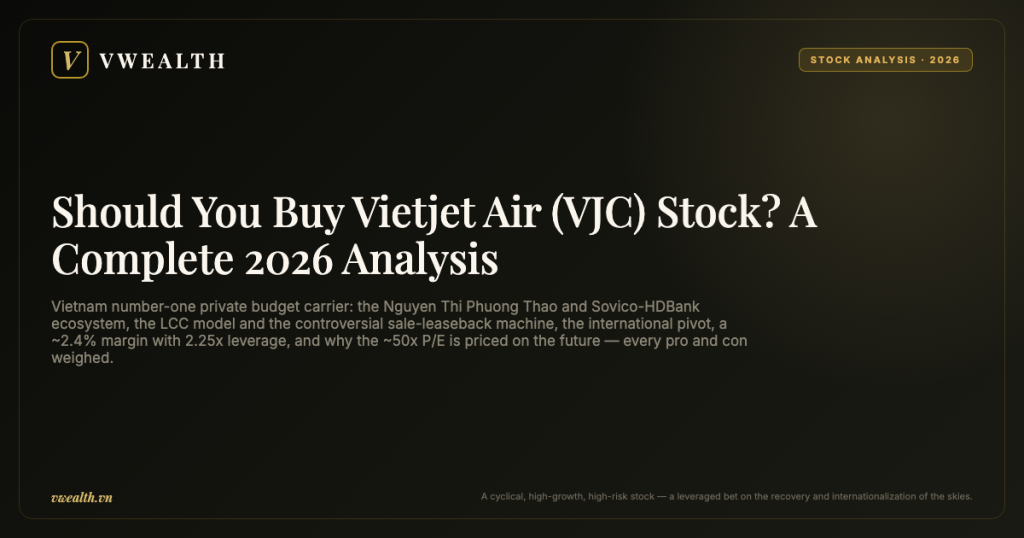
If you’re looking for a stock that carries both a compelling brand story and a real test of an investor mettle, then VJC — the stock of Vietjet Aviation JSC (HOSE: VJC) is a name hard to skip. This is Vietnam largest private low-cost carrier (LCC), tied to the image of Southeast Asia first self-made woman billionaire — Nguyen Thi Phuong Thao. Vietjet doesn’t just sell air tickets; it changed the very way tens of millions of Vietnamese think about “boarding a plane,” turning what was once the privilege of a few into a mass service.
But behind that inspiring story is a stock with a very distinct character, and you need to understand it clearly before putting money in. VJC is highly cyclical: its profit rises and falls with the post-COVID tourism-recovery wave, with peak and off seasons, with the economy health. The carrier runs on large financial leverage — a trait of aviation, among the most capital-intensive industries. And a significant part of Vietjet profit over many years comes from two factors you don’t control: aircraft sale-and-leaseback and the movement of oil prices. In other words, VJC is the stock of a fast-growing, high-ambition business whose results swing sharply.
At the time of writing, VJC trades around 140,500 dong a share (19 June 2026) — a price just technically adjusted after Vietjet did a 30% stock split (record date mid-June 2026). In 2025, the carrier closed a brilliant year: consolidated revenue 82,093 billion dong (up 14%), after-tax profit surging +51%, carrying 28.2 million passengers, while accelerating coverage of international routes to India, Central Asia, China and Australia.
So the question is very direct: should you buy VJC at this price, and if so, what kind of investor does it suit? To answer properly, you can’t just look at one year profit. You need to understand how Vietjet was born, why the LCC model helped it grow explosively, how the sale-leaseback “cash machine” works, how it survived the COVID shock, and why Vietjet is now pouring resources into pivoting to international flying. This full analysis will guide you through each of those layers. And we start from the root: Vietjet formation and evolution.
VJC market data (updated 19 June 2026)
| Current price | 140,500đ | 2025 revenue | 82,093 bn (+14%) |
| Change (June)* | −17.84% | 2025 after-tax profit | 1,968 bn (+51%) |
| P/E | Debt/Equity | ~50x | 2.25x | 2025 passengers | 28.2 million | 254 routes |
*The June drop is mainly a technical adjustment for the 30% stock dividend, not a fundamental decline. Source: VWealth price data + Vietjet 2025 statements. For reference only.
History and evolution
To understand why VJC is a stock worth analyzing carefully, you need to go back to the context of Vietnamese aviation over a decade ago — when flying was still a luxury for most people. Vietjet story isn’t merely the story of one business, but the story of a market being “unlocked.”
The birth context: breaking the monopoly of Vietnamese skies
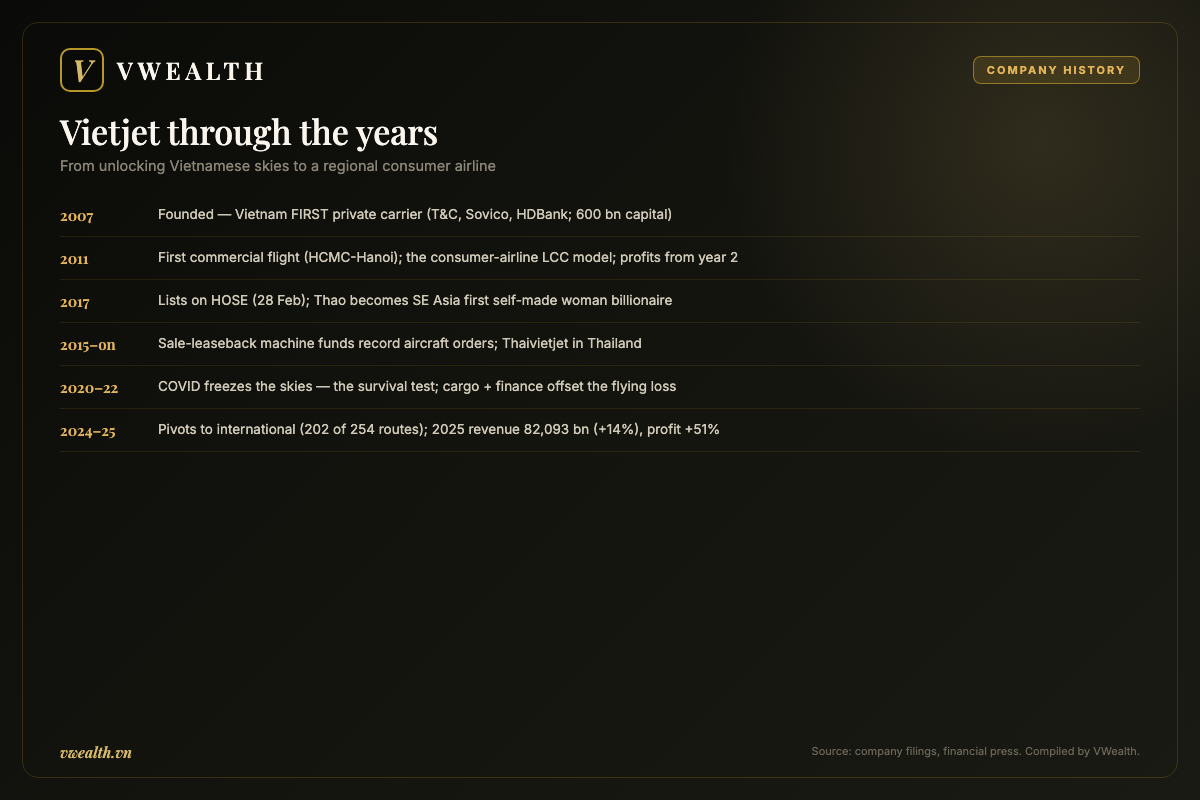
Vietjet was established on 23 July 2007, with three main founding shareholders — the T&C Group, Sovico Holdings and HDBank — with initial charter capital of 600 billion dong. This was the first private carrier licensed in Vietnam — a milestone more institutionally significant than an isolated business event.
Picture it: before Vietjet, Vietnamese skies were almost the sole playground of the national flag carrier. High fares, few choices, and flying belonged to the well-off or business travelers. The appearance of a private carrier with budget ambitions was the jolt that broke that monopoly. As transport-sector leaders later assessed, Vietjet joining the market ended the aviation-business monopoly, created healthy competition, and helped about 30% of passengers fly for the first time in their lives. That “30% flying for the first time” figure says it all: Vietjet didn’t just take share from rivals, it created a new market from people who had never flown.
Behind this ambition was Nguyen Thi Phuong Thao — who tied the Sovico ecosystem (diversified investment) and HDBank (finance) to an aviation dream. The combination of a diversified group, a bank and a carrier wasn’t accidental: it shows that from the start, Vietjet was designed as a project needing large capital and a strong financial machine behind it. This is a detail to remember, because later this very “aviation-tied-to-finance” structure would be both a strength and a point for caution with VJC.
Taking off in 2011 and the “consumer airline” model
Though licensed in 2007, Vietjet took over 4 years of preparation before it truly took off. The first commercial flight was on 24 December 2011, the Ho Chi Minh City – Hanoi route. Such a long delay is normal in aviation — where entry barriers are very high in capital, licenses, fleet and infrastructure.
What set Vietjet apart from the starting line was the new-generation low-cost model, which it positioned as a “consumer airline.” An LCC core philosophy is very simple but extremely effective: lower fares to the lowest possible to stimulate demand, then profit from large volume and ancillary services. You buy a cheap ticket, but if you want to choose a seat, add baggage, order a meal, buy insurance or duty-free onboard — you pay extra. Each small amount adds up to a high-margin revenue stream.
Vietjet runs this model methodically:
- A uniform fleet: focusing on the narrow-body Airbus A320/A321 reduces maintenance, pilot-training and operating costs.
- High frequency, quick turnaround: optimizing ground time so each aircraft flies more legs per day.
- Ancillary revenue: the classic LCC “weapon.” By 2024, Vietjet ancillary revenue reached about 12,500 billion dong, over 17% of total revenue — a very significant weight with a much higher margin than pure ticket sales.
- Bold marketing: Vietjet was famous (and controversial) for its “bikini airline” image in the early years. Though it drew mixed reactions, this shock-communications strategy helped a young carrier achieve huge brand recognition at low cost — right in the cost-optimizing spirit of an LCC.
The result of this model was astonishing: Vietjet profited from its second year of operation — rare for a new carrier, which usually loses money for years. And the pace of share-grabbing was almost unprecedented. Less than 5 years after its first flight, Vietjet passenger volume was on track to surpass the national carrier. By 2017, Vietjet held about 43% of the domestic share, and in recent years the two market leaders in Vietnam hover around 42–43% each. From zero, Vietjet rose to rival the state giant in just a few years.
The 2017 IPO and the “Phuong Thao phenomenon”
The milestone that turned Vietjet from a business story into a financial icon was its listing on the Ho Chi Minh Stock Exchange (HOSE). VJC officially debuted on 28 February 2017 at a reference price of 90,000 dong. On the very first session, VJC hit the 20% ceiling — the maximum for a newly listed stock — and Vietjet raised about $167 million, becoming the largest IPO on Vietnam market at the time.
Nguyen Thi Phuong Thao herself shared that taking Vietjet to the exchange was a deal that stretched over “800 days” — a road so arduous she once half-jokingly said she “wouldn’t advise Vietnamese businesses to follow Vietjet path.” That rigor reflected the ambition to make Vietjet transparent and standardized to the standards of a large public company.
This IPO created a historic “phenomenon”: it made Nguyen Thi Phuong Thao Southeast Asia first self-made woman billionaire, per Forbes. With her VJC stake, she immediately entered the group of the richest on Vietnam market. For you — an investor — the real meaning of this milestone isn’t the inspiring story, but that from 2017, Vietjet financial health became public, audited and monitored by the market. VJC officially became an asset you can buy, sell and value.
Vietjet 2017 IPO was both the largest financial milestone on Vietnam market at the time and the birth of Southeast Asia first self-made woman billionaire — turning a budget carrier into a market-cap icon.
The huge aircraft-order strategy and the sale-leaseback “machine”
This is perhaps the most important part, and also the most easily misunderstood, when you analyze VJC. Vietjet continually draws attention with record aircraft orders, hundreds at a time: from the Airbus A320/A321neo, to the Boeing 737 MAX, and recently the wide-body Airbus A330neo.
A few numbers to picture the scale:
- In 2025, Vietjet signed an order for 100 A321neo (plus options for 50 more) with Airbus, worth about $25 billion.
- Earlier, it ordered 20 wide-body A330neo — preparing for long-haul, intercontinental ambitions.
- Vietjet also has an agreement to buy up to 200 Boeing 737 MAX, part of a tens-of-billions-of-dollars cooperation package with US partners.
The natural question many investors ask: where does a budget carrier get the money to buy hundreds of aircraft like that? The answer lies in the sale-and-leaseback model — and this is Vietjet distinctive “cash machine” over the years.
Here is how it works, step by step:
- Step 1: Vietjet orders a large number of aircraft directly from the manufacturer (Airbus, Boeing). Thanks to the huge order size, it gets a very deep discount versus list price.
- Step 2: When the aircraft is delivered, Vietjet sells it to aircraft-leasing companies at the market price — higher than the discounted buy price. This difference is recorded as profit.
- Step 3: Immediately after, Vietjet leases back the very aircraft it just sold to operate. It doesn’t need large capital to own the plane, only paying periodic lease — reducing capital pressure with a lease cost far better optimized than the market average.
The benefit of this model is clear: it lets Vietjet expand its fleet extremely fast without “burying” billions of dollars of capital in assets, while creating a significant profit stream from the price difference. This is why the huge aircraft orders aren’t just transport ambition, but a financial strategy.
However — and this is what you must remember when valuing VJC — the sale-leaseback profit is uneven and depends on the aircraft-delivery schedule. In a year Vietjet receives and “flips” many aircraft, profit can look beautiful; in a year of supply-chain congestion or slow deliveries, this profit stream shrinks. So when you look at Vietjet profit figure, always separate: how much comes from core flying operations (passenger transport, ancillary) and how much from financial operations — sale-leaseback. This is the key to correctly understanding the “quality” of VJC profit.
“Exporting” the model: Thaivietjet and regional ambition
Not stopping at the domestic market, Vietjet soon sought to replicate the LCC model across the region. Thai Vietjet Air — the joint venture in Thailand — began operating from March 2015, using Suvarnabhumi airport (Bangkok) as its base. This was Vietjet “export the budget-flying model” move.
And that move paid off: after nearly a decade, Thai Vietjet rose to the leading group in Thailand domestic market, surpassing even long-established rivals. Gaining a foothold in a large tourism market like Thailand both diversifies Vietjet revenue and creates a springboard for the regional network. For you, this detail shows Vietjet isn’t a carrier that “only knows the home market” — it’s a business with ambition and capability to reach beyond borders.
The 2020–2022 COVID shock and the survival test
If there is one period that most clearly reveals the cyclical nature and risk of an aviation stock, it’s the COVID-19 pandemic. When the whole world closed its skies in 2020–2021, the entire aviation industry fell into an unprecedented crisis, and Vietjet was no exception. Its air-transport operations lost thousands of billions of dong — in the first half of 2020 alone, the air-transport segment lost over 2,100 billion dong.
However, how Vietjet reacted shows the machine notable flexibility:
- Pushing cargo — using passenger aircraft to carry freight when there were no passengers.
- Developing new service products like SkyBoss and the Power Pass flight card to maintain cash flow.
- Leveraging financial operations, asset transfers and investments to offset the transport loss.
Thanks to this, there were periods when Vietjet still reported consolidated profit from non-transport sources, even as the core flying segment lost money — a notable “reversal” amid the COVID super-storm. Even so, in 2022 financial costs surged (interest, FX), so the carrier still recorded a significant after-tax loss. This is clear evidence of leverage risk: when interest rates and FX move unfavorably, a business with large debt and many foreign-currency aircraft-lease obligations faces very strong profit pressure.
By 2023, as tourism and travel recovered, Vietjet returned to its growth orbit, with quarterly profits recovering strongly, and the carrier firmly denied the bankruptcy rumors that had spread during the tough period. The lesson you take from this period is very important: VJC is the stock of an industry extremely sensitive to external shocks — pandemics, oil prices, interest rates, FX. When everything is favorable, profit booms; when storms hit, the carrier can flip from profit to loss very fast.
Pivoting to international flying: a new growth chapter
After the pandemic, Vietjet made a defining strategic move: pouring resources into expanding the international network. The domestic market was near saturation and fiercely competitive with thin margins; while international routes bring higher revenue per passenger.
The scale of this shift is impressive. In 2025, Vietjet operated a total of 254 routes, of which up to 202 were international and only 52 domestic — a structural reversal versus the early years when it flew mainly domestically. It opened a series of new routes to high-growth markets:
- India: opening routes connecting Ho Chi Minh City with Bengaluru, Hyderabad and other cities — targeting the huge tourism and labor market.
- Central Asia and China: opening a series of new routes to this region in 2025.
- Australia: expanding long-haul routes, using the newly ordered wide-body A330 fleet.
A very notable point for you: from 2025, Vietjet earned more from carrying international passengers than domestic. This is a fundamental change in revenue quality. Pivoting to international helps Vietjet escape the domestic “race to the bottom” on fares, while opening a far larger long-term growth runway. That is also why the carrier ordered wide-body A330/A330neo aircraft — the “cards” for the intercontinental-flying dream.
All these moves converged in the 2025 results — a pivotal year: consolidated revenue 82,093 billion dong (+14%), after-tax profit up as much as 51%, carrying 28.2 million passengers on about 153,000 flights. Into 2026, the momentum continued, and the carrier decided on a 30% stock dividend from retained earnings — a move that both rewards shareholders and boosts VJC liquidity (and is also why the reference price adjusted to the 140,500-dong zone you see today).
Summing up the journey — and what to look at next
From a private carrier licensed in 2007, taking off in 2011, Vietjet has traveled an extraordinary path: breaking the monopoly of Vietnamese skies, democratizing flying, listing and creating Southeast Asia first self-made woman billionaire, building the sale-leaseback “machine” from record aircraft orders, surviving the COVID shock, and now repositioning itself as a true international carrier.
Understanding this history, you have the foundation to view VJC correctly: this is a high-growth but strongly cyclical stock, with large leverage, and profit quality that needs careful dissection. But an ambitious business like Vietjet can’t be separated from the people steering it. What team made the bold multi-tens-of-billions-of-dollars aircraft bets? What is the ownership structure, and do the leadership interests align with yours — the small shareholder — or not? That’s the content of the next section: Leadership and ownership structure.
Leadership and ownership structure
When you hold VJC, you don’t just buy a budget carrier. You’re betting on one person and one ecosystem. Rarely is a listed business on HOSE tied so tightly to one individual: Nguyen Thi Phuong Thao. Understanding her and the power network around her — the Sovico Group, HDBank, Phu Long real estate — is understanding the biggest “hidden” part behind Vietjet balance sheet. In this section, the writer will dissect each layer with you: who steers, who owns, and what points you must scrutinize before putting money in.
Nguyen Thi Phuong Thao — self-made woman billionaire and the mind behind Vietjet
Nguyen Thi Phuong Thao (born 7 June 1970 in Hanoi) is Chair of the board and CEO of Vietjet Aviation JSC. But to understand how she could build a carrier from nothing, you need to go back to the 1980s–1990s. As a finance-economics student in Moscow (former USSR), she began business: distributing fax machines, rubber, plastic and consumer goods from Japan, Hong Kong and Korea to the goods-scarce Soviet market. Per Forbes and Wikipedia, she became a dollar millionaire at just 21. That wasn’t inherited wealth — it was money self-earned in the chaotic post-Soviet market, and this “cross-border trading” experience shaped her aggressive commercial thinking later.
On education, she holds a bachelor in financial-credit management and labor economics at the Plekhanov University of Economics (Russia), and a doctorate in economic management at the Mendeleev University of Chemical Technology (Russia). This financial-credit foundation explains why she is skilled not just in aviation, but also deeply understands banking and capital structure — key when running the sale-and-leaseback model we discuss at the end of this section.
The historic milestone came in February 2017, when Vietjet listed on HOSE. Forbes recognized Thao as Vietnam first self-made woman billionaire and the only woman billionaire in Southeast Asia at the time — as well as Vietnam second dollar billionaire (after Pham Nhat Vuong). Per data cited from Forbes, as of October 2025 her net worth was estimated at about $4.2 billion, ranking around 964th globally. Most of this wealth comes from her stakes in Vietjet (VJC) and HDBank (HDB) — the twin pillars of her empire. In 2021, she was also awarded the French Legion of Honour.
For an investor, the point to remember is: Thao asset value is directly tied to VJC and HDB market prices. This creates a strong “shared interest” — she has a big incentive to keep the share price healthy. But it also means concentration risk: the business fate is tied too tightly to one individual.
Thao style is tied to breakthrough, sometimes controversial marketing — from a low-fare pricing strategy to expand the “everyone can fly” market, to bold communications campaigns that once made waves. The through-line vision is to turn Vietjet from a domestic budget carrier into a “modern multinational aviation group,” per the 2025–2030 strategy the board itself announced. You need to assess this ambition soberly: it’s both a growth driver and the source of large financial leverage.
The Sovico ecosystem: power enveloping Vietjet
To value VJC, you can’t separate it from the Sovico Group (Sovico Group / Sovico Holdings) — the spiritual “parent” of the whole network. Thao is simultaneously Chair of Sovico, Standing Vice Chair of HDBank board, and Chair and CEO of Vietjet. One person, three seats of power at the three largest links — that is what makes this ecosystem run seamlessly, but also what small shareholders must be wary of.
Per economic press, Sovico operates on four main pillars:
| Field | Emblematic links in the Sovico ecosystem |
|---|---|
| Aviation | Vietjet Air (VJC) — Sovico is a founding and large shareholder |
| Finance – Banking | HDBank (HDB), HD Securities (formerly Phu Gia Securities), fund management |
| Real estate – Resorts | Phu Long real estate (Dragon City South Saigon), Furama Resort Da Nang, the Ariyana project, Abacus Tower |
| Energy – Industry | Power – renewable energy, petrochemicals |
The link Vietjet ↔ HDBank ↔ Sovico ↔ Phu Long isn’t accidental but a deliberate design. HDBank provides credit and financial services; Sovico is the “brain” owning and coordinating capital; Phu Long brings cash flow and land (notably a strategy targeting areas around airports — a direct synergy with aviation). When a carrier has a “sister” bank and a resource-rich parent group behind it, it enjoys a capital-access advantage independent rivals struggle to match. The press once called Sovico the group “backing” both HDBank and Vietjet — a phrase that captures both the strength and the risk.
The meaning for VJC shareholders: the ecosystem brings flexible capital-raising, liquidity support and stability in tough periods (like the pandemic). But the risk is that cross-ownership and internal transactions may mean minority-shareholder interests don’t always coincide with those of the controlling group. You’re investing alongside a very powerful person — both an anchor and a point for caution.
The executive team: the 2025–2026 handover generation
A point many old analyses haven’t updated: the Vietjet CEO seat has changed significantly. You need to get this right so as not to be confused.
Dinh Viet Phuong — who spent many years as Vietjet CEO/Managing Director — stepped down as CEO and was elected First Vice Chair of the Vietjet board for the 2022–2027 term, per a disclosure effective from 29 April 2026. Phuong has over 24 years of senior-leadership experience, graduated from the Maritime University, holds an MBA from CFVG (France) and a doctorate from the Moscow State Academy of Water Transport.
Replacing Phuong as CEO is Nguyen Thanh Son (born 1971), who holds an MBA and over 30 years of aviation experience. Promoting an industry veteran to run the business, while keeping Phuong as First Vice Chair, shows a succession-oriented handover tied to the 2025–2030 development strategy.
| Person | Current role (updated 2026) | Note |
|---|---|---|
| Nguyen Thi Phuong Thao | Chair of the board and CEO | Also Chair of Sovico, Vice Chair of HDBank |
| Dinh Viet Phuong | First Vice Chair of the board | Former CEO, effective from 29/4/2026 |
| Nguyen Thanh Son | CEO | Over 30 years of aviation experience |
For you — an investor — the stability of the executive team is a positive signal: no “sudden blood transfusion due to crisis,” but a deeper reorganization. Even so, remember that real power at Vietjet still rests with the Chair seat and the controlling shareholder group, not just the CEO seat.
Ownership structure: the Thao group holds control
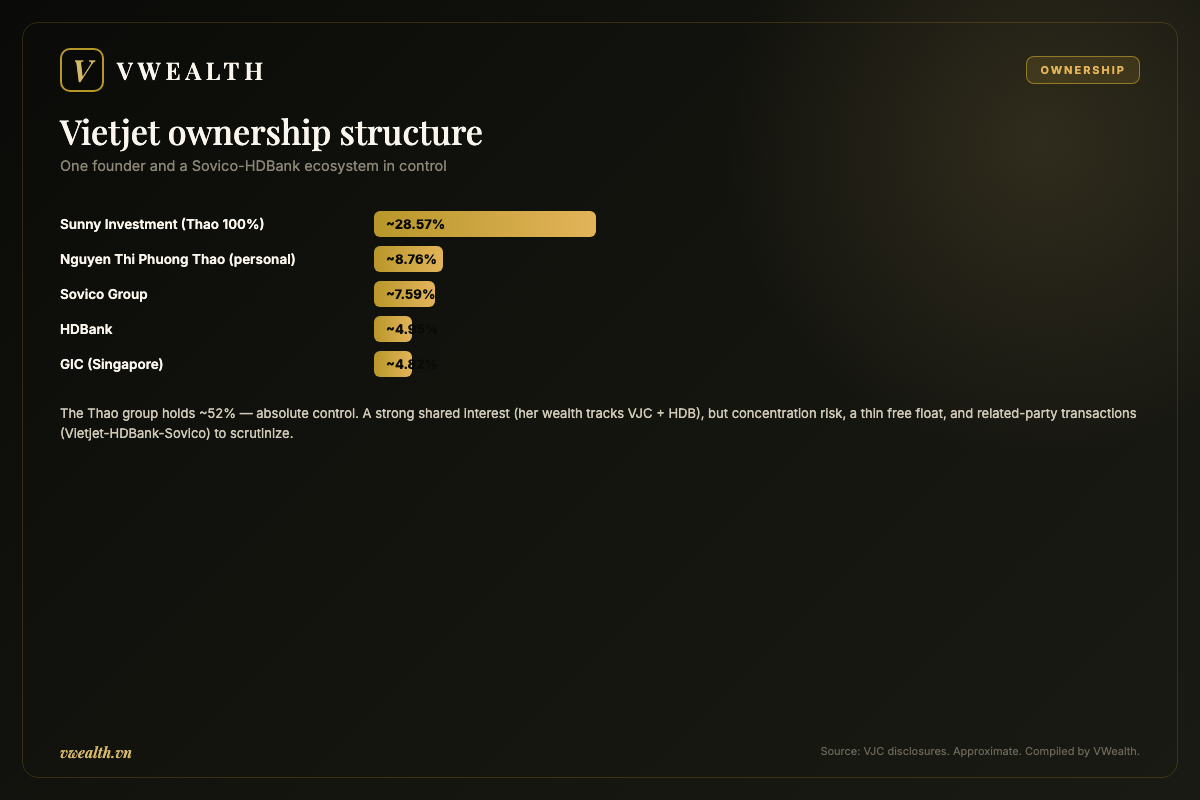
This is the “backbone” part you must not skip. Vietjet ownership structure shows a very high concentration in the group related to Nguyen Thi Phuong Thao. Based on disclosed data and press citations (the ratios below are for reference as of disclosure; you should cross-check VJC latest governance report before deciding):
| Shareholder / Group | Ownership (reference) | Nature of relation |
|---|---|---|
| Sunny Investment (Huong Duong Sunny) | ~28.57% | 100%-owned by Thao |
| Nguyen Thi Phuong Thao (personal) | ~8.76% | Direct |
| Sovico (Sovico Group) | ~7.59% | Thao is Chair |
| HDBank | ~4.95% | Bank in the ecosystem |
| GIC (Singapore government) | ~4.82% | Foreign fund |
Adding up the entities and individuals related to Thao, the press once recorded ownership of about 52% of Vietjet after Sovico completed buying more shares. In other words, the controlling shareholder group holds absolute control — they decide almost every matter at the general meeting. This has two clear sides you need to weigh:
The positive side: The founder “bets big” on her own business. This interest alignment usually creates long-term commitment, consistent direction, and reduces hostile-takeover risk. Investment figures by family members (like reports that Thao son planned to spend hundreds of billions buying VJC shares) are also seen by the market as a signal of internal confidence.
The risk side: The free-float ratio is effectively narrowed when too many shares are in the related group hands. Minority shareholders have very little voice in governance. When power is highly concentrated, checks and balances weaken, and the controlling group interests may be prioritized. The presence of a reputable foreign fund like GIC is somewhat reassuring on governance quality, but its ratio isn’t large enough to truly counterbalance the controlling group.
On foreign ownership, reference data show VJC foreign room at about 10–11% as of mid-2025 — not too high, indicating there is still room for foreign capital but also reflecting a relatively “closed” shareholder structure.
Governance: related-party transaction risk — the point you must scrutinize most
If there is only one thing in this section that should make you pause, it’s related-party transactions. When a business sits in a dense cross-ownership ecosystem — Vietjet, HDBank, Sovico, Phu Long all share the same “soul,” Thao — transactions between these entities need absolute transparency, because this is where minority-shareholder interests are most easily affected.
The focus of debate for years has been the sale-and-leaseback (SLB) model. It works like this: Vietjet signs an aircraft-purchase contract with the manufacturer (Airbus, Boeing) and pays a small deposit; before or at delivery, Vietjet sells the aircraft to a lessor then leases the very same aircraft back to operate. The difference between the discounted buy price (thanks to the large order) and the resale price is booked as profit right at delivery.
The press once calculated that at one period SLB brought Vietjet nearly 2,200 billion dong of gross profit, while consolidated gross profit from all operations was only about 871 billion — implying core operations (passenger transport) may actually have been losing over 1,300 billion at that time. This is why experts call SLB a “double-edged sword.”
Why should you care? Because SLB can “beautify” accounting profit: profit is recognized upfront in one shot, but the lease cost stretches over many years and is usually higher than other financing forms, especially when FX moves unfavorably. Vietnam Airlines itself once publicly argued that recognizing revenue from SLB is a way of “pushing risk to the future.” When assessing VJC, you need to separate: how much profit comes from real flying operations, and how much from the SLB financial operation — because these two streams have entirely different quality and sustainability.
Besides, pay attention to other transactions in the ecosystem: the credit-deposit relationship with HDBank, transactions with Sovico entities, the parent group bond issuance. These transactions aren’t inherently bad — they’re common at every large group. The issue lies in the terms and prices: whether they’re done on a fair, arm-length basis. This is when you need to read carefully the “related-party transactions” notes in VJC audited financial statements, and track the corporate governance report.
In sum, on governance, Vietjet is a classic story of a family-ecosystem business: you get financial synergy, capital-raising ability and a visionary leader whose interests are tightly tied to the stock; in exchange, you accept concentrated-power risk, limited free-float and the complexity of internal transactions. The writer advises you not to see this ownership structure as absolutely “good” or “bad,” but as a set of risk parameters to discount into your own valuation expectations.
Having understood “who steers and who owns,” your next step is to look at the real money-making machine: how Vietjet business ecosystem and operating segments run, where the growth drivers are and where the bottlenecks are. That’s what we’ll dissect in the next section.
Business model and ecosystem
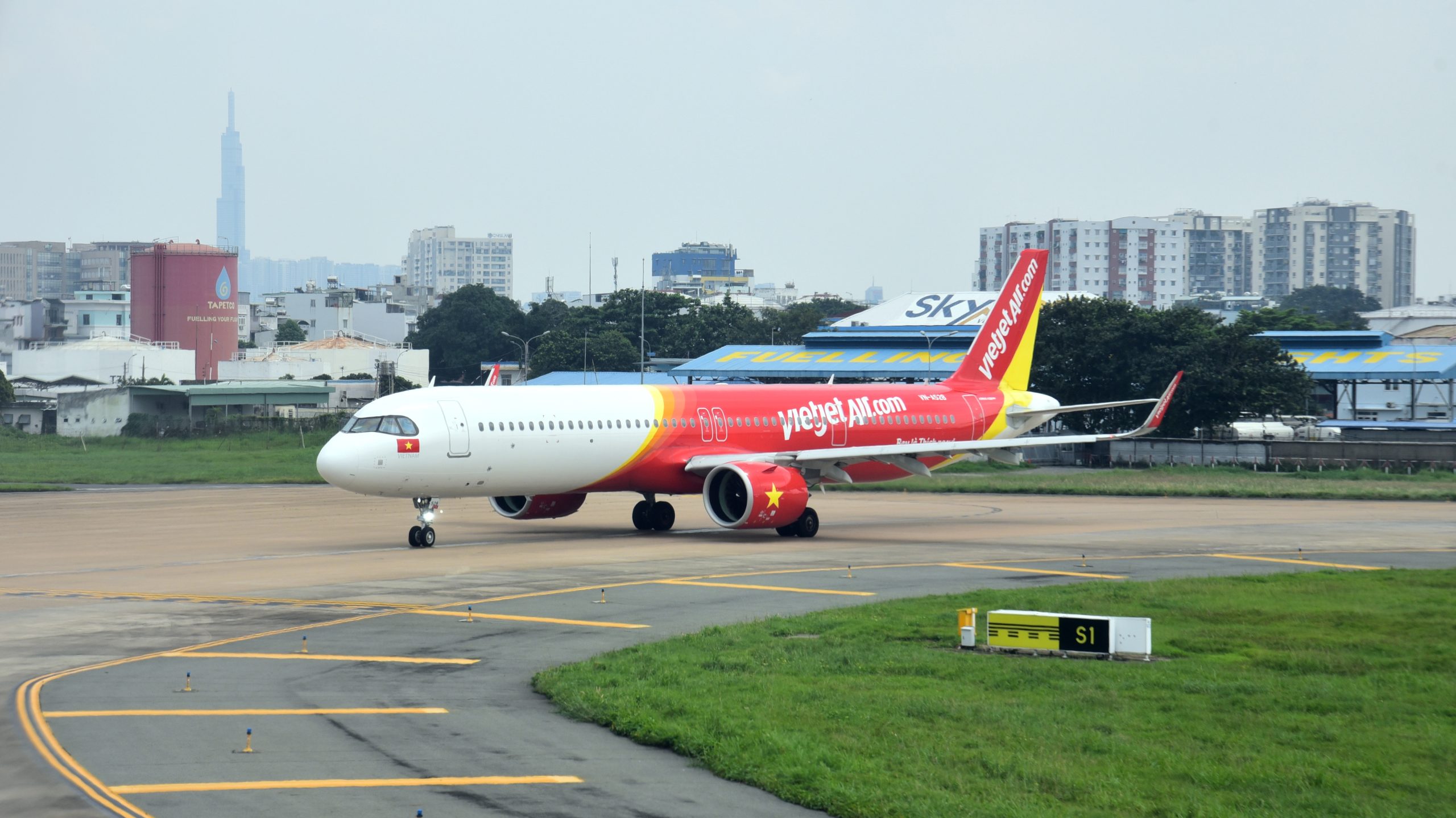
When you see a bright-red Vietjet aircraft take off, you easily assume this is just a carrier selling tickets like any other. But if you want to understand VJC stock, you must dissect the money-making machine behind that shell. Vietjet doesn’t run like a traditional carrier. It’s a combination of a pure-bred low-cost carrier (LCC), an aircraft-trading company, and a link in the Sovico Group finance-consumer ecosystem. These three layers overlap to create a profit model that is both attractive and controversial. This section helps you understand each layer, even if you’re just starting to learn about aviation.
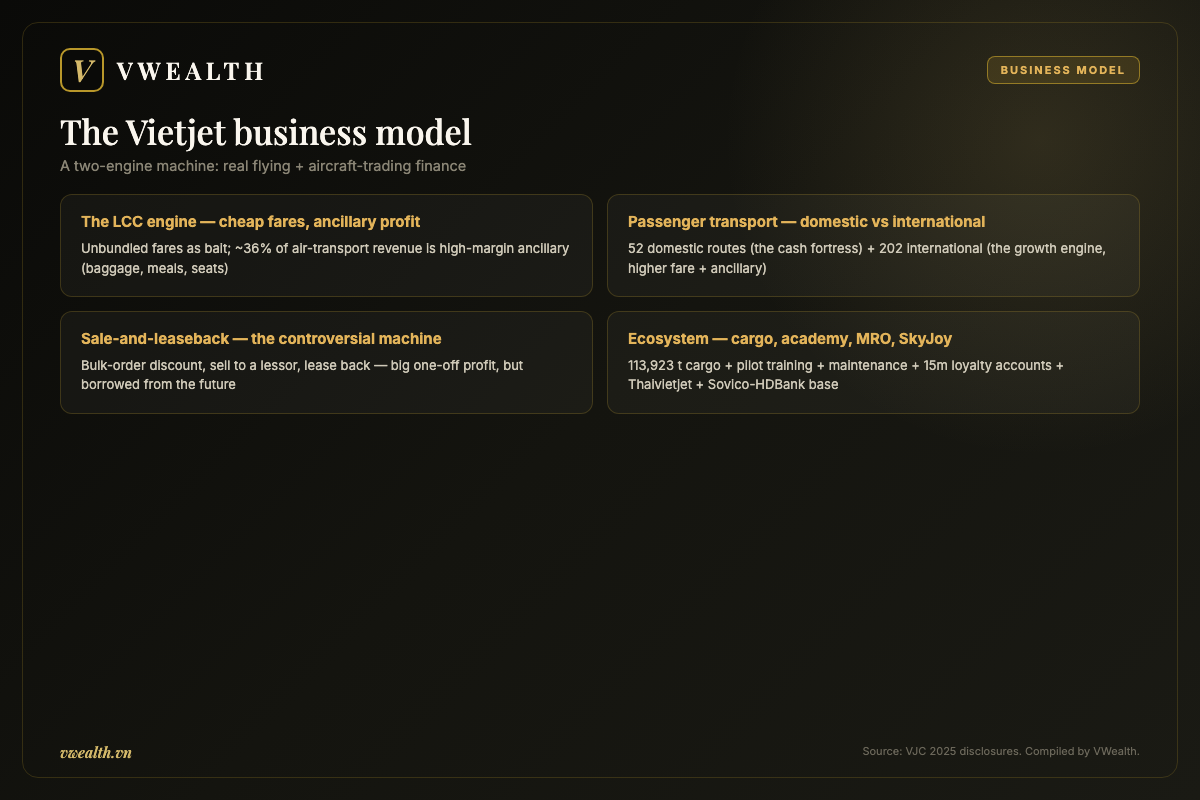
Before going deep, grasp a few 2025 framing numbers as an anchor. That year, Vietjet carried 28.2 million passengers (up 9%), operated 153,000 flights (up 11.2%), ran 254 routes of 52 domestic and 202 international, and carried 113,923 tonnes of cargo. Consolidated revenue reached about 82,093 billion dong, after-tax profit about 2,123 billion dong (up 51.2%, beating plan by 120%). The general meeting approved a 30% stock dividend. These numbers are the output of the machine we’re about to dissect.
The LCC model: cheap fares as bait, ancillary as profit
LCC stands for Low-Cost Carrier. This model core philosophy is very simple but extremely effective: sell very cheap tickets to fill seats, then profit from add-ons. Picture it: a traditional carrier sells you a “bundled package” — the fare includes checked baggage, meals, seat selection. Vietjet does the opposite. It unbundles all those services from the fare. The base fare is just the right to board and fly from A to B. Everything else is a paid option.
Why is this strategy so potent? Because the low fare acts as a psychological “hook.” When you see a Saigon–Hanoi ticket for a few hundred thousand, even “0-dong fare” promotions, you’re drawn in and book. But at checkout, you realize you need 20kg more baggage, want an exit-row seat for legroom, want to pre-order a hot meal, and maybe buy flight insurance. Each choice adds a few dozen to a few hundred thousand. All these together form what finance calls ancillary revenue.
This is Vietjet “weapon,” and you need to understand why it matters so much to a shareholder. Vietjet ancillary revenue has contributed up to about 36% of total air-transport revenue, and this weight has exceeded 35% in some quarters. This source alone rose nearly 12% year on year. What makes it a weapon isn’t the size, but the margin.
Selling a ticket, the carrier bears fuel cost, airport fees, crew salaries, aircraft depreciation. Selling 20kg more baggage or a seat selection has near-zero marginal cost — the plane takes off whether the cargo hold is full or empty. So each dong of ancillary revenue is far “sweeter” than each dong of fare.
In other words, if the fare is a fierce race where carriers trample each other to cut prices, ancillary revenue is a fertile, less-competitive land where nearly all revenue flows straight to profit. A good LCC isn’t the one selling the most expensive ticket, but the one that optimizes the ancillary ratio per passenger. When you track VJC in quarterly reports, always watch the ancillary-revenue-per-passenger figure — it tells you whether the LCC machine is running well or flagging.
Passenger transport: domestic holds the fort, international opens the way
Vietjet heart is still carrying people. This segment splits into two fronts with very different roles, and you need to distinguish them clearly.
The domestic market — the cash-flow fortress
In Vietnam, Vietjet is one of the leaders in domestic share. This is the carrier “fortress”: a dense network connecting major cities and tourist spots, high frequency, a brand familiar to Vietnamese. The domestic segment brings stable cash flow and helps Vietjet maintain a high load factor. However, the domestic market is fairly saturated and fiercely competitive with Vietnam Airlines and Bamboo Airways. There isn’t much growth room left, and the margin is eroded by the fare race. So domestic plays a “hold the fort” role more than a growth engine.
The international market — the growth engine
This is where the VJC growth story is written next. In 2025, of the 254 total routes, up to 202 were international — an overwhelming ratio showing the reach-out strategy has become the backbone. The carrier opened 22 new routes toward Central Asia and China in the year. The target markets span widely: India (the billion-person market seen as a gold mine), Central Asia, China, Australia, plus the traditional markets Japan, Korea, Indonesia, Thailand.
Why is international important to you — an investor? Three reasons. First, international legs are longer, so fares are higher and ancillary revenue per passenger is larger — long-haul passengers tend to buy more baggage and meals. At one point, international-passenger revenue exceeded domestic-fare revenue. Second, this is a market with much room, where Vietjet can grow double digits instead of fighting over a fully divided domestic pie. Third, the international network leverages Vietnam geography as a regional transit hub. In exchange, international requires wide-body aircraft (Vietjet ordered 20 Airbus A330neo), high new-route-opening costs and larger FX risk.
Sale-and-leaseback: the key and most controversial profit source
If you learn only one concept in this whole section, learn this. Sale-and-leaseback is the key to understanding why Vietjet profit reports are sometimes unbelievably beautiful, and why many analysts frown looking at them.
How it works — step by step
Follow this sequence of events:
- Step 1 – Order in bulk: Vietjet orders aircraft from Airbus (and Boeing) in very large quantities — hundreds at once, e.g. an order of 100 A321neo plus 50 purchase options. When you buy hundreds of aircraft wholesale, you get a very deep discount versus list price.
- Step 2 – Receive the aircraft: at delivery, Airbus hands over the aircraft to Vietjet at the pre-agreed discounted price.
- Step 3 – Sell to a lessor: Vietjet immediately sells that aircraft to a leasing company (lessor) like AerCap, at a market price higher than what it paid.
- Step 4 – Lease the same one back: at the same time, Vietjet signs a lease-back contract for the very aircraft it just sold, over a long term (usually 8–12 years), to keep operating.
The result? Vietjet pockets the difference between the discounted wholesale price and the price sold to the lessor, booked as profit. The aircraft stays in the fleet and carries passengers normally — legally it belongs to the leasing company, while Vietjet pays monthly lease. The carrier gets fresh cash immediately, avoids taking on huge debt to own the plane outright, and books a significant profit.
Two sides of the coin — why it’s controversial
This is where you need clear eyes. Sale-and-leaseback is a legal, globally common financial tool, but how Vietjet uses and accounts for it creates two opposing views.
The bright side — the supportive view: This is a smart working-capital optimization. Vietjet turns its wholesale-negotiating power into real cash, freeing capital to expand the fleet fast without piling on debt. Using large orders for a discount then realizing the difference is a real business skill, not accounting magic. Many LCCs worldwide use this model to grow fast.
The dark side — the critical view: The issue is that this profit doesn’t come from the core activity of carrying passengers. This is “technical” financial-and-aircraft-trading profit. Analysts point out a few things to watch:
- Unsustainable profit: sale-leaseback profit depends on the aircraft receive-and-sell schedule. In a year of receiving many aircraft, profit spikes; in a lean year, it drops. It doesn’t reflect whether the flying is truly profitable.
- “Borrowing profit from the future”: when you sell an aircraft at a high price today to book profit, you simultaneously commit to higher lease payments for years to come. That is, you’ve recognized future profit in the present, pushing lease costs later. This year beautiful profit is partly “borrowed” from later years.
- Accounting controversy: there has been debate about how Vietjet records aircraft-sale proceeds into revenue/income to properly meet accounting standards — whether this should be income or a finance-lease obligation. This makes reading the carrier “real profit” far more complex than an ordinary business.
The lesson for you investing in VJC: don’t look at the total profit figure and rush to rejoice. Peel apart how much comes from flying (tickets + ancillary + cargo) and how much from aircraft trading. Profit quality matters more than profit size.
Supplementary revenue sources in the ecosystem
Beyond the three main pillars above, Vietjet built a series of satellite segments, each earning money while reinforcing long-term position.
Cargo
The belly of a passenger aircraft always has room for freight, and Vietjet exploits that hold fully. In 2025 the carrier transported 113,923 tonnes of cargo. Cargo has strategic value because it uses existing assets (the flight takes off whether there’s cargo or not), creates a revenue stream less sensitive to the travel season, and especially booms thanks to cross-border e-commerce. This is a good defensive segment when travel demand fluctuates.
Aviation academy (pilot training)
Vietjet Academy trains pilots, flight attendants and technical staff. In 2025, the academy ran 15,198 courses for about 162,100 trainee slots (up 53% and 30% respectively). This segment solves the industry scarce-labor problem — instead of depending on external supply, Vietjet trains its own pilots for the swelling fleet, and can train for other carriers for a fee. This is a hidden competitive advantage newcomers often overlook.
Technical and maintenance services
Vietjet invests in maintenance-repair-overhaul (MRO) capability, especially tied to a facility at Long Thanh airport. Technical self-reliance helps the carrier cut the cost of sending aircraft abroad for maintenance and control its operating schedule. Long term, MRO could also become a service sold to other carriers in the region.
SkyJoy — the loyalty program
Launched in May 2023, SkyJoy quickly reached over 15 million member accounts. Don’t dismiss a points program. SkyJoy is a customer-retention tool, gathers behavior data, and turns Vietjet into a consumer platform rather than just a carrier. Reward points can link with the Sovico–HDBank ecosystem, creating a closed loop between flying, spending and personal finance.
Thaivietjet and regional ambition
Vietjet doesn’t stop at Vietnam borders. Through the Thai Vietjet joint venture in Thailand, the carrier plants a foot in one of Southeast Asia most vibrant aviation markets, operating the Thai domestic network and international routes from Bangkok. This “multinational” strategy helps Vietjet spread risk beyond a single market, while building the image of a regional-scale LCC rather than just a national one. The ambition reaches further with plans to open routes to Europe and North America with the wide-body A330neo fleet, plus an international aviation-finance center project tied to the International Financial Center in Ho Chi Minh City. The infrastructure project at Long Thanh airport — Vietnam future largest airport — is a card for Vietjet to lay the foundation for the next growth phase.
The Sovico – HDBank ecosystem: a capital and customer base
This is the final layer and the one that makes Vietjet fundamentally different from a standalone carrier. Vietjet doesn’t stand alone — it sits within the ecosystem of the Sovico group led by Nguyen Thi Phuong Thao, tightly tied to HDBank, real estate and energy.
This synergy gives Vietjet advantages rivals struggle to have:
- A capital base: a carrier needs enormous capital to buy/lease aircraft. The relationship with HDBank and Sovico financial network helps Vietjet access capital more easily, especially in fleet-financing and sale-leaseback deals.
- Customer-data synergy: Vietjet flyers, SkyJoy members and HDBank customers can be cross-connected via co-branded cards, consumer finance, points. Each segment feeds customers to the others.
- The “consumer airline” positioning: the leadership vision is to turn Vietjet into a consumer airline — where the ticket is just the gateway to sell a range of other services and financial products to tens of millions of customers a year.
The flip side to note: tight ties to a family ecosystem also raise questions about governance, related-party transactions and transparency. As an investor, you should view this as a double-edged sword — both a strength and a governance risk to monitor.
To close: a two-engine machine and a connecting bridge
In sum, picture Vietjet as a machine running on two parallel engines. The first is pure flying: cheap fares draw passengers, then it squeezes profit from high-margin ancillary revenue, cargo, and expanding the international network. This is the engine that creates sustainable cash flow, reflecting the true health of an LCC. The second is the financial-and-aircraft-trading machine via sale-and-leaseback, creating large but technical profits that are uneven and controversial on quality.
Surrounding these two engines is a broad ecosystem — the training academy, technical services, SkyJoy, Thaivietjet, and especially the Sovico–HDBank base — helping Vietjet position itself not just as a carrier but as a regional “consumer airline.” It’s this hybrid model that creates both attractive profit and distinctive risks: hard-to-read profit quality, dependence on the aircraft-delivery schedule, and high financial leverage. Understanding that structure is a prerequisite before you step into the next section — where we examine VJC position and financial health to see how solid this machine really is.
Position and financial health
When you look at Vietjet (ticker VJC), the first thing to remember is that you’re analyzing a business with two very different faces. On the first face, this is Vietnam largest private carrier, a brand that reshaped how Vietnamese fly and is reaching across Asia. On the second face, this is a capital-intensive financial machine running on a margin so thin that even a small move in oil prices or FX is enough to shake the bottom-line profit. Understanding both faces is the key so you aren’t swept up in glossy growth numbers while missing the risks deep in the balance sheet.
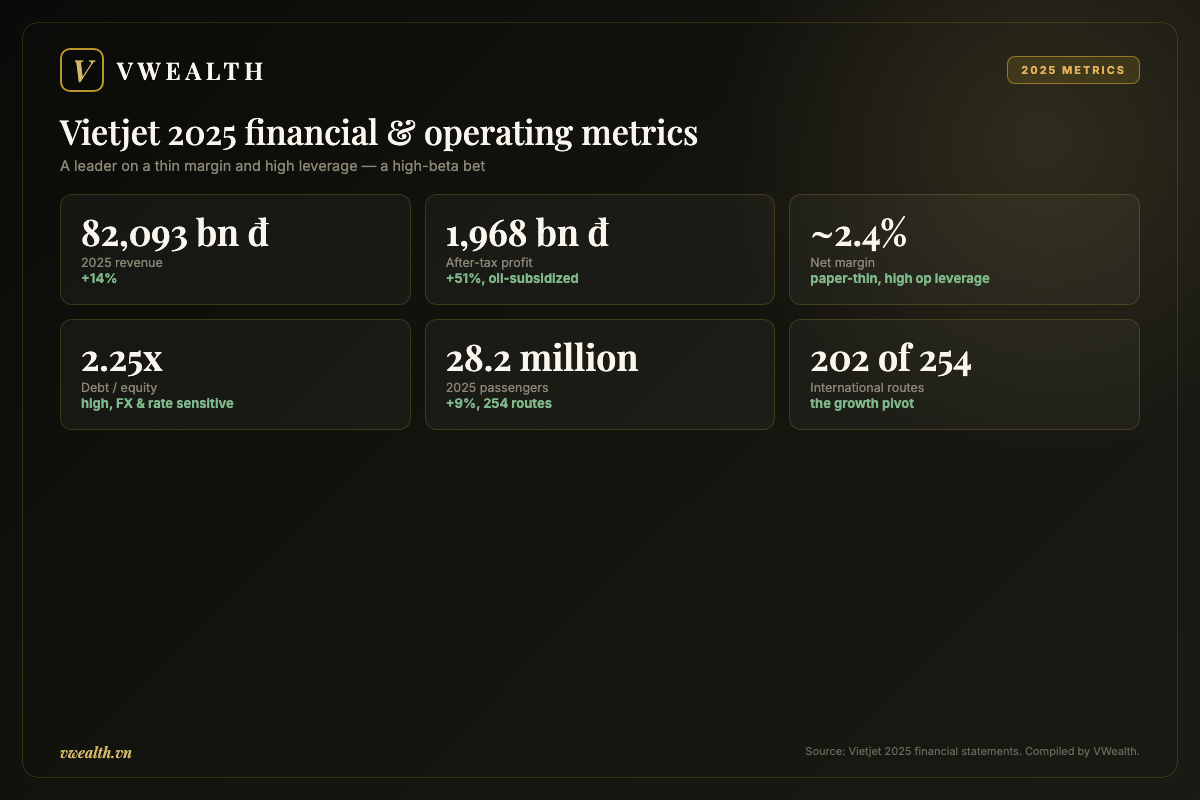
In 2025, Vietjet booked consolidated revenue of 82,093 billion dong, up 14% year on year; consolidated after-tax profit reached 2,123 billion dong, while parent-company after-tax profit was 1,968 billion dong, up 51% and beating the year plan by over 120%. Q4 was especially impressive with pre-tax profit of 579 billion dong, up as much as 436% year on year. Total assets touched 139,459 billion dong. These numbers, at first glance, paint the picture of a business taking off strongly. But behind them is a financial structure you need to dissect carefully before placing your trust.
The industry-leading position: a real advantage, not a hollow title
Let’s start with the positive and real. Vietjet is the private carrier leading Vietnam domestic share, with about 45% of domestic passenger share. This isn’t a random number but the result of over a decade of persistently pursuing the low-cost model, stimulating a new customer class that had never flown. When you hold nearly half the domestic market of a country of nearly 100 million with a blossoming middle class, that’s a deep competitive advantage.
The 2025 operating scale further cements this position. Vietjet operated about 153,000 flights (up over 11%), carried 28.2 million passengers (up 9%), with a modern fleet of A320, A321 and A330 serving a wide network of 254 routes. The most notable point is the network structure:
- 52 domestic routes — the stable cash-flow base, where Vietjet dominates.
- 202 international routes — the new growth driver, spanning Northeast Asia, Southeast Asia, India, Australia and Kazakhstan.
This shift carries great meaning. In 2025, for the first time the international segment brought Vietjet more revenue than domestic. International flying usually has longer legs, higher fares and a better margin than cheap domestic flying. Vietjet fast international expansion both diversifies revenue and reduces dependence on a near-saturated domestic market. This is a growth story with a basis, not a fanciful hope.
You should view Vietjet position as a double-edged sword: large scale is both a competitive advantage and a huge capital burden. Each new aircraft that expands a route also brings a new debt or aircraft-lease obligation.
An extremely thin margin: the 2.4% figure you can’t forget
This is the most important part many amateur investors overlook. Put two numbers side by side: consolidated revenue 82,093 billion dong, but parent-company after-tax profit only 1,968 billion dong. Simple division gives a figure that should make you pause: the net margin is only about 2.4%.
Picture it: for every 100 dong of revenue Vietjet takes in, after subtracting all fuel, aircraft lease, staff, airport, interest and tax costs, the carrier keeps only about 2.4 dong. This is an inherent trait of the budget-airline industry worldwide, but it creates a consequence you must understand: extremely high operating leverage. When the margin is paper-thin, profit becomes extremely sensitive to every input variable.
- Jet A1 fuel price: fuel cost usually makes up 30–40% of a budget carrier total operating cost. In 2025, Jet A1 fell over 10% year on year — one of the biggest reasons Vietjet profit broke out. But reverse the scenario: if oil rises 10–15%, that whole 2.4% margin could be wiped out. Vietjet profit is, to a very large degree, a hostage of world oil prices.
- Load factor: with the cost of a flight nearly fixed whether the plane is full or empty, each empty seat is a direct loss eating into the thin margin. Just a few percentage points off the load factor and the profit picture can reverse.
- USD/VND exchange rate: most large costs — aircraft lease, fuel, maintenance — are in USD, while domestic revenue is in VND. Each time the dollar strengthens, Vietjet costs swell.
The lesson is clear: the 51% profit growth of 2025 is beautiful, but it was significantly “subsidized” by low oil prices — a factor beyond the business control. Don’t mechanically extrapolate this growth for coming years.
High financial leverage: the price of a large fleet
To own and operate a fleet of hundreds of aircraft, Vietjet must carry a debt-heavy balance sheet. As of 31 December 2025, net debt to equity stood at 2.25x. In other words, each dong of equity carries 2.25 dong of net debt. In the year, Vietjet financial costs rose 29%, with interest expense alone jumping from about 1,218 billion to 1,644 billion dong as the carrier expanded its debt to finance the new fleet.
To be fair: aviation is inherently one of the most capital-intensive industries, and a 2.25x leverage isn’t abnormal for a carrier in a strong expansion phase. Vietjet liquidity is still at 1.53x — meaning current assets exceed current liabilities, a sign the carrier isn’t under immediate liquidity pressure. In the year, Vietjet also successfully issued 50 million shares, adding about 5,000 billion dong to equity, somewhat strengthening the capital base.
But high leverage always comes with two risk sides to weigh:
- Interest-rate sensitivity: when global or domestic rates rise, Vietjet interest expense rises too, eating straight into the already-thin profit.
- FX sensitivity: a significant part of the carrier debt is in USD. When USD/VND rises, the converted value of the debt swells, creating an FX loss that can erode profit in any given quarter. You should track the DXY index (dollar strength) closely as an early indicator of this pressure.
Leverage is like an actual lever: it amplifies profit when things are favorable (low oil, stable VND), but also amplifies loss when the wind reverses. With VJC, you’re betting in part on the macro environment staying favorable.
Profit quality: how much comes from real flying?
This is the sharpest question a sober investor must ask about Vietjet, and it relates to the sale-and-leaseback (SLB) model tied to the carrier from its early days.
Here is how it works: Vietjet orders a large number of aircraft from Airbus or Boeing at a very large “wholesale” discount thanks to the huge order. After delivery, the carrier sells those aircraft to finance-leasing companies then immediately leases them back to operate. The difference between the discounted buy price and the resale price is booked as profit right at the transaction.
The benefit of this model is real: it lets Vietjet avoid burying capital in aircraft assets, keeps the balance sheet lighter and provides cash to expand. But it creates a profit-quality issue you must watch:
- SLB profit is one-off and depends on the delivery schedule. In years Vietjet receives many new aircraft, revenue and profit from the SLB financial operation surge, creating a profit “boost” that suddenly beautifies the picture. In years of few deliveries, this profit source shrinks. This makes profit between years hard to compare directly.
- You need to separate the two profit streams. One is profit from core operations — selling tickets, ancillary revenue (baggage, meals, seat selection, onboard sales) — which reflects the true business health. The other is profit from the SLB financial operation and financial revenue. When the core margin is thin as analyzed, a significant part of reported profit in many periods comes from the financial operation rather than from carrying passengers.
Another point to note is the large receivables on the balance sheet, including transactions with related parties. A large receivables scale isn’t automatically a bad sign, but it requires you to read the financial-statement notes carefully to understand whether the cash has truly come into the till or still sits on paper. Beautiful accounting profit with mismatched real cash flow is a warning any cautious investor should check.
To be fair, it must be stressed that SLB is a common, legal practice in global aviation, and the IFRS 16 accounting standard has made this recording more transparent than before. The issue isn’t that Vietjet is doing anything wrong, but that you — as an investor — need to correctly understand the nature of the profit you’re valuing, rather than just looking at the final total.
Summing up the financial-health picture
To condense, you can picture VJC as follows. This is a truly industry-leading business, with a dominant domestic share, a large fleet and a convincing, accelerating international-expansion story. 2025 was a clear victory on growth. But the carrier financial foundation is built on three fragile pillars: an extremely thin margin of about 2.4%, high financial leverage of 2.25x, and a portion of profit from the cyclical SLB financial operation.
That doesn’t mean VJC is a bad investment — many of the world leading airlines run on a similar structure. It means VJC is a high-beta stock with the macro cycle: when oil is low, FX stable, rates falling and tourism booming, profit can surge like in 2025. But when those factors reverse, the vulnerability is correspondingly large. You aren’t buying a stable defensive stock, but a leveraged bet on the recovery and growth of regional aviation.
With that contradictory internal foundation — both attractive and risky — the next question is how the market has valued VJC, and whether the current price fully reflects both the opportunity and the risk. That’s what we’ll analyze in the market-reception section right after.
Market reception
If you open the board on 19 June 2026 and see VJC stop at 140,500 dong, then glance at the monthly-change column with −17.84%, the first reflex is easily panic: “Vietjet just lost nearly a fifth of its value in a month, is something serious going on?” This is exactly where an investor reading raw data completely misunderstands the nature, and where you need to pause long enough to dissect. Because most of that “drop” is not the market selling off the stock out of concern about the business. It’s the mandatory accounting consequence of a purely technical event: Vietjet just did a 30% stock dividend, and the exchange must adjust the reference price down accordingly. Your wallet, if you hold VJC, isn’t thinner because of this. This whole section is written so you can clearly distinguish “nominal price falling” from “real value lost” — a skill that, for an aviation stock like VJC, matters far more than for other sectors.
Why VJC price “fell” 17.84% but you still lost no money
Let’s start with the mechanism, because if you grasp the mechanism every number after will become clear. 16 June 2026 was the ex-rights trading day and 17 June 2026 was the record date for the 2025 dividend. This round Vietjet paid a dividend in shares at a 100:30 ratio — meaning for every 100 shares you hold, you get 30 new shares. The company issued over 177.4 million shares, sourced from undistributed after-tax profit on the audited 2025 consolidated statements (over 12,775 billion dong of retained earnings), raising charter capital from 5,916 billion dong to nearly 7,691 billion dong.
Now the core part you must understand. When a company issues 30% more shares but takes in not a single dong of new money (because this is paid from retained earnings, not selling shares for cash), the total enterprise value — the “pie” — stays the same. It’s just that the pie is now cut into 30% more slices. Each slice must therefore be correspondingly smaller. HOSE does this mechanically by adjusting the ex-rights day reference price: taking the prior close divided by 1.3.
A concrete example to feel it in numbers: suppose before the record date you had 1,000 VJC shares at about 180,000 dong each, total 180 million dong. After the 30% dividend, you have 1,300 shares, and the reference price is adjusted down to about 180,000 ÷ 1.3 ≈ 138,500 dong a share. Multiply back: 1,300 × 138,500 ≈ 180 million dong. Exactly the old amount. You didn’t get richer or poorer overnight — you just hold more pieces of paper each at a smaller face value.
This is why the June −17.84% needs to be read with a big asterisk. A very large part of that drop is just a technical adjustment — the nominal price falls because the share count swells, not because investors fled the stock en masse. If a financial website or a stock app shows the non-adjusted price change, it draws a huge red candle that looks like a disaster, while in reality the holder suffered no loss. Serious platforms use the adjusted price to keep chart continuity, and then the 30% “fall” vanishes, the price line runs seamlessly. The lesson: when looking at the change of any stock that just split or paid a stock dividend, always ask “is this the adjusted or non-adjusted price?” before concluding anything.
This doesn’t mean VJC can’t have a real decline mixed into that figure. After removing the ~23% technical adjustment (corresponding to the 30% ratio, since 1 − 1/1.3 ≈ 23%), if the total drop is only 17.84% then VJC adjusted price actually rose slightly in the month — i.e. the market received it quite positively, no sell-off at all. This is an important detail very few individual investors notice: if the “nominal drop” is smaller than the technical adjustment that should have applied, the stock is essentially being bought, not sold.
Why VJC P/E is so high it’s almost meaningless
Now to the valuation question, and this is where many new investors stumble hardest with an aviation stock. Let’s calculate together. Vietjet 2025 consolidated after-tax profit reached about 2,123 billion dong (over 51% growth versus 2024), while the portion attributable to the parent shareholders is around 1,968 billion dong. After the 30% dividend, shares outstanding rose from about 591.6 million to nearly 769 million (matching the new charter capital of 7,691 billion dong at 10,000-dong par).
Dividing parent profit by the new share count: 1,968 billion ÷ 769 million ≈ 2,560 dong EPS. At 140,500 dong, VJC P/E lands around 50–55x — and even using consolidated profit of 2,123 billion, the P/E is still around 47–51x. Versus the VN-Index average P/E of usually 13–15x, VJC is over three times as expensive. A traditional value investor looking at this would immediately label it “too expensive, stay away.”
But here’s what you must absorb: with an aviation stock, the trailing P/E is almost a meaningless measure, and here are three reasons why.
- The aviation margin is paper-thin. Vietjet made over 82,000 billion dong of revenue in 2025 but kept only about 2,123 billion of after-tax profit — a net margin of just ~2.6%. When the denominator (profit) is so small and fragile, just one small variable — fuel nudging up, FX moving, a weak travel season — can halve profit, sending the P/E jumping to “terrifying” levels then collapsing next year. The P/E of a business whose profit swings like a pendulum tells you nothing stable.
- Leverage and heavy-capital nature. Aviation is terribly capital-hungry: fleet, aircraft lease/purchase, maintenance. At end-2025, Vietjet total assets were 139,459 billion dong, net debt to equity at 2.25x. This structure makes accounting profit swing strongly with the financial cycle rather than purely reflecting “operating health.”
- The market prices expectations, not the past. The 140,500-dong price you see isn’t the market paying 50x for last year profit. It’s the market betting on coming years profit — as the fleet expands, as the 254 routes (especially 202 international) fill seats, as 2025 28.2 million passengers become 35–40 million in the future.
That’s why professional aviation analysts almost never use P/E but switch to measures reflecting operating capability and recovery expectations: EV/EBITDA (enterprise value to earnings before interest-tax-depreciation, neutralizing differences in leverage and fleet depreciation), available seat-kilometers (ASK) and revenue passenger-kilometers (RPK), the load factor, and ancillary revenue. Through these lenses, a carrier growing passengers double digits and opening 22 new routes a year looks far more attractive than the cold 50x P/E.
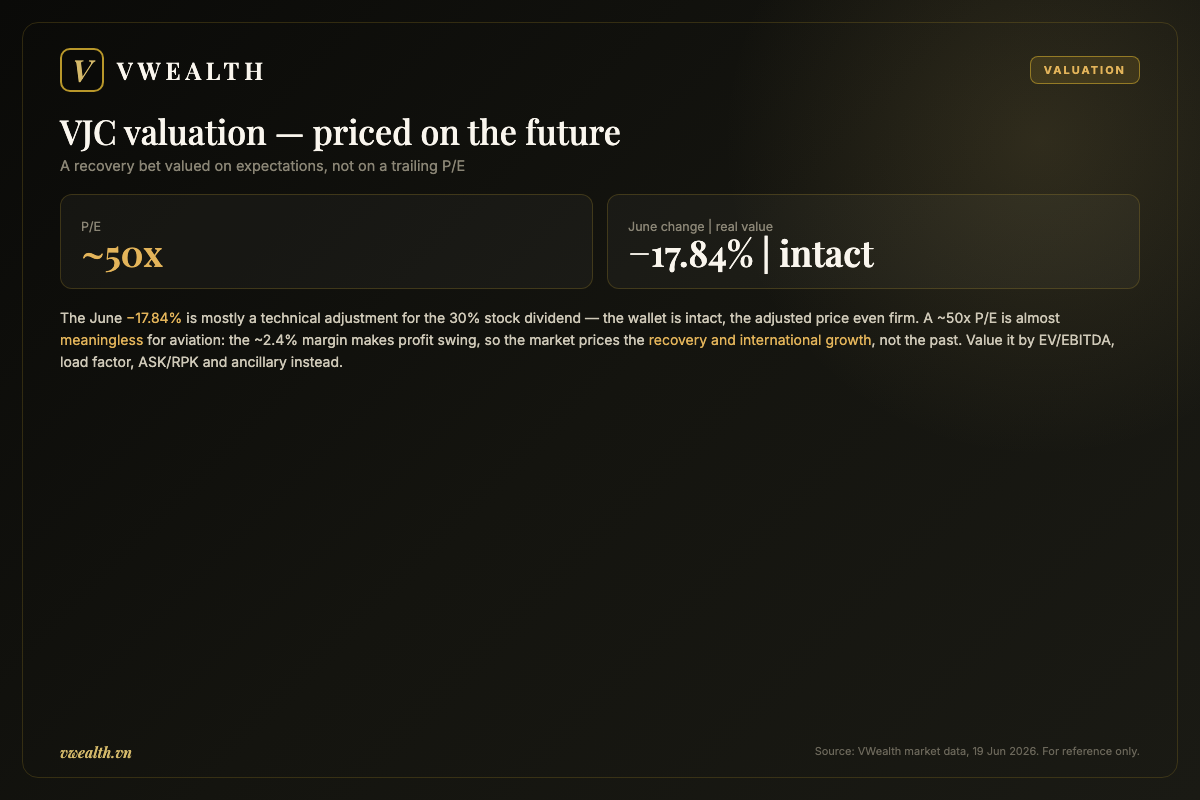
Read the chart above in that spirit: the ~50x P/E isn’t an invitation nor a warning in itself — it only says VJC is valued on the future, not the present. The real question you must answer isn’t “is the P/E high” (clearly it is), but “do I believe in the aviation-tourism recovery scenario and Vietjet successful internationalization enough to justify this price.” If you believe, a high P/E is the price for a growth stock. If you don’t, no aviation P/E is “cheap.”
Price action: a “recovery bet” stock
Once you understand the valuation nature, VJC price action won’t surprise you. This is one of the most volatile stocks in the large-cap group on HOSE, and that volatility isn’t random — it reflects the aviation industry “double leverage” trait. Three main flows pull VJC price, and you should track all three.
- The travel cycle and demand. Aviation is a direct mirror of consumer and travel health. Each peak season (Tet, summer, holidays), each piece of news on international arrivals to Vietnam, each new visa policy hits straight into profit expectations and moves VJC.
- Fuel price (Jet A1). Fuel cost makes up a very large share of a carrier cost structure. When world oil rises, Vietjet already-thin margin is squeezed; when oil falls, profit stretches. This is an exogenous variable management can’t control, and the market reacts to it almost instantly.
- Sentiment and money flows. As a “growth story” stock, VJC is sensitive to the market general risk appetite. When money is euphoric, investors readily pay high for expectations; when the market is wary, future-priced stocks like VJC are usually sold harder than average.
Adding these three forces, you have a stock that is essentially a ticket betting on the aviation industry recovery. When everything aligns — tourism booming, cheap oil, ample money flows — VJC can fly very far. When the wind reverses, it can fall fast too. This isn’t a defensive stock to put in a drawer and forget; it demands you understand what you’re betting on and can bear the volatility that comes with it.
Dividend policy: keeping cash to feed the fleet
Back to dividends, because they say a lot about this business philosophy. Notice the 2025 round is paid in shares, not cash. This is a consistent Vietjet trait, and it’s entirely logical for a carrier in a phase of intense expansion.
Vietjet needs money — a lot of money — to finance fleet expansion, order new aircraft, open more international routes, invest in infrastructure. In that context, retaining profit (over 12,775 billion dong of undistributed profit used for this round) and “paying” shareholders in shares instead of taking cash out of the business is a strategically reasonable choice: capital stays in the company for reinvestment, while raising charter capital strengthens the financial base and creates room for future capital-raising plans. The consequence for you — an investor — is: don’t expect VJC as a steady cash-dividend stock. If your goal is annual passive cash flow, this isn’t the right choice. VJC cash dividend, if any, is usually low and irregular. The value you get from VJC lies in the expectation of capital gains if the growth story materializes, not in a dividend flow.
Foreigners and room: GIC was once a large shareholder
A final piece to understand VJC ownership structure is the foreign-investor story. Vietjet has long drawn interest from international institutions, most notably GIC — the Singapore government fund, one of the world largest, most reputable sovereign funds. The presence of a name like GIC in the shareholder structure is a notable sign of the business credibility in the eyes of global institutional investors.
However, you need to read this info current and soberly. Over time, GIC ownership gradually declined after sell-downs; at many points GIC was no longer in the large-shareholder group (the 5% threshold), with holdings falling to around below 5%. This reminds you that “having a large foreign fund” is a credibility plus but not a permanent guarantee — funds still buy and sell per their portfolio strategy, and a fund reducing its ratio isn’t necessarily a bad signal about the business.
On foreign room, Vietjet still has room for foreign investors (the remaining room around a few percent depending on timing, corresponding to tens of millions of shares). Having room means foreign investors can still participate, but the room isn’t too wide — a factor you should check on updated data if foreign flows are part of your investment thesis, because foreign capital in/out is usually a strong catalyst for large caps like VJC.
To close before moving to the industry context
Let’s wrap everything you just read into one picture. The June “17.84% drop” is largely a technical illusion from the 30% stock dividend — the shareholder wallet is intact, and after removing the adjustment, VJC real price is even firm. A ~50x P/E sounds scary but is almost meaningless for an aviation stock, where the thin margin and swinging profit make the market value on recovery and international-growth expectations rather than past profit. Dividends are mostly in shares because the business keeps cash to feed the fleet. And foreigners — with the shadow of GIC — are both a credibility plus and a variable to monitor.
VJC is a ticket betting on the recovery and internationalization of Vietnamese aviation — the reward can be large, but the volatility is high too. You buy VJC not to buy peace of mind, but to buy a belief in the future of the skies.
And to know how well-founded that belief is, you need to look beyond the board — at the very industry Vietjet flies in: travel demand, competition, fuel prices, airport infrastructure and the international-tourism wave. That’s the industry context we’ll open right after.
Economic and aviation-industry context
No aviation stock can be valued apart from the big frame it operates in. For Vietjet (VJC), the picture is even clearer: this is a business whose profit fate, however skilled the internal machine, is governed by three forces beyond management control — travel demand, fuel prices and FX. Before you decide anything about VJC at the current 140,500 dong, you need to understand thoroughly which way these three forces lean in 2025–2026.
The tourism-recovery wave: the biggest driver, and what VJC bets on
This is the good-news part, and where anyone looking at VJC should start. 2025 was a true boom year for Vietnamese tourism. International arrivals to Vietnam reached about 21.2 million, up over 20% from 2024 and the highest in the country tourism history. More important than the absolute number is the quality of the recovery: Vietnam ~22% growth far outpaced the global average (~5%) and the Asia-Pacific region (~8%). Versus pre-pandemic, Vietnamese tourism recovered over 110%, while the whole Asia-Pacific region was only back to about 90% of the old level.
What does this mean for you, considering VJC? It means the market demand “runway” is very wide. In 2026, the tourism sector targets 25 million international arrivals — about 4 million more. Each international arrival is a potential seat on a VJC flight, and importantly international passengers usually fly longer legs, spend more on baggage, meals, seat selection — the very high-margin ancillary segment VJC lives on.
This recovery isn’t temporary luck. It’s backed by real policy: visa waivers for many key markets, e-visas for citizens of all countries, extended stays and a wider visa-waiver list. These are structural policy levers, not easily reversed.
The long-term drivers behind the numbers
Behind the tourism wave are a few foundational trends to remember because they last decades, not one season:
- Vietnam swelling middle class. Each year millions more Vietnamese can afford to buy a plane ticket for the first time. For a budget carrier (LCC) like VJC, this is the core customer base — people who previously took coaches and trains, now switching to flying because fares have reached their pockets.
- Two-way inbound and outbound tourism. Not only foreigners into Vietnam, but Vietnamese increasingly travel abroad — Thailand, Korea, Japan, Taiwan, and further. VJC exploits both directions of this flow.
- Long Thanh airport. This is the biggest upcoming infrastructure variable. Long Thanh (Dong Nai, about 40km from Ho Chi Minh City) is expected to operate commercially phase 1 from mid-2026, with a design capacity of 25 million passengers/year in the first phase and a long-term vision of up to 80–100 million/year. Tan Son Nhat airport has long been suffocatingly overloaded; Long Thanh opens the physical “space” for carriers like VJC to raise frequency and open new routes, especially long-haul.
Two life-or-death variables: Jet A1 fuel price and USD FX
Now to the part you must be most sober about. All the beautiful growth stories above can be wiped out on the profit report by two numbers VJC can’t control.
First, Jet A1 fuel price. Fuel makes up about 40% of a carrier total operating cost. For VJC, with an already-extremely-thin margin (2025 after-tax profit of only 1,968 billion dong on tens of thousands of billions of revenue), each oil-price move hits straight at the bottom line. And 2026 isn’t a favorable year for fuel. Per the International Air Transport Association (IATA), global carriers fuel costs are forecast to rise from about $252 billion in 2025 to $350 billion in 2026 — up nearly 40%. Consequently, IATA forecasts the global aviation industry net profit in 2026 at only about $23 billion, nearly halving from $45 billion in 2025, the main cause being high fuel prices. When the whole global industry has its profit “halved” by oil, a highly leveraged, thin-margin carrier like VJC will be among the most sensitive.
Second, USD/VND exchange rate. This is a double hit for VJC. Most aircraft lease and purchase debts are in USD; many large costs (fuel, maintenance, engine lease) are also priced in USD. Meanwhile, most domestic revenue is in dong. When the dong depreciates, the USD debt and costs converted to VND swell, eating into profit and creating FX losses on the financial statement. Forecasts for 2026 lean toward the dong continuing to weaken: UOB projects USD/VND around 26,300 in Q1 then easing to 25,900 by year-end, while some domestic experts warn depreciation could reach 4–5% in the year. With a balance sheet of 2.25x debt-to-equity, each percent the dong weakens is a cut into VJC profit.
Remember this as a principle when assessing VJC: travel demand decides revenue, while oil prices and FX decide profit. A record-passenger year can still be a shrunken-profit year if oil and FX turn their back.
Competition: cramped at home, fierce abroad
Vietnam domestic market is essentially a two-horse race. VJC and Vietnam Airlines together hold over 84% of the domestic share; VJC alone holds about 43% — a dominant position in the budget segment. Bamboo Airways, after restructuring, holds only about 8% with a small fleet. On home turf, VJC is the unrivaled LCC leader.
But the story reverses when VJC goes international — the very direction it’s betting on for future growth. On international routes, VJC must compete with a series of seasoned regional budget carriers (AirAsia, Scoot, Cebu Pacific…) and large traditional carriers. The low-cost advantage at home doesn’t automatically translate into an advantage on long international legs, where the game of capacity, slots and brand recognition is entirely different.
Infrastructure and cyclical risks not to be ignored
Finally, there are structural industry risks you need to factor in:
- Overloaded airport infrastructure. Before Long Thanh operates fully, Tan Son Nhat is still congested. Limited slots mean that even if the carrier wants to add flights, it’s held back by the infrastructure “ceiling.”
- Aircraft shortage and slow deliveries. The whole industry is suffering from the supply chain: Airbus delays deliveries, and especially the Pratt & Whitney engine issue grounds many aircraft awaiting maintenance. For a carrier betting on receiving hundreds more aircraft to fly international, each month of delay is a month of lost potential revenue.
- Industry cyclicality. Aviation is a classic cyclical industry. An economic recession, a pandemic, a geopolitical shock pushing oil up — any of these can break the recovery trajectory. Travel demand is highly elastic: when the economy is tough, people cut plane tickets first.
Trend forecast
With the industry picture clear, now let’s look ahead. This section isn’t to fortune-tell the share price — no one can — but to help you picture the possible scenarios and the trigger conditions of each, so you can weigh the probabilities yourself.
VJC strategy: betting everything on internationalization and scale
VJC leadership has charted a very clear path, and it bears the mark of a big growth gamble:
- Large-scale fleet expansion. VJC has over 400 aircraft on order. In 2025 alone, it ordered 100 more A321neo (plus options for 50 more) for the regional network, and raised the total wide-body A330neo order to 40 after adding 20. The A321neo handles regional legs to “gather” passengers, while the A330neo opens direct long-haul capability.
- Bursting into international. This is the focus. VJC is operating and expanding routes to India, Central Asia (Kazakhstan), Australia, and targets direct flights to Europe once the A330neo fleet is complete. India — the billion-person market — is a land VJC targets very aggressively.
- A young, fuel-efficient fleet. The neo (new engine option) line burns significantly less fuel than the old generation. In a high-oil-price world, this is a real cost advantage.
- Expanding the ecosystem. Thaivietjet (the Thailand joint venture), the cargo segment, and using Long Thanh airport as the southern long-haul base.
The issue is: this strategy costs a lot of capital, swells debt, and depends on the new international routes profiting in time. That’s why VJC future could branch in very different directions.
Three scenarios for the coming period
Here are three scenarios. Read them as three forks, not three prophecies.
- Positive scenario — “A kite meeting a favorable wind.” Conditions: tourism keeps booming toward 25 million international arrivals or more; Jet A1 cools; the dong stays stable; and most importantly, the new international routes (India, Australia, Europe) fill seats and profit fast. Long Thanh operates on schedule, relieving the infrastructure bottleneck. Consequence: revenue and profit accelerate together, the margin stretches, the market re-rates the stock on the growth story. This is the scenario buyers of VJC at the current price are expecting.
- Base scenario — “Flying steady through turbulence.” Conditions: tourism grows well but oil prices and FX are at “uncomfortable” levels per current IATA and UOB forecasts. Consequence: revenue rises on passenger volume, but the margin stays thin as fuel costs and FX losses eat into it. Profit rises but doesn’t boom; the stock swings quarter to quarter, heavily dependent on the oil and FX numbers. This is the most likely scenario per current macro data.
- Negative scenario — “Headwinds all at once.” Conditions: oil climbs and stays high, the dong depreciates strongly (4–5% or more), fierce international competition keeps new routes loss-making for a long time, plus slow aircraft deliveries stall the fleet growth. Worse, a demand shock (recession, pandemic). Consequence: with 2.25x leverage and a thin margin, profit could be severely eroded, cash-flow and interest pressure rising. This is the scenario a conservative investor must put on the scale, not allowed to ignore.
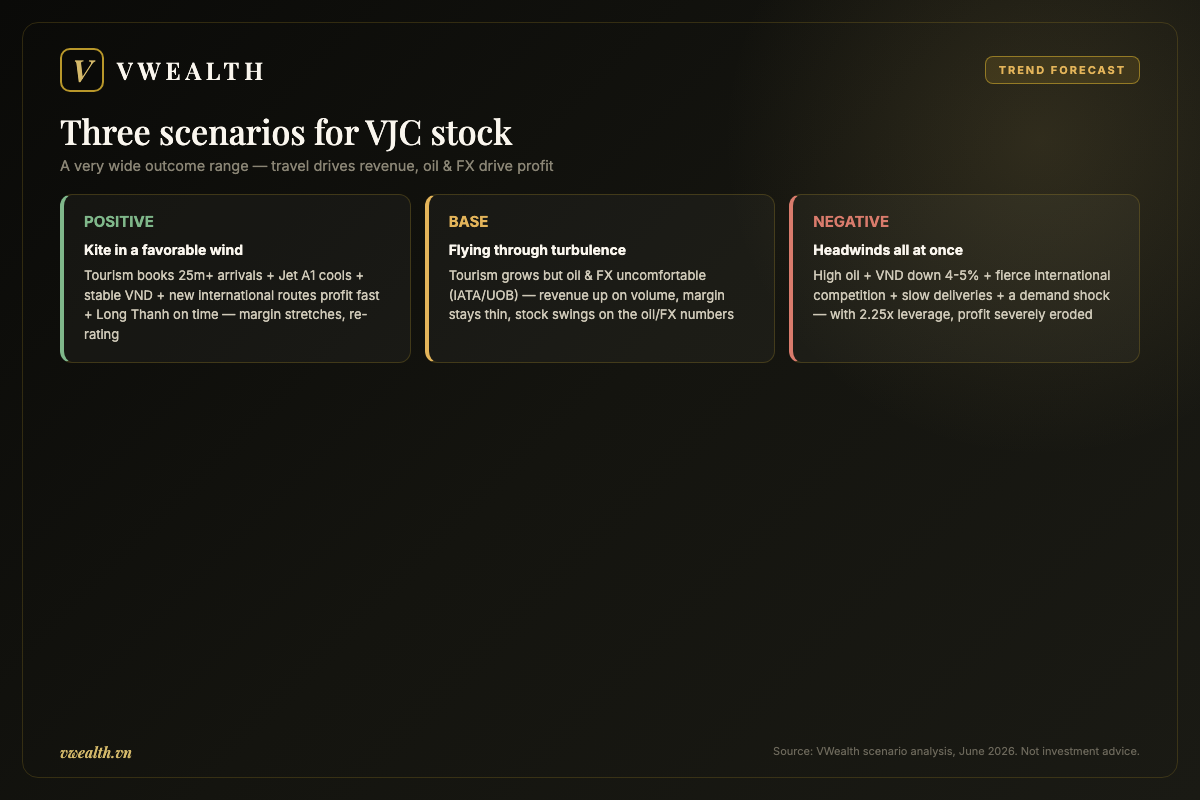
The key takeaway: VJC is a stock with a very wide outcome range. It isn’t a “safely sideways” stock. The reward in the positive scenario is real, but the risk in the negative scenario is no less real, and both depend on variables beyond the leadership hands.
Should you buy VJC stock?
This is the question you really want answered, and I won’t dodge it — but I also won’t press the button for you. My role here is to lay everything heavy and light on the scale, so you — with your own risk appetite and goals — make a sober decision yourself.
The PROS scale — why some want to buy VJC
- Vietnam number-1 private budget carrier. With about 43% of the domestic share, VJC dominates the LCC segment — exactly the segment benefiting most from the growing middle class.
- Direct beneficiary of the tourism-recovery wave. Vietnamese tourism is recovering above pre-pandemic levels and faster than the region. VJC 28.2 million passengers in 2025 is proof of real demand.
- The internationalization story and a young fleet. 254 routes, over 400 aircraft on order, expanding to India, Australia, Europe — if successful, this is a large long-term growth driver. The fuel-efficient neo fleet is a real advantage in a high-oil environment.
- High ancillary revenue. VJC LCC model earns strongly from baggage, meals, seat selection, onboard sales — a segment with a much higher margin than pure fares.
- The Sovico ecosystem backing. Behind VJC is the Sovico group with financial strength and a network, providing an anchor for big deals.
- 2025 profit recovery. After-tax profit of 1,968 billion dong, up 51% year on year — showing upward momentum in results.
The CONS scale — why some stay away from VJC
- An extremely thin margin on a cyclical industry. This is the biggest risk. 1,968 billion of profit sounds large, but versus the huge revenue the margin is very thin. A small move in oil or FX can flip the whole profit picture.
- High financial leverage — 2.25x debt-to-equity. This debt makes VJC sensitive to interest rates and FX. When the dong weakens or rates rise, financial costs swell fast, and the thin margin has no “cushion” to absorb it.
- Profit depends heavily on sale-leaseback — controversial. A significant part of VJC yearly profit comes from the aircraft sale-and-leaseback operation rather than purely from passenger transport. Many analysts question the quality and sustainability of this profit stream. You need to read the report carefully to know where the profit comes from.
- Systemic oil-price risk. IATA forecasts industry-wide fuel costs up nearly 40% in 2026, eroding half the industry profit. VJC is among the hardest hit.
- Related-party transactions. The tangled relationships in the Sovico ecosystem are both an anchor and a point to scrutinize carefully on transparency and conflict of interest.
- A high P/E valuation. At 140,500 dong, the market is paying a not-cheap profit multiple — i.e. valuing on future growth expectations, not current profit. If internationalization growth doesn’t materialize as expected, this valuation is easily corrected.
What kind of investor does VJC suit?
Instead of a “buy” or “sell” answer that applies to everyone — meaningless, since each person has a different situation — let’s view VJC through four investor types:
| Investor type | Does VJC suit? | Reason |
|---|---|---|
| Believer in the tourism-recovery & internationalization story, accepting high volatility | May suit | VJC is a way to bet directly on the tourism recovery and international-flying ambition. This person understands they’re buying a cyclical stock with a wide outcome range, and accepts it. |
| Investor seeking safety, stability, capital preservation | Not suitable | A thin margin + 2.25x leverage + oil/FX dependence make VJC too volatile for this goal. |
| Investor seeking a steady dividend for income | Not suitable | A cyclical stock with swinging profit, needing to keep capital to reinvest in the fleet — not a stable dividend source. |
| Value investor seeking a cheap stock versus assets/profit | Consider carefully | A high P/E means VJC isn’t “cheap” by traditional value standards; you’re paying for expected growth, not buying a bargain. |
In other words: VJC is essentially a cyclical, growth, high-risk stock. It could be a reasonable piece in the portfolio of someone who believes in the Vietnamese aviation-tourism story and has the “guts” to bear erratic profit quarters from oil and FX. But it isn’t a place to store money you can’t afford to lose, or to seek the calm of a dividend stock.
Before you decide
If you lean toward buying, at least answer three questions for yourself: One, can you bear this stock falling deeply in a high-oil-price year? Two, have you read the financial statements carefully to know how much profit comes from real transport and how much from sale-leaseback? Three, is VJC weight in your portfolio small enough that a negative scenario won’t ruin your whole financial picture? If you lean toward avoiding, that’s entirely reasonable too — there’s nothing wrong with passing on a stock whose risk level you’re not comfortable with.
Disclaimer: This article is for informational and reference-analysis purposes only, and is absolutely not advice or a recommendation to buy or sell any stock, including VJC. The figures, forecasts and scenarios above are based on data at the time of writing and may change. The stock market always carries risk, and you bear full responsibility for your investment decision. Research thoroughly, consider your personal financial situation, and consult a licensed investment advisor before putting money in.
Research Vietnamese stocks in English with vwealth. Our AI-powered platform turns Vietnamese market data into full English analysis reports — with international payment support and a free 2-month trial for new accounts. Create your free account and read the latest reports.