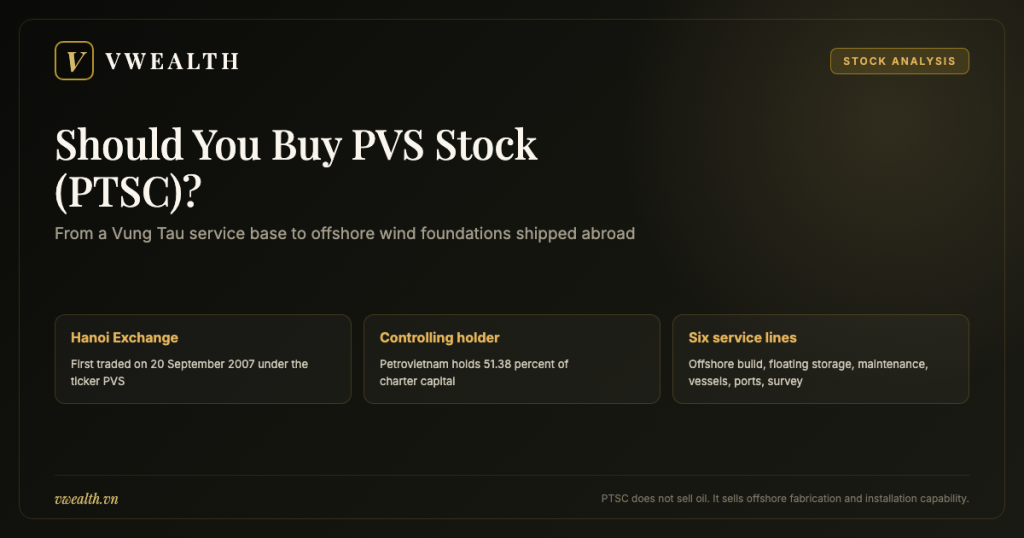
Should you buy PVS stock — the ticker of Petrovietnam Technical Services Corporation, universally known as PTSC, listed on Vietnam’s Hanoi Stock Exchange? Most people who ask that question ask it right after an oil price headline, and that is exactly where the reasoning goes wrong. PTSC does not sell oil. It owns no producing field. It is a contractor: a company that sells fabrication yards, offshore installation capability, vessels, port logistics and engineering hours to the people who do own the fields. Between the crude price and a contractor’s profit sits a long lag — often two to three years — and something more important than the lag itself: somebody else’s capital allocation decision. This article starts at the beginning, with a 1976 government decision to turn the coastal city of Vung Tau into a petroleum service base, and works forward to the day PTSC began shipping offshore wind turbine foundations to Taiwan and Europe. It ends with a straight answer about which kind of investor this stock suits, and which kind it does not.
One convention before we start, the same one used across this series. You will meet many dates, names, contract awards and scale figures in the pages below. All of them come from disclosed public sources: filings to the stock exchange, shareholder meeting resolutions, the company’s own announcements, and mainstream financial media. What you will not find here is a most-recent-quarter earnings figure or today’s valuation multiple. For a project contractor, those numbers swing violently between quarters purely because of the percentage-of-completion accounting used on construction contracts, not because the business got better or worse. This article teaches you where to look and how to read what you find. For the current numbers, open the latest research reports on vwealth.
A second convention, and it matters more. A great deal of narrative surrounds PVS: offshore wind, the Block B gas chain, jacket exports, Middle East contracts. This article separates three tiers of information that the market routinely blends together. Tier one is a signed and disclosed contract. Tier two is a project with government approval in principle but no signed contract. Tier three is market expectation with no disclosure behind it at all. Those three tiers have completely different investment value, and most valuation mistakes on contractor stocks come from adding them up as if they were the same thing.
If you are new to the Vietnamese market and have not yet worked through the basics of access, custody and settlement, start with the pillar guide on how to invest in the Vietnam stock market. This article assumes you know what a foreign ownership limit is and how a Vietnamese trading day works.
From a 1976 zoning decision to Vietnam’s largest offshore fabrication contractor
To understand why PTSC operates the way it does today — why its executive offices sit in Ho Chi Minh City while its industrial heart is in Vung Tau, why it runs six businesses that look almost unrelated to each other — you have to walk through its history. The story begins before Vietnam produced a single commercial barrel of oil.
1976: a decision about land, not about oil
On 24 November 1976, Vietnam’s Prime Minister signed Decision 458/TTg approving the master plan to develop Vung Tau city as a petroleum service base. Read quickly, that is an urban planning document. Put it in context and it becomes something else entirely. At that moment Vietnam had no commercial oil production, no operating petroleum joint venture, and effectively no domestic oil services industry.
The decision was a long-range strategic bet dressed as administrative paperwork. Its logic ran like this: if Vietnam is going to have offshore oil on its southern continental shelf, it needs an onshore logistics base close enough to serve it. Offshore petroleum simply cannot function without a stretch of coastline with deep-water quays, assembly yards wide enough to build steel structures weighing thousands of tonnes, and a standing fleet of support vessels. Vung Tau was chosen because it faces the Cuu Long and Nam Con Son sedimentary basins.
Remember this detail, because it explains a competitive advantage that no domestic rival can replicate quickly: the land itself. A coastal fabrication yard with deep-water access, a load-out quay, a skidway and tens of contiguous hectares is not something money creates in two or three years. It requires zoning, permits, time, and having been put in the right place decades ago.
It is worth pausing on how unusual that sequencing was. In most petroleum provinces, service companies appear after production begins, drawn in by demand that already exists. Vietnam did the reverse: it designated the service base before there was anything to service. Whether that was foresight or simply central planning discipline, the effect on today’s competitive landscape is the same. The land was reserved, the channel was dredged over subsequent decades, and the industrial zoning was fixed long before anybody had to negotiate with a residential neighbourhood or a tourism developer for coastal frontage.
Compare that with the difficulty a new entrant would face today. Coastal land in Ba Ria – Vung Tau now competes with tourism, container logistics and petrochemical uses. Acquiring forty contiguous hectares of shoreline with deep-water access, obtaining heavy industrial permits and building a load-out quay would take years and a great deal of capital, assuming the permits could be obtained at all. This is what economists mean when they describe a barrier to entry that is structural rather than commercial.
1986 and 1989: two predecessor companies with two different trades
In 1986 the Petroleum Services Company, abbreviated PSC, was established. Three years later, in 1989, the Geophysical and Petroleum Technical Services Company, abbreviated GPTS, was formed. The two did different work. One leaned toward logistics, supply and operations; the other toward geophysical survey, the business of measuring the seabed so that a field operator knows where to drill.
Their parallel existence reflected the needs of that period accurately. By the late 1980s the Vietsovpetro joint venture had begun producing, and a service ecosystem was forming around it. But that ecosystem was fragmented: each unit handled one slice, and nobody had the capability to take an entire scope of work from design through handover.
1993: the merger, and the name PTSC
In 1993, PSC and GPTS merged into the Petroleum Technical Services Company, taking the acronym PTSC — a name that has survived to this day and that the market uses more often than the full corporate title. This was the first genuine inflection point in the company’s biography, because it combined two trades into one organisation and created the ability to bid for broader scopes.
Through the 1990s and early 2000s, PTSC grew alongside the industry’s production volume. Every new platform needed supply vessels to move people and materials. Every new field needed a port base for staging. Every offshore structure needed periodic maintenance. That is the business model of a domestic service provider inside an expanding industry, and it has one virtue and one flaw: stability on one side, thin margins and near-total dependence on a single large customer on the other.
Through this period the company also built the second half of its business, the part that generates income from owned assets rather than from contracts. Floating storage units, the support vessel fleet and the port bases were assembled over the same years, largely funded from retained earnings and partner capital. Investors who look only at the contracting headlines tend to date the company’s asset base to recent years, when in fact most of it was accumulated slowly during this earlier phase.
That timing matters for one specific reason: the assets are old in accounting terms but far from finished in economic terms. A fabrication yard does not depreciate the way a piece of machinery does; its economic value is tied to location and permits, both of which appreciate as coastal land becomes scarcer. Book value therefore understates the replacement cost of the asset base, which is one argument for looking at price to book with a critical eye rather than a mechanical one.
2006 and 2007: equitisation and the first trading session
In 2006 PTSC completed its equitisation — the Vietnamese term for converting a state enterprise into a joint stock company — and carried out its initial public offering. In 2007 it began operating formally as a joint stock company under the ticker PVS. On 20 September 2007 the shares traded for the first time on the Hanoi Stock Exchange.
One detail matters more to a foreign investor than it might appear: PVS listed on HNX rather than HOSE, and it has stayed there. For practical purposes the two exchanges differ in intraday price band width and in how index products treat their constituents. HOSE carries a daily band of seven percent around the reference price; HNX runs a wider ten percent band. That single difference makes PVS structurally more volatile intraday than a comparable HOSE name, before you consider anything about the business. The mechanics are laid out in the guide to Vietnam’s three exchanges and in the note on trading hours and price bands.
Equitisation did not change the substance of the relationship between PTSC and the Vietnam Oil and Gas Group, the state energy holding company generally known as Petrovietnam. The group remained the controlling shareholder, and simultaneously remained the largest source of work through its member companies and the joint ventures in which it participates. Chapter two examines that arrangement in detail, because it is both a cushion and a real constraint.
The 2010s: climbing from subcontractor to EPCI main contractor
The most important stretch of PTSC’s development was its climb up the contracting ladder. Offshore construction has a fairly explicit hierarchy of capability. At the bottom, you rent out equipment and labour. A step up, you fabricate to somebody else’s drawings. Higher still, you take the whole package: engineering, procurement, construction, installation and commissioning — abbreviated EPCI from the initials of each phase.
Moving up to main contractor status is a change of kind, not of degree. It demands detailed engineering capability, international procurement management, a balance sheet strong enough to post performance bonds, and above all a track record of completed projects of comparable size. That last requirement is the hardest barrier of all: no international field operator hands a several-hundred-million-dollar scope to a contractor that has never built anything that big.
PTSC crossed that barrier gradually, working through domestic projects for Vietnam’s own petroleum ecosystem and accumulating references. By the middle of the 2010s the company was winning large main contractor packages at home and beginning to appear on international bid lists.
From 2023: exporting offshore wind foundations, the second inflection
If 1993 was the first inflection point, the period from 2023 is the second, and it may prove to be the most consequential in the company’s history. In May 2023, PTSC signed a contract with Ørsted — the Danish offshore wind developer, one of the largest in the world — to fabricate and supply 33 steel jacket foundations for the Greater Changhua 2b and 4 offshore wind project off Taiwan. The work was executed at PTSC’s yard in Vung Tau, with total steel tonnage of roughly 70,000 tonnes.
Consider what that contract meant beyond its dollar value. Before it, PTSC was a domestic service provider: its customers were in Vietnam, its projects were in Vietnamese waters, and the ceiling on its workload was set by the number of Vietnamese offshore petroleum projects sanctioned each year. The Ørsted contract broke that ceiling. It established that a yard in Vung Tau could serve customers in Taiwan, Japan and Europe — markets whose annual offshore wind investment dwarfs Vietnam’s entire upstream petroleum capital expenditure.
Additional renewable scopes followed, including EPC contracts for offshore substations on the Hai Long 2 and Hai Long 3 projects in Taiwan and fabrication packages for the European market. According to company disclosures and industry press, the aggregate value of offshore wind contracts PTSC has won and is executing runs to roughly one billion US dollars.
August 2023: a survey licence and an export ambition
On 29 August 2023, PTSC received approval from Vietnam’s Ministry of Natural Resources and Environment to conduct marine surveys in the waters off Ba Ria – Vung Tau, in support of an offshore wind project intended to export electricity to Singapore. It was the first marine survey approval of its kind granted to an offshore wind project in Vietnam.
The project sits inside an exclusive partnership between PTSC and Sembcorp Utilities of Singapore, targeting roughly 2.3 gigawatts of offshore renewable capacity in Vietnamese waters, transmitted to Singapore by high-voltage subsea cable. Singapore’s side issued a conditional approval letter for importing clean electricity from Vietnam.
Be disciplined about what this is. A survey licence is not an investment licence. A partnership agreement is not a contract with a value. A multi-gigawatt cross-border power export project requires a complete legal framework, a tariff mechanism, billions of dollars of project finance, and a bilateral arrangement between two governments. It is a long-dated option with genuine value, but it is not cash flow for the next several years. This is the clearest example of the three tiers of information described at the top of this article.
2024: two large packages on the Block B gas chain
In September 2024, the consortium of PTSC and McDermott — the American offshore construction firm — was awarded the EPCI number one package on the Block B – O Mon gas-to-power chain, worth approximately 1.1 billion US dollars, of which PTSC’s share was around 550 million. In the same period the company was awarded the EPCI number two package at a value of roughly 400 million US dollars.
That is the largest workload the company has ever taken from a single domestic project chain. Its character differs from the export contracts: domestic scopes usually carry more controllable margin risk, because the contractor knows the site conditions, the local supply chain and the weather windows intimately. In exchange, it ties the company’s fortunes to the schedule of a project chain that itself endured more than a decade of delays before reaching a final investment decision.
Milestone summary table
| Date | Event | Why it matters to an investor today |
|---|---|---|
| 24 Nov 1976 | Decision 458/TTg designates Vung Tau as a petroleum service base | Origin of the deep-water quay and yard land advantage |
| 1986 | Petroleum Services Company (PSC) established | Origin of the logistics and vessel businesses |
| 1989 | Geophysical and Petroleum Technical Services Company (GPTS) established | Origin of the survey business |
| 1993 | PSC and GPTS merge to form PTSC | First time the company could bid broad scopes |
| 2006 | Equitisation and initial public offering completed | Outside shareholders enter the register |
| 20 Sep 2007 | First trading session on HNX under ticker PVS | Nearly two decades of price history across cycles |
| 2010s | Climb to EPCI main contractor status | Higher rung on the capability ladder, wider potential margin |
| May 2023 | Contract with Ørsted for 33 offshore wind jackets, Greater Changhua 2b and 4 | First large-scale export of offshore steel structures |
| 29 Aug 2023 | Marine survey approval for the wind-to-Singapore export project | Long-dated option, not near-term cash flow |
| Sep 2024 | EPCI packages one and two awarded on the Block B – O Mon chain | Largest domestic workload in company history |
| 6 Dec 2024 | Tran Ho Bac appointed General Director for a five-year term | New executive generation entering a high-workload period |
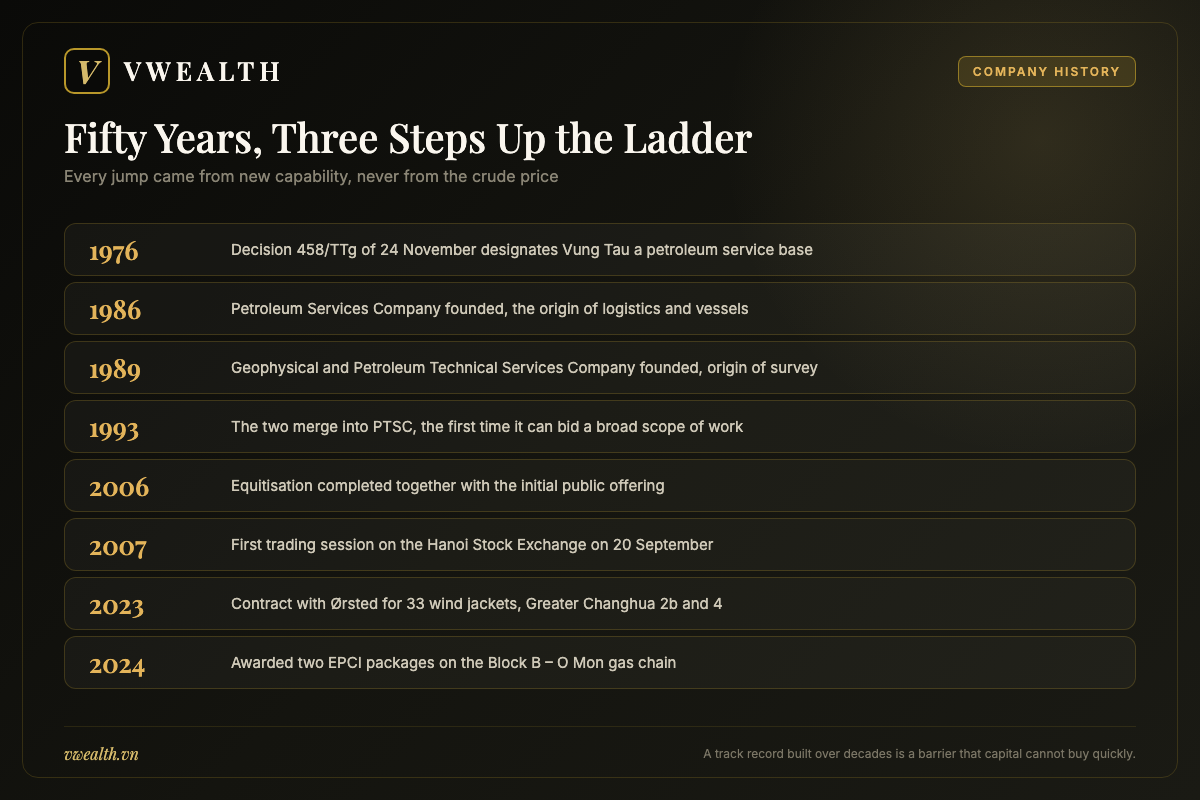
Step back from the timeline and a pattern emerges that most commentary misses entirely. Every jump in PTSC’s value came from climbing a rung on the capability ladder, not from a rise in the oil price. 1993 merged capabilities. The 2010s added main contractor status. 2023 opened an entirely new industry in international markets. The oil price only determines how much work exists in the market; which share of that work the company wins depends on which rung it stands on. Carry that lens through the rest of this article.
Who runs PTSC and who actually owns it
There is one question a foreign investor should ask about any Vietnamese state-controlled listed company before asking anything else: when the interests of minority shareholders and the controlling shareholder diverge, who decides? For PVS the answer is unambiguous, and you should know it before you look at a single valuation multiple.
Phan Thanh Tung, chairman since 2018
Phan Thanh Tung has served as Chairman of the Board of Directors of PTSC since 28 May 2018, following that year’s annual general meeting, when his predecessor Thai Quoc Hiep retired. Before taking the chair he was a member of the same board. He also holds the position of Party Committee Secretary of the corporation — a role that, in the Vietnamese state enterprise structure, carries real institutional weight alongside the corporate title.
The point here is not biography but continuity. An offshore construction contractor lives on long-term relationships with field operators and on a track record accumulated across many years. A stable chair over a long period is a positive signal for this kind of business, unlike sectors where frequent leadership turnover is unremarkable.
Tran Ho Bac, general director since December 2024
Tran Ho Bac, born in 1978 in Nam Dinh province, is a mechanical engineer with a master’s degree in business administration. He was appointed General Director of PTSC for a five-year term effective 6 December 2024, and serves as the corporation’s legal representative and Deputy Party Committee Secretary. He was previously a Deputy General Director of the same company.
His predecessor was Le Manh Cuong, who joined PTSC in 1995 working directly aboard offshore support vessels, became a Deputy General Director in August 2009, and served as General Director from May 2018 before moving up within the parent group.
Read both biographies the same way. Both leaders rose from inside the organisation, both are engineers by training, and both spent years in deputy roles before taking the top job. This is the standard personnel model in Vietnamese state corporations, and it has two faces. The positive face: the executive understands the technical detail of the work intimately, which matters enormously at a contractor where one engineering error can consume a package’s entire margin. The limitation: this model rarely produces abrupt strategic pivots, and major decisions travel through the controlling shareholder’s approval machinery.
Petrovietnam holds just over half the company
The Vietnam Oil and Gas Group is the largest and controlling shareholder of PVS, holding 51.38 percent of charter capital, equivalent to roughly 245.5 million shares out of nearly 478 million shares outstanding according to recent disclosures. The 51.38 percent figure is not accidental. It sits deliberately just above the fifty percent line, enough for the group to control ordinary shareholder resolutions outright.
For a minority holder this has three very practical consequences. First, every profit distribution plan, every large investment decision and every key appointment is in practice determined by the controlling shareholder. Second, the genuinely free-floating share count is only about half of charter capital, which makes the stock easier to push in both directions when flows arrive. Third, the possibility of state divestment is a topic the market revisits periodically; as of now it is an expectation rather than an announced plan, and you should not build an investment case on it.
If the state ownership structure of Vietnamese listed companies is new to you, the overview of Vietnamese state-owned enterprises on the exchange explains how control, governance and divestment programmes typically work across this group.
The controlling shareholder is also the largest customer
This is the single most important feature of the PVS ownership structure, and it differs from most listed companies anywhere. Petrovietnam is not merely a shareholder. Through its member companies and the petroleum joint ventures and production sharing contracts in which it participates, the same ecosystem has for many years been PTSC’s largest source of work.
Look squarely at both sides of that arrangement. The benefit is obvious: a relatively steady flow of work that private contractors find hard to penetrate, a preferential position on domestic projects, and a cushion when international markets freeze. The cost is equally obvious: when your largest customer is also your owner, price and contract terms are not negotiated in a purely arm’s-length market. Margins on internal scopes therefore tend to be thinner than on comparable international work.
This is precisely why the offshore wind export contracts attracted so much attention. They are not just new revenue; they are evidence that the company can win in genuinely competitive tenders against international contractors, where nobody hands anybody a package. For a broader framework on assessing governance quality at Vietnamese listed companies, see the guide to corporate governance in Vietnam.
Dividends: consistent cash, but not a reason to own the stock
PVS has a long record of paying cash dividends fairly consistently across many years, including through downturns in the domestic petroleum cycle. That is a genuine mark of financial discipline and reflects the company’s strong cash position.
Understand what it is, though. At an offshore construction contractor, the cash dividend does not play the role it plays at an infrastructure or consumer company where cash flow is steady and the dividend is the main reward. Here it is a mechanism for retaining shareholders through low-workload years, while the real value of the investment comes from the workload cycle. If income is your objective, compare this against the alternatives set out in the guide to Vietnamese dividend stocks.
One more caution. The payout ratio each year is decided by the annual general meeting and moves with earnings and with the working capital demands of projects in execution. During periods when the company must post bonds and fund working capital for large main contractor packages, the case for retaining cash inside the business strengthens. Do not extrapolate an old year’s payout into next year’s.
Foreign ownership room and the HNX listing
PVS is not in a sector subject to a low statutory foreign ownership cap the way banking is. However, because the state shareholder already holds more than half the capital, everything available to every other investor — foreign investors included — is bounded above by that same fact. If the Vietnamese foreign ownership regime is unfamiliar, the explainer on foreign ownership limits in Vietnam sets out the rules by sector.
There is a further point about passive flows. As Vietnam progresses toward emerging market status in the major index families, index providers allocate weight using their own criteria, and free float is one of the most important. A company with more than half its capital held by the state receives a lower investable weight than a similarly sized company with a wider float. The mechanics of the reclassification process are covered in the note on the FTSE Russell market upgrade.
Ownership and leadership summary
| Item | Disclosed position | What an investor should take from it |
|---|---|---|
| Controlling shareholder | Vietnam Oil and Gas Group, 51.38 percent of charter capital | Outright control of ordinary shareholder resolutions |
| Chairman | Phan Thanh Tung, in post since 28 May 2018 | High continuity, appropriate for a long-cycle contracting business |
| General Director | Tran Ho Bac, born 1978, appointed 6 Dec 2024, five-year term | Internal promotion, engineering background |
| Predecessor | Le Manh Cuong, general director from May 2018, with PTSC since 1995 | Orderly succession rather than a governance crisis |
| Relationship with owner | Owner is simultaneously the largest source of work | Stability purchased with thinner internal margins |
| Listing venue | HNX, first traded 20 September 2007 | Ten percent daily band, narrower index coverage than HOSE |
| Dividend policy | Consistent cash dividends, ratio set annually by the AGM | Discipline signal, not the main reason to own the shares |
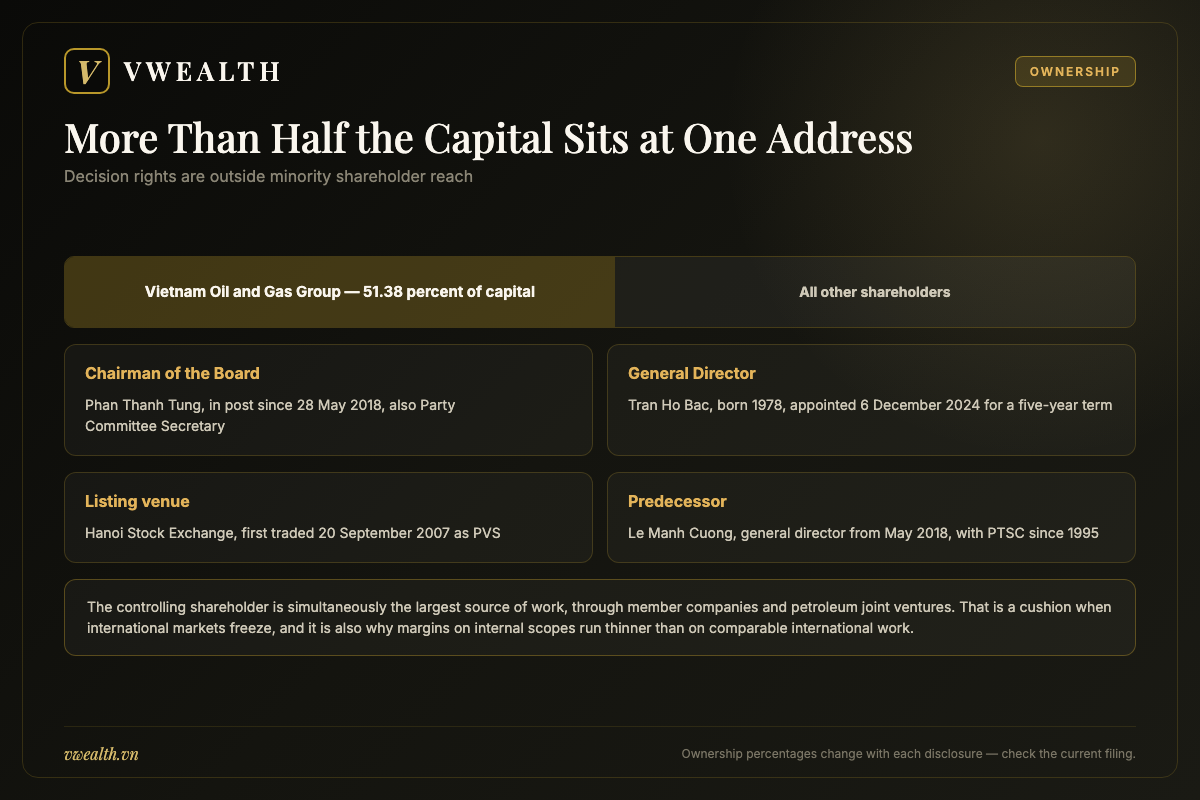
Summarise the chapter in one sentence: when you buy PVS you buy a slice of a company whose decision rights sit elsewhere, and in exchange you stand on the same side of the table as the entity with the most work to award. Whether that trade suits you is a personal judgement, but it has to be made before you think about valuation.
How PTSC makes money: dissecting six very different service lines
The thing that confuses newcomers reading PVS financial statements is that the company does not have one business. It has six, each with its own commercial model, its own cycle and its own margin profile. To value it properly you have to pull them apart rather than look at consolidated revenue and draw a conclusion.
Mechanical and construction: the backbone
The mechanical and construction segment, usually shortened to M and C, is the largest line and the one that sets the personality of the whole company. This is where PTSC takes main contractor packages covering engineering, procurement, fabrication, transport and installation of offshore structures: platform jackets, topsides, pipelines, offshore substations and, more recently, offshore wind turbine foundations.
According to securities analyst compilations covering the 2017 to 2023 period, this segment contributed roughly 52.4 percent of corporate revenue but only about 33.3 percent of gross profit. Those two numbers side by side tell an important story: the largest revenue line is not the best margin line. That is inherent to main contracting, and you need to understand why.
In an EPCI package, the bulk of contract value sits in bought-in materials: plate steel, tubulars, equipment, electrical systems, corrosion protection coatings. The contractor buys them in and passes them through to the client as part of the scope, with essentially no margin on that portion. The contractor’s real value added lies in fabrication man-hours, project management, and the ability to deliver on schedule. So a headline contract worth hundreds of millions can leave a modest profit if the materials share is high.
The practical implication is blunt: never multiply an announced contract value by an imagined margin to estimate profit. Look instead at the segment’s actual historical gross margin over multiple years, and understand that it moves with contract type rather than with the oil price.
Floating storage and production vessels: the smoothest cash flow in the house
The second line is chartering and operating floating storage and offloading vessels, abbreviated FSO, and floating production storage and offloading vessels, abbreviated FPSO. These are large tankers permanently moored at a field, receiving crude from the production platform, processing it and storing it until an export tanker arrives.
The commercial model here is nothing like the fabrication business. Charter contracts run for years, the day rate is fixed in the contract, and cash flow is therefore highly predictable. This is the highest-margin and most stable line in PTSC’s portfolio.
There is an accounting detail here that you must know before you read the income statement. Most of these floating units are owned and operated through joint ventures and associates in which PTSC holds a partial stake alongside foreign partners. As a result, the revenue of those ventures does not appear in PVS consolidated revenue at all. Instead, the corresponding share of their profit is recognised on a single line: share of profit from joint ventures and associates.
That is why there are periods when PVS reports a thin consolidated gross margin while net profit holds up perfectly well: a meaningful slice of earnings travels around the revenue line rather than through it. If you look only at consolidated gross margin, you will misjudge the quality of this business. The technique of unpicking Vietnamese statements this way is covered in the guide to reading Vietnamese company financial statements in English, which also explains where the equity-method line sits in a VAS-format income statement.
One more feature of the charter business deserves attention from anyone modelling this company. Floating production and storage units are typically deployed on a specific field, and their contract term is negotiated against the operator’s expectation of that field’s remaining life. When a field is extended, the charter is often extended too, sometimes at a renegotiated rate. When a field is abandoned, the unit must be redeployed, and redeployment usually requires a yard period for modification, which costs both money and idle time.
This is why the notes disclosing charter maturities are worth more attention than their modest presentation suggests. A single large unit rolling off contract can move the equity-method line materially in either direction, and the market frequently fails to anticipate it because the information sits in a note rather than in a headline.
Operations and maintenance
The operations and maintenance line, usually shortened to O and M, is the business of looking after offshore facilities once they are in service. Platforms, pipelines, subsea valves and pumps all require scheduled maintenance, breakdown repair and safety certification.
It is an unglamorous business with two large virtues. First, it repeats: a facility handed over will need maintenance year after year across a twenty or thirty year design life. Second, it is relatively insensitive to the capital cycle: even if no new project is sanctioned, existing installations must be maintained or production stops. At a company whose main line has a violent cycle, the maintenance business acts as a shock absorber.
The specialised vessel fleet
PTSC operates a fleet of offshore support vessels of several types: platform supply vessels, anchor handling tugs, standby and safety vessels, and specialist craft for subsea work. This line resembles shipping more than it resembles construction contracting.
Vessels are chartered by the day at rates set by regional supply and demand. When many projects run concurrently, day rates climb quickly; when exploration and development activity cools, vessels sit at the quay while fixed costs continue. This is a high operating leverage business and it is the place on the financial statements where you see the industry cycle most clearly.
The vessel fleet also carries a hidden operating characteristic that shows up in downturns. Offshore support vessels have long useful lives but require class certification, dry-docking and periodic upgrades regardless of whether they are earning. In a soft market, an owner faces a choice between laying a vessel up cheaply — which saves cash but degrades readiness — or keeping it warm and absorbing the cost. Decisions taken in a downturn therefore determine how quickly the fleet can capture the following upturn.
For an investor, the practical signal is fleet utilisation disclosed alongside day rates. Utilisation without rate tells you the vessels are working but not earning; rate without utilisation tells you the reported number applies to only part of the fleet. Both figures together, tracked over several periods, describe the vessel cycle far better than revenue does.
Port bases: the hardest asset to replicate
According to the company’s own disclosure, PTSC manages and operates eight petroleum service port bases along the Vietnamese coast, with total area exceeding 360 hectares and more than 2,700 metres of quay. This is the least discussed part of PVS when the market talks about the stock, and in the view of this article it is the most valuable.
The reason is that you cannot create a petroleum service base by writing a cheque over two years. It needs a coastal site with sufficient channel depth, contiguous land of tens of hectares for laying down steel structures weighing thousands of tonnes, a load-out quay and skidway, heavy lift capability, and permits. For offshore wind, the space requirement is even more demanding, because wind foundations are physically larger than most conventional petroleum structures.
Put differently, when Ørsted selected Vung Tau to fabricate 33 jackets, it was not only selecting a contractor. It was selecting an existing coastal industrial platform with proven capability. That is what regional competitors need years and very large capital budgets to build.
Survey, subsea services and remotely operated vehicles
The line inherited from the old GPTS covers seismic survey, geotechnical site survey, and inspection and repair of subsea infrastructure using remotely operated vehicles. It is small in revenue but strategically significant, because it sits at the very front of the value chain, where work on any project appears first.
For offshore wind the survey capability matters even more, since every project begins with seabed survey, wind resource measurement and geotechnical foundation investigation. That capability is exactly what allowed the company to become the first entity granted a marine survey approval for an offshore wind export project in Vietnam.
Offshore renewables: the newest line and the main reason for market interest
Technically, offshore renewables is not a separate seventh business. It is a new market for existing capabilities: the fabrication yard, offshore steel structural engineering, marine transport and installation, and survey. But because the addressable market is so much larger than the domestic petroleum market, it deserves to be viewed as a growth pillar in its own right.
Look carefully at the logic of the transition. A platform jacket and an offshore wind turbine jacket are both welded tubular steel structures, both must resist wave and wind loading and seawater corrosion, and both are built on a yard and towed offshore for installation. The skills are close to identical. The largest difference is that wind requires many nearly identical units, which means serial manufacturing capability, whereas petroleum structures are typically one-off builds to bespoke designs.
That is simultaneously the opportunity and the challenge. Opportunity, because serial production allows cost optimisation and margin improvement over time as the learning curve is climbed. Challenge, because it demands industrial manufacturing management, which is a different discipline from the project management mindset a petroleum contractor grows up with.
Where the moat is, and where it is thin
Gathered together, PVS’s durable advantages come in four layers. The first is the coastal industrial platform with deep-water quays, which is essentially impossible to replicate domestically. The second is the track record of completed large offshore structures, which a new entrant needs a decade to accumulate. The third is competitive engineering labour cost relative to Japanese, Korean and European yards. The fourth is the relationship with the domestic petroleum ecosystem.
The moat is thin in three places. First, it does not protect margin: in international tenders price still decides, and Chinese, Malaysian and Indonesian yards operate at comparable or lower cost bases. Second, workload depends on other people’s capital decisions — the company cannot manufacture demand for itself. Third, fabrication capacity has a physical ceiling: a yard holds only so much steel at once, so long-run revenue growth requires yard expansion, which requires capital.
Segment comparison table
| Segment | Revenue model | Margin character | Cycle sensitivity |
|---|---|---|---|
| Mechanical and construction | Lump-sum main contracts, percentage of completion | Thin, driven by materials share of contract value | Very high, follows operator capital cycles |
| FSO and FPSO chartering | Multi-year day-rate charters, mostly via joint ventures | High and stable, reported in equity-method line | Low, tied to field life |
| Operations and maintenance | Recurring annual service contracts | Moderate and steady | Low, tied to installed base |
| Specialised vessels | Day-rate charter at regional market rates | Volatile, high operating leverage | High |
| Port bases | Land, quay and logistics service fees | Steady, backed by hard-to-replicate assets | Moderate |
| Survey and subsea | Project-based technical service contracts | Moderate, small scale | High, sits at the front of the chain |
| Offshore renewables | Fabrication and installation contracts for international clients | Improvement expected as serial production scales | Follows global offshore wind investment |
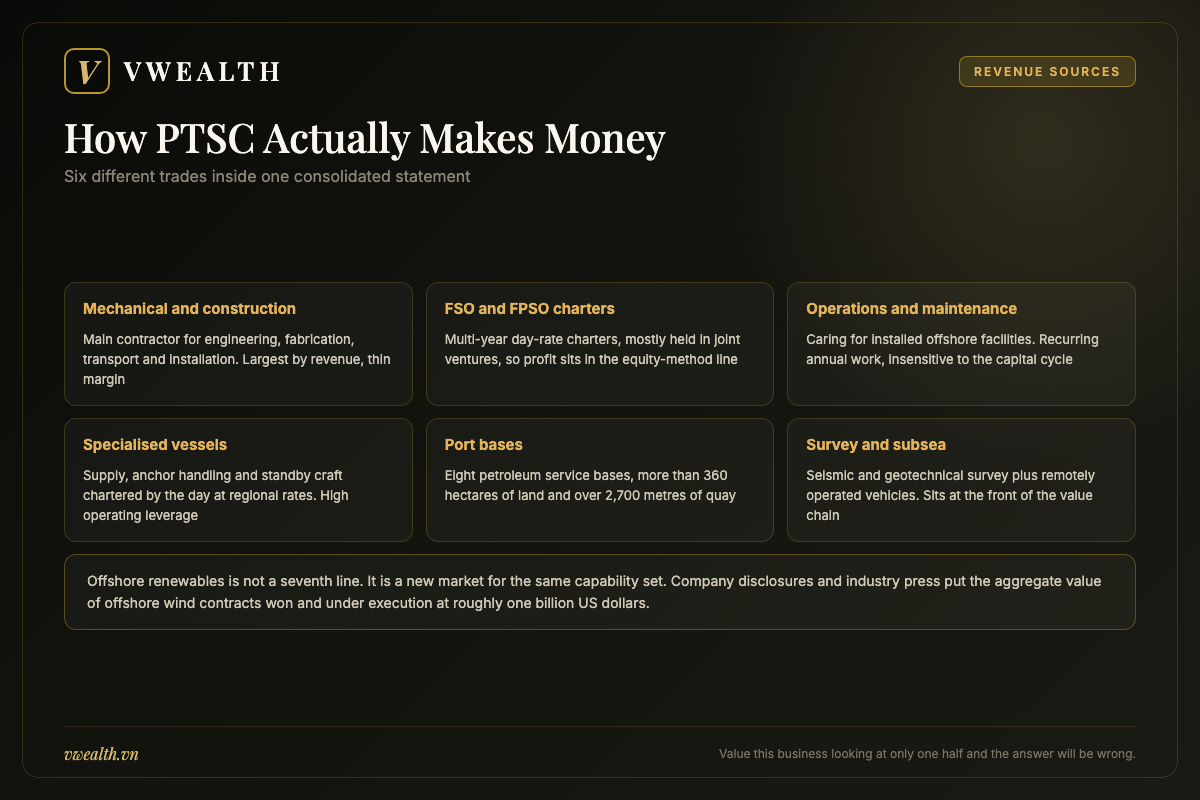
If you compress this chapter into one sentence: PVS is a company with two halves. The first half is a contractor — loud, thin-margined, violently cyclical, and responsible for almost every headline. The second half is an asset owner collecting charter and concession income — quiet, high-margined, rarely mentioned, and the thing that carries the company through cold years. Valuing this business while looking at only one half guarantees an error.
Position and financial health: seven things to check before you buy PVS stock
Reading a construction contractor’s accounts with the toolkit you use for a manufacturer is the fastest route to misunderstanding the business. Quarterly profit at a contractor jumps around with milestone recognition, not with commercial health. Here are the seven places to look, in order of importance.
Check 1: the order backlog, the single most important number
Contracted work not yet executed — the backlog — is the most important metric at any contractor, more important than last quarter’s profit. The reason is simple: last quarter’s profit describes the past, while backlog describes the next two to three years.
Read it in three layers rather than as a single total. Layer one is signed work with notice to proceed issued, which is committed. Layer two is signed work still waiting on conditions precedent, typically a client’s final investment decision. Layer three is tenders in progress with no award yet. A great many online write-ups add all three together and call the result backlog, and that is the origin of unrealistic expectations.
This figure does not appear as a fixed line in the financial statements. You find it in the annual report, in AGM documentation and in contract award disclosures. For the current period figure, check the research reports on vwealth.
Check 2: gross margin in the construction segment, and its trend
Thin gross margin in the M and C segment is normal, but the precise degree of thinness says a great deal. Three things push a package’s margin below plan: a high materials share of contract value, steel and equipment price inflation after the contract price was fixed, and schedule slippage that inflates project overhead.
The correct way to read it is across several consecutive years rather than a single quarter, and against periods when the company executed similar contract types. One quarter of negative segment margin is not necessarily a disaster; it may reflect a provision taken against a specific package. Several consecutive quarters of abnormally low margin is a different signal — it suggests the company is taking work at any price to keep the yard busy.
There is a second reason segment margin deserves scrutiny at this particular company. Because the controlling shareholder is also a major client, some domestic scopes are negotiated rather than competitively tendered. That tends to compress margin but also to reduce variance, since scope and conditions are better understood on both sides. Export scopes, by contrast, are competitively won and carry both wider margin potential and wider execution risk, particularly where the client applies European or Taiwanese certification standards with heavy documentation requirements.
What you want to see over time is the export share of the segment rising without margin deteriorating. That combination would indicate the company is winning competitive work on capability rather than on price. The opposite combination — rising export share with falling margin — would suggest it is buying market share, which is a strategy that works only for as long as the balance sheet tolerates it.
Check 3: share of profit from joint ventures and associates
As explained in chapter three, profit from the floating storage fleet flows through the equity-method line rather than through consolidated revenue. This is high-quality earnings: it comes from long-term charters, it varies little, and it is usually accompanied by real cash dividends remitted to the parent.
When you read the statements, calculate this line as a percentage of profit before tax. A high share means a meaningful part of earnings does not depend on how many new packages were won this year. That is valuable information when you assess the risk profile of the investment.
Look at the other side too. Charter contracts have end dates. When a large charter matures, the company must renegotiate at a new rate, redeploy the vessel to another field, or lose the cash flow. The maturity schedule of those charters is something to hunt for in the notes.
Check 4: net cash position and financial income
PVS belongs to the group of Vietnamese listed companies that carry large cash and cash equivalent balances relative to their size. The reason arises from the trade itself: a contractor receives advance payments from clients at the start of a package, and that money sits on the balance sheet until it is set off progressively against milestones. The company also needs cash reserves to support performance and warranty bonds.
Three implications follow. First, interest income can be a non-trivial share of profit in low-workload years, and it moves with the deposit rate rather than with core operations. Second, when you value the business on a multiple basis, strip net cash out of enterprise value so you can see what the operating business is actually priced at. Third, a large cash balance is not entirely free cash — part of it is client money held in trust against future work.
Check 5: receivables and working capital turns
Every contractor carries large receivables, because cash arrives on certified milestones rather than monthly. But receivable quality differs enormously between companies, and this is where you should read the notes carefully.
Three questions to answer. First, how concentrated are receivables, and who are the counterparties? An amount due from an international oil major is a different asset from an amount due from a financially stressed developer. Second, what is the ageing profile — is anything materially overdue across several reporting periods? Third, how much doubtful debt provision has been recognised, and is the provision growing?
In contracting, most financial accidents do not come from losing money on site. They come from completing the work and then being unable to collect.
Check 6: lump-sum contract risk and provisions
Most EPCI main contracts are lump-sum: the contractor fixes a price for the entire scope, and every cost overrun during execution lands on the contractor unless it falls within an agreed adjustment clause. It is a model that favours the client and pushes risk down the chain.
Three common sources of overrun: material price inflation after price fixing, client-driven design change, and schedule delay from weather or supply chain. The second usually has a compensation mechanism; the other two frequently do not.
When you read the accounts, pay attention to warranty provisions, provisions for liabilities, and any notes concerning contract disputes or arbitration. An unexpected provision on a large package can erase a full year of profit. Conversely, a provision release or a compensation settlement received from a client can lift one quarter’s profit dramatically without saying anything about operating capability. Both directions are reasons never to annualise a single quarter.
One additional balance sheet item deserves a look at any contractor: contract assets and contract liabilities, sometimes still labelled with older terminology in Vietnamese filings. Contract assets represent work performed but not yet billed; contract liabilities represent amounts billed or advanced ahead of work performed. The relationship between the two describes whether the company is financing its clients or its clients are financing it.
A healthy contractor generally runs with contract liabilities comfortably exceeding contract assets, meaning client advances are funding the work. When that relationship inverts and stays inverted, the company is effectively extending credit to its customers, which consumes cash and raises the risk of an eventual write-down. Track the ratio across periods rather than reading either number alone.
Check 7: operating cash flow against reported profit
The last check, and the one retail investors skip most often: compare net cash from operating activities with net profit over several years.
At a contractor these two diverge in any individual year, because advances and milestone collections do not fall evenly. But cumulated over three to five years, operating cash flow should approximate or exceed cumulative profit. If cumulative profit is high while cumulative operating cash flow lags badly, earnings are sitting in receivables and in work in progress rather than in the bank.
The seven checks in one table
| Metric | Where to find it | Healthy sign | Warning sign |
|---|---|---|---|
| Order backlog | Annual report, AGM papers, award disclosures | Rising, with committed work a high share | Growth driven only by unsanctioned packages |
| Construction segment gross margin | Segment note | Stable across years on similar contract types | Several consecutive quarters abnormally low |
| Equity-method profit | Income statement and notes | Steady contribution with cash dividends received | Large charter maturing with no replacement plan |
| Net cash and interest income | Balance sheet and financial income note | Sufficient for bonding without heavy borrowing | Interest income becoming an outsized share of profit |
| Trade receivables | Receivables note | Short ageing, strong counterparties | Persistent overdue balances, rising provisions |
| Provisions and disputes | Provisions and contingencies notes | No large unusual items | New provision against a material package |
| Operating cash flow | Cash flow statement | Multi-year cumulative near or above profit | Strong profit but cash not arriving |

What do these seven checks say about PVS’s position? They say this is the outright domestic leader in offshore fabrication, with no comparable local competitor, hard-to-replicate assets and a quiet stream of high-quality income from leased assets. They also say profit carries high variance driven by project timing, that the main line runs on thin margin, and that most of the risk sits in execution rather than in sales. That is the profile of a good company in a hard business, not of an easy one.
How the market treats PVS stock: the portrait of an expectation-driven ticker
Nearly two decades of trading on HNX have given this stock a very distinct personality. If you intend to own it, you should know what kind of instrument you are stepping into before you discuss price.
Why PVS is called an oil price beneficiary, and why that label is incomplete
Whenever Brent rallies hard, Vietnamese oil and gas tickers rally with it, and PVS is almost always among the strongest movers. That leads many investors to file it under direct oil price beneficiary.
The label is accurate about price behaviour and wrong about business mechanics, and the gap between those two is exactly where both the opportunity and the risk live. The real chain runs like this: a high oil price makes field operators more confident about sanctioning projects; sanction leads to tender; tender leads to award; award leads to revenue recognised on percentage of completion over the following two to four years. That chain is long, and every link can break.
The practical consequence: the share price reacts to oil headlines almost instantly, while profit arrives years later or does not arrive at all. There have been stretches where crude rallied strongly and operators still did not increase capital spending because they prioritised dividends and debt reduction. Conversely, there have been stretches where crude went sideways while the company was at its busiest, because previously awarded projects were in peak construction.
The pragmatic conclusion for you: do not use a crude chart to forecast PVS earnings. Use the backlog. But do not be surprised when the share price moves on crude anyway, because a large part of short-term flow trades the story, not the model.
Valuing a contractor: why the earnings multiple misleads
For a company whose profit swings with project timing, a single year’s price-to-earnings ratio is close to meaningless in isolation. At the cycle trough, depressed earnings make the multiple look expensive precisely when the stock is cheapest. At the peak, elevated earnings make the multiple look cheap precisely when risk is highest.
Experienced investors handle this three ways. The first is to use average earnings across a full cycle, typically five to seven years, instead of one year. The second is to lean on price to book value, since the book value of a company owning fabrication yards, quays and vessels is far more stable than its earnings. The third is to strip net cash out of market capitalisation to derive the enterprise value of the core operating business, then compare that against operating profit.
The general framework for multiple-based work on this market, including the local quirks of VAS accounting, is set out in the note on Vietnamese market valuation. For a cyclical contractor, this article recommends running all three approaches rather than picking one.
There is a further practical point for foreign investors specifically. Vietnamese equities settle on a T plus two basis, and a foreign investor must hold securities through a licensed local custodian and register for a trading code before placing a first order. That process adds days at the front end, which matters if your intention is to react quickly to a news catalyst. It also means that the practical liquidity available to a foreign account can be lower than screen volume suggests, because part of the visible turnover is domestic retail flow trading intraday.
The consequence for position sizing is straightforward. Build slower than you would in a developed market, assume the exit will be slower than the entry, and be sceptical of any thesis that depends on trading around news efficiently. The structural volatility of this ticker rewards patient accumulation and punishes urgency.
Trading personality: news-driven, liquid, volatile
PVS is among the most liquid names in Vietnam’s energy complex, and that cuts both ways. The good side: you can size a position and exit it without the liquidity trap that afflicts small UPCoM names. The bad side: that same liquidity makes it a favourite vehicle for short-term flow, so realised volatility exceeds anything the balance sheet would justify. The wider HNX daily band amplifies the effect.
Three categories of news move this stock: global crude headlines, progress updates on large domestic projects, and new contract awards, particularly in offshore wind. The third category has the strongest psychological effect because it attaches to a long-term growth story, and it is also the one investors most often misprice, because contract value is not profit.
Foreign investors and institutional flow
As one of very few Vietnamese companies with regionally competitive offshore fabrication capability and contracts with international wind developers, PVS sits on the radar of funds investing around the energy transition theme. The renewables angle gives it access to a pool of investors that a pure petroleum services company struggles to reach.
Two practical constraints apply. First, free float is capped by the state holding, which bounds the size of position a large fund can build. Second, the company lists on HNX, which fewer international index products track than HOSE. Both facts moderate the passive flow benefit that a Vietnamese market reclassification would otherwise bring.
Comparing PVS with the other Vietnamese energy names
Vietnam’s listed energy complex contains four quite different business models, and lumping them into one basket is a common error. The table below places PVS in the value chain.
| Company | Position in the chain | Main revenue source | When it benefits |
|---|---|---|---|
| PVS (PTSC) | Upstream technical services | Offshore construction contracts, floating storage charters, port bases | When operators raise capital spending, typically years after a crude rally |
| PVD (PV Drilling) | Upstream drilling services | Day-rate rig charters | When rig rates and utilisation rise together |
| GAS (PV GAS) | Midstream gas transport and distribution | Dry gas and LPG sales, transportation fees | When gas volumes and selling prices are both favourable |
| PLX (Petrolimex) | Downstream fuel retail | Regulated margin per litre distributed | When volumes grow and prices are stable |
| POW (PV Power) | Power generation from gas and coal | Electricity sales into the national market | When fuel supply is secure and dispatch is high |
The table shows something important: within a single crude rally, those five companies respond differently in both timing and magnitude. PVS is the latest to benefit but has the longest runway, because once work is contracted it runs through the accounts for years. For the sector-level picture before picking a name, see the overview of Vietnamese energy sector stocks.
A final portfolio note. Because all five names sit under the same macro variable, holding several of them does not diversify risk as much as the position count suggests. Sector correlation is the thing to measure, not the number of tickers.
Industry context: Vietnamese upstream and the offshore wind window
A contractor does not manufacture its own demand. It lives on other people’s investment decisions. To picture PVS’s future you therefore have to look at four sources of demand, each with its own logic.
Source one: domestic upstream petroleum investment
This is the traditional demand source. Vietnamese crude output passed its peak years ago, and the flagship fields in the Cuu Long basin are late in life. That creates two opposing needs: maintenance and modification work to extend field life, and new field development to replace declining volumes.
For more than a decade, new field investment in Vietnam was subdued for several reasons: volatile crude prices, production sharing terms that international operators found insufficiently attractive, and lengthy approval processes. The revised Petroleum Law effective from 2023 aims to loosen part of that bottleneck, particularly through incentives for technically difficult blocks and a leaner approval pathway.
For PVS this is the baseline variable: if domestic upstream investment genuinely recovers, domestic workload thickens for years. It is also a variable the company neither controls nor forecasts, because it depends on operator and regulator decisions.
Gas deserves separate emphasis within that first source, because it is where Vietnamese upstream activity is genuinely concentrated. Domestic power demand growth has been persistent, and gas-fired generation sits between coal, which faces both financing and policy constraints, and renewables, which need firming capacity. That places a structural premium on developing domestic gas resources, and gas developments are construction-intensive in exactly the areas PTSC serves: platforms, pipelines and shore terminals.
The corollary is that a contractor exposed to gas developments has a somewhat different demand profile from one exposed to oil. Gas projects are usually anchored by long-term offtake agreements with power producers, which makes their sanction decisions less sensitive to short-term commodity swings and more sensitive to tariff negotiation and grid planning. That is a slower process, but a steadier one.
Source two: the large gas-to-power chain
The Block B – O Mon chain is the largest upstream investment Vietnam has undertaken in many years, spanning offshore gas production, the pipeline to shore, and the gas-fired power plants at the receiving end. It is the largest source of work for the entire domestic petroleum services ecosystem.
For PVS, the two main contractor packages awarded in 2024 are the most committed workload the company holds. But remember the history of the chain itself: it was discussed, engineered, negotiated and postponed across more than a decade before reaching a final investment decision. Schedule risk on a multi-party project of this kind is real, not theoretical. Delay does not cancel a contract, but it pushes revenue into later years and inflates project overhead.
Source three: international offshore wind
This is the most important source over the long run, and the one that changes what kind of company PVS is. Annual offshore wind investment across Taiwan, Japan, Korea and Europe is many times larger than Vietnam’s entire upstream petroleum capital budget.
It is worth understanding precisely why Vietnam has an opening in that supply chain. A wind turbine jacket is a very heavy steel structure whose fabrication is labour and space intensive, while value per tonne of steel is not especially high. That is exactly the kind of work high-cost countries struggle to keep. Vietnam has a long coastline, a welding and structural workforce already trained to petroleum standards, and coastal industrial land inherited from the oil industry.
But the window is neither permanent nor exclusively Vietnamese. China has the world’s largest offshore wind fabrication capacity. Korea, Malaysia, Indonesia and India are all investing in the same chain. In addition, several developed markets attach local content conditions to their support schemes, narrowing the space for foreign yards. PTSC’s position therefore has to be defended with quality and delivery performance, not with price alone.
Source four: domestic offshore wind
Vietnam has set offshore wind targets within its national power development plan. If that market genuinely forms, PVS is almost certainly the largest domestic beneficiary, because no other Vietnamese company holds the full set of survey, fabrication, transport and installation capabilities.
This is, however, the most distant source in time. Offshore wind needs a legal framework for allocating sea areas, a tariff mechanism attractive enough to raise international project finance, grid connection planning, and investors willing to commit billions of dollars. Until those pieces are in place, the Singapore export partnership and the domestic projects remain in the option tier rather than the cash flow tier.
It is also worth being precise about what kind of wind work a Vietnamese yard can realistically capture. Fixed-bottom foundations for water depths where jackets and monopiles are viable are within reach today, and that covers most of the Taiwanese, Japanese and Korean pipeline as currently designed. Floating foundations, which the deeper Japanese and European projects will eventually require, involve different structures and different mooring engineering, and the global supply chain for them is still forming.
That distinction is a genuine strategic question for the company. Staying with fixed-bottom work means competing in a maturing, price-driven market. Moving into floating structures means investing ahead of a demand curve that has not yet arrived. Neither path is obviously right, and how management chooses to allocate capital between them is one of the more informative things to listen for at shareholder meetings.
Regional competition and the capacity ceiling
PTSC’s competitors are not domestic. At home the company has no peer of comparable offshore capability. The real competition is regional: Malaysian, Singaporean, Korean, Chinese and Middle Eastern yards with larger fabrication footprints, deeper international experience and stronger balance sheets.
PTSC’s edge in that race is cost and geographic proximity to East Asian markets. Its disadvantage is scale: when a client needs hundreds of foundations delivered inside a tight window, yard capacity becomes an elimination criterion. That is why yard expansion and heavy lift investment are far more worth tracking than crude headlines.
Market reclassification and capital flows
Vietnam’s progress toward emerging market status affects PVS indirectly in two ways. The first is passive flow into the market as a whole, where large liquid names benefit first. The second, more important over the long run, is the cost of capital for the whole economy: a higher market classification makes it easier for Vietnamese companies to access international capital and for energy infrastructure projects to reach financial close.
Four demand sources at a glance
| Demand source | Degree of certainty | Timing of impact | What to monitor |
|---|---|---|---|
| Domestic upstream petroleum | Moderate, depends on operator decisions | Continuous but irregular | Number of new field sanctions approved |
| Large gas-to-power chain | High, contracts signed | Multi-year, follows construction schedule | Actual progress against plan |
| International offshore wind | Moderately high, contracts already executed | Per contract, potentially repeating | New awards and free yard capacity |
| Domestic offshore wind | Low, legal framework incomplete | Long dated, several years out | Tariff mechanism and sea area allocation rules |
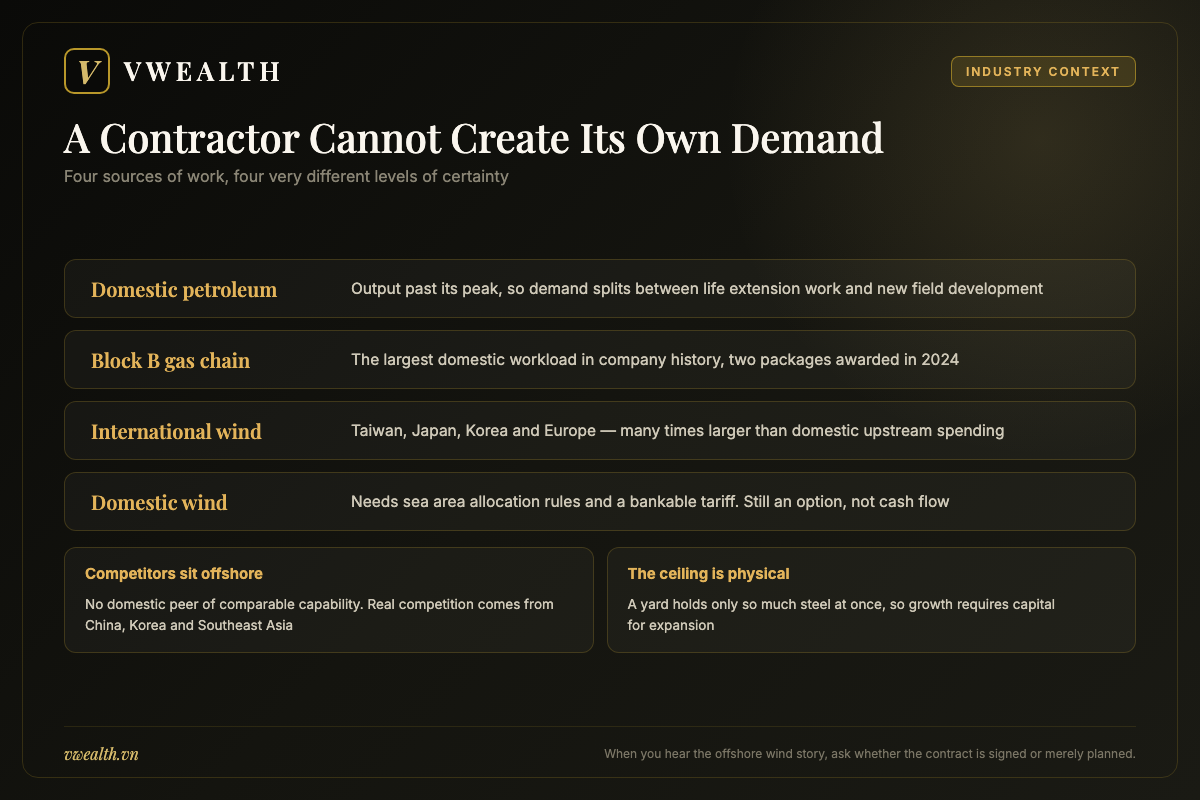
Taken as a whole, the industry backdrop for PVS is better than it was a decade ago, but for a different reason than the market usually gives. It is better not because of crude, but because the company opened a door into a new market at exactly the moment its old domestic market reached its limits. That is a structural shift, and it is worth more than any crude rally.
Looking forward: three scenarios for PVS and what each one requires
This section does not set a price target. It sets out three scenarios and the conditions each requires, so that you can watch which branch reality is taking. That is more useful than a number, because it gives you something testable over time.
Four variables that decide the outcome
The first variable is actual execution progress on the domestic main contractor packages already signed. This has the largest influence on earnings over the next several years, and it is also the easiest to monitor, because the company reports progress in AGM documentation and annual reports.
The second variable is the number of new offshore wind contracts won, and more importantly the margin embedded in them. Winning a large contract at a thin margin flatters revenue without creating shareholder value.
The third variable is the domestic upstream investment cycle after Block B. Once the peak construction phase of the big chain passes, the company needs replacement work. The question that matters is where that work comes from, and whether it is already in the pipeline.
The fourth variable is execution discipline. In contracting, the same contract can be profitable or loss-making depending on cost and schedule control. It is the hardest variable to observe from outside, and you only see it through segment gross margin across several consecutive quarters.
Optimistic scenario: the wind market expands while domestic work peaks
In this scenario the domestic packages run close to schedule, the company wins further fabrication contracts for East Asian wind projects, and yard capacity stays near fully utilised for several consecutive years. Building series of similar structures improves margin along the learning curve.
Three conditions have to hold. First, domestic project schedules do not slip by more than a couple of quarters. Second, the regional offshore wind market maintains its investment pace, without a stall driven by high financing costs or changes to support schemes. Third, the company invests in yard expansion early enough to take on additional work.
Early signals that this branch is unfolding: contract awards announced at a steady cadence, backlog rising across reporting periods even while large revenue is being recognised, and construction segment gross margin improving gradually rather than staying flat.
Before working through the branches, it helps to state what would count as evidence against this article’s own framing. If PVS earnings began to track crude prices closely and promptly, with little relation to disclosed backlog, then the contractor model described here would be wrong and the commodity-beta label would be right. If export margins came in materially above domestic margins on a sustained basis, the thin-margin characterisation would need revising upward. Watching for evidence that contradicts your model is more useful than collecting evidence that confirms it.
Equally, some things would not count as evidence either way. A single quarter of unusually strong or weak profit tells you almost nothing at a percentage-of-completion business. Nor does a single contract award, however large the headline number, until you know the materials share and the execution window.
Base case: busy for several years, then a search for replacement work
This is the scenario this article considers most likely. The company executes its signed workload somewhat behind plan, profit improves markedly during the peak construction phase, but margin does not improve much because most contract prices were fixed earlier. Floating storage, port bases and maintenance keep contributing steadily.
Once the large packages complete, the company enters a period of lower workload unless replacement work has been secured. That is the rhythm every contracting stock experiences, and it is exactly why valuing the business on peak-year earnings is always dangerous.
The conditions for this scenario are undemanding: nothing unusual has to happen. The implication for you is that this holding should be viewed through a cycle lens rather than as a smooth growth compounder.
Adverse scenario: schedule slippage plus a problem package
The adverse case does not require a crude collapse. It requires two things at once: material slippage on the domestic schedule, and a large package running over budget badly enough to force a provision.
The second risk is more damaging than the first, because it does not only wipe out that package’s profit — it damages the company’s standing in international prequalification. In this industry, a project delivered late or over cost can remove a contractor from the shortlist for the next several tenders.
There is one further adverse branch worth pricing. The global offshore wind market has already slowed once, when high interest rates forced developers to rework project economics and a number of large projects in Europe and the United States were delayed or cancelled. If that cycle repeats just as domestic workload runs down, the company would face a period with an underemployed yard while fixed costs continue.
Scenario summary table
| Scenario | Conditions required | How it shows in the accounts | Early signal to watch |
|---|---|---|---|
| Optimistic | Domestic schedule holds, regional wind investment continues, yard expanded in time | Backlog rises, construction gross margin improves gradually | Steady award announcements, capacity investment disclosed |
| Base case | No shock, modest schedule slippage | Profit rises through the peak phase, margin flat | Backlog draining as large packages complete without replacements |
| Adverse | Material delay, provision on a large package, wind market slows | Negative construction segment margin, profit leaning on interest income | Provisions note rising unusually, client postponement news |
What all three scenarios share is that the charter, port base and maintenance businesses keep running. That is the floor under the company, and it explains why PVS rarely falls into sustained losses even in the coldest years of the domestic cycle. The variance sits in the construction segment — and so does the share price.
So, should you buy PVS stock? A straight answer
You now have the material. This closing chapter does three things: weighs the case for, weighs the case against, and says plainly which investor this stock suits.
The case for: five reasons PVS deserves consideration
First, outright domestic leadership in offshore fabrication, grounded in a hard-to-replicate asset base: coastal industrial land with deep-water quays and load-out capability. This is an advantage created by physics and zoning, not by relationships.
Second, the company has proven international competitiveness by delivering jacket and offshore substation contracts for foreign clients. That evidence is worth more than any strategy statement, because it demonstrates that the product meets the standards of some of the most demanding developers in the world.
Third, the two-layer business structure: a volatile contracting layer and a stable asset-leasing layer. The second layer carries the company through cold years and produces steady cash.
Fourth, a sound balance sheet with a strong cash position and limited reliance on borrowings. In a violently cyclical industry, the ability to survive the trough is itself a competitive advantage — many international contractors have gone bankrupt during periods of low oil prices.
Fifth, the company sits at the intersection of two long-run trends: the need to sustain and expand domestic gas production, and the migration of offshore wind fabrication supply chains toward Southeast Asia.
A sixth point, less often mentioned, concerns optionality. Because the company owns the scarce physical asset rather than merely the contract, it retains choices that a pure labour contractor does not have. Yard capacity can be directed toward petroleum structures, wind foundations, offshore substations or industrial modules depending on which market pays best at the time. That flexibility is not visible in any single year’s accounts, but it is the reason the business has survived several complete downturns in its main market without structural damage.
Optionality of that kind is genuinely hard to value, and reasonable investors will disagree about what it is worth. The honest way to treat it is as a reason to require a smaller discount than you would for a pure contractor, rather than as a reason to pay a premium.
The case against: six risks you have to face directly
First, thin margin in the core segment. A large contract does not automatically translate into large profit, and investors misprice this constantly.
Second, lump-sum execution risk. A cost overrun on a large package can erase a year of profit, and you generally cannot see it coming from outside the company.
Third, dependence on other parties’ capital decisions. The company cannot generate its own demand, so there are periods when capacity sits idle with nothing to do but wait.
Fourth, state control of more than half the capital, which places decision rights outside minority reach, restricts free float and reduces the stock’s attractiveness to index-tracking money.
Fifth, customer concentration. A large share of the work comes from the domestic petroleum ecosystem, which makes the company sensitive to policy and to the financial health of a narrow customer set.
Sixth, intensifying regional competition in wind fabrication, compounded by the trend toward local content requirements in support schemes. The export window is open, but nothing guarantees it stays open.
Weighing both sides
| In favour | Against |
|---|---|
| Hard-to-replicate assets: fabrication yards, deep-water quays, eight port bases | Thin gross margin in the core construction segment |
| Delivered export contracts for international offshore wind developers | Cost overrun risk inherent in lump-sum contracting |
| Steady income from charters, port concessions and maintenance | Cannot create demand, depends on operator sanction decisions |
| Sound balance sheet with a strong net cash position | State control, limited free float, reduced passive flow eligibility |
| Sits at the intersection of domestic gas and offshore wind supply chains | Customer concentration and sharpening regional competition |
| High liquidity relative to most sector peers | Realised volatility well beyond what fundamentals justify, widened by the HNX band |
Who this stock suits, and who it definitely does not
For the long-term value investor: PVS can fit, provided you value it across a cycle rather than on a single year’s earnings, and provided you treat the asset-leasing layer as the floor and the contracting layer as the option. You need patience measured in years, and you need the temperament to sit still through ugly quarters.
For the growth investor: the offshore wind story is a genuine growth story, but growth here arrives contract by contract, not as a smooth curve like a software or retail compounder. If you are accustomed to steady sequential growth, this company will frustrate you.
For the income investor: PVS is not the right choice. The cash dividend is consistent but the yield is not among the market’s highest, and the price volatility far exceeds what an income-focused holder normally wants to absorb.
For the short-term trader: the name is liquid and news-rich, so it sits on many watchlists. But precisely because news flow is heavy, the risk of chasing a headline is at its highest here. If you trade it, define your exit before you enter, and be especially careful about margin leverage after an extended run — Vietnamese brokers can and do force-sell into weakness, and the wider HNX band makes those moves faster.
A note on position sizing for a portfolio that already holds Vietnamese energy exposure. PVS, PVD, GAS, PLX and POW all sit under the same macro variable and, to varying degrees, within the same state ecosystem. Holding four of them is closer to holding one large sector position than to holding a diversified basket, and correlation tends to rise precisely when it hurts most, during broad sector drawdowns.
If you want energy exposure with genuinely different drivers, the useful contrast is between an upstream services company like PVS, whose earnings follow capital spending, and a downstream distributor whose earnings follow consumption volume. Those two respond to different parts of the same cycle. Pairing two upstream services names achieves far less than most investors assume.
Five questions to answer before you place an order
Question one: what is the current backlog, and what share of it is committed work with notice to proceed? If you cannot answer this, you do not yet have enough information to buy.
Question two: which way has construction segment gross margin trended across the last four to six reporting periods?
Question three: what percentage of profit before tax comes from joint ventures and associates, and is any large charter approaching maturity?
Question four: if you strip net cash out of market capitalisation, what multiple of mid-cycle earnings is the core business actually trading on?
Question five: how long do you intend to hold, and what will you do if four quarters pass with no earnings improvement because a project slipped? Answering that before you buy will save you far more money than answering it while you are down.
Closing: a contractor that just found a new door
PTSC’s story is the story of a company built to serve one industry that discovered its capability set could serve a much larger one. From a 1976 zoning decision, through the 1993 merger, up the contracting ladder, to the first wind jackets shipped to Taiwan — it is a long exercise in accumulating capability and then selling that capability to whoever pays most for it.
But capability does not convert into profit automatically. Between the two sit execution discipline, the ability to hold margin in competitive tenders, and plain luck on the schedules of projects the company does not control. That is why this stock rewards patience and punishes headline chasing.
So, should you buy PVS stock? If you understand that you are buying a contractor rather than an oil producer, accept that profit arrives on project cycles rather than on crude cycles, are willing to read the backlog every reporting period instead of reading headlines, and refuse to build a thesis on projects that have not reached final investment decision — then PVS is a reasonable holding within a Vietnamese energy allocation. If you are buying because crude just rallied, because a large contract was just announced, or because offshore wind sounds like next year’s theme, you are buying an expectation rather than a business.
One last thing to carry with you. PTSC’s history, assets and competitive position change slowly. Its backlog, segment margins, receivables, provisions and valuation change every quarter. Before you place an order, open the latest research and score the seven checks from chapter four again. It takes fifteen minutes, and they are the most valuable fifteen minutes in the entire decision. If you do not yet have the tools to do that, create a free vwealth account and let the platform read the filings for you.
This article provides information and analysis for reference purposes only and is not a recommendation to buy or sell any security. All investment decisions are yours alone, and you bear responsibility for their outcomes. Consider consulting a licensed financial adviser before acting.
Research Vietnamese stocks in English with vwealth. Our AI-powered platform turns Vietnamese market data into full English analysis reports — with international payment support and a free 2-month trial for new accounts. Create your free account and read the latest reports.