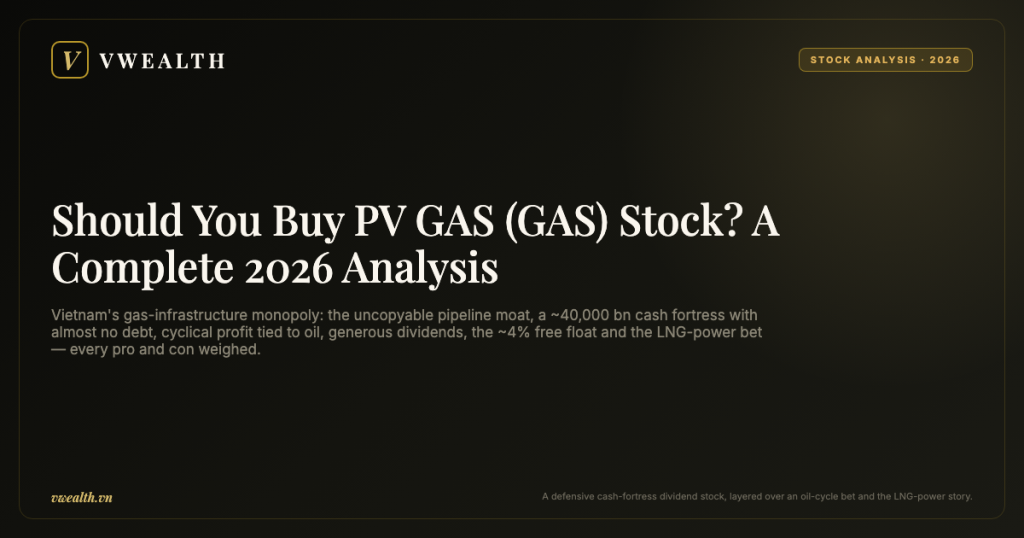
There’s a kind of business on Vietnam’s stock market that, when named, almost no investor still needs to ask “what does this company do to live.” PetroVietnam Gas Corporation – PV GAS (HOSE: GAS) is one of those few. Picture it this way: nearly every time you flip on a light in the South, there’s a very high chance that electricity was generated from gas transported by PV GAS; every bag of urea fertilizer for the delta’s rice fields also runs on gas feedstock this company supplies. PV GAS supplies gas for over 30% of the nation’s electricity output and about 70% of the country’s fertilizer demand — numbers reflecting a position very few listed businesses have: a near-natural monopoly over a country’s gas infrastructure.
That’s precisely what makes GAS a special stock, and the reason this full analysis wants to dissect it carefully. PV GAS is the sole dry-gas supplier in Vietnam, while also holding about 70% share in liquefied petroleum gas (LPG) distribution. When a business owns a network of nearly 1,500 km of gas pipelines, gas-processing plants and a storage-terminal system built over three-plus decades, a new rival wanting to squeeze in is nearly impossible — not because the law forbids it, but because no one spends billions of dollars to build a second parallel undersea pipeline system. That infrastructure is a real economic moat made of concrete and steel.
But “monopoly” doesn’t mean “always equally fat profit.” This is the second crux to pin down before reading on: PV GAS’s profit is very clearly cyclical, because gas selling prices are largely anchored to world crude prices (Brent/FO). In 2022, when oil topped 100 USD/barrel, PV GAS set a historic profit peak; in years oil cooled, profit shrank correspondingly even though gas volume barely changed. You’re buying an infrastructure-monopoly business, but its results “breathe” with the rhythm of the global oil price — a fairly interesting blend of defensiveness and cyclicality.
Compensating for that cyclicality is something many defensive investors dream of: an extremely healthy balance sheet. As of end-2025, PV GAS held cash, cash equivalents and deposits of nearly 40,000 billion dong, about 40% of total assets; while outstanding borrowings were only about 2,970 billion dong — that is, the company has cash more than ten times its debt, with almost no net debt. Such a business is nearly “immune” to bankruptcy risk, has more than enough capacity to invest in large projects out of pocket, and steadily pays high cash dividends — up to 60% in one year, distributing over 13,780 billion dong of cash to shareholders.
On scale, GAS is among the largest-cap blue chips on the exchange; at one point in 2025 its market cap topped 152,000 billion dong. The controlling shareholder is the Vietnam National Industry – Energy Group (Petrovietnam/PVN) at about 95.8% — a figure that’s both an anchor (a core state enterprise tied to national energy security) and a notable technical risk you’ll see later (the risk of no longer qualifying as a public company because the free-float ratio is too low). On 19 June 2026, GAS closed around 81,200 dong/share.
So the central question of this whole article is: should you buy GAS, and if so, what kind of investor does it suit? To answer properly, you can’t just look at today’s price. You need to understand how PV GAS was built, why its monopoly is durable, and most importantly — how the LNG turning point is reshaping this business’s future margin. Let’s start from the roots: the 35-plus-year journey of building a “gas-energy backbone” for the whole economy.
GAS market data (updated 19 June 2026)
| Current price | 81,200đ | 2025 revenue | ~134,000 bn (+27%) |
| Change (June) | −3.56% | 2025 pre-tax profit | 14,500 bn (218% of plan) |
| Net cash | ~40,000 bn | 2025 dividend | PVN | 25% | 95.8% |
Source: VWealth price data + PV GAS 2025 reports. Figures move by session — for reference only.
History and evolution
PV GAS’s history, in short, is the history of Vietnam’s gas industry. Before 1990, Vietnam had almost no real concept of a “gas industry” — associated gas extracted along with oil was largely flared off at sea for lack of infrastructure to collect it and bring it ashore. PV GAS was born to solve that problem, and to understand the stock’s value today, you need to walk back up each rung it climbed.
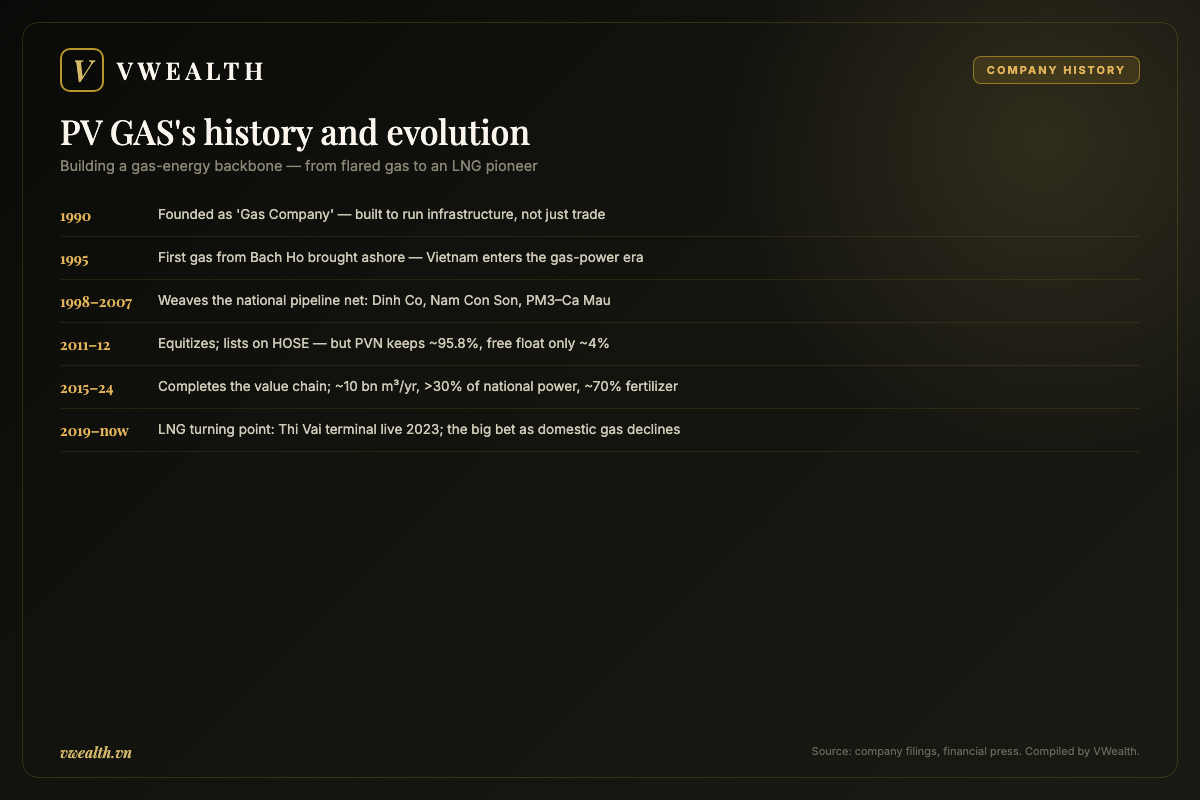
The founding phase (1990–1995): from zero
PV GAS was established on 20 September 1990 under the original name “Gas Company,” on the basis of the Vung Tau Petroleum Works Management Board. Right from the name, the company’s core function was defined: collecting, importing, transporting, storing, processing, distributing and trading gas and gas products. This wasn’t a mere trading company — it was born to build and operate infrastructure, and this very “infrastructure” nature is the source of the economic moat investors enjoy today.
The true historic milestone came on 26 April 1995, when the first gas flow from the Bach Ho field was brought ashore through the first pipeline system, supplying gas to the Ba Ria Power Plant. That moment marked Vietnam formally entering the era of using natural gas for power generation. The Bach Ho gas system was the first infrastructure brick — and once a pipeline is laid on the seabed, every power and fertilizer plant built afterward is forced to connect to PV GAS’s network. This is how a natural monopoly was “staked” from day one.
The infrastructure-building phase (1998–2007): weaving the national pipeline network
If Bach Ho was the first brick, this phase was when PV GAS wove the whole infrastructure net that today is nearly impossible to copy. Each pipeline is not just an engineering work, but a newly opened “monopoly zone”:
- 1998 – Dinh Co Gas Processing Plant: the first gas-processing project Vietnam itself invested in, built and operated. From here PV GAS not only transported raw gas but also separated out LPG and condensate — higher-value products, opening the liquefied-gas business that later took ~70% market share.
- 1999: began domestic LPG and condensate production (May), helping Vietnam partly secure its own energy source rather than depending on imports.
- 2002 – Nam Con Son gas system: commissioned in December with foreign partners, expanding gas supply to the Southeast region — home to the country’s largest gas-power plant clusters.
- 2003: completed the first low-pressure gas distribution network, bringing gas to industrial parks.
- 2007 – PM3 – Ca Mau gas system: with about 325 km of offshore and onshore pipeline, PV GAS developed the gas market for the Southwest region, supplying the Ca Mau Power–Fertilizer cluster. That same year, the company was reorganized on a parent-subsidiary model and formally took the name PetroVietnam Gas Corporation.
By the end of this phase, the picture was clear: PV GAS owned the Bach Ho, Cuu Long, Nam Con Son, PM3 – Ca Mau and later Ham Rong – Thai Binh gas systems, stretching from the Southeast down to the Southwest and up to the North. For investors, the meaning is very practical: every km of pipeline laid thickens the barrier to entry. No private rival can, or wants to, spend capital building a parallel pipeline system to compete — that’s the classic definition of a natural infrastructure monopoly.
Why does this matter to your pocket? Because an infrastructure-monopoly business has “pricing power” and revenue very hard to erode by competition. GAS’s risk hardly lies in “losing customers to rivals,” but in the input price (oil price) and the very gas source underground — two variables you need to watch instead of the usual competition worry.
The equitization and listing phase (2011–2012): opening to investors
On 16 May 2011, PV GAS converted to a joint-stock model with charter capital of 18,950 billion dong. A year later, in May 2012, GAS shares officially listed on the Ho Chi Minh City Stock Exchange (HOSE) with about 1.9 billion shares. This was the moment the national gas business’s “door” opened to public investors — for the first time you could own a part of the national gas-energy backbone with a single buy order on the board.
However, there’s a structural trait that has accompanied GAS from listing day to now which you must grasp: PVN (now the Vietnam National Industry – Energy Group) always holds absolute control, currently at about 95.8%. This has two sides. The positive: GAS is backed by the largest state energy group, tied to national energy security, with almost no takeover or governance-crisis risk. The other side: the free float is very small, only about over 4% in outside shareholders’ hands — making liquidity and the “room” for individual investors fairly limited.
This very concentrated structure, by late 2025 – early 2026, gave rise to a notable technical story: per the amended Securities Law, a public company must have at least 10% of voting shares held by at least 100 small shareholders. With PVN owning up to 95.8%, GAS doesn’t meet this condition and had to disclose a plan to remedy the risk of delisting from HOSE. Don’t panic — this is mainly a procedural issue (leadership has spoken of a handling plan, usually toward loosening the room/reducing state ownership or being resolved by a mechanism), not a reflection of business health. But it’s a legal-technical risk factor you need to put into your “consideration table” when planning to hold GAS long-term.
The maturity phase (2015–2024): completing the value chain
Past its listing age, PV GAS kept building a closed value chain from collecting – processing – storing – transporting – distributing:
- 2015: the Ham Rong gas field (Song Hong basin) went into operation and Nam Con Son 2 phase 1 was commissioned, expanding both its northern presence and southern collection capacity.
- 2018 – Ca Mau Gas Processing Plant: operated with capacity of about 6.2 million m³/day, adding value to the PM3 gas source rather than just selling raw gas.
- By this phase, PV GAS supplied nearly 10 billion m³ of dry gas a year, contributing over 30% of national electricity output, ~70% of fertilizer demand and most key industrial parks — truly the “gas-energy backbone.”
Throughout this phase, GAS’s business model clearly revealed the two-sidedness you must memorize: revenue stable thanks to infrastructure monopoly, but profit rising and falling with oil prices. 2022 is the classic proof — when oil topped 100 USD/barrel, GAS set a historic profit peak; in later years oil cooled and the number shrank notably. The company’s gross margin over the past 5 years has been steadily above 16% and net margin above 10% — enviable returns, but with a rhythm tightly tied to the global commodity cycle.
The LNG turning point (2019 – present): the big bet for the future
This is the most important chapter if you want to invest in GAS with a 5–10 year horizon, because it redefines the whole growth driver and margin risk of the business. The root problem is: Vietnam’s domestic gas fields have mostly entered a phase of declining output. Bach Ho, Nam Con Son gas… can’t flow forever at their old capacity, while gas demand for power generation rises, especially at the dry-season peak. The solution PV GAS chose is to shift to importing liquefied natural gas (LNG) from abroad.
- 2019: broke ground on the Thi Vai LNG terminal – Vietnam’s first LNG import facility.
- 2023: the Thi Vai LNG terminal (1 million tons/year capacity, at Phu My, Ba Ria – Vung Tau) began commercial operation; the first LNG ship docked. PV GAS became the first business in Vietnam qualified to export and import LNG — a pioneering position extending the monopoly chain into a new field.
- 2024 – 2026: raising Thi Vai’s regasification capacity, expanding phase 2 toward 3 million tons/year; while preparing for the larger-scale Son My LNG terminal. In the first half of 2026, imported LNG alone reached hundreds of thousands of tons to ensure gas supply for dry-season power.
For investors, the LNG turning point is a double-edged sword, and you need to look straight at both edges:
- Opportunity: LNG opens a new “ocean” of volume growth. As domestic gas depletes, imported LNG is what keeps GAS’s revenue engine running and even swelling per the national LNG-power plan (Power Plan VIII). The owner of the first and largest terminal infrastructure — that is GAS — will be the gatekeeper of this energy flow.
- Challenge: imported gas has a much higher cost than domestically extracted gas, so the margin per unit of LNG is thinner. The business model gradually shifts from “selling cheap gas from one’s own fields” to “buying expensive gas then transporting-distributing for a fee.” This is a profit-structure change you must watch: revenue growth doesn’t necessarily come with proportional profit growth if the LNG-power pricing mechanism isn’t fully unblocked.
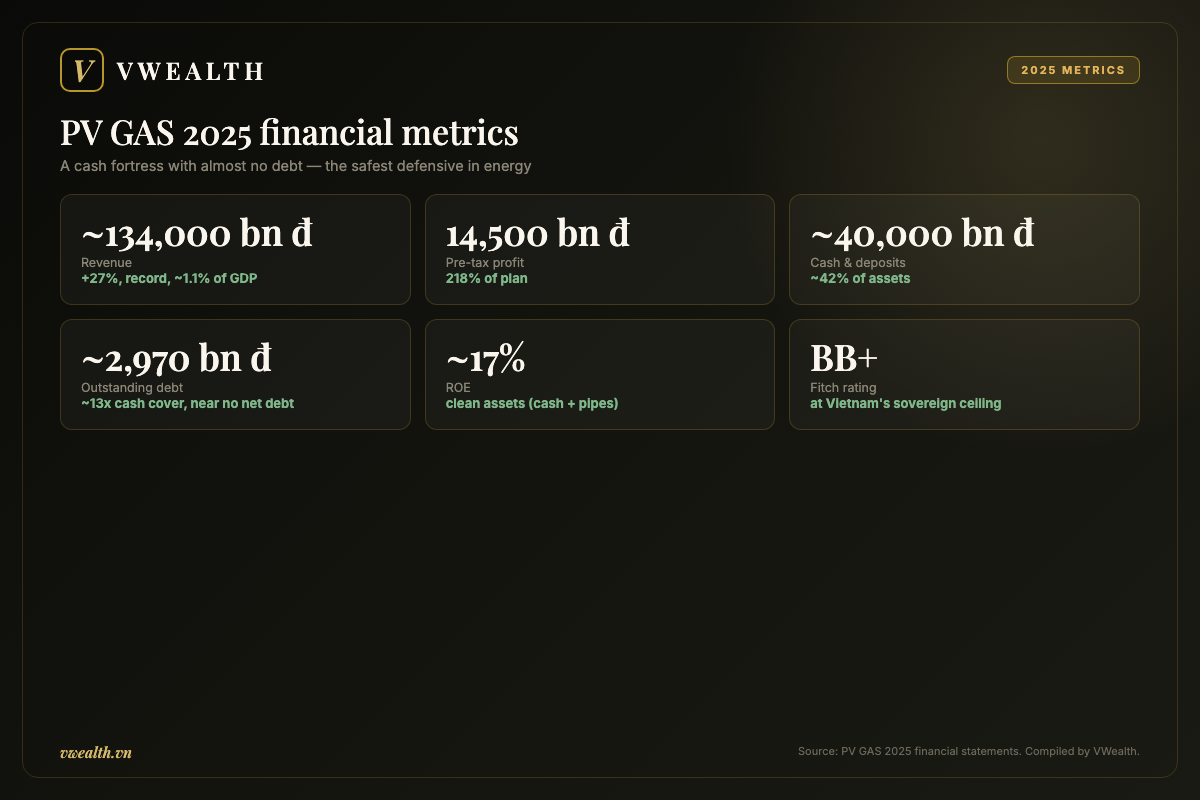
And the most recent result shows this machine is still running very strongly. In 2025, PV GAS’s consolidated revenue reached about 134,000 billion dong, up as much as 27% versus 2024 — a record revenue; pre-tax profit is estimated at 14,500 billion dong, at 218% of the profit target set. Notably, equity at end-2025 topped 67,653 billion dong, liabilities were only over 25,878 billion, and within that outstanding borrowings were just ~2,970 billion — a financial picture so healthy it’s nearly flawless. This is also the foundation for the generous cash-dividend policy GAS has maintained for years.
| Metric (2025, consolidated estimate) | Value |
|---|---|
| Revenue | ~134,000 bn dong (+27%) |
| Pre-tax profit | ~14,500 bn dong |
| Equity (31/12/2025) | > 67,653 bn dong |
| Cash & equivalents, deposits | nearly 40,000 bn dong (~40% of total assets) |
| Outstanding borrowings | ~2,970 bn dong (nearly no net debt) |
| PVN ownership | ~95.8% |
Looking back over the 35-plus-year journey, you’ll see an investment logic emerge very clearly. PV GAS isn’t a tech-style hot grower; it’s an infrastructure “giant tree” — slow but sure, a natural monopoly, financially rock-solid, steady dividends, but with profit swaying to the rhythm of oil prices and now at a strategic bend transforming into the LNG era. Every historic pipeline, every gas-processing plant, every LNG terminal you just read about isn’t just a past fact — they’re the bricks forming the economic moat and simultaneously shaping both the opportunity and risk of GAS stock today.
That history gives you the frame to understand the business. But how fast or slow a large ship like PV GAS moves, how it rides the oil-cycle waves and the LNG bet, depends heavily on the helmsman. So before diving into the valuation numbers, let’s look at the leadership — the people deciding how PV GAS steps into the next decade.
Leadership and state ownership
If you only look at GAS through the price chart or a few profit-news lines, you’ll miss the most important thing defining this stock’s nature: it’s not a private business running on the usual shareholder-value-maximizing logic, but a state gas-infrastructure “arm,” listed for transparency rather than to dilute control. Before you put a single dong into GAS, you need to understand who really holds the reins, who they are, and whether their interests align with yours — a small individual shareholder. This is the part many investors skim over, then pay for when liquidity suddenly dries up or a decision “above” the business changes the whole investment thesis.
Ownership structure: one shareholder holding nearly absolute control
The first point, and the one dominating everything else at GAS: the Vietnam Oil and Gas Group — now the Vietnam National Industry – Energy Group (Petrovietnam/PVN), a 100%-state-owned group — owns about 95.76% of PV GAS’s charter capital. The rest, only about 4.24%, is split among over 17,000 small shareholders. In other words, the entire “living part” of GAS stock the market actually trades — what investors call free float — is just around 4%.
This number isn’t a dry technical detail. It’s the key to understanding nearly every paradox of GAS. A business with a market cap in the hundreds of thousands of billions of dong, among the largest on HOSE, yet with an abnormally tiny amount of shares actually “floating” relative to its size. I want you to remember this ratio as a navigational map for the whole analysis ahead.
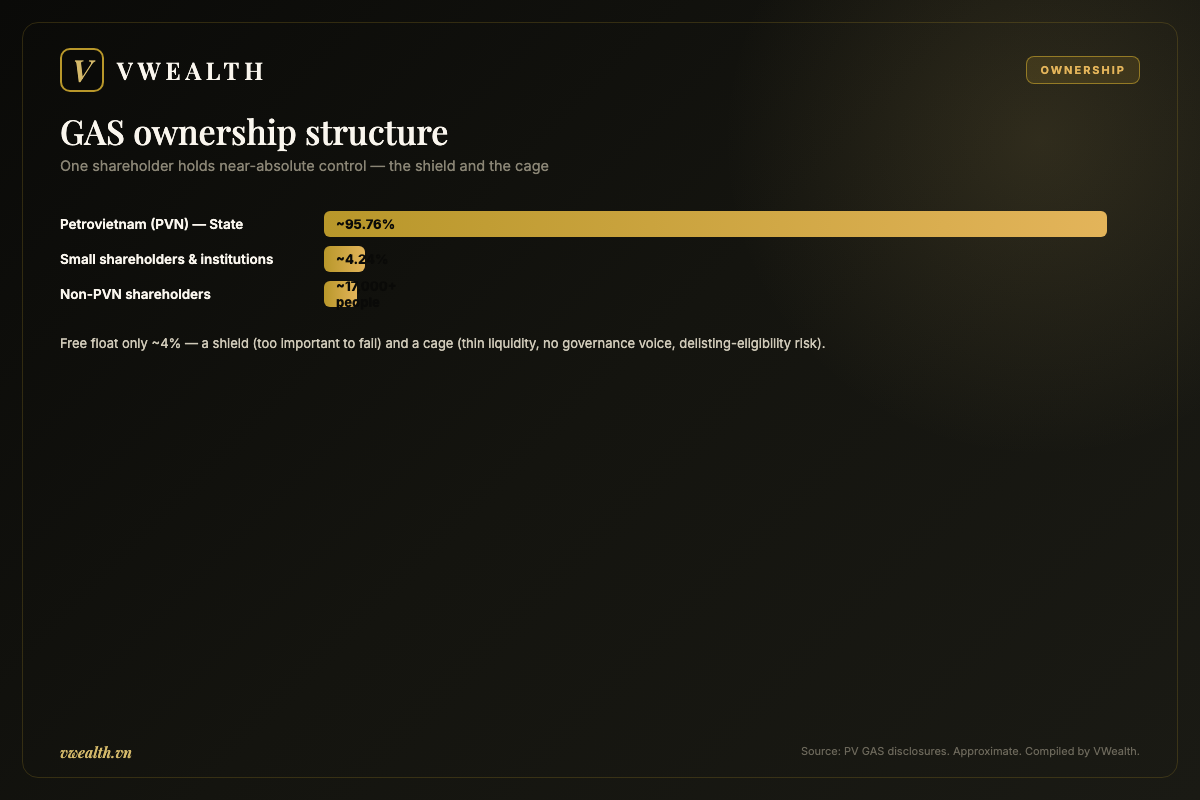
| Ownership component | Estimated ratio | Meaning for investors |
|---|---|---|
| Petrovietnam (PVN) – State | ~95.76% | Absolute control: strategy, personnel, dividends all dominated by PVN |
| Small shareholders & other institutions | ~4.24% | Very low actual free float; voice at the AGM nearly negligible |
| Number of non-PVN shareholders | ~17,000+ | Many in headcount but small in capital weight |
Note: the ratios above are disclosed figures and may change slightly by each shareholder-list closing date; you should cross-check PV GAS’s latest governance report before deciding. But even off by a few percent, the overall picture is unchanged: GAS is one of the most “concentrated” stocks on the market.
Two sides of state ownership: the shield and the cage
Near-absolute state ownership is a double-edged sword, and as an investor you need to weigh both edges rather than just choosing the one you like to hear.
The favorable side — the shield. With PVN behind it, GAS is nearly a business “too important to fail.” The whole system of gas pipelines, terminals and processing plants in Vietnam is in PV GAS’s hands; this is strategic infrastructure tied to national energy security. In Power Plan VIII, gas power is defined as an important baseload source, meaning the state guarantees GAS’s gas output in strategic direction long-term. The natural monopoly in gas transport and distribution is implicitly protected by this ownership structure. When crisis hits, a business like GAS would be among the last the state lets face liquidity or bankruptcy risk. For safety-seeking investors, that’s a very thick psychological “cushion.”
The unfavorable side — the cage. But that very structure also cages GAS. Because the free float is too low, GAS’s liquidity is usually thin versus its cap: a large buy or sell order can push the price sharply, and large institutional investors struggle to enter or exit without price impact. More importantly, every big decision — from gas selling prices, tens-of-thousands-of-billions investment plans, to profit-distribution ratios — depends on PVN and the state policy framework, not your vote. In an AGM, with nearly 96% of votes held by a single entity, the combined voice of over 17,000 small shareholders still can’t change anything PVN has decided. Buying GAS means accepting being a “hitchhiker” shareholder: you benefit when the car runs well, but you don’t hold the wheel and don’t decide the route.
With GAS, you don’t buy the right to decide the business — you buy the right to ride along with a decision the state has predetermined. Your profit comes from choosing the right helmsman, not from getting to drive.
Risk of losing public-company status — and the divestment unknown
This is a development I especially want you to note, because it shows the low-free-float “cage” isn’t just theory. Per the Securities Law, a public company needs at least 10% of voting shares held by small shareholders (non-major shareholders). With a free float of only about 4%, PV GAS doesn’t meet this condition, and the business had to announce it no longer qualifies as a public company based on the shareholder list at the closing date. This is a real legal-status risk, affecting listing eligibility, not a small matter.
Facing this, PV GAS’s Chairman spoke reassuringly: the business is working with relevant agencies to meet listing conditions, while planning a charter-capital increase. That opens a very watchable unknown for investors: to remedy the too-low free float, in theory there are two paths — either PVN reduces its stake (partial divestment), or the business raises capital in a way that lifts the outside-held share proportion.
I stress the word “unknown”: as of the time of analysis, no specific divestment roadmap has been officially announced, and you shouldn’t bet on divestment expectations as a certainty. But you need to understand the two opposing scenarios this unknown creates:
| Scenario | Potential impact on small shareholders |
|---|---|
| PVN keeps ~95.76%, resolves via capital increase/listing techniques | Free float stays thin, liquidity remains an inherent weakness; the stock is hard for foreigners and large funds to accumulate |
| PVN partially divests to raise the free float | Liquidity improves, may attract institutional flows and stronger index inclusion; but may create supply pressure short-term |
How you should act on this unknown is: watch official disclosures about capital increases and state ownership closely, but value GAS based on the current reality — a concentrated stock with limited liquidity — rather than valuing based on a divestment story not yet formed.
Leadership: technocrats in the PVN ecosystem
A trait you need to grasp when investing in large state enterprises like GAS is: leadership is usually rotated and appointed within the PVN ecosystem, and is deeply technocratic and industry-specific. They’re not startup entrepreneurs who founded the company, but a highly specialized management team deployed by the organization.
Per disclosed information, PV GAS’s Chairman is Mr. Nguyen Thanh Binh, while the CEO is Mr. Pham Van Phong (appointed from around 2023). I phrase this cautiously and recommend you verify against the latest annual report or disclosure page before citing, because senior personnel in the PVN system have a rotation trait — the one holding the seat today may be deployed to another unit in the group next period, and this itself is a characteristic of the state-governance model you need to get used to.
The positive: PV GAS’s executive team are generally people who grew up in the gas engineering field itself — pipeline operation, gas processing, LNG terminals — so technical expertise and industry knowledge are a real strength. In a field where an operating error can cause serious safety consequences, having a technically deep leadership is reassuring. When PV GAS sets big goals for the coming period — developing Block B, expanding the Thi Vai LNG terminal, the Vung Ang LNG storage with investment plans in the tens to over a hundred thousand billion dong for 2026–2030 — you’ll want the leaders to be technical people who understand the complexity of these projects, not just people good at telling stories on the exchange.
The point to weigh: because leadership sits within PVN’s deployment mechanism, GAS’s strategic direction will always be placed within the overall interest of the parent group and the state. This means, in some situations, small shareholders’ interests may not be the top priority — for example when the state needs GAS to play a supply-stabilizing role or support energy-price policy. You need to read GAS’s leadership through the lens of “representatives of the state shareholder,” not “representatives of all shareholders equally.”
Governance and dividend policy: the enormous cash flow and the state shareholder’s logic
This is perhaps the part you’ll like most as a small GAS shareholder, because it’s where your interest and PVN’s interest coincidentally align almost perfectly.
PV GAS is famous as one of the most cash-rich businesses on Vietnam’s stock market. GAS’s cash, cash equivalents and bank deposits regularly swing in the 30,000 – 40,000 billion dong range, and in recent periods this number has been recorded approaching, even exceeding 40,000 billion dong. A balance sheet with such a net-cash mountain, nearly no net debt, is the foundation for two things: the ability to self-fund giant infrastructure projects, and the ability to pay high, steady cash dividends year after year.
And GAS is indeed a “dividend machine.” The business maintains a tradition of high cash dividends: announced plans show cash dividends usually in the range of a few thousand dong per share per year (for example, a plan of 2,500 dong/share for 2025, 2,000 dong/share for 2026 per disclosure), with total dividend payout reaching thousands of billions of dong per round. I note that the specific ratios and payout levels change yearly and depend on AGM resolutions, so treat this as an illustration of a durable policy rather than a fixed commitment.
| Financial-governance trait | Figure/explanation (estimate, verify) |
|---|---|
| Cash & deposits | Regularly ~30,000–40,000 bn dong, some periods approaching/exceeding 40,000 bn |
| Dividend policy | High, steady cash; e.g. ~2,500 dong/share (2025), ~2,000 dong/share (2026) per disclosure |
| Total recent dividend payout | Scale of thousands of billions of dong |
| Balance-sheet nature | Large net cash, low leverage — foundation for dividends & investment |
Why is GAS so “generous” with cash, while many other businesses prefer to retain profit? The answer lies precisely in the ownership structure we dissected. PVN — the shareholder holding nearly 96% — needs the dividend cash flow from GAS to serve the group’s own financial needs and its obligations to the state budget. Per the state-enterprise profit-distribution mechanism, a large part of the profit PVN receives from GAS dividends is in turn transferred to the budget. Bluntly: when PVN needs cash, the most efficient way is to “milk” dividends from cash cows like GAS. And because dividends are distributed by ownership ratio, every dong PVN receives also drags a small shareholder like you receiving a corresponding share.
At GAS, the state shareholder’s interest and small shareholders’ interest rarely conflict at the dividend table — both want cash in the pocket. This is one of the few points where a low free float becomes an advantage for you.
That’s something you should appreciate: precisely because the major shareholder is the state and needs cash flow, GAS is nearly “forced” to maintain high cash-dividend discipline. For income-seeking investors, this is one of the most reliable defensive dividend stocks on the market — as long as you accept the trade-off of liquidity and more modest price-growth speed than hot-growth stocks.
Gas-pricing mechanism and policy risk: where state power touches the margin
This final part closes the governance picture, because it’s where state ownership affects not just who steers but directly the pocket: GAS’s margin.
PV GAS’s gas serves three key customer groups: power (the bulk of volume, about 70–80%), fertilizer (over 10%) and industry. For welfare-natured customers — especially power and fertilizer — the gas selling price doesn’t fully run on free-market supply-demand, but is subject to state regulation, negotiation and policy framework. The common pricing mechanism is “anchored pricing”: the output gas price is calculated by a formula tied to a floor plus a percentage of the world Brent/FO oil price.
This creates another double-edged sword for the margin:
When world oil prices rise, the anchored-pricing formula helps the gas selling price rise too, supporting revenue and margin — this is why GAS is often seen as a “proxy” for oil prices on Vietnam’s stock market. Conversely, when oil prices fall, the gas selling price also adjusts down correspondingly, pulling the margin down. But the more important risk layer lies here: because prices for power and fertilizer are regulated and negotiated, GAS doesn’t have full authority to set prices to maximize profit. In periods when the state prioritizes stabilizing electricity and fertilizer prices to curb inflation or support agriculture, the business may have to accept a thinner margin than the “free market” would allow.
As an investor, you need to read this as follows: GAS’s profit isn’t just a function of oil prices and volume, but also a function of policy will. A change in the gas-pricing mechanism — whether to protect the business or protect electricity consumers — could significantly shift the profit picture, and you have almost no way to influence that decision. This is precisely the “policy risk” that state-infrastructure stocks like GAS always carry like their own shadow.
To summarize this section, I want you to leave with a clear thinking frame: GAS is a state-protected financial fortress, paying generous cash dividends thanks to the state shareholder’s own cash-flow needs, led by an industry-savvy technocrat team — but in exchange, you must accept a thin free float, limited liquidity, nearly no governance voice, and a margin always within reach of the policy hand. Understanding this trade-off, you’ll stop expecting GAS to behave like a nimble growth stock, and start valuing it for what it truly is: a defensive, dividend-generating asset tied tightly to the nation’s energy fate. To understand where this fortress generates cash flow, we’ll move to the next section — PV GAS’s ecosystem and products.
Products, infrastructure and ecosystem
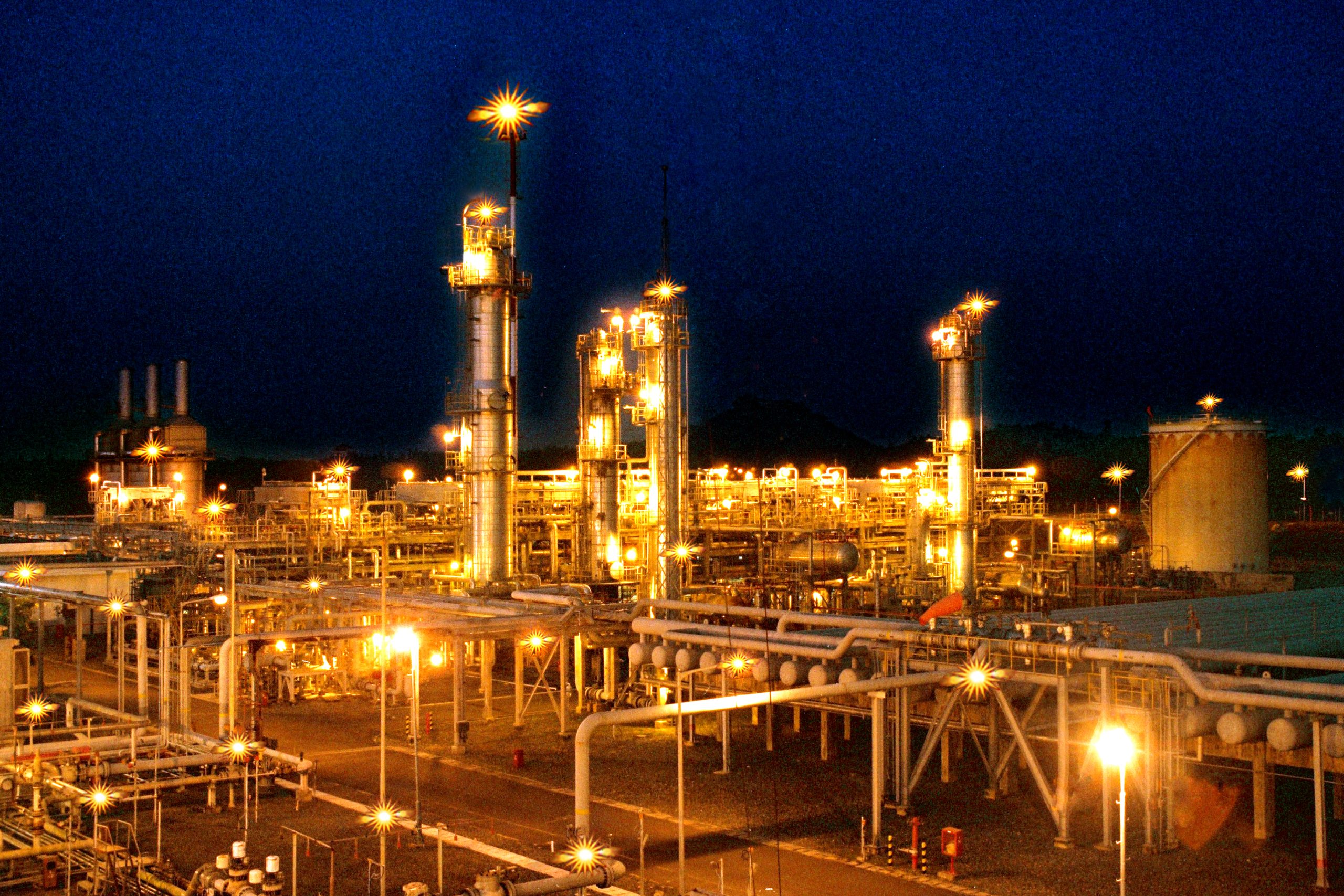
When you hold GAS stock, the first thing to understand is that you’re not buying a company that “sells gas” in the simple sense. You’re buying ownership of a part of nearly the entire backbone of Vietnam’s gas industry: from offshore extraction rigs, through thousands of kilometers of undersea pipeline, into processing plants, then radiating out to power plants, fertilizer plants, industrial parks and all the way to the gas bottle in your kitchen. That’s why every dong of GAS’s revenue is so tightly tied to national energy security. In this section, we’ll dissect each product segment, examine the monopoly infrastructure “moat,” and go through the subsidiary ecosystem — so you see where money is truly made, and where risk is quietly shifting.
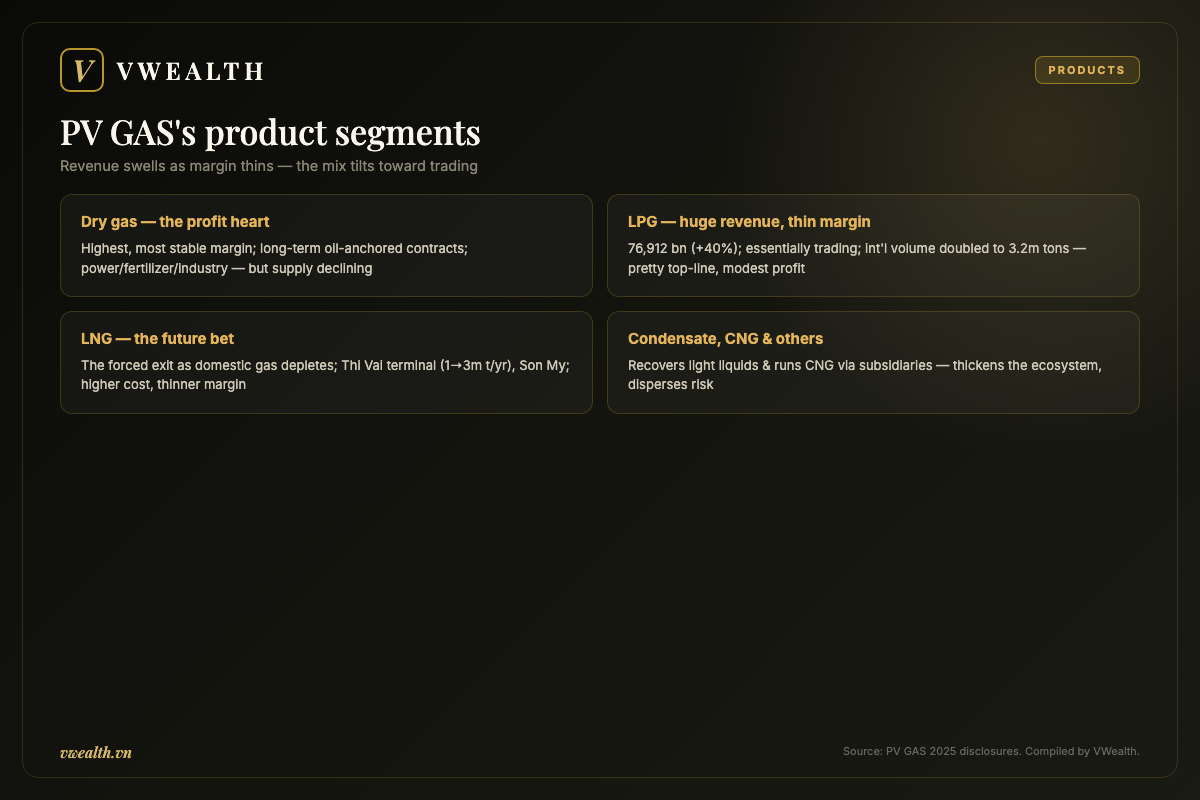
Before the details, let’s grasp the 2025 financial picture as an anchor. 2025 marked a milestone: PV GAS set the highest revenue in its operating history, equal to about 1.1% of the country’s GDP. The dry-gas and LNG segment brought about 52,069 billion dong (up 29%); the LPG segment reached about 76,912 billion dong (up 40%); and notably LPG/LNG business volume topped 5 million tons — up 64% year on year, an unprecedented record. But right within that brilliant picture is a paradox you need to remember throughout: the more revenue swells, the thinner the margin, because the hottest growth comes from the trading segment (imported LPG, LNG) which has a low gross margin, while the fattest segment — domestic dry gas — faces declining supply.
Dry gas — the profit-creating heart
If you had to point to one “money-making” product for GAS, it’s dry gas. This is natural gas that has had liquids and impurities separated out at processing plants, mainly composed of methane, transported by pipeline to large consumers. You should understand dry gas isn’t the largest-revenue segment, but it’s the highest- and most-stable-margin segment — because it’s tied to long-term contracts, an oil-anchored pricing formula, and a customer network almost unable to go elsewhere.
Dry-gas customers fall into three groups, in order of importance:
- Gas-power plants — the largest consumer group, accounting for the overwhelming share of dry-gas volume. Power-plant clusters in the Southeast (Phu My, Nhon Trach) and Southwest (Ca Mau) depend almost absolutely on GAS-supplied gas to generate power. When you turn on the air conditioner at noon in summer, part of that electricity comes from GAS’s gas.
- Fertilizer plants — Phu My Fertilizer and Ca Mau Fertilizer use dry gas as input to produce urea. These customers have very stable demand, since fertilizer production runs nearly year-round.
- Industrial customers — industrial parks, ceramics, steel, food plants use low-pressure gas to replace coal/FO oil. This group is smaller in volume but has good margins and is being expanded by GAS.
Dry gas’s role goes beyond pure business. A country wanting energy security must have a proactive baseload power source, and gas is a cleaner choice than coal and more flexible than hydropower. So GAS isn’t just a listed business — it’s a link in national energy strategy. This is both a shield (the state won’t let GAS face large risk) and a clamp (the price sold to power is regulated, can’t be freely floated by the market).
Remember a core paradox: dry gas is GAS’s best-earning segment, but also the segment shrinking in supply. Traditional gas fields in the Cuu Long and Nam Con Son basins have passed their peak and are naturally declining. This is precisely why GAS’s whole future strategy revolves around two words: LNG.
LPG — an enormous revenue machine, margin thin as a rice leaf
LPG (liquefied petroleum gas — propane and butane) is the largest-revenue segment for GAS in 2025: about 76,912 billion dong, up as much as 40%. It sounds grand, but this is where you need to be most clear-headed. LPG is essentially a trading activity — buying, importing, distributing — so cost of goods takes a very large share and the gross margin is extremely thin. The stronger the revenue rises, the more it pulls GAS’s overall margin down, even though absolute total profit may still nudge up.
GAS distributes LPG under the PetroVietnam Gas / PV GAS brand through two channels:
- Residential retail — 12kg, 45kg gas bottles to households, restaurants, eateries through a dealer network and regional distribution subsidiaries.
- Industrial wholesale — supplying bulk LPG (tanks) to plants and industrial parks for fuel.
The real bright spot of 2025 wasn’t the domestic market (which grew modestly ~8%, to nearly 1.8 million tons) but the international business — booming with over 3.2 million tons, double 2024. This very international trading pushed LPG/LNG volume past 5 million tons. You need to understand its nature clearly: this is very-thin-margin trading, contributing a lot to top-line revenue but modestly to profit. It helps make the revenue number pretty, helps utilize logistics capacity and the network, but don’t confuse volume growth with profit-quality growth.
LNG — the future bet and the exit for declining domestic gas
This is the segment you must pay the most attention to if you hold GAS long-term, because it decides the story of the next 10 years. LNG (liquefied natural gas) is gas cooled deep to about minus 162 degrees C to liquefy it, allowing transport by ship across oceans then regasification at a terminal. For Vietnam, LNG isn’t a luxury choice — it’s a forced exit.
The reason lies in the paradox mentioned above: domestic gas fields are declining, while power demand keeps rising unceasingly. As “home-grown” gas depletes, you’re forced to import gas from abroad. GAS moved ahead when it brought the Thi Vai LNG terminal (Ba Ria – Vung Tau) into commercial operation from July 2023, phase 1 capacity 1 million tons/year, and successfully carried out many LNG imports supplying power and large industrial customers. GAS is currently the only unit in Vietnam with the capacity and license to import, store and distribute LNG at commercial scale.
The LNG expansion roadmap is the strategic backbone:
- Thi Vai phase 2 — raising capacity from 1 to 3 million tons/year, to meet gas demand for the new gas-power cluster.
- Son My (Binh Thuan) — a super LNG-import terminal project with planned capacity up to 10 million tons/year, where GAS holds a controlling co-ownership role. This is a national-scale project.
- Long-term gas-supply contracts — GAS has signed a series of gas-supply contracts for the Nhon Trach 3 and Nhon Trach 4 power plants — the first LNG-power plants using imported LNG, expected to commercially operate and consume ever more gas.
To picture the ambition’s scale: GAS plans to invest over 100,000 billion dong in the next 5 years, mostly into LNG infrastructure. But you need to view LNG with two eyes. The bright side: this is a long-term growth driver with almost no domestic rival, cementing the monopoly into a new era. The dark side: imported LNG has a high cost and swings with world prices, its margin naturally thinner than domestic gas, and the LNG-power pricing problem (more expensive than coal/hydropower) still depends on the pricing mechanism and long-term power-purchase agreements not yet fully clear. LNG is both the future and where margin risk resides.
Condensate and other products
Besides the three pillar segments, GAS also recovers and trades condensate — the light liquid (natural gasoline) separated during gas processing at plants like Dinh Co and Ca Mau. Condensate is sold to refineries and petrochemical plants as feedstock. This is a small segment by weight but meaningful: it maximizes use of the input gas flow, turning the “accompanying” part into revenue, with the selling price anchored to crude. Besides condensate, GAS also trades CNG (compressed natural gas for vehicles and industry) through a subsidiary, plus technical, transport and pipeline-maintenance services. These segments don’t change the overall picture, but help thicken the ecosystem and disperse risk.
Monopoly infrastructure — a “moat” no one can dig again
This is the most important part to understand why GAS is valuable. All the products above are meaningless without the thing connecting them: the physical infrastructure system. And GAS’s infrastructure is precisely its most durable competitive advantage — a “moat” no rival can recreate in the next several decades, because it requires enormous capital, decades of construction time and state backing.
After 35 years of development, GAS’s core infrastructure assets include:
- The Nam Con Son pipeline system — a two-phase line (transporting gas and condensate simultaneously), the longest in the world at the time it was commissioned, bringing gas from offshore fields into the Southeast shore. As of August 2025, this system had safely transported 110 billion m³ of gas — a number reflecting reliability and scale.
- The PM3 – Ca Mau gas system — bringing gas from the PM3 overlapping area (Vietnam – Malaysia) to supply the Ca Mau power-fertilizer cluster in the Southwest.
- The Bach Ho – Cuu Long gas system — the first line, the root of the gas industry, bringing associated gas from the Bach Ho field and Cuu Long basin ashore.
- Gas-processing plants — the Dinh Co Gas Processing Plant (operating since 1999, the first facility in Vietnam using Turbo Expander deep-cooling technology) and the Ca Mau Gas Processing Plant (operating since 2017, using Ortloff SCORE technology to maximize recovery of high-value liquid products).
- The Thi Vai LNG terminal — the first and largest LNG import terminal in Vietnam, the gateway to the imported-gas era.
Why is this an “unbeatable moat”? Imagine you’re a rival wanting to compete with GAS. You’d have to seek a permit to build undersea pipeline, negotiate with upstream fields, spend billions of USD, wait a decade — and then still fight a business with the whole network, customers and policy support already in place. In practice that’s infeasible. That’s why GAS is nearly a natural monopoly in gas transport and distribution. Customers — power plants, fertilizer plants — are hard-wired into GAS’s pipelines; their switching cost is nearly infinite. This is precisely the foundation explaining why GAS keeps stable margins and cash flow despite oil-price swings.
The subsidiary ecosystem — a network covering the whole value chain
GAS doesn’t operate alone but orchestrates a whole subsidiary ecosystem, each unit holding a link in the value chain. A notable point of 2025: 100% of member units were profitable — a rare achievement, showing health spread across the whole system rather than concentrated only at the parent.
The main pieces in the ecosystem:
- PV GAS South (PGS) — one of the key member units, strong in LPG business thanks to the supply advantage from the parent; distributes gas in the South.
- PV GAS D (PGD) — Low-Pressure Gas Distribution — GAS holds controlling stake (about 50.5%), specializing in supplying low-pressure gas, LPG, LNG, CNG to industrial customers. In 2025, PGD reached revenue of nearly 11,453 billion dong (up ~5%) but profit fell about 33% to over 168 billion dong — exactly the “revenue up, profit down” paradox due to price policy supporting customers to keep competitive. PGD is a miniature mirror reflecting the whole group’s margin challenge.
- CNG Vietnam — specializing in compressed natural gas (CNG) for industry and transport.
- PVGAS LPG (Vietnam LPG Trading JSC) — the hub for large-scale LPG trading and distribution under the common brand.
- Transport, pipeline-operation and technical-service units — ensuring the gas flow runs continuously and safely through the whole system.
This ecosystem structure gives you two benefits when owning the parent’s stock. First, GAS controls the whole chain from processing to retail, keeping margins throughout rather than losing them to intermediaries. Second, the geographic and product dispersion helps reduce risk: when one segment (e.g. domestic dry gas) declines, another (LNG, international LPG) can offset in volume and revenue.
Bottom line: the monopoly moat meets the shift to LNG
Putting it all together, GAS’s portrait emerges clearly. On one side is monopoly infrastructure assets nearly impossible to copy — the pipeline network, processing plants, terminals — creating stable cash flow and a near-impregnable position in the mid- and downstream gas segments. On the other is a big shift underway: cheap, high-margin domestic gas is depleting, forcing GAS to shift focus to imported LNG and trading LPG — segments with spectacular volume growth but thin margins and dependent on world prices.
That’s why you see 2025 revenue set a record but the market stays cautious about profit quality. The GAS investment story, therefore, is a bet on whether this group can leverage its infrastructure “moat” to lead Vietnam’s LNG era — turning the old monopoly advantage into a new monopoly advantage — while keeping margins good enough amid a revenue mix increasingly tilting toward trading. To assess whether GAS can do that, you need to examine the business’s financial health, cash flow and valuation next — which is what we’ll dissect right after in the “Position and financial health” section.
Position and financial health
When you hold PetroVietnam Gas’s (PV GAS, ticker GAS) 2025 financials, the first thing that hits you isn’t a single beautiful number, but a rare combination on Vietnam’s stock market: a business that just set a revenue record, holds a cash mountain of nearly 40,000 billion dong, and has almost no debt. That’s the portrait of a “giant” standing firm amid a volatile energy-price cycle. In this section, you and I will dissect the three foundation layers of GAS’s health: the natural-monopoly position in the gas industry, the “cash fortress” making this stock a defensive asset, and the profit cyclicality you must understand before putting money down.
Foundation layer one: The natural-monopoly position — the deepest “economic moat” in energy
To understand why GAS deserves to be among the market’s highest-quality stocks, you need to look beyond the balance sheet, into the industry structure. PV GAS isn’t merely a gas-trading company; it nearly monopolizes the whole collection, transport and distribution of dry gas in Vietnam. The entire pipeline system from offshore fields ashore — Nam Con Son, Cuu Long, PM3 – Ca Mau — is in GAS’s hands. This isn’t an advantage copyable with money: building a national gas pipeline system requires enormous capital, special permits, and decades of accumulated infrastructure.
In investment language, this is called an “economic moat” — and for GAS, it’s the deepest kind: an infrastructure-based natural monopoly. A new rival wanting to compete must not only spend billions of USD but also overcome legal barriers because gas is a national energy resource tied to energy security. This very position was reflected directly in the 2025 revenue: over 135,000 billion dong, equal to about 1.1% of the country’s GDP. To picture the scale, on each day of peak quarters, GAS takes in approximately 400 billion dong. This is the scale of a national energy institution, not an ordinary listed business.
Revenue equal to 1.1% of the country’s GDP and contributing over 7,500 billion dong to the state budget. GAS isn’t just a stock — it’s a link in Vietnam’s energy security.
The consequence of this moat is relatively stable “pricing” ability. Because customers are mainly power plants, fertilizer plants and large industrial parks — units that can’t easily replace their gas source — GAS has a firm bargaining position. In 2025, 100% of GAS’s member units were profitable. This seemingly dry number is actually very important to you: it shows governance quality and health spread across the ecosystem, with no “loss-making subsidiary” quietly eroding consolidated profit.
Foundation layer two: The “cash fortress” — why GAS is the safest defensive stock in energy
If the monopoly position is the moat, then GAS’s balance sheet is a fortress built of cash. As of 31/12/2025, GAS held cash and bank deposits of nearly 39,766 billion dong — about 42% of total assets. Meanwhile, actual outstanding borrowings (financial debt) were only about 2,970 billion dong. Read that number again: nearly 40,000 billion in cash, against under 3,000 billion in debt. In other words, GAS has almost no net debt — idle cash more than 13 times its borrowings.
This is precisely what creates the fundamental difference between GAS and the rest of the energy industry. Let me explain why this “cash fortress” makes GAS the safest defensive stock in the group:
- Immune to interest-rate and liquidity risk. When rates rise or credit tightens, heavily indebted energy businesses (especially power and upstream oil-gas) must bear financial costs. GAS is the opposite — nearly no interest paid, and it’s a lender. The deposit mountain brings thousands of billions of interest income a year, becoming a “profit cushion” auto-activated when the core business struggles.
- Foundation for high, sustainable dividends. The AGM approved a 25% dividend, corresponding to about 6,000 billion dong. With abundant cash and steady profit, GAS’s high cash-dividend policy isn’t the risky “borrow to pay dividends” kind, but funded directly from real cash flow. For an investor prioritizing steady income, this is a precious anchor.
- The ability to “survive” through crisis. In periods of plunging oil prices or weakening gas demand, a heavily indebted business can collapse. GAS has the financial room to wait for the recovery cycle, even to acquire and expand when rivals are exhausted.
Equity at end-2025 reached 67,653 billion dong, undistributed after-tax profit was still 12,484 billion dong. Total assets 93,531 billion dong, up 14% versus year-start. With after-tax profit of about 11,572 billion dong on this equity base, ROE (return on equity) falls around 17%. This is a very respectable number given the reality that nearly half of GAS’s assets are cash “sitting still” earning low interest — meaning the actual operating-asset portion is generating far higher returns. Asset quality is also very “clean”: mostly cash, pipelines and real infrastructure, not goodwill or hard-to-value intangibles.
This health is also confirmed by an independent third party. In November 2025, Fitch Ratings assigned GAS an international credit rating of “BB+” — level with Vietnam’s sovereign ceiling, reflecting efficient operation and sustainable profitability. Such a rating is a “certificate” that GAS’s cash fortress isn’t just pretty on paper.
Foundation layer three: Profit cyclicality — the downside you must understand clearly
By here, if you think GAS is a steady, risk-free “money printer,” stop. Behind the monopoly position and cash fortress is a core trait investors often overlook: GAS’s profit is clearly cyclical, and that cycle is governed by two variables beyond the business’s control — oil prices and gas volume.
Why does the oil price decide a gas company’s profit? The answer lies in the selling-price mechanism. Most of GAS’s gas-sale contracts reference the fuel oil (FO) price, which swings in step with world crude. When oil/FO prices rise, GAS’s gas selling price rises, and the margin widens. When oil cools, the selling price shrinks while many input costs are fixed, and the margin is immediately squeezed. This is why GAS’s pre-tax profit can swing sharply between quarters even though volume changes little.
Q4 2025 is a vivid illustration of this mechanism. In this quarter, GAS’s after-tax profit reached only about 1,387 billion dong, down as much as 32% year on year — even though net revenue surged 75% to nearly 43,700 billion dong. This “revenue up but profit down” paradox is explained by a few layers:
- Gross margin compressed sharply, from about 16% to 9%, as cost of goods surged to nearly 39,900 billion dong. Most of the added revenue came from the imported LPG and LNG segments — which have far thinner margins than traditional domestic dry gas.
- Admin costs rose 61% to over 1,760 billion dong, mainly because of a provision for bad receivables of up to 1,170 billion dong (versus 656 billion in the year-earlier period). This is a prudent accounting factor, but ate straight into quarterly profit.
You need to read Q4 2025 calmly: most of the 33% drop came from provisioning (a one-off factor) and the product-mix shift to thin-margin LNG, not core-business collapse. For the full year, GAS still netted about 11,414–11,572 billion dong, up nearly 10% versus 2024 and beating the profit plan by 218%. One weak quarter doesn’t erase a record year.
Q4 revenue up 75% but profit down 33%. This isn’t a paradox — it’s GAS’s nature: margins depend on oil prices and product mix, not revenue scale.
Long-term risk: natural decline of domestic gas volume
There’s a strategic risk you need to remember beyond the oil-price cycle: Vietnam’s domestic gas fields are entering a phase of natural output decline. Long-producing fields in the Cuu Long, Nam Con Son basins are gradually depleting, while new gas projects deploy slowly. Domestic dry gas — GAS’s highest-margin profit source — is shrinking over time.
GAS’s solution is a model shift: from a domestic gas distributor to an integrated energy business, importing LNG to offset the volume shortfall. In 2025, LPG/LNG business volume topped 5 million tons, up 65% year on year; international activity (importing, trading) contributed over 56% of total revenue. This is both a scale-growth opportunity and a margin challenge: imported LNG has a far thinner margin than domestically extracted gas. In other words, GAS is trading part of its margin to hold scale and market share — a trade-off leadership actively chose.
Summary of the financial-health picture
So what should you retain? GAS is a beautiful market paradox: a natural-monopoly business with an uncopyable infrastructure moat, a cash fortress of nearly 40,000 billion dong with almost no net debt making it the safest defensive asset in energy and a sustainable dividend machine, but simultaneously a cyclical stock whose profit breathes with oil prices and faces the long-term risk of declining domestic gas.
GAS’s financial health, therefore, isn’t the “hot-growth” kind but the “rock-solid” kind — suited to investors prioritizing capital safety and a steady dividend stream over expectations of quickly doubling the account. The next question, and what decides whether you should put money down, is: how has the market valued all of this? Let’s see how the market receives GAS stock in the next section.
Market reception
When you look at the board and see GAS at 81,200 dong (close of 19 June 2026, VWealth plugin data), the first thing to understand is that you’re not looking at an ordinary stock. You’re looking at one of the largest “pillars” of Vietnam’s stock market — a de facto monopoly in gas transport and distribution, with the Vietnam Oil and Gas Group (PVN) holding up to 95.8% of capital. That state-ownership anchor shapes nearly every trading trait of this stock: how the market values it, how it pays dividends, how the price dances with world oil, and even why a blue chip with a cap of nearly 190 trillion has surprisingly thin liquidity.
In this section, you and I will dissect how the market really “reads” GAS stock — not by broker sales pitches, but by the logic of numbers: P/E by the oil cycle, the cash fortress feeding dividends, the ultra-low free float distorting liquidity, and the role of foreigners plus the upgrade story. Understanding these four forces, you’ll know what kind of investor GAS suits, and more importantly, who GAS doesn’t suit.
Valuation: P/E ~16x and the cyclical-stock trap
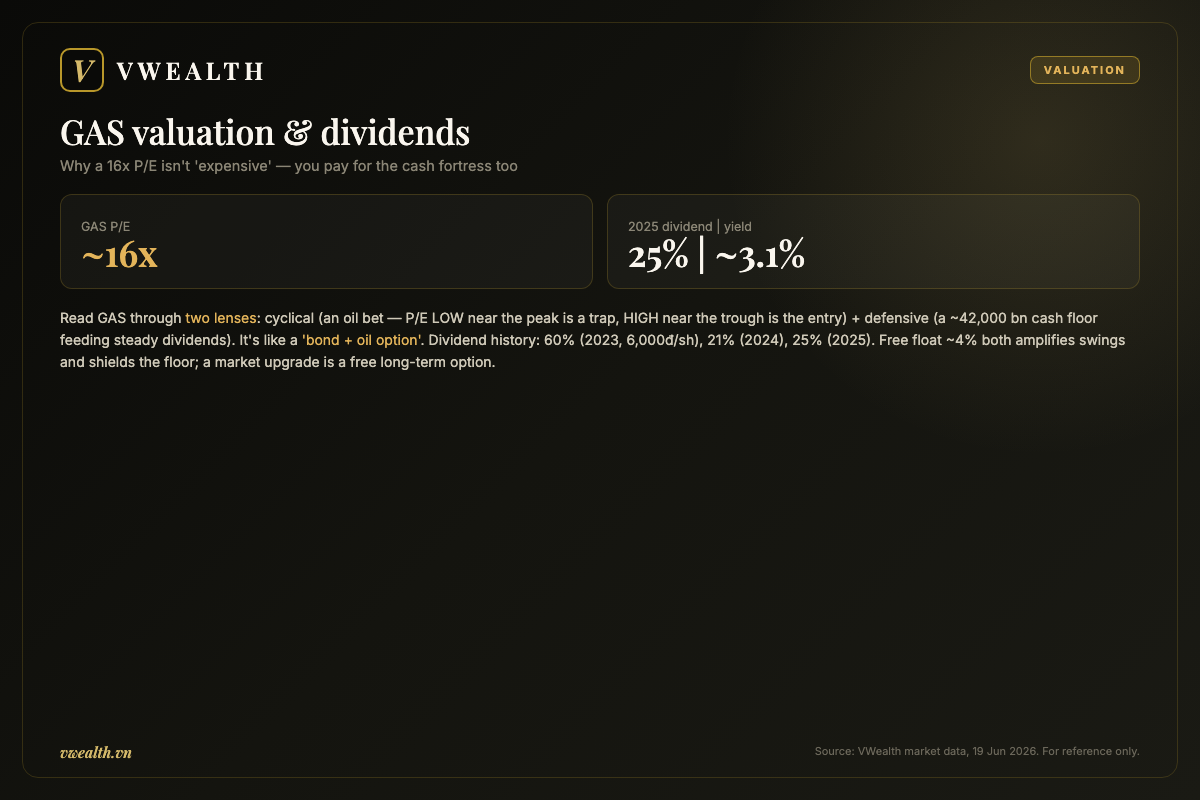
Let’s start with the most basic calculation you can verify yourself. PV GAS has about 2.3 billion shares outstanding (charter capital raised to around 24,130 billion dong after bonus-share issuances). 2025 pre-tax profit reached about 14,500 billion dong, after-tax profit estimated around 11,500–12,000 billion. Dividing after-tax profit by shares outstanding, you get an EPS of approximately 5,000 dong/share. And at 81,200 dong, GAS’s P/E is about 16x.
This 16x figure, at first glance, looks “more expensive” than the general level of a market where many banks trade at 8–10x P/E. But this is precisely where most amateur investors misread cyclical stocks. You need to understand a classic paradox: for a commodity stock like GAS, a low P/E is usually a danger sign, while a high P/E is sometimes a safe entry point.
The cyclical P/E trap: When oil prices peak, GAS’s profit swells, the large EPS denominator pulls the P/E down low — and that’s precisely when the stock is riskiest, because peak profit isn’t durable. Conversely, when oil prices bottom, profit shrinks, the P/E jumps high — but that’s usually the attractive zone to accumulate.
The reason lies in GAS’s gas-selling-price structure. A large part of the business’s output gas price is anchored to the fuel-oil (FO) price or world Brent. When Brent climbs to 90–100 USD/barrel, GAS’s margin bursts open, profit jumps; when Brent falls to 60–65 USD, profit shrinks correspondingly. So GAS’s EPS isn’t a steady cash flow but a wave rising and falling with the global energy cycle. If you apply a fixed P/E to peak-cycle EPS, you’re paying a high price for profit about to decline — the very definition of a reverse value trap.
So the market values GAS not just by one year’s profit, but through two parallel lenses:
- The cyclical lens: This is the “oil-price bet” part. Investors pay for expectations of oil prices and gas volume over the next 12–24 months. This valuation portion swings strongly, sensitive to Middle East news, OPEC+, and domestic gas-power demand.
- The defensive lens: This is the “base value” part. GAS owns a super-healthy balance sheet — cash and bank deposits up to about 42,000 billion dong, with almost no net debt. This enormous net cash creates a valuation “floor”: even if profit declines, GAS has more than enough to pay high cash dividends and never faces financial risk. This part is stable, low-volatility, and the reason many funds hold GAS as a haven asset.
When you combine these two lenses, you understand why GAS’s 16x P/E isn’t “expensive” in the usual sense. You’re paying partly for cyclical profit, and partly for the “cash fortress” plus a nearly certain dividend stream. That’s why GAS rarely trades at a dirt-cheap P/E like other pure-cyclical stocks — the market always attaches a “defensive premium” to its 42-trillion vault.
Dividends: the cash fortress feeds a high, steady dividend stream
If there’s one reason defensive investors — especially funds and long-term investors — love GAS, it’s the cash dividend. This isn’t a business paying token dividends for show. GAS is among the most generous listed businesses on HOSE in real cash returned to shareholders.
Look at the history to see the durability of this cash flow:
- 2023: Record cash dividend of 60% of par — that is 6,000 dong/share, total payout nearly 13,800 billion dong. This was one of the largest cash-dividend payouts in Vietnam’s stock-market history.
- 2024: Cash dividend of 21% of par (2,100 dong/share), paid in 2025, plus a 100:3 bonus-share issuance.
- 2025: The AGM approved a cash dividend of 25% of par (2,500 dong/share), equal to about 6,032 billion dong.
See the pattern? From 2009 to now, GAS has almost never stopped paying cash dividends, with ratios commonly ranging 20–40% of par, jumping to 60% in the super-profit years 2022–2023. The source of this steadiness is precisely the 42,000-billion cash fortress. Unlike businesses that must borrow to pay dividends (a worrying sign), GAS pays dividends from real operating cash flow and its enormous deposit store — structurally sustainable.
On dividend yield, at 81,200 dong, using the 2,500-dong dividend of 2025, the yield is about 3.1%. But here’s a subtle point to grasp: GAS’s dividend yield dances with the cycle. In a super-profit year with a 6,000-dong dividend, the yield could jump above 7% at the same price zone. This dividend “buoy” creates price support: whenever GAS falls deeply, the dividend yield rises enough to attract long-term money in, helping the price avoid a free fall like a speculative stock.
In other words, for defensive investors, GAS is like a “bond plus an oil option”: you receive a relatively certain cash-dividend stream (the bond part), plus price-appreciation potential when the oil cycle is favorable (the option part). That’s a risk-reward profile very different from most stocks on the exchange.
Price behavior: a VN30 pillar dancing with world oil, free float only ~4%
Now to the trait making GAS both attractive and “tricky”: how the share price moves. GAS is among the largest-cap tickers on the exchange, about 12.7% of the VN30 basket weight — that is, it’s a real “pillar,” every nudge of GAS drags the VN-Index and VN30 score. But behind that blue-chip label is a structural paradox you must understand.
Because PVN holds 95.8%, the shares actually freely traded on the market — that is free float — is only about 4%. Of 2.3 billion shares, only about under 100 million units actually “float” for trading. This creates two opposing consequences you need to weigh carefully:
- Limited liquidity, price easily “pulled”: With thin floating stock, even a relatively small amount of money can push GAS’s price to swing notably. A buy-up or dump of a few tens of billions — nothing for a ticker with a cap near 190 trillion — is still enough to move the price a few percent. This makes GAS’s price sometimes jerk up/down at the limit, not necessarily reflecting fundamentals. You’ve seen GAS hit the ceiling when Middle East tensions escalate — that’s partly an oil-price reaction, but partly the thin-free-float effect amplifying the range.
- But also well “supported”: The other side of the coin — because there’s little stock to sell, GAS is rarely “dumped” to the floor for long. The state shareholder doesn’t sell, index funds are forced to hold to track VN30, so the price floor is usually well held. Low free float is both a volatility risk and a shield against collapse.
The biggest price driver, as said, is the world oil price. Treat GAS almost as an “oil-price proxy” for Vietnam’s market: Brent up, GAS up; Brent down, GAS under pressure. Add to that foreign flows and ETF flows — two forces we’ll discuss right below. When all three forces (oil price + foreigners + ETFs) resonate in the same direction, GAS can create very strong waves thanks to the thin free float. That’s both an opportunity and a trap for latecomers.
Foreigners, ETFs and the upgrade story
As a VN30 pillar, GAS is in the mandatory portfolio of most index-tracking ETFs — from domestic ETFs like SSIAM VN30, to foreign funds tracking the Vietnam market. This means a significant part of GAS’s scant free float is “locked” in index funds’ hands, further scarcifying actively traded stock.
Foreigners play a two-sided role in GAS’s price. On one hand, this is a stock in the sights of large funds wanting exposure to Vietnam’s energy and gas-infrastructure story. On the other, because the free float is thin, each strong foreign net-buy or net-sell leaves a clear mark on the price. The market recently saw weeks of record foreign net-selling across HOSE — and such foreign-capital withdrawals put no small pressure on large-cap pillars like GAS, even though the business fundamentals are unchanged.
This is where the market-upgrade story becomes important to you. If Vietnam’s stock market is upgraded from “frontier” to “emerging” in international classification systems, an enormous passive foreign-capital flow will have to allocate into the VN30 pillars — and GAS, with its large weight, is almost certain to benefit. The low-free-float paradox then amplifies further: the same amount of foreign money pouring in but too little stock to buy, the buying pressure could push the price up strongly. This is a free “long-term option” you hold when owning GAS.
Of course, the downside to remember: the very ~4% free float is one of the barriers making some institutions hesitate — because the stock is hard to enter/exit in large volume without slippage. And GAS’s foreign room, though not yet full, is still capped by the dominant state ownership. This is a stock where you can’t expect a takeover or ownership-structure change — PVN will hold controlling power long-term.
Long-term drivers: from the cash fortress to the LNG and gas-power story
So far, we’ve talked a lot about GAS’s “defensive” trait. But the market values GAS above a pure-cyclical stock for one more reason: the long-term growth story from LNG and gas power. This is what makes GAS not just an “oil bond” but also a bet on Vietnam’s energy transition.
Domestic gas volume from traditional fields is naturally declining over time. To offset and create new growth room, PV GAS invested in the Thi Vai LNG terminal with 1 million tons/year capacity — Vietnam’s first large-scale LNG import infrastructure — and is expanding, while planning LNG/LPG centers in the North, North-Central and South-Central regions. This is a strategic shift: from a business dependent on domestic gas to an integrated gas-value-chain supplier capable of importing to meet rising energy demand.
The nearest and clearest driver is gas power. In 2026, PV GAS will supply gas for the Nhon Trach 3 and Nhon Trach 4 power plants as they enter commercial operation — these are Vietnam’s first LNG-fired power plants, opening a new, durable revenue stream for GAS. The business’s 2026 plan targets consolidated revenue of about 142 trillion dong (equal to about 1.1% of GDP) and pre-tax profit around 11.2 trillion. As Power Plan VIII prioritizes developing LNG power to gradually replace coal power, GAS stands right at the fuel-supply link for a whole generation of new power plants.
In other words, GAS’s long-term picture has three stacked layers: the defensive layer (cash + dividends), the cyclical layer (oil prices), and the growth layer (LNG + gas power). These three layers explain why the market is willing to pay a 16x P/E for a business that at a glance looks like just a “state commodity company.”
Bottom line: who does GAS suit?
So after dissecting everything, how should you position GAS in your mind? I’ll wrap it in one line you can remember:
GAS is a defensive stock supported by a cash fortress and a high, steady dividend stream, layered over a bet on the oil-price cycle, plus a long-term growth story from LNG and gas power.
If you’re a defensive investor prioritizing a steady dividend stream and a balance sheet that can’t “break,” GAS is one of the highest-quality choices on the exchange — provided you buy at a reasonable valuation zone, ideally when oil prices and profit are at the cycle trough (when the P/E looks high). If you’re a short-term speculator, remember the ~4% free float makes GAS’s price “jerk” strongly and hard to predict with small flows — both an opportunity and a risk.
What you absolutely shouldn’t do is judge GAS by a single P/E at one point in time. This stock must be read in the context of the oil-price cycle, the cash fortress’s health, and the trajectory of the shift to LNG — factors we’ll place in a bigger frame in the next “Industry context” section, where you’ll see where GAS stands in the whole panorama of Vietnam’s gas and energy industry.
Economic and gas-energy industry context
Before you put a single dong into GAS stock, there’s something you need to engrave: PV GAS isn’t a standalone business. It’s a link sitting between two enormous currents — on one side the global energy market with oil and gas prices swinging by the hour, on the other the electricity thirst of a growing Vietnamese economy. The 14,500 billion dong pre-tax profit of 2025, the generous cash dividends, the cash fortress of nearly 40,000 billion dong you see today — all are the result of where those two currents meet. Understanding this context, you’ll understand why GAS is sometimes a stable “cash cow” and sometimes a cyclical stock full of uncertainty.
World oil and gas prices — the vital variable
If you could only choose one number to watch for GAS, choose the oil price. The reason lies in PV GAS’s very gas-selling-price structure. The natural-gas price this business sells to power plants, fertilizer plants and industrial customers isn’t a fixed number, but anchored to a formula referencing Brent, FO (Fuel Oil) or world LPG prices. When world oil prices rise, PV GAS’s gas selling price rises, and the margin widens. When oil plunges, revenue and profit shrink correspondingly. This is why GAS is classed as a commodity-cyclical stock, not a pure defensive stock as many mistakenly think.
The 2026 oil-price picture is especially volatile. The US Energy Information Administration (EIA) raised its full-year-2026 average Brent forecast to about 96 USD/barrel, up sharply 45.5% from the 66 USD/barrel forecast issued in January 2026, even forecasting the price could peak around 115 USD/barrel in Q2 2026 due to supply disruptions. Meanwhile, the IEA warned the market could be short up to 1.78 million barrels/day in 2026 if Middle East supply doesn’t fully recover, while OPEC leans toward a relatively balanced supply-demand scenario in the medium term and has cut its global oil-demand forecast.
What do you see here? Enormous uncertainty. The world’s leading institutions can’t even agree on where oil prices will go. For GAS, this has two sides. The favorable: if the EIA’s high-oil-price scenario materializes, PV GAS’s revenue and profit benefit directly, because the reference gas selling price will anchor high. The unfavorable: this very dependence means GAS’s profit isn’t within leadership’s control. You can be an excellently run business with good cost discipline — as PV GAS proved when it cut admin costs 5% while 2025 consolidated revenue rose as much as 27% to a record ~134,000 billion dong — but if oil prices crash, profit still shrinks. This is something you must never forget holding this stock.
Natural decline of domestic gas — the thorniest problem
This is perhaps the most structural, long-term challenge you need to understand about GAS. Vietnam’s traditional gas fields in the Southeast — the “cheap” gas source bringing the best margins for many years — are entering a phase of natural output decline. Old fields depleting is an irreversible law of the oil-gas industry. PV GAS itself admitted this reality when it said “domestic gas naturally declines” and the business must prepare replacement scenarios.
What’s that replacement scenario? Importing LNG (liquefied natural gas). This is precisely the crux many investors overlook. When PV GAS must import LNG from the world market to offset depleting domestic gas, there are two big consequences:
- Lower margins. Domestic gas extracted from local fields usually has a low cost, bringing high margins. Imported LNG must be bought at world prices, plus transport, regasification and loss costs — pushing the cost up and eroding the margin. For the same volume of gas sold, gas from imported LNG leaves less profit than domestic gas.
- Dependence on world LNG prices. Where GAS previously bore only oil-price risk on the output (selling price), it now also bears LNG-price risk on the input (buying price). The world LNG market is very sensitive to geopolitics, Europe’s winter, China’s demand — factors entirely beyond a Vietnamese business’s reach.
In other words, you’re witnessing a quiet shift in the “quality” of GAS’s profit: from a business relying on high-margin domestic resources, to a gas trading-logistics business, buying and reselling LNG at a thinner margin. Revenue scale may still rise (PV GAS targets 2026 revenue of about 142,000 billion dong), but the profit rate per dong of revenue risks being compressed over time. This is a long-term trend you must put into your valuation model.
Power Plan VIII — the biggest opportunity, also the biggest bottleneck
If declining domestic gas is bad news, then Power Plan VIII (revised, approved by the Prime Minister in April 2025) is the biggest ray of hope for PV GAS’s future. This plan places LNG power in a priority position in the national power-source mix. Per the direction, by 2030 there will be about 15 more LNG-power plants with total capacity up to 22,400 MW (about 14% of the country’s total generation capacity), consuming about 14 – 18 million tons of LNG a year.
Picture the scale of this number. Each LNG-power plant is an enormous, stable gas-consuming customer for decades. With its near-monopoly on gas infrastructure, PV GAS is the most natural unit to supply gas for this wave of power plants — from importing LNG, storage, regasification to transport by pipeline. If everything goes smoothly, this will be GAS’s core volume-growth driver for the whole coming decade, enough to offset and overcome the decline of domestic gas.
LNG power is both PV GAS’s biggest growth opportunity and its hardest-to-untie bottleneck. Demand is clear, but the mechanism to turn demand into money is still unfinished.
But — and this is a very big “but” — you shouldn’t rejoice too soon. Actual implementation is facing serious mechanism bottlenecks. Most LNG-power projects are behind schedule; many haven’t chosen investors, haven’t broken ground, and most importantly haven’t signed power-purchase agreements (PPAs). The core snag lies in two things: electricity price and offtake.
Specifically, an LNG-power plant wanting to operate must sell electricity at a price enough to cover the expensive LNG cost. But retail electricity prices in Vietnam are still state-regulated and kept relatively low to protect consumers and production. The gap between “LNG electricity cost” and “allowed selling price” creates a commercial bottleneck. At the same time, LNG-power investors demand an output-offtake mechanism (a commitment by EVN to buy a minimum amount of electricity) to ensure payback, but this mechanism is still being tugged over in negotiation. As long as the electricity-price and offtake bottleneck isn’t decisively untied, LNG-power plants stay slow to operate, and PV GAS’s enormous on-paper gas demand can’t convert into real revenue. This is a policy risk you must watch quarter by quarter.
Energy transition and gas-pricing policy risk
At the longest-term view, you need to place GAS in the context of the energy-transition trend and Vietnam’s Net Zero 2050 commitment. In this picture, natural gas is positioned as a “bridge fuel” — cleaner than coal, more stable than solar and wind which depend on weather. As Vietnam gradually reduces coal power and increases renewables, LNG power plays the role of a flexible baseload source, running to fill in when the wind is calm and the sun is off. This bridge role gives GAS a “golden” window that could last a few decades.
However, “bridge” also means not the final destination. In the very long term, as electricity-storage and renewable technology matures, the role of fossil gas will narrow. This is a strategic risk for every fossil-energy business, though for GAS it’s still fairly distant.
A nearer and more concrete risk is the domestic gas-pricing mechanism. As a state business holding essential infrastructure, PV GAS’s gas selling price doesn’t fully run on the market but is subject to regulation and negotiation with large consumers (especially EVN and fertilizer plants). A policy change on the gas-pricing mechanism — whether favorable or unfavorable — could strongly impact profit. This is a hard-to-quantify but ever-present risk for a business standing at the intersection of the market and the state.
Trend prediction
After dissecting the industry context, now it’s time to look forward. GAS’s future is shaped by two pulling forces: leadership’s proactive strategy and objective variables beyond control (oil prices, policy mechanism). Let’s analyze each part, then place them into three specific scenarios so you have a reference frame.
PV GAS’s strategy — an all-in bet on LNG
PV GAS’s leadership has read the “domestic gas depletes — LNG rises” problem very clearly and is acting decisively. The central strategy is turning PV GAS into a leading regional LNG importer, storer and distributor, with the aspiration to become the LNG hub of Vietnam and the region. Specifically, you can see the following pillars:
- Expanding the Thi Vai LNG terminal. This is the first and most important LNG terminal, being raised from 1 million tons/year to 3 million tons/year to ensure stable gas supply for the Southeast — the country’s industrial heart.
- Deploying the Son My LNG terminal. A large-scale project in Binh Thuan, designed to supply gas for the Son My LNG-power cluster — one of the key gas-power centers under Power Plan VIII.
- Developing LNG terminals in the North and North-Central. LNG-terminal projects in Hai Phong and Vung Ang (Ha Tinh) have received investment approval, aiming to bring gas to the Northern market — which previously had almost no gas infrastructure, opening an entirely new market for GAS.
To realize this strategy, PV GAS plans to invest over 100,000 billion dong (about 3.8 billion USD) in 2026 – 2030, with clear priority on LNG infrastructure and M&A activity. In 2026 alone, planned investment disbursement is over 9,000 billion dong. This is a big bet. The cash fortress of nearly 40,000 billion dong you see today is precisely the “ammunition” for PV GAS to fund this investment wave without borrowing heavily — an extremely valuable financial advantage. But you also need to be clear-headed: large investment means cash will be gradually “drawn” from the vault, and the efficiency of these investments depends entirely on whether the gas-power plants operate on schedule — that is, on the mechanism bottleneck we discussed above.
Three scenarios for GAS stock
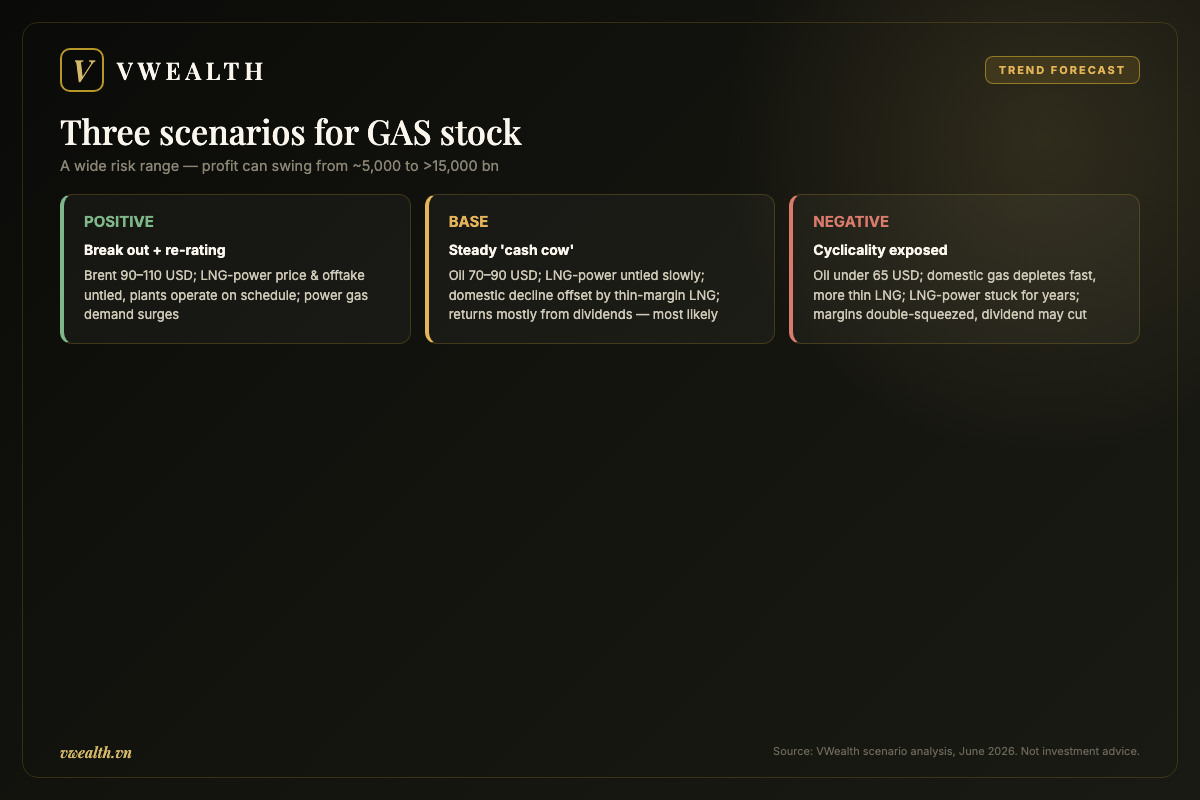
No one can predict the future exactly, but a wise investor always prepares for many possibilities. Below are three scenarios to help you picture GAS’s possible swing range, based on three key variables: oil prices, the depletion pace of domestic gas, and the progress of untying the LNG-power mechanism.
| Scenario | Conditions | Effect on profit and share price |
|---|---|---|
| Positive | Brent anchors high (90 – 110 USD/barrel per EIA scenario) + electricity-price and offtake mechanism for LNG power untied, LNG-power plants operate on schedule + gas demand for power rises strongly. | Revenue and profit break out: reference gas price high, while gas volume for power surges thanks to the LNG-power cluster. Profit could far exceed the 14,500 billion of 2025. Dividends stay high, P/E valuation “re-rated” on the growth story. The share price has significant room to rise. |
| Base | Oil prices swing moderately (70 – 90 USD/barrel) + LNG-power mechanism untied slowly, in parts + declining domestic gas gradually offset by thin-margin imported LNG. | Profit flat or slow growth, around 11,000 – 15,000 billion dong (near the ~11,200 billion 2026 pre-tax profit plan the business conservatively set). GAS plays the “cash cow” role paying steady dividends. The share price moves in a narrow range, with returns mainly from dividends rather than price appreciation. |
| Negative | Oil prices sink deep (under 65 USD/barrel) + domestic gas depletes faster than expected, forcing higher thin-margin imported LNG + LNG-power mechanism stuck for long, plants slow to operate for years. | Profit shrinks notably (PV GAS once had to set a conservative plan of profit falling up to 50% in hard years). Margins double-squeezed from both input (expensive LNG) and output (low oil prices). Dividends may be adjusted down. The share price faces pressure, cyclicality clearly exposed. |
The important thing you draw from these three scenarios isn’t “which scenario to choose,” but recognizing GAS’s very wide risk range. For the same business, profit can swing from 5,000 – 7,000 billion (a hard year) to over 15,000 billion (a favorable year). This swing is the industry’s cyclical nature, not a governance flaw. When you hold GAS, you must accept living with those rising and falling waves.
Should you buy GAS stock?
It’s time to place every piece on the scale. Throughout this analysis, you’ve walked through PV GAS’s solid financial internals, its near-monopoly gas-infrastructure position, and an industry context full of both opportunity and challenge. The final question — and the hardest — is whether, at 81,200 dong with a current P/E of about 16x, GAS is an investment suited to you. Let me say straight from the start: this article won’t verdict “buy” or “sell” for you. That decision is yours, based on your own risk appetite and goals. An analyst’s job is to hand you an accurate scale.
On the scale: pros and cons
Let’s start with the bright spots — the reasons many long-term investors treasure GAS:
- Gas-infrastructure monopoly. PV GAS owns the near-only pipeline and terminal system in Vietnam. This is a deep, wide “economic moat” almost no rival can cross for decades. Anyone wanting to bring gas to power plants and fertilizer plants must go through GAS’s infrastructure.
- A cash fortress of nearly 40,000 billion dong. This is one of the “healthiest” balance sheets on Vietnam’s stock market. This enormous cash is both a crisis-resilience cushion, a resource to fund the LNG strategy without borrowing heavily, and the basis to maintain dividends.
- High, sustainable dividends. PV GAS has a history of generous cash dividends — the AGM approved a 25% cash dividend for 2025, and once paid up to 60%/share. For an investor seeking a steady cash flow, this is a very big plus.
- Defensiveness and safety. Gas is an energy necessity with relatively stable demand regardless of the economic cycle. Along with controlling state ownership and a healthy balance sheet, GAS is a “sleep well” stock in volatile market periods.
- Riding the long-term LNG-power wave. Power Plan VIII opens an enormous gas-demand market. If the mechanism bottleneck is untied, GAS is the direct and biggest beneficiary.
- Benefiting when oil prices are high. In a high-oil-price environment like the EIA’s 2026 forecast, GAS is one of the clearest ways for Vietnamese investors to “bet” on rising energy prices.
But the scale must have two pans. Below are the risks and limits you absolutely mustn’t turn a blind eye to:
- Cyclical profit by oil prices. This is the biggest risk. GAS’s profit rises and falls with world oil prices — something beyond the business’s control. Buying GAS at the oil-cycle peak may mean buying “falsely high” profit.
- Declining domestic gas, thin-margin LNG. The high-margin domestic gas source is depleting, replaced by thin-margin imported LNG. This is a trend gradually eroding profit “quality” long-term.
- Low free float, poor liquidity. The state (via PVN) holds a very large controlling stake, freely traded shares only about 4%. This makes liquidity low, the price can swing strongly on small volume, and large investors struggle to enter/exit positions.
- Dependence on the state pricing mechanism. The gas selling price is subject to regulation and negotiation, not fully market-based. A policy change could strongly impact profit in both directions.
- Slow profit growth, signs of saturation. Though revenue set a record, core profit doesn’t grow explosively. The 2026 pre-tax profit plan the business itself set (about 11,200 billion) is even lower than the 2025 result, showing caution about short-term growth prospects. At a P/E of about 16x, you’re paying a not-cheap price for a slow-growing business.
Which kind of investor does GAS suit?
There’s no absolutely “good” or “bad” stock — only a stock that fits or doesn’t fit your goals. Hold GAS up against four common investor portraits:
- Dividend / passive-income investor. This is the group GAS suits best. If your goal is a steady, generous dividend cash flow from an industry-leading business with little bankruptcy risk, GAS meets it very well. The cash fortress and monopoly position guarantee the ability to maintain dividends.
- Defensive / capital-preservation investor. Also very suitable. If you prioritize safety, “sleeping well” through market swings, and accept modest but certain returns, GAS is a defensive pillar worth considering for the portfolio — as long as you understand and accept the oil-cycle wave.
- Commodity-cycle investor. Suitable, but requires skill. If you can read the oil-price cycle and want to bet on the rising-energy-price scenario (like the 2026 forecast), GAS is a good tool. But this group must accept volatility and know that “buying at the right point in the cycle” is a survival factor.
- Fast-growth investor. This is the group least suited to GAS. If you expect a stock to double or triple in a few years on explosive profit growth, GAS is almost certain to disappoint you. The business is already at large scale, core growth is slow, and most of the growth story (LNG power) is still stuck at a mechanism bottleneck with no known resolution date.
In sum, GAS is the archetype of a “defensive stock — cyclical dividend.” It suits those seeking stability, cash flow and safety, while clear-headed enough to accept profit rising and falling with oil prices. It doesn’t suit hot-growth hunters. The current 81,200-dong price and ~16x P/E aren’t a cheap zone, so if you’re interested, timing and entry price will be very important — especially be cautious if oil prices are at the cycle peak.
GAS isn’t a stock to get rich fast. It’s a stock to sleep well, receive dividends, and patiently wait for the LNG-power wave — if the mechanism bottleneck is untied.
Disclaimer: This entire analysis is produced for informational and reference purposes, and is not investment advice, nor a recommendation to buy or sell GAS or any security. The figures, forecasts and scenarios presented are based on public information at the time of writing and may change without notice. The stock market always carries risk; share prices can rise or fall, and you may lose part or all of your capital. Before making any decision, you should research thoroughly, weigh your personal financial situation and consult a licensed financial advisor. You are fully responsible for your own investment decisions.
Research Vietnamese stocks in English with vwealth. Our AI-powered platform turns Vietnamese market data into full English analysis reports — with international payment support and a free 2-month trial for new accounts. Create your free account and read the latest reports.