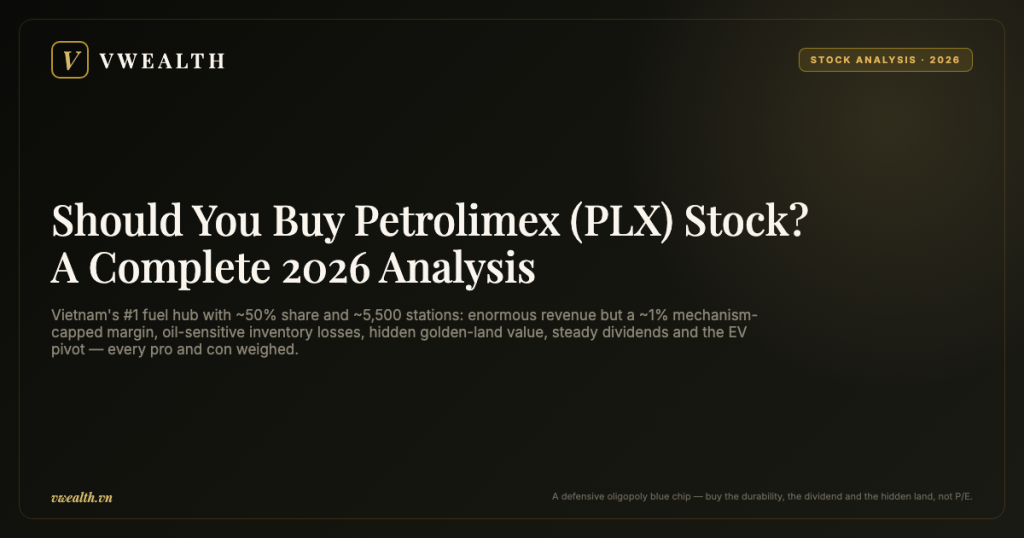
If you’ve ever filled up your tank anywhere on this S-shaped strip of land, you’ve almost certainly stepped into the “territory” of a single business: Vietnam National Petroleum Group – Petrolimex, ticker PLX on HOSE. This isn’t an unfamiliar name on the board, but the nation’s number-one fuel hub: holding about 50% of domestic retail market share with a network of nearly 5,500 stores blanketing 34 provinces, a figure no rival comes close to. Simply put, for every two liters of gasoline Vietnamese buy, about one flows through Petrolimex’s system.
Petrolimex is the kind of business investors jokingly call a “national blue chip”: a state-controlled enterprise, enormous in scale, present in every family’s daily life. On revenue, it’s one of the biggest “giants” on Vietnam’s stock market — in 2025 it set a record of nearly 310,000 billion dong, second only to the Vingroup ecosystem, a figure equal to over 12 billion USD. It sounds overwhelming, but this is precisely where you need to be most clear-headed looking at PLX.
Because Petrolimex’s enormous revenue comes with a fact few notice: an extremely thin margin. On a “mountain” of nearly 310,000 billion dong of revenue in 2025, pre-tax profit was just 3,643 billion — that is, a pre-tax margin of just over 1%. Petrolimex’s profit doesn’t mainly lie in how much gasoline it sells, but depends heavily on the state’s fuel-price management mechanism and world oil-price movements. When oil plunges, high-priced inventory suddenly becomes a burden, and a thousand-billion loss in the fuel segment in one quarter is entirely possible — as Q1 2026 itself witnessed.
In exchange, PLX has something many other stocks dream of: steady cash dividends, paid every year, usually around 10–12% of par, with each round distributing thousands of billions of dong to shareholders. At 38,650 dong (close of 19 June 2026), the question many investors are asking is: should you buy PLX, and what kind of investor does it suit? To answer thoroughly, you can’t look at just one quarter or one P/E number. You need to understand who Petrolimex is, how it traveled a 70-year journey to reach its dominant position today, and what historical “knots” are shaping its future. This full analysis will peel back each layer, and we start from the roots — where every worthwhile investment story should begin.
PLX market data (updated 19 June 2026)
| Current price | 38,650đ | 2025 revenue | 309,875 bn (#2 on exchange) |
| Change (June) | −2.77% | 2025 pre-tax profit | 3,643 bn (margin ~1.2%) |
| Market share | Stations | ~50% | ~5,500 | Dividend | P/E | 12% | ~16–18x |
PLX is an oligopoly fuel blue chip: enormous revenue but a ~1% margin capped by the pricing mechanism; profit sensitive to oil (Q1/2026 inventory loss). Hidden value in the land bank of 5,500 stations. Source: VWealth + PLX reports. For reference only.
History and evolution
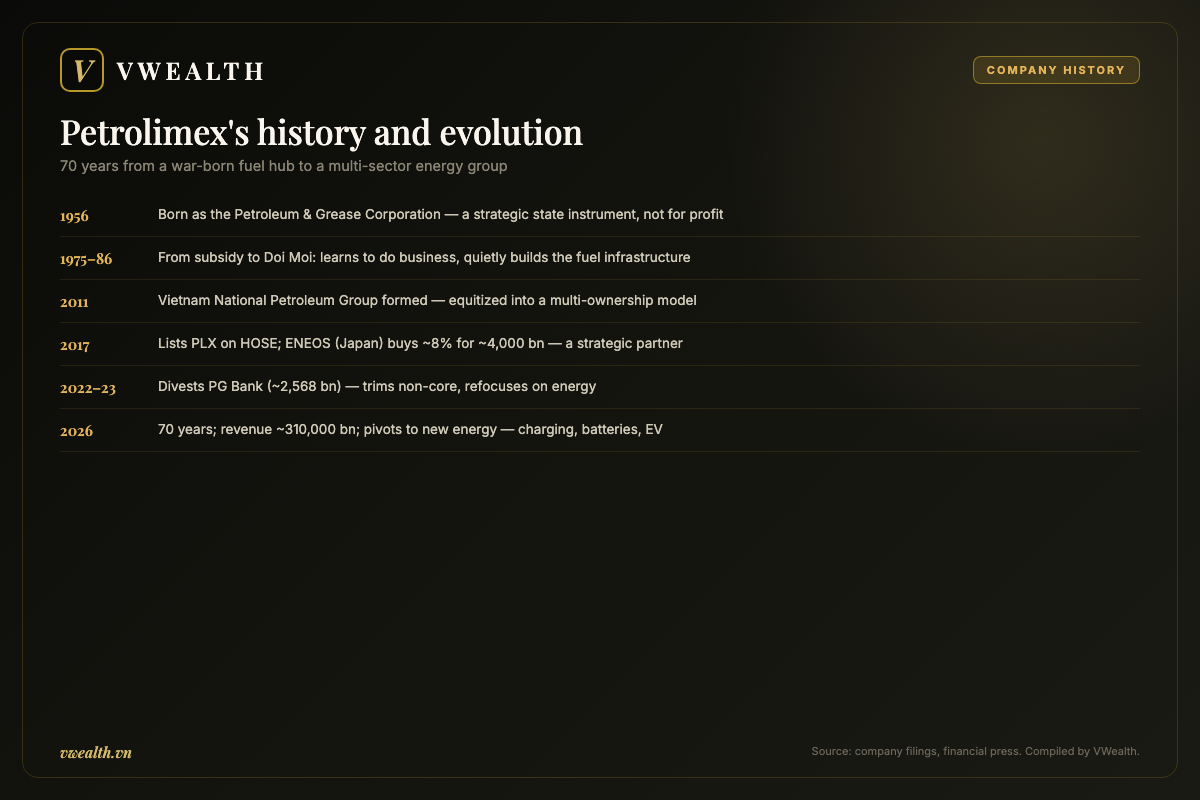
To understand why Petrolimex today is held 75.87% by the state and called an “energy-security pillar,” you must go all the way back to 1956 — a time when controlling every drop of fuel wasn’t merely a business matter, but a survival matter for a whole nation just emerging from war. PLX’s history isn’t the history of a startup or a private business rising up, but the history of a strategic instrument of the state, and this “state-owned in the blood” trait explains nearly everything you see in PLX stock today.
1956: Born from war and the need for reconstruction
On 12 January 1956, the Ministry of Trade issued Decree No. 09/BTN-ND.KB, establishing the Petroleum and Grease Corporation – the direct predecessor of today’s Petrolimex. The founding context was very special: the North had just been liberated after 1954, fuel infrastructure was severely lacking, while the need for fuel for economic recovery, stabilizing life and preparing for the struggle to reunify the country was extremely urgent.
This was the first time the Vietnamese state had a dedicated organization to unify the management and organization of the fuel business. Note the word “unify” — from day one, Petrolimex was born to be a single hub, not to compete in an open market. The corporation’s core function then was to receive, store and dispense fuel per mandatory quotas, serving security, defense, socio-economics and especially supplying the front lines.
The important thing to remember: Petrolimex wasn’t born to maximize profit. It was born to ensure essential energy for the country in all circumstances. Seven decades later, this “gene” remains intact in how the state manages fuel prices and keeps absolute controlling stake in the business — and that’s both an anchor and a weakness of PLX stock.
In the war years, the fuel industry’s role became even more vital. Fuel is the “blood” of every war machine and production; the fuel-supply transport routes to the southern battlefield became a legendary part of history. Throughout this period, Petrolimex’s predecessor operated entirely on the subsidy mechanism — receiving, reserving and distributing per orders, with no concept of “profit or loss” or “shareholders” like now.
From subsidy to Doi Moi: Learning to do business
After the country reunified in 1975 and especially after Doi Moi (economic reform) from 1986, the business’s role gradually changed. From a purely quota-dispensing unit, the Vietnam National Petroleum Corporation (the name changed several times) had to start learning to operate like a business — self-accounting, expanding the network, investing in terminals, a fleet, and developing a retail store system nationwide.
This is precisely the phase Petrolimex quietly built its most precious asset that few recognize: an enormous fuel infrastructure network. The coastal hub-terminal system, the pipeline system, the ocean and coastal fleet, along with thousands of stores at “golden land” frontage locations on arterial transport axes. When you assess PLX’s value today, don’t just look at annual profit — most of the real value lies in the infrastructure and real-estate assets accumulated over these many decades.
The “market-stabilizing” role was also shaped in this phase and continues to this day. As the largest hub business, Petrolimex is always entrusted by the state with keeping fuel supply and price levels stable. When the market swings sharply, Petrolimex is usually the unit that must “shoulder” the responsibility of not letting supply break — an important political mission, but one sometimes running counter to shareholders’ pure interest.
2011: Forming the Group – a turning point in thinking
A pivotal milestone came in 2011. Per Prime Minister’s Decision No. 828/QD-TTg of 31 May 2011, the Vietnam National Petroleum Group (Petrolimex) was formed from equitizing and restructuring the Vietnam National Petroleum Corporation, converting to a multi-ownership joint-stock model.
This was the first time this business transformed from a purely state corporation into a group operating on a joint-stock mechanism. Along with the renaming and restructuring, the direction also broadened: Petrolimex was no longer just a “gasoline-selling business,” but began to be positioned as a multi-sector energy group, with an ecosystem of subsidiaries spanning many fields related to fuel and energy.
2017: Equitization, HOSE listing and the “handshake” with the Japanese
If you had to choose the most important year for investors, it’s 2017. This is the year Petrolimex officially became a stock you can trade. On 21 April 2017, over 1.29 billion PLX shares officially debuted on the Ho Chi Minh City Stock Exchange (HOSE), immediately placing Petrolimex among the market’s largest-cap businesses.
But the most valuable story of this listing lies in the foreign strategic shareholder. Before listing, Petrolimex chose and sold shares to JX Nippon Oil & Energy (JX NOE) – now ENEOS, Japan’s number-one energy group. In one of the largest investment deals in Vietnam in 2016, the Japanese partner spent nearly 4,000 billion dong to own about 8% of Petrolimex, while bringing the state shareholder’s stake down to 75.87% – a figure held stable to this day.
Why is the “handshake” with ENEOS so important to you – an investor? For several reasons:
- Governance quality: ENEOS is Japan’s leading oil-and-gas group, holding both upstream (extraction, refining) and downstream (distribution). As a strategic shareholder, ENEOS helps Petrolimex raise governance capacity and standardize its fuel business to international standards. The presence of a large, disciplined “player” from Japan is a significant plus for transparency and financial discipline.
- Long-term faith: ENEOS isn’t a wave-chasing financial investor. The Japanese market has saturated, and they see Vietnam – through Petrolimex – as a long-term growth opportunity. A steadfast partner wanting to stay is a positive signal about the business’s intrinsic prospects.
- The foreign “room ceiling” – a special variable: This is a point you must remember. ENEOS openly aspires to raise its stake to 20–25%, and has continuously accumulated more. To date, ENEOS (via ENEOS Vietnam) holds about 13.08%, equal to over 169 million PLX shares. Foreigners in general have neared the maximum 20% foreign-ownership ceiling at Petrolimex. Persistent demand from a strategic shareholder wanting to buy more is a price-supporting factor few blue chips have.
| Shareholder | Role | Ownership (approx.) |
|---|---|---|
| State (Committee for Management of State Capital / Ministry of Industry and Trade) | Absolute controlling shareholder | ~75.87% |
| ENEOS (via ENEOS Vietnam) | Foreign strategic shareholder | ~13.08% |
| Remaining shareholders (incl. public investors) | Minority ownership, free-float shares | The rest |
A consequence of the large shareholders continuously accumulating is that PLX’s free-float is quite low. Most shares are “locked” in the hands of the state and ENEOS. This makes PLX a stock with liquidity not too abundant versus its cap, and the price can sometimes swing sharply when large flows enter or exit. Indeed by April 2026, the concentrated ownership at times caused Petrolimex to no longer meet “public company” conditions under the Securities Law, forcing the Board to consider selling some treasury shares to ensure the public-share ratio per regulation – a fairly rare situation, reflecting PLX’s “little floating stock” trait.
The Petrolimex ecosystem: not just gasoline
When you buy PLX stock, you’re not just buying a chain of gas stations. You’re buying shares of a multi-sector energy group with a wide-spanning ecosystem of subsidiaries and affiliates. Understanding this picture helps you correctly assess the profit sources and the business’s diversity:
- Fuel retail – the core segment, with nearly 5,500 stores and a nationwide dealer network. This is the “heart” generating enormous revenue but thin margins.
- Petrochemicals – PLC (Petrolimex Petrochemical Corporation): producing and trading lubricants, asphalt, chemicals. This is a segment with far better margins than fuel retail.
- Gas – PGC (Petrolimex Gas Corporation): trading liquefied petroleum gas (LPG) for residential and industrial use.
- Transport – PG Tanker and water-transport units: an oil-tanker fleet serving input logistics, a strategic link helping Petrolimex secure supply.
- Aviation fuel: supplying jet fuel – a field with a high entry barrier and attractive margins.
- Terminal infrastructure: like the Van Phong bonded fuel terminal joint venture, reinforcing its import-hub and reserve position.
This multi-sector nature is both a strength (diverse income, some thick-margin segments offsetting the thin-margin fuel segment) and once a weakness when the group invested in non-core fields – notably banking.
PG Bank divestment: cleaning up to focus
One of the most notable restructuring moves in the recent period was Petrolimex fully divesting from PG Bank (Petrolimex Group Commercial Joint Stock Bank). In 2022–2023, the group focused on handling this non-core investment. On 6 March 2023, Petrolimex announced an auction of its entire PG Bank stake (equal to 120 million shares, i.e. 40% of the bank’s capital) at a starting price of 21,300 dong/share, and the 7 April 2023 auction on HOSE succeeded – the group sold to 4 investors, taking in about 2,568 billion dong.
The meaning of this move for shareholders is very clear and positive:
- Focusing on the core industry: Banking isn’t the forte of a fuel business. Exiting PG Bank helps Petrolimex concentrate resources into energy – where it has a real competitive advantage.
- Taking in hard cash: Over 2,500 billion dong freed up for reinvestment or balance-sheet strengthening, while removing risk related to the sensitive finance-banking field.
- A governance signal: This proves leadership is on the right “streamlined, focused” track the state requires of state enterprises after equitization.
A new direction: from “fuel king” to a comprehensive energy business
The most interesting – and most debated – story lies in the new chapter Petrolimex is writing. Leadership has openly announced an ambitious long-term direction: not stopping at the role of a fuel-trading business, but gradually transforming into a comprehensive energy business, in line with the global energy-transition trend.
Specific steps taken and underway:
- Cleaner fuels: distributing E10 biofuel and Euro V-standard fuel, getting ahead of the environmental-standard tightening roadmap.
- Rooftop solar: targeting installing solar systems at at least 30% of stores – turning the gas-station network into distributed power-generation points.
- EV charging stations: developing charging infrastructure at fuel stores, partnering to build charging stations nationwide on an open model for all EV brands. Petrolimex has inaugurated its first charging stations and partnered with players in this field.
- A battery-and-EV company: in 2026, Petrolimex plans to launch a new company related to batteries and EVs – a concrete step to join the new-energy value chain, including a battery-swapping model.
- International cooperation: working with partners from Singapore, China, Korea to research long-term energy solutions.
Why is this direction important to your investment decision? Because it touches directly on Petrolimex’s biggest long-term risk: the electrification of transport. As EVs become ever more common, demand for traditional fuel will stall then decline. Petrolimex’s most precious asset – nearly 5,500 “golden land” frontage locations – risks becoming a “stranded” asset if the business doesn’t transform in time. Conversely, if Petrolimex succeeds in turning each gas station into an “integrated energy-service station” (selling fuel, charging, swapping batteries, plus amenities), that very enormous infrastructure becomes an uncopyable competitive advantage. This is a strategic gamble that will decide whether PLX is a “safe dividend” stock or a “long-term growth” stock in the coming decade.
Seven decades in review: what it means for investors today
2026 marks Petrolimex’s 70-year journey – from the Petroleum and Grease Corporation born in war in 1956 to an energy group with over 12 billion USD in revenue and a market cap exceeding 51,000 billion dong. Placing this whole journey side by side, you draw conclusions of real value for investing:
- The dominant position is real and durable: It’s no accident Petrolimex holds ~50% market share. That’s the result of 70 years of accumulated infrastructure, network and a role entrusted by the state. The entry barrier is enormous – no one can erect 5,500 stores and a terminal system overnight.
- The state’s hand is a double-edged sword: The 75.87% controlling stake brings stability, policy backing and an “energy-security pillar” role. But it also means Petrolimex sometimes must put the stabilizing mission above profit, and the pricing mechanism makes profit hard to break out as shareholders wish.
- Profit depends on factors beyond control: World oil prices and the pricing mechanism are two variables governing each quarter’s results. This is why PLX can profit big one year but lose in the core segment the next – a trait you must accept.
- The “nest egg” lies in assets and dividends: The golden-land real estate, the infrastructure system, plus the steady annual cash-dividend stream are the “base value” making PLX attractive to safety- and steady-income-oriented investors.
- The future is a question mark worth watching: The shift to clean energy, charging stations, batteries and EVs will decide whether PLX escapes the “shadow” of a traditional fuel business facing electrification risk.
In sum, Petrolimex’s 70-year history shows you a business born to serve the nation, grown alongside the country’s turning points, and standing before the most important strategic crossroads since equitization. But a business, however glorious its history, is only as good as the people steering it and the decisions they make each day. How Petrolimex leverages its enormous asset base, how aggressively it bets on new energy, whether it keeps financial discipline under “political mission” pressure – all depend on leadership. That’s what we’ll dissect right in the next section.
Leadership and ownership structure
When you analyze a stock like PLX of Vietnam National Petroleum Group (Petrolimex), you can’t start from the balance sheet or the price chart. You must start from a more basic question: who really owns this business, who runs it, and most importantly – do their interests align with yours, a small shareholder buying a few hundred shares on the exchange? For Petrolimex, the answer to all three questions revolves around a reality dominating everything: this is first and foremost a listed state enterprise, not a public company the state holds a stake in. That subtle difference, as you’ll see, explains almost the entire character of this stock.
Ownership structure: two hands holding nearly 90% of capital
Let’s start with the most important number. The state shareholder, whose capital is represented by the Committee for Management of State Capital at Enterprises (this capital was previously managed by the Ministry of Industry and Trade, handed over to the Committee from late 2018), holds about 75.87% of Petrolimex’s charter capital. This isn’t an ordinary controlling stake – it’s an absolute one. With over three-quarters of voting shares, the state can decide every matter at the AGM, from electing the Board, approving profit plans, to dividend policy, without needing a single vote from the rest.
The second-largest shareholder, and also a rare bright spot on governance quality, is ENEOS Corporation of Japan – the number-one energy group of the land of the rising sun. ENEOS is present at Petrolimex through the ENEOS entity (formerly JX Nippon Oil & Energy), which became a foreign strategic shareholder in 2016 through buying about 8% of capital worth approximately 4,000 billion dong – one of the largest investment deals in Vietnam at the time. After accumulating more shares through Petrolimex’s treasury-share sales, the ENEOS/JX group now holds about 13% of charter capital (some materials record around 13.08%). This group has over 100 years of history, formed from merging Nippon Oil and Nippon Mining, and their participation isn’t purely a financial investment.
When you add these two figures – about 75.87% state and about 13% ENEOS – you’ll see nearly 89% of Petrolimex’s charter capital is in the hands of two stable strategic shareholders who barely trade on the exchange. The rest, the free-float ratio truly for public investors, is only about over 10% and in practice even lower after subtracting long-term-holding institutions.
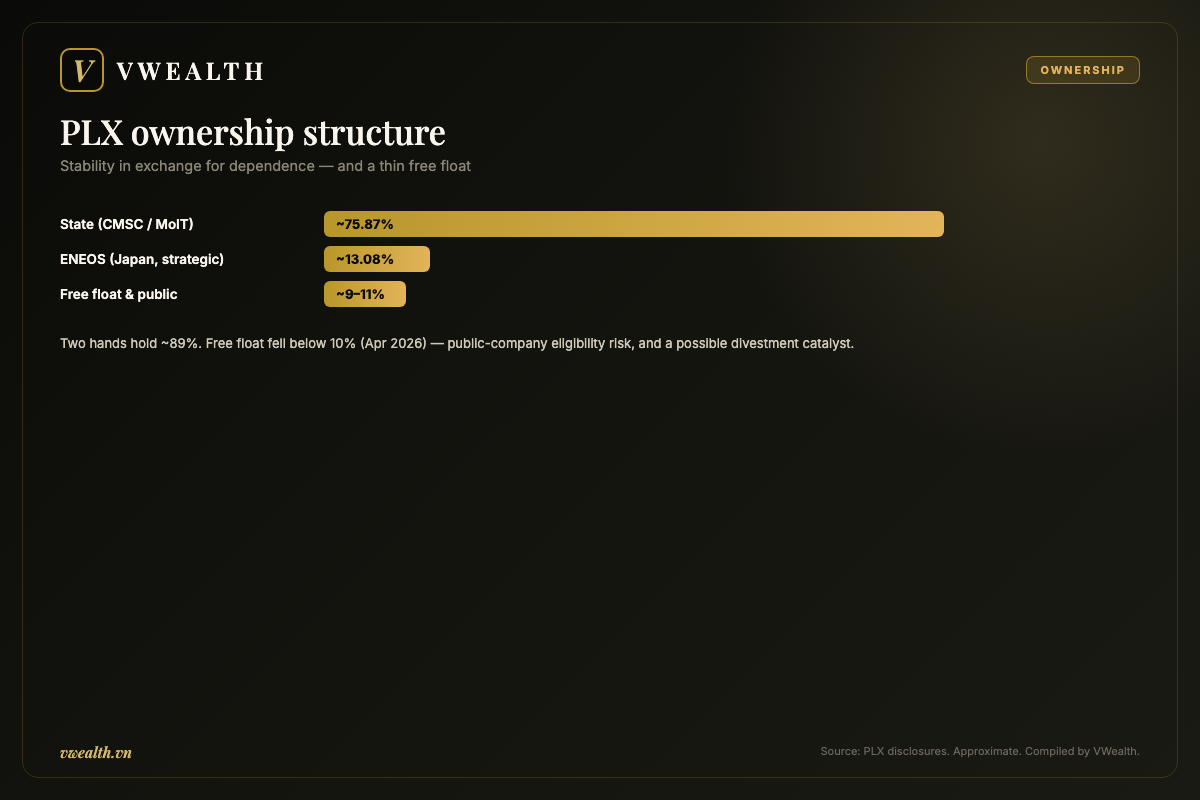
This low free-float isn’t a harmless technical detail. It has very concrete consequences you need to weigh. First, the stock’s real liquidity is limited – the actually “circulating” shares are far fewer than the cap suggests, making the price sensitive to large flows in or out. Second, and this is the most notable thing in 2026, the too-thin free float landed Petrolimex in a rare legal situation.
Per an April 2026 disclosure, Petrolimex’s small-shareholder group held only over 9.4% of total voting shares – below the minimum 10% threshold the Securities Law requires to maintain public-company status. The group announced it currently doesn’t meet public-company conditions, and if it can’t raise this ratio to at least 10%, in theory it would have to consider the procedure to revoke public status.
You should understand the nuance of this news calmly. This isn’t a sign of the business weakening – on the contrary, it reflects the very fact that large shareholders hold too tightly. However, as an investor, this is a legal-governance risk variable you must watch, because public-company status and listing relate directly to disclosure obligations and your ability to trade the stock. How the business and regulators handle this situation in coming periods is something to observe, rather than panic over.
What the ownership structure means: stability in exchange for dependence
Petrolimex’s ownership structure is a classic double-edged sword of a key state enterprise. On the positive side, the state’s absolute controlling stake brings a stability few private businesses have. Petrolimex is a pillar of national energy security, the hub ensuring fuel supply “in all situations” – a commitment more political than commercial. This business has almost no bankruptcy risk, no hostile-takeover risk, and a market position naturally protected by the scale of the store and terminal system no private rival can copy short-term.
But the price of that stability is precisely dependence. When the state is at once the controlling shareholder, the price regulator and the appointer of leaders, the business’s goal isn’t entirely to maximize profit for shareholders. Petrolimex must also carry the role of market-stabilizing instrument, inflation-curbing, and welfare-ensuring. When national goals and profit goals conflict – for example when world prices swing sharply – the interest of a small shareholder like you usually isn’t the top priority. This is the fundamental trade-off you accept buying PLX: you buy a very stable asset, but the potential for explosive profit growth is limited by the very mechanism that created that stability.
Leadership: state-appointed, with a Japanese governance imprint
Because the state holds control, Petrolimex’s senior leadership is essentially chosen and appointed by the owner-representing agency, not decided by market shareholders. The current Board head is Mr. Pham Van Thanh, serving as Chairman. During the 2025 personnel turbulence, Mr. Pham Van Thanh was also temporarily assigned to run the group’s operations as legal representative.
On the CEO position, 2025 was a year of notable change you need to grasp for an objective assessment. In July 2025, Petrolimex appointed Mr. Luu Van Tuyen – then Deputy CEO – as CEO for a 5-year term, effective 18 July 2025. Mr. Tuyen is a long-tenured group member, working at Petrolimex since 2002, having served as Chief Accountant in 2012–2019 before holding the Deputy CEO position. Promoting a seasoned internal person shows an effort to maintain operating continuity after the turbulence.
Leadership legal issues: a note to present cautiously
It would be dishonest for an analysis of Petrolimex’s governance to skip a reality the mainstream press has widely reported. You need to know this information, but also place it in the correct, cautious legal framework.
Per mainstream sources, in May 2025, Mr. Dao Nam Hai – Petrolimex’s CEO at the time – was temporarily suspended, then dismissed from the CEO position and had his Board membership suspended. Subsequently, authorities announced the prosecution of him related to a case. Years earlier, Petrolimex also had senior leaders entangled in legal trouble in various matters.
As an investor, you should approach this information objectively and legally: prosecution is a procedural step, and every individual is presumed innocent until a court’s effective conviction. What this analysis wants you to draw isn’t a personal judgment, but a lesson about governance risk: at large state enterprises, risk related to individual leaders and management transparency is a real factor to be counted into the “risk premium” when you value the stock.
On the other hand, you should also recognize that a business with a governance system strong enough to replace its head, appoint a new CEO and maintain continuous operation without supply disruption – that’s also a signal of the apparatus’s resilience, not just risk.
ENEOS’s role: a Japanese-style governance arm on the Board
This is where the foreign strategic shareholder creates value you shouldn’t underrate. ENEOS (via JX Nippon Oil & Energy) doesn’t participate in Petrolimex as a passive financial investor waiting for dividends. From the start, the Japanese shareholder group set up a dedicated entity to closely track the investment and participate directly in Petrolimex’s Board, thereby overseeing the restructuring and raising the group’s governance capacity.
The Japanese partner’s role, per disclosures by Petrolimex and the partner, includes supporting governance-capacity improvement, completing the fuel business system to international standards, cooperating to develop new energy fields beyond traditional fuel, and increasing enterprise value. For you, this is an important protective layer: the presence of a reputable foreign institutional shareholder with a Board seat creates a counterweight and a standard of governance, internal control and transparency higher than a purely state enterprise. In other words, ENEOS partly helps align management’s interest closer to shareholders’ interest.
The pricing-mechanism trait: the biggest risk lies right in the business model
If you’re only allowed to remember one thing about Petrolimex’s business nature, remember this: the profit from Petrolimex’s core fuel segment isn’t decided by the free market, but capped by the state’s price-management mechanism. This is both a trait and the biggest risk of this stock, and it stems directly from the ownership structure we just analyzed.
Specifically, retail fuel prices are managed per the “base price” – a formula the state sets, in which the components of standard business costs and standard profit for the hub business are fixed at a certain ceiling. Petrolimex can’t freely set prices by supply-demand or by its competitive capability; the margin per liter of fuel is basically “framed” in the management formula. Besides, the Fuel Price Stabilization Fund acts as a shock absorber: when world prices rise high, the fund is drawn to hold down retail prices; when prices fall, the fund is replenished.
What’s the consequence for you? First, the core segment’s margin is very thin and lacks breakout potential – Petrolimex can hardly benefit greatly when world prices are favorable, because profit above the standard doesn’t belong to the business the way a free-market company’s would. Second, short-term results depend heavily on the “lag” and “accuracy” of the management mechanism: if world prices swing faster than the base-price adjustment cycle, the business may bear inventory losses or reap unintended inventory gains, creating profit swings between quarters that don’t reflect real capability. Third, because standard costs are fixed, every Petrolimex internal cost-optimization effort creates only a limited margin improvement.
Let me tell you straight: this is why PLX is rarely a “growth” stock. The profit ceiling of the core segment is predetermined by a mechanism beyond management’s control. PLX’s investment value, if any, must come from elsewhere – stability, the oligopoly position, land and distribution assets, non-fuel segments, and especially the steady cash-dividend stream.
Dividend policy: the reward for stability
For a growth-capped business like Petrolimex, cash dividends are how the business returns value to shareholders, and also how the state – as the largest shareholder – recovers its return on capital. So it’s no surprise PLX maintains a fairly steady, stable cash-dividend policy over many years.
Specifically, for 2024 results, Petrolimex paid a 12% cash dividend (equal to 1,200 dong/share), with a total payout of about over 1,500 billion dong, paid in June 2025. For the 2025 plan, the group also proposed a 12% cash dividend (1,200 dong/share), corresponding to a planned payout of about 1,525 billion dong. Some plans for the next period are mentioned around 10%. So you can picture a relatively stable cash-dividend range of 10–12% of par in recent years.
| Fiscal year | Form | Ratio (of par) | Amount/share |
|---|---|---|---|
| 2024 | Cash | 12% | 1,200 dong |
| 2025 (plan) | Cash | 12% | 1,200 dong |
| 2026 (expected) | Cash | ~10% | ~1,000 dong |
You need to read this number clear-headedly. A 12% dividend sounds attractive, but that’s a ratio of the 10,000-dong par, not the market price. Calculated on the actual market price (e.g. around 34,500 dong at one point in mid-2025), the real dividend yield is only about 3.5% – lower than the 12-month bank deposit rate at the same time. Note also that PLX’s dividend has trended down over time: from very high levels after equitization, the ratio has gradually fallen to the 10–15% zone in recent years, reflecting pressure on margins and long-term volume prospects (including the EV factor reducing fuel demand).
Even so, the important plus is stability and predictability. This is a business almost certain to pay a cash dividend every year, because the state shareholder itself needs this cash flow. For an investor prioritizing steady income and capital safety over price growth, this “bond-like” trait of PLX can be an attraction – as long as you can buy at a price low enough for the dividend yield to be truly competitive.
Connecting to the next section
In sum, Petrolimex’s governance portrait is a unified whole: an absolute controlling state shareholder creating stability but placing profit below the energy-security goal; a Japanese strategic shareholder in ENEOS bringing precious governance standards and a counterweight; a pricing mechanism capping the core margin; and a steady cash-dividend policy as the reward for that stability. You now understand who owns, who runs, and what binds profit. The next question is: with those constraints, where does Petrolimex really make money, and can the group’s business ecosystem – from fuel, petrochemicals, insurance, banking to real estate and new energy – create enough value to rise above the ceiling of the core segment? That’s what we’ll dissect in the “Business ecosystem” section.
Business ecosystem

When you drive along any road in Vietnam, from an arterial highway to a small city street, you’ll almost certainly encounter a gas station bearing the familiar orange “P” sign on a green background. That’s Petrolimex – and that network isn’t just a place to fill up. It’s the skeleton of one of the largest businesses in Vietnam’s economy, with 2025 revenue up to about 310,000 billion dong. To picture it, this figure is larger than the budgets of many provinces combined, and places Petrolimex among the few businesses with the largest revenue scale nationwide.
But if you’re considering investing in PLX stock, the important thing to understand right away is: that enormous revenue doesn’t mean enormous profit. Petrolimex is an extremely large cash-turning machine but with a very thin margin. And precisely because the core margin is thin, how this business builds an ecosystem around the fuel axis – from petrochemicals, gas, transport, insurance to new energy – is the part of the story that decides the long-term value you need to grasp. In this section, I’ll walk you through each layer of that ecosystem, explaining in detail as if you’d never read a financial statement.
The core: fuel business – largest in scale, thinnest in margin
Let’s start from the machine’s heart. The nature of Petrolimex’s fuel business is distribution trading: the business buys fuel at the input, then sells it at the output, and earns the spread plus the standard costs the state allows. It sounds simple, but its scale makes you pause and think.
At the input, Petrolimex sources goods via two paths. First is importing directly from the international market (Singapore, Korea, Middle East…). Second is buying from the two domestic refineries: Dung Quat Refinery (Quang Ngai) and Nghi Son Refining and Petrochemical Complex (Thanh Hoa). This is a point to remember: Petrolimex is mainly a distributor, not a refiner. They don’t own Dung Quat or Nghi Son (these two plants belong to PVN and a joint venture) – they’re wholesale buyers bringing goods to market. This distinction is very important when you assess risk: Petrolimex’s profit is sensitive to the buy-sell price spread and standard costs, not to crude prices like an extraction company.
At the output, goods go through two main channels:
- Direct retail through the fuel-store system (COCO — company-owned, company-operated, i.e. stations Petrolimex itself owns and operates). This is the best-margin channel because the business captures the whole trading portion.
- Wholesale and through dealers, franchise merchants (DODO — dealer-owned, dealer-operated): Petrolimex wholesales to stations bearing the Petrolimex sign but privately owned, or sells to large industrial customers (transport, manufacturing, aviation, maritime). This channel has thinner margins but pushes large volume.
In 2025, Petrolimex’s total fuel volume reached about 17.7 million m³/tons, up about 12% year on year – a very strong volume growth for a business already at the lead. Of this, domestic retail alone reached 7.92 million m³/tons. Note this proportion: retail is under half of total volume but is the “best” part on margin. When analysts talk about PLX’s “growth quality,” they usually look at whether the retail proportion nudges up.
5,500 stores and the “golden land” problem
Petrolimex’s most impressive tangible asset is the network of about 5,500 fuel stores spread across 63 provinces – the largest fuel-retail system in Vietnam. Along with the wholesale and dealer network, Petrolimex holds about 50% market share of domestic fuel. In other words, for every two liters of gasoline sold in Vietnam, about one goes through Petrolimex’s system. No rival (PVOIL, Saigon Petro, Mipec…) comes close to this scale.
A gas station isn’t just a canopy and a few pumps. It’s a plot of land, usually at the frontage of a major road, an intersection, a city gateway – locations that, valued at today’s real-estate market, would be an enormous number. This is precisely PLX’s “hidden” value that the balance sheet doesn’t fully reflect.
You should understand why “golden land” is so important. Most of Petrolimex’s station locations were formed decades ago, when land was still abundant and cheap. On the books, these plots are recorded at historical value or as land-lease rights, far below their true value today. That creates two consequences investors need to weigh:
- Actual net asset value is higher than book value. If one day Petrolimex revalues its whole land bank at market, enterprise value could reveal a large safety cushion for shareholders.
- A competitive barrier nearly impossible to copy. A new rival wanting to open 5,500 stores in equivalently prime locations is infeasible – good frontage land in Vietnam’s cities today is both scarce and expensive. This network is the “moat” protecting PLX’s dominant position.
Precisely because the margin per liter is very thin, each prime retail point becomes a “double-earning plot”: selling fuel and being a platform to exploit higher-value services – which I’ll discuss in the non-fuel-services section below.
The subsidiary ecosystem: where the thicker margins are
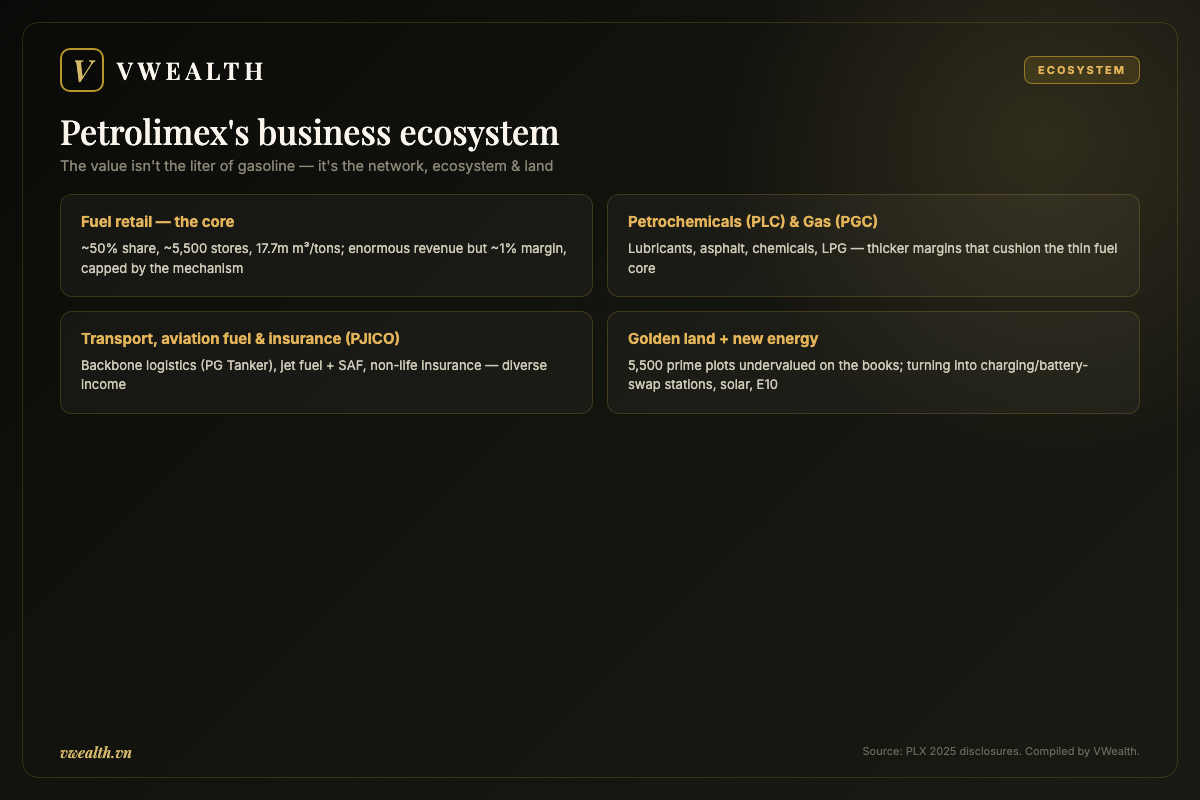
If the fuel segment is the wide but thin body of the iceberg, the subsidiary ecosystem is the pieces with thicker, more stable margins, helping “support” overall profit when fuel prices swing. This is what sets Petrolimex apart from a pure fuel distributor: they’re a multi-sector group with fuel as the axis. Let’s go through each name.
PLC — Petrolimex Petrochemical Corporation
PLC is the petrochemical segment, producing and trading three main product groups: lubricants (engine oils, industrial oils), asphalt (road-paving material, benefiting directly from the public-investment and transport-infrastructure wave), and chemicals (industrial solvents). PLC’s appeal to investors is its far higher margin than the fuel segment – because these are processed, branded products, less subject to price-ceiling control than fuel. When Vietnam pushes highway, airport projects, PLC’s asphalt segment usually benefits directly.
PGC — Petrolimex Gas Corporation
PGC trades liquefied petroleum gas (LPG) – the very gas you use to cook in your home gas bottle, plus industrial gas for plants. This is a segment with relatively stable cash flow and essential demand. PGC leverages the very Petrolimex logistics network and brand to distribute, creating synergy with the core segment.
Transport and terminal infrastructure: PG Tanker, PJTACO
This is the backbone logistics segment of the whole system. PG Tanker operates a sea oil-tanker fleet, handling fuel transport from the source to hub terminals. PJTACO and the road-transport and terminal units handle moving goods from terminals to stores. Picture this as the “circulatory system” flowing fuel through the business’s body. Self-controlling logistics helps Petrolimex control costs and ensure supply – a big advantage in periods of fuel-market stress.
Petrolimex Aviation — aviation fuel
The aviation fuel segment supplies jet fuel (Jet A-1) to airlines at airports. Along with the recovery and growth of Vietnam’s aviation industry, this is a segment with good growth potential. In 2025, Petrolimex even began accessing sustainable aviation fuel (SAF) – a long-term trend as the global aviation industry aims to reduce emissions.
PJICO — non-life insurance
PJICO (Petrolimex Insurance Corporation) is one of Vietnam’s leading non-life insurers. This is a financial segment bringing stable income and especially having natural synergy with the ecosystem: millions of fuel visits daily are a potential customer base for motor and personal insurance. Insurance is also a segment with a business model entirely different from fuel (collecting premiums upfront, paying claims later, investing idle money), helping diversify the group’s profit sources.
Construction and the divested PG Bank story
Petrolimex also has a construction segment (building stores, terminals, fuel works). An important historical detail you should know: Petrolimex once owned PG Bank (Petrolimex Group Commercial Joint Stock Bank), but divested from this bank. Exiting the banking field reflects the strategy of refocusing on the core energy axis rather than spreading into finance – banking requires very different risk-management capabilities. For investors, this is a signal that leadership is consciously “trimming” the portfolio to be lean and on-target.
Non-fuel services and digitalization: turning gas stations into “points of sale”
This is the part of the story I want you to especially note, because it’s the key to understanding why the 5,500-store network has value far beyond selling gasoline. Petrolimex’s new strategic thinking is shifting from “gas station” to “point of sale” multi-service.
Think of it this way: each day millions of vehicles pull into Petrolimex stores. That’s an enormous, steady stream of people, at fixed locations. Just selling gasoline is a waste. So the direction is to exploit more:
- Convenience stores integrated right at the station – selling drinks, fast food, essentials, on the “rest-stop combo” model common in many developed countries. Consumer-retail margins are much higher than gasoline.
- Digital payment and e-wallets: digitizing the whole fuel experience – cashless payment, loyalty points, e-invoices. The customer-behavior data collected here is an increasingly valuable intangible asset.
- The “point-of-sale ecosystem” direction: turning each store into a node in a service network, where customers not only buy fuel but use many other services – thereby increasing loyalty and revenue per point of sale.
For a long-term investor, this is a direction that helps “thicken” the very thin margin of the fuel segment, while reducing dependence on oil-price swings. The larger the network, the clearer the non-fuel exploitation advantage – and Petrolimex holds the largest network.
New-energy direction: preparing for the day EVs reign
The biggest question hanging over every fuel business in the world is: what happens when EVs replace gasoline vehicles? If fuel demand peaks then declines, a network of 5,500 gas stations risks becoming a burden rather than an asset. Petrolimex understands this risk very well, and is proactively shifting. This is the part I consider most important when you assess PLX’s long-term potential.
A new green-energy company — turning gas stations into charging stations
The most concrete and notable step: in May 2026, Petrolimex officially announced the establishment of Vietnam Green Energy Infrastructure JSC, a joint venture with two partners – Xuan Cau Holdings and Selex Motors (an electric-motorbike and battery-swapping tech firm). This JV targets electric-transport solutions: EV charging stations and battery swapping. The core idea is very smart: instead of letting 5,500 gas stations “die off” as EVs rise, Petrolimex turns those very prime locations into charging and battery-swapping stations. The land, electricity and premises infrastructure are already in place – just repurpose them.
At the 2026 AGM, Petrolimex’s leadership also revealed a plan to launch a new company related to batteries and EVs – showing this isn’t a token experiment, but a seriously bet-on investment direction.
LNG, solar and clean fuels
Besides EVs, Petrolimex is also expanding into other transitional energy sources:
- LNG (liquefied natural gas): an energy source “cleaner” than coal and oil, seen as a bridge fuel in Vietnam’s energy transition.
- Rooftop solar: Petrolimex targets installing rooftop solar systems at at least 30% of stores – using the existing canopy area to self-generate power, both reducing costs and scoring points on sustainability.
- E10 biofuel: from 2025, E10 biofuel has been rolled out across all 5,500 Petrolimex stores, along with raising fuel standards to Euro V and accessing sustainable aviation fuel (SAF).
You need to place these steps in the time context: analysts forecast Vietnam’s traditional fuel demand will still rise in the next few years thanks to an expanding middle class and rising vehicle count, but from about 2028–2030 the growth pace will slow notably as EVs, green fuels and vehicle-control policies take effect. That is, Petrolimex has a “time window” of a few years to both profit from the core segment and build the foundation for the new-energy segment. Their acting before fuel demand peaks is a significant plus for governance vision.
Bottom line: why this ecosystem is PLX’s value core
If I had to condense this whole section into one line to carry when making your investment decision, it’s: Petrolimex’s real value doesn’t lie in each liter of gasoline sold, but in the 5,500-store network plus the ecosystem around it and the golden-land bank supporting it all.
Three pillars form that value core:
- The ~5,500-store network + ~50% market share – a nearly impregnable competitive moat, no rival can copy within a many-year horizon.
- The multi-sector ecosystem – petrochemicals (PLC), gas (PGC), transport (PG Tanker, PJTACO), aviation fuel, insurance (PJICO) – segments with thicker margins, helping stabilize profit when the fuel segment swings, and opening many revenue sources.
- The golden-land bank + new-energy direction – the very prime locations now serving as gas stations will be charging stations, battery-swap stations, multi-service points of sale of the future. This asset is both a hidden-value cushion on the books and a launchpad for the energy transition.
Understanding this ecosystem, you have half the picture. The other half – whether that enormous-scale machine is financially healthy, how thin the margin is, cash flow and debt – is what I’ll dissect with you in the next section: Position & financial health.
Position and financial health
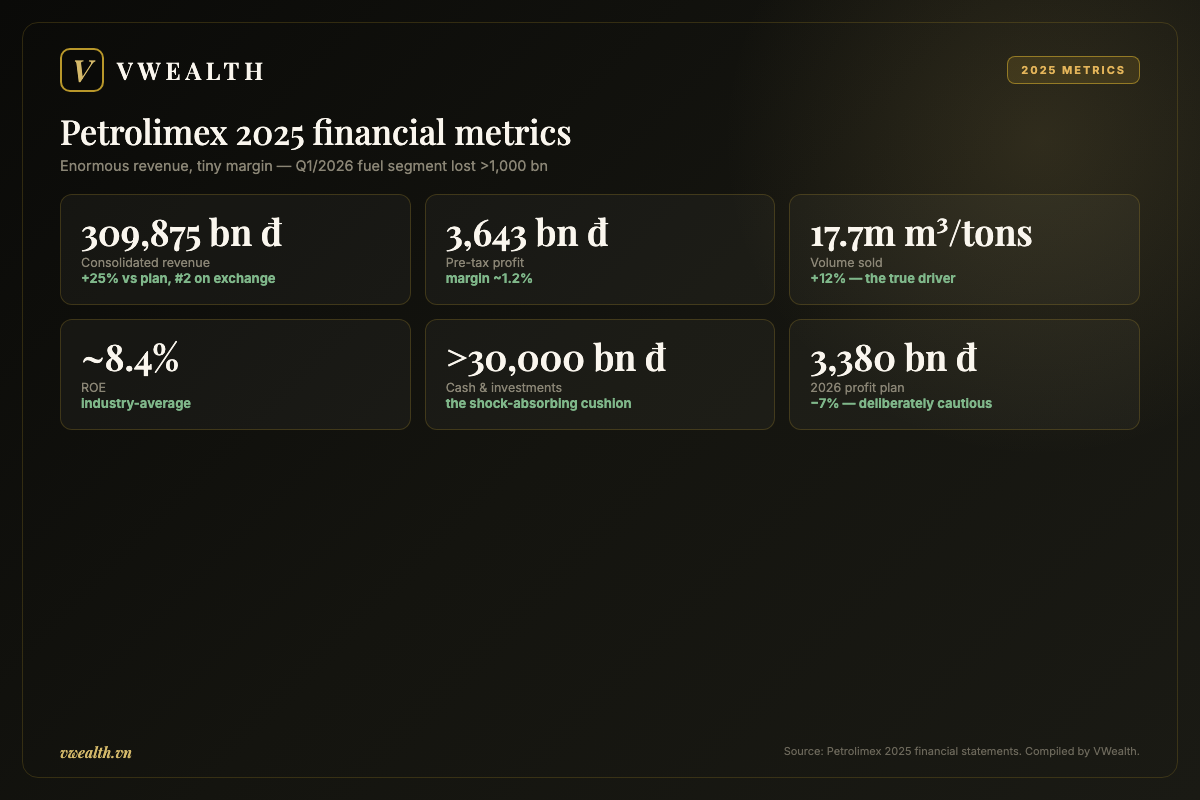
If you look only at the revenue figure, you’ll easily be overwhelmed by Petrolimex. In 2025, this group brought in 309,875 billion dong of consolidated revenue – beating plan by 25%, a record and second on Vietnam’s whole stock market, only behind Vingroup. But right here you meet this stock’s biggest paradox: revenue up to over three hundred thousand billion, yet pre-tax profit only 3,643 billion dong. The pre-tax margin is just around 1.2%. To understand PLX, you must understand why such a large business is so “thin” – and why that’s not necessarily a weakness, but the industry’s nature.
This section dissects three layers: Petrolimex’s near-dominant position in the fuel market, the mechanism making the group’s profit both stable and “ceiling-capped,” and the health of the balance sheet behind all the quarterly swings you see on the board.
The number-one hub position: what can’t be copied
Let’s start with the most important thing. Petrolimex is Vietnam’s largest fuel-hub business, holding about 50% of retail market share nationwide. This isn’t a number obtained naturally through marketing or promotions. It’s built on a physical infrastructure no domestic rival can match: a hub-terminal system stretching the length of the country, large-capacity fuel depots at strategic coastal locations, a pipeline network, a sea-transport fleet, and especially thousands of directly-owned fuel stores plus a dealer system reaching down to small roads.
Picture it: for a new business to compete fairly with Petrolimex, they’d have to spend tens of thousands of billions of dong and take many years to rebuild from scratch the terminal chain, import infrastructure and retail network at prime locations Petrolimex has held for decades. This is precisely the most durable “economic moat” – a very high entry barrier from tangible assets and scale. Along with PVOIL, these two state enterprises form a near-oligopoly in hub distribution, where the rest of the market is split among much smaller private hubs.
Petrolimex doesn’t win by cheap prices or differentiated products – A95 gasoline is A95 everywhere. Their advantage lies in this: when you need fuel, the station nearest you likely bears the “P” logo. That’s the advantage of infrastructure and presence, something money can’t buy quickly.
This position also brings something hard to quantify but very valuable: the market-stabilizing role. Petrolimex is the state’s regulating instrument for ensuring fuel supply – this is both a responsibility and a form of “guarantee” for the business’s long-term existence. You’ll never see Petrolimex fall into bankruptcy like a startup; but in exchange, that very special role is the root of the thin-margin paradox we’ll discuss right after.
The “enormous revenue – tiny margin” paradox
This is the most important part to grasp, because it decides how you value and what you expect from this stock.
Why does a business selling over 310,000 billion dong of goods a year profit only 3,643 billion pre-tax? The answer lies in the fact that Petrolimex can’t freely set its selling price. Retail fuel prices in Vietnam are managed by the joint Ministry of Industry and Trade – Ministry of Finance per the “base price” formula, announced and adjusted periodically. In that formula, each liter of fuel includes: the import price (converted world price), taxes and fees, standard business costs, and standard profit – a fixed profit per liter the state sets.
The consequence of this mechanism is very clear. Petrolimex’s core fuel profit is essentially a simple multiplication:
- Fuel profit ≈ Volume sold × Standard profit per liter
- When world oil prices rise, revenue in money swells (because each liter sells dearer), but the standard profit per liter is nearly unchanged.
- When oil prices fall, revenue shrinks, but the standard profit stays the same.
This fully explains the paradox. Petrolimex’s revenue swings mainly with oil prices, while core profit tracks volume. In 2025 volume reached 17.7 million m³/tons, up 12% – and this very volume increase, not the record revenue, is the true profit driver. When you read “Petrolimex sets a revenue record,” be clear-headed: most of that number just reflects high oil prices, not the business doing better.
The positive side is that this mechanism creates a predictable, well-defensive profit stream. Because the standard profit is state-guaranteed in the formula, Petrolimex hardly loses heavily in normal market conditions, and profit rises steadily with consumption volume – which itself grows with GDP and vehicle count. The limit is the ceiling: the business can’t “break out” in profit however much it sells, because the margin is locked. This is why PLX is rarely valued as a growth stock, but usually seen as a defensive, steady-dividend stock.
| Metric (2025) | Value | Meaning |
|---|---|---|
| Consolidated revenue | 309,875 bn dong | Beat plan 25%, record, top 2 on exchange |
| Pre-tax profit | 3,643 bn dong | Beat plan 14% |
| Pre-tax margin | ≈ 1.2% | Reflects the standard-price mechanism |
| Volume sold | 17.7 million m³/tons | Up 12% – the true profit driver |
| EPS | ≈ 1,472 dong/share | Basis for P/E valuation |
| ROE | ≈ 8.4% | Capital efficiency at industry-average level |
| 2026 pre-tax profit plan | 3,380 bn dong | Targets a ~7% DECREASE |
Oil prices and the inventory gain/loss “chess game”
If the standard profit is the stable part, then the biggest noise variable for quarterly profit is inventory. This is what many investors misunderstand about Petrolimex, so you need to grasp it firmly.
Petrolimex must always maintain an enormous fuel inventory – both to reserve circulation per regulation, and because the supply chain from arrival at the depot to sale at the station spans weeks. This stock is bought at the oil price at import time, but sold at the base price at sale time. That time gap creates a “chess game” with oil prices:
- When oil prices RISE: inventory bought cheaper earlier is sold when prices are higher → Petrolimex enjoys an inventory gain, quarterly profit better than the standard portion.
- When oil prices FALL: inventory bought expensive must be sold (or revalued) when prices have dropped → an inventory loss arises, the business must provision for inventory devaluation, eating straight into profit.
Q1 2026 is the classic proof and also a warning. The world oil market fell into an abnormally volatile cycle – geopolitical tensions pushed diesel prices at one point up to nearly 292 USD/barrel then plunging to around 140 USD in just a few weeks. Petrolimex’s inventory at quarter-end reached a record high of nearly 29,800 billion dong, dragging a devaluation provision of over 6,300 billion dong. The result: the fuel segment alone lost over 1,000 billion dong, and the whole group reported a net loss of about 763 billion dong – versus a 133-billion profit in the year-earlier period.
You need to distinguish clearly: the inventory loss is largely accounting and timing, not a sign of the core business collapsing. The provision made can be reversed if oil prices recover next quarter. This is why, despite forecasting a thousand-billion Q1 loss, many securities firms kept a positive recommendation on PLX.
This leads to a principle for reading Petrolimex: don’t judge the business by one quarter. PLX’s quarterly profit can dance strongly with the oil-price chart, but if you look over a full-year or multi-year cycle, inventory gains/losses tend to cancel out, and the rest – standard profit times volume – is the durable core you’re truly buying.
Financial health: the cash cushion behind the swings
Behind those volatile profit numbers is a respectable balance sheet, and this is what makes Petrolimex far more solid than the “thousand-billion loss” news suggests.
The first thing that hits you is the very large cash pile. Petrolimex regularly holds over 30,000 billion dong in cash, bank deposits and short-term financial investments – at times about a third of total assets. This cash pile isn’t accidental: it comes from the “hard cash” retail trait. When you fill up, you pay immediately; but Petrolimex gets to pay suppliers on delay and pay taxes periodically. This favorable working-capital cycle continuously pumps abundant cash into the vault.
That large cash pile creates a stable and very valuable income source: deposit interest. Petrolimex’s financial revenue from deposit interest, lending and FX differences reaches thousands of billions a year. This is nearly a profit “cushion” standing independent of the fuel segment – when the core business is eroded by inventory losses, this financial income still flows steadily, cushioning consolidated profit. In many periods, deposit interest contributes a significant part of the group’s bottom-line profit.
The other side of the balance sheet is large short-term debt – usually over 20,000 billion dong. This number at first glance easily causes worry, but you need to understand its nature correctly: most of this is capital funding inventory and the fuel-import cycle, not risky long-term investment debt. Petrolimex borrows short-term to buy goods, sells to collect cash, then revolves – a financial model of a large-scale trading business. What matters is that long-term debt is very small, and the business holds a large enough deposit balance in parallel that the net financial position stays healthy. In other words, this is manageable “operating” debt, not risky leverage.
- Cash & equivalents + financial investments: over 30,000 billion dong – a strong liquidity cushion.
- Debt mostly short-term (~20,000+ billion): funding inventory, fast turnover, low structural risk.
- Financial income: thousands of billions/year from deposit interest – an independent defensive profit source.
- ROE ~8–12% depending on the year: capital efficiency at an average level, reasonable for a margin-capped business.
All told, Petrolimex’s financial health can be summed up: a cash-rich business, leverage at a controllable level, with a financial income source backing it, and a balance sheet thick enough to absorb quarterly inventory-loss shocks without shaking its foundation.
The risks you mustn’t overlook
For balance, this is the other side of the picture. A strong position doesn’t mean no risk, and some of PLX’s risks are structural, hard to resolve quickly:
- Oil-price swings and inventory losses: as analyzed, this is the biggest quarterly-profit noise variable. In periods of abnormal oil-price plunges – like early 2026 – Petrolimex can lose a thousand billion short-term, pressuring the share price even though it’s essentially a temporary accounting loss.
- The state pricing mechanism: a double-edged sword. It guarantees the standard profit but also caps profit. When standard costs don’t keep pace with actual costs (wages, operations, losses rising faster than allowed in the price formula), the business’s real margin is eroded and can’t be offset by raising selling prices.
- Losses and operating costs: with the enormous volume moving through terminals, pipelines, transport, every percentage point of loss is big money – and the portion above standard must be self-borne.
- The shift to EVs (long-term): this is a foundational risk, though slow. Fuel demand for personal vehicles will long-term face pressure from the transport-electrification trend. Petrolimex itself is well aware of this – the group plans to set up a new company related to batteries and EVs, a move showing it’s proactively finding adaptation paths rather than denying the trend.
These very risks – especially the early-year oil-price swings and the long-term EV worry – are why Petrolimex set its 2026 pre-tax profit plan at 3,380 billion dong, down about 7% versus 2025. This is a cautious, deliberately “reverse-geared” target, reflecting leadership’s clear-headedness before a year forecast to be stormier.
Summarizing the picture: you’re looking at a business with a near-dominant position and uncopyable infrastructure, a stable profit machine capped by the pricing mechanism, a cash-rich balance sheet strong enough to withstand inventory shocks, and a clear set of risks but ones mostly already recognized by the market. This isn’t a stock to expect profit breakouts, but a defensive asset – as solid as its own steel tanks. The next question is: with all these traits, how has the market received PLX stock?
Market reception
If you’re holding the board and see PLX resting at 38,650 dong in the session of 19 June 2026, you easily get the feeling this is a “hibernating” stock: all of June passed, the price nudged down about −2.77%, no big waves, no hot speculative story. And that’s precisely the first thing you need to understand about how the market values Vietnam National Petroleum Group: PLX isn’t a stock to “trade,” it’s a stock to “hold.” Every measure, every expectation, every price reaction revolves around a rare nature on HOSE – a near-oligopoly business in an essential industry, a margin thin as a knife blade, but sitting on an enormous hidden asset block and paying dividends steadily like a bond.
In this section, as someone who has followed the infrastructure-utility group for many years, I want to dissect for you three layers of the story: what logic the market is using to value PLX, why that logic is “special” and can’t be measured by the usual P/E, and how you – the investor considering it – should read the price, dividend and catalyst signals so you don’t buy the wrong expectation.
A 16–18x P/E isn’t cheap at all – and that’s not the problem
Let’s start with the number that confuses many newcomers. With about 1.27 billion shares outstanding (charter capital ~12,700 billion dong) and 2025 after-tax profit around 2,900 billion dong (pre-tax 3,643 billion), PLX’s EPS falls around 2,300 dong/share. Dividing the price of 38,650 dong by that EPS, you get a P/E of about 16–18x. If you’re used to looking at manufacturing or retail stocks, this number isn’t “cheap” at all – even higher than the market’s P/E level (around 15x). At one point in late 2025, when profit temporarily shrank, PLX’s trailing (TTM) P/E was even pushed above 20x.
Newcomers rush to conclude: “expensive, skip it.” Professionals stop and ask a different question: why does a business with a margin of just a few percent get a two-decade P/E accepted by the market for years? The answer lies in P/E being the wrong tool to value Petrolimex, and the market knows this well.
The problem with fuel EPS is that it’s “compressed” by the industry’s nature. PLX’s gross margin is only around 6–7%, its pre-tax margin just about 2%. That is, of every 100 dong of revenue, the business keeps very little. When the denominator (profit) is so thin, P/E is automatically inflated – not because the stock is expensive, but because the state-capped retail-price mechanism (300 dong/liter under the old decree) makes profit not reflect the business’s true scale and value. You’re looking at a giant forced to sell goods at a corner-shop’s margin.
With Petrolimex, P/E doesn’t tell you if the stock is expensive or cheap. It only tells you how tightly the state is squeezing the industry’s margin. To value it right, you must step outside P/E and look at what the balance sheet doesn’t fully record: position and land.
Valuing by assets and cash flow – Petrolimex’s three “hidden gold mines”
When P/E fails, the market values PLX by three other pillars, and this is the interesting part I want you to grasp firmly.
Pillar one – the oligopoly position. Petrolimex holds about 50% market share of national fuel distribution by volume. On the remaining market, PV OIL and a series of small hubs split the other half. This isn’t ordinary market share – it’s the position of a business the whole economy depends on for operating fuel. Such market share creates a “moat” almost no new rival can rebuild: you can’t erect 5,500 gas stations at prime locations overnight. The market pays a valuation premium for this durability – just like it pays a premium for an electricity or water utility.
Pillar two – and this is the real “gold mine” – land-bank value. Petrolimex owns and operates a network of about 5,500 fuel stores spread across 63 provinces, most at traffic frontages, intersections, highway axes – plots that, revalued at the current real-estate market, would be far larger than the book value recorded. This is the “hidden asset” the financials never show correctly, because accounting records land at historical cost rather than revaluing. When you buy a PLX share, you don’t just buy the gasoline-selling profit stream – you buy a part of one of Vietnam’s most prime commercial real-estate collections. Each time equitization, divestment or land-bank revaluation is mentioned, the market immediately “remembers” this value layer, which is why PLX is rarely dumped to a dirt-cheap valuation.
Pillar three – the steady cash-dividend stream. I’ll cover this in a separate section, but it needs to be placed here as a leg of the valuation: this very stable payment stream lets the market value PLX closer to a dividend-discount model (DDM) than a profit-growth model. You don’t buy PLX expecting profit to double; you buy it for a steady cash flow, a solid balance sheet and a hard-to-replace asset block.
To help you picture the overall valuation, look at the summary chart below – it shows why a “not-cheap P/E” stock is still cherished by the market:
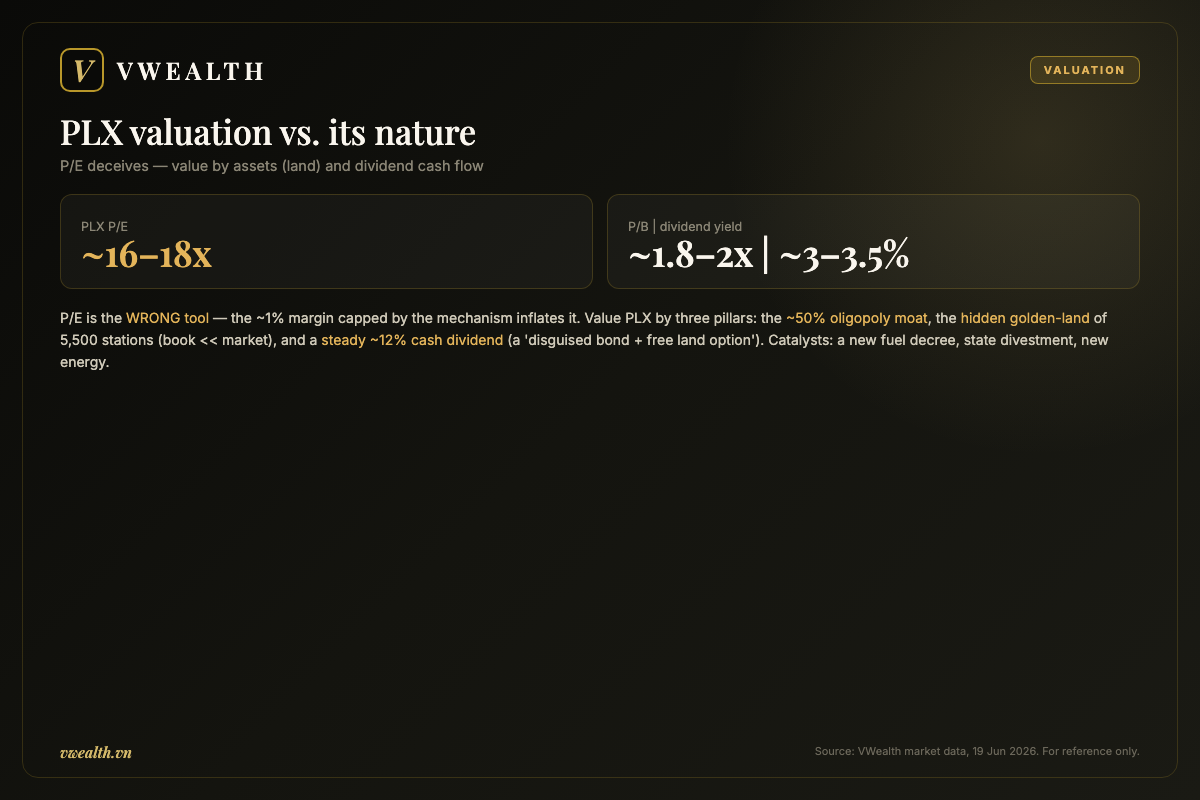
Note the last column: for each metric, the “story” the market attaches to it matters more than the number itself. A P/B around 1.8–2x for a business holding an un-revalued land bank is actually a hidden cheapness, not expensive. The high P/E is a consequence of the thin margin from the mechanism, not the market pricing wildly.
Price behavior: why PLX is “low-wave” and what that says about you
PLX is a blue chip in the VN30 basket, market cap around 49,000 billion dong – large enough to be in the group of stocks index funds (ETFs) and institutional funds hold as a “must-have” in their portfolios. This large-cap trait makes PLX’s price move slowly, with inertia, few 5–7% intraday jerks like small and mid caps. When you see it drop only 2.77% in June, that’s typical behavior: PLX swings in a narrow range, following very “macro” forces rather than manipulation rumors.
Specifically, PLX’s price is sensitive to three variables you need to watch:
- World oil prices (inventory gain/loss). This is variable number one. Petrolimex must always maintain a large reserve inventory per regulation. When Brent rises, inventory bought cheaper earlier is sold at higher prices – generating an inventory gain, good profit, supported share price. When oil plunges, the scenario reverses: the business holding high-priced goods must sell low, an “inventory loss” eroding profit. Q3 2024 was a lesson when the fuel-industry “giant’s” profit fell over 80% mainly due to oil-price swings. So when you look at PLX’s price, glance at the Brent chart too – they’re tightly linked.
- The price-management mechanism and fuel decree. Every piece of news about changes to the base-price formula, standard-profit ceiling, price-adjustment cycle directly impacts future margins. This is the “policy” catalyst I’ll analyze closely below.
- Consumption volume. An indicator of the economy’s health – the economy grows, transport is busy, fuel sells well. The recent administrative-province mergers also open opportunities for Petrolimex to expand its retail network.
This leads to an important conclusion for your investment style: PLX suits investing more than trading. If you like volatility, like “eating” 15–20% in a few weeks, this isn’t your dish. But if you want a defensive, stable, dividend-generating component in a long-term portfolio, PLX stands right in that spot. This stock rewards patience, not haste.
Steady dividends – a “disguised bond” in a stock
This is the part I want you to remember if you’re an income-oriented investor. Petrolimex maintains a very stable cash-dividend policy. Per the 2025 profit-distribution plan, the group plans a 12% cash dividend – that is 1,200 dong/share, corresponding to a payout of about 1,525 billion dong. Placing this 1,200 dong on the price of 38,650 dong, you get a dividend yield of about 3–3.5%.
The 3–3.5% sounds modest versus savings rates, but don’t view it in isolation. Place it beside three factors: (1) this is a steady and predictable cash flow, present every year, little dependent on short-term profit swings; (2) you receive the dividend while still holding the potential price appreciation of the land assets; (3) the payment ability is guaranteed by the healthy operating cash flow of a 50%-market-share business. In other words, PLX behaves like a bond with a ~3% coupon plus a free price-appreciation option from the land bank. For retirees or passive-income seekers, that’s a very valuable structure.
The dividend’s steadiness also holds institutions and forms a “floor” for the price. When the price falls, the dividend yield rises, itself creating demand from yield-buying investors – this self-balancing mechanism further explains why PLX rarely free-falls.
Catalysts: three fuses that could re-rate the stock
A defensive stock doesn’t mean no upside. For PLX, there are three catalysts that, if you hold long-term, you should watch closely because they can “awaken” the valuation:
1. A new fuel decree – a structural change. This is the catalyst I value most. The draft new decree on the fuel business proposes liberalizing the profit component: instead of a hard 300 dong/liter ceiling like the old mechanism, hub-distributor businesses will get to set their own retail prices, adding flexibility to the margin. At the same time, standard business costs will be adjusted annually by CPI rather than “frozen” for years like in 2015–2021. For a business with the country’s largest distribution network, Petrolimex is precisely the clearest beneficiary if the margin is loosened: just a few percentage points more margin, absolute profit can jump because it multiplies with the enormous revenue scale (the 2026 revenue plan is up to ~315,000 billion dong). This is the kind of catalyst that can pull the “false” P/E back to true value.
2. State divestment and the free-float problem. PLX’s ownership structure is currently very concentrated: the state holds 75.87%, the Japanese strategic partner ENEOS holds 13.08%, these two large shareholders combined already take nearly 89% of charter capital. Small shareholders are only about 9.4% – and this recently caused Petrolimex to announce it doesn’t meet public-company conditions (the law requires at least 10% of voting shares held by at least 100 small investors). This is a double-edged sword you need to understand well. The risk side: if the free-float ratio can’t be remedied within the required timeframe, public status and liquidity could be affected. The opportunity side: this very pressure raises the possibility the state must divest or sell treasury shares to the market to raise the free float. Each divestment is an occasion for asset revaluation (especially the land bank) and increased free float – usually a positive catalyst for the price. See this as a “story waiting to be triggered.”
3. New energy and network expansion. Petrolimex is gradually piloting new-energy segments, non-fuel services at stations (retail amenities, EV charging) – precisely a way to leverage the 5,500-store prime network to create new higher-margin revenue. This is a long-horizon catalyst, but it’s the answer to the very EV risk I mention right after.
Risks: don’t look only at the bright side
As a responsible writer, I won’t paint you a one-color picture. PLX has two core risks you must weigh.
Short-to-medium-term risk: falling oil prices and inventory losses. As analyzed, each world-oil-price plunge can create an inventory loss, dragging quarterly profit down sharply and pressuring the share price. The group’s own 2026 plan is also cautious: despite record revenue of ~315,000 billion, pre-tax profit is expected to fall about 7% to 3,380 billion dong – reflecting the industry’s thin-margin, oil-sensitive nature. You need to accept that PLX’s profit will have years of flat or slight decline; that’s the nature, not a crisis.
Long-term risk: the EV trend. Over the next 10–20 years, transport electrification could gradually erode traditional fuel demand. This is a real structural risk for the whole industry. However, you need to place it in the right timeframe: in Vietnam, this process is gradual, and Petrolimex’s very prime-land network is an asset to convert (into charging stations, service points) rather than entirely abandoned. Foreigners – especially ENEOS, a Japanese energy group well-versed in energy transition – staying with PLX is also a signal the long-term story isn’t as pessimistic as the surface fear.
Foreigners: ENEOS as a confidence “anchor”
One point I want you to note about the shareholder structure: the presence of ENEOS Corporation with 13.08% isn’t merely a financial investment. ENEOS is one of Japan’s largest energy groups, and their being a long-term strategic shareholder of Petrolimex brings two values: transferring modern fuel-retail governance and operating experience; and more importantly for an investor like you – it’s a confidence “anchor.” A demanding international institution accepting to stay for years is an implicit signal that Petrolimex’s intrinsic value (especially the land bank and market-share position) is real and durable. Due to the low free-float and concentrated structure, the general foreign net-buy room is limited, but ENEOS’s “anchoring shareholder” role forms a stable foundation for the valuation rather than creating trading waves.
Bottom line: PLX in your portfolio
After going through every layer, the picture becomes clear. PLX is a defensive, oligopoly blue chip: a ~50% market-share position nearly impregnable, a steady cash-dividend stream around 10–12% of par (yield ~3–3.5%), and an enormous hidden land value from 5,500 gas stations the balance sheet has never fully recorded. In exchange, you must accept a business with a thin margin, sensitive to oil prices, making profit and the share price flat in some years.
So the most correct reading is: don’t value PLX by pure P/E, value it by assets (P/B with the revalued land bank) and dividend cash flow. Don’t expect it to “explode” like a speculative stock, treat it as a defensive-income component in a long-term portfolio, with the big catalysts (new fuel decree, state divestment, new energy) playing the role of a “bonus reward” if triggered. In one line to carry: PLX suits long-term investors and dividend investors more than traders – you buy durability, steady cash flow and a hidden land bank, in exchange for enduring a thin margin swinging with oil prices.
To fully understand why this stock moves that way, the next step is to place Petrolimex in its proper arena – the panorama of Vietnam’s fuel industry, the competitive structure and the macro forces reshaping the game. That’s the industry context the next section opens for you.
Economic and fuel-industry context
To understand a stock like PLX, you can’t look only at the balance sheet or the 3,643-billion-dong pre-tax profit of 2025. A fuel-hub stock is a “creature” living parasitically on three big currents: domestic consumption demand, the state’s price-management mechanism, and world oil prices. These three currents decide most of Petrolimex’s fate more than any internal business decision. This section dissects each current so you see where Vietnam’s number-one hub business stands in the macro picture.
Consumption demand: still rising with GDP, but the EV shadow has appeared on the horizon
The most beautiful story of Vietnam’s fuel industry over the past two decades is the near-mechanical link between fuel-consumption volume and economic growth. As GDP rises, more goods circulate, more trucks run, people buy more motorbikes and cars, and every liter of fuel sold is a link in that machine. For an economy targeting growth around 6.5-7%/year, domestic fuel demand long-term is estimated by many institutions to rise about 5-6%/year. This is the foundation explaining why a business holding about 50% market share like Petrolimex always has a relatively firm volume “floor” to rely on.
But if you’re a long-term investor, you must look beyond today’s 5-6%. A structural shift is happening right on Vietnam’s streets, and it’s not slow at all. By early 2026, Vietnam had risen to the world’s third-largest electric-motorbike market, only behind China and India. In 2025 alone, about 700,000 electric motorbikes were sold; the first half reached about 209,000, up nearly 99% year on year. VinFast alone sold over 406,000 electric motorbikes, up nearly 500% versus 2024, and continued selling nearly 54,000 EVs in Q1 2026 alone.
You need to place this number in the right context to neither over-panic nor over-relax. Electric motorbikes and EVs can’t “wipe out” fuel demand overnight, because the total fleet of gasoline vehicles in circulation is in the tens of millions and most road freight transport still runs on diesel. However, what matters for a stock is the margin of the trend, not the absolute level. As the EV-conversion pace accelerates, each passing year erodes the growth pace of gasoline volume (especially gasoline for urban motorbikes). Policies restricting gasoline vehicles in large cities like Hanoi, plus continuously swinging fuel prices, are pushing consumers to convert faster than expected. This is why even Petrolimex’s leadership has proactively prepared for the post-fuel scenario, which you’ll see clearly in the prediction section later.
The core point to remember: Vietnam’s fuel demand is still rising, but this is an industry entering late-stage maturity, where the long-term growth driver no longer lies in the liter of fuel itself, but in what the business exploits from its existing assets and network.
The price-management mechanism: the heart deciding PLX’s margin
If you could only choose one most-important factor to understand PLX stock, it’s the price-management mechanism. Unlike an ordinary manufacturing business free to set its selling price by supply-demand, Vietnam’s fuel-hub businesses have long operated within a state-regulated price framework. Retail prices are calculated by formula, adjusted periodically (recently every 7 days), with a standard cost and standard profit predetermined. The direct consequence: Petrolimex’s margin is extremely thin, only around 1% of the enormous revenue. This business can’t sell dearer when it wants, nor is it allowed to lose “by the market” freely – it’s squeezed between two clamps.
Coming with the pricing mechanism is the Fuel Price Stabilization Fund – an instrument of setting aside and drawing to “smooth” price swings for consumers. In theory, this fund protects people from price shocks; but in practice, it creates lag and opacity in the hub business’s cash flow, sometimes making real profit not reflect market movements accurately.
This is where the story becomes interesting for 2026. The Ministry of Industry and Trade has been finalizing a new decree on the fuel business, replacing the old legal framework, with the core direction of giving businesses more price-setting authority through a price-announcement mechanism – businesses announce their own selling prices and are subject to oversight, rather than waiting for centralized price management. In parallel, the Stabilization Fund’s role is notably narrowed in practice: with a short price-adjustment cycle (7 days), domestic prices have tracked world prices closely and the fund is nearly no longer regularly set aside/drawn, paving the way for the possibility of phasing out this instrument long-term.
For an investor, what’s the meaning of the mechanism change? Picture it two ways:
- The positive direction: As businesses get more price authority and the stabilization fund recedes, margins may become more transparent and stable. Petrolimex – with superior scale, warehousing and coordination capacity – has the advantage to price more reasonably by real cost, rather than being “forced” into a rigid formula. A margin, even nudging from ~1% to a bit higher, multiplied by revenue in the hundreds of thousands of billions, creates a large difference in absolute profit.
- The cautious direction: Setting one’s own price also means real price competition among hubs. In a freer market, small merchants may accept thinner margins to grab share in certain segments, pressuring Petrolimex itself. The scale advantage still tilts toward PLX, but the “safe zone” the old pricing mechanism created won’t be intact.
A notable detail of the industry picture: in 2025, over 20 fuel merchants ceased operations. This shows the industry is in a filtering phase – weak-capital, thin-finance hubs struggle to survive as the mechanism and costs tighten. Long-term, this filtering benefits “big players” like Petrolimex, further cementing the business’s oligopoly position.
Domestic supply and the import problem
Vietnam has two key refineries, Dung Quat and Nghi Son, meeting a large part of domestic fuel demand, with the rest made up by imports. This hybrid supply structure (domestic + import) is both a shield and a weakness. The shield: a large hub business like Petrolimex has many sourcing channels, less absolute dependence on one plant or one import market. The weakness: when the domestic source falters (Nghi Son has repeatedly had operating and financial troubles), the business is forced to import urgently at high cost, and this differential isn’t always reflected in retail prices in time.
2026 witnessed a classic illustration of sourcing risk: import premiums surged to 30-37 USD/barrel – unprecedented levels – but weren’t fully reflected in domestic retail prices. When input costs surge while output prices are anchored to the management formula, the already-thin margin is choked, even negative. This is precisely the mechanism behind Petrolimex’s over-1,000-billion-dong fuel-segment loss in Q1 2026, which we’ll analyze closely in the conclusion.
World oil prices: the variable beyond control
Above all, world oil prices are the biggest and most unpredictable variable governing Petrolimex’s results. You need to understand an important paradox: a fuel-hub business does not simply benefit when oil prices rise and suffer when they fall. The issue lies in inventory.
Petrolimex must always maintain an enormous circulation reserve – as of end-Q1 2026, inventory reached nearly 29,800 billion dong (including a devaluation provision of over 6,500 billion), up 16,000 billion versus year-start. When world oil prices fall deeply, goods imported at high prices suddenly lose value, forcing the business to provision and record an “inventory loss.” Conversely, when oil prices rise steadily, inventory gains value and the business enjoys this gain. In other words, the trend and stability of oil prices matter more than the absolute price level.
2026 was a classic chaotic year for oil prices. Brent was at times in the 91-92 USD/barrel zone, then plunged over 3% in June, with sessions dropping over 4% to around 83-84 USD/barrel after expectations of a US-Iran deal. Meanwhile, OPEC cut its 2026 global oil-demand growth forecast to about 970,000 barrels/day (from 1.17 million barrels/day earlier), reflecting weak-demand worries. On the other side, geopolitical risk in the Middle East and the Ukraine conflict still hang; there are extreme scenarios banks like ING warn prices could surge to the 120-130 USD/barrel zone if supply is seriously disrupted. Notably, diesel prices once surged to 292 USD/barrel in March – nearly 4 times the prior month – then fell deeply to around 140 USD/barrel in April. These very violent swings “hit” Petrolimex’s inventory directly.
In sum, the industry context shows Petrolimex is a hub business solid in position, but its profit is torn by three forces: domestic demand gradually stalling under EV pressure, a pricing mechanism in a reform phase that could improve margins, and unpredictable world oil prices creating inventory-loss risk. Understanding these three forces is the key to correctly reading the next prediction section.
Trend prediction
After dissecting the business internals and industry context, it’s time to look forward together. Let me tell you straight: predicting a fuel stock’s price is among the hardest things, because the most decisive variable – world oil prices – almost no one forecasts exactly. So instead of a fake target number, we’ll analyze the real drivers then build three scenarios with specific conditions and consequences, for you to position yourself in each scenario.
The drivers that could re-rate PLX
There are five drivers worth watching, and notably most of them do not come from selling fuel itself – a signal that the PLX investment story is shifting from “fuel business” to “asset and energy-transition business”:
- A new price decree improving margins. As analyzed, if the self-pricing mechanism works well and the stabilization fund recedes, Petrolimex’s margin has a chance to be more stable and transparent. This is a “quiet” but weightiest driver for core profit.
- Volume rising with the economy. Though growth slows, absolute volume still nudges up with GDP, helping revenue maintain slight upward momentum in the medium term.
- Exploiting the golden-land value of the station system. This is perhaps the biggest “hidden asset” undervalued by the market. With about 5,500 owned/managed fuel stores, many at prime urban frontages, Petrolimex holds an enormous land bank whose market value could far exceed book value. Commercially exploiting these locations (retail, amenity services, leasing) is a long-term driver few mention.
- New energy: charging stations, batteries and EVs. Petrolimex’s leadership has openly announced a plan to launch a new company related to batteries and EVs, while the industry deploys charging stations right at fuel stores (PV OIL – a rival – has covered about 600/1,000 stores with charging stations). The wide gas-station network is the ideal infrastructure to convert into a charging-station network. This is how Petrolimex “defends” against the very EV wave threatening its gasoline volume.
- State divestment and raising the free float. Petrolimex has cited two solutions: selling all treasury shares to the market to raise the free-float ratio, or implementing a divestment reducing the state stake. Both could be strong catalysts: a higher free float makes the stock more liquid, easier for index inclusion, and divestment usually comes with expectations of improved governance and asset revaluation.
Three scenarios for PLX
From the drivers and risks analyzed, picture three scenarios. Note: this is a thinking frame to prepare your mindset, not a prophecy.
| Scenario | Trigger conditions | Effect on profit and share price |
|---|---|---|
| Positive | The new price decree works smoothly helping stabilize margins; world oil prices flat or slightly and stably up (no deep-plunge shock); the divestment/free-float-raising story is accelerated. | Core profit recovers clearly, no more inventory-loss burden; the market re-rates by “golden-land assets + new energy + divestment.” The share price has room to re-rate to a notably higher level than now. |
| Base | The pricing mechanism improves gradually; oil prices swing in a moderate range; divestment happens slowly; EVs gnaw at gasoline volume but without a shock. | Profit flat around the current level, cash dividends maintained steadily. The stock trades in accumulation, playing a defensive/dividend role rather than growth. The price swings in a narrow range around the current valuation. |
| Negative | Oil prices fall deeply and swing violently causing large inventory losses (like Q1/2026); an unfavorable pricing mechanism or fierce hub competition erodes margins; the EV wave accelerates faster than expected. | Profit falls sharply or losses by quarter; pressure to cut/hold dividends. Market confidence weakens, valuation is discounted. The share price faces significant correction pressure, as seen when PLX once hit the floor as thousand-billion loss news appeared. |
What you should draw from these three scenarios is the asymmetry of PLX’s risk. On the bad side, an oil-price shock can come very fast and very strong (over 1,000-billion loss in just one quarter). On the good side, drivers like divestment or golden-land exploitation happen slowly, needing many years to materialize. This is the trait to remember: buying PLX means buying a long-term story with a solid asset anchor, but you must accept violent short-term jerks along the way.
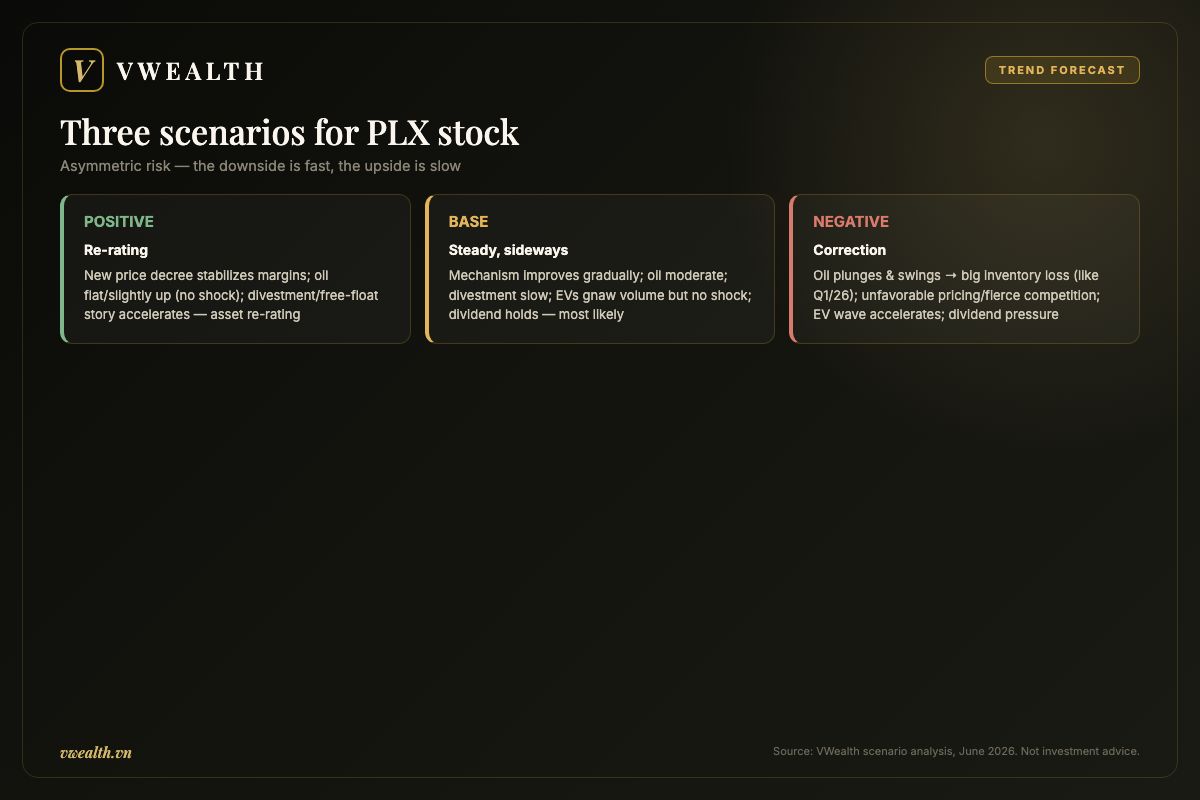
Should you buy PLX stock?
By here, we’ve traveled a long journey: from the business internals, valuation, industry context to future scenarios. The final question – and the one you truly care about – is: at a price around 38,650 dong and a P/E of about 16-18x, is PLX worth putting money into? Let’s weigh the whole scale honestly, before I place PLX in its proper “box” on the map of investor types.
Weighing the pros: why PLX is still a respectable asset
- The number-one hub position, a hard-to-replace oligopoly. About 50% market share is a number no rival in Vietnam can approach. This isn’t an easily-eroded advantage – building a national-scale terminal, hub and distribution network needs decades and enormous capital. With over 20 small merchants leaving the market in 2025, Petrolimex’s position is further cemented.
- The ~5,500-station network and hidden golden-land value. As analyzed, this is an asset the market usually undervalues. The land bank at prime locations is both a value “cushion” and a future exploitation driver (retail, charging stations, services).
- Steady cash dividends. Petrolimex has a tradition of steady cash dividends, with ecosystem segments (like Petrolimex Petrochemical) targeting a minimum 12% dividend. A steady dividend cash flow is a big plus for passive-income-oriented investors.
- State backing and strategic partner ENEOS. Having the Ministry of Finance (state-capital representative) and Japanese energy group ENEOS as major shareholders brings stability, credibility and access to resources and technology – something few private peers have.
- Benefiting from pricing reform and divestment potential. These two long-term catalysts, if realized, could re-rate the stock positively.
Weighing the cons: the risks you’re not allowed to overlook
- Extremely thin margin, profit capped by the mechanism. A margin of only around 1% means just a small swing in input costs or the pricing mechanism is enough to wipe out profit. This is a structural weakness, unfixable by ordinary governance effort.
- Inventory losses when oil prices fall. This is a present, not theoretical, risk: right in Q1 2026, the fuel segment lost over 1,000 billion dong due to an oil-price shock, inventory swelled to nearly 29,800 billion with a devaluation provision of over 6,500 billion. When you hold PLX, you always “carry” this risk.
- Low profit growth. This isn’t a stock of doubling, tripling profit. The industry’s nature and the pricing mechanism limit core-profit growth room.
- Long-term EV pressure. The EV-conversion wave is accelerating faster than many think, gradually eroding gasoline-volume growth – especially in the urban-motorbike segment.
- Low free float, state dependence. The low free-float ratio makes liquidity limited and the price easily governed by administrative rather than purely market decisions.
- Not-cheap valuation. At a P/E of about 16-18x, PLX isn’t a “bargain” stock quantitatively. Most of the asset and divestment story seems partly priced into the price already.
Which kind of investor does PLX suit?
Instead of imposing a “buy or not” answer, the more correct way is to ask: does PLX fit your goals? Below are four common investor types, and PLX’s position for each:
- Defensive investor. You prioritize capital preservation, want an industry-leading business hard to collapse, with state backing. PLX is fairly suitable – the oligopoly position and golden-land assets create a solid “value floor.” But you must accept unexpected inventory-loss quarters.
- Dividend investor. You seek steady passive cash flow. PLX is suitable thanks to the steady cash-dividend tradition, as long as you don’t expect the dividend to rise strongly and accept that in bad years the dividend may be adjusted.
- Long-term investor in monopoly assets. You believe in the golden-land exploitation story, the shift to charging stations/new energy and state divestment over the coming years. PLX is suitable, provided you’re patient enough for these catalysts to materialize slowly.
- High-growth / short-term speculator. You hunt multi-bagger stocks or fast trades. PLX is less suitable – the thin margin, low profit growth, limited free float and oil-price dependence make it not an ideal playground for this goal.
In other words, PLX is a stock deeply of “defensive assets and dividends tied to an oligopoly position,” not a growth stock. If your goal frame is in the first three groups, PLX deserves a spot on your careful-research list. If you’re in the fourth group, there are probably options better suited to your appetite.
Closing words
Petrolimex is the classic portrait of a “quiet giant”: dominating the market, holding enormously valuable assets, backed by the state and a Japanese partner – but tied down by a fragile thin margin and the jerks of world oil prices. This stock’s future will be decided not by how many more liters of gasoline it sells, but by how much value the business exploits from its golden land, how successfully it transforms in the EV era, and how the divestment story unfolds. It’s a long-term gamble with a solid anchor, but requiring patience and a stomach strong enough to bear the violent short-term jerks.
Disclaimer: This article is produced for analysis and reference-information purposes, and is not advice to buy, sell or hold securities. All figures are cited from public sources at the time of writing and may change over time. The stock market always carries risk, including the possibility of losing part or all of your capital. You should research thoroughly, weigh your personal financial situation and consult a licensed investment advisor before making any decision. vwealth.vn and the author are not responsible for any loss arising from the use of information in this article.
Research Vietnamese stocks in English with vwealth. Our AI-powered platform turns Vietnamese market data into full English analysis reports — with international payment support and a free 2-month trial for new accounts. Create your free account and read the latest reports.