Should you buy PVD stock — the ticker of PetroVietnam Drilling and Well Services Corporation, known throughout the industry as PV Drilling, listed on the Ho Chi Minh City Stock Exchange? This is the only company in Vietnam that owns and operates its own offshore drilling rigs, a position that sounds unassailable and comes attached to an uncomfortable truth: the company does not set the price of what it sells. Rig day rates are determined by the regional offshore drilling market, and that market moves on things decided very far from Vung Tau — the production decisions of oil-exporting states, the capital cycles of international energy majors, and how many rigs Saudi Aramco releases in a given quarter. This article traces the whole journey of PV Drilling, from a service company with no assets to rent out to a fleet of eight rigs, teaches you how to read the financial statements of a drilling contractor — a business type where the familiar toolkit for industrial stocks will lead you systematically astray — and closes with a straight answer about which kind of investor this share suits.
Before we start, one convention between you and this article, the same one used across this series. You will meet a great many dates, rig names, contracts and markets, all drawn from company disclosures, shareholder meeting resolutions and mainstream Vietnamese financial media. But this article will not quote the most recent quarter’s financials: what profit was booked, what the margin was, what multiple the stock trades at this morning. Not because numbers do not matter, but because for a drilling contractor in the middle of a fleet expansion those numbers swing violently between quarters. An article meant to remain useful for two years starts misleading people ninety days after publication if it hard-codes a single quarter. Instead you will learn where to look and how to interpret it, and you can pull current figures from the analysis reports on vwealth.
A second note about what kind of business this actually is. Offshore drilling is neither manufacturing nor conventional services. It is heavy asset rental: the company spends hundreds of millions of dollars on a rig, then rents it to oil companies by the day. That structure produces two characteristics you must keep in mind throughout. First, fixed costs are very high and almost entirely inflexible — an idle rig still incurs maintenance, still depreciates, and still requires the crew to be retained. Second, revenue depends on exactly two variables: how many days the rig works, and how much it earns per working day. Multiply those two and you have most of the picture. Understand this structure and you will understand why PVD shares have had years when they multiplied and years when they lost almost everything, while the company stayed the same company and the fleet stayed the same fleet.
One final orientation note for readers approaching Vietnam from abroad. Vietnam has been an oil producer since the mid-1980s, its offshore fields lie mostly in shallow to medium water on the continental shelf, and its state energy group holds controlling stakes in the listed companies across the oil and gas value chain. PV Drilling sits at the upstream service end of that chain. If you are new to this market, the guide to investing in the Vietnam stock market covers the access, custody and settlement mechanics that sit underneath everything discussed here, and the overview of Vietnamese state-owned enterprises explains the governance pattern that shapes companies like this one.
From a service unit with no rigs to a contractor with its own fleet: the history of PV Drilling
There is a simple question that few investors ask when they first look at PVD: before 2007, when Vietnam had already been producing oil for more than two decades, who drilled those wells? The answer is foreign drilling contractors. All of them. The history of PV Drilling, put briefly, is the history of an oil-exporting country deciding to hold the drill bit itself.
2001: a drilling company with nothing to drill with
PV Drilling was established on 26 November 2001, carved out of the offshore petroleum technical services arm of PTSC. At that point the name was somewhat broader than the reality. The company provided services around the wellbore, supplied personnel, and acted as agent for international contractors. It did not own a single rig.
This starting point matters and is worth remembering, because it explains the company culture that followed. PV Drilling grew up in the service business first and became a rig owner second. Many drilling contractors around the world do the opposite: raise capital, buy rigs, then build an organisation. PV Drilling built the organisation first, worked on other people’s rigs, learned the trade on partner equipment, and only then bought steel. That route was slower, but it left behind an asset that never appears on a balance sheet: a cadre of Vietnamese drilling engineers capable of operating rigs to international standards. Later, when the company took rigs to Malaysia, Indonesia and Brunei, it was that intangible asset rather than the rig itself that won the tenders.
2006: equitisation, listing, and a name that changed twice
On 15 February 2006 the company converted into a joint stock company. On 5 December of the same year, PVD shares were listed on the Ho Chi Minh City exchange. On 11 May 2007 it was restructured as a corporation with charter capital of VND 680 billion.
The context of those dates is worth noting. The 2006 to 2007 period was the peak of Vietnam’s equitisation and listing wave, and also the most exuberant phase of a very young stock market. PVD listed just as money was hunting for anything with the words “oil and gas” attached. But unlike many companies that listed in the same window and then had no idea what to do with the proceeds, PV Drilling had a very specific plan for the money: buy a rig.
2007: the first offshore rig owned by a Vietnamese contractor
In March 2007, PV Drilling took delivery of PV DRILLING I from the Keppel FELS yard in Singapore. It was the first jackup rig owned by a drilling contractor based in Vietnam. Technically, PV DRILLING I is an ABS/A1 classed self-elevating unit, with overall dimensions of roughly 234 by 208 by 25.5 feet, and accommodation for 110 people.
Pause here, because the significance is larger than an asset purchase. Before 2007, every well drilled on Vietnam’s continental shelf meant money paid to a foreign contractor. From 2007, a portion of that money stayed in the country. As an investor, though, the conclusion you should draw is colder than national pride: from this moment PV Drilling stopped being a light-capital service business and became a capital-intensive one. Every question about the company from here is a question about depreciation, leverage and asset utilisation. The metrics you use to judge it have to change accordingly.
2009 to 2015: assembling a fleet
In the six years after the first rig, PV Drilling assembled almost the entire fleet it still relies on today.
2009 was the busiest year. The company absorbed PetroVietnam Drilling Investment Joint Stock Company, taking charter capital to VND 2,105 billion. In the third quarter of the same year, PV DRILLING II was delivered, again from Keppel FELS Singapore, with accommodation for 120 people and a maximum drilling depth of 30,000 feet. PV DRILLING III followed immediately after.
In 2013 the company added a different class of unit altogether: PV DRILLING V, a semi-submersible tender assist drilling rig, usually shortened to TAD. This type does not drill independently the way a jackup does. It moors alongside an existing fixed wellhead platform and transfers its drilling equipment onto that platform to work. It serves a distinct segment, typically fields that already have permanent infrastructure in place.
In March 2015, PV DRILLING VI arrived — a 400-foot jackup, also from Keppel FELS. It was the last newbuild the company ordered for more than a decade, and the timing of its delivery became an expensive lesson that we come to next.
Two storms: 2015 to 2016, and 2020
This is the most important part of the history for anyone considering PVD stock, because it shows you the true amplitude of risk in this industry — not in theory, but through what actually happened to this specific company.
The first storm began in late 2014 when world oil prices collapsed. From 2016 the sector faced a double squeeze: energy majors slashed exploration and production spending, while rig day rates fell vertically because the whole region had too many rigs. For a company that had just taken delivery of a new rig in March 2015 — and therefore just added a large block of depreciation — the timing could not have been worse. This is the textbook pattern of every capital-intensive cyclical business: orders placed in a good market are always delivered into a bad one, because the gap between ordering and delivery is measured in years.
The second storm arrived in 2020. The pandemic collapsed oil demand and prices fell to levels never seen before. The Southeast Asian drilling market froze: in that year, 26 of the region’s 61 jackup rigs were without work. PV Drilling was not spared. PV DRILLING III had to stop operating in Malaysia from June 2020 and PV DRILLING II from July 2020, both significantly earlier than their contracts had planned. Day rates through 2020 and into 2021 were estimated at around USD 65,000 per day and were considered unlikely to rise until Brent recovered above the breakeven level of Vietnamese fields.
The consequence in the stock market was predictable. PVD set its all-time high on 16 September 2014 and its all-time low on 31 March 2020. The gap between those two points is more than an order of magnitude. Note that those historical prices are not adjusted for later share issues, so do not use them to compute returns; use them instead to understand one thing clearly — this is a share with a very wide amplitude, and anyone buying it needs to be prepared for both directions.
2024 to 2026: buying used rigs, reopening the cycle
After almost a decade without a newbuild, PV Drilling returned to expansion, but by a different route than before.
In December 2024 the company acquired a used jackup rig, named it PV DRILLING VIII, and put it through reactivation. After that process the rig was expected to start work at the end of August 2025 for the Vietsovpetro joint venture at Block 09-2/09.
Then came PV DRILLING IX. That rig left the port of Esbjerg in Denmark under wet tow to Rotterdam in the Netherlands, formally beginning its journey to Vietnam in October 2025. It reached Vietnam at the end of December 2025 for the second phase of reactivation, and executed its first drilling campaign from April 2026.
In the second quarter of 2026 the company acquired another jackup, PV DRILLING X. Over roughly three years from 2024 to 2026, then, the fleet gained three jackups, and management has indicated plans to invest in a further one or two rigs during 2026 to 2030.
The change of method is worth dwelling on, because it says something about how this management team thinks about capital. Building a new jackup takes years and costs considerably more; buying a used rig and reactivating it is cheaper and faster, at the cost of an older asset with heavier maintenance ahead of it. The company is choosing speed and a low entry cost over pristine equipment. For an investor this is not obviously right or wrong — it is a trade-off, and you will be able to verify how it turns out through the maintenance cost ratio over the next few years.
Summary timeline
| Date | Event | What it meant for shareholders |
|---|---|---|
| 26/11/2001 | Founded out of PTSC’s offshore petroleum technical services arm | Started as a service business with no rigs of its own |
| 15/02/2006 | Converted into a joint stock company | Opened the route to raising capital from the market |
| 05/12/2006 | PVD shares listed on the Ho Chi Minh City exchange | Capital available to buy large assets |
| 11/05/2007 | Restructured as a corporation with charter capital of VND 680 billion | Established the multi-subsidiary structure still used today |
| 03/2007 | Took delivery of PV DRILLING I from Keppel FELS | Shift from a light-capital service firm to a capital-intensive one |
| 2009 | Absorbed PVD Invest, capital to VND 2,105 billion; PV DRILLING II and III delivered | A three-rig fleet takes shape |
| 2013 | Added the tender assist rig PV DRILLING V | Entry into a separate service segment |
| 03/2015 | Took delivery of the 400-foot jackup PV DRILLING VI | New asset arrived just as the oil price cycle turned down |
| 2015–2016 | Oil price collapse, day rates fell, sector cut exploration budgets | Lesson in the lag between ordering and delivery |
| 2020 | 26 of 61 regional jackups idle; PV DRILLING II and III stopped early in Malaysia | The true amplitude of risk in an asset rental model |
| 30/09/2019 | Charter capital raised to VND 4,215.46 billion | Dilution, but stronger financial capacity |
| 12/2024 | Acquired the used jackup PV DRILLING VIII | Return to expansion through low-cost second-hand assets |
| 10/2025 | PV DRILLING IX began its journey home from Esbjerg | Capacity added as domestic demand was rising |
| 04/2026 | PV DRILLING IX entered its first drilling campaign | The new asset starts generating revenue |
| Q2 2026 | Acquired a further jackup, PV DRILLING X | Fleet keeps growing, and so do leverage and depreciation |
Who runs PV Drilling, and who owns it?
For a state-controlled listed company, the ownership question matters far more than it does for a private one, because it determines how the company makes decisions, how it pays dividends, and how quickly it can respond to a market opportunity.
Petrovietnam holds control, and what that means in practice
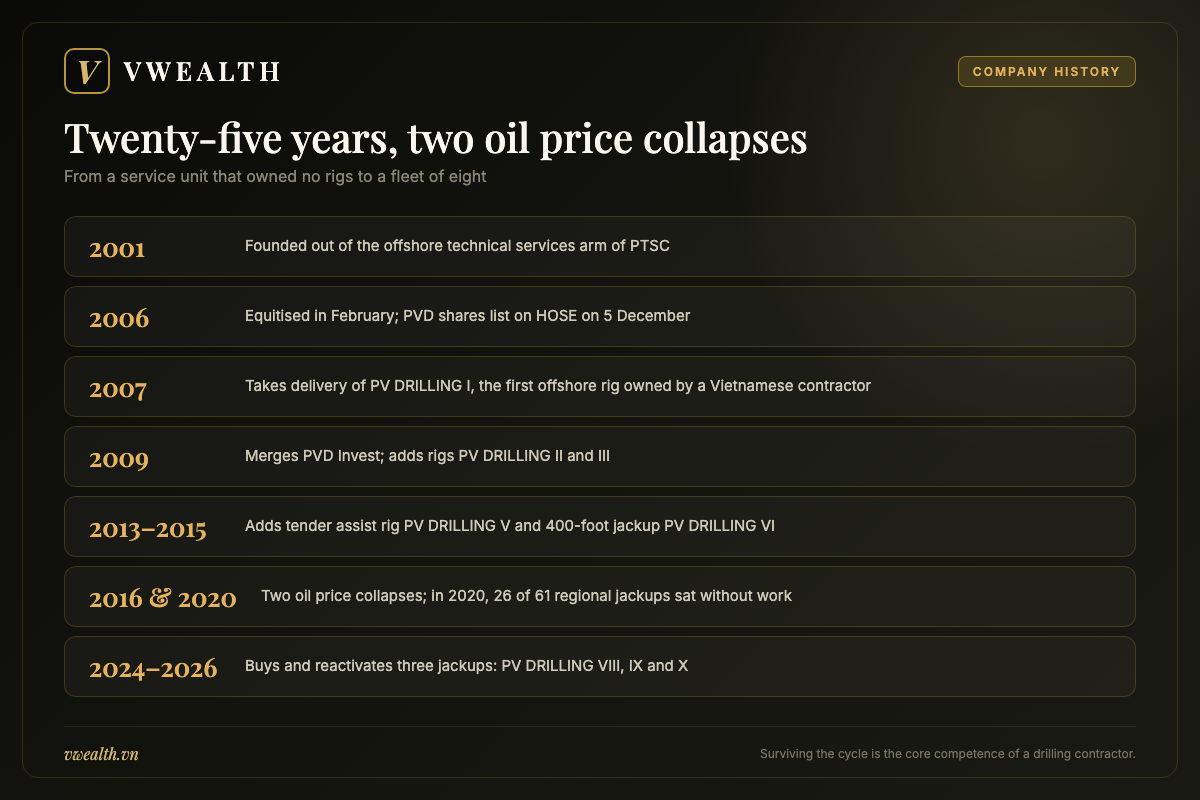
The largest shareholder in PV Drilling is the Vietnam Oil and Gas Group, holding 280,496,572 shares, equivalent to roughly 50.4 per cent of charter capital according to disclosure. That is outright control: this shareholder alone can decide every matter within the general meeting’s authority that requires an ordinary majority.
For a minority investor this structure has three consequences, and not all of them are negative.
The first is positive. PV Drilling is close to the default drilling contractor for domestic projects in which the parent group participates. In an industry where winning tenders determines survival, that ownership relationship is a real advantage, not a theoretical one. It is also why this company has never found its entire fleet idle, even in the worst years.
The second is neutral but important to know. Major decisions — new rig investments, dividend levels, senior appointments — pass through the process of a company with controlling state capital. That process is tighter and more transparent than at many private companies of similar size, but it is also slower. In an industry where the window to buy a cheap rig at the bottom of a cycle stays open for only a few months, decision speed is a variable with a real monetary value.
The third calls for caution. When the interests of the controlling shareholder and the minority diverge, the minority is in the weaker position. This does not mean conflict will arise, and in practice PV Drilling has no record of squeezing minority shareholders. But as the person putting up money, you should know exactly where you sit at the table. Readers unfamiliar with this pattern in Vietnam will find the discussion of foreign ownership room in Vietnamese stocks useful, since a high state stake also constrains the free float available to foreign buyers.
Chairman of the board: Mr Mai The Toan
Mr Mai The Toan holds the position of Chairman of the Board of PV Drilling. At the annual general meeting held on 21 April 2026, the company elected the board for the 2026 to 2031 term, and he continued as Chairman.
What matters here is not the individual so much as the continuity. In an industry with cycles as long as offshore drilling, where a rig purchase decision made today only reveals whether it was right after four or five years, a leadership team that survives an election cycle is genuinely useful information. It means the people who decided to buy three rigs between 2024 and 2026 are the same people who will have to answer to shareholders for how those rigs perform. That alignment between the decision-maker and the person accountable for the decision is a governance factor investors routinely overlook.
Chief executive: Mr Nguyen Xuan Cuong
Mr Nguyen Xuan Cuong is a board member and the General Director of PV Drilling, and also serves as Deputy Secretary of the corporation’s Party Committee.
His remarks at the 2026 annual general meeting are worth recording, because they are a clear signal about the executive team’s risk appetite: PV Drilling will pursue a cautious investment strategy, control cash flow, and only disburse capital where effectiveness is assured. For a company that has just bought three rigs in three years, that statement has a concrete meaning — it implies the pace of any further rig purchases will depend on whether the three just acquired perform, not on whether cheap rigs happen to be available.
Below the chief executive sits a group of deputy general directors covering drilling, technical, commercial and financial functions. For an individual investor this detail matters less than the two positions above, but it does indicate a clearly delineated functional management model — which is what you would want to see in a company operating complex technical assets across five countries.
Dividends: do not put PVD in an income portfolio
PV Drilling’s dividend policy depends closely on the year’s results, and a drilling contractor’s results depend on the cycle. The consequence is a dividend stream that is not smooth: some years cash, some years stock, and some years nothing.
This is not a governance failing but an inevitable consequence of the business model. A company that must retain cash to service debt taken on to buy rigs, and to fund periodic maintenance of assets worth hundreds of millions of dollars, cannot commit to a utility-like dividend. If you are building a portfolio to live on dividends, look elsewhere — the analysis of the power generation company inside the same oil and gas ecosystem shows a completely different cash flow profile for comparison.
Charter capital and the dilution question
PV Drilling’s charter capital has travelled a long way: VND 680 billion in 2007, VND 2,105 billion in 2009 after absorbing PVD Invest, VND 4,215.46 billion as of 30 September 2019, and further increases after that.
Each increase had a legitimate purpose — buying assets, strengthening the balance sheet, or absorbing a subsidiary. But as a shareholder you need to read the number differently: every time charter capital rises without a matching rise in profit, your earnings per share are diluted. This is why, when comparing today’s PV Drilling with the company of ten years ago, you cannot simply compare absolute profit. Divide by the share count, and remember that the denominator has changed.
Reading a state-controlled listed company correctly
PV Drilling belongs to the group of companies where the state retains control but the company is listed and operates under company law. This group shares a characteristic worth understanding: disclosure standards are usually above the market average, because they must satisfy both listing rules and state capital management rules, while flexibility in investment decisions is lower than at a private peer.
For a drilling contractor, that trade is reasonably balanced. You give up some speed, and you get a balance sheet that is rarely pushed to its limits and a disclosure standard good enough to follow the company seriously. In an industry where a long list of private contractors have gone bankrupt across successive oil price cycles, that conservatism is worth more than it looks.
How PV Drilling makes money: anatomy of a drilling contractor
If the business model had to be compressed into one sentence, it would be this: the company buys extremely expensive machines and rents them to oil companies by the day, and sells around them a set of services that only people inside the industry can provide. The rest of this chapter explains why that simple sentence produces such a complicated business.
Rig rental: the heart of the model
This is the segment that contributes most of the revenue and essentially all of the volatility in profit. The mechanics are simple in principle. An oil company needs to drill a well, runs a tender, drilling contractors bid in dollars per day, and the winner mobilises a rig and bills for the days it works.
Three characteristics follow from that structure, and you must hold all three in mind when reading any PVD report.
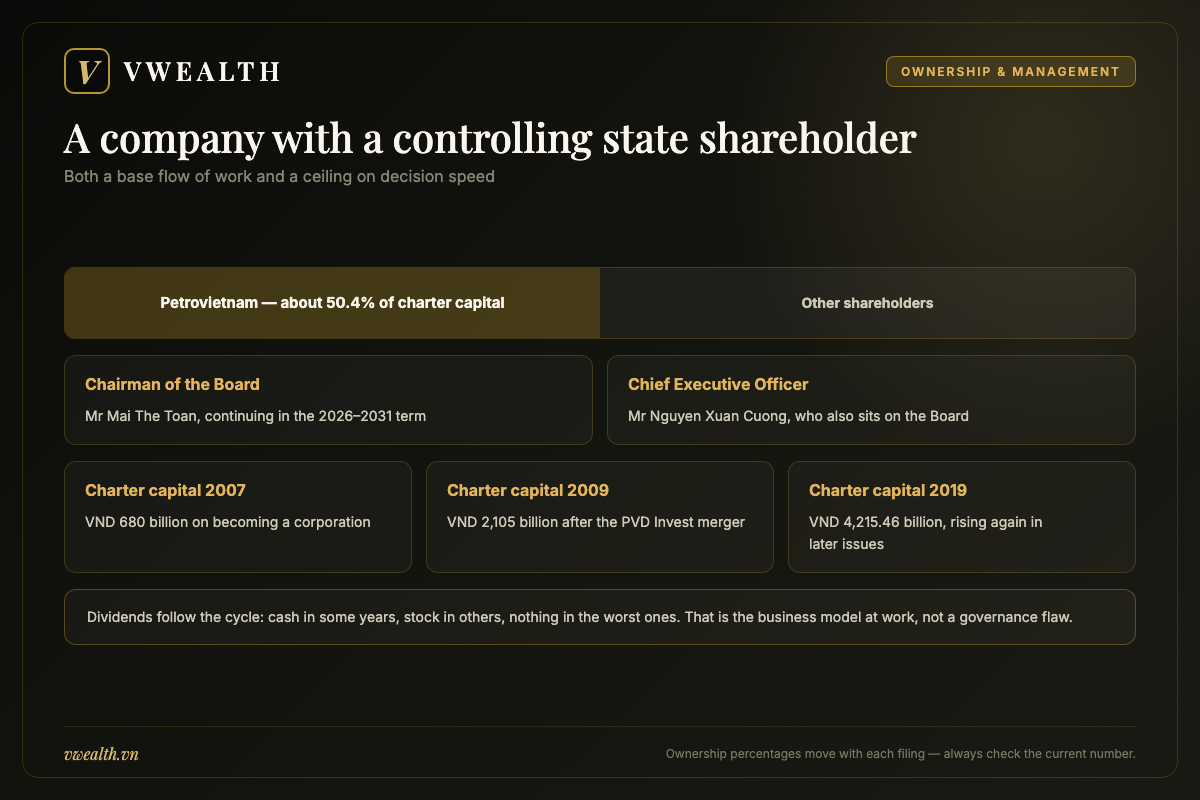
First: revenue equals working days multiplied by day rate. There is no third variable. Every more elaborate piece of analysis is ultimately a restatement of those two numbers.
Second: costs are largely fixed. Rig depreciation does not change whether the rig works or not. The operating crew has to be retained, because rebuilding a drilling crew takes years. Periodic maintenance still has to be performed to keep class certification. The result is a very high breakeven, and every working day beyond breakeven contributes almost entirely to profit. This is why a drilling contractor’s earnings do not follow a smooth line — they step.
It is worth understanding how a drilling contract is actually built, because the headline day rate is not the whole of it. A typical contract has several rate tiers. There is a mobilisation payment covering the cost of moving the rig to location, which can be substantial when a rig is towed between countries and is usually amortised over the contract. There is the operating rate, paid for days the rig is actively drilling. There is a standby or waiting rate, lower than the operating rate, paid when the rig is on location but not drilling for reasons outside the contractor’s control. And there is a repair rate, often zero, applied when the rig is down for the contractor’s own equipment failures. Two contracts with identical headline day rates can therefore produce quite different economics depending on how the tiers are set and how many days fall into each bucket.
The practical consequence for an investor is that operational reliability translates directly into money. A rig with a high uptime record spends more days on the operating rate and fewer on the repair rate, which is why the operational efficiency figure the company reports is not a public relations statistic but a genuine economic variable. It also explains why an established contractor with a strong track record can sometimes secure a better rate than a newer competitor bidding lower: an operator that loses drilling days to breakdowns loses far more than the rate difference.
PV Drilling has no pricing power in the ordinary sense. If the prevailing jackup rate in Southeast Asia is a certain number, the company can only bid around that number. This is the fundamental difference between a drilling contractor and a company with a consumer brand, and it is why operational excellence in this industry shows up in utilisation and cost rather than in margin per day.
The current fleet: eight machines, three kinds of work
As of mid-2026, PV Drilling’s fleet comprises the jackups PV DRILLING I, II, III, VI, VIII and IX, together with the semi-submersible tender assist rig PV DRILLING V, and one land rig working in Algeria. PV DRILLING X, acquired in the second quarter of 2026, is the most recent addition.
These three rig types serve three different kinds of work with different economics, and it is worth being able to tell them apart.
Jackups are the bulk of the fleet. A jackup is a barge with three or four legs, towed to location, where the legs are lowered to the seabed and the hull is jacked up clear of the water. It works in shallow to medium water depths, which describes most of Vietnam’s continental shelf and most producing fields across Southeast Asia. This is the most competitive segment, and also the one with the most work available.
The tender assist rig works differently. It moors alongside an existing fixed wellhead platform and transfers its drilling package onto that platform. The segment is narrower, with fewer potential customers, but contracts tend to be longer and less aggressively bid. The downside is that when a TAD loses its customer, finding a replacement is materially harder, because not every field can use one.
The land rig is the smallest and most idiosyncratic part of the business, currently working in Algeria. It gives the company a foothold in North Africa, but it is not large enough to change the overall picture.
Where the fleet is working, and for whom
The thing that distinguishes PV Drilling from the usual mental image of a domestic state-linked company is that most of its fleet works abroad. The company has offices in Algeria, Malaysia, Brunei and Indonesia, and rigs operating in Vietnam, Malaysia, Indonesia and Brunei.
According to the most recent disclosures, PV DRILLING I and PV DRILLING VI hold drilling contracts in Malaysia with two firm years running to early 2026 plus three optional years. PV DRILLING III worked in Malaysia until the first quarter of 2025 and then moved to Indonesia, where it signed a three-year contract covering 2026 to 2028 for Pertamina’s drilling campaign, with the possibility of a two-year extension. PV DRILLING II operates in Indonesia and PV DRILLING V in Brunei. PV DRILLING VIII was deployed for Vietsovpetro at Block 09-2/09, and PV DRILLING IX began its first drilling campaign in April 2026. In the first half of 2026 the company reported that its offshore rigs maintained operational efficiency above 99 per cent.
This is the single most important fact in the chapter, because it inverts a common assumption. Many investors buy PVD as a play on domestic Vietnamese oil and gas projects. In reality, most of the fleet is generating revenue in Malaysia, Indonesia and Brunei. That cuts two ways. The favourable side: the company is not hostage to the timetable of a handful of domestic projects, and markets such as Malaysia and Indonesia have carried healthy margins. The side to weigh: you are buying a company exposed to the policy and currency risk of four countries rather than one, and a headline about a domestic project may move the share price far more than it moves the earnings.
The service businesses around the rigs: where margins are steadier
Beyond rig rental, PV Drilling operates a chain of technical services organised into subsidiaries and joint ventures: PVD Deepwater, PVD Tech, PVD Offshore, PVD Logging, PVD Well Services and PVD Training, together with joint ventures alongside international contractors including PVD Baker Hughes, PVD Expro, PVD Tubulars Management and Vietubes.
These cover well engineering services, personnel supply and professional training, mechanical fabrication, inspection and maintenance, and equipment trading.
Their role in the investment case is entirely different from the rig segment, and it is widely underappreciated. The service businesses are smaller but far less capital-intensive and far less volatile with the day rate cycle. In the years when the drilling market froze, it was the service businesses that kept cash coming in and kept the organisation together. Put differently, services are not where the great years come from — they are what allows the company to survive the bad years and still be there for the next upturn.
One further point. The joint ventures with international contractors are not merely capital contributions that pay a share of profit. They are a technology transfer channel and a route to specialised service lines that would take many years to build alone. The implication for an investor is that part of PVD’s competitive capability sits inside entities the company does not wholly own, and the profit from them appears in the share of results of joint ventures and associates rather than in consolidated revenue.
Where is the moat, and how deep is it?
This question deserves a blunt answer, because it is the easiest place to go wrong when valuing PVD.
The first moat is the position of being the only Vietnamese drilling contractor that owns offshore rigs. That moat is real, but it only functions inside Vietnam’s borders. In Malaysia or Indonesia, PV Drilling is one bidder among many, with no preference of any kind.
The second moat is the relationship with the parent group and with domestic field operators. It is real and valuable, but it is not permanent: it depends on how many domestic projects actually proceed, which in turn depends on policy and on the oil price.
The third moat, and probably the most durable, is the organisation and its operating credentials. To place a rig with an international oil company, a contractor must pass a demanding qualification process covering safety systems, operating track record and certified personnel. PV Drilling sits on the approved contractor lists of multiple operators in the region. A newcomer with money to buy a rig cannot buy that position; it takes years to build.
But the rest has to be said plainly: none of those three moats protects the company from the day rate cycle. When the region has too many rigs, every contractor is squeezed, including the best one. PVD’s moat helps the company win work; it does not help the company win price. That distinction is the single most important thing for an investor in offshore drilling to internalise.
Position and financial health: seven things to check before you buy PVD stock
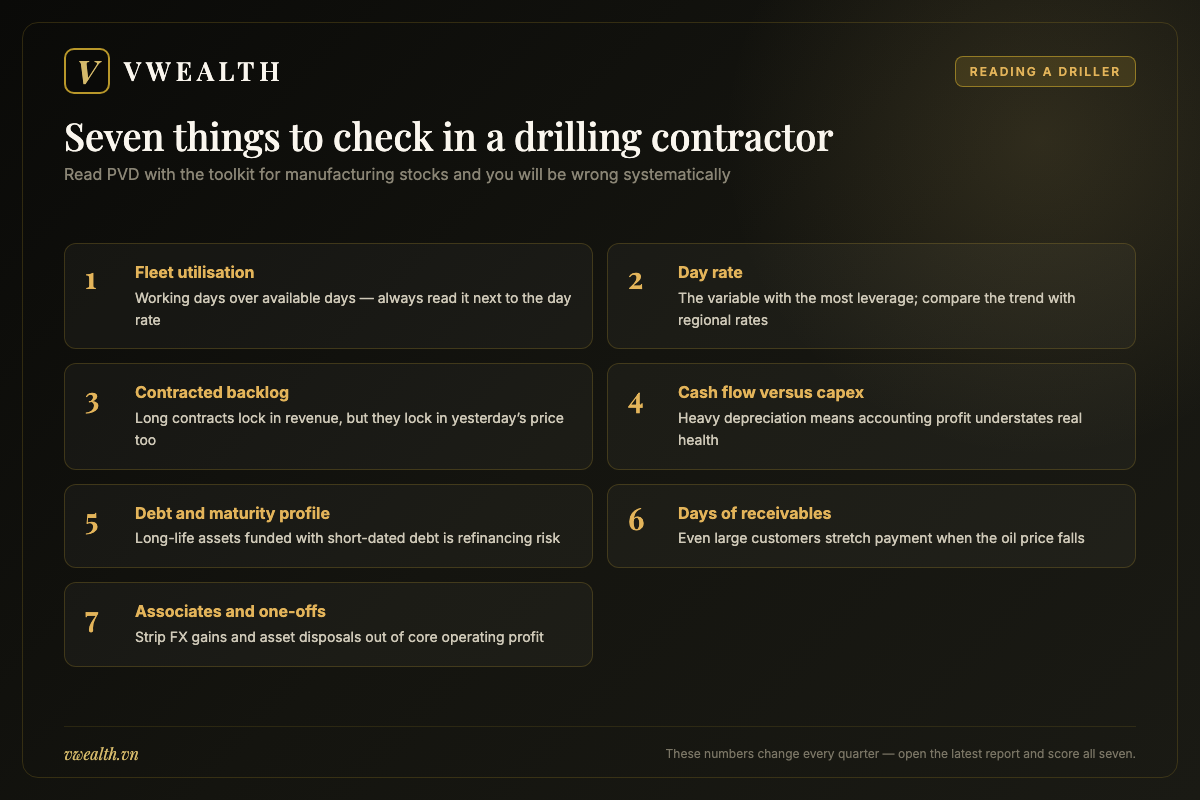
This is the most practical chapter in the article. If you use the familiar metrics of a manufacturing or retail stock to read PV Drilling’s accounts, you will reach the wrong conclusion systematically rather than occasionally. The seven checks below are the specific framework for a drilling contractor, and you can score them again after every quarterly report.
Check 1: fleet utilisation, not revenue
Utilisation is the ratio of days worked to total days in the period. It is the single most important operating metric and one the company usually discloses in its activity reporting. In the first half of 2026 the company reported that all offshore rigs maintained safe operation with efficiency above 99 per cent.
Read that number alongside the day rate, never on its own. High utilisation during a period of strong rates is a genuinely positive signal. High utilisation during a period of weak rates may instead mean the company has accepted lower pricing to keep the rigs busy — still better than idle steel, but not something to celebrate. Always put utilisation next to price before drawing a conclusion.
Check 2: the day rate, the variable that decides everything
The day rate is what the company earns for each day a rig works. In a high fixed-cost model this is the variable with the greatest operating leverage on profit. A few percentage points on the rate can move earnings by a multiple, and the same is true in reverse.
This number changes continuously with regional rig supply and demand, so this article does not quote the current level — take it from an up-to-date report. What matters is how to read it: do not look at the rate at a single point in time, look at its trend across four quarters and against the regional benchmark. A contractor whose day rate is rising more slowly than the regional benchmark is losing bargaining position, even while the income statement still shows a profit.
One further distinction matters here: the difference between the rate the company is currently earning and the rate the market is currently offering. Because most of the fleet works on multi-year contracts, the earned rate reflects the market of one, two or three years ago. When the market is rising, the earned rate lags and the company looks worse than the environment; when the market is falling, the earned rate lags and the company looks better than the environment. Either way, the earned rate is a rear-view mirror. If you want to know what the next contract will be worth, look at the current market rate for comparable rigs, not at the rate in the last income statement.
Check 3: contracted backlog
Backlog is the total value of contracts signed but not yet performed. For a drilling contractor it is the best forward indicator available, because it tells you how much future revenue has already been locked in.
PV Drilling’s contract structure shows a preference for long firm periods with extension options: two firm years plus three optional in Malaysia, three firm years plus two optional in Indonesia. That structure is a double-edged sword and deserves attention. It protects the company when rates fall, because the contract is locked. But it also locks the company into old pricing when the market rises, so it does not capture the full upswing. When you read the backlog, ask the follow-up questions: at what rate level were these contracts signed, and how long until they come up for renegotiation?
Check 4: depreciation and cash flow versus accounting profit
Drilling rigs are very large assets that depreciate heavily. As a result, a drilling contractor’s accounting profit is usually far below the cash the business actually generates, because depreciation is a non-cash charge.
This is why using an earnings multiple to value a drilling contractor produces strange answers. At the bottom of the cycle the company may post an accounting loss while cash flow remains positive, which makes the multiple meaningless. The correct approach is to look at operating cash flow and compare it with capital expenditure in the same period. If operating cash flow covers the investment programme without new borrowing, the company is in healthy condition even if the reported profit is unattractive.
Check 5: borrowings and the pace of fleet investment
Between 2024 and 2026 PV Drilling added three jackups and has indicated plans for a further one or two rigs during 2026 to 2030. Rigs cost money, and most of that money comes from debt.
What you need to track is not only the debt-to-equity ratio but three figures together: total borrowings, the ratio of interest expense to operating profit, and the maturity profile of the debt. A company with an average leverage ratio but mostly short-term debt funding assets with a twenty-year life is running refinancing risk, however comfortable the headline ratios look.
Check 6: receivable days and customer quality
PV Drilling’s customers are oil companies — generally large, and in several cases national oil companies of countries in the region. That is good customer quality, but payment cycles in this industry can be long, and during periods of low oil prices even the largest customers stretch their payables.
So watch average receivable days across quarters. If that number is creeping up while revenue is not rising correspondingly, it is an early sign that pressure is spreading from the customers to the company, and it typically shows up before the earnings deteriorate.
Check 7: joint venture earnings and one-off items
Part of PV Drilling’s profit comes from joint ventures with international contractors. That contribution sits in the share of results of joint ventures and associates rather than in consolidated revenue, so it is easily missed on a quick read.
Asset-heavy companies also tend to carry one-off items: foreign exchange differences on hard-currency borrowings, asset disposals, or provision adjustments. The reading rule is simple: separate profit that comes from rig rental and services from profit that comes from everything else, and use only the first to judge the trend. A foreign exchange gain is real money, but it tells you nothing about whether next year’s operations will be better.
Where PV Drilling sits on the regional map
Placing PVD correctly on the industry map helps you size your expectations sensibly.
Domestically, PV Drilling is the only drilling contractor that owns offshore rigs, with essentially no direct competitor of comparable scale. Within Southeast Asia it is a mid-sized contractor: eight rigs is a meaningful fleet but not a large one next to international contractors operating dozens. Globally, the active jackup fleet numbers roughly 430 units, so PV Drilling’s share measured by rig count is small.
The conclusion: PV Drilling is the leader in a small market and a mid-tier player in a large one. That position is enough to keep the fleet busy, but not enough to influence market pricing. Buying PVD means buying a capable operator in an industry where somebody else sets the price.
| Metric | Why it matters for a drilling contractor | Good sign | Warning sign |
|---|---|---|---|
| Fleet utilisation | Determines how many days generate revenue | High, with the day rate holding | High, but achieved by discounting to stay busy |
| Day rate | The variable with the greatest leverage on profit | Rising faster than the regional benchmark | Flat or lagging while the region rises |
| Contracted backlog | Locks in future revenue | Long duration signed at good rate levels | Long duration locked at the old cycle’s low rates |
| Operating cash flow versus capex | Heavy depreciation distorts accounting profit | Cash flow funds investment with little new debt | Capex persistently exceeds cash flow, debt swells |
| Borrowings and maturity profile | Long-life assets funded short is refinancing risk | Debt maturities matched to asset life | Large share of short-term debt |
| Receivable days | Even large customers stretch payment when oil is weak | Stable across quarters | Creeping up while revenue is flat |
| Joint venture and one-off items | Does not reflect core operating capability | Core profit growing, one-offs small | Profit driven mainly by currency gains or disposals |
How the market treats PVD stock: portrait of a share with a long memory
There are shares the market prices on earnings. There are shares the market prices on expectation. PVD belongs to a rarer third category: the market prices it on where it sits in the cycle. Once you see that, a great deal of otherwise baffling price behaviour becomes legible.
Why an earnings multiple gives the wrong answer here
For a company with stable profit, the price-to-earnings ratio is a useful tool. For a drilling contractor it is not, and the reason is arithmetic rather than opinion.
At the bottom of the cycle a drilling contractor’s earnings are tiny or negative. As the denominator approaches zero, the multiple explodes or becomes undefined, making the share look extraordinarily expensive at precisely the moment it is cheapest on an asset basis. At the top of the cycle the reverse happens: very large earnings compress the multiple, making the share look cheap at precisely the moment risk is highest. This is the classic trap in every cyclical stock, and new investors fall into it with great regularity.
A more appropriate approach for this kind of business is to look at price against the book value of the assets, with the central question kept in view: what would this fleet fetch on the second-hand rig market today, and how does that compare with the company’s market capitalisation? A second angle is enterprise value against earnings before interest, tax, depreciation and amortisation, which strips out the effects of heavy depreciation and of capital structure and therefore reflects the cash-generating power of the assets more faithfully.
The personality of PVD shares
If the character of this ticker had to be described in a few traits, they would be these.
First, PVD is one of the most oil-price-sensitive shares on the Vietnamese market. When crude moves sharply, PVD usually reacts immediately, and often by more than the actual effect on earnings would justify. The reason is that short-term money uses PVD as an instrument for taking a view on oil, not as a way of owning a business.
Second, the share reacts strongly to project news. Any headline connected to a large domestic project can produce a move, even when the real revenue effect is distant and uncertain. In early 2026 there was a case of an oil and gas share rising sharply on rumour, prompting market professionals to publicly advise caution in trading it. This is a characteristic of the sector rather than of any one ticker.
Third, liquidity is reasonable — enough for an individual investor to build and exit a position without difficulty. That is a practical advantage over many smaller energy names in Vietnam. Note, though, that with the state holding just over half the capital, the genuinely free float is smaller than the market capitalisation suggests.
Fourth, and most importantly: this share has a long memory. Investors who held PVD through 2015 to 2020 remember very clearly what it felt like to lose most of the value of that position. That memory keeps a portion of long-term money wary of the name even after the company has changed. For a new buyer, that market psychology is both a risk and an opportunity, depending entirely on where in the cycle you buy.
Foreign investors should also factor in the mechanics of the market itself, which shape how a share like this behaves. Vietnamese equities settle on a delayed cycle, so shares bought are not available to sell immediately, and daily price movement is bounded by percentage limits set per exchange. For a share as news-sensitive as PVD, those limits matter in practice: on a large piece of news the share can reach the daily limit and stay there with an unfilled order queue, meaning that neither buyers nor sellers get the price they see on the screen. This is not a flaw in the market so much as a feature to plan around — it argues for building positions gradually rather than attempting to react to headlines.
Foreign ownership limits are a second consideration. With the state holding just over half the capital, the portion genuinely available to foreign buyers is smaller than the headline market capitalisation implies, and in periods of strong foreign interest the effective free float can tighten quickly. That tightness cuts both ways: it amplifies moves upward when foreign money arrives and downward when it leaves.
Foreign ownership and the catalysts worth watching
Four categories of news are worth following, and three are worth ignoring.
Worth following: new contracts or extensions for specific rigs, with their durations; the decision on the next rig investment and how it is financed; actual progress at large domestic drilling projects; and the prevailing jackup day rate across Southeast Asia.
Worth ignoring: crude price moves over a few sessions, since they do not change contracts already signed; rumours about projects with no formal announcement; and valuation comparisons against oil and gas companies at other points in the value chain, whose business models are entirely different.
Comparing PVD with other options in the energy complex
Vietnam’s oil and gas sector has several listed names, but they sit at very different points in the value chain and their economics have almost nothing in common.
| Criterion | PVD — drilling | Gas distribution | Refining and petrochemicals |
|---|---|---|---|
| Position in the chain | Upstream services to exploration and production | Midstream transport and distribution | Downstream processing |
| Variable that drives profit | Day rate and days worked | Gas volumes and the pricing mechanism | The spread between product prices and crude |
| Sensitivity to oil price | Indirect but powerful, with a lag of several quarters | Moderate | Direct through the spread, moves quickly |
| Capital intensity | Very high; the asset is a rig | High; the assets are pipelines and terminals | Very high; the asset is a plant |
| Dividend stability | Low, dependent on the cycle | Usually steadier | Varies with the spread |
| What breaks the thesis | Regional rig oversupply pushing day rates down | Declining domestic gas reserves | A sustained narrowing of the refining spread |
The table is not a ranking. Its purpose is to show that “investing in Vietnamese oil and gas” is not one decision but at least three different ones. For a broader view of the complex, the overview of Vietnam’s energy sector stocks is a sensible starting point, and the analysis of the country’s dominant gas distributor shows how a midstream business behaves through the same oil price cycle.
The offshore drilling industry in 2026: rig supply, policy, and the projects still waiting
No drilling contractor is ever bigger than the volume of work in its industry. This chapter looks at the level above PV Drilling: where the regional rig market stands, how domestic policy has changed, and what the projects everyone keeps mentioning actually deliver.
Regional jackup supply: the tight spot is beginning to loosen
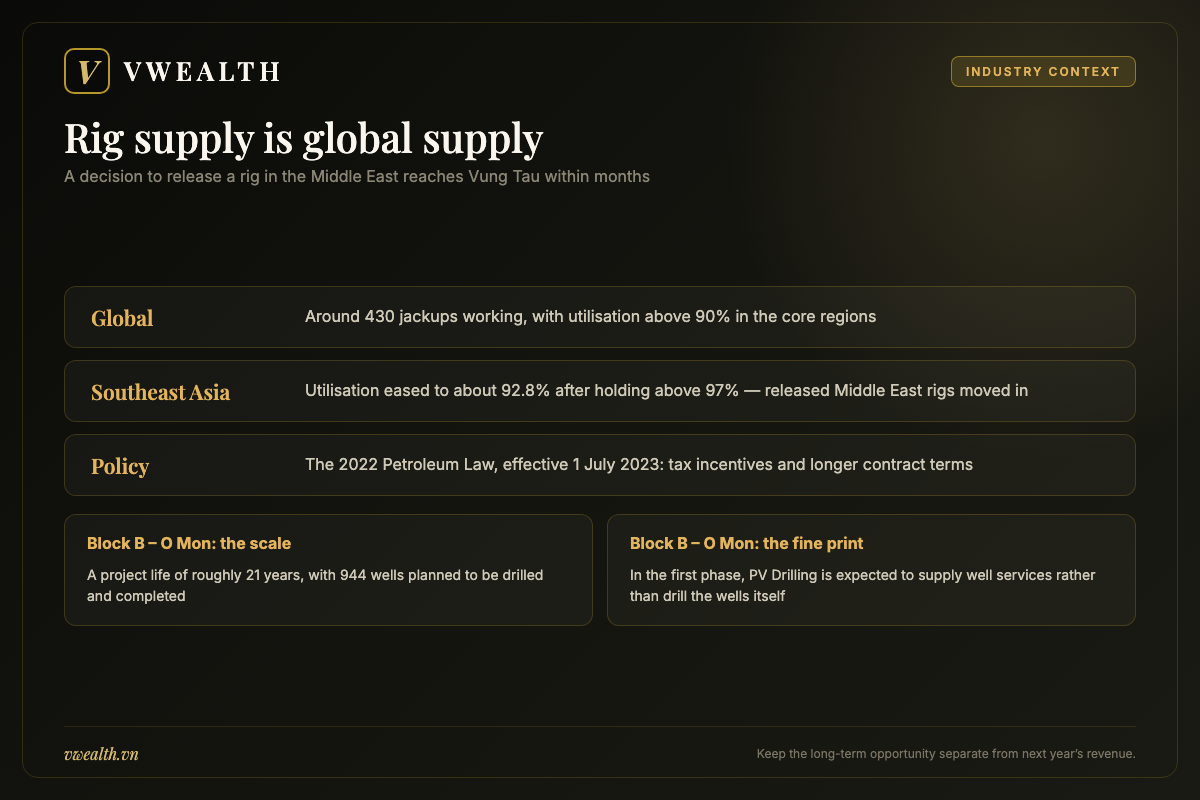
Globally, the active jackup fleet numbers roughly 430 units, with utilisation above 90 per cent in key regions including Southeast Asia. That tight supply is the foundation of the healthy rate environment contractors have enjoyed in recent years.
But the picture is shifting, and this needs watching closely. Jackup utilisation in Southeast Asia has declined to around 92.8 per cent after holding above 97 per cent for an extended period. The principal cause cited is three waves of rig releases by Saudi Aramco: rigs suspended in the Middle East spill into other regions in search of work, and Southeast Asia has absorbed the most visible share of them. Combined with a slower pace of new contracting in the region, the result is that pricing pressure has started to appear.
This is the detail Vietnamese investors most often overlook, because it happens a long way away. But the transmission mechanism is direct: a jackup can be towed from the Gulf to Southeast Asia in a matter of weeks. Rig supply is global supply, not local supply. A production decision taken in the Middle East can reduce the day rate offshore Vung Tau a few months later, with nothing having changed in Vietnam at all.
There is one supply-side factor working in the contractors’ favour, and it is worth weighing against the migration risk. Very few new jackups have been ordered in recent years. The collapse of 2015 and 2016 left shipyards with unsold speculative rigs and left contractors with no appetite or balance sheet capacity to order more, and that reluctance persisted through 2020. A jackup takes years to build, so the absence of orders today constrains supply for years ahead. The rigs migrating into Southeast Asia from the Middle East are therefore a redistribution of existing supply rather than genuine new supply — which makes the pressure real but potentially temporary, unlike the structural oversupply that followed the newbuilding boom of the early 2010s.
The practical implication is that the current softening should be watched but not automatically read as the start of another 2016. The distinction to keep in mind is between rigs moving between regions and rigs being added to the world fleet. The first redistributes work; the second destroys pricing for years.
One structural feature reinforces the point. Southeast Asia is a large but fragmented market, with a rate level below the Western basins and different operating standards. That means even in a good cycle, a contractor working this region will not achieve the pricing available in the North Sea or the Middle East.
Block B and O Mon: a big story, but read the fine print
No subject has been discussed more in connection with Vietnamese oil and gas shares in recent years than the Block B and O Mon project. It is a large gas development, and its drilling scope is genuinely substantial: across a field life of roughly 21 years, the project is expected to drill and complete a total of 944 wells.
The timetable has also become clearer. The operator, Phu Quoc POC, is targeting first gas in August 2027, and that target is assessed as achievable. Drilling was expected to begin in April 2026 with 85 wells in the first phase, of which the Naga 4 rig would drill 40, with the second rig to be announced later.
Now the fine print, which runs contrary to the expectations of many people buying PVD on this story. According to analysis by a domestic investment fund, PV Drilling is not expected to participate directly in drilling at Block B during 2026, and would instead supply well services.
The economic distance between those two roles is very large. Rig rental is a high-revenue segment with substantial operating leverage; supplying well services is a much smaller business with entirely different margin characteristics. If you are buying PVD stock on the assumption that the company will drill the bulk of Block B’s wells from the outset, that assumption needs to be verified against the company’s own formal disclosures before you commit capital.
This does not mean the project is worthless to PV Drilling. With a 21-year life and 944 wells, it represents decades of work for the domestic oilfield services industry, and the opportunity for PVD in later phases is real. The point of this section is narrower: separate the long-term opportunity from next year’s revenue. Markets routinely pay for the former as though it were the latter.
Other domestic projects generating drilling demand
Beyond Block B, domestic drilling demand is being generated by a series of other developments. The company has named Block B, Dai Hung Phase 4, Hai Su Vang and Ca Voi Xanh as growth drivers in the domestic market. Alongside these sit the Kinh Ngu Trang, Kinh Ngu Trang Nam, Ken Bau and Su Tu Trang fields.
The right way to read that list: each project is at a different stage, from post-sanction to still under study. For an investor the most useful sorting criterion is a single question asked of each name — has this project reached a final investment decision? Before that milestone, every figure about well counts and workload is an expectation. After it, the numbers become a plan with commitments behind it.
The 2022 Petroleum Law: a real change with a slow effect
The Petroleum Law of 2022, effective from 1 July 2023, is the most significant policy change in the sector in more than a decade. Three points matter to an investor.
First, tax incentives were materially widened: the incentivised corporate income tax rate for the sector was reduced to 32 per cent from 50 per cent previously, with a crude oil export tax rate of 10 per cent.
Second, petroleum contract terms were extended: from 25 years to 30 years for ordinary contracts, and from 30 years to 35 years for projects in the encouraged investment category.
Third, for the first time the law recognises unconventional petroleum within its definition of petroleum, extending the scope to coal gas, oil shale, shale gas, natural gas hydrates and other hydrocarbon forms.
The relevance to PV Drilling is indirect but substantive. The company does not benefit from these tax incentives directly, since they apply to exploration and production activity. But if better terms and longer contracts attract more foreign investment into Vietnam’s open offshore blocks, the eventual result is more wells drilled — and that is PVD’s market. One caution: this effect is slow. From the signing of a petroleum contract to the bit reaching the seabed usually takes several years.
The energy transition: a long-term risk to face directly
Anyone buying an oil and gas share with a long horizon has to answer one question: if the world moves to clean energy, will this company still have work?
The honest answer has three parts. First, oil and gas demand is not disappearing within the next several years, and natural gas is still treated by many countries as a transition fuel — which favours gas developments such as Block B. Second, as international majors redirect capital towards renewables, exploration and production budgets face long-term pressure, and those budgets are the market for every drilling contractor. Third, the offshore engineering capability of a drilling contractor can be partially redirected towards other offshore projects, but that is a direction requiring fresh investment rather than a natural transition.
For an investor with a three-to-five-year horizon, this risk is not yet the deciding factor. For someone planning to hold ten years or more, it is a question to revisit periodically rather than answer once. The broader discussion of the structural risks of investing in Vietnam covers the policy and currency layer that sits alongside it.
Looking forward: three scenarios for PVD stock and the conditions that produce each
This chapter does not offer a price target. For a cyclical share, a number written down today will not merely be wrong — it has the worse side effect of making you stop thinking once the price reaches it. What follows instead is three scenarios with concrete conditions, so you can check reality against the framework after every report.
The four variables that decide PVD’s future
For PV Drilling there are exactly four variables worth tracking. Almost everything else written about this company is noise arranged around them.
Variable one: the prevailing jackup day rate in Southeast Asia. This is the foundation of everything, and it depends on global rig supply rather than regional demand alone. Track regional utilisation alongside it, because the two move together and utilisation usually turns first.
Variable two: the performance of the three recently acquired rigs. PV DRILLING VIII, IX and X are second-hand assets that have been reactivated. Do they work full years? Are actual maintenance costs close to budget? Do the day rates they secure justify the acquisition and reactivation cost? Those three questions will determine whether the used-rig strategy was shrewd or cheap in the expensive sense.
Variable three: the actual volume of domestic work. Not the list of projects that get named in the press, but the number of wells genuinely drilled and the share of them performed by PV Drilling. To repeat the point from chapter six: the company’s role at Block B in the early phase is expected to be well services rather than direct drilling.
Variable four: the cost of capital and the debt structure after the rig purchases. Expanding a fleet with debt in an industry with volatile revenue increases the sensitivity of earnings to interest rates, and that sensitivity is permanent until the debt is repaid.
The optimistic scenario: a cycle long enough for three rigs to pay back
In this scenario the following conditions hold together. Regional rig supply does not loosen materially beyond the current spillover from the Middle East, so day rates hold in the upper part of their range. The three new rigs enter service on schedule, work full years, and reactivation costs do not overrun. Domestic drilling volumes genuinely increase as large projects move into execution. And interest rates stay in the lower part of their range, so financial expense does not grow in step with the fleet.
Under those conditions the operating leverage works exactly as designed. With high fixed costs, every additional working day and every additional dollar of day rate flows almost entirely into profit. The company now has considerably more rigs than in the previous cycle, so the same rate environment produces materially more earnings than it used to. The market begins to price PVD as a regional drilling contractor in the middle of a good cycle rather than as a company that has just escaped a difficult period — and that re-rating of the multiple, rather than the earnings growth alone, is where the large returns in this kind of share come from.
Early markers that this is unfolding: average fleet day rate rising across reporting periods while utilisation holds; operating cash flow growing faster than borrowings; and new contracts signed with long durations at rate levels above the contracts they replace. None of those requires you to forecast anything — they are backward-looking facts you can check.
The base scenario: more rigs, better earnings, no great wave
On a cautious reading this is the highest-probability outcome.
The conditions: regional rig supply loosens gradually as units migrate in from other basins, so day rates go sideways or drift slightly lower rather than continuing to rise. The new rigs enter service but with the small delays and cost overruns that second-hand assets routinely produce. Domestic drilling volumes rise but more slowly than hoped, and the share of the large projects that PV Drilling actually wins is more modest than the market had assumed. Interest expense is stable but continues to absorb a meaningful part of operating profit.
The result: a company noticeably larger in assets and revenue, with earnings improved on the difficult years but without a step change. The share oscillates within a broad range, moving on oil headlines and project news, without establishing a clear long-term trend.
Be clear about what this scenario means. It is not a failure case. In the base case PV Drilling remains a sound business with a larger fleet and a stronger position than before. It is simply the case in which the reward arrives slowly and requires you to sit through several unexciting years. Investors who buy a cyclical share expecting a quick move tend to sell in the middle of exactly this scenario, and that is the most common way to lose money in a company that has done nothing wrong.
The adverse scenario: rig oversupply arrives while the debt is still heavy
The bad case does not require a catastrophe. It requires three ordinary things to happen at once — and the offshore drilling industry has repeated precisely these three with remarkable regularity.
One: the wave of rigs from the Middle East and other basins continues into Southeast Asia, pushing regional utilisation down and triggering price competition. Two: oil prices fall into a sustained low range, prompting field operators to cut drilling budgets and defer projects — exactly what happened in 2015 and again in 2020. Three: the company has to service debt taken on for three rigs at a time when the revenue from those same rigs is falling short of plan.
In that situation the company faces three pressures simultaneously: day rates fall, working days fall, and interest expense does not. With a high fixed-cost structure, that combination can push earnings from positive to negative very quickly. The plausible consequences are a suspension of the cash dividend, deferral of the next rig purchase, disposals of non-core assets, or in a more severe case a debt restructuring.
This needs stating plainly: the adverse case is a risk scenario, not a forecast. It is set out here so that you know in advance what you would do if you began to see it developing. The early warning signals are specific and checkable. Fleet utilisation falling for two consecutive periods. A rig coming off contract without a follow-on contract signed. Average day rates falling while the regional benchmark also falls. And the ratio of interest expense to operating profit breaching whatever threshold you set for yourself in advance.
One point of fairness even here. A drilling rig has genuine resale value and there is a global second-hand market for rigs. A leveraged company with physical assets it can actually sell has options that a leveraged company carrying only goodwill does not. That is not a reason to be relaxed about debt. It is a reason to distinguish between the risk of a painful period and the risk of permanent capital loss. For PVD the first is entirely plausible; the second would require a considerably harsher combination of events.
Summary of the three scenarios
| Scenario | Conditions required | How it appears in the accounts | What it means for shareholders |
|---|---|---|---|
| Optimistic | Regional rig supply stays tight; the three new rigs perform to plan; domestic drilling volumes genuinely rise; interest rates low | Average day rate rising, utilisation holding, operating cash flow growing faster than borrowings | The market re-rates PVD as a contractor in mid-cycle rather than one just out of trouble |
| Base | Day rates flat to slightly lower; minor issues with the new rigs; domestic work grows slowly; interest expense stable but material | Revenue and assets grow, earnings improve slowly and unevenly | The share trades in a broad range and demands patience over several years |
| Adverse | Rigs migrate in from other basins; oil prices low for a sustained period; rig debt falls due while revenue disappoints | Utilisation and day rates fall together; interest expense absorbs most of operating profit | Risk of a suspended dividend, deferred investment, asset sales or debt restructuring |
How to use this table matters. Do not try to pick today which column will happen — nobody can. Use it as a scorecard: each quarter, read the results and ask which column the evidence has moved towards. After four or five quarters a pattern emerges, and that pattern is far more reliable than any forecast made in advance.
So, should you buy PVD stock? A straight answer
You now have the facts. This final chapter does not dodge the question, but it also does not issue a buy or sell recommendation, because such a recommendation is only meaningful in the context of your own financial circumstances, time horizon and tolerance for risk — three things this article cannot know.
The case for: five reasons PVD deserves consideration
First, the position is unique domestically. PV Drilling is the only Vietnamese contractor that owns and operates offshore drilling rigs. If you want exposure to the upstream end of Vietnam’s oil and gas industry through the stock market, there is essentially no equivalent alternative. Scarcity has a value of its own.
Second, the company has demonstrated that it can survive two brutal cycles. The 2015 to 2016 period and the year 2020 pushed many drilling contractors around the world into bankruptcy or restructuring. PV Drilling came through both with its fleet intact and its organisation preserved. In a cyclical industry, survivability is a core competence rather than a matter of luck.
Third, most of the revenue comes from outside Vietnam. The fleet works in Malaysia, Indonesia and Brunei alongside the domestic market, under long contracts with extension options. That reduces dependence on the timetable of a handful of domestic projects, which is notoriously difficult to predict.
Fourth, the fleet has been expanded in the right direction and by an economical method. The three jackups added between 2024 and 2026 were all acquired second-hand and reactivated rather than ordered new. That approach shortens the time to revenue and lowers the entry cost — a disciplined capital allocation decision in an industry where newbuilding at the wrong point in the cycle has destroyed many companies.
Fifth, the controlling shareholder is the state energy group. This underwrites a base flow of domestic work and a conservatively managed balance sheet. In an industry where many private competitors have disappeared across successive cycles, that characteristic is worth more than its dull appearance suggests.
The case against: six risks you must look at directly
First, the company has no pricing power. Day rates are set by regional and global supply and demand. PV Drilling can be an excellent operator and still have to accept whatever price the market offers. This is a structural limit, not a management failing, and no amount of operational improvement removes it.
Second, regional rig supply is showing signs of loosening. Southeast Asian jackup utilisation has fallen to around 92.8 per cent from above 97 per cent, principally because rigs released in the Middle East have migrated into the region. This is a real risk, already in motion, and entirely outside the company’s control.
Third, leverage has risen with the fleet. Buying three rigs in three years means more debt and more depreciation. In an industry where revenue can fall sharply within a single year, each additional unit of leverage widens the range of outcomes in both directions.
Fourth, the risk inherent in second-hand assets. Acquired rigs are cheaper than newbuilds, but greater age means heavier maintenance, more downtime for repairs, and the risk that reactivation costs exceed budget. This trade-off is real and will reveal itself gradually over the coming years rather than immediately.
Fifth, the gap between story and revenue. Large domestic projects are discussed constantly, but the specific role and actual scope of work PV Drilling wins in each project is what generates cash. For Block B in particular, the company is expected to supply well services in the early phase rather than drill directly. Buying the share on the story without verifying the scope of work is a risk the buyer creates for themselves.
Sixth, the long-term energy transition risk. If global exploration and production budgets come under structural pressure as capital shifts towards renewables, the market for every drilling contractor narrows. This risk is not urgent, but it should not be dismissed if you intend to hold for a long time.
The two sides in one table
| The case for | The case against |
|---|---|
| The only Vietnamese contractor owning offshore drilling rigs | No pricing power; day rates are set by the regional market |
| Survived two brutal cycles with fleet and organisation intact | Southeast Asian rig supply loosening as Middle East rigs migrate in |
| Most rigs on long contracts in Malaysia, Indonesia and Brunei | Long contracts also lock in old pricing when the market rises |
| Fleet expanded through second-hand assets at low entry cost and fast time to revenue | Older assets bring higher maintenance cost and downtime risk |
| State energy group as controlling shareholder underwrites a base flow of domestic work | Decision-making slower than at a private competitor in the same industry |
| Service businesses and joint ventures preserve cash flow through downturns | Actual scope of work at large domestic projects may be smaller than the market assumes |
Which investor PVD suits, and which it definitely does not
This is the section to read most carefully, because the same share can be a correct decision for one person and a clear mistake for another. The question is not whether PV Drilling is a good company, but whether it fits the portfolio and the temperament you actually have.
| Investor type | Is PVD a fit? | Why |
|---|---|---|
| Cycle investor who understands the industry and actively times entries and exits | A fit; this is precisely the share for that approach | Wide amplitude and clearly observable variables give a diligent follower a genuine edge |
| Growth investor with a three to five year horizon, comfortable with volatility | A fit at a moderate position size | The three new rigs need several years to prove themselves; that is a risk that can be compensated |
| Value investor looking for real assets below intrinsic worth | Possibly a fit, but value it on assets rather than earnings | Earnings-based multiples give inverted signals at both the top and the bottom of this industry’s cycle |
| Income investor seeking dividend yield | Not a fit | Dividends follow the cycle and cash is being retained to service rig debt |
| New investor with a small portfolio and limited experience reading financial statements | Better to wait | This share requires rescoring the seven checks in chapter four every quarter; buy-and-forget does not work here |
| Investor already holding several commodity and cyclical names | Consider position size carefully | Adding PVD concentrates exposure to the same category of cyclical risk rather than diversifying it |
| Foreign investor seeking exposure to Southeast Asian offshore drilling | A reasonable vehicle, with caveats | The fleet works across four countries, but you also take on Vietnamese state-ownership dynamics and a limited free float |
If you are building an energy and infrastructure allocation, comparing PVD against the alternatives in the same family is a step worth taking. The analysis of the national fuel distributor shows how a downstream link in the same chain responds to the same oil price variable, while the analysis of the largest port operator in northern Vietnam offers a useful contrast in how to read a capital-intensive asset owner in an entirely different industry.
Four questions to answer before you place an order
Before you press the button, answer these four honestly. If there is any one you cannot answer, stop — not because the share is bad, but because you are not yet ready for this particular one.
Question one: do you know where you are in the cycle? For a cyclical share, entry timing matters far more than it does for a steady compounder. If you have no view at all on the current position of the day rate cycle, you are buying at random.
Question two: are you willing to follow this company every quarter? The seven checks in chapter four need rescoring after every report. PVD is not a buy-and-forget holding.
Question three: what percentage decline can you tolerate without selling in a panic? This ticker’s own history shows the amplitude can be very wide. Write the number down before you buy, not after the screen turns red.
Question four: what proportion of your portfolio will this position represent? For a cyclical share with rising leverage, position sizing is a more important risk-management tool than entry timing, and it is entirely within your control.
Closing: a capable company in a difficult industry
There is one thing PV Drilling has done that very few of its global peers managed: it came through two collapses in the oil price without losing its assets, without losing its organisation, and still strong enough afterwards to go out and buy more rigs. In an industry where the list of bankrupt drilling contractors runs long, that survivability is not a small thing.
But surviving well is not the same as the share going up. PVD’s story from here depends on things beyond management’s reach: global rig supply, the exploration budgets of international majors, the world oil price, and the timetable of projects other people decide. The company can do everything right and still have several difficult years — that has happened at least twice in its own short history.
So, should you buy PVD stock? If you understand that you are buying an asset rental business in an industry governed by a cycle, if you accept that earnings will step rather than climb smoothly, if you have a clear view on where the day rate cycle currently stands, and if your position is small enough to let you sleep through the bad quarters — then PVD is a rational choice within an energy allocation. If you are buying because a large project headline sounds exciting, because oil has risen for a few sessions, or because you have heard this is the stock that benefits from a mega-project without verifying the company’s actual scope of work in it, then you are buying a story rather than a business.
It is also worth stating what a reasonable holding period looks like for this share, because that is where most retail disappointment originates. A drilling cycle from trough to peak has historically run several years, and a rig purchased today will not have demonstrated its full economics for four or five. An investor whose horizon is measured in months is not really investing in PV Drilling at all — they are taking a position on the oil price using PVD as the instrument, which is a legitimate trade but an entirely different activity with entirely different risk management requirements. Confusing the two is the most common error made with this ticker, and it is made in both directions: traders who end up holding for years because the position went against them, and long-term investors who sell in the first bad quarter because they were never prepared for the amplitude.
A final word on how to keep this article useful. The framework here — the seven checks, the four variables, the three scenarios — is deliberately built to outlast any particular quarter. Facts about the fleet, the contracts and the markets will change; the questions will not. When PV DRILLING X takes its first contract, when the next rig purchase is announced, when the Block B scope is formally confirmed, you will not need a new framework. You will need to run the same checks against the new facts and see which scenario column the evidence has moved towards. That discipline is worth more over a full cycle than any single insight about the company.
One last thing to take away. PV Drilling’s history, its fleet and its position change slowly. Fleet utilisation, day rates, contracted backlog, borrowings and valuation change every quarter. Before you place an order, open the latest analysis report and score the seven checks from chapter four again. It takes fifteen minutes, and they are the most valuable fifteen minutes in the whole decision process. If you do not yet have the tools to do that, create a vwealth account and let the platform read the reports for you.
This article provides information and analysis for reference purposes and is not a recommendation to buy or sell any security. Every investment decision is yours alone, and you carry the consequences of it. Consider consulting a licensed financial adviser before acting.
Research Vietnamese stocks in English with vwealth. Our AI-powered platform turns Vietnamese market data into full English analysis reports — with international payment support and a free 2-month trial for new accounts. Create your free account and read the latest reports.