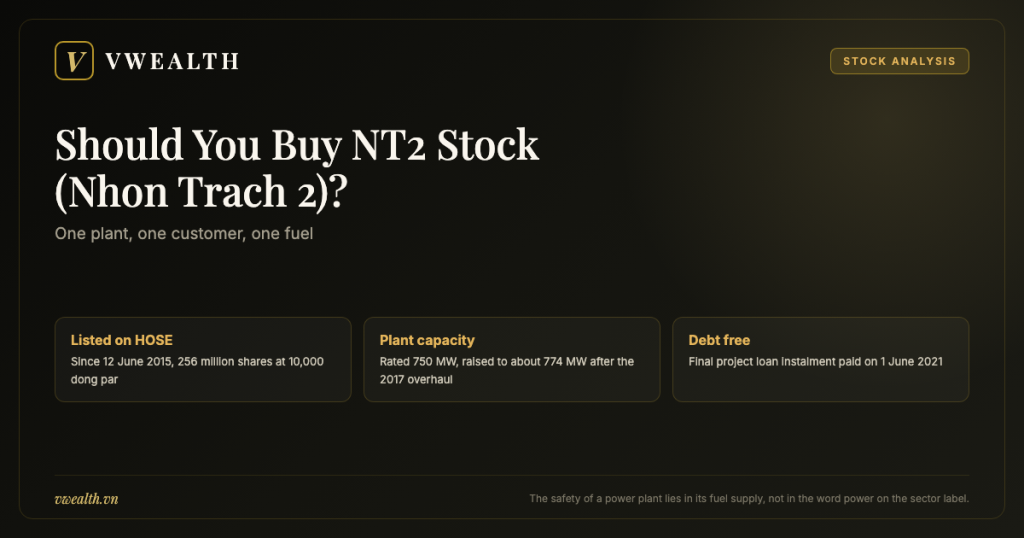
Should you buy NT2 stock — the Ho Chi Minh Stock Exchange listing of PetroVietnam Power Nhon Trach 2 Joint Stock Company — is a question most investors answer badly, because they start by assuming they are buying a company. They are not. They are buying a machine. A very large machine sitting in Dai Phuoc commune, Dong Nai province, made of two gas turbines, two heat recovery steam generators and one steam turbine, rated at 750 megawatts, selling electricity to exactly one customer and burning exactly one fuel. No branches. No brand. No customers to win. The entire enterprise fits inside a single power plant. This analysis walks from the groundbreaking in 2009 to the present, explains in plain language how a gas-fired power plant makes and loses money in the Vietnamese electricity system — something almost no retail investor is ever taught properly — and closes with a straight answer: which kind of investor NT2 suits, and which kind it absolutely does not.
Before we start, a ground rule that applies to every company analysis in this series. You will encounter many dates, names, gas field names and scale figures, all drawn from public disclosure: filings with the Ho Chi Minh Stock Exchange, shareholder meeting resolutions, statements from the company and its parent group, and mainstream financial media. What you will not find here is the latest quarter’s financials or today’s valuation multiples. For a gas-fired power plant, the gross margin can flip from healthy to negative because input gas costs shift a few percent, or because the plant was dispatched lightly for one month. So this article teaches you where to look and how to read it, and points you to the current research reports on vwealth for live numbers.
One more ground rule specific to this ticker. NT2 is a subsidiary of PetroVietnam Power Corporation, listed as POW, and it buys gas through the system operated by PetroVietnam Gas, listed as GAS. All three sit on the same value chain, but they are not three versions of the same story. This analysis will show exactly where NT2 differs from POW, its parent company, and why the two are not interchangeable in a portfolio. If you are new to this market and want the structural background first, start with our guide on how to invest in the Vietnam stock market.
From an empty lot in Nhon Trach to 750 megawatts
There is a detail in NT2’s history that few investors know, and it explains almost the entire personality of the stock: this company was created to do exactly one thing, and that thing was fully defined before the first foundation was poured. On 15 June 2007, PetroVietnam Power Nhon Trach 2 Joint Stock Company was incorporated with charter capital of 2,560 billion Vietnamese dong. Its stated mission was short: invest in, manage and operate the Nhon Trach 2 combined cycle gas turbine power plant.
Why a whole company for a single plant
Pause on that question, because it is the key to understanding why NT2 is both unusually easy to analyse and unusually easy to misjudge.
In the power industry there is an organisational form called the project company. The idea is simple: each major plant is placed inside its own legal entity, with its own balance sheet, its own borrowings, and debt service funded by the cash the plant itself generates. Lenders financing power projects like this structure because the repayment source is visible and not commingled with the parent group’s other activities. Parent groups like it too, because trouble at one project does not contaminate the others.
For an equity investor, the project company structure has one very large consequence: NT2’s financial statements are clean to a degree that is genuinely rare on the Vietnamese market. There is no thicket of associates, no puzzling financial investments, no property segment appearing unexpectedly at the bottom of the balance sheet. You get one machine, one sales contract, one fuel supply contract, one loan and one depreciation schedule. That is the whole thing.
That simplicity cuts both ways. It makes valuation refreshingly transparent, but it also means the business has nowhere to hide when conditions deteriorate. A diversified conglomerate having a difficult year can sell a plot of land, divest a subsidiary or book a financial gain to soften the numbers. NT2 has nothing to sell but electricity.
June 2009: groundbreaking, and a tender that saved close to a hundred million dollars
Construction began in June 2009. The engineering, procurement and construction contract went to a consortium of Lilama and PetroVietnam Construction. That detail matters historically: at the time, most large Vietnamese power plants were built under foreign EPC leadership, and having a domestic consortium take turnkey responsibility for an F-class combined cycle plant was something of an experiment.
The outcome of that tender was recorded as roughly twenty percent below international bid pricing, equivalent to savings of approximately one hundred million US dollars on total project cost. This is not a vanity statistic. For a power plant, total project cost is the root of every depreciation charge for the next two decades, and depreciation is the single largest fixed cost item. Saving a hundred million dollars during construction means a materially lower annual depreciation charge across the plant’s entire life, and therefore a lower cost per kilowatt hour delivered.
Put differently, most of NT2’s competitive position today was decided in a tender room back in 2008, not in a board meeting this year. That is very characteristic of the power sector: the decisions that matter most are made once, at the start of the asset’s life, and you live with the consequences for two or three decades.
16 October 2011: the first commercial electron
The plant was completed after more than twenty-nine months of construction and entered commercial operation on 16 October 2011, ahead of contractual schedule. The formal inauguration took place on 12 November 2011.
The technical configuration is described as two-two-one: two gas turbines, two heat recovery steam generators, one steam turbine. You should understand this configuration because it determines how the plant earns money. In a combined cycle plant, gas is burned in the gas turbine to generate electricity the first time; the exhaust, still extremely hot, is not vented straight to atmosphere but routed through heat recovery boilers that raise steam, and that steam drives a second turbine to generate electricity a second time. That second generation pass — essentially free in fuel terms — is why combined cycle plants achieve far higher efficiency than simple cycle gas turbines.
For an investor, thermal efficiency matters more than nameplate capacity. Higher efficiency means less gas per unit of electricity, which means lower production cost, which means that when the system ranks plants by cost to decide who gets dispatched first, you sit in the upper tier. An F-class combined cycle plant sits above older gas plants in that ranking, and that is why NT2 was dispatched steadily through most of its operating life.
12 June 2015: NT2 lists on HOSE
NT2 shares began trading on the Ho Chi Minh Stock Exchange on 12 June 2015, with 256 million shares registered at a par value of 10,000 dong, equivalent to a listed value of 2,560 billion dong.
The timing is worth noting. By 2015 the Vietnamese market was becoming comfortable with the idea of utility stocks as a defensive group — steady cash flow, steady dividends, limited exposure to consumer cycles. NT2 listed exactly when that narrative was easy to accept, and for years afterwards it was routinely cited as a flagship of the domestic dividend cohort. If that cohort interests you, our overview of Vietnam dividend stocks explains how to separate a sustainable payer from a company distributing cash it should be reinvesting. NT2 is an excellent test case for that framework, and you will see why in chapter four.
2017: the first major overhaul, and a lesson about lumpy costs
In 2017 the plant completed a major overhaul and available capacity was raised to roughly 774 megawatts, above the original design rating.
Remember this overhaul, because it introduces a cost characteristic that newer investors consistently overlook when analysing power companies: maintenance spending at a power plant is not spread evenly across years. Gas turbines follow a maintenance schedule based on operating hours, tiered into routine inspections, intermediate overhauls and major overhauls. A major overhaul is the heaviest tier, requiring the unit to be offline for weeks while turbine blades and combustors are replaced or refurbished, and it concentrates a large expense into a single accounting period.
The consequence is that a year containing a major overhaul looks worse on the income statement in two directions at once: costs rise, and output falls because the plant is down. An investor watching only quarterly earnings, without knowing the maintenance calendar, will conclude the business is deteriorating when in fact the plant is doing precisely what it must to run for another decade. This is one of the seven things you must check when reading a power company’s accounts, and chapter four returns to it in detail.
1 June 2021: the last foreign currency instalment
This is the single most important date in NT2’s financial history. If you remember only one, remember this one.
The Nhon Trach 2 plant was financed with foreign currency borrowings totalling 240.65 million US dollars and 227.04 million euros. On 1 June 2021 the company completed its nineteenth of nineteen scheduled repayments, with a final instalment of roughly 519 billion dong, formally clearing all foreign debt raised for the project.
Three things changed immediately. First, interest expense effectively disappeared from the income statement. Second, and more subtly, foreign exchange risk dropped sharply — previously, every time the dollar or the euro strengthened against the dong, the company had to book a revaluation loss on its debt, causing reported profit to swing for reasons entirely unrelated to whether the plant was running well. Third, the cash flow that had been servicing principal was freed, and much of it began flowing to shareholders as cash dividends.
If you have ever wondered why a power stock ends up classified as a high-yield holding, this is the answer: a plant that has repaid its debt and is nearly through its depreciation schedule is a cash generating machine, provided it keeps getting dispatched and keeps getting gas.
2023 to 2024: when gas ran short and profit hit a multi-year low
That word provided is doing a lot of work in the sentence above, and the 2023 to 2024 period proved it.
Gas supply to the southeastern region declined. The Cuu Long basin — the traditional source, close to shore, cheap to produce — began depleting. To compensate, the gas industry accelerated production from Nam Con Son basin fields, but those sit further offshore in harder conditions, and consequently sell at meaningfully higher prices than legacy Cuu Long gas.
For NT2, two things happened simultaneously. Gas allocation was insufficient to run the plant at desired load, and at one point the plant was taken down for a major overhaul precisely when gas supply was inadequate to dispatch it anyway. At the same time, the gas that was available cost more, raising the cost per kilowatt hour and pushing the plant down the merit order. In 2023, generation was estimated at roughly 2.99 billion kilowatt hours, only about seventy-three percent of the annual plan. Profit fell to its lowest level in nearly a decade, and in one quarter the company flagged the possibility of a loss.
The lesson is concrete, and you should carry it through the rest of this analysis: for a gas-fired power plant, the biggest risk is not demand — Vietnamese electricity demand rises almost every year — but fuel. Without reasonably priced gas, the finest machine in the world is just a stationary block of steel.
From 2025 onward: recovery, and a depreciation milestone approaching
The recent period has seen a clear reversal. Dispatch improved materially, partly because supplementary gas from Block 05-2 and 05-3, containing the Hai Thach and Moc Tinh fields, was added to the plant’s fuel mix, and partly because system demand rose while hydropower was no longer as abundant as in high-rainfall years. Profit recovered strongly from the trough.
But the more interesting development for long-term investors is an accounting milestone now approaching: most of the plant’s principal equipment is nearing the end of its depreciation schedule. From that point, a very large fixed cost — one that never involved cash — leaves the income statement, while the plant keeps running and keeps collecting electricity revenue.
This is what makes the NT2 story different from most listed equities. At most companies, higher profit requires selling more or selling at better prices. At NT2, a slice of earnings growth arrives almost automatically simply because a depreciation schedule runs out. You do not need a revenue forecast to see it; you need to read the fixed asset note. The specific figures by asset class and the exact timing change every reporting period, so check the latest vwealth research report for current detail.
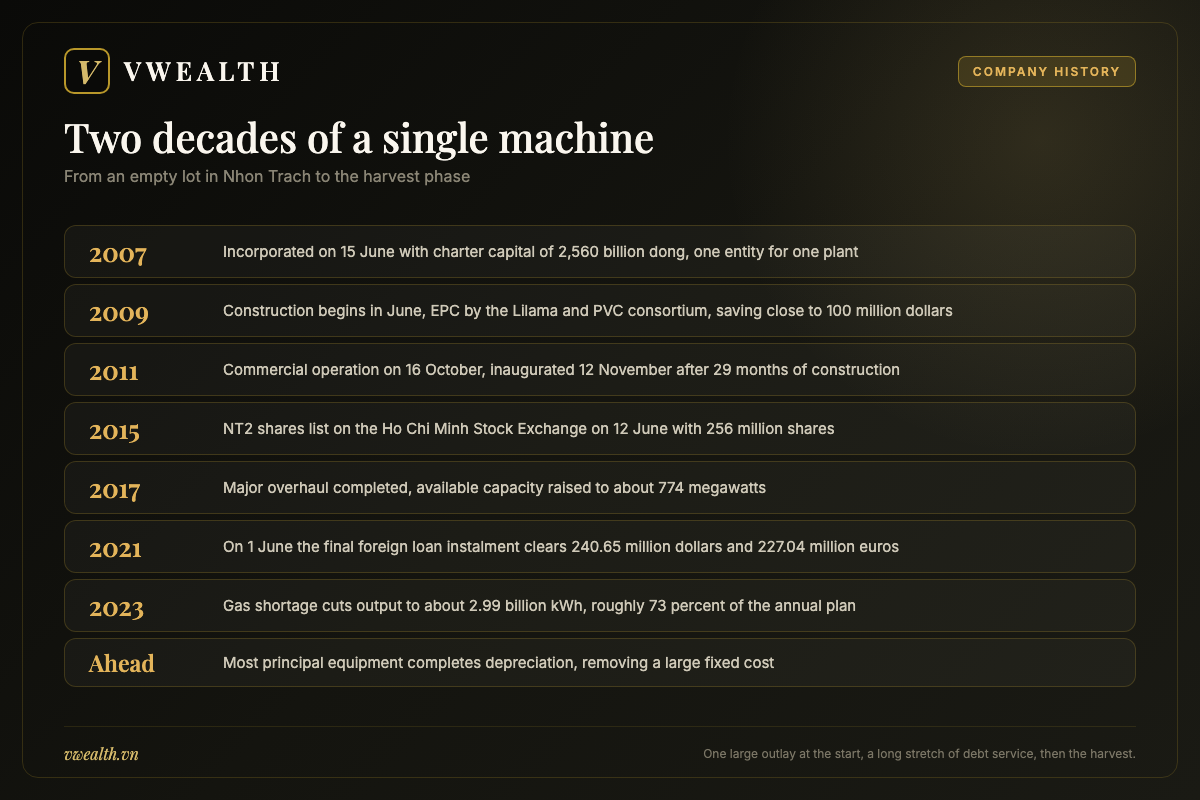
The milestone table: read it once to see the shape of the business
| Date | Event | Why it matters to an investor today |
|---|---|---|
| 15 June 2007 | Company incorporated with charter capital of 2,560 billion dong | Project company structure: one legal entity for one plant |
| June 2009 | Construction begins, EPC by Lilama and PetroVietnam Construction consortium | Tender saved close to 100 million dollars, lowering lifetime depreciation |
| 16 October 2011 | Commercial operation after more than 29 months of construction | Start of the depreciation clock and of operating cash flow |
| 12 November 2011 | Plant formally inaugurated | F-class combined cycle, two-two-one configuration |
| 12 June 2015 | HOSE listing, 256 million shares at 10,000 dong par | Stock enters the defensive cohort, dividend narrative begins |
| 2017 | Major overhaul completed, available capacity raised to about 774 MW | Introduces the lumpy nature of maintenance spending |
| 1 June 2021 | Final repayment of 240.65 million dollars and 227.04 million euros of project debt | Interest expense and currency risk largely disappear |
| 2023 to 2024 | Gas shortage and higher gas prices, 2023 output about 2.99 billion kWh | Empirical proof that fuel, not demand, is the binding risk |
| Recent period | Block 05-2 and 05-3 gas added, output and profit recover | New fuel sources reopen dispatch headroom |
| Approaching | Most principal equipment completes depreciation | Large fixed cost leaves the accounts, free cash flow expands |
Read that table vertically and you see the classic shape of an infrastructure asset: one large capital outlay at the start, a long stretch of debt service, then a harvest phase. NT2 is at the tail end of that arc. This is the single largest difference between NT2 and power stocks still in heavy investment mode, and the reason the two types should never be judged by the same criteria.
Who actually steers NT2, and where the cash goes
For a company that owns a single plant, the question of who runs it sounds unimportant — the machine runs, the money arrives, what is there for management to decide? That intuition is wrong, but wrong in a subtle way. NT2’s management does not decide electricity demand, does not decide gas prices, and does not decide the dispatch schedule. What they do decide happens to be exactly the set of things that reach the shareholder’s pocket: how to bid into the electricity market, how to schedule maintenance, how to negotiate gas supply, and what share of profit to return as dividends.
Ownership: one controlling shareholder and a group of patient foreign funds
PetroVietnam Power Corporation, listed as POW on HOSE, is the controlling shareholder of NT2 with a stake of approximately 59.37 percent of charter capital. That level is sufficient to decide virtually all ordinary business at the annual general meeting, including board appointments and the profit distribution plan.
The rest of the register is where it gets interesting. Technology Development Company Limited, known locally as CFTD, holds roughly 8.27 percent. More notable is the persistent presence of a cluster of value-oriented foreign funds: Samarang Asian Prosperity at around 5 percent, Apollo Asia Fund at around 3.28 percent, and Panah Master Fund at around 1.67 percent.
Read that list carefully. These are not index funds obliged to hold NT2 because a benchmark says so. These are mid-sized active managers, several of them well known across Asia for extremely long holding periods and highly selective portfolios: they hunt for assets that are easy to understand, generate steady cash, are run by managers who do not burn capital on glamorous projects, and above all actually pay cash dividends. The fact that this cohort has appeared in a Vietnamese power plant’s share register for years is a qualitative signal worth weighing. It is not an endorsement, but it is a data point.
The direct consequence for you, as an individual investor, is that the genuinely tradable float is small. When the controlling shareholder holds close to sixty percent and a group of long-only funds holds roughly ten percent more, the shares turning over on any given day are thin. The upside is that the price is not whipsawed by speculative flows. The downside is that when you want to exit a sizeable position quickly, the market may not have room for you at the price you see on screen.
The current management team
The Chairman of the Board is Mr Uong Ngoc Hai, born in 1972. The company’s General Director is Mr Ngo Duc Nhan, born in 1966. The executive team also includes Ms Nguyen Thi Ha, Mr Nguyen Van Quyen and Mr Nguyen Trung Thu as deputy directors. The Chief Accountant is Mr Le Viet An, and the Head of the Supervisory Board is Mr Nguyen Huu Minh.
Personnel structures at power plant operators are typically far more stable than at trading or property companies, and that stability is normal rather than a sign of stagnation. Safely operating an F-class gas turbine train is a technical discipline built on years of accumulated experience, and the value of an operating team lies precisely in knowing their own machine down to its quirks.
That said, you should still track senior personnel changes through company filings, because at businesses where the state-linked parent holds control, management changes often accompany a change of direction at the parent level. If you want to understand how state ownership shapes governance and capital allocation across the Vietnamese market, our piece on Vietnamese state-owned enterprises sets out the pattern, and NT2 fits it closely.
The relationship with the parent: real advantages, real constraints
PetroVietnam Power’s control creates a two-way relationship you need to look at squarely.
The advantage side is clear. NT2 sits inside a group with experience operating multiple power plants, long-standing working relationships with the electricity offtaker and the gas supplier, and the ability to coordinate maintenance scheduling across plants in the same cluster. For a standalone operator, negotiating a long-term gas contract would be considerably harder.
The constraint side is equally clear. When the parent simultaneously owns other plants — including new liquefied natural gas projects in the very same Nhon Trach complex — the group’s optimisation problem does not necessarily coincide with NT2’s. A minority shareholder in NT2 owns a specific asset; a shareholder in the parent owns a portfolio of plants. Those two positions diverge at times.
This is why the introduction stressed that NT2 and POW are not substitutes. Buying POW shares means buying a portfolio spanning coal-fired, hydro, gas-fired and under-construction assets, with cash flow being absorbed into new investment. Buying NT2 means buying a single asset that has nearly finished paying for itself and is entering harvest. Two different risk profiles, two different dividend expectations, and no good reason to hold both simply because both are labelled power stocks.
Dividend policy: where NT2 genuinely stands apart
This is the part of the chapter to read most carefully.
Since dividends began in 2014, NT2 has distributed a cumulative total of approximately 202.92 percent in cash and 11 percent in stock, measured against par value. To put that in plain terms: a shareholder who held from the beginning has received more than twice the par value of the shares back in cash alone, before counting bonus shares and before counting any price appreciation.
But do not mechanically project that into the future. NT2’s payout ratio swings meaningfully year to year, and the amplitude of that swing accurately reflects the cycle the business lives in: in years with abundant gas and strong dispatch the payout rises; in years of gas shortage, weak output and depressed profit, the payout is cut accordingly.
That is the core distinction between a high-yield stock and a stable-yield stock. NT2 belongs firmly in the first category and only partially in the second. If you are building a portfolio designed to live off dividends and need a dependable annual cash figure, you should not place heavy weight on a single name whose distribution tracks fuel prices.
On the other side of the ledger, the depreciation milestone mentioned in chapter one has a direct bearing here. Depreciation is an accounting charge, not a cash outflow. When it falls away, accounting profit rises but actual cash generation does not increase by the same amount — what changes is retained earnings available for distribution, meaning the legal headroom for dividends widens. For a company that has cleared its project debt and has no announced plans to build a new plant, that headroom has a good probability of being used to raise the payout. But probability is not commitment, and the decision rests with a shareholder meeting where the controlling holder commands close to sixty percent of the votes.

Ownership table and what it implies for minority holders
| Shareholder group | Indicative stake | What you should infer |
|---|---|---|
| PetroVietnam Power Corporation (POW) | About 59.37% | Controls board appointments and profit distribution; direction follows group interest |
| Technology Development Company (CFTD) | About 8.27% | Long-standing domestic institutional holder |
| Samarang Asian Prosperity | About 5% | Asian value fund, long holding periods |
| Apollo Asia Fund | About 3.28% | Mid-sized active manager focused on cash flow and dividends |
| Panah Master Fund | About 1.67% | Foreign institutional investor |
| All other holders | Remainder | Thin free float, limited daily liquidity |
Stakes shift with each disclosure round and with fund trading, so treat the table as a snapshot rather than a constant. What does not change is its shape: one large controlling holder, a cluster of foreign value funds, and a modest free float. That shape governs almost the entire trading personality of the stock, and chapter five explores the consequences.
How NT2 makes money: one plant, one customer, one fuel
Now for the most important chapter in this analysis. If you skip it, every number in the later chapters will just be a number. Vietnam’s electricity sector runs on a specific rulebook that retail investors are rarely taught properly, and most analytical errors on power stocks come from applying ordinary manufacturing logic to a power plant.
The single buyer and the power purchase agreement
In Vietnam, a large power plant does not sell to thousands of customers. It sells to Vietnam Electricity, the state utility, through its single-buyer purchasing arm. That relationship is governed by a power purchase agreement, universally abbreviated as a PPA.
The PPA for the Nhon Trach 2 plant was signed after a long negotiation running to more than twenty rounds of discussion between the parties. That detail tells you something: every parameter in the contract is the product of bargaining, and once signed it governs the company’s cash flow for many years.
For an investor, the single-buyer model has two faces. The good face is that you have no marketing, no distribution channel and no competition for customers. Electricity produced is electricity sold, and there is no inventory. The bad face is that you have no bargaining power. If the buyer pays late, you cannot switch customers. If the buyer reduces dispatch, you have no alternative market. All risk concentrates on one counterparty — what risk textbooks call customer concentration, here taken to its absolute limit.
Contracted output: the single most important concept in Vietnamese power stocks
This is where many investors go wrong, so let us go slowly.
Since the competitive generation market began operating, a plant’s output is split into two parts. The first is contracted output, referred to in industry shorthand by the symbol Qc. This is electricity sold at the price agreed in the PPA, independent of the spot market price. The second part is the remaining volume, settled at the market price prevailing in each trading cycle.
The contracted proportion is set annually under electricity market operating rules, and for NT2 the long-term contracted portion accounts for the dominant share of total output. That is precisely why this business is regarded as having relatively predictable revenue compared with plants heavily exposed to spot pricing.
Here is the subtlety, though. A high contracted ratio does not mean stable profit. It means stable revenue. Profit still depends on the spread between the contracted selling price and the cost of production, and the cost of production depends on gas. When gas prices rise faster than the contract’s pass-through mechanism permits, that difference eats directly into the plant’s margin. This is how a company with most of its output contracted can still report a loss.
Hold on to this principle: for a gas-fired plant, output determines revenue while gas price determines profit. The two variables are independent, and you must track both.
The competitive generation market and the art of bidding
The uncontracted portion is sold into the competitive generation market. The mechanism works broadly like this: plants submit bids for each trading cycle, the system stacks the bids from lowest price to highest, and dispatches sequentially until demand is met. A low-cost plant is called almost always; a high-cost plant is called only when the system is tight.
This mechanism explains why fuel cost matters roughly twice as much here as at an ordinary manufacturer. At an ordinary manufacturer, higher input costs compress the margin. At a power plant, higher input costs compress the margin and simultaneously push you down the merit order, so you also sell less. Two effects, both negative, compounding.
The reverse is equally true: when gas prices are favourable, margins widen and volumes rise at the same time. This compounding in both directions is why gas-fired generators show far more earnings volatility than the intuitive label defensive sector would suggest.
Fuel: four names worth memorising
The Nhon Trach 2 plant burns natural gas delivered through the southeastern gas system, sourced from fields in the Hai Thach and Moc Tinh cluster, the Thien Ung and Dai Hung cluster, the Nam Con Son basin, and the Sao Vang and Dai Nguyet development.
Memorise those four names, because any news about production progress, technical incidents or accelerated depletion at those fields is news that hits NT2 directly — far more directly than a macro headline about world oil prices.
The crux of the entire fuel story is this: the near-shore Cuu Long basin fields, historically the cheapest to produce, are in natural decline. Replacement volumes come from the Nam Con Son basin and other fields further offshore, where production conditions are harder and delivered gas prices are higher. This trend is structural, not seasonal. It means the average input gas cost for the whole southeastern gas-fired fleet drifts upward over time, and that is the long-run headwind every honest NT2 analysis must incorporate.
On the other side of the ledger, the company has one important support: a long-term gas supply commitment from PetroVietnam Gas of roughly 784 million cubic metres per year running through 2036. A long-term volume commitment of that kind materially reduces the risk of simply having no fuel to burn, though it does not fix the price. If you want to understand the supply side more deeply, our analysis of GAS, PetroVietnam Gas describes the pipeline system and field mix that feeds the Nhon Trach cluster.
Domestic gas versus imported LNG: the advantage NT2 still holds
Management has publicly addressed this point when asked about competition from the new liquefied natural gas plants in the same complex.
Domestically produced natural gas carries a lower price base than imported liquefied natural gas. The gap cited in public discussion was approximately 9.3 US dollars per million BTU for domestic gas against approximately 12 US dollars per million BTU for imported LNG, making domestic gas roughly twenty percent cheaper. BTU is a unit of heat energy, and gas in the power sector is always priced on heat content rather than volume, because what a turbine needs is heat rather than cubic metres.
That fuel price gap translates directly into a cost per kilowatt hour gap, which translates directly into merit order position. As long as NT2 receives domestic gas at a lower price base than imported LNG, the plant sits above the LNG plants in the cost ranking and gets dispatched first.
But this advantage has an expiry date approaching from two directions. First, domestic gas is depleting and its price is drifting up. Second, global LNG technology and supply chains could make imported gas cheaper. Those two lines are moving toward each other, and how fast they converge is one of the most important long-run variables for this stock.
Exchange rate compensation: an unusual line item
Reading NT2’s accounts, and those of several other Vietnamese generators, you will encounter a line item that can be confusing: compensation for foreign exchange differences.
Its origin lies in electricity tariff mechanics. The plant was built with foreign currency debt, and the contracted electricity price structure includes an allowance for currency movement. When exchange rate movements change translated costs, the difference is settled between generator and offtaker through a compensation mechanism, typically recognised in the period when both sides agree the figures.
The key characteristic for investors is that this item is lumpy. It can appear at material size in one period and be absent in the next. If you take the profit of a period containing a large compensation entry and multiply by four to estimate the full year, you will be badly wrong. The practical rule: when reading NT2’s earnings, always separate what comes from operating the plant from what comes from one-off items. This is a general skill, and NT2 happens to be an unusually clean illustration of it. Our guide to reading Vietnamese company financial statements in English covers where such items appear in the standard Vietnamese reporting format.
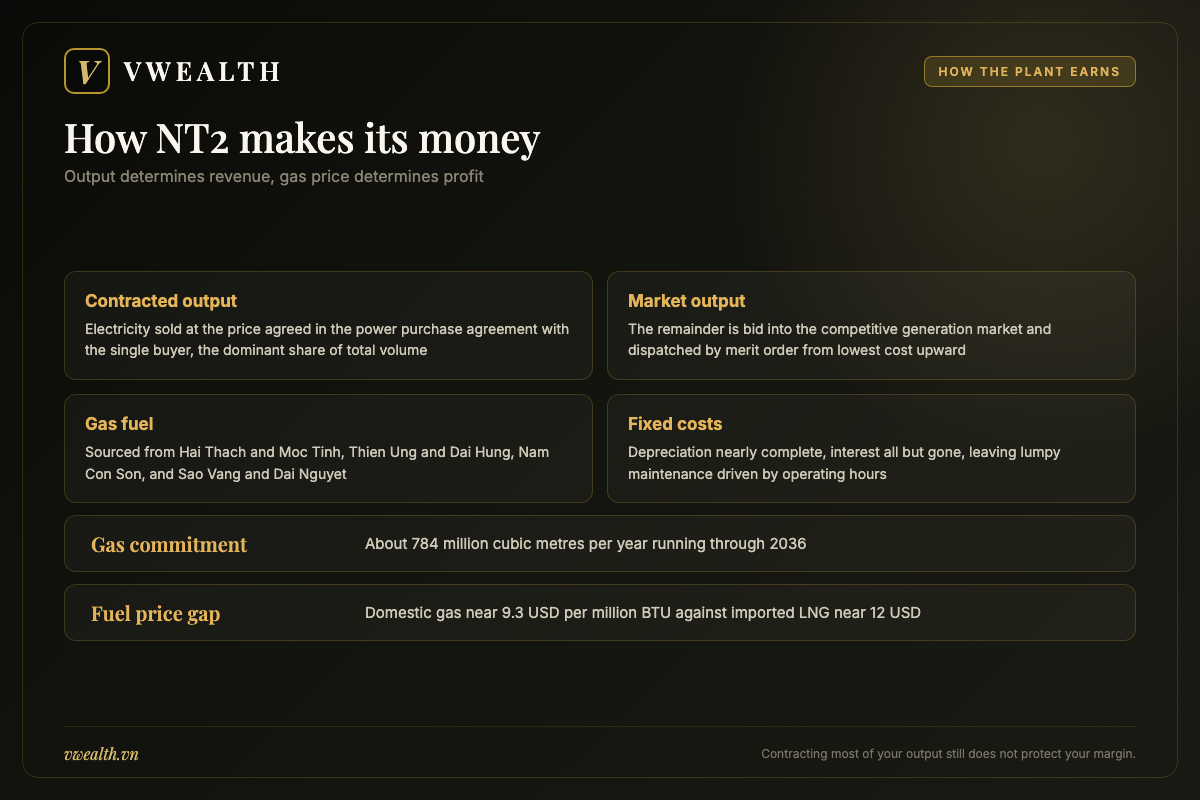
Anatomy of a gas-fired plant’s revenue and cost
| Component | Nature | Who determines it | Volatility |
|---|---|---|---|
| Contracted output revenue | Electricity sold at long-term contract price | PPA terms and market operating rules | Low within a year, reset annually |
| Market output revenue | Electricity settled at cycle market prices | System supply and demand plus the plant’s bid | High |
| Gas cost | Largest variable cost, priced on heat content | Field mix and gas supply contract | Very high, structurally rising |
| Depreciation | Fixed, non-cash charge | Schedule fixed when assets were commissioned | Flat then falls sharply at end of schedule |
| Maintenance and overhaul | Fixed but lumpy, driven by operating hours | Manufacturer maintenance intervals | Concentrated in certain periods, distorts quarterly profit |
| Interest expense | Largely gone since project debt was repaid | Capital structure | Very low |
| Financial income from deposits | Interest on a large cash balance | Deposit rates and dividend policy | Moderate, rises as cash accumulates |
| Exchange rate compensation | Tariff mechanism item, irregular | Settlement with the offtaker | Lumpy, frequently misread |
Read that table once and you see why NT2 is simultaneously easy and hard. Easy, because there are only eight lines and none of them is mysterious. Hard, because the two largest lines — output revenue and gas cost — are both outside management’s control, and both move a great deal.
Financial position: seven things to check in a power plant’s accounts
This chapter does not hand you last quarter’s figures. It hands you something more durable: a reading routine you can repeat every quarter, every year, for NT2 and for any other power stock. Once you have finished this chapter, open the research reports on vwealth and score the seven items below against current data.
Item one: actual electricity generated, in kilowatt hours
Start with a physical unit rather than a monetary one. For a power plant, generated volume is the root variable; every financial figure is a function of it.
The Nhon Trach 2 plant has a design rating of 750 megawatts, raised to roughly 774 megawatts after the 2017 overhaul, and public materials cite average annual output above 4.5 billion kilowatt hours under good dispatch conditions. After a decade of operation, cumulative commercial generation reached approximately 47 billion kilowatt hours, and the running total of electricity delivered to the national grid has been marked at successively higher milestones since.
Use those figures as your yardstick. When reading any given year, compare actual generation against the four and a half to five billion kilowatt hour band. If output is materially below it, find the reason before drawing conclusions: was there a major overhaul, was gas allocation restricted, was hydropower unusually abundant that year? The year 2023 is the textbook case, with output estimated at roughly 2.99 billion kilowatt hours, about seventy-three percent of plan — a single number that tells the whole story of that year without reading another line.
Item two: input gas price and the pass-through mechanism
The second item is the gas price, expressed in US dollars per million BTU.
You need to look at two things simultaneously: the gas price level in the period, and the extent to which that price is passed through into the electricity selling price. If the mechanism allows near-complete pass-through, the plant’s margin is protected and you only need to worry about volume. If only part passes through, the remainder sits on the company’s shoulders and erodes the margin.
This is where field mix becomes concretely important. Gas from near-shore fields is cheaper; gas from distant offshore fields is dearer. When the share of expensive gas in the fuel mix rises, average gas cost rises even if no individual field’s price changes. That is a quiet kind of change, unannounced by any dramatic headline, and it shows up only in the cost of goods sold line.
Item three: gross margin on electricity production
Gross margin is where the first two items meet. For a gas-fired plant it is the most sensitive indicator of operating health, and it swings far more than intuition about an infrastructure sector would suggest.
A practical reading rule: do not look at a single quarter’s gross margin, look at a run of four to eight consecutive quarters and find the shape. A gross margin rising steadily across several quarters usually means the plant is being dispatched well on reasonably priced fuel. A gross margin that collapses for one quarter and then recovers is usually the fingerprint of a maintenance outage or a month of gas shortage. A gross margin sliding gradually across many consecutive quarters is the genuinely worrying pattern, because that signals a structural change in fuel economics.
Item four: remaining depreciation and the end date
This is the item that individual investors almost never open, even though it sits right there in the notes to the financial statements.
For a power plant, depreciation is the largest fixed cost and also the most predictable, because the schedule was set when the assets were commissioned. The Nhon Trach 2 plant entered commercial operation in October 2011, and most of the principal equipment groups reach the end of their depreciation life in the current period. Public analysis has estimated that annual depreciation expense falls by a very large amount once this milestone passes.
The implication for you is blunt. A large fixed cost leaves the income statement without any accompanying decline in revenue or cash flow. Accounting profit jumps. But — and this is the important qualifier — actual cash generation does not increase by the same amount, because depreciation was never a cash outflow. What genuinely changes is the headroom for dividends and the way the market looks at the stock’s earnings multiple.
A good investor asks a follow-up question most people skip: when equipment is fully depreciated for accounting purposes, is it finished physically? Not necessarily. A properly maintained gas turbine can run considerably longer than its accounting life. But maintenance costs tend to climb with machine age, and at some point the company faces a choice between a major upgrade investment and accepting declining efficiency. That is a question for the next decade rather than the next quarter, but anyone buying to hold for ten years should be asking it now.
Item five: cash, deposits and financial income
A company that has repaid its project debt and is not building a new plant will accumulate cash. In recent disclosure periods, NT2’s bank deposit balances have been reported in the thousands of billions of dong, generating a steady stream of financial income alongside electricity revenue.
This is a double-edged position that deserves serious thought. On the positive side: a safe balance sheet, no bank dependency, and a buffer to absorb a bad gas year without raising capital. On the question side: cash sitting in a bank earns only deposit rates, well below the return on equity the plant itself generates. Holding materially more cash than operations require means shareholder capital is being used inefficiently.
In other words, for a company like NT2 at the end of its investment cycle, distribution policy is not a side issue — it is part of the investment thesis. The real question for management and the controlling shareholder is whether surplus cash returns to shareholders or is retained for a purpose not yet disclosed.
Item six: receivables from the electricity offtaker
In a single-buyer model, receivables are where risk collects.
Track the receivable balance and days sales outstanding. Lengthening collection periods do not mean the company is extending credit carelessly — they usually reflect the financial condition of the offtaker and the payment cycle of the wider system. But whatever the cause, the consequence for shareholders is identical: profit has been recognised on the income statement while the cash has not arrived, and dividends must be paid in real money.
This is why, with power stocks, you should read the cash flow statement before the income statement. Net cash from operating activities is what funds dividends, not the net profit line.
Item seven: the maintenance and overhaul calendar
The final item does not sit in any numeric table, but it explains more surprises than any other.
Gas turbines are maintained on cumulative operating hours, with tiers running from routine inspections to intermediate and major overhauls. A major overhaul forces the plant offline for weeks, producing a large cost concentrated in one period and forfeiting that period’s output.
Companies typically disclose the maintenance plan in annual general meeting materials or the annual report. If you know in advance that a year contains a major overhaul, you will not panic when that quarter’s profit drops, and equally you will not get overexcited comparing a clean quarter against an overhaul quarter from the prior year. This is simple, public information, and it creates a genuine edge for anyone willing to read it.

The seven-item scorecard
| Item | Where to find it | Healthy sign | Warning sign |
|---|---|---|---|
| Actual generation | Annual report, company bulletins | Stable around the multi-year average band | Deep shortfall against plan with no overhaul to explain it |
| Input gas price | Cost of sales notes, AGM materials | Effective pass-through into tariff | Rising share of high-cost gas in the mix |
| Gross margin | Income statement | Rising trend over several quarters | Gradual slide across many consecutive quarters |
| Remaining depreciation | Fixed asset notes | Schedule nearly complete, fixed costs falling | Unplanned major upgrade capital expenditure |
| Deposits and financial income | Balance sheet and notes | Adequate buffer, surplus returned to owners | Cash piling up for years with no stated purpose |
| Receivables from offtaker | Balance sheet, cash flow statement | Stable days sales outstanding | Collection period lengthening across several periods |
| Maintenance calendar | AGM materials, annual report | Disclosed early, executed to plan | Unplanned outage caused by equipment failure |
These seven matter far more than revenue. A power plant’s revenue tells you how many hours it ran, not how much money it made.
How the market treats NT2 stock
The business is one thing; the stock is another. A good plant can still be a poor investment if you pay the wrong price, and the reverse also holds. This chapter is about NT2’s trading personality — something you learn by watching for years rather than by reading financial statements.
Personality: slow, heavy, anchored to the dividend
NT2 belongs to what investors call the defensive cohort. The most visible characteristic is a narrower daily trading range than the market average, and a price that typically reacts slowly to index waves.
The reason lies in the ownership structure described in chapter two. When close to seventy percent of the shares sit with a controlling holder and long-horizon funds, the stock genuinely available for daily trading is thin. Sellers are mostly individual investors, buyers likewise, and both groups watch the same variable: the dividend.
The consequence is that NT2’s price tends to oscillate around a dividend yield the market considers fair. When deposit rates fall, the acceptable yield falls with them and the share price is bid up. When rates rise, money leaves the yield cohort for safer channels and the price comes under pressure. This linkage is unusually direct for NT2 compared with most listed names, and it means a Vietnamese interest rate decision can matter more to this stock than a company announcement.
Thin liquidity: a real risk, not a technicality
Read this section with the seriousness it deserves, because it is the most commonly underestimated risk in the whole thesis.
With a limited free float, NT2’s average daily traded value is well below that of similarly capitalised names in banking or property. Under normal market conditions this causes no inconvenience at all. But liquidity has an unpleasant property: it disappears precisely when you need it most.
Picture a concrete scenario. Bad news arrives about gas supply, or the company announces a reduced dividend. Simultaneously, many individual investors want out. Because natural buying interest is thin, the accumulated sell orders drive the price down far harder than the news itself warrants. The reverse applies on good news, where the price can run well past fair value simply because there is no stock available.
The practical rule is straightforward. If the position you intend to build is larger than a meaningful fraction of average daily traded value, you must accept that entering and exiting will take several days and that your realised average price will differ from the screen price. Vietnam’s market microstructure adds further constraints worth knowing — daily price bands, settlement timing and session mechanics — all covered in our guide to Vietnamese trading hours and price bands, and in our overview of the HOSE, HNX and UPCoM exchanges.
Valuation: why the earnings multiple misleads on power stocks
This is the most common valuation trap with NT2.
The price to earnings ratio uses net profit as its denominator. For NT2, net profit is heavily affected by three things that say nothing about operating health: depreciation currently going through a large step change, irregular compensation items, and the timing of major overhauls. The result is a multiple that can look expensive in a weak year and cheap in a year containing one-off income, with neither reading conveying useful information.
For infrastructure assets, analysts generally prefer measures that strip out depreciation and capital structure, such as comparing enterprise value with earnings before interest, tax, depreciation and amortisation. That approach lets you compare a nearly fully depreciated plant against a newly built one on a common basis. Beyond that, two practically meaningful measures for NT2 are the dividend yield and free cash flow per share.
Discounted cash flow suits this asset class particularly well, because plant life and cost structure are both relatively easy to model. Building three scenarios around different assumptions for gas price and dispatch volume is, in truth, the most appropriate way to value a power plant. Our broader piece on valuation on the Vietnamese market covers how local multiples compare with regional peers and why sector-specific adjustments matter.
Foreign ownership and room
The presence of foreign funds in NT2’s register raises the question of foreign ownership limits. For power sector companies, the maximum foreign holding is set by prevailing regulation and the company’s charter, and the remaining headroom changes with daily trading.
What matters is the implication. When substantial room remains open to foreign investors, the stock stays within reach of funds looking to deploy, creating a latent source of demand. When room is nearly exhausted, that demand disappears and the stock depends entirely on domestic flows. Our explainer on Vietnam foreign ownership limits sets out the mechanism and how to check current availability.
One further point concerns the market upgrade narrative. Thinly traded names generally do not benefit directly from passive flows tracking an index, because index funds need liquidity to enter and exit. So if you are buying NT2 hoping to ride an upgrade wave, you may have picked a reasonable stock for the wrong reason.
NT2 against other ways to own Vietnamese power
The table below does not rank anyone above anyone else. It exists to show that the power cohort contains very different asset types, and that choosing between them is really a choice about which risk you want to own.
| Ticker | Asset nature | Key profit driver | Cash flow profile |
|---|---|---|---|
| NT2 | A single gas-fired plant, debt free, nearly fully depreciated | Gas price and dispatch volume | Harvest phase, cash dividend priority |
| POW | Portfolio of gas, coal, hydro and projects under construction | Blended across sources plus LNG project execution | Investment heavy, cash absorbed by projects |
| REE | Diversified group spanning engineering, rental property and a power portfolio | Several independent segments including hydro and renewables | Diversified, less exposed to any single variable |
| PC1 | Power construction, wind development, minerals and property | Construction backlog and project timelines | Project cyclical, higher leverage |
| GEE | Electrical equipment manufacturing rather than generation | Grid investment and equipment demand | Industrial cycle driven |
Looking at that table, NT2 occupies a distinctive slot: it is close to the purest listed way to own a single generating asset that has passed its investment phase. If you want broader sector exposure, REE and PC1 are very different propositions, while GEE sits on the equipment side rather than the generation side. Four tickers, four completely different ways of making money, all wearing the same sector label. Our sector map of Vietnamese energy stocks lays out the full landscape.
Catalysts: the events that actually move this stock
For a stock as slow as NT2, price changes usually come from a short and listable set of events.
First, the dividend decision at the annual general meeting. This is the most important calendar event of the year for this name. Second, gas supply news — a new field coming online, faster than expected depletion, or a change in gas pricing arrangements. Third, the depreciation completion milestone and how the company communicates the resulting earnings headroom. Fourth, movements in deposit interest rates, which reset the dividend yield the market demands. Fifth, changes to electricity market operating rules and the contracted output ratio.
Notice that nothing on that list involves consumer taste, technology trends or brand competition. That is precisely what makes this stock manageable for busy investors: you have five variables to watch, and four of them change only a few times a year.
The Vietnamese power sector: the arena NT2 competes in
You cannot analyse a power plant without understanding the system it sits inside. This chapter sketches a map detailed enough to be useful without drifting into engineering, and detailed enough that you can read sector news without being led astray.
Electricity demand: the biggest and most durable tailwind
Vietnam’s economy has grown at a comparatively high rate for many years, and electricity demand typically grows faster still than headline output. Industry projections cited in sector materials place annual electricity demand growth in the region of eight to eight and a half percent for the period ahead.
This is the foundation of the sector’s reputation as defensive growth: demand is close to certain to rise regardless of whether consumers are tightening their belts. Factories, industrial parks, data centres and air conditioning in cities that keep getting hotter all push system load upward.
But one caution needs stating immediately so you do not fall into the familiar inference trap: rising sector demand does not automatically become profit for companies in the sector. Rising electricity demand only guarantees that more electricity must be bought; it does not guarantee that your plant is the one dispatched, and it certainly does not guarantee a healthy margin. Whether you get called depends on where you sit in the cost ranking, which loops straight back to fuel prices.
The generation mix and the competition between plant types
Vietnam’s power system draws on several source types with very different costs and characteristics.
Hydropower has a variable cost near zero — water is free — so it is dispatched first whenever water is available. This is why a wet year is a hard year for thermal generators: hydro runs flat out and pushes everything else down the stack. Conversely, a drought year is comfortable for gas and coal plants.
Coal-fired generation generally has a lower variable cost than gas at most price points, so it usually sits above gas in the merit order, but it carries environmental pressure and constraints on new development.
Solar and wind have very low variable costs but cannot be dispatched: they generate when the sun shines and the wind blows, not when the system needs them. The renewables boom created a very practical technical problem, namely that the system needs sources able to start quickly and ramp fast to cover cloud cover and still air.
And this is exactly where gas-fired generation plays a role nothing else fills as well. Combined cycle gas turbines ramp far more flexibly than coal plants. The more renewable capacity in the system, the greater the need for flexible resources. That is the long-run structural argument in favour of plants like Nhon Trach 2, even if gas-fired generation’s share of total output does not grow.
Imported LNG: the new competitor next door
Within the same Nhon Trach complex, new generation liquefied natural gas plants have been developed, burning imported LNG rather than domestically produced gas.
Comparing the two plant types is a compact lesson in infrastructure competitive advantage.
The new plant has more modern equipment and higher conversion efficiency. But the new plant also carries the full depreciation burden of an investment just completed, plus interest on debt just drawn, plus a higher imported fuel price. The older plant is slightly less efficient, but it has repaid its debt, is nearly through depreciation, and burns cheaper fuel.
In a merit order ranked by cost, the advantage tilts toward the older plant for as long as the fuel price gap persists. That is why NT2’s management has publicly expressed confidence about competing with the new LNG plants in the same complex.
But you must look squarely at how temporary that advantage is. Domestic gas is depleting and getting dearer. Imported LNG can get cheaper as terminal infrastructure matures and long-term contracts are signed. The day those two price lines cross is the day NT2’s cost advantage thins considerably. Nobody knows that date, but you should treat it as part of the investment thesis rather than a distant abstraction.
The offtaker and the financial health of the whole system
There is a systemic risk every Vietnamese power stock shares: the retail electricity tariff charged to end users is regulated by the state, while the wholesale prices paid to generators reflect market costs.
When system input costs rise faster than retail tariffs are adjusted, the offtaker comes under financial strain, and that strain propagates down to generators as slower payment or tighter dispatch. This is not an NT2-specific risk; it is a structural feature of electricity markets in most developing economies.
So when following power stocks, watch news on retail tariff adjustments and on the offtaker’s financial condition alongside company results. It is a macro variable that affects the entire cohort, and it typically moves before company financial statements reflect it.
Policy and planning: the hard frame for the next two decades
Vietnam’s national power development plan is the document that shapes the generation mix over the long run, determining which source types are prioritised, at what scale, and where.
For an investor, the practical meaning of a power plan is that it tells you who a plant’s future competitors will be. If the plan strongly favours one source type, plants of that type will be built, adding total supply and squeezing the dispatch position of existing assets. Conversely, if a source type is constrained from further development, existing plants of that type enjoy a scarcity position.
For the southeastern gas-fired cluster, the policy story revolves around the transition from domestic gas to imported LNG and the pace of renewable deployment. That broader theme belongs to the oil, gas and energy complex, described in more depth in our overview of Vietnamese energy sector stocks.
Market reform: a slow moving variable that matters more than it looks
The Vietnamese electricity market has been reformed in stages over more than a decade, moving from a fully centralised purchasing model toward progressively more competition. The competitive generation market, in which plants bid for dispatch, was the first major step. Later stages contemplate competition at the wholesale and eventually the retail level, and mechanisms allowing large industrial consumers to contract directly with generators have been introduced.
Why should an NT2 shareholder care about a reform agenda that unfolds over years? Because every parameter that determines this company’s revenue is set inside that regulatory frame. The contracted output ratio is set by market operating rules. The pass-through of fuel cost is set by tariff mechanics. The settlement price for uncontracted volume is set by the market design. Change the frame and you change the economics of every plant in the country, without any plant doing anything differently.
The direction of reform is, on balance, favourable to low-cost plants and unfavourable to high-cost ones, because more competition means dispatch and pricing depend more strictly on merit. A plant that has repaid its debt and burns comparatively cheap fuel is well positioned in that world. A plant carrying fresh capital costs and expensive imported fuel is not.
But there is a countervailing consideration. A larger share of output settled at market prices rather than at contracted prices means more revenue volatility. For a stock held primarily for dividend reliability, more volatility in revenue means more volatility in the payout. So the reform trend is not straightforwardly good news for NT2 shareholders; it improves the relative competitive position while widening the range of possible outcomes.
Climate cycles: the variable nobody can forecast but everyone must watch
One more force belongs on the map, and it is genuinely uncontrollable: rainfall.
Vietnam has substantial hydropower capacity, and because water carries no fuel cost, hydro plants run whenever reservoirs allow. In a wet year, hydro generation displaces thermal generation across the system. In a dry year, the reverse happens and gas and coal plants are called far more heavily.
This means a meaningful part of NT2’s annual earnings variability is determined by weather patterns in river basins hundreds of kilometres from the plant. Analysts commonly reference the El Nino and La Nina oscillation when discussing thermal generators for exactly this reason: a dry cycle is a tailwind for gas plants, a wet cycle a headwind.
The investment implication is not that you should try to forecast rainfall. It is that you should avoid extrapolating any single year. A year of exceptional profit driven by drought is not a new baseline, and a year of weak profit driven by heavy rain is not evidence of structural decline. When you look at NT2, average across a climate cycle rather than judging by the most recent twelve months. This is one of the most common analytical mistakes made with thermal generators anywhere in the world, and it is entirely avoidable.
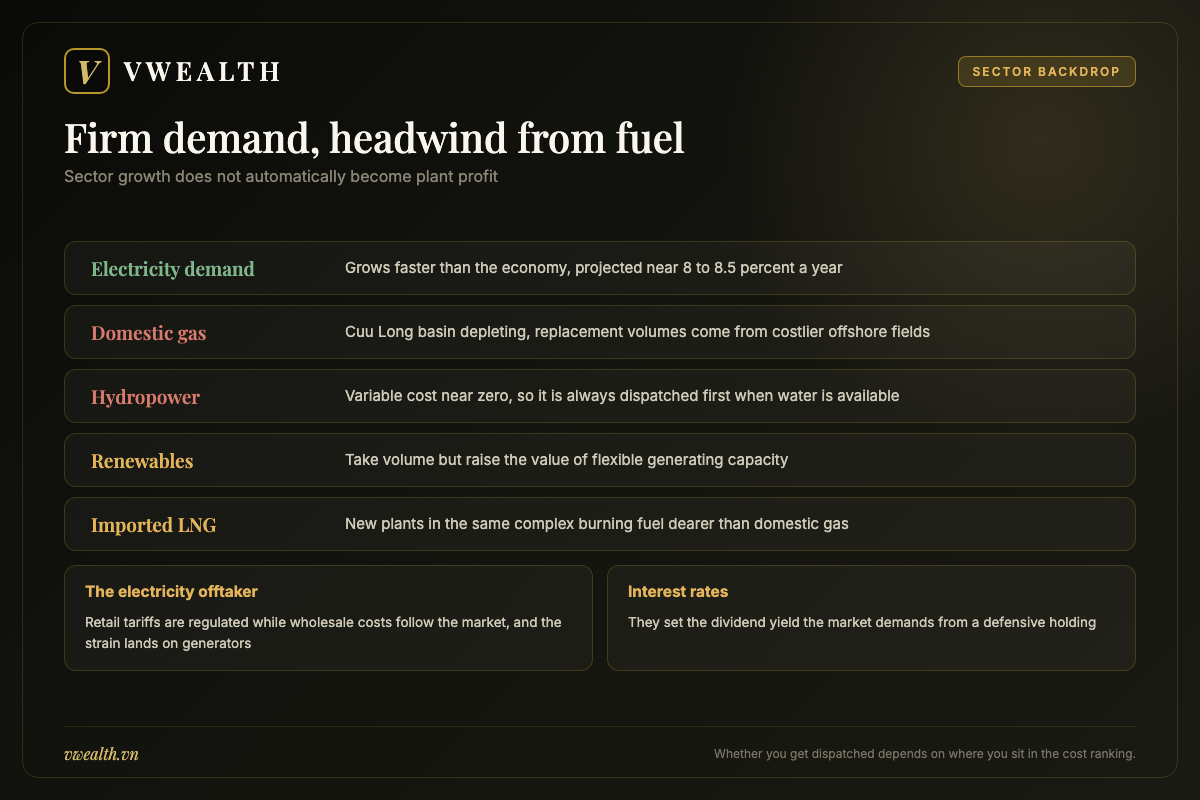
Forces shaping the sector and their effect on NT2
| Force | Direction of impact on NT2 | Time horizon |
|---|---|---|
| Electricity demand rising with economic growth | Positive: more total electricity must be purchased | Long term, steady |
| Abundant hydropower in high rainfall years | Negative: pushes thermal plants down the merit order | Seasonal and climate cyclical |
| Domestic gas depletion | Negative: average gas cost rises structurally | Long term, hard to reverse |
| Rising wind and solar share | Mixed: takes volume but increases need for flexible capacity | Long term |
| New imported LNG plants entering service | Negative: added competition in the same complex | Medium term |
| Price gap between domestic gas and imported LNG | Positive while the gap remains wide | Narrowing gradually |
| Financial health of the electricity offtaker | Negative when strained: slower payment, tighter dispatch | Tracks tariff policy cycles |
| Interest rate environment | Negative when rates rise: competition from bank deposits | Monetary policy cycle |
Taken as a whole, NT2 stands on very firm demand foundations while facing a structural headwind from the fuel side. That is a balanced picture rather than a one-directional one, and every scenario in the next chapter turns on which force prevails.
Looking ahead: three scenarios for NT2
This chapter offers no price target. Setting a price target for a business whose profit depends on fuel costs is a risky exercise of limited value. Instead, here are three scenarios with the conditions required for each, so you can check them against what is actually happening.
Drivers already visible
Before the scenarios, let us list the drivers that rest on established fact rather than speculation.
The first is the depreciation milestone. Most of the plant’s principal equipment reaches the end of its depreciation life in the current period, removing a large fixed cost from the income statement without any accompanying revenue decline.
The second is a clean balance sheet. The company cleared its project debt in mid-2021 and has accumulated substantial deposit balances, meaning it has a buffer to absorb a bad year without raising capital.
The third is the long-term gas commitment running to 2036 at roughly 784 million cubic metres per year, supplemented by the addition of Block 05-2 and 05-3 gas to the fuel mix.
The fourth is continued growth in system electricity demand, plus the increasing value of flexible capacity in a grid absorbing more renewables.
Base case: the harvest machine runs steadily
The base case assumes gas is supplied at levels allowing the plant to run near its multi-year average output band, that gas prices drift up along the structural trend but are largely passed through into tariffs, and that no major unplanned technical failure occurs.
Under these conditions, accounting profit is supported by falling depreciation, operating cash flow is steady, and the dividend payout is maintained at a level that compares well with the broader market. The stock oscillates within a narrow band around a dividend yield the market finds acceptable.
Conditions required for this scenario to hold: the gas supply contract delivers committed volumes, maintenance is executed on schedule, the offtaker pays on time, and the annual general meeting maintains a shareholder-friendly distribution policy.
Bull case: full depreciation meets a high dispatch year
The bull case requires three things to coincide.
First, a dry climate cycle reduces hydropower output, lifting thermal dispatch requirements for many consecutive months. Second, gas is supplied at consistently high volumes with no price spike, keeping the plant in the upper tier of the merit order. Third, the depreciation milestone passes during exactly this window, so the two effects compound.
When those three align, accounting profit can rise very sharply against the multi-year norm, and dividend headroom expands considerably. This is the shape of the best years in the company’s history.
But note that all three conditions lie largely outside the company’s control. A bull case dependent on weather and fuel prices is not a scenario you should treat as the default when deciding what price you are willing to pay.
Bear case: the gas shortage repeats
The bear case requires no imagination, because it already happened in 2023 and 2024 and left clear fingerprints in the accounts.
The assumptions: gas supply declines faster than expected or suffers technical problems in production and transport; the gas that is available is expensive enough to push the plant down the merit order; and simultaneously a wet year lets hydropower take the volume. Output falls well below the average band, gross margin compresses, and profit sinks to a low level.
The direct financial consequence is a reduced dividend, and for a stock held predominantly for its dividend, a payout cut usually triggers selling pressure. Combined with thin liquidity, this is the scenario in which the price can correct far harder than the operating reality warrants.
There is a worse variant, though of low probability in the near term: a major technical failure forcing an extended unplanned outage. For a single-plant company, there is no other asset to compensate during that time. That is the price of concentration.
The indicators worth putting on a calendar
Rather than guessing which scenario unfolds, set a monitoring schedule and let reality answer.
Monthly, watch news on gas supply in the southeastern region and hydrological conditions at the large reservoirs. Quarterly, read actual generation and gross margin, separating out any one-off income. Annually, read the shareholder meeting materials carefully for the maintenance plan, the output plan and the profit distribution proposal. And at any time, follow disclosures on gas pricing mechanisms and electricity market operating rules.
Four groups of indicators, each taking a few minutes per period. That is the entire monitoring workload this stock demands — considerably lighter than a retailer or a bank, and part of its appeal for investors with limited time.
Should you buy NT2 stock? Weighing both sides
Now to the question in the title. The answer is not a single word, because the same stock can be a sound choice for one investor and a mistake for another. What this analysis can do is lay out both sides of the scale honestly, then say plainly who NT2 suits.
The case for: what you actually get
First, you get an asset that is understandable to a degree that is genuinely rare. One plant, one sales contract, one fuel, one clean balance sheet. No opaque subsidiaries, no unexplained financial investments, no property division appearing out of nowhere. For an individual investor without unlimited time, the ability to understand a business completely is a real advantage, not a minor one.
Second, you get an asset that has already passed through the most expensive phase of its life. Project debt was cleared in mid-2021. Most equipment has finished or is finishing its depreciation schedule. In everyday terms, somebody else paid off the mortgage and you are buying in at the stage where the property only collects rent.
Third, the dividend record is a factual history rather than a promise: cumulative distributions of approximately 202.92 percent in cash and 11 percent in stock against par value since 2014.
Fourth, the shareholder register has featured, for years, foreign value funds that specialise in hunting for steady cash generators. That is not a guarantee, but it is a qualitative data point worth weighing.
Fifth, the company holds a long-term gas supply commitment running to 2036 and enjoys a fuel cost advantage over imported LNG plants in the same complex for as long as the price gap holds.
Sixth, and often overlooked, the operating model requires very little forecasting skill from you. You are not being asked to predict consumer behaviour or technology adoption. You are being asked to track four or five observable variables, all of which are publicly disclosed.
The case against: what you are actually accepting
The first and largest risk is fuel. Near-shore domestic gas is in structural decline, with replacement volumes coming from more expensive offshore fields. This headwind cannot be reversed by good management.
The second risk is absolute concentration. One plant, one customer, one fuel. Trouble at any of those three points has nothing to offset it. The 2023 to 2024 period is the empirical proof, with 2023 output at roughly 2.99 billion kilowatt hours, about seventy-three percent of plan, and profit at a multi-year low.
The third risk is thin liquidity. With a limited free float, building or exiting a large position takes days and incurs slippage. This is the risk retail investors ignore until the day they need to sell in a hurry.
The fourth risk is a variable dividend. The payout tracks earnings, and earnings track gas prices and dispatch volumes. This is a high-yield stock, not a steady-yield stock, and the difference matters enormously if you are depending on the income.
The fifth risk is limited growth. NT2 has no second plant under construction and no announced major expansion. Once the depreciation effect is priced in, the question of where further growth comes from has no clear answer.
The sixth risk is asset age. The plant entered commercial service in 2011. Maintenance costs trend upward with machine age, and at some point the company faces a choice between substantial upgrade capital expenditure and accepting declining performance.
The seventh risk is governance alignment. The controlling shareholder owns other plants, including competing LNG assets in the same complex. Group-level optimisation and minority shareholder interest do not always point the same way.
The balance sheet of arguments
| In favour | Against |
|---|---|
| Simple asset, unusually readable accounts | No other segment to cushion a plant problem |
| Project debt cleared since mid-2021 | No new plant, limited long-run growth narrative |
| Most equipment at or near full depreciation | Rising maintenance cost as the machine ages |
| Substantial cumulative cash dividend record since 2014 | Payout ratio swings with gas prices and output |
| Long-term gas commitment running to 2036 | Gas price rising structurally as field mix shifts |
| Cost advantage over imported LNG generation | That advantage is narrowing over time |
| Controlling shareholder is an experienced operator | Group interest does not always match minority interest |
| Low price volatility, suits a defensive allocation | Thin liquidity, difficult to size positions large |
Which investor does NT2 suit
Four profiles should let you place yourself accurately.
The income investor who prioritises cash flow over growth. This is the cohort NT2 exists to serve, with one mandatory condition: you must understand that the dividend stream from this name is not flat. Some years are excellent, some years are cut. The correct use is to treat NT2 as one component of a multi-name income portfolio at moderate weight, not as a sole income source. If you need a fixed annual distribution to cover living expenses, cap the weighting and pair it with steadier sources.
The long-term value investor who buys assets and holds for years. NT2 fits this framework well, because it is close to the archetype value investors prefer: understandable, cash generative, clean balance sheet, management that does not gamble. Your task is to build a cash flow model with explicit assumptions on gas price and output, decide the price you are willing to pay, then wait patiently for the market to offer it. With a low volatility stock, good entry points do not come often, so patience is a precondition rather than a virtue.
The growth investor looking for a business that doubles in a few years. NT2 does not fit. There is no second plant being built, no new market to open, no new product to sell. The visible earnings uplift comes mainly from depreciation falling away, which is a one-time step rather than a compounding trajectory. If your criterion is double-digit revenue growth over consecutive years, look in a different sector.
The short-term trader hunting momentum and range. NT2 is close to the worst available choice. The stock moves little, liquidity is thin, news flow is sparse, and the events capable of moving the price are all pre-announced on a calendar. Transaction costs and slippage would consume whatever the narrow range might offer.
Practical notes for investors based outside Vietnam
If you are reading this from abroad, a few mechanical points apply specifically to a name like NT2.
Foreign investors need a securities trading code and an account with a local broker before they can buy Vietnamese listed shares. Settlement follows a local cycle, and daily price bands limit how far a stock can move in one session — a constraint that becomes relevant precisely on the days when everyone wants to trade the same direction.
Foreign ownership limits apply and vary by sector and by company charter, so check available room before sizing a position. And because NT2’s free float is thin, foreign investors accustomed to deeper markets should be especially conservative about position size relative to average daily traded value.
Finally, dividends are paid in Vietnamese dong, which introduces a currency consideration for anyone measuring returns in another base currency. For a stock whose principal attraction is its dividend stream, currency movement is not a footnote — it is part of the return calculation.
Three questions to ask yourself before placing an order
Question one: could you live through a year in which the dividend is cut sharply because of a gas shortage? If the answer is no, you should not buy, because that scenario has already occurred and there is no reason to assume it will not recur.
Question two: is the position you intend to build larger than a meaningful share of average daily traded value? If so, split it and accept that accumulating a full position will take days.
Question three: have you opened the fixed asset note and checked the remaining depreciation schedule yourself? That is a fifteen-minute exercise, and it is the highest information-value page in this company’s entire financial statement package.
Closing thoughts
Nhon Trach 2 is the story of a machine built at the right time, built economically, run long enough to repay its debt, and now entering its harvest years. If Vietnam’s power sector is a stage, NT2 is not the leading actor; it is a piece of equipment humming reliably backstage, noticed only when it stops.
What makes the story interesting for investors is not scale but cleanliness. It is rare to find a listed company whose entire investment case fits in three lines: does the plant have gas to burn, does the gas price pass through, and does surplus cash reach shareholders. Those three questions you can monitor yourself.
So, should you buy NT2 stock? If you understand that you are buying an infrastructure asset at the end of its investment cycle, accept that profit will swing with gas prices and rainfall, plan in advance for thin liquidity to slow your trading, and treat the dividend as the primary reward rather than capital gain, then NT2 is a sensible piece for the defensive part of a portfolio. If you are buying because you heard power stocks are safe, or because you saw one good year’s dividend yield and assumed every year looks the same, you are missing the thing that matters most: the safety of a power plant lies in its fuel supply, not in the word power on the sector label.
One last thing to carry with you. NT2’s corporate structure, plant technology and long-term contracts change slowly, but dispatch volume, input gas price, gross margin, deposit balances and the payout ratio change every reporting period. Before you place an order, open the latest research report and score the seven items from chapter four again. It takes fifteen minutes, and it is the most valuable quarter of an hour in the entire decision process. If you do not yet have the tools to do it, create a vwealth account and let the platform read the filings for you.
This article is provided for information and analysis purposes only and does not constitute a recommendation to buy or sell any security. All investment decisions are your own and you bear responsibility for their outcomes. Consider consulting a licensed financial adviser before acting.
Research Vietnamese stocks in English with vwealth. Our AI-powered platform turns Vietnamese market data into full English analysis reports — with international payment support and a free 2-month trial for new accounts. Create your free account and read the latest reports.


