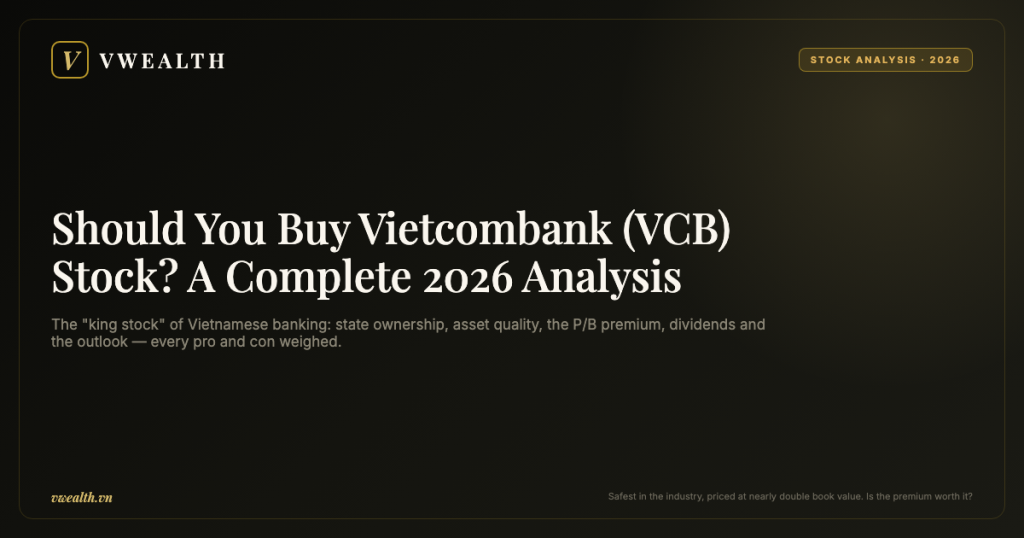
There are stocks you buy for a red-hot growth story, where a few quarters tell you whether you’ve won or lost. And there are stocks you hold like a piece of the national economy — where every percentage point of price movement is not just one company’s business, but a thermometer measuring the health of the entire Vietnamese banking system. VCB — the stock of the Joint Stock Commercial Bank for Foreign Trade of Vietnam (Vietcombank) — belongs to the second group. On HOSE, people habitually give it an almost default title: the “king stock,” the “eldest brother” of the banking industry.
That title is no flattery. In 2025, Vietcombank once again held the industry’s profit crown with more than 44,020 billion dong in consolidated pre-tax profit — a figure most other banks must combine several years to reach. Total assets passed 2.48 quadrillion dong. And more important than those absolute numbers is a metric banking analysts consider truly “world-class”: a non-performing-loan (NPL) ratio held below 1% — the lowest among the large banks — with an NPL coverage ratio around 259%, meaning for every dong of bad debt, Vietcombank has already set aside nearly two and a half dong. That is the prudence of a bank that does not need to chase growth at all costs, because its position is itself a competitive advantage.
But this is also where the story becomes interesting for you — the person weighing this stock. Because on 19 June 2026, VCB traded around 61,700 dong per share, and for the first time in years, Vietcombank’s title of “largest cap on the exchange” has wobbled, ceding ground to newer names. An “eldest brother” whose growth is slowing but whose asset quality is the best — that is a classic investment paradox. The central question of this entire analysis, therefore, is not “is VCB good” — the answer is almost self-evidently yes. The more valuable question is: should you buy VCB at this price, and if so, which kind of investor does this stock suit?
To answer thoroughly, you cannot just look at today’s board. You need to understand why Vietcombank possesses a special “genetic code” that sets it apart from every other bank — a legacy that began in 1963, from a time when the concept of a “stock market” did not yet exist in Vietnam. Let’s start from the roots.
VCB market data (updated 19 June 2026)
| Current price | 61,700đ | 2025 pre-tax profit | 44,020 bn (+4%) |
| Change (June) | −0.8% | P/B | P/E | ~2.5–2.8x | ~14–15x |
| NPL ratio | 0.58% (lowest) | CASA | ~35% |
Source: VWealth real-time market price data + VCB 2025 financial statements. Figures move session to session — for reference only.
History and evolution
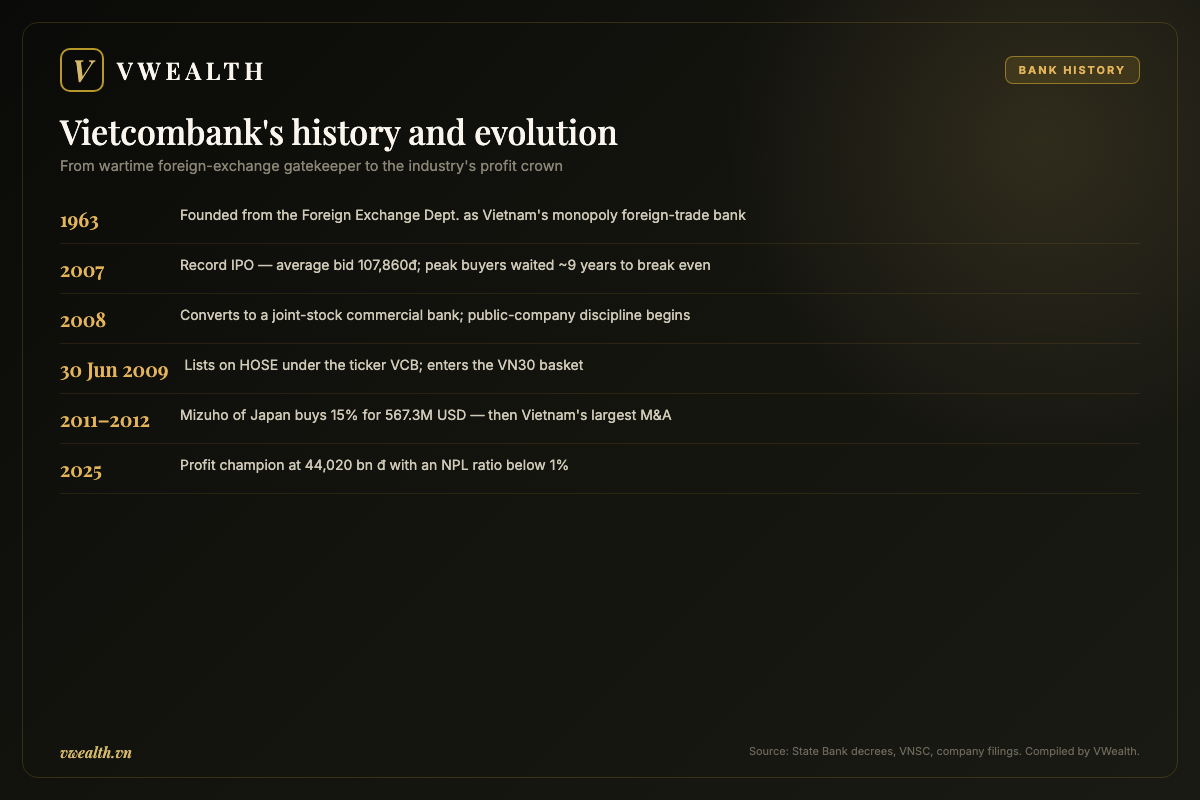
1963 — The foreign-exchange gatekeeper of a wartime economy
To understand today’s Vietcombank, you must return to a very different setting: North Vietnam in the early 1960s, a centrally planned economy preparing to enter the war against the US. In that economy, foreign currency was not a freely traded good — it was a strategic resource, managed centrally like ammunition and food.
Under Decree 115/CP of 30 October 1962 by the Government Council, spun off from the Foreign Exchange Department of the State Bank, the Bank for Foreign Trade of Vietnam was officially born and began operating on 1 April 1963. Note the original name carefully: the Bank for Foreign Trade. From its very name, its mission was defined: this was the sole door connecting Vietnam’s economy to the outside world in monetary terms.
Throughout 1963–1975 and into the subsidy era, Vietcombank was assigned by the Party and State a role no other bank had: the country’s monopoly foreign-trade commercial bank. All international settlement, national foreign-reserve management, aid reception, and import-export financing — all passed through a single door named Vietcombank. In the fiercest war years, this bank even took on a top-secret mission: organizing B29 — the Special Foreign Currency Fund (established April 1965), secretly receiving and transporting aid foreign currency to support the southern battlefront. This is a little-known story: a bank directly involved in the logistics of the war.
Why does this historical detail matter to an investor in 2026? Because the most durable competitive advantages usually cannot be bought with money — they are accumulated over time. Nearly three decades of a foreign-trade monopoly implanted in Vietcombank something rivals born later cannot copy.
Connect that legacy to the present. A correspondent-banking network spanning the globe, a dominant position in international settlement and trade finance, top-tier foreign-exchange trading capability — those are the “sediment” left from the monopoly era. To this day, Vietcombank remains the market leader in import-export settlement and foreign-currency trading. And more important for the profit story: that historical foreign-trade strength is tied to a base of large corporate customers, general corporations and conglomerates — an abundant source of non-term deposits. That is part of why Vietcombank’s CASA ratio (current and savings account deposits, an almost free source of funds) is always among the highest in the industry, dragging its cost of funds down and pushing its net interest margin up. An advantage 60 years in the making, materializing in every dong of profit today.
2007 — The IPO frenzy and the marriage of the “favourite child”
Into the 2000s, Vietnam reformed, joined the WTO, and the wave of state-enterprise equitization became the centre of attention. Vietcombank was chosen by the Government as the first state-owned bank to pilot equitization — a symbolic choice. You do not pilot with a weak bank; you pilot with the “favourite child” to prove the path is right.
And on 26 December 2007, Vietcombank’s IPO created a tremor on the young stock market. The bank offered 97.5 million shares to the public. As many as 9,326 investors registered to bid for a volume exceeding 122 million shares — supply fell short of demand. The average successful bid price closed at a staggering figure: 107,860 dong per share, raising over 10,000 billion dong. This was one of the largest IPOs in the history of Vietnam’s capital market up to that point.
But the Vietcombank IPO story is also a classic lesson about timing — something you, as an investor today, should take to heart. The auction took place exactly when the peak of the first boom had passed and the market began showing signs of a plunge. Nearly 10,000 people still rushed in to buy at over 107,000 dong out of faith in the “king stock.” Then the 2008 global financial crisis struck. Those who bought at the 2007 peak had to wait nearly 9 years — until mid-2016 — to break even and profit (after adjusting for dividends and splits). An excellent business bought at the wrong price can still bury your capital for a decade. Remember this lesson when we discuss VCB’s valuation in later sections.
The equitization process was completed with the milestone of 2 June 2008, when Vietcombank officially converted to a joint-stock commercial bank. From a 100% state-capital institution, the “eldest brother” began to wear the clothing of a public company — with all the transparency discipline, information disclosure and shareholder pressure that demands.
30 June 2009 — VCB lists, a ticker is born
On 30 June 2009, the stock under the ticker VCB officially listed on the Ho Chi Minh City Stock Exchange (HOSE). From that moment, Vietcombank was no longer just a financial institution — it became an asset any investor, from a billion-dollar foreign fund to a salaried worker, could own a piece of.
The meaning of this milestone for the investor is very concrete. A listing means liquidity — you can buy and sell easily — and transparency — audited financial statements, disclosed periodically, under the supervision of the State Securities Commission. VCB quickly became a pillar blue-chip with a large weight in indices such as VN30 and VN-Index. This creates a dual character: VCB is both a stock to invest in and a stock that index funds and ETFs must hold to track the market. A structural source of demand, not fully dependent on the short-term appetite of individual investors.
2011–2012 — “The quiet Japanese” and the 567 million USD handshake
A large bank needs large capital to grow larger, and needs “knowledge” to modernize. Vietcombank found both in a Japanese partner. Under a contract signed on 30 September 2011, Vietcombank sold 15% of its charter capital to Mizuho (Mizuho Corporate Bank, part of the Mizuho financial group — one of Japan’s largest banks). By early 2012, a flow of 567.3 million USD (about 11,800 billion dong) was officially transferred by Mizuho into Vietcombank’s account.
The detail that makes this deal memorable: Mizuho registered to buy 347.6 million common shares at 34,000 dong per share — about 24.5% above the market price at the time. The Japanese “shark” accepted paying a premium to enter, and this was the largest M&A investment in Vietnam’s history up to that point. Many at the time thought Mizuho overpaid. But money has a long memory: after more than 13 years of holding, Mizuho’s investment has multiplied many times over — a living proof of the argument “buy a good business and hold patiently.”
- On capital: Mizuho strengthened Vietcombank’s capital base, providing a platform for asset growth over the following decade.
- On governance: the Japanese strategic partner brought standards of risk management, technology and a prudent culture — contributing to why Vietcombank’s asset quality is consistently superior.
- On ownership structure: a concentrated structure with the State (via the State Bank) holding a controlling ~74.8% and Mizuho holding ~15% means the volume of shares truly floating on the market (free float) is very small — a factor that both supports the price and makes liquidity weaker relative to the enormous market cap.
From “eldest brother” to the profit crown
Along with modernization — pioneering Core Banking and online banking from 2002, opening a representative office in New York in late 2019, expanding digitalization — Vietcombank gradually shaped a very distinctive growth model. This is not a model of hot growth via high-risk credit. It is a “slow but sure” model: select good customers, keep the cost of funds low thanks to CASA and brand reputation, control bad debt strictly, and let efficiency accumulate over time.
The result of that philosophy is many consecutive years of Vietcombank holding the profit crown of the entire banking industry, peaking at more than 44,020 billion dong of pre-tax profit in 2025, with bad debt pulled below 1% and a thick provisioning buffer. Vietcombank became the benchmark against which every other bank compares itself — a kind of “gold” the market uses to measure safety.
| Milestone | Event | Meaning for the investor |
|---|---|---|
| 1963 | Founded from the Foreign Exchange Department, foreign-trade monopoly | Root of the durable forex & CASA advantage that persists today |
| 2007 | Record IPO, average price 107,860đ | Lesson: good business + wrong price = 9 years of buried capital |
| 2008 | Converted to a joint-stock bank | Transparency, public-company discipline |
| 30 Jun 2009 | HOSE listing, ticker VCB | Liquidity, into the VN30 basket — structural demand |
| 2011–2012 | Mizuho buys 15% for 567.3 million USD | Strong capital + Japanese governance standards, low free float |
| 2025 | Profit champion 44,020 bn, NPL <1% | Best asset quality, but growth is slowing |
When you string this whole journey together, you’ll see a red thread running through it: Vietcombank has never been a stock for speculative “all-in” bets. From wartime foreign-exchange gatekeeper, to the favourite child chosen to pilot equitization, to the cautious marriage with Mizuho, and then the durable profit crown — all tell of an institution that puts safety and reputation above speed. That is both its greatest strength and its limit: you can hardly expect it to double your account in a year, but you also rarely need to worry about it collapsing.
Such a legacy and such a good model do not run themselves. Behind that crown are specific people — those who decide the bank’s risk appetite, capital strategy and digital direction for the coming decade. To understand whether Vietcombank can hold its “eldest brother” position as rivals accelerate, you need to look at the leadership steering this ship — and that is exactly what we’ll dissect next.
Leadership and state ownership
When you buy a bank stock, you are not really buying the logo or the headquarters building — you are buying trust that the money customers deposit will be well managed, and that when a financial storm hits, that bank will still stand firm. With Vietcombank, most of that trust comes not from any specific product but from two very special words: the State. This is a bank whose largest shareholder, holding absolute control, is the State Bank of Vietnam — that is, the Government. And this very ownership structure, together with a leadership almost all raised within the national monetary-management system, is both VCB’s firmest shield and the golden band that keeps it from ever being as free as a purely private bank. This section will help you see through both sides — because if you look at only one side, you will mis-value the most expensive stock on Vietnam’s exchange.
Ownership structure: why the “owner” of VCB is the Government
Let’s start with the ownership picture, because it is the foundation that decides everything else. Vietcombank’s shareholder structure is among the most concentrated of any listed bank. According to referenced disclosures, the State Bank holds about 74.8% of charter capital — an overwhelming ratio, allowing the State to decide nearly every major matter at the shareholders’ meeting without needing anyone’s consent. Strategic partner Mizuho Bank of Japan holds about 15% — a ratio “locked” since the 2011 deal and virtually unchanged. The remainder, only about 10.2%, is what’s left for tens of thousands of other institutional and individual investors, including foreign names such as Singapore’s GIC.
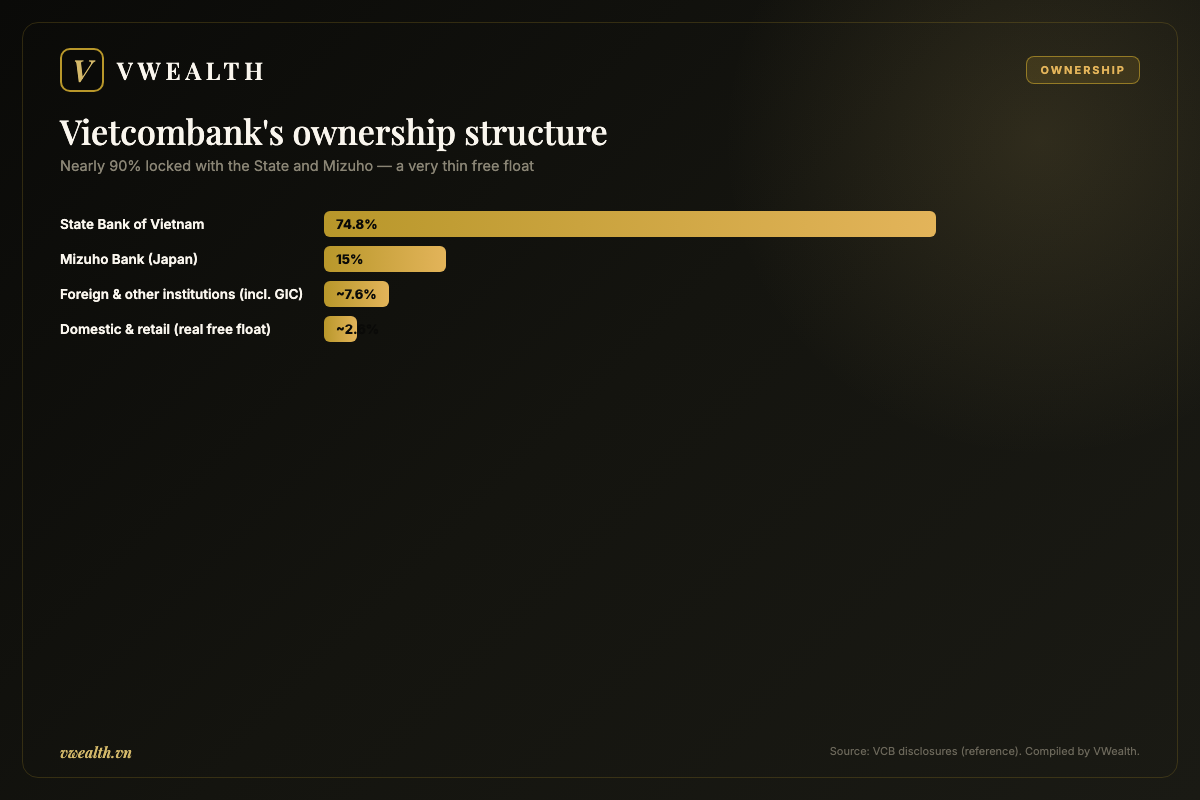
That 10.2% figure is something you must engrave in your memory. It means the truly “floating” portion of shares on the exchange — what financiers call free float — of a bank with a top-tier market cap in Vietnam is surprisingly small. Most shares are “frozen” in the hands of the State and Mizuho, almost never sold. This creates a very interesting dual consequence you must understand so you are not surprised looking at the price board.
The bright side: because free-floating supply is so scarce, even a not-too-large flow of money can push VCB’s price up strongly, and because most large shareholders “hold long,” the stock is rarely dumped en masse. That is why VCB usually has a firm price floor and less panic volatility than many private banks. The dark side: VCB’s daily liquidity is not abundant relative to its size, and more importantly, you — as a small shareholder — have virtually no voice. Every major decision has already been settled beforehand in the meeting room of the State-capital representative. You ride that ship, but you don’t steer it, and you don’t even get to weigh in on the direction.
| Shareholder | Ownership (reference) | Meaning for you |
|---|---|---|
| State Bank (representing the Government) | about 74.8% | Absolute control; a “cannot collapse” guarantee; but also the main source of policy pressure |
| Mizuho Bank (Japanese strategic partner) | about 15% | Support in governance, technology, international ties; shares locked long-term |
| Foreign & other institutional shareholders (incl. GIC…) | about 7.6% | High-quality foreign capital, but a small share |
| Domestic & individual shareholders (real free float) | the small remainder | Thin “floating” supply → firm price but limited liquidity |
“Too big to fail” — the invisible shield money cannot buy
Among bank investors there is a concept you should know by heart: “too big to fail.” Vietcombank is the clearest embodiment of that concept in Vietnam. When the State holds nearly three-quarters of a bank, it sends an implicit but extremely powerful message to the whole market: if VCB runs into trouble, the Government will not stand by with folded arms. Depositors rest easy, international partners rest easy, and investors rest easy too. That is a kind of “implicit insurance” no private bank, however high its profits, can buy for itself.
It is this very shield that explains why VCB stock is always valued at a level “more expensive” than the norm — investors are willing to pay extra for safety. In periods when financial markets shake, money tends to seek refuge in VCB. You are paying a high price not because VCB grows the fastest, but because it is the hardest to break. For many long-term investors, especially the elderly or safety-oriented funds, that is an entirely worthwhile trade-off.
With Vietcombank, you are not buying the fastest ship. You are buying the ship everyone believes the Government will never let sink. The price premium you pay is the insurance fee for that belief.
The price of the shield: when the State is both a pillar and a burden
But if you stop there, you understand only half the story, and half a truth is sometimes more dangerous than a lie. High state ownership is not only a pillar — it is also an obligation. When the Government is the owner, Vietcombank is not entirely free to do business purely for maximum shareholder profit. It is also a policy tool.
Picture it: each time the economy needs to be “given blood,” when the Government wants to lower interest rates to support businesses, the leading state-owned banks like VCB must always be the first to cut lending rates — even when that erodes their own margins. VCB has repeatedly led rate-cut rounds to support the economy, sometimes sacrificing part of its profit to play the role of the exemplary “eldest brother.” A private bank would never voluntarily do that unless it benefited. But VCB has an obligation to, because its owner is the State, and the State’s goals are much broader than a line of profit on a quarterly report.
Heavier than the interest-rate pressure is another obligation: the mandatory takeover of weak banks. This is exactly where the bright and dark sides of state ownership show most clearly, and I will analyse it in detail below. For now, you only need to remember one core principle: at VCB, the interest of the small shareholder always ranks behind the nation’s macro interest. Most of the time, these two interests run in parallel. But in tense moments they can conflict, and when they do, you know which way the win will tilt.
Leadership: temple guardians raised at the State Bank
Ownership structure shapes people, and Vietcombank’s leadership is living proof. This is not the domain of fundraising startup entrepreneurs, but of veteran executives, most raised over many years in the state-owned banking system with close ties to the State Bank.
The current head — Board Chairman Nguyen Thanh Tung — is a typical example of this distinctive path. He was appointed Chairman on 26 July 2024, after serving as VCB’s CEO from early 2023. That is, the bank’s highest helmsman is someone who rose from within, understanding VCB from the inside out, rather than an unfamiliar face “brought in from outside.” Even more notable, this chairman’s seat was left empty for a while after the predecessor — Pham Quang Dung — was moved up to become Deputy Governor of the State Bank. This seemingly small detail says a great deal: at VCB, the line between “bank leader” and “national monetary-management official” is a two-way street. People move from VCB up to the State Bank, and from the management system down to running VCB. That is an unmistakable mark of state governance.
Alongside the Chairman, CEO Le Quang Vinh runs day-to-day operations, after being assigned to lead the executive board from mid-2024. Together with a seasoned team of deputy CEOs, VCB’s leadership machine exudes a consistent quality: professionalism and prudence. You will not find here hot-growth declarations like “double the scale in two years,” nor reckless bets on real-estate bonds or high-risk lending segments that once shook several private banks. VCB’s leadership culture is the culture of the temple guardian — make it solid before thinking about going fast.
The downside of this bureaucratic prudence, to be fair, is speed. The state machine decides more slowly, is less breakthrough-innovative, and sometimes misses opportunities that nimble private banks have already seized. If you seek a “rapid-growth” bank stock, VCB may make you impatient. But if you seek stability and a machine that will never “burn down its own house,” that very slowness becomes a precious asset.
A prudent culture and the “rainy-day fund” — the industry’s thickest buffer
The leadership’s prudent governance culture is not a slogan on paper; it shows very concretely in the financial numbers, and this is a point you need to understand deeply to read VCB’s reports correctly. Vietcombank is famous industry-wide for its policy of thick risk provisioning — proactively “setting aside” a large sum in case loans turn bad.
To picture it easily: imagine bad debts as latent “wounds” in the loan portfolio. The NPL coverage ratio — the amount provisioned versus the actual bad debt — is the bank’s “reserve of bandages.” While many banks keep just enough, Vietcombank has for years maintained this ratio among the highest in the entire system, at times reaching the level where each dong of bad debt is “padded” with several dong of provisions. By mid-2025, VCB’s NPL ratio was still controlled around 1.12% — among the lowest in the industry — with a very thick coverage buffer.
The way VCB provisions is like a person who always keeps an emergency fund several times larger than the actual need. When the economy is favourable, this “rainy-day fund” can be reversed back into profit; when the economy is difficult, it is the cushion that keeps the bank from ever having to report a loss.
Why does this matter to you? Because it gives VCB an extremely flexible “profit-smoothing” ability and a stability few rivals can match. The thick provision is exactly the “rainy-day fund” — a hidden reserve that can be reversed into profit in years when the numbers need dressing up, or become the last shield in stormy years. VCB’s profit is therefore smooth, steady, with few negative surprises. That is the dream of every safety-oriented investor. The downside, again, is a trade-off: with much money set aside, the annual reported profit is “hidden” somewhat, and profit growth looks less attractive than banks that “eat fast.” Along with the prudent culture come transparency standards and orderly listing — VCB discloses fully, on time, and is one of the most closely followed businesses on HOSE.
Taking over weak banks: a test of mettle or a burden?
No example illustrates the two sides of state ownership better than the story of Vietcombank taking over a weak bank by mandate. On 17 October 2024, the State Bank officially handed over the Construction Bank (CB Bank) — a bank once under special control — to Vietcombank under a plan approved by the Government. By January 2025, CB Bank was renamed Vietcombank Digital Technology Bank — VCBNeo, with a leadership team dispatched by VCB, including a Vietcombank board member as its chairman.
You need to see this with both eyes, because analysts too are split into two camps:
The positive side — privileges and rewards attached. Shouldering a weak bank is not “free” in the sense of pure loss. In return, VCB enjoys significant policy incentives: a higher credit-growth quota, special support mechanisms, and most importantly, the chance to expand network scale and customer base. Renaming it VCBNeo and positioning it as a digital bank shows VCB does not see this merely as “clearing rubble,” but as a springboard to pilot a new digital-banking model without disturbing the parent brand. This is how a political obligation is turned into a strategic opportunity — and it shows the leadership’s mettle.
The risk side — the burden is real. Even so, do not be naive. A bank weak enough to require a mandatory takeover usually carries huge accumulated losses and a machine needing costly restructuring. “Reviving” it demands human, technological and patience resources over many years. This is truly a test of mettle: done well, VCB affirms its pillar status and reaps privileges; if it gets bogged down, this will be a “grin-and-bear-it” investment dragging on efficiency. And important for you: this is a decision VCB had no right to refuse. It was handed down from above, exactly per the logic “state-owned banks must shoulder national responsibilities” that I mentioned. The state shield and the state burden, here, are one and the same.
Dividend history: why you rarely receive cash
Finally, a very practical question: holding VCB stock, what do you get? The answer reveals another layer of the state-ownership story. For many years, Vietcombank almost did not pay cash dividends, but mainly paid in stock to retain capital and increase charter capital.
The peak was a stock dividend at a very high ratio — about 49.5% — lifting VCB’s charter capital to over 83,000 billion dong, with the bank targeting a further rise to around 94,000 billion and then aiming past the 100,000 billion mark. Only recently has VCB returned to paying part of the dividend in cash at a modest ratio (about 4.5%) after many years of “abstaining” from cash.
Why so? There are two reasons tightly tied to the ownership structure. First, a bank wanting to grow credit and meet international capital-adequacy standards is always “thirsty for capital”; retaining profit to build up equity is a natural choice, and paying in stock is the way to keep money in the bank while still “rewarding” shareholders. Second — and this is the state-specific point — VCB’s cash dividend must pass approval from the state-capital management body, because each dong of cash paid out is also a dong flowing back to the budget (via the State Bank’s stake). The dividend decision is therefore not purely a financial calculation, but also a matter of budget balance and national capital policy.
For you, the consequence is clear: if you are an investor who needs a steady annual dividend stream to spend, VCB historically is not the ideal choice — you receive “paper” (shares) more than “cash.” But if you are a long-term investor who believes in the accumulation of value, then VCB’s continuous piling up of capital to grow larger — swelling charter capital, expanding lending capacity — is exactly the driver helping the stock’s value expand over time.
In short, through the lens of leadership and state ownership, you have seen a Vietcombank that is contradictory yet consistent: extremely safe thanks to the Government’s backing, but also bound by that very backing; prudent to the point of the industry’s thickest “rainy-day fund,” but for that reason not on-fire growth; granted privileges, but also forced to shoulder duties like taking over a weak bank. Understand this thread and you’ll understand why VCB stock is always expensive yet still sought after. And to see how this machine actually makes money — from lending, retail, trade finance to the large-corporate customer ecosystem — we’ll move to the next section: Business segments and the ecosystem.
Business segments and the ecosystem
Before you decide to put money into a bank stock, there is a basic question you must be able to answer: where does this bank make money, and why does it earn more — or more durably — than rivals? With Vietcombank, the answer lies not in any glossy number, but in how the machine is assembled: on one side a huge lending flow running through about 1.66 quadrillion dong of credit, on another a store of cheap deposits letting them borrow society’s money at a lower cost than others, and on yet another the “foreign-trade bank” legacy letting them collect fees on every foreign-currency dong entering and leaving Vietnam’s economy.
This section will dissect each of those segments — not so you memorize the numbers, but so you understand how the machine runs and why it is hard to copy. That is what investors call the “economic moat.”
How a bank makes money: a primer on net interest income and NIM
Let’s start with the simplest thing. A bank is essentially a money-trading intermediary. It raises your money (savings deposits, account balances) and pays you an interest rate — called the cost of funds. Then it lends that money out to businesses, home buyers, car buyers… at a higher rate. The difference between the lending rate and the deposit rate is net interest income (NII). This is the core lifeblood, the largest part of almost every bank’s total income, and Vietcombank is no exception.
To measure the efficiency of this “money trading,” analysts use a metric called NIM (Net Interest Margin). Think of NIM as the profit margin on each dong the bank lends out. A NIM of 3% means for every 100 dong of interest-earning assets, the bank profits 3 dong after subtracting the interest paid to depositors. The higher and thicker the NIM, the “healthier” the bank. And this is where Vietcombank has a structural advantage few banks in Vietnam possess.
The secret to a durable NIM is not lending at cut-throat rates — any bank can do that, but it will attract risky customers. The secret lies in the other side: raising cheap funds. And Vietcombank is the best at that very side few pay attention to.
The silent weapon: CASA and a low cost of funds
In a bank’s deposit store, there are two very different kinds of money. The first is term deposits — the 6-month, 12-month savings book on which you demand 5–6% a year. This money is expensive. The second is non-term deposits — the balance in your payment account, your salary account, a business’s daily working cash. On this the bank pays almost only a symbolic rate (0.1–0.5% a year). The ratio of non-term deposits to total deposits is called CASA (Current Account Savings Account).
Picture it: two banks both lend to a customer at 8%. But bank A raises funds at an average cost of 4.5%, while bank B — thanks to more non-term deposits — pays only 3.5%. On the same loan, bank B earns an extra 1% without taking on any additional risk. Multiply that 1% by more than 1.6 quadrillion dong of outstanding loans, and you’ll see how enormous a profit difference it creates.
Vietcombank maintains a CASA ratio in the range of 35–40%, among the highest in the system, second only to Techcombank. Why does Vietcombank have this cheap-money store? The reason comes from its own history and reputation:
- The “national bank” trust. In the Vietnamese psyche, Vietcombank is “the safest place to keep money.” Millions of individuals and businesses leave their payment balances here by default, without needing an attractive rate.
- Salary accounts and corporate cash flows. Many conglomerates, FDI enterprises and state agencies pay salaries and move operating cash through Vietcombank accounts — an abundant and stable CASA source.
- The payment ecosystem. When your money is “running” through transfers, payments and international trade at Vietcombank, it sits in a non-term account — and becomes cheap funds for the bank.
This CASA store is exactly why Vietcombank’s NIM is both high and stable across interest-rate cycles. In the low-rate environment of 2025, when industry-wide NIM was under pressure and Vietcombank’s first-half net interest income was nearly flat, management and analysts judged that NIM had bottomed around Q2 2025 and begun to recover thanks to a stable, low cost of funds plus the return of higher-yield retail lending. In Q3 2025 alone, net interest income bounced to 14,657 billion dong, up 8% year on year — a sign the core machine is regaining momentum.
Lending to whom? The wholesale–retail mix and a strategic shift
If CASA is the cheap “input,” then the “output” — the loan portfolio — decides how much the bank earns and how much risk it takes. Vietcombank is traditionally a wholesale bank: most of its loans are concentrated in large corporations, state groups, general corporations and especially the foreign-direct-investment (FDI) sector.
This wholesale segment is Vietcombank’s historical forte. They are the arranger of capital for a series of key national projects — the roughly 1-billion-USD Block B – O Mon gas-power chain of Petrovietnam, or the 3.7-billion-USD financing of 50 narrow-body aircraft for Vietnam Airlines. These are loans very few Vietnamese banks have the capital strength and reputation to arrange. In the FDI sector alone, 2025 outstanding loans grew as much as 17% year on year, accounting for about 11.5% of total loans — proof that Vietcombank remains the “bank of choice” for foreign capital flowing into Vietnam.
However, wholesale has a drawback: thin margins. Large businesses have strong bargaining power; they push rates down. So Vietcombank’s strategy in recent years is to push retail — home loans, consumer loans, and production-business loans to households, small traders and SMEs. Retail carries higher rates, thicker margins, and better risk diversification (instead of concentrating on a few large customers). The recovery of retail credit in the second half of 2025 was one of the drivers pulling Vietcombank’s NIM back up.
Overall, in 2025 Vietcombank’s credit outstanding reached about 1.66 quadrillion dong, up more than 15% — a strong growth rate but described as “selective growth,” meaning it accepts sacrificing some speed to preserve asset quality. The result of that prudence is an NPL ratio controlled below 1% — among the cleanest in the whole industry. You should remember this point: for a bank, fast growth without controlling bad debt is a double-edged sword; Vietcombank chooses the safe side.
Non-interest income: the “foreign-trade bank” legacy turned into money
If it stopped at lending, Vietcombank would only be a big bank. What makes them different lies in the second income source: non-interest income — money the bank earns without lending out capital, without bearing credit risk. This is the “clean” income every investor loves, because it is stable and does not eat into capital.
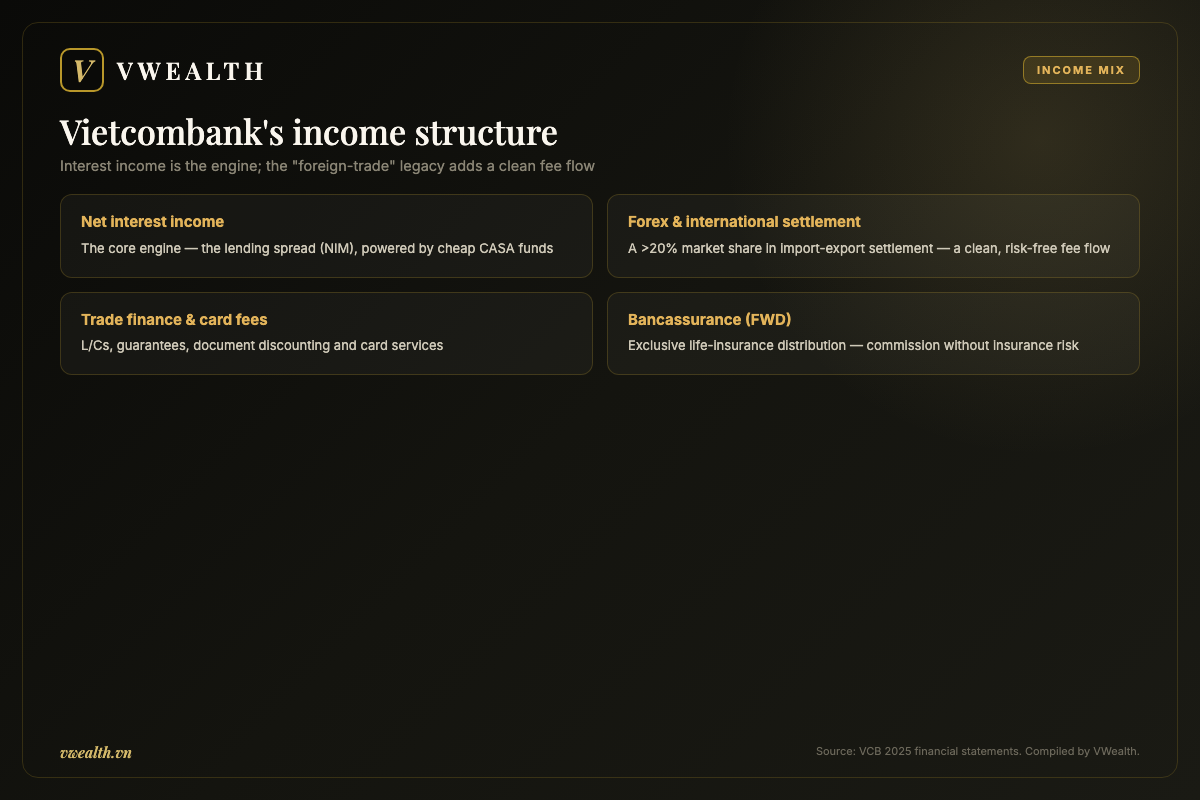
And this is exactly Vietcombank’s home turf. The bank’s full name is the Joint Stock Commercial Bank for Foreign Trade of Vietnam — the words “Foreign Trade” are no accident. Vietcombank was born with the mission of serving the country’s international commerce, and for decades held a near-monopoly in this field. That legacy today becomes a fee-collecting machine few can rival.
Foreign exchange and international settlement — a dominant domain
Each time a Vietnamese business exports a container of goods to the US, or imports a batch of machinery from Germany, it needs a bank to open a letter of credit (L/C), settle internationally, and exchange currency. Vietcombank is the number-one choice: it holds a share above 20% in the country’s import-export settlement — an absolute leading position.
Understand why this matters to the investor’s wallet:
- Foreign-currency trading. Vietcombank trades foreign currency on an enormous scale, earning the exchange-rate spread on each transaction. In 2025, forex trading profit still reached about 1,280 billion dong in a single quarter — a thick, steady flow despite market volatility.
- Trade finance. Fees from opening L/Cs, guarantees, and discounting import-export documents — this is pure fee income, almost risk-free.
- The correspondent-bank network. Vietcombank has correspondent relationships with thousands of banks worldwide, rated highly by international institutions for settlement quality — an intangible asset rivals must spend decades to build.
This is a real “moat”: a new bank cannot simply have lots of capital and steal Vietcombank’s foreign-trade share. It requires a network, international reputation, and the trust of import-export businesses accumulated over many decades.
Card services and service fees
Vietcombank is also one of the “big players” of Vietnam’s card market — both domestic debit cards and international credit cards (Visa, Mastercard, JCB). Every card swipe, every withdrawal, every annual fee generates a fee flow. Note a 2025 reality: Vietcombank’s net service income declined (to about 938 billion dong in a quarter), reflecting the fierce fee competition in digital banking as many banks waive transfer fees to attract customers. This is a real pressure you should watch — but it is offset by the strength of the forex segment and the scale of the customer base.
Bancassurance — an exclusive handshake with FWD
Another important fee source is bancassurance — selling insurance through the banking channel. Vietcombank signed an exclusive life-insurance distribution partnership with FWD, one of the largest bancassurance deals in the Vietnamese market. The mechanism is simple and attractive for the bank: Vietcombank uses its branch network and millions of customers to introduce FWD’s insurance products, in exchange receiving commission and fees — without bearing insurance risk. Products are integrated straight into the VCB Digibank app, letting customers buy insurance, pay premiums and manage policies entirely online. Even though the whole bancassurance industry is subdued after a period of tighter regulation, this remains a long-term fee stream for Vietcombank.
The ecosystem: subsidiaries that extend the customer lifecycle
Vietcombank is not just a standalone bank. Behind it is an ecosystem of subsidiaries and member units that keep customers within a “closed loop” — you deposit, borrow, invest in securities, buy insurance, receive remittances… all under one brand. Each segment is both a revenue source and a thread binding the customer to stay.
- VCBS (Vietcombank Securities). A 100%-owned subsidiary, founded in 2002. What’s special: VCBS connects directly and synchronously with the VCB Digibank system, letting investors deposit/withdraw securities cash in real time within the banking app. This is an integration advantage independent brokerages lack.
- VCBF (Vietcombank Fund Management). A fund-management joint venture, serving customers’ investment needs and earning asset-management fees.
- VCB Leasing (financial leasing). Provides financial leasing of machinery and equipment to businesses — a financing form complementing traditional credit.
- Vietcombank Remittance (VCBR). A 100%-owned remittance company, partnering with counterparts in many countries to pay remittances into Vietnam via four channels: over the counter, into accounts, home delivery (covering 52 of 63 provinces) and into e-wallets. Vietnam is one of the world’s largest remittance recipients, and Vietcombank is one of the main gateways for this flow.
- The international network. Vietcombank has three overseas subsidiaries — the Vinafico finance company in Hong Kong, the Vietcombank money-transfer company in the US, and a subsidiary bank in Laos — plus a representative office in the US. In total, more than 600 branches, transaction offices and member units at home and abroad. This international presence continues to reinforce its “foreign-trade bank” position.
Digital transformation: VCB Digibank and the power of customer scale
All the segments above would be mere potential without something connecting them to tens of millions of users. That something is VCB Digibank — the digital-banking platform with nearly 15 million users, among the most popular financial apps in Vietnam.
For an investor, this customer scale has a very concrete meaning. Each Digibank user is a touchpoint for Vietcombank to cross-sell: from a payment account (feeding CASA), to consumer loans, opening a credit card, buying FWD insurance, opening a VCBS securities account, sending and receiving remittances… all in one app. The cost of serving a digital customer is nearly zero after the platform is built, but revenue from them accumulates over time. This is how digital transformation turns scale into real profit, while nurturing the very cheap CASA store mentioned at the start of the section.
To close: Vietcombank’s “economic moat” is built from three pillars
Now assemble it all. Why does Vietcombank deserve a valuation above the norm and the investor label of “the national bank stock”? Because it owns an “economic moat” built from three pillars very hard to copy at once:
- Forex and international-settlement strength — the “foreign-trade bank” legacy with an import-export share above 20%, bringing a clean, stable fee flow, and a barrier to entry nearly impossible to breach in the short term.
- The CASA store and low cost of funds — the “safest place to keep money” trust lets Vietcombank borrow society’s money cheaper than rivals, creating a thick, durable NIM across every rate cycle.
- Scale and the ecosystem — total assets of 2.48 quadrillion dong, nearly 15 million digital users, a network of more than 600 units at home and abroad, plus subsidiaries covering securities, insurance, remittances and leasing — all locking customers into a closed loop.
These three pillars do not exist independently but resonate: scale and reputation feed cheap CASA; cheap CASA creates a high NIM; the foreign-trade position draws large businesses and FDI to open accounts, which further builds CASA and fees. That is a self-reinforcing spiral — the classic feature of a business with a durable competitive advantage.
But however wide the “economic moat,” it must be verified by concrete financial-health numbers: is capital thick or thin, how well is bad debt really controlled, where do profitability metrics (ROE, ROA) stand versus the whole industry, and is the provisioning buffer enough to withstand risk. That is exactly what the next section — “Position and financial health” — will take you deep into, so you don’t just believe the story but grasp the evidence behind it.
Position and financial health
When you put a dong of capital into a bank stock, what you really buy is not the logo or the lit-up branches on street corners. You buy a balance sheet. And for a bank, the health of that balance sheet decides almost everything: how far it can grow, how big a shock it can withstand, and most importantly, whether it hides a bad-debt bomb beneath a pretty profit shell. In Vietnam’s whole banking industry, there is one name analysts almost default to as the yardstick for “safe”: Vietcombank. This section dissects why VCB deserves that title, and why that very safety is both its deepest economic moat and the point that makes not a few investors impatient.
Profit champion and market-cap king: scale creates soft power
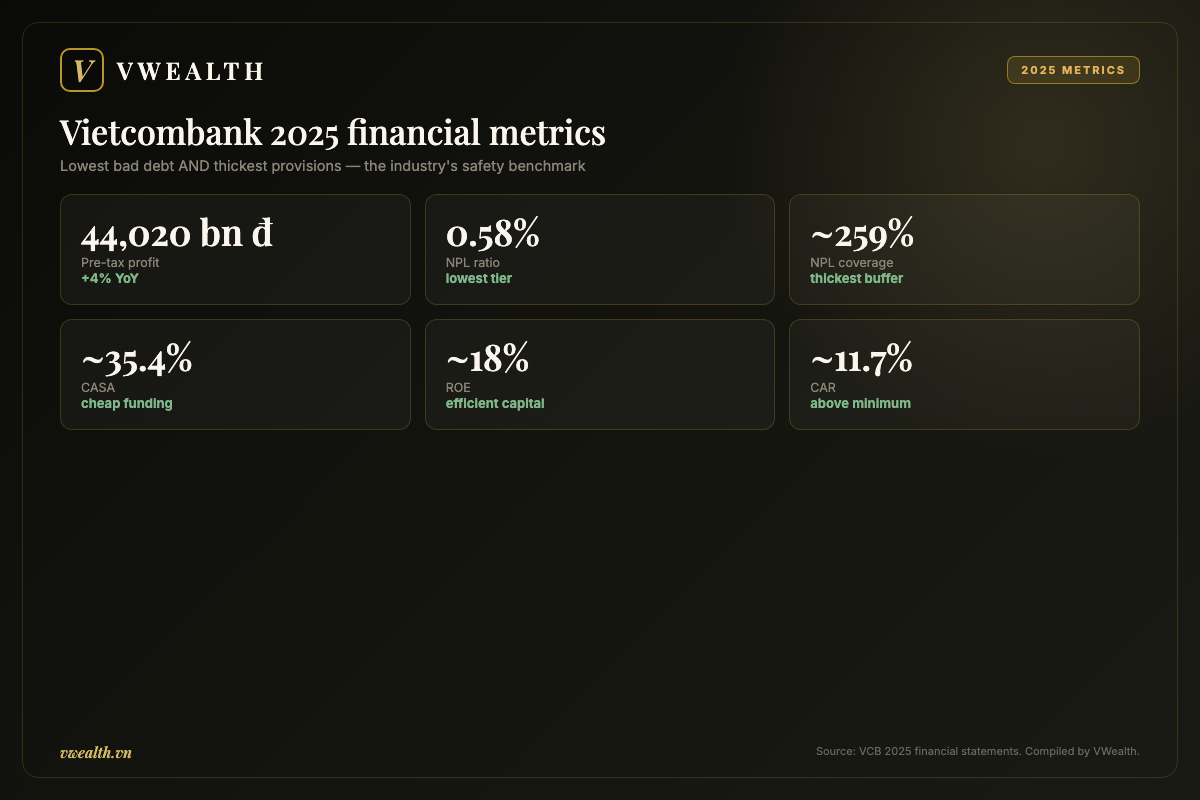
Let’s start with the driest number then dig into its meaning. In 2025, Vietcombank recorded pre-tax profit of 44,020 billion dong, up 4% year on year, continuing to hold the profit crown of the whole banking industry. After-tax profit reached 35,198 billion dong. This is not VCB’s first time at number one, but a many-year streak of leading. Along with that, VCB is the largest-cap stock on HOSE, larger than even the leading businesses of other sectors.
You might ask: what’s special about a profit crown besides sounding impressive? The answer is that scale in banking is not just pride, it is a kind of “soft power” that feeds itself. A bank with tens of thousands of billions of accumulated profit each year has an internal capital source to expand credit without constantly borrowing expensively or diluting shareholders. A brand etched into the Vietnamese mind as “the safest state-owned bank” attracts deposits at a lower cost than rivals, and cheap deposits are the raw input of every dong of bank profit. Large scale also lets VCB invest in technology, risk-management systems and an international partner network at a level small banks cannot afford. In other words, VCB’s leading position is not a snapshot of one moment, but a flywheel that has spun for years and, the more it spins, the harder it is to stop.
But if you stop at “high profit, biggest,” you still don’t understand why the market values VCB well above the rest. The real moat lies one level deeper.
Number-one asset quality: the moat newcomers often overlook
For a bank, profit is only the visible part. The submerged part, the part that decides whether the bank lives long or dies suddenly, is the quality of its loan assets. A bank can boast huge profit today then collapse tomorrow simply because loans thought good turn out uncollectible. This is exactly where VCB separates from the crowd.
At the end of 2025, Vietcombank’s NPL ratio was only 0.58%, down sharply from 0.96% the year before. The absolute bad-debt balance fell as much as 31%, to about 9,464 billion dong. To picture how low this is: while many banks struggle to keep bad debt below the State Bank’s 3% warning threshold, VCB is below 0.6%, meaning for every 1,000 dong lent, fewer than 6 dong show signs of being hard to collect. This is the lowest NPL ratio among Vietnam’s large banks.
However, the most impressive number, and VCB’s most important moat, is not the NPL ratio. It is the NPL coverage ratio.
The “rainy-day fund”: why the coverage ratio is the real weapon
Let’s pause and explain this concept very carefully, because if you are new, this is the most valuable thing you’ll learn reading about bank stocks.
When a bank lends and worries it may not collect fully, the law requires it to set aside a sum in advance called risk provisions. This provision is counted straight into expenses, meaning it “erodes” profit in the very year it is set aside. The NPL coverage ratio (Loan Loss Reserve coverage, or LLR/LLCR) measures a simple question: for each 1 dong of bad debt, how many dong of provisions has the bank set aside to offset it?
At the end of 2025, VCB’s NPL coverage ratio was around 259%. Read that number again. It means for each 1 dong of bad debt on the books, Vietcombank has prepared about 2.59 dong of provisions. The bank has provisioned more than two and a half times its entire existing bad debt. This is among the highest coverage levels in the whole industry, and it creates two advantages newcomers often don’t notice at once:
- It is a shield when the economy worsens. Suppose next year the economy weakens, businesses struggle, VCB’s bad debt jumps. Most other banks would have to strain to set aside new provisions in that very bad year, thinning profit exactly when it’s hardest. VCB is different: the thick pre-built provision lets the bank absorb the shock without cutting deep into profit. It is like a person who stockpiled a full pantry before the famine arrived.
- It is “latent profit” awaiting reversal. This is the interesting part seasoned investors love. Provisions already set aside are money already counted as expense, already reducing the profit of prior years. But if that bad debt is later repaid by the customer, or the collateral recovered, the surplus provision is reversed back into profit. The 259% provision layer is therefore not lost money; it is a “rainy-day fund” sitting quietly on the balance sheet, ready to burst into profit in later years. Analysts habitually call this VCB’s “profit buffer.”
A bank with the industry’s lowest bad debt yet the industry’s thickest provisions. That is not excess prudence; it is how VCB turns asset quality into a shock-proof safe while also stashing future profit. This is the deepest moat layer, hard for rivals to copy, because it is built with decades of provisioning discipline.
When you put the three pieces together: champion profit, lowest bad debt, and near-highest coverage, you’ll understand why the market calls VCB the industry’s “safety benchmark.” Most banks do only one of the three well; VCB does all three at once.
Low cost of funds: a trusted brand turned into money
A natural question: how does VCB lend so safely yet still earn the most? The answer lies on the input side, the cost of raising funds, and this is where VCB’s brand turns directly into money.
The crux is the CASA ratio, the ratio of non-term deposits to total deposits. Non-term deposits are the money people and businesses keep in payment accounts, moving in and out constantly, on which the bank pays almost no interest or very little. The higher the CASA, the cheaper the average cost of funds. At the end of 2025, VCB’s CASA reached about 35.4%, with non-term deposits of nearly 592 trillion dong, among the leaders in the system.
Why are people willing to leave hundreds of trillions of dong earning almost no interest in a VCB account? Because of trust. In the mindset of most Vietnamese, depositing at Vietcombank is absolutely safe, a bank that “cannot fall.” That trust, built over decades and reinforced by its state-controlled position, is the intangible asset generating a huge flow of cheap deposits. You cannot buy that trust with money, cannot erect it in a few years with advertising. Rivals can spend heavily to win CASA, but they must pay with promotions and attractive rates, while VCB draws it in almost for free thanks to its brand.
A low cost of funds leads straight to one consequence: a durable NIM. NIM is the gap between the rate the bank earns on lending and the rate it pays depositors, the bank’s core lifeblood. With a cheap input, VCB has room to both lend at competitive rates and keep a healthy margin. It must be frankly noted that VCB’s NIM narrowed in 2024 and 2025, as management proactively cut lending rates to “accompany the economy.” But the notable thing is that VCB can proactively do this, sacrificing part of its margin to retain customers and fulfil its state-bank role, precisely because its cost-of-funds base is solid enough to bear the sacrifice. That is a luxury a bank with thin CASA dares not contemplate.
Dominance in forex and international settlement: a historical moat few can touch
There is a business segment where Vietcombank’s full name, “Joint Stock Commercial Bank for Foreign Trade of Vietnam,” says it all. VCB was born to serve foreign trade, and to this day remains the uncrowned king of this field.
In international settlement and trade finance, VCB’s share is about 19.8%, the highest in the industry. For every 5 dong of import-export settlement running through Vietnam’s banking system, nearly 1 dong passes through VCB. Along with that is a leading position in foreign-currency trading. These are fee segments, income that bears no credit risk, and extremely valuable for two reasons.
- Non-interest income makes profit less dependent on credit. When loan growth slows or bad-debt risk rises, fees from international settlement, trade finance and forex trading still flow steadily, cushioning profit. In 2025, VCB’s non-interest income reached 13,683 billion dong.
- This segment has very high barriers to entry. To lead international settlement, a bank needs a global correspondent network, a reputation recognized by foreign institutions, compliance systems to international standards, and decades-long relationships with the import-export community. VCB accumulated all of that back when it was the monopoly foreign-trade bank. A new bank, however much money it has, cannot in a few years win the trust of export businesses used to “choosing carefully whom to entrust their gold.”
Capital adequacy and Basel: a reinforced foundation
A bank’s last defensive layer is its own capital, measured by the CAR (capital adequacy ratio). Roughly, CAR tells you how much “buffer capital” of its own a bank has versus the scale of risk-weighted assets it carries; the thicker the buffer, the greater its ability to absorb losses before touching depositors’ money. At the end of 2025, VCB’s CAR was around 11.7%, significantly above the minimum the State Bank requires.
VCB’s CAR, though not the highest in the industry, must be placed in context: VCB is pushing a plan to raise charter capital to nearly 94,000 billion dong, including a private-placement option for investors, to build a thicker capital buffer for expanding credit in the coming years. At the same time, VCB is one of the pioneering banks registering to apply early the capital-calculation standards under Circular 14/2025, a step toward more modern Basel risk-management standards. A bank voluntarily adopting a stricter capital-governance framework early is a signal that management is confident in its balance-sheet health, not avoiding scrutiny.
Assembling the health picture: VCB’s balance sheet has total assets over 2.4 quadrillion dong (up about 17%), credit up 15%, deposits up 10%, bad debt below 0.6% with coverage above 250%, CAR above 11% and being further reinforced. Placed side by side, this is almost the textbook definition of a “healthy” bank: steady growth, low risk, thick provisions, enough capital. Profitability metrics are also among the industry’s best, with ROE around 18% and ROA about 1.7%, showing VCB is not only safe but also uses its capital efficiently.
The other side of the safety medal
By now you might think VCB is a flawless, perfect stock. An honest analyst must point out the other side of the medal, because the very safety that is praised gives rise to VCB’s characteristic weakness.
Safety, in financial language, usually means prudence. And prudence means slower growth. Look back at the opening number: VCB’s 2025 profit rose only 4%, and the 2026 plan targets only about 5% growth. Over the same period, quite a few nimble private banks recorded double-digit profit growth, some up 20–30%. VCB chooses to lend in low-risk segments, tightly controls credit to speculative areas like real estate, and is willing to sacrifice NIM for stability. The inevitable consequence is more modest profit growth than the market leaders.
For an investor seeking a fast-rising stock, this is a real disappointment: you buy a wonderful business but one growing steadily at a single-digit pace, while somewhere smaller banks are sprinting. VCB’s real risk is not collapse — that is nearly impossible with such a balance sheet. VCB’s risk is slowing growth, the machine being too big and too cautious to accelerate, so the stock may go sideways for a long time if the market favours the hot-growth story elsewhere. This is the price of safety, and you need to be honest with yourself about whether you accept that trade-off.
The most correct reading is this: VCB is not a stock to expect an account-doubling in a few months. It is a foundational asset, the “defensive” part of a portfolio, a bank that stands firm even when the whole industry hits a bad-debt storm, thanks to its thick provisions and strong capital. Those who buy VCB don’t buy speed, they buy certainty and the ability to survive every cycle. In long-term investing, the ability to not lose money in the worst years is sometimes more precious than the ability to make a lot in the best years.
So how does the market value this benchmark financial foundation, and is there still room for you to step in at the current price? That is the story we open right after, looking at how the market received VCB stock.
How the market received the stock
If you opened the price board on 19 June 2026, Vietcombank’s VCB stood at 61,700 dong a share. That number, set against a market cap of over half a quadrillion dong, makes VCB the largest listed business on Vietnam’s stock market — larger than names like Vinhomes, FPT or Hoa Phat. But “biggest” and “best to buy now” are two entirely different stories. This section will help you understand how the market is valuing VCB, and more importantly, why a bank stock must be examined with a yardstick few newcomers know: P/B, not the familiar P/E you usually hear about.
Picture it this way. When you plan to buy a stock, you always have to answer a seemingly simple but actually very hard question: “Is this price expensive or cheap?” With VCB, the answer has almost never been “cheap.” And that is exactly the knot anyone wanting to own this national stock must untie.
Before talking price: why banks are valued by P/B, not just P/E
You are used to P/E — the price-to-earnings ratio. Divide the stock price by earnings per share (EPS) to get a number telling you how many dong you pay to “buy” one dong of the company’s profit. P/E is very useful for most companies. But for banks specifically, professional investors place it secondary and elevate another metric: P/B — price to book value. Why?
The reason lies in the very nature of a bank’s assets. Think of Hoa Phat: its assets are steel plants, blast furnaces, production lines, warehouses — physical things hard to revalue in real time and not always reflecting true market value. Conversely, nearly all of a bank’s assets are financial assets: cash, bonds, and most importantly loans. These are numbers recorded fairly close to true value on the balance sheet. So a bank’s “book value” — its equity, the part truly belonging to shareholders after subtracting all debt and customer deposits — is a reliable measure of the “net assets” you own when buying the stock.
There is a deeper reason, and this is something you should note carefully. For a bank, equity is the machine’s fuel. Banking law requires each bank to have enough equity to “support” its lending volume (the CAR). Roughly: for each additional dong of equity, a bank is allowed to lend about ten more dong. The thicker the equity, the greater the lending room — the profit room. This is why book value is not just a dry accounting number, but the physical limit of business scale. P/B therefore directly measures the very thing that decides how big a bank can grow.
For a manufacturer, P/E tells you how much you pay for a dong of profit. For a bank, P/B tells you how much you pay for a dong of capital — and it is that capital that generates future profit.
So what does P/B “say”? A bank with a P/B of 1 means the market values it exactly at book value — no more, no less. A P/B of 2 means you accept paying double book value. It sounds irrational: why pay double for what you buy? The answer lies in one word: ROE — return on equity. If a bank uses one dong of capital to generate 0.20 dong of profit a year (ROE 20%), it is worth much more than a bank generating only 0.10 dong (ROE 10%) from the same capital. A high P/B is exactly how the market “rewards” durable profitability on capital. The hidden rule: high P/B goes with high ROE. When you see a bank paid double the industry P/B while its ROE is also 1.5 times the industry, that premium is not unreasonable — it has a basis.
Putting VCB on the scale: P/B, P/E and the real numbers
Now let’s plug in real numbers. In 2025, Vietcombank earned pre-tax profit of about 44,020 billion dong — still the most profitable bank in the system. After a 49.5% stock dividend to raise charter capital to 83,557 billion dong, VCB’s shares outstanding are about 8.3 billion units. Dividing after-tax profit by these shares, EPS falls in the range of 4,000–4,300 dong. At 61,700 dong, VCB’s P/E is currently about 14–15 times.
And P/B? This is the number worth watching. VCB trades at a P/B of about 2.5–2.8 times, while the general level of Vietnam’s banking industry is only around 1.5 times. In other words, the market is willing to pay for each dong of Vietcombank’s equity nearly double what it pays for an average bank. VCB is the bank stock with the highest, most persistent P/B on the whole exchange.
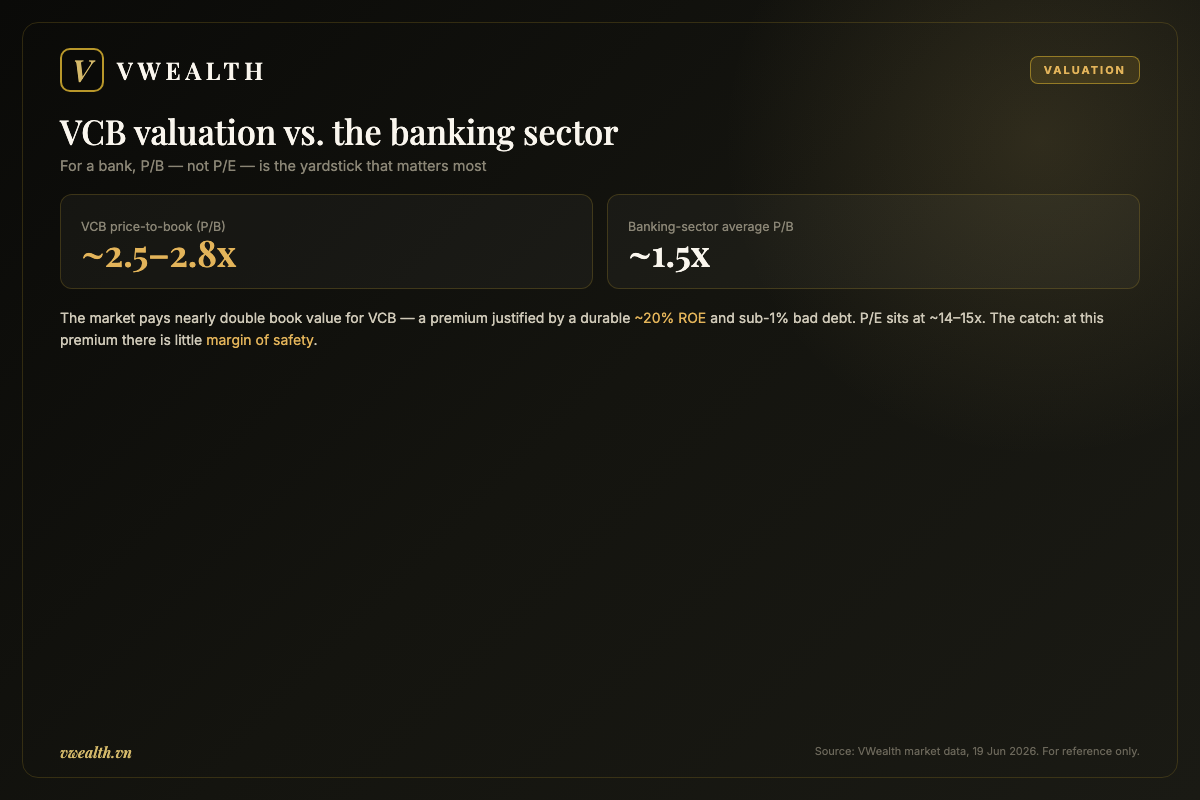
You need to read the comparison in its proper spirit. The P/B column is the “soul” column. VCB’s P/E (14–15 times) at first glance is not too expensive versus the broad market, at times even cheaper than some retail stocks. But what makes VCB durably “expensive” lies in the market agreeing to pay 2.5–2.8 times book value — a premium very few Vietnamese businesses, in any industry, command.
Why VCB deserves that premium — and why that is also worrying
A premium does not arise by itself. Vietcombank has “paid” for its high valuation with three things very hard to copy.
- The best asset quality in the system. VCB’s NPL ratio has for years stayed below 1% — among the lowest in the industry. For a bank, low bad debt is not just a pretty number, it means equity is less “eroded” by provisioning, profit is more genuine, and there is less risk of a quarter where profit evaporates on debt handling. This is the foundation that lets investors sleep well.
- High and durable ROE. VCB continually posts ROE around 20%, a figure few banks sustain across cycles. As said above, a high P/B is the reward for high ROE — this is the logic piece justifying the premium.
- Brand and a near soft-monopoly position. Vietcombank dominates international settlement and trade finance, with a large non-term deposit base (CASA) keeping funding costs cheap. The “Foreign Trade” name tied to state prestige makes deposits flow in naturally, even in panicky markets.
So what’s the downside? This is what newcomers very often overlook: precisely because VCB is good and everyone knows it is good, its price is rarely cheap — and you almost never get a “margin of safety.” The concept of margin of safety means the cushion between the price you pay and true value, so that if you miscalculate a little you still don’t lose heavily. When a stock trades at a P/B of 2.5–2.8 times, the market has already “counted in” almost all the good things. Every expectation about growth, durable ROE, leading position — is already in that 61,700-dong figure. You buy VCB not because it is mispriced and cheap, but because you believe it will continue to deserve that expensive price for many years. That is an entirely different argument, and its risk is entirely different too: if VCB’s ROE dips just a little, the 2.5–2.8x premium could shrink to 2x, and the stock could lose 20–30% without the bank even doing badly.
The “national” stock: multi-year price action
Looking back at history, you’ll see VCB is a stock with a very distinct “personality.” Listed on HOSE since 2009, from mid-2017 VCB entered a long, durable uptrend, making it the largest-cap stock on the market by end-2020 and holding that position since. In early 2026, VCB touched an all-time high around 78,800 dong (split-adjusted), before cooling to the 61,000–64,000 dong zone by mid-year.
What’s notable about VCB’s “price personality” is its calmness. This is not a cyclical stock like steel or securities — names that can triple then halve within a year. VCB rarely crashes deeply in panicky markets, because large money always sees it as a “refuge” whenever risk rises. But the other side of the medal: it also rarely explodes. You can hardly expect VCB to double your account in six months. It is a stock of durability, of slow-but-sure accumulation — suited to long holders, not to short-swing traders.
Dividends: correctly understanding “raise capital to lend more”
This part most easily confuses new investors, so read carefully. Vietcombank pays dividends mainly in stock, not cash. The peak was a 49.5% stock dividend — the highest in the bank’s history — to lift charter capital to 83,557 billion dong. A holder of 1,000 shares received an extra 495 new shares. The cash portion is modest, usually only around 4.5%.
Hearing “receive extra free shares” sounds attractive, but you need a clear head. A stock dividend is essentially dilution: the total profit “pie” is unchanged, only cut into more, smaller slices, so each share’s price automatically adjusts down accordingly. In pure arithmetic, at the moment of the split, your assets do not increase by a single dong.
So why does Vietcombank still do it, and why does the state, the largest shareholder, support it? Because for a bank, retaining profit to convert into equity is the way to fuel the lending machine. Recall the P/B logic at the section’s start: more equity means more lending room, more future profit room. Vietcombank chooses not to “pull money out to distribute” but to “leave money in to grow.” If you believe this bank can still sustain a high ROE, then its retaining capital to expand is a decision beneficial to you long term — capital left in the hands of someone who can generate 20% a year is better than holding cash dividends and struggling to reinvest yourself.
This clearly positions who VCB suits. If you are an investor who needs a steady cash flow to spend — VCB is not for you, because the cash dividend is too thin. But if you are a long-term accumulator, don’t need to withdraw, and want your assets to compound on the back of a top institution’s capital growth and expansion — then this stock-dividend policy is exactly your taste.
Low free float: a double-edged sword that props up the price
There is a structural feature of VCB you must understand, because it directly affects how the price moves: a very low free-float ratio.
Look at the ownership. The State Bank holds 74.8%. Japanese strategic partner Mizuho holds 15%. Combined, these two shareholders hold nearly 90% of the shares — and they almost never sell. The remainder, only about 10% actually floats on the market for funds and individuals to trade daily, including Singapore’s sovereign fund GIC holding about 2.55%.
- The benefit: low free float is like a dam holding water. Because sellable supply is so small, VCB’s price is naturally “propped up” and less wildly volatile. There is no scenario where a sell-off by a few retail investors crashes the price, simply because 90% of shares sit still in firm hands. This is part of why VCB trades calmly, as said above.
- The harm: low free liquidity also means the stock is less “flexible.” When you want to buy or sell a large volume, you may have to accept an unfavourable price. And part of VCB’s valuation premium comes from this very scarcity — not entirely from business quality. That is something to separate out when weighing it: how much of the expensive price is because VCB is truly good, and how much is just because it is scarce.
Finally, being the largest-cap stock, VCB has the heaviest weight in the VN30 basket and in index-tracking ETFs. Each time new money flows into Vietnam ETFs, part must buy VCB by weight — creating a stable “passive” demand regardless of whether investors like the stock. VCB is therefore both a stock and a “pillar” propping up the index: when it rises the VN-Index rises with it, and vice versa. This pillar role further reinforces stability, but also makes VCB a sentiment gauge for the whole market whenever foreigners buy or sell on a net basis.
To close: is paying this premium worth it?
After going through all the numbers and arguments above, we return to the core question anyone looking at VCB must answer. This stock is rarely cheap. A P/B of 2.5–2.8 times, nearly double the industry, is not a “bargain” by any definition of value investing. You will not buy Vietcombank with a wide margin of safety — the market has already priced its excellence into the price.
VCB is rarely cheap. The real question is not “is it cheap,” but “is paying this premium worth it” — and the answer depends entirely on how long you believe Vietcombank can hold its profit crown.
If you believe 20% ROE is durable, bad debt will stay below 1%, and Vietcombank’s leading position won’t wobble, then paying the premium today is paying for the peace of mind and steady growth of many years ahead. If you doubt that — doubt that industry competition will erode margins, that the credit cycle will worsen asset quality — then this expensive price is a risk, not a guarantee. And to answer that very question, you cannot look at Vietcombank alone. You must place it in the flow of Vietnam’s whole banking industry — the context we enter right after.
Economic and banking-sector context: where does VCB stand in the big picture?
You cannot value a bank stock if you detach it from the economy feeding it. A bank is essentially a mirror reflecting a whole nation’s health: when businesses prosper, they borrow more and repay more steadily; when the economy runs out of breath, yesterday’s loans become today’s bad debt. Vietcombank, however strong, is still a large boat floating on that common current. So before you decide anything about VCB, look down at the water.
What does Vietnam’s banking industry depend on?
Three things decide almost the entire profit fate of a Vietnamese bank: credit growth, net interest margin (NIM), and asset quality. All three are not fully in the bank’s hands, but are governed by GDP growth, the interest-rate level, and especially the guiding hand of the State Bank (SBV).
Let’s start with credit, the lifeblood. Unlike many countries, in Vietnam each bank cannot lend freely as much as it likes. The SBV allocates a “credit quota” to each bank each year, as a way to control the amount of money pumped into the economy to keep inflation in check. In 2025, the industry credit-growth target was set around 16%, and into 2026 the guidance was adjusted to about 15% — still high by international standards, reflecting Vietnam’s economic-growth ambition. Some analysts even reckon actual credit could approach 20% in this period if the economy absorbs it well. For a bank, a larger credit quota means wider profit room — and VCB, thanks to its position and financial health, is usually granted one of the largest and most flexible quotas.
But fast credit growth is only half the story. The other half is how much the bank earns on each dong lent — that is NIM, the spread between lending and deposit rates. And this is where the picture turns less cheerful. Vietnam’s industry-wide NIM is clearly narrowing: at the end of 2025, the sector’s net interest margin fell to around 3.1%, one of the lowest levels in years, and is forecast to stay flat or dip slightly in 2026.
Why is NIM shrinking? There are two simultaneous pressures. First, ever-fiercer rate competition: banks race to cut lending rates to win good customers, while still having to pay attractive deposit rates to retain funds. Second, the wave of fee waivers — free transfers are now the norm, eroding a once-lucrative income source. When both lending rates and service fees are compressed, banks are forced to make up “quantity for quality”: lend more to offset the thinner margin on each dong.
The systemic risks hanging overhead
If you look only at growth, Vietnam’s banking industry looks very attractive. But the veteran analyst always looks at the back of the medal — and the back here is asset risk.
The two biggest landmines lie in real estate and corporate bonds. A significant portion of Vietnam’s banking system loans, directly or indirectly, is tied to real estate — from lending to developers, to home buyers, to land as collateral. When the property market freezes or falls, the domino chain begins: developers struggle to sell, cash flow clogs, they can’t repay; collateral loses value so the bank, even seizing it, can’t recover enough. Corporate bonds — most also issued by property firms — are a parallel risk front, where many banks are at once holder, guarantor and distributor.
This is exactly why “the health of the property market” becomes an indicator anyone holding bank stocks must track. The relatively positive news is that, per industry assessments for 2026, bad-debt pressure is expected to ease as credit and economic growth improve, and the sector’s NPL coverage ratio is expected to stay above 80%. But “sector-wide” is an average masking terrible divergence: some banks have coverage above 200%, some struggle near the minimum.
The policy hand: a double-edged sword
The SBV does not only allocate credit quotas. In recent years, it has also frequently guided — and sometimes pressured — banks to cut lending rates to support businesses and the economy. For borrowers, this is good news. But as a bank shareholder, you need to understand its price: each time lending rates are forced down while deposit rates haven’t fallen correspondingly, NIM is squeezed a bit more. A bank, in this respect, carries part of the “policy-tool” role of the State — and state-controlled banks like VCB find it even harder to stand outside that responsibility.
A leading state-owned bank like Vietcombank both enjoys the privileges of its state position and must shoulder the obligations of that position. You cannot take only the sweet part and ignore the bitter when investing in it.
Basel III and the capital-raising race
A big force is reshaping the whole industry: the Basel III capital-adequacy standard. To meet ever-stricter safety buffers, banks are forced to raise equity — either by retaining profit (paying stock dividends instead of cash), or by issuing more shares to investors. 2026 is therefore called by observers the year of the “capital-raising wave.” This has two sides: raising capital makes banks more solid, with more lending room; but issuing more shares also dilutes existing shareholders, and stock-over-cash dividends leave income-seeking investors less pleased.
The upgrade and foreign-room story
This is perhaps the industry’s biggest catalyst in this period. In April 2026, FTSE Russell officially confirmed the roadmap to upgrade Vietnam’s stock market to the secondary emerging group, effective from September 2026, with weight rising in stages through 2027. The passive foreign capital expected to flow in could reach billions of USD — and large-cap bank stocks like VCB sit right in the first line of sight of this money.
Running alongside the upgrade is the story of raising the foreign-ownership limit for banks. Allowing foreign ownership up to 49% at some banks is not just a technical decision, but also a policy message about a more deeply integrated market. For VCB, foreign room has long been a knot: foreigners want to buy but are “at the ceiling,” and the private-placement deal for 6.5% of capital to a foreign partner still awaits the right timing. If room is loosened and the deal is closed at a good price, that will be a significant boost.
Why VCB is the industry’s “safe haven”
Now connect it all. When systemic risk — property bad debt, bonds, narrowing NIM — rises, smart money does not abandon the banking industry; it shifts within the industry, from high-risk banks to the safest ones. And in the market’s eyes, VCB is that refuge.
- Industry-leading asset quality: VCB’s NPL ratio stays below 1% — a level almost no other large bank touches — and its provisioning buffer is among the thickest in the system.
- State-owned position: with a controlling state shareholder, VCB is considered nearly “cannot fall,” a belief with real value in panicky markets.
- A cheap funding base: brand and network help VCB draw abundant non-term deposits, better protecting NIM than the norm when the whole industry’s margins are squeezed.
In other words, the very risk-laden context is what highlights VCB’s value. When the waves are big, people seek the sturdiest boat — and they are willing to pay more for that sturdiness. This leads straight to the valuation paradox we’ll dissect in the conclusion.
Trend forecast: big ambition, cautious steps
A good business does not live on the past alone; what moves a stock is expectations about the future. So what future is Vietcombank drawing for itself, and does the market believe that picture?
Vietcombank’s ambitions
At the 2026 annual general meeting, VCB’s leadership put on the table plans both ambitious and very “characteristically Vietcombank” — that is, large in scale but cautious in growth numbers.
The centrepiece is the plan to raise charter capital to nearly 94,000 billion dong (specifically, a target of about 94,238 billion dong), through issuing over 1 billion shares. This is no random number: it serves three goals at once — meeting Basel III capital standards, expanding lending room, and reinforcing the position of the largest-cap stock on the exchange. At the end of 2025, VCB’s charter capital was 83,557 billion dong, so this is a significant leap. The meeting also left open the intention to have a presence at the Vietnam International Financial Centre (VIFC) with a member bank capitalized at about 3,000 billion — a long-term move to get ahead of the country’s new financial infrastructure.
On business, the 2026 target is rather modest: credit outstanding up about 10%, profit up about 5%. This 10% credit-growth figure is even lower than the industry guidance (around 15%), reflecting exactly VCB’s philosophy — not chasing hot growth, but selecting customers and preserving asset quality. The meeting also stressed tight control of credit to speculative real estate, a signal the bank is proactively defending against the industry’s biggest landmine.
Two other strategic pillars are digital transformation and handling the acquired bank VCBNeo. VCBNeo is the former CBBank — a weak bank mandatorily transferred to Vietcombank in late 2024, then rebranded and launching the NeoOne digital-banking app. VCB has completed migrating VCBNeo’s core system onto its own platform. This is a classic double-edged sword: taking on a weak bank is a burden, but in return VCB enjoys policy incentives (such as a lower required-reserve ratio) and gains a “laboratory” to pilot a pure digital-banking model without touching the parent brand.
Three scenarios for VCB stock
No one can forecast the price precisely, but the serious analyst always builds scenarios to know what they are betting on. At a reference price of 61,700đ (19 June 2026), a P/E around 14–15 times and a P/B around 2.5–2.8 times, here are three plausible paths.
- Positive scenario. The property market warms up, sector bad debt cools; the FTSE upgrade goes smoothly in September 2026, drawing foreign capital into blue-chips; foreign room is loosened and VCB closes the 6.5% private placement at a high price. Then cap and profit are both supported, VCB’s premium valuation is “forgiven” by the market, and the price has room to surpass its peak zone. Consequence: P/B can stretch to a higher zone on expectations, with the price rising clearly.
- Base scenario (most likely). Everything goes “to plan”: credit up around 10%, profit up about 5%, NIM flat, bad debt still below 1%. No breakthrough catalyst but no shock either. Consequence: VCB’s price moves in an accumulation band, rising steadily in step with profit growth and book value, suited more to a long-term holder than a short-swing trader.
- Negative scenario. Real estate and corporate bonds worsen, sector bad debt jumps; the SBV keeps pressing rates lower, squeezing NIM further; the upgrade roadmap or the foreign-capital deal hits snags; the VCBNeo restructuring burden is larger than expected. Consequence: even though VCB remains the industry’s safest place, the premium valuation is “tested” by the market — when sentiment sours, people don’t pay a high P/B for anyone, and the price may correct to a more modest valuation zone.
The key point to remember: in all three scenarios, VCB’s internal health barely wobbles. What changes is not the quality of the business, but the price the market is willing to pay for that quality. This is a stock whose biggest risk lies not in “is the company okay,” but in “at what price do you buy it.”
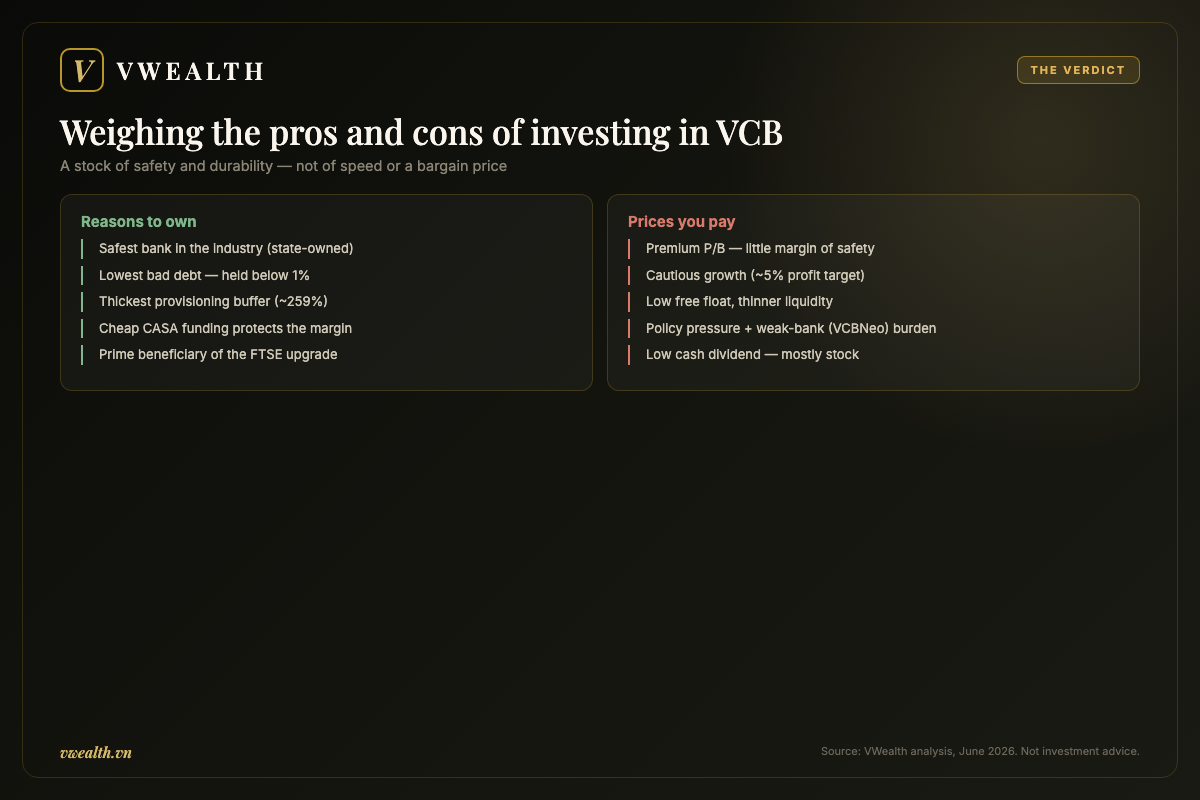
Should you buy VCB stock?
It’s time to gather it all into an honest answer. And the most honest answer is: there is no one answer for everyone. VCB is an excellent business, but “excellent business” and “the investment right for you” are two different things. Let’s weigh both sides flat.
The PRO side: why many want to own VCB
- The safest in the industry. In an industry full of risk landmines — bad debt, bonds, NIM squeeze — VCB is the sturdiest boat. Its leading state-owned position creates an extremely valuable psychological layer of protection in volatile markets.
- Number-one asset quality. Bad debt held below 1%, well below the industry norm — meaning most of the dongs VCB lends truly come back.
- A thick provisioning buffer. Its NPL coverage is among the highest in the system, helping VCB withstand shocks better and even reverse provisions to dress up profit when conditions improve.
- Brand and a cheap funding base. Network and reputation help VCB attract low-cost deposits, protecting margins when the whole industry’s NIM is squeezed.
- Long-term benefit from credit growth and the upgrade. As the largest-cap blue-chip on the exchange, VCB sits right at the centre of foreign flows when the market is upgraded by FTSE and foreign room is loosened.
The CON side: the prices you must pay
- Premium valuation, little margin of safety. A P/B around 2.5–2.8 times is well above the industry average. You are paying dearly for safety — and when the price has priced in all the expectations, upside room is narrowed while correction risk in bad sentiment is larger.
- Cautious growth, slower than private banks. A 10% credit and 5% profit target for 2026 is modest. If you seek speed, many private banks are far nimbler.
- Low free float. A small free-floating ratio because the State holds control and foreign room is at the ceiling — liquidity for individual investors is not always abundant, and the price sometimes moves on institutional flows more than fundamentals.
- Policy pressure and the weak-bank burden. The “policy tool” role makes VCB hard to keep out of rate-cut rounds, and restructuring VCBNeo is an obligation rather than a purely commercial choice.
- Low cash dividend. VCB prioritizes retaining profit and paying stock dividends to raise capital — good for long-term growth, but less attractive to those who need a steady cash flow.
A decision framework: which kind of investor are you?
Instead of declaring “buy” or “not,” examine VCB through your own lens.
| Investor type | Does VCB fit? | Core reason |
|---|---|---|
| Value investor (seeking cheap stocks) | Less fitting at the current price | A premium P/B of 2.5–2.8 times is hard to call “cheap”; the margin of safety is thin. Could wait for deep corrections. |
| Growth investor (seeking speed) | Little fit | A 5% profit target is cautious; the pace lags many nimble private banks. |
| Long-term accumulation investor | Fairly fitting | Asset quality and durability make multi-year holding reassuring; captures the full credit-growth and upgrade story. |
| Safety-first investor | Very fitting | This is almost the number-one “sleep well” choice in banking; trade speed for certainty. |
The picture is fairly clear: VCB is a stock of safety and long-term durability, not of speed or a bargain price. If you value a good night’s sleep, want a “refuge” component as the backbone of your portfolio, and are willing to hold through many cycles, VCB is one of the brightest candidates on Vietnam’s market. Conversely, if you hunt fast growth or a cheap price with a large margin of safety, VCB at the current price may make you impatient — and that is an entirely legitimate choice.
One last important point: whatever kind you are, always separate the two questions this whole article revolves around — “Is VCB a good business?” (the answer is almost certainly yes) and “Is today’s price reasonable for my goals?” (the answer depends on you). A good business bought too dear can still be a mediocre investment, and a good business bought at the right time can be the foundation for a whole decade.
Disclaimer: This article is produced for informational and educational purposes, based on publicly available data at the time of writing (June 2026). It is not a recommendation to buy, sell or hold any stock. All price, valuation and projection figures may change over time and with market movements. The stock market always carries the risk of capital loss. You should do your own thorough research, consider your personal financial situation, and consult a licensed advisor before making any investment decision. Investors bear full responsibility for their own decisions.
Research Vietnamese stocks in English with vwealth. Our AI-powered platform turns Vietnamese market data into full English analysis reports — with international payment support and a free 2-month trial for new accounts. Create your free account and read the latest reports.
Read more sector analysis: Vietnam’s Banking Sector: A Foreign Investor’s Guide to the Market’s Backbone