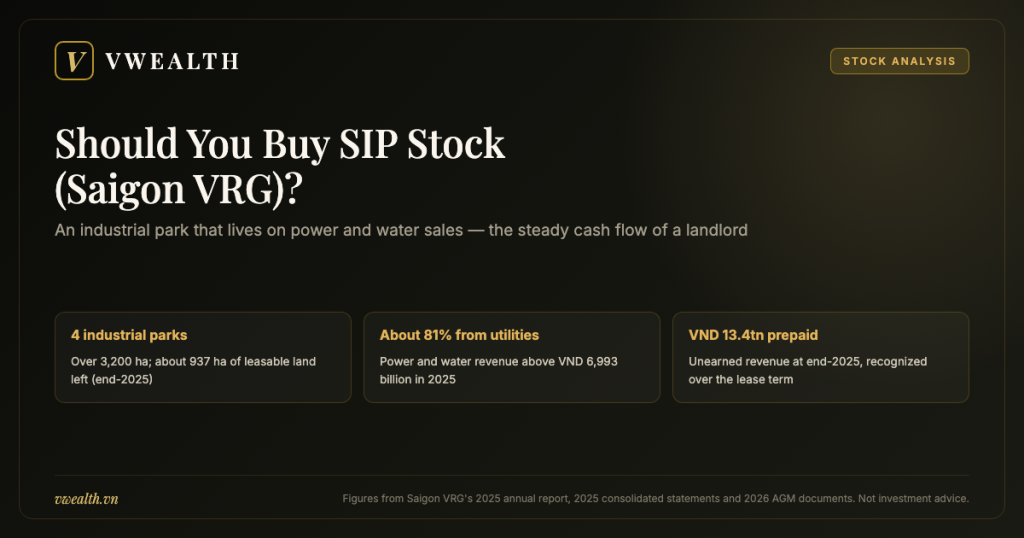
Should you buy SIP stock? Many investors who ask that question file Saigon VRG Investment Corporation — ticker SIP on the Ho Chi Minh Stock Exchange (HOSE) — in the same drawer as every other Vietnamese industrial park developer. They wait for news of a big factory signing a lease for dozens of hectares and then buy. Yet most of this company’s money does not come from leasing land at all. In 2025, roughly 81% of Saigon VRG’s consolidated net revenue came from selling electricity and water to the factories already operating inside its four industrial parks: Phuoc Dong in Tay Ninh, Le Minh Xuan 3 and Dong Nam in Ho Chi Minh City, and Loc An – Binh Son in Dong Nai. Land lease income is booked slowly, year by year, over leases that run for decades, which leaves a pile of “unearned revenue” of about VND 13.4 trillion on the balance sheet at the end of 2025. Put simply, SIP behaves more like a utility living inside industrial parks than a land speculator. This analysis walks through the whole story — from rubber plantation land in 2007, through the 2023 move to HOSE, to the multi-trillion-dong loan book that shareholders questioned at the 2026 annual meeting — so you can decide for yourself who SIP stock suits, and who it does not.
First, the naming, because “VRG” appears in several places in Vietnam stocks and it is easy to mix them up. VRG is the English acronym of the Vietnam Rubber Group, the state-owned rubber conglomerate that now trades under the ticker GVR. It was a founding shareholder of Saigon VRG and sold almost all of its stake in December 2020. Confusingly, there is also a listed ticker called VRG, which belongs to a different company from the same “rubber family” — not the company analyzed here. SIP is Saigon VRG Investment Corporation (Công ty Cổ phần Investing Sài Gòn VRG), business registration number 0305268812, first registered on October 24, 2007 in Ho Chi Minh City. When this article says “Saigon VRG” or “SIP”, it means the same company.
Second, a note on sources, which applies to every article in the vwealth company-analysis series. Dates, names, transactions and figures come from published information: the 2024 and 2025 annual reports, annual general meeting (AGM) documents and resolutions, HOSE disclosures, financial and price data compiled by VNDirect, Saigon VRG’s own project pages, and Vietnamese financial media such as CafeF, Bao Dau Tu, Thuong Truong magazine, Thuong Hieu va Cong Luan and Nguoi Quan Sat. Figures from closed fiscal years are used as historical reference points. The article does not quote today’s share price, current P/E or the latest quarter’s profit; for those, check the latest vwealth analysis reports. Any figure that vwealth derived from source data is labeled “vwealth estimate”, and every worked calculation is an illustrative example, not a forecast. If you are new to the market’s mechanics — trading hours, T+2 settlement, daily price limits and foreign ownership caps — our guide to investing in the Vietnam stock market covers the basics.
From Rubber Land to Four Industrial Parks: The Story of Saigon VRG
To understand why SIP earns money in a way few peers do, you need to go back to where it started. Saigon VRG was not founded by property investors assembling land. It was carved out of a state agricultural group that held hundreds of thousands of hectares of rubber plantations and needed a way to make that land earn more. The decisions taken in the first decade — building substations, water plants and wastewater treatment before tenants arrived — still shape the company’s cash flow today.
2007: four founders and VND 250 billion of capital
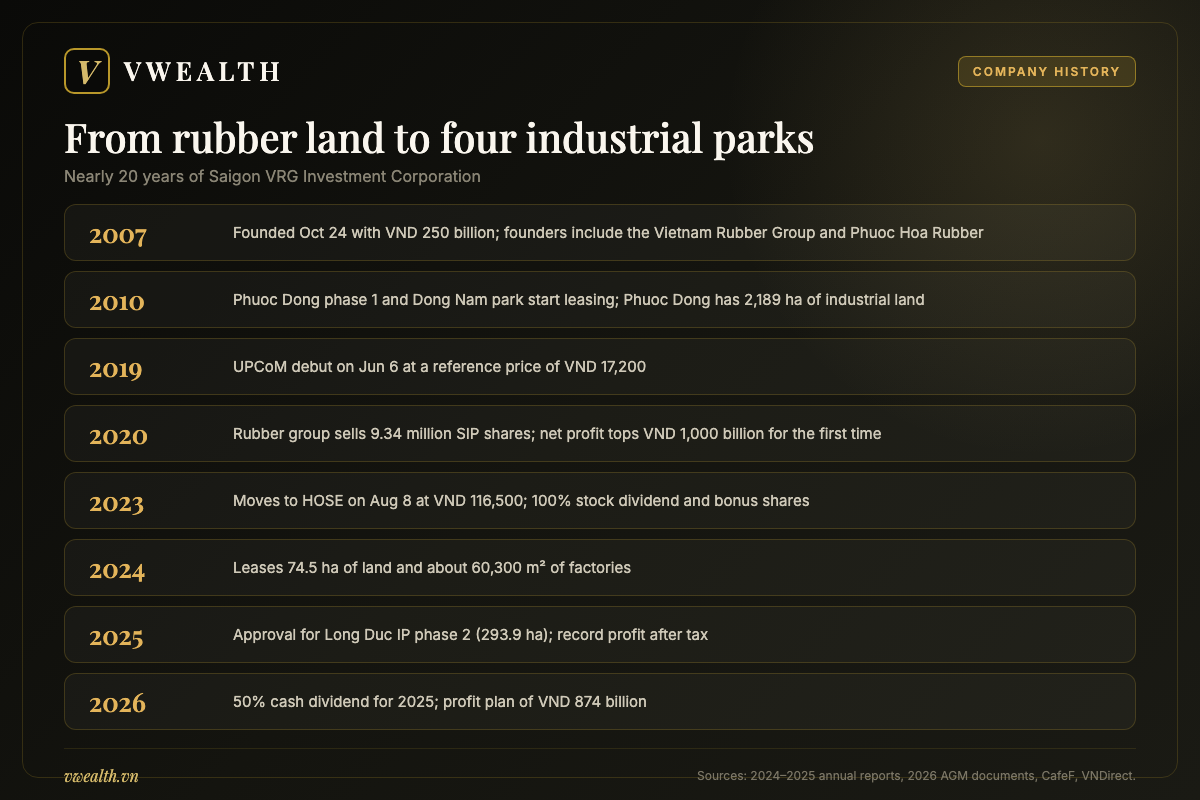
According to the company’s 2025 annual report, Saigon VRG Investment Corporation was established on October 24, 2007 with initial charter capital of VND 250 billion. The founding shareholders, according to CafeF and Bao Dau Tu, were the Vietnam Rubber Group, Phuoc Hoa Rubber JSC (today’s ticker PHR), Rubber Construction Investment JSC and several individuals. This was the period when rubber companies started to look at their land differently. An ageing rubber plantation next to a national highway, within driving distance of Ho Chi Minh City, could be worth far more as industrial land than as a source of latex.
Just over a year later, on December 10, 2008, charter capital was raised to VND 600 billion. According to the annual report, in 2008 the company set up the Dong Nam Industrial Park in Cu Chi on the northwestern edge of Ho Chi Minh City (342.53 hectares), and in 2009 the Phuoc Dong – Boi Loi industrial, urban and services complex in Tay Ninh province, near the Cambodian border, with 2,189 hectares of industrial land. The first two projects alone covered more than 2,500 hectares — a vwealth estimate from company figures — which tells you something important: from day one, Saigon VRG held land banks that were very large relative to its own capital.
The original shareholder structure was pure “rubber family”: state capital through the group, a listed rubber company, and a construction firm from the same industry. That structure would change completely after 2020, but the management team stayed — a detail that matters when we get to the leadership chapter.
2008–2013: Dong Nam, Phuoc Dong and building ahead of demand
Developing an industrial park means spending money long before any revenue arrives. You compensate farmers, level the land, build roads, pull in power lines and construct a wastewater plant, and only then can you invite factories. At Phuoc Dong, the scale was large: the company’s project page puts initial investment at about USD 350 million for a complex covering 2,436.11 hectares. According to the 2025 annual report, by 2012 Dong Nam and Phuoc Dong had together attracted more than USD 2 billion of investment; by the end of 2025, Phuoc Dong alone had 60 investors with total capital of USD 5.78 billion and about 64,000 workers.
Those 64,000 workers capture what Phuoc Dong was built for: labor-intensive industries leaving Ho Chi Minh City and Binh Duong as land became expensive and workers scarce. According to Saigon VRG’s project page, the park sits on provincial road 782, about 60 km from Ho Chi Minh City, about 20 km from the Moc Bai international border gate with Cambodia, and about 14 km from Thanh Phuoc port on the Vam Co Dong river. Meanwhile, Dong Nam Industrial Park in Cu Chi began leasing to tenants in 2010, according to the 2019 annual report cited by CafeF. In 2013 the company added the Loc An – Binh Son Industrial Park (497.77 hectares) in Long Thanh, Dong Nai, through its stake in VRG Long Thanh Investment and Development JSC, and in 2014 the Le Minh Xuan 3 Industrial Park in Binh Chanh, Ho Chi Minh City (231.25 hectares of industrial land) — completing today’s four parks.
While the land bank grew quickly, charter capital grew very slowly — VND 600 billion from late 2008, VND 610.48 billion in 2015, VND 660.48 billion in November 2017 and VND 690.48 billion in May 2018, according to the capital history in the annual report — reflecting a period when the company funded infrastructure with prepaid lease money rather than raising capital from the market.
2019: an UPCoM debut at VND 17,200 and an eightfold rise in three months
On June 6, 2019, SIP shares began trading on UPCoM — Vietnam’s unlisted public company market, a lighter-regulation venue that sits below HOSE and HNX — at a reference price of VND 17,200. That price looks almost unbelievable in hindsight. VNDirect’s price history shows the first few sessions barely traded at the reference price, then the stock climbed steadily; by August 20, 2019 it closed at VND 139,000 — roughly eight times its first-session level in less than three months.
Why did the market re-rate SIP so quickly? Part of the answer is that the starting reference price was far below the value of the prepaid lease revenue the company was sitting on. The other part is that 2019 profit jumped. According to VNDirect’s compilation of the consolidated statements, 2019 net revenue was about VND 4,340 billion, up about 34%, and profit after tax about VND 645 billion (about VND 595 billion attributable to the parent) — roughly 2.6 times 2018, a vwealth estimate. Financial income, mainly deposit interest, was about VND 300 billion.
Those two traits — profit lifted by a large pile of deposits generating steady interest, and annual plans that are set low and then beaten — repeat almost every year afterwards. If you remember just one thing from the history, remember that the market was surprised by SIP precisely because it valued it like an ordinary real estate company, while its cash flow worked differently.
2020: the rubber group exits and profit crosses VND 1 trillion
2020 was the turning point in ownership. Under its restructuring plan, the Vietnam Rubber Group (GVR) divested from Saigon VRG. In December 2020, GVR registered to sell 9.34 million SIP shares. CafeF reported that on December 14, 2020, 9.34 million shares were matched in a burst of trading at VND 141,100–141,500, about 45% above the VND 97,500 floor price GVR had set; the group was estimated to have raised about VND 1,320 billion. That same session, SIP closed at its daily limit-up of VND 145,200. After the sale, GVR’s stake fell from 13.53% to 0.43% — about 1.4 million shares, which the group said it would sell after a new valuation.
The same year, Saigon VRG’s profit crossed the trillion-dong mark for the first time. CafeF, citing the consolidated financial statements, reported 2020 net revenue of about VND 5,080 billion, up 17%; VNDirect’s compiled data shows profit after tax of about VND 1,118 billion, of which about VND 1,026 billion was attributable to parent shareholders. The revenue mix said it all: electricity and water sales alone were VND 3,929 billion, about 77% of net revenue (a vwealth estimate). Financial income rose about 2.1 times to VND 638 billion, of which VND 505 billion was deposit and loan interest and VND 102.8 billion gains on the sale of investments.
Another year-end 2020 figure caught analysts’ attention: according to VNDirect’s compiled data, total short- and long-term unearned revenue reached about VND 9,364 billion, up about VND 4,037 billion during the year (a vwealth estimate from about VND 5,327 billion at the end of 2019). CafeF noted at the time that SIP had become the listed company with the largest pool of unrecognized industrial park lease revenue, ahead of both GVR (VND 9,015 billion) and IDICO (VND 6,300 billion). This is money tenants had already paid for decades of use, waiting to be recognized as revenue over time.
2022–2023: a HOSE application, the move from UPCoM and a doubled share count
On August 12, 2022, HOSE confirmed receipt of Saigon VRG’s application to list 92,904,146 shares, with Vietcombank Securities (VCBS) as listing adviser, according to CafeF. During 2022 the company also bought back shares to cut its capital; charter capital fell from VND 929.04 billion to VND 909.04 billion in December 2022. The listing was approved on June 29, 2023 under HOSE Decision 306/QD-SGDHCM. The shares were delisted from UPCoM on August 1, 2023, and on August 8, 2023 more than 90.9 million SIP shares began trading on HOSE at a reference price of VND 116,500. VNDirect’s price data shows the stock closed its first HOSE session at VND 130,300.
Earlier, the AGM on May 29, 2023 had approved a package for fiscal 2022 of 45% cash dividend, 45% stock dividend and 55% bonus shares, according to CafeF. The share portion was carried out right after the move: the ex-rights date was September 7, 2023, for 100% in total. More than 90.9 million new shares started trading on October 12, 2023, lifting charter capital to more than VND 1,818 billion. Because the share count doubled, the share price was adjusted accordingly — something to keep in mind when comparing prices before and after September 2023.
2023 was also a year of negative operating cash flow. VNDirect’s compiled data shows full-year operating cash flow of about minus VND 798 billion, driven mainly by jumps in receivables (about VND 1,251 billion) and prepaid expenses (about VND 763 billion). Profit held up: 2023 revenue was about VND 6,677 billion and profit after tax about VND 1,004 billion according to VNDirect, roughly 33% above the VND 755.2 billion plan set by shareholders (the margin is a vwealth estimate).
2024–2026: record profit, Long Duc phase 2 and deliberately “backward” plans
The last three years have been Saigon VRG’s profit peak, and also the period in which it lined up land for the next cycle. According to VNDirect’s compilation of the consolidated statements, net revenue reached about VND 7,801 billion in 2024 and about VND 8,596 billion in 2025, with profit after tax of about VND 1,279 billion and VND 1,467 billion respectively. In 2024 the company leased 74.5 hectares of industrial land (158.5% of a 47-hectare plan, including 58.1 hectares at Phuoc Dong) and nearly 60,300 m² of ready-built factories, according to its 2024 annual report. 2025 was much slower: only 28.6 hectares against a 45-hectare plan, or 63.6%, according to the 2026 AGM documents. Even so, 2025 profit was the highest in the company’s history — a clear sign that SIP’s earnings do not depend heavily on how many hectares it signs in a given year.
On the land side, on February 11, 2025, Deputy Prime Minister Tran Hong Ha signed the investment policy decision for the Long Duc Industrial Park phase 2 in Long Thanh, Dong Nai, covering 293.9 hectares with a 50-year term. The investor is VRG Long Duc Investment JSC, per Decision 265/QD-TTg. The 2025 annual report lists VRG Long Duc as an indirect subsidiary of Saigon VRG with a 57.95% stake; some press reports mention VRG Long Thanh instead — a different subsidiary, 69% owned by SIP, which runs the Loc An – Binh Son park. The two entities are easy to confuse. At the 2026 AGM, management said the compensation price schedule had been prepared and was awaiting approval along with a 1:2,000 zoning adjustment, and that the park was expected to start operating from late 2027.
A very distinctive SIP habit is how it sets targets. For 2025, the company planned profit after tax of about VND 832.6 billion, roughly 35% below the prior year, then delivered VND 1,467.1 billion — 176.22% of plan according to the 2026 AGM documents. For 2026, the plan is again set low: VND 874.18 billion of profit and VND 5,940.25 billion of total revenue, about 40% and 31% below 2025 actuals. A few Vietnamese outlets described this plan as “up 5%” — that comparison is against the previous year’s plan, not against actual results. You will see this theme again in the outlook chapter: with SIP, reading the annual plan literally can lead you to the wrong conclusion.
| Date | Event | Why it matters to shareholders |
|---|---|---|
| Oct 24, 2007 | Founded with VND 250 billion; founders include the Vietnam Rubber Group, Phuoc Hoa Rubber, Rubber Construction Investment and several individuals | Started life as a unit of the rubber industry |
| Dec 10, 2008 | Capital raised to VND 600 billion | Funding for Dong Nam and Phuoc Dong – Boi Loi |
| 2009 | Phuoc Dong – Boi Loi complex set up, 2,189 ha of industrial land | Tay Ninh’s largest industrial complex takes shape |
| 2013–2014 | Loc An – Binh Son (Dong Nai) and Le Minh Xuan 3 (HCMC) added | Today’s four-park portfolio complete |
| Jun 6, 2019 | UPCoM debut at a reference price of VND 17,200 | Rapid re-rating followed |
| Dec 14, 2020 | GVR sells 9.34 million SIP shares on-exchange at about VND 141,100–141,500; stake falls to 0.43% | State capital effectively exits |
| Aug 8, 2023 | Moves to HOSE at VND 116,500 | Better liquidity and index eligibility |
| Sep–Oct 2023 | 45% stock dividend plus 55% bonus shares; capital above VND 1,818 billion | Share count doubles, price adjusted |
| Feb 11, 2025 | Investment policy for Long Duc IP phase 2 (293.9 ha), Decision 265/QD-TTg | New land near Long Thanh airport |
| 2025 | Net revenue about VND 8,596 billion; profit after tax about VND 1,467 billion | Record profit year |
| Apr 21, 2026 | AGM approves a 50% cash dividend for 2025 and a VND 874 billion profit plan | High cash payout, conservative plan |
Sources: 2025 annual report, 2026 AGM documents, Decision 265/QD-TTg, CafeF, VNDirect compiled financial and price data.
Looking back, Saigon VRG can be summed up in one sentence: a company handed very large land banks, which invested early in utility infrastructure and, as a result, owns a steady stream of cash from factories that have already moved in — something the market took years to price properly. For a comparison with another former state developer that went the diversified route, see our analysis Should you buy IDC stock (IDICO)?. If you want the “rubber roots” behind SIP, our GVR stock analysis tells the land-bank story of its former parent.
Leadership and Ownership: The Team That Stayed After the State Left
When a state-owned enterprise is privatized, investors usually worry most about who takes control afterwards. Saigon VRG’s answer is unusual: state capital left, but the people who had run the company from its early years stayed on, and together with a few institutions they became its largest shareholders. This chapter shows who makes the decisions, how much they own, and which governance points are worth watching.
Tran Manh Hung and Lu Thanh Nha: two executives from the early years
According to the biographies in the 2025 annual report, Chairman Tran Manh Hung (born 1958, law graduate) joined Saigon VRG in 2008 as vice chairman, became chairman in 2013, also served as CEO from 2016 to July 2020, and has been chairman only since July 1, 2020. CEO Lu Thanh Nha (born 1981, master’s in economics) was the company’s first chief accountant in 2007, later deputy CEO for finance and chief accountant, and has been CEO since August 2020; in July 2025 he was reappointed for the 2025–2030 term. Mr. Nha signs disclosures as the legal representative and is usually the one answering shareholders directly at AGMs. The board also includes Bach Van Nhan, Nguyen Thanh Tung (who is also a deputy CEO), Pham Hong Hai, and independent member Pham Van Dong. The executive team includes deputy CEOs Dang Anh Hao and Phan Quoc Thang; the chief accountant is Nguyen Thanh Dat.
Stability at the very top is rare among Vietnamese companies that used to be state-owned, where a leadership change after privatization often brings a strategy change too. At SIP, the strategy has barely moved for many years: fill the existing parks, invest in utilities to keep tenants, and expand into new parks as land runs out. The flip side of that stability is concentrated power: the two most senior executives are also among the largest shareholders, as the next section shows.
There have been a few recent changes. On May 21, 2026, the board dismissed Tran Ngoc Van from his position as deputy CEO. On the supervisory board — a separate oversight body that Vietnamese joint-stock companies elect alongside the board of directors — Huynh Huu Tin resigned for personal reasons, and the 2026 AGM elected Duong Duy Phu, whom Thuong Truong magazine identifies as CEO of Nam Tan Uyen Industrial Park JSC (NTC). That detail links directly to an important feature of SIP’s ownership.
Four major shareholders and a cross-holding with Nam Tan Uyen
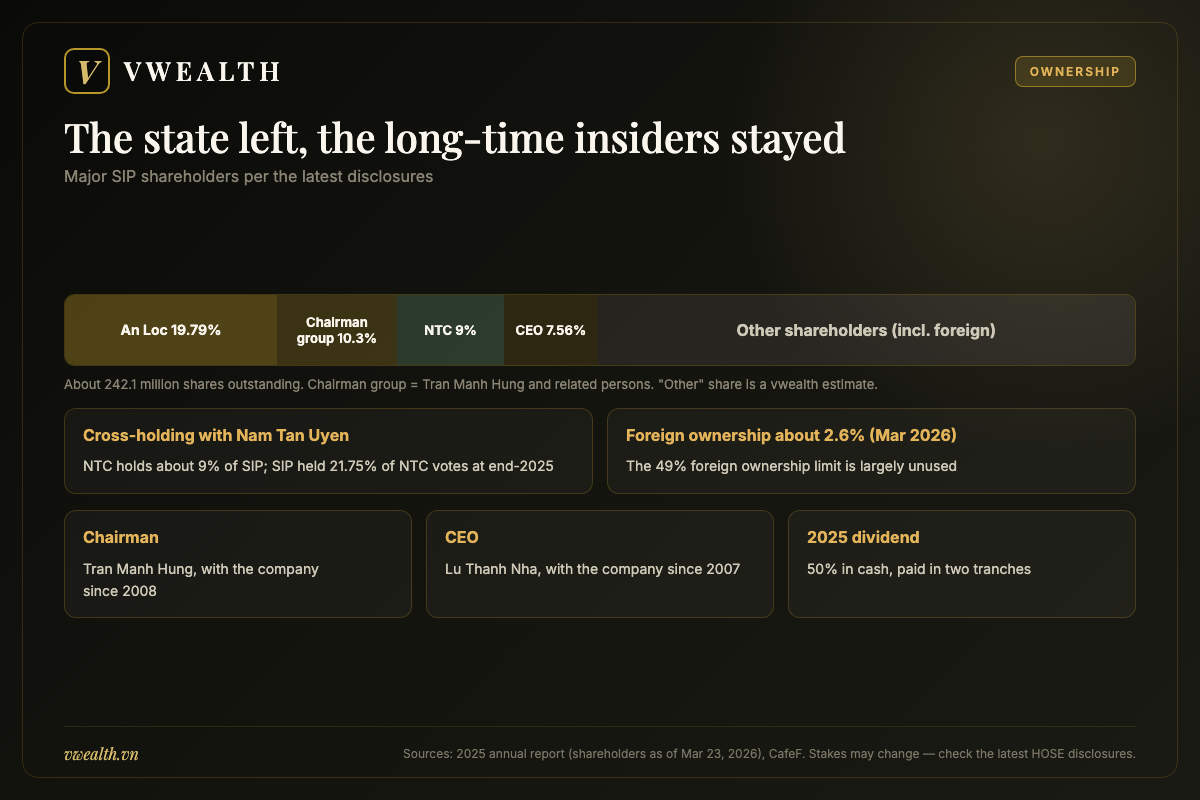
According to the shareholder structure as of March 23, 2026 in the 2025 annual report, SIP has four major shareholders (holders of 5% or more). The largest is An Loc Urban Investment and Development JSC with 47,915,385 shares, or 19.79%. Next is Nam Tan Uyen Industrial Park JSC (NTC) with 21,780,840 shares (9.00%). The two individuals are Chairman Tran Manh Hung with 20,910,280 shares (8.64%) and CEO Lu Thanh Nha with 18,306,546 shares (7.56%) — Mr. Hung’s figure is before the June 2026 family transaction described below.
The group’s stakes have been stable for years. At the end of 2021, An Loc held 19.46%, Mr. Hung 9.92%, NTC 8.86% and Mr. Nha 7.36%; at the end of 2022 the figures were 19.93%, 10.27%, 9.06% and 7.52%. Together, the four major shareholders held about 45% in March 2026; Bao Dau Tu put the remaining 55.01% with other shareholders, each below 5%. Other board members also hold meaningful stakes: Pham Hong Hai 2.18% (his sister 2.17%) and Nguyen Thanh Tung 1.76%, according to the annual report. In other words, the shares that genuinely trade freely are far fewer than the roughly 242.1 million shares outstanding.
The two-way relationship with Nam Tan Uyen deserves attention. NTC is a major shareholder of SIP, and SIP in turn owns a significant slice of NTC: the associates table in the 2025 annual report shows SIP’s voting interest in NTC at 24.87% at the start of 2025 and 21.75% at the end of 2025, with the carrying value falling from about VND 833 billion to about VND 714 billion. Both companies have rubber-industry roots. Cross-holdings are legal, but they have two consequences minority shareholders should understand. First, part of SIP’s profit comes from its share of associates’ earnings — the “share of profit from associates” line was roughly VND 39–84 billion a year in 2020–2025 per VNDirect, and NTC is among those associates. Second, voting power at the two companies is intertwined; NTC’s CEO joining SIP’s supervisory board in 2026 is one example.
| Shareholder | Most recent disclosed stake | Notes |
|---|---|---|
| An Loc Urban Investment and Development JSC | 19.79% (Mar 23, 2026) | Largest institutional holder, stable since 2021 |
| Nam Tan Uyen Industrial Park JSC (NTC) | 9.00% (Mar 23, 2026) | Cross-holding: SIP holds 21.75% of NTC’s votes (end-2025) |
| Tran Manh Hung (Chairman) | 7.11% after the Jun 10, 2026 trade | About 10.3% together with related persons |
| Lu Thanh Nha (CEO) | 7.56% (Mar 23, 2026) | With the company since 2007 |
| Foreign investors | about 2.6% (Mar 23, 2026) | Foreign ownership limit 49%, largely unused |
| Other shareholders | remainder | Each below 5% |
Sources: 2025 annual report (shareholder structure as of Mar 23, 2026), CafeF. Stakes can change after share issues and trades; check the latest HOSE disclosures.
The chairman’s family and internal transfers
Two recent transactions show Chairman Tran Manh Hung’s stake being rearranged within his family. In late June 2025, according to disclosures listed on CafeF, Mr. Hung sold 3.5 million shares while his wife, Ms. Le Hong Cam, and his child, Tran Le An, reported buying; the 2025 annual report shows his stake falling from 10.30% to 8.64% over the year, with Ms. Cam holding 1,725,000 shares (0.71%) and Tran Le An 2,303,174 shares (0.95%) after the 15% stock dividend. On June 10, 2026, Mr. Hung sold another 3.7 million shares in a negotiated trade, falling to 17.2 million shares (7.11%), while Tran Le An bought exactly 3.7 million, rising from 0.95% to 2.48%. CafeF calculated that Mr. Hung and related persons still hold about 24.9 million shares in total, or 10.3% of the company.
In substance, these are intra-family transfers rather than sales to the market: the group’s combined stake barely changed. For minority shareholders, the useful takeaway is that management’s control has not weakened, and the next generation of the chairman’s family now appears on the shareholder register. Such transactions are disclosed as required, and you can follow new filings in HOSE’s insider-trading section.
Separately, in September 2024 the company issued 1,454,463 ESOP shares to employees; these shares can only be traded from August 30, 2027, according to the additional-listing notice on CafeF. That was only about 0.7% of shares outstanding at the time — modest dilution compared with many Vietnamese companies. For a framework on how to judge programs like this, see our overview of corporate governance in Vietnam.
Dividends: from bonus shares to a 50% cash payout
SIP pays cash dividends regularly and uses shares in parallel to grow its capital. On the share side: more than 10 million bonus shares (15%) in 2020, nearly 12 million (15%) in 2021, then the big one — a 45% stock dividend plus 55% bonus shares in 2023 (for fiscal 2022) — followed by 15% in shares for each of fiscal 2023 and 2024. On the cash side: 20% for fiscal 2020 (two 10% tranches), 28% for 2021 (18% in December 2021 and 10% in July 2022) and 45% for 2022 (10% and 35%), according to CafeF and VNDirect’s corporate-action data. In Vietnam, dividend rates are quoted as a percentage of the VND 10,000 par value, so 10% means VND 1,000 per share.
More recently: fiscal 2023 brought 16% in cash (10% in December 2023 and 6% in May 2024) plus 15% in shares (July 2024). For 2024: 32% in total — 10% cash (December 2024), 7% cash (May 2025) and 15% in shares (July 2025). For 2025: 50%, entirely in cash — a 10% interim (paid December 18, 2025) and a 40% second tranche (record date May 15, 2026, paid June 5, 2026 under board resolution 1653), totaling VND 1,210.56 billion per AGM documents. For 2026, the AGM approved a minimum of 10%, which can be raised if business results and cash flow allow, according to Thuong Truong magazine.
A 50% rate means VND 5,000 per share. Compared with 2025 profit attributable to parent shareholders (about VND 1,323 billion in VNDirect’s compiled data), total cash dividends of about VND 1,210 billion equal roughly 90% of profit — a vwealth estimate. That is a very high payout. The 2026 AGM documents add a telling detail: the parent company’s separate profit after tax for 2025 was about VND 1,092 billion, below the VND 1,210.56 billion dividend; the gap came from earlier years’ retained earnings, and after fund allocations and the dividend only about VND 17.6 billion of undistributed profit remained. The same AGM was asked to transfer the entire VND 328.9 billion development investment fund back into undistributed profit, according to Thuong Hieu va Cong Luan. But it also means 50% is not guaranteed every year: the committed minimum is only 10%. Remember too that Vietnam withholds 5% personal income tax on cash dividends paid to individual shareholders.
Governance: points worth monitoring
A fair picture of governance has to include the less comfortable facts that have been disclosed. In 2024, Saigon VRG received an administrative penalty decision on taxes; Dau Tu Chung Khoan reported that the company was fined and charged back taxes of more than VND 916.3 million, and Tap chi Cong Thuong noted “repeated violations”. Against annual profit above VND 1 trillion that is small, but it is a data point about the company’s filing processes that shareholders should know.
Also in 2024, on August 8, HOSE issued a reminder to SIP over late disclosure of a change in its voting share count after the stock dividend for 2023, according to VNDirect’s corporate-event data. This was a procedural lapse that did not change any business figures, but it suggests investor relations is not the company’s strongest area.
The bigger issue to watch is how the company uses its idle cash. At the end of 2025, short-term loans receivable rose to about VND 4,928 billion in VNDirect’s compiled data, more than three times the level at the start of the year. At the 2026 AGM, the CEO confirmed these were loans to securities companies, assessed as low risk and expected to be recovered within 6–12 months. Chapter 4 looks at this in detail. From a governance standpoint, the reasonable questions are whether the counterparties, collateral and interest rates are disclosed in enough detail, and whether this is a long-term policy or simply a temporary use of cash while new projects wait for capital.
How Saigon VRG Makes Money: An Industrial Park That Lives on Power and Water Sales
Imagine you own a huge apartment complex. The units are sold on 50-year leases; you receive the money once, but your books spread it evenly over the years. Meanwhile, every month the residents pay you for electricity, water and building services — small amounts per household, but large in total, and unrelated to how many new units you sell this year. That is almost exactly Saigon VRG’s model, except that the apartments are industrial plots and the residents are factories.
Electricity, water and wastewater: over 80% of revenue, on thin margins
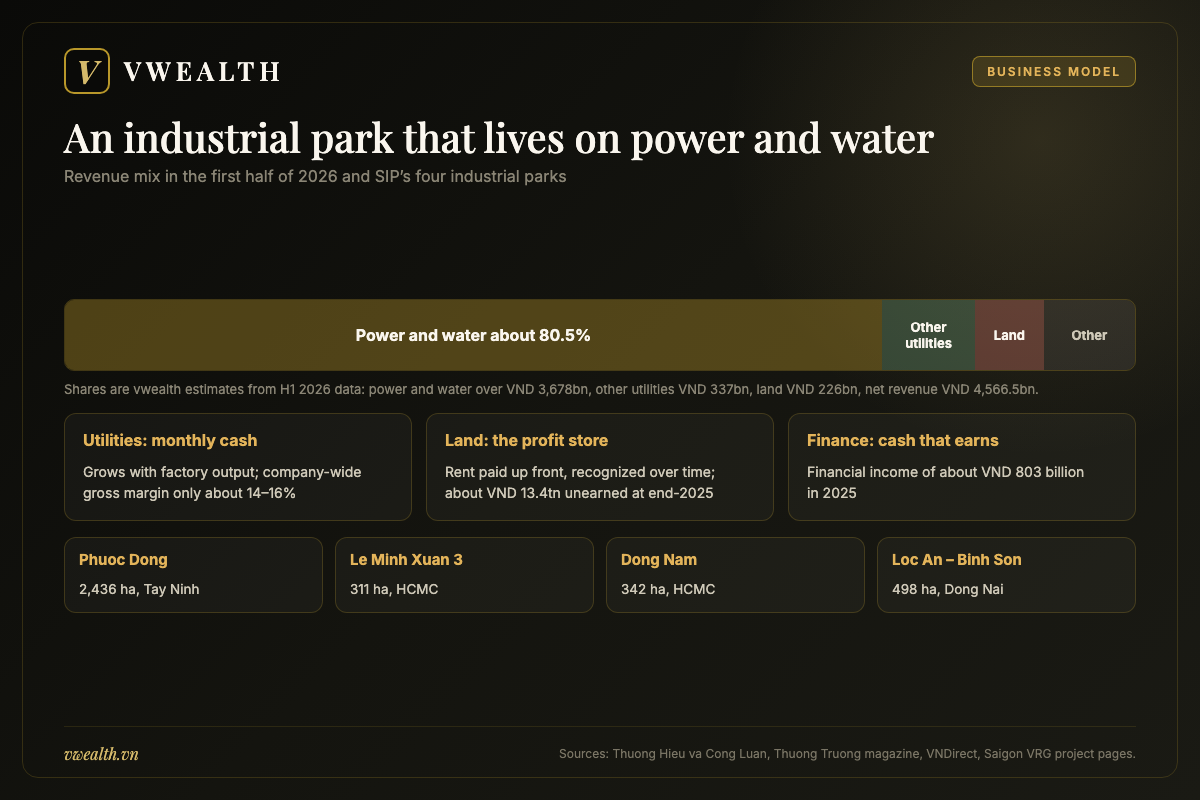
Thuong Truong magazine, citing the Q4 2025 consolidated statements, reported that in 2025 revenue from supplying electricity and water in the industrial parks exceeded VND 6,993 billion, up 7%, accounting for about 81% of net revenue of nearly VND 8,604 billion. On the parent company’s separate basis, the 2025 annual report shows electricity and water revenue of about VND 6,543 billion, up 6.2% and 86.63% of total revenue, “mainly thanks to benefiting from higher electricity prices”. The pattern is long-standing: in 2020, electricity and water already made up about 77% of net revenue. In the first half of 2026, Thuong Hieu va Cong Luan reported electricity and water revenue of more than VND 3,678 billion, over 80% of revenue; adding VND 337 billion of other park utility services brought the utilities group to nearly 88% of sales revenue — almost 18 times the revenue from land leasing.
Here is how it works on the ground. At Phuoc Dong, according to the company’s project page, industrial power comes through five on-site substations with a combined capacity of 693 MVA, built, operated and maintained by Saigon VRG. Clean water comes from on-site treatment plants with capacity of 120,000 m³ per day, drawing raw water from the East canal of the Dau Tieng reservoir. At Le Minh Xuan 3 and Dong Nam, the company runs on-site substations of 3 × 63 MVA; at Loc An – Binh Son, total power capacity is 80 MVA according to the annual report; wastewater is collected and treated at on-site plants. Tenants buy their power and water through Saigon VRG’s infrastructure — and pay every month.
Industrial park power mostly comes from the national grid, passes through Saigon VRG’s substations and then reaches the factories, so what the company keeps per kWh is a distribution margin rather than a generator’s profit — that is vwealth’s explanation for why margins in this segment are thin. Company-wide gross margin ranged only from about 13.6% to 15.6% in 2019–2025 (vwealth estimate from VNDirect’s compiled data), far below a pure land-leasing business. A November 2025 report by ACBS Securities, cited by Nguoi Quan Sat, gives a sense of the physical scale: in Q3 2025 alone, commercial electricity volume reached 517.9 GWh, up 8.1% year on year, and gross margin in the power and water segment was about 15.8%. What utilities bring is not high margin but regularity: volumes rise with the number of factories running and how hard they run, with almost no “empty years” of the kind land leasing can have.
Land leasing: small in revenue, big in profit and on the balance sheet
If utilities are the “monthly bills”, land leasing is the “apartment sale”. Tenants typically prepay infrastructure rent for the remaining life of the project — often several decades. Saigon VRG recognizes this money gradually over the lease term rather than all at once in the year of handover. As a result, land revenue on the income statement is small: about VND 226 billion in the first half of 2026, around 5% of revenue, according to Thuong Hieu va Cong Luan and Nguoi Quan Sat. The rest sits on the balance sheet as “unearned revenue”.
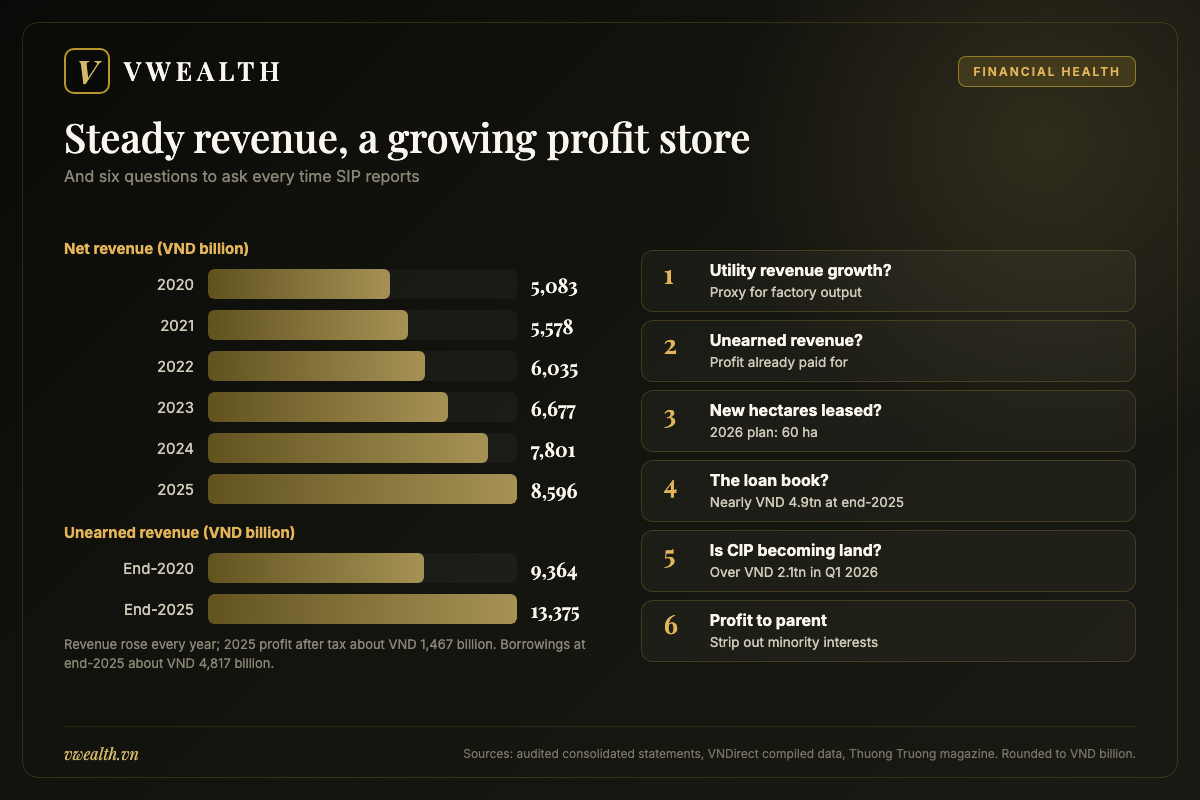
VNDirect’s compiled data shows SIP’s total short- and long-term unearned revenue rising from about VND 5,327 billion at the end of 2019 to about VND 13,375 billion at the end of 2025. Thuong Truong magazine rounds it to VND 13,400 billion at the end of 2025 and more than VND 13,900 billion (including customer advances) at the end of Q1 2026; NH Securities Vietnam (NHSV), in a September 2026 report, put unearned revenue at more than VND 13,500 billion at the end of Q2 2026. This is money tenants have already paid, which the company has already collected and used for infrastructure, bank deposits or lending — but in accounting terms, it will “flow” into revenue over the coming years.
Although land is a small share of revenue, its margin is much higher than utilities: compensation and infrastructure costs were incurred up front and are expensed in step with revenue recognition. On top of that, the prepaid rent is exactly what gives the company thousands of billions of dong in interest-earning deposits. So don’t judge the land business by its 5% share of revenue — it is the root of both the financial income and the customer base for utilities.
Phuoc Dong: a 2,436-hectare complex at the heart of SIP
According to Saigon VRG’s project page, Phuoc Dong Industrial Park lies on provincial road 782, now in Gia Loc ward, Tay Ninh province, with a total area of 2,436.11 hectares, of which 2,189.11 hectares are zoned for industry; initial investment was about US$350 million. The company calls it “the largest industrial, urban and commercial complex in Tay Ninh”. According to the land table in the 2025 annual report, Phuoc Dong is split into Zone A (1,014.1 hectares in total, 814.03 hectares leasable, 97.04% occupied) and Zone B (1,175 hectares, 903.74 hectares leasable, only 24.96% occupied) — about 1,717.77 hectares of net leasable industrial land in total.
Phuoc Dong’s advantage is not proximity to Ho Chi Minh City but scale and price. The land is flat and firm enough to build factories without piling, according to the company, and it is close to the access road for the Ho Chi Minh City – Moc Bai expressway, Thanh Phuoc port and the Moc Bai border gate into Cambodia. The park has gone through several phases: phase 1 opened in 2010 and was about 92% occupied according to the 2019 annual report (cited by CafeF); phases 2 and 3 have been added gradually. For phase 3, by the end of 2025 the company had paid 694 of 759 households (91.4%), covering 507.4 of 568.5 hectares (89.25%), for a total of about VND 2,178 billion — 93.1% of the compensation budget, according to the 2025 annual report. Of the 60-hectare leasing plan for 2026, Phuoc Dong accounts for about 40 hectares.
Around the park are projects serving workers and expatriate staff: the Thuan Loi residential area, Phuoc Dong villas and apartments, a service building, a clinic and a kindergarten. The Thuan Loi residential area alone has 382 completed houses, 311 of them sold, with the rest rented to experts and workers, according to the 2025 annual report. More recently, Minh Phu Land became the development partner for the Phuoc Dong New City shophouse project; according to CafeLand, at an event on August 25, 2026 the two sides announced plans to launch 204 shophouses in October 2026. These projects contribute little revenue so far — in 2025 the company sold about 205 townhouses in phase 2 of Phuoc Dong New City, booking about VND 220 billion — but they make Phuoc Dong more livable, which matters to factories that need thousands of workers.
Le Minh Xuan 3, Dong Nam and Loc An – Binh Son: three smaller parks in prime spots
The other three parks are much smaller but sit where industrial land is increasingly scarce. Le Minh Xuan 3 in Binh Chanh, Ho Chi Minh City, covers about 311 hectares (including roughly 80 hectares of residential land), about 5 km from Ring Road 3 according to the project page; the industrial part is 231.3 hectares with about 155.75 hectares leasable and was only about 37% occupied at the end of 2025. It has 44 investors with USD 252 million of capital, about 2,200 workers, and has just energized the 110 kV Le Minh Xuan 2 substation. Dong Nam in Cu Chi (now Binh My commune), Ho Chi Minh City, covers 342 hectares, about 3 km from Thu Dau Mot; the industrial part is 286.8 hectares with about 206.46 hectares leasable. It has leased land since 2010 and is about 89% occupied, with 44 investors, USD 1.75 billion of capital and about 18,600 workers, according to the 2025 annual report.
Loc An – Binh Son in Long Thanh, Dong Nai, covers 497.77 hectares, developed through the subsidiary VRG Long Thanh (69% owned by SIP), with net leasable area of about 360.58 hectares, nearly 68% occupied at the end of 2025. Its location is tied to Long Thanh International Airport: about 15 km from the airport, about 4 km from the Ho Chi Minh City – Long Thanh – Dau Giay expressway and about 40–42 km from Cai Mep port, according to the project page. At the 2026 AGM, management said Le Minh Xuan and Loc An – Binh Son are expected to be filled within 5–7 years, and that rents at Loc An – Binh Son might stay flat or dip slightly because of competition from new projects, according to Thuong Truong magazine.
In total, according to the land table in the 2025 annual report, SIP’s four parks cover 3,204.9 hectares with 2,440.6 hectares of leasable land; the company has leased 1,503.5 hectares (61.6%) and still has about 937.1 hectares ready for new projects. Adding Long Duc phase 2 (293.9 hectares), there is land for the next decade — the question is how fast it can be leased.
Ready-built factories, housing, solar power and logistics: the supporting pieces
Besides raw land, SIP rents ready-built factories and warehouses — a model suited to small and medium-sized firms and suppliers that want to start production quickly without building their own plant. At Le Minh Xuan 3, the project page lists units from 680 m²; at Loc An – Binh Son, from 2,000 m². In 2024 the company leased nearly 60,300 m² of factory space; the 2025 plan was cut to 25,850 m² and 14,270 m² was actually leased (just over 55% of plan). By the end of 2025 the three parks had about 349,849 m² of factory land, of which 145,018 m² of factories were leased, an average occupancy of 90.37%, according to the annual report. The 2026 plan is about 30,000 m² (1,000 m² at Dong Nam, 12,360 m² at Le Minh Xuan 3 and 16,500 m² at Phuoc Dong, per Bao Dau Tu), and about 10,000 m² had been leased in Q1 2026. Factory rents are paid monthly — steady cash, like utilities.
On energy, the 2026 AGM documents say the company had invested in 74 MW of solar power by 2025 and plans another 13 MW on factory rooftops in 2026. Its website also presents it as a distribution partner for First Solar panels. Rooftop solar gives tenants access to greener power — increasingly a requirement from multinational buyers in their supply chains — and may improve margins in the power business compared with purely distributing grid electricity.
Logistics is often mentioned but still early. Construction in progress for the Thanh Phuoc port project was about VND 87 billion at the end of Q1 2026, according to Thuong Truong magazine; Saigon VRG owns 99.82% of VRG Thanh Phuoc Port and Logistics Services JSC. Management says it will study expanding into logistics, using the parks’ locations near the Moc Bai expressway, Ring Roads 3 and 4 and the Bien Hoa – Vung Tau expressway. For investors, this is a long-dated option rather than profit you can model today.
Which business feeds which — and where the moat is
Put the pieces together and you get a closed loop. Land leasing brings in large prepayments; that cash funds utility infrastructure and sits in bank deposits. Factories that lease land become customers for power, water and wastewater treatment for decades. Deposits and loans generate financial income — about VND 803 billion in 2025 according to VNDirect’s compiled data. Profit from all three sources funds cash dividends. Each business feeds the others, and none of them stands on its own for long.
| Business | Scale (2025 or latest) | Cash-flow pattern | Role |
|---|---|---|---|
| Electricity and water | Over VND 6,993 billion, about 81% of revenue (2025) | Monthly, tied to factory output | Large revenue, thin margin |
| Other park utility services | VND 337 billion (H1 2026) | Recurring management and service fees | Deepens tenant relationships |
| Industrial land leasing | About 5% of revenue (H1 2026); unearned revenue about VND 13,400 billion (end-2025) | Paid up front, recognized over 40–50 years | Source of cash, high margin |
| Ready-built factories and warehouses | About 30,000 m² of new leases planned for 2026 | Recurring rent | Attracts small and mid-sized tenants |
| Residential and commercial property | About VND 220 billion (2025) | Project-by-project sales | Serves the workforce, not a core driver |
| Financial activities | Financial income about VND 803 billion (2025) | Deposit and loan interest | Major contributor to profit |
Sources: 2025 annual report, Thuong Truong magazine, Thuong Hieu va Cong Luan, VNDirect compiled data, 2026 AGM documents.
SIP’s moat — the advantage that is hard to copy — sits in three places. The first is tenants’ switching costs: a factory built at Phuoc Dong and hooked up to power and water can hardly “move house” just because the electricity tariff ticks up. The second is the scale of a contiguous land bank in Tay Ninh, big enough to justify a 693 MVA power system and a 120,000 m³/day water plant — something small parks cannot match. The third is the balance sheet: the huge block of prepaid revenue gives the company cheap capital and limits its need for bank loans to run the business. The limits of the moat are just as clear: if factories in the parks cut output, utility revenue falls with them; and if new land comes to market slowly, the flow of new tenants — the growth engine of the whole loop — slows too.
To see how SIP differs from other industrial landlords, compare the profit structure of Kinh Bac in our KBC stock analysis, where a few large land deals can make a whole year’s profit jump, or the urban-industrial ecosystem model of Becamex in our BCM stock analysis.
Financial Health: How to Read SIP Stock Before You Decide to Buy
If you are used to reading reports from industrial park developers that book land revenue up front, SIP’s financial statements will look odd: very large revenue but thin margins; liabilities around 80% of total capital yet mostly not borrowings; gross profit well below pre-tax profit. This chapter explains each of those oddities so you don’t draw conclusions that are either too optimistic or too pessimistic.
Seven years of rising revenue: the personality of a utility
The table below summarizes key figures for 2020–2025 from the consolidated financial statements (VNDirect compiled data). What stands out is not any single large number but the consistency: net revenue rose every year, including pandemic-hit 2021 and 2023, when demand for industrial land cooled.
| Year | Net revenue (VND bn) | Gross profit (VND bn) | Gross margin* | Financial income (VND bn) | Profit after tax (VND bn) | Attributable to parent (VND bn) | Operating cash flow (VND bn) |
|---|---|---|---|---|---|---|---|
| 2020 | 5,083 | 689 | 13.6% | 647 | 1,118 | 1,026 | 2,862 |
| 2021 | 5,578 | 773 | 13.9% | 364 | 909 | 835 | 805 |
| 2022 | 6,035 | 901 | 14.9% | 390 | 1,010 | 977 | 1,206 |
| 2023 | 6,677 | 930 | 13.9% | 439 | 1,004 | 927 | -798 |
| 2024 | 7,801 | 1,095 | 14.0% | 622 | 1,279 | 1,170 | 621 |
| 2025 | 8,596 | 1,343 | 15.6% | 803 | 1,467 | 1,323 | 2,440 |
Sources: audited consolidated financial statements, VNDirect compiled data; rounded to VND billion. *Gross margin is a vwealth estimate (gross profit divided by net revenue). Some Vietnamese outlets report 2025 net profit of VND 1,356 billion because of different compilation; the 2025 annual report shows consolidated profit after tax of VND 1,467 billion, matching the table.
From about VND 4,340 billion in 2019 to about VND 8,596 billion in 2025, revenue nearly doubled in six years, a compound annual growth rate of roughly 12% — a vwealth estimate. Profit after tax moved to a different rhythm: flat around VND 900–1,100 billion in 2021–2023, then a jump in 2024–2025. That mismatch is the first hint that SIP’s profit does not come only from gross profit.
A gross margin that stays within 13.6–15.6% shows the cost structure of the utilities business has barely changed over the years. When you read a quarterly report and see gross margin jump outside that band, look for the reason: perhaps a transfer of land-use rights was booked (as in Q2 2021, when CafeF noted a one-off VND 102.4 billion from transferring lease rights — without it, gross margin in Q2 2022 fell from 19.7% to 12.9%), or input power costs changed.
VND 13.4 trillion of unearned revenue: a “liability” you don’t repay in cash
Look at the balance sheet at the end of 2025. SIP’s total liabilities were about VND 22,856 billion against total capital of about VND 28,670 billion — close to 80%. For an ordinary company, that ratio would be alarming. But about VND 13,375 billion of it was unearned revenue (VND 399 billion short-term and VND 12,976 billion long-term), and about VND 3,087 billion was long-term accrued expenses — infrastructure costs provisioned in advance to match land revenue that will be recognized later. Actual borrowings were only about VND 4,817 billion.
Unearned revenue is a special kind of liability: the company doesn’t repay it in cash; it “repays” it by letting tenants keep using the land for the lease term. Each year, a small slice moves into revenue. You can think of it as a store of future profit that has already been paid for. Against equity of about VND 5,814 billion at the end of 2025, unearned revenue was about 2.3 times as large — a vwealth estimate. That is why many analysts say SIP’s price-to-book ratio “looks expensive” without capturing its real value.
Still, don’t treat this store as cash waiting to be paid out. The prepaid rent has already been spent on compensation and infrastructure, and part of it sits in deposits and loans. Unearned revenue secures future accounting profit; the ability to pay dividends depends on actual cash flow each year. The two are linked but not the same.
Deposits, loans and financial income: nearly half the profit story
In 2025, SIP’s gross profit was about VND 1,343 billion while pre-tax profit was about VND 1,839 billion. The difference comes from financial activities: financial income of about VND 803 billion minus financial expenses of about VND 220 billion leaves about VND 583 billion. Gross financial income was therefore equivalent to about 44% of pre-tax profit, and the net figure after financial expenses about 32% — vwealth estimates from compiled data. For an industrial park company, that is a very high share.
The source of that income is a large pool of financial assets. At the end of 2025, cash and cash equivalents were about VND 845 billion, held-to-maturity investments (mostly term deposits) about VND 4,873 billion, and short-term loans receivable about VND 4,928 billion. Thuong Truong magazine put “cash and bank deposits” at nearly VND 5,200 billion at the end of 2025 — the figure varies slightly depending on which line items are grouped. By the end of Q2 2026, Thuong Hieu va Cong Luan reported nearly VND 1,468 billion of cash and equivalents plus VND 10,895 billion of short-term financial investments, “mainly term deposits and loans”.
This cuts both ways. On the positive side, the company has a thick cash cushion, enough to pay high dividends and self-fund most land compensation for new projects. On the other side, SIP’s profit is sensitive to interest rates. When deposit rates fall or one-off investment gains don’t recur, financial income falls too — in Q1 2026, consolidated financial income dropped 16.6% to about VND 195 billion; the company’s explanatory letter No. 1668 attributed this to “lower profit from the sale and liquidation of financial investments”, which pushed consolidated profit after tax for the quarter down 11.37%. If you value SIP on its 2025 earnings, separate out the financial component and ask whether it is durable.
The VND 4.9 trillion lent to securities companies
The item shareholders asked about most at the 2026 AGM was “short-term loans receivable”. According to Thuong Truong magazine, this stood at more than VND 4,900 billion at the end of 2025, over three times the start-of-year level; the notes to the financial statements describe loans with terms under 12 months, secured by collateral, at specified interest rates. At the AGM on April 21, 2026, CEO Lu Thanh Nha confirmed the money had been lent to securities companies, in order to “use cheap capital to improve financial efficiency”; the company rated the risk as not high and expected full recovery within 6–12 months. At the end of Q1 2026, short-term loans were nearly VND 4,500 billion, “mainly to securities companies”, according to Thuong Truong.
Lending to securities companies is not new at SIP. According to CafeF (January and March 2024), at the end of 2023 SIP’s loans to securities firms totaled about VND 1,270 billion, including Vietcombank Securities (VCBS) and VietinBank Securities (CTS); at the time SIP described them as unsecured short-term loans at about 4.7–7% a year. CTS’s board also disclosed resolutions to borrow short-term from SIP with a limit of VND 2,000 billion (November 2023), later raised to VND 2,500 billion (January 2024). The big difference now is scale — from about VND 1,270 billion to about VND 4,900 billion in two years — and the end-2025 notes describe the loans as secured.
Put this in proportion. Nearly VND 4,900 billion is equivalent to about 85% of equity at the end of 2025 and about 17% of total assets — vwealth estimates. This is no longer a side investment. In principle, short-term secured lending can earn more than bank deposits, but the credit risk is concentrated in counterparties from a single industry — securities brokerage, which is highly cyclical. The identity of each borrower at the end of 2025 was not disclosed in the sources vwealth reviewed; information on borrowers has come mainly from the securities companies’ own disclosures.
This article has no basis for saying the loan book is good or bad; what can be said is that you should track it every reporting period. Three simple questions: does the balance shrink as promised within “6–12 months”, or is it rolled over repeatedly; has the company booked any provisions; and do the notes spell out what the collateral is? If the balance is recovered on time and returns to deposits or project spending, this is simply a way to optimize idle cash. If it becomes a permanent and growing line item, questions about management’s risk appetite become legitimate.
Operating cash flow and borrowings: steady, but not smooth
The table above shows that SIP’s operating cash flow swings more than its profit: about VND 2,862 billion in 2020, down to VND 805 billion in 2021, about minus VND 798 billion in 2023, then about VND 2,440 billion in 2025. The reason lies in the timing of land prepayments and compensation outlays. In years when tenants prepay a lot, cash flow jumps; in years when the company advances large sums for land compensation on new projects (other receivables rose from about VND 1,062 billion in 2023 to about VND 3,212 billion in 2025, mainly land compensation advances for industrial park projects, according to Thuong Truong magazine), cash flow is pulled down.
Borrowings have clearly risen over the past three years: from about VND 1,686 billion at the end of 2023 to about VND 3,598 billion at the end of 2024 and about VND 4,817 billion at the end of 2025, with interest expense of about VND 64 billion, VND 77 billion and VND 162 billion respectively. By the end of Q2 2026, financial debt exceeded VND 5,500 billion, according to Thuong Hieu va Cong Luan. Notably, the company is borrowing, lending and holding deposits on a similar scale at the same time. A reasonable explanation is differences in rates and maturities between the items, but the structure makes the accounts more complex and makes profit more dependent on treasury management.
Compared with many peers, SIP’s leverage is still low: borrowings of about VND 4,817 billion versus cash, deposits and loans receivable of more than VND 10,000 billion combined at the end of 2025 — a vwealth estimate. SIP’s financial risk therefore lies not in its ability to repay debt but in the quality of the financial assets it holds.
First half of 2026 and the AGM plan: reading the published numbers correctly
At the time of writing, SIP had published its Q1 and Q2 2026 financial statements. According to Thuong Hieu va Cong Luan, first-half 2026 net revenue was about VND 4,566.5 billion, up 12% year on year; profit after tax about VND 803.7 billion, up 12%, of which about VND 747.4 billion was attributable to the parent, up 18%. Q1 2026 was a step back: consolidated profit after tax was about VND 356.6 billion, down 11.37% year on year, according to the company’s explanatory letter — the drop came from financial income, not from power and water, which still grew about 6% in the quarter.
Set against the annual plan, SIP had delivered about 92% of its VND 874.18 billion consolidated profit-after-tax target after six months — a vwealth estimate. It is the familiar pattern: a plan set low to leave room for risk, and actual results that usually beat it. The 2026 AGM documents show the plan on two levels: on a separate basis, total revenue of VND 5,147.6 billion and profit after tax of VND 629.6 billion; on a consolidated basis, total revenue of VND 5,940.25 billion, pre-tax profit of VND 1,092.7 billion and profit after tax of VND 874.18 billion — all 105% of the 2025 plan. The 2026 dividend is set at a minimum of 10%, and the AGM authorized the board to decide the rate and timing of interim payments, as long as they do not exceed undistributed profit at the time.
Three other items from the 2026 AGM are worth recording. First, the proposal to move the entire VND 328.9 billion development investment fund back into undistributed profit “to optimize the capital structure”, according to Thuong Hieu va Cong Luan — a step that widens room for cash dividends in coming years. Second, the AGM approved a framework for related-party transactions, including borrowing, lending and collateral arrangements at rates agreed case by case, according to the AGM documents. Third, the election of Duong Duy Phu to the supervisory board, as noted in chapter 2. In July 2026, the board passed a resolution selecting the auditor for the 2026 financial statements, according to the disclosure list on CafeF.
For investors, the simplest reading is this: the 2026 plan is not a profit forecast but a “floor” management is comfortable committing to. The numbers worth tracking are the growth of power and water revenue, hectares signed against the 60-hectare plan, and the loan balance at the end of each quarter.
Six questions to ask every time SIP reports
From the points above, here is a short checklist for reading SIP’s quarterly reports instead of looking only at the bottom line.
One: how much did electricity and water revenue grow? This is the closest proxy for how busy the factories in the parks are. If utility revenue falls for several quarters in a row, tenants are cutting output — more worrying than a quarter without new land deals.
Two: did unearned revenue rise or fall? A rise means new tenants prepaid more than was recognized in the period — the store of future profit is getting bigger. Several periods of decline mean the company is eating into the old store without replenishing it.
Three: how many new hectares were leased? The 2026 plan is 60 hectares of land and about 30,000 m² of factories; in Q1 2026 the company said it had leased about 35 hectares. This drives prepayments in the years ahead.
Four: how are financial income and the loan book moving? Track the balance of loans receivable, provisions and the interest rates in the notes. This is the most changeable part of profit.
Five: is construction in progress turning into leasable land? At the end of Q1 2026, construction in progress was over VND 2,100 billion, including nearly VND 1,100 billion at Phuoc Dong – Boi Loi, nearly VND 510 billion at Le Minh Xuan 3, VND 243 billion at Dong Nam and VND 179 billion at Loc An – Binh Son. Money already spent needs to be “packaged” into leasable land within a few years.
Six: how much profit belongs to parent shareholders? Some projects sit in subsidiaries SIP does not fully own (such as Long Duc and Loc An – Binh Son), so non-controlling interests — about VND 144 billion in 2025 — will grow as those projects grow. Use the profit line attributable to SIP shareholders when you calculate earnings per share.
How the Market Treats SIP Stock: From an Eightfold Rally to a Dividend Stock
Every stock has a “personality” shaped by its trading history and its shareholders. SIP’s is two-sided: it was a spectacular price story when it first listed, but in recent years many investors have held it for cash dividends. Understanding that personality helps you know what to expect — and what not to expect — as a holder.
Historical price milestones
The table below records price milestones reported in the press, with dates. Important: these are prices at the time, not adjusted for share issues. The combined 100% stock dividend and bonus issue in 2023 doubled the share count, so prices before and after September 2023 are not directly comparable.
| Date | Price (VND per share) | Context |
|---|---|---|
| Jun 6, 2019 | 17,200 (reference) | First session on UPCoM |
| Aug 20, 2019 | 139,000 | Roughly 8x in under three months |
| Dec 14, 2020 | 141,100–145,200 | GVR divests on-exchange; SIP closes at limit-up |
| Jan 22, 2021 | 228,700 | Highest closing price on record (unadjusted) |
| Aug 16, 2022 | 136,900 | After filing for HOSE listing |
| Aug 8, 2023 | 116,500 (HOSE reference) | Closed its first session at 130,300 |
| Nov 29, 2023 | 58,000 | After the share count doubled |
| Aug 5, 2024 | 68,600 | Limit-down with the broader market |
| Feb 19, 2025 | 86,600 | Limit-up during the session |
| Oct 20, 2025 | 50,000 | Lowest close of 2025 |
| Apr 10, 2026 | 60,800 | Ahead of the 2026 AGM |
Sources: VNDirect historical price data, CafeF. Closing prices not adjusted for dividends or bonus shares. For the current price, see a live quote or the vwealth report.
The milestones show two eras. From 2019 to early 2021, SIP was a “discovery” stock: the market re-rated it from a low reference price to a level that reflected utility cash flow and the store of prepaid revenue, with a record close of VND 228,700 on January 22, 2021 (before later share issues). From 2022 onward, the price has moved in a wide range with sentiment toward industrial park stocks as a group — rallying on hopes of FDI inflows (as in the limit-up session of February 19, 2025) and falling when the broader market sold off or on shocks such as the 2025 tariff news.
Stock personality: moderate liquidity, concentrated ownership
With about 242.1 million shares outstanding and nearly half held by four major shareholders, SIP’s free float is limited. The usual consequence for stocks like this is moderate liquidity compared with larger industrial park names such as KBC or BCM, and prices that can move sharply when large money flows in or out over a short period. The limit-up sessions of December 14, 2020 and February 19, 2025 are examples.
The second trait is sensitivity to dividend news. Each time the company announces a high cash payout — such as 50% for 2025 — the stock attracts income-seeking investors. Conversely, when the company sets a low profit plan, headlines tend to say it is “going backward”, and short-term sentiment can suffer even though history shows the plan is usually beaten. For instance, the 2025 profit plan (VND 832.6 billion) was about 35% below 2024’s actual result (a vwealth estimate); full-year results came in 76% above plan. 2021 was similar: according to CafeF, the company planned profit more than 53% below 2020, while actual profit fell only about 19% (a vwealth estimate from VNDirect data).
The third trait is its link to the “rubber family”. Many investors view SIP, NTC, PHR and GVR as a group, and prices sometimes move together on news about converting rubber land into industrial parks. In business terms, though, SIP has been independent of the rubber group since 2020; what remains is mainly the cross-holding with NTC and a shared history.
Foreign investors and ETFs
Foreign ownership of SIP is very low: according to the shareholder structure as of March 23, 2026 in the 2025 annual report, foreign investors held about 2.6% (institutions 2.55%, individuals 0.05%), against a foreign ownership limit of 49% set under a 2022 State Securities Commission notice. For international investors, SIP remains much less known than KBC or IDC. In Vietnam, many listed companies cap foreign ownership at 49% or lower, so room matters; with SIP, room is not the constraint — awareness is.
There have been some steps forward on accessibility. After the move to HOSE, SIP was not eligible for margin trading during its first six months, as is standard for newly listed stocks; since March 2025 it has been on HOSE’s list of margin-eligible stocks, according to VNDirect’s corporate-event data. If the stock is later added to major ETF baskets, that would bring a group of passive buyers, but also expose it to outflows when those funds see redemptions.
Low foreign ownership cuts both ways. It suggests room to attract international investors if the company improves investor relations and English-language disclosure; but it also shows that SIP is not on the radar of most large funds — so don’t expect a wave of foreign buying to arrive on its own.
Valuation: why SIP’s P/E and P/B can mislead
This article does not quote current P/E or P/B; you can find updated figures in the vwealth report. What matters more is how to read them. As an illustrative example: 2025 profit attributable to parent shareholders of about VND 1,323 billion divided by about 242.1 million shares gives earnings per share of about VND 5,460 — a vwealth estimate. If you use that to calculate a P/E, remember that about one third of pre-tax profit comes from financial activities, which depend on interest rates and the quality of the loan book. A “cheap” P/E may simply reflect the market discounting that financial income.
P/B is even easier to misread. SIP’s equity is small (about VND 5,814 billion at the end of 2025) because most of its value sits in the store of unearned revenue and in industrial parks carried at historical cost. On P/B alone, SIP often looks more expensive than many property companies; but once you set it against VND 13.4 trillion of unearned revenue — about 2.3 times equity — the picture changes considerably.
A more sensible way to value SIP is to split it into three parts: the value of utility cash flows (stable, growing with the number of factories), the value of prepaid land revenue and the remaining land bank (discounted for time and leasing risk), and the net value of financial assets (deposits and loans minus borrowings). Brokerages often use a sum-of-the-parts or discounted cash flow approach along these lines. For example, in November 2025 ACBS Securities issued a BUY recommendation on SIP, based on forecast 2026 profit growth from power, water and land leasing; in September 2026, NH Securities Vietnam (NHSV) called SIP “a forgotten growth stock”, highlighting its store of unearned revenue, according to Nguoi Quan Sat. Read the assumptions in full rather than just the target price, and remember that brokerage forecasts can be wrong.
Catalysts the market tends to react to
Historically, SIP’s price has reacted to five kinds of news. First, dividend news: the cash rate announced at the AGM and record dates. Second, land news: investment approvals, land allocation and completed compensation for Long Duc phase 2 or Phuoc Dong phase 3. Third, leasing results: hectares signed each quarter, especially when above plan. Fourth, macro news on FDI and tariffs, which moves the whole industrial park group. Fifth, index news, such as ETF reviews.
Two newer items belong on your watch list: developments in the loans to securities companies (whether the balance falls as planned), and progress on major infrastructure around SIP’s parks — the Ho Chi Minh City – Moc Bai expressway, Ring Road 3 and Long Thanh airport. These could change how the market views both the company’s earnings and the value of its land.
A practical note for newer investors: for a stock with a high cash dividend, the price usually adjusts down on the ex-dividend date by roughly the dividend amount. That is not “lost money” — the drop has turned into cash in your account, minus 5% personal income tax. But buying right before the record date just to “collect the dividend” rarely delivers the benefit people expect.
Industry Backdrop: FDI, US Tariffs, New Infrastructure and Circular 99
No industrial park company can escape the story of foreign direct investment. But the impact on SIP differs from many peers, because most of SIP’s revenue comes from factories that are already in place. This chapter places SIP in the wider industry picture; for a broader overview of Vietnam’s factory economy, see our guide to Vietnam manufacturing and industrial stocks.
Southern industrial land: a flood of new supply as core land runs out
The “China + 1” wave — multinationals adding factories outside China to reduce risk — has made Vietnam one of Asia’s main manufacturing destinations since the late 2010s. In the south, the result has been dwindling industrial land in core areas such as Ho Chi Minh City, Binh Duong and Dong Nai, rising rents, and new projects shifting to more distant provinces such as Tay Ninh, the former Long An and the former Binh Phuoc.
On the supply side, Saigon VRG’s own 2025 annual report expects industrial land supply to rise sharply in 2025–2030, with more than 500 parks newly established or expanded nationwide. The same report says Ho Chi Minh City’s industrial land market slowed in 2025 compared with earlier years because of tariff worries, with new registered investment pausing and projects being rescheduled, while ready-built factories and warehouses held up better, at occupancy of 74% and 96% (the company cites CBRE). Plentiful new supply is good news for tenants but creates price competition — exactly what SIP’s management acknowledged when discussing Loc An – Binh Son.
For SIP, this means the three smaller parks near Ho Chi Minh City (Le Minh Xuan 3, Dong Nam) and near Long Thanh airport (Loc An – Binh Son) have location advantages but little land left, while Phuoc Dong has plenty of land but must compete with many new parks on the periphery. SIP’s leasing pace over the next few years therefore depends heavily on Phuoc Dong’s own appeal.
US reciprocal tariffs: a shock to land leasing, a slower effect on utilities
In early April 2025, the United States announced a 46% reciprocal tariff on Vietnamese goods; after negotiations, the rate on Vietnamese goods was cut to 20% under an executive order at the end of July 2025, according to Vietnam’s Ministry of Industry and Trade (cited by VietNamNet). Industrial park stocks were among the hardest hit after the April announcement, as investors feared foreign manufacturers would delay new plants. SIP itself reflected this concern in its 2025 annual report, naming textiles, footwear, wood, plastics and rubber as key affected product groups and warning that trade protectionism by major economies, especially the United States, could hurt its leasing plans.
The impact on SIP arrives in two layers at different speeds. The first layer is new land leasing: in 2025, SIP leased only 28.6 hectares versus 74.5 hectares in 2024 — possibly partly because tenants waited to see how tariffs settled, although the company did not break out the causes. The second layer is utility revenue, which only falls if operating factories cut production. In practice, electricity and water revenue still grew about 7% in 2025. This is exactly what the “industrial park living on power and water sales” lens helps you see: the tariff shock hits SIP’s future growth faster than it hits its existing revenue.
The open question is SIP’s tenant mix — which industries, exporting where — which the company has not disclosed in detail in the documents vwealth could find. If the share of tenants exporting to the US is high (in industries such as footwear, textiles and furniture, traditional sectors at Phuoc Dong and Dong Nam), the long-term output risk would be larger.
The Moc Bai expressway, Ring Road 3 and Long Thanh airport: infrastructure that lifts land value
Each of SIP’s parks sits next to a major transport project. Phuoc Dong is close to the Ho Chi Minh City – Moc Bai expressway; Saigon VRG highlights its location “near the access road to the Ho Chi Minh City – Moc Bai expressway”. Le Minh Xuan 3 is about 5 km from Ring Road 3, and the company markets Dong Nam as gaining investment appeal from Ring Road 3. Loc An – Binh Son and Long Duc phase 2 are within the catchment of Long Thanh International Airport and the Ho Chi Minh City – Long Thanh – Dau Giay expressway.
Transport infrastructure raises land value in two ways: it shortens shipping times for tenants, and it widens the area from which factories can hire workers. For SIP, this matters most at Phuoc Dong, about 60 km from Ho Chi Minh City, where travel time is currently a hurdle for some investors. Once the expressway is complete, the “psychological distance” between Phuoc Dong and the city will shrink considerably. Still, infrastructure projects in Vietnam often run behind schedule, so investors should not build this benefit into short-term expectations.
Vietnam’s administrative reorganization from mid-2025 also changed place names: Phuoc Dong is now in Gia Loc ward, Tay Ninh province, and the company’s headquarters in Dong Nam Industrial Park is now in Binh My commune, Ho Chi Minh City. In business terms this does not change land-use rights or lease contracts, but it could affect how regional planning and investment incentives are applied in the future.
Circular 99/2025: when the accounting rules change, where does SIP stand?
From January 1, 2026, Circular 99/2025/TT-BTC on corporate accounting took effect, requiring revenue from leasing assets that is received in advance for multiple periods to be allocated over the lease term. Previously, industrial park developers could choose to book the full 50-year rent in one go, or spread it. According to Dau Tu Chung Khoan (September 2026), from early 2026 companies such as BCM, SNZ, NTC and SZC had to spread prepaid rent instead of booking it up front, while KBC, IDC and LHG still book qualifying contracts up front; first-half 2026 results in the group diverged sharply as a result.
For SIP, the change has almost no effect — because the company already spread revenue over time. CEO Lu Thanh Nha said at the 2026 AGM that SIP was not affected because it already recognized revenue year by year, so its financial indicators and access to capital remain stable, according to Thuong Truong magazine. This matters for comparisons: before 2026, SIP’s profit often looked “less explosive” than peers that booked land revenue up front; from 2026, those companies will report more like SIP, and differences in earnings quality will be easier to see.
Competition: where SIP stands next to KBC, IDC, BCM, VGC and NTC
Among listed industrial park stocks, each company has a different way of making money, and comparing profits or P/E directly can mislead. The table below compares business models, not current numbers.
| Company | Main land bank | Land revenue recognition (before 2026) | Distinctive income |
|---|---|---|---|
| SIP – Saigon VRG | Tay Ninh, Ho Chi Minh City, Dong Nai | Spread over the lease term | Power, water and utility services (about 80% of revenue); large financial income |
| KBC – Kinh Bac | Mainly the north (Bac Ninh, Bac Giang, Hai Phong…) and former Long An | Large amounts often booked on handover | Land revenue from big contracts, urban property |
| IDC – IDICO | Several provinces in both north and south | Still books qualifying contracts up front (per Dau Tu Chung Khoan, Sep 2026) | Industrial land, hydropower, a toll road |
| BCM – Becamex | Former Binh Duong and nearby provinces | See our BCM analysis | Industrial parks, urban development, joint-venture ecosystem |
| VGC – Viglacera | Several northern and central provinces | See our VGC analysis | Building materials and industrial parks |
| NTC – Nam Tan Uyen | Former Binh Duong | See NTC’s financial statements | Land leasing, park services; cross-holding with SIP |
Source: vwealth compilation from company reports and published analyses; describes business models only, see each company’s statements for details.
SIP’s biggest point of difference is the weight of utilities. Most peers have a utility business, but it is small next to land; SIP is the reverse. That makes SIP less sensitive to any single big land deal, but also means it rarely has a year of explosive profit growth like developers that book a hundred-hectare contract up front. By vwealth’s calculation from VNDirect data, 2025 consolidated profit after tax (about VND 1,467 billion) over average equity at the start and end of the year, including non-controlling interests (about VND 5,341 billion), gives a return of about 27% — high for a property company, partly because SIP’s equity is small relative to its assets.
If you are weighing several names in the sector, you can set SIP beside our analysis of VGC stock (Viglacera) — a company that both develops industrial parks and makes building materials — to see two different ways of “diversifying” within the same industry.
Outlook: Three Scenarios for SIP Stock and What Would Have to Happen
No one knows for sure where a share price will go, and this article offers no price target. What we can do is identify the variables that drive SIP’s story and describe three scenarios with specific conditions. As you follow the news, you will be able to tell which scenario the story is leaning toward.
Five variables that will shape SIP’s future
The first variable is the output of factories in the parks. Power and water make up about 80% of revenue, so the health of tenants — especially exporters — determines most of SIP’s revenue. Tariffs, order books and input power prices all act on this variable.
The second is the pace of new land leasing. The 2026 plan is 60 hectares; 2024 delivered 74.5 hectares and 2025 only 28.6. Each new hectare brings both a prepayment and a new utility customer for decades.
The third is progress on new land — Phuoc Dong phase 3 and Long Duc phase 2 (expected to start operating from late 2027, according to management). If new land is slow to arrive while existing parks fill up, growth will stall.
The fourth is interest rates and the quality of financial assets, including the loans to securities companies. This is the part of profit that can change fastest, in either direction.
The fifth is dividend policy. The 50% cash payout for 2025 is high; if the company falls back to the 10% minimum to conserve cash for compensation, income-focused shareholders may react.
Bull case: tenants run at full capacity and new land arrives on time
This scenario needs several conditions at once. First, factories in the parks maintain or increase output — Vietnamese exports keep growing now that the reciprocal tariff rate has been set, and orders continue to shift away from China. Second, SIP leases at least its planned 60 hectares a year, with Phuoc Dong phase 3 compensation completed and Long Duc phase 2 starting operations from late 2027 as management expects. Third, the loans to securities companies are recovered on time and the cash returns to deposits or project spending.
In that case, utility revenue keeps rising steadily as it did in 2019–2025, the store of unearned revenue grows, and actual profit once again beats the “conservative” VND 874 billion plan by a wide margin. Cash dividends could stay high. On top of that, peers switching to spread-out recognition under Circular 99 could lead the market to reassess the quality of SIP’s steady earnings, and completed expressways would raise Phuoc Dong’s appeal. This is the scenario in which SIP is valued like a utility with growth.
Signs to watch for: double-digit annual growth in power and water revenue; more than 15–20 hectares of new leases per quarter; a steadily falling loan balance; an announcement approving the Long Duc phase 2 compensation schedule.
Base case: controlled sideways movement while waiting for new land
In the base case, utility revenue still grows but slows to single digits as the core parks fill up. Land leasing runs at 30–60 hectares a year — not spectacular, but enough to keep the store of unearned revenue from shrinking. Long Duc phase 2 slips a few quarters behind schedule, as is common for industrial park projects in Vietnam. Moderate deposit rates mean financial income does not grow further.
Profit could then move sideways around recent levels, above plan but without setting new records every year. The cash dividend could be lower than the 50% paid for 2025 if the company prioritizes keeping cash for compensation. In this scenario, the stock behaves like “a bond with modest growth”: the dividend yield is the main source of return, and price swings follow sentiment toward industrial park stocks.
Signs to watch for: utility revenue growth of roughly 3–8% a year; quarterly profit close to the same period a year earlier; leasing at about 60–100% of plan; no major news on new land for 12–18 months.
Bear case: tenants cut output and financial assets run into trouble
The bear case is not necessarily a collapse, but a combination of adverse factors. One: key export industries in the parks struggle for an extended period — orders fall because of tariffs or weak global consumer demand — so power and water volumes decline for the first time in years. Two: demand for land stalls while many new parks in Tay Ninh and Dong Nai market space at the same time, forcing SIP to cut rents, as management already warned for Loc An – Binh Son. Three: the loans to securities companies are rolled over for long periods or require provisions if the stock market suffers a shock.
In this scenario, profit could come in close to the company’s conservative plan instead of beating it comfortably, dividends could fall back toward the 10% minimum, and the market could heavily discount financial income. The store of unearned revenue would still act as a cushion — profit from land already paid for keeps being recognized — so SIP’s bear case looks different from that of a developer booking revenue up front, which can swing to losses when it cannot hand over land.
Signs to watch for: power and water revenue down year on year for two consecutive quarters; a loan balance that does not fall, or new provisions; new leasing below half of plan; a dividend rate set near the minimum.
Illustrative example: how one lease “flows” into the accounts
To see why SIP’s profit is steady rather than explosive, here is an illustrative example using hypothetical numbers, not company figures. Suppose a factory leases 10 hectares at Phuoc Dong with 40 years left on the project term and prepays all its infrastructure rent — VND 400 billion.
A developer that books revenue up front (before Circular 99) would record VND 400 billion of revenue in the handover year, and profit would spike. Under SIP’s approach, only about VND 10 billion of revenue is recognized each year (VND 400 billion divided by 40 years); the remaining VND 390 billion sits in unearned revenue. But SIP has the VND 400 billion in hand immediately: deposited at a hypothetical 5% a year, the first year’s interest alone would be about VND 20 billion — twice the land revenue recognized. That is why SIP’s financial income is so large.
There is more. Once the factory starts running, it buys power, water and wastewater treatment every month. Suppose the 10-hectare plant’s utility bill is VND 30 billion a year at a hypothetical 10% gross margin: SIP earns about VND 3 billion of extra gross profit a year for the life of the plant. Add the three streams together and one land lease becomes three sources of profit: spread-out land revenue, interest on the prepayment, and monthly utility profit. None of them creates a “boom year” in this example, but all three accumulate over time — which is exactly SIP’s personality.
The example also shows the weak spot: if no new leases are signed this year, profit does not fall right away, but future years miss one “layer” of accumulation. SIP’s long-term growth still needs new land, even if its short-term profit depends little on it.
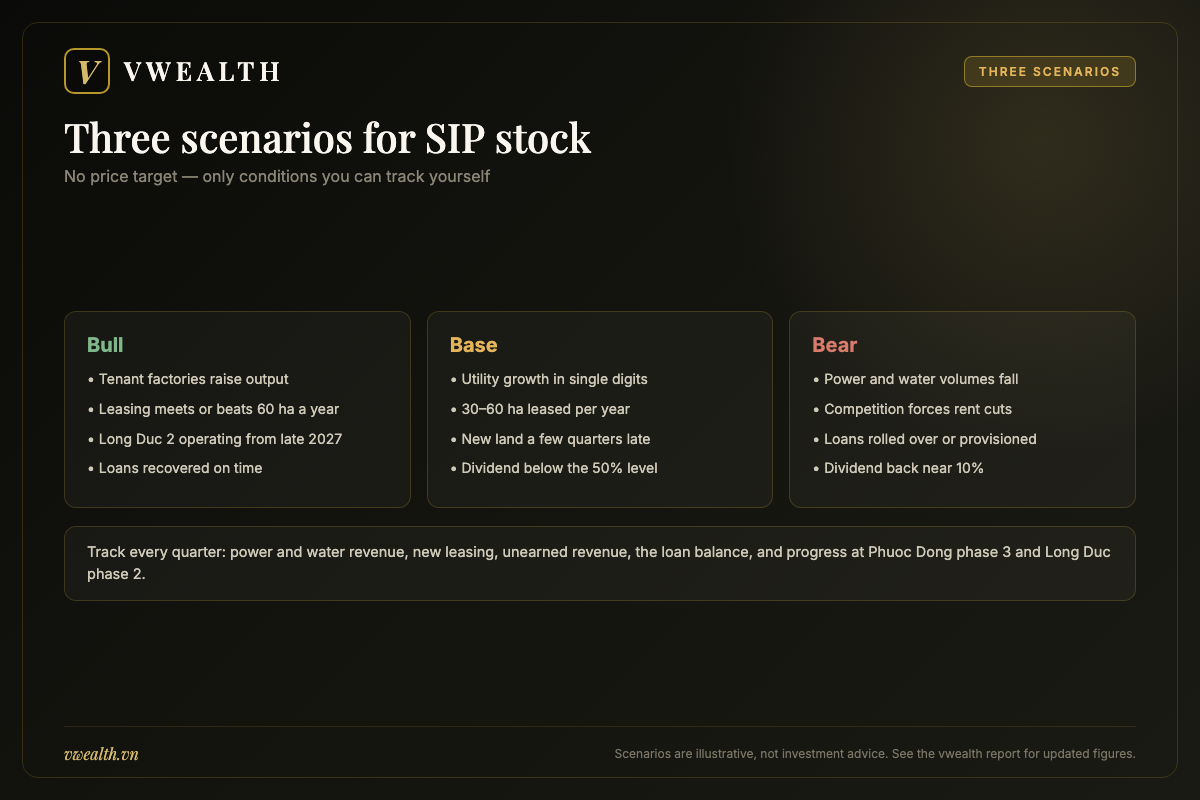
Should You Buy SIP Stock? Weighing the Pros and Cons
By now you have been through Saigon VRG’s history, people, business model, numbers and industry backdrop. There is no single answer to “should I buy SIP stock” that fits everyone — it depends on what you need from an investment. This final chapter sums up the strengths, the weaknesses, and the kinds of investors SIP may or may not suit.
The compelling strengths
Steady utility cash flow that is rare in the sector. About 80% of revenue comes from power, water and services sold to factories already operating, and net revenue rose every year from 2019 to 2025. This is not revenue that hinges on a handful of large contracts.
About VND 13.4 trillion of unearned revenue. The cash has been collected; the profit will be recognized gradually over decades. Circular 99 forcing the whole sector to adopt SIP’s spread-out approach makes this strength easier to see.
A cash-rich balance sheet with low borrowing relative to financial assets. Cash, deposits and loans receivable totaled more than VND 10,000 billion at the end of 2025, versus borrowings of about VND 4,800 billion.
A high recent cash dividend. 50% for 2025, after years of alternating cash and share dividends.
Stable management and a record of beating plans. The chairman and CEO have been with the company since 2007–2008; actual profit has usually far exceeded the plan set at the start of the year.
About 930 hectares of leasable land left, plus Long Duc phase 2, in locations tied to major transport infrastructure.
The weaknesses you cannot ignore
Thin margins in the core business. Company-wide gross margin is only about 14–16%. Big revenue does not mean big profit; a small change in input power prices or in the rules for retailing power inside industrial parks could have a noticeable effect.
Heavy reliance on financial income. About a third of 2025 pre-tax profit came from net financial activities (vwealth estimate). Lower interest rates or problems with financial assets would hit profit directly.
A large loan book to securities companies. Nearly VND 4,900 billion at the end of 2025, equivalent to about 85% of equity. Management rates the risk as low and promises recovery within 6–12 months, but shareholders should keep watching.
Slow land leasing in 2025. 28.6 hectares against a 45-hectare plan. If that persists, long-term growth will weaken even if short-term profit is not yet affected.
Concentrated ownership, a cross-holding and low foreign interest. Four major shareholders hold nearly half the company; there is a two-way stake with NTC; foreign ownership is only about 2–3%. Liquidity and interest from large institutions remain limited.
Some disclosed governance issues. A VND 916.3 million tax penalty and a reminder for late disclosure in 2024 — small in scale, but facts to know.
| Pros | Cons |
|---|---|
| About 80% of revenue from utilities, rising steadily for years | Gross margin only about 14–16% |
| Unearned revenue of about VND 13.4 trillion | That store is not cash available for payout |
| Cash, deposits and loans receivable above VND 10 trillion | Nearly VND 4.9 trillion is lent to securities companies |
| 50% cash dividend for 2025 | Committed minimum is only 10% |
| Stable management that usually beats plans | Concentrated ownership, low foreign interest |
| Remaining land and Long Duc phase 2 | 2025 leasing at only 63.6% of plan; rising rent competition |
| Barely affected by Circular 99 | Unlikely to post the profit spikes of up-front recognizers |
Who SIP stock may suit
Long-term, income-oriented investors. If you want a stock with steady cash flow that pays cash dividends, and you accept price swings with the sector, SIP has fitting characteristics. Judge the dividend year by year rather than assuming 50% will repeat.
Investors who can read “non-standard” financial statements. SIP rewards people willing to split profit into three parts — utilities, land and finance — and to track the store of unearned revenue. If you enjoy fundamental analysis, it is a case worth studying.
Investors who want exposure to Vietnam’s industrial park sector but dislike earnings volatility. Compared with developers that book land up front, SIP offers a way into the sector with smoother earnings, in exchange for less short-term upside.
Who it may not suit
Investors looking for a stock that jumps on one big contract. The spread-out revenue model makes a surprise profit quarter unlikely. If you are hunting for a short-term story, names with more earnings leverage in the sector may fit better.
Investors who don’t want to monitor financial-asset risk. With about a third of profit coming from finance and a multi-trillion-dong loan book, SIP requires reading the notes every quarter. If you only want to glance at revenue and profit, you will miss something important.
Traders who need high liquidity for large positions. Concentrated ownership limits the free float; large orders can move the price.
Final thoughts
Saigon VRG is an industrial park company that lives on selling power and water. That sounds less exciting than stories of hundreds of hectares signed, but it is exactly what gives this landlord its rare steady cash flow: rent collected up front and recognized gradually, utility bills arriving every month, and a large cash pile earning interest. On the other side, thin margins, reliance on financial income and a large loan book are points you should not overlook.
So, should you buy SIP stock? If you want an industrial park stock among Vietnam stocks with smooth earnings and cash dividends, and you are willing to read the balance sheet carefully, SIP deserves a place on your watch list. If you need explosive growth or don’t want to track complex financial items, you may prefer to look elsewhere. Whichever way you lean, start with up-to-date figures: utility revenue, new leasing, the loan balance and this year’s dividend plan. You can create a vwealth account to see our SIP report with the latest numbers and compare it with its peers.
Research Vietnamese stocks in English with vwealth. Our AI-powered platform turns Vietnamese market data into full English analysis reports — with international payment support and a free 2-month trial for new accounts. Create your free account and read the latest reports.


