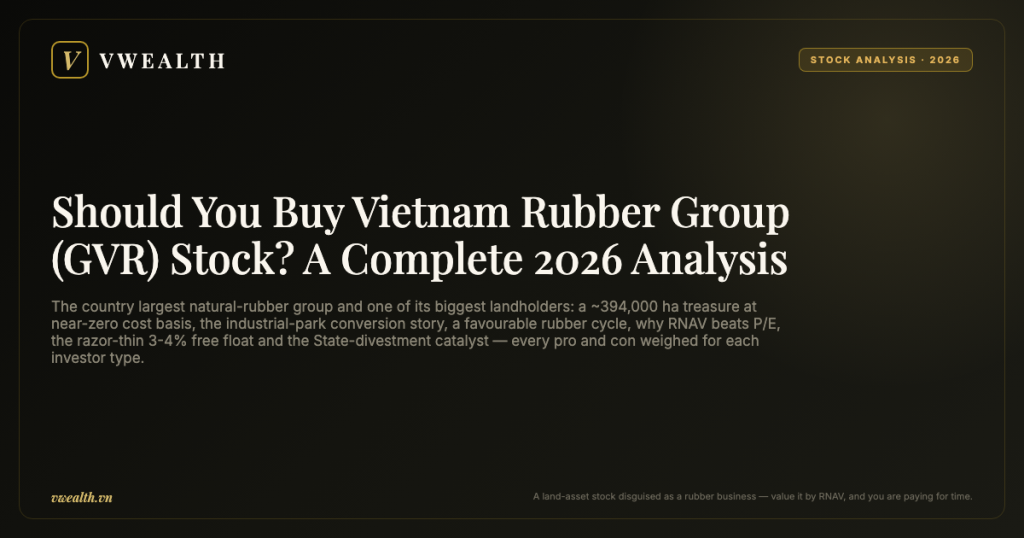
When you look at the ticker GVR — Vietnam Rubber Group (HOSE: GVR) — the first thing that comes to most people minds is the image of endless straight rows of rubber trees stretching across the southeast, and milky-white latex dripping into collection cups at dawn. That is true: GVR is Vietnam largest natural-rubber group, one of the leading natural-rubber producers in the world, with a tradition of more than a century tied to the “white gold” tree. But if you stop at the rubber tree, you miss the most fascinating part of this investment story.
Because the real investment story of GVR isn’t in the latex. It lies beneath the roots of those trees — in the enormous land bank of nearly 395,000 hectares the group holds. This is a “land treasure” in the literal sense: hundreds of thousands of hectares granted by the State from the subsidy era at a cost basis close to zero, and located in some of the most prime positions — Binh Duong, Dong Nai, Ba Ria – Vung Tau, Tay Ninh, Binh Phuoc — right at the heart of the wave of industrialization and the FDI capital flowing into Vietnam. When each piece of low-yield rubber land is converted into an industrial park, a hectare that cost a few dozen million dong can generate profit dozens, even hundreds, of times over. That is why analysts call GVR a “double-benefit” stock.
The year 2025 is vivid proof. GVR shares rose more than 60% from the start of the year — an extraordinary gain for a group-scale state enterprise. The drive came from two sides at once: rubber prices anchored at record highs (the average selling price in the final quarter topped 52 million dong a tonne), and increasingly concrete hopes for converting tens of thousands of hectares of rubber land into high-value industrial land. The business results reflected it: revenue passed 28,900 billion dong (+10%), after-tax profit reached 6,353 billion dong (+32%) — the highest in many years.
So should you buy GVR, and what kind of investor does it suit? This question can’t be answered by a price chart alone. GVR is a special business: at once a commodity-cycle stock (sensitive to rubber prices), a long-term asset story (industrial land), and a state enterprise the State holds nearly 97% of. To understand its true value and true risk, you need to trace history upstream — from the French-colonial rubber plantations, through nationalization and consolidation into a group, to its listing day on HOSE. Every one of those milestones left a mark on today balance sheet, especially in the “land treasure” GVR owns. Let’s begin that journey.
GVR market data (updated 19 June 2026)
| Current price | 35,100đ | 2025 revenue | >28,900 bn (+10%) |
| Change (June) | +0.14% | 2025 after-tax profit | 6,353 bn (+32%) |
| P/E | Land bank | ~22–27x | ~394,000 ha | State | Rubber latex | 96.77% | 76% of rev |
Note: the stock is already up >60% year to date with a high P/E — the story is in the land-asset value (RNAV) unlocked over the long run. Source: VWealth price data + GVR 2025 reports. For reference only.
History and evolution
To understand why GVR owns such an enormous land bank at a cost basis close to zero — an asset no private business on Vietnam stock market can replicate — you must go back more than a century, to when the rubber tree first took root in southern soil. The history of GVR isn’t the history of a company founded and then raising capital. It’s the history of a whole national industry, built up through the colonial era, war, nationalization, then equitization. That very special current shaped the nature of the business you are considering investing in today.
The plantation legacy: the rubber tree and the “hell on earth” of the French era
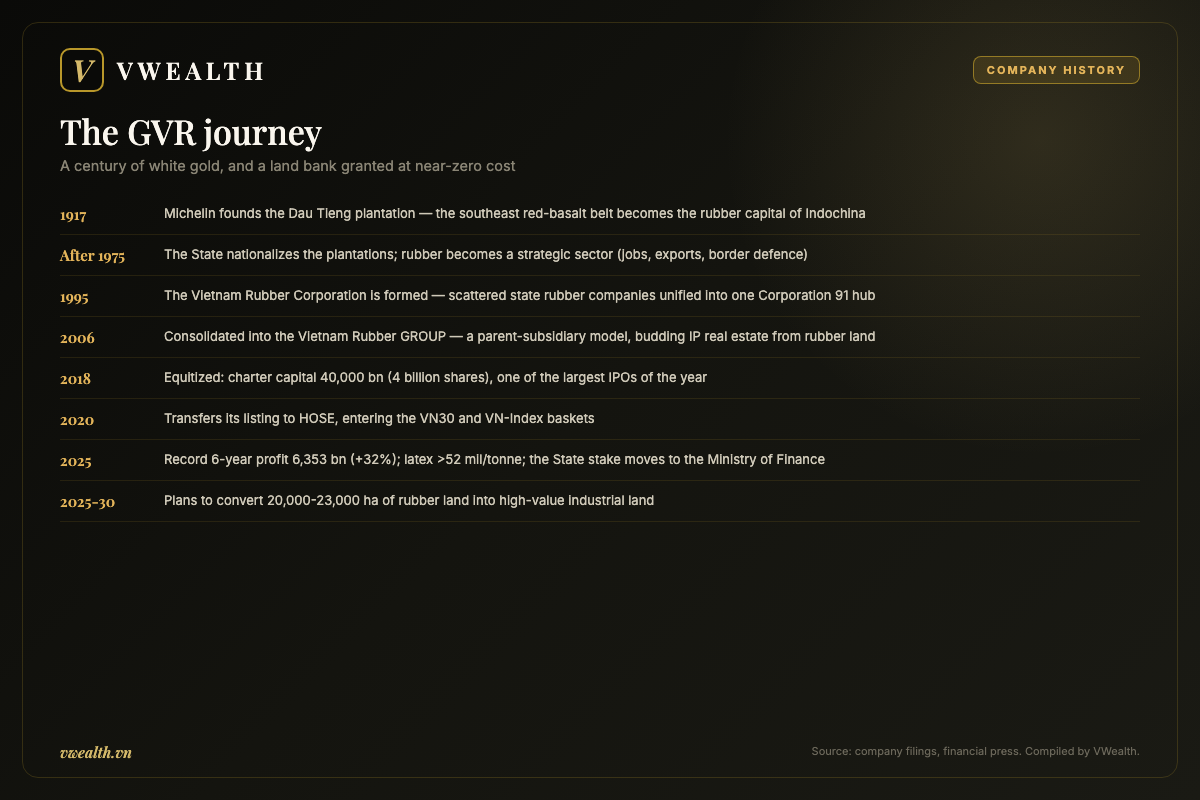
The rubber tree isn’t native to Vietnam. The French brought it in for trial planting from the late 19th century (around 1897), and by the early 20th century, when world rubber demand exploded thanks to the automobile and tyre industries, French capital began pouring into Cochinchina to set up large-scale plantations. In 1917, the tyre giant Michelin founded the Dau Tieng Rubber Plantation — one of the first and largest rubber plantations in the south. The fertile red basalt lands of the southeast — Dau Tieng, Phu Rieng, Loc Ninh, Dong Nai — quickly became the rubber capital of all Indochina.
But behind those neat rows of trees was a painful chapter of history. To get labour, French capital recruited indentured “coolies” from the north and centre, bringing them south under contracts that bound them like slaves. The harsh labour regime — beatings, wage docking, hunger and disease — led people to call the plantations “hell on earth,” with the haunting saying that “every rubber tree that rises has a worker fallen beneath it.” That very oppression gave birth to a struggle movement: the strike by thousands of Phu Rieng rubber workers in 1930 became the famous “Red Phu Rieng” — a landmark in the history of Vietnam labour movement.
Why does this historical detail matter to an investor? Because it explains the origin of the land bank. The vast rubber plantations cleared in the French era — forest cleared, gardens laid out, boundaries drawn — are the physical forerunner of the rubber farms GVR inherits today. Most of the “prime” land in the southeast that GVR holds has a continuous exploitation history of a hundred years. That land wasn’t newly bought, not newly compensated and cleared — it has been in the rubber industry hands for a very long time, with a book value close to zero. That is the starting point of the “treasure” we will discuss in detail later.
Nationalization and the state role: from the General Department to the Rubber Corporation
After national reunification in 1975, the entire system of French and private rubber plantations in the south was taken over and nationalized by the State. The rubber industry became a key economic sector under direct State management, initially through the General Department of Rubber of Vietnam. In this period the rubber tree was positioned not just as an economic crop but as a strategic one: creating jobs for tens of thousands of workers, an export good earning foreign currency, and tied to the task of developing border regions and national defence (many farms lie right along the Cambodian border).
The first institutional turning point came in 1995. Under the Prime Minister Decision 252-TTg, the Vietnam Rubber Corporation was established, gathering the scattered state rubber companies into a unified state corporation on the “Corporation 91” model — the model of large state corporations in the early Doi Moi period. This was the first time the rubber industry had a single centralized business “hub” managing the land bank, the tree gardens and the processing plants nationwide.
You need to remember this “state enterprise” trait, because it is a double-edged sword for GVR stock:
- The upside: As a state enterprise granted land, GVR accumulated an enormous land bank without paying market price to buy it. Its natural-monopoly position in the state rubber industry also gives the group a scale with no domestic rival.
- The downside: The state apparatus tends to run cautiously, land-conversion legal procedures are complex and slow, and decisions must pass many approval levels. The State absolute controlling stake also keeps the free-float ratio very low, affecting liquidity and the rights of small shareholders.
Consolidation into a Group in 2006: shaping the rubber “empire”
The year 2006 marked the most important organizational upgrade. On 30 October 2006, the Prime Minister issued decisions (248 and 249/2006/QĐ-TTg) approving the pilot scheme to form the Vietnam Rubber Group on the basis of the Vietnam Rubber Corporation. The organizational model shifted from a state corporation to a parent-subsidiary model, with a parent company as the head, owning and controlling dozens of member rubber companies and support units.
Becoming a “group” wasn’t just a rename. It reflected a multi-industry ambition: alongside the core of planting-tapping-processing natural rubber, GVR expanded into rubber-wood processing (using up liquidated old trees), rubber industrial products, hydropower, and especially — the budding formation of an industrial-park real-estate segment by converting part of the rubber land. The seed of today investment story was sown right here.
By 2010, the group was converted into a single-member limited liability company owned by the State — a legal-standardization step to move closer to the market mechanism, clearing the way for the later equitization process.
Equitization and listing: GVR reaches HOSE
After years of preparation, GVR entered its equitization phase — one of the largest deals in the state-enterprise sector. In February 2018, the group carried out its initial public offering (IPO), putting out more than 475 million shares (about 11.88% of charter capital). This was one of the largest IPOs in Vietnam in 2018. On 1 June 2018, the group officially converted and began operating as a joint stock company under the full name Vietnam Rubber Group – JSC, with charter capital of 40,000 billion dong (equivalent to 4 billion shares) — a capital scale among the largest on the exchange.
Although the IPO was in 2018, GVR shares initially traded on UPCoM, and only in 2020 did they officially transfer their listing to the Ho Chi Minh City Stock Exchange (HOSE) — the most standard and most liquid exchange in Vietnam. Reaching HOSE put GVR into the major index baskets (VN30, VN-Index), attracting index-fund flows and institutional investors.
One core point you must grasp about the ownership structure: even as a listed joint stock company, the State still holds about 96.77% of GVR capital. The right to represent the State capital was initially transferred from the Ministry of Agriculture to the Commission for the Management of State Capital at Enterprises (CMSC) from late 2018; by 2025, this right was further transferred to the Ministry of Finance. This absolute State controlling ratio has two direct consequences for shareholders:
- Extremely low free-float: Only about 3% of shares truly circulate freely on the market. This makes the share price prone to strong swings on news waves, and the room for outside investors is very limited.
- Every big decision depends on the State owner: Land-conversion plans, divestment, dividends, investment expansion… all need the consent of the State capital representative. This is both a “guarantee” of stability and a barrier to speed.
Why the land bank is the most precious asset: decoding the “treasure”
By now you have enough context to understand why analysts are more enthralled by GVR land bank than by its rubber segment. Let’s fit the historical pieces together.
GVR manages about 394,782 ha of land, spread across the southeast, the Central Highlands, and even Cambodia and Laos. Most of this land bank originates from plantations and farms cleared and assigned for management over many decades, so its book value is close to zero or extremely low. This is the crucial difference: when a private real-estate business wants to build an industrial park, it must spend thousands of billions to buy land, compensate and clear the site at market price. GVR already has the land in hand at a negligible cost basis.
More important than the quantity is the location. GVR key rubber regions — Binh Duong, Dong Nai, Ba Ria – Vung Tau, Tay Ninh, Binh Phuoc — are the most dynamic industrial belt in Vietnam, where FDI capital pours in most strongly and demand to lease industrial land is always tight. Low-yield rubber land sits right beside urban areas, expressways and airports (like Long Thanh airport) — a “prime” quality that even money struggles to buy.
The economics of land conversion explains why this is a “gold mine”:
| Factor | Rubber land (current) | Industrial land (after conversion) |
|---|---|---|
| Value / profit margin | Rubber gross margin ~30%, depends on cyclical latex prices | Industrial-park real-estate gross margin up to ~40% — the highest of all segments |
| Land cost basis | Close to zero (land assigned long ago) | Sold/leased at market price, the huge gap booked as profit |
| Cash-flow durability | Swings with the commodity-price cycle | Long-term, more stable cash flow from leasing industrial land |
In practice, GVR already runs a sizeable industrial-park ecosystem — about 14 industrial parks with more than 4,200 ha, drawing over 820 investors and creating about 260,000 jobs (through member companies like Nam Tan Uyen, Bac Dong Phu and affiliates). The ambition is far bigger: over 2025–2030, the group plans to convert about 20,000–23,000 ha of rubber land into industrial land. New projects keep launching, for example the Hiep Thanh Industrial Park (Tay Ninh) at nearly 495 ha with total capital of about 2,350 billion dong. If even a small part of these 23,000 ha is successfully converted and booked at market price, the potential profit is very large relative to the group current profit scale.
The essence of the GVR story is an “asset transformation”: turning hundreds of thousands of hectares of agricultural land at a cost basis close to zero, located in prime industrial positions, into high-value industrial land. This is something no real-estate business on the exchange can replicate — because no one else has that enormous land bank ready.
However, you also need to stay clear-eyed: this “treasure” is decoded very slowly. Converting land-use purpose must pass planning, multi-level approvals, garden compensation, policy adjustments — a process that can drag on for years and easily fall behind schedule. Potential assets worth tens of thousands of billions of dong still sit mostly as “potential” on paper, not yet fully realized into profit. This is exactly why GVR valuation always sparks a debate between two schools: those who believe in future land value and those who look only at real current profit.
The rubber-price cycle: the short-term driver of 2025
While the land story is long-term, it is the latex price that creates the stock “waves” in the short term — and 2025 was an explosive year. Rubber is a commodity with a clear cyclical nature: prices rise and fall with the global supply-demand balance, the health of the auto industry (tyres take up most of rubber demand), and macro factors like exchange rates, weather and oil prices.
After years of low prices that shrank new planting, the market entered a phase of supply shortage. Natural-rubber prices recovered strongly, pushing GVR average latex selling price to a record high — topping 52 million dong a tonne in the late-year period, up more than 56% year on year. Because the rubber segment still makes up most of revenue (historically over 76%), each dong of latex-price gain flows straight down to profit with very high leverage. The result: after-tax profit in the first half of 2025 jumped 82%, and the full year rose 32% — the highest in many years.
| Metric (2025) | Value | Versus 2024 |
|---|---|---|
| Net revenue | ~28,939 billion dong | +10% |
| Pre-tax profit | ~7,627 billion dong | +36% |
| After-tax profit | ~6,353 billion dong | +32% |
| Average latex price (final quarter) | >52 million dong/tonne | +56% |
But “cycle” also means two directions. Rubber prices can reverse and fall when supply recovers or the global economy weakens and drags tyre demand down. A commodity-cycle stock is usually valued cheaply at a profit peak (because the market knows the profit is hard to sustain) and vice versa. This is why you shouldn’t value GVR simply by P/E in a peak-profit year — that is one of the classic traps with cyclical stocks.
In sum, through the historical journey from the Michelin plantation of 1917, through nationalization after 1975, the Rubber Corporation of 1995, the group consolidation of 2006, the equitization of 2018 and the HOSE listing of 2020, you have seen clearly the portrait of GVR today: Vietnam largest rubber group, controlled almost absolutely by the State, sitting on a “land treasure” of nearly 395,000 ha whose true value has only begun to be released. Two drivers — the short-term rubber-price cycle and the long-term industrial-land conversion — interweave, creating a stock at once attractive and complex. But however great the potential, it depends on the people who run it: those who decide the pace of land conversion, the investment discipline, and the treatment of shareholders. That is why we need to look closely at the group leadership in the next section.
Leadership and State ownership
If you only look at the share price, you might see GVR as an ordinary ticker on HOSE. But to understand why GVR moves slowly, why the group “land treasure” has for years still not fully unlocked, and why small shareholders have almost no voice, you must look at one root trait: GVR is in reality still a state enterprise wearing the coat of a joint stock company. The whole story of governance, decision-making speed and even the rhythm of dividends revolves around this special ownership structure. In this section, let me dissect it carefully with you.
Ownership structure: the State holds almost absolutely
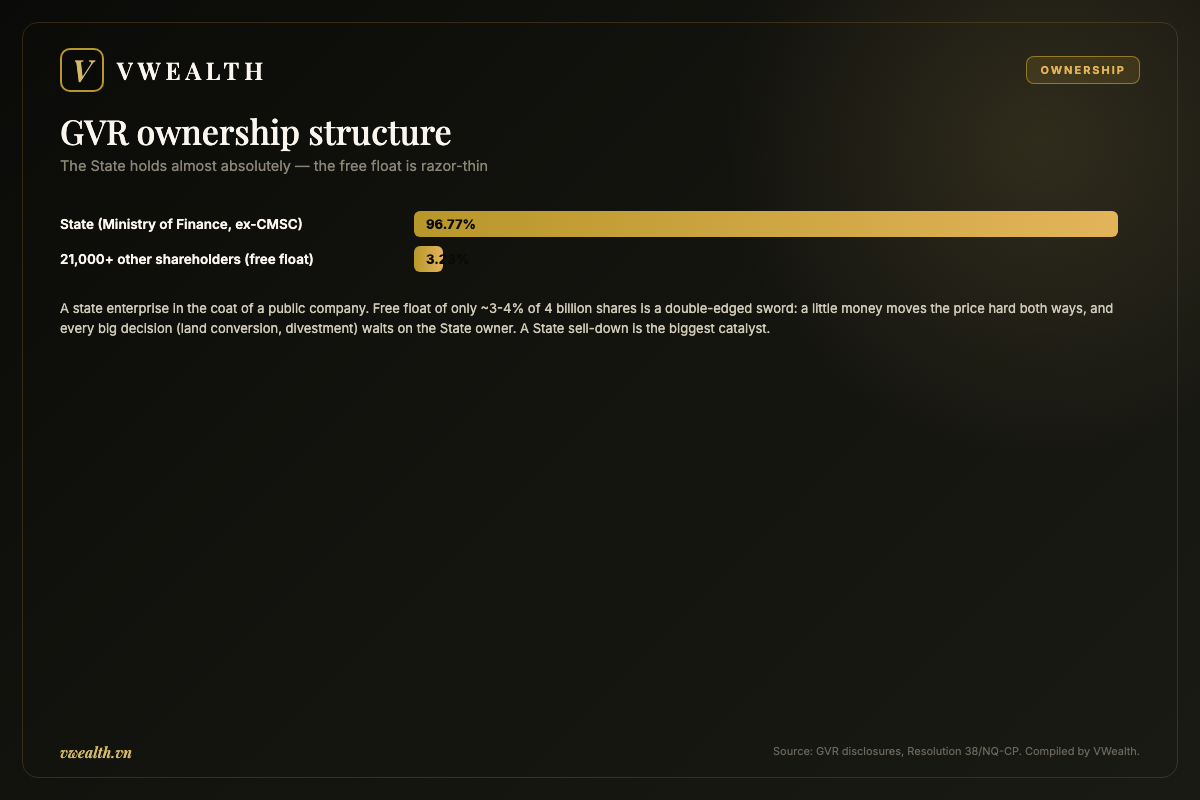
Let’s start with the number most shocking to any investor used to the idea of a “public company.” Per the group own disclosures, the State shareholder holds 96.77% of the voting shares at GVR, while the more than 21,000 remaining shareholders together share a mere 3.23% of capital. With charter capital of 40,000 billion dong (4 billion shares at 10,000 dong par), the truly “floating” portion on the market (free-float) is extremely thin. This is one of the businesses with the highest State ownership ratio on Vietnam entire stock exchange.
There is a detail about the identity of the “State shareholder” you need to grasp so as not to confuse it with old documents. Previously, the right to represent the State capital at GVR was held by the Commission for the Management of State Capital at Enterprises (commonly abbreviated CMSC, or the “super-commission”). However, under the Government Resolution 38/NQ-CP of 2025, the right to represent State capital at 18 groups and corporations (including GVR) was transferred from this Commission to the Ministry of Finance from around late February 2025, tied to streamlining the apparatus and dissolving the Commission for the Management of State Capital. Thus, at the time of writing, the representative of the nearly 96.77% State stake at GVR is the Ministry of Finance. I stress this because many old analysis reports still write “CMSC owns” — in essence the owner is still the State, only the representative agency has changed.
The Ministry of Finance (formerly the Commission for the Management of State Capital) is the State shareholder holding about 96.77% of GVR voting shares; the more than 21,000 remaining shareholders own only about 3.23%. This is the ownership structure of a state enterprise in the true sense, not an ordinary public company. (Source: GVR disclosures, Resolution 38/NQ-CP)
Extremely low free-float: a double-edged sword for investors
This ownership ratio creates a direct consequence you must weigh before putting money in. With only about 3.23% of shares truly circulating freely, the “real” liquidity of GVR is much thinner than it feels. Even a not-so-large amount of capital can push the price to swing strongly — this explains why GVR often has a wide swing range in industrial-park speculative waves, even though most shares sit still in State hands. Low free-float keeps the share supply scarce, so when speculative money flows toward the “land conversion” theme, the price can rise very fast; but when the money withdraws, it falls just as hard.
An interesting legal consequence: because it doesn’t guarantee a minimum 10% of voting shares held by at least 100 investors who are not major shareholders, GVR in fact doesn’t meet the conditions of a public company under the Securities Law. The group once had to disclose this. However, because it is carrying out a restructuring scheme approved by the competent authority, GVR falls under transitional provisions (per Law No. 68/2025/QH15, effective from 1 August 2025) and is not stripped of its public-company status. In other words, GVR is granted a “special dispensation” to keep its listing while awaiting the State to divest along the roadmap.
For you, this has two sides. The positive: if in future the State divests (reducing its ownership to a more reasonable level), the shares released to the market will raise free-float, improve liquidity and possibly attract more foreign funds — a long-term “restructuring” story worth watching. The risk: as long as the State holds almost absolutely, every big GVR decision must follow the process of a state enterprise, and the voice of small shareholders at the general meeting can almost never change the vote result.
Leadership: governing a group of many subsidiaries
On people, you need to know two key positions. Per reports from general meetings and group disclosures, Mr Tran Cong Kha serves as Chairman of the Board, while Mr Le Thanh Hung is CEO of the Vietnam Rubber Group (VRG). Both were elected to these positions at the extraordinary general meeting in early 2022 and have continued to run the group at recent meetings. At the 2026 annual general meeting (held in June 2026), Mr Tran Cong Kha as Chairman was still the one announcing the group main business targets. I note that senior personnel at a state enterprise can change by decision of the ownership-representative agency, so always cross-check the latest disclosure before making a decision.
What makes GVR governance more complex than an ordinary company is the “parent-subsidiary group” scale. GVR doesn’t directly exploit all hundreds of thousands of hectares of rubber, but coordinates through a system of member companies across the southeast, the Central Highlands, and even Laos and Cambodia. Many of these subsidiaries list separately on the exchange, forming a whole “rubber family” familiar to investors:
| Member company (representative) | Role / Note |
|---|---|
| Dau Tieng Rubber | A large single-member LLC, a wide rubber land bank in Binh Duong/Tay Ninh — a potential IP-conversion land source |
| Phu Rieng Rubber | A large tapping unit in the Binh Phuoc region |
| Dong Phu Rubber (DPR) | Separately listed, tied to a series of Bac/Nam Dong Phu IP projects |
| Phuoc Hoa Rubber (PHR) | Separately listed, one of the IP-land “stars” of the rubber family |
| Nam Tan Uyen (NTC) | Runs the Nam Tan Uyen IP — the classic “rubber land into IP” model |
| Ba Ria Rubber, Tan Bien Rubber… | Units tapping and developing land banks by region |
This structure is both a strength and a bottleneck. The strength is that GVR owns (directly or indirectly through subsidiaries) an enormous land bank — the total rubber-garden area of the whole system reached nearly 378,000 ha as of end-2025. The bottleneck is that every big decision on converting land-use purpose must pass many tiers: from the subsidiary, up to the parent group, then to the State ownership-representative agency and the relevant ministries. The more tiers the apparatus has, the slower the decision-making.
The key issue: why the “land treasure” unlocks slowly
This is the most important part to understand if you intend to invest in GVR for the industrial-park real-estate story. The most attractive investment argument for GVR is: the group holds extremely cheap rubber land (State-assigned land for growing rubber), located in prime positions of the southern industrial region; converting just a part to industrial/urban land can multiply the value many times. It sounds very appealing. But the actual execution is much slower than the market expects, and the reason lies in the State-ownership structure and the procedures themselves.
Picture the journey a piece of rubber land must take to “become” an industrial park, roughly through these steps:
| Step | Procedural content |
|---|---|
| 1. Include in the plan | The land area must be added to the local land-use plan and IP development plan — then the locality submits it upward |
| 2. Approve the purpose conversion | Needs a decision approving the conversion of rubber land to industrial/other land — involving many ministries and the Government |
| 3. Appraise the project | Many IP projects must pass the National Appraisal Council, an in-principle investment approval |
| 4. Assign land, price it, financial obligations | Re-determine the land price, land rent/land-use fees, obligations to the State — a very sensitive step because the original land was State-assigned |
| 5. Build infrastructure, lease | Only now the IP-infrastructure and leasing stage — i.e. only now begins booking revenue |
Every step in this chain can “freeze” for quarters, even years, because it depends on the approval pace of State agencies — something GVR leadership itself cannot decide. The leadership has repeatedly admitted at meetings that the conversion roadmap depends on many objective factors, each project has its own roadmap, and the specific timing can’t yet be determined. The risk of “falling behind schedule” in converting rubber land to IP is almost always cited as a standing risk.
To picture the scale and the “slowness” of the story: as of recently, GVR has decisions/approvals to convert about 25,000 ha of rubber land to industrial land in localities like Tay Ninh, Ba Ria – Vung Tau, Binh Phuoc — out of a total of about 40,000 ha added to the provinces IP plans. But the area approved for conversion (about 23,500 ha at one disclosed milestone) is far from the area actually under way (only about 11,000 ha), and different again from the area already leased and earning money. The conversion plan in key areas like Binh Duong and Dong Nai at one point was still awaiting the National Appraisal Council. At the 2026 meeting, leadership said it would deploy investment in many industrial parks from Q3 — i.e. the story is still in the future tense, not the cash flow of the present.
GVR “land treasure” is real, but the key is in the hands of State agencies, not fully in the hands of the executive board. Because the original land was State-assigned and the group is State-controlled, every conversion step must pass planning and multi-level approval — that is why the potential value is “priced in” years ahead on the market, but unlocking it into real cash comes in a trickle and is hard to time.
In other words, the very trait of “State ownership” is both a foundation and a shackle for GVR. The foundation: land assigned by the State at a cost basis close to zero, a near-monopoly position in Vietnam natural-rubber industry, few rivals with a clean land bank of comparable scale. The shackle: to exploit that land value, GVR must queue through the exact process of a state enterprise, unable to be “flexible” like a private real-estate business. If you expect GVR to release land as fast as a private IP developer, you will be disappointed; if you accept this as a long-term accumulation story moving to the rhythm of policy, you will be more patient.
Dividends: a steady cash flow for the patient
In compensation for the slowness of the land story, GVR is fairly “decent” to shareholders on the steady cash dividend — a trait that fits the defensive investor taste well. The group keeps a policy of paying dividends in cash (not diluting with shares) at a stable rate around 3-4% of par a year. Specifically, for financial year 2025, GVR pays a cash dividend of 4% (equivalent to 400 dong a share), with the payment date in December 2025 — a payout of about 1,600 billion dong. For 2026, the group again plans a dividend of at least 4% of par.
With a par of 10,000 dong, 4% corresponds to 400 dong a share. You need to stay clear-eyed: this number sounds “steady and sure,” but calculated on the GVR market price (many times higher than par), the actual dividend yield on your purchase price is usually quite modest — this is not a stock to “eat” a high dividend from, but a stock paying a stable dividend while you wait for the long-term land story to gradually materialize. This defensive trait, plus the State controlling stake, means GVR is often placed in the group of “stable, low blow-up risk” stocks rather than the hot-growth group.
In sum, the governance and ownership picture of GVR can be captured like this: a group the State holds almost absolutely (96.77%, now represented by the Ministry of Finance), extremely low free-float, leadership running an ecosystem of many subsidiaries; owning an enormous “land treasure” but unlocking it slowly because it depends on approval procedures; and compensating for that slowness with a steady cash dividend flow. Once you understand this frame, you will easily evaluate the next part correctly — where I dissect with you the ecosystem and the business segments that truly generate money for the group.
Business segments and the land treasure
If you only look at the name “Vietnam Rubber Group,” you will easily make a very common mistake: assuming this is purely a latex-selling business, rising and falling with farm-produce prices, nothing attractive. But if you stop there, you have missed the most interesting part of the story. GVR is one of the strangest businesses on Vietnam stock market: what makes most of the revenue today (latex) is not what decides the true value of the stock in ten, twenty years (the land bank).
In this section, I will “dissect” each GVR business segment with you, from the traditional core of the rubber tree to the “treasure” investors whisper about: hundreds of thousands of hectares of land right in the heart of the southern industrial capital. I will explain in the most accessible way, even if you are just starting to learn about this business.
1. Natural rubber (latex) — the core that feeds the group today
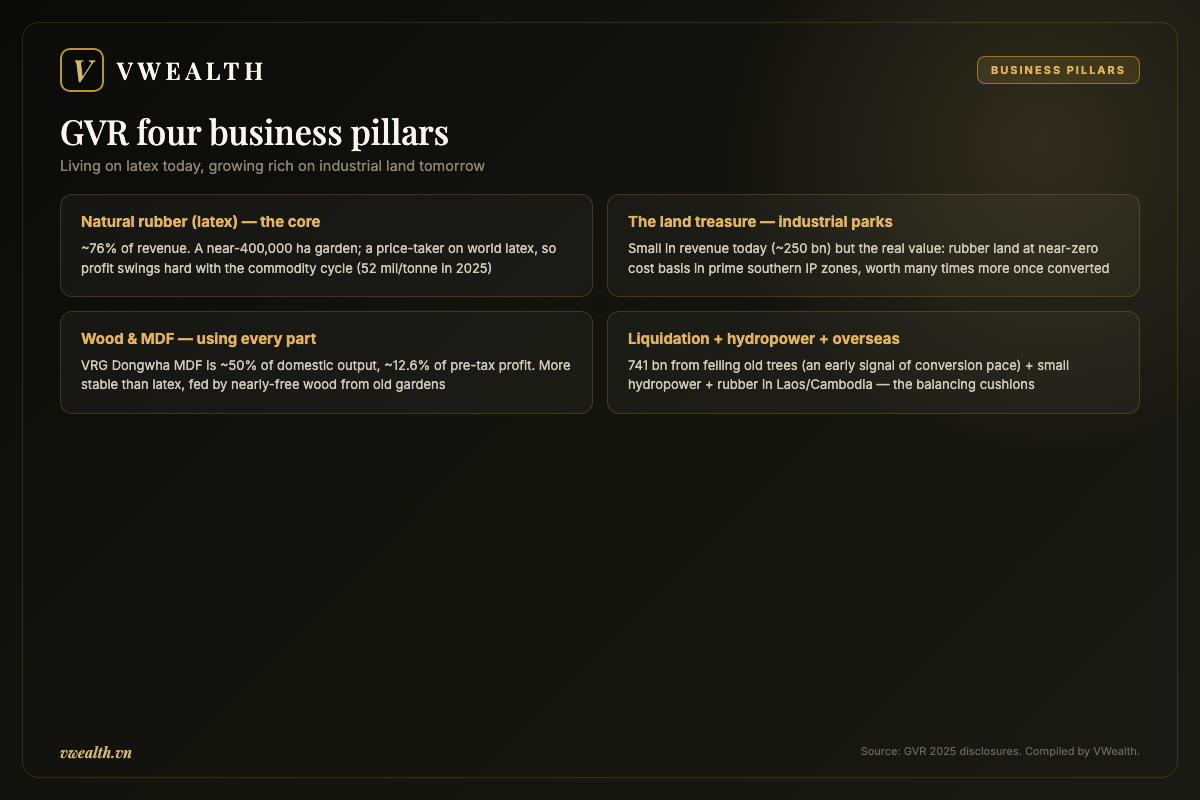
This is the “root” business, the one tied to GVR since its state-corporation days. In 2025, the latex segment contributed about 76% of the group total revenue — in Q1/2025 alone, this segment brought in 4,316 billion dong, 76% of revenue and up as much as 27% year on year. In other words, of every 4 dong of revenue GVR takes in, about 3 dong come from planting, tapping and selling latex.
To picture it, the business model of this segment is fairly simple and very “agricultural”:
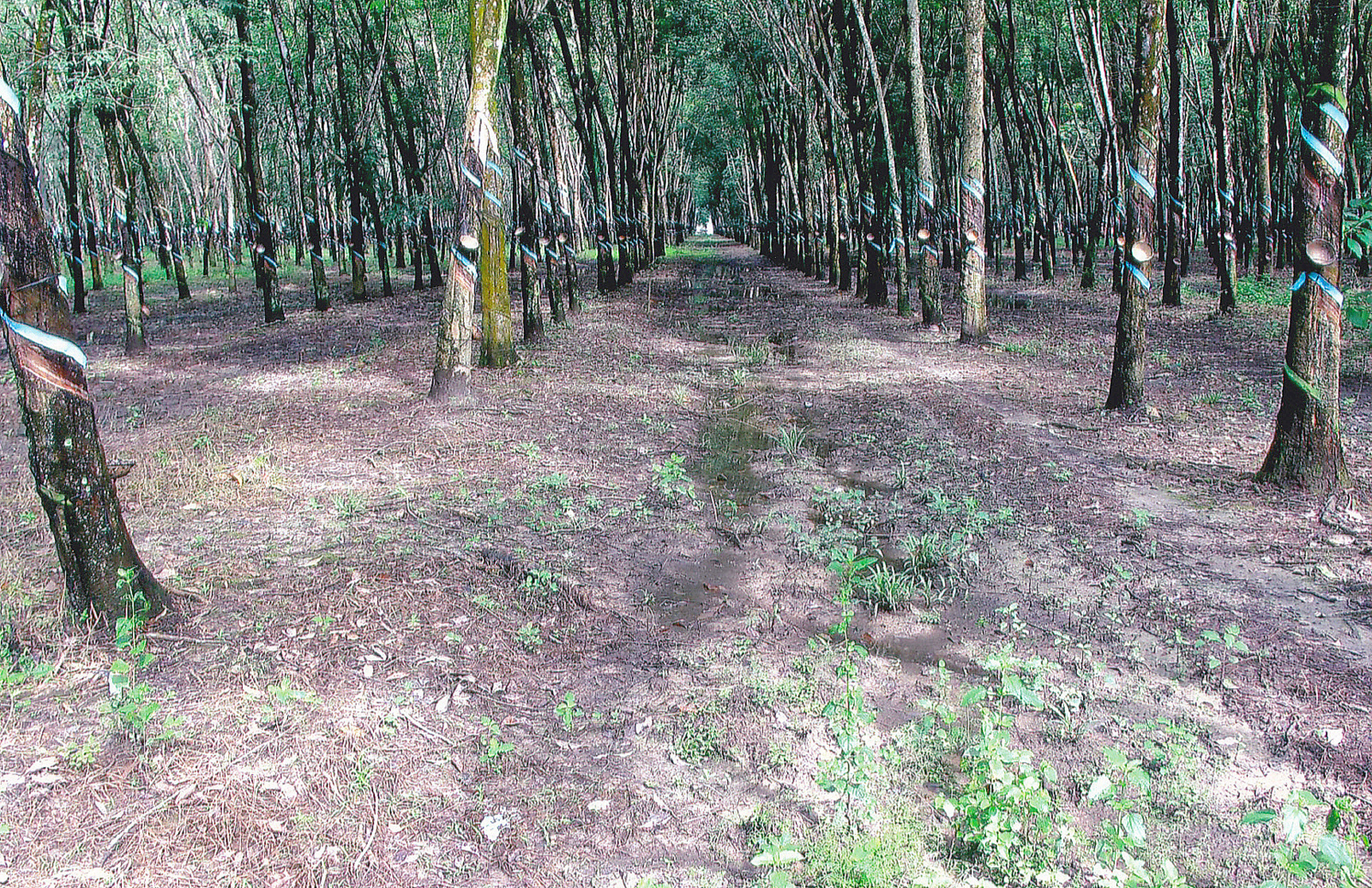
- Planting: GVR owns Vietnam largest rubber-tree garden, with a total area reaching nearly 400,000 hectares (including Vietnam, Laos and Cambodia). This is an enormous number — no other domestic business has such a large concentrated agricultural land bank.
- Tapping: After planting, a rubber tree takes 5–7 years to yield latex, then gives a stable harvest for about 20–25 years. Workers tap latex each early morning, and it is gathered back to the plant.
- Processing: Fresh latex is processed into products like block rubber (SVR), sheet rubber, concentrated latex… to sell to the tyre, glove, foam and industrial rubber-component industries.
- Sales and export: Most of the output is exported, in which China is the largest customer — it consumes rubber to make car tyres for its own enormous domestic market.
The point to grasp firmly about this segment: its profit depends almost entirely on the world rubber price. This is a basic commodity, like oil, steel or sugar — the price rises and falls with global supply and demand and is very clearly cyclical. GVR can’t set its own selling price; it is a “price taker.” When the world rubber price rises, GVR profit balloons very fast because planting costs are nearly fixed; conversely, when the price drops, the margin contracts instantly.
2025 was exactly a year of “favourable heavens.” The average latex selling price reached about 52 million dong a tonne — a high rarely seen in many years, thanks to tight world supply (bad weather in Thailand and Indonesia) while tyre demand recovered. It was thanks to the high anchored rubber price that in the first half of 2025 GVR set a profit record and the full year hit its highest net profit in 6 years.
A lesson for you: when you read a quarter where GVR profits heavily thanks to latex, don’t rush to conclude “the business is growing sustainably.” Ask right away: where is the world rubber price in the cycle? A large part of that profit is a “gift from the heavens” of commodity prices, not intrinsic capability generating itself. This is the core trait of every commodity stock.
The latex segment, therefore, is the “cash cow” providing steady cash flow to feed the apparatus, pay dividends and — most importantly — fund the group long-term ambition. But it is not the reason many large funds bet on GVR. The real reason lies in the next part.
2. The “land treasure” — industrial parks, the real value driver of GVR stock
Now I will tell you the most fascinating part, what analysts call the “story” of GVR.
Let’s return to the nearly 400,000 hectares of rubber land I just mentioned. Where is most of this land bank? The answer makes many investors jump: it is scattered across Binh Duong, Dong Nai, Binh Phuoc, Tay Ninh — the very core of Vietnam most dynamic industrial triangle, where FDI (foreign-capital) factories are fighting over every square metre of clean land to build workshops.
Try thinking with this logic:
- A hectare of rubber land, if used only to tap latex, can generate a few dozen million dong of profit a year — not bad, but not much either.
- But that same hectare, if converted in purpose to industrial land and then leased back to factories, can generate profit dozens, even hundreds, of times over.
This is exactly GVR “magic.” The group holds an enormous land bank at an extremely low cost basis (agricultural land assigned many decades ago), located in prime positions. Each time a piece of rubber land is legally permitted to convert to industrial land, its value “vaporizes” upward geometrically. People compare GVR to a farmer who happens to own a field right on the edge of a swelling city — yesterday paddy land can become hundred-billion frontage land tomorrow.
How does GVR own industrial parks?
GVR doesn’t run all the industrial parks itself, but owns them through an ecosystem of subsidiaries and affiliates — many of them “stars” on the stock exchange with very high margins:
- Nam Tan Uyen (ticker NTC): the “jewel” of the system, owning the Nam Tan Uyen IP cluster in Binh Duong with a total area of over 966 ha, across 3 phases (NTC-1, NTC-2 and the NTC-3 expansion). This is one of the most profitable IPs in the country.
- Phuoc Hoa Rubber (ticker PHR) and Dong Phu Rubber (ticker DPR): both tapping rubber and holding land banks and stakes in many IPs.
- Bac Dong Phu IP, Nam Dong Phu IP (Binh Phuoc), Minh Hung III: projects under way and coming. Bac Dong Phu IP alone has two major shareholders, DPR (51%) and NTC (40%).
- VSIP (Vietnam Singapore Industrial Park): GVR contributes capital to this renowned IP joint venture through Phuoc Hoa, for example a 20% stake in VSIP 3.
The investment logic here is very clear: when you buy GVR stock, you don’t just buy a latex-selling company, but indirectly own a stake in a whole industrial-real-estate “empire” sitting on a gold mine of land.
The pace of “unlocking” the treasure — and why it is slow
If the treasure is so large, why hasn’t GVR grown rich immediately? Because there is a “lock” called legal procedure. Rubber land is agricultural land assigned by the State; to convert it to industrial land requires a series of approval steps: adjusting the land-use plan, the provincial plan, in-principle investment approval, pricing the land-use fee to remit to the State… Each step can drag on for years.
Even so, 2025–2026 is a period when the “lock” is gradually opening:
- To date, about 23,500–25,000 ha of rubber land have been approved for conversion to industrial land — a big legal step forward.
- In 2025, GVR and its subsidiaries were approved to invest in 3 new IP projects (Bac Dong Phu Phase 2, Minh Hung III Phase 2, Nam Dong Phu Phase 2) with a total area of 1,280 ha.
- The group is preparing procedures for about 2,604 ha of IP from converted rubber land, and targets converting up to 20,000 ha in the 2025–2030 period.
This is exactly why the real-estate/IP segment — though still very small in current revenue (in 2025 it grew as much as 75% but reached only about 250 billion dong, a modest figure next to the thousands of billions of the latex segment) — is valued very highly. The market doesn’t pay for today number; the market pays for the potential released gradually year by year. Each time a new IP project is approved, a part of the “treasure” is unlocked and transformed into real cash.
The most correct way to understand GVR: you are valuing an enormous industrial real-estate company “disguised” under the shell of a rubber business. Most of its value is an asset on the balance sheet (a low-cost land bank) not yet fully reflected in annual profit.
3. Wood and wood products (MDF, finger-jointed wood) — using every part of the rubber tree
The next business segment shows how well GVR “uses every part of the fish.” When an old rubber garden (over 25 years) can no longer yield latex, the trees are felled to replant a new batch. But the old rubber trunk isn’t thrown away — it becomes precious raw material for the wood industry.
GVR owns a large wood-processing plant system, the most prominent being VRG Dongwha MDF — a joint venture with the Dongwha group (South Korea). To picture the scale:
- VRG MDF accounts for nearly 50% of MDF output produced domestically.
- The MDF plants in Binh Phuoc, Quang Tri and Kien Giang frequently run above design capacity (at times up to 160%).
- In 2024, the MDF segment contributed about 12.6% of the group total pre-tax profit — a significant and stable share.
MDF is industrial fibreboard used for furniture, kitchen cabinets, flooring… while finger-jointed and refined wood is exported. What is nice about this segment is that it is more stable than the latex segment — less dependent on the rubber-price cycle — and uses a nearly free raw-material source from the group own gardens. This is a “shock absorber” that makes GVR profit less volatile.
4. Rubber-tree liquidation — a steady “hidden” income few notice
This is a small but very interesting detail that many new investors overlook. As said, each year GVR must fell part of its old rubber area to replant. This liquidated wood is sold, creating a cash flow we can call “hidden income” — it isn’t the main business but happens steadily every year like clockwork.
The 2025 figure shows the scale is not small at all: GVR took in 741 billion dong from rubber-tree liquidation, up as much as 88% year on year, plus 86 billion dong from compensation. That 741 billion flows almost straight into profit because the liquidated wood was “planted and depreciated” decades ago.
Why did this income rise sharply in 2025? Because it is tied to the land-conversion story in part 2: as GVR speeds up shifting rubber gardens to IPs, it must fell trees on those areas, driving up the volume of liquidated wood and compensation. In other words, the liquidation income is an “early signal” that the land-conversion machine is accelerating. Track this number and you can partly guess the rhythm of “unlocking the treasure.”
5. Other segments — hydropower, high-tech agriculture, overseas rubber
Beyond the four main pillars, GVR has some support segments that help diversify income and use the available land bank and infrastructure more efficiently:
- Hydropower: the group invests in some small and mid-sized hydropower plants, using the terrain in rubber-garden regions. This segment isn’t large but gives stable cash flow with low risk.
- High-tech agriculture: a new direction, trialling high-value crops, livestock or technology-applied agriculture on part of the land bank — both exploiting the land and probing a future model.
- Rubber in Laos and Cambodia: GVR has tens of thousands of hectares of rubber planted in the two neighbouring countries, expanding the raw-material zone across Vietnam borders. Notably, the liquidated rubber-wood source from Laos and Cambodia (estimated up to about 30 million m³) is also being counted on to serve the MDF wood industry — once again showing the group “use everything to the max” thinking.
These segments individually don’t change the overall picture, but together they help GVR have a more balanced financial picture, not “putting all its eggs in one basket” that is the latex price.
To close: “living on latex today, growing rich on IP land tomorrow”
If I had to sum up the entire business portrait of GVR in one sentence, I would say it to you like this: GVR lives on latex today, but will grow rich on industrial-park land in the future.
More specifically:
- Today: ~76% of revenue comes from latex, with profit rising and falling with the world commodity cycle. This is the part that “feeds” the group, generating cash flow and dividends.
- The future: the true value lies in the nearly 400,000 ha land bank in prime positions, gradually converting into IPs with profit many times over. This segment is still small in revenue but is the “story” pricing the stock.
- The cushion: the stable MDF wood segment and the steady tree-liquidation income help reduce the fickleness of the latex price.
Understanding this split is the key to investing in GVR clear-headedly: don’t let a quarter of heavy profit from the latex price make you overly euphoric, and don’t let a weak latex quarter make you pessimistic — because most of the long-term value of the business is “sleeping” in those rubber forests, awaiting the day they convert to workshops.
Of course, a beautiful business picture still needs verifying with concrete financial-health numbers: how much debt GVR carries, whether its cash flow is truly healthy, how far the current valuation has reflected the “land treasure,” and what risks could slow the conversion story. That is exactly the content I will unpack with you in the next part — GVR position and financial health.
Position and financial health
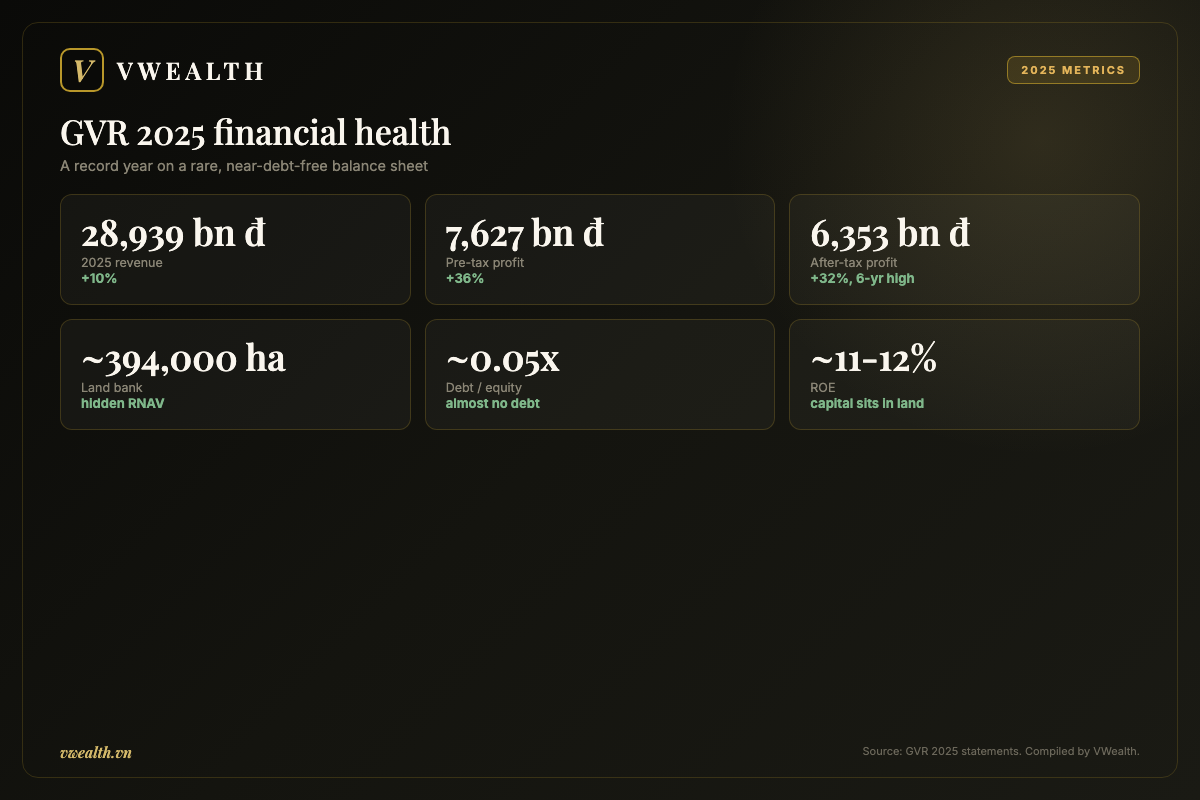
If you look at GVR through a single number, you will misunderstand this business. In 2025, Vietnam Rubber Group reported consolidated revenue of over 28,900 billion dong (up about 10%), pre-tax profit topping 7,600 billion dong (up as much as 36%) and after-tax profit reaching 6,353 billion dong — up 32% and a record in the group history. Those are very beautiful numbers. But in that very same year, Q4/2025 profit alone fell nearly half versus prior quarters, as the world rubber price cooled from its peak. Those two facts sit side by side, and the gap between them is exactly what you need to understand before valuing this stock.
This part will split GVR into three layers: its “kingpin” position in the rubber industry, the real driver behind the record 2025 profit, and the hidden-asset layer — the nearly 394,000 ha land bank — which is the deeper reason the market values GVR higher than an ordinary agricultural business. With each layer, you will see both the bright side and the risk, because the GVR story is one of “great value but slow to unlock.”
Position: Vietnam number-one rubber group and one of the country largest landholders
First, let’s position who GVR is correctly. This isn’t one rubber company among many — it is the largest rubber group in Vietnam by both garden area and annual latex output. The group manages a land bank of about 394,000 ha stretching across the southeast (Binh Duong, Dong Nai, Ba Ria – Vung Tau, Tay Ninh) and expanding into Laos and Cambodia. This scale makes GVR not only the head of the latex industry, but naturally one of the largest private-State landholders in the country.
That position gives GVR three advantages you should remember. First, the garden scale creates a stable latex cash flow lasting many decades — a rubber tree yields latex for about 20-25 years before liquidation. Second, as a business with a State controlling stake, GVR has a special advantage in accessing and converting land-use purpose — something a private real-estate developer could hardly accumulate over many lifetimes. Third, GVR subsidiary ecosystem already has IP-building units (like the member companies running IPs in the southeast), meaning the group not only “has land” but also “knows how to exploit land.”
Remember one short sentence: GVR is both a basic-commodity producer (latex, cyclical) and a holder of an enormous land treasure (long-term accumulation). Valuing this stock is the problem of adding two very different natures together.
The 2025 profit driver: why the record, and why Q4 reversed
The record 2025 profit didn’t come from a governance miracle, but from three fairly clear sources, of which the largest is also the most volatile.
- High cyclical rubber prices. This is driver number one. GVR average latex selling price in the first half of 2025 reached about 52 million dong a tonne, well above the ~43 million average of 2024. When the price rises sharply while garden costs are nearly fixed, the gross margin of the latex segment bursts out very fast — the gross profit of latex and rubber products in the first half rose as much as 55% year on year, taking up most of the whole group gross profit. This high price base was supported by a world rubber-supply shortage (estimated at about 500,000 tonnes short in 2025).
- Rubber-tree liquidation. Each year GVR replants part of its old garden area, and the liquidated rubber wood brings a significant income at almost no additional planting cost. This is a “by-product” cash flow, but a steady one.
- Industrial parks and land-conversion compensation. Income from leasing IP land and compensation when handing over rubber land for infrastructure/IPs contributes a high-quality profit layer, less dependent on commodity prices.
The problem is: among the three sources above, the largest — the rubber price — is also the one you can’t control and swings with the global commodity cycle. Right at the price peak, profit explodes; when the price adjusts, profit contracts very fast. Q4/2025 is the vivid illustration: as the rubber price cooled from its peak, one quarter of group profit fell nearly half. The same business, the same land bank, the same apparatus — but the quarterly result can differ by a factor, just because the price of one commodity changed.
You need to read this cyclicality as a structural trait, not an accident. The latex-segment profit will always rise and fall with the world price, and “super-profit” years like 2025 shouldn’t be extrapolated straight into an annual profit baseline. This is the clearest short-term risk of GVR: an investor buying at the peak of the rubber-price cycle, expecting peak profit to last forever, very easily overpays.
The enormous hidden value from land: the RNAV treasure and why it unlocks slowly
If the latex segment is the “visible” and volatile part, then the nearly 394,000 ha land bank is the “hidden asset” that explains why the market is willing to pay a high valuation for GVR even when annual profit isn’t very large.
The crux lies in accounting. Most of this rubber-land area is booked at an extremely low historical cost — the value from many decades ago, when agricultural land had almost no meaningful market price. But if part of that area is converted to industrial or urban land in the key southern industrial provinces, the market value can be many times the book number. Conversion compensation is estimated in the range of 1 – 2.5 billion dong a hectare depending on the project, while the book price of the same area is nearly negligible. This is exactly why analysts usually value GVR by the RNAV method (Revalued Net Asset Value) rather than just P/E — because a P/E based on current profit would completely miss the value layer sitting still in the land.
The group has a concrete roadmap: converting several thousand hectares of rubber land to IP land over 2025-2030 (disclosed plans mention about 3,444 ha in the first phase and a long-term vision of tens of thousands of hectares, of which over 20,000 ha are already planned for IP direction), plus the ambition to access more land in the expanded Ho Chi Minh City. On paper, this is one of the largest and cheapest “clean land banks” ready for Vietnam industrial-real-estate wave.
But here is the most important “but” of the whole article: this enormous land value is still mostly NOT realized. The legal procedure for converting rubber land to IPs in Vietnam is very slow and depends on the planning of each locality, each period. A hidden asset remains a hidden asset until there is a legal decision, compensation actually received and the land put into exploitation.
The consequence for you as an investor is: the market is valuing GVR largely on expectation of unlocking land, not on already-certain cash flow. When the legal side is favourable and a big project is compensated, the stock usually reacts strongly; when the conversion pace slows, the “expectation” portion in the price can deflate fast. The value is real and very large, but the timing of unlocking isn’t in the business hands — that is the core trade-off of holding GVR.
Financial health: a rare healthy balance sheet
One thing that makes GVR cyclical risk far more “bearable” than other commodity businesses is the health of its balance sheet. If the rubber-price cycle is the weakness, the financial structure is the support.
GVR barely depends on borrowing. Its leverage ratio (debt/equity) stays very low, only about 0.05 times — i.e. equity is many dozens of times the outstanding debt. Total debt has fallen sharply to a multi-quarter low. On the other side, the group holds very abundant cash and deposits: net cash at end-2025 was very high, and cash and deposits kept rising into early 2026 on a consolidated total-asset base of tens of thousands of billions. A business with almost no debt, sitting on a mountain of cash and owning a low-cost land block — that is a very strong defensive financial configuration.
This configuration matters because it creates several layers of mutually supporting cash flow:
- Latex cash flow – large but swings with the price cycle.
- Rubber-wood liquidation cash flow – steady, little dependent on the latex price.
- Dividends and profit from IP subsidiaries – high-quality, stable, a counterweight to the cyclical part.
- Land-conversion compensation – uneven but each amount very large.
On profitability, GVR ROE is in the roughly 11-12% zone (recorded around 11.85% at Q3/2025). This isn’t very high next to hot-growth businesses, and partly reflects that a large amount of GVR capital is “sitting still” in low-book-value land not yet generating matching profit. This is a very GVR two-sided view: a modest ROE is both a weakness (capital not efficiently exploited) and the very proof of the hidden-asset argument (that land block, if unlocked, would pull efficiency up). Besides, GVR has a tradition of paying steady cash dividends over many years, fitting the taste of investors who prefer stability.
| 2025 financial metric | Value | Meaning |
|---|---|---|
| Consolidated revenue | > 28,900 billion dong (+10%) | Industry-leading scale, up on latex prices |
| Pre-tax profit | > 7,600 billion dong (+36%) | A strong jump on the rubber-price cycle |
| After-tax profit | 6,353 billion dong (+32%) | A record in the group history |
| Q4/2025 profit | Down nearly half | A cyclicality warning — latex prices cooled |
| Land bank managed | ~394,000 ha | A hidden RNAV asset, booked at low cost |
| Debt/equity leverage | ~0.05 times | Almost no debt — very safe |
| Cash & deposits | Very abundant (record-high zone) | A defensive cushion for the price cycle |
| ROE | ~11-12% | Modest — much capital still sits in land |
Summary: great value, but patience is a mandatory condition
Combining the three layers, the GVR picture is fairly clear and balanced. You are looking at an absolute industry leader, a rare healthy balance sheet with almost no debt and a large cash pile, owning an enormous cheaply-booked land treasure that could become an enormous profit source in the future. That is the attractive part. But at the same time, the group core profit still depends heavily on the cyclical rubber price — which Q4/2025 reminded you doesn’t peak forever — and the largest land-value layer unlocks slowly, depending on legal factors beyond the business control.
In other words, GVR is an investment story of patience: the value is real and very large, but it is paid out gradually over time and along the pace of land conversion, not arriving in one quarter. An investor buying GVR for the “land treasure” hope needs to be prepared to go through quarters of profit swinging with the latex price, and to measure success in years, not months. It is precisely this special mix — an enormous hidden asset plus cyclical risk and legal lag — that keeps the market looking at GVR with an eye both eager and wary. How the market receives and prices this stock, with all the hope and doubt attached, will be the next content.
Market reception
By now, you understand what GVR does and how it makes money. But there is one question every investor before the board must answer for themselves: at the price of 35,100 dong on 19 June 2026, is GVR stock expensive or cheap? And more importantly — what is the market paying for when it buys GVR? This part will dissect how the market values Vietnam Rubber Group, because if you use the wrong yardstick, you will conclude entirely wrongly about this stock.
Let’s start with a shocking number. In 2025, GVR earned after-tax profit of 6,353 billion dong, up 32% year on year — a very beautiful result. Consolidated earnings per share (EPS) fell into the range of 1,300-1,600 dong. Dividing the 35,100-dong price by this EPS gives a P/E of about 22-27 times. This is the valuation of a hot-growth stock, not of a business planting rubber trees for latex. If you look only at profit, GVR is unreasonably expensive. But the market isn’t “crazy” — it is valuing GVR by an entirely different logic. Understanding that logic is the key to this whole stock.
Why GVR P/E is so high — and why P/E is the wrong yardstick
First, let’s be honest with each other about the number. GVR charter capital is 40,000 billion dong, par 10,000 dong a share, so the group has exactly 4 billion shares outstanding. This is one of the businesses with the largest number of shares on HOSE. With after-tax profit of 6,353 billion dong in 2025, divided evenly across 4 billion shares, each share “carries” about 1,588 dong of profit. However, because part of the profit belongs to minority shareholders at subsidiaries, the EPS attributable to parent shareholders is in fact lower — the disclosed report shows basic EPS of about 1,312 dong for 2025. Whichever number you take, the result is still a P/E in the 22-27 times zone.
To help you picture how “expensive” this level is: a traditional industrial-manufacturing business in Vietnam is usually valued at a P/E of 8-12 times. The VN-Index generally trades around a P/E of 13-15 times. A pure rubber stock — living on latex prices rising and falling with the commodity cycle — should be valued at a P/E below the market average, because its profit is less stable and depends on something beyond leadership control: the world rubber price. Yet GVR is priced at nearly double the general level. Why?
The short answer: the market doesn’t buy GVR for the rubber tree. The market buys GVR for the land beneath those rubber trees. And land doesn’t appear at its true value in the profit statement — so P/E is entirely not the right yardstick to measure this stock.
This is the crux where many new investors get stuck. P/E (Price to Earnings) measures how much you must pay to buy one dong of current profit. It is a wonderful yardstick for businesses whose value lies in the cash flow they generate each year — banks, consumer goods, retail. But with GVR, most of the value doesn’t lie in this year latex profit, but is “frozen” in an enormous untapped asset: nearly 395,000 ha of land. Profit from selling latex is only the small tip of the iceberg. Using P/E to value GVR is like valuing a prime downtown plot by the monthly rent someone currently collects on it — you would value it dozens of times below its true value, or conversely, see a high P/E and think it expensive.
RNAV — the true yardstick of a “land-asset” stock
If P/E is wrong, which yardstick is right? The answer professional investors use for GVR is RNAV — short for Revalued Net Asset Value. It sounds technical, but the idea is very simple and you will grasp it right away.
Imagine your grandparents left you a wide garden on the outskirts, bought long ago for just a few dozen million dong. On the family books, the garden is still recorded at a few dozen million. But now the area is about to be zoned as an industrial park, and its actual market price is already a few dozen billion. If someone asks “how rich is your family,” you wouldn’t answer with the old-book number — you would answer with the current market price of the plot. That is exactly the spirit of RNAV: take all the business assets, revalue them at today market price (instead of the book price from years ago), add them up, then subtract debts. The remaining number is the true value of the business.
With GVR, “the grandparents garden” is nearly 395,000 ha of rubber land — a land bank analysts commonly call the “treasure” (why they call it that, you will see right below). On the accounting books, most of this area is recorded at the original cost of planting trees decades ago, nearly zero versus its true value. But if a hectare of rubber land is permitted by the State to convert to industrial land, its value can leap from a few hundred million to tens of billions of dong. That gap between “book price” and “potential market price” is exactly the value investors are betting on — and that is why they are willing to pay a P/E of 25 times for latex profit, because they are in fact paying for the RNAV of the land, not for the latex.
To show you the full picture, here is a comparison of two ways of valuing GVR at the 35,100-dong price:
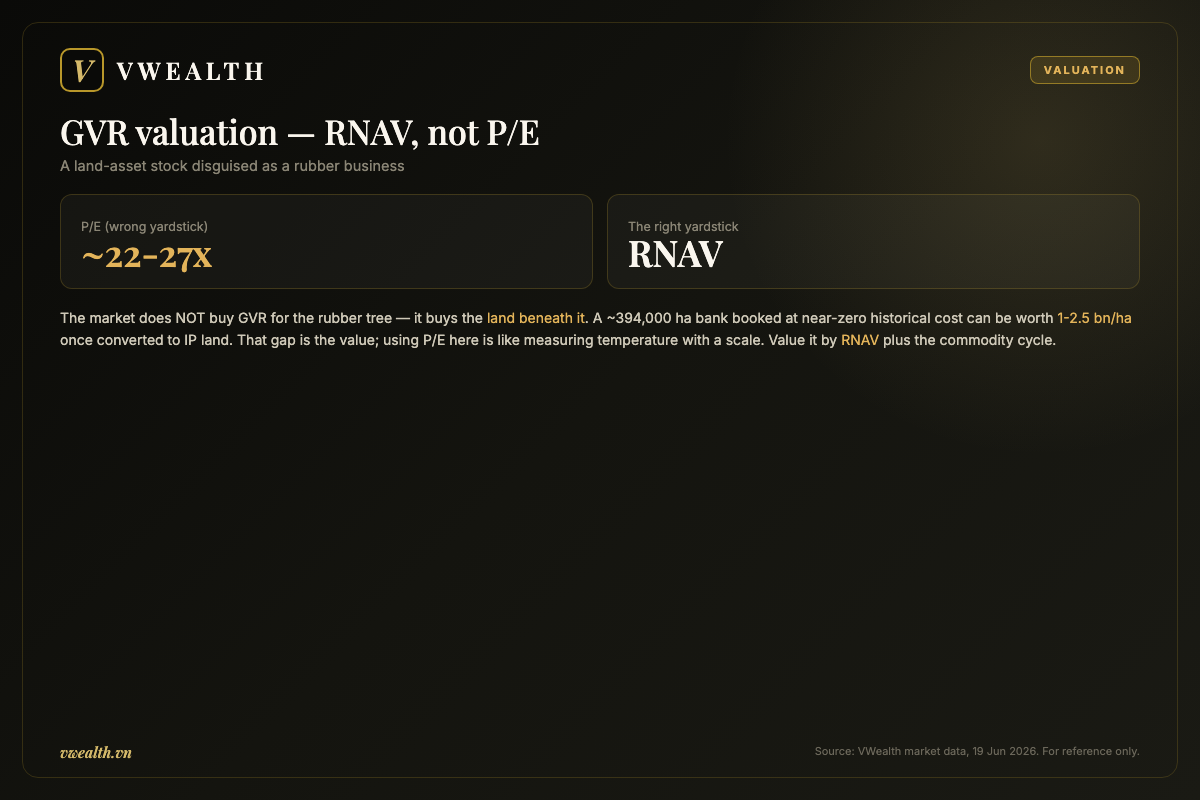
Read the chart above carefully. From the P/E (profit) view, GVR is “expensive.” From the RNAV (land-asset) view, the story is entirely different — and that is the view most of the big money is using. When you hear someone say “GVR is too expensive, P/E all the way to 25 times,” you now have enough knowledge to understand that person is using the wrong yardstick — like measuring temperature with a scale.
The 395,000-ha land “treasure” — the story that drove the price up more than 60%
Now let’s talk about the price action, because it tells you exactly what the market expects. From the start of 2025 to mid-2026, GVR stock rose more than 60%. There was even a phase where the stock rose up to 63% in just two months, and set a historic peak of 46,500 dong in early March 2026 before correcting to the 33,000-35,000 zone. A very large-cap stock in the VN30 group rising so hot must have a very strong story behind it. That story has three interwoven layers:
- Layer 1 — high rubber prices: This is the most “real” driver, coming from tangible profit. The world natural-rubber market is short about 500,000 tonnes in 2025, and the shortage is forecast to spread to 2030. Short of goods means rising prices. GVR natural-rubber segment alone in the first 5 months of 2026 grew revenue up to 72% year on year, taking 84% of total revenue. Real profit rose on latex prices — this explains why 2025 profit rose 32% and the first 5 months of 2026 rose more than 30%.
- Layer 2 — the industrial-land conversion story heating up: This is the driver that made the price “fly.” FDI capital is pouring strongly into Vietnam and foreign investors need clean industrial land to build factories — while the IP land bank in the key southern provinces grows ever scarcer. GVR holds nearly 395,000 ha of rubber land, many positions right in Binh Duong, Dong Nai, Tay Ninh, Ho Chi Minh City — the industrial capitals. The group plans to convert over 23,000 ha of rubber land to IP land over 2025-2030, with the Ho Chi Minh City proposal alone up to about 7,000 ha across 10 IPs. Each hectare successfully converted is one time the “treasure” turns into real money.
- Layer 3 — the “public-land” stock wave: GVR didn’t rise alone. In this period, the whole market had a wave of hunting for state enterprises holding large land banks at cheap book prices — hoping for restructuring, asset revaluation, land-value realization. GVR is the “star” of that wave because it holds one of the largest land banks on Vietnam stock market. On top of that, the Government directives on restructuring State capital poured more fuel on the hope.
You need to look straight at the essence: most of this 60% gain is a rise on expectation, highly speculative, not a rise on profit already realized from land. Real profit rose 30% — beautiful, but not enough to explain a 60% price gain and a P/E vaulting to 25 times. The gap is exactly the “price of the treasure dream.” And a dream can come true, or it can be delayed many years. Notably, by May 2026 some large analysis firms like SSI Research had shifted to a cautious view, arguing the GVR price “has fully reflected the expectation” — a warning signal that the easiest part of the wave may be over.
Risks you are not allowed to overlook
A stock valued on expectation always comes with the risk the expectation doesn’t materialize. With GVR, you need to pin these risks into your head:
- Slow land conversion: Converting rubber land to IP land is a long legal process, through many approval levels, planning and compensation. The “treasure” may be real, but how long it takes to open the vault is an unknown. Each year of delay is a year the market loses patience, and the price can correct sharply.
- Rubber prices reversing: GVR “real” profit layer depends on the high latex price being in a high zone. Rubber is a cyclical commodity. If the rubber price turns down, profit falls, EPS drops, and the P/E already at 25 times will be “inflated” even higher — triggering a wave of sell-off.
- Valuation already stretched: When an institution like SSI says “the price has fully reflected the expectation,” it means the room to rise on good news is narrow, while the room to fall on bad news is large. Buying at a high zone after a 60% gain is buying when the reward/risk no longer tilts in your favour.
Steady dividends but extremely low free-float — a double-edged sword
GVR pays cash dividends fairly steadily. The 2025 dividend plan is 4% (equivalent to 1,600 billion dong distributed to shareholders), i.e. 400 dong cash a share. At the 35,100-dong price, the dividend yield is only about 1.1% — low, because the price has run too far. Even in years of higher dividends (4-6%), at the current price level GVR is still not a stock you buy for the dividend. The dividend here is a “bonus” for the long-term holder, not the main reason to invest.
But there is a structural trait you must understand, because it directly affects how the GVR price moves: the State holds up to 96.77% of capital. This means the ratio of shares truly free to trade on the market (free-float) is only about 3-4%. Of the 4 billion shares, only a very small part truly “floats” to trade.
Low free-float is a double-edged sword. The first edge: even a moderate amount of money flowing in is enough to push the price up strongly — this is part of the reason GVR could rise a hot 60%. The second edge: when the money withdraws, the price falls just as fast and deep, because there aren’t enough shares to absorb the selling. GVR is therefore an enormous-cap stock that swings unusually hard — a paradox you need to prepare for mentally.
Foreigners and the “detonator” of State divestment
The very low free-float in turn opens the biggest catalyst of the GVR story: State divestment. Under the rules on the ratio of freely transferable shares for a public company, the State needs to reduce at least 6.77% of capital at GVR — equivalent to nearly 271 million shares — to bring ownership below the threshold and raise free-float. This isn’t a rumour: the State capital management agency (CMSC) had a plan and the group once held an extraordinary meeting on it.
Why is this a big catalyst? Because when the State sells off a large volume of shares, a series of positives can happen at once: higher free-float helps the stock qualify for international index baskets, drawing ETP-fund flows; better liquidity attracts more institutional investors; and land-asset revaluation is usually sped up to serve the divestment. Foreigners have also taken notice — this group has continually net-bought GVR recently, betting mainly on this scenario. If divestment happens at a good price, it could be the “detonator” for a new wave. But conversely, if divestment is delayed — as it has been many times — then the expectation being priced into the stock will deflate.
To close: GVR is a bet on two things, valued by RNAV not P/E
Let’s wrap this whole part so you carry away a clear conclusion. When you buy GVR at the 35,100-dong zone, you don’t buy a rubber business with a P/E of 25 times. You are betting on two things in parallel:
- First — the realization of the land “treasure.” You bet that nearly 395,000 ha of rubber land, especially the part in the key industrial provinces, will gradually convert into high-value IP land, turning the cheap book value into real money. This is most of GVR value, and it can only be measured by RNAV.
- Second — the rubber-price cycle. You bet that the natural-rubber price stays high or rises further thanks to supply shortage, keeping the “real” profit beautiful while awaiting the land treasure to open.
Add the spice of the State-divestment catalyst and foreign-money flows that can flare up at any time — but can also be delayed long. And overarching everything is the risk of a stock with only 3-4% free-float: violent swings in both directions.
In other words: GVR is not a stock to value by P/E, but a “land-asset stock” that must be valued by RNAV and the commodity cycle. Whoever uses the wrong yardstick will either miss it for seeming “expensive,” or dive in without understanding they are paying for a dream, not for today profit. To judge how well-grounded that dream is, you need to step outside the stock itself and look at the big picture: the context of the rubber industry, the FDI wave and the whole economy thirst for industrial land — which is the content of the next part.
Economic context, the rubber industry and industrial parks
To understand why GVR stock could rise more than 60% from the start of the year to climb to the 35,100-dong zone, you can’t look only at the group own financial report. GVR is a business standing right at the intersection of three big currents moving at once: the world rubber price in a favourable cycle, the supply-chain-shift wave pouring FDI into Vietnam, and an enormous land bank gradually being “untied” to convert to industrial parks. This part will dissect each of those currents, because it is they — not a single quarter profit number — that decide your investment story with GVR over the next 5–10 years.
The world rubber price: a short-term variable but standing on the favourable side
First, you need to distinguish clearly: for GVR, the rubber price is a short-term, cyclical driver, while industrial-park land is the long-term, structural driver. But don’t therefore make light of the latex price, because it is still the cash-flow source feeding the group and the thing that most directly affects the quarterly profit the market watches daily.
The good news is that rubber is clearly in a favourable price cycle. GVR average selling price anchors around ~52 million dong a tonne — a high zone versus the many lean years before. This isn’t accidental, but comes from a structural supply-demand imbalance on the world market:
- Supply shrinks over the long run. Most of the rubber area in Southeast Asia was planted decades ago, and now the share of trees over 30 years old is very high, with declining yield. The ability to raise global supply in 2026 is assessed as extremely limited — supply is forecast “stable but trending to shrink.”
- Weather is a surprise boost. Severe flooding in Thailand — the world largest natural-rubber producer — disrupted output and raised concern about global supply. Early-2026 estimates show the market short about 400,000 tonnes.
- Tyre demand and China keep the rhythm. China depends more than 80% on imported rubber, and its imports in the first 11 months of 2025 reached nearly 5.87 million tonnes, up nearly 17% year on year. Rubber demand in China is still led by the tyre industry, especially replacement-tyre demand — a stable source, little dependent on new-car sales.
The result is that rubber prices in Northeast Asia have continually set peaks in 2026, at one point climbing to ~2.66 USD/kg with a cumulative year-to-date gain of over 15%. International analysts even compare the rubber market to a “compressed spring”: supply structurally too low, demand recovering, and any additional signal (weather, China, logistics) could trigger a new price rally.
Remember the two-sidedness: a favourable cycle keeps the latex price high and pushes profit up, but rubber is also a basic commodity — meaning what can rise can also fall. When the price reverses, GVR latex-segment profit can drop very fast within a single quarter, and this is the biggest risk on the existing cash-flow side.
EUDR – the EU anti-deforestation law and the traceability advantage
There is a variable many individual investors overlook but that is reshaping the power map of the global rubber industry: the EU Deforestation Regulation (EUDR).
EUDR requires that every product in seven commodity groups — including natural rubber — sold into or exported from the EU market must prove three things: the product doesn’t cause deforestation (after the 31/12/2020 milestone), is produced legally under the law of the country of origin, and has a Due Diligence Statement proving the business has traced the origin to each plot of land with geographic coordinates. After many delays, the application date for large businesses was pushed to 30/12/2026, and to 30/6/2027 for small businesses.
This sounds like a barrier, but for a group like GVR it is actually an advantage. Why? Because EUDR rewards producers able to trace origin transparently to each plot of land — and this is exactly the strength of a state enterprise managing land centrally, with clear cadastral records for hundreds of thousands of hectares of gardens. While countless smallholders in Southeast Asia will struggle to prove coordinates and land history, GVR can turn its traceability capability into a “passport” into the EU premium market. When “clean” supply meeting the EUDR standard becomes scarce, traceable rubber can be sold at a price premium. This is a long-term driver, quiet but real, standing on GVR side.
The industrial-park and FDI wave: where GVR has the “gold frontage” ready
If the rubber price is the cyclical story, the industrial-park (IP) wave is the structural story — and this is the real reason GVR stock was re-rated so strongly.
Vietnam benefits directly from the “China + 1” strategy of multinational groups. When US-China trade tensions escalate and production costs in China rise, manufacturers shift part of their supply chain — assembly, packaging, lower-risk stages — to low-cost destinations like Vietnam. Vietnam advantages are very concrete: labour costs 30–50% lower than China, and a more favourable tariff position. This capital flow is not theoretical: FDI disbursement in 2025 set a record of ~25 billion USD, and exports of electronics, computers and components alone reached nearly 107.75 billion USD, putting Vietnam among the top 10 exporters in this field.
That capital flow needs “a place to live,” and that “place” is exactly industrial-park land. The consequence is that IP land rents jump, especially in the south:
| Metric (Q1/2025) | South | North |
|---|---|---|
| Average land rent | ~177 USD/m² (some markets ~200 USD/m²) | ~132 USD/m² |
| Increase versus a year earlier | ~3.5–12% | ~5.6% |
| Occupancy rate | ~89% | high |
| Forecast rent growth/year (next 3 years) | ~3–7% | ~4–8% |
The crux to grasp: an occupancy rate of ~89% in the south means clean IP land, ready to lease, is scarce. Traditional industrial markets like Binh Duong, Dong Nai, Ba Ria – Vung Tau, Tay Ninh are almost out of “empty land.” And this is exactly where GVR holds most of its ~394,000 ha land bank. In other words: demand for IP land in the southeast is at a record high, supply is nearly exhausted, and GVR is sitting on the country largest land bank right at that epicentre. That is why the market calls GVR land bank a “treasure.”
Land-conversion policy and planning – the key to the treasure
However, a “treasure” only has value when you can open the lock. And the lock here is called policy and planning. GVR land is currently still mostly agricultural rubber land — to become IP land worth many times more, GVR must pass a long legal process: inclusion in the provincial and national land-use plan, conversion of land-use purpose, in-principle investment approval, compensation and site clearance, then only building infrastructure.
This is a double-edged sword you must understand clearly. On one hand, as a state enterprise holding land centrally, GVR has a big advantage in being included in planning and approval — something private businesses can hardly match. On the other hand, precisely because it is State, every step must follow strict procedures through many approval levels, so the pace is usually slow. There have in fact been reports of thousands of hectares of inefficient rubber being “left idle,” capital buried while awaiting conversion. The pace of “untying” this land bank is therefore the single biggest deciding variable for the true value of GVR stock — and it lies more on the policy desk than in the business own capability.
Trend forecast
From the three currents above, you can picture the road ahead for GVR as a story with two layers: a layer of cyclical cash flow from rubber, and a layer of long-term value accumulation from land. This part will sketch the long-term drivers, then place them into three scenarios so you can picture the possible price range yourself. Let me stress from the start: these are analysis scenarios, not a prophecy about the price.
Long-term driver: from “latex kingpin” to “industrial-land kingpin”
GVR core investment story over the next 5–10 years can be summed up in one sentence: gradually transforming the low-yield rubber-land bank into much higher-value IP, urban and service land. This isn’t an idea on paper. GVR has set targets to convert thousands of hectares of rubber land to industrial land in the recent period, concentrated in the southeast. The group already has IP projects with large approved total areas (per disclosed plans, some IP-investment plans from converted rubber land reach thousands of hectares), and more importantly a pipeline much larger behind them.
The value logic is very simple but powerful: each hectare of rubber land, while still tapping latex, generates only modest profit a year; but when converted to IP land leased at ~177–200 USD/m², the value can leap many times over. When you multiply that gap by thousands, even tens of thousands, of potential hectares, you understand why the market is willing to pay a high P/E for GVR — it isn’t valuing today profit, but valuing the net asset value treasure (RNAV) hidden in the land that will be realized gradually.
Catalyst: State divestment
Alongside the land driver, there is a special catalyst the market watches: the State-divestment plan. The Commission for the Management of State Capital (CMSC) had a restructuring plan, in which GVR is among the businesses being prepared for a divestment roadmap to ready it for the longer road ahead.
Why is divestment a catalyst? Because it is hoped to loosen GVR biggest bottleneck — speed. When the State ownership ratio falls and the governance mechanism becomes more flexible, GVR can speed up converting rubber land to IP land, realizing value faster. In other words, divestment doesn’t create new value, but it can shorten the time for the treasure to unlock — and in valuation, time is money. Even so, you need to be cautious: the divestment roadmap for state enterprises in Vietnam usually drags on and misses its deadline many times, so this is a potential catalyst, not something certain on schedule.
Three scenarios for GVR
To help you picture the range, let’s place the three currents – rubber prices, land-conversion pace, and FDI/divestment – into three scenarios:
- Positive scenario. Rubber prices hold a high zone thanks to a prolonged supply shortage; a favourable legal side helps GVR speed up land conversion; FDI keeps pouring strongly into the southeast keeping IP rents rising; and State divestment happens on schedule. Then both layers – cyclical cash flow and land value – realize together, and the market may keep re-rating GVR to an even higher level. This is the “all the stars align” scenario.
- Base scenario. Rubber prices fluctuate around the current zone, enough to feed cash flow but not exploding; land conversion happens gradually, each year peeling off a few hundred to over a thousand more hectares into IPs; FDI is stable. In this scenario, GVR is still a good story but needs time, and the share price depends heavily on whether the market has enough patience to wait for the land value to “trickle” into realization. This is the most reasonable scenario to anchor your expectation.
- Negative scenario. Rubber prices reverse down as supply recovers or demand weakens, dragging latex-segment profit sharply lower for many quarters; at the same time, legal and procedural issues make land conversion slow, projects “left idle” for long. Then the existing cash-flow layer weakens while the land-value layer hasn’t caught up to fill in, and the current high P/E becomes hard to justify, and the stock could correct to re-reflect the expectation. This is the scenario you must be prepared to face.
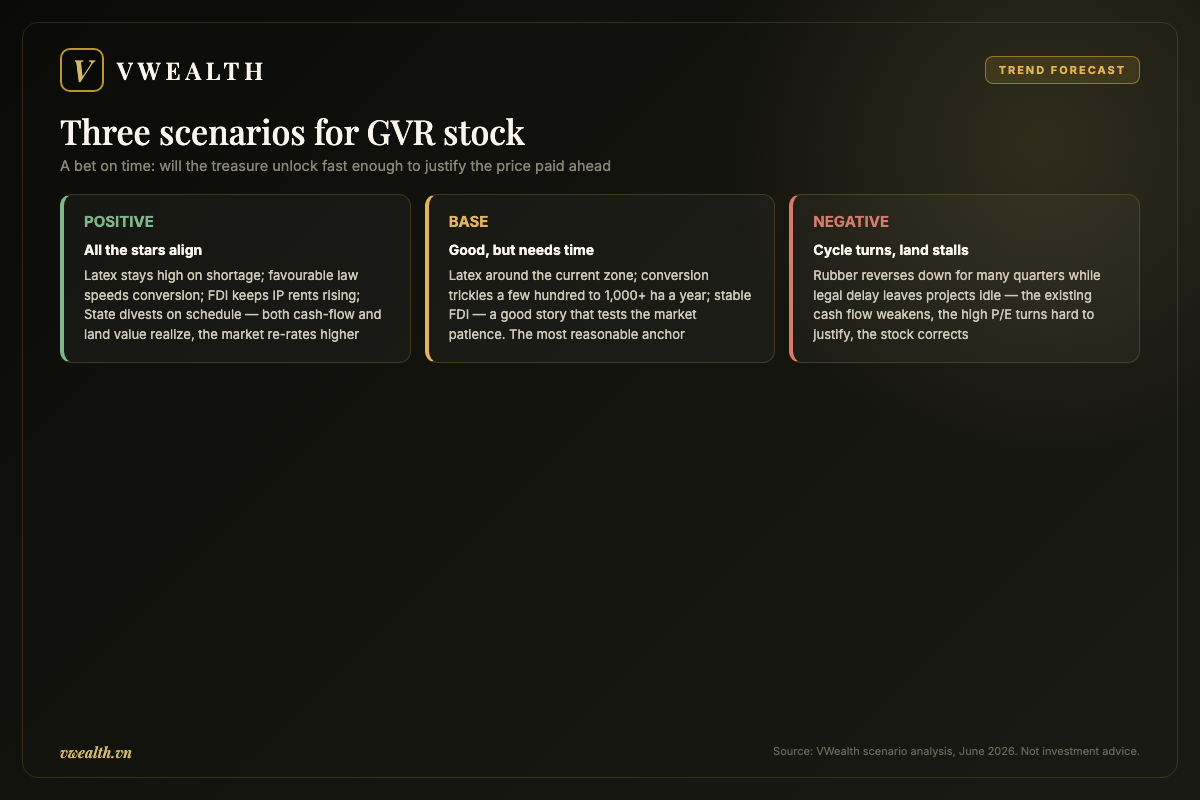
The takeaway from the three scenarios: most of GVR upside comes from long-term expectation about land, while most of the short-term risk comes from the rubber cycle and legal lag. This is a stock where the buyer is essentially betting on time: whether the treasure unlocks fast enough to justify the price the market has already paid in advance.
Should you buy GVR stock?
By now, you have enough pieces to answer the most important question yourself. Instead of handing down a “buy” or “sell” verdict — which no honest writer should do for you — we will weigh all the pros and cons, then view GVR through the lens of four investor types so you can identify which group you belong to.
What makes GVR attractive
- The country largest landholder – an enormous RNAV “treasure.” With ~394,000 ha of land bank, most in the southeast, GVR owns a hidden net-asset-value treasure few listed businesses can match. This is the foundation of the whole re-rating story.
- Standing right at the heart of the FDI and industrial-park wave. GVR land sits right where IP rents are highest and occupancy is already ~89% – i.e. the place where demand exceeds supply most clearly in the country.
- The rubber cycle is favourable. A latex price of ~52 million dong a tonne and a trend of global supply shortage keep the core-segment cash flow healthy, plus a traceability advantage under the EUDR standard.
- Good financial health. The group has an abundant cash base, low debt and a steady dividend history – a “cushion” giving it the strength to wait for the long-term land story without financial pressure.
- The 2025-results boost. After-tax profit of 6,353 billion dong in 2025, up 32% – proof that the favourable cycle is reflecting into real numbers.
- The State-divestment catalyst. If it happens, it could shorten the time to unlock the land treasure and re-rate the business.
What should make you wary
- The valuation is already high. After rising more than 60% from the start of the year, a P/E of ~22 times means the market has already priced in a lot of the land expectation. You are buying a future story at a price that isn’t cheap at all – the room to “ride a cheap valuation” is almost gone.
- The land treasure unlocks slowly. This is the biggest risk. The legal procedures, planning, compensation and site clearance of a state enterprise usually drag on. The land value is real, but realizing it is a journey of many years, not a few quarters.
- Latex profit is cyclical. Rubber is a commodity. The peak is proof of the volatility – some quarters profit can drop sharply when the price or output reverses – this is a standing risk to the existing cash flow.
- The risk of rubber prices reversing. The “compressed spring” may spring up, but if supply recovers or Chinese demand stalls, the price can turn fast, dragging profit and market sentiment with it.
- Low free-float, prone to speculation. The very large State stake keeps the freely-floating shares low, making the price prone to swinging hard with speculative money rather than with fundamentals. This can make the stock “overshoot” in both directions.
What kind of investor does GVR suit?
The same stock, but whether it fits depends on who you are. Let’s view it through four investor types:
| Investor type | Does GVR fit? | Why |
|---|---|---|
| Long-term value investor (believes the land-conversion story) | Fits best | You buy the RNAV land treasure and have enough patience to wait for it to realize over many years, accepting the rubber cycle and legal lag. |
| Dividend / stable-income investor | Fits partly | Steady dividends and healthy finances, but the dividend yield on the already-high market price may not be attractive; you buy mainly for asset-price appreciation, not the dividend flow. |
| Fast-growth / results-momentum trader | Less fitting | The land story unfolds slowly and latex profit swings; you would easily grow impatient and bear cyclical risk. |
| Deep-value bargain hunter | Doesn’t fit | A P/E of ~22 times already reflects a lot of expectation – this is no longer a bargain in the “buy cheap” sense. |
Let me say it plainly to help you position yourself: GVR is a stock for the long-term investor who believes in the industrial-land conversion story, with enough time and nerves of steel to get through quarters of swinging latex profit and times when the legal roadmap moves slower than expected. Conversely, if you need fast results, or you only buy when the valuation is truly cheap and safe, then GVR at the current price may disappoint you – not because the business is bad, but because the price has run quite far ahead of the story.
Closing: you are paying for time
In sum, GVR is one of the most special investment stories on the exchange: a business sitting on the country largest land bank, right at the epicentre of the FDI and industrial-park wave, and meeting a favourable rubber-price cycle at the same time. The essence of an investment in GVR is a bet on time: whether the land treasure unlocks fast enough to justify the valuation the market has already paid in advance. Those who believe in the long-term vision and can bear the patience will see a gem gradually emerging; those who need certainty and immediate results will see an expensive stock with many unknowns. There is no right answer for everyone – only the right answer for you, depending on your risk appetite, time frame and belief in this story.
Disclaimer: This article is made for informational and reference-analysis purposes, and is not a recommendation to buy, sell or hold any security. The figures are gathered from sources believed to be reliable at the time of writing, but may change and are not guaranteed to be absolutely accurate. Investing in stocks always carries risk, including the risk of losing capital. You should assess your own financial situation, research thoroughly and/or consult a licensed financial advisor before making any investment decision. Every investment decision and its associated risk belong to you.
Research Vietnamese stocks in English with vwealth. Our AI-powered platform turns Vietnamese market data into full English analysis reports — with international payment support and a free 2-month trial for new accounts. Create your free account and read the latest reports.