Should you buy HHV stock? The ticker belongs to Deo Ca Traffic Infrastructure Investment JSC, the company that holds toll rights over the Hai Van tunnel, the Deo Ca and Cu Mong tunnels, and the Bac Giang – Lang Son expressway — some of the most strategically placed pieces of road infrastructure in Vietnam. For a foreign investor, HHV is one of the very few listed vehicles offering direct exposure to Vietnam’s road network through the build-operate-transfer model, and it arrives with a balance sheet that makes most people uncomfortable on first reading: long-term borrowings measured in the tens of trillions of dong. This article traces the full story from a wartime vehicle repair workshop founded in 1974 to Vietnam’s leading private transport infrastructure investor, teaches you how to read the financial statements of a BOT company — a business type where the standard toolkit produces confident and wrong conclusions — and finishes with a straight answer on who this stock suits and who it absolutely does not.
Before we start, one convention between you and this article, the same one used across this series. You will meet a lot of dates, names, project titles and scale figures, all taken from publicly disclosed sources: exchange filings, shareholder meeting resolutions, company announcements, government legal documents and mainstream financial press. What you will not find here is a current-quarter earnings figure or a valuation multiple as of today. For a BOT company these move with project timing and with policy, so the article teaches you where to look and how; for the current numbers, open the latest analysis reports on vwealth.
A second convention specific to this ticker. Two topics around HHV are routinely discussed emotionally: the size of its borrowings, and the relationship between the listed company and the wider Deo Ca ecosystem. This article handles both by the series rules: state only what has been formally disclosed, separate fact from inference, and make no accusations. Heavy debt at a BOT company is not by itself a bad sign — but it must be read correctly, and chapter four shows how.
From a 1974 repair workshop to Vietnam’s leading private infrastructure investor
Here is a detail almost nobody notices when looking up this ticker: the company began as a workshop repairing construction vehicles for wartime road building. Not an investment fund, not a construction group — a repair shop. To understand why this company has an operating capability no Vietnamese competitor can match, you have to walk through its turns one by one.
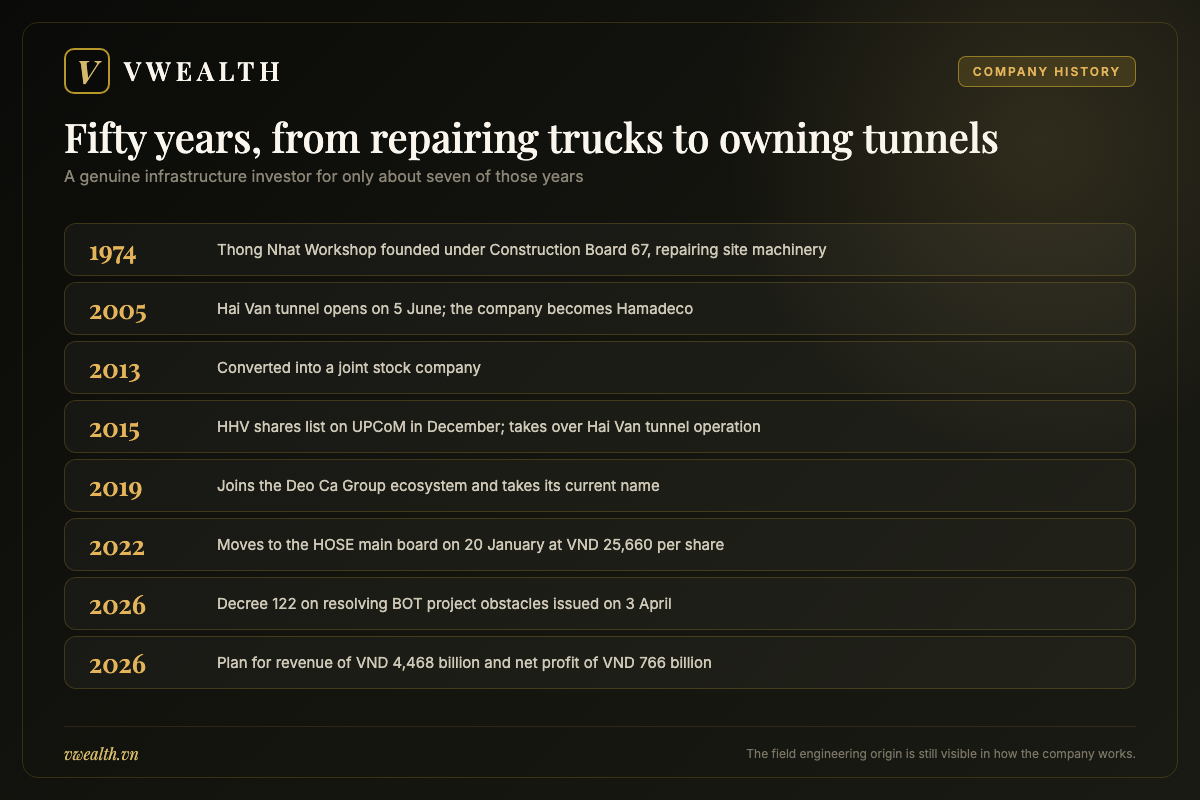
1974: Xuong Thong Nhat
In 1974, Xuong Thong Nhat — the Thong Nhat Workshop — was established under Construction Board 67, the military engineering unit responsible for building roads during the war. Its job was to keep construction machinery running.
Pause here longer than the detail seems to deserve, because it explains a characteristic that survives today. HHV’s roots are in field engineering, not in finance. Its original core capability was keeping equipment operational in the harshest conditions imaginable. Decades later, when the company became the operator of the longest road tunnel system in Southeast Asia, that origin was still what made the difference.
2005: the Hai Van tunnel opens, and a new name
On 5 June 2005, the Hai Van road tunnel opened to traffic — at the time the longest road tunnel in Southeast Asia, cutting through the mountain pass that had been the most feared stretch of Vietnam’s north-south highway.
Alongside that event, the company was reorganised as the Hai Van Road Tunnel Management and Operation Company, known as Hamadeco. The new mission was not vehicle repair but operating a complex piece of engineering: ventilation systems, fire suppression, traffic monitoring, in-tunnel rescue.
This was the most important turning point in capability terms. Operating a long road tunnel is an extremely narrow profession: Vietnam had essentially no second organisation accumulating comparable experience, for the simple reason that there was no second tunnel to accumulate it on. When a series of new tunnels was built over the following two decades, the organisation that already had trained people and proven procedures was the one selected.
What BOT means in Vietnam, and why it matters for this ticker
If you invest across emerging markets you have met build-operate-transfer structures before, but Vietnam’s version has features worth stating precisely, because they define what you own when you own HHV.
Under a BOT contract, a private investor finances and builds a road, bridge or tunnel, then holds the right to collect tolls from users for a contractually defined period sufficient to recover capital and earn an agreed return, after which the asset transfers to the state at no cost. The contract specifies total investment, the capital structure, the permitted toll level, the schedule on which tolls may be increased, a traffic forecast, and the length of the collection period. Everything about the economics flows from that document.
Three characteristics of the Vietnamese context matter. First, toll levels and the timing of increases are administratively set, not market determined — so the investor’s revenue can be affected by decisions taken for entirely legitimate public policy reasons, such as controlling inflation or limiting logistics costs. Second, the equity portion required of the investor is typically a minority of total investment, with banks providing the rest, which is exactly why leverage at these companies is structurally high. Third, the state’s own contribution to a project, where one exists, is a negotiated component that can be revised — and delays in delivering it push the whole financial plan out.
Put those three together and you understand why analysing a Vietnamese BOT company is different from analysing a toll road operator in a market where tariffs are indexed automatically. You are not only assessing whether traffic will grow; you are assessing whether the contractual mechanism will be honoured on the timeline written into it. That is a governance and policy judgement as much as a financial one, and it is the reason this article devotes an entire chapter to the regulatory framework.
The upside of the same structure is worth stating too. Once a toll asset is operating and its debt is being serviced normally, its cash flow is among the most predictable in any listed business: it does not depend on consumer taste, technology cycles, commodity prices or competitive pricing. Very few equities in Vietnam offer that quality of cash flow, and that scarcity is a genuine part of the investment case.
2013 to 2015: equitisation and the first public market
The company was converted into a joint stock company during the restructuring of state enterprises in the transport sector. In December 2015 its shares began trading on UPCoM under the ticker HHV. That same year, it formally took over management and operation of the Hai Van tunnel from the state authority.
At this stage HHV was still a mid-sized technical services business: revenue came mainly from operation and maintenance contracts, not from owning toll rights.
2019: joining Deo Ca Group and a change of name
This was the second major turning point, and the one that defines the ticker as you see it today.
In 2019 the company became part of the Deo Ca Group ecosystem and was renamed Deo Ca Traffic Infrastructure Investment JSC. The new name states the change precisely: from management and operation to investment.
Deo Ca Group was by then the name attached to the Deo Ca tunnel project — a milestone in Vietnamese construction, because for the first time a domestic private company acted as project owner and organised the construction of a large mountain tunnel itself rather than depending on foreign contractors. Placing HHV in the role of the ecosystem’s listed vehicle meant the economic interests in those works would progressively be gathered into a single entity with shares trading on an exchange.
For investors, this is the moment the nature of HHV changed completely: from a services company with steady revenue and a light balance sheet, into an infrastructure investor with enormous assets and matching debt. Any analysis of HHV before and after this point describes two different companies.
20 January 2022: moving to the HOSE main board
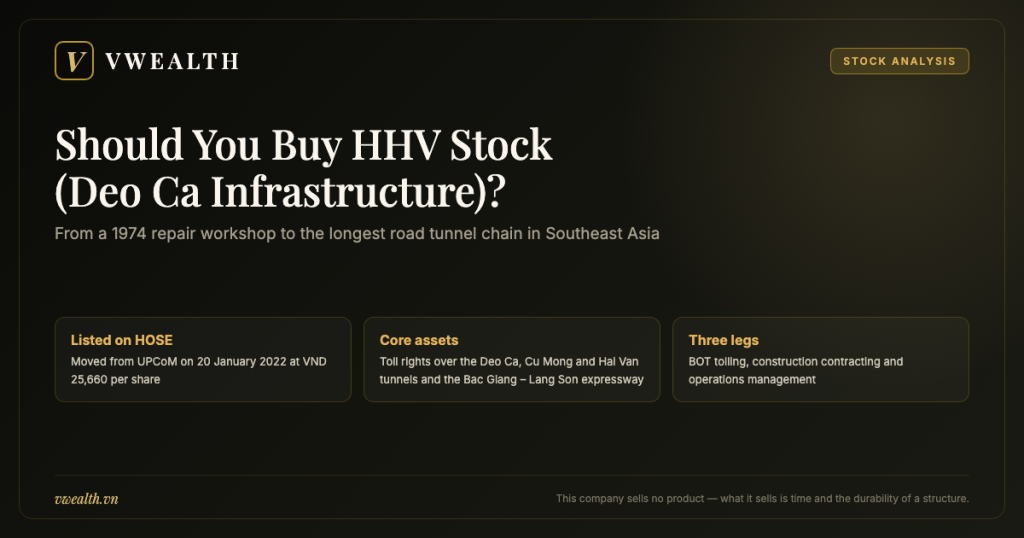
On 20 January 2022, more than 267 million HHV shares transferred from UPCoM to a full listing on the Ho Chi Minh Stock Exchange, with a first-session reference price of VND 25,660 per share, implying a market capitalisation of roughly VND 6,861 billion.
A main board listing delivered three things: higher disclosure standards, the ability to raise capital through rights offerings to existing shareholders, and a much wider investor base. All three matter for a company whose capital requirement effectively never stops, because every new infrastructure project demands a corresponding slice of equity.
2022 to 2026: raising capital continuously to keep going
The years after listing have been a sequence of capital raises. The company has repeatedly offered shares to existing holders, lifting charter capital year after year. In the offering completed in the first quarter of 2026, HHV raised charter capital from roughly VND 4,974 billion to roughly VND 5,472 billion by issuing nearly 49.7 million shares, with around 23,847 investors participating. The roughly VND 497 billion raised went mainly to paying for the transfer of a stake in the Cam Lam – Vinh Hao expressway project and a stake in a member construction company. By mid-2026, charter capital had risen further to roughly VND 5,745 billion.
Read this sequence as an analyst. A company that continuously issues new shares to fund its next step is growing by expanding its equity base rather than by compounding retained earnings. That is not bad — in infrastructure it is close to mandatory — but it has a very specific consequence for your wallet: earnings per share are diluted continuously, and you must contribute new money at each offering to keep your ownership percentage. Chapter five returns to this.
Historical milestones at a glance
| Date | Event | What it means for an investor today |
|---|---|---|
| 1974 | Thong Nhat Workshop founded under Construction Board 67 | Field engineering roots, not financial roots |
| 5 Jun 2005 | Hai Van tunnel opens; company becomes Hamadeco | Begins accumulating tunnel operating capability, a very narrow profession |
| 2013 | Converted into a joint stock company | Opens the path to listing and capital raising |
| Dec 2015 | HHV shares trade on UPCoM; takes over Hai Van tunnel operation | Services-company phase, balance sheet still light |
| 2019 | Joins Deo Ca Group, renamed Deo Ca Traffic Infrastructure Investment | Shifts from operator to investor; the stock changes character entirely |
| 20 Jan 2022 | Moves to HOSE at VND 25,660, market cap about VND 6,861 billion | Wider capital access for a continuous funding need |
| 2022 to 2026 | Repeated rights offerings, charter capital rising steadily | Growth through equity expansion, with dilution attached |
| Q1 2026 | Issues nearly 49.7 million shares, charter capital to about VND 5,472 billion | Proceeds used for the Cam Lam – Vinh Hao stake transfer |
| 3 Apr 2026 | Government issues Decree 122/2026 on resolving BOT project obstacles | Legal framework opening the way to budget support for stalled projects |
| 28 Jul 2026 | Deo Ca Group receives 25 million shares by transfer, becoming a major shareholder | Parent raises direct exposure to the listed entity |
| 2026 | Plan for consolidated revenue of VND 4,468 billion and net profit of VND 766 billion | A record if achieved |
Read the table vertically and you see a fifty-year-old company that has only been a genuine infrastructure investor for roughly seven years. That is the sharpest difference from long-established construction groups, and it is both the opportunity and the risk.
Who runs HHV and who actually owns it
The ownership chapter for HHV has a feature that sets it apart from most family-controlled or state-controlled companies on the Vietnamese market: no shareholder holds a controlling percentage. At first glance that sounds like good news for minority investors. The reality is more nuanced, and you need to understand it before drawing conclusions.
Ho Minh Hoang and the executive team
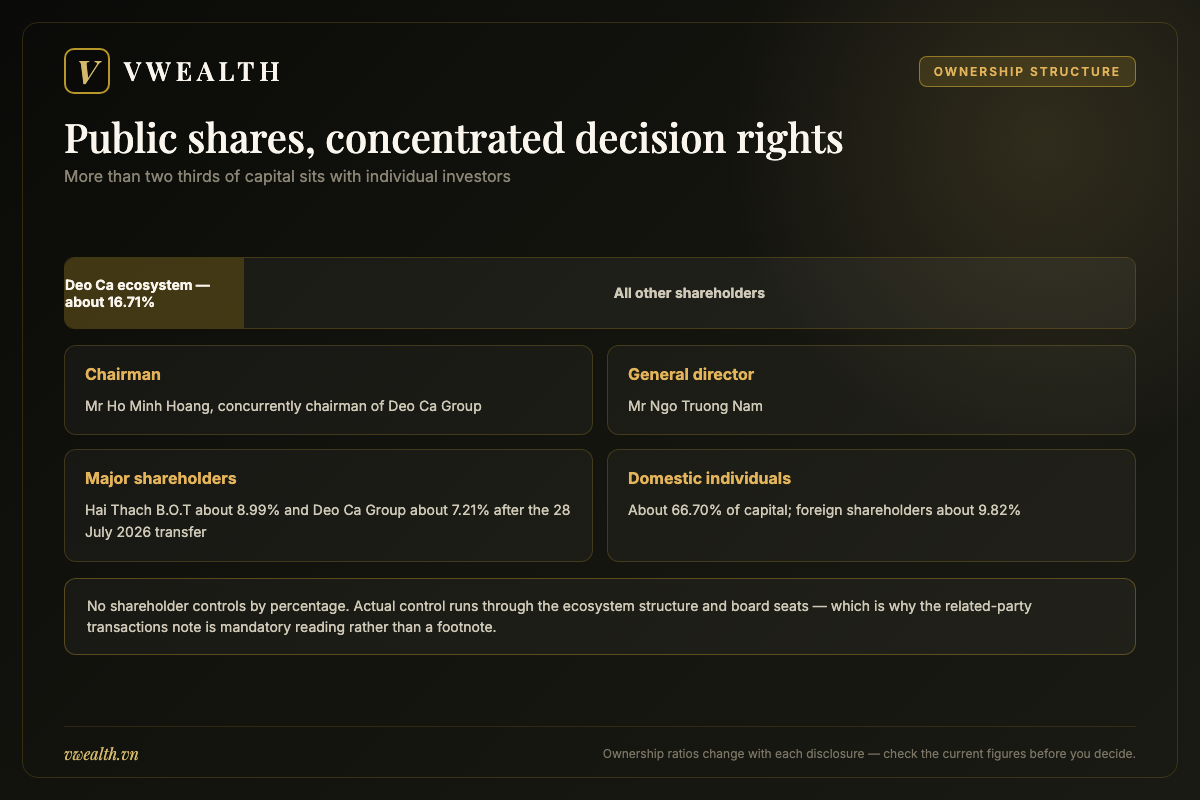
The chairman of HHV’s board is Ho Minh Hoang, who simultaneously serves as chairman of Deo Ca Group. He is the figure associated with the Deo Ca tunnel project and with the image of a Vietnamese private company capable of building a large mountain tunnel on its own.
The general director is Ngo Truong Nam, who runs day-to-day operations at the listed company.
One statement from the chairman at the 2026 annual general meeting is worth recording, because it states the governance stance management has set for itself: the company will not use shareholder money to speculate or gamble on projects that lack the conditions for success. Alongside it came a publicly stated project selection standard: transparent mechanisms, feasible financial plans, manageable risk, and genuine long-term value creation.
For a BOT company such a statement matters far more than it would elsewhere. This industry has a specific temptation: infrastructure projects are always available, always need an investor, and can always be presented with an attractive financial model on paper. A company that takes on more projects than its equity base can support does not discover the problem immediately — it discovers it seven or ten years later, when actual traffic volumes fall short of forecast. Project selection discipline is therefore a core capability, not a slogan.
This is also why you should apply a formal governance lens to this ticker. The overview of corporate governance in Vietnamese listed companies sets out what disclosure and board practice look like locally; for a business where every investment decision locks capital for two decades, the quality of the decision maker is a more important variable than any current-quarter financial ratio.
Shareholder structure: control through ecosystem, not through percentage
This is the part of the chapter to read most carefully.
On 28 July 2026, Hai Thach B.O.T Investment JSC transferred 25 million HHV shares to Deo Ca Group through a negotiated block trade. After the transaction, Hai Thach B.O.T reduced its holding from 13.35% to 8.99%, retaining roughly 51.67 million shares. Deo Ca Group lifted its stake to 7.21% and formally became a major shareholder. Counting related entities, the Deo Ca ecosystem holds roughly 16.71% of HHV’s charter capital. Ho Minh Hoang personally holds roughly 0.43%.
Translate those numbers into the language of someone buying the stock.
First, most HHV shares sit with the general investing public. According to the disclosed ownership breakdown, domestic shareholders hold roughly 90.18% of capital, split between institutions at roughly 23.48% and individuals at roughly 66.70%, while foreign shareholders hold roughly 9.82%. An individual weighting above two thirds is very high compared with similarly sized listed companies, and it explains why HHV has good liquidity and volatile price action.
Second, actual control is exercised through the ecosystem structure and through board seats rather than through a dominant shareholding. This is a neutral observation — many large companies worldwide operate this way — but it produces two consequences investors must know.
The first consequence: when the parent and related entities hold only about one sixth of capital, every new share issue they do not fully subscribe reduces that share further. This is why you see intra-ecosystem transactions gathering subscription rights or receiving share transfers. These are publicly disclosed and you should track them as an indicator of how committed the controlling group is.
The second consequence, and the more important one: related-party transactions are structural to this model, not exceptional. HHV builds for projects within the ecosystem, receives stake transfers in projects from ecosystem entities, and operates works the ecosystem invests in. This article makes no assessment of any individual transaction — that is the job of regulators and auditors. What it emphasises is that with a structure like this, the related-party transactions section of the notes is mandatory reading, not something to skim. If you are unfamiliar with local reporting conventions, the guide to Vietnamese company financial statements explains where to find these disclosures and how they are presented.
What Deo Ca Group is, and why the relationship matters
Because HHV’s identity is bound to its parent, it is worth stating what Deo Ca Group is.
Deo Ca Group is a private Vietnamese infrastructure group best known for delivering the Deo Ca tunnel, a project that became a reference point in Vietnamese construction because a domestic private company organised and completed a large mountain tunnel that had previously been assumed to require foreign contractors. The group’s activities span project development, construction, tunnel and expressway operation, and it has been associated with several of the country’s most technically demanding road projects.
The relationship with HHV runs in both directions and you should understand both. Downward, the group supplies HHV with project pipeline, technical capability and standing with authorities and lenders — advantages a standalone mid-cap contractor would not have. Upward, HHV serves as the listed vehicle through which the group’s infrastructure interests can be held, valued and, when needed, funded from public markets.
The structural point for a minority shareholder is that value can move between entities in the ecosystem through the terms of construction contracts, stake transfers and service agreements. Nothing in the public record cited here suggests improper terms in any specific case, and this article does not assess individual transactions. What it says is narrower and firmer: in an ecosystem structure, terms of related-party dealings are a first-order determinant of how much value accrues to the listed entity, so they belong at the top of your checklist rather than in a footnote. Read the related-party note, compare margins on ecosystem work with margins on external work where disclosure allows, and treat consistent, arm’s-length-looking terms over several years as a positive signal in its own right.
Foreign ownership and foreign participation
Foreign ownership at HHV runs around 9.82% of capital. Compared with many other infrastructure names, this is meaningful participation, indicating that the ticker sits within the field of view of foreign investors interested in the Vietnamese infrastructure story.
If the mechanics of ownership caps in Vietnam are new to you, the guide to foreign ownership limits in Vietnamese stocks covers how they work. For HHV the room is not the constraint; the level of foreign participation is worth watching as a sentiment indicator in a stock where individuals hold more than two thirds of the shares.
Dividends and the capital allocation problem of an expanding infrastructure investor
A BOT company in a heavy investment phase faces an obvious internal tension between paying cash dividends and retaining capital for new projects.
For HHV, cash generated by operating toll stations is real and relatively stable. But most of that cash is committed in advance to principal and interest obligations on the very projects that produce it — a defining feature of project finance structures, where toll revenue is pledged under a financial plan approved by lenders and by the competent authority.
The consequence for shareholders: the capacity to pay large, regular cash dividends at this stage is limited, and the company tends to prioritise retaining resources for equity contributions into new projects. Check the dividend policy approved at the most recent shareholder meeting rather than assuming, and read carefully whether payment is in cash or in shares — the two mean completely different things for your wallet.
Ownership and leadership at a glance
| Item | Disclosed position | What an investor should take from it |
|---|---|---|
| Chairman | Ho Minh Hoang, concurrently chairman of Deo Ca Group | Sets strategy at both the parent and the listed entity |
| General director | Ngo Truong Nam | Runs day-to-day operations of the listed company |
| Major shareholder | Hai Thach B.O.T at roughly 8.99% after the 28 July 2026 transfer | No shareholder controls by percentage |
| Parent company | Deo Ca Group at roughly 7.21%, now a major shareholder | Direct commitment to the listed entity increased |
| Whole ecosystem | Roughly 16.71% of charter capital | Control through structure and board seats, not a dominant stake |
| Chairman’s personal holding | Roughly 0.43% | Low personal stake relative to the executive role |
| Domestic individual investors | Roughly 66.70% of capital | Good liquidity but price sensitive to retail sentiment |
| Domestic institutions | Roughly 23.48% of capital | A meaningful institutional base exists |
| Foreign shareholders | Roughly 9.82% of capital | Notable participation for an infrastructure name |
| Charter capital | Roughly VND 5,745 billion after raises through mid-2026 | Rising continuously, with EPS dilution attached |
| Stated governance stance | No shareholder money for projects lacking conditions for success | Project discipline is the core capability in this industry |
The table shows something uncommon: HHV is a large company whose shares are mostly held by the general public, while actual decision rights are concentrated. Both halves belong in your risk assessment.
How HHV makes money: the three legs of an infrastructure investor
Ask a typical investor what HHV does and the answer is usually toll collection. That answer is correct but incomplete, and the missing part is the segment currently generating the largest share of revenue. This chapter separates each source, shows which leg feeds which, and identifies where the model has a genuine moat.
Leg one: BOT investment and toll collection
This is the segment generating long-term cash flow and the reason the model exists.
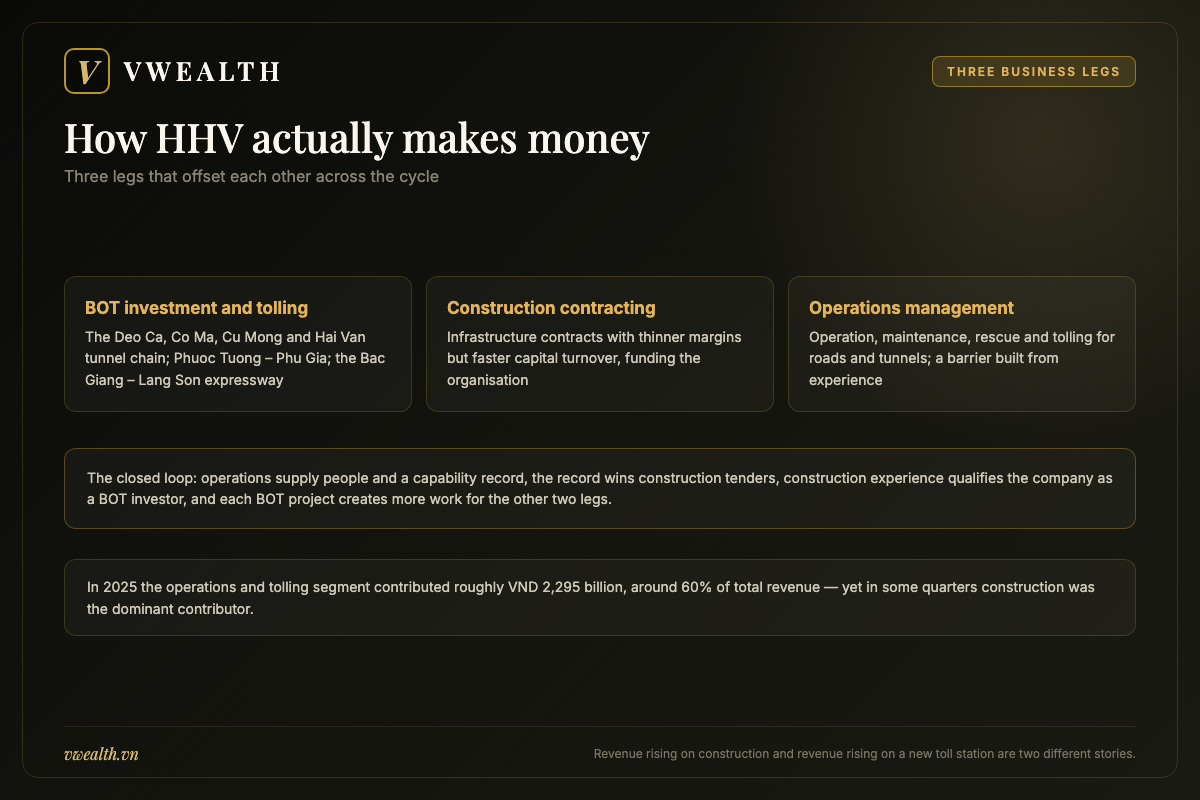
HHV holds interests in a series of critical transport works in central and northern Vietnam: the chain of road tunnels at Deo Ca, Co Ma, Cu Mong and Hai Van; the Phuoc Tuong – Phu Gia tunnel; and the Bac Giang – Lang Son expressway. The company operates multiple toll stations across these works.
The revenue mechanism must be understood precisely, because it governs how you read the statements later. The investor funds construction, then holds the right to collect tolls for a defined period to recover capital and earn a return, before transferring the work to the state. The capital comes in two parts: the company’s own equity and bank borrowing, with the borrowed portion typically far larger.
What sets this segment apart from any other business is the character of its cash flow. An operating toll station produces relatively predictable cash — traffic volumes do not swing wildly month to month — but most of that cash is already pledged to debt service under the approved financial plan. In other words, the company has cash flow but is not free to use it for many years.
This is where new investors misread the situation in both directions. The optimistic error: seeing steady toll revenue and concluding the company has abundant free cash flow. The pessimistic error: seeing enormous debt and concluding the company is heading toward insolvency. Both come from not reading the project financial plan.
The assets themselves: what these tunnels and roads actually are
For an investor outside Vietnam, the project names mean little without geography, so it is worth walking the map.
The Hai Van tunnel runs under the Hai Van pass between Hue and Da Nang, roughly at the midpoint of Vietnam’s north-south highway. Before it opened, every truck on the national trunk route climbed a narrow mountain road with steep gradients, blind curves and frequent fog — a stretch with a long accident history. The tunnel removed that, and there is no equivalent alternative for a heavy vehicle in a hurry.
The Deo Ca, Co Ma and Cu Mong tunnels sit further south along the same corridor, through the coastal mountain spurs separating Phu Yen, Khanh Hoa and Binh Dinh. Together with Hai Van they form a chain: the same north-south freight flow passes through several of them in sequence, which means the traffic driver behind each is broadly the same and correlated.
The Phuoc Tuong – Phu Gia tunnels lie north of Hai Van on the same route, addressing the same problem on a smaller scale.
The Bac Giang – Lang Son expressway is a different proposition. It runs northeast from the Hanoi region toward the Chinese border at Lang Son, serving cross-border trade rather than domestic north-south freight. Its traffic driver is therefore trade volume with China and the pace at which the corridor’s remaining links are completed — a distinct exposure from the tunnel chain, which is useful diversification within the portfolio.
Two conclusions follow for an investor. First, the tunnel chain assets sit on infrastructure that is genuinely difficult to bypass, which is the strongest form of position a toll asset can have. Second, because several of them serve the same corridor, a slowdown in national freight movement affects them together rather than one at a time. When you model this portfolio, do not treat the projects as independent bets.
Leg two: construction contracting
This is the segment currently contributing the largest revenue share, and the one investors most often undervalue.
HHV takes on construction work for transport infrastructure projects, including packages under the national expressway programme and projects within the Deo Ca ecosystem. As Vietnam accelerates public investment in infrastructure, the workload in this segment has grown sharply and become the main revenue driver in the medium term.
The characteristics to remember: margins are much thinner than in tolling, but capital turns over faster and no twenty-year lock-up is required. It funds the organisation and maintains construction capability while BOT projects work toward steady-state operation.
There is a subtlety to notice. For a company that is simultaneously investor and contractor, part of the construction workload comes from projects the ecosystem itself invests in. This gives the company control over schedule and quality, but it also makes the segment’s true margin harder for an outsider to assess. That is one more reason to read the related-party disclosures.
Leg three: operations and maintenance
This is the oldest segment, descended directly from operating the Hai Van tunnel, and the one producing the steadiest revenue.
HHV provides operation and maintenance services for roads and tunnels, covering traffic monitoring, maintenance, rescue response, fire safety and toll system operation. As new expressway sections along the north-south corridor come into service, demand for professional operators rises correspondingly, and the company bids for those contracts.
Do not underrate this apparently unglamorous segment. It has three valuable properties: contracted, recurring revenue; minimal capital requirement; and, most importantly, it creates a barrier to entry. Operating a long road tunnel is not something a new entrant learns in a year; it requires trained people, procedures proven through real incidents, and a track record every project owner demands at tender.
How the three legs fit together
This is where HHV’s model has its own internal logic, and it is worth understanding.
The operations segment gives the company people, procedures and a capability record. That record helps win construction tenders. Construction experience gives the company the standing and technical understanding to qualify as a BOT investor. And once it is a BOT investor, it generates additional workload for the other two segments.
A closed loop like this is a real advantage in an industry where the largest barrier is not capital — banks can lend capital — but demonstrated execution capability. Vietnam has very few private companies that have delivered a large mountain tunnel end to end.
Where HHV’s moat is, and where it is thin
The first moat is time-limited toll rights on routes with no equivalent alternative. The Hai Van, Deo Ca and Cu Mong tunnels sit on the north-south corridor at points where the alternative is a longer and more dangerous mountain pass. This is a position a competitor cannot create by building a rival facility.
The second moat is tunnel operating capability — a narrow profession in which the company holds a near-monopoly on experience in Vietnam, courtesy of a fifty-year history.
The third moat is a track record in complex infrastructure construction, which determines tender eligibility in an industry where owners assess capability before they assess price.
Now be honest about the thin spots. The first moat has an expiry date: toll rights end under contract, and their value declines with each year of operation. The second and third rest on people and track record, meaning they must be maintained by continuously winning new work — an infrastructure company that stops taking new projects is shrinking its own moat. And that leads directly to the central paradox of this industry: maintaining position requires continuous investment, and every investment requires more borrowing or more equity issuance.
The three segments compared
| Segment | How it generates cash | Cash flow character | What to monitor |
|---|---|---|---|
| BOT investment and tolling | Fund construction, collect tolls for the contract term, then transfer | Steady and predictable, but largely pledged to debt service | Actual traffic versus the approved financial plan |
| Construction contracting | Contracts for infrastructure works, including ecosystem projects | Faster capital turnover, thinner margins | Order backlog and payment progress |
| Operations and maintenance | Contracts for operating, maintaining, rescue and tolling on roads and tunnels | Contracted and steady, minimal capital required | Kilometres of new route won under management each year |
Look at the table and you will see what many investors miss: HHV today looks more like an infrastructure contractor with a BOT portfolio than a pure toll operator. That balance may reverse in future as BOT projects reach steady operation, but you must value the company as it is, not as you imagine it.
Position and financial health: seven things to check before deciding whether to buy HHV stock
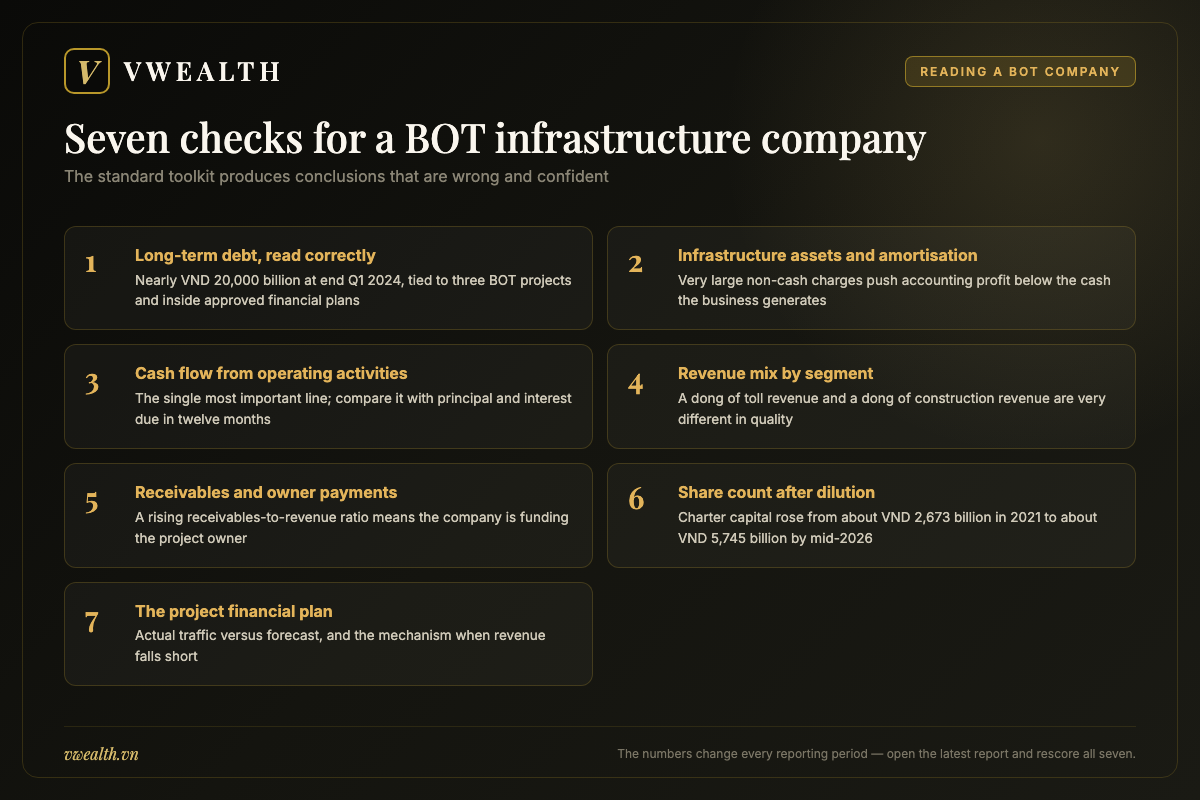
This is the most important chapter in the article, because HHV is one of the most misread tickers on the exchange — in both directions. The familiar toolkit of debt-to-equity, profit margin and free cash flow, applied directly to a BOT company, produces conclusions that are both wrong and confident.
Check 1: the long-term debt pile and how to read it correctly
Let us go straight at the most contested number. As of the end of the first quarter of 2024, HHV recorded long-term borrowings of nearly VND 20,000 billion. That figure prompted rumours about the company’s solvency, and the company responded publicly.
Three points from that response are worth recording as facts. First, most of the debt relates to three specific BOT projects: the Deo Ca – Cu Mong – Co Ma – Hai Van tunnel chain, the Bac Giang – Lang Son expressway, and the Phuoc Tuong – Phu Gia tunnel. Second, these borrowings sit within each project’s financial plan and have been appraised and approved by the competent state authority and by lenders. Third, the company stated that loans and interest have been paid in full and on schedule, with liquidity ratios at levels it described as safe.
Now the analysis, and this is where you need to think differently.
At a manufacturer, borrowing funds an asset whose revenue is competitive: the factory must sell into a market with rivals. At a BOT project, borrowing funds an asset whose revenue stream is defined by contract, on a route that often has no equivalent alternative, over a defined period. The risk therefore has a different nature: not the risk of losing market share, but the risk that actual traffic falls short of forecast, and the risk that the mechanism itself is changed.
So the right question is not whether the debt is large — in BOT it always is — but these three. What percentage of the approved financial plan is actual traffic running at? How many years of toll collection remain on each project? And if revenue falls short of the plan, what is the resolution mechanism?
There is a very practical test you can run yourself. Open the notes, find the maturity analysis of borrowings, and see how much falls due within twelve months. Then open the cash flow statement and add up net cash from operating activities across the last four quarters. If the second number comfortably exceeds the first, the debt — however large — is being serviced by the business itself. If not, the company is relying on new borrowing or new issuance to repay old debt, and that is a state to watch closely. This comparison takes five minutes and it replaces every emotional argument about the twenty-trillion figure.
One more distinction to get right: BOT debt is typically structured as project finance, meaning the repayment source is the toll stream of that specific project and the security is the toll right of that specific project. This differs from an ordinary corporate loan, where the whole company’s assets stand behind the borrowing. The difference has practical meaning: risk at each project is ring-fenced to a degree rather than spreading across the whole group. Read the notes to understand the security structure of each large facility rather than lumping everything into one number.
One further framing helps. Ask what the debt actually bought. At a company that borrowed to fund working capital or to acquire a business at a rich price, the debt may have bought very little of lasting value. At HHV the debt bought tunnels through mountains on the country’s main freight corridor — assets that exist, function, and generate toll receipts every single day. That does not make the debt safe, and it certainly does not make it small. But it does mean the relevant question is about the schedule of repayment against the schedule of collection, not about whether there is anything behind the borrowing at all. Investors who react to the headline figure alone are skipping the only question that matters.
Check 2: infrastructure assets and the depreciation problem
On HHV’s balance sheet, most assets are toll rights over infrastructure works — long-term assets amortised across the toll collection period.
This creates an accounting effect you must grasp. Depreciation and amortisation at a BOT company are very large, but they are non-cash: they reduce accounting profit without reducing the money in the bank. The consequence is that reported net profit at a young BOT company usually looks modest relative to the cash the business actually generates.
This is why professional analysts typically look at cash flow before depreciation and interest when assessing infrastructure companies, rather than at net profit. If you look only at net profit and divide market capitalisation by it, you will always find this stock expensive — while that measure does not fit the nature of the business.
Check 3: cash flow from operating activities, the single most important line
If you could track only one number for HHV, track cash flow from operating activities.
The reason is simple: it is the only figure that answers whether the company has real money, undistorted by depreciation, by percentage-of-completion revenue recognition on construction, or by amortisation entries.
For a company carrying large debt, operating cash flow that is positive and large relative to the period’s debt service is the most persuasive evidence of health. Conversely, weakening operating cash flow while debt does not fall is the earliest and most reliable warning signal.
A practical routine: each quarter, note operating cash flow, note the change in total borrowings, and note the change in charter capital. Those three numbers together tell you whether growth is being funded by the business, by lenders, or by you. At an infrastructure company in an expansion phase all three sources are legitimate, but the mix over time is the clearest statement of what kind of investment you actually hold.
Check 4: revenue mix and the quality of each dong of revenue
Not every dong of revenue is equal, and at HHV the differences are large.
Toll revenue is high quality: cash arrives immediately, margins are high, receivable risk is minimal. Construction revenue is lower quality: recognised on progress, thin margins, and exposed to slow payment from project owners. Operations revenue sits in between: recurring, moderate margin, low risk.
So when HHV’s revenue rises, the first thing to examine is the mix. Revenue rising because the construction segment expanded is one story; revenue rising because a new toll station entered service is an entirely different story in long-term value terms.
According to disclosures for 2025, the operations and tolling segment contributed roughly VND 2,295 billion, around 60% of total revenue, while in some quarters construction was the dominant contributor. That oscillation is normal for this model and is precisely why you look at the mix rather than the headline total.
A worked illustration of how BOT economics run
The following is an illustrative example with round numbers, not a projection of any HHV project. Its purpose is to show you the shape of the cash flow so you recognise it when you open a real statement.
Imagine a tunnel costing 10,000 units to build, funded with 2,000 units of equity and 8,000 units of bank debt over a fifteen-year term. Once open, it collects 1,200 units of toll revenue a year and spends 200 units on operation and maintenance, leaving 1,000 units of operating cash. Of that, roughly 500 units go to loan principal and roughly 400 units to interest in the early years, leaving about 100 units genuinely available to the shareholder.
Meanwhile, the accountants amortise the toll right over the concession period — say 500 units a year. So the reported income statement shows 1,200 of revenue, less 200 of operating cost, less 500 of amortisation, less 400 of interest, giving 100 units of pre-tax profit. Accounting profit is small; operating cash flow before interest is ten times larger.
Now change one thing: interest costs fall by a quarter because debt has been partly repaid using external support. Interest drops from 400 to 300, and pre-tax profit rises from 100 to 200 — a doubling of reported profit from a change that did not touch revenue at all. That single sensitivity explains why every conversation about HHV eventually returns to the debt balance, and why the budget support question in chapter six matters more than any traffic forecast.
Run the example in the other direction and you get the bear case just as quickly: a rise in average interest cost of the same magnitude wipes out the profit line entirely while the business itself performs identically. Highly geared assets convert small changes in funding cost into large changes in equity earnings. That is neither good nor bad in itself; it is the defining characteristic of the asset class, and it must be sized accordingly in a portfolio.
Check 5: receivables and amounts owed by project owners
This is a point investors frequently skip at infrastructure contractors.
When the company builds for a publicly funded project, payment timing depends on state budget disbursement, which follows its own rhythm and does not always match construction progress. As a result, receivables can swell even while the project itself is running well.
The right approach: track receivables as a percentage of revenue across periods. A ratio climbing over several consecutive periods signals that the company is increasingly funding the project owner — which tightens working capital needs at a company that is already heavily borrowed.
Check 6: share count and the pace of dilution
This is the check that bears most directly on your interest as a minority shareholder.
HHV’s charter capital has risen continuously through repeated issuance, from roughly VND 2,673 billion around 2021 to roughly VND 5,745 billion by mid-2026. Each issuance increases shares outstanding, and if profit does not grow proportionately, earnings per share stagnate or fall even as the company grows.
The correct check has two steps. Step one: calculate earnings per share after adding the full share count of plans approved by shareholders but not yet issued — including the roughly 85 million share issuance discussed at the 2026 annual general meeting. Step two: ask yourself whether you are willing to contribute additional capital at each offering. If the answer is no, plan on your ownership percentage declining over time.
Check 7: the project financial plan and the mechanism when revenue falls short
The final check is the least understood and the most decisive for a BOT company.
Each BOT project has an approved financial plan setting out total investment, capital structure, interest rate, toll levels, the scheduled toll escalation path, traffic forecasts and the collection period. The entire value of the project to shareholders depends on how closely reality tracks that plan.
The largest risk in Vietnam’s BOT model over the years has been reality diverging from the plan for reasons outside the investor’s control: scheduled toll increases not implemented on time, or a parallel route entering service and diverting traffic. When that happens the payback period stretches, and the present value of future cash flows falls sharply.
This is exactly why Decree 122/2026, discussed in chapter six, is a significant event for the industry: for the first time there is a detailed legal framework for resolving precisely this kind of problem. For HHV, two of the projects under consideration are the Bac Giang – Lang Son expressway and the Deo Ca tunnel.
What these seven checks say about HHV’s position
Add them up and the picture is fairly clear. HHV holds a distinctive position in an industry with few competitors, owns toll rights on routes that are hard to substitute, and runs a construction segment benefiting directly from Vietnam’s infrastructure investment cycle. That is the asset side.
On the other side is a balance sheet that is very heavily geared by the nature of the model, a continuous dilution process, and a high degree of dependence on policy — something the company does not control but which determines the value of the assets it holds. Both sides are real, and which one you weight more depends on your investment horizon as much as on the company itself.
How the market treats HHV stock: a retail-owned infrastructure name
Every stock has a personality on the tape, and that personality is set more by who owns it than by what the company does. With HHV the personality is easy to read once you know the shareholder structure.
Good liquidity and high volatility
With roughly two thirds of capital held by domestic individual investors, HHV has good liquidity and a very large following. This is a genuine advantage over many other infrastructure stocks: you can trade at reasonable size without worrying about finding the other side.
The other side of the coin is volatility. A stock owned mainly by retail investors tends to react fast and hard to news, and sometimes before news is confirmed. HHV also sits in an industry where policy news appears constantly: a new decree, an expressway approval, a tender award. The result is a stock that moves more than a company with stable toll cash flow arguably should.
Treat this as a fact to manage position size around rather than a reason to buy or sell. Concretely: if you hold HHV long term for the infrastructure cash flow thesis, be prepared for stretches of heavy volatility that have nothing to do with that cash flow.
Practical notes for investors based outside Vietnam
A few mechanics are worth knowing before you build a position in any Vietnamese mid-cap, and they apply with particular force to a volatile, retail-heavy name like this one.
Vietnam operates daily price bands, so a stock can reach its limit and effectively stop trading for the rest of the session. In a sharp move this means an order may go unfilled on precisely the day you wanted to act. Settlement runs on a T-plus cycle, so shares bought are not immediately available to sell. Both features push you toward limit orders and toward position sizes you can hold through a bad week rather than trade around.
Rights offerings deserve special attention here, because HHV has run several and has more approved. In a rights issue, existing shareholders receive the right to subscribe new shares at a set price. If you do nothing, your stake is diluted; in some cases rights can be sold, in others they lapse. As a foreign holder you need to confirm with your custodian, well before the record date, whether you are able to participate and what the process is. Discovering that you cannot subscribe on the day the offering closes is an avoidable and expensive surprise.
Finally, disclosure timing. Vietnamese companies publish quarterly financial statements and periodic disclosures in Vietnamese first, with English versions arriving later or not at all for smaller filings. For a company where the notes matter as much as the headline numbers, this is a real constraint on foreign investors, and it is one reason a research platform that translates and structures those disclosures is worth having.
Why P/E misleads on this ticker
As chapter four explained, depreciation and amortisation of toll rights at a BOT company are very large and non-cash. That pushes accounting profit well below actual cash generation.
The direct consequence: divide market capitalisation by net profit and you get a high price-to-earnings ratio and conclude the stock is expensive. That conclusion may be wrong in substance, because the denominator is being suppressed by a charge that takes no money out of the business.
More suitable approaches include comparing market capitalisation to cash flow before depreciation and interest, or building a discounted cash flow model over the remaining toll life of each BOT project and then adding the value of the construction and operations segments. The second is the most faithful to the business but requires many assumptions, so build three scenarios rather than one.
The personality of HHV stock
Looking back at trading since the main board move, a few repeating characteristics are worth knowing in advance.
First, it reacts strongly to public investment and infrastructure policy news. Whenever there is news of a large public investment package, an expressway launch, or a change in the public-private partnership framework, infrastructure stocks tend to rise together and HHV is usually among the leaders.
Second, it is sensitive to news about debt and financial health. The episode of rumours around long-term borrowings forced a public response from the company — evidence that the market still treats leverage as this stock’s most sensitive point.
Third, each new share issuance creates short-term pressure on the price, because existing shareholders must decide whether to commit more money and some will choose to sell their rights rather than exercise them.
Public investment and where HHV sits in the beneficiary chain
HHV is one of the most frequently cited tickers when the market discusses the public investment theme. But you should understand precisely where the company benefits.
The chain from a dong of state infrastructure spending usually runs through several layers: contractors receive workload, materials suppliers sell steel, cement, aggregate and asphalt, and over the long run companies holding assets along the new route benefit from added value.
HHV sits in the first layer through construction, and in a layer of its own through operations as new routes require operators. That is a good position because it benefits early and directly. The analysis of HPG and Hoa Phat Group gives you the view from the materials layer, and the sector overview of Vietnamese steel and industrial stocks shows how the same public spending produces very different kinds of benefit in timing and durability.
Comparing HHV with other infrastructure options
| Criterion | HHV | Other infrastructure and construction names | What an investor should conclude |
|---|---|---|---|
| Core asset | Toll rights on hard-to-substitute tunnels and expressways | Mainly execution capability and contracts | HHV owns long-lived assets, not just a workflow |
| Financial leverage | Very high by the nature of the BOT model | Lower at pure contractors | Far more sensitive to interest rates |
| Revenue stability | Three legs offsetting each other | Depends on the tender cycle | Less exposed to work droughts than a pure contractor |
| Share liquidity | Good, with individuals holding about two thirds | Varies widely by ticker | Easy to trade but volatile |
| Policy dependence | Very high, on both toll mechanisms and budget support | Mainly on disbursement pace | Both risk and opportunity come from policy |
| Dilution | Continuous across multiple issuances | Lower where no project equity is required | Always compute EPS after full dilution |
| Barriers to entry | High in tunnel operation and complex infrastructure works | Lower in general construction | Few direct domestic competitors |
For a concrete comparison within the same group, the analysis of CII, another Vietnamese infrastructure investor describes the model closest to HHV’s: also BOT-based, also highly geared, but different in geography and in the mix of assets attached. Another useful contrast is PC1 Group — a company that is both an EPC contractor and an owner of power generation assets, following the same logic of moving from contractor to asset owner that HHV is pursuing, just in a different sector.
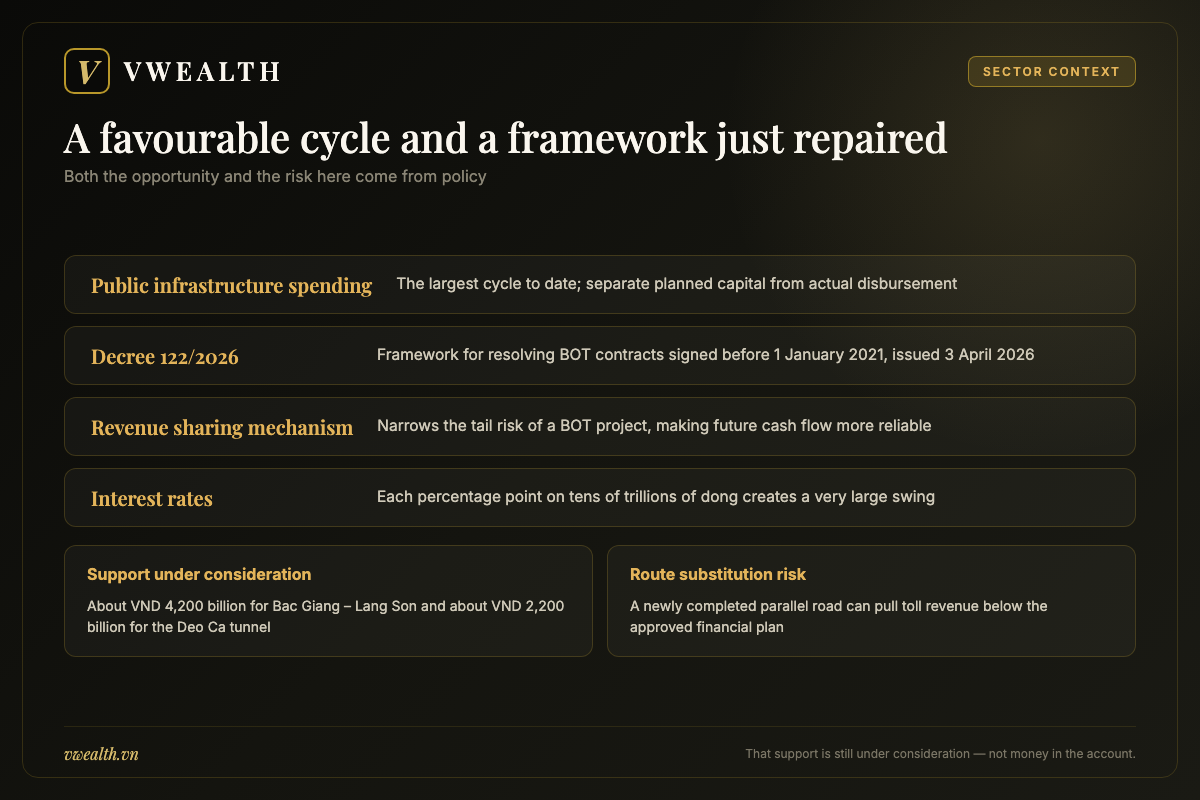
Sector context: a favourable cycle and a legal framework just repaired
No company is bigger than its industry. For HHV this is especially true, because nearly all of its workload and nearly all of the value of its assets are determined by state infrastructure policy.
The infrastructure investment cycle: the root driver
Vietnam is in the largest transport infrastructure investment cycle in its history, built around the north-south expressway backbone together with ring roads, regional connectors and railway projects.
For a company like HHV, this cycle creates two layers of opportunity. The first is construction workload, arriving immediately and measurable in contract value. The second is demand for operating the new routes once complete, arriving later but lasting longer because it takes the form of multi-year service contracts.
One thing to watch when following this theme: distinguish planned capital from actual disbursement. A programme announced with a very large headline number but disbursing slowly reaches companies far later than the market’s expectations assume. The broader Vietnam market outlook discussion covers how public investment cycles have historically translated into listed company earnings.
Decree 122/2026 and the backlog of stalled BOT projects
This is the most important policy event for the industry in years, and it relates directly to HHV.
On 3 April 2026, the Government issued Decree 122/2026 setting out detailed rules for resolving obstacles in BOT transport projects. It applies to transport infrastructure projects under BOT contracts signed before 1 January 2021, and covers two areas: handling revenue shortfalls, and the conditions and principles for determining compensation when a contract is terminated early.
The key principle: for the first time there are detailed rules for determining compensation cost, including settled total investment capital excluding the state’s contribution, operation and maintenance costs, taxes and fees, and capital mobilisation costs, less revenue already collected. According to the assessment of the responsible ministry, roughly eleven BOT transport projects have been stuck for a prolonged period and require resolution, among them the Deo Ca tunnel and the Bac Giang – Lang Son expressway.
For HHV, at the 2026 annual general meeting the company indicated that two projects were being considered for allocated budget support of roughly VND 4,200 billion for Bac Giang – Lang Son and roughly VND 2,200 billion for the Deo Ca tunnel, totalling around VND 7,000 billion.
Read this carefully and precisely. This is support under consideration and allocation within a newly issued legal framework, not money that has arrived in the company’s account. If it is delivered in full, the impact is very large: it materially reduces borrowings, cuts interest expense, and directly improves net profit for years. If it moves slower than expected, everything stays as it is. This is the single most important variable across the three scenarios in chapter seven.
Why BOT became difficult in Vietnam: a short history of the problem
To understand why a decree about resolving BOT obstacles is treated as major news, you need the background.
Vietnam turned heavily to the BOT model in the 2010s because infrastructure needs far outran what the state budget could fund. Dozens of road projects were awarded, built and opened. The model worked in the sense that the roads got built — but a set of recurring problems emerged that were mostly structural rather than the fault of any individual investor.
The first problem was toll placement and public acceptance. Several early projects positioned toll stations in ways that drew strong public objection, and some had to reduce tolls or suspend collection. The second was that scheduled toll escalations written into contracts were frequently deferred for macroeconomic policy reasons, so the revenue curve underlying every financial plan flattened. The third was route substitution: in several cases a parallel or upgraded road opened after the BOT asset, drawing away exactly the traffic the plan had assumed. The fourth was delay in delivering the state’s own committed contribution to certain projects.
The result was a group of projects where the investor had performed its obligations, the asset existed and functioned, and yet the payback path had stretched well beyond what any lender had underwritten. Banks carried the exposure, investors carried the equity risk, and there was no clear legal route to resolution — which is why the situation persisted for years.
Decree 122/2026 is the attempt to close that gap. Its significance for an equity investor is not that money is guaranteed to any company; it is that a defined process now exists where previously there was none. A resolvable problem is valued differently from an unresolvable one, even before any specific resolution occurs.
Two cautions when you weigh this. First, a framework existing and a framework being executed at pace are different things, and Vietnamese administrative processes involving budget allocation historically take time. Second, the compensation principles set out in the decree are based on settled investment cost less revenue already collected — an accounting exercise that itself requires agreement between parties. Treat announced figures as indicative of scale rather than as scheduled receipts.
The legal framework for public-private partnerships
Beyond that decree, Vietnam’s public-private partnership legislation has been amended in a direction that removes obstacles for investors, including provisions on sharing revenue increases and decreases.
The significance of a revenue sharing mechanism is large and worth explaining. Under the traditional BOT model, the investor bears all traffic risk: fewer vehicles than forecast and the investor absorbs it, more vehicles and the investor keeps it. A sharing mechanism sets a band, and when actual revenue falls outside that band the state and the investor share the shortfall or the excess.
For an equity investor, the meaning is this: the tail risk of a BOT project narrows, which makes future cash flow more reliable — and therefore justifies a lower discount rate in valuation. This is the kind of change that generates no dramatic headlines but materially affects enterprise value.
The next wave: rail, ring roads and what comes after expressways
Vietnam’s expressway programme is the visible half of the infrastructure cycle, but it is worth thinking about what follows, because a company whose moat rests on continuously winning new work is valued partly on the pipeline beyond the current one.
Three directions are visible in national planning. The first is urban ring roads around Hanoi and Ho Chi Minh City, which carry heavy engineering content including elevated sections and river crossings. The second is railway, a category Vietnam has discussed for years and has been moving toward committing to; rail construction is technically distinct from road work, but tunnelling and heavy civil engineering capability transfers reasonably well. The third is the ongoing need to operate and maintain everything already built — a segment that grows mechanically with every kilometre completed, regardless of whether new construction slows.
For HHV specifically, the third direction is the most reliable and the least discussed. Every expressway section that opens creates a multi-year operations contract that has to go to someone, and the pool of organisations with the credentials to run tunnels and complex highway systems in Vietnam is small. This is not a dramatic growth story, but it is the part of the business least dependent on winning competitive tenders against well-capitalised rivals and least dependent on policy timing.
When you assess the durability of the investment case, weigh these three separately. Construction workload can be cyclical and is exposed to disbursement pace. Toll cash flow is contractual but finite, declining as concessions run down. Operations revenue is the one that compounds quietly with the size of the national network. A long-term holder is, in effect, betting that the third grows large enough to matter by the time the first two have run their course.
Interest rates: a two-way variable that leans one way
For a company with large long-term borrowings, interest rates have the largest and most direct effect on profit.
The mechanism is simple: each percentage point change in the average rate applied to tens of trillions of dong of debt creates a swing in financial expense that is very large relative to the company’s profit. This is why infrastructure stocks rally hard when the market expects rate cuts, and sell off just as hard in the opposite case.
One technical note: infrastructure project loans often carry interest terms defined within the approved financial plan, so actual sensitivity can differ from that of an ordinary commercial loan. Read the borrowings note to see the split between fixed and floating rates.
Traffic volumes and regional economic growth
The final and most fundamental factor: toll cash flow depends on vehicles passing the station, and vehicle counts depend on economic activity in the area the route serves.
HHV’s core assets sit on the north-south corridor through central Vietnam and on the corridor connecting toward the northern border. That ties the company’s cash flow to two things: freight movement along the national trunk route, and cross-border trade.
When assessing the long-term prospects of a toll station, ask two questions: does this area have a driver of traffic growth over the next decade, and is any route nearing completion that could divert vehicles away from the existing one? The second question is the one many investors forget, and it is precisely the risk that has caused difficulty for numerous BOT projects in Vietnam.
Looking ahead: three scenarios for HHV stock and what triggers each
This section gives no price target, because any number quoted today would be stale before you finished reading. Instead it describes three possible states and lists the specific conditions that let you recognise which one you are in.
Four variables that decide HHV’s future
The first variable is the pace at which budget support is allocated under the new framework for the Bac Giang – Lang Son and Deo Ca tunnel projects. This is the largest, because it acts on debt, interest expense and profit simultaneously.
The second is the disbursement pace of public investment into transport infrastructure, which determines construction workload and the kilometres of route the operations segment can win.
The third is the interest rate environment, acting directly on financial expense at a heavily geared balance sheet.
The fourth is the company’s own capital discipline: how many new projects it takes on, with what capital structure, and how many new shares it issues to fund them.
Bull case: support arrives and leverage falls quickly
Conditions: budget support under the new framework is allocated and disbursed broadly on schedule, while interest rates stay low and construction workload remains abundant.
The chain of effects then runs as follows. Borrowings fall materially, interest expense falls with them, and because interest is a large item relative to profit at this company, the saving flows straight down to net profit. In parallel, cash previously committed to debt service is partly freed, giving the company room both to pay dividends and to fund equity contributions for new projects without heavy issuance.
This is the scenario in which the market re-rates the ticker in a fundamentally different way, because the three things investors worry about most — debt, interest expense and dilution — all ease at once.
Early signals: specific capital allocation documents published; long-term borrowings falling clearly across several consecutive reporting periods; financial expense falling faster than the debt balance.
Base case: the company grows, leverage stays put
This is the scenario this article considers most likely.
Here operations continue steadily: toll stations perform in line with plan, the construction segment has work thanks to the public investment cycle, and the operations segment expands with each new expressway section. Revenue and profit rise gradually toward the targets management sets.
But budget support is disbursed more slowly than expected, or only partially. Borrowings decline slowly and interest remains a large expense. The company continues to need capital for new projects and therefore continues to issue shares, so earnings per share grow far more slowly than absolute profit.
For an investor this carries a consequence worth stating plainly: the company genuinely improves, but the improvement is divided across an ever-larger share count. You can be right about the business and still earn a modest return.
Bear case: rising rates meet slow disbursement
Conditions: interest rates rise materially while public investment disbursement slows and budget support is drawn out.
The company then faces pressure from three directions. On cost, interest rises on a very large debt balance and eats straight into profit. On revenue, the construction segment runs short of work and receivables from ongoing projects stretch out. On capital, the need to issue new shares arrives exactly when equity markets are least receptive, making offerings hard to complete or forcing acceptance of a low price.
In that situation the company may need to slow its participation in new projects. That is a sound management response and consistent with the stated capital discipline, but it delays the growth story the market is pricing.
Early signals: financial expense growing faster than the debt balance; receivables as a share of revenue rising across several consecutive periods; operating cash flow weakening while twelve-month debt service does not fall.
The three scenarios summarised
| Scenario | Trigger conditions | What happens to the business | Early signals |
|---|---|---|---|
| Bull | Budget support allocated on schedule, interest rates low | Debt and interest fall sharply, cash flow is freed | Specific allocation documents; long-term debt clearly down over several periods |
| Base | Operations fine but support disbursed slowly or partially | Profit rises but is divided across a growing share count | Charter capital keeps rising while debt moves sideways |
| Bear | Rates rise while public investment disbursement slows | Interest erodes profit, new projects deferred | Financial expense outpacing debt growth; receivables swelling |
Note what these three share: all revolve around cost of capital and policy timing rather than around whether the company does its job well. That is true of every BOT company, and you must accept it if you want to own this kind of asset.
So, should you buy HHV stock? A straight answer
Seven chapters in, it is time to put the pieces together. This section weighs both sides, then says who this stock suits and who it absolutely does not.
The bull side: five reasons HHV deserves consideration
First, real assets with contractually defined cash flow. Toll rights over the Deo Ca, Cu Mong and Hai Van tunnel chain and the Bac Giang – Lang Son expressway are assets very few Vietnamese listed companies own, and their cash flow does not depend on competing for customers in the ordinary sense.
Second, a rare capability. Operating long road tunnels is a profession in which effectively one organisation in the country has accumulated sufficient experience, thanks to a fifty-year history. That barrier comes from time rather than capital, so competitors cannot shortcut it.
Third, three legs that offset each other. While the BOT segment is still servicing debt, construction funds the organisation; when the construction cycle cools, tolling and operations keep flowing. This structure is more durable than a pure contractor’s.
Fourth, position within the largest infrastructure investment cycle in Vietnam’s history, benefiting at both the construction stage and the operation stage of new routes.
Fifth, a genuine policy catalyst: a new legal framework for resolving BOT project obstacles, with two of the company’s projects among those under consideration for budget support totalling around VND 7,000 billion. If delivered, the balance sheet impact is very large.
The bear side: six risks you must look at directly
The first risk, and the largest, is financial leverage. Long-term borrowings in the tens of trillions of dong are inherent to the model, but they make the company more rate-sensitive than almost any other ticker on the exchange, and they amplify small errors in cash flow forecasts into large errors in equity value.
The second is continuous dilution. Charter capital has risen repeatedly within a few years, and new issuance plans continue to be tabled. If you do not subscribe at each offering, your ownership percentage falls.
The third is a high degree of policy dependence. Toll levels, the escalation schedule, the collection period, support mechanisms — all are decided by the authorities. The company can do its job well and still suffer if the mechanism changes.
The fourth is traffic risk. A newly completed parallel route can divert vehicles and cause toll revenue to fall short of the financial plan. This has happened to numerous BOT projects in Vietnam.
The fifth is the complexity of the ecosystem structure. The company is both contractor and investor within an ecosystem of related entities, making the true margin of each segment harder for an outsider to assess. This article makes no assessment of any individual transaction, but it stresses that you must read the related-party disclosures.
The sixth is price volatility driven by the shareholder base. With more than two thirds of capital held by individual investors, this stock reacts fast and hard to news, including unverified news.
Bull and bear side by side
| Bull side | Bear side |
|---|---|
| Toll rights on hard-to-substitute routes with contractual cash flow | Very large long-term borrowings, more rate-sensitive than almost any peer |
| Near-monopoly on domestic tunnel operating experience | Continuous dilution across repeated issuances |
| Three offsetting legs, less exposed to work droughts | Very high dependence on toll mechanisms and policy |
| Direct beneficiary of the largest infrastructure cycle to date | Risk of traffic falling short of the approved financial plan |
| New framework opening the way to roughly VND 7,000 billion of support | That support is still under consideration, not money received |
| Management has publicly stated project selection discipline | Ecosystem structure makes segment margins harder to assess |
| Good share liquidity, easy to trade | Volatile pricing with individuals holding over two thirds |
Who HHV suits, and who it absolutely does not
For a growth investor playing the infrastructure theme, accepting medium to high risk, with a three to five year horizon: HHV is one of the most direct ways to participate in Vietnam’s infrastructure investment cycle. The conditions are that you monitor operating cash flow and borrowings every quarter, and accept that you may be asked to contribute more capital at future offerings.
For a value investor: this ticker requires two extra steps many people skip. Step one is building a discounted cash flow model over the remaining toll life of each BOT project rather than using a price-to-earnings multiple. Step two is recalculating earnings per share after adding the full share count of approved issuance plans. Skipping step two is the classic mistake with infrastructure stocks.
For an income investor seeking a regular cash yield: at the current stage this is not a suitable choice, because most toll cash flow remains committed to debt service and to equity contributions for new projects. This may change as projects reach steady operation, but buy on today’s facts rather than on tomorrow’s picture.
For new investors or anyone with a low risk tolerance: be cautious with a ticker that combines very high leverage with high policy dependence. If you want exposure to Vietnamese infrastructure without single-company risk, start from the broader framework in how to invest in the Vietnam stock market, which covers market access, account opening and diversification for foreign investors.
Four questions to answer before you place an order
Question one: have you opened the latest cash flow statement and compared net cash from operating activities with principal and interest falling due in the next twelve months? If not, you do not know what financial health you are buying.
Question two: have you recalculated earnings per share after adding the full share count of issuance plans already approved by shareholders?
Question three: does your buy case depend on budget support being disbursed within a specific window? If so, ask yourself what you would do if it runs two or three years late.
Question four: is this position small enough that you stay calm when the whole infrastructure group falls on an interest rate headline?
How to keep score after you decide
Whatever you conclude, the decision is not a single event. Set yourself a short review list and run it once per reporting period, because the things that would change your mind on this ticker are specific and observable.
Watch four items in order. First, any formal document allocating budget support to the Bac Giang – Lang Son or Deo Ca tunnel projects — this is the single piece of news that changes the investment case outright. Second, net cash from operating activities compared with principal and interest due in the next twelve months, which tells you whether the business is servicing itself. Third, charter capital and shares outstanding, which tells you how much of any improvement is actually reaching each share you hold. Fourth, the revenue mix between tolling, construction and operations, which tells you whether the company is drifting toward lower-quality revenue.
If all four move favourably at once, you are in the bull scenario. If the first stays silent while the second deteriorates, you are drifting toward the bear scenario regardless of how impressive the asset list looks. Most of the time you will find yourself in the base case, and the discipline that matters there is simply not adding to a position because nothing has happened.
Closing: a company that sells time, not products
HHV’s story is that of a company in the hardest business on the exchange to explain: it spends tens of trillions of dong today in exchange for the right to collect small amounts of money at a toll booth over the next twenty years. There is no product to sell, no market share to win, no customer to retain. The only thing it sells is time and the durability of a structure.
From a wartime vehicle repair workshop, to the operator of the longest road tunnel in Southeast Asia, to Vietnam’s leading private transport infrastructure investor — it is a journey in which the field engineering origin is still visible in how the company works. But as a stock, HHV is still mid-journey: the works are built and the cash is flowing, but most of that cash is still repaying the loans used to build them.
So, should you buy HHV stock? If you understand that you are buying the cash flow of the next twenty years rather than this quarter’s earnings, accept that high leverage is inherent rather than a defect, can read operating cash flow and debt structure in the statements, and are willing to contribute capital at future offerings — then HHV is a defensible choice for the infrastructure-themed part of a portfolio. If you are buying because public investment is a hot theme, because you assume roads always have traffic, or because you believe a support package is about to arrive, then you are buying a story rather than a business.
One last thing to take with you: HHV’s history, asset portfolio and operating capability change slowly, but its borrowings, interest expense, operating cash flow, revenue mix, share count and the progress of support mechanisms change every reporting period. Before you place an order, open the latest analysis report and rescore the seven checks in chapter four. It takes fifteen minutes, and they are the most valuable fifteen minutes in the whole decision. If you do not yet have the tools to do it, create a free vwealth account and let the platform read the reports for you.
This article provides information and analysis for reference purposes only and is not a recommendation to buy or sell any security. All investment decisions are your own and you bear responsibility for their outcomes. Consider consulting a licensed financial adviser before acting.
Research Vietnamese stocks in English with vwealth. Our AI-powered platform turns Vietnamese market data into full English analysis reports — with international payment support and a free 2-month trial for new accounts. Create your free account and read the latest reports.