If you’ve ever walked past a building under construction anywhere in rural Vietnam and looked up at the roof, chances are the metal sheet over your head carries the Hoa Sen brand. That’s not a figure of speech. Hoa Sen Group Joint Stock Company (HOSE: HSG) is currently Vietnam’s number-one galvanized-steel-sheet producer, holding about 29% of the domestic galvanized-sheet market — a leading position few businesses in any Vietnamese industry have held continuously for over two decades. The Hoa Sen name, and the man tied to it, Mr. Le Phuoc Vu, have become part of the country’s construction-materials industry landscape, to the point that many people just call galvanized sheet “Hoa Sen sheet” as a generic term.
But behind that leading position is a stock story far more complex than the glossy “sheet king” image. HSG is a deeply cyclical stock — its profit fate is bound tight to the up-and-down wave of hot-rolled coil (HRC) prices on the world market, the input material Hoa Sen buys to roll, coat and paint. When steel prices rise, Hoa Sen’s margins swell as inventory value rises with them; when steel prices reverse, that very inventory becomes a burden eroding profit. This is a converter business with thin margins in normal conditions, capable of exploding to trillion-dong profit in one year then losing money the very next quarter. To understand HSG without understanding the steel cycle is to watch half a film.
And that’s why the current period is worth your attention. Hoa Sen is striving to transform — from a pure steel-sheet processing plant, swinging with every beat of raw-material prices, into a construction-materials retailer with the Hoa Sen Home superstore chain spreading nationwide. If this restructuring gamble succeeds, the nature of HSG stock could change: less dependent on the steel-price wave, with more stable cash flow from retail. At a price of 11,950 dong (close of 19 June 2026), you’re looking at a mid-cap stock, high liquidity, but standing at a crossroads between a cyclical past and an unproven retail future.
In this full analysis, we’ll start from the roots. The first part — the one you’re reading — reconstructs Hoa Sen’s journey: from a small sheet workshop in Binh Duong in 2001 to Vietnam’s number-one sheet group and Southeast Asia’s leading sheet exporter; the unique integrated production-plus-retail-distribution model that made the difference; the tsunamis of profit and the abysses of loss; and the Hoa Sen Home turning point reshaping the future. Understanding what Hoa Sen has been through lets you answer the final question this article aims at: should you buy HSG, and which kind of investor does it suit?
HSG market data (updated 19 June 2026)
| Current price | 11,950đ | FY24-25 revenue | 36,538 bn |
| Change (June) | −4.02% | After-tax profit | 732 bn (146% of plan) |
| Galvanized-sheet share | 29% (#1) | P/B | Net margin | ~0.8–1.3x | ~2% (cyclical) |
Note: HSG is a CYCLICAL STEEL stock, thin-margin — read P/B & cyclical profit rather than P/E. Fiscal year ends 30 Sep. Source: VWealth + Hoa Sen reports. For reference only.
History and evolution
Hoa Sen’s story begins very humbly, and that very humbleness makes its journey remarkable. On 8 August 2001, Hoa Sen Joint Stock Company was founded with initial charter capital of just 30 billion dong, a mere 22 employees and 3 distribution–retail branches. Set against today’s group scale, that figure is almost a startup fairy tale. The founder was Mr. Le Phuoc Vu, a businessman who rose from a small base, starting with trading and processing roofing sheet and metal in the Binh Duong area. With no large capital backing and no ready technology, Hoa Sen of its early days was just a small link in the roofing-materials supply chain for southern residential projects.
The fascinating thing is: from the very first day, Hoa Sen was not just a producer. Those three initial bases already had a distribution–retail element. The seed of the later signature model — producing and selling directly to end users at once — was sown from the outset, though at the time perhaps no one imagined it would become the core competitive advantage.
From a small sheet workshop to the number-one sheet group
2002–2003 marked the first expansion. Hoa Sen added 31 branches, raising total distribution–retail points to 34, concentrated mainly in the Southwest, Southeast and the central coastal strip. This was a quiet but foundationally meaningful strategic decision: instead of selling through intermediary agents, Hoa Sen built its own network touching customers directly. That network later became the “moat” protecting the business from rivals.
2004 was the first truly industrial milestone. On 8 August 2004, Hoa Sen put into operation its color-coating line no. 1 with capacity of 45,000 tons a year, while inaugurating its headquarters in Song Than II Industrial Park, Di An, Binh Duong. From simple trading and processing, Hoa Sen began mastering higher value-added stages. In 2005, the company put galvanizing line no. 1 and color-coating line no. 2 into operation — gradually completing its galvanized-sheet technology chain.
The following years were a continuous chain of expansion and consolidation:
| Year | Milestone |
|---|---|
| 2001 | Founded with 30 billion dong capital, 22 employees, 3 branches |
| 2004 | Color-coating line no. 1 (45,000 tons/year); Song Than II headquarters inaugurated |
| 2006 | Founded Hoa Sen Sheet JSC, capital 320 billion dong |
| 2007 | Consolidated three subsidiaries into one unified Hoa Sen structure |
| 2008 | Listed HSG shares on HOSE (5 Dec 2008) |
| 2009 | Raised charter capital from 570 billion to 1,008 billion dong |
| 2010 | 106 branches; completed phase 1 of the Phu My Steel Plant |
| 2013 | Galvanizing line phase 2 (120,000 tons/year) |
2008 was an important milestone in capital-market terms: on 5 December 2008, HSG shares officially listed on the Ho Chi Minh City Stock Exchange (HOSE). Notably, Hoa Sen listed right in the middle of the 2008 global financial crisis storm — a far-from-favorable start, but also a show of the mettle of a business daring to raise public capital to expand. From here, every Hoa Sen move was exposed under the light of thousands of shareholders and analysts.
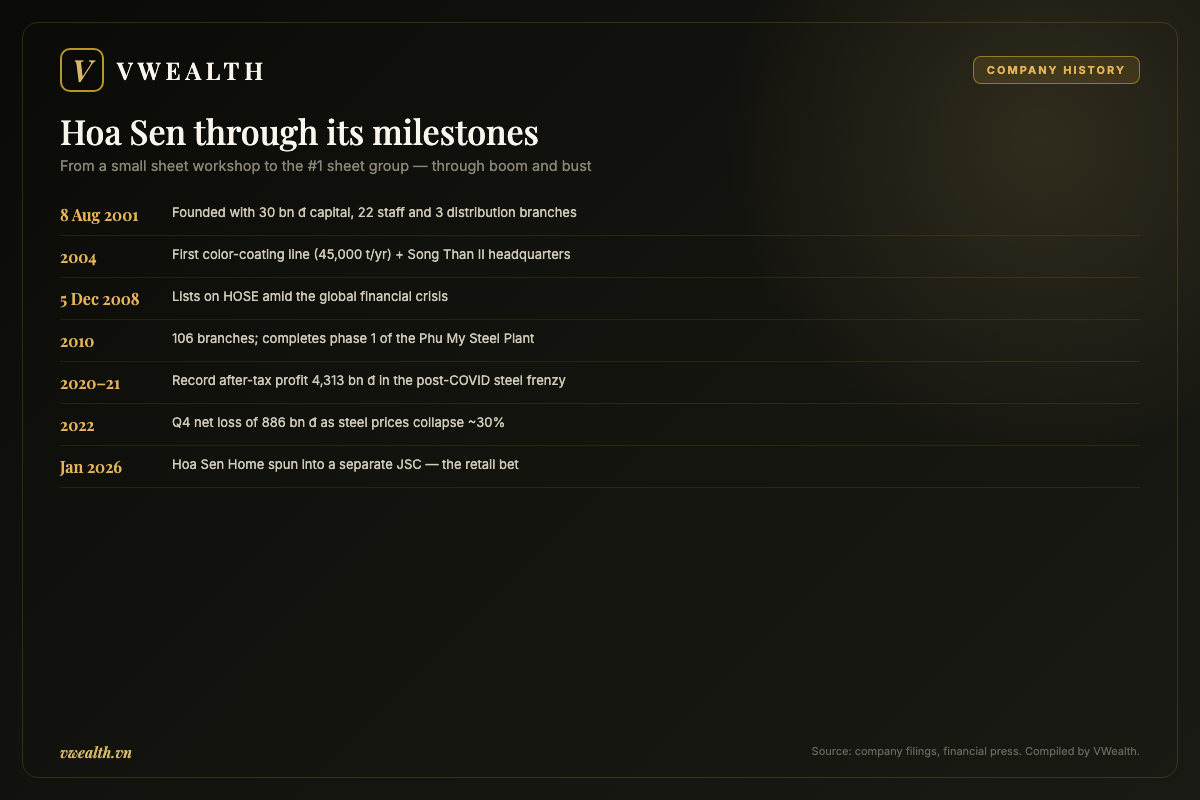
After listing, Hoa Sen accelerated in both capital and production capacity. Charter capital in 2009 jumped from 570 billion to over 1,000 billion dong. By 2010, the branch system reached 106 — triple in just half a decade — while phase 1 of the Phu My Steel Plant was completed, marking a shift of the production center to Ba Ria–Vung Tau, with its seaport advantage for importing raw materials and exporting finished goods. Over more than two decades of building, Hoa Sen went from a small sheet workshop to Vietnam’s number-one steel-sheet production and trading business, and the region’s leading sheet exporter — at times even the largest sheet exporter in Southeast Asia, and among Asia’s top 5 if you count “giants” like China and India.
The integrated model: production plus retail distribution
If you had to point to one thing that sets Hoa Sen apart from almost every rival in the steel-sheet industry, it’s the vertical integration between production and retail distribution. Picture it this way: most steel-sheet producers sell wholesale — they produce, push to tier-1 agents, who push to tier-2, and only then to consumers. Each intermediary rung eats a slice of the margin, and the producer almost loses direct contact with the end market.
Hoa Sen does it differently. The business builds and runs a network of distribution–retail branches across the whole country, selling products directly to customers. The advantages of this model are not small:
- Keeping the distribution margin instead of sharing it with a system of intermediary agents.
- Control over price and output: in tough markets, Hoa Sen can adjust output and selling price through its own channel, instead of depending on agents’ decisions.
- Holding end-market data: understanding real user demand in each region, and adjusting the product mix accordingly.
- Brand strength direct to users: the Hoa Sen name became familiar precisely through physical presence everywhere.
Alongside the distribution network is an integrated production system diversified over time. Hoa Sen makes not only galvanized sheet. At large plants like the Phu My Steel Plant in Ba Ria–Vung Tau (over 16.7 ha, design capacity up to 1.2 million tons a year) and the Nghe An plant cluster in Dong Hoi Industrial Park, Hoang Mai, Hoa Sen produces galvanized sheet, aluminum-zinc alloy-coated sheet, cold-rolled sheet, color-coated sheet, galvanized steel pipe, cold-rolled steel, and even plastic pipe (HDPE, PPR) and plastic fittings. The range stretches from the roof down to water supply-and-drainage pipes — true to the spirit of a comprehensive construction-materials supplier, not just a sheet workshop.
The “integrated production plus retail distribution” model is the red thread running through Hoa Sen’s history. It was sown from the first three branches in 2001, reinforced through the hundred-branch network of the 2010s, and is being upgraded to a new stature with today’s Hoa Sen Home chain.
Pushing exports and the trade-defense problem
As the domestic market gradually saturated, Hoa Sen sought the open sea. The business pushed galvanized-sheet exports to the US, Europe and many Asian countries, leveraging its port-side plants and large-scale production. There were peak periods like 2021 when Hoa Sen’s export volume reached 121,000 tons a month, bringing in over 100 million USD a month — figures that made Hoa Sen the region’s leading sheet exporter.
But exports are a double-edged sword. The more it sells abroad, the more Hoa Sen becomes a target of anti-dumping investigations. This is an inherent risk to remember when assessing this stock:
- US: From September 2024, the US Department of Commerce launched an anti-dumping investigation on some steel products from Vietnam, disrupting Hoa Sen’s exports to the US market.
- EU: The European Union tightened trade-defense measures and green standards on imported steel, pressuring export margins.
- Australia: In mid-2026, Australia launched an anti-dumping investigation on galvanized sheet imported from Vietnam, with Hoa Sen among the named businesses.
As a result, Hoa Sen’s export volume can swing sharply with each round of duties. Even in FY2024–2025, though overall it beat its profit plan, the company’s export volume fell about 29% year on year — vivid proof that a trade barrier can strangle a revenue channel with just one administrative decision from abroad. This unpredictable export risk is one of the drivers pushing Hoa Sen to return to strengthening its domestic market and developing retail.
The 2021 profit tsunami and the 2022 abyss
No chapter in Hoa Sen’s history shows the stock’s cyclical nature more clearly than 2020–2023. This is a vital lesson if you’re weighing whether to buy HSG.
In FY2020–2021 (ended 30 September 2021), amid the post-pandemic global steel-price frenzy — when economies simultaneously stimulated demand and HRC prices soared vertically — Hoa Sen achieved record after-tax profit of 4,313 billion dong, completing up to 288% of plan. This is a dream figure for a thin-margin converter. The mechanism behind it is fairly simple: Hoa Sen bought low-priced raw materials, stockpiled inventory, then as steel prices surged, both inventory value and finished-goods selling prices rose together — margins swelled abnormally. HSG stock flew with it, becoming one of the “hottest” names on the exchange that year.
Then the wave reversed, and it reversed cruelly. Into FY2021–2022, world steel prices plunged continuously while consumption slowed as high inflation choked purchasing power in many countries. The same inventory mechanism that once created huge profit now ran in reverse: high-priced inventory suddenly had to be sold at low prices, forcing provisions for inventory devaluation. The year’s profit path was a long slide:
| Period (FY2021–2022) | After-tax profit | Movement |
|---|---|---|
| Q2 | 234 billion dong | Down 77.4% year on year |
| Q3 | 265 billion dong | Down over 84% year on year |
| Q4 | Loss of 886 billion dong | Worst loss-making quarter in 4 years |
From a peak of 4,313 billion dong in profit to a bottom of nearly 900 billion dong in loss in just one quarter — that’s the swing range that makes HSG both attractive and frightening. For an investor who catches the cycle bottom and sells at the top, HSG is a money-printing machine. For someone chasing the record 2021 profit, it was a painful top-buying. The lesson is clear: for a cyclical stock like HSG, buying when profit looks best is usually the riskiest time, and vice versa. This is a counterintuitive principle many new investors pay tuition to learn.
It was precisely the 2022 shock — combined with steel prices staying flat through 2022–2023 and a tightening wave of trade defense — that forced Hoa Sen’s leadership to ask a survival question: can it forever bet the whole company’s fate on a steel-price wave it cannot control? Their answer was Hoa Sen Home.
The Hoa Sen Home turning point: seeking new growth
Hoa Sen Home is the strategic card leadership bets on for the future. In essence it’s a nationwide chain of construction-materials and interior superstores — selling not just Hoa Sen steel sheet, but everything a project needs: from construction materials, sanitary ware, paint and water pipes to furniture. In other words, Hoa Sen wants to turn its traditional sheet-branch network into general retail points where people can shop “all in one” for their home.
The strategic logic behind it is compelling. The steel-sheet production segment swings violently with the raw-material cycle, has thin margins and depends on risky exports. Meanwhile, construction-materials retail — if done well — delivers more stable cash flow, better trading margins, and most importantly leverages the most precious asset Hoa Sen built over 20 years: its branch network and nationwide brand. This is a moat that pure-production rivals cannot easily copy.
The scale of the rollout shows how serious this gamble is:
- The Hoa Sen Home system has developed over 400 stores nationwide, including 143 stores in the superstore model, trading over 15,000 product codes from leading domestic and foreign partners.
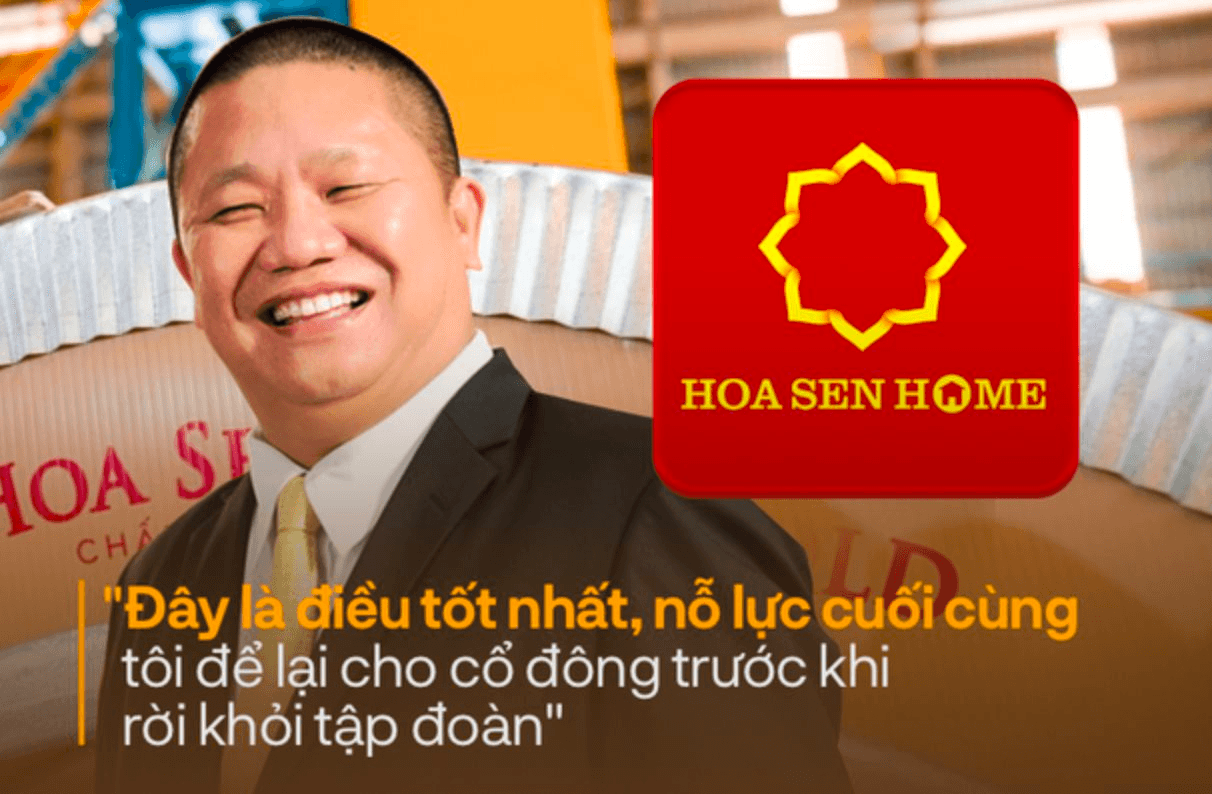
- In January 2026, Hoa Sen Home Joint Stock Company was founded as an independent legal entity with charter capital of 1,000 billion dong, of which Hoa Sen Group holds 99% — a step paving the way for a possible separate IPO of the retail segment in the future.
- The 2026 plan is to expand to 165 superstores; by 2030 the aim is at least 300 superstores, while developing Mega Home centers of 10,000–30,000 m².
- Hoa Sen Home signed cooperation with Alibaba Cloud and Cainiao on supply-chain technology and logistics, and deployed Salesforce CRM to upgrade customer-management capacity — showing a serious digitalization ambition, not just opening physical stores.
Spinning Hoa Sen Home into a separate company is a detail you should note particularly. It’s not just an administrative restructuring. If this retail segment proves its profitability and one day gets an independent IPO, its value could be “re-rated” at a retail-industry multiple — much higher than the cyclical steel-industry multiple. That’s the scenario the most optimistic investors hope for in HSG. Of course, this is still an undecided gamble: construction-materials retail is a cutthroat arena requiring inventory management of tens of thousands of SKUs and sophisticated chain operations — a very different skill set from running a sheet-rolling plant.
The role of Le Phuoc Vu and the succession story
You can’t tell Hoa Sen’s history without the founder. Mr. Le Phuoc Vu is the group’s soul — from building a small sheet workshop into Vietnam’s number-one sheet empire, he’s tied to every big decision of the business for over two decades. However, in recent years, his image has taken on a very unusual color for Vietnamese business circles: he’s known as the “tycoon who took up religious life,” following Buddhism and gradually withdrawing from direct management.
Mr. Vu formally took refuge in the Three Jewels in mid-July 2020, and at the 2021 AGM announced a plan to leave Hoa Sen in 2026 — coinciding with the 25th anniversary — to live a serene monastic life. However, by 2024, he adjusted the plan, saying he might need another 5–10 years to complete “cherished projects,” especially the Hoa Sen Home retail system itself. He also mentioned transferring the group to a successor and directing his wealth to a non-profit fund. This is a distinctive governance risk investors must weigh: a business tied too closely to an individual intending to withdraw, with a succession story not yet truly clear and decisive.
In practice, Hoa Sen’s management has been “renewed” and decentralized across leadership generations. Names like Mr. Tran Ngoc Chu — tied to Hoa Sen from the early years, having held CEO and Standing Vice Chairman roles — show the business has a professional management layer alongside the founder. Mr. Vu stepping back is both a question mark on stability and a test of the apparatus’s self-operating ability. The Hoa Sen of the future will have to prove it can grow without absolute dependence on one man’s vision.
That’s also the reason to move to the next chapter. A business standing amid a major transformation — from cyclical production to stable retail, from the founder era to the post-founder era — makes the capacity and direction of its leadership the decisive factor in whether the Hoa Sen Home gamble succeeds, and whether HSG stock can escape the shadow of the steel cycle. Let’s go deep into the people steering the Hoa Sen ship.
Leadership and ownership structure
When you analyze a heavy-industry producer like Hoa Sen Group (ticker HSG, HOSE), you can’t look only at gross margin or hot-rolled-coil inventory. You must look at the people at the helm, at how power and ownership are distributed, and at the governance philosophy behind decisions worth thousands of billions of dong. For HSG, this story is more special than most listed businesses in Vietnam, because it’s tightly tied to a figure who is both a businessman and a Buddhist on a journey to leave secular life: Mr. Le Phuoc Vu. Understanding Mr. Vu, the management he leaves behind, and who really holds Hoa Sen’s shares, gives you a much sharper view of this stock’s risk and opportunity.
Le Phuoc Vu — from empty hands to “sheet king”
Mr. Le Phuoc Vu was born on 28 May 1963 in Quy Nhon, Binh Dinh, into an ordinary working-class family. His journey is an almost classic startup story of the early Doi Moi generation of Vietnamese businessmen: rising from nothing, once a hired hand, having scraped through many trades before opening a small sheet shop. From that humble sheet shop, he step by step built Hoa Sen Group — a business that for many years held the lead in Vietnam’s galvanized-sheet industry, with domestic galvanized-sheet share reaching about 29% at times and a significant weight in Southeast Asia’s galvanized-sheet exports. It’s this dominant position that earned him the media and market nickname “sheet king.”
What you need to note is that Hoa Sen is not a group that was “inherited” or formed from a capital alliance. It’s the product of one individual — a self-made man who shaped the corporate culture and set the strategic vision himself. This trait creates both strength and risk. The strength is consistency of vision and fast decision-making. The risk is heavy dependence on a single person — what analysts often call “key-man risk.” For HSG, this risk is all the more notable when the founder himself has publicly stated his intention to leave.
A Buddhist at the helm: a distinctive leadership style
What makes HSG’s leadership portrait entirely different from the rest of Vietnam’s stock market is Mr. Le Phuoc Vu’s spiritual dimension. He’s a devout Buddhist. Per information from Buddhist circles, around July 2020 he took refuge in the Three Jewels (per a Vietnamese Buddhism source, tied to Vien Minh Patriarchal Temple) after years of studying and practicing the Dharma. He chose a life of meditation, going to the mountains, almost withdrawing from daily material life.
Per media accounts, Mr. Vu maintains a monastic lifestyle on the mountain, coming down only once a month to set strategic direction for Hoa Sen before returning to his meditative life.
This lifestyle is not just a private matter. It directly shapes his management style. Mr. Vu has repeatedly stated he no longer pursues wealth accumulation. At some AGMs, he expressed attention-grabbing views on money, responsibility and leaving. Per Nguoi Lao Dong (early 2021), he once said he would “take religious vows after 2026” and practice in Bao Loc, while sharing that he “had wanted to take vows since age 30,” that he was leaving “out of responsibility, not to gather a pile of money,” and that by then he would sell all his shares to later investors. These are statements to read cautiously — they reflect Mr. Vu’s personal state of mind at the time, not a binding commitment on the timing or path of any specific divestment.
Why does this matter to you — an investor? Because a founder declaring he no longer desires money and is ready to sell all his shares creates a big question mark over the future ownership structure and over how “attached” he is to the business. On one hand, this can be a positive signal: Mr. Vu proactively preparing a handover, building a successor management team, reducing dependence on the individual. On the other, a largest shareholder publicly stating an intention to divest in the future is always a factor creating psychological pressure on the share price and demanding you watch insider transactions closely.
Gradually withdrawing from management, but still Chairman and major shareholder
A subtle point to distinguish clearly: Mr. Le Phuoc Vu has gradually withdrawn from daily management, but still holds the Board Chairman’s seat and remains the largest shareholder. These two roles are very different. Daily management — running plants, managing the supply chain, marketing, sales — he has handed to a professional management team. But the power to set strategic direction at the Board level, along with the voice of a controlling shareholder, he still holds.
This “Chairman steps back, management steps forward” model reflects a deliberate governance shift. Instead of a business run by individual command, Hoa Sen is trying to become an organization run by institution. This is a trend governance experts view positively long term, because it reduces key-person risk. However, you also need a cautious view: a new management team, however professional, still needs time to prove its ability to lead the business through the volatile steel-price cycles — the harsh nature of the galvanized-sheet industry.
Management: the successor team after the Chairman stepped back
The most notable management handover occurred in 2024, when Hoa Sen changed CEO and appointed a series of new executives. Per VnEconomy, Mekong ASEAN and ZNews, Mr. Vu Van Thanh (born 1966) was appointed CEO and the group’s third legal representative, effective 12 April 2024. Before that, Mr. Thanh was Standing Deputy CEO in charge of Marketing–Communications, and had run the Hoa Sen Phu My Sheet Plant — that is, someone long attached and knowledgeable in both production operations and brand.
In the same round, Hoa Sen appointed additional Deputy CEOs for functional areas. Per the above sources, these include Mr. Nguyen Ngoc Huy (born 1978, previously in charge of exports), Mr. Tran Dinh Tai (born 1979, in charge of Marketing–Communications) and Mr. Pham Dinh (born 1980, in charge of supply chain). Note that senior personnel names and titles can change each period; the information here reflects the 2024 appointment round per press sources, and if you make an investment decision, cross-check with Hoa Sen’s latest published governance report.
| Position | Person (per press) | Born | Note |
|---|---|---|---|
| Board Chairman | Le Phuoc Vu | 1963 | Founder, largest shareholder; gradually withdrawing from daily management |
| CEO | Vu Van Thanh | 1966 | Appointed 12 Apr 2024; legal representative; background in Marketing and plant operations |
| Deputy CEO | Nguyen Ngoc Huy | 1978 | Previously in charge of exports |
| Deputy CEO | Tran Dinh Tai | 1979 | In charge of Marketing–Communications |
| Deputy CEO | Pham Dinh | 1980 | In charge of supply chain |
A detail to keep an eye on: historically, Hoa Sen had notable senior-personnel upheavals, including disputes with former executives (a case of a former CEO suing Hoa Sen Sheet, recorded by VnExpress years ago). Also, Mr. Tran Ngoc Chu — a long-attached leadership figure — per Tin nhanh Chung khoan sold nearly all his HSG shares in early 2025 after a price rally. These facts remind you that leadership’s share trading is a signal to watch: when insiders sell heavily after a price rise, it can be both ordinary personal profit-taking and an implicit message about valuation the market should consider.
Ownership structure: one major shareholder and a sea of individual investors
This is the core part to understand HSG’s “character” on the exchange. Per data compiled near end-2025 (from DSC and vietnambiz), Mr. Le Phuoc Vu — as Board Chairman — holds about 16.96% of Hoa Sen, the largest shareholder. The rest of the ownership shows a very characteristic HSG picture: institutional-fund weight is relatively modest (per DSC, funds combined hold only about a few percent), while the “other shareholders” group — mainly small individual investors — holds an overwhelming weight.
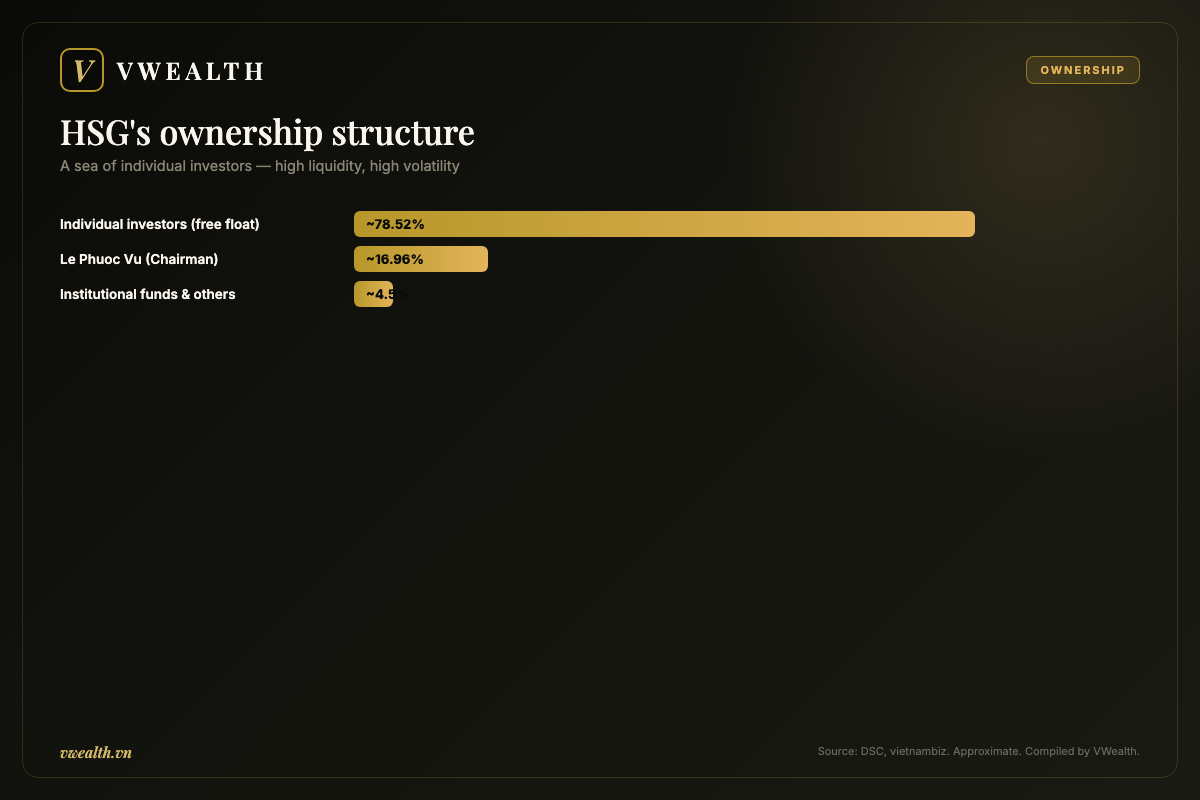
Read this number carefully, because it explains HSG’s price behavior better than any technical indicator. When over three-quarters of shares are in individual investors’ hands, HSG stock has two accompanying traits. First is very high liquidity — HSG is always among the most actively traded steel stocks, easy to buy and sell. Second, the downside, is strong price volatility: the herd psychology of individual investors makes HSG’s price abnormally sensitive to industry news, world steel prices, and speculative flows. In other words, HSG’s large free float is both a plus for liquidity and a minus for stability.
On the group related to Mr. Vu — you may have heard of entities like “Hoa Sen Investment” or family entities. A notable fact: per Dien dan Doanh nghiep, Hoa Sen Investment Group once cut its HSG holding to 0%. This shows the ownership of the related-shareholder group has changed significantly over time. You should understand that the ownership of Mr. Vu personally and related parties is not fixed; it moves with trading rounds, stock dividends and handover plans. So for any specific ownership figure, always treat it as a snapshot at a point in time and verify against the latest governance report or major-shareholder trading data.
The succession story: who will inherit the “sheet king”?
Tied to Mr. Le Phuoc Vu’s intention to take religious vows is the biggest HSG governance question for the coming years: who will inherit? At the 2024 AGM, per press sources, Mr. Vu expressed an intention to transfer his shares to his youngest daughter — Ms. Le Hoang Dieu Thien (born 2001) — reportedly pursuing a double bachelor’s program in Australia. Approach this information very cautiously: this is a stated personal intention, not yet an institutionalized or completed succession plan. Whether a person born in 2001, still studying abroad, can take over a multi-thousand-billion heavy-industry group is an open question the market will keep assessing.
More important for you than the successor’s identity is the quality of the handover process. A business that succeeds in succession is one that has built a governance system strong enough to operate stably regardless of who sits in the chairman’s seat. Hoa Sen proactively strengthening its professional management from 2024 is a step in that direction. But until this process completes and is tested across a few business cycles, this remains a governance risk you need to price into your investment decision.
Governance and controversial decisions: the Ca Na lesson
No HSG governance portrait is complete without the Ca Na mega-steel project in Ninh Thuan. This is a classic case for understanding the risk appetite and the strategic-thinking errors of Hoa Sen’s leadership in the earlier period. In 2016, Hoa Sen announced an ambition to invest in the Hoa Sen Ca Na–Ninh Thuan steel-rolling complex with expected total investment of up to about 10 billion USD (some sources cite 10.6 billion USD) and planned capacity of up to 16 million tons a year. This was an enormous gamble, far exceeding Hoa Sen’s own capital scale at the time.
It was in the context of the Ca Na project that Mr. Le Phuoc Vu made one of the most controversial statements of his career — essentially “why would I be foolish not to do it, foolish not to invest” (per Dan Tri and CafeF).
However, the project met major concerns over environment and financial feasibility. By 2020, after about 4 years, Hoa Sen announced it was withdrawing from Ca Na and dissolving the subsidiaries set up to implement it (per VnExpress, Fili, CafeF). What’s notable is how leadership looked back on this decision. Per Dan Tri (early 2025), Mr. Vu admitted that “not doing” Ca Na turned out to be fortunate — by withdrawing, Hoa Sen avoided an enormous foreign-currency debt burden and currency risk that could have reached several billion USD amid the steel industry’s later turbulence.
The Ca Na lesson shows you two sides of the same coin. The negative: HSG’s leadership at one point pursued ambitions beyond its core financial capacity, with a very high risk appetite and imprudent statements. The positive: they were also clear-eyed enough to stop in time, accepting a “loss of face” to avoid a financial disaster. When you assess HSG today, keep in mind this is a leadership prone to being generous with big investment ideas — and therefore, watching non-core investments (such as moves back into real estate, or the trillion-dong contribution to set up a real-estate investment company the press once mentioned) is an essential part of your governance-risk monitoring.
Dividend policy: a signal from the cash paid to shareholders
A business’s dividend policy is a window into the leadership’s capital-allocation philosophy. For Hoa Sen, a notable update: per vietnambiz, Hoa Sen approved a plan to issue over 186 million shares to pay a dividend for FY2024-2025, at a payout ratio of 30% (that is, a shareholder owning 100 shares receives 30 more). This issuance is expected to raise the group’s charter capital from about 6,210 billion dong to about 8,072 billion dong, with a record date expected around May 2026 (pending State Securities Commission approval). With a 16.96% stake, Mr. Le Phuoc Vu alone is expected to receive nearly 32 million more shares from this distribution.
Read this move with an analytical eye. Paying a dividend in stock (instead of cash) means the business keeps cash in the vault while diluting the outstanding share count. This is usually the choice of a business wanting to preserve liquidity for working capital or investment, especially when financial-cost pressure is present. Indeed, Hoa Sen’s leadership has mentioned financial-cost pressure, with short-term debt in the multi-thousand-billion range and interest expense that could rise as rates climb. In a context of recent-quarter results notably weaker year on year, choosing a stock dividend over cash is a capital-allocation decision to weigh carefully: it both shows cash caution and reminds you the business is prioritizing retaining resources over distributing cash to shareholders.
To sum up leadership and ownership, you’re looking at a business led by a legendary founder who is proactively stepping back, a professional management team still needing time to prove itself, an ownership structure thin on institutions but dense with individual investors, and a governance history both bold and knowing when to stop. All these factors of people and power don’t exist in a vacuum — they operate through Hoa Sen’s system of plants, galvanized-sheet products, steel pipe, plastic and its enormous distribution network. And that’s what you’ll dissect with me next: Hoa Sen Group’s products and system.
Products, distribution system and Hoa Sen Home
If you want to understand why HSG is valued in a very different way from other steel-sheet businesses on the exchange, you can’t look only at output and steel prices. You must look at what Hoa Sen has quietly built for two decades: a machine of three nested layers — market-leading products, a direct retail distribution network of hundreds of points almost no rival can copy, and now the Hoa Sen Home ambition, a construction-materials superstore chain expected to grow “many times larger than Hoa Sen Group today.” Those three layers are the core of HSG’s investment story. In this section, I’ll dissect each layer, so that by the end you clearly grasp where Hoa Sen makes money, where its real advantage lies, and whether its new bet has a basis or is just a dream.
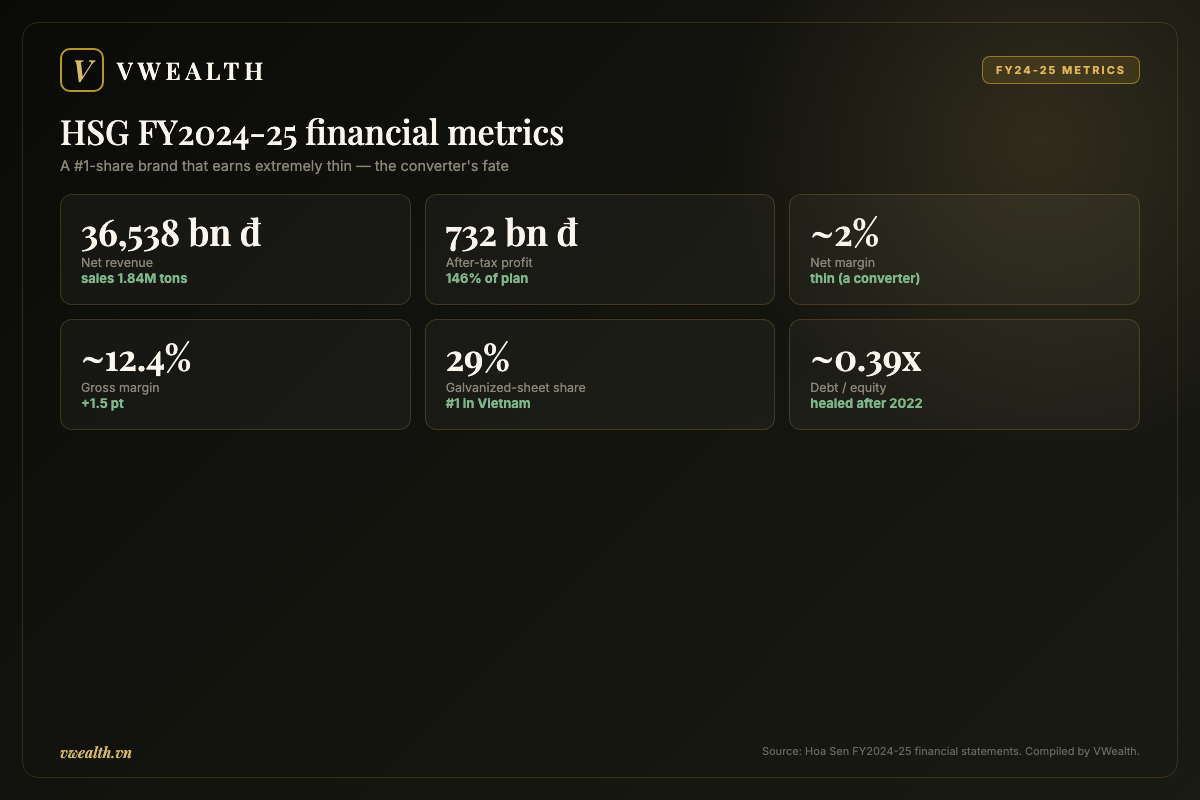
First, let’s set a few numbers as a reference frame. In FY2024-2025 (Hoa Sen’s fiscal year runs October to September), the group recorded sales volume of over 1.84 million tons and net revenue of 36,538 billion dong. More important than the absolute figure is position: from October 2024 to March 2025, Hoa Sen continued to lead the domestic galvanized-sheet market with 29% — number one nationwide — and ranked second in steel-pipe share with about 15%. This is not a newly won position, but a throne Hoa Sen has held for years. When you invest in HSG, you’re buying a share of an industry leader — and that matters greatly to valuation.
Core products: number-one galvanized sheet, top-tier steel pipe, plus plastic pipe
Hoa Sen’s product portfolio is organized into four large groups, but the soul is still galvanized sheet. Picture “galvanized sheet” not as a single product but as a whole family serving different needs:
- Cool sheet (aluminum-zinc alloy-coated sheet) — the premium line, good corrosion resistance, long lifespan, usually for industrial roofs, workshops and coastal projects. This is the good-margin line and Hoa Sen’s brand strength.
- Zinc sheet (galvanized sheet) — the mass-market line, reasonably priced, serving residential construction and mid-range projects, the “mass” product helping Hoa Sen cover the market broadly.
- Color sheet (color-coated sheet, including wood-grain sheet) — a color paint layer over cool or zinc sheet, both aesthetic and durability-enhancing, favored for residential roofs. This is a high-value-added segment.
Alongside galvanized sheet is steel pipe — including hot-dip galvanized pipe, galvanized pipe and steel box — serving construction structures, fences, scaffolding and interiors. This segment puts Hoa Sen among the market leaders, usually in the country’s top 2. And the fourth group is plastic pipe (uPVC, HDPE, PP-R) — a segment leveraging the existing distribution system to sell more products to the same base of construction customers. This whole portfolio revolves around a base market: roofs and materials for both residential and industrial construction. When a house or workshop is built in Vietnam, there’s a very high chance it uses sheet, steel pipe or plastic pipe — and Hoa Sen wants to be present at every one of those touchpoints.
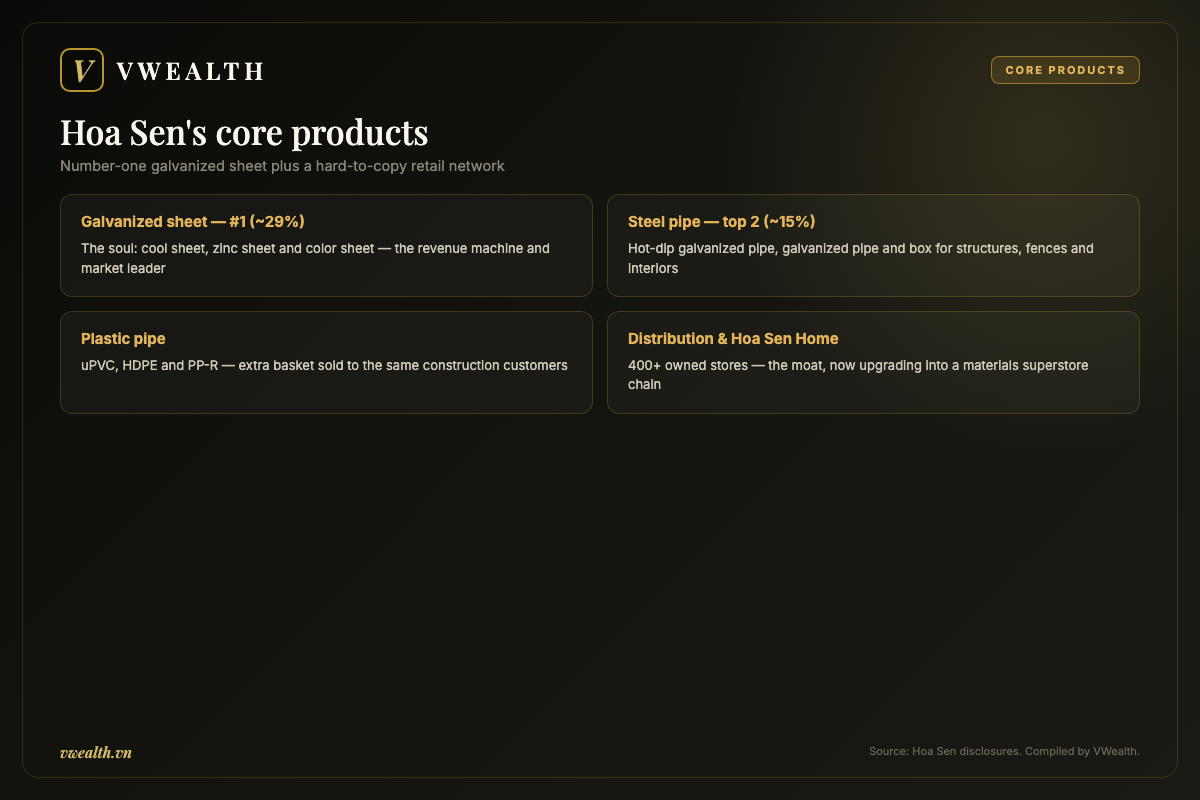
What to remember about the product structure: galvanized sheet is the revenue machine and where Hoa Sen holds the number-one position, steel pipe is a solid supplementary segment, and plastic pipe and expansion products are how Hoa Sen grows the “basket” per customer. Good products alone aren’t enough — rivals also make cool sheet and color sheet. What sets Hoa Sen apart is the second layer: it sells in a way almost no one in the industry can copy.
The integrated “production + retail distribution” model: a unique advantage
This is the part I think you most need to read carefully, because it’s the key explaining why Hoa Sen keeps its margin and brand durable across many steel-price cycles. Unlike most Vietnamese steel-sheet businesses — which produce then wholesale through agents and intermediary distributors — Hoa Sen owns and runs a network of branches and stores selling directly to end consumers, spread across the country. Total sales points reach over 400 direct branches and stores, a number you won’t find at any direct rival.
This model is organized methodically by geography: each province has a branch as the legal entity, managing the warehouse and coordinating all store activity in that province; each store is the direct touchpoint with end buyers — selling, delivering, caring for customers. In other words, Hoa Sen is both producer and retailer. Compare to see the difference clearly:
| Criterion | Hoa Sen (HSG) | Typical rival (Nam Kim, Ton Dong A…) |
|---|---|---|
| Domestic sales model | Direct retail via owned branches/stores | Mainly wholesale via agents, distributors |
| Direct sales points | Over 400 branches and stores | Depends on an independent agent network |
| Relationship with end buyers | Direct, holds customer data | Indirect via intermediaries |
| Ability to hold price/margin | High — controls the retail price | Lower — margin depends on agents squeezing price |
| Brand strength to households | Strong — “Hoa Sen sheet” is a household name | Weaker in the retail residential segment |
Why does this matter so much to you — an investor? Because it creates three cumulative advantages. First, keeping the margin: selling retail directly, Hoa Sen doesn’t cede the trading margin to layers of intermediary agents, and actively adjusts selling price with raw-material moves instead of being squeezed by agents. In periods of strong steel-price volatility, this control over output is a very precious cushion. Second, brand strength: because Hoa Sen-signed stores are present across all provinces, Vietnamese people default to “buying sheet means buying Hoa Sen” — a recognition advantage hard to buy with marketing money. Third, data and customer relationships: Hoa Sen knows who buys what, where, for what — and this is the foundation for stepping into the third layer, Hoa Sen Home.
Remember this: in the steel-sheet industry, anyone can invest in the same color-coating line. But building over 400 stores across all 63 provinces, building household trust for 20 years, takes time and capital money can’t buy fast. That’s Hoa Sen’s true moat.
Exports: a big driver but with anti-dumping risk
The next layer to understand is exports. Hoa Sen has long been one of Vietnam’s largest sheet exporters, sending products to over 90 countries and territories, with three key markets being the EU, US and Southeast Asia. At times, exports contributed about two-thirds of Hoa Sen’s total sales volume — an enormous weight. Exports are both a growth driver and a release valve when the domestic market saturates. But precisely because of heavy export dependence, Hoa Sen also exposes itself to an industry-specific risk: anti-dumping investigations.
A recent story illustrates this risk clearly. From September 2024, the US Department of Commerce (DOC) launched anti-dumping and anti-subsidy investigations on galvanized sheet, cold-rolled steel and color sheet. Due to cautious customers, Hoa Sen’s exports to the US were suspended from then. The preliminary duty on Hoa Sen Sheet was up to about 59% — the highest in the group, while Hoa Phat, Nam Kim and Pomina bore about 49.42% and Ton Dong A the lowest at 39.84%. Before that, Hoa Sen exported about 15,000–20,000 tons a month to the US; now that figure is near zero. In the EU, volume also fell from 20,000–30,000 tons a month to 15,000–20,000 tons a month as the EU tightened steel imports.
However — and this is where you need to read thoroughly rather than panic — the story isn’t one-sided negative. Two notable balancing points. One: despite losing nearly a whole year of US exports, Hoa Sen still reported profit and even beat its annual profit plan — proving the domestic market and other export markets are strong enough to offset. Two: most of the EU’s defense measures focus on semi-finished hot-rolled coil (HRC) — precisely Hoa Sen’s input material — not finished galvanized sheet, so in this respect Hoa Sen even benefits indirectly. Meanwhile, at home, the Ministry of Industry and Trade extending anti-dumping duties on galvanized sheet imported from China and Korea for another 5 years (until October 2029, at 4.95%–34.27%) protects Hoa Sen’s home turf. The lesson: trade risk is real and can shake HSG’s price short term, but the multi-market structure plus domestic strength gives Hoa Sen far better resilience than a pure exporter.
The Hoa Sen Home transformation: a bet to re-rate the business
Now the most interesting part, the one that could completely change how you see HSG stock: Hoa Sen Home. This is no longer about selling sheet. Hoa Sen takes the retail-distribution advantage discussed above and upgrades it into a chain of construction-materials and interior superstores — where you buy not just sheet, but also floor tiles, paint, sanitary ware, kitchen appliances, furniture and a host of other finishing materials. The ambition, stated frankly by leadership: turn Hoa Sen Home into “the Mobile World of the construction-materials industry” — the leading construction-materials and interior superstore system in Vietnam, reaching the top of Southeast Asia.
To realize it, Hoa Sen formally founded Hoa Sen Home Joint Stock Company (5 January 2026, initial charter capital 1,000 billion dong), over 99%-owned by the group, as the legal entity to manage and develop this superstore chain nationwide. Look at the existing scale and the road ahead:
- By end-2024, the system had about 120 stores organized under the Hoa Sen Home model out of over 400 total branches, aiming to raise this to 139 stores in 2025.
- Hoa Sen Home revenue in FY2024 reached about 13,300 billion dong (construction materials making up 98%), targeting 15,000 billion dong in 2025.
- 2030 vision: chain revenue heading toward about 33,000 billion dong (equivalent to 1.3 billion USD), average growth of 16.3% a year over 2024–2030.
- Plan to open 25–35 more stores a year toward about 300 points; from 2027 developing a “mega store” model per province of 10,000–20,000 m². Hoa Sen is seeking 300–500 sites to expand.
Why is this a big deal for HSG’s valuation? Because if Hoa Sen Home succeeds, this business will no longer be valued as a pure steel company — which the market tags with a low P/E for cyclicality and thin margins — but begins to take on the shape of a retailer, where investors are willing to pay more for network, brand and stable cash flow. That’s the “re-rating” logic many expect. Leadership itself expects Hoa Sen Home to one day grow “many times larger than Hoa Sen Group today,” and has set a goal to IPO this chain as its “trump card.”
But I wouldn’t be doing my job as an analyst if I only painted the opportunity. You need to weigh the challenges fully. First, multi-category construction-materials retail is a game of large working capital and thin margins — utterly different from producing sheet. Hoa Sen once had to pour thousands of billions of dong (some information says up to 6,000 billion) into this chain, and there was a period the chain paused expansion, left unfinished with a former 2-billion-USD dream. Second, this is a crowded arena — from modern construction-materials chains to tens of thousands of traditional materials shops and even furniture retailers. Third, the mega-store model needs large sites, complex operations, inventory management of thousands of SKUs — a capacity very different from running a steel plant. Restructuring into a separate JSC and setting an IPO goal shows Hoa Sen is serious and wants transparency, but also means results will be scrutinized very closely in the coming years.
The bottom line: three layers of advantage and one new direction
In sum, when you look at Hoa Sen’s “core,” remember three layers stacked on each other. The base layer is number-one galvanized-sheet share (29% domestic) with top-tier steel pipe — a revenue machine proven across many cycles, with over 1.84 million tons sold and 36,538 billion dong of revenue in FY2024-2025. The middle layer is the direct retail distribution network of over 400 points — a unique moat helping Hoa Sen keep margin, brand and end customers, something Nam Kim or Ton Dong A (mainly wholesale) lack. The top layer, ambitious and risky, is Hoa Sen Home — the transformation from sheet producer to construction-materials and interior retailer, opening a new growth driver and the possibility of a market re-rating. Add exports as both a driver and an anti-dumping risk to watch closely, and you have a fairly complete picture of how Hoa Sen creates value.
Good products, strong distribution and a bold new direction — that’s the trio shaping HSG’s future. But a business, however attractive its model, must stand on healthy financial foundations, especially in a capital-heavy, volatile steel industry. So how healthy and strong is Hoa Sen’s real position? That’s what we dissect next.
Financial position and health
If you want to understand a steel stock like HSG, there’s a question to answer before looking at any profit figure: where does this business stand in the value chain, and is its balance sheet “strong” or “weak” when storms hit? Because for a classic cyclical industry like galvanized sheet, market position decides survival through the bottom, while financial health decides in what stance the business enters the next wave. Hoa Sen’s FY2024-2025 (ended 30 September 2025) gives us a very clear picture of both: a number-one-share brand that earns extremely thin, and a balance sheet notably “healed” after the 2022 shock.
Position: the galvanized-sheet throne and a hard-to-copy distribution network
Start from Hoa Sen’s strongest asset. In FY2024-2025, the group firmly held about 29% of domestic galvanized-sheet share, continuing as Vietnam’s number-one in this segment. This is no random or fleeting figure. Hoa Sen has led the galvanized-sheet market for years, and analyst reports even project share could edge up to 30% and one more percentage point thanks to anti-dumping duties on cheap galvanized steel from China and Korea — a factor pushing out imports and ceding the home turf to large domestic producers.
In steel pipe, Hoa Sen ranks second with about 15% share. Combined, you have a business dominating galvanized sheet and among the leaders in steel pipe — the two most important downstream product lines of the industry.
But if you look only at market share, you’ll miss Hoa Sen’s truly hardest-to-copy competitive advantage: the largest distribution-retail system in the industry. Hoa Sen owns a network of hundreds of stores and branches across the country (the Hoa Sen Home model and the traditional branch system), reaching into small-province markets. In an industry where products are almost “commodity” — this brand’s sheet and that brand’s sheet differ very little — the distribution channel, brand coverage and ability to bring goods to end consumers are the economic moat. A new rival wanting to grab 29% share must not only build plants but also build a retail system that takes decades to establish. This is why Hoa Sen’s position is far more durable than what annual profit figures show.
Hoa Sen’s position lies more in the distribution channel than in the plant. Anyone can roll out a coil of sheet; very few can sell it to every commune and district across Vietnam like Hoa Sen.
Extremely thin margins: why 36,538 billion in revenue yields only 732 billion in profit
This is the most important part to grasp so you don’t get “burned” valuing HSG. In FY2024-2025, Hoa Sen achieved consolidated revenue of 36,538 billion dong but after-tax profit of only 732 billion dong. A simple division gives a net margin of only about 2%. In other words, for every 100 dong of goods sold, after deducting all costs, Hoa Sen keeps only about 2 dong.
This 732-billion figure is actually a good result — it beat the high plan leadership set by 146%, up about 42% from the prior year, and was achieved amid falling sales volume (consolidated volume over 1.84 million tons, down year on year as galvanized-sheet and steel-pipe exports fell sharply). The gross margin this fiscal year improved to about 12.4%, up 1.5 percentage points, partly thanks to good inventory management and a reversal of inventory-devaluation provisions of about 166 billion dong.
But that 2% net margin reveals the industry’s nature: Hoa Sen is a converter, not an upstream steel producer. The core business is buying hot-rolled coil (HRC) — the input making up the overwhelming share of cost — then cold-rolling, galvanizing/color-coating, producing sheet and steel pipe to sell. The value-add Hoa Sen creates per ton is relatively small versus the raw-material value. The inevitable consequence: Hoa Sen’s profit is extremely sensitive to three variables, and you should remember these three when watching the stock:
- Input hot-rolled coil (HRC) price. This is the biggest cost. Hoa Sen imports HRC from Chinese suppliers and buys domestically (mainly from Hoa Phat). When HRC prices rise, costs climb; when HRC prices fall, margins can widen — but only if selling prices don’t fall faster.
- Output sheet and steel-pipe selling price. Because products are almost commodity, selling prices track regional steel prices and competitive pressure very closely. Hoa Sen has very little independent pricing power.
- Inventory gain/loss. This is the most subtle variable. Because it must stockpile a large HRC volume for many months of production, when steel prices swing, warehouse value swings too — creating inventory gains (when prices rise) or losses/provisions (when prices fall).
With a net margin of just 2%, a few-percent move in HRC or selling prices is enough to turn profit from positive to negative. That’s why HSG is a classic cyclical stock — and its own history is vivid proof.
The steel cycle through Hoa Sen’s own lens: 2021, 2022, and the 2024-25 recovery
To feel this business’s “ups and downs,” look back at the three most recent phases, read through Hoa Sen’s own reports.
The 2020-2021 peak. This fiscal year Hoa Sen earned record after-tax profit of 4,313 billion dong, completing 288% of plan and nearly 3.7 times the prior year. World steel prices were in a post-pandemic frenzy, selling prices soaring, and cheap inventory bought earlier suddenly became “gold” when sold at new prices. This is a converter’s dream scenario: input price locked low, output price surging.
The 2021-2022 bottom. The party ended fast. From October 2021 to late July 2022, world steel prices plunged about 30%. High-priced inventory bought at the peak suddenly became a burden, and Hoa Sen had to make massive inventory-devaluation provisions. Q2 profit fell over 77% to 234 billion; Q3 fell over 84% to 265 billion; then in the final quarter of the fiscal year, the group reported a net loss of nearly 900 billion dong — the first loss-making quarter since 2018. The same business, the same line, but just a year after the peak it nearly fell into a full-year loss.
The 2024-2025 recovery. After the difficult 2022-2023, Hoa Sen gradually regained its footing. The 732-billion profit of the past fiscal year, beating plan by 146%, marked a solid recovery — though still far from the 4,313-billion peak. This says an important truth: never extrapolate one year of HSG profit into a long-term trend. A fat-profit year doesn’t mean fatter profit next year; a near-loss year doesn’t mean the business is about to go bankrupt. You must look across a whole cycle, take multi-year average profit for valuation, rather than being enchanted or panicked by a single figure.
Inventory and working capital: a double-edged sword
One trait you can’t ignore reading Hoa Sen’s balance sheet is inventory scale. At recent points, Hoa Sen’s inventory reached over 10,000 billion dong, about 43-44% of total assets — mostly HRC and finished goods. This is not a sign of unsold goods, but the model’s nature: a converter must always “hold” enough raw material to run many months, both to ensure continuous production and to actively lock in input prices.
This enormous inventory turns working capital into a double-edged sword:
- Opportunity: When leadership reads the cycle right — stockpiling low-priced HRC before prices jump — the warehouse becomes a money printer, as seen in 2021 and partly in the 166-billion provision reversal of the past fiscal year.
- Risk: When it reads wrong — holding high-priced goods then prices reverse down — the business must make provisions, eating straight into profit, like the 2022 tragedy.
In other words, leadership’s ability to manage inventory and read the steel-price cycle is almost the decisive variable in Hoa Sen’s profit or loss, on par with the market itself. This is a point to watch closely each quarter: is inventory rising or falling, and does that move match the HRC-price trend?
Financial health: a balance sheet “healed” after 2022
The good news for shareholders is that after the 2022 shock, Hoa Sen acted very decisively to strengthen financial health. The biggest bright spot is sharply cutting debt. Ending FY2024-2025, the debt-to-equity ratio was only about 0.39 times — a very healthy level for a capital-intensive producer. To picture it, in the earlier stressed period, Hoa Sen’s leverage was much higher and interest pressure was a constant burden.
Proactively cutting debt brings two concrete benefits: first, financial costs fall notably (some quarters down about 8% quarter on quarter), directly adding to profit; second, resilience when the cycle turns down is raised — a low-debt business won’t be “squeezed” by banks or forced to dump assets when the market sours. Operating cash flow also improved versus the difficult period, letting the group both repay debt and maintain operations.
That said, keep a balanced view. Hoa Sen’s ROE swings very strongly with the cycle and is generally low in recent years — FY2024 ROE was only around 4-5%, accurately reflecting the industry’s thin-margin nature. This is not a business generating high, steady returns on capital; most of the time, Hoa Sen’s capital works quite hard for modest profit, exploding only in cycle-favorable years. Also note that the first half of FY2025-2026 showed signs of debt rising again amid declining profit — proving that a cyclical business’s “health” is never a fixed state, but always swings with each phase of the steel market.
Hoa Sen after 2022 is a lower-debt, safer business — but “safe” in the steel industry doesn’t mean “stable.” The balance sheet has healed, yet profit will still rise and fall with each beat of HRC prices.
The risks you must weigh
An honest analyst can’t tell only the positive story. Below are the substantive risks you need to put on the scale when looking at HSG:
- Hot-rolled coil (HRC) price. As analyzed, this is the variable governing profit. Hoa Sen depends on HRC imported from China and bought domestically from Hoa Phat, with almost no control over input price. Every large move in regional HRC prices hits results directly.
- Cheap Chinese steel. Oversupply and cheap steel flooding in from China is a constant pressure, pulling domestic selling prices down and eroding margins. Vietnam’s anti-dumping policy partly protects Hoa Sen, but this is a policy factor that can change.
- Anti-dumping duties in export markets. Exports were once an important growth driver, but ever-thickening trade barriers — especially US protection and many other markets — sharply cut galvanized-sheet and steel-pipe export volume in the past fiscal year. Narrowing export doors force Hoa Sen to rely more on home turf.
- Currency risk. Because it imports raw materials in foreign currency, VND/USD swings directly affect input costs and can create currency gains/losses in the financials.
All in all, you’re looking at an industry-leading business by position, one that proactively cleaned its balance sheet, but still “imprisoned” in the thin-margin, harshly cyclical nature of steel. The number-one galvanized-sheet position and distribution network are real, durable assets; while annual profit will keep being a jagged up-and-down line tracking HRC prices. Understanding that distinction — what is durable value, what is cyclical volatility — is the key to not buying HSG at the wave’s peak and selling at the bottom. With the financial foundation now strengthened, the next question is how the market is valuing this stock, and whether that price reflects both its position and its cyclical risk.
Market reception
If any ticker on HOSE deserves the title “national stock of the speculators,” it’s HSG. On the 19 June 2026 session, HSG’s price stopped at 11,950 dong — a modest number, just a few ticks above the 10,000-dong par, and down about 4.02% in June alone. But don’t let that small number fool you. Behind that “iced-tea” price is one of the highest-liquidity stocks on Vietnam’s market, where tens of millions of shares change hands each session, where individual investors flow in and out like a marketplace, and where traditional valuation is almost entirely bent by the steel industry’s harsh cyclicality.
In this section, you and I will dissect how the market really “treats” HSG: from why this stock’s P/E is almost useless — even a trap — to why traders love HSG so much, why foreigners once fled, and why Hoa Sen’s dividends dilute shareholders’ own pockets. All to answer a core question: whom does HSG suit, and which side of this gamble are you on?
Valuing a steel stock: when P/E becomes a trap
Start with a classic mistake many new investors make looking at HSG. You open the price board, see a steel company’s P/E at 6x–7x and cheer: “So cheap, let’s buy!” Then you look at HSG with a P/E that can jump to 15x, 20x, even higher when profit shrivels, and conclude: “Expensive, stay away.” Both reflexes, for a cyclical stock, can be disastrously wrong.
The problem lies in the steel industry’s cyclical nature. For strongly cyclical groups like steel, fertilizer and chemicals, the valuation rule runs opposite to ordinary intuition: the lowest P/E usually falls right when the business is at its profit peak, while sky-high P/E appears at the cycle bottom. The reason is simple arithmetic: when world steel (HRC) prices boom, HSG’s profit swells, the EPS denominator swells, sending P/E tiny — but that’s the peak, the time of highest reversal risk. Conversely, when the industry hits bottom, Hoa Sen’s profit shrivels to a few dozen or few hundred billion, EPS falls near the floor, sending P/E “frighteningly” large — but that’s often the accumulation zone worth attention.
Look at HSG’s real numbers now. After-tax profit for FY2024-2025 was about 732 billion dong. It sounds fine, but against tens of thousands of billions of revenue and an enormous share count (~620 million shares, soon rising to over 807 million after the issuance), HSG’s EPS is very thin. As of Q2 2025, HSG’s EPS was only about 751 dong per share. At a price of 11,950 dong, HSG’s P/E is pushed high and swings violently each quarter — a typical picture of a business in the recovery zone rather than the cycle peak.
For a steel stock like HSG, a high P/E doesn’t mean “expensive,” and a low P/E isn’t necessarily “cheap.” P/E here doesn’t measure valuation — it measures where you stand in the cycle. Confusing this is falling into the classic P/E trap.
So if P/E isn’t reliable, where should you look? Professional analysts’ answer for steel stocks is P/B (price-to-book), combined with examining profit across a whole cycle rather than a single quarter. P/B is far more stable because a large producer’s book value (equity) — with its plants, inventory and over 400 distribution branches — doesn’t “dance” quarter to quarter like profit. Per some securities firms’ assessments, HSG once traded around a P/B of 0.8x during the industry’s difficult period, and the reasonable valuation zone for this stock is usually put around 1.0x–1.3x book value. When HSG drops below 1.0x P/B, that’s when the market values the business below even its net assets — usually corresponding to the cycle bottom.
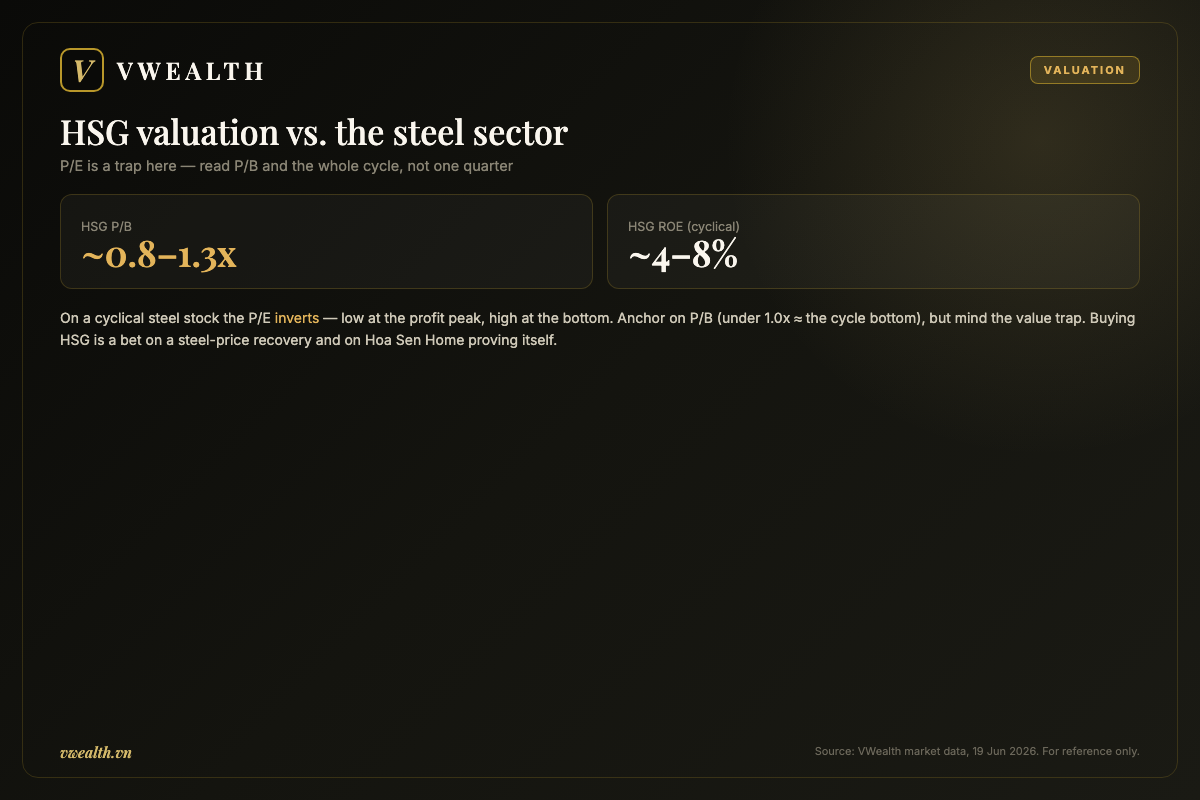
But P/B also has its own limit, and you need to beware a second concept: the value trap. This is when a stock trades at a very low P/E or P/B for a long time, making investors mistakenly think it’s cheaply valued and “will rise sooner or later.” But if the business’s internals don’t improve — ROE stays sluggish, margins thin, the industry has no wave — the stock can stay “cheap” forever and go nowhere. For HSG, projected ROE was once forecast at only around 8% — a modest figure — so a low P/B doesn’t automatically equal “opportunity.” Valuing HSG, ultimately, is a bet on expectation: expectation that world steel/HRC prices recover, and expectation that the Hoa Sen Home retail segment proves effective.
Hoa Sen Home and the “valued by recovery expectation” problem
If you plan to buy HSG at the current price, you’re essentially not buying the HSG of today — you’re buying the HSG of tomorrow that you expect. There are two main expectation drivers backing this stock’s valuation.
First is the steel-price cycle. Hoa Sen’s profit is extremely sensitive to world HRC prices — the input for making galvanized sheet and steel pipe. When HRC prices bottom then rise, the business benefits doubly: cheap inventory stockpiled earlier is sold at higher prices, and the gross margin widens. This is the “engine” that created past explosive profit waves. Conversely, when cheap Chinese steel floods Asian and global markets — the very fear that once made foreigners flee — HSG’s margins are choked.
Second is the Hoa Sen Home distribution segment. This is the long-term transformation story leadership pins many hopes on: shifting from a pure steel-sheet producer to a construction-materials and interior retailer, with a store chain. Hoa Sen Home’s appeal lies in the margins of non-steel categories: while construction steel has a gross margin of just 2–3%, paint reaches 15–20%, and floor tiles and sanitary ware up to 25–30%. If Hoa Sen can lift the weight of these high-margin items, profit will depend less on the steel wave and be more stable. The issue is that so far, the distribution segment contributes only about 10% of total revenue, and analysts still assess the retail chain’s efficiency as not commensurate with the capital poured in. In other words: the potential is real, but it’s still a promise more than a result.
It’s precisely because these two drivers still lie in the future that valuing HSG is such a high-stakes “bet.” You’re not valuing a stable cash flow; you’re valuing a probability of recovery.
Price action and speculativeness: a trader’s stock
This is the part I think you most need to engrave if you plan to touch HSG. Because however carefully you analyze valuation, in practice, HSG’s daily price is driven by speculative flows more than by the numbers on the financials.
Look at the ownership structure. Small shareholders — individual investors — make up about 78.52% of HSG’s ownership. This is the most prominent trait and the key explaining everything. This sky-high free float creates extremely abundant liquidity: you can buy or sell millions of shares almost without moving the price. For traders, this trait is gold — easy in, easy out, no fear of being “stuck” for lack of buyers. That’s why HSG is always among the highest-liquidity stocks on the exchange, and a familiar “playground” for Vietnamese traders.
HSG’s price history is vivid proof of this speculativeness. Recall the 2020–2021 tsunami: from a low, HSG rose many-fold, climbing to a peak around 44,000 dong, fueled by the post-COVID global steel-price frenzy and a flood of new retail money into stocks. Then in 2022, everything reversed brutally: HSG’s price plunged from the peak to below 12,000 dong — evaporating nearly three-quarters of its value — as steel prices weakened, rates rose and the industry outlook darkened. An investor who bought the 2022 top and held to now is still deeply underwater, even though the business never truly “lacked money,” as Chairman Le Phuoc Vu himself once mused.
- 2020–2021: Rose many-fold to a peak ~44,000đ — post-COVID steel-price wave + new retail money.
- 2022: Collapsed below 12,000đ — weakening steel prices, rising rates, foreign net selling.
- 2024–2026: Sideways in the low 11,000–15,000đ zone — fragile profit recovery, awaiting a new steel cycle.
This enormous swing range — from 44,000 to 12,000 then hovering around 11,000–15,000 — is the portrait of a stock the market values by emotion and steel-price expectation more than by intrinsic cash flow. Individual investors love to “trade” HSG with each beat of HRC-price news, with each session of hot money rotating. When the steel wave comes, HSG surges. When the wave recedes, HSG is also among the deepest fallers. That’s both its appeal and its fatal risk.
HSG is not a stock to buy then “lock in the drawer” and forget for ten years. It’s a trader’s stock — where entry, exit and risk management matter far more than whether you love or hate the business.
Dividends: reward or dilution?
HSG’s dividend policy is a point to understand correctly, because it easily misleads. Hoa Sen belongs to the group paying dividends cyclically: in favorable industry years with abundant profit, shareholders get a decent dividend; in tough years, the dividend shrivels or switches to stock form.
Specifically, for FY2024-2025, Hoa Sen decided to pay a stock dividend at 30% — meaning for every 100 shares owned, you receive 30 new shares. In total, nearly 186.3 million new shares will be issued, pushing outstanding shares from about 621 million to nearly 807.3 million, and raising charter capital from over 6,209 billion to over 8,072 billion dong.
“Free extra shares” sounds attractive, but stay clear-eyed: a stock dividend creates no new value. It only cuts the pie into more slices. When outstanding shares rise 30%, the reference price is adjusted down accordingly on the ex-dividend date, and EPS — already thin — is further diluted because the same profit must now be split among more shares. This is one reason HSG’s P/E tends to look “expensive” arithmetically. Hoa Sen sometimes also pays a cash dividend (most recently around 500 dong per share, a yield of about 3%), but prioritizing stock payouts shows the business wants to keep cash to strengthen financial health while the industry remains uncertain.
Foreigners and the “flight” lesson
One last important angle is foreign flows — often seen as “smart money.” And for HSG, the foreign history isn’t pretty. There was an alarming period when foreign funds fled Hoa Sen: the Dragon Capital fund group once net-sold nearly 9.8 million HSG shares in about two months, cutting its holding from 10.14% to 4.86% of charter capital.
The motive behind this net-selling wave isn’t hard to understand: foreigners worried about the steel industry’s gloomy outlook in general, and especially about the wave of cheap Chinese steel flooding Asian markets — directly threatening the margins of galvanized-sheet producers like Hoa Sen. When “smart money” retreats from a cyclical stock, it’s usually a signal they see risk outweighing reward at that time. Notably, leadership and insiders also had divestment rounds — Chairman Le Phuoc Vu’s company once registered to divest all of tens of millions of shares — showing even “insiders” cut weight at times.
This doesn’t mean HSG is “bad” — it underscores its cyclical nature: big money enters HSG with the steel-price wave, and exits with it too. HSG’s abundant liquidity makes these large in-and-out rounds smooth, but also amplifies the price-swing range discussed above.
The bottom line: whom does HSG suit?
Having put all the pieces together — valuation distorted by the cycle, P/E as a trap, extremely high speculative liquidity, a price history of many-fold rises then many-fold collapses, dilutive stock dividends, and foreigners flowing in and out with the steel wave — the picture of how the market receives HSG is fairly clear.
HSG is a classic cyclical steel stock, a bet on the recovery of world steel/HRC prices and on the long-term potential of the Hoa Sen Home distribution system, with very high price volatility — in essence, it suits traders more than long-term value investors. If you’re disciplined, can read the steel-price cycle, manage entry–exit and accept high volatility risk, HSG can be a strong profit tool in industry waves. But if you seek a defensive stock, steady cash dividends and the peace of “buy and forget,” HSG will most likely test both your nerves and your wallet.
And to understand why HSG must “live” by the beat of steel prices, we need to step back and look at the bigger picture: the context of Vietnam’s and the world’s steel industry itself — which decides whether the recovery wave you’re betting on truly arrives.
Economic and steel-sheet industry context
To understand why HSG stock sometimes surges vertically and sometimes plunges miserably, you can’t look only at Hoa Sen’s balance sheet. You must place this business in the right current of one of the most cyclical industries on the exchange: steel sheet. Hoa Sen is not a steel maker. In essence, Hoa Sen is a downstream converter: it buys hot-rolled coil, cold-rolls, galvanizes or color-coats, then sells to the market. This business’s entire margin fate, and hence its stock’s fate, hangs on a variable Hoa Sen almost cannot control: the hot-rolled coil price.
HRC — the heart deciding Hoa Sen’s margin
Hot-rolled coil, abbreviated HRC, is the main input making up most of the galvanized-sheet production cost. Picture HRC as flour to a bakery. The bakery has a strong brand, a beautiful store chain, a good sales team, but if flour prices swing strongly, the bakery’s profit swings too, however good they are. Hoa Sen is that giant bakery of the sheet industry.
The core problem is the lag. When Hoa Sen buys HRC into its warehouse, it takes time to turn it into finished goods and sell. If steel prices rise in that period, cheap inventory bought earlier suddenly “gains” more — this is called an inventory gain. Conversely, when steel prices reverse down, high-priced inventory bought earlier loses value, the business must make inventory-devaluation provisions, and profit can nearly evaporate in a single quarter. This is why a number-one-share business like Hoa Sen can earn trillions one year but lose heavily the next. After-tax profit for FY2024–2025 of about 732 billion dong is a notable recovery from the bottom, but it’s just one point on a very jagged curve.
For a downstream converter like Hoa Sen, steadily and stably rising steel prices are the ideal environment. What the business fears most is not high prices, but sudden volatility and abrupt reversals.
The flood of oversupplied Chinese steel — a double-edged sword
China produces over half the world’s steel. When China’s domestic property market weakens persistently, its domestic steel demand falls, leaving an enormous surplus of capacity. The familiar escape for Chinese steel mills is ramping up cheap exports, and Vietnam — a market right next to the border, a large importer — becomes a top destination. In 2025, Vietnam imported about 6 million tons of HRC from China. The average HRC price in China in 2025 fell about 9.8%, to about 477 USD/ton FOB, the lowest since 2020.
This is exactly the double-edged sword you need to grasp clearly to understand HSG stock:
- The favorable edge: Cheap HRC from China lowers Hoa Sen’s raw-material input cost. Short term, if the output galvanized-sheet selling price doesn’t fall as fast as the input material price, Hoa Sen’s margin widens. This is one factor giving Hoa Sen surprisingly good profit quarters.
- The adverse edge: That same flood, cheap Chinese steel also pours in as finished galvanized sheet, competing directly with Hoa Sen’s own products on home turf. Cheap raw-material prices also drag the galvanized-sheet price level down, eroding revenue. And most importantly, overly cheap steel prices are a sign of a weak market — low demand, cautious sentiment — bad for overall consumption.
In other words, Hoa Sen both benefits and is harmed by the same phenomenon, and which way the scale tips depends on the speed and magnitude of prices. This is why you should never assess Hoa Sen through a single variable.
Anti-dumping duties on HRC: the Ministry of Industry and Trade acts
Facing the steel flood, the Ministry of Industry and Trade issued a decision imposing anti-dumping duties on some hot-rolled coil products originating from China (case code AD20), at rates ranging from about 23.1% to 27.83%, applied from July 2025 and lasting 5 years. HRC imports from China are forecast to fall from about 6 million tons in 2025 to under 2 million tons in 2026 if the defense barrier holds.
For Hoa Sen, this is a delicate matter, not one-sidedly favorable. Domestic HRC production share is almost entirely in the hands of two big players: Hoa Phat with about 61% and Formosa Ha Tinh about 39%. These two are the ones who filed for the investigation. The HRC anti-dumping duty directly protects Hoa Phat and Formosa — the raw-material suppliers — not Hoa Sen. Hoa Sen’s leadership itself has publicly expressed the view that HRC duties mainly benefit the two upstream producers, while galvanized-sheet businesses and consumers risk losing out from rising input costs.
Look at this paradox clearly: a policy “good for Vietnam’s steel industry” in the press can raise Hoa Sen’s input cost, because when cheap HRC from China is blocked, Hoa Sen must buy more from Hoa Phat and Formosa at possibly higher prices. Hoa Sen’s position in the steel value chain — squeezed between the raw-material producer above and the consumer market below — keeps this business perpetually passive on margin.
Tariff barriers from the US and EU: the export door narrows
If the raw-material-import side is complex, the finished-goods export side is even tenser. Vietnamese galvanized sheet, a strong exporter to the US and Europe, faces a barrage of trade-defense barriers:
- US: In April 2025, the US Department of Commerce announced preliminary findings in the anti-dumping investigation on galvanized sheet imported from Vietnam, with duties for many businesses ranging from about 39.84% to 88.12%. Hoa Sen alone was hit with a preliminary duty of about 59%, while businesses like Nam Kim and Ton Hoa Phat bore 49.42%. This is high enough to choke Vietnamese galvanized sheet’s competitiveness in the US market.
- EU: The European Union tightened barriers on imported steel. From mid-2026, the EU sharply cut annual duty-free quotas and doubled the tariff rate, up to 50% on imports beyond quota. The EU has also formally imposed anti-dumping duties on hot-rolled steel from Vietnam.
The consequence is clear in the data: galvanized-sheet exports in Q1 2026 fell sharply, about 39.8% year on year. For a business that once had a significant export weight like Hoa Sen, the shrinking of major export markets is a direct blow to revenue and volume. This is a structural risk, not a fleeting one, and it forces Hoa Sen to pivot strongly to the domestic market — which leads us to the picture’s most positive factor.
Domestic demand recovers: a ray of light from real estate and public investment
While the export door narrows, the domestic market is clearly warming. This is the most important driver lifting the steel industry from early 2026:
- Public investment booms: Public-investment disbursement reached about 188,000 billion dong in the first 4 months of 2026, up about 13% year on year. Large infrastructure projects — highways, airports, ports — consume enormous steel and are stable demand, little dependent on market sentiment.
- Real estate recovers: Thousands of real-estate projects once legally stuck are gradually being unclogged. As projects restart, demand for construction materials — including galvanized sheet for roofing and cladding — rises.
- Residential construction: Total steel consumption in Q1 2026 reached about 9.4 million tons, up 14.6% year on year; within it, domestic consumption of construction steel rose up to 30%. For full-year 2026, total steel consumption is forecast to rise about 12.9%.
The point to note is the different shades across product lines. Construction steel and HRC are recovering very strongly, but galvanized sheet — Hoa Sen’s core product — is forecast to recover only mildly, about 3% in 2026, due to the burden of falling exports. In other words, the steel industry’s recovery wave doesn’t lift all boats equally. Hoa Sen benefits from warming domestic demand, but that benefit is being eroded by the closing export door. This is the core tug-of-war shaping the business’s outlook.
The risk of a steel-price reversal — a specter always lurking
Finally, you must always remember steel prices can reverse anytime, and that’s the biggest, hardest-to-forecast risk for Hoa Sen. Steel prices are forecast to recover in 2026 thanks to domestic demand, but a forecast is just a forecast. If China’s economy keeps weakening, if they ramp up cheap exports again, if the global economy slumps sending steel demand plunging, HRC prices could reverse and plunge anytime. And as analyzed, every sharp steel-price drop is another time Hoa Sen faces the risk of inventory-devaluation provisions, compressing an already-thin margin even thinner. This specter never leaves the balance sheet of a downstream converter like Hoa Sen.
Trend prediction
Having placed Hoa Sen in its proper industry context, now we look ahead. This section doesn’t aim to precisely forecast the share price — no one does that reliably with a cyclical stock — but to sketch the drivers, scenarios and each scenario’s triggers, so you can judge the probabilities according to your own risk appetite.
The growth drivers ahead
First, the construction and real-estate recovery wave. This is almost the most certain driver. As public investment maintains strong disbursement momentum and real-estate projects are unclogged, domestic galvanized-sheet demand will be supported for many years. Hoa Sen, with its number-one galvanized-sheet position (about 29%) and wide distribution network, is one of the most direct beneficiaries of this trend.
Second, and most important, the Hoa Sen Home gamble. This is the story that could change HSG stock’s nature. Hoa Sen Home is a construction-materials and interior retail chain, grown from 35 stores in 2021 to about 120 stores by end-2024. In early January 2026, the group formally founded Hoa Sen Home Company with initial charter capital of 1,000 billion dong, of which HSG holds over 99%, oriented to operate as an independent company.
Why is this a turning point? Because Hoa Sen’s traditional steel-sheet production segment is cyclical, thin-margin and raw-material-price-dependent. Construction-materials retail is a model with more stable cash flow, less dependent on steel-price swings, and if successful can create a stable, sustainable revenue source. Leadership’s long-term ambition, once announced, is to reach 3 billion USD in revenue thanks to Hoa Sen Home. For FY2025–2026, the group’s base plan targets volume of 1.75 million tons, net revenue of 35,000 billion dong and after-tax profit of 500 billion dong; a more positive scenario aims for 1.85 million tons, 37,000 billion dong in revenue and up to 600 billion dong in profit.
Third, the possibility of a Hoa Sen Home IPO. Leadership has publicly announced a plan to IPO and list Hoa Sen Home once this subsidiary operates stably, completes its governance system and market conditions are favorable. This is an appealing story for investors: if Hoa Sen Home is valued as a retailer (which the market usually pays a much higher P/E than a cyclical steel business), then the value of HSG’s stake in Hoa Sen Home could be strongly “re-rated,” creating upside for HSG stock itself. This is an important anchor of expectation for anyone holding HSG long term.
Three scenarios for HSG stock
From the drivers and risks above, we can sketch three scenarios. Read each scenario’s triggers carefully, because that’s what helps you monitor and adjust expectations over time.
- Positive scenario: Steel prices recover favorably and steadily in 2026, bringing inventory gains and improved margins. Real estate recovers strongly, public investment disburses well, pushing domestic galvanized-sheet demand above forecast, enough to offset falling exports. At the same time, Hoa Sen Home grows on plan with a clear IPO roadmap. In this scenario, profit could exceed the 500–600-billion target, the “re-rating” story via Hoa Sen Home is embraced by the market, and the stock has considerable upside from its current low price.
- Base scenario: Steel prices go sideways or recover mildly, margins stay thin. Warming domestic demand offsets most but not all of the export decline. Hoa Sen meets its profit target around 500 billion dong. Hoa Sen Home grows steadily but the IPO doesn’t happen right away. In this scenario, the stock swings within a range, accurately reflecting a cyclical business in a slow-recovery phase — no explosion but no collapse.
- Negative scenario: Steel prices reverse sharply, forcing Hoa Sen to make inventory-devaluation provisions, evaporating profit. Anti-dumping tariff barriers in the US and EU hold or tighten further, closing export markets. Chinese steel keeps oversupplying, competing fiercely on home turf, dragging domestic selling prices down. In this scenario, profit could be far below target, even returning to loss risk like cycle-bottom years, and the stock faces strong downward pressure.
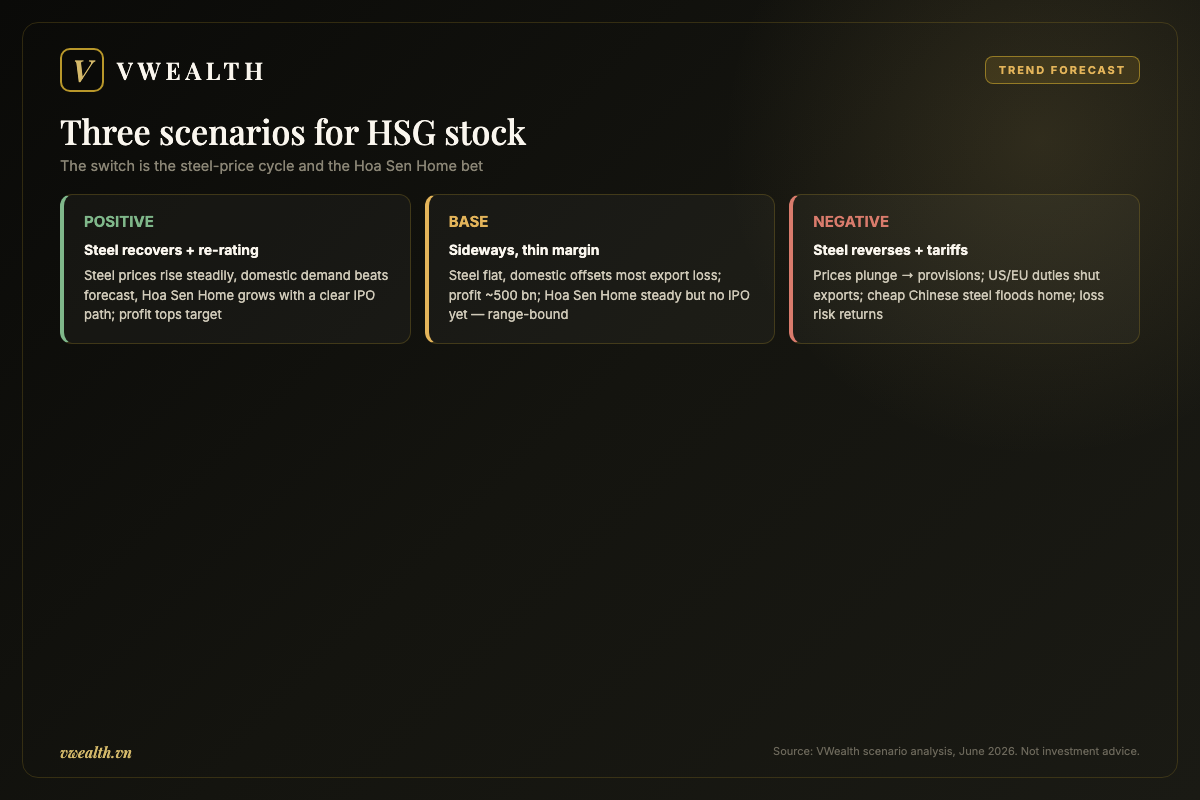
What to remember: for a cyclical stock like HSG, the line between these three scenarios is very thin and can reverse in just one or two quarters. One good quarterly profit figure doesn’t mean the up-cycle is certain; conversely one loss-making quarter isn’t necessarily the end. This is the kind of stock demanding you watch the steel-price variable and Hoa Sen Home progress closely, not “buy and forget.”
Should you buy HSG stock?
We’ve traveled a long road: from the business’s position, financial health, to industry context and future scenarios. Now it’s time to put it all on the scale. Let me say frankly from the start: this article won’t tell you to “buy” or “sell.” That’s your own decision, based on your risk appetite and investment goals. An analyst’s job is to help you see both sides of the coin clearly.
The pros: why HSG has its own appeal
- Number-one position in galvanized sheet. About 29% share is a substantive competitive advantage, hard to dethrone short term. Large scale gives Hoa Sen raw-material bargaining power and operating efficiency small rivals can’t match.
- A unique retail distribution network. Unlike steel-sheet businesses that only wholesale, Hoa Sen owns a wide retail store system — an intangible asset rivals need years and lots of capital to build. This is the foundation for Hoa Sen Home.
- Hoa Sen Home — a new growth direction and a re-rating story. If this retail chain succeeds, it can shift part of the business’s nature from “thin-margin cyclical steel” to “stable-cash-flow retail,” plus an IPO possibility to re-rate HSG’s stake. This is the most appealing point of the HSG investment story now.
- A healthier balance sheet. Hoa Sen cut debt notably from its earlier peak-debt period, giving it better resilience when the industry cycle turns.
- Direct benefit from the domestic construction recovery. Warming public investment and real estate are a real push for domestic galvanized-sheet demand.
- Low, accessible price. At about 11,950 dong per share, HSG is easy for small individual investors to buy, and is in a low zone by long-term history.
The cons: risks you absolutely must not overlook
- Thin margins and extremely high cyclicality. This is risk number one. Hoa Sen’s profit swings violently with steel prices — trillion-dong profit this year can become a loss next year. This is not a business with steady profit for you to hold passively at ease.
- The P/E trap. For a cyclical stock, a low P/E usually appears at the profit peak (about to fall), while a high or negative P/E appears at the profit bottom (about to rise). If you buy because P/E looks “cheap” without understanding where you are in the cycle, you can easily buy the top.
- Anti-dumping risk in export markets. US duties (preliminary ~59% for Hoa Sen) and EU barriers are shrinking an important revenue channel. This is a structural risk, not fleeting.
- Pressure from Chinese steel. Oversupply and cheap competition from China both threaten margins and create unpredictable instability in raw-material and selling prices.
- Dilution from stock dividends. Hoa Sen has a history of issuing shares to pay dividends, raising the share count and diluting per-share benefits. You must factor this in when assessing EPS growth.
- High speculativeness. HSG is a stock favored by speculators, high liquidity, swinging strongly with steel-price and policy news. This appeals to traders but is a nightmare for investors needing stability.
Which kind of investor does HSG suit?
There’s no absolutely “good” or “bad” stock — only a stock suited or unsuited to each person. Hold HSG up against four investor types:
- Safety-first investor prioritizing capital preservation: HSG is less suitable. Cyclicality and thin margins make this stock too volatile for your appetite. If you lose sleep over a portfolio swinging 20% in a month, this isn’t the stock for you.
- Long-term investor seeking steady growth and regular dividends: HSG is less suitable by its traditional nature. However, if you truly believe in the transformation into a retailer via Hoa Sen Home, you can view this as a long-term bet on a change of nature — but you must accept the risk that the story doesn’t pan out.
- Investor accepting cyclical risk, believing in steel recovery and Hoa Sen Home: HSG is fairly suitable. If you clearly understand the industry cycle, watch steel prices and Hoa Sen Home progress closely, and buy at the cycle bottom expecting recovery, HSG gives you strong profit leverage when the cycle rises.
- Traders, short-term speculators: HSG is very suitable. High liquidity, strong volatility with news is an ideal environment to trade — provided you have stop-loss discipline and don’t get “stuck” when bad news hits.
In sum: HSG is a stock of faith in the cycle and of the transformation story. It rewards generously those who understand the cycle and time it right, but punishes heavily those who buy because “it looks cheap” without understanding what they’re betting on.
Closing words
HSG stock is a vivid portrait of Vietnam’s steel industry: carrying both a respectable leading position and the harshness of a thin-margin cyclical industry. On one side is the number-one galvanized-sheet position, a unique distribution network and the promising Hoa Sen Home story. On the other is fragile margins, violently swinging profit tied to steel prices, and headwinds from international tariff barriers. The final decision — buy, hold, or stay out — depends on which kind of investor you are and which scenario you believe in. Choose with understanding, not with emotion before a share price that seems attractive.
Disclaimer
This article is produced for informational and reference-analysis purposes, and is not investment advice or a recommendation to buy or sell any stock. The figures cited are drawn from public sources at the time of writing and may change over time. The stock market always carries risk, and past performance does not guarantee future results. You should do your own thorough research, weigh your personal financial situation and consult a licensed investment advisor before making any decision. You are fully responsible for your own investment decisions.
Research Vietnamese stocks in English with vwealth. Our AI-powered platform turns Vietnamese market data into full English analysis reports — with international payment support and a free 2-month trial for new accounts. Create your free account and read the latest reports.