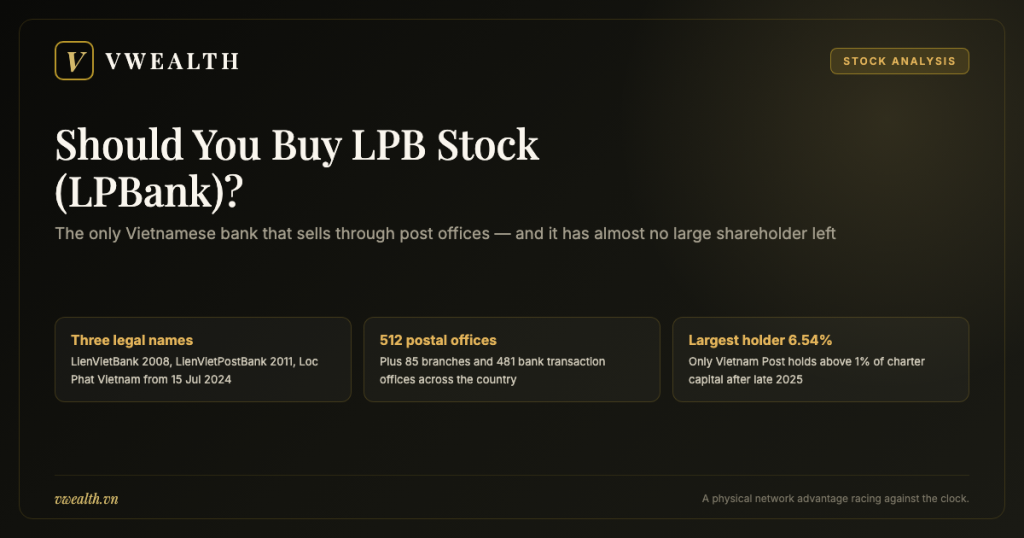
Asking whether to buy LPB stock starts from a stranger place than any other bank on the Vietnamese exchange. This is a lender that has changed its legal name three times in eighteen years, and that has just come through an ownership shift leaving it with almost no large shareholder at all. LPB is the ticker of Fortune Vietnam Joint Stock Commercial Bank, known commercially as LPBank — formerly LienVietBank, then LienVietPostBank. It is also the only bank in Vietnam with a distribution network no competitor can replicate: hundreds of service counters sitting inside post offices, reaching communes where no commercial bank branch would ever be economic. This analysis walks through those eighteen years, dissects the bank-and-post-office model, teaches you how to read the accounts of a retail bank, and ends with a straight answer.
One convention before we start. You will encounter dates, names, ownership percentages and scale figures in this article, all drawn from public sources: the establishment licence, regulatory decisions, shareholder meeting resolutions, exchange filings and mainstream financial media. What you will not find is a figure for the latest quarter, a current valuation multiple, or a price target. For a bank, those numbers move with every quarter and every turn in monetary policy; an article still being read two years from now that quotes one specific quarter is wrong ninety days after publication. Instead, this piece teaches you where to look. For current numbers, open the research reports on vwealth.
If you are new to this market, the companion guide on how to invest in the Vietnam stock market covers accounts, settlement and the mechanics underneath everything discussed here, while the Vietnam banking sector guide explains the regulatory architecture this bank operates inside.
Three names in eighteen years: the history of a bank that would not sit still
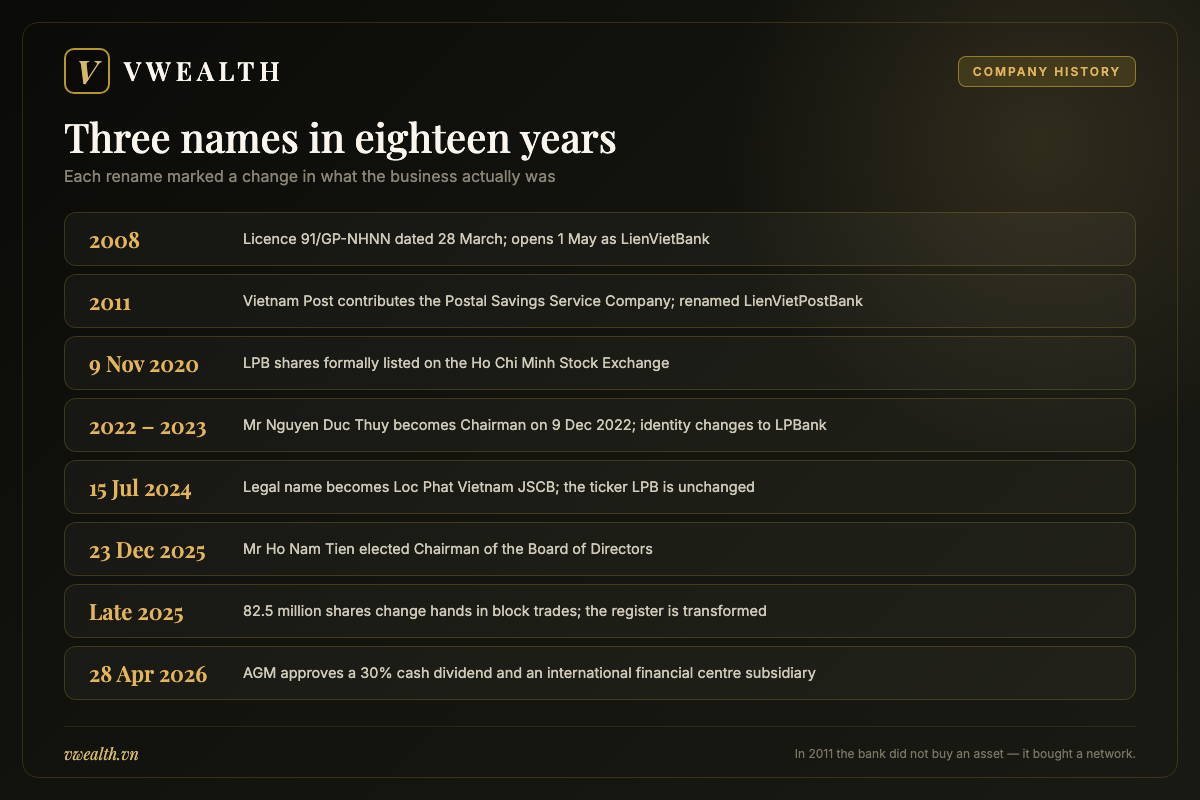
Very few listed Vietnamese companies have changed their legal name three times in under two decades. At LPBank, each rename was not a branding exercise. Each one marked a change in what the business fundamentally was.
2008: LienVietBank opens into a financial storm
The bank was established under Establishment and Operation Licence number 91/GP-NHNN dated 28 March 2008, issued by the Governor of the State Bank of Vietnam, and formally commenced operations on 1 May 2008 under the name LienVietBank.
The timing matters. 2008 was the year the global financial crisis reached Vietnam, deposit rates were driven to extreme levels for a period, and several newly licensed small banks ran into difficulty within months of opening. Being born into that environment forced the bank to find a route other than head-to-head competition in the large cities, where established lenders had already put down deep roots.
Keep this in mind for the next section: for a new bank with no network and no legacy customer base, the scarcest resource is not capital but a channel to reach depositors. Three years later, this bank solved that problem in a way nobody in Vietnam had done before.
2011: the post office arrives and the bank changes species
In 2011, Vietnam Post contributed capital into LienVietBank in the form of the Postal Savings Service Company plus cash. The bank was renamed from LienVietBank to LienVietPostBank.
This is the single most important event in the entire history of the institution. If you remember only one date from this article, remember this one.
Postal savings is a model in which deposits are taken through post office counters, and it has a long history in several countries — Japan being the best-known example. The idea is simple: post offices exist everywhere, including places where a bank would never open a branch because the economics do not work, and people in those places still need somewhere to put their money.
When the postal operator contributed that savings company as capital, LienVietPostBank did not buy a financial asset. It bought a network. From being an unremarkable three-year-old lender, it instantly gained access to service points across the whole country — something far larger banks would need decades and enormous capital expenditure to build, if they could build it at all.
Why the bank-and-post-office model is so unusual
The largest cost for a retail bank is not the interest it pays on deposits; it is the cost of running the network: premises, staff, security, systems. Opening a transaction office in a distant district requires a meaningful upfront investment and takes years to break even. That is why the branch map of Vietnamese banking is dense in the cities and thins out rapidly beyond them.
The postal model inverts that arithmetic. The post office already exists, already has premises, already has staff, and already has customers in the habit of walking in. Adding a banking counter has a far lower marginal cost than building a new transaction office from scratch.
The consequence is access to a customer base most competitors simply skip: rural households, pension and social benefit recipients, small traders in district towns. That base has very particular characteristics, and chapter three explains why it is both a goldmine and a ceiling.
What “joint stock commercial bank” means in this market
A short definitional note, because the Vietnamese banking landscape has categories that do not map neatly onto other markets.
Vietnam’s banking system contains state-owned commercial banks in which the state holds a dominant stake, joint stock commercial banks owned by private and institutional shareholders, foreign bank branches and subsidiaries, and policy banks that lend on social objectives rather than commercial ones. LPBank belongs to the second category.
The category matters for two reasons. First, joint stock commercial banks compete for deposits without an implicit state guarantee behind them, which shows in their funding cost relative to the state-owned group. Second, they are subject to the ownership ceilings described later in this article, which is why no private Vietnamese bank has a single shareholder holding the kind of stake that would be unremarkable in many other markets.
There is a third point specific to this bank. Vietnam Post is a state-owned enterprise, so LPBank’s largest shareholder and network partner sits inside the state sector even though the bank itself is a private joint stock institution. That hybrid character has no exact parallel elsewhere in Vietnamese banking.
9 November 2020: LPB lists on HOSE
LPB shares were formally listed on the Ho Chi Minh Stock Exchange on 9 November 2020.
For a bank, a main-board listing means more than raising capital. It imposes a stricter disclosure regime, requires quarterly financial reporting, puts the stock within reach of funds and index families, and — most importantly — creates a market price that every subsequent capital increase must reference.
It is also the point at which LPB began being compared directly against other listed banks on the same set of metrics, a comparison that continues today.
2022 and 2023: a new chairman and a new brand
On 9 December 2022, Mr Nguyen Duc Thuy was elected Chairman of the Board of Directors. The period that followed brought a series of identity and organisational changes.
In 2023, the bank changed its commercial identity from LienVietPostBank to LPBank following approval from the State Bank of Vietnam. In the same year, on 21 June 2023, Mr Ho Nam Tien was approved for appointment as Chief Executive Officer.
Shortening a four-syllable name to a three-letter mark is an understandable marketing decision. But it carried a consequence worth noting: the word “Post” disappeared from the everyday name while the postal network remained the bank’s single most distinctive asset. That mismatch between identity and business model is worth keeping in mind as you read documents from different years.
15 July 2024: a new legal name, the same ticker
From 15 July 2024, Lien Viet Post Joint Stock Commercial Bank formally took a new name: Loc Phat Vietnam Joint Stock Commercial Bank. The State Bank of Vietnam issued Decision number 423/QD-TTGSNH2 to effect the change, with the English name Fortune Vietnam Joint Stock Commercial Bank. The abbreviation LPBank and the ticker LPB remained unchanged.
“Loc Phat” carries connotations of development, fortune and prosperity in East Asian cultural convention. This was the third change of legal name since the bank was founded.
One practical implication for investors: because the ticker did not change, price history and trading data remain continuous. But when you search older documents you will encounter all three names, and you need to know they refer to the same legal entity.
Late 2025: the biggest change since 2011
The closing weeks of 2025 brought a tightly linked sequence of events, and this is the part of the chapter to read most carefully.
On 23 December 2025, Mr Nguyen Duc Thuy stepped down as Chairman of the Board. The Board elected Mr Ho Nam Tien, then Permanent Vice Chairman, as Chairman for the remainder of the 2023 to 2028 term. The stated reason was a change in the bank’s shareholder structure.
Immediately afterwards, across four trading sessions from 26 to 31 December 2025, LPB shares saw a series of negotiated block trades totalling 82.5 million shares. Mr Nguyen Duc Thuy, who had previously held 2.76% of charter capital, ceased to be a shareholder holding 1% or more.
Mr Nguyen Duc Thuy subsequently took the role of Chief Executive Officer at Sacombank, another listed Vietnamese bank. If that institution interests you, the dedicated piece on whether to buy STB stock analyses it separately.
Taken together, these three events produced an ownership state that is genuinely rare among listed Vietnamese banks, and chapter two is devoted to it.
2026: the annual meeting and a new direction
The 2026 annual general meeting was held on 28 April 2026 and approved several notable items.
On personnel, the meeting elected two additional board members: Ms Duong Hoai Lien, previously responsible for internal audit, and Mr Pham Quang Hung, with a background in insurance and international finance. Ms Vuong Thi Huyen stepped down as an independent member. The board then comprised six members, two of them independent. The Supervisory Board added three new members: Ms Pham Thi Thom, Ms Trinh Thi Thanh Hang and Ms Phung Thi Thu Hien.
On strategy, the meeting approved a plan to establish a wholly owned subsidiary bank at the Vietnam International Financial Centre, targeting higher-value services: international finance, asset management and investment advisory.
On distributions, the meeting approved a cash dividend at a 30% ratio. That figure is striking in the context of Vietnamese banking, and chapter two explains why.
Key milestones at a glance
| Date | Event | Why it matters |
|---|---|---|
| 28 Mar 2008 | Establishment licence 91/GP-NHNN issued | Birth of LienVietBank |
| 1 May 2008 | Formal commencement of operations | Opened into the global financial crisis |
| 2011 | Vietnam Post contributes the Postal Savings Service Company plus cash; renamed LienVietPostBank | The event that defined the business model to this day |
| 9 Nov 2020 | LPB shares listed on HOSE | Enters full disclosure regime and direct peer comparison |
| 9 Dec 2022 | Mr Nguyen Duc Thuy elected Chairman | Beginning of the rebranding phase |
| 2023 | Commercial identity changed to LPBank | The word “Post” leaves the everyday name |
| 21 Jun 2023 | Mr Ho Nam Tien appointed Chief Executive Officer | The man who would later take the chair |
| 15 Jul 2024 | Legal name changed under Decision 423/QD-TTGSNH2 | Third rename; ticker LPB unchanged |
| 23 Dec 2025 | Mr Ho Nam Tien elected Chairman of the Board | Handover of the top governance role |
| 26 – 31 Dec 2025 | 82.5 million LPB shares change hands in block trades | Ownership structure fundamentally altered |
| 28 Apr 2026 | AGM approves 30% cash dividend and the international financial centre subsidiary plan | Sets the strategic frame for the next phase |
A bank with almost no large shareholder
If you have read analyses of Vietnamese banks before, you know the usual structure: an identifiable controlling group, often linked to a conglomerate or a family, standing behind every decision. LPBank today is the exception, and that exception is the most interesting analytical feature of this ticker.
Ho Nam Tien: an insider promoted
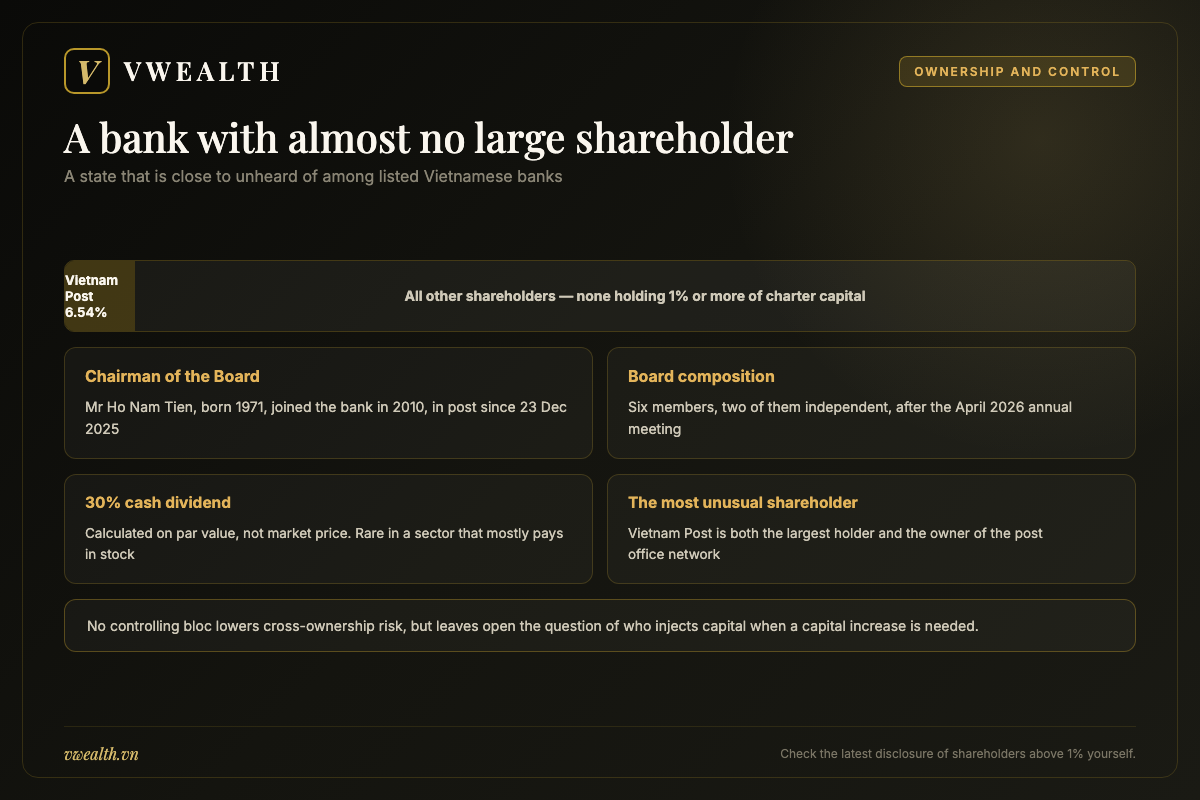
The Chairman of the Board is Mr Ho Nam Tien, born in 1971, holder of a master’s degree in banking, with more than thirty years of experience in financial services. He joined the bank in 2010 and spent fifteen years in senior leadership roles before his election as chairman, most recently as Permanent Vice Chairman.
This detail cuts both ways.
On the positive side, someone promoted from within after fifteen years understands the systems, the network, the customer base and the weak points that an outsider would take years to notice. For a bank with a distribution model as idiosyncratic as LPBank’s, that operating knowledge is not replaceable.
On the cautionary side, insiders tend to continue existing approaches. If the bank needs a strategic turn, the fact that the person steering helped build the previous strategy raises a legitimate question about the speed of change.
Mr Ho Nam Tien previously held the chief executive role from June 2023. After he moved to the chairmanship at the end of 2025, the chief executive seat entered a transition period. This is something you should verify in the bank’s most recent disclosures before deciding, because senior executive continuity is a real variable for an organisation of this network scale.
The board after the 2026 meeting
The board currently comprises six members, two of whom are independent. The two additions elected at the April 2026 meeting were Ms Duong Hoai Lien and Mr Pham Quang Hung. Ms Vuong Thi Huyen stepped down as an independent member.
The ratio of two independent members out of six is worth noting when comparing across banks. The independent director is a statutory role designed to protect minority shareholders: the person may not be an employee of the bank, may not represent a major shareholder’s capital, and is charged with raising objections to transactions carrying conflict-of-interest risk.
The Supervisory Board was also strengthened with three new members, all with backgrounds at other major banks. In a Vietnamese bank, the Supervisory Board plays a role distinct from the board of directors: it oversees compliance and the integrity of financial reporting, and in a credit institution that is a critical line of defence. For a fuller picture of how these bodies work in this market, the overview of corporate governance in Vietnam is a useful companion.
Ownership: only one name above 1%
This is the most important section of the chapter.
Following the late-2025 transactions, only Vietnam Post remains a shareholder holding more than 1% of charter capital, with 167.2 million LPB shares, equivalent to 6.54%.
Pause on that figure. Among listed Vietnamese joint stock commercial banks, having a largest shareholder at roughly six and a half percent is extremely unusual. Most private banks have at least one group holding a double-digit stake, and many have a de facto controlling bloc considerably larger than any individual disclosure suggests.
Why does this situation exist? The Law on Credit Institutions imposes strict ownership ceilings on banks: limits on the stake of an individual shareholder, of an institutional shareholder, and of a group of related shareholders. These rules exist to prevent an individual or group turning a bank into a funding vehicle for its own ecosystem — a lesson Vietnam’s banking system paid dearly to learn. Since disclosure requirements for shareholders holding 1% or more were tightened, the ownership picture across Vietnamese banks has become substantially more transparent.
Is having no controlling shareholder good or bad?
There is no one-directional answer, and you should reach your own based on your risk appetite.
The positive side is that cross-ownership risk and related-party lending risk fall sharply. With no controlling bloc, the probability that the bank is used to fund its owner’s projects is much lower. That category of risk caused the largest failures in Vietnamese banking history, so reducing it is not a trivial benefit.
A second positive is a large free float. For institutional investors, a stock where most of the shares are actually tradable is far easier to enter and exit than one where a controlling shareholder has locked up the majority.
The cautionary side is the question of long-term commitment. A committed large shareholder is usually the party that pushes a bank forward: injecting capital when a capital increase is needed, taking responsibility when something goes wrong, and setting multi-year strategy. Without that anchor, the bank depends entirely on the quality of its executive team and its board.
A second caution is uncertainty about the future ownership picture. A dispersed structure can change quickly: large block trades can bring a new shareholder group into the picture at any time. For an investor, this means you must monitor the 1% shareholder disclosures more frequently than you would for a bank with a clear owner.
What the 1% disclosure rule changed
The clarity of the ownership picture described above is itself relatively recent, and understanding why matters for how you read older material.
Historically, Vietnamese bank ownership disclosure focused on shareholders above 5%, which left substantial room for economic interests to be held through related parties, nominees and investment vehicles that individually fell below the threshold. In practice, that meant published ownership tables often failed to show who actually controlled a bank.
After disclosure requirements were extended to shareholders holding 1% or more, together with the related persons of those shareholders, the picture became considerably sharper across the whole sector. Several banks that appeared to have dispersed registers turned out to have concentrated ones, and a few that appeared concentrated turned out to be less so.
For LPB specifically, this is why the statement “only one shareholder above 1%” carries real information rather than being a technicality. Under the current regime, a genuinely concentrated holding would be much harder to conceal than it once was. It also means that any comparison you make against pre-rule ownership data is not like for like.
Vietnam Post: the most unusual shareholder
Vietnam Post is not only the largest shareholder. It is also the operating partner and the owner of the post office network the bank relies on to distribute its products.
That two-way relationship is both the strength and the item to monitor. It is a strength because the interests align: the postal operator gains revenue from financial services, the bank gains a network it did not have to build. It is something to monitor because every arrangement between the two is a related-party transaction, and the terms of those arrangements — revenue sharing, fees for use of service points, contract duration — determine most of the economics of the model.
The two parties have worked together for fifteen years and have announced an upgraded strategic partnership for the next phase, aiming to build a leading community financial services network in rural areas and smaller urban centres, improve utilisation of postal service points, develop a comprehensive financial product ecosystem and accelerate digital transformation.
A 30% cash dividend: put the number in context
The 2026 annual general meeting approved a cash dividend at a 30% ratio. That is a high figure and needs to be understood correctly.
First, the 30% is calculated on par value, not on the market price. This is where newer investors routinely go wrong and assume they are receiving thirty percent of their invested capital.
Second, a bank paying a cash dividend at this level is notable given the sector backdrop. For years, the regulator has encouraged banks to retain earnings to build their own funds, improving capital adequacy and creating headroom for credit growth. Consequently most banks have chosen stock dividends over cash.
A bank that elects to pay cash at a high ratio is sending two signals at once. The positive signal is confidence: enough capital and enough earning power to reward shareholders while sustaining growth. The signal to verify is the flip side: if own funds thin out, credit growth headroom in later years narrows. The check is concrete — track the capital adequacy ratio across periods, and chapter four explains exactly how.
If income is your objective, the survey of dividend stocks in Vietnam is worth reading before you place LPB in that bucket.
Ownership and governance summary
| Item | Disclosed position | What to re-check yourself |
|---|---|---|
| Shareholders above 1% | Only Vietnam Post, 167.2 million shares, about 6.54% | The most recent 1% shareholder disclosure |
| Chairman | Mr Ho Nam Tien, born 1971, in post since 23 Dec 2025 | Latest personnel resolutions |
| Chief executive | Seat in transition after Mr Ho Nam Tien became chairman | Most recent appointment announcement |
| Board of directors | Six members, two independent | Dissenting opinions recorded in meeting minutes |
| Supervisory board | Three new members elected at the 2026 AGM | The supervisory board report in AGM materials |
| Dividend | 2026 AGM approved a 30% cash dividend | Record date and the effect on capital adequacy |
| Free float | Very high, with no controlling shareholder | Average turnover and foreign ownership level |
How LPBank makes money: dissecting the bank-and-post-office model
A bank earns in three ways: the spread between lending and funding rates, service fees, and investment results. At LPBank the first dominates, and the entirety of the bank’s advantage and its ceiling lie in where it gathers deposits and where it lends.
The network in concrete numbers
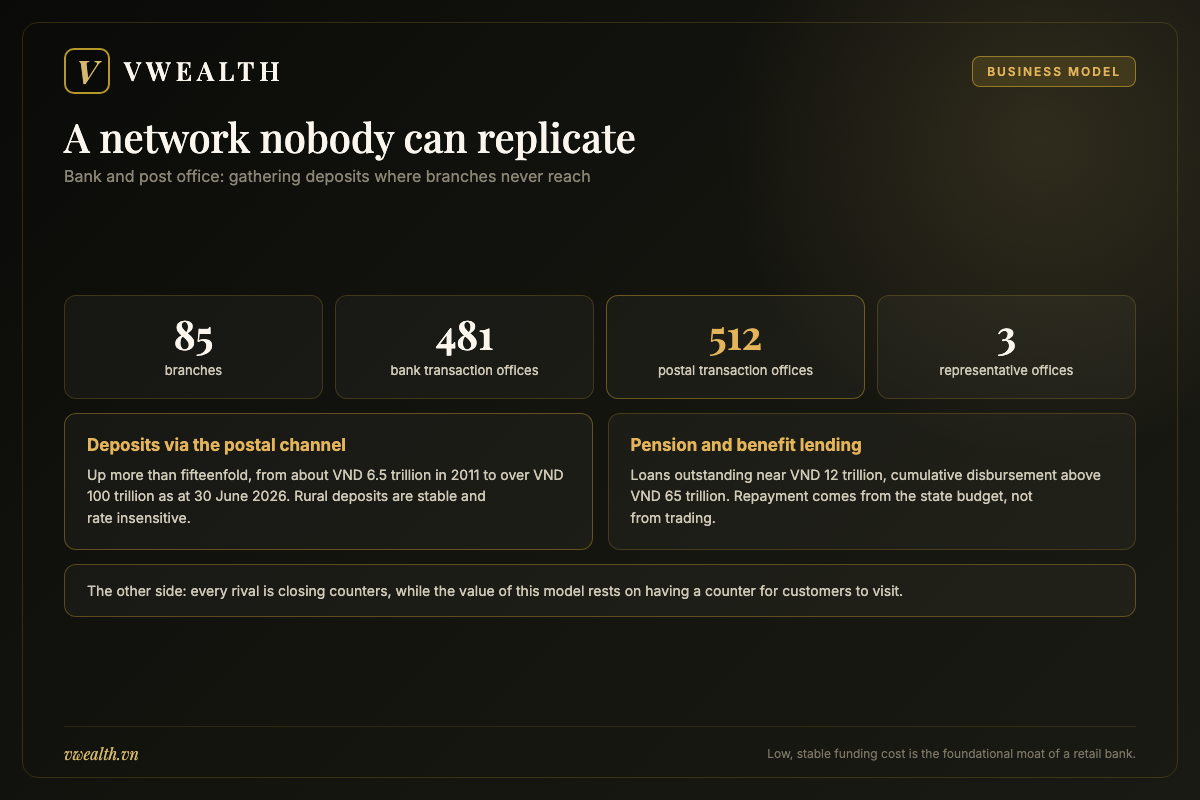
The bank’s current network comprises one head office, three representative offices, 85 branches, 481 bank transaction offices and 512 postal transaction offices.
The last figure is the striking one. More than five hundred service points sitting inside the postal system is something no other bank in Vietnam has. Combined with 481 conventional transaction offices, the total number of customer-facing points exceeds that of many banks with comparable asset size.
More important than the count is the location. Postal transaction offices sit in places where a standalone bank office would not be economic: small towns, district centres, densely populated rural areas with average incomes. This is a market that larger banks mostly serve remotely through apps, while LPBank serves it face to face across a counter.
The real scale of the postal channel
After fifteen years of partnership, the two parties disclosed a financial services network serving more than 1.6 million customers.
On funding, deposits mobilised through the postal network have grown more than fifteenfold, from roughly 6.5 trillion dong in 2011 to over 100 trillion dong as at 30 June 2026.
On lending, outstanding loans for pensions and social benefits reached nearly 12 trillion dong, with cumulative disbursement exceeding 65 trillion dong.
Those three figures explain the model better than any paragraph could. The postal channel is primarily a funding channel: it gathers idle savings from dispersed locations, with small individual balances but very large numbers of accounts. On the lending side, its signature product is tied to pensions and benefits — a form of credit with a very distinctive risk profile.
Why rural deposits are good deposits
In banking, not every deposit dong is worth the same, and this is something investors outside the industry routinely overlook.
Deposits from large corporates and from urban individuals are rate-sensitive. When another bank offers half a percentage point more, the money moves immediately, because these depositors watch the market and because transferring takes minutes on a phone. This is called hot money, and it is more expensive than it looks because the bank must keep chasing rates to retain it.
Deposits from rural customers, particularly older ones, behave in the opposite way. Depositors tend to be loyal to a familiar counter, compare rates across banks less often, and prioritise convenience of distance. This funding is more stable, less rate-sensitive, and therefore cheaper in practice even where the posted rate is similar.
For a bank, low and stable funding cost is the foundational competitive advantage. It allows either more competitive lending rates or a wider net interest margin at the same lending rate. This is LPBank’s genuine moat, and it is not something a competitor can buy with an advertising budget.
The other side: physical cost in a digital era
Every advantage has a price, and the price here is the cost of running a physical network at a moment when banking is moving onto phones.
Digitally aggressive banks are steadily reducing branch counts because their customers no longer visit. Every closed office is a fixed cost that disappears. Meanwhile, LPBank’s value rests precisely on having a counter for customers to visit.
This is a real dilemma, not a theoretical risk. If the rural customer base migrates to apps faster than expected, the physical network advantage erodes while the cost remains. If they migrate slowly, the bank retains its advantage but falls behind in the urban segment where the competition over digital experience is fierce.
That is why the announced partnership direction emphasises digital transformation alongside better utilisation of service points. In other words, the bank has to walk on two legs at once, which is harder than walking on one.
How the postal channel works day to day
It helps to picture the mechanics, because the model is easy to describe abstractly and easy to misunderstand.
A postal transaction office is a post office that also carries out banking transactions on the bank’s behalf. A customer walks in to collect a pension, send a parcel or pay a bill, and can also open a savings account, make a deposit, withdraw cash or service a loan at the same counter. The banking activity runs on the bank’s systems and under the bank’s licence; the premises and much of the customer-facing staffing come from the postal side.
Three operational consequences follow. First, the bank’s marginal cost per additional service point is a fraction of what a standalone office would cost, which is the source of the cost advantage discussed throughout this article. Second, the bank’s control over service quality at those points is shared rather than absolute, which is an operational risk that does not exist in an owned branch. Third, the arrangement is governed by a contract, and the economics for the bank depend on how revenue and cost are split under it.
That third point is the one investors most often skip. Whatever the network is worth, part of the value accrues to the partner, and the split is not something a minority shareholder can read off the face of the accounts. What you can do is watch the related-party note and the operating expense lines together for signs that the terms have shifted.
Pension and benefit lending: the signature product
This is the credit product most tightly bound to the postal model, and it deserves proper explanation because its risk profile differs sharply from ordinary lending.
The principle is lending against a recurring income stream from a pension or social benefit, where the benefit itself is paid out at the post office counter. That creates a structure in which the lender knows exactly what the repayment source is, when it arrives and where.
The risk advantage is clear: the repayment source is a state budget flow rather than the borrower’s business income, so it does not disappear in a downturn. In a recession, a loan against a pension is far safer than a loan against a small trader’s revenue.
The limitation is equally clear: individual loan sizes are small, the total book is capped by the number of beneficiaries and the level of benefits, and per-loan administrative cost is high because of the volume of small files. This is a stable segment, not one that can be scaled several times over.
The other business lines: urban retail, corporate and fees
Beyond the postal axis, LPBank runs the businesses of a conventional commercial bank through its 85 branches and 481 transaction offices.
Urban retail covers mortgages, consumer lending, credit cards and individual deposits. This is the most fiercely contested segment, where LPBank faces banks with stronger technology platforms and stronger urban brands head on.
Corporate banking covers working capital lending, trade finance, guarantees and payment services. For a bank with rural retail roots, this segment typically concentrates on small and medium enterprises rather than large conglomerates.
Non-interest income covers payment service fees, bancassurance commissions, card fees and other services. Every Vietnamese bank wants to raise this share, because fee income does not consume regulatory capital the way lending does, and because it is less volatile across the rate cycle.
The new direction: a subsidiary at the international financial centre
The plan approved at the 2026 annual meeting is to establish a wholly owned subsidiary bank at the Vietnam International Financial Centre, targeting higher-value services: international finance, asset management and investment advisory.
This is a notable move because it sits at the opposite end of the spectrum from the founding model. The postal model serves large numbers of customers with small transaction values in rural areas; wealth management serves small numbers with large values in a financial district.
The right way to read a plan like this is with patience. Building a high-end financial services business requires specialised staff, complex compliance infrastructure and time to accumulate credibility. Do not value it before it produces revenue as a separate reported line in the segment note.
Comparing the business axes
| Business axis | Distribution channel | Main customers | Strength | Limitation |
|---|---|---|---|---|
| Deposit taking via post offices | 512 postal transaction offices | Rural households, older savers | Stable, rate-insensitive funding | Cost of running a physical network |
| Pension and benefit lending | Postal channel | Pension and benefit recipients | Repayment source resilient to the cycle | Capped by the number of beneficiaries |
| Urban retail | 85 branches and 481 transaction offices | Urban individuals | Better margin on selected products | Intense competition on technology and brand |
| Corporate banking | Branch network | Small and medium enterprises | Brings low-cost transaction deposits | Credit risk concentrated by sector |
| Fee income | Whole network plus digital channels | All segments | Does not consume regulatory capital | Exposed to bancassurance policy changes |
Seven checks to run before you buy LPB stock
Reading bank accounts is nothing like reading a manufacturer’s. A bank has no inventory and no factories. Its largest asset is a book of loans — which is to say, a collection of other people’s promises to pay. The quality of those promises decides everything else.
This chapter gives you seven metrics in the order you should read them. If you want the valuation methodology in more depth, the note on Vietnamese financial statements under VAS and IFRS explains where each disclosure sits and how Vietnamese bank reporting differs from what you may be used to.
Check 1: net interest margin and the funding mix
Net interest margin, usually shortened to NIM, is the difference between the average yield a bank earns on interest-earning assets and the average cost it pays for funding, expressed as a percentage of interest-earning assets. For a retail bank this is the single most important line.
At LPBank, the margin has one characteristic worth understanding: it is supported by the funding mix, not only by lending rates. As chapter three explained, rural deposits are more stable and less rate-sensitive than urban deposits, allowing the bank to hold funding cost below what a lender competing head-on in the cities must accept.
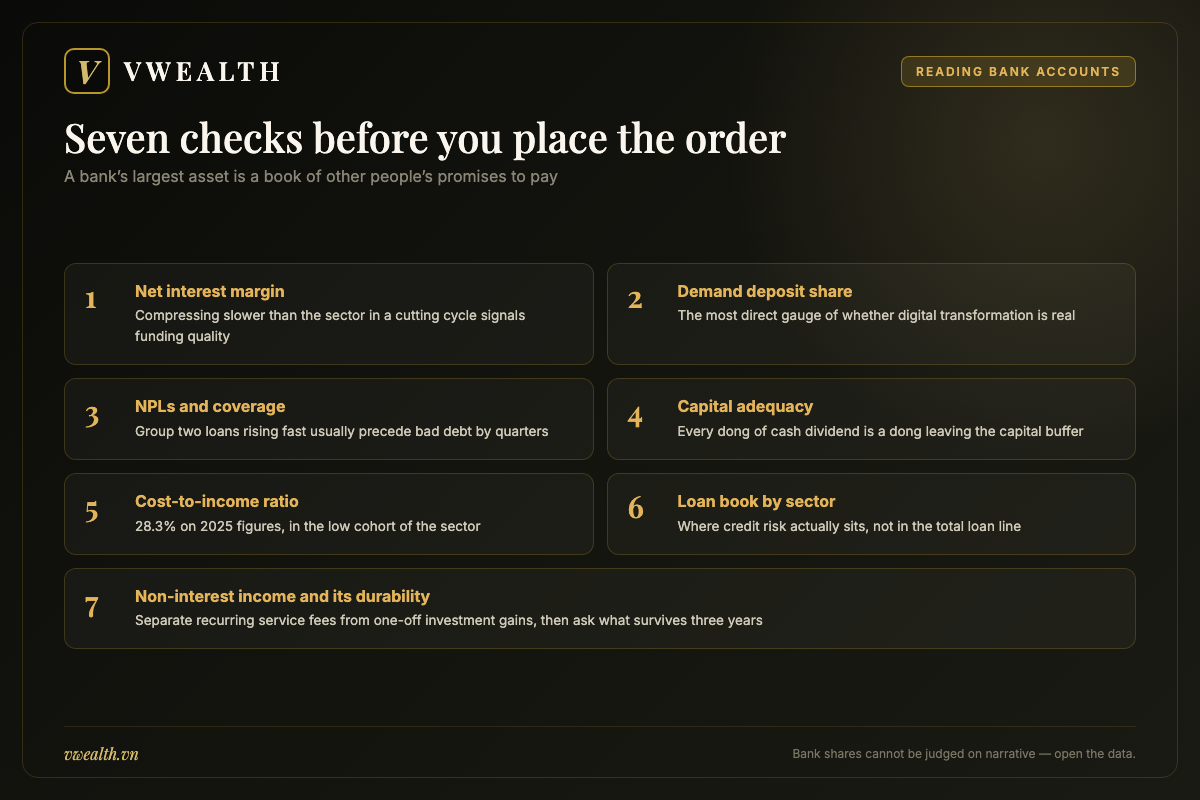
How to read it: never look at one quarter’s margin. Look across many quarters and place it alongside the general rate environment. If the bank’s margin compresses more slowly than the sector average during a rate-cutting phase, that is evidence of funding quality. If it compresses faster, the funding mix is deteriorating.
The mechanics of margin compression, explained
It is worth spending a moment on why margins move the way they do, because international readers coming from markets with different deposit structures often find the pattern counterintuitive.
On the asset side, a large share of Vietnamese bank lending carries rates that reset periodically against a reference, so lending yields adjust downward fairly quickly when policy rates fall. On the liability side, term deposits carry fixed rates until maturity, so funding cost only falls as existing deposits mature and are rolled at the new level. The result is a lag: in a cutting cycle, asset yields fall before funding costs do, and the margin compresses temporarily even at a well-run bank.
The reverse happens in a tightening cycle. Lending yields rise first, funding costs catch up later, and margins look flattering for a period — right up until credit quality starts to suffer from the higher rates borrowers now face.
The practical implication: judge a bank’s margin performance relative to the sector at the same point in the cycle, never in isolation.
Check 2: the share of demand deposits
The ratio of non-term deposits to total deposits, commonly called CASA, measures the share of funding that is effectively free. Money sitting in a customer’s payment account earns very little interest, so the higher this ratio, the cheaper the bank’s funding.
At LPBank this metric deserves close attention for two opposing reasons.
The first is that rural customers tend to hold term savings rather than leave balances in payment accounts, which puts structural pressure on the ratio.
The second is that digital transformation, pension payment into accounts and cashless payment programmes in rural areas all raise the ratio over time. If the bank executes digitalisation well within its own customer base, this is the most durable source of margin improvement available to it.
Put differently, the demand deposit ratio is the most direct measure of whether the bank’s digital strategy is real or rhetorical.
Check 3: non-performing loans and the coverage ratio
The non-performing loan ratio is the share of the loan book classified into groups three, four and five under the regulator’s classification, divided by total loans. Everyone looks at it, and looking at it alone is not enough.
The mandatory companion metric is the loan loss coverage ratio: total loan loss provisions divided by total non-performing loans. It tells you what proportion of the problem book has already been provided for.
The two must be read together. A bank with a low bad debt ratio but thin coverage is riskier than a bank with a higher ratio and heavy coverage. The reason is that provisions already taken are costs already recognised; if the loan is ultimately lost, it does not create a fresh shock to earnings.
There is a third metric few investors watch that has real predictive value: the group two ratio, meaning loans under special mention. These are loans not yet classified as non-performing but already past due by a short period. A fast-rising group two balance usually foreshadows a rise in non-performing loans several quarters later.
Check 4: capital adequacy and the effect of cash dividends
The capital adequacy ratio, or CAR, is regulatory capital divided by risk-weighted assets. It answers the question: if a portion of the asset book loses value, does the bank hold enough capital to absorb it?
At LPBank this metric matters particularly for the reason given in chapter two: the bank pays a substantial cash dividend. Every dong paid out in cash is a dong leaving regulatory capital, and regulatory capital determines how much credit growth the bank is permitted to pursue.
The check is concrete: track capital adequacy across periods against the pace of loan growth. If loans grow quickly while the ratio declines and cash dividends continue, the bank is spending its buffer. If the ratio holds or improves while the dividend is maintained, that indicates earning power strong enough to feed both.
Two more regulatory ratios worth knowing
Beyond capital adequacy, Vietnamese banks operate under two liquidity constraints that foreign investors frequently miss, and both bear on LPBank’s model.
The first is the loan-to-deposit ratio, capped by the regulator. It limits how much of a bank’s customer deposit base can be lent out, forcing a portion to be held in liquid form. A bank with a strong deposit franchise has natural headroom under this cap; a bank that funds itself heavily in the interbank market does not.
The second is the cap on the proportion of short-term funding that may be used for medium and long-term lending. This exists because Vietnamese depositors overwhelmingly place money on short tenors while borrowers, particularly mortgage borrowers, want long ones. The regulator has tightened this ratio in steps over several years, and each tightening pressures banks that had leaned on the mismatch.
Why this matters for LPB: a deposit-rich retail funding base is precisely the profile that sits comfortably under both constraints. A bank whose funding comes from stable household savings rather than wholesale markets has more room to grow lending within the rules than its headline size alone would suggest. When you compare LPB against peers, check these two ratios alongside capital adequacy — together they tell you how much of the growth quota a bank can actually use.
Check 5: the cost-to-income ratio
The ratio of operating expenses to total operating income, commonly called CIR, measures operating efficiency. A lower ratio means the bank generates a unit of income with less expense.
This is where LPBank’s large physical network faces the most visible pressure, since every service point carries premises and staffing cost. It is also, simultaneously, the metric that proves whether the model works: if a bank with a wide network still holds a low cost ratio relative to peers, that means sharing infrastructure with the postal operator genuinely is cheaper than building your own.
According to the 2025 figures presented at the annual general meeting, the bank’s cost-to-income ratio stood at 28.3%. That places it among the lower cohort in Vietnamese banking, and it is the clearest quantitative evidence available for the cost efficiency argument.
What to watch is the trajectory in coming years, as the bank simultaneously invests in digital capability and maintains the physical network — two cost streams at once.
Check 6: the loan book by sector and segment
This is the least discussed metric and the one that determines most of a bank’s real risk.
Open the notes to the financial statements and find the analysis of loans by economic sector and by customer type. Three questions to answer.
First, what share goes to real estate and construction? This is the most cyclical sector and the origin of most of the sharp increases in bad debt across Vietnamese banking history.
Second, what is the split between individual and corporate lending? Individual lending spreads risk across many small exposures; corporate lending concentrates it into fewer large ones.
Third, what share goes to agricultural and rural households? This is the segment tied to LPBank’s founding model, and it carries its own risks around weather, commodity prices and disease outbreaks.
Check 7: non-interest income and its durability
The final metric is the share of non-interest income in total operating income, measuring how dependent the bank is on the interest spread.
A bank with a high non-interest share is typically valued more highly, because that income does not consume regulatory capital and is less volatile through the rate cycle. But the components must be separated.
Payment service fees, card fees and account maintenance fees are durable, tied to the number of actively transacting customers. Bancassurance commissions were a large income source for many Vietnamese banks but fell materially after rules on selling insurance through bank channels were tightened. Gains on investment securities are lumpy, dependent on bond market conditions, and should not be treated as recurring capability.
The practical approach: separate these components in the notes, then ask which of them will still be there in three years.
The seven checks and where to find them
| # | Metric | What it means | Good sign | Warning sign |
|---|---|---|---|---|
| 1 | Net interest margin | Spread between asset yield and funding cost | Compresses slower than sector in a cutting cycle | Compresses faster; funding cost rising |
| 2 | Demand deposit share | The portion of funding that is nearly free | Rises steadily with digital adoption | Flat or falling despite digital investment |
| 3 | NPLs, group two loans and coverage | Asset quality and the provision buffer | Heavy coverage, stable group two | Group two rising fast, coverage thinning |
| 4 | Capital adequacy ratio | Loss absorption and growth headroom | Stable or improving despite cash dividends | Declining while loans grow quickly |
| 5 | Cost-to-income ratio | Network operating efficiency | Stays in the low cohort of the sector | Rises as digital and network costs stack |
| 6 | Loan book by sector | Where credit risk actually sits | Diversified, real estate share controlled | Concentrated in one cyclical sector |
| 7 | Non-interest income share | Dependence on the interest spread | Rising through recurring service fees | Rising through one-off investment gains |
How the market treats LPB stock
This chapter is about the share, not the bank. The two are related but not the same.
Which valuation measure works for a bank
Before the mechanics, one framing point. A bank is a leveraged institution by design: it holds a modest slice of equity against a much larger book of assets funded by other people’s money. That leverage is why small changes in asset quality produce large changes in equity value, and why the valuation approach for banks is built around the balance sheet rather than around the income statement. Keep that in mind through the rest of this chapter.
For banks, the most common measure is not price to earnings but price to book value. The reason is fundamental: a bank’s assets are financial assets carried close to value, and shareholders’ equity is the figure that directly reflects the institution’s capacity to absorb risk.
But price to book on its own is not enough. It must be paired with return on equity. The logic runs like this: two banks each hold one dong of equity; whichever generates more profit from that dong deserves a higher price per dong of book value.
So the correct way to compare banks is to plot both metrics together, rather than ranking on either alone. A bank trading at a low price-to-book with an equally low return on equity is not cheap at all.
Earnings quality: the thing to scrutinise most
There is another variable the market always prices into bank shares, even when nobody says it aloud: how much you can trust the reported profit number.
Bank profit depends heavily on provisioning decisions, and provisioning carries a degree of discretion within the regulatory framework. A bank that provisions heavily reports lower profit this year but more certain profit in later years. A bank that provisions lightly does the opposite.
This is why the market pays very different prices for the same reported profit at two different banks. With LPB, the check is to compare the coverage ratio against the sector norm: heavier coverage means the reported profit number is more trustworthy.
The personality of the stock
Three characteristics anyone holding LPB should be prepared for.
The first is sensitivity to ownership news. For a bank with no large shareholder other than Vietnam Post, every sizeable block trade becomes news and triggers speculation. This produces sessions of sharp movement unrelated to operating results.
The second is sensitivity to monetary policy. This is common to the whole banking group: when the market expects rate cuts and looser credit, the group moves together; when asset quality worries rise, the group is sold together.
The third is high liquidity. A large free float makes LPB considerably easier to trade than bank shares where a controlling holder has locked up most of the register. For investors with size, this is a genuine advantage.
Index membership and passive flows
One structural feature of LPB deserves its own note, because it follows directly from the ownership picture.
Vietnamese index providers, and the exchange-traded funds tracking them, apply eligibility screens based on listing venue, market capitalisation, free float and trading turnover. Free float is where most bank shares run into trouble: when a controlling shareholder and a foreign strategic partner between them hold the majority of the register, the free-float-adjusted weight can be a small fraction of the headline capitalisation.
LPB has the opposite profile. With no controlling holder and a largest shareholder at roughly six and a half percent, its free-float-adjusted weight is close to its full weight. For passive and quasi-passive money, that makes it a more accessible name than several larger banks.
The practical implication is that flows into the Vietnamese banking sector as a whole — whether from index inclusion, a market reclassification or simply a sector rotation — reach LPB more directly than they reach names where the tradable pool is thin. That amplifies both directions of the sector’s moves.
What the cash dividend tells the market
Approving a 30% cash dividend places LPB in a small group within Vietnamese banking. Most banks have chosen stock dividends for years in order to retain capital.
For income-seeking investors this is a clear attraction. But three questions must be answered before treating it as a reason to buy.
First, is this payout level sustainable across years, or is it a one-year decision? Check the payment history and the payout ratio against net profit.
Second, after paying, does the capital adequacy ratio still leave headroom for the credit growth the bank has planned?
Third, if the regulator changes its stance on cash dividends in the banking sector, how would the bank respond? This is a genuine policy risk, not a hypothetical.
Foreign ownership room and what it means here
Foreign ownership in Vietnamese banks is capped at a materially lower level than in most other sectors, under rules specific to credit institutions. This is one of the largest constraints on foreign capital entering these shares. The mechanics are set out in the guide to foreign ownership limits in Vietnamese stocks.
With LPB, the absence of a large foreign strategic shareholder creates a particular feature: the unused room could be headroom for a future strategic sale to an overseas partner. That is the kind of catalyst the market reacts strongly to when it appears, and also the kind of rumour that circulates far more often than an actual transaction occurs.
A practical rule: never buy a bank share purely on the expectation of a foreign strategic sale. If it happens, treat it as a bonus; if it does not, your investment case still has to stand.
Catalysts that can move LPB
Four categories of event are worth monitoring.
The first is the disclosure of shareholders holding above 1%. Given the current structure, the appearance of a substantial institutional holder would be significant news.
The second is senior personnel decisions, particularly the chief executive appointment.
The third is progress on the international financial centre subsidiary, since that business carries a different margin profile from the traditional franchise.
The fourth is regulatory change on credit growth quotas, prudential ratios and cash dividend policy.
Comparing LPB with other Vietnamese banks
| Bank | Model | Notable strength | How it differs from LPB |
|---|---|---|---|
| LPBank (LPB) | Rural retail through the postal network | Stable funding, efficient operating cost | Almost no large shareholder remaining |
| Vietcombank (VCB) | State-controlled, large corporate franchise | Lowest funding cost in the sector, strong asset quality | State control and a small free float |
| ACB | Urban retail and SME lending | Asset quality consistent across cycles | Concentrated in cities rather than rural areas |
| TPBank (TPB) | Digital-first with a light physical footprint | Low operating cost through digital channels | The opposite network strategy |
| Sacombank (STB) | Retail with a wide branch network, post-restructuring | The legacy asset resolution story | A very different restructuring context |
The table makes a point worth remembering: banks look alike from a distance and differ enormously up close. Where the funding comes from, who the borrowers are, and where the network sits — those three questions produce three different businesses even when all are called banks.
The Vietnamese banking sector in 2026
No bank lives outside monetary policy or outside the health of the economy. This chapter sketches the landscape LPBank operates in.
The credit growth quota system
This is a feature of the Vietnamese market that foreign investors must understand. The State Bank of Vietnam allocates a credit growth quota to each bank, and a bank may not expand lending beyond the ceiling it has been granted for the year.
That means a bank’s growth rate is not entirely its own decision. However many good borrowers it finds, it cannot expand the loan book past its allocated limit.
Quotas are allocated on several factors, including asset quality, capital adequacy and compliance record. A bank that maintains good asset quality and thick capital therefore tends to receive a wider quota — a direct link between the metrics in chapter four and actual growth capability.
The rate environment and sector margins
The largest macro variable for any bank is the level of interest rates.
When rates fall, margins usually compress because lending yields drop faster than funding costs, for the structural reason explained in chapter four. When rates rise, the reverse happens, but it comes with rising credit risk because borrowers face a heavier burden.
At LPBank, a funding mix weighted toward stable household deposits means less shock in either direction than at banks relying heavily on interbank funding and large institutional deposits.
Exchange rate policy and why it reaches the loan book
A bank whose business is entirely domestic still lives with the exchange rate, and the transmission runs through policy rather than through its own balance sheet.
When pressure builds on the dong, the central bank’s room to keep domestic rates low narrows, because a wide gap between domestic and international rates encourages capital to leave. Defending the currency therefore tends to mean holding domestic rates higher than growth conditions alone would justify.
For banks, that has two effects at once. Higher rates support margins in the short run, since asset yields reprice faster than funding costs. But higher rates also increase the debt service burden on borrowers, and after a lag that shows up as rising special mention loans and then rising non-performing loans.
So a period of currency pressure is not straightforwardly good or bad for a bank share. It is good for the next two quarters of reported margin and bad for the four quarters of asset quality that follow. Investors who see the first effect and stop reading are the ones who buy bank shares at the wrong point in the cycle.
System-wide asset quality
The bad debt picture across Vietnamese banking is tied closely to two groups: real estate and small and medium enterprises.
Real estate is highly cyclical, and when the market freezes both developers and homebuyers struggle to service debt, producing bad loans in the corporate book and the retail book simultaneously. That is why the real estate share of the loan book is a mandatory check.
Small and medium enterprises are the segment most sensitive to the economic cycle and to interest rates. When orders fall or funding costs rise, this group struggles first.
A bank whose book is weighted toward dispersed individual lending, particularly products tied to stable income sources such as pensions, faces less pressure in the down phases of the cycle. That is a structural positive for LPBank’s model.
Financial inclusion and the underserved market
One long-standing direction in Vietnamese financial policy is financial inclusion: extending banking services to population groups and geographies that are underserved.
This is a structural tailwind for LPBank’s model, because the postal network already sits in precisely the places policy is aimed at. Paying pensions, social benefits and support programmes through this channel serves the policy objective while building the bank’s customer base.
But the limitation must be faced squarely: serving lower-income groups means small transaction values and high cost per customer. This segment builds a stable foundation and a customer base; it is not the segment that delivers step-change profit growth.
Competition from digital banks and e-wallets
The competitive battle in Vietnamese retail banking in this period is fought on digital experience rather than on interest rates.
Banks investing heavily in apps are winning younger urban customers through instant account opening, free transfers and bundled services. E-wallets and payment platforms are also inserting themselves between the bank and the customer at the everyday payment layer.
For LPBank, this pressure is not yet acute in its core customer base but will grow over time as younger rural customers become accustomed to doing everything on a phone. That is why the demand deposit ratio in chapter four is such an important gauge: it tells you whether the bank is converting its own customer base in time.
Consolidation pressure across the sector
One further structural force shapes the environment every Vietnamese bank operates in: the long-running effort to strengthen the system by dealing with its weakest members.
Vietnam has a sizeable number of banks relative to the size of its economy, and the tail of that distribution has historically included institutions with thin capital and impaired asset books. The policy response has included mandatory transfers of weak banks to stronger ones, restructuring plans and stricter prudential requirements applied across the board.
This matters to investors in two ways. The first is direct: a bank that takes on a weak institution acquires its problems along with its network and customers, and the terms of such transfers — including any regulatory concessions granted in exchange — determine whether the transaction creates or destroys value for existing shareholders. Any bank can in principle be asked to participate.
The second is indirect but more pervasive. Every tightening of prudential standards raises the capital and systems cost of running a bank, which disadvantages smaller and weaker institutions and gradually concentrates the sector. For a mid-sized bank with a distinctive franchise and efficient costs, that concentration is more opportunity than threat — but only if its own capital position stays comfortable, which loops back to the capital adequacy check in chapter four.
Bancassurance rules and the fee income question
For years, selling insurance through bank channels was a large fee income source for the entire sector. After rules on the activity were tightened to protect consumers, that income declined markedly at most banks.
This has forced banks to find other fee sources: payment services, cards, corporate cash management, foreign exchange services. It is the reason check seven in chapter four insists on separating the components of non-interest income to see which parts are durable.
Market classification and foreign flows
The story around a potential upgrade in Vietnam’s market classification bears directly on the banking group, because banks make up the largest weight in the market and are typically the first sector foreign funds allocate to when entering a new market.
The banking group carries a specific constraint, though: the foreign ownership ceiling. Several large bank tickers are already at their limit, so incoming foreign capital tends to look for names with remaining headroom. That is worth factoring in when comparing bank shares.
Country-level risks that sit above all of this
Finally, a bank is a leveraged play on its home economy. Anything that affects Vietnamese growth, employment, property prices or the currency shows up in a bank’s loan book within a few quarters.
For a foreign investor, that means a position in LPB is not only a view on this bank’s management and model. It is also a view on Vietnamese macro conditions, on the trajectory of the property cycle, and on the dong. The summary of risks of investing in Vietnam covers those country-level variables in detail, and reading it alongside this analysis is worth the time.
Three scenarios for LPB stock and what triggers each one
This section contains no price target. For a bank, a price target depends on macro variables nobody forecasts reliably. What is more useful is a conditional framework.
The four variables that decide the outcome
The first variable is asset quality. This is always the dominant variable for any bank. A lender growing fast while bad debt grows faster is borrowing that growth from the future.
The second variable is the pace of digital adoption within the bank’s own customer base. If the bank digitalises the postal channel — turning a service point into a place where accounts are opened and app usage is taught, rather than merely a counter that takes cash — the network advantage extends for years. If it does not, the network gradually becomes a cost burden.
The third variable is the ownership structure. Given the current state, whether or not a committed large shareholder emerges will shape the bank’s strategy for years.
The fourth variable is policy: the credit growth quota granted, the stance on cash dividends, and prudential ratio requirements.
The optimistic scenario: the old model digitalises successfully
Conditions: the bank converts its rural customer base to digital channels, lifting the demand deposit ratio and lowering funding cost; asset quality holds steady with thick loan loss coverage; credit growth quotas are generous thanks to strong prudential metrics; the international financial centre subsidiary begins generating revenue; and a substantial institutional shareholder emerges with a long-term commitment.
What it looks like in the accounts: net interest margin widening, or at minimum holding through a rate-cutting phase; cost-to-income staying in the low cohort of the sector; the share of recurring service fee income rising; capital adequacy stable even while cash dividends continue.
What the market does: re-rates the bank from the multiple of a mid-tier retail lender toward that of a differentiated franchise with high return on equity. For bank shares, an upward move in the price-to-book multiple has a larger effect on the share price than the underlying profit increase does.
The base case: a steady retail bank
Conditions: digital transformation progresses but slowly, with the demand deposit ratio improving gradually; asset quality moves with the sector cycle; credit quotas sit around the sector average; the subsidiary plan remains at the establishment stage; the ownership register stays dispersed.
What it looks like in the accounts: profit growing at a high single-digit to low double-digit rate; net interest margin oscillating around its existing level; the bad debt ratio moving with the cycle but within control; cash dividends maintained though the ratio may be adjusted.
What the market does: leaves the valuation framework unchanged, with the share price tracking profit and moving with the banking group as a whole. This is the highest-probability scenario and the one to use as your default.
The adverse scenario: network cost meets a credit cycle
Conditions: a weakening economy pushes bad debt higher, forcing heavier provisioning that eats into profit; simultaneously, digital investment spending continues while the physical network cannot yet be trimmed; the demand deposit ratio fails to improve, raising funding cost; and maintaining the cash dividend thins capital, narrowing growth headroom.
What it looks like in the accounts: group two loans rise first, non-performing loans follow; coverage thins; cost-to-income climbs; profit falls further than operating income because of provisioning charges.
What the market does: cuts the valuation multiple to that of a bank with asset risk. In this phase bank shares typically fall further than the profit decline alone would suggest, because the market worries about what has not yet been recognised in the accounts.
One variable specific to LPB: the ownership vacuum
Beyond the four sector variables, LPB carries one of its own: the absence of a large shareholder.
That state can develop in three directions. The first is continued dispersion, with the bank run as a professionally managed institution under board oversight. The second is a domestic institutional group gradually accumulating and becoming a large shareholder. The third is a foreign strategic partner entering, within the sector’s ownership ceiling.
Those three paths lead to three different strategies and three different valuations. This is uncertainty a minority shareholder cannot forecast, and the correct response is to demand a wider margin of safety rather than to guess.
Scenario summary
| Factor | Optimistic | Base case | Adverse |
|---|---|---|---|
| Asset quality | Stable with heavy coverage | Moves with the sector cycle | Group two then NPLs rise quickly |
| Digital adoption in the core base | Successful, demand deposits rise | Progresses slowly | No improvement, funding cost rises |
| Cost efficiency | Stays in the low cohort of the sector | Flat | Rises as both cost streams stack |
| Capital adequacy | Stable despite cash dividends | Edges down with loan growth | Thins, narrowing growth headroom |
| Ownership | A committed large shareholder appears | Register stays dispersed | Ownership churn creates strategic drift |
| Market treatment | Multiple re-rated as a differentiated model | Framework unchanged, price tracks profit | Multiple cut on asset risk concerns |

So should you buy LPB stock? A straight answer
You now have the facts. This section does not dodge the question, but it also does not issue an instruction, because the right answer depends on who you are.
The case for: six reasons LPB deserves consideration
The first is a distribution model nobody can copy. More than five hundred service points inside the postal system, backed by a fifteen-year partnership with Vietnam Post, create customer access that competitors cannot rebuild with money.
The second is the funding structure. Rural deposits are more stable and less rate-sensitive than urban deposits, and for a retail bank that is a genuine moat.
The third is cost efficiency proven in the numbers. A cost-to-income ratio of 28.3% on 2025 figures sits in the low cohort of Vietnamese banking, and for a bank with this network breadth that is substantial evidence for the economics of the shared-infrastructure model.
The fourth is low cross-ownership risk. With no controlling bloc, the probability of the bank being used to fund an owner’s ecosystem falls sharply. That risk category caused the largest failures in Vietnamese banking history.
The fifth is the cash dividend policy. In a sector where most banks pay in stock, distributing meaningful cash creates real cash flow for shareholders.
The sixth is high liquidity from a large free float, convenient for both individual and institutional investors entering or exiting positions.
The case against: seven risks to face squarely
The first risk is the cost of maintaining a physical network in a digital era. Today’s advantage can become tomorrow’s burden if the customer base migrates to apps faster than expected.
The second risk is dependence on a single partner for that network. The entire postal advantage rests on the cooperation agreement with Vietnam Post. The terms of that agreement — revenue sharing, duration, scope of exclusivity — are variables minority shareholders cannot see in full.
The third risk is the ownership vacuum. No large shareholder means nobody is certain to inject capital when a capital increase is needed, and nobody sets long-term strategy beyond the executive team.
The fourth risk is senior personnel uncertainty. After the former chairman departed and the former chief executive moved into the chair, the executive layer entered a transition that investors need to follow through official disclosures.
The fifth risk is asset quality. This is common to all banks, but at a lender with meaningful exposure to households and small businesses it manifests in a particular way: bad debt dispersed across many small exposures, hard to see early and expensive to work out.
The sixth risk is pressure on capital from the cash dividend policy. Paying shareholders in cash is pleasant in the short term but thins the capital buffer, and that buffer determines growth headroom in later years.
The seventh risk is policy risk. Credit growth quotas, prudential ratio requirements, bancassurance rules — all sit outside the bank’s control and can change in a single decision.
Weighing the two sides
| In favour | Against |
|---|---|
| A postal network no competitor can replicate | Cost of maintaining a physical network in a digital era |
| Stable rural funding, insensitive to rate competition | The whole advantage rests on one cooperation agreement |
| Cost-to-income in the low cohort of the sector | Digital spending and network cost run simultaneously |
| Low cross-ownership and related-party lending risk | No large shareholder committed to inject capital when needed |
| Cash dividend creates real shareholder cash flow | Cash dividend thins capital and growth headroom |
| Large free float and high liquidity | Ownership can shift quickly through block trades |
| Pension lending has a resilient repayment source | That segment is capped by the number of beneficiaries |
| Aligned with the financial inclusion policy direction | Small transaction values and high cost per customer |
Which kind of investor LPB suits
This is the most practical part of the article. The same stock at the same price produces four different answers for four different investor types.
For the long-term value investor, LPB presents a clear thesis: a differentiated distribution model, efficient operating costs and stable funding. What you must do is examine asset quality more carefully than usual, because at a bank everything good collapses if the assets are bad. Your margin of safety should be calculated on book value adjusted for the provisions that may still be required, not on reported book value.
For the growth investor, LPB warrants caution. A bank’s growth is capped by its credit quota and by its capital, so it cannot compound like a technology company. The genuine growth story lies in digitalising the core customer base and in the new service business — both of which need years to prove out.
For the income investor, LPB is clearly attractive given a cash dividend policy in a sector that rarely pays cash. But two tests are mandatory: is the payout ratio against profit sustainable, and does capital adequacy after payment still leave room for planned credit growth? If both answers are positive, this is one of the more interesting candidates in the income bucket.
For the short-term trader, LPB offers high liquidity and a dense news flow — from major shareholder disclosures to personnel decisions to monetary policy. Remember that bank shares tend to move as a group rather than individually, so tracking the sector’s rhythm matters more than parsing any single bank’s headlines.
And there is one group LPB almost certainly does not suit: anyone unwilling to read bank financial statements. Bank shares cannot be assessed through narrative; you have to open the asset quality data. If you do not intend to do that, choose a fund rather than an individual bank ticker.
Extra notes for investors based outside Vietnam
If you are investing from abroad, five mechanical points apply to LPB specifically.
The first is the foreign ownership ceiling for credit institutions, which is materially lower than for most other sectors. Before assuming you can build a position, check the remaining room, because a stock at its limit trades at a premium in the offshore market and is effectively closed on the exchange.
The second is settlement. Vietnamese equities settle on a cycle that means shares bought today are not immediately available to sell. Plan position changes accordingly.
The third is the daily price band applied by the exchange. Bank shares move as a group, and in a strong sector move a stock can reach its limit in either direction, leaving you unable to transact at the price you wanted.
The fourth is currency. Your return is the share price return multiplied by the dong’s move against your home currency. Over a long holding period this is not a detail, particularly for a domestically focused bank whose earnings are entirely in dong.
The fifth is disclosure language and accounting standards. Vietnamese banks report under domestic standards, and loan classification and provisioning rules differ from what you may be used to. Full financial statements are frequently published in Vietnamese first, with English versions arriving later or in summary form.
How to build a position sensibly in a bank share
A note on execution, because it matters more with banks than with most sectors.
Bank shares are cyclical in a specific way: they look cheapest on earnings-based measures exactly when the credit cycle is about to turn against them, and most expensive when provisions are being released and profits look strong. That means buying on a single snapshot of a valuation ratio is a poor process.
A more robust approach is to define what you would need to see in the asset quality data before adding, then scale into the position across several reporting periods as those conditions are confirmed or refuted. That converts a single bet on a valuation multiple into a series of decisions informed by evidence.
It also protects you from the most common error with bank shares: buying a large position on a low price-to-book without checking whether the book value itself is about to be reduced by provisions.
Three mistakes investors commonly make with this ticker
Before the checklist, three errors specific to LPB that are worth naming.
The first is treating the absence of a controlling shareholder as unambiguously positive. It removes a real category of risk, and it also removes a real source of capital and strategic direction. Investors who read only the first half of that sentence overrate the situation; investors who read only the second half underrate it. Both halves are true at once.
The second is buying for the cash dividend without checking capital. A cash dividend at a high ratio is genuinely unusual in Vietnamese banking and genuinely attractive. But it is funded from the same capital that permits credit growth, and a payout that thins the buffer buys income this year at the cost of growth in later years. The dividend and the capital adequacy ratio must be read as one decision, not two.
The third is treating the postal network as a permanent asset rather than a depreciating one. It is a formidable advantage today and the numbers prove it. Whether it is still an advantage in ten years depends on execution that has not happened yet. Anyone underwriting this stock on a long horizon is implicitly underwriting that execution, and should say so explicitly in their own reasoning rather than quietly assuming it.
Five questions to answer before you place the order
Question one: have you looked at the loan loss coverage ratio and the group two loan ratio for the most recent period, and which way are they trending?
Question two: have you checked capital adequacy after allowing for the cash dividend payment?
Question three: have you opened the most recent disclosure of shareholders above 1%, and has any new name appeared?
Question four: have you confirmed the current chief executive through the bank’s official announcements?
Question five: if the price falls materially after you buy with no bad news on asset quality, will you add, hold, or sell? Answer that before buying.
Closing: a differentiated model that has to prove itself again
LPBank is one of the few Vietnamese banks that can answer the question “what makes you different” in a single sentence. The answer is the post office: an existing network, in precisely the places the banking industry skipped, serving precisely the customers financial inclusion policy is aimed at. That is a real advantage, measurable in operating cost and in the stability of funding.
But every advantage has a lifespan. A physical network was the advantage of an era in which people had to leave the house to deposit money. The large question of the next decade is not whether that network is wide, but whether the bank can turn it into the starting point for a digital relationship with the customer.
At the same time the bank has entered a new governance phase: a chairman promoted from within, an executive layer in transition, and an ownership register so dispersed that almost nobody holds a controlling position. That state may prove healthy — less cross-ownership risk, more professional management — or it may be a vacuum waiting to be filled. Nobody yet knows.
The final question to ask yourself is not “is LPB a good bank” — it is a bank with a clear model and cost efficiency proven in the numbers. The right question is: are you willing to own a lender whose greatest advantage is racing against the clock, and whose ownership picture is still open? If yes, the remaining task is to buy at a price cheap enough relative to book value and to check asset quality every quarter. If no, then no price is cheap enough.
This article provides information and an analytical framework. It is not a recommendation to buy or sell. Every investment decision is yours alone and depends on your financial circumstances, risk tolerance and time horizon. For current financial data, prevailing valuation and the latest developments, consult official filings and the research reports on vwealth before acting.
Research Vietnamese stocks in English with vwealth. Our AI-powered platform turns Vietnamese market data into full English analysis reports — with international payment support and a free 2-month trial for new accounts. Create your free account and read the latest reports.