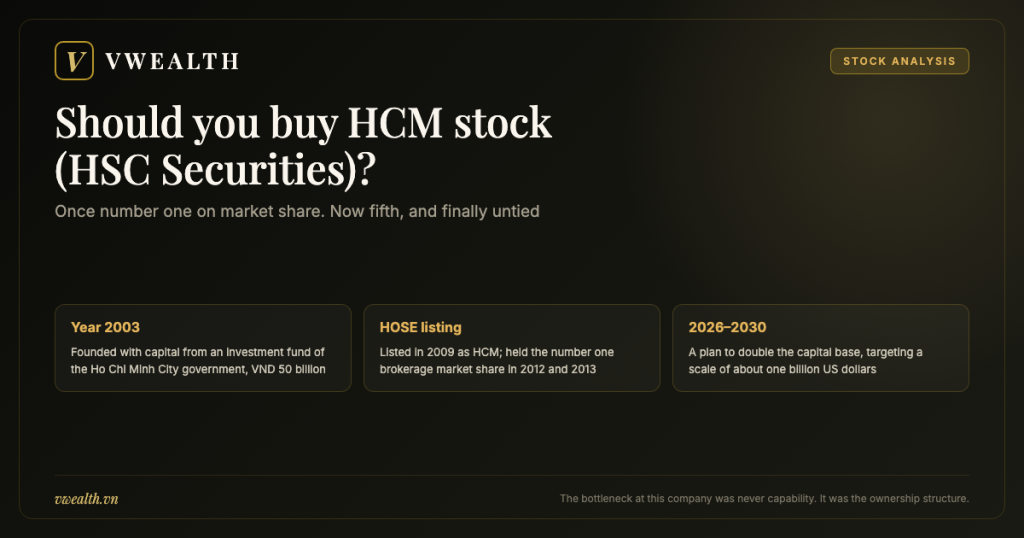
Should you buy HCM stock? It is a question you cannot answer from a price chart, because almost everything that matters about Ho Chi Minh City Securities Corporation — the broker the market knows as HSC — sits outside the price. This is the only securities firm in Vietnam that was founded with money from a city government. It grew up under the wing of a foreign fund manager, and it is now halfway through a slow, deliberate handover of ownership that very few retail investors have noticed. It is also the firm that once held the number one brokerage market share on the Ho Chi Minh exchange and has since slid to fifth — not because it lost its craft, but because every attempt to raise capital had to travel through hundreds of documents passing back and forth between government agencies. And it is the rare Vietnamese brokerage stock that broke to an all-time high in exactly the stretch when most of its peers were losing thirty to fifty percent. This article walks the whole file: twenty-three years of history, an ownership structure that is being rewritten quarter by quarter, how HSC actually earns its money, the eight places you must look when you open its accounts, and a straight answer on who this stock suits and who it does not.
Before we begin, a convention worth agreeing on. You will meet a great many dates, names, share issues and ownership percentages in what follows — all of it publicly disclosed and verifiable in filings. What you will almost never see is a figure from the most recent quarter: how many billion dong the firm earned, what its price-to-book multiple is today, how large its margin loan book is this morning. The reason is practical. For a brokerage, those numbers move every ninety days and can reverse completely in three months. An article that hard-codes an August 2026 number becomes misinformation by November. So instead of handing you figures with an expiry date, this piece teaches you how to read the numbers of this particular business, so that each quarter you can open the statements yourself and know exactly what you are looking at. For live figures, use the analysis reports on vwealth.
All amounts here are in Vietnamese dong. As rough mental arithmetic, one US dollar bought somewhere in the region of VND 26,000 during 2026, so VND 1 trillion is on the order of forty million dollars. Treat that as shorthand, not a precise translation — the dong drifts and the company reports in dong. Vietnamese share prices are also quoted in plain dong, which is why you will see a stock trading at “32,000” rather than at some tidy single-digit number. If any of the market plumbing in this article is unfamiliar — how foreign ownership limits work, how the two exchanges divide the listed universe, how orders and settlement run — the guide to investing in the Vietnamese stock market covers it from the beginning, and the Vietnam stock market guide maps the sectors and the index structure.
One more thing needs saying at the outset, so you do not misread the chapters that follow. The name “Ho Chi Minh City Securities” leads a lot of people to assume this is a state-owned enterprise. That is half right. It is right in the sense that the firm was capitalised by a financial institution belonging to the Ho Chi Minh City People’s Committee — the city government — and that this institution is still a major shareholder today. It is wrong in the sense that the state’s stake has been falling for years, and that the largest single shareholder today is a foreign fund management group that has been attached to the company since 2005. The whole of chapter two is given over to that distinction, because if you misread the ownership structure of HCM you will misread both its risks and its opportunities.
And a note on the ticker itself, since it trips up newcomers constantly: the three letters HCM are the abbreviation of the city, not a description of the business. This is not an infrastructure company, a property developer, or a municipal utility. It is a securities firm.
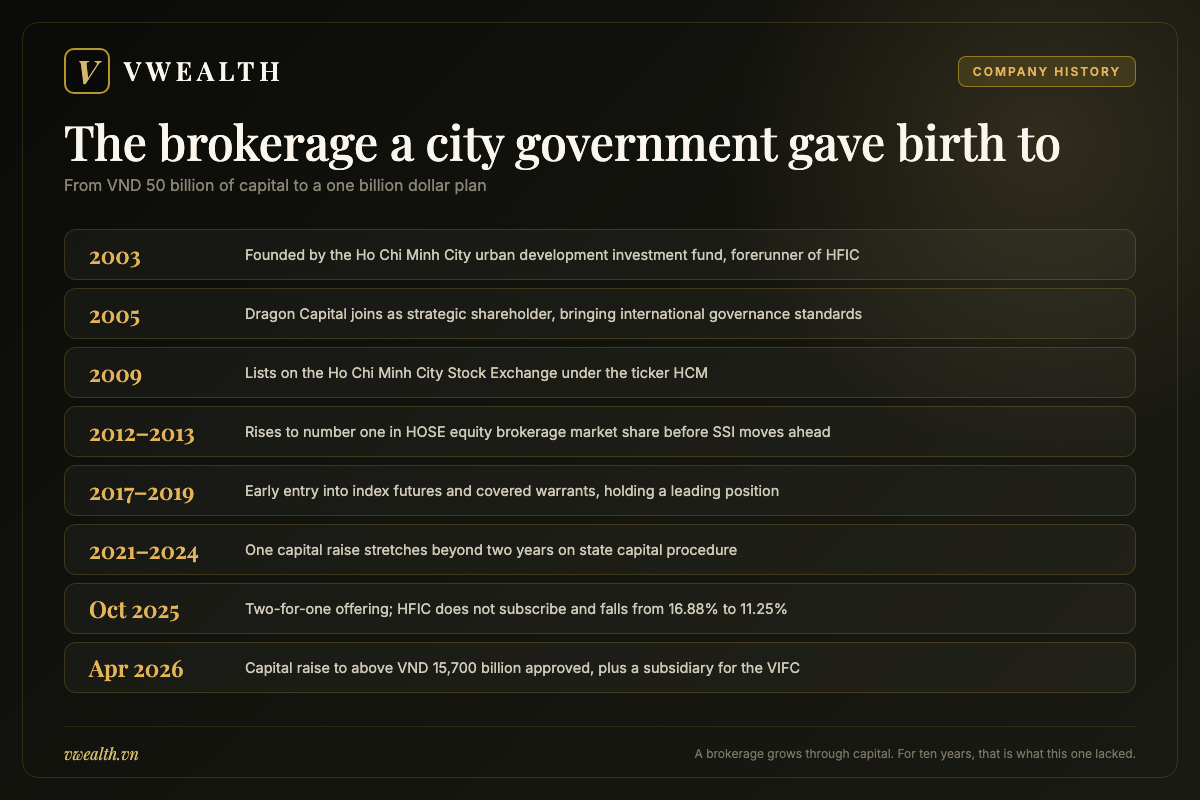
Twenty-three years of a brokerage a city government gave birth to
Most Vietnamese securities firms were born in one of three ways. A bank set up a subsidiary to cross-sell to its own depositors. A group of businesspeople pooled money to buy a foothold in the capital market. Or a conglomerate built itself a financial arm. HSC belongs to none of those categories. It was founded by an investment fund owned by the Ho Chi Minh City government, and its original purpose had more policy in it than commerce: to give the city an instrument in a capital market that had only just come into existence. That unusual starting point produced both the greatest strength and the greatest weakness that HCM stock has carried for two decades.
2003: fifty billion dong and a city investment fund
HSC was established in 2003 by the Ho Chi Minh City Investment Fund for Urban Development — HIFU — an institution later converted into the Ho Chi Minh City Finance and Investment State-owned Company, known as HFIC. Initial charter capital: VND 50 billion.
Pause on that fifty billion for a moment, because it tells you a great deal about the era. In 2003, the Vietnamese stock market was three years old. The Ho Chi Minh exchange had opened in July 2000 with exactly two listed stocks. By 2003 the entire market held only a couple of dozen listed companies, with a total capitalisation that, translated into today’s money, would not match a single mid-cap business. The number of licensed brokerages could be counted on your fingers. Founding a securities firm in Vietnam in 2003 was not a way to make money. It was a bet that this tiny market would one day become a large one.
And the party placing the bet was not an entrepreneur. It was a city fund. That matters more than it first appears. It meant that from day one, HSC felt no pressure to grow at any cost to satisfy a private owner, and it had no corporate ecosystem to serve. There was no parent company that needed bond financing arranged. There were no property projects that needed funding put together. HSC grew up as a genuine financial intermediary — and that habit, as you will see, is still visibly intact in how the firm operates in 2026.
The downside appeared almost immediately, though it took another fifteen years to show its full severity: when the founding shareholder is an agency that manages state capital, every decision to raise equity gets pulled into the public sector’s approval machinery. We will come back to this in the section on 2021 to 2024, the most painful stretch in the whole corporate biography.
Understanding HFIC, and why state ownership slows a capital raise
This section exists for readers outside Vietnam, because HFIC has no exact equivalent in most markets and the mechanism it creates is central to the entire HCM investment case.
HFIC is the investment arm of the Ho Chi Minh City People’s Committee. Think of it as a municipal holding company: the city places capital into it, and it in turn holds equity stakes in businesses the city considers strategic — a structure closer to a sovereign or municipal investment vehicle than to a government department. Its shareholdings are legally state capital, and that legal characterisation is what creates the friction.
Here is why. In most markets, when a listed company wants to issue new shares, the sequence is short: the board proposes, the shareholders vote, the regulator clears the prospectus, the shares are sold. A large existing shareholder simply decides whether to subscribe or not, using its own judgement about value. In Vietnam, when the large shareholder is a state entity, that private decision becomes a public one. Committing additional state capital to a business is governed by rules on the management and use of state capital in enterprises, and those rules push the decision up through layers of approval — in HSC’s case, as the company itself described it, all the way to the level of the Prime Minister’s office. Each layer requires documentation, valuation opinions, and sign-off. Each layer takes time.
The consequence is not merely bureaucratic annoyance. It is a competitive handicap with a hard financial edge, and to see why you need one more piece of Vietnamese market plumbing. Vietnamese law caps a securities firm’s total margin lending at two times its own equity. Margin lending — lending clients money to buy shares, secured on those same shares — is the single largest revenue engine of a modern Vietnamese brokerage. So the arithmetic of the whole industry reduces to one sentence: to lend one more dong, you need half a dong more equity. A firm that cannot raise equity quickly cannot grow its main business at all, no matter how good it is at that business.
Hold that thought. It is the key that unlocks the rest of this article.
2005 to 2008: Dragon Capital arrives and the machine starts running
In 2005, Dragon Capital joined HSC as a strategic shareholder. Looking back, this is the milestone that shaped the company’s fate more than any other.
For readers unfamiliar with the name: Dragon Capital is a foreign fund management group that has operated in Vietnam since 1994 — that is, from before the stock market existed. For many years it was the principal gateway through which international investor money reached Vietnamese equities, and it remains one of the largest and longest-established foreign asset managers in the country. When an institution like that becomes the strategic shareholder of a young brokerage, what it brings is not only money. It brings the governance standards of an international fund manager, it brings a network of foreign institutional clients, and it brings a philosophy very different from the market consensus at the time: build research first and sell services off the back of it, rather than build a sales force first and chase account openings.
Charter capital climbed steadily in the years that followed: VND 100 billion in 2006, VND 200 billion in 2007, VND 395 billion in 2008, and roughly VND 600 billion by the end of 2009. Across that same window, the Vietnamese market went through the first mania in its history — the VN-Index peaked in March 2007 — and then walked straight into the 2008 global financial crisis. HSC had grown just enough to catch part of the boom, and remained small enough not to die in the storm.
2007 also produced a personnel event that few people paid attention to at the time: Mr Johan Nyvene joined as chief executive. He holds both American and Vietnamese citizenship, and his Vietnamese name is Nguyen Quoc Huan. He would occupy the top executive seat at HSC for thirteen consecutive years before moving to the chairman’s chair. A Vietnamese brokerage keeping the same chief executive for thirteen years is close to unique in this industry. That stability is part of the answer to why HSC has consistently been rated highly by institutional clients.
2009: HCM lists on the Ho Chi Minh exchange
In 2009, HSC listed on the Ho Chi Minh City Stock Exchange under the ticker HCM. Those three letters — identical to the abbreviation of the city — make it one of the easiest tickers to remember on the board, and also the source of a persistent confusion: a great many new investors assume HCM must be something to do with the city’s infrastructure or property.
Choosing HOSE over HNX was both sensible and close to inevitable. Vietnam has historically run two equity venues: the Ho Chi Minh exchange, HOSE, which hosts the large caps and carries the VN-Index, and the Hanoi exchange, HNX, which has hosted smaller companies. Foreign and domestic institutions trade almost exclusively on HOSE, because that is where the liquid large caps are. HSC was headquartered in Ho Chi Minh City, its founding shareholder was a city institution, and its target client base was institutional. It went where its customers were.
That is the first difference from the two other brokerages analysed in this series. SHS chose the Hanoi exchange and stayed stuck there for seventeen years, and VIX took more than a decade to get itself moved to HOSE. HSC was in the right place from the start.
2009 was also the year the market rebounded violently off its February low. The VN-Index more than doubled in a matter of months, turnover exploded, and brokerage stocks flew with it. HSC listed into the middle of that wave — an unusually favourable debut.
2010 to 2013: four years at the top of the industry
The 2010 to 2013 stretch was HSC’s golden age, and if you want to understand why the market still extends this stock a certain respect today, you have to understand this period.
While most of the industry threw itself into a race to open branches and hire brokers to accumulate retail accounts, HSC did something else: it built a research house. The firm invested in one of the largest analyst teams in the market, published in both Vietnamese and English, and used the quality of that research as its weapon to win institutional and foreign fund clients — a group that does not care about cheap commissions and does care intensely about who gives them accurate information and who can execute a large order without moving the price against them.
The results were visible. HSC was recognised by Thomson Reuters in the Extel survey in 2010, ranked by Institutional Investor in its all-Asia research team survey in 2011, awarded by FinanceAsia in its country awards in 2012, and repeatedly voted best Vietnamese broker in AsiaMoney’s polls. In 2014, The Asian Banker named HSC the best-managed broker in the Asia-Pacific region. In 2019, Alpha Southeast Asia called it the best broker for institutional clients.
More important than the awards is the market share number. In 2012 and 2013, HSC rose to the top of the equity brokerage league table on HOSE — outright number one — before SSI pushed it back into second. And the profit mix in the 2013 financial year shows something worth noting: brokerage contributed 31% of profit, meaning this firm genuinely lived on service fees rather than on trading securities for its own account. That is where HSC has always differed from the cohort of brokers whose income is dominated by proprietary trading.
Remember those two words, “number one”, because the rest of this biography is the story of losing it — and of exactly why it was lost.
2014 to 2020: keeping the craft, losing the ranking
From around 2014, the structure of the game changed. New retail account openings accelerated, the market tilted towards small individual investors, and brokerages realised that market share was now decided not by foreign funds but by millions of individuals trading every day. Serving that group requires three things: cheap commissions, a large margin lending capacity, and an app people enjoy using. All three require capital.
HSC kept its craft — research quality, institutional relationships, large-order execution, investment banking — but began to run out of breath in the capital race. While Vietcap effectively dominated the top three from the third quarter of 2014 through to mid-2020, and SSI expanded into asset management and new business lines, HSC stood still at an equity base that grew steadily smaller relative to its ambitions.
This was also the period in which HSC built two strengths that still carry real value in 2026. The first is derivatives: the VN30 index futures market opened in August 2017, and HSC was among the earliest movers, later holding a top-three position by market share. VN30 futures are cash-settled contracts on the index of the thirty largest and most liquid HOSE stocks, and for a long time they were the only instrument in Vietnam that let an investor profit from a falling market. The second is covered warrants — a product launched in 2019 that only firms with genuine pricing and hedging capability dare to issue at scale.
In January 2020, the board appointed Mr Trinh Hoai Giang — then a deputy chief executive — as chief executive with effect from 1 April 2020, succeeding Mr Nyvene. Mr Nyvene moved to the board and took the chairman’s seat in 2021. A calm internal handover, no upheaval, no clear-out — one more detail about the temperament of this business.
2021 to 2024: two years, hundreds of documents, and a very high price
This is the most important passage in the chapter. If you only have time to read one part of HSC’s history, read this one.
The 2020 to 2022 period was the largest boom in the history of the Vietnamese stock market. Deposit rates fell to record lows, the pandemic kept millions of people at home, and money poured into equities. New account openings set records month after month, and market-wide turnover exceeded one billion US dollars on some sessions. For a brokerage this is a gold mine at both ends: commission income rises with turnover, and margin loan demand rises with greed.
But margin lending requires equity. As set out above, the law caps a securities firm’s margin book at two times its own equity. There is exactly one way to lend more: raise capital. The entire industry threw itself into issuing shares.
HSC threw itself in too. And HSC got stuck.
In December 2021 the company successfully issued 152.5 million shares, raising VND 2,135 billion. But in January 2022 the State Securities Commission required that the portion contributed by HFIC — VND 459.2 billion — not yet be used, because of unresolved procedures relating to state capital. The next offering, approved by shareholders back in 2022 at a size of 228.7 million shares, was not completed until April 2024. More than two years for one capital raise.
The root cause sits here: HFIC at the time held 121.6 million shares, equal to 17.26% of charter capital, and under the rules governing state capital, a decision to inject further money into a securities business had to pass through multiple layers of approval reaching up to the level of the Prime Minister. Every time HSC wanted to issue shares, that entire machine had to run.
In April 2023, at the annual general meeting, chairman Johan Nyvene said something plainly that investors were still quoting years later: it took hundreds of documents going back and forth between HSC and the relevant agencies, and roughly two years, to complete a single capital increase. Chief executive Trinh Hoai Giang pointed to the direct commercial consequence: HSC’s equity brokerage market share on HOSE had fallen from above 10% — second place in the whole market — to around 6%.
The disclosed specifics: 5.32% in 2023, ranking fifth; 6.17% in the first half of 2024, still fifth. At the same moment, HSC’s margin loan book had reached 1.73 times equity, close to the hard ceiling of two times, while many competitors were sitting at 0.33 to 1.2 times — meaning they had room to lend and HSC had none.
Read that again. This is not the story of a weak business. This is the story of a business whose hands were tied at precisely the moment the race was at its most frantic. The entire investment case for HCM stock over 2025 to 2030 revolves around a single question: now that the rope is being untied, how fast does this firm run?
2025 to 2026: the rope starts to come off
In October 2025, HSC completed an offering of nearly 360 million shares to existing shareholders at a ratio of two to one — that is, one new share offered for every two held. This time there was a fundamental difference: HFIC did not exercise its rights, and transferred away the entire entitlement that arose. As a result, the agency’s holding fell from 16.88% to 11.25%.
That was not an oversight. It was policy. A plan for restructuring state capital, approved by the Ho Chi Minh City People’s Committee, established that HFIC would divest its entire stake in HSC along a roadmap split into several phases. In other words, the founding shareholder is preparing to leave, and each capital raise HFIC sits out shrinks its stake by another notch.
In April 2026 the annual general meeting approved a series of decisions that mark a turning point. The 2026 business plan targets revenue of VND 6,576 billion, up 50%, and pre-tax profit of VND 2,302 billion, up 56%, with a target return on equity of 13%. The capital increase plan has three components: an offering of roughly 270 million shares to existing shareholders, an issue of roughly 22 million employee shares under an ESOP, and a private placement of roughly 200 million shares to professional investors. Together, more than 490 million new shares, taking charter capital from VND 10,808 billion to more than VND 15,700 billion and raising nearly VND 5,600 billion.
Chief executive Trinh Hoai Giang also announced a longer-term target: to double the capital base within five years, with raises pencilled in for 2026, 2028 and 2030, reaching a scale of roughly one billion US dollars by 2030. At the same meeting, shareholders approved the establishment of a subsidiary with capital of around VND 800 billion to participate in the International Financial Centre in Ho Chi Minh City, and a change in the governance model from a supervisory board to an audit committee sitting under the board of directors.
From a VND 50 billion company owned by a city investment fund in 2003, to a one-billion-dollar plan for 2030. That is the whole twenty-three-year arc.
| Date | Event | What it means for an investor today |
|---|---|---|
| 2003 | Founded by HIFU, later HFIC, with VND 50 billion of charter capital | State parentage — the source of both its discipline and its red tape |
| 2005 | Dragon Capital becomes strategic shareholder | Brought international governance standards and a foreign institutional network |
| 2007 | Mr Johan Nyvene becomes chief executive, a seat he holds for 13 years | Rare continuity in an industry of short leadership cycles |
| 2009 | Lists on HOSE as HCM with capital of roughly VND 600 billion | Placed on the exchange its institutional clients actually trade |
| 2012–2013 | Number one in HOSE equity brokerage market share | The high-water mark against which the present must be measured |
| 2017–2019 | Early entry into index futures and covered warrants | Two revenue streams most rivals cannot replicate |
| 2021–2024 | A capital raise stretched beyond two years by state-capital procedure | The direct cause of the market share it lost |
| Oct 2025 | Two-for-one rights issue; HFIC does not subscribe, falling to 11.25% | The state exit becomes visible |
| Apr 2026 | Capital raise to above VND 15,700 billion approved; VIFC subsidiary created | The rope comes off — a new phase begins |
What this biography tells you about HCM stock in 2026
Three conclusions come out of it, and you should carry all three through the rest of this article.
First, HSC is a business that knows its trade. Not every Vietnamese brokerage has held the number one market share position, been ranked by international institutions for the quality of its research, or led large investment banking mandates. That craft did not evaporate when the market share fell. It simply stopped being convertible into money, for want of capital.
Second, HSC’s bottleneck for the past ten years has been its ownership structure, not its operating capability. That is a solvable class of problem, and it is being solved. But you need to track the solving with concrete evidence, not with faith.
Third, the price of the solution is dilution. Going from VND 10,808 billion to more than VND 15,700 billion of charter capital in a single year is an increase of roughly 45%. If profit does not rise correspondingly, your slice of each dong of earnings gets smaller. Chapters four and five will show you exactly how to monitor that.
Who owns HCM stock: a foreign fund moving up, a state agency moving out
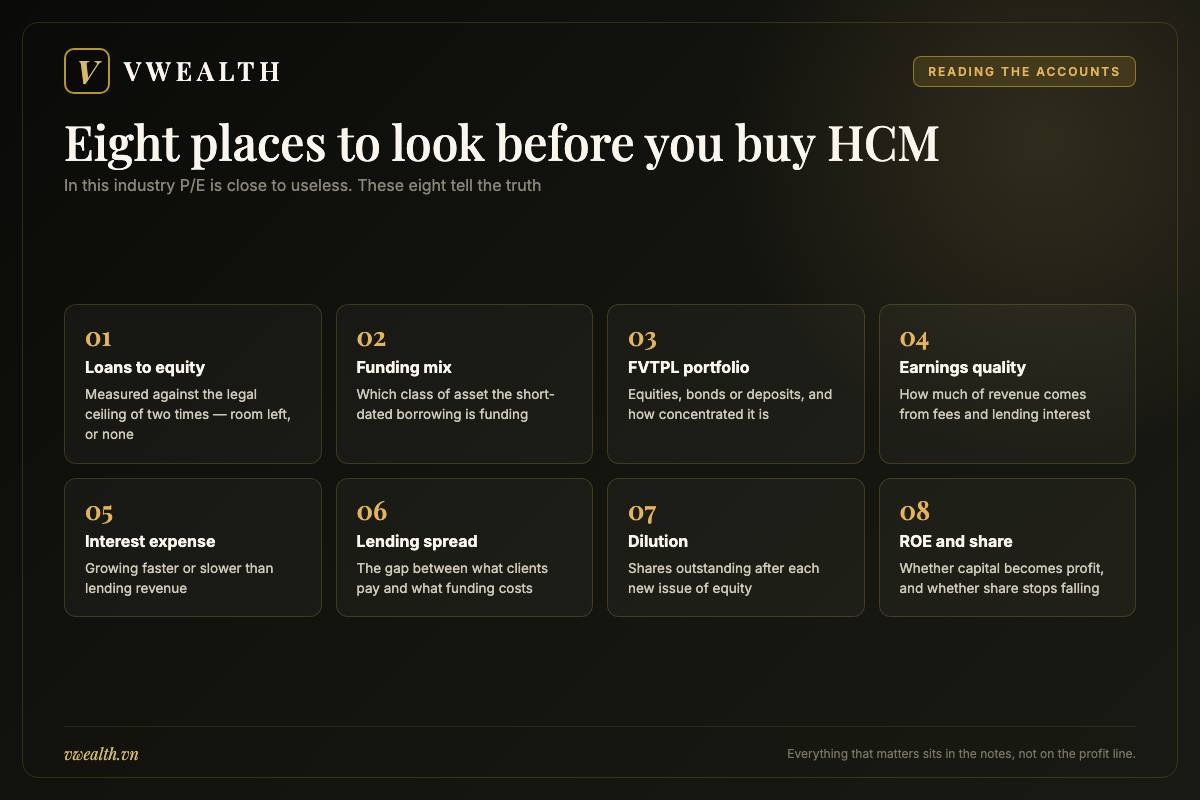
For most Vietnamese stocks, the ownership story is a static one: who holds what percentage, which family controls the board, which conglomerate stands behind it. For HCM, the ownership story is dynamic — a handover taking place while you read this, slowly, through one share issue after another, and with almost no noise on the trading screen. Understanding that handover is understanding most of the risk and most of the opportunity in this stock over the next three to five years.
Johan Nyvene: thirteen years running the firm, then the chair
If you had to pick one person who embodies HSC’s temperament, it is Johan Nyvene. He holds American and Vietnamese citizenship, and his Vietnamese name is Nguyen Quoc Huan. He joined HSC in 2007 as chief executive and board member, held the top executive role until 2020, and became chairman of the board in 2021.
Thirteen unbroken years as chief executive of a listed brokerage is close to unmatched in this industry in Vietnam. Securities firms are notorious for short leadership cycles: one bear market is usually enough to cost a chief executive the job. But look at it from the other direction. For the foreign institutional clients HSC bet its business on, the stability of the person at the top is not a human resources detail. It is part of the counterparty risk file. A fund managing several hundred million dollars does not want to get acquainted with a new management team every two years.
Mr Nyvene’s character shows most clearly in how he described the capital raise problem in 2023: no blame assigned to anyone, no complaining, just the numbers — hundreds of documents, two years. That is the language of someone accustomed to dealing with institutional investors: state the problem in measurable facts and let the listener draw their own conclusion.
What you should take from this is that HCM is not “a stock belonging to one man”. There is no central figure around whom everything revolves, no dynastic narrative, no parent conglomerate to be served. That strips the stock of the drama retail investors are often drawn to, but it also strips out a very heavy category of risk: the risk of a controlling shareholder treating a brokerage as a private wallet.
Trinh Hoai Giang: a career through Vietcombank, Dragon Capital, then HSC
The man running HSC today is Trinh Hoai Giang, appointed chief executive on 1 April 2020 after thirteen years as a deputy chief executive responsible for investment and operations at the same company.
His background has three notable stages. Before joining HSC he ran treasury at Vietcombank — an institution that teaches you how to read a balance sheet and how to manage liquidity, two skills a surprising number of Vietnamese brokerage executives lack. If you want a sense of the institution he came out of, the analysis of Vietcombank in this series describes the most conservative balance sheet in Vietnamese banking. After that he was chief operating officer at Dragon Capital — where you learn how an international fund manager evaluates a counterparty. He is a Fulbright scholar and took an MBA in the United States in 2005.
Those three stages explain a great deal about the HSC of 2020 to 2026: why the firm manages proprietary portfolio risk more tightly than most peers, why it talks about capital and leverage in the language of a bank rather than the language of a broker, and why the 2026 to 2030 strategy is built around the size of the balance sheet rather than around the number of new accounts opened.
One small detail worth noticing: both the chairman and the chief executive of HSC came out of, or are closely tied to, Dragon Capital. That is not a coincidence, and it leads straight into the next section.
Dragon Capital: from strategic shareholder in 2005 to largest holder today
Dragon Capital came into HSC in 2005 as a strategic shareholder. Twenty-one years later, the group is the company’s largest shareholder with a stake of around 31.5% of charter capital — disclosures during 2026 put the specific figure at 31.48%, maintained at 31.51% after the group exercised its rights in the latest issue.
That 31.5% needs to be read correctly. It is not outright control, but it is enough to have a decisive voice on most matters put to a shareholder meeting, and it is far ahead of the second-largest holder. More telling than the number, though, is the behaviour: Dragon Capital does not stand aside and watch the company raise capital. In recent issues the group has repeatedly written real cheques to take up its rights — one round involving close to VND 700 billion, another involving a registration to buy up to 85 million shares for more than VND 850 billion.
For a retail investor, that is a more valuable signal than any analyst report. A professional fund manager, twenty-one years into a relationship, with a seat close enough to the board to know the business from the inside, continuing to put fresh money in at every raise — that is the most credible vote of confidence a shareholder can cast. But you have to read the other side of it as well. Every fund eventually exits. Dragon Capital is an asset manager, not a founding family. If the day comes when the group starts reducing its stake, that will be the single largest variable HCM stock has ever faced — far larger than one quarter of missed earnings.
This is also the fundamental difference between HCM and the other brokerage tickers in this series. VIX is a securities firm with essentially no major shareholder left, with ownership so dispersed that nobody is accountable for long-term direction. SHS is tied to a domestic business ecosystem. HCM has one dominant shareholder: professional, foreign, and present through three full market cycles.
HFIC: the founding shareholder is leaving on a schedule
This is the section to read most carefully in the whole chapter.
The Ho Chi Minh City Finance and Investment State-owned Company — HFIC — is the successor to HIFU, the institution that created HSC in 2003. For many years HFIC held roughly 17% of charter capital, specifically 121.6 million shares equal to 17.26% as of 2024. That stake is precisely why every HSC capital raise had to travel through the state capital approval machinery described in chapter one.
After the two-for-one offering in October 2025, HFIC did not exercise its rights and transferred away the entire entitlement. Its holding fell from 16.88% to 11.25%. This was the direct consequence of the state capital restructuring plan approved by the Ho Chi Minh City People’s Committee: HFIC will divest its entire stake in HSC along a roadmap, split into phases according to conditions at the time.
But the story has a twist a lot of people miss. In the 2026 issue, according to disclosures, HFIC registered to buy more than 30.4 million shares under a four-to-one rights ratio at VND 10,000 per share, keeping its holding at around 11.26% after the issue. In other words, this time the agency chose to participate so as not to be diluted further.
How should you interpret that? The most reasonable reading is as an asset management decision rather than a strategic reversal. If the policy is to sell, then holding your percentage steady before you sell preserves the value of the state’s stake better than being diluted first and selling afterwards. But that is inference, not an official statement. The only thing you actually need to monitor is HFIC’s disclosed transactions — each time the agency sells a large block, the market has to absorb meaningful supply, and that is a genuine short-term variable for the share price.
There is one notable footprint on the tape. During the second quarter of 2026, put-through volume in HCM shares reached nearly 224 million units, equal to roughly 20.7% of charter capital — with almost 21 million shares crossing on 3 June 2026 alone. Put-through trading, sometimes called negotiated or block trading, is a separate channel from the continuous order book: two parties agree price and size directly and the trade is registered with the exchange. Volumes of that magnitude in that channel usually mean institutions rearranging positions, not retail investors trading on screen. You do not need to know exactly who sold to whom. You just need to know that this company’s shareholder register is being rewritten, and that you should re-read the list of major shareholders every quarter.
| Party | Role | Direction of travel | What to watch |
|---|---|---|---|
| Dragon Capital | Largest shareholder since 2005, around 31.5% of capital | Holding and adding fresh money through rights issues | Any move to reduce — the single biggest variable in the stock |
| HFIC | Founding shareholder, representing Ho Chi Minh City state capital | Down from 17.26% to around 11.25%; full divestment is policy | Each disclosed sale and the supply it puts into the market |
| Mr Johan Nyvene | Chairman since 2021, chief executive 2007 to 2020 | Stable, attached to the firm for nearly two decades | Succession planning at board level |
| Mr Trinh Hoai Giang | Chief executive since 1 April 2020, Vietcombank and Dragon Capital background | Leading the 2026 to 2030 capital strategy | Delivery against the stated capital and market share commitments |
| New professional investors | Buyers in the planned private placement of roughly 200 million shares | Not identified when the plan was approved | Identity, issue price and lock-up period |
Cash dividends: where HCM parts company with the rest of the sector
Vietnamese brokerages have one habit in common over the past five years: almost none of them pay cash dividends. The commercial logic is sound — every dong retained can be recycled into an interest-earning margin loan, so paying cash out looks like waste. The whole sector pays stock dividends instead, which is to say it pays in paper.
HSC does it differently. The company has paid cash dividends almost continuously for years. According to disclosures: for 2023 the total payout ratio was 11.78% of par value — comprising the second tranche for 2022 at 6.56% and the 2023 portion at 5.22%, equal to VND 1,178 per share. For 2025 the company paid an interim 4% and then a further 4%, taking the total to 8% of par, or roughly VND 864 billion of cash out the door. For 2026 the plan is 7% of par; on 17 July 2026 the company set the record date to pay 4% in cash while simultaneously running the rights entitlement for the issue of nearly 270 million new shares.
Look closely at the structure of that 17 July date, because it is very characteristic of HSC: on the same day, the company both hands money to shareholders and invites shareholders to hand money back. At first glance that seems contradictory. In fact it is how a business keeps discipline around a dividend commitment while still raising growth capital — and it sends a clear message about the shareholder base the company wants to keep: people who stay for the long run, who are willing to put more in, and who treat a steady cash stream as part of their return.
Do not mistake a payout of 7% or 8% of par for a 7% or 8% dividend yield. This is a Vietnamese convention that catches out foreign readers constantly. Dividends here are declared as a percentage of par value, and par value for essentially every listed Vietnamese share is VND 10,000. The actual yield you receive is the cash amount divided by the price you paid, and since the market price is a multiple of par, the real yield is a good deal more modest. The value of this policy is not in the yield; it is in the signal. A brokerage willing to pay real cash out on a regular schedule is a brokerage confident in its actual cash flows, rather than one carrying paper profits from portfolio revaluation.
How HSC actually earns money: four engines on the accounts and one asset that is not on them
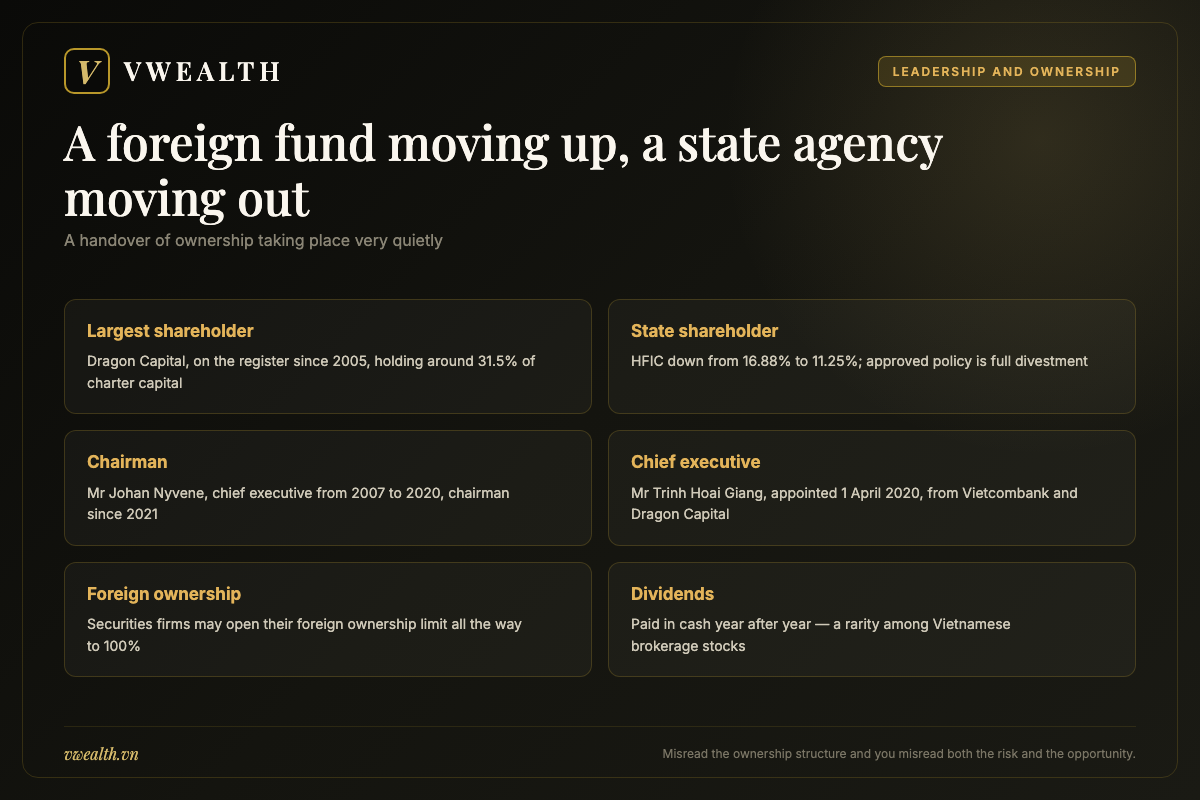
There is a misconception so widespread it is close to universal: people assume securities firms live on brokerage commissions. In reality, at most Vietnamese brokerages in 2026, commission income is a small line. The largest line is margin interest — meaning a Vietnamese securities firm is, functionally, a specialist lender that happens to also run a trading platform. Grasping that is a precondition for reading any set of accounts in this industry. If you want the foundations first, the Vietnam stock market guide explains how the financial sector is structured before you come back here.
HSC runs on four principal revenue engines, plus one asset that appears on no line of the balance sheet yet determines most of the firm’s competitive position.
Margin lending: the biggest engine, and a ceiling made of concrete
Margin lending works like this. You have VND 100 million and you want to buy VND 200 million of shares. The broker lends you the other 100 million, holds those same shares as collateral, and charges interest. Margin rates in Vietnam are considerably above bank lending rates — through the rate-rising phase of 2026 the market norm was recorded at around 14% a year, up from 11% to 12% previously. If the share price falls to a defined threshold, the broker force-sells the collateral to recover its money. In substance, this is secured lending against highly liquid collateral.
For HSC this is revenue engine number one. In the first half of 2026, interest from loans and receivables was the largest contributor to operating revenue, and taken together with brokerage commissions the two lines accounted for roughly three quarters of the firm’s operating revenue. The loan book at that point exceeded VND 29,000 billion.
But this engine has a concrete ceiling: the law caps a securities firm’s total margin lending at two times its own equity. That is a hard number, not negotiable, and it turns the strategy of the entire industry into a very simple equation: to lend one more dong, you need half a dong more equity.
That is why HSC’s capital raising story is not dry corporate finance. It is a matter of survival for the largest business line. When the loan book sat at 1.73 times equity, as it did around 2024, the firm had essentially no room to serve additional clients. Every new customer taken on meant an existing customer’s limit being cut. Picture a restaurant with a brilliant chef, a wonderful menu and a queue out the door — but only ten tables, and no permission to add an eleventh. That is precisely the HSC of 2022 to 2025.
The 2026 capital plan targets margin loan growth of 61%. That sounds aggressive, but it is essentially the arithmetic consequence of adding nearly VND 5,600 billion of equity. The lending ceiling widens, and client demand was already there.
Brokerage: two completely different businesses inside one revenue line
The line labelled “brokerage revenue” in HSC’s accounts contains two entirely different businesses stapled together, and if you do not separate them you will misjudge the company.
The first is retail brokerage. This is the most brutal fight in the market: competition on commission, on margin rates, on app quality, on armies of brokers chasing account openings. It is also where HSC has been pushed back most visibly over the past decade, and where firms with a parent bank or a zero-commission strategy now hold the advantage.
The second is institutional and foreign investor brokerage. This is a different trade entirely. Clients here do not ask what the commission is; they ask whether you have research coverage on the sector, whether you can work a large block without moving the price, whether you have English-language support and whether you comply with international standards. Margins in this business are higher, relationships are more durable, and the barrier to entry is far greater — you cannot build an institutional sales desk in six months.
HSC is strong in the second and relatively weak in the first. Management has publicly chosen that direction: the 2026 plan targets brokerage growth of 38%, explicitly focused on high-value clients and institutional investors, and notes that large institutional trading activity picked up from the middle of 2025.
This is the right strategy for the firm’s actual capabilities, but you have to understand the cost of it: brokerage market share measured by traded value — the number the exchanges publish quarterly — will be hard to grow quickly, because most of the traded value on the Vietnamese market still comes from individual investors. HSC can earn more money from brokerage while its market share ranking barely improves. If you score this company by the league table alone, you will score it wrong.
Derivatives and covered warrants: a quadrillion dong and the trap inside that number
This is the area where HSC is genuinely ahead of most competitors, and also the area most easily misread.
Vietnam’s derivatives market opened in August 2017 with VN30 index futures. HSC moved early and holds a top-three position by market share, recorded at 9.45%. In the first half of 2026, futures traded through HSC reached roughly VND 1.05 quadrillion — 1,050 trillion dong — while equity turnover through the firm over the same period was roughly VND 252,100 billion. A gap of more than four times.
The trap is this: that VND 1.05 quadrillion does not mean HSC’s clients put that much money to work. Futures trade on margin, meaning you post only a fraction of the contract’s notional value, and you can open and close a position several times in the same day. A small pot of money turning over continuously generates an enormous notional turnover figure. That number measures activity, not client capital.
It still tells you two true things. First, HSC holds a professional, high-frequency client base — the sort that produces steady fees regardless of whether the market rises or falls, because derivatives allow you to make money in both directions. That is a defensive revenue stream that firms strong only in cash equities do not have. Second, to serve that group at all you need trading infrastructure, risk management capability and clearing membership — none of which can be bought with an advertising budget.
Covered warrants belong to the same family. These are instruments issued by the broker itself, letting an investor take a leveraged view on the price of an underlying stock with a small outlay. To issue them, the firm must price them correctly and hedge its own resulting exposure — get it wrong and the firm takes the loss, not the client. The number of Vietnamese brokerages capable of running that business at scale can be counted on one hand, and HSC has been among them since the product launched in 2019.
Proprietary trading: HSC uses it in a way the rest of the industry does not
Proprietary trading is a securities firm buying and selling securities with its own money. At many Vietnamese firms this is the largest revenue source and the largest risk: the entire company’s earnings rise and fall with whatever equity portfolio management happens to be holding. You can see a textbook example in the analysis of VIX, where proprietary trading dominates almost the whole profit picture.
HSC does not play that game, and there is a very concrete piece of evidence for it.
At the start of 2026, HSC’s proprietary equity portfolio stood at roughly VND 3,900 billion. By the end of the first quarter of 2026, according to its published report, that figure was around VND 18 billion. In other words, the firm sold down virtually its entire proprietary equity book inside one quarter, immediately before and during a stretch in which the market shook badly on geopolitical tension from late February.
Stop on that number. Selling nearly four trillion dong of shares in three months is not a trading decision. It is a risk management decision taken at the highest level. And it tells you how HSC’s leadership views proprietary trading: not as a profit engine, but as a tap that can be turned off when risk rises, in order to protect equity capital — the very thing that is the binding constraint on the margin lending business.
The remainder of HSC’s financial asset portfolio leans heavily towards debt instruments and assets held to hedge its warrant and derivatives positions, rather than directional bets on share prices. This is something you should verify for yourself each quarter by opening the note on financial assets recognised at fair value through profit or loss — chapter four gives you the exact instructions.
One important caveat: this discipline has a downside. In a strongly rising market, a firm holding little proprietary equity will not book the windfall gains its bolder rivals report. If you expect HCM to double its profit in a quarter because of its trading book, you are expecting the one thing this company deliberately does not do.
Investment banking: small line, high margin, cyclical as anything
Investment banking — equity issuance advisory, corporate bond advisory, mergers and acquisitions, underwriting — is a small revenue line but a high-margin one, and it carries disproportionate brand value. One large listing or one offering placed with foreign investors puts the adviser’s name across every financial page in the country, and opens the door to the next several mandates.
HSC has a long history in this business and has been voted best investment bank in Vietnam by FinanceAsia. The 2026 plan targets growth of 136% in this line — the highest of any segment — on the stated grounds that the pipeline of pending transactions is unusually full across both equity and debt capital markets.
Read that 136% with two caveats. First, the base is low: when a line is small, more than doubling it is easier than a large line growing 20%. Second, investment banking revenue is intensely cyclical and very hard to forecast — it depends on whether companies want to raise money, which in turn depends on whether markets are receptive. In a bad year this line can shrink by more than half.
The real positive lies elsewhere: investment banking and institutional brokerage feed each other. The research team publishes on a sector, the institutional sales desk takes that research to the funds, and when a company in that sector needs to issue equity it goes to the firm that already has relationships with those funds. That circular flow is something a newly arrived brokerage cannot copy in a few years.
The research house: the largest asset that is not on the balance sheet
Open HSC’s balance sheet and you will find no line carrying the value of its analyst team. Yet that is the asset that built this firm’s position over twenty years.
HSC constructed one of the largest research houses in the Vietnamese market, publishing bilingually, covering hundreds of tickers and every major sector. It is that research quality that led international institutions to rank HSC repeatedly in Asian analyst surveys — from Thomson Reuters Extel in 2010 to Institutional Investor in 2011 — and that has kept an institutional client base loyal across multiple cycles.
Why does research convert into money? Because the institutional business model works on a specific principle: a fund pays above-minimum execution commission to whichever broker provides it with informational value. In developed markets this arrangement is named explicitly and has its own regulatory regime. In Vietnam it is unnamed, but it works the same way.
What you have to weigh is whether this moat is eroding or thickening. There are two forces pulling in opposite directions. Eroding it: information is increasingly free, and automated data platforms and artificial intelligence now do work that used to require an analyst — which is precisely why AI-driven analysis platforms such as vwealth exist and are growing quickly. Thickening it: as the market is upgraded and foreign institutional money arrives in volume, demand for international-standard research in English rises, and the number of firms that can supply it remains very small.
The reasonable view is that this moat retains value for at least one more cycle, but should not be treated as permanent.
| Business line | Role in the revenue picture | HSC’s edge | Risk specific to the line |
|---|---|---|---|
| Margin lending | Largest revenue source | High-value client base, tight risk management | Two-times-equity ceiling; force-selling risk when markets fall |
| Retail brokerage | Moderate contribution, fiercely contested | A long-established brand | Squeezed by zero-fee players and bank-owned brokers |
| Institutional and foreign brokerage | High margin, durable relationships | Research, block execution, international standards | Rises and falls with foreign flows |
| Derivatives and covered warrants | Steady fees, earns in both market directions | Top-three derivatives share, in since 2017 | Hedging losses if instruments are mispriced |
| Proprietary trading | Used as a risk valve, not a profit engine | Willingness to cut the book fast when risk rises | Misses windfall gains in strong rallies |
| Investment banking | Small in size, high in margin and prestige | Deal history and institutional relationships | Highly cyclical and hard to forecast |
So where is HSC’s real competitive advantage?
Put together, HSC’s moat is not cheap commissions, not a beautiful app, and not a corporate ecosystem supplying it with free customers. It sits in three stacked layers.
The first layer is its relationships with institutional and foreign investors, built over twenty years and reinforced by the fact that its largest shareholder is itself an international fund manager. This layer cannot be bought.
The second layer is technical capability in difficult products: derivatives, covered warrants, large-block execution, and now the operations required to serve foreign institutions under the non-prefunding regime. Very few competitors can do these things at all.
The third layer is governance reputation. A securities firm that has gone twenty-three years without a major scandal, has never been used as a financing tool for somebody’s ecosystem, and has kept a stable leadership team — in this industry, that is a genuine asset.
The weakness is equally clear: HSC has never won the fight for the mass retail investor, and it never will on current strategy. The entire investment question comes down to whether you believe the Vietnamese market of 2030 will look like the Vietnamese market of 2021 — where individual investors decided everything — or like other emerging markets, where institutions and foreign investors take a steadily larger share. HSC is betting on the second.
Position and financial health: eight places to look before you decide on HCM stock
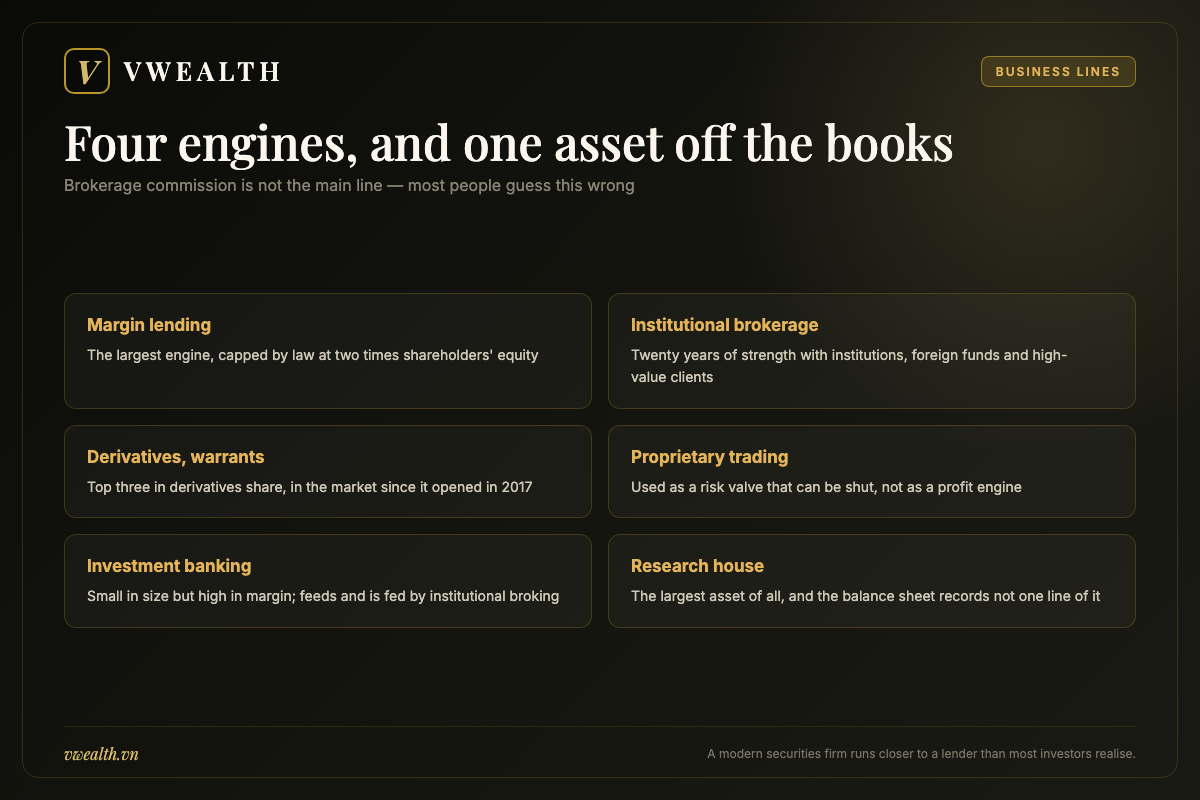
This is the most practical chapter in the article. The aim is not to hand you last quarter’s figures — those expire before you can use them. The aim is to teach you to open HSC’s financial statements and know exactly where to look, in what order, and what number should worry you.
First, a warning about tools. Most investors open a data screen, look at the price-to-earnings ratio, see a low number and conclude the stock is cheap. For a securities firm, that approach is not merely useless. It is dangerous.
Why P/E is almost worthless here, and why HSC’s P/B has a quirk
P/E is price divided by earnings per share. It is useful when a company’s earnings are relatively stable year to year — a retailer, say, or a fertiliser plant. For a brokerage, earnings swing with market turnover, and the amplitude of that swing can be several times over.
The consequence is a paradox you must commit to memory: the P/E of a brokerage stock is at its lowest precisely when the market is at its peak — because earnings are at a maximum — and at its highest precisely when the market is at its bottom, when earnings approach zero. Buying on a low P/E in this industry means buying at the top of the cycle. That is the trap that swallowed a great many new investors in 2022.
The more sensible measure is P/B — price divided by book value per share. It is steadier, because equity does not dance the way earnings do. The correct way to use it is to compare HCM’s current P/B against its own P/B history across cycles, and against brokerages of similar size.
But HSC’s P/B carries a quirk that is rarely discussed. For a securities firm whose assets are mostly margin loans and cash, book value reflects real value fairly closely — the loans are secured on listed shares, highly liquid, marked daily. That makes HSC’s P/B a relatively trustworthy measure. By contrast, at brokerages whose assets lean heavily towards unlisted corporate bonds or non-public equity, book value may contain positions that have never been marked properly to market, and a low P/B can be an illusion.
The second quirk: HSC is in the middle of a rapid capital-raising cycle. Each issue increases equity immediately, while earnings need time to catch up. That means P/B will fall automatically after every issue without anything qualitative having changed. When you see HCM’s P/B decline, the right question is not “has the stock got cheaper?” but “how much equity was just added, and has profit caught up?”
Places one and two: margin loans to equity, and the funding mix
Place number one is the ratio of the margin loan book to equity. Take loans and receivables on the asset side and divide by shareholders’ equity. The legal ceiling is two times.
For HSC this is the single most important number, because it tells you whether the business still has room to grow or has hit the wall. How to read it:
If the ratio is above 1.6 times, the firm is close to the ceiling — the largest business line has nowhere left to expand, and you should wait for the next capital raise rather than expect immediate growth. That was exactly HSC’s position in 2024, at 1.73 times, while many competitors sat between 0.33 and 1.2 times.
If the ratio is below 1 times immediately after a large capital raise, the firm has plenty of lending room — but you need to watch the speed at which it fills up. Money raised and left sitting in deposits earns only bank deposit rates, well below margin rates, and it drags return on equity down. After the 2026 raise, this is the number to check every quarter.
Place number two is the funding mix. Securities firms do not lend only their own equity; they borrow from banks and issue paper, then lend the proceeds on to clients and pocket the spread. Look at borrowings on the balance sheet relative to equity. The core question: what assets are the short-term liabilities funding? If short-dated borrowing funds margin loans — assets that can be recovered quickly — maturity risk is low. If short-dated borrowing funds illiquid assets, that is a real risk.
At HSC the asset structure tilts firmly towards margin loans and cash, so maturity risk is relatively low. But do not treat that as a given; re-check it each quarter, particularly now that the firm has established a subsidiary and is expanding into new activities.
Places three and four: the financial asset mix and the quality of earnings
Place number three is the line for “financial assets at fair value through profit or loss”, usually abbreviated FVTPL. This is the proprietary book. Open the note and answer three questions: what is in it — listed shares, bonds, certificates of deposit, something else? How concentrated is it, and does any single position dominate? And what is the gap between original cost and revalued carrying amount?
That third question matters enormously and almost nobody asks it. If the book is carrying a large unrealised gain, that gain has already been booked through the income statement even though the firm has not sold a single share. If the market turns, that paper gain evaporates and drags profit negative — without a single dong of real cash moving in either direction.
For HSC, as covered in chapter three, the proprietary equity book was cut to a very small figure during the first quarter of 2026. That sharply reduces this category of risk, but you must check each quarter whether the firm has rebuilt the book. A change here is a strategic change, and it alters the company’s entire risk profile.
Place number four is earnings quality: how much of profit comes from service fees and lending interest — recurring, forecastable income — and how much from revaluing the proprietary book, which is one-off income.
The method is simple. Open the income statement, add brokerage revenue to interest from loans and receivables, and divide by total operating revenue. The higher the ratio, the better the earnings quality. At HSC in the first half of 2026, those two lines accounted for roughly three quarters of operating revenue — a high proportion by industry standards, and one of the reasons the market is willing to pay a higher valuation for HCM than for several similarly sized peers.
Places five and six: interest expense and the lending spread
These are two places very few retail investors examine, and they determine the true profitability of the largest business line.
Place number five is the firm’s own interest expense. A brokerage borrows from banks and from the bond market to fund its client lending. When the general level of interest rates in the economy rises, this cost rises with it, and if the firm cannot raise client lending rates quickly enough, the margin gets squeezed.
This happened very visibly during 2026. Interest expense across the sector rose sharply — at SSI it went from roughly VND 469 billion to roughly VND 754 billion year on year, while at HSC it rose roughly 73% to around VND 522 billion. Most brokerages responded by lifting margin rates to around 14% a year, from the previous 11% to 12%.
Place number six is the lending spread: the difference between what the firm charges clients and what its own funding costs. You cannot calculate this precisely from public statements, but you can estimate the trend. Divide interest from loans and receivables by the average loan book to get the yield earned, then divide interest expense by average total borrowings to get the cost paid. The direction of travel of the gap matters more than the level.
Why does this matter especially for HSC? Because the firm’s client base tilts towards high-value and institutional customers — the group with the most bargaining power on rates. Serving large clients means thinner spreads but lower credit risk and larger volumes. It is a deliberate trade-off, and you should monitor whether it is still a good one as rates move. Bank shareholders will recognise the same tension; the Techcombank analysis in this series walks through the same net-interest-margin arithmetic on a much larger balance sheet.
Places seven and eight: dilution, return on equity, and the number that cannot be dressed up
Place number seven is dilution. This is the most direct risk to your wallet over the next two to three years.
Work through an illustrative calculation — purely a worked example to show the mechanism, not a forecast. Suppose a company has 100 shares and earns 100 dong, so each share earns 1 dong. The company issues 45 new shares, raising capital by 45%. If profit next year rises to 130 dong — up 30%, a very good outcome — then earnings per share become 130 divided by 145, roughly 0.90 dong. Profit rose 30% and your slice fell 10%.
That is exactly the arithmetic facing HCM shareholders. Charter capital is planned to rise from VND 10,808 billion to more than VND 15,700 billion, roughly 45%, in a single year. The 2026 pre-tax profit plan is growth of 56%, and the earnings-per-share target is set at VND 1,705, up 16%. So even inside the company’s own plan, per-share earnings growth is far slower than total profit growth. That is the price of capital, and it is written down plainly rather than hidden.
Place number eight is return on equity — ROE. This is the most comprehensive single measure, because it answers the only question you truly care about: how much profit does each dong of equity generate? The ROE target set at the 2026 annual general meeting is 13%.
Use that 13% as a scorecard for the next three years. If equity rises by half and ROE holds around 13% or better, management has successfully converted capital into profit and the investment case is intact. If equity rises by half and ROE sinks below 10%, the firm is raising money faster than it can deploy it — and you are paying for a larger balance sheet rather than a better business.
Finally, there is one measure that sits outside the financial statements and cannot be dressed up: brokerage market share, published quarterly by the exchanges. No accounting treatment can touch this number. For HSC it is both a gauge and a verdict. According to HOSE disclosures, HSC’s equity brokerage share was 7.30% in the first quarter of 2026, ranking fifth after Vietcap moved ahead at 7.35%; in the second quarter of 2026 the figure fell to 6.80%, still fifth. Set against above 10% and second place roughly five years earlier, the distance is stark.
| What to check | Where to find it | Healthy sign | Warning sign |
|---|---|---|---|
| 1. Margin loans to equity | Balance sheet: loans and receivables, shareholders’ equity | Below 1.5 times and filling steadily | Above 1.7 times — no room left to grow |
| 2. Funding mix | Balance sheet: borrowings and issued paper | Short-dated funding against fast-recovering assets | Short-dated funding against illiquid assets |
| 3. FVTPL portfolio mix | Note on financial assets | Few equities, diversified, transparent | Rebuilding a large book concentrated in a few names |
| 4. Earnings quality | Income statement | Fees and lending interest dominate revenue | Profit dependent on portfolio revaluation |
| 5. Interest expense | Income statement, financial costs | Growing slower than the loan book | Growing faster than lending revenue |
| 6. Lending spread | Estimated from the two ratios above | Stable or widening | Narrowing for several quarters running |
| 7. Dilution | Shares outstanding and issuance resolutions | Earnings per share still rising after issues | Total profit up while per-share earnings fall |
| 8. ROE and market share | Financial statements and exchange disclosures | ROE near 13% as equity grows; share rising | ROE below 10%; share falling several quarters in a row |
How to use these eight checks without a spreadsheet habit
If you have never read a Vietnamese brokerage’s statements before, do not attempt all eight at once. Do them in three passes.
The first pass is a two-minute health check: margin loans to equity, and earnings quality. Those two numbers alone tell you whether the firm has room to grow and whether its profit is real. If both look fine, the company is not in trouble.
The second pass, once a quarter, adds the FVTPL note and interest expense. This is where a change of strategy shows up first — a rebuilt trading book, or funding costs running ahead of lending income.
The third pass, once a year, is the dilution and ROE arithmetic. This is the pass that tells you whether you, personally, are better off than you were twelve months ago, which is not the same question as whether the company is bigger.
Do this and you will know more about HSC than most people who own the stock. Skip it and you are relying on a narrative, which is what this article is trying to talk you out of.
How the market treats HCM stock: the broker institutions buy when they are frightened
Every stock has a personality, and that personality is formed by who buys it and why. HCM has a very distinct one within the Vietnamese brokerage sector — a sector famous for hosting the most volatile tickers on the board. The fastest way to understand that personality is to look at what happened in the first half of 2026.
Why HCM broke to an all-time high while the sector lost thirty to fifty percent
This is the most remarkable thing to happen to this stock in years, and it contains the whole investment case in miniature.
From late February 2026, the Vietnamese market shook hard on geopolitical tension in the Middle East and on rising interest rates. Brokerage stocks — the group most sensitive to both factors — were sold off. Most tickers in the sector lost between thirty and fifty percent from their highs.
HCM went the other way. It rose roughly 55% in under two months and broke to an all-time high on 18 May 2026, clearing the previous peak zone above VND 32,000 set back in November 2021, at the very top of the pandemic-era mania.
Three reasons sit behind that, and all three are things we have already covered.
The first is portfolio discipline. Cutting the proprietary equity book from roughly VND 3,900 billion at the start of the year to roughly VND 18 billion by the end of the first quarter meant that when the market fell, the firm took essentially no proprietary damage — while many competitors had to book revaluation losses.
The second is the revenue mix. When most of your revenue comes from lending interest and service fees rather than from proprietary trading, a market decline does far less damage to your results. The market paid a premium for that stability at exactly the moment stability became scarce.
The third is the capital story. Where many companies raise money to repair a balance sheet, HSC was raising money to widen a lending ceiling — a growth reason, not a defensive one. Investors distinguish between those two kinds of issuance.
One detail worth noting: according to flow data over that period, the buying came mainly from individual investors rather than from institutions or foreign funds. That sounds paradoxical given everything we have said about HSC as an institutional house. But it makes sense: when a market turns fearful, it is experienced retail investors who go hunting for the most defensive name inside a cyclical sector — and within Vietnamese brokerages, HCM is the closest thing to that description.
What should you take from it? That HCM is not the fastest mover when the market rallies, but it holds its value markedly better when the market sours. If you are looking for a leveraged proxy on the VN-Index, this is not your ticker. If you want exposure to the brokerage sector without absorbing the full amplitude of the sector, this is exactly where to look.
Three big waves in the price history of HCM
Reading a ticker’s price history is the best way to learn how it responds to different kinds of news.
The first wave was 2012 to 2013, when HSC climbed to number one in HOSE brokerage share and the market began recovering after years of decline. This was a wave of position: the price rose because the business was beating its competitors on its own turf.
The second wave was 2020 to 2021, a wave of liquidity. From roughly VND 12,000 to 14,000 in late 2020, the shares nearly tripled to above VND 32,000 by November 2021, then held around VND 28,000 to 30,000 through the first quarter of 2022. From April 2022 the market entered a severe correction on monetary tightening, and HCM fell with the whole sector. That wave had nothing to do with corporate capability — it was simply money in, then money out.
The third wave is 2025 to 2026, and it is the most interesting because it has three layers of driver stacked on top of each other: expectations around the market upgrade, the untying of the capital constraint, and the market’s recognition of risk discipline. The all-time high of 18 May 2026 sits inside this wave.
What is worth thinking about is that all three waves were long — measured in quarters, not weeks. HCM is not a ticker of multi-session explosions. It needs time, and it rewards patience more than it rewards speed.
Who owns HCM: a shareholder base unlike the rest of the sector
The composition of a shareholder register drives price behaviour more than most investors realise, and HCM’s register has three distinct layers.
The first layer is long-term institutional ownership, led by Dragon Capital with around 31.5%, plus the state holding at HFIC. Together, more than forty percent of the shares sit with two entities that essentially never trade day to day. That makes the genuine free float smaller than the charter capital figure implies, and explains why HCM is less easily knocked down by short-term selling waves.
The second layer is long-term individual investors, drawn in by the steady cash dividend policy and by the governance reputation. This is a cohort that does not sell into weakness, because rising prices were never the reason they bought.
The third layer is short-term trading flow, appearing whenever there is news about the market upgrade or about a share issue. This is the layer that creates volatility, and it is far thinner here than in tickers like VIX and the more speculative brokerage names.
That three-layer structure has a practical consequence you should know before placing an order: HCM’s liquidity is good but not top-tier within the sector, and the price tends to move in long stretches rather than in strings of limit-up and limit-down sessions. Worth explaining for readers new to Vietnam: HOSE applies a daily price band of plus or minus seven percent around the previous reference price, so “limit up” and “limit down” are real, hard boundaries here rather than figures of speech. For a trader, HCM’s steadiness is a drawback. For someone accumulating a large position over time, it is an advantage.
One variable to watch closely: put-through volume. As noted in chapter two, nearly 224 million HCM shares changed hands through the negotiated channel in the second quarter of 2026, equal to roughly 20.7% of charter capital. When that much stock changes owner, the shareholder structure shifts, and the personality of the ticker can shift with it. This is something to re-check periodically rather than assume is standing still.
Foreign ownership room, and a privilege only the brokerage sector has
For most Vietnamese companies, the maximum permitted foreign shareholding — usually called the foreign ownership limit, or “room” — is capped at 49%, and for banks it is lower still. Securities firms are the exception: a Vietnamese brokerage is permitted to open its room to 100%.
This is a substantial privilege, and for HCM it carries far more specific meaning than for its peers. The company’s largest shareholder is already a foreign institution, and its core business is serving foreign institutional investors. If a day comes when a regional financial institution wants to buy control of the Vietnamese brokerage with the best institutional franchise, HCM is one of a very small number of names that would qualify for the conversation.
That does not mean it will happen. It is a possibility, not a forecast, and you should absolutely not buy a stock on this basis. But it is a genuine layer of latent value, particularly with HFIC divesting and with the planned private placement of roughly 200 million shares to professional investors having no publicly identified buyer at the time the plan was approved.
The reverse is also true: open room is a double-edged sword. When foreign investors sell, there is no cap to slow the selling down, and the stock takes the supply pressure directly. In periods when foreign money is leaving Vietnam, stocks with high foreign ownership typically suffer more than the market average. This asymmetry applies across the market, not just to brokers — the VPBank analysis in this series covers how the same dynamic plays out where a strategic foreign holder is on the register.
Placing HCM beside five rivals: five very different ways to make money
The quickest way to understand a business is to set it beside its peers and ask where the difference lies. Among Vietnamese brokerages, the difference is not size — it is business model. That makes a straight comparison of P/B multiples across tickers close to meaningless unless you first understand what each firm actually lives on.
| Company | Main engine | Client base | Greatest strength | Characteristic risk |
|---|---|---|---|---|
| HCM — HSC | Margin lending and service fees | Institutions, foreign funds, high-value individuals | Research, derivatives, disciplined risk management | Dilution from repeated raises; a major holder that may exit |
| SSI | Diversified, largest in scale | Broad, retail and institutional | Capital base and breadth of licences | Funding costs rise quickly when rates climb |
| VCI — Vietcap | Investment banking and institutional brokerage | Institutions and foreign funds | Large advisory mandates; recently passed HSC on share | Advisory revenue is highly cyclical |
| VND — VNDirect | Retail brokerage and financial products | Mass-market individual investors | Technology platform and wide client base | Sensitive to turnover swings and bond exposure |
| VIX | Proprietary trading | Thin relative to its capital base | Large equity base, very high share liquidity | Profit depends on the proprietary book |
| SHS | Proprietary trading and lending, mid-pivot | Very small brokerage share relative to capital | Equity among the largest in the industry | Capital not yet converted into market share |
Read that table and HCM’s position becomes clear: this is the firm whose model most closely resembles a professional financial institution, living on fees and interest rather than on bets on share prices — and it is also the firm with the least capacity to surprise. You will not wake up one morning to find HCM has tripled its profit because it got a stock call right. You will also not wake up to find it deeply in the red because a portfolio evaporated.
Vietnam’s brokerage industry in 2026: the market upgrade lands on HSC’s strongest suit
Some years the industry backdrop matters more than the company. For Vietnamese brokerages, 2026 is one of those years. And what makes it unusual for HSC is that the largest sector event of the decade lands precisely where this firm is strongest — while doing nothing at all about the place where it is weakest.
The FTSE upgrade effective 21 September 2026: four tranches and a 1.7 billion dollar number
After years on the watch list, Vietnam has been reclassified by FTSE Russell from frontier market to secondary emerging market. The decision was announced on 8 October and takes effect from 21 September 2026, after the index provider confirmed Vietnam had passed its formal review. Vietnamese stocks will be added to FTSE indices in four tranches, beginning on 21 September 2026 and completing around September 2027.
Why does this matter? Because there is a very large pool of money in the world that is not permitted to buy shares in a frontier market. Index funds, pension funds and insurance funds in developed countries are typically bound by mandate to invest only in markets that meet defined standards of accessibility, custody and settlement. When a market is upgraded, that door opens and money flows in — not because anyone has fallen in love with Vietnamese equities, but because the index composition changed and index-tracking funds are obliged to follow.
How much money? According to an estimate from SSI Research, passive fund inflows could reach roughly 1.7 billion US dollars, disbursed across something like three to five quarters — a pattern similar to the earlier Saudi Arabian case. That is a research house’s estimate, not a committed figure, and you should treat it as such.
One important technical element FTSE Russell referred to: Circular 08/2026/TT-BTC established the legal framework guaranteeing foreign investors access to the Vietnamese market through global securities firms. In other words, the legal plumbing for foreign flows has now been installed rather than merely promised.
For HSC this is a catalyst landing in the right place. Foreign money entering Vietnam does not arrive in retail brokerage accounts; it arrives through securities firms with the capability to service foreign institutions. The number of Vietnamese firms that can do this is countable on one hand, and HSC has been at the front of that group for twenty years. If you want the mechanics of the upgrade and which sectors it touches, the guide to investing in the Vietnamese stock market covers the classification process and what changes for a foreign account.
Removing pre-funding: why this is a game for firms with large balance sheets
This is a technical change that very few retail investors understand, and it reshapes competitive dynamics in the industry more than any other policy.
Previously, every investor buying shares in Vietnam had to have the full cash amount in their account before placing the order. For a domestic retail investor, that is unremarkable. For a fund in London or Singapore, it was a serious obstacle: they had to wire money into Vietnam, convert currency, and leave it sitting in an account before knowing whether the order would even fill. The opportunity cost is substantial, and this was one of the principal reasons index providers had withheld an upgrade.
Circular 68/2024/TT-BTC, issued by the Ministry of Finance on 18 September 2024 and effective from 2 November 2024, untied exactly this knot. Under the new rules, foreign institutional investors may buy shares without having full cash at the point of order; the securities firm extends a trading limit in advance and settlement takes place after the order is executed.
Now read that sentence again and ask yourself: who carries the risk between execution and payment?
The answer is the securities firm. If the foreign client fails to settle on time, the broker wears it. Which means that to run this business at any scale, a firm needs three things: enough equity capital to absorb the risk, a counterparty risk system good enough to extend limits to the right names, and relationships long enough to know who is trustworthy.
Those three things are a description of HSC. And this is the deepest explanation for why the firm has been in such a hurry to raise capital across 2025 and 2026: not only to lend more on margin, but to be large enough to qualify for the foreign institutional flow that is coming. The new game is a game of big balance sheets, and a small brokerage — however skilled — does not get an invitation.
It is also worth being clear-eyed about what this does not fix. Non-prefunding helps institutions, not the mass retail market. It widens HSC’s advantage in the segment where it already leads, and does nothing whatsoever about the segment where it is losing ground.
The race to zero commissions and the bank-owned brokers
While the international door opens, the domestic door narrows. And this is where HSC struggles.
From around 2021, several brokerages began waiving or nearly waiving trading commissions to buy market share. The logic is simple and ruthless: commission is not the main revenue line, margin interest is — so give the trading away free, pull the clients in, and make the money on lending. The strategy worked well enough to reshape the entire league table.
The second group is more dangerous: brokerages with a parent bank or a financial group behind them. Their advantage is funding cost — they borrow more cheaply — plus a ready-made client base of millions of retail customers from the parent bank and the ability to cross-sell. In the HOSE brokerage market share table for the second quarter of 2026, the effect is plain: TCBS rose to 9.36%, and VPBankS rose from 2.94% to 3.57% — both names attached to a bank. Anyone who has read the Techcombank analysis will recognise how deliberately that securities arm was built into the group’s strategy.
Over the same period, HSC fell from 7.30% to 6.80%. Vietcap eased slightly to 7.00% but stayed above HSC. The wider picture in the second quarter of 2026 shows something else worth thinking about: the combined share of the top ten firms fell from roughly 69% to roughly 64%, meaning share is dispersing towards smaller firms rather than concentrating at the top.
HSC has chosen not to fight the commission war. That is a defensible choice — the firm has no parent bank to absorb the losses, and institutional clients do not select a broker on price. But that choice means HSC’s brokerage share is unlikely to return to the above-10% level of a decade ago. You should accept that as a base assumption rather than hope for a reversal.
The Ho Chi Minh City International Financial Centre: a new door being opened
Another policy development is reshaping the industry, and HSC is unusually well placed to benefit: the Vietnam International Financial Centre in Ho Chi Minh City, abbreviated VIFC.
The idea behind an international financial centre is to create a zone with its own legal, tax and foreign exchange framework, closer to international standards than the rest of the economy, in order to attract foreign financial institutions to set up. Many large Vietnamese banks and brokerages have signalled an intention to take part.
HSC moved early. The April 2026 shareholder meeting approved the creation of a wholly owned subsidiary with charter capital of roughly VND 800 billion to join VIFC as a member. The reason a subsidiary was required rather than direct participation is itself notable: current VIFC rules do not yet allow a securities firm to register as a member directly, so it has to be done through a separate legal entity the company owns.
Management describes this as a strategic step to strengthen competitiveness and long-term positioning, widening access to international capital, clients and partners while taking advantage of preferential policies and adopting international standards in operations and governance.
How should you assess it? Cautiously. VIFC is a long-term project, the legal framework is still being completed, and VND 800 billion of capital in a subsidiary is an investment that may take years to earn a return. But the strategic logic fits HSC’s DNA precisely: if there is one Vietnamese brokerage for which access to international capital and clients is core rather than decorative, it is this one. It also does no harm that the company is headquartered in Ho Chi Minh City and was born out of the city government.
The headwinds nobody should forget
This chapter has been fairly positive so far. Let us balance it.
The first headwind is interest rates. The brokerage industry lives on cheap money. When deposit rates rise, two things happen at once: the firm’s funding cost goes up, and part of investors’ money leaves the market and returns to savings accounts. 2026 demonstrated this clearly, through the sharp rise in industry-wide interest expense and the push of margin rates towards 14%.
The second headwind is the cyclicality of the business itself. Securities firms carry very high operating leverage: costs are largely fixed while revenue swings with market turnover. In a good market, profit inflates fast. In a bad market, profit does not merely decline — it turns negative. The industry has proved this at least twice, in 2011 and in 2022.
The third headwind is the upgrade flow itself. Money that can come in can also go out. Passive index flows arrive mechanically and can leave mechanically if the index is adjusted or if global flows reverse. Being upgraded increases openness, and openness cuts both ways.
The fourth headwind, and the most specific to HCM: the HFIC divestment. Every large block sold is real supply hitting the market. If that process runs during a weak market, the price impact will be visible.
Looking ahead: three scenarios for HCM stock and what has to happen for each
By this point you have enough material to build the forward picture yourself. This section gives no price target — nobody can forecast a share price, and anyone who tells you they can is selling you something. What you need instead is three scenarios with observable conditions, so that each quarter you can mark where reality is actually drifting.
Three genuine drivers ahead
The first driver is capital. Once charter capital moves from VND 10,808 billion to more than VND 15,700 billion, the margin lending ceiling — the constraint that has strangled this business for four years — widens considerably. This is not a vague hope; it is the arithmetic consequence of a plan already approved by shareholders. The only question is how quickly the firm fills the new capacity.
The second driver is the market upgrade. From 21 September 2026, Vietnamese stocks begin entering FTSE indices in four tranches running through to September 2027. Passive flows estimated at roughly 1.7 billion US dollars will pass through securities firms capable of servicing foreign institutions — and HSC is one of the few that qualifies. Add the non-prefunding mechanism under Circular 68, and the foreign institutional service business moves from being a high-margin niche to something that can genuinely scale.
The third driver is the untying of the ownership knot. As the state stake falls and eventually disappears, the company stops having to route major decisions through the state capital approval machinery. Decision speed rises, and a decade-long structural handicap simply goes away.
All three drivers are real and all three have already begun. But none of them converts automatically into shareholder profit — which is why we need three scenarios.
The bull case: capital and the upgrade both convert into earnings per share
In this scenario, everything meshes.
The 2026 capital raise completes in full across all three components, including the private placement, and the professional investor who buys in turns out to be a name with strategic value rather than merely money. The margin book fills within three to four quarters, taking the loans-to-equity ratio back to the 1.4 to 1.6 range without any loosening of credit standards.
Upgrade flows arrive, and arrive steadily. HSC’s foreign institutional brokerage business grows visibly, and non-prefunded trading becomes a meaningful revenue line. Investment banking wins several large mandates as Vietnamese companies use a favourable valuation window to issue equity.
The visible results: ROE holds at 13% or better despite equity having grown by nearly half; earnings per share rise year on year rather than stalling; brokerage market share stops falling and ticks up for four consecutive quarters; the cash dividend is maintained. HFIC completes its exit to a strategic partner rather than distributing stock onto the market.
What has to be true for this to happen: market turnover establishes a higher plateau, interest rates hold steady or fall, and management maintains risk discipline while expanding quickly — the hardest of the three.
The base case: bigger, safer, but your slice does not grow fast
This is the scenario I consider most likely, and the one you should use as your default.
Capital rises as planned. The loan book grows with it, but more slowly than hoped, because elevated interest rates keep client borrowing demand from exploding. Upgrade flows arrive gradually, spread across many quarters, and a meaningful portion of the money goes into large-cap stocks rather than into brokerage revenue.
HSC’s institutional and foreign business genuinely improves, but not enough to offset continued erosion of retail brokerage share by the bank-owned and low-fee competitors. The market share ranking oscillates around fifth place, up some quarters and down others.
Absolute profit rises, the cash dividend holds, and the business is safer because the balance sheet is thicker. But earnings per share grow slowly because of dilution, and ROE drifts into the 10% to 12% range rather than holding at 13%. The stock trades sideways in a wide band, with occasional waves driven by upgrade news or divestment news.
In this scenario HCM is not a bad investment — you still collect a dividend, you still own a competent business with low accident risk. But it is not an investment that makes you rich quickly either. That is something you need to be honest with yourself about before placing an order.
The bear case: the cycle turns just as the balance sheet is at its largest
The bear case does not require the company to do anything wrong. It only requires the market to turn.
Interest rates keep rising, money leaves equities for savings accounts, and turnover contracts quickly. Brokerage revenue falls with turnover. Margin loan demand drops and, worse, as share prices fall the firm has to force-sell collateral across a broad front — at exactly the moment the loan book is the largest it has ever been, thanks to the capital raise.
Interest expense rises while lending revenue falls, squeezing the spread from both ends. Capital raised sits idle because nobody wants to borrow, dragging ROE sharply lower. Foreign flows reverse, and because brokerage foreign ownership room is open to 100%, there is no cap to slow the selling. If HFIC is selling into that same window, the supply is heavier still.
The one bright spot in the bear case — and this is the main reason many institutional investors prefer HCM to other brokerage tickers — is that the firm does not carry a large proprietary equity book. When the market breaks, HSC does not have to book thousands of billions of dong in revaluation losses the way some competitors do. Profit will fall a great deal, but the probability of a heavy loss is lower than the sector norm.
Put differently: in the bear case HCM still falls, but it falls less than the group. That is the entirety of the defensive value you are buying when you choose this name.
How to use these three scenarios in practice
Do not pick a scenario to believe in. Use all three as a scorecard.
Each quarter, when HSC’s financial statements are published, open them and mark five numbers: margin loans to equity, the share of fees and lending interest in operating revenue, cumulative ROE, brokerage market share as published by the exchange, and any change in the list of major shareholders. Write those five numbers into a simple table, this quarter next to last quarter.
After three or four quarters, the table will speak for itself. If the loan book is filling steadily, ROE holds, and market share stops falling, you are in the bull case. If the loan book grows slowly, ROE drifts down, and share keeps slipping, you are in the base case — and the correct response is to adjust your expectations rather than adjust your convictions. If interest expense grows faster than lending revenue for two consecutive quarters, that is the early signal of the bear case.
This sounds laborious, but it is the difference between investing and guessing. If you would rather not do it by hand, the updated analysis reports on vwealth already compile most of these metrics quarter by quarter.
What would make me change my mind
A scenario framework is only honest if it includes the evidence that would break it. Four specific things would force a rethink of everything written above.
One: a rebuilt proprietary equity book. If the FVTPL note shows HSC assembling a large directional equity portfolio again, the defensive character described throughout this article no longer applies, and the stock should be valued like its more aggressive peers.
Two: any reduction in Dragon Capital’s stake. Twenty-one years of continuous ownership is the strongest single qualitative argument for this company. If that changes, the argument changes with it.
Three: ROE below 10% for four consecutive quarters after the raise completes. That would mean the capital was raised faster than it could be used, and the dilution was not paid for.
Four: the private placement going to a buyer with no strategic value, at a price that materially undercuts the market. That would tell you the company needed the money more than it could choose its partner.
None of these has happened. All four are observable, and none of them requires you to guess.
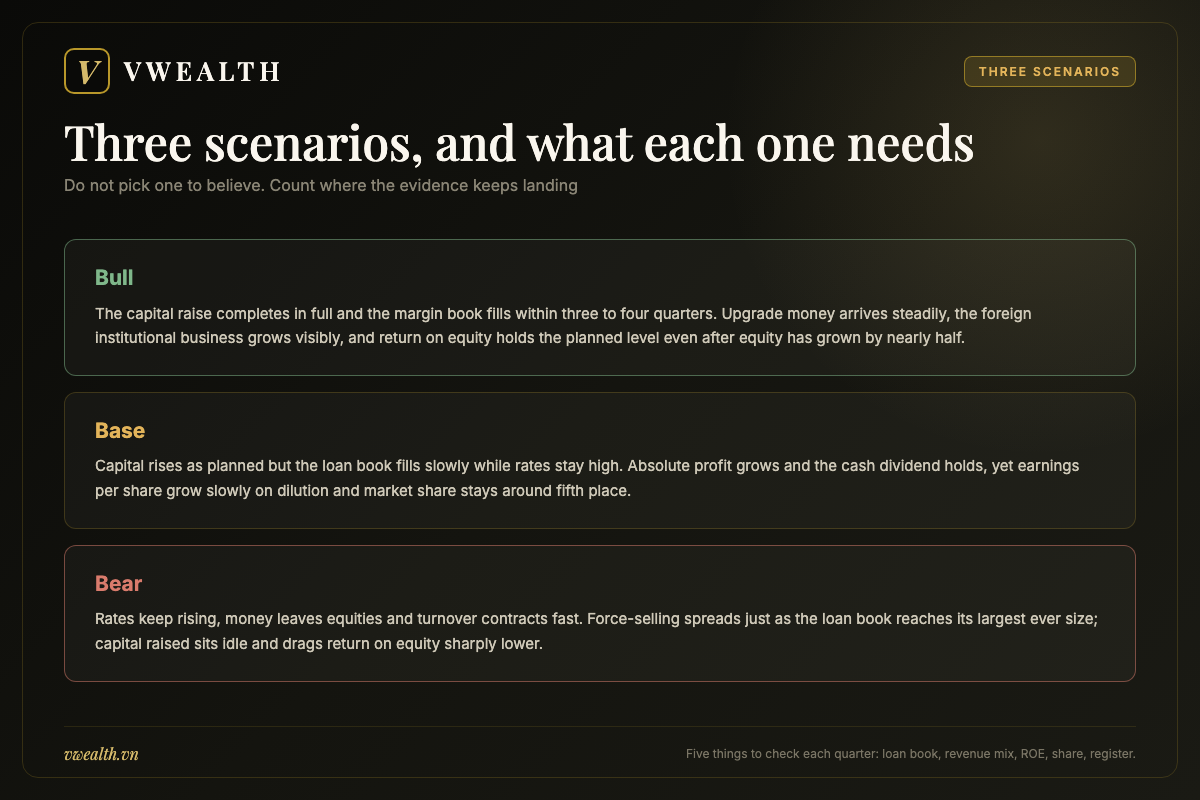
So should you buy HCM stock? A straight answer
It is time to answer the question in the title. There will be no verdict of the “buy” or “do not buy” variety, because such an answer is only valid once you know who you are, how much money you have, how long you intend to hold and how much loss you can tolerate. What I can do is put every card on the table, name each advantage and each risk plainly, and then describe precisely the kind of investor this stock suits.
The case for: what makes HCM genuinely worth a look
First, this is the cleanest business model in the sector. It lives on service fees and lending interest, with those two lines accounting for roughly three quarters of operating revenue in the first half of 2026. There is no corporate ecosystem to be served, no parent company needing capital arranged, no murky corporate bond portfolio. In an industry where the largest risk usually comes from a brokerage being used as somebody’s financing vehicle, the absence of that risk is itself an asset.
Second, risk discipline has been demonstrated by action rather than asserted in a presentation. Cutting the proprietary equity book from roughly VND 3,900 billion to roughly VND 18 billion during the first quarter of 2026, right before a turbulent stretch, is concrete evidence. The direct result: the stock broke to an all-time high on 18 May 2026 while most of the sector was down thirty to fifty percent.
Third, the bottleneck of a decade is being removed. Charter capital moves from VND 10,808 billion to more than VND 15,700 billion, and the state’s holding falls along an approved divestment roadmap. What pushed HSC down the league table was never capability; it was ownership structure — and that structure is changing.
Fourth, the biggest sector event in a decade lands squarely on the firm’s strengths. The FTSE upgrade effective 21 September 2026, the removal of pre-funding for foreign institutions under Circular 68, and the market access framework under Circular 08/2026 all require a brokerage with thick capital, long-standing foreign institutional relationships, and international operating standards.
Fifth, the largest shareholder is an international fund manager that has been attached to the company for twenty-one years, holds around 31.5% of the capital, and keeps writing real cheques at every raise.
Sixth, a regular cash dividend — something that barely exists elsewhere in the Vietnamese brokerage sector.
The case against: what should give you pause
First, dilution is the most direct risk. Charter capital rises roughly 45% in a single year, and management has announced plans to keep raising in 2028 and 2030 to reach a scale of roughly one billion US dollars. The company’s own plan shows 2026 pre-tax profit rising 56% while earnings per share rise only 16%. If you buy and hold for ten years, you have to accept that your ownership percentage will be steadily shrunk unless you put more money in at every rights issue.
Second, brokerage market share is falling, not rising. From above 10% and second place roughly five years ago, down to 7.30% in the first quarter of 2026 and 6.80% in the second, holding fifth after being passed by Vietcap. This is a number that cannot be dressed up, and its direction of travel is wrong.
Third, HSC has no parent bank. In an industry where funding cost determines margin and a bank’s customer base determines market share, standing alone is a long-term structural disadvantage — one that does not disappear even if the capital raise succeeds. The contrast is stark against a broker attached to a large retail bank; the TPBank analysis in this series shows how deep a digitally native bank’s retail funnel can run.
Fourth, the HFIC divestment creates supply. From 17.26% to 11.25% and continuing, every large block sold is real stock hitting the market. At the same time, nearly 224 million shares changed hands through put-through trades in the second quarter of 2026 alone — the shareholder register is being rewritten and you do not yet know the final result.
Fifth, major shareholder risk. Dragon Capital is an asset manager, not a founding family. Every fund has an exit date, and at around 31.5% any move to reduce would be the largest event this stock has ever faced.
Sixth, the cyclicality does not go away. However clean the business model, HSC is still a securities firm: revenue depends on market turnover, costs are largely fixed, and when the cycle turns profit contracts very quickly.
| The case for | The case against |
|---|---|
| Revenue built on fees and lending interest, high earnings quality | Continuous dilution along a capital roadmap running to 2030 |
| Risk discipline proven by cutting the proprietary book | Brokerage share down several quarters, now fifth place |
| The state ownership knot being untied on an approved schedule | No parent bank to subsidise funding cost or supply clients |
| The market upgrade lands on the institutional and foreign franchise | Supply from the HFIC exit and large put-through blocks |
| Largest shareholder is an international manager of twenty-one years’ standing | That same shareholder will one day have to sell |
| Regular cash dividends, rare in this sector | Cyclicality and high operating leverage are unchanged |
What kind of investor does HCM stock suit?
Group one: people who want exposure to the brokerage sector to capture the upgrade cycle, but cannot stomach the volatility of the speculative names within it. HCM gives you most of the sector’s opportunity with materially less of its risk, in exchange for giving up the possibility of doubling your account in a few months.
Group two: quality-focused investors who hold for years. If you belong to the school of buying good businesses and leaving them alone, HCM is one of very few brokerage tickers that meets the classical definition of a good business: transparent governance, stable leadership, an understandable model, no scandals.
Group three: people wanting a specific bet on the foreign capital thesis. If you believe the Vietnamese market will shift from being dominated by individual investors towards a larger institutional and foreign weighting — as has happened in every other emerging market — HCM is the most direct way to express that.
Group four: disciplined portfolio builders who want a financial-sector holding that pays cash. At a moderate weight and bought in instalments over time, HCM fits that role well.
Who should not buy HCM stock?
Not for anyone looking for a stock that moves fast over a few weeks. All three major waves in this ticker’s history were measured in quarters. The concentrated shareholder base and long-term investor cohort reduce volatility — good if you hold, tedious if you trade.
Not for anyone who hates being diluted. If you are the sort of investor who feels robbed every time a company issues new shares, HSC’s 2026, 2028 and 2030 capital roadmap will irritate you for years.
Not for anyone who cannot follow a company periodically. This stock has three variables that require monitoring — the pace at which the margin book fills, the progress of the HFIC divestment, and Dragon Capital’s stake. If you have no time to read quarterly disclosures, you will miss precisely the signals that matter most.
Not for anyone putting everything into one ticker. Brokerage is a cyclical industry with high operating leverage. Even though HCM is the most defensive name in the group, it is still in the group, and no brokerage stock deserves to dominate a portfolio.
And here are four questions to answer before you place an order.
Question one: how long do you intend to hold? If the answer is under six months, reconsider — this ticker’s temperament does not suit short horizons.
Question two: do you have cash ready to participate in the coming rights issues? If not, accept in advance that your ownership percentage will shrink and that earnings per share will grow more slowly than total profit.
Question three: which thesis are you actually buying? If it is the market upgrade, know that the flows are estimated to be disbursed across three to five quarters rather than arriving at once. If it is a return to the top three by market share, re-read chapter six — that most likely does not happen.
Question four: what percentage decline would make you sell? Answer it before you buy, write it down, and respect it. Brokerage stocks, even the most defensive one in the group, can still fall a long way when the cycle turns.
A closing thought: a capable business that has just been untied
If this entire article had to be compressed into one sentence, it would be this: HSC is a securities firm that knows its trade, that was tied up for a decade by the very shareholder that created it, and whose rope is now being untied — at exactly the moment the Vietnamese market is entering a phase that requires the kind of capability this firm has.
That is a good story. But good stories do not automatically become shareholder returns. Between “the business is getting better” and “your shares make money” lies a gap called dilution, and HSC is crossing that gap at speed: 45% more capital in one year, with two more raises scheduled before 2030.
So the answer to whether you should buy HCM stock does not turn on whether you believe in the business. It turns on whether you have the patience to wait for capital to become profit, and the discipline to open the accounts each quarter and check the eight places listed in chapter four. If you do, this is one of the highest-quality names the Vietnamese brokerage industry currently offers. If you do not, there are simpler ways to invest.
The best thing you can do right now is not to decide whether to buy. It is to open HSC’s most recent financial statements, find the eight places listed in chapter four, and score the business using today’s numbers — rather than using the story told by an article.
Research Vietnamese stocks in English with vwealth. Our AI-powered platform turns Vietnamese market data into full English analysis reports — with international payment support and a free 2-month trial for new accounts. Create your free account and read the latest reports.