On HOSE, there are stocks whose name alone conjures a whole business story. TCB — the stock of the Vietnam Technological and Commercial Joint Stock Bank (Techcombank) — is one of them. This is not simply a bank ticker to trade on credit headlines, but the most representative embodiment of the concept of “Vietnam’s leading private value bank“: an institution that chose a path different from the rest of the industry, and stuck to it persistently for over a decade.
If you had to wrap Techcombank in one nickname, investors have already given it a title: the “CASA king.” As of the end of 2025, Techcombank’s ratio of non-term deposits (CASA) reached 40.4% — the highest in Vietnam’s whole banking industry, equivalent to a CASA balance of about 268,700 billion dong out of total deposits of 665,600 billion dong. This figure is not for show, but the core of the whole business model: high CASA means cheap funds, cheap funds mean a thick net interest margin, and a thick margin is one reason Techcombank has for years been among the industry’s profitability leaders. In 2025 alone, the bank led the whole industry on ROA at about 2.39% over the four most recent quarters.
Behind Techcombank is one of the most powerful names in Vietnamese business: USD billionaire Ho Hung Anh — tied to the Masan ecosystem of Mr. Nguyen Dang Quang, and more broadly the network of large private groups like Masan and Vingroup, whose customers flow through Techcombank accounts every day. This very ecosystem is both a strength and the biggest point of contention when you weigh TCB stock: this bank is very heavily concentrated in real estate and corporate bonds. In 2022–2023, real-estate-related loans once made up a very large share of the portfolio, making TCB the centre of concern whenever the property market “caught a cold.”
As of 19 June 2026, TCB stock closed around 30,950 dong. For a bank posting record profit, with the market’s number-one CASA, just returning to cash dividends after 10 years of “abstaining,” but simultaneously carrying the burden of concentration risk in real estate — the question for you is very clear: Should you buy TCB at this price, and which kind of investor does TCB suit? To answer thoroughly, you cannot start from the price board. You must start from the roots — from the story of how a small bank on Ly Thuong Kiet street in 1993 became Vietnam’s most valuable private bank.
TCB market data (updated 19 June 2026)
| Current price | 30,950đ | 2025 pre-tax profit | 32,538 bn (+18.2%) |
| Change (June) | −4.33% | CASA | 40.4% (CASA king) |
| P/E | P/B | ~8x | ~1.2x | NPL | Dividend | 1.13% | 67% |
Source: VWealth price data + Techcombank 2025 reports. Figures move session to session — for reference only.
History and evolution
Understanding Techcombank’s history is not a box-ticking exercise. For a bank stock, history is evidence of governance quality and strategic consistency — two things that decide whether you should extend long-term trust. The TCB story is special in that it proves a bank can go against the crowd and still win, as long as it stays the course.
A humble start in 1993 and the Eastern-European intellectual “genes”
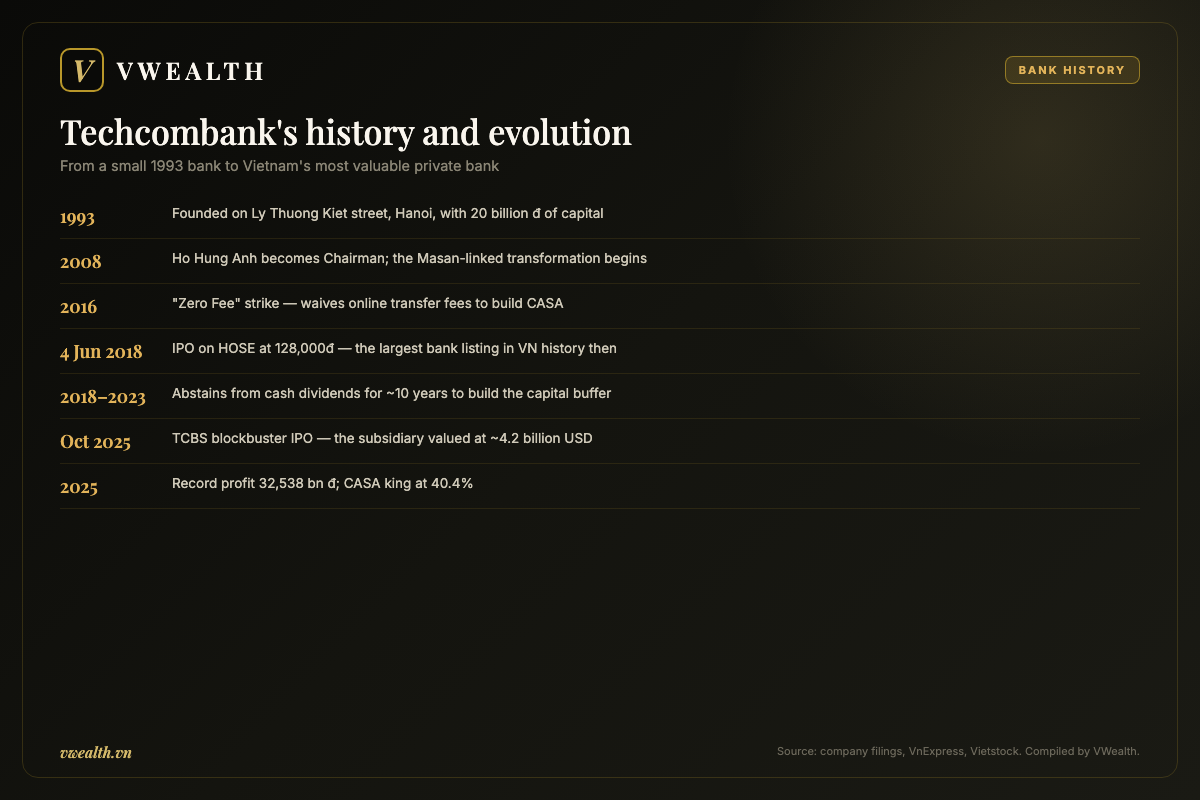
Techcombank was founded on 27 September 1993 at 24 Ly Thuong Kiet street, Hanoi, with an initial charter capital of only 20 billion dong. What stands out from the starting line is the founding composition: the bank was born from a group of intellectuals returning from Europe and the former Soviet Union. This is no meaningless detail — this Eastern-European-rooted “gene” would later draw in a class of businessmen returning from Russia, including names that completely reshaped Techcombank’s fate.
In the early years, Techcombank ran the trajectory of a small joint-stock bank in the early reform era: in 1994 it opened a branch in HCMC and raised capital to 51.5 billion dong; in 1996 it added a Thang Long branch and transaction offices in both Hanoi and HCMC. This was the “accumulation” phase — the bank existed, expanded gradually, but nothing yet made the market pay special attention. Had Techcombank stopped on that trajectory, you would not today have a billion-dollar stock to discuss.
The transformation: the group of businessmen from Russia and the Masan alliance
The real turning point came with the arrival of the group of businessmen returning from the Russian Federation — most notably Mr. Ho Hung Anh and Mr. Nguyen Dang Quang. To picture their origins: in 1994–1997, Mr. Ho Hung Anh started up in Russia as director of a company trading two very “everyday” food items — instant noodles and chili sauce. At the same time, Mr. Nguyen Dang Quang was also building a consumer-goods empire from that market, and that was the embryo of what became Masan.
These two men brought back to Vietnam not just capital, but a mindset for building large-scale businesses to international standards. Mr. Ho Hung Anh joined Techcombank, becoming First Vice Chairman in 2006, then formally taking the Board Chairman seat in 2008 — a position he has held continuously since. 2008 is therefore seen as the milestone starting Techcombank’s impressive transformation.
What you need to grasp here is the strategic alliance between Techcombank and Masan. These are not two unrelated businesses that happen to share shareholders, but two pieces of the same founding group:
- Cross-ownership and shared-origin personnel: Masan has long been a large shareholder closely tied to Techcombank, and “the shadow of Masan” is clearly present in the bank’s governance structure. Mr. Ho Hung Anh is simultaneously one of the key figures of both.
- Ecosystem customers: Masan’s enormous retail and consumer-goods network (and more broadly large partners like Vingroup) creates a natural transaction cash flow through Techcombank accounts. This is one of the foundational reasons TCB nurtures one of the industry’s most abundant CASA pools.
In other words, Techcombank is not just an independent bank gathering customers from zero. It is “supported” by an enormous private ecosystem — both a hard-to-copy competitive advantage and the point cautious investors always scrutinize for concentration and cross-ownership risk.
Laying the governance foundation: McKinsey, culture and the “risk-adjusted returns” strategy
A bank wanting to go far cannot rely on relationships alone. Right after the new leadership took shape, Techcombank did something quite bold for a Vietnamese bank at the time: in 2009, it spent a large budget to bring in McKinsey — the world’s leading strategy consultancy — to help build a business strategy and corporate culture to international standards.
From that advisory foundation, Techcombank gradually shaped the core philosophy its leadership repeats to this day: “Risk-adjusted returns” — optimizing profit on a risk-adjusted basis. The leadership frames this as the message “high profit, low risk,” deliberately going against the conventional market logic of “high risk, high return.” For you, this is a very memorable detail, because it explains most of TCB’s later controversial decisions: choosing premium customers, focusing on segments the bank believes are highly profitable per unit of risk — even when that makes the portfolio less diversified.
Leading the CASA and digital-banking race: the 2016 “Zero Fee” strike
If you had to pick one business decision that created “CASA king” Techcombank, it is the “Zero Fee” programme in late 2016 — fully waiving online transfer fees. At the time, transfer fees were still a familiar income source for banks, so voluntarily giving up this income was seen by many as reckless.
But the logic behind it was sharp: by removing the fee barrier, Techcombank turned its accounts into the place where customers let their daily transaction cash flow through, rather than just a place for term savings. That transaction cash flow is exactly non-term deposits at near-zero interest — the cheapest funding a bank can have. “Zero Fee” kick-started the whole wave of free banking services in Vietnam, but Techcombank was the first mover and benefited most: it combined heavy investment in the digital platform (app, online experience) to retain customers, turning the payment flow into an “operating bloodstream” rather than just short-term technical funds.
The result is a virtuous spiral: good digital banking → customers keep more transaction cash → high CASA → cheap funds → thick margins → high profit → resources to reinvest in technology. By the end of 2025, Techcombank served about 18 million customers with an industry-leading 40.4% CASA — the fruit sown from the very 2016 “Zero Fee” gamble.
The 2018 IPO: the largest bank listing in Vietnamese history at the time
On 4 June 2018, TCB stock officially traded on HOSE. Before listing, Techcombank conducted a share sale to investors at 128,000 dong per share, raising about 21,000 billion dong (~922 million USD) — implying a market cap of about 6.5 billion USD. This was the largest IPO/issuance in Vietnamese banking history at the time, and one of the “hottest” deals on Vietnam’s capital market in 2018.
Investor interest was enormous: shares bid for far exceeded the offering, with participants like Dragon Capital, Singapore’s sovereign fund (GIC) and Fidelity. Advisors were Morgan Stanley, Deutsche Bank and Viet Capital Securities. For you, the meaning of the 2018 IPO is this: it was the moment the international market “re-rated” Techcombank as a leading private bank capable of large capital raises — no longer a mid-sized joint-stock bank.
The 10-year “abstinence” from cash dividends to build capital
This is perhaps the most debated and most admirable feature in TCB’s governance history. Throughout 2018–2023, Techcombank paid not a single dong of cash dividend. This policy was actually announced by Mr. Ho Hung Anh back in 2013: the bank would not pay cash dividends for about 10 years, retaining all accumulated profit into own capital to serve growth.
For many shareholders who prefer “hard cash,” this policy once caused frustration — especially as retained profit accumulated to tens of thousands of billions of dong while shareholders received no cash dividend. But through a strategic lens, it was a move very consistent with the “risk-adjusted returns” philosophy:
Instead of paying money out, Techcombank retained profit to build one of the industry’s thickest capital buffers. Thick capital gives the bank both room for credit growth and the strength to withstand market volatility — exactly the spirit of “high profit, low risk.”
By 2023, at the shareholders’ meeting, Mr. Ho Hung Anh signalled this might be the last year without a cash dividend. And indeed, from 2024, Techcombank began returning to shareholders in cash after a decade of accumulation — with an initial plan of about 1,500 dong per share (a 15% ratio), among the highest of banks disclosing at the time. This shift carries large symbolic meaning: it shows the bank is confident its capital base is solid enough to both grow and share the fruits with shareholders.
The 2020–2021 property–bond boom and the 2022 trial by fire
No picture is entirely rosy, and this is the part you need to read most carefully. In 2020–2021, alongside the boom in property and corporate bonds, Techcombank pushed hard on financing real estate and bonds — consistent with its focus on large, premium customers. Real-estate-related loans once made up a very high share of the portfolio, at times reaching about 60% by sector. The Techcom Bond Fund (TCBF) also grew strongly in this period.
Then the corporate-bond crisis and property freeze of late 2022 struck. Confidence shook, thousands of billions of dong were withdrawn from bond funds, TCBF included; TCB stock came under heavy pressure as the market labelled it “the real-estate bank.” This was the harshest test of the “low risk” philosophy Techcombank pursues — and also a reminder that focusing on a highly profitable sector always comes with a price: concentration risk.
The bank’s post-crisis response shows its ability to self-correct. Techcombank proactively cut its real-estate lending share: by Q4 2025 this ratio had fallen significantly, and into early 2026, for the first time in history the real-estate loan share was pulled below 30% (to about 28.9%), with a long-term goal of bringing it to around 22% in a few years. The near-39,000 billion dong that “disappeared” from the real-estate loan book shows this was a real portfolio restructuring, not just a slogan.
Today’s position: a leading private value bank, record profit in 2025
After more than three decades and a major trial by fire, Techcombank entered 2025 with record results. A few numbers to anchor:
| Metric (2025) | Value | Meaning |
|---|---|---|
| Pre-tax profit | ~32,538 billion dong (+18.2%) | Record level, beating the target |
| Total assets | > 1.19 quadrillion dong (+22%) | Among the leaders of the private group |
| Total operating income (TOI) | ~53.4 trillion dong (+13.6%) | Steady growth across income lines |
| CASA ratio | 40.4% | Highest in the industry — the cheap-funding base |
| Customers | ~18 million | A data “treasure” for digital transformation |
With these numbers, Techcombank reinforces its title of Vietnam’s leading private value bank, leading the industry on profitability (top ROA, ROE among the highest) and one of the Vietnamese banks that has ranked among the high brand-value names on the international map. Its helmsman — Mr. Ho Hung Anh — has also become one of the rare USD billionaires in Vietnamese banking, with wealth tied to both Techcombank and Masan.
In short, TCB’s history is a story of strategic consistency: from a small bank in 1993, led by the Russia-rooted businessmen, laying an international governance foundation with McKinsey, choosing the “risk-adjusted returns” philosophy, betting on CASA and digital banking with “Zero Fee,” a record 2018 IPO, abstaining from dividends for 10 years to build capital then returning it from 2024 — and surviving the 2022 property shock to peak in profit in 2025. Every piece serves a single goal: high profit on a controlled-risk basis.
But that strategy is only as good as the people executing it are skilled and disciplined. To judge whether Techcombank can keep this philosophy as scale grows and the environment gets more complex, you need to look closely at the people in the leadership seats — those who will decide how the capital buffer is used, how the property portfolio is trimmed, and where shareholders’ capital is allocated. That is the next section: Leadership.
Leadership and ownership structure
If you want to understand a bank, don’t stop at the balance sheet — look at the people at the wheel and the hands holding the shares. At Techcombank (TCB), these two are so tightly linked they are nearly inseparable. This is one of the very few Vietnamese private banks where the governance story, the ownership story and the strategy story are told by the same group of figures, across nearly two decades. When you buy TCB stock, you buy not just a profit stream — you place trust in a governance philosophy and a very distinctive power structure. This section will help you see both clearly.
Ho Hung Anh — the billionaire Chairman and the “risk discipline” philosophy
The person in Techcombank’s Board Chairman seat from 2008 to now is Mr. Ho Hung Anh. For you, this name may be familiar from rich lists: per Forbes, Mr. Ho Hung Anh is a USD billionaire, once ranked among Vietnam’s richest (Forbes placed him fourth-richest in Vietnam in 2021). But what makes him worth your attention lies not in the wealth, but in his starting point and how he built his empire.
Ho Hung Anh belongs to the generation of businessmen who started up in Eastern Europe. He and Mr. Nguyen Dang Quang — founder of Masan Group — are called by the press “the billionaire buddies” or “the duo,” both rising from years of trading consumer goods (instant noodles, chili sauce) in the Russian and Eastern European markets in the early 1990s. Per An Ninh Thu Do newspaper, the two are “two friends returning from Eastern Europe who became USD billionaires.” This relationship is not just anecdote — it is the foundation explaining why Masan and Techcombank remain so intertwined in ownership to this day, which you’ll see clearly in the shareholder section below.
On governance style, the biggest mark analysts attach to Ho Hung Anh is risk discipline and long-term vision. You can sense this through a decision debated for years: Techcombank resolutely paid no cash dividend for about a decade to retain all profit and strengthen its capital base. That is the choice of a helmsman prioritizing “balance-sheet health” over short-term shareholder satisfaction — a philosophy we’ll analyze in detail in the dividend section.
When you assess TCB’s leadership, remember that stability here is a defining trait: Ho Hung Anh has held the Chairman seat continuously since 2008, across many terms. This continuity is both a strength (a consistent, unbroken strategy) and something to weigh on governance (the degree of power concentration).
On personal ownership, an interesting detail to grasp: the shares directly registered under Mr. Ho Hung Anh’s own name at Techcombank are not large — just over 1% of capital (per the bank’s disclosure of shareholders owning over 1%). This can mislead into thinking the Chairman “holds little.” The reality is the opposite: his ownership power lies in the family group and related parties, not in his individual name. This is a very important feature for you to read the true nature of power at TCB.
Jens Lottner — the foreign CEO and the “data bank” culture
If Ho Hung Anh is the architect of vision and risk, the day-to-day operator is a very different face: Mr. Jens Lottner, Techcombank’s foreign CEO. This is rare — not many Vietnamese banks put a foreign CEO in the top executive seat, and you should see this as a strategic statement rather than a random choice.
Let’s verify the term status, because this matters to investors: as of 2026, Jens Lottner is still in office. He has been Techcombank’s CEO since 2020, and has been reappointed for a second term. Per international banking sources (The Asian Banker, Fintech News Singapore), the reappointment took effect from 18 August 2025 after State Bank approval, and the new term runs to 2030. So concerns about a “leadership vacuum” in the medium term are largely eliminated — you are looking at an executive machine with clear continuity to the end of the decade.
Lottner brings over three decades of finance-banking experience at large global institutions such as McKinsey, Boston Consulting Group and Siam Commercial Bank (Thailand). This strategy-consulting and technology background shapes what Techcombank claims as its identity: a bank run on data and digitalization. At 2026 investor events, management repeatedly stressed the ambition to become a “comprehensive AI bank” and to reach a market cap of about 20 billion USD. For you, this message is not a slogan — it explains why TCB spends heavily on technology, data and digital experience, and why this bank’s CASA ratio is usually among the highest in the system.
What you should weigh: the “domestic Chairman — foreign CEO” model creates a fairly clear division of roles. The Board (headed by the founding shareholder group) holds direction and risk appetite; the international executive team handles operations, technology and modern governance standards. This combination is one reason TCB is seen as having a governance “quality” distinct from the rest of the private-bank group.
Ownership structure: no State shadow, the pivot is family and Masan
This is the part to read most carefully, because it shapes the entire “personality” of TCB stock. Unlike the state-owned group (Vietcombank, BIDV, VietinBank) where the State holds control, Techcombank has no state shareholder. This is a purely private bank, and its power structure revolves around three blocks: the Ho Hung Anh family group, Masan Group and related parties, plus the foreign shareholder group — the rest being freely traded shares (free float).
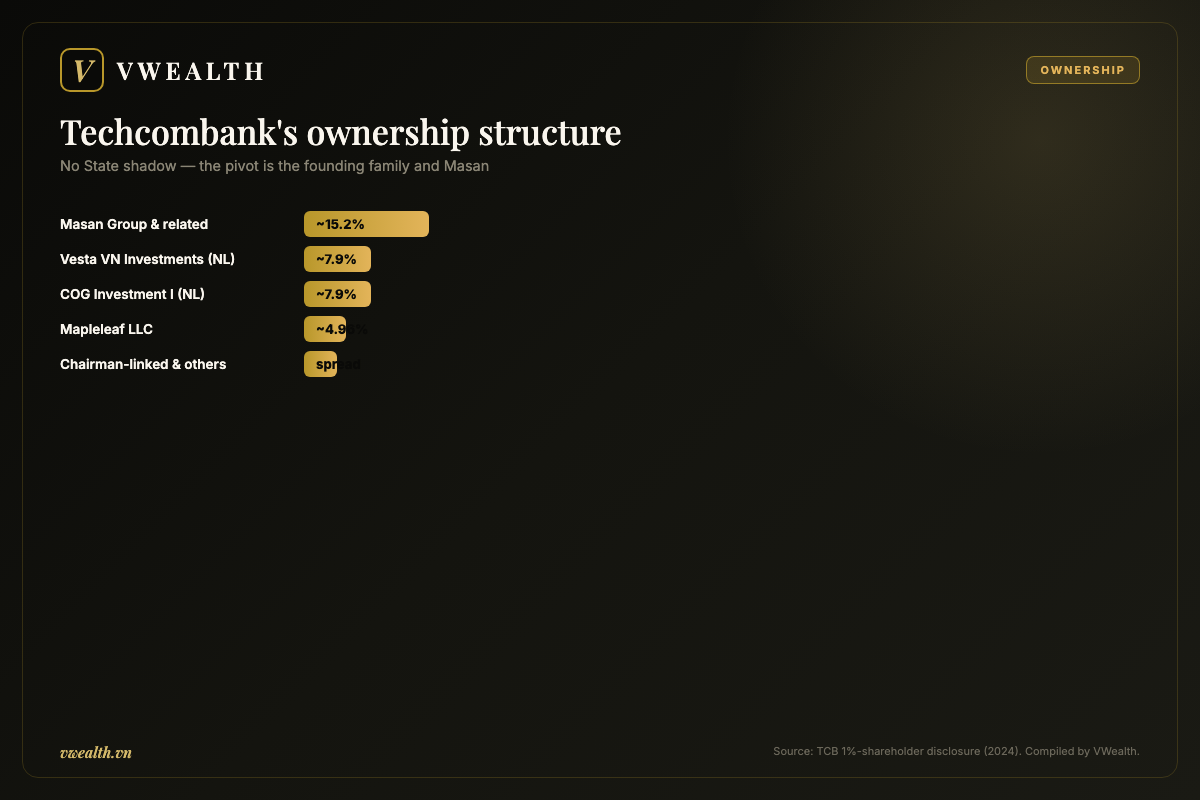
From 1 July 2024, the amended Law on Credit Institutions requires banks to disclose shareholders owning from 1% of capital (previously the threshold was 5%). Thanks to this, for the first time TCB’s ownership picture was revealed in unusual detail. Per Techcombank’s disclosure (via VietnamPlus), a group of 13 disclosed shareholders held about 1.84 billion shares in total, equivalent to about 52% of the bank’s capital. Below are the notable pieces to remember:
| Shareholder group | Ownership (approx.) | Note |
|---|---|---|
| Masan Group and related parties | ~15.2% | Largest institutional shareholder; clearly reflects the Masan ↔ Techcombank cross-ownership |
| Vesta VN Investments B.V and related parties | ~7.9% | Foreign investment entity (Netherlands) |
| COG Investment I B.V and related parties | ~7.9% | Foreign investment entity (Netherlands) |
| Mapleleaf LLC | ~4.96% | Institutional shareholder |
| Morgan Stanley & Co. International Plc | ~1.45% | International financial institution |
| Government of Singapore Investment Corp (GIC) | over 1% | Sovereign wealth fund |
| Individuals & entities related to the Chairman group | a large group, spread across many names | Mr. Ho Hung Anh himself is registered for just over 1%; the power lies in the family group |
Note: the ratios above are disclosed at points in time and may change after capital raises/transactions; you should check the bank’s latest shareholder report before deciding.
Masan ↔ Techcombank cross-ownership: understand it correctly to avoid confusion
The point you cannot skip is the relationship between Masan and Techcombank. Masan Group and related parties are the largest institutional shareholder block at TCB. Per data disclosed around September 2024, Masan Group alone held about 14.9% and its related group a few percent more, lifting the “Masan family” total to around 15% of the bank’s capital. This is the clearest expression of the historic bond between the two empires built by the “billionaire buddies” Ho Hung Anh and Nguyen Dang Quang.
Why does this matter to you? First, it creates shareholder stability: the founding block and Masan have little incentive to dump shares, keeping the ownership structure durable. Second, it is a bridge for ecosystem synergy — Masan, with its retail network (WinMart/WinCommerce) and millions of consumer customers, is a natural “funnel” for Techcombank’s digital-banking services. But you also need caution on the other side: cross-ownership and a relationship with a large multi-sector-group shareholder always demand transparency on related-party transactions. This is a governance risk cautious investors should monitor periodically via the bank’s reports, rather than wave off.
Foreign room and the “lock-and-save” strategy
A very distinctive feature of TCB is how it manages the foreign-ownership ratio (foreign room). Instead of opening the ceiling fully, Techcombank keeps foreign room at about 22.5% — below the 30% the rules allow for banks. Per securities analysts, this “locking” of some room is not from a lack of appeal to foreign investors, but a strategic move: the bank keeps part of the room as a “reserve,” to serve a possible private placement to a large foreign strategic partner in the future at a high price, rather than letting small investors trade it on the exchange.
For you, this is a two-sided signal. On the positive side: it shows management is confident in the brand value and willing to be selective about partners, a sign of the long-term vision familiar to Ho Hung Anh’s style. On the side to note: limited foreign room means narrower participation opportunity for the broad foreign public, and any news of a future private placement to a strategic partner could be a big catalyst for the stock.
The dividend-policy turning point: from “10 years no cash” to a big payout
If you had to pick one governance event that best expresses the “Techcombank philosophy” and its transformation, it is the dividend policy. This is a story you should understand thoroughly, because it says a lot about how management thinks about capital.
For about a decade, Techcombank paid almost no cash dividend. All profit was retained to strengthen the capital base, expand the business and lift capital-adequacy ratios to the industry’s highest tier. For many shareholders preferring a steady cash flow, this was frustrating. But looking back, this very “compression” helped TCB accumulate a thick capital buffer, passing through volatile periods (including the bond–property storm) in a stronger position than most rivals. That is long-term vision paid for with patience.
The turning point came in 2024–2025. After about 10 years of retaining profit, Techcombank began paying cash dividends again. Per domestic financial sources (Vietstock, Nhan Dan, CafeF), the bank paid cash dividends at around 10–15% of par in these years, with the payout tied to 2024 results reaching over 7,000 billion dong in cash. A bank “quiet” about dividends suddenly opening the cash valve at a scale of thousands of billions is a signal that management judges the capital base solid enough to both grow and “reward” shareholders.
Alongside cash, Techcombank also pushed stock dividends to raise charter capital. At the general meeting, the bank proposed a very high ratio (a total dividend/bonus figure mentioned around 67% in one plan), issuing more shares to existing shareholders to lift charter capital to about 113,000 billion dong — placing TCB among the banks with the largest charter capital in Vietnam. You should understand the two are different in nature: a cash dividend is real money flowing to shareholders; a stock dividend/capital raise converts retained profit into charter capital, increasing shares outstanding (and thus adjusting the reference price), to create room for credit growth in the coming years.
The message to take: TCB simultaneously (1) paying cash after a decade of “abstinence” and (2) issuing stock to raise capital to ~113,000 billion dong shows the bank shifting from a “defensive accumulation” phase to a “reward-shareholders-and-unleash-growth” phase. This is a turning point in the capital lifecycle, not just a dividend number.
Of course, you should read this turning point in a balanced way. Large cash dividends and fast capital raising are confident signals, but they set a demanding requirement: the bank must sustain a high return on equity (ROE) after charter capital swells, or EPS may be diluted. The ability to “digest” the new capital — turning capital into quality credit growth and commensurate profit — is the biggest test for the Ho Hung Anh — Jens Lottner leadership in the second half of this decade.
In short: what are you betting on?
Putting it all together, TCB’s governance and ownership portrait is fairly clear. You have a billionaire Chairman with a risk-discipline philosophy and long-term vision, tied to the Masan family via the “billionaire buddies” thread; an international CEO reappointed to 2030, pushing the bank toward data and digitalization; an ownership structure with no State, pivoting on the founding family group and Masan, surrounded by selective foreign shareholders and a deliberately “locked” foreign room. And you witness an important capital turning point: from a decade of dividend compression to both paying cash and raising capital to a system-leading scale.
That is a structure that gives you reassurance about stability and strategic consistency, while also reminding you to monitor three points closely: the degree of power concentration, related-party transactions within the ecosystem, and profitability on the newly expanded capital base. These very people and shares lead us to the next section — where we dissect “Techcombank’s ecosystem” to see how that power machine turns into profit.
Ecosystem and business segments
When you look at Techcombank’s 2025 results — total assets over 1.19 quadrillion dong, total operating income (TOI) of 53.4 trillion dong, CASA at 40.4% — it’s easy to be swept up by these enormous numbers and miss the most important question for an investor: where does this bank’s money truly come from, and what machine pumps that cash flow? Unlike most Vietnamese banks, which live mainly on the deposit–lending spread, Techcombank has spent over a decade building a closed financial ecosystem, where each segment doesn’t operate alone but nourishes the others. That is both the source of a hard-to-copy competitive advantage and where the concentration risks lie hidden that you must scrutinize before putting money down.
In this section, I’ll dissect each layer of that machine: from the parent bank with the market’s number-one CASA weapon, to the bet on the housing value chain, the TCBS jewel preparing to list, the emerging insurance and fund-management segments, to the One Mount technology joint venture. The goal is that by the end, you know not just what Techcombank makes money on, but understand why this model produces superior margins — and what scenarios could slow that machine.
The parent bank: the heart of the machine and the NIM question
Before the glamorous ecosystem, you need to understand the core: Techcombank is still a commercial bank, and most of its profit comes from net interest income (NII). Roughly, this is the money the bank earns from the difference between lending rates and the rates it pays depositors. In 2025, Techcombank’s NII was about 35–38 trillion dong, the largest share of the 53.4-trillion TOI.
To measure the efficiency of this, analysts use NIM (Net Interest Margin). Picture NIM as a factory’s “gross margin”: if a bank raises funds at 4% and lends at 9%, the raw margin is 5%; after subtracting costs, what’s left is NIM. The higher the NIM, the more the bank earns on each dong of earning assets. And this is where Techcombank separates from the crowd — not because it lends at cut-throat rates, but because it buys funds more cheaply than almost every rival. The secret lies in a weapon called CASA.
The market’s No.1 CASA weapon: why is Techcombank’s cost of funds the lowest?
CASA stands for Current Account Savings Account — non-term deposits, i.e. money customers keep in payment accounts for daily spending rather than term savings. The key point: the bank pays almost no interest (or very little, only 0.1–0.5% a year) on this type of deposit, while term savings cost it 5–6% a year. In other words, a dong of CASA is a nearly free dong of capital. The higher the CASA ratio, the lower the average cost of funds, the thicker the NIM, and the fatter the profit.
In 2025, Techcombank reached a CASA ratio of 40.4% — leading the whole Vietnamese banking system, with double-digit CASA-balance growth and total funding of about 665.6 trillion dong. At some points in Q2 2025, the figure even exceeded 41%. To picture the superiority: most large Vietnamese private banks reach CASA only in the 20–35% range. Techcombank holding the CASA crown for years running is not luck, but the result of three synergistic strategic choices:
- Pioneering the “Zero-fee” strategy. In 2016, Techcombank was the first bank in Vietnam to waive all transfer, withdrawal and account-maintenance fees — at a time when every other bank charged. This “sacrifice the fees” decision made millions choose Techcombank as their main spending account. And a main spending account always leaves some money behind — that is CASA. They traded short-term fee income for long-term “transaction cash flow,” a move rivals still scramble to catch.
- A premium, high-income customer base. Techcombank deliberately targets the above-average-income group in large cities — those who keep much higher average account balances than the norm. A Priority customer keeping a few hundred million in a payment account contributes to CASA dozens of times more than an ordinary customer. It is the quality of the base, not just the number, that thickens CASA.
- Digital banking and “cash-flow nurturing.” With over 18 million customers and a digital platform invested in the thousands of billions, Techcombank turns its app into where customers “live” daily: receive salary, pay bills, invest, buy insurance. Products like “Auto-earn” automatically move idle balances into yield instruments while keeping liquidity — leaving customers no incentive to withdraw to another bank. The longer money stays in the ecosystem, the more durable the CASA.
Remember this core point: 40.4% CASA is not a dry accounting number, but the foundation of Techcombank’s entire competitive advantage. The industry’s lowest cost of funds lets it both lend at competitive rates to win share and keep a high NIM to protect profit. When you value TCB, CASA is the most valuable “moat” to track quarter by quarter — if this ratio drops sharply, the whole investment thesis must be reconsidered.
The real-estate concentration and housing-value-chain strategy: both engine and Achilles’ heel
If CASA is the cheap “input,” then the housing value chain is the profitable “output” Techcombank bets on most. This is its clearest identifying feature — and also the most controversial. Instead of spreading capital evenly across sectors, Techcombank chose to go deep into a home’s whole lifecycle: lending to developers to build projects, lending to contractors and material suppliers in the chain, then lending to the final home buyer via mortgages.
This “one arrow, many targets” approach explains why Techcombank’s personal credit in 2025 surged to 372 trillion dong, up 30.8% from the start of the year — with mortgages a key driver. When the bank finances a whole Vinhomes or Masterise project, it holds a ready list of thousands of potential buyers and can “tailor” a loan package for each right at the point of sale. Rivals wanting customers must go find each borrower one by one; Techcombank has a whole customer “funnel” led straight into its system.
The nucleus of this strategy is the “three-legged stool” model observers often mention, linking three links:
- Vingroup / Vinhomes / Masterise Group — the creators of real estate and living space, generating project supply and a huge flow of home buyers.
- Masan Group — a long-time strategic partner in consumer–retail, expanding the daily-transaction customer base and supporting CASA.
- One Mount Group — a technology–retail–real-estate joint venture (detailed later), whose OneHousing platform integrates mortgages and personal-finance packages directly into the property-transaction process, creating a seamless experience from viewing a home to disbursement.
The strength of this model is undeniable: it lets Techcombank control the entire cash flow of a housing transaction, from the developer’s construction loan, to the buyer’s installments, to property-insurance fees and post-purchase personal finance. Each link pumps more CASA, service fees and credit outstanding to the bank.
But — and this is the part you must weigh — that very concentration is TCB’s biggest risk. When a bank puts most of its eggs in the real-estate basket and ties tightly to a few large groups (Vingroup, Masan), its fate must move in phase with the property cycle. If the property market freezes — as 2022–2023 showed — all three lending layers come under pressure at once: developers can’t sell, buyers hesitate, bad debt risks swelling all together. The degree of credit concentration in one sector and one related-customer group is always what cautious investors and regulators watch. For Techcombank, this is not a reason to reject the stock, but the key risk variable to price correctly: this bank’s advantage and weakness lie on the same axis — the housing value chain.
TCBS — the ecosystem’s “jewel” and the 2025 blockbuster IPO
If you had to point to one piece making Techcombank’s ecosystem special versus every other bank, it is TCBS (Techcom Securities). This is a subsidiary Techcombank controls, and one of the most efficient “money-printing machines” on Vietnam’s financial market.
Why call TCBS a jewel? Look at the numbers: in 2025, TCBS set a record pre-tax profit of over 7,100 billion dong, up nearly 50% year on year and completing 123% of its annual plan. For years running, TCBS has been the most profitable securities company in Vietnam, with return on equity (ROE) among the leaders. What makes TCBS special is the “WealthTech” model — combining technology and wealth management — with a very balanced revenue mix, little dependent on pure brokerage:
- Bond distribution: net revenue 3,966 billion dong (about 40% of total revenue, up 42%). TCBS has led the corporate-bond distribution market for years running (from 2017 to 2025) and is always among the top 1–2 in bond-issuance advisory.
- Margin lending: about 3,664 billion dong (up 43%), with market-leading margin balances — leveraging the very investor base of the Techcombank ecosystem.
- Investment banking (IB): over 2,018 billion dong (up 50%), leading in IPO advisory and capital raising.
- Brokerage and custody: up 63%, with a clearly improved HOSE market share.
The most notable event for TCB investors is TCBS’s blockbuster IPO in October 2025. This offering was assessed as the most successful among securities-company IPOs in 2025: shares bid for exceeded 575 million, 2.5 times the offering, drawing about 26,000 investors plus 78 financial institutions and international funds, with total registered value over 500 million USD. On 21 October 2025, more than 2.31 billion shares under the ticker TCX officially traded on HOSE at a reference price of 46,800 dong per share, implying a market cap of over 108,000 billion dong (about 4.2 billion USD).
For you — an investor weighing TCB — TCBS’s IPO has a very concrete meaning. When an extremely valuable subsidiary is separately listed and valued at about 4.2 billion USD, Techcombank’s stake in TCBS becomes an asset transparently valued by the market, exposing the “hidden” value previously buried in the parent bank’s balance sheet. This is one of the most watchable upside catalysts when valuing TCB by the sum-of-the-parts method.
Insurance, fund management and the One Mount joint venture: completing the circle
Beyond the parent bank and TCBS, Techcombank is adding more pieces to turn the ecosystem into a closed circle, where a customer can meet every financial need — borrow, deposit, invest, protect — without stepping outside.
Life insurance — TCLife (Techcom Life). In July 2025, Techcombank was officially licensed to establish its own life-insurance company — TCLife — with charter capital of 1,300 billion dong, in which Techcombank holds 80%. This is an important strategic move: instead of being an agent selling third-party insurance (the traditional bancassurance model, now facing much confidence volatility), Techcombank produces and distributes insurance products for its own 18 million customers, keeping the whole value chain. The bank expects TCLife to lose money in the first two years (investment phase), turn a net profit from year three, and contribute significant profit after 5 years with an expected return above 23%. You should see this as a long-term investment, not contributing immediately but expanding future fee income.
Fund management and investment (TCBS / TCInvest). Through TCBS, Techcombank also runs fund management and the TCInvest platform, providing fund certificates, accumulation products and automatic investing for individual customers. This has a dual meaning: it creates a stable asset-management fee stream, while “anchoring” customers and their cash in the ecosystem — indirectly reinforcing CASA itself.
One Mount Group — the technology–retail–real-estate joint venture. This is a strategic joint venture between Techcombank and partners in the Vingroup–Masan ecosystem, serving as the “technology layer” linking the pieces. One Mount’s OneHousing platform integrates Techcombank’s mortgages and finance packages directly into the digital property-buying journey; while its retail-distribution platforms expand the transacting customer base. In other words, One Mount is the data-and-customer bridge between banking, real estate and consumer — exactly the “three-legged stool” spirit mentioned.
Digital transformation and premium customers: the glue binding the whole ecosystem
A point easily underestimated but running through every Techcombank segment: the digital-transformation strategy and focus on premium (Priority) customers. Techcombank has invested thousands of billions in technology infrastructure, partnered with global players and built a large-scale data–technology team. This investment isn’t to “look impressive,” but creates three direct financial effects:
- Lowering operating costs and thickening CASA — when customers transact mainly on the app, the bank spends less on branches while keeping spending cash in the system.
- Raising non-interest income (service fees) — the digital platform enables cross-selling investment, insurance and wealth management to the right customer at the right time, turning each customer into multiple revenue streams instead of one.
- Locking in premium customers — the Priority group, with large balances and complex financial needs, is the segment contributing most to both CASA and fees. Keeping them keeps the highest-quality profit.
This is why Techcombank is often called the leader of the digital-transformation race — not because of a pretty app, but because technology is used as a direct lever for three financial pillars: CASA, service fees and operating costs.
To close: a tightly linked machine — and a reminder about concentration risk
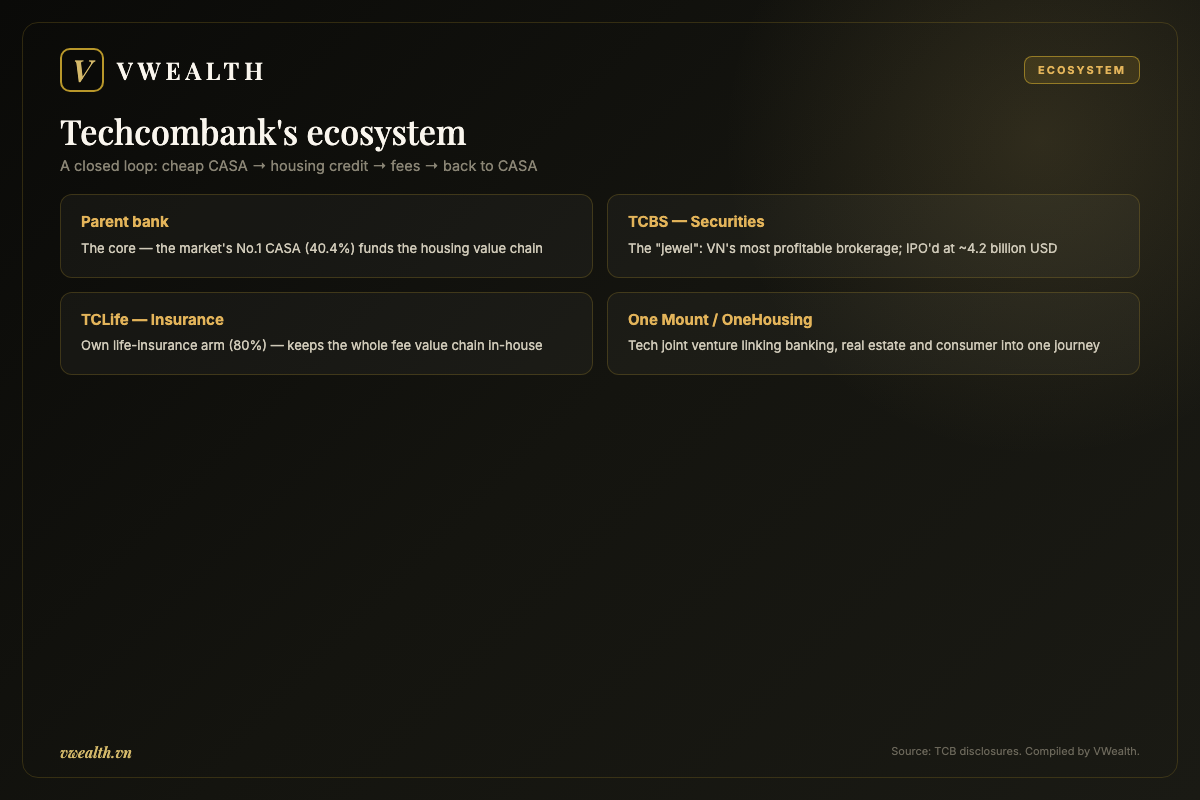
Putting all the pieces together, you’ll see Techcombank is not a simple bank but an integrated financial platform, running a rather beautiful cycle: the market’s No.1 CASA brings the industry’s cheapest funds → cheap funds are pushed into the housing value chain to create high credit growth → the property–consumer ecosystem (Vingroup, Masan, One Mount) continuously pumps in customers and transaction cash → TCBS, TCLife and fund management harvest fees and profit from that very customer base → all of it returns to reinforce CASA. Each turn strengthens the machine a bit more, and that is the source of the profit leadership among private banks that Techcombank held throughout 2025.
But that very tight linkage is a double-edged sword. The biggest advantage — focusing on the housing value chain and a few partner groups — is simultaneously the biggest risk: Techcombank’s fate is very tightly tied to the health of the property market and the Vingroup–Masan ecosystem. Low diversification means a shock at one link spreads fast through the whole system. That is why in the next section — “Position and financial health” — we need to scrutinize Techcombank’s asset quality, NPL ratio, capital buffer and resilience, to see whether this impressive machine is solid enough to pass through the cycles.
Position and financial health
If you want to understand Techcombank at a truly deep level, don’t stop at the headline “record profit.” A bank is not a money-printing machine, but a balance sheet that breathes: it swells when the economy is healthy, shrinks when risk knocks. In this section, you and I will dissect TCB on both sides people often separate: how beautiful the numbers are, and what risk sits behind those beautiful numbers. I won’t sugar-coat or scare you. A good bank still has a fatal weakness, and a clear-headed investor’s job is to look straight at it.
The 2025 picture: record profit, but more important is the quality of the profit
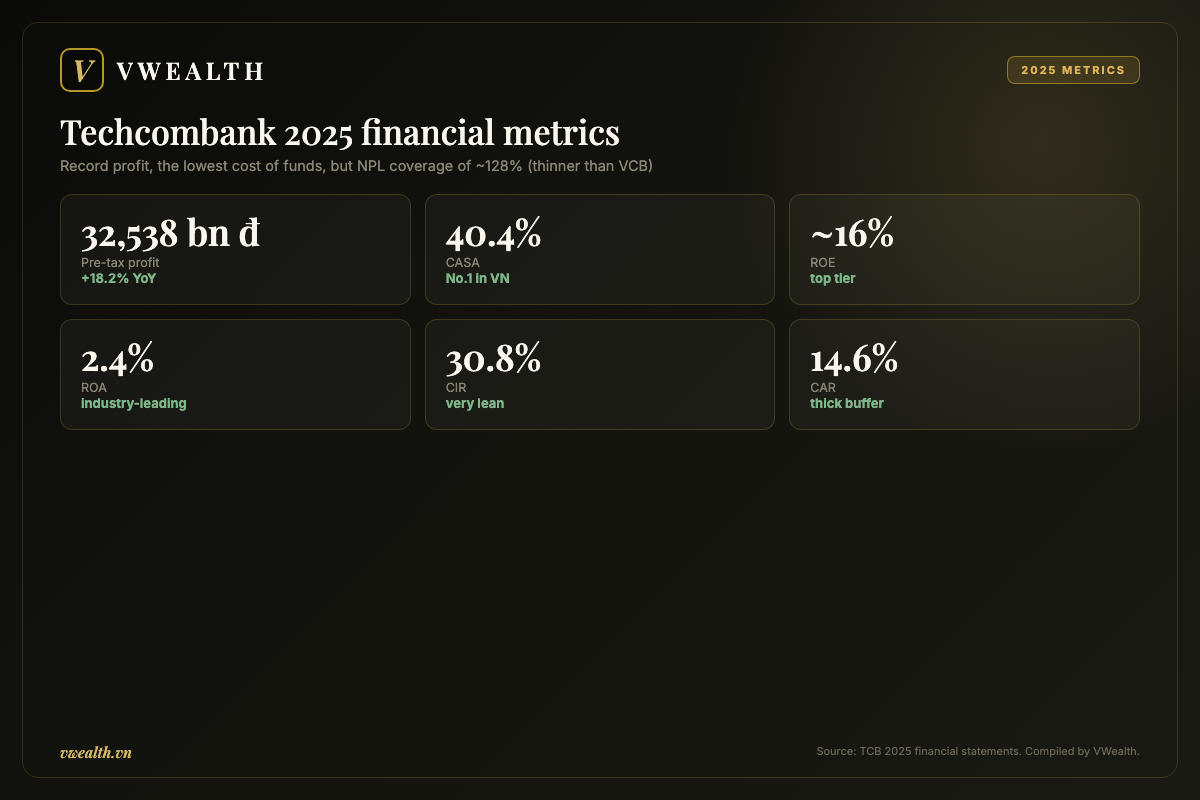
In 2025, Techcombank recorded pre-tax profit of 32,538 billion dong, up 18.2% year on year and beating the shareholders’ meeting target (31,500–31,700 billion). This is a record high, and the third consecutive quarter of peak profit — Q4 2025 alone reached about 9,200 billion, nearly double the same period. But the bare profit number says little. What you need to look at is whether the source of that profit is durable.
Total operating income (TOI) reached 53.4 trillion dong, up 13.6%. Breaking it down: net interest income about 38.2 trillion with NIM stable around 3.9%; fee and non-interest income about 11.5 trillion, up 7.8%. This structure matters: the more a bank depends on pure net interest income, the more its profit is sensitive to the credit and rate cycle; a bank with diverse fee income (insurance, cards, treasury, investment) has a more stable cash flow. TCB is among those with a relatively balanced income structure versus the Vietnamese bank norm, though its fee share was higher during the corporate-bond boom and has since cooled.
The most admirable bright spot is operating efficiency. The cost-to-income ratio (CIR) fell to 30.8% — meaning for every 100 dong of income, the bank spends about 31 dong to operate. In banking, a CIR below 35% is already considered very lean; TCB is among the lowest in the system. This is the direct fruit of digitalization: fewer physical branches, fewer transaction staff, more transactions running on the app. This efficiency is not something rivals copy in a year.
Scale also speaks to position: total assets exceeded 1.19 quadrillion dong at end-2025, up as much as 21.8% in a year. Credit growth was about 18.4% — well above the industry average — with personal lending surging 30.8% to 372 trillion, and corporate lending to 452.1 trillion (+13.4%). The loan-to-deposit ratio (LDR) was 76.5%, still in the safe zone under the rules.
Position: the private bank leading on profit and market cap
Place TCB on the right competitive map. In the private-bank group (outside the state-owned Vietcombank, BIDV, VietinBank, Agribank), Techcombank has for years led on absolute profit and is one of the largest-cap names on the exchange. By the 2026 general meeting, the bank had approved a plan to raise charter capital to over 113,700 billion dong — the highest in Vietnam’s banking system — cementing its position as the private bank with the largest capital scale in the country.
That position didn’t come from luck. It comes from a chain of causally linked advantages, whose first link is CASA. Follow this logic chain, because it is the key to why TCB profits so heavily:
- The industry’s highest CASA (40.4% at end-2025) means a large part of TCB’s deposits are non-term — money the bank pays almost no, or very little, interest on.
- High CASA pulls the cost of funds down. When the input is cheap, the bank has more room on the output side.
- A low cost of funds pushes NIM to the high group. TCB’s 3.9% NIM is among the leaders, even though the 2025 rate context was not easy for the whole industry.
- High NIM + large scale = fat profit. That is the 32,538 billion you see on the first line.
Understanding this chain, you’ll understand why analysts call CASA Techcombank’s “economic moat” — and why I devote a whole section to it.
The CASA and digital-banking “moat”: why 40.4% is a durable advantage
CASA — Current Account Savings Account, i.e. payment and non-term savings deposits — is money customers keep in accounts to spend daily, not locked for term interest. For a bank, this is the cheapest funding possible. Techcombank’s 40.4% CASA is the highest in Vietnam’s system — and what makes it a durable advantage, not a momentary figure, lies in three points.
First, TCB is the “Zero Fee” pioneer. From 2016, Techcombank was the first commercial bank to waive all online transfer fees for individuals, then extend to businesses. At the time, this was a bold move: voluntarily giving up a fee source in exchange for something more precious — customers keeping money in TCB accounts rather than another bank’s. When every transaction is free and smooth on the app, users have no reason to withdraw. The money that stays is CASA. Today zero-fee has become the norm and rivals have caught up, but TCB has the first-mover advantage: user habits are formed, the product ecosystem is rooted.
Second, the quality of the customer base. TCB’s CASA is not just large but “high-quality” — concentrated in well-off individuals, large enterprises, and customers within the partner ecosystem. This group has large, stable account balances. A product like “Auto-earn” — automatically generating yield on idle balances — has attracted millions of customers to activate it, keeping money in the system rather than flowing elsewhere.
Third, the digital platform as the base. High CASA and low CIR are two sides of the same coin: both come from TCB investing heavily and early in digital banking. A good app retains users (lifting CASA) while cutting operating costs (lowering CIR). This is a self-reinforcing loop a technology-laggard bank finds very hard to catch.
Frankly, so you’re not overly optimistic: CASA is a brutal, non-constant race. At times during high-rate cycles, TCB’s CASA ratio has dipped. When savings rates are attractive, some customers shift non-term money to term to earn interest, squeezing CASA. So don’t treat 40.4% as a constant — see it as a structural advantage that must be continuously defended.
Real-estate concentration risk: a fatal weakness to face squarely
This is the part I want you to read most carefully, because it is the flip side of the beautiful growth story above. Every Techcombank advantage has its price, and the price here is one of the industry’s highest concentrations in real estate.
Look at the numbers. TCB’s directly real-estate-related loan share at end-2025 was 30.7% — down from 33.2% earlier, showing the bank is actively diversifying. But counting the broader “ReCom” cluster (real estate, construction, building materials) and personal mortgages, exposure to the property cycle is far larger than that 30.7%. Some analyst estimates put the broadly-defined property-linked credit ratio very high in the portfolio. Add the corporate-bond portfolio — most of which also comes from issuers in real estate.
Why is this a fatal weakness, not just an ordinary risk? Because it is concentration risk, not diversified. A bank lending across many sectors has other sectors compensate when one struggles. When the portfolio piles into one field, the bank’s fate is bound to that field’s fate. If the property market freezes — as 2022–2023 showed — developers can’t sell, cash flow clogs, repayment ability declines, and home buyers come under pressure too. Then TCB faces greater risk than a bank with a more balanced portfolio. This is a truth you shouldn’t ignore just because everything has been fine in recent years.
This risk is amplified by the degree of ecosystem linkage. Techcombank is tightly bound to the Masan, Vingroup groups and partners like One Mount in distribution, financial services and real estate. This ecosystem is a double-edged sword. The good side: it creates customers, CASA and quality deals, and lets TCB understand end-to-end customers to control risk better than an outsider. The risk side: dependence. If a large link in the ecosystem hits trouble — on liquidity, projects or governance — the impact reaches TCB faster and harder than a bank standing outside. The degree of partner concentration is something to watch closely.
For its part, Techcombank’s leadership responds to this risk fairly frankly. They affirm they only finance projects with full legal status and good liquidity, target keeping real-estate bad debt below 1%, and disclose a long-term roadmap to cut the ReCom credit share from about 37% to 25% over the next 5 years. The drop from 33.2% to 30.7% in 2025 is evidence this roadmap is being executed, not just a promise. That is a positive signal. But as a cautious investor, you should assess the bank based on the risk that still exists, not just the promises about the future.
Asset quality: beautiful numbers, but a thinner buffer than the state-owned big brother
On paper, TCB’s asset quality is very good. The NPL ratio at end-2025 was 1.13% — low versus the industry. The NPL coverage ratio reached 127.9%, meaning for every 100 dong of bad debt the bank has provisioned nearly 128 dong, and this is the ninth consecutive quarter above 100%. In other words, if all existing bad debt were wiped out, TCB still has enough provisions to absorb it. That is a real cushion.
But balance your view. TCB’s 127.9% cushion is markedly thinner than Vietcombank — whose NPL coverage is usually in the 200–230% zone and is seen as the industry’s “defence king.” This gap reflects a difference in appetite: Vietcombank stockpiles provisions like a fortress, trading some short-term profit for absolute safety; TCB optimizes capital efficiency, keeping just-enough provisions and letting more profit flow to shareholders. Neither choice is wrong — but you need to know which kind of bank you’re buying. With TCB, the safety margin to absorb a major property shock is narrower than the defensive state-owned group.
An indicator you should especially watch is group-2 debt — “attention-needed” loans, overdue 10–90 days. This is not yet bad debt but the “waiting room” for it. When the economy struggles or property stalls, group-2 debt usually swells first, signalling bad-debt pressure in later quarters. For a bank with TCB’s property exposure, group-2 debt trends are the most sensitive thermometer to measure the “heat” of risk before it shows in the bad-debt line. Don’t just look at the 1.13% NPL and relax — watch the group-2 trend quarter by quarter.
ROE and thick capital: the fruit of 10 years of “abstaining” from dividends
TCB’s profitability is among the leaders: ROE (return on equity) about 16% and ROA (return on assets) 2.4% in 2025. The 2.4% ROA is especially notable — it is the “purest” measure of how much profit a dong of assets generates, undistorted by leverage, and 2.4% is among the highest in Vietnamese banking.
But the more interesting story lies in “thick capital.” TCB’s CAR reached 14.6%, far above the 8% minimum. This thick capital buffer is the result of a decade-long strategic decision: for about 10 years, Techcombank paid almost no cash dividend, retaining all profit to accumulate capital. That was deliberate “abstinence” — trading shareholders’ short-term dividend cash to build a solid capital base, strong enough to absorb risk and finance growth without constantly raising new capital that dilutes shares.
Recently, thanks to the thick capital buffer accumulated, TCB began “returning” to shareholders: a 15% cash dividend (2024) then 10% (2025), and at the 2026 meeting approving a total dividend ratio up to 67% plus a plan to raise charter capital to the system’s highest. In other words, ten years of accumulation now convert into room to both pay generous dividends and keep CAR in the safe zone — a financial stance few banks have.
To wrap up: you are looking at a bank with top-tier profitability, a solid capital base, the industry’s leading CASA and one of the leanest operating machines — but also a bank with most eggs in the real-estate basket, with a thinner provisioning buffer than the state-owned group. TCB’s financial health is therefore that of a top athlete, not a defensive strongman: superior performance in favourable conditions, but higher sensitivity when the wind turns. That is the dual mirror the market must look into whenever it values this stock — and it leads us to the next section: how the market received TCB stock.
How the market received the stock
If you look at the board on 19 June 2026, TCB shows at 30,950 dong a share. A dry number. But behind it is an endless debate between those who believe Techcombank is the undervalued jewel of Vietnamese banking, and those who think that price correctly reflects a risk the market cannot ignore: this bank’s dependence on real estate. This section will help you understand why the market “prices” TCB this way, and more importantly, what that price says about investor expectations.
Unlike a manufacturer or retailer, valuing a bank cannot rely on the ordinary measures you’re used to. You can’t count factories, measure capacity or look at inventory. What a bank “sells” is money and trust. So to understand what the market thinks about TCB, you need to learn two languages specific to bank investing: P/B and ROE. Let’s start here.
P/B and ROE: two pieces to value a bank
P/B (Price-to-Book) tells you how much the market is willing to pay for each dong of equity the bank holds. If P/B is 1, you buy the bank exactly at its book net asset value. If P/B is 1.2 times, you pay 1.2 dong for each dong of book equity — that 0.2-dong surplus is the price of expectation: the expectation that the bank will make that capital grow faster than the norm.
But P/B alone is meaningless. It only becomes sharp when paired with ROE (Return on Equity). ROE measures a bank’s ability to turn each dong of shareholders’ capital into profit. The golden rule in bank valuation is simple: the higher and more sustainable a bank’s ROE, the higher the P/B the market should pay. A bank with 10% ROE demanding 2x P/B is expensive; a bank with 20% ROE paid only 1x P/B is absurdly cheap. The ROE–P/B relationship is the compass for knowing whether a bank stock is expensive or cheap versus its true quality.
And this is where the TCB story becomes interesting. Techcombank’s 2025 ROE was about 16% — among the highest in Vietnamese banking, alongside a 2.4% ROA, a CIR of just 30.8% (one of the leanest in the industry), and CASA — cheap non-term deposits — around 40%. This is the portrait of an extremely efficient bank, good at making money, with a cheap capital structure. By the ROE–P/B logic, such a bank should be paid a P/B of 1.5 to 2 times, even higher.
Yet reality is not so.
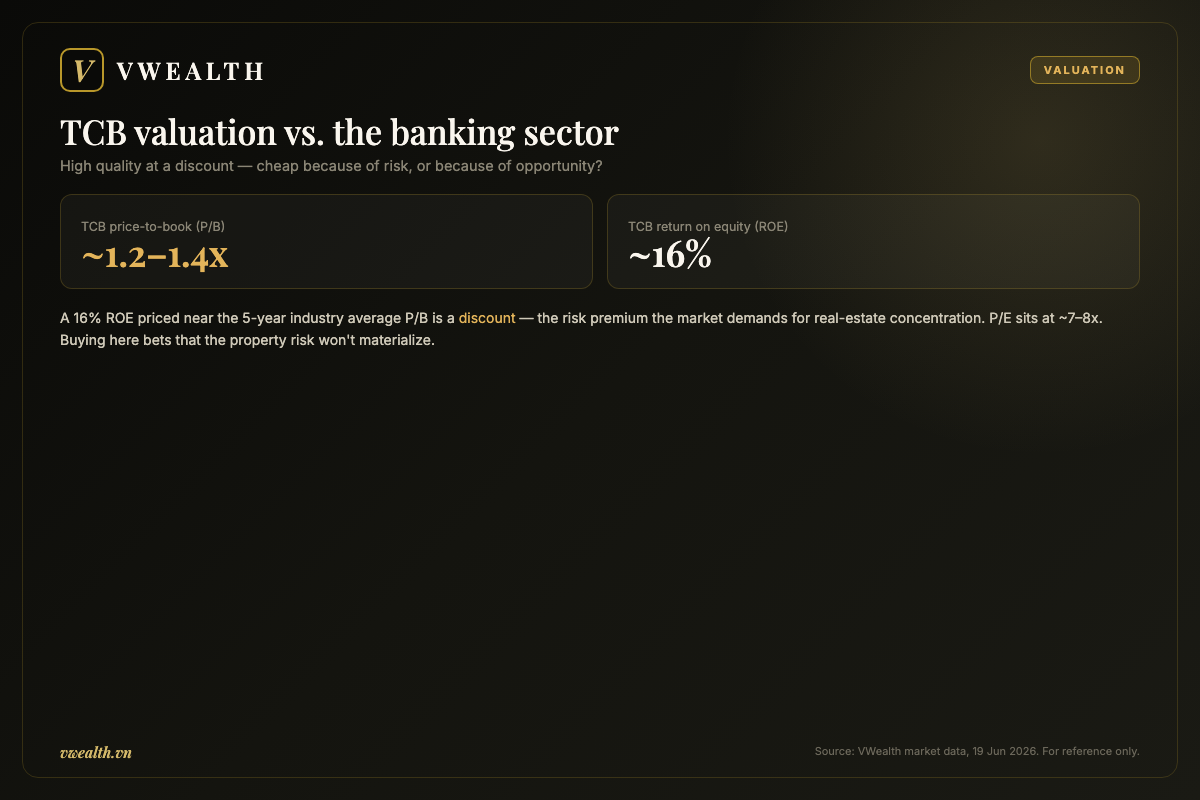
At 30,950 dong on 19 June 2026, TCB trades at a P/B of about 1.24 times and a P/E of about 8.4 times. After accounting for the large stock split that will significantly raise shares outstanding (charter capital rising to over 113,000 billion dong — the highest of private banks), these multiples move in the range of P/E 7–8 times and P/B 1.2–1.4 times. In other words: a bank with 16% ROE is valued by the market on par with, or even below, the industry’s 5-year average. This is not how the market usually treats an efficiency champion. This is a discount.
When the industry’s best money-maker is priced on par with the average, the market isn’t mistaken — it is demanding compensation for a risk it sees.
Cheap because of risk, or cheap because of opportunity?
This is the central question you must answer before deciding whether to buy TCB. This discount doesn’t come from the market’s ignorance. Investors know very well TCB’s ROE is high. What they fear, with good reason, is the quality behind that profit number.
The story fits in three words: concentration risk. For years, Techcombank’s model has been tightly tied to real estate and corporate bonds — from lending to developers, to home buyers, to distributing bonds via the subsidiary TCBS. When the property market is favourable, this machine produces enormous profit at low cost, and that is the source of the 16% ROE. But when property struggles, that very concentration becomes the Achilles’ heel. A bank spread across sectors takes a lighter shock; a bank with eggs in the real-estate basket shakes harder when that basket tilts.
The market, through the 1.24x P/B, sends a clear message: “We recognize you’re good, but we demand a discount to compensate for the chance those property loans turn bad someday.” This is a risk premium subtracted straight from the price.
So the question “cheap because of risk or cheap because of opportunity?” is really two ways of expressing the same truth, depending on whether you believe that risk materializes:
- If you believe the risk will erupt — a prolonged property freeze, surging property bad debt, provisions eroding profit — then the current price is not cheap. It’s fair, even expensive if the bad scenario plays out.
- If you believe the risk is controlled — and TCB’s leadership targets keeping property bad debt below 1%, with a bank-wide NPL of only around 1.1% and NPL coverage near 128% — then TCB is an opportunity: you’re buying a top-tier bank at the price of an average one.
The entire TCB investment thesis revolves around this very hinge. You don’t buy TCB because it grows fast, nor for a generous dividend. You buy TCB as a calculated bet: that this bank’s true operating quality is good enough to overcome the property fear, and when that fear fades, the discount will narrow too.
The dividend turning point: from ten years of “silence” to consecutive cash
There is a detail in TCB’s history that, if skipped, means you won’t understand the change in how the market views this stock. For about a decade, Techcombank paid almost no cash dividend. The reason wasn’t a lack of money, but philosophy: the bank retained all profit to feed growth, build its base and strengthen its safety buffer. For many dividend-loving investors, that was a “silence” long enough to frustrate.
Then everything reversed. From 2024, Techcombank began paying cash dividends, and 2025 marked the third consecutive cash payout — 700 dong per share, paid in May 2026, a 7% ratio. At the same time, the bank announced an enormous bonus-share plan: a total dividend ratio up to 67%, of which 60% is bonus shares. This is one of the largest payouts in banking, lifting TCB’s charter capital past 113,000 billion dong — establishing it as the private bank with the largest charter capital in the system.
This turning point sends two important signals to read correctly.
First, on capital health. A bank only dares to pay both cash and a huge stock dividend when confident its capital buffer is thick enough. With a CAR around 14.6% — far above the minimum — TCB is telling the market it is not only good at making money but has capital to spare enough to both reward shareholders and keep growing. This is a signal of strength, not depletion.
Second, on goodwill to share. Starting cash payments after a decade is a change in the “covenant” between bank and shareholders. It turns TCB from a pure growth stock into a growth-plus-cash-flow stock — widening the pool of potential investors, including funds and long-term investors who prize dividends. With a dividend yield around 5.5% at the current price, TCB is no longer a stock “just waiting for price gains.”
But here is a psychological trap you must absolutely avoid. When a stock pays a large 60% bonus, the price on the board is adjusted down accordingly on the ex-rights date. At a glance, you might think the stock “crashed.” It didn’t. That’s just division: the same cake now cut into more slices, so each slice is smaller — but your total asset value isn’t lost. If you hold TCB through the split, the shares in your account rise to offset exactly the adjusted price. Don’t be fooled by the red number on the board.
| Criterion | Cash dividend | Bonus share dividend |
|---|---|---|
| 2025 ratio | 7% (700đ/share) | 60% |
| What you receive | Cash into your account | More shares |
| Effect on board price | Slight adjustment | Sharp downward adjustment (not a crash) |
| Signal meaning | Ample capital, sharing benefit | Confidence in the capital buffer & growth |
Price action and liquidity: a VN30 pillar
TCB is not a stock you need to worry about on liquidity. As one of the largest-cap stocks on HOSE, with a market cap around 219,000 billion dong, TCB is in the VN30 basket — the 30 pillar stocks shaping the index. Average trading volume ranges from several million to tens of millions of shares a session (the recent 10-session average around 9 million, some sessions above 10 million). This means: whether you’re a small individual or a large fund, you can trade TCB with almost no worry of being “stuck” or moving the price much.
But this pillar status also creates a dual character. Because TCB is an important VN30 component and one of the largest banking representatives, its price reflects not just Techcombank’s own health, but also resonates strongly with the general sentiment of the whole banking industry. When money believes in the sector’s outlook, TCB usually benefits first. Conversely, whenever there’s bad news about bad debt, property, or credit tightening, TCB is often among those sold hardest — sometimes more than its intrinsic value warrants, simply because it’s the most tradable name and the most tied to the property story.
For you, this has two practical implications. One, TCB’s short-term swings often say nothing about the bank itself, but about the market’s mood toward the whole sector — don’t panic over emotional waves. Two, those very moments when the whole sector is dumped over a macro fear are often when a quality stock like TCB is pushed to its most attractive price.
Foreigners and the room-loosening story
Another lens for reading market expectations is foreign flows. Foreign ownership at TCB is currently about 22.5% of the allowed 30% room, leaving about 7.5% of space. Notably, in many earlier periods, TCB’s foreign room was full or near-full — a sign of how eager international investors are for this stock. Foreigners don’t easily pile capital into a bank if they don’t believe in its governance quality and profitability.
Behind the room number are two bigger stories the market is pricing into expectations:
- The market-upgrade story. As Vietnam’s market nears an upgrade from frontier to emerging, large foreign funds will have to allocate to pillar, high-liquidity stocks like TCB. This is structural money, not dependent on short-term sentiment — and TCB is one of the clearest beneficiaries.
- The room-loosening story. Some securities firms expect TCB could have its foreign room raised higher in the future. If realized, it would open a new “valve” for international capital, creating additional demand the current price hasn’t fully reflected.
Both stories are free “options” attached to the stock: they may not happen, but if they do, they are catalysts to narrow the discount the market places on TCB.
To close: high quality at a discount
Gather all the pieces to see the full picture. You have a bank operating among the most efficient in Vietnam: 16% ROE, lean operating costs, abundant cheap funds, a thick capital buffer. You have a dividend turning point signalling financial health and goodwill to shareholders. You have top liquidity and upgrade and room-loosening stories ahead. By every bank-valuation logic, such a profile should be paid a much higher P/B.
Yet the market keeps TCB in the 1.2–1.4x P/B zone. The whole gap between “should be” and “reality” is the price of one persistent worry: real-estate concentration risk.
TCB is a high-quality asset discounted for property risk. Buying TCB at this price is essentially betting that risk won’t materialize.
That is the most condensed thesis to remember. The 30,950-dong price is not cheap by accident, nor expensive irrationally — it is the result of a bargain between quality and risk. If you believe quality will beat the fear, this is an opportunity. If you believe the fear is well-founded, this is a fairly priced trap. There is no answer for everyone; only the answer that fits your own risk tolerance.
And to judge which way that scale tilts, you can’t look at TCB alone. You need to place it in a bigger context — the health of the whole banking industry, the property cycle, credit policy and the rate environment. That is what we’ll dissect in the next section on the industry context.
Economic and banking-sector context: where does TCB stand in the big picture?
A bank stock is never a standalone story. It is a mirror reflecting the health of the whole economy, the rate level, monetary policy, and most importantly for Techcombank, the property market. You cannot value TCB just by looking at its balance sheet. You must understand the water this boat swims in. This section places TCB in the right macro and industry context so you clearly see why it is both the most-benefiting and the riskiest stock among the leading private banks.
Credit grows strongly, but the “pie” isn’t shared evenly
Start with the industry-wide number. As of end-November 2025, system credit outstanding exceeded 18.2 quadrillion dong, up more than 16.5% from the start of the year, and full-year 2025 credit growth reached about 19%. This is very high by historical standards, reflecting the effort to pump capital into the economy to support GDP growth. Into 2026, the State Bank’s guidance is system credit growth of about 15%, though some securities firms like MBS Research expect the actual figure could approach 20%.
The point to grasp: fast credit growth is a necessary condition for banks to expand profit scale, but it doesn’t automatically turn into quality profit. A bank growing credit 20% but pushing capital into risky sectors at low rates creates “hollow growth.” Conversely, the bank that keeps its cost of funds low and its margin good is the real beneficiary. This is the crux when we examine TCB.
A notable point of the 2025 picture: credit growth (19%) far outpaced deposit growth (11.4%). This mismatch creates liquidity pressure and pushes the whole industry’s funding costs up, especially for banks heavily dependent on high-rate term deposits. In that environment, a bank with a high non-term deposit (CASA) ratio has a clear cost-of-funds advantage. Remember this detail, because it is Techcombank’s entire “weapon.”
Low rates and the industry’s narrowing NIM
This is the biggest headwind for the whole banking industry in this period. To support businesses and the recovering economy, lending rates are kept low, while funding costs tend to rise due to the credit–deposit mismatch above. The result is that NIM — the spread between lending and deposit rates, a bank’s “core margin” — has been significantly eroded.
The numbers are clear: industry-wide NIM fell to about 2.9% at end-2025, from 3.5% at end-2024. This is one of the lowest NIM levels since 2018. Forecasts for 2026 suggest the industry NIM will stay flat or hold below 3.0%, at least in the first half, before possibly improving gradually as medium- and long-term loans exit promotional rates and reset to floating.
When the whole industry’s margin is squeezed, the competitive advantage no longer lies in who lends more, but in who has cheaper funds. And that is the arena Techcombank leads.
Why is CASA so important in this context? CASA is non-term payment deposits — money customers keep at near-zero interest. The higher a bank’s CASA ratio, the lower its average funding cost, and thus the better protected its NIM when lending rates fall. While the industry NIM shrank to 2.9%, TCB with its 40.4% CASA at end-2025 — the market’s highest — has a natural “cushion” to withstand this pressure better than most rivals. This is why TCB is repeatedly called the system’s “CASA king.”
The core risk: the health of the property and corporate-bond markets
If you’re only allowed to remember one thing about TCB’s risk, remember this: Techcombank’s fate is tightly tied to Vietnam’s property and corporate-bond markets, at a deeper level than almost every other large bank.
Techcombank is built around an ecosystem focused on real estate and large partners like Vingroup, Masan. This bank’s model, for years, has been financing the property value chain — from developers, contractors, to the final home buyer via mortgages. This is both TCB’s superior growth engine in booming property years, and its Achilles’ heel when the market reverses.
Look at the loan structure. As of 31 December 2025, TCB’s real-estate loan share was about 30.7%, down from 33.2% a year earlier. TCB’s leadership is actively lowering the share of lending to high-risk sectors, a move showing they are well aware of this exposure. Even so, even after the reduction, TCB’s concentration in real estate and corporate bonds is among the highest of listed banks.
This creates a very distinctive investment character for TCB stock you must understand clearly. That is a “two-way leverage” to the property cycle:
- When property recovers: TCB is the biggest beneficiary. When property liquidity returns, projects unclog, buyers disburse again, corporate bonds are refinanced — the whole ecosystem TCB finances “comes alive,” driving high-quality credit growth, higher fees and lower provisioning pressure. Profit can jump more than the industry norm.
- When property worsens: TCB also bears the biggest risk. A prolonged liquidity freeze, or a wave of property-bond defaults, hits TCB harder than banks with a spread portfolio. Bad debt can rise, provisioning pressure erodes profit, and the stock price usually reacts very sensitively.
The good news is that so far, TCB’s asset quality remains well controlled. The NPL ratio at end-2025 was 1.13%, and property-segment bad debt (both individual and corporate) is kept below 1%. NPL coverage is about 127.9%. These are healthy numbers and show TCB’s risk-management machine hasn’t “broken.” However, stay clear-headed: bad debt is a lagging indicator. In a bad property cycle, bad debt usually only shows after many quarters. So today’s 1.13% is a plus, but not insurance for the future.
State Bank policy: the gatekeeper shaping the game
In this picture, the State Bank (SBV) is the helmsman. Its decisions on credit quotas, rate management, and tightening or loosening property lending all directly affect TCB. The SBV setting a 15% credit-growth target for 2026 with a macro-stability priority shows the regulator wants to both support growth and control systemic risk. A series of pressures identified for the industry in 2026 — a prolonged credit-deposit imbalance, NIM falling to low levels, and quietly rising group-2 debt — are all variables to monitor, as they strongly affect high-risk-appetite banks like TCB.
The upgrade and foreign-room story: a long-term tailwind
Beyond the risks, there is a turning-point positive driver where TCB is a prime beneficiary: the Vietnam market-upgrade story.
FTSE Russell has officially confirmed the roadmap to upgrade Vietnam’s stock market from Frontier to Secondary Emerging, with the allocation of Vietnamese stocks into the indices officially starting 21 September 2026. Per estimates, passive ETF flows could reach about 1.5 billion USD, and adding active flows, the total could reach 6–8 billion USD, even over 10 billion USD in HSBC Global Research’s most optimistic scenario.
Why is this good for TCB? When large foreign capital flows in, it usually prioritizes large-cap, high-liquidity stocks with good fundamentals — and leading banks like TCB are almost certainly in the disbursement list. More importantly, TCB is one of the banks with room or a story related to loosening foreign ownership. The more a stock opens to foreigners, the easier it catches this flow. This is a long-term catalyst that could support a re-rating, especially for names currently trading at a cheap P/B versus their intrinsic quality.
To sum up the context: TCB operates in an industry with eroding margins, but it is better equipped than most rivals thanks to the market’s highest CASA. Its biggest risk lies not in rates or general credit, but in the property and corporate-bond markets — where TCB can both win biggest and take the heaviest blow. And behind it, the upgrade story and foreign flows form a slowly building long-term tailwind.
Trend forecast: TCB’s strategy and three scenarios ahead
Having understood the context, your next question is surely: so where is TCB headed? This section is not prophecy — no one can predict a stock price precisely. Instead, we’ll do something more useful: analyze the strategy TCB’s leadership is pursuing, then build three plausible scenarios with each one’s trigger conditions and price consequences. This approach helps you prepare for multiple possibilities rather than betting all on one vision.
Techcombank’s strategy: transforming from a “property bank” to a comprehensive financial ecosystem
To predict the future, understand what TCB wants to become. Leadership has set a clear ambition: toward a 20-billion-USD market cap, through strong digitalization, subsidiary IPOs and expanding the finance-technology ecosystem. Specifically, this strategy has these pillars:
- The TCBS IPO — creating value from the “hidden jewel”: Techcom Securities (TCBS) has been the securities company with the largest charter capital and best profitability in Vietnam for years running. TCB holds up to 79.82% of TCBS. TCBS’s IPO raised about 410 million USD (about 10.8 trillion dong) at an IPO price of 46,800 dong per share, was oversubscribed 2.5 times and named the best IPO in Asia-Pacific in 2025. Listing TCBS helps “reveal” the true value of this asset on the parent bank’s balance sheet — value the market may not have fully reflected in TCB’s price.
- Pushing retail and unsecured lending: TCB is shifting away from a model dependent on concentrated property lending, toward a broader retail segment, including unsecured consumer loans. This segment has higher margins and better risk diversification, though it also demands sophisticated personal-credit risk management.
- Holding the CASA crown: The 40.4% CASA ratio is the core advantage, and TCB invests heavily in digital experience and transaction incentives to retain this non-term cash. High CASA is the base for protecting NIM in a low-rate environment.
- Expanding the affluent/wealth customer base: TCB targets the wealthy segment with wealth-management, insurance and investment services — a stable fee source with little credit risk and long-term customer loyalty.
- Targeting sustainable profit growth: For 2026, TCB set two scenarios. The positive one targets 37,500 billion dong pre-tax profit (up about 15%) with bad debt controlled below 1.5%; the more cautious one targets 35,000 billion dong (up about 7.6%) with bad debt below 2%. Notably, the bank also began paying cash dividends — 7% (700 dong per share) alongside a bonus-share ratio up to 60%.
This strategy shows a Techcombank trying to “diversify away from itself” — gradually reducing property dependence, increasing non-interest income, and turning the ecosystem into a long-term competitive advantage. If executed successfully, this is the path for TCB to reduce cyclicality and deserve a higher re-rating.
Three scenarios for TCB stock
Now let’s build three visions. For each, pay attention to both the trigger conditions (what must happen) and the price consequence (how the stock reacts). Note: the price zones below are illustrative of the valuation logic based on P/B and P/E, not target-price recommendations.
Positive scenario: “All the stars align”
Conditions: The property market recovers clearly — property liquidity returns, projects unclog, corporate bonds are refinanced smoothly. At the same time, TCBS lists successfully and is valued high, helping “realize” this asset’s value into the parent bank’s market cap. Combined with foreign flows from the FTSE upgrade arriving in September 2026, the market re-rates TCB’s P/B to match its intrinsic quality.
Consequence: This is the scenario where TCB benefits most in the whole industry. Profit beats the 37,500-billion target, bad debt stays low, and most importantly the P/B is pulled from the current 1.2–1.4x zone higher. When a high-quality bank like TCB trades at a P/B just above 1x, the market only needs to accept paying a bit more for the price to rise significantly. This is the biggest-reward scenario.
Base scenario: “On the right path, but no miracle”
Conditions: The property market recovers slowly, step by step, not collapsing but not booming. Rates stay low, industry NIM flat around 2.9–3.0%. TCB hits its profit target in the 35,000–37,500 billion zone thanks to high CASA protecting margins, stable asset quality, bad debt under control. TCBS lists smoothly but its value is partly anticipated by the market.
Consequence: The stock moves with single- to low-double-digit profit growth, P/B holds around the current 1.2–1.4x. You receive the newly started cash dividend plus bonus shares, and a return commensurate with a good bank bought at a reasonable price. This is the most likely vision and also the anchor for assessing your risk/reward.
Negative scenario: “Property bad debt erupts”
Conditions: The property and corporate-bond markets worsen for a prolonged period — liquidity freezes, some large developers become insolvent, a bond-default wave spreads. Due to high, concentrated exposure, TCB’s bad debt exceeds the 2% control threshold, forcing the bank to sharply raise provisions, eroding profit.
Consequence: This is the scenario where TCB suffers most in the leading-bank group. Profit could fall deeply or stall, and the market usually “punishes” high-risk stocks by pushing P/B below 1x. The price decline in this scenario could be significant and prolonged, because it strikes straight at TCB’s business-model core. This is a real capital-loss risk you must weigh seriously before deciding.
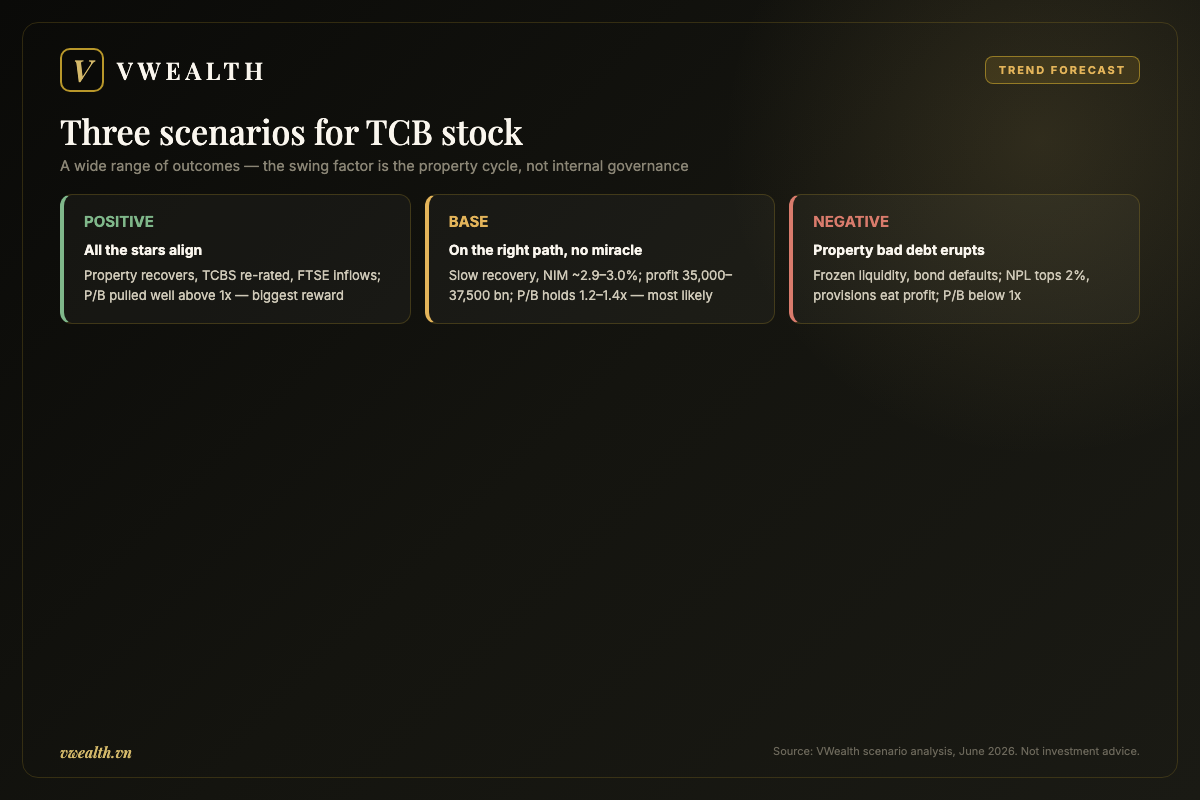
The takeaway from these three scenarios is very important: TCB is a stock with a wide range of outcomes. The reward in the positive scenario is very attractive, but the risk in the negative one is very real. And the variable deciding which scenario you land in is not TCB’s internal governance (which is fairly good), but a factor beyond the bank’s control: the property-market cycle. So investing in TCB is essentially taking a view on the future of Vietnamese real estate.
Should you buy TCB stock?
We’ve come a long way: from the financial foundation, valuation, industry context, to strategy and future scenarios. Now it’s time to gather it all to answer the question you care about most. But let’s be frank upfront: this section will not declare “buy” or “sell” for you. No one has the right to do that for you, because the right decision depends on your own risk appetite, goals and beliefs. What we do is put both the benefit and harm sides clearly on the scale, then help you position yourself.
The BENEFIT side: why TCB is a high-quality stock at a reasonable price
- CASA king — the lowest cost of funds in the system: With the market’s highest 40.4% CASA, TCB has a superiorly cheap cost of funds. In an environment where the industry NIM shrinks to 2.9%, this is an extremely valuable margin shield few banks can copy.
- High ROE and a thick capital base: TCB is consistently among the banks with the highest return on equity, alongside one of the industry’s thickest safety buffers — the base to both grow and withstand shocks.
- TCBS about-to/already IPO’d — large value revealed: Listing the TCBS “jewel” (79.82% owned), Vietnam’s most profitable securities company, helps realize part of the value the market may not have fully reflected in TCB’s price.
- Cheap P/B versus quality: At around 30,950 dong, TCB trades at a P/E of about 7–8 times and a P/B of about 1.2–1.4 times. For a bank with high ROE, leading CASA and a thick capital buffer, this valuation is not expensive — even cheap versus its intrinsic quality.
- Starting cash dividends: The first cash dividend (7%, 700 dong per share) alongside a high bonus-share ratio is a sign of maturity in profit-distribution policy and provides real cash to shareholders.
- The BIGGEST beneficiary when property recovers and the market upgrades: The property-cycle leverage makes TCB the name that bounces hardest if property warms up; plus foreign flows from the FTSE upgrade (starting September 2026) favouring high-quality large-caps like TCB.
The HARM side: risks you must not underestimate
- The largest real-estate and bond concentration in the group: Real-estate loans around 30.7%, plus corporate-bond exposure, make TCB the most vulnerable bank if property worsens. This is the number-one risk, not to be ignored.
- Vingroup/Masan ecosystem exposure: The tight bond to a few large groups is both a value-chain advantage and a partner-concentration risk — their fate directly affects TCB’s portfolio.
- A thinner provisioning buffer than VCB: TCB’s NPL coverage (about 127.9%) is good, but still markedly thinner than defensive banks like Vietcombank, which keep very high coverage. When risk materializes, TCB has fewer “cushion layers” to absorb it.
- Strong swings with the property cycle: TCB stock tends to swing sharply with market sentiment on real estate. If you can’t stand volatility, this is a point to weigh carefully.
- Dilution from stock splits: The high bonus-share ratio (up to 60%) sharply raises shares outstanding, diluting per-share metrics and requiring profit to rise correspondingly to hold value.
Which kind of investor are you?
The most useful way to answer “should you buy TCB” is to see yourself in four typical investor groups. Honestly see where you fit:
| Investor type | Characteristics | Does TCB fit? |
|---|---|---|
| Growth investor, risk-tolerant | Believes Vietnamese real estate will recover, willing to trade concentration risk for quality-at-a-cheap-price and re-rating potential | Fairly fits TCB’s story |
| Value investor, disciplined | Buys a good bank cheap, understands the risk and only allocates a reasonable portfolio weight | The cheap P/B is attractive, but control your weight given the concentration risk |
| Defensive investor, safety-first | Prizes a thick provisioning buffer, a spread portfolio, low volatility, steady dividend income | May find TCB riskier than their appetite; defensive banks fit better |
| Short-term swing trader | Trades on volatility and flows, doesn’t hold long | TCB’s high volatility can create opportunity but also much risk |
Distilled into one sentence: TCB fits best those who believe Vietnam’s property market will recover, and are willing to accept concentration risk in exchange for a high-quality bank at a cheap price. Conversely, if you’re uncomfortable betting on the property cycle, or prioritize absolute safety, TCB’s exposure may exceed your tolerance — and that is an entirely legitimate answer.
Remember: there is no absolutely “good” or “bad” stock, only a stock that fits or doesn’t fit you. TCB is a high-quality business with a very specific, very large risk. Understanding both sides clearly, positioning yourself correctly, controlling your portfolio weight, and never investing with money you can’t afford to lose — that is the wise way to decide.
Disclaimer: This article is produced for informational and reference-analysis purposes, and is not a recommendation to buy, sell or hold any stock. The figures are compiled from public sources at the time of writing and may change over time. Stock prices, business results and macro factors are always volatile; past results do not guarantee future performance. Every investment decision is your own; you should carefully weigh your personal financial situation and consult a licensed advisor before acting. vwealth.vn and the author bear no responsibility for any losses arising from the use of information in this article.
Research Vietnamese stocks in English with vwealth. Our AI-powered platform turns Vietnamese market data into full English analysis reports — with international payment support and a free 2-month trial for new accounts. Create your free account and read the latest reports.
Read more sector analysis: Vietnam’s Banking Sector: A Foreign Investor’s Guide to the Market’s Backbone