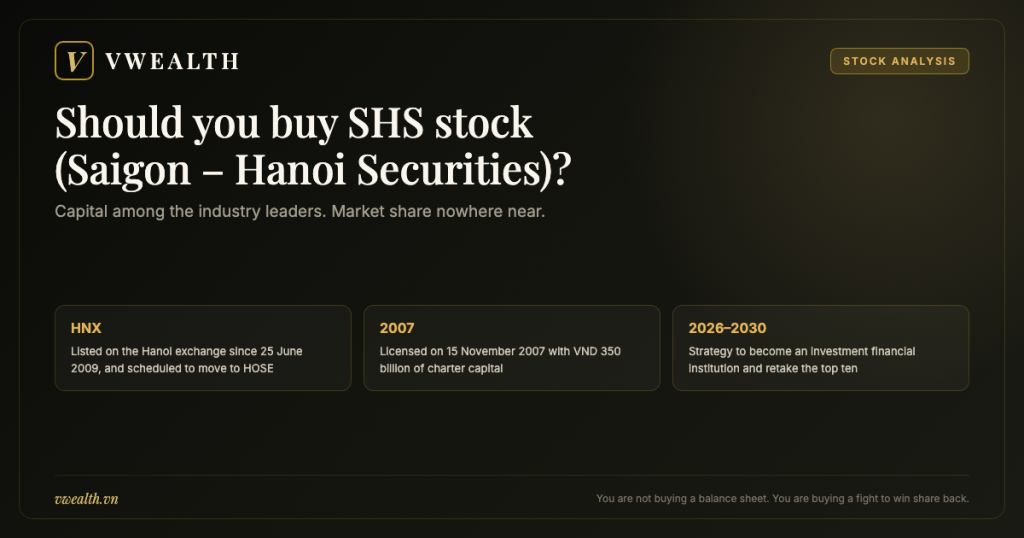
Should you buy SHS stock? The question carries a layer of meaning that almost no other Vietnamese brokerage ticker does. Saigon–Hanoi Securities is not simply another broker. It is the largest securities firm still listed on the Hanoi exchange at the exact moment that exchange is being wound down and its entire equity board moved south to Ho Chi Minh City. Its chairman was born in 1989 and carries the same surname as the founder of the bank whose name sits inside the company’s own. In under a month in the spring of 2026, a fund registered in Finland bought its way past every domestic institution on the shareholder register. And this is a broker whose management publicly admitted its retail brokerage market share had fallen below two percent — then set a target of climbing back into the top ten, and then the top five, within five years. This article walks the whole file: nineteen years of history containing one near-death experience, how a securities firm actually earns money, the nine places you must look when you open SHS’s accounts, and a straight answer on who this stock suits and who it absolutely does not.
Before we start, a convention worth agreeing on. You will meet a great many dates, names, capital increases and transactions in what follows — all of it publicly disclosed and verifiable in filings. What you will almost never see is a figure from the most recent quarter: how many billion dong it earned, what its price-to-book multiple is today, how large its margin loan book has grown. The reason is practical. For a brokerage, those numbers move every ninety days and can reverse completely in three months. An article that hard-codes an August 2026 number becomes misinformation by November. So rather than handing you numbers with an expiry date, this piece teaches you how to read the numbers, so that each quarter you can open the statements yourself and know exactly what you are looking at. For live figures, use the analysis reports on vwealth.
All amounts here are in Vietnamese dong. As a rough mental conversion, one US dollar bought somewhere in the region of VND 26,000 during 2026, so VND 1 trillion is on the order of forty million dollars. Treat that as arithmetic shorthand, not a precise translation — the dong drifts, and the company reports in dong. Vietnamese share prices are also quoted in plain dong, which is why you will see a stock trading at “51,500” rather than at some tidy single-digit figure.
There is one more thing that should be said plainly at the outset. SHS is connected to a large and well-known Vietnamese business ecosystem — T&T Group and Saigon–Hanoi Commercial Joint Stock Bank, better known as SHB — through both shareholding and shared leadership. This article describes those relationships exactly as they have been officially disclosed, and no further. SHS is an independent legal entity with its own listing, its own separately audited financial statements, and its own liability for its own results. Two companies sharing part of a name and part of an ecosystem does not mean the results of one determine the results of the other. You will see why that distinction matters when we get to chapter four.
If Vietnam is new to you as a market, it is worth reading this alongside our guide to investing in the Vietnam stock market, which covers the plumbing — account opening, foreign ownership limits, settlement cycles and the daily price band — and our broader Vietnam stock market guide for how the exchanges themselves are structured. Those mechanics matter more than usual for this particular company, because SHS is one of the few large names whose story is partly about which exchange it trades on.
Nineteen years of a hyphenated name: the history of Saigon–Hanoi Securities
Some companies get their names out of a marketing meeting. Others get them out of a statement of intent. SHS belongs firmly in the second category: it welded the names of Vietnam’s two largest cities into its own on the day it received its first licence, before it had a single client. To understand why the market today regards this ticker with a mixture of affection and suspicion, you need to walk the nineteen years — including at least one in which SHS shares changed hands for less than the price of a glass of iced tea on a Hanoi pavement.
2007: born just after the peak, with VND 350 billion of capital
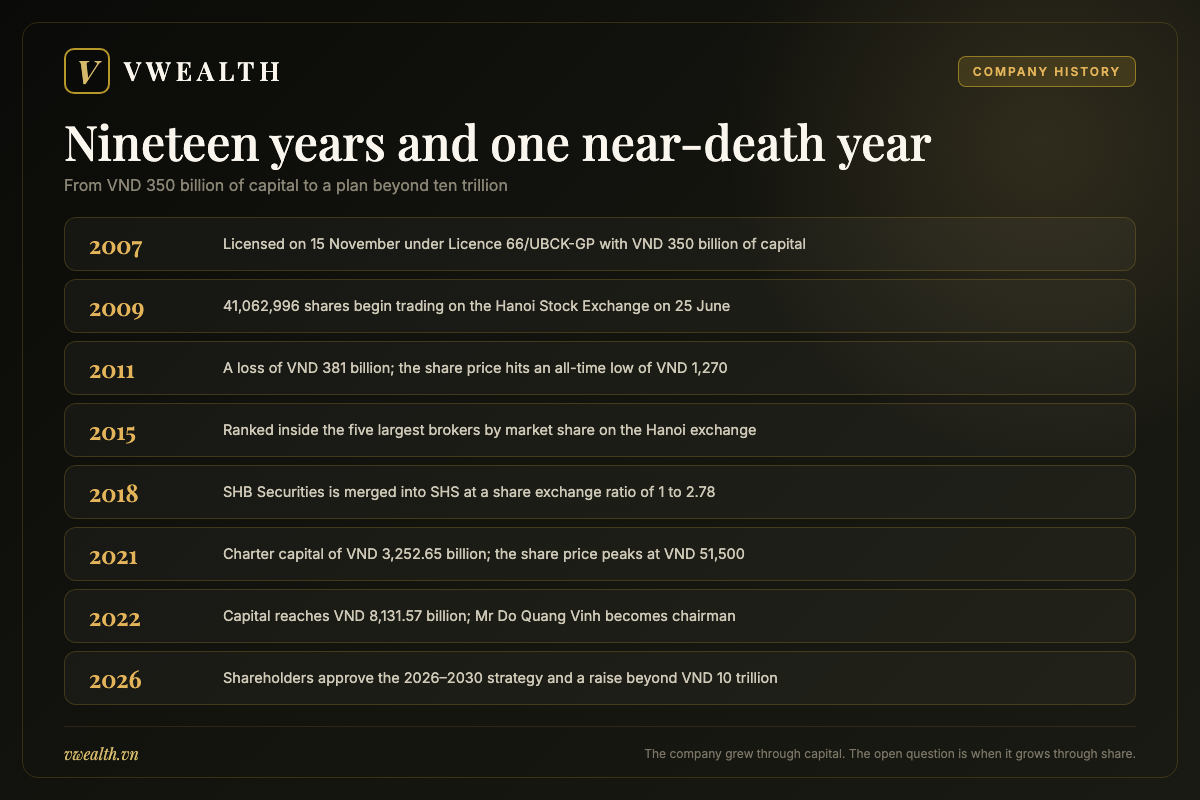
On 15 November 2007, the State Securities Commission of Vietnam issued Licence No. 66/UBCK-GP, bringing Saigon – Hanoi Securities Joint Stock Company into existence. Initial charter capital: VND 350 billion. Head office: Hanoi.
The timing deserves a pause. 2007 was the crest of the first speculative mania in the history of the Vietnamese stock market. The VN-Index set a record in March 2007, trading floors were physically packed with people, and brokerages sprouted like mushrooms — at one point the country hosted close to one hundred licensed securities firms serving a market capitalised at a fraction of today’s size. SHS was born in November 2007, months after the top and just before the 2008 global financial crisis arrived. Put another way: this company never enjoyed a single day of the boom before it had to learn how to survive a bust.
The name “Saigon – Hanoi” was not incidental. It belongs to the same naming lineage as Saigon – Hanoi Commercial Joint Stock Bank, SHB, the bank associated with the businessman Do Quang Hien — a figure Vietnamese sports media universally calls “bau Hien”, literally “patron Hien”, a nickname the Vietnamese press gives to tycoons who bankroll football clubs. The three letters SHS on the board, like the three letters SHB, both point back to the same financial ecosystem then taking shape in the north of the country. This is public information, and it has followed the stock for nineteen years — functioning at once as an advantage and as a permanent question in investors’ minds.
VND 350 billion was a respectable base for a new broker in 2007. But hold on to that number, because it is the starting point of one of the longest capital-raising journeys in the industry: from VND 350 billion to nearly VND 9 trillion, roughly a twenty-five-fold increase, in under two decades. Everything you will read later about dilution, about price-to-book, about whether large capital converts into large profit, traces back to that VND 350 billion.
2009: forty-one million shares list in Hanoi
On 25 June 2009, all 41,062,996 SHS shares began trading on the Hanoi Stock Exchange under the ticker SHS.
Choosing HNX over HOSE in 2009 was an entirely ordinary decision at the time. Vietnam then ran two equity exchanges: the Ho Chi Minh Stock Exchange, HOSE, for larger companies, and the Hanoi Stock Exchange, HNX, for mid-sized ones. HNX had gentler listing standards, a wider daily price band — plus or minus ten percent per session against HOSE’s plus or minus seven — and a noticeably livelier trading culture. For a two-year-old brokerage, Hanoi was the sensible choice. What nobody could have foreseen in 2009 is that the decision would follow SHS for seventeen years, and would still be generating consequences in 2026, when the entire HNX equity board began its migration to HOSE. We return to that in chapter five.
2009 was also the year the Vietnamese market rebounded violently off its February 2009 low. The VN-Index more than doubled in a matter of months, turnover exploded, and brokerage stocks — the most turnover-sensitive group on any exchange — flew with it. SHS listed in the middle of that wave. It was the first lesson this ticker ever taught its shareholders: the price of a securities firm does not track the business, it tracks the mood of the entire market.
2010–2017: a trillion in capital, a fall to VND 1,270, then six years of cleaning up
In 2010, SHS raised charter capital to VND 1 trillion, formally joining the group of Vietnamese brokers with trillion-dong balance sheets — a meaningful milestone in that era. On paper, everything was pointing up.
Then 2011 arrived. It was one of the worst years in the history of the Vietnamese stock market: double-digit inflation, deposit rates that at times exceeded fourteen percent, a credit squeeze, a property developer sector in disarray, and turnover so thin that on many sessions the entire market traded less than VND 1 trillion. For securities firms this was a perfect storm. Dead turnover killed brokerage fees, a falling market killed the proprietary book, and margin loans turned into bad debt as clients were blown out of their positions.
SHS reported a loss of VND 381 billion for 2011. Against VND 1 trillion of charter capital, that evaporated more than a third of shareholders’ funds in twelve months. The market responded exactly as you would expect: on 27 December 2011, SHS shares touched VND 1,270 — the lowest price in the entire trading history of the ticker. A brokerage capitalised at a trillion dong, closing at one-eighth of the VND 10,000 par value that every Vietnamese share is issued at.
This is the stretch of history anyone considering SHS should read carefully — not to be frightened, but to understand what kind of industry this is. Brokerage is a business with extreme operating leverage: costs are largely fixed (salaries, systems, premises) while revenue swings with market turnover. When markets are good, profit inflates fast. When markets are bad, profit does not shrink — it goes negative. 2011 is the proof, and nothing guarantees that structural feature has disappeared from the industry by 2026.
In December 2012, SHS announced it had returned to profit after a year of aggressive restructuring. In the Vietnamese brokerage industry of that period, “aggressive restructuring” had a very specific meaning: close branches, cut headcount, recover or write down bad receivables, shrink the proprietary book, and retreat to a core client base.
That same year, SHS’s equity brokerage market share rose sharply. According to company disclosures, it grew 215 percent on HOSE and 216 percent on HNX, lifting SHS to eleventh place out of the ninety-eight securities firms then operating on the Hanoi exchange. That figure — ninety-eight firms — tells you a great deal about the era: the market carried far more brokers than its real size justified, and most of them would vanish, merge or lose their licences over the following decade.
Across 2015 and 2016, SHS held a position among the five largest brokers by market share on HNX. That was the high-water mark of the firm’s brokerage franchise — and you should file it away, because it stands in harsh contrast to where the company sits in 2026. A business that once ranked in the top five of an entire exchange, declaring a decade later that its goal is to “return to the top ten”, is a story worth understanding properly.
Taken as a whole, 2012 to 2017 was a period in which SHS survived and held station rather than advanced. Charter capital sat still at VND 1 trillion for the entire stretch. Meanwhile some competitors began to run: SSI expanded into asset management and investment banking, HSC and Vietcap built institutional and foreign client franchises, and the bank-affiliated brokers started leveraging branch networks to cross-sell. The gap that defines SHS today opened here.
2018: a rare merger between two brokers, and the detail few noticed
2018 brought something uncommon in Vietnamese capital markets: a merger between two securities firms. On 23 March 2018, the Chairman of the State Securities Commission approved the absorption of SHB Securities (SHBS) into SHS, under a plan already passed by both companies’ 2017 annual general meetings. On 29 August 2018 the amended licence was issued, closing the process.
The mechanics are worth studying. SHS issued nearly 5.4 million new shares to exchange for all 15 million SHBS shares, at a ratio of 1:2.78 — meaning an SHBS holder surrendered 2.78 SHBS shares to receive one SHS share. Post-merger, SHS charter capital rose from VND 1 trillion to roughly VND 1,053.96 billion. The swap was valued at approximately VND 54 billion.
Three things follow from those numbers. First, a 1:2.78 exchange ratio tells you both boards, and by extension the market, valued an SHBS share at little more than a third of an SHS share — SHBS was clearly the weaker party. Second, the deal was tiny relative to SHS: charter capital rose barely five percent. This was not a transformational combination; it was an ecosystem tidy-up, folding two related brokers into one, entirely consistent with the market restructuring roadmap Vietnamese regulators pursued from 2011 to 2020. Third, and this is the part that matters to you as an investor: after 2018 this ecosystem contains exactly one securities firm, and it is SHS. SHS is not a bank’s subsidiary; it is the independently listed entity that absorbed the bank’s brokerage.
2019–2022: the capital machine starts up, and a peak of VND 51,500
From 2019, SHS embarked on the most sustained run of capital increases in its history. Charter capital went from VND 1,053.96 billion to VND 2,072.68 billion in 2019, then VND 3,252.65 billion in 2021, then leapt to VND 8,131.57 billion in 2022. In three years it grew almost fourfold.
Why then? Because this was the era of the new retail investor — the phenomenon Vietnamese finance calls the “F0 investor”, borrowing the epidemiological term for a patient zero. The pandemic kept millions of people at home, savings rates fell to historic lows, and money poured into equities. New account openings set records month after month. Whole-market turnover exceeded one billion US dollars in a single session. For a broker this was a gold mine at both ends: fee income rose with turnover, and demand for margin loans rose with greed. But margin lending consumes capital — and Vietnamese law caps a securities firm’s total margin loan book at two times its shareholders’ equity. If you want to lend more, there is exactly one route: raise more equity. The whole industry piled into issuance, and SHS was in the queue.
On 18 November 2021, SHS shares touched VND 51,500 — the highest price in the ticker’s history. Set that beside the VND 1,270 low of 27 December 2011: roughly a forty-fold spread, inside a single decade. Not many stocks on any exchange can tell a range story like that. One caveat: both prices are as-traded on the day and are not adjusted for the subsequent issuance and stock dividends, so do not compare either of them directly with today’s screen price.
Then 2022 arrived, and it arrived quickly. Global rates rose, the domestic corporate bond market suffered a confidence shock, a string of legal cases rattled investor psychology, and the VN-Index shed roughly a third of its value over the year. Brokerage stocks fell harder than the broad market — as they always do in every down-cycle. That is this ticker’s second lesson: you are not buying a business, you are buying a multiplier on the market.
2023–2026: nearly nine trillion in capital and a strategy called “the next level”
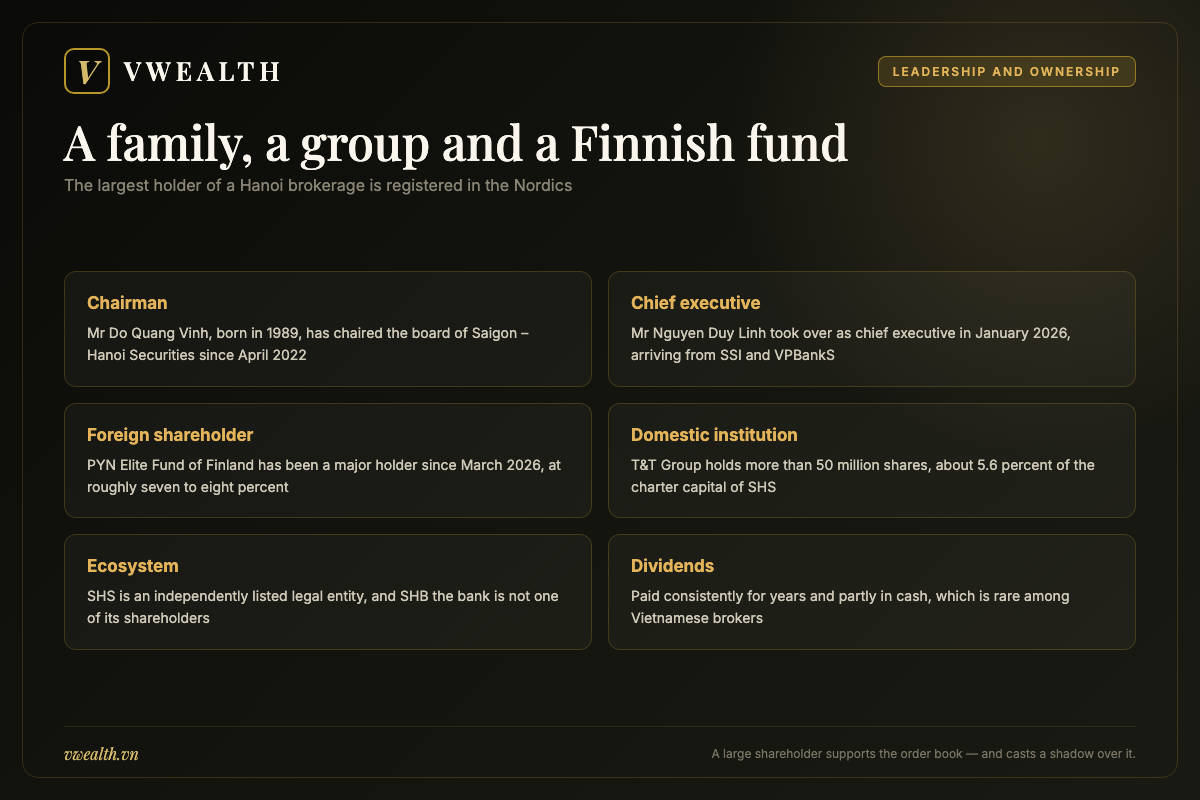
After the 2022 drawdown, SHS moved into a consolidation phase. Charter capital continued to grind higher, reaching VND 8,994.62 billion by 2025, corresponding to 899,462,220 listed shares. The company maintained a consistent dividend policy — something few Vietnamese brokers do — with a total ratio of 20 percent in 2025, split into 10 percent cash and 10 percent stock.
But the real inflection in this period was in people and direction, not in numbers. In April 2022, Mr Do Quang Vinh became Chairman of the Board. In January 2026, SHS appointed Mr Nguyen Duy Linh as Chief Executive Officer — an outsider to the ecosystem, formerly of SSI and previously chairman of VPBank Securities (VPBankS). The annual general meeting held on 17 April 2026 approved a plan to lift charter capital past VND 10 trillion, a dividend of 5 percent cash plus 5 percent stock, and — most consequentially — a 2026–2030 transformation strategy aimed at turning SHS from a traditional brokerage into what management calls an “investment financial institution”.
That strategy rests on four pillars: rebuild retail and institutional brokerage, build a wealth management franchise, accelerate investment banking, and restructure the funding base and fixed income product suite. The market share target was stated openly at the meeting: back into the top ten in the near term, aiming for the top five by 2030. Management also publicly acknowledged the starting point — brokerage market share of roughly 1.65 percent, against a threshold of about 3 percent needed to sit comfortably inside the top ten.
What nineteen years tells you about the SHS of today
Stitch the whole history together and you get a portrait that is extremely characteristic of Vietnam’s first-generation brokerage industry: born at the top of a wave, nearly killed by the crisis, survived by shrinking, then grew via capital rather than via market share.
Here is the crux for understanding SHS in 2026. This is a company that has accumulated balance-sheet scale at the top end of its industry but has not converted that scale into a commensurate franchise position. Large equity, large total assets, large margin lending capacity, large underwriting capacity — and a brokerage market share so modest that its own board has had to set “return to the top ten” as a formal objective. The entire investment case for SHS lives inside that gap. If you believe the gap will close, you are buying a repositioning story. If you do not, you are buying a portfolio of financial assets wrapped in the shape of a stock.
| Date | Event | Charter capital | What it means for an investor |
|---|---|---|---|
| 15 Nov 2007 | Incorporated under Licence 66/UBCK-GP | VND 350 billion | Born after the 2007 peak, just before the 2008 crisis |
| 25 Jun 2009 | 41,062,996 shares list on HNX | — | Chose Hanoi and its ±10% band — a decision with consequences into 2026 |
| 2010 | Capital raised to the trillion-dong mark | VND 1,000 billion | Joins the large-capital brokerage cohort of that era |
| 2011 | Loss of VND 381 billion; share price hits VND 1,270 on 27 Dec | VND 1,000 billion | Living proof of the industry’s operating leverage |
| 2012 | Back to profit; ranked 11th of 98 brokers on HNX | VND 1,000 billion | Survived by shrinking, not by breaking out |
| 2015–2016 | Inside the top five for HNX brokerage share | VND 1,000 billion | Peak franchise position — the benchmark for today |
| 2018 | SHBS merged into SHS at a 1:2.78 exchange ratio | VND 1,053.96 billion | Ecosystem consolidates into a single securities firm |
| 2019 | First major capital raise in nine years | VND 2,072.68 billion | The capital machine starts, to fund margin lending |
| 2021 | Capital raised; share price peaks at VND 51,500 on 18 Nov | VND 3,252.65 billion | The top of the retail investor wave |
| 2022 | Capital raised 2.5x during a severe bear year | VND 8,131.57 billion | Capital grew faster than earning power — the root of the ROE problem |
| Apr 2022 | Mr Do Quang Vinh becomes Chairman | — | Second-generation ecosystem leadership takes over |
| 2025 | Charter capital reaches its current level; 20% total dividend | VND 8,994.62 billion | 899,462,220 shares listed; a consistent dividend policy |
| Jan 2026 | Mr Nguyen Duy Linh appointed CEO | — | An outsider to the ecosystem, from SSI and VPBankS |
| 17 Apr 2026 | AGM approves the 2026–2030 strategy | Plan to exceed VND 10 trillion | Stated goal: return to the top ten by brokerage share |
Who owns SHS stock: a family, a conglomerate and a fund from Finland
Open the major shareholder register of SHS in mid-2026 and you find something almost no other Vietnamese brokerage can show you: the single largest holder is not a domestic conglomerate, not a bank, and not a founding individual. It is an investment fund registered in Finland. This chapter explains how that happened and what it means for anyone about to press the buy button.
Mr Do Quang Vinh: a chairman born in 1989
Mr Do Quang Vinh has chaired the SHS board since April 2022. He was born in 1989, read Finance and Banking at Middlesex University in the United Kingdom and holds a master’s degree from the University of East Anglia. Alongside his role at SHS he serves as Vice Chairman of Saigon – Hanoi Commercial Joint Stock Bank (SHB) for the 2022–2027 term. He is the son of Mr Do Quang Hien — Chairman of SHB and Chairman of the Strategy Committee of T&T Group. His elder brother, Mr Do Vinh Quang, born 1985, works in a different part of the ecosystem.
All of this is disclosed in prospectuses, annual reports and board resolutions at both companies. One person holding senior positions at a bank and a brokerage inside the same ecosystem is legal in Vietnam and far from unusual. But it creates a situation an investor should look at squarely rather than avoid: where two companies share leadership, any transactions between them must be disclosed as related-party transactions, and your job as a shareholder is to read that note in the financial statements. Not out of suspicion — out of diligence. We will cover exactly how to read it in chapter four.
A young chairman running a brokerage with nearly VND 9 trillion of capital cuts both ways. The positive: SHS’s strategic direction since 2022 has clearly tilted toward technology, digital products, client experience and wealth management — precisely the areas where the industry’s older leadership generation has been slow. The consideration: an ambitious strategy with only a few years of data behind it is unproven. The market will mark this management team on quarterly brokerage market share, not on statements made at an AGM.
The T&T – SHB ecosystem: saying exactly enough, and no more
T&T Group appears on the SHS major shareholder register with more than 50 million shares — roughly 5.6 percent of charter capital against the current listed share count. Historically, as of 2021, T&T was the largest single holder at approximately 5.42 percent. SHB the bank is not a shareholder of SHS; the connection between the two companies runs through the ecosystem and through shared leadership, plus the historical fact that SHBS, the bank’s own brokerage, was merged into SHS in 2018.
This is where precision matters most, because it is where the market most often gets it wrong. SHS is not a subsidiary of SHB. SHS is not a subsidiary of T&T. SHS is an independent legal entity, separately listed on HNX, with its own financial statements, its own auditor, its own shareholder meetings, and liability limited to its own assets. T&T’s roughly 5.6 percent stake clears Vietnam’s 5 percent threshold for major shareholder disclosure obligations, but it is nowhere near enough to control any resolution at a general meeting. The ecosystem’s real influence on SHS runs through board seats and through business opportunity — not through voting power.
That business opportunity is real and has already materialised. During 2026, SHS acted as adviser on SHB’s private placement, connecting the bank with large investment funds — a substantial, publicly announced investment banking mandate. For a brokerage trying to build an investment banking franchise, having a pre-existing corporate client base inside the ecosystem is a genuine head start. In return, an investor is entitled to ask the reverse question: if investment banking revenue depends heavily on businesses within the same ecosystem, is that a durable competitive capability or simply internal deal flow? The answer shows up in whether SHS wins mandates from unrelated corporates — and that is precisely what you should be tracking, year by year.
PYN Elite Fund: a Finnish fund that bought in over three spring weeks
The most interesting ownership story at SHS unfolded across the first and second quarters of 2026, and it involves a name familiar to anyone who follows Vietnamese equities: PYN Elite Fund, a Finnish investment fund known for long holding periods in Asian emerging markets and for publishing its investment reasoning in monthly letters to unitholders.
The sequence, from official disclosures: on 25 March 2026, PYN Elite bought nearly 3 million additional SHS shares, taking its holding to roughly 47.3 million units, or 5.26 percent of charter capital — formally crossing into major shareholder status. On 31 March 2026 the fund bought roughly a further 15 million shares, lifting the total to approximately 62.33 million units, or 6.93 percent. By early April 2026, cumulative purchases since late March reached nearly 26 million shares, pushing ownership above 70.3 million units, or 7.82 percent. On 16 April 2026 the fund added 3 million more, reaching approximately 73.87 million units — 8.21 percent. Then, on 23 June 2026, it sold 3 million shares, reducing its stake from around 8.05 percent to 7.71 percent.
Why does this detail matter? Three reasons.
First, a long-only foreign fund committing hundreds of billions of dong over a handful of weeks to become the largest shareholder of a mid-tier broker, precisely as Vietnam approaches an index reclassification, is a statement of thesis rather than a random trade. Brokerage stocks are the most direct and earliest beneficiaries of rising market turnover — and a market upgrade is the biggest liquidity story Vietnam has had in a decade.
Second, having a foreign institution at nearly 8 percent changes the shape of the register. It creates a block of stock unlikely to be dumped on short-term wobbles, while simultaneously raising the pressure on management around disclosure and governance standards — foreign funds read the notes carefully and are not shy about saying so.
Third, and this is the flip side you must hold in mind: a large shareholder will, one day, sell. The 3 million shares PYN disposed of in June 2026 is a reminder that a block of roughly 70 million shares in one institution’s hands is both a support and a shadow hanging over the order book. If that fund ever decides to exit, the supply hitting the market will not be small. This is a structural risk that a broker with genuinely dispersed ownership — VIX Securities, for instance, which has no holder above 5 percent — simply does not carry. It is one of the sharpest differences between two companies in the same industry.
Mr Nguyen Duy Linh and the decision to hire an outsider to run the business
In January 2026 SHS appointed Mr Nguyen Duy Linh as Chief Executive Officer, replacing Mr Nguyen Chi Thanh, who resigned for personal reasons. Mr Linh spent many years at SSI — the oldest Vietnamese brokerage and the one with the strongest institutional client base — and previously chaired the board of VPBank Securities (VPBankS) before resigning in July 2024.
Choosing an outsider to run day-to-day operations is a governance signal worth noting. It draws a clear line between two roles: the board represents shareholders and sets strategic direction; the executive team owns operations and results. At many Vietnamese companies those two roles overlap into a grey zone. At SHS in 2026, the boundary is drawn more sharply than it used to be.
Mr Linh’s most quoted remark, recorded at investor events during 2026, is that “SHS is not starting wealth management from zero”. His point is that the company already possesses the balance sheet, the equity base and the client list to expand into asset management services, rather than having to build from scratch. He has also been blunt about the market share gap: currently around 1.65 percent, needing roughly 3 percent to sit safely inside the top ten, and targeting 5 to 6 percent for a top-five position by 2030.
Treat these target numbers the way you should treat every management commitment: write them down, date them, and then each quarter open the market share tables published by the exchanges and check. Brokerage market share is one of the very few metrics in this industry that cannot be dressed up — it is published by the exchange operators, calculated on actual traded value, and updated quarterly.
Dividends: where SHS diverges sharply from its peers
Most Vietnamese brokers between 2020 and 2026 chose to retain all earnings to build capital, because capital is the direct raw material of margin lending. Shareholders were paid in shares, rarely in cash. SHS went a different way.
In 2023 the company issued a 5 percent stock dividend plus a 5 percent bonus share issue from equity reserves. In 2024 the total payout ratio was 20 percent, comprising 10 percent cash (VND 1,000 per share) and 10 percent stock. In 2025 shareholders again received a total of 20 percent, of which 10 percent was cash — an outlay of more than VND 813 billion — plus 5 percent as a stock dividend and 5 percent as bonus shares from a capital increase. The 2026 AGM approved 5 percent cash plus 5 percent stock.
A brokerage paying out more than VND 800 billion in hard cash while its entire industry races to hoard capital for lending is making a statement. It says management wants a stable shareholder base, values returning cash, and is confident the remaining capital is sufficient for its growth plans. The trade-off is direct: every dong paid out is a dong not deployed into margin loans or the investment book. For you as an investor, that is a genuine choice to weigh — you receive a cash yield that is rare in this industry, but the company compounds its capital slightly more slowly than rivals retaining everything. It is worth comparing this approach with how the listed Vietnamese banks handle the same question; Vietcombank and Techcombank sit at opposite ends of that spectrum, and the reasoning is instructive.
| Stakeholder | Role at SHS | Degree of influence | What to monitor |
|---|---|---|---|
| PYN Elite Fund (Finland) | Largest shareholder, holding around 7.7–8.2% during 2026 | No control, but large enough to move supply and demand in the stock | Disclosures of stake increases and decreases; the fund’s monthly investor letters |
| T&T Group | Major shareholder, more than 50 million shares (about 5.6% of capital) | Major shareholder under the 5% rule, nowhere near control | Changes in the stake and related-party transactions in the notes |
| Mr Do Quang Vinh | Chairman since April 2022; also Vice Chairman of SHB | Sets strategic direction, does not run daily operations | Execution of the 2026–2030 strategy against what was promised at the AGM |
| Mr Nguyen Duy Linh | CEO since January 2026; background at SSI and VPBankS | Accountable for operations and results | Quarterly brokerage market share; progress in building wealth management |
| SHB (the bank) | Not a shareholder; same ecosystem, and merged its brokerage into SHS in 2018 | A source of investment banking mandates, not a parent-subsidiary relationship | Share of IB revenue from related parties versus unrelated clients |
| Domestic retail shareholders | Hold the large majority of the remaining free float | Drive liquidity and short-term price movement | Average daily turnover; how sharply the price reacts to market news |
How SHS makes money: four engines and a deliberate change of roles
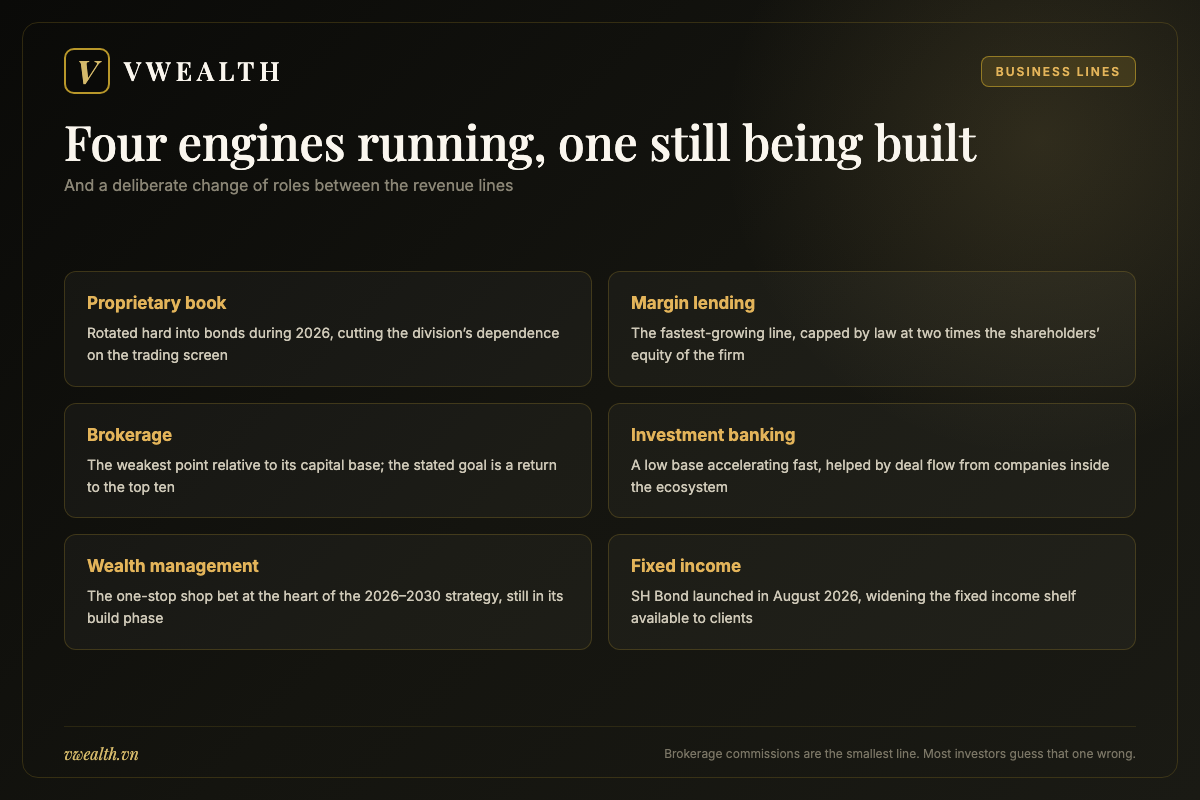
Ask ten retail investors how a securities firm earns money and nine will say “brokerage commissions”. That answer is wrong in a way that can cost you money. For most Vietnamese brokers in 2026, brokerage fees are the smallest of four revenue lines — and at several firms they do not even cover the cost of running the division. This chapter takes each of SHS’s engines apart and shows you how the company is deliberately swapping their roles.
Proprietary trading: the old engine, being steered toward bonds
Proprietary trading, put simply, is the firm buying and selling securities with its own money. Not client money. Company money. Gains accrue to the company; losses land on shareholders.
In the accounts, the proprietary book sits mainly under FVTPL — “financial assets at fair value through profit or loss”. The critical feature of that line item is that it is remeasured to market value at each reporting date, with the difference flowing straight into the income statement, even when the firm has not sold a single share. Meaning: in a quarter when the VN-Index rallies hard, a broker can report a large profit without a single dong of cash arriving. Conversely, in a falling quarter it can report a heavy loss while the portfolio remains completely intact and may well earn handsomely the following year.
This is the source of all the unpredictability in brokerage stocks. And at SHS, the 2026 story is one of intentional migration: the proprietary book has tilted decisively from equities into bonds. Per company disclosure, bonds rose to roughly two-thirds of the portfolio by mid-2026, against under half at the end of 2025; the equity portion shrank accordingly.
The significance of that shift is large, and it is the core difference between SHS and an equity-heavy proprietary house. Bonds generate steady, forecastable interest income that barely moves with the trading screen. Equities generate revaluation gains and losses that swing violently and make quarterly earnings dance. When a firm deliberately moves two-thirds of its book into bonds, management is telling the market: we want steadier profit, and we accept giving up the windfall quarters when equities surge.
That trade-off has a price, and the price showed up during 2026 itself. In quarters when equity markets moved against it, the proprietary line dragged on group profit even while the core divisions grew. Prepare yourself for this: a company mid-way through restructuring its revenue mix will print several ugly-looking quarters, even when the long-run direction is right. For the quarter-by-quarter figures, check the updated vwealth reports.
Margin lending: the fastest-growing engine
Margin lending is the broker lending clients money to buy more shares, secured on the shares sitting in the client’s own account. The client pays interest daily. The firm collects it. Structurally it is a miniature bank that makes exactly one kind of loan.
This is the highest-quality profit line inside a securities firm, for three reasons. First, the income is interest — steady, accrued daily, indifferent to whether the market rises or falls, dependent only on whether clients keep the balance outstanding. Second, the risk is managed through maintenance margin ratios and forced liquidation: when the collateral falls to a threshold, the system automatically sells to recover the loan. Third, lending capacity scales with shareholders’ equity — and SHS has a great deal of equity.
Through 2026 this was SHS’s fastest-growing division. The client loan book expanded sharply year on year, and lending income became the largest component of core operating revenue. Two forces pushed it: investor appetite for leverage rising with the market, and SHS itself pushing the product because it fits the “prioritise lower-risk assets” strategy management has set out.
But you must understand the dark side of margin, and understand it properly. Forced liquidation only works while the stock remains liquid. In a session where dozens of names are locked limit-down — a scenario Vietnam has lived through repeatedly — the broker cannot sell the collateral because there are no bids. At that moment a loan that looked safe becomes a doubtful receivable. Margin risk is not linear risk; it is lumpy risk, silent for years and then detonating over a handful of sessions. That is why “margin loans to shareholders’ equity” sits on the list of nine mandatory checks in the next chapter.
Brokerage: the sore point, and the whole strategic bet
This is where SHS is weakest relative to its capital base, and management does not hide it. Brokerage market share sits around 1.65 percent while the company ranks near the top of the industry by shareholders’ equity. A business that was inside the top five on HNX in 2015 and 2016 now has to set “return to the top ten” as a goal. That is a relative decline stretching across a full decade.
How did it get here? The answer lies not with SHS but with the commission war that reshaped the whole industry from roughly 2021. A cluster of brokers — led by VPS, followed by TCBS, DNSE and the bank-owned firms — cut commissions to near zero, in several cases to actual zero, to buy market share and client accounts. They accepted losses in brokerage and made it back on margin interest earned from those same clients. That war pulled almost the entire cohort of new retail investors toward them and left behind the firms still running the traditional adviser-led brokerage model.
The scoreboard is unambiguous. In the first half of 2026, VPS led HNX equity brokerage share at around 18 to 19 percent, TCBS was second at nearly 10 percent, followed by SSI, VNDirect, MBS, Vietcap, VPBankS, BSC, DNSE and VIX. SHS does not appear in the top ten of the very exchange it has been listed on for seventeen years. That is a fact worth confronting head-on.
And yet this is also where the entire upside of the investment case lives. Going from 1.65 percent to 3 percent sounds modest, but it means nearly doubling the traded volume flowing through SHS’s system — and for a firm whose infrastructure is already built and whose costs are largely fixed, each incremental percentage point of share drops almost straight through to profit. That is what “operating leverage” means when it runs in your favour. If SHS pulls it off, the value created will dwarf anything another few trillion dong of capital could produce.
Investment banking: small, but accelerating fastest
Investment banking — IB — means advising companies on equity issues, bond issues, listings and mergers. Revenue is advisory and underwriting fees, typically a percentage of deal value.
The characteristics of the business: it needs little capital, carries very high margins, and depends enormously on relationships and on the capital markets cycle. When markets are hot, corporates queue up to raise and advisers cannot breathe. When markets go cold, the division goes close to dormant.
At SHS this was the fastest-growing line in 2026, albeit from a very low base. The flagship mandate disclosed was the adviser role on SHB’s private placement, connecting the bank with large investment funds. It is a substantial transaction, and it proves two things at once: SHS can execute a large IB mandate, and SHS enjoys privileged access to clients inside its own ecosystem.
Read that fact with two eyes. The first eye sees the advantage: very few mid-tier brokers have a listed bank sitting within arm’s reach as a client. The second eye asks about durability: if most IB fees come from ecosystem companies, what does the division lean on once those companies have finished raising capital? The answer will surface over the next two or three years in the mix of mandates won from unrelated clients. That is the indicator to watch, and it matters far more than any single quarter’s IB revenue line.
Wealth management and the “one-stop shop”: the strategic bet of 2026–2030
This is the newest part of the SHS story, and the part that most distinguishes it from the rest of the sector.
The 2026–2030 strategy aims to turn SHS into what management calls a “One-Stop Shop” — a single destination where retail and institutional clients can invest, trade, borrow on margin, receive strategic advice, have assets managed and arrange corporate financing on one platform. In other words, SHS does not intend to fight VPS or TCBS on cheap commissions and fast apps; it wants to move up a tier, into full-service wealth management.
There is sound economics behind that choice. In discount brokerage, margins have been crushed and the winner is whoever has the best technology and the cheapest funding — a game in which brokers owned by large banks hold a structural advantage. In wealth management, fees are charged on assets under management rather than per order, clients are far less price-sensitive, and relationships are considerably stickier. If Vietnam follows the path of the Asian markets ahead of it, the population with accumulated financial assets will grow quickly and demand for professional wealth management will follow.
In August 2026, SHS launched SH Bond, broadening the fixed income options available to clients — a step entirely consistent with the strategy: sell financial products to an existing client base, collect distribution fees, and keep client cash inside the system rather than letting it drift to another channel.
But let us be blunt: this is a long-horizon bet, not a story about the next four quarters. Building a genuine wealth management business requires certified advisers, a broad enough product shelf, technology systems, and years of accumulated trust. In the first two or three years it consumes more money than it makes. If you are buying SHS for the wealth story, tell yourself in advance that you are buying something whose verification period is measured in years, not quarters.
So where is SHS’s competitive advantage?
The hardest question about SHS is the question of moat. Brokerages struggle to have one, because the product is close to identical: everyone routes the same order to the same exchange through the same clearing infrastructure.
Honestly assessed, SHS has three things that qualify as advantages, and none of them is absolute. First, a large equity base — enabling margin lending and underwriting at a scale most firms with comparable market share cannot match. Second, ecosystem relationships, delivering investment banking flow and a ready-made corporate client list. Third, a long-established brand in the north of Vietnam and a loyal client base dating from the years when SHS sat in the HNX top five.
Those three together do not make a deep moat. They make a good starting position for a race — the race to win back market share. What you are buying is that starting position, plus a belief that the people driving will take the right line. If you want a financial-sector business with a more obvious structural moat, the deposit franchise at a large Vietnamese bank is the cleaner comparison; MB Bank and ACB both illustrate what a genuine funding-cost advantage looks like in practice.
| Division | Nature of revenue | Volatility | Capital intensive? | Where SHS stands |
|---|---|---|---|---|
| Proprietary trading (FVTPL) | Revaluation gains and losses plus realised trading gains | Very high; can be negative for a whole quarter | Very | The old engine, being reweighted toward bonds |
| Margin lending | Interest accrued daily on client loan balances | Low in normal conditions, lumpy when markets break | Very; capped at 2x shareholders’ equity | Fastest-growing line, the core profit pillar |
| Brokerage | Commission on client traded value | High; tracks market turnover | Light, but needs systems and people | Biggest weakness; share around 1.65% |
| Investment banking | Advisory and underwriting fees | Very high; tied to the capital markets cycle | Little capital, many relationships | Low base, accelerating on ecosystem flow |
| Wealth management and distribution | Fees on assets under management and product distribution | Low and steady once scale is reached | Moderate | New division, still investing, not yet harvesting |
Position and financial health: nine places to look before you decide whether to buy SHS stock
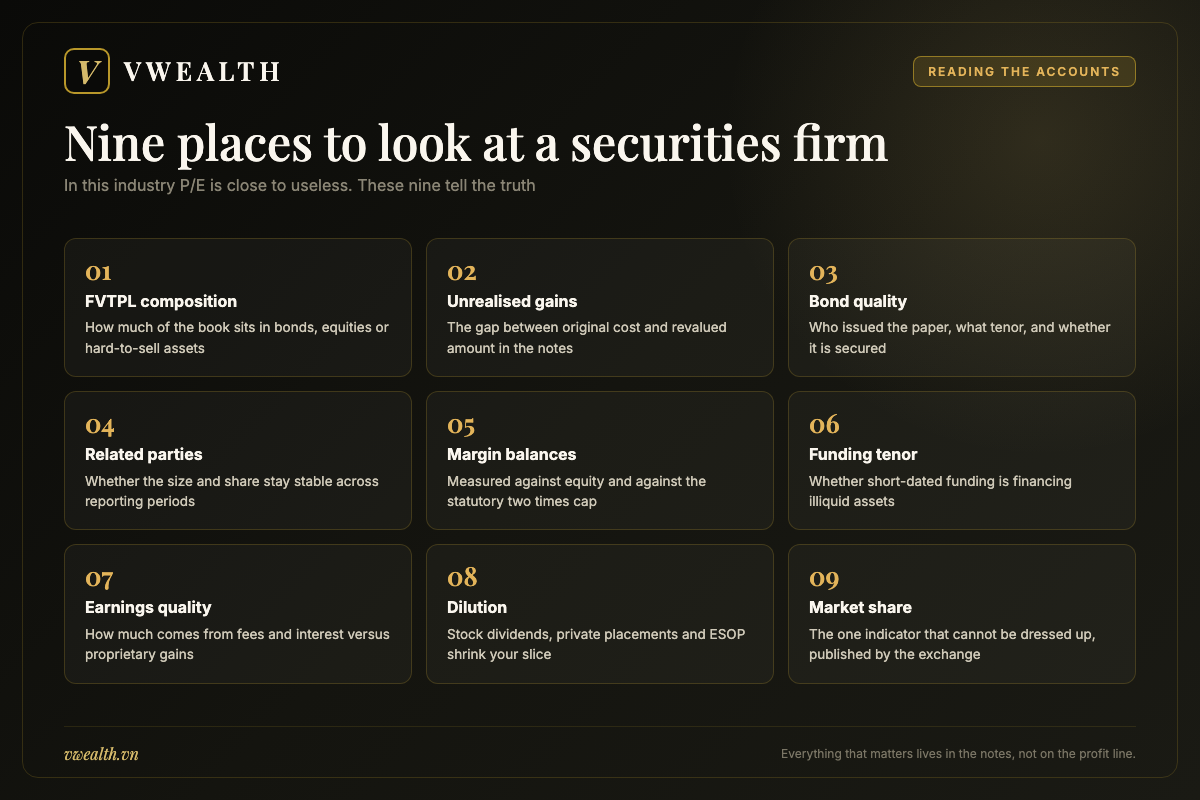
This is the most important chapter in the article, and the one you should reread every quarter. Because reading the accounts of a securities firm is nothing like reading those of a manufacturer. At a factory you look at revenue, gross margin, inventory, capacity utilisation. At a brokerage almost none of those concepts exist. What you look at instead is a balance sheet stuffed with financial assets, a leveraged funding structure, and an income statement in which most of the numbers are the result of revaluation rather than of selling anything.
P/E is close to useless here; P/B is the measure — but P/B has a trap
The price-to-earnings ratio is the most widely used valuation tool in the world and it is nearly worthless for a securities firm. The reason is simple: the denominator dances. A broker can earn enormously in a rising quarter and lose money in a falling one without anything about the underlying business changing. A P/E calculated on that denominator produces a meaningless answer: artificially low at the top of the cycle, when profit has inflated the most, and sky-high or negative at the bottom. Using P/E to buy brokerage stocks is the fastest way to buy the peak.
Instead the market uses price-to-book — share price divided by book value per share. The logic is sound: a brokerage’s assets are mostly financial assets with observable market prices, so book value approximates real value reasonably well. A P/B of 1 means you are paying exactly book value. A P/B of 2 means you are paying double, and you are paying for an expectation that the company will earn a better return on that capital than its peers.
But P/B carries a very specific trap at SHS, and you need to see it. When a company repeatedly issues new shares below market price — through rights issues to existing holders, through employee stock ownership plans (ESOP), through private placements — book value per share is dragged toward par, and P/B appears to improve even as your slice of the company is diluted. In the other direction, every stock dividend increases the share count without increasing equity, so book value per share falls and the screen P/B rises even though nothing fundamental has changed.
The way to handle it: never read P/B as an absolute number. Read it along two axes. First, against SHS’s own history — what P/B range has this stock traded in over the past three to five years, and where does it sit on that range now? Second, against peers at the same moment in time. And always check whether the share count changed between the two observations.
Checks one and two: the shape of the FVTPL book and unrealised gains
Open the notes to the financial statements and find the section on financial assets at fair value through profit or loss. Two of the most important pieces of information about SHS’s real health live there.
The first is the composition of the book: what percentage is bonds, what percentage is listed equities, what percentage is unlisted equities, and what percentage is certificates of deposit and other instruments. For SHS in 2026, bonds have grown to roughly two-thirds of the portfolio with equities compressed to about one-third. You need to track this ratio quarter by quarter because it tells you which way management is betting. A bond-weighted book means steadier profit but less capacity to explode higher when equities rally. If the equity weighting suddenly jumps back up, understand that the risk in the SHS shares you hold has just risen, even if the price has not yet reflected it.
The second is the gap between cost and fair value. The note always shows two columns: original purchase cost, and revalued amount at the reporting date. The difference between them is the unrealised gain or loss — not sold, not cash. If SHS reports a big profit but most of it sits in revaluation, understand that the profit can evaporate next quarter if markets turn. Conversely, if the company is carrying a large unrealised loss, that may be latent profit for future quarters should markets recover — provided the position is still held.
Checks three and four: bond portfolio quality and related-party transactions
This is the part most retail investors skip, and it is the single most worthwhile passage in SHS’s 2026 accounts — precisely because the company is migrating hard into bonds.
A corporate bond portfolio is not a homogeneous block. Government bonds differ from bank bonds, bank bonds differ from property developer bonds, and secured bonds differ from unsecured ones. Two portfolios of identical size can carry risk that differs by an order of magnitude. Vietnam’s 2022 corporate bond episode is still recent: when several issuers lost the ability to pay, the institutions holding and distributing those bonds suffered a chain reaction in both financial and reputational terms.
What to do: open the note, and look at who issued the bonds in the book, what sector they belong to, what the tenors are, and whether they are secured. If the book leans toward government and bank paper, credit risk is low. If it concentrates in non-bank corporate issuers, and particularly in a handful of large issuers, concentration risk rises materially.
Alongside that, read the related-party transactions note. Disclosure is mandatory and it usually sits near the end. It lists transactions between SHS and the entities and individuals connected to it by ownership or by shared leadership. Reading it is not an act of suspicion — it is the routine work of a responsible shareholder. What you are looking for is scale and character: were the transactions conducted on ordinary commercial terms, what proportion of total revenue or total book do they represent, and have they risen abnormally across periods? A stable proportion with clear explanation is normal. A share that balloons with no explanation is a signal to dig further.
Checks five and six: margin loans to equity, and the funding structure
Vietnamese law caps a securities firm’s total margin loan book at two times shareholders’ equity. That is a hard ceiling, and it creates a very useful ratio: margin loans outstanding divided by shareholders’ equity.
How to read it: the closer to the ceiling, the more fully the firm is exploiting its lending headroom, the higher the profit from that line — but also the higher the risk and the less room left to grow. A firm near the cap has only two paths to growth: raise capital (diluting shareholders) or stop. A low ratio, conversely, means plenty of headroom the firm has not used — perhaps out of prudence, perhaps because there are not enough clients wanting to borrow.
At SHS, read this ratio alongside the plan to raise charter capital above VND 10 trillion. If capital rises and the loan book does not keep pace, return on equity gets diluted. If the loan book grows faster than capital, the company is consuming its headroom and you should pay close attention to the credit quality of what it has lent against.
Check six is the funding structure. A securities firm does not run on equity alone; it borrows from banks, issues its own corporate bonds, and takes short-term funding to finance the trading book and the loan book. The thing to inspect is tenor: if a firm is using short-dated funding to finance long-dated assets or an illiquid book, that is textbook liquidity risk. In a market shock, creditors demanding repayment at the same moment that assets cannot be sold is the scenario that has felled financial institutions far larger than SHS.
Checks seven and eight: earnings quality and dilution
Earnings quality, at a brokerage, has a precise definition: what percentage of profit comes from service fees and lending interest — the repeatable sources — versus what percentage comes from investment gains, which depend on the market.
The calculation is straightforward. Add lending interest, brokerage revenue, advisory revenue and custody revenue into one bucket called “fee and interest income”; put “gains and losses on financial assets” beside it. The ratio between the two tells you whether you are looking at a service business or an investment fund wearing a service business costume. At SHS the ratio is shifting favourably: during 2026 the core divisions grew while proprietary trading stalled. If that trend persists across several quarters, SHS’s earnings quality is genuinely improving — and that is a legitimate reason for the market to pay a higher price-to-book.
Check eight is dilution, and at SHS it is a permanent risk rather than an occasional one. Look at the history: VND 350 billion to VND 1 trillion, to VND 2,072 billion, to VND 3,252 billion, to VND 8,131 billion, to VND 8,994 billion, and a plan to exceed VND 10 trillion. Every capital increase through new issuance shrinks your ownership unless you write another cheque to follow your rights. The 2026 plan contains all three formats: stock dividends, a private placement to investors, and an ESOP for staff. Before each round, recompute for yourself: after the issue, how much equity and how much profit does one SHS share still represent?
Check nine: where SHS really sits in the industry, measured three different ways
The final check is not in the financial statements at all. It is the exercise of placing SHS beside its competitors and measuring it three different ways — because each ruler produces a different ranking, and the distance between those rankings is the story of this stock.
The first ruler is shareholders’ equity. On this measure SHS sits in the leading group of the industry — more than VND 10 trillion of equity, a scale very few Vietnamese brokers reach.
The second ruler is brokerage market share. On this measure SHS is outside the top ten on the very exchange where it is listed. The distance between ruler one and ruler two is the central paradox of SHS, and equally the place where the upside is stored if management can close it.
The third ruler is return on equity. This is the fairest measure, because it asks the blunt question: how much profit does each dong of shareholder capital generate per year? For a company with plenty of capital and a modest franchise, this number tends to sit below the industry norm. Use it to grade management year by year, and compare it against the listed Vietnamese financial sector broadly — a bank such as VPBank or Sacombank will give you a sense of what a mature returns profile looks like on a comparable capital base.
| # | Metric | Where to find it | Good sign | Warning sign |
|---|---|---|---|---|
| 1 | FVTPL portfolio composition | Financial assets note | Stable weighting toward bonds and liquid assets | Sudden swing into equities or hard-to-sell assets |
| 2 | Unrealised gains and losses | Cost versus fair value columns | Realised gains make up the bulk of profit | Profit is mostly revaluation, with no cash received |
| 3 | Bond portfolio quality | Detailed issuer note | Weighted toward government and bank paper | Concentrated in a few non-bank corporate issuers |
| 4 | Related-party transactions | Note near the end of the statements | Stable proportion, clearly explained | Expanding quickly with no explanation |
| 5 | Margin loans to equity | Balance sheet and lending note | Headroom remaining below the 2x cap | At the cap, or spiking within a single quarter |
| 6 | Funding mix and tenor | Liabilities section | Funding tenor matched to asset tenor | Short-term funding financing illiquid assets |
| 7 | Earnings quality | Income statement | Fee and interest income rising as a share of the total | Profit almost entirely dependent on proprietary trading |
| 8 | Dilution | AGM resolutions and issuance filings | Capital growth matched by profit growth | Capital outgrowing profit over several periods |
| 9 | Quarterly brokerage market share | Exchange publications | Rising steadily toward the 3% mark | Flat or falling despite large capital increases |
How the market treats SHS stock: the default brokerage name on the Hanoi exchange
There is something a balance sheet will never tell you: who buys this stock, why they buy it, and when they usually sell it. With SHS the answer has been stable for more than a decade, and you need to know it before you place an order — because a stock’s personality shapes your experience of owning it more than its earnings ever will.
High beta and a very distinctive shareholder base
Beta measures how sensitive a stock is to the broad market. A beta of 1 means the stock moves in step with the index. A beta above 1 means it amplifies: the market rises one percent, it rises more; the market falls one percent, it falls further.
The entire Vietnamese brokerage sector carries a high beta, and SHS sits in the highest cohort. The cause is structural rather than psychological: broker revenue comes from market turnover, and turnover rises and falls in the same direction as the index but with much larger amplitude. A market up twenty percent can double turnover; a market down twenty percent can shrink turnover to a third. Broker profits therefore swing harder than the index, and share prices reflect that.
The SHS shareholder base is equally distinctive. This is one of the most familiar tickers to retail investors in northern Vietnam — a legacy of the years when SHS ranked in the HNX top five for brokerage share and ran a dense branch network across Hanoi and the surrounding provinces. Many investors knew this ticker before they knew how to read a balance sheet, and they trade it out of habit. Add the fact that SHS is the largest brokerage stock still listed on HNX and the ticker becomes the default sector proxy on the Hanoi exchange. The result: healthy liquidity, violent price swings, and a price that reacts extremely fast to any news about the market as a whole.
Three great waves in the price history of SHS
Look at the long-run chart and you see three distinct waves, each teaching a different lesson.
Wave one, 2009. SHS listed in the middle of a violent recovery off the crisis low, and the stock flew with its sector. Two years later, at the end of 2011, the same stock closed at VND 1,270. The lesson: in this industry, a cycle of euphoria and a cycle of despair can sit less than twenty-four months apart.
Wave two, 2020–2021. The new retail investor wave lifted turnover to levels never seen before. Brokerage stocks became the market’s leadership group. SHS peaked at VND 51,500 on 18 November 2021. Then 2022 arrived: global rates reversed, the domestic corporate bond market suffered a confidence shock, and the brokerage group fell harder than the index. The lesson: brokerage stocks tend to peak before earnings peak, because the market prices expected turnover rather than the last reported quarter.
Wave three, 2025–2026. This is the market reclassification wave. Once it became clear Vietnam was on track for promotion to secondary emerging market status, brokerage stocks were treated as the most direct beneficiaries and money flowed in hard. SHS was among the names bought, and PYN Elite Fund’s arrival on the major shareholder register in the first quarter of 2026 is one piece of that picture.
Three waves, one repeating pattern: brokerage stocks rise when expected turnover rises, and fall before the reported numbers deteriorate. If you intend to buy SHS, accept that you are trading an instrument for betting on the market cycle — do not talk yourself into believing you are holding a steady compounding business.
The exchange migration: a technical catalyst almost nobody is watching
This is where SHS differs completely from every other brokerage stock in 2026, and it is the point fewest retail investors think about.
Under Vietnam’s market restructuring roadmap, every stock currently listed on HNX — more than three hundred and thirty tickers — will be moved to a listing on HOSE. The deadline has been adjusted and now sits at the end of 2026, after which the stocks registered for trading on UPCoM, the third and least regulated tier, follow. In substance this is the final step in consolidating the entire equity market onto a single exchange, so that HNX can convert fully into the bond and derivatives venue.
For SHS — the largest brokerage stock still on HNX — the migration produces three concrete consequences.
First, the daily price band. On HNX the band is plus or minus ten percent per session. On HOSE it is plus or minus seven. After the move, the maximum single-session swing in SHS narrows. For a high-beta name with many short-term traders, that is a change you feel in the daily experience of holding it.
Second, index eligibility. The index families that foreign funds and ETFs actually track — VN30, VN100 and the international benchmarks constructed on HOSE constituents — only admit HOSE-listed stocks. A stock sitting on HNX is effectively excluded from most index-driven money. Moving to HOSE puts SHS in front of an investor group it previously could not reach. Layer that on top of the country’s index reclassification and you have two catalysts stacked on each other, which very few stocks enjoy simultaneously.
Third, sentiment and liquidity. In Vietnamese market history, many stocks moving from HNX or UPCoM to HOSE have recorded higher turnover and better valuations, simply because visibility improved and the investor pool widened. Nothing guarantees it repeats for SHS, but it is a real factor to put into the equation. What matters is that you track progress through official filings from the company and the two exchanges, rather than trading on rumour.
Foreign ownership, room, and one privilege the brokerage sector enjoys
Here is something many investors do not know: securities firms are one of very few sectors in Vietnam where foreign investors may own up to one hundred percent of charter capital, provided the company’s own charter does not set a lower limit. Banks are capped at thirty percent. Many conditional sectors are capped at forty-nine percent or lower. Brokerage is open.
This is why, over the past decade, Korean, Taiwanese and Japanese financial groups have bought Vietnamese mid-tier and small brokers outright, turned them into subsidiaries and injected cheap capital to win margin lending share. Open room is also why PYN Elite Fund could push its holding in SHS above eight percent without bumping into any ceiling.
For an SHS shareholder this cuts both ways. On the positive side, the stock is permanently within reach of foreign capital, and in a longer-dated scenario a well-capitalised brokerage with a long-established brand is always a potential target for a foreign strategic partner — a scenario the market tends to revalue very aggressively when it happens. On the side requiring care: competition in the industry is fiercer for exactly the same reason, because foreign-owned rivals typically enjoy materially cheaper funding and are willing to accept thinner margins to win clients.
SHS against its peers: several completely different ways to make money
The quickest route to understanding SHS is to set it beside others in the same industry. What you find is that “brokerage stock” is not the homogeneous category most people assume.
VIX Securities is the pure financial investment model: very large capital, profit determined by the proprietary book, brokerage share small relative to capital, ownership dispersed with no controlling holder. It is the clearest contrast to SHS on the register and the closest match on the balance sheet.
The bank-owned brokers represent a different model entirely — cheap funding from the parent, a captive client base cross-sold through the branch network, and a willingness to run brokerage at a loss to build the loan book. If you want to understand where their advantage comes from, start with the parents themselves: TPBank is a useful case study in how a digitally-led Vietnamese bank builds a retail funding base, which is precisely the raw material a discount broker needs.
And where does SHS sit? Somewhere between the pure investment houses and the full-service leaders, and moving deliberately toward the latter. It resembles VIX in having large capital and small brokerage share. It differs from VIX in having a publicly stated strategy to close that gap, an ecosystem that supplies investment banking flow, identifiable institutional shareholders, a consistent cash dividend policy, and an actively de-risked proprietary book. If VIX is a bet on the market cycle, SHS is a bet on the market cycle plus a bet on management execution. Two layers of wager, two layers of risk — and two layers of opportunity.
| Criterion | SHS | VIX Securities | Bank-owned brokers | Full-service leaders |
|---|---|---|---|---|
| Listing venue | HNX, scheduled to migrate to HOSE | HOSE | Mostly unlisted subsidiaries | HOSE |
| Main profit source | Margin lending and proprietary, shifting toward services | Proprietary trading dominates | Margin lending funded cheaply by the parent | Balanced across brokerage, lending and IB |
| Brokerage market share | Modest versus capital; target is a return to the top ten | Small relative to capital | Leading, won through the commission war | Consistently in the leading group |
| Ownership structure | Identifiable holders: a foreign fund and a domestic group | Dispersed, no holder above 5% | Controlled by the parent bank | Founding shareholder groups with control |
| Cash dividends | Paid consistently for several years | Mainly stock | Paid up to the parent | Varies by company |
| 2026 idiosyncratic story | Exchange migration plus repositioning as an investment institution | Capital scale and the proprietary book | Continued share capture in retail | Direct beneficiaries of reclassification flows |
Vietnam’s brokerage industry in 2026: the market got upgraded — now what?
2026 is the year Vietnam’s brokerage industry received the largest gift in the twenty-six-year existence of the market — and also the year competition within that industry became the fiercest it has ever been. Both things are true at once, and you need to understand both before deciding whether to buy SHS stock or any other broker on the board.
The market upgrade: one and a half billion dollars and an open door
On 8 April 2026, in its interim review, FTSE Russell confirmed the roadmap for reclassifying Vietnam from frontier market to secondary emerging market status. Allocation of Vietnamese stocks into FTSE Russell’s global index families begins on 21 September 2026 and completes in September 2027.
The figure quoted most often: index-tracking funds are expected to deploy approximately US$1.523 billion into Vietnamese equities, phased across tranches running from September 2026 to September 2027. Include active flows — funds not obliged to replicate the index but which adjust allocations by market classification — and total estimated inflows range from three to six billion US dollars.
To reach this milestone Vietnam had to deliver three concrete things: launch a new trading system built with the Korea Exchange, remove the pre-funding requirement for foreign investors, and loosen foreign ownership limits. All three land directly on securities firms — particularly the removal of pre-funding, because it transfers settlement risk from the foreign investor onto the broker serving them. Under the old regime a foreign buyer had to have cash in the account before an order could be placed, which many global institutions simply refused to do. Removing it opened the door, and put the broker on the hook.
For brokerage stocks, reclassification is a double catalyst. Layer one: foreign inflows lift whole-market turnover, and turnover is the raw material of the entire industry. Layer two: the larger brokerage stocks themselves become candidates for index inclusion and receive buying directly. That is why this sector typically runs ahead of the market in every reclassification story in every country that has been through one.
But something should be said plainly: reclassification has been known and anticipated for a long time, and is priced in to some degree already. The question for a 2026 investor is no longer “will Vietnam be upgraded” but “will actual flows match the expectation already embedded in the price”. That gap between expectation and reality is where money is made and equally where it is lost.
How the zero-commission war reshaped the whole industry
Before 2020 the business model of a Vietnamese broker was simple: hire a lot of brokers, give each a book of clients, charge a commission on every executed order, pay the broker a slice. Commission rates typically ran between 0.15 and 0.35 percent of order value.
Then a group of firms broke the rules of the game. They cut commissions to token levels, in some cases waiving them for life, and made the money back on margin interest instead. The logic was sharp: brokerage fees are a small and eroding revenue line, while lending interest is the large one — so use zero commissions as bait to capture the client base, then earn on the loan balances of that same base.
The result after a few years is heavy concentration at the top. In the first half of 2026, VPS held around 18 to 19 percent of HNX equity brokerage share, TCBS nearly 10 percent, followed by SSI, VNDirect and a string of other names. In derivatives, concentration is even more extreme: VPS holds roughly a third of the market, DNSE roughly a quarter, and the top ten firms account for more than 93 percent of the whole thing. On both fronts, a small group controls most of the game.
For a firm like SHS, this war forces a hard choice: either join the price race and burn money for years to buy share, or go around it by climbing into a higher-value service tier where clients do not select a provider on price alone. SHS chose the second road, with the wealth management strategy and the one-stop shop model. It is the economically sensible choice, and also the one that takes the longest to prove.
The capital-raising race: everybody inflated at once
Between 2021 and 2026, nearly every large Vietnamese broker raised capital multiple times. The common driver is that two-times-equity cap on margin lending: to lend more you need more equity, and there is no other route.
The consequences of that race deserve thought. First, total industry equity grew far faster than market turnover. That means the same revenue pie now has considerably more capital queued up to share it — and industry-wide return on equity trends down. Second, expanded lending headroom pushed firms to compete on margin interest rates, eroding the margin on the very business that was supposed to be the profitable one. Third, existing shareholders were diluted again and again.
This is the backdrop against which you must place SHS’s plan to lift capital above VND 10 trillion. The question is not “is raising capital good” — it is “will the incremental capital earn at least as much as the existing capital”. If yes, that is real growth. If no, it merely makes the company bigger rather than richer, and the people who pay for it are the shareholders who were already there.
Restructuring two exchanges: HNX leaves the equity business
A large structural change is under way that gets far less coverage than the reclassification story: the consolidation of the entire equity market onto a single exchange.
Under the roadmap, more than three hundred and thirty stocks currently listed on HNX will move to HOSE, with a deadline at the end of 2026; the UPCoM-registered stocks follow afterward, also to HOSE. HNX will focus on operating the bond market and the derivatives market.
For the market at large, this concentrates liquidity, unifies trading standards, and makes index construction far easier for international investors — an important condition of integration. For SHS specifically, it directly affects its own stock as analysed in chapter five, and it simultaneously affects the business: as HNX becomes the bond and derivatives venue, brokers strong in those two areas gain room to grow.
This is also why SHS pushing hard into fixed income products — including the SH Bond product launched in August 2026 — has strategic logic rather than being an opportunistic gesture. Vietnam’s bond market remains very small relative to the size of its economy and relative to regional peers, and it is precisely the ground regulators want developed after the 2022–2023 clean-up.
The headwinds nobody should forget
After four sections of good news, a section on industry risk is due — because in this business, risk does not arrive gradually. It arrives over a handful of sessions.
Cycle risk. This is the biggest and it cannot be engineered away. All industry revenue depends on turnover, and turnover depends on sentiment and on the level of interest rates. A rate-tightening cycle, an external shock, or simply retail money growing tired after a period of euphoria — any of these can halve turnover within months. 2011 and 2022 are the two most recent occasions it happened.
Clustered margin risk. When the whole industry pushes loan balances high at the same time, secured against largely the same stocks, a sharp drop triggers simultaneous forced selling. Supply crushes the price, the falling price triggers more liquidation — a spiral Vietnam has seen repeatedly, and one that spares nobody.
Bond risk. As brokers rotate their books into bonds, they reduce price volatility risk and take on credit risk — the risk that an issuer cannot repay. That risk is silent for years and then detonates once, and when it does the damage is real cash rather than a revaluation entry.
Policy and technology risk. This is a heavily regulated industry: capital adequacy ratios, lending caps, product rules, advisory rules. A single regulatory document can rewrite the economics of an entire division. On top of that sits operational risk — the industry runs on software, and a system outage lasting long enough can cost client relationships that are hard to win back.
Looking forward: three scenarios for SHS stock and what would have to be true for each
This section does not forecast a price. Nobody can forecast the price of a brokerage stock, because doing so means forecasting the mood of an entire market over many months. What this section does instead is lay out three paths that could unfold, each with its own observable conditions — so that every quarter you can check the evidence yourself and see which way reality is drifting.
Three genuine drivers ahead
Driver one: reclassification flows and the turnover cycle. Allocation of Vietnamese stocks into the FTSE index families begins in September 2026 and runs through September 2027. That is scheduled money, not a rumour. If it drags active flows along with it and lifts whole-market turnover durably, every broker benefits — and SHS, with a large equity base and remaining lending headroom, is among those best positioned to exploit it.
Driver two: the migration to HOSE. This is a catalyst specific to SHS that most competitors do not have, because they have been on HOSE for years. The move opens the door to index inclusion, widens the institutional investor pool, and in many historical cases has come with improved liquidity.
Driver three: the market share gap. This is the largest driver in value terms and the hardest in execution terms. Moving from roughly 1.65 percent to roughly 3 percent means nearly doubling the volume routed through SHS’s system. For a business whose costs are largely fixed, the incremental revenue converts to profit at a very high rate. If SHS achieves it, the earnings impact dwarfs anything a capital raise could deliver.
The bull case: capital and strategy both convert into market share
In this scenario the three drivers reinforce each other. Reclassification proceeds smoothly, foreign flows arrive on schedule, and whole-market turnover establishes a durably higher base. SHS completes its move to HOSE and comes into view for index funds and institutional investors. The plan to raise capital past VND 10 trillion is executed at a sensible issue price, and the incremental capital goes straight into margin lending with the loan book expanding in step.
Most importantly, brokerage market share begins ticking up steadily quarter after quarter — it does not need to leap, it only needs a clear and continuous trend toward the 3 percent mark. The investment banking division wins mandates from clients outside the ecosystem, proving capability rather than merely proving relationships. The wealth management division begins reporting assets under management figures it can publish. A proprietary book weighted toward high-quality bonds smooths earnings and compresses the quarter-to-quarter swing in results.
When all of that happens together, the thing that changes is not just profit but how the market values the business. A broker earning mostly from fees and lending interest commands a materially higher price-to-book than one earning mostly from proprietary trading — because forecastable cash flow is worth more than lucky cash flow. That is the real prize in the bull case: not one blowout quarter, but a higher baseline valuation.
Observable conditions: brokerage market share rising for at least four consecutive quarters; fee and lending income rising as a share of total revenue; the HOSE migration completed; at least one large investment banking mandate from a client outside the ecosystem; PYN Elite Fund holding or increasing its stake.
The base case: bigger, steadier, but still not different
This is the highest-probability path, and it is not a bad one — it is simply not spectacular.
Here the market is upgraded and turnover improves, but foreign flows arrive more slowly than hoped because the allocation process stretches over a full year. SHS completes its exchange migration, raises capital as planned, keeps growing the margin loan book, and improves core profit steadily. The bond-weighted proprietary book makes results less volatile but also means the company misses the windfall quarters when equities surge.
But brokerage market share creeps up only slowly — perhaps from 1.65 percent to around 2 percent over several years, not enough for the top ten. The reason is not that SHS executes badly; it is that the competition does not stand still. The leaders have better technology, cheaper funding, and already own the new retail cohort. The wealth management division remains in build phase, spending more than it earns. Investment banking grows but still leans substantially on ecosystem transactions.
The outcome: SHS remains a high-beta brokerage stock, bought when the market is euphoric and sold when it cools, with a reasonably consistent cash dividend acting as an anchor. You make money if you buy at the right point in the cycle and lose money if you buy at the wrong one — exactly as has been true for seventeen years.
Observable conditions: market share flat or rising very slowly; core profit rising but return on equity not visibly improving because capital rises alongside it; the cash dividend maintained; the revenue mix shifting only gradually.
The bear case: the cycle turns while the balance sheet is at its largest
A brokerage’s bad scenario never begins at the brokerage. It begins in the market.
Picture it: after the reclassification euphoria, foreign inflows come in below expectations or reverse once the allocation is finished. Domestic interest rates rise again, deposits look attractive, and retail money leaves equities. Turnover contracts fast. The market falls hard over a few weeks and triggers broad forced liquidation.
At that moment SHS is carrying the largest balance sheet in its history: equity above VND 10 trillion, a margin loan book elevated after many quarters of growth, and a substantial proprietary portfolio. Three things come under pressure simultaneously. The equity portion of the trading book is revalued down and drives profit negative. The loan book faces recovery risk on names that have lost their bid. Brokerage revenue contracts with turnover. And investment banking freezes almost entirely, because no company issues equity into a collapsing market.
Add one more layer specific to this period: the bond portfolio. If a downturn pushes several issuers into payment difficulty, the bond line — the one everyone assumed was “safer than equities” — becomes a source of real loss rather than a temporary mark.
And the final layer: an institutional holder with nearly 8 percent deciding to reduce its position into thin liquidity, adding non-trivial supply pressure to the price.
Observable conditions: whole-market turnover falling for several consecutive months; deposit rates rising again; industry-wide margin balances at elevated levels; doubtful receivables appearing in the notes; disclosure of a stake reduction by a major shareholder.
How to actually use these three scenarios
The most common mistake is to pick a scenario to believe in, then hunt for supporting evidence and discard the rest. That is the fastest route to holding a stock far too long or selling it far too early.
The correct use: treat the three scenarios as three columns in a tracking sheet. Each quarter, when the financial statements and the exchange market share tables are published, open the sheet and tick each observable condition into its proper column. After four quarters you will see which column reality is accumulating in. No prediction required — just counting.
Four things to check every quarter with SHS, in order of importance: one, brokerage market share as published by the exchanges; two, the weight of fee and lending income relative to proprietary gains and losses; three, margin loans against shareholders’ equity; four, disclosures of ownership changes by major shareholders. Those four answer nearly every question that matters about this ticker, and all four are available in the updated vwealth analysis reports without you having to open a several-hundred-page filing yourself.
| Scenario | Market backdrop | What SHS must deliver | Observable conditions |
|---|---|---|---|
| Bull | Reclassification draws real money; turnover establishes a higher base | Market share climbing steadily toward 3%; IB wins clients outside the ecosystem; wealth management reports AUM | Four consecutive quarters of rising share; fee and interest income share rising; HOSE migration completed; foreign holder maintains or adds |
| Base | Turnover improves but foreign flows arrive slowly and in tranches | Sustain loan book growth and core profit, accepting slow market share gains | Share flat or creeping; profit rising but return on equity not visibly better; cash dividend maintained |
| Bear | Rates rise, money exits, turnover contracts, the market falls hard | Control margin book quality and bond credit quality; preserve capital adequacy | Turnover falling for months; doubtful receivables appearing; revaluation losses on the book; a major shareholder discloses a sale |
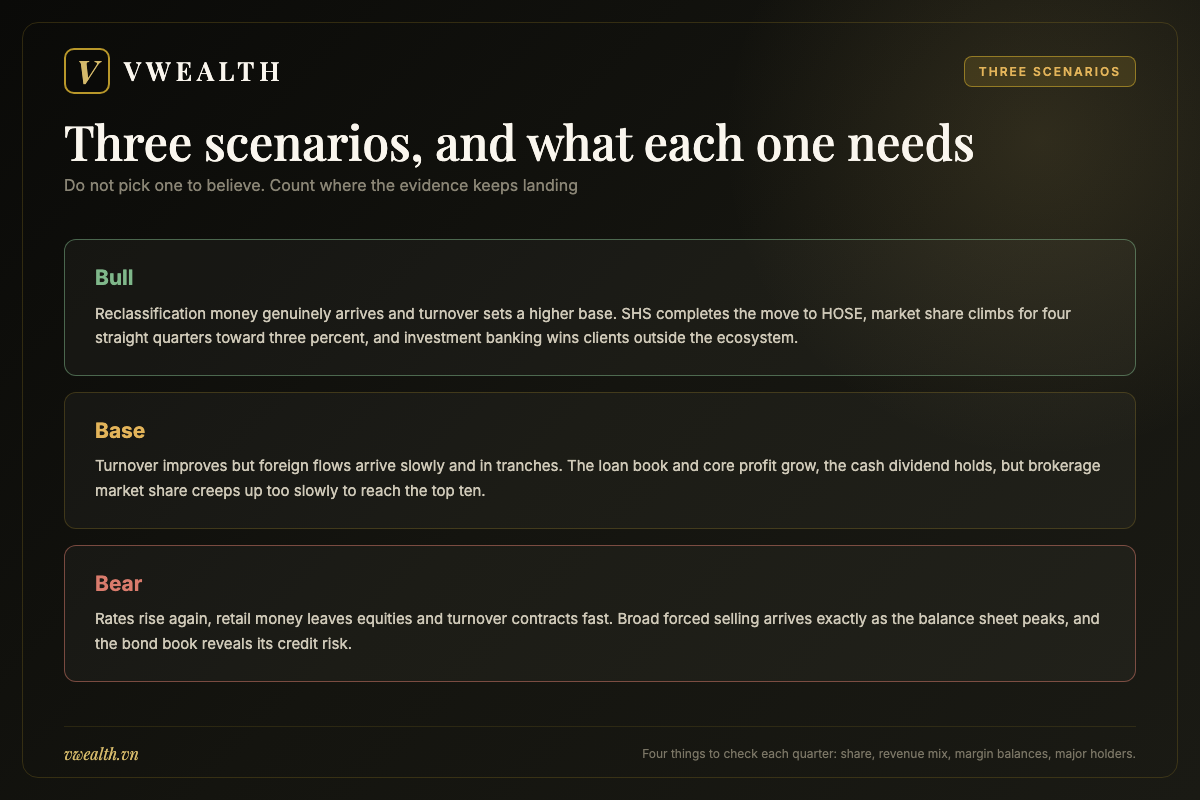
So, should you buy SHS stock? The straight answer
After seven chapters it is time to answer the question in the title. The most honest answer is that whether you should buy SHS stock depends almost entirely on what kind of investor you are, why you are buying, and how long you intend to hold. What follows is two ledgers, a set of investor profiles, and a closing assessment with no gloss on it.
The case for: what genuinely makes SHS worth looking at
A capital base among the largest in the industry. Shareholders’ equity above VND 10 trillion is not something many Vietnamese brokers can show. It lets SHS expand margin lending, underwrite issues, and absorb a bad cycle far better than competitors with similar market share. In an industry where capital is the raw material of production, that is a real advantage.
A consistent cash dividend policy. Very few Vietnamese brokers pay out hundreds of billions of dong in cash each year while the rest of the sector retains everything to build capital. For an investor who values cash actually arriving in the account, this is a clear differentiator and one you can verify across several years of history.
The HOSE migration is a catalyst nobody else has. SHS is one of the few large-capitalisation brokerage stocks still on HNX and scheduled to move. That opens the possibility of index inclusion and a wider investor base — an opportunity competitors already on HOSE have long since used up.
A proprietary book being steered toward lower-volatility assets. Deliberately lifting the bond weighting to roughly two-thirds of the portfolio is a conscious de-risking decision. If sustained, it makes SHS profit less hostage to the trading screen — something a great many peers have not managed.
Identifiable institutional shareholders. A long-only foreign fund near 8 percent and a domestic group above 5 percent create a layer of stable ownership and a healthy pressure on governance and disclosure standards.
An ecosystem that supplies investment banking flow. Very few mid-tier brokers have large corporate clients within arm’s reach. It is a good starting position in the highest-margin business in the industry.
The case against: what should make you cautious
Brokerage market share is weak relative to capital. Roughly 1.65 percent for a firm in the top tier by equity is a paradox, and it reflects years of lost ground in the commission war. This is not a problem that gets fixed in a couple of quarters.
Dilution is a permanent risk. Charter capital has gone from VND 350 billion to nearly VND 9 trillion with a plan to exceed VND 10 trillion, and the plan uses all three formats: stock dividends, private placement and ESOP. Each round shrinks your slice unless you write another cheque.
High beta and a history of extreme swings. This ticker has traded at VND 1,270 and it has traded at VND 51,500. If you cannot tolerate your position losing thirty percent in a few weeks with no bad news about the company itself, this stock will make you take the wrong decision at the worst possible moment.
Cycle risk cannot be removed. The whole industry depends on turnover, and turnover depends on rates and sentiment. 2011 and 2022 are two reminders that a broker’s profit can go from strongly positive to negative in four quarters.
Credit risk in both the bond book and the margin book. The two largest items on the balance sheet both carry lumpy risk: quiet for years, then detonating in a single shock.
The repositioning strategy has no track record yet. Returning to the top ten and then the top five, the full-service wealth model, the investment financial institution — all of it is correct on paper and only recently started. You are buying a promise that is still in the process of being proven.
Which kind of investor does SHS suit?
The sector-cycle investor. If you understand that a brokerage stock is an instrument for betting on market turnover, know which phase of the cycle you are in, and have the discipline to exit when that phase ends, SHS is one of the more liquid tools available for the job.
The investor who believes the repositioning story and has a three-to-five-year horizon. If you read the 2026–2030 strategy, believe the new management team will close the market share gap, and are willing to check the evidence every quarter, SHS gives you a clear thesis with specific, verifiable checkpoints.
The investor wanting exposure to the reclassification story through its most direct beneficiary. Brokerage stocks eat turnover directly, and SHS carries the extra layer of the exchange migration that other names do not have.
The investor who wants cash income from a cyclical sector. If you want brokerage exposure while still receiving a real cash flow into your account each year, SHS’s dividend policy is a rare plus within this group.
Who should stay away?
Anyone looking for a stable stock to buy and forget. Nothing here is stable. Profit swings by the quarter, price swings by the week, and the industry’s structure guarantees it will continue.
Anyone unwilling to read the notes to the financial statements. At a securities firm every important fact lives in the notes: portfolio composition, bond quality, loan balances, related-party transactions. If you only look at the net profit line, you are buying without knowing what you bought.
Anyone planning to buy a high-beta stock using leverage. Buying a brokerage on margin doubles a risk that is already large: you are using leverage to buy a business whose profit comes from lending leverage to other people. In a crash, the two layers find each other.
Anyone who needs the money back within twelve months. This industry’s cycle is longer than a year, and you do not control when the market turns. Short-dated money has no business in the highest-beta group on the exchange.
Four questions to answer before you place the order
One: are you buying SHS for the cycle or for the company? If for the cycle, you need an exit plan and you need to know which indicator tells you the cycle has ended. If for the company, you must accept that your thesis needs three to five years to be proven right or wrong, and that over that period the price will move violently for reasons entirely unrelated to your thesis.
Two: will you actually check brokerage market share every quarter? It is the one indicator that cannot be dressed up and the central metric of the SHS thesis. If you do not intend to follow it, you should not be buying the repositioning story — you are simply buying beta.
Three: have you recalculated your stake after the next capital raise? The plan to exceed VND 10 trillion has already been approved by shareholders. Before buying, work out for yourself how much equity one share will represent afterward, and whether you intend to follow your rights with more cash.
Four: if the price falls thirty percent tomorrow with no bad news from the company, what will you do? This is the question that really matters, and it should be answered before you buy rather than while the screen is red. If your honest answer is “sell immediately”, then you should size the position far smaller than you originally planned.
Closing: a company rewriting itself, and an invitation to bet alongside it
SHS in 2026 is a business in mid-transition. Behind it lie nineteen years containing one near-death experience, a lost golden age of market share, and a capital machine that never stopped running. Ahead of it lie an ambitious repositioning strategy, two large catalysts — market reclassification and the exchange migration — and a market share gap that its own board named out loud at the annual general meeting.
What is admirable about SHS, and what distinguishes it from many peers, is the candour. A management team that publicly admits its market share is under two percent, publicly states a target and publicly sets out a roadmap, is a management team putting itself up to be graded every quarter. For an investor that is a good thing: you get a clean yardstick for knowing whether you were right, instead of having to guess.
But do not mistake candour for certainty. The distance from 1.65 percent to 3 percent has to be taken from competitors who are stronger technologically and cheaper on funding. Wealth management needs years to reach scale. And above everything, this remains an industry in which one bad cycle can erase three good years — as 2011 proved to SHS itself.
If you do decide to buy, buy with the understanding that you are placing two bets at once: one on the cycle of the Vietnamese stock market, and one on the execution capability of a new management team. Both can win, and both can lose. What you control is not the outcome — it is your position size, your holding period, and how disciplined you are about tracking the four metrics in chapter seven.
Before you place the order, spend fifteen minutes opening the latest analysis report and working through the nine checks in chapter four. Corporate history does not change, but SHS’s proprietary book, its loan balances, its share count and its valuation change every quarter. Those fifteen minutes are the most valuable part of the entire decision. If you do not have an account yet, you can register free here to read the current data.
| Dimension | Positive | Negative | What decides the outcome |
|---|---|---|---|
| Capital scale | Equity among the industry’s largest, ample lending headroom | Capital has outgrown profit for years, with continuous dilution | Whether new capital earns as well as old capital |
| Brokerage market share | Low base means large improvement headroom and favourable operating leverage | Outside the top ten on its own listing exchange | The market share trend across four consecutive quarters |
| Proprietary book | Deliberately tilted to bonds, producing steadier profit | Adds credit risk and gives up windfall quarters | The credit quality of the issuers in the book |
| Ownership and governance | A long-only foreign fund plus a CEO hired from outside the ecosystem | Concentrated large holders who will eventually sell | Disclosures of ownership changes by major shareholders |
| The 2026 story | Reclassification plus the HOSE migration — two catalysts stacked | Much of the expectation may already sit in the price | Actual flows measured against expectations |
| Dividends | Consistent cash payments, rare in this sector | Every dong paid out is a dong not lent | Whether the dividend survives a full bad cycle |
Research Vietnamese stocks in English with vwealth. Our AI-powered platform turns Vietnamese market data into full English analysis reports — with international payment support and a free 2-month trial for new accounts. Create your free account and read the latest reports.