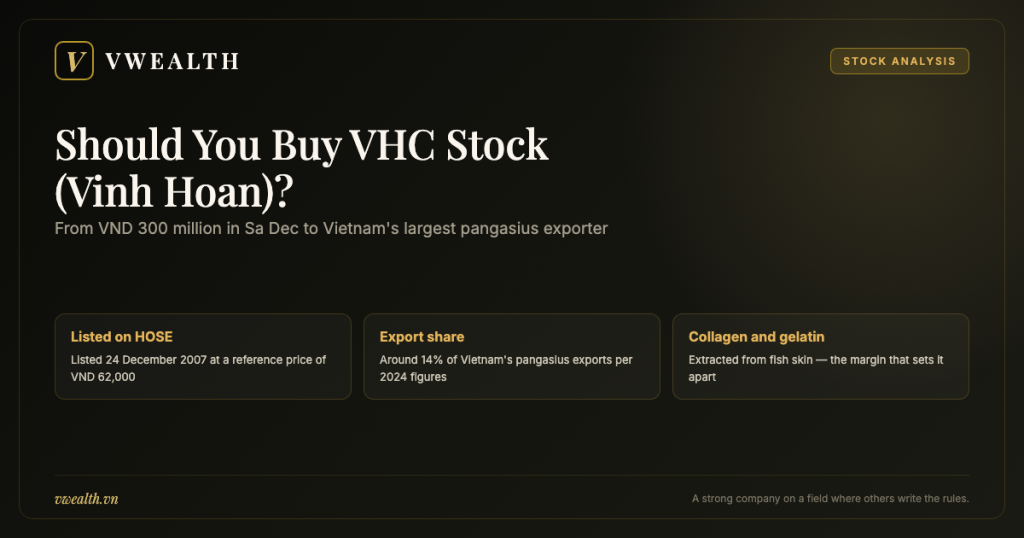
Should you buy VHC stock — the Ho Chi Minh Stock Exchange ticker for Vinh Hoan Corporation, Vietnam’s largest pangasius exporter — is a question you cannot answer by studying the Vietnamese stock market. Most of this company’s fate is decided elsewhere: in a US Department of Commerce ruling on anti-dumping duty rates, in the dong-dollar exchange rate, in the spending power of Chinese and European consumers. This is one of very few listed Vietnamese companies whose revenue comes predominantly from abroad, and that single fact changes how you must analyse it. This piece traces the company from a private enterprise founded in Sa Dec with VND 300 million in 1997, through two decades of living alongside trade remedy cases, to the high-margin collagen business of today — and ends with a straight answer about which kind of investor VHC suits, and which kind should stay away.
Before we start, the ground rules that apply to every company profile in this series.
You will encounter many dates, plant names, people and scale figures. All come from publicly disclosed sources: corporate filings, annual reports, exchange disclosures, the company’s own official channels and specialist trade media. What you will not find is a valuation multiple as of today, a live raw pangasius price, or the most recent quarter’s earnings. For a seafood exporter, a single quarter’s result depends on selling prices in each market, on raw material costs during those specific three months, and on currency movements — which means one quarter tells you very little about long-term health. Instead, this article teaches you where to look and how to read it. For current figures, open the latest research reports on vwealth.
Second ground rule: this is the first company in the series from Vietnam’s seafood sector, an industry with vocabulary many investors have never encountered — raw pangasius, fillet, value-added products, self-sufficient farming areas, anti-dumping duty, administrative review, sustainability certification. Each term is explained the first time it appears.
Third ground rule: if Vietnamese equities are new to you, read the pillar guide on how to invest in the Vietnam stock market first. It covers accounts, settlement, price bands and foreign ownership mechanics that this article assumes.
Fourth ground rule: nothing here is a recommendation to buy or sell.
From VND 300 million in Sa Dec to the top of Vietnam’s pangasius industry
There is a detail in Vinh Hoan’s origin story that few investors know, and it explains both the company’s caution and its resourcefulness: Vinh Hoan was built by a woman who left the state sector to start her own business in her thirties, with capital so small it now sounds like a joke.
1997: VND 300 million and a decision to leave the state payroll
Vinh Hoan was established in 1997 in Sa Dec, Dong Thap province, as a private enterprise with initial capital of VND 300 million. Its founder was Truong Thi Le Khanh.
Put that figure in context. VND 300 million was the scale of a small processing workshop, not a factory. Nearly thirty years later, that enterprise has charter capital of roughly VND 2,094.5 billion as of mid-2026, a network of about fifteen processing plants, its own farming areas, and the position of Vietnam’s largest pangasius exporter.
The location was not accidental either. Dong Thap sits at the centre of the Mekong Delta’s pangasius farming region, where the Tien and Hau river systems create natural conditions for this species that are close to unique globally. Pangasius grows very fast, tolerates high stocking density, and yields a white, low-bone, mild-flavoured fillet — precisely the raw material Western industrial food processing wants. Vietnam has essentially no competitor at industrial scale in this product, and that fact underpins the entire industry.
1998 to 2006: from private enterprise to limited company to joint stock company
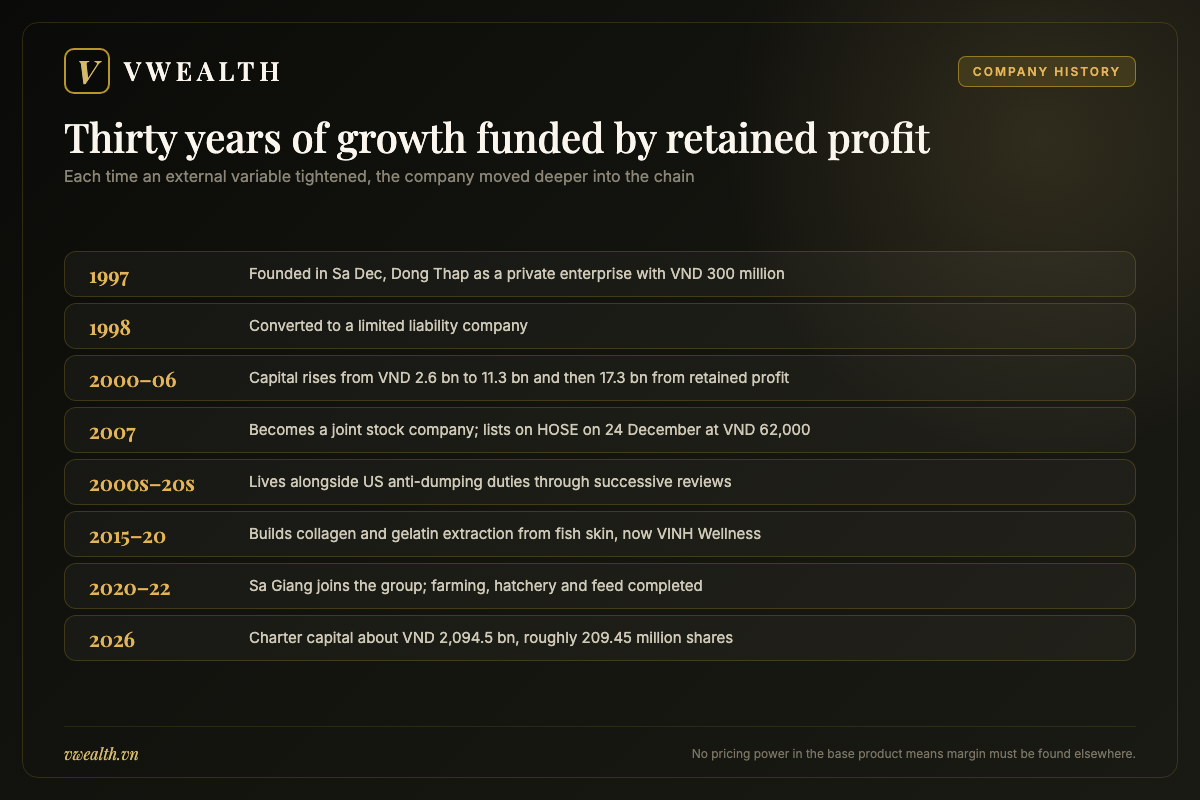
In 1998 the business converted into a limited liability company. The years that followed were a sequence of capital increases: from VND 300 million to VND 2.6 billion, then VND 11.3 billion, then VND 17.3 billion.
That sequence tells you how this company grew: not through one large capital raise, but by accumulating profit and reinvesting step by step. It is a slow but solid growth model, and it left its mark on the company’s financial structure to this day — Vinh Hoan generally carries one of the healthier balance sheets in Vietnamese seafood.
24 December 2007: listing on the Ho Chi Minh Stock Exchange
VHC shares began trading on the Ho Chi Minh Stock Exchange on 24 December 2007, at a first-day reference price of VND 62,000 per share.
That timing placed the listing immediately before the global financial crisis, and the following period was a harsh test for every Vietnamese exporter: demand in the US and Europe collapsed, credit tightened, currencies moved violently. Vinh Hoan came through it, which says a great deal about the quality of its working capital management.
From listing onwards, outside investors could see inside the company through periodic financial statements — and could see, for the first time, exactly how dependent it was on foreign markets.
Anti-dumping duties: twenty years living with one variable
This is the most important part of the company’s history, and if you skip it you do not understand VHC.
Since the early 2000s, Vietnamese frozen pangasius fillets have been subject to US anti-dumping duties. The mechanism works as follows, and you need to understand it precisely.
An anti-dumping duty is not a single fixed rate applied to an entire country. After an order is imposed, the US Department of Commerce conducts annual administrative reviews — known in the trade as PORs, for period of review. Each review examines twelve months of past export data, and the outcome is a company-specific rate for each respondent.
The consequences of this mechanism are enormous. Two Vietnamese companies selling the same fillet into the United States can face completely different duty rates. A company receiving a low or zero rate holds an almost absolute price advantage in that market; a company receiving a high rate is effectively pushed out of it.
Across many review periods over two decades, Vinh Hoan has been among the companies receiving favourable rates, and this is one of the most important reasons it has held its leading position in the US market.
But understand the nature of that advantage correctly: it is not a permanent asset. Rates are redetermined after each review, based on that period’s data and on the methodology the investigating authority applies. The final results of the twenty-first administrative review, announced on 12 August 2026 for the period from 1 August 2023 to 31 July 2024, were assessed as less favourable than the preliminary determination that preceded them.
The lesson for an investor is concrete: when analysing VHC, the duty rate from the most recent review is a mandatory data point, and it can change your investment thesis with a single announcement. This is a category of risk no management team controls.
2015 to 2020: collagen and gelatin — the second great turning point
If the anti-dumping case is the largest external variable, the collagen business is the most important internal decision in the company’s history.
The idea began with a very practical observation. When you fillet a pangasius, the saleable white flesh accounts for only part of the fish’s weight; the remainder is skin, bones, fat, head and viscera. In the old model, that remainder was sold cheaply as fishmeal or animal feed. But pangasius skin contains collagen — a protein in heavy demand across nutraceuticals, cosmetics and pharmaceuticals, at a price per kilogram many times higher than fillet.
Vinh Hoan built a collagen and gelatin extraction business from fish skin, today organised as the unit named VINH Wellness. This is the shift from selling a raw food commodity to selling a high-value industrial ingredient, and it changed the margin structure of the whole company.
Understand why this matters so much from an investment standpoint. Pangasius fillet is a near-homogeneous commodity competing on price, with thin margins and cyclical exposure. Collagen and gelatin are industrial ingredients sold to corporate customers under contracts, with demanding technical and certification requirements, so barriers to entry are far higher and margins far steadier. Put differently, every percentage point of revenue that shifts from fillet to collagen is a percentage point less exposure to the cycle.
That is the genuine long-term investment thesis for VHC — not how many tonnes of fish were shipped to America this year.
2020 to 2022: Sa Giang, agriculture and a closed chain
During this period Vinh Hoan expanded in two directions.
The first was consumer goods: the company brought Sa Giang, a long-established prawn cracker brand from Dong Thap, into the group as a member company. This step matters more strategically than by size — it gives Vinh Hoan a foothold in branded consumer goods, quite different from selling raw material to industrial buyers.
The second was completing the chain upstream: its own farming areas, hatcheries and aquafeed production, today organised under VINH Agriculture. The group also operates a technology unit, VINH Technology.
The strategic logic behind self-sufficiency in farming deserves careful attention, because it is the biggest single differentiator among pangasius companies. Externally purchased raw fish prices swing sharply with the season and with farmers’ stocking cycles. A company that raises most of its own requirement has a steadier cost base, controls quality, and can provide the traceability that large importers increasingly demand. A company entirely dependent on external purchase sees its margin swing with fish prices, exactly as a steel mill’s margin swings with iron ore.
Today: scale, certifications and position
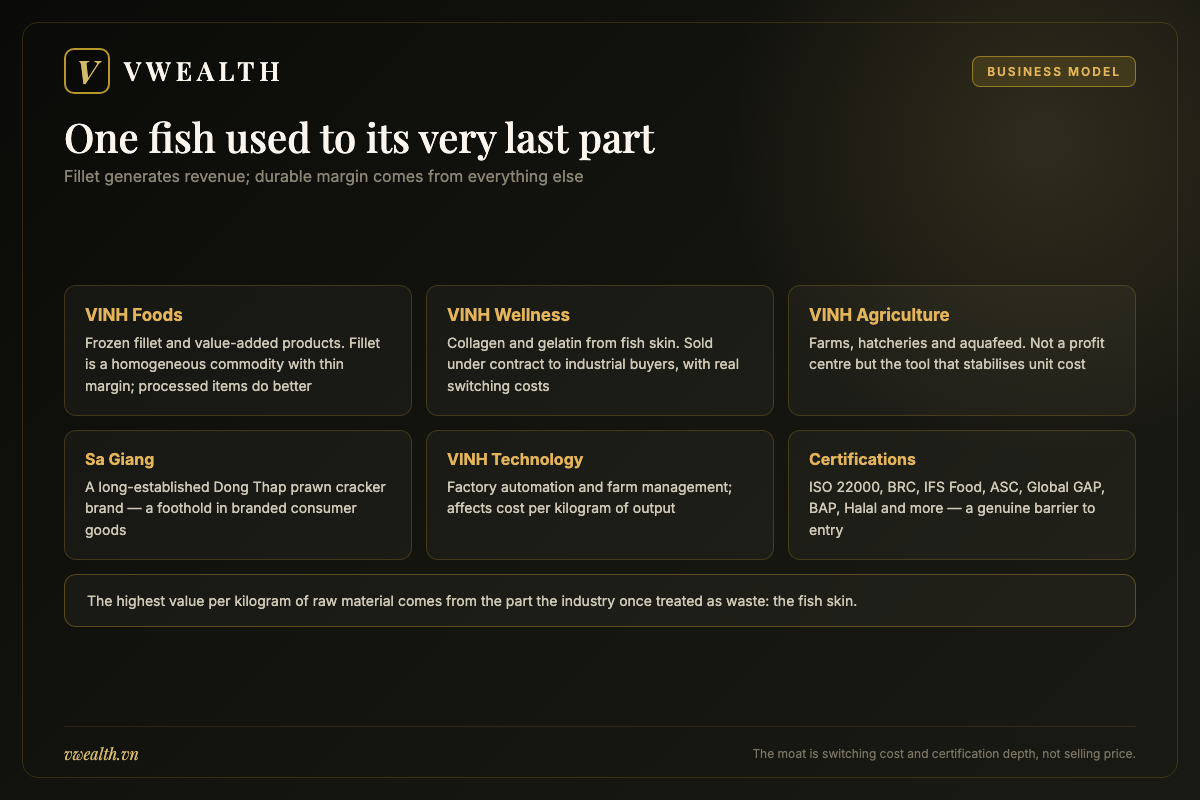
At the time of writing, Vinh Hoan is organised into five units: VINH Foods for fillets and value-added products, VINH Wellness for collagen and gelatin, VINH Agriculture for farming and agriculture, VINH Technology for technology, and the member company Sa Giang.
The company operates roughly fifteen processing plants, is headquartered in Dong Thap province, and held approximately fourteen percent of Vietnam’s pangasius export market according to 2024 figures.
One detail few investors weigh properly but which is genuinely valuable: the company’s portfolio of international certifications is unusually deep, including ISO 22000, ISO 17025, ISO 14001, BRC, IFS Food, HACCP Codex, Global GAP, ASC, BAP, BSCI, SMETA and Halal. To an outsider this looks like an alphabet soup. To someone inside the industry it is a passport: many major European and American retail chains buy only from suppliers holding specific certification sets, so this paperwork is a real barrier to entry against smaller competitors.
Historical milestones at a glance
| Date | Event | Why it matters to an investor |
|---|---|---|
| 1997 | Founded in Sa Dec, Dong Thap as a private enterprise with VND 300 million | Built by its founder with no state legacy |
| 1998 | Converted to a limited liability company | Begins a sequence of capital increases funded by retained profit |
| 2000–2006 | Capital rises from VND 2.6 bn to VND 11.3 bn and then VND 17.3 bn | Slow, solid growth leaves a healthy balance sheet |
| 2007 | Becomes a joint stock company; lists on HOSE on 24 December at VND 62,000 | Outside investors first see the scale of export dependence |
| 2000s–2020s | Lives alongside US anti-dumping duties through successive administrative reviews | Each period’s rate is a mandatory check before any decision |
| 2015–2020 | Builds collagen and gelatin extraction from fish skin, now VINH Wellness | Shift from raw commodity to high-margin industrial ingredient |
| 2020–2022 | Sa Giang becomes a member company; farming, hatchery and feed completed | A foothold in branded consumer goods plus input self-sufficiency |
| 2024 | Around 14% of Vietnam’s pangasius export market | Industry leader, yet in a highly fragmented industry |
| 12 Aug 2026 | Final results of the 21st administrative review for 1 Aug 2023 – 31 Jul 2024, less favourable than preliminary | A reminder that duty advantages are never permanent |
| Mid-2026 | Charter capital around VND 2,094.5 billion | A mid-sized capital base by HOSE standards |
Look across that timeline and a pattern emerges: each time an external variable tightened — duties, currency, consumer demand — Vinh Hoan responded by moving deeper into the value chain rather than by expanding volume. That is the strategy of a company that understands it has no pricing power in its base product, so it must find margin somewhere else.
Who runs Vinh Hoan and who actually owns it
VHC’s ownership register has a feature that very few Vietnamese companies in the same industry can match, and it deserves careful reading.
Truong Thi Le Khanh: founder and still chairwoman
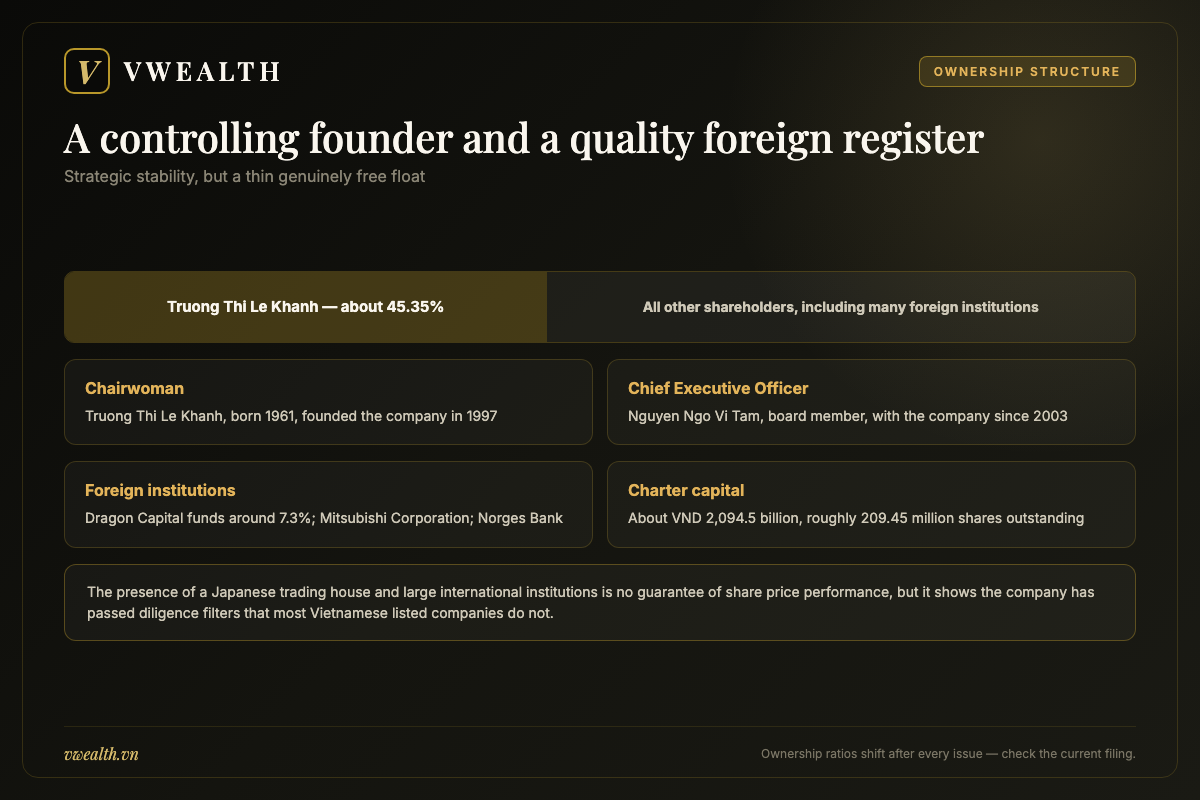
Truong Thi Le Khanh, born in 1961, founded Vinh Hoan in 1997 and has served as Chairwoman of the Board of Directors ever since. She is also the company’s largest shareholder, holding roughly 94.98 million shares, equivalent to approximately 45.35% of capital according to recent disclosures.
That 45% figure is worth pausing on. It is a very high controlling stake for a listed company, and it produces three specific consequences.
First, strategic stability. There is no risk of a control contest, no exposure to hostile takeover, and management can pursue long-horizon projects such as the collagen business without pressure from short-term shareholders.
Second, tight alignment. Most of the founder’s personal wealth sits in the company’s shares, giving her the strongest possible incentive to protect long-term value.
Third, the downside: minority shareholders have effectively no influence on major decisions, and the genuinely free-floating share count is far smaller than the listed share count. This directly affects liquidity and price volatility.
The executive team: long tenure and continuity
The Chief Executive Officer role is held by Nguyen Ngo Vi Tam, who is also a board member and has been with the company since 2003. Nguyen Thi Kim Dao serves as Finance Director, likewise a board member, having joined in 2004. Truong Tuyet Hoa is a board member involved in the commercial side. The board also includes independent members.
Two things stand out about this structure.
The first is length of tenure. Key executives have been with the company for over twenty years. In an industry where relationships with importing customers, certification systems and farming areas all take years to build, that continuity is a genuine asset.
The second is that senior leadership is predominantly female, still uncommon among Vietnamese industrial manufacturers. This is not a financial metric, but when you score corporate governance, the composition and stability of a leadership team carry meaning.
As always, verify the board and executive roster in the latest annual report yourself, since composition changes each term.
Foreign shareholders: VHC’s biggest differentiator
This is a detail investors routinely overlook, and it says a great deal about company quality.
Beyond the chairwoman, Vinh Hoan’s major shareholder list includes notable names: Dragon Capital funds at roughly 7.3%, Mitsubishi Corporation of Japan, and Norges Bank — the manager of Norway’s sovereign wealth fund — holding around 12.7 million shares according to published data.
Why does this matter?
First, a Japanese trading house such as Mitsubishi does not buy an equity stake purely as a financial investment. The presence of a large industrial partner typically accompanies commercial relationships and distribution channels, though the specifics are for the company to disclose.
Second, sovereign wealth funds and large institutional managers run demanding due diligence, particularly on environmental, social and governance criteria. Their holding is not a guarantee of share price performance, but it does show the company has passed a filter that most Vietnamese listed companies do not.
Third, and more practically: a dense foreign institutional register means this stock is sensitive to foreign flows. When international money moves into or out of Vietnam, VHC is typically among the names affected. If foreign ownership limits are unfamiliar, read the explainer on foreign room in Vietnamese stocks.
Dividends and profit distribution
Vinh Hoan belongs to the group of Vietnamese companies with a tradition of paying cash dividends, combined with stock dividends in stronger years. The specific payout varies year to year and by shareholder resolution, so check the most recent distribution plan rather than relying on a fixed number.
More interesting than the number is the logic. For an exporter with heavy working capital needs — buying raw material, growing fish for months, processing, then waiting for foreign customers to pay — retaining part of the profit is rational. But unlike many cyclical companies, Vinh Hoan is not one that must continuously raise new capital to survive, and that shows in a relatively light debt structure by industry standards.
Ownership and leadership summary
| Item | Publicly disclosed | What you should verify yourself |
|---|---|---|
| Chairwoman | Truong Thi Le Khanh, born 1961, founded the company in 1997 | Current term and insider share transactions |
| Chief Executive Officer | Nguyen Ngo Vi Tam, board member, with the company since 2003 | Division of duties within the executive team |
| Finance Director | Nguyen Thi Kim Dao, board member, with the company since 2004 | Currency risk management notes in the financial statements |
| Largest shareholder | Truong Thi Le Khanh, about 94.98 million shares, roughly 45.35% of capital | Updated ratio after any new issue |
| Foreign institutions | Dragon Capital funds around 7.3%; Mitsubishi Corporation; Norges Bank around 12.7 million shares | Changes in foreign holdings in periodic disclosures |
| Shares outstanding | Approximately 209.45 million shares | Updated count after the most recent issue |
| Charter capital | Around VND 2,094.5 billion as of mid-2026 | Any capital changes announced during the year |
| Dividends | Tradition of cash payment, with stock dividends in stronger years | The most recent profit distribution plan |
The conclusion of this chapter: VHC is a company with a real owner, an unusually stable executive team, and a foreign institutional register almost no peer can match. That is a substantial quality signal. The price is a high controlling stake that leaves the free float thin, and minority shareholders without influence over major decisions.
How VHC makes money: five units and a fish used to its very last part
If you had to describe Vinh Hoan’s business model in one sentence, it would be this: take a pangasius and find a way to earn the most possible money from every part of it.
The company organises its operations into five units. Let us walk through each, and more importantly, see how they support one another.
VINH Foods: fillets and value-added products
This is the largest unit and the company’s foundation. Its products fall into two economically distinct groups.
The first is frozen fillet — the white flesh removed from the fish, frozen and shipped by container. This is a near-homogeneous commodity. Buyers are importers, supermarket chains and industrial food processors, and they compare prices closely. Margins here are thin and swing with raw fish prices and market-by-market supply and demand.
The second is value-added products: breaded fish, marinated fish, crabsticks, fish tofu, fish strips and prepared meals. Margins are better here because you are no longer selling a frozen block of protein but a product closer to a meal, with its own recipe and process.
The mix between these two groups is an indicator worth tracking across years. A rising share of value-added products means the company is moving in the right direction, even if total revenue is flat.
VINH Wellness: collagen and gelatin, where the real margin lives
As described in chapter one, this unit extracts collagen and gelatin from pangasius skin — the by-product that once sold for very little.
Understand who this unit’s customers are, because that determines cash flow quality. Marine collagen and gelatin go into nutraceuticals, cosmetics, pharmaceuticals and certain food applications. The buyers are manufacturers in those industries, purchasing under contract with demanding requirements on purity, batch-to-batch consistency, traceability and certification.
That produces three favourable consequences. First, once a supplier is written into a customer’s product formulation, replacing it is difficult, because switching forces the customer to retest and re-register. That is a genuine switching cost, and it is an economic moat the fillet business simply does not have. Second, prices fluctuate far less seasonally than fillet prices. Third, marine collagen carries an advantage over bovine or porcine collagen in markets with religious or dietary requirements.
This is the unit to watch most closely, because it determines whether VHC ends up valued as a seafood exporter or as an industrial ingredient manufacturer.
VINH Agriculture: farms, hatcheries and feed
This unit handles the input side: the company’s own pangasius farming areas, hatcheries and aquafeed production.
The value of input self-sufficiency lies in three places.
First, cost stability. Externally purchased raw fish prices swing hard, because they depend on stocking decisions made months earlier by thousands of independent farmers — a cyclical mechanism essentially identical to the one described in the analysis of Dabaco in Vietnamese livestock. A company raising most of its own requirement avoids most of that volatility.
Second, quality control and traceability. Major European retail chains increasingly want to know which pond a fish came from, what it ate and what treatments it received. A company with its own farms can answer; a company buying on the open market cannot.
Third, sustainability certification. Standards such as ASC and Global GAP apply to farming operations rather than to factories, so obtaining them requires control of the farms.
Sa Giang: a foothold in branded consumer goods
Sa Giang is a long-established prawn cracker brand from Dong Thap, now a member company within the Vinh Hoan group.
By size it is small. By meaning it gives the company something the rest of the model lacks: a brand selling directly to end consumers, both domestically and for export.
The difference between selling to industrial buyers and selling a branded consumer product is the difference in pricing power, which is why food companies everywhere try to move downstream. For a Vietnamese food company that has travelled that entire road, compare the margin structure in the Vinamilk analysis, and for sector context read the overview of Vietnam consumer sector stocks.
VINH Technology and the part you cannot see
The technology unit supports factory automation, farm management and technical applications across the chain. This kind of investment is hard to see in the accounts but affects cost per kilogram directly — and in an industry where a few percentage points of unit cost decide winners, that is no small matter.
How the closed value chain works
Put the pieces together and the chain runs as follows. Hatcheries supply fry and fingerlings to the farms. The feed mill supplies feed to the farms. Fish reaching size move to the processing plants. There, the white flesh becomes VINH Foods fillet or value-added product; the skin enters the VINH Wellness collagen and gelatin extraction lines; remaining by-products become fishmeal and fish oil. Sa Giang works the branded consumer channel.
The strength of this model is high raw material utilisation and, more importantly, that the highest value per kilogram comes from the part the industry once treated as waste.
But as with any integrated producer, keep perspective: a closed chain is not the same as risk diversification. Every unit begins with the same fish from the same delta. A disease event, a water quality problem or extreme weather would affect all of them simultaneously. Where VHC genuinely does diversify is on the output side: collagen sold to pharmaceutical and cosmetics manufacturers follows a completely different demand cycle from fillet sold to supermarkets.
Segment comparison
| Unit | Products | Margin characteristics | What to monitor |
|---|---|---|---|
| VINH Foods | Frozen fillet and value-added products | Thin on fillet, better on processed items | Share of value-added products in total revenue |
| VINH Wellness | Collagen and gelatin from fish skin | High and stable, with customer switching costs | Capacity utilisation and share of group profit |
| VINH Agriculture | Farms, hatcheries, aquafeed | Not a profit centre but a cost stabiliser | Self-sufficiency ratio over time |
| Sa Giang | Prawn crackers and branded consumer goods | Consumer margins, small scale | Pace of distribution expansion |
| VINH Technology | Technology and automation across the chain | No material direct revenue | Impact on cost per kilogram of output |
So when someone asks how Vinh Hoan makes money, the accurate answer is: most revenue from selling pangasius fillet abroad, but the most valuable and most durable margin from everything that is not fillet.
Competitive position and financial health: seven checks before buying VHC stock
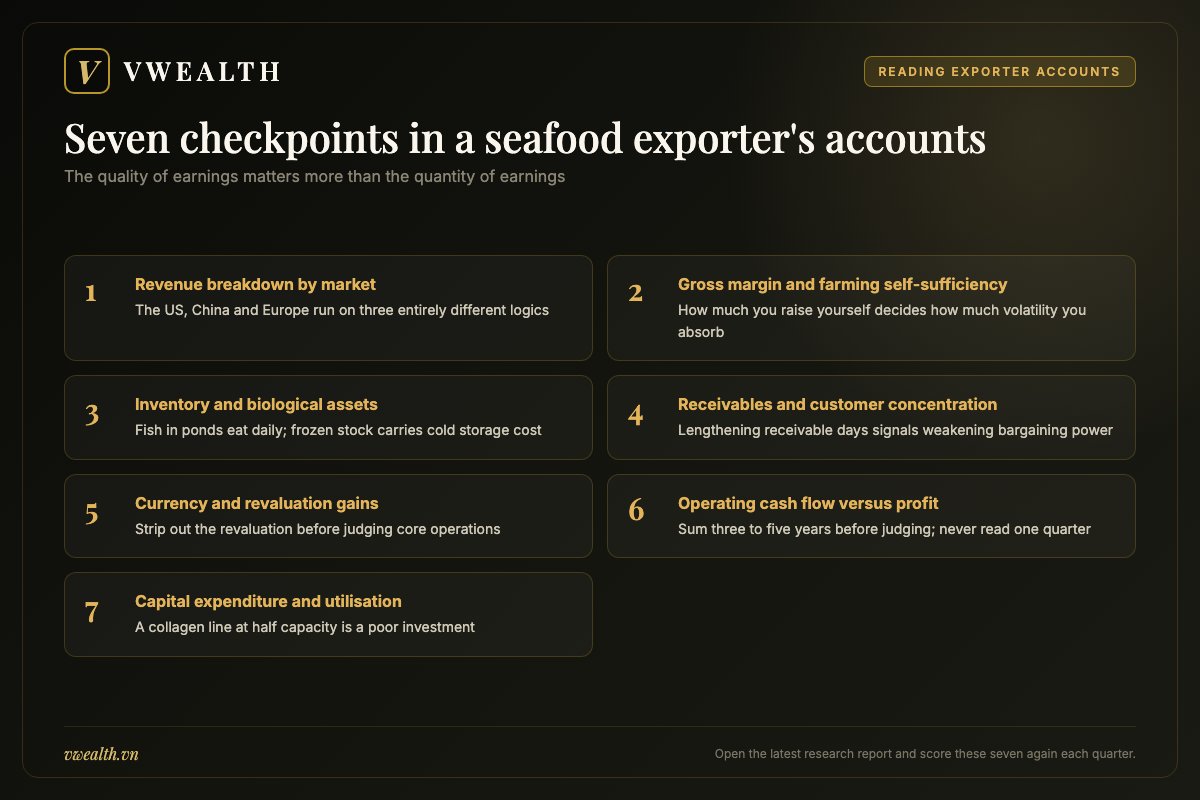
This chapter does not hand you numbers. It teaches you to read this company’s numbers. For an exporter, figures change every quarter and with every currency move, so anything printed here would expire before you read it. The method does not expire.
Check one: revenue breakdown by market
This is the first page to open, before the balance sheet.
Vinh Hoan sells into many regions. For Vietnamese pangasius the three most important are the United States, China and the European Union, alongside Brazil, Mexico, ASEAN and the Middle East.
You need to know each market’s share of revenue, because each operates on entirely different logic.
The United States offers the best selling prices but carries the highest regulatory barriers, including company-specific anti-dumping duties and food safety oversight requirements. A company with a favourable duty rate earns very good margins there; a company without one is effectively locked out.
China offers enormous volume with lower formal barriers, but lower prices, more varied quality requirements, and a different risk: quarantine policy can change rapidly, and price competition among Vietnamese exporters is intense.
Europe demands the most complete sustainability certification set and stringent traceability, but in return customer relationships tend to be more stable and change less abruptly.
Practical rule: chart revenue by market for at least the last three years. If one market’s share jumps sharply, ask whether the company is expanding or being funnelled in one direction because another door closed. Those two situations look identical on a chart and mean opposite things.
Check two: gross margin and farming self-sufficiency
A pangasius company’s gross margin is set by the gap between export selling prices and the combined cost of raw fish and processing.
On the price side, the company has essentially no control over fillet — that is a world market price. On the cost side, the degree of farming self-sufficiency is the most important variable.
Walk through the mechanism with an illustrative example using assumed figures. Suppose a company raises seventy percent of its raw material requirement and buys thirty percent externally. If market raw fish prices rise thirty percent, that company’s total raw material cost rises by roughly nine percent, because its own farmed portion has a separate and steadier cost base. A competitor buying everything externally absorbs the full thirty percent. That gap is enough for one to remain profitable while the other loses money.
This is why, when comparing pangasius companies, the self-sufficiency ratio matters more than revenue scale.
Also examine gross margin by segment where disclosed, separating collagen from fillet. The two carry very different margins, and a blended figure hides the real picture.
Check three: inventory and biological assets
Like a livestock producer, a seafood company carries a distinctive line item: fish still growing in ponds, recorded as biological assets or work in progress.
The economics are similar: fish in a pond eat every day, need treatment and management, and beyond a certain size feed conversion efficiency drops so further growing destroys value. The company cannot pause to wait for a better price.
On top of that, frozen finished goods in cold storage are a large line item, because export shipments take time to sail and to be accepted. Cold storage consumes meaningful electricity, and inventory held too long risks quality deterioration.
When reading the accounts, examine inventory relative to revenue, inventory growth versus revenue growth, and the notes on inventory write-down provisions.
Check four: receivables and customer concentration
Investors used to analysing domestic companies routinely underweight this line.
When you sell to a foreign importer, cash does not arrive immediately. Between the goods leaving port and the money arriving there may be weeks or months, depending on payment terms. During that interval, the company is lending its customer money at no interest.
Two questions. First, what are average receivable days, and are they lengthening or shortening? Lengthening may mean the company is loosening terms to keep orders — a signal of weakening bargaining power. Second, how concentrated is the customer base? If a handful of customers account for a large share of revenue, losing one is a real shock rather than a theoretical risk.
Check five: currency and foreign exchange gains and losses
This is the largest single difference between analysing an exporter and analysing a domestic company.
Vinh Hoan sells in foreign currency, primarily US dollars. That produces two very different effects you must separate.
The first is a real economic effect. When the dong weakens against the dollar, the same dollar-denominated order converts into more dong, while most production costs are domestic and denominated in dong. A weaker dong therefore benefits the exporter — the exact opposite of a company importing its inputs.
The second is an accounting effect. The company holds foreign currency receivables and may hold foreign currency borrowings. At each period end these are revalued at the closing rate, generating a foreign exchange gain or loss in the income statement. This item can be large and can make a quarter look better or worse than the underlying business was.
Practical rule: when quarterly profit jumps, open the notes and strip out the foreign exchange revaluation before concluding that core operations improved. The explainer on Vietnamese dong currency risk covers both channels sector by sector.
Check six: operating cash flow versus reported profit
This is the earnings quality test, and it matters especially for a business carrying both large inventory and large receivables — which is exactly what a seafood exporter is.
The principle: profit is an opinion, cash is a fact. A company can report profit while operating cash flow is negative, if that profit sits in the ponds and in foreign customers’ payables.
Correct method: sum operating cash flow over three to five consecutive years and compare against total net profit for the same period. If close, the profit is real. If materially lower, find where the difference sits.
Check seven: expansion capital expenditure and allocation discipline
Vinh Hoan invests continuously: processing plants, collagen lines, farms, feed mills. On the balance sheet, the incomplete portion appears as construction in progress.
Two questions each period. Do major projects complete on the announced schedule? And when a new line is finished, does actual utilisation reach the promised level?
For the collagen business the second question is particularly important, because it carries high capital intensity and only earns well when running at full utilisation against contracted volume. A collagen line running at half capacity is a poor investment, even if margin per kilogram remains high.
If Vietnamese accounting conventions are unfamiliar, the primer on Vietnamese financial statements and how VAS differs from IFRS will save you time on all seven checks.
Where Vinh Hoan sits in the industry
Vietnam’s pangasius industry has dozens of exporters, of which a small group operates at genuine industrial scale with their own farms and plants, while the majority are small processors or traders.
Vinh Hoan’s position has three features.
First, leadership in export market share, at roughly fourteen percent of the industry per 2024 figures. That number cuts both ways: it confirms the top position while also showing how fragmented the industry is, with nobody large enough to set market prices.
Second, a different product mix. Very few competitors operate a high-margin industrial ingredient business such as collagen at comparable scale. This is where Vinh Hoan separates from the pack.
Third, balance sheet quality and certification depth. In an industry where many companies run high leverage and depend on short-term borrowing, a relatively light debt structure is a real advantage during bad phases.
Comparison with other export-oriented options
| Comparison group | Characteristics | Key strength | Difference versus VHC |
|---|---|---|---|
| Vinh Hoan (VHC) | Pangasius export plus industrial ingredients | Market leader, high-margin collagen unit, quality foreign register | The benchmark in this table |
| Other listed pangasius exporters | Predominantly frozen fillet | Higher beta to fish prices and export prices | Fewer high-margin segments, more fillet dependence |
| Shrimp exporters | Shrimp farming and processing chains | Higher value per unit of product | Different disease profile and international competition |
| Hoa Sen (HSG) and steel exporters | Export-oriented industrial manufacturing | Also exposed to trade remedies and currency | Cycle driven by steel prices, not food prices |
| Vinamilk (VNM) and branded food | Branded consumer goods | Pricing power and stable margins | Far less dependent on foreign markets and trade rules |
To see how another Vietnamese company lives with trade remedy cases in its export markets, the Hoa Sen analysis is a useful comparison, because the legal mechanism is nearly identical even though the product is entirely different.
How the market treats VHC stock: portrait of an exporter
The company is one thing; the stock is another. This chapter covers the latter.
Why VHC’s P/E also misleads, but differently from a pure cyclical
VHC is cyclical, but not in the way a livestock producer or a steel mill is cyclical.
For a pure commodity cyclical, one variable dominates: the price of a commodity. For VHC, profit results from several variables stacked together: selling prices in each market, the anti-dumping duty rate, raw fish prices, the exchange rate, and the contribution share of the collagen business. The earnings chart still looks sawtoothed, but each tooth has a different cause.
The practical consequence is important: you cannot value VHC on a trailing P/E, and you also cannot simply use through-cycle average earnings as you would for a commodity name. You must ask an additional question: where did that year’s profit come from?
A year of high profit driven by a favourable US duty rate is profit that can disappear after one review. A year of high profit driven by foreign exchange gains is profit that does not repeat. But a year of high profit driven by a rising collagen contribution is durable profit, and it deserves a higher multiple.
In other words, for this stock the quality of earnings matters more than the quantity.
The personality of VHC on the tape
Four traits.
Trait one: more sensitive to international news than domestic news. A US trade authority announcement, a monthly export statistic, a change in Chinese quarantine policy — these move VHC far more than the direction of the VN-Index.
Trait two: sensitive to foreign flows. Given the dense foreign institutional register, this name frequently appears in foreign net buying and selling and can face pressure when funds rebalance.
Trait three: liquidity below the large-cap group. Between the founder’s controlling stake and long-term institutional holders, daily circulating volume is thinner than the listed share count suggests. Anyone building a large position must account for this.
Trait four: wide swings but with a fundamental floor. Unlike names driven purely by narrative, VHC has real assets, real cash flow and a genuinely high-margin business, so deep drawdowns tend to attract long-term money.
Dividends and total return
Vinh Hoan has a tradition of paying cash dividends, unusual among its peers. Even so, the amount depends on each year’s results, so this is not a fixed income stream you can plan spending around.
For most investors, the return from this name will still come primarily from price appreciation, with the dividend acting as compensation while waiting.
The catalysts the market watches
Four categories, ordered by how much genuine substance each carries.
First, and strongest in terms of price reaction: anti-dumping administrative review outcomes. A favourable result can change the profit outlook in the highest-priced market.
Second: monthly industry export statistics and average export price trends. This is public data and a leading indicator of results.
Third: progress in the collagen business — new capacity, new contracts, new markets. This category carries the most durable substance, even if the price reaction is slower.
Fourth: currency movements. These hit profit quickly but are frequently overstated by the market.
Where VHC fits among your alternatives
If you want exposure to Vietnam’s export story, VHC is among the most direct routes — but not the only one, and not the least risky.
If you want stable margins with little dependence on foreign policy decisions, domestic consumer names fit better. If you want agricultural cycle exposure without international trade risk, a livestock producer such as Dabaco follows entirely different logic: also agriculture, but with revenue almost entirely domestic. And if your interest in Vietnam is driven by supply chain relocation, the overview of China plus one and Vietnamese stocks sets out which sectors benefit most directly.
The accurate placement of VHC is this: a high-quality company in a difficult industry, with a growing high-margin segment and a foreign policy risk that never disappears.
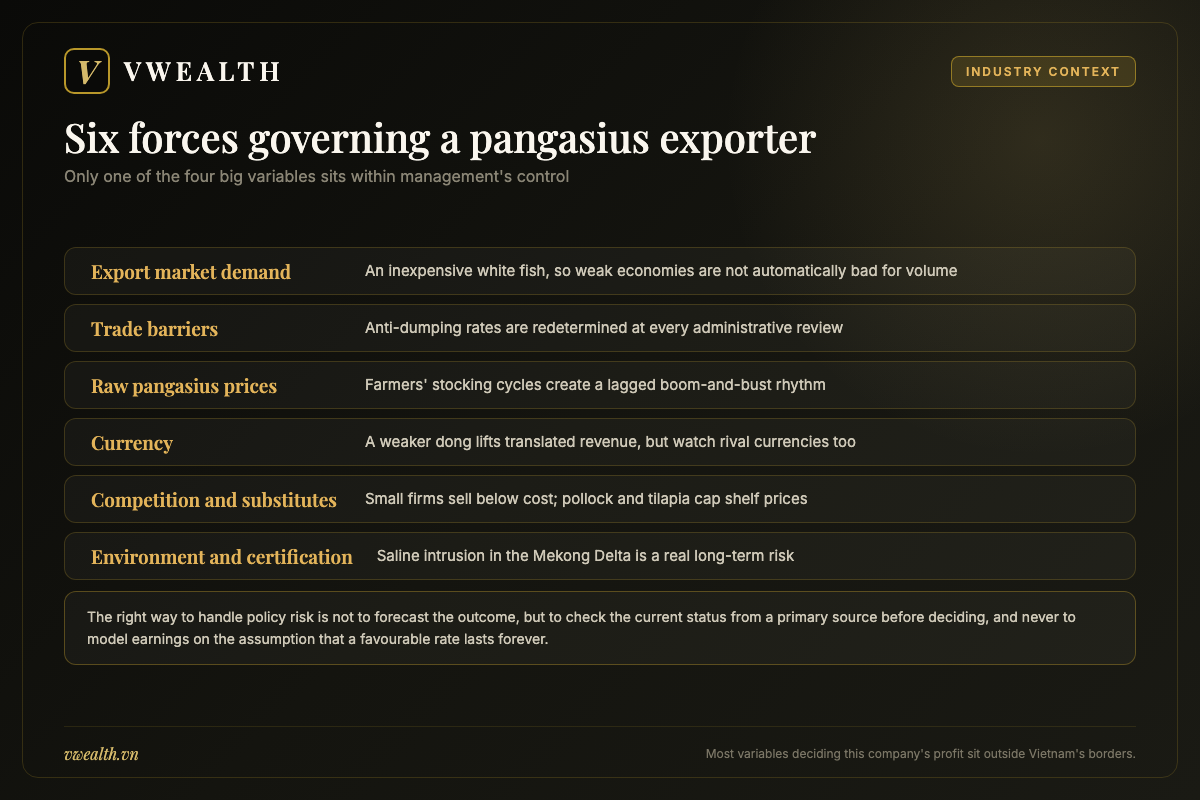
Industry context: six forces governing a pangasius exporter
No analysis of VHC stands without the industry. And for this company, “the industry” is not merely Vietnamese seafood — it is the global food market plus the trade rules that govern it.
Force one: consumer demand in export markets
Pangasius is an inexpensive white fish, and that determines its position in the Western consumer’s basket.
Here is a point many investors get backwards. During periods of economic difficulty and high inflation, consumers in the US and Europe tend to trade down from expensive fish species to cheaper ones. Pangasius is one of those substitutes. To a degree, therefore, this industry is counter-defensive: hard economic times are not automatically bad for volume.
Conversely, in good times consumers may return to premium species, but total food demand rises and average selling prices can improve.
Distribution channel matters too. Selling into supermarket retail brings better and steadier prices than foodservice, but requires specific certification and packaging. Selling into industrial processing brings volume at the lowest prices.
Force two: trade barriers and technical regulation
This is the industry’s most distinctive force and the hardest to forecast.
Barriers come in three layers.
The first layer is anti-dumping duties, with the annual administrative review mechanism described in chapter one. Rates are set company by company and can change each period.
The second layer is food safety oversight and equivalence programmes, in which the importing country’s regulator requires the exporting country’s control system to be equivalent to its own. This is a systemic barrier: it applies to the whole industry rather than to individual companies, and satisfying it is a multi-year effort by regulators and producers together.
The third layer is general tariff policy, which can shift with the international trade environment and lies beyond any company’s ability to predict.
For an investor, the correct handling of this risk is not to try to forecast outcomes but to do two practical things: always check the current status before deciding, and never build an investment thesis on the assumption that a favourable rate will persist indefinitely.
Force three: raw pangasius prices and the stocking cycle
Raw pangasius prices move through a cycle whose logic closely resembles the livestock cycle.
When export prices are good, processors buy more, raw prices rise, farmers see profit and stock heavily. Several months later that generation reaches size and comes out of the ponds together, supply is abundant, and raw prices fall. When prices stay low long enough, farmers leave ponds empty, supply contracts, and the loop restarts.
The biological lag here is shorter than in pig farming but still long enough to create a cycle. And as chapter four explained, the farming self-sufficiency ratio determines how much of this volatility a company absorbs.
A secondary but relevant variable: aquafeed prices, which depend on global agricultural commodity prices and the exchange rate — precisely the variables that drive the livestock industry.
Force four: the exchange rate
Analysed in chapter four from an accounting angle; here we look at it from the industry angle.
Currency affects exporters in two ways. The first is the translation effect: a weaker dong means converted revenue rises. The second, subtler effect is competitive: if a rival exporting country’s currency weakens more than the dong, their product becomes cheaper than Vietnam’s on the same supermarket shelf.
So you should not watch only the dollar against the dong, but also the relationship with the currencies of competing countries in the same food category.
Force five: competition, domestic and from substitutes
Competition arrives from two directions.
The first is competition among Vietnamese companies themselves. The pangasius industry is fragmented, and during price downturns smaller companies will sell below cost to preserve cash flow, dragging the average export price down for everyone. This is characteristic of an industry with no player large enough to lead pricing.
The second, and more important in the long run, is substitution on international shelves. Pangasius competes directly with Alaska pollock, cheap cod, tilapia from other countries and other farmed species. When supply of a substitute rises sharply or its price falls, pangasius comes under immediate pressure.
The implication: when reading industry news, do not follow only Vietnamese pangasius data. Follow global white fish supply as well.
Force six: environment, sustainability certification and the Mekong Delta
This is the slowest force but possibly the most important over the next decade.
Three trends point the same way. First, major importing markets increasingly require sustainability certification, traceability and labour standards. This disadvantages small producers and favours those who have already invested in a complete certification system — one of Vinh Hoan’s clearest advantages.
Second, domestic environmental regulation on farming areas and processing wastewater is tightening, raising compliance costs and accelerating the exit of small operators.
Third, and most concerning, is long-term risk to the raw material region itself. The Mekong Delta faces saline intrusion, changing river flows and water quality challenges. This is not a one-quarter or one-year risk, but if you intend to hold this stock for ten years, it is a variable you are obliged to weigh.
Looking forward: three scenarios for VHC stock and what must happen in each
This section promises no price target. For a company whose profit depends on decisions by a foreign trade authority, any twelve-month target number is decorated guesswork. Instead, three scenarios with their required conditions.
The four variables that decide VHC’s future
Variable one is the status of trade barriers in the main markets, particularly duty rates through successive reviews.
Variable two is the relationship between average export prices and raw pangasius prices — that is, the core business gross margin.
Variable three is how fast the collagen and value-added segments grow as a share of group profit.
Variable four is the exchange rate and demand strength in major importing markets.
An important note: only variable three lies within management’s control. That is why, when scoring this company’s management, you should score them on the pace of product mix shift rather than on the profit of one fortunate year.
Optimistic scenario: favourable barriers and a rising collagen share
Conditions required: duty rates in the US market stay in favourable territory across reviews; demand in the US, China and Europe recovers and average export prices improve; raw fish costs stay stable thanks to farming self-sufficiency; the collagen business runs at full capacity under long-term contracts and opens new markets.
Observable results: gross margin improves and, more importantly, the profit mix shifts — collagen and value-added contribute a rising share while raw fillet contributes less.
What changes in valuation terms: if the profit mix genuinely shifts and holds for several years, the market has grounds to stop valuing VHC as a pure seafood exporter. That re-rating, rather than one strong year of profit, is the real prize.
Base case: sideways with volatility, and a slow shift
Conditions required: trade barriers change period to period without a major shock; demand recovers slowly and unevenly; raw fish prices oscillate with the stocking cycle; the collagen business keeps growing but not fast enough to invert the profit mix.
Observable results: earnings remain sawtoothed year to year, depending on which market was favourable and which way the currency moved. But across a full cycle the company retains its leadership position and a healthy balance sheet, while the high-margin share creeps up annually.
This is the most likely scenario and the one demanding the most patience, because the reward arrives slowly and there is no exciting short-term story to tell.
Pessimistic scenario: barriers tighten while demand weakens
Conditions required: an unfavourable review outcome reduces competitiveness in the highest-priced market; simultaneously consumer demand in major markets weakens and average export prices fall; raw fish costs rise as supply contracts; domestic price competition pushes prices lower still.
Observable results: gross margin squeezed from both sides, profit falling sharply, with inventory and receivables potentially swelling as customers delay acceptance and payment.
What to monitor here is not profit but resilience: cash balances, debt levels, and whether the collagen business retains its order book. A company that passes through this phase with its balance sheet intact and its high-margin segment untouched will be extremely well positioned when the cycle turns, because many smaller competitors will have been eliminated.
Scenario summary
| Scenario | Conditions required | Early signals | Implication for investors |
|---|---|---|---|
| Optimistic | Favourable duties; demand and export prices improve; collagen at full capacity | Gross margin improving and collagen’s profit share visibly rising | Potential re-rating as an industrial ingredient producer |
| Base case | Barriers shift without shocks; slow demand recovery; collagen grows steadily | Sawtoothed earnings but leadership and balance sheet preserved | Requires multi-year patience; reward arrives slowly |
| Pessimistic | Adverse review alongside weak demand and rising raw fish costs | Rapid margin compression; inventory and receivables swelling | Track resilience and the collagen order book, not profit |
What would prove your thesis wrong
Three falsification conditions worth writing into your investment journal.
First: if you buy believing collagen will lift the company out of commodity status, then that segment’s profit share standing still over multiple years is disconfirming evidence.
Second: if you buy believing the duty advantage is durable, then an unfavourable outcome persisting across several review cycles is disconfirming evidence.
Third: if you buy believing farming self-sufficiency makes the company steadier than peers, then gross margin volatility matching or exceeding the industry average across two cycles is disconfirming evidence.
What foreign investors should know before buying a Vietnamese seafood exporter
This chapter exists because the series is read outside Vietnam, and several practical realities differ from developed markets.
You are buying a domestic company with foreign revenue and foreign regulatory risk
This combination is unusual and deserves to be stated plainly. You are taking Vietnamese country risk on the operating side — labour, land, environmental regulation, water, domestic policy — while simultaneously taking regulatory risk in the United States, China and Europe on the revenue side.
Practically, this means diversification does not work the way you might assume. Owning VHC alongside a portfolio of US consumer stocks does not fully diversify your US exposure, because a US policy shift can hit both at once, in the same direction.
Trade remedy proceedings are public and researchable
Unlike much company information in frontier markets, anti-dumping proceedings generate a public paper trail. Preliminary and final determinations, methodologies and company-specific rates are published by the investigating authority.
This is a rare situation where a diligent foreign investor can genuinely be better informed than the average local retail participant, because the primary documents are in English and freely available. Use that advantage: read the determination rather than the headline about it.
The information gap on the industry side
Vietnamese data on farming areas, stocking volumes and regional raw fish prices is less comprehensive and less timely than agricultural statistics in developed markets. Industry associations publish monthly export figures, which are useful, but upstream data is patchy.
The practical response is to weight verifiable data more heavily — company disclosures, published export statistics, official determinations — and to discount commentary about where raw fish prices are heading next quarter.
Practical access and mechanics
To buy VHC you need a securities trading code and a local brokerage account, described step by step in the guide to opening a brokerage account in Vietnam as a foreigner. Note also that Vietnam applies daily price limits and specific settlement conventions, covered in Vietnam stock trading rules, and that tax treatment for non-residents is explained in taxes for foreign investors in Vietnamese stocks.
One mechanical point specific to this name: because much of the market-moving news originates from foreign authorities and is often released outside Vietnamese trading hours, you will frequently find the price has already gapped when the market opens. Position sizing matters more than reaction speed here.
Common mistakes foreign investors make with this stock
Mistake one: treating a favourable duty rate as a permanent structural advantage rather than a periodically redetermined outcome.
Mistake two: reading a strong quarter without stripping out foreign exchange revaluation gains.
Mistake three: assuming that because the company sells food, its earnings should be as stable as a consumer staple. They are not.
Mistake four: comparing revenue scale across pangasius companies while ignoring farming self-sufficiency, which matters far more to margin resilience.
Mistake five: underestimating how thin the free float is given a 45% controlling stake plus long-term institutional holders.
Mistake six: valuing the collagen business on its potential rather than on its current contribution, and then being disappointed by the pace.
Understanding pangasius: a primer for investors outside Vietnam
Most readers of this series know what a bank or a steel mill does. Fewer have a clear picture of what pangasius farming actually is, and that gap makes the financial statements harder to interpret than they need to be. This chapter closes it.
What the fish is, and why Vietnam dominates it
Pangasius, sold internationally under names including basa and swai, is a freshwater catfish species farmed intensively in the Mekong Delta. Three biological characteristics make it commercially remarkable.
First, growth speed. The fish reaches harvest weight in a matter of months, far faster than most farmed marine species. That shortens the capital cycle: money invested in fingerlings and feed returns comparatively quickly.
Second, stocking density tolerance. Pangasius can be farmed at densities that would be impossible for many species, which means output per hectare of water surface is very high. This is the single largest driver of the industry’s low unit cost.
Third, fillet characteristics. The flesh is white, low in bones, mild in flavour and holds together well when frozen and cooked. For industrial food processing and for supermarket private label, those attributes matter more than culinary prestige.
Vietnam’s dominance rests on geography rather than technology. The Tien and Hau river systems provide the water volume, temperature and flow characteristics this species requires at a scale essentially unmatched elsewhere. Other countries farm pangasius, but not at Vietnamese cost and volume.
The structure of the industry
The Vietnamese pangasius industry has three participant types, and understanding their interaction explains the price cycle.
At the base are independent farming households and small farm operators. They make stocking decisions based on the price they observe today and their assessment of cash flow, which is precisely how a supply cycle is generated.
In the middle are processing and exporting companies. Some own farms; many buy raw fish externally. Those buying externally are effectively price takers on both sides — they cannot set the export price and cannot set the raw fish price.
At the top are a small number of integrated groups controlling hatcheries, feed, farms, processing and export. Vinh Hoan sits here, along with a handful of others.
The critical structural fact is fragmentation. With the largest player at roughly fourteen percent of exports, nobody can discipline pricing. During downturns, the industry competes itself into losses, which is a recurring feature rather than an anomaly.
From pond to plate: where the money goes
Follow one fish and you see the economics.
A hatchery produces fry, which grow into fingerlings. Fingerlings are stocked into grow-out ponds. Over the growing period the largest single cost by far is feed, which is why aquafeed prices matter to margins nearly as much as fish prices themselves. Mortality across the cycle is a second key variable, controlled through water management and health protocols.
At harvest, fish move to a processing plant. There the fish is separated: white flesh becomes fillet, either sold plain or processed further; skin becomes collagen feedstock for companies equipped to use it; the remainder becomes fishmeal, fish oil and by-products.
The yield ratio of saleable fillet to live weight is a closely watched operational metric, because a percentage point of yield improvement flows almost entirely to profit. This is one of the places where a well-run processor separates itself from a poorly run one.
Finally, product is frozen, packed to the customer’s specification, and shipped. Between shipment and payment lies the receivables period discussed in chapter four.
Why certification is not bureaucratic noise
Foreign investors sometimes dismiss certification lists as marketing. In this industry they are commercial infrastructure.
European retail chains in particular operate approved supplier lists, and inclusion requires specific certifications covering food safety, farming practice, environmental management and labour conditions. Audits are periodic and failure means delisting. Obtaining and maintaining the full set costs real money and takes years.
The practical effect is a two-tier industry: a small group of companies able to supply major Western retail, and a much larger group restricted to less demanding channels at lower prices. That divide, more than scale, explains persistent margin differences between Vietnamese pangasius exporters.
Building a monitoring checklist for VHC
Analysis is useless if you cannot maintain it. This chapter converts everything above into a short routine you can repeat each quarter in under an hour.
The quarterly routine
Step one: open the quarterly report and record four numbers — consolidated net revenue, gross margin, operating cash flow, and net profit. Then record one derived number: the foreign exchange gain or loss stripped out of the profit line.
Step two: record revenue by market as a percentage. Note the direction of change in the US, China and Europe.
Step three: record the contribution of the collagen and value-added segments where disclosed. This is your single most important long-term indicator.
Step four: record inventory and receivables as a percentage of revenue, and note whether receivable days lengthened.
Step five: check for any new trade determination affecting the company, and record the current duty status.
Five entries, one page per quarter. After eight quarters you will have a picture no single report can give you.
The annual review
Once a year, add three checks. Compare cumulative operating cash flow against cumulative net profit for the last three to five years. Verify whether major capital projects met their announced schedule. And re-read your own falsification conditions from chapter seven to see whether any have been triggered.
What should make you act
Two categories of change should prompt a genuine reassessment rather than a note in the file.
The first is a sustained adverse shift in trade barriers in the highest-value market, persisting beyond a single review period. That changes the earnings power of the business, not merely one year’s results.
The second is the collagen contribution stalling for multiple consecutive years while capital continues to flow into it. That would indicate the central long-term thesis is not working, and it is the kind of slow disconfirmation investors are most prone to ignore.
Reading the trade case: a practical guide to anti-dumping reviews
Because the anti-dumping mechanism is the largest single variable in VHC’s earnings power, it deserves a chapter of its own written for someone who has never followed a trade case. What follows is the general mechanism, not a prediction about any specific outcome.
Why the duty exists at all
Anti-dumping law exists to address the situation where a producer sells into an export market at a price considered below normal value. When an investigating authority finds dumping and finds injury to a domestic industry, it imposes duties intended to offset the margin.
Whether one agrees with the economics is beside the point for an investor. What matters is that once an order exists, it creates a durable administrative process that reshapes competition in that market for years, sometimes decades.
How a rate is actually calculated, in outline
The core comparison is between the export price and a constructed normal value. Because Vietnam has historically been treated as a non-market economy in these proceedings, normal value has often been built using costs from a designated surrogate country rather than from the exporter’s own domestic prices.
That single methodological choice matters enormously, and it explains something investors often find baffling: why a company’s duty rate can change substantially between periods without any change in its own behaviour. If the surrogate country or the surrogate data changes, the calculated normal value changes, and so does the margin.
It also explains why outcomes are difficult to forecast even for specialists. You are not predicting a company’s operations; you are predicting an administrative methodology.
Mandatory respondents, separate rates and everyone else
In each review, the authority typically selects a small number of companies as mandatory respondents and calculates individual rates for them based on their full data submissions. Other companies that demonstrate independence from state control may receive a separate rate, often derived from the mandatory respondents’ results. Companies that do not qualify fall into a country-wide rate, which is generally punitive.
For an investor, the practical questions are: was the company a mandatory respondent this period, what rate did it receive, and how does that compare with the rates received by its domestic competitors? The last question is the one most often skipped, and it is the one that determines relative competitiveness.
Preliminary versus final, and why the gap matters
Each review produces a preliminary determination followed months later by a final determination. The two can differ materially, as they did in the twenty-first review whose final results were announced on 12 August 2026 and were assessed as less favourable than the preliminary stage.
The share price implication is that trade case news arrives in at least two waves, and the market frequently over-reacts to the first. A disciplined investor treats the preliminary determination as information rather than as a conclusion.
Cash deposits, assessments and the timing of cash flows
One technical point with real financial consequences: the rate set in a review typically governs cash deposit requirements going forward and the final assessment of duties on past entries. That means a change in rate can produce both a forward-looking margin effect and a backward-looking cash settlement effect.
When reading financial statements, look for disclosures regarding duty provisions and contingent liabilities. A company that has accrued conservatively for potential assessments is in a different position from one that has not.
How to use all this without becoming a trade lawyer
You do not need to master the methodology. You need three habits.
Habit one: before any decision on this stock, confirm the current duty status from a primary source rather than a news summary.
Habit two: when a determination is announced, check the company’s rate alongside its domestic competitors’ rates before judging whether the news is good or bad. An unfavourable absolute rate can still be a relative win if competitors fared worse.
Habit three: never model the company’s future earnings on the assumption that a favourable rate persists indefinitely. Build your base case around the possibility that it does not.
How VHC compares with global aquaculture peers
Foreign investors often arrive at VHC after looking at listed aquaculture companies elsewhere, particularly Norwegian and Chilean salmon farmers. The comparison is instructive precisely because the businesses differ so much.
Salmon versus pangasius: different economics entirely
Salmon farming operates on long biological cycles measured in years, requires licensed marine sites that are scarce and expensive, and produces a premium protein with genuine consumer brand recognition in some markets. Licence scarcity creates a structural supply constraint, which is why salmon prices behave the way they do.
Pangasius operates on short cycles measured in months, uses freshwater ponds that are comparatively easy to establish, and produces an inexpensive commodity protein. There is no meaningful licence-based supply constraint, which is exactly why the industry generates the boom-and-bust cycle described earlier.
The investment implication is direct: do not apply salmon farming valuation logic to a pangasius company. The supply-side scarcity that supports salmon economics does not exist here.
What VHC shares with global peers
Three features do translate across. First, biological risk: disease and water quality events affect all aquaculture. Second, feed cost exposure: feed is the dominant input cost everywhere in the sector, and it links back to global agricultural commodity markets. Third, sustainability scrutiny: every listed aquaculture company now faces certification and environmental disclosure requirements from major buyers.
Where VHC is genuinely unusual
The collagen business is the feature with no close analogue among most listed aquaculture peers. Extracting a high-value industrial ingredient from what was formerly waste is a margin structure more familiar from specialty chemicals than from fish farming.
This is why the framing used throughout this analysis matters: the interesting question about VHC is not how it compares to other fish companies today, but how far it can move toward being valued as something other than a fish company.
A note on scale
One final calibration for international readers: by global standards VHC is a mid-sized company, not a large one. Position sizing, liquidity expectations and the depth of available research should all be calibrated accordingly. This is a market where doing your own primary work has more value than in a heavily covered developed market — and where the absence of extensive sell-side coverage is both the opportunity and the risk.
Three misreadings of Vietnamese exporters worth unlearning
Before the verdict, three framing errors are worth naming, because they recur across every conversation about Vietnamese export names and they distort position sizing more than any spreadsheet mistake.
The first misreading is treating export revenue as evidence of quality. Selling abroad is not inherently better than selling domestically. An exporter accepts foreign regulatory risk, currency risk and customer concentration risk in exchange for access to larger and often higher-priced markets. Sometimes that trade is worth making and sometimes it is not, but it is a trade, not an upgrade. A Vietnamese company selling exclusively into its own fast-growing domestic market may carry a far better risk-adjusted profile.
The second misreading is assuming that a company leading its industry is therefore protected. Market leadership in a fragmented industry with no pricing power confers less protection than investors instinctively assume. Fourteen percent of exports makes Vinh Hoan the largest participant, but it does not let the company set prices, discipline competitors, or avoid the losses that industry-wide overcapacity produces. Leadership here means surviving downturns better, not avoiding them.
The third misreading is treating certification depth and institutional shareholders as a valuation argument. They are quality signals, and quality signals belong in your assessment of risk rather than in your estimate of fair value. A company can be genuinely well run, well certified and well owned, and still be expensive. Confusing quality with value is among the most common ways good research turns into a poor purchase.
Hold those three corrections in mind while reading what follows. The verdict below assumes you have already dropped them.
A note on holding period
One last practical point that follows from everything above. The thesis for this company operates on a multi-year clock, while the news flow that moves its share price operates on a weekly one. That mismatch is the single most common reason investors lose money on names like this: they adopt a long-term thesis and then trade it on short-term information.
If you decide the collagen migration is the reason to own VHC, then the only evidence that should change your mind is evidence about that migration — segment contribution, capacity utilisation, new contracts. A poor quarter caused by currency revaluation is not evidence. A duty announcement is relevant to earnings power but is not, by itself, evidence about the migration thesis. Decide in advance which category of news you are actually watching for, and ignore the rest with discipline.
So, should you buy VHC stock? A straight answer
Time to bring it together. This chapter does not dodge the question in the title, but it also refuses to answer with a single word — because the correct answer depends on who you are.
The case for: seven reasons VHC deserves consideration
Reason one: leadership in an industry where Vietnam holds a near-unique natural advantage. The Mekong Delta allows pangasius farming at a scale and cost that is genuinely hard to replicate elsewhere.
Reason two: the collagen and gelatin business. This is the largest single difference between VHC and the rest of the industry — a high-margin segment with real customer switching costs and limited exposure to the fish price cycle.
Reason three: a closed chain from hatchery to finished product, stabilising unit costs and satisfying increasingly strict traceability requirements.
Reason four: a deep portfolio of international certifications, which functions as a genuine barrier to entry and as a precondition for selling into major retail chains.
Reason five: the founder still leads with a controlling stake, and the executive team has more than twenty years of continuity. In an industry where customer relationships take years to build, that matters.
Reason six: an ownership register including a major Japanese trading house and large international institutions. Not a guarantee of price performance, but evidence the company has passed demanding due diligence filters.
Reason seven: a relatively healthy financial structure by industry standards, giving the company more capacity than peers to absorb bad phases.
The case against: seven risks to look at squarely
Risk one, and the largest: foreign trade policy risk. Anti-dumping duty rates are redetermined each review, and an adverse outcome can change the profit outlook in the highest-priced market. No management team controls this.
Risk two: dependence on consumer demand abroad, in economies you cannot monitor as easily as your own.
Risk three: the raw pangasius price cycle, driven by thousands of independent stocking decisions.
Risk four: currency volatility, affecting both real results and reported accounting numbers.
Risk five: domestic price competition during downturns, when smaller companies sell below cost and drag the average export price down for everyone, compounded by competition from substitute white fish species internationally.
Risk six: a free float thinner than the listed share count suggests, given the controlling stake and long-term institutional holders.
Risk seven, long term: environmental risk to the raw material region itself, including saline intrusion, changing river flows and water quality in the Mekong Delta.
Balance sheet of arguments
| In favour | Against |
|---|---|
| Market leadership in an industry with a natural Vietnamese advantage | Fragmented industry with nobody large enough to lead pricing |
| High-margin collagen business with customer switching costs | That segment still needs years to invert the profit mix |
| Closed chain from hatchery to product, with farming self-sufficiency | Every unit still begins with the same fish from the same delta |
| Deep certification portfolio acting as a real barrier to entry | Rising certification demands also raise compliance costs |
| Founder-led with over twenty years of executive continuity | A 45% controlling stake leaves the free float thin |
| Quality foreign institutional register, rare in the sector | Sensitive to foreign fund rebalancing flows |
| Relatively healthy balance sheet versus industry norms | Foreign trade policy risk that cannot be eliminated |
| A weaker dong lifts translated revenue | Currency revaluation makes quarterly profit hard to read |
Who VHC suits, and who should avoid it
The long-term value investor. This is probably the best-suited group, subject to two conditions. First, that you value the company on the quality and mix of its earnings rather than on one year’s profit figure. Second, that you accept a portion of the risk lies entirely outside the company’s control — foreign trade policy — and that you size your position accordingly. Meet both, and the thesis that the business is migrating from raw commodity toward industrial ingredient stands up well.
The growth investor. Potentially suitable, but only if your bet is specifically on collagen and value-added products rather than on pangasius volume. If you buy VHC as a growth stock expecting export revenue to rise steadily every year, you will be disappointed — this industry does not grow in a straight line.
The income investor. Not a strong choice, despite the tradition of cash dividends. The payout depends on each year’s results, and those results depend on variables outside anyone’s control. You need predictable income, and this is not a predictable source.
The short-term trader. VHC is tradeable around duty news, export statistics and currency moves. But note two things. First, the most important news comes from foreign authorities and is typically released outside Vietnamese trading hours, so you cannot position ahead of it. Second, liquidity is thinner than in large caps, so slippage can be meaningful. If you take this route, stop-loss discipline is mandatory.
Five questions to answer before placing an order
Question one: have you checked the anti-dumping status from the most recent review? If not, you do not yet have enough information to buy this stock.
Question two: in the most recent year’s profit, how much came from core operations and how much from currency revaluation or non-recurring items?
Question three: is the collagen and value-added contribution rising or flat? This is the most important indicator for the long-term thesis.
Question four: what percentage of your portfolio will this represent? For a name carrying foreign policy risk, an oversized position turns a reasonable decision into a serious problem.
Question five: what would make you admit you were wrong and sell? Write it down, in words, before you buy.
Closing thought: a strong company on a field where others write the rules
If this entire analysis compressed into one sentence, it would be this: Vinh Hoan is among the best-managed companies in Vietnamese seafood, but it plays on a field where the rules are written by others.
Nearly thirty years ago this business started with VND 300 million in Sa Dec. Today it is Vietnam’s largest pangasius exporter, with around fifteen plants, its own farming areas, a collagen extraction business few regional competitors can match, and names on its shareholder register that most Vietnamese listed companies never attract. That is a genuine achievement, built through three decades of patience.
But the achievement does not change one fact: most of the variables determining this company’s profit lie outside Vietnam’s borders. An administrative decision in Washington, a quarantine policy change in Beijing, a consumption downturn in Europe — each can move results more than any internal effort.
The only way an exporter escapes that condition is to move up the value chain until its product is no longer a commodity that can be sourced from someone else. Vinh Hoan is walking that road through collagen, and the speed at which it walks is what you should track — not this month’s export tonnage.
So the real question is not “should I buy VHC stock” but “am I willing to own a good company whose largest risk is beyond the control of both me and its management”. If your answer is yes, and you size the position to match that risk, VHC belongs on your watchlist. If your answer is no, look toward companies with domestic revenue — you will sleep considerably better.
As for current quarterly figures, revenue by market and segment margins — that is the job of data, not of an article. Open the report before you place the order.
This article is provided for information and analysis purposes only and does not constitute a recommendation to buy or sell any security. Historical figures and information regarding trade remedy proceedings are cited from publicly disclosed sources as at the time of writing and may change after each review or reporting period. The article deliberately omits current-quarter financial data and does not provide price targets. Every investment decision is yours alone and you bear responsibility for its outcome. Consider consulting a licensed financial adviser before acting.
Research Vietnamese stocks in English with vwealth. Our AI-powered platform turns Vietnamese market data into full English analysis reports — with international payment support and a free 2-month trial for new accounts. Create your free account and read the latest reports.


