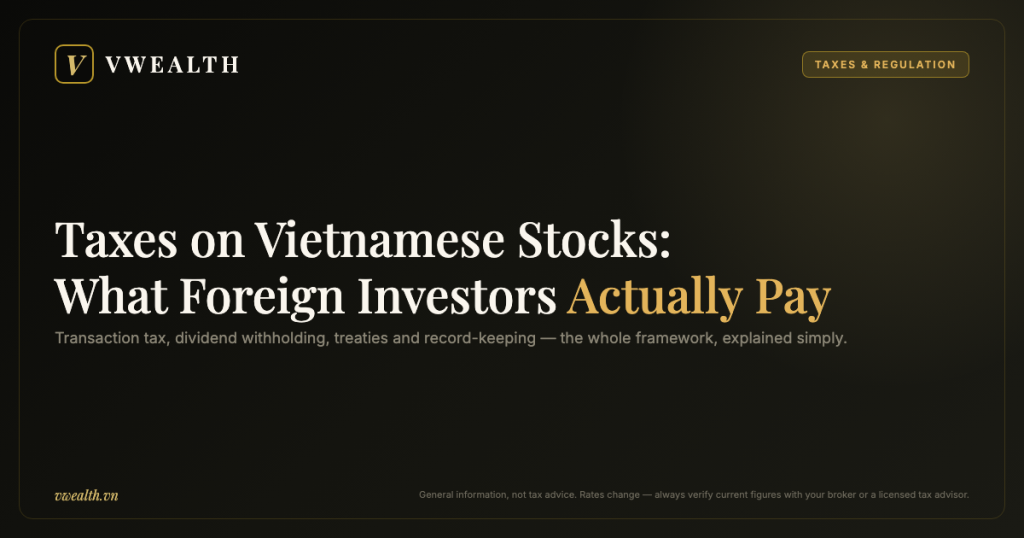
Vietnam taxes stock investors in a way that surprises almost everyone arriving from the United States, Europe or Australia: instead of a classic capital gains tax on stocks where you tally profits once a year, Vietnam generally taxes each sale transaction at a small flat rate the moment it happens, withholds tax on dividends before the cash reaches you, and — for the typical foreign individual investor — asks for no annual tax return at all. This guide explains the whole framework conceptually: how the transaction-based model works, why it can be both kinder and crueler than a Western-style capital gains tax, what happens to your dividends, how double taxation treaties fit in, and what records you should keep. One warning before we start, and it will be repeated because it matters: tax rates and rules change, and your personal situation changes the answer. Treat everything here as general information, not tax advice, and verify the current numbers with your broker or a licensed tax advisor before you rely on them.
Why Vietnam’s Approach to Taxing Stocks Surprises Foreign Investors
Most developed markets tax stock investing through a net-gains model. You buy a share, you sell it later, and the difference between the two prices — your capital gain — is what gets taxed. If you lose money, there is usually no tax, and in many countries the loss can even offset other gains. Once a year you (or your accountant) add everything up, file a return, and settle the bill.
Vietnam took a different road for individual investors, and understanding why makes the whole system click. When the market opened to the public in 2000, the tax authority faced a practical problem: millions of small retail accounts, paper-heavy record keeping, and no realistic way to audit the purchase price of every share a person had ever bought. Calculating true net gains for each investor would have been an administrative nightmare. So the system that evolved for securities trading leans on a simpler idea: tax the transaction itself, at the source, at a rate low enough that nobody needs to file anything afterward.
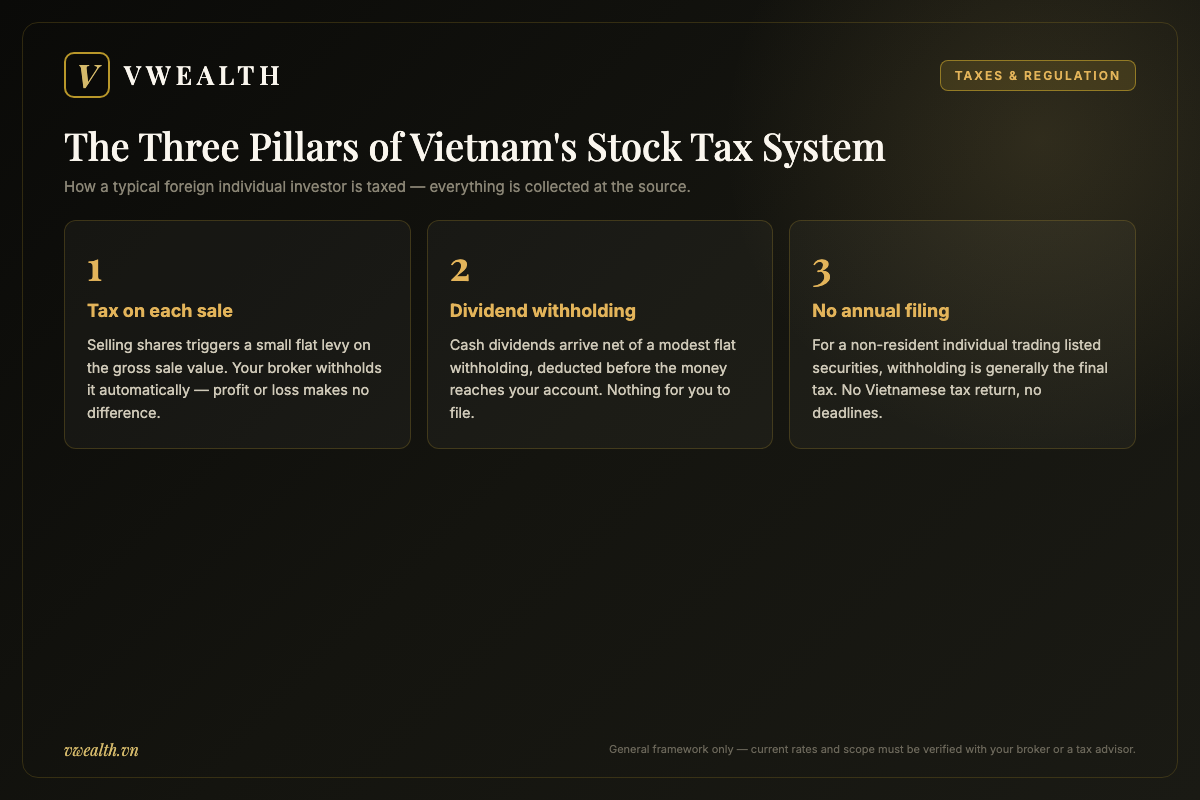
In practice, the framework for a typical individual investor — foreign or Vietnamese — has three pillars:
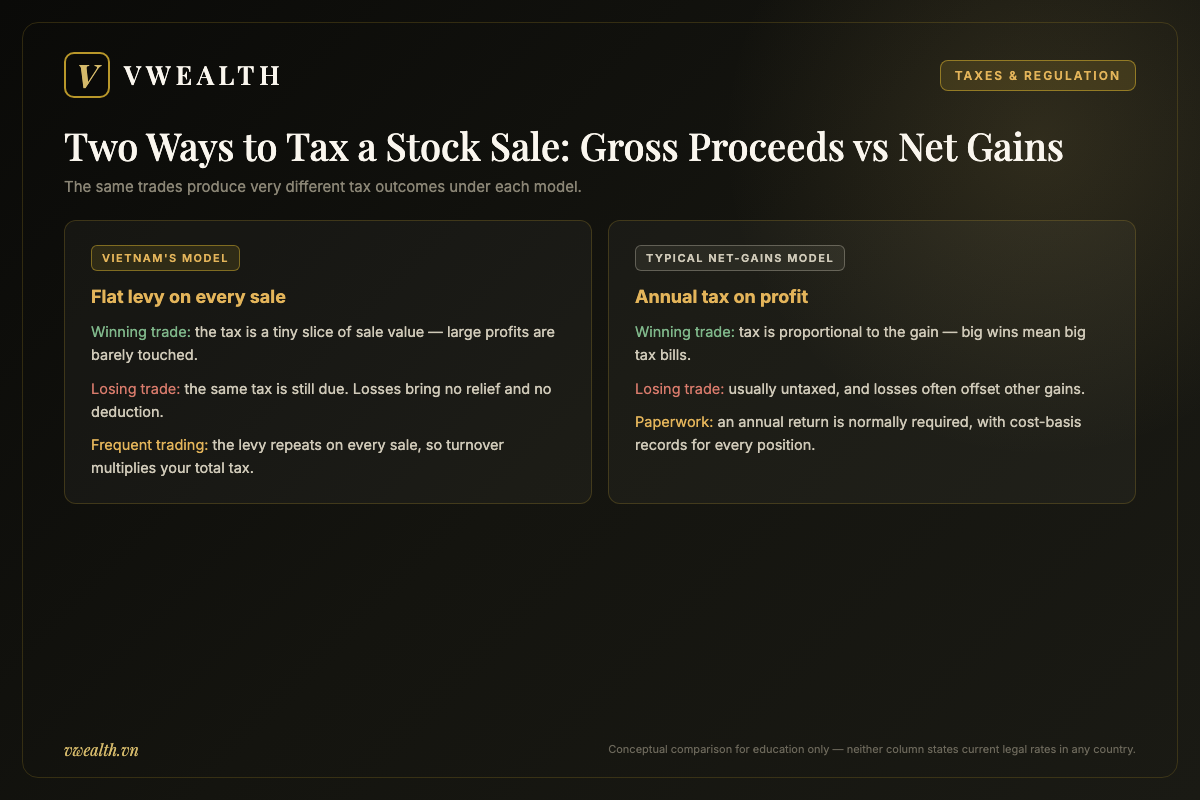
- Tax on sales, not on annual profit. When you sell shares, a small flat percentage of the gross sale value (the total amount the sale is worth, before any costs) is treated as tax. Your securities company calculates it and withholds it automatically. Whether the trade made you money is, for this purpose, irrelevant.
- Withholding on dividends. When a listed company pays a cash dividend, a modest flat percentage is typically withheld before the money lands in your account. Again, no action required from you.
- No annual filing for the typical case. Because tax is collected at the source on each event, a foreign individual whose only Vietnam-source income is from trading listed securities generally has no annual Vietnamese tax return to file. The withholding is usually the final tax.
Notice the hedged language: “typically,” “generally,” “usually.” That is deliberate. The exact rates, the exact scope of withholding, and the exact filing obligations are set by Vietnamese tax law and circulars that get amended from time to time. As of mid-2026 the governing statute is being renewed: Vietnam passed a new Personal Income Tax Law No. 109/2025/QH15, adopted by the National Assembly on 10 December 2025 and taking effect on 1 July 2026 (with the wage- and business-income provisions applying from the 2026 tax year), replacing the 2007 PIT Law and its 2012 amendment. The good news for the framework in this article is continuity rather than upheaval: the new law keeps the same architecture for listed-securities investors — a flat levy on sale proceeds and flat withholding on dividends — and the headline rates carried over unchanged. But the numbers attached to it are still exactly the kind of detail you must confirm with your broker or a tax advisor at the moment you invest — not from an article, however carefully written — because the implementing decrees and circulars that put a new law into daily practice are themselves finalized and revised on the government’s own schedule.
If you have not yet set up access to the market, it is worth reading how the plumbing works first, because the tax system hangs off that plumbing. Our guide on how to invest in Vietnam’s stock market as a foreigner covers the two main routes in — offshore ETFs versus a direct local brokerage account — and the tax treatment differs meaningfully between them, as we will see below.
How the Capital Gains Tax on Stocks in Vietnam Actually Works
Let’s walk through the mechanics of a sale, because this is where the Vietnamese model differs most sharply from what you may know at home.
The tax is calculated on gross proceeds, not on your profit
Suppose — purely as an illustrative example, with made-up numbers — you sell 1,000 shares of a listed company at 50,000 Vietnamese dong per share. Your gross sale proceeds are 50 million dong. Under the transaction-based model, the securities tax is computed as a flat percentage of that 50 million, full stop. The system does not ask what you paid for the shares. It does not ask how long you held them. It does not ask whether the position is up 80 percent or down 30 percent.
For many years the rate applied to individuals selling listed securities has been 0.1 percent of gross sale value, and that figure carries straight through the 2026 legal overhaul: under the new PIT Law 109/2025 and the framework it continues, personal income tax on a securities transfer is calculated as the transfer price multiplied by 0.1 percent, for residents and non-residents alike (see the PwC Vietnam individual tax summary for the standing rate table). So the number is not a vague “small fraction” — it is a specific, currently applicable 0.1 percent. We still frame it as an order of magnitude rather than a promise, and you should still confirm the exact figure and any threshold with your securities company before your first trade, because the implementing decree for the new law is the layer where fine print lands and a rate quoted in an article can lag a subsequent amendment.
Continuing the illustration: if the applicable rate were 0.1 percent, the tax on that 50-million-dong sale would be 50,000 dong — roughly the price of one of the shares you sold, or about two US dollars at recent exchange-rate levels. Your broker deducts it when the trade settles. You will see it as a line item on your trade confirmation, sitting next to the brokerage commission, which is usually several times larger than the tax itself.
Your broker is the tax collector
In tax jargon this arrangement is called withholding at source: the institution paying you money (here, the securities company executing your sale) deducts the tax and remits it to the state on your behalf. For you, the practical consequences are enormous and mostly pleasant. You never transfer money to a tax office. You never compute anything. You never face a deadline. Every taxable event is settled the moment it occurs, and your account balance always reflects your after-tax position.
This is why the choice of broker matters more in Vietnam than in markets where you handle your own filing. The broker’s systems are your tax compliance. When you go through the process of opening a Vietnamese brokerage account as a foreigner, ask the broker directly: which taxes do you withhold for me, at what current rates, and what year-end statements do you provide? A good broker serving foreign clients answers this in one email, and the answer is worth keeping on file.
Buying is not taxed — selling is
One asymmetry worth spelling out: the securities transaction tax applies to the seller, not the buyer. When you purchase shares you pay brokerage commission and exchange fees, but no transaction tax. The taxable event is the disposal. This means the cost of a round trip (buy plus sell) includes the tax exactly once, and it means investors who trade rarely pay this tax rarely. A buy-and-hold investor who accumulates a position over years and sells it once pays the transaction tax on a single event; a day trader who turns the same capital over two hundred times a year pays it two hundred times. The system quietly rewards patience — a theme that recurs throughout Vietnamese market rules, from settlement cycles to price bands.
What counts as a “sale” can be broader than you think
Transfers of listed shares through the exchange are the clean, obvious case. But other disposals — transferring shares off-exchange, selling shares in a company that is not listed, tendering into a buyback, receiving cash in a merger — can fall under different rules, sometimes with genuinely different tax treatment, and this is one area the 2026 law actually changes. The transfer of shares in a public, listed or registered-for-trading company keeps the 0.1-percent-of-proceeds treatment. But transfers of stakes in unlisted, non-public entities — for instance a capital contribution in a limited-liability company — are increasingly treated as a “capital transfer” rather than a “securities transfer,” and under the direction of Law 109/2025 those are commonly reported as taxed at 20 percent on the actual net gain (sale price minus documented cost and reasonable expenses), or, where the cost basis cannot be substantiated, at 2 percent of the gross transfer price. That is a materially heavier and more paperwork-intensive regime than the flat 0.1 percent on listed shares, and the exact mechanics were still being finalized in the implementing decree as of mid-2026. If you ever do anything with Vietnamese securities other than buying and selling listed shares through your brokerage account, that is precisely the moment to pay a tax advisor for an hour of their time. The routine case is automated; the edge cases are not.
Gross-Proceeds Taxation vs Classic Capital Gains Tax: The Trade-Off
Now that the mechanics are clear, step back and look at what this design really means for you as an investor. The transaction-based model is neither strictly better nor strictly worse than a net-gains capital gains tax — it redistributes the burden in a specific way, and knowing which side of the redistribution you sit on is genuinely useful for strategy.
When the Vietnamese model is kinder to you
Imagine an investor whose portfolio doubles. Under a classic capital gains regime taxing net profits at, say, 20 percent — an illustrative rate, chosen only for arithmetic — doubling 100 units of capital produces 100 units of gain and 20 units of tax. Under a gross-proceeds model at a fraction of one percent, selling the now-200-unit position costs a fraction of one unit. For investors who make large profits, the transaction tax is dramatically lighter. This is the flattering side of the Vietnamese model: winners keep almost everything, and there is no incentive to defer selling purely for tax reasons, no “lock-in effect” where investors sit on positions they no longer believe in just to avoid crystallizing a gain.
There is a second kindness: simplicity itself has value. No annual filing means no accountant’s fees for the Vietnam leg of your investing, no risk of missing a foreign filing deadline in a language you do not read, and no exposure to penalties for innocent paperwork errors. For a foreign individual managing investments across several countries, removing an entire tax return from the calendar is worth real money and real peace of mind.
When it is crueler
Now imagine the opposite investor: one who sells at a loss. Under a net-gains regime, a losing trade generates no tax and often generates a deductible loss that shelters other income. Under the gross-proceeds model, the tax is due anyway — the same flat slice of sale value, taken from a trade that already hurt. There is no concept of loss relief inside the transaction-tax mechanism. You cannot carry a bad year forward. Every sale pays, in profit and in loss alike.
The second cruelty is subtler: the tax compounds with trading frequency. Because the levy attaches to every sale, an active trader’s effective annual tax burden is the flat rate multiplied by portfolio turnover. Illustration again: at a hypothetical 0.1 percent per sale, an investor who turns over their entire portfolio fifty times a year pays roughly 5 percent of portfolio value in transaction tax annually — before commissions, before spreads, and regardless of whether the year ended in profit. The same investor turning over once a year pays 0.1 percent. Two investors, identical returns before costs, wildly different outcomes. If you needed one more argument against overtrading, Vietnamese tax design provides it — and the behavioral evidence on why frequent traders underperform points the same direction in every market that has been studied.
| Feature | Transaction-based model (Vietnam’s approach for individuals) | Net-gains model (typical in US/EU) |
|---|---|---|
| What is taxed | Gross value of each sale | Profit (sale price minus purchase cost), usually netted annually |
| Losing trades | Taxed the same as winning trades | Generally untaxed; losses often deductible |
| Large gains | Taxed very lightly relative to the profit | Taxed in proportion to the profit |
| Annual filing | Generally none for the typical individual; withheld at source | Annual return usually required |
| Who bears the admin | The broker (withholding agent) | The investor and their accountant |
| Effect of frequent trading | Tax multiplies with every sale | Mostly neutral to turnover (timing rules aside) |
| Incentive created | Rewards low turnover; no lock-in effect on winners | Can encourage holding winners purely to defer tax |
Read the table twice and a strategic conclusion falls out on its own: the Vietnamese tax system is structurally aligned with long-horizon, low-turnover investing. If your plan for Vietnam is patient accumulation of quality companies — the approach we generally analyze on this platform — the tax regime is close to a rounding error. If your plan is rapid trading, the tax is one more headwind on a road that already has several.
Dividends, Bonus Shares and Interest: The Income Side
Selling shares is only half of the tax picture. The other half is the income your holdings generate while you own them, and Vietnamese companies are enthusiastic dividend payers by regional standards — many banks, utilities and consumer companies distribute cash regularly, which is precisely why dividend strategies attract foreign interest.
Cash dividends: withheld before you see them
The framework mirrors the sale-side logic. When a listed company pays a cash dividend to an individual shareholder, a flat percentage is withheld at the source as personal income tax on income from capital investment. That figure is 5 percent, and it too survives the 2026 legal overhaul intact: dividends and other income from capital investment for individuals remain taxed at a flat 5 percent under the continuing framework, with the same rate applying to non-residents. So this is a concrete, currently applicable number rather than a vague “historically discussed” one. The caveat still applies — verify the exact rate with your broker or the dividend announcement itself before building it into any yield calculation, and watch the implementing decrees — but the 5 percent is well established.
One genuinely new wrinkle is worth flagging, because it favors fund investors. Law 109/2025 introduces a 50 percent reduction of personal income tax on dividends distributed to individuals from securities investment funds and real-estate investment funds established under the Law on Securities, for a period the Government sets. In plain terms, if your Vietnam income comes through an onshore fund rather than directly from a company’s dividend, part of the dividend tax may be halved — a detail to raise specifically with your broker or fund manager, since the reduction and its duration are set in the implementing rules, not in the article you are reading.
Illustrative example: a company declares a dividend of 1,500 dong per share and you hold 10,000 shares. Gross dividend: 15 million dong. If the applicable withholding were 5 percent, 750,000 dong would be withheld and 14.25 million would arrive in your account. There is nothing to file, nothing to reclaim domestically in the ordinary case, and the credited amount is yours to reinvest or repatriate. When you compare dividend yields across companies, remember that screens and reports usually quote the gross yield — your realized yield is the after-withholding figure.
Stock dividends and bonus shares: taxed later, and differently
Vietnamese companies frequently pay dividends in shares rather than cash, or issue bonus shares from retained earnings — a practice far more common than in Western markets. The conceptual tax treatment here has a twist worth understanding: receiving the shares is generally not the taxable moment. Instead, tax attaches later, when you sell them, and the rules have historically treated the sale of dividend shares as triggering both the ordinary transaction mechanics and a deferred tax on the investment income the shares represented. In plain language: a stock dividend is not free of tax, it is tax postponed, with the reckoning at disposal.
The precise computation — what base value the deferred income is measured on, which rate applies, how your broker sequences the withholding when you sell a mixed lot of purchased and bonus shares — is exactly the sort of detail that has been adjusted by circulars over the years and that brokers implement in their systems. Do not try to reverse-engineer it from an article. The practical takeaway is simpler: when you receive stock dividends, record the event (date, ratio, number of shares received), because the paper trail will matter at sale time, and ask your broker how their system will handle the tax when you eventually sell.
Bond interest and fund distributions
If your Vietnamese portfolio extends beyond equities — corporate bonds, government bonds, open-ended fund certificates — each instrument has its own income-tax treatment for individuals, generally also implemented through flat withholding at source. Interest on bonds and distributions from funds are typically caught by the same personal-income-tax-on-capital-investment logic as dividends, while the sale of fund certificates and listed bonds runs through transaction-style mechanics. Here too the 2026 law adds an incentive for the patient: under Law 109/2025 the transfer of open-ended fund certificates held for two years or more from the date of purchase is reported as exempt from personal income tax — a deliberate nudge toward longer holding periods, and another reason to date-stamp every fund-certificate purchase in your own records. The pattern to remember is the architecture, not the numbers: Vietnam-source investment income for individuals is overwhelmingly a withhold-at-source, no-filing affair, and the entity paying you is responsible for getting it right.
Who Actually Handles the Paperwork — and When You Might Have To
By now the theme is clear: for the standard case, the system runs itself. But “standard case” has boundaries, and knowing where they are protects you from unpleasant surprises.
The standard case: non-resident individual trading listed securities
A foreign individual who is not a Vietnamese tax resident, whose only Vietnam-source income is from trading listed securities and receiving dividends through a properly opened brokerage account, generally has a complete tax life that consists of: withholding on sales, withholding on dividends, and nothing else. No Vietnamese tax code registration beyond what the broker arranges, no annual return, no payments. The trading code you obtained when opening the account and the indirect investment capital account that channels your money in and out — both covered step by step in our brokerage account guide for foreigners — are the identifiers the whole withholding machinery hangs on.
Tax residency: the boundary that changes everything
Vietnamese law, like most countries’ law, distinguishes residents from non-residents, and the line is drawn primarily by physical presence — the threshold is presence in Vietnam for 183 days or more within a calendar year or within twelve consecutive months from arrival, or having a permanent residence there (including a leased home under a tenancy of 183 days or more in the tax year). Cross that line and you are potentially a Vietnamese tax resident, which changes the framework fundamentally: residents are taxed on worldwide income and do face annual filing obligations in ways non-residents typically do not. An expatriate working in Ho Chi Minh City who also trades stocks is in a completely different position from an investor in Singapore or Frankfurt holding the same shares. If you live in Vietnam part of the year, or are planning to, the residency question is the first thing to settle with an advisor — everything else in this article is downstream of it.
Corporate and institutional investors: a different regime
Everything above describes individuals. A foreign company, fund or other institution investing in Vietnamese securities is taxed under corporate mechanisms instead — historically through deemed-rate withholding on securities transfers and its own treatment of dividend and interest flows, with rates and procedures that differ from the individual regime. If you are considering holding Vietnamese stocks through a personal offshore company, note that the choice of vehicle changes the tax outcome, not just the paperwork, and the comparison deserves professional modeling before you commit. Many individual investors discover too late that the structure they chose for convenience produced a worse tax result than simply holding in their own name.
The ETF alternative: someone else’s tax problem
One more boundary case, relevant to readers still choosing their route in: if you gain Vietnam exposure through an offshore ETF listed in the US or Europe rather than direct shares, you never personally touch the Vietnamese tax system at all. The fund bears the Vietnamese-level taxes inside its structure (reflected in its tracking difference), and your personal tax life happens entirely under your home country’s rules for foreign funds. Simpler in one way, less transparent in another — and the fund-level drag is one of the quiet costs of the ETF route that our market entry guide weighs against the control of direct ownership.
Double Taxation Treaties: The Concept, and Whether They Matter for You
Here is the question every cross-border investor eventually asks: “Vietnam taxed me — will my home country tax me again?” The answer runs through two mechanisms, one unilateral and one bilateral, and both are worth understanding conceptually even though the details are country-specific.
The problem treaties solve
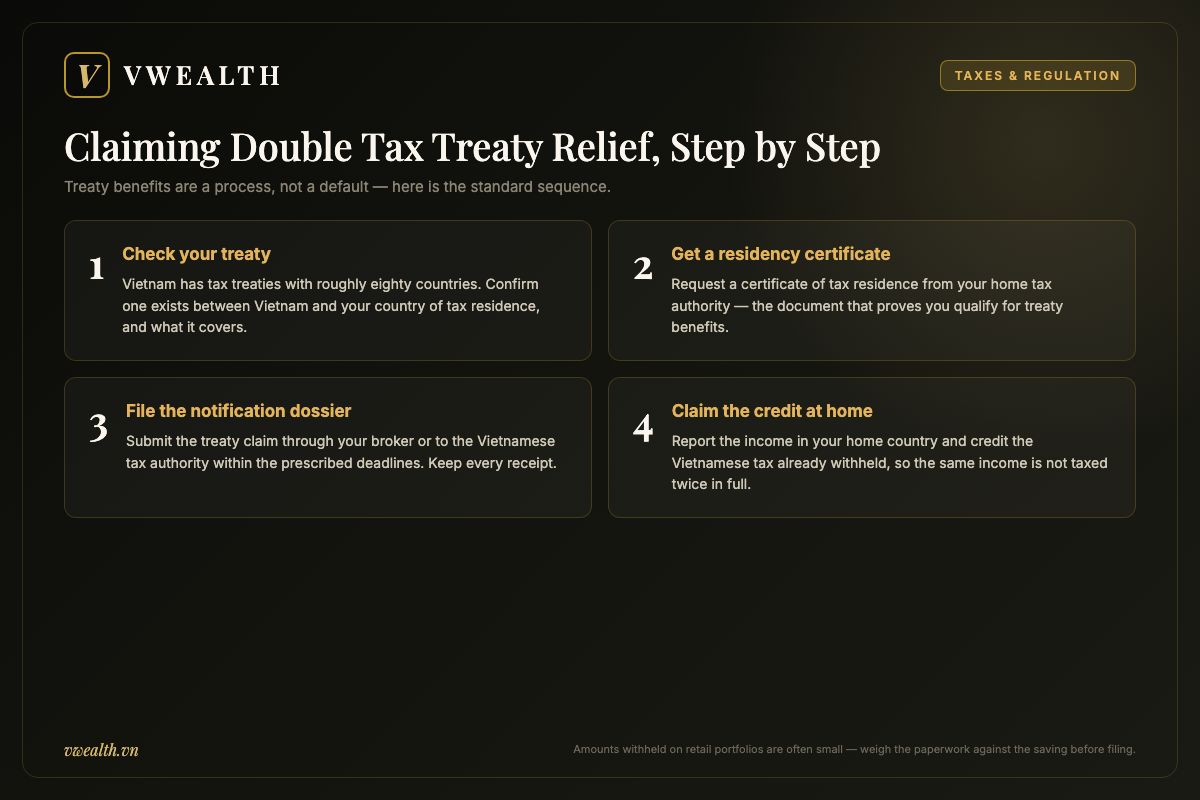
Double taxation happens when two countries both claim the right to tax the same income — Vietnam because the income arose there (source taxation), and your home country because you live there (residence taxation). Left unmanaged, a dividend could be taxed twice in full. To prevent this, Vietnam has signed double taxation agreements (DTAs — bilateral treaties allocating taxing rights between two countries) with a large number of partners: as of mid-2026 the network is counted at roughly 80-plus countries (commonly cited at around 80 signed, with the great majority in force), including most of Europe, much of Asia, Australia and Canada. Each treaty is an individually negotiated document, which is why blanket statements about “the treaty rate” are meaningless until you name the country pair.
How relief typically works
Treaties and domestic law generally provide relief through one of two methods. Under the credit method, your home country taxes your worldwide income but lets you subtract the tax already paid to Vietnam, so you effectively pay the higher of the two rates rather than the sum. Under the exemption method, your home country simply excludes the Vietnam-taxed income. Which method applies, and to which income types, is written into your specific treaty and your home country’s law. A practical observation follows from the arithmetic: because Vietnamese withholding on securities income is low by international standards, the foreign tax credit involved is often small — the illustrative 750,000 dong withheld from that 15-million-dong dividend converts to a modest credit against a home-country tax bill that may be several times larger. For many investors, the treaty’s main function is not saving money on the Vietnamese side but documenting the credit on the home side.
Claiming treaty benefits is a process, not a default
If a treaty entitles you to a lower Vietnamese rate than the domestic default, the benefit is usually not applied automatically. The standard machinery involves obtaining a certificate of tax residence from your home tax authority (a document proving you are entitled to the treaty), submitting a notification dossier through the withholding agent or to the Vietnamese tax authority within prescribed deadlines, and keeping the paper trail. Given the small absolute amounts withheld on typical retail portfolios, many individual investors rationally conclude the procedure costs more than it saves and simply take the domestic withholding as final. That is a legitimate choice — but it should be a choice, made after checking your specific treaty and amounts, not a default born of not knowing the option existed. Ask your broker whether they process treaty relief for clients from your country; the quality of the answer tells you a lot about the broker.
Your home country still wants to hear from you
A final point that no Vietnamese broker will handle for you: whatever Vietnam withholds, your obligations at home remain yours. Most residence countries require you to report foreign investment income and often foreign account holdings themselves, under regimes with meaningful penalties for silence. The 14.25 million dong that arrived after Vietnamese withholding is still, in most systems, reportable income at home, with a credit for the tax paid. Vietnam’s simplicity ends at its border; budget time (or advisor fees) for the home-country leg accordingly.
How Vietnam Compares: The Same Trade in Different Markets
Context makes the Vietnamese model easier to evaluate. Consider, conceptually, what a foreign individual faces when selling shares at a profit in a few reference markets. We deliberately compare structures rather than rates, because rates move and structures endure.
| Market feature | Vietnam | Markets with net-gains taxation of foreigners | Markets that exempt foreign investors’ gains |
|---|---|---|---|
| Tax event on sale | Flat levy on gross proceeds, withheld instantly | Tax on computed profit, often via annual filing or clearance process | No local tax on the gain (e.g., the general US treatment of foreign individuals’ stock gains) |
| Loss treatment | None — losses irrelevant to the levy | Losses typically deductible or carried forward | Not applicable locally |
| Filing burden on the foreigner | Generally none for listed trading | Can be substantial; sometimes requires local tax agent | Generally none locally |
| Dividend treatment | Flat withholding at source | Withholding, often treaty-reduced with paperwork | Withholding still usually applies |
| Predictability of cost | Very high — known percentage of trade value | Depends on profit, holding period, brackets | High locally; home rules dominate |
Two honest observations emerge. First, Vietnam is not the world’s lightest regime — markets that simply do not tax foreign individuals’ capital gains at all exist, and for pure gain-taxation the US treatment of non-resident aliens’ stock profits is famously generous, with the tax action shifted to dividends instead. Second, Vietnam is arguably among the world’s most frictionless regimes: the combination of tiny transaction levy, source withholding and zero filing means the total cost of compliance — money plus time plus risk of error — is about as low as cross-border investing gets. Some regional peers pair modest taxes with heavy paperwork; Vietnam pairs modest taxes with almost none. For a foreign individual weighing frontier-market opportunities, that compliance simplicity deserves a line in the comparison spreadsheet right next to expected returns, and it rarely gets one.
It is also fair to note what you give up: the absence of loss relief means Vietnam offers no tax cushion in bad years, and the flat structure offers no long-term-holding discount of the kind some countries use to reward patience explicitly. Vietnam rewards patience implicitly instead, by charging per transaction.
The Currency Layer: Taxes Are in Dong, Your Life Probably Is Not
Every number in this article so far has been denominated in Vietnamese dong, and that is not a stylistic choice — it is how the system works. Taxes are computed and withheld in dong, on dong-denominated trades, inside a dong-denominated account. For a foreign investor, this adds a layer that domestic investors never think about.
Three practical consequences deserve attention. First, your home-country reporting will almost certainly require converting Vietnamese amounts into your home currency at defensible exchange rates — typically the rate on the transaction date or an official average, depending on your jurisdiction’s rules. If you trade actively, reconstructing fifty conversion rates at filing time is miserable; recording the rate contemporaneously takes seconds. Second, currency movement changes your true tax burden as measured in your own money: withholding of 750,000 dong costs you more or fewer dollars depending on where the exchange rate stands, and over multi-year holding periods the dong’s path can matter as much as the tax rate itself. Third, repatriation — moving your money back out through the capital account — is a currency conversion event with its own documentation, and banks may ask for evidence that taxes on the underlying income were duly withheld before processing large outbound transfers. The mechanics of the dong, its managed exchange-rate regime and what it means for your realized returns are a large enough topic that we cover them separately in our guide to Vietnamese dong currency risk for foreign investors — read it alongside this article, because tax and currency are the two costs that share the same paperwork.
Record-Keeping: The Habit That Makes Everything Else Easy
Vietnam will not ask the typical foreign individual for records — but your home tax authority might, your bank will when you repatriate, and future-you certainly will when trying to reconstruct what happened three years ago in an account interface that has since been redesigned. The record-keeping burden the Vietnamese system lifts from your shoulders should be picked back up voluntarily, in lightweight form. Here is the practical minimum, built from what actually gets asked for:
- Trade confirmations for every buy and sell. Download the contract notes your broker issues, showing date, quantity, price, commission and — on sales — the tax withheld. Do this monthly; brokers’ online archives are not guaranteed to reach back forever, and closed accounts are hard to query.
- Dividend and corporate-action statements. For each cash dividend: announcement, gross amount, withholding, net credited. For each stock dividend or bonus issue: the ratio, the date, and the number of shares received — remember these carry deferred tax consequences at sale.
- Exchange rates, recorded contemporaneously. One column in a spreadsheet: the dong rate against your home currency on each transaction and dividend date. Painless now, priceless at filing time.
- Capital account statements. Every transfer into and out of Vietnam through your indirect investment capital account, with the bank’s paperwork. This is the document set that proves your money entered legally and can leave cleanly.
- Tax residency certificates and treaty filings, if you use them. Treaty relief is a paper game; keep every certificate and submission receipt for at least as long as your home country’s audit window.
- An annual one-page summary. Once a year, write down: total sales, total tax withheld on sales, total dividends gross and net, and year-end holdings. Fifteen minutes that turns any future question — from a tax office, a bank, or an heir — into a lookup instead of an archaeology project.
If that list sounds tedious, note that most of it is generated automatically by the broker and merely needs downloading. The investors who suffer are not those who kept too few records but those who assumed the broker’s portal was a permanent archive. It is not; treat it as a source, and keep your own copy.

Common Questions and Costly Misunderstandings
“I lost money this year — can I get the transaction tax back?”
Under the transaction-based mechanism as it has long operated, no. The levy on gross sale value is not an estimate of profit tax that gets reconciled later; it is the tax. There is no annual reconciliation for the typical individual in which losses would surface. Build this into expectations from day one, and let it reinforce discipline about position sizing and trade frequency — the same disciplines covered in our broader guide for foreign investors in Vietnamese stocks, whose section on beginner mistakes pairs naturally with this article.
“Do I need a Vietnamese tax code or tax agent?”
For plain listed-securities investing through a proper brokerage account, the broker’s withholding machinery generally covers everything, and foreign individuals in the standard case do not engage a local tax agent at all. The cases that change the answer: becoming Vietnamese tax resident, earning other Vietnam-source income (salary, property, business), trading unlisted shares, or claiming treaty relief. Any of those, and an hour with a Vietnam-qualified tax advisor is cheap insurance.
“Are the rates in this article the current rates?”
As of mid-2026 the core figures are current and specific, not illustrative: 0.1 percent of gross proceeds on a listed-securities sale, and 5 percent withholding on cash dividends — both carried unchanged into the new Personal Income Tax Law 109/2025 that takes effect on 1 July 2026. The framework has been remarkably stable, and the 2026 overhaul kept the listed-investor mechanics intact while tightening the treatment of unlisted-share and capital transfers and adding reliefs for fund investors. That said, tax law is amended by real governments on their own schedules, and the implementing decrees and circulars that turn a new law into daily practice can move faster than any evergreen article. So verify before you rely: your securities company (which must implement current rates in its systems, and whose client-services desk answers this question weekly) and a licensed tax advisor in Vietnam or your home country are the two reliable checkpoints. Five minutes of verification beats any amount of reading.
“Does the taxman care whether I hold for a day or a decade?”
Within the transaction model, no — there is no holding-period distinction, no long-term discount, no short-term penalty. The rate on a sale is the rate. The economics, however, care a great deal: because tax is charged per transaction, turnover is the variable you control that most directly determines your cumulative tax cost. Ten round trips cost ten times the tax of one. Frequency, not duration, is what the system prices.
“If Vietnam is this simple, why do I keep hearing taxes are a reason to avoid frontier markets?”
Because in many frontier and emerging markets, the pain is real — clearance certificates before repatriation, mandatory local tax agents, capital gains computations in unfamiliar formats. Vietnam’s securities tax regime is a genuine exception on the compliance dimension, which is one reason the market has drawn steadily growing foreign participation despite its other frictions, such as foreign ownership limits and currency conversion. Judge each market on its own paperwork, not the category’s reputation.
Key Takeaways: A Simple System That Rewards Simple Behavior
Strip away the caveats and the Vietnamese framework for foreign individual investors fits in four sentences. Selling shares triggers a small flat tax on the gross sale value, withheld by your broker. Cash dividends arrive net of a modest flat withholding. Stock dividends defer their tax to the day you sell. And for the typical non-resident individual trading listed securities, there is no Vietnamese tax return — the withholding is the whole story, leaving only your home country’s reporting to handle with the records you sensibly kept.
The strategic implications are just as compact. The system taxes activity, not success, so it punishes churning and barely notices patient compounding. It offers no shelter for losses, so risk management must come from your process rather than the tax code. And its numbers, while historically stable and low, are set by law that changes — so the single most important habit is verification: confirm current rates with your broker before trading, and involve a tax advisor the moment your situation steps outside the standard case of a non-resident individual trading listed shares. Everything in this article describes the general framework for educational purposes; it is general information, not tax, legal or investment advice, and this analysis is for reference only, not an investment recommendation.
Research Vietnamese stocks in English with vwealth. Our AI-powered platform turns Vietnamese market data into full English analysis reports — with international payment support and a free 2-month trial for new accounts. Create your free account and read the latest reports.