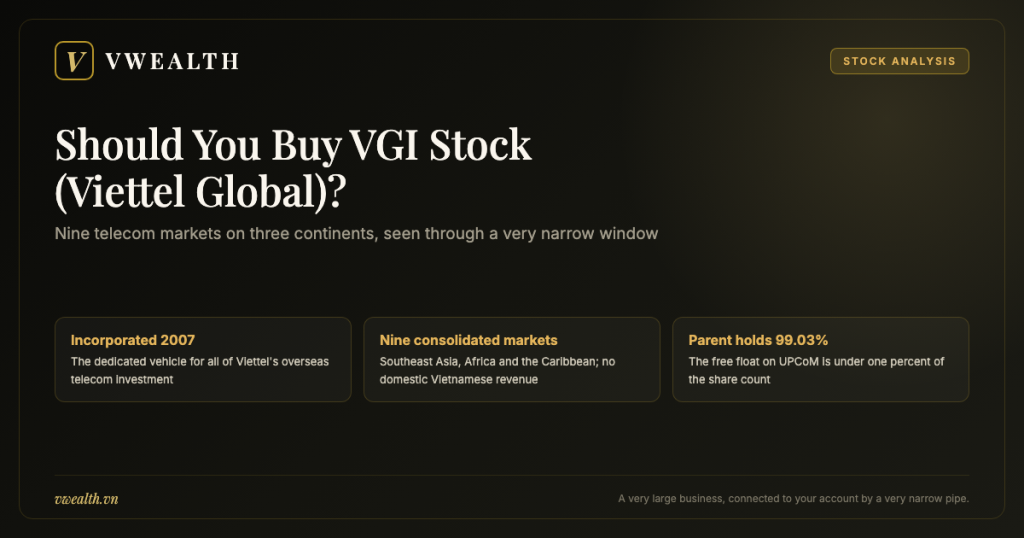
Anyone asking whether to buy VGI stock runs into a trap on the very first line of the order book. Viettel Global is the only company on any Vietnamese exchange whose entire revenue comes from telecom networks in nine foreign markets across three continents — Southeast Asia, Africa and the Caribbean. No other Vietnamese listed company offers that exposure. But the shares trade on UPCoM rather than the main board, they sit under a formal warning designation, and less than one percent of the share count actually floats outside the state parent. You are looking at a very large business through a very narrow window, and the number on the screen may not mean what you think it means. This analysis walks through two decades of Viettel Global’s overseas expansion, shows you the five places to read carefully in the accounts of a multi-currency consolidator, and explains why the parent’s divestment roadmap — not any quarterly result — is the single most important variable for anyone buying these shares.
Three conventions before we begin.
The first concerns figures. You will find dates, market names, executive names and ownership percentages, all drawn from public sources: incorporation records, shareholder meeting resolutions, filings with the Hanoi Stock Exchange, and mainstream financial media. What you will not find is a share price, a current valuation multiple, a price target, or a latest-quarter number. For current data, open the research reports on vwealth, where figures are refreshed against published filings.
The second concerns the boundary between the group and the listed entity. Viettel is a very large military-owned industrial and telecom group, and several Vietnamese listed companies are loosely described as part of the “Viettel family.” This article is about exactly one legal entity: Viettel Global Investment Joint Stock Company, ticker VGI. Where something belongs to the parent group or to a sister company, the text says so, because confusing that boundary is the source of almost every misunderstanding about this stock.
The third concerns tone. This is neither a promotion nor a takedown. Viettel Global has an international operating record that very few Vietnamese companies can match, and it simultaneously has a share structure that a foreign retail investor needs to understand thoroughly before committing capital. Both things are true at once.
Two decades abroad, starting with six people
Viettel Global’s story does not begin with a transaction. It begins with a decision that looked backwards at the time: a Vietnamese mobile operator that was not yet the domestic leader decided to go build networks in other countries.
Who the parent is, for readers outside Vietnam
Before the history, a short orientation for anyone unfamiliar with the Vietnamese corporate landscape, because VGI cannot be understood without its parent.
Viettel is a state-owned industrial and telecommunications group under Vietnam’s Ministry of National Defence. It began as a military communications construction unit and became a commercial mobile operator only in the mid-2000s, entering a domestic market where incumbents already held the profitable urban customers. It won the domestic market by covering the countryside first and pricing aggressively — the same playbook it later exported.
Several distinct listed entities sit within or adjacent to this group, each with a separate business and a separate ticker. Confusing them is the single most common error in coverage of these shares. Viettel Global is the vehicle for overseas telecom investment. Other affiliated listed companies handle domestic postal and logistics services, or telecom infrastructure construction and tower operations. They share a brand and a parent; they do not share a business model, a customer base, or a risk profile.
Two implications follow for a foreign reader. The first is that the parent’s decisions — capital allocation, personnel rotation, divestment timing — are the dominant governance input at VGI, more so than at a company with dispersed private ownership. The second is that when Vietnamese media reports that “Viettel stocks rallied,” that describes thematic flow across a group of tickers rather than a development at any one company. Do not treat such a move as information about VGI’s business.
2006: a project management board of six
In 2006 Viettel created a foreign investment project management board staffed by six people. At that moment the company had been selling mobile service at home for less than two years — Viettel launched its Vietnamese mobile network on 15 October 2004 with the 098 prefix, becoming the country’s fourth operator.
In other words, the company decided to go abroad while it was still the late entrant at home. That was the first unusual thing about it, and it shaped everything that followed. Viettel did not target wealthy saturated markets. It targeted countries where telecom infrastructure was thin, average income was low, and the large international carriers had little appetite for covering rural districts because the returns did not clear their hurdle rates.
Internally the strategy had a plain name: surround the cities from the countryside. Build base stations all the way into remote areas, sell cheap SIM cards, accept very low revenue per subscriber, and in exchange win a large subscriber base and the position of the operator with the widest coverage. This model demands heavy infrastructure capital up front and demands patience for years before profitability arrives — something an ordinary listed company finds nearly impossible to sustain, but something a company whose parent is a state group can do.
24 October 2007: the entity is created
Viettel Global Investment Joint Stock Company was established on 24 October 2007. It was and remains the dedicated vehicle for all of Viettel’s overseas telecom investment. VGI does not sell telecom services inside Vietnam and does not compete with Viettel Telecom domestically. Every dong of its consolidated revenue originates outside Vietnam’s borders.
This matters more than it first appears when you open the accounts. A Vietnamese company with zero revenue denominated in Vietnamese dong reports every figure as the output of a currency translation, and that translation can flatter or damage the picture without a single operational fact changing. Chapter four returns to this.
2008 and 2009: Laos and Cambodia
The first international market was Laos. Star Telecom, a joint venture between Viettel and local partner Lao Asia Telecom, launched the Unitel brand in February 2008. Cambodia followed almost immediately: Viettel Cambodia launched the Metfone brand on 19 February 2009.
These two markets later became the most reliable profit pillars in the portfolio, and they are the clearest evidence for the “enter early into an unsaturated market” thesis. In both Laos and Cambodia, Viettel not only captured large market share but held a leading position for years — an outcome that is very hard to replicate by entering late.
For someone reading the accounts, these two markets matter because they represent the mature part of the portfolio: new capital expenditure has fallen, cash flow is relatively steady, and volatility now comes from price competition and local telecom policy rather than from network construction costs.
2011 to 2015: three continents in five years
This is the period in which the map took its present shape. In September 2011 Natcom launched in Haiti, with Viettel Global holding the controlling stake and Haiti’s Teleco S.A holding the remainder. In January 2012 Movitel launched in Mozambique — the first African market and the project most discussed in the early years, because the scale of fibre infrastructure it built was large relative to the host country’s existing national network.
In July 2013 Telemor opened in Timor-Leste. In September 2014 Nexttel opened in Cameroon. In October 2014 Bitel opened in Peru. In May 2015 Lumitel opened in Burundi. In October 2015 Halotel opened in Tanzania.
Seven new markets in four years, across three continents, three time zones and three entirely different political risk profiles. The execution speed is genuinely impressive, and it is also the root of most of the accounting complications VGI still carries. Each market is a separate legal entity with its own currency, its own regulatory framework, and in several cases its own local partner with its own expectations.
November 2018: Cameroon, a wound that has not closed
Nexttel is a joint venture between Viettel and a Cameroonian partner. From November 2018 the relationship between the two shareholder groups fell into a prolonged disagreement. According to reporting by international trade press, the Cameroonian side took steps after which Vietnamese staff were no longer able to work at the operator’s headquarters, while that partner disputed the characterisation and set out its own account. This article takes no side and reaches no conclusion about who was right — that belongs to the competent tribunals and to the parties themselves.
What investors need to hold onto is the accounting consequence, and it is very specific: from 1 November 2018 onwards, Viettel Global has been unable to obtain the financial data of Viettel Cameroon S.A.R.L. for consolidation. That condition has persisted continuously for years. In the reporting cycle covering 2025, the company still disclosed that it had not obtained the entity’s figures.
There have been periods of renewed dialogue — Cameroonian press reported that the shareholders announced a resumption of talks, and a government-level meeting took place between Vietnam’s Deputy Foreign Minister Nguyen Quoc Cuong and Cameroon’s Prime Minister Joseph Dion Ngute aimed at resolving the impasse. But as of the most recent disclosures, the data problem has not been definitively closed. Chapter five shows you what this turns into on the exchange.
2018: Myanmar and the listing
Mytel was the tenth market Viettel entered abroad and the last new market Viettel Global opened for roughly a decade afterwards. The Myanmar joint venture began commercial service in 2018.
The same year the shares began trading. VGI’s first trading day on UPCoM was 25 September 2018, at a reference price of 15,000 dong per share. The original plan had been to bring the shares to market in July of that year.
There is a structural detail here that many people get wrong. Peru — the market operating under the Bitel brand — is run and managed by Viettel Global, but Peru’s results are not consolidated into VGI’s reported accounts, because host-country rules required the operating entity to sit with the parent group. So when you read company material referring to “nine markets,” that means nine consolidated markets; when you read press coverage referring to “ten Viettel markets abroad,” that is the group’s perspective. This is not a semantic quibble. Peru has historically been one of the higher-performing markets in the system, and the fact that it is not in the consolidated accounts means you must not add it in when valuing VGI.
2019 to 2024: no new markets
After Myanmar, Viettel Global essentially stopped opening new markets for roughly a decade. This is the least discussed period and the most important one for understanding the company today.
During these years the story was no longer geographic expansion but depth: upgrading networks to 4G, pushing data consumption to replace voice and messaging, and above all building digital financial services on top of the mobile subscriber base — a wallet and mobile-money model that fits economies where the share of the population holding a bank account is far below the share holding a phone.
It was also the period in which the company had to work through the consequences of its earlier expansion speed: accumulated losses at certain markets, investments requiring impairment provisions, and the Cameroon data situation described above.
2025 and 2026: records, cash dividends, and one new market
In 2025 the company reported the strongest results in its history: consolidated net revenue above 44,000 billion dong, growing more than twenty percent, and profit after tax of 11,250 billion dong, up 57% year on year. Gross margin was reported at a record 51.3%.
In the same cycle, Viettel Global began paying cash dividends. The 2025 annual general meeting approved a distribution of more than 2,280 billion dong, equal to 7.5% of charter capital — regarded as the first cash dividend after many years of retaining all earnings to fund overseas investment. At the annual general meeting held on 23 April 2026, shareholders approved a dividend for the 2025 financial year of 33% in cash, equal to 3,300 dong per share and total distribution above 10,044 billion dong.
And after nearly a decade without a new market, the board approved on 17 April 2026 a project in the Dominican Republic with an announced scale of about USD 560 million, under the entity Viettel Dominicana, beginning with mobile and fixed broadband infrastructure and later extending into data centres, cloud computing, cybersecurity and IT solutions.
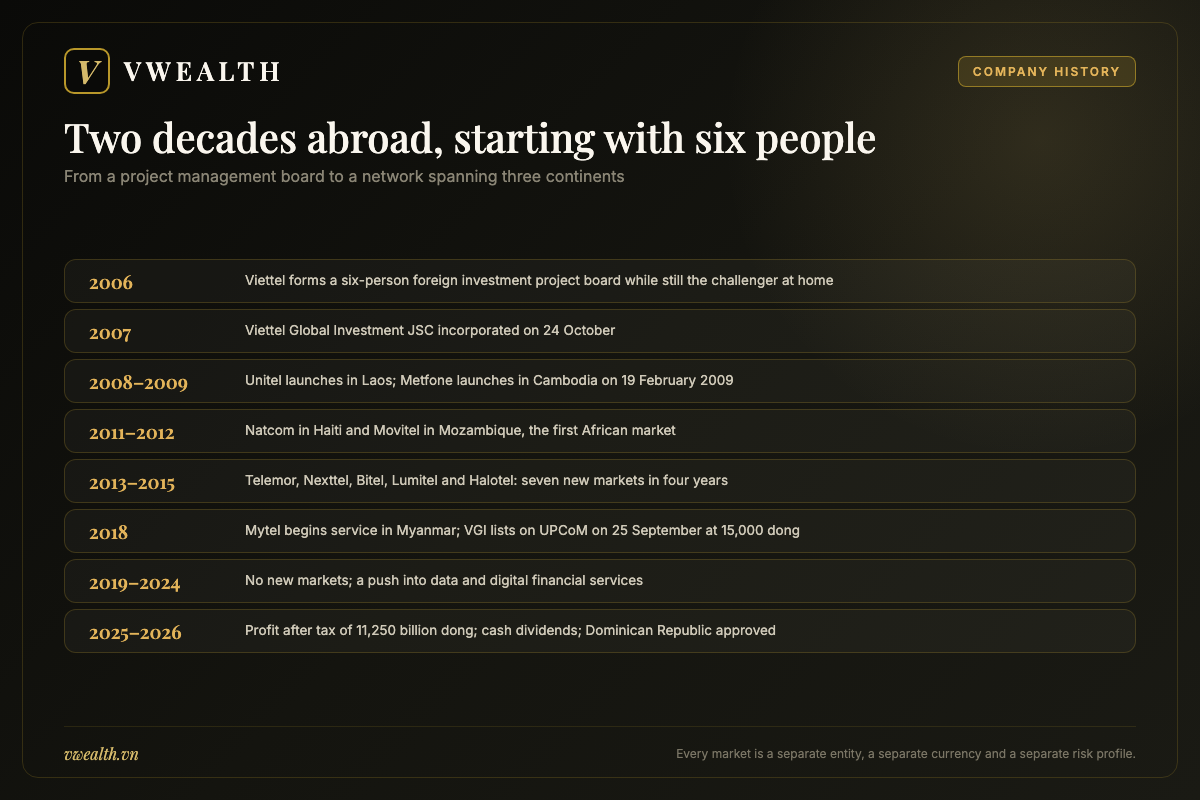
The timeline, read down the page
| Date | Event | Why it matters to a buyer today |
|---|---|---|
| 2006 | Foreign investment project board created, six staff | The origin of the whole model: go abroad while still the challenger at home |
| 24 Oct 2007 | Viettel Global Investment JSC incorporated | Dedicated overseas vehicle; no domestic Vietnamese revenue |
| 2008 – 2009 | Unitel (Laos), Metfone (Cambodia) | The two steadiest profit pillars, past the heavy investment phase |
| 2011 – 2015 | Natcom, Movitel, Telemor, Nexttel, Bitel, Lumitel, Halotel | Three continents in four years; also the root of multi-entity risk |
| Nov 2018 | Cameroon shareholder dispute; loss of access to VCR data | Direct cause of the long-running qualified audit opinion |
| 2018 | Mytel begins commercial service in Myanmar | Last new market opened for roughly a decade |
| 25 Sep 2018 | VGI’s first UPCoM trading day, reference price 15,000 dong | UPCoM rather than the main board — consequences persist today |
| 2019 – 2024 | No new markets; push into data and digital services | Depth phase and clean-up of the expansion legacy |
| 2025 | Profit after tax 11,250 billion dong, up 57%; first cash dividend 7.5% | Transition from a capital-absorbing company to a cash-returning one |
| 17 Apr 2026 | Dominican Republic project approved, announced scale USD 560 million | First new market in almost ten years |
| 23 Apr 2026 | AGM approves 2025 dividend of 33% in cash | Dividend policy shifts decisively to cash distribution |
What to carry forward from chapter one
Three things. First, this is a company that has completed a full cycle: years of investment losses, then breakeven, then large profits. That cycle is documented, not narrated. Second, the expansion speed of 2011 to 2015 left an accounting legacy that is still unresolved. Third, the shift to paying cash dividends changes the nature of how the company treats shareholders — and at a stock where the free float is minuscule, that change carries more weight than usual.
Who runs it, and who owns almost all of it
At most companies the ownership chapter is the dullest one. At VGI it is the decisive one, because the ownership structure affects not just minority rights but the legal status of the shares themselves.
Chairman of the board: Dao Xuan Vu
Mr Dao Xuan Vu holds the position of Chairman of the Board of Directors at Viettel Global. The role is recorded in the company profile published on Vietnamese securities data systems and was reflected in coverage of the annual general meeting held on 23 April 2026.
What a foreign investor should understand about this seat: it is not the chair of an individual founder-owner. It is the seat representing the parent group’s capital, held by an executive from within the Viettel system and rotated according to group assignment. That cuts two ways. The positive side is strategic continuity, with no risk of the control battles that periodically disrupt Vietnamese companies with dispersed private ownership. The side to note is that major corporate decisions tend to reflect the priorities of the parent group and of the state capital management framework, rather than the short-term interests of minority holders on the exchange.
Chief executive: Nguyen Thi Hoa
Ms Nguyen Thi Hoa serves as General Director, the Vietnamese equivalent of chief executive, and also sits on the board. She was born in 1980 and is the first woman to hold the top executive role in the corporation’s history, with more than fifteen years inside the Viettel system before her appointment.
The appointment was covered by multiple Vietnamese financial outlets and is reflected in the company profile on securities data systems. It is worth noting not for symbolism but because in reporting on the 2026 annual meeting, it was the chief executive herself who spoke publicly about the free float problem — the issue we turn to below. A management team that raises its own structural risk in front of shareholders is a positive governance signal, even though the risk itself remains intact.
The executive bench
The published company profile lists deputy general directors including Nguyen Cao Loi, Nguyen Duc Quang, Ha The Duong, Hoang Long, Pham Anh Duc and Tran Thu Huyen. Of these, Ms Tran Thu Huyen and Mr Hoang Long were approved for appointment by the board in May 2026.
A wide executive bench makes sense given VGI’s structure: each market is an independent legal entity in a different country, requiring coverage by geography and by function simultaneously. But it also reminds you that the management cost of this model is not small. When reading the accounts, look at general and administrative expense as a share of revenue across several years rather than in a single period.
Senior turnover: normal inside a state group
VGI has seen periods of senior personnel change driven by rotation within the parent group. Vietnamese financial media has reported instances of board members and the head of the internal audit committee resigning to take up new assignments allocated by the group.
At a private company, a cluster of simultaneous resignations warrants close inspection. At a company inside a state group, the cadre rotation mechanism makes this far more routine. The way to tell the difference: read the stated reason in the disclosure, check whether the departing individual is recorded as taking another role within the same system, and check whether the company appoints a replacement quickly or leaves the seat vacant for a long stretch. That reading discipline applies to any market, and the guide to corporate governance in Vietnamese listed companies sets out the disclosure conventions a foreign reader should expect.
Ownership: 99.03% and the rest
This is the most important number in the article.
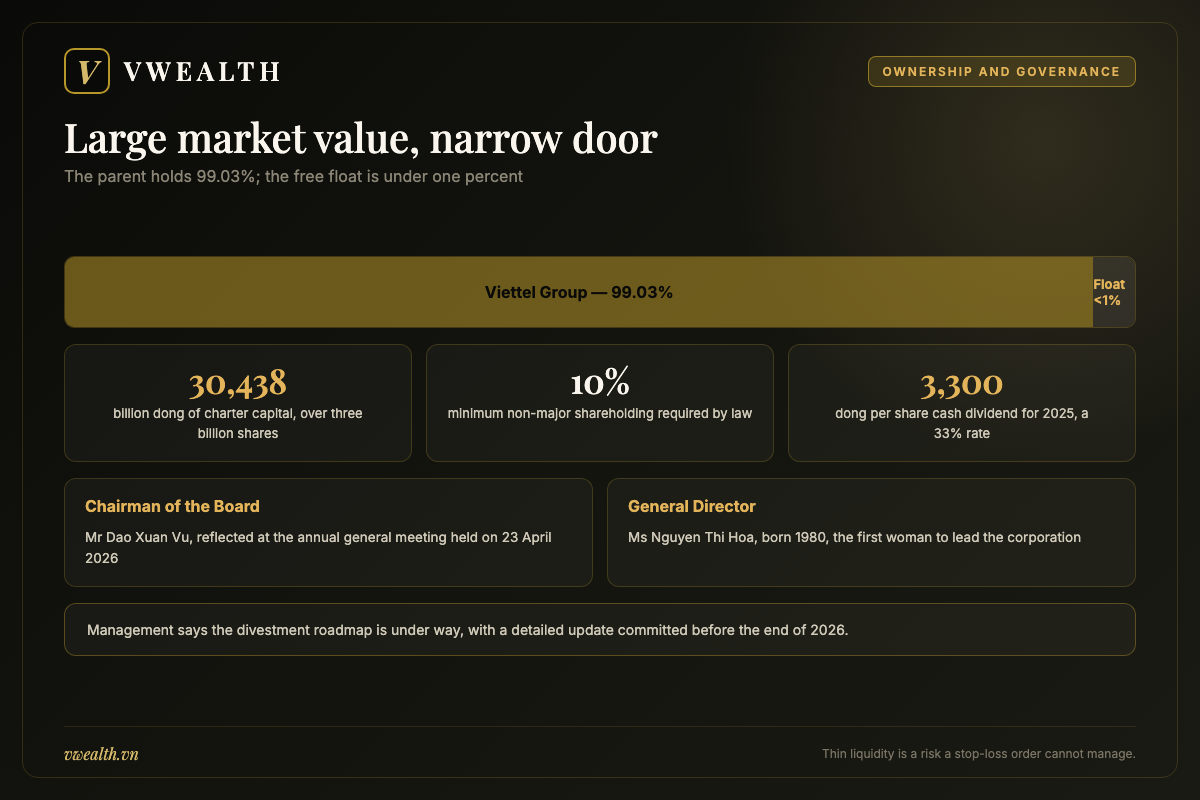
Viettel Global’s charter capital is 30,438,112,000,000 dong, corresponding to more than three billion shares outstanding. Of these, the Military Industry and Telecoms Group holds 3,014,205,300 shares, equal to 99.03%. Every other shareholder combined — every individual and institution on the exchange — holds under one percent.
Pause on that, because its consequences run through the rest of the analysis.
First, liquidity. When under one percent of shares sit outside the parent, then no matter how large the notional market capitalisation, the number of shares that can actually change hands daily is very small relative to that size. An order worth a few hundred thousand dollars moves this stock far more than an equivalent order in a main-board Vietnamese blue chip. That is true buying and selling alike — and selling is the painful direction.
Second, valuation. A share price forms from the supply and demand of the floating portion. When the float is this thin, the price that forms does not carry the same statistical meaning as at a company with hundreds of millions of freely traded shares. Valuation ratios computed across the full share count can therefore produce numbers you should not read in the usual way. That is why this article gives no valuation figure at all.
Third, and this is the newest element: the company’s status as a public company is itself in question.
Public company status and the divestment roadmap
Vietnam’s Securities Law sets a minimum condition on the proportion of shares held by non-major shareholders for a company to retain public company status — a minimum of 10%, held by at least 100 investors who are not major shareholders.
With a float under 1%, Viettel Global is a long way from that threshold. At the 2026 annual general meeting, General Director Nguyen Thi Hoa told shareholders directly that unless minority ownership rises by at least nine percentage points, the company faces the risk of losing public company status. Management stated that a divestment roadmap is under way, with valuation specialists engaged and consultation with relevant agencies proceeding, and committed to providing detailed updates before the end of 2026.
This deserves to be thought about in both directions rather than one.
The constructive reading: if the parent genuinely sells down a meaningful stake, the float multiplies. Liquidity improves, the stock becomes visible to funds, and the path to a main-board listing — an objective the company has repeatedly stated — loses one of its largest obstacles. This is a real catalyst, with a stated timeline, disclosed by the company itself.
The cautious reading: any large sell-down creates supply pressure in the short run, and the price in a state divestment is typically set by an appointed valuer rather than by the screen price of a thin market. At companies with very low free float, the gap between the screen price and the price achievable in a size transaction can be substantial. Beyond that, Vietnamese state divestment processes have a well-documented history of running longer than planned because of valuation and approval procedure — meaning the larger risk is not that divestment happens, but that it does not happen on schedule.
If you are unfamiliar with how foreign ownership limits interact with a structure like this, the explainer on foreign ownership room in Vietnamese stocks covers the mechanism. The key point for VGI is that with a float under one percent, foreign room is effectively not a live variable, because there is simply not enough stock for overseas investors to build a position anywhere near any limit.
Dividends: from nothing to a large cash payout
For most of its existence, Viettel Global paid no cash dividend. That was rational. The company was building networks in nearly ten countries, every base station was an outlay, and the cash it produced was retained to keep investing.
The turning point came as the larger markets moved past the heavy investment phase and began sending cash back. The 2025 annual meeting approved the first cash dividend at 7.5% of charter capital, totalling more than 2,280 billion dong. The 2026 annual meeting raised the dividend for the 2025 financial year to 33%, equal to 3,300 dong per share and more than 10,044 billion dong in total.
This is one of the clearest policy shifts you can observe at this company. But read it correctly. With the parent holding 99.03%, virtually all of the dividend cash flows to the parent. The dividend is first and foremost a mechanism for moving profit from the subsidiary up to the group, and only secondarily an income stream for minority holders. That does not diminish its value to you — you receive exactly 3,300 dong per share you hold — but it explains why VGI’s dividend policy tracks the parent’s capital needs more closely than any signal management wishes to send the market.
| Ownership dimension | Figure or status | Direct consequence for a retail investor |
|---|---|---|
| Charter capital | 30,438,112,000,000 dong | More than three billion shares outstanding — very large notional size |
| Parent holding | 99.03% (3,014,205,300 shares) | Shareholder resolutions are effectively decided before the meeting convenes |
| Free float | Under 1% | Thin liquidity; price sensitive to small orders; hard to exit a position |
| Public company threshold | Minimum 10% held by non-major shareholders, at least 100 investors | At least nine percentage points must be added — both a catalyst and a risk |
| Remediation | Divestment roadmap under way, update committed before end 2026 | A dated milestone you can score management against |
| Dividend for FY2024 | 7.5% in cash, more than 2,280 billion dong | First cash distribution after years of full retention |
| Dividend for FY2025 | 33% in cash, 3,300 dong per share | Confirms the company has entered a harvest phase |
| Foreign room | Not a live variable due to lack of stock | Do not build a thesis here on foreign inflows |
One sentence for chapter two
VGI’s ownership structure is simultaneously its greatest strength and its greatest weakness, and it is the same fact viewed from two sides. The strength: the company has a parent large enough, patient enough and well-resourced enough to pursue telecom projects that take a decade to repay — the kind of project ordinary capital markets will not finance. The weakness: precisely because the parent holds almost everything, the listed shares lack the liquidity characteristics a retail investor needs. You cannot choose one half. Buying VGI means accepting the whole package.
What this company actually sells
Read the name “Viettel Global Investment” and you might assume a financial holding company. It is not. VGI is a collection of real mobile operators with real base stations, real shops and real people selling SIM cards in local markets — all of it located in other countries.
Pillar one: conventional telecom in developing markets
This remains the largest share of consolidated revenue. The business model of a mobile operator is the same everywhere in principle: you spend capital to build infrastructure, then sell monthly access to that infrastructure to as many people as possible.
VGI’s difference lies in which markets it chose. Most of its markets share three features: a young population, low initial network coverage, and low income per head. Those three create a very particular problem.
Low income means average revenue per user — the industry shorthand is ARPU — will be far below developed-market levels. You cannot sell a plan costing tens of dollars a month to someone earning a few hundred dollars a year. In compensation, low initial coverage means many people still have no connection at all, and whoever arrives first with the widest footprint effectively captures that group by default.
This is why Viettel built first and sold second, accepting losses for years. In Mozambique, for example, the fibre network Movitel deployed in its early phase was large relative to the country’s prior national infrastructure. It is a high-risk strategy: if market share falls short, that vast fixed asset base grinds down profit through depreciation for decades.
The unit economics, worked through slowly
It is worth spending a moment on the arithmetic of this model, because it explains both why the strategy works and why it takes so long to work.
Take an illustrative example — the numbers here are chosen for clarity, not drawn from any company filing. Suppose an operator spends a fixed sum to build a base station covering a rural district. In a developed market, that station might serve subscribers each paying the equivalent of twenty dollars a month, and the site repays its cost quickly. In the markets VGI targets, the same station might serve subscribers paying the equivalent of two or three dollars a month.
At first glance that looks like a worse business by a factor of seven or eight. Two things change the picture. The first is that construction and operating costs in those markets are also far lower — land, labour, permits and maintenance all cost a fraction of developed-market equivalents, and Viettel’s operating model was built specifically around keeping those costs down. The second is that there is no competitor at the site. In a saturated market, three operators split the same district; here, one operator may hold it outright for years.
The consequence is a payback period measured in years rather than quarters, followed by a long tail of high-margin revenue once the asset is built and largely depreciated. This is why the reported gross margin can reach the levels the company disclosed for 2025, and why the same company spent its first decade absorbing losses.
The investment implication is straightforward but often missed. A market that has just opened drags on reported profit; a market that opened a decade ago flatters it. When you look at any single period’s result at VGI, you are looking at the sum of several projects at different points on that curve. Judging the company on one year is like judging an orchard by weighing whatever fell that morning.
Pillar two: the shift from voice to data
Over the past decade, most of the incremental value at emerging-market operators has come not from adding subscribers but from existing subscribers consuming more data.
The mechanism is simple. A user on a feature phone who only calls and texts generates a certain level of revenue. When that user switches to a smartphone and starts watching video, using social media and streaming music, monthly telecom spending rises materially without the operator having to find a single new customer.
Across VGI’s African and Southeast Asian markets, that conversion is still under way rather than complete. It is one reason the company can sustain revenue growth well above the global telecom sector average — in developed markets this transition finished long ago and the industry has almost no organic growth left.
But the data shift has a cost side you should track. It requires continuous investment in network capacity. The more video people watch, the more sites must be upgraded and the more international bandwidth must be bought. So when reading the accounts, do not simply note that data revenue is rising; compare annual capital expenditure against operating cash flow.
Pillar three: digital financial services, the most interesting part
This is the segment a Vietnamese or Western investor is most likely to underestimate, because there is no direct domestic equivalent to draw on.
In many African countries, the share of the adult population holding a bank account is far below the share holding a mobile phone. Banks do not open rural branches because the economics do not work, but mobile operators already have base stations and a dense network of airtime agents everywhere. The result is that mobile money — loading value onto a phone account and using that account to transfer, pay and settle bills — becomes the de facto financial infrastructure of an entire economy.
This model was proven in Africa before Viettel entered it, and its margin profile differs sharply from pure telecom: the marginal cost of a transaction is close to zero while every transaction generates a fee. An operator that already has subscribers and an agent network essentially only has to switch the service on.
At VGI, digital services have been identified by management as one of the principal growth drivers for the coming phase, alongside conventional telecom, new sectors and market expansion. The company also uses the label “phase 3.0” to describe this shift from pure network operator to digital services provider.
When reading the accounts, look for the note breaking revenue down by service type. The share of revenue coming from outside conventional telecom is the most direct measure of whether this strategy is materialising or still living in meeting documents.
Pillar four: digital infrastructure and new sectors
The Dominican Republic project was announced with a sequence: mobile and fixed broadband infrastructure first, then data centres, cloud computing, cybersecurity and IT solutions. That is a clear signal about direction. Future markets are no longer approached as telecom projects but as comprehensive digital infrastructure packages.
Strategically this makes sense. An operator that only sells connectivity is easily displaced by a price war. A provider that owns the network, the data centre and the digital financial rails is far harder to displace, because enterprise customers and host governments have few equivalent alternatives.
But it must be said plainly: this segment has little result evidence yet at VGI scale. The correct treatment for an investor is to record it as an option rather than to add it to a valuation until numbers exist.
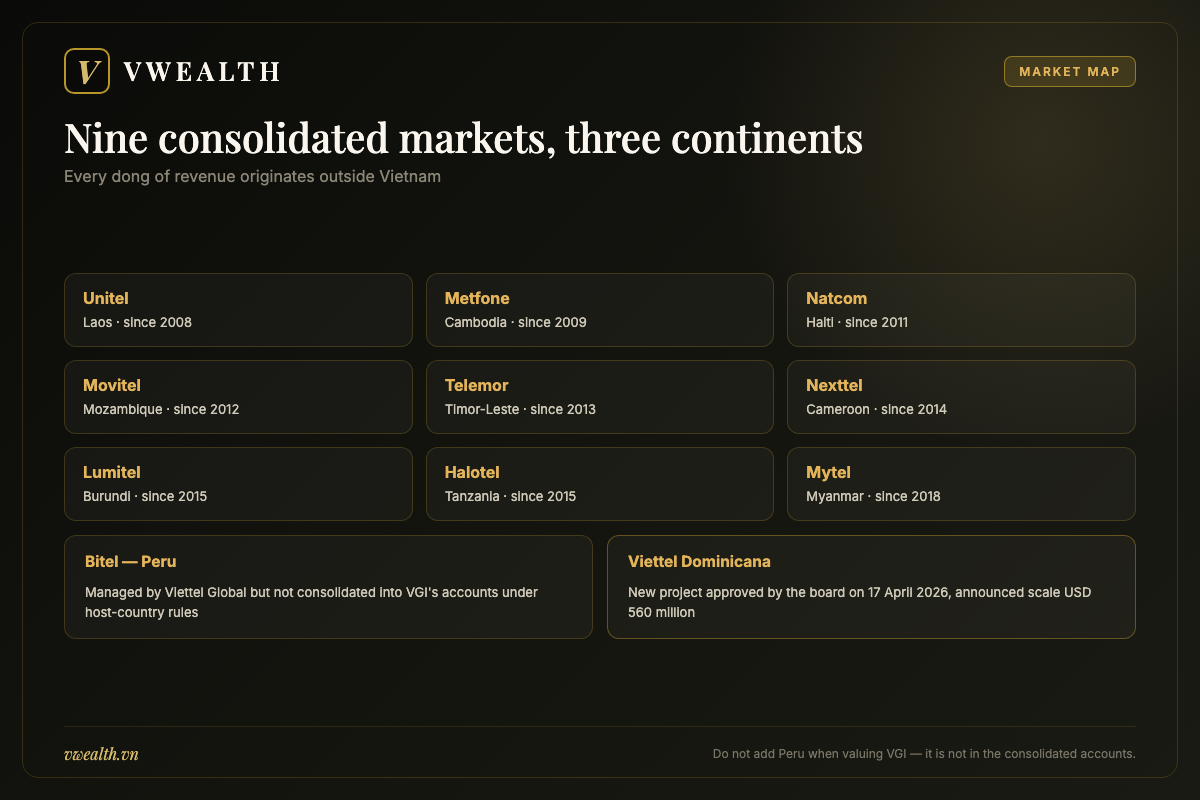
The nine consolidated markets
| Brand | Country | Region | From | Note |
|---|---|---|---|---|
| Unitel | Laos | Southeast Asia | 2008 | Star Telecom joint venture with Lao Asia Telecom |
| Metfone | Cambodia | Southeast Asia | 2009 | Second international market, long-running profit pillar |
| Natcom | Haiti | Caribbean | 2011 | Partnership with Haiti’s Teleco S.A |
| Movitel | Mozambique | Africa | 2012 | First African market, large-scale fibre deployment |
| Telemor | Timor-Leste | Southeast Asia | 2013 | Small by population |
| Nexttel | Cameroon | Africa | 2014 | Joint venture; shareholder dispute since 2018, data not consolidated |
| Lumitel | Burundi | Africa | 2015 | Small market, leading position |
| Halotel | Tanzania | Africa | 2015 | Direct competition with large regional carriers |
| Mytel | Myanmar | Southeast Asia | 2018 | Joint venture; remaining capital contribution fully provisioned |
| Bitel | Peru | South America | 2014 | Managed by VGI but NOT consolidated into VGI’s accounts |
| Viettel Dominicana | Dominican Republic | Caribbean | Approved 2026 | New project, announced scale USD 560 million |
Which parts feed which
The clearest way to hold VGI’s profit structure in your head is to picture the portfolio as an orchard with trees of different ages.
The harvested group: Laos and Cambodia, plus several African markets past breakeven. This group generates steady cash, requires little new investment, and is the source of dividend capacity.
The growing group: African markets with remaining headroom in data subscribers and digital financial services. Still consuming capital, but already contributing profit.
The troubled group: Cameroon, where financial data cannot be obtained, and Myanmar, where the political environment led the company to provision the entire remaining capital contribution in the joint venture. Accounting-wise this group has largely been dealt with; reputationally and in audit terms the consequences persist.
The newly planted group: the Dominican Republic. It will absorb capital over the coming years and reduce reported profit before it contributes — exactly as happened at every prior market.
Understand those four groups and you will not be surprised when VGI’s profit swings between periods. That is the nature of an infrastructure project portfolio, not a sign of instability.
Reading the accounts of a company with no domestic revenue
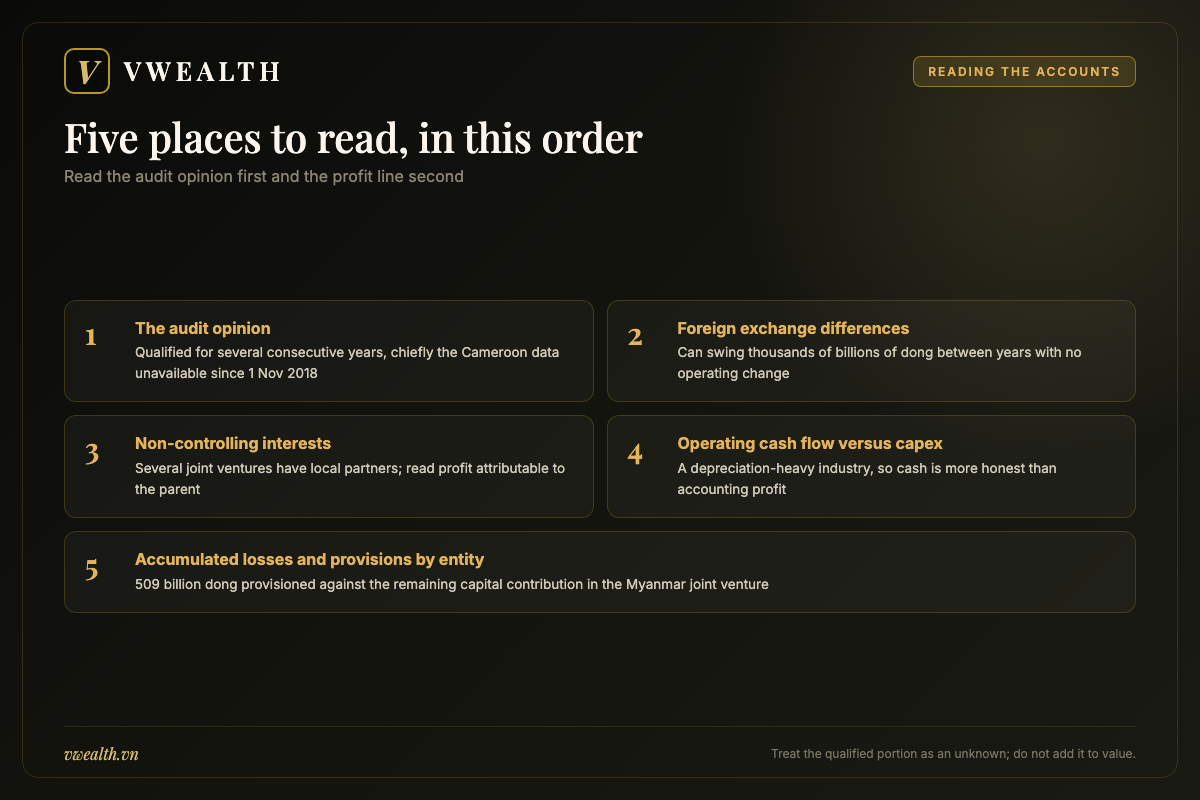
This is the most practical chapter in the article. If you have only fifteen minutes with Viettel Global’s financial statements, spend them on these five places, in this order.
Place one: the audit opinion, before the balance sheet
At most companies the audit opinion is boilerplate nobody reads. At VGI it is the first thing to read.
Viettel Global’s annual financial statements have carried a qualified audit opinion for several consecutive years. The principal qualification concerns the investment in Viettel Cameroon S.A.R.L.: because the company has been unable to obtain that entity’s financial data from 1 November 2018 through the end of 2025, the auditor states that it cannot determine whether adjustments to the consolidated financial statements would be necessary.
The auditor has also raised a qualification regarding the recognition of an impairment provision on the investment in the Myanmar joint venture. According to disclosure, the company assessed Myanmar’s political situation as continuing to be complex, affecting the joint venture’s operations, and provisioned the entire remaining capital contribution of 509 billion dong in the separate financial statements.
You need to understand what a qualified opinion does and does not mean. It does not mean fraud. It does not mean the other numbers are wrong. It means there is a portion of the picture the auditor cannot see, so they decline to attest to it. The correct investor response is to treat the qualified portion as an unknown and exclude it from enterprise value — value VGI on what has been attested, and regard Cameroon as an unquantified contingent interest.
Readers coming from IFRS jurisdictions should note that Vietnamese companies report under Vietnamese Accounting Standards, which differ from IFRS in several presentational and recognition respects. The guide to reading Vietnamese financial statements under VAS versus IFRS sets out where the differences bite hardest, and consolidation of foreign subsidiaries is one of the areas where the mapping requires care.
Place two: foreign exchange differences, capable of flipping a year
This is VGI’s largest single distinction from every other stock on a Vietnamese exchange.
The company collects revenue in Lao kip, Cambodian riel, Mozambican metical, Tanzanian shilling, Burundian franc, Haitian gourde and several other currencies. All of it must be translated into Vietnamese dong for consolidated reporting. At the same time, the company carries loans and intercompany receivables denominated in US dollars or in host-country currencies.
The result is that every reporting period generates a foreign exchange gain or loss, and that item can be very large relative to operating profit. At the 2026 annual general meeting the company revised its planned pre-tax profit target for the year down to 13,275 billion dong, a reduction of 12.5% from the original plan, citing as the main reason an expected foreign exchange loss of roughly 1,221 billion dong — against a gain of roughly 1,000 billion dong recorded in the prior year.
Read that illustrative example carefully. The swing from an FX gain to an FX loss alone creates a gap of more than two thousand billion dong between two years, without a single subscriber leaving the network and without a single base station going dark. If you look only at the profit-after-tax line and compare two years, you will draw the wrong conclusion about the health of the business.
The reading rule: always strip out the foreign exchange item before comparing periods. Operating profit from the core business is what tells you how the nine markets are actually performing.
Place three: non-controlling interests
Several of VGI’s markets are joint ventures with local partners. Natcom in Haiti is the clearest disclosed example: Viettel Global holds the controlling stake and the Haitian side holds the remainder.
That means the consolidated statements include the full revenue and profit of these ventures, but a portion of profit after tax belongs to non-controlling interests — the foreign partners — rather than to VGI’s own shareholders.
When reading, find the line for profit attributable to owners of the parent rather than the total profit-after-tax line. At a company with as many joint ventures as VGI, the gap between the two can be material, and the former is the portion you actually own.
Place four: depreciation and capital expenditure
Telecom is an industry where the largest cost is not selling expense but depreciation of infrastructure. A base station, once erected, is expensed across many years regardless of how many subscribers use it in any given year.
Two consequences follow. First, in the early phase of any new market, depreciation is heavy while revenue is thin — which is why new projects always lose money for several years. Second, once assets are largely depreciated, accounting profit jumps even though actual cash flow has not changed proportionately.
For VGI, therefore, operating cash flow is a more honest indicator than accounting profit. Compare operating cash flow against annual capital expenditure: a positive and stable gap over several years is evidence that the portfolio has entered its harvest phase, and it is also what makes the current scale of cash dividends possible.
Place five: accumulated losses and provisions by entity
After years of investment, some of VGI’s subsidiaries carry accumulated losses. That is normal for this business model, but it affects two things: the ability to distribute profit from those entities up to the parent, and the level of provisioning required.
The 509 billion dong provision against the remaining capital contribution in the Myanmar joint venture is a concrete example of the company recognising risk rather than leaving it hanging. In terms of accounting conservatism that is the right treatment. In investment terms it means that if the Myanmar situation improves in future, the provisioned amount could potentially be reversed — a contingent gain, but the kind you should not build into a base case.
| Order | Where to read | Why | Common mistake |
|---|---|---|---|
| 1 | Audit opinion | Long-running qualification tied to Cameroon and the Myanmar provision | Skipping it as boilerplate |
| 2 | Foreign exchange differences | Can swing thousands of billions between years with no operating change | Comparing two years of profit without stripping FX |
| 3 | Non-controlling interests | Several joint ventures have substantial local partners | Using total profit rather than profit attributable to the parent |
| 4 | Operating cash flow versus capex | Depreciation-heavy industry; cash is more honest than accounting profit | Looking only at profit after tax |
| 5 | Accumulated losses and provisions by entity | Affects the ability to move profit up to the parent | Treating a provision reversal as certain income |
Competitive position: strong where it is hard, absent where it is easy
On competitive position, Viettel Global has an almost unique characteristic: it leads market share in most of the markets it operates in, but those markets are all small, or infrastructurally difficult, or politically demanding.
This is a genuine form of competitive advantage. In a country where you have covered the most remote rural districts and your rivals have not, customers in those districts have no alternative. The cost for a new entrant to rebuild an equivalent network is very large and takes years. That is a real economic moat, and it does not erode easily under promotional pressure.
But be honest about the other half: that moat sits on top of markets with high country risk. Political upheaval, telecom policy change, currency depreciation, disputes with local partners — every one of these has already happened in this company’s own history. They are not theoretical. Understanding VGI means understanding that the reward and the risk come from the same source. The overview of the risks of investing in Vietnam covers the domestic layer; with VGI you are adding a second, foreign layer on top of it.
How the market treats VGI shares
By now you understand the business. This chapter is about the stock — and at VGI those two things diverge more than at almost any other listed company.
UPCoM, and what comes with it
VGI has traded on UPCoM since 25 September 2018. For readers unfamiliar with Vietnam’s market structure, the country has three trading venues. Ho Chi Minh City Stock Exchange, usually abbreviated HOSE, is the main board and hosts the large-capitalisation names that appear in international indices. Hanoi Stock Exchange, HNX, is the secondary listed board. UPCoM is the third venue, operated by HNX, and it is best understood as a registered trading system for public companies that are not formally listed.
Three differences matter to a foreign investor.
The first is the daily price band. Vietnamese exchanges apply a limit on how far a share may move in a single session from its reference price. UPCoM’s band is wider than the main board’s. For a thinly traded share, a wide band means the price can jump sharply on modest order flow.
The second is disclosure. Reporting obligations on UPCoM are lighter than on the listed boards. Companies still publish financial statements and material event disclosures, but the frequency and granularity are typically lower than a main-board investor would expect.
The third, and the most consequential for flows: many investment funds have mandates that restrict or prohibit holdings in unlisted securities. That removes a large class of potential buyers from the table regardless of how good the underlying business is.
Viettel Global has repeatedly stated an objective of moving to HOSE to improve transparency and liquidity, but has not been able to execute it. The two largest obstacles have already appeared in earlier chapters, and they are linked: the persistent qualified audit opinion, and a free float far below any reasonable threshold.
The warning designation and what that label really means
VGI shares sit under a warning designation on UPCoM. By decision of the Hanoi Stock Exchange dated 18 March 2026, the shares remained under warning status on the grounds that the annual financial statements had received a qualified audit opinion for three or more consecutive years. A prior decision maintaining the designation was issued on 4 April 2025 on the same grounds, based on the audited 2024 statements.
The company has filed an explanation setting out the cause and its remediation plan, in which the inability to obtain the Cameroonian entity’s data is stated explicitly.
Calibrate this label correctly. A warning designation is not a control designation and does not restrict trading; the shares change hands normally. But it is a public signal from the market regulator that part of the accounts is unattested, and it is a practical barrier both to a main-board move and to attracting institutional capital. For an individual investor, the useful action is to track each reporting cycle to see whether the qualification is lifted — it is one of the most concrete, document-verifiable indicators of progress available at this company.
The personality of the stock: thin, jumpy, hard to exit
This is the part the article wants to state most bluntly, because it is where a retail investor is most exposed.
When under one percent of the shares sit outside the parent, every market characteristic of the stock is distorted in a way that disadvantages whoever arrives last.
The price is easy to push up. A modest amount of capital can produce a large move, particularly during episodes when the cluster of Viettel-affiliated tickers draws attention at the same time. There have been sessions in which several Viettel-linked stocks rose sharply together, and that reflects thematic flow far more than any change in each company’s fundamentals.
The price is equally easy to push down, and that direction is the painful one. When you want to sell a meaningful position in a stock with a thin order book, you must either sell gradually across many sessions or accept a price materially below the reference. This is why a disciplined investor should think about the exit before placing the entry.
A practical rule: with securities whose float is this low, ask yourself before buying how many sessions it would take to liquidate your position if you needed the money tomorrow. If the answer is more than a handful, your position size should be small in proportion.
Why this article gives no valuation multiple
For most stocks, an analysis would discuss historical relative price-to-earnings and price-to-book — comparing the current multiple with the company’s own past and with sector peers.
At VGI that approach has three problems simultaneously.
The first is the denominator. Market valuation is calculated across the full share count, while the price forms from trading in under one percent of those shares. You are multiplying an unrepresentative price by a very large quantity.
The second is the numerator. Profit contains a foreign exchange item capable of swinging thousands of billions between two years, and contains the portion attributable to non-controlling interests. Without adjusting for both, the resulting multiple is not comparable across periods.
The third is the peer set. No Vietnamese listed company shares this model. Comparing VGI against emerging-market operators elsewhere in the world is closer in business substance but diverges on regulatory environment, accounting standards and ownership structure.
So the most honest thing this article can do is point out those three problems and leave you to work with current data. If you want to see how multiples mislead newer investors more generally, the pillar guide on how to invest in the Vietnam stock market covers the market mechanics that shape those numbers.
Dividends: the clearest bright spot
If there is one investment argument at VGI that requires no qualification, it is the dividend.
The company has moved from paying nothing to paying cash, and the distribution for the 2025 financial year is 3,300 dong per share, equal to 33% of par value. That is real cash, produced by real operations in markets that have passed their heavy investment phase.
But calculate it correctly. The 33% figure is a percentage of the 10,000 dong par value, not a dividend yield on the market price. To know the yield you actually receive, divide 3,300 dong by the price you paid. This is where newer investors most often make an error, and the error runs in the optimistic direction.
Also, one year’s dividend does not automatically repeat. VGI’s dividend policy depends on the parent’s capital needs and on the investment plan — and the investment plan has just acquired a large new project in the Dominican Republic.
How the illiquidity discount could close, and how it might not
It is worth being precise about the mechanism by which a discount like this closes, because vague optimism about “re-rating” is not an investment thesis.
A discount attached to illiquidity does not disappear because earnings improve. It disappears when the illiquidity itself disappears. That requires a specific sequence: the parent sells down enough stock that the float crosses the statutory threshold; the expanded float attracts domestic institutional participation; the audit qualification is lifted so the warning designation can be removed; and only then does a main-board migration become procedurally possible, which in turn opens the door to index inclusion and foreign institutional flow.
Each step is conditional on the one before it. A reader who buys the stock expecting a re-rating should be able to name which step is currently in progress and what evidence would confirm it. If you cannot, you are not holding a thesis; you are holding a hope.
The failure mode is equally specific. The most likely disappointing outcome is not a collapse in the business — the operating record argues against that — but simply that nothing moves. Vietnamese state divestment processes have a long history of extending beyond their announced timelines because valuation and approval steps involve multiple agencies. In that outcome you would own a profitable, dividend-paying company whose shares remain exactly as difficult to trade as they are today, for an indefinite period. That is not a disaster, but it is a very different holding from what an optimistic reading implies, and it is the outcome you should be prepared to live with.
Foreign flows: a variable that barely exists here
At many Vietnamese stocks, foreign investor buying and selling is a closely watched indicator. At VGI it is nearly meaningless, simply because there is not enough stock to build a position of any consequence.
That changes only if and when the parent’s divestment proceeds at sufficient scale. This is why the article treats the divestment story as the most important variable for a buyer of these shares — more important than the operating result of any individual market, because good operating results without liquidity are difficult for an individual investor to convert into realised return.
Market mechanics a foreign investor should know before touching this name
Vietnam remains classified as a frontier market by the major index providers, with an ongoing discussion about reclassification to emerging status. Several practical mechanics follow from that, and they are worth stating explicitly for readers who have not traded Vietnamese equities before.
Account opening and identification
A foreign individual or institution wishing to trade Vietnamese shares must first obtain a securities trading code from the Vietnam Securities Depository, then open an indirect investment capital account at a licensed Vietnamese bank, then open a securities account at a domestic brokerage. This process takes documentation and time. It is not a same-day exercise.
Settlement and the trading cycle
Vietnamese equities settle on a cycle commonly referred to as T+2 in current practice, meaning shares purchased are available in the account a set number of business days after the trade. What matters here is that you cannot buy and sell the same shares within a single session in the way you might in some other markets. For a thinly traded stock, the settlement cycle compounds the exit problem: you cannot react instantly.
Daily price bands
Every Vietnamese venue applies a ceiling and floor to daily price movement, calculated from the prior session’s reference price. UPCoM’s band is the widest of the three venues. This has a specific implication at VGI: on a day of concentrated buying or selling, the stock can hit its limit, and once it does, execution may be impossible at any price until the following session.
Foreign ownership limits
Vietnam caps foreign ownership at a company level, with the ceiling depending on sector and on the company’s own charter. Telecom is among the sectors where conditional limits apply. At VGI the point is academic for now: with a float under one percent, the practical constraint is availability of stock, not the regulatory ceiling. Should the divestment roadmap proceed, however, the foreign ownership question becomes live and worth revisiting.
Currency
Your return in your home currency has three layers at this stock, which is unusual. Layer one is the share price in Vietnamese dong. Layer two is the dong against your own currency. Layer three — and this is the layer specific to VGI — is the basket of African, Southeast Asian and Caribbean currencies in which the company’s underlying earnings are generated, translated into dong before they ever reach the income statement. Very few equities anywhere give a foreign investor three stacked currency exposures.
| Mechanic | How it works in Vietnam | Specific implication at VGI |
|---|---|---|
| Trading venue | HOSE main board, HNX listed board, UPCoM registered system | VGI trades on UPCoM; many fund mandates exclude unlisted securities |
| Daily price band | Ceiling and floor set from prior reference price; widest on UPCoM | A thin book plus a wide band means violent single-session moves |
| Settlement | Multi-day settlement cycle, no same-session round trip | Slows any attempt to exit a position quickly |
| Account setup | Trading code, indirect investment capital account, brokerage account | Not an instant process; plan before a catalyst, not after |
| Foreign ownership limit | Sector and charter dependent | Currently academic; becomes live only if the float expands |
| Currency exposure | Dong against your home currency | Plus a basket of host-country currencies behind the earnings |
| Index eligibility | Frontier classification, reclassification under discussion | VGI is excluded by venue and float regardless of index status |
Sector context: why emerging-market telecom still grows
To judge VGI fairly you need to know what industry it is actually playing in — and that industry looks nothing like the telecom sector you may know from your own country.
Global telecom is flat, except in specific places
In developed economies telecom has long been a utility: almost everyone has a phone, almost everyone has a data plan, and competition is mostly about taking customers from rivals on price. Sector revenue growth in those markets typically runs around the rate of inflation, sometimes below it.
But the map is uneven. In low-income and lower-middle-income economies, three processes are still running simultaneously: the unconnected are still being connected, the connected are moving from feature phones to smartphones, and smartphone users are beginning to use digital financial services. Each process raises telecom spending per head.
This is why a company like Viettel Global can report revenue growth many times the global telecom average, and the company’s own disclosures make exactly that comparison.
Competitors are not Vietnamese
A common error is to benchmark VGI against Vietnamese telecom or technology names. That is wrong in substance, because VGI does no business in Vietnam.
Its actual competitors are the multinational telecom groups operating across Africa and South Asia, plus strong domestic operators in each individual country. These are rivals with large capital bases, decades of experience in those markets, and in many cases close relationships with host governments.
VGI competes with them not on capital but on three things: speed of infrastructure deployment, depth of rural coverage, and low operating cost derived from a staffing model and operating culture carried over from Vietnam. The model has been proven across multiple markets, but it has limits. It performs best during the subscriber-acquisition phase and is less sharply differentiated in the later contest for higher-value urban customers and value-added services.
Mobile money: the next big contest in Africa
If there is one sector trend a VGI investor should watch most closely, it is mobile money in Africa.
The African mobile payments market is in a rapid growth phase, with interoperable infrastructure between providers steadily improving and a very large unbanked and underbanked population remaining. International sector reports treat it as one of the region’s strongest growth areas for the period ahead.
Operators occupy an unusual position in that contest. They hold three assets a traditional bank does not have in rural districts: a customer identity already verified through the mobile subscription, an agent network with genuine physical reach, and a distribution channel at near-zero marginal cost running through the customer’s own handset. In exchange, they must obtain financial services licences and submit to supervision by the host central bank — a new layer of regulatory risk that pure telecom does not carry.
For VGI this is simultaneously the largest opportunity and the place most in need of evidence. Opportunity, because the margin structure is attractive and the subscriber base already exists. In need of evidence, because most disclosure so far sits at the level of strategic direction rather than segment-level figures an investor can quantify.
Country risk: the thing that is not on the balance sheet
This is the risk category no financial ratio captures, and VGI’s own history demonstrates that it is real.
Political risk: the situation in Myanmar led the company to provision the entire remaining capital contribution in its joint venture there. Haiti has also faced years of severe security challenges.
Partner risk: the Cameroon episode is the most vivid illustration available of how a disagreement with a local shareholder can leave a company unable to access the financial data of its own investment for years.
Currency risk: several currencies in VGI’s markets have a history of depreciating against the US dollar. Depreciation reduces the translated value of revenue and profit while increasing the burden of foreign-currency borrowings.
Policy risk: spectrum licences, telecom levies, foreign ownership rules and financial services regulation are all set country by country and all subject to change.
There is also a diversification argument worth stating fairly, because it cuts against the purely pessimistic reading. Nine markets on three continents means no single country dominates the result. A political shock in one African market is painful but survivable while Laos, Cambodia and several other operations keep generating cash; a single-country operator has no such buffer. The company’s own record demonstrates this: it absorbed a full provision against its remaining Myanmar contribution and a multi-year loss of access to Cameroonian data, and still went on to report its strongest year ever. Country risk at VGI is therefore better understood as recurring rather than existential — expect something, somewhere, to go wrong in most years, and expect the portfolio to absorb it.
The key point: these four categories are not a reason to exclude VGI from consideration. They are a reason not to value it like a stable utility. The risk premium here must be higher, and the position size smaller, than for a company with domestic cash flows.
Comparing the alternatives on the Vietnamese market
| Criterion | VGI (Viettel Global) | Domestic technology and telecom names | Domestic utilities |
|---|---|---|---|
| Revenue source | Entirely foreign, nine consolidated markets | Mostly domestic, some service exports | Almost entirely domestic |
| Currency risk | Very high, flows straight into reported profit | Moderate | Low |
| Country risk | High and varied by market | Low | Low |
| Trading venue | UPCoM, under warning designation | Mostly HOSE | HOSE and HNX |
| Free float | Under 1% | Typically above 30% | Varied, several state-controlled |
| Index eligibility | None, by venue and by float | Several are index constituents | Some are index constituents |
| Company-specific story | Parent divestment, lifting the audit qualification, board migration | Digital services growth and software exports | Input price cycles and policy |
If you are weighing an allocation to Vietnamese technology and telecom, the analysis of whether to buy FPT stock describes an entirely different model in the same broad sector: revenue mostly from IT services and software exports, listed on the main board, deep liquidity. Reading the two side by side makes clear that “same sector” does not mean “same risk.” A further contrast within the technology chain is PET of Petrosetco, also a subsidiary of a large state group but with an entirely different margin and risk profile from VGI.
Looking forward: three scenarios and what has to happen in each
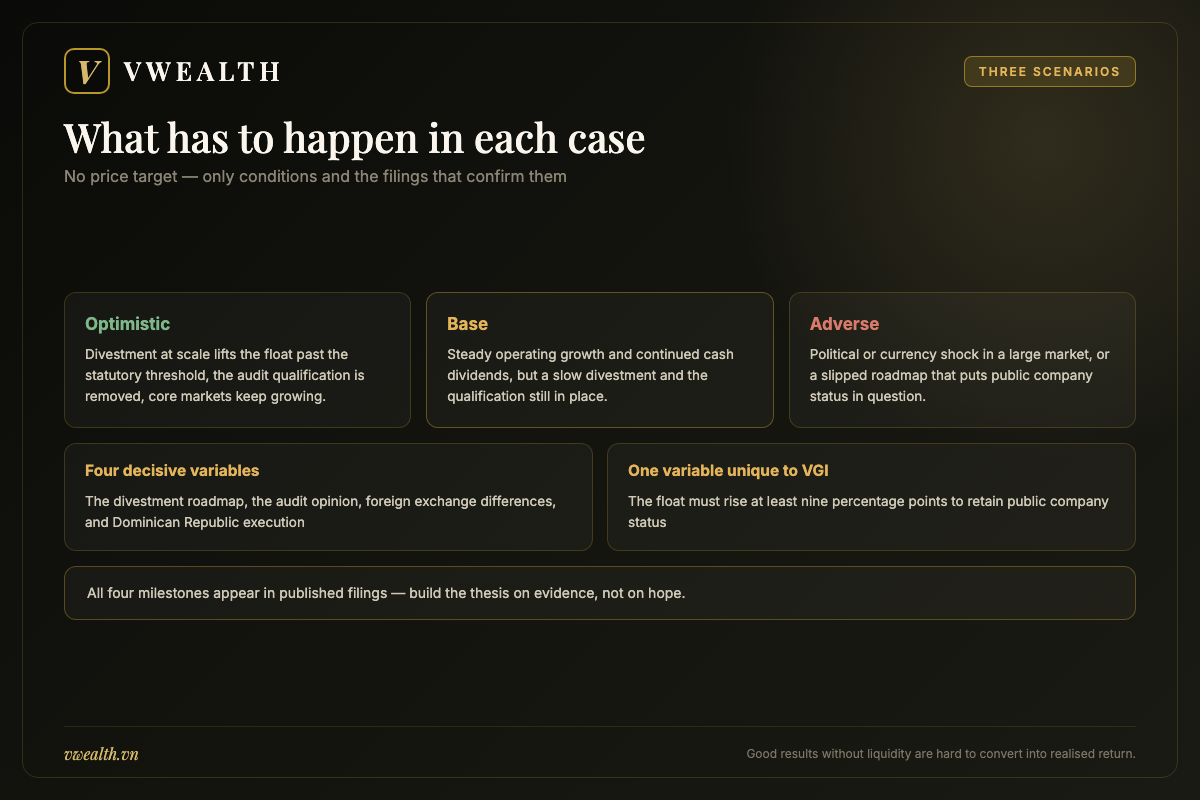
This section gives no price target. What it does is name the variables that decide the outcome, then describe three future states with the specific conditions required for each — so you can verify progress against filings rather than having to trust anyone.
Four decisive variables
Variable one: the parent’s divestment roadmap. This is the only variable capable of changing the nature of the security rather than merely changing a number. If the float rises from under one percent into double digits, every conclusion in this article about liquidity and valuation would need rewriting.
Variable two: the audit opinion. Lifting the qualification means lifting the warning designation and clearing a path toward a main-board listing. The difficulty is that it depends on resolving the Cameroon data situation, which is not entirely within the company’s control.
Variable three: exchange rates. As shown, the foreign exchange line alone can create a gap of thousands of billions of dong between consecutive years. This variable is essentially unforecastable, and the correct preparation is to expect reported profit to swing hard.
Variable four: execution in the new market. The Dominican Republic project at an announced USD 560 million will absorb capital in its early years. That is normal for this company’s model, but it will affect both reported profit and dividend headroom during the build phase.
The optimistic scenario
Conditions required: the divestment executes at sufficient scale to push the free float past the statutory threshold, alongside resolution of the Cameroon data problem so the audit qualification can be lifted. In parallel, the core markets sustain double-digit revenue growth, digital services begin reporting segment figures that demonstrate real contribution, and currency movements do not produce a large loss.
If that chain occurs, VGI becomes a materially different security: eligible to migrate to the main board, liquid enough for funds to participate, potentially visible to index compilers, and carrying a growth story that has no substitute on the Vietnamese market.
State the caveat plainly: this scenario requires several conditions to hold at once, at least one of which depends on a third party in another country. The probability of a chain is always lower than the probability of any single link.
The base scenario
Conditions required: the company keeps growing revenue in its core markets and keeps paying substantial cash dividends, but the divestment roadmap runs longer than planned because of valuation and approval procedure, and the audit qualification is not lifted.
In this scenario the business remains healthy while the stock retains all of its present characteristics: thin liquidity, sharp moves driven by thematic flow, and a persistent discount to intrinsic value because the market has no way to price a security that cannot be traded in size.
This is the scenario the article treats as the default, because it requires nothing more than the status quo continuing.
The adverse scenario
Conditions required: one or more large markets experiences political or regulatory disruption; or currencies in key markets depreciate sharply enough to compress translated profit; or the divestment fails to complete and the company loses public company status, with knock-on consequences for how the shares trade.
That final branch deserves emphasis because it is specific to this name. For an individual holder, a change in public company status is a risk that affects the ability to trade rather than merely the price — and that is the hardest kind of risk to manage, because you cannot cut a loss where there is no bid.
| Scenario | Conditions to look for | Verifiable evidence | Consequence for the shares |
|---|---|---|---|
| Optimistic | Divestment at scale; qualification lifted; core growth sustained | Divestment result disclosure; clean audit report; exchange decision removing the designation | Eligible for main board; the buyer base changes in kind, not just degree |
| Base | Steady operating growth; dividends maintained; divestment slow | Quarterly and annual filings; dividend resolutions; the roadmap update due before end 2026 | Present characteristics persist: thin, jumpy, discounted for illiquidity |
| Adverse | Political or currency shock in a large market; or loss of public company status | Material event disclosures; new provisions in the notes; regulator correspondence | Risk to tradability, not only to price |
What to monitor over the next twelve months
Four items deserve a calendar reminder. One, disclosures relating to the divestment roadmap — the company has committed to a detailed update before the end of 2026. Two, the audit opinion on the next annual financial statements, and the Hanoi Stock Exchange decision on the warning designation. Three, the note on foreign exchange differences in each reporting period. Four, progress on the Dominican Republic project, particularly licence and spectrum milestones.
All four are verifiable from published documents. That matters: at a company with as many unknowns as VGI, build your thesis on what can be checked rather than on what can be hoped.
So should you buy VGI stock?
You now have the facts. This chapter assembles them into a straight answer — not by saying buy or sell, but by saying clearly who this security suits and who it does not.
The case for
First, this is a genuinely unique exposure on the Vietnamese market. No other ticker gives you direct participation in telecom and digital financial services growth across emerging markets in Africa, Southeast Asia and the Caribbean. For a portfolio seeking geographic diversification inside a single frontier market allocation, that is a rare instrument.
Second, the business model is past its proof point. This is no longer a promise. The company has completed the loss-making phase, generated large profits, reported its highest ever profit after tax in 2025 at 11,250 billion dong with growth of 57%, and begun distributing cash.
Third, the moat in the core markets is real. Being the operator with the widest coverage in a given country is not something a rival erases with an advertising budget; replacing it requires large capital and years of construction.
Fourth, there is a clearly defined catalyst with a stated deadline: the divestment roadmap intended to satisfy the public company ownership requirement, with management committing to a detailed update before the end of 2026. Very few stocks offer a variable that is both this large and this dated.
Fifth, dividend policy has shifted decisively to cash at meaningful scale, which indicates that cash generated across the markets is now sufficient to fund reinvestment and shareholder distribution at the same time.
Sixth, and more subtly: the very features that make the stock unattractive to institutions — the venue, the float, the audit qualification — are also what create the discount. An investor who genuinely does not need liquidity is being paid, in the form of a lower entry valuation, to accept a constraint that does not bind them. That is a legitimate argument, provided you are honest with yourself about whether it applies to you.
The case against
First, and heaviest: liquidity. With a free float under one percent, this security is unsuitable for anyone who needs the ability to enter and exit flexibly. This is not a risk you can manage with a stop-loss order, because a stop-loss requires a buyer on the other side.
Second, the qualified audit opinion running for multiple consecutive years and the warning designation that accompanies it. This both restricts the set of institutions that can participate and blocks the path to a main-board listing.
Third, foreign exchange risk that is large and unforecastable, capable on its own of swinging reported profit by thousands of billions of dong between two years with no connection to operating quality.
Fourth, country risk and partner risk with actual precedent in this company’s own record. Cameroon and Myanmar are not hypotheticals; they happened, and their consequences remain visible in the accounts and in the exchange’s designation.
Fifth, the legal risk to public company status if the divestment roadmap does not complete. This is a risk to the tradability of your holding, a category individual investors rarely price.
Sixth, the absence of any adequate comparison set for valuation, which means the ordinary tools most investors rely on will produce numbers that are more misleading than helpful.
| For | Against |
|---|---|
| A one-of-a-kind emerging-market telecom exposure on a Vietnamese exchange | Free float under 1%; very thin liquidity; hard to exit a position |
| Model past its proof point; 2025 profit the highest in company history | Qualified audit opinion for multiple consecutive years; shares under warning designation |
| Genuine moat in markets where it already leads coverage and share | Foreign exchange differences can reverse reported profit between years |
| A dated catalyst in the parent’s divestment roadmap | Country and partner risk with precedent in the company’s own history |
| Cash dividend policy now at meaningful scale | Public company status at risk if the roadmap slips |
| The illiquidity discount can favour an investor who does not need liquidity | No adequate peer set; conventional multiples mislead here |
Which kind of investor this suits
| Investor type | Fit | Reasoning | If you proceed anyway |
|---|---|---|---|
| Long-horizon value investor comfortable with illiquidity | Conditionally suitable | Real business, real cash flow, real dividend; the illiquidity discount can be an opportunity if you never need to sell in a hurry | Keep the position small; use capital you will not need for years; track the audit opinion every reporting cycle |
| Income-focused investor | Partially suitable | Cash dividends are now substantial, but repeatability depends on the investment plan and the parent’s capital needs | Compute the yield on your actual purchase price, not on par value; do not assume this year’s payout repeats |
| Short-term trader | Not suitable | Thin order book, wide daily band, thematic flows that arrive and leave; exiting is the binding constraint | If you trade it at all, use very small size and accept that a stop may not fill near your intended level |
| New investor with a small portfolio | Not suitable as a first position | Correct assessment requires reading a multi-currency consolidation and interpreting a qualified audit opinion | Start with liquid main-board names and simpler accounts; return to VGI once the statements read easily |
| Foreign investor without a Vietnamese account | Not practical in the short term | Account setup takes documentation and time; UPCoM access and the float make execution the real obstacle | Complete the account process first and study the name; do not rush setup in response to a headline |
A closing word
Should you buy VGI stock? The most honest answer is that it depends on whether you are buying the business or buying the shares.
If you are buying the business, Viettel Global is one of the more remarkable corporate stories to emerge from Vietnam in the past twenty years: from a six-person project board to a telecom system spanning three continents, through a complete cycle of investment losses into substantial profit, and now returning cash to shareholders. What the company built in Laos, Cambodia, Mozambique and Burundi is a documented result, not a narrative.
But if you are buying the shares, you must live with three facts at once: under one percent of the stock is genuinely tradable, the financial statements have carried a qualified audit opinion for several consecutive years, and the company’s own status as a public company depends on a divestment roadmap that has not completed. Those three facts do not contradict the quality of the business. They simply say that the pipe connecting enterprise value to your account is very narrow.
The most sensible approach, in this article’s view: treat VGI as a small position, funded with capital you will not need for several years, and monitored against the four verifiable milestones set out in chapter seven. If the divestment takes shape and the audit qualification is lifted, you will have time to add — because at that point the stock will have the liquidity to let you do so. And if it does not, a small position is the size of loss you can absorb.
Before deciding, open current data rather than relying on memory. This article deliberately contains no price, no multiple and no latest-quarter figure, because those change while the article does not. Read the latest research reports on vwealth, check them against the five reading points in chapter four, and answer the question for yourself.
Disclaimer. This article is provided for information and educational purposes only and is not a recommendation to buy or sell any security. Information regarding company history, personnel, ownership and corporate events is drawn from public sources available at the time of writing and may change. Statements about future scenarios are analyses of conditions, not price forecasts. Investors are responsible for their own decisions and should consult a licensed adviser before trading. Investing in equities carries the risk of capital loss.
Research Vietnamese stocks in English with vwealth. Our AI-powered platform turns Vietnamese market data into full English analysis reports — with international payment support and a free 2-month trial for new accounts. Create your free account and read the latest reports.


