When you step into a WinMart+ at the mouth of your alley to buy a bottle of Nam Ngu fish sauce, a pack of Omachi noodles, a cup of Phuc Long tea and top up your phone card on the way out, you’re standing in the middle of an ambition far larger than a mini-supermarket: it’s the touchpoint of what Masan’s founder calls the “consumer operating system.” The MSN stock of Masan Group JSC (HOSE: MSN), closing around 72,000 dong a share on 19 June 2026, isn’t merely the stock of a consumer-goods maker. It’s your ticket to bet on one of Vietnam’s leading private consumer-retail conglomerates, led by billionaire Nguyen Dang Quang.
The central story of MSN, the thing you must understand before deciding to buy or not, is captured in three forces pulling against each other. One is the ambition to build “Point of Life” — turning each point of sale into a place serving every essential need of a Vietnamese family, from necessities and finance to telecoms. Two is the spectacular turnaround of WinCommerce — a retail chain that once devoured tens of thousands of billions of dong in losses and has now turned profitable. And three is the price paid for all that ambition: a balance sheet carrying high debt accumulated from a series of acquisitions, now on a downward path as profit recovers.
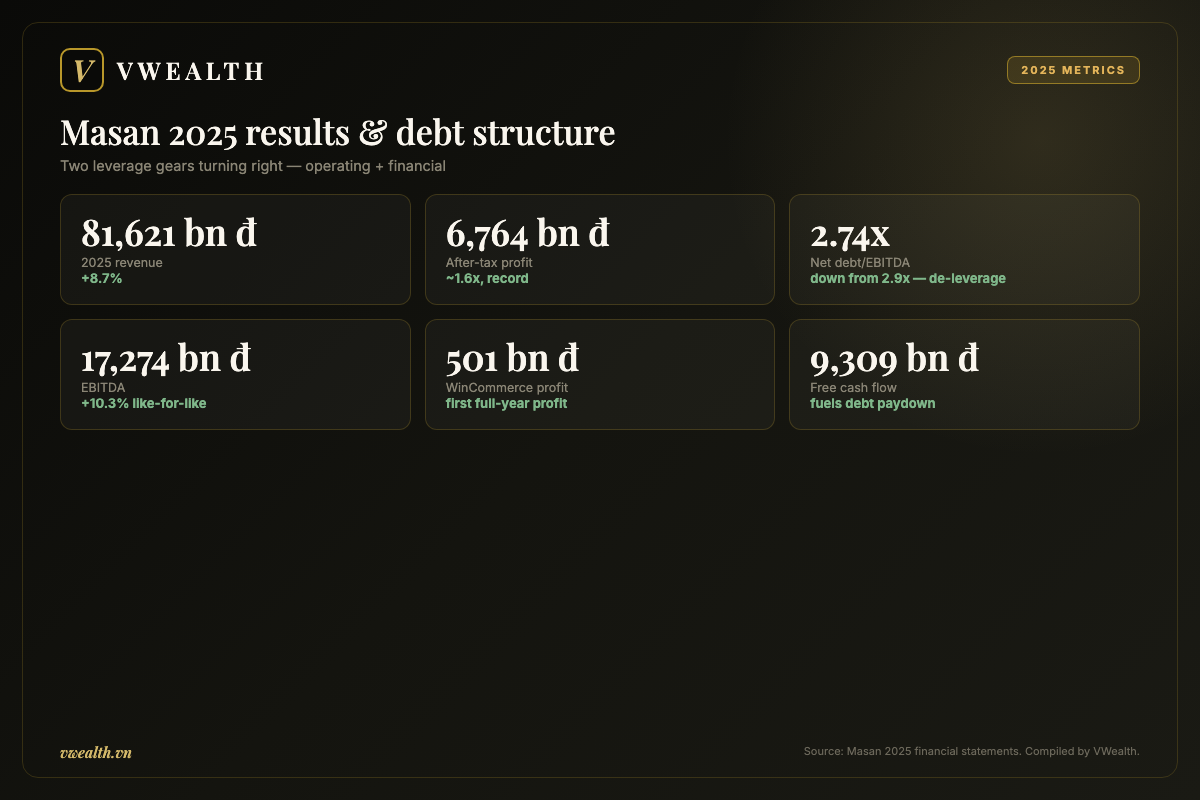
In 2025, Masan booked revenue of 81,621 billion dong (up 8.7%) and after-tax profit of 6,764 billion dong — a record high, about 1.6 times the year before. These numbers say one thing: the machine is shifting from a “burn cash to build” phase to a “harvest” phase. But does 72,000 dong already fully reflect the recovery story, or is there still room? And more importantly for you: what kind of investor does MSN suit? To answer, you need to go back to the starting point — a small instant-noodle workshop in Russia in the early 1990s.
MSN market data (updated 19 June 2026)
| Current price | 72,000đ | 2025 revenue | 81,621 bn (+8.7%) |
| Change (June) | −3.61% | 2025 after-tax profit | 6,764 bn (~1.6x) |
| Net debt/EBITDA | 2.74x (falling) | WinCommerce | Now profitable |
Source: VWealth price data + Masan 2025 reports. Figures move by session — for reference only.
History and evolution
Masan’s history is one of the most thrilling entrepreneurial journeys in Vietnamese business: from a man selling instant noodles to the Vietnamese community in Russia, Nguyen Dang Quang returned home to build a multi-billion-dollar consumer-retail empire. Understanding each turning point in that journey isn’t just revisiting the past; it helps you recognize the company’s “DNA” — a DNA of big bets on necessities, of masterful M&A, and of continually accepting debt in exchange for scale and position.
From a Russian noodle workshop to the Chinsu brand
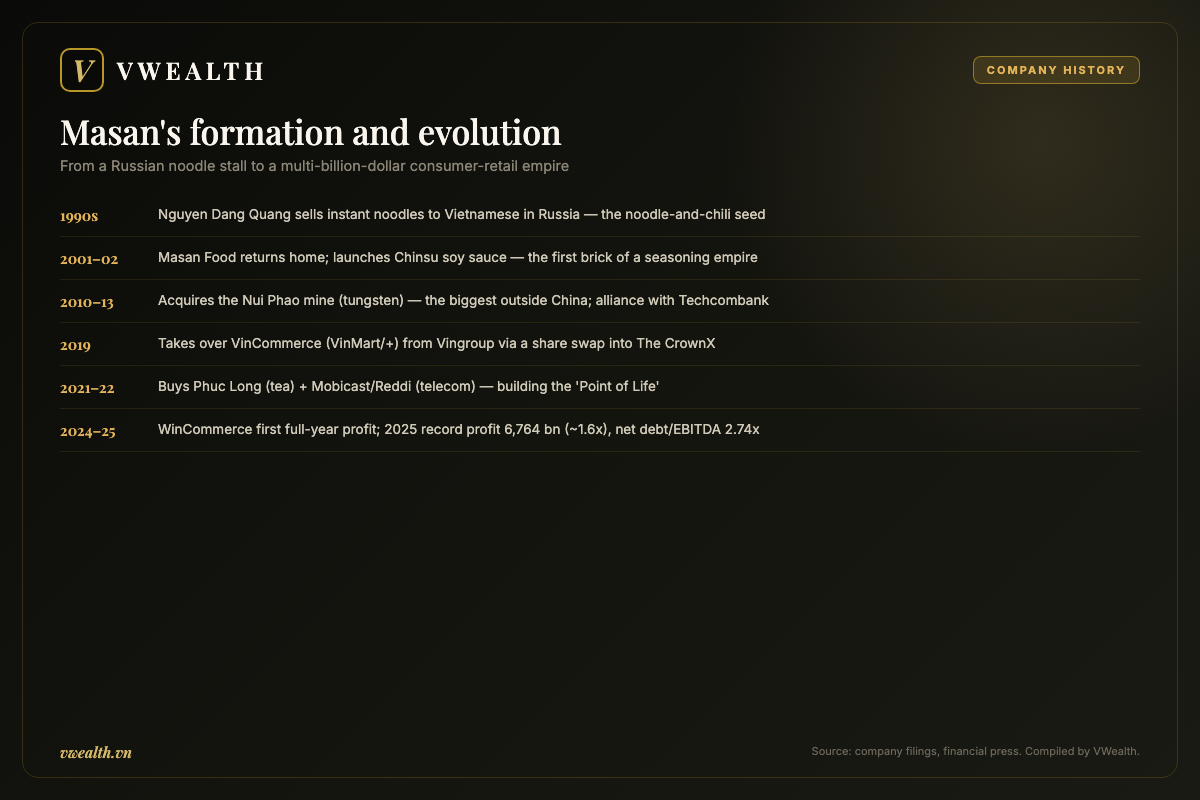
Nguyen Dang Quang was born on 23 August 1963 in Quang Tri, with an unusual education for most entrepreneurs of his time: a Master of Business Administration and a PhD in nuclear physics, studying in Russia and Belarus. In the early 1990s, while still in Russia, he began his career selling instant noodles to the large Vietnamese community there. The media later nicknamed him “the man who taught Russians to eat instant noodles and use chili sauce,” because he was among the first to bring these products into the vast Russian market.
Notably, Quang didn’t go it alone. Starting out alongside him in Eastern Europe was a companion who would stick with him for decades: Ho Hung Anh. Both were overseas students, both started in the noodle business in Eastern Europe, both returned to Vietnam and both built not only Masan but also Techcombank. This duo is considered one of the classic partnerships of Vietnamese business. Only much later, when banking regulations tightened the rule against one individual leading both a company and a bank, did Ho Hung Anh step back from Masan to focus on Techcombank — but the strategic alliance between these two pillars of finance and consumer goods remains an important legacy.
In 2001, Quang decided to bring Masan Food back to Vietnam, marking the brand’s appearance on home soil. In 2002, Masan launched the Chinsu soy sauce — the first brick laying the foundation for an entire seasoning empire. From Chinsu, the company successively launched brands that today are in nearly every Vietnamese kitchen: Nam Ngu fish sauce, Omachi and Kokomi instant noodles, sausages, and Vinacafé instant coffee (after acquiring Vinacafé Bien Hoa). This is Masan Consumer — the traditional cash-printing machine, generating stable cash flow to fund the big bets to come.
Quang’s through-line philosophy can be summed up in one sentence: bet on the things Vietnamese use every day. Seasonings, noodles, meat, drinks — these are essential needs that never disappear, whether the economy is up or down. It’s this “bet on necessities” vision that later led Masan to the most shocking decision in the group’s history: taking on a retail chain losing thousands of billions.
The turn into minerals: the Nui Phao gamble and the Techcombank alliance
Before venturing into retail, Masan made a move that seemed off-topic but revealed Quang’s M&A mettle. In 2010, through its subsidiary Masan Resources, the group acquired 100% of the Nui Phao mine project from Tiberon. On 18 June 2010 in Thai Nguyen, Masan held the Nui Phao project launch ceremony. This was Masan’s official entry into mining and processing — specifically tungsten, fluorspar, bismuth and copper.
Why would a seasoning business go dig a mine? The answer lies in the scale and strategic position of this asset. The Nui Phao mine in Dai Tu district, Thai Nguyen, is assessed as the largest tungsten and fluorspar mine in the world outside China. In late April 2013, the mining and processing line entered commercial production. This unit — later renamed Masan High-Tech Materials — became one of the world’s leading strategic tungsten suppliers, accounting for about 21% of global tungsten supply outside China in the 2020–2025 period. For you — an investor — this minerals segment is both a plus (a rare strategic asset, benefiting when tungsten prices rise) and a minus (cyclical, commodity-price volatility, once a burden of debt and cost for many years).
In parallel, the alliance with Techcombank — where Ho Hung Anh played a pillar role — gave Masan a special advantage: access to capital and financial structuring for billion-dollar deals. It’s this “three-legged stool” of consumer goods — minerals — finance that formed the base for Masan to dare think of moves few Vietnamese companies had the resources to make.
2019 — The turning point: Masan takes over VinCommerce from Vingroup
If you had to choose one moment that redefined all of Masan, it’s late 2019. This is when Masan received the transfer of VinCommerce (the unit owning the VinMart and VinMart+ chains) along with VinEco from the Vingroup of billionaire Pham Nhat Vuong. With a consumer group on one side and the country’s largest multi-industry group on the other, this was a market-shaking deal.
The first question you’ll ask: why would Vingroup let go of Vietnam’s largest retail chain? At the time VinCommerce ran 113 supermarkets and over 1,900 convenience stores across more than 60 provinces — a huge scale — but with accumulated losses exceeding 17,500 billion dong in 2015–2019, and 3,460 billion dong of losses in the first 9 months of 2019 alone. Vingroup then wanted to concentrate on industry-technology (VinFast) and had publicly pledged not to sell a Vietnamese brand to foreigners, ruling out foreign rivals like Central Group, BJC, Aeon, Lotte.
And why Masan, rather than some other Vietnamese company? Among domestic candidates, Masan had superior financial strength: 2019 revenue of 37,354 billion dong, with stronger EBITDA, equity and total assets than rivals; most importantly, experience executing billion-dollar deals (Nui Phao over $1 billion, Proconco over $200 million) and a strategic relationship with Techcombank — which was Vingroup’s own financial partner. Names like Saigon Co.op or Mobile World lacked comparable resources or M&A depth.
The most subtle point lies in the deal structure: this wasn’t an outright cash purchase, but a clever share swap. Masan merged VinCommerce and VinEco with Masan Consumer (MCH) into a new entity named The CrownX. In this structure, The CrownX held 83.74% of VCM (the unit owning 100% of VinCommerce) and 85.71% of Masan Consumer Holdings. Instead of taking cash, Vingroup kept an option to own about 30% of The CrownX, while Masan held about 70%. Meaning Vingroup didn’t “sell outright” but kept a share of the interest in the new entity, while Masan gained the combination of consumer-goods manufacturing muscle with the country’s largest retail distribution network — a “from factory to shelf” combination no Vietnamese company had done before at this scale.
The restructuring journey: from thousand-billion losses to a turnaround
Receiving a chain bleeding thousands of billions a year, Masan faced sharp market skepticism: when will this thing ever profit? The WinCommerce restructuring story thus became the biggest test of the group’s operating capability — and the most compelling chapter if you want to understand why MSN today is so different from MSN in 2020.
In 2020, Masan acted decisively. The chain was renamed WinCommerce (VinMart to WinMart, VinMart+ to WinMart+), closing over 700 underperforming outlets, restructuring product categories and renegotiating rental costs. At that point, only about 20% of stores hit the operating breakeven point — a number showing the depth of the pit Masan had to fill.
In 2021–2022, alongside rolling out the “Point of Life” ecosystem, Masan built the Supra logistics system that cut logistics costs 11%, and pushed private labels (WinMart Good, WinMart Cook, WinMart Home, WinMart Care). The cost-optimization details are impressively recounted — even shortening the receipt paper by 1cm saved about 10 billion dong a year. By 2023, the store model was clearly differentiated: WiN serving urban areas, WinMart+ Rural serving the countryside; the WIN membership program was born and quickly drew about 10 million members.
The sweet fruit came step by step. In Q3 2021, WinCommerce first reported after-tax profit of 137 billion dong — the first quarter of net profit since coming under Masan. By Q2 2024, the chain officially recorded net profit again after a long stretch. For the full year 2024, WinCommerce was profitable for the whole year for the first time — a symbolic milestone, 5 years after Masan took over. And by 2025, the recovery accelerated strongly: WinCommerce’s full-year after-tax profit reached about 501 billion dong, dozens of times 2024; Q4 alone reached 257 billion dong (up 23.1%). The store network also swelled to nearly 3,700 stores across 62 provinces. This is the central “turnaround” in the MSN investment story: what was once seen as a thousand-billion millstone has now become a profit-growth engine.
| Period | WinCommerce status |
|---|---|
| 2015-2019 (under Vingroup) | Accumulated losses over 17,500 billion dong |
| 2020 | Renamed, closed >700 stores, only ~20% of outlets at breakeven |
| Q3 2021 | First quarter of net profit (137 billion dong) |
| 2024 | First full-year profit after 5 years under Masan |
| 2025 | After-tax profit ~501 billion dong, nearly 3,700 outlets |
Phuc Long, Mobicast and the “consumer operating system” ambition
Having secured a huge retail network, Masan kept adding pieces to realize the “Point of Life” vision — turning each outlet into a place fully serving a family’s living needs. The logic here is clear: if you already own thousands of daily touchpoints with consumers, why sell only necessities and not also drinks, financial services and telecoms on the same platform?
The beverage piece came from Phuc Long. In May 2021, Masan spent $15 million to buy 20% of the Phuc Long tea-coffee chain, valuing it at about $75 million. In early 2022, the group bought a further 31% for $110 million; by August 2022, through its subsidiary The Sherpa, Masan raised total ownership to 85%, bringing the total value of the 85% Phuc Long Heritage acquisition to about $280 million. Phuc Long isn’t just a well-profiting tea brand, but also provides kiosks placed right inside WinMart+ stores — a way to draw customers, raise visit frequency and leverage existing floor space.
The telecoms piece came from Mobicast, the carrier behind the Reddi mobile brand. This move brought telecom services — SIMs, data plans, top-ups — into the ecosystem, giving Masan another data-and-digital-service channel tied to the WIN membership program. Combined with the ability to deposit/withdraw money and make digital payments right at the store, the “consumer operating system” picture gradually took shape: a Vietnamese person can buy necessities, drink tea, use financial and telecom services — all at one touchpoint, serving about 80% of consumers’ daily spending.
By 2026, Masan officially unveiled the “consumer operating system” concept for retail distribution at its shareholders’ meeting — a vision upgrade from the original “Point of Life.” The ultimate goal remains serving 35–50 million customers, turning each outlet from a “pure shopping place” into an “integrated destination” both online and offline.
The price of ambition: the debt burden and the journey down
Every ambition has its price, and for Masan, that price shows clearly on the balance sheet. To acquire Nui Phao, take over VinCommerce, buy Phuc Long and Mobicast, the group accepted a level of high debt lasting many years. This is a point you can’t overlook when weighing MSN: most of the stock’s risk lies in interest expense and debt-servicing cash-flow pressure, not in the ability to sell goods.
The good news is the numbers are heading the right way. Masan openly places strategic focus on de-leveraging: improving the balance sheet, cutting financial costs and divesting from non-core segments. In the first 9 months of 2024, the group paid 4,878 billion dong of interest, down 8% year on year; the net debt/EBITDA ratio fell from 3.9x (Q4 2023) to 3.4x. At WinCommerce alone, total debt at end-2024 was about 13,823 billion dong (down 8%), and the chain proactively bought back 1,140 billion dong of bonds ahead of maturity in July 2024 — a sign that financial health is being reinforced step by step.
The meaning of this debt picture for you is very important. As WinCommerce and other segments shift from loss to profit, the cash flow generated not only feeds growth but is also used to pay down debt. Each dong of debt reduced means lower interest expense, more net profit “freed up” — this is precisely the mechanism that created the 1.6x profit jump in 2025. In other words, MSN is at a stage where both drivers — business growth and a lighter financial burden — push profit up together. On the flip side, if interest rates rise again or consumption weakens, high leverage remains a double-edged sword.
Wrapping up the journey and what you need to remember
From an instant-noodle workshop in Russia, Nguyen Dang Quang built a consumer-retail empire with revenue over 81,600 billion dong. Every turning point in Masan’s history carries a consistent logic: bet on necessities, use M&A capability and financial alliances to win scale, then patiently restructure until the assets turn profitable. Chinsu – Nam Ngu – Omachi built the cash-flow foundation; Nui Phao opened the strategic minerals segment; the 2019 VinCommerce deal was the biggest gamble, turning Masan from a manufacturer into a retail giant; Phuc Long and Mobicast fleshed out the “consumer operating system” dream.
What you need to remember before reading on: MSN today is a machine shifting from “build” to “harvest,” with WinCommerce having successfully turned around and the debt burden gradually falling. That’s a real recovery story, backed by 2025 numbers. But to judge whether 72,000 dong is attractive and what kind of investor MSN suits, you need to look at the people steering this ship. Let’s analyze Masan’s leadership in the next section.
Leadership
When you hold a pack of Omachi noodles, a bottle of Nam Ngu fish sauce or Chin-su chili sauce, you’re touching the assets of one of the most unpredictable business minds in Vietnam. Analyzing MSN while ignoring the man behind it is like valuing a ship without looking at its captain. Because for Masan, the “leadership story” isn’t an appendix at the end of the annual report — it’s the core. Masan is a group run with a dealmaker’s mindset, where every big move bears the very personal imprint of the founder and an executive machine chosen carefully by M&A logic. In this section, you’ll understand why the quality and style of these people are both the strongest growth driver and the biggest concentration risk you must weigh before putting money in.
Nguyen Dang Quang — Vietnam’s most low-profile billionaire
Nguyen Dang Quang was born in 1963 in Quang Tri, and is Chairman and co-founder of Masan Group. If you’re used to the image of billionaires constantly in the press, giving grand speeches, Quang is almost an absolute exception. Forbes and domestic media have repeatedly called him Vietnam’s most “low-profile” USD billionaire: rarely appearing in public, rarely giving interviews, and almost only “surfacing” through the deals his group executes. Per Wikipedia and business profiles, he holds a PhD in nuclear physics (trained in Belarus) and an MBA in business administration in Russia — a rare combination: a scientific-technical foundation plus financial thinking.
His entrepreneurial story is tied to the Vietnamese community in Eastern Europe in the 1990s. While in Russia, he started by selling instant noodles to Vietnamese, then expanded into other food products like soy sauce and chili sauce through the Mivimex brand/factory. This is an important detail for understanding Masan’s “DNA”: the group wasn’t born from a tech lab or resource privilege, but from a very everyday consumer need — the stomach of Vietnamese abroad. The philosophy “think like a Vietnamese, do for the Vietnamese,” as Quang has often stressed, isn’t a marketing slogan but real lived experience.
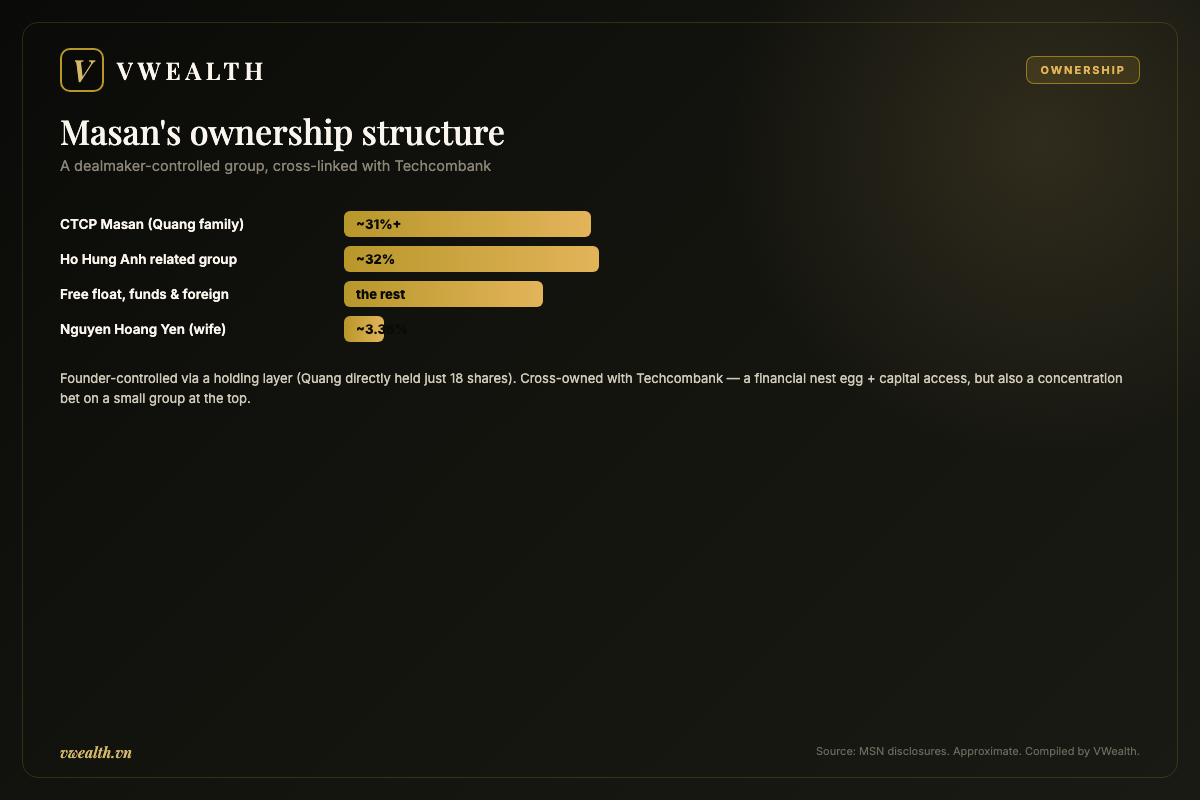
In 2019, Quang was officially recognized by Forbes as a USD billionaire with a starting fortune of about $1.1 billion. What intrigues observers is how he owns Masan. On the listing records, at one point Quang directly held a mere 18 MSN shares — an almost symbolic number. But his real power lies in indirect ownership: through Masan Corporation (CTCP Masan) — the group’s largest shareholder — his family controls a dominant stake. Per published statistics, the group related to Quang holds about 31%-plus of MSN (a figure around 446 million shares counting the ownership structure). His wife, Nguyen Hoang Yen, owns about 3.36% (roughly 50.9 million shares), and his daughter, Nguyen Yen Linh, from late 2024 also began registering to buy millions of shares — a sign that the next generation is gradually being brought into the ownership picture.
You should remember this “18 direct shares” detail, not as a sensational fact but as a governance lesson: at Masan, the ownership structure is organized through a holding layer (CTCP Masan), so when you read reports, you must look through the parent-company layer rather than only at the individual name on the direct-shareholder list.
The mind of a “big dealmaker”
If you had to sum up Quang’s leadership style in one phrase, it would be: M&A strategist. Masan under him didn’t grow the slow “accumulate small into big” organic way, but grew through bold acquisitions and handshakes with foreign capital. From acquiring Vinacafé Bien Hoa, Vinh Hao mineral water, the animal-feed segment (Proconco, Anco — the forerunner of Masan MEATLife), to the most famous M&A of all: taking over the entire VinCommerce (VinMart/VinMart+) retail system from Vingroup in late 2019, renamed WinCommerce. Every deal bears the mark of someone making a big bet on a long-term vision, accepting short-term losses to seize position.
In late 2025, ahead of listing Masan Consumer (MCH) on HoSE, Quang made a rare statement worth pondering: he likened Masan Consumer to a “family heirloom diamond.” As he explained in the press, this wasn’t just a flowery metaphor but based on five core factors: a high, stable dividend; long-term growth capability; industry-leading position; efficient finances and lean operations; and strong brand-building capability. He stressed the big opportunity as Vietnam’s per-capita GDP touches the $5,000 threshold — the point when the middle class booms and shifts from saving to spending on quality of life. This statement reveals his thinking: he doesn’t see Masan as a mere consumer-goods company, but as a machine betting on the long-term trajectory of Vietnamese purchasing power.
“Masan Consumer is a family heirloom diamond” — Nguyen Dang Quang’s metaphor reveals a core philosophy: treating the consumer segment as an enduring asset to be preserved and accumulated across generations, not a good to be traded back and forth.
As an investor, you need to read this style two ways. The bright side: Quang has proven the ability to see far and the courage to bet on markets others still hesitated over (modern retail, FMCG supply chains). The dark side: a group run by continuous M&A is a group that lives with debt leverage and cash-flow pressure. Every big deal needs capital, and capital isn’t free.
The historic bond with Ho Hung Anh and Techcombank
You can’t understand Masan apart from the name Ho Hung Anh and Techcombank. This is one of Vietnam’s most famous business “partnerships,” and their relationship is the key to assessing the “nest egg” portion of MSN’s valuation.
Nguyen Dang Quang and Ho Hung Anh are a pair of friends who started up together in Eastern Europe, both beginning in instant noodles before each led his own empire in Vietnam: Quang with Masan (consumer goods) and Hung Anh with Techcombank (banking). The special feature is the cross-ownership structure binding the two. Per published figures, Ho Hung Anh is one of Masan Group’s own largest shareholders (some statistics put the ratio related to his group around 32% of MSN), and has been Techcombank’s Chairman since 2008. In the other direction, Masan Group is a large shareholder of Techcombank — holding a significant ratio (sources put it around 14.9%–15% of TCB at various points), and Quang himself once served as Techcombank’s Vice Chairman.
Picture it this way: two friends, two groups, cross-owning each other, lifting each other’s value. When TCB stock rises, Masan’s assets swell too, and vice versa. Financial press has repeatedly noted sessions where MSN and TCB rose together, helping the “billionaire duo” gain hundreds of billions of dong of wealth in a day. This is both a synergistic strength and a point to note about interlinked risk.
| Linkage | Detail (per published figures, may change over time) | Meaning for MSN investors |
|---|---|---|
| Masan → Techcombank | Masan is a large TCB shareholder, holding about 14.9%–15% of the bank | A large-value financial investment — a “nest egg” on the balance sheet |
| Ho Hung Anh → Masan | Among the largest related-group shareholders at MSN | Aligned interests, stable long-term direction |
| Nguyen Dang Quang ↔ TCB | Once served as Techcombank Vice Chairman | Credit relationship, easy capital access for the ecosystem |
Why is the Techcombank part so important to MSN? Because Masan’s TCB stake is a kind of “nest egg” — a financial asset with large market value sitting on the balance sheet, realizable when needed. When you value MSN, you’re not only valuing noodles, fish sauce and the WinMart supermarket chain, but also indirectly valuing a slice of one of Vietnam’s largest private banks. However, the downside is that when the banking sector hits rough weather, the value of this “nest egg” moves too, adding another variable that MSN shareholders must bear.
The executive team: Danny Le and the M&A brass
If Quang is the vision architect, then CEO Danny Le is the builder. Let me clarify one point so you don’t get confused: Danny Le is a separate individual, not a son or direct relative of the Chairman according to official information; “Le” is just how the name is written. Per his profile on Masan’s website and sources like VnExpress and MarketScreener, Danny Le graduated with a bachelor’s degree from Bowdoin College (USA), holds US citizenship, and before joining Masan worked at Morgan Stanley in New York in 2006–2010, advising financial institutions and executing M&A, capital markets and equitization transactions.
This is a very “Masan” detail: they chose an ex-investment banker to lead the group, because Masan is essentially a deal machine. Danny Le joined Masan in 2010, becoming a key figure in building strategy and directly organizing M&A transactions. He was appointed Group CEO for the 2020–2025 term, while also serving as Chairman and CEO of The CrownX — the integrated consumer-retail platform combining WinCommerce and Masan Consumer Holdings — and sitting on the boards of many subsidiaries (including Chairman roles at Masan High-Tech Materials and Masan MEATLife). At the 2026 AGM, it was Danny Le who argued that MSN is valued about 60% below its true value — a statement showing management is very proactive in the valuation conversation with the market.
Below the group tier are the “generals” in charge of each pillar. In consumer goods — Masan’s heart — Truong Cong Thang serves as CEO of Masan Consumer (MCH). Thang is seen as the man tied to the “brandification” strategy: turning ordinary goods into strong brands, with the goal of owning multiple brands each doing hundreds of millions of dollars in revenue a year (Kokomi, Omachi, Chin-su, Nam Ngu, Wake-Up 247) and the ambition to build billion-dollar brands reaching global consumers. In retail, WinCommerce completed its 2023 restructuring phase and set a goal of positive net profit from 2025 — an extremely important milestone because retail is the most capital-hungry segment and the biggest test of the whole machine’s operating capability.
Governing by leverage and foreign capital: two sides of one coin
Masan’s most prominent and debated governance feature is its strategy of raising capital from major foreign partners. This is where you need very clear-headed analysis, because it’s both a big plus and a big risk.
The list of investors who have poured capital into Masan’s ecosystem reads like a “who’s who” of global finance. SK Group (of South Korea) became a large Masan shareholder from 2018, then in 2021 invested $340 million to hold about 4.9% of The CrownX and spent $410 million for 16.26% of VinCommerce/WinCommerce. An alliance led by Alibaba and Baring Private Equity Asia poured $400 million into The CrownX (2021). Then came TPG, the Abu Dhabi Investment Authority (ADIA) and SeaTown adding a further $350 million. The US fund Bain Capital also led an equity round of up to about $500 million for Masan Group. In total, The CrownX platform alone raised about $1.5 billion from investors.
The bright side is very clear: Masan’s capital-raising ability is regional class. Having names like SK, Alibaba, Bain, KKR (cited in several of the group’s earlier deals), TPG, ADIA accept pouring in hundreds of millions of dollars is a strong validation of Masan’s stature and growth story. This capital flow gives the group resources to expand retail, restructure and get through the early loss-making investment phase.
But the dark side is no less serious, and you need to weigh it. First is dilution: each funding round into a subsidiary (The CrownX, WinCommerce) means MSN shareholders own a smaller slice of the growing pie. Second is the put-option clause — a double-edged sword. The SK Group case is the classic example: the Korean investor held the right to sell its stake back to Masan, and by 2024 they triggered a divestment. SK transferred 7.1% of WinCommerce back to Masan for $200 million (valuing WinCommerce at over $2.8 billion), while also selling about 76 million MSN shares, bringing its group stake down to about 3.67% and no longer a major shareholder. Masan having to arrange resources to “take back” the stake when a partner divests creates cash-flow pressure and is something you must track closely in the financial statements.
Masan is among Vietnam’s best at raising capital — but capital raised via put options isn’t “free” capital. It’s an obligation that can come back to claim the group’s cash flow at exactly the market’s toughest moment.
What this means for your investment
Pulling the leadership picture together, you should draw a few practical conclusions. One, Masan is a bet on the dealmaking capability and long-term vision of Nguyen Dang Quang and the ex-banker team led by Danny Le. This is a rare strength, but also a concentration risk: most of the group’s value is tied to the quality of judgment of a small group at the top. Two, the Masan–Techcombank relationship brings a valuable “nest egg” and a capital-access advantage, but forces you to also track the banking sector’s health as a side variable. Three, the growth-by-leverage-and-foreign-capital model has proven effective at expansion, but comes with dilution risk, debt and put-option obligations you must read carefully in the financial-statement notes.
All these people and structures converge into a single entity Masan calls the “Masan Ecosystem” — from consumer-goods factories, the nationwide WinMart supermarket chain, chilled meat, high-tech minerals, to a bank investment. Understanding the minds behind it, you now have a compass to step into the next section: dissecting exactly how that ecosystem operates and generates cash flow.
Note: the figures above on ownership ratios, deal values and shareholder structure are compiled from information published at different times and may have changed; you should cross-check with Masan’s latest annual report and disclosures before making an investment decision. This is reference analysis, not a buy/sell recommendation.
The Masan ecosystem
When you hold MSN, you don’t buy one company — you buy a whole integrated consumer-retail conglomerate assembled from nearly two decades of acquisitions, restructuring and strategic bets. This is what makes MSN one of the hardest stocks to value on HOSE: you can’t view it as a standalone business, but must peel apart each pillar, understand how they feed each other and sometimes drag each other down. In 2025, this machine proved its endurance: consolidated net revenue reached 81,621 billion dong, and more importantly, after-tax profit hit a record of about 6,764 billion dong — up 58% from 2024. For the first time in history, nearly every large piece of the ecosystem was profitable at once.
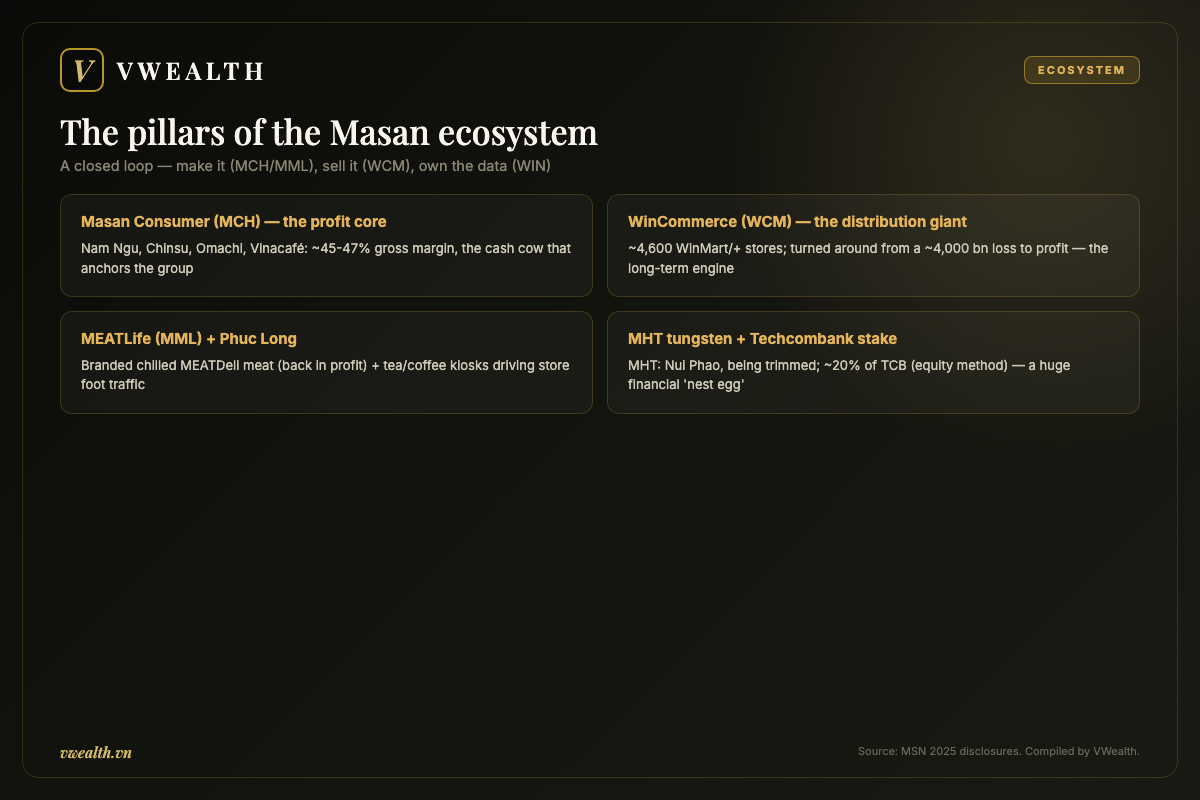
Before going deep, let me draw the overall picture. Masan runs an “integrated consumption” model with a clear backbone: Masan Consumer (MCH) is the cash-printing machine on FMCG brands; WinCommerce (WCM) is the huge distribution channel putting goods into consumers’ hands; Masan MEATLife (MML) supplies branded chilled meat; Phuc Long adds the tea-coffee experience; Masan High-Tech Materials (MHT) is the global tungsten industrial segment being “trimmed”; and Techcombank (TCB) stands outside consolidation but is a huge financial “nest egg.” All are bound by the “Point of Life” — consumer operating system vision and the WIN membership program.

Masan Consumer (MCH) — the profit machine that anchors the whole group
If you could keep only one reason to believe in MSN, it’s Masan Consumer. This is the real profit pillar — where the thick cash flow, high margin and stability come from, on which the other segments lean to “learn to walk.” MCH owns a brand portfolio so strong it nearly commands the Vietnamese kitchen: Nam Ngu fish sauce, Chinsu chili and soy sauce, Omachi and Kokomi noodles, Vinacafé and Wake-Up coffee, energy drinks, beer and a range of bottled beverages. These aren’t newly emerging brands — they’re names deeply embedded in consumption habits, and that’s the hardest economic moat to cross.
The numbers say it all about this segment’s profit quality. As early as Q1 2025, MCH recorded net revenue of 7,489 billion dong, up 14% year on year, with a gross margin holding at a very high level — about 47%. To picture it: a retail chain is lucky to have a 20-25% gross margin, while MCH sells fish sauce and noodles at a gross margin near half of revenue. For full-year 2025, the company targeted revenue of 33,500–35,500 billion dong, double-digit growth (10-15%) — and in fact the consumer segment grew right in line with the “double-digit” expectation management committed to.
What makes me rate MCH highly isn’t just the present but the “premiumization” strategy. Instead of racing to cut prices, Masan pushes consumers up to higher-value product lines. Omachi is the classic example: this brand’s revenue rose 20.1% year on year, lifting the premium share of the noodle portfolio to 56%. When you sell more premium goods, you both raise revenue and widen margin — this is the highest-quality kind of growth.
The second spearhead is the “Go Global” strategy. In 2025, the international business brought Masan Consumer nearly 1,674 billion dong of revenue, up 26.8% year on year. Management targets international markets contributing 10-15% of MCH’s total revenue by 2028. The long-term ambition is to build 16 strong brands and maintain a high 50-80% dividend policy — a signal that MCH is confident in its cash flow. In late 2025, MCH also officially listed on HOSE, a move that helps more transparent valuation of the group’s most valuable pillar.
Remember this: most of MSN’s consolidated profit comes from MCH. While the retail and industrial segments are still “learning to walk,” it’s this fish-sauce–noodle machine that carries the results for the whole group. This is both a support and a concentration risk you must be aware of.
WinCommerce (WCM) — the spectacular turnaround from a 4,000-billion loss to profit
If MCH is the stability story, then WinCommerce is the most compelling transformation story in the ecosystem. This is Vietnam’s largest necessities-retail chain by outlet count, running two brands, WinMart (supermarkets) and WinMart+ (convenience stores/minimarts). When Masan took over the chain from Vingroup (formerly VinCommerce) in late 2019, the company was losing about 4,000 billion dong a year in operations — a burden that seemed impossible to bear.
The turnaround journey is a classic lesson in retail restructuring. Masan closed a series of underperforming outlets, standardized the product range, optimized logistics and, most importantly, was patient with “store economics” — i.e. only opening when a store unit could profit. The result: after years of “burning cash,” WCM recorded positive after-tax profit for the first time in 2024 — a historic milestone. And in 2025, this momentum was firmly reinforced.
- Outlet scale: in May 2025, WinMart+ officially opened its 4,000th store in My Tho city, Tien Giang — marking 10 years of development. In 2025 alone, the chain opened 764 new stores, far exceeding its highest target (400-700 stores).
- Revenue growth: as of May 2025, WCM reached 3,031 billion dong of net revenue in the month, up 17.6% year on year. For the full year, the modern-retail segment targeted revenue of 35,600–36,900 billion dong (up 8-12%) and positive after-tax profit.
- Long-term ambition: management announced a goal of 10,000 stores, betting on Vietnam’s modern-retail wave — especially the WinMart+ Rural model bringing modern retail to the countryside (nearly 50 new stores a month).
WCM’s new growth driver is the WIN membership program — the key to turning the store chain into a customer-data platform. WIN members get shopping perks, and more importantly, Masan gathers consumption behavior to personalize promotions and cross-sell MCH, MML and Phuc Long products right in the same store. This is the closed loop few Vietnamese groups own: making the goods (MCH, MML), selling the goods (WCM), and owning the customer data (WIN).
Masan MEATLife (MML) — branded chilled meat back in the black
The meat segment was once Masan’s “difficult child,” but in 2025 it proved its value. MML runs the MEATDeli chilled-pork brand along with a chicken segment, with a strategy of shifting from a traditional livestock company to a branded meat-processing business — a much higher value-added model than selling live pigs.
The financial story here is a clear recovery. In 2024, MML brought in nearly 7,650 billion dong of net revenue (over 21 billion dong a day) and after-tax profit of over 27 billion dong — a spectacular reversal from a loss of nearly 386 billion dong in 2023. Into 2025, the improvement grew even stronger:
- Q1 2025: revenue of 2,070 billion dong, up 20.4% year on year.
- Q3 2025: net revenue of 2,384 billion dong and after-tax profit of over 101 billion dong — up 23% and 5.2 times, respectively, year on year.
- Full-year 2025 target: revenue of 8,250–8,749 billion dong (up 8-14%), with a long-term vision toward a $2 billion revenue mark.
Notably, MML benefits directly from the ecosystem: MEATDeli meat is widely sold through the WinMart/WinMart+ system, saving distribution costs and reaching millions of customers without building its own channel. This is the most concrete proof of the “integration” advantage — a product fresh off the line already has over 4,000 outlets waiting.
Phuc Long — a tea & coffee chain integrated into outlets
Phuc Long Heritage is the experiential piece of the ecosystem. Masan acquired this Bao Loc-rooted tea-coffee chain with a dual goal: owning an F&B brand loved by young people, and using it to boost foot traffic for WinMart+ stores through an integrated kiosk model.
However, I want you to view this segment realistically. The Phuc Long kiosk-in-WinMart+ model was once expected to lift the retail chain’s margin by over 4%, but actual operation showed that the more integrated kiosks opened, the harder it was to profit, and it’s the standalone flagship stores that “carry the team” on profit. Masan had to fine-tune the strategy, shrinking the kiosk count and focusing on truly effective locations. In 2024, Phuc Long’s net revenue reached about 1,621 billion dong (up 5.6% for the year, with Q4 up 11.5%).
Phuc Long is an example showing “integration” isn’t always automatically profitable — it demands operating discipline. For you, this is a small segment financially but strategically important: it adds a reason for customers to step in and stay longer.
Masan High-Tech Materials (MHT) — global tungsten being restructured
MHT is the most “off-key” piece in a consumer group — and that’s also why Masan is trimming it. This is a world-leading high-tech tungsten materials supplier, running the Nui Phao polymetallic mine in Thai Nguyen — one of the largest tungsten mines outside China — plus a modern processing plant. Tungsten is a strategic metal used in electronics, aerospace, autos, energy and pharmaceuticals.
MHT’s biggest turning point is the move to restructure to cut debt and exit the downstream segment. In December 2024, MHT completed the transfer of 100% of H.C. Starck Holding (Germany) to Mitsubishi Materials Corporation (MMC). This was a key deal:
- Strong debt reduction: the proceeds were used to cut MHT’s net debt from about $670 million to about $490 million — a significant lightening of the financial burden for the whole group.
- Retaining strategic interests: MHT signed a long-term APT and tungsten-oxide supply contract with H.C. Starck, while keeping its stake in Nyobolt (a UK fast-charge battery company using tungsten) and special rights to “black mass” recycling technology.
- Back in the black: in 2025, MHT was among the segments recording positive results, contributing to the group’s “all profitable” picture.
Note: Masan uses the divestment proceeds from H.C. Starck to concentrate resources on the core consumer-retail segment. In other words, MHT is gradually being positioned as a non-core segment, and restructuring/partial divestment is a trend management has signaled. For an investor, this cuts two ways: it reduces exposure to volatile commodity risk, and could generate a large sum to strengthen the balance sheet if Masan divests further.
Techcombank (TCB) — a financial “nest egg” outside consolidation
This is the piece many new investors miss. Masan owns about 20% of Techcombank — one of Vietnam’s most efficient and largest private banks. Because this ratio is below the control level, TCB isn’t consolidated into MSN’s revenue, but accounted for by the equity method: Masan records the profit corresponding to its ownership ratio.
This contribution is far from small. In Q3 2025 alone, the profit Masan recorded from Techcombank reached about 1,242 billion dong, up 9.4% year on year. This is a steady and rising contribution, because TCB’s profit has grown by an average of about 40% a year over the past decade. Alongside the associate profit, Masan also receives cash dividends when TCB pays out — for instance over 2,200 billion dong of dividends received from Techcombank and Vinacafé Bien Hoa.
I call TCB a “nest egg” for this reason: this investment both generates steady associate profit each quarter, and is a large market-value asset Masan can “draw out” when it needs to strengthen its finances. When you value MSN, don’t forget to add the value of the 20% Techcombank stake — it’s often valued by the market below its true worth within a consumer group’s structure.
“Point of Life” — the consumer operating system that connects everything
All the pillars above don’t exist in isolation. They’re bound by a through-line vision Masan calls “Point of Life” — the consumer operating system. The core idea is simple but ambitious: turn each WinMart+ store into a touchpoint serving the entire daily essential needs of a Vietnamese family — from necessities (WinMart+), financial services (Techcombank), pharmaceuticals (Dr.Win), food and drink (Phuc Long), to telecoms (Reddi).
Reddi is the digital piece. Masan acquired 70% of Mobicast — the owner of the Reddi mobile virtual network (MVNO) — to add a telecom layer to the ecosystem, aiming for a “super-app” integrating every product and service into a single platform. Combining Reddi with the WIN membership program, Masan can track, serve and cross-sell to the same customer across many fronts. The group targets serving 35–50 million customers — a scale large enough to turn consumption data into a real competitive advantage.
This ecosystem’s customer database is impressive: millions of loyal customers from WinMart/WinMart+, a young customer base from Phuc Long, and millions of high-income customers from Techcombank. When you can “read” the consumption behavior of tens of millions of people and serve them with your own products, through your own sales channel — that’s a moat rivals find very hard to copy.
The “integrated consumption” model: an advantage that comes with cross-risk
So how should you conclude on this ecosystem? I want you to view it in a balanced way — because this is the key to valuing MSN correctly.
On the advantage: the integrated model creates three synergy loops. First, MCH and MML make the goods, WCM distributes — cutting channel costs and securing offtake. Second, WIN and Reddi collect data, enabling more effective personalization and cross-selling. Third, Techcombank provides a stable financial-profit “cushion” when operating segments fluctuate. 2025 was the first year this whole machine ran in phase — and the result was a record profit of over 6,700 billion dong.
On the risk: that same integration also creates cross-risk. When segments are tightly linked, one faltering link can spread across the whole system. The group once carried large debt to build this ecosystem (though MHT is actively cutting debt). Consolidated profit still depends heavily on MCH and the Techcombank contribution — if either falters, overall results will be significantly affected. Moreover, the retail segment, though now profitable, has a thin margin, easily hurt by competition and weak purchasing power.
In sum, when you hold MSN, you bet on Masan management’s ability to keep all six pillars running in harmony. 2025 shows they’ve done it — but this is a model demanding continuous operating discipline. To understand whether MSN is worth its current price, the next step is to look at the group’s position and financial health: the debt structure, cash flow, and how Masan is shifting from “burning cash to build the ecosystem” to “harvesting profit.”
Position and financial health
If you only have a few minutes to understand MSN, this is the part you must not skip. Because for Masan, the investment story isn’t about how many bottles of fish sauce the group sells or how many WinMart supermarkets it opens. The real story lies in one word: leverage. Masan is one of Vietnam’s largest private businesses, owning an integrated consumer-retail empire few rivals have. But that empire was built largely with borrowed money. Understanding Masan’s financial health — especially the debt structure — is understanding the entire risk and opportunity of MSN. This section dissects that thoroughly for you, even if you’re just starting to learn about stocks.
Position: a rare closed-loop consumer-retail empire
Before talking about debt, you need to see clearly where Masan stands, because it’s this position that “backs” their huge debt pile. Masan isn’t a standalone company, but a holding group owning many important pieces, each leading or near-leading its industry:
- Masan Consumer (MCH) — the fast-moving consumer goods (FMCG) segment. This is the group’s real “golden goose.” Masan Consumer leads many essential categories: fish sauce, soy sauce, chili sauce, instant noodles, instant coffee, beverages… In 2025 this segment brought in 30,557 billion dong of revenue with a gross margin of 45.5% — a figure any consumer business would dream of.
- WinCommerce (WCM) — the modern WinMart/WinMart+ retail chain. This is the system with the most outlets in Vietnam, at 4,592 stores by end-2025 (764 new in the year). When you step into a WinMart+ at the mouth of your alley, you’re standing in the country’s number-one modern-retail network by coverage.
- Masan MEATLife (MML) — the chilled-meat and branded-meat-processing segment under MEATDeli, 3F.
- Masan High-Tech Materials (MHT/MSR) — mining and high-tech materials (tungsten), one of the large tungsten suppliers outside China.
- Techcombank (TCB) — Masan holds about 20% of this leading private bank. This is a huge “nest egg” we’ll discuss in detail at the end.
What makes Masan special is the “Point of Life” model — closed-loop integration from production (MCH, MML) to distribution into consumers’ hands (WCM), combined with finance (TCB). Goods Masan itself makes are sold in Masan’s own supermarket chain, reaching customers via Masan’s own bank and payment ecosystem. Very few groups in the world achieve this closed loop. That’s the position. But to build that loop, Masan did something controversial for years: it borrowed a lot.
The crux: why is Masan nicknamed the “king of leverage”?
You’ll often hear investors call Masan the “king of leverage” or “king of debt-financed M&A.” That name isn’t accidental. For over a decade, Masan’s core growth strategy has been acquisition (M&A): buying Vinacafé, Vinh Hao mineral water, the entire VinMart/VinMart+ chain from Vingroup in 2019 (later renamed WinMart), Phuc Long, Mobicast (the Reddi carrier)… Each deal was a leap in scale. But where’s the money to buy? Mostly from debt.
Picture it simply in everyday terms: leverage is like buying a 10-billion house with only 3 billion of your own money, the other 7 billion a bank loan. If the house price rises, you profit richly on your 3 billion of capital — that’s the power of leverage. But each month you still pay interest on that 7 billion, whether or not the house generates money. If your income slumps, that interest can strangle you. Masan played exactly this game, but at a scale of tens of thousands of billions of dong.
Leverage is a double-edged sword. When the subsidiaries do well, profit is amplified many times over. When they lose money, interest expense steadily erodes cash flow — regardless of business conditions. For MSN, this is the decisive factor of the stock’s risk, bigger than how many packs of noodles it sells.
The peak of this pressure fell in 2022–2023, when WinCommerce was still deeply loss-making (at one point losing about 4,000 billion dong a year), the high-tech materials segment struggled on falling tungsten and copper prices, while the group’s Net debt/EBITDA ratio at times reached 3.5x. Interest rates were high in that period. The result was that interest expense “ate” a large part of the profit made. MSN was then valued low by the market partly out of fear: would Masan “suffocate” in its own debt?
Reading the Net debt/EBITDA ratio: what does 2.74x say?
This is the most important ratio you need to grasp when analyzing MSN, so let me explain it very slowly. Net Debt is total borrowings minus cash on hand. EBITDA is earnings before interest, tax and depreciation — roughly “the cash the core business generates each year.” The Net debt/EBITDA ratio tells you: how many years of profit the business needs to pay off net debt, if it put all the money earned toward paying debt.
- Below 2x: a healthy, comfortable balance sheet.
- 2 – 3x: acceptable for a growing group, but needs watching.
- Above 3.5 – 4x: starts to be worrying, cash flow easily squeezed by interest.
In 2024 Masan’s ratio was about 2.9x. Into 2025, the figure was pulled to 2.74x — a clear improvement and an extremely positive signal. It tells you either Masan reduced debt, or EBITDA (core profit) rose, or both. In reality, both. EBITDA in 2025 reached 17,274 billion dong (up 10.3% on a like-for-like basis), while the group proactively used various sources of cash to reduce debt. The denominator grew, the numerator shrank — so the ratio fell. This is the first evidence Masan is gradually shedding the “king of leverage” label.
The debt-reduction strategy: what is Masan doing to escape the “leverage trap”?
Masan’s management understands clearly that as long as the market sees it as a “debt bomb,” MSN will be undervalued. So debt reduction has become the number-one strategic priority in recent years. How they do it has three main directions, and you should understand them to assess sustainability:
- Raising capital from foreign partners: instead of only borrowing from banks, Masan sells down stakes in subsidiaries to international strategic investors (like Bain Capital, SK Group of Korea, large funds) to get fresh cash to reduce debt — replacing borrowings with equity, which doesn’t bear interest.
- IPO/listing and subsidiary divestment: Masan plans to list “gems” like Masan Consumer and WinCommerce more transparently, and move Masan High-Tech Materials (MSR) from UPCoM to HoSE for a proper valuation. Each such “value unlock” is a chance to raise money to strengthen the balance sheet.
- Using dividend and core-profit cash flow to pay debt: especially the cash dividends received from the Techcombank investment, plus Free Cash Flow in 2025 of up to 9,309 billion dong. Thanks to this effort, interest expense has been cut significantly — in 2024 alone the group cut at least 400 billion dong of interest expense, and this trend continued into 2025.
What you need to remember: for a highly leveraged business, cutting interest expense directly and powerfully lifts net profit. Each dong of interest saved flows almost straight down to the bottom line. This is why, when Masan both reduces debt and improves the business, its profit can surge.
2025 profit quality: the subsidiaries’ “turnaround”
After-tax profit (before minority interest) in 2025 reached 6,764 billion dong, about 1.6 times 2024 and a record high in Masan’s history, completing 139% of the plan. But a wise investor always asks: where does this profit come from, is it sustainable? The good news is the profit quality this time is very substantive, coming from the business itself rather than a one-off asset sale. Look at the subsidiaries’ “turnaround”:
- WinCommerce: this is the most impressive story. From losses of about 4,000 billion dong in earlier years, in 2025 WCM made a profit of 501 billion dong (before minority interest), with revenue of 38,979 billion (up 18.3%) and a net margin of 1.3%. A thousand-store retail chain shifting from “cash-burning machine” to “cash-printing machine” is a make-or-break turning point.
- Masan MEATLife (MML): profit of 619 billion dong, over 24 times the year before, with EBIT margin improving 330 basis points.
- Masan High-Tech Materials (MHT): out of the red, back in profit thanks to recovering tungsten prices and an EBITDA margin jumping to 29.2%.
- Techcombank: contributed nearly 4,997 billion dong to group profit, up 15.3%.
What do you see here? The profit surge comes from two synergizing drivers: (1) subsidiaries shifting from loss to profit — operating leverage kicking in as revenue passes breakeven; and (2) lower interest expense from debt reduction — financial leverage reversing favorably. Same machine, when both leverage gears turn the right way, profit is amplified exponentially. That’s exactly what happened in 2025, and it’s why the group confidently declared it had entered a “sustainable growth cycle.”
The Techcombank “nest egg”: a quiet safety cushion
There’s an asset on Masan’s balance sheet many new investors overlook: the investment of about 20% in Techcombank (TCB) — Vietnam’s leading private bank. This is a “nest egg” in the literal sense, and it matters to Masan’s debt story in two ways.
First, on value: with Techcombank’s market cap, this 20% stake is worth tens of thousands of billions of dong — a huge asset block that MSN’s stock price often doesn’t fully reflect. If needed, this is a highly liquid asset that can be pledged or partly sold to handle debt. It’s like having a large savings book behind your home loan — the lender is much more at ease.
Second, on cash flow: each year Masan receives dividends and records significant profit from Techcombank (in the most recent quarter alone Techcombank contributed about 1,316 billion dong). This dividend cash flow is one of the resources for Masan to strengthen its balance sheet, reducing leverage without selling off core businesses. In other words, Techcombank is both an asset cushion and a “tap” pumping steady cash to support the debt-reduction strategy.
The overall picture and the 2026 track
To sum up Masan’s financial health at present, keep these core points in mind: the group is still a highly leveraged business — that’s an inherent, undeniable risk — but the trend is clearly shifting positively. Net debt/EBITDA fell from 2.9 to 2.74x, interest expense is down, subsidiaries are all turning from loss to profit, and the Techcombank asset block still sits there as a defensive layer. The leverage machine that once threatened Masan is now turning the right way to generate profit.
Looking ahead, management set an ambitious 2026 target: consolidated revenue toward the 100,000-billion-dong threshold (up 15-20%), pre-minority-interest profit around 7,250-7,900 billion dong, and especially WinCommerce expected to lift profit to about 1,000 billion dong. If achieved, this would be the second straight year Masan proves the sustainable growth cycle is real. Of course, every target depends on the group continuing to be disciplined with its debt and keeping the leverage gears turning the right way.
Improving financial health never sits still in the books — it’s always “scanned” and reflected in the share price. So how has the market received this MSN transformation, and what is the valuation saying? That’s the story we’ll dissect right in the next section.
Market reception
When you see MSN’s board stop at 72,000 dong in the 19 June 2026 session (the real price from the VWealth plugin), it’s very easy to fall into a familiar trap: take that price, multiply by a P/E, and conclude “expensive” or “cheap.” For most stocks, that calculation is enough. But for Masan, it’s almost meaningless — and this is what makes MSN one of the most misunderstood stocks on HOSE for the past decade. You don’t buy a standalone business. You buy a financial holding company holding controlling or dominant stakes in a chain of “children,” many of which are already or soon separately listed. To understand how the market values MSN, you have to peel apart each part — which is why this section goes deeper than usual.
Why a consolidated P/E is nearly useless for a holding like Masan
Let’s start from the most controversial number. Masan’s consolidated 2025 after-tax profit reached about 6,764 billion dong — a record, nearly double the year before. With about 1.44–1.5 billion shares outstanding, if you divide this straight, EPS lands around 4,500–4,700 dong, corresponding to a P/E of about 15–16x at 72,000 dong. It sounds reasonable. But that number hides an important truth: most of Masan’s consolidated profit comes from Masan Consumer — a segment the group doesn’t own 100%. When you strip out the portion belonging to minority interests, the profit truly “into the pocket” of the parent’s shareholders is much lower, and the core EPS many brokerages use for valuation is only around 2,300–4,000 dong depending on the method. That pushes the P/E to a range of 18–32x — a band so wide it itself says P/E isn’t the right tool here.
The deeper problem: Masan’s consolidated profit mixes several things of entirely different nature. There’s stable, high-margin operating profit from consumer goods (Masan Consumer). There’s financial profit from the Techcombank stake — accounted for by the equity method, not sales revenue. There’s the WinCommerce retail segment that just shifted from loss to a thin profit. And there’s the Masan High-Tech Materials (MSR) mining segment, sensitive to world commodity prices, sometimes profit sometimes loss. Adding it all up then dividing by a single P/E is like valuing an investment fund by the share price of one member company. It’s not wrong arithmetically, but wrong in essence.
For a holding, the right question isn’t “what’s the P/E” but “what’s the total value of the parts minus debt, and how deeply is the market discounting it.”
Sum-of-the-parts (SOTP) valuation: how the market really sees MSN
This is where the SOTP — Sum Of The Parts — method steps in. The logic is very intuitive: if each of Masan’s “children” were separately listed with a market price, you’d just add up the value of Masan’s stake in each subsidiary, then subtract net debt at the parent level. What’s left is the net asset value (NAV) each MSN share represents. Fortunately for the analyst, Masan has put nearly all its “brood” on the exchange:
- Masan Consumer (MCH) — the profit gem, listed on UPCoM, with a market cap regularly exceeding the parent MSN’s own cap. Masan holds a dominant ~93%.
- Techcombank (TCB) — Masan and related parties hold about ~20% (the direct portion alone near 15%), a bank with a market cap around $7 billion. This is the largest “hidden value.”
- Masan MEATLife (MML) — the chilled-meat segment, listed on UPCoM, smaller in scale but a piece of the consumer ecosystem.
- Masan High-Tech Materials (MSR) — tungsten mining, listed on UPCoM, in the process of streamlining (selling H.C. Starck to cut debt).
- WinCommerce — the WinMart/WinMart+ chain, not separately listed but valued via funding rounds and stake-repurchase deals.
- Phuc Long — the tea & coffee chain, unlisted, valued by prior acquisition deals.
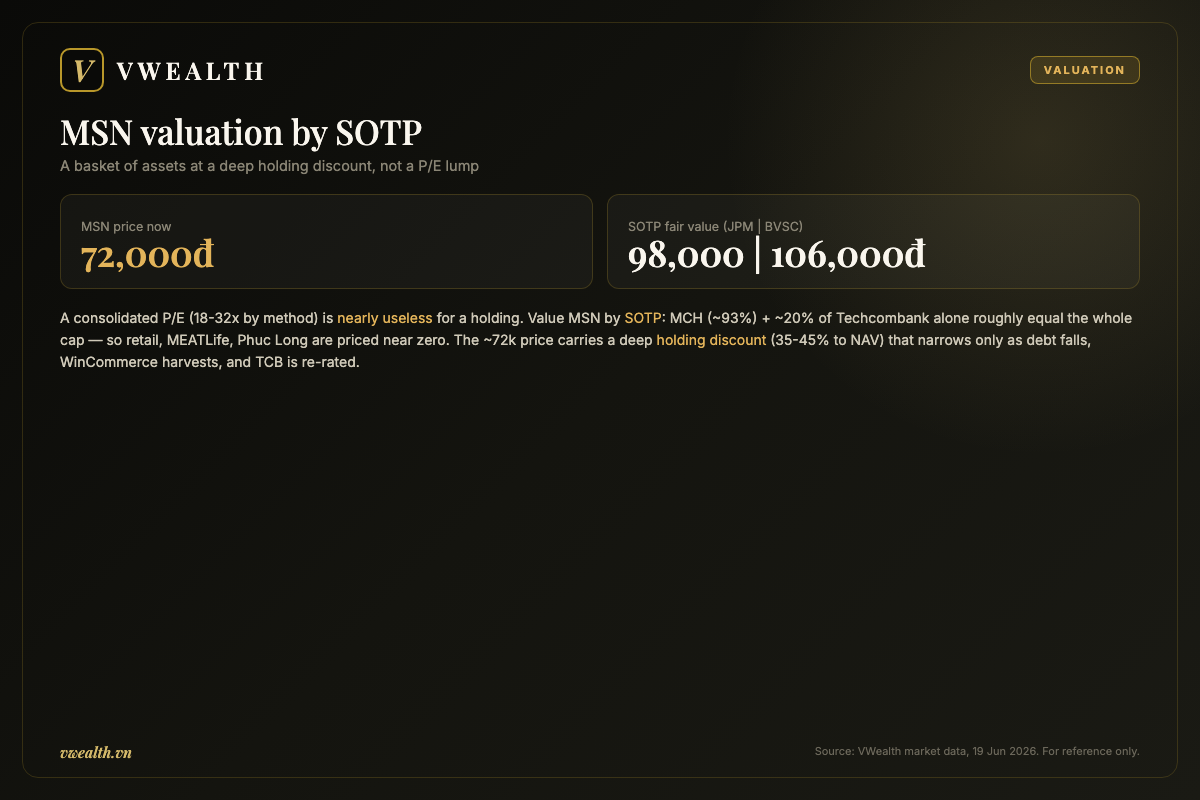
When you add up the value of Masan’s stakes in these pieces at market prices, then subtract parent-level net debt, a series of major institutions all arrive at a figure significantly above the current price. JP Morgan once valued MSN at up to 98,000 dong a share using exactly this SOTP method; BVSC set a fair value of 106,000 dong. Masan’s own management at the 2026 AGM also declared the stock is valued about 60% below its true value — and offered a very apt image: “Buy MSN at 80,000 dong and you get WinCommerce, Masan MEATLife, Phuc Long… thrown in free.” That idea sounds like an ad, but arithmetically it has a basis: the value of Masan’s stake in Masan Consumer plus the Techcombank stake alone roughly equals or exceeds MSN’s entire current market cap. Every remaining segment, in SOTP theory, is being assigned a value of zero or negative by the market.
The chart below helps you picture MSN not as a homogeneous lump of profit, but as a basket of assets with pieces very different in nature:
The holding discount: why “sum of the parts” is always bigger than the share price
Here you’ll ask a very fair question: if the total net asset value reaches 98,000–106,000 dong, why does MSN keep trading around 72,000 dong? The answer is a classic phenomenon of every financial holding company in the world: the holding discount. The market almost always values the parent’s stock below the total value of the assets it holds, and this discount can range from 20% to over 40%. There are three reasons investors demand that discount.
First is debt. Masan runs on high leverage — characteristic of a group that both acquires retail and invests in mining. Net debt at the parent level must be subtracted straight from total asset value, and more importantly, it’s an obligation bearing steady interest regardless of how the subsidiaries do. Management’s target is to pull the Net debt/EBITDA below 3.5x — and each step toward that target is a time the market widens its valuation.
Second is liquidity and control. Buying MSN doesn’t mean you can sell the Techcombank stake yourself to realize its value. The assets are in management’s hands, and “unlocking” that value depends on their decisions — spin-offs, divestments, or further listings. Investors demand a discount to compensate for this lack of agency.
Third is group management cost and capital-allocation risk. A holding can use money from the “cash cow” (Masan Consumer) to feed a cash-burning segment (retail formerly), and investors don’t always agree with that allocation. When WinCommerce was still loss-making, MSN’s holding discount was pushed very deep because the market feared “the MCH gem is being used to cover retail losses.” This is the key to understanding the price action of recent years.
Price action: the four valves controlling MSN
If you’ve followed MSN long enough, you’ll see this stock doesn’t move linearly with quarterly results like a pure consumer stock. It reacts strongly to the story — specifically the following four valves, each of which, when opened, narrows the holding discount:
- (a) WinCommerce profitability. This is the biggest catalyst of the past two years. In 2025, WinCommerce first made a full-year net profit of about 501 billion dong and first turned cash-flow positive since COVID. Each piece of good news from this chain not only adds profit, but also erases the “MCH feeding retail” fear — so the price impact is often larger than the absolute profit figure.
- (b) Debt-reduction progress. Each sale of non-core assets (like H.C. Starck under MSR), each quarter pulling the leverage ratio down, is a time the market revalues MSN shareholders’ equity higher.
- (c) Techcombank’s share price. Because the ~20% TCB stake is a huge SOTP piece, MSN has an almost implicit correlation with TCB’s price. TCB rises, MSN’s NAV automatically swells without Masan doing anything.
- (d) Foreign capital flows. MSN is a blue chip in the basket of most foreign ETFs and active funds. When foreigners net-buy the Vietnamese market, MSN is often among the first to benefit; when they pull out, MSN faces strong selling pressure too.
There’s a trait you absolutely must remember: MSN is an interest-rate-sensitive stock. Because of high leverage, when the rate level rises, the group’s interest expense swells and the holding discount widens — the stock falls. Conversely, a low-rate environment is a double tailwind: it both cuts financial costs and makes investors willing to pay more for the long-term growth story. If you hold MSN, you’re indirectly placing part of your bet on the rate cycle.
Foreign capital and strategic partners: a double-edged sword
Masan is one of Vietnam’s most persistent “magnets” for foreign capital. World-class funds like KKR, TPG, SK Group, Bain Capital have all poured in capital — many funds two or three times over. Bain Capital’s equity investment in the group could rise to $500 million; SK Group of Korea was once a major shareholder at both the group and WinCommerce levels.
This capital flow is a double-edged sword, and you need to see both sides clearly. The supportive side: each funding round from a reputable institution both injects cash to help cut debt and is an independent “valuation validation” — when Bain or SK accepts paying price X for a segment, the market has a basis to revalue MSN accordingly. The risk side: most of these deals are equity poured into subsidiaries rather than buying MSN shares on the exchange, coming with put options or conversion clauses. This creates two consequences: one is dilution of MSN shareholders’ ownership in the very “children” of highest value; two is that when a partner wants to divest (like SK Group extending then moving to transfer its WinCommerce stake), Masan must spend money to buy it back — both a chance to reclaim value and a cash-flow pressure. You need to read each deal’s structure carefully rather than just hearing the headline “foreign fund pours in billions.”
Dividends: don’t buy MSN to wait for cash
If you’re an investor seeking a steady cash-dividend flow, MSN is almost certainly not for you — and that’s entirely consistent with the group’s strategy. Masan prioritizes retaining cash to reduce debt and reinvest in the consumer-retail ecosystem, rather than paying high cash dividends. The payment history is thus low and irregular, alternating between cash and stock dividends, without a stable committed ratio year after year.
Position the investor clearly: MSN is a growth and “value-unlock” stock, not an income stock. You expect gains from price appreciation as the holding discount narrows, not from a dividend cash flow.
Interestingly, the most important dividend flow for Masan flows in rather than out: the group receives thousands of billions of dong of dividends a year from Techcombank and Vinacafé Bien Hoa. In other words, the “income” the assets generate is being used to strengthen the parent’s own balance sheet — again coming back to the debt-reduction story.
In sum: what are you betting on when you buy MSN?
Putting it all together, the picture sharpens. At 72,000 dong, the market is valuing MSN with a deep holding discount to the sum of its parts — the fair valuation range per SOTP that major institutions give (98,000–106,000 dong) implies 35–45% upside. That gap isn’t “the market being wrong,” but the price of high debt, of capital-allocation risk, and of value still “locked” in management’s hands. That price will narrow when — and only when — the catalyst valves open one by one.
So, frankly: buying MSN is betting on three things at once — the debt-reduction path to below 3.5x EBITDA, WinCommerce shifting from “just profitable” to a real “harvest,” and the hidden value of the nearly 20% Techcombank stake being fully valued by the market. If all three happen, the holding discount contracts and the price moves toward NAV. If rates reverse upward, or retail stalls, or TCB corrects, the discount widens again. That’s why, to value MSN correctly, you can’t stop at the board — you must understand the industry each of its “children” plays in. And that’s what we’ll dissect in the next section on the industry context.
Economic and consumer-retail industry context: where does MSN stand in the big picture?
A stock never moves in a vacuum. For Masan, the stock of a group whose profit largely comes from the shopping baskets of 100 million Vietnamese and from huge borrowings, the two variables “people’s purchasing power” and “the interest-rate level” almost decide its fate. Before you think about buying or not buying MSN around 72,000 dong, you need to understand which waters this ship is sailing. This section dissects each macro and industry current that supports or threatens Masan.
Vietnam’s purchasing power and consumption: recovering but not yet booming
The first good news: Vietnam’s consumer economy is in a clear expansion phase. Total retail sales of goods and consumer-service revenue in the first 9 months of 2025 reached over 5.17 quadrillion dong, up 9.5% year on year. Into 2026, the momentum grew stronger as Q1 2026 GDP rose 7.83%, and the government targets full-year growth above 10% — an ambitious figure. This is an ideal environment for a consumer-goods group: with rising incomes and fuller pockets, people spend more freely.
But don’t rejoice too soon. “Recovery” doesn’t mean “boom.” Vietnamese consumption still carries a cautious trait after the earlier period of inflation and high rates. Consumers tend to hunt for promotions and prioritize essentials (food, drink, basic household goods) over luxuries. This actually suits Masan quite well: Masan Consumer’s basket (Chin-su fish sauce, Omachi noodles, Vinacafé coffee, seasonings) and the WinMart/WinMart+ chain sell exactly the things people must buy whether the economy is good or bad. This is the inherent “defensive” nature of essential goods — an important anchor when you assess this stock’s risk.
Modern retail: still huge room — a golden opportunity for WinCommerce
This is the most compelling part of Masan’s story, and you need to grasp it firmly. Vietnamese retail is still dominated by the traditional channel — i.e. markets, grocery shops, small stalls. Per 2025 figures, traditional grocery stores still hold about 59% of retail share, and the FMCG traditional channel alone still holds over 50% share.
Picture it this way: modern retail in Vietnam is like a house that has just finished its foundation. The gap between the current 12-27% and the 40-50% of developed regional countries is the “runway” of growth lasting a whole decade. And WinCommerce is sitting right in the driver’s seat.
WinCommerce — owning the WinMart and WinMart+ chains — is one of the two grocery chains dominating Vietnam (along with Bach Hoa Xanh of Mobile World). In 2025, WinCommerce opened 764 more WinMart+ stores, bringing the total to 4,592 outlets nationwide. More importantly, this chain is attacking hard into the countryside — where modern retail is almost empty — rather than only racing in cities. Vietnam’s modern trade is forecast to grow at a compound rate of about 6% a year in 2025-2030, with the convenience-store/minimart segment alone possibly growing double digits a year. This is the basis for Masan to believe WinCommerce will be a long-term growth engine.
FMCG competition: a merciless war
However, you must also stay clear-headed: this isn’t a playground for Masan alone. In FMCG, Masan Consumer competes with global giants like Unilever, Nestlé, plus domestic rivals. In retail, Bach Hoa Xanh is accelerating, convenience chains like Circle K, GS25, Ministop keep expanding, and e-commerce (Shopee, TikTok Shop) is gradually swallowing consumer-goods share. FMCG volume through the modern channel rose 4.2% in the first 5 months of 2025 — a positive number but one that also shows the pie is being fought over by many.
Masan’s advantage lies in owning both the brand (Masan Consumer) and the distribution channel (WinCommerce). When you enter a WinMart+ and see Omachi noodles and Chin-su fish sauce filling the best shelf spots, that’s the power of the closed-loop ecosystem few rivals have. But this advantage is also a double-edged sword — it makes the group structure complex and hard to value, which we’ll discuss in the conclusion.
Interest rates: a life-or-death variable for a highly indebted group
If you had to choose a single variable deciding MSN’s short-term fate, it’s interest rates. This is something you can’t overlook. Masan is a group running on large financial leverage, with a Net debt/EBITDA of 2.74x — i.e. a very significant debt pile. Each percentage-point change in rates directly and powerfully affects the group’s net profit.
- When rates fall: interest expense falls, and Masan’s net profit surges in “leveraged” fashion. This is why many investors see MSN as a stock “betting on a falling-rate cycle” — debt reduction plus cheap rates is a golden combination for valuation.
- When rates rise: the interest burden swells, eroding profit while raising financial risk. This is the scariest scenario for MSN.
The current context has both good and bad news. Good: the State Bank’s policy rate is kept low (around 3% in April 2026), and the general orientation is to lower lending rates to support growth. Bad: the SBV itself admits rates are hard to cut much further in 2026, and could even nudge up in the first half to protect the VND against depreciation pressure and the Fed’s unpredictable policy. In other words, the “downward path” of rates — the most favorable scenario for MSN — isn’t firmly assured. You’re betting part of your case on this expectation.
Tungsten prices and the Masan High-Tech Materials segment
Another interesting piece is Masan High-Tech Materials (MHT/MSR) — the largest tungsten mining company outside China. This segment was once a loss-making “millstone,” but in 2025-2026 became an unexpected bright spot. The APT (ammonium paratungstate) price jumped from about $340/mtu at end-2024 to around $900/mtu at end-2025, then exploded past $2,500-3,100/mtu in Q1 2026. The cause: China banned tungsten exports, supply grew scarce, plus booming demand from the semiconductor and AI supply chains.
Thanks to this price fever, MHT targets net profit of 1,700-2,500 billion dong (base/optimistic scenario) in 2026 — a spectacular reversal. For you, this is a “free option” attached to MSN: if the tungsten super-cycle lasts, this is added profit; if the price cools, this segment returns to a secondary role. Don’t value MSN mainly on tungsten — it’s the seasoning, not the main dish.
Foreign capital flows and the market-upgrade story
Finally, a macro-level tailwind: a stock-market upgrade. FTSE Russell has confirmed upgrading Vietnam from a frontier market to a secondary emerging market, effective 21 September 2026. Institutions estimate the passive capital flowing in could be $5-6 billion in the short term, and the World Bank believes long-term flows could reach up to $25 billion by 2030.
MSN is one of the large-cap, high-liquidity stocks almost certain to be in the index baskets foreign funds must buy. When foreign money flows in by index, blue chips like MSN usually benefit on both liquidity and valuation. This is a significant catalyst for late 2026 and 2027 — but remember, upgrade flows lift the whole market, not just MSN, and it doesn’t fix the internal debt issues.
Trend forecast: where will Masan go?
Having understood the context, let’s now try to look ahead. Let me say at once: this section is scenario analysis based on data and logic, not prophecy. The stock’s future depends on how management executes the strategy and how the macro environment plays out. Let’s dissect Masan’s strategy first, then draw three scenarios for you to weigh.
The core strategy: from “burning cash to build” to “harvesting”
Masan’s central story from 2026 on can be summed up in one word: “harvest.” After years of pouring in money and bearing losses, the pillars are turning profitable one by one. Specifically:
- WinCommerce enters a real profit phase. Having turned profitable, WinCommerce targets net profit of 1,000 billion dong in 2026 and plans to double its store count by 2030. The chain’s revenue rose 32% in early 2026, with some months up 27%. This is the shift from “burden” to “profit engine” — the most important turning point for MSN.
- Masan Consumer goes global. The group’s highest-margin consumer segment is developing “Mega Brands” and pushing exports, aiming to take Vietnamese brands worldwide rather than depending only on the domestic market.
- Continued debt reduction. With improving cash flow from WinCommerce and Masan Consumer, cutting the Net debt/EBITDA below the current 2.74x is a top priority. Reducing debt both cuts risk and “frees” profit from the interest burden.
- Possible subsidiary IPO/listing. Masan may continue the path of listing or raising capital for subsidiaries (like Masan Consumer, WinCommerce) to realize “hidden value” and raise money to pay debt.
Combining these pillars, the group targets revenue of about 98,000-100,000 billion dong for 2026 (growth of ~20%), with 2025 after-tax profit already at 6,764 billion dong (up about 1.6x) and expected continued double-digit profit growth in 2026.
Three scenarios for MSN
To give you a balanced view, I draw three scenarios — not for you to pick the one you like, but to see clearly the width of possibilities and their attached conditions.
| Scenario | Core conditions | Consequence for the stock |
|---|---|---|
| Positive | WinCommerce beats the 1,000-billion profit target, expands fast; the group cuts debt strongly; rates stay low/fall further; consumption clearly recovers; upgrade-driven foreign flows pour in; tungsten prices anchor high. | Profit surges as lower leverage cuts interest expense; the valuation is “decompressed”; the stock could rise well past 72,000 dong. This is the “successful restructuring story” recognized by the market. |
| Base | WinCommerce hits its profit target, grows to plan; debt falls steadily; rates go sideways; consumption grows moderately; the upgrade proceeds smoothly. | Profit grows double digits as planned; the stock moves positively but gently, tracking the fundamental improvement. The reward goes to the patient. |
| Negative | Consumption weak/sideways; WinCommerce slow to hit targets; rates rise to protect the FX; debt pressure swells; tungsten prices cool; possible dilution from further capital raises. | Interest expense erodes profit; financial risk rises; the valuation is discounted further; the stock faces correction pressure. This is the flip side of high leverage. |
The important takeaway from this table: all three scenarios turn on exactly two axes — debt-reduction execution + WinCommerce profitability and the direction of interest rates. If you believe these two axes lean positive, MSN is a compelling story. If you doubt it, the risk is very real.
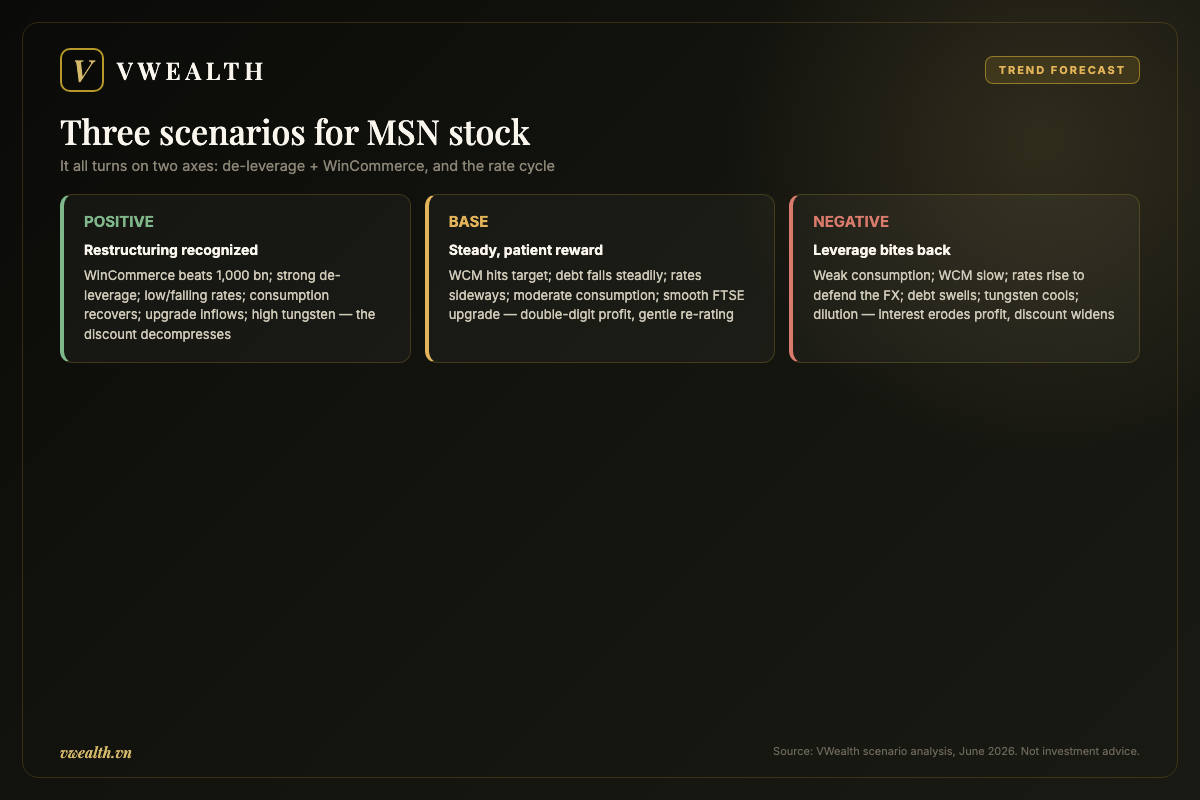
Should you buy MSN stock?
Now for the question you’ve been waiting for. But I’ll be honest: I won’t tell you to buy or sell. No one has the right to do that for you, because the money is yours and so is the risk appetite. My job is to lay the pros and cons clearly on the scale, then help you see whether MSN suits your investor “type.”
Weighing the PROS
- Vietnam’s largest consumer-retail ecosystem. Masan owns both the brand (Masan Consumer) and the distribution channel (WinCommerce ~4,600 stores) — a rare closed loop. Not many groups in Vietnam reach people’s shopping baskets at this scale.
- Masan Consumer — a high-margin machine. The consumer segment has strong brands, good margins, stable cash flow, high defensiveness. This is the “diamond” of the group.
- WinCommerce turnaround. From deep losses to a 1,000-billion profit target in 2026 — if executed right, this is a long-term growth engine given the still-vast modern-trade runway.
- Hidden value from Techcombank and other assets. Masan holds a stake in Techcombank and other assets not fully reflected in the share price — room to “decompress” the valuation.
- Big beneficiary when rates fall and consumption recovers. This is the anchor of the story: with high leverage, each time rates drop, MSN’s profit surges. Plus upgrade-driven foreign flows — a double base for the period ahead.
Weighing the CONS
- High debt — interest-rate risk is the biggest worry. Net debt/EBITDA of 2.74x makes MSN extremely rate-sensitive. If rates rise (a scenario the SBV doesn’t rule out in 2026), the interest burden will erode profit. This is a risk to face squarely.
- Complex group structure, hard to value. Masan is a “group of groups” — consumer goods, retail, mining, banking. This complexity usually makes the market apply a “holding discount” — i.e. the total value of the parts is valued lower when lumped together.
- Dilution risk from capital raises. To reduce debt, Masan may have to issue more shares or raise capital, diluting existing shareholders’ interests.
- Low dividend. This isn’t a stock for those seeking a steady dividend cash flow. Profit is mostly reinvested and used to pay debt.
- Dependent on execution. The whole positive story rests on the assumption that management executes the debt-reduction and profit plan. Execution is a risk — however good a plan, it can slip.
What kind of investor does MSN suit?
For you to check against yourself, I divide investors into four common types:
| Investor type | Does MSN suit? |
|---|---|
| Risk-taker who believes in the restructuring & consumption cycle | Fairly suitable. You bet on WinCommerce turning profitable, debt falling and rates dropping — a “two-way leverage” story with large reward potential if it goes right. |
| Long-term growth investor, patient for years | Possibly suitable. The modern-trade runway and ecosystem scale are a multi-year story, but you need nerves of steel to bear the volatility. |
| Safety-seeker who dislikes volatility | Not suitable. High leverage and complexity make MSN not a place to “sleep soundly.” |
| Income-seeker wanting steady cash flow | Not suitable. Low dividend, profit funneled to reinvestment and debt repayment. |
In short: MSN is a “story” stock — the reward comes from the belief that the restructuring will succeed and that the consumption-and-rate cycle will lean favorably. It suits those who understand and accept leverage, patient enough to pursue it for years. It does not suit those seeking safety or a steady dividend flow. The final decision, once again, rests with you: how much you believe this story, and what level of risk you can bear.
Disclaimer: This article is produced for informational and reference-analysis purposes, and is not investment advice or a recommendation to buy or sell any security. All figures are compiled from public sources at the time of writing and may change. Investing in stocks always carries risk of capital loss. You should research thoroughly, consider your personal financial situation, and consult a licensed advisor before making any investment decision. vwealth.vn is not responsible for any loss arising from the use of information in this article.
Research Vietnamese stocks in English with vwealth. Our AI-powered platform turns Vietnamese market data into full English analysis reports — with international payment support and a free 2-month trial for new accounts. Create your free account and read the latest reports.