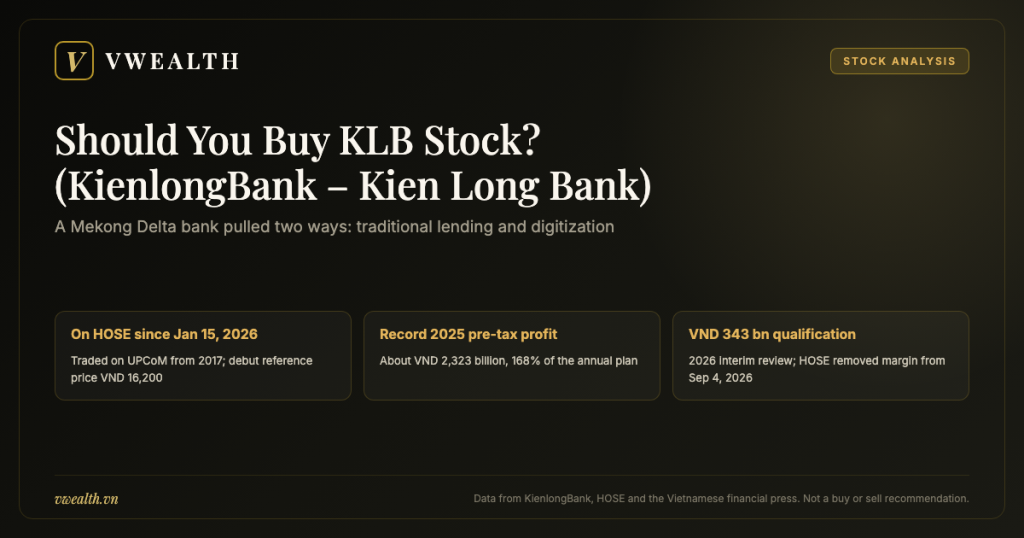
Should you buy KLB stock? The question has become harder to ignore since Kien Long Commercial Joint Stock Bank — KienlongBank — moved its shares from the UPCoM market to the Ho Chi Minh City Stock Exchange (HOSE) on January 15, 2026. This is a bank that opened in 1995 in Rach Gia, a coastal market town in the Mekong Delta, with charter capital of just VND 1.2 billion, and that spent most of its first 25 years earning a few hundred billion dong a year. Then, in 2025, it reported pre-tax profit of roughly VND 2,323 billion — about double the prior year and the highest in its 30-year history. According to the bank, KLB shares rose about 131% during 2025, the best performance in Vietnam’s listed banking group that year. Yet less than eight months after its HOSE debut, the same stock was removed from the exchange’s margin-eligible list because the auditor’s review of the 2026 interim financial statements contained a qualified conclusion over a receivable of more than VND 343 billion. At the same time, shareholders approved a plan to move the head office from the Mekong Delta to Dong Nai, an industrial hub next to Ho Chi Minh City. This analysis walks through that story, shows you how to read the numbers of a small, high-return Vietnamese bank, and gives a balanced answer on who KLB suits — and who it does not.
First, the names, because they can be confusing for international readers. KLB is the ticker of Kien Long Commercial Joint Stock Bank (in Vietnamese, Ngân hàng TMCP Kiên Long), usually branded KienlongBank. In 2021 the bank launched a digital-banking brand called KSBank and at one point planned to rename itself, but according to VietNamNet (January 2023) the renaming was not approved; the establishment and operating license reissued as No. 17/GP-NHNN on April 3, 2026 lists the short names Ngân hàng Kiên Long and KienLong Bank. KSBank therefore appears only in some older documents. KLB shares traded on UPCoM — Vietnam’s unlisted public company market, with lighter disclosure and trading rules — from June 29, 2017, had their last UPCoM session on January 6, 2026, and were formally listed on HOSE, the country’s main board, from January 15, 2026. Older documents still say “UPCoM: KLB”; that information predates 2026. According to the bank’s corporate website, its registered head office is still at 40-42-44 Pham Hong Thai Street in Rach Gia ward, An Giang province (the former Kien Giang province was merged into An Giang in Vietnam’s 2025 administrative reform), while the policy of relocating the head office to Dong Nai was approved at the annual general meeting on April 23, 2026; on July 3, 2026 the board chose a planned site in the Sonadezi building, Tran Bien ward, Dong Nai city, and the move still requires approval from the competent state authorities.
A few ground rules, as with every company analysis in the vwealth series. Events, names, transactions and numbers come from published sources: KienlongBank’s 2025 annual report, its audited 2025 consolidated financial statements, its Q1 2026 and reviewed first-half 2026 financial statements, the minutes and resolution of the April 23, 2026 shareholder meeting, the bank’s regulatory disclosures and State Bank of Vietnam (SBV) decisions it has published, VNDirect trading data, and financial media such as VnExpress, CafeF, CafeLand, VietNamNet, TheLEADER, Tuoi Tre, VietnamBiz, Bao Phap luat Viet Nam and Nguoi Quan Sat. Figures for closed financial years are used as historical reference points. This article does not quote today’s share price, current P/B or P/E, or quarterly profit after the second quarter of 2026 — those change constantly. Where a figure is vwealth’s own calculation, it is labelled “vwealth estimate” or “illustrative example”. Where published sources disagree, both are shown. For current numbers, open the vwealth analysis reports. If you are new to the market itself — foreign ownership limits, T+2 settlement, daily price bands — start with our guide on how to invest in the Vietnam stock market.
One more thing, and it is the thread running through this whole piece. In this series vwealth has already covered several mid-sized and smaller private Vietnamese banks — OCB with its Japanese strategic shareholder, MSB with its strong base of current-account deposits, Nam A Bank’s digital push and NCB’s restructuring. KienlongBank has a story of its own. It was born to lend to farmers and small traders in the Mekong Delta, and today it is being pulled in two directions. One pull is its roots: a branch network concentrated in the Delta and southern Vietnam, household businesses, small retail borrowers. The other is ambition: a digital bank with around 98% of transactions on digital channels, the MyShop merchant ecosystem, an in-house AI platform called Kiloba, premium banking, and a new head office in Dong Nai. So when you ask whether to buy KLB stock, the question really has three parts: is 2025’s profitability durable, where does the risk sit when more than half of the loan book is classified under construction, and will those two pulls converge or tear the bank apart.
From a Rural Bank in Rach Gia to HOSE: 31 Years of KienlongBank
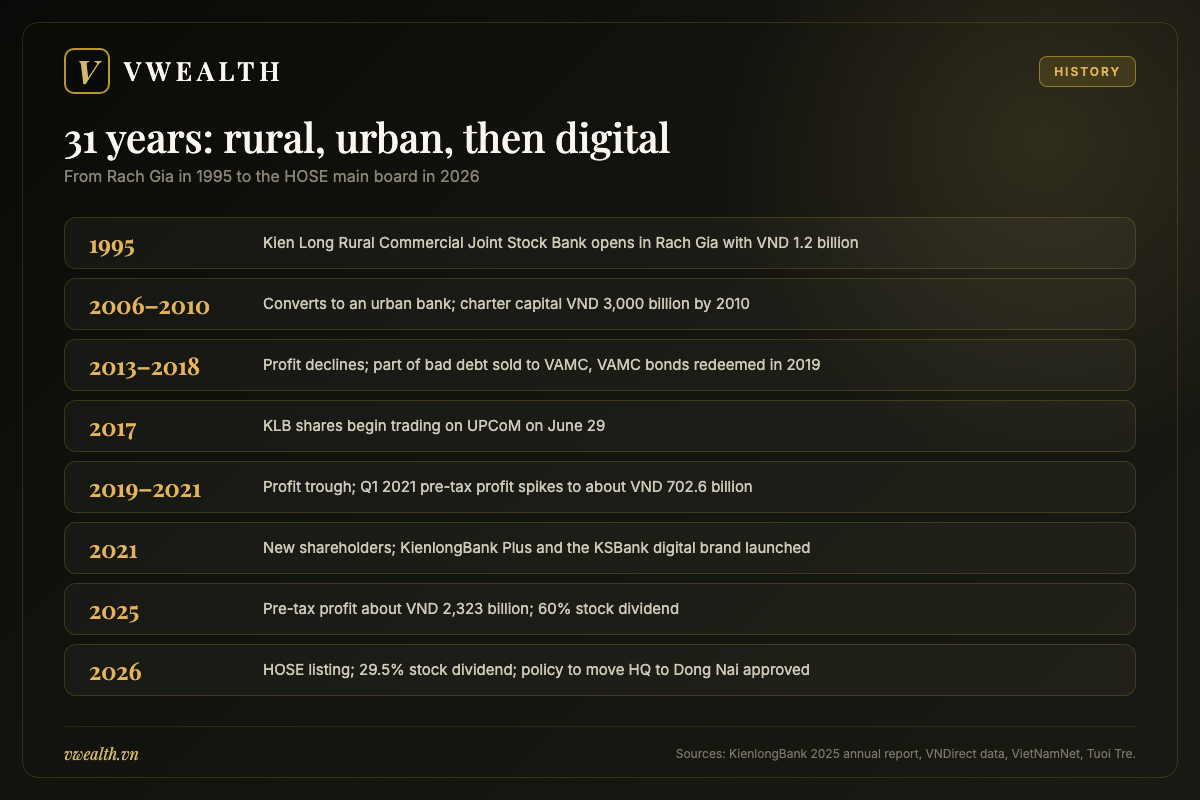
If you had to summarize KienlongBank’s history in one sentence, it might be this: a provincial bank that moved slowly for 25 years and then almost completely changed gear in the last five. Unlike many rural banks of the same generation, which changed names, moved head offices and disappeared into mergers, Kien Long kept its original name for three decades. But keeping a name is not the same as staying the same. The chairmanship has changed hands many times, the controlling shareholder groups have changed, and from 2026 even the head office in Rach Gia is due to move. Understanding that journey helps explain the oddities in KienlongBank’s financial statements today: a “rural-rooted” bank where construction accounts for more than half of loans, and a “digital” bank with very few low-cost current-account deposits.
1995: A Rural Bank With VND 1.2 Billion in Rach Gia
According to the bank’s official profile, KienlongBank began operating on October 27, 1995, under establishment license No. 0056/NH-GP issued by the SBV Governor on September 18, 1995. Its original name was Kien Long Rural Commercial Joint Stock Bank, based in Rach Gia, then the capital of Kien Giang province. The bank’s 2025 annual report records its starting charter capital as only VND 1.2 billion — more than six thousand times smaller than its 2026 charter capital of about VND 7,528 billion, by vwealth’s division.
The 1990s were the years when Vietnam licensed a wave of rural joint-stock banks to channel credit into rice, fruit and seafood-producing regions. Kien Giang was a textbook Mekong Delta agricultural province: rice paddies, offshore fishing, shrimp farming, and dense networks of small traders around district markets. A bank like Kien Long lived on small loans — fertilizer before planting season, engine repairs for fishing boats before the fishing season, inventory for traders before the Lunar New Year. The model’s great strength was proximity: loan officers knew individual fields and individual boats. Its weakness was just as clear: when rice prices fell or a shrimp crop failed, a loan book concentrated in one region took the hit all at once.
The bank’s history page records that KienlongBank received a third-class Labor Order from the State President for its performance in 2002–2006, and the 2025 annual report adds a Prime Minister’s certificate of merit for 2001–2005 — details that show that in its first decade Kien Long was regarded as a steady local bank. VNDirect’s archived data also shows how small it was: in 2005 its paid-in capital was only about VND 28 billion and pre-tax profit about VND 14 billion.
Why should a story from nearly 30 years ago matter to an investor today? Because it is in the “DNA” of the network. Most of KienlongBank’s branches and transaction offices are still in the Mekong Delta and southern Vietnam, serving households, household businesses and small firms. These customers pay higher lending rates than large corporates, but they are expensive to serve and carry regional concentration risk. Every digital strategy you will read about in later sections is an attempt to keep the advantage of being close to customers while cutting the cost of a physical branch network.
2006–2012: Becoming an Urban Bank, VND 3 Trillion of Capital and the First Growth Spurt
In the mid-2000s, the SBV raised minimum capital requirements and encouraged qualified rural banks to convert into urban commercial banks. According to the 2025 annual report, in 2006 KienlongBank converted from a rural bank into an urban bank and renamed itself Kien Long Commercial Joint Stock Bank. Many other rural banks converted in the same period; quite a few later changed their names or moved their head offices — the closest example being Navibank, now NCB. Kien Long is one of the few banks of that generation that still carries its original name.
The charter capital milestones tell the story of that acceleration: VND 580 billion in 2007, VND 1,000 billion in 2008 and VND 3,000 billion in 2010. By 2011 the network had reached 26 branches and 69 transaction offices, and the bank booked pre-tax profit above VND 520 billion. VNDirect data show pre-tax profit rising from about VND 51 billion in 2008 to VND 120 billion (2009), VND 259 billion (2010) and VND 525 billion (2011) — nearly doubling every year. This was Kien Long’s “first golden age”.
The same period also planted the seeds of the slowdown that followed. VND 3,000 billion was the regulatory minimum at the time, and according to VNDirect data the figure stood still from 2010 through 2017; only in 2018 did capital edge up to VND 3,236.96 billion, according to the bank’s history page. When capital does not grow, lending cannot grow much either, and a small bank ends up stuck between two lanes: too small to compete with the state-owned banks in the Delta, not fast enough to race the urban private banks.
Profit peaked in this phase in 2011 and then began to slide: after-tax profit was about VND 351 billion in 2012, according to VNDirect data. From 2013 the bank entered a long stretch of slow growth.
2013–2018: Falling Profit, VAMC Bonds and the UPCoM Debut
In 2013 Vietnam’s banking sector was in the middle of a major clean-up after the credit boom of 2007–2011. System-wide bad debt had ballooned, and the Vietnam Asset Management Company (VAMC) had just been created to buy banks’ non-performing loans in exchange for special bonds. According to VNDirect data, KienlongBank’s after-tax profit slid from VND 351 billion in 2012 to VND 313 billion in 2013, VND 176 billion in 2014, VND 165 billion in 2015 and just VND 121 billion in 2016, before recovering to VND 202 billion in 2017 and VND 232 billion in 2018.
One detail from this era is a useful lesson in reading Vietnamese bank bad-debt figures. Like many banks, KienlongBank sold part of its bad loans to VAMC in exchange for special bonds. Loans “sold” this way drop out of the on-balance-sheet NPL ratio, but the bank still has to provision for the VAMC bonds over time. The lesson still applies today: a clean headline NPL ratio does not necessarily capture every problem loan. The bank’s history page records that in 2019 it redeemed all of its VAMC bonds ahead of schedule.
Throughout these years KienlongBank quietly kept building its network and technology. It joined the Visa network and launched Kienlong Mobile Banking in 2014; it was present in 26 provinces and cities with 27 branches and 76 transaction offices in 2015; 28 branches and 89 offices in 2016; and 31 branches and 103 offices in 2018. In 2015 it launched a VND 2,000 billion preferential lending package. In 2016 and 2018 it launched Visa and then JCB international credit cards. Reading that list, you can see a bank trying to escape its “rural bank” image through cards and electronic banking — a direction that only truly accelerated a decade later.
The most important milestone for shareholders was June 29, 2017, when KLB shares began trading on UPCoM. According to VNDirect trading data, the first session closed at VND 11,400 per share. The 2018 shareholder meeting elected an eight-member board for 2018–2022 (Tuoi Tre – Saigon Times, citing bank documents), and Mr. Le Khac Gia Bao — who joined KienlongBank in March 2013 and had headed the supervisory board — held the chair in the period that followed, according to his profile in the 2025 annual report. Mr. Bao left the board in April 2021 (VietNamNet), headed the supervisory board from January 2022 to April 2023, and was then re-elected to the board for 2023–2027.
2019–2021: A Profit Trough and the Q1 2021 Spike
2019–2021 was the most volatile stretch for profit in KienlongBank’s history, and you can read it entirely from the financial statement data archived by VNDirect.
Q4 2019 was the break: net interest income for the quarter fell to only about VND 116 billion, versus about VND 270–314 billion in each of the three previous quarters, even though interest and similar income was still about VND 1,125 billion. The bank made a pre-tax loss of about VND 150 billion in the quarter.
The effect showed up immediately in the annual accounts: full-year 2019 pre-tax profit was only about VND 86 billion, down roughly 70% from VND 290 billion in 2018 and the lowest in more than a decade.
2020 was a year of waiting: in the first three quarters the bank earned pre-tax profit of only about VND 57 billion, VND 46 billion and VND 42 billion respectively, with quarterly net interest income of around VND 240–296 billion.
According to VNDirect data, Q4 2020 pre-tax profit was about VND 13.6 billion, and full-year 2020 pre-tax profit about VND 158 billion — still far below earlier years.
Then Q1 2021 spiked: interest and similar income reached about VND 2,166 billion, double the roughly VND 1,000–1,100 billion of neighboring quarters; net interest income was about VND 915 billion, about three times Q2 2021; and pre-tax profit was about VND 702.6 billion in Q1 2021 alone (VNDirect data) — more than its combined pre-tax profit for 2018–2020.
Why does this period matter to you? It explains two things. First, the “more than VND 1 trillion” profit of 2021 was concentrated in a single quarter, driven by a one-off jump in interest income that did not repeat. Second, it shows how sharply a small bank’s profit can swing within a few quarters. When you read KienlongBank’s profit today, separate the recurring part from the one-off part — exactly how section 4 unpacks 2025.
2021–2024: New Shareholders, the KSBank Name and a Digital Makeover
At the same time, something else was happening on the UPCoM trading screen. In late 2020 and early 2021, a large number of KLB shares changed hands through negotiated (block) trades and the price rose sharply: according to VNDirect data, KLB closed at about VND 11,300 on October 1, 2020, VND 19,200 on January 4, 2021 and VND 25,100 on April 19, 2021. When a large share of a bank’s capital changes hands in a short time, a change in governance almost always follows.
It came at the start of 2021. In January 2021 Mr. Tran Ngoc Minh (born 1984) joined as deputy CEO (Tuoi Tre), and Mr. Nguyen Van Minh — who had led software projects — became deputy CEO and head of the IT center from January 7, 2021 (2025 annual report). An extraordinary meeting scheduled for January 28, 2021 elected two additional directors for the 2018–2022 term: Ms. Tran Thi Thu Hang, born 1985, then CEO of Sunshine Group, and Mr. Le Hong Phuong, CEO of BBGroup and a former CEO of NCB (Tuoi Tre – Saigon Times). In April 2021, Mr. Do Anh Tuan — chairman of Sunshine Group — and Ms. Vo Thi Tuan Anh joined the board, while Mr. Le Khac Gia Bao resigned as a director (VietNamNet). In May 2021, Ms. Tran Thi Thu Hang became chair at 36 — described by the press at the time as Vietnam’s youngest bank chair (VietNamNet).
The new shareholders’ imprint showed up quickly. According to VietNamNet (April 2021), the logo of KSBank — the digital-banking brand KienlongBank had just launched — appeared on the Sunshine Center building at 16 Pham Hung Street, Hanoi, where the bank’s northern representative office is now located. The bank planned to rename itself KSBank, but according to VietNamNet (January 2023) the change was not approved. Also in 2021, according to the bank’s history page, KienlongBank unveiled a new logo and brand identity for its 26th anniversary, launched the KienlongBank Plus app, put next-generation STM machines into service for the first time, and was approved to raise charter capital to VND 3,652.8 billion through a 13% stock dividend for 2020 (VNDirect corporate-action data).
On results, 2021 was the first year KienlongBank’s pre-tax profit exceeded VND 1,000 billion (about VND 1,010 billion per VNDirect data) — though, as noted, most of it came in Q1 2021 with a one-off jump in interest income. The following two years showed the “underlying” level once that one-off disappeared: pre-tax profit of about VND 682 billion in 2022 and VND 719 billion in 2023. The share price made a big round trip too: according to VNDirect data, KLB peaked near VND 40,000 in March 2022, and by January 2023, when the bank withdrew its HOSE listing application citing “unfavorable market conditions”, it traded at only about VND 12,200 (VietNamNet). These were the years the bank poured money into technology: according to its history page, in 2022 it migrated its card core to SmartVista and completed Basel II risk management; in 2023 it went live on a new core banking system and launched the MyShop merchant-finance suite, the KienlongBank Pay payment solution and a priority banking service; and in 2024 it completed both its Basel III and ESG projects.
On July 9, 2024, Ms. Tran Thi Thu Hang stepped down as chair for personal reasons but remained on the board; Mr. Tran Ngoc Minh, then vice chairman and CEO, was elected chairman, and Mr. Tran Hong Minh became acting CEO, according to VietNamNet. By the 2025 annual report, the nine-member board no longer included Ms. Hang. Several changes of chair within a few years is not a small thing, but from mid-2024 the leadership began to stabilize — and that is also when the numbers began to accelerate.
2025–2026: Record Profit, a HOSE Listing and the Move to Dong Nai
2025 was KienlongBank’s 30th anniversary, and the year its numbers surprised the market. According to the 2025 annual report, pre-tax profit reached VND 2,322.7 billion, up 108.86% from 2024 and equal to 168.43% of the VND 1,379 billion target. After-tax profit was about VND 1,856 billion. Total assets crossed VND 100 trillion for the first time, reaching VND 103,303 billion at year-end. In September 2025 (ex-date September 24, 2025), the bank paid a 60% stock dividend — among the highest in the banking sector in 2025, according to CafeLand — lifting charter capital from about VND 3,652.8 billion to VND 5,821.7 billion.
On December 18, 2025, HOSE issued Decision 1227/QD-SGDHCM approving the listing of 582,170,526 KLB shares (CafeLand). January 6, 2026 was the last trading session on UPCoM, and on January 15, 2026, KLB debuted on HOSE at a reference price of VND 16,200; at that price, market capitalization was about VND 9,430 billion (vwealth estimate: 582.17 million shares × VND 16,200). Before that, on December 1, 2025, Mr. Tran Hong Minh formally became CEO.
The April 23, 2026 AGM approved three big decisions: a 2026 pre-tax profit target of VND 2,600 billion (up about 12%), a 29.5% stock dividend to lift charter capital to about VND 7,527 billion, and the policy of relocating the head office from An Giang to Dong Nai. In June 2026 the SBV approved the capital increase (CafeF); July 3, 2026 was the ex-date, the bank issued 170,617,811 new shares, and under SBV Decision 1694/QD-NHNN of July 22, 2026 charter capital officially became VND 7,527.88 billion. At this point the two pulls on KienlongBank are clear: a bank with Mekong Delta roots that wants its “brain” in an industrial city near Long Thanh airport, and that wants to be seen as a digital bank rather than a rural one.
But 2026 did not bring only good news. Between February and April 2026, the SBV’s inspectorate published inspection conclusions for several branches; a case in which a customer said VND 5 billion had disappeared from their account was widely reported; and from September 2026 KLB was removed from the list of margin-eligible stocks because of the qualified review conclusion. These events are discussed objectively in sections 4 and 6.
| Date | Event | What it meant for shareholders |
|---|---|---|
| Oct 27, 1995 | Kien Long Rural Commercial Joint Stock Bank opens in Rach Gia with VND 1.2 billion of capital | Mekong Delta rural-bank roots |
| 2006–2008 | Converts to an urban bank (2006); capital VND 580 billion (2007), VND 1,000 billion (2008) | Expansion beyond Kien Giang |
| 2010–2011 | Charter capital VND 3,000 billion; pre-tax profit above VND 520 billion in 2011 | First peak, then capital flat through 2017 |
| 2013–2018 | Profit declines; part of bad debt sold to VAMC, VAMC bonds redeemed in 2019 | Slow-growth years |
| Jun 29, 2017 | KLB begins trading on UPCoM, closing at VND 11,400 on day one | A public market price |
| 2019–Mar 2021 | Profit falls into a trough, then spikes in Q1 2021 | 2019 pre-tax profit falls to about VND 86 billion; Q1 2021 pre-tax profit about VND 702.6 billion once recovered |
| 2021 | New shareholders; Ms. Tran Thi Thu Hang becomes chair; KienlongBank Plus launched; capital VND 3,652.8 billion | Start of the digital strategy |
| Jul 9, 2024 | Mr. Tran Ngoc Minh becomes chairman | Leadership stabilizes |
| 2025 | Pre-tax profit about VND 2,323 billion; 60% stock dividend; capital VND 5,821.7 billion | Record year |
| Jan 15, 2026 | HOSE debut at a VND 16,200 reference price | Main-board listing |
| 2026 | 29.5% stock dividend (capital VND 7,527.9 billion); policy to move HQ to Dong Nai approved; not margin-eligible from Sep 4 | Expansion alongside unanswered audit questions |
Looking at the whole path, KienlongBank has had three very different “lives”: a rural bank (1995–2006), a small urban bank with slow growth (2007–2020), and a high-return digital bank (since 2021). Each life came with its own shareholder group and its own type of risk. The third life is only five years old, so the biggest question for investors is whether it is durable enough to become the bank’s true nature — or just a favorable cycle.
KLB Leadership and Ownership: A Young Management Team and the Published Shareholder Lists
At a small bank, leadership and major shareholders matter far more than at a state-owned lender. A state bank has the government behind it and changes strategy slowly. A small bank can change direction entirely when a new shareholder group arrives — as KienlongBank did in 2021. This section tells you who runs the bank, who owns it, and how to read KLB’s shareholder disclosures correctly.
Chairman Tran Ngoc Minh: From Deputy CEO in 2021 to the Chair
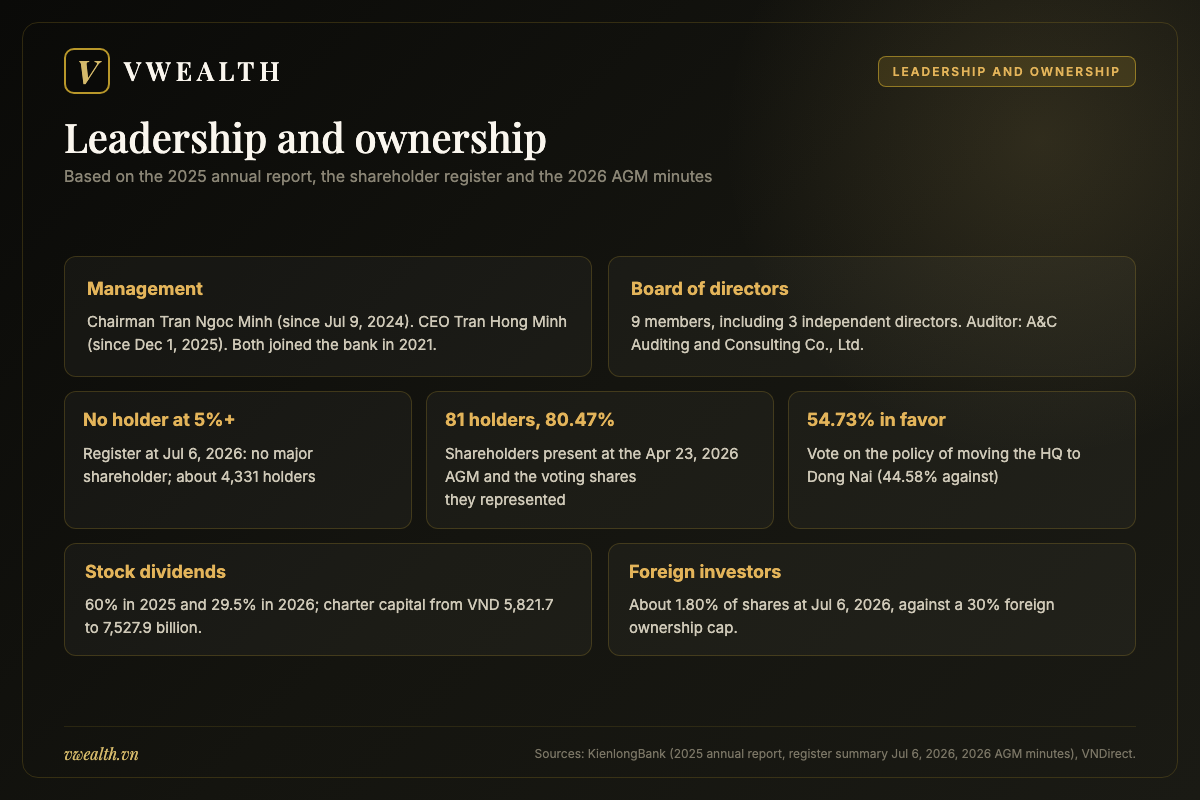
According to the bank’s governance page and 2025 annual report, Mr. Tran Ngoc Minh holds a master’s degree in economics from the Banking Academy and has nearly 20 years at banks and large groups, including roles as deputy branch director, head of appraisal at head office, director of funding, head of finance and deputy CEO in charge of finance. He joined KienlongBank in January 2021 as deputy CEO, became acting CEO in October 2021, CEO on December 9, 2021 (and a board member from December 28, 2021), vice chairman and CEO on April 27, 2023, and chairman on July 9, 2024. Tuoi Tre reports that he was born in 1984.
Notably, Mr. Minh ran the bank throughout 2021–2024, when its core systems were replaced and “underlying” profit hovered around VND 700 billion. A CEO moving up to chairman usually brings strategic continuity — a plus. But it also means the supervisor (the board) and the executive team have been closely intertwined. The 2024 Law on Credit Institutions raised the bar on board independence, and KienlongBank added independent directors at an extraordinary meeting in October 2024.
According to the minutes of the April 23, 2026 AGM, when asked why the 2026 plan grows profit by only about 12%, the chair said the plan was built “on a prudent basis, with room to respond”, and that the average 2026 profit growth of the 20 largest banks that the bank had compiled was also only close to 14%. Asked why a bank earning so much pays no cash dividend, the answer was that its charter capital is “still quite modest relative to its growth potential”, so stock dividends are preferred to keep resources inside the bank.
CEO Tran Hong Minh and the Executive Team
According to the 2025 annual report, Mr. Tran Hong Minh holds a bachelor’s degree in investment economics from the National Economics University and has nearly 15 years in finance and banking, including at LPBank and VPBank. He joined KienlongBank in March 2021 as director of the northern strategic-client center, became deputy CEO on November 26, 2022, acting CEO on July 9, 2024 and CEO on December 1, 2025. Both the chairman and the CEO therefore joined the bank in 2021 — a young leadership team tied to the digital transformation.
The executive team saw notable turnover in 2026. According to the bank’s disclosures, Ms. Vu Thi Phuong was appointed deputy CEO on May 5, 2026 and left on August 7, 2026; Mr. Phan Duc Kha was appointed deputy CEO on May 11, 2026; Ms. Vu Ngoc Lan Chau was appointed deputy CEO on May 21, 2026 and relieved of the post at her own request from September 8, 2026; and Ms. Nguyen Thi Hong Van — deputy CEO since early 2025 — was relieved from August 11, 2026. According to VietnamBiz, after these changes the executive team has six people: CEO Tran Hong Minh, four deputy CEOs and the chief accountant. One change on its own says little; several senior changes within a few months is something worth asking investor relations about.
According to the 2025 annual report, total headcount fell from 4,793 at the end of 2024 to 4,158 at the end of 2025 (down 13.25%). The financial statement notes use a different count (“employees working” at the group): 3,225 at end-2025, 3,070 at the end of Q1 2026, then back up to 3,674 on June 30, 2026. The two series have different scopes, so compare only within one series; together they show a sharp slimming in 2025 and renewed hiring in Q2 2026. At the 2026 AGM, the bank linked its people strategy to a “5.0 competency framework” and to working alongside AI assistants.
A Nine-Member Board With Three Independent Directors
According to the governance page and 2025 annual report, KienlongBank’s board has nine members: Chairman Tran Ngoc Minh; Vice Chair Nguyen Thi Hong Hanh (formerly head of finance at Geleximco Group and chair of An Binh Securities Investment Fund Management); directors Le Khac Gia Bao (a former Deloitte auditor who has served as KienlongBank’s head of the supervisory board and as chairman), Nguyen Thi Thanh Huong (a former acting CEO of BAOVIETBank), Bui Thanh Hai (formerly chair of the bank’s debt management and asset exploitation company) and Nguyen Cao Cuong (former head of internal audit and former head of the supervisory board); and three independent directors — Ms. Nguyen Thuy Nguyen (elected April 27, 2023), Mr. Kim Minh Tuan and Mr. Nguyen Chi Hieu (both elected October 26, 2024; Mr. Hieu previously worked at Vietcombank, Vietcredit and Timo). The supervisory board is headed by Ms. Do Thi Tuyet Trinh. The external auditor is A&C Auditing and Consulting Co., Ltd.
How to read this structure: one group of directors has been with the bank since before 2021 (Mr. Bao, Mr. Hai, Mr. Cuong — all with backgrounds in audit, control or debt recovery), another group with corporate-finance and large-bank experience joined from 2021 onward, and three independent directors were elected in 2023–2024. Three independents out of nine is a respectable ratio for a small bank. What to watch is how the audit and risk committees perform, especially after the 2026 qualified review discussed in section 4.
Ownership: No Major Shareholder, but Fairly Concentrated Holdings
This is the part most easily misread, so let’s go slowly. According to the summary of the shareholder register at July 6, 2026 published by the bank, KienlongBank has no major shareholder — no individual or institution owning 5% or more of charter capital. There were about 4,331 shareholders; foreign investors held about 1.80%; and the bank held 3.8 million treasury shares (about 0.50%). If you stopped reading there, you would think KLB’s ownership is very dispersed.
But the meeting data show that voting power is fairly concentrated. According to the minutes of the April 23, 2026 AGM, only 81 shareholders were present at the opening, yet they represented 465.4 million shares, or 80.47% of voting shares; the roughly 4,563 absent shareholders represented only 19.53%. In other words, a few dozen shareholders (directly or by proxy) cast most of the votes. Each is below the 5% threshold, but together they form an absolute majority.
The same minutes show that these shareholders do not always vote the same way. The head-office relocation item — added to the agenda at the request of a shareholder group owning 5.34% of capital, in a letter dated April 15, 2026 — passed with about 291.4 million votes in favor (54.73% of votes present) and about 237.4 million against (44.58%). Two other items (listing publicly offered bonds and delegating powers to the board) also received only about 55% support, while items such as the business plan, profit distribution and capital increase received about 99.9%. The bank does not identify shareholder groups in this way; read this simply as a sign of differing views among large shareholders on the head-office strategy.
So how should you interpret it? Vietnam’s “major shareholder” disclosure threshold is 5% for an individual or institution, together with related persons as defined by law. That is why “no major shareholder” and “a few dozen holders control most votes” are not contradictory — they measure different things. The practical consequence for minority shareholders: the genuine free float may be much smaller than the paper figure, liquidity can be thin at times, and meeting outcomes depend mainly on the views of the shareholders holding large blocks.
The Sunshine Group Relationship: What Has Been Disclosed
Because Sunshine Group appears so often in KienlongBank’s story, it helps to separate what has been disclosed. First, Ms. Tran Thi Thu Hang — then CEO of Sunshine Group — joined the board in early 2021 and chaired it from May 2021 to July 2024; in April 2021, Mr. Do Anh Tuan, chairman of Sunshine Group, also joined the board (VietNamNet). Second, the bank’s northern representative office is on the 6th floor of Sunshine Center, 16 Pham Hung Street, Hanoi, and according to the minutes the 2026 AGM was held in the 5th-floor hall of that building in an online format. Third, in July 2026 KienlongBank, Visa and Sunshine Group signed a strategic agreement to develop cashless payment infrastructure in Sunshine-developed urban areas, starting with the Dong Nai smart city, according to Nguoi Quan Sat. In September 2026 the bank launched its premium KienlongBank Visa Signature credit card. Fourth, the bank’s first-half 2026 governance report lists several companies based in Sunshine Center as related parties of an executive, with deposit transactions at the bank.
Fifth, the inspection conclusion issued by the SBV’s Region 10 inspectorate for KienlongBank’s Lam Dong branch (reported by CafeLand on March 11, 2026) found that, for loans secured by assets or intended for the development of the Sunshine Heritage, Sunshine Sky City, Sunshine Golf & Resort Lang Co, Sunshine Grand Capital and Sunshine Empire projects and by shares, the branch “strictly complied” with the SBV’s valuation guidance. On the other hand, the same conclusion noted that the branch’s NPL ratio remained high, that it relied heavily on loans outside its area, and that there were weaknesses in appraisal, collateral management and monitoring of loan use.
Investors often ask whether KienlongBank and Sunshine Group cooperate on technology. In the sources vwealth checked, no core-technology partnership between the two has been announced; the announced cooperation concerns cards, payments and the customer ecosystem. The infrastructure technology partner the bank announced in early 2026 is CMC Telecom (digital infrastructure, cloud, information security, IT operations), according to Thuong hieu va Cong luan. For investors, the question is not “is there a relationship” but how much credit goes to related customers and projects and on what terms — information found in the related-party notes of the financial statements and in governance reports.
Dividends: Almost Entirely in Shares — and Why That Does Not Dilute You
KienlongBank’s recent dividend history is simple, according to VNDirect corporate-action data: in 2021 it paid a 13% stock dividend for 2020, lifting capital to VND 3,652.8 billion; in September 2025 it paid a 60% stock dividend (for 2024), lifting capital to VND 5,821.7 billion; and in July 2026 it paid a 29.5% stock dividend (for 2025, ex-date July 3, 2026), lifting capital to VND 7,527.9 billion. There was no cash dividend in this period in the sources vwealth checked; at the 2026 AGM the bank said that when conditions allow, it may propose bigger capital raises such as a larger rights issue or a sale to strategic investors.
A stock dividend is entirely different from a private placement. When the bank pays 29.5%, every shareholder — large or small — receives 29.5 new shares for every 100 held. Your ownership percentage does not change, total book value does not change (it simply moves from retained earnings to charter capital), and the share price is technically adjusted down on the ex-rights date. This is a key difference from the NCB story vwealth analysed, where capital grew mainly through private placements to a small group of investors while existing shareholders could not participate. With KLB, “dilution” in the sense of losing ownership does not happen through stock dividends; the price shareholders pay is receiving no cash while the bank retains all profit to grow capital.
| When | Change on the board and executive team | Source |
|---|---|---|
| 2018 AGM | Eight-member board elected for 2018–2022; Mr. Le Khac Gia Bao held the chair in the period that followed | Tuoi Tre – Saigon Times; 2025 annual report |
| Jan 2021 | Mr. Tran Ngoc Minh joins as deputy CEO; extraordinary meeting elects Ms. Tran Thi Thu Hang and Mr. Le Hong Phuong to the board | Tuoi Tre |
| Apr 2021 | Mr. Do Anh Tuan (Sunshine Group chairman) and Ms. Vo Thi Tuan Anh join the board; Mr. Le Khac Gia Bao resigns as a director | VietNamNet |
| May 2021 – Jul 8, 2024 | Ms. Tran Thi Thu Hang chairs the board | VietNamNet |
| Dec 9, 2021 | Mr. Tran Ngoc Minh formally becomes CEO | Tuoi Tre; 2025 annual report |
| Apr 27, 2023 | Board elected for 2023–2027; Mr. Le Khac Gia Bao returns to the board | 2025 annual report |
| From Jul 9, 2024 | Mr. Tran Ngoc Minh chairman; Mr. Tran Hong Minh acting CEO | VietNamNet |
| Oct 26, 2024 | Independent directors Kim Minh Tuan and Nguyen Chi Hieu elected | 2025 annual report |
| Dec 1, 2025 | Mr. Tran Hong Minh formally becomes CEO | Disclosure of Dec 2, 2025 |
The table only lists changes with verified sources; the chairs before 2018 could not be fully verified by vwealth and are not listed. The takeaway: KienlongBank has gone through several controlling shareholder groups, and each change brought a change of strategy. The current strategy — digital banking, premium clients, a Dong Nai head office — is tied to the shareholders and leadership that arrived in 2021.
How KienlongBank Makes Money: Rural Roots, a Large Construction Book and a Digital Ecosystem
A commercial bank makes money in a simple way: raise funds as cheaply as possible, lend at the highest rate the risk allows, and sell services for fees. The spread between lending yields and funding costs, measured over interest-earning assets, is the net interest margin (NIM). KienlongBank’s NIM is among the highest in Vietnam — about 4% in 2025 according to the bank, versus a reference level of about 3.05% for the 27 banks compiled by TheLeader. This section unpacks where that high NIM comes from, and how much of the bank’s “rural Mekong” roots remain in how it earns money today.
Loans by Sector in Mid-2026: Construction Is More Than Half
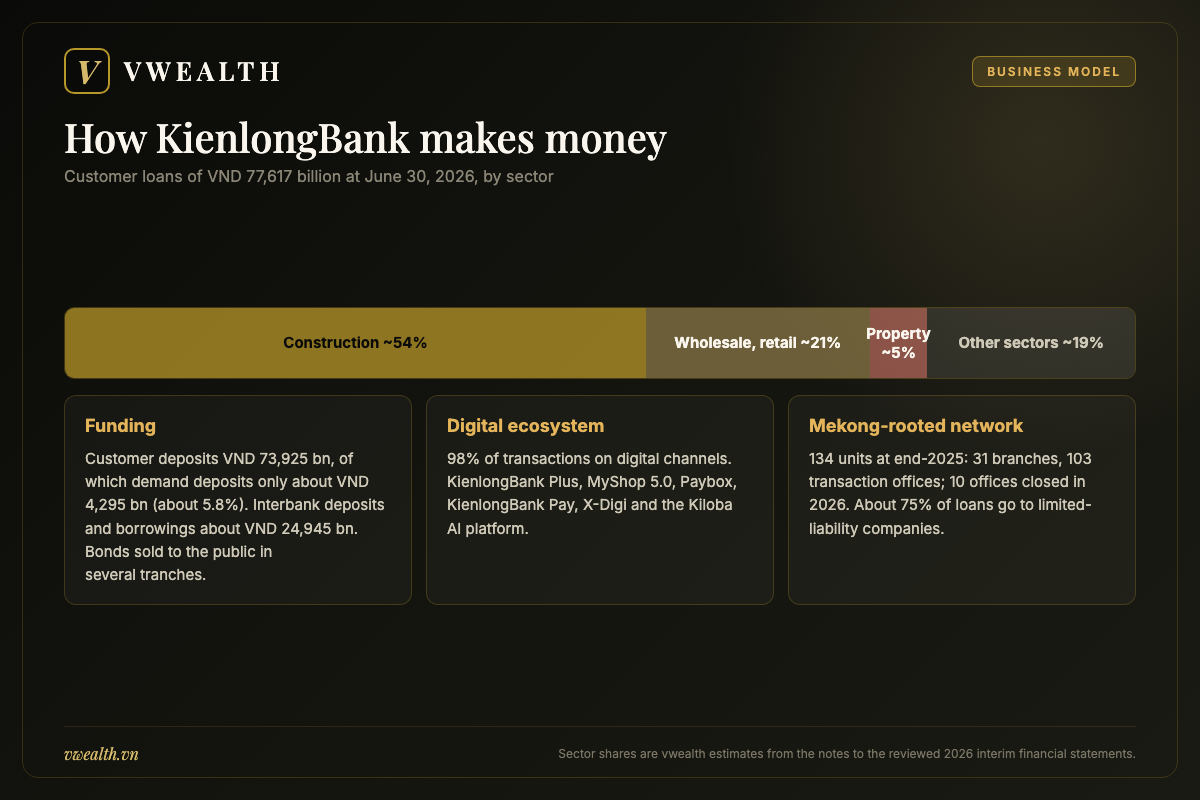
The number that surprises most readers of KienlongBank’s financial statements is in the note on loans by economic sector. According to the reviewed consolidated interim financial statements for 2026, as of June 30, 2026 total customer loans were VND 77,617.9 billion, of which construction accounted for VND 42,169.2 billion (up about VND 9,273 billion from VND 32,896.2 billion at the start of the year), wholesale and retail trade and vehicle repair VND 16,237.2 billion, and real estate (business and own use) VND 4,171.3 billion — down sharply from VND 7,762.6 billion at the start of the year. Construction plus real estate comes to about VND 46,340 billion, or about 59.7% of total loans (Nong nghiep va Moi truong reported the same figures).
From those figures, vwealth estimates: construction alone is about 54% of loans; the three sectors together are about 80.6%; all other sectors combined come to only about VND 15,040 billion, or about 19% of loans — the largest being “household production of goods and services for own use” (VND 7,836.9 billion) and agriculture, forestry and fisheries (VND 4,191.8 billion, about 5.4% of loans). For a bank with “rural” roots, that is a very large shift.
So is “construction” households building homes, or companies? Another table in the same note helps answer part of that: by customer type, limited-liability companies account for VND 58,292.8 billion (about 75% of loans), joint-stock companies VND 4,070 billion, and household businesses and individuals only VND 15,255.1 billion (about 19.7%). Because total lending to households and individuals is almost VND 26,900 billion smaller than construction lending alone, vwealth estimates that at least about 64% of construction loans are owed by corporate borrowers — mainly limited-liability companies. In other words, KienlongBank’s loan book leans toward companies far more than its “retail bank” image suggests. The statements do not show how much of this is tied to real-estate projects versus contractors; that is the first question to put to investor relations, because the answer determines the real risk.
Supporting details from inspection findings: at KienlongBank’s Ca Mau branch, the SBV’s Region 15 inspectorate pointed to credit concentrated in a small number of customers (VietNamNet, April 2026); at the Lam Dong branch, the conclusion said operations relied heavily on loans outside the branch’s area (CafeLand, March 2026); and at the Can Tho branch, the Region 14 inspectorate also noted weaknesses in lending and deposit-taking (VietNamNet, August 2025). Read alongside construction’s roughly 54% share of loans, this is why concentration risk sits at the center of any KLB analysis — a small bank is always sensitive to a handful of large borrowers.
A Mekong Delta Network, Household Businesses and Retail Customers
According to the 2025 annual report, at the end of 2025 KienlongBank had 134 network units — 31 branches and 103 transaction offices — plus two representative offices in Hanoi and Ho Chi Minh City. The 31 branches and 103 offices match the network size in 2018 according to the bank’s history page, even though total assets have multiplied since. In other words, the bank has grown without opening new physical branches. In 2026 the network began to shrink: at the end of July 2026 the board passed resolutions closing 10 transaction offices in Lam Dong, Tay Ninh, Can Tho, Vinh Long, An Giang and Ca Mau, with nearby branches taking over their customers (Kenh14, citing the bank’s disclosure). At the 2026 AGM, the bank said it would keep moving counter transactions to digital channels in order to “streamline the network effectively from 2026”.
The network still bears a strong Mekong Delta and southern imprint: branches in An Giang (formerly Kien Giang), Ca Mau, Phu Quoc, Can Tho, Vinh Long, Soc Trang, Bac Lieu and other Delta provinces, plus points in Ho Chi Minh City, the Southeast, the Central Highlands and Hanoi. Its traditional customers are households, household businesses and small traders who want a bank close to home and quick procedures. But as the customer-type table above shows, household businesses and individuals account for only about 19.7% of loans in mid-2026, and agriculture, forestry and fisheries for only about 5.4%.
This means KienlongBank’s rural roots now live mainly in its network and customer base, while its loan book has shifted heavily toward construction, trade and real estate. That is the core of the “Mekong bank pulled in two directions” angle of this analysis.
MyShop, Paybox, KienlongBank Pay and Kiloba AI: What Digitization Is For
Digital banking is what KienlongBank talks about most, and it is also where the bank publishes the most figures. According to the 2025 annual report (also cited by TheLEADER): 98% of transactions were done on digital channels; revenue from KienlongBank Pay grew 865%; MyShop and Paybox contributed 45% of fees; and more than 33,000 customers joined the “Kiloba universe” ecosystem. TheLEADER, citing the annual report, adds that international payment turnover rose 31.38%, Western Union remittances 73.75% and active credit cards 36%.
MyShop, launched in 2023, gives household businesses a dedicated payment account, static and dynamic QR codes and real-time revenue tracking. In September 2026 the bank upgraded it to MyShop 5.0 “All-in-One”, combining sales management, e-invoicing, digital signatures and tax-filing support in a single app, deployed on KienlongBank Plus, according to VnExpress. Paybox is a speaker at the counter that announces incoming payments. The context matters: household businesses face rising requirements for e-invoices, tax filing and documentation, so a tool that takes payments, issues invoices and helps with tax is a “hook” to keep traders’ cash flows — exactly the traditional customer base of a bank with rural roots.
Kiloba is KienlongBank’s family of digital and AI assistants; the 2025 annual report says the bank completed the rollout of Kiloba AI and runs assistants such as Kiloba HR, Kiloba RecruitBot and Kiloba L&D for human-resources work. On the customer side, the bank promotes an “AI Teller” on its X-Digi system — a “bank that never sleeps” that lets customers deposit and withdraw cash 24/7. At the 2026 AGM, the bank tied staff streamlining and productivity directly to digitization and AI.
So what does digitization deliver to shareholders? One thing is clear and one is not. The clear part is operating costs. According to the Q1 2026 financial statements, Q1 2026 operating expenses were about VND 418 billion, down about 28% from about VND 579 billion a year earlier (vwealth estimate: total operating income minus pre-provision profit), while net interest income still rose. For the first half as a whole, however, operating expenses rose slightly, by about 2% (VND 895 billion versus VND 875 billion) — the Q1 cut did not repeat in Q2. The unclear part is cheap funding and fee income. A successful digital bank usually attracts plenty of current-account (CASA) deposits because customers keep money in payment accounts. Yet KienlongBank’s CASA is among the lowest in the sector, and net fee income fell sharply in the first half of 2026 — see section 4.
Premium Customers, a New Branch Format and the Visa Signature Card
At the other end of the customer spectrum, KienlongBank is building a business that looks nothing like Mekong Delta traders: a priority personal banking service, launched in 2023 according to the bank’s history page, and a next-generation transaction space at KienlongBank Pham Hung (Hanoi) opened in 2025. In September 2026 the bank launched the premium KienlongBank Visa Signature credit card for high-net-worth clients, according to Viet Bao, two months after its three-way agreement with Visa and Sunshine Group.
Why would a small bank go after this segment? Wealthy clients bring large, stable deposits, fee income (cards, insurance, investment advice) and cross-selling. But competition is fierce — large banks such as Techcombank and VIB, and foreign banks, already have strong brands and products. The distinctive edge KienlongBank can lean on is its partner’s high-end property ecosystem, as the three-way agreement with Visa and Sunshine Group shows. That is both an opportunity (a ready customer base) and a risk (dependence on one market and one partner). Public sources do not yet break out the revenue contribution of premium banking, so treat it as a strategy still taking shape.
Funding and Non-Interest Income: Term Deposits, Interbank and Public Bonds
On the funding side, KienlongBank relies mainly on term deposits from households and businesses. According to the reviewed interim financial statements, customer deposits were VND 73,925 billion at June 30, 2026, up only about 2.7% from the start of the year, while demand deposits fell by more than VND 1,500 billion, from VND 5,840 billion to about VND 4,295 billion (VND 4,274 billion of it in dong). vwealth estimate: demand deposits are only about 5.8% of customer deposits. TheLEADER, using data compiled for 27 banks, puts KienlongBank’s CASA at about 5.93%, versus a reference level of about 20.47% for the group. The two figures are close, and both reveal a paradox: a bank with 98% of transactions on digital channels has almost no “cheap money” from payment accounts.
So where does total funding of about VND 102,592 billion (vwealth estimate: customer deposits + deposits and borrowings from other credit institutions + valuable papers) come from, if customer deposits are about VND 74,000 billion? A large part is deposits and borrowings from other credit institutions — up from VND 15,875 billion at the start of the year to VND 24,945 billion at mid-2026 — while KienlongBank itself placed VND 24,529 billion with other credit institutions (up from VND 16,165 billion). The two sides are nearly equal, showing the bank is quite active in the interbank market. The rest is valuable papers of about VND 3,723 billion. Since late 2025, KienlongBank has been selling bonds to the public under offering registration certificate No. 410/GCN-UBCK of October 28, 2025: it reported results of the first tranche on December 15, 2025 and the second on May 5, 2026, and announced a third tranche on July 16, 2026; bond codes KLB125015, KLB125016 and KLB126021 have been approved for listing on HNX (per its disclosure list).
On the income side, the 2025 mix according to the audited financial statements was: net interest income VND 3,767.6 billion (up 18%), net fee income VND 877.8 billion (up about 83% from VND 480.5 billion), FX gains VND 88.4 billion and net other income VND 409.2 billion — including VND 397.2 billion of recoveries of loans previously written off against provisions, versus VND 207.1 billion the year before. That last line deserves attention: recovering written-off loans is a real source of income for KienlongBank, but it is hard to forecast and does not recur evenly. The audited statements also show about VND 3,088.6 billion of written-off bad debt still tracked off balance sheet at end-2025 (principal VND 1,378.2 billion, interest VND 1,710.4 billion) — a “store” still available for recovery, but also the trace of loans that once went bad.
| Business line | Current role | Strengths | What to watch |
|---|---|---|---|
| Construction-sector lending | About 54% of loans in mid-2026 (vwealth estimate from the financial statement notes) | Main engine of loan growth | Concentration; at least about 64% owed by corporate borrowers (vwealth estimate) |
| Wholesale and retail trade; household businesses | VND 16,237 billion of loans in mid-2026 | Close to the traditional customer base, good yields | Cost to serve, regional risk |
| Digital ecosystem (KienlongBank Plus, MyShop, Paybox, Pay, X-Digi) | 98% of transactions digital | Lower operating costs, household-business retention | Has not lifted CASA; fee income fell in H1 2026 |
| Premium banking, Visa Signature | New, still being built | Large deposits, card fees, cross-selling | Tough competition; tied to a partner’s property ecosystem |
| Funding | Term deposits, interbank, public bonds | Interbank funding up sharply in H1 2026; public bond offerings | CASA about 6%; higher funding cost than large banks |
| Recovery of written-off loans | VND 397.2 billion in 2025 (VND 207.1 billion in 2024) | Can create one-off profit | Irregular; reflects old loans that went bad |
Which business feeds which? Term deposits and interbank funds feed lending; lending — largely in construction and trade — generates high-margin interest income; that income pays for technology and provisions; and the digital ecosystem cuts operating costs, which is the main reason 2025 profit grew faster than revenue. KienlongBank’s “moat” therefore lies not in scale or cheap funding but in two things: a high NIM from serving customers large banks tend to overlook, and low costs from digitization. Both can erode — NIM through rate competition, cost advantages through digital operational risk — so they need checking every quarter.
Financial Health: Reading KienlongBank’s Numbers Before You Buy KLB Stock
This is the most important section if you are deciding whether to buy KLB stock. When a bank doubles its profit in a single year, you need to peel it apart: how much came from the core business, how much from cost cuts, how much from lower provisioning, and how much from one-off items. This section goes layer by layer and ends with a checklist you can use every time KienlongBank reports. For a broader framework on Vietnamese banks, see our Vietnam banking sector guide.
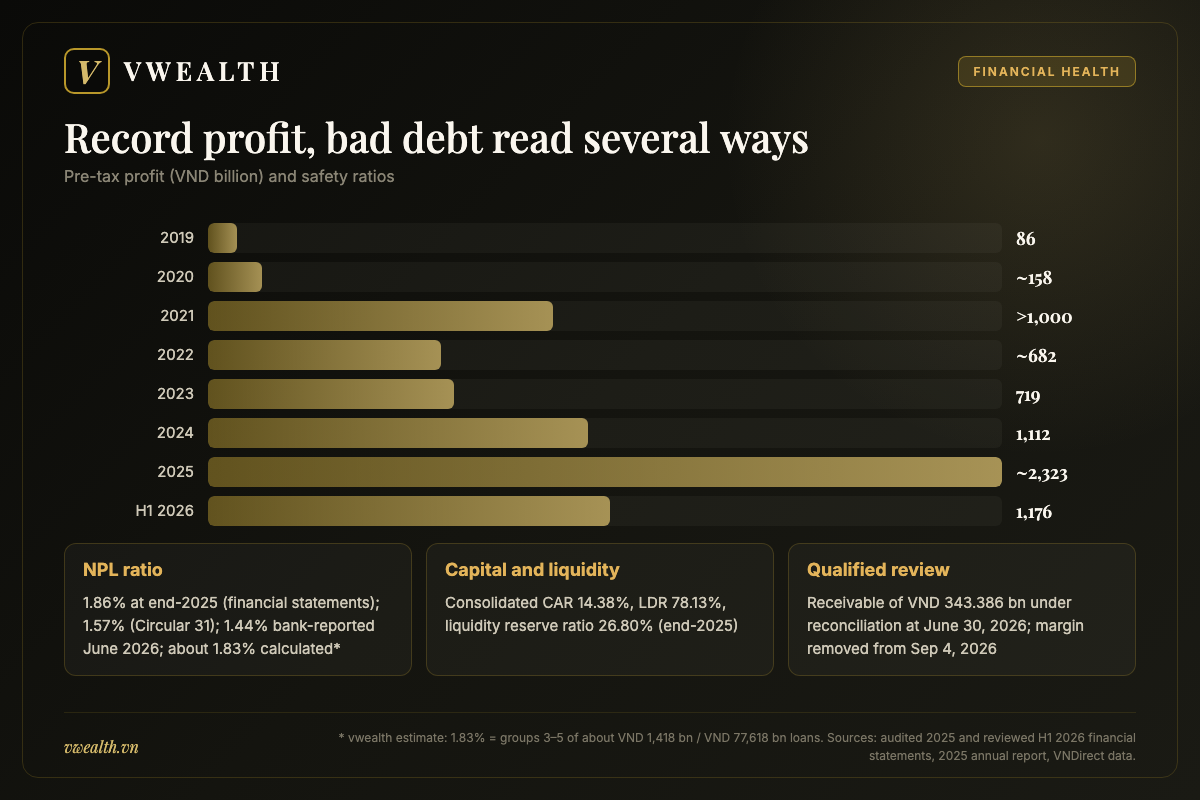
More Than a Decade of Profit: A VND 86 Billion Trough in 2019, a VND 2,323 Billion Peak in 2025
The table below shows consolidated profit milestones from financial statement data archived by VNDirect (2024–2025 cross-checked against the 2025 annual report; the first half of 2026 from the reviewed interim statements). These are historical figures for closed periods.
| Year | Pre-tax profit (VND bn) | After-tax profit (VND bn) | Notes |
|---|---|---|---|
| 2011 | 524.8 | 394.6 | Peak of the early phase |
| 2012 | 467.8 | 351.0 | Decline begins |
| 2013 | 393.4 | 313.4 | |
| 2014 | 233.7 | 175.9 | |
| 2015 | 211.7 | 165.2 | |
| 2016 | 151.6 | 121.0 | Low point of 2013–2016 |
| 2017 | 252.2 | 201.7 | UPCoM debut |
| 2018 | 290.1 | 231.9 | |
| 2019 | 85.9 | 67.7 | Q4 2019 pre-tax loss of about VND 150 bn; quarterly net interest income only about VND 116 bn |
| 2020 | 158.2 | 126.3 | A year of waiting |
| 2021 | 1,010.0 | 770.3 | Q1 2021 alone: pre-tax profit VND 702.6 bn on recovery |
| 2022 | 681.9 | 544.5 | |
| 2023 | 718.6 | 574.0 | |
| 2024 | 1,112.1 | 887.5 | |
| 2025 | 2,322.7 | 1,856.2 | Record; 168% of plan |
| H1 2026 | 1,175.7 | 939.5 | About 45% of the VND 2,600 bn plan; review qualified |
You can see three distinct “levels”: a few hundred billion dong in 2011–2018, a trough in 2019–2020, then roughly VND 700 billion in 2022–2023, before jumping above VND 1,100 billion in 2024 and above VND 2,300 billion in 2025. 2021 was an “abnormal” year because of a large debt recovery. So the investment question is not “does KienlongBank make a lot of money” but “is VND 2,000 billion-plus the new baseline”.
Unpacking 2025: NIM, Fees, Recoveries and Costs
According to the audited 2025 financial statements, net interest income was VND 3,767.6 billion, up 18%. Net fee income rose about 83% to VND 877.8 billion. Net other income rose about 88% to VND 409.2 billion, mainly thanks to VND 397.2 billion of recoveries of loans written off against provisions. Operating expenses rose only about 2% to about VND 2,061 billion. The result: pre-provision operating profit (PPOP) rose about 63% to about VND 3,146 billion. Credit-loss provisions were about VND 824 billion, almost unchanged from the previous year (VND 823 billion). Pre-tax profit therefore doubled.
Broken down this way, the positive is clear: profit grew mainly through PPOP, not through lower provisioning — provisions were basically flat in 2025. That is a much better signal than banks whose profit spikes because of provision write-backs. But two points need weighing. First, the VND 397 billion recovery of written-off loans — about 17% of 2025 pre-tax profit (vwealth estimate) — is hard to repeat regularly. Second, fee income rose 87% in 2025 but reversed sharply in the first half of 2026, as shown below.
On returns, published figures vary slightly by method: the bank said 2025 ROE was “above 22%” in a January 2026 release (CafeF), while AGM materials cited ROE of about 25%, ROA of 1.8% and NIM around 4% (CafeF, April 2026); at the AGM the bank said 2025 NIM was “above 4.15%”; TheLEADER, using compiled data, shows trailing-12-month ROE of about 25.44%, ROA about 1.93% and NIM about 4.04%. Whichever number you use, KienlongBank was among the more profitable banks in 2025 — its annual report describes it as “Top 2 in the sector for ROE, Top 3 for NIM, Top 4 for ROA”.
First Half of 2026: Profit Up 27.6%, but Fee Income Down
In the first six months of 2026, according to the reviewed interim financial statements, KienlongBank earned pre-tax profit of VND 1,175.7 billion, up 27.6% year on year, and after-tax profit of VND 939.5 billion. Net interest income was VND 1,926.6 billion, up 11.2%. Provisions fell 33.5% to VND 351.2 billion. Net fee income dropped 38.6% to only VND 189.4 billion. Q2 2026 alone brought pre-tax profit of about VND 655 billion, up 15.8% (VietnamBiz). In Q1 2026, according to the quarterly statements (also cited by TheLEADER), PPOP rose from VND 554.7 billion to VND 664.8 billion year on year while provisions fell from VND 198.2 billion to VND 143.3 billion; net fee income fell from VND 159.6 billion to VND 92.3 billion, and net other income from VND 103.6 billion to VND 15.7 billion.
Taken together: the first half of 2026 still showed good growth, but the drivers differ from 2025. Net interest income growth slowed (11% versus 18%), fee income fell sharply, and part of the profit growth came from lower provisions. That matters for a bank that has made digitization its strategic core: more digital transactions do not automatically translate into more fee income.
In terms of scale, total assets at mid-2026 were VND 114,911 billion, up 11.2%; customer loans VND 77,617.9 billion, up 8.4%; total funding about VND 102,592 billion, up about 12% and already at the full-year plan of VND 102,498 billion. To hit the VND 2,600 billion profit target, the second half of 2026 needs pre-tax profit of about VND 1,424 billion (vwealth estimate), about 21% more than the first half.
Bad Debt: 1.44%, 1.57%, 1.83% or 1.86% — One Bank, Several Numbers
Search for “KienlongBank NPL ratio” and you will find several different numbers — which does not mean anyone is wrong. Vietnamese banks commonly use at least two measures: bad debt divided by customer loans (based on the financial statements), and the NPL ratio under SBV prudential rules (for example Circular 31/2024), whose denominator is broader total credit exposure. The broader the denominator, the lower the ratio.
For KienlongBank at the end of 2025: according to the audited financial statements, total bad debt (groups 3–5) was VND 1,334.7 billion, up about 7.6% from VND 1,240.6 billion at the start of the year, and the NPL ratio to customer loans fell from about 2.02% to 1.86% (because loans grew faster than bad debt) — by vwealth’s division. Some websites reported that bad debt “fell 7.59%” at end-2025; the audited figures show it rose, not fell. At the same date, the management report put the NPL ratio under Circular 31/2024 at 1.57% (1.60% in 2024). The end-2025 mix: group 3 about VND 239 billion, group 4 (doubtful) about VND 470 billion — about 2.8 times the VND 170 billion at the start of the year — and group 5 about VND 625 billion, down about 25% from VND 839 billion but still about 47% of total bad debt.
At mid-2026: the bank announced an NPL ratio of 1.44% (as reported by VietnamBiz). Meanwhile, the notes to the reviewed financial statements show groups 3–5 at about VND 1,418 billion, up about 6.3% from the start of the year; divided by customer loans of VND 77,617.9 billion, that is about 1.83% (vwealth estimate). The gap between 1.44% and 1.83% most likely reflects different denominators, as explained above; track both over time, and never compare one bank’s figure on method A with another bank’s on method B. Underneath, group 2 (special mention) loans rose about 31% to VND 1,090.6 billion, group 5 rose to VND 780.5 billion and group 4 fell to VND 364.3 billion; the bank used VND 230.9 billion of provisions to write off risk in the six months.
Coverage — provisions divided by bad debt — also varies by source: the bank said “above 80% for several consecutive quarters” (end-2025) and cited 88% at end-2025 at the AGM; TheLEADER, using its own compiled data, shows about 73.3%. Calculated from the financial statements (vwealth estimate): about 79% at end-2024 (980 / 1,241 billion), about 88% at end-2025 (1,174 / 1,335 billion) and about 91% at mid-2026 (1,294.5 / 1,418 billion). That is mid-range for the sector — not thin like banks under restructuring, but not as thick as the most defensive banks. What deserves attention is the internal trend: group 2 and group 5 loans rose in the first half of 2026 just as provisioning fell. If special-mention loans keep sliding into worse groups, provisions will have to rise again.
Capital and Liquidity: CAR 14.38%, LDR About 78%
According to the 2025 annual report, at end-2025 KienlongBank’s consolidated capital adequacy ratio (CAR) was 14.38%; its liquidity reserve ratio 26.80%; short-term funds used for medium- and long-term lending 14.22%; and loan-to-deposit ratio (LDR) 78.13% — all within regulatory limits. The bank’s history page says that in 2025 KienlongBank “pioneered the implementation of Circular 14/2025/TT-NHNN on capital adequacy”.
CAR measures a bank’s capital cushion: own capital divided by risk-weighted assets. 14.38% is a reasonably thick buffer against the 8% minimum. Two caveats, though. First, the bank has grown charter capital mainly by retaining profit (stock dividends), plus funding from publicly offered bonds — with no fresh cash injection from a strategic shareholder; the bank itself acknowledged at the 2026 AGM that this approach “has not created a leap in capital scale”. If lending keeps growing fast, CAR will come under pressure. Second, CAR is risk-weighted, and loans to construction and real-estate companies usually carry higher weights than home-secured loans to individuals; the current loan mix therefore “consumes” capital faster than a purely retail book.
The VND 343 Billion Qualified Review and Inspection Findings at Four Branches
These are two 2026 events you should understand precisely — no more, no less. The first: in the reviewed consolidated interim financial statements for 2026, A&C Auditing and Consulting issued a qualified conclusion relating to a receivable of VND 343,386 million (about VND 343.4 billion) that was being reconciled with the relevant organizations. According to the wording of the basis for the qualified conclusion published by the bank, with the documents and information available, the auditor could not obtain sufficient appropriate evidence to assess the outcome of the reconciliation or the provisions that may need to be made.
KienlongBank’s explanation (letter 2809/NHKL of August 28, 2026, signed by CEO Tran Hong Minh): this is a receivable from pending transactions, detected through transaction reconciliation with related parties in June 2026; the bank has tightened transaction controls, reconciled in detail with the parties, continues to gather documents, and expected in September 2026 to propose appropriate remedies in line with regulations. According to letter 2821/NHKL of the same date, first-half after-tax profit after the review was unchanged from the bank’s own figures. As Bao Phap luat Viet Nam noted in its coverage, the bank said its own internal control unit detected the issue during routine reconciliation. A qualified conclusion does not mean the auditor rejects the financial statements as a whole; it focuses on a specific issue.
To get a sense of scale, vwealth estimate: VND 343 billion is about 29% of pre-tax profit for the first half of 2026. If most or all of it has to be provisioned after reconciliation, 2026 profit will be significantly affected; if it is reconciled and recovered, the impact will be small. The direct consequence has already happened: HOSE added KLB to the list of stocks not eligible for margin trading, effective September 4, 2026, because the review conclusion was not unqualified (CafeF). This is the first item to watch in the Q3 report and the 2026 audit.
The second event: during 2025–2026, regional SBV inspectorates published inspection conclusions for several KienlongBank branches — Can Tho (Region 14, VietNamNet, August 2025), Lam Dong (Region 10, CafeLand, March 2026) and Ca Mau (Region 15, VietNamNet, April 2026). The findings included lending to customers who did not fully meet borrowing conditions, loose appraisal and monitoring of loan use, weaknesses in valuing and accepting collateral, and credit concentrated in a few customers. In Ca Mau, the Region 15 inspectorate issued three administrative penalty decisions against the Ca Mau branch and the Nam Can and Dam Doi transaction offices, together with two recommendations and five advisory recommendations. These are administrative inspection findings with remedial recommendations, not criminal cases; at the 2026 AGM the bank said the branches had “mostly completed remediation”. For investors, their value lies in pointing to exactly what to watch in the reports: credit concentration, collateral quality and loan classification.
Eight Questions to Ask Every Time KienlongBank Reports
Instead of memorizing dozens of numbers, use this list as a quarterly checklist. Each question ties to a specific risk or driver discussed above.
- How has the VND 343 billion receivable been resolved? Is reconciliation complete, how much was provisioned, and does the full-year 2026 audit still carry a qualification? This is also the condition for KLB to regain margin eligibility.
- How much did PPOP grow? Pre-provision profit measures real earning power. If profit rises while PPOP stalls, growth is coming from lower provisions.
- Is NIM holding around 4%? NIM is KienlongBank’s biggest advantage; a deposit-rate war could erode it quickly.
- Is the share of construction and real-estate lending still rising? And has the bank started to disclose how much of it is home-building loans to individuals?
- Where are group 4 and group 5 loans heading? Doubtful debt jumped in 2025; if it slides into the loss category, provisions will rise.
- What is coverage based on the financial statements? Calculate loan-loss provisions divided by bad debt yourself rather than relying on press releases.
- Are CASA and fee income improving? This is the test of the digital strategy: 98% digital transactions should gradually turn into cheap deposits and fees.
- What is CAR after the 29.5% capital increase, and do the next public bond tranches complete? The capital cushion determines how fast lending can grow.
You don’t have to dig these figures out of financial statements that run to hundreds of pages. The stock analysis reports on vwealth compile PPOP, NIM, bad debt, coverage and valuation quarter by quarter in English; just create a free account to follow them.
How the Market Has Treated KLB Stock: From UPCoM in 2017 to HOSE in 2026
A good bank is not necessarily an easy stock to own. The stock’s personality — liquidity, shareholder structure, margin eligibility, fund interest — shapes your experience as a buyer and seller. This section looks at KLB through the lens of the stock market.
Historical Price Milestones for KLB
The price points below are historical (nominal closing prices, not adjusted for stock dividends) from VNDirect trading data; they do not reflect today’s price. On its first UPCoM session on June 29, 2017, KLB closed at VND 11,400. On October 1, 2020 it stood at about VND 11,300; after the large transfers of late 2020 it reached VND 19,200 on January 4, 2021 and about VND 25,000 at the end of 2021, then peaked at VND 39,900 on March 22, 2022. By January 2023, when the bank withdrew its HOSE listing application, it was down to about VND 12,200. For 2025 as a whole, according to the bank’s release, KLB rose about 131% — the biggest gain among bank stocks that year; it closed at VND 16,600 on December 30, 2025.
On its last UPCoM session on January 6, 2026, KLB closed at VND 16,800. The reference price for the HOSE debut on January 15, 2026 was VND 16,200, with a ±20% band on day one; during the session the price touched VND 17,600 (CafeF) and closed at VND 17,150; on January 16, KLB closed at VND 18,150. The stock then corrected: about VND 15,250 in early February and about VND 13,000 at the end of March 2026. Note that prices from July 3, 2026 onward must be adjusted for the 29.5% stock dividend when comparing.
Three lessons from these milestones. One: KLB has had very strong event-driven rallies (the change of shareholders in late 2020, record profit and the move to HOSE in 2025). Two: after the event, the stock has tended to correct — the familiar “buy the expectation, sell the event” pattern. Three: because the bank keeps paying stock dividends (60% in 2025, 29.5% in 2026), nominal prices on the screen are not comparable across years; you need adjusted prices.
Stock Dividends and Adjusted Prices: An Illustrative Example
Illustrative example: suppose you held 1,000 KLB shares before the 60% stock dividend in 2025. Afterwards you have 1,600 shares. After the 29.5% dividend in 2026 you have about 2,072 shares (1,600 × 1.295). Your percentage ownership of the bank is unchanged because every shareholder receives the same ratio. In theory, the share price is adjusted down proportionally on the ex-rights date: a share priced at VND 16,000 before the 29.5% dividend would have an adjusted reference price of about VND 12,355 (16,000 ÷ 1.295) — an illustrative calculation, not an actual price.
Why does this matter? Because many newer investors see KLB’s price “drop” after the record date and panic, even though the total value of their holding is unchanged. Conversely, some think stock dividends are “free money” — they are not, since book value is simply divided into more pieces. Real value for shareholders only grows if the bank reinvests retained profit at a high ROE. With ROE around 22–25% as in 2025, retaining earnings makes sense; if ROE falls sharply, the “retain to grow” argument weakens and shareholders have grounds to ask for cash dividends.
Margin: From “Not Yet Six Months Listed” to “Removed Over the Review Conclusion”
Margin trading means borrowing from a securities firm to buy shares. For many HOSE stocks, margin money is an important part of liquidity. KLB’s 2026 has been unusual on this front. Right after its debut, HOSE placed KLB on the list of stocks not eligible for margin because it had been listed for less than six months (notice of January 16, 2026). On July 16, 2026, HOSE removed KLB from that list. But only about seven weeks later, effective September 4, 2026, HOSE added KLB back to the list of stocks not eligible for margin trading, because the reviewed consolidated interim financial statements for 2026 carried a conclusion that was not unqualified (CafeF).
Put simply, for virtually all of 2026 KLB has not enjoyed stable margin flows on HOSE. That cuts both ways. The downside: limited liquidity and demand, and leveraged investors can’t participate. The upside: the stock is less exposed to cascading forced selling when the market falls. The conditions for KLB to return to the margin list are fairly clear: the next financial statements (full-year audit or review) must carry an unqualified opinion, and HOSE’s other criteria must be met.
Ownership, Liquidity and Foreign Investors
As the leadership section showed, a few dozen shareholders cast most of the votes at KienlongBank. The result is that the number of shares genuinely “floating” in the market is much smaller than the total outstanding. By moving to HOSE, the bank hopes to improve liquidity and access to institutional investors. According to VNDirect data, average matched volume over the last 10 UPCoM sessions (December 22, 2025 to January 6, 2026) was only about 0.58 million shares per session, versus more than 2 million shares per session in the first two HOSE sessions. Check recent average volume before placing a large order, and avoid chasing the price on news days.
Foreign investors are almost absent from KLB. According to the 2025 annual report, at end-2025 foreign investors (34 holders) owned about 1.39% of shares; according to the shareholder register summary of July 6, 2026, the figure was about 1.80%. The foreign ownership cap for Vietnamese banks is 30%, so the room is almost untouched. At the 2026 AGM, asked about strategic shareholders, the bank said that when market conditions allow, the board will propose bigger capital raises, including an offering to domestic or foreign strategic investors; vwealth has not seen any announcement of such a deal so far. If you are a foreign investor or want to understand the mechanism, our explainer on foreign room in Vietnam stocks covers the details.
Valuing KLB: Reading P/B Against ROE, and the Catalysts the Market Reacts To
Bank stocks are usually valued on price-to-book (P/B) because a bank’s assets are mostly financial. An illustrative example using historical figures: equity at end-2025 was about VND 8,416.5 billion, or about VND 14,550 per outstanding share (578.37 million shares, excluding treasury shares); at the VND 16,200 reference price on its HOSE debut, P/B was about 1.1x (vwealth estimate). That is a figure at one point in time, not a recommendation; check the current P/B in vwealth’s reports.
Why might a high-ROE bank trade at a P/B of only around 1x? The market typically discounts the factors this article has covered: small scale, low CASA, lending concentrated in construction and real estate, a history of changing controlling shareholders, thin liquidity, and doubt over whether 2025’s ROE is sustainable. The sensible approach is to set P/B against the long-run ROE you expect, not the ROE of a single best year. If you believe ROE can hold around 18–20%, a P/B near 1x looks cheap; if you think ROE will drift back to the 12–14% of earlier years, the story is very different.
Historically, KLB’s price has reacted most strongly to: quarterly results (especially when profit beats plan), news about major shareholders and senior personnel, exchange transfers and margin status, stock dividends (technical price adjustments), and news about audits and inspections. In the second half of 2026, the two clearest catalysts are the outcome of the VND 343 billion receivable and whether the head-office move to Dong Nai is approved by the SBV and carried out in practice.
Industry Context: A Small Mekong Bank Amid the Race for Capital, the Race to Digitize and a Wave of HOSE Listings
No bank stands alone. KienlongBank’s 2025 performance came in a favorable year for the sector: the VN-Index rose more than 41% in 2025 according to figures cited by the bank, banks led the market, and system-wide credit grew quickly. This section places KienlongBank in the wider picture — the region where it was born, the new rules of the game, and similar-sized banks on a similar path.
The Mekong Delta: Why Small Banks Struggle to Live on Rice Alone
The Mekong Delta is Vietnam’s rice bowl and its fruit and seafood basket, yet it is where small private banks find it hardest to grow. The reasons lie in the nature of agricultural lending. Loans are small and scattered, so appraisal, disbursement and collection costs per dong are high. Borrowers’ income depends on weather, commodity prices and export markets, so risk arrives by season and by region. Collateral is often agricultural land, which is hard to value and hard to realize when loans go bad. And competition is intense from the state-owned agricultural bank and from policy-lending programs with subsidized rates that private banks cannot match.
That is why almost every 1990s-generation rural bank in the Delta had to choose one of three paths: convert into an urban bank and shift its center of gravity to the cities; merge; or shrink. An interesting parallel is NCB — also born as a rural bank in Kien Giang (Song Kien Rural Bank), renamed Navibank and then NCB, with its head office moved to Hanoi, as vwealth covered in its analysis of whether to buy NVB stock. KienlongBank chose the first path but kept its name and its head office in Rach Gia much longer — until the 2026 decision.
This lens explains why KienlongBank’s loan book today leans toward construction and trade: to grow with good margins, a small bank has to move into segments with larger loan sizes and collateral that is easier to realize than farmland. The price is concentration risk — exactly what the 2026 inspection conclusions pointed to.
Dong Nai Instead of Rach Gia: Reading the Head-Office Move
On April 23, 2026, shareholders approved the policy of moving the head office from An Giang to Dong Nai; the item was added to the agenda at the request of a shareholder group owning 5.34% of capital and received 54.73% of votes present. On July 3, 2026, the board’s Resolution 13/NQ-HĐQT accepted a planned site on parts of the 1st and 2nd floors of the Sonadezi building, Tran Bien ward, Dong Nai city, and tasked the chairman with seeking approval from the competent authorities and amending the license. As of late August 2026, the bank’s disclosures still gave its head office as Rach Gia. According to VnExpress, bank representatives said the goal is to get closer to high-growth areas, especially the southern key economic region; in 2025 Dong Nai had the fourth-largest economy in the country, GRDP growth of about 9.63%, more than 40 operating industrial parks, total outstanding credit of over VND 600,000 billion, and major infrastructure such as Long Thanh International Airport. The bank aims to contribute about VND 600–1,000 billion a year to the local budget and would be the first joint-stock commercial bank headquartered in Dong Nai. It also said it would keep operating in its existing locations, including An Giang.
Why should investors care about an “address” decision? Because it reveals the strategic center of gravity. Moving the head office to an industrial city means the bank wants to compete in trade finance, guarantees and cash management for FDI companies and supply chains — the areas VnExpress quoted the bank as targeting. These are segments dominated today by large domestic and foreign banks. At the same time, Sunshine Group — KienlongBank’s card and payments partner — is the investor of a riverside urban project of about 944.7 hectares in Dong Nai under a provincial decision dated May 15, 2026, according to Nguoi Quan Sat. That the two events coincide is public information; the extent of any credit relationship can only be checked in the related-party disclosures of the financial statements.
The 2026 Wave of Small Banks Moving to HOSE, and the Race for Capital
KienlongBank is not the only bank switching exchanges in 2026. BVBank (BVB) also moved more than 640 million shares from UPCoM to HOSE, trading from July 21, 2026 (VnEconomy). The two banks are of broadly similar size, both with southern roots, and both face the same question: once on the main board, how do you attract institutional money? You can compare their approaches through vwealth’s BVB stock analysis.
The capital backdrop is also shifting. The 2024 Law on Credit Institutions tightened ownership limits and governance requirements, while Circular 14/2025/TT-NHNN brought capital adequacy calculations closer to international standards. On funding costs, the bank said at the 2026 AGM that deposit rates rose in Q1 2026 amid fierce competition; after the SBV Governor directed banks to lower deposit rates, 29 credit institutions cut their rates, KienlongBank among them. For a low-CASA bank like KienlongBank, swings in funding costs feed directly into NIM — in either direction.
High-Tech Fraud: The Other Side of Digital Banking
When 98% of transactions are digital, operational risk moves to digital channels too. From April 2026, the press reported that a customer in Hanoi said VND 5 billion in his account at KienlongBank had been transferred out in 11 transactions between 01:19 and 01:33 on December 13, 2025; according to VietNamNet (June 2026), the customer said the authorities had held back VND 2.5 billion and that he had asked the bank to explain its authentication process. At the April 23, 2026 AGM, answering a shareholder, the presiding board said the case showed signs of high-tech fraud and impersonation of bank staff; the bank had reported it and was working with the police, the case was under investigation in accordance with the law, and the bank pledged to support the customer (AGM minutes; also reported by Nhadautu). Because the authorities have not issued an official conclusion, this article makes no judgment about anyone’s responsibility.
What investors should take away is not a single case but the category of risk. For a digital bank, a process gap or a fraud campaign can cause direct financial loss (if the bank has to compensate), reputational damage (customers withdrawing money) and compliance costs (investing in more authentication and fraud-alert systems). This is an industry-wide trend — the SBV keeps raising authentication and transaction-alert standards — and a cost every digital bank has to bear.
How KienlongBank Compares With Banks Telling Similar Stories
To place KLB correctly, the table below gives a qualitative comparison with several mid-sized and smaller private banks vwealth has analysed. It lists standout features from those analyses and published sources only; it does not rank the banks or compare figures at the same point in time. For current numbers, see vwealth’s reports.
| Bank (ticker) | Origins | Main story | What to watch |
|---|---|---|---|
| KienlongBank (KLB) | Kien Giang rural bank, 1995; HOSE since Jan 2026 | High returns (NIM around 4%, 2025 ROE above 22%), digitization, HQ move to Dong Nai | CASA about 6%; construction over half of loans; 2026 qualified review |
| NCB (NVB) | Song Kien rural bank, Kien Giang, 1995; HNX | Restructuring, capital raised via private placements | Dilution, bad debt, low coverage |
| Nam A Bank (NAB) | Urban joint-stock bank, 1992; HOSE since 2024 | Fast asset growth, ONEBANK digital banking | Low CASA, continuous capital raising |
| OCB | Urban bank with a Japanese strategic shareholder | Retail, SMEs, foreign capital | Asset quality after the bond cycle |
| MSB | Vietnam Maritime Bank | High CASA, cheap funding | Loan growth, ownership |
The table shows KLB’s unusual position: among small banks, KienlongBank had some of the highest returns in 2025 but some of the least cheap funding. Banks like MSB take the opposite route — cheap funding, moderate returns. The two models react very differently when interest rates rise: high-CASA banks feel less pressure, while banks relying on term deposits and interbank funds, like KienlongBank, feel it faster. Conversely, when rates fall, KLB may benefit sooner.
Outlook: Three Scenarios for a Bank Pulled in Two Directions
No one knows for certain where KienlongBank will be in three years, and this article will not offer a price target. What you can do is identify the most important variables and sketch a few scenarios with concrete conditions to track. As new data arrives, you will see which scenario reality is following.
Five Variables That Will Decide KienlongBank’s Future
One: the resolution of the VND 343 billion receivable. It is a short-term variable with wide effects — on 2026 profit, on the full-year audit opinion, on margin eligibility, and on the market’s trust in the transaction controls of a digital bank.
Two: NIM. With CASA around 6%, KienlongBank’s NIM of around 4% depends heavily on lending at high rates. If deposit competition pushes funding costs up while lending rates are squeezed, NIM will compress quickly.
Three: credit quality in construction and real estate. More than half of the loan book is classified under construction. If property and infrastructure investment go well, this segment earns good returns; if the cycle turns, this is where bad debt shows up first.
Four: the ability to turn digitization into cheap funding and fees. So far, digitization has clearly cut costs. The next step — lifting CASA and making fee income steady — will determine the long-term advantage.
Five: governance and organizational stability. A new head office in Dong Nai, a young executive team, senior personnel changes, and remedial actions after inspections all need time to prove themselves.
Bull Case: 2025’s Returns Become the New Baseline
Conditions for this scenario: the VND 343 billion receivable is resolved with small provisions, the full-year 2026 audit is unqualified and KLB returns to the margin list; NIM holds around 4% as rates stay stable; bad debt based on the financial statements stays below 2% and actual coverage rises; the bank meets or beats its VND 2,600 billion pre-tax profit target for 2026; CASA and fee income start improving thanks to MyShop, the Visa Signature card and premium banking; the Dong Nai head office helps broaden a good-quality corporate customer base; and possibly a strategic investor, domestic or foreign, takes a meaningful stake.
In this scenario the market has grounds to narrow the P/B discount relative to banks with similar ROE, and KLB could attract more institutional money. But remember: even the bull case requires many conditions to line up at once.
Base Case: Moderate Growth, With Both Pulls Coexisting
Conditions: the receivable is resolved with moderate provisioning that dents profit for a quarter or two without derailing the plan; NIM slips slightly as funding costs rise; 2026 profit lands near plan, with growth in later years in the high single to low double digits; bad debt edges up but stays under control; CASA improves slowly; dividends remain mostly in shares.
Here the bank remains a solid high-return name among small banks, but the market is not ready to value it on par with larger banks that have cheap funding. The stock may move sideways in a wide range, reacting mainly to quarterly results and to the broader banking group. For long-term investors, returns would come mainly from the bank reinvesting profit at a decent ROE rather than from a re-rating.
Bear Case: Concentration Risk and Operational Risk Surface Together
Conditions: most of the VND 343 billion receivable has to be provisioned, or further related issues emerge during reconciliation; the full-year audit is qualified again; a slowdown in property or construction investment drives a sharp rise in group 4 and group 5 loans in the construction book; rising funding costs squeeze NIM; recoveries of written-off loans no longer contribute as much as in 2025; and remedial actions after inspections require extra provisioning or loan reclassification.
In this scenario profit could fall from its 2025 peak, ROE could drop well below recent levels, and the stock’s characteristics — thin liquidity, no margin, concentrated ownership — would amplify price swings. The 2019–2020 trough, when pre-tax profit fell to about VND 86 billion in one year, shows how quickly a small bank’s annual profit can collapse. This is not a forecast; it is what you should be mentally prepared for if you hold KLB.
Early Warning Signs to Track Every Quarter
You don’t have to wait until year-end to know which scenario is unfolding. Here are the early signals, in order of importance.
- Disclosures on the VND 343 billion receivable — the bank said it would propose handling measures in September 2026; the Q3 2026 report will show the outcome.
- Provisions relative to PPOP — if provisions jump while PPOP stalls, the bear case is getting closer.
- The loans-by-sector note — whether the construction share keeps rising or has levelled off.
- Group 2 and group 4 loans — special-mention and doubtful loans are the amber lights before loss-category debt.
- Demand deposits and fee income — whether digitization has turned into a funding advantage.
- Senior personnel and the progress of the head-office move — organizational stability during the transition.
- HOSE’s margin list — KLB’s return to margin eligibility would signal the audit issues have been resolved.
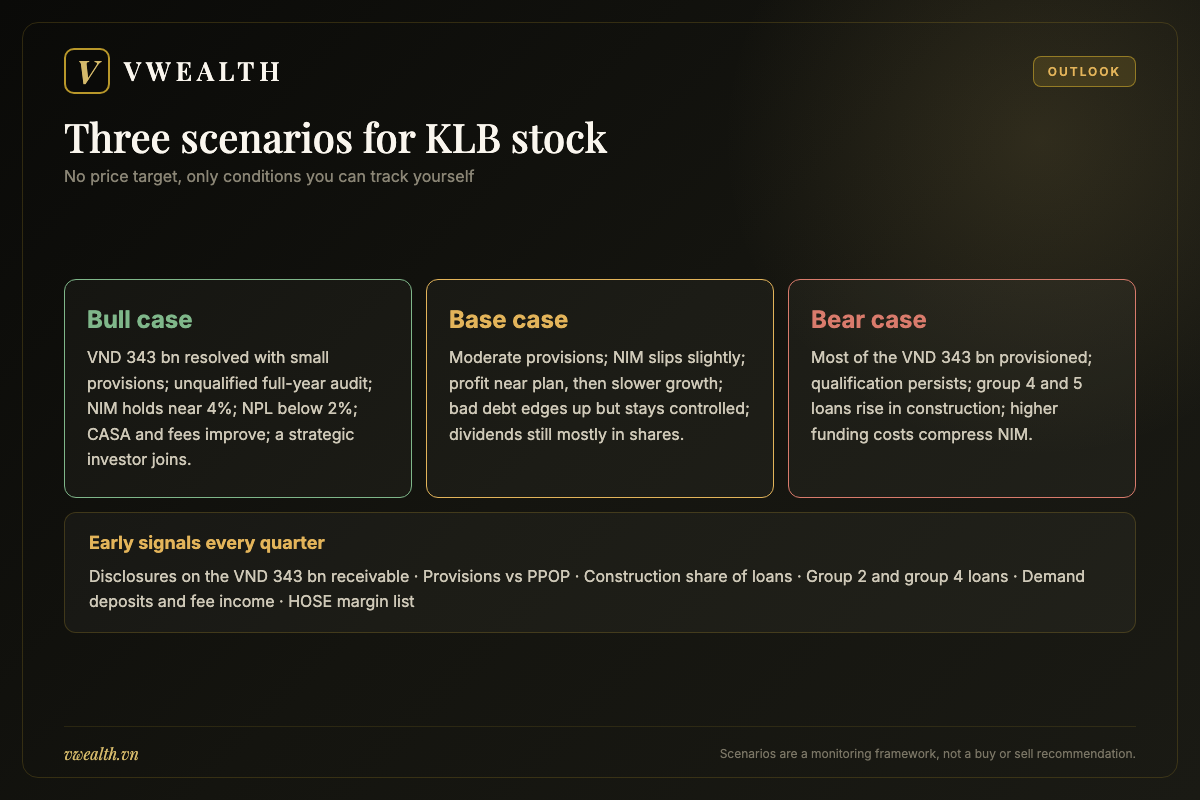
So, Should You Buy KLB Stock? Weighing a Small, High-Return Bank
By now you have the facts to decide for yourself. This final section pulls together the strengths and weaknesses and helps you judge whether KLB fits your approach. A reminder: this is a balanced assessment, not a buy or sell recommendation.
The Strengths
Profitability among the best in the sector. In 2025, NIM around 4%, ROE above 22% according to the bank, and pre-tax profit of about VND 2,323 billion. More importantly, growth came mainly from pre-provision profit rather than lower provisioning. The first half of 2026 still grew 27.6%.
Genuine cost reduction. Around 98% of transactions are digital, 2025 headcount fell 13.25%, 2025 operating expenses rose only about 2% while total operating income rose about 32%, and Q1 2026 operating expenses fell about 28% year on year (vwealth estimate from the financial statements; for the whole first half they rose about 2%). A small bank with low costs can compete in segments that large banks consider not worth serving.
A decent capital cushion and steadily growing charter capital. Consolidated CAR was 14.38% at end-2025; charter capital grew from VND 3,652.8 billion in 2021 to about VND 7,527 billion in 2026 without private placements that shrink minority shareholders’ ownership.
A HOSE listing with more access to institutional money. Foreign investors own almost nothing and the foreign room is nearly untouched; if the audit issues are resolved, KLB has more ways to get noticed than in its UPCoM days.
The historical trough is behind it. Pre-tax profit has risen from about VND 86 billion in 2019 to more than VND 2,300 billion in 2025, and VAMC bonds were redeemed in 2019.
The Weaknesses
The 2026 qualified review and loss of margin eligibility. The auditor could not yet assess the VND 343 billion receivable; until there is a conclusion, this is the biggest uncertainty.
Credit concentration. Construction accounts for about 54% of loans in mid-2026 (vwealth estimate), or about 59.7% including real estate; about 75% of loans go to limited-liability companies. Inspection conclusions at several branches also pointed to credit concentrated in a small number of customers.
Expensive funding. CASA is about 6%, far below the sector; the bank depends on term deposits, interbank funds and bonds. When rates rise, NIM feels the pressure quickly.
Earnings quality that is partly hard to forecast. Recoveries of written-off loans contributed about 17% of 2025 pre-tax profit (vwealth estimate); fee income fell sharply in the first half of 2026; doubtful loans jumped in 2025.
A “difficult” stock. Concentrated ownership, thin liquidity, no margin, dividends mainly in shares, and a history of changing controlling groups. Investors who need regular cash income will find it a poor fit.
| Criterion | Positive | Negative |
|---|---|---|
| Returns | NIM around 4%, 2025 ROE above 22% per the bank | Needs to prove durability beyond 2025 |
| Asset quality | NPL below 2% on the various measures; VAMC bonds redeemed | Special-mention and group-5 loans up in H1 2026; coverage varies by source |
| Loan mix | Good loan growth, high margins | Construction about 54% of loans |
| Funding | Funding growth ahead of plan; CAR 14.38% | CASA about 6%; reliance on interbank and bonds |
| Digitization | 98% digital transactions, sharply lower costs | Has not lifted CASA; fee income down; fraud risk |
| Governance | Young leadership, 3 of 9 directors independent | 2026 qualified review; inspection findings at some branches |
| The stock | HOSE listing; foreign room almost untouched; stock dividends do not dilute ownership | Off the margin list from Sep 4, 2026; thin liquidity; no cash dividend |
Who KLB Stock Suits — and Who It Doesn’t
It may suit long-term investors who can tolerate volatility, want exposure to a small, high-return Vietnamese bank, and have the patience to follow quarterly results and wait for the audit questions to be answered. It may also suit investors building a diversified basket of Vietnam stocks in the banking sector who want a small position in the “small bank, high return” group alongside large banks with cheap funding. For them, the right position size is one the portfolio can absorb if the bear case happens.
It does not suit investors who need regular cash dividends; margin traders (KLB is currently not margin-eligible); anyone without time to read quarterly reports; or anyone buying just because the stock rose 131% in 2025. Nor does it suit someone looking for a “defensive bank stock” — KLB is a small bank with concentration risk, not a large state-owned lender. If you want to compare, look at larger private banks such as VIB or TPBank to see the difference in scale, funding cost and stability.
For foreign investors specifically, a few practical points apply. KLB is on HOSE, so it is accessible through any Vietnamese brokerage account that trades the main board, and the 30% foreign-ownership cap is far from binding. Liquidity, however, is thin relative to large-cap banks, so order sizes and execution matter, and research in English on a bank of this size is scarce — one of the reasons vwealth publishes full English reports on Vietnamese stocks.
Questions Readers Often Ask About KLB Stock
Which exchange is KLB listed on? Since January 15, 2026, KLB has been listed on HOSE. Before that it traded on UPCoM from June 29, 2017 to January 6, 2026.
Are KienlongBank and KSBank the same bank? KSBank is a digital-banking brand KienlongBank launched in 2021; the bank planned to rename itself KSBank, but according to VietNamNet (January 2023) this was not approved. The license reissued on April 3, 2026 lists the short name Ngân hàng Kiên Long (KienLong Bank).
Who are KienlongBank’s major shareholders? According to the shareholder register summary at July 6, 2026, no individual or institution owns 5% or more. However, at the 2026 AGM, 81 shareholders present represented about 80.47% of voting shares, so voting power is in practice fairly concentrated.
Does KienlongBank pay cash dividends? In recent years it has mainly paid stock dividends: 60% in 2025 and 29.5% in 2026. Management says it prefers to retain earnings to grow capital.
Why was KLB removed from the margin list? From September 4, 2026, HOSE added KLB to the list of stocks not eligible for margin because the reviewed 2026 interim consolidated financial statements carried a conclusion that was not unqualified, relating to a receivable of more than VND 343 billion under reconciliation.
Is KienlongBank moving its head office? The April 23, 2026 AGM approved the policy of moving the head office from An Giang to Dong Nai (54.73% of votes present in favor); on July 3, 2026 the board chose a planned site in the Sonadezi building, Tran Bien ward, and the move still requires approval from the competent authorities. The bank says it will keep operating in An Giang.
Final Thoughts
KienlongBank is a rare story in the Vietnamese market: a rural bank born in Rach Gia in 1995 that passed through three decades and several generations of shareholders, saw its pre-tax profit fall to about VND 86 billion in one year, and then, in the past five years, turned itself into a digital bank with returns among the best in the sector. 2025 was the best year in its history, and the HOSE listing in early 2026 was a fitting reward for that journey.
But KienlongBank today is also pulled in two directions. Its roots are a Mekong Delta network, household businesses and small customers; its ambition is digital banking, premium clients, a head office in Dong Nai and a loan book leaning heavily toward construction. The two can complement each other — digitization lets it serve small customers cheaply, larger loans let it grow fast — but they can also stretch the bank, as the 2026 qualified review and inspection findings remind us. So the balanced answer to whether you should buy KLB stock is this: it is a bet that 2025’s performance becomes the bank’s true nature, not a defensive bank stock. If you choose to participate, do so with a moderate position size, a clear list of signals from the outlook section, and a purchase price you have checked against book value and the ROE you believe is sustainable. Up-to-date valuation, earnings and asset-quality data for KLB and its peers are always available in vwealth’s analysis reports.
Research Vietnamese stocks in English with vwealth. Our AI-powered platform turns Vietnamese market data into full English analysis reports — with international payment support and a free 2-month trial for new accounts. Create your free account and read the latest reports.


