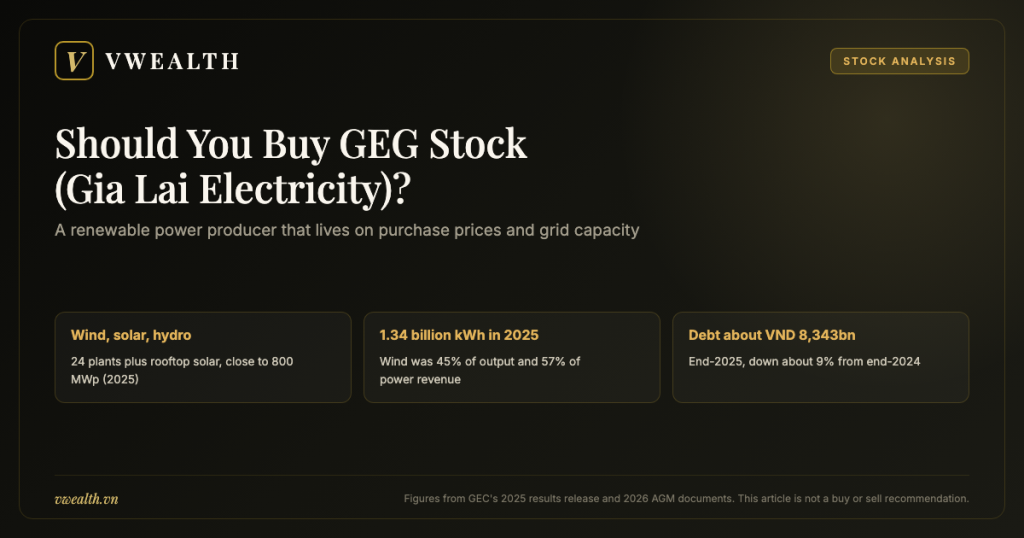
Should you buy GEG stock? The ticker belongs to Gia Lai Electricity Joint Stock Company, a renewable power producer listed on the Ho Chi Minh City Stock Exchange (HOSE), and it is a hard question to answer if you only look at the earnings line. In 2025 the company booked a net profit of VND 947 billion, its best result since listing. In the first half of 2026 net profit fell to roughly VND 272 billion, down almost two-thirds. No turbine broke and the wind did not stop; power output actually edged up. What changed was price. The 2025 figure contained a one-off “retroactive” revenue payment of close to VND 400 billion, booked when the Tan Phu Dong 1 wind farm finally secured an official tariff after more than two years of selling power at a provisional rate, plus a one-time gain on selling a stake in a hydropower company. That episode captures what GEG really is: an almost pure-play renewable generator that sells nearly all of its output to one buyer, lives on tariffs set by policy, and depends on whether the transmission grid can take the electricity it produces. This analysis follows the company from a handful of small hydro plants in Vietnam’s Central Highlands in 1989 to the country’s first operational direct power purchase agreement in 2026, so you can decide who GEG stock suits and who it does not.
First, some naming housekeeping, because three similar abbreviations float around. GEG is the stock ticker. The legal entity is Gia Lai Electricity Joint Stock Company (Công ty Cổ phần Điện Gia Lai), enterprise code 5900181213, headquartered at 114 Truong Chinh Street in Pleiku, capital of Gia Lai province. The company’s own documents use the abbreviation GEC; that is the same company, just its corporate short name. GHC is a different ticker: Gia Lai Hydropower JSC, a subsidiary in which GEG held about 62.53% as of 30 September 2025, and which moved its listing to HOSE on 30 January 2026. Whenever this article says “Gia Lai Electricity”, “GEC” or “GEG”, it means the parent company.
Second, our ground rules, the same as every company analysis in the vwealth series. Dates, names, deals and figures come from published sources: consolidated financial statements, shareholder meeting documents and resolutions, HOSE disclosures, VNDirect’s aggregated financial data, GEC’s annual report and investor-relations disclosures, brokerage research (Shinhan, ACBS, VCBS, MBS) as reported in the press, and Vietnamese financial media such as CafeF, Dau tu Chung khoan, VnExpress, Nha Dau tu, Dan Tri, Bao Phap luat Viet Nam and Tap chi Cong Thuong. Any number that vwealth derived from other numbers is labelled as a vwealth estimate. Figures that change daily, such as today’s share price, current P/E or the latest quarter, are deliberately not fixed in the text; open the latest vwealth reports for live numbers. If you are new to buying Vietnamese stocks as a foreign investor — foreign ownership limits, T+2 settlement, daily price bands — our guide on how to invest in the Vietnam stock market is the best starting point.
From small dams in the Central Highlands to a renewable power producer: 37 years of Gia Lai Electricity
Many investors first met GEG as a “wind and solar stock” riding Vietnam’s renewable boom of 2019–2021. Its roots go much deeper, and they lie in something far less glamorous: small hydropower plants of a few megawatts each, scattered along the streams of Gia Lai and Kon Tum provinces. Understanding that starting point explains why GEG has a culture of running plants well, why it thinks like a power producer rather than a financial engineer, and why its old hydro fleet now raises a fresh question about pricing.
1989–2010: a state company running highland hydro
According to GEC’s corporate profile, the company was founded on 1 June 1989. Its predecessor was Gia Lai – Kon Tum Hydropower Company, a wholly state-owned enterprise tasked with managing small hydropower plants in central Vietnam and the Central Highlands. At that time the national grid had not reached many upland areas, and small hydro plants supplied electricity locally to district towns. In 1995 the company was renamed Gia Lai Electricity Company.
Picture a small hydro plant and you understand the company’s temperament. There is no giant reservoir like Hoa Binh or Son La; usually a small diversion weir, a penstock carrying water down to the turbine, and capacity from a few hundred kilowatts to a few tens of megawatts. Output depends almost entirely on how much water flows past in each season. In the Central Highlands’ rainy season the plants run flat out; in the dry season many barely turn. Operating costs are low and there is no fuel bill, but revenue rises and falls with the weather. That was Gia Lai Electricity’s first gene: a business used to volatile, weather-driven output sold at pre-set prices.
In July 2010 the company held its initial public offering and from September 2010 operated as a joint stock company. The development timeline in GEC’s 2025 annual report records the 2010 equitisation with charter capital of VND 262 billion and 14 hydropower plants totalling 84 MW. For scale, the whole portfolio then was smaller than the single 100 MW Tan Phu Dong 1 wind farm GEG would build a decade later.
2013–2016: joining Thanh Thanh Cong and welcoming two foreign strategic investors
The first ownership turning point came in 2013. According to Dan Tri newspaper, from that year Gia Lai Electricity became the flagship energy business of Thanh Thanh Cong Group (TTC Group), the conglomerate associated with the family of Mr. Dang Van Thanh and best known for sugar, real estate, industrial parks and tourism. For TTC, a power company with steady cash flow balanced cyclical businesses such as sugar.
The second turning point was 2016. According to GEC’s 2025 annual report, that year the International Finance Corporation (IFC), part of the World Bank Group, and Singapore-based Armstrong clean energy fund became strategic shareholders and charter capital rose to VND 745 billion. By mid-2022, according to CafeF citing the Q2 2022 financial statements, IFC still held 13.74% and AVH Pte. Ltd. (Singapore) was the largest shareholder with 20.76%. Their arrival mattered more than the percentages. IFC and international clean energy funds typically bring demanding environmental, social and governance standards and open doors to international project finance. This period shaped GEG into a “renewable energy company with international standards” rather than just a provincial hydro operator.
Ownership was therefore highly concentrated from the start: a domestic conglomerate group plus foreign institutional investors held most of the capital. This “small free float” characteristic has stayed with GEG ever since, and you will see its effect on trading in chapter five.
2017–2019: UPCoM debut, the solar FIT rush and the move to HOSE
On 21 March 2017, GEG shares began trading on UPCoM — Vietnam’s unlisted public company market, a lighter-regulation venue often used before a full listing — at an unadjusted opening reference price of VND 20,000, according to VNDirect trading data. Hardly anyone noticed at first: average matched volume in 2017 was only about 8,300 shares per session (a vwealth estimate from VNDirect data).
Then policy changed everything. In 2017 Vietnam introduced a feed-in tariff (FIT) for solar power: projects reaching commercial operation before the deadline would have their entire output bought by state utility Vietnam Electricity (EVN) at 9.35 US cents per kWh for 20 years. For a company that already knew how to build and run power plants, and whose international shareholders could unlock debt financing, it was a rare opportunity. According to GEC’s 2025 annual report, in 2018 the company brought Vietnam’s first two solar farms into operation, totalling 117 MWp. Around the same time the 49 MWp TTC Duc Hue 2 solar project was being prepared — a project that, as you will see, would only start operating in 2026 under an entirely different mechanism.
Across 2018–2019 GEG brought a series of FIT solar farms online. According to Shinhan Securities Vietnam’s 2025 assessment, the company owns five solar farms totalling 260 MWp, all on the 9.35 US cent FIT for 20 years, plus around 32 MWp of rooftop solar (GEC’s 2025 annual report puts rooftop at about 40 MWp). Charter capital rose fast to keep pace. The stock woke up as well: from about VND 14,900–15,100 in early January 2019, GEG reached VND 27,400 on 30 August 2019 (unadjusted closing prices, VNDirect data), a gain of roughly 80–85%.
On 19 September 2019 nearly 204 million GEG shares moved to HOSE. Contributed capital at the end of 2019 was about VND 2,039 billion, almost eight times the level at equitisation (a vwealth estimate from VNDirect data and the annual report).
2020–2021: the wind race against the 31 October 2021 deadline
When the solar FIT window closed, a wind FIT was still available: wind projects reaching commercial operation before 1 November 2021 would receive 8.5 US cents per kWh onshore and 9.8 US cents offshore (including nearshore intertidal projects) for 20 years. The whole industry raced the clock, GEG included.
GEG pursued four wind projects through member companies: V.P.L Ben Tre (30 MW), Ia Bang 1 (50 MW) in Gia Lai, and Tan Phu Dong 1 (100 MW) and Tan Phu Dong 2 (50 MW) in former Tien Giang province. According to Dan Tri, Ia Bang 1 broke ground in October 2020 and Tan Phu Dong 2 started construction in March 2021. To fund all this it issued both bonds and rights shares; contributed capital rose from about VND 2,712 billion at end-2020 to VND 3,037 billion at end-2021, while borrowings nearly doubled during 2021 (VNDirect data).
The race ended half won, half lost. Three projects made the deadline: Tan Phu Dong 2 was completed in October 2021; Ia Bang 1 was energised in October 2021; VPL Ben Tre reached commercial operation at the end of October 2021. According to Shinhan, all three receive the FIT. Tan Phu Dong 1 — the largest project, 100 MW with a total investment of about VND 4,464 billion — did not make it. It only reached commercial operation on 31 May 2023, according to 2025 AGM documents cited by Bao Phap luat Viet Nam, and fell into a group of 85 so-called “transitional” projects: built, but not eligible for FIT, and left waiting to negotiate a new price with EVN.
That detail sounds technical, but it drove GEG’s profits for the next four years. A 100 MW project with about VND 3,125 billion of bank loans in its budget (according to Dan Tri) started paying interest and depreciating immediately, yet could only sell power at a provisional VND 907.975 per kWh — exactly 50% of the ceiling tariff, according to the notes to the 2025 financial statements. You will see the consequences in chapter four.
2022–2024: JERA, DEG and the years interest ate the profit
In August 2022 came the biggest shareholder news in GEG’s history. JERA — the Japanese power generation joint venture of Tokyo Electric Power Company Holdings and Chubu Electric Power — together with JERA Asia announced an investment of about JPY 15 billion, roughly USD 112 million according to Nikkei, to own 35.1% of GEG, buying the stakes of IFC and the Armstrong fund. Nikkei Asia reported the deal added about 190 MW of renewable capacity to JERA’s portfolio. On 7 December 2022 IFC transferred its entire 44.2 million shares, or 13.74% of capital, to AVH Pte. Ltd of Singapore, lifting that entity’s holding to 35.1% — exactly the figure JERA announced. From 2024 onward, reports list the 35.1% shareholder as Jera Asia Vietnam Holdings Pte. Ltd.
Also in 2022, after more than a year of due diligence and negotiation, shareholders approved the issuance of more than 64 million convertible dividend-preference shares to DEG (Deutsche Investitions- und Entwicklungsgesellschaft), the German development finance institution within the KfW group; the offering results were approved by the board in late December 2022 (Resolution 16/2022/NQ-DHDCD of 12 October 2022 authorised 64.2 million shares, VND 642 billion at issue value). Within a few months GEG had changed its foreign strategic shareholder and added a preferred-equity investor.
Operationally, 2022–2024 was hard. The new wind farms brought a surge in depreciation and interest. Consolidated interest expense rose from about VND 384 billion in 2021 to VND 592 billion in 2022 and VND 842 billion in 2023, according to VNDirect’s aggregated financial data. Net profit dropped from VND 371 billion in 2022 to VND 143 billion in 2023 and VND 92 billion in 2024. In the third quarter of 2024, GEG reported an after-tax loss of about VND 48 billion according to VNDirect’s quarterly data — in a season of weak wind while Tan Phu Dong 1 was still on its provisional price.
2024 also brought a legal item you should understand correctly when reading headlines. In August 2024 the Security Investigation Agency of the Ministry of Public Security, while investigating a case of “abusing positions and powers while performing official duties” at the Ministry of Industry and Trade and several provinces, asked EVN to provide information and documents on 32 wind and solar projects. According to Dan Tri and CafeF, the list included four wind projects developed by GEG and its member companies: Tan Phu Dong 1, Tan Phu Dong 2, Ia Bang 1 and VPL Ben Tre; GEG shares fell by the daily limit on 13 August 2024. None of the documents we reviewed from the company (the 2025 annual report and the 2026 AGM documents and minutes) mention any conclusion related to these projects. This was a request for documents to support an investigation into a case at regulatory bodies; the reports cited draw no conclusion of wrongdoing by Gia Lai Electricity. Investors should follow official statements from the authorities and the company’s own disclosures rather than infer from headlines.
2025–2026: an official price for Tan Phu Dong 1 and Vietnam’s first DPPA
2025 opened with the news GEG shareholders had waited years for. In March–April 2025 the company agreed with EVN on an official tariff for Tan Phu Dong 1 of VND 1,813 per kWh — almost double the provisional price and just below the VND 1,816 ceiling for offshore wind. The addendum was signed on 26 March 2025 with EVN’s Electric Power Trading Company (EPTC), at 99.8% of the ceiling and applied retroactively from May 2023; the retroactive difference was estimated at about VND 397 billion in the 2025 AGM documents cited by Bao Phap luat Viet Nam. In May 2025 the A7 turbine of the VPL plant was also priced, at VND 1,810/kWh. In the same year the company sold a 25% stake in Truong Phu Hydropower JSC; GEC reported a gain of about VND 110 billion, while ACBS estimated about VND 144 billion. Those two items lifted 2025 net profit to VND 947 billion.
In 2026 the story turned in a new direction. On 19 May 2026 the TTC Duc Hue 2 solar farm (49 MWp, with a battery energy storage system, or BESS) reached commercial operation. From 1 June 2026, according to Vietnam’s National Power System and Market Operator (NSMO) as reported by VnExpress, Duc Hue 2 and Samsung Electronics Vietnam Thai Nguyen became the first pair to actually operate a direct power purchase agreement (DPPA) through the national grid, with expected volume of about 70 GWh per year. A project approved in early 2019 in the hope of receiving FIT ended up pioneering a market mechanism instead — a miniature of the entire Vietnamese renewable sector over the past seven years.
| Year | Milestone | What it meant for shareholders |
|---|---|---|
| 1989 | Founded 1 June as Gia Lai – Kon Tum Hydropower Company | Small-hydro roots, used to seasonal output |
| 2010 | IPO in July, equitised from September; capital about VND 262bn, 14 hydro plants, 84 MW | Start of repeated capital raising |
| 2013 | Becomes TTC Group’s flagship energy company | Controlling shareholder is a private conglomerate |
| 2016 | IFC and the Armstrong fund become strategic shareholders | International standards and capital |
| 2017 | UPCoM debut on 21 March at VND 20,000 | Shares gain a market |
| 2018–2019 | FIT solar farms online; HOSE listing on 19 September 2019 | Revenue jumps |
| 2021 | Three wind farms make the FIT deadline; Tan Phu Dong 1 misses it | Wind becomes the core, with heavy debt |
| 2022 | JERA buys 35.1%; preference shares issued to DEG | New foreign strategic shareholder |
| 2024 | After-tax loss of about VND 48 billion in Q3 | Peak pressure from interest and provisional pricing |
| 2025 | Tan Phu Dong 1 tariff set at VND 1,813/kWh, retroactive payment about VND 397bn; net profit VND 947bn | Record year, largely from one-offs |
| 2026 | Duc Hue 2 starts DPPA with Samsung on 1 June; GHC moves to HOSE on 30 January | A sales channel outside EVN opens |
Leadership and GEG stock ownership: TTC, JERA and a German preferred-equity investor
For most listed companies, “who owns it” is background information. For GEG it is close to half the investment case. Two strategic shareholder groups control the overwhelming majority of the ordinary shares, another foreign investor holds convertible preference shares, and the slice left for public investors is thin. This chapter walks through each group, then the people running the company and its dividend policy.
Two strategic groups own nearly 80% of the ordinary shares
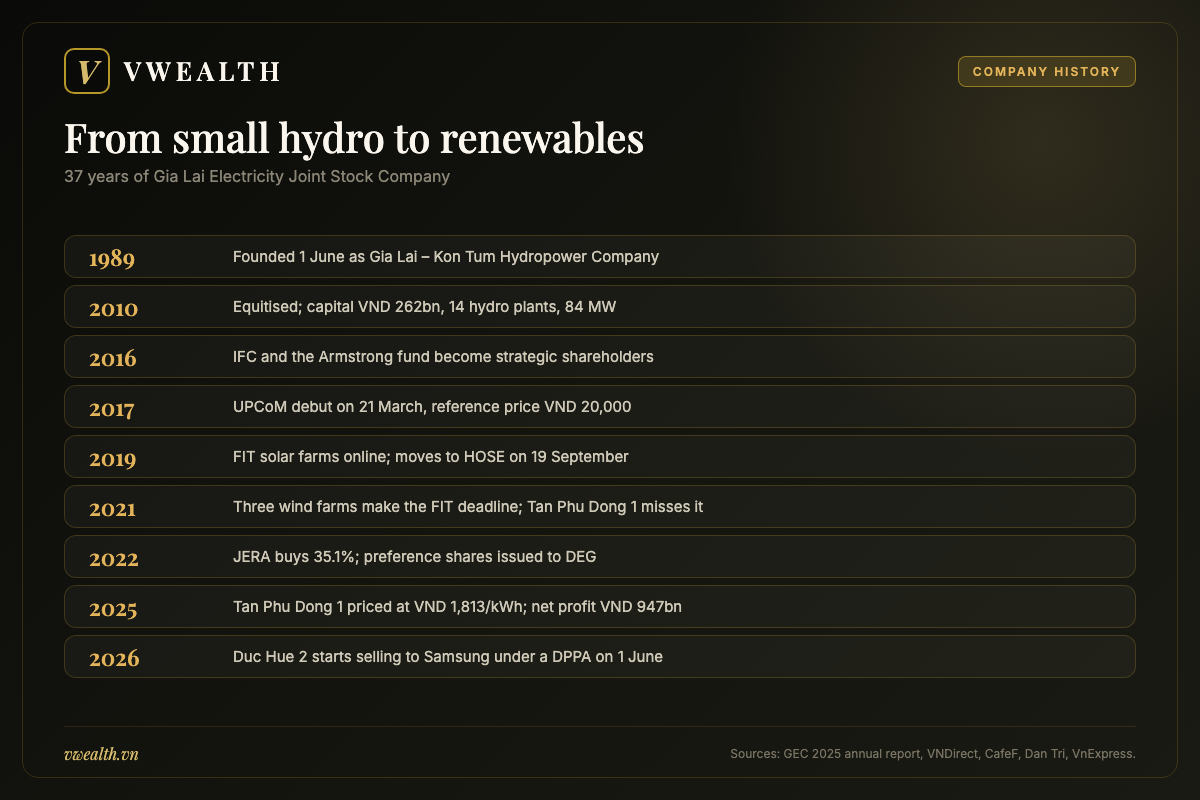
According to the Q1 2026 consolidated financial statements as summarised by Kinh te Moi truong magazine, GEG’s charter capital at 31 March 2026 was about VND 4,148 billion, of which about VND 3,583 billion was voting ordinary shares and VND 565 billion preference shares. On the ordinary share base, ownership looked like this: Jera Asia Vietnam Holdings Pte. Ltd. 35.1%; Thanh Thanh Cong Investment JSC 16.79%; Thanh Thanh Cong – Bien Hoa JSC (TTC AgriS, ticker SBT) 12.96%; Ben Tre Import-Export JSC (Betrimex) 6.33%; Thanh Thanh Cong Industrial Park JSC 3.83%; Bien Hoa Consumer Goods JSC 3.31%. Together the TTC-linked entities hold about 43.2%, JERA 35.1%, a combined 78.3%; all other shareholders hold only about 21.7%.
That 21.7% deserves a pause. It means that out of every 100 GEG shares outstanding, only about 22 are held by the individuals, funds and institutions that actually trade day to day. A thin free float makes the price sensitive to news, and a large sale by a strategic holder can create meaningful pressure. Watching HOSE’s major-shareholder transaction disclosures is part of owning this stock.
Holdings inside the TTC group also move around, and the disclosures show it. On 26 March 2026 Bien Hoa Consumer Goods sold 7,068,039 shares to TTC AgriS, falling from 5.28% to 3.31% and ceasing to be a major shareholder, while TTC AgriS rose from 10.99% to 12.96%. After the June 2026 share dividend, voting shares outstanding totalled 376,220,525. On 10 September 2026 Thanh Thanh Cong Investment bought 12 million shares in a negotiated trade, lifting its stake from 16.79% to 19.98% (75.17 million shares); the same day TTC AgriS sold 12 million shares and then another 3 million on 14 September 2026, leaving 33.77 million shares, or 8.98%. The group’s combined stake barely changed — shares simply moved between entities in the same ecosystem.
One point needs clearing up because it is often confused: REE is not a major shareholder of GEG. Refrigeration Electrical Engineering Corporation (REE) is another listed power company with hydro, wind and solar assets — a peer and a competitor for capital, and it does not appear on GEG’s list of major shareholders. If you want to compare how a diversified conglomerate with a power arm is valued, our REE stock analysis is a useful reference.
The TTC ecosystem: five entities, one interest group
The five TTC entities on GEG’s register are not five independent investors. According to Kinh te Moi truong, Thanh Thanh Cong Investment JSC is the core of the TTC Group ecosystem of Mr. Dang Van Thanh’s family. TTC AgriS is the listed sugar company chaired by Ms. Dang Huynh Uc My, who was also the legal representative and board chair of Betrimex as of August 2025. Thanh Thanh Cong Industrial Park JSC is chaired by Mr. Dang Hong Anh, Mr. Dang Van Thanh’s son. Bien Hoa Consumer Goods is a subsidiary of TTC AgriS.
Holding shares through several entities is common among Vietnamese private groups and is neither good nor bad in itself. What matters is the practical effect. First, major decisions at GEG — capital plans, dividends, new projects — are shaped by a single interest group holding over 43% of ordinary shares, alongside JERA. Second, GEG transacts with companies in the ecosystem. Also according to Kinh te Moi truong, in Q1 2026 Thanh Thanh Cong Investment was GEG’s largest related-party counterparty at nearly VND 15.8 billion; at quarter-end GEG had about VND 28.5 billion receivable from related parties, of which about VND 27.8 billion from TTC Energy JSC, plus a short-term loan of more than VND 22 billion to Son Tin Commodity Trading JSC. Against total assets of around VND 15,100 billion these amounts are small, but the “related party transactions” note is worth checking each quarter to see whether they grow.
The TTC group’s holdings have been reshuffled over time. In April 2022 Mr. Dang Van Thanh sold his entire 11.6 million GEG shares (about 3.83%), according to CafeF. In August–September 2022 Thanh Thanh Cong Investment sold more than 3.2 million shares, cutting its stake from 17.8% to 16.79% — a level unchanged until the September 2026 transaction. In other words, intra-group transactions have mostly been rearrangements rather than exits.
JERA: why Japan’s largest power generator chose GEG
JERA was created by combining the fuel and thermal power businesses of Tokyo Electric Power Company Holdings (TEPCO) and Chubu Electric Power, two of Japan’s major utilities. It is one of the world’s largest energy companies, active in liquefied natural gas (LNG), power generation and renewables. According to Nikkei Asia in 2022, JERA aimed to raise its renewable capacity to 5,000 MW by 2025, and the GEG stake added roughly 190 MW toward that goal.
For a group like JERA, 35.1% of GEG is a gateway into Vietnamese renewables through a company with an operating portfolio, a team and local regulatory know-how. For minority shareholders the presence of JERA cuts both ways. On the positive side, an industry-leading strategic investor with deep technical and financial capacity has made a long-term bet on the company. On the watch-list side, JERA came in during 2022, when expectations for Vietnamese renewables were high; the deal was worth about USD 112 million, or more than VND 2,630 billion, according to CafeF, while GEG shares traded for years below their early-2022 peak. A strategic holder’s Vietnam strategy may evolve; watch major-shareholder notices. At the end of 2025 JERA still held 125,756,637 shares, or 35.1% of ordinary capital.
JERA also explains a feature of GEG’s shareholder data: foreign ownership looks very high, but most of it is one strategic holder that does not trade. Daily “foreign net buying or selling” figures for GEG therefore reflect smaller foreign investors and funds, not JERA’s intentions.
DEG and 56.5 million preference shares: capital that sits between debt and equity
DEG’s preference shares are a detail many readers of GEG’s accounts skip, yet they directly affect ordinary shareholders. Under the 2022 shareholder resolution reported by CafeF, these are dividend-preference shares with a maximum term of six years; the dividend equals 6% multiplied by an adjustment ratio set by the shareholders’ meeting before payment. Holders may convert into ordinary shares at any time after 24 months and before 72 months from completion of the offering, at a conversion price no lower than GEG’s book value per share at the time of the offering.
Think of this capital as a bridge between debt and equity. Like debt, it requires a regular, near-fixed payment — the preferred dividend — ahead of ordinary shareholders. Like equity, it sits in shareholders’ equity and can become ordinary shares, diluting existing holders. The original issue value was VND 642 billion (64.2 million shares). The 2025 preferred dividend was set at 6.3673% of issue value — 6% times an adjustment factor of 106.121% — paid in cash to DEG. The fall from VND 642 billion to about VND 565 billion at end-2025 is explained in the disclosures: on 15 December 2025 GEC bought back 7,704,000 preference shares from DEG at an average VND 10,756 per share, about VND 82.9 billion in total, to return capital, and reduced its charter capital accordingly, leaving 56,496,000 preference shares. The 24 April 2026 AGM approved a further buyback of up to 14,766,000 preference shares, expected in Q4 2026 or Q1 2027, at VND 10,000 to a maximum VND 10,955 per share.
Timing and direction are what matter to investors. The offering completed in late December 2022, so the conversion window runs from about late 2024 to about late 2028 — a vwealth estimate based on the published 24–72 month terms, not an official schedule. In practice, the company is buying the preference shares back for cash rather than DEG converting them: if the new buyback is completed in full, about 41.7 million preference shares would remain (a vwealth estimate). For ordinary shareholders, a cash buyback avoids dilution but uses cash; conversion-driven dilution remains possible for the portion not yet bought back.
Management: Mr. Tan Xuan Hien and Ms. Nguyen Thai Ha
According to GEC’s disclosures, the company’s legal representative is Mr. Tan Xuan Hien, Chairman of the Board. A September 2026 board resolution on the Tan Phuoc 1 solar project also authorised the Chairman to handle everything from land and permits to contractor selection and financing. The Chief Executive Officer is Ms. Nguyen Thai Ha, who answered shareholders’ questions on debt and interest rates at the 2026 annual meeting. Mr. Tan Xuan Hien was elected Chairman for the 2025–2030 term after the April 2025 meeting; in April 2026 the board reappointed Mr. Le Thanh Vinh as Deputy CEO. The executives we could check in the annual report each hold very small personal stakes.
Low personal ownership by executives is natural in a company controlled by two institutional shareholders: management here resembles a professional team mandated by the major owners rather than founders with their own capital at stake. Management’s incentives therefore align mostly with what TTC and JERA want — running plants efficiently, keeping leverage within safe limits and developing new projects. It also explains why GEG’s disclosure style is fairly systematic: quarterly results releases break down output by source, revenue by segment, EBIT margin and EBITDA margin. According to its 2025 annual report, GEC has won numerous awards for annual reporting, ESG and disclosure, and maintains an “A-” credit rating with a “Stable” outlook from FiinRatings.
At the 24 April 2026 annual meeting, Ms. Nguyen Thai Ha said management regards leverage control as a key priority, that about 90% of borrowings come from state-owned commercial banks (the “Big 4”), and that the average interest rate in 2025 was about 7.7–8% per year, according to the meeting minutes. She also acknowledged that rates were trending higher in 2026 and had been built into the plan; according to Vietstock, the 2026 rate cited at the meeting was about 8.3–8.5%. That kind of statement is credible for one reason: it does not promise profit growth; it spells out cost-of-capital pressure.
Dividends: mostly paid in shares
If you want a power stock that pays steady cash dividends, GEG is not the classic example. Based on VNDirect’s corporate action calendar: the 2021 dividend was 6% in shares (ex-date 16 June 2022); 2022 was 6% in shares (6 July 2023); 2023 was 5% in shares (29 August 2024); 2025 was 5% in shares (ex-date 10 June 2026, with 17,912,154 new shares trading from 22 July 2026, lifting charter capital to about VND 4,327 billion). The annual cash dividend has gone mainly to DEG’s preference shares. In Vietnam dividends are quoted as a percentage of the VND 10,000 par value, so a 5% share dividend means five new shares for every 100 held. The 2026 meeting explained that paying in shares “prioritises resources for projects under way and balances investment needs with shareholder interests,” according to Dau tu Chung khoan.
A share dividend does not make you richer on the day: no cash leaves the company, the same pie is simply cut into more slices, and the share price is adjusted down on the ex-date. The benefit only arrives if the retained cash is invested in projects earning more than the cost of capital. For GEG, that means judging the share dividends alongside the returns of Duc Hue 2, VPL Ben Tre phase 2 and the projects after them. One small compliance item: on 22 May 2026 GEC disclosed Decision 300/QD-XPHC from the Gia Lai Provincial Tax Department over incorrect tax declarations for 2024–2025; back taxes, fines and late-payment interest totalled about VND 181 million, which the company says it has paid in full. The amount is tiny relative to revenue, but it is the kind of item worth reading directly in the disclosures rather than through headlines.
| Shareholder | Type | Stake in ordinary shares (31 Mar 2026) | Note |
|---|---|---|---|
| Jera Asia Vietnam Holdings Pte. Ltd. | Foreign institution (Japan) | 35.1% | Largest shareholder since late 2022 |
| Thanh Thanh Cong Investment JSC | TTC ecosystem | 16.79% | Core of TTC Group |
| Thanh Thanh Cong – Bien Hoa JSC (SBT) | TTC ecosystem | 12.96% | Listed sugar company |
| Ben Tre Import-Export JSC | TTC ecosystem | 6.33% | |
| Thanh Thanh Cong Industrial Park JSC | TTC ecosystem | 3.83% | |
| Bien Hoa Consumer Goods JSC | TTC ecosystem | 3.31% | Subsidiary of SBT |
| Other shareholders | Public | About 21.7% | The actively traded portion |
| DEG (Germany) | Convertible preference shares | 56.5 million preference shares | Not counted in ordinary capital; being bought back gradually |
How Gia Lai Electricity makes money: three power sources, essentially one buyer
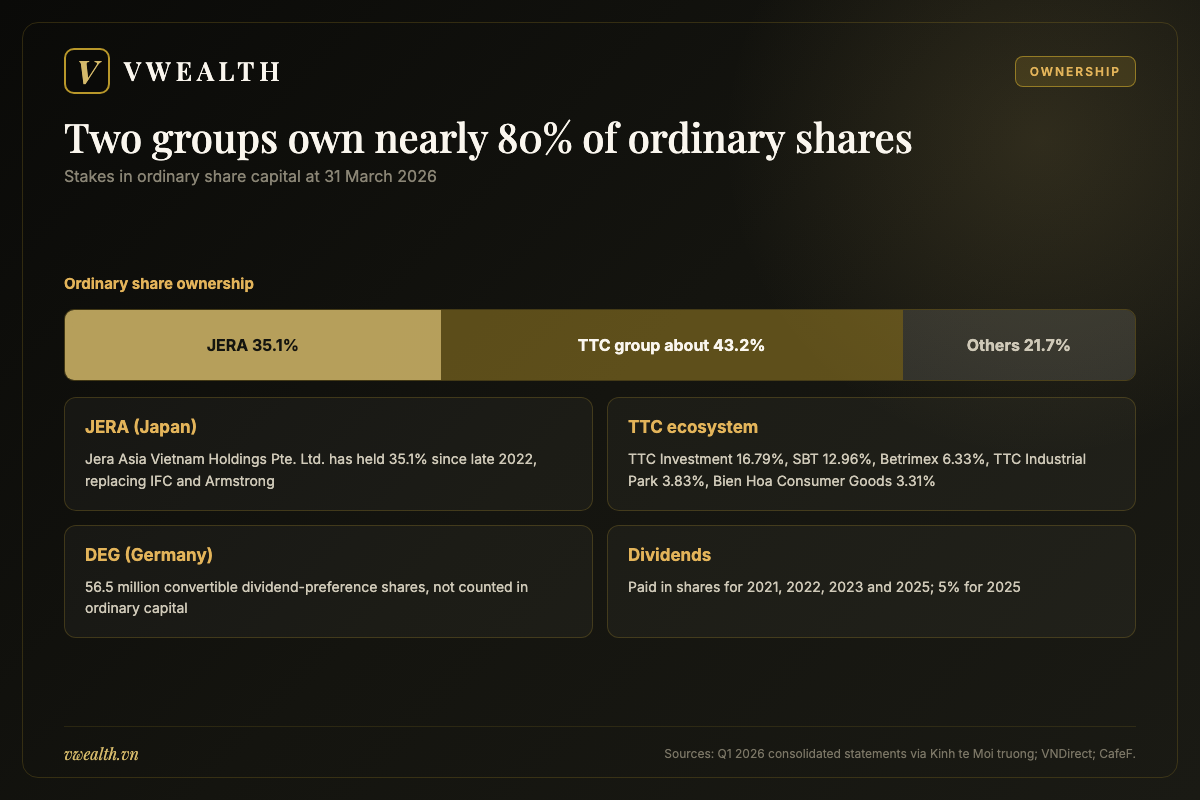
In short, GEG is an almost pure-play renewable generator. According to Dau tu Chung khoan’s summary of 2025 results, electricity sales made up about 98% of total revenue, with the rest from services and equipment. There is no real estate arm like Ha Do, no construction business like PC1, no office leasing or water business like REE. Everything reduces to a simple equation: revenue = electricity sold × price. This chapter goes through each power source, where its volume and price come from, and then looks for the company’s moat.
In 2025, according to GEC, the portfolio consisted of 24 power plants plus rooftop solar systems, with total installed capacity approaching 800 MWp, according to the AGM report cited by Dau tu Chung khoan (the 2025 annual report gives the precise figure as about 769 MWp). System output was about 1.34 billion kWh and electricity revenue VND 2,935 billion. The mix: wind 606 million kWh and VND 1,679 billion (45% of output, 57% of revenue); hydro 375 million kWh and VND 430 billion (28% of output, 15% of revenue); solar about 357 million kWh — 319 million from farms and 38 million from rooftops — and VND 827 billion (27% of output, 28% of revenue). Notice something: hydro produces almost 30% of the electricity but only 15% of revenue, while wind produces 45% and earns 57%. The reason is price — each source is sold under a different mechanism.
Small hydro: the oldest cash source, with 20-year contracts now expired
Hydro is GEG’s root. According to Shinhan, the company has 12 small hydropower plants (each below 30 MW) totalling about 81 MW. Small hydro plants in Vietnam typically sell to EVN under an “avoided cost tariff” — a price set in advance each year reflecting the cost the power system avoids by having this small source. These plants do not bid into the competitive wholesale market and have their full output purchased. Shinhan calculated that over the previous five years GEG’s average hydro selling price was about VND 1,263 per kWh, above the VND 800–1,200 range of most other hydro plants, and that the segment generated around VND 300 billion of cash flow a year.
But a big change has received little attention. At the 2025 annual meeting, GEG’s management said its small hydro plants had reached the end of their 20-year contracts and would move to a provisional price of VND 749 per kWh, about 20% below the avoided cost tariff, according to Tap chi Cong Thuong citing Shinhan. The company hopes to negotiate a higher price and receive a retroactive adjustment. This is the mirror image of the Tan Phu Dong 1 story: in wind, a low provisional price was later raised; in old hydro, the price may fall once the long-term contract ends. If the final price is significantly lower, hydro’s “steady” cash flow will thin out.
Small hydro also lives or dies by rainfall. In Q1 2026 GEG’s hydro output rose 59% to 51 million kWh; yet according to MBS Securities, in July–August 2026 system-wide hydro dispatch fell about 13% year on year as El Niño formed, and GEG was among the companies with hydro plants expected to be affected. GEG’s 2026 plan targets 341 million kWh from hydro, below the 375 million kWh of 2025.
Part of the hydro fleet sits inside the subsidiary Gia Lai Hydropower (GHC), in which GEG held about 62.53% as of 30 September 2025. GHC operates the H’Chan and H’Mun hydro plants, with combined installed capacity of 28.2 MW, plus the Ham Phu 2 solar farm in former Binh Thuan province, according to GEC’s annual report. Nearly 47.7 million GHC shares moved from UPCoM to HOSE on 30 January 2026 at a reference price of VND 29,000, according to CafeF. Having a separately listed subsidiary gives an interesting reference point: the market prices a slice of GEG’s assets every day.
Solar: a 9.35 US cent FIT and the question of acceptance paperwork
Solar was the “money machine” of 2019–2021. According to Shinhan, GEG’s five solar farms totalling 260 MWp all receive the 9.35 US cent FIT for 20 years, with an estimated internal rate of return (IRR) of about 13–14%; investment cost was only about VND 18–20 billion per MW versus an industry average of about VND 22 billion. Plants such as Ham Phu 2 (49 MWp) and Truc Son (44.4 MWp) sit in areas with high solar irradiation. On top of the farms, GEG has about 32 MWp of rooftop solar, according to the same source. In the first half of 2026, solar farms and rooftop systems generated 219 million kWh and about VND 504 billion, or 36% of output and 38% of electricity revenue.
The FIT is denominated in US cents but paid in Vietnamese dong at the prevailing exchange rate, so a stronger dollar lifts solar revenue. That provides a natural partial hedge: most of GEG’s debt is in dong, while part of its revenue is linked to the dollar.
The risk in this segment is policy. From early 2025, according to VietNamNet, EVN’s Electric Power Trading Company proposed provisional prices below FIT for projects that had been recognised for commercial operation (COD) before receiving the official construction acceptance approval, and investors objected. In February 2026 the Ministry of Industry and Trade asked 15 provinces to review and, where applicable, sanction 167 solar projects in this situation. The reports cited do not list any GEG project, and this article has no information to confirm whether any GEG plant is affected. What you can do is read the “trade receivables” line and the tariff notes in GEG’s financial statements each quarter, to see whether any amount is being withheld or billed at a provisional rate.
Wind: the new backbone, three FIT projects and one transitional project
Since 2022, wind has been GEG’s main engine. Its four operating wind farms total 230 MW:
- Tan Phu Dong 1 (100 MW, former Tien Giang province, now Dong Thap): coastal site in Phu Tan commune, total investment about VND 4,464 billion, including more than VND 1,339 billion of equity and VND 3,125 billion of bank loans; commercial operation on 31 May 2023. Transitional project, official price VND 1,813/kWh agreed in 2025 and applied retroactively from May 2023.
- Tan Phu Dong 2 (50 MW, same area): investment about VND 2,242 billion, including about VND 672.6 billion of equity and VND 1,569 billion of loans; construction from March 2021, completed October 2021. FIT.
- Ia Bang 1 (50 MW, Chu Prong, Gia Lai): 10 turbines, investment about VND 2,200 billion (VND 660 billion equity, VND 1,540 billion loans), commercial operation October 2021. FIT.
- VPL Ben Tre (30 MW, Binh Dai, former Ben Tre): investment about VND 1,452 billion, operating from late October 2021. FIT.
Investment and capacity figures come from Dan Tri in 2024; FIT status from Shinhan in 2025; Tan Phu Dong 1’s operating date from the 2025 AGM documents. Both Tan Phu Dong farms are owned by Tien Giang Wind Power JSC, a GEG subsidiary, and were the first two wind projects in Tien Giang’s coastal waters to enter the national wind power plan.
Why does wind earn more per kWh than hydro? Pricing mechanism. Offshore wind FIT is 9.8 US cents, onshore 8.5 US cents; the transitional Tan Phu Dong 1 earns VND 1,813/kWh. Compared with small hydro’s historical average of about VND 1,263/kWh (and the VND 749 provisional price after contract expiry), each wind kWh brings in considerably more. But wind is also far more expensive to build: Tan Phu Dong 1 cost about VND 44.6 billion per MW (a vwealth estimate, dividing total investment by capacity), more than double the solar investment cost Shinhan cites. The higher price compensates for higher capital cost — which is why interest and depreciation absorb much of this segment’s gross profit in its early years.
Wind is seasonal too. GEG’s own quarterly figures show the third quarter is usually the hard one for wind — Q3 2024 was the company’s only loss-making quarter that year — while the northeast monsoon at the end and start of the year is peak season. In Q1 2026 wind generated 209 million kWh, about 58% of the quarter’s output (a vwealth estimate from 209 of 362 million kWh). For the first half of 2026 wind reached 322 million kWh, 52.2% of output, and about VND 678 billion, or 51.6% of electricity revenue.
Duc Hue 2 and the DPPA: selling directly to an industrial customer for the first time
Every plant above sells to EVN. Duc Hue 2 is the first exception, and possibly the template for the future. According to VnExpress and the 2026 AGM minutes, the 49 MWp project in Tay Ninh province (formerly Long An), owned by TTC Duc Hue – Long An Power JSC, completed construction and energised its substation at the end of 2025, passed acceptance in early April 2026, started commercial operation on 19 May 2026, integrates a BESS, and from 1 June 2026 sells power under a DPPA to Samsung Electronics Vietnam Thai Nguyen (SEVT).
A DPPA — direct power purchase agreement — is governed by Decree 57/2025/ND-CP (later amended by Decree 243/2026/ND-CP). In the version that runs through the national grid, the plant still delivers power to the grid and sells on the spot market, while the corporate buyer signs a financial contract with the plant to “lock in” a price for the corresponding volume. For GEG the benefit is escaping the single-buyer position and gaining a long-term foreign-invested customer; for Samsung it is certified renewable electricity toward its decarbonisation commitments. According to VnExpress, the project is expected to supply about 70 GWh per year and cut about 46,000 tonnes of CO2.
The DPPA price has not been officially disclosed. As of May 2026, CafeF reported that the price was still under negotiation with the customer. VCBS estimated the project would contribute about 35 million kWh in 2026 and 70 million kWh in 2027 — a broker estimate, not a company figure. At the 2026 AGM, management said current price frameworks are designed by the Ministry of Industry and Trade to deliver an IRR of about 12% on standard investment costs; reaching that requires good output and tight cost control. The era of subsidised 9.35 US cent-style tariffs is over, and new-project returns depend on lower investment cost, storage and good customers.
Projects under way and in the pipeline: from VPL 2 to Tan Thanh
According to the 2026 AGM report cited by Dau tu Chung khoan, GEG targets total capacity of about 1 GW over 2026–2027. Specific projects:
- VPL Ben Tre wind phase 2 (VPL 2), 30 MW: construction started in 2025, power purchase agreement (PPA) signed with EVN at 99.5% of the ceiling price, credit arranged with Vietcombank, targeted to operate in Q4 2026 according to the 2026 AGM documents; according to VCBS, investment of about VND 1,500 billion and expected output of about 92 million kWh per year; Shinhan cites an expected IRR of about 11%.
- Ea Tih hydropower, 8.6 MW (Dak Lak): construction started in late September 2025, targeted for mid-2027.
- Tan Thanh wind, 100 MW: the Tien Giang (now Dong Thap) provincial government approved the investment policy on 24 June 2025 for Tan Thanh Renewable Energy JSC, part of GEG; investment VND 4,700 billion, expected output about 264 million kWh a year, sharing infrastructure with Tan Phu Dong 1 and 2, construction planned to start in September 2026 and complete in July 2028, according to Decision 1719 as reported by local media.
- Tan Phuoc 1 solar, 25 MW (about 33.75 MWp): board approved in September 2026, estimated investment about VND 460 billion excluding VAT, according to Nha Dau tu.
Shinhan in 2025 also cited a potential pipeline of about 3,000 MW to 2030; that is a study list, not an investment commitment. One detail stands out: Tan Thanh shares the substation, subsea cables and transmission line of the Tan Phu Dong farms. If it goes ahead, that lowers connection cost — the very bottleneck that chapter six identifies as the biggest in Vietnamese renewables.
The moat of a pure-play renewable generator
When a company sells an identical commodity (a GEG kWh is the same as anyone else’s) to a near-monopoly buyer, where does competitive advantage lie? Four places.
First, a book of legacy contracts. FIT plants hold 20-year contracts at prices no new project can obtain today. As long as those contracts are honoured, they are an asset that cannot be replicated. Second, source diversification. Hydro is strong in the rainy season, solar in the dry season, wind in the monsoon; the three partly offset each other, smoothing revenue compared with a single-technology producer. Third, development and operating capability. GEG handles everything from project development, permits and construction to operation; an EBITDA margin of about 78% in the first half of 2026 (a vwealth estimate from pre-tax profit, interest expense and depreciation) is a high figure. Fourth, strategic shareholders and international capital. JERA, DEG and an international loan from Symbiotics of Switzerland — repaid in full in 2025 at VND 212 billion, according to the annual report — show access to capital many domestic peers lack.
This moat has clear limits: GEG does not set the price for most of its output, does not decide whether the grid takes all its power, and does not control rain, sun or wind. That is why this analysis describes GEG as a business “dependent on power purchase prices and the transmission grid”.
| Source | Output 2025 | Electricity revenue 2025 | Main pricing mechanism | Biggest risk |
|---|---|---|---|---|
| Wind (230 MW) | 606m kWh (45%) | VND 1,679bn (57%) | 20-year FIT (3 projects); transitional VND 1,813/kWh (Tan Phu Dong 1) | Weak summer wind; heavy debt |
| Solar (about 260 MWp farms + 32–40 MWp rooftop before Duc Hue 2) | 357m kWh (27%) | VND 827bn (28%) | 9.35 US cent FIT for 20 years; DPPA for Duc Hue 2 | Curtailment; FIT paperwork review |
| Small hydro (about 81 MW) | 375m kWh (28%) | VND 430bn (15%) | Avoided cost tariff; VND 749/kWh provisional after 20-year contracts expired | Dry years; lower new price |
Financial health: read the numbers before deciding whether to buy GEG stock
The accounts of a renewable generator read very differently from those of a retailer or a bank. Revenue is largely “pre-programmed” by capacity, weather and contract price; fuel cost is zero; most costs are plant depreciation and interest. So the key question is not “how fast did revenue grow” but: how much gross profit is left after paying the banks, and does the cash actually arrive or sit in receivables? This chapter shows you how to read GEG’s numbers in exactly that order. If you are new to reading Vietnamese financial statements, our guide to Vietnamese company financial statements in English explains the layout under Vietnamese Accounting Standards.
Revenue up 2.6 times in six years, profit shaped like a saw blade
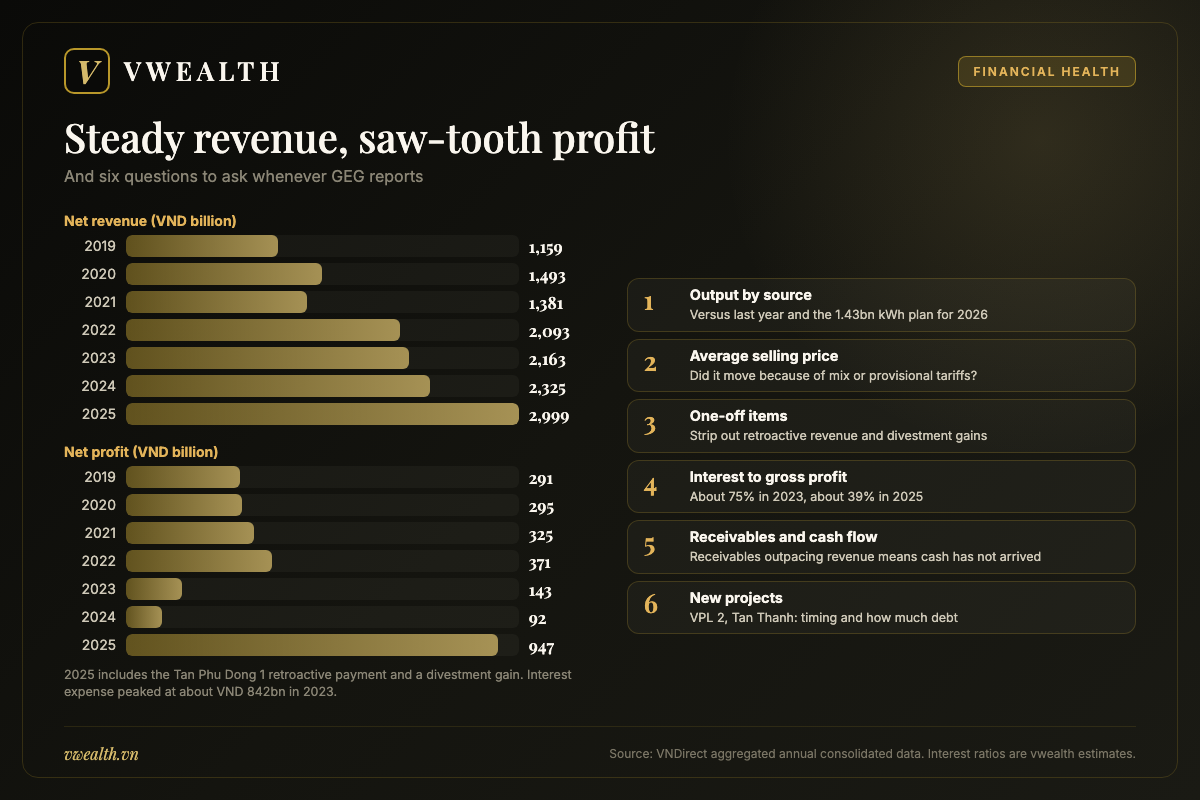
According to VNDirect’s aggregated consolidated data, GEG’s net revenue rose from about VND 1,159 billion in 2019 to about VND 2,999 billion in 2025 — roughly 2.6 times (a vwealth estimate). Revenue stepped up with each layer of new plants: 2019–2020 from solar, 2022 from FIT wind, 2023 from Tan Phu Dong 1, and 2025 from Tan Phu Dong 1’s official price.
Profit did not move in a straight line. Net profit was about VND 291 billion in 2019, 295 billion in 2020, 325 billion in 2021 and 371 billion in 2022, then fell to 143 billion in 2023 and 92 billion in 2024 before jumping to 947 billion in 2025. The 2023–2024 trough was not about revenue (which kept rising) but about cost of capital: interest expense rose from about VND 384 billion in 2021 to 842 billion in 2023, while depreciation climbed from about 414 billion to 697 billion. A wind farm starts consuming interest and depreciation on day one; if its tariff has not been set — as with Tan Phu Dong 1 — only half the revenue shows up.
A note on reading the data: you may see different figures for the same year in the press — for example, VND 304 billion for 2019 is pre-tax profit in VNDirect’s data, not net profit (291 billion). Gaps usually stem from definitions (pre- versus post-tax, consolidated versus parent). For exact figures, go to each year’s audited statements.
| Year | Net revenue | Gross profit | Interest expense | Net profit | Net profit to parent | Borrowings at year-end |
|---|---|---|---|---|---|---|
| 2019 | 1,159 | 650 | 245 | 291 | 251 | 3,897 |
| 2020 | 1,493 | 761 | 354 | 295 | 257 | 3,802 |
| 2021 | 1,381 | 767 | 384 | 325 | 283 | 7,103 |
| 2022 | 2,093 | 1,011 | 592 | 371 | 316 | 9,927 |
| 2023 | 2,163 | 1,121 | 842 | 143 | 137 | 10,097 |
| 2024 | 2,325 | 1,073 | 786 | 92 | 115 | 9,193 |
| 2025 | 2,999 | 1,714 | 665 | 947 | 709 | 8,343 |
Unit: VND billion. Source: VNDirect aggregated annual consolidated financial data; borrowings = short-term plus long-term borrowings and finance leases (summed by vwealth). Rounded.
2025: a record year and its one-off layers
Profit before tax in 2025 reached VND 979 billion against a plan of 777 billion; net profit was 947 billion and profit attributable to parent shareholders about 708–709 billion. Read carefully, the figure has three layers.
Layer one — the Tan Phu Dong 1 retroactive payment. About VND 397 billion of revenue for power generated in 2023–2024, recognised at once when the official price was set, plus a smaller retroactive amount for turbine A7 at the VPL project. Layer two — the Truong Phu Hydropower divestment gain. GEC reported a gain of about VND 110 billion at the 2026 AGM, while ACBS estimated about VND 144 billion; 2025 financial income reached VND 142 billion, up almost VND 104 billion year on year, mostly from this. Layer three — core profit. According to the company’s representative at the 2026 AGM as reported by Vietstock, excluding one-offs, 2025 profit before tax was about VND 455 billion. The 2026 profit-before-tax plan is VND 460 billion — flat against the core.
In other words, about half of 2025 pre-tax profit came from non-recurring items. If you value GEG on a P/E based on 2025 earnings, the stock will look artificially cheap. That is the most common trap in reading GEG, and it explains why first-half 2026 profit “fell 65%” while management still described the core business as stable: net revenue in H1 2026 was about VND 1,348 billion (down 22.4%), but electricity revenue before taxes and fees was about VND 1,314 billion, up 7%, according to Nha Dau tu, and output rose 2% to 616 million kWh.
Borrowings of about VND 8,300–8,400 billion: in dong or dollars, and from whom
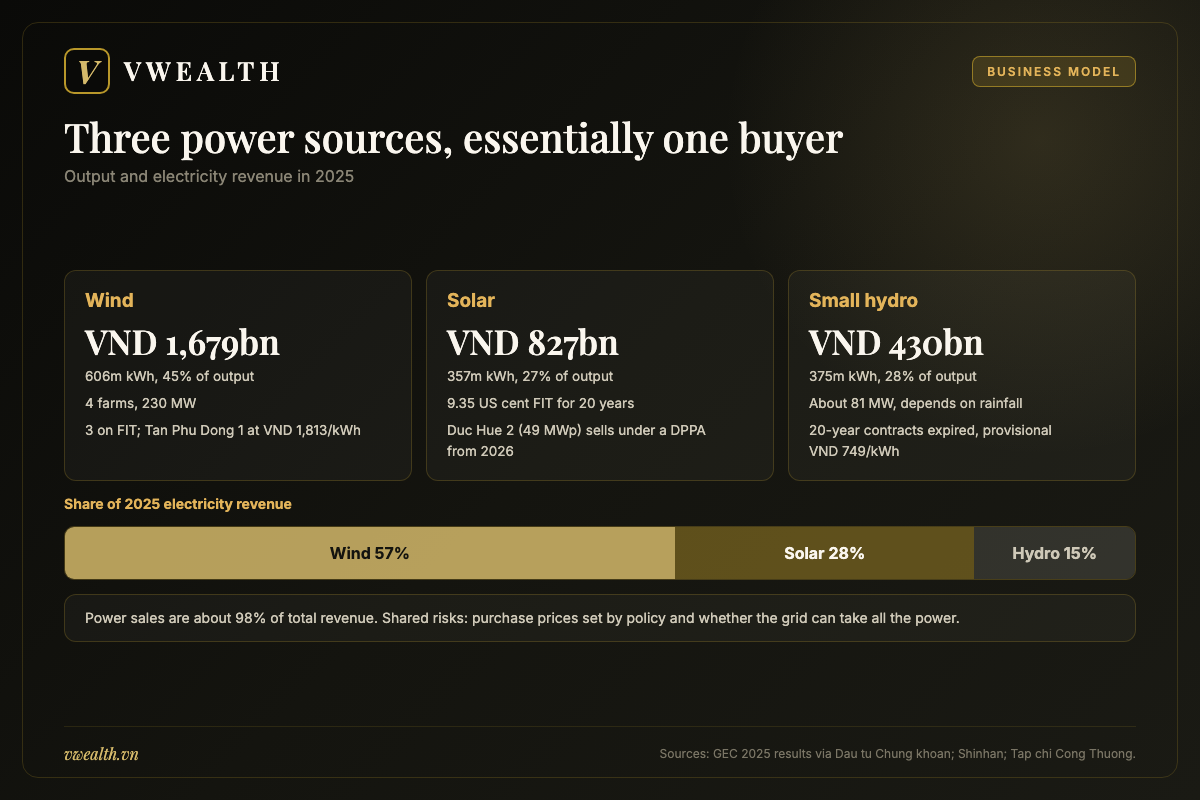
GEG’s debt peaked in 2023 at about VND 10,100 billion (vwealth’s sum of short- and long-term borrowings from VNDirect data). Since then it has fallen steadily: about VND 9,193 billion at end-2024, VND 8,343 billion at end-2025 according to GEC, and about VND 8,395 billion at the end of Q2 2026 — VND 741 billion short-term and VND 7,654 billion long-term — according to Nha Dau tu. Debt-to-equity was about 1.24 times at end-Q2 2026; at 31 March 2026 borrowings were about VND 8,176 billion, or roughly 54% of total assets (vwealth’s calculation from VNDirect quarterly data).
On currency, the CEO’s remarks at the 2026 AGM are the clearest clue: about 90% of borrowings come from state-owned commercial banks (the “Big 4”: Vietcombank, VietinBank, BIDV and Agribank), with an average 2025 rate of about 7.7–8% a year. At that rate, the bulk is almost certainly dong-denominated — dollar loans usually carry much lower rates. International funding includes DEG’s preference shares (now being bought back gradually) and a loan from Symbiotics (Switzerland), which was repaid in full during 2025 at VND 212 billion, according to the annual report. The company also has some domestic bonds, which it is repurchasing early on the schedule agreed with bondholders; in 2025 it paid more than VND 117 billion of bond principal and interest, according to Bao Phap luat Viet Nam. The implication for investors: GEG’s currency risk on debt is small, while its exposure to dong interest rates is large. Each 1 percentage point on roughly VND 8,300 billion of debt equals about VND 83 billion of annual interest — an illustrative vwealth example that ignores any fixed-rate portion.
On debt service capacity, the chart in GEC’s 2025 annual report shows interest coverage of 2.47 times in 2025, a clear improvement from about 1.23 times in the two previous years. The 2026 AGM documents put consolidated liabilities at 57% of total assets at end-2025, down from 62% in 2024, with a current ratio of 2.01 times. The trend is improving, but leverage remains high compared with most listed companies outside the power sector.
Interest and depreciation: the two costs that decide profit
Try a simple comparison with VNDirect data. In 2023 gross profit was about VND 1,121 billion and interest expense about 842 billion — interest equal to about 75% of gross profit. In 2024 the ratio was about 73%. In 2025, with gross profit up to 1,714 billion and interest down to 665 billion, it fell to about 39%. In H1 2026, according to Nha Dau tu, interest expense of VND 348 billion was equivalent to 48% of gross profit. (Ratios are vwealth estimates.)
This tells you the most important thing about GEG: shareholder profit is a thin residual between two large numbers. Gross profit at a power company is already after depreciation (about VND 800 billion a year in 2024–2025) — a non-cash charge reflecting wear on the assets. Then come interest, overheads and tax. A 10% fall in gross profit from a low-wind year, or a 1-point rise in interest rates, can cut net profit by a multiple of that. Q2 2026 is the example: revenue fell only 7% and gross profit 13%, but financial income dropped from VND 119 billion to 5.4 billion and interest rose from 164 billion to 183 billion, leaving quarterly net profit at only about VND 8 billion, according to Nha Dau tu.
The good news is that time is on the company’s side: project loans amortise on schedule, so interest cost tends to fall each year absent big new projects, and some old hydro plants will become fully depreciated, as Shinhan notes. The thing to watch is that each new project — VPL 2, Tan Thanh — restarts the cycle of “borrow heavily, pay high interest in the early years”.
Cash flow: high EBITDA margin, but watch receivables
GEG’s accounting profit is thin, but the cash its plants generate is much thicker, because depreciation is not a cash cost. In H1 2026, pre-tax profit of about VND 305 billion plus interest expense of VND 348 billion gives earnings before interest and tax (EBIT) of about VND 653 billion, an EBIT margin of about 48% of net revenue; adding about VND 404 billion of depreciation gives an EBITDA margin of about 78% (a vwealth estimate from Nha Dau tu figures and VNDirect quarterly data). According to VNDirect, net operating cash flow was about VND 1,063 billion in 2023, 913 billion in 2024 and 933 billion in 2025 — many times net profit in 2023–2024. That cash repays principal: in 2025 the company repaid about VND 1,278 billion of loans while drawing only about 439 billion of new debt, a net reduction of roughly 840 billion (a vwealth estimate from the aggregated cash flow statement).
The item to keep an eye on is trade receivables. At end-2024 they were about VND 415 billion; at end-2025 about 824 billion, nearly double (VNDirect data). Part of this may be the Tan Phu Dong 1 retroactive amount recognised but not yet fully collected; the 2025 annual report is where to confirm. At the 2026 AGM a shareholder asked directly about collecting power receivables from EVN; the CEO replied that the company had “not recorded a material impact” on operations from electricity payments and receivables management, but gave no specific payment timetable — so it remains a variable to track in quarterly reports. Cash and equivalents at end-2025 were only about VND 86 billion, plus about 335 billion of short-term financial investments — a thin liquidity cushion relative to annual debt repayments.
How to read it: if receivables keep rising while revenue is flat, power payments are arriving late — and for a company repaying more than VND 1,000 billion of principal a year, slow payment from the buyer is a direct risk. If receivables fall back to VND 400–500 billion in coming quarters, the retroactive cash has arrived.
Six questions to ask whenever GEG reports
1. Is output from each source up or down, and why? GEG publishes wind, solar and hydro output quarterly. Compare with the same period last year and with the annual plan (2026: 1.43 billion kWh total — wind 642 million, solar 449 million, hydro 341 million kWh). Weather-driven variation is normal; variation from curtailment or outages needs explaining.
2. Did the average selling price change? In Q1 2026 the average price was about VND 2,119/kWh, 4% lower year on year, according to CafeF citing ACBS. A lower price can reflect mix (more hydro) or provisional tariffs. The notes tell you which.
3. Are there one-off items? Retroactive revenue, divestment gains, provision reversals. Strip them out before comparing periods.
4. What is interest expense as a share of gross profit? Below 40% is comfortable; above 70% means very thin profit, as in 2023–2024.
5. Do receivables and operating cash flow move with profit or against it? Profit rising while receivables rise faster signals cash not yet received.
6. What are the timeline and funding of new projects? Does VPL 2 start in Q4 2026, does Tan Thanh break ground on schedule, how much debt funds each? Every new project raises debt before it raises profit.
How the market treats GEG stock: from sought-after “green energy” name to a stock waiting on tariffs
GEG stock has a clear personality: it reacts more to policy news on power prices than to individual quarters of earnings. When the market believes the renewable story, GEG is priced like a growth stock; when policy stalls, it is priced like an indebted company with thin margins. This chapter covers the price history, trading character and appropriate valuation lenses — no price target, just a framework for your own judgment.
Price milestones
2017 — UPCoM debut at VND 20,000 (unadjusted). Liquidity was almost nil, averaging about 8,300 shares a session for the year (a vwealth estimate from VNDirect data). 2019 — the solar fever. From about VND 14,900–15,100 in early January 2019, the stock reached VND 27,400 on 30 August 2019, a gain of about 80–85% (unadjusted, VNDirect data), just before the move to HOSE. 2021–2022 — peak and fall. The stock peaked at VND 28,400 on 9 March 2022 and fell to a low of VND 9,540 on 15 November 2022 (unadjusted, VNDirect data); on 8 December 2022 it closed at VND 12,950 — nearly 36% above the low but still about 50% below the peak, according to CafeF. This was a period of broad market correction combined with worries over wind projects that missed the FIT deadline.
2025 — a rally as Tan Phu Dong 1 got its price. News of the official tariff deal with EVN and a much higher profit plan lifted the shares: from a low of VND 11,200 on 14 January 2025, GEG reached VND 18,000 on 4 August 2025 and closed the year at VND 15,400 (unadjusted, VNDirect data). 2026 — back to waiting. On 8 May 2026 GEG closed at VND 14,300, the lowest since the start of the year, for a market capitalisation of about VND 5,123 billion according to CafeF. In late July 2026 it traded around VND 12,250, slightly up from about VND 11,700 on 22 July but some 25% below its March 2026 level — when it touched VND 17,150 on 25 March — according to Nha Dau tu and VNDirect data. These historical markers show the range of swings; for today’s price, check a live quote or the vwealth report.
Notably, brokers see GEG quite differently. In August 2026 ACBS (report dated 4 August) set a target of VND 17,500 (post-dividend) while VCBS set VND 13,800, according to Nha Dau tu; in May 2026 ACBS had a target of VND 18,400, according to CafeF. A gap of nearly 27% between two professional estimates shows how heavily GEG’s valuation depends on assumptions about tariffs, output and cost of capital — there is no single “right” number.
Trading character: thin free float, sensitive to policy news
As chapter two showed, about 78% of ordinary shares sit with two strategic groups. The real free float is thin, so liquidity is moderate: on 8 May 2026 about 480,000 shares changed hands in matched orders, according to CafeF. For individuals trading a few thousand to tens of thousands of shares this is not a problem; for institutions wanting to move millions of shares, entry and exit can move the price.
GEG also belongs to the “policy event” group. On days with news on tariff frameworks, the DPPA mechanism, FIT project reviews or transitional price negotiations, renewable stocks tend to move together. In July 2024 the government issued Decree 80/2024/ND-CP on the DPPA mechanism, opening the way for the contract Duc Hue 2 signed almost two years later. In August 2024, when reports emerged that investigators had asked EVN for documents on 32 projects, GEG shares fell by the daily limit on 13 August, according to CafeF. Knowing this helps you avoid panic on news-driven swings, and avoid chasing a single positive headline.
According to GEC’s 2025 annual report, the stock has been a member of the VN100 index and the VNSI20 sustainability index. Index membership brings flows from tracking ETFs, but with a thin free float the actual weights are usually small. Index constituents are reviewed periodically, so check the latest lists.
Foreign ownership: mostly JERA, the rest small
GEG’s foreign ownership looks very high, but as noted, most of it is one strategic holder — Jera Asia Vietnam Holdings with 35.1%. Two consequences follow. First, the foreign ownership “room” (Vietnam caps foreign holdings in many listed companies) left for other foreign funds is narrow: according to the 2026 AGM documents, foreign ownership at end-2025 was 46.30% (including DEG’s preference shares) against a 50% cap tied to national energy security rules; check the remaining room before counting on foreign inflows. Second, if JERA ever adjusts its stake, it would be a large negotiated block trade — the kind of event that can reshape the register in a single session, as when IFC transferred 13.74% on 7 December 2022.
For a contrast in how state-controlled generators are held and traded, see our POW (PV Power) stock analysis: a generator controlled by the state energy group, with a fleet dominated by gas and coal-fired plants.
Valuing a renewable generator: why 2025 P/E misleads
There are three ways to look at GEG’s valuation, each answering a different question.
P/E (price to earnings). The most popular but least suitable for GEG. 2025 earnings were inflated by one-offs worth about half of pre-tax profit; 2023–2024 earnings were depressed by Tan Phu Dong 1’s provisional price. If you use P/E, use “core” earnings — for instance around the VND 380 billion net profit plan for 2026 — and remember that profit attributable to parent shareholders is lower still, since minority interests in subsidiaries such as GHC take their share.
EV/EBITDA (enterprise value to earnings before interest, tax, depreciation and amortisation). Better suited to capital-intensive businesses. EV adds net debt to market capitalisation — and at GEG, borrowings above VND 8,000 billion may exceed the market cap itself. In other words, buying GEG shares means buying the equity slice “behind” a large block of debt; every change in plant value hits equity value several times over. That leverage works both ways. For more on how Vietnamese stocks are typically valued and where these multiples sit versus the region, see our piece on Vietnam stock market valuation.
Project-by-project discounted cash flow (DCF). The approach brokers usually take: each plant is a stream of cash flows to the end of its contract, discounted to today. It exposes the crucial assumptions: whether FIT contracts are honoured for the full 20 years, what hydro earns after contract expiry, and whether new projects earn an IRR above the cost of capital. Most of the gap between ACBS’s and VCBS’s targets comes from these assumptions.
What about P/B (price to book)? GEG’s book value is mostly plants built at historical cost less depreciation. It is a reference point, but a plant’s real value depends on its tariff more than on what it cost. A VND 4,464 billion wind farm selling at half the ceiling price is worth something very different from the same farm selling at VND 1,813/kWh. To see updated valuation ratios for GEG against its peers, you can create a vwealth account and open the report for this ticker.
Catalysts the market tends to react to
Tariff agreements. Tan Phu Dong 1 in 2025 is the clearest example. Next up is the official price for small hydro plants whose 20-year contracts expired — a similar catalyst whose direction is still unknown. New project milestones. VPL 2 in Q4 2026, Tan Thanh groundbreaking, Tan Phuoc 1. Seasonality. Q4 and Q1 are strong wind quarters, Q3 is weak; the market often prices the season in advance. Interest rates. With over VND 8,000 billion of debt, any signal on lending rates affects profit expectations. Sector policy. DPPA decree amendments, outcomes of FIT project reviews, transmission build-out. Major-holder and DEG actions. TTC sales, changes in JERA’s stake, or DEG’s conversion decision.
Industry context: dependent on power purchase prices and the transmission grid
If one sentence sums up GEG’s risk and opportunity, it is this: a pure-play renewable generator depends on two things it does not control — the price its buyer is willing to pay, and whether the grid will take all the power it produces. This chapter does not retell the full FIT saga — our HDG (Ha Do Group) stock analysis covers the FIT-to-transitional-price story from the angle of a company with two engines. Here we focus on what matters most to a company with no second engine, like GEG.
From FIT to transitional prices, auctions and DPPAs: four generations of power pricing
Renewable pricing in Vietnam can be split into four generations, and GEG’s portfolio contains all four. Generation one — avoided cost tariffs for small hydro, tied to long-term contracts that are now expiring. Generation two — FIT for solar (2017–2020) and wind (to 31 October 2021), fixed for 20 years in US cents. Generation three — transitional prices for projects built but too late for FIT, negotiated within a framework set by the Ministry of Industry and Trade, like Tan Phu Dong 1 at VND 1,813/kWh. Generation four — market mechanisms: auctions, new generation price frameworks and DPPAs like Duc Hue 2.
Each generation pays less than the one before. Asked at the 2026 AGM about the returns of new projects under current frameworks, GEG’s leaders acknowledged that today’s price frameworks are lower than the old FIT, so the investor’s task is to make projects work at those prices, according to Vietstock. For shareholders, that means each new megawatt will contribute less profit than each old FIT megawatt, and profit growth must come from lower capex, better operation, storage and DPPA customers — not from subsidised tariffs.
Curtailment: when the plant can run but the grid will not take the power
Curtailment is when a renewable plant could generate — the sun is shining, the wind is blowing — but the system operator orders it to reduce output because transmission lines are congested or the system has surplus power at that moment. A hydro plant with a reservoir can hold water for later; for solar and wind, curtailed electricity is simply lost. Revenue disappears while interest and depreciation keep running.
Vietnam learned this lesson in 2020–2021. A large amount of solar capacity came online in a short period thanks to FIT, while transmission lagged and many plants in project-dense areas had to cut output. In essence, solar output peaks at midday while system demand peaks in the late afternoon and early evening; if renewables keep growing without balancing solutions, curtailment could recur.
For GEG, this risk comes with concrete numbers. According to management’s report in the 2026 AGM documents, revenue lost to capacity curtailment, maintenance stoppages and incidents in 2025 equalled 4.5% of achievable revenue, up from 3.7% in 2024; the five solar farms lost more than 7.7%, wind about 3.9%. The documents also describe late October to early November 2025, when floods led the system to prioritise hydro: over 18 days, wind nationwide was dispatched at only about 19% of capacity on average, with cuts of up to 99% in some places. GEG’s 2025 electricity output and revenue therefore reached only 97% of plan (excluding retroactive revenue), about 35 million kWh short. Beyond those figures, there are three things to track yourself. First, GEG’s solar farms sit in high-irradiation zones — often the same zones crowded with projects, where congestion risk is higher. Second, on 19 July 2026 the Gia Lai provincial government wrote to the Prime Minister asking for help with transmission bottlenecks and power evacuation, according to Lao Dong newspaper — a sign that grid capacity in the area remains a bottleneck. Third, Duc Hue 2’s integrated BESS is the company’s direct answer: batteries let it store midday power for peak hours, reducing wasted output.
How to read it in the numbers: if solar output falls in a quarter while irradiation was normal, or is well below installed capacity times sunshine hours, curtailment may be a cause. Look for it in the results release or ask at the shareholders’ meeting.
FIT reviews and EVN payments: contract risk
The second risk is that old contracts are reopened. As noted in chapter three, from early 2025 EVN’s Electric Power Trading Company proposed provisional prices for projects recognised for COD before obtaining acceptance approval, and investors objected that this breached their power purchase agreements, according to VietNamNet. In February 2026 the Ministry of Industry and Trade asked 15 provinces to review and, where applicable, sanction 167 solar projects in this group.
For GEG, this article has no information to confirm whether any plant is or is not on those lists. But the nature of the risk is clear: a FIT plant’s value lies entirely in its 20-year price contract. If part of a contract is adjusted, revenue and asset value fall accordingly, while the loans used to build the plant must still be repaid in full. Tan Phu Dong 1’s own experience in 2023–2024 — a provisional price at half the ceiling while interest ran in full — illustrates how quickly pricing policy can spill into financial strain.
Power Development Plan VIII, storage, demand and the weather
The positive side of the sector picture is demand. According to MBS, electricity consumption in the first eight months of 2026 rose 9.7% year on year, with demand from digital infrastructure, manufacturing and foreign-invested factories rising. The revised Power Development Plan VIII (PDP8, Decision 768/QD-TTg of 2025) for the first time gives battery storage a prominent role, targeting about 10,000–16,300 MW of BESS and at least about 2,400 MW of pumped-storage hydro by 2030. The government has also kept refining the rules for DPPAs and rooftop solar — Decree 243/2026/ND-CP of 26 June 2026 amended Decrees 57 and 58 of 2025. A Ministry of Industry and Trade survey at the end of 2023 found about 20 large companies wanting to buy power directly, with combined demand of nearly 1,000 MW, according to VnExpress.
The other side is weather — the variable nobody controls. According to MBS, El Niño formed from June 2026 and rainfall was lower than a year earlier; hydro dispatch in July–August 2026 fell about 13% year on year. MBS forecast GEG’s Q3 2026 net profit at about VND 71 billion, down 5%, with Duc Hue 2’s contribution partly offsetting lower hydro. For GEG, El Niño usually cuts both ways: less rain hurts hydro, while more sunshine can help solar. The multi-source portfolio is the cushion for years like that.
GEG alongside other listed power companies
Comparison shows how GEG differs from other “power stocks”. The table describes characteristics; it does not rank them.
| Company | Main power sources | Non-power businesses | How it differs from GEG |
|---|---|---|---|
| GEG (Gia Lai Electricity) | Wind, solar, small hydro | Almost none (power sales about 98% of revenue) | — |
| REE | Large hydro, wind, solar | M&E contracting, clean water, office leasing, real estate | Several income engines, large reservoir hydro |
| HDG (Ha Do) | Hydro, solar, wind | Real estate, leasing, hotels | Two engines: power and property |
| PC1 | Hydro, wind | Power construction, nickel mining, real estate | Construction is a large share |
| POW (PV Power) | Gas, coal, hydro | Limited | State-controlled, competes in wholesale market |
| GHC (Gia Lai Hydropower) | Small hydro, solar | None | GEG subsidiary, separately listed |
Read our PC1 stock analysis to see a power company using construction as a second engine. What GEG shares with the group is dependence on weather and pricing policy; what sets it apart is that it has almost no other income to lean on when power gets tough. That “purity” is exactly what some investors want — buying GEG means buying the Vietnamese renewable story straight — and exactly the concentration others want to avoid.
Outlook: three scenarios for GEG stock and what would trigger each
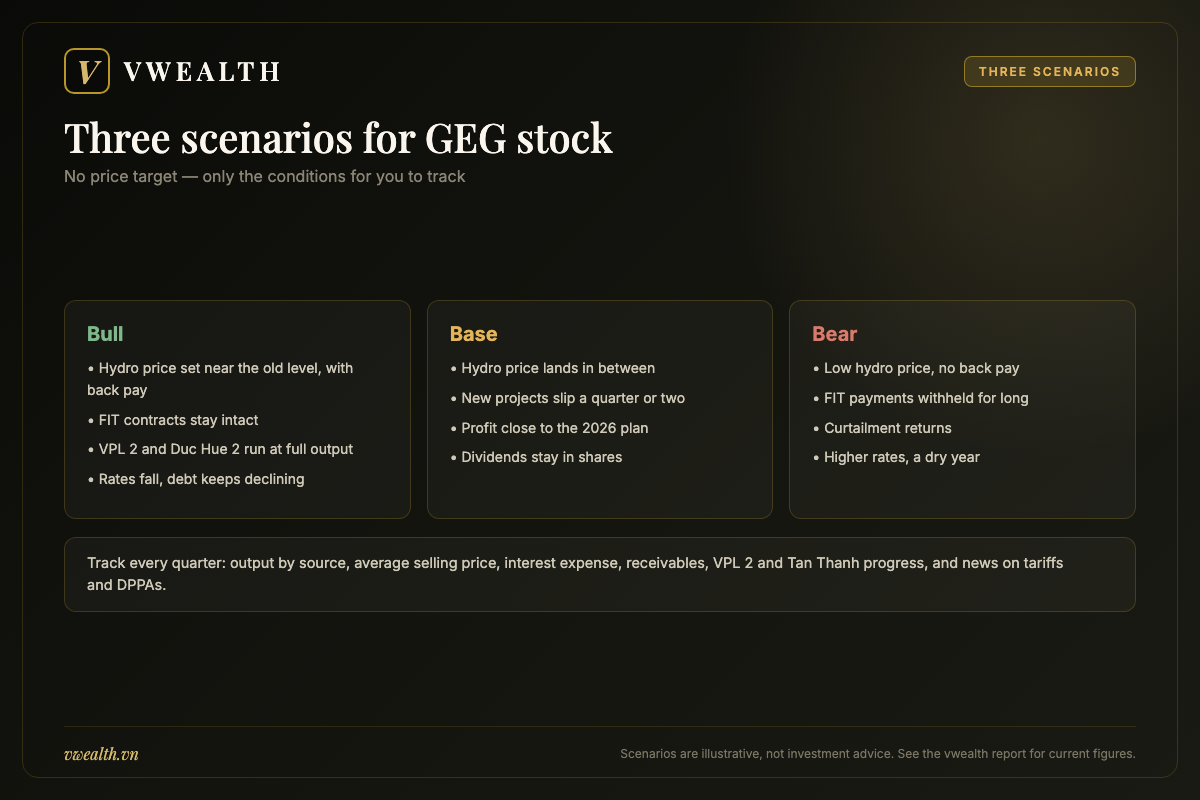
Nobody knows where GEG’s share price will go, and this analysis offers no price target. Instead, this chapter identifies the decisive variables and builds three scenarios with the conditions under which each would unfold. The goal is to help you know what to watch, so that when news arrives you can tell which way the story is leaning.
Six variables that will shape GEG’s future
1. Prices for the “unsettled” sources. Most important are the official price for the small hydro plants whose 20-year contracts expired (currently provisional at VND 749/kWh) and the actual price of the Duc Hue 2 DPPA. 2. The stability of FIT contracts. The outcome of sector-wide FIT reviews and how withheld payments are handled. 3. Transmission and curtailment. Progress on new lines, the system’s absorption capacity, storage. 4. Interest rates. With about VND 8,300–8,400 billion of debt, mostly from state banks. 5. Weather. El Niño, La Niña, the monsoon. 6. Capital discipline as the company expands. Tan Thanh — 100 MW and VND 4,700 billion — is the biggest project since Tan Phu Dong 1; how GEG funds it (how much debt, how much equity, under which sales mechanism) will decide whether shareholders gain or take on extra risk.
Bull case: favourable tariffs, projects on time, lower rates
Conditions: the official hydro price is set near the old avoided cost level, with retroactive payment; existing FIT contracts remain intact; VPL 2 starts in Q4 2026 and Duc Hue 2 runs a full year in 2027 at about 70 million kWh as VCBS estimates; Tan Thanh breaks ground on time with a sensible capital structure and a clear offtake contract; lending rates ease as the CEO hoped at the 2026 AGM; the weather cooperates.
In that world, core profit rises gradually as new volume arrives and interest cost falls with scheduled repayments; debt keeps declining and debt-to-EBITDA improves; the company might consider cash dividends. The market could re-rate GEG as a renewable platform with DPPA customers — a story few listed companies can tell. A risk even in the good case: for any preference shares not yet bought back, a higher share price gives DEG reason to convert, diluting ordinary holders; if the company keeps buying them back for cash, as in December 2025, dilution risk falls but cash is used up.
Base case: controlled sideways movement
Conditions: the hydro price lands somewhere in between; FIT contracts are not materially changed; new projects slip by a quarter or two; rates are flat or slightly higher; average weather. This is close to the company’s own plan: revenue around VND 3,100 billion, profit before tax around VND 460 billion, dividends in shares.
In this scenario profit does not boom, but steady cash from the operating portfolio — Shinhan counted about 672 MW in 2025, before Duc Hue 2 — is enough to service debt on schedule. The shares would probably swing with seasons and policy headlines rather than trend clearly. Investors holding through this scenario mainly capture value from debt reduction — each year a slice of enterprise value shifts from lenders to shareholders — rather than from profit growth.
Bear case: unfavourable tariffs, grid congestion, higher rates
Conditions: the official hydro price comes in well below the old level with no retroactive payment; parts of FIT contracts are adjusted or payments are withheld for long periods; curtailment returns as system-wide solar grows faster than the grid; interest rates rise; a dry or low-wind year; new projects overrun budgets or schedules.
Then the “thin residual” structure shows: a gross profit drop of a few tens of percent could push net profit close to break-even, as in Q3 2024, while more than VND 1,000 billion of annual principal repayments does not shrink. The company might have to slow investment, refinance or raise more equity. For shareholders, this is the scenario in which leverage makes losses larger than the decline in operating profit.
Illustrative example: how one tariff can change a whole year of profit
To see how much the purchase price matters, take Tan Phu Dong 1 as an illustration, using simple vwealth assumptions. Shinhan estimated the project’s revenue would rise from about VND 250 billion to VND 500 billion a year at the new price; dividing VND 500 billion by VND 1,813/kWh implies output of about 276 million kWh a year (a vwealth assumption). At the official price, a year at that output brings in about VND 500 billion. At the provisional VND 907.975/kWh — exactly 50% of the ceiling, applied from May 2023 to February 2025 — it brings in only about VND 250 billion. The difference — about VND 250 billion a year — is roughly 2.7 times GEG’s entire 2024 net profit (VND 92 billion).
Continue the arithmetic: the project borrowed about VND 3,125 billion. At 8% a year on the full original balance (a simplification that ignores repayments), interest would be about VND 250 billion a year. So at the provisional price, the project’s revenue barely covered interest, before depreciation and operating costs; at the official price, it is profitable. And if curtailment removed 5% of output, revenue would fall by about VND 25 billion a year at the official price. All of this is an illustrative example, not the project’s actual figures — real output depends on each year’s wind and the actual loan balance declines on schedule — but it shows why GEG is a business that “lives on the power purchase price”.
So, should you buy GEG stock? Weighing the pros and cons
After seven chapters, the original question still has no single “yes” or “no” for everyone — and that is how it should be. GEG stock suits some investors and not others. This final chapter pulls together the strengths and weaknesses and helps you place yourself in the right group.
The compelling positives
A diversified, operating renewable portfolio. Wind, solar and hydro across several regions partly offset weather risk. Most capacity is built, with no construction risk left. Long-term FIT contracts for most wind and solar output, at prices new projects cannot get. Tan Phu Dong 1 now has an official price, removing the biggest bottleneck of 2023–2024. A DPPA pioneer. Duc Hue 2 is the first project operating a DPPA through the national grid, with Samsung as customer — an experience advantage as the green power market for foreign manufacturers grows. Debt is falling. From a peak of about VND 10,100 billion in 2023 to about 8,300–8,400 billion; interest expense in 2025 was below 2023. Strong strategic shareholders. JERA is one of the world’s largest energy companies; DEG and international loans such as Symbiotics (repaid in 2025) show access to funding beyond domestic banks. Systematic disclosure, with output and revenue by source published regularly.
The negatives you cannot ignore
Dependence on purchase prices and one main buyer. Most revenue comes from EVN under policy-set pricing; the post-contract hydro price and sector-wide FIT reviews are unknowns. Dependence on the grid. Curtailment could return if renewables outpace transmission. High leverage, thin profit. Interest once consumed about three-quarters of gross profit; one bad year can push profit toward break-even. 2025 profit will not repeat. About half of 2025 pre-tax profit was one-off. Dividends mostly in shares, with gradual dilution, plus potential dilution from the portion of DEG’s preference shares not yet bought back. Thin free float, with major holders steering decisions. Sector legal news. Four wind projects were on the list of documents investigators asked EVN to provide in 2024; the reports cited draw no conclusion about the company, but it is information investors should follow through official channels.
| Aspect | Pros | Cons |
|---|---|---|
| Revenue | Long-term contracts, output predictable by season | Prices set by policy; one main buyer |
| Profit | High EBITDA margin (about 78% in H1 2026) | Heavy interest and depreciation; one-offs distort the numbers |
| Balance sheet | Debt down from the 2023 peak; mostly dong loans from large banks | Borrowings still above VND 8,000bn; thin cash |
| Growth | DPPA, storage, VPL 2, Tan Thanh, Tan Phuoc 1 | New price frameworks below FIT; new projects need more debt |
| Shareholders | JERA and TTC committed long term | Free float about 21.7%; dilution from share dividends and DEG shares not yet bought back |
| Macro | Rising power demand; foreign manufacturers need green power | Grid congestion, El Niño, interest rates |
Who GEG stock suits
Investors who want a “pure” renewable power stock. If you believe in Vietnam’s energy transition and want a ticker that reflects that story without real estate or construction mixed in, GEG is one of the few options on the exchange. Patient followers of policy. GEG’s value unlocks one tariff agreement at a time; investors willing to read decrees and quarterly output releases have an information edge. Investors who accept volatility and think in years. Quarterly profit can swing sharply with seasons and one-offs; over a multi-year horizon — as debt falls and new projects start — the picture is steadier. Investors seeking diversification through an asset whose cash flows are tied to power contracts, with low correlation to consumer or banking stocks. For foreign investors, it also offers exposure to Vietnam’s electricity demand growth without buying a state-controlled utility.
Who it does not suit
Investors who need regular cash dividends. In recent years GEG has mostly paid dividends in shares. Investors who cannot stomach policy risk. A single document on power prices can change a whole year’s outlook. Investors who look only at P/E. With earnings distorted by one-offs and high leverage, a plain P/E easily leads to the wrong conclusion. Traders moving large volumes who need deep liquidity, given the thin free float.
Final thoughts
Gia Lai Electricity has come a long way: from a state company running a few small hydro plants in 1989, through the FIT boom, the wind race to the 2021 deadline and the years when interest ate almost all the profit, to a record 2025 and Vietnam’s first operational DPPA in 2026. Through all of it, one thing has not changed: GEG makes electricity well, but the value of that electricity is decided by the purchase price and the transmission grid.
So, should you buy GEG stock? If you want a stock that reflects the Vietnamese renewable energy story directly, accept leverage and policy risk, and are willing to track tariffs, output and debt every quarter, GEG deserves a place on your research list. If you need cash dividends, smooth earnings, or would rather not depend on regulators’ decisions, other Vietnam stocks may fit better — our guide on how to invest in the Vietnam stock market covers the wider menu. Whichever way you lean, start with current numbers: latest quarterly output, average selling price, interest expense, receivables and VPL 2 progress. You can create a vwealth account to read the GEG report with up-to-date figures and compare it with other power companies.
Research Vietnamese stocks in English with vwealth. Our AI-powered platform turns Vietnamese market data into full English analysis reports — with international payment support and a free 2-month trial for new accounts. Create your free account and read the latest reports.


