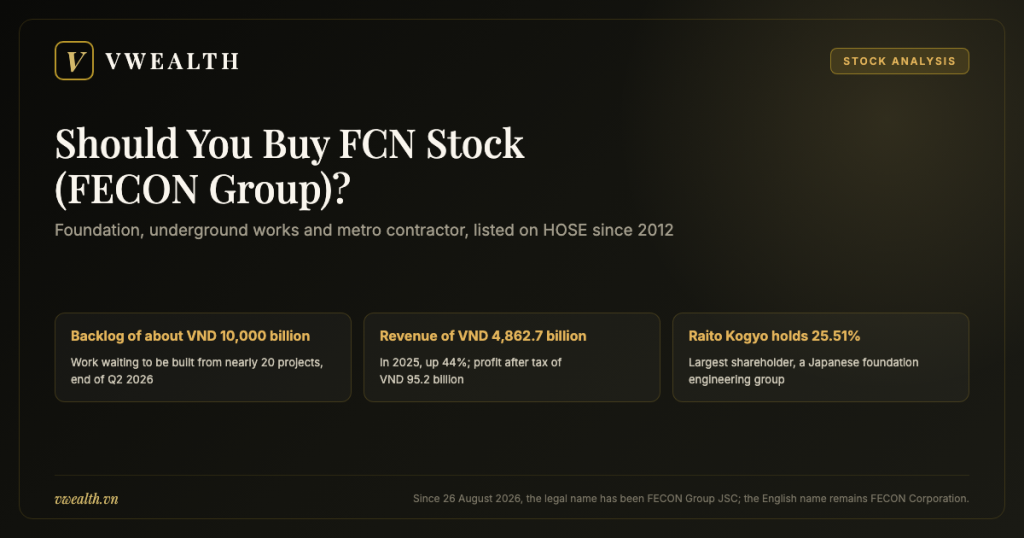
Should I buy FCN stock? It is a hard question to answer if all you look at is one strong quarter or one metro contract worth trillions of dong. FCN is the ticker of FECON Group JSC on the Ho Chi Minh City Stock Exchange (HOSE), and its story begins in 2004, when a small group of foundation engineers with a few billion dong in capital chose to specialise in the part of construction that few Vietnamese builders treated as a core trade: everything below ground level. Twenty-two years later, the same team operates its own tunnel boring robots beneath Hanoi, holds a backlog of roughly VND 10,000 billion in work waiting to be built, and formally became a “Group” on 26 August 2026. Yet this is also a company that has missed its profit plan seven years in a row, carries more than VND 4,000 billion in borrowings and had to call its annual shareholders’ meeting twice before enough votes turned up. This analysis peels back the layers — history, people, the money-making machine and financial health — so you can judge for yourself whether FCN fits your portfolio.
Before the story, a few conventions. FCN is the stock code of the business that people in the industry simply call FECON. Since 26 August 2026 the legal entity has been FECON Group JSC (renamed from FECON JSC on 26 August 2026; English name FECON Corporation) — in Vietnamese, Cong ty Co phan Tap doan FECON — and its English trading name remains FECON Corporation. The shares have a par value of VND 10,000, have been listed on HOSE since 24 July 2012, and the charter capital currently stands at VND 1,574.4 billion, equivalent to 157,439,005 shares. Figures in this article come from the company’s 2025 annual report, shareholder resolutions and meeting minutes, FECON’s regulatory disclosures, VNDirect financial data and Vietnamese financial media. Closed fiscal years are used as historical markers. Numbers that change every day — the share price, market capitalisation, today’s P/E ratio — are deliberately left out; for live figures, open the latest vwealth research reports. Wherever a number is our own calculation, we label it “vwealth estimate”.
If you are new to Vietnamese equities, a few mechanics are worth knowing before you read on. HOSE is the country’s main board, where most large and mid-sized companies trade; daily price moves there are capped at ±7%, trades settle on a T+2 basis, and every listed company has a foreign ownership limit that can matter for overseas funds. Our guide on how to invest in the Vietnam stock market walks through account opening and these rules step by step. On vwealth, FCN sits in the construction and infrastructure group, alongside contractors such as Coteccons, whose story you can read in our analysis of CTD stock (Coteccons).
Here, though, we focus on one contractor that “goes underground”. To answer whether you should buy FCN stock, the central question of this whole analysis is this: can FECON turn its record backlog into cash — fast enough to service its debt and absorb a large new share issue — before Vietnam’s metro cycle really reaches its peak from 2027 onward?
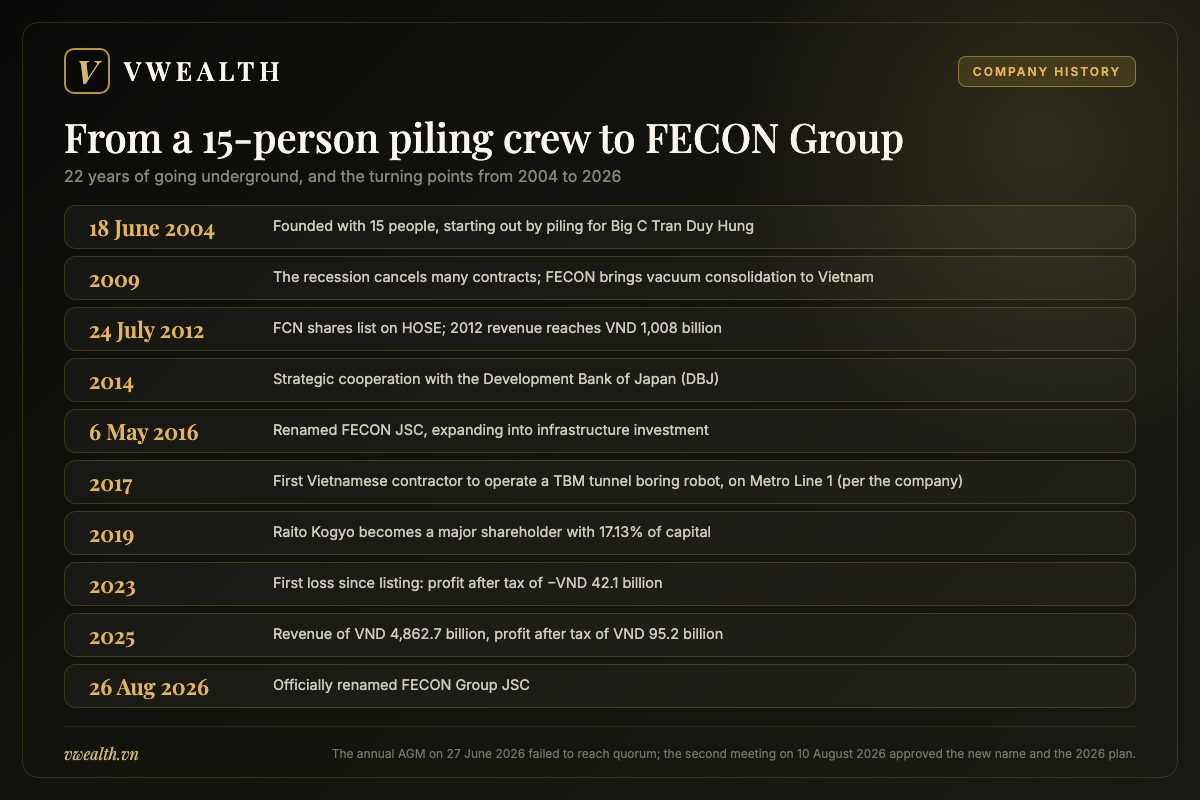
From a 15-person piling crew to “FECON Group”: 22 years of going underground
There is a curious paradox in construction: the most important part of any building is the part nobody sees. You can admire the facade of a shopping mall, photograph a railway station or count the floors of a tower — but almost nobody asks how many piles hold it up or how the soft ground beneath was treated. FECON’s story begins exactly in that hidden space. Understanding the path the company has travelled — from a piling crew to a metro tunnelling contractor — helps you read today’s numbers correctly: why FECON is so proud of its technology, why it borrows so much, and why one strong quarter may not be the whole story.
2004: a group of engineers spots a gap in foundations
On 18 June 2004, FECON Foundation Engineering and Underground Construction JSC was founded in Hanoi. According to the company’s own history page, the entire business started with around 15 people — counting everyone from the managers to the workers and even the security guard. Starting capital was only a few billion dong. That long, technical-sounding name actually said everything about the founders’ ambition: they did not want to be a general “construction contractor”; they wanted to be specialists in foundations and underground works.
Why choose such a narrow niche? Mr Pham Viet Khoa, the founder and Chairman of the Board of Directors, once explained in an article in Nhan Dan newspaper that Vietnamese construction companies at the time were strong at building what stands above ground but had little deep understanding of foundations, whereas his group came from a geotechnical background and therefore chose a specialised field to do really well. Think of it as a specialist clinic opening in a market full of general hospitals: smaller in scale, but if its expertise runs deep enough, the big hospitals end up hiring it.
FECON’s first project was piling for the Big C Tran Duy Hung hypermarket in Hanoi. Then came Melinh Plaza and a building known as Metro 2 Hanoi. First-year sales, according to Nhan Dan, were around VND 5 billion. That figure is so small that today it would barely cover a minor work item inside a single FECON contract — but it shows just how modest the starting point really was.
One detail is worth remembering. Just two years later, from 2006, FECON began winning projects from foreign investors, mostly Japanese companies. For a two-year-old foundation contractor, landing Japanese clients so early was both a mark of technical credibility and the first thread in a relationship with Japanese partners that you will meet again and again in this article.
2008–2012: a pile factory, vacuum consolidation and surviving 2009
If you want to grow in the foundation business, sooner or later you have to make your own piles. In 2008, FECON commissioned production line No. 1 at its pile factory in Ha Nam province, with a capacity of 3,000 metres of piles per day. In 2011, line No. 2 added another 5,000 metres per day. Making its own piles gave the company control over its main material, helped it keep schedules when supply was tight, and created an extra revenue stream from selling piles to other contractors. But it also marked the first time FECON put serious money into fixed assets — an investment habit that would repeat itself.
Then came 2009. According to the company’s history page, the economic downturn caused many FECON contracts to be cancelled or delayed. For a five-year-old business living mainly on construction contracts, a cancelled contract means idle machines and idle crews while fixed costs keep running. The way out FECON chose was technology: in the second half of 2009, the company introduced vacuum consolidation, a soft-ground treatment method, to Vietnam.
Put simply, vacuum consolidation “sucks” water out of weak soil layers using vacuum pressure so that the ground settles in advance and firms up, instead of piling on thousands of cubic metres of sand and waiting a very long time. On muddy riverside and coastal land — exactly where power plants, ports and chemical depots tend to be built — this is an extremely practical problem. Thanks to the technology, FECON won projects such as the Nhon Trach 2 thermal power plant, PVtex Dinh Vu and the Thi Vai LPG depot. The first lesson of FECON’s history is therefore very clear: when the market shrinks, what keeps a business alive is not a cheap price but the ability to do something others cannot yet do.
In February 2010, FECON set up the Foundation and Underground Engineering Institute. According to the company, it was the first research institute housed inside a construction business in Vietnam. You do not need to treat that as a trophy; what matters is the priority it reveals. Even in difficult years, the company chose to fund a unit dedicated to research and testing technical solutions rather than simply chasing volume. For investors, this is the root of what later sections call FECON’s technology “moat”.
Listing on HOSE on 24 July 2012 and the trillion-dong revenue milestone
2012 was the year FECON made its debut in the capital markets. On 27 June 2012, according to the company, FECON became the first Vietnamese business to join the International Tunnelling and Underground Space Association (ITA-AITES) as a corporate member — the body that brings together tunnelling professionals from around the world. Less than a month later, on 24 July 2012, FCN shares officially listed on HOSE.
That same year, FECON’s net revenue reached VND 1,008 billion and profit after tax VND 100.1 billion, according to VNDirect annual financial data. Set that next to roughly VND 5 billion in sales in 2004 and the business had grown about two hundredfold in just eight years (vwealth estimate, for illustration only). That is the pace of a company that picked the right niche: as described above, during this period FECON kept winning shopping centres, power plants, industrial factories and LPG depots — every one of which needs somebody to take care of the ground beneath it.
The listing matters to today’s shareholders in two ways. First, FECON gained a source of equity funding alongside bank loans — a channel it would tap many times, from convertible bonds to rights issues for existing shareholders. Second, from 2012 onward every business plan, and every miss or beat against that plan, was made public in front of thousands of shareholders. Chapter 4 will show that this very transparency exposes a long-running weakness: the gap between plan and results.
Japanese investors arrive: DBJ in 2014, Raito Kogyo in 2019
The relationship with Japanese clients that began in 2006 gradually turned into a relationship with Japanese shareholders. On 13 June 2014, FECON signed a strategic cooperation agreement with the Development Bank of Japan (DBJ). A fund managed by DBJ invested about VND 195 billion in convertible bonds that FECON issued in 2014. A convertible bond is a loan whose lender has the right to swap it into shares later — a way for an investor to earn fixed interest while keeping a “ticket” to become a shareholder if the business does well.
Also in 2014, FECON began expanding beyond foundations: it made strategic investments in TEDI and CIENCO1, took a stake in the BOT project for the National Highway 1 bypass around Phu Ly city, and rolled out an SAP-ERP management system. In 2015, the company built soil-cement columns using Jet Grouting technology with a 3.2-metre diameter on Ho Chi Minh City’s Metro Line 1. On 6 May 2016, the business was renamed FECON JSC (FECON Corporation), dropping “foundation engineering and underground construction” from its name to open the way into transport infrastructure, urban-environmental projects and energy.
The biggest shareholder turning point came in 2019. On 4 April 2019, FECON signed a comprehensive strategic cooperation agreement with Raito Kogyo, a Japanese foundation engineering company. On 28 May 2019, according to Bao Dau tu (Investment Newspaper), Raito Kogyo officially became a major shareholder with more than 19.5 million shares, or 17.13% of capital, by taking over the convertible bonds previously held by DBJ’s JSEAG fund and converting them into shares. In other words, the “ticket” DBJ bought in 2014 was passed on to a strategic investor from the same trade. According to the 2025 annual report, Raito Kogyo now holds 40,167,682 shares, or about 25.51% of charter capital (vwealth estimate: 40,167,682 divided by 157,439,005 shares) — making it FECON’s largest shareholder.
Why does this matter? A strategic shareholder from the same industry brings more than money: it brings technology, processes and credibility with project owners funded by Japanese capital. Chapters 2 and 3 look more closely at Raito Kogyo’s role, from its Vice Chairman seat on the board to the ground-improvement technologies transferred through a joint venture.
TBM robots, metro lines and the first loss in 2023
Nhan Dan newspaper recorded one remark by Mr Pham Viet Khoa that sums up FECON’s ambition for more than a decade: “Vietnam will have to build metros sooner or later. Why shouldn’t FECON be the first company to do it?” In 2017, according to the company, FECON became the first Vietnamese contractor to operate a TBM (tunnel boring machine — a giant machine that excavates soil and installs the tunnel lining as it goes) on Ho Chi Minh City’s Metro Line 1.
The next step came on Hanoi’s Metro Line 3, Nhon – Hanoi Station. On package CP03, FECON built the tunnel section from Voi Phuc to Tran Hung Dao, assembling and operating the TBM itself. According to CafeF, FECON completed 4 km of tunnel with the TBM and handled foundation treatment for all of the line’s underground stations and ventilation shafts. For a company that once only drove piles for hypermarkets, this was a huge leap: Vietnamese engineers at the controls of a boring machine beneath the capital, instead of watching foreign contractors do the job.
In the same period, FECON also tried its hand at energy. The Vinh Hao 6 solar power project (50 MWp, with planned investment of VND 1,361 billion) completed its legal procedures to start construction in 2018 and was sold in 2022. The proceeds from that sale helped prop up 2022 results — and their absence is exactly what made 2023 a sad milestone.
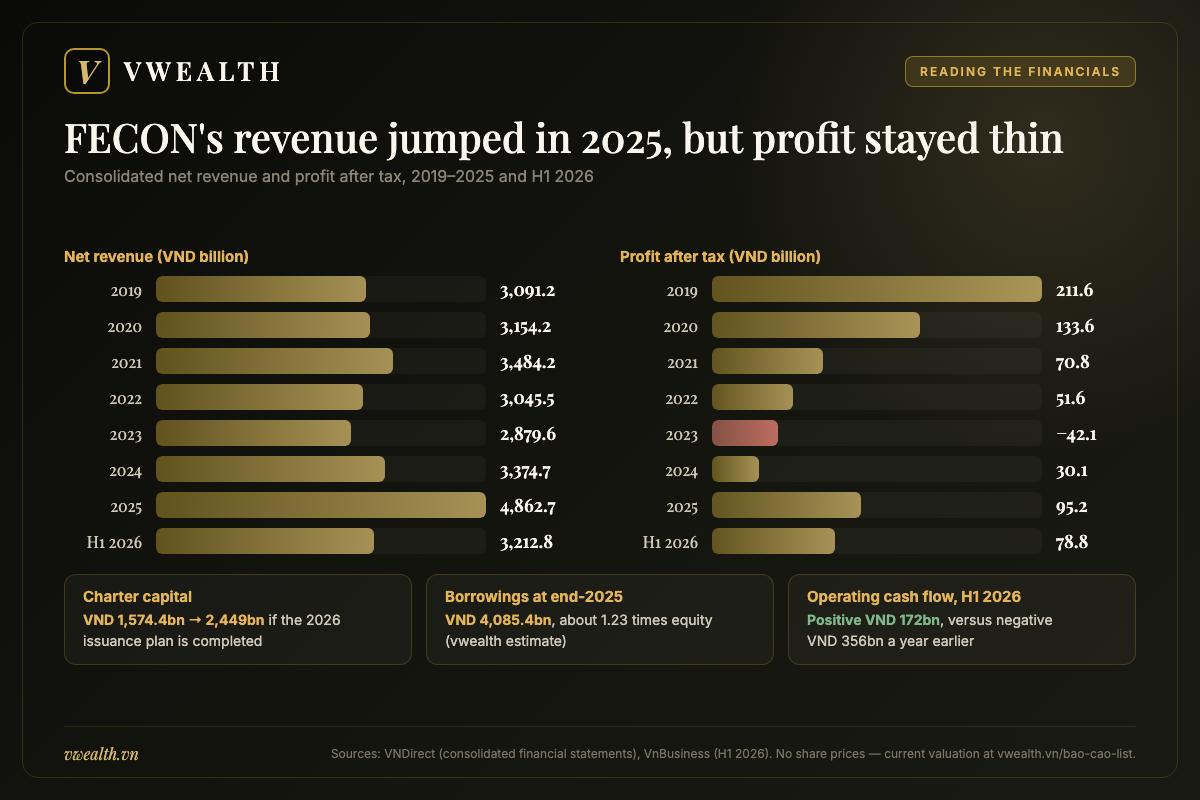
In 2023, for the first time since listing, FECON reported a loss: profit after tax was negative VND 42.1 billion on revenue of VND 2,879.6 billion. CafeF quoted the company’s explanation: there was no longer any revenue from the sale of Vinh Hao 6, while interest expenses rose. These two causes are worth remembering because they are the two threads running through this entire article: FECON’s profit is sensitive to one-off gains from selling projects, and it is sensitive to interest rates. In 2024 the company returned to profit with VND 30.1 billion; in 2025 revenue grew 44% to VND 4,862.7 billion and profit after tax reached VND 95.2 billion — up 216%, yet still only 48% of the VND 200 billion target that shareholders had set for that year.
2026: a new “Group” name, two shareholder meetings and a profit surge
If you had to pick a single year that shows both FECON’s strengths and its weaknesses, it would be 2026. On 27 June 2026, the first attempt at the annual general meeting (AGM) failed because shareholders representing only 29.626% of shares attended, according to Vietstock — the first time FCN had ever failed to hold its annual meeting. In Vietnam, an AGM needs a minimum share of voting capital present to be valid, otherwise it has to be reconvened. On 10 August 2026, the second meeting went ahead and approved three major items: renaming the company “FECON Group”, the 2026 business plan, and a plan to issue about 87.5 million new shares.
The renaming was legally completed very quickly. Under disclosure No. 364/2026/CV-TCKT.FECON dated 27 August 2026, FECON received its 35th amended Enterprise Registration Certificate, pursuant to Resolution No. 01/2026/NQ-DHDCD dated 10 August 2026. From 26 August 2026, the legal name is FECON Group JSC (Cong ty Co phan Tap doan FECON); the English name remains FECON Corporation, abbreviated FECON CORP. The ticker FCN is unchanged, the enterprise code is still 0101502599, and the head office is still on the 15th floor of CEO Tower, Pham Hung Street, Tu Liem Ward, Hanoi. This is the second name change in ten years: from “Foundation Engineering and Underground Construction” (2004) to “FECON JSC” (2016), and now “FECON Group” (2026). Each new name has widened the scope of ambition by another notch.
Meanwhile, business results in the second half of the year began to brighten. According to CafeF’s compilation of third-quarter 2026 financial statements, FECON’s pre-tax profit for Q3 reached VND 131 billion, up 442% year on year; nine-month pre-tax profit reached VND 239 billion, up 351%. We do not yet have Q3 revenue or Q3 profit after tax from a verified source, so this article uses only the pre-tax profit figure. You can see the full updated numbers in the latest report on vwealth.
Those three events — a meeting short of shareholders, the “Group” name and a big profit quarter — placed side by side form the question the following chapters answer in turn: does FECON’s ambition come with the ability to turn work into cash, and do shareholders have enough confidence to keep travelling with it?
| Year | Milestone | Why it matters to shareholders today |
|---|---|---|
| 18 June 2004 | FECON Foundation Engineering and Underground Construction JSC founded; first project piling for Big C Tran Duy Hung; first-year sales about VND 5 billion | The core trade is foundations — the skill base for every later business line |
| 2006 | Starts winning projects from foreign investors, mostly Japanese | Beginning of the relationship with Japanese clients and partners |
| 2008 / 2011 | Ha Nam pile factory: line 1 (3,000 m/day), line 2 (5,000 m/day) | Control over the main material; first large investment in fixed assets |
| 2009 | Downturn, many contracts cancelled; vacuum consolidation introduced to Vietnam | Precedent: technology helps the business survive a bad cycle |
| February 2010 | Foundation and Underground Engineering Institute established | Foundation of the technical edge |
| 24 July 2012 | FCN shares listed on HOSE; 2012 revenue reaches VND 1,008 billion | Equity funding channel opens; business plans become public |
| 13 June 2014 | Strategic cooperation with DBJ; a DBJ fund buys about VND 195 billion of convertible bonds | Groundwork for Japanese shareholders |
| 6 May 2016 | Renamed FECON JSC (FECON Corporation) | Expansion into infrastructure, urban and energy investment |
| 2017 | Operates a TBM on Ho Chi Minh City Metro Line 1 | Entry into metro tunnelling |
| 2019 | Raito Kogyo becomes a major shareholder (17.13%); now about 25.51% | Strategic shareholder from the same trade, source of technology |
| 2023 | Net loss of VND 42.1 billion — the first since listing | Exposes sensitivity to interest costs and project-sale gains |
| 2025 | Revenue VND 4,862.7 billion (+44%), profit after tax VND 95.2 billion, 48% of plan | Scale grows fast, profit has not kept up |
| 27 June and 10 August 2026 | First AGM fails to reach quorum; second approves new name, 2026 plan and issue of ~87.5 million shares | Dispersed shareholder base; large potential dilution |
| 26 August 2026 | New legal name: FECON Group JSC | Positioned as an infrastructure “group”, ticker FCN unchanged |
| Q3 2026 | Pre-tax profit VND 131 billion (+442%); nine months VND 239 billion (+351%) | Profit rising sharply, must be read alongside cash flow (Chapter 4) |
A founder, a Japanese anchor shareholder and an AGM that had to meet twice
For a construction company, the question of “who runs it and who owns it” matters more than you might think. Contracts last years, cash comes in slowly and borrowings are large — so the quality of management’s decisions and the patience of major shareholders go a long way toward deciding the fate of the stock. FECON’s ownership picture has a distinctive shape: the founder still sits in the Chairman’s seat, the largest shareholder is a Japanese company from the same trade, and most of the remaining shares are scattered among nearly fifteen thousand small holders.
Pham Viet Khoa: from foundation engineer at LICOGI 20 and TEDI to founder
Mr Pham Viet Khoa was born in 1973 in Y Yen district, Nam Dinh province. According to a profile published by Dan Viet newspaper in 2021, he holds two master’s degrees: one in Business Administration and one in Foundations and Underground Engineering. Before founding FECON, he worked in two places, both tied to foundation work: from 1994 to 1998 he was head of a foundation construction and testing team at LICOGI 20, and from 1999 to June 2003 he was in charge of foundation engineering at TEDI, a design consultancy. About a year after leaving TEDI, he and his colleagues founded FECON.
That background explains a great deal about FECON. Someone who has led a site crew understands the construction site; someone who has worked in design consulting understands drawings and how project owners make decisions. Combining the two, Mr Khoa built FECON as an “engineering first, commercial second” business: research the solution, win the client over with a technical proposal, and only then build. It is no surprise, then, that in 2014 FECON chose to make a strategic investment in TEDI — the very firm where its founder used to work.
Mr Khoa holds the Chairman’s seat for the 2024–2029 term and is the face of the company in front of shareholders, from explaining business plans to answering questions about major projects. In 2024 he said FECON was confident it had the capability to take part in the North–South high-speed railway project, according to CafeF. As for his personal shareholding, the sources we were able to check were all old and did not agree with one another, so this article does not give a specific figure; you can look up the latest list of insider shareholders in the corporate governance reports that FECON publishes periodically.
Raito Kogyo: largest shareholder and technology partner
Raito Kogyo is a Japanese company listed on the Tokyo Stock Exchange since 1979, with about 70 years in the foundation business. According to Bao Dau tu, in 2018 Raito Kogyo reported consolidated revenue of USD 910 million, profit of USD 81 million and 1,016 employees. In other words, this is an “older sibling” in the foundation trade, not a financial fund that buys only to sell.
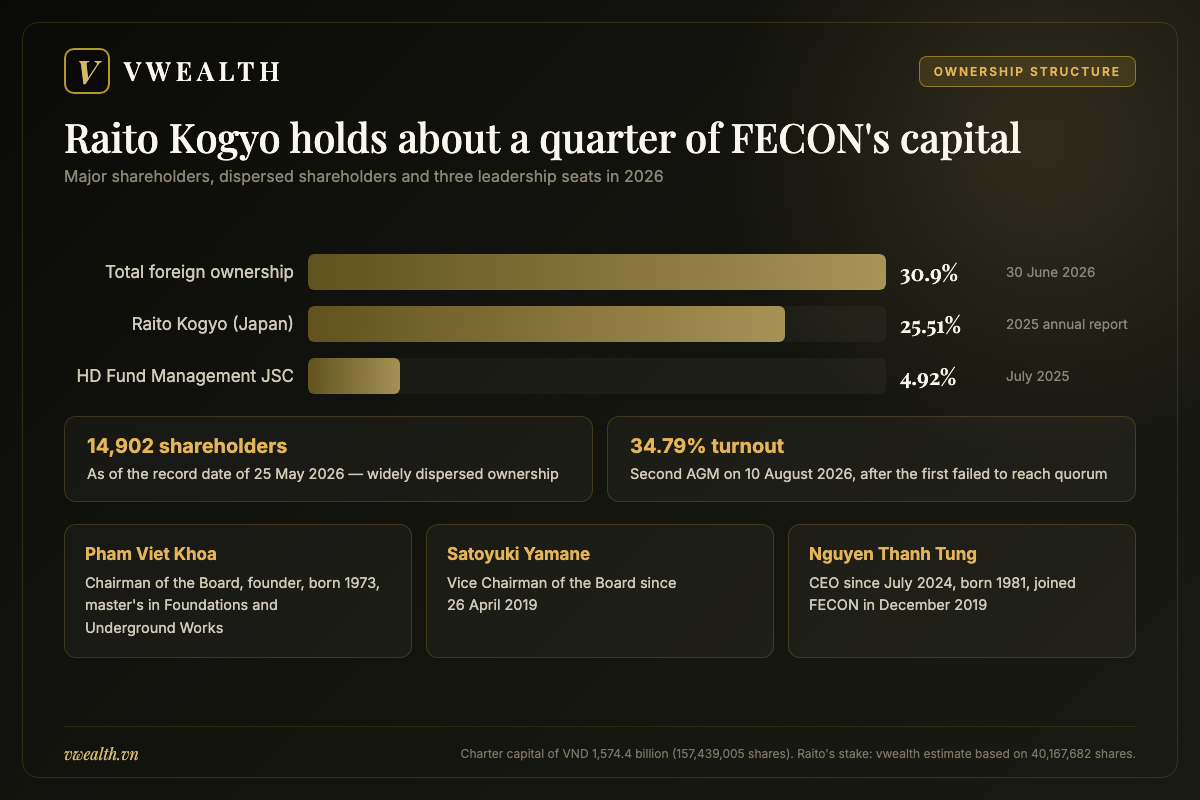
From 17.13% in 2019, Raito Kogyo’s stake has grown to 40,167,682 shares, or about 25.51% of charter capital according to the 2025 annual report (the percentage is a vwealth estimate based on a total of 157,439,005 shares). In a company where most of the remaining shares are spread among thousands of small investors, a block of more than a quarter of the capital held by one shareholder is the largest voting bloc at every general meeting. So on big issues such as share issues or changes in strategy, Raito Kogyo’s view is something minority shareholders should watch closely.
Raito Kogyo’s influence is not limited to its votes. Mr Satoyuki Yamane has been Vice Chairman of FECON’s board since 26 April 2019 — the same month FECON signed its comprehensive strategic cooperation agreement with Raito Kogyo. On the technical side, ground-improvement technologies such as RAS Column, CDM (cement deep mixing), Jet Grouting and Chemical grouting were brought into Vietnam through the FECON RAITO joint venture; RAS Column was used for the first time in Vietnam at berths 5–6 of Lach Huyen port, according to Nhan Dan. According to Bao Dau tu, Raito Kogyo also committed to holding 36% of FECON Underground Construction JSC (FCU), the FECON-branded unit specialising in underground works.
You should read this relationship in both directions. The positive side: a strategic shareholder from the same industry has an interest tied to long-term performance, and brings technology and credibility to projects funded by Japanese ODA (official development assistance). The side to monitor: a shareholder this large makes its own decision on whether to take part in capital raisings — and that directly affects the success of the share issue analysed in Chapter 5.
The board and management team in 2026
According to the corporate governance report for the first half of 2026, the Board of Directors for the 2024–2029 term consists of: Mr Pham Viet Khoa (Chairman); Mr Tran Trong Thang (Standing Vice Chairman, with FECON since its founding on 18 June 2004); Mr Satoyuki Yamane (Vice Chairman); Mr Nguyen Van Thanh; and two independent members, Mr Nguyen Huu Thai Hoa and Mr Ha Cuu Long. Another member, Mr Nguyen Tran Dang Phuoc, resigned with effect from 11 July 2025 and was formally dismissed by the 2026 AGM.
The meeting on 10 August 2026 elected Mr Tran Quoc Viet as an additional board member. Mr Viet, born in 1972, holds a PhD in Business Administration from the National Economics University, served as CEO of Ecopark from 2018 to 2023 and as Deputy CEO of Kinh Do from 2004 to 2015. For a company pushing harder into industrial parks, urban areas and social housing, adding someone who has run an urban development business to the board is a detail worth noting — although its real effect can only be measured through the results of future projects.
At the executive level, Mr Nguyen Thanh Tung has been CEO since July 2024, replacing Mr Nguyen Van Thanh, who held the post for nearly six years and remains on the board. Mr Tung, born in 1981, holds an MBA from the University of Hawaii at Manoa (Shidler College of Business) and spent 14 years at companies such as Vamed (Austria), CIMAS, AA and Hawee before joining FECON in December 2019, according to Mekong ASEAN. From 2 July 2026, Mr Bui Mon Bach was appointed Deputy CEO; he has been with FECON since 2007 and is currently CEO of FECON Pile and Construction JSC and Chairman of FECON South.
One governance detail should be recorded objectively: HOSE issued a written reminder to FECON for late disclosure of a board membership change that took effect on 10 August 2026 but was announced on 12 August 2026, according to Doanh nhan – Bao Phap luat. This was a breach of the disclosure deadline, not a problem with the substance; but for shareholders, timely disclosure is a small yardstick of governance discipline that you can track over time.
| Position | Person | Notes from sources |
|---|---|---|
| Chairman of the Board | Pham Viet Khoa | Founder; born 1973; foundation work at LICOGI 20 and TEDI |
| Standing Vice Chairman | Tran Trong Thang | With the company since its founding on 18 June 2004 |
| Vice Chairman | Satoyuki Yamane | Vice Chairman since 26 April 2019 |
| Board member | Nguyen Van Thanh | Former CEO for nearly 6 years |
| Independent members | Nguyen Huu Thai Hoa; Ha Cuu Long | Two independent seats |
| Member elected 10 August 2026 | Tran Quoc Viet | Former CEO of Ecopark, 2018–2023 |
| Chief Executive Officer | Nguyen Thanh Tung | Since July 2024; joined FECON in December 2019 |
| Deputy CEO | Bui Mon Bach | Since 2 July 2026; with FECON since 2007 |
14,902 shareholders and the lesson of a 29.6% turnout
As of the record date of 25 May 2026, FECON had 14,902 shareholders representing 157.44 million shares, according to CafeLand. That is a highly dispersed ownership structure: apart from Raito Kogyo, VNDirect data shows HD Fund Management JSC holding 7,742,800 shares (4.92%) as of 15 July 2025, and total foreign ownership at about 30.9% of capital as of 30 June 2026. Most of the rest belongs to individual investors and small institutions.
That structure had a very concrete consequence in 2026. The first annual meeting on 27 June 2026 was attended by shareholders representing only 29.626% of shares, short of the minimum needed to proceed. According to Vietstock, Mr Pham Viet Khoa explained that the shareholder base is dispersed, construction stocks had not yet attracted investor interest, and some major shareholders had said in advance that they would not attend. The second meeting on 10 August 2026 was attended by shareholders representing 34.7935% of voting shares, according to the minutes, and all items were approved.
What does a turnout of about 35% tell you? It suggests that most FCN shareholders do not follow the company closely, or do not treat voting as a priority. The consequence cuts both ways. On one hand, big decisions — including a plan to issue tens of millions of new shares — are settled by the small group of shareholders who actually show up. On the other, that indifference is itself a signal of how much attention the market was paying to this stock at the time. If you hold or plan to buy FCN, reading the AGM documents yourself and exercising your vote is the simplest way to give your voice real weight.
Dividends: paid late, paid small, then paused
If you are looking for a steady dividend payer, FCN’s track record will give you pause. According to corporate action data from VNDirect and CafeF, the cash dividend for 2020 was 3%, paid in November 2021; for 2021 it was 3%, paid in September 2022. In Vietnam, dividends are quoted as a percentage of the VND 10,000 par value, so the 4% instalment below equals VND 400 per share. The dividend for 2022 was split into two instalments: 1% paid in February 2024 and 4% (VND 400 per share) paid on 30 December 2025, with a record date of 18 December 2025 and a total payout of about VND 63 billion. In other words, most of the dividend for fiscal 2022 reached shareholders at the end of 2025 — roughly three years late.
The company made a loss in 2023, so no dividend was paid for that year. For 2024, the board once proposed a maximum of 5% in cash, according to Mekong ASEAN. For 2025, according to Doanh nhan – Bao Phap luat, FECON paid no dividend, allocated just over VND 1 billion to its bonus and welfare fund and retained more than VND 62 billion of undistributed profit after tax. For 2026, according to Vietstock, the company plans again to pay no cash dividend in order to keep resources for projects and its capital needs in 2027.
Set this against the strategic targets for the 2024–2029 term approved by the 2023 AGM — revenue growth of at least 15% a year, a net profit margin of at least 5% and an expected dividend of 10% a year — and you can see a wide gap between ambition and reality. Take 2025 as an illustrative example: profit after tax of VND 95.2 billion on revenue of VND 4,862.7 billion works out to a margin of about 2% (vwealth estimate), less than half of the 5% target. With FCN, dividends are not currently a reason to buy; if anything, they are a distant reward for a successful turnaround.
| Shareholder / group | Shares | Stake | Data date |
|---|---|---|---|
| Raito Kogyo (Japan) | 40,167,682 | ~25.51% (vwealth estimate) | 2025 annual report |
| HD Fund Management JSC | 7,742,800 | 4.92% | 15 July 2025 (VNDirect) |
| Total foreign ownership | — | ~30.9% | 30 June 2026 (VNDirect) |
| Total number of shareholders | 14,902 shareholders | 157.44 million shares | Record date 25 May 2026 |
| Turnout at first AGM | — | 29.626% | 27 June 2026 (quorum not met) |
| Turnout at second AGM | — | 34.7935% | 10 August 2026 (approved) |
One caution when reading this table: the percentages were captured at different dates, so they cannot simply be added together. The 30.9% foreign ownership figure already includes Raito Kogyo’s stake, because it is a foreign investor. For the most recent list of major shareholders, check the governance reports and major-shareholder trading notices that FECON publishes on its website.
How FECON makes money below ground
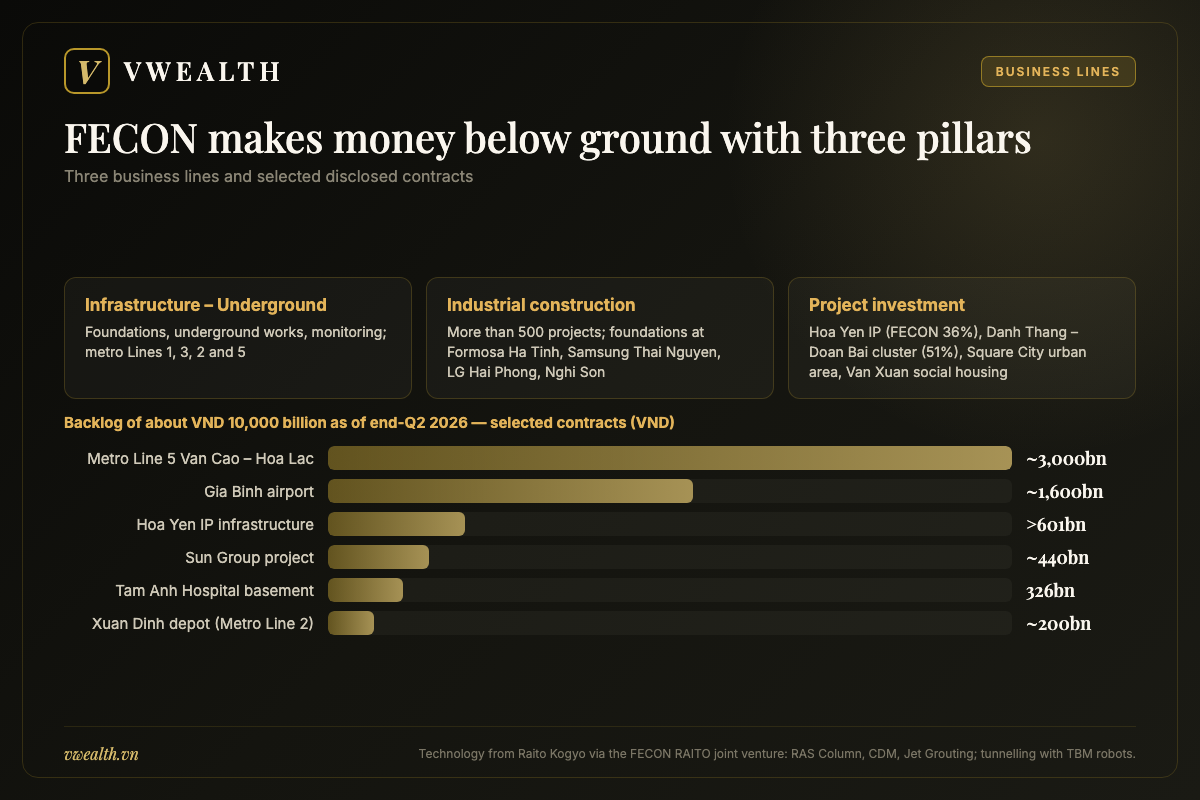
To judge a construction stock, you have to answer a deceptively simple question: what does this company sell, to whom, and why do clients hire it instead of someone else? For FECON, the answer has two layers. The first is construction — the part that generates most of the revenue. According to the 2025 annual report, the construction business covers industrial construction (heavy industry, energy and light industry) and Infrastructure – Underground construction (infrastructure, foundations, underground works and monitoring). The second layer is project investment: transport infrastructure, industrial parks, urban areas and energy. The company describes its three strategic pillars as Infrastructure – Underground Construction, Industrial Construction and Project Investment.
These two layers feed each other in a clear logic: construction generates cash flow and technical capability, while project investment uses that same capability to create assets with higher margins. But they also compete for each other’s capital — and that is where you need to look carefully in Chapter 4.
Foundations: the original trade, across more than 500 projects
According to the company profile on VNDirect, FECON has taken part in more than 500 projects and has been the lead foundation contractor on some of Vietnam’s largest industrial projects: Formosa Ha Tinh, Samsung Thai Nguyen, LG Hai Phong and the Nghi Son refinery and petrochemical complex. The list stands out not only for its scale but for its clients: foreign groups building factories in Vietnam usually set very high technical and schedule requirements for the foundations, because uneven settlement of just a few centimetres can cause trouble for an entire production line above.
Foundation work has two features that interest investors. First, it comes early: foundations are always built first, so when a new wave of factories or infrastructure begins, foundation contractors are the first to get the work. Second, it requires specialised equipment and geotechnical experience, so there are not many contractors capable of handling large projects. The Ha Nam pile factory that FECON built in 2008 also serves this business line, keeping the company in control of piles for its own sites.
The flip side is that foundation work is tightly tied to the cycle. When factory investment slows, as in 2009 described in Chapter 1, foundation contracts are the first to be cancelled or postponed. So the original trade gives FECON skill and reputation, but it does not give the company a stable revenue stream through every phase of the cycle.
Underground works and metro: Lines 1, 3, 2 and 5
This is the business that shapes FECON’s public image. After Ho Chi Minh City Metro Line 1 (Jet Grouting in 2015, TBM operation in 2017) and Hanoi Metro Line 3, Nhon – Hanoi Station (4 km of tunnel completed by TBM, plus foundation treatment for all underground stations and ventilation shafts), FECON is now present on two new Hanoi lines.
Line 2, Nam Thang Long – Tran Hung Dao, has a total investment of VND 35,679 billion funded by Japanese ODA through JICA (the Japan International Cooperation Agency). Construction started on 9 October 2025, with completion expected in 2029. According to CafeF and Bao Dau tu, FECON won the project’s first construction package: ground treatment for the Xuan Dinh depot, worth about VND 200 billion, with a 499-day execution period. A depot is where trains are parked and maintained — a large plot of land whose ground must be reinforced before rails and workshops can be laid.
Line 5, Van Cao – Hoa Lac, is much bigger: a total investment of more than VND 72,000 billion and a length of about 39.58 km, with construction starting at the end of 2025. In May 2026, FECON signed a contract worth about VND 3,000 billion within the EPC package of component project 2, taking on TBM tunnelling for sections S4–S5 and S5–S6 and the underground ramp, in partnership with China’s Pacific Construction Group. According to Vietstock, in the first half of 2026 FECON signed about 50% of the underground scope of Line 5, and expects to sign additional variation work as well as underground packages in Ho Chi Minh City.
A contract of about VND 3,000 billion is worth placing next to FECON’s full-year 2025 revenue of VND 4,862.7 billion: one metro contract is equivalent to roughly 60% of a year’s revenue (vwealth estimate). But metro lines are multi-year projects where revenue is recognised according to construction progress, so a contract signed today is “released” into revenue gradually — and according to guidance the company has shared, the metro business is expected to reach its peak contribution from 2027.
Airports, ports and hospitals: the VND 10,000 billion backlog
In construction, “backlog” means the value of contracts signed but not yet completed — the volume of work waiting to be turned into revenue. According to CafeF, by the end of Q2 2026 FECON had a backlog of about VND 10,000 billion from nearly 20 projects, spanning metro, airports, ports, industrial parks, hospitals, housing and factories. To get a sense of the pace, compare that with the end of 2025, when Agriseco put FECON’s backlog at nearly VND 4,000 billion, according to CafeLand. The two figures come from different sources, so read them only as a trend — but the trend is clear: the work pipeline grew sharply within half a year.
In Q2 2026 alone, FECON signed more than VND 3,600 billion of new contracts, according to CafeF. Most came from Gia Binh airport: packages totalling nearly VND 1,600 billion in the quarter, including the airside technical infrastructure package worth more than VND 1,000 billion. The rest formed a fairly varied list: about VND 440 billion on a Sun Group project, VND 326 billion for the basement of Tam Anh Hospital in Ho Chi Minh City, more than VND 300 billion on the Hancinco Nguyen Xien project and about VND 290 billion on the Thu Thiem Administrative Centre.
Earlier, in February 2025, the CC1 – Coteccons – FECON consortium won package 11.5, the “Car Park”, within component project 3 of Long Thanh International Airport, priced at nearly VND 3,144 billion over 16 months, according to CafeF. That is the value for the whole consortium, not FECON’s own share. In addition, at the Hoa Phat – Long An port, FECON treated soft ground using RAS technology.
The takeaway from this list: FECON has moved well beyond its image as a “piling contractor”. It now takes on airside infrastructure packages, hospital basements and administrative-centre infrastructure. Diversifying like this reduces dependence on one type of client, but it also pulls FECON into packages where many contractors compete. Chapter 4 shows that FECON’s gross margin hovered around 14% in both 2019 and 2025, and was lower in some quarters — so more work does not necessarily come with a matching rise in profit.
Industrial and energy construction
The second of the three pillars is industrial construction, in which energy plays a large part. According to Nhan Dan, FECON has worked on the Thai Binh 1 and 2, Nghi Son 1 and 2, Long Phu 1, Vinh Tan 4, Nhon Trach 3 and 4 and Vung Ang 2 thermal power plants; the Hoa Phat Dung Quat 2 project; and 10 wind power projects in 2020–2022. Power plants are classic clients for ground-improvement specialists: they usually sit on coastal or riverside land with weak soil, and they house extremely heavy equipment that needs very solid foundations.
Looking ahead, according to Vietstock, FECON continues to pursue the O Mon 4 power project and nearshore and offshore wind projects, while studying bids for LNG-to-power projects. At the same time, the company plans to divest or transfer the energy projects it has invested in — a direction consistent with the Vinh Hao 6 story of 2022 and with the need to reduce debt discussed in Chapter 4. In other words, in energy, FECON wants to be a contractor more than a long-term owner.
If you are interested in stocks that benefit from infrastructure and energy investment, our analysis of VCG stock (Vinaconex) gives you a view of a larger general contractor in the same sector, which you can set against FECON’s “deep specialist in foundations and underground works” model.
Project investment: industrial parks, urban areas and social housing
The third pillar is where FECON acts as the developer rather than the contractor. This business has the potential for higher margins, but it also ties up capital for the longest time. According to the 2025 annual report and press coverage, the current portfolio includes:
FECON IP Hoa Yen Industrial Park (Bac Ninh): 256.68 ha, with investment of more than VND 3,700 billion; FECON owns 36%. Construction started in April 2026, and sales (leasing of industrial land) are expected to begin from the end of 2026; FECON has also won the infrastructure construction package worth more than VND 601 billion. According to Vietstock, industrial parks are the growth driver for 2026–2027, and some tenants have already paid deposits. This is a textbook example of the two business layers feeding each other: FECON is both a shareholder in the developer and the contractor building its infrastructure. To understand how an industrial park company earns money from land leases, you can read our analysis of IDC stock (IDICO).
Danh Thang – Doan Bai Industrial Cluster (Bac Ninh): FECON holds 51%. According to Bao Dau tu, in the first half of 2026 the company transferred VND 486.3 billion from construction in progress to tangible fixed assets — a sign the project has moved into a stage where it can be operated.
Square City urban area (Pho Yen, Thai Nguyen): under construction and on sale. Within the Nam Thai – FECON Square City area is the Van Xuan social housing project, with total investment of more than VND 1,223 billion on about 2.1 ha, comprising around 910 social housing units and 247 commercial units, to be carried out from Q2 2026 to Q3 2029. According to Bao Dau tu and Nguoi Quan sat, revenue from property sales and transfers in the first half of 2026 reached VND 116.7 billion, more than 2.3 times the same period a year earlier.
Projects in development: a 218-ha urban area in Hung Yen with expected total investment of about VND 16,000 billion, whose 1/500 detailed plan has been approved; and an 82-ha eco-tourism area in Cao Bang for which the company is looking for a buyer. In energy, the planned 2023 sale of the Quoc Vinh Soc Trang project fell through and the company is still looking for a way to transfer it, according to VietnamFinance.
You should see the investment business as a “warehouse of assets” not yet turned into cash. If FECON sells industrial land, sells apartments or transfers energy projects, it will book large, high-margin gains — just as Vinh Hao 6 propped up 2022. If the projects are delayed, on the other hand, they keep tying up capital and generating interest costs. A project like the VND 16,000 billion urban area in Hung Yen is many times larger than FECON’s equity (VND 3,308.6 billion at the end of 2025), so how the company finances it is a big question to watch.
The moat: Japanese technology and an in-house TBM crew
The natural question at this point is: what makes project owners hire FECON rather than another contractor? The answer lies in a combination of technologies that few domestic contractors fully possess. In ground improvement, the technologies transferred from Raito Kogyo through the FECON RAITO joint venture include RAS Column, CDM, Jet Grouting and Chemical grouting. Underground, FECON has mastered earth pressure balance (EPB) TBMs, pipe jacking and horizontal directional drilling (HDD), according to Nhan Dan.
But technology is only machinery; the real moat is the people who know how to run it. On Metro Line 3, FECON engineers assembled and operated the TBM themselves — experience that cannot be bought overnight, and part of the track record FECON brought to its partnership with Pacific Construction Group on Line 5. In addition, its ITA-AITES membership since 2012 and the fact that its “Infrastructure – Underground Construction” offering has been recognised three times in a row under Vietnam’s National Brand programme (the second time in 2024, the third in 2026) strengthen its credentials when bidding.
That moat also has a price. Specialised machinery is very expensive and only earns money when there is work. According to Vietstock, in 2026–2027 FECON plans to invest about VND 390 billion in machinery such as diaphragm-wall rigs, bored-pile rigs and TBMs, and to set up an Equipment Centre aiming to raise equipment utilisation from about 40% to 60–70% a year. That 40% figure says a lot: for more than half the time, a large share of FECON’s machinery is not generating revenue. Raising utilisation is one of the most direct ways to improve margins without needing any new contracts.
| Business line | Flagship projects | Disclosed value | FECON’s role |
|---|---|---|---|
| Foundations | Formosa Ha Tinh, Samsung Thai Nguyen, LG Hai Phong, Nghi Son refinery | More than 500 projects completed | Lead foundation contractor |
| Underground – metro | Metro Line 3, Nhon – Hanoi Station | 4 km of TBM tunnel | Tunnelling, TBM operation, ground treatment for underground stations |
| Underground – metro | Metro Line 2, Nam Thang Long – Tran Hung Dao (total investment VND 35,679 billion) | ~VND 200 billion, 499 days | Ground treatment for Xuan Dinh depot |
| Underground – metro | Metro Line 5, Van Cao – Hoa Lac (total investment >VND 72,000 billion) | ~VND 3,000 billion (May 2026) | TBM tunnelling S4–S5, S5–S6 and ramp, with Pacific Construction Group |
| Airport infrastructure | Gia Binh airport | Nearly VND 1,600 billion (Q2 2026) | Airside technical infrastructure package and other packages |
| Airport infrastructure | Long Thanh, package 11.5 Car Park | Nearly VND 3,144 billion (whole consortium) | Member of CC1 – Coteccons – FECON consortium |
| Civil infrastructure | Tam Anh Hospital basement, Ho Chi Minh City; Thu Thiem Administrative Centre | VND 326 billion; ~VND 290 billion | Basement and infrastructure works |
| Industrial – energy | Thai Binh, Nghi Son, Vinh Tan 4, Nhon Trach 3 & 4 power plants; Hoa Phat Dung Quat 2; 10 wind projects | — | Ground treatment, foundation works |
| Industrial park investment | FECON IP Hoa Yen (256.68 ha) | Investment >VND 3,700 billion; infrastructure package >VND 601 billion | 36% owner and infrastructure contractor |
| Urban investment | Square City; Van Xuan social housing | Social housing total investment >VND 1,223 billion | Developer, builder and seller |
How to read this table: the figures are disclosed contract values or total investment, not revenue. Revenue is only recognised once work is built and accepted, and cash only comes in when the client pays — which, as Chapter 4 shows, is FECON’s hardest step.
Reading FECON’s financial health: plenty of work, but the cash is stuck on site
The first three chapters tell a fairly attractive story: a company with technology, Japanese partners and a record backlog. This chapter is where you test that story against the numbers. For a construction contractor, the most important numbers are not on the revenue line but in three places: how much profit interest expense eats up, how long cash stays “buried” in receivables and unfinished work, and whether the company constantly has to borrow new money to repay old debt. The figures below come from the consolidated financial statements as compiled by VNDirect, in VND billion unless stated otherwise.
Seven years of revenue and profit, and a string of missed targets
| Year | Net revenue | Gross profit | Interest expense | Profit before tax | Profit after tax |
|---|---|---|---|---|---|
| 2019 | 3,091.2 | 434.3 | 83.1 | 276.6 | 211.6 |
| 2020 | 3,154.2 | 473.4 | 96.1 | 168.2 | 133.6 |
| 2021 | 3,484.2 | 469.7 | 145.7 | 109.8 | 70.8 |
| 2022 | 3,045.5 | 356.3 | 212.4 | 78.3 | 51.6 |
| 2023 | 2,879.6 | 485.2 | 259.9 | −18.2 | −42.1 |
| 2024 | 3,374.7 | 440.7 | 214.6 | 59.1 | 30.1 |
| 2025 | 4,862.7 | 702.9 | 270.7 | 144.4 | 95.2 |
Look at the table and you will see a clear “U” shape in the profit line: from VND 211.6 billion in 2019 it slid steadily to minus VND 42.1 billion in 2023, then recovered to VND 95.2 billion in 2025 — still less than half the old peak. Meanwhile, 2025 revenue was about 57% higher than in 2019 (vwealth estimate). The business is bigger, but each dong of revenue brings in less profit than before.
Alongside these numbers runs a planning story that the newspaper Thuong Truong called a “tradition of missed plans”: in 2019 FECON achieved 62% of its profit plan, in 2020 57%, in 2021 40.4%, in 2022 18% (against a plan of VND 280 billion), in 2023 it made a loss when the plan called for a profit, in 2024 it reached 50.3% (plan VND 60 billion) and in 2025 48% (plan VND 200 billion) — seven consecutive years below target. In addition, according to VietnamFinance, the parent company’s standalone profit after tax in 2025 was only about VND 11 billion, 18% of its VND 60 billion plan; consolidated basic earnings per share (EPS) for 2025 were VND 201.
Why does this matter to you? Because the 2026 plan is very ambitious. The meeting on 10 August 2026 approved consolidated revenue of VND 5,600 billion (up about 15%), consolidated profit after tax of VND 250 billion (up about 160%), standalone parent-company profit after tax of VND 60 billion and planned EPS of VND 1,115. Some outlets, such as Vietstock, mention a “net profit target of VND 200 billion” — most likely the portion of consolidated profit attributable to the parent’s shareholders. The three figures of 250, 200 and 60 billion measure three different things, so when you read the news, check the label attached to each one. Given a seven-year record of missed plans, the prudent reading is to treat the plan as management’s target, and to let your confidence grow only quarter by quarter as results come in.
Gross margin around 14%, but interest eats nearly 40% of gross profit
If you look only at gross margin, FECON has not got worse. In 2019, gross profit was about 14.0% of revenue; in 2025 it was about 14.5% (vwealth estimate, gross profit divided by revenue). In other words, at the construction level, for every VND 100 of revenue FECON still keeps about VND 14 after the cost of sales — roughly the same as six years ago.
The problem lies on the next line. Interest expense rose from VND 83.1 billion in 2019 to VND 270.7 billion in 2025 — more than three times higher. In 2025, interest equalled about 38.5% of gross profit; in 2023 the ratio reached about 53.6% (vwealth estimate: 270.7 divided by 702.9; 259.9 divided by 485.2). A simple way to picture it: out of every VND 100 of gross profit earned on site in 2025, nearly VND 40 had to go to banks and bondholders before selling and administrative expenses and tax were even counted. According to VietnamFinance, FECON’s total financial expenses were VND 287 billion in 2023, VND 232 billion in 2024 and VND 292 billion in 2025, equivalent to about 6% of revenue each year.
The lesson for reading FECON’s numbers is therefore very specific: do not stop at revenue or gross profit. Look at the gap between gross profit and profit before tax. When that gap narrows — because debt falls or interest rates fall — bottom-line profit can grow much faster than revenue. Conversely, if debt keeps rising, most of the effort on site will keep flowing into lenders’ pockets.
Borrowings above VND 4,000 billion and rising leverage
At the end of 2025, FECON’s consolidated balance sheet showed total assets of VND 10,176.3 billion, liabilities of VND 6,867.7 billion and equity of VND 3,308.6 billion. Within liabilities, short-term borrowings were VND 2,725.2 billion and long-term borrowings VND 1,360.2 billion, for a total of VND 4,085.4 billion. According to VietnamFinance, outstanding borrowings rose from VND 2,945 billion in 2023 to VND 3,891 billion in 2024 (up 32%) and VND 4,085 billion in 2025 (up 5%). According to the same source, the amounts FECON drew down in each of those years were VND 2,943 billion, VND 3,636 billion and VND 5,577 billion — meaning the company keeps taking on new loans to roll over old ones.
The ratio of borrowings to equity is the easiest measure of leverage to understand. By vwealth’s calculation from VNDirect data, it was about 0.46 times in 2019, 0.88 times in 2023, 1.16 times in 2024 and 1.23 times in 2025. As of 30 June 2026, according to VnBusiness, borrowings were about VND 4,267 billion, equivalent to about 126% of equity. In other words, every dong of shareholders’ capital now comes with more than one dong of debt.
Part of the debt comes from privately placed bonds. According to VietnamFinance, FECON issued the FCNH2325001 (VND 126 billion), FCNH2426001 (VND 120 billion) and FCN12501 (VND 120 billion) bond lots, each with an 18-month tenor and an 11% annual coupon. In 2025, the company spent more than VND 119 billion repaying principal and interest and buying back bonds early. In June 2026, FECON successfully raised VND 125 billion through the FCN12601 bond lot listed on HNX, the Hanoi Stock Exchange. An 11% annual rate is a significant cost of capital, and it feeds directly into the interest expense line analysed above.
This is also the main reason behind the share issue approved by the 2026 AGM: according to The Leader, about VND 698 billion of the expected proceeds will go toward repaying debt. Chapter 5 analyses that plan in more detail from a shareholder’s point of view.
71% of assets in receivables and inventory: reading a 453-day cash cycle
If we could choose only one number to understand FECON, it would be this one. According to VnBusiness, as of 30 June 2026 FECON had total assets of VND 11,105 billion, including short-term receivables of VND 4,423 billion and inventory of VND 3,444 billion — together VND 7,868 billion, or about 71% of total assets. Work-in-progress costs on construction projects alone came to VND 3,359 billion, meaning almost all of the inventory is unfinished work that has not yet been accepted by clients. Cash, by contrast, was only about VND 490 billion, against liabilities of VND 7,717 billion.
Picture it this way: FECON has spent money on materials, wages and machine time across a great many projects. Part of the work is finished but the client has not paid yet (receivables); another part is still under way and has not reached an acceptance milestone, so it cannot be invoiced (work in progress). Both are assets on paper, but neither is cash in hand — and while it waits, the company has to borrow to keep working. That is what we mean by “plenty of work, but the cash is stuck on site”.
VietnamFinance measures the length of this waiting game with three indicators. Days sales outstanding (the average time from booking revenue to collecting the cash) was 200 days in 2022, jumped to 450 days in 2023, then 429 days in 2024 and fell to 304 days in 2025. Days inventory outstanding was 257, 210 and 227 days in 2023–2025. The cash conversion cycle — the total time from paying cash out to collecting it back, after deducting the credit suppliers extend — was 571 days in 2023, 537 days in 2024 and 453 days in 2025. Put simply, in 2025 every dong FECON put into a project took about 15 months to come back as cash (vwealth estimate: 453 divided by 30).
There are two ways to read this series, and you should keep both in mind. The optimistic reading: the cycle is getting shorter each year, from 571 to 453 days, which suggests efforts to collect receivables are starting to pay off. The cautious reading: even 453 days is very long, and when the work volume rises sharply as it is doing in 2026, the amount of cash held up on site rises with it, pushing up borrowing needs. That is why “collecting receivables and speeding up acceptance and final settlement” sits among the financial restructuring measures management presented to the 2026 AGM.
The restatement of the Q4 2025 financial statements
One event FCN shareholders should know about: in a document dated 12 February 2026, FECON corrected its consolidated financial statements for Q4 2025. According to Doanh nhan – Bao Phap luat and CafeF, after the correction Q4 revenue fell from VND 2,714.8 billion to VND 1,572.2 billion (a reduction of about VND 1,140 billion); gross profit fell by VND 157.2 billion to VND 250.3 billion; and profit after tax fell by VND 16.5 billion to about VND 62.6 billion. The company explained that the cause was a printing error.
We record this event not to speculate, but because it has two practical consequences for anyone reading the numbers. First, when comparing Q4 2025 data across sources, you need to use the corrected version — all figures in this article are post-correction and match VNDirect data. Second, for a company whose earnings quality depends heavily on how revenue is recognised according to construction progress, reading the notes to the financial statements and the auditor’s opinion each period is a habit worth having.
Recent quarters and Q3 2026: profit rising, operating cash flow turning positive
| Quarter | Net revenue | Profit after tax |
|---|---|---|
| Q1 2025 | 820.7 | 1.0 |
| Q2 2025 | 1,326.3 | 16.0 |
| Q3 2025 | 1,142.6 | 16.5 |
| Q4 2025 (after correction) | 1,572.2 | 62.6 |
| Q1 2026 | 1,302.2 | 43.7 |
| Q2 2026 | 1,910.9 | 35.4 |
| Q3 2026 | Profit before tax VND 131 billion (+442%); nine months: VND 239 billion (+351%) | |
The quarterly table shows a clear acceleration from late 2025. In the first six months of 2026, according to VnBusiness and Vietstock, revenue reached VND 3,212.8 billion (up about 50%), profit before tax VND 107.2 billion and profit after tax VND 78.8 billion (about 4.6 times the same period a year earlier); revenue reached about 57% of the full-year plan and profit about 31%. Q3 2026 followed with pre-tax profit of VND 131 billion — more than the first half of the year combined. For Q3, the table shows only pre-tax profit because that is the indicator we could verify from a compilation of quarterly reports; you can find Q3 revenue and profit after tax in the updated reports on vwealth.
Read Q2 2026 closely, however, and a few details temper the excitement. According to VnBusiness, gross margin in the quarter fell from 12.49% to 9.61%; interest expense for the quarter alone was VND 66.6 billion; the company booked a loss of about VND 5.9 billion from associates; and profit after tax attributable to the parent’s shareholders was about VND 30 billion. Revenue in that quarter was the highest in the table, yet profit was lower than in the previous quarter — exactly the “do more, keep less” pattern analysed above.
The good news is in cash flow. In the first half of 2026, net cash flow from operating activities (CFO) was a positive VND 172 billion, compared with a negative VND 356 billion in the same period a year earlier. Investing cash flow was minus VND 545 billion (spending on projects and machinery) and financing cash flow plus VND 102 billion. Over the same six months, the company paid VND 123.6 billion in interest — about VND 20 billion a month. Operating cash flow turning positive is the first sign that some of the work has started to turn into cash; but VND 172 billion is still not enough to cover VND 545 billion of investment spending, so the company still needs outside funding.
If you only want to follow FECON through a handful of numbers each quarter, pick three: whether operating cash flow stays positive, whether receivables plus inventory grow more slowly than revenue, and whether the ratio of borrowings to equity is coming down. Those three numbers will tell you whether the VND 10,000 billion backlog is really turning into cash or simply into more receivables. How the market has reacted to this story — from valuation and foreign investors to the new share issue — is the subject of the next chapter. You can also set FECON against other infrastructure names, such as our analysis of HUT stock (Tasco) and our analysis of CII stock, or step back to the macro picture in our guide to Vietnam’s economy in 2026 for investors.
How the market has treated FCN stock: contract news, dilution and a Japanese shareholder
The previous four chapters showed you what kind of business FECON is: a foundation contractor that grew into an underground construction specialist, with a Japanese partner standing behind it, a large order book, and a lot of its cash tied up on construction sites. This chapter changes the angle. Instead of asking “how is the company doing?”, we ask “how does the market treat FCN shares?” The two questions are closely linked, but they are not the same. There have been years in which FECON signed large contracts while the stock barely moved, and there have been trading sessions in which the share price swung sharply because of a document that said nothing directly about profits.
As with every article in our “Should I buy” series, this one does not quote today’s share price, today’s market capitalisation, or today’s P/E and P/B ratios. Those numbers change every session, and a long article anchored to a specific price goes stale very quickly. Instead, this chapter shows you how to read the stock yourself: how many new shares are about to be created, how that will affect the profit attributable to each share, and which numbers you should place side by side when you open a price board.
The personality of an infrastructure construction stock: driven by contract wins and the public investment cycle
Every group of stocks has its own “personality”. Vietnamese bank stocks react to interest rates and credit growth. Retail stocks react to consumer spending. Infrastructure construction stocks such as FCN tend to move on three kinds of news: contract awards, disbursement of public investment, and legal developments around large projects. What all three have in common is that they arrive before the profit actually reaches the books, sometimes a full year before.
Take FECON itself as an example. In May 2026, the company signed a contract worth about VND 3,000 billion as part of an EPC package on Metro Line 5, the Van Cao – Hoa Lac line in Hanoi. In the second quarter of 2026, the total value of newly signed contracts exceeded VND 3,600 billion, including packages at Gia Binh airport. By the end of Q2 2026, the company said its construction backlog stood at about VND 10,000 billion across nearly 20 projects. The market usually welcomes news like this very quickly, because it answers the biggest question any contractor faces: “Will there be work to do next year?” But a contract signed today only turns into revenue once the work is physically built and formally accepted by the client, and only turns into cash once the project owner pays. On metro packages, that gap can stretch over many years.
The second type of news is legal. On 29 July 2026, when the Government Inspectorate of Vietnam published its inspection conclusion on the Long Thanh International Airport project, which named a number of construction contractors, FCN shares opened lower, fell further at one point during the session, then recovered towards the close and finished only slightly down. Chapter 6 covers the content of that conclusion in detail. The lesson here is about how the stock reacted: the first reaction is usually stronger than the reaction that follows once investors have actually read the document. People who trade on headlines tend to absorb the biggest swings.
The third type of news is macro: the public investment budget, progress on metro lines, and policies to ease difficulties for contractors. This is the “weather” for the whole sector, and FCN tends to move together with the infrastructure construction group when the weather changes. So when you follow FCN, do not look only at FECON’s own announcements; look at the whole group. A strong session for FCN may come from company-specific news, but it may equally be nothing more than money flowing into public-investment stocks in general.
Understanding this personality helps you avoid two common mistakes. The first is chasing the stock after a big contract win, when the profit that contract will eventually produce is still a long way off. The second is dumping the stock after a legal headline without reading what the document actually says about the company’s real role. Both are reactions to headlines, not to numbers.
Twenty years of charter capital, and a dilution of about 55.6%
A good way to understand a stock is to look at how its share count has changed over time. According to the table of capital changes in FECON’s 2025 annual report, charter capital went from VND 5 billion in 2004 to VND 39.63 billion in 2007, VND 457 billion in 2014 and VND 543.5 billion in 2017, then to VND 1,138.5 billion in June 2019, VND 1,195.4 billion in October 2019, VND 1,254.4 billion in January 2021 and VND 1,574.4 billion from January 2022. Since then it has not moved, which corresponds to about 157.44 million shares outstanding at the standard Vietnamese par value of VND 10,000 per share.
The jump in 2019 has its own story. In June 2019, HOSE (the Ho Chi Minh City Stock Exchange) approved the listing of a total of 113,847,742 FECON shares under Decision No. 189/QD-SGDHCM dated 31 May 2019. This was also the period in which Raito Kogyo became a major shareholder by converting bonds it had taken over from a fund of the Development Bank of Japan. In other words, a significant part of FECON’s charter capital today was born out of its relationship with its Japanese partner, not out of broad public offerings.
Now to the most important part of this chapter. A second general meeting of shareholders on 10 August 2026 approved a plan to issue about 87.5 million new shares in three tranches: a rights offering of more than 55.1 million shares to existing shareholders, a private placement of 24.5 million shares, and an employee share ownership plan (ESOP) of about 7.9 million shares. If completed, charter capital would rise from VND 1,574 billion to VND 2,449 billion and the company would raise about VND 875 billion. According to The Leader, the new shares are equivalent to about 55.6% of the shares currently outstanding. The expected timetable runs from Q4 2026 to Q1–Q2 2027.
What does “dilution” mean for you? Picture a cake cut into 157 slices. If it is now cut into about 245 slices and the cake does not get any bigger, every slice gets smaller. Profit is the cake; shares are the slices. As an illustration: if profit attributable to shareholders of the parent company stayed the same, earnings per share (EPS) after the issue would be only about 64% of the old level, a drop of about 36% (vwealth estimate: 157.44 million divided by about 244.9 million shares after the issue). That is why a large share issue must always come with a question: will the money raised make the cake bigger fast enough?
For FECON, the answer lies largely in how the money will be used. According to the plan as quoted by The Leader, about VND 698 billion of the proceeds will go towards repaying debt. The cake is not meant to grow through new factories, but through lower interest costs. Chapter 4 showed that interest expense in 2025 was VND 270.7 billion, equivalent to about 38.5% of gross profit (vwealth estimate). If debt falls, the share of profit “eaten” by interest falls too, and part of the dilution could be offset. How much depends on the actual interest rates on the loans being repaid and on how quickly the company borrows again for other projects, so this article does not put a number on that offset.
The chart below places two series side by side: consolidated revenue and profit after tax for 2019–2025 according to VNDirect data, together with the charter capital line rising from VND 1,574 billion to VND 2,449 billion if the issuance plan is completed. You will see that revenue in 2025 reached VND 4,862.7 billion, the highest in the series, while profit of VND 95.2 billion was still far below the VND 211.6 billion of 2019. The gap between those two lines is exactly the question the share issue has to answer.
Offer prices of VND 10,000 and VND 13,000: what existing shareholders should think about
FECON’s issuance plan has three tranches, two price levels and three different groups of recipients. Laying them out in a table makes them easier to compare.
| Tranche | Number of shares | Issue price | Transfer restriction | Use of proceeds (per the plan) |
|---|---|---|---|---|
| Rights offering to existing shareholders (ratio 20:7, i.e. 35%) | More than 55.1 million | VND 10,000 | Not stated in sources | About VND 551 billion: more than VND 301 billion to repay short-term loans, VND 150 billion for working capital, VND 100 billion for machinery and equipment |
| Private placement (about 15.6%) | 24.5 million | VND 13,000 | 1 year | VND 318.5 billion to repay short-term loans |
| ESOP for employees (5%) | About 7.9 million | VND 10,000 | 1 year | Reduce outstanding debt |
| Total if completed | About 87.5 million | — | — | About VND 875 billion raised; charter capital VND 1,574 billion → VND 2,449 billion |
Source: issuance plan approved by the general meeting of shareholders on 10 August 2026, as reported by Vietstock, Nguoi Quan Sat and The Leader. The total of about VND 698 billion for debt repayment is The Leader’s own aggregation.
A 20:7 ratio means that for every 20 FCN shares you hold on the record date, you have the right to buy 7 new shares at VND 10,000 each, which is exactly par value. This is a right, not an obligation. You have three choices: exercise the right and put in more money; sell the right to someone else during the permitted window (if the detailed plan allows it — you will need to read the official notice when the time comes); or let it lapse. If you let it lapse, your percentage ownership of FECON will shrink, because the total number of shares goes up while yours stays the same. Investors from markets where rights are routinely traded on the exchange should note that in Vietnam the transfer of subscription rights is usually handled through your broker within a fixed window, so check the mechanics before the deadline.
So how do you know whether VND 10,000 is “cheap” or “expensive”? This article deliberately does not compare it with the market price, because the market price changes every session. But you can do the comparison yourself on the record date. Take the market price at that time and compare it with VND 10,000: the wider the gap, the more valuable the right, and the more you lose by ignoring it. Conversely, if the market price moves close to the offer price, the right loses its appeal and the take-up rate among shareholders may be low. Unsubscribed shares are usually reallocated by the board of directors according to the plan, but that does not guarantee the company will raise the full amount.
The VND 13,000 price for the private placement is also worth noting. Private investors would be accepting a price VND 3,000 per share above what existing shareholders pay, plus a one-year lock-up. Normally, that signals a buyer with a long-term view of the business. But remember that a private placement only means something once a buyer is actually found and the deal closes. At the time of writing, the sources vwealth was able to read recorded only the plan, not a list of investors who had committed. When FECON discloses who the buyers are, that announcement deserves a careful read, because it tells you who is putting real money behind the 2026–2027 plan.
For employees, an ESOP at VND 10,000 with a one-year lock-up is a familiar retention tool. For outside shareholders, the ESOP is the smallest of the three sources of dilution (5%), but it is still part of the total of about 55.6%. What you should watch is the sequence: which tranche goes first, which comes later, and whether the money arrives as the plan says. A successful rights offering usually builds momentum for the private placement; a failed one would slow down the debt repayment plan.
Valuing FCN on P/B and P/E: how to do it yourself when 2025 EPS was only VND 201
The two most widely used valuation measures in the Vietnamese market are P/E and P/B. P/E (price to earnings) tells you how much you are paying for each unit of profit a share generates in a year. P/B (price to book) tells you how much you are paying for each unit of shareholders’ equity recorded on the balance sheet. The formulas are simple: P/E equals the market price divided by EPS; P/B equals the market price divided by book value per share. The hard part is not the division; it is choosing the right denominator.
For FECON, the EPS denominator is the easiest place to be misled. According to the 2025 annual report, consolidated EPS for 2025 was VND 201 per share. That is a very small number next to a par value of VND 10,000. When EPS is that small, the resulting P/E will be very high and usually does not reflect the real story. When a company has a weak profit year because of heavy interest costs, or because revenue has not yet been formally accepted, its P/E balloons; the next year, if profit recovers, the P/E shrinks even though the price has not moved. The 2026 plan targets EPS of VND 1,115, an increase of 455%. If you use planned EPS, the P/E will look much “cheaper”. But Chapter 4 showed that FECON has a seven-year run of missing its profit targets, so using planned EPS as the denominator means putting your faith in a number that has not been delivered consistently.
A more cautious approach is to use trailing EPS over the last four reported quarters and then place it next to planned EPS to see the range. And remember to apply the dilution effect from the section above: if the share issue is completed, the same level of profit will be spread over more shares. A P/E that looks reasonable before the issue could rise noticeably afterwards if profit does not grow fast enough.
P/B looks more stable for a construction company, because equity does not jump around as much as profit. At the end of 2025, FECON’s consolidated equity was VND 3,308.6 billion according to VNDirect data. But when you calculate book value per share, you need to use equity attributable to shareholders of the parent company, not including non-controlling interests (the portion that belongs to other shareholders in subsidiaries). You also need to remember that a contractor’s book value contains a lot of receivables and work in progress. Chapter 4 showed that at 30 June 2026, short-term receivables and inventories together came to about VND 7,868 billion, around 71% of total assets. If part of that proves hard to collect, the “real” book value will be lower than the figure on paper. So a low P/B for a contractor is not necessarily cheap; it may be the market’s way of discounting the quality of the assets.
This article does not give a specific P/E or P/B for FCN, nor a price target. For current figures, you can open the vwealth stock analysis reports, where valuations are updated against the latest financial statements. When you look at them, ask yourself three questions: which EPS is being used (annual, trailing four quarters, or plan)? Has equity been separated from non-controlling interests? And does the figure take into account the issue of about 87.5 million new shares?
Foreign ownership of about 31% and the role of the Japanese shareholder
For many small and mid-sized construction stocks on HOSE, foreign investors hold only a few percent. FCN is different. According to VNDirect data, foreign ownership of FECON was about 30.9% of capital on 30 June 2026, compared with 33.7% at the end of 2023. Most of that comes from one name: Raito Kogyo, the largest shareholder with 40,167,682 shares, or about 25.51% of capital (vwealth estimate based on the share count in the 2025 annual report divided by 157,439,005 shares outstanding).
What does this mean for the stock’s personality? First, a large block of shares sits with a strategic shareholder that does not trade day to day. The rest of the foreign holding, after excluding Raito Kogyo, is only about 5 percentage points (vwealth estimate: 30.9% minus 25.51%). So when you read that “foreign investors were net sellers of FCN”, you should understand that this usually reflects trading by funds and smaller investors, not by the Japanese shareholder. Second, the drop in foreign ownership from 33.7% to 30.9% over about two and a half years shows that some foreign investors have reduced their positions. VNDirect data once recorded funds such as PYN Elite Fund (3.31% in January 2021), Geoharbour (3.54% in December 2020) and Lumen Vietnam Fund (0.82% in December 2020) on the shareholder list. These are old figures; they only show that FCN once attracted attention from foreign funds and say nothing about what those funds hold today.
The most important question to watch in the upcoming issue is what Raito Kogyo will do. If the Japanese shareholder exercises its full rights at the 20:7 ratio, its ownership percentage is preserved; if not, that percentage will fall as the total number of shares rises. This article has no information about Raito Kogyo’s decision, so this is a point to look for in the disclosures on the results of the offering. For a company whose RAS, CDM and Jet Grouting technologies came through a joint venture with Raito, the Japanese partner’s actions during the capital raise are a signal of long-term commitment, stronger than any public statement.
It is also worth setting foreign ownership against the domestic shareholder picture. On the record date of 25 May 2026, FECON had 14,902 shareholders. One domestic institutional shareholder named in the data is HD Fund Management JSC, with 7,742,800 shares (4.92%) as of 15 July 2025. Most of the rest are individual investors holding small amounts, and Chapter 2 described how hard it has been to gather enough of them to hold a general meeting. A stock with a large strategic shareholder at the top and many dispersed small shareholders below typically has its day-to-day liquidity set by a small group, so the price can be more sensitive to news than you might expect.
Finally, there is the view of Vietnamese brokerages. In December 2025, Agriseco assessed that FECON was entering a new growth cycle driven by its backlog, metro lines and its real estate segment. That is a useful qualitative view for understanding why some investors are interested in FCN. But this article does not quote a price target from any brokerage, and you should treat views like that as a perspective to compare against, not as a promise of results. If you want to see how a peer in the same sector is treated by the market, our analysis of Coteccons (CTD) covers a contractor with a very different balance sheet.
The metro and public investment cycle: where FECON stands in the game
A contractor cannot grow bigger than its market. However good FECON is at tunnelling or strengthening soft ground, its revenue still depends on whether the state and private project owners build metros, airports, ports and industrial parks. This chapter looks outward: where public investment money is flowing, how long the metro networks of Vietnam’s two biggest cities are planned to be, who the competitors and partners are, and finally the legal story at Long Thanh that anyone looking at FCN in 2026 needs to read correctly.
VND 1.08 million billion of public investment in 2026 and the place of underground infrastructure
According to a summary by KBSV, Vietnam’s public investment plan for 2026 is about VND 1.08 million billion (roughly VND 1,080 trillion). The number is so large that it is hard to picture, so set it next to FECON’s size: the company’s revenue in 2025 was VND 4,862.7 billion, less than one two-hundredth of a single year’s public investment plan (vwealth estimate: VND 4,862.7 billion divided by VND 1.08 million billion, about 0.45%). In other words, the market does not lack work. The question for FECON is not “is there work?” but “how much of it can it win, at what margin, and how quickly will it get paid?”
Public investment does not flow evenly into every type of project. Each type has its own group of contractors: roads, bridges and ports, stations, industrial parks. Underground infrastructure, where FECON is strongest, is the technically hardest segment. Boring tunnels with a TBM (tunnel boring machine) beneath Hanoi’s old quarter, treating the ground for an underground station, and drilling piles for an airport terminal are all jobs that few domestic contractors can do. Precisely because few can do them, contractors with genuine capability have a chance to enter tenders from a stronger position.
For international readers, it helps to know that in Vietnam the state budget, ODA loans from countries such as Japan, and state-owned enterprises are the main project owners for transport infrastructure. That makes the pace of disbursement — how fast allocated money is actually paid out to contractors — a key variable. The most important point to remember: public investment disbursement is the “weather” indicator for the whole group. In a year of fast disbursement, contractors are paid faster, receivables fall and cash flow improves. In a year of slow disbursement, contractors pre-fund the work, borrow more, and interest eats into profit. For a company with a cash conversion cycle of 453 days, as FECON had in 2025, the rhythm of disbursement directly affects its financial health. If you are new to the Vietnamese market, our guide to investing in the Vietnam stock market explains how foreign investors open accounts and trade, and our overview of the Vietnam economy in 2026 puts public investment into the wider macro picture.
The Hanoi – Ho Chi Minh City metro map to 2035: more than 1,000 km on paper
If public investment is the weather, the metro is FECON’s main harvest season. According to the master plan cited by CafeF, by 2035 Vietnam aims for a national railway network of more than 2,000 km, while Hanoi and Ho Chi Minh City aim for metro networks totalling more than 1,000 km, with estimated capital needs of more than USD 150 billion. Hanoi alone is planning a metro network of about 979 km tied to a transit-oriented development model (TOD, meaning residential and commercial districts built around stations), while Ho Chi Minh City has set a target of operating about 187 km by 2030, according to Petrotimes.
Put those numbers next to today’s reality to see how big the cycle is. Part A of this article described FECON’s work on Ho Chi Minh City’s Metro Line 1 and the 4 km of TBM tunnelling it completed on Hanoi’s Metro Line 3, Nhon – Hanoi Station. If the plan for more than 1,000 km is carried out even partially, the volume of underground work will be many times larger than anything Vietnamese contractors have done so far.
Two lines under construction show that this cycle has genuinely begun. Hanoi’s Metro Line 2, Nam Thang Long – Tran Hung Dao, has a total investment of VND 35,679 billion, is funded by Japanese ODA through JICA, broke ground on 9 October 2025 and is expected to be completed in 2029. FECON won the first construction package on the line: ground treatment for the Xuan Dinh depot, worth about VND 200 billion over 499 days. Metro Line 5, Van Cao – Hoa Lac, has a total investment of more than VND 72,000 billion and a length of about 39.58 km, and broke ground at the end of 2025. The line has 20 stations, 6 of them underground, on a 1,435 mm track gauge. In May 2026, FECON signed a contract worth about VND 3,000 billion for the TBM tunnelling section of this line.
One thing investors should understand about metros: they are long-duration projects whose schedules change often. Site clearance, design revisions and ODA funding procedures can all slow down the volume of work actually carried out. So the 1,000 km plan represents long-term headroom, not revenue for the next year or two. FECON’s management has also stated clearly that the metro segment is expected to start contributing meaningfully from 2027, not 2026. Use the master plan to understand “how big the playing field is”, and use the backlog and the quarterly volume of accepted work to understand “how much FECON is actually capturing”.
Chinese contractors, Japanese partners and the localisation opportunity
Vietnam’s metro sector has a distinctive feature: each line is usually tied to the funding and technical standards of one particular country. Hanoi’s Metro Line 2 uses Japanese ODA through JICA. Metro Line 5 applies Chinese technical standards and equipment, and also aims to localise the urban railway supply chain. On this line, FECON is working with China’s Pacific Construction Group.
This creates a rather unusual position. On one side, FECON’s largest shareholder is Japan’s Raito Kogyo, with foundation technology transferred through the FECON RAITO joint venture. On the other, the company can also work with a Chinese main contractor on a major metro line. For project owners, a Vietnamese contractor with TBM operating experience that can work within both sets of standards is a useful option, especially as policy increasingly encourages higher localisation ratios.
But this position has a downside too. On large EPC packages, foreign contractors usually act as the main contractor while Vietnamese contractors take on part of the work. Margins, payment terms and schedule risk then depend on the contract with the main contractor, not with the project owner. When you read that FECON has signed a new contract, pay attention to whom it signed with and in what role: main contractor, joint venture member or subcontractor. The same VND 3,000 billion headline can carry very different risks and profits depending on that role.
In July 2025, the Deo Ca – FECON – PowerChina – Sucgi consortium proposed to carry out Metro Line 2 and several other metro lines, according to Tuoi Tre. The proposal shows that FECON does not just want to be a partial construction contractor, but wants a seat in larger consortia. This is consistent with the company’s 2026–2030 direction: prioritising EPC main-contractor consortia and M&A. But a proposal is not a contract, and you should only factor it into your expectations once there is an official decision.
Competitors and fellow travellers: Coteccons, Vinaconex, CC1, Deo Ca
In Vietnam’s construction industry, the line between competitor and partner is very thin. The same company may compete with FECON on one package and stand in the same consortium on another. The clearest example is Long Thanh airport: in February 2025, the CC1 – Coteccons – FECON consortium won package 11.5, the car park building under component project 3, at a price of nearly VND 3,144 billion over 16 months. If you want to compare how a large civil and industrial main contractor operates, our analysis Should I buy CTD (Coteccons) stock? is a good reference point. For a large infrastructure builder that also runs a real estate business, you can read our VCG (Vinaconex) stock analysis. And for two other listed names exposed to transport infrastructure, see CII and HUT (Tasco).
The overall picture for the sector in 2026 is growth, but slower growth. ACBS expects most construction and building materials companies to post higher results in 2026, but at a slower pace than the previous year. Some companies, such as VCG, HHV, DPG, LCG and CTD, have backlogs of about 2–3 times their 2025 construction revenue. Apply the same yardstick to FECON: a backlog of about VND 10,000 billion at the end of Q2 2026 is equivalent to about 2.1 times 2025 revenue (vwealth estimate: 10,000 divided by 4,862.7). In other words, in terms of order book depth, FECON sits within the sector’s general range — neither ahead nor behind. The difference lies in the type of work: underground structures and metros take a prominent place in FECON’s portfolio, a technically demanding segment where construction capability is the ticket to being invited to bid at all.
In the first half of 2026, a number of infrastructure companies such as Lizen, Dat Phuong, CC1 and Deo Ca reported improved profits thanks to their backlogs, according to MoneyF. But the same source also pointed to shared risks: fuel and construction material prices, and a shortage of skilled labour. Another common thread was noted by Nhip song kinh doanh: in Q1 2026, several construction heavyweights such as Coteccons, Vinaconex, Hoa Binh and FECON reported higher profits but negative operating cash flow. That is the nature of the whole industry: build first, get paid later. In September 2026, the government met with a number of contractors, including Son Hai, FECON and Lizen, to resolve difficulties facing construction contractors. For investors, this signals that contractors’ shared bottlenecks are being put on the table; concrete outcomes will have to wait for the documents that follow.
Long Thanh: Inspection Conclusion No. 318/KL-TTCP and how FECON responded
This is the section that anyone researching FCN in 2026 will come across, and also the one most easily misunderstood if you only read the headlines. So vwealth sets out only what the document and mainstream news sources record, in this order: what the document is, where FECON stands, what the conclusion says about the consortium that includes FECON, and how FECON responded.
The document. On 29 July 2026, the Government Inspectorate of Vietnam published Inspection Conclusion No. 318/KL-TTCP concerning the Long Thanh International Airport project. According to VnExpress and The Leader, the Government Inspectorate forwarded information to the Ministry of Public Security for consideration and handling in relation to contractors that had engaged in contract transfer, and in relation to the project owner, ACV (Airports Corporation of Vietnam). The contractors mentioned include a number of construction companies such as Vinaconex, Hancorp, CC1, Ricons, Newtecons and FECON.
FECON’s position. According to Nguoi Quan Sat, FECON was a member of a three-contractor consortium made up of Hancorp, Vinaconex and FECON that carried out package 5.6, “Pile construction for the Passenger Terminal”. FECON was not the sole contractor on this package, but one of the three consortium members.
What the conclusion says about the consortium. The conclusion found that the consortium had signed with another contractor that had not been approved by the project owner as a subcontractor, for a value of VND 87.1 billion, and that this conduct constituted contract transfer. The VND 87.1 billion figure is the value identified for the consortium; the sources vwealth was able to read do not break out the share of each member.
FECON’s response. According to the minutes of the general meeting of shareholders on 10 August 2026, as cited by Vietstock, FECON said it had cooperated with the authorities and provided all requested documents, and that as of the date of the meeting no issue or adverse impact on the company had arisen.
So how should you read this information? There are three points to keep clear. First, “forwarding information to the Ministry of Public Security for consideration and handling” is a procedural step, not a verdict: it means the competent authority will review the matter further. It is not a judgment or a finding of criminal liability against any individual or organisation. Second, under the presumption of innocence, an organisation or individual is only considered guilty once there is a legally effective court judgment. Third, vwealth does not speculate about the outcome of that review, the size of any financial impact, or whether the package will be adjusted, because the sources we read do not say.
What you can do is follow FECON’s official disclosures on the company’s website and on HOSE. If there is any new development from the authorities that affects the company, a listed company is obliged to disclose it. When that happens, read the disclosure in full rather than reading it second-hand through a headline. Chapter 5 showed how the stock reacted on 29 July 2026: a sharp fall at the open, then a recovery towards the end of the session. It is a textbook example of a headline creating volatility before the substance has been read carefully.
FECON outlook: three possible paths from 2027
This chapter does not predict the share price and does not offer any future profit figures projected by vwealth. Instead, it does two things. First, it lists the drivers that already exist on paper: the plan approved by the general meeting of shareholders, contracts already signed, projects already under construction. Second, it sketches three scenarios in the form “if conditions A, B and C happen, the story will tilt in this direction”, so that each quarter you know where to look and can tell for yourself which scenario you are in.
First, a reminder of the planned and actual milestones the scenarios revolve around. The general meeting on 10 August 2026 approved a 2026 plan with consolidated revenue of VND 5,600 billion (up 15%), consolidated profit after tax of VND 250 billion (up about 160%), parent-company profit after tax (separate financial statements) of VND 60 billion (up 445%) and EPS of VND 1,115 (up 455%). Vietstock reported a different target of “net profit of VND 200 billion, 6.3 times higher”; this article keeps each figure under its own label and does not mix them. As for actual results, in the first six months of 2026 FECON posted revenue of VND 3,212.8 billion, profit before tax of VND 107.2 billion and profit after tax of VND 78.8 billion, equivalent to 57% of the revenue plan and about 31% of the profit plan. In Q3 2026, according to CafeF, profit before tax reached VND 131 billion, up 442%; for the first nine months, profit before tax was VND 239 billion, up 351%. Q3 revenue and profit after tax were not available in the sources vwealth read, and profit before tax cannot be compared directly with a profit-after-tax target, so this article does not calculate a nine-month completion rate.
Driver one: metros and industrial parks reach their payoff point
FECON’s management has been fairly clear about timing: according to Vietstock, the metro and social housing segments are expected to start delivering from 2027, while industrial parks are the driver for 2026–2027 and already have customers who have paid deposits. In metros, during the first half of 2026 the company signed about 50% of the underground works on Metro Line 5, and it expects to sign additional scope as well as underground packages in Ho Chi Minh City. Hanoi’s Metro Line 2 broke ground in October 2025, with FECON’s Xuan Dinh depot package. If these contracts are built on schedule, they will gradually turn into revenue over the next few years.
In project investment, the FECON IP Hoa Yen industrial park in Bac Ninh covers 256.68 hectares with investment capital of more than VND 3,700 billion; FECON holds 36%, construction started in April 2026, and sales are expected to begin from the end of 2026. The Danh Thang – Doan Bai industrial cluster (FECON 51%) transferred VND 486.3 billion from construction in progress to tangible fixed assets in the first half of 2026, a sign that the project has entered a stage where it can be operated. Revenue from real estate business and transfers in the first six months of 2026 reached VND 116.7 billion, more than 2.3 times the same period a year earlier. If you want to understand how the market values a pure industrial park developer, our analysis Should I buy IDC (IDICO) stock? gives you a comparison framework, and our overview of Vietnam manufacturing and industrial stocks puts the wider industrial theme in context. For FECON, industrial parks are a secondary business compared with construction, but the fact that customers have already paid deposits makes it a cash source worth watching in 2026–2027.
One more point, so that you do not over-expect. According to the 2025 annual report, the 2026 plan was built on signed projects, carried-over workload, the probability of winning some of about 80 projects being pursued, the real estate business at Square City, Danh Thang – Doan Bai and Hoa Yen, and plans to divest energy projects. That means part of the plan depends on things that have not happened yet: winning tenders, making sales, selling projects. Among these, the Quoc Vinh Soc Trang energy project had a sale fall through in 2023 and a buyer is still being sought, according to VietnamFinance. Each successful divestment brings in cash that helps reduce debt; each missed deadline leaves a hole in the plan.
Driver two: a successful share issue and lower debt
If metros are the revenue driver, the issue of about 87.5 million shares is the balance sheet driver. Chapter 4 showed the burden: at 30 June 2026, borrowings were about VND 4,267 billion, equivalent to about 126% of equity; in the first six months of the year the company paid VND 123.6 billion in interest, about VND 20 billion a month. The issuance plan earmarks about VND 698 billion for debt repayment. If it is completed, the capital structure will be noticeably lighter than it is today.
Beyond the share issue, FECON has set out a series of financial restructuring steps recorded by Nguoi Quan Sat: collecting receivables, speeding up acceptance and final settlement of works, centralised financial management, and divesting investments that no longer fit. The company also plans to invest about VND 390 billion in machinery in 2026–2027 (diaphragm wall rigs, bored pile rigs, TBMs) and to set up an Equipment Centre aiming to raise utilisation from about 40% to 60–70% a year. These two directions pull cash flow in opposite ways: one brings money in, the other sends it out. The net result depends on which side moves faster.
There is an encouraging early signal: operating cash flow in the first six months of 2026 was a positive VND 172 billion, compared with a negative VND 356 billion in the same period a year earlier. At the same time, investing cash flow was a negative VND 545 billion and financing cash flow a positive VND 102 billion. In other words, the company has started to collect money from its sites, but it is still spending heavily on investment and still needs to borrow more. In June 2026, FECON successfully raised VND 125 billion through a bond issue (code FCN12601, listed on HNX, the Hanoi Stock Exchange). For 2026 the company plans not to pay a cash dividend, to preserve resources for projects and for its capital needs in 2027. All of this shows that 2026–2027 is a period of “carrying the capital load”, and the share issue is the most important piece of the puzzle.
Bull case: the plan is delivered, the money comes in, debt falls
This scenario happens when many favourable conditions arrive at the same time. On the business side: FECON meets or comes close to its 2026 plan of VND 5,600 billion in consolidated revenue and VND 250 billion in consolidated profit after tax, ending its seven-year run of missing profit targets. Q3 2026, with profit before tax of VND 131 billion, is a step in that direction, but Q4 still has to contribute significantly. On metros: Metro Lines 5 and 2 proceed on schedule, and FECON signs the remaining underground scope and the underground packages in Ho Chi Minh City as expected. On industrial parks: Hoa Yen starts selling from the end of 2026 as planned.
On the financial side: the rights offering to existing shareholders is almost fully taken up, the private placement finds investors, and the roughly VND 698 billion is used as intended to repay debt. Receivables and work in progress fall steadily thanks to faster acceptance and settlement. Operating cash flow stays positive in the following quarters. On the legal side: the authorities complete their review of the matter relating to Long Thanh package 5.6 without any significant adverse impact on the company, consistent with what FECON told its general meeting.
In this scenario, FECON enters 2027 with lighter debt, a thick backlog, and its metro business arriving at the payoff point management has described. The FCN story could shift from “a contractor with plenty of work but short of cash” to “an underground construction specialist entering the metro cycle with a lighter balance sheet”. But remember: this scenario requires almost every variable to go the right way, and for a company with as long a history of missing targets as FECON, the probability of everything lining up is not high. What is more, the price at the time you buy may already reflect part of these expectations.
Base case: the backlog becomes revenue, but margins stay thin and cash arrives slowly
The base case is “like the past, but a bit better”. Revenue keeps rising on the back of the roughly VND 10,000 billion backlog, because most signed contracts do get built. Profit improves compared with 2025, as the first nine months of 2026 showed with profit before tax of VND 239 billion, but the full-year result may still fall short of the VND 250 billion consolidated profit-after-tax plan. The conditions for this scenario are familiar: gross margin stays thin (in Q2 2026 the gross margin fell from 12.49% to 9.61%), interest still eats a significant share of gross profit, and cash collection improves only gradually.
On capital, the share issue is only partly completed: existing shareholders buy most of their rights, but the private placement is delayed or smaller than planned, so less than VND 698 billion goes to debt repayment. Borrowings fall, but not by much, and the company keeps using bonds and bank loans to fund new construction work. On metros: progress slips on some sections, and part of the payoff point moves beyond 2027. On industrial parks: Hoa Yen sells, but more slowly than planned.
In this scenario, FECON remains a profitable company with plenty of work, but the “new growth cycle” story has not been fully proven. The stock then usually tracks the news flow of the public investment group as a whole rather than the company’s own story. Your return on FCN in this scenario depends heavily on when you buy: buying while the market is excited about contract wins is usually harder than buying while the market is worried about debt and dilution.
Bear case: the share issue fails, receivables pile up, several variables turn at once
The bear case does not require everything to collapse. It only takes two or three variables moving the wrong way together. The first is the share issue: if the market price moves close to or below the VND 10,000 offer price, existing shareholders may be reluctant to exercise their rights, and a private placement at VND 13,000 becomes even harder to sell. The plan to use about VND 698 billion for debt repayment would then fall short, and the company would have to keep relying on bank loans and bonds.
The second variable is receivables and work in progress. At 30 June 2026, short-term receivables stood at VND 4,423 billion, construction work in progress at VND 3,359 billion, and cash at about VND 490 billion. If public investment disbursement slows, or some private project owners run into difficulty, cash comes in more slowly, the company has to borrow to keep working, and interest costs — already about VND 20 billion a month — keep eating into profit. History shows this has happened before: in 2023, when interest expense took about 53.6% of gross profit (vwealth estimate), FECON reported its first loss since listing.
The third variable is the external environment: higher interest rates make borrowing more expensive; rising fuel and construction material prices squeeze margins on fixed-price contracts; a shortage of skilled labour slows progress. The fourth variable is a prolonged review process relating to Long Thanh package 5.6, which would keep uncertainty around the company alive for longer. This article does not assume any outcome of that process; the condition here is only that it “drags on” and keeps market sentiment cautious.
In the bear case, FECON’s story returns to where it was: plenty of work but cash stuck on site, profit shared with lenders through interest, and the plan missed for yet another year. This is not a bankruptcy or collapse scenario; it is a “stuck” scenario that many Vietnamese contractors have been through. For an investor, being stuck in a stock that pays no dividend and has just been diluted is a large opportunity cost.
The image below summarises the three scenarios by their conditions, alongside the planned and actual milestones already disclosed. There are no projected figures in the image: only the 2026 plan (revenue of VND 5,600 billion, consolidated profit after tax of VND 250 billion) and the actual nine-month figure (profit before tax of VND 239 billion).
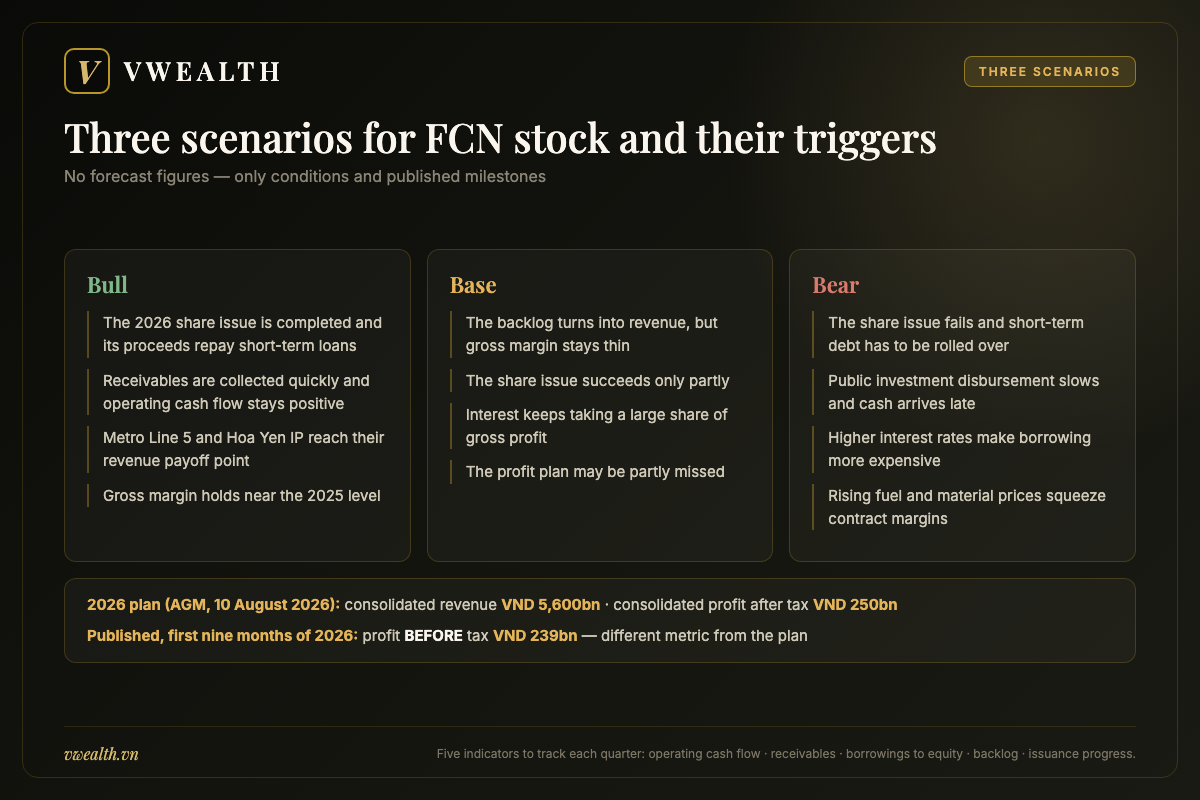
To make quarterly tracking easier, the table below condenses the three scenarios into signals you can check against financial statements and company disclosures.
| Scenario | Key conditions | Quarterly signals to watch |
|---|---|---|
| Bull | Meets or comes close to the 2026 plan (revenue VND 5,600 billion, consolidated PAT VND 250 billion); full issue of about 87.5 million shares; metros on schedule; Hoa Yen sales from end-2026 | Offering results disclosed in full; borrowings clearly lower; operating cash flow positive quarter after quarter; receivables and work in progress falling; new underground contracts on Metro Line 5 and in Ho Chi Minh City |
| Base | Revenue rises with the roughly VND 10,000 billion backlog but gross margin stays thin; share issue partly completed; metro delays on some sections | Gross margin similar to recent periods (9.61% in Q2 2026; about 14.5% for full-year 2025, vwealth estimate); interest still takes a large share of gross profit; borrowings fall only slightly; real estate revenue rises but slowly |
| Bear | Share issue fails or falls well short; receivables pile up; interest rates and material prices rise; Long Thanh review drags on | Cash falls, new borrowing rises; operating cash flow turns negative again; days sales outstanding rise; annual plan missed for an eighth time |
Sources: AGM plan of 10 August 2026; six-month and 30 June 2026 figures from VnBusiness and Vietstock; nine-month figures from CafeF; backlog from CafeF; scenario conditions compiled by vwealth.
Should I buy FCN stock? Weighing the pros and cons
Seven chapters have covered every angle of FECON: from a group of foundation engineers in 2004, through a Japanese shareholder and tunnel boring machines, to a debt-heavy balance sheet, a large share issue and a metro cycle that is just opening up. Now it is time to pull everything together and answer the question that brought you to this article: should I buy FCN stock? The honest answer is that it depends on who you are, what you need from the investment, and what price you buy at. This chapter does not recommend buying or selling; it puts the pros and cons on the scale and then shows which types of investor fit FCN and which do not.
The pros: plenty of work, rare underground expertise, a committed Japanese shareholder
The first plus is the order book. A backlog of about VND 10,000 billion from nearly 20 projects at the end of Q2 2026, equivalent to about 2.1 times 2025 revenue (vwealth estimate), gives FECON a workload that will last many quarters. For a contractor, that is the most important foundation of all, because without contracts every story about margins or cash flow is meaningless. The project list is also diverse: metros, Gia Binh airport, ports, hospitals, industrial parks and housing.
The second plus is its position in underground construction. FECON has worked on Ho Chi Minh City’s Metro Line 1 and Hanoi’s Metro Line 3, and is now on Metro Lines 2 and 5. TBM operating experience, ground treatment for underground stations, and the RAS, CDM and Jet Grouting technologies that came through the joint venture with Raito Kogyo are not things a competitor can acquire in a year or two. As the two big cities’ metro plans of more than 1,000 km are rolled out, contractors with ready-made capability and a project track record will have an advantage when bidding.
The third plus is the strategic shareholder. Raito Kogyo holds about 25.51% of the capital and is the largest shareholder. The Japanese partner is both a source of technology and an extra layer of governance oversight. The fourth plus is that recent results have clearly improved: profit before tax in Q3 2026 reached VND 131 billion, up 442%; for the first nine months it was VND 239 billion, up 351%; and operating cash flow in the first six months of 2026 was a positive VND 172 billion after a negative VND 356 billion in the same period a year earlier.
The cons: high leverage, working capital locked up on site, a history of missing targets
The biggest minus is debt. At 30 June 2026, borrowings were about VND 4,267 billion, about 126% of equity; the ratio of borrowings to equity has risen from about 0.46 times in 2019 to about 1.23 times at the end of 2025 (vwealth estimate). Interest payments of about VND 20 billion a month are a fixed cost that profit has to carry before anything reaches shareholders.
The second minus is working capital buried on construction sites. About 71% of total assets sat in short-term receivables and inventories at 30 June 2026, and the cash conversion cycle in 2025 was 453 days. Put simply, it takes more than a year from the moment FECON spends money on the work to the moment it collects payment. The correction of the Q4 2025 consolidated financial statements — when quarterly revenue was reduced by about VND 1,140 billion after the adjustment, which the company explained as a printing error — is also a reminder that you should read the reports carefully, including the explanatory notes.
The third minus is the track record on targets. For seven consecutive years, from 2019 to 2025, FECON missed its profit plan; in 2025 it achieved only 48% of its VND 200 billion target. With the 2026 plan setting consolidated profit after tax at VND 250 billion, investors have good reason to wait for actual numbers rather than trust the planned ones. The fourth minus is dilution and dividends: if the share issue is completed, the share count rises by about 55.6%; the company paid no cash dividend for 2025 and does not plan one for 2026. Finally, there is the legal factor: Inspection Conclusion No. 318/KL-TTCP on Long Thanh, which concerns the consortium that includes FECON, is being reviewed by the authorities as part of the normal procedure, and the outcome is not yet available in the sources this article has read.
| Pros | Cons | How to verify it yourself |
|---|---|---|
| Backlog of about VND 10,000 billion, about 2.1 times 2025 revenue (vwealth estimate) | Backlog only becomes cash after acceptance and payment; cash conversion cycle of 453 days (2025) | Quarterly revenue and receivables: revenue rising without receivables ballooning is a good sign |
| Metro experience on Lines 1, 3, 2 and 5; Raito technology | On large EPC packages, FECON is usually one part of a consortium, so margins depend on the contract | Read FECON’s role in each newly announced contract |
| Raito Kogyo holds about 25.51%, largest shareholder and technology source | Foreign ownership down from 33.7% (2023) to about 30.9% (June 2026) | Offering results: did Raito exercise its subscription rights? |
| 9M 2026 profit before tax of VND 239 billion, up 351%; 6M operating cash flow positive at VND 172 billion | Seven years of missed profit targets; borrowings about 126% of equity (30 June 2026) | Compare full-year 2026 profit after tax with the VND 250 billion plan; track borrowings after the share issue |
| About VND 875 billion to be raised, about VND 698 billion for debt repayment | Dilution of about 55.6%; no cash dividend for 2025–2026 | Actual proceeds, rights take-up rate, EPS after the issue |
Who FCN suits, and who should stay on the sidelines
FCN suits investors who can tolerate volatility and think in terms of the infrastructure cycle. If you believe the metro lines in Hanoi and Ho Chi Minh City will be accelerated over the coming years, and you want to bet on a contractor with real underground construction capability, FCN is one of the names worth researching. But you need patience: management has said the metro payoff starts from 2027, which means most of the story still lies ahead, not in the next few quarters.
FCN also suits people who are in the habit of reading financial statements every quarter. With a heavily indebted contractor and a long cash cycle, this is not a stock to buy and forget. You need to track receivables, operating cash flow, borrowings and the progress of the share issue. Investors who do this will spot early when the story changes direction, for better or for worse.
On the other hand, FCN does not suit people who need steady dividend income. The company paid no cash dividend for 2025, plans none for 2026, and its dividend history has been irregular: the 2022 dividend was paid in two instalments, the last of 4% on 30 December 2025. (In Vietnam, dividends are quoted as a percentage of par value.) If you need stable cash flow, infrastructure stocks with toll or operating-fee income may be a better fit; see our analyses of CII or HUT (Tasco) for a different infrastructure model. FCN also does not suit people who cannot accept dilution: if you do not intend to exercise your rights in the offering, your ownership percentage will shrink.
Finally, FCN does not suit people who react easily to headlines. This stock is sensitive to contract news, public investment news and legal news, as the session on 29 July 2026 showed. If you tend to sell on bad news and buy on good news before you have had time to read the substance, you may absorb more volatility than you need to. To see FCN in the wider context of Vietnam’s industrial and infrastructure names, our overview of Vietnam manufacturing and industrial stocks will help you compare it with companies in the same broad group.
Five metrics to track every quarter
If you decide to follow FCN, these are the five numbers worth opening every time FECON publishes its quarterly financial statements.
One: cash flow from operating activities (CFO). Positive VND 172 billion in the first six months of 2026, after a negative VND 356 billion in the same period a year earlier. If CFO stays positive for several quarters in a row, that is the clearest evidence that the backlog is turning into cash, not just into revenue on paper.
Two: short-term receivables and work in progress. At 30 June 2026, short-term receivables were VND 4,423 billion and construction work in progress VND 3,359 billion. These two numbers should grow more slowly than revenue. If they swell faster than revenue, the company is doing a lot of work but collecting little.
Three: borrowings to equity. About 126% at 30 June 2026. After the share issue, this ratio should fall clearly, because the company will have both more equity and less debt. If it does not fall, the money raised has been used for something else or new debt is growing quickly.
Four: backlog and new contracts signed. About VND 10,000 billion at the end of Q2 2026. You want to see new contracts replacing the work already completed, so that the order book does not thin out. Particularly worth watching are the remaining underground scope on Metro Line 5 and the underground packages in Ho Chi Minh City that management has mentioned.
Five: the results of the share issue. The number of shares actually sold, the money actually raised, the take-up rate among existing shareholders, the identity of the private placement investors, and whether the money is used as planned for about VND 698 billion of debt repayment. This is the number that decides what kind of balance sheet FECON takes into 2027.
Final thoughts: should you buy FCN stock now?
FECON is a rare story on the Vietnamese stock market: a contractor that started in foundation work, taught itself to dig tunnels, brought in a Japanese partner as its largest shareholder, and has a presence on several metro lines in Hanoi and Ho Chi Minh City. A thick backlog, genuine technical capability, and clearly improved results for the first nine months of 2026. That is the “work” side of the story.
The “money” side is different. High borrowings, more than seven-tenths of assets sitting in receivables and inventories, interest of about VND 20 billion a month, seven straight years of missed profit targets, and a share issue that will increase the share count by about 55.6%. So the central question for FCN is not “does FECON have work?” but this: can FECON turn its roughly VND 10,000 billion backlog into cash fast enough to repay debt and get through the dilution before the metro cycle truly reaches its payoff point in 2027?
This article does not recommend buying or selling. It gives you a map: where FECON makes its money, how to read its numbers, and which signals to watch to tell which scenario the story is following. The final decision is yours, based on your goals, your risk appetite and the price at the moment you look. For valuation, profit and scoring data updated against the latest financial statements, you can open the vwealth stock analysis reports, or create a free vwealth account to follow FCN alongside other Vietnamese construction and infrastructure stocks in one place.
Research Vietnamese stocks in English with vwealth. Our AI-powered platform turns Vietnamese market data into full English analysis reports — with international payment support and a free first month when you subscribe in the VWEALTH app. Create your free account and read the latest reports.