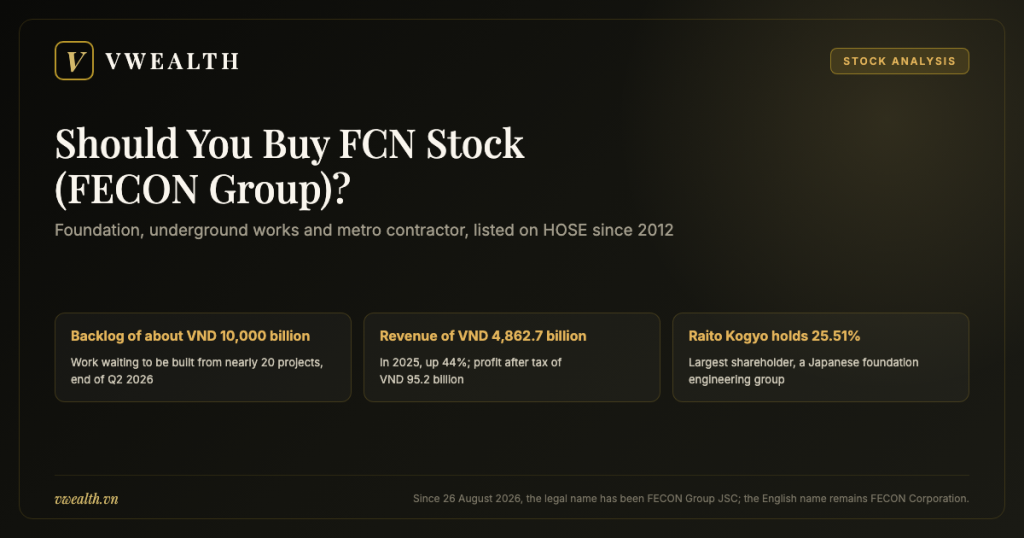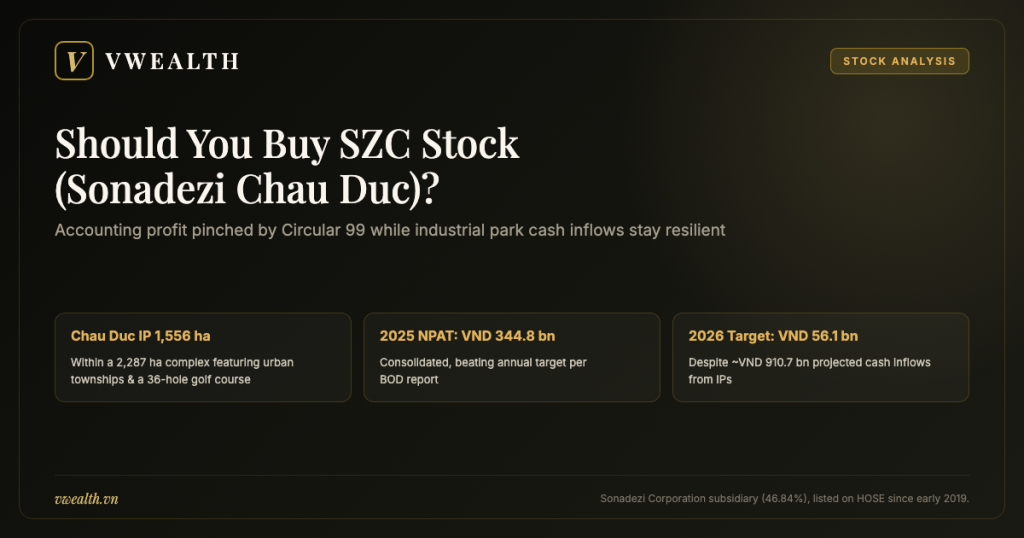
Deciding whether to buy SZC stock — the ticker symbol of Sonadezi Chau Duc Shareholding Company listed on the Ho Chi Minh Stock Exchange (HOSE) — is an intricate question if an investor focuses solely on reported accounting profits. In 2025, the corporation posted a record consolidated net profit after tax of approximately VND 345 billion, outperforming its targets for both net revenue and bottom-line earnings. Yet almost immediately thereafter, corporate leadership submitted a 2026 business plan to shareholders targeting just VND 56.1 billion in consolidated net profit — a contraction of roughly sixfold — while simultaneously forecasting cash collections of approximately VND 910 billion from its core industrial park operations. Accounting profits appear to nearly vanish, but operational cash flows remain exceptionally robust, and the explanation lies in the mandatory rollout of Circular 99/2025/TT-BTC governing how industrial real estate developers must recognize multi-year unearned rental revenue. This comprehensive fundamental analysis unpacks the entire investment case for SZC stock: tracing its trajectory from a subsidiary within the state-backed Sonadezi Dong Nai ecosystem into the master developer of a massive 2,287-hectare integrated hub comprising an industrial zone, urban township, 36-hole golf facility, and an operating BOT toll road situated less than twenty kilometers from the deep-water Cai Mep – Thi Vai port complex. By the conclusion of this study, global and domestic allocators will have a transparent, rigorous framework determining precisely who should buy SZC stock, and who should remain on the sidelines.
Before examining the financial statements, several corporate entities within this industrial ecosystem must be carefully delineated, as their tickers and legal names are frequently conflated by foreign institutional investors. SZC is the official stock ticker of Sonadezi Chau Duc Shareholding Company (officially registered in Vietnamese as Cong ty Co phan Sonadezi Chau Duc). Sonadezi (trading under the ticker SNZ on the UPCoM exchange) is the ultimate corporate parent — the Industrial Zone Development Corporation — which holds a controlling 46.84% equity stake in SZC. SZL is the ticker of Sonadezi Long Thanh Shareholding Company, an established sister developer within the same corporate stable (in which parent corporation Sonadezi owned 51.19% at the time of SZC’s public listing), and concurrently the second-largest institutional shareholder in SZC with an equity stake of approximately 10%. While the broader Sonadezi network encompasses numerous listed affiliates across southern Vietnam, this analysis focuses exclusively on SZC — the entity serving as the primary developer and long-term operator of the Chau Duc Industrial Park and its ancillary urban and commercial assets in what was historically the Chau Duc district of Ba Ria – Vung Tau province. For foreign allocators seeking a macro perspective on the broader peer group across the domestic exchange landscape, vwealth maintains an authoritative industry pillar on Vietnam manufacturing and industrial stocks to help position SZC relative to other listed developers. Furthermore, international investors navigating local market infrastructure, currency clearing, and account structures should consult our definitive guide on how to invest in Vietnam stock market.
In accordance with the editorial integrity standards governing all corporate studies at vwealth, every operational milestone, corporate timeline, executive name, regulatory proceeding, and financial figure presented throughout this report is derived strictly from verified official disclosures. These primary sources comprise the Board of Directors Report submitted to the 2026 Annual General Meeting of Shareholders (dated March 24, 2026), the sixteenth amended Charter of Sonadezi Chau Duc (effective April 16, 2026), corporate filings submitted to the State Securities Commission of Vietnam (SSC) and HOSE, formal corporate presentations hosted on the company’s official portal, audited multi-year financial statements, and institutional equity research published by leading domestic brokerages including Shinhan Securities, Vietcap Securities, and SSI Securities, alongside verified financial press reports. Financial metrics from audited historical years serve as fixed corporate benchmarks. Crucially, this study does not quote intraday stock prices, prevailing trailing price-to-earnings (P/E) multiples, or fluctuating market capitalization figures, as these indicators fluctuate with every trading session on the exchange. Wherever financial deductions or ratio adjustments are executed by our research desk, they are explicitly tagged as a “vwealth estimate” or an “illustrative example.” For real-time updated valuation multiples and quantitative risk scorings, readers should consult the live equity terminal on vwealth.
Finally, we emphasize the core analytical thesis that anchors this entire investigation. SZC stock is fundamentally not the type of security that can be rationally evaluated by taking a single year’s accounting earnings, applying an arbitrary price multiple, and deriving an intrinsic target price. SZC is an asset-heavy land master developer engaged in a multi-decade capital deployment cycle across a vast land reserve: deploying tremendous upfront capital into land compensation, site clearance, physical ground leveling, road construction, stormwater networks, and advanced wastewater treatment facilities over years, and subsequently recovering capital as individual land plots are leased out to multinational manufacturers. Consequently, determining whether to buy SZC stock hinges directly upon two overarching macro and corporate questions. First, should allocators evaluate this business through the lens of accounting profits — which are currently compressed and smoothed over decades due to new revenue recognition mandates — or through the lens of tangible land bank expansion and actual operational cash flow? Second, will the overarching wave of foreign direct investment (FDI) into Vietnam, navigating persistent shifts in global trade architecture and United States reciprocal tariff policies, remain sufficiently resilient to absorb more than 1,500 hectares of industrial land at Chau Duc?
From Chau Duc Scrubland to a 2,287-Hectare Complex: Sonadezi Chau Duc’s Journey
Many industrial zone developers listed on Vietnamese exchanges maintain corporate histories tethered to a single home province. SZC is unique in that its institutional identity spans two distinct regional jurisdictions: the company was born directly out of the Sonadezi conglomerate in Dong Nai province, maintaining its registered corporate headquarters in the city of Bien Hoa, whereas its entire physical land reserve is situated in Chau Duc and the adjacent Phu My region of the former Ba Ria – Vung Tau province. Following the sweeping national administrative reorganization enacted in 2025, that physical territory was incorporated into Ho Chi Minh City. One enterprise, two regional roots, and three administrative provincial names appearing across legal documentation within less than two decades may initially appear convoluted. However, as one traces each consecutive corporate milestone, the underlying strategic trajectory emerges with remarkable institutional clarity.
Founded in 2007 Within the Sonadezi “Family”
Sonadezi Chau Duc Shareholding Company was formally established in 2007 with an initial charter capital contribution of merely VND 74.8 billion. When evaluated against the sheer physical scale of the project the enterprise was incorporated to develop — a multi-purpose complex spanning more than two thousand hectares — this initial equity base was extraordinarily modest. However, this structure represents standard operating procedure for state-backed infrastructure development conglomerates in Vietnam: incorporating a specialized, ring-fenced project vehicle for each flagship regional initiative, injecting sufficient seed equity to initiate initial feasibility studies, master planning, and initial land compensation, and progressively expanding the equity base in tandem with operational land clearance and infrastructure milestones.
The institutional “family” behind this enterprise is the Industrial Zone Development Corporation, widely known across domestic commerce by its brand identity, Sonadezi. According to the executive message published on Sonadezi Chau Duc’s official corporate portal, the Sonadezi corporate system possesses “over 25 years” of institutional experience in industrial real estate development. At the time SZC prepared for its public listing in late 2018, domestic financial media described parent company Sonadezi as a premier infrastructure enterprise owned by the People’s Committee of Dong Nai Province, operating across a diversified multi-sector mandate with its definitive core competency centered on industrial estate development. Put simply, SZC was never an unproven private real estate speculator navigating land acquisition from scratch; rather, it functioned as the specialized operating arm of an established state-backed infrastructure conglomerate entrusted with master-planning a strategic regional land tract from the ground up.
This institutional lineage carries two fundamental implications for international investors evaluating Vietnam stocks. The first is corporate credibility: when multinational industrial tenants — ranging from electronics fabricators to precision component manufacturers — evaluate industrial park sites across Southeast Asia, the institutional pedigree of Sonadezi provides SZC with an immediate operational track record, eliminating the need to establish execution credibility from zero. The second implication concerns corporate governance and strategic capital allocation: because the parent corporation maintains nearly half of SZC’s outstanding equity, all pivotal boardroom decisions — such as equity offerings, long-term bank borrowings, dividend distributions, or operational prioritization across project phases — are viewed through the strategic prism of the Sonadezi system. Chapter 2 examines the practical dynamics of who controls the boardroom.
From its inception, SZC’s strategic mandate was intentionally formulated to transcend the boundaries of a conventional, single-purpose manufacturing enclave. Management selected an integrated “industrial – urban – golf” development paradigm: simultaneously leasing fully serviced industrial land to multinational factories, constructing integrated residential communities to house incoming factory workers, engineers, and executive management, and operating an international-standard championship golf facility to cater to foreign corporate executives while enhancing the terminal land value of the surrounding urban residential acreage. While highly compelling on paper, this integrated blueprint is exceptionally capital-intensive and entails a multi-year gestation period, as each distinct business segment operates on a different cash generation cycle. The strategic and financial repercussions of this structural model permeate nearly every subsequent chapter of this analysis.
Three Pieces in One Mega-Project: 1,556 Hectares of Industrial Land, Urban Township, and a 36-Hole Golf Course
According to official corporate documentation, the Chau Duc Industrial Urban & Golf Course Project encompasses a total master-planned footprint of 2,287 hectares. Within this master plan, the industrial park segment represents the cornerstone asset, encompassing 1,556 hectares; the remaining balance of the land bank is dedicated to a modern commercial-residential urban township and an international-standard 36-hole golf course. Institutional research published by Shinhan Securities in March 2026 similarly utilizes this benchmark figure of 2,287 hectares when describing SZC’s aggregated land bank across industrial, residential, and recreational functions.
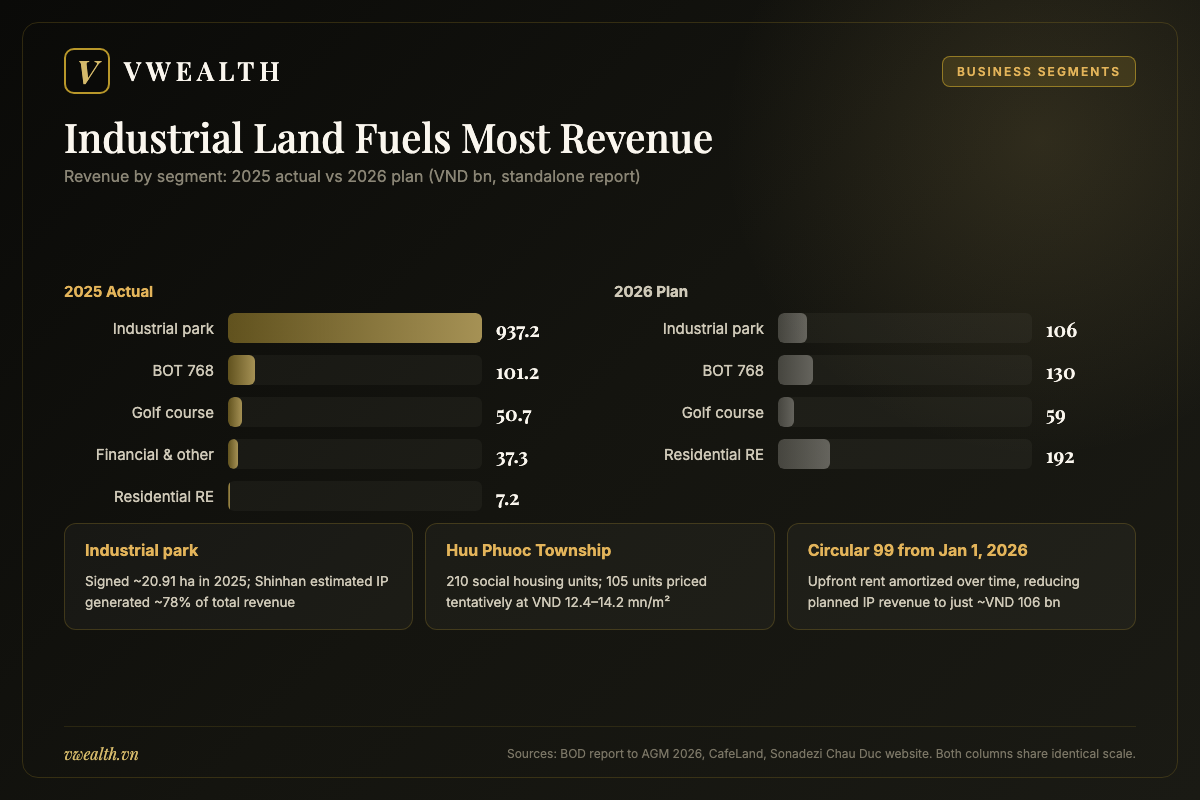
To grasp the sheer geographical scale of 2,287 hectares, foreign allocators can visualize a standard FIFA football pitch, which spans less than one hectare. SZC’s master-planned land bank is effectively equivalent to more than two thousand football pitches arranged contiguously. This immense physical scale explains why industrial land leasing has consistently operated as the core cash flow engine of SZC: in 2025 alone, industrial park operations generated approximately VND 937.2 billion in revenue, representing roughly 91% of the parent company’s total standalone revenue of approximately VND 1,032.4 billion.
The second major component of the master plan is the urban township. As early as 2023, the General Meeting of Shareholders formally approved an expansion of the total projected capital investment for the Chau Duc Urban Area project from an initial VND 1,237 billion to an ambitious VND 9,381 billion — an escalation of nearly sevenfold. At the 2025 Annual General Meeting, shareholders re-affirmed this adjusted investment total of VND 9,381 billion, with the formal project amendment dossier submitted directly to the Department of Finance of Ho Chi Minh City for regulatory processing. Adjacent to this flagship development sits the Sonadezi Huu Phuoc Residential Area — a targeted residential initiative where the corporation has completed Phase 1 construction of a dedicated social housing community comprising 210 residential units.
The third integrated piece is the golf course complex. By the end of 2025, the enterprise successfully finalized construction of the 18-hole Resort Golf Course alongside an upscale clubhouse facility, securing official certification of construction ownership from state authorities, while concurrently obtaining formal construction licensing for the second course — the 18-hole Tournament Golf Course. Once both courses are fully built, the complex will reach its full 36-hole master-planned scale. While golf operations do not generate massive standalone corporate profits, the facility serves as the high-profile commercial facade for the wider urban township, acting as an elite lifestyle amenity that caters directly to expatriate engineering teams, corporate executives, and multinational plant managers operating within the regional industrial corridor.
Beyond these three integrated components situated within the primary project boundary, SZC maintains ownership of an external operating infrastructure asset: the BOT 768 road project located in Dong Nai province, which is currently operated through a wholly owned single-member limited liability subsidiary. Geographically, this tollway is entirely detached from the Chau Duc industrial enclave; however, it functions as an invaluable source of steady, predictable recurring cash flow — an asset examined thoroughly in Chapter 3. The essential takeaway for investors evaluating SZC stock is that while the enterprise is primarily an industrial real estate developer, it is certainly not an industrial-only business.
Listing on HOSE in January 2019 with 100 Million Shares
SZC’s transition to the public capital markets occurred relatively late in the company’s corporate lifecycle. On December 18, 2018, the Ho Chi Minh Stock Exchange (HOSE) issued formal listing approval for 100 million SZC shares, corresponding to an initial charter capital of VND 1,000 billion. On January 15, 2019, SZC shares executed their first official trading session on HOSE. Financial media outlets Nha Dau Tu and VietnamFinance recorded the reference price on the debut trading session at VND 12,500 per share — a benchmark established by the issuer based on a blended average of trailing P/E multiples, price-to-book (P/B) ratios, and historical over-the-counter (OTC) transaction prices. While certain domestic market sources referenced slightly lower initial OTC markers, long-term allocators can reasonably view SZC’s public market debut as anchoring around the ten-to-twelve thousand VND threshold.
The financial statements at the time of the public listing revealed an enterprise that was just beginning to shift into high operational gear. In 2016, SZC recorded standalone net revenue of VND 101 billion and a net profit of VND 44 billion. In 2017, net revenue more than doubled to VND 219 billion, driving net profit to VND 72.7 billion. During the first nine months of 2018, net revenue reached VND 255 billion — nearly four times the figure recorded in the prior-year period — while net profit after tax reached VND 89.3 billion. For the full year 2018, corporate leadership estimated revenue of approximately VND 291 billion and net profit after tax of VND 91 billion, establishing a forward business target for 2019 of VND 320 billion in revenue and VND 100.2 billion in bottom-line net profit.
The institutional shareholder registry at the moment of public listing was already highly consolidated: parent company Sonadezi held 46.84% of charter capital, while sister entity Sonadezi Long Thanh held 10.8%. These two state-backed affiliates within the same corporate system collectively controlled more than 57% of total outstanding voting equity — meaning that from its very first trading day on the exchange, ultimate managerial control over SZC resided firmly within the Sonadezi institutional family. Crucially, research published by Shinhan Securities in March 2026 confirmed that parent entity Sonadezi continued to hold precisely 46.84% of voting equity, even after SZC’s charter capital expanded to nearly VND 1,800 billion. This indicates that through successive equity offerings, the parent corporation systematically exercised its subscription rights, preserving its equity ownership without dilution.
For private allocators and international portfolio managers, the HOSE listing fundamentally transformed two operational dynamics. First, it unlocked significant secondary market liquidity and placed the company under the formal research coverage of major institutional brokerages — as evidenced by detailed, continuous research notes from Shinhan Securities, Vietcap, SSI Securities, BSC, and VNDirect. Second, listing on the nation’s premier exchange subjected SZC to rigorous corporate disclosure standards, ensuring that corporate events such as regulatory tax reconciliations and state administrative reviews — analyzed in Chapter 2 — were formally disclosed to the public market.
Net Profit Rising From VND 44 Billion in 2016 to Approximately VND 345 Billion in 2025
When placing the initial and terminal historical markers side by side, SZC displays an impressive financial trajectory: standalone net profit of VND 44 billion in 2016 expanded to approximately VND 345 billion in consolidated net profit after tax in 2025 — representing an expansion of nearly eightfold over a nine-year operational span [vwealth estimate: 344.8 ÷ 44 ≈ 7.8 times]. However, the intervening operational path was anything but linear, and the underlying revenue recognition dynamics of an industrial developer bear little resemblance to those of a traditional consumer goods or manufacturing business.
For an industrial park developer in Vietnam, reported accounting net profit in any given fiscal year is heavily dictated by the precise volume of land acreage that completes physical site handover and meets the regulatory criteria for revenue recognition. Executing an industrial land lease agreement is an entirely distinct operational milestone from booking accounting revenue: tenant advance deposits and initial rental payments may be wired directly into the developer’s bank accounts in a previous fiscal year, but that leased land plot can only be recognized on the income statement once the physical ground is fully leveled, connected to trunk infrastructure, and formally handed over to the tenant. Consequently, developers frequently experience years where accounting profits surge dramatically due to the simultaneous handover of several massive tenant parcels, followed by consolidation phases where reported profits moderate even as new leasing contracts are actively inked.
Fiscal year 2024 serves as an instructive case study. Based on management estimates compiled in early 2025, total revenue for 2024 reached approximately VND 893 billion and profit before tax reached approximately VND 311 billion, achieving 101% and 109% of their respective annual targets. Heading into 2025, the Board of Directors Report confirmed standalone revenue of VND 1,032.4 billion, achieving 110.9% of the annual plan, and standalone net profit after tax of VND 331.0 billion, reaching 109.5% of the target. On a consolidated basis, 2025 revenue reached approximately VND 1,134.1 billion, yielding consolidated net profit after tax of approximately VND 344.8 billion. When positioned against pre-listing earnings benchmarks of VND 44 billion, VND 72.7 billion, and roughly VND 91 billion, this represented an enormous operational leap forward.
However, entering fiscal year 2026, the corporate earnings narrative experienced an abrupt divergence — not because industrial manufacturing tenants vacated the park, but because the domestic accounting methodology governing long-term land lease recognition was overhauled under Circular 99/2025/TT-BTC. While a granular dissection of this regulatory accounting shift is detailed in Chapter 5, investors should note this essential takeaway: SZC’s accounting trajectory is not a smooth upward staircase, and the sharp drop in planned 2026 earnings is an accounting artifact rather than an operational breakdown.
Capital Increase via Rights Issue and Clearing Bond Debt to Zero by Early 2025
Developing an integrated industrial and urban complex spanning over two thousand hectares naturally creates substantial capital demands. As of June 30, 2023, according to reviewed financial statements cited by financial media outlet Mekong ASEAN, SZC carried total interest-bearing debt of approximately VND 2,413 billion, representing 148% of total shareholder equity. This debt structure comprised short-term bank borrowings of VND 500 billion and long-term bank borrowings of VND 1,913 billion. Furthermore, the enterprise carried an active corporate bond issue originated in January 2021 with a total par value of VND 500 billion, issued specifically to fund capital deployment at the Chau Duc Urban Area project.
Faced with expanding debt service obligations amidst elevated domestic interest rates, on August 21, 2023, the Board of Directors formally approved a major rights offering to existing shareholders at a 2:1 ratio (granting existing holders the right to purchase one new share for every two shares held). The offering encompassed nearly 60 million new ordinary shares offered at an execution price of VND 20,000 per share — representing a discount of approximately 39% relative to prevailing secondary market prices at the time. The capital raise aimed to generate nearly VND 1,200 billion in gross proceeds, with roughly VND 800 billion earmarked to restructure bank debt and settle maturing corporate bond obligations, while the remaining balance of approximately VND 400 billion was allocated directly to fund ongoing infrastructure construction at Chau Duc Industrial Park.
In the 2026 Board of Directors Report, this capital increase is formally documented as the “2024 share offering.” Following its successful completion, SZC’s paid-in charter capital expanded to VND 1,799.86 billion, corresponding to exactly 179,985,863 outstanding ordinary shares pursuant to the sixteenth amended Charter. According to reporting by Tap chi Cong Thuong (Industry and Trade Magazine), the corporation successfully mobilized nearly VND 1,200 billion from existing shareholders, subsequently disbursing VND 274.5 billion toward debt restructuring and the scheduled retirement of corporate bond principal and interest.
The proceeds from this equity offering enabled SZC to achieve a financial milestone that many domestic real estate developers during the tumultuous 2023–2024 liquidity crunch could only dream of: completely eliminating its corporate bond debt. The corporate bond issue SZCH2126001, originally issued on January 8, 2021, with a 5-year tenure, had been progressively repurchased ahead of schedule starting in 2022. In early December 2024, the Board of Directors approved the early redemption of all remaining outstanding notes. On January 8, 2025, SZC officially completed the premature redemption of the final VND 200 billion in outstanding bonds, bringing its corporate bond debt balance to exactly zero.
Foreign investors must interpret this balance sheet milestone with analytical precision: “zero bond debt” does not mean “zero debt.” SZC continues to maintain substantial short-term and long-term commercial bank borrowing facilities, totaling several trillion VND — a liability structure scrutinized in Chapter 5. What the enterprise successfully eliminated was the specific debt category that caused the most severe refinancing and liquidity pressures across the broader Vietnamese corporate sector during the recent bond market disruption. However, the rights issue also introduced an inevitable structural dilution for equity holders: the outstanding share count expanded by approximately 1.5 times, meaning future net earnings are divided across a larger equity denominator. Furthermore, the administrative tracking and corporate disclosure surrounding the utilization of proceeds from this 2024 offering subsequently formed part of the formal regulatory review conducted by the State Securities Commission in 2025.
After the 2025 Administrative Merger: Project Belongs to HCMC, Headquarters Still in Dong Nai
In 2025, the Vietnamese Government executed a landmark administrative restructuring across southern provincial jurisdictions, formally merging Ba Ria – Vung Tau into Ho Chi Minh City. For Sonadezi Chau Duc, this macro realignment generated direct administrative modifications visible across its official legal documentation: the administrative address of Chau Duc Industrial Park is now officially designated in Ngai Giao Commune, Ho Chi Minh City, while social housing offerings within the Sonadezi Huu Phuoc Residential Area similarly list their location in Ngai Giao Commune, Ho Chi Minh City (with official corporate brochures noting its prior historical address in Suoi Nghe Commune, Chau Duc District, Ba Ria – Vung Tau Province).
Conversely, the corporation’s registered legal headquarters pursuant to its Charter remains situated on the 9th Floor of the Sonadezi Building, No. 1, Street 1, Bien Hoa 1 Industrial Park, Tran Bien Ward, Dong Nai Province — firmly within the administrative hub of its parent corporation. Meanwhile, the operational branch office directly managing the industrial complex is located along the Hoi Bai – Chau Pha – Da Bac corridor.
This provincial administrative restructuring has direct operational implications for investors tracking regulatory approvals: project dossiers, investment master-plan adjustments, and land-use certificates now progress through the municipal administrative apparatus of Ho Chi Minh City. The 2026 Board of Directors Report explicitly notes that the investment policy adjustment dossier for the Northern Urban Area and the overall project amendment dossier for Chau Duc Urban Area are currently under active review at the Department of Finance of Ho Chi Minh City. For institutional allocators, this represents a vital monitoring factor: navigating an administrative transition can result in procedural recalibrations where project approvals experience temporary delays or administrative consolidation as municipal departments realign.
From a commercial marketing perspective, having its flagship industrial and urban complex incorporated within the greater metropolitan territory of Ho Chi Minh City undeniably bolsters marketing reach when courting multinational corporations, who naturally recognize the international branding of HCMC. Nevertheless, the physical geography remains unchanged: transit times to deep-sea ports, regional expressways, and international airports remain identical — and as Chapter 4 illustrates, physical proximity to multimodal logistics nodes remains the definitive competitive moat determining Chau Duc’s long-term absorption rates.
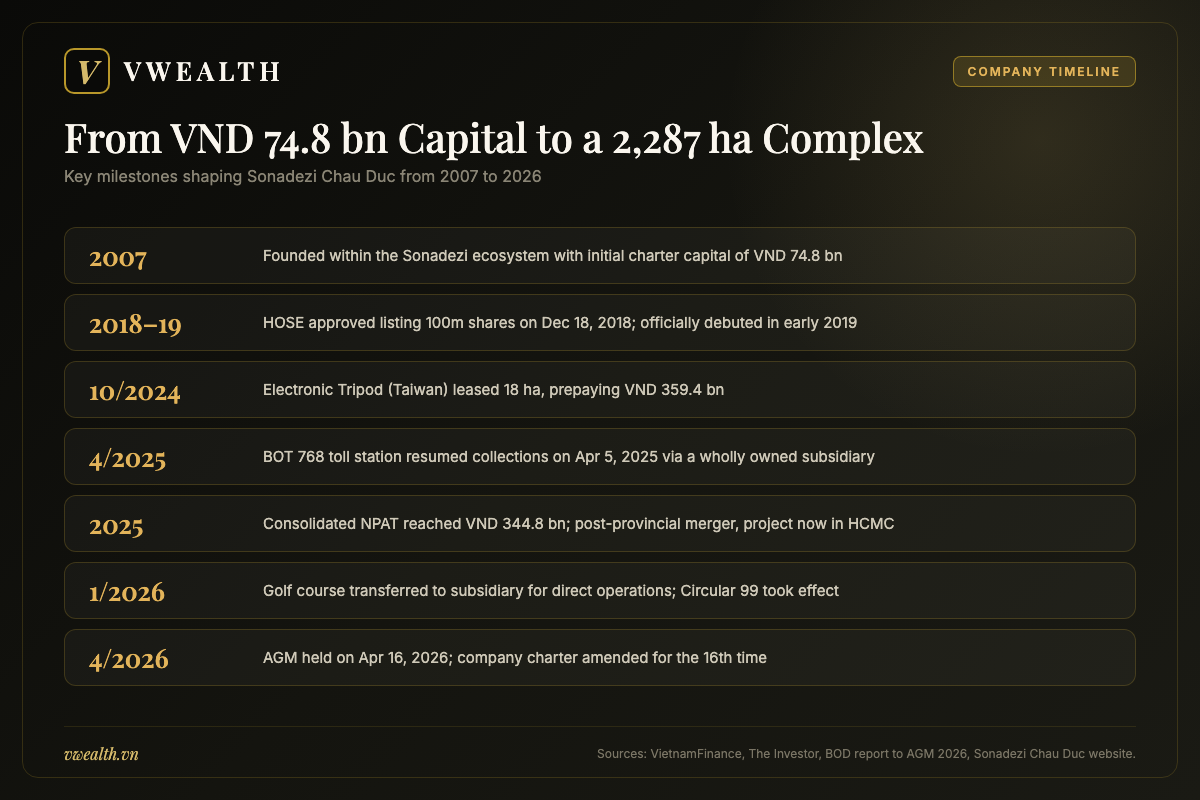
Synthesizing these strategic milestones, the following chronological matrix outlines the key structural turning points across Sonadezi Chau Duc’s history. Investors will observe that corporate actions have clustered densely between 2024 and 2026, marking a pivotal era where the enterprise simultaneously eliminated bond debt, secured premier multinational anchor tenants, and reorganized its auxiliary operating segments.
| Timeline | Corporate Milestone | Source Reference |
|---|---|---|
| 2007 | Establishment of Sonadezi Chau Duc Shareholding Company with initial charter capital of ~VND 74.8 billion | VietnamFinance, Nha Dau Tu |
| Dec 18, 2018 | HOSE approves listing of 100 million SZC shares (charter capital of VND 1,000 billion) | VietnamFinance, Nha Dau Tu |
| Jan 15, 2019 | First official trading session of SZC stock on HOSE (initial reference price of VND 12,500) | Nha Dau Tu |
| Jan 08, 2021 | Issuance of 5-year corporate bond tranche SZCH2126001 totaling VND 500 billion | Tap chi Cong Thuong |
| Aug 21, 2023 | Board approves rights offering of ~60 million shares to existing shareholders at 2:1 ratio (VND 20,000/share) | Mekong ASEAN |
| May 13, 2024 | Electronic Tripod Vietnam signs Memorandum of Understanding to lease 18 ha of industrial land | Elibook compilation of BSC/VNDirect |
| Jan 08, 2025 | Premature redemption of final VND 200 billion in outstanding bonds; bond debt reduced to zero | Tap chi Cong Thuong |
| Apr 05, 2025 | BOT 768 toll station officially resumes toll collection operations under provincial approval | 2026 Board of Directors Report |
| Aug 2025 | State Securities Commission conducts administrative inspection of SZC (Aug 18 – Aug 29, 2025) | 2026 Board of Directors Report |
| Jan 01, 2026 | Chau Duc Golf Services One-Member LLC officially commences commercial operation of golf assets | 2026 Board of Directors Report |
| Apr 16, 2026 | 2026 Annual General Meeting of Shareholders; sixteenth amended Charter becomes effective | SZC Corporate Charter |
Who Is at the Helm: Sonadezi, Sonadezi Long Thanh, and the Seven-Member Board
For an industrial real estate developer where the corporate parent controls nearly half of total outstanding equity, answering the question “who controls strategic decision-making” is every bit as critical as examining “how the business generates operating cash flow.” When an allocator purchases SZC stock, they are acquiring a minority equity interest, but fundamental corporate choices — such as overall leverage limits, the timing and pricing of capital raises, dividend payout ratios, and capital deployment priority across land parcels — are decided at an institutional level above the operating subsidiary. This chapter deconstructs who sits at that institutional table and how corporate governance impacts public market shareholders.
Sonadezi Corporation Holds 46.84%: The Deciding Shareholder
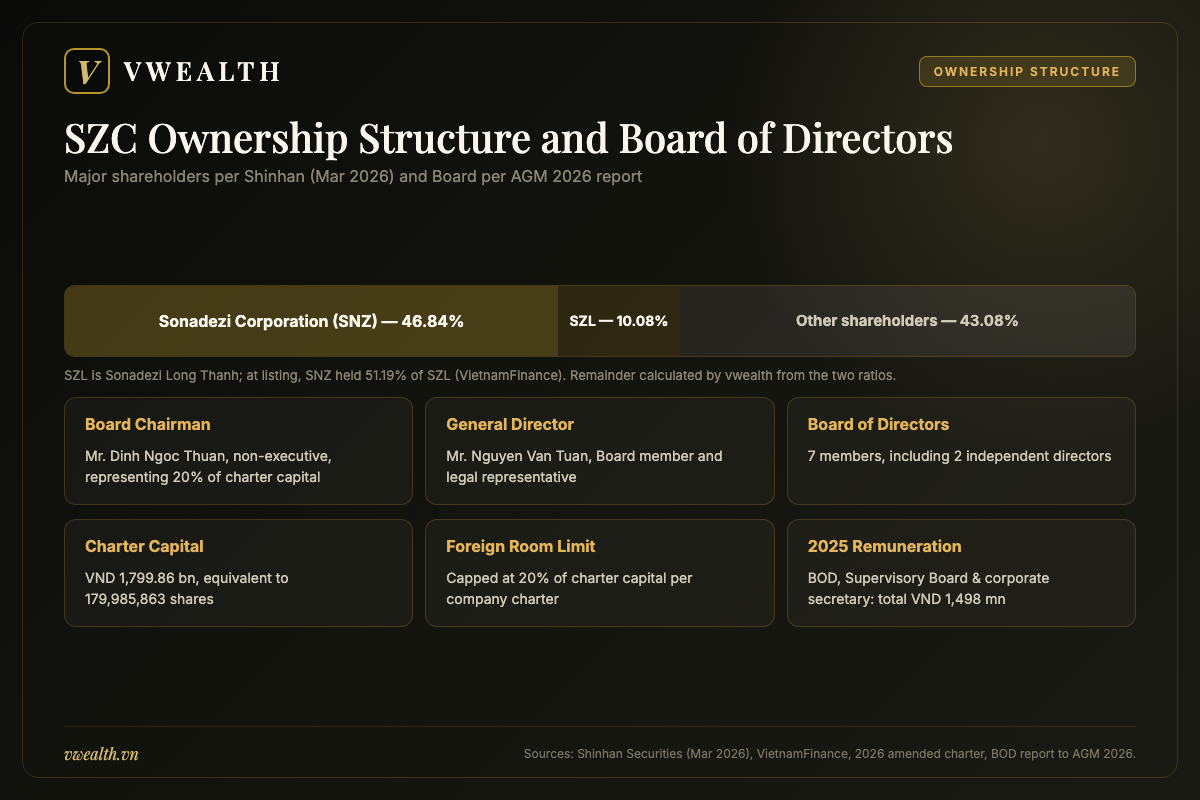
According to the equity research report published by Shinhan Securities in March 2026, the Industrial Zone Development Corporation (trading under ticker SNZ on UPCoM) holds 46.84% of Sonadezi Chau Duc’s total charter capital. This ownership level is identical to the equity stake recorded when SZC first listed on HOSE in early 2019, demonstrating that throughout more than seven years as a publicly traded enterprise, the parent company’s controlling ownership has remained remarkably stable.
While an equity stake of 46.84% falls slightly short of a mathematical 50% absolute majority on paper, in practical corporate governance it confers absolute working control. In a publicly traded corporation with thousands of retail holders, it is virtually impossible for fragmented minority shareholders to coordinate attendance, reach a voting quorum, and cast unified ballots against the controlling bloc. When combined with the equity block owned by Sonadezi Long Thanh — an affiliate operating within the identical state-backed parent conglomerate — the collective voting power of the Sonadezi family comfortably surpasses the 50% threshold. To state the corporate reality plainly: every major shareholder resolution, capital budget, and strategic corporate restructuring at SZC is decided in complete alignment with parent company Sonadezi.
For international investors evaluating Vietnam stocks, this ownership concentration introduces both distinct advantages and strategic trade-offs. The primary advantage is institutional stability: a state-backed infrastructure parent with decades of operational development experience naturally prioritizes long-term master-plan execution, regulatory compliance, and generational asset value over quarterly financial engineering or chasing short-term equity price momentum. The primary consideration, however, is that the strategic objectives of a state-linked parent corporation do not always align symmetrically with those of minority public market investors. For instance, in deliberating whether to retain annual operating cash flow to fund multi-trillion-VND land clearance initiatives or distribute substantial cash dividends, the parent company’s capital allocation priorities will prevail. When reviewing AGM resolutions, allocators should consistently assess whether a given policy benefits the physical project, the parent entity, or all shareholders proportionately.
Sonadezi Long Thanh at ~10%: Sister Shareholder Within the Same Ecosystem
The second-largest institutional shareholder in SZC is Sonadezi Long Thanh Shareholding Company (trading under ticker SZL), holding 10.08% of outstanding equity according to Shinhan Securities in March 2026 — an ownership stake recorded at 10.8% at the time of SZC’s public listing. At that time, parent company Sonadezi held 51.19% of Sonadezi Long Thanh’s charter capital, formally establishing SZL as a consolidated subsidiary of Sonadezi.
This multi-tiered parent-subsidiary architecture — often characterized across Asian industrial conglomerates as a cross-holding ecosystem — is a standard structural feature of Vietnamese state infrastructure corporations. For shareholders analyzing SZC stock, this structural reality demonstrates that the two largest institutional shareholders are not arms-length, independent actors; rather, they operate within a shared corporate governance orbit. Combining parent company Sonadezi’s 46.84% stake with Sonadezi Long Thanh’s 10.08% stake consolidates roughly 56.9% of total outstanding equity under the direct control of the unified Sonadezi corporate group [vwealth estimate: 46.84% + 10.08% ≈ 56.9%].
A direct market consequence of this ownership structure is that the actual free float available for secondary market trading outside the core Sonadezi group is capped at approximately 43% of total outstanding shares [vwealth estimate: 100% − 56.9%]. When factoring in long-term institutional holdings and specialized domestic investment funds, the effective liquid float circulating on HOSE is considerably smaller. A constrained free float can heighten secondary price volatility during market expansions or risk-off sentiment shifts, as concentrated order flow interacts with limited floating supply.
Foreign Ownership Limit Capped at 20% Under Company Charter: Implications for Liquidity and Valuation
A pivotal corporate governance parameter that frequently escapes initial foreign screening is enshrined within Article 4 of Sonadezi Chau Duc’s sixteenth amended Charter: the maximum foreign ownership limit (FOL, commonly referred to across domestic brokerage desks as “room ngoại”) is strictly capped at 20% of charter capital. Across the broader Vietnamese corporate landscape, industrial developers and commercial property enterprises typically carry foreign ownership limits of 49% or occasionally 50% under standard statutory provisions.
Why does this charter-imposed 20% foreign room ceiling carry profound implications for institutional allocators? Foreign institutional investors and global emerging market funds represent large-scale, long-term capital allocators capable of driving sustained valuation reratings. When an equity’s foreign ownership room is restricted to just 20%, the absolute volume of shares that the global institutional community can accumulate is structurally restricted. Once the 20% room ceiling is reached, foreign allocators wishing to purchase SZC stock are unable to execute buy orders on the open order book; they must either wait for existing foreign holders to sell, or negotiate off-market put-through transactions that frequently trade at significant negotiated premiums above the official exchange screen price.
For investors navigating the domestic exchange landscape, this restriction presents a distinct dual dynamic. On one hand, SZC stock is insulated from broad-based foreign institutional liquidation cycles: when emerging market funds engage in aggressive net-selling across frontier and emerging bourses, SZC experiences negligible direct foreign selling pressure simply because foreign institutional ownership is already legally bounded. On the other hand, the enterprise is structurally prevented from enjoying the aggressive valuation reratings and multiple expansions that frequently accompany heavy foreign capital inflows into peers possessing wider room allowances. This structural attribute must be carefully factored into any comparative evaluation when contrasting SZC with other major industrial real estate developers, such as analyzing whether to allocate capital after reviewing our research on should you buy KBC stock or our fundamental breakdown of IDC stock analysis.
The Seven-Member Board of Directors: Chairman Dinh Ngoc Thuan, CEO Nguyen Van Tuan, and Two Independent Members
According to the official Board of Directors Report submitted to the 2026 Annual General Meeting of Shareholders, SZC’s boardroom comprises seven members. The leadership is headed by Mr. Dinh Ngoc Thuan, serving as non-executive Chairman of the Board of Directors, formally representing a 20% state equity block. Mr. Thuan is also the executive who signs the corporate mission statement on Sonadezi Chau Duc’s official investor relations portal, formally positioning the enterprise as an integral operating member of the wider Sonadezi infrastructure network.
Day-to-day corporate executive leadership is directed by Mr. Nguyen Van Tuan, who serves concurrently as a Board Member and Chief Executive Officer (General Director), representing a 10% equity block while personally holding an equity stake of approximately 0.008%. Pursuant to the corporate Charter, the Chief Executive Officer serves as the sole legal representative of the company — empowering him with legal authorization to execute major commercial contracts, land lease covenants, banking agreements, and formal regulatory filings on behalf of Sonadezi Chau Duc. A negligible personal equity ownership stake among senior operating leadership is a classic structural hallmark of state-linked enterprises across Vietnam: senior executives function primarily as appointed corporate stewards tasked with managing state and institutional capital, rather than entrepreneurial founders managing family equity.
The remaining members of the Board of Directors encompass Mr. Pham Anh Tuấn, representing 10.08% of charter capital — a figure precisely mirroring the equity ownership stake of Sonadezi Long Thanh; Mr. Phan Dinh Tham, representing a 10% equity block; Ms. Nguyen Phuong Hang, serving as a non-executive Director; and two independent Board members, Mr. Nguyen Van Luong and Mr. Tran Hao Hiep. While the official Board disclosure does not explicitly match each individual Director’s representation to a specific shareholder name, aggregating the equity blocks represented by Chairman Dinh Ngoc Thuan (20%), CEO Nguyen Van Tuan (10%), and Director Phan Dinh Tham (10%) yields exactly 40% of voting capital — representing the predominant share of the 46.84% parent company block held by Sonadezi [vwealth analytical inference; specific shareholder proxy mandates are not individually broken down in the disclosure].
Supporting the executive suite are specialized Deputy General Directors entrusted with operational divisions. A prime example is Mr. Tran Trung Chien, Deputy CEO of SZC, who was formally appointed as Chairman and Director of Chau Duc Golf Services One-Member LLC — the newly established wholly owned operating subsidiary launched in late 2025 to take over direct commercial management of the golf course operations from the beginning of 2026.
During fiscal year 2025, the Board of Directors convened 5 formal scheduled meetings, but notably executed corporate governance via written shareholder and board resolutions on 57 separate occasions. Executing 57 corporate actions via written ballots demonstrates that executive management relies heavily on streamlined electronic and written authorizations rather than convening physical board assemblies — a practical administrative necessity for an infrastructure developer actively managing high-frequency land compensation decisions, public infrastructure procurement tenders, and time-sensitive land lease execution contracts that demand prompt corporate sign-offs.
Board and Supervisory Board Remuneration of ~VND 1.5 Billion in 2025
Corporate filings disclose that total remuneration allocated to the Board of Directors, the Supervisory Board, and the Corporate Governance Officer for fiscal year 2025 amounted to approximately VND 1,498 million; within this figure, Chairman Dinh Ngoc Thuan received annual compensation of approximately VND 216 million. When evaluated against the parent company’s standalone net profit after tax of approximately VND 331 billion in the same fiscal year, total board remuneration represented a modest 0.45% of bottom-line earnings [vwealth estimate: 1.498 ÷ 331].
Such conservative compensation levels are representative of Vietnamese state-backed infrastructure developers: the Chairman serves in a non-executive capacity appointed by the parent entity, meaning compensation derived from SZC forms only one component of their broader institutional compensation package. For external equity investors, this compensation profile presents a neutral signal. On one hand, corporate overhead and executive compensation do not dilute operational earnings or siphon off shareholder capital. On the other hand, executive management is not directly incentivized through extensive performance-based stock option plans (ESOPs) or equity appreciation rights tied to secondary market share price performance, as is common among private real estate enterprises.
Regarding dividend distributions, official corporate disclosures confirm that SZC formally compiled its shareholder register to execute cash dividend distributions for fiscal year 2025. While the specific dividend payout ratio and the delicate strategic trade-off between distributing cash to shareholders and conserving working capital for heavy land clearance outlays are analyzed in the valuation section of this report, investors should maintain this core principle: corporate dividend distribution policy is ultimately determined by the voting power of the controlling Sonadezi shareholder bloc.
The 2025 State Securities Commission Inspection and Tax Penalty Decision: Full Corporate Disclosure
A genuinely transparent public enterprise is not one that operates in complete isolation from regulatory oversight, but one that provides timely, complete public disclosure whenever regulatory audits occur. In its 2026 Board of Directors Report, SZC management proactively detailed two regulatory matters from fiscal year 2025 that every current and prospective shareholder must understand.
The first matter involved a comprehensive administrative inspection executed by the State Securities Commission of Vietnam (SSC) from August 18 to August 29, 2025. According to the Board Report, the inspection delegation identified administrative oversights pertaining to statutory corporate reporting obligations, timely information disclosures, and specific documentation regarding the operational disbursement and utilization of capital mobilized from the 2024 share offering. In response, the Board of Management submitted detailed explanations and fully executed all required administrative remedies. The regulatory report contained no findings of misappropriation or illegal diversion of capital; the issues identified related strictly to procedural compliance and corporate disclosure timetables.
The second matter occurred on October 28, 2025, when the Dong Nai Provincial Tax Department issued Administrative Penalty Decision No. 2226/QD-XPHC-DON against Sonadezi Chau Duc. The penalty pertained to the retrospective collection of corporate income tax for the 2024 tax year following updated administrative and policy guidelines. Management promptly disclosed the penalty decision on the stock exchange and completed self-adjusted tax declarations and settlements in full compliance with state regulations.
To assess these regulatory developments objectively: both matters were formally disclosed to the market through official corporate channels rather than surfacing as unverified market rumors, and according to official filings, all compliance remedies have been finalized. Simultaneously, they serve as a practical reminder that a large-scale land development enterprise engaged in complex land acquisitions, large-scale capital offerings, and sophisticated revenue recognition models operates within an intricate web of administrative compliance. Long-term shareholders holding SZC stock should monitor ongoing quarterly disclosures to ensure that future capital utilization reports and corporate filings maintain stringent institutional timeliness.
The table below summarizes the key institutional shareholders and corporate leadership governing Sonadezi Chau Duc based on official 2026 corporate disclosures.
| Entity / Executive Name | Corporate Governance Role | Ownership / Capital Representation |
|---|---|---|
| Industrial Zone Development Corporation (Sonadezi, SNZ) | Controlling Parent Corporation; largest institutional shareholder | 46.84% equity ownership |
| Sonadezi Long Thanh Shareholding Company (SZL) | Second-largest shareholder; sister affiliate within Sonadezi system | 10.08% equity ownership |
| Mr. Dinh Ngoc Thuan | Non-executive Chairman of the Board of Directors | Represents 20% capital block |
| Mr. Nguyen Van Tuan | Board Member & Chief Executive Officer (Legal Representative) | Represents 10% capital block; 0.008% personal ownership |
| Mr. Pham Anh Tuan | Member of the Board of Directors | Represents 10.08% capital block |
| Mr. Phan Dinh Tham | Member of the Board of Directors | Represents 10% capital block |
| Ms. Nguyen Phuong Hang | Non-executive Member of the Board of Directors | Non-executive Director |
| Mr. Nguyen Van Luong & Mr. Tran Hao Hiep | Independent Members of the Board of Directors | Independent governance oversight |
| Foreign Investor Community | Institutional and retail foreign allocators | Strictly capped at 20% FOL under Charter |
SZC’s Four Revenue Engines: Industrial Land, Residential Housing, Golf, and the BOT 768 Tollway
If one visualizes Sonadezi Chau Duc as an integrated agricultural estate, the industrial park functions as the primary grain field, while residential developments, the golf course, and the BOT tollway represent the surrounding orchards, commercial facilities, and irrigation infrastructure. The primary field dictates whether a given harvest year yields extraordinary abundance or consolidation; the auxiliary operations generate steady, recurring operating cash to fund everyday overhead and enhance the terminal capital value of the entire estate. This chapter deconstructs each individual revenue engine, evaluating which operating division cross-subsidizes the others and identifying where SZC’s genuine economic moat resides.
Industrial Land Leasing: ~VND 937 Billion in 2025, Accounting for Nearly 91% of Parent Company Revenue
According to the 2026 Board of Directors Report, Sonadezi Chau Duc’s industrial real estate division — comprising raw industrial land sub-leasing, ready-built factory rentals, management fees, and centralized infrastructure utilities — generated approximately VND 937.2 billion in standalone revenue in 2025, achieving 112.9% of its annual operating target. When positioned against the parent company’s total standalone net revenue of approximately VND 1,032.4 billion, industrial park activities accounted for nearly 91% of total top-line receipts [vwealth estimate: 937.2 ÷ 1,032.4]. In their institutional analysis, Shinhan Securities evaluated consolidated net sales, calculating that pure industrial land leasing specifically generated approximately 78% of consolidated revenue. While these two percentages diverge due to differences between standalone and consolidated denominators as well as reporting categorizations, both metrics tell an identical underlying story: Sonadezi Chau Duc is first and foremost an industrial land developer.
The operational monetization model of industrial land leasing in Vietnam operates under distinct commercial conventions. Corporate industrial tenants — predominantly multinational export-oriented manufacturers — enter into long-term sublease agreements for fully serviced land parcels, typically spanning the remaining duration of the master investment license (often extending 30 to 40 years into the future). Rental rates are commercially quoted in “USD per square meter per lease term,” representing a one-time lump-sum lease commitment for the entire multi-decade cycle. Crucially, industrial tenants typically remit the vast majority or entirety of the lease consideration upfront through scheduled progress payments, providing the developer with massive liquidity at the front end of the contract. A premier illustrative example is Electronic Tripod Vietnam — a wholly owned subsidiary of the global printed circuit board manufacturer Tripod Technology Corporation (Taiwan). On May 13, 2024, the Taiwanese enterprise executed a Memorandum of Understanding to lease an 18-hectare industrial parcel to construct a state-of-the-art facility carrying an estimated total capital outlay of USD 250 million and employing approximately 1,700 workers; according to financial reporting by The Investor, as of October 2024, Tripod had already wired advance lease payments totaling approximately VND 359.4 billion (equivalent to roughly USD 14.2 million) directly to SZC.
Prior to 2026, prevailing Vietnamese corporate accounting conventions permitted industrial park developers to recognize the entire lump-sum advance lease payment as accounting revenue immediately upon physical land handover, provided statutory handover conditions were met. This historical accounting standard explains why SZC’s reported net earnings soared to record levels in 2025 as multiple large-scale tenant parcels reached completion. However, beginning January 1, 2026, the enforcement of Circular 99/2025/TT-BTC mandated that multi-year prepaid rental receipts must be amortized straight-line across the entire operational lease tenure. Consequently, SZC’s approved 2026 corporate business plan budgets only approximately VND 106 billion in accounting revenue from industrial land leasing, despite the fact that management officially projects collecting approximately VND 910.7 billion in actual cash from industrial park tenants during the year. While the balance sheet mechanics of this regulatory shift are dissected in Chapter 5, the fundamental business reality remains entirely unchanged: SZC monetizes industrial infrastructure by transferring long-term land-use rights and collecting hard cash upfront.
Throughout fiscal year 2025, the company officially executed 3 new formal land sublease contracts and 3 Memorandums of Understanding, encompassing a combined area of approximately 20.91 hectares (achieving 90.91% of its annual leasing target). For 2026, management established a leasing target to secure approximately 25 hectares of newly leased industrial land while converting approximately 9.2 hectares of pre-existing lease reservations into finalized contracts. Across an industrial estate spanning 1,556 hectares, securing 25 to 30 hectares annually may sound incremental; however, each leased hectare translates into tens of billions of VND in prepaid cash inflows. More importantly, every multinational production facility established within the park generates ancillary demand for component suppliers, specialized sub-contractors, factory workforces, and residential housing.
Sonadezi Huu Phuoc Residential Area and the 210 Social Housing Units
The residential urban property division represents a strategic arena where SZC management harbored substantial commercial ambitions, but which had yet to generate meaningful top-line contributions through 2025. According to the 2026 Board of Directors Report, net revenue generated from the Sonadezi Huu Phuoc Residential Area in 2025 amounted to merely VND 7.2 billion, achieving an underwhelming 9.3% of its annual business target — representing the most significant operational underperformance across the corporate portfolio during the year.
Despite sluggish top-line recognition, on-site physical construction advanced materially during 2025. The company completed structural construction of Phase 1 of its dedicated social housing community, an integrated community cultural center, and a Phase 1 kindergarten facility (situated on lot S-K1) within the residential boundaries, while breaking ground on Phase 1 of an integrated commercial center. According to official corporate disclosures, Phase 1 of the social housing project comprises 3 residential apartment blocks totaling 210 units; within this supply, 105 units are designated for commercial sale, featuring unit floorplans ranging from 25 to 68.5 square meters, with tentative sales prices established at VND 12.4 to 14.2 million per square meter (inclusive of VAT). The remaining 105 units are retained for long-term residential leasing. The company conducted its third formal application intake window for eligible buyers from February 2 to April 30, 2026.
Corporate targets for 2026 reveal that leadership expects this residential engine to experience a dramatic revenue acceleration: budgeted residential property revenue is projected at approximately VND 192 billion — representing the single largest accounting revenue line item in the 2026 corporate budget, exceeding the reported revenue of the industrial park itself under Circular 99 accounting. While social housing developments operate under regulated, modest profit margins, they solve an existential operational hurdle confronting every large-scale industrial park: providing affordable, stable residential accommodations for incoming factory workers and engineering personnel within walking distance of factory gates. An industrial developer offering ready-made worker housing possesses a compelling competitive advantage when negotiating with multinational manufacturers.
Chau Duc Golf Course: 18-Hole Resort Finished, Greg Norman Branding Terminated, In-House Operation From 2026
The golf course division has undergone the most radical strategic restructuring across SZC’s operating portfolio over the past twenty-four months. In 2025, golf operations generated approximately VND 50.7 billion in revenue, exhibiting a minor year-over-year contraction according to Shinhan Securities. On the development front, the company achieved full completion of the 18-hole Resort Golf Course and its upscale clubhouse facility, successfully obtaining official state certificates of construction ownership, while concurrently securing formal building permits for the second planned championship course — the 18-hole Tournament Golf Course. Standalone capital expenditure allocated to golf course development during 2025 reached approximately VND 80.2 billion.
Two major strategic governance decisions accompanied this operational progress. First, the 2025 Annual General Meeting of Shareholders formally approved a corporate resolution to terminate the commercial brand partnership with Greg Norman Golf Course Design and discontinue the use of the iconic “Shark” logo for Chau Duc Golf Course; both parties subsequently executed a mutual contract liquidation agreement. Second, management’s original strategic plan to lease out the entire golf course facility to an external third-party hospitality operator failed to secure an acceptable commercial operating partner. Consequently, the Board pivoted to an in-house operating model, establishing Chau Duc Golf Services One-Member LLC — a wholly owned operating subsidiary capitalized with VND 10 billion, formed in late 2025 — which assumed direct commercial management of the golf course starting January 1, 2026, formally dissolving the pre-existing operational branch.
Carving out golf operations into a ring-fenced limited liability subsidiary provides minority public market shareholders with transparent visibility into the true unit economics of the asset: operating revenues, maintenance expenses, and bottom-line earnings are cleanly isolated rather than being aggregated within broader administrative costs. The 2026 business plan projects golf revenue of approximately VND 59 billion, establishing 2026 as the inaugural operational test determining whether internal management can elevate operating profitability. On-site capital plans for 2026 include finalizing detailed technical engineering designs for the full 18-hole Tournament Course and executing ground leveling across the first 9 holes, backed by a planned golf capital expenditure allocation of VND 25.2 billion.
BOT 768: Toll Collection Resumed on April 5, 2025, Generating ~VND 101 Billion in 2025
SZC’s fourth operating revenue engine is located miles away from the Chau Duc complex: the BOT Route 768 tollway project situated in Dong Nai province. Build-Operate-Transfer (BOT) infrastructure contracts represent public-private partnerships wherein an enterprise deploys private capital to construct or upgrade municipal transport arteries, collects commercial toll tariffs over an agreed concession period to recoup invested capital alongside an approved return, and ultimately transfers the infrastructure asset back to municipal authorities.
According to the 2026 Board of Directors Report, the BOT 768 toll plaza officially resumed commercial toll collection operations on April 5, 2025, pursuant to official Document No. 2021/UBND-KTN issued on March 4, 2025, by the People’s Committee of Dong Nai Province. Project operations are managed through BOT 768 One-Member LLC, a wholly owned operating subsidiary of SZC. Operating for roughly nine months during 2025, the tollway generated approximately VND 101.2 billion in net top-line revenue. For 2026, benefiting from a full twelve-month operational cycle, management projects tollway revenue to expand to approximately VND 130 billion.
The strategic value of BOT 768 to public equity investors lies in its high degree of cash flow predictability. While industrial land leasing revenue lurches in large lump sums dictated by lumpy tenant handovers and accounting amortization rules, highway toll cash flows into corporate bank accounts every single day. While toll collection will not transform SZC into an overnight growth powerhouse, it provides a highly reliable, non-cyclical liquidity cushion that covers regular debt service obligations and recurring corporate overhead. In their fundamental valuation model, Shinhan Securities appraised the net asset value of the BOT 768 concession at approximately VND 226 billion in their adjusted net asset value (RNAV) calculation — a modest figure relative to the flagship industrial park, but a tangible, cash-generating asset that cannot be overlooked.
Ready-Built Factories, Power, Water, and Wastewater Treatment: The Infrastructure Services Defining an Industrial Park
Raw land alone does not constitute an industrial park. The decisive elements that persuade multinational corporations to sign long-term lease covenants are the reliability and capacity of on-site utility infrastructure. According to the 2026 Board of Directors Report, cumulative infrastructure deployment at Chau Duc Industrial Park through the end of 2025 reached massive proportions: management has leveled roughly 990 hectares of ground (including 45 hectares leveled during 2025), constructed 44.5 kilometers of internal arterial paved roads integrated with stormwater drainage networks, installed 29.15 kilometers of clean water distribution piping, deployed 33.57 kilometers of centralized wastewater collection pipelines, and installed 27.4 kilometers of industrial-grade street lighting.
Regarding centralized wastewater treatment — an uncompromising operational requirement subject to stringent audit by foreign institutional tenants — Treatment Station No. 2, Module 2 (operating at a capacity of 4,500 m³ per day) is in full commercial operation; Module 3 (carrying a capacity of 8,000 m³ per day) has completed physical construction and is currently finalizing administrative environmental licensing; and the park maintains an active 33,000 m³ emergency retention pond. According to technical specifications published on the corporate portal, the master plan encompasses 3 centralized wastewater treatment plants providing an aggregate design capacity of approximately 45,000 m³ per day, with operational capacity currently running at 12,500 m³ per day. Planned infrastructure expenditure for 2026 includes commencing construction on Module 1 (8,000 m³ per day capacity) of Treatment Station No. 3.
Beyond raw land parcels, SZC also leases standardized ready-built factories (RBF) for specialized industrial enterprises seeking immediate production commencement without constructing custom facilities: Factory Units A and B occupy a 7,510 m² land plot with a combined factory floor area of 3,200 m²; Factory Unit C occupies a 5,382 m² land parcel with a factory footprint of 2,400 m². While the ready-built factory portfolio is relatively compact — appraised by Shinhan Securities at approximately VND 31 billion in net asset value — it provides a vital operational gateway for global supply chain vendors testing the Vietnamese market before committing to multi-hectare raw land leases.
Chau Duc Urban Township, Total Investment Capital of VND 9,381 Billion: The Inventory of the Future
If the industrial park represents SZC’s present cash generator, the Chau Duc Urban Township represents its primary long-term growth frontier — and concurrently its most complex asset to value fundamentally. General meetings of shareholders have officially approved an overarching investment capital budget of VND 9,381 billion for the Chau Duc Urban Area; project amendment dossiers are currently undergoing administrative processing at the Department of Finance of Ho Chi Minh City. Simultaneously, management submitted dossiers adjusting the investment policy for the Northern Urban Area and conducted formal architectural design competitions for the premium Golf Villa project.
Corporate targets for 2026 illustrate the expanding capital allocation toward this urban dimension: initiating physical construction of golf villas situated within “Core 1” of the Resort Golf Course, drafting comprehensive feasibility studies for social housing projects across sub-zones R2, R3, and R4, and constructing essential municipal facilities including a primary school, a junior high school, a regional medical health station, and a local police station within the Huu Phuoc residential precinct. Furthermore, the company must remit land-use levies for Phase 7 covering 10.98 hectares of urban land, totaling approximately VND 797.4 billion. Looking further ahead, the Board of Directors established strategic guidance to research satellite urban townships tailored to house multinational technical experts, engineers, and manufacturing workforces.
In Shinhan Securities’ March 2026 RNAV appraisal framework, the Chau Duc Urban Township was conservatively valued at its historical book value of approximately VND 1,579 billion, while the Huu Phuoc Urban Area was carried at roughly VND 231 billion. Utilizing balance sheet book value rather than discounted cash flow (DCF) modeling reflects the reality that institutional analysts lack sufficient transactional visibility to reliably model the timing, absorption pace, and unit pricing of future commercial releases. Consequently, the urban township functions as an embedded call option: if municipal zoning clearances advance smoothly and residential property demand remains robust, this asset will unlock extraordinary equity value; if regulatory processing drags, the capital remains tied up on the balance sheet within construction in progress and land inventory.
The comparative matrix below juxtaposes individual segment revenues achieved in 2025 (parent company standalone basis) against management’s budgeted revenue structure for 2026. The comparison starkly illuminates the dramatic accounting inversion caused by Circular 99: industrial park leasing appears to collapse from undisputed dominance to a secondary revenue contributor on paper, making way for residential housing and BOT toll receipts — even as actual cash collections from industrial tenants are projected to reach approximately VND 910.7 billion.
| Business Segment | 2025 Standalone Revenue (VND bn) | 2026 Budgeted Revenue (VND bn) | Operational Notes & Accounting Context |
|---|---|---|---|
| Industrial Real Estate Leasing | ~937.2 | ~106 | 2026 cash collections projected at ~VND 910.7 bn; accounting revenue amortized under Circular 99 |
| BOT Route 768 Tollway | ~101.2 | ~130 | 2025 reflected ~9 months of tolling (resumed Apr 5, 2025); 2026 reflects full 12-month run rate |
| Chau Duc Golf Course | ~50.7 | ~59 | Transferred to wholly owned operating subsidiary Chau Duc Golf Services LLC on Jan 1, 2026 |
| Financial Income & Other Revenue | ~37.3 | — | Encompassed financial revenue of ~VND 33.8 bn and sundry operating income |
| Residential Real Estate (Huu Phuoc) | ~7.2 | ~192 | 2025 achieved only 9.3% of target; targeted to become largest accounting revenue line in 2026 |
Sources: 2026 Board of Directors Report submitted to the Annual General Meeting (2025 standalone audited figures); 2026 corporate targets compiled by CafeLand from AGM documentation.
Strategic Location as the Greatest Moat: 3 km to Expressway, 16–19 km to Cai Mep Port, 29 km to Long Thanh Airport
Across the global industrial property asset class, an enduring operational adage dictates that the three most critical determinants of enterprise value are location, location, and location. When a multinational electronics manufacturer, precision engineering firm, or chemical producer evaluates where to commit hundreds of millions of dollars in fixed manufacturing capital, site selection is anchored upon rigorous logistics criteria: How many minutes does a freight container require to reach a deep-water seaport? How conveniently can international engineering specialists commute from an international airport? Are industrial power and wastewater treatment utilities guaranteed without interruption? This chapter examines how Chau Duc addresses those fundamental operational demands — and why its geographic positioning constitutes an economic moat that competing industrial developers cannot easily replicate.
Arterial Transport Connectivity: Directly Adjacent to the Bien Hoa – Vung Tau Expressway and Ring Road 4
According to official corporate documentation published on Sonadezi Chau Duc’s portal, the Chau Duc Industrial Park connects directly to National Route 56 and is situated approximately 3 kilometers from the Bien Hoa – Vung Tau Expressway, roughly 4 kilometers from the planned Ring Road 4 regional beltway, approximately 13 kilometers from National Route 51, and roughly 22 kilometers from the Ben Luc – Long Thanh Expressway corridor. Equity research published by BSC Securities in 2024 emphasized that the industrial complex occupies a strategic geographical position directly at the primary interchange connecting the Bien Hoa – Vung Tau Expressway with provincial Road 991B.
To conceptualize the logistics efficiency this infrastructure affords: an articulated container truck departing a manufacturing facility within Chau Duc navigates mere minutes along arterial access roads before merging onto a high-speed expressway network. From that junction, industrial freight can move seamlessly south toward deep-sea maritime terminals or transit north into the traditional manufacturing heartlands of Dong Nai and Binh Duong without negotiating congested inner-city urban traffic grids. For export-focused manufacturers operating under lean supply chain principles, every hour eliminated from transit times translates directly into compressed shipping costs, reduced inventory carrying expenses, and minimized freight demurrage penalties. These regional transport linkages represent a core component of the broader infrastructure upgrade cycle transforming southern Vietnam — a structural theme examined in our dedicated macro sector study on Vietnam manufacturing and industrial stocks, where SZC stands as a direct beneficiary of regional transport capital deployment.
Thi Vai – Cai Mep Deep-Water Port Complex and Direct Global Maritime Export Gateways
The single most compelling competitive advantage anchoring Chau Duc’s industrial appeal is its close geographic proximity to the Thi Vai – Cai Mep deep-water port complex: situated just 16 to 19 kilometers from the industrial park gates. Cai Mep – Thi Vai represents Vietnam’s premier deep-water maritime gateway, boasting natural water depths capable of accommodating ultra-large container vessels (ULCVs) that sail directly to major consumer markets across North America and Europe without requiring intermediate cargo transshipment via regional hub ports such as Singapore or Hong Kong.
For multinational manufacturing corporations fabricating export goods — encompassing consumer electronics, semiconductor components, automotive subsystems, and high-grade industrial materials — locating manufacturing facilities less than 20 kilometers from a deep-water seaport confers an operational cost advantage that inland industrial estates located 60 to 100 kilometers inland cannot bridge through discounted land rental rates alone. In their March 2026 equity research report, Shinhan Securities explicitly highlighted the ongoing expansion of the Cai Mep port infrastructure as a structural macro catalyst accelerating foreign direct investment inflows directly into the former Ba Ria – Vung Tau industrial corridor.
Long Thanh International Airport: The Anticipated Regional Catalyst
Pursuant to official corporate disclosures, Chau Duc Industrial Park is situated approximately 29 kilometers from the Long Thanh International Airport construction site. In their March 2026 research report, Shinhan Securities articulated an institutional expectation that the airport facility could reach construction completion before June 2026, viewing the mega-aviation hub as a powerful regional catalyst drawing foreign direct investment into the surrounding industrial perimeter.
Prudent institutional allocators must interpret the designation “expectation” with analytical rigor. Historically, international greenfield aviation hubs require an extended operational ramp-up phase post-inauguration to scale flight frequencies, calibrate customs logistics, and establish international air cargo forwarding networks. For an industrial park, the commercial benefits delivered by an international airport manifest across two primary operational channels: first, enabling rapid international air cargo transport for high-value, weight-sensitive industrial outputs — such as microelectronics, specialized test equipment, and precision medical components; second, providing seamless travel connectivity for multinational corporate executives, technical auditing teams, and foreign engineering specialists visiting production lines. While both channels represent substantial tailwinds for Chau Duc, the speed and scale of these benefits must be verified against actual operational milestones rather than factored into baseline equity valuations as a foregone conclusion.
Two 110 kV Substations, 150,000 m³/day Water Supply, and 12,500 m³/day Wastewater Treatment Capacity
For modern semiconductor packaging, printed circuit board fabrication, or precision chemical synthesis, an electrical power outage lasting merely a few minutes can destroy an entire production batch, inflicting millions of dollars in component losses. Corporate technical filings indicate that Chau Duc Industrial Park is engineered to address these operational vulnerabilities: the complex is served by 2 dedicated 110/22 kV electrical substations, each equipped with dual 63 MVA transformers (providing 2×(2×63 MVA) in aggregate power capacity); a centralized municipal clean water treatment plant with a delivery capacity of 150,000 m³ per day; and a master-planned centralized wastewater treatment system designed for 3 centralized plants carrying a total capacity of approximately 45,000 m³ per day, with 12,500 m³ per day currently in active commercial operation.
While utility metrics and infrastructure schematics rarely capture mainstream headlines, they represent the exact technical criteria that foreign corporate site-selection teams rigorously audit before approving multi-million-dollar capital investments. An industrial park that provides guaranteed, high-capacity electrical redundancies and operating wastewater treatment utilities materially compresses the lead time elapsed between signing an initial lease agreement and commencing physical factory operations — and for SZC, that accelerated timeline bridges the critical gap between collecting advance tenant deposits and recognizing formal accounting revenue.
Anchor FDI Tenants: Electronic Tripod’s 18-Hectare Lease and the Largest Remaining Industrial Land Reserve in Former Ba Ria – Vung Tau
The definitive corporate tenant validating Chau Duc’s industrial appeal in recent operating cycles is Electronic Tripod Vietnam, a direct subsidiary of the Taiwanese printed circuit board titan Tripod Technology Corporation. As detailed in Chapter 3, Tripod committed to leasing an 18-hectare parcel to construct a high-tech manufacturing plant involving an estimated capital outlay of USD 250 million, projected to employ approximately 1,700 personnel according to financial reporting by The Investor. Equity research from VNDirect, cited in an industry compilation on Elibook in October 2024, characterized the Tripod commitment as the largest high-tech industrial project secured within Chau Duc Industrial Park to date. Securing a tier-one multinational anchor tenant generates powerful supply chain agglomeration effects — with VNDirect analysts specifically emphasizing the high probability that Tripod’s component suppliers, raw material vendors, and specialized service contractors will follow the parent manufacturer into Chau Duc in subsequent development phases.
According to VNDirect research (compiled via Elibook in October 2024), as of the end of the second quarter of 2024, Chau Duc Industrial Park accounted for approximately 50.3% of the total leasable industrial land reserve remaining across the former Ba Ria – Vung Tau province. Regarding competitive pricing, BSC Securities estimated in 2024 that primary asking rents at Chau Duc hovered around USD 100 per square meter per lease cycle — representing an attractive discount compared to the neighboring Phu My 2 Industrial Park (commanding approximately USD 140/m²), and a massive pricing discount relative to mature industrial clusters across Binh Duong such as Nam Tan Uyen 3 (commanding USD 140–150/m²) and My Phuoc 2 and 3 (commanding USD 170–200/m²), or Nhon Trach clusters in Dong Nai (commanding USD 160–170/m²). While brokerage research desks cite varying rental rate estimates across different time horizons, international allocators should view these figures as a clear relative pricing landscape: Chau Duc provides highly competitive rental economics within the southern maritime corridor, maintaining significant room for pricing expansion as regional trunk expressways and airport connections reach completion. Supporting this thesis, Shinhan Securities incorporated a baseline assumption in March 2026 that industrial land lease rates at Chau Duc will expand by 5% to 8% annually throughout the 2025–2028 operational cycle.
Among Chau Duc’s tenant portfolio, foreign-invested enterprises represent the predominant share of leased acreage — a natural operational outcome for an industrial hub situated directly adjacent to an international deep-water port. Consequently, the commercial absorption pace of SZC’s industrial land bank is intimately tied to the overarching pulse of foreign direct investment deploying into the Vietnamese economy.
2025 FDI Macro Backdrop: 5-Year High Disbursed Capital, Slower Registrations in Second Half
According to official data compiled by the General Statistics Office of Vietnam (GSO) and cited by Shinhan Securities, realized (disbursed) foreign direct investment capital reaching Vietnam in 2025 expanded by 9% year-over-year to reach approximately USD 27.6 billion — establishing a 5-year historical peak. Total registered FDI capital exceeded USD 38.4 billion, reflecting modest year-over-year growth of 0.5%. However, the underlying trajectory of capital commitments shifted dramatically across the year: during the first six months of 2025, registered FDI surged by 42% to reach USD 21.5 billion; in sharp contrast, during the final six months of 2025, registered FDI contracted by 27% to USD 16.9 billion — reflecting a widespread wait-and-see stance among global multinational manufacturers awaiting regulatory clarity regarding shifting United States reciprocal tariff policies.
Remarkably, Sonadezi Chau Duc’s industrial leasing revenue experienced an aggressive resurgence precisely during the fourth quarter of 2025, according to Shinhan Securities, immediately following the formal announcement of country-specific tariff schedules by the United States administration — demonstrating that once trade policy parameters became quantifiable, foreign industrial tenants that had delayed final commitments promptly executed lease agreements. On February 20, 2026, the United States Supreme Court issued a 6–3 ruling determining that certain tariff impositions enacted under the International Emergency Economic Powers Act (IEEPA) were legally invalid, prompting the United States executive administration to transition toward a temporary tariff regime under Section 122 of the Trade Act. The direct ramifications of these evolving global trade policies on tenant leasing demand are thoroughly evaluated in our scenario matrix in Chapter 7; here, allocators must recognize that exceptional geographic positioning alone is insufficient — SZC requires sustained, uninhibited FDI capital formation to fully absorb its land bank.
To evaluate how Sonadezi Chau Duc’s land assets and competitive dynamics compare against major industrial developers situated across alternative manufacturing regions, allocators can examine our detailed studies on SIP stock analysis, BCM stock analysis, and VGC stock analysis. The comparative table below summarizes the exact physical distances connecting Chau Duc Industrial Park to southern Vietnam’s critical multimodal transport infrastructure.
| Key Transport Node | Distance from Chau Duc IP | Strategic Logistics & Operational Significance for Industrial Tenants |
|---|---|---|
| National Route 56 | Direct frontage & connectivity | Primary intra-provincial arterial corridor connecting local supply chains |
| Bien Hoa – Vung Tau Expressway | ~3 km | Rapid expressway transit bypassing urban centers toward ports & Dong Nai |
| Ring Road 4 (HCMC Metropolitan) | ~4 km | Arterial inter-provincial logistics highway linking the Southeast economic zone |
| National Route 51 | ~13 km | Traditional transport highway connecting Bien Hoa industrial belt to Vung Tau |
| Thi Vai – Cai Mep Deep-Water Port | ~16–19 km | Direct deep-sea maritime export gateway to North America and European markets |
| Ben Luc – Long Thanh Expressway | ~22 km | Direct transit corridor connecting Mekong Delta agricultural inputs & western HCMC |
| Long Thanh International Airport | ~29 km | Air freight for high-value tech components & foreign executive transit (expected catalyst) |
Source: Official corporate technical specifications published by Sonadezi Chau Duc (Industrial Land division).
Strategic geographic positioning, advanced utility infrastructure, and an established multinational anchor tenant represent concrete operational assets that Sonadezi Chau Duc already commands. However, these fundamentals address only the commercial question: “is this industrial park attractive to multinational corporate tenants?” The central question confronting public equity allocators — “is SZC stock an attractive investment today?” — requires an additional, rigorous layer of financial analysis: deciphering the corporation’s financial statements during a fiscal transition wherein Circular 99 has upended conventional accounting profit metrics.
Circular 99 Flips the Income Statement: Interpreting SZC’s 2025–2026 Financial Metrics Accurately
Consider an illustrative example: an individual leases out a commercial building for a ten-year duration, and the corporate tenant remits the entire ten-year rental consideration upfront on the day the lease is signed. The entire cash sum is securely deposited in the landlord’s bank account. The fundamental accounting question emerges: what is the landlord’s genuine “profit” for year one? If evaluated purely on a cash basis, the landlord collected ten years of operational cash flow simultaneously. If evaluated under accrual accounting conventions, the landlord is strictly permitted to recognize only one-tenth of the rental sum as revenue in year one, while the remaining nine-tenths must be deferred across future fiscal years. Two different methodologies measuring the exact same economic reality produce reported revenue figures that diverge by a factor of ten.
This dynamic captures the financial reality of Sonadezi Chau Duc in 2026. Preceding sections of this analysis chronicled the company’s historical foundation, corporate governance architecture, operational revenue engines, and strategic multimodal logistics access. This chapter directly examines the primary metric that equity allocators encounter when reviewing secondary market quotes: reported accounting net profit. For SZC, reported accounting profit is currently the most easily misunderstood indicator across the entire Vietnamese capital market. For any investor evaluating whether to buy SZC stock, this chapter demands the most rigorous scrutiny.
2025: A Historic High, Consolidated Net Profit of VND 344.8 Billion Beats Annual Plan
According to the draft Board of Directors Report submitted to the 2026 Annual General Meeting of Shareholders (digitally signed on March 24, 2026), Sonadezi Chau Duc posted consolidated net revenue of VND 1,134.1 billion, consolidated profit before tax of VND 443.3 billion, and consolidated net profit after tax of VND 344.8 billion for fiscal year 2025. On a parent company standalone basis, net revenue reached VND 1,032.4 billion (achieving 110.9% of the annual target), while standalone net profit after tax reached VND 331.0 billion (achieving 109.5% of the target). Total state budget remittances generated on a consolidated basis during the year amounted to approximately VND 164.9 billion.
Institutional equity research published by Shinhan Securities on March 12, 2026, utilized a consolidated net sales figure of VND 1,097 billion (representing a 26% year-over-year expansion) and a consolidated net profit after tax of VND 345 billion (up 15% year-over-year). The variance between the Board Report’s top-line figure of VND 1,134.1 billion and Shinhan’s net sales marker of VND 1,097 billion stems from revenue categorization: the Board’s consolidated figure encompasses financial income and sundry operating revenues, whereas Shinhan’s metric isolates net revenue derived strictly from sales of goods and industrial services. This highlights a fundamental habit for international investors reading Vietnamese financial disclosures: whenever two reputable institutional sources present slightly different figures for the same operating year, analysts must verify the underlying accounting definitions before drawing comparative conclusions.
The primary operational growth engine throughout 2025 was industrial park land leasing. The industrial real estate division (encompassing land subleasing, ready-built factory leases, park management fees, and centralized utility services) delivered VND 937.2 billion in standalone revenue, achieving 112.9% of its business target. During the fourth quarter of 2025 alone, Shinhan Securities recorded industrial land leasing revenue of VND 319 billion — representing a surge of roughly eight times relative to the third quarter of 2025 — occurring immediately after the United States administration published country-specific reciprocal tariff schedules, prompting multinational corporate tenants who had deferred final capital commitments to execute binding lease contracts. Total consolidated revenue in Q4 2025 reached VND 379 billion (up 64% year-over-year), generating net profit after tax of VND 103 billion (up 43% year-over-year).
A crucial accounting dimension must be emphasized: fiscal year 2025 was audited and closed under historical accounting regulations. Under those legacy standards, the vast majority of lump-sum prepaid industrial land rentals were recognized as revenue immediately in the fiscal year when physical site handover was completed. Consequently, reported accounting net profit in 2025 closely mirrored the massive physical volume of land parcels handed over to manufacturing tenants. Starting in 2026, that direct correlation was severed.
Circular 99/2025/TT-BTC: Why the 2026 Net Profit Target Drops Sharply to Just VND 56.1 Billion
Within the identical 2026 AGM corporate documentation, SZC management submitted an approved 2026 business plan targeting consolidated net revenue of VND 518.1 billion and consolidated net profit after tax of just VND 56.1 billion. The parent company standalone targets were even more modest: net revenue of VND 338.9 billion and standalone net profit after tax of VND 38.8 billion. When evaluated against the VND 344.8 billion consolidated net profit achieved in 2025, the budgeted 2026 profit target represents a steep contraction of approximately 84% [vwealth estimate: 56.1 ÷ 344.8 ≈ 16% of prior-year earnings].
An enterprise that had just delivered record financial results appeared to be budgeting an earnings collapse of more than four-fifths. The underlying catalyst was not an exodus of manufacturing tenants or a decline in operational activity. According to management’s detailed explanations reported by domestic financial media CafeLand, Circular 99/2025/TT-BTC — which took official regulatory effect on January 1, 2026 — mandates that multi-period advance rental payments received from industrial land subleasing must be amortized straight-line into accounting revenue across the multi-decade duration of the sublease, rather than recognized upfront upon land handover. SZC leadership explicitly affirmed that this represents a technical accounting adjustment governing revenue recognition timing, and in no way reflects a contraction in actual underlying cash generation.
Examining the budgeted 2026 revenue structure illustrates the magnitude of this accounting realignment. Industrial park operations, which generated VND 937.2 billion in 2025, are budgeted to recognize merely approximately VND 106 billion in accounting revenue in 2026. Conversely, residential property development at Huu Phuoc is budgeted at approximately VND 192 billion, BOT 768 tollway revenue is projected at approximately VND 130 billion, and golf operations are budgeted at approximately VND 59 billion. For the first time in corporate history, the core industrial park division ceases to be the largest revenue contributor on the reported income statement, even though it remains the primary driver of incoming corporate cash.
To grasp this dynamic through an illustrative example (using hypothetical numbers for analytical clarity): assume an industrial tenant remits an advance payment of VND 100 billion for a 40-year industrial land lease. Under legacy accounting rules, the developer could book the vast majority of that VND 100 billion as revenue immediately in the year of physical site handover. Under the straight-line amortization model mandated by Circular 99, the enterprise is permitted to recognize only approximately VND 2.5 billion per year (VND 100 billion divided by 40 years). The entire VND 100 billion in hard cash sits in the company’s bank accounts from day one, but the reported income statement reflects only a tiny fraction of that cash receipt. The remaining unamortized cash balance is credited to the balance sheet liability line item titled “unearned revenue.”
SZC management has not accepted this accounting disruption passively. The 2026 Board of Directors Report discloses that the corporation formally petitioned the Ministry of Finance requesting detailed implementation guidance on applying Circular 99 to industrial infrastructure developers, while concurrently requesting shareholder authorization for the Board to revise corporate financial targets should updated regulatory directives be issued. Consequently, the budgeted VND 56.1 billion net profit target is not a permanent operational ceiling; it can be revised upward if state regulatory authorities introduce alternative accounting recognition provisions. This regulatory variance represents a pivotal monitoring factor examined in our forward-looking scenario analysis.
First 9 Months of 2026: Accounting Net Profit Plunges 76% but Already Exceeds Full-Year Plan
Third-quarter 2026 financial statements released by the company demonstrate precisely the operational pattern that management’s 2026 budget signaled. According to financial reporting by Bao Phap Luat Vietnam (Doanh Nhan portal), during the first nine months of 2026, Sonadezi Chau Duc recorded net revenue of VND 346.3 billion, representing a 51.8% contraction relative to the VND 718.5 billion recorded in 9M 2025; nine-month consolidated net profit after tax reached VND 57.7 billion, contracting by 76.2% year-over-year. For the standalone third quarter of 2026, net revenue reached VND 112.1 billion (up 30% year-over-year) and net profit after tax reached VND 21.6 billion (up 3.8% year-over-year).
A cursory reading of mainstream financial headlines proclaiming that “SZC’s 9-month net profit collapsed by 76%” would lead an uninformed investor to conclude the enterprise was experiencing severe operational distress. However, when benchmarked against the full-year corporate business plan, an entirely different narrative emerges: the VND 57.7 billion in net profit generated during the first nine months has already exceeded the full-year budgeted target of VND 56.1 billion, reaching approximately 103% of the annual plan within three quarters [vwealth estimate: 57.7 ÷ 56.1 ≈ 103%]. The enterprise did not suffer an operational breakdown; rather, it is executing ahead of the conservative accounting targets established under Circular 99.
Operational breakdowns for Q3 2026 further reflect this structural revenue rotation. Accounting revenue derived from the industrial park during the quarter totaled just VND 13.7 billion (contracting by VND 19.4 billion year-over-year), while golf and restaurant hospitality operations delivered VND 15.5 billion (expanding by 29.6%). Institutional research compilations published on Elibook on October 22, 2026 (synthesizing equity reports from major brokerages), noted that third-quarter residential revenue from Huu Phuoc reached approximately VND 30 billion (compared to near-zero in the prior-year quarter), BOT 768 toll collections contributed approximately VND 39 billion, and cumulative nine-month revenue from Huu Phuoc reached approximately VND 75 billion. Investors should recognize that Elibook functions as a secondary research aggregator citing brokerage estimates rather than primary company disclosures.
The same institutional compilation noted that the gross profit margin of the industrial real estate division contracted to 26.5% in Q3 2026, down sharply from 67.3% in Q3 2025, bringing the blended nine-month industrial gross margin to 59%. A sharp, temporary compression in quarterly gross margin occurs naturally when recognized accounting revenue contracts abruptly while fixed ongoing infrastructure maintenance, administrative park overhead, and asset depreciation continue to be charged at a steady pace. Investors should avoid extrapolating a single quarter’s 26.5% gross margin as a new permanent baseline; rather, it reflects the friction of an accounting transition.
Cash Flow Reality vs. Accounting Earnings: VND 910.7 Billion Expected Cash Collection From Industrial Land
If an institutional allocator had to isolate a single metric from SZC’s entire 2026 corporate documentation, this is the figure that captures fundamental value: management officially budgets collecting approximately VND 910.7 billion in cash from industrial real estate operations in 2026, encompassing scheduled receivables from prior-year contracts alongside cash inflows from newly signed tenant commitments. In that identical operating year, budgeted accounting revenue from the industrial park is pegged at merely VND 106 billion. The spread between these two figures — exceeding VND 800 billion [vwealth estimate: 910.7 − 106] — represents real, cold liquidity collected by the company that cannot yet be recognized as accounting revenue on the income statement.
Clear evidence of this massive liquidity inflow is visible directly on the corporate balance sheet. According to brokerage research synthesized on Elibook citing Shinhan Securities, SZC’s unearned revenue balance reached approximately VND 826 billion by the close of the second quarter of 2026, swelling by roughly VND 516 billion in just six months. The same research source estimated that actual cash collected from industrial park operations during the first nine months of 2026 reached approximately VND 626 billion, reflecting a 59% year-over-year expansion (an estimate derived by brokerage analysts, not an official corporate disclosure line). Furthermore, newly signed industrial leasing acreage during the first six months of 2026 reached approximately 33 hectares, surpassing the total acreage signed during the entirety of 2025 (when SZC executed 20.91 hectares, achieving 90.91% of its target via three sublease contracts and three MOUs).
Synthesizing these operational facts reveals an enterprise whose reported accounting net profit contracted by 76%, but whose newly leased acreage and underlying operational cash collections expanded significantly. This is precisely why allocators cannot evaluate SZC stock in 2026 utilizing traditional price-to-earnings (P/E) or earnings-per-share (EPS) multiples. When accounting earnings are mechanically amortized across 40 years, reported P/E multiples appear artificially inflated, even as the enterprise accumulates substantial cash balances.
A practical analytical framework for investors tracking SZC’s quarterly disclosures involves reviewing three balance sheet and cash flow components before glancing at the income statement. First, inspect the Statement of Cash Flows, specifically the line item “Net cash flows from operating activities.” Second, examine the Balance Sheet under short-term and long-term “Unearned revenue”; a rising unearned revenue balance indicates that industrial tenants continue to lease land and remit upfront deposits. Third, review the financial statement footnotes detailing revenue by operating segment. Only after completing these three steps should an investor examine the final net profit after tax line. For an industrial developer operating under Circular 99, reading the financial statements in reverse is the only method to assess fundamental financial health.
A concrete historical transaction demonstrates how large advance deposits can be: in October 2024, Electronic Tripod Vietnam leased an 18-hectare parcel at Chau Duc Industrial Park and remitted advance payments totaling VND 359.4 billion (approximately USD 14.2 million), according to The Investor. Under Circular 99 conventions, a contract of that magnitude wires vast cash liquidity into SZC’s bank accounts immediately, but contributes only a narrow sliver of accounting revenue in any individual fiscal year.
Balance Sheet as of September 30, 2026: Total Assets of VND 8,511.5 Billion Dominated by Work-in-Progress Land
While accounting earnings can be smoothed or compressed by administrative circulars, the corporate balance sheet provides an unvarnished record of physical asset scale. According to financial data published by Bao Phap Luat Vietnam, as of September 30, 2026, Sonadezi Chau Duc’s total assets reached VND 8,511.5 billion, representing an expansion of 4.2% since the beginning of the year. The largest individual asset category was construction in progress (CIP), standing at VND 3,724.6 billion and representing 43.8% of total corporate assets; within this figure, capital deployed into the Chau Duc Industrial Park project accounted for more than VND 3,680 billion. Balance sheet inventory stood at VND 1,857.9 billion.
“Construction in progress” may sound like an abstract accounting entry, but in operational reality it represents capital deployed into land compensation, site clearance, ground leveling, arterial paving, and centralized utility networks for land tracts that have not yet reached final tenant handover. For SZC, this VND 3.7+ trillion line item represents the tangible land inventory of the future. It also reinforces why conventional earnings multiples fail to capture fundamental value: nearly half of the company’s total asset base is currently held in an active development phase that has not yet generated recognized accounting revenue.
Regarding corporate liquidity, cash and cash equivalents as of the end of the third quarter of 2026 reached VND 618.3 billion, marking a 48.2% expansion relative to the beginning of the year; short-term financial investments (primarily bank term deposits) expanded to VND 127.2 billion, up from VND 37 billion. Total liquid cash and short-term investments aggregated to roughly VND 745.5 billion. Expanding liquid reserves during a period of sharply declining accounting net profit provides undeniable proof that operating cash generation and accrual earnings are moving in opposite directions.
Regarding corporate leverage, total liabilities as of September 30, 2026, stood at VND 5,458.9 billion, reflecting an expansion of approximately 10% from the start of the year. Within this debt structure, short-term bank borrowings totaled VND 416.6 billion, while long-term bank borrowings totaled VND 1,948.4 billion, bringing total interest-bearing debt to approximately VND 2,365 billion. Netting out liquid cash and short-term financial investments (VND 618.3 billion plus VND 127.2 billion, totaling approximately VND 745.5 billion), SZC carries net interest-bearing debt of approximately VND 1,620 billion [vwealth estimate: 2,365 − 745.5]. Crucially, total liabilities significantly exceed interest-bearing borrowings because the liability side of the balance sheet includes unearned rental revenue — advance cash collected from industrial tenants. This represents an accounting liability, but SZC is under no obligation to repay this balance in cash; the enterprise settles this obligation by delivering industrial land parcels and operating infrastructure services pursuant to lease covenants.
Distinguishing between these two liability categories is critical when calculating corporate leverage ratios. Mechanically dividing total liabilities by shareholder equity makes SZC appear heavily leveraged on a quantitative screening screen. The accurate analytical approach separates interest-bearing bank debt (requiring cash interest and principal service) from unearned revenue (contractual delivery obligations). For an industrial park developer, an expanding unearned revenue liability is a definitive indicator of strong commercial demand.
| Operating Period | Net Revenue (VND bn) | Net Profit After Tax (VND bn) | Reporting Basis & Primary Data Source |
|---|---|---|---|
| 2016 | 101.0 | 44.0 | Audited pre-listing historical baseline — VietnamFinance |
| 2017 | 219.0 | 72.7 | Audited pre-listing historical baseline — VietnamFinance |
| 2025 (Consolidated) | 1,134.1 | 344.8 | 2026 Board of Directors Report (Shinhan cites net sales of 1,097) |
| 2025 (Standalone) | 1,032.4 | 331.0 | Achieved 110.9% and 109.5% of annual targets — 2026 Board Report |
| 2026 Plan (Consolidated) | 518.1 | 56.1 | Approved AGM target incorporating Circular 99 amortization — Board Report |
| 9 Months 2026 | 346.3 | 57.7 | Down 51.8% and 76.2% YoY; exceeds full-year target — Bao Phap Luat VN |
| 2026 Industrial Cash Target | ~910.7 (Cash Inflow) | — | Operational cash collections, not accounting revenue — 2026 Board Report |
The matrix above illustrates the multi-year progression connecting SZC’s early pre-listing earnings of VND 44 billion in 2016 to the record consolidated net profit of VND 344.8 billion in 2025, followed by the regulatory accounting inversion of 2026. The final line serves as an essential analytical anchor: reported accounting earnings do not tell the whole story.
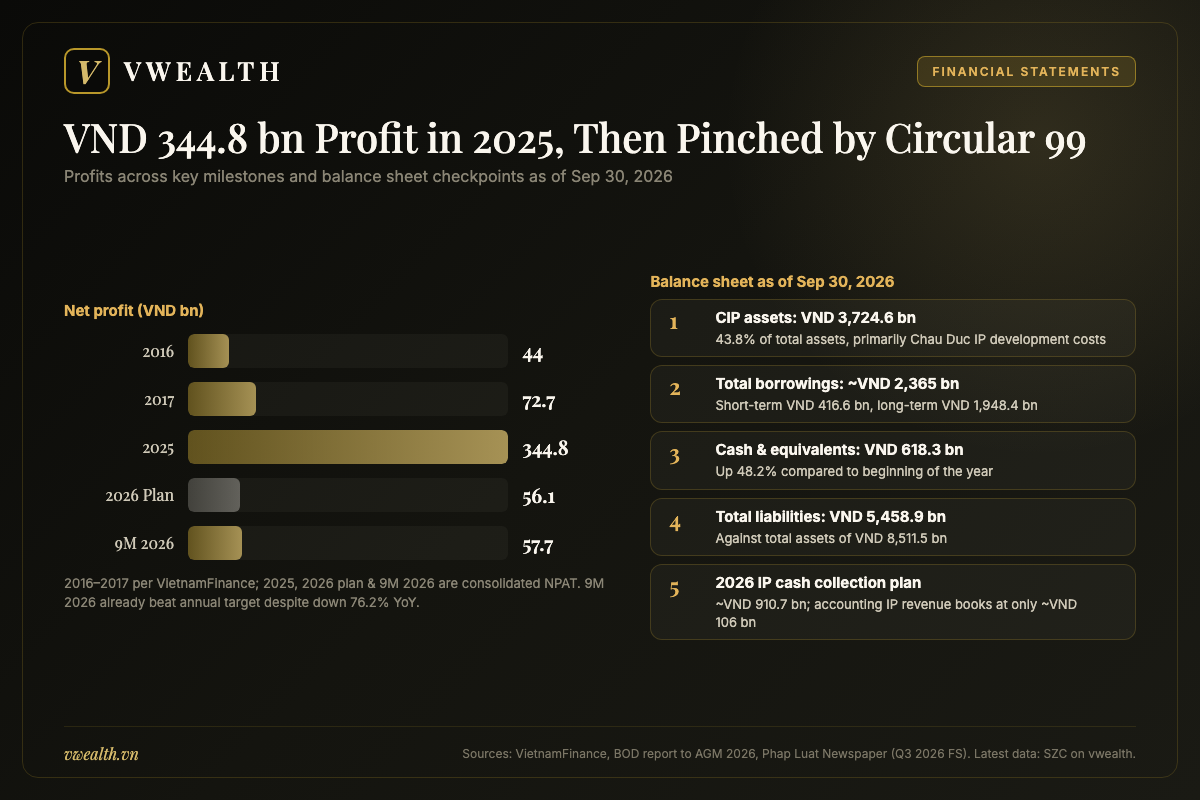
Valuation Approaches: How Securities Brokerages Evaluate SZC’s Fundamental Worth
When reported accounting earnings cease to function as a reliable valuation anchor, institutional equity analysts pivot toward two fundamental methodologies: Revalued Net Asset Value (RNAV) and multi-year discounted cash flow (DCF) modeling. This report intentionally refrains from quoting static price targets, intraday share prices, or prevailing P/E multiples, as these numbers fluctuate across every market session. What provides enduring value to investors is understanding the exact asset models that institutional research desks construct to evaluate SZC’s intrinsic worth.
The institutional equity report published by Shinhan Securities in March 2026 serves as an instructive benchmark for RNAV appraisal. Shinhan unbundled Sonadezi Chau Duc into discrete asset components, appraising each division independently: the Chau Duc Industrial Park was appraised via discounted cash flow modeling at approximately VND 6,052 billion; the Chau Duc Urban Township was carried at balance sheet book value of approximately VND 1,579 billion; the Huu Phuoc Urban Area was carried at book value of approximately VND 231 billion; the golf course complex was appraised at approximately VND 182 billion; ready-built factories were valued at approximately VND 31 billion; and the BOT Route 768 concession was appraised at approximately VND 226 billion — with the aggregated asset value divided across 179,985,863 outstanding ordinary shares. Reviewing this asset breakdown immediately reveals that the industrial park represents the overwhelming majority of total corporate value, meaning that analytical assumptions regarding leasing velocity, asking rents, and discount rates function as the primary drivers of intrinsic value. In that initial March 2026 framework, Shinhan assumed industrial land rental rates at Chau Duc would expand by 5% to 8% annually from 2025 through 2028, with industrial leasing generating roughly 78% of consolidated net sales.
A compelling dynamic surfaces when observing how institutional earnings forecasts diverged once the realities of Circular 99 were formally integrated into financial models. In March 2026, Shinhan initially projected 2026 net profit after tax of VND 401 billion on net revenue of VND 1,228 billion. By September 9, 2026 (according to institutional research compiled by Elibook), Shinhan revised its 2026 net profit forecast downward to approximately VND 76 billion and established a 2027 net profit forecast of VND 97 billion, while maintaining a positive investment stance titled “core business operations remain positive.” Concurrently, SSI Securities (in an equity report dated October 8, 2026) projected 2026 net profit of approximately VND 81 billion, while Vietcap Securities (in an update dated October 21, 2026) forecasted full-year net profit of approximately VND 142 billion based on an assumed annual leasing absorption pace of 25 hectares.
Brokerage earnings forecasts for the identical operating year range from VND 76 billion to VND 142 billion — a variance of nearly 100%. This divergence does not imply analytical incompetence; rather, it demonstrates that institutional research desks apply varying assumptions regarding how Circular 99 amortization schedules interact with physical tenant handover schedules. The vital takeaway for public equity allocators is clear: when premier institutional research teams exhibit such substantial disagreement regarding near-term accounting earnings, no investor should buy SZC stock based solely on a forward EPS estimate.
Furthermore, SZC possesses a structural governance characteristic that directly impacts institutional valuation multiples: the 20% foreign ownership limit (FOL) established under Article 4 of its sixteenth amended Charter. For global emerging market funds seeking industrial real estate exposure across Southeast Asia, this restricted room can cause SZC to be bypassed in favor of peers with wider foreign allowances. Regarding capital returns, corporate filings confirm that SZC compiled shareholder registers to execute cash dividend distributions for fiscal year 2025; allocators should consult official AGM resolutions hosted on the corporate portal to verify exact distribution dates and payout percentages.
To inspect live, updated secondary market prices, trailing P/E multiples, price-to-book ratios, and historical valuation percentiles, investors should consult the real-time equity terminal on VWEALTH rather than relying on static printed benchmarks. For allocators wishing to compare SZC against a peer whose financial statements experienced a similar revenue recognition transition, our fundamental study on IDC stock analysis provides an exceptional comparative benchmark.
Land Bank Dynamics and the Race for Site Clearance
An industrial infrastructure developer ultimately monetizes a single underlying asset that cannot be manufactured or replicated: fully cleared, legally compliant, utility-serviced industrial land. And to deliver clean land to global manufacturing corporations, the developer must first acquire physical possession from existing land occupants. For Sonadezi Chau Duc, the pivotal strategic narrative defining the coming decade does not reside on the accounting income statement, but in the operational efficiency of converting fragmented, uncompensated “leopard skin” parcels into contiguous, development-ready hectares that can be handed over to incoming multinational tenants. This chapter examines that operational land race alongside the competitive industry landscape in which SZC operates.
1,900 Hectares Already Handed Over, but Fragmented “Leopard Skin” Plots Remain
According to the 2026 Board of Directors Report, cumulative progress from project inception through the close of 2025 reveals that Sonadezi Chau Duc had secured approved site compensation schemes for approximately 1,995.22 hectares, representing an aggregate compensation commitment of VND 4,468.60 billion. Crucially, the enterprise had taken formal physical possession and site handover of approximately 1,900.37 hectares. When evaluated against the total master-planned project footprint of 2,287 hectares (comprising 1,556 hectares of industrial park alongside integrated commercial-urban acreage and golf facilities), the vast majority of the targeted territory has successfully transitioned into corporate control.
However, in large-scale real estate development, “the vast majority” is fundamentally distinct from “the entire territory.” The final remaining hectares of any mega-scale land tract are invariably the most complex and contentious to clear: lingering households demanding higher compensation rates, contested ancestral land titles, fragmented agricultural plots, and intricate inheritance documentation. Across the Vietnamese property industry, this bottleneck is termed “da beo” (leopard skin) — an operational condition where fully cleared, infrastructure-serviced land parcels are interspersed with uncompensated private plots, preventing the developer from delivering large, contiguous industrial parcels to major multinational tenants requiring massive uninterrupted footprints. In 2025, SZC deployed approximately VND 441.9 billion toward land compensation and site clearance, achieving merely 36.6% of its budgeted capital plan; the company compiled and secured formal approval for compensation schemes covering 28.79 hectares (totaling VND 401.08 billion) and took physical handover of 14.43 hectares.
Achieving only 36.6% of the annual compensation capital plan is an essential operational detail for investors to analyze. It demonstrates that land compensation and site clearance progress at an unpredictable cadence that is partially outside the direct control of corporate management, heavily reliant upon municipal administrative committees, local price appraisal boards, and household negotiations. When institutional allocators assess SZC’s commercial leasing capacity, they must not simply look at the headline 1,556-hectare industrial figure printed in marketing brochures; they must rigorously investigate what portion of that acreage is legally cleared, fully serviced with arterial utilities, and backed by formal Land Use Rights Certificates (LURCs).
Regarding on-site infrastructure deployment, cumulative progress through the end of 2025 indicates that SZC had executed ground leveling across roughly 990 hectares (with 45 hectares leveled during 2025), constructed 44.5 kilometers of paved roads integrated with stormwater drainage networks, laid 29.15 kilometers of clean water delivery pipes, installed 33.57 kilometers of centralized wastewater collection pipes, and deployed 27.4 kilometers of industrial lighting. Centralized Wastewater Treatment Station No. 2, Module 2 (4,500 m³ per day design capacity) remains in active commercial operation; Module 3 (8,000 m³ per day capacity) has completed physical installation and is currently finalizing regulatory operational licensing. These utility metrics represent non-negotiable operational prerequisites: global electronics, semiconductor, and specialty chemical manufacturers will not commit capital if centralized wastewater treatment capacity is constrained.
2026 Operational Blueprint: Spending VND 1,362.8 Billion on Land Compensation, Receiving 50.67 Hectares
If fiscal year 2025 was defined by record cash generation and tenant handovers, fiscal year 2026 is structurally configured as a year of massive capital deployment into land acquisition. The 2026 Board of Directors Report establishes an ambitious site compensation and clearance budget of approximately VND 1,362.8 billion — representing an outlay more than three times the actual compensation capital disbursed in 2025 [vwealth estimate: 1,362.8 ÷ 441.9]. In parallel, management budgeted capital expenditure for basic infrastructure construction of approximately VND 256.8 billion, comprising roughly VND 167.7 billion allocated to industrial park infrastructure and approximately VND 25.2 billion dedicated to golf course development.
Regarding specific land milestones, the approved 2026 operational plan encompasses highly defined tasks: executing cadastral land surveys across the remaining 17.76 hectares of contested territory (encompassing 11.8 hectares in Chau Pha and 5.96 hectares in Tan Thanh); securing approved compensation schemes for 42.65 hectares representing roughly VND 565.39 billion; taking physical site handover of 50.67 hectares (with approximately 50 hectares dedicated directly to the industrial park); petitioning municipal authorities for formal land allocation or long-term lease approvals across nearly 148 hectares; remitting Phase 7 land-use levies covering 10.98 hectares of urban township land, totaling approximately VND 797.37 billion; and securing formal Land Use Rights Certificates for 28.61 hectares under Phase 8 of the industrial park alongside 84.99 hectares situated within the Phu My precinct. Concurrently, management planned to execute Phase 5 unexploded ordnance (UXO) mine clearance across 160.75 hectares and commence construction on Module 1 (8,000 m³ per day design capacity) of Wastewater Treatment Station No. 3.
| 2026 Land & Infrastructure Operational Target | Targeted Area (ha) | Budgeted Capital Outlay (VND bn) |
|---|---|---|
| Site Compensation & Land Clearance (Total Budget) | — | ~1,362.8 |
| Approved Land Compensation Schemes | 42.65 | ~565.39 |
| Physical Land Handover Received (Industrial ~50 ha) | 50.67 | — |
| Applications for State Land Allocation / Land Leasing | ~148.0 | — |
| Phase 7 Land-Use Levy Remittance for Urban Township | 10.98 | ~797.37 |
| Land Use Rights Certificates (Phase 8 IP & Phu My) | 28.61 + 84.99 | — |
| Phase 5 UXO Mine Clearance Operations | 160.75 | — |
| Basic Infrastructure Capital Expenditure (Total Capex) | — | ~256.8 |
Source: Draft Board of Directors Report submitted to the 2026 Annual General Meeting of Shareholders of Sonadezi Chau Duc.
Analyzing this capital allocation schedule demonstrates that budgeted cash outlays for land and infrastructure materially surpass projected operational cash inflows from industrial land leasing. Aggregating the land compensation budget and basic infrastructure capital expenditure yields a combined planned outlay of approximately VND 1,620 billion [vwealth estimate: 1,362.8 + 256.8], which exceeds the VND 910.7 billion in cash collections projected from industrial tenants. The capital variance must be bridged through existing cash reserves, auxiliary operating cash flows, or expanded long-term commercial bank borrowing facilities. Crucially, investors should recognize that management’s capital expenditure budget functions as an authorized expenditure ceiling; in 2025, actual compensation spending reached only about one-third of the initial plan, indicating that actual 2026 disbursements may fall well short of these budgeted targets if administrative land procedures experience delays.
33 Hectares Signed in 6 Months vs. 21 Hectares in Full-Year 2025: Is Leasing Demand Rebounding?
The broader macro environment confronting the southern Vietnamese industrial real estate sector throughout 2025 and 2026 has been characterized by a prevailing sentiment: institutional anticipation. According to official General Statistics Office data cited by Shinhan Securities, realized foreign direct investment disbursed in 2025 reached USD 27.6 billion (up 9% year-over-year, marking a 5-year high), while registered FDI reached USD 38.4 billion (up 0.5%). However, the cadence of capital commitments was highly asymmetrical: registered FDI surged by 42% in the first half of 2025 (reaching USD 21.5 billion), but contracted by 27% in the second half (falling to USD 16.9 billion) as multinational corporations adopted a cautious stance pending clarity on United States tariff policies.
Against this fluctuating macro backdrop, Sonadezi Chau Duc’s newly contracted leasing acreage serves as the most sensitive leading operational indicator. In 2025, the company secured approximately 21 hectares of newly contracted industrial land across the entire twelve months (with the Board Report documenting exactly 20.91 hectares, achieving 90.91% of its target via three sublease contracts and three MOUs). In sharp contrast, during the first six months of 2026 alone, newly contracted leasing acreage reached approximately 33 hectares, according to brokerage compilations published on Elibook. If fully converted into binding contracts, this demonstrates an operational acceleration in multinational leasing commitments. For the full year 2026, corporate management established an operational target to secure 25 hectares of newly leased industrial land while converting 9.2 hectares of pre-existing lease commitments into binding agreements; equity analysts at Vietcap Securities similarly incorporated a baseline assumption of 25 hectares for the full year. Allocators must note that brokerage compilations citing “signed acreage” frequently blend binding sub-lease agreements with preliminary Memorandums of Understanding, making ongoing verification via audited financial footnotes and annual disclosures essential.
When evaluated against domestic industry peers, Sonadezi Chau Duc possesses an extensive remaining leasable land reserve situated slightly outside the saturated manufacturing hubs of Binh Duong and central Dong Nai, but compensated by unparalleled proximity to Cai Mep port and the Bien Hoa – Vung Tau expressway corridor. To evaluate how competing industrial operators navigate this macro cycle, investors can review our comprehensive research on KBC stock analysis (focusing on northern manufacturing hubs and major electronics conglomerates) and our fundamental breakdown of SIP stock analysis (highlighting industrial parks integrated with steady utility distribution cash flows). For a comprehensive macro sector overview, consult our analysis of Vietnam manufacturing and industrial stocks.
Another fundamental comparative variable is realized asking rent. Brokerage research desks publish varying estimates for Chau Duc at different historical intervals; hence this analysis avoids relying on an arbitrary blended average. The definitive empirical benchmark confirmed across primary disclosures remains the Electronic Tripod transaction: an 18-hectare commitment supported by an upfront cash advance of VND 359.4 billion. Concurrently, Shinhan Securities’ fundamental model incorporates an assumed 5% to 8% annual escalation in primary asking rents across 2025–2028. To the extent that Chau Duc’s asking rents remain moderately discounted relative to competing parks situated along the immediate maritime belt, this pricing differential acts as an attractive magnet drawing multinational tenants, while providing substantial embedded runway for future rental rate increases as regional transport infrastructure reaches operational maturity.
Northern Urban Township and Golf Villas: Fresh Administrative Procedures in Ho Chi Minh City
While the industrial park generates current operating cash flow, the integrated urban township represents SZC’s commercial inventory for the coming decade. At the 2025 Annual General Meeting of Shareholders (convened on April 11, 2025), equity holders formally approved the adjusted investment capital plan for the Chau Duc Urban Area project totaling approximately VND 9,381 billion. According to the 2026 Board of Directors Report, the formal investment policy adjustment dossier for the Northern Urban Area is currently undergoing administrative processing at the Department of Finance of Ho Chi Minh City, with the company having successfully organized an architectural design competition for the luxury Golf Villa enclave.
The administrative reality of submitting dossiers directly to Ho Chi Minh City authorities carries practical operational significance. Following the national provincial realignment in 2025, the physical project territory (historically situated in Chau Duc district, Ba Ria – Vung Tau province) was incorporated into Ho Chi Minh City. Consequently, all pending regulatory dossiers, master-plan amendments, and land-use certifications must be re-processed through the municipal bureaucracy of Vietnam’s largest economic metropolis. For equity investors, administrative transitions of this magnitude introduce short-term friction: approval processes and regulatory sign-offs may encounter procedural delays as municipal agencies review historical documentation, even though municipal incorporation undeniably elevates long-term land values over a multi-decade horizon.
Within the Sonadezi Huu Phuoc Residential Area, the company achieved structural completion of Phase 1 social housing blocks, an integrated community cultural house, and a Phase 1 kindergarten, while commencing ground works for Phase 1 of a commercial center. Planned milestones for 2026 encompass drafting detailed feasibility studies for social housing projects across sub-precincts R2, R3, and R4, alongside constructing essential public services including a primary school, a junior high school, a local medical clinic, and a local police headquarters. Within the golf division, capital works focus on engineering designs for the full 18-hole Tournament Course and site leveling across its initial 9 holes. Furthermore, the Board of Directors established strategic guidance to research satellite urban communities designed specifically for foreign technical specialists, engineers, and manufacturing personnel — creating a symbiotic ecosystem where expanding industrial employment directly drives commercial residential demand.
Regarding asset valuation, allocators must recall that Shinhan Securities carries the Chau Duc Urban Township in its RNAV framework strictly at historical book value, assigning zero speculative development premium. If municipal approvals advance efficiently and residential absorption accelerates, this asset will unlock massive equity appreciation; if administrative bottlenecks persist, the capital remains tied up on the balance sheet. Furthermore, the remittance of Phase 7 land-use levies for 10.98 hectares of urban land alone requires approximately VND 797.37 billion, illustrating that unlocking urban land reserves demands substantial liquidity.
Substantial Capital Requirements and Balance Sheet Leverage: Total Liabilities of VND 5,458.9 Billion
Synthesizing these strategic priorities reveals an enterprise executing an intensive dual-track financial mandate: collecting substantial cash inflows from industrial tenants while concurrently committing trillions of VND into site clearance, land fees, and trunk utility deployment. As of September 30, 2026, total corporate liabilities reached VND 5,458.9 billion, with total interest-bearing debt standing at approximately VND 2,365 billion — dominated by long-term bank borrowings of VND 1,948.4 billion.
Two structural dynamics present significant financial reassurance. First, the company’s borrowing profile is heavily weighted toward long-term maturities, precisely matching the multi-year gestation cycle of industrial land development and insulating the corporation from acute short-term refinancing risks. Second, Sonadezi Chau Duc completely eradicated its corporate bond exposure by executing the premature redemption of its final VND 200 billion bond tranche on January 8, 2025 (as reported by Tap chi Cong Thuong), leaving the company entirely unburdened by bond maturity cliffs. However, investors must monitor capitalized interest expenses: when borrowing costs are capitalized directly into work-in-progress project assets rather than expensed immediately on the income statement, they do not depress current reported earnings, but they steadily increase the historical cost basis of future leasable land, ultimately compressing long-term gross development margins.
A practical analytical framework for monitoring financial stability involves benchmarking the quarterly expansion of interest-bearing debt against the expansion of unearned revenue. If interest-bearing debt expands aggressively while unearned revenue stagnates, it indicates that the developer is consuming capital on site clearance without securing commensurate commercial tenant commitments. Conversely, if unearned revenue expands at a faster pace than net bank debt, the enterprise’s self-financing customer-funded development model is operating with exceptional efficiency.
Three Forward-Looking Scenarios for SZC Stock Through 2027
Attempting to predict precise equity share prices across future quarters is a flawed exercise that no institutional analyst executes with sustained accuracy. Consequently, this chapter avoids issuing static target prices. Instead, it identifies the foundational macroeconomic and operational variables that will dictate Sonadezi Chau Duc’s financial trajectory over the next twelve to twenty-four months, subsequently formulating three structured forward-looking scenarios — bull case, base case, and bear case — alongside the exact empirical conditions required for each scenario to materialize. As new quarterly disclosures and regulatory policies emerge, investors can systematically classify incoming developments into this strategic framework.
US Reciprocal Tariffs: From the February 20, 2026 Supreme Court Ruling to Section 122
Multinational industrial tenants leasing land across Vietnamese industrial parks are overwhelmingly export-oriented manufacturers, and the United States represents one of their most significant terminal consumer markets. Consequently, United States trade and tariff policies exert an immediate, profound influence on foreign corporate capital expenditure and factory site selection. As observed in Chapter 5, Sonadezi Chau Duc’s industrial leasing revenue staged an aggressive fourth-quarter surge in 2025 immediately after the United States administration published country-specific reciprocal tariff schedules — demonstrating that once trade policy parameters became quantifiable, corporate tenants who had delayed final commitments promptly executed lease agreements.
Fiscal year 2026 introduced an entirely fresh cycle of global trade policy calibration. According to institutional research from Shinhan Securities, on February 20, 2026, the United States Supreme Court delivered a landmark 6–3 ruling declaring that the executive branch’s application of broad tariffs enacted under the International Emergency Economic Powers Act (IEEPA) was unlawful. In response, effective February 24, 2026, the United States administration transitioned toward a temporary tariff mechanism established under Section 122 of the Trade Act, which carries a statutory limitation of 150 days. This report intentionally avoids citing specific percentage tariff rates due to variations across initial research sources.
The strategic implication for SZC is direct: the 150-day statutory window commencing in late February 2026 has concluded prior to the publication of this study; therefore, institutional allocators must actively verify the specific post-150-day trade framework governing Vietnamese manufacturing exports into the United States. Whenever long-term bilateral trade frameworks achieve institutional clarity, foreign direct investment tenants accelerate capital deployment; whenever trade policies face legal or political ambiguity, foreign corporate decision-makers defer final site commitments. Consequently, quarterly newly contracted industrial leasing acreage serves as the most reliable, rapid-response barometer reflecting multinational tenant sentiment.
Bull Case Scenario: Accelerated Tenant Commitments, Clarified Accounting Guidance, Completed Regional Infrastructure
The bull case scenario requires the harmonious convergence of several highly favorable operational and macroeconomic conditions. First, the bilateral trade framework governing Vietnamese manufactured goods entering the United States stabilizes with sufficient predictability, empowering multinational electronics, automotive component, and precision manufacturing corporations to execute long-term capital deployment. Under this catalyst, Sonadezi Chau Duc sustains the aggressive leasing momentum recorded during the first half of 2026 rather than reverting to the modest 21 hectares achieved across 2025. The benchmark operational indicator for this scenario is Shinhan Securities’ optimistic modeling assumption of approximately 45 hectares of newly leased industrial land per year, as outlined in their March 2026 equity research report.
Second, the Ministry of Finance issues a formal regulatory response to SZC’s official petition regarding Circular 99/2025/TT-BTC, introducing standardized accounting guidelines tailored specifically for industrial infrastructure operators that either permit revenue recognition to reflect operational cash flows more accurately, or establish unambiguous, standardized amortization schedules. Clarified regulatory guidance would eliminate the wide divergence currently exhibited across institutional brokerage forecasts, significantly soothing market anxiety regarding depressed accounting earnings.
Third, regional multimodal infrastructure projects reach operational fruition. Shinhan Securities articulated an institutional expectation that the Long Thanh International Airport project could complete construction before June 2026, complemented by ongoing capacity expansions across the Cai Mep deep-water port complex, transforming the former Ba Ria – Vung Tau industrial corridor into southern Vietnam’s premier logistics destination. Investors must treat this airport timeline as an institutional brokerage expectation subject to ongoing verification. Fourth, corporate site clearance operations accelerate, achieving near-full execution of the 2026 compensation plan, thereby providing expansive, contiguous clean land reserves capable of accommodating mega-scale multinational tenants without “leopard skin” fragmentation delays.
Under this optimistic operational scenario, balance sheet unearned revenue expands aggressively, generating massive liquid cash balances that allow SZC to internally fund site clearance and infrastructure construction without relying on expensive debt facilities. While reported accounting net profit remains structurally lower than pre-2026 historical peaks, it ascends steadily year-over-year as prior-year deferred rental contracts accumulate layered amortization. Simultaneously, institutional market participants begin valuing SZC based on operating cash flow and intrinsic net asset value rather than trailing price-to-earnings ratios.
Base Case Scenario: 25–35 Hectares Signed Annually, Modest Accounting Profit, Resilient Cash Flow
The base case scenario represents the operational trajectory most closely aligned with management’s approved corporate business plan and the fundamental modeling assumptions utilized by Vietcap Securities: securing approximately 25 hectares of newly contracted industrial land annually, complemented by successfully converting pre-existing lease reservations into binding contracts (with the 2026 plan targeting the execution of 9.2 hectares of pre-agreed commitments). The range of 25 to 35 hectares represents an illustrative operational baseline utilized by vwealth, spanning management’s official 25-hectare target to the roughly 33 hectares signed during the first six months of 2026 as compiled on Elibook.
In this baseline scenario, Circular 99/2025/TT-BTC remains enforced in its current regulatory formulation without immediate administrative exemptions. Reported consolidated accounting net profit for 2026 remains within the range currently projected across institutional brokerage desks — spanning from approximately VND 76 billion (Shinhan Securities) to roughly VND 142 billion (Vietcap Securities), as compiled by Elibook — before edging higher at an incremental pace in subsequent years. Actual cash collections derived from industrial park operations continue to generate hundreds of billions of VND annually, self-financing a substantial portion of ongoing land compensation and utility infrastructure, with the remaining capital deficit bridged via prudently managed long-term commercial bank borrowing facilities.
Concurrently, auxiliary operations perform their designated supportive functions: the Sonadezi Huu Phuoc Residential Area and social housing developments generate incremental top-line contributions without yet evolving into dominant profit pillars, while the BOT Route 768 tollway and Chau Duc Golf Course deliver modest but highly predictable recurring operating cash flows. From an equity performance standpoint, the base case scenario is frequently characterized by extended secondary market consolidation: equity markets find little justification to bid multiples aggressively higher due to low reported EPS, yet find no justification for aggressive liquidation because operating cash flows and underlying physical asset values remain exceptionally solid. Patient, cash-flow-focused allocators benefit steadily, while short-term momentum traders reliant on quarterly EPS growth find the equity uninspiring.
Bear Case Scenario: FDI Softening, Protracted Land Clearance Bottlenecks, Escalating Cost of Capital
The bear case scenario unfolds if global trade policy ambiguity persists or deteriorates materially, prompting multinational manufacturing corporations to freeze or indefinitely postpone international capital expenditure commitments — mirroring the dynamic observed in the second half of 2025 when registered foreign direct investment into Vietnam contracted by 27%. Under these macro headwinds, SZC’s newly contracted leasing volume falls below the baseline 25-hectare target. Simultaneously, if on-site land compensation operations encounter protracted community resistance or administrative gridlock similar to 2025 (when the company achieved only 36.6% of its compensation capital plan), SZC confronts a structural bottleneck: commercial prospective tenants may express interest, but the developer lacks contiguous, infrastructure-serviced land parcels ready for immediate physical delivery.
Severe financial pressures would emerge on the capital expenditure side of the balance sheet. If the enterprise is compelled to remit substantial statutory land-use levies for its urban township (such as the roughly VND 797.37 billion required for Phase 7 urban land) and continue basic utility deployment while tenant cash collections decelerate, interest-bearing bank debt would expand at a faster rate than unearned revenue — triggering the exact balance sheet deterioration highlighted in Chapter 6. Rising interest expenses capitalized into project costs would steadily inflate the historical cost basis of future leasable land, eroding terminal development margins. Furthermore, administrative delays associated with transitioning regulatory dossiers to Ho Chi Minh City municipal agencies could stall formal investment approvals for the Chau Duc Urban Area, leaving massive capital trapped indefinitely within construction in progress.
Under this adverse scenario, already compressed accounting earnings contract further, and secondary equity markets tend to penalize the stock aggressively based on depressed headline earnings before conducting nuanced cash flow evaluations. This represents a tangible downside risk that long-term allocators must incorporate into their risk models, regardless of their confidence in the long-term value of the underlying land bank.
| Core Strategic Driver | Bull Case Scenario | Base Case Scenario | Bear Case Scenario |
|---|---|---|---|
| Annual Leased Industrial Acreage (Illustrative) | ~45 ha annually (Shinhan Mar 2026 assumption) | 25–35 ha annually (Company target, Vietcap, 6M 2026 pace) | Below 25 ha annually |
| US Trade Policy & Multinational FDI | Tariff framework stabilizes; FDI executes rapid site commitments | Moderate trade friction; FDI commits at steady, measured cadence | Prolonged trade ambiguity; FDI freezes new manufacturing capex |
| Circular 99 Accounting Enforcement | Regulatory guidance clarifies rules, aligning revenue with cash flow | Circular 99 applied as structured; revenue amortized straight-line | Circular 99 unchanged; market fixates strictly on depressed EPS |
| Site Compensation & Land Handover | Execution nears 2026 plan; contiguous clean land delivered promptly | Moderate execution matching historical multi-year clearance averages | Protracted clearance delays mirroring 2025 (36.6% plan execution) |
| Cash Flow & Balance Sheet Leverage | Customer cash collections self-fund majority of land & capex costs | Customer cash complemented by structured long-term bank facilities | Bank borrowings surge faster than unearned revenue balances |
The scenario matrix above represents a structured analytical framework for institutional evaluation, not an absolute statistical forecast. Operational acreage benchmarks are derived directly from corporate targets, Shinhan Securities research, and Elibook compilations; vwealth does not assign arbitrary subjective probabilities to individual scenarios.
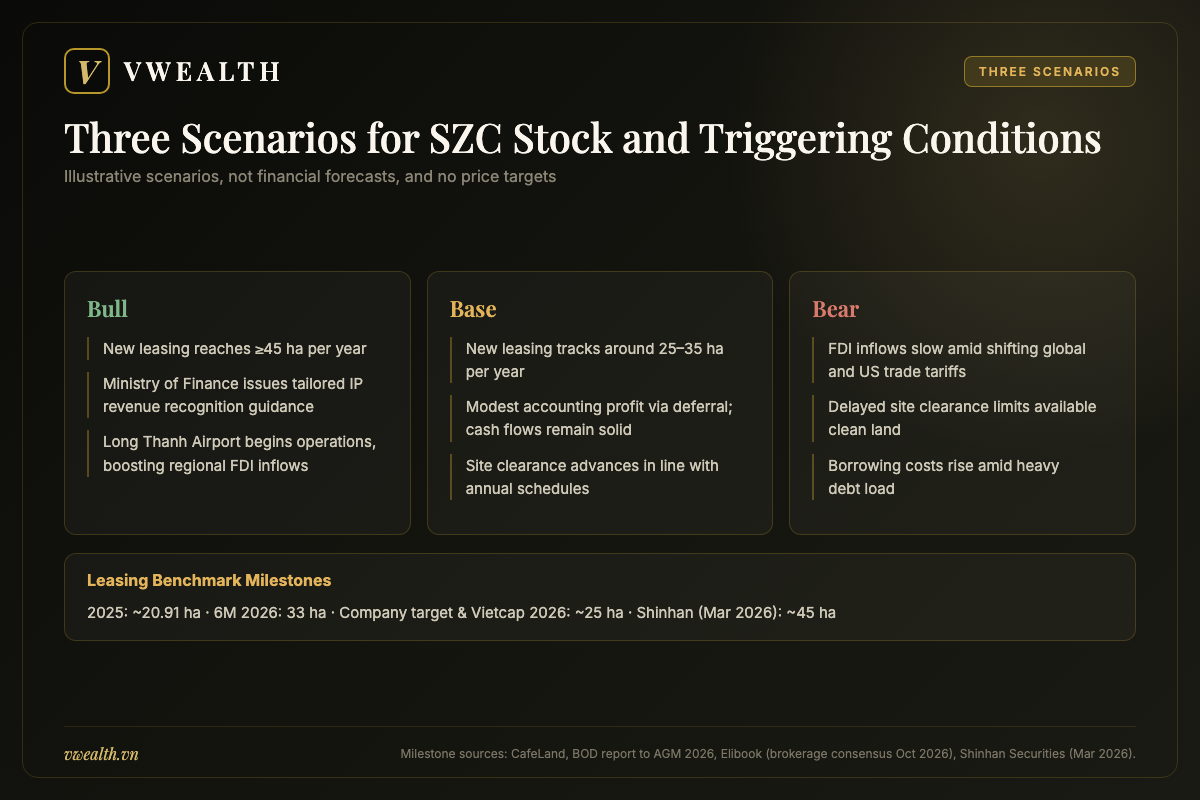
Critical Risk Factors to Monitor: Post-Merger Legal Transitions, 20% FOL Ceiling, Market Liquidity
Beyond the primary macro and operational drivers detailed in the scenario matrix, several structural risk factors warrant vigilant institutional monitoring. The first involves regulatory administrative transition risks resulting from the 2025 provincial reorganization. Incorporating the physical project territory into Ho Chi Minh City requires pending master-plan adjustments, investment policy amendments, and statutory land-use certifications to progress through newly assigned municipal agencies. The 2026 Board Report confirmed that adjustment dossiers for both the Northern Urban Area and the Chau Duc Urban Township are under review at the Department of Finance of Ho Chi Minh City; shareholders must monitor official corporate disclosures for formal approval notifications.
The second structural risk pertains to the 20% foreign ownership limit (FOL) established under Article 4 of the corporate Charter. When this foreign room ceiling is reached, foreign institutional capital is legally blocked from accumulating SZC stock on the open exchange order book, constraining global institutional demand. Conversely, during periods when foreign room is available, the equity lacks the broad international liquidity base enjoyed by industrial real estate peers maintaining 49% or 50% foreign ownership limits.
The third operational risk centers on asset and customer concentration. Industrial land leasing represents the overwhelming majority of Sonadezi Chau Duc’s fundamental enterprise value under institutional RNAV frameworks. Consequently, the operational decision of a single mega-scale anchor tenant to expand or contract its footprint exerts an outsized impact on full-year financial performance. While auxiliary divisions — encompassing BOT 768, the golf complex, and residential property — provide valuable operational diversification, their present scale remains insufficient to insulate corporate performance should the core industrial division experience a macro shock.
Finally, investors must manage the behavioral risk of “financial statement misinterpretation.” This is not a risk residing within the company, but within the investing public. During the ongoing transition under Circular 99, sensational media headlines proclaiming dramatic quarterly earnings contractions can trigger irrational secondary market panic selling. Conversely, should future accounting clarifications or lump-sum adjustments generate an artificial quarterly earnings spike, uncalibrated enthusiasm could lure retail capital into chasing the stock at cyclically elevated valuations. Maintaining an uncompromising understanding of underlying revenue recognition mechanics represents an investor’s greatest intellectual edge.
Should You Buy SZC Stock? Who It Fits and Who Should Step Aside
Following seven chapters of comprehensive fundamental analysis, the time has arrived to address the primary strategic question that brought you to this report: should you buy SZC stock today? The objective answer is that it depends entirely upon who you are as an investor, which financial yardstick you utilize to appraise enterprise value, and how long of a capital horizon you can maintain without demanding immediate liquidity. This final chapter issues no dogmatic buy or sell mandates; rather, it provides a rigorous, objective framework empowering global and domestic allocators to position Sonadezi Chau Duc appropriately within their broader investment portfolios.
Who It Is Suitable For: Long-Term Horizon Investors Prioritizing Operating Cash Flows Over EPS
Sonadezi Chau Duc is exceptionally well suited for sophisticated allocators who understand and embrace the financial reality that reported accounting net profit for Vietnamese industrial developers under Circular 99 no longer captures the true health or momentum of operational business activity. If you are an investor who routinely examines the Statement of Cash Flows, tracks balance sheet expansion across unearned revenue liabilities, and monitors net newly leased industrial acreage, you command a decisive informational advantage over market participants fixated exclusively on quarterly earnings per share (EPS). The fundamental investment case for SZC is anchored upon an irreplaceable real asset: a master-planned 2,287-hectare industrial and urban complex featuring a 1,556-hectare industrial core, with approximately 1,900 hectares already brought into corporate physical possession, strategically positioned adjacent to southern Vietnam’s deepest maritime gateway, with vast contiguous acreage remaining to be commercialized.
Furthermore, SZC is ideally tailored for allocators maintaining a patient investment horizon of three to five years or longer. Converting raw agricultural land into cash-generative industrial estates operates on a multi-year capital cycle dictated by global foreign direct investment decisions, which rarely unfold in smooth, linear quarterly progressions. Consider an illustrative example: if Sonadezi Chau Duc executes several landmark tenant subleases across a twelve-month span, reported accounting net profit under straight-line amortization rules may register only an incremental uptick, prompting short-term traders to express disappointment; in contrast, long-term allocators recognize that hundreds of billions of VND in prepaid cash have entered corporate accounts and accumulated within deferred revenue reserves, guaranteeing a predictable stream of recognized revenue and high-margin utility cash flows for decades into the future.
Finally, SZC appeals directly to global institutions seeking direct exposure to the manufacturing relocation wave concentrating around the Cai Mep – Thi Vai deep-sea port complex and the Long Thanh International Airport economic corridor, executed through a developer controlled by the Industrial Zone Development Corporation (Sonadezi) — an established state-backed infrastructure conglomerate possessing over twenty-five years of industrial execution experience.
Who Should Avoid It: Investors Demanding Steady Accounting EPS Expansion and High Predictable Dividends
Conversely, if your primary investment methodology relies on mechanical equity screening tools that filter securities based on consecutive quarters of positive EPS expansion or low trailing price-to-earnings (P/E) multiples, SZC stock will frequently fail your quantitative criteria over the coming operating cycles. This exclusion will occur not because the enterprise has experienced operational decay, but because regulatory revenue recognition conventions have structurally suppressed near-term accounting earnings. Investors who experience psychological anxiety holding an equity position amidst recurring financial media headlines declaring that “quarterly earnings have contracted” should refrain from initiating a position.
Additionally, allocators requiring high, highly predictable cash dividend yields to fund current lifestyle expenditures will find SZC suboptimal during its current capital-intensive expansion phase. The corporation is actively deploying multi-trillion-VND capital expenditure budgets toward land compensation, cadastral clearance, and centralized utility networks. While the company established shareholder registers to distribute cash dividends for fiscal year 2025, capital allocation priorities across future fiscal years will inevitably balance shareholder payouts against capital preservation, constrained by lower reported accounting profits under Circular 99. Investors should examine formal annual general meeting resolutions before baking aggressive dividend yields into total return expectations.
Finally, investors possessing low tolerance for secondary market volatility driven by macro trade headlines — encompassing United States reciprocal tariff reviews, global supply chain relocations, and emerging market currency fluctuations — should avoid concentrated positions in industrial developers. Securities tied directly to global manufacturing integration inevitably experience heightened beta whenever international trade friction surfaces.
Five Essential Questions to Answer Before Placing an Order for SZC Stock
Before executing an allocation order on HOSE, investors should articulate concise, evidence-based answers to the following five fundamental questions. If any question cannot be answered with analytical confidence, that marks the exact operational area requiring deeper investigation.
First, what fundamental methodology am I utilizing to value SZC? If relying on price-to-earnings multiples, you must acknowledge that the earnings denominator is severely compressed under Circular 99, rendering the multiple artificially elevated. If utilizing Revalued Net Asset Value (RNAV) or discounted cash flow modeling, you must accept that underlying assumptions regarding long-term asking rents, discount rates, and tenant absorption velocity carry inherent modeling sensitivities.
Second, what baseline of newly leased industrial acreage am I modeling annually? Historical and forward markers diverge significantly: management’s baseline target of 25 hectares (matching Vietcap’s assumption), the roughly 33 hectares signed during the first half of 2026 (as compiled on Elibook), and Shinhan Securities’ optimistic assumption of approximately 45 hectares annually generate radically different financial outcomes. Establish your baseline expectations and benchmark quarterly disclosures against them.
Third, can I comfortably tolerate multiple consecutive quarters of negative earnings headlines? The approved 2026 consolidated business plan establishes a net profit target of VND 56.1 billion against VND 344.8 billion delivered in 2025. If you comprehend this structural reality in advance, sensational media reporting will not induce panic liquidation.
Fourth, am I actively tracking municipal land compensation and regulatory permitting milestones? In 2025, actual compensation spending reached only 36.6% of the corporate budget; for 2026, management budgeted an ambitious compensation outlay of VND 1,362.8 billion. A developer’s operational capacity to deliver contiguous, infrastructure-serviced land dictates future cash generation.
Fifth, what specific portfolio weighting does SZC represent within my total assets? An equity asset whose underlying economics are exposed to global trade architecture and multi-year land clearance cycles should never occupy a portfolio weighting that jeopardizes overall portfolio solvency. An illustrative example: a disciplined allocator might restrict single-ticker industrial real estate exposure to a defined, conservative percentage of total equity capital, ensuring that market consolidation does not compel forced liquidation.
Quarterly Monitoring Checklist: Newly Leased Acreage, Unearned Revenue, Land Compensation Progress, Circular 99 Directives
For investors actively holding SZC stock or maintaining the security on an institutional watch-list, the following structured checklist outlines the key corporate indicators to track across each quarterly disclosure, arranged in order of analytical priority:
Begin by inspecting newly contracted industrial leasing acreage and the identity of multinational anchor tenants — verifiable across official corporate disclosures, annual reports, and institutional equity research updates. Next, examine balance sheet unearned revenue across short-term and long-term liabilities — steady expansion confirms that tenants continue remitting advance cash deposits. Third, evaluate net cash flows from operating activities within the Statement of Cash Flows, comparing cash generation directly against prior-year periods. Fourth, track site compensation disbursements, physical land handover acreage, and the issuance of formal Land Use Rights Certificates against annual corporate operational blueprints. Fifth, monitor total interest-bearing debt facilities, benchmarking the expansion of bank borrowings against the expansion of unearned customer revenue. Finally, monitor any formal administrative guidance issued by the Ministry of Finance regarding the implementation of Circular 99 for industrial park infrastructure: a standardized regulatory clarification could alter corporate profit targets and institutional market sentiment overnight.
To contextualize Sonadezi Chau Duc within the broader industrial real estate asset class across Vietnam stocks, allocators should explore our comprehensive sector study on Vietnam manufacturing and industrial stocks, and contrast SZC’s land bank dynamics with the integrated mega-developer profiled in our detailed study on BCM stock analysis.
| Core Strategic Strengths & Investment Catalysts | Key Operational Risks & Investment Headwinds |
|---|---|
| Master-planned 2,287 ha project footprint; ~1,900 ha already handed over with 1,556 ha industrial park | Reported accounting net profit severely suppressed in 2026 under Circular 99 (budgeted at VND 56.1 bn) |
| Vast operational cash collections: 2026 industrial cash collections officially budgeted at ~VND 910.7 bn | Aggressive 2026 land compensation budget of VND 1,362.8 bn demands substantial capital deployment |
| Expanding unearned revenue reserves (~VND 826 bn at end-Q2 2026 per Shinhan via Elibook) | Site clearance reached only 36.6% of plan in 2025; fragmented “leopard skin” plots remain |
| Unrivaled logistics access: 3 km to expressway, 16–19 km to Cai Mep deep-water port complex | Heavy dependence on export manufacturing FDI and evolving United States reciprocal tariff policies |
| Corporate bond debt entirely eliminated as of Jan 8, 2025; bank borrowings heavily long-term (~VND 1,948 bn) | Total interest-bearing debt of ~VND 2,365 bn with net debt of ~VND 1,620 bn (vwealth estimate) |
| Diversified auxiliary cash flows: BOT Route 768 tollway, Chau Duc golf course, and residential units | Foreign ownership limit strictly capped at 20% FOL; regulatory transition following HCMC provincial merger |
Final Takeaway: Value SZC by Land Assets and Operating Cash Flow, Not Accounting Earnings Alone
Sonadezi Chau Duc in 2026 provides a rare, textbook masterclass for public equity investors: the exact same corporate enterprise, operating within the exact same fiscal year, exhibits a contraction of more than three-quarters in reported accounting net profit, while concurrently projecting a massive expansion in actual cash collections derived from multinational industrial tenants. An allocator who glances casually at the bottom line of the reported income statement sees a business experiencing apparent contraction. An allocator who conducts a thorough fundamental audit across the corporate balance sheet and cash flow statements sees an enterprise actively accumulating massive deferred revenue balances while aggressively deploying capital to unlock vast future land reserves.
Returning to the core dilemma: should you buy SZC stock? If you are a long-term, fundamentally driven investor who evaluates businesses based on tangible operating cash generation, maintains conviction in the structural wave of foreign direct investment deploying into southern Vietnam’s maritime port gateway, and possesses the temperament to navigate global trade policy headlines, Sonadezi Chau Duc represents an exceptional candidate for comprehensive portfolio research. Conversely, if your strategy mandates linear quarterly accounting profit expansion, demands high and predictable dividend yields, or lacks the time to monitor cadastral compensation milestones and quarterly leased acreage, stepping aside or restricting your holding to an exploratory allocation represents the prudent course. This analysis provides an objective, transparent balance of structural advantages and operational risks to empower your independent capital allocation decisions, rather than an absolute recommendation to buy or sell.
Secondary exchange prices, trailing price-to-earnings multiples, price-to-book ratios, and quarterly financial metrics fluctuate continuously across every trading session. Rather than anchoring upon static printed figures, allocators should access the live equity terminal on VWEALTH to examine real-time updated valuations and benchmark SZC against competing industrial developers. You can create your free VWEALTH account to access continuously updated financial models and institutional research reports covering SZC and its industry peers as new financial filings are published.
Research Vietnamese stocks in English with vwealth. Our AI-powered platform turns Vietnamese market data into full English analysis reports — with international payment support and a free 2-month trial for new accounts. Create your free account and read the latest reports.