Vietnam is one of the fastest-growing economies in Asia: GDP expanded 8.02% in 2025 and a further 8.18% in the first half of 2026, driven by export manufacturing, foreign direct investment and a public investment push. For investors, 2026 is the year those growth numbers meet two hard tests — a 20% US tariff on Vietnamese goods, and the FTSE Russell reclassification to Secondary Emerging market status that takes effect on 21 September 2026. This guide sets out what the data actually says, where the growth comes from, what could break it, and how each theme reaches the listed equity market.
The 2025 scoreboard: what Vietnam actually delivered
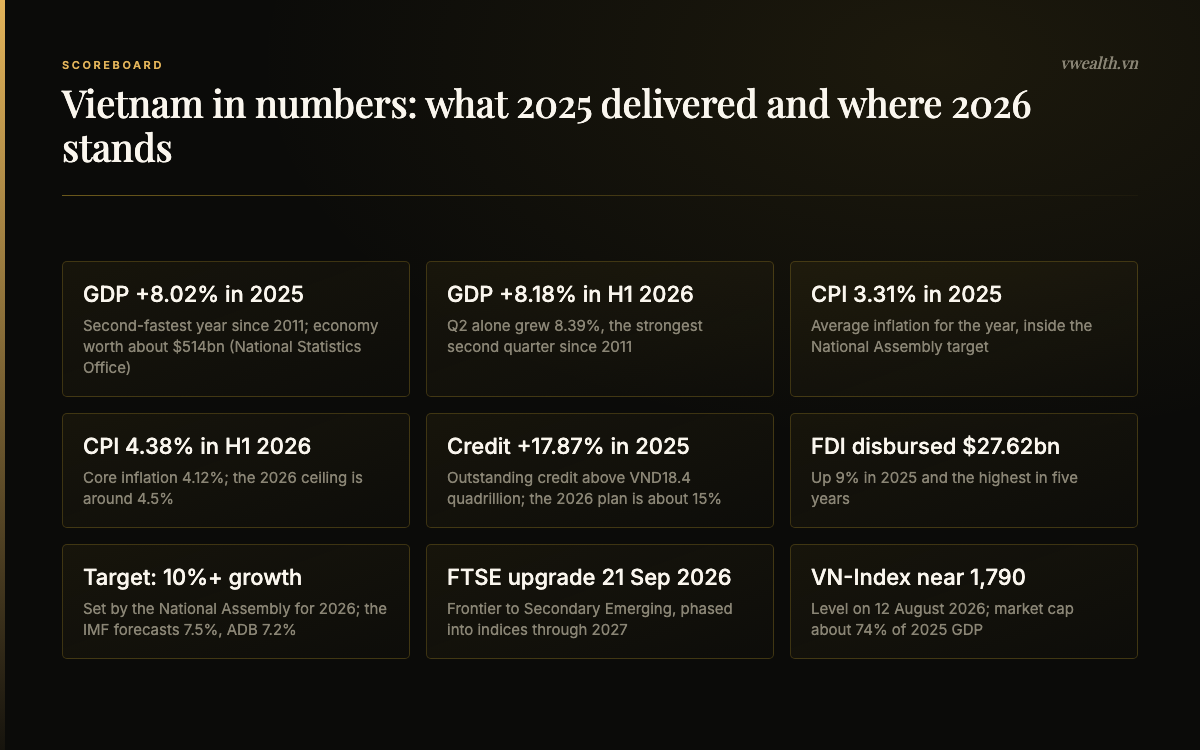
Start with the year that just closed, because the 2026 debate is really an argument about whether 2025 was a peak or a base. Vietnam’s National Statistics Office put full-year 2025 GDP growth at 8.02%, with the fourth quarter alone up 8.46% — the second-fastest annual rate in the 2011–2025 window, behind only the post-Covid rebound year of 2022. In level terms the economy reached roughly VND12.85 quadrillion, about US$514 billion, an increase of some US$38 billion on 2024.
The composition mattered as much as the headline. Industry and construction grew 8.95%, services 8.62%, and agriculture, forestry and fisheries 3.78%. Services made the largest single contribution to growth at 51.08%, with industry and construction at 43.62%. That is a healthier mix than the caricature of Vietnam as a pure assembly economy suggests: factories still set the pace, but domestic services now carry the larger share of the growth arithmetic.
Inflation stayed inside the fence — in 2025
Average CPI for 2025 came in at 3.31%, comfortably inside the ceiling the National Assembly had set. That is the number to hold in mind when you read 2026 commentary, because the picture has since changed. Vietnam entered 2026 with a policy ceiling of around 4.5% under National Assembly Resolution 244/2025/QH15, and average CPI in the first half of 2026 ran at 4.38%, with core inflation at 4.12%, per the National Statistics Office. Vietnam is still inside its own target, but the buffer is now measured in tenths of a percentage point rather than a full point and a half.
Credit did the heavy lifting
Vietnam is a bank-financed economy, and 2025 showed it. Outstanding credit to the economy rose 17.87% by 24 December 2025, taking total credit past VND18.4 quadrillion (about US$670 billion), according to the State Bank of Vietnam. That is a five-year high and roughly double the pace of nominal GDP growth. Credit expanding twice as fast as output is how you get 8% growth; it is also how you accumulate the kind of leverage that makes a central bank nervous. The 2026 plan pulls that back to about 15%, with the State Bank allocating quotas once for the year and monitoring quarterly rather than handing out mid-year top-ups.
If you want to understand how that quota mechanism works from the inside — why Vietnamese banks are valued on price-to-book rather than price-to-earnings, and why credit growth is a policy variable rather than a market one — our guide to the Vietnam banking sector covers the machinery in detail. It matters here because banks are the single largest sector in the index, so a 15% credit ceiling is not a banking story. It is a market story.
The external account: a US$20 billion cushion
Total two-way trade passed US$930 billion in 2025, up 18.2%, with a trade surplus of about US$20 billion, on National Statistics Office figures. Set that against a US$514 billion economy and you have the cleanest single measure of how open Vietnam is: two-way trade is worth roughly 1.8 times GDP. Very few economies of this size are that exposed to what happens elsewhere.
The internal split is instructive. The domestic sector ran a US$29.4 billion deficit while the foreign-invested sector, including crude oil, ran a surplus of nearly US$49.5 billion. In other words, the surplus is a foreign-invested manufacturing surplus. The United States was the largest export market at US$153.2 billion, China the largest import source at US$186 billion, and the bilateral surplus with the US reached nearly US$134 billion, up 28.2%. Hold that last number — it is the reason the tariff conversation exists at all.
Foreign direct investment kept arriving
Newly registered FDI in 2025 reached US$38.42 billion, up 0.5%, while disbursed FDI hit US$27.62 billion, up 9% and the highest in five years. The disbursement number is the one to watch. Registered capital is a promise; disbursed capital is concrete poured, machines installed and workers hired. Vietnam converting nearly three-quarters of a flat registration number into a five-year record of actual spending tells you that the pipeline built in 2021–2024 was real, not a press-release phenomenon.
Where the economy stands in 2026
Vietnam entered 2026 with the most ambitious growth target it has ever set. On 13 November 2025 the National Assembly adopted a socio-economic development plan with fifteen targets, headlined by GDP growth of 10% or higher, per capita GDP of US$5,400–5,500 and inflation held near 4.5%. To get there, the plan calls for total social investment of nearly VND4.93 quadrillion — around US$189 billion, up 18.7% year on year and equal to 33–33.7% of GDP.
A double-digit target is a political statement as much as an economic forecast, and it is worth reading it as such. It signals to ministries and provinces where the pressure will be applied: on disbursing public capital faster, on clearing project approvals, on not letting administrative friction cost half a percentage point of growth.
The first half of 2026 came in strong but short of target
GDP grew 8.18% in the first half of 2026, with second-quarter growth of 8.39% — the strongest second quarter since 2011, and an acceleration from 7.63% in the same period a year earlier. Manufacturing value added rose 10.23% and contributed 33.07% of total growth; services rose 8.09% and contributed 47.14%; agriculture rose 3.87%.
Strong, then — but not ten. The gap between 8.18% and a 10% target is the central tension of the Vietnamese policy year: whether to push harder on credit and public spending to close it, or accept eight-point-something and protect the inflation and currency position. Every risk discussed later in this article is downstream of that choice.
Momentum has held into the second half. The S&P Global Vietnam Manufacturing PMI rose to 52.9 in July 2026 from 51.8 in June, the strongest reading since February, with export sales growing at their fastest rate since July 2024 and factory employment rising for the first time in five months. Input and output price inflation both eased to ten-month lows, which is a useful counterweight to the CPI print.
The trade balance flipped, and that is the biggest change in the data
Here is the number most summaries of Vietnam miss. In the first half of 2026, exports reached US$266.52 billion (up 21.0%) but imports reached US$283.17 billion (up 33.4%), producing a trade deficit of US$16.65 billion, against a US$7.6 billion surplus in the first half of 2025. The swing is roughly US$24 billion in six months.
The composition explains most of it: higher fuel prices plus very heavy buying of machinery, components and production inputs. Read charitably, this is what an investment boom looks like — you import capital goods before you export the output they make, and the registered FDI surge supports that reading. Read sceptically, it is a current account cushion evaporating at exactly the moment the dong is under pressure. Both readings are defensible right now, and which one proves correct over the next four quarters is arguably the single most important open question in Vietnamese macro.
What outside forecasters expect
Nobody outside Hanoi forecasts ten. The Asian Development Bank projects 7.2% for 2026 and 7.0% for 2027 in its April 2026 Asian Development Outlook. The IMF raised its 2026 forecast by 0.4 percentage points to 7.5% in its July 2026 update. The World Bank sits lowest at 6.3%, which it still ranks as the best in East Asia and Pacific.
A 6.3% to 7.5% consensus band against a 10% official target is a wide spread, and it is worth being explicit about what to do with it. Use the official target to predict policy behaviour — where money will be spent, which approvals will be accelerated. Use the multilateral forecasts to set your own base case for corporate earnings. Do not mix the two.
The growth engines: where the 8% actually comes from
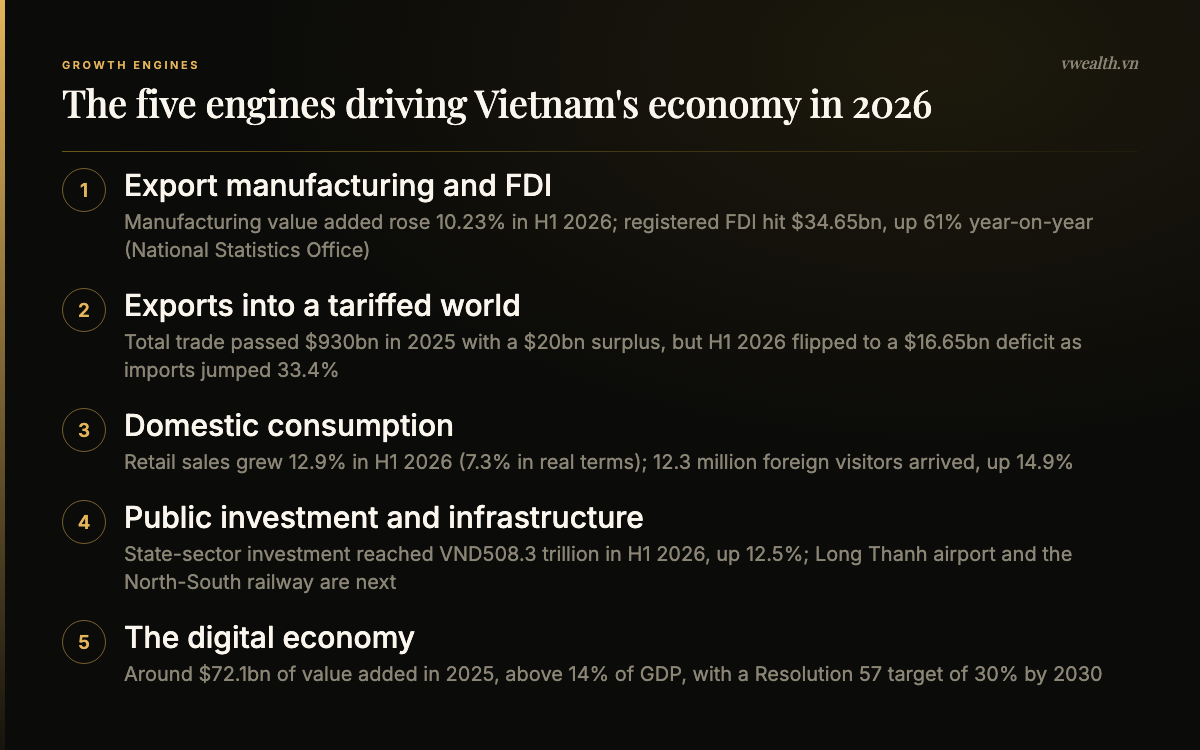
Headline GDP is an average of very different businesses. If you are allocating capital, the engines matter more than the aggregate.
1. Export manufacturing and FDI
This is the core engine and it is still accelerating. Registered FDI in the first half of 2026 reached US$34.65 billion, up 61.0% year on year, with disbursed FDI at US$13.03 billion, up 11.2%, according to the National Statistics Office. Manufacturing absorbed US$17.91 billion of the registered total, about 63%. A 61% jump in registrations in a single half-year is not noise; it is a signal that multinationals made their Vietnam decisions after the 2025 tariff framework was announced, not before it.
The investable consequence is that the beneficiaries are often not the exporters themselves — many of the largest are unlisted foreign subsidiaries — but the domestic landlords, contractors, logistics operators and power suppliers that serve them. Industrial park operators listed on the Ho Chi Minh Stock Exchange collect the rent on this trend far more directly than most listed manufacturers do.
2. Exports into a tariffed world
Exports grew 21.0% in the first half of 2026 despite a 20% US tariff being in place. That is the empirical answer to the most common question foreign investors ask about Vietnam right now: the tariff hurt, but it did not stop the machine. Vietnam remains cost-competitive against alternatives even with the duty applied, and buyers who had already relocated supply chains did not relocate them again over a single tariff line.
The risk is not the level of the tariff. It is the rules of origin attached to it, which is covered below.
3. Domestic consumption and tourism
Retail sales of goods and services grew 12.9% in the first half of 2026, or 7.3% after stripping out price effects. International arrivals reached 12.3 million, up 14.9%. Employment stood at 52.6 million with unemployment at 2.22%.
The 7.3% real figure is the honest one, and it is a good number for a country at this income level. It is what turns Vietnam from a manufacturing platform into a market — the reason consumer, retail, aviation and hospitality names have an earnings story that does not depend on what a US importer decides. With per capita GDP targeted at US$5,400–5,500 for 2026, Vietnam is entering the income band where discretionary categories historically inflect.
4. Public investment and infrastructure
State-sector investment reached VND508.3 trillion in the first half of 2026, up 12.5%. Public capital is the government’s most direct growth lever and the one it leans on hardest when the external picture wobbles — every plan document for 2026 emphasises faster disbursement from early in the year rather than the traditional year-end rush.
The projects behind that number are large enough to reshape the economy’s geography. Long Thanh International Airport is being wired into a multimodal network of metro lines and the planned high-speed railway. The North–South high-speed railway — roughly 1,541 km from Ngoc Hoi station in Hanoi to Thu Thiem in Ho Chi Minh City, at an estimated US$67 billion — is expected to complete feasibility procedures and break ground between the fourth quarter of 2026 and the fourth quarter of 2028, with consultant selection starting in June 2026 and an interim feasibility report due by June 2027.
Be careful how you trade this. A groundbreaking window that spans two years is not a catalyst; it is a theme. Construction materials, contractors and land banks near planned stations will price the story long before the first contract is awarded, and the gap between narrative and revenue in Vietnamese infrastructure has historically been measured in years.
5. The digital economy
The digital economy contributed about US$72.1 billion of value added in 2025, growing 14.6% and accounting for more than 14% of GDP — up from 12.87% in 2021 to 14.02% in 2025. Politburo Resolution 57 sets targets of at least 30% of GDP by 2030 and 50% by 2045.
Treat the 2030 target as a statement of policy intent rather than a forecast; doubling a sector’s GDP share in five years would be remarkable anywhere. But the direction is what matters for capital allocation, because it tells you where subsidies, licences and procurement will flow. It is also the part of the economy where the most interesting companies are still private — which is why the venture and growth-equity channel matters, and why we cover it separately in our guide to venture capital in Vietnam.
Structural themes that change the investment case
Growth rates move year to year. The themes below alter the structure of the opportunity, and they are the reason 2026 is a genuinely different year rather than another entry in a long run of good prints.
The FTSE Russell upgrade, effective 21 September 2026
This is the single largest scheduled event in the Vietnamese market’s history as an asset class. FTSE Russell’s March 2026 interim review confirmed Vietnam’s reclassification from Frontier to Secondary Emerging market status, effective from the open on Monday 21 September 2026, with the country to be added to FTSE global equity indices in phases continuing into 2027. FTSE cited the removal of the prefunding requirement for foreign institutional investors through a non-prefunding model, and the establishment of a formal process for handling failed trades.
What this actually does is change who is required to own Vietnam. Passive funds tracking the FTSE Emerging index have no discretion once the reclassification takes effect: Vietnamese equities must appear in the portfolio. That is a structural, price-insensitive buyer arriving on a known date — a rare thing in any market. The mechanics, the likely index weight, the phasing schedule and which names carry the largest expected passive demand are covered in our dedicated piece on the FTSE Russell upgrade of the Vietnam stock market.
Two cautions. First, the upgrade has been anticipated since October 2025, so a meaningful share of the flow is already reflected in prices. Second, the constraint that binds hardest is foreign ownership limits — passive money cannot buy shares that are not available to foreigners, which concentrates demand into whatever room exists rather than distributing it evenly across the index.
Institutional reform and the private sector
Politburo Resolution 68, issued on 4 May 2025, reframed the private sector as a principal driver of the economy rather than a supporting one. Its targets: 2 million active enterprises by 2030, private-sector growth of 10–12% a year, and a private-sector contribution of 55–58% of GDP, rising to at least 3 million enterprises and over 60% of GDP by 2045.
The gap between ambition and reality is instructive: Vietnam aimed for 1.5 million enterprises by 2025 and finished with close to one million, alongside more than five million household businesses. Converting household businesses into formal, taxed, bankable companies is the actual project, and it is slow. But it runs in the right direction for anyone investing in Vietnamese financials and business services, because a formalised SME base is a lending market and a payments market that does not exist today. In the first half of 2026, 111.7 thousand new enterprises registered with combined capital of VND1,352.6 trillion.
Energy: the constraint that could bind
Manufacturing growth of 10%-plus a year requires electricity to match. The revised Power Development Plan 8, approved in April 2025, keeps LNG-fired capacity at 22,524 MW by 2030 and revives nuclear power, with Ninh Thuan plants 1 and 2 slated to start operating between 2030 and 2035 at a combined 4,000–6,400 MW, plus a further 8,000 MW of nuclear identified for baseload by 2050.
For an investor, the energy chapter is a two-sided story. On the upside, it is a decade-long capital expenditure programme with identifiable listed beneficiaries in construction, electrical equipment and gas distribution. On the downside, power adequacy is a genuine operational risk for northern industrial provinces, and multinational site-selection committees ask about it directly. Delays here do not show up as an energy problem in the data; they show up as an FDI problem two years later.
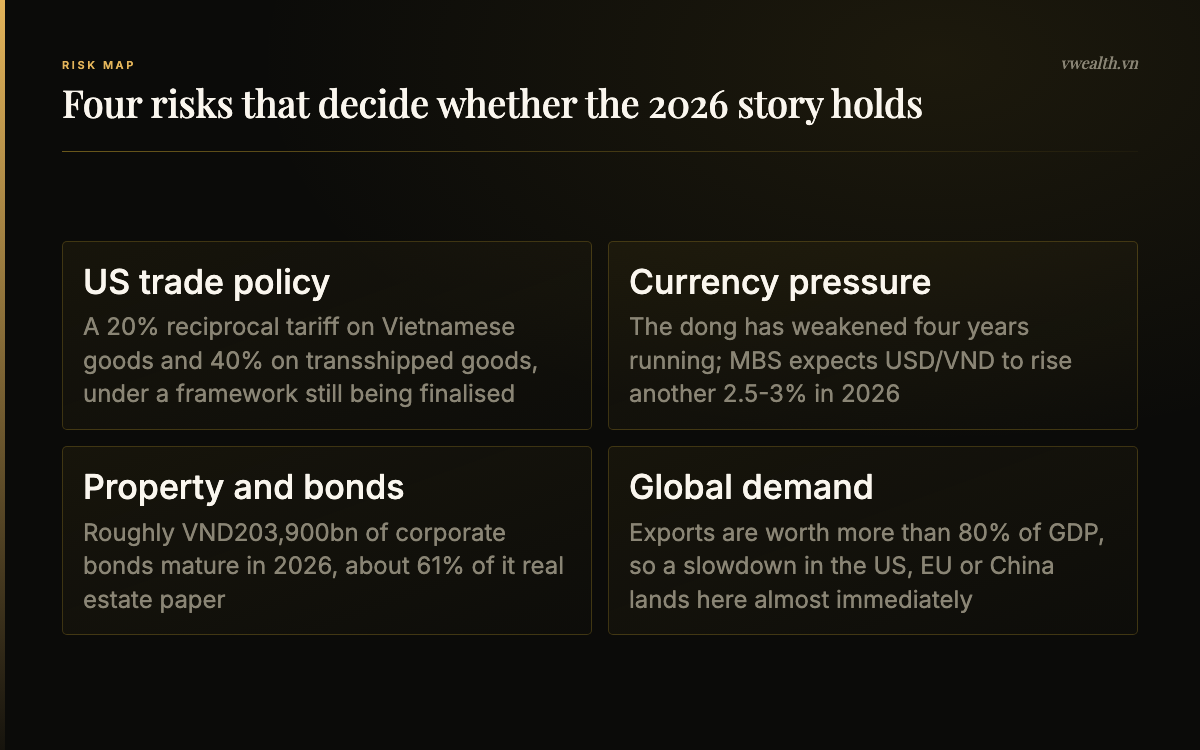
The risks that decide whether the 2026 story holds
US trade policy and rules of origin
Vietnamese goods entering the United States face a 20% reciprocal tariff, and goods deemed to be transshipped face 40%, under the framework announced on 2 July 2025 and set out in the joint statement of 26 October 2025 on a United States–Vietnam framework for reciprocal, fair and balanced trade. Negotiation on implementation detail continues, as tracked by the Council on Foreign Relations.
The 20% headline is survivable — the export data proves it. The 40% transshipment rate is the one that carries asymmetric risk, because its impact depends entirely on how “substantial transformation” is defined and enforced. A strict origin standard would fall hardest on assembly operations importing high-value Chinese components and adding modest local content — precisely the segment that grew fastest during the 2018–2024 relocation wave. A looser standard leaves the model intact. Until the enforcement mechanism is published in full, this is an unquantifiable risk, and it should be treated as such rather than assumed away.
There is also a second-order point worth naming. Vietnam’s bilateral surplus with the US reached nearly US$134 billion in 2025, up 28.2%. A surplus growing at that rate is a standing invitation to further trade action regardless of what any current framework says.
Currency pressure
The dong has weakened against the dollar for four consecutive years. The daily reference rate climbed about 3.5% over 2025, the steepest annual move since 2011. As of end-January 2026 the interbank rate stood at VND26,025 per dollar, according to MBS Securities research reported by The Investor, which expects USD/VND to rise a further 2.5–3% across 2026. UOB has projected 26,300 in the first quarter of 2026 and 26,100 in the second.
Two to three per cent a year sounds trivial until you compound it across a five-year holding period and apply it to a dollar-denominated return. Roughly a tenth of a US dollar investor’s cumulative gain can be consumed by currency alone over five years at that rate, before any market move. The mechanics are not mysterious: a large domestic-sector trade deficit, gold and dollar demand as savings vehicles, and an interest rate policy that has to stay accommodative to support a double-digit growth ambition. The first-half 2026 trade deficit removes one of the natural offsets, which is why the currency deserves more attention this year than it usually gets.
Property and the corporate bond wall
Roughly VND203,900 billion of corporate bonds mature during 2026, with the real estate sector accounting for about 61% of that; real estate bonds maturing in the year come to about VND99 trillion, up 74% year on year. Between VND80 trillion and VND100 trillion of principal and interest falls due each remaining quarter, per Vietnam Investment Review.
The tone of the market has improved: bank bond issuance fell 39.4% year on year while real estate issuance rose 123%, which is what refinancing capacity looks like when it returns — developers restarting projects, legal obstacles clearing, old debt being rolled. But refinancing capacity is conditional on liquidity, and liquidity is conditional on the credit quota. A 15% credit growth ceiling in 2026, down from 17.87% in 2025, tightens exactly the channel that developers depend on. Property risk in Vietnam is never only a property risk, because bank balance sheets carry both the developer loans and the mortgages.
Global demand
With two-way trade worth about 1.8 times GDP, Vietnam has almost no insulation from a downturn in the United States, the European Union or China. Domestic consumption growing at 7.3% in real terms is a genuine buffer, but it is not big enough to offset a sharp export contraction. This is the risk that requires no forecast and no policy error to materialise — it simply arrives from outside.
Overheating
The quieter risk is that Vietnam succeeds too well at hitting its target. Credit growing at nearly 18%, an inflation print already at 4.38% against a 4.5% ceiling, a currency under pressure and a fiscal push worth a third of GDP is a policy mix with limited slack. If the authorities respond to a growth shortfall by loosening further, the constraint will show up first in the currency and second in the CPI. Watching the monthly CPI print and the reference rate is the cheapest early-warning system a foreign investor has.
What each theme means for the listed equity market
Macro is only useful once it is translated into holdings. Here is how each engine and risk reaches the exchange floor.
Banks: the transmission belt for everything
Banks are the largest sector in the VN-Index and the most direct expression of the macro. Credit growth of about 15% in 2026 caps sector loan growth mechanically. Faster nominal GDP supports fee income and asset quality; property stress works the other way through non-performing loans and provisioning. If you own a Vietnam index fund, you own this cycle whether you intended to or not, which is why the sector deserves its own study rather than a passing glance.
Industrial property, construction and materials
The FDI number is this group’s revenue line. Registered FDI up 61% in the first half of 2026, with 63% of it in manufacturing, translates into land absorption at industrial parks, construction contracts and demand for steel and cement. Add the public investment programme and this is the cleanest listed proxy for the growth engines that are otherwise dominated by unlisted foreign companies.
Consumer, retail, aviation and hospitality
Real retail sales up 7.3%, 12.3 million foreign arrivals in six months, and rising per capita income are this group’s tailwinds. It is also the part of the market least exposed to US trade policy, which makes it a natural counterweight to export-linked positions rather than a duplicate of them.
Securities firms and the upgrade trade
Brokers are the most direct beneficiary of the 21 September reclassification: more foreign flow means more turnover, more margin lending and more custody business. It is also the most crowded expression of the theme, and the one where positioning has had the longest to build.
Exporters
Textiles, seafood, wood products and electronics components carry the tariff exposure directly. They are the correct place to express a constructive view on trade policy resolution and the wrong place to be if the transshipment rules land strictly.
On GDP growth and stock returns — a warning worth one paragraph
Fast GDP growth does not mechanically produce good equity returns. The relationship is loose, sometimes negative, and depends on how much of that growth accrues to listed companies rather than to unlisted foreign subsidiaries, state enterprises or workers, and on what multiple you pay for it. Vietnam is a particularly sharp example, because the FDI manufacturing sector that generates the trade surplus is largely invisible on the exchange. We cover the GDP-to-stock-market mapping in depth in a separate article; for the purposes of this one, take the caution and move on.
How to use this as a foreign investor
A few practical points that follow from everything above.
Separate the permanent from the perishable. The permanent framework is the one in this article: an open, FDI-driven manufacturing economy with a bank-financed credit channel, a policy-set growth target, a managed currency and a scheduled index upgrade. The perishable parts are every number in it. Quarterly GDP, monthly CPI, the reference rate, credit growth to date and FDI year to date all change, and you should pull them fresh from the National Statistics Office and the State Bank rather than trusting any article — this one included.
Decide your access route before you pick themes. Direct participation means a local securities account, a trading code and custody arrangements; the index route means an ETF. Each has different costs, different foreign ownership constraints and a very different experience around the September reclassification. Our overview of the best Vietnam ETFs covers the fund route, and the complete guide to the Vietnam stock market for foreign investors covers the mechanics of doing it directly.
Know which board you are buying on. Vietnam has three venues with materially different listing standards, liquidity and disclosure quality. A macro theme that looks compelling can be unbuyable at size on the wrong board. Our explainer on HOSE, HNX and UPCoM sets out what each one is for.
Size for the unquantifiable risk. Rules of origin enforcement cannot be modelled from public information today. When a risk cannot be quantified, the correct response is position sizing, not a more elaborate forecast.
Watch four numbers. Monthly CPI, the USD/VND reference rate, cumulative credit growth against the annual quota, and the monthly trade balance. Those four will tell you whether the 2026 story is holding together long before quarterly GDP does.
Where the market stands as this is written
The VN-Index closed at 1,793.18 points on 12 August 2026, up 19.77 points on the session, with the index trading around the 1,800 level through late August. Total market capitalisation at the short-term trough near 1,650 points was approximately US$382 billion, equivalent to about 74% of 2025 GDP. Foreign investors returned as net buyers into August after a period of heavy selling.
A market capitalisation around three-quarters of GDP is no longer a frontier valuation, and it is worth holding that in mind against the upgrade narrative. The passive flow arriving on 21 September is real and mechanical, but it arrives into a market that has already spent eleven months pricing it in.
The short version
Vietnam grew 8.02% in 2025 and 8.18% in the first half of 2026, with inflation contained at 3.31% last year and 4.38% so far this year, credit expanding 17.87% in 2025 against a 15% plan for 2026, record disbursed FDI of US$27.62 billion, and a US$20 billion trade surplus in 2025 that has since flipped to a US$16.65 billion first-half deficit. The government wants 10% growth in 2026; the IMF says 7.5%, the ADB 7.2% and the World Bank 6.3%. The FTSE Russell upgrade lands on 21 September 2026. A 20% US tariff is in force with a 40% transshipment rate whose enforcement remains undefined, the dong is expected to weaken another 2.5–3%, and about VND204 trillion of corporate bonds — 61% of it real estate — matures this year.
That is a genuinely attractive growth economy with three identifiable, datable risks attached. It is not a market to buy on the growth rate alone, and it is not a market to avoid because of the tariff headline. It is a market to size deliberately, hold through a currency drag, and revisit every quarter when the National Statistics Office publishes.
This article is analytical reference material, not investment advice; always do your own research and consider your personal risk tolerance before buying any security.
Research Vietnamese stocks in English with vwealth. Our AI-powered platform turns Vietnamese market data into full English analysis reports — with international payment support and a free 2-month trial for new accounts. Create your free account and read the latest reports.
Frequently Asked Questions
How fast is the Vietnam economy growing in 2026?
GDP grew 8.18% in the first half of 2026, with second-quarter growth of 8.39%, the strongest second quarter since 2011, according to the National Statistics Office. That follows full-year 2025 growth of 8.02%. The government targets 10% or higher for 2026, while the IMF forecasts 7.5%, the ADB 7.2% and the World Bank 6.3%.
What are the main drivers of economic growth in Vietnam?
Five engines: export manufacturing backed by foreign direct investment, exports themselves, domestic consumption, public investment in infrastructure, and the digital economy. Manufacturing value added rose 10.23% in the first half of 2026 and registered FDI jumped 61% to US$34.65 billion, while real retail sales grew 7.3% and state-sector investment rose 12.5%.
What is Vietnam’s inflation rate and is it under control?
Average CPI was 3.31% in 2025 and 4.38% in the first half of 2026, with core inflation at 4.12%. The 2026 ceiling set by the National Assembly is around 4.5%, so Vietnam is inside its target but with far less room than a year ago. Monthly CPI is one of the four numbers worth tracking closely this year.
How do US tariffs affect Vietnam’s economy?
Vietnamese goods face a 20% reciprocal tariff in the United States, with 40% applied to goods deemed transshipped, under the framework announced in July 2025 and detailed in the October 2025 joint statement. Exports still grew 21.0% in the first half of 2026, so the headline rate has proved survivable. The unresolved risk is how strictly rules of origin are enforced against the 40% rate.
What does the FTSE Russell upgrade mean for investors?
FTSE Russell reclassifies Vietnam from Frontier to Secondary Emerging market status from the open on 21 September 2026, with phased index inclusion continuing into 2027. Passive funds tracking the FTSE Emerging index must then hold Vietnamese equities, creating a structural, price-insensitive buyer on a known date. Much of that flow has been anticipated since October 2025, and foreign ownership limits will concentrate demand into the names with available room.
Is the Vietnamese dong a risk for foreign investors?
Yes, and it is the risk most often underestimated. The dong has weakened against the dollar for four consecutive years, the reference rate climbed about 3.5% in 2025, and MBS Securities expects USD/VND to rise a further 2.5–3% in 2026. Compounded across a multi-year holding period, that can consume roughly a tenth of a dollar investor’s cumulative return before any market move.
Does fast GDP growth mean Vietnamese stocks will perform well?
Not mechanically. The link between GDP growth and equity returns is loose and depends on how much growth accrues to listed companies rather than to unlisted foreign subsidiaries, and on the multiple you pay. In Vietnam this gap is unusually wide because the FDI manufacturing sector that generates the trade surplus is largely absent from the exchange.