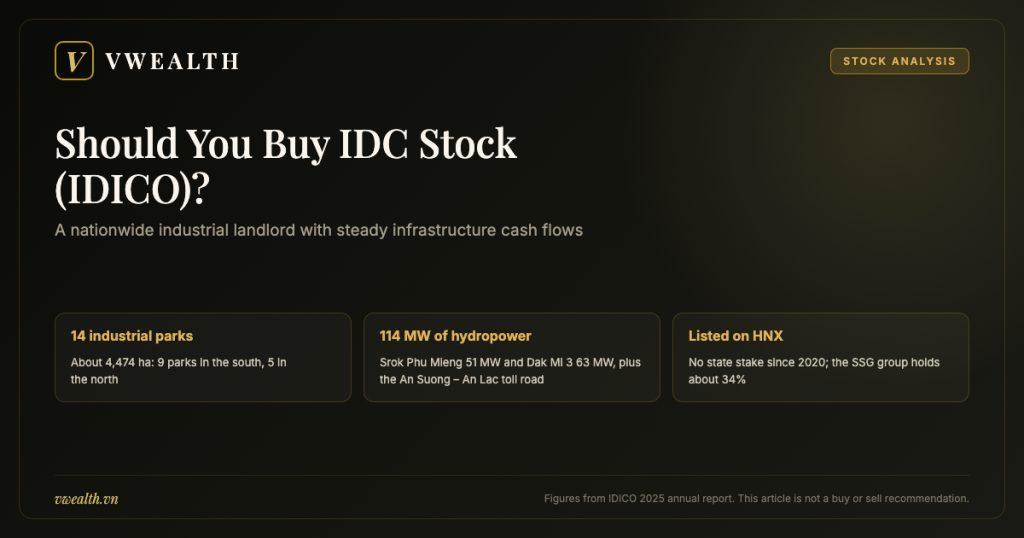
Should you buy IDC stock? For most investors who follow Vietnam stocks, the question tends to come up in rhythm with tariff headlines. Every time Washington announces a new duty on Vietnamese goods, IDC — the ticker of IDICO Corporation – JSC on the Hanoi Stock Exchange (HNX) — is among the first names to be sold. Every time a new wave of factories from China, Korea or Japan goes looking for land, IDC is among the first names mentioned as a beneficiary. Behind those swings sits an unusual business: a former state-owned corporation of Vietnam’s Ministry of Construction that now develops and manages 14 industrial parks covering roughly 4,474 hectares, stretched from Hai Phong and Bac Ninh in the north to Dong Nai, Tay Ninh and Dong Thap in the south — and that also owns two hydropower plants, a power distribution grid for its parks and a toll road concession on National Highway 1 at the western gate of Ho Chi Minh City. This analysis tells the whole story: from the Nhon Trach 1 industrial park in the late 1990s, through equitization, the exit of the state and the arrival of the SSG group, to the land-bank challenge of the tariff era. By the end, you will have a straight answer about who IDC stock suits, and who it does not.
First, let us get the names right, because they are easy to confuse. IDC is the ticker of IDICO Corporation – JSC, whose former name was Vietnam Urban and Industrial Zone Development Investment Corporation. There is another company whose old name also contained the letters IDC: Becamex IDC, now Becamex Group, ticker BCM — a completely different business tied to Binh Duong province. Within the IDICO ecosystem, several subsidiaries are listed separately too, such as IDICO Infrastructure Development Investment (IDICO-IDI, the toll road operator) and Srok Phu Mieng IDICO Hydropower. When you buy IDC, you are buying the parent company — its share of that whole ecosystem, plus the industrial parks it develops directly.
If you are new to the market, a few Vietnamese mechanics matter for everything that follows. Vietnam has three trading venues: HOSE (the main Ho Chi Minh City exchange, home to most large caps), HNX (the Hanoi exchange, where IDC trades) and UPCoM (an over-the-counter style venue for unlisted public companies). Trades settle on a T+2 basis, daily price moves are capped by exchange-specific bands, and foreign ownership in many companies is limited by a “foreign room” — for IDC, the cap is 49%. If you want a primer before diving in, our guide on how to invest in the Vietnam stock market walks through accounts, fees and foreign-investor rules.
A note on sources, as with every report in this vwealth series: dates, names, transactions and figures come from published information — IDICO’s annual reports, shareholder meeting documents, disclosures on HNX, auction results published by the stock exchanges, market data from consultancies such as CBRE, and Vietnamese and international financial media. Figures for closed fiscal years are used as historical reference points. We deliberately do not quote today’s share price, current P/E or the latest quarter’s earnings: for an industrial park developer, quarterly profit can jump or collapse simply because of when land handovers are booked, so those numbers age very quickly. Wherever a number is our own calculation, it is labelled “vwealth estimate” or “illustrative example”. For live figures, open the latest vwealth analysis reports.
And one final framing point, which is the spine of this article. Earlier in this series, we analysed Becamex — an “industrial city” model tied tightly to one province, where industrial parks, urban areas and regional infrastructure grow up together. IDICO is a very different animal: a landlord spread across the country, whose land bank is scattered over many provinces and whose parks come bundled with steady infrastructure cash flows — electricity, water, service fees and road tolls. So the question of whether you should buy IDC stock boils down to two parts: can land leasing move fast enough to justify the largest investment cycle in the company’s history, and are the infrastructure cash flows steady enough to keep funding the generous cash dividends shareholders have come to expect?
From a Ministry of Construction corporation to landlord of 14 industrial parks: 25+ years of IDICO
Many listed industrial park developers in Vietnam began with one plot of land in one province. IDICO began with an administrative decision: to fold a group of small state enterprises into one. Understanding that origin explains why IDICO today has land in both halves of the country, owns hydropower plants and a toll road alongside its parks, and why its largest shareholder is a private real estate group.
The 1990s: Nhon Trach 1 and the predecessor companies
IDICO’s industrial park story starts in Nhon Trach district, Dong Nai province, across the Dong Nai River from Ho Chi Minh City. According to the company’s annual report, the IDICO Nhon Trach 1 industrial park has been operating since 1998, and the company describes it as the model and foundation for every park that followed. The timing matters: Vietnam had opened up barely a decade earlier, and foreign direct investment (FDI) had just been hit by the 1997 Asian financial crisis. Developing an industrial park then meant building ahead of demand — levelling land, laying roads, pulling power lines, building wastewater plants — and then waiting for foreign manufacturers to arrive.
The firms doing that work did not yet carry the IDICO name. They were separate state companies: an urban and industrial zone development company, a petroleum construction company, a Mekong-region construction company, and several enterprises owned by provincial governments. Each had its own specialty, region and relationships. That “patchwork” origin is why IDICO later ended up with such a varied portfolio: industrial parks, housing, construction, building materials, hydropower and toll roads.
2000–2010: a diversified state corporation
In 2000, following Prime Ministerial document No. 1011/CP-DMDN dated November 7, 2000, the Minister of Construction issued Decision No. 26/2000/QD-BXD dated December 6, 2000, establishing the Vietnam Urban and Industrial Zone Development Investment Corporation — IDICO — as a state enterprise under the Ministry of Construction, created by reorganizing the companies above.
The following decade looked like the expansion of a typical state corporation of that era: doing many things at once. The My Xuan A industrial park in Ba Ria – Vung Tau was established by Prime Ministerial decision in 2002; the Kim Hoa park in Vinh Phuc (now part of Phu Tho) received phase-one approval at the end of 2002; and Phu My II — 620.6 hectares right next to the Cai Mep deep-water port — had its master plan approved by the Ministry of Construction in 2006. At the same time IDICO moved into energy: the 51 MW Srok Phu Mieng hydropower plant in former Binh Phuoc province broke ground in 2003 and began generating in 2006. IDICO also became the investor in a build–operate–transfer (BOT) project to upgrade the An Suong – An Lac section of National Highway 1A in Ho Chi Minh City — the road that tens of thousands of trucks from the Mekong Delta use every day.
In 2006, the ministry moved IDICO to a parent–subsidiary model. In 2010, under Decision No. 615/QD-BXD, it became a single-member limited liability company wholly owned by the state, with charter capital of about VND 1,602 billion. By then, IDICO looked much as it does today: a parent that directly owns many industrial parks, surrounded by a cluster of subsidiaries each holding a piece — hydropower, BOT, construction, housing.
2017–2018: equitization and two strategic investors at 22.5% each
Vietnam’s wave of state-enterprise equitization in the late 2010s brought IDICO to market. On October 5, 2017, IDICO held its initial public offering (IPO) auction. According to published results, more than 55.3 million shares were sold at an average price of VND 23,940, raising more than VND 1,324 billion; foreign investors bought about 41.35 million shares, nearly 75% of the offering. Winning bids ranged from VND 23,200 to VND 28,600.
The more important detail was the strategic investor round. Two groups were selected: Bitexco Group and SSG Group, each taking 67.5 million shares, or 22.5% of capital. Vietnamese media at the time also reported that Kinh Bac City — the company behind KBC stock — had applied but was not chosen. Bitexco was then best known for the Bitexco Financial Tower in Ho Chi Minh City and for its hydropower projects; SSG was the developer of the Saigon Pearl and Thao Dien Pearl residential projects in Ho Chi Minh City.
On November 24, 2017, IDC shares began trading on UPCoM at a reference price of VND 23,900. On March 1, 2018, IDICO officially became a joint stock company with charter capital of VND 3,000 billion, and from May 10, 2018 it took the name IDICO Corporation – JSC.
2019–2020: listing on HNX and a full state exit
On December 10, 2019, IDC moved from UPCoM to a formal listing on the Hanoi Stock Exchange at a first-day reference price of VND 18,500 — well below the IPO price two years earlier. IPO buyers were sitting on paper losses, a detail worth remembering if you think industrial park stocks are a one-way bet.
2020 was the year the state left. Under Prime Ministerial Decision No. 908/QD-TTg dated June 29, 2020 on the divestment list, and Ministry of Construction Decision No. 1356/QD-BXD dated October 20, 2020, the ministry put its entire 108 million shares — 36% of charter capital — up for public auction on the Ho Chi Minh City Stock Exchange on November 27, 2020, with a starting price of VND 26,930. The entire block was sold to nine investors (one domestic institution and eight individuals) at an average of VND 26,936 and a high of VND 26,950; registered demand exceeded the offering by about 17%. The ministry raised roughly VND 2,909 billion. From that point, IDICO had no state shareholder — a major difference from Becamex, where the state still holds an overwhelming majority.
Right after the divestment, on December 15, 2020, Mr. Dang Chinh Trung — a board member since February 2018 and SSG’s representative — was appointed General Director (the Vietnamese equivalent of CEO), replacing Mr. Nguyen Van Dat. The person at the wheel had changed.
2021–2022: Bitexco exits, SSG takes control, and a windfall year
In 2021, the relationship between the two strategic shareholders broke down in public. At that year’s annual general meeting, a block of shares almost exactly matching Bitexco’s stake voted against the profit distribution and share issuance proposals, and Bitexco lost its board seat. Between late May and late June 2021, Bitexco sold its entire 22.5% stake through order matching and negotiated trades. Vietnamese media estimated it had bought at around VND 24,000 and sold near VND 35,000 — roughly a 50% gain over four years. At the end of 2021, IDICO announced a new major shareholder, Bach Viet Manufacturing and Trading Co., Ltd., an entity the press identified as linked to the SSG group.
In April 2022, Ms. Nguyen Thi Nhu Mai — CEO of SSG Group — became Chairwoman of IDICO’s Board, replacing Mr. Le Ba Tho, who resigned for personal reasons. Also in 2022, charter capital rose to about VND 3,300 billion, and IDICO completed a restructuring around four core businesses: industrial real estate, energy, housing and urban development, and industrial park services.
In terms of earnings, 2022 was a boom year on paper. By recognizing, in a single year, most of the revenue from lease contracts at fully leased parks — the press cited Nhon Trach 5, where more than VND 1,400 billion of unearned revenue was released into revenue, along with Phu My II, Phu My II Expansion, Huu Thanh and My Xuan B1 — IDICO reported audited 2022 net profit of about VND 2,054 billion, versus only about VND 578 billion in 2021. But that year also left a lesson: audited pre-tax profit came in more than VND 541 billion lower than the company’s own figure, because the auditor rejected one-time recognition for part of the contracts and required them to be spread over the lease term. Chapter 4 comes back to this, because it is the key to reading IDC’s financial statements.
2023–2026: new land, tariffs and the biggest investment cycle yet
After 2022, IDICO faced the classic problem of every industrial park developer: old land running out, new land not yet ready. In 2023, pre-tax profit fell about 21% to roughly VND 2,057 billion. In 2024, the Prime Minister approved investment policies for two new parks, My Xuan B1 Expansion (former Ba Ria – Vung Tau, now part of Ho Chi Minh City) and Tan Phuoc 1 (former Tien Giang, now part of Dong Thap). That same year, IDICO booked pre-tax profit of about VND 2,993 billion — its highest ever, according to the press.
In 2025, two more projects won investment-policy approval: the Vinh Quang eco-industrial park in Hai Phong and the Phu Long park in Ninh Binh. But 2025 was also the year US reciprocal tariffs led many foreign investors to postpone land decisions. IDICO leased only about 76 hectares of new land, 62% of plan; industrial park revenue fell, and full-year pre-tax profit of about VND 2,918 billion was flat versus 2024 only because power, toll and services revenue made up the gap.
For 2026, shareholders approved a pre-tax profit target of about VND 2,903 billion — essentially flat — alongside planned capital spending of about VND 7,742 billion, roughly 2.8 times the prior year. Management also discussed moving the listing to HOSE around late 2026 or early 2027. In short, IDICO is at the start of a new investment cycle: spending now to have land to lease for years to come.
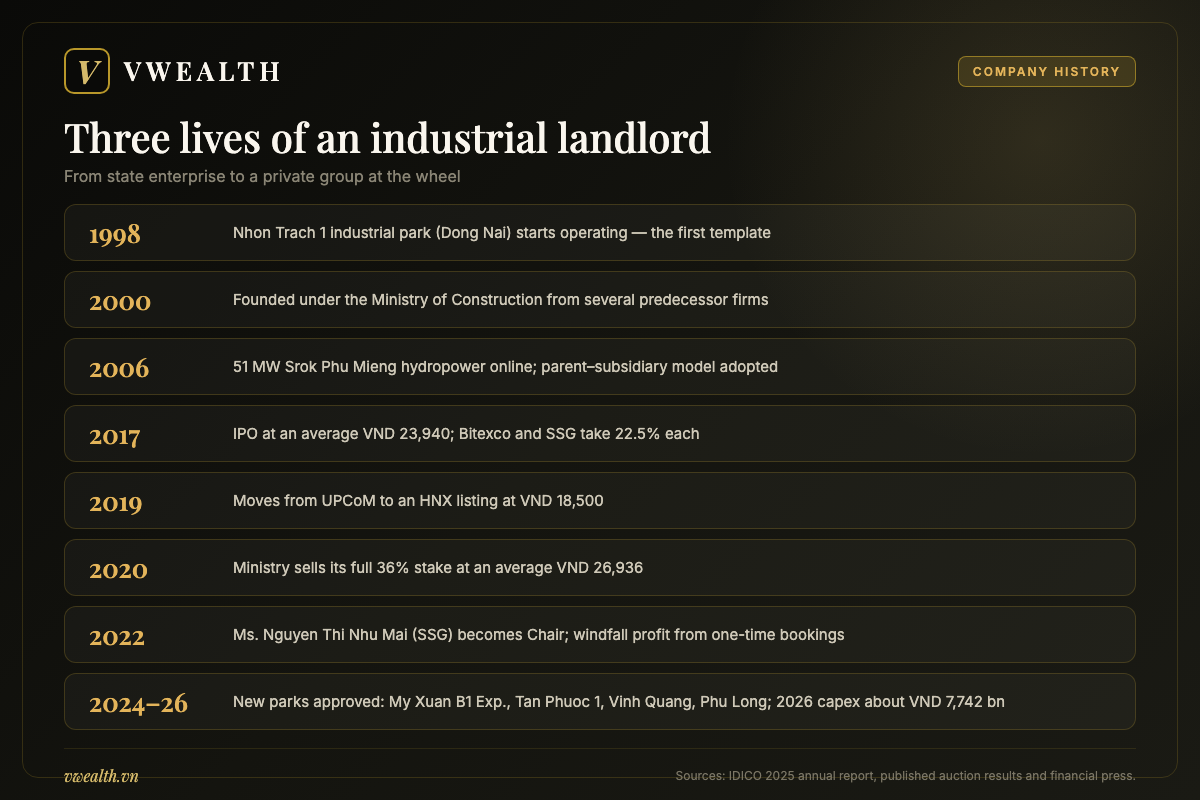
| Year | Milestone | Why it matters for IDC investors today |
|---|---|---|
| 1998 | Nhon Trach 1 industrial park (Dong Nai) begins operating | The first template; first-generation parks are now fully leased |
| 2000 | Corporation founded under the Ministry of Construction (Decision 26/2000/QD-BXD) | The “patchwork” origin that created a diversified portfolio |
| 2003–2006 | 51 MW Srok Phu Mieng hydropower plant built and commissioned | A steady energy cash flow to this day |
| Oct 5, 2017 | IPO at an average VND 23,940; Bitexco and SSG take 22.5% each | Start of the shift to private control |
| Nov 24, 2017 | Trading begins on UPCoM at VND 23,900 | First historical price reference |
| Dec 10, 2019 | Listed on HNX at VND 18,500 | Industrial park stocks can trade below IPO too |
| Nov 27, 2020 | Ministry of Construction sells its full 36% at an average VND 26,936 | No more state ownership |
| 2021–2022 | Bitexco exits; Ms. Nguyen Thi Nhu Mai (SSG) becomes Chair; windfall profit in 2022 | The SSG group takes control |
| 2024–2025 | Approvals for My Xuan B1 Expansion, Tan Phuoc 1, Vinh Quang, Phu Long | Land bank for the next growth cycle |
| 2026 | Planned capex of about VND 7,742 billion; HOSE transfer targeted for late 2026 – early 2027 | The largest investment cycle in company history |
Looking across the timeline, IDICO has lived three lives: a diversified state enterprise, a newly equitized company with two strategic shareholders watching each other, and today’s version — a private company led by the SSG group, trying to turn a scattered land portfolio into a more efficient machine for leasing land and collecting infrastructure fees.
Leadership and ownership: from the state to the “SSG house”
For many industrial park developers, the question “who owns it?” has a simple answer: the state, or a founding family. For IDICO, the answer is a bit more nuanced. There is no state shareholder and no founder in the usual sense, but there is a private group that owns more than a third of the company and holds both the chair and the CEO seat. Understanding that group means understanding most of IDC’s big decisions over the past five years — and likely the next five.
The SSG group: who actually makes the decisions
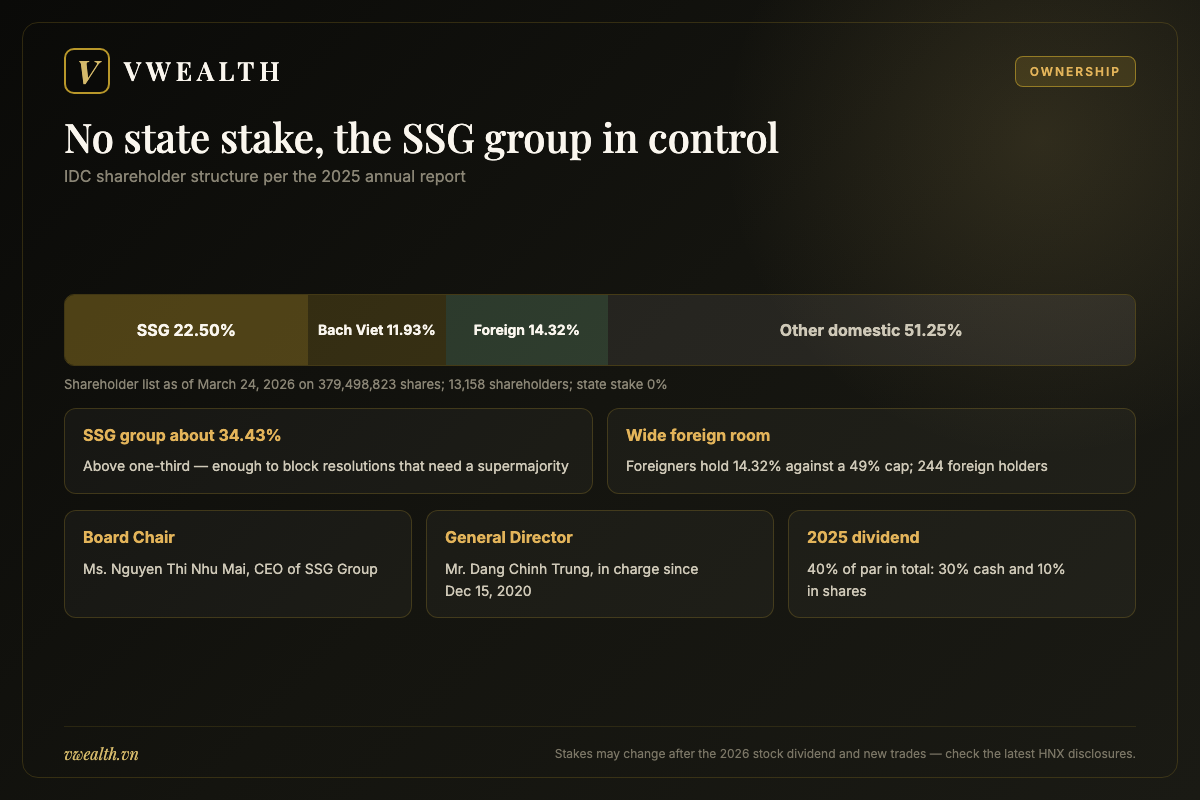
According to the major-shareholder list dated March 24, 2026 in IDICO’s 2025 annual report, two shareholders hold more than 5%: S.S.G Group JSC with 85,387,500 shares, or 22.50%, and Bach Viet Manufacturing and Trading Co., Ltd. with 45,265,495 shares, or 11.93%. Together they hold 34.43%. The press has repeatedly described Bach Viet as linked to the SSG group, and the annual report itself lists CEO Dang Chinh Trung as the authorized representative of about 14.84% of the capital, with related persons owning about 2.53% more.
Why does 34.43% matter? Under Vietnam’s Law on Enterprises, a shareholder holding more than one-third of the voting shares can block resolutions that require a supermajority at the shareholders’ meeting — such as amending the charter, selling major assets or reorganizing the company. The SSG group cannot pass every resolution on its own, but no major resolution can pass without it. And with the remaining 65.6% spread across more than 13,000 other shareholders, this group is, in practice, the deciding force.
Who is SSG? It is a private real estate developer in Ho Chi Minh City, known for the Saigon Pearl complex on the Saigon River and the Thao Dien Pearl project. When it joined IDICO in 2017, SSG was a strategic investor on equal terms with Bitexco; since Bitexco’s 2021 exit, SSG has been the controlling group. For minority shareholders, this cuts both ways. The positive: there is a clear owner with a strong incentive to make IDICO more profitable — and profit and dividends in 2022–2025 were indeed far higher than in the state-enterprise era. The watch point: when a controlling group also runs its own real estate business, transactions between IDICO and related parties deserve close scrutiny.
Ms. Nguyen Thi Nhu Mai and Mr. Dang Chinh Trung
IDICO’s Board Chair since April 2022 is Ms. Nguyen Thi Nhu Mai, born in 1969, holder of an MBA and concurrently CEO of SSG Group. According to the annual report, she personally owns about 705,996 shares (0.19%) and represents about 22.50% — SSG’s stake.
Day-to-day management is led by Mr. Dang Chinh Trung, a board member since February 24, 2018 and General Director since December 15, 2020. Some Vietnamese outlets describe him as the husband of Ms. Nguyen Hong Phuong, SSG’s founder. The annual report credits him with “successfully leading IDICO’s restructuring with outstanding growth in revenue and profit”, and notes a prior business background in real estate, energy, education and trading. However you weigh the self-congratulatory tone of an annual report, the numbers show that under his leadership IDICO has posted four consecutive years (2022–2025) of pre-tax profit above VND 2,000 billion — something the company never achieved before equitization.
Below him is a mix of veterans and newcomers. Mr. Nguyen Hong Hai has been with IDICO since August 2001, has been Deputy General Director since March 1, 2018, and oversees investment — meaning land bank development, the company’s most critical function. Mr. Nguyen Viet Tuan joined on April 21, 2023 as Deputy General Director for finance and accounting; Ms. Tran Ngoc Sang has been Chief Accountant since October 2024. The board has had an Audit Committee since April 21, 2023, under a governance model without a separate supervisory board. The frequent changes in the finance and accounting function in recent years are worth noting, especially given the 2022 audit adjustment.
Everyone else: 13,000+ shareholders, foreigners at about 14%
Outside the SSG group, IDC’s shareholder base is fairly dispersed. According to the 2025 annual report, there were 13,158 shareholders in total, with no state shareholder, no treasury shares and no preferred shares. Foreign investors — 244 institutions and individuals — held about 54.3 million shares, or 14.32%, against a foreign ownership limit of 49%. In other words, the remaining “foreign room” is very wide, unlike leading Vietnamese banks or retailers whose foreign room is often full and whose shares can trade at a premium for foreigners.
This structure gives IDC stock a particular personality, which Chapter 5 explores: a large free float (about two-thirds of shares sit outside the major-shareholder group), relatively good liquidity for HNX, and a share price that reacts sharply to the overall mood around industrial park stocks.
| Shareholder group | Shares | Stake | Notes |
|---|---|---|---|
| S.S.G Group JSC | 85,387,500 | 22.50% | Represented by Ms. Nguyen Thi Nhu Mai |
| Bach Viet Manufacturing and Trading Co., Ltd. | 45,265,495 | 11.93% | Identified by the press as linked to SSG |
| Two major shareholders combined | 130,652,995 | 34.43% | Above one-third — blocking power on supermajority resolutions |
| Foreign investors | 54,334,669 | 14.32% | 244 holders; foreign ownership limit 49% |
| Other domestic shareholders | 194,511,159 | 51.25% | 12,912 holders |
| State | 0 | 0% | Ministry of Construction sold its full 36% in 2020 |
Figures from IDICO’s 2025 annual report, with the shareholder list as of March 24, 2026, out of 379,498,823 shares outstanding. After the 2026 stock dividend, the share count rose, but relative stakes stay roughly the same absent new trades. Check the latest HNX disclosures before relying on these percentages.
Dividends: the cash machine of Vietnam’s industrial park stocks
If there is one reason many individual investors have held IDC for years, it is the dividend. Since 2022, IDICO has paid dividends that are high by Vietnamese market standards. In Vietnam, dividends are quoted as a percentage of the VND 10,000 par value, so “40%” means VND 4,000 per share. According to shareholder meeting documents and press reports, the 2022 and 2023 dividends were both 40% in cash. For 2024, the company paid 20% in cash across two interim payments (June 2024 and April 2025), plus a 15% stock dividend — nearly 49.5 million new shares, lifting charter capital to about VND 3,795 billion. For 2025, the total was 40%: a 15% cash interim at the end of 2025, then 15% cash plus 10% in shares with a record date of July 24, 2026 and cash paid on August 14, 2026. The 2026 plan keeps a 40% total, with the cash–stock split not yet set.
Read IDC’s dividend with two eyes. The first sees a generous company paying shareholders hundreds of billions to over a trillion dong a year in cash — the 15% cash payment in August 2026 alone came to about VND 569 billion on roughly 379.5 million shares. The second eye sees a gradual shift from cash toward shares (both 2024 and 2025 included a stock component), just as the company enters a heavy investment cycle and its borrowing rises. That makes financial sense — keeping cash to build new parks — but it means cash yields in the next few years may not match 2022–2023. And stock dividends do not make you richer on the day: they cut the same cake into more slices.
Illustrative example: you hold 1,000 IDC shares before the July 24, 2026 record date. You receive VND 1,500,000 in cash (15% × VND 10,000 × 1,000 shares, before Vietnam’s 5% personal income tax on dividends) and 100 new shares. You now hold 1,100 shares, but in theory the share price is adjusted down on the ex-rights date, so your total wealth is unchanged at that moment. Real value only grows if the retained capital is reinvested profitably.
Governance: what to watch in a group with many subsidiaries
IDICO is not one company but a cluster. The 2025 annual report lists 17 subsidiaries, from IDICO Tien Giang (65% owned, developer of Tan Phuoc 1), IDICO Vinh Quang (99.99%), IDICO Urban and Industrial Park Development (IDICO-URBIZ, 100%), Srok Phu Mieng IDICO Hydropower (51.78%), IDICO Infrastructure Development Investment (IDICO-IDI, 59.68%, the toll road business), UDICO (64.51%, power distribution), to IDICO-CONAC (51%, developer of My Xuan B1 Expansion) and VTA Global Port (51%, pending completion of an in-kind capital contribution). There are three associates, including Bien Hoa – Vung Tau Expressway Development JSC (BVEC).
This structure has three practical consequences for you. First, part of consolidated profit belongs to minority shareholders in the subsidiaries — in 2025, consolidated net profit was about VND 2,354 billion, but the portion attributable to parent shareholders was only about VND 1,932 billion according to press reports. Second, intra-group transactions and dealings with the major shareholders’ related parties are disclosed in the annual corporate governance report — a document you should read at least once a year. Third, unusual receivables deserve attention. In 2022, the press questioned why IDICO’s “other short-term receivables” rose from about VND 37 billion at the start of the year to about VND 699 billion nine months later without clear explanation in the quarterly notes. No wrongdoing was established, but it is exactly the kind of detail a careful investor should ask about.
How IDICO makes money: leasing land nationwide plus steady infrastructure cash flows
Picture a landlord who owns a dozen large plots in several provinces. Whenever a tenant signs, the landlord collects a huge payment upfront covering several decades. But this landlord does more than lease land: he sells electricity to his tenants, sells them clean water, charges for wastewater treatment, collects annual management fees, builds ready-made factories to rent by the month — and, on the side, owns two hydropower dams and a toll station on a national highway. That is essentially IDICO’s business model. Land delivers big but lumpy profits; everything else delivers smaller but steady cash. This chapter walks through each piece.
Industrial park infrastructure: 14 parks, about 4,474 hectares, north and south
According to the 2025 annual report, IDICO develops and manages 14 industrial parks totalling about 4,474 hectares — nine in the south and five in the north — spread across Dong Nai, Ho Chi Minh City (former Ba Ria – Vung Tau), Tay Ninh (former Long An), Dong Thap (former Tien Giang), Phu Tho, Bac Ninh, Hung Yen (former Thai Binh), Hai Phong and Ninh Binh. (Vietnam merged many provinces in mid-2025, which is why several parks now carry new provincial addresses.) The parks host more than 290 companies, mostly foreign-invested, with total registered capital above USD 9 billion.
You can sort the 14 parks into three groups by life stage. The fully leased group — Nhon Trach 1 and Nhon Trach V (691 ha, Dong Nai), My Xuan A (302 ha), My Xuan B1 (212 ha) and Kim Hoa (50 ha) — has almost no land left to lease but is a “mine” of annual service fees, power and water sales. The leasing group generates land revenue over the next few years. The under development group is the land bank for the next cycle; it currently consumes cash rather than producing revenue.
| Industrial park | Province (post-merger) | Area | Status per 2025 annual report |
|---|---|---|---|
| Huu Thanh | Tay Ninh (former Long An) | 524.1 ha (395.41 ha leasable) | Leasing, about 39% occupied |
| Phu My II | Ho Chi Minh City (former Ba Ria – Vung Tau) | 620.6 ha | Leasing, about 86% occupied |
| Phu My II Expansion | Ho Chi Minh City (former Ba Ria – Vung Tau) | 398.1 ha | Leasing, about 62% occupied |
| Que Vo II | Bac Ninh | 269.5 ha | Leasing, about 73% occupied |
| Cau Nghin | Hung Yen (former Thai Binh) | 183.9 ha | Leasing, about 53% occupied |
| Tan Phuoc 1 | Dong Thap (former Tien Giang) | 470 ha, investment above VND 5,900 bn | Under development, construction start expected late 2026 |
| My Xuan B1 Expansion | Ho Chi Minh City (former Ba Ria – Vung Tau) | 110 ha (83.4 ha leasable), nearly VND 2,000 bn | Under development, sales expected 2026 |
| Vinh Quang (eco-park) | Hai Phong | 350 ha (phase 1: 226 ha) | Under development |
| Phu Long | Ninh Binh | 416 ha, nearly VND 5,000 bn | Investment policy approved March 31, 2025 |
| Nhon Trach 1 & V, My Xuan A, My Xuan B1, Kim Hoa | Dong Nai, Ho Chi Minh City, Phu Tho | About 1,255 ha combined | Fully leased |
Source: IDICO 2025 annual report. Occupancy rates are as disclosed by the company at the time of the report; the combined area of the fully leased parks is a vwealth sum of individual park areas. For Huu Thanh, the report cites a planned area of 524.14 ha, total investment above VND 8 trillion and a lease term running from 2019 to 2069.
What makes this portfolio distinctive is that it is spread out. Huu Thanh is the western gateway from Ho Chi Minh City toward the Mekong Delta; Phu My II and its expansion sit next to the Cai Mep – Thi Vai port cluster and attract heavy industry that needs deep-water access; Que Vo II and Cau Nghin serve the northern electronics corridor near Bac Ninh and Hai Phong; Vinh Quang and Phu Long are the new northern cards. When one region slows, another can compensate — in 2025, the report says Huu Thanh and Cau Nghin contributed about 41 hectares, more than 54% of new leases, while Que Vo II alone signed 16 hectares. This is exactly how IDICO differs from Becamex: Becamex is “one city” in Binh Duong; IDICO is “many plots” in many regions.
The accounting quirk: 50-year land leases, booked at once or spread out?
This is the single most important point for anyone reading IDC’s financial statements, and the most frequently misunderstood. A foreign manufacturer leasing 10 hectares in an IDICO park typically signs a lease running to the end of the park’s project term (for Huu Thanh, 2069) and prepays nearly all the rent within about a year. The question is how IDICO books that money.
Vietnamese Accounting Standards guidance (Circular 200/2014/TT-BTC) allows a lessor to recognize the entire prepayment as revenue at once if several conditions are all met — broadly: the lease cannot be cancelled and the lessor has no obligation to refund; the prepayment covers the overwhelming majority (90% or more) of total lease payments and is paid within 12 months; substantially all risks and rewards have passed to the lessee; and the lessor can reliably estimate the full cost of the lease. If those conditions are not met, the prepayment sits on the balance sheet as “unearned revenue” and is recognized gradually over the lease term. If you are used to IFRS-reporting landlords or industrial REITs elsewhere, whose rental income usually arrives smoothly over time, this Vietnamese option to book decades of rent in one go is one reason local industrial park earnings look so much lumpier.
The consequences for you are big. If most contracts are booked upfront, profits jump in years with many signings and handovers and fall in quiet years — “lumpy” earnings. If they are spread out, profits are smoother but lower in the short run, and a store of future profit sits in unearned revenue. IDICO uses both methods depending on the contract and the park. 2022 is the textbook example: the company booked large one-time revenue from Nhon Trach 5 and several other parks, multiplying profit, but the auditor rejected one-time recognition for part of it, cutting pre-tax profit by more than VND 541 billion and revenue by nearly VND 760 billion versus the company’s own draft. Even in Q1 2026, the press explained a year-on-year profit decline with “fluctuations in revenue recognition from industrial park lease contracts”.
The takeaway: with IDC, do not read one quarter’s profit the way you would read a retailer’s. Look at hectares signed, hectares handed over, the unearned revenue balance and cash collected from customers. Accounting profit is just the shadow of those numbers, lagging by a few quarters.
Energy: the biggest revenue line, but not the biggest profit
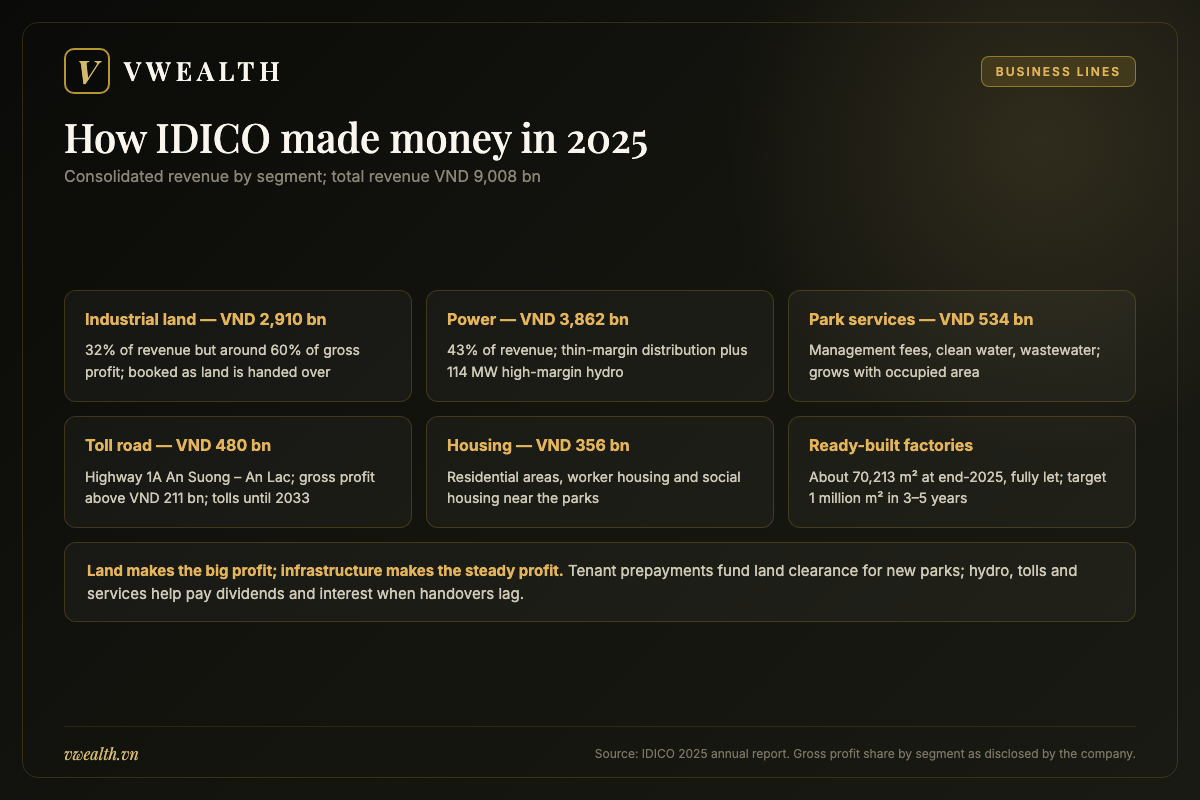
If you only look at revenue, you may be surprised: IDICO’s power business brought in about VND 3,862 billion in 2025, roughly 43% of total revenue — more than the industrial park business. But this segment contains two very different things.
The first is power distribution, handled mainly by the subsidiary UDICO. IDICO buys electricity from the national grid and redistributes it to factories in its parks through substations at Tuy Ha, Nhon Trach V and Huu Thanh, with total capacity of 481 MVA. In 2025, it distributed about 1,679 million kWh, generating about VND 3,308 billion of revenue. This is a “big revenue, thin margin” business: both purchase and sale prices operate within regulated frameworks, so the distributor’s spread is small. But it grows with occupancy — every new factory in a park is a new electricity customer.
The second is hydropower generation, and this is where the energy segment’s profit really comes from. IDICO owns two plants totalling 114 MW: Srok Phu Mieng, 51 MW (built 2003, commissioned 2006, now in Dong Nai after the merger), run by the subsidiary IDICO-SHP; and Dak Mi 3, 63 MW (built 2014–2017 at a total cost of about VND 2,034 billion, now in Da Nang), run by a branch of the parent company. In 2025, the two plants generated about 251.4 million kWh and 299.5 million kWh respectively — roughly 550 million kWh in total by our sum — helped by favourable rainfall. Hydropower is a largely depreciated machine with low running costs and high gross margins; the trade-off is that output depends on rain. In dry years, such as El Niño years, profit from this segment can drop noticeably.
The third, small but growing, is rooftop solar via the subsidiary IDERGY, set up in September 2022. By the end of 2025, IDERGY had about 13.2 MWp installed on factory roofs inside IDICO parks, with a 2026 target of an extra 20–30 MWp. At the 2026 AGM, management also mentioned a roughly 110 MW hydropower project under study, plus cooperation with Vingroup entities on battery storage and direct power purchase agreements (DPPAs). For foreign manufacturers under pressure to green their supply chains, a park landlord that can sell clean power is a genuine competitive advantage.
The An Suong – An Lac toll road: a cash box until 2033
IDICO’s least-discussed but steadiest business is the BOT toll road, run by the subsidiary IDICO-IDI (59.68% owned by the parent). The flagship project is the upgrade of National Highway 1A between An Suong and An Lac in Ho Chi Minh City — the western ring corridor that traffic from the Mekong Delta, Binh Duong and Tay Ninh must pass through. The annual report puts total BOT investment at about VND 2,455 billion, with toll collection running until 2033.
In 2025, tolls generated about VND 480 billion of revenue and more than VND 211 billion of gross profit. Small relative to group profit, but with three valuable qualities: it is steady (traffic on an arterial road varies little), it needs no major new capital (the road is built), and it has a clear end date. That end date is the part to remember: when the toll concession expires, the cash stops unless the company has a new BOT project to replace it. The report also mentions other income from the Tan Ky Tan Quy bridge and An Phu projects, suggesting some legacy transport contracts are still being wound down.
Park services, ready-built factories and housing: the smaller bricks
Once a park is full, the developer’s work is not over. Every year, tenants pay management fees, infrastructure usage fees, water bills and wastewater treatment charges. According to the annual report, with more than 1,800 hectares already leased, park service fees alone brought in about VND 146 billion in 2025, with fees rising about 3–5% a year. IDICO supplies clean water at nine projects, about 22.6 million m³, and treats about 12 million m³ of wastewater. Combined, the park services segment generated about VND 534 billion of revenue, up about 12%, with gross profit up about 32% — the third-largest profit contributor after industrial land and energy.
A newer direction is ready-built factories and warehouses. Instead of leasing only bare land for tenants to build on, IDICO builds units of roughly 2,000 to 10,000 m² and rents them on shorter terms. By the end of 2025, it had about 70,213 m² of such space, fully let as soon as completed; the CN1–CN5 cluster at Nhon Trach 1 (about 8.28 ha) is full. The 2026 plan adds about 100,400 m², with a long-term goal of around 1 million m² in three to five years. This model produces monthly cash flow rather than lump sums, and appeals to small and mid-sized “China+1” manufacturers who want to start production quickly without building their own plant.
Finally, housing and urban development is the smallest piece: about VND 356 billion of revenue in 2025, down from about VND 532 billion in 2024. Projects are mainly residential areas and resettlement zones near the parks, worker housing in Nhon Trach and social housing at My Xuan B1 (about 34,260 m² of land). The point is not big profit but giving the parks somewhere for workers to live — something FDI investors increasingly ask about when choosing a site.
| Segment (consolidated revenue) | 2024 (VND bn) | 2025 (VND bn) | Share of 2025 | Cash-flow character |
|---|---|---|---|---|
| Power business | 3,373 | 3,862 | 43% | Distribution: large, thin; hydro: high margin, rain-dependent |
| Industrial park infrastructure | 3,516 | 2,910 | 32% | Large, high margin, lumpy with handovers |
| Industrial park services | 472 | 534 | 6% | Steady, grows with occupied area |
| Road tolls (BOT) | 464 | 480 | 5% | Steady, ends in 2033 |
| Residential real estate | 532 | 356 | 4% | Small, project-driven |
| Other products and services | 490 | 446 | 5% | Construction, building materials |
| Financial and other income | 200 | 420 | 5% | Deposit interest, one-offs |
| Total revenue | 9,048 | 9,008 | 100% |
Source: IDICO 2025 annual report (total revenue includes financial income and other income). The “financial and other” line is a vwealth sum (168 + 32 in 2024; 322 + 98 in 2025).
Which business feeds which — and where the moat lies
Put the pieces together and the picture sharpens. According to the annual report, industrial park infrastructure made up only about 32% of revenue but around 60% of gross profit in 2025; energy ranked second in profit, park services third, tolls after that. In short: land makes the big profit; infrastructure makes the steady profit. Cash from land leases funds land clearance for new parks; steady cash from hydro, tolls and services helps pay dividends and interest in years when land handovers lag.
IDICO’s moat does not come from technology or a consumer brand, but from three hard-to-copy assets. One is legally approved land: getting a park approved by the Prime Minister or a province, clearing the land and building infrastructure typically takes years, and IDICO has thousands of hectares at various stages of that pipeline. Two is self-operated infrastructure: substations, water plants and wastewater plants turn every land tenant into a customer paying every year for decades. Three is more than 25 years of experience with FDI tenants — intangible but very real when a Korean or Japanese group chooses a partner for a multi-hundred-million-dollar investment.
The limits of the moat are just as clear. A scattered land bank means IDICO has no “regional monopoly” like Becamex in Binh Duong. In every province it competes head-on with dozens of other developers, from private players like Kinh Bac to parks backed by foreign groups. And land rents, though rising steadily for years, still depend on something outside the company’s control: where multinationals decide to put their factories.
Financial health: read the statements before deciding whether to buy IDC stock
There is a quick way to misread IDC: open the income statement, see that this quarter’s profit fell 20% year on year, and conclude the company is in decline. For a business whose profit mostly comes from handing over land under a handful of large contracts, that reading is nearly useless. This chapter does not give you the latest quarterly numbers — those are in the updated vwealth reports — but shows you how to read IDC’s own statements and judge for yourself.
Five years of profit: read the rhythm of land handovers, not single quarters
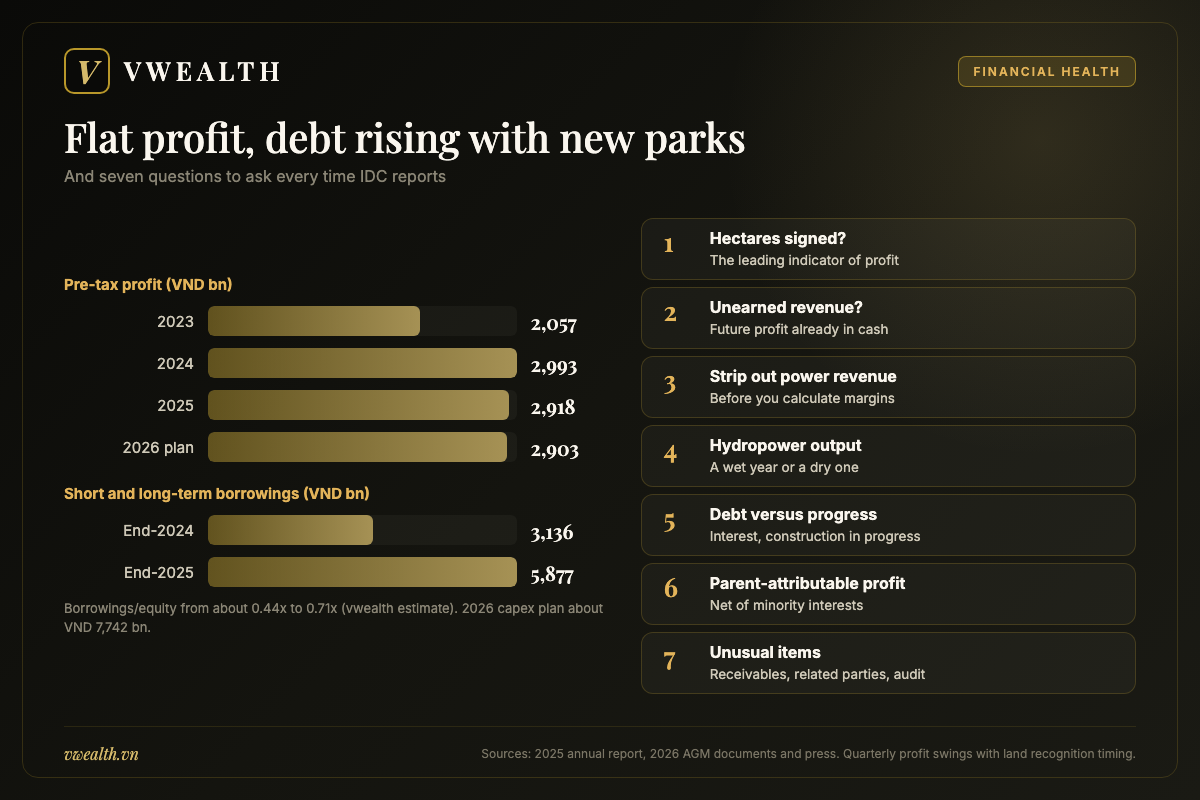
Start with the five closed years. In 2021, IDICO’s net profit was only about VND 578 billion according to press reports — a pandemic year with lockdowns, when almost nobody came to inspect land. In 2022, audited net profit jumped to about VND 2,054 billion, mostly from one-time recognition of older contracts. In 2023, pre-tax profit fell back to about VND 2,057 billion (down about 21%) as the one-time boost faded. 2024 was the peak: pre-tax profit of about VND 2,993 billion and net profit of about VND 2,392 billion. 2025 was flat: pre-tax about VND 2,918 billion, net about VND 2,354 billion, of which about VND 1,932 billion was attributable to parent shareholders.
| Year | Total revenue (VND bn) | Pre-tax profit (VND bn) | Net profit (VND bn) | Highlight |
|---|---|---|---|---|
| 2021 | — | — | about 578 | Pandemic year, slow leasing |
| 2022 | about 7,485 | cut by over 541 in audit | about 2,054 | One-time recognition of older contracts |
| 2023 | about 7,474 | about 2,057 | — | Down about 21% versus 2022 |
| 2024 | 9,048 | 2,993 | 2,392 | Record profit |
| 2025 | 9,008 | 2,918 | 2,354 (parent about 1,932) | Tariffs slowed land deals; power, tolls, services filled the gap |
| 2026 (plan) | 9,474 | about 2,903 | — | Flat; capex about VND 7,742 bn |
Sources: IDICO 2025 annual report, AGM documents and Vietnamese financial press (CafeF, Tin nhanh Chung khoan, Nguoi Dua Tin). A dash means vwealth could not find a sufficiently reliable published figure to cross-check. Sources sometimes mix “total revenue” (including financial and other income) with “net revenue”; for 2025, net revenue was about VND 8,588 billion and total revenue VND 9,008 billion. For reference, VND 1,000 billion is roughly USD 38–40 million at recent exchange rates.
What does the table tell you? IDICO’s profit does not climb in a straight line. It moves in steps: a low step before 2022, a high step since. After stepping up, it oscillates around VND 2,000–3,000 billion of pre-tax profit a year depending on land handovers. The flat 2026 plan shows management does not expect a new step until the new parks — Tan Phuoc 1, Vinh Quang, My Xuan B1 Expansion — start handing over land.
43% of revenue from power, around 60% of gross profit from land
Chapter 3 showed that power is the largest revenue line. Now put it next to profit. In 2025, per the annual report, industrial park infrastructure accounted for around 60% of group gross profit while contributing only about a third of revenue. Power distribution, by contrast, made up nearly 40% of revenue at a gross margin far below that of land — the report says only that the margin “improved by about 1 percentage point” versus 2024.
The lesson: IDICO’s consolidated gross margin swings with revenue mix. In a year with many land handovers, the blended margin rises; in a year with little land and more power, it falls, even if no business actually deteriorated. The annual report shows consolidated pre-tax profit margin of about 27% in 2025, while at the parent company — where land and the Dak Mi 3 hydro plant sit, with little distribution — the figure was about 62%. When you read the statements, always strip out power revenue before calculating margins; otherwise you are comparing apples with oranges.
Unearned revenue: a “good” liability on the balance sheet
At the end of 2025, IDICO’s total liabilities were about VND 14,938 billion, while short- and long-term borrowings were only about VND 5,877 billion. The difference of about VND 9,061 billion (vwealth calculation) includes trade payables, taxes, unpaid dividends and — most importantly for a park developer — unearned revenue and customer prepayments.
In accounting terms this is a “liability”: the company has collected the money but has not fully delivered the service. Economically, it is cash customers have already paid, which will turn into revenue over many years without collecting another dong. So when judging IDC’s leverage, do not use total liabilities to equity mechanically — it overstates risk. Use borrowings to equity, and look in the notes for the long-term unearned revenue balance to see how much “future profit” the company is already holding in cash.
A useful signal: if unearned revenue rises strongly while accounting profit falls, the company may be signing a lot but recognizing slowly — a better picture than it looks. Conversely, if profit jumps because a large chunk moves from unearned revenue into revenue, that profit is “withdrawn from the safe”, not newly earned — as in 2022.
Borrowings up 87%: the new investment cycle has begun
This is the most notable balance sheet change of 2025. Short- and long-term borrowings rose from about VND 3,136 billion to about VND 5,877 billion, an increase of roughly 87%. Total assets grew about 23% to about VND 23,201 billion; equity rose about 15% to about VND 8,263 billion. Construction in progress increased by about VND 2,100 billion, mainly for land clearance and infrastructure at new parks.
By vwealth’s calculation from those figures, borrowings-to-equity rose from about 0.44x at the end of 2024 to about 0.71x at the end of 2025. For a real estate company that is not high — many residential developers run several times that. But the trend is what to watch: the 2026 plan calls for about VND 7,742 billion of investment, roughly 2.8 times 2025, while profit is planned flat and the dividend plan stays at 40% total. The gap has to be funded somehow — more debt, retained earnings, stock rather than cash dividends, or upfront payments from new tenants. Some Vietnamese outlets have already questioned the 2026 plan’s reliance on borrowing.
The positive side: at the end of 2025 IDICO held substantial cash and deposits — financial income nearly tripled to about VND 322 billion in 2025, largely from deposit interest — and the company has redeemed some older bond tranches on schedule. The watch point: if new parks hand over land later than planned, interest costs will eat into profit before land revenue arrives.
Minority interests and cash-flow quality
As Chapter 2 noted, many IDICO subsidiaries are not wholly owned: Srok Phu Mieng hydro 51.78%, tolls via IDICO-IDI 59.68%, power distribution via UDICO 64.51%, Que Vo 54.94%, Tan Phuoc 1 via IDICO Tien Giang 65%, My Xuan B1 Expansion via IDICO-CONAC 51%. For every dong earned in those subsidiaries, IDC shareholders get only a share. In 2025, the gap between consolidated net profit (about VND 2,354 billion) and profit attributable to parent shareholders (about VND 1,932 billion per the press) was about VND 422 billion — a vwealth subtraction. When you calculate P/E, always use profit attributable to the parent.
On cash flow, compare operating cash flow with profit. For a park developer, operating cash flow can far exceed profit in a year of big signings (tenants pay upfront, profit is recognized gradually), or fall short in a year of “withdrawing from the safe”. If the two diverge in the same direction for several years running, ask more questions. Land clearance spending may sit in investing cash flow or in inventory depending on accounting treatment — check both.
Seven questions to ask every time IDC reports
Pulling it all together, here is a checklist you can use every quarter:
One, how many hectares were signed and handed over, and at which parks? New signings are the leading indicator of profit. Two, did the unearned revenue balance rise or fall? Three, how much of revenue is power, and what is the gross margin of the industrial park segment alone? Four, how did hydropower output compare with the same period last year — a wet year or a dry one? Five, how have borrowings, interest expense and construction in progress changed against the investment plan? Six, what is profit attributable to parent shareholders, net of minorities? Seven, are there unusual receivables, related-party transactions or audit adjustments?
If you can answer these seven every quarter, you will understand IDC better than most people who only look at the bottom line — and you will be surprised less often by a “bad” or “great” quarter that is really just a timing effect.
How the market treats IDC stock: tariff-sensitive, dividend-loyal
If you had to describe IDC stock in one sentence, it might be this: a high-dividend stock with a temper. It is not as quiet as a utility, nor as wild as a brokerage stock; it sways with every macro wind — FDI, tariffs, interest rates — while steadily paying shareholders. This chapter recounts how the market has priced IDC at key moments, so you know what to expect if you own it.
From IPO to HNX: historical price milestones
IDC’s public price milestones tell a modest story for the first few years. The average IPO price in October 2017 was VND 23,940; the first UPCoM reference price in November 2017 was VND 23,900; but when it moved to HNX in December 2019, the reference price was just VND 18,500. For its first two years as a public company, IDICO did not show profits compelling enough for the market to pay above the IPO price.
The psychological turn came with the state divestment. In November 2020, investors paid an average VND 26,936 per share for the ministry’s 36% block, while the market price was around VND 29,000 according to the press. In mid-2021, Bitexco sold near VND 35,000. After that, riding the industrial park stock rally and the 2022 profit windfall, IDC moved into a different price range altogether.
| Date | Public price reference | Context |
|---|---|---|
| Oct 5, 2017 | IPO, average VND 23,940 | Foreign investors bought nearly 75% of the offering |
| Nov 24, 2017 | UPCoM reference VND 23,900 | First trading session |
| Dec 10, 2019 | HNX reference VND 18,500 | Listing move, below IPO price |
| Nov 27, 2020 | Divestment auction, average VND 26,936 | Ministry of Construction sells 36%, exits fully |
| May–Jun 2021 | Bitexco sells near VND 35,000 (per press) | SSG group takes control |
| Feb 27, 2025 | 2025 high: VND 57,400 | Before the reciprocal tariff shock |
| Apr 9, 2025 | 2025 low: VND 27,700 | Days after the US announced a 46% tariff on Vietnamese goods |
| Dec 31, 2025 | Close VND 36,400; market cap about VND 13,814 bn | End of a volatile year |
Sources: auction results published by the stock exchanges, IDICO’s 2025 annual report (Tradingview, Vietstock and FiinPro data) and press reports. Prices are nominal at the time of trading, not adjusted for cash dividends and bonus shares, so they are not directly comparable with prices after dividend distributions.
2025: IDC’s personality in miniature
2025 is the perfect case study of how IDC reacts to macro news. Per the annual report, the stock hit its high for the year of VND 57,400 on February 27, 2025. On April 2, 2025, the United States announced a 46% reciprocal tariff on Vietnamese goods — among the highest rates imposed on any country. A week later, on April 9, 2025, IDC hit its low for the year at VND 27,700, down more than 50% from the peak (vwealth calculation on nominal prices). Investors feared that if Vietnamese exports were heavily taxed, multinationals would stop opening new factories and land demand would vanish.
Later, as Washington paused the higher rates and then reached a framework deal with Vietnam, the price partly recovered; one session saw nearly 19.9 million shares traded (August 11, 2025), against a full-year average of about 2.38 million shares per session. IDC closed the year at VND 36,400 — far from the low but also far from the high. The volume-weighted average price for the year was about VND 44,200.
The lesson from 2025: IDC stock reacts to expectations about FDI much faster than to the actual impact on financial statements. Full-year 2025 profit was almost flat versus 2024, yet the share price at one point lost half its value. If you are thinking of buying IDC stock, be prepared for 30–50% drawdowns on macro news even when nothing fundamental changes at the company.
Dividends: why many holders ride out the storms
What keeps IDC shareholders on board through sell-offs is the dividend. With total payouts of about 35–40% of par each year (2022–2023: 40% in cash; 2024: 20% cash plus 15% in shares; 2025: 30% cash plus 10% in shares), IDC ranks among the higher dividend payers in Vietnam stocks. Dividend yield is simple: cash dividend per share divided by the price you paid.
Illustrative example: suppose you buy IDC at VND 40,000 and the company pays VND 3,000 in cash per share for the year (equivalent to the 30% cash payout for 2025). Your cash dividend yield is 3,000 / 40,000 = 7.5% before tax. Buy at VND 55,000 and the yield is about 5.5%; buy at VND 30,000 and it is 10%. These prices are assumptions for illustration, not current prices or forecasts. Remember that IDC’s dividend depends on profit and on the capital needs of new parks; management can tilt toward more stock and less cash when it needs to conserve money.
Because of the dividend, IDC has a loyal base of holders — older individual investors and income-oriented funds — who tend to buy more whenever the price falls sharply. That behaviour creates a natural floor, which helps explain why IDC has often rebounded fairly quickly after each sell-off once the bad news passes.
Foreign investors and foreign room: plenty of space, not yet filled
At the end of 2025, foreign investors owned about 14.32% of IDC against a 49% cap. That leaves more than 34 percentage points of headroom — a lot. But open room does not automatically mean foreign buying: many foreign funds prefer liquid HOSE stocks included in major indices. That is why the plan to move to HOSE — targeted for late 2026 or early 2027 according to AGM remarks — is widely viewed as a catalyst.
For foreign investors, Vietnam’s industrial park story is easy to understand and easy to pitch: Vietnam is a destination for factory relocation, and park developers “sell shovels” in that gold rush. Our overview of Vietnam manufacturing and industrial stocks covers that theme across sectors. If IDC moves to HOSE and qualifies for major index baskets, passive money could flow in. But this is a possibility, not a certainty; the timing of the transfer and index eligibility depend on exchange rules and index providers.
Valuation: why IDC’s P/E can mislead you
The most common tool is P/E — price divided by earnings per share. For IDC, P/E can mislead for two reasons. First, earnings are lumpy with land recognition: in a year of heavy one-time bookings, EPS balloons and P/E looks cheap; in a light year, P/E looks expensive, even though the real value of the land bank has not changed. Second, part of the profit is “used up” — land once leased cannot be leased again — so a low P/E is not necessarily cheap if the remaining land bank is not replenished.
That is why analysts usually value park developers with a revalued net asset value (RNAV) or discounted cash flow (DCF) approach: estimate the remaining leasable area of each park, multiply by expected rents, subtract the land clearance and infrastructure costs still to be spent, discount to present value at an assumed leasing pace; then add the value of the steady cash-flow businesses (hydro, tolls, services) and subtract net debt. For IDC, the “steady cash flow” part is an advantage over many land-only peers, because it depends less on leasing assumptions.
P/B — price divided by book value — also needs care: land on the books is carried at historical cost, and some parks were cleared more than a decade ago at costs far below today’s market. So park developers often “look expensive” on P/B without that reflecting land value. For IDC’s current P/E and P/B against its own history and peers, open the vwealth report; this article deliberately omits those numbers because they change daily.
Catalysts the market tends to react to
From the price history, you can list the kinds of news that move IDC most. Macro: US tariff announcements, monthly FDI registration and disbursement data, high-level state visits with investment pledges, interest rate moves. Company: quarterly land signings, news of new parks being approved or breaking ground (Tan Phuoc 1 construction expected to start in late 2026, My Xuan B1 Expansion sales expected in 2026), dividend record dates, and the exchange transfer. Sector: the story of Vietnam’s stock market being upgraded by index providers, land policy, and the global minimum tax for FDI companies.
A small tip: when reading news, separate items that change value (new land, higher rents, new parks starting construction) from items that only change timing (less recognized this quarter, more next quarter). The market often reacts strongly to the second kind — which is where long-term investors can find opportunities, or at least avoid panic selling.
Industry backdrop: “China+1”, US reciprocal tariffs and the race for industrial land
No industrial park developer is bigger than the FDI cycle. IDICO can clear land quickly, build excellent infrastructure and price sensibly, but if multinationals do not want to build factories in Vietnam, the land just sits there. So to answer whether you should buy IDC stock, you need to understand where the capital is flowing, why, and what could change its direction. For a macro overview, see our guide to Vietnam’s economy in 2026 for investors and our piece on stocks tied to Vietnam’s export economy.
Vietnam in the “China+1” wave
“China+1” is the shorthand for a strategy many global manufacturers have adopted: keep factories in China but add at least one base elsewhere to reduce risk — the risk of US–China tariffs, of supply chain disruption like during the pandemic, of rising labour costs. Vietnam, with its border on China, young workforce, wide network of free trade agreements and competitive costs, is one of the leading destinations for this shift, alongside India, Thailand, Indonesia, Malaysia and Mexico.
FDI data reflect this. According to official figures cited by the press, registered FDI into Vietnam in 2025 was about USD 38.4 billion, up slightly; disbursed FDI was an estimated USD 27.6 billion, up about 9% and the highest in five years. The number of new projects rose about 20%, but the average registered capital per new project shrank — a trend toward more, smaller projects. For park developers that cuts both ways: each lease covers fewer hectares, but demand for ready-built factories — which IDICO is pushing — rises.
The industries arriving in IDICO parks are varied. The 2025 annual report mentions tenants in refractory materials, glass, food processing and EV charging, alongside traditional electronics, engineering and textiles. Port-side parks such as Phu My II attract heavy industry; gateway parks such as Huu Thanh attract light manufacturing and logistics; northern parks such as Que Vo II and Cau Nghin attract electronics and components supply chains.
US reciprocal tariffs: the 2025 shock and the open question
The United States is Vietnam’s largest export market, and most FDI factories in industrial parks make goods for export. So Washington’s tariff policy hits land demand directly. On April 2, 2025, the US announced a 46% reciprocal tariff on Vietnamese goods; a week later, the portion above a 10% baseline was paused for negotiations. On July 2, 2025, the two sides announced a framework: Vietnamese goods would face 20%, while goods deemed transshipped from third countries would face 40%. The 20% rate took effect in early August 2025, and in late October 2025 the two countries issued a joint statement on a reciprocal trade agreement framework. In 2026, the legal basis for these tariffs continued to be challenged in US courts and adjusted through other instruments — check the rate in force when you read this.
The impact on IDICO shows in the 2025 numbers: the company leased only about 76 hectares of new land, around 62% of plan. The annual report explains that tariffs and geopolitical conflicts led investors to delay decisions until markets stabilized. Note the difference between delay and cancel: many prospective tenants are still negotiating, just not signing. Once the tariff picture is clearer, some of that pent-up demand could return — the core of the bull case in Chapter 7.
One detail matters more than the 20% headline: the 40% rate on transshipment. It targets goods that merely pass through Vietnam to change their country of origin. To avoid that label, companies must genuinely manufacture and substantially transform products in Vietnam — which means real factories, on real land, with higher local content. Over the long run, that could favour park developers with large land banks and good infrastructure, even if it makes investors more cautious about site selection in the short term.
Rents, occupancy and changing land policy
According to CBRE data cited by the press, average industrial park occupancy was about 80% in the north and about 89% in the south; CBRE expects industrial land rents to rise roughly 4–8% a year in the north and 3–7% a year in the south over the next three years. High southern occupancy is why parks with clean land near Ho Chi Minh City and the ports — such as Huu Thanh, Phu My II Expansion and My Xuan B1 Expansion — have pricing power.
But the cost of new land is rising fast too. Vietnam’s 2024 Land Law (effective August 1, 2024) brings official land price tables closer to market prices, pushing up compensation, clearance costs and the land rent developers pay to the state. The mid-2025 provincial mergers changed the addresses of many parks (Huu Thanh from Long An to Tay Ninh, Tan Phuoc 1 from Tien Giang to Dong Thap, Cau Nghin from Thai Binh to Hung Yen, and so on) and may slow some procedures while new administrations settle in. In addition, the 15% global minimum tax Vietnam applies from 2024 to large multinational groups reduces the appeal of traditional corporate income tax incentives, forcing provinces and developers to compete on infrastructure, power, water, labour and administrative speed rather than tax breaks alone.
For IDICO, this means margins at new parks may not match those of older parks, whose land was acquired cheaply many years ago. That is a reason to be careful about extrapolating 2022–2025 profitability into the next decade.
New transport infrastructure: a boost for land in the right places
A park’s value depends heavily on the roads, ports and airports around it. In the south, IDICO’s Phu My II – My Xuan cluster sits next to the Cai Mep – Thi Vai ports and, per the company, about 30–35 km from the new Long Thanh international airport; the Bien Hoa – Vung Tau expressway, once fully open, will shorten the route to the port (IDICO also has an associate named after this route, BVEC). Huu Thanh benefits from ring roads and expressways linking Ho Chi Minh City with the Mekong Delta. In the north, Phu Long in Ninh Binh borders the East–West avenue connecting to the North–South expressway, and Vinh Quang in Hai Phong sits inside the north’s largest port region.
For a park developer, every new expressway that opens effectively “revalues” the surrounding land in the eyes of prospective tenants. Public infrastructure spending is therefore one of the quieter tailwinds behind the sector.
Competition: where IDC stands next to KBC, BCM, SZC and VGC
Vietnam’s stock market has several listed park developers, each with its own model. Comparing them clarifies what makes IDC different. Our analysis Should you buy KBC stock (Kinh Bac)? describes a private developer with a large land bank mainly in the north, very lumpy profits from big contracts, and urban ambitions. Should you buy BCM stock (Becamex)? describes the industrial-city model in Binh Duong, majority state-owned, with a large contribution from the VSIP joint venture. Should you buy VGC stock (Viglacera)? describes a “two-legged” company: building materials plus industrial parks.
| Ticker | Exchange | Controlling owner | Main land bank | Distinctive feature |
|---|---|---|---|---|
| IDC (IDICO) | HNX | SSG group about 34%; no state stake | 14 parks in both regions, about 4,474 ha | Land + hydro + tolls + power distribution; high cash dividends |
| KBC (Kinh Bac) | HOSE | Private | Mainly north (Bac Ninh, Bac Giang, Hai Phong), some southern projects | Big contracts, very volatile profit, urban development |
| BCM (Becamex) | HOSE | State majority | Former Binh Duong and neighbouring provinces | Single-region industrial city; large VSIP JV earnings |
| SZC (Sonadezi Chau Duc) | HOSE | Sonadezi Corporation | Chau Duc park (former Ba Ria – Vung Tau) | One large park near the Cai Mep port cluster |
| VGC (Viglacera) | HOSE | Gelex plus remaining state stake | Parks mainly in the north | Two legs: building materials and industrial parks |
This comparison is qualitative, based on analyses in the vwealth series and company disclosures; ownership stakes and land banks of other companies change over time, so check the latest figures.
From this table IDC’s position is clear. Compared with KBC, IDC is less lumpy thanks to its infrastructure cash flows, but also less likely to have a breakout year driven by a single multi-hundred-hectare deal. Compared with BCM, IDC has no regional monopoly and no VSIP-scale joint venture, but it is not locked into one province and has a much larger free float. Compared with SZC, IDC is more geographically diversified. Compared with VGC, IDC does not carry a cyclical building materials business; it has hydro and tolls instead. If you want a park developer that spreads its risks and pays steady dividends, IDC is worth researching; if you want a strong growth jolt from one mega-project, other names may fit better.
Outlook: three scenarios for IDC stock and the conditions behind each
Forecasting the price of an industrial park stock is futile: a single social media post about tariffs can wipe out any model. What is more useful is identifying the variables that matter, then picturing how the story unfolds when those variables tilt one way or the other. This chapter offers no price target; it offers conditions you can track yourself.
Six variables that will decide IDC’s future
One, the pace of new leasing. The 2026 plan is about 100 hectares; 2025 delivered only about 76. Quarterly signings are the single most important indicator. Two, progress at the new parks. Tan Phuoc 1 (470 ha), Vinh Quang (350 ha), My Xuan B1 Expansion (110 ha) and Phu Long (416 ha) — according to the company, once operational the new projects will add about 1,400 hectares of commercial industrial land. Clearing land on time versus a few years late makes an enormous difference. Three, US tariff policy and the outcome of trade negotiations. Four, rents versus land costs — whether margins at new parks can hold up as compensation costs rise under the 2024 Land Law. Five, rainfall — a wet year or a drought can move hydropower profit significantly. Six, capital structure and dividends — how the company balances new debt, retained earnings and cash dividends during a roughly VND 7,742 billion investment year in 2026.
Beyond these six, two secondary factors are worth watching: progress on the HOSE transfer, and any changes in the major-shareholder group — for example, if the SSG group buys more or sells down, or if a new strategic investor appears.
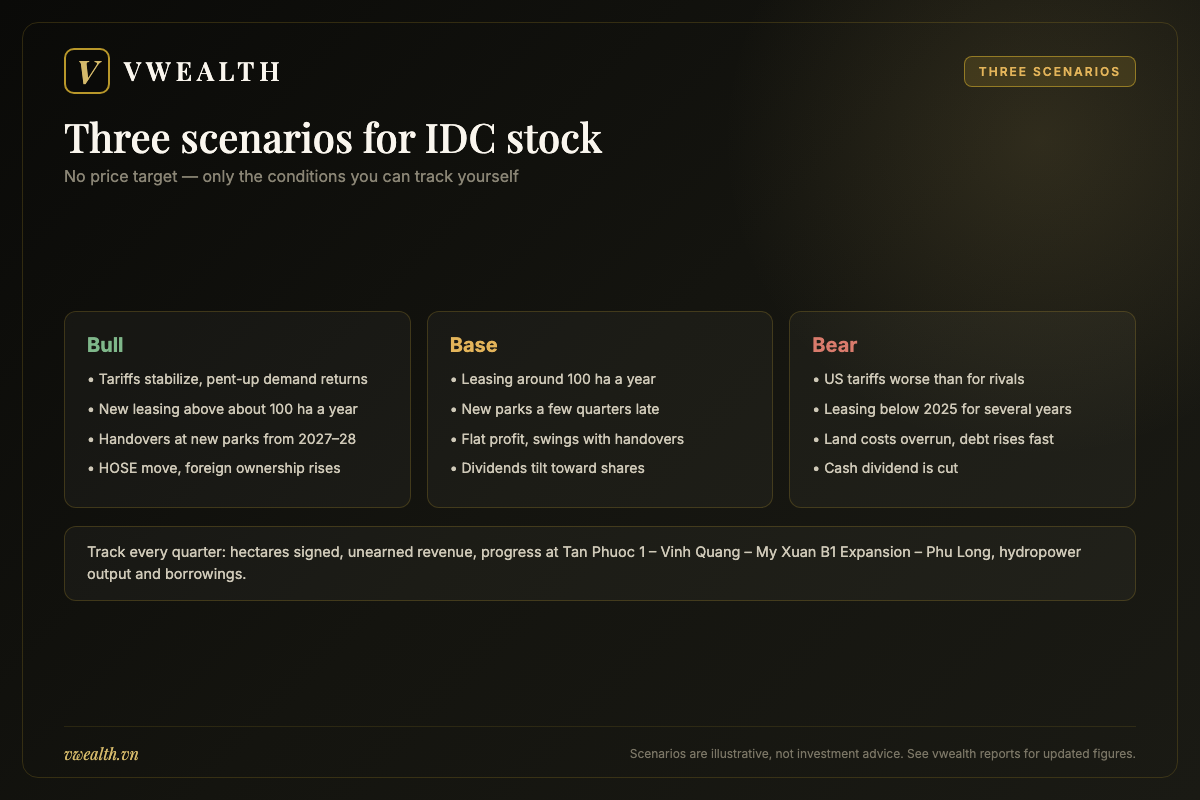
Bull case: pent-up demand returns and new parks deliver on time
This scenario plays out if the US–Vietnam tariff framework stabilizes at a level competitive with regional rivals, and investors who delayed in 2025 come back to sign. IDICO’s new leasing could then exceed the 100 ha/year plan, especially at Huu Thanh (more than 60% still unoccupied based on disclosed occupancy) and Phu My II Expansion. My Xuan B1 Expansion opens for sale in 2026 as planned, Tan Phuoc 1 and Vinh Quang break ground, and clearance is fast enough for handovers from around 2027–2028.
Meanwhile, ready-built factory space grows quickly toward target, and rooftop solar plus the new hydropower project add steady cash. The company moves to HOSE and foreign ownership rises. In this scenario, profit could step up to a new level after the flat phase, with cash dividends maintained. Conditions to watch for: new signings above plan for at least two consecutive quarters, a rising unearned revenue balance, and new parks breaking ground on schedule.
Base case: controlled sideways movement while waiting for new land
This scenario is closest to management’s own plan. Land demand recovers slowly, at roughly 100 ha a year. Parks already leasing fill up gradually; the new parks progress but a few quarters slower than hoped because of procedures and compensation. Profit moves sideways around 2024–2025 levels, fluctuating with handover timing and rainfall.
Debt rises with the investment cycle but stays under control thanks to tenant prepayments and steady cash from power, tolls and services. Total dividends stay around 40%, but the stock component may outweigh cash. The share price swings with macro news without a clear trend until the new parks start generating revenue. How to recognize it: signings near plan, quarterly profit up some quarters and down others but full-year close to plan, and debt rising in line with disbursement.
Bear case: adverse tariffs, delayed parks and rising leverage
This scenario happens if the US imposes significantly higher tariffs on Vietnam than on competing countries, or tightens transshipment rules so much that investors shift elsewhere. Land demand falls sharply; IDICO signs less than in 2025 for several years. At the same time, new parks must keep receiving investment because of commitments to provinces, clearance costs overrun under the new land price tables, and interest expense rises.
A few dry years cut hydropower profit. The company is forced to reduce cash dividends, pay more in stock or raise equity. The An Suong – An Lac toll concession approaches 2033 without a replacement. In this scenario, the stock could be under pressure for a long time, and the dividend yield — the main reason many people hold IDC — would lose its appeal. Warning signs: several consecutive quarters of falling signings, declining unearned revenue, debt growing faster than project progress, and a cut to the dividend plan.
| Variable | Bull | Base | Bear |
|---|---|---|---|
| New land leasing | Above about 100 ha/year | Around 100 ha/year | Below 2025 level (about 76 ha) |
| New parks (Tan Phuoc 1, Vinh Quang, My Xuan B1 Exp., Phu Long) | On schedule, handovers from about 2027–2028 | A few quarters late | Years late, cost overruns |
| US tariffs | Stable, competitive with the region | Uncertain but not worse | Worse than competing countries |
| Rainfall | Favourable | Average | Multi-year drought |
| Debt and dividends | Debt rises with projects, cash dividend held | Debt rises, dividend tilts to stock | Debt rises fast, cash dividend cut |
Illustrative example: what every 10 hectares means
To see why each hectare matters, run a hypothetical calculation. This is an illustrative example, not IDICO data. Suppose industrial land leases for 150 USD/m² for the full term (an assumed figure chosen for easy arithmetic, not an IDICO published rent). Ten hectares = 100,000 m², times USD 150 = USD 15 million, or about VND 390 billion at an assumed rate of VND 26,000 per dollar. If that park’s gross margin is 50%, gross profit is about VND 195 billion.
So in this example, the 24-hectare gap between the 100 ha plan and the 76 ha actually leased in 2025 equals about VND 470 billion of gross profit if booked upfront — not trivial against IDICO’s annual pre-tax profit of about VND 2,000–3,000 billion. But if the contracts are spread over 45–50 years, those same 10 hectares contribute only a few billion dong of profit a year. The example shows why both signing pace and recognition method matter — and why you should not overreact to a single quarter. Actual rents, margins and recognition differ by park; see the latest figures in vwealth’s reports.
So, should you buy IDC stock? A straight answer
You now have all the pieces: a former Ministry of Construction corporation now led by the private SSG group; 14 industrial parks across both halves of Vietnam; two hydropower plants, a power distribution grid and a toll road running to 2033; profit that stepped up in 2022 but is now flat; high dividends gradually tilting toward stock; and the largest investment cycle in the company’s history starting just as US tariffs remain an open question. There is no single answer to whether you should buy IDC stock. It depends on what kind of investor you are.
The compelling positives
A large, multi-region, legally approved land bank. About 4,474 hectares across 14 parks, with four new parks already approved, gives IDICO years of “inventory” without depending on a single province. Steady infrastructure cash flows. Hydro, tolls, park services and water create a layer of profit that depends little on land deals, helping the company hold up in weak FDI years like 2025. High dividends with a consistent record since 2022. No state ownership and a clear controlling owner with a profit motive. Wide foreign room and a potential HOSE move that could open the door to new investors. Positioning in the “China+1” shift — a long-term trend many believe will outlast any single US administration.
The negatives you cannot ignore
Lumpy, hard-to-forecast earnings tied to handover timing and revenue recognition, including one significant audit adjustment in the past. High sensitivity to US tariffs — in 2025 the stock lost more than half its value from peak to trough within weeks. A big investment cycle with fast-rising debt, while planned profit is flat. Rising new-land costs under the 2024 Land Law, which may squeeze margins at new parks. A multi-subsidiary structure that sends part of the profit to minorities and requires close monitoring of related-party dealings. A toll concession with an end date and hydro output at the mercy of the weather. Concentration of power in one major shareholder group that runs its own real estate business.
| Aspect | Upside | Downside |
|---|---|---|
| Land bank | About 4,474 ha, 14 parks, two regions, 4 new parks | New parks need heavy capital, land costs rising, long lead times |
| Profit | Four straight years of pre-tax profit above VND 2,000 bn | Lumpy, recognition-dependent; flat 2026 plan |
| Steady cash flow | 114 MW hydro, tolls, services, water, ready-built factories | Toll concession ends 2033; hydro depends on rainfall |
| Dividends | About 35–40% of par every year since 2022 | Tilting toward stock when cash is needed |
| Balance sheet | Borrowings/equity about 0.71x at end-2025 (vwealth estimate) | Borrowings up about 87% in 2025; 2026 capex about 2.8x |
| Macro | Beneficiary of “China+1” | Highly sensitive to US trade policy |
| Ownership | No state stake, wide foreign room, possible HOSE move | SSG group in control; related-party dealings need watching |
Who IDC stock suits
Long-term income investors who want a high-dividend stock, can tolerate volatility and are willing to hold for years to capture both dividends and land value. For them, macro-driven sell-offs like April 2025 may be accumulation opportunities if the company’s fundamentals have not changed. Investors who believe in supply chain relocation but prefer a regionally diversified company with a cash-flow cushion rather than a bet on a single mega-project. Investors comfortable reading financial statements at a basic level — separating power revenue, tracking signed hectares and unearned revenue as Chapter 4 describes.
If that is you, a sensible approach is to track the seven questions in Chapter 4 every quarter, compare IDC with peers like KBC, BCM and VGC, and keep position sizes moderate rather than concentrating your capital in a single industrial park name. Foreign investors should also factor in currency risk: returns in VND may look different once converted back to dollars or euros.
Who it does not suit
Short-term traders chasing quarterly earnings: IDC’s profit is out of phase with the underlying business, and the price reacts more to macro news than to company news, making it hard to trade on results. Anyone who cannot stomach sharp drawdowns: a 30–50% fall within weeks has already happened. Investors who need fast profit growth in the next year or two: the 2026 plan is flat and new parks take time. Investors who want to avoid trade policy risk: IDC is tied to the decisions of export manufacturers, and those decisions are tied to Washington.
Final thoughts
IDICO is not a hyper-growth story. It is the story of a large, long-established landlord trying to move from the era of “selling off old land acquired cheaply” to the era of “developing new land at higher cost”, using steady infrastructure cash flows as a cushion. If it succeeds, shareholders get both dividends and a new profit level. If it is slow, shareholders still get dividends but must be patient through years of sideways movement and tariff storms. So the question of whether to buy IDC stock is first a question about you: do you have the patience, and the discipline to read the reports, to hold a stock like this?
This article is informational analysis, not a recommendation to buy or sell. Before deciding, check the updated figures — price, P/E, P/B, latest quarterly profit, hectares signed — in the vwealth analysis reports, and consider your own risk tolerance. If you are interested in Vietnamese industrial park stocks in general, read our analyses of Kinh Bac, Becamex and Viglacera for a complete comparison, and revisit how to invest in the Vietnam stock market for the practical steps. When you are ready, you can open a free vwealth account to follow the latest reports.
Research Vietnamese stocks in English with vwealth. Our AI-powered platform turns Vietnamese market data into full English analysis reports — with international payment support and a free 2-month trial for new accounts. Create your free account and read the latest reports.