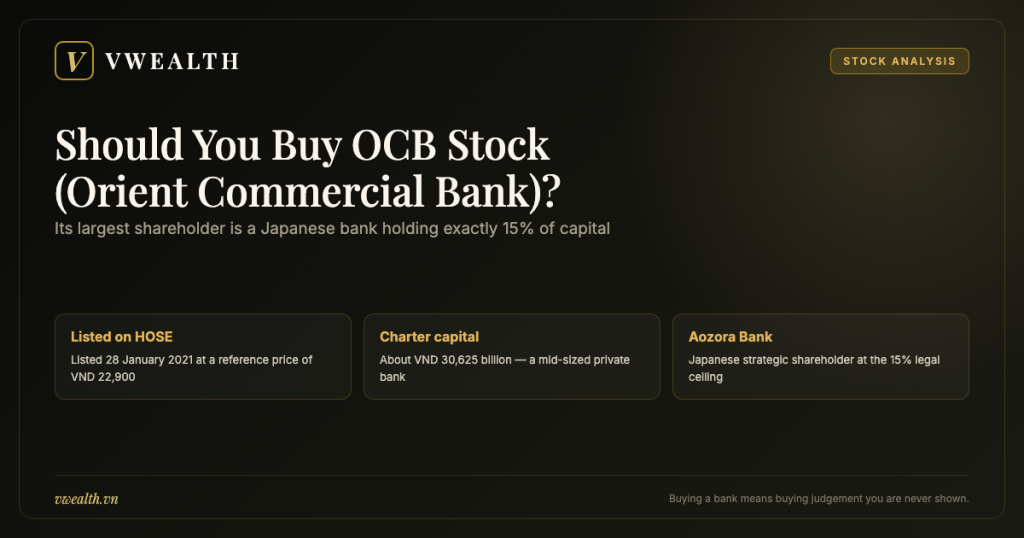
Should you buy OCB stock — the Ho Chi Minh Stock Exchange ticker for Orient Commercial Joint Stock Bank, known in Vietnamese as Ngan hang TMCP Phuong Dong — is among the hardest questions in this series, because a bank is a business whose balance sheet is the product. You cannot tour a factory, count inventory or inspect a production line. What you buy when you buy bank shares is the quality of a loan book you are never permitted to see, plus the judgement of the people deciding who gets credit. OCB carries one feature that separates it from most Vietnamese private banks: its largest shareholder is a Japanese bank holding exactly 15% of capital, the maximum a foreign strategic investor is allowed to hold. This analysis runs from a small joint stock bank founded in 1996 with VND 70 billion of capital, through a merger, to its 2021 listing — and ends with a straight answer about which kind of investor OCB suits, and which kind should stay away.
Before we start, the ground rules that apply to every company profile in this series.
You will encounter dates, names and scale figures, all drawn from publicly disclosed sources: corporate filings, annual reports, exchange disclosures and the bank’s own official channels. What you will not find is a valuation multiple as of today, a non-performing loan ratio, or the most recent quarter’s earnings. For a bank these figures change every quarter and only mean anything when placed side by side across many periods. Instead this article teaches you where to look and how to read it. For current figures, open the latest research reports on vwealth.
Second ground rule, specific to banks: this article devotes an entire long chapter to teaching you how to read a bank’s financial statements. If you have ever been frustrated that every bank analysis talks about net interest margin, current account balances, group 2 loans and provision coverage without explaining what any of them are, chapter four is the part to read most carefully. Without those terms, every conclusion about a bank is guesswork.
Third ground rule: if Vietnamese equities are new to you, read the pillar guide on how to invest in the Vietnam stock market first, and the sector overview in the Vietnam banking sector guide second. This article assumes both.
Fourth ground rule: nothing here is a recommendation to buy or sell.
From a small joint stock bank in 1996 to a HOSE listing
OCB’s history contains none of the dramatic turns some of its contemporaries experienced. But that absence of drama is itself valuable data, and we will see why at the end of this chapter.
1996: seventy billion dong and a licence
Orient Commercial Joint Stock Bank was established in 1996 with initial charter capital of VND 70 billion.
Place that in context. The mid-1990s were when Vietnam’s banking system opened to the joint stock sector after decades in which only state banks existed. Dozens of joint stock commercial banks were founded in that window, most with small capital and narrow geographic reach. The majority were later merged, acquired, or forced into restructuring.
That OCB has existed independently since 1996 and increased its charter capital more than four hundredfold is a data point in its own right. In banking, surviving three credit cycles is not a given.
2003: merging Tay Do Bank
In 2003 OCB merged Tay Do Bank, taking charter capital above VND 100 billion.
This was a characteristic transaction of Vietnam’s early-2000s banking restructuring phase, when regulators encouraged small banks to consolidate in order to reach minimum capital thresholds and improve governance capacity.
For an investor today the detail matters indirectly: it shows OCB has experience integrating another institution into its systems, a capability not every bank possesses.
2007 to 2020: the capital-raising road
By 2007 charter capital reached VND 1,000 billion. By 2020 it stood at roughly VND 8,767 billion.
That sequence reflects the fundamental logic of banking, and you need to understand it because it governs the entire investment case for any bank share.
A bank cannot lend at will. Capital adequacy rules require it to hold a defined proportion of own funds against risk-weighted assets. To lend more, it must have more capital. Capital comes from two places: retained earnings, and issuing new shares.
That is why banks raise capital almost continuously, why they pay stock dividends rather than cash, and why the dilution question is always present when you analyse a bank share. We return to this in chapter five.
The Japanese strategic shareholder: Aozora Bank
This is the feature that distinguishes OCB from most Vietnamese private banks of similar size, and it deserves detail.
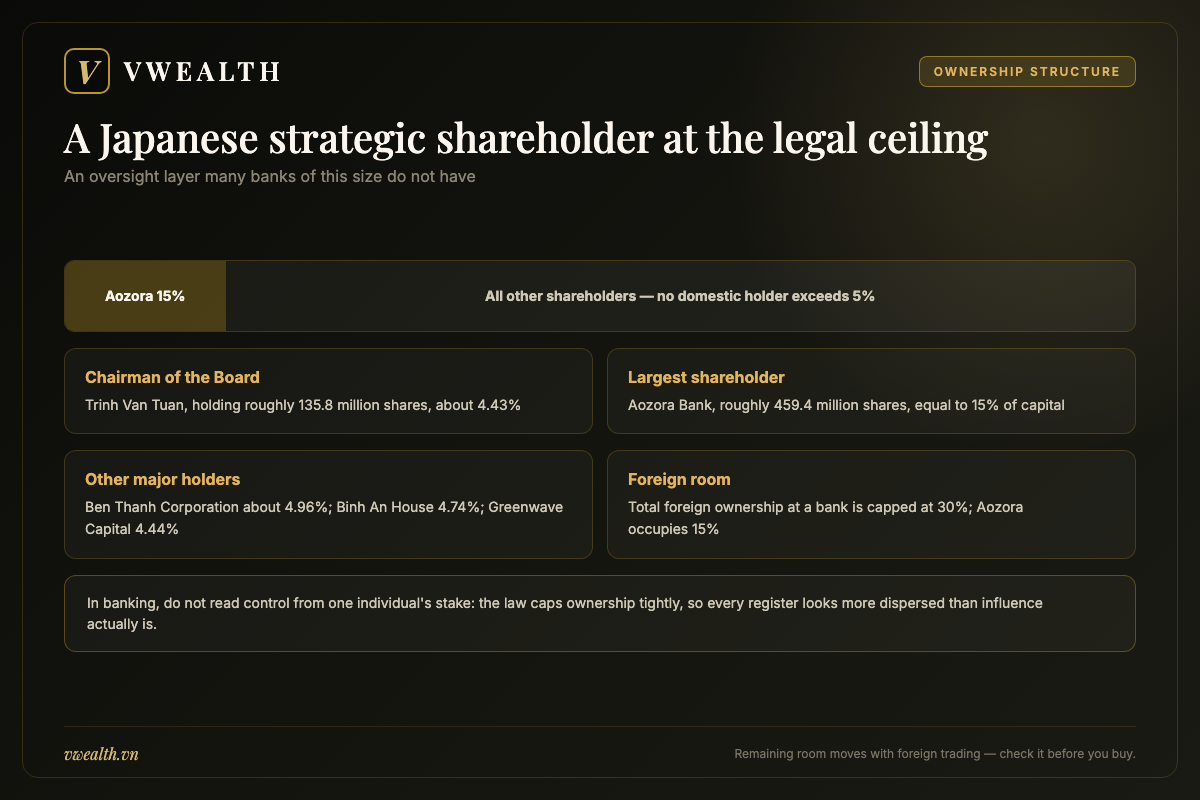
Aozora Bank, a Japanese institution, became OCB’s foreign strategic shareholder in the period before the bank listed, and remains its largest shareholder holding 15% of charter capital, equivalent to roughly 459.4 million shares according to disclosed data.
You need to understand why that figure is exactly 15% rather than any other number. Current Vietnamese regulation caps a single foreign strategic investor’s stake in a bank at 15% of charter capital, and caps total foreign ownership at a bank at 30%. Aozora therefore holds the maximum a foreign strategic shareholder is permitted to hold.
The presence of a foreign bank as strategic shareholder brings three things an investor should assess separately.
First, capital. A 15% investment is a meaningful contribution to tier one capital, improving the capital adequacy ratio and expanding headroom for credit growth.
Second, capability transfer. Japanese banks generally operate with conservative risk cultures and tight internal control systems. When such an institution participates as a strategic shareholder with board representation, it brings its standards. This value is difficult to quantify but real.
Third, a customer channel. A Japanese bank has relationships with Japanese corporations investing in Vietnam, and that is a corporate client segment with good credit quality which every Vietnamese bank would like to access.
But look at the other side too. A foreign strategic shareholder is not a guarantee. Vietnamese banking history includes cases where foreign strategic partners divested after several years for reasons internal to their own strategy, unrelated to the quality of the Vietnamese bank. And a shareholder holding 15% who wishes to exit would create very substantial supply pressure. This is a risk to monitor, not a risk to panic about.
28 January 2021: listing on HOSE
OCB shares began trading on the Ho Chi Minh Stock Exchange on 28 January 2021, at a first-day reference price of VND 22,900 per share. Charter capital rose to approximately VND 10,959 billion that year.
The timing is worth noting. Early 2021 was among the most exuberant periods in Vietnamese stock market history, with retail money flooding in and banks at the centre of attention. Many banks chose to list or transfer their listing during this window.
For investors, listing brought three substantive changes: tighter periodic disclosure obligations, the ability to raise capital through the market, and a public market price against which to compare other banks.
By 2026: current capital scale
As of 2026 OCB’s charter capital stands at roughly VND 30,625 billion, corresponding to approximately 3,062.5 million shares outstanding.
For orientation, that places OCB among Vietnam’s mid-sized private banks — considerably larger than the smallest institutions, but meaningfully smaller than the leading group of state-controlled banks and the largest private banks.
This mid-sized position matters and will recur throughout the article. Mid-sized Vietnamese banks share a characteristic: they lack the funding cost advantage of the leaders, so they must find growth in segments carrying higher yields — and higher-yielding segments always carry higher credit risk. The entire investment case for a mid-sized bank rests on how well management balances those two.
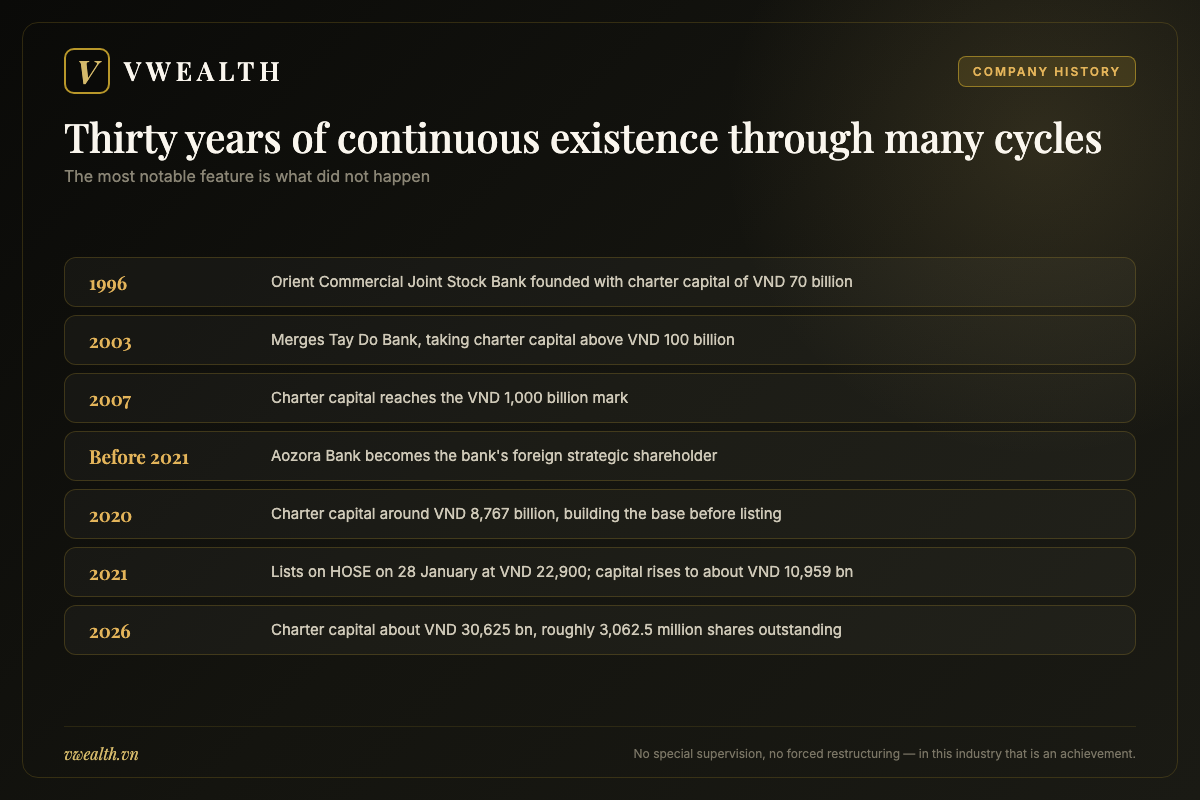
Historical milestones at a glance
| Date | Event | Why it matters to an investor |
|---|---|---|
| 1996 | Founded with charter capital of VND 70 billion | Part of the first joint stock bank generation; many peers no longer exist |
| 2003 | Merged Tay Do Bank, capital above VND 100 billion | Demonstrated ability to integrate another institution |
| 2007 | Charter capital reaches VND 1,000 billion | Achieves the scale needed to expand its footprint |
| Before 2021 | Aozora Bank becomes foreign strategic shareholder | Capital, Japanese risk standards, and a Japanese corporate client channel |
| 2020 | Charter capital around VND 8,767 billion | Building the capital base ahead of listing |
| 28 Jan 2021 | Lists on HOSE at VND 22,900; capital rises to about VND 10,959 billion | Tighter disclosure and a public price for comparison |
| 2026 | Charter capital about VND 30,625 billion, roughly 3,062.5 million shares | Mid-sized private bank; dilution is a permanent variable |
Looking across that timeline, the most notable feature is not what happened but what did not. OCB did not experience a liquidity crisis, was not placed under special supervision, had no major criminal case involving senior leadership, and was not sold for a nominal sum. In Vietnamese banking from 1996 to the present, that list of non-events is a genuine achievement — even though it never makes a headline.
Who runs OCB and who actually owns it
For a bank this chapter matters more than in any other industry. The reason is simple: a bank can look healthy on paper for years while asset quality deteriorates, because loan classification involves judgement. The people exercising that judgement are management. You are not buying a loan book; you are buying the judgement of those who manage it.
Trinh Van Tuan: chairman and long-serving figure
Trinh Van Tuan serves as Chairman of the Board of Directors of OCB. He is also a significant individual shareholder, holding roughly 135.8 million shares, equivalent to approximately 4.43% of capital according to recent disclosures.
That 4.43% figure deserves explanation, because newer investors look at it and wrongly conclude the chairman has limited influence.
Vietnam’s Law on Credit Institutions imposes strict ownership limits on banks, designed to prevent cross-ownership and control by a single shareholder group. Successive amendments have tightened these further: an individual’s maximum stake in a credit institution is capped at a low level, and the combined stake of an individual together with related parties is capped as well.
This means that in banking, you cannot read the degree of control from an individual’s shareholding the way you would with a manufacturer. Actual influence structures are more complex and typically distributed across multiple legal entities and related individuals.
This is precisely where an investor should do their own work rather than trusting any article: read the related party disclosures and related party transaction notes in the audited financial statements. That habit applies to every Vietnamese bank, not just this one.
The board: Vietnamese and Japanese members
OCB’s board comprises Chairman Trinh Van Tuan alongside members including Phan Trung and Ngo Ha Bac, with independent members including Le Xuan Nghia and Duong Ky Hiep. As a strategic shareholder holding 15% of capital, Aozora Bank has representation on the board, and the membership list includes Japanese names.
The presence of a foreign strategic shareholder’s representatives on the board is a far more significant governance fact than it appears. It means major decisions — credit policy, risk appetite, capital raising plans — must pass a party with a large financial interest and its own assessment standards, rather than only a domestic shareholder group.
For minority shareholders this is an indirect layer of protection. It does not eliminate risk, but it lowers the probability of the worst risk in Vietnamese banking: a bank becoming a funding vehicle for a major shareholder’s business ecosystem.
Executive management and a mandatory caveat
On the executive side, at the time of writing the chief executive role is held on an acting basis, and the executive team includes deputy chief executives Nguyen Ba Ngoc and Do Tu Anh.
Here the article stops and says something directly. OCB’s executive roster has changed recently, and public data sources do not fully agree on the name of the person currently holding the most senior executive position. Because this series does not publish information it cannot verify from at least two independent sources, this article will not name the current acting chief executive. Check the bank’s most recent disclosure if you need that information.
But the fact that the top executive position has seen turnover is itself an analytical data point. For a bank, executive stability matters, because credit policy and risk appetite typically carry the imprint of the individual leading the institution. A change of chief executive often brings adjustments in business direction, and investors should watch whether those adjustments run toward greater caution or greater aggression.
Ownership structure: Aozora first, the rest dispersed
According to disclosed data, OCB’s major shareholders are: Aozora Bank with approximately 459.4 million shares, equal to 15% of capital; Ben Thanh Corporation with roughly 152.0 million shares, about 4.96%; Binh An House Investment with roughly 145.0 million shares, about 4.74%; Greenwave Capital with roughly 135.9 million shares, about 4.44%; and Chairman Trinh Van Tuan with roughly 135.8 million shares, about 4.43%.
Three observations follow.
First, no domestic shareholder exceeds 5%. This is a direct consequence of the ownership limits on credit institutions, and it makes every Vietnamese bank’s register look more dispersed than the reality of influence.
Second, the largest shareholder is a foreign institution, which is not common among Vietnamese private banks.
Third, and most practically for a share buyer: if Aozora holds 15% within a 30% total foreign ownership cap, the remaining foreign room available to other international investors is materially reduced. This directly affects the potential for new foreign capital to flow into this ticker. If the concept is unfamiliar, read foreign room in Vietnamese stocks before continuing, because it is among the determinants of a bank share’s liquidity.
Dividends: why banks pay in shares
Vietnamese banks generally, and OCB specifically, favour stock dividends over cash. The reason differs from other industries and is worth stating.
Banks are constrained by capital adequacy. Every dong of retained profit increases own funds, and every additional dong of own funds permits the bank to expand lending by a multiple. For a bank, retaining profit is not merely saving — it is direct growth fuel.
Conversely, paying cash dividends reduces own funds and directly narrows lending capacity. Regulators have also, at times, encouraged banks to limit cash payouts in order to preserve resources for problem loan resolution and to build capital buffers.
The consequence for you as a share buyer: do not buy a mid-sized bank share for cash dividend income. Most of your return will come from growth in book value per share plus any change in the multiple the market applies — not from dividend cash flow.
Ownership and leadership summary
| Item | Publicly disclosed | What you should verify yourself |
|---|---|---|
| Chairman | Trinh Van Tuan, roughly 135.8 million shares, about 4.43% | Related party holdings in the audited statements |
| Board members | Including Phan Trung and Ngo Ha Bac; independent members including Le Xuan Nghia and Duong Ky Hiep; Japanese shareholder representation | Full membership per the latest shareholder resolution |
| Executive management | Chief executive role held on an acting basis; deputy CEOs include Nguyen Ba Ngoc and Do Tu Anh | The bank’s most recent senior personnel disclosure |
| Largest shareholder | Aozora Bank, roughly 459.4 million shares, 15% of capital | Any change in the strategic shareholder’s holding |
| Other major holders | Ben Thanh Corporation about 4.96%; Binh An House about 4.74%; Greenwave Capital about 4.44% | Major shareholder transactions in periodic disclosures |
| Foreign room | Total foreign ownership at a bank is capped at 30%; Aozora occupies 15% | Actual remaining room at the time you buy |
| Charter capital | About VND 30,625 billion, roughly 3,062.5 million shares | The current year’s capital raising plan |
| Dividends | Weighted toward stock in order to preserve own funds | The most recent profit distribution plan |
The conclusion of this chapter: OCB’s governance structure has one clear bright spot — a foreign strategic shareholder at the maximum permitted level with board representation — and one clear item to monitor, which is stability at the top of the executive team.
How OCB makes money: the business model of a commercial bank explained
If you have read other articles in this series you are used to a business model chapter that lists product lines. For a bank that approach is insufficient. We must start from first principles.
The core principle: a bank sells money and earns the spread
A commercial bank does something very simple in essence: it takes money from people with surplus funds at one interest rate, and lends it to people who need funds at a higher one. The difference between the two, less costs, is profit.
The entire craft of banking sits in three questions.
Question one: how cheaply can it raise funds? This is the cost of funding problem.
Question two: how high a lending rate can it charge while still getting the money back? This is the balance between yield and credit risk.
Question three: how efficiently can it run the machine? This is the operating efficiency problem.
Every metric you meet in chapter four is simply a way of measuring one of these three.
The funding side: why current account balances matter so much
A bank funds itself from three main sources: customer deposits, borrowing from other credit institutions, and issuing valuable papers.
Within customer deposits there is one especially important category: demand deposits, meaning balances customers leave in payment accounts for everyday spending. The industry shorthand is CASA, for current account and savings account.
Why does it matter? Because the bank pays almost no interest on this money. A bank with a high CASA ratio has a materially lower average cost of funding, and that advantage flows straight into its margin.
But CASA cannot be bought with interest rates. You cannot raise it by paying more, because its nature is that customers leave the money there for convenience rather than for yield. To have high CASA, a bank must be where customers receive salary, pay bills and transfer money daily. That requires a good app, reasonable fees, a broad payment ecosystem and a base of corporate clients paying salaries through the bank.
This is exactly why Vietnam’s digital banking race has been so intense in recent years. It is not a technology race for its own sake; it is a race for CASA. OCB competes in it through its digital platform OCB OMNI, serving both retail and corporate customers.
For a mid-sized bank this is the hardest front: larger banks have existing customer bases and much bigger technology budgets. Progress in the CASA ratio is therefore among the most informative indicators to track when analysing OCB across years.
The lending side: segments and their risk profiles
Banks lend into several segments, each with a different risk and yield profile.
Retail lending covers mortgages, car loans, consumer credit and credit cards. Yields are better than lending to large corporates, and risk is dispersed across many small exposures. But it is sensitive to household income and, in the case of mortgages, to the property market.
Lending to small and medium enterprises is the segment almost every mid-sized Vietnamese bank targets. Yields are higher, but credit risk is higher too, because smaller businesses are more vulnerable to economic swings and often lack transparent financial reporting.
Lending to large corporates carries lower risk but very thin margins, since these clients have strong bargaining power and are competed over by many banks.
Banks also hold corporate bonds and government bonds, alongside other earning assets.
The takeaway: when analysing a bank, the composition of the loan book matters as much as its size. Two banks with identical loan balances but different composition are two entirely different risk propositions.
Non-interest income: the underappreciated part
Beyond the interest spread, banks earn from fees and other activities: payment service fees, guarantee fees, foreign exchange trading, insurance distribution commissions, securities investment income and recoveries on previously written-off loans.
Why should an investor care? Because fee income does not consume capital the way lending does. A dong of profit from fees does not require the bank to hold additional regulatory capital the way a dong of profit from lending does. Banks with a higher share of non-interest income therefore tend to achieve better returns on capital, and the market values them accordingly.
For mid-sized banks it is also a lower-risk growth path than pushing credit into higher-yielding segments.
Revenue structure of a commercial bank
| Source | Nature | Advantage | Risk and constraint |
|---|---|---|---|
| Net interest income | Spread between lending yield and funding cost | Largest and steadiest income source for most Vietnamese banks | Consumes regulatory capital; carries direct credit risk |
| Demand deposits (CASA) | Near zero-cost funding within the deposit mix | Lowers average funding cost and lifts margin | Cannot be bought with rates; requires ecosystem and app quality |
| Retail lending | Mortgages, car loans, consumer credit, cards | Good yield with risk dispersed over many small exposures | Sensitive to household income and the property market |
| SME lending | Core segment for mid-sized banks | Higher yield than large corporate lending | Higher credit risk; less transparent borrower financials |
| Large corporate lending | Large clients, usually well collateralised | Lower risk, large ticket sizes | Very thin margins due to inter-bank competition |
| Fee and service income | Payments, guarantees, FX, insurance distribution | Does not consume regulatory capital like lending | Depends on customer base size and service quality |
| Securities investment | Government and corporate bonds | Liquidity management plus supplementary income | Interest rate risk and issuer credit risk |
In short, when someone asks how OCB makes money, the accurate answer is: mainly through the interest spread, with the decisive battle fought at two ends — lowering funding cost through demand deposits, and maintaining asset quality in higher-yielding lending segments. The next chapter teaches you to check both.

Seven checkpoints for reading a bank’s financial statements
This is the longest and most important chapter in the article. If you learn to read these seven metrics, you can analyse not only OCB but every bank listed in Vietnam.
The article will not hand you OCB’s numbers, because they change every quarter. What does not change is how to read them.
Checkpoint one: net interest margin
Net interest margin is the difference between the average yield on earning assets and the average cost of funding, expressed as a percentage of earning assets. The industry calls it NIM.
It measures the efficiency of the core business. A high NIM means the bank either funds itself cheaply, lends expensively, or both.
But here is where newer investors go badly wrong: a high NIM is not automatically good.
The reason is that high NIM usually comes from lending into higher-risk segments. Interest rates are the price of risk. A bank whose NIM materially exceeds the industry average either has a genuine funding cost advantage, or is accepting higher credit risk — and you must determine which.
How to test it: place NIM alongside the non-performing loan ratio and credit provision expense for the same periods, and track all three across at least eight quarters. If NIM is high while bad loans and provisions also rise, the extra profit is merely an advance drawn from the future. If NIM stays high while asset quality holds steady through a full cycle, that is a genuine advantage.
Checkpoint two: the demand deposit ratio
As chapter three explained, demand deposits are near-free funding, and their share of total deposits determines the average cost of funds.
For a mid-sized bank this metric reflects brand strength and digital platform quality more clearly than any other. Customers do not leave money in the payment account of a bank they do not use daily.
How to track it: look at the trend across quarters rather than a single point. The ratio fluctuates seasonally and with the interest rate environment — when term deposit rates rise sharply, customers shift money out of payment accounts into savings, depressing the ratio across the whole industry. What matters is the bank’s position relative to the industry average, and its multi-year trend.
Checkpoint three: asset quality, and why group 2 loans matter
This is the most important of the seven, and the one most often read superficially.
Under Vietnamese loan classification rules, loans are divided into five groups by risk level. Group 1 is standard. Group 2 is special mention. Groups 3, 4 and 5 are substandard, doubtful and loss respectively. When the press refers to the non-performing loan ratio, it means groups 3, 4 and 5 divided by total loans.
The problem is that if you only look at the NPL ratio, you are looking at the past. A loan does not jump straight from group 1 to group 5; it passes through group 2 first.
Group 2 is therefore the leading indicator. A sharp increase in group 2 loans over one or two quarters typically foreshadows a rise in the NPL ratio in subsequent quarters. An investor tracking only the headline NPL ratio will always receive the news later than the market.
Two related items deserve attention as well. First, loans sold to the national asset management company and the corresponding remaining bond balance — these have left the balance sheet but the risk has not entirely disappeared. Second, the scale of loans whose repayment terms were restructured during periods of policy support, since these are not classified as bad but their underlying risk profile has changed.
Checkpoint four: provision coverage ratio
The provision coverage ratio is the credit loss provision balance divided by total non-performing loans. It answers: if every current bad loan were entirely lost, what percentage of the damage has the bank already provided for?
Understand the economics through an illustrative example with assumed figures. Suppose two banks each report a 2% NPL ratio. Bank one has coverage of 150%, meaning it has provided one and a half times its bad loans. Bank two has coverage of 50%. On the headline metric they look identical. But bank one has already absorbed the cost and holds a buffer, while bank two must still provide more in future, meaning coming quarters’ profits will be eroded.
In other words, high coverage is profit already set aside, and low coverage is cost being pushed forward. It is one of the fastest ways to compare conservatism between banks.
Checkpoint five: capital adequacy and growth headroom
The capital adequacy ratio is own funds divided by risk-weighted assets. The regulator sets a minimum, and banks must stay above it.
Why does this matter to an investor? Because it determines how much room the bank has to grow without issuing new shares.
A bank sitting near the minimum while pursuing strong credit growth will be forced to raise capital — and raising capital means dilution for existing shareholders. A bank with a thick capital buffer can grow for several years without calling on the market.
When reading, look at three things: the current ratio versus the minimum requirement, the split between tier one and tier two capital, and the capital raising plan approved in the shareholder resolution. Together they tell you how much dilution to expect.
Checkpoint six: loan book composition by sector, especially property
Anyone analysing a Vietnamese bank must check this, and it sits in the notes to the financial statements rather than in any summary page.
The reason is specific. Property occupies a special role in Vietnam’s credit system in two ways. The first is direct lending: to project developers, and to home buyers. The second, no less important, is that property serves as collateral for the majority of other loans, including working capital and business loans.
The consequence is that when the property market declines, a bank suffers twice: directly exposed loans deteriorate, and the collateral value across the entire book falls, lowering recovery rates on problem loan resolution.
So when reading any Vietnamese bank’s accounts, look for three figures in the notes: the share of loans to property business activity, the share of home purchase lending, and the balance of property developer bonds the bank holds. Together they give you true exposure to the property cycle.
This is not a criticism of any particular bank — it is a structural feature of the whole system. But exposure differs between banks, and measuring that difference is your job.
Checkpoint seven: operating efficiency
The final metric is the cost to income ratio, which measures how much operating expense each unit of operating income requires.
Lower is better, but read it in context. A bank investing heavily in technology and network expansion will see this ratio rise temporarily, and that may be the right investment. What should concern you is a high ratio sustained across years without accompanying improvement in the demand deposit ratio or in fee income — meaning money has been spent without buying results.
Alongside cost to income, look at two aggregate profitability measures: return on equity and return on assets. The second is particularly useful when comparing banks with different leverage, because leverage cannot flatter it.
Where OCB sits within the system
Vietnam’s banking system divides into three tiers.
The first tier is the state-controlled commercial banks. They have the largest scale and the lowest funding costs thanks to their customer base and market trust, though growth is typically slower.
The second tier is the large private banks, which have reached sufficient scale to enjoy advantages in technology, brand and funding cost.
The third tier is the mid-sized and smaller private banks, including OCB. This group shares a characteristic: they must find growth in segments the tiers above do not serve well, accepting higher yields alongside higher risk, and permanently balancing growth against safety.
OCB’s distinguishing feature within that third tier is a foreign strategic shareholder holding 15% with board representation. This may help the bank maintain better risk discipline than the tier average — but that is a hypothesis to be tested against the seven metrics above across several years, not something to be assumed.
The seven metrics and how to read them
| Metric | What it measures | The trap |
|---|---|---|
| Net interest margin | Efficiency of the core business | High is not automatically good: it may be the price of higher credit risk |
| Demand deposit ratio | Funding cost and digital platform strength | Fluctuates with rates; must be read as a multi-year trend |
| Group 2 and group 3 to 5 loans | Current and imminent asset quality | The NPL ratio alone is backward-looking; group 2 leads it |
| Provision coverage | Buffer already set aside against future loss | Low coverage means cost pushed into future quarters |
| Capital adequacy | Growth headroom without new equity | Near the minimum plus growth ambition equals dilution |
| Loan book by sector | True exposure to the property cycle | Must add developer loans, mortgages and property bonds together |
| Cost to income | Operating efficiency | A temporary rise may be sound investment; sustained without results is not |
If you want to practise this framework on other banks before applying it to OCB, the analyses of TPBank and ACB present two private banks with different risk appetites, which makes them convenient comparisons.

How the market treats OCB stock: portrait of a mid-sized bank share
The company is one thing; the stock is another. This chapter covers the latter.
Why bank shares are valued on price to book, not price to earnings
This is the first thing to change in your head when moving from analysing manufacturers to analysing banks.
For an ordinary company, book value says little, because the carrying value of assets can differ greatly from economic value. For a bank the reverse holds: assets are predominantly loans and securities, financial items whose book values sit closer to their economic substance.
Price to book therefore becomes the central measure. It answers: what is the market willing to pay for each unit of this bank’s equity?
But there is a condition many people skip: the metric only means something if book value is real. And a bank’s book value depends on whether loans have been correctly classified and adequately provisioned. A bank that under-provides has inflated book value, and its price to book ratio will look artificially cheap.
That is why chapter four must precede this one. You cannot value a bank before assessing its asset quality.
The correct approach: read price to book alongside return on equity. In principle, a bank generating a higher return on equity deserves a higher multiple. A bank with a low multiple and an equally low return on equity is not cheap — it is correctly priced.
The personality of a mid-sized bank share
Four traits.
Trait one: it moves as a sector. Vietnamese bank shares trade in a strongly correlated group. When money flows into banks, nearly the whole group rallies; when it flows out, the whole group suffers. Mid-sized names typically move more than sector leaders in both directions.
Trait two: sensitivity to monetary policy. A change in the rate outlook, in credit growth quota allocation, or in loan classification rules affects the profit outlook of the entire industry immediately.
Trait three: sensitivity to property news. For the reasons set out in checkpoint six, the market treats bank shares as an indirect bet on the property cycle.
Trait four: exposure to capital raising events. When a bank announces a new issue, the market often reacts negatively in the short term over dilution, even when the raise is necessary for long-term growth.
Foreign room: a feature specific to this name
As chapter two noted, total foreign ownership at a Vietnamese bank is capped at 30%, and at OCB the strategic shareholder Aozora already occupies 15% of that.
This has two opposing consequences.
The unfavourable one: headroom for other foreign investors is narrowed, reducing the extent to which this name can benefit from waves of foreign capital entering Vietnam.
The favourable one: the 15% held by the strategic shareholder is long-term capital that does not trade daily, so it exerts no selling pressure during volatile markets the way short-term fund holdings do.
Check the actual remaining room at the time you buy, since the figure moves with foreign trading.
Dividends and calculating your true return
As established, mid-sized banks prioritise stock dividends. For you that means two things.
First: do not expect dividend cash flow. If your strategy depends on income, look elsewhere.
Second: when calculating your historical return, adjust prices for stock dividends and share issues. Failing to do so produces a badly distorted figure, usually distorted toward pessimism.
Catalysts the market watches in the banking sector
Four categories.
First: the monetary policy cycle. When rates fall, a bank’s funding cost typically declines before its lending yields do, creating a window in which margins expand. This is a powerful catalyst with real substance.
Second: credit growth quota allocation. This is a Vietnam-specific management tool and it directly determines how much each bank can expand its loan book.
Third: transactions involving strategic shareholders, private placements, or stake sales to foreign partners.
Fourth: improvements in asset quality, particularly when the property market warms and recovery rates on problem loans improve.
Comparing OCB with your alternatives in the sector
If you want exposure to Vietnamese banking, you have three tiers to choose from.
Choosing a state-controlled bank such as Vietcombank means choosing safety and stability, in exchange for a higher valuation and slower growth.
Choosing a large private bank means balancing growth against scale.
Choosing a mid-sized name such as OCB, MSB or VIB means accepting a lower valuation and wider volatility, in exchange for doing considerably more asset quality verification yourself.
OCB’s accurate placement is this: a mid-sized bank with a strong foreign strategic shareholder, suitable for an investor willing to read the accounts and tolerate volatility, unsuitable for anyone wanting to buy and forget.
Industry context: six forces governing a Vietnamese commercial bank
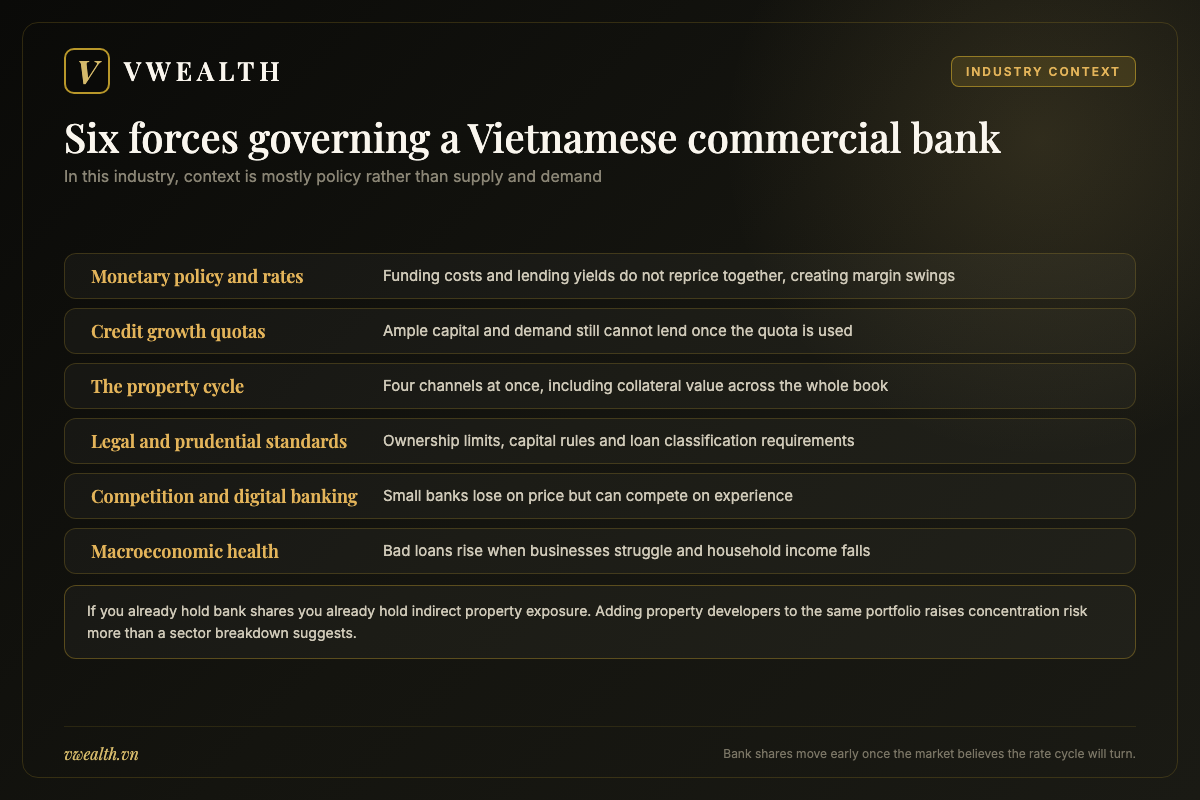
Banking is the most heavily regulated industry in the economy. Industry context here is therefore not mainly supply and demand — it is mainly policy.
Force one: monetary policy and the level of interest rates
This has the largest and fastest effect on bank profits.
The transmission mechanism contains a detail investors need to grasp: deposit rates and lending rates do not reprice at the same time. Term deposits reprice at maturity, while many loans carry floating rates that reset on a schedule. That mismatch creates periods in which margins widen or narrow purely because of timing.
Specifically, when rates fall, funding costs generally decline faster than lending yields, and margins widen for several quarters. When rates rise, the reverse occurs.
This is why bank shares often move early once the market begins to believe the rate cycle is about to turn, long before any figure appears in a financial statement.
Force two: credit growth quotas
This is a distinctly Vietnamese management tool that foreign investors often find unfamiliar: the regulator allocates credit growth quotas to individual banks rather than leaving expansion entirely to the market.
The practical significance is large. A bank may have sufficient capital, sufficient customers and sufficient loan demand, and still be unable to lend more once its quota is used. Conversely, receiving an increased quota is a genuine catalyst for the profit outlook.
Quota allocation typically considers factors such as asset quality, capital adequacy and compliance. In other words, banks that manage risk well are rewarded with growth headroom — an incentive mechanism investors should build into their analytical framework.
Force three: the property cycle
Analysed in detail in chapter four; here we view it at industry level.
Property connects to Vietnam’s banking system through four simultaneous channels: lending to project developers, lending to home buyers, holdings of property developer bonds, and its role as collateral for most other loans.
These four channels tie banking sector health to property market health far more tightly than casual observation suggests. When the property market freezes, a bank does not merely lose one customer segment — the collateral quality of its entire book is affected.
The practical consequence for you: if you hold bank shares, you already have indirect property exposure. Adding property developer shares to the same portfolio increases concentration risk more than you might assume.
Force four: the legal framework and prudential standards
Vietnam’s banking legal framework has tightened progressively through successive amendments and implementing circulars, focusing on three directions.
The first is ownership limits and restrictions on cross-ownership, intended to prevent banks from becoming funding vehicles for a shareholder group’s ecosystem.
The second is capital adequacy and risk management standards aligned with international practice, requiring banks to upgrade their risk measurement and reporting systems.
The third is loan classification and provisioning rules, which directly determine reported profit.
For mid-sized banks this tightening cuts both ways: compliance costs rise, but the gap between well-managed and poorly managed institutions becomes progressively more visible, which benefits those doing the work properly.
Force five: competition and the digital banking race
Competition in Vietnamese banking runs on two very different fronts.
The first is price: competing on deposit rates and lending rates. Smaller banks are permanently disadvantaged here, because they must pay more to attract deposits.
The second is experience: the mobile app, processing speed, service fees, payment ecosystem. This is a front where a mid-sized bank has a genuine opportunity, because technology investment does not require the same scale as branch network investment.
The prize on the second front is precisely the demand deposit ratio — the thing that lowers funding cost and offsets the disadvantage on the first front. That is why OCB and its peer group all invest in digital platforms.
Beyond banks competing with each other, there is competition from consumer finance companies, e-wallets and payment platforms. This group has not displaced banks in credit provision, but it competes directly in payments — which is exactly where demand deposits are generated.
Force six: macroeconomic health and household income
Finally, a bank is a mirror of the economy. Credit grows when businesses expand and households feel confident enough to borrow for homes and cars. Bad loans rise when businesses struggle and household income falls.
This means you cannot analyse a bank in isolation from the macro picture. Growth, employment, exports, public investment, domestic purchasing power — all transmit into a bank’s balance sheet with a lag of several quarters.
For a bank with a substantial share of SME and retail lending, sensitivity to the economic cycle is above average, because those are precisely the borrowers most vulnerable when growth slows.
Looking forward: three scenarios for OCB stock and what must happen in each
This section promises no price target. For a bank, any twelve-month target presupposes both monetary policy and the credit cycle — two things nobody forecasts reliably. Instead, three scenarios with their required conditions.
The four variables that decide OCB’s future
Variable one is the interest rate cycle and its effect on net interest margin.
Variable two is asset quality, visible through group 2 loans, non-performing loans and provision expense.
Variable three is progress in lowering funding cost, meaning the demand deposit ratio, and in raising the share of fee income.
Variable four is the property cycle, which affects both credit demand and collateral values simultaneously.
Note that the first two are largely driven by the external environment. Variable three is where management genuinely demonstrates capability. When scoring a bank’s management, score them on variable three and on risk discipline, not on the profit of a favourable year.
Optimistic scenario: a favourable cycle and improving asset quality
Conditions required: interest rates stable or falling, allowing margins to improve; the property market warms, improving recovery rates and easing provisioning pressure; the demand deposit ratio improves on the back of the digital platform; credit growth quota is allocated favourably thanks to good asset quality.
Observable results: group 2 loans decline first, followed by the non-performing loan ratio; provision expense eases and coverage rises; return on equity improves.
What changes in valuation terms: for bank shares, when return on equity improves durably and asset quality is demonstrated across a cycle, the market typically becomes willing to pay a higher price to book multiple. That is the largest prize in this scenario — larger than the profit increase itself.
Base case: sideways, moderate growth, gradual dilution
Conditions required: rates fluctuate within normal ranges; asset quality neither deteriorates nor visibly improves; the property market recovers slowly and unevenly; the bank continues raising capital to maintain growth headroom.
Observable results: absolute profit rises, but earnings per share rise more slowly because the share count increases; book value per share grows steadily; the relative valuation changes little.
This is the most likely scenario for a mid-sized bank, and it requires you to understand one thing clearly: in this scenario your return comes mainly from growth in book value, not from the market paying a higher multiple. That is a reasonable investment but not an exciting one, and it demands patience.
Pessimistic scenario: asset quality deteriorates into an unfavourable cycle
Conditions required: the economy slows, weakening household income and small business health; group 2 loans and then non-performing loans rise; the property market remains difficult, lowering collateral values and recovery rates; rising rates push funding costs up first.
Observable results: provision expense rises sharply and eats into profit; provision coverage falls; capital adequacy comes under pressure, potentially forcing a capital raise in unfavourable market conditions — meaning dilution at a low price, the worst outcome for existing shareholders.
What to monitor here is not profit but buffers: provision coverage, capital adequacy, and the rate of increase in group 2 loans. Those three tell you how long the bank can absorb pressure.
Scenario summary
| Scenario | Conditions required | Early signals | Implication for investors |
|---|---|---|---|
| Optimistic | Rates stable or falling; property warms; demand deposits improve; favourable credit quota | Group 2 loans fall first, provisioning eases, return on equity improves | Potential for a higher price to book multiple |
| Base case | Normal rate range; flat asset quality; continued capital raising | Absolute profit rises while earnings per share rise more slowly | Return comes mainly from book value growth; patience required |
| Pessimistic | Slowing economy; prolonged property weakness; rising rates | Group 2 loans rising fast, provisions up, coverage falling | Risk of dilutive capital raising at a low share price |
What would prove your thesis wrong
Three falsification conditions worth writing into your investment journal.
First: if you buy believing the Japanese strategic shareholder helps the bank maintain better risk discipline than its tier, then asset quality deteriorating in line with or worse than the tier average across a full credit cycle is disconfirming evidence.
Second: if you buy believing the bank will lower its funding cost through its digital platform, then a demand deposit ratio standing still across several years while technology spending continues to rise is disconfirming evidence.
Third: if you buy because the price to book ratio looks low, then a return on equity that is equally low and not improving is evidence that the stock is not cheap but correctly priced.
What foreign investors should know about Vietnamese banks
This chapter exists because the series is read outside Vietnam, and several features of Vietnamese banking differ enough from developed markets to cause genuine misjudgement.
Credit quotas are real and they bind
In most markets, a bank’s lending growth is limited by capital, funding and demand. In Vietnam there is a fourth constraint: an administrative quota allocated by the central bank.
Foreign investors frequently model Vietnamese bank growth as though capital adequacy were the binding constraint. Often it is not. A bank can be well capitalised and still unable to grow because its quota is exhausted, and a quota increase can lift the earnings outlook without any change in the bank’s own capability.
The practical consequence is that quota allocation news is genuinely material information for Vietnamese bank shares, in a way that has no direct equivalent in most other markets.
Ownership limits make registers look flatter than reality
As chapter two explained, Vietnamese law caps individual and related-party ownership in credit institutions at low levels. The effect on a shareholder register is that no domestic holder appears large.
Do not read that as evidence of dispersed control. Influence in Vietnamese banking is frequently exercised through structures that the headline register does not display. The correct response is not suspicion but diligence: read related party disclosures and related party transaction notes, which are where the substantive information sits.
This is also why the presence of a large, regulated foreign institution on a register is analytically meaningful. Its stake is transparent, its incentives are legible, and its board representation is documented.
Loan classification is rules-based but contains judgement
Vietnamese loan classification follows a five-group framework with prescribed criteria. That sounds mechanical, but in practice classification incorporates judgement about a borrower’s ability to repay, and restructuring decisions can change how an exposure is grouped.
This does not mean the numbers are unreliable. It means that comparing banks requires attention to conservatism, and provision coverage is the single best proxy for how conservative a bank has chosen to be. Two banks can report the same non-performing loan ratio with entirely different degrees of prudence behind it.
If you are unfamiliar with how Vietnamese accounting standards differ from IFRS, read the primer on Vietnamese financial statements and VAS versus IFRS before working through a bank’s notes for the first time.
Property is embedded in the system, not adjacent to it
Foreign investors sometimes treat property exposure as a line item to check. In Vietnam it is closer to a structural characteristic of the whole banking system, because property serves as collateral across most lending, not merely as an end-borrower sector.
The practical implication for portfolio construction is worth repeating: a Vietnamese bank share is partly a property cycle instrument. If you also own property developers, your true concentration is higher than a sector breakdown of your portfolio would suggest.
Capital raising is routine, not a distress signal
In some markets, a bank issuing equity signals stress. In Vietnam, ongoing capital raising among growing mid-sized banks is normal and expected, because credit demand grows faster than retained earnings can fund.
The analytical question is therefore not whether a bank raises capital, but at what price and under what conditions. Raising equity at a healthy valuation to fund profitable growth is constructive. Raising equity at a depressed valuation because capital adequacy is under pressure is destructive to existing holders. The same event carries opposite meanings depending on context.
Practical access and mechanics
To buy OCB you need a securities trading code and a local brokerage account, described in the guide to opening a brokerage account in Vietnam as a foreigner. Vietnam applies daily price limits and specific settlement conventions, covered in Vietnam stock trading rules, and non-resident tax treatment is explained in taxes for foreign investors in Vietnamese stocks.
One point specific to bank shares: foreign room is a hard constraint, and at OCB a substantial part of it is already occupied. Confirm available room before planning a position size, because discovering that room is exhausted after forming a view is a frustrating and avoidable outcome.
Six common mistakes foreign investors make with Vietnamese bank shares
Mistake one: valuing on price to earnings. For banks, price to book read alongside return on equity is the appropriate frame, and it forces you to think about asset quality rather than around it.
Mistake two: treating a high net interest margin as a quality signal. It is more often a risk signal, and must be read against provisioning and asset quality.
Mistake three: reading only the headline non-performing loan ratio and ignoring group 2. This guarantees you receive information later than the market.
Mistake four: ignoring provision coverage when comparing banks, which is equivalent to comparing two companies while ignoring how much cost one has already recognised.
Mistake five: modelling growth without modelling dilution. In a sector where capital raising is routine, per-share figures and absolute figures diverge substantially over time.
Mistake six: assuming a foreign strategic shareholder guarantees governance quality. It improves the odds and adds a monitoring layer. It is a favourable condition, not a conclusion.
A monitoring routine for a bank share
Analysis you cannot maintain is analysis you will abandon. This chapter converts the framework into a repeatable quarterly routine.
The quarterly routine
Step one: record net interest margin, cost to income, return on equity and return on assets.
Step two: record group 2 loans as a percentage of total loans, and the non-performing loan ratio. Note the direction of both. Group 2 is your early warning.
Step three: record provision expense for the quarter and the provision coverage ratio. Ask whether coverage is being built or run down.
Step four: record the demand deposit ratio and compare it against the previous four quarters, not against last quarter alone.
Step five: record capital adequacy and note any capital raising announcement, including the intended price and mechanism.
Five entries per quarter. After eight quarters you will hold a picture that no single report can give you, and you will notice deterioration two to three quarters before it reaches the headline numbers.
The annual review
Once a year, add three checks. Open the notes and record loan book composition by sector, adding developer lending, mortgages and property bonds together. Compare the bank’s provision coverage against its mid-sized peers. And re-read your own falsification conditions from chapter seven to see whether any has been triggered.
What should make you act
Two changes warrant genuine reassessment rather than a note in the file.
The first is group 2 loans rising materially for two consecutive quarters while provision coverage falls. That combination indicates deterioration arriving faster than the buffer is being built, and it typically precedes a difficult period.
The second is a capital raise announced at a depressed valuation while capital adequacy is close to the minimum. That is the dilutive scenario described in chapter seven, and it permanently reduces the value of an existing holding.
Conversely, one change should make you more positive rather than less: sustained improvement in the demand deposit ratio alongside stable asset quality. That combination is the clearest evidence that a mid-sized bank is genuinely improving its competitive position rather than merely riding a favourable cycle.
Comparing OCB against its peers in practice
Most investors compare banks badly. They line up price to book ratios, pick the lowest, and call it value. This chapter offers a better procedure, using OCB as the worked example.
Step one: normalise for conservatism before comparing anything
Before comparing profitability or valuation between two banks, first establish whether they are equally conservative. The quickest proxy is provision coverage, supplemented by group 2 loans as a share of total lending.
A bank with high coverage and low group 2 loans has already absorbed costs and is carrying a cushion. A bank with low coverage and rising group 2 loans is reporting profits that partly belong to future periods.
Comparing the reported return on equity of those two banks without this adjustment is meaningless. You would be comparing a figure net of cost against a figure gross of a cost not yet recognised.
Step two: separate structural advantage from cyclical luck
A mid-sized bank can post excellent numbers in a favourable rate environment purely because of timing, as chapter six explained. That is cyclical luck, and it reverses.
Structural advantage looks different. It shows up as a demand deposit ratio that rises across several years including unfavourable ones, as fee income growing faster than interest income, and as asset quality holding through a full cycle rather than a single benign stretch.
When you compare OCB with peers, ask which of the two categories the visible outperformance belongs to. The answer changes what multiple the bank deserves.
Step three: measure true property exposure, not stated exposure
As established, headline property lending understates real exposure because collateral is predominantly property across the whole book.
A workable approach is to add three disclosed figures — developer lending, home purchase lending and property developer bonds — and then treat the remainder of the book as carrying secondary property sensitivity through collateral values. This will not give you precision, but it will rank banks correctly, which is what comparison requires.
Step four: adjust for dilution history and dilution plans
Two banks growing absolute profit at the same rate can deliver very different shareholder outcomes if one issues shares more heavily. Look at the growth of book value per share over five years rather than total equity, and read the current year’s approved capital plan.
This step matters especially for mid-sized banks, where growth ambitions typically exceed what retained earnings alone can fund.
Step five: only then look at the multiple
Having normalised for conservatism, separated structure from cycle, ranked property exposure and adjusted for dilution, you can finally read price to book alongside return on equity and reach a defensible judgement about whether a bank is cheap.
Most of the time, this exercise reveals that apparently cheap banks are cheap for identifiable reasons. Occasionally it reveals a genuine mispricing, and that is where the work pays. What it reliably prevents is the most common error: buying a low multiple that reflects a low return, and calling it a bargain.
Understanding Vietnam’s banking system: a primer
Before the verdict, a short structural primer. Readers who already know the system can skip ahead; readers arriving from developed markets will find that several assumptions do not carry across.
How the system is shaped
Vietnam’s commercial banking system consists of state-controlled commercial banks, private joint stock commercial banks, foreign bank branches and subsidiaries, and a set of policy and cooperative institutions. For an equity investor, the listed universe is dominated by the first two categories.
The state-controlled banks are the largest by assets and enjoy the lowest funding costs, partly through scale and partly through the depositor trust that state backing implies. Their growth tends to be steadier and their valuations higher.
The private joint stock banks span a wide range, from institutions approaching the scale of the state banks down to small players. Within this range, competitive dynamics differ sharply: the largest private banks compete on technology and brand, while the mid-sized and smaller ones compete for niches.
OCB sits in that mid-sized private band, and everything about its strategic position follows from that placement.
Why funding cost is the central competitive variable
In a market where most banks lend into broadly similar segments and where lending rates are competitively determined, the durable difference between banks is what they pay for money.
A bank whose average funding cost is one percentage point lower than a rival’s can either earn a wider margin on identical lending, or undercut that rival on price while earning the same margin. Compounded across a large loan book and across years, that advantage is decisive.
This is why the demand deposit ratio recurs so often in this analysis. It is not an incidental metric; it is the clearest available proxy for the single most important structural advantage in the industry.
It is also why the digital banking investment cycle of the past decade was rational rather than faddish. A banking app is not primarily a customer service channel. It is a mechanism for becoming the account where salary lands and bills are paid, which is the mechanism for acquiring cheap funding.
The credit cycle and its lag
Bank earnings follow the economy with a lag, and the lag differs by direction.
On the way up, credit growth responds relatively quickly once businesses and households regain confidence, and margins can expand early in a rate-cutting cycle. Reported profits therefore improve before the wider economy feels fully recovered.
On the way down, the sequence is slower and more insidious. Borrower stress appears first in payment delays, which shows up as group 2 loans. Only later does the exposure migrate into the non-performing categories, and only then does provisioning bite into reported profit. The gap between the underlying deterioration and its appearance in headline profit can be several quarters.
This asymmetry is why chapter four insists on group 2 loans. It is the metric that compresses that lag for you.
Why provisioning policy is a strategic choice, not an accounting detail
Within the rules, banks retain some discretion over how aggressively they provision. That discretion produces a genuine strategic choice.
A bank that provisions heavily reports lower current profit and builds a buffer. If conditions worsen, it absorbs the shock without a profit collapse. If conditions improve, it can release provisions and report strong growth from a conservative base.
A bank that provisions lightly reports higher current profit and carries less buffer. If conditions worsen, provisioning catches up abruptly and earnings fall hard.
Neither approach is inherently wrong, but they produce very different experiences for a shareholder, and they are not visible from the headline profit figure. Provision coverage is where the choice becomes legible.
What the regulator actually optimises for
Understanding the regulator’s objective function helps predict policy. Vietnamese banking regulation has consistently pursued three aims simultaneously: supporting credit availability for economic growth, containing systemic risk, and gradually raising governance and prudential standards toward international norms.
These aims sometimes conflict, and the balance shifts with conditions. In periods of growth concern, credit availability receives more weight and quotas loosen. In periods of asset quality concern, prudential tightening dominates.
For an investor this has a practical use: when you can identify which aim is currently dominant, you can anticipate the direction of policy that follows, and bank shares respond to policy direction more than to any individual bank’s results.
The long-run structural case
Finally, the reason the sector attracts long-term interest at all. Vietnam has a young population, rising incomes, and financial services penetration that remains below regional peers in several categories, including mortgage lending, insurance and investment products.
That combination implies a long runway for credit and financial services to grow faster than the economy as a whole for an extended period. Banks are the primary vehicle through which that growth is intermediated.
But a structural growth story does not guarantee returns to shareholders of any individual bank. Growth requires capital, capital requires issuance, and issuance dilutes. The banks that convert sector growth into per-share value are those that fund growth substantially from retained earnings, which requires high returns on equity, which in turn requires either low funding cost or genuinely superior risk selection.
That is the standard against which any Vietnamese bank, including OCB, should ultimately be measured.
Three framing errors worth unlearning first
Before the verdict, three framing errors are worth naming, because they recur in almost every conversation about Vietnamese bank shares and they distort position sizing more than any modelling mistake.
The first error is treating a bank share as a proxy for the country’s growth story. It is a leveraged claim on the credit cycle, which is a different thing. Vietnam can grow while a particular bank destroys value through poor risk selection, and a bank can perform well during a mediocre stretch for the economy because rate timing favoured it. If your reason for owning the share is a view about the country, express that view through something with less credit leverage attached.
The second error is assuming that regulatory tightening is bad for listed banks. It raises compliance costs, which is real, but it also widens the gap between institutions that manage risk properly and those that do not, and it constrains the reckless competitor who would otherwise price loans irrationally. For a bank that is already run conservatively, a tighter framework is closer to a competitive benefit than a burden.
The third error is reading a controlling foreign strategic shareholder purely as a positive. It brings capital, standards and oversight, all genuine. But it also concentrates a large block of stock in one pair of hands whose strategic priorities are set overseas and can change for reasons entirely unrelated to the Vietnamese bank’s performance. That is a real, if low-probability, source of supply risk, and it belongs in your assessment alongside the benefits rather than being netted quietly against them.
Hold those three corrections in mind while reading what follows.
A note on holding period and information cadence
One practical point follows from everything above. The thesis for a mid-sized bank operates on a multi-year clock, while the news flow that moves its share price operates on a weekly one. That mismatch is the most common reason investors lose money in this sector: they adopt a structural thesis and then trade it on cyclical information.
If your reason for owning OCB is that its funding cost will fall and its risk discipline will prove better than its tier average, then the only evidence that should change your mind is evidence about those two things — the demand deposit ratio, group 2 loans, provision coverage across a cycle. A weak quarter caused by rate timing is not evidence. A sector-wide selloff on property headlines is not evidence about this bank specifically.
Decide in advance which category of information you are actually watching for, write it down, and treat everything else as noise. In a sector where the group moves together and the underlying differences take years to reveal themselves, that discipline is worth more than any additional analytical sophistication.
Where this analysis could be wrong
Honesty requires naming the limits of what an article can establish. Three of them apply here.
First, everything written about asset quality is framework rather than finding. This piece teaches you which metrics reveal deterioration and how quickly, but it deliberately does not assert a conclusion about OCB’s current asset quality, because that conclusion would expire within a quarter and because reaching it responsibly requires reading statements that will be newer than this text.
Second, the governance argument rests on an inference. A regulated foreign bank holding the maximum permitted stake with board representation should, in principle, raise the standard of oversight. Whether it has done so at this specific institution is testable only through outcomes across a full cycle, and reasonable people can disagree about how much weight to give the inference before those outcomes are in.
Third, personnel information in Vietnamese banking changes faster than published data sources update, which is precisely why this article declined to name the current acting chief executive. Treat any leadership detail here as a prompt to check the primary disclosure rather than as a settled fact.
So, should you buy OCB stock? A straight answer
Time to bring it together. This chapter does not dodge the question in the title, but it also refuses to answer with a single word — because the correct answer depends on who you are.
The case for: six reasons OCB deserves consideration
Reason one: a foreign strategic shareholder at the maximum permitted level. Aozora Bank holds 15% of capital — precisely the ceiling for a foreign strategic investor in a Vietnamese bank — with representation on the board. That is an additional oversight layer many private banks of comparable size do not have.
Reason two: continuous independent existence since 1996 through multiple credit cycles, without falling under special supervision or being forced into restructuring. In banking that is a substantive achievement even though it never makes headlines.
Reason three: mid-sized scale creates greater percentage growth headroom than the leading tier enjoys. A smaller bank can grow its loan book faster in percentage terms, provided it manages risk.
Reason four: mid-sized bank valuations are generally lower than sector leaders, so if asset quality is demonstrated across a cycle there is genuine room for the market to re-rate.
Reason five: the 15% held by the strategic shareholder is long-term capital that does not trade daily, so it creates no selling pressure during volatile periods.
Reason six: Vietnamese banking is tied to the economy’s long-term growth and to a credit expansion process in a country with a young population and rising financial services penetration.
The case against: seven risks to look at squarely
Risk one, and the largest for any bank: asset quality risk. You cannot inspect individual loans, and classification involves judgement. This is an information asymmetry no individual investor fully eliminates.
Risk two: property cycle exposure through four simultaneous channels. This is a system-wide characteristic, but its degree differs between banks and you must measure it yourself.
Risk three: dilution. Banks need capital to grow, and growth means issuance. In the adverse scenario, being forced to raise at a low price is the worst outcome for existing holders.
Risk four: a competitive disadvantage in funding cost against the leading tier, which pushes mid-sized banks toward higher-risk segments in search of growth.
Risk five: turnover in the most senior executive position. For a bank, credit policy and risk appetite carry personal imprint, so this warrants monitoring rather than dismissal.
Risk six: limited remaining foreign room, since the strategic shareholder occupies 15% of a 30% cap, reducing the ability to benefit from waves of foreign inflows.
Risk seven: policy risk. A change in loan classification rules, capital standards or the credit quota mechanism can alter the entire sector’s profit outlook with a single document.
Balance sheet of arguments
| In favour | Against |
|---|---|
| Foreign strategic shareholder at 15% with board representation | Remaining foreign room is narrowed, limiting new foreign demand |
| Continuous existence since 1996 through multiple credit cycles | Asset quality remains a black box to individual investors |
| Mid-sized scale gives greater percentage growth headroom | Funding cost disadvantage against the leading tier |
| Mid-tier valuations sit below sector leaders | A low multiple is not cheap if return on equity is equally low |
| Strategic shareholder capital is long-term and does not trade | A strategic exit would create very large supply pressure |
| Sector tied to long-run economic growth and credit penetration | Property exposure runs through four channels at once |
| An extra risk-discipline layer from the Japanese partner | Periodic dilution from capital raising to maintain adequacy |
| Digital banking is a viable route to lower funding cost | Senior executive turnover requires monitoring |
Who OCB suits, and who should avoid it
The long-term value investor. Potentially suitable, under one strict condition: you must be willing to read the financial statements yourself and score the seven metrics from chapter four every quarter. A mid-sized bank share is not a buy-and-forget asset. If you do not intend to do that work, choose a sector leader at a higher valuation with less to verify.
The growth investor. Potentially suitable in theory, since mid-sized banks have more percentage headroom to grow their loan books. But understand that rapid credit growth in this sector always raises a question: which segment is that growth coming from, and what will asset quality look like in two to three years? Loan growth accompanied by rising group 2 loans is growth borrowed from the future.
The income investor. Not suitable. Mid-sized banks prioritise retaining profit to build own funds, so cash dividends are low and inconsistent. If you need reliable cash flow, look elsewhere.
The short-term trader. Bank shares move strongly as a group, and mid-sized names typically swing wider than sector leaders in both directions, which makes this group suitable for sector rotation trading. But that is exactly why the risk is higher: when the sector turns, mid-caps fall faster. Stop-loss discipline is mandatory if you take this route, particularly with margin.
Five questions to answer before placing an order
Question one: have you opened the notes and looked at group 2 loans for the last four quarters? If not, you do not yet have enough information to buy any bank share.
Question two: is this bank’s provision coverage above or below the mid-tier average? That is the fastest measure of conservatism available to you.
Question three: how much capital adequacy headroom remains, and what capital raising has the bank announced for this year? This is the dilution question.
Question four: how much property exposure do you already carry in your portfolio? Remember that a bank share is already an indirect form of it.
Question five: what would make you admit you were wrong and sell? Write it down, in words, before you buy.
Closing thought: buying a bank means buying judgement you cannot see
If this entire analysis compressed into one sentence, it would be this: when you buy a bank share, you are buying the quality of tens of thousands of lending decisions you will never be shown.
That is what makes banking different from every other industry. With a factory you can count capacity. With a retail chain you can count stores. With a bank, the thing that determines value sits inside a loan book you see only through a handful of aggregate metrics, prepared by the very party selling you the shares.
The only way to handle that situation is not to trust or distrust, but to verify systematically and patiently across many periods. The seven metrics in chapter four are the toolkit for doing exactly that. A bank that holds all seven steady through a full credit cycle has proven more than any statement in an annual report ever could.
For OCB, the standout fact is the presence of a foreign strategic shareholder at the maximum permitted level, with representation on the board. That is a meaningful additional oversight layer in an industry where the largest risks usually originate from within. But it is a favourable condition, not a conclusion. The conclusion must come from the numbers you check yourself, quarter after quarter.
So the real question is not “should I buy OCB stock” but “am I willing to do the verification work that owning a mid-sized bank share requires”. If you are, this is a group where research effort is clearly rewarded, because the gap between banks that do the job properly and banks that do not is wide and few people bother to measure it. If you are not, choose a sector leader and pay a little extra for the peace of mind.
As for current quarterly figures, the non-performing loan ratio, capital adequacy and relative valuation against the sector — that is the job of data, not of an article. Open the report before you place the order.
This article is provided for information and analysis purposes only and does not constitute a recommendation to buy or sell any security. Figures and personnel information are cited from publicly disclosed sources as at the time of writing and may change after each disclosure period. The article deliberately omits current-quarter financial data and does not provide price targets. Every investment decision is yours alone and you bear responsibility for its outcome. Consider consulting a licensed financial adviser before acting.
Research Vietnamese stocks in English with vwealth. Our AI-powered platform turns Vietnamese market data into full English analysis reports — with international payment support and a free 2-month trial for new accounts. Create your free account and read the latest reports.