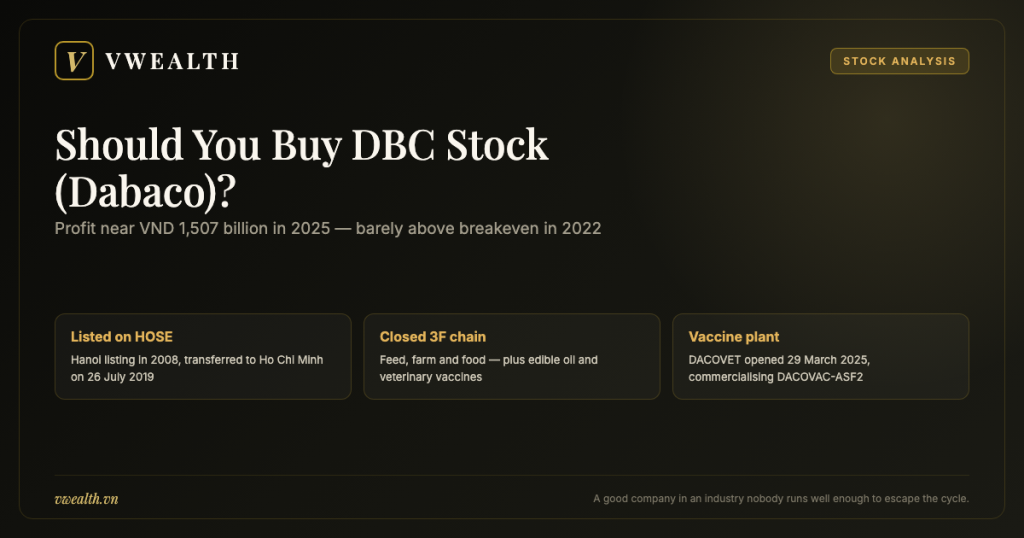
Should you buy DBC stock — the Ho Chi Minh Stock Exchange ticker for Dabaco Group Joint Stock Company, Vietnam’s largest listed pork and animal feed producer — is a question you will answer incorrectly if you only look at the most recent year’s earnings. In 2025 the company reported net profit of roughly VND 1,507 billion, nearly double the previous year and far above the target its own shareholders had set. Yet only three years earlier, the same company barely avoided losses. There is no contradiction. Dabaco is a cyclical business, and with cyclical businesses the prettiest number usually appears exactly when caution is most warranted. This analysis traces the company from a nearly bankrupt silk cooperative in Bac Ninh province in 1996, through the African swine fever catastrophe, to the vaccine plant and edible oil refinery of 2026 — and ends with a straight answer about which kind of investor DBC suits, and which kind should stay away.
Before we start, a few ground rules, the same ones that apply to every company profile in this series.
You will encounter many dates, plant names, people and scale figures. All of them come from publicly disclosed sources: annual reports, shareholder meeting resolutions, filings with the stock exchange, and mainstream Vietnamese financial media. What you will not find here is a valuation multiple as of today, a live hog price, or the most recent quarter’s earnings. For a livestock company, a single quarter’s result depends almost entirely on the spread between the selling price of pigs and the cost of raising them during those specific three months — which means one quarter tells you close to nothing about long-term health. Instead, this article teaches you where to look and how to read what you find. For the current numbers, open the latest research reports on vwealth.
Second ground rule: this is the first company in the series from Vietnam’s livestock sector, an industry that many investors assume they understand because everyone buys meat. In reality the business has its own vocabulary — live hog price, cost of production per kilogram, feed conversion ratio, mortality rate, sow herd, biological assets. Each term is explained the first time it appears, because without them you simply cannot read Dabaco’s financial statements.
Third ground rule: if you are new to Vietnamese equities generally, read the pillar guide on how to invest in the Vietnam stock market first. It covers account opening, settlement cycles, price bands and foreign ownership mechanics that this article assumes you already know.
Fourth ground rule: nothing here is a recommendation to buy or sell. The final chapter states plainly who this stock suits, but the decision remains yours.
From a failing silk cooperative to northern Vietnam’s leading livestock group
There is a detail in Dabaco’s origin story that few investors know, and it explains almost everything about the company’s character: Dabaco was not created to raise pigs. It grew out of a provincial silk company that was about to be shut down.
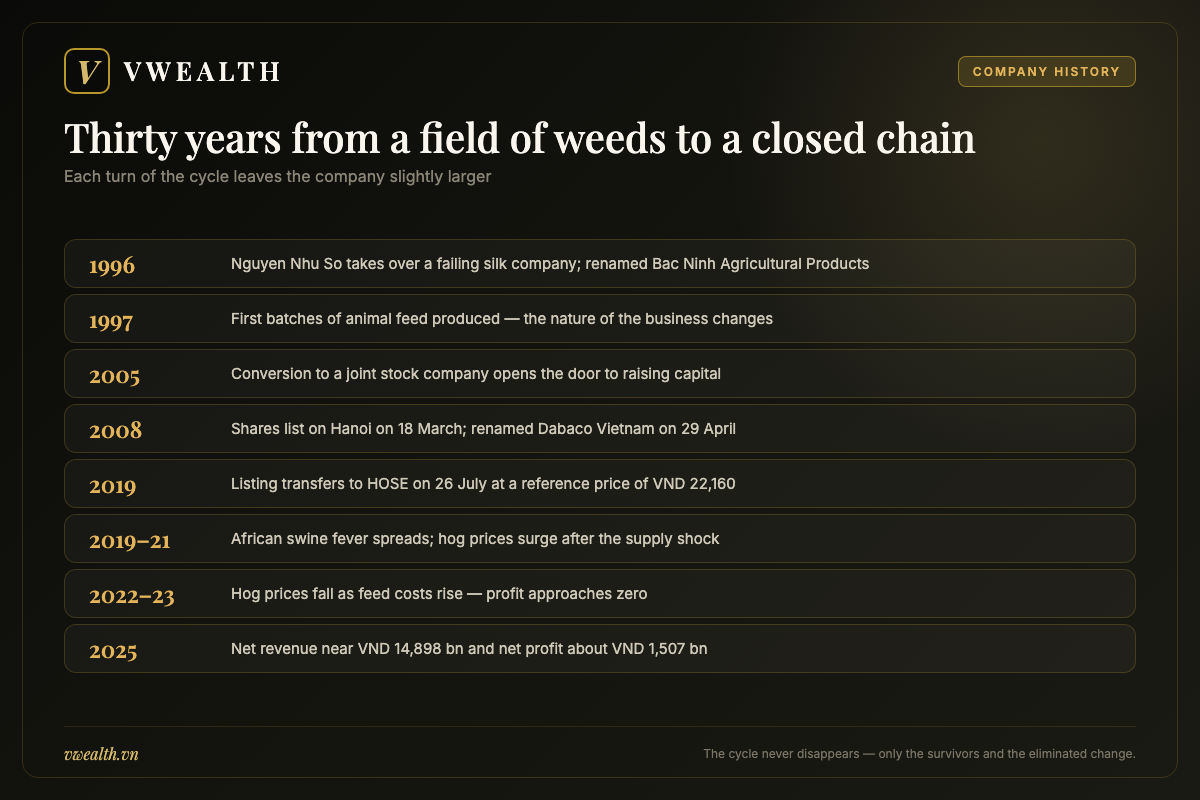
1996: a welding machine and a field of weeds
In 1996 the authorities of Ha Bac province — later split into Bac Ninh and Bac Giang — assigned an official named Nguyen Nhu So to run the Ha Bac Silk Sericulture Company. It was a state enterprise on the verge of dissolution. According to accounts recorded by multiple Vietnamese newspapers, the entire usable asset base at handover consisted of one welding machine worth roughly VND 2.5 million, a handful of remaining staff, and an abandoned plot of land overgrown with weeds.
Pause on that figure. VND 2.5 million was, and is, a trivial sum — at the time worth a few hundred US dollars. That was the actual starting point. Thirty years later the same enterprise has charter capital above VND 4,000 billion, dozens of subsidiaries, and factories from the northern provinces to the south.
The founding story gets retold often in Vietnam, and it deserves retelling. But as an investor you should extract something more practical from it than inspiration: this company was built by the will of one person, and its internal power structure still reflects that fact today. We return to this in chapter two, because it is simultaneously the company’s greatest strength and its largest single risk.
The province subsequently renamed the business Bac Ninh Agricultural Products Company. The broader name allowed a far wider range of activity than silk, and the new director used every inch of it.
1997: the decision to change trades — animal feed
The first genuinely pivotal decision came quickly. Nguyen Nhu So identified a paradox in Vietnam at the time: an agricultural country in which most industrial animal feed was produced by foreign corporations or imported outright. Farmers raised the pigs and chickens, but the fattest margin in the value chain belonged to whoever sold them the feed.
By the end of 1997, the first batches of animal feed rolled out of Bac Ninh Agricultural Products Company. This is the moment the nature of the business changed permanently: from a local agricultural trading firm into an industrial manufacturer.
It is worth understanding why the feed industry is so attractive, because the logic carries through the entire investment case.
First, demand is remarkably stable and grows with the national herd regardless of whether hog prices are high or low — the pig still eats every day even when its owner is losing money. Second, margin per tonne of feed is thin, but volumes are large and, more importantly, working capital turns over quickly. Third, whoever sells feed owns the distributor network and the relationships with thousands of farming households — an intangible asset that cannot simply be purchased.
Those three characteristics later became the cushion that carried Dabaco through years when hog prices collapsed.
2005: equitisation and escaping the provincial shadow
In 2005 the business formally converted into a joint stock company. This step was unavoidable for anyone wanting to grow: a provincial state enterprise cannot raise capital fast enough to build feed mills, buy farmland and expand a sow herd in an industry where scale determines unit cost.
Equitisation did something else important. It allowed management and employees to own shares. The ownership structure you see today — with the founding group and executive team holding a controlling stake — traces directly back to this moment.
2008: listing on Hanoi and the Dabaco name
On 18 March 2008, the company’s shares began trading on the Hanoi Stock Exchange. Shortly after, on 29 April 2008, it was renamed Dabaco Vietnam Joint Stock Company.
From listing onwards, outside investors could finally look inside the business through periodic financial statements. What they saw for many years afterwards was a sawtooth earnings chart: a year of large profits, a year of thin profits, a year that nearly went negative. That pattern is not evidence of poor management. It is the nature of the industry.
On 26 March 2011 the company was renamed again, this time to Dabaco Vietnam Group Joint Stock Company. The word “group” reflected reality: by then it operated dozens of subsidiaries across different links of the value chain.
2011 to 2018: building the 3F chain, and the cost of doing everything yourself
This was the period in which Dabaco built what it calls its 3F chain: Feed — Farm — Food. The idea sounds obvious when stated: make your own feed, raise animals on that feed, then slaughter, process and sell the meat yourself.
The difficulty is worth spelling out, because it is where most integrated agriculture ambitions fail. Each link in this chain is a separate industry requiring a separate competence and a separate kind of capital. Feed is process manufacturing: you need mills, nutritional formulations and a distribution network. Farming is capital-intensive agriculture: you need land, climate-controlled barns, breeding stock and veterinary capability. Food is fast-moving consumer goods: you need brands, retail shelf space and a cold chain. These three competences do not automatically convert into one another, and many companies have failed precisely because they assumed they would.
Dabaco chose to move slowly and build everything in-house, accepting capital tied up for long periods. That approach produced a balance sheet heavy in fixed assets and carrying meaningful debt — a characteristic that follows the company to this day, and one of the seven things you must examine when reading its accounts.
26 July 2019: moving to the Ho Chi Minh Stock Exchange
DBC shares transferred their listing from Hanoi to the Ho Chi Minh Stock Exchange, with a reference price on the first trading day of VND 22,160 per share.
Changing exchanges does not make a business better, but it changes who owns it. HOSE is Vietnam’s most liquid venue, followed by more institutional investors, subject to stricter disclosure standards, and the pool from which the major indices draw constituents. If you are unsure how Vietnam’s three trading venues differ, the guide to HOSE, HNX and UPCoM explains the practical consequences for foreign investors.
After moving to HOSE, DBC gradually became the market’s proxy for the entire livestock theme — meaning that whenever hog price news breaks, money tends to flow into this ticker first.
2019 to 2021: African swine fever and an expensive lesson
African swine fever arrived in Vietnam in early 2019 and spread on an unprecedented scale. At that point the world had no commercial vaccine, mortality in infected herds was extremely high, and the only response available was culling combined with strict quarantine.
The consequence for the industry was a textbook supply shock. Millions of pigs were destroyed, the national herd contracted sharply, and smallholder farmers went out of business in waves. Following that supply collapse, live hog prices surged through 2019 and 2020.
Here is where newer investors typically misread the situation. An epidemic that devastated the industry produced a period of record profits for industrial producers that managed to protect their herds. The reason is that they operate closed-barn systems with far better biosecurity than smallholders, so their losses were proportionally much lower — while their selling prices rose with the national shortage.
In other words, disease transfers market share and profit from smallholders to large producers.
That is the first lesson to carry into any analysis of DBC: with this stock, bad news for the industry is sometimes good news for the company, and vice versa.
2022 to 2023: two years of near-losses, and the cycle revealing itself
After the peak, what had to happen happened. High hog prices triggered aggressive restocking by both companies and households. When that restocked generation reached market weight, supply became abundant and prices fell. At the same time, global feed raw material prices — corn, soybean meal, wheat — rose sharply on supply chain disruption and geopolitical volatility.
Two jaws closing simultaneously: output prices down, input prices up. The result was that through 2022 and 2023 Dabaco struggled to keep profits positive, and some reporting periods showed losses.
Commit that period to memory, because it is the most honest photograph of DBC’s risk profile. A company can be operating well — plants running, herds healthy, staff unchanged — and still see profit approach zero, simply because two price lines outside its control moved in opposite directions for a few quarters.
2025: profit above a trillion dong, and the trap inside a beautiful number
The cycle turned again. For the 2025 financial year Dabaco reported consolidated net revenue of nearly VND 14,898 billion, up around 9.8% year on year, and net profit after tax of approximately VND 1,507 billion, up nearly 96% and far exceeding the VND 1,007 billion profit target approved by shareholders.
The main driver was straightforward: live hog prices held at elevated levels through most of 2025 while raw material costs cooled from their peaks. The spread between the two price lines widened, and because Dabaco feeds its own herds with its own feed, that spread flowed directly into profit.
This is precisely the trap chapter four dissects: if you take peak-cycle earnings and divide the share price by them, the stock will look irrationally cheap. And with cyclical companies, the stock looks cheapest exactly when the risk is highest.
2025 and 2026: a vaccine plant, an oil refinery, and more shares outstanding
Alongside the price cycle, the company did two things with far more durable significance.
First: on 29 March 2025 in Bac Ninh, Dabaco inaugurated the DACOVET vaccine manufacturing plant and announced the commercialisation of DACOVAC-ASF2, an African swine fever vaccine developed by its subsidiary Dacovet Pharmaceutical and Veterinary Company. It became the third African swine fever vaccine in Vietnam to receive a circulation licence. Published test results indicated the vaccine met standards for sterility and safety, with protective efficacy in the range of 80% to 100% in trial herds.
But you need the rest of the story, which matters just as much. DACOVAC-ASF2 is currently indicated only for meat pigs roughly eight to twelve weeks old; it is not approved for sows or other categories. And for a period after licensing, the group primarily used the vaccine on herds inside its own farm system rather than pushing external sales, with company leadership publicly citing cost of production as the reason.
What does that mean in practice? It means that today the vaccine’s largest value to Dabaco is not vaccine revenue — it is reduced disease risk in its own herds. That is still real value, but it shows up in the accounts as lower mortality and steadier unit costs, not as a striking new revenue line. Any investor valuing DBC by assigning large near-term vaccine sales is running well ahead of the evidence.
Second: during the first quarter of 2026 the group inaugurated and commissioned phase two of its edible oil plant in Bac Ninh, with capacity of roughly 1,000 tonnes of oilseed per day. The plant crushes oilseeds, and the by-product of crushing is oil meal — the key protein ingredient for compound animal feed. This closes a loop: an input Vietnam largely imports can now be partly self-supplied.
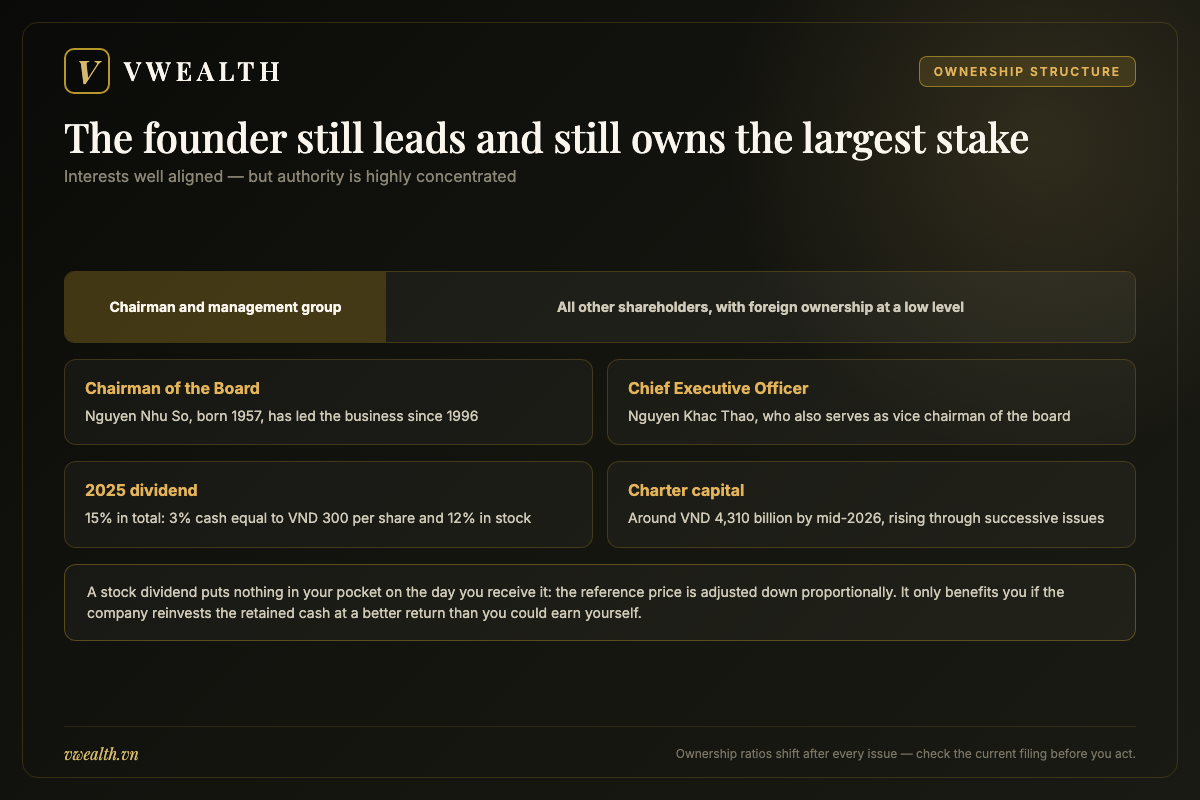
On capital, the company has steadily raised charter capital through stock dividends and share issues, reaching roughly VND 4,310 billion by mid-2026. Raising equity funds investment without adding debt, but the trade-off is dilution — each share you hold represents a smaller slice of the business. Chapter four shows you how to test the impact.
Historical milestones at a glance
| Date | Event | Why it matters to an investor |
|---|---|---|
| 1996 | Nguyen Nhu So takes over a failing silk company; province renames it Bac Ninh Agricultural Products | Near-zero starting point; culture tied tightly to one founder |
| 1997 | First batches of animal feed produced | Shift from local trading firm to industrial manufacturer |
| 2005 | Conversion to joint stock company | Opens capital raising; creates the insider ownership base |
| 18 Mar 2008 | Shares list on Hanoi Stock Exchange; renamed Dabaco Vietnam on 29 Apr 2008 | Outside investors gain access to periodic financial statements |
| 26 Mar 2011 | Renamed Dabaco Vietnam Group | Reflects a multi-subsidiary structure across the value chain |
| 2011–2018 | Build-out of the 3F chain: feed, farm, food | Fixed-asset heavy balance sheet with meaningful debt |
| 26 Jul 2019 | Listing transfers to HOSE at a reference price of VND 22,160 | Becomes the market’s proxy for the livestock theme |
| 2019–2021 | African swine fever; hog prices surge after the supply shock | Disease shifts share and profit from smallholders to industrial farms |
| 2022–2023 | Hog prices fall while feed inputs rise; profit approaches zero | The clearest picture of this stock’s cyclical risk |
| 29 Mar 2025 | DACOVET vaccine plant opens; DACOVAC-ASF2 commercialised | Near-term value is internal risk reduction, not a large revenue line |
| 2025 | Net revenue near VND 14,898 bn; net profit about VND 1,507 bn | A cyclical peak year — treat it carefully as a valuation base |
| Q1 2026 | Edible oil plant phase two commissioned, roughly 1,000 tonnes of seed per day | Closes the protein input loop for the feed business |
| Mid-2026 | Charter capital around VND 4,310 bn | Deeper equity base, but dilution to monitor |
Look across that timeline and one pattern repeats. Every few years the industry completes a full cycle: supply shock, price surge, restocking, oversupply, shakeout. Dabaco does not escape that cycle. What it does is emerge from each turn slightly larger, with one more link in the chain under its control, and with a little more share taken from those who did not survive. That, rather than this year’s hog price, is the actual investment thesis.
Who runs Dabaco and who actually owns it
If you only have ten minutes to research DBC, spend them on this chapter. In livestock, management quality matters more than in infrastructure or banking — because the decision to expand or shrink the herd must be made before the market shows the signal, and getting that timing right can determine an entire year’s profit.
Nguyen Nhu So: soldier, founder, and still at the helm
Nguyen Nhu So was born on 23 August 1957 in Tien Du district, Bac Ninh province. Before entering business he spent fifteen years in the military. After leaving the army and completing a degree in economics, he was appointed deputy director of a provincial materials company in 1988, then in 1996 was sent to rescue the silk company described in chapter one.
He serves as Chairman of the Board of Directors of Dabaco Vietnam Group and is also the company’s largest individual shareholder. Beyond his business role, he has served as an elected deputy to Vietnam’s National Assembly.
Thirty years attached to one company is a data point a serious investor should evaluate in both directions.
The positive direction: when a founder still holds power and still keeps most of his personal wealth in the company’s shares, his interests are tightly aligned with minority shareholders. He has no incentive to strip assets, and no incentive to flatter a single quarter, collect a bonus and leave. In an industry where investment decisions look five to seven years ahead — building barns, developing a sow herd, constructing plants — an owner’s long horizon is an advantage that hired management rarely replicates.
The risk direction: the business depends on one individual. In corporate governance this is called key person risk, and at Dabaco it is more pronounced than at most listed companies of comparable size, because nearly the entire corporate history is the history of one person’s decisions.
For foreign investors, this pattern is common across Vietnamese mid-caps and is one of the structural features that separates the market from developed markets. It is neither automatically good nor automatically bad; it simply demands that you evaluate the individual rather than the institution.
The executive team and the succession question
Below the chairman, the Chief Executive Officer role is held by Nguyen Khac Thao, who also serves as vice chairman of the board. He is typically the executive representing the group at major events, including the inauguration of phase two of the edible oil plant. Nguyen Thi Thu Huong holds the position of vice chairwoman and deputy chief executive.
One thing you should verify yourself rather than trust any analysis, including this one: board and executive rosters change with each term and each shareholder resolution. The accurate method is to open the corporate governance section of the most recent annual report, or the company profile on a data provider. An article captures a snapshot at the moment of writing.
The succession question is unavoidable for a company whose founder is past sixty and remains the organisation’s centre of gravity. It is not a delicate topic to be avoided — it is a genuine valuation variable.
A practical way to assess it involves three questions. First, has the company built systems, or does it still run on direct instruction? The tell is whether subsidiaries have independent management with separately visible results. Second, has the next generation been given real responsibility? Look at who is named as leading recent major projects. Third, is the ownership structure arranged so that a transition would not create a forced selling event on the exchange?
None of these has a definitive answer inside an article. But a long-term holder is obliged to track them through each annual general meeting.
Ownership structure: insiders in control, foreign holdings thin
Three features of DBC’s register stand out.
First, the largest individual shareholder is Chairman Nguyen Nhu So, holding tens of millions of shares, equivalent to somewhat more than twenty percent of capital according to recent disclosures. The exact ratio shifts after each stock dividend and each insider transaction, so verify the current figure rather than trading on a number printed in any article.
Second, counting the broader management group and related parties, insider ownership is materially higher than the chairman’s holding alone. The practical consequence is that the genuinely free-floating share count is considerably smaller than total shares listed — which matters for liquidity and for how far the price can move on modest flows.
Third, foreign ownership at DBC sits at a modest level, only a few percent of capital according to published statistics. This cuts both ways. Favourably, the foreign room is largely unused, so there is no technical ceiling if international money rotates into Vietnamese agriculture. Unfavourably, thin foreign ownership also indicates the stock is not on the regular watchlist of many large institutions, which partly reflects how global investors view cyclicality in this sector. If foreign ownership limits are unfamiliar, read the explainer on foreign room in Vietnamese stocks before sizing any position.
Dividends: why Dabaco pays mostly in shares
DBC’s dividend policy has been consistent in one respect: the stock component is consistently larger than the cash component. Under the 2025 profit distribution plan, the total dividend ratio was 15%, comprising 3% in cash — equivalent to VND 300 per share — and 12% in shares.
Foreign investors often misread Vietnamese stock dividends, so it is worth being precise.
A cash dividend is real money leaving the company and arriving in your account. It reduces equity and reduces the cash available for investment.
A stock dividend moves no money at all. It is an accounting transfer from retained earnings into charter capital, accompanied by the issue of new shares to existing holders pro rata. After the record date, the reference price is adjusted downward proportionally. At the moment of receipt, the value of your holding does not increase by a single dong — you hold more shares, each representing a smaller slice.
So why do it? Because for a company in a heavy investment phase — building barns, an oil plant, a vaccine facility — retaining cash is rational, while management still wants shareholders to feel rewarded. This only benefits you under one condition: that the company deploys the retained capital at a return higher than you could achieve yourself with the cash. Testing that condition is the work of chapter four.
If your strategy is to live off steady cash dividends, DBC is not your stock. The cash component is simply too thin, and it is not stable across the cycle.
Ownership and leadership summary
| Item | Publicly disclosed | What you should verify yourself |
|---|---|---|
| Chairman | Nguyen Nhu So, born 1957, founder and leader since 1996 | Current term and insider share transactions |
| Chief Executive Officer | Nguyen Khac Thao, also vice chairman of the board | Division of duties among deputy CEOs in the annual report |
| Vice chair and deputy CEO | Nguyen Thi Thu Huong | Full executive roster as of the latest filing |
| Largest shareholder | Chairman Nguyen Nhu So, somewhat above twenty percent of capital | Updated ratio after each stock dividend |
| Extended insider ownership | Management and related parties hold a controlling block | Actual free float available to trade |
| Foreign ownership | Low, only a few percent of capital | Remaining room and recent foreign net flows |
| 2025 dividend | 15% total: 3% cash equal to VND 300 per share, 12% in stock | Record date and reference price adjustment |
| Charter capital | Around VND 4,310 billion as of mid-2026 | Share count after the most recent issue |
The conclusion of this chapter is compact: DBC is a company with a real owner, concentrated authority, a long horizon and interests aligned with shareholders. That is a substantial advantage in an industry that requires patience. But the same concentration produces two risks you must accept if you buy: key person risk, and the reality that minority shareholders have effectively no voice in major decisions.
How DBC makes money: the 3F chain and the pieces most investors overlook
Many investors discuss DBC as though it were a pig farming company. That framing is wrong enough to distort your valuation. Dabaco is an agro-industrial conglomerate of several segments, in which pig farming attracts the most attention but is not the largest revenue generator.
The company describes its strategy as 3F+, meaning Feed — Farm — Food plus Future, the latter denoting technology and extended links. Let us walk through each piece, and more importantly, how they feed one another.
Feed: the revenue backbone and the cyclical cushion
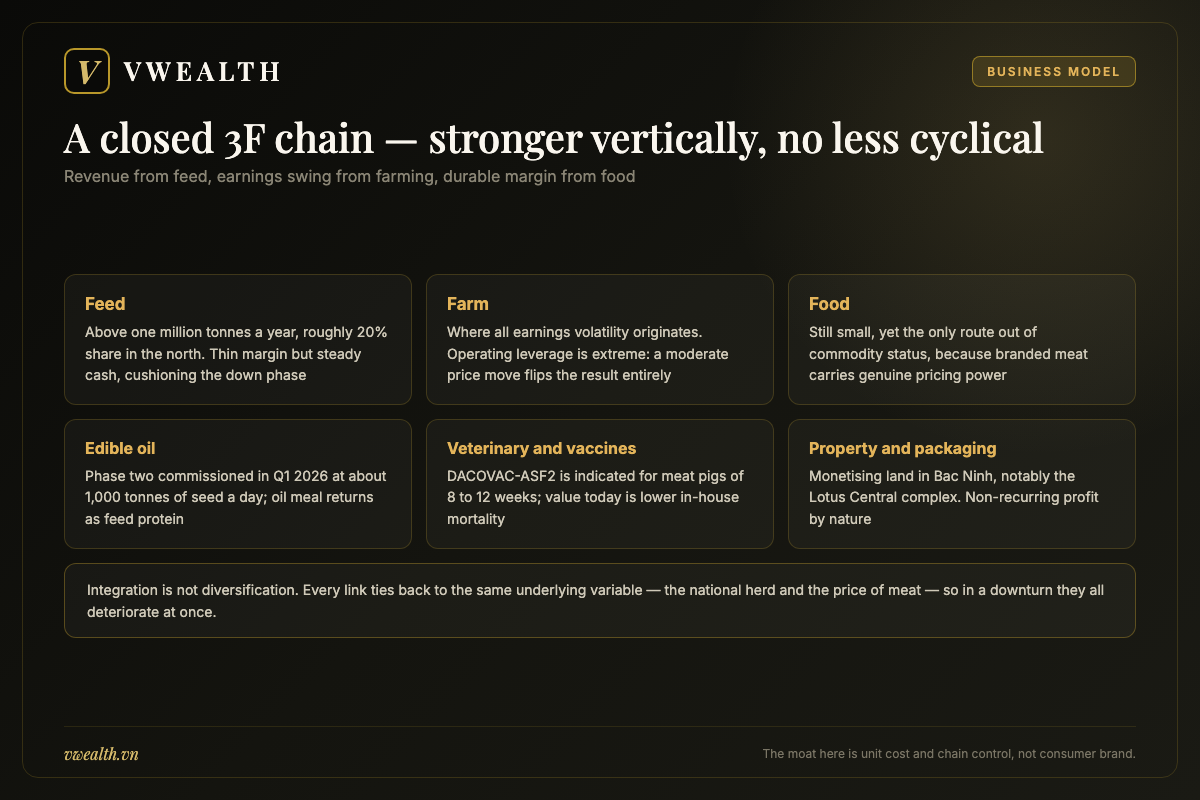
This is the original segment, the oldest and the spine of the group. According to company disclosures, feed output runs above one million tonnes per year, equivalent to roughly twenty percent market share in northern Vietnam.
Three reasons this segment matters more than it appears.
First, it generates steady cash. Feed sells continuously, collects quickly, and does not depend on the slaughter cycle. When hog prices fall and the farming segment loses money, the feed mills keep running — that is the cushion preventing free fall in the bad phase of the cycle.
Second, it is where economies of scale bite hardest. The primary inputs are corn, soybean meal, wheat, rice bran and additives. Most protein inputs and a portion of energy inputs are imported. Whoever buys in bulk, holds storage capacity, can hedge or forward-price, and has access to foreign currency achieves a materially better cost base than a small mill.
Third — and this is rarely mentioned — the feed business is an information system. A feed producer knows precisely whether tonnage is rising or falling in each region, and feed tonnage is a leading indicator of the national herd. In other words, the person selling feed sees the supply wave before the market sees the price.
The risk in this segment is thin margin and fierce competition against foreign groups with far deeper resources. This is not a business where you can raise prices at will.
Farm: breeding stock and grow-out, where profit is decided
The farm segment contains two economically distinct activities that investors frequently conflate.
The first is breeding stock. Dabaco invests in pig and poultry genetics, including imported grandparent and great-grandparent lines. Selling breeding stock is a separate trade with better margins than grow-out and a different cyclical rhythm: when hog prices rise, everyone rushes to restock, so demand for piglets spikes before demand for finished pigs does.
The second is raising animals for meat, principally pigs and chickens. This is where all of DBC’s earnings volatility originates.
Let us make the mechanism concrete with an illustrative example — the figures are assumed purely to demonstrate the principle, not actual company data. Suppose the cost of producing one kilogram of live hog is VND 50,000, covering piglets, feed, veterinary care, labour and barn depreciation. If the live hog price is VND 60,000 per kilogram, you earn VND 10,000 per kilogram, a twenty percent margin on cost. But if the price falls to VND 45,000, you lose VND 5,000 per kilogram. A twenty-five percent move in selling price has completely inverted the result.
That is operating leverage in livestock, and it is why DBC’s earnings chart looks like a saw blade. No amount of management skill erases the mechanism; excellence only lowers unit cost by a few percentage points, which is enough to survive longer when prices collapse.
Food: small today, but the only exit from commodity status
The food segment covers slaughtering, processing and distribution of meat products, along with eggs and various processed goods.
By scale it remains small relative to feed and farming. Strategically, however, it is the segment most worth watching, because it is the only route by which a livestock producer escapes the fate of being a commodity seller.
The reason is pricing power. When you sell live hogs, you sell a homogeneous commodity at a price the market sets — you have no pricing power whatsoever. When you sell a branded chilled meat pack in a supermarket, you sell a consumer product with a far steadier price, a much better margin, and far less week-to-week sensitivity to the live hog price.
This is the path several regional groups have taken, and it is the path Masan Group pursues in Vietnam through its chilled meat and retail ecosystem. The difference is that Masan already owns distribution and consumer brand-building capability, while Dabaco is strongest in production. Which one covers the remaining distance faster is an open question, and the answer directly affects the multiple the market is willing to pay for DBC over the next decade. For broader context on this sector, the overview of Vietnam consumer sector stocks is a useful companion read.
Edible oil: closing the raw material loop
Many investors skim past the edible oil plant assuming it is an unrelated side venture. It is directly connected to the core.
Crushing oilseeds produces two outputs: edible oil for consumers, and oil meal — the protein-rich residue. Oil meal is the single most important protein ingredient in compound animal feed, and one Vietnam imports in large volume.
So the oil plant simultaneously creates a new consumer product line and supplies raw material to the group’s own feed mills. Phase two was commissioned during the first quarter of 2026 with capacity of roughly 1,000 tonnes of seed per day.
The genuine benefit lies in reduced import dependence and lower currency risk on the input side. But keep perspective: Vietnam’s consumer cooking oil market already has entrenched players controlling distribution, so building retail share is far from easy, and the return on this investment will take several years to assess.
Veterinary medicine and vaccines: turning a cost into a product
Dacovet Pharmaceutical and Veterinary Company, the group subsidiary, developed the DACOVAC-ASF2 vaccine discussed in chapter one. Beyond African swine fever vaccine, the segment produces veterinary drugs and preparations serving both internal needs and the external market.
The strategic value to a livestock producer is clear: controlling your own veterinary capability means better disease risk management and steadier unit costs. The commercial value — selling vaccine externally for cash — remains at an early stage, given the vaccine’s narrow indication and the cost of production that company leadership has publicly acknowledged.
Practical advice: treat the vaccine segment as a free option inside your investment thesis. If it develops into a meaningful revenue line, that is upside. If it does not, your thesis must still stand without it.
Real estate, packaging and the smaller pieces
Dabaco operates a real estate segment with urban and apartment developments in Bac Ninh province, of which the Lotus Central complex on Ly Thai To street is the best known. The group also produces packaging and runs trading and support activities.
View the real estate segment for what it is: the product of land accumulated locally over many years, and a source of non-recurring profit recognised in particular years when projects are handed over. It can flatter a financial year, but it is not a core competence and should not be valued as though it were a professional property developer.
How the 3F chain feeds itself — and why that is not diversification
This is the most important passage in the chapter, so read it slowly.
Dabaco’s closed loop works as follows. The oil plant crushes seed, producing oil meal. Oil meal, together with corn and other inputs, enters the feed mills. Feed nourishes the group’s own pig and poultry herds, with the remainder sold to external farmers. Breeding farms supply piglets to the group’s own grow-out barns and to the market. In-house veterinary operations handle herd health. Finished animals move into processing plants and emerge as meat products for consumers.
The benefits are quality control from end to end, lower intermediary costs, and retention of each link’s margin instead of paying it away.
But here is where many investors go seriously wrong: a closed loop is not risk diversification. Genuine diversification means two income streams that are uncorrelated — a company that both sells electricity and leases offices, for instance. At Dabaco, virtually every link is tied to the same underlying variable: the national livestock herd and the price of meat. When hog prices fall and farmers empty their barns, the farming segment loses money, feed sales slow, breeding stock goes unsold, veterinary orders shrink, and the processing segment faces price pressure. They all deteriorate together.
Put differently, the 3F chain makes the company stronger vertically without making it less cyclical.
Segment comparison
| Segment | Role in the chain | Margin characteristics | What to monitor |
|---|---|---|---|
| Animal feed | Revenue backbone and cyclical cushion | Thin margin, high volume, fast cash conversion | Tonnage sold and imported raw material prices |
| Breeding stock | Input to grow-out plus a standalone revenue line | Better margin than grow-out; leads the cycle | Restocking demand across the market |
| Grow-out farming | Where group profit is won or lost | Very high operating leverage; can turn negative | Spread between hog price and cost of production |
| Food processing | The exit from commodity status | Higher and steadier margin; still small | Retail channel expansion and brand strength |
| Edible oil | Closes the protein input loop for feed | Exposed to global seed prices and retail competition | Utilisation rate of phase two capacity |
| Veterinary and vaccines | Internal disease risk control | Value today is cost avoidance, not revenue | Wider vaccine indications and unit economics |
| Real estate | Monetising accumulated local land | Non-recurring, lumpy by handover schedule | Legal progress and sales pace per project |
So when someone asks how Dabaco makes money, the accurate answer is: most of its revenue from selling feed, most of its earnings volatility from raising pigs, and its hope of durable margin from processed food. Those three have three different rhythms, and you must track all three.
Competitive position and financial health: seven things to check before buying DBC stock
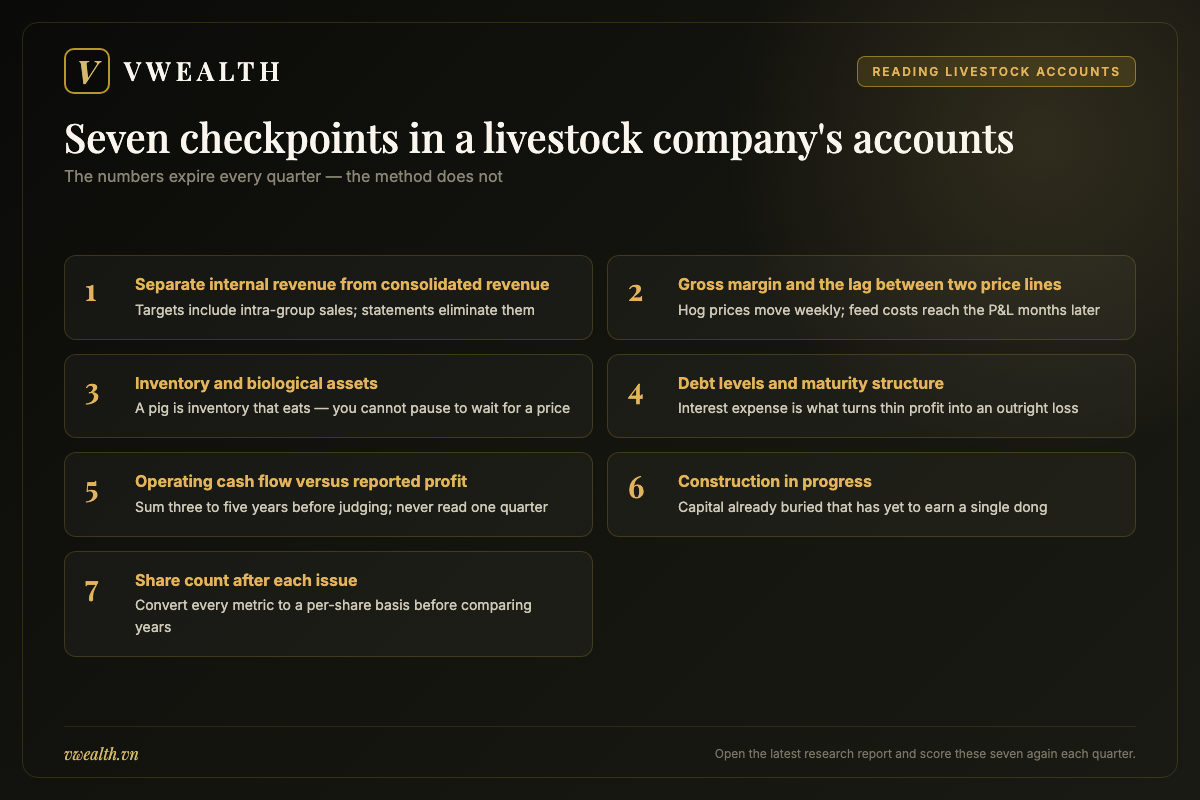
This chapter does not hand you numbers. It teaches you how to read this particular company’s numbers. The reason is simple: DBC’s figures change every quarter with the hog price, so any number printed here would expire before you read it. The method does not expire.
There are seven checkpoints. If you remember only one, remember the first, because it trips up more people than any other.
Checkpoint one: revenue including internal consumption versus consolidated revenue
This trap is specific to Dabaco and you will hit it the moment you start searching.
In shareholder meeting resolutions, the company typically sets its revenue target using total revenue including internal consumption. For example, the approved 2026 plan targets total revenue of roughly VND 29,311 billion, profit before tax of about VND 1,261 billion and profit after tax of about VND 1,117 billion. Meanwhile, the consolidated net revenue recorded in the 2025 financial statements was nearly VND 14,898 billion.
See the gap? The plan figure is nearly double the reported figure. If you compare a VND 29,311 billion target against VND 14,898 billion of actual revenue and conclude the company missed its plan by half, you have compared two different things.
The cause is the closed loop. When the feed mill sells feed to a farm inside the same group, that transaction is revenue for the feed company and cost for the farm company. On consolidation, accountants must eliminate all such intra-group transactions, otherwise revenue would be double counted. The more integrated the group, the larger the elimination.
The practical rule: compare like with like. Compare a total revenue target with total revenue achieved, and consolidated net revenue with consolidated net revenue. When valuing on a revenue basis, only ever use consolidated net revenue.
One useful by-product: the gap between the two figures gives you a rough measure of how integrated the chain has become. A wider gap means more is consumed internally.
If you are unfamiliar with Vietnamese accounting conventions more broadly, the primer on Vietnamese financial statements and how VAS differs from IFRS will save you several hours of confusion.
Checkpoint two: gross margin and the lag between two price lines
Gross margin is what remains after subtracting cost of goods sold from revenue. For Dabaco this is the single most sensitive and most informative line.
What you need to understand is that this company’s gross margin is determined by the gap between two price lines: the output price of live hogs, and the input price of feed raw materials. But the two lines do not move at the same time. Imported raw materials are typically priced months in advance and sit in inventory, so they feed into cost of goods sold with a lag. Live hog prices react weekly.
The practical consequence is significant. When hog prices rise while cheap raw material bought earlier remains in inventory, gross margin expands rapidly and profit explodes. Conversely, when hog prices begin falling while expensive inventory is still working through, margin gets squeezed from both directions and profit falls faster than the hog price itself.
That is why livestock company earnings always amplify the swing in hog prices. Prepare psychologically for that before you buy.
How to track it: build a table of quarterly gross margin for at least eight consecutive quarters, alongside the average live hog price for each of those quarters. The relationship becomes visible, and you can estimate the lag.
Checkpoint three: inventory, because a pig is an asset that eats
Livestock financial statements contain a line item other industries do not have: biological assets, or work in progress in the form of animals still growing.
Consider the economics. A pig in a barn is inventory, but a very unusual kind: it consumes money every day simply to exist. You cannot pause production to wait for a better price the way a steel mill can idle a line. The pig eats daily, needs veterinary care and labour, and beyond a certain weight its feed conversion efficiency deteriorates sharply, meaning further feeding destroys value.
This creates selling pressure that investors outside the industry rarely appreciate: farmers must sell when animals reach weight, almost regardless of price. It is why hog prices can fall very steeply in the short run when supply bunches together.
When reading the accounts, examine three things: inventory relative to revenue, the growth rate of inventory versus the growth rate of revenue, and the notes on inventory write-down provisions. Inventory growing faster than revenue for several consecutive quarters warrants investigation, though it is not automatically negative — the company may be deliberately building the herd ahead of an expected price upturn.
Checkpoint four: debt and interest cost in a capital-hungry industry
Industrial livestock production is capital intensive. Climate-controlled barns, waste treatment systems, feed mills, slaughter lines, the oil plant, the vaccine facility — all require large capital with slow payback. Companies in this sector almost always carry meaningful borrowings.
Look at four measures.
First, total debt to equity, to gauge leverage. Second, maturity structure: how much is short-term borrowing requiring continuous rollover, and how much is long-term debt funding fixed assets. Financing long-lived assets with short-term debt is a fragile structure when credit conditions tighten. Third, interest expense relative to operating profit — in the bad phase of the cycle, interest cost is precisely what pushes a company from thin profit into loss. Fourth, cash and equivalents, because in this industry the ability to absorb several bad quarters matters more than the ability to shine in several good ones.
Checkpoint five: operating cash flow versus reported profit
This is the earnings quality test, and it matters especially for a company holding large inventory.
The principle: profit is an opinion, cash is a fact. A company can report profit while operating cash flow is negative, if that profit is buried in inventory or receivables.
For Dabaco, negative operating cash flow in a single quarter is not necessarily a warning — the company may be building the herd or stockpiling raw materials. But negative operating cash flow over several consecutive years alongside consistently reported profit is a serious question.
The correct method: sum operating cash flow over three to five consecutive years, then compare against total net profit for the same period. If the two are close, the profit is real. If cash flow is materially lower, go find where the difference sits on the balance sheet.
Checkpoint six: construction in progress and capital discipline
Dabaco continuously has new projects under way. On the balance sheet this appears as construction in progress — money already spent on facilities not yet completed, not yet operating, and not yet being depreciated.
The line has two faces. Positively, it represents future production capacity: growth being built. Cautiously, it represents buried capital producing no revenue while the interest funding it must still be paid.
Two questions each reporting period. One: do major projects reach completion on the announced schedule, or do they slip every year? Two: when a project transfers into fixed assets, does actual utilisation reach the level management previously promised?
A company that answers both well across multiple cycles deserves a higher multiple than the industry average. That is something you must score yourself over time; nobody can score it for you.
Checkpoint seven: share count and dilution
Because Dabaco pays stock dividends regularly and has conducted share issues, the number of shares outstanding rises over time. Charter capital reached roughly VND 4,310 billion by mid-2026.
This is where retail investors get fooled by profit growth charts. Absolute profit rising thirty percent sounds excellent, but if the share count also rose twenty percent over the same period, earnings per share rose only about eight percent. And what determines the value of your stake is earnings per share, not the company’s absolute profit.
The correct habit: convert every metric to a per-share basis before comparing across years. And when calculating your historical return, remember to adjust prices for stock dividends, otherwise your figures will be badly wrong.
Where Dabaco sits on the industry map
Once you know how to read the numbers, the next question is how the company compares against others on the same field.
Vietnam’s livestock industry has three tiers of participant. The first is very large foreign corporations, led by C.P. Vietnam alongside names such as Japfa, CJ, De Heus and Cargill. They bring capital, technology, global supply chains and an advantage in international raw material procurement. The second tier is domestic companies operating at industrial scale, including Dabaco, GreenFeed, Mavin, Hoa Phat’s agriculture division, Masan MEATLife, BAF and others. The third tier is smallholder farms, historically dominant but shrinking rapidly after each disease outbreak.
Dabaco’s position within that picture has three features.
First, it is among the domestic companies with the most complete closed chain, from raw material to finished food, including veterinary and vaccine capability. Very few Vietnamese companies own all these links.
Second, its geographic strength is concentrated in the north, where it holds substantial feed share and a long-established distributor network. That is a real advantage but also a limit — the south is a large market with deeply entrenched competitors.
Third, in absolute scale Dabaco remains considerably smaller than the leading foreign groups. In the race on unit cost, it must compensate with operating efficiency and domestic market knowledge rather than sheer size.
Peer comparison among listed names
| Company | Focus | Key strength | Difference versus DBC |
|---|---|---|---|
| Dabaco (DBC) | Closed 3F chain, strongest in northern feed and farming | Complete links from raw material to food, with in-house veterinary and vaccines | The benchmark in this table |
| Masan Group (MSN), meat and consumer arm | Consumer brands and retail distribution | Pricing power from brand, wide distribution reach | Stronger at the consumer end, less exposed to live hog prices |
| Hoang Anh Gia Lai (HAG) | Livestock combined with fruit plantations | Lower feed cost by using self-grown agricultural output | No large-scale industrial feed operation |
| Vinamilk (VNM) | Dairy and dairy herd operations | Leading consumer brand, stable margin | Different category, far smoother cycle |
| C.P. Vietnam and foreign groups | Very large closed chains, not domestically listed | Capital, technology and global procurement scale | Materially larger; not accessible to local retail investors |
To see how Vietnamese peers approach cost control differently, the profile of Hoang Anh Gia Lai and its combined fruit and livestock model is a useful contrast, while Vinamilk shows what a genuinely branded food business looks like in the same market.
How the market treats DBC stock: portrait of a classic cyclical
The company is one thing; the stock is another. This chapter covers the latter: how the market handles this ticker, and what behaviour you should expect.
Why DBC’s P/E ratio misleads newcomers
This is the most valuable lesson any investor can take from this stock, and it holds true for every cyclical company anywhere.
The price-to-earnings ratio divides share price by earnings per share. For a company with stable earnings, a low P/E usually means cheap. For a cyclical company, that relationship inverts.
Walk through the mechanism with an illustrative example using assumed figures. Suppose at the cycle peak the company earns VND 2,000 per share and the stock trades at VND 20,000, giving a P/E of 10 — apparently very cheap. But a cycle peak is by definition unsustainable. Two years later, hog prices fall and earnings drop to VND 400 per share. If the stock still trades at VND 20,000, the P/E is now 50 — apparently very expensive. Same company, same factories, different phase.
The practical conclusion: with DBC, a low P/E in a record profit year is a warning signal rather than a buy signal; and a high P/E in a trough year sometimes means the risk is already largely priced. This is counterintuitive, and it is exactly why so many retail investors buy cyclical stocks at the worst possible moment.
So what should you use instead? Three complements. First, use average earnings across a full cycle — typically five to seven years — rather than a single year. Second, use price to book value, since book value is far steadier than earnings and reflects the underlying plant and farm assets. Third, look at enterprise value against physical capacity, for instance per tonne of feed capacity or per breeding sow.
The personality of DBC on the tape
Every stock has a personality, and you should know it before you buy.
DBC’s has four traits.
Trait one: wide trading range. This follows directly from operating leverage. When the market believes the hog cycle is turning up, this ticker moves hard; when that belief reverses, it falls just as fast.
Trait two: price leads earnings. The market does not buy last quarter’s profit; it buys expectations about hog prices six months out. So you will see periods where the stock rallies while financial statements still look poor, and the reverse. Anyone waiting for a pretty report before buying typically buys the second half of the move.
Trait three: high sensitivity to industry news. A report of a new outbreak, an import statistic, a herd survey — each can move the price immediately. This ticker is driven by news flow more than by the broad index.
Trait four: pronounced speculative activity during sector rotations. Because DBC is regarded as the livestock proxy on HOSE, short-term money tends to choose it first when playing the hog price theme. That supports liquidity but also pushes price further from intrinsic value in both directions.
Dividends, dilution and realised total return
As chapter two established, DBC’s cash dividend is thin and most of the payout comes in shares. Under that policy, essentially all of your return will come from price appreciation rather than dividend income.
Three implications for strategy. First, entry and exit timing matter far more than for a high dividend stock. Second, you receive no cash while you wait, so the opportunity cost of holding through the wrong phase is large. Third, you must track dilution as described in checkpoint seven.
Liquidity, foreign flows and practical execution
DBC’s liquidity ranks reasonably well among mid-capitalisation names on HOSE, sufficient for individual investors to enter and exit without great difficulty under normal conditions. Two caveats apply.
First, liquidity in a cyclical name is uneven: very high during a sector rally and noticeably thinner when the theme cools. If you intend to build a large position, do not assume the liquidity of an active month will still be there in the month you want to sell.
Second, low foreign ownership means the stock is less affected by foreign fund rebalancing than large caps, but equally less likely to benefit when international money enters the market. If your thesis is built around a market reclassification narrative, DBC is not the most direct beneficiary.
On mechanics, foreign investors should also be aware of Vietnam’s settlement cycle, daily price bands and lot sizes, all covered in the guide to Vietnam stock trading rules, and of the tax treatment described in taxes for foreign investors in Vietnamese stocks.
The catalysts the market talks about
Four categories of catalyst are commonly used to explain DBC’s rallies. Knowing them helps you distinguish genuine change from storytelling.
First: the hog price cycle. The strongest catalyst and the easiest to forecast incorrectly.
Second: progress in the vaccine business. Any news on wider indications, lower production cost or supply contracts can move the price. Remember to assess actual revenue scale rather than valuing on expectation.
Third: new projects entering operation, such as the second phase of the edible oil plant. This catalyst has genuine substance because it increases productive capacity.
Fourth: industry policy, particularly rules on farming conditions and disease control. This category is routinely underestimated yet has the largest long-run impact, because it determines how quickly smallholders exit.
Where DBC sits among your alternatives
If you want exposure to Vietnamese food consumption, DBC is neither the only option nor the easiest.
If you want steady margins and brand strength, the consumer group offers alternatives with higher valuations and slower but smoother growth. If you want high-beta exposure to the livestock cycle specifically, there are other pure-play names on the exchange worth comparing on cost of production. If you want defensive stability through weak market phases, DBC does not qualify despite selling food — its earnings volatility disqualifies it.
The accurate placement is this: a cyclical stock with real assets and a real owner, suitable for buying in the right phase, not suitable for buying and forgetting.
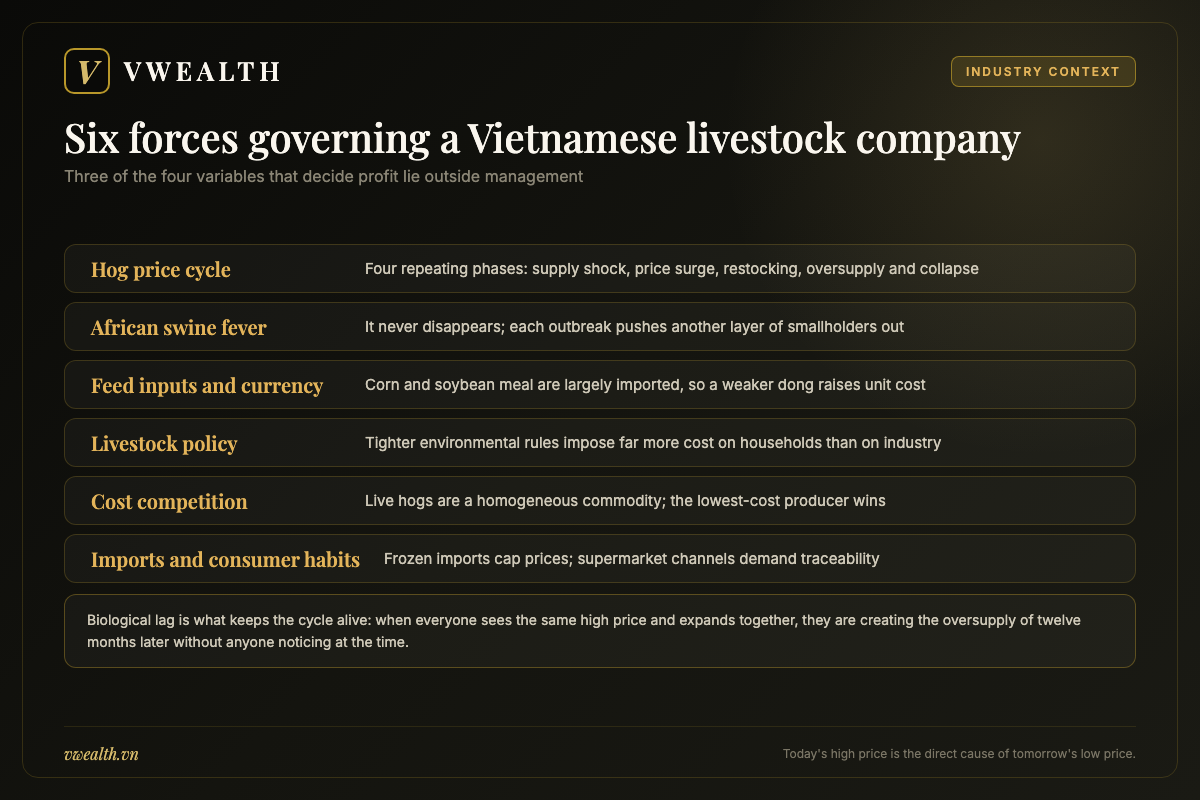
Industry context: six forces that govern a Vietnamese livestock company
No analysis of DBC stands up without the industry. For this company, context is not background — it is the deciding factor.
Force one: the live hog price cycle
The live hog price is the price of a live pig at the farm gate, quoted per kilogram. It is the industry’s most important variable, and it moves through a cycle with a logic you should learn by heart.
The cycle has four phases. Phase one is a supply shock: disease or sustained losses cause farmers to cut herds, and the national herd contracts. Phase two is the price rise: supply is short, hog prices jump, farmers make large profits. Phase three is restocking: seeing profit, both companies and households expand herds simultaneously. Phase four is oversupply and price collapse: the restocked generation reaches market weight together, supply is abundant, prices fall, weaker producers are washed out — and the loop begins again.
What makes this cycle so durable is biological lag. From the decision to expand to having pigs available for sale takes many months, and more than a year if a sow herd must be built first. So when everyone sees the same high price signal and simultaneously decides to expand, they are collectively creating the oversupply of twelve months hence without anyone noticing.
That is why the industry never outgrows its cycle, regardless of technological progress.
As an investor, take away two lessons. First, do not extrapolate current hog prices into the future — today’s high price is the cause of tomorrow’s low price. Second, the most attractive time to research livestock stocks is usually when the industry is most depressed, when the news is uniformly grey and nobody wants to discuss the sector.
Force two: disease, particularly African swine fever
African swine fever is the baseline risk of Vietnamese pig farming, with three characteristics you must grasp.
First, it does not go away. Since its arrival the pathogen persists in the environment, and localised outbreaks continue to occur seasonally, particularly when weather shifts and when livestock movement increases. Through 2026, localised outbreaks were still being recorded in numerous localities, prompting authorities to tighten transport controls, intensify disinfection and suspend restocking in high-risk areas.
Second, it has a two-directional price effect. In the short run, when an outbreak hits a region, farmers sell early to avoid losses, which temporarily increases supply and depresses prices. Several months later, once culled and panic-sold volumes have passed through, supply falls short and prices rebound. An investor who reads outbreak news and only observes this week’s price reaction will misjudge the direction of the effect.
Third, it stratifies the industry. Industrial farms with strong biosecurity suffer far lower losses than smallholders. Every outbreak therefore accelerates the migration of market share from household farming to industrial production. This is a long-run structural trend favouring Dabaco and its peers.
Vaccines, including Dabaco’s own DACOVAC-ASF2, reduce the risk but do not eliminate it, because the current indication is narrow and mass vaccination requires both time and money.
Force three: imported raw materials and the exchange rate
Vietnam imports most of its animal feed raw materials, especially corn and soybean meal. That places the industry in a double dependency.
The first dependency is global agricultural commodity prices, which swing with harvests in major exporting countries, with weather, with trade policy and with energy prices.
The second is the exchange rate. When the Vietnamese dong weakens against the US dollar, raw material costs translated into dong rise, and the cost of production rises even if world prices are unchanged. This transmission channel is frequently overlooked by foreign investors who assume a domestic-demand business is insulated from currency moves. The explainer on Vietnamese dong currency risk sets out the mechanism sector by sector, and livestock sits firmly on the losing side of a weaker dong.
Dabaco’s investment in the edible oil plant to produce its own oil meal is an attempt to reduce this dependency. Understand the magnitude correctly, though: it reduces rather than removes exposure, because the oilseed input itself may also be imported.
Force four: policy and the slow squeeze on household farming
Vietnam’s regulatory framework for livestock has tightened considerably in recent years, imposing requirements on safe distances from residential areas, on waste treatment and on registration of farming activity. The general direction is that livestock farming within residential zones is restricted, while concentrated farming must meet environmental standards.
The impact is highly asymmetric. For a household keeping a few dozen animals in a backyard, compliance cost can exceed an entire year’s profit, so many exit the trade. For a company that has already built industrial barns with waste treatment systems, the same rules impose almost no incremental cost — and in fact create an advantage by removing low-cost competitors.
In other words, environmental and biosecurity policy is quietly transferring market share to large producers. This is a long-run growth driver that receives little attention but is far more durable than any single hog price rally.
Force five: competition and the race on unit cost
Competition in Vietnamese livestock is intense and runs along exactly one axis: cost per kilogram of meat.
Because live hogs are a homogeneous commodity, nobody achieves a premium price through branding at the farm gate. The winner is whoever has the lowest unit cost, because that producer still earns a margin at prices where competitors are losing money.
Unit cost depends on four things: feed raw material prices, feed conversion ratio — the kilograms of feed required per kilogram of weight gain, mortality rate from disease, and depreciation plus interest allocated per animal.
The leading foreign groups hold advantages on the first two through global procurement scale and superior genetics. Domestic producers such as Dabaco compete through market knowledge, distributor relationships and low-cost operation under Vietnamese conditions. Meanwhile, a wave of new entrants into the industry in recent years has made the field more crowded, and this matters because several well-capitalised newcomers are willing to absorb losses to buy market share.
Force six: imported meat and shifting consumption habits
Two longer-horizon trends worth monitoring.
The first is imported meat. As free trade agreements progressively remove tariff barriers, frozen meat from countries with large-scale livestock industries can enter Vietnam at competitive prices, particularly into industrial catering and processing channels. This acts as a soft ceiling on domestic prices.
The second is a change in how Vietnamese households buy meat. The share bought at traditional wet markets is gradually declining while supermarket and convenience store channels grow, accompanied by higher expectations around traceability and food safety. This trend favours producers with closed chains and brands — which is precisely why Dabaco’s food processing segment, small as it is, is the most strategically important thing to watch.
Looking forward: three scenarios for DBC stock and what must happen in each
This section promises no price target. Anyone handing you a specific twelve-month price target for a livestock stock is pretending to know the hog price twelve months from now. Instead, we set out three scenarios with the conditions required for each, so that you can check reality against them as it unfolds.
The four variables that decide DBC’s future
Variable one is the average live hog price over the next twelve to twenty-four months. This carries the heaviest weight for near-term earnings.
Variable two is imported feed raw material prices translated into dong — that is, the product of world prices and the exchange rate.
Variable three is the degree of disease control, visible through herd mortality rates and through whether vaccination becomes widespread.
Variable four is the timeline and utilisation of new investments — the oil plant’s second phase, the vaccine business, expanded barns — because this determines earning power in the next cycle rather than this one.
An important note: the first three variables lie outside management’s control. Only the fourth is genuinely decided by the company. That is also why, when assessing the quality of a cyclical company’s management, you should score them on variable four rather than on how much they earned this year.
Optimistic scenario: a favourable cycle plus new segments contributing
Conditions required: live hog prices hold above the company’s cost of production for several consecutive quarters; imported raw material prices stay stable or fall and the exchange rate is not volatile; disease is well controlled through biosecurity and vaccination, keeping mortality low; the oil plant’s second phase runs at design capacity and the food processing segment expands its retail presence.
Observable results: gross margin expands, operating cash flow turns strongly positive and is sufficient to reduce borrowings, and projects in progress transfer into fixed assets and start generating revenue. Most importantly, the share of profit derived from less cyclical segments — processed food, edible oil, veterinary products — rises.
What would change in valuation terms: if the less cyclical profit share genuinely increases and holds for several years, the market has grounds to award DBC a higher multiple than the historical average for a pure livestock producer. That re-rating, rather than one strong year of earnings, is the real prize in this scenario.
Base case: a neutral cycle with the company growing by taking share
Conditions required: hog prices oscillate around an equilibrium band, with good stretches and bad stretches alternating as history suggests; raw material prices move within their normal range; disease flares locally by season without becoming a nationwide epidemic; investment projects reach completion somewhat later than planned, which is extremely common.
Observable results: earnings remain sawtoothed year to year with no smooth growth trend. But viewed across a full cycle, comparing peak to peak and trough to trough, both levels sit higher than in the previous cycle — because the company’s herd is larger, its feed share has crept up, and each outbreak has pushed another layer of smallholders out of the market.
This is, in my view, the most likely scenario, and also the one demanding the most patience. It does not produce an exciting story, but it does accumulate value if you hold long enough and buy at a sensible level.
Pessimistic scenario: the two jaws close again
Conditions required: hog prices fall below cost of production and stay there for several quarters; simultaneously imported raw material prices rise due to weather, geopolitics or currency depreciation; and a widespread disease outbreak lifts mortality sharply.
Observable results: gross margin compressed from both sides, profit approaching zero or turning negative as in 2022 and 2023. In that situation interest expense becomes a genuine burden, and if the company is carrying many projects in progress, cash flow pressure intensifies because capital is committed but not yet earning.
What to monitor in this scenario is not profit — profit will certainly be poor. What to monitor is resilience: cash balances, refinancing capacity, and whether the company is forced to cut investment or sell assets. A company that passes through this phase with its balance sheet intact becomes the big winner of the following cycle, because weaker competitors have been eliminated.
Scenario summary
| Scenario | Conditions required | Early signals | Implication for investors |
|---|---|---|---|
| Optimistic | Hog prices above cost for several quarters; stable inputs and currency; disease controlled; new projects at full capacity | Gross margin expanding consecutively; strong operating cash flow; rising share of less cyclical profit | Potential re-rating to a higher multiple, not merely one good year |
| Base case | Hog prices oscillating around equilibrium; seasonal local outbreaks; projects delivered later than planned | Earnings still sawtoothed, but cycle peak and trough both higher than the prior cycle | Requires patience and disciplined entry; unsuitable for the impatient |
| Pessimistic | Hog prices below cost for an extended period; adverse inputs and currency; widespread disease | Rapid margin compression; negative operating cash flow; interest consuming operating profit | Track resilience rather than profit; the main risk is holding the wrong phase with leverage |
What would prove your thesis wrong
A good habit among disciplined investors is to write down the conditions that would falsify your thesis before buying. For DBC, three are worth recording in your investment journal.
First: if you buy because you believe the closed chain makes the company more stable than peers, then gross margin volatility at DBC matching or exceeding the industry average across two consecutive cycles is disconfirming evidence.
Second: if you buy for the vaccine story, then veterinary and vaccine revenue failing to grow materially several years after the plant opened is disconfirming evidence.
Third: if you buy because you believe the company is shifting toward branded consumer goods, then the revenue share of food processing standing still over multiple years is disconfirming evidence.
Write them down, and review them once a year. This practice guards against the most dangerous habit in investing: adjusting your thesis to fit the price.
What foreign investors should know before buying a Vietnamese livestock stock
This chapter exists because the series is read by people outside Vietnam, and several practical realities differ meaningfully from developed markets.
Pork is not a niche in Vietnam — it is the protein staple
In many Western markets, pork is one option among several. In Vietnam it is the dominant animal protein in household cooking, and pork prices carry enough weight in the consumer basket that a sustained move affects headline inflation. This has two consequences for investors.
The first is that demand is genuinely staple-like: it grows with population and income, not with fashion. The second is that when prices rise steeply, the issue becomes a matter of public interest, which raises the possibility of administrative attention — increased import quotas, appeals for price restraint, tighter oversight of the distribution chain. Producers therefore face a soft ceiling in extreme upswings that pure market logic would not predict.
The information environment is thinner than you may be used to
Detailed national statistics on herd size, regional slaughter volumes and inventory levels are less comprehensive and less timely in Vietnam than in the United States or the European Union. Practically, this means market participants often trade on partial data and anecdote, which amplifies price swings in both the commodity and the equity.
The practical response is to give more weight to data you can verify — company disclosures, feed volumes, published outbreak notices — and less weight to sentiment-driven commentary about where hog prices are heading next quarter.
Corporate structure and related-party transactions
Vietnamese groups frequently operate through many subsidiaries with substantial intra-group trade, and Dabaco is a clear example given its closed chain. This is legitimate and disclosed, but it demands more careful reading than a single-entity business.
Two habits help. Read the related-party transaction notes rather than skipping them. And whenever comparing figures, confirm whether you are looking at parent-company or consolidated statements — the difference can be large, and Vietnamese media sometimes quote one while readers assume the other.
Practical access for a non-resident investor
To buy DBC you need a securities trading code and a local brokerage account, a process described step by step in the guide to opening a brokerage account in Vietnam as a foreigner. Beyond account mechanics, remember that Vietnam operates daily price limits, so in a sharply moving market you may not be able to exit at your chosen level on a given day.
Common mistakes foreign investors make with this stock
Mistake one: valuing peak earnings as though they were normal. Covered at length in chapter five, but it remains the single most expensive error.
Mistake two: treating the vertically integrated chain as diversification. It is integration, not diversification, and the difference matters in a downturn.
Mistake three: assuming a domestic food business is insulated from currency risk. Feed inputs are imported, so a weaker dong raises costs directly.
Mistake four: buying on vaccine headlines without checking the indication scope and the actual revenue contribution.
Mistake five: ignoring stock dividends when calculating historical returns, which produces figures that are simply wrong.
Mistake six: sizing the position as though this were a consumer staple. It is not; its earnings volatility resembles a commodity producer far more than a food brand.
So, should you buy DBC stock? A straight answer
Time to bring it together. This chapter does not dodge the question in the title, but it also refuses to answer with a single word — because the correct answer depends on who you are.
The case for: six reasons DBC deserves consideration
Reason one: the company owns real assets and real productive capacity. Feed mills, breeding farms, grow-out barns, processing plants, an oil refinery, a vaccine facility. This is not a business living on a narrative. For a value investor, the existence of quantifiable tangible assets is an important anchor when markets panic.
Reason two: the closed chain has all its links. Very few Vietnamese companies span raw material to finished food while also owning veterinary and vaccine capability. That gives control over cost and quality that single-link competitors do not have.
Reason three: the founder still leads and still holds a large stake. In an industry requiring multi-year vision, that alignment is an intangible asset that is hard to value but very real.
Reason four: the long-run structural trend favours large producers. Household farming is shrinking under the combined pressure of disease, environmental regulation and economies of scale. Every cycle transfers more share to the industrial tier. This growth driver is independent of the hog price.
Reason five: demand for pork in Vietnam is staple demand, tied to population and income rather than to a passing consumption trend.
Reason six: two options embedded in the business that are not heavily reflected in valuation — the vaccine segment if indications widen and unit cost falls, and food processing if a genuine consumer brand emerges. Both are options rather than commitments, but they exist.
The case against: seven risks to look at squarely
Risk one, and the largest: cyclicality combined with high operating leverage. Profit can fall eighty percent or turn negative because the spread between two price lines moved by a few tens of percent. This is not a risk that management skill can fully neutralise; it is inherent to the industry.
Risk two: disease. A widespread outbreak can erase several quarters of profit. Vaccines reduce the risk without removing it.
Risk three: dependence on imported raw materials and the exchange rate. The company has essentially no pricing power on output while bearing the full volatility of input costs.
Risk four: capital intensity and debt. This industry consumes capital continuously. In the bad phase, interest expense is what pushes thin profit into loss.
Risk five: dilution. A dividend policy weighted toward stock, plus periodic share issues, means earnings per share grows more slowly than absolute earnings.
Risk six: key person risk, with the succession question still unanswered in public.
Risk seven: competition from foreign groups with greater scale and resources, plus a wave of newly capitalised domestic entrants willing to run losses to win share.
Balance sheet of arguments
| In favour | Against |
|---|---|
| Large tangible productive asset base that can be measured | High operating leverage; profit can turn negative in the down phase |
| Complete 3F chain, rare among domestic producers | Integration is not diversification: segments deteriorate together |
| Founder at the helm with interests aligned to shareholders | Key person risk and an open succession question |
| Structural share shift from households to industrial farms | Competition from larger, better-resourced foreign groups |
| Staple demand tied to population and income | No pricing power because live hogs are a homogeneous commodity |
| Optionality in the vaccine and food processing segments | Both remain small; valuing them on expectation is premature |
| Oil plant closes the protein input loop, cutting import reliance | Still exposed to global seed prices and currency moves |
| Reasonable liquidity during sector rallies | Liquidity thins when the theme cools; cash dividend is minimal |
Who DBC suits, and who should absolutely avoid it
Read this section most carefully, because the same stock can be a sound choice for one investor and a mistake for another.
The long-term value investor. DBC can fit, subject to two conditions. First, that you value it on assets and on average through-cycle earnings rather than on the most recent year. Second, that you accept holding through at least one full cycle — meaning several years — without panicking when a year or two of earnings approaches zero. If you can do both, the thesis that the company grows larger with each cycle stands up well. If you cannot, do not buy.
The growth investor. Generally not your stock. Growth here comes in steps and in cycles, not as steady annual compounding. If you want a company increasing profit twenty percent every year without interruption, livestock does not supply that. The single exception is if you are specifically betting on the food processing or vaccine segments inflecting — in which case you must monitor those two segments rather than the hog price.
The income investor living on dividends. Not suitable, and that conclusion is firm. The cash dividend is too thin and not stable across the cycle. Look instead at utilities, consumer staples, or banks with a consistent payout record.
The short-term trader playing sector rotation. DBC is among the most suitable tickers on HOSE for this approach, because it is the livestock proxy, liquid during rallies and quick to react to industry news. But that is precisely why the risk is highest: you are trading a highly operationally leveraged asset where sentiment reverses rapidly. If you choose this route, stop-loss discipline is mandatory rather than optional, particularly if you use margin.
Five questions to answer before placing an order
Question one: which phase of the hog cycle are you in, and what evidence supports that view? If your answer is “the press says hog prices are rising”, you have news, not evidence.
Question two: what method are you using to value this stock? If the answer is the trailing P/E, return to chapter five and read it again.
Question three: how long do you intend to hold, and can you tolerate a year of near-zero profit without capitulating?
Question four: what percentage of your portfolio will this position represent? With a volatile cyclical, an oversized position is the fastest way to turn a decision that is right over the long run into a psychological disaster.
Question five: what would make you admit you were wrong and sell? Write it down, in words, before you buy.
Closing thought: a good company in a hard industry
If this entire analysis had to compress into one sentence, it would be this: Dabaco is a seriously run company in an industry where nobody runs things well enough to escape the cycle.
Thirty years ago this business began with a welding machine and a field of weeds. Today it operates a production chain from oilseed to the meat on a dinner table, owns its own vaccine plant, and is one of the few Vietnamese companies capable of standing on the same field as international livestock corporations. That is a genuine achievement, and it did not happen by luck.
But the achievement does not change the nature of the industry. A pig still takes the same number of months to grow, farmers still restock aggressively when they see profit, and prices still fall when that generation reaches market. That cycle repeated many times before you had heard of DBC, and it will repeat again afterwards.
So the real question is not “should I buy DBC stock” but “am I the kind of investor who can own a cyclical”. The investor who can is the one willing to buy when the headlines are grim, willing to sit still through several years of poor earnings, and willing to trim when everyone else is most enthusiastic. If that describes you, DBC belongs on your watchlist. If you are not sure it describes you — and most individual investors it does not — then being honest with yourself right now will save you a great deal of money later.
As for the current quarterly figures, segment margins and relative valuation against history — that is the job of data, not of an article. Open the report before you place the order.
This article is provided for information and analysis purposes only and does not constitute a recommendation to buy or sell any security. Historical figures are cited from publicly disclosed sources as at the time of writing and may change with each reporting period. The article deliberately omits current-quarter financial data and does not provide price targets. Every investment decision is yours alone and you bear responsibility for its outcome. Consider consulting a licensed financial adviser before acting.
Research Vietnamese stocks in English with vwealth. Our AI-powered platform turns Vietnamese market data into full English analysis reports — with international payment support and a free 2-month trial for new accounts. Create your free account and read the latest reports.


