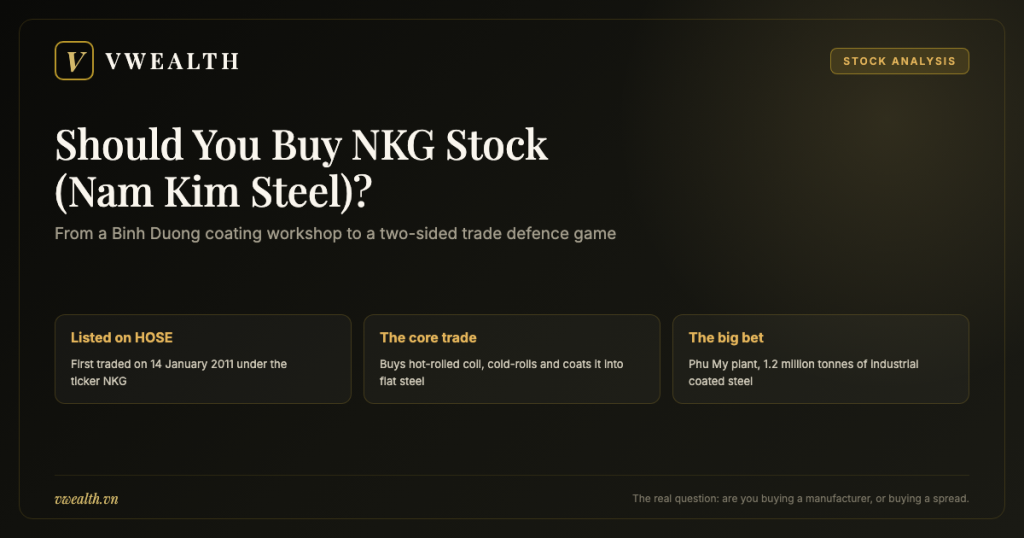
Should you buy NKG stock, the ticker of Nam Kim Steel Joint Stock Company on Vietnam’s Ho Chi Minh Stock Exchange? Most foreign investors approach this question the wrong way, because they file Nam Kim under the heading of a steel producer and then apply the analytical toolkit that belongs to an integrated steelmaker. Nam Kim does not make steel. It buys hot-rolled coil from someone else, cold-rolls it, coats it with zinc or an aluminium-zinc alloy or a layer of paint, and sells the result as roofing sheet and coated flat steel. Every dollar of profit the company earns lives inside the gap between what it pays for raw coil and what it charges for the finished sheet. That gap is thin, it moves week to week, and it is governed by two forces the company cannot control: the world price of hot-rolled coil, and the tariff walls that importing countries choose to build. This analysis walks from a small coating workshop founded in Binh Duong province in 2002, through a chain of plants that each roughly doubled capacity, to the Phu My plant now entering operation, and finally to the question that actually matters: when you buy NKG, are you buying a manufacturer or are you buying a spread?
Before we start, one convention between you and this article, the same convention every company analysis in this series follows. You will meet dates, names, plant capacities, administrative decision numbers and regulatory rulings. All of them come from public sources: disclosures filed with the exchange, decisions published by Vietnam’s Ministry of Industry and Trade, determinations published by foreign trade authorities, shareholder meeting resolutions and mainstream financial press. What you will not meet is a figure for last quarter’s earnings, today’s share price, or a current valuation multiple. For a business with a thin spread and a short cycle, a quarterly profit number detached from the raw material price of that same quarter tells you almost nothing. Instead this article teaches you where to look and how to read what you find; for the numbers themselves, open the latest research reports on vwealth.
A second convention matters especially for this ticker. Nam Kim sits on both sides of trade defence proceedings: it is a petitioner at home and a respondent abroad. This article describes the administrative decisions that have been formally published, explains the mechanism behind them, and draws out what that mechanism means for an investor. It does not attribute wrongdoing to any company, and it does not comment on whether a foreign authority’s determination was right or wrong. An anti-dumping margin is the output of an administrative procedure applying a specific calculation methodology; it is not a moral verdict on how a business is run. That is the standing rule of this series for every company we cover.
If you are new to this market, one more piece of scaffolding will help. Vietnamese equities trade on three venues: the Ho Chi Minh Stock Exchange, or HOSE, where NKG is listed and where the largest and most liquid companies sit; the Hanoi Stock Exchange; and UPCoM, a lighter-regulation board. Settlement runs on a T plus two basis, daily price movement on HOSE is capped at seven per cent either side of the reference price, and foreign ownership is capped by sector. A tour of those mechanics is available in the guide on how to invest in the Vietnam stock market, and the specifics of trading mechanics are set out in Vietnam stock trading rules.
From a coating workshop in Binh Duong to one of Vietnam’s largest coated steel producers
Here is something worth knowing about Vietnam’s coated steel industry: it barely existed before the year 2000. Roofing sheet used by Vietnamese households was mostly imported, or came from small workshops using crude coating methods that produced uneven, short-lived material. Nam Kim was founded exactly as demand from rural housing and industrial construction began to accelerate, and it was founded with an equipment choice that turned into a durable advantage.
December 2002: sixty billion dong and a non-oxidising furnace
Nam Kim Steel Joint Stock Company was established on 23 December 2002 with initial charter capital of sixty billion Vietnamese dong. By the standards of 2002 that was enough to build one coating line and a shed around it, and not much more.
What is interesting is not the size but the specification. Nam Kim installed a metal coating line using NOF technology, short for non-oxidising furnace. This technical detail deserves a paragraph, because it explains the company’s product positioning for the two decades that followed. In hot-dip galvanising, the base steel strip must be cleaned and heated before it enters the molten zinc bath. Older lines heat the strip in an oxygen-rich furnace, which oxidises the surface; the oxide layer then has to be chemically stripped, and any residue leaves the zinc coating uneven. A non-oxidising furnace burns in an oxygen-starved atmosphere, so the strip arrives at the zinc bath already clean. The coating adheres more uniformly, and, crucially, the line can run faster and handle thinner base steel.
The commercial consequence: Nam Kim could produce thin, flat, cosmetically clean sheet, which is to say material fit for commercial construction and for export, not merely for low-cost rural roofing. That is why, when export markets opened later in the decade, Nam Kim could serve them immediately while many domestic coating workshops could not.
The general lesson for reading any manufacturer: ask which generation of equipment the company bought. In materials processing, the vintage of the line determines the product range the company is allowed to aspire to, and the product range determines the margin. A company locked into the commodity tier by its own equipment can improve profitability by a few percentage points through better management, and no more than that.
14 January 2011: listing on HOSE
NKG shares were listed and began trading on the Ho Chi Minh Stock Exchange on 14 January 2011. The timing was not comfortable. Vietnam’s equity market was in a long post-crisis drawdown, domestic interest rates were extremely high, and the property sector was frozen.
A building materials company listing at the bottom of a construction cycle is a revealing paradox. It tells you the motive for listing was not to sell shares expensively but to open a channel for funding the capacity expansion already planned on paper. The company needed money to build plants, and Vietnamese bank credit in 2011 was expensive.
This pattern repeats through Nam Kim’s history, and you should file it as a character trait rather than an isolated event: this is a company that repeatedly uses the capital market to fund capacity growth. The upside is fast expansion. The downside is that existing shareholders face dilution on a recurring basis. If a steadily rising share count makes you uncomfortable, this is not your stock, and no amount of operational improvement will change that.
2010 to 2016: a chain of plants and a stepwise jump in capacity
Nam Kim Plant 1 broke ground in 2010 and started production in 2012, taking group capacity to roughly three hundred and fifty thousand tonnes per year. Plant 2 broke ground in 2014 and formally started production in 2016, lifting capacity to roughly six hundred and fifty thousand tonnes per year. A third plant followed, along with the Nam Kim Chu Lai steel pipe project in Quang Nam province in central Vietnam, designed for roughly one hundred and fifty thousand tonnes of pipe per year.
Look at that sequence and a strategy becomes obvious: every two to three years, add a plant, and roughly double capacity each time. This is a pure scale strategy. In a thin-spread processing industry, scale is a genuine weapon, because it lets you buy hot-rolled coil in larger lots on better terms, accept larger export orders, and spread fixed costs across more tonnes.
But scale in a cyclical industry cuts both ways, and Nam Kim has been cut by its own blade at least once. When capacity is large and the market contracts, fixed costs do not contract with it. Depreciation still runs, interest still accrues, skilled labour still has to be retained. That is why earnings in a business like this do not oscillate gently around a mean; they swing between extremes.
2019: selling assets, a decision the market usually misreads
In 2019 Nam Kim completed the transfer of Nam Kim Plant 1 in Binh Duong to another company, alongside divestments from several projects and production units. The stated purpose was to raise cash to reduce medium-term borrowings.
In most markets, news that a manufacturer is selling a plant reads as a negative, because it suggests contraction. In materials processing that reading skips a layer. Plant 1 was the first-generation facility: older equipment, a narrower product range, and a location that was no longer optimal for logistics. Selling a low-return asset to repay high-cost debt is simple arithmetic, and usually the right arithmetic.
The lesson: when a company sells assets, do not stop at how much. Ask what was sold, how much that asset contributed to profit before the sale, and what the proceeds were used for. Selling a weak asset to repay expensive debt is restructuring. Selling a strong asset to cover operating losses is a warning sign. On a newswire headline the two look identical.
2021 and 2022: the peak and the fall of a cyclical stock
The year 2021 was extraordinary for the global steel industry. Post-pandemic supply chain disruption, large stimulus programmes in Western economies, and a simultaneous surge in construction demand pushed hot-rolled coil prices to levels not previously seen. Vietnamese coated steel producers benefited twice over: selling prices rose, and inventory bought earlier at lower cost suddenly carried a far higher market value.
Then 2022 reversed. Global interest rates rose sharply to fight inflation, construction demand cooled, and hot-rolled coil prices fell hard. Any coated steel producer holding expensive inventory had to book write-downs, and those write-downs hit the income statement directly. The Vietnamese coated steel sector went through an exceptionally difficult year.
This is the single most important lesson Nam Kim’s history offers, and it applies to every coated steel name. A spread processor has a brutal property: when input prices rise, it earns twice, once from operations and once from inventory revaluation. When input prices fall, it loses twice, as the processing spread compresses and inventory is written down. That is why the earnings line for this group is not a trend but a sawtooth with very wide teeth.
2024 to 2026: a large bet on Phu My
In 2024 Nam Kim completed a rights offering of more than one hundred and thirty-one million shares to existing shareholders, raising more than one thousand five hundred billion dong, with the stated purpose of funding the Phu My project.
The Nam Kim Phu My coated sheet plant was first disclosed in April 2022, sited in the My Xuan B1 industrial park in the former Ba Ria – Vung Tau province, designed for one million two hundred thousand tonnes per year, with an initially announced total investment of roughly four thousand five hundred billion dong. Through successive adjustments the total investment was raised to roughly six thousand two hundred billion dong.
The line configuration reveals the strategic intent: one galvanising line of three hundred and fifty thousand tonnes, two aluminium-zinc alloy coating lines of three hundred thousand and one hundred and fifty thousand tonnes, and one colour-coating line of one hundred and fifty thousand tonnes. The product focus is not ordinary roofing sheet but high-specification coated steel for downstream industries with real value added: automotive, home appliances, industrial packaging, electric vehicle battery casings, and silicon steel for electric motors and transformers.
Pause on that application list, because it is the most important part of this chapter. If Phu My runs to design, Nam Kim stops being a company that sells roofing sheet. It becomes a company that sells input material into manufacturing supply chains, a market with stricter quality requirements, longer contract cycles, customers who find it harder to switch suppliers, and therefore steadier margins.
That is the core investment thesis for this ticker today, and it is also where the largest risk sits. A six thousand billion dong project at a company of Nam Kim’s size is a big bet. Management has indicated that the initial operating phase requires roughly two to three quarters to reach fifty to sixty per cent of capacity, with full utilisation expected thereafter. Treat that as a milestone to monitor rather than a guaranteed outcome; in materials manufacturing, the distance between design specification and stable commercial output is usually measured in years.
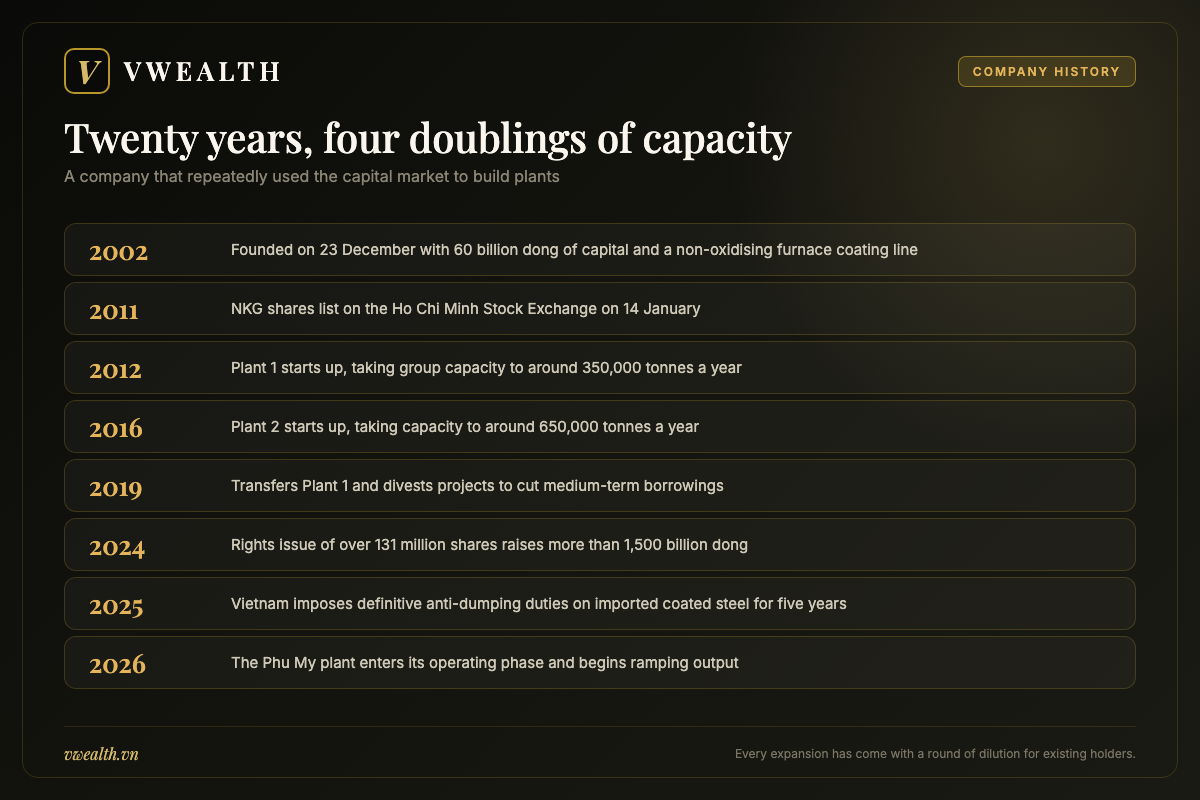
| Date | Event | What it means for an investor |
|---|---|---|
| 23 Dec 2002 | Founded with charter capital of 60 billion dong, installs a non-oxidising furnace coating line | An early equipment choice that opened the higher product tier |
| 14 Jan 2011 | NKG shares list on HOSE | Opens a funding channel for the capacity expansion cycle |
| 2012 | Plant 1 starts up, group capacity around 350,000 tonnes per year | Moves beyond workshop scale |
| 2016 | Plant 2 starts up, capacity around 650,000 tonnes per year | Reaches the scale required to compete in export markets |
| 2019 | Transfers Plant 1, divests from several projects | Restructuring to cut medium-term borrowings |
| 2024 | Rights issue of over 131 million shares raising over 1,500 billion dong | Shareholders accept dilution to fund Phu My |
| 14 Aug 2025 | Decision 2310/QD-BCT imposes definitive anti-dumping duties on coated steel from China and Korea | A five-year protective wall around the domestic market |
| 26 Aug 2025 | The United States issues final determinations on corrosion-resistant steel from Vietnam | The US market effectively closes to Vietnamese coated steel |
| 2026 | Phu My plant enters its operating phase | The pivot from roofing sheet toward industrial coated steel |
Leadership and ownership: a family-founded company that has just completed a succession
There is a category of risk that investors in Asian family-controlled listed companies routinely underweight: founder risk. A business tied to one individual runs smoothly right up until the day that individual leaves the chair. Nam Kim has just passed through such a transition, and the way it was handled says a good deal about governance quality.
Ho Minh Quang: the successor, not the founder
There is a detail in the leadership story that outsiders often miss. The man at the top of Nam Kim today did not create it. Mr Ho Minh Quang is the son-in-law of Mr Tran Xao Co, the original founder. Mr Quang contributed additional capital to the company and took over as chairman and general director in 2009, seven years after the company was formed and two years before the shares listed.
This matters for two reasons. First, the period of real growth at Nam Kim, from a small coating workshop to one of Vietnam’s leading coated steel groups, took place under Mr Quang rather than under the founder. Second, the company has already executed one transfer of control, and that transfer was not accompanied by any publicly recorded dispute.
Mr Ho Minh Quang currently serves as chairman of the board and is the largest individual shareholder, holding tens of millions of shares. His percentage stake shifts with each issuance, so you should read the latest disclosure rather than trusting any fixed figure, including one printed in an article.
April 2026: a new chief executive and a separation of roles
On 15 April 2026, Nam Kim carried out its most significant senior personnel change in years. Mr Vo Hoang Vu stepped down as general director and legal representative, and was simultaneously elected standing vice chairman of the board for the 2025 to 2030 term. Mr Nguyen Vinh An, previously deputy general director and an executive board member, was appointed general director for the 2026 to 2031 term.
Read the structure of that transition carefully, because it differs from the abrupt leadership changes that Vietnamese small and mid caps often produce. The outgoing chief executive did not leave the company; he moved up to the board. The incoming chief executive came from inside the executive team, not from outside. And the handover was timed to coincide with the Phu My project entering operation.
Under the governance scoring framework this series uses, a succession with a defined path, internal continuity and retention of the predecessor scores materially higher than an abrupt replacement. It does not guarantee results, but it reduces the risk of operational discontinuity at exactly the moment a company can least afford it. Broader context on how governance works in Vietnamese listed companies is covered in Vietnam corporate governance.
Insider buying: how to weigh the signal properly
Between 27 July and 13 August 2026, Mr Nguyen Vinh An, board member and general director, bought one million NKG shares. His holding rose from roughly six hundred and nine thousand shares to roughly one million six hundred thousand, or about zero point three three per cent of charter capital.
Insider transactions are among the most over-interpreted signals in the Vietnamese market, so it is worth placing this one precisely. Here is why the signal has value: an executive knows the order book, the commissioning progress of a new plant and the cost structure several months before the market does. And here is its limit: one million shares, a third of one per cent of capital, is small relative to shares outstanding, and an individual can buy for several reasons including a deliberate demonstration of commitment.
The correct reading is to treat executive buying as one additional piece of evidence with a positive but small weight, meaningful only when placed alongside other evidence. If an executive buys while the flagship project shows genuine operational progress, the two pieces reinforce each other. If an executive buys while every operating metric deteriorates, that single piece carries no real weight.
The shareholder register: dispersed, and becoming more so
Nam Kim has a relatively dispersed shareholder base compared with many peers. In a stock dividend completed on 18 June, the company issued nearly forty-four million eight hundred thousand shares to approximately forty-four thousand nine hundred and eighty-seven shareholders, lifting charter capital from nearly four thousand four hundred and seventy-six billion dong to more than four thousand nine hundred and twenty-three billion dong.
Nearly forty-five thousand shareholders is a figure worth sitting with. It tells you NKG has a very broad retail investor base. That produces good liquidity, which means a foreign investor can build or exit a position of meaningful size without moving the price much. It also produces high volatility, because retail investors react quickly and in the same direction to the same news.
On dividends, foreign investors need to understand one point about the form of payment. A stock dividend puts no cash in your pocket; it divides the same pie into more slices and the reference price is adjusted accordingly. For a company that needs capital for a major project, retaining cash and paying in shares is a financially sensible choice. But if you own equities for a recurring cash yield, be clear about this: NKG does not serve that objective. Names better suited to it are discussed in Vietnam dividend stocks.
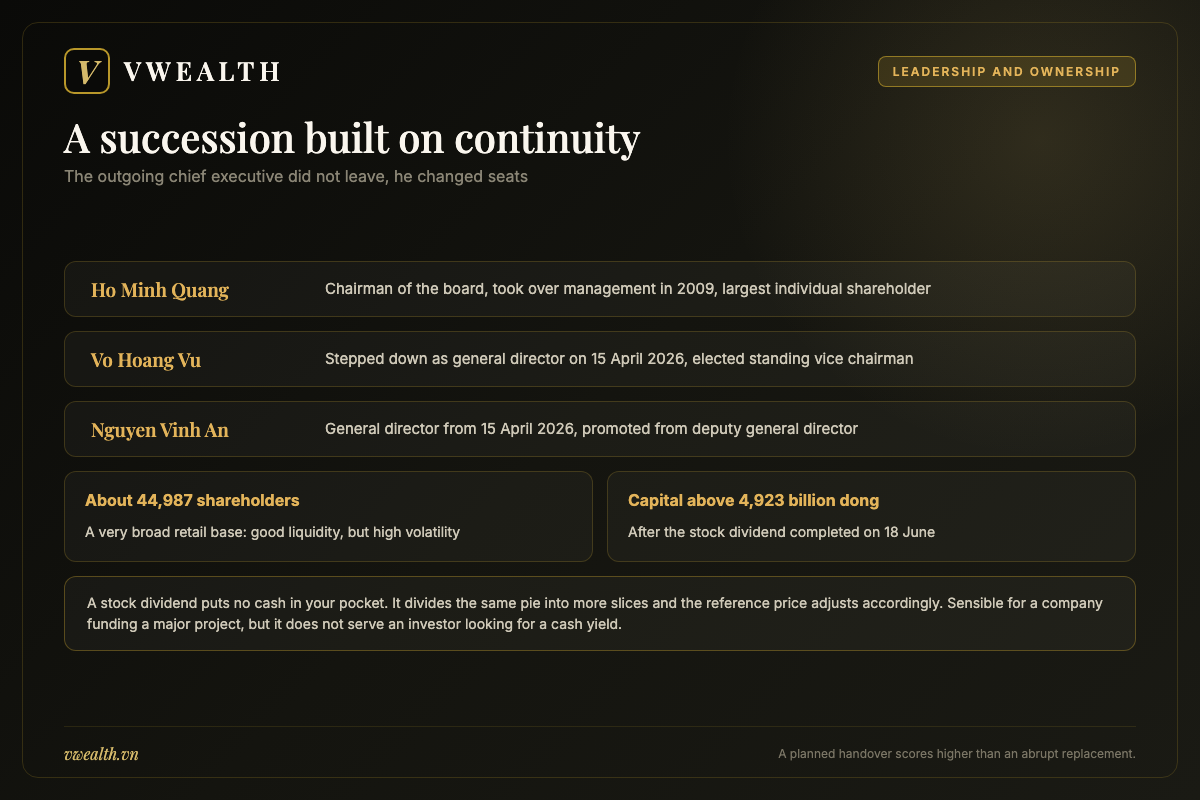
| Item | Disclosed status | What to keep monitoring |
|---|---|---|
| Chairman of the board | Mr Ho Minh Quang, took over management in 2009 | Changes in his stake through successive issuances |
| Standing vice chairman | Mr Vo Hoang Vu, moved from the chief executive role on 15 April 2026 | His practical role in overseeing the Phu My ramp |
| General director | Mr Nguyen Vinh An, appointed 15 April 2026 for the 2026-2031 term | Operating results in the first two years of the term |
| Shareholder count | Approximately 44,987 holders at the stock dividend | Dispersion drives both liquidity and volatility |
| Charter capital | Over 4,923 billion dong after the stock dividend | Any further issuance plans for future projects |
| Dividend policy | Stock dividends favoured during the heavy investment phase | When cash dividends resume |
How Nam Kim makes money: the anatomy of a spread processor
If you read only one chapter of this analysis, read this one. Every valuation judgement, every risk assessment, and the entire answer to whether you should buy NKG stock flows from getting this chapter right.
The steel value chain and where Nam Kim sits in it
Steel has several tiers, and each tier is a different business in economic terms. Upstream is steelmaking: iron ore or scrap goes into a blast furnace or an electric arc furnace and comes out as semi-finished steel. The middle tier is rolling: semi-finished steel is hot-rolled into coil, universally abbreviated as HRC. Downstream is processing: HRC is cold-rolled, then galvanised, alloy-coated or colour-coated, then slit into sheet and coil, or formed and welded into pipe.
Nam Kim sits downstream. It does not smelt and it does not hot-roll. It buys HRC, domestically or imported, and performs the cold rolling and coating steps.
The economic consequence of that position is more severe than it first appears. The cost of HRC dominates the cost of a coated steel product, typically in the region of seventy to eighty per cent depending on grade and on the moment in the price cycle. Which means that when you buy shares in a coated steel producer, you are buying a company whose cost structure sits mostly outside its own control.
A comparison with an integrated producer such as Hoa Phat makes the point concrete. The analysis of HPG stock describes the opposite exposure: an integrated producer smelts its own steel and rolls its own coil, so a rising HRC price lifts its revenue. For a coater, a rising HRC price is a rising input cost. Two companies that both sit in the sector index labelled steel respond in opposite directions to the same variable. This is the most common analytical error investors make with this group, and it costs real money.
Segment one: coated steel, the revenue backbone
Coated flat steel is the core segment and the largest revenue source. The range splits into three families. Galvanised sheet is the base product, zinc-coated for corrosion resistance, used widely in residential construction and light structures. Aluminium-zinc alloy coated sheet carries a combined coating that resists corrosion far better in coastal and hot-humid conditions, and sells at a premium. Colour-coated sheet adds a paint layer for applications demanding appearance and longer service life, and carries the best margin of the three.
When you read the accounts of a coated steel producer, the mix across those three families tells you more than total volume. A company selling one million tonnes of low-grade galvanised sheet can earn less than a company selling six hundred thousand tonnes with a heavy weighting toward colour coating. Volume is a marketing metric; mix is a financial one.
Distribution splits in two. The domestic channel runs through dealers and distributors serving Vietnamese residential and industrial construction. Cash converts quickly, but price competition is brutal because the base product is close to a commodity. The export channel reaches many destination markets with larger order sizes, but carries tariff risk and currency risk. Foreign investors should read Vietnam dong currency risk for how the exchange rate interacts with an exporter’s reported earnings and with your own returns in your home currency.
Segment two: steel pipe and other processed products
Alongside coated sheet, Nam Kim produces steel pipe and steel coil. Pipe is made by forming and welding flat steel into round or square section, used in structural construction, scaffolding, metal furniture and technical infrastructure. The Nam Kim Chu Lai pipe plant in Quang Nam, designed for roughly one hundred and fifty thousand tonnes per year, extended this segment into central Vietnam.
Three characteristics of the pipe segment are worth holding on to. First, margins are typically thinner than colour-coated sheet because the technical barrier is lower. Second, it tracks domestic construction demand and therefore carries less tariff exposure. Third, it shares raw material with the coating segment, which creates procurement scale and warehouse efficiency.
Put plainly: pipe is not the segment that makes the company rich, it is the segment that keeps the company full. It absorbs capacity, holds dealer relationships together, and reduces dependence on a single product line.
Segment three, still forming: coated steel for manufacturing
This segment has no operating history to judge, and yet it determines the investment case for NKG over the next five years. The Phu My plant is designed to produce high-specification coated steel for automotive, home appliances, industrial packaging, electric vehicle battery casings, and silicon steel for electric motors and transformers.
Why is this a different business rather than a bigger version of the same one? Three reasons.
The first is the quality barrier. A roofing sheet a few per cent out of tolerance bothers nobody. A coated sheet feeding an automotive body-stamping line or an EV battery casing line that is out of tolerance gets the entire lot rejected. Requirements for coating uniformity, flatness, mechanical properties and batch-to-batch consistency step up sharply.
The second is switching cost. Industrial customers must qualify the material, run trials on their own lines, adjust tooling, and in many sectors obtain approval from their own end customer. That process takes many months and costs money. Once a supplier is inside the chain, its position is far more durable than that of a company selling sheet through a dealer network.
The third is a different cyclical driver. Roofing demand follows the construction cycle. Coated steel for appliances and electrical equipment follows the consumption cycle and the power sector investment cycle. Those cycles are not in phase, which flattens the earnings line.
Silicon steel deserves separate mention as the most technically demanding item in the list. It is a specialised electrical steel used as the magnetic core in motors and transformers, requiring tight control of alloy composition and grain structure. Demand is tied to grid investment and to electric vehicle adoption, both of which are structural growth stories in Southeast Asia. If Nam Kim reaches commercial-scale output in this product, that is a genuine step change in positioning. But wait for operating evidence rather than buying the announcement.
Where is the moat, and how wide is it
Be honest about this question, because the answer sets the multiple you should be willing to pay.
Nam Kim has three real advantages. Capacity scale among the leaders of Vietnam’s coated steel sector, large enough to negotiate HRC procurement terms and to accept large export orders. A domestic distribution network built over two decades with broad dealer coverage. And accumulated process capability across several generations of coating lines, visible in the breadth of grades it can run.
All three can be replicated with capital. A well-funded competitor can build an equivalent coating plant in two to three years. Coated steel has no patent protection, no network effects, and no meaningful switching cost in the commodity tier. The barrier to entry is money, and money always finds its way into an industry earning attractive returns.
That is why this industry recurrently slips into oversupply, and why margins never stay high for long. The practical conclusion: do not pay the multiple of a company with a durable competitive advantage for a large-scale processor. Pay the multiple of a cyclical, and look for an entry in the lower half of the cycle.
Phu My is the attempt to escape that trap. If it succeeds, the switching costs of the industrial tier create a protective layer the roofing tier never had. That is precisely why the project deserves more of your attention than any other piece of news about this ticker. For the wider sector map, see Vietnam steel and industrial stocks.
The working capital cycle, and why it dictates the balance sheet
One more piece of the operating model deserves its own section, because it explains a balance sheet that otherwise looks alarming to an investor used to asset-light businesses.
A coating plant runs on a physical cycle that ties up cash at every step. Hot-rolled coil is bought in large lots, often with sea freight and customs clearance in front of it, so cash leaves the company weeks before the material reaches the line. The coil then sits in the yard, moves through pickling, cold rolling, coating and slitting, and emerges as finished sheet that waits for a truck. Dealers in the domestic channel expect credit terms. Export customers pay against documents on a schedule set by the shipping cycle.
Add those steps up and you get a cash conversion cycle measured in months rather than weeks. That is why a coated steel producer carries inventory and receivables that look heavy relative to revenue, and why it borrows short-term money to carry them. It is not a symptom of poor discipline; it is the shape of the industry.
What you should watch is not the absolute level but the direction and the composition. If inventory days are rising while sales volumes are flat, the company is accumulating material it is not moving, which sets up a write-down if prices fall. If receivable days are stretching, dealers are being financed more generously, which usually happens when demand is soft and the company is defending volume. And if short-term borrowings grow materially faster than inventory plus receivables combined, the extra money is going somewhere other than working capital, which is worth understanding before you own the shares.
There is also a seasonal pattern to allow for. Construction activity in Vietnam is affected by the rainy season in the south and by the extended Lunar New Year shutdown, so both volumes and working capital have a recurring rhythm through the year. Comparing one quarter against the immediately preceding quarter, rather than against the same quarter a year earlier, is a common way to reach a wrong conclusion about this sector.
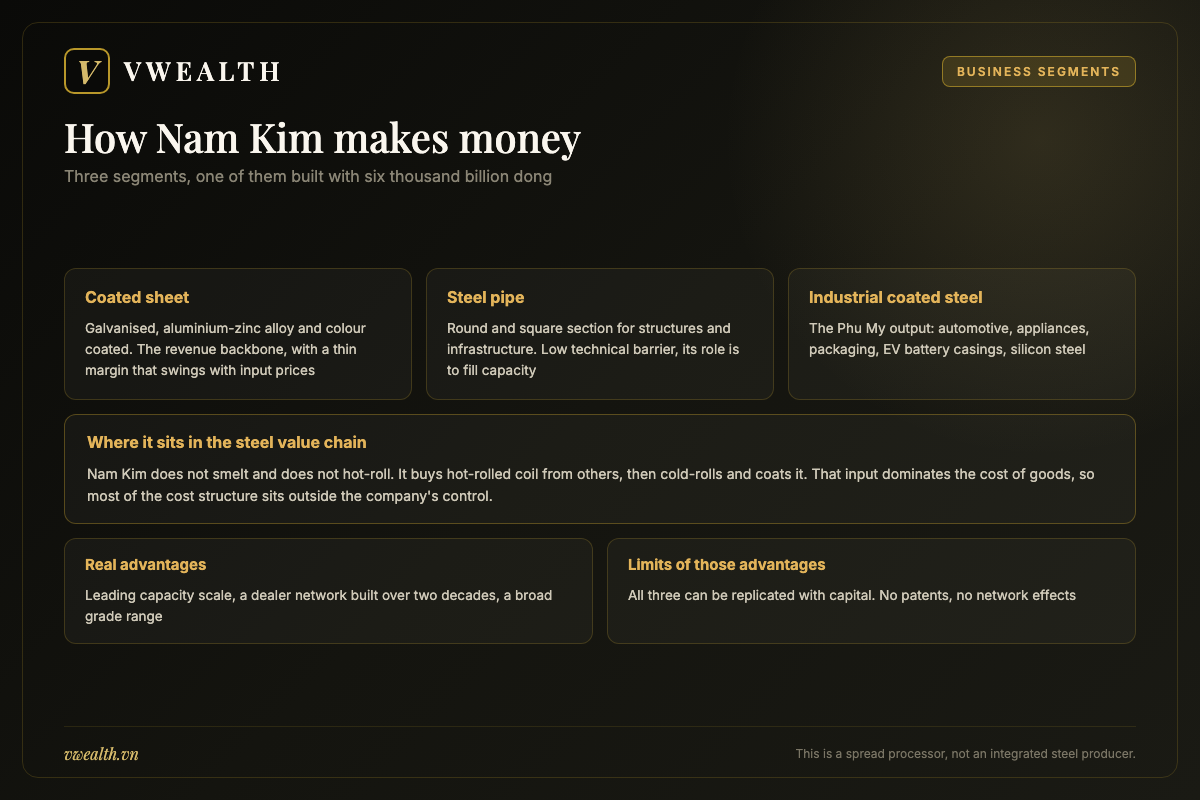
| Criterion | Coated sheet | Steel pipe | Industrial coated steel (Phu My) |
|---|---|---|---|
| Role | Revenue backbone | Capacity filler, dealer retention | Future growth engine |
| Technical barrier | Moderate, higher in colour coating | Low | High |
| Margin | Thin, swings with HRC prices | Thinnest | Expected steadier, evidence pending |
| Tariff exposure | High in the export channel | Low, mostly domestic | Depends on destination market |
| Governing cycle | Construction cycle | Construction cycle | Consumption and grid investment cycles |
| Customer switching cost | Near zero in the commodity tier | Near zero | High, requires qualification and trials |
Market position and financial health: reading the numbers of a thin-spread business
This chapter does not hand you last quarter’s figures. It hands you a reading method, so that whenever you open the statements you know where to look first. If you have not worked with Vietnamese filings before, the guide to Vietnamese financial statements under VAS and IFRS explains the presentation differences that trip up international readers.
Position in the industry: among the leaders, but not the price setter
Vietnam’s coated steel market is fairly concentrated at the top. The leading group includes Hoa Sen, Nam Kim, Ton Dong A, together with foreign-invested producers and the coated steel arms of the large steel groups. Below them sit dozens of small coating workshops serving local markets.
Nam Kim ranks among the leaders on capacity and output. But leading on scale is not the same as leading on price. In this industry, the price setter is whoever has the lowest cost position or the strongest consumer-facing brand. The analysis of HSG stock describes a different model inside the same industry: a company that built a direct retail distribution system reaching the end user, an expensive structure that nevertheless preserves better margins in the domestic channel.
Nam Kim went the other way: weighted toward manufacturing and wholesale, light on retail infrastructure. The advantage is lower selling costs and faster asset turnover. The disadvantage is weaker pricing power and heavier dependence on filling capacity.
Metric one: gross margin and the story behind it
For a coated steel producer, gross margin is the single most important line, and it is also the most misread.
Gross margin in this group swings across a wide band from year to year. What you need is not the number for one quarter but an understanding of the three forces that move it.
The first force is the lag between input purchase and output sale. The company buys HRC today and sells finished product weeks to months later. If HRC rises over that interval, the cost of goods on that lot sits below the prevailing market, and gross margin expands. If HRC falls, gross margin compresses. This is mechanical; it says nothing about management quality.
The second force is product mix. A rising share of colour-coated and other higher-value grades improves gross margin even with a flat HRC price.
The third force is capacity utilisation. Depreciation and plant fixed costs are absorbed per tonne produced. Running at eighty per cent utilisation loads each tonne with less fixed cost than running at fifty.
Those three forces explain why a blockbuster quarter at a coated steel producer may say nothing about business quality. Separate them before drawing a conclusion.
Metric two: inventory and the write-down line
This is where many investors in steel names have been buried, and it deserves a careful explanation.
A coated steel producer must carry large inventory: HRC bought in lots, work in progress sitting on the line, finished goods awaiting delivery. Under accounting rules, inventory is carried at the lower of cost and net realisable value. So when the market price of steel falls below the carrying cost of the material in the warehouse, the company must book a provision, and that provision runs straight through the income statement as an expense.
The consequence: in a quarter when steel prices fall sharply, the company can report a loss even though sales operations were entirely normal. Conversely, in a quarter when steel prices recover, previously booked provisions can be reversed, producing an earnings spike that did not come from trading the business better.
So when you see a coated steel producer report a large jump in profit, the first thing to do is open the notes to the financial statements and find the line for reversal of inventory write-downs. If most of the increase came from there, that is accounting profit rather than operating profit. The article on reading Vietnamese company financials in English shows where these notes sit in a typical filing.
Metric three: leverage and debt maturity structure
Coated steel producers use substantial short-term borrowing to fund working capital, which is the nature of buying raw material in large lots. Short-term debt funding working capital is not a warning sign; it is the right instrument for the right purpose.
The problem arises when a company funds long-lived assets with short-dated money, using twelve-month facilities to build a plant depreciated over twenty years. Maturity mismatch is the most common reason manufacturers get into difficulty when credit conditions tighten.
For Nam Kim during the Phu My phase, this is where you should look hardest. Open the balance sheet and answer three questions: where is the ratio of borrowings to equity relative to this same company three years ago; has the share of long-term debt in total borrowings risen in step with capital disbursed on the plant; and what proportion of operating profit is consumed by interest expense.
Metric four: multi-year cumulative operating cash flow
For a cyclical, a single year of cash flow is meaningless. In a year when steel prices rise, the company must spend cash building inventory, so operating cash flow can be negative despite strong reported profit. In a year when prices fall, the company liquidates inventory and operating cash flow can be positive despite a reported loss.
The correct method is to sum operating cash flow across a full cycle, typically four to six years, and compare that total with cumulative net profit over the same span. If the two are close, earnings quality is good. If cumulative cash flow lags cumulative profit substantially, profit is sitting in receivables or inventory rather than in the bank.
Metric five: export share and market concentration
This metric is mandatory for Vietnamese coated steel, because it links directly to the tariff risk discussed in chapter six.
You need the share of export revenue in total revenue, and within exports, the weight of each major destination. A company with sixty per cent export revenue and half of that going to a single destination carries severe concentration risk: one administrative decision in that jurisdiction can erase a third of revenue.
A company with dispersed destinations, none dominant, is far more resilient. Update this figure annually, because the destination mix at Vietnamese coated steel producers has changed dramatically in recent years under trade defence pressure.
Metrics six and seven: project progress and disclosure quality
For a company in a heavy investment phase, project progress is a financial metric, not an operational news item. Every quarter of delay is another quarter of capitalised interest and another quarter of expected revenue pushed back.
The last metric is hard to quantify and worth a great deal: disclosure quality. Does the company publish monthly or quarterly volumes? Can you separate revenue by segment and by destination market? Does it explain deviations from plan? A transparent company lets you decide earlier; an opaque one forces you to guess, and guessing costs money.
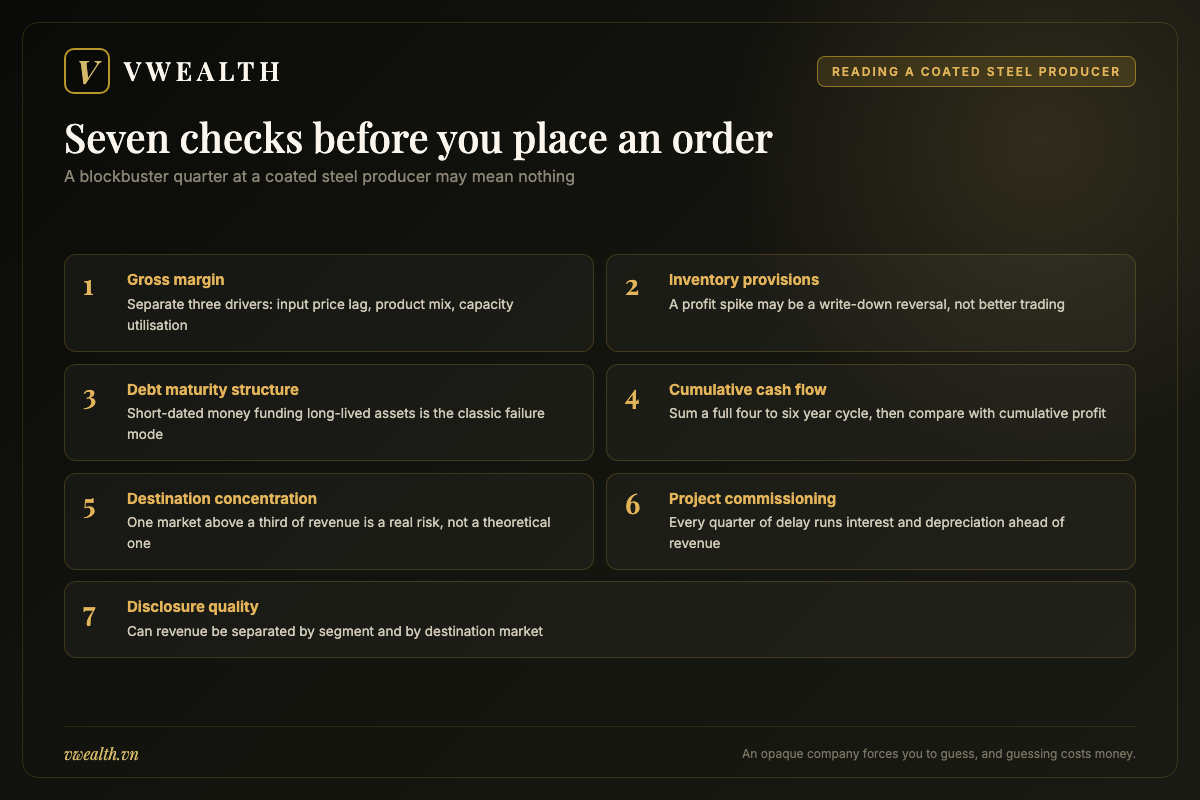
| # | Metric | Where to find it | Red flag |
|---|---|---|---|
| 1 | Gross margin and its three drivers | Income statement, cross-checked against HRC prices for the period | Margin expands while HRC falls, without another explanation |
| 2 | Inventory provisions and reversals | Notes to the financial statements | Most of the profit increase comes from reversals |
| 3 | Borrowings and maturity structure | Balance sheet | Short-dated debt funding long-lived assets |
| 4 | Cumulative operating cash flow over 4-6 years | Multi-period cash flow statements | Well below cumulative net profit |
| 5 | Export share and destination concentration | Revenue notes by geography | One destination above a third of revenue |
| 6 | Capex disbursement and commissioning progress | Periodic disclosures and board resolutions | Repeated delays without explanation |
| 7 | Disclosure quality | The full year of filings | Revenue cannot be separated by segment |
How the market treats NKG stock: portrait of a classic cyclical
Every stock has a personality, formed by its shareholder register, its industry, and the market’s collective memory of it. NKG’s personality is unusually legible, and if it does not suit you, no amount of fundamental analysis will make the position comfortable to hold.
Character: wide swings, fast reactions, driven by sector news
NKG belongs to the higher-volatility tier of the Vietnamese market. Three factors combine to produce that.
First, the underlying earnings themselves swing violently, for the reasons set out in chapters three and four. A company whose profit can travel from a strong surplus to a loss within four quarters cannot have a stable share price.
Second, the shareholder base is broad and heavily retail. With nearly forty-five thousand holders, this is a widely watched ticker, and a large share of those holders react to the same headline in the same direction at the same time.
Third, steel is a news-dense sector. World HRC prices update weekly, trade defence decisions appear several times a year, and infrastructure and property policy shifts constantly. More news means more reasons to trade.
The result is that NKG regularly sits among the higher-turnover names on HOSE. High liquidity is a genuine advantage for a foreign investor: you can enter and exit in size without moving the price. But high liquidity combined with wide swings also makes the ticker a favourite of short-term traders, which amplifies the volatility further.
One practical mechanic to keep in mind: HOSE applies a daily price band of seven per cent either side of the reference price. In a sharp sector-wide move, a cyclical name like this can trade at the band limit for consecutive sessions, which means the price you see is not always a price at which you can transact. Position sizing should assume that exiting during a violent move may take several days.
Valuation: why the P/E of a cyclical reads backwards
This is the most important technical point in the chapter, and the trap that catches most newcomers to the sector.
For a company with stable earnings, a low price to earnings ratio means cheap. For a cyclical such as a coated steel producer, that rule inverts. The reason is in the denominator. At the top of the cycle, steel prices are high, the spread is wide, and earnings hit a record. The large denominator makes the P/E look very low, and that is precisely when the shares are most expensive, because that level of earnings will not repeat. At the bottom of the cycle, earnings collapse toward zero or turn negative, the P/E spikes or becomes meaningless, and that is often when the shares are cheapest.
Three workable alternatives for NKG.
The first is mid-cycle earnings. Take average net profit across a full cycle, typically four to six years including both good years and bad, and compute the multiple on that average. This gives you a far steadier anchor than trailing twelve-month earnings.
The second is price to book combined with mid-cycle return on equity. Book value at a manufacturer is relatively stable because most assets are plant and inventory. Compare the current price to book against the company’s own historical range, and sanity-check it against the mid-cycle return on equity: a business that earns a mid-teens return through the cycle deserves a different multiple of book from one that earns single digits.
The third is valuation per tonne of capacity. Divide enterprise value by total designed capacity to get a figure per tonne, then compare across peers and against the cost of building an equivalent new plant. This approach is particularly useful for a company that has just completed a large investment but has not yet booked the corresponding revenue, because it looks at productive capability rather than at past results. A broader framework for judging where the market as a whole stands is set out in Vietnam stock market valuation.
Dividends and capital allocation priorities
During the heavy investment phase, Nam Kim has prioritised retaining resources and paying dividends in stock, as with the issue of nearly forty-four million eight hundred thousand shares noted in chapter two.
Judge that choice with the right question: what is the company doing with the retained cash, and is the expected return on that use higher than the return you could earn on the dividend yourself? If retained cash funds a plant that opens a higher-margin tier, retention is correct. If retained cash merely plugs weak operating cash flow, retention is a warning.
Foreign ownership and the foreign investor’s mechanics
NKG is open to foreign investors and does not sit in one of the sectors subject to a low statutory foreign ownership cap, unlike banking. The mechanics of these caps, and how to check the remaining headroom on any ticker, are explained in foreign room in Vietnam stocks.
For the steel group generally, foreign flows tend to be cyclical and driven by a view on global commodity prices rather than by any company-specific story. So do not read foreign buying or selling in this name as a verdict on business quality; read it as an indicator of appetite for the steel sector as a whole. A picture of who the institutional holders of Vietnamese equities actually are is given in what foreign funds hold in Vietnam.
There is also a market-structure angle specific to the current moment. Vietnam’s progression through the index provider classification process has been a persistent theme for foreign flows, and index-driven money tends to concentrate in the largest and most liquid names first. A mid-cap cyclical is a second-order beneficiary at best. That context is covered in the Vietnam market upgrade process.
The catalysts the market actually reacts to
With NKG, four categories of event reliably move the price. The first is movement in world hot-rolled coil prices, particularly sustained multi-week trends. The second is trade defence decisions, both domestic and foreign. The third is news on Phu My commissioning and output. The fourth is macro policy affecting construction: public investment disbursement, property credit, and interest rates.
The discipline that matters is separating catalysts with lasting effects from those that only create a short wave. An anti-dumping order with a five-year term changes market structure; one week of rising HRC prices does not. A long-term investor should respond to the first category and ignore the second.
What past drawdowns teach about position sizing
A final point on market behaviour, aimed at the practical question of how much of a portfolio this name should occupy.
Cyclical industrial stocks in emerging markets share a pattern: the drawdown from a cycle peak to a cycle trough is far larger than the drawdown of the broad index over the same period, and the recovery is far faster once the cycle turns. That asymmetry is not a flaw to be engineered away; it is the source of the return. But it has two implications that investors routinely ignore.
The first is that the position size has to be set so that a deep drawdown does not force you to sell. Anyone who sizes a cyclical position as though it were a staple will eventually be forced out at the bottom by their own discomfort, converting a temporary mark-to-market loss into a permanent one.
The second is that averaging into weakness only works if the thesis is about the cycle rather than about the company. If the share price is falling because steel prices are falling, adding on weakness is consistent with the thesis. If the share price is falling because the flagship project has slipped by a year and the balance sheet is deteriorating, adding on weakness is simply increasing exposure to a thesis that has broken. The discipline lies in writing down, in advance, which pieces of evidence would tell you which of those two situations you are in.
For NKG specifically, the evidence list is short and concrete: quarterly output from the new plant, the direction of gross margin excluding provision reversals, the trend in short-term borrowings, and the domestic share of revenue. If those four are intact, price weakness is cyclical. If two or more are deteriorating together, it is not.
Industry context: coil prices, trade walls, and a two-sided defence game
No sector on the Vietnamese exchange requires as much policy literacy as coated steel. This chapter works through three layers of context, from the outside in.
Layer one: hot-rolled coil prices and global oversupply
HRC is Nam Kim’s dominant input, and its price is set globally, not in Vietnam. Three forces drive it.
The first is Chinese production and demand, since China produces the majority of the world’s steel. When Chinese property demand is weak, surplus domestic steel is pushed into export markets, dragging regional prices down. The second is raw material cost, principally iron ore and coking coal. The third is environmental and energy policy in major producing countries, because these shape the operating cost of blast furnaces.
For a coating company, the direction of HRC prices produces two opposing effects that you must separate. Falling HRC reduces input cost, which is good for the processing spread over the long run. But falling HRC also drags down finished product prices and generates inventory losses in the short run. That is why coated steel producers prefer a stable, moderate HRC price level over a cheap one.
There is a second-order effect worth naming. Vietnam has been building domestic HRC capacity, which over time reduces the sector’s reliance on imported coil. For a coater, a deeper domestic coil market shortens the procurement lead time and reduces the exposure to freight and currency on the input side. It also, however, ties the coater’s input cost more closely to the pricing decisions of a small number of domestic suppliers.
Layer two: the trade walls built around Vietnam
This is the largest structural change the Vietnamese coated steel sector has faced in recent years, and it needs to be stated precisely.
On 26 August 2025, the United States Department of Commerce issued final determinations in the anti-dumping and countervailing duty investigations covering corrosion-resistant steel products from Vietnam and several other countries. Anti-dumping rates determined for Vietnamese producers ranged from roughly eighty-seven point zero seven per cent to roughly one hundred and sixty-two point nine six per cent; countervailing rates spanned a very wide band, from negligible to above two hundred per cent depending on the company and the programmes examined. Within that final determination, the anti-dumping margin assigned to Nam Kim Steel was ninety-four point eight nine per cent.
One clarification prevents a serious misreading. A triple-digit duty sounds catastrophic, but the practical impact depends entirely on whether the company still sells into that market. According to disclosures reported in the financial press, Nam Kim had stopped selling into the United States market from the fourth quarter of 2024, before the final determination was issued. Other large Vietnamese coated steel producers made similar pivots: one peer announced a strategic focus on the domestic market, another set a target of lifting domestic revenue above seventy-five per cent of the total.
This is the important lesson about reading trade defence news. Markets react to the percentage, while the number that actually matters is the share of revenue coming from the affected market at the moment the measure takes effect. A one hundred per cent duty on a market representing two per cent of revenue is far smaller than a twenty per cent duty on a market representing forty per cent of revenue.
On the European side the picture is also shifting. On 26 September 2025 the European Commission imposed anti-dumping duties on hot-rolled flat steel from Egypt, Japan and Vietnam, with the rate for Vietnamese-origin material at roughly twelve point one per cent, with an exemption for one producer. On 18 September 2025 the Commission initiated an anti-dumping investigation into cold-rolled steel coil from a group of countries including Vietnam; the product scope of that case excludes stainless, coated and colour-coated steel.
More consequential for the medium term is the change to the safeguard regime. The new European Union regulation in force from 1 July 2026 does not extend the previous safeguard but replaces it with a permanent framework intended to run to 2031, with tighter quotas and a higher out-of-quota tariff. One technical feature has direct implications for Vietnam: a melt and pour rule, which attributes origin to the country where the steel was actually melted rather than to the country where the final processing occurred. For countries that process steel from imported substrate, Vietnam among them, that rule can shrink the quota available.
What this means for an investor: the barrier facing Vietnamese steel in Europe is moving from temporary to permanent, and from targeting pricing behaviour to targeting supply chain structure. That is the kind of change a company cannot solve by cutting its selling price. It has to be solved by changing markets or by changing where the substrate is melted.
There is a broader theme underneath all of this that foreign investors following the region will recognise. Vietnam has been one of the main beneficiaries of manufacturing relocation out of China, a shift discussed in China plus one and Vietnamese stocks. The trade defence response now emerging in developed markets is, in part, a response to that shift. Sectors where Vietnamese output is close to a commodity and where the substrate is imported are the most exposed; sectors where Vietnam adds genuine transformation are less so. Coated steel currently sits closer to the first description, and Phu My is an attempt to move it toward the second.
Layer three: the wall Vietnam built for itself
The story has a second half that many observers miss: Nam Kim is not only a respondent abroad, it is a petitioner at home.
On 14 June 2024, Vietnam’s Ministry of Industry and Trade issued a decision initiating an anti-dumping investigation into certain coated steel products originating from China and Korea, case reference AD19. The petitioners were five domestic producers, including Hoa Sen, Nam Kim, Ton Phuong Nam, Ton Dong A and a steel joint venture operating in Vietnam.
On 14 August 2025, the Ministry issued Decision 2310/QD-BCT imposing definitive anti-dumping duties on products within the scope of the case, with a maximum rate of roughly thirty-seven point one three per cent on Chinese-origin goods and roughly fifteen point six seven per cent on Korean-origin goods, applicable for five years.
For Nam Kim this is the most important protective layer currently in place. The Vietnamese domestic coated steel market spent years under pressure from low-priced imports; a wall with a five-year term creates a window long enough for domestic producers to fill capacity and repair margins in the home channel.
But look at the other side of the medal. First, trade remedies expire; after five years they must be reviewed, and the outcome of a review is not guaranteed. Second, a well-built protective wall attracts new investment into the very industry it protects, and that new capacity eventually recreates domestic oversupply. Third, the benefit is shared across every producer in the industry, so it lifts the sector baseline rather than conferring an advantage on any single ticker.
Putting the three layers together, Nam Kim’s strategic picture is clear. The export door into developed markets is narrowing materially, while the domestic door is better protected than it has been in years. That is why the pivot toward the home market and toward industrial-grade coated steel is not a discretionary choice; it is a forced adjustment. Investors weighing the country-level risks of this market more broadly will find them collected in the risks of investing in Vietnam.
Layer four: domestic demand, the variable that decides everything else
Trade policy sets the boundaries of the game, but domestic demand determines how much of the capacity behind those boundaries actually gets used. Three components of Vietnamese demand matter for coated steel.
The first is residential construction, particularly outside the largest cities. Coated roofing sheet is a mass-market product bought by households and small builders, so demand tracks rural and provincial incomes, and it tracks them with less lag than apartment sales in the big urban markets. This is the demand base that has supported the sector for two decades and it is comparatively steady.
The second is industrial construction: factories, warehouses and logistics facilities. This category consumes large volumes of coated sheet for roofing and cladding, and it is directly linked to foreign direct investment inflows into manufacturing. When new plants are being built in the industrial parks of the northern and southern manufacturing belts, coated steel demand follows within a few quarters.
The third is public infrastructure. This affects coated steel less directly than it affects rebar and structural steel, but large infrastructure programmes lift the whole construction ecosystem and the industrial buildings that accompany it.
The practical instruction: when you are forming a view on this stock, do not stop at the steel price and the tariff headlines. Look at the direction of registered and disbursed foreign direct investment into manufacturing, at construction activity indicators, and at credit growth into real estate and construction. Those variables tell you whether the capacity Nam Kim has built will be filled, and utilisation is the difference between a thin margin and no margin at all.

| Measure | Date | Substance | Effect on Vietnamese coaters |
|---|---|---|---|
| Domestic case AD19 initiated | 14 Jun 2024 | Anti-dumping investigation into coated steel from China and Korea, filed by five domestic producers | Opens the path to a protective wall at home |
| Decision 2310/QD-BCT | 14 Aug 2025 | Definitive anti-dumping duties, up to about 37.13% on Chinese origin and 15.67% on Korean origin, for five years | Relieves low-priced import pressure in the home channel |
| US final determinations | 26 Aug 2025 | Anti-dumping and countervailing duties on corrosion-resistant steel from Vietnam, with wide company-specific ranges | The US market effectively closes, though most producers had already exited |
| EU duties on hot-rolled coil | 26 Sep 2025 | Roughly 12.1% on Vietnamese origin, with one producer exempted | Indirect effect through regional input pricing |
| EU cold-rolled investigation | 18 Sep 2025 | Case initiated covering a group of countries including Vietnam, scope excludes coated and colour-coated steel | No direct effect on coated steel yet, scope worth monitoring |
| New EU safeguard framework | In force 1 Jul 2026 | Replaces the old safeguard with a permanent regime to 2031, tighter quotas, melt and pour origin rule | Barrier shifts from temporary to structural, adverse for processors |
Outlook: Phu My, tariff walls, and three scenarios for Nam Kim
This chapter contains no price target, because anyone issuing a price target for a cyclical is pretending to know something they cannot know. Instead it lays out three scenarios, states the conditions required for each, and identifies the early signals that tell you which one you are living in.
Four forces pushing forward
The first is the commissioning ramp at Phu My. Management has indicated the initial phase needs roughly two to three quarters to reach fifty to sixty per cent of capacity. This is a measurable driver: every quarter you can read actual output in the disclosures and compare it against the stated path.
The second is the domestic trade remedy, effective for five years from August 2025. Over that window, pressure from low-priced imports is reduced, creating room for margin repair in the domestic channel.
The third is the domestic infrastructure and construction cycle. Coated sheet and pipe are late-stage construction materials: foundations and frames consume rebar and structural steel first, roofing and cladding come later. Demand for coated products therefore tends to inflect a few quarters after demand for construction steel. Investors watching the sequencing of a Vietnamese construction upcycle should account for that lag rather than expecting simultaneous moves.
The fourth is the shift into industrial-grade coated steel. If Nam Kim can place material inside the supply chains of appliance makers, electrical equipment producers or automotive assemblers, the revenue structure changes in kind, not merely in degree. Vietnam’s long-run consumption and industrialisation trajectory, which underpins that demand, is discussed in the Vietnam demographics investment case.
Four forces pushing back
The first is domestic oversupply. The protective wall is itself attracting new capacity. If total domestic coating capacity grows faster than demand, the benefit of the wall gets eroded from the inside.
The second is the financial cost of the early operating phase of a large project. Once a plant is commissioned, interest is no longer capitalised into the construction asset but flows straight into the income statement, and depreciation begins. Both appear immediately, while revenue from the new plant builds gradually. This is why the early phase of a large project usually makes reported earnings worse before it makes them better, and why investors who bought on the announcement often sell in frustration at exactly the wrong moment.
The third is HRC price volatility. A sustained decline in input prices while the company carries elevated inventory to feed a new plant would create write-down pressure.
The fourth is further contraction of export markets, in particular the effect of the new European safeguard framework and the possibility that trade defence cases spread to other regional markets that currently absorb Vietnamese coated steel.
Base case: a controlled transition
In this scenario, Phu My commissions along the announced path, reaching roughly half of design capacity within the first few quarters and building from there. The domestic market stays protected by the trade remedy, and margins recover gradually from a low base. HRC prices move within a moderate band without triggering a large write-down event. The company maintains a stable debt structure and does not need fresh equity in the near term.
Conditions required: commissioning does not slip more than a quarter or two from the disclosed path; domestic construction demand does not deteriorate sharply; HRC does not enter a prolonged downtrend.
Early signals: output from the new plant rises steadily quarter by quarter; the domestic share of revenue increases; gross margin improves without depending on provision reversals.
On the information currently available, this is the highest-probability scenario. It is also the one that demands the most patience, because most of the benefit only appears after several quarters of unremarkable reported numbers.
Bull case: entry into industrial supply chains
In this scenario, in addition to reaching full utilisation, Nam Kim qualifies its high-specification coated steel into the supply chains of industrial customers at home and abroad, at a weighting large enough to change the revenue mix. At the same time, the domestic construction cycle recovers clearly, so the traditional coated sheet and pipe segments also run full.
Conditions: the product passes the lengthy and demanding qualification processes of industrial buyers; the company maintains consistency between batches; and downstream demand in electrical equipment, appliances and electric vehicles continues to expand.
Early signals: disclosure of contracts or supply relationships with large industrial customers; a visible rise in the share of higher-value grades in the revenue mix; gross margin holding an improvement across several consecutive quarters rather than oscillating with HRC.
In this scenario the market has grounds to re-rate the stock toward a less cyclical multiple. But remember that markets re-rate after evidence, not after a press release, and that the evidence in this business arrives in the form of consistent output over multiple quarters.
Bear case: a large project meeting a weak market
In this scenario the new plant is slow to reach capacity while depreciation and interest have already started, at the same time as domestic construction demand weakens and HRC enters a sustained decline. Large inventories held to feed the new plant require write-downs. New industry-wide capacity creates domestic oversupply that erodes the benefit of the trade remedy. The company may need to raise additional equity, diluting existing holders.
Conditions: commissioning slips by several quarters; domestic demand contracts; input prices fall deeply and stay down.
Early signals: output from the new plant flatlines across several quarters; short-term borrowings grow faster than inventory; interest expense consumes a rising share of operating profit; an equity issuance appears that was not part of the disclosed plan.
To be clear about what this scenario is: it describes a period of poor financial performance, not a threat to the company’s existence. Nam Kim has a twenty-year operating history, has passed through at least two deep sector downturns, and has previously restructured successfully by selling underperforming assets. That experience has value, and it is one reason the bear case here is about the size of the drawdown rather than about solvency.
| Scenario | Conditions required | Early signals | Consequence for the investor |
|---|---|---|---|
| Bull | Qualifies into industrial supply chains, construction cycle recovers | Higher-value grades rise in the mix, margin improvement sustained over quarters | Grounds for a re-rating toward a less cyclical multiple |
| Base | Phu My commissions on the stated path, domestic wall works as intended | New plant output rises steadily, domestic revenue share increases | Gradual improvement, requires patience across several quarters |
| Bear | Project delayed, demand weak, HRC falls for a prolonged period | Output flat, short-term debt rising fast, unplanned equity issuance | Weak earnings for several quarters, dilution risk |
So, should you buy NKG stock?
You now have the material to answer for yourself. This section weighs the arguments on each side and then says plainly which kind of investor this ticker suits.
The case for
First, Nam Kim ranks among the scale leaders of Vietnam’s coated steel industry, with two decades of accumulated manufacturing capability and distribution reach. In an industry where the barrier to entry is capital and time, that position has real value.
Second, the domestic market is protected by definitive anti-dumping duties running five years from August 2025. That is a long enough window for domestic producers to improve utilisation and repair margins.
Third, the Phu My plant opens the possibility of a shift into industrial coated steel, a tier with higher customer switching costs, longer contract cycles, and steadier margins than commodity roofing sheet.
Fourth, the United States tariff risk, however alarming the headline percentage, has largely been dealt with in advance: the company stopped selling into that market from the fourth quarter of 2024. A risk that has already crystallised is no longer a latent risk, and markets frequently misprice the difference.
Fifth, liquidity is good and the shareholder base is broad, which matters for a foreign investor who needs to size a position and be able to exit it.
Sixth, the company has just completed a succession with continuity, retaining the outgoing chief executive in a supervisory role on the board at the precise moment the flagship project enters operation.
Seventh, the company has demonstrated, in 2019, that it is willing to sell underperforming assets to repair the balance sheet rather than defending scale for its own sake. That is a useful behavioural precedent to have on file before entering a downturn.
The case against
First, this is a thin-spread processor whose cost structure sits largely outside its own control. No amount of management skill escapes that fact.
Second, earnings move in a wide sawtooth, and the share price follows. An investor who cannot tolerate volatility will sell at the wrong time, which converts a cyclical exposure into a permanent loss.
Third, the competitive advantages can be replicated with capital. Coated steel has no patent protection, no network effects, and recurrently slips into oversupply.
Fourth, the early operating phase of a large project typically damages reported earnings before it helps them, because depreciation and interest arrive ahead of revenue.
Fifth, history shows the company is willing to issue equity to fund expansion, so dilution is a standing risk rather than an exception.
Sixth, the export door into developed markets is narrowing structurally, particularly with the European safeguard framework applying a melt and pour origin rule that disadvantages processors of imported substrate.
Seventh, cash dividends are not a priority during the investment phase.
Eighth, for a foreign investor there is a currency layer on top of everything else. Earnings and the share price are denominated in dong, and your return in your home currency depends on the exchange rate as well as on the business.
| Argument for | The offsetting argument |
|---|---|
| Scale among the leaders of the coated steel sector | Scale amplifies the damage when the market contracts |
| Domestic trade remedy in force for five years | The wall attracts new capacity and can create oversupply |
| Phu My opens the industrial coated steel tier | No operating history yet on which to judge it |
| US tariff risk has largely already crystallised | The European barrier is turning structural and permanent |
| Good liquidity, easy to enter and exit | Wide swings invite emotional trading |
| Succession handled with continuity | The new executive team has no full cycle track record |
| Petitioner status in the domestic trade case | Respondent status in several export markets |
Which investor does this suit
The cyclical investor, meaning someone who deliberately buys a sector in its difficult phase and sells it in its favourable phase, is the natural owner of this ticker. If you can follow hot-rolled coil prices, read trade defence decisions, and hold a position that shows a paper loss for several quarters, NKG gives you precisely what you are looking for: high sensitivity to an industrial cycle in a fast-growing economy.
The long-term growth investor may be interested in one narrow angle: the Phu My story and the industrial coated steel tier. If that is your discipline, set explicit conditions before you buy, for example that you will only commit capital once there is evidence of actual output and of qualification into an industrial supply chain, rather than buying the announcement.
The income investor should not choose this name at present. The company is prioritising retained capital for investment, and the cyclical nature of the business makes a steady dividend stream structurally unlikely. Vietnam offers better candidates for that objective in utilities, insurance and consumer staples.
The newcomer to Vietnamese equities, and any investor with a low risk tolerance, should think carefully. This is not a stock on which to learn the market. Wide price swings combined with weekly news flow create an environment in which inexperienced investors trade too much and lose money through their own behaviour rather than through the underlying business. If you still want steel exposure, cap the position size within the portfolio and set risk rules in advance. For a lower-volatility starting point in this market, the discussion of Vietnam blue chip stocks is a better place to begin.
There is also a practical access question for investors based outside Vietnam. Buying NKG requires a local securities trading account and a securities trading code, and the account opening process for a non-resident involves documentation and a custodian relationship. That process takes time and is worth completing before you have a view you want to act on, not after. The mechanics are set out in the guide to opening a brokerage account in Vietnam as a foreigner. If you would rather take exposure to Vietnamese industrials without single-stock risk, the alternatives are compared in Vietnam portfolio construction, ETFs versus direct stocks. For a cyclical of this kind, the honest answer is that a fund will not give you the exposure you are looking for, because index products are dominated by large caps; if you want the cycle, you have to own the cycle.
Closing thoughts
Nam Kim Steel is the story of a company that chose the right equipment in 2002, used the capital market repeatedly to double its capacity, survived both the peak and the trough of an unforgiving industry, and is now placing a large bet on stepping out of the tier where it succeeded and into a harder but more durable one.
The context around that bet has also changed completely from a decade ago. The era in which a Vietnamese coated steel producer could grow by exporting cheaply has closed. The trade barriers around Vietnam are shifting from temporary to permanent and from targeting price behaviour to targeting supply chain structure. At the same time, the domestic market is better protected than it has been in years. Both changes point in the same direction: Nam Kim’s future lies at home and in a higher tier, not in shipping more cheap sheet abroad.
So, should you buy NKG stock? If you understand that you are buying a spread processor in a cyclical industry, accept that earnings will swing hard and that some quarters will be genuinely bad, know how to value the company on mid-cycle earnings rather than trailing earnings, and have the patience to follow a plant ramp across several quarters, then NKG is a defensible choice within the Vietnamese steel complex. If you are buying because the P/E looks low in a strong quarter, because of a tariff headline, or because the shares have already run and you are afraid of missing out, then you are buying a price movement rather than a business.
One last thing to carry with you. The technology, the capacity, the distribution network and the industry position of Nam Kim change slowly. The hot-rolled coil price, the gross margin, the debt structure, the export destination mix and the Phu My ramp change every quarter. Before you place an order, open the latest research report and re-score the seven checks from chapter four. It takes fifteen minutes, and it is the most valuable fifteen minutes in your entire decision process. If you do not yet have the tools to do it, create a free vwealth account and let the platform read the filings for you.
This article is provided for information and analysis purposes only and does not constitute a recommendation to buy or sell any security. All investment decisions are your own and you bear responsibility for their outcome. Consider consulting a licensed financial adviser before acting.
Research Vietnamese stocks in English with vwealth. Our AI-powered platform turns Vietnamese market data into full English analysis reports — with international payment support and a free 2-month trial for new accounts. Create your free account and read the latest reports.