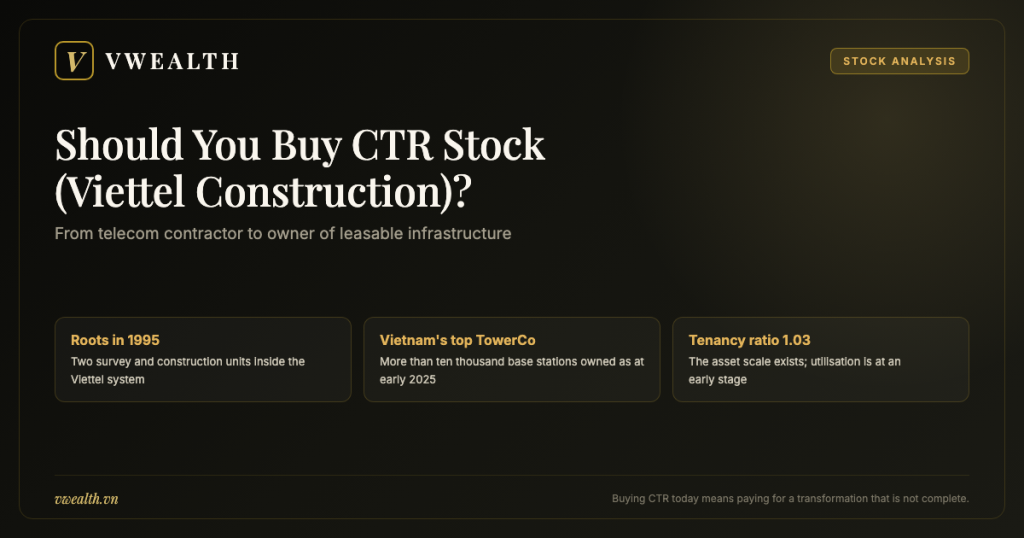
Anyone asking whether to buy CTR stock is usually picturing the wrong company. The name Viettel Construction suggests a contractor that builds things, and a decade ago that was exactly right. But the business today is turning into something quite different: the largest owner of leasable telecom infrastructure in Vietnam, the model the world calls a TowerCo. The difference between those two identities is not semantic. It is the difference between a company that sells labour under contract at a margin of a few percent and a company that owns rentable assets at a margin three to four times higher. This analysis retells thirty years of Viettel Construction, explains the TowerCo model and the single metric that governs it, and answers plainly whether that transformation has travelled far enough to justify the price.
Three conventions before we begin.
The first concerns figures. You will find historical milestones, ownership data, infrastructure counts and results from completed financial years, all drawn from public sources: the company profile, shareholder meeting resolutions, exchange filings and mainstream financial media. What you will not find is a share price, a current valuation multiple, a price target, or a latest-quarter number. For current data, open the research reports on vwealth.
The second concerns boundaries within the Viettel ecosystem. Several Vietnamese listed companies are loosely described as part of the “Viettel family,” each a separate legal entity with a distinct business model. This article covers exactly one: Viettel Construction Joint Stock Corporation, ticker CTR. Where something belongs to the parent group or a sister company, the text says so.
The third concerns personnel. The company’s executive leadership changed significantly during 2026. This article records only what has been disclosed and verified across multiple sources; where a position cannot be confirmed, it says so plainly rather than guessing.
Thirty years: from a survey unit to an infrastructure owner
CTR’s story is about an internal unit gradually becoming an independent company, and then about a company that sells labour gradually becoming a company that owns assets. Both transitions took years, and the second is still under way.
Orientation for readers outside Vietnam
A short note on context, because CTR cannot be read correctly without it.
Viettel is a state-owned industrial and telecommunications group under Vietnam’s Ministry of National Defence, and the country’s largest mobile operator. Several listed entities sit within or adjacent to that group, each with a separate business: overseas telecom investment, postal and logistics services, and — in CTR’s case — telecom infrastructure construction, operation and leasing.
Vietnam’s telecom market is concentrated among a small number of large operators, all of which historically built and owned their own networks. That fact matters more than any other single detail in this article, because it defines both the opportunity and the ceiling for a Vietnamese TowerCo. Where Western markets developed independent tower companies that lease to many carriers, Vietnam is only beginning that transition, and it is starting from a base in which almost every tower belongs to the operator using it.
1995: two units inside a military company
Viettel Construction traces its origin to 30 October 1995, when the Survey and Design Enterprise and the Construction Installation Enterprise were established under the Military Electronics and Telecommunications Company.
The context explains the original business. In the mid-1990s Vietnam was starting to build modern telecom infrastructure. Building a network requires people to survey routes, design them, erect masts, lay cable and install equipment. That is what these two units did, and they did it for their own parent.
Carry this forward: CTR’s roots are as an in-house construction unit. That creates one large advantage and one large weakness, and both persist today. The advantage is technical capability plus a steady workload from a major customer. The weakness is dependence on that same customer.
2003 and 2006: merged, then spun onto its own books
On 30 September 2003, the Technical Services Centre merged into the Construction Installation Enterprise under a single name. This combined two capabilities that had been separate: building infrastructure, and operating and maintaining it once built.
In April 2006, the Military Telecommunications Corporation converted the unit from dependent accounting to independent accounting, under the new trading name Viettel Construction State-Owned One Member Limited Company.
That step matters more than its administrative appearance suggests. Under dependent accounting, the unit was simply a cost centre inside the parent’s books. Under independent accounting it became responsible for its own revenue, costs and profit — that is, it began behaving like a real business. That was the precondition for later equitisation and listing.
2017: onto UPCoM
CTR shares began trading on UPCoM on 31 October 2017, at a reference price of 26,000 dong per share. UPCoM is Vietnam’s third trading venue, a registered system for public companies that are not formally listed, with lighter disclosure requirements and a wider daily price band than the main board.
At that point the market still saw CTR as a telecom construction contractor. Revenue came mainly from building and operating infrastructure under contract, and the economics of that model are clear: revenue can be large but margin is thin, because a contractor sells effort rather than owning a productive asset.
The turning point: deciding to own the infrastructure
This is the most important chapter in the company’s history, and it attaches to a process rather than to a single date.
The idea runs as follows. As a contractor, you build a base station for an operator, collect a one-time fee, and that is the end of it. As an infrastructure owner, you fund the tower yourself, then lease space on it to operators and collect rent every month for years. If that tower carries two or three tenants, revenue multiplies while cost barely moves.
Internationally this model is called a TowerCo — a company that owns and leases shared telecom infrastructure. It has been common in the United States, Europe and much of Asia for years, resting on simple logic: operators compete on service and price, not on whether each of them erects its own mast beside a rival’s. Sharing infrastructure saves capital across the industry and reduces visual clutter for society.
CTR chose this road, and the choice reshaped the entire investment case for the stock. The company has announced that it is Vietnam’s number one TowerCo by scale of owned infrastructure.
23 February 2022: moving to the main board
CTR shares moved from UPCoM to a full listing on the Ho Chi Minh City Stock Exchange on 23 February 2022, with a first-day reference price of 85,400 dong per share.
The venue change matters more than many investors assume. The main board carries higher disclosure standards, a tighter daily price band, and most importantly opens the stock to institutional investors whose mandates restrict unlisted securities. For a company mid-transformation that needs the market to re-assess it, that was a logical step.
The 5G phase: workload and opportunity at once
Vietnam’s commercial 5G rollout creates two kinds of opportunity for CTR simultaneously, and they must be distinguished because their earnings quality differs sharply.
The first is construction workload. Deploying 5G requires installing new equipment on existing sites and erecting additional sites, especially in urban areas where 5G coverage radius is shorter than 4G. This is work CTR does well, but it is contract work at thin margin.
The second is demand for leased infrastructure. Because 5G requires denser site coverage, operators face a very large capital bill if they build everything themselves. Renting space on an existing third-party tower becomes the more economic option. This is the high-margin, multi-year part.
Put differently: 5G delivers immediate revenue to the construction lines, but the durable value sits in leasing. When reading CTR’s accounts, always separate the two.
Infrastructure scale: where the portfolio stands
Published infrastructure figures for early 2025 give a sense of scale. As at the end of February 2025 the company owned 10,114 base transceiver stations, 2.45 million square metres of in-building distributed antenna systems, 2,716 km of transmission routes and 16.92 MWp of solar power capacity. By the end of March 2025 the base station count reached 10,350, of which 340 sites carried two or more operators as tenants, giving a tenancy ratio of 1.03.
That final figure — a tenancy ratio of 1.03 — is the most important number in this paragraph, and chapter three explains why.
2025 and 2026: record results and a new direction
In 2025 Viettel Construction posted net revenue above 13,939 billion dong, up 10.6% year on year, profit before tax of 745 billion dong, up 11%, and profit after tax of close to 600 billion dong. Both revenue and profit were the highest in the company’s history.
The 2026 annual general meeting was held on 22 April 2026, with 171 shareholders attending in person and online, representing approximately 79 million voting shares, equal to 69.33% of total voting shares.
The meeting approved a dividend for financial year 2025 at a total rate of 27%, comprising 15% in cash and 12% in shares, with total value above 308.8 billion dong. The 2026 consolidated revenue plan was set above 15,653 billion dong, up more than 11% on 2025. The company also disclosed a strategic direction to expand into renewable energy and to enter real estate, developing social housing under the Viettel brand.
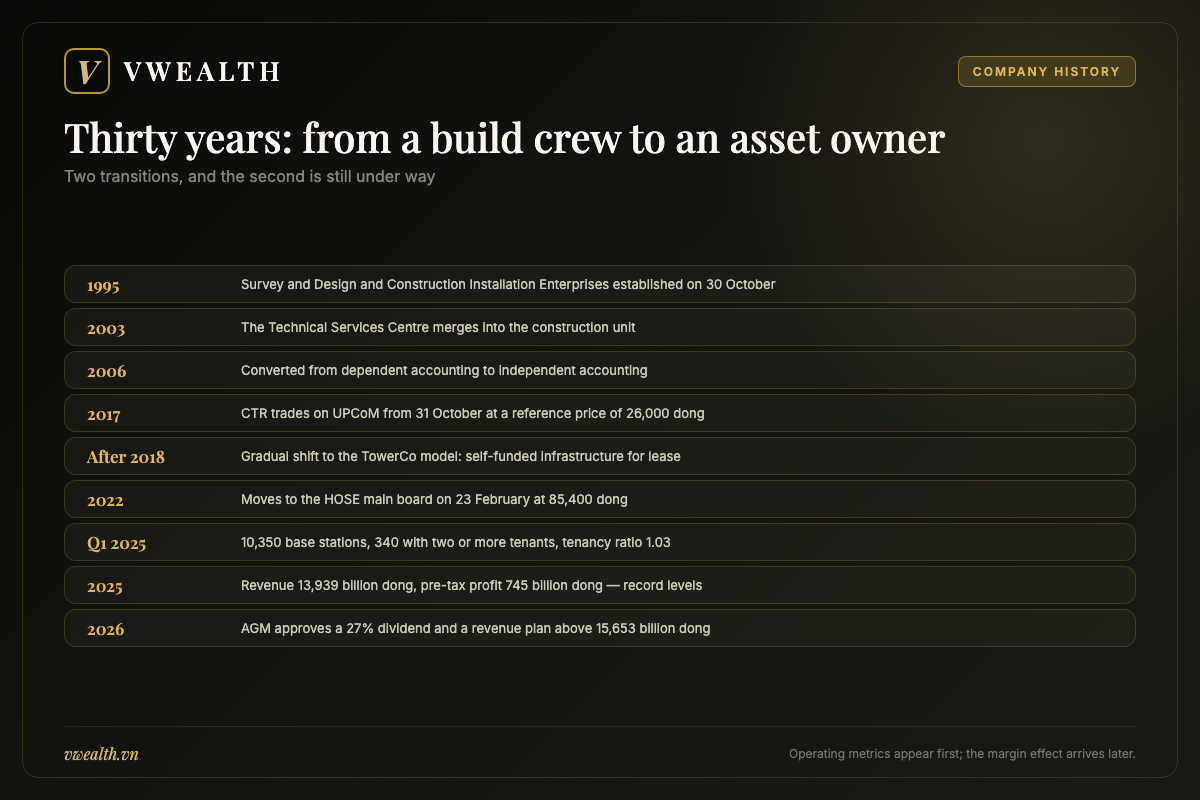
The timeline, read down the page
| Date | Event | Why it matters to a buyer today |
|---|---|---|
| 30 Oct 1995 | Survey and Design Enterprise and Construction Installation Enterprise established | Origin as an in-house construction unit within the Viettel system |
| 30 Sep 2003 | Technical Services Centre merges into the construction unit | Combines building capability with operation and maintenance |
| Apr 2006 | Converted from dependent to independent accounting | Begins behaving as a real business; precondition for equitisation |
| 31 Oct 2017 | CTR trades on UPCoM at a reference price of 26,000 dong | The market still saw it as a construction contractor |
| After 2018 | Gradual shift to the TowerCo model: self-funded leasable infrastructure | The turning point that reshaped the investment case |
| 23 Feb 2022 | Moves to HOSE at a reference price of 85,400 dong | Opens the stock to institutions; higher disclosure standards |
| End Q1 2025 | 10,350 base stations, 340 with two or more tenants, tenancy ratio 1.03 | Scale is built; utilisation is the part still ahead |
| 2025 | Revenue 13,939 billion dong, pre-tax profit 745 billion dong — record levels | Steady double-digit growth in both revenue and profit |
| 22 Apr 2026 | AGM approves a 27% dividend for 2025 and a revenue plan above 15,653 billion dong | A dividend policy blending cash and shares |
| 2026 | Announces expansion into renewable energy and Viettel-branded social housing | New directions requiring careful monitoring of capital efficiency |
Why the market took years to re-frame this company
One detail in CTR’s listed history is worth pausing on, because it teaches a general lesson about how markets price companies in transition.
When it reached UPCoM in 2017, CTR was seen as a telecom construction contractor. That perception produced a valuation to match the construction sector: a low multiple, because construction carries thin margins, cyclicality and dependence on project owners.
But the substance of the business had begun changing before the market’s perception did. Funding towers to lease them out does not generate revenue immediately — it generates cost first, an asset second, and revenue only months or years later. During that interval the financial statements look no different from a contractor’s, and arguably worse, because they now carry additional depreciation.
This is a common phenomenon at any company shifting from selling labour to owning assets: there is a stretch during which the financial statements do not yet reflect the change in kind, and the market therefore does not re-price. An investor who recognises the change before it appears in the accounts has an advantage; an investor who reads only the accounts will always be one beat late.
The lesson for following CTR today: operational metrics such as towers owned and tenancy ratio appear first, and the effect on margin arrives afterwards. If you wait until the blended margin has visibly improved before buying, you may be paying a price that already reflects it. Conversely, if you buy early on operational metrics, you must accept that you are paying for a future that is not certain. Neither option is free; what matters is knowing which one you are choosing.
What to carry forward from chapter one
Three things. First, this is a company mid-way through a genuine business model transformation, from contractor to asset owner — and the value of the stock depends on how far that transformation travels. Second, the infrastructure already built is a real asset that cannot be replicated quickly. Third, the company has just announced expansion into two new fields, renewable energy and real estate — something to monitor with caution rather than enthusiasm, since each new field absorbs capital and demands capabilities different from the core.
Who runs it and who owns it
At a company whose largest customer is also its largest shareholder, the ownership chapter is not a formality. It explains both the biggest opportunity and the biggest risk in the stock.
The controlling shareholder is the parent group
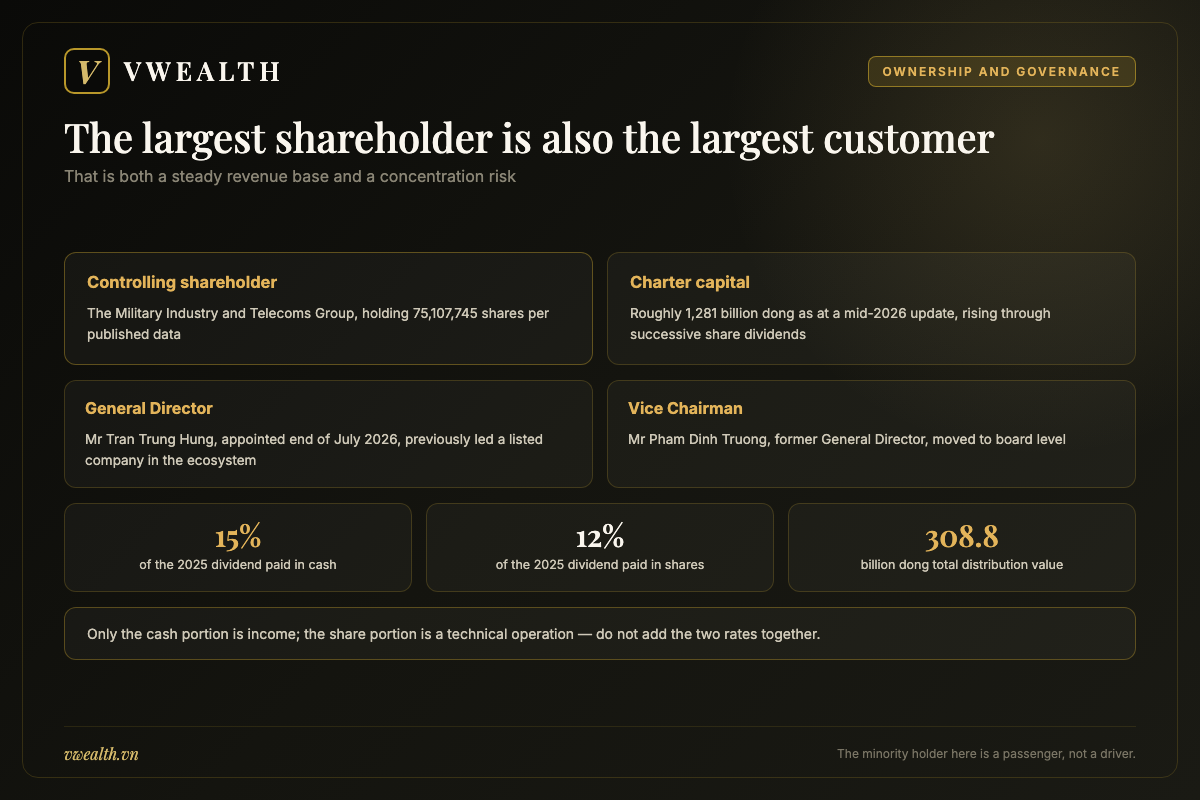
The Military Industry and Telecoms Group is CTR’s controlling shareholder. According to published shareholder data, the group holds 75,107,745 shares. Charter capital stood at roughly 1,281 billion dong as at a mid-2026 update, having risen through successive share dividends.
Because the ownership percentage shifts every time the company issues shares as a dividend, check the ratio as at the date you read rather than relying on a fixed number. What is certain is that the parent retains control: at the 2026 annual general meeting, attending voting shares reached 69.33% of the total, the bulk of which belongs to the major shareholder.
This structure produces three consequences worth weighing.
The first is stability. There is no risk of a control contest and no risk of a sudden strategy change because a large shareholder changed its mind. For a company investing in infrastructure with multi-year payback, that stability is a precondition.
The second is the customer relationship. This is CTR’s most distinctive feature: the largest shareholder is simultaneously the largest customer. That guarantees a steady workload — an advantage no independent contractor enjoys. But it also raises the transfer pricing question: how are contracts between the two priced, and which side captures the margin. The overview of corporate governance at Vietnamese listed companies covers the related-party disclosure conventions that apply here.
The third is minority rights. At the current control level, minority shareholders cannot influence corporate decisions. You are buying a passenger’s seat, not a driver’s.
Customer concentration: stated plainly
This is the largest risk in the stock, and it deserves its own section rather than being buried in a line.
A very large share of CTR’s revenue comes from the Viettel ecosystem: building infrastructure for the operator, operating and maintaining the network, and leasing infrastructure. That means the parent group’s capital expenditure plan directly drives the subsidiary’s revenue.
Look at this risk from both sides.
The constructive side: Viettel is Vietnam’s largest mobile operator with a continuous infrastructure investment programme, particularly through the 5G deployment cycle. A large, financially capable customer with long-term needs is the customer every contractor wants.
The cautious side: when one customer represents an outsized share of revenue, the supplier loses most of its pricing power. And when that customer’s infrastructure investment cycle slows — which will certainly happen once 5G coverage is complete — the workload declines.
This is precisely why the shift toward owning leasable infrastructure, together with widening the tenant base to other operators, is strategically correct and not merely margin-accretive. Leasing space on a tower to a second or third operator both raises margin and reduces dependence. Chapter three shows you the metric that measures progress on this.
Executive leadership: a major change in 2026
At the end of July 2026, Mr Tran Trung Hung was appointed General Director of Viettel Construction Joint Stock Corporation. Mr Pham Dinh Truong, the previous General Director, moved to the position of Vice Chairman of the Board of Directors.
The new chief executive’s background is worth noting because it hints at direction. According to disclosed information, Mr Tran Trung Hung joined Viettel in 2002 and began working at Viettel Post in 2003, holding several management roles before serving as board member and General Director at that logistics company. From 2022 to 2026 he was assigned to oversee the Star Telecom joint venture in Laos before taking up his new role at Viettel Construction.
That is the profile of someone with experience running a listed company inside the ecosystem and experience in an overseas market. For a company simultaneously transforming its model and expanding abroad, the profile fits in theory. But as with every new appointment, results need time to assess.
On the chairmanship, this article does not name an individual, because the public sources available at the time of writing were not consistent. Open the investor relations section of the company’s own site to confirm the board and executive roster as at the date you read this. This is not evasion but principle: what cannot be confirmed is not stated.
What state group ownership means in practice
Foreign investors sometimes read “state-controlled” as a simple negative. At a Vietnamese infrastructure company the reality is more specific.
On the constructive side, it brings three things. Ownership stability, so there is no risk of the control contests that periodically disrupt privately held Vietnamese companies. Access to a guaranteed pipeline of work, which for a contractor is worth a great deal. And a conservative approach to leverage and risk-taking, which in a capital-intensive business is closer to a virtue than a vice.
On the constraining side, it brings three others. Major capital decisions run through state capital management processes that take time. Senior appointments follow the group’s cadre rotation rather than a purely commercial search, which is why executive changes at these companies often look abrupt from outside. And commercial terms with the parent are negotiated inside a relationship rather than in an open market, which limits how much margin the subsidiary can extract.
The honest summary: state group ownership at CTR narrows both tails. It makes a catastrophic outcome unlikely and makes aggressive value extraction unlikely too. For an investor whose thesis is a slow, capital-intensive transformation, that trade is defensible. For an investor expecting management action to unlock value quickly, it will be frustrating.
Dividends: blending cash and shares
The 2026 annual general meeting approved a dividend for financial year 2025 at a total rate of 27%, of which 15% is in cash and 12% in shares, with a total value above 308.8 billion dong.
Understand these two components correctly, because they differ fundamentally.
The cash portion is real money arriving in your account. The 15% rate is a percentage of the 10,000 dong par value — that is, 1,500 dong per share — not a dividend yield on the market price. To know the actual yield, divide that amount by your purchase price. Vietnamese companies quote dividends against par by convention, and this trips up newer investors constantly.
The share portion is entirely different: the company issues additional shares to existing holders, and no money leaves the business. You receive more shares but your ownership percentage is unchanged, and the reference price is adjusted accordingly. It is effectively a technical operation increasing the share count, not income. For a company that needs capital to build infrastructure, paying part of the dividend in shares is a rational choice — but investors should not add the two rates together and call the sum a return.
| Dimension | Figure or status | Direct consequence for a retail investor |
|---|---|---|
| Controlling shareholder | Military Industry and Telecoms Group, 75,107,745 shares per published data | Strategic stability; minorities have no influence on decisions |
| Charter capital | Roughly 1,281 billion dong as at a mid-2026 update | Rises with each share dividend, diluting per-share figures |
| Relationship with the parent | Also the largest customer | Steady workload, but limited pricing power |
| General Director | Mr Tran Trung Hung, appointed end of July 2026 | Experience running a listed company and an overseas market |
| Vice Chairman | Mr Pham Dinh Truong, former General Director | Institutional knowledge retained at board level |
| FY2025 dividend | 27% total: 15% cash and 12% shares, above 308.8 billion dong | Only the cash portion is income; the share portion is technical |
| 2026 annual meeting | 22 April 2026 | The date the year’s plan and expansion strategy were disclosed |
| Foreign ownership room | Check at the time of purchase | At state-controlled telecom-related names, remaining room is often narrow |
If you are unfamiliar with how foreign ownership limits constrain overseas participation, the explainer on foreign ownership room in Vietnamese stocks sets out the mechanism.
Four business pillars and the metric that governs a TowerCo
This is the most valuable chapter in the article. If you understand this section, you will assess CTR more accurately than most of the people currently buying it.
Four pillars, four very different margins
Viettel Construction operates across four main pillars, and the crucial fact is that their margins differ enormously.
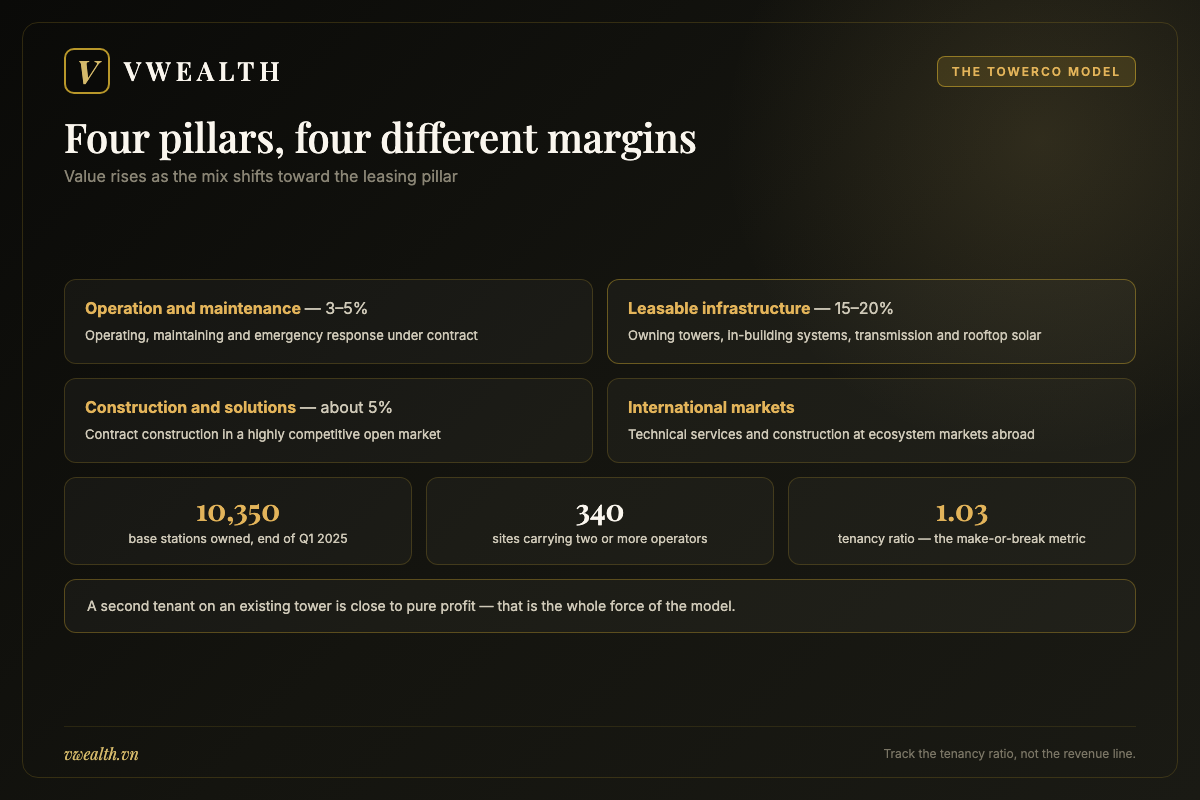
The first pillar is operation and maintenance. The company operates, maintains and provides emergency response for telecom networks under contract. Revenue is stable and the workload steady, but the disclosed margin runs at only around three to five percent. This is selling labour, and the price is largely set by the customer.
The second pillar is investment in leasable infrastructure. This is the real TowerCo business: the company funds towers, in-building antenna systems, transmission routes and rooftop solar, then leases them out. The disclosed margin runs at roughly fifteen to twenty percent — three to four times the first pillar.
The third pillar is construction and solutions. Here the company bids for construction contracts and deploys technical solutions. Competition is intense because this is an open market, and the disclosed margin runs at around five percent.
The fourth pillar is international markets. The company provides technical services and construction in overseas markets within the Viettel ecosystem. According to disclosure, international revenue runs at roughly 2,500 billion dong with growth of a few percent per year.
From those four margin figures you can derive CTR’s entire investment case without any valuation model: enterprise value rises as the revenue mix shifts from pillars one and three toward pillar two. Everything else is detail.
Tenancy ratio: the number to check before any other
This concept deserves careful attention, because it is the most honest measure of a TowerCo’s efficiency.
The tenancy ratio is the average number of tenants per tower. If a company owns one thousand towers with one thousand lease contracts in total, the tenancy ratio is 1.0. With one thousand towers and one thousand five hundred contracts, it is 1.5.
Why does this matter so much? Because a tower’s cost structure is nearly fixed. You lease the land, erect the mast, run power, build fencing, provide security and maintenance — and those costs barely change whether one operator or three has equipment on it. Revenue, however, multiplies with tenant count.
Work through an illustration to see the force of this mechanism. Suppose a tower carries operating and depreciation costs of sixty units per year, and each lease contract brings one hundred units of revenue. These figures are an illustration constructed for clarity, not drawn from any company’s data.
With one tenant: revenue one hundred, cost sixty, profit forty, margin forty percent.
With two tenants: revenue two hundred, cost perhaps seventy because extra equipment consumes a little more power and maintenance, profit one hundred and thirty, margin sixty-five percent.
With three tenants: revenue three hundred, cost eighty, profit two hundred and twenty, margin above seventy-three percent.
What do you see? The second and third tenants deliver almost pure profit. That is why TowerCos globally command premium valuations, and why tenancy ratio is treated as the industry’s make-or-break metric.
Now return to CTR. According to disclosed figures for the end of March 2025, the company owned 10,350 base stations, of which 340 carried two or more operators, giving a tenancy ratio of 1.03.
What does 1.03 tell you? It says most towers still carry a single tenant. That means the headroom is enormous — and it also means most of the TowerCo model’s value still lies ahead rather than inside current results. This is the crux the article wants you to hold: the asset scale exists, but utilisation is at an early stage.
So the one metric you should track most closely at CTR in coming reporting periods is not revenue and not profit, but the tenancy ratio. If that number rises steadily, the investment thesis is working. If it stalls across several periods while the tower count keeps rising, the company is adding assets without monetising the ones it already has.
The life of a tower: where the money goes and when it returns
To make the leasing model concrete, follow a single tower from nothing to profitability.
Step one is site acquisition. The company must find land or a rooftop that works technically — high enough, unobstructed, near power — then negotiate a long-term lease with the owner. This is the most time-consuming step and the one that creates the largest barrier for latecomers: the best locations are taken by whoever arrives first.
Step two is construction. Erect the mast, pour foundations, run power, build fencing, install cooling and backup supply. This is a large, one-time outlay.
Step three is signing the first tenant. The operator installs its equipment on the mast and pays rent periodically. From this point the tower produces revenue.
Step four is operation. The tower needs maintenance, power and emergency response. This is recurring cost, and it is close to fixed regardless of tenant count.
Step five — the value-determining step — is finding the second tenant. If found, tower revenue doubles while cost rises only slightly. If not, the tower remains profitable but at a far more modest level.
Viewed across that life cycle you see why the TowerCo model appeals to long-horizon investors and frustrates short-horizon ones. All the cost loads at the front, revenue spreads across many later years, and the genuinely large profit appears only when the second tenant arrives — which may be several years after the tower was built.
The practical reading consequence: while the company is expanding its tower portfolio rapidly, accounting profit will look less attractive than the underlying reality, because depreciation on new towers weighs on earnings before those towers have found second tenants. That is why chapter four insists on reading cash flow rather than profit alone.
What a mix shift would actually look like
Because the entire investment case rests on the revenue mix moving toward the leasing pillar, it is worth making that abstraction concrete.
Take an illustrative company with total revenue of one hundred units, split as follows: fifty units from operation and maintenance at a four percent margin, thirty-five units from construction and solutions at a five percent margin, and fifteen units from leasable infrastructure at an eighteen percent margin. These figures are an illustration, not the company’s actual mix.
Blended operating profit in that case is two units from operations, one and three-quarters from construction, and two and seven-tenths from leasing — roughly six and a half units in total, a blended margin of about six and a half percent.
Now shift the mix without changing total revenue: forty units from operations, thirty from construction, thirty from leasing. Operating profit becomes one and six-tenths, one and a half, and five and four-tenths — roughly eight and a half units, a blended margin above eight percent. Same revenue, roughly thirty percent more profit.
Extend the shift further, to thirty units from operations, twenty-five from construction and forty-five from leasing, and blended profit approaches eleven units — a margin near eleven percent, close to double the starting point, again on identical revenue.
Two conclusions follow. The first: the mix shift is a more powerful profit lever than revenue growth, which is exactly why the investment case is about transformation rather than about scale. The second: the shift is slow precisely because it requires building assets, and building assets requires capital and time. A company cannot re-mix its revenue in a quarter the way a software company can change its pricing.
This arithmetic also explains why the 2025 result matters so much as a diagnostic. If profit grows at roughly the same rate as revenue, the mix has not moved materially. When the mix genuinely begins shifting, profit growth should visibly outpace revenue growth — and that divergence, when it appears, is the confirmation an investor is waiting for.
Why the second tenant is hard to find in Vietnam
If the mechanism is that attractive, why is the tenancy ratio only just above 1? Three structural reasons matter.
The first is industry history. Vietnam’s large operators built their own networks two decades ago, each with its own tower estate. Shifting to leasing third-party infrastructure changes both habit and balance sheet structure — that happens gradually, not immediately.
The second is competitive relationships. CTR belongs to one operator’s ecosystem. A rival operator weighing whether to lease space on a tower owned by a company inside a competitor’s group will have its own considerations about strategy and infrastructure security. This is a soft barrier but a real one, and it is why independent TowerCos in many countries are deliberately separated from carriers.
The third is location. Not every tower is attractive to a second tenant. A tower in a sparsely populated area, where a second operator has no coverage need, will struggle to add a tenant however cheap the space. Conversely, a tower in a dense urban district is an asset everyone wants.
These three explain why raising the tenancy ratio is a multi-year process rather than a matter of a few quarters. They also give you three things to monitor: government policy on telecom infrastructure sharing, cooperation agreements between CTR and other operators, and the geographic mix of the tower portfolio.
The lease contract: what makes tower revenue durable
One more feature of the model deserves explanation, because it is the reason international investors treat tower revenue as almost bond-like.
A tower lease is not an ordinary commercial contract. It typically runs for a long initial term with renewal options, includes contractual escalation of the rent, and is extraordinarily difficult for the tenant to exit. That last point is the crucial one and it is worth understanding why.
Once an operator installs radio equipment on a tower, that site becomes part of its live network. Customers in the surrounding area depend on it. Moving to a different tower means finding an equivalent site with equivalent coverage geometry, obtaining permits, physically relocating equipment, and accepting a service interruption — all to save a rent that is small relative to the operator’s overall cost base. In practice, operators almost never move. The industry term for this is high switching cost, and in tower leasing it is unusually high.
The consequence is that tower revenue exhibits very high renewal rates. Once a tenant is on a site, that revenue tends to persist for as long as the network exists. That predictability is what allows international tower companies to carry higher leverage and command higher valuation multiples than most other asset owners.
Two caveats apply when transferring this logic to Vietnam. The first is that lease terms in an immature market may be shorter and less standardised than in markets where the model has been running for decades. The second is that where the tower owner and the tenant belong to the same group, the commercial character of the lease is different from an arm’s-length contract — the durability of the revenue is real, but its pricing is set inside the group rather than by the market.
The practical implication for an investor: the more of CTR’s lease revenue that comes from operators outside its own ecosystem, the more that revenue resembles the durable, market-priced cash flow that international investors pay a premium for. That is a second reason, beyond margin and beyond concentration risk, to watch the tenant mix rather than only the tower count.
Rooftop solar and the expansion directions
One item in the infrastructure portfolio deserves attention: 16.92 MWp of solar capacity as at the end of February 2025.
The operational logic here is persuasive. The company already maintains a nationwide field-technician network to service telecom sites, and already works with electrical systems at dispersed locations. Installing and operating rooftop solar draws on exactly that capability. Revenue from selling power is also recurring and long-dated, matching the character of the leasing business.
The 2026 annual general meeting disclosed a push into renewable energy and a newer direction: entering real estate with a focus on Viettel-branded social housing.
On the real estate direction, the appropriate investor posture is caution rather than enthusiasm. Real estate demands capabilities entirely different from telecom infrastructure: land bank development, project legal work, sales, and multi-year project cash flow management. Social housing carries the additional feature of regulated margin caps in exchange for policy support. This is a segment to await actual figures on before including it in any assessment. The guide to reading Vietnamese financial statements covers where segment disclosure sits under Vietnamese standards, which is where such evidence will first appear.
| Pillar | Nature | Disclosed margin | What determines it |
|---|---|---|---|
| Operation and maintenance | Operating, maintaining and emergency response under contract | Around 3 – 5% | Workload from the major customer and workforce efficiency |
| Leasable infrastructure | Owning towers, in-building systems, transmission, rooftop solar | Around 15 – 20% | Tenancy ratio and the geographic mix of the portfolio |
| Construction and solutions | Contract construction and technical solution delivery | Around 5% | Bidding intensity and the industry investment cycle |
| International markets | Technical services and construction in overseas markets | Not disclosed separately | Investment pace at ecosystem markets abroad |
Position and how to read the accounts of a hybrid business
This chapter does two things: establishes where CTR stands, and shows you the five places to read in the accounts of a company that is simultaneously a contractor and an asset owner.
Two ways a TowerCo grows, and which one CTR is using
Internationally, tower companies have grown along two quite different paths, and knowing which path a company is on tells you a great deal about its risk profile.
The first path is acquisition. A tower company buys an existing portfolio from an operator that wants to shed the asset, typically thousands of towers at once, with a long leaseback contract attached. The buyer instantly gains scale, an anchor tenant and predictable revenue. The cost is a large upfront payment, usually debt-funded, and the acquirer inherits whatever quality the portfolio has.
The second path is organic construction. The company builds towers itself, one site at a time, and finds tenants afterwards. Growth is slower and capital is consumed steadily rather than in a single transaction, but the company controls site selection and its balance sheet does not take a sudden leap.
CTR has grown predominantly along the second path. It builds. That has three implications an investor should hold.
The first: growth in tower count is bounded by the company’s own capital and execution capacity, so it is steady rather than step-changing. Do not expect the portfolio to double in a year.
The second: because the company chose the sites, portfolio quality reflects its own judgement rather than an inherited estate. Whether that judgement was good shows up precisely in the tenancy ratio over time — sites chosen where a second operator would eventually want coverage will attract tenants; sites chosen only to serve the anchor tenant will not.
The third: the acquisition path remains available and would be the fastest way to change the company’s scale. Any announcement of a portfolio purchase from another operator would be a genuinely significant event for this stock, both because of the scale it would add and because it would signal that Vietnamese operators have begun to accept the shared-infrastructure model in earnest.
Position: number one in a market that is still small
CTR has announced that it is Vietnam’s number one TowerCo by scale of owned telecom infrastructure. That is a real position, and it differs entirely from its position in construction, where it competes against dozens of other contractors.
But place that position in the right context. Vietnam’s market for leased telecom infrastructure remains at an early stage compared with developed countries, where third-party owners hold the majority of towers and tenancy ratios sit far above 1.03.
That cuts two ways. The constructive side: growth headroom is very large, and the leader typically captures the most as a market expands. The cautious side: an early-stage market is also one whose development speed depends on factors outside the company’s control — infrastructure sharing policy, the strategic decisions of other operators, and the pace of technology deployment.
Depreciation: the key to reading any infrastructure business
There is one line item newer investors tend to skip that determines how to read an infrastructure company correctly: depreciation.
Depreciation is the accounting method for spreading the cost of a long-lived asset across its years of use. A tower built today is not expensed entirely this year; instead the cost is allocated across its expected life. That sounds technical, but it produces three very practical consequences.
The first: depreciation is a cost on the income statement but not a cash outflow in the period. The cash left when the tower was built. So the actual cash flow of an infrastructure business is always healthier than its accounting profit, sometimes much healthier.
The second: a company expanding rapidly will have compressed accounting profit. Each new tower adds depreciation immediately while its revenue takes time to fill in. So if you assess a company mid heavy-investment cycle on an earnings multiple, it will look unfairly expensive.
The third: when assets are largely depreciated but still in service, accounting profit jumps while cash flow is unchanged. A base station has a physical life far longer than its depreciation schedule, so this effect is real in the industry.
That is why telecom infrastructure companies globally are assessed on operating cash flow before depreciation rather than on profit after tax. For CTR the practical reading is: look at operating cash flow in the cash flow statement, compare it with fixed asset purchases in the same period, and track the gap across several years.
Five places to read in CTR’s accounts
Place one: revenue by pillar. This is the most important, because as chapter three showed, the four pillars carry four very different margins. Total revenue rising mainly through construction produces far slower profit growth than the same rise coming from leasing. Find the segment note and compute each pillar’s weight across years.
Place two: capital expenditure against operating cash flow. The TowerCo model is capital-hungry: each new tower is money out first, revenue later and spread over years. If capex persistently exceeds operating cash flow, the company must borrow or issue equity, and both carry a cost.
Place three: borrowings and their maturity profile. This follows directly from place two. For an infrastructure investor, borrowing to fund long-lived assets is normal and sensible, but check whether the debt-to-equity ratio is climbing quickly and whether short-term debt is funding long-term assets — that is a maturity mismatch signal.
Place four: receivables and their quality. This is the contractor-specific item. In construction, revenue is recognised on progress but cash can arrive late. Compare receivables growth with revenue growth; if receivables grow much faster, earnings quality is deteriorating even while the profit line looks healthy.
Place five: operational metrics. This is the one investors skip because it is not on the balance sheet. Towers owned, towers with two or more tenants, tenancy ratio, in-building system area, transmission kilometres, solar capacity — these numbers describe the company’s future more accurately than any line in the financial statements.
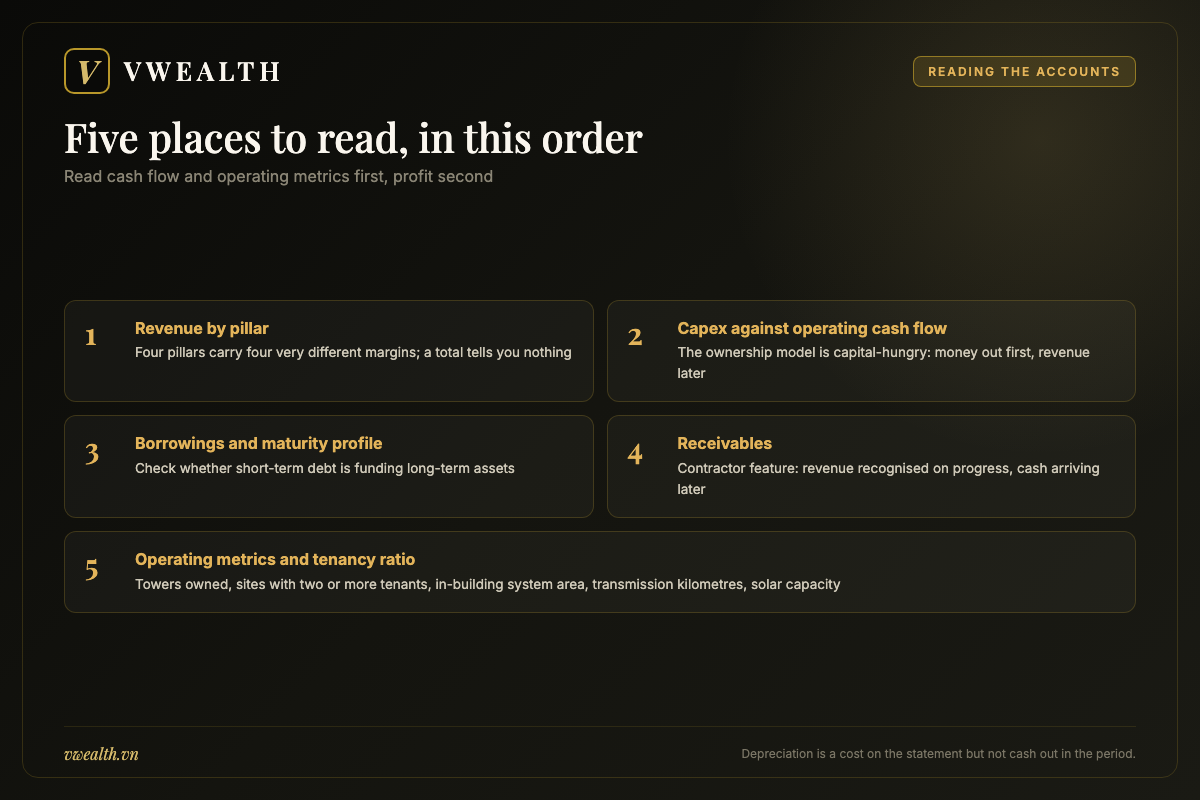
| Order | Where to read | Why it matters | Common mistake |
|---|---|---|---|
| 1 | Revenue by pillar | Four pillars carry four very different margins | Reading only total revenue without splitting by pillar |
| 2 | Capex against operating cash flow | The model is capital-hungry: money out first, revenue later | Skipping the cash flow statement entirely |
| 3 | Borrowings and maturity profile | Direct consequence of funding infrastructure with debt | Not checking whether short-term debt funds long-term assets |
| 4 | Receivables | Contractor feature: revenue on progress, cash later | Treating accounting profit as cash |
| 5 | Operational metrics and tenancy ratio | Describes the future more accurately than the accounts | Ignoring them because they are not on the balance sheet |
Related-party transactions: how to read them here
At a company whose controlling shareholder is also its principal customer, related-party disclosure is not a compliance footnote — it is a core analytical input.
Vietnamese accounting standards require disclosure of transactions and balances with related parties in the notes. At CTR that note tells you three things worth extracting each year.
The first is the scale of revenue from related parties relative to total revenue. Track it as a percentage across several years. A slowly declining percentage is evidence that the company is genuinely diversifying its customer base; a stable or rising one says the dependence has not eased regardless of what strategy documents claim.
The second is the receivable balance owed by related parties. Compare it with the revenue those parties generate. If receivables are growing faster than related-party revenue, working capital is being extended to the parent, which is economically a form of financing provided by minority shareholders.
The third is any payable or borrowing relationship running the other way. Where a subsidiary borrows from or is guaranteed by its parent, the terms matter for assessing the true cost of capital.
None of this implies wrongdoing. Related-party trading is normal and often efficient inside a group, and the disclosure regime exists precisely so outside shareholders can see it. The point is simply that at CTR this note deserves as much attention as the income statement, because it is where the customer concentration risk becomes measurable rather than merely described.
Scale and the quality of growth
In 2025, net revenue exceeded 13,939 billion dong, up 10.6%; profit before tax was 745 billion dong, up 11%; profit after tax was close to 600 billion dong. The 2026 consolidated revenue plan approved by shareholders sits above 15,653 billion dong, up more than 11%.
Two observations follow from that set of numbers.
The first: profit growth roughly matched revenue growth. That means the overall margin structure has not improved materially — the shift toward leasing is happening but is not yet strong enough to lift the blended margin noticeably. This is the most important single data point for assessing the transformation’s progress, and it supports a cautious reading rather than an optimistic one.
The second: revenue above 13,939 billion dong against profit after tax near 600 billion dong shows a blended net margin that remains low by infrastructure-company standards. That follows from most revenue still coming from thin-margin pillars. When comparing CTR with other infrastructure names, do not use revenue as a measure of economic scale — use gross profit by segment.
Comparisons within the ecosystem and the sector
Several Vietnamese listed companies sit within the Viettel ecosystem with entirely different business models. The analysis of whether to buy VGI stock of Viettel Global describes a company in the same ecosystem with a completely different profile: all revenue from nine overseas telecom markets, traded on UPCoM with a free float under one percent. Reading both together makes clear that sharing a parent does not mean sharing an asset type.
If you want a contrast with a technology company built on services and software rather than physical infrastructure, the analysis of FPT stock is a useful reference point: higher margins, but no physical asset barrier. Two models, two kinds of moat.
And if the renewable energy expansion interests you, the analysis of GEE of Gelex Electric covers an electrical equipment manufacturer, showing that the power value chain contains several links with very different economics.
How the market treats CTR shares
By now you understand the business. This chapter is about the stock and about how the market prices a transformation story.
A stock bought for a future story
CTR belongs to the group of stocks the market prices on expectation more than on current results. That is not a criticism — it follows naturally from the business model.
The reason is clear. If you value CTR as a construction contractor earning a few percent margin, you apply a low multiple consistent with the construction sector. If you value it as a TowerCo with recurring lease cash flow and high margins, you apply a much higher multiple, as international markets do for telecom infrastructure companies.
The gap between those two valuation frames is both the reward and the risk in this stock. If the transformation succeeds, a higher multiple is justified. If it runs slower than expected, the market will revise its frame — and a revision hurts far more at a stock already carrying a high multiple than at one carrying a low one.
That is why chapter three insists on the tenancy ratio. It is not merely an operating statistic; it is the evidence that defends or refutes the valuation.
Personality: thematic and volatile
CTR is generally grouped with technology and telecom infrastructure names on the Vietnamese market. That group moves thematically: when the market is interested in digital transformation, 5G or data centres, the whole group rises; when the theme cools, the whole group falls.
Two implications. First, do not mistake a thematic rally for genuine company progress; verify with operational data. Second, volatility typically exceeds the market average, so risk management thresholds need to be wider. Position sizing should reflect the volatility of the security, not the size of the issuer.
What moves the stock in practice
It is worth naming the specific triggers that move this share, so you can separate signal from noise.
Triggers that genuinely matter: periodic disclosure of tower counts and multi-tenant sites, from which the tenancy ratio is derived; segment revenue data showing the leasing share; announcements of infrastructure cooperation agreements with other operators; regulatory movement on infrastructure sharing; and capital commitments to the new business lines.
Triggers that look important but usually are not: a single quarter’s revenue figure, since construction revenue is lumpy by nature and says little about the mix; general market commentary linking the stock to unrelated technology news; and thematic rallies across the digital infrastructure group as a whole.
The discipline that follows: before reacting to a move in this stock, ask which of the two lists the trigger belongs to. If it is not on the first list, the appropriate response is usually no response.
Why this article gives no valuation multiple
At CTR the conventional multiples suffer three problems at once.
The first is hybrid nature. The company is both a contractor and an asset owner, and the market prices those two identities against different standards. Applying a single multiple to a hybrid is crude.
The second is the investment phase. While the company is adding assets, depreciation rises quickly and compresses accounting profit even as underlying cash flow is stronger. An earnings-based multiple therefore looks more expensive than the substance warrants. In developed markets, TowerCos are typically valued on operating cash flow before depreciation rather than on accounting profit.
The third is the peer set. No Vietnamese listed company shares this model for a direct comparison. Comparing against international TowerCos is right in business substance but diverges on scale, on tenancy ratio and on the degree of neutrality toward carriers.
So the honest course is to name those three problems and leave you to work with current data.
Dividends: do not add the two rates
As noted in chapter two, the 2025 dividend comprises 15% in cash and 12% in shares. Only the cash portion is income.
For a company in a heavy infrastructure investment phase, paying part of the dividend in shares is sensible: the company retains cash to invest while still meeting shareholder expectations. But investors should stay clear-eyed that a share dividend creates no new value — it simply divides the same cake into more slices.
How the discount could close, and how it might not
Be precise about the mechanism by which a valuation frame changes, because vague optimism about a re-rating is not an investment thesis.
For CTR to be priced as an infrastructure owner rather than a contractor, a specific sequence has to occur. The leasing pillar’s revenue share must rise enough that the blended margin moves visibly. That requires the tenancy ratio to climb, which requires tenants from outside the parent’s ecosystem. Once blended margin improves, profit growth begins outpacing revenue growth, which is the observable signal analysts and institutions respond to. Only then does the market have grounds to apply a different multiple.
Each step depends on the one before it. A reader buying the stock expecting a re-rating should be able to name which step is currently in progress and what evidence would confirm it. If you cannot, you are holding a hope rather than a thesis.
The failure mode is equally specific, and it is not a collapse. The likeliest disappointing outcome is that the company keeps growing revenue at a respectable double-digit pace on construction workload, keeps adding towers, and keeps its tenancy ratio close to where it is — leaving a good business that never earns the higher valuation frame. In that outcome an investor still owns a growing company paying a partial cash dividend, which is not a disaster, but the returns look nothing like what the transformation story implies. That is the outcome to be prepared to live with.
Liquidity and foreign flows
CTR is listed on HOSE and therefore trades far more freely than ecosystem peers on UPCoM. Even so, with a controlling shareholder holding the majority, the freely traded share count remains smaller than the company’s headline size implies.
On foreign ownership room, check the position at the time you buy. At state-controlled companies in telecom-related fields, the room available to foreign investors is often not wide, and a full or near-full room can restrict overseas participation regardless of interest.

Market mechanics a foreign investor should know
Vietnam is classified as a frontier market by the major index providers, with reclassification under discussion. Several practical mechanics follow.
Access and settlement
A foreign investor must obtain a securities trading code from the Vietnam Securities Depository, open an indirect investment capital account at a licensed Vietnamese bank, then open a securities account with a domestic brokerage. The process takes documentation and time. Equities settle on a multi-day cycle, so you cannot buy and sell the same shares within a session. The overview of how to invest in the Vietnam stock market sets out the sequence.
Price bands and venue
Every Vietnamese venue applies a daily ceiling and floor calculated from the prior reference price. The main board band is the tightest of the three venues, which works in CTR’s favour relative to ecosystem peers on UPCoM: moves are less violent and execution more predictable.
Currency and country risk
Your return in your home currency has two layers: the share price in dong, and the dong against your currency. CTR’s revenue is predominantly domestic, so it carries no natural currency hedge, unlike an exporter. The broader country-level considerations appear in the overview of the risks of investing in Vietnam.
| Mechanic | How it works in Vietnam | Specific implication at CTR |
|---|---|---|
| Trading venue | HOSE main board, HNX listed board, UPCoM registered system | CTR trades on HOSE with full disclosure obligations |
| Daily price band | Ceiling and floor from the prior reference price; tightest on the main board | Less violent moves than ecosystem peers on UPCoM |
| Settlement | Multi-day cycle, no same-session round trip | Limits tactical trading around thematic news |
| Account setup | Trading code, capital account, brokerage account | Arrange access before a catalyst, not after |
| Foreign ownership limit | Sector and charter dependent | Often narrow at state-controlled telecom-related names |
| Currency | Dong against your home currency | Domestic revenue means no natural hedge |
Sector context: infrastructure sharing is the trend, but it moves slowly
To judge CTR fairly you need to know what stage its industry occupies.
Why the world moved to shared infrastructure
Thirty years ago every operator built its entire network itself. That made sense when coverage was the primary competitive weapon: whoever covered more won.
But once markets saturated and almost every area carried every operator’s signal, each carrier maintaining its own mast beside a rival’s became pure waste. Capital was locked into assets that created no competitive differentiation, while the real contest had shifted to service quality, pricing and digital ecosystems.
From that realisation, operators in many countries began selling their tower estates to specialist infrastructure companies and leasing back. The operator received a large cash sum to invest in new technology and shed an asset burden; the infrastructure company gained a large tower portfolio and set about finding additional tenants to raise utilisation. That is how the TowerCo industry formed and became a distinct asset class in international capital markets.
Why Vietnam is moving more slowly
In Vietnam the process is slower for the three reasons set out in chapter three: the habit of owning infrastructure, competitive relationships between operators, and the uneven value of individual sites.
A fourth structural reason should be added: Vietnam’s telecom market is concentrated among a small number of large operators. When the pool of potential tenants is small, the achievable tenancy ratio is capped from the outset, unlike markets with many carriers and many wireless service providers all needing equipment space.
That does not negate the opportunity, but it does place a practical ceiling on the domestic tenancy ratio CTR can reach, and it explains why the company is simultaneously expanding into other infrastructure types such as in-building systems, transmission and solar.
What infrastructure sharing policy could change
One external variable could move faster than any of the company’s own actions: government policy on telecom infrastructure sharing.
Vietnam’s authorities have general policy interest in reducing duplicated infrastructure, for reasons that are partly economic and partly about urban environment — clusters of separate masts serving the same district are visibly wasteful. Where regulators in other countries have pushed sharing, they have used a familiar set of levers: requiring operators to grant access to their passive infrastructure on reasonable terms, restricting permits for new masts where an existing structure could host the equipment, and setting reference pricing for site access.
Any of those levers would materially change CTR’s economics, because each one directly raises the probability of a second tenant on an existing site. A permit restriction is the most powerful of the three: if a new mast cannot be built where an existing one can host the equipment, the tower owner’s negotiating position improves immediately.
Two cautions belong alongside that observation. The first is timing: infrastructure policy moves slowly and rarely on a schedule an investor can rely on. The second is symmetry — policy that mandates access on reasonable terms can also cap what the owner may charge, so a sharing mandate is not automatically favourable to the tower owner’s margin. Regulated access with regulated pricing is a different business from voluntary access at market pricing.
The reasonable investor position: treat policy as a possible accelerator rather than a foundation. Build your thesis on what the company can achieve commercially, and treat any regulatory push toward sharing as upside you did not pay for.
5G and what comes after
The 5G deployment cycle is the clearest driver over the short and medium term. It creates construction workload and creates leasing demand, as chapter one analysed.
But a long-horizon investor should think one step further: what happens after 5G coverage is complete? Industry history shows each mobile generation takes roughly a decade from initial deployment to saturation, followed by a quiet period before the next. During that quiet period construction workload falls sharply, and a company that lives only on construction suffers.
This is the strongest argument for the shift toward owning leasable infrastructure: lease revenue does not depend on new investment cycles but on whether the network is still in use — and networks are always in use. In other words, the leasing pillar is a counter-cyclical cushion, and that, beyond margin, is its greatest value.
Data centres and digital infrastructure: the next opportunity
The long-run trend in telecom infrastructure globally is expansion from towers into digital infrastructure more broadly: data centres, edge facilities, high-capacity transmission. The logic is identical — all are physical assets leased under long-term contracts.
At CTR the in-building antenna business and the transmission business already move in this direction. A nationwide field-technician network is an advantage when expanding into other kinds of dispersed infrastructure.
That said, this direction has potential but limited result evidence at scale. The correct investor treatment is to record it as an option rather than to add it to a valuation.
What international TowerCos teach
Because Vietnam has no domestic peer, the useful exercise is to look at markets that went first and extract three lessons.
The first concerns tenancy ratio. In mature markets, large telecom infrastructure companies operate at tenancy ratios well above 1.03. That level was not reached at inception; it is the product of a multi-year process, usually alongside acquiring tower portfolios from the carriers themselves. The lesson: do not expect this metric to leap in a few quarters, but do not accept it standing still for years either.
The second concerns neutrality. The most successful infrastructure companies globally are neutral hosts, belonging to no carrier, because only a neutral host makes every carrier comfortable leasing. CTR sits inside one operator’s ecosystem, and that is a structural difference to weigh when comparing it with international peers.
The third concerns capital structure. Because the model produces predictable recurring cash flow, international telecom infrastructure companies typically run higher financial leverage than other sectors, and markets accept it. But high leverage is only safe when cash flow is genuinely stable — that is, when the tenancy ratio is already high and leases are long. At a low tenancy ratio, high leverage is considerably riskier.
Taken together these give a practical conclusion: CTR sits at the early stage of a model proven elsewhere. That is both an opportunity — the road ahead has been travelled and can be learned from — and a reminder that the road is long.
Where else the model can extend: in-building systems and transmission
Towers dominate the discussion, but two other asset classes in CTR’s portfolio deserve attention because they extend the same economics into different physical settings.
The first is in-building distributed antenna systems. Modern buildings — shopping centres, office towers, hospitals, airports, underground car parks — block outdoor radio signal, so operators need equipment installed inside to serve customers there. Building that system once and letting multiple operators share it is the same shared-infrastructure logic as a tower, applied vertically. The disclosed figure of 2.45 million square metres of such systems as at early 2025 gives a sense of the scale already deployed.
The economics are attractive for the same reason as towers: the physical installation is the fixed cost, and each additional operator connecting to it adds revenue at low marginal cost. The commercial dynamic differs slightly in that the building owner is a third party in the arrangement, which adds a negotiating layer but also creates a barrier once the system is installed, since no building owner wants a second set of cabling running through their property.
The second is transmission. Base stations must connect back to the core network, and that connection runs over fibre. Owning transmission routes and leasing capacity on them is again the same model: a large fixed investment, then recurring revenue from multiple users. The disclosed 2,716 km of transmission routes as at early 2025 is modest by national standards but meaningful as a complement to the tower portfolio, because a tower with transmission already attached is more valuable to a tenant than a bare tower.
Taken together, these two lines matter for a specific reason: they raise revenue per site without requiring a second operator to sign a tower lease. A single tenant that takes tower space, in-building coverage and transmission capacity generates considerably more revenue than a tenant taking tower space alone. That is a second lever alongside the tenancy ratio, and it is less dependent on the competitive dynamics that make second tenants hard to win.
Four risks specific to CTR
The first is customer concentration, analysed in chapter two. It is the largest.
The second is investment cycle risk. Construction workload depends on the telecom industry’s capital expenditure plans, and those plans are distinctly cyclical by technology generation.
The third is capital risk. The ownership model requires continuous capital expenditure. If the cost of capital rises or operating cash flow fails to keep pace, portfolio expansion slows — and slowing means the growth story is pushed further out.
The fourth is diversification risk. Entering real estate and renewable energy opens opportunity but disperses resources and demands new capabilities. Vietnamese corporate history contains numerous cases of companies strong in a core business struggling when they moved into a distant one.
Looking forward: three scenarios and what has to happen in each
This section gives no price target. It names the deciding variables, then describes three future states with the conditions required for each — so you can verify progress against published material.
Four decisive variables
Variable one: the tenancy ratio. This is the only variable capable of changing the valuation frame rather than merely the profit figure. Every incremental tenant on an existing tower is close to pure profit.
Variable two: the share of total revenue coming from leasable infrastructure. This measures the transformation’s progress and determines the blended margin.
Variable three: the pace and scale of domestic telecom industry investment, particularly the 5G cycle. This determines workload for the construction and operations pillars.
Variable four: capital efficiency in the new segments. Renewable energy and real estate will absorb capital over coming years. The question to answer is whether returns on capital there match or exceed the core.
The optimistic scenario
Conditions required: the tenancy ratio rises steadily across periods, clearly above 1.03 and moving toward 1.2 or higher; the leasing pillar’s revenue share grows faster than total revenue so the blended margin visibly improves; infrastructure sharing policy becomes clearer; and the new segments show acceptable capital efficiency.
If that chain holds, the market has grounds to value CTR as a leasable infrastructure company rather than as a contractor — and that shift in valuation frame is the largest part of the reward, larger than the profit growth itself.
State the caveat plainly: this scenario requires several conditions simultaneously, at least two of which depend on decisions by other operators and by the regulator, that is, outside the company’s control.
The base scenario
Conditions required: revenue continues growing at double digits on 5G workload; the tenancy ratio rises slowly; the leasing share increases gradually but not enough to lift the blended margin visibly; the dividend continues in its blended cash-and-share form.
In this scenario the company still grows well, but the market keeps valuing it between the two frames — not as cheap as a contractor, not yet as rich as a mature TowerCo. The share price moves with themes and with quarterly results.
This is the scenario the article treats as the default, because it best fits the available evidence: in 2025, profit growth roughly matched revenue growth, indicating the margin structure has not shifted materially.
The adverse scenario
Conditions required: the domestic telecom investment cycle slows after 5G coverage completes, sharply reducing construction workload; the tenancy ratio stalls so the invested asset base fails to reach expected utilisation; or the new segments absorb large capital without commensurate returns, raising borrowings and depressing return on capital.
The most concerning branch combines the second and third: the company keeps adding assets while existing assets remain under-utilised, and simultaneously deploys capital into new industries. In that case the balance sheet expands faster than cash flow, and an expectation-based valuation must adjust.
| Scenario | Conditions to look for | Verifiable evidence | Consequence for the shares |
|---|---|---|---|
| Optimistic | Tenancy ratio clearly rising; leasing share growing fast; favourable sharing policy | Periodic operational disclosures; segment reporting; policy documents | Grounds for the market to re-frame it as a leasable infrastructure company |
| Base | Double-digit revenue growth on 5G; tenancy ratio rising slowly; blended margin little changed | Quarterly and annual filings; annual meeting resolutions | Good growth but a valuation stuck between two frames; thematic volatility |
| Adverse | Investment cycle slows; tenancy ratio stalls; new segments absorb capital inefficiently | Cash flow statement; borrowings; notes on investments in subsidiaries | Balance sheet expands faster than cash flow; expectation-based valuation adjusts |
What to monitor over the next twelve months
Four items deserve a calendar reminder. One, the periodic operational disclosures, particularly towers owned and towers with two or more tenants — from which you compute the tenancy ratio yourself. Two, revenue by pillar in the segment note, to measure transformation progress. Three, fixed asset purchases against operating cash flow in the cash flow statement. Four, the pace and quantum of capital deployed into renewable energy and real estate.
All four are verifiable from published material. At a stock where most of the value sits in expectation, verifying against operational data is the only way to know whether your thesis still holds.
So should you buy CTR stock?
You now have the facts. This chapter assembles them into an answer — not by saying buy or sell, but by saying clearly who this security suits and who it does not.
The case for
First, this is the largest owner of telecom infrastructure in Vietnam by the company’s own disclosure, with more than ten thousand base stations plus in-building systems, transmission routes and solar capacity. That asset base is a genuine barrier that money cannot replicate quickly.
Second, the transformation from contractor to asset owner is a real story with clear economic logic and precedent in many international markets. The margin gap between the two models is three to four times, on the company’s own disclosure.
Third, a steady workload from the ecosystem of Vietnam’s largest mobile operator, together with the ongoing 5G deployment cycle, underpins revenue over the medium term.
Fourth, the company has a record of continuous growth, with 2025 revenue and profit both at all-time highs and a 2026 plan calling for more than 11% further growth.
Fifth, the shares are listed on the main board with full disclosure obligations and far better liquidity than ecosystem peers on UPCoM.
Sixth, the tenancy ratio at 1.03 is simultaneously today’s weakness and tomorrow’s headroom: every additional tenant on an existing asset is close to pure profit.
The case against
First, and heaviest: heavy dependence on a single customer that is also the controlling shareholder. That limits pricing power and ties revenue to one party’s capital expenditure plan.
Second, the transformation is running slower than the market’s expectation. The evidence sits in the 2025 numbers: profit growth roughly matched revenue growth, meaning the margin structure has not shifted materially.
Third, a tenancy ratio of 1.03 means most of the TowerCo model’s value is still in the future. Buying CTR today is paying for a process that is not complete.
Fourth, the ownership model consumes capital continuously, carrying debt and cash flow risk if investment outpaces returns.
Fifth, the expansion into renewable energy and real estate awaits evidence, and while it waits it disperses resources away from the core.
Sixth, the structural ceiling on raising the tenancy ratio in Vietnam is real: few operators, competitive relationships between ecosystems, and uneven value across sites.
| For | Against |
|---|---|
| Vietnam’s largest owner of telecom infrastructure by disclosure | Heavy dependence on one customer that is also the controlling shareholder |
| A transformation story with clear economics and international precedent | Transformation running slowly; blended margin not yet visibly improved |
| Steady revenue base from the ecosystem and the 5G cycle | Tenancy ratio of 1.03: most of the model’s value is still ahead |
| 2025 revenue and profit at record levels; 2026 plan up more than 11% | Capital-hungry model carrying debt and cash flow risk |
| Main-board listing, full disclosure, good liquidity | Expansion into real estate and energy awaits evidence |
| Large headroom to raise utilisation on assets already built | Structural ceiling on raising the tenancy ratio in Vietnam |
Which kind of investor this suits
| Investor type | Fit | Reasoning | If you proceed |
|---|---|---|---|
| Long-horizon growth investor | Suitable | The transformation needs years to complete, and the reward lies in the market re-framing the valuation | Track the tenancy ratio each period; sell if it stalls across several periods while assets keep growing |
| Thematic investor in digital infrastructure and 5G | Conditionally suitable | The company is one of the most direct expressions of that theme on the exchange | Separate a thematic rally from real progress; verify with operational data |
| Income-focused investor | Less suitable | Only part of the dividend is cash; the company needs capital for infrastructure | Count only the cash portion against your purchase price; do not add the share portion |
| Risk-averse investor who dislikes volatility | Not suitable | An expectation-priced stock carries volatility above the market average | If you participate anyway, keep the weighting small and the risk threshold wide |
| New investor with a small portfolio | Conditionally suitable | The business model is far easier to understand than banking or insurance, but the tenancy ratio concept is essential | Read chapter three first; start small and follow a few reporting periods |
| Foreign investor | Practical, with a check to make | Main-board listing and reasonable liquidity make it accessible | Verify remaining foreign ownership room before committing |
A closing word
Should you buy CTR stock? The most honest answer is that it depends on how far you believe the transformation will travel, and whether you have the patience to wait.
If you see CTR as a telecom construction contractor with plenty of work thanks to the 5G cycle, it is a good company: stable governance, steady growth, but thin margins and cyclical exposure. Valued through that lens, it should be priced modestly.
If you see CTR as a company on its way to becoming an owner of leasable infrastructure with recurring cash flow and high margins, the story is worth considerably more — but you must accept that the current evidence is only at an early stage. A tenancy ratio of 1.03 says it all: the asset scale exists, the utilisation does not yet.
The most sensible approach, in this article’s view: treat CTR as a long-horizon growth position at a moderate weighting, and tie your thesis to exactly one verifiable metric, the tenancy ratio. If that number rises steadily across periods, you have reason to be patient and to add gradually. If it stalls across several periods while the company keeps adding assets and keeps deploying capital into new industries, your thesis has been falsified and you should act on that — rather than waiting for the price to confirm what the data already said.
Before deciding, open current data rather than relying on memory. This article deliberately contains no price, no multiple and no latest-quarter figure. Read the latest research reports on vwealth, check them against the five reading points in chapter four, and answer the question for yourself.
Disclaimer. This article is provided for information and educational purposes only and is not a recommendation to buy or sell any security. Information on history, personnel, ownership, infrastructure figures and corporate events is drawn from public sources available at the time of writing and may change; for the board and executive roster in particular, readers should consult the company’s most recent disclosure. Statements about future scenarios are analyses of conditions, not price forecasts. Numerical examples in this article are illustrations. Investors are responsible for their own decisions and should consult a licensed adviser before trading. Investing in equities carries the risk of capital loss.
Research Vietnamese stocks in English with vwealth. Our AI-powered platform turns Vietnamese market data into full English analysis reports — with international payment support and a free 2-month trial for new accounts. Create your free account and read the latest reports.


