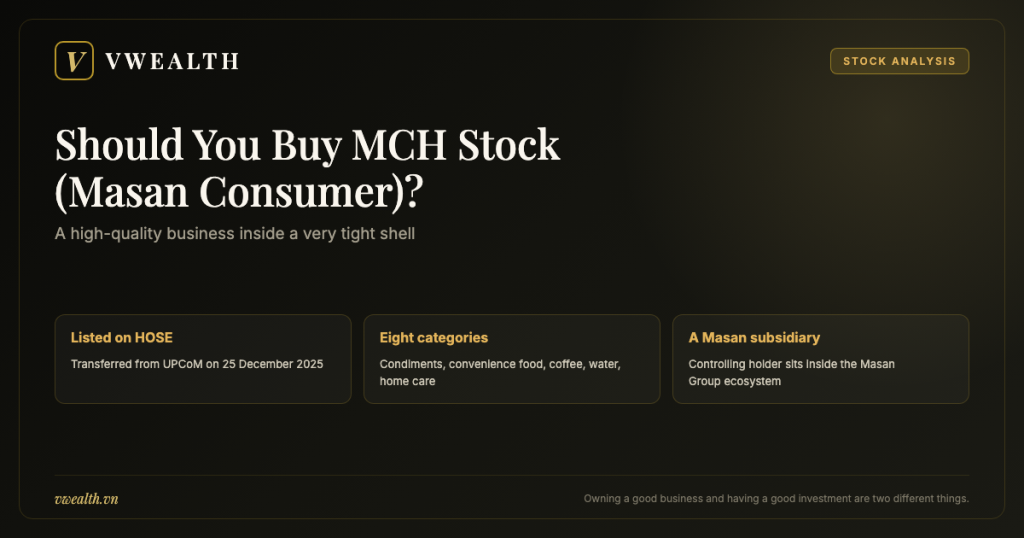
Should you buy MCH stock — the ticker of Masan Consumer Corporation, the fast-moving consumer goods arm of Vietnam’s Masan Group? The question became far more relevant in December 2025, when the shares moved from the UPCoM market onto the Ho Chi Minh Stock Exchange, ending nearly nine years in a venue most institutional money would not touch. Yet almost every discussion of this ticker drifts upward into the parent company: Masan Group, its retail chain, its mining assets, its consumer finance arm. This article deliberately does the opposite. It ignores the conglomerate entirely and examines one thing: a consumer goods manufacturer that sells fish sauce, instant noodles, instant coffee and bottled water. You will learn why a company selling items that cost a dollar or two earns margins heavy industry would envy, where its moat genuinely sits, and why the ownership structure that gives it stability is simultaneously the largest practical risk a minority shareholder faces.
One convention before we begin, the same one used across this series. You will meet many dates, brand names, acquisitions and scale figures below. All come from disclosed public sources: exchange filings, shareholder meeting resolutions, the company’s own announcements, and mainstream financial media. What you will not find is a most-recent-quarter earnings figure or today’s valuation multiple. At a consumer goods company those numbers move with seasonality, input costs and product launch cycles. This article teaches you where to look and how to read what you find. For the current figures, open the latest research reports on vwealth.
A second convention. MCH is a subsidiary of Masan Group, and this series already carries a separate analysis of MSN, the parent holding company. The two pieces deliberately do not overlap. The MSN article looks top down at a diversified group spanning consumer, retail, materials and financial services, and its central question is the conglomerate discount. This article looks bottom up at a pure consumer goods business, and its central question is brand strength and distribution quality. If you want the group picture, read that one. If you want to understand the company that actually makes the fish sauce, read on.
If Vietnam is a new market for you, the pillar guide on how to invest in the Vietnam stock market covers access, custody and settlement. This article assumes that groundwork.
From noodle containers sold in Eastern Europe to a bottle in nearly every Vietnamese kitchen
There is a founding story the Vietnamese market retells often, but most tellers stop at the colourful part and skip the important part. The colourful part is containers of instant noodles and chilli sauce sold to Vietnamese communities in Eastern Europe in the mid-1990s. The important part is what happened after the founders brought that money and that experience home.
Before the timeline, one framing point that will make the rest of this chapter more useful. Consumer goods companies are unusual among listed businesses in that their most valuable assets do not appear on the balance sheet. Factories, warehouses and vehicles are recorded at cost less depreciation, and they are replaceable. The brand, the distribution relationships and the shelf position are not recorded at all, and they are what actually generate the returns.
This has a direct consequence for how you read the history. Each milestone below should be assessed not by the capital deployed but by whether it added to those unrecorded assets. An acquisition that bought a brand people already trusted added a great deal. A name change added nothing by itself but signalled where management was pointing. Reading the timeline through that filter turns a corporate chronology into an investment argument.
1996: starting in a niche market a long way from home
According to the company’s own account, 1996 is the founding milestone, marked by trading activity in the Russian market and the establishment of the Viet Tien production operation. The context deserves attention. Post-Soviet Russia was economically chaotic, consumer goods were scarce, and the Vietnamese diaspora in Eastern Europe represented a real market with real purchasing power.
What the business learned in that period was not a product formula. It was a lesson in distribution inside a market lacking modern retail infrastructure: how to get goods into consumers’ hands when there are no supermarket chains, no professional logistics networks, and everything must move through a web of small traders. That is precisely the problem Vietnam itself would present for the following two decades.
There is a second, less romantic reading of the early years that is worth keeping in mind. Trading into a chaotic market is a business built on relationships and on tolerance for operational risk, not on brand equity. Very few companies that begin that way successfully convert into branded manufacturers, because the two require entirely different disciplines: one rewards opportunism, the other rewards consistency over decades.
That conversion is the genuinely impressive part of the Masan Consumer story, and it is the part investors should weigh when assessing whether current management can execute the next transition, from a domestic distribution champion into a company that competes in modern and online channels. Past transitions do not guarantee future ones, but a company that has made one difficult shift has at least demonstrated it is institutionally capable of change.
2000 to 2008: coming home, changing names, and finding something to sell
In 2000 the Minh Viet Industrial Import-Export Joint Stock Company was established. In 2003, following a merger, the business became Ma San Trading Corporation. In 2008 the name changed again, to Ma San Food Corporation.
That sequence of renamings was not cosmetic. It tracked a genuine strategic migration: from trading into manufacturing, then from general manufacturing into food specifically. During this period the company built the brands that would become its backbone for years: soy sauce and fish sauce under the Chin-su name, then Nam Ngu, then Tam Thai Tu at the mass-market tier.
One decision from this era is worth remembering when you assess management capability. Rather than competing head-on with international brands at the premium end, or accepting a role as a cheap commodity producer, the company built a laddered portfolio: one brand for the premium tier, one for the middle, one for the mass market. The same factories, the same distribution system, three different wallets served. Global consumer groups have used that architecture for decades, but at that point in Vietnam few domestic companies executed it well.
2011: renamed Masan Consumer, and entry into beverages
2011 was the pivotal year. The company renamed itself Ma San Consumer Corporation, and in October acquired a controlling stake in Vinacafé Bien Hoa Joint Stock Company, then Vietnam’s largest instant coffee producer. The initial stake was around 50.3 percent, and financial media reported the transaction value at roughly 1,700 billion dong.
That deal established a playbook the company would repeat many times, and its logic is worth understanding. Masan Consumer was not buying a factory. It was buying a brand that already occupied space in consumers’ minds, then pushing that brand through its own distribution and marketing machine. In other words, it bought the part that is hardest to create — consumer trust — and supplied the part it already had, which is the ability to get product onto shelves everywhere.
The results in the Vinacafé case were visible. According to figures published in market analysis, Vinacafé Bien Hoa’s net revenue rose from roughly 1,586 billion dong in 2011 to roughly 3,249 billion dong in 2017, while gross margin roughly doubled over the same stretch. That is evidence the acquirer created value beyond simply consolidating a revenue line.
A fair question to ask about this acquisition record is whether the prices paid were sensible. In practice, several deals were regarded as expensive at signing. Vinh Hao was bought at a multiple many times the prior year’s earnings. Vinacafé was not cheap by the standards of its day either.
The acquirer’s justification was that it was not buying current earnings but the earnings that would exist once the brand had been run through its own system. That argument proved correct in some cases and not in others — and it is exactly what you should verify in the accounts. Whether goodwill arising from these transactions has been impaired is the clearest accounting evidence that a deal failed to meet expectations, and impairment charges are disclosed rather than hidden.
2013 to 2016: mineral water, condiments and a rapid deal sequence
In early 2013 the company acquired roughly 63.5 percent of Vinh Hao Mineral Water Corporation, paying around 85,000 dong per share and valuing that business at approximately 700 billion dong — a multiple many times the prior year’s after-tax profit, and considered expensive at the time by many observers.
Across 2014 and 2015 the company added stakes in Cholimex Food, a long-established southern chilli sauce and condiment brand, and in Saigon Nutri Food. In December 2015, through its beverage subsidiary, it acquired roughly 65 percent of Quang Ninh Mineral Water Corporation, owner of the Quang Hanh brand. In 2015 the corporate name was standardised as Masan Consumer Corporation, and 2016 brought further expansion in coffee, mineral water and a Thai subsidiary.
Viewed from a distance, the deal sequence follows one consistent logic: each acquisition did not open a new industry so much as add a drawer to the same cabinet. Fish sauce, soy sauce, chilli sauce, instant noodles, instant coffee, bottled water — all fast-moving consumer goods, all travelling through the same distribution channel to the same shopper, all sold by the same sales force. That is expansion with genuine synergy, quite unlike diversification that merely assembles assets.
The Thai subsidiary established in this period is a small item that carries a larger signal. It marked the first serious attempt to operate outside Vietnam rather than merely to export, and Thailand is a sensible testing ground: a large regional market with a developed modern trade, strong local incumbents and a consumer palate close enough to Vietnam’s for product transfer to be plausible.
Whether that early step scaled into anything meaningful is a question the annual disclosure of international revenue answers better than any strategy statement. As a general rule for consumer companies expanding regionally, treat the first three years abroad as tuition rather than as a growth engine, and expect the economics to look poor until distribution reaches critical density in at least one foreign market.
2018 to 2020: processed meat and home care
In 2018 the company established a strategic partnership with Jinju Ham, the Korean processed meat producer, opening a path into meat-based prepared foods. In 2019 a subsidiary was created for home and personal care, and the following period brought household detergents and cleaning products into the portfolio.
The move into home care deserves note, because it steps outside food while staying inside the same shopping basket. Dishwashing liquid, laundry powder and liquid detergent are frequently repurchased, low-value items, and they put the company in direct competition with the two largest multinational groups in the category worldwide. That is a hard fight, and you should track this segment as a live test of the company’s brand-building capability in the most competitive environment it faces.
2017 and 2025: two listings
On 5 January 2017 MCH shares traded for the first time on UPCoM. UPCoM is Vietnam’s market for public companies that are not formally listed; it carries lighter disclosure requirements and a wider daily price band than the two listed exchanges. For close to nine years, one of Vietnam’s largest consumer goods companies traded in a venue most institutional funds either could not or would not buy.
On 25 December 2025 the shares formally listed and began trading on the Ho Chi Minh Stock Exchange, following a final UPCoM session on 17 December. That is the single most consequential event for this stock in years, and chapter five examines what it does and does not change. If the differences between Vietnam’s three trading venues are unfamiliar, the guide to HOSE, HNX and UPCoM sets them out.
From 2024: the international push
In 2024 the company announced the strategy it calls Go Global, targeting a group of billion-dollar brands and a rising share of revenue from international markets over the following years. By the company’s own account, its products reach roughly 98 percent of Vietnamese households, across eight categories and more than one hundred products.
The 98 percent figure is self-reported and should be read as an indicator of reach rather than an audited statistic. But it raises a genuinely important investment question: if domestic penetration is already close to its ceiling, future growth must come from one of three routes — selling more to the same shopper, selling more expensive products to the same shopper, or selling to shoppers in another country. Those three routes differ enormously in difficulty and risk, and chapter seven returns to them.
Milestone summary table
| Date | Event | Why it matters to an investor today |
|---|---|---|
| 1996 | Trading activity in Russia and the Viet Tien production operation | Origin of the distribution capability in an unmodernised market |
| 2000 | Minh Viet Industrial Import-Export company established | Shift from trading into manufacturing |
| 2003 | Merger creates Ma San Trading Corporation | First unified corporate structure |
| 2008 | Renamed Ma San Food Corporation | Clear positioning inside food |
| Oct 2011 | Renamed Masan Consumer; acquired roughly 50.3 percent of Vinacafé Bien Hoa | The template repeated in later deals |
| Early 2013 | Acquired roughly 63.5 percent of Vinh Hao Mineral Water | Entry into bottled water |
| 2014 and 2015 | Stakes in Cholimex Food and Saigon Nutri Food | Reinforced condiments and food |
| Dec 2015 | Acquired roughly 65 percent of Quang Ninh Mineral Water, the Quang Hanh brand | Completed the water portfolio north and south |
| 5 Jan 2017 | First trading session on UPCoM | Nine years outside most institutional mandates |
| 2018 | Strategic partnership with Jinju Ham of Korea | Path into processed meat |
| 2019 | Home and personal care subsidiary established | First step outside food |
| 2024 | Go Global strategy and billion-dollar brand ambition announced | Implicit acknowledgement of the domestic ceiling |
| 25 Dec 2025 | Listing transferred from UPCoM to HOSE | Most consequential event for the stock in years |
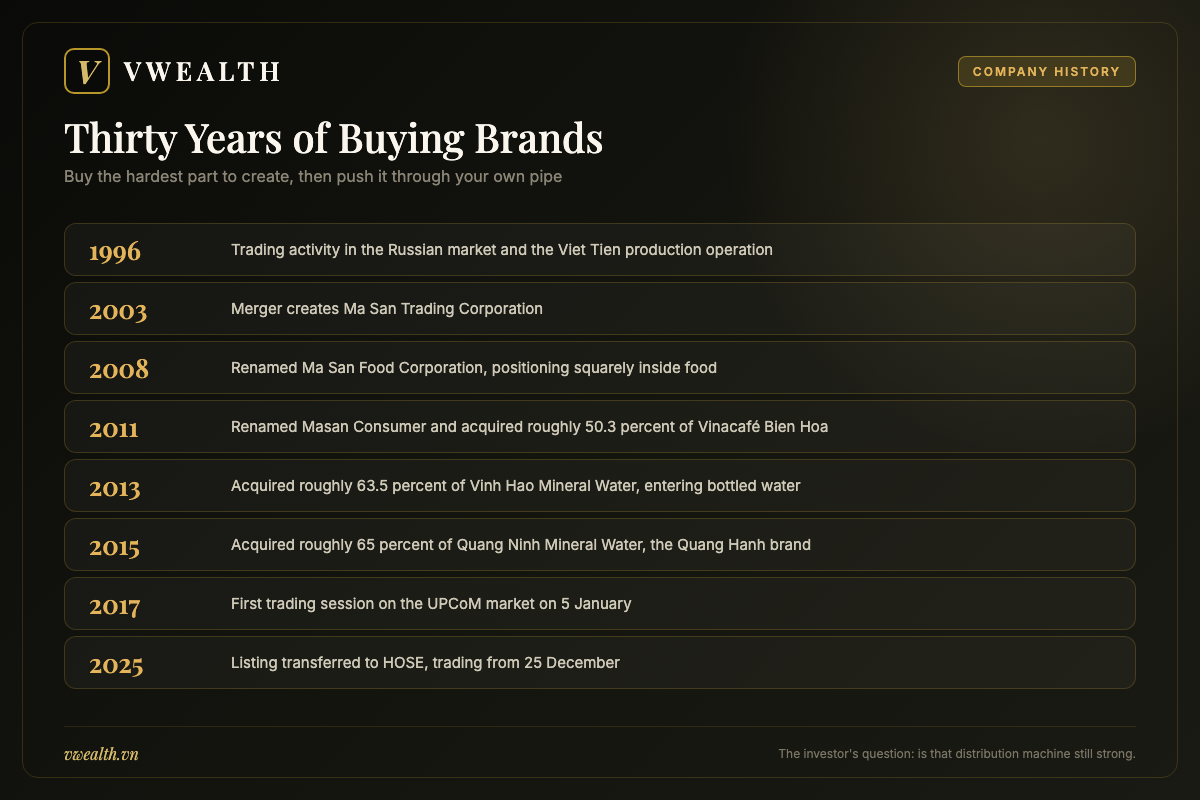
Step back and one thing is strikingly consistent: this company grew by buying brands and pushing them through a distribution system it built itself. It has rarely invented a genuinely new product for the world. What it does well is spot a brand whose potential is under-exploited, acquire it, and plug it into a marketing and sales machine that runs better than the previous owner’s. If you intend to invest here, the question you must answer is whether that machine is still strong, and how many attractive brands are left to buy.
Who runs Masan Consumer and who actually owns it
For MCH this chapter matters more than it usually would. At most listed companies, the shareholder register is background information. Here it is the variable that most directly shapes your experience as an investor — from your ability to buy and sell, to the weight of your voice in any decision.
Danny Le, the chairman
Danny Le serves as Chairman of the Board of Masan Consumer while simultaneously holding the role of Chief Executive Officer of Masan Group, the parent company, a position he has held since 2020. He joined Masan in 2010, having previously worked in investment banking.
Having the parent group’s chief executive chair the subsidiary’s board tells you something explicit about governance: MCH’s strategy is formulated inside the group’s strategy, not independently of it. For an investor this is not necessarily bad news, but it does mean you should read both stories. The companion analysis of MSN, the parent, covers the group-level picture.
Truong Cong Thang, the chief executive
Truong Cong Thang is General Director of Masan Consumer and a member of its board. He is the executive most closely associated with this business across several eras: he held senior operating roles at Masan Consumer in the early 2010s and returned to lead the consumer business in recent years.
One data point worth noting, not as a recommendation but as something to track: Thang has registered to purchase additional MCH shares, raising his personal stake. Insider buying with personal money is a signal worth attention in any market, though never sufficient on its own to justify a decision. The framework for reading insider transactions and governance quality at Vietnamese companies appears in the guide to corporate governance in Vietnam.
Ownership: an unusually thin free float
MCH’s largest shareholder is Masan Consumer Holdings, an entity within the Masan Group ecosystem, holding a controlling stake per the company’s disclosed register. Beyond that direct holding, the parent group’s effective control is higher still once indirect holdings through other member entities are counted.
The consequence is something you must fully absorb before placing an order. The genuinely free-floating share count is a small fraction of shares outstanding. At a company with very large market capitalisation, that produces a paradox: the capitalisation ranks among the market’s biggest, while daily traded value is far thinner than comparably sized names.
Three practical risks come with a thin float, and each deserves reading carefully. First, high hidden transaction cost: when you try to buy or sell any meaningful size, your own order moves the price against you. Second, price volatility beyond anything earnings explain, because a modest amount of money is enough to move the quote. Third, and this one is most underestimated, constrained exit during market stress — precisely when you most need to sell, the bid is thinnest.
This is the sharpest difference between MCH and a deeply traded consumer name such as VNM, Vinamilk. Both are consumer businesses with strong brands, but the trading experience for a minority investor is two different stories. If you manage a portfolio on the principle of always retaining the ability to exit, build that into your position size from the start.
What minority rights actually mean under near-total control
When one shareholder holds the large majority of capital, every ordinary resolution of the shareholders’ meeting is decided in practice before the meeting convenes. Profit distribution, investment plans, key appointments, related party transactions — all sit with the controlling side.
None of that means minority interests are being harmed. In many respects the two sides want the same things: a well-run business paying dividends. But you should recognise that you are a passenger rather than a driver, and that there are categories of decision — the pricing of transactions between MCH and other entities in the same ecosystem, for instance — where interests may not align perfectly. That is why the related party note sits in the seven checks in chapter four.
There is a further governance point specific to Vietnamese groups that international investors should register. Vietnamese listed subsidiaries of larger groups are common, and the market has learned to price the resulting agency risk. The practical protections available to a minority holder are the disclosure regime, the audit, and the requirement that material related party transactions be reported. These are meaningful but not equivalent to the protections a controlling-shareholder regime in a developed market would provide.
What this means in practice is that your due diligence burden is higher, not that the investment is unsound. Read the audited annual statements rather than relying on quarterly summaries, read the auditor’s opinion and any emphasis of matter paragraphs, and read the related party note in full every year rather than skimming the totals.
Dividends: the genuine bright spot
Masan Consumer has a record of paying substantial cash dividends, and this is one of the main reasons investors follow the name. Around the listing transfer in late 2025, the company set record dates for dividend payment, treasury share distribution and a share issuance to increase capital.
The capacity to pay comes from the business model itself. A fast-moving consumer goods company needs far less fixed capital investment than heavy industry: once the plants are built they need maintenance and incremental expansion in line with volume. Meanwhile cash comes in from sales every day. The result is abundant free cash flow, most of which can be returned to shareholders without constraining growth.
Do not read the dividend mechanically, though. Three questions to ask: what is the payout ratio against earnings and is it sustainable; is the dividend paid in cash or in shares, since the two are fundamentally different things; and is the company simultaneously issuing new shares that dilute your holding. The framework for checking all three appears in the guide to Vietnamese dividend stocks.
Foreign ownership and institutional access
MCH is not in a sector subject to a low statutory foreign ownership cap. But as with everything else about this stock, the real constraint is not the rule, it is the availability of shares: once the controlling shareholder holds the large majority, what remains for everyone else is limited.
That has a direct bearing on passive flows. Index providers allocate weight using free-float-adjusted market capitalisation. A company with enormous headline capitalisation but a small float receives far less weight than the headline suggests. The mechanics appear in the note on Vietnam’s market reclassification.
Ownership and leadership summary
| Item | Disclosed position | What an investor should take from it |
|---|---|---|
| Chairman | Danny Le, also CEO of Masan Group since 2020 | MCH strategy is formed inside group strategy |
| General Director | Truong Cong Thang, also a board member | Long association with the consumer business |
| Largest shareholder | Masan Consumer Holdings, within the Masan ecosystem | Decision rights sit outside minority reach |
| Free float | A small fraction of shares outstanding | Thin liquidity relative to capitalisation, so size positions accordingly |
| Listing venue | HOSE since 25 Dec 2025, UPCoM from 5 Jan 2017 | Higher disclosure standards and a wider investor base |
| Dividend | Record of substantial cash payments | Genuine attraction, but test its sustainability |
| Related party transactions | Present, given the multi-company ecosystem | The note must be read every reporting period |
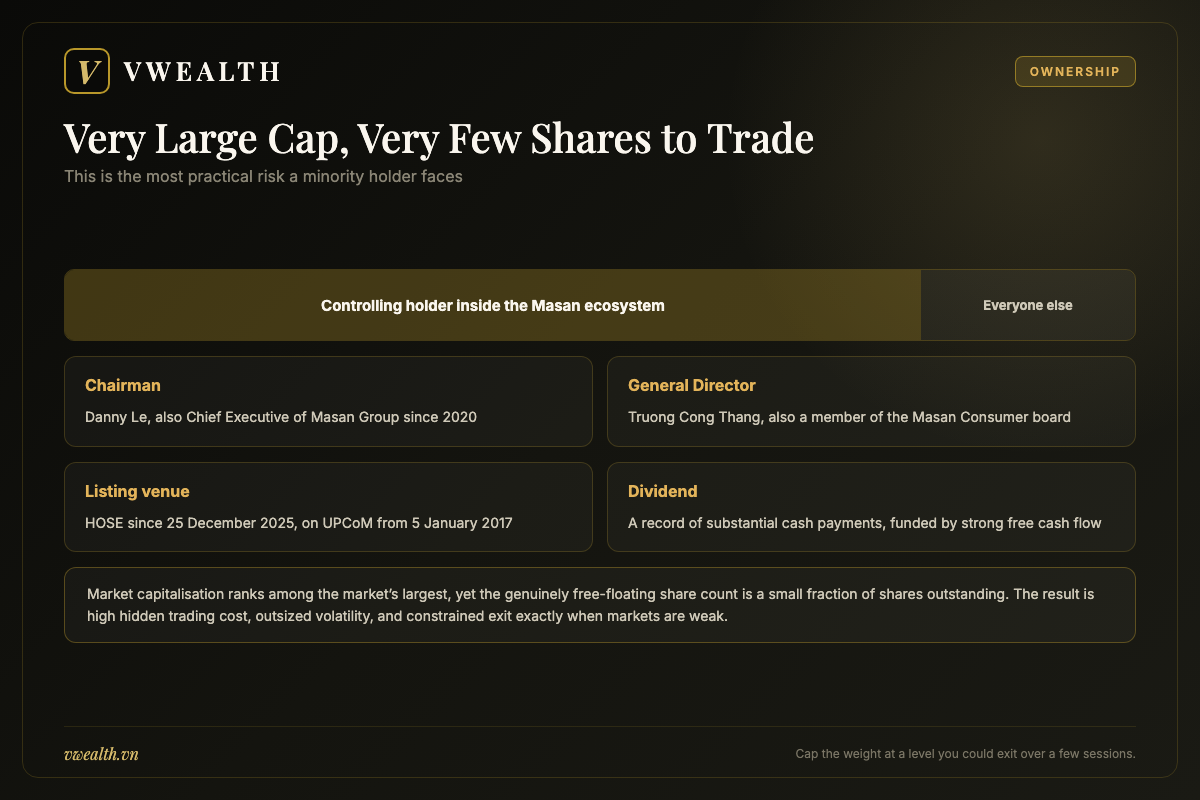
Summarise the chapter this way: MCH is a good business inside an ownership structure that leaves minority holders very passive and the shares thinly traded. That is not a reason to dismiss it, but it must be reflected in your position size and in how long you expect to hold.
How Masan Consumer makes money: dissecting an eight-category portfolio
The short answer: this company sells things a Vietnamese household buys repeatedly every month. But the short answer hides the interesting question — why do two companies selling similarly cheap goods earn wildly different margins. This chapter goes at exactly that.
Condiments: the fattest margin and the deepest moat
Fish sauce, soy sauce and chilli sauce are the company’s founding category, carrying brands such as Chin-su, Nam Ngu and Tam Thai Tu. It is also the highest-margin part of the portfolio, and it is worth understanding precisely why.
The first reason is that raw material cost is a relatively low share of retail price. A bottle of fish sauce retailing for the equivalent of a dollar or two carries far less than that in ingredients, packaging and bottling cost. The gap is not consumer exploitation; it is the cost of building the brand, the cost of getting product to hundreds of thousands of points of sale, and profit.
The second reason is deeper, and it is the moat itself. Condiments attach to taste. A cook who has used one particular fish sauce for years is deeply reluctant to switch, because the risk is not financial, it is the family dinner. The switching cost here is psychological, and it is far higher than for goods consumers compare on price.
The third reason is the price ladder described in chapter one. By occupying all three tiers, the company retains a household as its wallet changes: trading up moves the shopper to a premium label, trading down moves them to the mass label, but either way they stay inside the same house.
One more aspect of condiments matters, because it connects directly to risk. Precisely because these products sit at the centre of the daily meal, they are the most sensitive category to food-safety publicity. Vietnam’s fish sauce industry has been through extended public controversies over standards and ingredients, and episodes like that affect the whole category rather than any single company. The lesson for investors: high switching cost protects share in normal conditions, but the trust that creates the switching cost is exactly what is vulnerable in a communications crisis. That is why a condiment business must invest heavily in quality control and proactive communication, and why its large selling expense line is not waste.
It is worth being explicit about how a condiment moat is actually maintained, because the mechanism is not obvious. The company must keep the product visible enough that it remains the default choice, keep quality consistent enough that no reason to switch ever arises, and keep the price gap against the tier below narrow enough that trading down does not become attractive during a squeeze. All three require continuous spending, which is why a strong consumer brand is better described as a well-maintained asset than as a permanent endowment.
The corollary for investors is that a sudden improvement in profit margin at a condiment business is not automatically good news. It is worth checking whether the improvement came from operating efficiency, from input costs falling, or from reduced brand investment. Only the first two are unambiguously positive.
Convenience foods: a much harsher battlefield
Instant noodles and related convenience products form a large category with the fiercest competition. Vietnam ranks among the world’s largest instant noodle markets on a per capita basis, with strong competitors including Japanese and Korean groups alongside long-established domestic names.
The company’s approach here is to move up rather than compete on price at the bottom: noodles made with potato starch, packs containing real meat, products positioned as a complete meal rather than an emergency ration. The commercial logic is clear — if you cannot win on price, change what the customer is comparing.
For an investor this is the category most worth watching in the numbers, because it is the honest test of brand strength. When input costs rise, can the company raise prices without losing volume? The answer to that question, repeated across several input cost cycles, is the most reliable moat gauge available to an outsider.
There is one more structural feature of the noodle category worth understanding, because it shapes margins across the whole industry. Instant noodles are extremely price-transparent: the consumer sees dozens of options side by side at almost identical price points, and the product is consumed frequently enough that price memory is sharp. That combination limits how much any producer can charge above the category norm, no matter how good the brand.
Which is why the strategy of redefining the product — as a meal rather than a noodle — is not marketing decoration but the only viable route to margin expansion. If the consumer accepts that a product belongs in a different category, the reference price changes with it. Watching whether that repositioning is holding, across several years and several competitor responses, is one of the more informative things an investor can track here.
Coffee and beverages: buy a brand, then push it through the pipe
The beverage segment covers instant coffee under the Vinacafé name, energy drinks, and bottled mineral water under the Vinh Hao and Quang Hanh brands. Most of it arrived through acquisitions, making it the clearest illustration of the company’s growth model.
Bottled water has an interesting economic property: the product is nearly undifferentiated physically, and transport cost is high relative to product value, so competitive advantage rests mainly on plant location and distribution density within a sensible delivery radius. Owning mineral water sources in both the south and the north therefore carries more practical weight than it might appear.
Bottled water also illustrates a point about how acquisitive growth interacts with margin. When a company buys into a category where its distribution advantage is worth less — because the product is heavy, low-value and locally supplied — the acquired business will dilute group margin even if it performs exactly as expected. That is not a failure of the acquisition; it is arithmetic.
The investment question is whether the diluted margin buys something worth having: volume that keeps the distribution fleet busy, a defensive position against a competitor, or a foothold in a category expected to premiumise later. Bottled water in Vietnam has in fact premiumised over time, with consumers trading from basic purified water toward branded mineral water, so the strategic logic has support. But the margin arithmetic is real and shows up in the consolidated numbers.
Home and personal care: the hardest fight
Household and personal care products put the company in direct competition with the two multinational groups that dominate the category globally, both with vastly larger marketing budgets and research capability.
The only advantage a domestic player can exploit here is superior understanding of the traditional retail channel and the ability to serve price points multinationals de-prioritise. Set conservative expectations for this segment, and track it with market share data rather than press releases.
Processed meat and newer categories
The prepared meat business, developed after the Jinju Ham partnership, targets a real consumer trend: urban households have less time to cook and will pay for convenience. The category has substantial headroom but demands cold chain and distribution infrastructure considerably more complex than dry goods.
Distribution: the company’s largest intangible asset
If you had to name one thing that explains Masan Consumer’s position, name the distribution system. Brands matter, but a brand that is not on the shelf sells nothing.
Vietnamese retail still carries a large traditional share: wet markets, family-run grocery stores, small eateries. Serving that channel is far harder than serving supermarkets, because it consists of hundreds of thousands of scattered outlets, each buying tiny quantities, with inconsistent payment practices, requiring salespeople to visit in person. Building such a system takes years and a great deal of money, and it is the single largest barrier to entry in the industry.
Alongside the traditional channel, the company holds an unusual advantage from the parent ecosystem: a modern retail chain within the same group, giving its products access to urban shoppers without negotiating shelf position with a third party. That is a real advantage, and it is also precisely where an investor must scrutinise the pricing of intra-group transactions. For context on how Vietnamese retailers operate, see the overview of Vietnamese retail sector stocks.
Prepared foods also raise a working capital question worth flagging. Chilled and frozen products carry shorter shelf lives, higher wastage risk and heavier logistics costs than dry goods. A company scaling into that category should be expected to show a temporary deterioration in inventory efficiency and possibly in gross margin while the operation reaches scale.
Distinguishing that expected, temporary drag from a genuine problem requires looking at the segment rather than the consolidated figure. If the group inventory days lengthen while the cold chain business is scaling, that is explicable. If they lengthen while nothing is scaling, it is not.
Where the moat is, and where it is thin
MCH’s moat has three layers. The first is brand embedded in consumption habit, especially in condiments where switching cost is psychological. The second is a distribution network reaching the traditional channel, which takes years to build. The third is scale in production and raw material purchasing, allowing lower unit costs than smaller rivals.
Three thin spots are equally clear. First, in categories where the brand is not tied to taste — bottled water, household care — consumer switching cost is close to zero and the moat is correspondingly shallow. Second, high domestic penetration narrows the room for growth by extension. Third, the rise of e-commerce and retailer private labels is steadily eroding the value of a traditional distribution advantage, and this is the most important long-run risk to monitor.
Category comparison table
| Category | Representative brands | Margin character | Moat depth |
|---|---|---|---|
| Condiments | Chin-su, Nam Ngu, Tam Thai Tu | The fattest in the portfolio | Deep, built on psychological switching cost |
| Convenience foods | Omachi, Kokomi | Moderate, improving as the mix moves upmarket | Moderate, intense competition |
| Coffee and beverages | Vinacafé, energy drinks | Moderate to good | Moderate, resting on acquired brands |
| Bottled water | Vinh Hao, Quang Hanh | Thinner, high transport cost per unit value | Shallow, advantage is plant location |
| Home and personal care | Household care portfolio | Under pressure from multinational rivals | Shallowest, track by market share |
| Processed meat | Prepared food portfolio | Still building, needs cold chain | Not yet established |
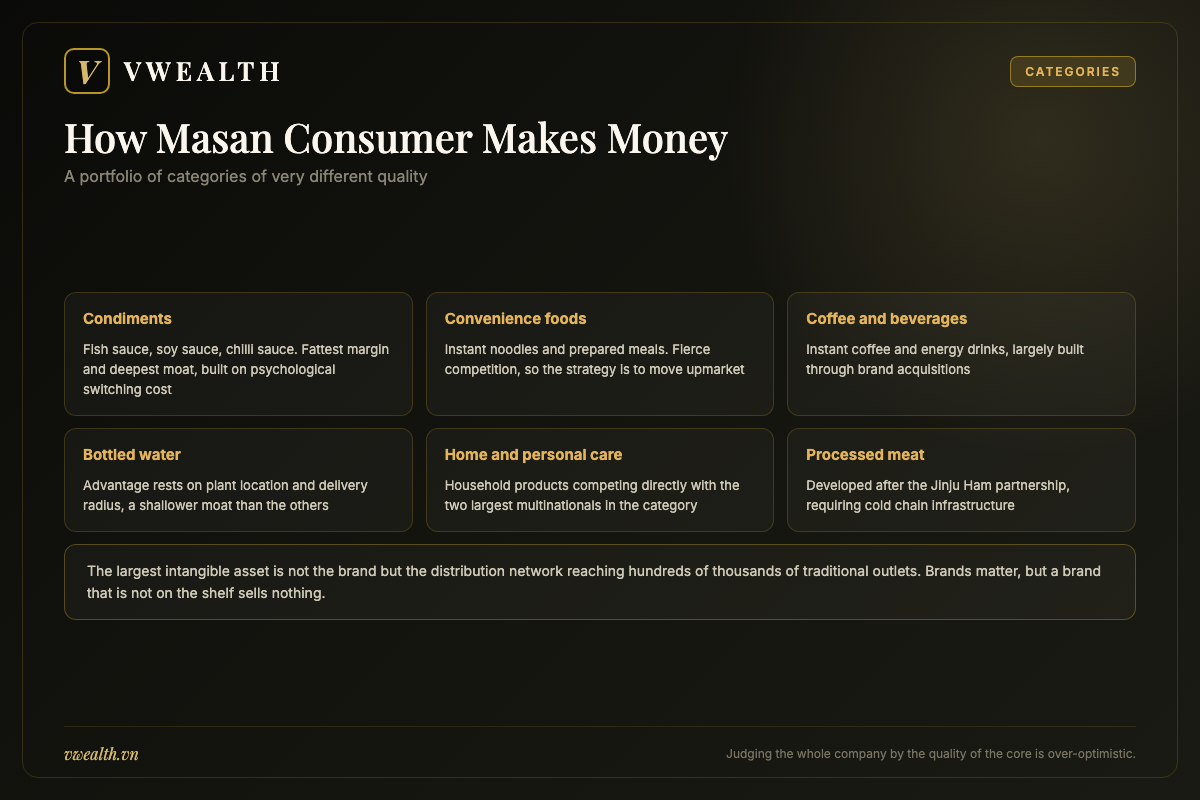
Compressed into one sentence: MCH is not a homogeneous company but a portfolio of categories of very different quality. The condiment core is a high-quality asset worth paying for. The extensions are either still proving themselves or under competitive pressure. Judging the whole company by the quality of the core is over-optimistic; judging it by the weakest category is over-pessimistic. The right approach weights by contribution, and to know the weights you must open the segment note.
Position and financial health: seven checks before you buy MCH stock
Reading a fast-moving consumer goods company is easier than reading a bank or a contractor, but easier does not mean obvious. These seven metrics are the minimum toolkit, ordered by importance.
Before the checks themselves, one orientation point about Vietnamese reporting that saves confusion. Listed Vietnamese companies report under Vietnamese Accounting Standards, which differ from IFRS in several respects relevant to a consumer business, including the treatment of certain trade promotion costs and the presentation of associates. Larger companies frequently publish supplementary information that helps bridge the gap, and the annual report is generally far more informative than the quarterly release.
None of these differences prevent meaningful analysis. They simply mean you should establish your baseline from audited annual statements, use interim reports to track direction, and avoid comparing a Vietnamese company’s ratios directly against an IFRS peer without first checking that the components are defined the same way.
Check 1: gross margin and the story it tells
Gross margin is the single most important metric at a consumer goods company, because it measures pricing power directly. A business with genuinely strong brands holds gross margin reasonably steady through input cost cycles, because it can pass cost into price.
Read it as a multi-year series set against the price behaviour of the category’s main inputs. If input costs rise and gross margin does not fall materially, that is strong evidence of brand strength. If margin compresses every time inputs rise and does not recover when they fall, the company is sharing economics with the trade or with consumers.
A useful refinement for Vietnamese filings: gross margin is presented on a VAS income statement in a familiar format, but the classification of certain distribution costs can differ from what an investor trained on international standards expects. The guide to reading Vietnamese company financial statements in English explains where those items sit.
Check 2: selling expense as a share of revenue
In this industry, selling expense is not pure cost — it is investment in an intangible asset. Advertising budget, display fees and trade discounts are money spent today to hold a position in the consumer’s mind tomorrow.
What you track is the ratio of selling expense to revenue over several periods, and more importantly its relationship to revenue growth. Three cases. Selling expense growing slower than revenue is a very good sign: the brand is carrying itself. Both growing in step is normal. Selling expense growing faster than revenue over several consecutive periods is a warning: the company is buying growth.
A common trap: cutting advertising sharply in one quarter flatters that quarter’s profit immediately, while the bill arrives in later years as eroded share. Do not celebrate a net margin improvement that comes from cutting marketing.
A practical note on where to find selling expense detail in Vietnamese filings. The income statement presents selling expenses as a single line, and the level of breakdown in the notes varies between companies and between annual and interim reports. Annual audited statements generally carry more granularity than quarterly releases, so build your baseline understanding from the annual report and use quarterly numbers to track direction rather than composition.
If the disclosure does not separate advertising from trade discounts and logistics, you can still learn a great deal from the aggregate ratio and from management commentary at the annual meeting, where questions about marketing intensity are routinely asked and answered. Over several years, the pattern of those answers is itself informative.
Check 3: revenue and profit contribution by category
As chapter three showed, MCH’s categories differ sharply in quality. Where growth comes from therefore matters as much as how much growth there is.
Find the segment note and answer three questions: what share of total profit does the condiment category represent and is it falling; have the newer categories begun contributing profit or only revenue; and is any category loss-making while being masked by the core?
Check 4: revenue from new products, and the volume-versus-price split
This is the check retail investors skip most often while industry professionals treat it as existential. A healthy consumer company must launch new products continuously, because consumer habits shift and competitors do not stand still.
Companies typically disclose this in AGM materials or annual reports as the percentage of revenue derived from products launched within the last few years. Too low a share means the portfolio is ageing. A very high share without margin improvement means the company launches a lot and lands few.
There is a companion reading that is even more useful: split revenue growth into the part driven by volume and the part driven by price. Companies rarely disclose that split directly, but you can approximate it by comparing revenue growth against the price adjustments management describes in shareholder communications. The distinction matters enormously. Volume-driven growth means the company is selling more units, so share or the market is expanding. Price-only growth sustained over many periods while volume stays flat signals a company using brand strength to compensate for lost momentum, and that has a limit, because nobody can raise prices forever.
One more angle on category contribution that repays effort: compare the growth rate of each category against the growth rate of its underlying market where industry data is available. A category growing at ten percent inside a market growing at fifteen is losing share while appearing healthy in isolation. A category growing at four percent inside a market growing at one is gaining share while appearing sluggish.
Absolute growth numbers tell you about the environment. Relative growth numbers tell you about the company. When only one is available, be careful about which conclusion you draw, and be especially careful when management presents absolute numbers in a period when the market itself was strong.
Check 5: inventory days and channel receivables
Fast-moving consumer goods carry a distinctive risk outsiders rarely appreciate: channel stuffing. A company can recognise revenue when it ships to a distributor, but that product has not necessarily reached an end consumer. If the channel is loaded with excess stock, this quarter’s revenue is effectively borrowed from next quarter.
Detection means tracking two metrics alongside revenue: inventory days and receivable days. If revenue rises strongly while receivable days lengthen and inventory swells, ask questions.
Two further balance sheet items reward attention at a consumer company. The first is goodwill and other intangibles arising from past acquisitions, which for an acquisitive company can be a substantial share of total assets. Impairment there is a direct verdict on capital allocation quality.
The second is fixed asset investment relative to depreciation. A consumer company running capital expenditure well below depreciation for several years is harvesting rather than reinvesting, which flatters near-term cash flow while quietly ageing the asset base. A company spending well above depreciation is building capacity, which is encouraging if volume is growing and worrying if it is not. The ratio between the two, tracked over a full cycle, tells you which mode management is in.
Check 6: related party transactions
Because MCH sits within an ecosystem of commonly controlled companies, the related party note is mandatory reading rather than optional.
Four things to look at: the scale of sales to entities within the same ecosystem relative to total revenue; whether the commercial terms are stated to be at market rates; receivable and payable balances with related parties at period end; and any lending, deposit or guarantee arrangements between entities.
To avoid misunderstanding: the existence of intra-group transactions is not a negative signal. In a vertically integrated group they are inevitable and frequently beneficial to both sides. What you need is transparency on pricing and scale, so you can judge how much of MCH’s profit is earned in the open market.
Check 7: free cash flow and the quality of the dividend
The final check connects to the main reason many people own this stock. Take net cash from operating activities, subtract capital expenditure to derive free cash flow, and compare it against cash dividends actually paid in the same period.
If free cash flow consistently exceeds dividends paid, the policy is sustainable with room to spare. If dividends approximate or exceed free cash flow across several years, the company is paying from accumulated cash or borrowing, and the payout may have to fall when growth capital is needed.
The seven checks in one table
| Metric | Where to find it | Healthy sign | Warning sign |
|---|---|---|---|
| Gross margin | Income statement | Stable through input cost cycles | Compresses on every input rise and never recovers |
| Selling expense to revenue | Income statement and notes | Growing slower than revenue | Growing faster than revenue over several periods |
| Contribution by category | Segment note | Core solid, new categories turning profitable | New categories contributing revenue but no profit |
| New product revenue and volume mix | Annual report, AGM materials | Steady share with improving margin | Growth coming from price alone while volume is flat |
| Inventory and receivables | Balance sheet and notes | Days stable as revenue grows | Revenue up while receivables and inventory swell |
| Related party transactions | Related party note | Reasonable scale, terms disclosed | Large and rising share, balances outstanding for long periods |
| Free cash flow and dividends | Cash flow statement | Free cash flow consistently above dividends | Dividends at or above free cash flow |
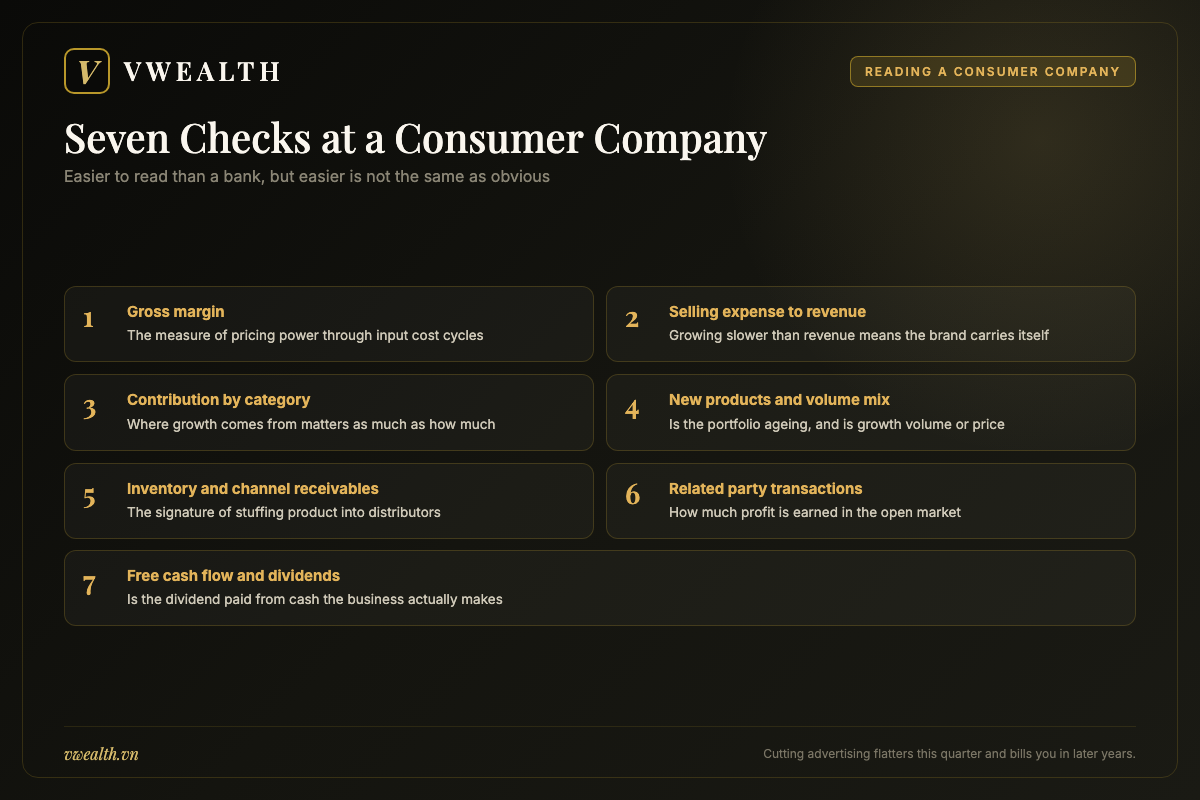
What do the seven checks say about MCH’s position? They say this is among the best-positioned consumer goods companies in Vietnam, with a rare condiment core, abundant cash generation and a habit of returning cash to shareholders. They also say quality is uneven across categories, that part of the activity occurs inside a related ecosystem and therefore needs transparency to assess, and that room for growth by extension in the domestic market has narrowed. That is the profile of a high-quality company entering a phase where it must prove it can grow by depth rather than by breadth.
How the market treats MCH stock: the listing transfer and the liquidity problem
This stock has a rare characteristic: very large market capitalisation with a trading history that occurred mostly in a venue institutions avoid. Understanding that characteristic explains most of what happens to the price.
Nine years on UPCoM and what it cost
From January 2017 to December 2025, MCH traded on UPCoM. That market has three features that bear directly on a stock: lighter disclosure requirements than the two listed exchanges, a wider intraday price band, and — most importantly — restrictions, whether regulatory or self-imposed, that keep many institutional funds from buying UPCoM shares at all.
The result was a paradox that lasted years: one of Vietnam’s largest consumer companies sat outside the reach of most institutional capital. That goes a long way toward explaining why the stock’s valuation during that period was often compared unfavourably with peers listed on HOSE.
25 December 2025: the transfer and what came with it
Moving the listing to HOSE at the end of 2025 removed that technical barrier. On HOSE the stock became eligible for consideration by a far wider set of funds, faces stricter disclosure obligations, and trades within a narrower daily band than on UPCoM. During 2026 the exchange also removed the stock from the list of securities ineligible for margin trading, and the shares were recorded as a component of the VN30 index.
Read that sequence with a clear head. A listing transfer and index inclusion improve accessibility for capital, but they do not make the business better. Revenue, margin and market share the day after the transfer were identical to the day before. What changed was the pool of potential buyers and the price that pool is willing to pay. At a stock with a low free float, that change can move the price sharply in the short run — in both directions.
It is worth correcting a common misunderstanding here. Transferring from UPCoM to HOSE is not a share offering; the company raises nothing from the act, and shares outstanding do not change because of the move. It is purely a change of venue and rulebook. Every price effect therefore comes from the demand side, not the supply side. More investors may buy, more funds are permitted to buy, and the stock appears in more screens. But the quantity of shares available to sell to them is exactly what it was. Holding that distinction clearly prevents you from confusing a market structure change with a change in business value.
The paradox of a large cap that barely trades
This is the most important thing to remember about the stock, and it deserves restating from a trading perspective. Index inclusion creates an interesting technical consequence: index-replicating funds must buy a certain quantity while the quantity available in the market is tightly limited. When compulsory demand meets constrained supply, price moves hard. That benefits existing holders, but it also means the price formed during such a period does not necessarily reflect intrinsic value.
Three practical rules for an individual investor. First, break orders up and accept accumulating across many sessions rather than one large order. Second, cap this name’s weight in your portfolio at a level you could exit over a few sessions without dumping. Third, be extremely wary of margin leverage in a thinly traded name, because when you are forced to sell your own order makes the price worse.
One more consequence of a constrained float deserves attention, because it works in the opposite direction from the one investors usually consider. A thin float amplifies moves upward as readily as downward. Periods of forced or enthusiastic buying can lift the price well beyond what fundamentals support, and the same thinness that made the ascent easy makes the descent fast when the buying stops.
The disciplined response is to anchor your view on business value and treat the traded price as information about sentiment rather than about worth. That discipline is easier to state than to practise, particularly during a period when a stock is in the news for structural reasons. Writing down your valuation range before an event, rather than during it, is the simplest protection available.
Valuing a consumer company: why the multiple always looks expensive
Fast-moving consumer goods stocks trade at earnings multiples above the market average almost everywhere in the world, and Vietnam is no exception. New investors often see that number and conclude the stock is expensive, which is a premature judgement.
Three reasons the market pays up for this group. First, the cash flow repeats with unusual reliability: people buy fish sauce regardless of the economic cycle. Second, capital intensity is low, so most profit converts into free cash. Third, bankruptcy risk is essentially nil for a business with strong brands and a clean balance sheet.
But a high multiple is only justified while growth is present. When a consumer company hits the ceiling of domestic penetration and growth slows, the market de-rates it, and that de-rating can grind on for years even while profit still edges higher. This is the principal valuation risk at MCH, and it is larger than the business risk. The framework for thinking about multiples on this market is set out in the note on Vietnamese market valuation.
There is a broader lesson in the UPCoM years that applies beyond this one company. Market microstructure — which venue a stock trades on, how much of it floats, which indices include it — can affect valuation for long periods independently of business performance. Investors trained in deep, efficient markets tend to underweight this factor, assuming that value will find its price. In frontier and early emerging markets it frequently does not, or does so only when a structural barrier is removed.
That cuts both ways for a buyer. It means genuine mispricing can persist long enough to be exploitable, which is an opportunity. It also means you may hold a correctly analysed position for years while the market ignores it, which requires a temperament many investors discover they do not have.
Comparing MCH with the other consumer options
| Company | Position in the consumer chain | Main revenue source | Key investor characteristic |
|---|---|---|---|
| MCH (Masan Consumer) | Fast-moving consumer goods manufacturer | Condiments, convenience food, beverages, home care | High margin, large cash dividends, thin liquidity |
| VNM (Vinamilk) | Dairy manufacturer | Liquid milk, powder, yoghurt | Deep liquidity, steady dividend, slowing growth |
| SAB (Sabeco) | Alcoholic beverage producer | Beer and soft drinks | Sensitive to policy and out-of-home consumption |
| MWG (Mobile World) | Retailer | Electronics, phones, grocery | Thin margin, high operating leverage, cyclical |
| MSN (Masan Group) | Parent holding company | Consumer, retail, materials, financial services | Conglomerate discount, more complex structure |
The table surfaces a choice many investors do not realise they are making: buy MCH or buy MSN. In substance, buying MSN means buying most of MCH indirectly plus the other businesses, usually at a discount to the sum of the parts. Buying MCH means owning the highest-quality consumer core directly while accepting thin liquidity. There is no universally correct answer; it depends on whether you want purity or you want the discount.
For investors weighing the role of consumer names within a portfolio, the overview of Vietnamese consumer sector stocks explains why this group tends to hold up better during market drawdowns.
Industry context: demographics, income and the great channel shift
A consumer company grows with the wallets and habits of a population. This chapter looks at the four forces shaping the industry, and which are blowing with the company and which against.
Force one: rising income and the move upmarket
The largest long-run driver of Vietnamese consumer goods is not population growth but income per capita. As incomes rise, consumers do not eat more by volume; they shift to more expensive versions: from mass fish sauce to premium, from basic instant noodles to noodles with meat, from ordinary instant coffee to premium packaged formats.
That is precisely the driver the company’s price ladder is designed to capture. When a shopper trades up, the company does not lose the customer, it simply sells them a different product at a better margin on the same purchase occasion. For an investor this is the highest-quality source of growth available, because it requires neither new customers nor new outlets. The demographic backdrop is set out in the note on Vietnam’s demographic investment case.
Force two: the shift from traditional to modern and online retail
This force cuts both ways and is the most important thing to watch over the coming decade. Modern retail — supermarkets, convenience stores, grocery chains — is expanding quickly in urban Vietnam, and e-commerce is growing faster still.
The favourable side: modern channels give manufacturers access to higher-income consumers, better product display, and far more accurate sales data. For a company inside a group that owns its own retail chain, the advantage is larger still.
The unfavourable side, and it is more serious than many appreciate: the core competitive advantage of large manufacturers for decades has been exactly the distribution system reaching the traditional trade. As consumers migrate to supermarkets and online, that barrier loses value. A new brand today can reach millions of people without any field sales force, using an online storefront and an advertising budget. On top of that, retail chains increasingly push private label products that compete directly with their own suppliers on their own shelves.
There is a secondary variable inside this shift worth tracking: purchase frequency and pack format. In traditional trade, consumers buy small quantities often — small sachets, small bottles. In modern and online channels they buy in bulk, favouring larger formats and bundles. That changes product mix, changes packaging, and ultimately changes margin per unit sold. Manufacturers that redesign their format portfolio channel by channel protect their margins. Those that simply carry the old range into the new channel watch margin compress without understanding why.
It is worth adding a note on what the channel shift does to the manufacturer’s information position, because this is often overlooked. In the traditional trade, a manufacturer knows what it shipped to distributors but has limited visibility of what actually sold to consumers. In modern and online channels, point-of-sale data is precise and available quickly.
That is a genuine advantage for whoever can use it: faster feedback on new launches, better forecasting, less working capital tied up in the wrong stock. It also raises the competitive bar, because rivals with the same data can respond just as fast. Over time, the winners in a data-rich channel tend to be the organisations that build the analytical capability to act on it, not simply those that collect it.
Force three: input costs and the currency
Input costs for this industry depend on a basket of agricultural commodities and packaging materials, many priced internationally and paid for in foreign currency. When commodity prices rise or the dong weakens, gross margin comes under pressure.
A company’s ability to absorb that depends on three things: brand strength sufficient to raise prices, scale sufficient to buy inputs well, and hedging policy. This is exactly why gross margin ranks first among the seven checks in chapter four.
Currency deserves a separate word for an international investor, because it affects your return directly rather than only through the company’s costs. A foreign shareholder in a Vietnamese company earns returns in dong and converts them back into a home currency. Even a company performing perfectly can deliver a disappointing result in dollar or euro terms if the dong depreciates over the holding period.
Consumer companies have a partial natural hedge here that is worth noting: their revenue is domestic and their pricing power lets them pass local inflation into prices over time, which historically has offset part of the currency drift. The offset is partial and slow, not complete, but it is one reason domestic consumer names are often held by investors who take a multi-year view on Vietnam.
Force four: regulation and food safety standards
The food industry faces steadily tightening rules on labelling, ingredients, advertising and hygiene. Over the long run this favours large companies with proper quality systems, because it raises compliance costs and pushes small producers out.
But it also creates a distinctive industry risk investors must acknowledge: reputational risk. A food safety incident, even a small one that is later clarified, can inflict brand damage far exceeding the direct financial cost. At a company whose principal asset is consumer trust, this is a genuine tail risk — rare but severe.
A final observation about the regulatory direction that matters for the medium term. Standards covering labelling, nutritional declaration and advertising claims in Vietnam have converged steadily toward international norms, and that convergence is likely to continue. For an export-minded company this is helpful, because compliance built for the domestic market increasingly resembles what a foreign market will require.
For smaller domestic competitors it is the opposite: rising compliance cost falls hardest on those with the least scale to absorb it. Over a decade, this dynamic has consistently favoured large branded manufacturers in every market where it has played out, and there is little reason to expect Vietnam to be different.
Exports: an open door, but a hard one
Taking Vietnamese brands abroad has clear logic: domestic headroom is narrowing, while the Vietnamese diaspora and Asian consumers generally represent a real market for Vietnamese condiments and foods.
Set expectations properly, though. Abroad, the company loses nearly every advantage it holds at home: no proprietary distribution, no established brand recognition, no scale advantage against local incumbents. Exporting consumer goods is a multi-year, expensive undertaking. The correct reading is to treat it as a long-dated option and to track it by the actual share of international revenue year by year, not by announced targets.
The four forces at a glance
| Force | Direction | Who benefits | What to monitor |
|---|---|---|---|
| Rising income and premiumisation | Favourable, long run | Companies with a laddered price portfolio | Share of revenue from premium products |
| Shift to modern and online retail | Both ways | Companies with their own retail access, but erodes the distribution barrier | Revenue mix by channel and private label pressure |
| Input costs and currency | Unfavourable when rising | Companies with pricing power and scale purchasing | Gross margin through input cycles |
| Regulation and food safety | Favourable long run, with tail risk | Large companies with quality systems | Reputational incidents and crisis handling |
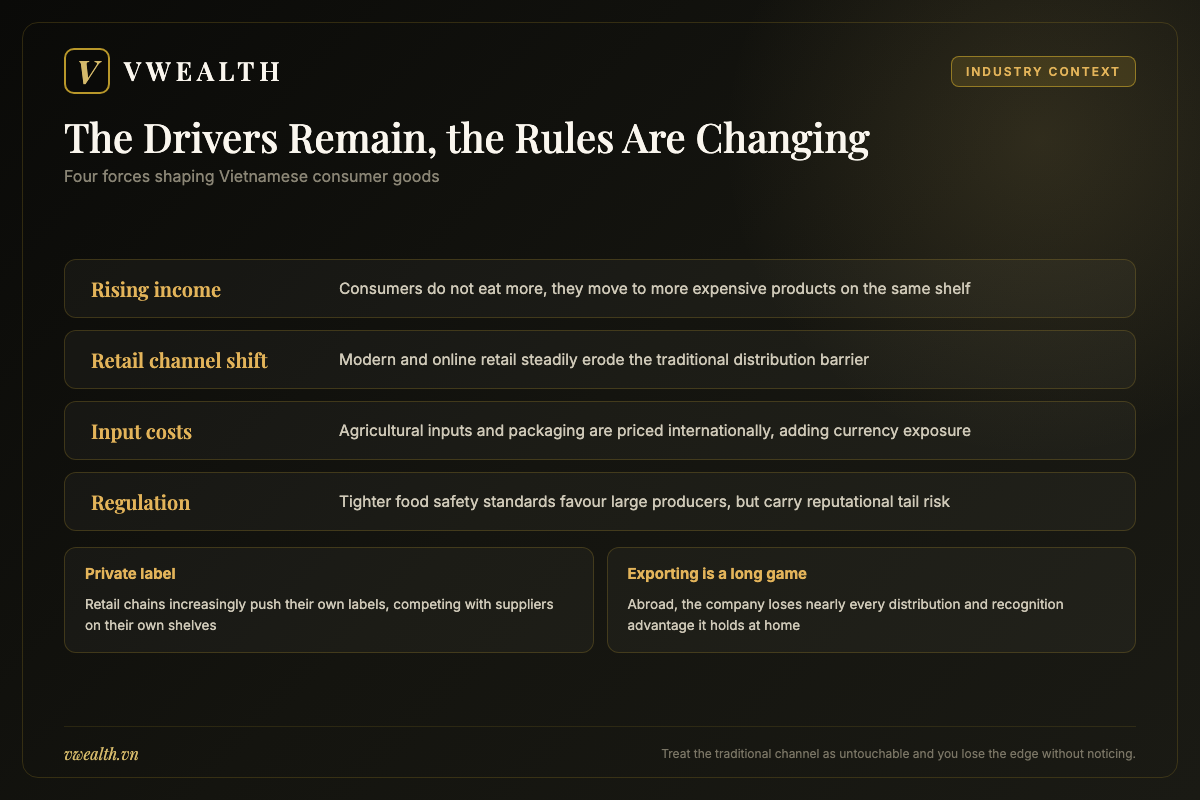
Summing up the backdrop: Vietnamese consumer goods still enjoys real growth from rising incomes, but the rules of the game are changing at the distribution layer. Companies that convert a traditional distribution advantage into a modern and online advantage will keep their position. Companies that treat the traditional channel as untouchable will lose their edge without noticing, because the process is slow.
Looking forward: three scenarios for MCH and what each one requires
No price targets here. Three scenarios with conditions, so you can track which branch reality follows.
Four variables that decide the outcome
The first variable is the ability to lift the average value of each purchase. With penetration already high, growth must come from selling more expensive products to the same shopper. Track the premium share of revenue and gross margin.
The second is the pace of channel migration and how well the company adapts. If the share of revenue through modern and online channels rises steadily without margin deterioration, the transition is working.
The third is the real outcome of the international strategy, measured by the actual share of international revenue year by year rather than by announced ambition.
The fourth, unusually important for this particular stock, is the free float. Anything that increases the quantity of shares genuinely available improves liquidity and widens the investor base, and anything that reduces it does the reverse.
A word on how a consumer goods business ages, since this is the frame that makes the scenarios below intelligible. Categories mature at different speeds. A condiment brand established in a national cuisine can hold share for decades with modest reinvestment. A beverage brand faces reinvention every few years as taste trends move. A household care brand competes against multinationals that reformulate and relaunch constantly.
Because MCH holds all three kinds of asset, its aggregate growth rate is a blend of very different underlying decay and renewal rates. Any forecast built on a single company-wide growth number is therefore fragile. The more robust approach is to think about the core and the extensions separately, then weight them.
Optimistic scenario: premiumisation works and liquidity improves
Here the company continues lifting the average value per purchase through its premium portfolio, holds gross margin through input cycles, and migrates successfully to modern channels. In parallel, the free float widens, letting the stock reach more funds and narrowing the liquidity discount.
Conditions required: a high hit rate on new launches, selling expense growing slower than revenue, and no reputational incident in the food categories.
Early signals: gross margin improving across several periods, average daily traded value rising durably, and a visibly increasing premium share of revenue.
It also helps to be concrete about what would falsify the framing used in this article. If MCH’s gross margin turned out to move principally with commodity prices rather than holding through cycles, the brand-strength argument would be weaker than described here. If liquidity improved substantially and the valuation discount persisted anyway, the liquidity explanation for that discount would be wrong and something else would need to account for it.
Deliberately identifying what would prove you wrong, before you buy, is more useful than assembling further evidence that you are right. It also gives you a rule for selling that does not depend on the price, which is the hardest kind of discipline to maintain and the most valuable.
Base case: moderate growth, steady dividends, flat rating
This is the scenario the article considers most likely. The company keeps growing at a moderate rate, faster than the economy but without dramatic acceleration. Margins hold near their historical range. Cash dividends continue. The international strategy advances slowly without contributing materially.
In this branch, total investor return comes mainly from two sources: the dividend and moderate profit growth, while the valuation multiple stays flat or drifts slightly lower. That is a decent investment but not a fast one, and you should accept that before buying.
The base case also implies something about the appropriate holding period. If total return is composed mainly of a dividend plus moderate earnings growth, then the compounding works slowly and steadily, and short holding periods expose you mostly to multiple movement rather than to business performance. Investors who buy this kind of asset with a one-year horizon are, whether they realise it or not, making a bet on sentiment.
Extend the horizon to five years or more and the arithmetic changes: the dividend stream and earnings growth begin to dominate, and the entry multiple matters less with every year held. That is the classic case for owning a high-quality consumer business, and it is also why paying attention to the entry price is not a contradiction of a long-term approach but a component of it.
Adverse scenario: quiet share loss or a reputational shock
The adverse case has two rather different branches. The first unfolds slowly: retailer private labels and new online-native brands nibble at share in categories with low switching costs. Revenue still rises on price, but volume flattens or falls, and selling expense has to increase to defend position. This process is hard to detect in one or two quarters and very costly over several years.
The second branch unfolds quickly: a food safety incident or a viral negative story hits a flagship brand. At a company whose principal asset is trust, this kind of risk can destroy years of building in weeks.
There is also a valuation-only branch unrelated to operations. If the market concludes that domestic growth has run out, the multiple can compress steadily for years even while profit grows modestly. That is the quietest risk facing anyone buying at an elevated rating.
A note on how to use these scenarios. They are not three mutually exclusive futures but three branches a company can travel at different times. A consumer company may run the base case for several years, shift to the optimistic branch when a new product line lands, then slide toward the adverse branch when a new competitor appears. Tracking the early signals therefore matters more than picking the right scenario at the outset. Choose two or three metrics from the chapter four table, record them every reporting period, and read the trend rather than the single number.
Scenario summary table
| Scenario | Conditions required | How it shows in the accounts | Early signal to watch |
|---|---|---|---|
| Optimistic | Premiumisation works, channel shift handled, float widens | Gross margin up, selling expense growing slower than revenue | Premium share rising, daily traded value up durably |
| Base case | No shock, moderate growth | Margins flat, dividends steady | Revenue growth modest with no acceleration |
| Adverse | Quiet share loss or a reputational shock | Selling expense outgrowing revenue, gross margin compressing | Volume flat while revenue rises on price alone |
What all three share is that the company faces no existential risk. The condiment category is still there, the brands are still there, the cash still arrives. What differs across branches is the growth rate and the multiple the market is prepared to pay. That is why, with this stock, the price you pay matters far more than picking the right company.
So, should you buy MCH stock? A straight answer
You now have the material. This closing chapter does three things: weighs the case for, weighs the case against, and says plainly who this stock suits.
The case for: five reasons MCH deserves consideration
First, the quality of the core business is genuinely high. Condiments combine fat margins, reliably repeated demand and psychological switching costs — a trio of characteristics that is rare on the Vietnamese market and rarer still in one company.
Second, the distribution network reaching the traditional trade is an intangible asset that takes years and enormous spending to build, supplemented by privileged access to a modern retail chain inside the same group.
Third, abundant free cash flow and a record of substantial cash dividends. For investors who care whether a company actually transfers money to its owners rather than merely reporting profit, that is a meaningful point in its favour.
Fourth, the move to HOSE and inclusion in a major index removed a technical barrier that had persisted for years, widening the set of investors able to participate.
Fifth, this is a defensive business. Demand for condiments, noodles and drinking water contracts far less in a downturn than almost any other sector, so results are steadier than the market average.
A sixth consideration sits slightly outside the usual list, and it concerns optionality inside the group. Because MCH sits alongside a modern retail network under common ownership, it has a route to test products, gather sales data and scale winners faster than an independent manufacturer of similar size. That capability does not show up as a line in any statement, and it is genuinely difficult to value.
Treat it as a reason to require a slightly smaller discount than you otherwise would, rather than as a reason to pay a premium. Advantages that cannot be measured have a habit of being smaller in practice than they appear in a strategy presentation, and the honest position is to acknowledge the uncertainty rather than to resolve it in either direction.
The case against: six risks you have to face directly
First, thin liquidity relative to capitalisation. This is the most practical risk and it directly shapes your experience both entering and exiting.
Second, a controlling shareholder holding the large majority of capital, leaving minority holders effectively without a voice in any decision.
Third, membership of an ecosystem of related companies, meaning part of the activity occurs through intra-group transactions and requires transparency to assess properly.
Fourth, narrowing room for growth by extension domestically as penetration approaches its ceiling, forcing growth onto harder paths.
Fifth, the erosion of the traditional distribution advantage by e-commerce and retailer private labels. This is the most important long-run risk and, because it unfolds slowly, the easiest to ignore.
Sixth, valuation risk: consumer stocks trade at elevated multiples, and when growth slows, multiple compression can cancel out years of profit growth.
Weighing both sides
| In favour | Against |
|---|---|
| Condiments with fat margins and high psychological switching cost | Thin liquidity relative to capitalisation, high hidden trading cost |
| Distribution reaching the traditional trade, hard to replicate | Controlling shareholder holds the majority, minorities are passive |
| Abundant free cash flow and a large cash dividend record | Related party transactions require reading every period |
| Now on HOSE and inside a major index | Domestic penetration near its ceiling, extension growth limited |
| Defensive characteristics through economic downturns | Traditional distribution advantage eroding steadily |
| Laddered portfolio captures the premiumisation trend | High multiple vulnerable to de-rating as growth slows |
Who this stock suits, and who it definitely does not
For the long-term value investor: MCH can fit if you treat it as an investment in business quality and accept a holding period measured in years. The conditions are that you buy at a sensible valuation rather than at the top of a listing-transfer rally, and that you accept it will be difficult to exit quickly if you change your mind.
For the growth investor: this is not a high-growth stock. The company is already large, penetration is already high, and every new growth engine needs years to prove itself. If you are hunting for pace, better options exist.
For the income investor: this is among the more interesting names on the market, given stable cash generation and a record of substantial cash dividends. But verify the payout against free cash flow, and stay alert to share issuance that dilutes your holding.
For the short-term trader: this is the least suitable profile of the four. Thin liquidity makes entry and exit expensive, price can swing violently on a single large order, and using margin leverage in a name like this is a recipe for trouble. Note also that Vietnamese settlement runs on a T plus two basis and foreign investors must trade through a licensed local custodian, which lengthens the practical reaction time still further.
A note on position sizing for a portfolio that already holds Vietnamese consumer exposure. MCH, VNM, SAB and the retail names all depend on the same underlying variable: Vietnamese household consumption. Holding four of them is closer to holding one large sector position than to holding a diversified basket, and correlation between them rises precisely during broad consumption downturns, which is when diversification is supposed to help.
If you want genuinely differentiated exposure inside consumption, the useful contrast is between a manufacturer whose earnings depend on brand and margin, and a retailer whose earnings depend on volume and operating leverage. Those two respond differently to the same conditions. Pairing two branded manufacturers achieves far less separation than the ticker count suggests.
Five questions to answer before you place an order
Question one: which way has gross margin trended over the last four to six reporting periods, and is that trend consistent with what input prices did?
Question two: is selling expense growing faster or slower than revenue?
Question three: what share of revenue and profit comes from the condiment category, and have the newer categories turned genuinely profitable?
Question four: what is the average daily traded value of this stock, and at the position size you intend, how many sessions would you need to exit fully without dumping?
Question five: are you buying because of business quality, or because of the listing transfer and index inclusion story? If it is the latter, remember that such a story runs only once and is usually priced in before it becomes fact.
Closing: a good business inside a tight shell
The story of Masan Consumer runs from containers of goods sold in Eastern Europe to a presence in nearly every Vietnamese kitchen. It grew by acquiring brands and pushing them through a distribution system it built itself, and that method has been validated repeatedly.
But owning a good business and having a good investment are two different things. With MCH, the gap between them sits in two very concrete places: the price you pay and the quantity of shares available for you to trade. The quality of the business is not seriously disputed. The ownership structure and the liquidity are where your practical risk actually lives.
So, should you buy MCH stock? If you understand that you are buying a high-quality consumer goods business under near-total control, accept thin liquidity and size your position accordingly, treat the dividend as a meaningful part of total return, and buy at a sensible valuation rather than chasing an event-driven move — then MCH is a reasonable holding within a consumer allocation. If you are buying because the stock just changed exchanges, because it just entered an index, or because you heard the products reach 98 percent of households, you are buying a story rather than a business.
One last thing to carry with you. Masan Consumer’s brands, category portfolio and distribution system change slowly. Its gross margin, selling expense, category mix, liquidity and valuation change every quarter. Before placing an order, open the latest research and score the seven checks from chapter four again. It takes fifteen minutes, and they are the most valuable fifteen minutes in the entire decision. If you do not yet have the tools to do that, create a free vwealth account and let the platform read the filings for you.
This article provides information and analysis for reference purposes only and is not a recommendation to buy or sell any security. All investment decisions are yours alone, and you bear responsibility for their outcomes. Consider consulting a licensed financial adviser before acting.
Research Vietnamese stocks in English with vwealth. Our AI-powered platform turns Vietnamese market data into full English analysis reports — with international payment support and a free 2-month trial for new accounts. Create your free account and read the latest reports.