Most people who ask whether to buy GEE stock start from a misunderstanding: they think they are asking about Gelex. GEE is the ticker of Gelex Electric Joint Stock Company, a subsidiary controlled by Gelex Group, which itself trades under the ticker GEX. They are separate legal entities, separate listings, and — this is the part that matters — completely different investment propositions. Gelex Group is a holding company with several verticals. Gelex Electric is a pure electrical equipment manufacturer that owns brands almost every household in Vietnam has used without noticing: CADIVI cable inside the walls, THIBIDI distribution transformers on the pole at the end of the street, EMIC meters mounted by the front gate, HEM motors inside the water pump. This analysis walks through the road from the first copper cable produced in 1975 to the day GEE rang the bell on the Ho Chi Minh Stock Exchange, teaches you how to read the accounts of a manufacturer whose profit is largely decided by a metal price set in London, and ends with a straight answer.
One convention before we start. You will encounter dates, names, brands and scale figures in this article, all drawn from public sources: the listing prospectus, annual reports, shareholder meeting resolutions, disclosures filed with the exchange, and mainstream financial media. What you will not find is a figure for the latest quarter, a current valuation multiple, or a price target. For a manufacturer whose gross margin moves with the world copper price, those numbers age badly; an article still being read two years from now that quotes one specific quarter is wrong ninety days after publication. Instead, this piece teaches you where to look. For current numbers, open the research reports on vwealth.
If you are new to this market entirely, the companion guide on how to invest in the Vietnam stock market covers accounts, settlement, taxes and the mechanics that sit underneath everything discussed here.
From a copper strand in 1975 to a ticker on HOSE
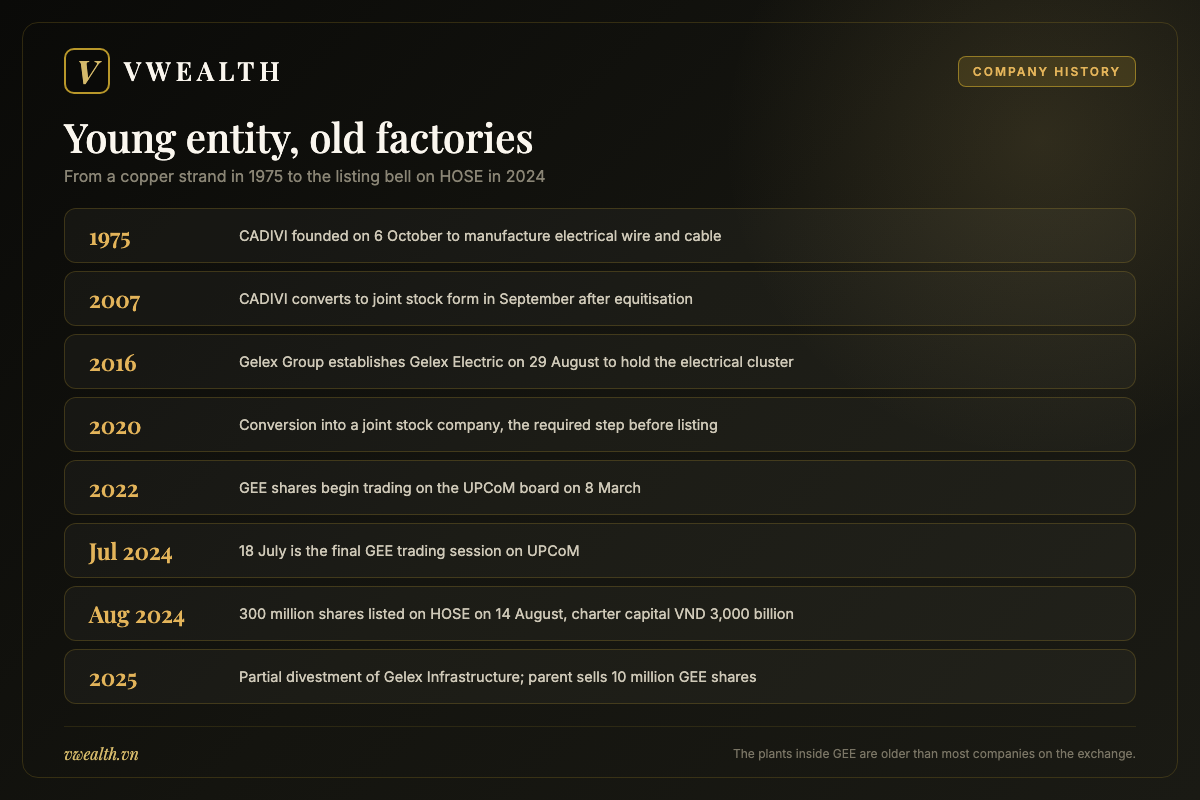
Gelex Electric has an unusual profile: the legal entity is young, but the factories inside it are older than most companies listed in Vietnam. This is not an industrial startup. It is a collection of plants with half a century of operating history, gathered under a newer corporate name.
GEE and GEX: same family, different problems
Start here, because it changes how you read everything that follows. Two tickers in the Gelex ecosystem trade on HOSE. GEX is Gelex Group Joint Stock Company, the parent — a holding company with two large pillars, electrical equipment and infrastructure. GEE is Gelex Electric Joint Stock Company, the subsidiary that runs the electrical equipment pillar, with the parent holding control.
The difference is not cosmetic. It is a difference in what you actually own when the order fills. Buying GEX means buying a portfolio: indirect exposure to electrical equipment plus infrastructure, industrial parks, building materials, clean water and energy assets — and accepting the discount the market habitually applies to holding companies. Buying GEE means buying a factory group: direct exposure to one manufacturing chain, with no industrial park land and no water utility attached.
If the group story is what interests you — the change of control, the acquisition history, how to value a multi-layer parent — the dedicated piece on whether to buy GEX stock covers that company and this article will not repeat it. From here on, we are talking about the factories: what they make, who buys it, what the margin looks like, and what breaks it.
1975: CADIVI and the first cable
The oldest brand in the house is CADIVI, the Vietnam Electric Cable Corporation, founded on 6 October 1975 to manufacture electrical wire and cable. Vietnam had just been reunified, the power infrastructure had to be rebuilt almost from scratch, and a domestic plant capable of producing conductors was a strategic asset rather than an ordinary industrial site.
Cable manufacturing has one characteristic you need to absorb immediately, because it returns in every later chapter: the product is close to a pure commodity. A copper conductor with plastic insulation made by plant A and one made by plant B, at the same cross-section and the same standard, are physically equivalent. There is no breakthrough feature that creates distance. Competitive advantage therefore has to come from somewhere else: scale, cost, distribution reach, and above all the trust of the electricians who install it.
That last item is exactly what CADIVI accumulated over fifty years. In Vietnamese residential electrical work, when a tradesman buys wire, he rarely reads the technical sheet. He reads the label. A brand that professionals default to is an intangible asset that is extremely hard to copy, because it cannot be purchased with advertising spend — it accretes through time and through the absence of failures.
CADIVI converted to a joint stock company in September 2007 following equitisation. It now runs multiple plants and a distribution system of more than two hundred first-tier dealers across the country — a figure worth remembering, because it explains how a commodity product can hold a leading position.
HEM, THIBIDI and EMIC: three names older than their parent
CADIVI is not an exception. The three other brands in the Gelex Electric house are also older-generation industrial operations, each occupying a different segment of the path electricity takes.
THIBIDI is the distribution transformer brand. If you look at a utility pole in any residential neighbourhood in Vietnam and see a metal drum or box mounted on a bracket, that is very likely a distribution transformer, and there is a good chance it carries the THIBIDI name. The device steps medium-voltage grid supply down to the level households and workshops can use.
HEM is the electric motor and generator brand. Its products sit inside machinery rather than on the grid: motors driving pumps, industrial fans, conveyors and compressors. This segment tracks factory capital spending and the water utility investment cycle, not the grid construction cycle.
EMIC is the electricity metering brand. The box on the wall outside your house that the utility uses to bill you every month is exactly this product category. Metering has a distinctive commercial model that chapter three explores: the customer base is effectively a single institutional block, and the replacement cycle is set by regulation rather than by consumer preference.
Those four groups — cable, transformers, motors, metering — combine into something uncommon: a company present at almost every stage of the journey electricity makes, from the substation down to the socket in a bedroom.
2016: Gelex gathers the electrical business into one entity
The predecessor of today’s entity was Gelex Electric Joint Stock Company, established by Gelex Group on 29 August 2016. The purpose was explicit: consolidate all investments in the electrical equipment cluster — CADIVI, THIBIDI, HEM, EMIC and related units — under one company rather than leaving them scattered beneath the parent.
That may sound like administrative housekeeping, but it has real consequences. When plants sit scattered across a group, nobody can see them as a single block; the parent’s consolidated statements mix them with real estate, water and other verticals, and investors have no way to assess the electrical business on its own. Consolidated into one entity, the cluster gets its own accounts, its own management team, its own targets, and eventually its own listing.
Finance calls this structure an intermediate holding company, or sub-holding: a layer between the group parent and the operating plants. Its advantage is clarity of accountability and the ability to raise capital for one pillar independently. Its disadvantage is an extra ownership layer, and minority investors buying the middle tier need to understand that profit reaching them passes through one more split with minority shareholders at the plant level.
2020: conversion to a joint stock company
The business converted from its original limited liability form into a joint stock company in January 2020. This is a mandatory step on the road to a listing: only a joint stock company can issue shares to the public and register for centralised trading.
Charter capital at the time of the HOSE listing was 3,000 billion dong, corresponding to 300 million shares. That figure has since changed through bonus share issues and further capital raising — details below — but it is a useful anchor for the scale of equity at the point the company stepped into public markets.
8 March 2022: GEE appears on UPCoM
GEE shares began trading on UPCoM on 8 March 2022. UPCoM is Vietnam’s third board, intended for public companies that are not yet listed on the two main exchanges. It carries lighter disclosure requirements than HOSE or HNX, a wider daily price band, and is generally treated by institutions as a lower tier. The differences between the three boards are laid out in the guide to HOSE, HNX and UPCoM.
Why would a company of this size start on UPCoM instead of listing directly on HOSE? Usually the answer is time. HOSE listing criteria require a sufficient operating history in joint stock form, clean audited statements across several periods, and a series of shareholder structure tests. Putting shares on UPCoM first gives the stock a market reference price, some liquidity and a trading history, ahead of a transfer once the file qualifies.
If you are weighing GEE, note this detail: the stock has a relatively short trading history compared with long-established industrial names. That genuinely constrains analysis, because you do not have many cycles in which to observe how the share price responds to a copper spike or a credit squeeze.
14 August 2024: off UPCoM, onto HOSE
18 July 2024 was GEE’s final trading session on UPCoM. Roughly a month later, on 14 August 2024, the Ho Chi Minh Stock Exchange held the listing ceremony and put 300 million GEE shares into official trading on the main board.
Changing boards does not sell one extra metre of cable. What it changes is the buyer base. A great many domestic and foreign funds operate under mandates that permit investment only in shares listed on a main exchange; UPCoM falls outside that scope. Moving to HOSE opens the door to that pool of capital and puts the stock within reach of the index families that passive money tracks.
This is why board transfers are often followed by a sustained rise in turnover. For an individual investor, the lesson is not “a board transfer means the price goes up” but “a board transfer means the number of people who are allowed to buy goes up” — a structural change in demand, not a promise about price.
2025 and beyond: divestment, capital increases and a new chapter
Two recent events deserve to be recorded, because both change how you read the numbers.
First, Gelex Electric divested part of its stake in Gelex Infrastructure. That sale generated a large financial gain of a one-off nature, recognised in the 2025 results. Hold on to this detail. Without it, you will look at the 2025 profit line and mistake it for the recurring earning power of the factories. It is not. Chapter four shows you how to separate the two.
Second, the parent sold 10 million GEE shares, equivalent to roughly 2.74% of charter capital, raising approximately 1,550 billion dong. After the transaction Gelex Group’s holding in Gelex Electric stood at around 75.95%, and it remains the largest shareholder by a wide margin. The parent described the purpose as restructuring its investment portfolio and creating long-term capital for strategic activity, while retaining control above 75%.
Alongside this, the company carried out capital increases: a bonus share issue at a 20% ratio, followed by an approved plan for a much larger issuance intended to lift charter capital well above the original 3,000 billion dong, funding long-term investment. For existing shareholders, every issuance is a dilution calculation that has to be done properly — the last section of chapter five deals with it directly.
Key milestones at a glance
| Date | Event | Why it matters |
|---|---|---|
| 6 Oct 1975 | CADIVI founded to manufacture electrical wire and cable | Oldest brand in the group and the base of its largest revenue line |
| Sep 2007 | CADIVI converts to joint stock form | Opens the way for later ownership changes |
| 29 Aug 2016 | Gelex Group establishes Gelex Electric | The electrical cluster gets a single legal entity for the first time |
| Jan 2020 | Conversion into a joint stock company | Mandatory step before a public listing |
| 8 Mar 2022 | GEE begins trading on UPCoM | First market price and first trading history |
| 18 Jul 2024 | Final UPCoM session | End of the third-board phase |
| 14 Aug 2024 | 300 million shares listed on HOSE | Opens access for funds restricted to main-board names |
| 2025 | Partial divestment of Gelex Infrastructure stake | Creates a one-off gain that distorts year-on-year comparison |
| 2025 | Parent sells 10 million shares, holding falls to about 75.95% | Marginally more free float, control unchanged |
| 2025 – 2026 | Bonus share issue and approved capital increase plan | Long-term investment funding, with dilution to manage |
Who runs Gelex Electric and who actually owns it
In a subsidiary where the parent holds more than three quarters of the equity, the governance question is not “who manages this” but “how are minority interests protected”. Read this chapter slowly.
Le Ba Tho, Chairman of the Board
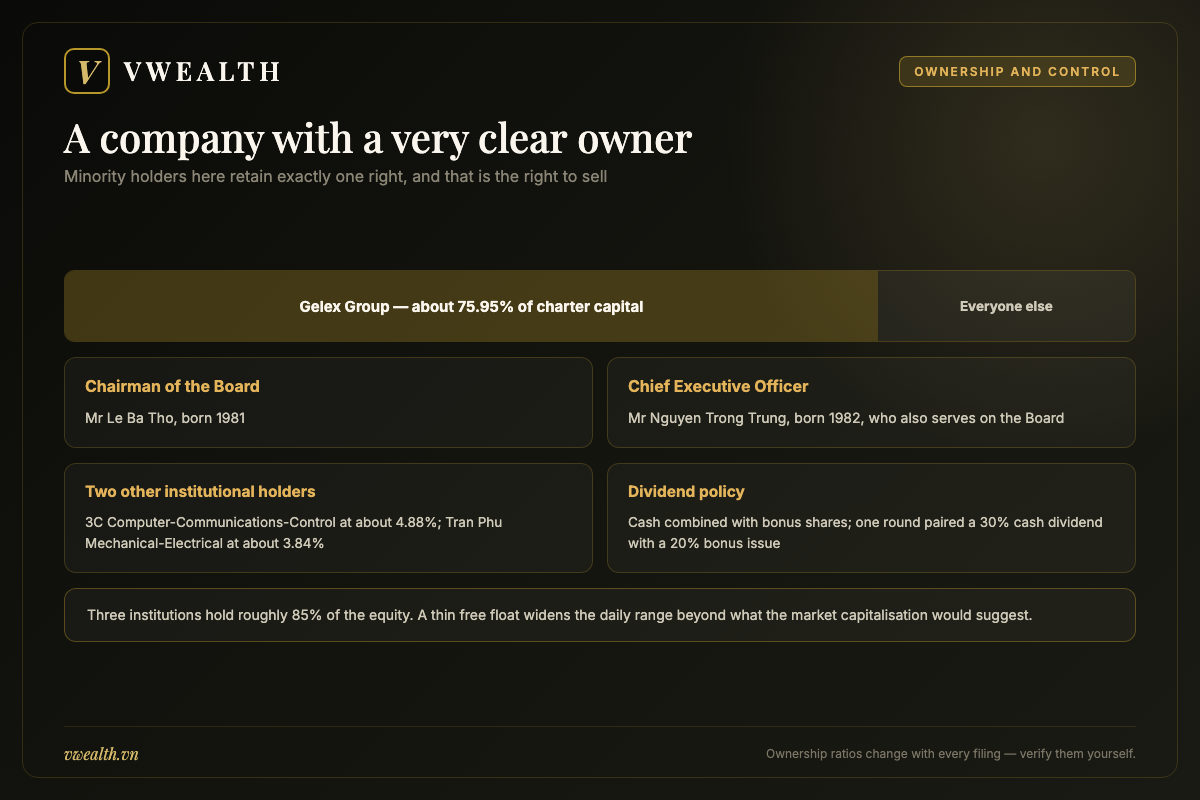
The Chairman of the Board of Directors at Gelex Electric is Mr Le Ba Tho, born in 1981. In the governance model used across the Gelex ecosystem, the chairmanship of a subsidiary is typically held by a group-level executive, acting as the bridge between parent strategy and subsidiary operations.
For an investor, the item worth tracking is not the personal biography but the stability of the structure. An industrial manufacturer works on long factory investment cycles, long framework agreements with dealers, and even longer relationships with utility customers. Frequent change at the top usually drags strategy with it, and in this industry a mid-course strategy change is expensive.
Nguyen Trong Trung, Chief Executive Officer
The General Director, who also serves on the Board, is Mr Nguyen Trong Trung, born in 1982. A chief executive who simultaneously sits on the board is common practice in Vietnam; it gives the operator a direct voice at the strategy table, but it also blurs the boundary between supervision and execution.
Management’s stated direction for the coming phase contains one point worth carrying into the later chapters: the company says the next growth phase will not rely heavily on expanding the scale of traditional product lines, but will instead shift toward growth quality and new product categories. In plainer terms, management is acknowledging that selling more cable the old way has hit a ceiling, and that the future has to come from somewhere else.
That is a refreshingly direct statement, and also a promise that needs verification across several reporting periods. Chapter four hands you the exact metrics to verify it with.
The board and the role of the independent director
Alongside the chairman and the chief executive, the board includes Mr Do Duy Hung and Mr Dang Phan Tuong, together with an independent member, Mr Nguyen Duc Luyen. Corporate governance functions include Ms Luu Thi Phuong.
The independent director is a statutory role designed to protect minority shareholders: the person may not be an employee, may not represent a major shareholder’s capital, and is charged with raising objections to transactions that carry conflict-of-interest risk. In a company where the parent holds above 75%, the independent director’s voice is close to the only formal channel minority holders have at board level.
In practice, at that ownership level every general meeting resolution lies within the parent’s power to decide. This is not an accusation — it is arithmetic. But you must look at it squarely before buying: holding GEE makes you a minority shareholder in a company with a clearly identified owner, and you are betting that the owner’s interests align with yours. For international readers accustomed to more dispersed registers, the overview of corporate governance in Vietnam provides useful context on how common this structure is.
The controlling shareholder and the 75.95% figure
The ownership register is highly concentrated. Gelex Group holds approximately 75.95% of charter capital following the sale of 10 million shares. Two other institutional holders have been recorded with meaningful stakes: 3C Computer-Communications-Control Corporation at roughly 4.88%, and Tran Phu Mechanical-Electrical Corporation at roughly 3.84%.
Add those three together and roughly 85% of the equity sits with three institutions. Everything else is spread across all remaining investors. This is the most important fact in the chapter, and it leads straight into the next section.
Thin free float and what it means in practice
Free float is the proportion of shares genuinely available for trading, excluding stakes held by controlling shareholders or subject to transfer restrictions. A thin free float produces three very specific consequences that retail investors routinely underestimate.
The first is a wider trading range than the market capitalisation would suggest. When the tradable share count is small, a moderate amount of money moves the price a long way. This holds in both directions: fast up, fast down.
The second is exit risk. If you accumulate a large position and then need to sell into a weak session, you may have to accept a price materially below the reference. For an investor with a modest position this is rarely a practical problem; for a portfolio manager it is often the deciding factor.
The third is that minority voting power is effectively nil. You cannot block a share issuance, veto a related-party transaction, or place a nominee on the board. You hold exactly one right: the right to sell.
Dividends: cash and stock
By the standards of Vietnamese manufacturers, Gelex Electric’s distribution policy is relatively generous. The company has paid cash dividends combined with bonus share issues, including one round pairing a 30% cash dividend with a 20% bonus share issue.
You need to separate those two clearly, because many investors do not.
A cash dividend is real money leaving the company’s account and arriving in yours. Note that the 30% figure is expressed as a percentage of par value, not of the market price — a convention that regularly confuses newcomers into thinking they are receiving thirty percent of their invested capital.
A bonus share issue is the opposite: not a single dong leaves the company. Retained earnings or share premium are capitalised, and new shares are distributed to holders pro rata. You own more shares, but each represents a smaller slice of the same business, and the reference price is adjusted down on the ex-date. In value terms at the moment of distribution, you are no wealthier.
That does not make bonus shares pointless. They increase the share count, lower the nominal price level, and generally improve liquidity — which for a stock with a thin free float is a genuine benefit. But call it what it is: a capital structure technique, not a reward.
Related-party transactions: the section to read carefully
In any company inside a large group, related-party transactions are the note you must open in the financial statements. These are the purchases, sales, loans, borrowings, leases and guarantees between the company, its parent and its sister companies.
Such transactions are entirely lawful and often operationally sensible: one company in the family selling to another is faster and involves less counterparty risk. But they are also the channel through which value can move between entities in ways that do not always favour minority holders in one particular entity.
You do not need to become an auditor. Three checks per reporting period are enough: open the related-party note, check whether the scale of those balances has jumped versus the prior period, and check whether any receivable from a related party has been sitting unpaid for an extended time. Those three checks take ten minutes and catch most of what matters. If you want a structured framework for this habit, the guide on reading Vietnamese financial statements under VAS and IFRS explains where the disclosures sit.
Ownership summary and what to monitor
| Item | Disclosed position | What to re-check yourself |
|---|---|---|
| Controlling shareholder | Gelex Group, about 75.95% of charter capital | Latest ratio after issuances and share sales |
| Other institutional holders | 3C at about 4.88%; Tran Phu at about 3.84% | Major shareholder disclosure filings |
| Chairman | Mr Le Ba Tho, born 1981 | Board nomination resolutions for the new term |
| Chief executive | Mr Nguyen Trong Trung, born 1982 | Stability of the executive team over time |
| Independent director | Independent board member in place as required | Dissenting opinions recorded in meeting minutes |
| Dividend | Cash plus bonus shares; one round at 30% cash and 20% bonus | Most recent payment resolution and record date |
| Free float | Low, given concentrated institutional ownership | Effect on daily turnover and price range |
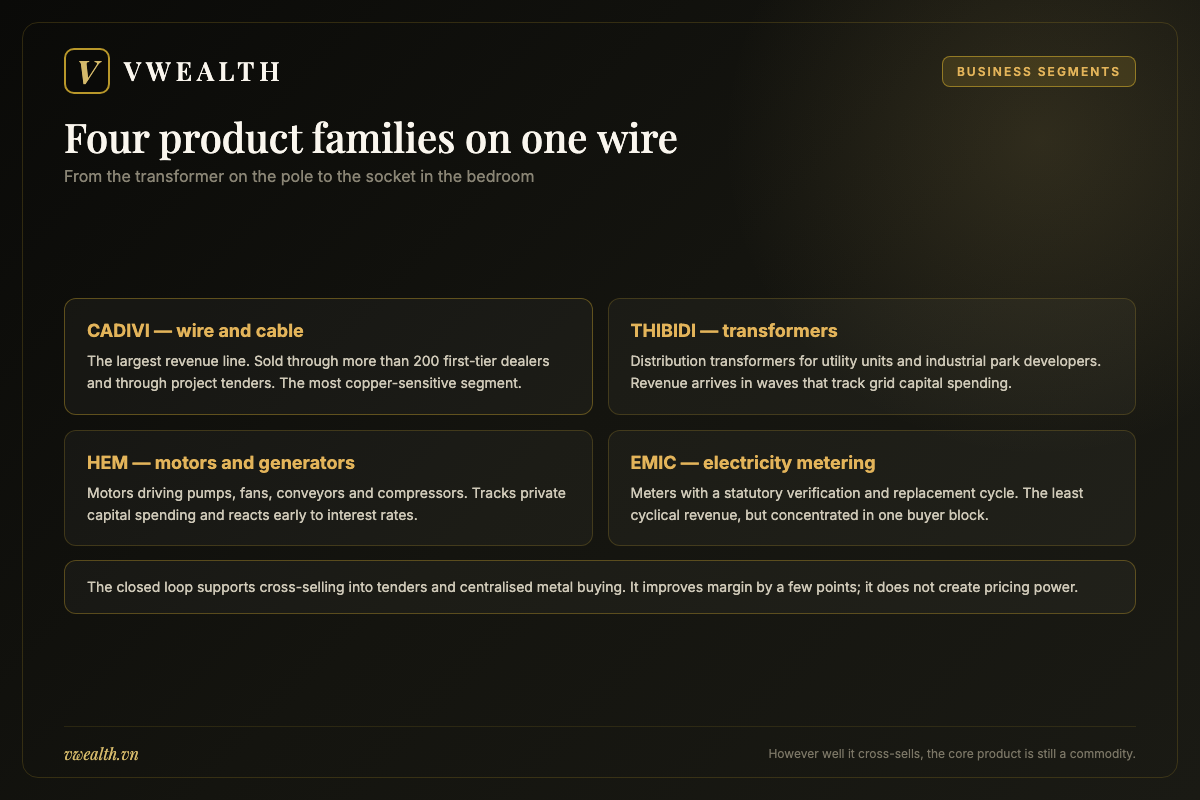
How Gelex Electric makes money: four product families on one wire
This is the most important chapter in the article. If you do not understand what the business sells and to whom, every number later is just a number. Gelex Electric owns a group of subsidiaries producing and supplying products across the electricity value chain, from transmission down through distribution to equipment used inside homes.
Family one: wire and cable, with CADIVI at the centre
This is the largest revenue line and the easiest to understand. The products are residential wiring, low-voltage and medium-voltage power cable, control cable and specialty cable. Customers fall into two very different groups.
The first is the retail market: households building or renovating, electricians, and building materials shops. This group buys through the dealer network, buys by brand and habit, and does not haggle hard over small price differences. It delivers better and steadier margin.
The second is the project market: construction contractors, industrial park developers, and utility units. This group buys through tender, buys in bulk, pushes hard on price and pays slowly. Margins are thinner, but volumes are large and this channel is directly tied to the infrastructure investment cycle.
A healthy cable business balances the two: the retail channel protects margin, the project channel keeps the plants running at full utilisation. If the mix tilts too far toward projects, margins compress and receivables swell. That is precisely the metric to monitor, and chapter four covers it in detail.
Why a network of two hundred dealers is a real asset
Many investors read a distribution network as a cost line. In the cable industry it is a moat.
The reason lies in the physics of the product. Electrical cable is heavy, bulky, low in value per metre, and demanded urgently: an electrician needs the drum today, not next week. That makes freight cost and proximity to the point of sale competitive factors on par with quality. A manufacturer with dealers down to district level always has an edge over one with warehouses only in major cities, even when the two products are equivalent.
Building that network takes decades, and it also takes something harder to buy than money: trade credit relationships. First-tier dealers typically buy on credit, and extending credit lines to hundreds of dealers requires a receivables management system that a new entrant cannot assemble in a few years.
The moat has a downside, though. Extending dealer credit means the company’s working capital sits out in the market; when the economy turns, receivables are the first thing to break. This is why you read the receivables note before you read the revenue line.
How the two sales channels differ in working capital
One more point about the retail and project channels, because it explains a pattern you will see in the accounts and might otherwise misread.
The retail channel runs on relatively short credit terms with a large number of small counterparties. Individually each dealer is a modest exposure; collectively they are diversified, and a single failure does not move the numbers. Collection is reasonably predictable, and inventory turns at a steady pace because household demand does not stop.
The project channel runs on long credit terms with a small number of large counterparties, and payment is frequently linked to construction milestones rather than delivery. A single large developer delaying payment can visibly lengthen the average receivable days for the whole company. Worse, retention amounts are often withheld until a project is accepted, which can be a long time after the cable was delivered and the revenue recognised.
So when you see receivable days lengthen, the first question is not “is the business deteriorating” but “has the channel mix shifted”. A company winning more project work will mechanically show longer receivables even if nothing is wrong. The follow-up question is whether the margin earned on that project work compensates for the working capital it consumes — and that is a question the segment note lets you answer.
Family two: distribution transformers, with THIBIDI at the centre
A distribution transformer steps medium-voltage grid supply down to the level households and workshops consume. This segment differs from cable in three ways.
The first difference is engineering content. Transformers are specified on no-load loss, load loss, noise level and overload capability — parameters buyers genuinely measure and compare. That creates distance between an experienced manufacturer and a new one, unlike cable where the distance is mainly brand.
The second difference is the customer. Distribution transformer buyers are predominantly utility units and developers of industrial parks and urban projects. This is project procurement, tender-driven, tightly linked to the disbursement schedule of grid investment.
The third difference is cadence. Residential cable demand runs steadily all year because someone is always renovating. Transformers arrive in waves: a year of heavy grid investment brings a dense order book, the following year the plant runs below capacity. This is the most volatile segment in the group.
Family three: motors and generators, with HEM at the centre
An electric motor is the heart of everything that turns inside a factory: pumps, fans, conveyors, compressors, crushers. This segment’s customers are not the utility but manufacturers themselves and water supply operators.
The notable characteristic here is that motors track private capital spending rather than public investment. When businesses expand workshops, they buy motors; when they defer investment, the segment stalls. That makes motors a decent leading indicator of manufacturing investment health — and also makes them the first segment to feel a rise in interest rates.
There is one structural opening worth tracking: energy efficiency standards. When minimum efficiency requirements for motors are tightened, older equipment must be replaced with high-efficiency units, and that is a mandatory replacement cycle rather than a discretionary one. Whichever manufacturer already holds a compliant product range benefits.
Family four: metering, with EMIC at the centre
Electricity meters run on a business model quite unlike the other three, and it is more interesting than it looks.
First, the customer base is effectively a single institutional block: the electricity distribution utilities. Households do not buy meters. That means this segment’s revenue depends on the procurement plan of essentially one buyer — simultaneously a source of stability and a concentration risk.
Second, metering equipment is subject to statutory verification and replacement cycles under measurement regulation. This is demand independent of the economic cycle: whether times are good or bad, a meter that has reached the end of its verification period must be replaced.
Third, this is the segment with the fastest rising technology content. The shift from mechanical to electronic meters, and then from electronic meters to remotely read meters that transmit data to a central system, creates a large-scale replacement wave with a higher-value product. Whoever keeps pace with the buyer’s technical specification wins share; whoever lags is dropped from the approved vendor list.
The closed-loop story: real advantage or annual report language?
The company describes its advantage as a closed-loop ecosystem linking research, prototyping, production and commercialisation within one group, shortening development cycles and optimising cost. The fair question is whether that is a genuine advantage or the language of an annual report.
There are three places where the advantage is real and verifiable.
The first is cross-selling within a single tender. An industrial park project needs medium-voltage cable, transformers and switchgear. A supplier with the full range is better placed to win the combined package than one carrying a single product line, and saves on the cost of bidding.
The second is centralised raw material purchasing. Copper and aluminium are shared inputs across cable, transformers and motors. Buying at group scale beats buying plant by plant — a small saving per tonne, but a large one multiplied by annual volume.
The third is shared distribution. A dealer channel built for cable can push other residential electrical products without constructing a new channel.
And here is where the claim gets oversold: it does not free the company from the commodity nature of its main product. However well it cross-sells, a metre of cable still competes on price with a metre of competing cable. The closed loop improves margin by a few percentage points; it does not create pricing power.
Three new product bets worth tracking
The company’s stated direction points at several product groups you should note down, because these are what determine whether the growth story is real.
The first group is smart grid equipment and remote monitoring and metering systems. This is the most natural extension, building on existing metering capability and riding the grid modernisation trend.
The second group is electrical equipment for data centres. A data centre is a building type with extremely high power density and stringent reliability requirements on its supply system, along with demand for switchgear, protection and backup power. If Vietnam genuinely attracts digital infrastructure investment, this is new demand at better margin than commodity product.
The third group is next-generation residential electrical devices and charging station infrastructure. This is the riskiest, because it pushes the company into competition with international consumer brands on a field where an industrial brand holds no natural advantage.
What to do with all three is straightforward: do not value them before you see revenue. New products in heavy industry have development-to-commercial-order cycles measured in years, and the failure rate is not low. Treat them as a free option attached to the position, not as the core of the investment case.
Comparing the four product families
| Product family | Lead brand | Main customers | Revenue character | Specific risk |
|---|---|---|---|---|
| Wire and cable | CADIVI | Retail dealers and project contractors | Largest and steadiest, highly copper-sensitive | Price competition, counterfeit labelling |
| Distribution transformers | THIBIDI | Utility units, industrial park developers | Arrives in waves, tracks grid capex | Dependence on public investment disbursement |
| Motors and generators | HEM | Manufacturers, water utilities | Tracks private capital spending | Sensitive to interest rates and investment sentiment |
| Electricity metering | EMIC | Electricity distribution utilities | Stable, with a statutory replacement cycle | Concentration in a single buyer block |
Seven checks to run before you buy GEE stock
Reading the accounts of an electrical equipment manufacturer is nothing like reading a bank, a property developer or a holding company. One variable dominates everything here: the price of the input metal. This chapter gives you seven checks, in the order you should run them.
Check 1: gross margin, not revenue
Revenue at a cable manufacturer is the single most misleading line in the statements, because it reflects the copper price more than it reflects volume.
Picture it concretely. Copper accounts for a very large share of the cost of a cable. If the world copper price rises thirty percent, the company has to raise its selling price correspondingly or lose money. The result is a jump in revenue even though it did not sell one extra metre. Conversely, when copper falls, revenue drops while the plants run at exactly the same utilisation.
So “revenue grew twenty percent” at this business does not automatically mean “volume grew twenty percent”. The more reliable measure is gross margin: gross profit divided by net revenue. It tells you how much of every dong of sales the company keeps after cost of goods sold.
The reading rule: revenue rising while gross margin compresses means the company is chasing volume by giving up price. Revenue flat while gross margin expands is a considerably better sign, because it indicates the product mix has shifted toward higher-value items or that input costs are under control.
The lag between copper and margin: a worked illustration
The transmission from copper price into gross margin is not instant, and that lag creates reporting periods that look wonderful or terrible without reflecting true capability.
Here is an illustration, not company data. Suppose a plant buys copper into inventory in January at a price of 100 units. The copper sits for roughly three months before it becomes cable and is sold. If world copper rises to 120 over those three months, the company sells cable at the new price level while booking cost against the cheaper lot. Gross margin expands abnormally. Reverse it: if copper falls from 100 to 85, the company must sell at the new market level while still booking cost against the expensive lot, and gross margin compresses even though it did nothing wrong.
The practical lesson is simple: never read one quarter and conclude. Look at gross margin across four to eight consecutive quarters and place it alongside the copper price over the same window. If margin improves durably during a stretch when copper was flat, that is evidence of operating capability.
Check 2: inventory — warehouse or wager?
Inventory at a cable manufacturer contains two things of fundamentally different character: metal raw material and finished goods.
Finished goods inventory rises when product is not moving — the familiar bad signal in any industry. But raw material inventory rising can be a deliberate decision: management expects copper to rise and stocks up. When the call is right, that is a large gain. When it is wrong, it is a loss sitting quietly in the warehouse waiting to be written down through an inventory provision.
This raises a question you should answer for yourself before buying: do you want the management team taking a position on metal prices on your behalf? Some investors like it, because it amplifies profit in an upcycle. Others see it as risk taken outside the core competence.
How to check: track average inventory days across periods, calculated as inventory value divided by cost of goods sold, multiplied by the number of days in the period. If inventory days jump while revenue does not rise correspondingly, open the note and see whether the increase sits in raw materials or in finished goods. Those two answers lead to opposite conclusions.
Check 3: receivables and the quality of the sales book
This is the most fragile point in any business that sells through dealers and contractors.
Trade receivables represent revenue already recognised but not yet collected. On the retail channel, that is dealer credit. On the project channel, it is money owed by developers and contractors. The project channel is considerably more dangerous, because payment timing depends on the disbursement schedule of a construction project, and construction projects run late.
Three indicators to watch. First, average receivable days: if they lengthen steadily across periods, the company is selling on longer credit to hold its revenue line. Second, receivables as a share of revenue: if that ratio grows faster than revenue itself, the quality of the sales book is deteriorating. Third, the provision for doubtful debts: a fast-rising provision usually precedes bad news by a few quarters.
One reading trick few investors use: compare receivable days with payable days. If the company is owed money for materially longer than its own suppliers give it, then the company is financing working capital for the entire chain — and that financing is coming from bank debt.
Check 4: debt and working capital
A cable manufacturer always needs substantial working capital, because it must pay for metal upfront, hold it as inventory, then extend credit to customers. A long cash conversion cycle makes short-term borrowing normal, not a sign of distress.
What needs separating is short-term debt funding working capital from long-term debt funding plant investment. The first expands with business scale and contracts when business slows; it is not alarming as long as inventory and receivable turnover remain healthy. The second attaches to capacity expansion projects, and the question to ask is whether the project will generate enough cash flow to service it.
The most practical single metric is interest expense as a share of gross profit. If interest consumes a steadily larger portion of gross profit across periods, the company is running on leverage rather than on efficiency.
Check 5: separate core profit from divestment profit
This is the single most important point when reading Gelex Electric’s recent results, and the place where many investors will stumble.
As noted in chapter one, the company divested part of its Gelex Infrastructure stake and recognised a large one-off financial gain in the 2025 results. Those results therefore contain two layers stacked on each other: profit generated by the factories and profit generated by selling an asset.
Precisely because the second layer does not repeat, the profit plan approved by shareholders for the following year sits well below the 2025 outturn — and management stated the reason plainly: the absence of the extraordinary gain, combined with a deliberate increase in spending on research, development and new products.
The practical consequence for you is direct. If you take 2025 net profit, divide by the share count, and divide the price by that figure to obtain a valuation multiple, you will produce a number that is artificially attractive. The correct approach is to strip out the one-off gain, recalculate profit from core operations, and value on that base. This is not advanced technique; it only requires opening the financial income line and the accompanying note rather than stopping at the bottom line.
Check 6: non-controlling interests
Gelex Electric does not operate the plants itself. It holds controlling stakes in a group of subsidiaries, and those subsidiaries have their own minority shareholders.
The accounting consequence is this: the consolidated statements add in the full revenue and profit of the subsidiaries, then at the bottom of the statement carve out the portion attributable to minority holders at the lower level. The line you need is “profit after tax attributable to owners of the parent”, not total profit after tax.
The gap between those two lines can be significant. If you use the total line by mistake to compute earnings per share, you will value the stock as cheaper than it is and walk yourself into a bad decision. This is a classic error when analysing multi-layer ownership structures.
Check 7: revenue mix by channel and by geography
The final check is the revenue mix, and it is the best available indicator of growth quality.
Revenue growth driven by the retail channel is durable growth: good margin, fast collection, risk spread across hundreds of dealers. Revenue growth driven by the project channel is more visible but thinner: low margin, long receivables, and dependence on the disbursement pace of developers the company does not control.
Export revenue is a third layer, and the one most worth tracking over the long run. Exporting electrical equipment means the product meets the standards of a demanding market, and it opens a demand source not tied to the domestic investment cycle. But exports also bring trade defence risk and currency risk — both covered in chapter six.
How to check: open the segment note disaggregating revenue by business line and by geography in the audited statements, record the proportions each year, and follow the direction of travel over three to five years.
The seven checks and where to find them
| # | Metric | Where to find it | Good sign | Warning sign |
|---|---|---|---|---|
| 1 | Gross margin | Income statement | Margin expands while copper is flat | Revenue up but margin compressing |
| 2 | Inventory days | Balance sheet and notes | Stable, moving with normal seasonality | Raw material build-up while metal prices are high |
| 3 | Receivable days and provisions | Balance sheet and notes | Flat or shortening | Lengthening steadily, provisions rising fast |
| 4 | Interest expense over gross profit | Income statement | Small and stable | Rising share across periods |
| 5 | Core profit excluding one-off items | Financial income line and notes | Grows without asset sales | Profit mostly from disposals |
| 6 | Profit attributable to owners of the parent | Bottom of the consolidated statement | Gap to total profit narrowing | Minority interests taking a growing share |
| 7 | Revenue mix by channel and geography | Segment note | Retail and export gaining share | Heavier reliance on the project channel |

How the market treats GEE stock
This chapter is about the share, not the company. The two are related but not identical, and confusing them is the origin of a great many poor decisions.
A ticker with a short trading history
GEE has traded on UPCoM only since March 2022 and on HOSE only since August 2024. Measured by trading age, this is a young stock.
That has real analytical consequences. With an industrial name listed for twenty years, you can observe how it behaved through several interest rate cycles, several raw material shocks and several market drawdowns. With GEE, the observation window is much shorter, so every statement of the form “this stock usually does X” has to be qualified as resting on limited data.
It is also a reason to be careful with long-run comparison charts: the UPCoM period had different liquidity and price band characteristics from the HOSE period, so splicing them into one continuous line invites false conclusions. The mechanics of price bands and session structure in Vietnam are set out in the note on trading hours and price bands.
Which valuation measure works for GEE
For an industrial manufacturer whose profit swings with input prices, any measure based on a single year’s earnings has a built-in defect: the stock looks cheap at the top of the cycle and expensive at the bottom. This is the classic cyclical trap.
Three practical ways to handle it.
The first is to smooth earnings: use average core profit over several consecutive years rather than one year, neutralising both the metal price cycle and one-off items. Slower, but it produces a far more stable reference level.
The second is to use a book-value-based measure. For a manufacturer that owns real plants, land and equipment, book value moves less erratically than profit, and the price-to-book ratio provides a useful supplementary view.
The third is enterprise value against earnings before interest, tax, depreciation and amortisation. This neutralises differences in capital structure and depreciation policy between peers, which is convenient for cross-company comparison.
What matters most: whichever method you use, use the same one when comparing GEE against peers, and strip out one-off gains before you calculate anything.
Why GEE and GEX should not be valued with the same ruler
This mistake is easy to make precisely because the two names share a family.
GEX is a parent holding several verticals. The sensible approach for it is a sum-of-the-parts valuation with a holding company discount applied — the discount the market habitually imposes because investors must reach the assets through an intermediate layer. GEE is the opposite: an operating business with plants, products and a measurable margin. It is valued as a manufacturer, not as a portfolio.
The two can therefore diverge, and the observation that GEE looks more or less expensive than GEX on some ratio does not automatically mean anything. You are comparing two different asset types with one ruler that cannot measure both.
There is one genuine linkage worth noting: when the market re-rates GEE, the asset side of GEX is re-rated with it, because GEE is a large component of the parent’s total value. The reverse influence is much weaker.
The personality of the stock
Three characteristics that anyone holding GEE should be prepared for.
The first is sensitivity to the grid investment narrative. Whenever news appears about power planning, major transmission projects or utility capital spending, the electrical equipment group tends to move together. That can make GEE run on headlines faster than orders actually arrive at the factory gate.
The second is sensitivity to metal prices. When world copper moves sharply, investors quickly infer the margin impact and act ahead of the quarterly report.
The third is the thin free float effect described in chapter two: a wider daily range than the market capitalisation would suggest.
Together those produce a stock unsuited to nervous holders, but not a pure speculative vehicle either — because behind it sit real plants, real brands and real cash flow.
Index membership and passive flows
One consequence of the HOSE listing deserves its own note, because international readers often overlook it. Vietnam’s main indices, and the exchange-traded funds that track them, apply eligibility screens covering listing venue, market capitalisation, free float and trading turnover. A stock that satisfies those screens attracts a layer of buying that has nothing to do with anyone’s view of the business.
For GEE, the listing venue test is now satisfied and the capitalisation test is comfortable, but the free float and turnover screens are the binding constraints, for exactly the reasons set out in chapter two. This creates an unusual dynamic: any event that genuinely enlarges the tradable pool — a further sale by the parent, a rights issue taken up broadly, a bonus issue lifting the share count — can improve index eligibility and bring in a class of buyer that was previously excluded.
The practical takeaway is to read parent share sales with two lenses rather than one. In the short term they add supply and weigh on price. Over a longer horizon they can widen the investor base in a way that is structurally positive.
Dividends and shareholder cash flow
Against the average listed Vietnamese manufacturer, Gelex Electric’s distribution policy is on the active side. Maintaining cash dividends alongside bonus share issues indicates operating cash flow strong enough to pay shareholders while retaining investment capital.
A caution belongs here, though. A high cash dividend in a year containing an extraordinary divestment gain does not guarantee a high cash dividend in years containing only factory profit. If you are buying GEE for income, compute the payout ratio against core profit rather than total profit, and check whether that ratio is sustainable.
Foreign ownership room and what it means in practice
Foreign ownership room is the statutory ceiling on the aggregate stake foreign investors may hold in a Vietnamese company. For most manufacturers outside conditional business lines, the ceiling is high.
With GEE, however, there is a practical reality to face. When the controlling shareholder holds roughly three quarters of the equity, the shares left for every other investor — domestic and foreign combined — are limited. Available room on paper does not mean a foreign fund can accumulate a large position on the exchange. That practical constraint matters more than the headline room figure. The mechanics and the exceptions are explained in the guide to foreign ownership limits in Vietnamese stocks.
Dilution: the arithmetic you must run on every issuance
The company has carried out and approved capital increases lifting charter capital materially above the 3,000 billion dong level at listing. For existing shareholders, each issuance forces a calculation.
The calculation has three questions. One, who is it issued to: existing shareholders pro rata, or a private placement to outside investors? In the first case you keep your ownership percentage if you subscribe; in the second, your percentage falls.
Two, what is the money for: expanding production capacity, repaying debt, or topping up working capital? Only the first has a real prospect of generating incremental profit to offset the dilution.
Three, what is earnings per share after the issuance: projected core profit divided by the new share count. If that figure is lower than before and management has no clear path to lift it, the issuance is transferring value away from you.
Comparing GEE with other ways to own the electricity chain
| Company | Position in the chain | Main revenue source | How it differs from GEE |
|---|---|---|---|
| Gelex Electric (GEE) | Electrical equipment manufacturing | Cable, transformers, motors, metering | Profit highly sensitive to input metal prices |
| Gelex Group (GEX) | Multi-vertical parent | Consolidated profit and dividends from pillars | Valued sum-of-the-parts, with a holding discount |
| PC1 Group | Power construction and generation assets | Line and substation construction, hydro and wind | Installs the equipment rather than manufacturing it |
| REE Corporation | Building services and utility investments | Mechanical and electrical contracting, utility dividends | A hybrid of contractor and financial investor |
| PV Power (POW) | Electricity generation | Selling power into the system | Sits at the end of the chain, not a buyer of distribution gear |
The table makes one point worth remembering: all of these benefit from the power investment cycle, but each benefits at a different link and with a different lag. An equipment manufacturer like GEE typically receives orders earlier than a construction contractor, because the hardware has to exist before it can be installed. The wider picture for the group is drawn in the overview of Vietnamese energy sector stocks.
The Vietnamese electrical equipment industry in 2026
No company lives outside its industry. This chapter sketches the landscape Gelex Electric stands in, and identifies four winds — two behind, two against.
The revised Power Development Plan VIII and the capital numbers
The foundation of the Vietnamese electrical equipment story in this period is the revised National Power Development Plan, commonly shortened to the revised PDP VIII, approved by the Prime Minister in April 2025.
That plan sets out investment capital requirements for the 2026 to 2030 period equivalent to roughly 136.3 billion US dollars, of which approximately 118.2 billion is for generation capacity and approximately 18.1 billion is for the transmission grid.
It is accompanied by very concrete volumes for the 2025 to 2030 window: hundreds of thousands of MVA of new 500 kV and 220 kV substation capacity, tens of thousands of MVA of upgrades to existing substations, tens of thousands of kilometres of new transmission line and thousands of kilometres of line refurbishment.
This is one of the rare cases where an investor is handed an official planning figure for the scale of demand across an entire industry over several years. But it has to be read correctly, and the next section explains why.
Why the grid, not generation, is where GEE benefits directly
Within that total, the majority sits in generation — the power plants themselves. Building a gas-fired plant or a wind farm requires turbines, boilers and equipment Gelex Electric does not manufacture. Most of that spending flows abroad or to construction contractors.
The portion a distribution equipment manufacturer genuinely touches is the grid: substations, lines, switchgear, cable and metering at the distribution level. When reading the plan, therefore, the number relevant to GEE is the grid allocation, not the headline total.
One further clarification. Most of the volume itemised in the plan sits at transmission level, 500 kV and 220 kV, whereas this group’s product strength is concentrated at distribution level. An expanding transmission network still creates indirect demand at distribution level, because power arriving somewhere requires low-voltage networks to spread it — but the lag is real and the benefit is not one for one.
The practical conclusion: this is a genuine tailwind, but do not multiply 18.1 billion dollars by a self-invented share and call the result future revenue. The better verification is to follow newly signed contract value and order backlog as disclosed period by period.
Data centres: a new demand source forming
The digital infrastructure investment trend creates a building type with unusual electrical characteristics: extremely high consumption density in a small footprint, and near-absolute requirements for supply continuity.
That drives demand for far more complex electrical systems than a conventional factory needs: multiple layers of redundancy, high-grade switchgear and protection, continuous monitoring. This is a segment with better margin than commodity product and a higher technical barrier.
The company has placed data centre equipment among its strategic product groups. But as noted in chapter three, treat this as an option rather than a cash flow. The only way to verify it is to watch for revenue from this group appearing as a separate line in the segment note.
Copper: the headwind nobody controls
This is the largest variable, and no one inside the company decides it.
Copper demand is tied to global electrification: grids, electric vehicles, renewables and data centres all consume it. At the same time, new supply from large mines has a very long development cycle. The mismatch between fast-rising demand and slow-rising supply is why copper goes through periods of violent movement.
For a cable manufacturer this cuts both ways. The negative side is that input cost is hard to forecast and margin gets squeezed in a rising phase if the price cannot be passed through quickly enough. The positive side is that in a rising phase, inventory bought cheaply earlier generates additional profit, and smaller thinly capitalised competitors are pushed out because they cannot fund raw material purchases.
Put differently, volatile copper is simultaneously a risk and a protective barrier for the large producer. The point to retain: it makes GEE’s profit swing in a way that management skill cannot eliminate.
Aluminium, plastics and the rest of the input basket
Copper dominates the conversation, but it is not the whole input basket, and the other components behave differently.
Aluminium is the main substitute conductor. It carries less current for a given cross-section but weighs far less and costs less per unit of conductivity, which is why overhead lines commonly use it. A manufacturer able to serve both copper and aluminium specifications has some ability to follow customers when relative metal prices shift, which softens the impact of a copper spike.
Insulation and sheathing materials are the second component: polymer compounds derived from petrochemical feedstock, so their cost tracks oil and gas markets rather than metals. Cross-linked and flame-retardant grades carry higher specification and higher margin than standard compounds.
Transformer production adds two further inputs with their own dynamics: electrical steel for the core, most of which is imported and subject to its own trade measures, and insulating oil. Motor production adds magnetic materials and bearings.
The reason this matters is that a single headline copper number does not tell you what happened to blended input cost in a given period. When you see gross margin move and want to know why, check whether the segment mix shifted before concluding that copper alone explains it.
Domestic competition: crowded but clearly tiered
Vietnam’s cable market has many producers, but the tiering is clear.
The top tier consists of long-established brands with large-scale plants, wide dealer networks and the capability to bid on project tenders. Alongside CADIVI sits Tran Phu Mechanical-Electrical Corporation, a strong northern name with more than thirty years in the trade — and, as noted earlier, also an institutional shareholder of Gelex Electric itself.
The middle tier consists of brands present for roughly twenty to thirty years, strong in the residential segment on competitive pricing; DAPHACO, for instance, has been in the market since 1999.
The bottom tier consists of small workshops competing purely on price, typically in small residential works and rural areas.
This structure matters to an investor: actual profit concentrates in the top tier, because only the top tier has the scale to negotiate on copper and the qualifications to bid on large packages. The price war at the bottom has limited effect on the project segment, but a real effect on the low-price end of the residential segment.
Counterfeit labelling: an industry-specific risk
This is a risk outsiders rarely consider but everyone in the trade knows.
Electrical wire is easy to counterfeit at the label level, because a buyer cannot verify the true conductor cross-section or copper purity by eye at the counter. A cable marked as 2.5 square millimetres but actually delivering 2.0 still lights the room; it simply runs hotter and fails sooner.
For the leading brand, counterfeits cause two kinds of damage. The direct damage is lost volume. The indirect damage, and the more dangerous one, is lost trust: when an incident occurs with a counterfeit carrying your label, decades of accumulated reputation erode.
This is why major manufacturers invest in anti-counterfeit marking, traceability codes and authorised distribution channels. For an investor, that is a recurring cost to accept, and one more reason to value the official dealer network highly.
Exports and trade defence
Exporting is the way out of the ceiling imposed by the domestic market, and also the harshest test of product quality.
But exporting electrical equipment carries three risks worth knowing. The first is trade defence: metal products and products made from metal are a category frequently subject to anti-dumping and countervailing investigations in many markets. The second is certification: every market has its own standards regime, and the cost of certification is an upfront investment with no guarantee of orders. The third is currency, which feeds directly into the margin on long-dated contracts.
So when the company announces a product internationalisation strategy, the metric to follow is not the number of certifications obtained but the share of export revenue in the total, measured across several years.
Public investment, residential construction and interest rates
The final wind is the construction cycle in general.
Every new structure — housing, workshops, roads, industrial parks — consumes cable, switchgear and transformers. Demand in this industry therefore tracks the economy’s total construction volume closely, and tracks the interest rate level closely too, because rates determine whether people borrow to build.
When residential property recovers and public investment accelerates, electrical equipment demand follows with a lag of a few quarters. When credit tightens, the project channel stalls first and the residential channel follows. This is why industry data should always be read alongside the wider macro picture. For readers assessing country-level exposure, the summary of risks of investing in Vietnam covers the macro and policy variables that sit above all of this.
Three scenarios for GEE stock and what triggers each one
This section contains no price target. Nobody can produce a credible price target for a company whose profit depends on a world metal price. What is more useful is a conditional framework: if these things happen, the business moves in this direction.
The four variables that decide the outcome
The first variable is the pace of grid investment disbursement. The plan exists and the numbers are published, but the gap between a plan and actual disbursement is a permanent feature of Vietnamese infrastructure. This is the dominant variable for transformers and medium-voltage cable.
The second variable is the copper price and its effect on gross margin. Not the absolute level so much as the rate of change: a high but stable price is something the business adapts to; violent moves in either direction are what wreck a reporting period.
The third variable is the health of the retail channel, which is to say the household building and renovation cycle. This is the leg that protects margin and supports cash collection.
The fourth variable is the actual outcome of the new product groups: smart grid equipment, data centre gear, next-generation residential devices. This is the variable management controls most, and also the one with the longest lag.
The optimistic scenario: all four legs strong
Conditions: grid investment is disbursed broadly on the planned schedule, producing a dense order flow for transformers and cable; copper trades sideways or rises steadily, keeping gross margin stable and rewarding inventory positions; residential construction recovers and lifts the dealer channel; at least one of the three new product groups begins recognising revenue as a separate reported line.
What it looks like in the accounts: revenue growth accompanied by improving or at minimum flat gross margin; core profit excluding one-off items rising year over year; receivable days not lengthening; the share of export or new-product revenue ticking up in the segment note.
What the market does: re-rates the business from the multiple of a commodity manufacturer toward the multiple of a growing electrical infrastructure supplier. That kind of re-rating has a larger effect than the profit increase itself, because it changes how the market classifies the company rather than merely changing a number.
The base case: a good manufacturer in a steady industry
Conditions: grid investment proceeds but behind schedule, as most large infrastructure programmes do; copper swings within a wide band, pushing gross margin up and down quarter to quarter; the retail channel moves sideways with the economy; new products remain in prototyping and certification without material revenue contribution.
What it looks like in the accounts: revenue growing at a high single-digit rate, core profit growing more slowly than revenue, gross margin oscillating around an unchanged level across several years; dividends maintained; working capital lines neither improving nor deteriorating markedly.
What the market does: leaves the valuation framework where it is, with the share price tracking profit and adding short waves on sector news. This is the highest-probability scenario, and the one investors should treat as their default when running numbers.
The adverse scenario: costs arrive before the orders
Conditions: grid investment slips by years on approvals or funding; copper falls sharply, forcing write-downs on inventory bought at higher levels; residential construction weakens; research spending and certification costs for new products rise while the corresponding revenue has not appeared; and a capital raise dilutes earnings per share at the same time.
What it looks like in the accounts: revenue falling because selling prices track copper down; gross margin compressing; selling and administrative expenses not falling in step because they are largely fixed; receivables lengthening as contractors delay payment; core profit falling faster than revenue because of operating leverage.
What the market does: re-rates downward to the multiple of a cyclical in its down phase. In that phase earnings-based ratios will look expensive — exactly the cyclical trap described in chapter five — and many investors will sell at precisely the point where they should be looking again.
One variable specific to GEE: what the parent decides
Beyond the four industry variables, GEE carries one of its own: decisions taken by the controlling shareholder.
The parent may continue trimming its stake to restructure its portfolio, as it did with the 10 million share block. Each such sale forces the market to absorb new supply, typically creating short-term price pressure while improving long-term liquidity. In the other direction, if the parent’s holding were to fall below key thresholds, the governance structure of the business could change.
The parent may also decide on internal restructuring transactions: moving a unit from one pillar to another, merging or carving out a business line. Those decisions change GEE’s financial picture without any connection to how many metres of cable were sold.
None of this is inherently negative — many restructuring decisions create real value. But it is a source of uncertainty a minority shareholder can neither forecast nor influence, and the appropriate response is to demand a wider margin of safety.
Scenario summary
| Factor | Optimistic | Base case | Adverse |
|---|---|---|---|
| Grid investment disbursement | Broadly on plan | Behind plan but progressing | Slips by years on approvals and funding |
| Copper price | Flat or steadily rising | Wide two-way swings | Sharp fall, inventory write-downs |
| Retail channel | Recovers with construction | Sideways | Declines with the property cycle |
| New products | Revenue appears as a reported line | Still in prototyping | Costs rise, revenue does not arrive |
| Gross margin | Improving or flat | Oscillating around trend | Visibly compressing |
| Market treatment | Re-rated as infrastructure supplier | Framework unchanged, price tracks profit | De-rated as a cyclical in its down phase |

So should you buy GEE stock? A straight answer
You now have the facts. This section does not dodge the question, but it also does not issue an instruction, because the right answer depends on who you are and not only on what the company is.
The case for: six reasons GEE deserves consideration
The first is brand position. CADIVI, THIBIDI, HEM and EMIC have existed in the trade for decades, with distribution reach and the confidence of professional users. In an industry where the product is close to a commodity, brand and network are two of the few things that create distance.
The second is a demand base with a policy foundation. The revised Power Development Plan VIII sets out very large grid investment volumes for the coming period. This is not discretionary consumer demand; it is demand required for the electricity system to function.
The third is chain coverage. The company is present across several stages of the electricity path, from transmission down to metering and residential devices. That supports cross-selling into combined tenders and reduces dependence on any single product line.
The fourth is cash flow and distribution policy. This is a manufacturer selling product year-round rather than a project company recognising revenue on completion milestones, and that shows in its ability to sustain payments to shareholders.
The fifth is the metering segment with its statutory replacement cycle. This is the least economically cyclical revenue in the group, and the migration toward remotely read meters opens an upgrade wave at higher unit value.
The sixth is scale during industry shakeouts. In a phase of violent metal price movement, thinly capitalised producers are forced out; that share flows to the leaders.
The case against: seven risks to face squarely
The first risk is input price dependence. This cannot be eliminated, only partly managed. It makes profit swing in ways outside management’s control.
The second risk is the commodity nature of the core product. Electrical cable carries no pricing power. Every margin improvement has to come from cost and mix, not from the ability to raise prices.
The third risk is the thin free float. The controlling shareholder holds roughly three quarters of the equity, and two further institutions hold meaningful blocks, leaving a modest tradable pool. That widens the price range and makes exiting a large position difficult.
The fourth risk is that minority influence is effectively zero. Every resolution lies within the parent’s power. You are betting that the owner’s interests align with yours, and that is an assumption rather than a guarantee.
The fifth risk is the distorting effect of one-off profit. The divestment gain inside the 2025 result makes year-on-year comparison difficult and makes crude valuation ratios look cheaper than they are.
The sixth risk is dilution from capital raising. With charter capital rising materially above the level at listing, existing holders must track earnings per share after each issuance.
The seventh risk is the lag between a plan and a purchase order. A large published investment programme does not mean orders this year. Investors who buy the planning narrative without checking the order backlog usually wait far longer than they expected.
Weighing the two sides
| In favour | Against |
|---|---|
| Long-established brands and a wide dealer network | Core product is a commodity with no pricing power |
| Grid investment demand grounded in national planning | Long lag between planning documents and real orders |
| Coverage across several links of the electricity chain | Profit swings with a copper price nobody controls |
| Metering has a statutory, non-cyclical replacement cycle | Metering depends on a single block of buyers |
| Steady manufacturing cash flow with a dividend record | A dividend paid out of an extraordinary year is not a sustainable rate |
| Scale wins share when the industry shakes out | Thin free float, wide range, hard to exit in size |
| New product direction targets better-margin categories | New products have no revenue yet and costs come first |
| Indirect exposure to the digital infrastructure build-out | Minority shareholders hold no practical voting power |
Which kind of investor GEE suits
This is the most practical part of the article. The same stock at the same price produces four different answers for four different investor types, and all four answers are correct for the person giving them.
For the long-term value investor, GEE offers what you look for: real assets, real brands, real cash flow, and an industry with non-discretionary demand. What you must accept is the volatility that metal prices impose, and you are obliged to value on core profit with one-off items stripped out rather than on headline accounting profit. Your margin of safety should be wider than the one you would apply to a business with pricing power.
For the growth investor, GEE is a case for caution. The traditional segments have a ceiling, and management has said so itself. The genuine growth story sits in the new product groups and in the grid investment wave, and neither has converted into numbers yet. If you buy for growth, define your verification milestone explicitly: revenue from the new product groups appearing as a separate line in the segment note, or a clearly rising order backlog.
For the income investor, GEE has a notable distribution record but requires one mandatory test: compute the payout ratio against core profit rather than total profit, and check whether operating cash flow can fund that payout in a year without extraordinary items. If the answer is no, this is not a dividend stock; it is a cyclical temporarily paying a high dividend.
For the short-term trader, GEE offers plenty of material: dense power sector news flow, high sensitivity to metal prices, and a wide range created by the thin float. But that same thin float cuts the other way when you need to exit quickly in size. If you trade this name, set your stop before you enter rather than inventing one afterwards.
And there is one group GEE almost certainly does not suit: anyone who needs certainty about quarterly outcomes, anyone uncomfortable with company profit hinging on a global variable they do not follow, and anyone planning to concentrate a large share of a portfolio into a single thinly floated name.
Extra notes for investors based outside Vietnam
If you are investing from abroad, four mechanical points apply to GEE specifically.
The first is settlement. Vietnamese equities settle on a cycle that means shares bought today are not available to sell immediately; plan position changes with that in mind rather than assuming same-day round trips.
The second is the daily price band. HOSE applies a limit on how far a share may move from its reference price in a session. In a stock with a thin float, hitting that limit in either direction is not unusual, and it can leave you unable to transact at the price you wanted.
The third is currency. Your return is the share price return multiplied by the dong exchange rate move against your home currency. For a long holding period, that second factor is not a detail.
The fourth is disclosure language. Full financial statements and shareholder meeting materials are frequently published in Vietnamese first, with English versions arriving later or in summary form. If your process depends on reading primary documents, budget for that gap.
Five questions to answer before you place the order
Question one: have you recalculated core profit with the divestment gain removed, and which figure is your valuation actually based on?
Question two: have you read the segment note on revenue by channel, and is the project channel’s share rising or falling?
Question three: can you live with company profit swinging on the world copper price? If the answer is no, this is not your stock at any price.
Question four: have you computed earnings per share on the post-issuance share count, or are you still using the old one?
Question five: if the price falls materially after you buy with no bad news about the business, will you add, hold, or sell? Answer that before you buy, not after.
Closing: a good factory in an industry that lets nobody get rich quickly
Gelex Electric is easy to respect and hard to value. Easy to respect because it makes real things, sells them to real customers, under brands that have held their ground for half a century. Hard to value because a large part of its profit is governed by a variable set on a metals exchange in London rather than inside its own plants.
Electrical equipment is an industry where it is hard to lose everything and equally hard to get rich quickly. Electricity is non-negotiable demand; there will be no day on which Vietnam stops needing cable and transformers. But precisely because everyone knows that, competition is permanent, margins stay thin, and the rewards go to whoever operates well across many cycles rather than to whoever guesses one quarter correctly.
The final question to ask yourself is not “is GEE a good company” — it is a good company in the sense that an industry-leading industrial manufacturer is good. The right question is: are you willing to own a business whose annual outcome depends on the copper price and on the disbursement pace of the power sector, while you hold no voice at the governance level? If yes, the remaining task is simply to buy at a price cheap enough relative to core earnings. If no, then no price is cheap enough.
This article provides information and an analytical framework. It is not a recommendation to buy or sell. Every investment decision is yours alone and depends on your financial circumstances, risk tolerance and time horizon. For current financial data, prevailing valuation and the latest developments, consult official filings and the research reports on vwealth before acting.
Research Vietnamese stocks in English with vwealth. Our AI-powered platform turns Vietnamese market data into full English analysis reports — with international payment support and a free 2-month trial for new accounts. Create your free account and read the latest reports.