In 2009, out of every 100 dong this bank lent out, only 32 reached an ordinary household — someone buying a home, financing a car, swiping a credit card. Thirteen years later that number was 90. No other listed bank in Vietnam has travelled that far down a single road. This is VIB, the Vietnam International Bank, traded on the Ho Chi Minh Stock Exchange under the ticker VIB. And the question of whether you should buy VIB stock is, underneath, a question about whether you believe in a bank that deliberately chose to stand on one leg.
Foreign investors who look at Vietnam’s banking sector usually start with the obvious names: the state-controlled giants, or the two or three private banks that show up in every emerging-market fund’s top holdings. VIB rarely leads that list. It is mid-sized by assets, it has no sprawling ecosystem behind it, and it does not generate the sort of headlines that travel across borders. What it has instead is the most unusual balance sheet in the sector — and for an investor trying to understand how Vietnamese households actually borrow money, that makes it one of the most instructive companies on the exchange.
Each of Vietnam’s listed private banks has a recognisable face. Techcombank is the bank of real estate developers and corporate bonds. MB is the bank of a military-linked ecosystem and large corporate clients. ACB is the bank of near-conservative caution. VPBank is the bank of high-yield consumer finance. VIB, if you had to compress it into one line, is the purest retail bank in the system: almost its entire loan book consists of loans to individuals, and the largest slice of that is mortgages, home-improvement loans, auto loans and credit card balances.
That purity cuts both ways, and you need to look straight at both edges before you decide anything. The first edge: when household incomes rise and the housing market functions, a focused retail bank earns very fat returns, because lending to individuals carries a materially wider spread than lending to large corporates. Between 2020 and 2022, VIB posted years in which return on equity touched roughly 30% — a rare figure in any banking market. The second edge: when housing freezes and mortgage borrowers come under stress, VIB has nowhere else to shelter. In 2025, its pre-tax profit stopped at VND 9,105 billion, up just 1% year on year, against a plan of VND 11,020 billion approved by shareholders at the start of that same year.
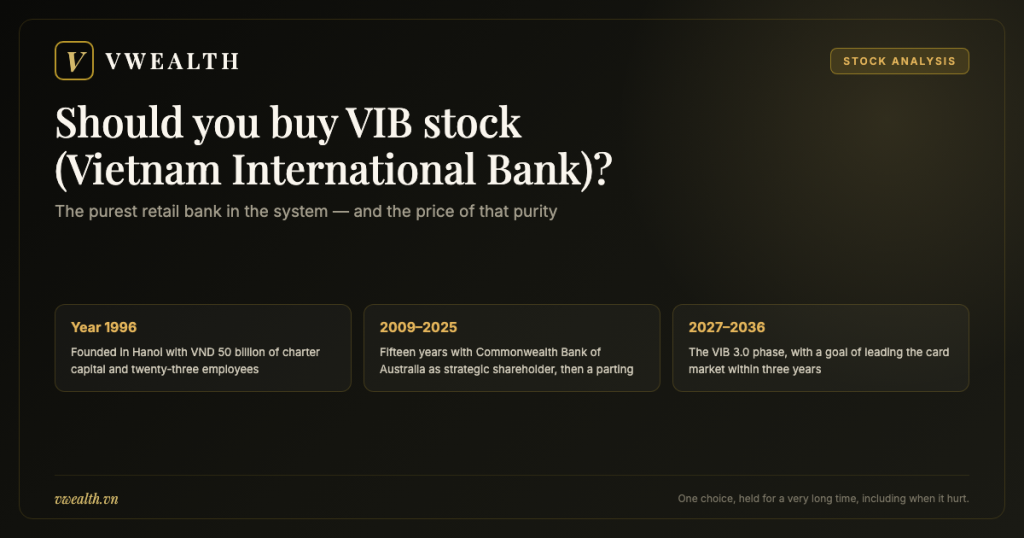
This article walks the full length of that story: from a small office in Hanoi in 1996 with VND 50 billion of charter capital and twenty-three employees, through fifteen years of learning the retail trade from an Australian bank, to the day that teacher sold every last share and walked away, and finally to where VIB stands now — a bank closing out a ten-year transformation programme and declaring that a new growth cycle begins next. By the end you should be able to answer the real question for yourself: should you buy VIB stock, and if so, what kind of investor does it actually suit?
Two notes on how to read what follows. First, on numbers. Every historical figure and milestone below comes from the bank’s own disclosures and from Vietnamese financial media. But the figures that matter most on the day you place an order — this quarter’s profit, this quarter’s non-performing loan ratio, today’s price-to-book multiple, today’s share price — move constantly, and this article deliberately does not print them. Open the latest analysis reports on vwealth for the current numbers, then bring them back to the framework laid out here. That is the correct way to use a long analysis piece.
Second, on currency. Vietnamese companies report in dong, and we keep every figure in dong for consistency with the source disclosures. For rough intuition, the dong has traded in the region of 25,000 to 26,000 per US dollar in recent years, so a trillion dong sits on the order of forty million dollars — use the live rate for anything you actually calculate. If you are new to this market entirely, the mechanics of trading here, from settlement cycles to daily price limits, are worth understanding first; our guide on how to invest in the Vietnam stock market covers that ground.
Thirty years on one road: the history of VIB
With some companies, history is an appendix. With VIB it is the argument. If you do not walk the thirty-year path, you will not understand why a bank would push almost its entire loan book into a single customer segment, and why it kept that choice even when the segment ran into a storm.
1996 and the first twelve quiet years
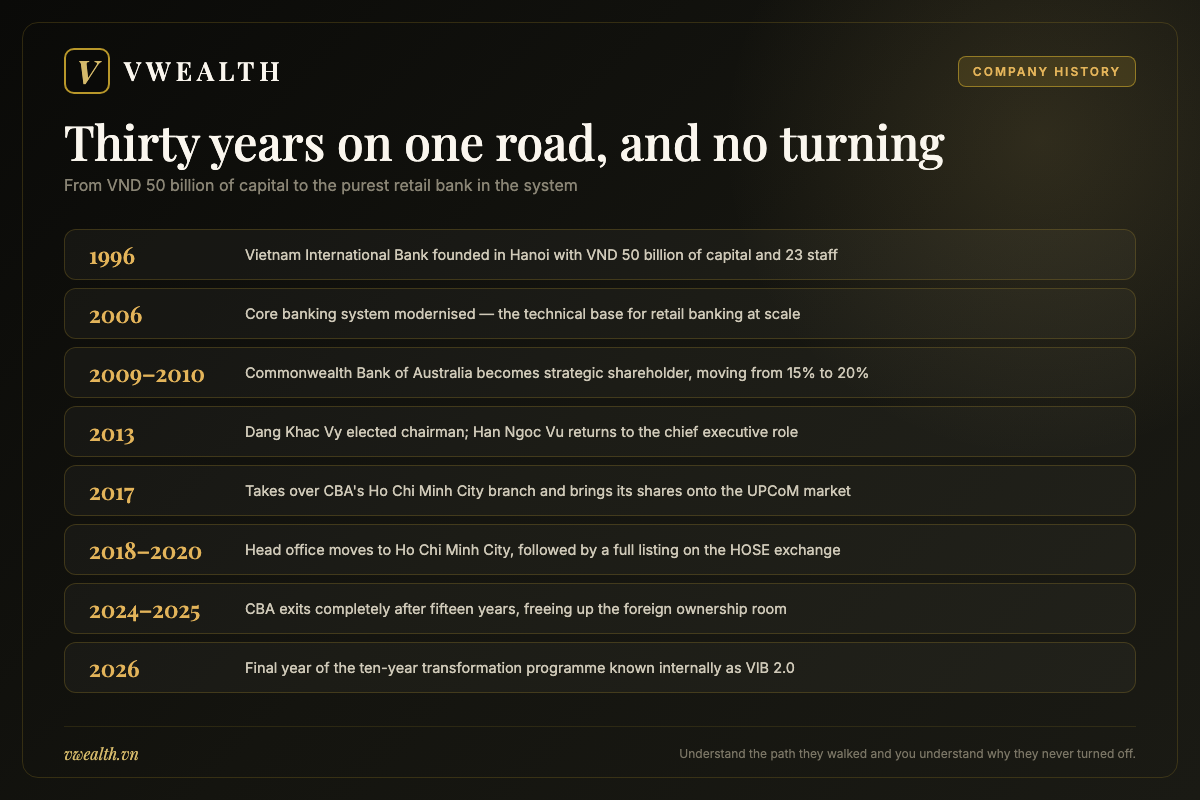
On 18 September 1996, the Vietnam International Bank was formally established in Hanoi. Its opening scale, per the bank’s own account, was VND 50 billion in charter capital and twenty-three employees. Pause on those two numbers. Fifty billion dong in the mid-1990s was the balance sheet of a mid-sized trading company, not a financial institution. Twenty-three people is a department, not a bank.
The context matters too. The mid-1990s was the period in which Vietnam opened up aggressively, the two-tier banking system was only a few years old, and a wave of joint-stock commercial banks was chartered almost simultaneously. Among the people putting up capital was a very particular group: Vietnamese entrepreneurs who had made money in the former Soviet Union and Eastern Europe, returning home with capital and a view of markets utterly unlike the residue of central planning. A striking number of Vietnam’s large private banks today trace back to that cohort, and VIB is one of the clearest cases.
Even the name carries the fingerprint. “International” was not decoration. It reflected the founders’ background — people who had done cross-border business before they ever ran a domestic bank. That small detail returns with real force thirteen years later, when VIB became one of the first Vietnamese banks to strike a partnership with a top-tier global financial institution.
Then twelve years with almost nothing to report. This stretch rarely gets mentioned because it has no drama. For more than a decade, VIB did what a mid-sized Vietnamese joint-stock bank of that era did: corporate lending, trade finance, international settlements, a slowly widening branch network in the major cities. Nothing about it suggested a company that would later stand out.
But one thing was done early and done properly, and it turned out to be the foundation for everything else: in 2006 the bank modernised its core banking system. Core banking is the software spine that records every account, every transaction and every loan. It sounds like plumbing, and it is — but it settles a very practical question: can you serve a million retail customers at low cost? A bank running legacy systems can cope perfectly well with a few thousand corporate clients, but it will break under millions of small daily transactions. When VIB decided a few years later to become a retail bank, the 2006 decision turned out to be the precondition.
Also in this period, in late 2006, Han Ngoc Vu joined VIB as chief executive. That is the first appearance of a name that would attach itself to this bank for nearly two decades, along a career path unusual enough that we return to it in the next chapter.
2009 to 2010: the Australians knock, and everything changes
This is the single largest turning point in VIB’s history. If you remember only one date from this chapter, make it this one.
In 2009, VIB entered into a partnership with Commonwealth Bank of Australia — usually shortened to CBA — one of the four largest banks in Australia and an institution with a particular strength in retail banking. In 2010, CBA formally became VIB’s strategic shareholder with an initial 15% stake, later raised to 20%, close to the ceiling Vietnamese law allows a single foreign strategic investor to hold in a domestic bank.
A word on that ceiling, because it recurs throughout this article and confuses almost every first-time investor in Vietnamese banks. Vietnam caps aggregate foreign ownership in a domestic credit institution at 30% — this is the “foreign ownership limit”, commonly called the foreign room. Within that overall 30%, a single foreign strategic investor is subject to its own separate sub-limit, historically 20%. The two limits do different jobs: the 30% preserves domestic control of the banking system as a whole, while the strategic sub-limit governs how much influence any one foreign institution can accumulate. CBA at 20% was therefore holding effectively the maximum a strategic partner could hold, and two-thirds of all the foreign room available in the bank.
But the money was not the important part of the deal. The important part was the craft. CBA did not simply write a cheque and wait for dividends; it transferred a retail banking operating model that had already been proven in a developed market — how to credit-score individual borrowers, how to design mortgage products, how to manage the risk of a portfolio containing hundreds of thousands of small loans rather than a few hundred large ones, how to run a branch network to a service standard.
You need to understand why that was valuable. Corporate lending and retail lending are different trades, not different sizes of the same trade. With corporates, a bank underwrites a few dozen large files, each of which may take months, and any single mistake can punch a hole in the balance sheet. With individuals, a bank processes tens of thousands of small files a month, cannot possibly underwrite each one by hand, and is forced to rely on statistical models and standardised process. A Vietnamese bank in 2010 trying to teach itself the second trade from scratch would have spent a decade doing it and paid the tuition in bad debt. VIB bought the shortcut.
The result of that shortcut shows up in one number: retail loans as a share of total loans. In 2009 it was 32%. By 2022 it was 90%. No other listed Vietnamese bank has ever run that concentrated.
2013: a swap of chairs, and a declaration about retail
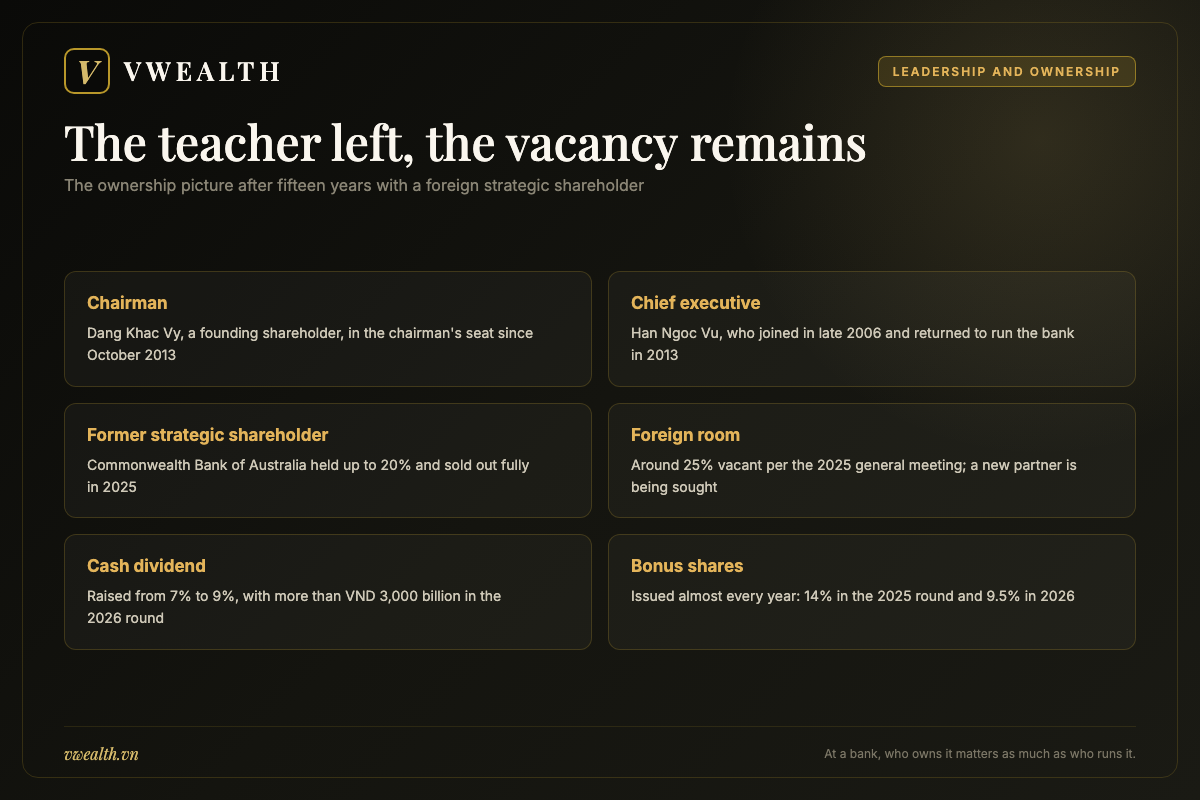
On 16 October 2013, VIB’s annual general meeting elected Dang Khac Vy — one of the founding shareholders — as chairman of the board. At the same moment, Han Ngoc Vu, who had been sitting in the chairman’s seat, was moved back to the chief executive role.
From the outside this looks like nothing more than two people swapping chairs. Look closer and it is a clean separation of ownership from execution: the founding shareholder takes the strategy and oversight seat, while a professional manager with international banking grounding returns to run the machine. That structure has held ever since, and its stability is a genuinely rare asset in Vietnamese banking, where the chief executive’s chair at many institutions changes hands every few years.
The years from 2013 to 2016 were also VIB’s cleanup years. The non-performing loan ratio in 2016 still stood at 2.58%, above what the market treats as comfortable. The bank was simultaneously working off the legacy of an older credit cycle and rebuilding the portfolio around retail. That kind of work generates no headlines, but it is the precondition for the years that followed.
2017: buying a branch from its own teacher
2017 was the densest year in VIB’s history and the hinge year of the retail strategy.
The first event: on 9 January 2017, more than 564 million VIB shares began trading on UPCoM, Vietnam’s third-tier market for public companies that are not yet listed on a main exchange. The reference price on day one was VND 17,000 per share. VIB was the first bank to reach UPCoM that year, opening a wave of bank listings onto organised markets.
The second event is the more interesting one: VIB took over the entire operation of Commonwealth Bank of Australia’s Ho Chi Minh City branch. The agreement was signed on 28 February 2017, approved by the State Bank of Vietnam, and expected to complete in the third quarter of the same year. It was the first time a domestic Vietnamese bank had acquired the branch of a foreign bank.
Notice the neat paradox in that transaction. CBA was VIB’s strategic shareholder and, at the same time, operating its own branch in Ho Chi Minh City doing retail business, with more than 20,000 customers, mostly individuals and small and medium enterprises. In other words, the teacher and the student were competing on the same field. The 2017 deal ended the overlap in the tidiest possible way: the student bought the teacher’s book of business, and the teacher went back to being purely a shareholder.
What VIB acquired was not just a customer list. It was a retail portfolio already run to CBA standards, together with the processes and the people who ran it. From 2017 onward, the shift into retail credit accelerated noticeably. Management later described that year as the starting point of a ten-year transformation programme they called internally “VIB 2.0”.
2018 to 2024: south to Saigon, up to HOSE, then a bend in the road
In late 2018, VIB moved its head office from Hanoi to Ho Chi Minh City, into Sailing Tower at 111A Pasteur in District 1. For a bank born in Hanoi and named “International”, relocating its headquarters to the southern commercial capital was not a cosmetic gesture. It was a move toward the market: Ho Chi Minh City and its surrounding provinces hold the densest concentration of middle-class households and the most active housing and automotive markets in the country — which is to say, the places where a retail bank’s target customer actually lives.
In November 2020, VIB moved its shares from UPCoM to a full listing on the Ho Chi Minh Stock Exchange, with close to a billion shares outstanding and charter capital above VND 11,000 billion. The timing is worth remembering: in the middle of a pandemic year, when most businesses were contracting, Vietnamese bank stocks entered a powerful re-rating driven by low interest rates and a flood of new retail brokerage accounts. VIB listed exactly as that wave began.
The three years after the HOSE listing are the best stretch in VIB’s financial record. Return on equity — the ratio that tells you how many dong of annual profit each 100 dong of shareholder capital produces — rose from around 13% in 2018 to above 20%, and at points during 2020 to 2022 touched roughly 30%. Pre-tax profit compounded at close to 50% a year between 2017 and 2022. The non-performing loan ratio was pulled from 2.58% in 2016 down below 2% from 2019 onward.
Then the road bent. In 2023, pre-tax profit rose only about 1% year on year to roughly VND 10,700 billion, and ROE slipped from around 30% to 25%. The NPL ratio rose to 2.2% in 2023, then to 2.67% by the third quarter of 2024, with total non-performing loans of roughly VND 11,503 billion — up 37% since the start of that year. Within that, group 5 loans, the category Vietnamese regulation defines as loans with a likelihood of total capital loss, exceeded VND 6,000 billion.
The cause is not hard to identify, and it sits precisely where VIB is strongest: the housing market. When home prices run far ahead of incomes, demand for mortgages stalls; when the economy tightens, some existing borrowers struggle to service debt. A bank with 90% of its loan book in retail lending, most of it housing-related, feels that shock earlier and harder than anyone else. The retail share was progressively dialled down, from 90% in 2022 to 85% in 2023 and lower in the years after — a defensive move.
2025 and 2026: a deliberately sacrificed year, and the promise of VIB 3.0
2025 closed with a strange set of numbers. Total assets reached VND 556,000 billion, up 13%. Credit outstanding hit VND 382,000 billion, up 18% — a very strong expansion. Customer deposits were around VND 330,000 billion, up 10%. The combined balance of demand deposits and high-yield accounts grew 39% from the start of the year. The capital adequacy ratio reached 12.2% under Basel III. The NPL ratio fell back to 2.2%, the lowest in three years.
And yet pre-tax profit came in at VND 9,105 billion, up a bare 1%, and far below the VND 11,020 billion plan shareholders had approved at the start of the year. ROE fell to 16.5%.
The official explanation from Chairman Dang Khac Vy: this was a deliberate decision. The bank chose to raise loan loss provisioning sharply, clean the books, reinforce its capital base and risk governance, and simultaneously invest heavily in technology, products and people for the retail franchise. The stated spirit was to choose long-term durability over short-term optics.
How should you take that explanation? Honestly, this is exactly the kind of statement an investor cannot verify on the spot — every bank with a weak profit year can claim it provisioned by choice. There is only one way to test it, and it involves watching two things over the next several quarters: does the NPL coverage ratio actually rise, and does provisioning expense fall once the bad debt has been worked through? If both hold, the explanation was true. If bad debt keeps swelling while provisioning stays high, that was not a choice — it was a requirement.
At the same time, management declared 2026 the final year of the ten-year VIB 2.0 transformation, with the bank entering a new phase called VIB 3.0 covering 2027 to 2036, carrying an ambition of 20% to 30% annual growth and a goal of leading the domestic card market. The 2026 plan sets pre-tax profit at VND 11,550 billion, up 27%, on credit growth of around 15%.
| Date | Event | Why it matters to an investor today |
|---|---|---|
| 18 Sep 1996 | Founded in Hanoi with VND 50 billion capital and 23 staff | Purely private roots, no controlling state capital |
| 2006 | Core banking system modernised | The technical precondition for retail banking at scale |
| 2009–2010 | Commonwealth Bank of Australia becomes strategic shareholder (15%, later 20%) | Imported an international retail model — the source of every advantage since |
| 16 Oct 2013 | Dang Khac Vy becomes chairman; Han Ngoc Vu returns as CEO | A governance structure stable for more than a decade |
| 9 Jan 2017 | 564 million+ shares begin trading on UPCoM at VND 17,000 reference | Start of market disclosure discipline |
| 2017 | Acquires CBA’s entire Ho Chi Minh City branch (20,000+ customers) | First Vietnamese bank to buy a foreign bank branch; start of “VIB 2.0” |
| Late 2018 | Head office relocated from Hanoi to Ho Chi Minh City | Moving to where retail borrowers actually live |
| Nov 2020 | Lists nearly 1 billion shares on HOSE; charter capital above VND 11,000 billion | Enters institutional screens; liquidity improves sharply |
| 2020–2022 | ROE touches roughly 30% at points | The peak of the concentrated retail model |
| 2023–2024 | Profit stalls; NPL reaches 2.67% (Q3 2024) | The cost of pushing one segment to the limit |
| 2024–Mar 2025 | CBA fully exits after fifteen years | Strategic shareholder lost; foreign room freed up |
| 2025 | Assets VND 556,000bn; credit VND 382,000bn (+18%); PBT VND 9,105bn (+1%); ROE 16.5% | A “cleanup” year: volume grew, profit was sacrificed |
| 2026 | PBT plan VND 11,550bn (+27%); final year of VIB 2.0 | The test of whether the 2025 explanation was true |
Step back across the whole thirty years and you will notice that VIB is not a story of dramatic pivots the way several of its peers are. It is the story of one choice held for a very long time: choose retail, choose individual customers, choose homes and cars as collateral, and do not change your mind even when the choice hurts. If you want to compare it with a bank that went after the same retail customer by a different door — through technology and a young user base — our analysis of whether to buy TPB stock of TPBank sets the two approaches side by side.
Who steers VIB, and who actually owns it
For a bank, the question “who owns this” matters far more than it does for a manufacturer. The reason is simple: a bank lends other people’s deposits, and the person who decides who gets those loans is the person holding control. Ownership structure is therefore not merely a dividend question — it is part of the risk profile. This chapter peels the layers: the man at the top, the man running the machine, the large shareholders, what the disclosures say, and what they do not say.
Dang Khac Vy: from instant noodles in Russia to a bank chairman’s seat
This is one of the more remarkable business biographies in Vietnamese banking, and it explains a good deal about VIB’s personality.
Dang Khac Vy was born on 7 June 1968 in Nghe An province in central Vietnam. He graduated as a mining and geology engineer from the Moscow Geological Institute named after S. Ordzhonikidze, then earned a doctorate in economics at the Institute of World Economy and Politics under the Russian Academy of Sciences. In other words: a man trained as an engineer in the Soviet Union, who redirected into economics, and who stayed to do business in Russia through the most chaotic decade that economy has known.
In 1999 he co-founded Mareven Food Holding, the parent of Mareven Food Central. This was not a small diaspora trading business. Mareven became one of Russia’s leading producers of instant noodles and mashed-potato products, led the market with its Rolton brand, and at one point held roughly 46% of the Russian instant noodle market. If your mental image of Vietnamese entrepreneurs in Eastern Europe involves market stalls, a 46% national share of a consumer packaged goods category in a country of more than 140 million people is a fairly firm correction.
The detail that matters for an investor is the original trade: fast-moving consumer goods. Someone who built a fortune by selling millions of noodle packets to millions of consumers tends to think in retail terms — large volume, small unit size, standardised process, brand and distribution as the weapons. That is precisely the logic of a retail bank. The parallel proves nothing on its own, but it is a useful piece of the puzzle when you are trying to understand why VIB’s strategy has been consistent to the point of stubbornness.
Vy has been a founding shareholder of VIB since 1996 and was elected chairman on 16 October 2013 — more than a decade in the seat. In Vietnamese banking, that kind of longevity for a founder-chairman is simultaneously a strength and a thing to monitor. The strength: strategy does not get torn up, and the decision-maker’s interests are tied to the institution over long horizons. The thing to monitor: power concentrated in one group for a long period demands that internal oversight and independent audit genuinely have teeth.
Han Ngoc Vu: the chief executive who left and came back
Han Ngoc Vu’s career path at VIB is an unusual one. He joined the bank as chief executive in late 2006, held the role until 2008, then moved up to the board of directors and served a stretch as chairman. In 2013 the board appointed him back into the chief executive role, and he has run the bank’s operations ever since.
He has close to thirty-five years in finance and banking, including many years at international banks. That background matters more than it appears at first glance: the period during which VIB absorbed CBA’s retail model required an operator who could speak the same governance language as the Australian partner — the same vocabulary of risk appetite, reporting standards and process design. A chief executive with only domestic experience would have struggled to do it.
The practical meaning for you of a chairman and chief executive pairing that has held for more than a decade is this: when you read VIB’s long-term plan, you are reading the plan of people who will still be there to execute it. That does not guarantee the plan is correct, but it does remove the risk that the strategy gets overturned simply because the leadership was replaced.
Fifteen years, then goodbye: CBA sells out completely
If chapter one was the story of CBA arriving, this is the story of CBA leaving — and it happened slowly, over more than a year.
CBA had held up to 20% of VIB. Through 2024 the Australian bank sold down in stages: disclosures describe a tranche of up to 448 million shares, equivalent to roughly 15% of charter capital, and a further sale of about 10% of capital in October 2024 raising roughly VND 5,400 to 5,500 billion. On 5 March 2025, CBA sold the remainder — more than 128 million shares, around 4.4% of capital, with an estimated value of roughly VND 2,600 billion. Pyn Elite Fund, a Finland-based fund that has been one of the more visible foreign investors in Vietnamese equities, was among the buyers in that final tranche. After that transaction CBA no longer held any VIB shares, closing out fifteen years as strategic shareholder.
CBA’s stated reason: concentrating resources on its banking operations in Australia and New Zealand. That reason is verifiable at the level of the broader pattern — over the past decade a number of large Western banks have retreated from minority stakes in emerging markets to reduce capital costs and simplify group structures, and this is by no means specific to Vietnam. Put differently, CBA’s exit does not automatically mean CBA turned negative on VIB.
But do not exhale too quickly either. Three practical consequences deserve recording. First, VIB lost a shareholder that supplied governance standards and international credibility — neither of which can be replaced with cash. Second, a very large block of shares was pushed into the market over more than a year, creating meaningful supply pressure on the price. Third, and this is the positive side: the foreign room was freed up.
The shareholder register: a domestic network with common roots
According to disclosures reported by Vietnamese financial media as at October 2023, VIB’s major shareholders comprised: the family of Dang Khac Vy at roughly 23%, Commonwealth Bank of Australia at 20.4%, Do Xuan Hoang at roughly 5.1%, Funderra Joint Stock Company at roughly 4.8%, and Uniben Joint Stock Company at roughly 4.8%.
Two details there are worth stopping on. First, Uniben is a domestic fast-moving consumer goods company operating principally in food — the same original industry as Mareven in Russia. Second, Do Xuan Hoang also belongs to the generation of Vietnamese entrepreneurs who built businesses in Eastern Europe. That is to say, VIB’s large shareholders are not a random collection: they are a network with shared geography, shared generation and shared industry background.
That network cuts both ways, exactly like the retail strategy does. The good side: high alignment, no strategic tug-of-war between competing shareholder factions, and no incentive among the large holders to exit on a short horizon. The side to watch: when a bank’s large shareholders also own other businesses, related-party lending is permanently a topic the market will probe. Vietnam’s Law on Credit Institutions sets explicit limits on credit extended to related parties, and the figures sit in the notes to the annual audited financial statements.
The practical advice here is unglamorous: ignore rumours, open the “related party transactions” note in VIB’s audited financial statements, look at the size of related-party exposure and compare it with own funds. If the number is small and stable across years, this is a theoretical concern. If it swells quickly, that is a signal you must take seriously. This principle applies to every private Vietnamese bank, not to VIB specifically.
After CBA’s exit, a new name entered the picture. Per a disclosure filing, Beston Joint Stock Company together with its related persons raised its holding to 243 million VIB shares, equivalent to 8.159% of charter capital, following a transaction on 18 March. Beston was established in November 2020, is headquartered in District 3 of Ho Chi Minh City, is represented by Nguyen Thuy Nga, born in 1978, and lists food trading as its principal business.
This is the part to read with the right attitude. A disclosure filing tells you who holds how much — that is a fact. It does not tell you why they bought or what relationship, if any, they have with existing shareholder groups — that is speculation. In the Vietnamese market, every time a low-profile legal entity buys a large block of bank shares, social media promptly manufactures a full set of theories. As an investor, stay anchored to the official filings and keep a presumption of innocence.
The one thing that can be concluded with confidence: after the foreign strategic shareholder left, VIB’s ownership is shifting toward domestic investors, and the bank is publicly searching for a new foreign partner. Those two facts will shape the balance of power at VIB for years.
The foreign room: three disclosed numbers that do not line up
“Foreign room” is the maximum aggregate stake all foreign investors combined may hold in a company. For Vietnamese banks, the general ceiling is 30%, within which a single foreign strategic investor faces its own separate sub-limit. Critically, a Vietnamese company can set its own maximum foreign ownership ratio below the statutory ceiling — and it can change that self-imposed cap. Banks do this for a specific purpose: reserving headroom for a future strategic partner instead of letting financial investors fill it up on the open market.
VIB’s foreign room story has three disclosed data points, and they were made at different times in different contexts. We report each as disclosed rather than trying to stitch them into one consistent narrative.
Point one. For many years, the bank maintained a maximum foreign ownership ratio of 20.5%, and the room was nearly always full. That meant foreign investors wanting VIB usually could not buy on the exchange and had to accept a premium through negotiated block trades.
Point two. From early July 2024, VIB announced it was locking the maximum foreign ownership ratio at 4.99%, equivalent to roughly 148.7 million shares. The conventional market reading of that move is that it was intended to preserve headroom for a future strategic partner rather than allow portfolio investors to absorb it.
Point three. At the annual general meeting held on 27 March 2025, Chairman Dang Khac Vy stated that VIB’s foreign room stood at roughly 25% vacant and that the bank was searching for a new foreign strategic shareholder following the separation from CBA.
Those three figures — 20.5%, 4.99% and roughly 25% vacant — cannot be reconciled from public information alone, because a self-imposed cap can be raised or lowered by board and shareholder resolution and the disclosures do not spell out the sequence. Do not try to build a story that makes all three fit. What you should do instead is check the current maximum foreign ownership ratio and the current filled percentage on the exchange’s own data before you make any assumption about how much room a foreign buyer actually has today. Anyone building a position from outside Vietnam should treat this as a live operational constraint, not a background fact.
What the vacancy does mean, if it persists, is very concrete. It is a potential catalyst — an event capable of moving the share price materially. When a Vietnamese bank sells a stake to a foreign strategic partner, the deal is typically priced above market, brings a large share premium into equity, and drags governance improvements along with it. Looking across the sector’s history, transactions of that kind have produced clear price reactions. But keep a cool head: “searching” is a very long way from “signed”. Finding a strategic partner for a Vietnamese bank routinely takes years, and not every search ends in a deal.
Dividend policy: steady cash plus an annual bonus issue
This is the section income-oriented investors should read most carefully, because VIB belongs to the relatively small group of Vietnamese banks that pay cash dividends consistently — something not every bank manages, since the State Bank has for years encouraged institutions to retain earnings to build capital.
The plan approved by shareholders in 2025: a cash dividend at a ratio of 7%, a bonus share issue to existing shareholders at 14%, plus 0.26% in ESOP shares for staff. Total distribution of roughly 21%. Charter capital accordingly rose from VND 29,791 billion to VND 34,040 billion, an increase of 14.26%.
The plan for 2026: a cash dividend of 9%, a bonus issue of 9.5% (more than 323 million shares), and ESOP of 0.24% (around 8 million shares) — nearly 19% in total. The cash component alone is estimated at more than VND 3,000 billion, drawn from retained earnings after fund appropriations as at the end of 2025. Charter capital is expected to rise from VND 34,040 billion to a maximum of VND 37,354 billion, an increase of 9.74%.
| Distribution year | Cash dividend | Bonus shares | ESOP | Charter capital after |
|---|---|---|---|---|
| 2025 (for FY2024 results) | 7% | 14% | 0.26% | VND 34,040 billion (+14.26%) |
| 2026 (for FY2025 results) | 9% | 9.5% | 0.24% | Up to VND 37,354 billion (+9.74%) |
How should you read that table? Three observations.
First, the cash ratio went up while the bonus share ratio came down. Cash from 7% to 9%; bonus shares from 14% to 9.5%. That is a signal that the bank feels better capitalised and is willing to hand real money to shareholders. For an income investor, that is good news.
Second, bonus shares are not a gift. This trips up an enormous number of new investors, in every market. When you receive an extra 9.5 shares for every 100 you hold, the reference price is adjusted down proportionally on the ex-rights date. The total value you hold at that instant is unchanged. What you get is more shares at a lower price each — easier liquidity, and the market usually likes the optics, but not one new dong has been created. Only the cash dividend is money arriving in your account.
Third, calculate dividend yield off market price, not par value. The “9%” in the announcement means 9% of the VND 10,000 par value, that is VND 900 per share. Your actual yield is 900 divided by the price you paid. As an illustration only: buy at VND 18,000 and your cash yield is 5%; buy at VND 30,000 and it is 3%. Same policy, two buyers at two prices, two very different outcomes. Foreign investors should also remember that Vietnam applies withholding on dividend income and a transaction-value-based tax on share sales, and that the practical net yield depends on your custodian’s treatment — check with your broker rather than assuming the headline ratio.
If you want to compare VIB’s dividend approach with a peer in the same cohort, our analysis of whether to buy ACB stock covers a bank that also distributes consistently but runs a distinctly more conservative risk appetite.
How VIB makes money: anatomy of Vietnam’s purest retail bank
Now we open the hood. A bank, stripped to essentials, does three things: it gathers money from one group of people, lends it to another group, and sells services alongside. The spread between lending rates and funding rates is the main livelihood; fee income is the side dish. What differentiates one bank from another is who it lends to and how it funds itself. For VIB, the answer to the first is unusually clear, and the answer to the second is its largest weakness.
Mortgages: the biggest engine and the most fragile footing
This is the heart of the bank. Within VIB’s retail lending portfolio, housing-related lending is the largest component by a wide margin. According to figures disclosed during the period when the portfolio ran at its most concentrated, home purchase loans accounted for roughly 77% of the retail book, with the remaining 23% in home construction and renovation lending.
Why would a bank love mortgage lending this much? Four very practical reasons.
Reason one: clear collateral. A mortgage is secured by the house itself. If the borrower cannot pay, the bank still has an asset to work with. Compared with unsecured consumer lending — where the bank loses effectively everything on default — this is a materially higher-quality asset.
Reason two: long tenor, steady income. A Vietnamese mortgage typically runs 15 to 25 years. The bank receives an even stream of interest for many years, rather than perpetually hunting new borrowers to replace maturing working-capital facilities as it would in corporate lending.
Reason three: better spread than large-corporate lending. Large companies have bargaining power and squeeze pricing to the bone. An individual buying a home has no such leverage, and in practice cares more about the monthly instalment than about a few tenths of a percentage point on the rate.
Reason four: mortgage borrowers are sticky. A person taking a mortgage usually opens a salary account, buys loan insurance, takes a credit card and keeps savings at the same bank. One loan drags a whole chain of other revenue behind it.
But this engine has a very sensitive fuse: house prices. When prices in the big cities run far ahead of average incomes, the number of people who qualify for a mortgage falls — not because they stopped wanting to borrow, but because at those prices the monthly instalment breaches the affordability threshold the bank itself sets. That is exactly what happened through 2023 and 2024, and it is the direct cause of VIB’s retail credit growth slowing while non-performing loans rose.
Picture it with a simple illustrative example. A couple earns a combined VND 40 million a month. Standard underwriting practice will not allow debt service to exceed roughly 50% of income, so a maximum of about VND 20 million. At prevailing rates and tenors, that instalment supports a loan of a certain size; if apartment prices rise by half over a few years while incomes barely move, the loan the couple now needs sits far above what they can be approved for. The result: the application is declined, or the borrower withdraws it. That is the mechanism by which an expensive housing market chokes retail credit even though genuine demand for shelter is entirely intact.
There is a second-order point here that international investors often miss. In Vietnam, mortgage rates are typically structured as a promotional fixed rate for the first year or two, after which the rate floats against a reference rate set by the bank. So a household’s affordability is tested twice: once at origination, and again when the promotional period rolls off. When the second test lands in a high-rate year, delinquencies appear in a cluster — which is part of why bad debt at retail banks in this market tends to arrive in waves rather than gradually.
Cars and cards: two niches where VIB genuinely leads
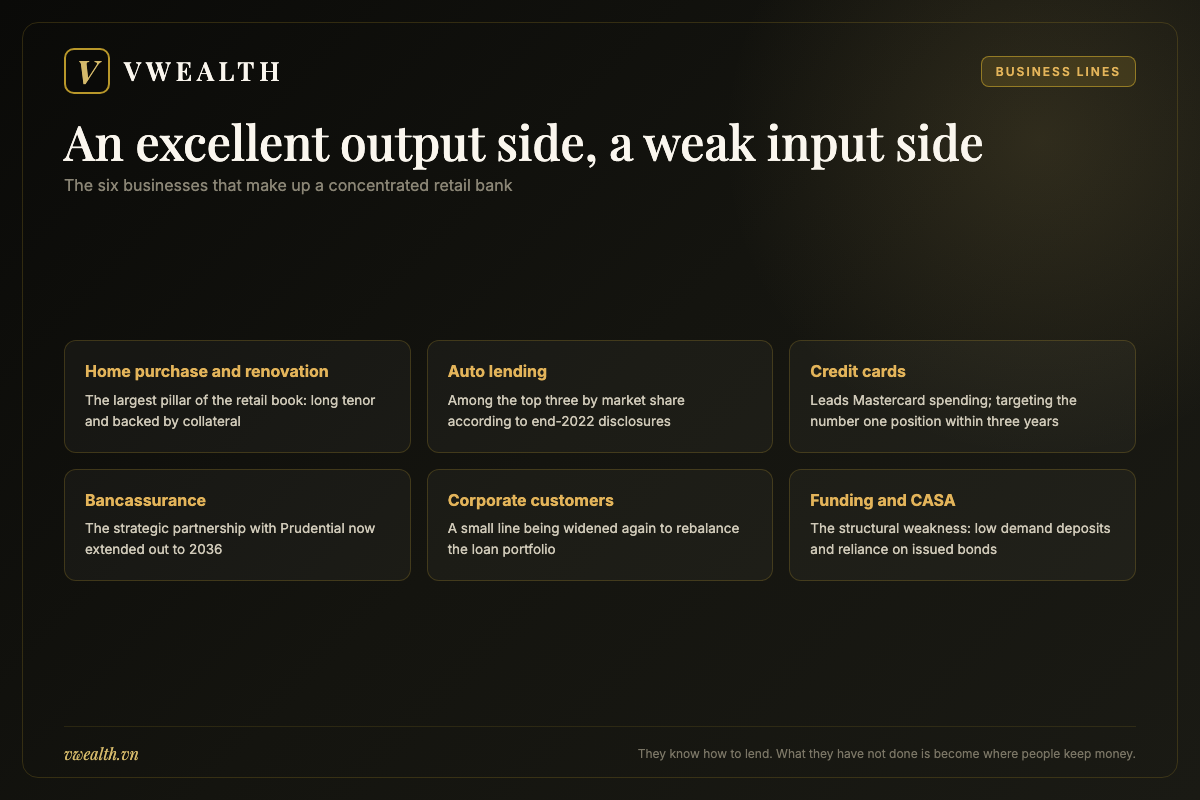
The first niche is auto lending. This gets little attention but deserves some, because it is a rare case of a Vietnamese bank building a leadership position in a narrow specialty. Per figures disclosed as at the end of 2022, VIB sat in the top three by market share in auto lending in Vietnam.
That position did not arrive by accident. Auto lending is its own trade. It requires a bank to build a network of dealer relationships, because the customer typically decides to borrow right there in the showroom, sitting across from a salesperson. Whichever bank approves fastest, staffs the dealership, and offers a product simple enough to explain in three sentences, wins. That is operational capability, not financial capability, and it takes years to construct.
Auto lending also carries a different risk shape from mortgages. Tenors are much shorter, typically three to seven years. The collateral is a vehicle — easier to repossess than real estate, but depreciating fast. In exchange, the rate is higher than on a mortgage. For VIB the segment plays a balancing role: it recycles capital faster, keeping the portfolio from becoming excessively long-dated.
The variable to watch here is Vietnam’s car market itself. New vehicle sales depend heavily on registration fee policy, on middle-class income growth, and increasingly on the shift toward electric vehicles — where the distribution structure, the residual value of a used car and the whole basis for valuing collateral are all in motion. A bank strong in auto lending will have to relearn collateral valuation over the next several years.
The second niche is credit cards — and if you had to pick one business that captures VIB’s character, pick this one.
Per figures disclosed as at the end of 2022, VIB led Mastercard credit card spending share in Vietnam at roughly 33%, meaning that for every three dong spent on a Mastercard in the market, one went through a VIB card. For a bank outside the top tier by total assets, that is a striking number.
The way they achieved it is quite specific: cards were segmented by spending behaviour rather than by customer tier. There is a card built for online shoppers, with high cashback on e-commerce, ticketing and hotel bookings. There is a card built for travellers. There is a card focused on flat cashback across total spend. The most notable product is a two-in-one card combining credit and debit functionality on a single piece of plastic, introduced as the first of its kind in Southeast Asia. On top of that, once an application is approved, the bank issues a digital card in the app immediately so the customer can spend online without waiting for physical delivery.
At the 2026 annual general meeting, management set the goal of leading the domestic card market within three years, with the stated direction of turning the VIB card into an everyday payment instrument. That is an ambitious claim, and usefully, it is a verifiable one — card market share is measured periodically by the international card schemes.
Why do credit cards matter so much to how the stock is valued? Three reasons. One, card balances carry a very high spread, materially above mortgage lending. Two, cards generate fee income — annual fees and interchange from merchants — which is non-interest income that consumes no credit quota and requires relatively little capital. Three, cards are a data gateway: the bank learns where its customers spend, and can cross-sell on the strength of that knowledge.
The flip side: card balances are unsecured. When the economy turns, this is the first loan category to break and the one that breaks hardest, because there is no collateral to recover against. A bank pushing cards hard through an upswing can earn spectacularly; the same bank in a downswing has to provision heavily. Keep that in mind when you read the “number one in cards within three years” target.
Bancassurance with Prudential: a contract to 2036 and an upfront fee
“Bancassurance” is the model in which a bank distributes life insurance to its own customers and earns commission. For many Vietnamese banks between 2018 and 2022, it was a gold mine of non-interest income.
VIB’s insurance partner is Prudential. Per figures disclosed at the end of 2022, VIB was among the top two banks by bancassurance market share. In 2023 the two sides extended their strategic partnership to 2036, and according to reporting in Vietnamese financial media, VIB expected to receive an upfront fee of roughly USD 100 million from the renewal. In June 2026 the two sides announced a further update to the arrangement, focused on raising advisory quality, transparency and customer experience.
You need to understand the mechanics of an upfront fee. When an insurer signs an exclusive multi-year distribution agreement through a bank, it pays a large sum in advance to buy access to the customer base. The bank receives the money once but typically recognises it in income evenly across the life of the contract. Which means: the fee produces a stable, highly predictable stream of non-interest income for years, but it is not fresh profit generated each year — it is money already received, sliced up for accounting purposes.
The industry context here is important and must be stated plainly, because it is not obvious from outside Vietnam. From 2023 onward, the bank distribution channel for life insurance in Vietnam was tightened sharply following a wave of complaints that customers had been sold policies with inadequate disclosure while arranging loans. Regulators issued stricter rules on the advisory process, including recording requirements, and prohibited tying the purchase of insurance to loan disbursement. The sector-wide consequence was a steep fall in insurance premium revenue through the bank channel and a multi-year rebuilding of trust. VIB, holding a leading position in the segment, was affected in the same direction as the whole industry. The fact that both parties nonetheless extended to 2036 and updated the agreement toward a healthier standard suggests both have decided to rebuild it on the new rules, accepting lower volume for greater durability.
Corporate customers: a small business being grown back
With retail at times reaching 90% of the book, everything else — corporate lending — occupied only a corner of VIB’s portfolio. But that corner is being expanded. From 90% in 2022, the retail share fell to 85% in 2023 and continued to decline, standing at roughly 80% of total credit in 2025.
Do not read that as a retreat. Read it as portfolio balancing. When the retail segment runs into difficulty, a sensible bank widens into another segment to keep credit growth going rather than sitting and waiting for housing to recover. The fact that 2025 credit growth reached 18% while the retail market had not truly reignited tells you the incremental growth came from somewhere else.
But this is also where you should ask a question. Corporate lending is a trade VIB walked away from more than a decade ago to specialise in retail. Returning to an old trade after ten years is not simple: the corporate credit underwriting team has to be rebuilt, client relationships re-established, and above all the risk appetite kept tightly controlled. In banking, the largest losses tend to come from the business a bank has only recently re-entered and grown quickly. This is a point to track in coming reports: how much corporate exposure grew, which sectors it concentrates in, and what the asset quality of that specific cohort looks like.
Funding and CASA: the structural weakness that has to be named
Here is the least comfortable part of the VIB file, and any serious analysis has to say it out loud.
CASA stands for current account and savings account — the balances customers leave in transactional accounts rather than locking into term deposits. A bank pays essentially nothing, or very little, on those balances. The higher the CASA ratio, the cheaper the bank’s average cost of funds and the wider its net interest margin. CASA is one of the sharpest dividing lines between a strong bank and an ordinary one anywhere in the world, and in Vietnam it is close to a religion among analysts.
VIB has for years carried a CASA ratio in the lower group among listed private banks. The reason sits inside the business model itself: a bank focused on lending for homes and cars attracts borrowers, but does not automatically attract depositors. Abundant demand deposits come from two sources — corporate transaction accounts, with operating cash flowing in and out daily, and retail customers who treat the bank as their primary bank. VIB is weak in the first because its corporate business is small, and it has to fight hard for the second against banks with more widely used apps.
The consequence is that VIB must fund itself more heavily through term deposits and through issuing debt securities. In 2025 alone, the total value of bonds issued by VIB was raised to VND 14,227 billion. Bonds give the bank stable long-dated funding — well suited to financing 20-year mortgages — but they are considerably more expensive than demand deposits.
The encouraging news: in 2025 the combined balance of VIB’s demand deposits and high-yield accounts grew 39% from the start of the year. A “high-yield account” is a product paying more than a standard current account while still allowing withdrawal at any time — a device banks use to pull idle cash in. A 39% increase shows the effort to improve the funding mix is producing results. But read that percentage next to the absolute number: growing 39% from a low base can still leave a modest CASA ratio. Look up the latest CASA ratio in the most recent quarterly financial statements rather than settling for the growth rate.
MyVIB and whether digital banking is still an advantage
MyVIB is the bank’s digital banking application, built on cloud infrastructure and integrating the full experience from card application and digital card issuance through payments to loan management.
The question worth asking is this: in 2026, is digital banking still a competitive advantage, or has it become the minimum condition for survival? The honest answer is the second. Nearly every Vietnamese bank today offers instant transfers, online account opening via electronic identification, and QR payments — the country’s interbank instant payment infrastructure is genuinely among the better ones in the region, which means the technology gap between banks has compressed very fast.
So for VIB, the value of technology does not lie in having a handsome app. It lies in two much more specific places: approval speed and cost to serve per customer. A pure retail bank lives on volume — tens of thousands of loan and card applications a month. If technology cuts approval time from days to hours and reduces the headcount needed per thousand applications, that is a real advantage and it shows up directly in the cost-to-income ratio. If it does not, the app is simply an expense.
| Business line | Role in the portfolio | Margin | Principal risk | What to track |
|---|---|---|---|---|
| Home purchase and renovation loans | Largest pillar of the retail book | Moderate, long tenor | Home prices far above incomes; property liquidity | New disbursement pace and group 2 loans in this segment |
| Auto loans | Top three by market share (end-2022 data) | Higher than mortgages | Fast vehicle depreciation; sales tied to fee policy | New car sales and collateral valuation in the EV era |
| Credit cards | Leads Mastercard spending at ~33% (end-2022); target number one within three years | Highest of all lending lines | Unsecured — first to break in a downturn | Spending share and the NPL ratio of card balances specifically |
| Bancassurance (Prudential) | Core non-interest income; contract to 2036 | Fee-based, capital-light | Tightened rules on bank insurance distribution | Whether premium fee income has recovered |
| Corporate customers | Small line being expanded again | Lower than retail | A trade abandoned for a decade, capability must be rebuilt | Sector mix and asset quality of this cohort alone |
| Funding (CASA, bonds) | The input to the entire machine | Cost of funds above CASA-rich peers | Reliance on term deposits and debt securities | The absolute CASA ratio, not just its growth rate |
Look at the whole table and a portrait emerges of a bank with an excellent output side and an unfinished input side. VIB knows how to lend efficiently and how to sell products to households; what it has not achieved is making households think of VIB as the place to keep money. The entire VIB 3.0 phase management describes, if it is to succeed, has to solve the input problem. For a contrast with a bank whose funding structure is strong precisely because of a large corporate client base, see our analysis of MBB stock of MB Bank.
Financial health: nine places to look before you answer the VIB question
Reading a bank’s financial statements is nothing like reading a manufacturer’s. With a factory you look at revenue, cost of goods sold, inventory. With a bank those line items are close to meaningless. A bank is a machine that converts risk into profit, and the entire art of reading its numbers reduces to one question: how much risk is this bank taking to earn what it earns, and has it already recognised the cost of that risk in the accounts?
This chapter gives you nine places to look. The nine apply to any bank, but the order of priority is specific to VIB, because a purely retail model makes some of them far more important than they would be elsewhere.
Places 1, 2 and 3: NIM, CASA and the retail share
NIM is net interest margin: the difference between the average yield a bank earns on interest-earning assets and the average rate it pays for funding. It is the single most important operating metric for a commercial bank. A NIM of 4% means that for every 100 dong of interest-earning assets, the bank keeps 4 dong of net interest before operating costs and provisions.
VIB sits in the higher-NIM group in the Vietnamese system, and the reason is on the asset side: lending to individuals, particularly card balances and auto loans, prices well above lending to large corporates. But as the previous chapter established, VIB’s funding side is expensive because CASA is low. So VIB’s NIM is the outcome of a subtraction between a very good output and a mediocre input.
The practical implication is specific: VIB’s NIM is far more sensitive to deposit rates than that of a high-CASA bank. When the deposit rate environment rises, a bank funding 40% of its book with demand deposits is essentially unaffected on that portion; a bank funding itself principally with term deposits and bonds sees its cost of funds climb within a couple of quarters. So when you read news about the direction of Vietnamese interest rates, remember that VIB sits in the high-sensitivity group.
How to check it: open the most recent quarterly statements, divide net interest income by average interest-earning assets to get NIM, then compare with VIB’s own figure four quarters earlier. The trend matters more than the absolute level.
The third place is the retail share of the loan book. You will not find this on any standard banking checklist, but for VIB it belongs near the top.
The history of that number: 32% in 2009, up to 90% in 2022, back to 85% in 2023, and around 80% in 2025. Read that path as a chart of management psychology. The rising phase was the phase of absolute conviction in retail. The falling phase is the phase of admitting that concentration has a price.
As an investor you need to track it in both directions. If the retail share keeps falling sharply, that may signal VIB is losing its identity and drifting into competition with larger banks on a field where it is not the best player. If it climbs back above 85%, that signals housing has warmed up and the main engine is running again — but concentration risk returns along with it.
Places 4 and 5: non-performing loans and coverage
Under State Bank of Vietnam classification, non-performing loans are those in groups 3, 4 and 5 — substandard, doubtful, and loans with a likelihood of capital loss. The NPL ratio is the sum of those three divided by total loans. Group 2, “special mention”, sits just outside the NPL definition and covers loans 10 to 90 days overdue.
VIB’s path: 2.58% in 2016, below 2% from 2019, up to 2.2% in 2023, reaching 2.67% in the third quarter of 2024 with total non-performing loans of roughly VND 11,503 billion, of which group 5 exceeded VND 6,000 billion. Then 2.4% in 2024 and back down to 2.2% in 2025, the lowest in three years.
But the NPL ratio on its own tells you very little. You have to read it alongside the NPL coverage ratio — accumulated loan loss provisions divided by total non-performing loans. That ratio answers the question: if every bad loan were written off entirely, has the bank already set aside enough money? A bank with 2% NPLs and 150% coverage is in far better shape than a bank with 1.5% NPLs and 50% coverage.
This is precisely where the chairman’s explanation of 2025 gets tested. If the bank genuinely sacrificed profit in order to provision heavily, the coverage ratio has to rise visibly across the 2025 and 2026 reporting periods. If coverage stays low while profit stays thin, the “deliberate decision” narrative needs rereading. Look both numbers up in the latest financial statements before you decide anything — no metric in this article substitutes for that.
One more indicator to watch alongside: group 2 loans. This is the warehouse of future bad debt. For a retail bank, a sudden jump in group 2 in one quarter typically precedes a rise in NPLs two to three quarters later. It is the earliest reliable warning you will get from a Vietnamese bank’s disclosures.
Place 6: collateral, and what “more than 90%” actually means
This is VIB’s largest structural strength and it needs to be understood correctly.
Per disclosure at the 2026 annual general meeting, more than 90% of VIB’s retail credit portfolio is secured. That is to say, the great majority of its loans to individuals are backed by a house, land or a vehicle.
Why does that matter so much? Compare two banks each carrying a 2.5% NPL ratio. Bank A lends unsecured for consumption: when a loan breaks, recovery is close to nothing and the recovery rate may be a few tens of percent. Bank B lends against houses: when a loan breaks, the bank realises the collateral and typically recovers most of the outstanding balance, sometimes all of it. Same headline NPL ratio, dramatically different actual loss.
This is why you should not panic when VIB’s NPL ratio prints slightly above some peers. The right question is not “how much is non-performing” but “how much is lost when it goes bad”. With a heavily secured portfolio, the ultimate loss content is usually far lower than the NPL ratio implies.
There is of course a condition attached, and it is very practical: the bank has to actually be able to realise the collateral. If the legal process for taking possession and selling a secured asset drags on for years, collateral value on paper is just a pretty number. This is exactly where the 2025 legal change makes a large difference for VIB — we deal with it in detail in the industry chapter.
Place 7: CAR, Basel III and the capital buffer
CAR is the capital adequacy ratio: own funds divided by risk-weighted assets. In plain terms it measures whether the bank has enough of its own capital to absorb losses before depositors’ money is touched.
In 2025, VIB’s CAR reached 12.2% under Basel III, above the minimum Vietnamese regulation requires. Basel III is the international standard for bank capital adequacy, stricter than Basel II in that it adds capital buffers and liquidity requirements. A bank adopting and reporting under Basel III is a positive governance signal, though the act of reporting does not by itself make a bank safe.
CAR carries a dual meaning for you. On one hand, a high CAR is a shock absorber. On the other, CAR is also a growth licence: a bank that wants to lend more must hold matching capital. A bank targeting 15% annual credit growth with a CAR only marginally above the minimum will be forced to raise capital continuously — either by retaining earnings, which means smaller cash dividends, or by issuing shares, which means dilution. That is the direct line between the capital ratio and your wallet.
Place 8: CIR and ROE — the quality of each dong of profit
CIR is the cost-to-income ratio: total operating expenses divided by total operating income. A CIR of 35% means the bank spends 35 dong to generate 100 dong of income. Lower is more efficient.
For a retail bank, CIR is a decisive metric, because serving millions of small customers is inherently more expensive than serving a few thousand large ones. Every dong invested in technology, in the app, in process automation ultimately has to show up here. If VIB’s CIR is flat or rising across several years despite heavy technology investment, that technology has not yet produced efficiency.
ROE you met in chapter one: 13% in 2018, above 20%, a peak around 30% in the 2020 to 2022 window, 25% in 2023, and 16.5% in 2025. That is a clear downward slope and you need to understand why.
ROE fell because two forces pushed the same way. The first is the numerator: profit stalled under heavy provisioning and compressed spreads. The second is the denominator: equity swelled quickly as the bank continually issued bonus shares and retained earnings to build capital — charter capital moved from VND 29,791 billion to VND 34,040 billion and is planned to reach up to VND 37,354 billion, all within two years. At the same absolute level of profit, a larger equity base mechanically produces a lower ROE.
This is where many investors misread the situation. A fall in ROE from 30% to 16.5% does not mean the bank deteriorated by a proportionate amount. A meaningful part of the decline comes from the bank being better capitalised, which is to say safer. But do not over-console yourself either: a 16.5% ROE at a bank that once earned 30% is still a reminder that the competitive advantage has thinned, and the market will value the shares on the current ROE, not the historical one.
Place 9: funding structure and issued bonds
The last metric, and it is particularly important at VIB.
A bank lending for 20 years while funding itself with six-month deposits is running maturity mismatch risk: long assets, short liabilities. The State Bank of Vietnam controls this through a regulatory limit on the proportion of short-term funding that may be used for medium and long-term lending — a rule that has been progressively tightened over the past several years and which bites hardest on exactly the kind of mortgage-heavy bank VIB is. The standard remedy is to issue bonds and long-dated certificates of deposit to extend the maturity of the funding base, which is precisely what VIB did, taking the total value of bonds issued in 2025 up to VND 14,227 billion.
Look at that number with two eyes. The positive eye: the bank is actively managing maturity and not leaving a liquidity gap open. The wary eye: bonds are expensive funding, and every additional dong of bonds erodes the net interest margin. A bank leaning heavily on bond issuance is a bank that has not yet solved the cheap-deposit problem.
The nine places are collected in the table below so you can carry it with you when you open the financial statements.
| # | Metric | The question it answers | What to watch at VIB specifically |
|---|---|---|---|
| 1 | NIM — net interest margin | How much the bank keeps per dong of earning assets | High thanks to retail, but unusually sensitive to deposit rates |
| 2 | CASA — demand deposit ratio | Whether funding is cheap or expensive | Structural weakness; read the absolute ratio, not just growth |
| 3 | Retail share of loans | How concentrated the portfolio is | 32% (2009) → 90% (2022) → ~80% (2025); track both directions |
| 4 | NPL ratio | How much of the book is impaired | 2.2% (2025), lowest in three years; read group 2 alongside |
| 5 | NPL coverage ratio | Whether enough has been set aside against bad debt | Where the 2025 “deliberate sacrifice” claim gets verified |
| 6 | Share of secured lending | How much is lost when a loan breaks | More than 90% of the retail book is secured — the biggest strength |
| 7 | CAR — capital adequacy | Enough capital to absorb loss and to grow | 12.2% under Basel III (2025) |
| 8 | CIR and ROE | Operating efficiency and return on shareholder capital | ROE 16.5% (2025), down sharply from a ~30% peak; partly a capital effect |
| 9 | Funding structure and bonds | Whether funding maturity matches asset maturity | Bonds issued in 2025 raised to VND 14,227 billion |
Where VIB sits on the map of Vietnamese private banks
The most useful way to position VIB is to place it beside the other listed private banks along a business-model axis rather than a size axis. Size tells you who is bigger; model tells you who behaves differently in the same weather.
| Bank | Model identity | Standout strength | Corresponding weakness |
|---|---|---|---|
| VIB | Purest retail — homes, cars, cards | Very high share of secured lending; good NIM; leads in cards and auto | Low CASA; dependent on housing; small corporate business |
| Techcombank | Real estate, corporate bonds, affluent customers | CASA among the highest in the system; large customer ecosystem | Concentration in one sector and its related client group |
| ACB | Retail and SME, run conservatively | Asset quality stable across multiple cycles | Growth rarely breaks out |
| VPBank | Parent bank plus consumer finance | Very high margins; broad customer reach | Large unsecured exposure; NPLs swing hard with the cycle |
| MB | Universal, tied to a large corporate ecosystem | Abundant low-cost funding; mass digital customer base | Reliance on a handful of key clients and sectors |
| TPBank | Retail led by technology and a young user base | Digital brand recognition; low cost to serve | Mid-sized; competing head-on with much larger banks |
The conclusion of this chapter: measured by collateral quality, VIB has a far better foundation than its NPL ratio suggests. Measured by funding structure, it is in the weaker group. Measured by profitability, it is sitting at the bottom of a cycle, and the entire question is whether that cycle turns back up. If you want to compare it against a peer that pursued the same households through high-yield unsecured consumer finance instead, read our analysis of VPB stock of VPBank and set the two risk profiles next to each other.

How the market prices VIB stock: portrait of a retail bank share
A good business and a good stock are two different things. You can be entirely right about VIB as a bank and still lose money by buying at the wrong price. This chapter is about the second half: the logic the market currently applies to VIB, and what could change that logic.
Why banks are valued on P/B rather than P/E
For most companies, the familiar valuation metric is the price-to-earnings ratio — share price divided by earnings per share. For banks, analysts lean on price-to-book instead: share price divided by book value per share.
The reason is practical. A bank’s profit in any given quarter depends heavily on how much it provisions, and management has real latitude in that decision within the boundaries of regulation. With the same loan portfolio, a bank can provision heavily and print a low profit, or provision to the minimum and print a handsome one. Which means the “E” in P/E is far less stable in banking than in other industries. VIB’s own 2025 is the living illustration: the same bank, the same portfolio growing at 18%, and profit still up only 1%.
Book value, by contrast, is an accumulated figure that is hard to distort in a single quarter. It represents the assets genuinely belonging to shareholders once all liabilities are subtracted. That makes P/B a steadier yardstick both for comparing banks with one another and for comparing a bank with its own history.
Reading relative P/B for VIB — and the trap of a fallen ROE
The founding principle: the fair P/B of a bank is tied directly to that bank’s ROE. The intuition is simple. If a bank earns 25% on shareholder capital every year, the market will pay a substantial premium to book value, because each dong of capital sitting there compounds fast. If it earns 10%, the market will pay around or below book.
This is the single largest trap in valuing VIB today. Its ROE has travelled from roughly 30% down to 16.5%. If you take the P/B multiple the market once paid VIB during the 30% ROE era and conclude “the stock is cheap versus its own history”, you have made an invalid comparison. That historical multiple belonged to a different bank — one earning twice what this one earns.
The correct comparison has three steps, and you should complete all three before deciding anything:
Step one: take VIB’s current P/B from live data. Step two: compare it with the average P/B of private banks with a comparable ROE today, not with VIB’s own golden-era multiple. Step three: ask the question that actually matters — where do you believe VIB’s ROE settles over the next three years? If you believe it recovers above 20%, today’s multiple may be an opportunity. If you think 16% to 18% is the new normal, then the fair price has to reset to that new normal too.
An illustration of the arithmetic, using invented figures and not a recommendation: assume a bank with book value of VND 15,000 per share. If the market pays 1.2 times book, the price is VND 18,000. If ROE improves and the market lifts its accepted multiple to 1.6 times, the price becomes VND 24,000 — a 33% gain with no change in book value at all. Conversely, if ROE keeps eroding and the market marks down to 0.9 times, the price is VND 13,500. Same company, same balance sheet, and an enormous range driven purely by belief. That is why you need a clear view on future ROE before you buy any bank stock, in any market.
The personality of VIB shares, and the annual bonus issue
Every stock has a “personality” that long-term holders recognise immediately. VIB’s has a few defining traits.
First, this is a consistent cash dividend payer. Among Vietnamese banks, the majority have gone years distributing only shares and no cash. VIB has paid cash repeatedly and has raised the ratio from 7% to 9%. That attracts a completely different holder base from the speculative crowd: people looking for cash flow.
Second, it moves with the banking sector’s rhythm. Vietnamese bank stocks tend to travel in a herd: when money rotates into “banks”, nearly the whole group rises together; when the market rotates elsewhere, the whole group rests. VIB is no exception, and through many stretches it has not been large enough to generate a wave of its own.
Third, liquidity is decent but not top tier. After successive bonus issues, VIB’s share count has grown considerably, which has helped turnover. Even so, matched volume remains below the largest bank tickers — a point to weigh if you intend to deploy meaningful size, and a particularly relevant one for foreign institutions that need to enter and exit without moving the price.
Fourth, and this is distinctive: VIB is sensitive to residential property news. Because the model concentrates on mortgage lending, headlines about housing policy, mortgage rates, or the apartment market move this stock more visibly than they move a universal bank.
The fifth trait deserves detail: bonus shares are issued nearly every year. VIB distributed 14% in the 2025 round and 9.5% in the 2026 round. Many new investors read that as a gift. Look closer.
When a bank issues bonus shares, it converts part of retained earnings into charter capital. Total equity does not change — only the label on a line in the balance sheet does. The share count rises, so book value per share falls proportionally, and the reference price on the exchange is adjusted downward accordingly.
So why do banks keep doing it? Three practical reasons. One, higher charter capital improves regulatory ratios and creates headroom for credit growth. Two, a lower post-adjustment price makes the shares feel more accessible to retail investors and improves liquidity. Three, in market psychology, a bonus issue reads as a signal that the bank is profitable.
What you should take from that: only the cash dividend is a real transfer of value from the company to you. A bonus issue is a redivision of what you already own. Do not put the bonus ratio into your return calculation.
There is one further consequence of continual bonus issues that few investors notice: it depresses ROE mechanically. If equity grows faster than profit, ROE must fall. A meaningful part of VIB’s slide from 30% to 16.5% comes from this mechanism rather than from a proportionate deterioration in the business. When you compare VIB’s ROE with another bank’s, check whether the two have been growing their capital bases at similar rates.
Foreign investors: from a permanently full room to a vacancy
The foreign ownership story at VIB has two chapters that point in opposite directions, and you need both to read the price action correctly.
The old chapter: for many years VIB’s foreign room stood at 20.5% and was almost always full, largely because CBA held the bulk of it. When the room is full, a foreign investor who wants in has to wait for another foreign holder to sell, or buy through a negotiated trade at a premium. That state of affairs usually supports a firm floor under the price.
The new chapter: from 2024 through March 2025, CBA sold hundreds of millions of shares. An enormous supply of stock landed on the market over more than a year. Any share would face price pressure through a period like that, and this is a technical factor you should separate cleanly from the fundamentals when you look back at VIB’s chart for those years.
After CBA’s departure, the chairman stated at the March 2025 annual general meeting that the foreign room was roughly 25% vacant. As set out in chapter two, that figure sits alongside two other disclosed numbers that do not reconcile from public information, so verify the current cap and current fill rate on exchange data before acting on it. Directionally, though, the position has inverted: from a stock foreign investors could not buy, to one they can. That has two faces. The good face: the shares are far more accessible to foreign funds, and if international capital rotates back into Vietnam, VIB is one of the few bank tickers with space. The face to note: a wide-open room also means the stock has lost the scarcity premium that used to support it.
If the mechanics of foreign ownership limits, negotiated block trades, settlement cycles and daily price bands are new to you, they are worth learning before you place an order rather than after — our guide to the Vietnam stock market walks through how the exchange actually operates, including the seven percent daily band on HOSE and the settlement timetable that determines when shares and cash actually land in your account.
What could move VIB stock
If you follow this name, here is the list of events worth setting alerts on. Each one has the capacity to make the market reprice the shares.
One, news of a new foreign strategic shareholder. This is the most powerful catalyst on the list. A stake sale to a foreign partner typically comes at a valuation above market and brings a large share premium. But remember: so far this is a stated intention, not a transaction.
Two, the NPL coverage ratio in coming quarterly reports. If that number jumps visibly, the “deliberate profit sacrifice” story is confirmed, and the market will start looking through to a normalised profit level for the following year.
Three, progress against the VND 11,550 billion profit plan for 2026. Bear in mind that the 2025 plan was VND 11,020 billion and the actual result was VND 9,105 billion. VIB’s plan-completion record across two consecutive years will directly affect how much credibility the market extends to management’s numbers.
Four, the housing market and mortgage rates. This is the base variable under the entire business model.
Five, credit quota policy. The pilot removal of the administrative credit growth ceiling from 2026 could completely change the growth cap for banks that meet the criteria.
Six, the outcome of Vietnam’s market reclassification story. If passive money from index-tracking funds flows in, banks with wide-open foreign room are the direct beneficiaries.
To compare the listed bank tickers side by side at the same point in time, the vwealth section on banking and brokerage stocks collects analyses written to the same framework, which makes cross-reading far easier than assembling scattered sources. And if you want to see how the reclassification argument looks from the other side of the market — from a brokerage whose earnings depend directly on foreign flow — our analysis of HCM stock of HSC Securities takes the same question from a different angle.
The rules are being rewritten: Vietnam’s retail banking landscape in 2026
There are periods in which a bank’s results depend mainly on the bank. And there are periods in which the rules of the game change enough that every bottom-up analysis has to be redone. 2025 and 2026 belong to the second kind. Several large changes are happening at once, and all of them touch VIB’s business model directly — some favourably, some as pressure.
This chapter matters more than usual for an investor based outside Vietnam, because these are the pieces of context that never make it into a screening tool. Two banks can look identical on a spreadsheet and respond completely differently to the same regulatory change, purely because of what sits inside their loan books.
Change one: removing the credit quota — opportunity or discipline test
Since 2011, following a period in which credit grew above 30% a year in 2009 and 2010 and generated high inflation and macroeconomic instability, the State Bank of Vietnam has assigned each bank an individual credit growth target — what the market calls the “credit room” or credit quota. At the start of each year every bank receives a ceiling; to lend beyond it, the bank must apply for an extension.
For a foreign investor this is one of the more unusual features of Vietnamese banking and it is worth pausing on. In most markets, how fast a bank grows its loan book is a function of capital, risk appetite and demand. In Vietnam, for more than a decade, it has also been a function of an administratively allocated number. The consequence is very particular: a bank’s growth is not entirely determined by its own capability. Many banks exhausted their quota by mid-year and had to stop disbursing while loan demand was still there — which is also why the quarterly earnings pattern of Vietnamese banks can look strange to outsiders.
The Prime Minister has directed the State Bank to build a roadmap and pilot the removal of the credit growth quota mechanism, to be implemented from 2026. The accompanying direction is a shift from administrative command to risk-based and standards-based supervision: the regulator would build criteria covering banks that operate efficiently, comply with prudential ratios and show good credit quality indicators, while strengthening inspection, supervision and post-audit so that systemic risk does not accumulate.
For VIB the change has two very distinct faces.
The opportunity face: if the criteria are built around capital adequacy, asset quality and compliance, then a bank with a 12.2% Basel III CAR and more than 90% of its retail portfolio secured sits in a relatively good position. Being untied from an administrative ceiling means VIB can grow at the pace its market capability supports rather than being cut off mid-year.
The risk face: when nobody is holding you back, discipline has to come from inside. A retail bank in an unconstrained environment is easily tempted to loosen underwriting standards to win share — and the consequence of doing so only surfaces two to three years later, as bad debt. This is the genuine test of management’s declared preference for long-term durability over short-term optics.
How to monitor it: if VIB grows credit far above the sector average for two consecutive years while group 2 loans also climb, that is a warning. If growth is strong while asset quality holds, that is evidence of capability.
Change two: the return of the right to seize collateral
If you remember one thing from this chapter, make it this. It is the legal change with the largest impact on VIB’s business model in the past decade, and it is almost entirely invisible to anyone reading Vietnamese banks from abroad without local context.
The background: in 2017, the National Assembly issued Resolution 42 on the pilot handling of bad debt, which among other things granted credit institutions the right to seize collateral. That resolution expired, leaving a gap — a bank wanting to realise a secured asset had to go through a long litigation route that could take years per file. In a country where the courts and enforcement agencies already carry heavy caseloads, “years per file” is not an exaggeration, and it meant secured lending in Vietnam was in practice less secured than the loan documentation implied.
On 27 June 2025, the National Assembly passed the Law amending and supplementing a number of articles of the Law on Credit Institutions, with 435 of 443 deputies in favour. The law formally codifies the core content of Resolution 42, including the right to seize collateral in order to resolve bad debt, conditional on the collateral meeting criteria set by the Government. The law took effect on 15 October 2025.
The law also builds in borrower protections: at least 15 days before seizing real estate collateral, the credit institution must publicly disclose the time and place of the seizure, the asset concerned and the reason for it. The process, sequence and conditions are all spelled out to prevent abuse.
Why does this matter especially to VIB rather than uniformly across all banks? Connect the logic from the previous chapter. VIB has the highest proportion of secured lending in its cohort — more than 90% of the retail book, mostly houses and cars. The value of collateral depends entirely on the ability to convert it into cash when needed. For years, that was the bottleneck: banks held assets on paper but realised them very slowly.
When the right to seize is written into law, the real economic value of the whole collateral portfolio rises. Specifically it acts in three places: the time to resolve a bad loan shortens, the recovery rate per dong of bad debt improves, and as a consequence future provisioning requirements decline. All three flow straight into profit. For a bank whose entire competitive identity is built on secured retail lending, this is close to the ideal piece of legislation.
But do not expect an immediate effect. The law took effect in October 2025, and seizing real estate collateral still depends on implementing decrees covering asset criteria, on how the rules are actually applied province by province, and on the liquidity of the property market itself — because seizing a house you cannot sell simply exchanges one illiquid asset for another. This is a change that delivers benefit over years, not over a quarter.
Change three: the housing market, VIB’s bloodstream
No analysis of VIB is complete without the residential property market. But an important distinction has to be drawn: VIB does not lend heavily to property developers; it lends to home buyers. Those are very different risks, and conflating them is one of the most common errors foreign investors make when they screen Vietnamese banks for “real estate exposure”.
Developer lending carries project risk: the project stalls on legal approvals, the developer runs out of liquidity, and a loan of many hundreds of billions of dong breaks all at once. Home buyer lending carries household income risk: the customer loses a job, income falls, the monthly instalment goes unpaid. The second is far more granular — tens of thousands of small independent loans — but it correlates strongly with the health of the broader economy.
The problem through 2023 to 2025 was on the demand side: home prices in the major cities rose faster than incomes, shrinking the pool of people who qualify to borrow. Banks were not short of capital to lend for housing, and Vietnam is not short of people who want to buy a home — what is short is the number of people who both want to buy and meet credit standards at current prices.
So the variable to track is not “are house prices rising or falling” but the ratio between house prices and incomes, together with the supply of apartments in the genuinely affordable segment. If supply in the mid-market and affordable tiers is unblocked, the pool of qualified borrowers widens and VIB’s main engine restarts. If the market keeps tilting toward the premium end, mortgage growth headroom stays narrow no matter how low rates go.
Change four: bancassurance after the crackdown
The bank distribution channel for insurance was the fastest-growing source of non-interest income in the sector between 2018 and 2022. After a wave of complaints about advisory quality, regulators tightened: clearer rules on the advisory process and evidence retention, and a prohibition on tying insurance purchase to credit approval.
The sector-wide result was a sharp drop in insurance fee revenue through banks. For VIB — one of the leaders in the segment — the impact was proportional to how much it had depended on the channel in the first place.
What is notable is that neither party withdrew. The strategic partnership with Prudential was extended to 2036 and updated again in 2026 toward higher advisory quality and transparency. The correct reading: this is a business being rebuilt from the foundation, with an expectation of lower volume than at the peak but more durable contracts — which is to say a higher second-year persistency rate, the metric that actually determines the long-run value of any bancassurance agreement.
Retail competition and the market reclassification story
The paradox is that VIB’s own success created its competitors. Fifteen years ago, few Vietnamese banks took retail seriously. Today nearly every private bank declares retail its priority, and the partially privatised state banks, with their enormous branch networks, are pushing consumer lending hard as well.
Competition plays out on three specific fronts. Price: mortgage rates across banks converge ever more tightly, and first-year promotional packages have become standard. Speed: customers choose whoever approves fastest, and this is where technology creates genuine differentiation. Customer base: whoever captures the salary account and the primary transaction account gains cross-sell advantage and CASA — precisely where VIB is weak.
VIB’s position in that race is the position of a specialist among generalists. It is better than most at secured lending to individuals, but it lacks the broad ecosystem some rivals use to keep customers inside. To see two very different ways of building a retail customer base, read our analyses of TCB stock of Techcombank and VCB stock of Vietcombank — one private and ecosystem-driven, one state-controlled with the deepest deposit franchise in the country.
The final factor in this chapter sits outside banking but bears directly on the share price: the reclassification of Vietnam’s stock market from frontier to emerging status.
When a market is upgraded, index-tracking funds are obliged to buy that market’s stocks at the prescribed weights. Banks, with large capitalisation and high liquidity, are always on the shopping list. But there is a precondition: the stock must have foreign room available. A ticker whose room is full cannot be bought by a foreign fund no matter how much it wants to.
This is where VIB’s current circumstance becomes an advantage. After CBA’s exit, VIB is one of relatively few banks with substantial foreign ownership headroom. If foreign capital genuinely returns, VIB is in the group capable of absorbing it.
| Change | What it involves | Effect on VIB | Direction |
|---|---|---|---|
| Pilot removal of the credit quota from 2026 | Shift from administrative allocation to risk-based and standards-based supervision | Banks meeting prudential criteria can grow to capability; discipline must be self-imposed | Positive, conditional |
| Amended Law on Credit Institutions (effective 15 Oct 2025) | Codifies Resolution 42, restoring the right to seize collateral with a public-notice process | Raises the real economic value of the secured portfolio — VIB’s greatest strength | Positive, compounding over years |
| Housing market | Prices high relative to incomes; supply skewed to the premium segment | Directly determines the growth headroom of the main engine | Currently a drag |
| Bancassurance tightening | Stricter advisory standards; insurance may not be tied to loan approval | Fee income below peak; Prudential contract runs to 2036 | Negative near term, healthier long term |
| Retail competition | Every bank now treats retail as a priority | Compresses spreads and raises customer acquisition costs | Negative |
| Market reclassification | Passive capital could flow into large-cap names | VIB retains wide foreign room and can absorb it | Potentially positive |
Three scenarios for VIB stock, and the conditions each one requires
Nobody can forecast a share price. But you can absolutely build scenarios in advance, attach observable conditions to each, and then tick off every quarter which way reality is drifting. That approach converts investing from guesswork into disciplined monitoring. This chapter does exactly that for VIB.
Four drivers ahead
Before the scenarios, gather the four forces that will determine where VIB goes over the next three to five years.
Driver one: recovery of the retail credit cycle. This is the biggest force and the one least within VIB’s control. It depends on household income, mortgage rates, and the supply of affordable housing. If those three align favourably, VIB is the most direct and strongest beneficiary in the system — for the simple reason that it is the most concentrated.
Driver two: collateral value being unlocked. The amended Law on Credit Institutions, effective 15 October 2025, permits seizure of collateral under a defined process. For a bank with more than 90% of its retail book secured, the cumulative effect over several years could be substantial: shorter workout times, higher recovery rates, lower provisioning costs.
Driver three: a new foreign strategic shareholder. The foreign room is vacant and management has publicly stated the intention to find a partner. If it happens, the deal brings capital, credibility and usually a re-rating. If it does not happen for several years, the market will gradually stop paying anything for the expectation.
Driver four: the ambition to lead the card market within three years. This is the driver most within VIB’s own control. Cards deliver both high spread and fee income, and they are a data gateway for cross-selling. If executed, it improves NIM and the non-interest income mix simultaneously.
The bull case: a retail bank rediscovers its form
In this scenario, every piece falls into place.
The housing market unblocks in the affordable segment and the number of qualified mortgage applications rises again. The pilot removal of the credit quota lets VIB grow to its capability rather than to an allocated ceiling. The right to seize collateral is exercised smoothly, allowing the bank to clear the bad debt accumulated in 2023 and 2024 at a high recovery rate and pulling provisioning expense down visibly. The card business gains share in line with the stated target, contributing both interest and fees. And above all, a foreign strategic partner appears, bringing capital and a renewed governance standard.
The financial outcome in this case: profit rebounds such that the VND 11,550 billion plan for 2026 is met or exceeded, ROE works its way back above 20%, and the NPL ratio falls below 2%. When ROE recovers, the P/B multiple the market is willing to pay rises with it — and that is where most of an investor’s return actually comes from in a bank stock.
Observable conditions: retail credit growth positive for two consecutive quarters; NPL coverage rising clearly; provisioning expense as a share of total loans declining; formal announcement of a strategic partner; card spending share increasing.
The base case: in step with the sector, no faster
This is the highest-probability scenario and the one you should use as your planning baseline.
The housing market recovers slowly and unevenly. Retail credit grows, but moderately rather than explosively. Non-performing loans are contained in the 2% to 2.5% region thanks to collateral and the new law, but provisioning costs remain at necessary levels rather than falling sharply. The 2026 profit plan is achieved partially rather than fully — remember that the 2025 plan of VND 11,020 billion produced an actual VND 9,105 billion. ROE oscillates in the 16% to 19% band. The cash dividend continues and bonus shares are issued annually. The search for a strategic shareholder drags on without resolution.
For an investor, that scenario means VIB is a stable holding with a real cash dividend stream, a share price that travels with the banking sector’s rhythm, and a return driven mainly by dividends plus the annual increase in book value — not by a large re-rating.
Observable conditions: credit growth around the 15% plan; NPLs flat; ROE in the 16% to 19% band; profit plan completed at 85% to 100%; no significant news on a strategic shareholder.
The bear case: asset quality erodes while margins compress
This scenario does not require a shock. It only requires two adverse things happening at the same time.
The first: the housing market stays subdued for an extended period, household incomes come under pressure, and the cohort of borrowers who bought at peak prices struggles to service debt. Group 2 loans swell and then migrate into non-performing status. Even with collateral, foreclosing into an illiquid property market does not rescue the situation quickly: the bank takes possession of the asset but sells it slowly and cheaply.
The second: deposit rates rise while competition prevents mortgage rates from rising in step. For a bank with low CASA and reliance on bond funding, cost of funds climbs quickly and the net interest margin is squeezed from both sides at once.
Where those two meet, the result is profit flat or falling across several quarters, ROE sliding below 15%, provisioning costs elevated for an extended period, and the bank forced to cut or suspend the cash dividend to preserve capital. That last possibility deserves serious thought from anyone holding VIB for income, because it destroys the very reason they hold it.
To be clear so this is not misread: this is a scenario about deteriorating business performance, not about existential risk. With a 12.2% Basel III CAR and a heavily secured portfolio, VIB carries a considerable buffer. The bear case here is “several years of poor returns”, not “loss of viability”.
Observable conditions: group 2 loans rising two quarters in a row; NPLs above 3%; NIM narrowing for three consecutive quarters; profit plan completion below 80%; management cutting or dropping the cash dividend.
The scenario table and how to use it properly
| Scenario | What must happen | Early signals | Consequence for the stock |
|---|---|---|---|
| Bull | Affordable housing unblocks; collateral seizure works smoothly; cards gain share; a foreign strategic shareholder arrives | Retail credit positive two quarters running; coverage rising; provisioning falling; partner announced | ROE back above 20%; the market lifts the P/B it will pay |
| Base | Slow, uneven recovery; NPLs held around 2–2.5%; profit plan partially met | Credit growth near 15%; NPLs flat; ROE 16–19%; no strategic shareholder news | Moves with the bank sector; the main reward is the cash dividend |
| Bear | Prolonged housing weakness alongside rising deposit rates | Group 2 up two quarters running; NPLs above 3%; NIM compressing three quarters running; cash dividend cut | ROE below 15%; the market marks down the P/B it will pay |
How to use that table correctly. The most common mistake is to pick a scenario to believe in and then hunt for evidence supporting it. The correct method is the reverse: each quarter, when results are published, open this table, read the “early signals” column, and mark which row reality matches. After three or four quarters, the picture assembles itself without you having to guess.
One more principle worth holding: a slow, consistent change matters more than a single quarter’s number. One weak profit quarter caused by provisioning tells you nothing. Four consecutive quarters of rising group 2 loans tells you a great deal. Banking runs on long cycles, and the things that matter most always surface later than the share price does.

So should you buy VIB stock? A straight answer
You now have the material. This final chapter does not dodge: we weigh both sides, identify who VIB suits and who it categorically does not, and close with four questions you must answer for yourself before placing an order.
First, though, a principle. There is no universal yes or no, because the same stock is the right decision for one person and the wrong decision for another — depending on holding period, on objective, and on what else sits in the portfolio. The job of this article is to hand you a framework for deciding, not to decide for you.
The case for: five reasons VIB deserves consideration
Reason one: the best collateral quality in its cohort. More than 90% of the retail credit portfolio is secured. In an industry where actual loss content, not the headline NPL ratio, is what determines outcomes, that is a very real structural advantage. And it was just amplified by the amended Law on Credit Institutions effective October 2025.
Reason two: genuine expertise in specific niches. Leading Mastercard spending share at roughly 33% per end-2022 data, a top-two position in bancassurance, a top-three position in auto lending. These are not vague marketing claims but measurable positions built over years, and they are not easily taken away in a quarter or two.
Reason three: a consistent and rising cash dividend. From 7% to 9%, with more than VND 3,000 billion in total cash for the 2026 distribution. Among Vietnamese banks — where shareholders have for years received only paper — that is a difference with real value to an income investor.
Reason four: wide foreign room and the strategic shareholder story. Roughly 25% of vacant room, per the 2025 annual general meeting disclosure, is an intangible asset. It both opens a path for foreign capital in a reclassification scenario and is the necessary condition for a strategic stake sale that could trigger a re-rating.
Reason five: stable governance and a consistent strategy. The same chairman and the same chief executive for more than a decade, and the same retail strategy held through multiple cycles. In banking, that consistency materially reduces the risk of a strategy being torn up mid-course.
The case against: five risks you have to look at squarely
Risk one: concentration. This is the largest risk and it is embedded in VIB’s identity. A bank with 80% to 90% of its book in personal lending, most of it housing-related, has nowhere to shelter when that segment hits a storm. 2023 and 2024 already showed you a preview of that film.
Risk two: low CASA and a high cost of funds. This is an unresolved structural weakness. It makes VIB’s NIM abnormally sensitive to deposit rate movements and forces reliance on bond funding — with total issuance in 2025 raised to VND 14,227 billion.
Risk three: ROE has fallen and the path back is unproven. From roughly 30% to 16.5%. Even though part of that is the swelling capital base, 16.5% is the new level the market will use to value the shares. The fact that the 2025 plan of VND 11,020 billion produced VND 9,105 billion is also a mark on management’s forecasting record.
Risk four: the strategic shareholder is gone and not yet replaced. Fifteen years alongside CBA gave VIB its retail model and its governance standard. The teacher has left. Finding a new partner is an intention, not a result, and searches of this kind in Vietnam routinely run for years.
Risk five: bancassurance fee income has not recovered. What was once the strongest non-interest income line is being rebuilt from the ground up after the regulatory tightening. The contract with Prudential running to 2036 is a foundation, but volumes in the new era will struggle to match the peak.
| In favour | Confidence level | Against | Severity |
|---|---|---|---|
| More than 90% of the retail book is secured | High — disclosed at the annual general meeting | Concentration in housing-related personal lending | High — already materialised in 2023–2024 |
| Leadership in cards, bancassurance and auto lending | High — per disclosed market share data | Low CASA, high funding cost, bond reliance | High — a long-term structural weakness |
| Steady cash dividend, raised from 7% to 9% | High — plan approved by shareholders | ROE down from ~30% to 16.5% | Medium-high — partly a capital base effect |
| Foreign room roughly 25% vacant | High as disclosed in 2025; verify the current cap | No strategic shareholder replacing CBA | Medium — a deferred opportunity rather than a loss |
| New law permits seizure of collateral | High legally; pace of implementation unclear | Bancassurance fee income not yet recovered | Medium — affects non-interest income |
Who VIB suits, and who it definitely does not
VIB may suit you if:
You are a long-term investor looking for a steady dividend stream, willing to accept moderate capital appreciation, and able to wait out a full credit cycle — meaning three to five years, not three to five months. A rising cash dividend is a substantial plus for you.
You believe Vietnam’s residential property cycle will recover in the affordable segment and you want an instrument to express that belief without buying property developers directly, which carry considerably more risk. VIB is the indirect play, with collateral behind it.
Your portfolio is light on Vietnamese banks, or heavy on universal banks and you want a name with a clearly defined retail identity to diversify your approach to the sector.
VIB is almost certainly wrong for you if:
You are looking for a fast, powerful growth stock. VIB is in a consolidation phase, not an explosive one. Expecting to double your money in a year here is an expectation in the wrong place.
You trade short term on news flow. The factors that determine VIB — the housing cycle, the pace of the new law’s implementation, the search for a strategic shareholder — all move in years, not weeks.
You cannot tolerate a stock going sideways for several quarters. In the base case, that is precisely what is most likely.
Your portfolio is already heavy in real estate, or already heavy in retail-lending banks. Adding VIB in that situation is not diversification — it is stacking more of the same risk under a different name.
Four questions to answer before you place the order
Question one: where do you believe VIB’s ROE lands in three years? Above 20%, or around 16% to 18%? The entire fair P/B you should be willing to pay hangs on that answer. Do not use the historical multiple from the 30% ROE era as your anchor.
Question two: have you opened the latest quarterly financial statements? Three minimum numbers to check: the NPL ratio, the NPL coverage ratio, and the CASA ratio. This article deliberately omits current-quarter figures because they change constantly; you can pull the latest analysis reports on vwealth for up-to-date data before you decide.
Question three: are you buying for the dividend or for a re-rating? Those two goals demand different behaviour. If it is for the dividend, your entry price determines your yield and you should wait for a price that delivers an adequate one. If it is for a re-rating, you need a clear view on the catalyst — a strategic shareholder, an ROE recovery — and a date by which you will recheck your assumption.
Question four: if the bear case arrives, what will you do? Write it down now, while your head is clear. If group 2 loans rise two quarters running and the bank cuts its cash dividend, do you hold or sell? A decision made in advance always beats one made while the board is red. If you do not yet have an account set up to track these indicators systematically, opening a free vwealth account is a sensible first step.
Closing: one choice, held for a very long time
Thirty years ago, VIB began with VND 50 billion and twenty-three people. Sixteen years ago it invited an Australian bank into the house and learned a trade few Vietnamese institutions were then taking seriously: lending to one household at a time, tens of thousands of loans a month, with process and models in place of instinct. Nine years ago it bought its own teacher’s branch. And last year the teacher sold every share and left, leaving behind a bank that had grown up and a large vacancy on the foreign ownership register.
The VIB story has none of the drama of a rescue or a reinvention. It is the story of one choice held for a very long time, including through the periods when the choice hurt. That constancy is simultaneously the bank’s greatest strength and its greatest risk — you cannot take one without the other.
Which means the answer to the question of whether you should buy VIB stock is nearly identical to the answer to a different question: do you believe Vietnamese households will keep borrowing to buy homes, buy cars and spend on cards over the next ten years? If you do, VIB is one of the most direct ways to express that belief. If you are unsure, or if you need a result within a few months, this is not your stock — and there is nothing wrong with standing outside a story you do not yet understand well enough.
The only thing this article would ask you not to do: do not make a decision on the strength of a single analysis, including this one. Open the financial statements, look up the three numbers named above, check them against the scenario table, and place an order only when you can say out loud why you are buying — and under what circumstances you would sell.
Research Vietnamese stocks in English with vwealth. Our AI-powered platform turns Vietnamese market data into full English analysis reports — with international payment support and a free 2-month trial for new accounts. Create your free account and read the latest reports.