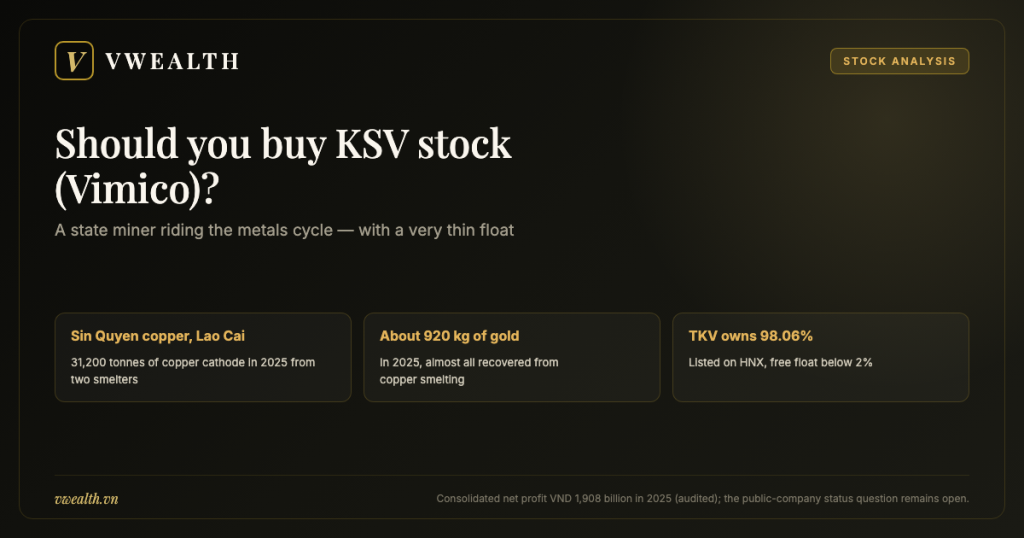
Should you buy KSV stock? A few years ago almost nobody asked, because almost nobody could buy it. KSV is the ticker of Vinacomin – Minerals Holding Corporation (Vimico), and in its early years on Vietnam’s UPCoM market there were entire years in which the stock barely traded at all. Then gold, silver and copper all climbed to levels never seen before. The company that the Vietnamese press calls the country’s largest gold producer posted record profit after record profit, floated a 119% cash dividend, and eventually paid 40.5% in cash plus a 50% stock dividend. KSV has had strings of consecutive limit-up sessions, and sessions in which trillions of dong of market value vanished after a single announcement. Underneath it all sits a paradox: a state-owned miner that captures the full upside of the metals cycle, yet whose shares are so thinly held by the public that its parent, the Vietnam National Coal – Mineral Industries Holding Corporation (TKV, also known as Vinacomin), owns 98.06%. This analysis tells the whole story and ends with a straight answer: who KSV stock suits, and who it does not.
First, the names, because they are easy to mix up. KSV is the ticker. The legal name is Vinacomin – Minerals Holding Corporation – JSC (in Vietnamese, Tổng công ty Khoáng sản TKV – CTCP). The short name used by the company and the press is Vimico. The shares were first registered for trading on UPCoM, Vietnam’s unlisted public company market, in 2016, and moved to a full listing on the Hanoi Stock Exchange (HNX) on 2 February 2023. Do not confuse Vimico with its parent: TKV/Vinacomin is a wholly state-owned group, mainly known for coal, and it is not listed. Vimico is its metals subsidiary. It runs the Sin Quyen copper mine in Lao Cai province near the Chinese border, two copper smelters, and — as a by-product of that copper chain — produces most of Vietnam’s industrially mined gold.
A note on method, as with every company analysis in the vwealth series. Dates, names and figures come from published sources: audited financial statements, shareholder meeting resolutions and materials, corporate governance reports, the explanations Vimico files with the State Securities Commission (SSC) and HNX, and Vietnamese financial media such as VnExpress, CafeF, Vietstock, Dan tri and Cong Thuong, plus trading data from VNDirect. Figures for closed financial periods are used as historical markers. We deliberately do not quote today’s share price, current P/E or the latest quarter’s profit; for a company whose earnings can double or halve with the price of gold and copper, such figures go stale quickly. Anything calculated by us is labelled as “vwealth’s estimate” or “illustrative example”. For current numbers, see the latest vwealth reports.
One idea runs through the whole piece. KSV is not a growth stock in the retail or technology sense. It is a commodity stock with two layers of peculiarity stacked on top of each other. The first layer is the business: Vimico’s profit depends first on world copper, gold and silver prices and on whether the Sin Quyen mine gets its expansion licence in time. The second layer is the stock: because so few shares are freely tradable, KSV’s market price can move far more violently than anything happening inside the company. Whether you should buy KSV stock therefore has to be answered on both layers. Do you believe in the metals cycle? And are you comfortable holding a share in which a single large order can move the price noticeably? If you are new to the market’s mechanics — foreign ownership limits, T+2 settlement, daily price limits — start with our guide on how to invest in the Vietnam stock market.
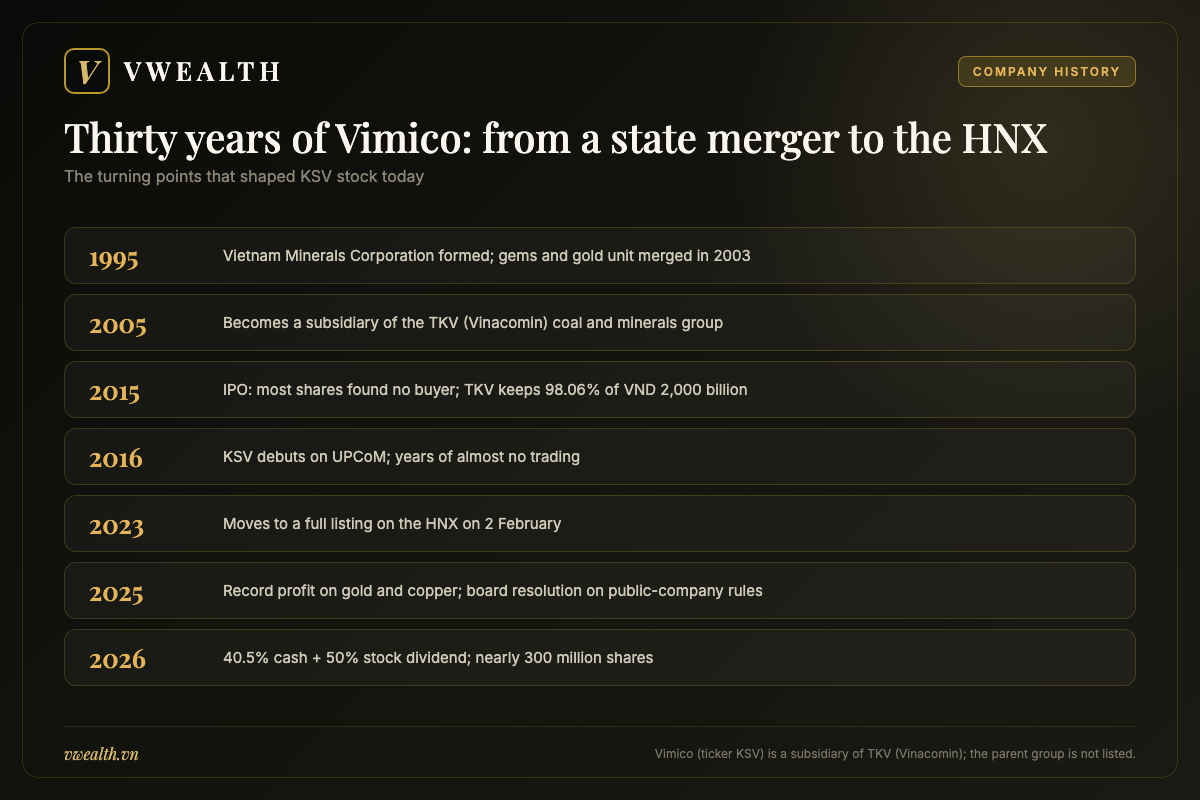
From a 1995 state merger to an HNX listing: thirty years of Vimico
Some listed companies begin with a founder and an idea. Vimico began with an administrative decision: to fold several scattered state mineral units into a corporation large enough to do what none could do alone — open big mines, build smelters, and process ore deep into refined metal. Thirty years later, that origin still shapes everything: the shareholder register, how decisions get made, even who the biggest customer is. Understanding Vimico’s history is the fastest way to understand why KSV stock looks the way it does today.
1995–2005: merging the mineral corporations and absorbing gems and gold
According to the company’s own history page, on 27 October 1995 the Minister of Heavy Industry signed Decision No. 1118/QĐ-TCCBĐT establishing the Vietnam Minerals Corporation by merging two entities: the Vietnam Rare and Precious Minerals Corporation and the Mineral Development Corporation. It was a decade after Vietnam’s Doi Moi reforms, when the state was consolidating enterprises into large general corporations to pool capital and prepare for international integration. Vimico still treats 27 October as its founding day, and 2025 marked its thirtieth anniversary.
On 18 February 2003, the Ministry of Industry merged the Gemstone and Gold Corporation into the Vietnam Minerals Corporation. It sounds like bureaucratic housekeeping, but it explains something investors often find odd: why a copper miner has a “Viet Nhat Gem Branch” dealing in gold jewellery and handicrafts, and a 48.31% stake in a Hanoi gold, silver and gemstone trader. Those pieces are legacies of the 2003 merger, not a retail gold strategy, and they are tiny in today’s profit picture.
On 26 December 2005, the Prime Minister signed Decision No. 345/QĐ-TTg creating the Vietnam National Coal – Mineral Industries Group, and the minerals corporation became a subsidiary under a parent–subsidiary model. From then on, Vimico’s fortunes were tied to TKV — a group in which coal is the backbone and metals are a smaller but important block. That relationship is both support (capital, a captive customer, clout with local authorities) and constraint (every major decision passes through an almost-sole shareholder).
2006–2014: building the copper chain in Lao Cai
This is when Vimico built what generates most of its revenue today: the copper chain in Lao Cai. The Sin Quyen mine sits in Bat Xat district in the far north, and the Vietnamese press routinely describes it as the country’s largest copper mine. According to Vimico’s project page, the “expansion and capacity upgrade of the Sin Quyen copper mining and processing area” carried a total investment of about VND 2,566.7 billion over 2009–2017, with a stated goal of increasing domestic copper output “to replace imported copper” and recovering associated minerals such as gold and silver. That wording matters: most of Vimico’s gold does not come from a stand-alone gold mine; it rides along with copper ore.
Alongside the mine came smelting. The Lao Cai Copper Smelting Branch operates the original smelter, and Vimico later added a smelter with a capacity of 20,000 tonnes a year (the name used in the procurement and insurance notices the company posts on its website). Today the two smelters together are planned to produce about 30,000 tonnes of copper cathode a year. That is why Vimico is described as a miner with “deep processing” capability — most Vietnamese mining companies stop at concentrate.
Legally, on 15 June 2010, the Ministry of Industry and Trade converted the corporation into a single-member limited liability company renamed Vinacomin – Minerals Corporation, a standard step before equitisation (Vietnam’s term for partially privatising state enterprises): separate the capital and assets first, then value and sell a portion.
2015–2016: equitisation, an IPO nobody wanted, and the UPCoM debut
On 30 December 2014, the Prime Minister approved the equitisation plan for the parent company (Decision No. 2388/QĐ-TTg). Charter capital was set at VND 2,000 billion, or 200 million shares at the standard VND 10,000 par value. According to Bao Dau tu (April 2015), the IPO was to offer more than 46.6 million shares to the public, equal to 23.3% of post-equitisation charter capital. The plan to place most of those shares with outside investors, as you will see, never came true.
The initial public auction took place on HNX on 23 April 2015, offering more than 46.6 million shares at VND 10,000 par. Metal prices were in a down-cycle and Vimico’s profits were shrinking: according to the IPO figures reported by Bao Dau tu, net revenue in 2011–2014 was about VND 3,214, 2,454, 3,141 and 3,129 billion, while net profit fell from VND 227 billion in 2011 to about VND 101 billion in 2014; ROE in 2014 was only 6.9%. The 2015–2017 plan attached to the IPO projected dividends of just 2–4% a year. The average revenue mix for 2011–2014 was also disclosed: copper cathode above 45%, mineral trading by subsidiaries (mainly tin and zinc ingot) about 30%, gold about 11%. Against that backdrop, outside demand was very weak and most of the shares on offer found no buyer.
The unsold shares stayed with TKV. So when Vimico formally began operating as a joint stock company on 6 October 2015, the parent held 98.06% of charter capital. That 98.06% — the product of a failed 2015 auction — has barely moved in over a decade, and it is the root of nearly every awkward feature of KSV stock discussed in later chapters.
In July 2016, HNX approved the registration of all 200 million KSV shares for trading on UPCoM. Price data retrieved by vwealth from VNDirect shows the first recorded session on 28 July 2016, at VND 13,000 — the same reference price that Thoi bao Tai chinh Viet Nam reported on listing day. (Some later articles say KSV joined UPCoM “in early 2016”; the HNX approval and the trading data point to July 2016.) According to consolidated financial data compiled by VNDirect, Vimico posted a net loss of about VND 14 billion in 2015 and a net profit of only about VND 8 billion in 2016. That is a very modest starting point for a company that would earn close to VND 2 trillion a year a decade later.
2016–2020: the years the stock barely moved
A price chart of KSV from this period is an almost flat line — not because the price was stable, but because there was almost no trading. By vwealth’s count of VNDirect data: in 2018 there were 250 trading sessions and not a single share matched in 249 of them; in 2020, 246 of 252 sessions had no matches; 2017 and 2019 each had more than 200 blank sessions. With 98.06% held by TKV and the rest scattered among small IPO-era holders, there was nobody to sell and hardly anybody wanting to buy.
Inside the company, these were grinding years. In the first half of 2019, consolidated net profit was only about VND 10.5 billion on revenue of more than VND 2,500 billion, and the full year 2019 ended with a net loss of about VND 43 billion (VNDirect data) — a sign of very thin margins. The company also sold stakes in small units within its system (its website still carries a notice on continuing to divest its shares in Mineral Development JSC No. 4), in line with the state enterprise restructuring of that era. In 2020, consolidated pre-tax profit rose to about VND 243 billion, roughly 16 times the VND 15.5 billion of 2019 — with about VND 223 billion coming in the fourth quarter alone, as metal prices rebounded sharply after the pandemic shock (VNDirect data).
2021–2023: the first trillion-dong year and the move to HNX
2021 was the first year Vimico looked like it could be a big earner. According to the 2021 consolidated figures compiled by VNDirect, net revenue was about VND 7,991 billion (the four quarterly reports as first published add up to about VND 8,810 billion — the annual figure was later restated), pre-tax profit about VND 1,303 billion and net profit about VND 1,084 billion, more than five times 2020, with about VND 834 billion attributable to the parent’s shareholders. Pre-tax profit in Q2 2021 alone was nearly VND 394 billion — the highest up to that point, before being dwarfed a few years later. The driver, as in every big year since, was higher average selling prices for copper cathode, gold and silver.
From 2021, KSV also began to trade for real, with blank sessions falling to a few dozen a year. At the end of 2022 the stock was approved to move from UPCoM to the listed board: its last UPCoM session was 16 January 2023, and from 2 February 2023 KSV traded on HNX with a first-day reference price of VND 27,600 (VNDirect corporate events). The key point: a listing raises disclosure standards, but it does not increase the free float — the portion of shares that is actually available to trade. TKV still held 98.06%.
2023 was a pause. Vimico’s gross margin that year was only about 9.4% (gross profit of about VND 1,123 billion on revenue of about VND 11,912 billion, VNDirect data) — less than 10 dong left from every 100 dong of revenue after cost of goods sold. It was an early reminder of the company’s nature: without supportive metal prices, a mining-and-smelting machine with heavy fixed costs produces very thin margins.
2024–2026: record gold, record profits, a public-company question and a 50% stock dividend
In 2024, world gold prices began a long climb. Vimico’s explanation of its 2025 results states that the average gold price in 2025 was VND 2,556.3 million per kg, about VND 758.8 million above 2024, and copper cathode VND 262.2 million per tonne, up VND 32 million — implying 2024 averages of roughly VND 1.8 billion per kg of gold and VND 230 million per tonne of copper (vwealth’s subtraction). Gross margin jumped to about 19%. Consolidated net profit crossed VND 1 trillion for the first time (VND 1,221.6 billion, per the comparative figures in the audited 2025 statements). On the market, KSV went from VND 46,600 (close on 3 December 2024) to VND 132,000 on 27 December 2024 — up about 180% in less than a month — before two straight limit-down sessions (VNDirect data, unadjusted prices).
2025 took Vimico to another level. Consolidated net revenue was VND 14,554 billion, pre-tax profit VND 2,453.7 billion and consolidated net profit VND 1,908.4 billion — the best in its thirty-year history. Vimico’s average realised gold price in 2025 was about VND 2.56 billion per kilogram; gold output was about 920 kg (board report; the year-end review estimate was 918 kg) and copper cathode 31,200 tonnes. But 2025 also raised a legal question. Under the amended Securities Law effective 1 January 2025, a public company must have at least 10% of its voting shares held by at least 100 investors who are not major shareholders. With TKV at 98.06%, Vimico did not meet that test. A board resolution dated 26 November 2025 said so explicitly, and set out that if by 1 January 2026 the company still did not comply, or the SSC did not accept it as qualifying, it would file to cancel its public company status. KSV fell about 24% over the three sessions from 28 November to 2 December 2025.
In 2026, the story continued on both layers. On the business layer, net profit was VND 897 billion in Q1 2026 and VND 1,531 billion in Q2 2026 — each the most profitable quarter in the company’s history. On the stock layer, the 22 April 2026 annual meeting approved a 2025 dividend of 40.5% in cash plus 50% in shares (instead of the 119% cash proposal floated beforehand). The share issuance closed on 15 July 2026, lifting shares outstanding to 299,999,812. In early September 2026, HNX approved the change in listing registration, and Vimico called an extraordinary shareholder meeting for 9 October 2026 to confirm the new charter capital and approve its five-year business cooperation plan for 2026–2030.
The table below gathers the key milestones in one place. The final column is how vwealth reads each milestone’s significance for anyone considering KSV stock today.
| Date | Milestone | What it means for a KSV investor today |
|---|---|---|
| 27 Oct 1995 | Vietnam Minerals Corporation formed from two state mineral corporations | A company born of an administrative decision, not a founder |
| 18 Feb 2003 | Gemstone and Gold Corporation merged in | Explains the small jewellery and gemstone businesses |
| 26 Dec 2005 | Becomes a subsidiary of TKV | Parent–subsidiary relationship drives strategy, sales and capital |
| 2009–2017 | Sin Quyen mine expansion (about VND 2,566.7 billion); a second 20,000 t/yr smelter built | The Lao Cai copper chain is the main earnings engine |
| 23 Apr 2015 | IPO of more than 46.6 million shares; most found no buyer | Root of TKV’s 98.06% stake |
| 6 Oct 2015 | Becomes a joint stock company with VND 2,000 billion charter capital | 200 million shares, nearly all held by the parent |
| 28 Jul 2016 | First recorded trading session on UPCoM | Years of almost no trading followed |
| 2021 | Pre-tax profit above VND 1,000 billion for the first time | Shows the operating leverage of a fixed-cost machine to metal prices |
| 2 Feb 2023 | Moves to a full listing on HNX | Higher disclosure standards, unchanged free float |
| 2025 | Consolidated net profit VND 1,908.4 billion; 26 Nov board resolution on public-company conditions | Very strong business layer; legal question on the stock layer |
| 2026 | Two record quarters; 40.5% cash + 50% stock dividend; charter capital nearly VND 3,000 billion; EGM called for 9 Oct | More shares, but TKV’s percentage unchanged |
Who runs Vimico and who owns it: a stock that is 98.06% held by TKV
In most company analyses, the ownership chapter is where you work out who controls the business and whether their interests line up with yours. At KSV, the first question answers itself: TKV controls the company almost completely. The second is more interesting, because when one shareholder holds 98.06%, every decision — dividends, capital spending, prices charged to sister companies, even whether to keep public company status — is in practice that shareholder’s decision. Your share, if you buy KSV, is a very thin slice of a pie that is less than 2% of the whole.
TKV: near-total owner, and also the biggest customer
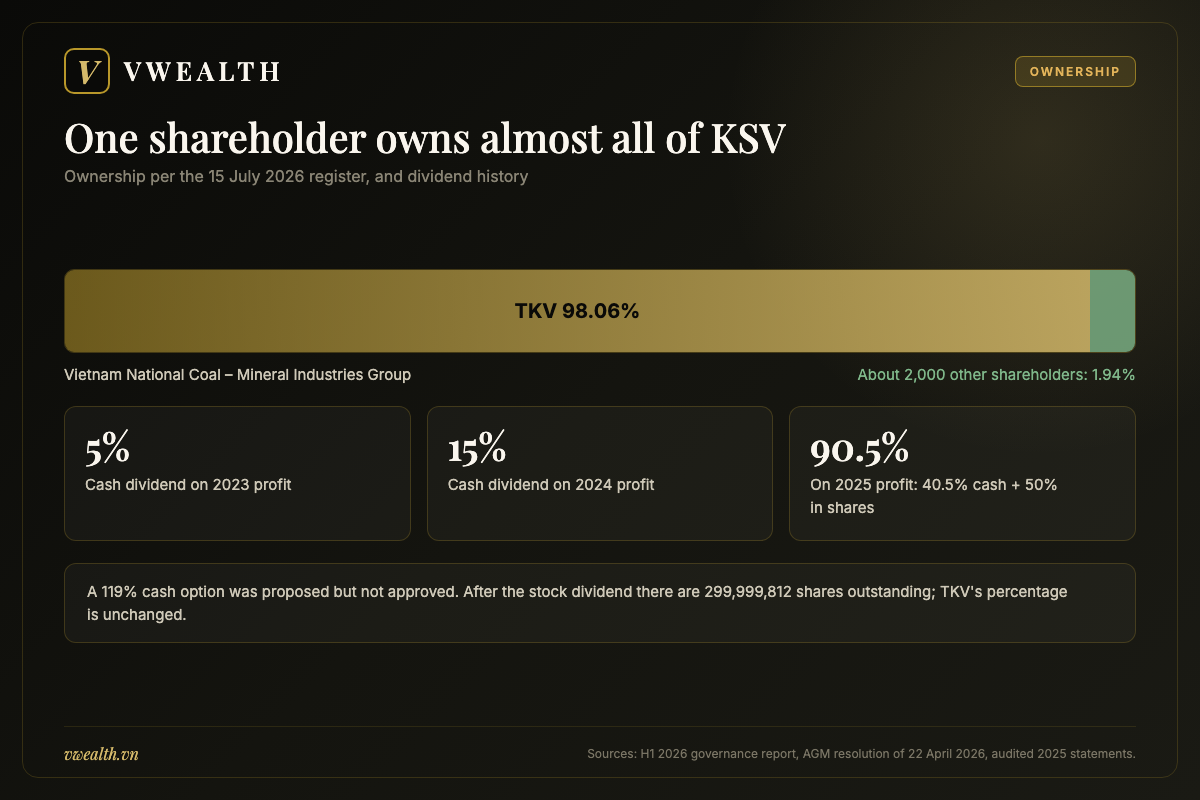
According to the shareholder list dated 15 July 2026 in the first-half 2026 corporate governance report, the Vietnam National Coal – Mineral Industries Holding Corporation holds 196,117,900 shares, or 98.06% of charter capital (based on the 200 million shares before the stock dividend). Because the dividend shares were distributed to all holders at the same 2:1 ratio, TKV’s percentage should remain around 98.06% afterwards; by vwealth’s estimate, TKV now holds roughly 294 million of the 299,999,812 shares outstanding.
What many investors miss is that TKV is not only the owner. The related-party note in the audited 2025 consolidated financial statements shows Vimico sold goods and services worth about VND 7,923 billion to TKV in 2025 (about VND 6,972 billion in 2024). The segment note states that of total net revenue of VND 14,554 billion, about VND 9,740 billion came from sales to related parties — roughly two-thirds, by vwealth’s division. Beyond TKV itself, another group company, Vinacomin Machinery JSC, bought about VND 1,755 billion from Vimico during the year. In the other direction, Vimico bought about VND 1,371 billion of goods and services from Vinacomin – Ta Phoi Copper JSC, another Lao Cai copper mine in the TKV group that supplies concentrate to Vimico’s smelters.
Seen from TKV’s side, the minerals division — in which Vimico is a flagship unit — is currently the group’s most profitable business. According to CafeF (May 2026), summarising TKV’s audited 2025 consolidated statements, group net revenue was about VND 137,062 billion, of which coal about VND 85,078 billion and minerals about VND 28,519 billion; but minerals gross profit rose above VND 10,315 billion at a margin of about 36.2%, contributing about 46% of group gross profit versus about 33% for coal. (TKV’s minerals division includes units other than Vimico, so these are not Vimico’s own figures.) That helps explain why the parent pays close attention to Vimico’s dividend flow and investment decisions.
In other words, Vimico lives inside a closed ecosystem: it buys concentrate from a sister company, smelts it into cathode, and sells much of the output through its parent. That has advantages — steady offtake, no need to hunt for customers — and one thing to watch: how internal transfer prices are set. Vimico discloses related-party transactions as required (for example, a copper cathode sale and purchase contract between TKV and Vimico, and a 2026 copper concentrate purchase contract with Ta Phoi estimated at about VND 1.788 trillion, according to the governance report). Vimico’s variance explanations publish average selling prices for each main product every period; you can compare those figures with world metal prices over the same period to see how closely internal prices track the market.
The board and management: career miners and metallurgists
Per the first-half 2026 governance report, the 2025–2030 board has five members. The chairman is Nguyen Van Hai, who also sits on TKV’s Capital Management Board; according to Vimico’s leadership history page, he has chaired the company since May 2019. Trinh Van Tue is a board member and General Director (CEO): he became a Deputy General Director in August 2015 and General Director in March 2018, and is also Party Secretary of the corporation. Dang Duc Hung is a full-time board member; Ngo Quoc Trung is a board member, Deputy General Director and the person responsible for information disclosure; Nguyen Van Thai is the independent director.
The executive team also includes Deputy General Directors: Ly Xuan Tuyen (appointed November 2019), Ngo Quoc Trung (June 2018), Le Tuan Ngoc (February 2021) and Dang Xuan Tuyen (June 2024), according to the first-half 2026 governance report. The common thread is continuity: many have spent decades at Vimico or TKV, rising through mine branches, smelters and finance departments. That helps operationally — mining and smelting reward field experience — but it also means Vimico’s strategy tends to follow the group’s direction and state mineral policy rather than the bold moves you might see at a private company.
One detail from the 2026 AGM minutes is worth noting. Asked about restructuring under Law No. 56/2024/QH15, the chair’s representative said every plan relating to capital structure and business expansion would be carefully considered to ensure compliance with the law, “particularly those applicable to public companies”. It was a neutral answer that neither promised a divestment nor ruled one out.
The remaining 1.94%: around two thousand shareholders sharing a thin slice
If TKV holds 98.06%, everyone else holds 1.94% — about 3.88 million of the 200 million shares before the stock dividend, and about 5.8 million of the nearly 300 million afterwards (vwealth’s estimate). According to the 2026 AGM minutes, at the 16 March 2026 record date Vimico had 2,159 shareholders: 7 institutions, 2,151 domestic individuals and 1 foreign individual. The EGM materials say the dividend shares went to 2,065 shareholders. The figures differ because they were taken at different dates, and the register of a listed stock changes daily.
A vivid illustration of scale: at the 2026 AGM, 14 shareholders and proxies were present at the opening, representing 98.13% of voting shares. Over the morning, a few more individuals registered — one with 500 shares, five with a combined 21,010, one with 100. Every resolution passed with 100% of votes present. That is not a governance scandal; it is the arithmetic of a register in which one holder owns almost every vote. It also means that as a minority shareholder your voice in Vimico’s decisions carries essentially no voting weight.
There is a further consequence that matters more to traders: the shares that actually “float” are even fewer than 1.94%. Some of that slice sits with long-term holders who bought at the IPO or during the illiquid UPCoM years and rarely sell. So the number of shares realistically available on any given day is a small fraction of a small fraction. Chapter 5 explains how that structure feeds into price swings.
The “10% held by at least 100 investors” rule and what has happened so far
Vietnam’s Securities Law No. 54/2019/QH14, as amended by Law No. 56/2024/QH15 effective 1 January 2025, says a company keeps public company status only if it has paid-in charter capital of at least VND 30 billion and at least 10% of its voting shares held by at least 100 investors who are not major shareholders. As the Vietnamese financial press has explained the rule, if a company still fails the test one year after it stopped meeting it, it must file to cancel its public company status — and a company without that status is not eligible to list on HOSE or HNX or to trade on UPCoM.
Vimico has more than 2,000 shareholders — easily clearing the “100 investors” bar — but fails the “10%” bar, because non-major holders own only 1.94%. On 26 November 2025, the board issued a resolution on meeting public company conditions with three main points: authorising the General Director to keep reporting to and explaining to the SSC the company’s “specific shareholder structure” (following Letter No. 2845 sent to the SSC on 14 November 2025); disclosing that the company did not yet meet the condition; and stating that if by 1 January 2026 it still did not comply, or the SSC did not accept it as qualifying, it would file to cancel its public company status.
The market reacted immediately. According to VNDirect data, KSV fell limit-down on 28 November and 1 December 2025 and closed on 2 December at VND 112,000, about 24% below VND 148,200 on 27 November; on 200 million shares, that erased roughly VND 7,200 billion of market value in three sessions (vwealth’s estimate). Yet barely a month later the stock posted five consecutive limit-up sessions from 31 December 2025 to 8 January 2026 — price and legal story moving in opposite directions, which is common in a stock with so few free-floating shares.
In the audited 2025 consolidated financial statements (signed 19 March 2026), auditor BDO added an “emphasis of matter” paragraph — not a qualification, but a note drawing readers’ attention — stating that Vimico does not currently meet the conditions to maintain public company status, is reporting to and explaining to the SSC regarding its specific shareholder structure, and is developing a capital restructuring plan to maintain that status. The 2026 AGM authorised the board to approve a 2026–2030 restructuring plan once TKV has approved it. Meanwhile, in September 2026 HNX still approved the change in KSV’s listing registration after the stock dividend, and the shares continued to trade normally on HNX. The final outcome of the SSC process — and whether TKV sells down to lift the free float to 10% — is something you need to follow directly in Vimico’s disclosures. vwealth does not speculate on the result.
Why does this matter to a buyer? There are two very different paths. If TKV divests enough to reach 10%, the free float would grow roughly fivefold: liquidity would improve and larger funds might take notice, but a large block of supply would come to market, typically through an auction or an offering priced by the seller. If Vimico gives up public company status, the shares would leave the exchange; minority holders would remain legal owners, but buying and selling would become much harder than trading on an exchange. Between those two paths lies a third: the status quo continues while the parties look for a solution. None of these is certain, and that uncertainty is a risk specific to KSV that you would not face in a widely held stock.
KSV is not alone. In early 2026, the Vietnamese press listed a series of large state-linked companies with highly concentrated ownership that also fall short of the 10% test — for example PV GAS (GAS) disclosed that its 17,494 minority shareholders hold only 4.24%, meaning PetroVietnam holds 95.76% (CafeF, 5 January 2026). vwealth has analysed a similar case in our review of VGI (Viettel Global), where the parent holds about 99%. How each company resolves the issue will set precedents for the rest.
Dividends: from a few percent to 90.5%, and who receives most of it
For years, Vimico’s dividends were modest, in line with thin profits. According to the corporate-event calendar VNDirect compiles from company disclosures, the dividend for 2021 was 15% in cash (VND 1,500 per share, ex-date 29 August 2022), for 2022 12% (VND 1,200, 4 October 2023), for 2023 5% (VND 500, 14 August 2024) and for 2024 15% (VND 1,500, 14 August 2025). The 2025 financial statements match: the “profit distribution” TKV received from Vimico was about VND 98.06 billion in 2024 and VND 294.18 billion in 2025 — exactly VND 500 and VND 1,500 times TKV’s 196,117,900 shares. (Note that Vietnamese companies quote dividends as a percentage of the VND 10,000 par value, not of the market price: a “15% dividend” means VND 1,500 per share.)
The big jump came with 2025 profit. The 2026 AGM materials initially proposed a 119% cash dividend — VND 11,900 per share, about VND 2,380 billion in total, more than the parent company’s 2025 net profit and funded partly from retained earnings. But the AGM minutes show that option received zero votes. The option approved with 100% of votes present was the second: 50% in shares and 40.5% in cash. The cash portion was VND 810 billion (VND 2,000 billion charter capital × 40.5%), the stock portion VND 1,000 billion at par, and about VND 98.4 billion went to the bonus and welfare fund.
According to the schedule reported by CafeF, the record date was 15 July 2026, the cash dividend of VND 4,050 per share was paid on 5 August 2026, and holders received 50 new shares for every 100 held. The EGM materials confirm 99,999,812 new shares were distributed to 2,065 shareholders, with 188 fractional shares cancelled. Charter capital rose from VND 2,000 billion to VND 2,999,998,120,000.
Two things to remember about KSV dividends. First, at 98.06%, almost all cash dividends flow to TKV: of the VND 810 billion paid, vwealth estimates about VND 794 billion went to TKV and about VND 16 billion to all other shareholders combined. Dividend policy therefore reflects the parent’s cash needs and the state owner’s direction more than any wish to please minority holders. Second, switching from 119% cash to 50% stock plus 40.5% cash kept cash inside the company for investment — but it also increased the share count by 50%, so per-share figures (EPS, dividend per share) from 2026 onward are not directly comparable with earlier years. The 2026 plan approved by shareholders targets a dividend of at least 15%.
A stock dividend does not create value; the pie is the same, just cut into more slices. What it changes is the share count — and at KSV that matters indirectly: free-floating shares rose from about 3.9 million to about 5.8 million (vwealth’s estimate), even though the percentage is unchanged. The legal 10% threshold remains far away.
| Ownership and dividend item | Figure | Source / note |
|---|---|---|
| TKV holding | 196,117,900 shares, 98.06% | H1 2026 governance report, record date 15 Jul 2026 (pre-issuance) |
| All other shareholders | About 1.94% | Derived from TKV’s stake |
| Number of shareholders | 2,159 (16 Mar 2026); 2,065 received dividend shares (Jul 2026) | 2026 AGM minutes; EGM materials |
| Dividend on 2023 / 2024 profit | About 5% / 15% cash | vwealth’s estimate from payments to TKV |
| Dividend on 2025 profit | 40.5% cash + 50% shares | AGM resolution 22 Apr 2026 (119% cash option not approved) |
| Shares outstanding | 200,000,000 → 299,999,812 | After issuance closed 15 Jul 2026 |
| 2026 dividend plan | At least 15% | 2026 AGM resolution |
How Vimico makes money: copper is the backbone, gold is the bonus
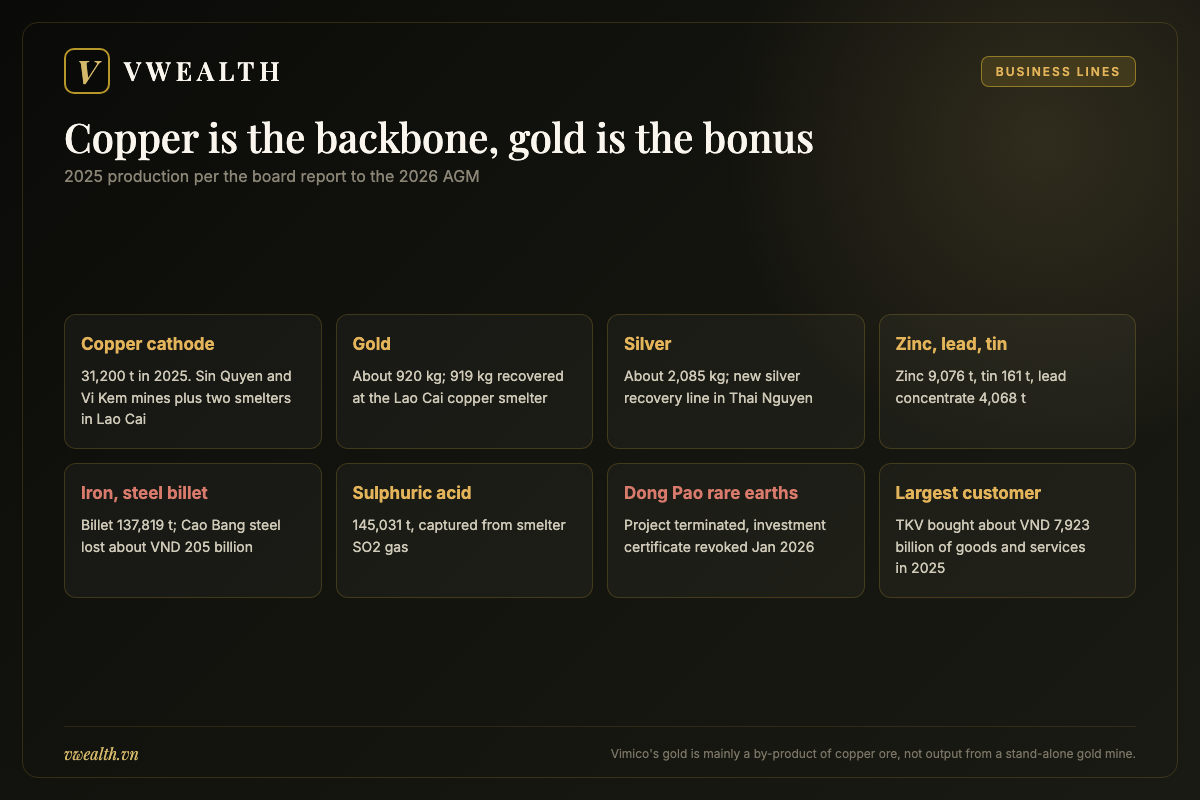
Picture a copper smelter as a giant furnace. In goes copper concentrate — a grey powder that is roughly a quarter copper, the rest sulphur, iron and other elements. The furnace melts it and separates crude copper, which is then electrolytically refined into cathode sheets of 99.95–99.99% purity. Along the way, the sulphur burns off as sulphur dioxide, which is captured and turned into sulphuric acid. And at the bottom of the electrolytic cells settles a special sludge — anode slime — containing the gold, silver and other precious metals that were locked in the ore. Vimico’s entire business model can be understood through that furnace: copper is the main product, gold and silver are the bonus that comes with it, and acid is an environmental by-product turned into a commodity. Everything else — zinc, tin, iron, steel billet, rare earths — sits in subsidiaries and is much smaller.
The 2025 financial statements show how concentrated the business is: of VND 14,554 billion in net revenue, about VND 14,303 billion came from “mining, processing and trading of minerals” and only about VND 251 billion from services. Geographically, the company reports a single domestic segment. The 2026–2030 five-year plan presented to the EGM is even more explicit: the parent company — home of the Sin Quyen mine and both copper smelters — is projected to generate about VND 50,897 billion of revenue over five years, of which about VND 50,209 billion is “copper mineral revenue”.
Copper: from the Sin Quyen open pit and the Vi Kem underground mine to Lao Cai cathode
Sin Quyen is an open-pit mine: overburden (the waste rock covering the ore) is stripped, ore is mined and sent to concentrators where it is crushed and floated into concentrate grading about 25% copper. According to the board’s report to the 2026 AGM, Sin Quyen produced about 1.76 million tonnes of run-of-mine ore in 2025, 103.46% of plan; total material moved was about 9.2 million cubic metres, most of it landslide remediation in the eastern pit. The 2026 plan calls for 20.5 million cubic metres of overburden removal and 2.05 million tonnes of ore at an average grade of 1.059% copper.
That grade deserves a pause. At 1.059%, each tonne of ore contains only about 10.6 kg of copper. To make roughly 30,000 tonnes of cathode a year, Vimico has to process millions of tonnes of ore and move tens of millions of cubic metres of rock. That is why mining costs are largely fixed — excavators, haul trucks, fuel, labour, depreciation — and why profit is so sensitive to selling prices.
Next to Sin Quyen is Vi Kem, an underground mine that started up in recent years. In 2025 it produced about 200,124 tonnes of ore; the 2026 plan is 250,000 tonnes at about 0.712% copper. The board’s report admits the mine still struggles, with productivity below expectations and a shortage of underground miners. Besides its own ore, the smelters use concentrate bought from Ta Phoi Copper, a sister company in the TKV group. The 2025 report also notes that, despite trying multiple channels, Vimico has not yet managed to import copper concentrate — meaning the two smelters depend almost entirely on domestic mines.
On the output side, Vimico produced about 65,499 tonnes of copper concentrate (25% Cu equivalent) and 31,200 tonnes of cathode in 2025, selling about 30,162 tonnes of cathode. Average cathode prices, per the company’s explanations, were about VND 262.2 million per tonne in 2025, about VND 341.7 million in Q1 2026 and about VND 345.7 million for the first half of 2026. Multiplying 2025 sales volume by the average price, vwealth estimates 2025 cathode revenue at about VND 7,900 billion — a little over half of consolidated revenue, and very close to the value of goods Vimico sold to TKV that year (VND 7,923 billion). That near-match suggests most cathode is sold through the parent (Vimico has disclosed a cathode sale contract with TKV); it is vwealth’s inference from two figures, not a number the company publishes.
Gold and silver: why nearly all the gold comes out of a copper smelter
This is the most interesting — and most misunderstood — fact about KSV. Many investors assume Vimico owns a big gold mine. In reality, according to the production table in the board’s report, Vimico produced about 920 kg of gold in 2025, of which about 919 kg came from the Lao Cai Copper Smelting Branch and only about 0.49 kg was alluvial gold from Cao Bang. The 2026 plan is the same: 940 kg, of which 939 kg from the copper smelter and 1 kg from Cao Bang. In other words, Vimico’s gold is a by-product of Sin Quyen and other copper concentrates, recovered during copper smelting and refining.
That has important consequences for valuing the stock. First, gold output cannot be raised independently: more gold requires mining and smelting more copper ore. When gold doubles, Vimico cannot “open another gold mine”; output stays around 900–1,000 kg a year, as the five-year plan shows (939 kg in 2026, 1,016 kg in 2027, easing to 904 kg by 2030). Second, the cost of producing that gold is essentially already inside copper mining and smelting costs. When gold rises, most of the increase drops straight into gross profit. That is why Vimico’s profit leapt in 2024–2026 even though volumes barely grew.
On prices, per the explanations Vimico files with the SSC and HNX: the average gold selling price was about VND 1.8 billion per kg in 2024 (implied from the 2025 increase), VND 2,556.3 million in 2025, VND 4,036 million in Q1 2026 and VND 3,830 million for the first half of 2026. It sold about 877 kg in 2025; by vwealth’s estimate, 2025 gold revenue was about VND 2,240 billion, roughly 15% of revenue — far smaller than copper, but with very high margins because the costs are “shared” with copper.
Silver follows the same logic on a smaller scale: about 2,085 kg produced and 2,062 kg sold in 2025, both below plan because metal content in the feed concentrate fell. The average silver price was about VND 22 million per kg in 2025, rising to about VND 57.8 million in the first half of 2026. Since July 2025, subsidiary Thai Nguyen Non-ferrous Metals has also run a line recovering silver from hydrometallurgical residues at its electrolytic zinc plant.
A small footnote to avoid confusion: Vimico’s product list includes “gold metal 99.90–99.95% Au”, “gold jewellery and handicraft products” (via the Viet Nhat Gem Branch) and “gold concentrate”. In scale, jewellery and gemstones are tiny; what drives profit is refined gold recovered from copper smelting.
Zinc, lead and tin: small businesses in Thai Nguyen and Cao Bang
Beyond the Lao Cai copper chain, Vimico owns a cluster of subsidiaries in Vietnam’s northern uplands. Vimico – Thai Nguyen Non-ferrous Metals JSC (51% owned) runs an electrolytic zinc plant, the Lang Hich lead–zinc mine and part of the tin output. Cao Bang Minerals and Metallurgy JSC (51.89%) mines and smelts tin. In 2025 the group produced about 9,076 tonnes of zinc ingot, 161 tonnes of tin ingot and 4,068 tonnes of 50% lead concentrate; the average zinc ingot price in the first half of 2026 was about VND 87.7 million per tonne.
These businesses are small next to the parent: in 2025, Thai Nguyen Non-ferrous Metals earned about VND 107.67 billion before tax and Cao Bang Minerals and Metallurgy about VND 13.52 billion, versus about VND 2,449.6 billion at the parent. The thing to watch is reserves: the board’s report notes declining reserves at several mines — the Cao Bang tin mine, the Kip Tuoc iron mine and the southwest Nui Phao tin mine — and tin output in 2025 reached only about 75.5% of plan. Since June 2025, the zinc plant has switched to a semi-hydrometallurgical process to recover zinc from legacy residues — squeezing more out of old material as purchased concentrate becomes harder to find.
Iron, steel billet and the Cao Bang steel problem
This is the part of Vimico that drags on results. Cao Bang Cast Iron and Steel JSC (52.54% owned, per the 2025 financial statements) makes steel billet from iron ore. In 2025 it lost about VND 205.2 billion, bringing accumulated losses to about VND 358.15 billion according to the board report. Vimico’s 2025 explanation cites slow billet sales (162,036 tonnes, down 2,721 tonnes) and an average selling price VND 0.72 million per tonne lower; the meeting materials also point to slow compensation and site clearance at the Na Rua iron mine, forcing the plant to buy costlier substitute ore while billet prices fell. Group-wide billet output in 2025 was about 137,819 tonnes, only about 83.5% of plan.
Iron ore comes from two main sources: magnetite concentrate recovered at Sin Quyen (the copper ore there also contains iron — yet another by-product) and the Kip Tuoc iron mine. Iron concentrate output was about 179,166 tonnes in 2025. The five-year plan projects a sharp increase to about 390,000 tonnes a year from 2027 and billet output of 220,000 tonnes a year. The October 2026 EGM is also being asked to approve a framework agreement to buy billet from Cao Bang Cast Iron and Steel as feedstock for a new 70,000-tonne-per-year structural steel rolling line in Cao Bang, to be built in 2027–2028 and start operating in 2029, supplying mine roof-support steel to TKV itself. In effect, Vimico is trying to rescue its steel business by creating internal demand for it.
For investors, iron and steel is more risk than opportunity: thin margins, competition from large producers such as Hoa Phat (HPG), and dependence on land clearance at the iron mines. The five-year plan expects Cao Bang Cast Iron and Steel to earn only about VND 3 billion in 2026 and VND 100–180 billion a year thereafter — if everything goes to plan.
Sulphuric acid: turning smelter off-gas into a product
When copper is smelted, the sulphur in the concentrate burns into sulphur dioxide. Rather than releasing it, the smelter captures the gas and makes commercial sulphuric acid. In 2025 Vimico produced about 145,031 tonnes of acid, about 131,956 tonnes of it at the Lao Cai copper smelter, and sold about 148,039 tonnes to fertiliser and chemical users. The 2026 plan is about 128,726 tonnes.
Acid is not a big profit line, but it matters in two ways. Environmentally, it is a condition for running the smelter within standards. Commercially, acid prices depend on regional fertiliser and chemical demand and can swing widely. That is a secondary variable worth watching, not a pillar of the investment case.
Dong Pao rare earths: a big asset on paper, a project that has been terminated
The press often calls Vimico “the company holding Vietnam’s largest rare earth mine”, and that label helped fuel the stock’s surges in late 2024. The facts need stating clearly. The Dong Pao rare earth mine in Tam Duong, Lai Chau province is managed by Lai Chau Vimico Rare Earth JSC (Lavreco); Vimico’s stake is reported differently depending on the date and source (55% on the website and in 2023–2025 press reports, 57.19% in the 2025 financial statements). According to CafeF (30 July 2026), Dong Pao is Vietnam’s largest rare earth mine, covering nearly 133 hectares with total geological reserves (dry basis) of more than 11.3 million tonnes — over half of the country’s rare earth reserves. Even so, the project has produced almost nothing commercially.
According to the notes to the 2025 consolidated statements, the investment project for mining and processing rare earth ore at Dong Pao (mining and beneficiation component) was terminated and its investment registration certificate revoked under Decision No. 01/QĐ-STC dated 9 January 2026; Lavreco is shifting its main activities to coal trading and loading services. Lavreco lost about VND 56 billion in 2025. The Lai Chau tax authority has enforced collection of its tax arrears by debiting its bank accounts — more than VND 140 billion at the end of 2024 (Vietnamplus, Cong Thuong) and more than VND 136 billion under decisions dated 17 September 2025 (Cong Thuong). Vimico’s 2025 explanation says audited group net profit came in about VND 90.4 billion below the self-prepared figure, mainly because Lavreco had to expense Dong Pao project costs after its investment certificate was revoked. Construction in progress for the rare earth project fell on the books from about VND 207.8 billion at the start of 2025 to about VND 97.6 billion at year-end.
The 2026–2030 plan still pencils in small revenues for Lai Chau Rare Earth in 2029–2030, tiny relative to the group. The lesson: do not value KSV as a “rare earth stock”. Reserves in the ground only have value with a licence, technology, capital and a partner to bring them to the surface — and at the time of writing, Dong Pao has none of those in place.
Where the moat is — and where it ends
A moat is an advantage that keeps competitors from taking a company’s business. Vimico’s moat has three parts. First, resources and licences: the Sin Quyen copper mine cannot be replicated; a newcomer would need decades to explore, license, clear land and build a comparable mine. Second, metallurgical capability: two copper smelters producing around 30,000 tonnes of cathode a year, plus the ability to recover gold, silver and acid — deep processing that most Vietnamese miners lack. Third, its place in the TKV system: steady offtake through the parent and support when dealing with provinces and ministries.
Each part has clear limits. Resources deplete: the eastern Sin Quyen pit is in its final phase under Mining Licence No. 1868, and the western pit stopped mining in May 2024 for closure and internal waste dumping. The future of the copper chain depends on the expansion licence discussed in chapter 6. Smelting capacity is capped by feedstock: without enough domestic concentrate, and without imports, capacity sits idle. And the TKV relationship cuts both ways: it guarantees offtake but places pricing of internal sales, dividends and investment in the hands of one shareholder whose goals need not match those of minority investors.
| Business line | Main units | 2025 output (produced) | Role in profit |
|---|---|---|---|
| Copper cathode | Sin Quyen mine, Vi Kem mine, Lao Cai smelters (parent) | 31,200 t; 25% Cu concentrate 65,499 t | Revenue backbone (roughly half) |
| Gold | Recovered at Lao Cai smelter; tiny alluvial output in Cao Bang | About 920 kg (919 kg from smelting) | High margin, very sensitive to gold price |
| Silver | Smelting; recovery from Thai Nguyen zinc residues | About 2,085 kg | Small, sensitive to silver price |
| Zinc, lead, tin | Thai Nguyen Non-ferrous Metals (51%), Cao Bang Minerals & Metallurgy (51.89%) | Zinc 9,076 t; tin 161 t; lead concentrate 4,068 t | Small profits; some reserves declining |
| Iron, steel billet | Cao Bang Cast Iron & Steel (52.54%), Sin Quyen magnetite, Kip Tuoc mine | Iron concentrate 179,166 t; billet 137,819 t | Drag — Cao Bang steel lost about VND 205 billion |
| Sulphuric acid | Lao Cai smelter, Thai Nguyen | 145,031 t | Environmental by-product |
| Rare earths | Lai Chau Rare Earth (57.19% per 2025 FS) | No commercial output | Dong Pao project terminated Jan 2026; lost about VND 56 billion |
Output source: board report to the 2026 AGM; ownership: 2025 consolidated financial statements; the “role” column is vwealth’s assessment.
Financial health: read the statements before deciding whether to buy KSV stock
If you only read headlines, Vimico has posted “record profit” continuously from 2024 to 2026. True, but not enough. For a miner, the question is not “how much did it earn this year” but “where did the profit come from, can it repeat, and how much is left when metal prices turn”. This chapter shows you how to read Vimico’s own statements: which lines matter, which numbers mislead, and seven questions to ask every reporting period. For the wider sector picture, see our overview of Vietnam’s manufacturing and industrial stocks.
Ten years of profit: from tens of billions to nearly two trillion dong
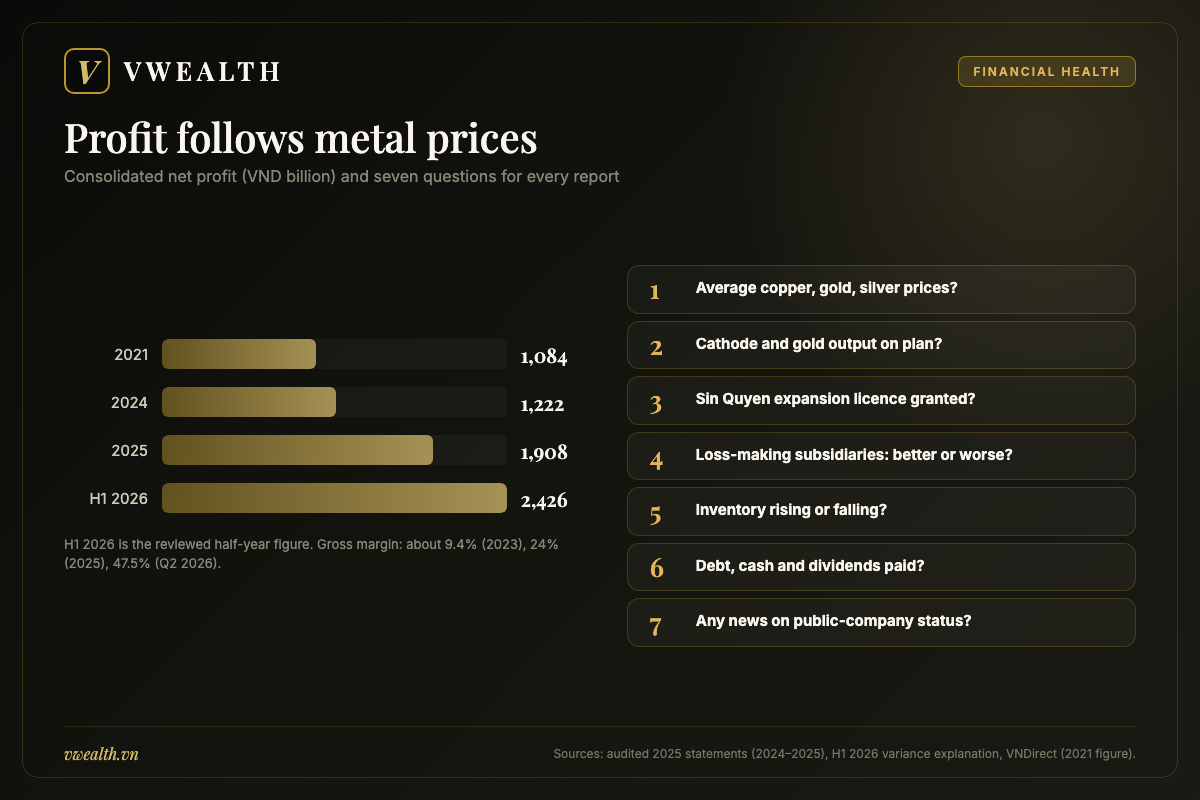
Line the profit milestones up and you see the classic shape of a commodity business. In 2014, before equitisation, net profit was about VND 101 billion (per the IPO documents). In 2016 consolidated net profit was only about VND 8 billion; 2019 was a loss of about VND 43 billion. 2020 pre-tax profit was about VND 243 billion. 2021 net profit was about VND 1,084 billion. 2022–2023 stalled, with 2023 gross margin of only about 9.4%. 2024 consolidated net profit was VND 1,221.6 billion; 2025 was VND 1,908.4 billion. In the first half of 2026 alone, consolidated net profit was VND 2,425.9 billion on the reviewed figures — already more than all of 2025.
Revenue grew far more slowly: about VND 7,991 billion in 2021 (restated), VND 13,253 billion in 2024, VND 14,554 billion in 2025 and VND 9,890 billion in the first half of 2026. The gap between revenue growth and profit growth is operating leverage: when selling prices rise, revenue rises proportionally, but costs — mostly fixed — do not, so profit rises many times faster. Gross margin tells the story best: about 9.4% in 2023, about 19% in 2024, about 24% in 2025, about 25% in Q1 2026 and, according to CafeF, about 47.5% in Q2 2026 alone. The reverse also holds: when prices fall, profit shrinks much faster than revenue.
The 2026 plan approved at the 22 April 2026 AGM shows how the company itself views the cycle. Per the AGM resolution, planned consolidated total revenue is VND 13,841 billion and profit VND 2,042 billion (of which the parent VND 1,984 billion), with an estimated VND 1,880 billion paid to the state budget, VND 750 billion of investment, a dividend of at least 15%, an average workforce of 5,142 and planned average income of VND 17.26 million per person per month. That is a step back from 2025: Vietstock calculated planned profit at about 17% below the 2025 result. At the meeting, the company’s representative said geopolitical factors were pushing up logistics and input costs. (Some outlets reported planned revenue as VND 13,481 billion; the AGM resolution and the year-end review both give about VND 13,841–13,842 billion, and vwealth uses the resolution figure.) The first half has already far outrun that plan: reviewed consolidated net profit of about VND 2,425.9 billion is about 119% of the full-year profit target by vwealth’s division — bearing in mind that the plan’s “profit” line and reported net profit may not be defined identically. The gap between plan and reality is the clearest illustration that state-owned miners set plans on very cautious price assumptions.
Prices decide almost everything: reading the average-price explanations
Whenever profit moves more than 10% versus the prior-year period, listed companies in Vietnam must file an explanation with the SSC and the exchange. For Vimico, these filings are the most valuable documents for understanding the machine, because they list average selling prices and volumes for each main product. A sequence from published filings and press reports:
2024 (implied from the increases stated for 2025): cathode about VND 230 million/tonne, gold about VND 1.8 billion/kg, silver about VND 17.9 million/kg. 2025: cathode VND 262.2 million/tonne (up VND 32 million), gold VND 2,556.3 million/kg (up VND 758.8 million/kg), silver VND 22.2 million/kg, zinc ingot VND 74.8 million/tonne. Q1 2026: cathode VND 341.7 million/tonne (up VND 104 million year on year), gold VND 4,036 million/kg (up VND 1,870 million), silver VND 61.7 million/kg, magnetite concentrate VND 1.8 million/tonne, zinc ingot VND 86.2 million/tonne. First half 2026: cathode VND 345.7 million/tonne, gold VND 3.83 billion/kg, silver VND 57.8 million/kg, zinc ingot VND 87.7 million/tonne.
Side by side, it is obvious what created record profits: not surging volumes (cathode stayed around 30,000–31,000 tonnes a year, gold around 900 kg), but prices. Vimico’s realised gold price in the first half of 2026 was more than double 2024; cathode was about 50% higher. The first-half 2026 explanation says it plainly: profit rose “mainly due to higher sales volumes and average selling prices of the main products”. Volume gains were tiny — 41 kg more gold and 56 tonnes more cathode than a year earlier — so it was mostly price.
The lesson: when a KSV quarterly report comes out, first find the variance explanation, note the average prices for copper, gold and silver, and compare them with world metal prices in the following quarter. If world prices have flattened or fallen, you can anticipate the direction of next quarter’s profit before it is reported.
Why 2025 has four different “profit” numbers
Read the Vietnamese press on Vimico’s 2025 results and you will find several numbers: “expected profit of VND 2,399 billion” (December 2025 year-end review), “net profit of roughly VND 2,000 billion” (the self-prepared, pre-audit figure: VND 1,998.8 billion), “net profit above VND 1,970 billion” and “net profit of VND 1,908 billion” (once the audit was out). They are not contradictory; they are different measures at different times. Here is how to read them:
In the audited 2025 consolidated statements: profit before tax was VND 2,453.7 billion; net profit for the whole group was VND 1,908.4 billion; of which VND 1,970.2 billion was attributable to the parent’s shareholders and about minus VND 61.9 billion to non-controlling interests. Why is the parent’s share larger than the total? Because loss-making subsidiaries (Cao Bang steel, Lai Chau Rare Earth) have minority shareholders who absorb part of those losses, so the non-controlling share is negative and pulls the total below the parent’s share. Basic EPS for 2025 was VND 9,851, on 200 million shares. After the 50% stock dividend, the same profit spread over about 300 million shares would equal about VND 6,567 per share (vwealth’s estimate, purely for like-for-like comparison).
And the gap between self-prepared and audited figures? According to Vimico’s explanation No. 704/VIMICO-TCKT of 25 March 2026, audited consolidated net profit came in about VND 90.4 billion (4.5%) lower, mainly because Lai Chau Rare Earth had to book additional expenses after Dong Pao’s investment certificate was revoked. For the first half of 2026 the gap was tiny: consolidated net profit of VND 2,427.7 billion before review and VND 2,425.9 billion after. (The VND 2,392 billion some outlets quoted for the half-year is profit attributable to the parent’s shareholders — about VND 978.6 billion in Q1 plus VND 1,412.7 billion in Q2 per VNDirect data — not group net profit.) Good habit: always note which line you are looking at — pre-tax or after-tax, group or parent-attributable, self-prepared or audited.
Debt, cash flow and depreciation: a strengthening balance sheet
Vimico once borrowed heavily to build mines and smelters. At the end of 2021, according to VNDirect data, short-term borrowings were about VND 2,355 billion and long-term about VND 1,819 billion. By the end of 2025, per the audited statements, short-term borrowings were about VND 1,290.8 billion (from VND 2,185.7 billion at the start of the year) and long-term about VND 789.2 billion (from VND 1,243.5 billion) — about VND 2,080 billion in total, down roughly VND 1,350 billion in a year (vwealth’s arithmetic). Interest expense fell to about VND 175.6 billion in 2025 from VND 242.1 billion in 2024. At the end of Q2 2026, according to VnExpress and CafeF, financial debt was about VND 1,487 billion while cash and deposits were about VND 3,359 billion (about four times the start of the year) — meaning Vimico now holds more cash than debt, by vwealth’s comparison.
Depreciation is another line to watch: about VND 1,207.8 billion in 2025 and VND 1,241.5 billion in 2024. Heavy depreciation tells you two things. First, operating cash flow is usually higher than accounting profit, because depreciation is a non-cash charge. Second, the asset base is being consumed quickly — mines and plants need continuous reinvestment just to hold output. The group’s 2026 investment plan is about VND 750 billion (about VND 523 billion was implemented in 2025), well below annual depreciation — reasonable while the largest expansion project (Sin Quyen) awaits its licence, but a question mark for long-term output.
Resource tax, state budget payments and environmental costs
Mining is an industry in which the state takes its share through many channels besides corporate income tax. In the 2025 consolidated statements, natural resource tax payable for the year was about VND 727.7 billion — about 5% of net revenue by vwealth’s calculation. Current corporate income tax was about VND 560.3 billion and VAT about VND 641.9 billion, plus land rent, fees and mining-rights fees (an upfront charge for the right to exploit a deposit, amortised over time). Total state budget contributions in 2025 were about VND 2,220 billion per the board’s report; the 2026 plan is about VND 1,880 billion.
For investors, the point is that a meaningful share of every extra dong of revenue from higher metal prices goes to the state via resource tax (levied on the value of extracted resources) before it becomes profit. If resource tax or mining-rights fees change — a topic debated repeatedly during revisions of Vietnam’s Law on Geology and Minerals — Vimico’s margins would be hit directly.
Environmental costs are spread across several lines. The board’s report says Vimico spent about VND 40.7 billion on environmental protection in 2025, about VND 70.8 billion on occupational safety and about VND 80.8 billion on disaster prevention and emergency response. The financial statements carry provisions for environmental restoration at operating mines and environmental protection deposits. 2025 was also a year of repeated storms (Nos. 5, 9, 10 and 11, per Vimico) that caused landslides and flooding in Cao Bang, Thai Nguyen and Lao Cai, damaging sites, plants and roads. At Sin Quyen, landslide remediation in the eastern pit reached about 8 million cubic metres in 2025 — a large operating cost that a reader focused only on profit would miss.
Seven questions to ask every time Vimico reports
Pulling it together, here is the checklist vwealth suggests for every KSV reporting period:
1. What were the average selling prices of copper, gold and silver, versus the prior-year period and the prior quarter? Look in the variance explanation. This is the single most important variable.
2. Did cathode and gold output stay on plan? The 2026 plan is 30,000 tonnes of cathode and 940 kg of gold. Shortfalls usually signal feedstock or mine problems.
3. Has the Sin Quyen expansion licence been granted? This determines ore supply from 2026 onward (see chapter 6).
4. Are the loss-making subsidiaries — Cao Bang steel, Lai Chau Rare Earth — losing more or less? A negative “profit attributable to non-controlling interests” is the quickest tell.
5. Is inventory rising or falling? According to VNDirect data, inventory jumped to about VND 4,058 billion at the end of 2021 (from about VND 1,626 billion a year earlier); it was about VND 2,868 billion at the end of 2024 and about VND 2,821 billion at the end of 2025. Rising metal inventory can mean holding back for better prices — or difficulty selling.
6. How did debt, cash and cash dividends change? With TKV holding 98.06%, dividend cash flows mostly to the parent; what you want to know is whether enough cash stays behind to fund expansion.
7. Any new disclosure on public company status or a capital restructuring plan? This is a stock-layer variable. It is not in the income statement, but it can move the price more than any profit figure.
| Item (consolidated) | 2021 | 2024 | 2025 | H1 2026 |
|---|---|---|---|---|
| Net revenue (VND bn) | 7,991 | 13,252.8 | 14,554.0 | 9,890 |
| Profit before tax (VND bn) | 1,303 | 1,568.7 | 2,453.7 | — |
| Net profit (VND bn) | 1,084 | 1,221.6 | 1,908.4 | 2,425.9 (reviewed) |
| Gross margin | About 25%* | About 19% | About 24% | Q2: about 47.5% |
| Financial debt, period-end (VND bn) | About 4,174* | About 3,429* | About 2,080* | About 1,487 |
| Average realised gold price | — | About VND 1.8 bn/kg | About VND 2.5 bn/kg | VND 3.83 bn/kg |
| Average realised cathode price | — | About VND 230 m/t | VND 262.2 m/t | VND 345.7 m/t |
Sources: audited 2025 consolidated statements (2024 and 2025 figures), 2025 and H1 2026 variance explanations, VNDirect data (restated 2021 figures), CafeF and VnExpress (Q2 2026). Cells marked * are vwealth’s calculations (2021 gross margin = gross profit of about VND 2,001 billion divided by revenue of VND 7,991 billion; debt = short-term plus long-term borrowings).
How the market treats KSV stock: real profits, thin float, wide swings
Two stories run side by side at KSV, and investors often blur them. The first is the business: profit rises because metal prices rise — measurable, verifiable in the reports. The second is the stock: the price on the exchange moves with the supply and demand of a very small number of shares, so at times it runs ahead of the first story and at times it runs against it. This chapter separates the two. You will not find a claim here that KSV is “cheap” or “expensive” at any particular moment — instead, the facts of what has happened and the mechanism that explains them.
From sessions with no trades to a stock in the news every week
vwealth calculated some statistics from KSV’s matched-order trading data on VNDirect (our calculations, rounded). In 2016–2020, most sessions had no trades at all. In 2021, blank sessions fell to 25, and median matched volume was about 8,100 shares per session. In 2023, its first year on HNX, median volume was only about 2,350 shares and median value less than VND 0.1 billion per session. From 2024, KSV had no blank sessions: median volume was about 13,900 shares per session in 2024, about 38,700 in 2025 and about 33,500 in the first nine months of 2026; median matched value in 2025 was about VND 6 billion per session.
For scale: a stock in Vietnam’s VN30 blue-chip index typically trades hundreds of billions of dong a day. KSV — a company whose market value ran into tens of trillions of dong for much of 2025–2026, according to figures cited in the press — trades a few billion dong per session. Even on the limit-up session of 5 August 2026, a few days after record Q2 earnings, KSV matched only about 139,000 shares (VNDirect data).
The big moves of 2024–2026: what has been recorded
Below are the key price facts (unadjusted matched prices from VNDirect data, i.e. not adjusted for the July 2026 50% stock dividend). At the end of 2024, KSV rose about 180% in less than a month to close at VND 132,000 on 27 December 2024, then fell limit-down in the next two sessions (VND 107,000 on 31 December). From around VND 35,000–36,000 in late July 2024, the stock closed at VND 299,500 on 17 February 2025 — its highest close ever, roughly eightfold in about half a year — before easing to VND 187,200 on 28 March 2025. In early November 2025 it was about VND 160,000. On 2 December 2025, after the public-company resolution, it closed at VND 112,000, some 63% below the February 2025 peak. From 31 December 2025 to 8 January 2026 it posted five straight limit-up sessions; on 30 January 2026 it closed at VND 230,700, about 157% above VND 89,900 on 30 December 2025, then fell limit-down on 2 February 2026. It was about VND 161,200 at the end of March 2026 and about VND 151,000–162,000 in early May 2026. After the stock dividend (ex-date 14 July 2026, with the reference price adjusted to about VND 101,400), KSV hit the daily limit at VND 122,100 on 5 August 2026, for a market value of about VND 36,600 billion on nearly 300 million shares. Many outlets quote adjusted prices, so you will see different numbers (CafeF, for instance, puts the February 2025 peak at “above VND 190,000” on an adjusted basis).
By vwealth’s count of VNDirect data, KSV closed at its daily ceiling in 22 sessions in 2024, 21 in 2025 and 14 in the first nine months of 2026; it closed at the floor in 5, 8 and 4 sessions respectively. On HNX the daily price band is ±10% (UPCoM ±15%, HOSE ±7%), so five consecutive limit-up days can lift the price by about 60%.
Asked to explain the five limit-up sessions in early 2026, Vimico told the SSC and HNX that the rise reflected “the general market situation”, that buying and selling decisions were made by investors and were “beyond the control of the Corporation”, and that business operations were normal with no special developments. That is the standard response of a listed company — and a reminder that KSV’s share price does not always reflect a change inside the business.
Why a small free float makes the price swing so hard
Understanding the mechanism helps you stay calm when the price moves fast. Think of the free float as the width of a river. Pour the same volume of water — the same amount of money wanting to buy — into a narrow river and it rises far higher than in a wide one. At KSV the “river” is only about 1.94% of the shares wide, and the part realistically for sale on any given day is narrower still. On good news (gold at a record, record earnings), a few tens of billions of dong of buying can clear the offers and push the stock to its daily ceiling. On bad news (the public-company risk), a small group heading for the exit at once can push it to the floor, because the bid side is so thin.
There are three practical consequences. First, bid–ask spreads can be wider than in liquid stocks; a large market order may fill well away from the price you expected. Second, exit risk: in limit-down sessions with large unfilled sell orders, you may place a sell order and not get filled. Third, the market price can diverge from fundamental value for long periods, in either direction, because there are not enough large institutional investors to pull it back toward a reasonable range. For foreign investors there is an extra layer: Vietnam caps foreign ownership in many listed companies, and with 98.06% held by a state group, the practical room for foreign buyers in KSV is very limited — check the current foreign-ownership figures with your broker before planning any position.
Thin trading also keeps KSV out of most large funds and ETFs, which typically screen stocks by free float and average traded value. So KSV lacks a steady class of buyers that supports many other large-cap names in the market.
How to value a miner: why P/E can fool you
For most stocks, the P/E ratio (price divided by earnings per share) is a quick way to judge whether shares are expensive or cheap. For a miner like Vimico, P/E has a familiar trap: it tends to look lowest exactly when risk is highest. At the top of a metals cycle, profits balloon and P/E looks cheap; at the bottom, profits shrink toward zero and P/E looks absurdly expensive — even though that may be the better time to buy. Vimico’s own history shows it: profit of only tens of billions of dong in 2016–2019, then nearly VND 2 trillion a year in 2025, then more than VND 2.4 trillion in half a year in 2026. A P/E based on a peak year says little about sustainable value.
Some complementary lenses. First, normalised earnings: instead of this year’s profit, estimate average profit across the price cycle. Vimico’s own five-year plan projects consolidated profit of about VND 9,718 billion for 2026–2030, or about VND 1,944 billion a year on average (vwealth’s division). State-company plans tend to be conservative, and the first half of 2026 alone already beat the full-year plan; but the figure tells you what management considers “baseline capacity” under cautious price assumptions. Second, P/B and asset value: consolidated equity was about VND 5,503 billion at the end of 2025 and about VND 6,938 billion at the end of Q2 2026 — but the book value of a mine does not reflect remaining reserves, so P/B is only useful for relative comparison. Third, sensitivity to metal prices: chapter 7 includes an illustrative example of how profit changes when gold and copper move 10%.
One point specific to KSV: because the free float is so small, the “market price” may not be a price at which a large block of shares could actually change hands. If TKV ever sells down, the offering price will be set by the seller and the auction mechanism — possibly above, possibly below the traded price. Treat KSV’s market capitalisation as a reference figure, not a valuation verified by deep liquidity. For current valuation metrics, see the vwealth reports.
Catalysts ahead
Five events could change the KSV story over the next 12–24 months. One, the outcome of the extraordinary shareholder meeting scheduled for 9 October 2026: confirming the new charter capital, amending the charter, approving the five-year plan and the billet framework agreement for the rolling mill. Two, the outcome of the SSC process on public company status and the 2026–2030 capital restructuring plan — the biggest stock-layer catalyst, in either direction. Three, the Sin Quyen expansion licence. Four, world gold, copper and silver prices over the coming quarters. Five, the 2026 dividend — at least 15% under the plan, but actual profit could allow more, depending on the major shareholder’s decision.
One more change is technical but directly affects how KSV trades: according to CafeF (26 September 2026), before a 31 December 2026 deadline HOSE must take over the shares listed on HNX under the restructuring of the two exchanges, and KSV is one of four HNX companies with a market value above USD 1 billion (with KSF, THD and NVB), together about 41% of HNX’s listed market value. If KSV moves to HOSE, its daily price band would narrow from ±10% to ±7%; the band for the first session after the move has not been announced. For a stock with so few free-floating shares, a narrower band could stretch limit-up or limit-down runs over more sessions even as each session moves less — this is vwealth’s view, not a forecast.
Industry context: copper, gold and Vietnam’s minerals sector in the metals cycle
Vimico is small on the global mining map — 30,000 tonnes of cathode a year is a sliver of world copper supply. It cannot move prices; it is a price taker. So understanding KSV stock means understanding the much bigger forces setting copper and gold prices — and the very particular legal framework of Vietnam’s minerals sector, where a licence matters as much as the ore body.
Copper: the metal of electrification
Copper is the second-best electrical conductor after silver but far cheaper, so it is everywhere: wiring, motors, transformers, air conditioners, cars. The big trends of this decade — grid expansion, renewable energy, electric vehicles, data centres — all need more copper. On the supply side, new mines take many years to develop and ore grades at older mines tend to decline — exactly what Vimico is experiencing at Sin Quyen. Those two forces are why many international analysts see a favourable long-term outlook for copper. But copper is also highly sensitive to the business cycle, especially demand from China, the world’s largest consumer. When the global economy slows, copper prices usually fall quickly.
Vietnam is a net copper importer; the Sin Quyen project’s stated goal is literally “to replace imported copper”. That gives Vimico’s cathode a domestic market — mainly through TKV — with prices that track international prices converted into dong. Vimico’s realised cathode price rose from about VND 230 million per tonne in 2024 to about VND 345.7 million in the first half of 2026, reflecting both world copper prices and the exchange rate.
Gold and silver: safe havens in an uncertain world
World gold prices rose strongly in 2024–2026 amid geopolitical tension, central-bank buying and shifting interest-rate expectations. Vimico’s realised gold price — about VND 1.8 billion per kg in 2024, about VND 2.56 billion in 2025, above VND 4 billion in Q1 2026, then VND 3.83 billion on average in the first half of 2026 — is the dong-denominated version of that trend. Vimico’s 2026 AGM materials also cite tensions in Iran and the Gulf pushing up oil prices and therefore fuel costs — a reminder that the same geopolitical event can lift gold (good for Vimico) and raise mining costs (bad for Vimico).
What matters for investors: gold lacks the industrial-demand anchor that copper has; its price depends heavily on sentiment and monetary policy. Historically, strong gold rallies have often been followed by deep corrections. Silver sits in between — a precious metal with industrial uses (electronics, solar panels) — and tends to be more volatile than gold, as Vimico’s own realised silver prices show: about VND 22 million per kg in 2025, then about VND 57.8–61.7 million in the first half of 2026.
Vietnam’s minerals sector: Master Plan 866, licensing and land clearance
If metal prices are the wind in Vimico’s sails, licences are the canal that determines whether the boat can move at all. The board’s report to the 2026 AGM devotes several pages to this, and it is the part investors should read most carefully.
In summary, per Vimico’s own documents: resource development — exploration licences, mining licences, reserve upgrades within licensed boundaries — continued to face procedural hurdles and long timelines. Exploration for expansion and deeper mining ran into obstacles related to the Government’s mineral exploration, mining and processing master plan (Decision 866/QĐ-TTg) and the procedure for designating areas exempt from mining-rights auctions. Several applications — including the Sin Quyen expansion and the Southeast Sin Quyen area — could not proceed because they overlapped with restricted or temporarily restricted mining areas and conflicted with copper and apatite zoning. Compensation and land clearance were difficult, especially during the transition to Vietnam’s new two-tier local government structure.
On the Sin Quyen expansion specifically: Vimico filed its mining licence application on 26 September 2025; approval was pending because of the overlap with restricted zones. On 14 November 2025, it asked the Lao Cai provincial authorities to remove 13.5 hectares of protection forest from the restricted area so the licence could proceed; the 2026 plan targeted completing licensing in Q1 2026, with the Vietnam Department of Geology and Minerals and the Ministry of Agriculture and Environment responsible for approval. The documents vwealth reviewed do not confirm when the licence was formally granted; that is a milestone you need to check in Vimico’s disclosures. Its importance shows in the five-year plan: copper concentrate output is projected at about 88,796 tonnes in 2026, far above 65,499 tonnes in 2025 — an increase that is only achievable if the mine expands on time.
The broader lesson: in Vietnam’s minerals sector, legal and procedural risk is real business risk, not administrative detail. A mine with reserves but no licence generates no revenue; a project with a licence but no cleared land does not either — the Na Rua iron mine and Cao Bang steel are examples within Vimico’s own group.
The amended Securities Law and the wave of highly concentrated state companies
On the stock layer, the relevant industry context is not metal prices but capital-market policy. Law No. 56/2024/QH15 set the 10% minority-holding condition for public company status, to ensure listed shares are genuinely public and liquid. In early 2026, the press counted many large state-linked companies with very high state ownership that do not meet the test — PV GAS is one disclosed example.
For state-owned companies, the solution most often discussed in the press is a partial state divestment — but that depends on restructuring and divestment plans approved by the competent authorities, not on the listed company alone. In Vimico’s case, per the 2026 AGM resolution, the 2026–2030 restructuring plan needs TKV’s approval before Vimico’s board can approve it. Watch disclosures from Vimico, from TKV, and news on state-enterprise restructuring together.
Where KSV sits among Vietnam’s resource stocks
No other listed Vietnamese company is quite like Vimico. But placing KSV next to a few resource- and commodity-linked stocks vwealth has analysed helps you locate it. Masan High-Tech Materials (MSR) is also a polymetallic miner whose parent holds a very high stake, but its profit engine is tungsten and its parent is a private conglomerate. Duc Giang Chemicals (DGC) runs on apatite ore and yellow phosphorus, is privately controlled and far more liquid. Vietnam Rubber Group (GVR) is a state-owned company with very high state ownership, living off rubber prices and a land bank. Nam Kim Steel (NKG) and Hoa Phat are steelmakers, relevant to Vimico’s billet business.
| Stock | Main profit engine | Controlling shareholder | Stock characteristics |
|---|---|---|---|
| KSV (Vimico) | Copper cathode; gold and silver recovered from smelting | TKV (state) about 98.06% | Very low free float, wide swings, public-company status risk |
| MSR (Masan High-Tech Materials) | Tungsten, fluorspar, copper, bismuth | Masan Group (private), very high stake | Low free float, strategic-commodity stock |
| DGC (Duc Giang Chemicals) | Yellow phosphorus, apatite-based chemicals | Founding shareholders (private) | High liquidity, phosphorus price cycle |
| GVR (Vietnam Rubber Group) | Rubber, industrial parks, land bank | State (very high stake) | Large cap, also faces free-float questions |
| HPG (Hoa Phat) | Construction and flat steel | Founding shareholders (private) | Very high liquidity, steel cycle |
Source: vwealth compilation from company analyses and published disclosures; the table is for positioning, not ranking.
Outlook: three scenarios for KSV stock and what would trigger each
Nobody can forecast next year’s gold or copper price with precision, and vwealth will not give a price target for KSV. What is more useful is to identify the variables that drive the story and build three scenarios with clear conditions you can monitor. When a condition materialises, you know which way the story is leaning.
Six variables that decide KSV’s future
One, gold and silver prices. Because gold is a by-product whose cost is essentially inside copper costs, every move in gold hits gross profit almost directly. Two, copper prices. Cathode is roughly half of revenue; copper sets the earnings “floor” when gold corrects. Three, the Sin Quyen expansion licence and concentrate supply. Without ore, the smelters cannot run at capacity, and gold output falls with copper. Four, loss-making subsidiaries. Cao Bang steel and the new rolling mill could erode part of the profit. Five, resource tax and mining fees. Resource tax and mining-rights fees can change. Six, the answer to the public-company question. Divestment, status quo or delisting — three paths, three very different shapes for the stock.
Bull case: metals stay high, the mine expands, the free float grows
Conditions: gold and copper hold near first-half 2026 levels for several years; the Sin Quyen expansion licence is granted and concentrate output rises in line with the five-year plan (about 79,000–96,000 tonnes a year, with a low of 78,875 tonnes in 2028); Vimico finds additional concentrate (including imports); losses in steel narrow. On the stock layer, the capital restructuring plan leads TKV to divest gradually, lifting the free float enough to meet the law.
In that case, profit could stay well above the five-year plan (which uses cautious assumptions), and cash flow would allow both dividends and expansion. The stock would become more liquid, might attract institutional investors, and its swings would become less extreme. The risk in this scenario is the offering price in any divestment: a large supply of shares coming to market could weigh on the price in the short term.
Base case: metals cool but stay above history, and everything moves slowly
Conditions: gold and silver correct from their peaks but do not return to 2023 levels; copper moves with the economic cycle; the Sin Quyen licence arrives later than planned and output grows slowly; Cao Bang steel keeps losing a little or breaks even. The public-company question is worked through gradually and the stock stays listed on HNX with a low free float.
In that case, profit could drift back toward the five-year plan — roughly VND 1,600–2,200 billion a year based on the plan’s annual figures — well below the pace of the first half of 2026. Dividends stay at the planned minimum of 15% or higher at TKV’s discretion. The stock keeps its wide-swing, thin-liquidity character; its price responds more to gold headlines and ownership news than to quarterly reports.
Bear case: metals break, the mine stalls, the stock leaves the exchange
Conditions: gold corrects sharply after a long rally (as it has in the past) and copper falls on a weaker world economy; the Sin Quyen licence is delayed further while the eastern pit runs down and ore output falls; storms and landslides disrupt operations; fuel and material costs rise. On the stock layer, no solution to the 10% condition is found and Vimico has to give up public company status.
In that case, operating leverage works in reverse: profit shrinks faster than revenue, and gross margin could fall back toward single digits as in 2023. If the stock leaves the exchange, minority holders remain owners but trading becomes much harder than on a listed market. This is a scenario KSV buyers must accept as possible, even if it is not the only one.
Illustrative example: how sensitive is KSV’s profit to gold and copper?
This is an illustrative example by vwealth using 2025 figures as a base, not a forecast. In 2025 Vimico sold about 877 kg of gold at an average of about VND 2.556 billion per kg, or about VND 2,240 billion of gold revenue. If gold were 10% higher with volumes and costs unchanged, revenue would rise by about VND 224 billion — and because gold’s production cost is essentially inside copper costs, most of that would flow to profit before resource tax and corporate income tax. Against 2025 pre-tax profit of VND 2,453.7 billion, that is an impact of about 9%.
For copper: in 2025 Vimico sold about 30,162 tonnes of cathode at about VND 262.2 million per tonne, or about VND 7,909 billion. A 10% higher copper price would add about VND 791 billion of revenue. Not all of it would reach profit: part of Vimico’s concentrate is bought in (for example from Ta Phoi Copper) at prices linked to copper, so costs rise too, and resource tax rises as well. The upper bound — if the entire increase reached profit — is about 32% of 2025 pre-tax profit; the real figure would be materially lower.
These two simple calculations show why Vimico’s profit could multiply within two years when both gold and copper rose — and the reverse: if both fell 20–30%, much of the “excess” profit could disappear. When you read any opinion on KSV, ask yourself: what gold and copper prices is it assuming?
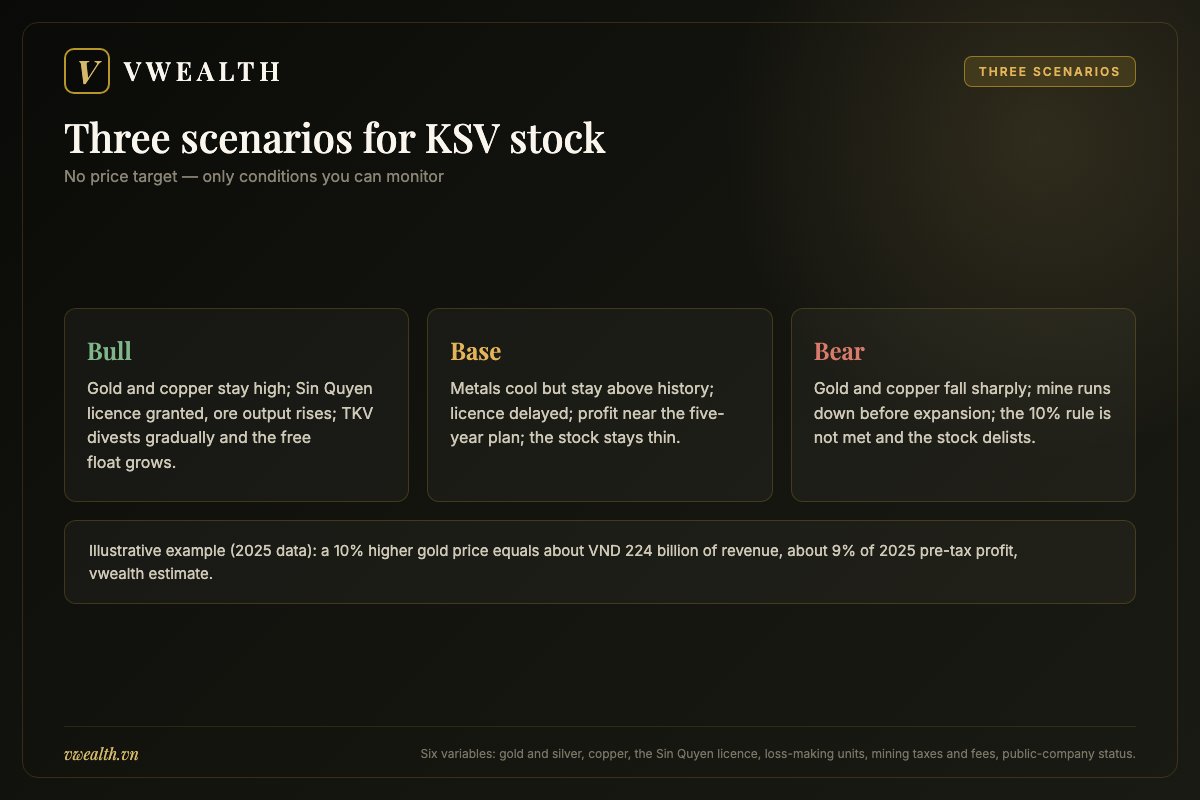
So, should you buy KSV stock? A straight answer
You have now seen Vimico on both layers: a state-owned miner at peak profitability thanks to the metals cycle, and a stock so thinly held that the usual features of a market — liquidity, valuation, voting power — are all bent out of shape. There is no single answer to whether you should buy KSV stock. It depends on who you are, how much capital you have, and what kind of risk you can live with.
The strongest arguments for
Hard-to-replicate assets. The Sin Quyen copper mine, two copper smelters and the ability to recover gold, silver and acid form a value chain no other listed Vietnamese company has at similar scale. Leverage to precious metals. Because gold is a by-product, KSV offers exposure to gold prices through company earnings — with higher sensitivity than gold itself. A visibly stronger balance sheet. Debt down sharply, cash up, interest costs falling. Real, audited profits. The 2025 and first-half 2026 results come from selling prices and volumes explained in detail, not one-off gains. A higher dividend policy. From a few percent to 40.5% cash plus 50% stock for 2025, with a planned minimum of 15% for 2026.
The arguments against that you cannot ignore
Profit depends almost entirely on metal prices, which the company does not control; Vimico’s own five-year plan projects average profit well below the 2026 pace. Depleting resources and licence uncertainty: the eastern Sin Quyen pit is in its final phase, the expansion awaits approval, ore grades are falling, and concentrate imports have not materialised. Loss-making subsidiaries: Cao Bang steel and Lai Chau Rare Earth. Very thin liquidity and wide price swings — you may not be able to buy or sell at the price you want. Unresolved public-company status risk at the time of writing. Minority shareholders have essentially no voting weight: TKV decides, and most revenue comes from transactions within the TKV system.
| Factor | Upside | Downside |
|---|---|---|
| Assets | Large copper mine, deep processing | Licensed areas depleting; expansion awaiting approval |
| Metal prices | Full exposure to the gold, silver and copper cycle | Profit shrinks fast when prices fall |
| Major shareholder TKV | Stable offtake, group support | Near-absolute control; large related-party dealings |
| Finances | Debt falling, cash rising | Heavy depreciation; continuous reinvestment needed |
| Dividends | Sharp increase for 2025 | Dependent on TKV’s decisions and cash needs |
| The stock | Can rally hard on good news | Thin liquidity, wide swings, public-company status risk |
Who KSV stock suits
Investors who want exposure to the metals cycle through a stock and understand that it is a cycle. If you have your own view on gold and copper over the next few years and want a Vietnamese listed instrument reflecting it, KSV is one of very few options — provided you follow metal prices closely.
Investors using small amounts and small portfolio weights. Given thin liquidity, KSV suits capital you can build and unwind gradually over many sessions, as a small part of your total assets. A position that is large relative to average daily trading of a few billion dong will be hard to exit when you need to.
Investors willing to read disclosures. The KSV story changes through dry documents: board resolutions, variance explanations, meeting materials. Those who read them have a clear edge over those who only see “record profit” or “limit-up” headlines. Many of these documents are published in English on Vimico’s website, which helps foreign investors.
Who it does not suit
Investors who need high liquidity or manage large sums. If you might need to sell quickly, KSV’s tiny free float is a real risk. Investors who buy on tips or chase limit-up streaks. The 2024–2026 record shows fast rallies have often been followed by equally fast declines. Investors seeking stable long-term dividends. Dividends depend on commodity profits and the major shareholder’s decisions; a high payout this year does not guarantee the next. Investors who value a say in governance — with 98.06% in one holder’s hands, minority votes carry essentially no weight.
Final thoughts
Vimico is the story of a copper furnace in Lao Cai and what settles at the bottom of its refining cells. Over thirty years, the same machine has earned tens of billions of dong, had its profit target cut to zero, and now earns trillions — not because the machine changed much, but because copper and gold prices did. This state-owned miner is clearly benefiting from the metals cycle. But KSV stock carries a feature that has nothing to do with metals: it is thin, very thin, with 98.06% in one shareholder’s hands and a legal question about its public-company status still without a final answer.
Whether you should buy KSV stock comes down to three smaller questions. One: what do you believe about gold and copper over the next three to five years? Two: will the Sin Quyen mine expand in time to hold output? Three: are you comfortable owning a stock whose trading — and even its presence on the exchange — depends on decisions by its major shareholder? To answer them you need current data — realised prices, output, debt, licensing progress, ownership disclosures — which this analysis deliberately does not give as “today’s” figures. You can create a free vwealth account to track those metrics every reporting period, compare KSV with MSR, HPG and other Vietnam stocks tied to commodities, and make your own decision. This article helps you understand the business; it is not a recommendation to buy or sell.
Research Vietnamese stocks in English with vwealth. Our AI-powered platform turns Vietnamese market data into full English analysis reports — with international payment support and a free 2-month trial for new accounts. Create your free account and read the latest reports.


