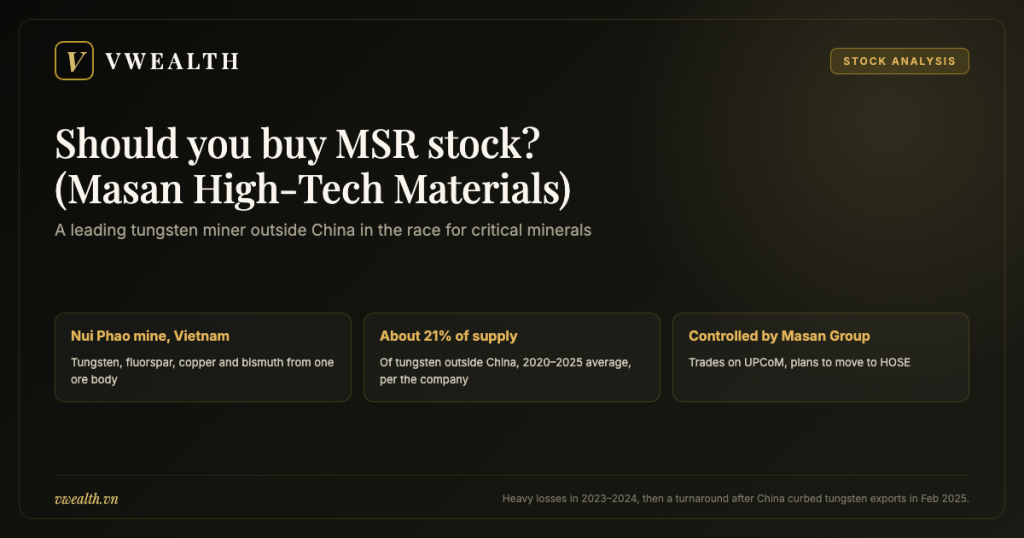
Should you buy MSR stock? A year ago, almost nobody asked. For nearly a decade, MSR — the ticker of Masan High-Tech Materials Corporation on Vietnam’s UPCoM market — was a sleepy listing: its parent, Masan Group, owned more than 90% of the shares, the free float was tiny, and profits swung between razor-thin and losses of more than VND 1.5 trillion a year. Then, in the space of about eighteen months, everything changed. China tightened exports of tungsten, European tungsten prices multiplied several times over, a Nasdaq-listed American company agreed to pay about USD 125 million for a 4.99% stake, the company paid its first-ever cash dividend, and management announced plans to move the listing to the Ho Chi Minh City Stock Exchange (HOSE). MSR suddenly became one of the most talked-about Vietnam stocks. This analysis tells the whole story — from a polymetallic deposit in northern Vietnam discovered by a Canadian explorer in the 1990s, through the purchase and later sale of Germany’s H.C. Starck tungsten business, to the company’s rare position as a large tungsten supplier outside China in the global race for critical minerals. By the end, you will have a straight answer: who MSR stock suits, and who it does not.
First, a few names that are easy to mix up. MSR is the stock ticker of Masan High-Tech Materials Corporation. The company and the press often abbreviate the business name as MHT, but MSR is the code you type into a brokerage app. The company was called Masan Resources from 2010 until it was renamed Masan High-Tech Materials in 2020. MSN, by contrast, is the ticker of Masan Group Corporation — the parent company, which owns most of MSR through a subsidiary. Buying MSN gives you a whole ecosystem of consumer goods, retail, banking and mining; buying MSR gives you the mining arm almost in isolation, concentrated in one mine and one processing plant in Thai Nguyen province. These are two very different investment decisions. If you want the group-level picture, vwealth has a separate analysis of MSN stock (Masan Group), where the Nui Phao mine gets a few paragraphs. Here, it is the whole story.
A note on sources and numbers, as with every company profile in this series. Dates, names, deals and figures come from published information: Masan High-Tech Materials’ own releases and reports, announcements by counterparties such as Mitsubishi Materials and The Elmet Group, the U.S. Geological Survey (USGS), broker research, and Vietnamese and international financial media. Figures for closed fiscal years are used as historical markers. We deliberately do not quote today’s share price, current P/E ratio or the latest quarterly profit — for a company whose earnings can multiply because of the price of one metal, those numbers go stale quickly. Where a figure is our own calculation, we label it “vwealth estimate” or “illustrative example”. For live numbers, open the latest vwealth research reports.
If you are new to investing in Vietnam, a few mechanics matter for this stock. Vietnam has three trading venues: HOSE (the main board, home of the large caps), HNX (a smaller exchange) and UPCoM (a market for public companies that have not met, or not sought, a full listing). Daily price limits are ±7% on HOSE and ±15% on UPCoM. Settlement is T+2. Foreign ownership is capped per company, and many international funds can only buy stocks that sit on HOSE or inside benchmark indices. Our guide on how to invest in the Vietnam stock market covers account opening and these rules in detail.
Finally, the thread that runs through this entire analysis. MSR is not a growth stock in the way a retailer or tech company is, where management controls most of its own destiny. It is a commodity stock: earnings depend first on the tungsten price, and the tungsten price depends first on decisions made in Beijing, Washington and Brussels. The question of whether to buy MSR stock is therefore bound up with a bigger one: is today’s tungsten boom a structural shift that will last for years, or a cyclical peak like the ones before it — and does the Nui Phao mine have enough ore left to capture it?
From a hillside in Dai Tu to one of the largest tungsten mines outside China: thirty years of Nui Phao
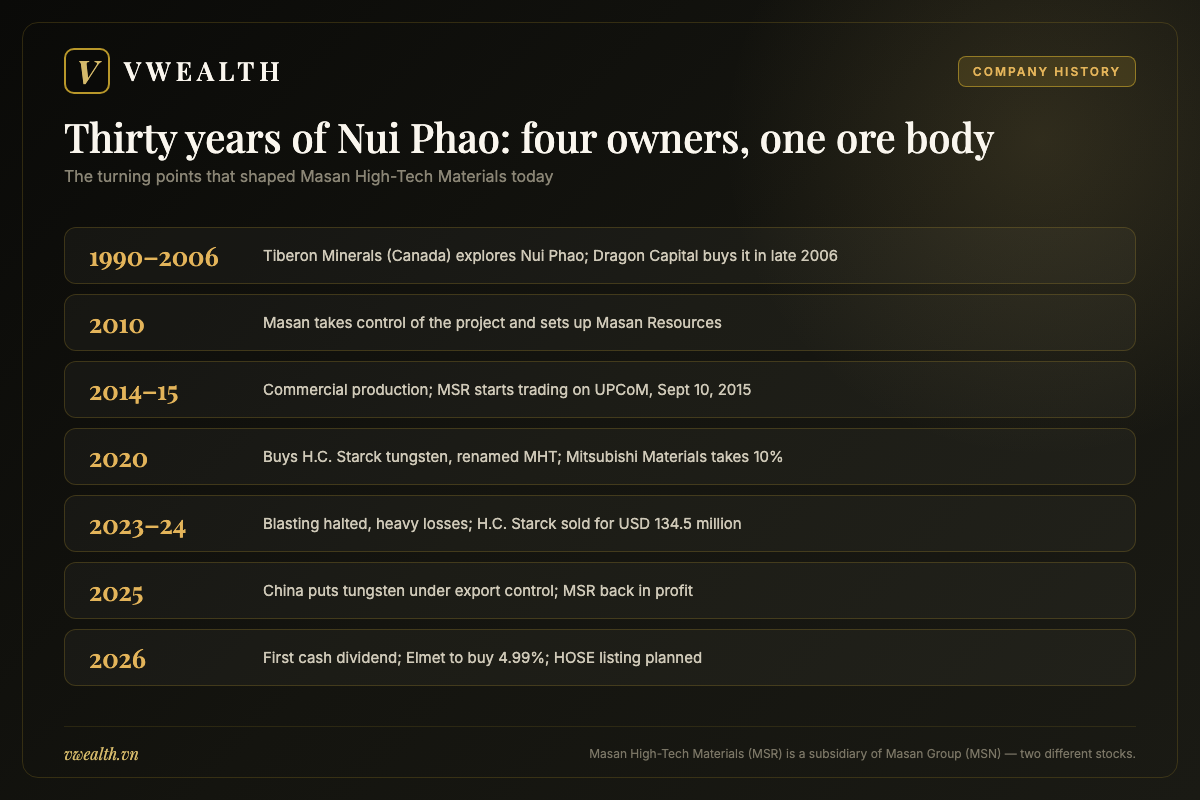
Many listed companies begin with a founder. Masan High-Tech Materials begins with an ore body. Before there was a company or a ticker, there was a range of hills in the north-west of Thai Nguyen province, north of Hanoi, containing tungsten, fluorspar, bismuth and copper in the same deposit — a large-scale “polymetallic” mine of a kind that is rare anywhere in the world. Over three decades that ore body passed from a Canadian explorer to an investment fund to a consumer conglomerate. Every change of ownership changed the story, and understanding those turns is the fastest way to understand why MSR stock is both attractive and hard to predict today.
The 1990s to 2006: Tiberon Minerals and a decade-long pursuit
The story starts in the mid-1990s, when Tiberon Minerals, a small Canadian mining company, explored the Nui Phao area of Dai Tu district and identified it as a polymetallic deposit containing tungsten, bismuth and fluorspar. Vietnamese press accounts of this period stress one detail: Tiberon spent roughly ten years going from exploration to an investment licence. A decade is normal in mining, and it offers the first lesson about MSR: its core asset cannot be built quickly. A competitor wanting a comparable mine would have to find an ore body, prove the reserves, secure permits, clear land, and build a processing plant — each step measured in years.
But finding a mine and turning it into cash are two different things. A project like Nui Phao needs hundreds of millions of dollars upfront for the pit, a concentrator, tailings storage, power lines and resettlement of local households. For a small explorer, that was out of reach. In late 2006, Dragon Capital — one of the largest fund managers in Vietnam — bought Tiberon Minerals for about USD 251 million, according to contemporary reports in CafeF and VnEconomy. The expectation was that the project would be operating by around 2009.
2007–2010: the global financial crisis and the handover to Masan
That expectation was not met. The 2008–2009 global financial crisis froze most of the financing channels available to new mining projects. According to press accounts, Dragon Capital could not solve the problem of funding construction. An idle mine is an asset that only costs money: permits must be maintained and holding costs paid, with no revenue coming in.
On May 13, 2010, Dragon Capital and Masan Group agreed that Masan would take control of Dragon Capital’s entire interest in the Nui Phao mining joint venture. The same year Masan set up Masan Resources to hold the project. Mining licence No. 1710/GP-BTNMT was issued on September 21, 2010, according to company documents cited by Vietcap Securities. On June 18, 2010, Masan held a project launch ceremony in Thai Nguyen. For a group then known mainly for fish sauce, soy sauce and instant noodles, the move looked like a detour. Read closely, however, it fits a pattern that recurs throughout Masan’s history: buy a large, difficult asset that is stuck for lack of capital, at a price the seller has few alternatives to, and then use financial muscle to bring it into production.
The remaining stake held by Tiberon was bought out later; press reports put the purchase of Tiberon’s Masan Resources shares at about VND 928.56 billion, completed in 2014. From that point, Nui Phao belonged entirely to Masan.
2011–2015: building the mine, a joint venture with H.C. Starck, and a UPCoM listing
Construction began in mid-2011. On the start of operations, sources differ, and you should know that. vwealth’s earlier MSN analysis cited late April 2013 as the date the mining and processing lines began production, while company documents cited by Vietcap give March 1, 2014 as the start of commercial production. The reasonable reading is that 2013 was trial operation and ramp-up, and 2014 the official commercial start. The mine’s maximum design capacity is about 3.5 million tonnes of ore per year.
Masan did not want to sell only raw concentrate. Tungsten concentrate sits at the bottom of the value chain, sells at a discount and must be sold to processors — most of which are in China. To move up, Masan formed a joint venture in 2014 with H.C. Starck, the German materials group and one of the oldest names in tungsten, to build a tungsten chemicals plant right next to the mine, 51% owned by Masan and 49% by H.C. Starck. That plant became Masan Tungsten Company (MTC), which converts concentrate into ammonium paratungstate (APT) and tungsten oxides — intermediate products worth considerably more.
On September 10, 2015, MSR shares began trading on UPCoM. This was not a big capital-raising IPO; it was closer to registering a presence on the market. The parent still held almost all the shares and the tradable float was tiny — a feature that stayed with MSR for the next ten years and is central to the market story in chapter 5.
2018–2020: buying out the plant, acquiring H.C. Starck Tungsten, and the “high-tech materials” ambition
In August 2018, Masan Resources bought H.C. Starck’s 49% stake in the processing joint venture, taking 100% ownership of the plant. The ambition did not stop there. On September 17, 2019, the company signed an agreement to buy H.C. Starck’s entire tungsten business — production sites in Goslar (Germany), Sarnia (Canada) and China making tungsten metal powders, tungsten carbide powders and other downstream products. On June 10, 2020, Masan Tungsten, a wholly owned subsidiary, announced completion of the deal.
Straight afterwards, the company changed its name from Masan Resources to Masan High-Tech Materials. The new name signalled a new strategy: not a “mining company” selling raw materials, but a “high-tech materials platform” running from mine to metal powder used in cutting tools, electronics and aerospace. In October 2020, Mitsubishi Materials Corporation — the Japanese materials group and a long-standing H.C. Starck customer — signed a strategic alliance and subscribed for 109,915,542 newly issued MSR shares, equal to 10% of the company, for about USD 90 million. According to The Investor, the deal closed on October 30, 2020, at roughly VND 19,054 per share.
On paper, this was the high point: a Vietnamese company owning both a mine and a leading German tungsten brand, with a Japanese conglomerate as a strategic shareholder. Consolidated revenue jumped as H.C. Starck was brought onto the books. The following years would show that going downstream was far more expensive than expected.
2023–2024: the broken years — blasting halted, heavy losses, and the sale of H.C. Starck
In 2022, MHT’s revenue reached about VND 15.55 trillion, a record according to company reports. Then problems piled up in 2023. From the second quarter of 2023, the mine’s long-standing blasting contractor stopped providing services, disrupting mining for the last three quarters of the year. According to Vietcap, the blasting suspension ran from April 2023 to March 2024, forcing Nui Phao to process low-grade, oxidised stockpiles with poor recovery rates and high unit costs. Meanwhile H.C. Starck in Europe faced weak demand and high energy costs, and rising interest rates inflated borrowing costs. Revenue fell to about VND 14.09 trillion in 2023, and net profit attributable to shareholders swung to a loss of about VND 1.58 trillion; in 2024 the loss was about VND 1.64 trillion (Vietcap’s compilation of company data).
The chosen fix was to exit downstream. In May 2024, MHT and Mitsubishi Materials signed a framework and then definitive agreements for Mitsubishi Materials to acquire 100% of H.C. Starck Holding (Germany) for an equity purchase price of USD 134.5 million. The deal closed on December 18, 2024. It came with a long-term offtake agreement under which H.C. Starck continues to buy APT and tungsten oxide from the Thai Nguyen plant. MHT also retained its interest in Nyobolt — a UK fast-charging battery company using tungsten and niobium in the anode — and the right to a share of profits if H.C. Starck’s “black mass” battery recycling technology is commercialised. According to Masan, the proceeds cut MHT’s debt from about USD 670 million to about USD 490 million.
Also in May 2024, Mitsubishi Materials exited as an MSR shareholder. According to The Investor, on May 30, 2024, three negotiated trades transferred about 109.92 million MSR shares at VND 14,800 each, worth about VND 1.63 trillion — matching the 10% the Japanese group had bought in 2020. The publication estimated Mitsubishi Materials lost about 29% on the investment. Remember that detail: a strategic shareholder that understands tungsten better than almost anyone sold below its entry price at the point of maximum pessimism — roughly a year before tungsten began its strongest rally in decades.
2025–2026: tungsten spikes, profits return, Elmet arrives, and a HOSE listing is planned
On February 4, 2025, China’s Ministry of Commerce put tungsten (along with tellurium, bismuth, molybdenum and indium) under export control, requiring a licence for shipments. According to the USGS, the Rotterdam APT price rose from about USD 331 to about USD 675 per metric tonne unit (mtu, equal to 10 kg of WO₃) during 2025. For 2025 MSR reported revenue of about VND 7.44 trillion and net profit of about VND 11 billion — a small number, but the first profit after two heavy loss years. The fourth quarter alone produced about USD 8.5 million in net profit, the highest since 2022, according to VIR.
In 2026 prices accelerated as never before. Fastmarkets recorded European APT rising from USD 900–940/mtu in January 2026 to USD 1,650–1,900/mtu by mid-February; by mid-year, international media described prices above USD 3,000/mtu as a record. MSR’s results turned accordingly: the company set a 2026 plan for after-tax profit of VND 1.7–2.5 trillion depending on the scenario, and the press reported that first-half profit exceeded the cumulative profit of many previous years. The 2026 shareholders’ meeting approved delisting from UPCoM in order to list on HOSE. In May 2026, Masan sold 2% of MSR to employees and qualifying MSN shareholders. In July 2026 MSR signed a toll-processing partnership with South Korea’s GB Innovation. In September 2026 it set the record date for a 10% cash dividend — its first since listing. And on September 24, 2026, The Elmet Group — a U.S. company listed on Nasdaq under ELMT — announced it would buy 4.99% of MSR for USD 124.75 million, along with a long-term tungsten supply agreement and a board seat.
Eighteen months, from a company losing more than a trillion dong a year to one valued by an American partner at roughly USD 2.5 billion. That speed is why MSR is so widely discussed — and why it demands the calmest possible analysis.
| Year | Milestone | Why it matters for MSR investors today |
|---|---|---|
| Mid-1990s | Tiberon Minerals (Canada) explores and defines the Nui Phao polymetallic deposit | The core asset took decades to develop — hard to replicate |
| Late 2006 | Dragon Capital buys Tiberon for about USD 251 million | The previous owner could not fund construction |
| 2010 | Masan takes control (agreement of May 13, 2010), sets up Masan Resources; mining licence issued September 21, 2010 | Start of the parent–subsidiary relationship that still defines MSR |
| 2013–2014 | Trial operation then commercial production (company date: March 1, 2014); processing JV with H.C. Starck (51/49) | Birth of the “mine plus chemicals plant” model |
| Sept 10, 2015 | MSR begins trading on UPCoM | Very low free float for years |
| 2018–2020 | Buys remaining 49% of the plant (Aug 2018); acquires H.C. Starck’s tungsten business (closed June 10, 2020); renamed MHT; Mitsubishi Materials takes 10% (Oct 2020) | Downstream expansion: revenue balloons, so does debt |
| 2023–2024 | Blasting halted about Apr 2023–Mar 2024; net losses of about VND 1.58 trillion and 1.64 trillion; H.C. Starck sold to Mitsubishi Materials for USD 134.5 million (closed Dec 18, 2024); Mitsubishi sells its 10% of MSR at VND 14,800 | Back to an upstream-midstream model focused on deleveraging |
| 2025 | China puts tungsten under export control (Feb 4, 2025); MSR returns to profit (about VND 11 billion) | Turning point of the price cycle |
| 2026 | HOSE listing plan; Masan sells 2% (May); GB Innovation deal (July); first 10% cash dividend (Sept); Elmet to buy 4.99% (announced Sept 24) | From a dormant ticker to a market headline |
Who runs MSR and who really owns it: a near-wholly-owned subsidiary with a public ticker
When you buy shares in an independent company, you become a co-owner alongside thousands of other shareholders, and management — in theory at least — works for all of them. With MSR, the situation is different. You are sharing a boat with someone who owns close to nine-tenths of it. Every major decision — asset sales, borrowing, dividends, which exchange to list on, whom to sell stakes to — is in practice made by Masan Group. This chapter explains who decides, how they have decided in the past, and what that means for a minority shareholder.
Masan Group and Nguyen Dang Quang: the final decision-maker
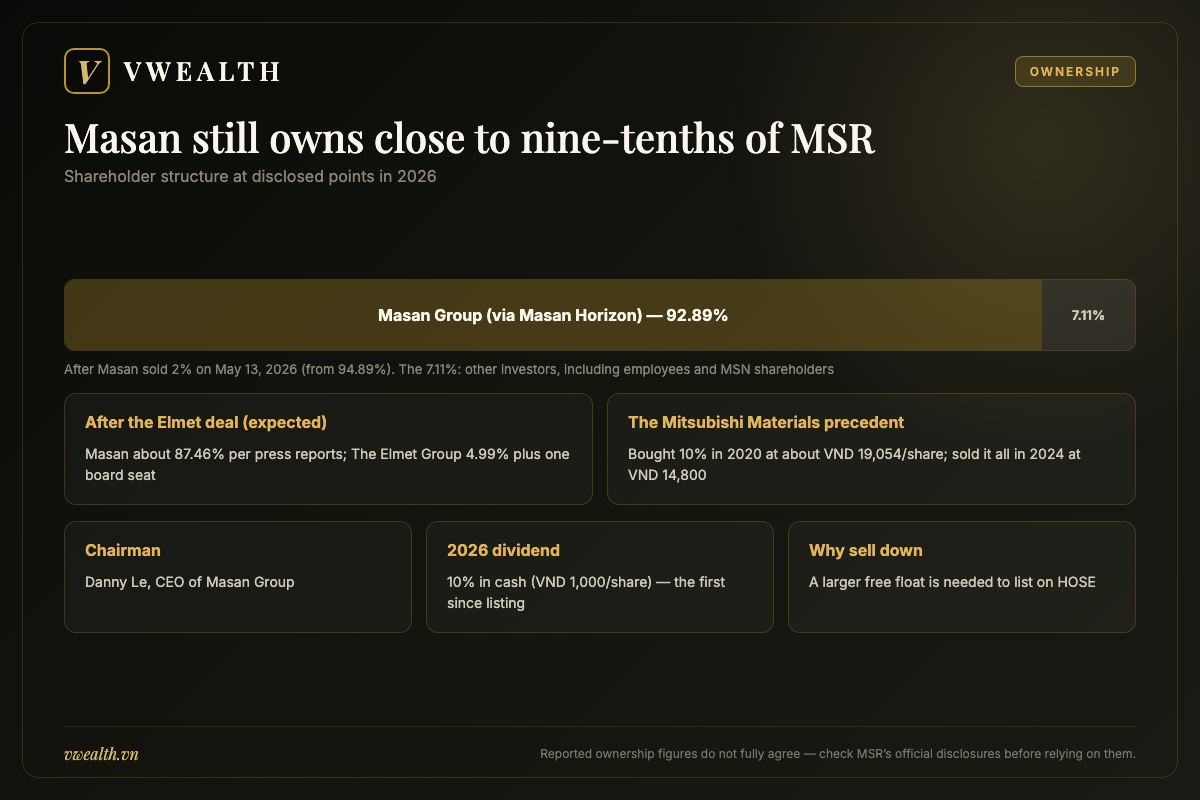
Masan Group, founded and chaired by billionaire Nguyen Dang Quang, controls MSR through Masan Horizon, a wholly owned subsidiary. According to Vietcap, with data as of March 2, 2026, Masan Horizon held 94.89% of MSR, management about 0.02%, and other investors the remaining roughly 5.09%.
To understand how Masan views MSR, recall the group’s style: buy large assets when others are stuck, restructure aggressively, and sell whatever no longer serves the strategy. With Nui Phao, Masan has done all three: it bought in 2010 when Dragon Capital could not raise funds, expanded downstream in 2020, and reversed course by selling H.C. Starck in 2024 when debt became a burden. For years Masan’s leadership publicly put consumer goods and retail at the centre, with high-tech materials positioned as non-core. vwealth’s MSN analysis noted the same “trimming” signal.
The 2026 signals are more nuanced. Rather than sell MHT to a single buyer, Masan chose a “value unlocking” route: selling small slices to employees, MSN shareholders and a strategic partner, paying a first cash dividend, preparing a HOSE listing — and, according to Elmet’s announcement, evaluating an international listing. For minority shareholders this is encouraging: a controlling shareholder that wants the market to value its subsidiary highly is, at least for now, aligned with you. But “for now” is the key phrase, and we return to it at the end of the chapter.
Danny Le, Michael Hung Nguyen and the mine management team
According to management details compiled by Vietcap in March 2026, MSR’s chairman is Danny Le, CEO of Masan Group, who previously worked in investment banking at Morgan Stanley in New York. Michael Hung Nguyen, Deputy CEO of Masan Group, sits on MSR’s board as second vice chairman; he is credited with building Masan’s transactions platform and previously helped set up J.P. Morgan’s Vietnam investment banking execution team. Neither held MSR shares directly at that date.
The operating team has a clearly international flavour. MSR’s CEO at the time was Michael Glover, a chemical engineer with more than 30 years of experience in minerals, plant operations and project delivery, holding bachelor’s and master’s degrees from the University of the Witwatersrand in South Africa. Deputy CEO Aditya Aggarwal covers corporate finance, M&A and fundraising; Deputy CEO Phan Chien Thang oversees media, community and external relations — a particularly sensitive role for a mine surrounded by villages. Check the latest annual report, because executive roles at Masan subsidiaries change fairly often.
The division of labour tells you something: strategic and financial decisions (asset sales, capital raising, listing moves) sit at group level with people from investment banking backgrounds, while the mine team focuses on engineering — recovery rates, mining costs, safety, environment. When you read MSR news, ask which level it belongs to. A stake sale is a financial story; a fluorspar recovery rate rising to 65.5% in Q4 2025, as VIR reported, is an operating story.
Ownership: from 94.89% to about 87.46% in six months
For almost ten years MSR’s shareholder register barely moved. In 2026 it changed faster than ever. On May 13, 2026, according to the Vietnamese legal newspaper Phap Luat Viet Nam, Masan sold about 2% of MSR (about 22 million shares): roughly half to Masan employees with a three-month lock-up, and the rest to MSN shareholders qualifying as professional investors. Masan’s stake fell from 94.89% to 92.89%; the free float rose to about 7.11%.
When the Elmet deal was announced on September 24, 2026, Vietnamese media reported that Masan would retain control with about 87.46% after the transaction. You may notice this is lower than the simple arithmetic of 92.89% − 4.99% = 87.90%; the gap may reflect other transactions in between, but we could not find a disclosure confirming the detail. This is exactly the kind of number you should verify in MSR’s official filings before relying on it. Total shares outstanding were about 1,099.8 million according to Vietcap (March 2026).
| Date | Masan (via Masan Horizon) | Strategic shareholder | Other investors | Source |
|---|---|---|---|---|
| After Oct 2020 | Most of the remainder | Mitsubishi Materials 10% | Small | Masan, Vietnam News |
| May 30, 2024 | — | Mitsubishi Materials sells its entire 10% at VND 14,800 | Domestic buyers | The Investor |
| Mar 2, 2026 | 94.89% | None | About 5.09% (management about 0.02%) | Vietcap |
| May 13, 2026 | 92.89% | None | About 7.11% | Phap Luat Viet Nam |
| After Elmet deal (expected) | About 87.46% | The Elmet Group 4.99% | Remainder | Press citing company; verify against filings |
Why does Masan need to sell down? Listing rules. Vietnamese reporting on MSR’s path to HOSE lists the criteria to meet: two consecutive profitable years, a minimum return on equity of 5%, and a sufficient free float. According to Dien Dan Doanh Nghiep, Masan needs to cut its stake below 90% for MSR to qualify for a transfer in 2027. HOSE listing rules generally also require no accumulated losses at the time of application — for a company fresh from two heavy loss years, that is a line worth watching in the financial statements. Each Masan sell-down is therefore not just about raising cash; it is a required step on the road to the main board.
Dividends: the first cash payout in 2026 — and who receives most of it
From its UPCoM debut in 2015 through 2025, MSR paid no cash dividends. That is unsurprising: profits were thin or negative and debt was high. In 2026 the picture changed. MSR set a record date of September 17, 2026 (ex-date September 16) for a 10% cash dividend — VND 1,000 per share, as Vietnamese dividends are quoted as a percentage of the VND 10,000 par value — with payment expected on September 24, 2026. With about 1.1 billion shares outstanding, the total payout was about VND 1.1 trillion, according to Tin Nhanh Chung Khoan and other outlets.
Do the arithmetic. If Masan held about 92.89% at the record date, roughly VND 1.02 trillion of that payout flows to Masan and only about VND 80 billion to all other shareholders combined (vwealth estimate, based on the stake disclosed in May 2026). That does not make the dividend “Masan’s” — every share receives the same amount, and you receive your share. But it explains why dividend decisions at MSR are closely tied to the parent’s cash needs. Masan Group is pursuing a deleveraging programme; a highly profitable subsidiary paying dividends is a way to move cash to the group without selling assets.
The lesson for you: do not extrapolate the 2026 dividend into a steady income stream. MSR’s payout policy will depend on tungsten prices, debt repayment schedules, capital needs for mine expansion, and Masan Group’s cash requirements at any given time. In a year when tungsten prices fall sharply, the dividend could disappear as quickly as it appeared.
Elmet and minority-shareholder risk: when parent and subsidiary interests diverge
The Elmet Group taking 4.99% and a board seat gives minority shareholders something MSR has long lacked: an outside shareholder with a voice, industry knowledge and its own interest in transparent governance. According to Elmet’s GlobeNewswire release, the two companies have worked together for about 12 years; Elmet also said it would support MSR’s planned uplisting to HOSE and its evaluation of an international listing. Remember the Mitsubishi Materials precedent, though: a 10% strategic shareholder that came in during 2020 and left in 2024 at a lower price. A strategic shareholder is not insurance for the share price.
Where exactly does minority risk lie at MSR? At least four places — not to scare you, but so you know what you are accepting.
First, related-party transactions. MSR borrows, receives guarantees, trades and buys services within the Masan ecosystem. These are legal and common in any conglomerate, but their terms — interest rates, fees, tenors — determine where profits end up. When you read the financial statements, open the note on “related-party transactions”.
Second, the price at which the parent sells. Masan sold 2% to employees and MSN shareholders in 2026 at a price the source article did not disclose. When a parent sells subsidiary shares to selected groups, other minority shareholders cannot participate. That breaks no rules, but it reminds you that the benefits of “value unlocking” may be distributed unevenly.
Third, strategic decisions made for the group. In 2020 MSR bought H.C. Starck; in 2024 it sold it for USD 134.5 million plus an offtake agreement. There is not enough public data to calculate the full profit or loss of that round trip, but MSR shareholders clearly bore the interest costs and losses during the years H.C. Starck was consolidated. A group can afford to experiment at a subsidiary; the subsidiary’s minority shareholders live with the outcome without meaningful votes.
Fourth, liquidity and the exit door. When a single holder owns close to 90%, very few shares trade each day. If bad news arrives, the exit can be very narrow. Chapter 5 covers this in detail.
Put together, the picture has two sides. 2026 is a period in which Masan’s interests (a high valuation for MSR, a HOSE listing, more partners) align with minority shareholders more than at any earlier stage. But the power structure has not changed. Masan still decides.
How MSR makes money: four minerals from one ore body and one chemicals plant
Think of the Nui Phao mine as a layered cake. Every tonne of ore contains not just tungsten but also fluorspar, copper and bismuth in varying grades. The concentrator separates each into its own concentrate. One of them — tungsten — goes next door to the chemicals plant to become a higher-grade product. The rest is sold directly. Understanding MSR means understanding what each layer contributes, which is stable, which is volatile, and which is now driving the share price.
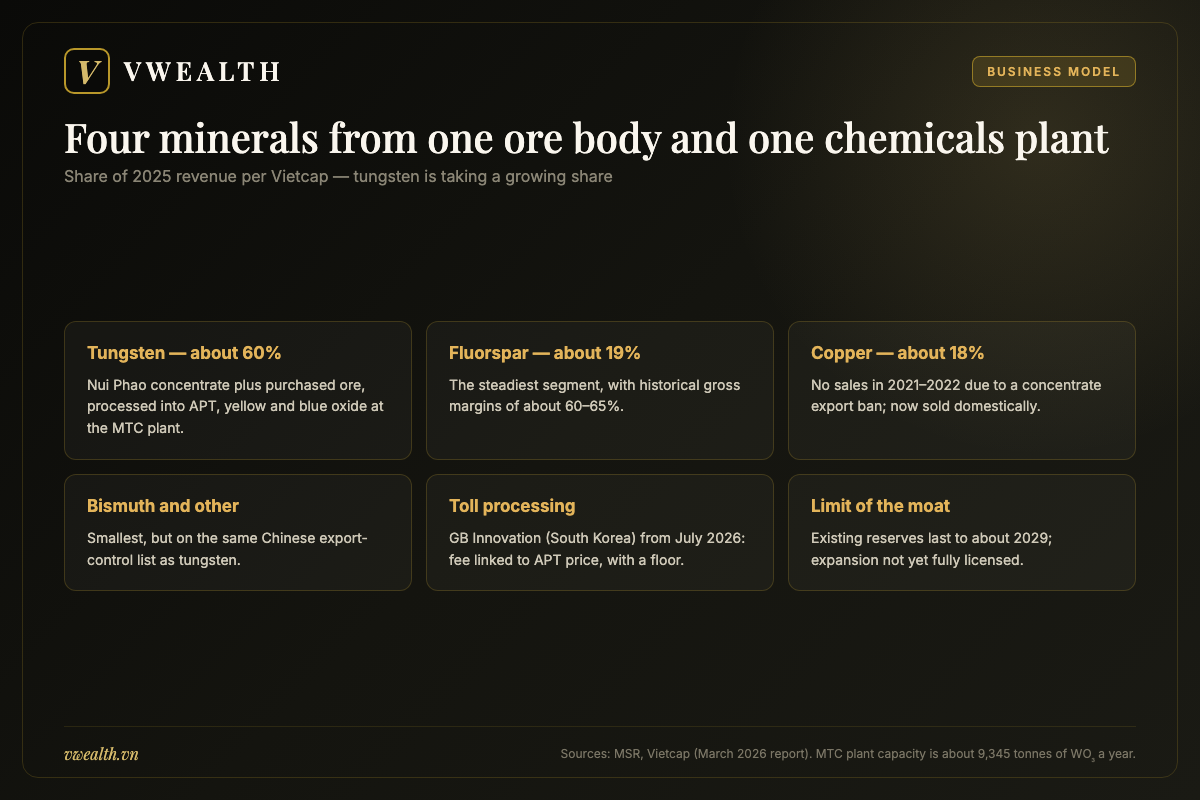
According to Vietcap, of 2025 revenue of about VND 7.44 trillion, tungsten accounted for about 60%, fluorspar about 19%, copper about 18%, and bismuth and other products the rest. But those weights shift quickly with prices: as tungsten prices multiplied in 2026, tungsten’s share of revenue and profit grew accordingly. Vietcap forecasts tungsten will account for about 90% of cumulative revenue and about 85% of cumulative gross profit over 2026–2036 — an analyst forecast, not a company commitment, but it shows MSR increasingly becoming a pure “tungsten stock”.
Tungsten: from concentrate to APT, yellow oxide and blue oxide
Tungsten (chemical symbol W, also called wolfram) has the highest melting point of any metal and is extremely dense; as tungsten carbide it is extraordinarily hard. It is rarely sold as pure metal. The value chain runs through several steps: ore → concentrate (a few dozen percent WO₃) → intermediate chemicals such as ammonium paratungstate (APT), yellow tungsten oxide (YTO), blue tungsten oxide (BTO) and sodium tungstate → tungsten metal powder and tungsten carbide powder → end products such as drill bits, cutting inserts, electronic components and armour-piercing penetrators.
MSR operates at the first and middle steps: Nui Phao Mining Company (NPMC) mines and concentrates the ore; Masan Tungsten Company (MTC) converts concentrate into APT, YTO, BTO and sodium tungstate. According to company documents cited by Vietcap, MTC has capacity of about 9,345 tonnes of WO₃ a year. A crucial point: MTC is much bigger than the amount of concentrate Nui Phao itself supplies. MTC therefore buys external concentrate — “ExTC” — from sources outside China and Russia, with more than 1,000 tonnes secured under long-term contracts.
This model brings two advantages. First, MSR sells higher-value intermediates and keeps the margin that would otherwise go to a processor. Second, large-scale tungsten processing outside China is rare, so new mines elsewhere — in South Korea, Australia or Europe — need somewhere to process ore without shipping it to China. MSR can become a regional “refinery”.
The model also has a downside. When MSR buys outside ore, it pays the ore price — which also rises with tungsten prices. Profit on purchased concentrate is only the processing spread, far thinner than on self-mined ore. 2023–2024 showed the risk clearly: according to Vietcap, the tungsten segment made gross losses of about VND 594 billion in 2023 and about VND 620 billion in 2024, as the mine had to process low-grade stockpiles during the blasting halt while tungsten prices were still low.
Fluorspar: the quiet segment with the steadiest margins
Fluorspar (calcium fluoride, CaF₂) is rarely mentioned in coverage of MSR, yet for years it was the company’s lifebuoy. Acid-grade fluorspar is the feedstock for hydrofluoric acid — an input for refrigerants, fluoropolymer plastics, and increasingly LiPF₆ electrolyte salt in lithium-ion batteries. According to Vietcap, fluorspar has historically been MSR’s most stable gross profit contributor, with gross margins of about 60–65%, while tungsten and copper are the swing factors.
Fluorspar is also on the European Union’s list of critical raw materials. So when the world talks about “critical minerals”, MSR has not one but three relevant products: tungsten, fluorspar and bismuth. The mine’s fluorspar recovery rate reached 65.5% in Q4 2025, a marked year-on-year improvement according to VIR — an operating metric worth watching, since every extra point of recovery is extra revenue without mining more ore.
Copper: from an export ban on concentrate to domestic sales
MSR’s copper business is a vivid example of policy risk. According to Vietcap, in 2020 MSR sold substantial copper under special permission to export concentrate. After that, Vietnam’s ban on exporting copper concentrate meant the company booked no copper revenue in 2021–2022 even though the mine kept producing — the concentrate simply piled up in inventory. From 2022, domestic smelting capacity expanded, creating local demand, and in 2023–2025 MSR switched to domestic sales. According to the company, copper inventory stood at about 2,047 tonnes of contained copper at end-2025, expected to be cleared during 2026.
The lesson goes beyond copper. For a Vietnamese mining company, rules on exporting raw minerals can move revenue from year to year more than prices do. Tungsten is processed domestically and is less exposed, but if you see copper revenue jump or collapse unexpectedly in a report, check whether the cause is price, volume, or policy and inventory.
Bismuth and toll processing: two small but notable pieces
Bismuth is a low-toxicity heavy metal used in pharmaceuticals, cosmetics, low-melting alloys and as a lead substitute. It is MSR’s smallest segment. But note this: bismuth is on the same Chinese export-control list announced on February 4, 2025, alongside tungsten, tellurium, molybdenum and indium. When China restricts a metal it dominates, buyers must look elsewhere — and MSR is one of few industrial-scale bismuth sources outside China.
The second piece is toll processing. On July 9, 2026, MSR announced a strategic partnership with GB Innovation (GBI), a South Korean tungsten miner. According to Masan’s release, concentrate mined by GBI in Korea will be shipped to Vietnam, where MSR will convert it into APT and tungsten oxides. Processing fees are set as a percentage of the Fastmarkets APT price index, with a floor-price mechanism to limit margin risk. The company also outlined plans to lift tungsten oxide capacity to more than 8,000 tonnes of WO₃ a year.
Why does this matter? It shows MSR trying to shift part of its model from “selling a commodity at market price” to “selling a processing service with a floor”. Done at scale, this would make profits less dependent on Nui Phao’s own reserves. Do not overstate it, though: at the time of writing this is one contract with one partner, and most of MSR’s profit still comes from self-mined ore.
| Segment | Share of 2025 revenue (per Vietcap) | Profit profile | Main risks |
|---|---|---|---|
| Tungsten (own concentrate + MTC processing + purchased ore) | About 60% | Highly volatile with APT prices; gross losses in 2023–2024, strong rebound from 2025 | Tungsten price, ore grade, mine life, cost of purchased ore |
| Fluorspar | About 19% | Most stable; historical gross margin about 60–65% | Recovery rates, fluorochemical demand |
| Copper | About 18% | Depends on copper price and sales channel | Concentrate export policy, inventory |
| Bismuth and other | Remainder | Small; benefits when China tightens | Thin market, volatile prices |
| Toll processing (GBI from July 2026) | Just starting | Fee as a percentage of APT price, with a floor | Still small, partner-dependent |
Where the moat is — and where it ends
Warren Buffett calls a durable competitive advantage a “moat”. MSR’s moat does not lie in brands or customer networks like a consumer company’s, but in three things.
Resources and permits. According to company documents cited by Vietcap, Nui Phao’s approved reserves are about 83.2 million tonnes of ore: roughly 55.2 million tonnes in Phase 1A and about 28 million tonnes in Phase 1B. The investment certificate, originally valid to February 2, 2034, has been extended to February 2, 2044. A tungsten mine of this size takes decades to develop — Nui Phao’s own journey from Tiberon to Masan proves it.
A processing plant outside China. Vietcap describes MTC as one of few large-scale tungsten chemical facilities outside China able to produce high-tech intermediates at the mine site. Building one requires complex technology and, more importantly, time to become “qualified” with customers: a cutting-tool maker or defence supplier tests a new raw-material source for a long time before accepting it. A 12-year relationship with Elmet and an offtake agreement with H.C. Starck are intangible assets that are hard to copy.
Geopolitical position. According to company data cited by Vietcap, MSR averaged about 21% of global tungsten supply outside China over 2020–2025. According to the USGS, Vietnam mined about 3,000 tonnes of tungsten in 2025, second in the world after China. With the U.S. preparing to bar defence contractors from using tungsten with any Chinese stage from 2027, a large supply source in Vietnam suddenly carries strategic value beyond its commodity value.
But this moat has a limit every MSR investor must memorise: a mine is a depleting asset. According to company documents cited by Vietcap in March 2026, Phase 1A has been mined out, operations are transitioning to Phase 1B with about 28 million tonnes of ore, and on existing reserves alone the mine life runs to around 2029. The Nui Phao Expansion area (about 55.19 million tonnes of ore, designated on May 20, 2026) and the Nui Chiem area (about 60 million tonnes of resources, selected as the sole candidate for an exploration licence on June 10, 2026) could extend operations — management estimates to around 2036 with the Nui Phao Expansion, and the company speaks of 20–30 years if both are developed. But these are resources not yet fully licensed for mining. A resource-based moat is only as wide as the years of ore left.
Market position and financial health: read the numbers before you buy MSR stock
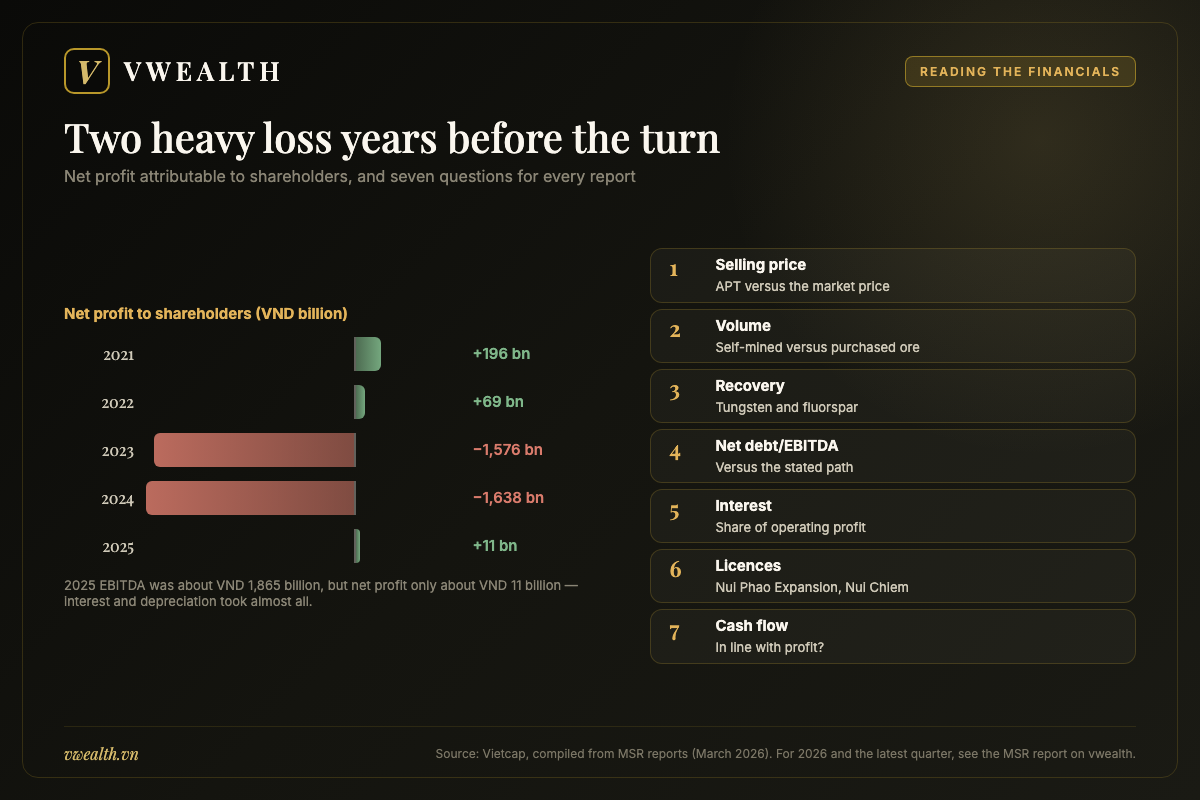
Here is a quick way to see why MSR was ignored for so long. In 2025, according to Vietcap’s compilation of company data, MSR’s EBITDA — earnings before interest, tax, depreciation and amortisation — was about VND 1.87 trillion. Yet net profit attributable to shareholders was only about VND 11 billion. Depreciation and interest consumed almost the entire gap. A big mine with trillions of dong in revenue, and what was left for shareholders was a rounding error. This chapter shows you how to read MSR’s numbers properly: not by looking at one year’s profit, but at the machine that produces it.
A decade of thin profits and two years of heavy losses
Vietnamese media in 2026 liked a striking line: MSR’s first-half 2026 profit equalled the combined profit of the previous 16 years of operations. That may be arithmetically true, but what it really tells you is that for 16 years MSR made almost nothing for shareholders. The table below summarises net profit attributable to parent-company shareholders for the last five closed fiscal years.
| Year | Net revenue | Net profit attributable to shareholders | What happened |
|---|---|---|---|
| 2021 | Includes H.C. Starck | About VND 196 billion | Post-COVID supply-chain disruption |
| 2022 | About VND 15.55 trillion (record) | About VND 69 billion | Highest revenue, razor-thin profit |
| 2023 | About VND 14.09 trillion | Loss of about VND 1.58 trillion | Blasting halted from Q2, higher rates, weak H.C. Starck |
| 2024 | Includes H.C. Starck for almost the full year | Loss of about VND 1.64 trillion | Blasting resumed in March; H.C. Starck sold in December |
| 2025 | About VND 7.44 trillion | About VND 11 billion | Higher tungsten prices, no H.C. Starck, best quarter since 2022 in Q4 |
Sources: profit per Vietcap (March 2026 report) compiled from MSR data; 2022–2023 revenue from company reporting cited by Market Times; 2025 revenue per MSR and VIR. For 2026 figures, see the updated MSR report on vwealth.
The table reveals something counter-intuitive: the highest-revenue year (2022) was not the most profitable, and the lowest-revenue year (2025) marked the turnaround. The reason is that revenue in 2020–2024 was “inflated” by H.C. Starck — a downstream business with large sales but thin margins, heavy working capital needs, and exposure to Europe’s energy crisis. Big revenue does not mean big profit; for MSR, what matters is the tungsten price, self-mined output and interest costs.
Why 2025 revenue was both “up 19%” and “down 48%”: a lesson in consolidation
Read enough coverage of MSR’s 2025 results and you will find two apparently contradictory numbers. VIR, citing the company, reported 2025 revenue of about VND 7.44 trillion, up 19% year on year. Vietcap’s report shows 2025 revenue down about 48% versus 2024. Both can be right — they compare different things.
In 2024, MSR’s consolidated accounts still included H.C. Starck’s revenue for almost the full year (the sale closed on December 18, 2024). In 2025 H.C. Starck was gone. Compare consolidated figures and revenue fell sharply. Compare like for like — only the continuing Vietnamese operations — and revenue rose. VIR also reported 2025 tungsten revenue of about USD 171.5 million, up 33%.
The lesson applies to every stock, but especially to MSR: whenever you read a growth figure, ask “compared with what, on what basis”. A company that has just bought or sold a big division produces financial statements that are not comparable across years, and headline writers may pick whichever number looks better.
Debt: the burden that kept MSR underwater, and the repayment path
If you had to name one reason MSR’s profits stayed thin for years, it would be debt. To build the mine, buy out Tiberon, acquire the processing plant from H.C. Starck and then H.C. Starck’s entire tungsten business, the company borrowed heavily. According to an analysis republished by DNSE and the Vietnamese Journal of Economics and Finance, total borrowings were close to VND 12 trillion at Q1 2025, and interest expense was equivalent to nearly 24% of net revenue — an unusually high ratio. Put simply: out of every 100 dong of revenue, almost 24 went to interest before paying for any mining, labour or depreciation.
According to Masan, the H.C. Starck proceeds cut MHT’s debt from about USD 670 million to about USD 490 million. In 2026, the company set out clearer financial targets: according to Vietstock, net debt/EBITDA was expected to fall from about 3.5x to 1.7x during 2026; according to Phap Luat Viet Nam, the aim is to approach 0.1x by end-2027 and reach a positive net cash position by end-2028. Read these for what they are: management targets built on continued high tungsten prices, not achieved results.
Net debt/EBITDA is the single most important ratio to track. It tells you how many years of operating earnings (before interest, tax, depreciation and amortisation) it would take to repay net debt. At 3.5x, a commodity company is stretched; below 2x is fairly safe; below 1x is very healthy. MSR’s special feature is that the denominator (EBITDA) depends on tungsten prices: if tungsten halves, EBITDA can fall by more than half, and the ratio can jump even if the company borrows nothing new. A balance sheet that looks “clean” at the top of the cycle can become tight again when the cycle turns. Because MSR is a cyclical commodity producer, this ratio deserves more attention than any single year’s earnings per share.
Earnings quality: price, volume, grade and inventory
A mining company’s profit can be broken into four “gears”. When you read MSR’s quarterly report, try to identify which gear is turning.
Selling price. This was the biggest gear in 2025–2026. APT prices multiplied in a little over a year, and most of MSR’s profit improvement came from here. Price-driven profit arrives without effort and leaves without warning.
Self-mined volume. According to Vietcap, 2026 is a transition year from Phase 1A to 1B; self-mined tungsten concentrate output was expected to be flat, rising from 2027 as mining moves into higher-grade zones. Self-mined volume matters because the margin on own ore is much higher than on purchased ore.
Grade and recovery. The 2023–2024 blasting halt proved the point: processing low-grade, oxidised stockpiles cut recovery and sent unit costs soaring. Conversely, fluorspar recovery of 65.5% in Q4 2025 is a sign of improving operations.
Inventory and price lags. Commodity processors typically buy raw material (here, outside concentrate) before selling finished product. When prices are rising, cheap inventory sold at high prices produces temporarily flattering profits. When prices reverse, the opposite happens. One 2025 analysis predicted MSR’s margins would improve from Q3 2025 as inventory turned over at higher prices. When tungsten turns down, prepare for the reverse — possibly including inventory write-downs.
One more earnings-quality point: one-offs. In 2024 there was a gain on the H.C. Starck sale (when the deal was announced, Vietnam News cited an estimated one-time profit of around USD 40 million), alongside restructuring costs. When comparing years, strip out such items to see “core” earnings.
Seven questions to ask every time MSR reports
We do not print the latest quarterly numbers, but we can give you the checklist. Each time MSR reports, open the filing — or the updated MSR report on vwealth — and answer:
1. What was the average selling price of APT and tungsten oxide, compared with the market price over the same period? If MSR’s realised price is well below market, long-term contracts with lagged pricing formulas may be the cause — helpful on the way down, costly on the way up.
2. How many tonnes of WO₃ came from self-mined concentrate, and what share was purchased ore? The higher the share of purchased ore, the thinner the margin.
3. Are tungsten and fluorspar recovery rates improving?
4. Where are net debt and net debt/EBITDA relative to the company’s stated path?
5. What share of operating profit goes to interest expense? This is the quickest test of whether the company has escaped its “debt trap”.
6. How far along is licensing for the Nui Phao Expansion and Nui Chiem? This determines long-term value more than any quarterly figure.
7. Is operating cash flow in line with reported profit? If profit rises but cash flow does not, cash may be tied up in inventory or receivables.
How the market has treated MSR stock: from a dormant UPCoM ticker to a market talking point
Open a chart of MSR from 2015 to 2024 and you see a fairly dull line: prices moving with big Masan headlines, many sessions trading only tens of thousands of shares, almost no brokers publishing regular research. From 2025, that line changed completely. This chapter explains why — and, more importantly, which yardstick the market is using to value MSR, and which one you should use.
Ten years on UPCoM: why a big asset was valued half-heartedly
UPCoM is Vietnam’s trading venue for public companies that are not formally listed. Compared with HOSE, it has wider daily price limits (±15% versus ±7%), lighter disclosure requirements, and — most importantly — much less attention from large funds. Many domestic and foreign funds have internal rules allowing them to buy only formally listed stocks, or only constituents of benchmark indices such as the VN30 or FTSE and MSCI indices. On UPCoM, MSR was almost invisible to that capital.
The second factor is free float. According to Vietcap, MSR’s free float at the start of 2026 was only about 5%. When 95% of shares sit untouched with the parent, very few shares change hands and prices can be pushed up or down by modest orders. Institutional investors dislike this: they need to buy meaningful size without moving the price too far, and to be able to sell when needed.
The third factor was an unappealing story. In the years of low tungsten prices, MSR was an indebted, thin-margin mining company with environmental issues, sitting inside a group everyone knew was primarily about consumer goods. There was little reason to pay up.
As a result, for years MSR was treated mainly as a minor component in sum-of-the-parts valuations of MSN rather than as a stock with its own story.
2025–2026: four reasons MSR suddenly became a talking point
The attention did not come from one headline but from four layers stacked on top of each other.
Layer one: the tungsten price. China imposed export controls on February 4, 2025; according to the USGS, Rotterdam APT rose from about USD 331 to about USD 675/mtu during 2025; in 2026 it rose several-fold again. Tungsten stocks worldwide — Almonty Industries, EQ Resources, and Chinese producers such as Xiamen Tungsten and China Tungsten & Hightech — rallied hard. MSR is one of very few large tungsten stocks outside China that investors can buy; Vietcap called it a “rare listed gateway” to the ex-China tungsten upcycle.
Layer two: an earnings turnaround. From losses of more than a trillion dong in 2023–2024 to a profit in 2025 and a 2026 plan of VND 1.7–2.5 trillion. A “from loss to big profit” story always attracts both speculative and fundamental money.
Layer three: corporate events. The HOSE transfer plan approved at the 2026 AGM; Masan’s 2% sale to employees and MSN shareholders in May; the first cash dividend in September; and the Elmet deal on September 24, 2026. Each event put MSR back on the front pages.
Layer four: foreign buying. According to Phap Luat Viet Nam (August 30, 2026), foreign investors were net buyers of about VND 155 billion of MSR in August 2026 — the strongest net foreign buying on UPCoM that month — and foreign ownership rose from 0.07% at end-2025 to 0.55% by late August 2026. The absolute numbers are still very small, but the direction is clear. The timing also coincided with FTSE Russell’s upgrade of Vietnam to Secondary Emerging market status, effective September 21, 2026 — see our explainer on the FTSE Russell upgrade of the Vietnam stock market.
The same article reveals the stock’s true personality. MSR rose about 43.5% in just over a month, from VND 32,900 (July 22, 2026) to VND 47,200 (August 28, 2026). Earlier, according to other reports, the stock was around VND 50,500 on March 27, 2026. So between late March and late July 2026 it fell about 35% (vwealth estimate from two press-reported prices) before rebounding. A stock that can lose a third and then gain almost half within five months is for people who can stomach large swings — the first thing to know about MSR’s character.
Three public valuation markers: Mitsubishi 2020, Mitsubishi 2024 and Elmet 2026
An interesting way to see how the market has valued MSR over time is to look at the occasions when real buyers paid real money for large stakes.
October 2020: Mitsubishi Materials bought 10% in newly issued shares at about VND 19,054 per share (about USD 0.82), roughly USD 90 million in total, according to The Investor. MSR had just bought H.C. Starck; the “high-tech materials platform” story was at peak expectations.
May 2024: That 10% was sold in three negotiated trades at VND 14,800 per share, about VND 1.63 trillion in total. This was the bottom of the cycle: two straight loss years, high debt, and a forced sale of H.C. Starck.
September 2026: Elmet agreed to buy 4.99% for USD 124.75 million. Vietnamese media translated this into an equity valuation of about USD 2.5 billion. Divide USD 124.75 million by 4.99% of about 1,099.8 million shares (roughly 54.9 million shares) and you get about USD 2.27 per share; at an assumed exchange rate of VND 26,000–26,500 per dollar, that is roughly VND 59,000–60,000 per share. This is a vwealth estimate — neither the press nor the release disclosed a per-share price, and the actual exchange rate at settlement may differ.
These three markers teach two things. First, MSR’s value swings with the tungsten cycle so strongly that even a knowledgeable strategic investor sold at the bottom. Second, the price of a strategic transaction is not “fair value” for minority shareholders: Elmet is also buying a long-term tungsten supply agreement and a board seat — things that have value to Elmet and that you do not receive when you buy 1,000 shares on the market.
How to value a mining company: why P/E can mislead you
For a commodity stock like MSR, the P/E ratio — price divided by earnings per share — is especially misleading. With 2025 profit of only about VND 11 billion, trailing P/E ran into the thousands; Vietcap showed a trailing P/E of about 4,947x in March 2026 — meaningless for investment purposes. Conversely, in a peak-price year, inflated earnings make P/E look very cheap. That is the classic cyclical-stock trap: the lowest P/E often appears exactly when earnings peak — when downside risk is greatest.
Analysts generally use three alternatives for miners:
EV/EBITDA — enterprise value (market cap plus net debt) divided by earnings before interest, tax, depreciation and amortisation. It suits MSR because it strips out capital structure and heavy depreciation. Vietcap compared MSR with Chinese tungsten producers (Xiamen Tungsten, China Tungsten & Hightech, Chongyi Zhangyuan), whose median five-year average EV/EBITDA was about 12.1x according to Bloomberg data.
Discounted cash flow (DCF) over the mine life — projecting cash flows year by year until the mine is exhausted and discounting them back. For a mine, value depends heavily on two assumptions: the long-term commodity price and the years of ore remaining. To show how cautious even bullish analysts are: Vietcap’s March 2026 base case assumed tungsten at about USD 1,680–1,700/mtu for 2026–2028 (about 20% below the roughly USD 2,100/mtu at the time) and USD 1,200/mtu from 2029 onward — in other words, analysts positive on MSR still did not assume peak prices would last.
Net asset value (NAV) — the present value of mines and plants minus debt. This is how international investors usually value miners, and it forces you to answer the key question: which reserves are licensed, and which are merely potential resources?
The takeaway: do not buy MSR because “P/E is low”, and do not sell it because “P/E is high”. Ask what tungsten price and mine life the market is implicitly assuming. For current valuation metrics — EV/EBITDA, P/B, forward P/E — see the MSR report on vwealth.
The HOSE move and other catalysts ahead
Events that could change how the market views MSR over the next 12–24 months include:
Transfer to HOSE. According to the press, the target is 2027. On HOSE, MSR could come onto the radar of large funds and indices, and liquidity typically improves. But remember: a listing move does not change the tungsten price or the mine’s reserves — it only changes who can buy the shares. Many stocks rally ahead of a transfer and then drift after it, a classic “buy the rumour, sell the news” pattern.
Completion of the Elmet deal. Elmet’s release said closing was expected in the third quarter of 2026; Vietnamese media reported the first half of October 2026. Timely completion — or delay — is a signal to watch.
Further Masan sell-downs. To reach the free-float threshold, Masan may sell more. Each sale adds supply, and its price becomes a valuation marker the market will watch. Note that reports of the current ownership level do not fully agree — one late-August 2026 article still cited 94.89% — so rely on official disclosures.
Mine expansion licensing. A mining licence for the Nui Phao Expansion and progress on Nui Chiem exploration are the most important long-term catalysts.
November 2026 and Chinese policy. On November 9, 2025, China suspended until November 27, 2026 its ban on exports to the U.S. of gallium, germanium, antimony and superhard materials, while keeping licence requirements. Tungsten was not part of that easing — it remains under the licensing regime introduced in February 2025. But U.S.–China trade deadlines like this are moments when critical-mineral markets can turn, and you should watch them.
Industry backdrop: tungsten, China and the race for critical minerals
Try a small experiment. Look around you: your phone contains chips made with processes that use tungsten hexafluoride; the drill in your toolbox has a tungsten carbide tip; the car outside was machined with carbide cutting tools; the solar panels on a nearby roof were sliced from silicon blocks with tungsten-containing wire. Tungsten is everywhere yet almost invisible, because it is a tiny fraction of the cost of the final product. That feature — indispensable, hard to substitute, and cheap relative to the end product — is what created the price boom MSR is riding.
What tungsten is and why it is hard to replace
According to the USGS, about 60% of tungsten consumed in the United States goes into cemented carbide parts — cutting, drilling and wear-resistant materials used in construction, metalworking, mining and oil and gas drilling. The rest goes into alloys and specialty steels, electrodes, filaments, electrical and electronic components, and chemicals. In defence, tungsten is used in armour-piercing munitions and armour; Vietcap notes that for defence applications tungsten has virtually no substitutes. In semiconductors, tungsten hexafluoride (WF₆) is used in chip manufacturing.
The USGS does list possible substitutes: carbides based on molybdenum, niobium or titanium; ceramics; cermets; tool steels; and depleted uranium or lead where high density is needed. But it notes that most options reduce rather than replace tungsten, and in some uses substitution means higher cost or lower performance. Economists call this “inelastic” demand: if the price doubles, buyers still need almost the same quantity, because a cutting tool or defence component cannot stop production just because an input worth a few percent of its cost got more expensive.
Inelastic demand plus concentrated supply is the classic recipe for violent price shocks — in both directions. Grasp this and you understand why MSR’s earnings can jump from a trillion-dong loss to a trillion-dong profit, and could go the other way.
China: the hand on the supply valve
According to the USGS (Mineral Commodity Summaries 2026), global tungsten mine production in 2025 was about 85,000 tonnes (tungsten content), of which China produced about 67,000 tonnes — roughly 79% (vwealth estimate from the two USGS figures). China also holds about 2.5 million tonnes of the world’s more than 4.7 million tonnes of reserves. Vietnam ranked second in output with about 3,000 tonnes in 2025 (3,400 tonnes in 2024) and reserves of about 170,000 tonnes. The USGS also notes China is the world’s largest producer, importer and consumer of tungsten concentrate, and that its imports rose significantly in 2025.
The history of tungsten prices is a history of decisions in Beijing. In the early 2000s, China flooded the world with cheap tungsten, forcing many mines outside China to close — part of the reason Nui Phao took so long to finance. In the mid-2000s China introduced export quotas and taxes. More recently, the decisions have come thick and fast:
On February 4, 2025, China’s Ministry of Commerce placed tungsten, tellurium, bismuth, molybdenum and indium under its Export Control Law; exporters of the relevant items, including APT, must apply for licences. In April 2025, according to Vietcap’s compilation, China cut its tungsten mining quota by about 6.5% versus 2024 — the third consecutive year of tightening. On December 26, 2025, the Ministry of Commerce published the list of companies authorised to export tungsten, antimony and silver for 2026–2027; for tungsten, 15 firms, unchanged in number. According to the Investing News Network, China’s exports of tungsten products fell about 34% year on year by volume in the first two months of 2026.
The most thought-provoking point is not that China restricts exports, but that it is gradually becoming a net importer of tungsten — Vietcap cites Shanghai Metals Market data showing China’s 2025 tungsten exports down about 20% while imports rose nearly 40%. If that trend persists, the rest of the world will have to secure its own supply, and every large mine outside China — Nui Phao included — becomes more valuable.
The U.S., Europe and Japan: the race for non-Chinese supply
United States. According to the USGS, the U.S. has had no commercial tungsten mining since 2015 and relies on imports for more than 50% of consumption. In 2021–2024, Vietnam supplied about 8% of U.S. tungsten imports, level with Bolivia. At the end of 2024, the U.S. raised Section 301 tariffs to 50% on several Chinese tungsten products. More important still is defence procurement rule DFARS 252.225-7052: from January 1, 2027, the prohibition on tungsten from China, Russia, Iran and North Korea widens from the melting and production stage all the way back to mining of the ore, and recycled material no longer resets the country of origin. In plain terms, U.S. defence contractors will have to show their tungsten has not passed through China at any stage, from mine to finished part. Industry has warned that compliant supply may not exist in sufficient volume by then. Fastmarkets also points to “Project Vault”, a USD 12 billion U.S. critical-minerals stockpiling initiative, and the USGS notes several tungsten projects in the U.S. and Canada receiving Defense Production Act awards.
This is the context for the Elmet deal. Bloomberg described Elmet as “Pentagon-backed”; Elmet describes itself as a U.S.-based provider of critical materials, precision-engineered components and advanced high-energy systems. According to Vietnamese media citing MSR’s disclosure, the accompanying supply agreement runs for more than eight years, with committed volume of about 1,250 tonnes of WO₃ equivalent per year and estimated total revenue of about USD 1.5 billion at current tungsten prices. When DFARS takes effect, a large Vietnamese tungsten source with no Chinese link at any stage has strategic value for the U.S. defence supply chain.
Europe. The EU lists tungsten as a strategic raw material under the Critical Raw Materials Act (CRMA); fluorspar and bismuth are also on its critical raw materials list. A 2023 European Commission study placed tungsten among materials with both high economic importance and high supply risk. For MSR, that means three of its four products are “strategic” or “critical” for European customers.
Japan and South Korea. Mitsubishi Materials — a major Japanese maker of carbide tools — chose to buy H.C. Starck from MSR in 2024 and signed an offtake for APT and tungsten oxide from Vietnam. South Korea has Almonty Industries’ newly operating Sangdong mine, and GB Innovation chose to send its ore to MSR for processing. Both countries lack non-Chinese tungsten processing capacity — a gap MTC can fill.
In short, MSR sits at the intersection of three forces: China tightening, the U.S. excluding Chinese supply from defence, and Europe and Japan seeking alternatives. That is why this cycle may differ from previous ones — but “may differ” is not “will differ”.
Tungsten prices: from about USD 330 to above USD 3,000 per mtu
Tungsten is usually priced in USD per mtu — a metric tonne unit, equal to 10 kg of WO₃, or one-hundredth of a tonne. The most common benchmark is the Rotterdam APT price published by Fastmarkets and Argus. Because sources use different benchmarks and dates, the table below gives the source for each data point; do not stitch them into a single price line.
| Date | Price level | Source |
|---|---|---|
| 2021–2024 average | About USD 225–275/mtu (concentrate, Rotterdam) | USGS |
| Start of 2025 | About USD 331/mtu (APT, Rotterdam) | USGS |
| End of 2025 | About USD 675/mtu (APT Rotterdam, USGS); USD 735–780/mtu (VIR); about USD 862/mtu (Fastmarkets, per Vietcap) | Multiple sources — differ by benchmark and date |
| January 2026 | USD 900–940/mtu (APT) | Fastmarkets |
| Mid-February 2026 | USD 1,650–1,900/mtu (European APT) | Fastmarkets |
| March 6, 2026 | About USD 2,100/mtu | Fastmarkets, per Vietcap |
| Mid-2026 | Above USD 3,000/mtu, described as a record | Mining.com, Vietnamese media |
Fastmarkets also reported ferro-tungsten at USD 200–210/kg W in mid-2026, versus USD 45–46/kg W a year earlier. In other words, prices rose roughly 4–10 times, depending on product and base date, in about 18 months.
For MSR investors, this table carries two messages. First, current prices are far above the levels at which MSR lost more than a trillion dong a year (2023–2024), so current profits do not need peak prices to survive — only that prices do not fall back to the old range. Second, a commodity that multiplied in 18 months can fall just as hard if one of its drivers — Chinese policy, defence stockpiling, new supply — reverses. Vietcap’s own base case assumes prices decline from 2029.
New non-Chinese supply and companies to compare
High prices attract new supply — the rule of every commodity. The questions are how soon and how much. According to Vietcap’s March 2026 compilation, notable ex-China tungsten projects include: Boguty in Kazakhstan (Jiaxin International, whose parent is a Chinese state-owned company), which started production in 2025; Sangdong in South Korea (Almonty Industries), operating from late 2025 and set to double capacity in 2027; Dolphin in Australia (Group 6 Metals), ramping up; Hemerdon in the UK (Tungsten West), expected to start around Q4 2026; and El Moto in Spain, expected to start in the second half of 2027. Vietcap estimates that if these mines (excluding Boguty because of its Chinese link) ran at full capacity, extra ex-China supply would be only about 13,000 tonnes of WO₃ a year by 2028 — Vietcap’s estimate, not realised data. According to MSR itself, most proposed “new tungsten mines” in the past never reached production.
On the Vietnamese market, there are very few listed metal miners to compare with MSR. The name most often mentioned alongside it is KSV — Vimico (TKV Minerals Corporation), listed on HNX since February 2, 2023 and controlled by the state-owned Vietnam National Coal and Mineral Industries Group (TKV). But KSV is not “another MSR”: its products are copper cathode, gold, silver, magnetite concentrate and zinc ingot — not tungsten. KSV also had a sharp rally in early 2026 — Vietstock reported the stock rose more than 150% in a single month — showing that speculative money had found the whole mining group, not just tungsten.
| Criterion | MSR (Masan High-Tech Materials) | KSV (Vimico) | Almonty Industries | Chinese tungsten producers (Xiamen Tungsten, China Tungsten & Hightech) |
|---|---|---|---|---|
| Venue | UPCoM, planning HOSE in 2027 | HNX (since Feb 2, 2023) | Listed overseas | China A-shares |
| Main metals | Tungsten, fluorspar, copper, bismuth | Copper, gold, silver, magnetite, zinc | Tungsten (Sangdong, South Korea) | Tungsten, full value chain |
| Controlling shareholder | Masan Group | TKV (state) | Public shareholders | Chinese state-owned enterprises |
| Model | Mine plus tungsten chemicals plant at the mine | Multiple mines and smelters in Lao Cai, Cao Bang, Thai Nguyen | New mine ramping up | Integrated from mine to end product |
| DFARS 2027 beneficiary | Potentially — non-Chinese source | Not directly | Potentially — non-Chinese source | No — excluded from U.S. defence chain |
| Specific risks | Mine life, debt, minority shareholders | Copper/gold prices, state ownership | Construction and ramp-up | Domestic policy, quotas |
To see MSR against the wider picture of Vietnamese industrials and materials, read vwealth’s analyses of HPG stock (Hoa Phat Group) — also commodity-sensitive, but on a very different scale and model — and DGC stock (Duc Giang Chemicals), which also built its advantage on mineral resources (apatite ore) and deep processing. The sector overview is in our pillar page on Vietnam manufacturing and industrial stocks.
Environment and community: costs that do not appear on the price sheet
Any analysis of a large mine must talk about the people living around it. For Nui Phao, the public record shows environmental and community issues stretching over many years.
In 2017, Vietnam’s Ministry of Natural Resources and Environment issued an inspection conclusion (No. 2065) on Nui Phao Mining Company. According to Tuoi Tre (July 16, 2017), it found violations in minerals, land, water resources and environment: the sulphide tailings storage facility (STC) was not waterproofed to standard despite containing hazardous substances; 11 households in hamlets 3 and 4 of Ha Thuong commune still lived in an at-risk zone and had not been relocated as the environmental impact assessment required; the company sold excavated soil with high iron content without reporting it; and it lacked certificates of completion for environmental protection works for some phases. The company was fined VND 510 million and ordered to remediate.
In July 2024, according to Dan Tri, Nui Phao reported to the ministry that it had basically completed the inspection requirements after submitting more than 30 progress reports since August 2017; in 2023 it rehabilitated 3.3 hectares and was researching fixes for seepage at the tailings facility. But complaints continued. In April 2025, according to Tien Phong, residents of hamlet 13, Tan Linh commune reported dust pollution affecting air and water and landslide risks; more than 30 households live near the northern tailings area, 25 of them directly adjacent. The chairman of Thai Nguyen province ordered an inter-agency inspection to be completed within 45 days from April 25, 2025.
To be fair, Masan High-Tech Materials also publishes extensive environmental, community and tax contributions — in 2025 the company said it contributed more than VND 1.03 trillion to the state budget. We do not have enough basis to judge the current environmental situation. But for investors these issues are real financial risks: a new inspection could require extra investment, suspension of works, or relocation costs; and as the company seeks to expand into the Nui Phao Expansion and Nui Chiem areas, local community acceptance is an implicit condition as important as any permit. For international investors — Elmet, or the funds that may arrive once MSR is on HOSE — environmental, social and governance (ESG) standards may even decide whether they are allowed to hold the stock at all.
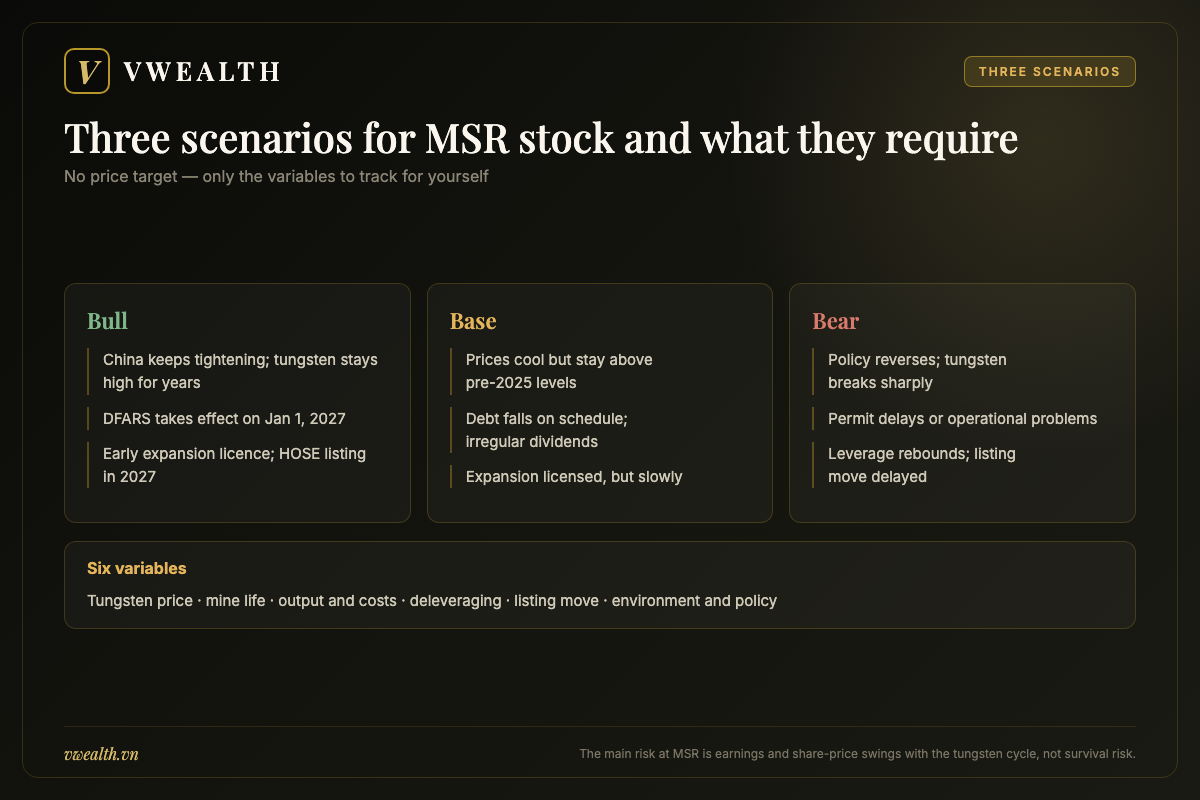
Outlook: three scenarios for MSR stock and what would have to happen
Forecasting commodity prices is something even the best professional traders often get wrong. So this chapter gives no price target. Instead it does something more useful: it identifies the variables that will determine MSR’s future, then sketches three possible pictures, with the conditions needed for each. When news arrives, you can place it in a scenario and adjust your view.
Six variables that will decide MSR’s future
1. The tungsten price. The biggest variable, and outside the company’s control. It depends on Chinese export policy and mining quotas, defence stockpiling in the U.S. and Europe, the global industrial cycle, and how fast new mines outside China come on line.
2. Mine life. According to company documents cited by Vietcap, existing reserves (Phase 1B) allow mining until about 2029. The Nui Phao Expansion could extend that to around 2036 by management’s estimate; adding Nui Chiem, the company speaks of 20–30 years. Vietcap argues that under Vietnam’s Law on Geology and Minerals, effective July 2025, existing operators have priority to explore and expand into contiguous ore bodies without a mining-rights auction — so MSR is likely to secure the expansion. But “likely” is not a mining licence in hand.
3. Output and operating costs. The switch from Phase 1A to 1B, a combination of open-pit and underground mining, and the move into higher-grade zones from 2027 are technical changes that can go smoothly or not. The 2023–2024 blasting halt showed that one operational hiccup can wipe out a year’s profit.
4. Speed of deleveraging. If the company uses the high-price window to repay debt as targeted (net debt/EBITDA at 1.7x by end-2026, net cash by end-2028), its financial risk when the cycle turns will be much smaller. If cash goes mainly to dividends up to the parent or to new projects, the balance sheet will be less resilient.
5. The listing move and shareholder structure. A timely HOSE listing, more strategic shareholders and better liquidity — or delays and a continued low-float UPCoM stock.
6. Environment, community and domestic mining policy. A new inspection, changes to resource taxes or export rules, or community opposition to expansion could all matter a great deal.
Bull case: a long tungsten “super-cycle” and an extended mine
This scenario requires many favourable things at once. China keeps tightening exports and gradually becomes a net importer; DFARS takes effect on January 1, 2027 as scheduled, sending demand for “China-free” tungsten sharply higher; new mines outside China run late, as the industry’s history suggests. Tungsten prices, even if they cool from the peak, stay far above the average of the previous decade.
At company level: MSR secures a mining licence for the Nui Phao Expansion, self-mined output rises from 2027 as planned, and the MTC plant runs near capacity with partner ore from GBI and long-term contracts such as Elmet’s. Debt falls fast and the company reaches net cash early. MSR moves to HOSE in 2027, gets picked up by international funds, and perhaps even pursues the international listing Elmet mentioned.
In this scenario, MSR shifts from “cyclical commodity stock” to “strategic asset” valued like the rare non-Chinese tungsten producers — and dividends could become a regular part of the story. But remember: this scenario needs almost every variable to line up, and the price you pay may already reflect most of it.
Base case: prices cool but stay above the past; expansion is slow but sure
This is close to how most analysts model the company. Tungsten prices gradually retreat from the 2026 peak as new supply (Boguty, Sangdong, Hemerdon…) contributes and defence stockpiling needs are partly met, but remain well above the USD 300–400/mtu range of the pre-2025 years because China does not return to its old open-export stance. For reference: Vietcap’s base case (March 2026) assumes USD 1,680–1,700/mtu for 2026–2028 and USD 1,200/mtu from 2029.
MSR stays solidly profitable and repays debt on schedule, though a little slower than targeted. Expansion licensing comes through, but takes longer than hoped. The HOSE transfer succeeds but does not trigger a big rally because the market has priced it in. Dividends are paid but irregularly. Here, your return depends heavily on your entry price: buying at peak euphoria may disappoint; buying when the market fears “the tungsten wave is over” may work well.
Bear case: tungsten breaks and the mine runs into trouble
A bear case does not need everything to go wrong — just two or three variables turning at once. The U.S. and China could reach a broader trade deal in which China eases tungsten exports, while defence stockpiling slows and new mines arrive faster than expected — and tungsten falls sharply, as it did in the 2013–2015 cycle. Or DFARS could be delayed because U.S. industry is not ready, reducing the “premium” for non-Chinese supply.
At company level: expansion licensing is delayed or meets community opposition; an operational problem like the 2023 blasting halt recurs; Phase 1B grades come in below expectations. As prices fall, high-cost inventory must be sold cheaply, possibly with write-downs. If debt has not come down fast enough, net debt/EBITDA jumps again as EBITDA shrinks. Masan might postpone the HOSE move, and the stock would return to thin liquidity — leaving a narrow exit for minority shareholders.
For MSR, the bear case is usually not bankruptcy risk — the company has a large parent and real assets — but the risk of a deep and prolonged share-price decline. Mitsubishi Materials buying at about VND 19,054 in 2020 and selling at VND 14,800 in 2024 illustrates exactly that.
| Variable | Bull | Base | Bear |
|---|---|---|---|
| Tungsten price | Stays high for years | Cools but above pre-2025 levels | Breaks sharply as policy reverses |
| Chinese policy | Keeps tightening; becomes a net importer | Current licensing regime stays | Eased as part of a trade deal |
| U.S. policy | DFARS on time Jan 1, 2027; strong stockpiling | Applied with adjustments | Delayed; less demand for “clean” supply |
| Mine life | Expansion licensed early | Licensed, but slowly | Stuck on permits or community issues |
| Debt | Net cash early | Falls on schedule | Net debt/EBITDA rebounds |
| Listing | HOSE in 2027, possibly international listing | HOSE, but already priced in | Delayed; liquidity stays thin |
Illustrative example: how sensitive MSR’s earnings are to tungsten prices
To see why MSR’s share price is so volatile, here is an illustrative example using round, simplified numbers — not a forecast for the company.
Suppose a company sells 5,000 tonnes of WO₃ a year as APT and tungsten oxide. Since 1 tonne equals 100 mtu, 5,000 tonnes is 500,000 mtu. If the average selling price changes by USD 1,000/mtu, revenue changes by USD 500 million — at an assumed VND 26,000 per dollar, about VND 13 trillion. That is more than MSR’s entire 2025 revenue.
But revenue is not profit. Suppose only about one-fifth of that WO₃ comes from self-mined ore and four-fifths from purchased ore (a ratio chosen to be close to Vietcap’s 2026 projection of about 1,285 tonnes of self-mined WO₃ out of about 5,874 tonnes sold, or about 22% — a vwealth estimate from those two Vietcap figures). On the self-mined portion, a price rise flows almost straight into gross profit, because mining costs do not rise with tungsten prices. On the purchased portion, the cost of ore rises too, so the company only gains the processing spread — usually much smaller. So in this example, the gross profit gain might be only a fraction of the revenue gain, but still large enough to multiply profit many times over versus a low-price year.
The sensitivity table in Vietcap’s March 2026 report offers a more concrete gauge: in their model, every USD 100/mtu change in the 2026 average tungsten price shifts forecast 2026 EBITDA by about VND 500 billion (vwealth estimate read from Vietcap’s sensitivity table; this is an analyst projection, not actual data). With interest and depreciation largely fixed, almost all of that change drops to pre-tax profit. That is operating leverage — and it works in both directions.
The lesson: when reading news about MSR, the key question is not “how much did the company earn this quarter”, but “where is the tungsten price relative to what the market is implicitly assuming in the share price”. For up-to-date selling prices, volumes and margins, check the MSR report on vwealth.
So, should you buy MSR stock? A straight answer
You have now followed Nui Phao through thirty years: a Canadian explorer, a fund stuck for capital, a bold consumer conglomerate, the H.C. Starck round trip, two heavy loss years, the tungsten boom and the Elmet deal. Time to answer the question this analysis began with: should you buy MSR stock? The honest answer is: it depends on who you are, what price you pay, and what you believe about tungsten. This chapter helps you weigh each side.
The strongest arguments for
A genuinely rare asset. Nui Phao is one of the largest operating tungsten mines outside China; according to company data, MSR averaged about 21% of non-Chinese tungsten supply over 2020–2025; Vietnam is the world’s second-largest tungsten miner according to the USGS. This is not a story on paper — it is measured in tonnes of ore and validated by contracts with Mitsubishi Materials, H.C. Starck, Elmet and GB Innovation.
An integrated mine-plus-processing model. The MTC plant lets MSR sell higher-value intermediates instead of raw ore, and opens the possibility of becoming a “refinery” for other non-Chinese mines — a role that could outlast Nui Phao’s own ore.
Geopolitical tailwinds. China is controlling exports, the U.S. will bar Chinese supply from its defence chain from 2027, and Europe and Japan are seeking alternatives. Few stocks listed in Vietnam sit as squarely at the intersection of the critical-minerals race as MSR.
A balance sheet being cleaned up. H.C. Starck sold, proceeds used to cut debt, a target of positive net cash by end-2028. If achieved, the financial risk that swallowed profits for years shrinks considerably.
A controlling shareholder motivated to “unlock value”. A listing move, a first cash dividend, and a strategic partner on the board. For now, Masan’s and minority shareholders’ interests point the same way.
The risks you cannot ignore
Profits depend almost entirely on one commodity price. MSR lost about VND 1.58 trillion and 1.64 trillion in 2023–2024 when tungsten was cheap and operations stumbled. Tungsten has multiplied in about 18 months; a commodity that rises that fast can fall just as fast.
A mine is a depleting asset. Existing reserves are expected to last until about 2029. The expansion has good prospects but is not yet a mining licence in hand. Every long-term valuation of MSR implicitly bets on a successful expansion.
Weak minority position. Masan owns close to 90%; all major decisions are made by the parent. The H.C. Starck round trip shows MSR shareholders can bear the cost of group-level strategic experiments.
Low liquidity and extreme volatility. A small float on UPCoM; a price that can lose a third and then gain almost half within a few months, as 2026 showed.
Environmental and community risk. The 2017 inspection and residents’ complaints in 2025 show these issues are not closed, and they will matter more as the company seeks to expand.
High expectations. When a stock is widely discussed, valued by a foreign partner in the billions of dollars, and preparing to move to the main board, much of the good news may already be in the price. Future returns depend on reality beating those expectations.
| Pros | Cons |
|---|---|
| One of the largest tungsten mines outside China; about 21% of non-Chinese supply (2020–2025, per company) | Earnings tightly tied to tungsten — lost more than VND 1.5 trillion a year when prices were low |
| Rare large-scale tungsten chemicals plant outside China, able to toll-process for partners | Existing reserves to about 2029; expansion not yet certain |
| Direct beneficiary of Chinese export controls and U.S. DFARS 2027 | Policies could reverse in a trade deal |
| Debt reduced after the H.C. Starck sale; net cash targeted by end-2028 | Targets assume high prices; if EBITDA falls, leverage rebounds |
| First cash dividend, HOSE plan, strategic shareholder Elmet | Masan owns close to 90%; minorities have little voice; low free float |
| Three products classed as strategic or critical materials (tungsten, fluorspar, bismuth) | Environmental and community risk around the mine; watch inspections and complaints |
Who MSR stock suits
Investors who want exposure to the critical-minerals cycle and understand the bet. If you believe U.S.–China supply-chain decoupling will last for years and want an investment tied to it on the Vietnamese market, MSR is one of very few options. Treat it as a cyclical position with a plan for taking profits and cutting losses, not a “buy and forget” stock.
Investors who can tolerate big swings and follow news closely. Tungsten prices, Chinese policy, DFARS progress, mine licensing, Masan’s sell-downs — this is information to update monthly, not annually.
Investors allocating a small weight within a diversified portfolio. With risk concentrated in one mine, one metal and one controlling shareholder, MSR fits as a small slice alongside stocks with steadier cash flows. If you want Masan exposure in a more diversified form, MSN stock — where MSR is one piece alongside consumer goods, retail and banking — is another option to consider.
Who it does not suit
Income investors seeking steady dividends. The 2026 cash dividend was the first in more than a decade and depends on tungsten prices and the parent’s cash needs. If you need reliable income, look elsewhere.
Buyers chasing “that stock everyone says is flying”. MSR has already risen a long way from its lows; chasing headlines in an illiquid stock is the fastest way to buy a short-term top. Even Mitsubishi Materials — a strategic investor that knows the industry — bought at peak expectations in 2020 and sold at the bottom in 2024.
Investors needing high liquidity. If you manage large sums or may need to sell quickly, MSR’s thin float may prevent you from exiting at the price you want, at least until the HOSE move and a larger free float.
Strict ESG investors. If your portfolio excludes miners with unresolved environmental records, MSR may not pass your screen.
Final thoughts
Masan High-Tech Materials is the story of an ore body. The Nui Phao deposit was in Dai Tu long before the company existed, and it will shape MSR’s fortunes more than any strategy or deal. Thirty years have shown that the same mine can leave its owner short of capital, losing trillions, or earning record profits — depending on tungsten prices, operational execution and the weight of debt at the time. In 2026, all three lined up favourably for the first time, and the market responded accordingly.
Whether to buy MSR stock therefore comes down to two smaller questions. One: what do you believe about tungsten prices over the next three to five years — is today’s boom a structural, geopolitics-driven shift, or a cyclical peak that will pass like the ones before? Two: will Nui Phao be licensed to expand soon enough to capture that cycle? If the share price reflects only the base case while you have solid reasons to believe in the bull case, there may be an opportunity; if it already reflects the bull case, the risk outweighs the reward. To answer, you need current data — realised prices, output, net debt/EBITDA, licensing progress — which this analysis deliberately leaves out. You can create a free vwealth account to track those metrics report by report, compare MSR with MSN and other Vietnam stocks, and make your own decision. This article is meant to help you understand the business; it is not a recommendation to buy or sell.
Research Vietnamese stocks in English with vwealth. Our AI-powered platform turns Vietnamese market data into full English analysis reports — with international payment support and a free 2-month trial for new accounts. Create your free account and read the latest reports.


