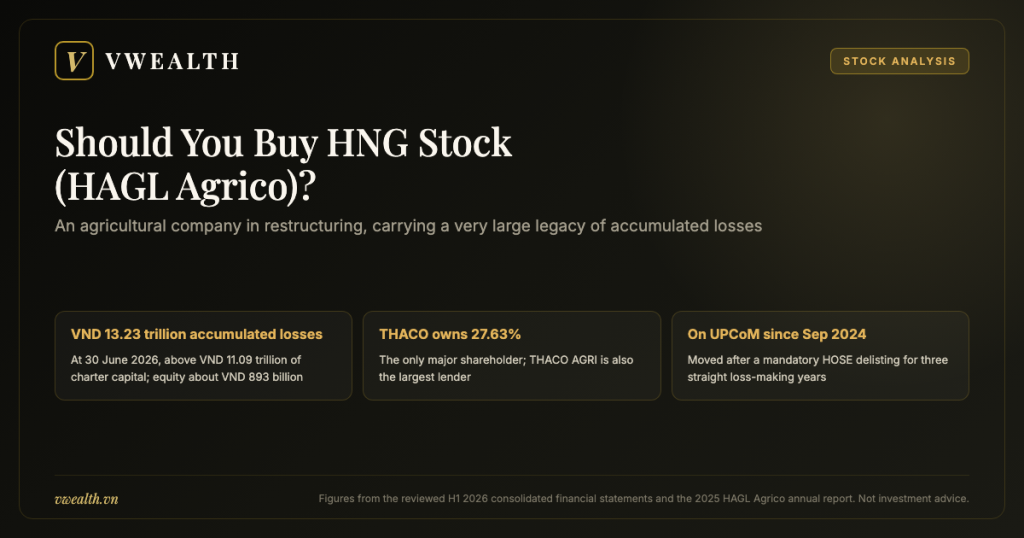
Should you buy HNG stock? HNG is the ticker of Hoang Anh Gia Lai International Agriculture Joint Stock Company, better known as HAGL Agrico, a plantation company whose shares have traded on Vietnam’s UPCoM market since 18 September 2024 after a mandatory delisting from the Ho Chi Minh City Stock Exchange (HOSE). The company sits on tens of thousands of hectares of farmland in Laos and Cambodia and has been run since 2021 by THACO, the industrial conglomerate founded by billionaire Tran Ba Duong. It also carries a decade of financial baggage: according to its reviewed consolidated interim financial statements, at 30 June 2026 HAGL Agrico had accumulated losses of about VND 13,231 billion — now above its charter capital of VND 11,086 billion — equity of only about VND 893 billion (still positive), current liabilities exceeding current assets by about VND 12,445 billion, and an auditor, Ernst & Young Vietnam, again drawing attention to a “material uncertainty” about its ability to continue as a going concern. Put simply, this is an agricultural company in the middle of a restructuring, dragging a very large legacy of losses behind it, and its risk profile is far above that of the typical Vietnamese listed company. This analysis is not meant to scare you away or to sell you a turnaround dream. It walks through each layer of the story so you can decide for yourself whether to buy HNG stock.
A note on sources and conventions, as with every company analysis in the vwealth series. Dates, names and financial figures come from published information: audited consolidated financial statements (via VNDirect’s public financial data), HAGL Agrico’s 2025 annual report (published in English), its H1 2026 corporate governance report, disclosures filed with HOSE and the Hanoi Stock Exchange (HNX), and coverage of shareholder meetings and company news on CafeF, one of Vietnam’s largest financial news sites. Where sources disagree, we say so. Any figure that vwealth derived by dividing or multiplying published numbers is labeled a “vwealth estimate.” We do not quote today’s share price, current price-to-book ratio, market capitalization or the latest quarterly result, because those change constantly; for current numbers, open the latest vwealth analysis report. Amounts are in Vietnamese dong (VND); as a rough guide, one US dollar has traded at roughly VND 25,000–26,000 in recent years.
If you are new to Vietnamese equities, our pillar guide on how to invest in the Vietnam stock market explains the basics used throughout this article: the three trading venues (HOSE, HNX and UPCoM), daily price limits, foreign ownership limits and T+2 settlement. If you have already read our analysis of HAG stock (Hoang Anh Gia Lai), you know this story from the side of the former parent company: Doan Nguyen Duc, widely known in Vietnam as “Bau Duc,” paying down debt, growing bananas and moving into coffee. This article deliberately looks at the other half of that separation — the company that went to THACO, taking with it most of the rubber and oil palm land bank and most of the debt. The two stocks share a history but have very different risk profiles.
From Bau Duc’s Rubber Venture to a THACO-Run Company: The History of HAGL Agrico
Most investors still think of HNG as HAG’s “little sibling.” That was accurate for the first decade. It has not been true since 2021. The history of HAGL Agrico is the story of a huge land bank that changed hands operationally three times: from Bau Duc’s rubber vision, through a period in which HAGL and THACO tried to rescue each other, to the current era in which THACO runs the company on its own. Each phase left a layer on the balance sheet that you can still see today, and understanding those layers is the only way to read HNG’s numbers correctly.
2010–2014: A Rubber Company and a Three-Country Land Bank
According to HAGL Agrico’s own 2025 annual report, the company began life as Hoang Anh Gia Lai Rubber Joint Stock Company, registered in Gia Lai province in the Central Highlands on 26 May 2010 with initial charter capital of VND 200 billion. The Hoang Anh Gia Lai group was then at the height of its fame, and rubber was seen as “white gold”: latex prices were high, Chinese tire demand was booming, and land in Laos and Cambodia could be leased for long periods at low cost. The new subsidiary was tasked with signing land lease contracts with the governments of both neighboring countries and planting rubber and sugarcane in Vietnam, Laos and Cambodia.
The pace of capital raising tells you how ambitious the plan was. Charter capital jumped from VND 200 billion in 2010 to VND 3,850 billion in 2011 and VND 3,991 billion in 2012. The company expanded into oil palm and cattle. According to the summary THACO presented to shareholders in 2021, the land bank at its peak reached about 84,000 hectares — roughly 8,900 ha in Vietnam, 27,376 ha in Laos and 47,724 ha in Cambodia — mostly for rubber and oil palm.
One feature of rubber explains almost everything that followed. It is a long-cycle crop: trees need about six to seven years of establishment before they can be tapped. During that period the company only spends money — on land rent, seedlings, fertilizer, labor and infrastructure — while earning almost nothing. Under Vietnamese accounting rules, those costs are capitalized as “construction in progress” on the balance sheet rather than expensed. Once a plantation starts producing, it is moved into fixed assets and depreciated every year. The model only works if latex prices at harvest are high enough to cover both upkeep and depreciation, and if the company has enough cash to survive the establishment years. HAGL Agrico later struggled on both counts.
The problem was timing. Global rubber prices peaked around 2011 and then fell for years. Trees planted at the top of the cycle reached tapping age when prices were low. To fund the expansion, the group borrowed heavily from banks and bond investors. That is the seed of the debt HAGL Agrico still carries: even in its 2025 annual report, the company explains that a large portion of its outstanding loans “relates to investments in rubber plantations from previous periods.”
2015–2017: A HOSE Listing, Rock-Bottom Rubber Prices and a Pivot to Fruit
In April 2015, the company adopted its current name, Hoang Anh Gia Lai International Agriculture Joint Stock Company. According to the general information section of its audited financial statements, its shares were listed on HOSE under Decision No. 278/QD-SGDHCM dated 10 July 2015, with the ticker HNG. Charter capital reached VND 7,081 billion that year. In Laos, HAGL was by then not only a farm investor but also a builder of infrastructure for the host government — a relationship HAGL Agrico would keep leaning on.
On paper, the first year as a listed company looked fine. Consolidated financial data show 2015 net revenue of about VND 4,731 billion and after-tax profit of about VND 744 billion, and the cash flow statement records about VND 83 billion of dividends paid — one of the very few cash dividends in the company’s history. But total liabilities at the end of 2015 were already about VND 17,222 billion, close to 1.75 times equity (vwealth estimate). A long-cycle plantation business carrying that much debt is highly exposed to any shock to prices or cash flow.
The shock came in 2016. Rubber prices were depressed, the sugar and beef cattle ventures were not paying off, and the entire HAGL group ran into a liquidity crisis. HAGL Agrico reported an after-tax loss of about VND 1,020 billion for 2016 (restated figure). At the end of that year, parent company HAG issued the HAGLBOND16.26 bond, with state-owned lender BIDV as bondholder, to restructure its debts (the bond is covered in detail in our HAG analysis). Crucially for HNG shareholders, many assets of HAGL Agrico and its subsidiaries — land and plantations in Laos and Cambodia — were pledged as collateral for the group’s obligations at BIDV. That tie would shape HNG’s fate for the next eight years.
Around the same time, Bau Duc made a big strategic turn: converting part of the rubber land and idle land to fruit. HAGL Agrico’s annual report describes how the company scaled back cattle, sold its sugarcane project and planted fruit trees on surplus land, mainly bananas, mangoes, jackfruit, pomelos and dragon fruit plus more than fifteen other varieties. The press at the time admired the “fruit basket” strategy; later, THACO’s management team would criticize it as spread too thin.
To keep going, HAGL Agrico repeatedly issued shares to swap for debt. Charter capital rose to VND 7,671 billion in 2016. By 2018 charter capital had reached VND 8,868 billion, equivalent to roughly 120 million more shares than in 2016 (vwealth estimate from the charter-capital history in the annual report). Every such deal diluted existing shareholders, but reduced cash repayment obligations. By mid-2018, according to THACO’s account at the 2021 shareholder meeting, HAGL Agrico had “lost liquidity seriously” and could no longer pay principal and interest when due; its oil palm estates were practically abandoned and more than half of its rubber trees were stunted because there was no money to maintain them.
2018–2019: THACO Arrives Through Convertible Bonds
In August 2018, Vietnam’s market watched one of the most talked-about deals of the year: Truong Hai Auto Corporation (THACO, now Truong Hai Group Corporation), the country’s largest private automaker, became a strategic partner of Hoang Anh Gia Lai. The partnership began on 8 August 2018, when HAGL Agrico’s total debt was reported at about VND 18,414 billion. THACO’s entry point into HAGL Agrico was convertible bonds plus shares: according to CafeF in August 2018, THACO planned to invest more than VND 3,800 billion through the two channels, equivalent to about 35% of the company. THACO also placed representatives on HNG’s management from the September 2018 shareholder meeting, and six former deputy CEOs were dismissed by the end of that year.
2019 was the year of the biggest asset restructuring. To raise cash for medium-term debts owed to BIDV and other banks, HAGL Agrico sold three subsidiaries to THACO’s agricultural arm (then called THADI, later Thagrico, now THACO AGRI): Dong Duong Rubber and Daun Penh in Cambodia and Trung Nguyen Rubber in Gia Lai, covering 22,462 hectares, for a combined VND 7,623 billion. According to THACO’s account in 2021, only about 2,287 ha of bananas and 333 ha of dragon fruit on that land were producing, while 14,171 ha of rubber had been abandoned and were not being tapped.
In August 2019 the convertible bonds were converted. HAGL Agrico issued 221.71 million new shares, of which THACO received about 221.69 million, lifting charter capital to VND 11,086 billion — where it has stayed ever since. After the conversion THACO owned 26.29% and became the second-largest shareholder behind HAGL; together with related parties, the THACO group held more than 35.5%. The HAGL group’s stake fell below 50%, the control threshold, although HAG said at the time that it remained the parent in control of HNG. Also in 2019, Tran Ba Duong personally bought HNG shares and then sold 37.7 million of them to Tran Oanh Trading and Production Co., Ltd., a related company (August 2019). THACO later raised its stake to 27.63%; at 30 June 2026, together with Mr. Duong’s 4.58% and Tran Oanh’s 4.96%, the related group held about 37.17% (vwealth estimate from disclosed figures).
Fresh capital did not prevent a heavy loss. Net revenue in 2019 fell to about VND 1,811 billion because three sold subsidiaries were no longer consolidated, and the net loss attributable to shareholders of the parent was about VND 2,426 billion, driven mainly by write-downs of underperforming assets and plantation conversion costs. The review report on the 2019 interim financial statements also contained a qualified opinion over the reversal of a tax provision related to Decree 20/2017 on related-party transactions. Earlier, from 9 April 2019, HOSE had already placed HNG on its “warning” list, and the back-to-back losses of 2018 and 2019 kept weighing on the stock’s trading status.
2020–2021: A Profit From Selling Subsidiaries, Then THACO Takes the Wheel
2020 stands out in HNG’s books as the only profitable year between 2018 and 2025. But you need to know where that profit came from. According to the consolidated financial statements, 2020 gross profit was only about VND 147 billion, while financial income reached about VND 1,019 billion — mostly tied to gains on selling subsidiaries to THACO — leaving an after-tax profit of about VND 21 billion. In other words, without that “selling the furniture” gain, 2020 would also have been a loss year. The thin profit broke the losing streak, which is why it took the 2021–2023 losses to trigger a mandatory delisting.
The plan the two groups had worked out had two parts. First, THACO’s farming arm would buy four more subsidiaries owning land in Koun Mom (Cambodia), Dak Lak and Gia Lai — 20,744 hectares for VND 9,095 billion. Second, HAGL Agrico would keep about 35,749 ha in Laos and northern Cambodia to develop on its own. According to THACO, the deal was meant both to fund the rescue of deteriorating banana farms and to book a profit for HNG.
The deal ran into a legal knot: the land-use certificates of the companies being sold were pledged as collateral for the HAGL group’s debt at BIDV. The buyer had paid but could not receive the land titles. According to coverage of HNG’s 2021 shareholder meeting, because HAGL and HAGL Agrico could not agree with the bank on repaying enough debt to release the collateral, THACO ended up taking over the management of HAGL Agrico itself. At an extraordinary shareholder meeting on 8 January 2021, the board was reshaped and Tran Ba Duong became chairman of HNG. On 18 March 2021, Tran Bao Son, then a board member and CEO of Thagrico, was appointed HNG’s general director. Doan Nguyen Duc stepped back to vice chairman.
At the same time, HAG began selling down its HNG stake to repay its own debts. Filings show HAG sold HNG shares in several tranches during 2021 and 2022, and kept reducing its stake in later years.
This is also when the episode many investors remember as “THACO pulling out” happened. On 23 July 2021, HNG announced that Thagrico had stopped its plan to subscribe for 741.5 million new HNG shares in a private placement — a plan approved by an extraordinary shareholder meeting to swap most of HNG’s debt to THACO’s farming arm into equity. Thagrico cited the fact that, more than two years on, it still had not received the land titles of the companies it bought in 2019, as well as COVID-19 disruptions. The distinction matters: THACO stopped buying newly issued shares; it did not exit HNG. The parties quickly renegotiated. According to HNG, BIDV committed to return three land titles, Thagrico agreed to lend another VND 600 billion, and the two sides offset receivables and payables, leaving HNG owing Thagrico about VND 1,265 billion as of 30 June 2021. Because the 741.5-million-share placement never happened, HNG’s charter capital stayed at VND 11,086 billion and THACO remained primarily a large creditor rather than an outright majority shareholder. The “major shareholder that is also the major lender” structure dates from here.
2022–2024: Cleaning the Books, a Record Loss and Leaving HOSE
2022 brought the largest loss in HNG’s history: about VND 3,576 billion attributable to the parent. The company’s explanations and shareholder meeting coverage point to several layers at once. First, write-offs of plantation conversion costs accumulated up to 2020 — the 2022 plan estimated about VND 2,563 billion for 8,426 ha of rubber, 1,449 ha of oil palm, 609 ha of dragon fruit and 2,517 ha of other fruit trees. Second, a sharp, inflation-driven fall in the Lao kip, creating large foreign exchange losses on revalued debts; in October 2022 the company said it was switching the accounting currency of its Lao subsidiaries to a single international currency to limit the damage. Third, soaring costs for fertilizer, materials and shipping, labor shortages in Laos during COVID restrictions, and about VND 237 billion of damage from Typhoon Noru. The new management’s approach was to push costs that had been parked on the books through the income statement and rebuild from the ground up, accepting several years of heavy losses.
In August 2022, HAG, HNG and BIDV signed a tripartite agreement to separate their assets: HNG group assets would be released from HAG’s 2016 bond obligations in exchange for HNG repaying a set amount on a schedule. In May 2022 Bau Duc sold all the HNG shares he still held personally, and HAG kept cutting its stake through several sales.
Three consecutive annual losses — 2021, 2022 and 2023, of about VND 1,119 billion, VND 3,576 billion and VND 1,098 billion respectively — triggered the mandatory delisting rule in Article 120 of Decree 155/2020/ND-CP. HOSE issued its delisting decision on 9 August 2024; the last trading day on HOSE was 5 September and the delisting took effect on 6 September 2024. On 18 September 2024, all 1,108,553,895 HNG shares began trading on UPCoM, the venue for unlisted public companies operated by HNX. At the 2024 shareholder meeting, Tran Ba Duong had said transparency was what mattered, and that even on UPCoM the share price could rise if the business performed.
On 31 December 2024, HNG announced it had completed its obligations under the tripartite agreement, paying a total of VND 4,228 billion — VND 2,094 billion directly on BIDV loans and VND 2,134 billion to HAG in connection with the 2016 bond — and no longer owed HAG anything. In return, HNG received back, in four tranches, use and exploitation rights over more than 32,500 hectares of industrial crop land, including over 8,500 ha of oil palm and over 24,000 ha of rubber held by its subsidiaries in Cambodia and Laos, which had previously been pledged. These were the company’s own subsidiaries’ assets being released from collateral, not newly purchased land. Also in 2024, according to its financial statements, HNG’s total borrowings rose about 21% to nearly VND 9,950 billion, of which about VND 9,065 billion came from THACO AGRI — a detail you will see again in the financial section.
2025–2026: Bau Duc Leaves the Board, HAG Sells Out, THACO Stands Alone
2025 cut the last ties to the old parent. According to the 2025 financial statements, Doan Nguyen Duc stepped down as vice chairman of HNG on 25 April 2025; on the same day two other members, Nguyen Hoang Phi and independent member Nguyen Phuc Thinh, left the board, and Vo Thi My Hanh was appointed as a non-executive member. In January 2026, HAG sold its remaining 91.38 million HNG shares, or 8.24% of the company, in negotiated trades; local press reported proceeds of nearly VND 594 billion. From then on, HAG and HNG had no ownership link.
Operationally, HNG booked 2025 net revenue of VND 678 billion, up 38% from 2024, but still lost VND 987 billion after tax — its fifth consecutive annual loss. The 2025 shareholder meeting had approved a planned pre-tax loss of VND 854 billion, with the core business expected to make a small profit and most of the loss coming from destroying plantations for conversion and depreciation of plantations and infrastructure. The actual pre-tax loss was about VND 980 billion, roughly 115% of the planned loss. On 3 December 2025, according to the annual report, the Lao government granted HAGL Agrico a concession agreement and a state land lease for its Southern Laos subsidiary covering rubber, bananas, pineapples, mangoes, pomelos, durians, grass, livestock and processing plants in Sekong and Attapeu provinces; the surveyed cultivation area in Laos was expanded from 27,383 ha to 31,292 ha.
At the April 2026 annual meeting, HNG set a 2026 target of VND 1,676 billion in net revenue and VND 232 billion in pre-tax profit — the first profit target in years. Planned 2026 capital spending was about VND 3,664 billion, including about VND 1,769 billion for bananas. During the discussion, management said it was considering a private placement of about 20% of the company’s shares to two strategic investors, described as long-term investment funds, at a price to be set by the investors’ own valuation. Note, however, that none of the twelve items voted on in the 2026 AGM resolution covered a share issue, so at the time of writing this is an intention, not an approved plan. Tran Ba Duong said the company would need about three to four years to deal with its accumulated losses and stated there was no plan to merge HNG into THACO AGRI. In early July 2026, the board reappointed Tran Bao Son as general director for 2026–2030 (from 1 July 2026), and on 6 July 2026 it approved merging two Lao subsidiaries, Hoang Anh Quang Minh Rubber and Hoang Anh Attapeu Agricultural Development, into the Southern Laos company; by late August 2026 the merger was still being completed.
Then came the half-year results. In July 2026, the company’s self-prepared Q2 report showed a consolidated after-tax profit of about VND 27.3 billion — its first profitable quarter in years — mainly because it had capitalized more borrowing costs into projects. But when Ernst & Young reviewed the six-month accounts, it accepted capitalization of only about VND 204 billion of the VND 431 billion of interest incurred; the remaining roughly VND 227 billion had to be expensed. The result: the six-month 2026 after-tax loss went from about VND 34.8 billion (self-prepared) to about VND 186.8 billion after review, even though net revenue rose about 33% to more than VND 289 billion and the loss was smaller than in the same period of 2025 (about VND 259 billion). Shortly afterwards, in early September 2026, the chief accountant resigned and the company appointed a replacement.
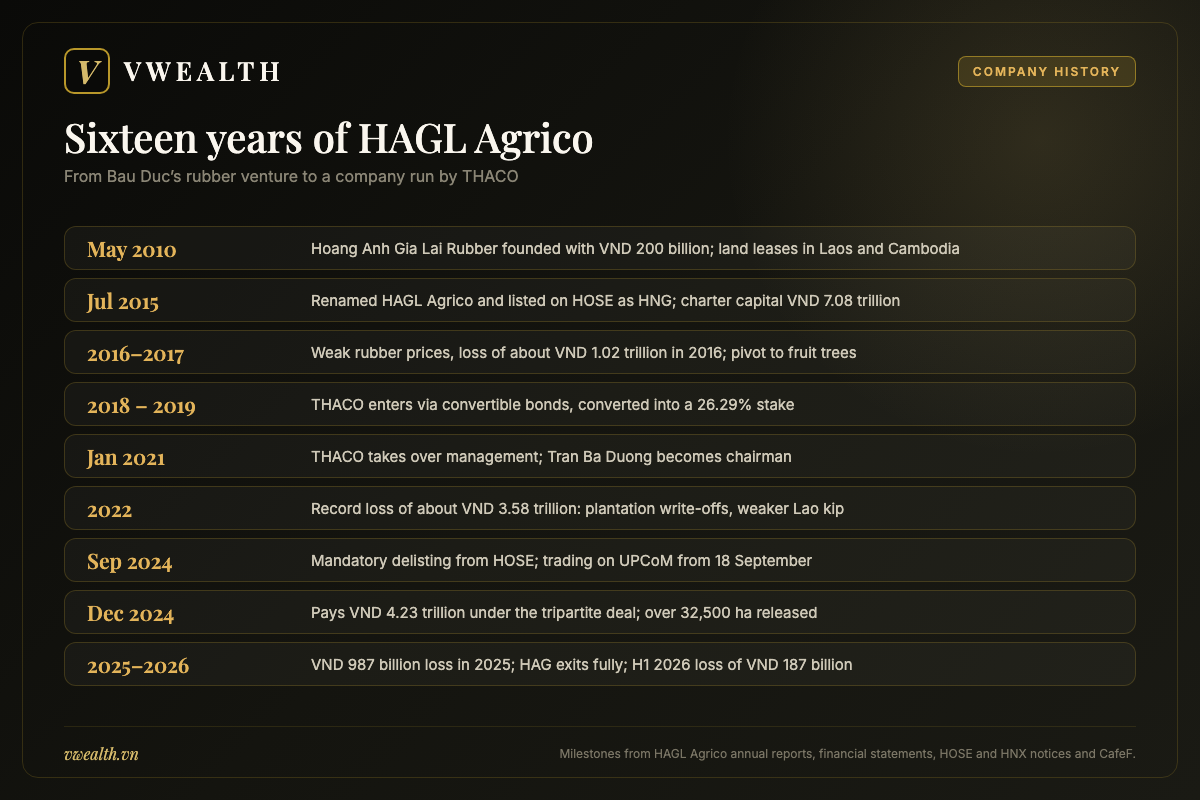
If you had to compress sixteen years into one sentence: HAGL Agrico was born as a debt-funded rubber machine, was knocked down by the rubber price slump and a group-wide liquidity crisis, was rescued with THACO’s money and eventually had to hand THACO the keys, and is now using loans from the THACO ecosystem to convert its land to bananas and cattle. The table below summarizes the key milestones.
| Date | Event | What it meant for shareholders |
|---|---|---|
| 26 May 2010 | Hoang Anh Gia Lai Rubber JSC founded with VND 200 billion | Start of a debt-funded rubber model across three countries |
| Apr–Jul 2015 | Renamed HAGL Agrico; listed on HOSE (decision dated 10 July 2015) | HNG joins the main board |
| 2016 | Loss of about VND 1,020 billion; HAGL 2016 bond with BIDV; pivot to fruit | HNG assets tied to group debt |
| Aug 2018 | THACO signs a strategic partnership, planning to invest over VND 3,800 billion via HNG convertible bonds and shares | A strategic investor appears |
| 2019 | Three subsidiaries (22,462 ha) sold to THACO’s farming arm; bonds converted, capital reaches VND 11,086 billion | THACO 26.29%, THACO group over 35.5% |
| 2020 | VND 21 billion profit thanks to financial income from subsidiary sales | Losing streak broken, but not by farming |
| Jan–Mar 2021 | Tran Ba Duong becomes chairman; Tran Bao Son becomes general director | THACO formally runs the company |
| 23 Jul 2021 | Thagrico drops plan to buy 741.5 million new shares | Capital stays at VND 11,086 billion; THACO mainly a lender |
| 2022 | Loss of about VND 3,576 billion; tripartite HAG–HNG–BIDV agreement | Conversion costs written off; asset separation begins |
| Sep 2024 | Mandatory delisting from HOSE; UPCoM trading from 18 September | Wider price band, no margin lending, lower visibility |
| 31 Dec 2024 | VND 4,228 billion paid under the tripartite deal; over 32,500 ha released | Assets freed; debt shifts to a related party |
| 25 Apr 2025 | Doan Nguyen Duc leaves the board | End of the founder’s role |
| Jan 2026 | HAG sells its last 8.24% | THACO is the only major shareholder |
| Apr 2026 | VND 232 billion pre-tax profit target; management floats a placement of about 20% of shares (no resolution yet) | Turnaround goal; possible dilution |
| Jul–Sep 2026 | Two subsidiaries merged into Southern Laos; reviewed H1 2026 loss of about VND 187 billion; accumulated losses VND 13,231 billion | Accumulated losses above charter capital; equity about VND 893 billion |
Leadership and Ownership: THACO Holds 27.63% and Plays Several Roles at Once
At most listed companies, asking “who is the major shareholder” tells you who sets strategy. At HNG, the question matters much more, because the largest shareholder is also the largest lender, a major customer, a supplier of materials, and the party that has pledged financial support so the company can keep operating. Understanding this relationship is the key to understanding both the risks and the potential of HNG stock.
Chairman Tran Ba Duong and a Management Team From THACO
Tran Ba Duong, born in 1960, has chaired Truong Hai Group Corporation (THACO) since 2007, according to the biography in HNG’s annual report, and has chaired HAGL Agrico since 8 January 2021. For investors, his name is associated with cars, engineering, real estate and, more recently, large-scale agriculture in Laos and Cambodia. In 2024 he said THACO had spent about VND 8,000 billion initially and had to put in roughly another VND 12,000 billion to restructure HAGL Agrico. Even so, HAGL Agrico is just one piece of THACO’s wider agricultural ecosystem in Laos and Cambodia.
Day-to-day management is led by Tran Bao Son, born in 1973, a mechanical engineer who has worked at THACO since 1997. He has been HNG’s general director since 18 March 2021 and is also general director of Truong Hai Agriculture JSC (THACO AGRI). In July 2026 the board reappointed him for a term ending 30 June 2030. The deputy general director since August 2025, Phan Ba Cuong, has worked at THACO since 2008 and is also a deputy general director of THACO AGRI.
In early 2026, HNG’s board still had three members: Tran Ba Duong, Tran Bao Son and Vo Thi My Hanh — HNG’s general director in the Bau Duc era and the last face linked to the HAG side. The only independent director had left the board in April 2025. In April 2026, after HAG had fully exited, Ms. Hanh resigned, and the 24 April 2026 meeting elected Bui Minh Khoa — previously head of the supervisory board, with an accounting background inside the THACO ecosystem according to his annual-report biography — as a non-executive director. The supervisory board also changed two members: Tran Thanh Duy became its head and Nguyen Xuan Viet a member, alongside Bui Thi Lieu, who has worked at Truong Hai Group since 2007. By the H1 2026 report, therefore, neither the board nor the supervisory board included anyone from the HAG side, and the board had no independent director.
This cuts both ways. On the positive side, management and the major shareholder are aligned, decisions are fast, and HNG can draw on group resources — from mechanized equipment, materials and packaging to sales channels. On the other side, when nearly everyone who oversees and runs the company comes from the same ecosystem, minority shareholders have little independent voice in transactions between HNG and THACO companies. This is not an allegation of wrongdoing; it is a governance feature that minority investors should factor into the risk they are taking.
Ownership Structure: One Major Holder and More Than 21,000 Small Ones
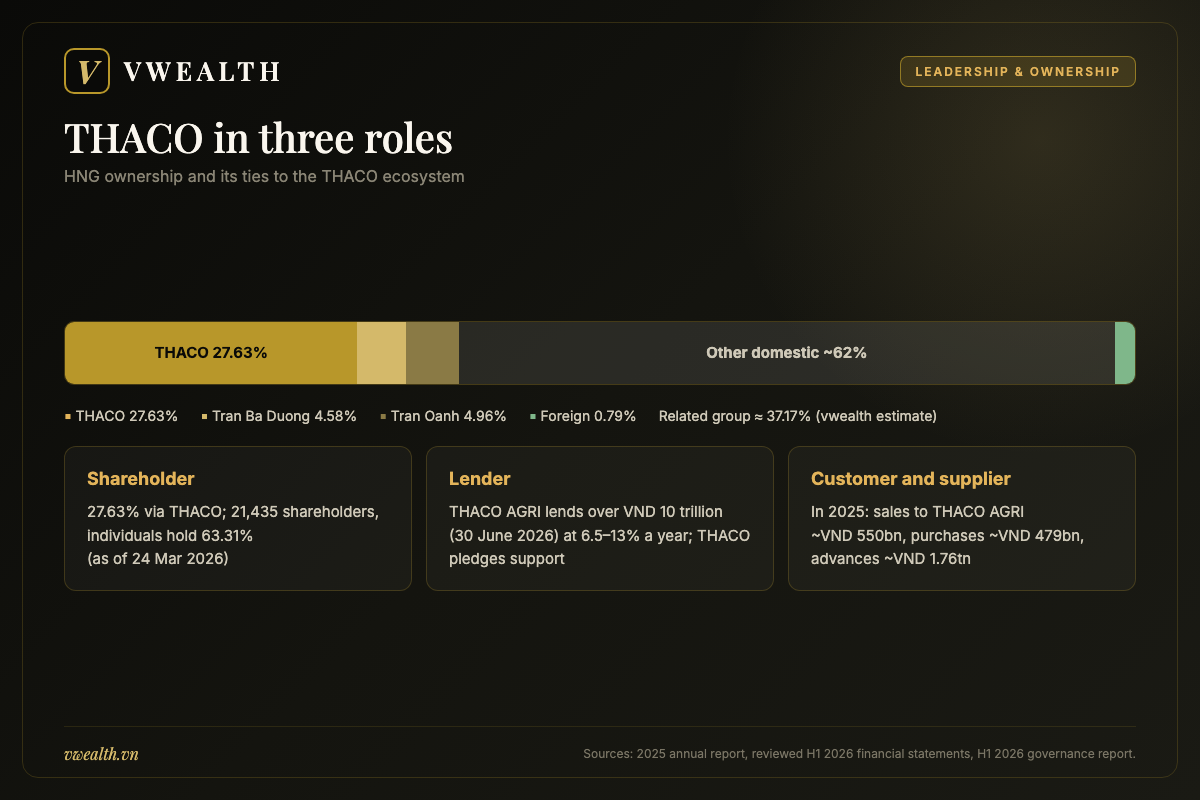
According to the shareholder register compiled by the Vietnam Securities Depository and Clearing Corporation as of 24 March 2026 and presented in the 2025 annual report, HNG has 1,108,553,895 common shares, no treasury shares and 21,435 shareholders. The only major shareholder (5% or more) is Truong Hai Group Corporation, with 306,346,880 shares, or 27.63%. The H1 2026 corporate governance report lists additional holders related to the chairman: Tran Ba Duong personally holds 50,760,000 shares (4.58%) and Tran Oanh Trading and Production Co., Ltd. holds 54,980,000 shares (4.96%). Adding these up, the group related to Mr. Duong controls about 37.17% (vwealth estimate from published figures).
| Shareholder / group | Shares | Stake | Source, date |
|---|---|---|---|
| Truong Hai Group Corporation (THACO) | 306,346,880 | 27.63% | 2025 annual report, register as of 24 Mar 2026 |
| Tran Ba Duong (chairman) | 50,760,000 | 4.58% | H1 2026 governance report |
| Tran Oanh Trading and Production Co., Ltd. (related entity) | 54,980,000 | 4.96% | H1 2026 governance report |
| Related group total | 412,086,880 | about 37.17% | vwealth estimate |
| All domestic institutions | 397,874,557 | 35.9% | 2025 annual report |
| Domestic individuals | 701,878,847 | 63.31% | 2025 annual report |
| Foreign investors | 8,800,491 | 0.79% | 2025 annual report |
Two things stand out. First, nearly two-thirds of HNG shares are held by Vietnamese retail investors, which explains why the stock reacts so sharply to news, as we discuss in the market section. Second, the “domestic institutions” line consists of just 23 institutions, and most of its 35.9% belongs to THACO and Tran Oanh. At the 24 April 2026 meeting, only 77 shareholders attended in person or by proxy, representing about 65.25% of voting shares — meaning the voice of more than 21,000 small shareholders was almost absent where decisions were made.
That stake has barely moved for years: a governance report cited in mid-2024 already showed THACO at 27.63% and Tran Oanh at 4.96%, and the figures were unchanged at 30 June 2026 (at the 2022 shareholder meeting, Tran Ba Duong once said the group held “over 38%,” possibly on a different aggregation basis; conversely, some outlets add only THACO and Mr. Duong and arrive at about 32.2%). In other words, after more than five years running HNG, the THACO group has barely added equity; additional support has flowed mainly through loans. That choice matters. A lender earns interest and ranks ahead of shareholders if things go wrong; an equity holder bears the risk last. If the 2026 private placement of about 20% goes to outside investors, the THACO group’s percentage will fall unless it also participates.
THACO’s Three Roles: Shareholder, Lender and Customer
It helps to picture the relationship between HNG and the THACO ecosystem as three ropes running side by side.
The first rope is equity: 27.63% through the parent THACO, plus the related holdings described above.
The second rope is debt. According to CafeF’s summary of the 2025 financial statements, THACO AGRI is HNG’s largest lender, with about VND 9,577 billion outstanding at interest rates of 6.5% to 8.5% a year. HNG’s total borrowings at the end of 2025 were about VND 10,448 billion according to the annual report, meaning roughly 92% of its borrowings come from one related party (vwealth estimate). At the 2025 meeting, Tran Ba Duong himself said that of about VND 15,000 billion of liabilities at the time, bank debt was only about VND 1,200 billion, and THACO was carrying the remaining roughly VND 12,000 billion. The VND 9,577 billion and VND 12,000 billion figures measure different things — one is loans outstanding, the other a broad description of liabilities — so do not add or subtract them.
By 30 June 2026, according to the reviewed half-year report, loans from THACO AGRI had passed VND 10,000 billion: about VND 3,932 billion of unsecured short-term loans (6.5–8% a year, maturing between December 2026 and June 2027) and about VND 6,105 billion of unsecured long-term loans (7.7–13% a year, with maturities out to March 2031), of which about VND 5,133 billion is the current portion due within 12 months. Total borrowings were then about VND 10,863 billion, so THACO AGRI’s share remained around 92% (vwealth estimate); the only significant commercial bank loan left, according to CafeF, was about VND 500 billion from TPBank, secured on land-use rights and assets in Cambodia. That is why every question about HNG’s liquidity ultimately comes down to one: will THACO keep rolling the debt over?
The third rope is trade. According to the related-party transaction table in the 2025 annual report, during 2025 HNG sold goods and services worth about VND 550 billion to THACO AGRI, bought materials and goods worth about VND 479 billion from it, received about VND 1,765 billion in customer advances from it, recorded about VND 736 billion of interest expense with it and drew about VND 513 billion of new loans. HNG also bought goods and fixed assets from several other THACO group companies. In the first half of 2026, according to CafeF’s summary of the reviewed report, about 82.8% of HNG’s net revenue came from sales to THACO AGRI; THACO AGRI’s advances for future fruit purchases reached about VND 3,755 billion (VND 939 billion short-term and VND 2,816 billion long-term); and interest expense payable to THACO AGRI over the six months was about VND 389 billion.
The VND 736 billion interest figure is worth a closer look, because the consolidated income statement for 2025 shows interest expense of only about VND 415 billion. Under Vietnamese accounting standards, interest on loans that finance assets under construction — immature plantations, infrastructure being built — may be capitalized into those assets instead of being expensed immediately. The gap comes from capitalizing part of the interest into construction in progress. The 2026 half-year report shows how large this is: of about VND 431 billion of interest incurred in the first six months, the company initially capitalized about VND 335 billion and expensed only VND 96 billion; after review, EY accepted capitalization of only about VND 204 billion, and about VND 227 billion had to be expensed. So the true cost of borrowed money is far larger than what appears in the income statement, and the capitalized part will come back through depreciation once plantations and cattle farms start producing. For HNG, the “interest expense” line is heavily shaped by accounting choices — always look at total interest incurred in the notes.
As for commitments, in the going-concern note (in both the 2025 and H1 2026 reports), HNG states that Truong Hai Group Corporation, its major shareholder, has committed to provide the additional financing needed and to extend its receivables from HNG as they fall due. That commitment is what keeps the company standing — and it is also HNG shareholders’ single biggest dependency.
Related-Party Transactions: Shareholder Questions and the Company’s Answers
Two-way trade with THACO AGRI has been questioned publicly by shareholders. At the 2025 meeting, a shareholder pointed to 2024, when THACO AGRI bought about VND 391 billion of goods from HNG while HNG bought about VND 368 billion back from THACO AGRI. According to CafeF’s report, Tran Ba Duong replied that there was no profiteering and that purchase and sale contracts are sometimes used as a way to channel funding to HNG when direct investment or money transfers face legal or regulatory obstacles. He added a line widely quoted in the Vietnamese press: if HNG fails, THACO is the one that loses money — “eating HAGL Agrico is eating ourselves.”
Another long-running question concerned “selling below cost”: from 2021 to 2024, HNG’s gross profit was negative every year, deepest in 2022 at about VND 971 billion negative. The company attributed this to high depreciation (for rubber, depreciation was about 60% of cost of goods sold), low yields due to labor shortages, weather and disease, and a high rate of banana bunches that had to be discarded. Mr. Duong rejected the idea of selling below cost at the product level, arguing that if production costs are measured properly, products such as bananas are profitable, while the reported losses come from plantation write-offs and financing costs included in cost of sales. From Q1 2025, HNG’s gross profit turned positive again; for full-year 2025 it was about VND 151 billion.
The sensible approach for an outside investor is not to reach conclusions on behalf of regulators or auditors, but to track three verifiable indicators. First, whether prices charged to THACO AGRI are comparable to prices for independent customers — rarely disclosed in full, but gross margins by segment are an indirect signal. Second, the interest rate on THACO AGRI loans versus what banks would charge a borrower with a similar profile — the disclosed 6.5–8.5% a year is not high by recent Vietnamese commercial lending standards. Third, the auditor’s view: for 2025 the audit opinion was unqualified, with no exception on this issue.
Dividends, Dilution and Minority Shareholder Rights
HNG has not paid a dividend since 2016, and legally it cannot pay one while it has accumulated losses. With accumulated losses of about VND 13,231 billion at 30 June 2026 — while Tran Ba Duong’s “three to four years” estimate was made in April 2026, when the book figure was about VND 10,400 billion — you should treat dividends as a very distant possibility at best. The 2026 AGM resolution also states plainly: no dividend. If you want steady income, HNG is not the right stock.
Dilution, on the other hand, is much closer. HNG’s history shows repeated share issuance to swap debt or convert bonds: in 2016, early 2018 and August 2019. The 2026 plan — a private placement of about 20% of shares to two strategic investors — would, if carried out, increase the share count, and its effect on existing shareholders will depend on the issue price relative to book value and the market price at the time. The outlook section includes an illustrative calculation.
One positive on transparency: even on UPCoM, HNG continues to publish a full annual report in both Vietnamese and English, quarterly financial statements, governance reports and board resolutions approving related-party transactions, as required. Its auditor is Ernst & Young Vietnam, part of one of the Big Four audit networks.
Core Businesses: Rubber Pays the Bills, Bananas and Cattle Are the Bet
If you only follow the headlines, you might think HNG is a “banana company.” The 2025 numbers tell a different story: the largest revenue line is still rubber, the legacy crop the company is gradually trying to replace. This section goes through each business so you can see which part is cash flow today, which part is tomorrow’s hope, and which part is still just a plan on paper.
The Land Bank in Laos and Cambodia: Foundation and Burden
HNG’s core asset is the right to use and farm agricultural land under lease and concession agreements with the governments of Laos and Cambodia. According to reports of the 2021 shareholder meeting, after THACO took over, HNG retained about 35,749 ha, most of it in Laos (about 27,400 ha) and the rest in northern Cambodia. In 2025, the company worked with the Lao government to resurvey and expand the cultivated area in Laos from 27,383 ha to 31,292 ha, as recorded in the concession agreement signed on 3 December 2025.
A large land bank sounds like an obvious advantage for a farming company, but read two more details. First, this is leased or concession land with fixed terms in foreign countries, subject to local land law, taxes and policy; it is not an asset that can be sold like industrial park land in Vietnam. Second, much of it was previously planted with rubber and oil palm, so turning it into banana farms or pasture means clearing old trees, re-working the soil, and building irrigation and power — each step costs money and creates plantation write-off charges in the income statement. According to Tran Ba Duong at the 2025 meeting, the “burden” of conversion costs and depreciation is currently more than VND 200 million per hectare.
Remember also the more than 32,500 ha of rubber and oil palm released from collateral at the end of 2024. Regaining those rights lets HNG include the land in its conversion plans or pledge it for new borrowing, but it does not generate revenue by itself. There is no separate palm oil line in the 2025 revenue breakdown.
Rubber: The Biggest Revenue Line in 2025, With a Heavy Depreciation Load
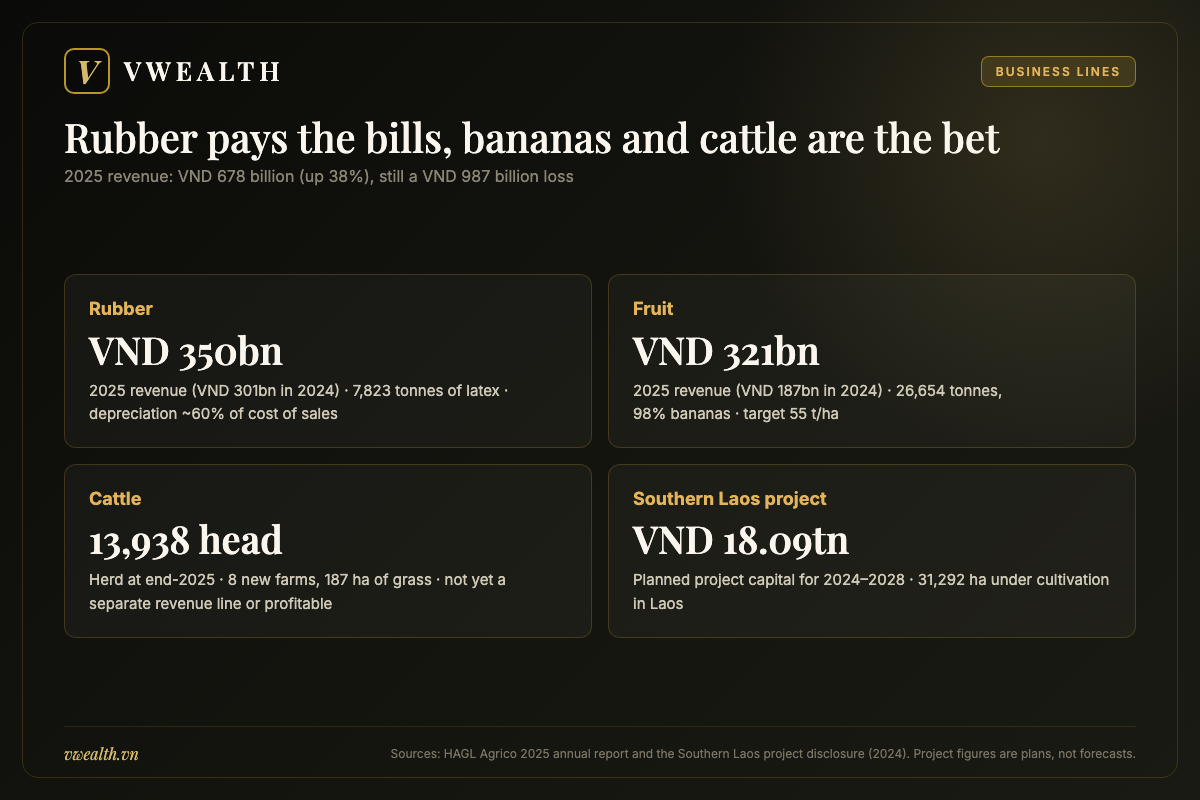
According to the 2025 annual report, rubber generated about VND 350 billion of revenue, up 16% from VND 301 billion in 2024, on latex output of about 7,823 tonnes. Dividing one by the other gives an average selling price of about VND 44.7 million per tonne (vwealth estimate). For comparison, our analysis of GVR stock (Vietnam Rubber Group) notes that GVR’s average latex selling price was about VND 52 million per tonne in the first half of 2025. The gap could reflect product mix, markets and delivery timing, so do not treat it as a direct efficiency measure, but it suggests HNG has no pricing edge in this business.
HNG’s rubber problem is on the cost side. The company says depreciation makes up about 60% of the cost of goods sold for rubber. According to its Q3 2024 report, the total area of mature rubber plantations was 15,192 ha, but only about 4,932 ha could be tapped efficiently; accounting standards require depreciation on all plantations recognized as fixed assets, including those not being harvested. Put simply, HNG pays depreciation on about 15,000 ha but collects latex from about 5,000 ha. At the 2025 meeting, management said there were still more than 13,000 ha of rubber; the 2025 plan was to tap about 5,538 ha and convert about 3,832 ha of rubber to bananas and a cattle-plus-pomelo model.
Why not convert everything at once? Because every hectare of rubber that is cut down turns the remaining book value of those trees into an expense in that year. The faster the conversion, the bigger that year’s accounting loss; the slower the conversion, the longer the company carries depreciation on unproductive trees. This is HNG’s central dilemma, and the roughly VND 747 billion of “conversion” costs in 2025 is the price of choosing the faster path.
Bananas: The Growth Engine Management Is Betting On
In THACO’s strategy for HNG, bananas are the lead crop. In 2025, fruit revenue was about VND 321 billion, up 72%; fruit output was about 26,654 tonnes, of which bananas accounted for 26,172 tonnes, or about 98%. The 2025 plan called for planting 2,026 new hectares and harvesting about 1,117 ha; the 2026 target is about 3,000 ha of bananas. The 2026 investment budget for bananas is about VND 1,769 billion, almost half of total planned capital spending.
Bananas were chosen for their short cycle: from planting to the first harvest typically takes around nine to twelve months, far faster than the six to seven years for rubber. They generate cash year-round and have a large export market right across the border in China. At the 2025 meeting, Tran Ba Duong said grade-A banana export prices were close to US$13.5 per carton, and that the company needed yields of 55 tonnes per hectare, aiming for 70, and banana revenue above VND 200 million per hectare to offset the losses.
You can use the company’s own numbers to check progress. Dividing 2025 fruit revenue by output gives an average price of about VND 12 million per tonne, or roughly VND 12,000 per kilogram (vwealth estimate). At 55 tonnes per hectare, revenue per hectare would be about VND 660 million; to clear the VND 200 million per hectare threshold Mr. Duong mentioned, HNG would need an actual yield of at least roughly 17 tonnes per hectare at that price (illustrative example, vwealth estimate). Note that this is revenue, before the costs of planting, maintenance, packing and transport; the VND 200 million threshold is a condition for absorbing the conversion burden, not a full break-even point. It sounds achievable, but history shows this is exactly where HNG has stumbled: in Q3 2024, harvested banana area fell from 1,920 ha to 494 ha because old plantations were no longer productive and had to be taken out of production and replanted; in 2022–2023, the company repeatedly reported high rates of banana bunches discarded in the field because of labor shortages and disease. Actual yield on harvested area is the single most important number to watch each quarter.
Cattle, Mangoes, Pomelos, Durians and the “Circular” Farming Model
The third business is cattle farming combined with fruit trees, in what THACO calls an “integrated, circular, organic-based” model: banana by-products and grass feed the cattle, manure becomes organic fertilizer for the orchards, and the output of one step becomes the input of the next. According to the 2025 annual report, the company completed eight more cattle farms and planted 187 ha of new grass during the year; the herd reached 13,938 head at the end of 2025. At the 2025 meeting, general director Tran Bao Son said the plan was to build a breeding herd of about 16,700 cows and that the cycle from importing cows to calving and fattening takes about three years; he acknowledged the cattle business was “not yet profitable” and would only earn money once fattened cattle were sold.
The 2025 revenue breakdown has no separate line for cattle — revenue is mostly rubber and fruit, with about VND 6 billion from services and VND 1 billion from other products. That means the entire cost of building farms, buying cattle and planting grass currently sits on the balance sheet as construction in progress or biological assets, waiting to generate revenue.
Other fruit such as mangoes and pomelos contributed very little: only about 482 tonnes in 2025. Durians and pineapples appear in the crop list for the Southern Laos project and in the concession agreement with the Lao government, but they are not yet meaningful revenue sources. If you see HNG promoted as a “durian stock,” remember that as of the 2025 results, durian is a target in a long-term plan.
The VND 18 Trillion Southern Laos Project: Plans Versus Reality
In early 2024, HNG shareholders approved a large-scale fruit-and-cattle project in Attapeu and Sekong provinces, to be carried out by a wholly owned subsidiary, the Southern Laos Agricultural Investment and Business Production Company. According to the disclosure at the time, the project covers 27,384 ha with total investment of VND 18,090 billion (about US$750 million), including about VND 9,650 billion of equity and about VND 8,440 billion of debt, with investment to be completed between 2024 and 2028. Once finished, the company projected around 624,000 tonnes of fresh fruit exports a year (including 500,000 tonnes of bananas), revenue of about VND 13,500 billion and profit of about VND 2,450 billion a year.
Read these numbers for what they are: projected results in a project filing, not a vwealth forecast or a profit commitment. Set against 2025 reality — about 26,654 tonnes of fruit and VND 678 billion of total revenue — the gap is enormous: fruit output would need to grow more than twentyfold (vwealth estimate). Moreover, “equity of VND 9,650 billion” for the project, when consolidated equity at the end of 2025 was only about VND 1,045 billion, implies that in practice the parent’s capital contributions to the subsidiary must come from borrowing — again largely from THACO AGRI — or from issuing new shares.
The 2025 annual report mentions a proposal for a bonded warehouse to support agricultural exports, and the 2026 investment plan approved by shareholders allocates about VND 142 billion to factories, cold storage and bonded warehouses, about VND 104 billion to mechanization and transport, and about VND 106 billion to housing and welfare facilities. These are worth watching, but there are no revenue figures yet to evaluate.
One more number matters here: according to the notes to the 2026 half-year report, at 30 June 2026 HNG had a USD 400 million commitment to contribute capital to the Southern Laos company for the Attapeu–Sekong project. In other words, most of the equity funding for the project still lies ahead, while consolidated equity was only about VND 893 billion. That money will again have to come from borrowing (mostly from THACO AGRI), customer advances or new share issues — a direct link between the project and the dilution risk discussed in the ownership and scenario sections.
Which Business Feeds Which, and Where Is HNG’s Moat?
| Segment | 2024 revenue (VND bn) | 2025 revenue (VND bn) | 2025 output | Current role |
|---|---|---|---|---|
| Rubber | 301 | 350 | 7,823 tonnes of latex | Largest revenue source, heavy depreciation, gradually shrinking |
| Fruit (mostly bananas) | 187 | 321 | 26,654 tonnes (26,172 t bananas) | Growth engine, needs heavy investment |
| Services | 3 | 6 | — | Negligible |
| Other products | 1 | 1 | — | Negligible |
| Cattle | Not reported separately | Herd of 13,938 at end-2025 | Still investing; not yet profitable per management | |
| Total | 492 | 678 | — | Up 38%, still a VND 987 bn loss |
Source: HAGL Agrico 2025 annual report. The answer to “which business feeds which” is clear: right now, no business can feed the whole company. Rubber and bananas together generated about VND 670 billion of revenue, while 2025 interest expense on the income statement alone was about VND 415 billion and plantation conversion costs about VND 747 billion. What actually keeps HNG going today is borrowed money and advances from the THACO ecosystem.
And the moat — a durable competitive advantage? There are three candidates. One is a large contiguous land bank with long-term concession agreements, which is very hard to replicate. Two is THACO’s capability in mechanization, farm inputs and logistics, which can cut input and transport costs. Three is geography: proximity to the Chinese market. But all three only turn into profit once plantation yields reach target and financing costs are under control. The moat exists, but for now it is partly filled in by debt.
Financial Health: How to Read HNG’s Numbers Before You Buy HNG Stock
For a normal company, you read the financial statements to see how much it earns and how fast it grows. For HNG, you read them to answer a different question: does the company have enough money and enough time to finish its conversion, and who is paying for it? This section teaches you to read the six most important groups of numbers for HNG and ends with seven questions to ask every time the company reports.
Eleven Years of Revenue and Profit: From Trillion-Dong Profits to Trillion-Dong Losses
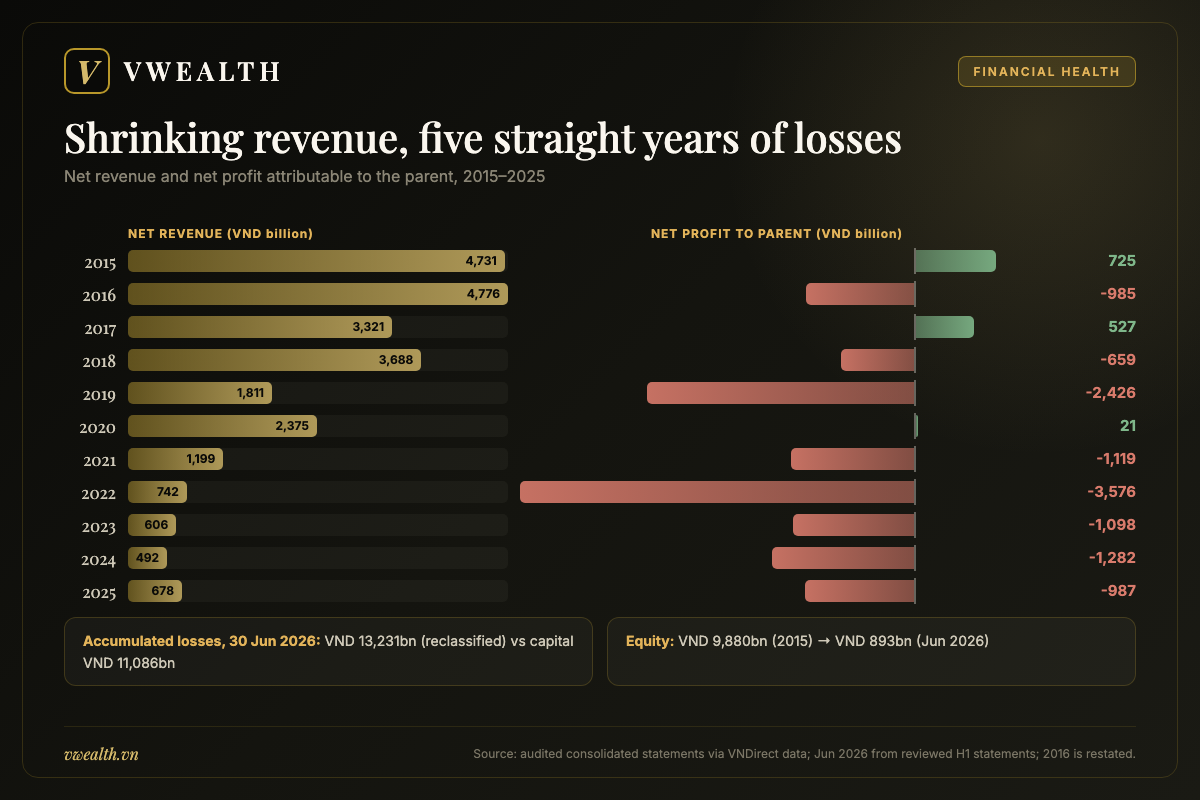
| Year | Net revenue | Gross profit | Net profit to parent | Year-end equity | Year-end retained earnings |
|---|---|---|---|---|---|
| 2015 | 4,731 | 1,237 | 725 | 9,880 | 2,127 |
| 2016 | 4,776 | 510 | -985 | 9,732 | 392 |
| 2017 | 3,321 | 1,215 | 527 | 10,153 | 911 |
| 2018 | 3,688 | 1,501 | -659 | 10,676 | 103 |
| 2019 | 1,811 | 213 | -2,426 | 9,738 | -2,324 |
| 2020 | 2,375 | 147 | 21 | 8,680 | -2,306 |
| 2021 | 1,199 | -454 | -1,119 | 5,997 | -3,426 |
| 2022 | 742 | -971 | -3,576 | 3,034 | -7,003 |
| 2023 | 606 | -664 | -1,098 | 2,256 | -8,102 |
| 2024 | 492 | -436 | -1,282 | 1,636 | -9,384 |
| 2025 | 678 | 151 | -987 | 1,045 | -10,371 |
| H1 2026 (reviewed) | 289 | 55 | -187 | 893 | -13,231 (*) |
Unit: VND billion. Source: audited consolidated financial statements via VNDirect public data; 2024–2025 cross-checked against the 2025 annual report; H1 2026 from the reviewed consolidated interim financial statements. The 2016 figure is restated. (*) Opening 2026 balances were reclassified under Circular 99: about VND 2,673 billion was moved from the foreign exchange reserve to accumulated losses, so opening accumulated losses were restated to about VND 13,044 billion.
The table carries three lessons. First, the drop in revenue from nearly VND 4,800 billion to under VND 700 billion does not mean the operating business “collapsed” by that much. Most of it reflects HNG selling subsidiaries and land that generated revenue (rubber in Cambodia and Gia Lai, sugarcane, beef cattle, bananas in Cambodia), and exiting businesses such as chili and real estate. HNG in 2025 is a smaller and very different company from HNG in 2015, just as today’s HAG is different from HAG ten years ago.
Second, the profitable years before 2021 usually involved gains on asset sales or reversals rather than purely operating profit. In 2017, financial income was about VND 1,015 billion; in 2020, about VND 1,019 billion, reflecting gains on disposals. When you read the profits of a company in restructuring, always separate “selling the furniture” from “making money.”
Third, 2025 was the first year since 2020 with positive gross profit, about VND 151 billion. That is a genuine sign of improvement at the production level. But it is still far too small compared with interest, conversion costs and depreciation on idle plantations. For HNG to earn a net profit, gross profit must grow several times over, or the costs below it must fall sharply — or both.
Accumulated Losses, Equity and the Foreign Exchange Reserve
HNG’s equity at the end of 2025 was about VND 1,045 billion. The arithmetic on the balance sheet is simple: contributed capital of VND 11,086 billion, plus share premium of about VND 1,170 billion, minus accumulated losses (negative retained earnings) of VND 10,371 billion, minus a negative foreign exchange translation reserve of about VND 840 billion. The result is roughly VND 1,045 billion — equity equal to only about 9.4% of charter capital (vwealth estimate).
A few points to understand clearly. First, HNG’s consolidated equity is still positive, if very thin: about VND 1,045 billion at 31 December 2025 in the audited statements and about VND 893 billion at 30 June 2026 in the reviewed half-year statements. Some sources have described HNG as having “negative equity,” but according to these two reports that was not the case at either date. Second, on the books, accumulated losses now exceed charter capital: about VND 13,231 billion at 30 June 2026 against VND 11,086 billion. The jump from VND 10,371 billion does not mean the company lost almost VND 3,000 billion in six months. The actual loss for the period was about VND 187 billion; the other roughly VND 2,673 billion is a reclassification under Circular 99/2025/TT-BTC (Vietnam’s new corporate accounting regime, applied for the first time in the period), which moved that amount from the foreign exchange reserve line to accumulated losses, leaving total equity essentially unchanged by that step. The real cushion to watch is therefore total equity: about VND 893 billion, smaller than a single year’s loss like 2025. As of 27 September 2026, vwealth found no announcement in HNG’s disclosure list placing the stock under warning, control or trading restrictions on UPCoM; but “negative equity” is a threshold that auditors, the exchange and the market all watch, so follow the next reports closely.
Third, the foreign exchange reserve within equity is typical of a company with foreign subsidiaries. When the financial statements of subsidiaries in Laos or Cambodia are translated into dong for consolidation, differences caused by exchange-rate moves are booked directly to equity rather than through profit and loss. This reserve was as low as about minus VND 2,832 billion at the end of 2021 — which is why equity fell by about VND 2,683 billion in 2021 even though the full-year loss was only about VND 1,119 billion. After HNG switched the accounting currency of its Lao subsidiaries to an international currency from late 2022 (the 2026 report says subsidiaries use the US dollar and the Cambodian riel), the negative balance gradually narrowed, and after the Circular 99 reclassification described above the line turned positive, at about VND 1,869 billion at 30 June 2026. So when comparing HNG’s accumulated losses before and after 2026, compare total equity rather than the accumulated-loss line alone. The lesson: HNG’s equity can swing sharply with exchange rates even when profit is unchanged.
Debt: More Than VND 18.6 Trillion, Almost All Borrowings From One Related Party
At the end of 2025, HNG’s total liabilities were about VND 18,633 billion against total assets of about VND 19,678 billion; the annual report puts liabilities-to-assets at 0.95 times and debt-to-equity at 17.83 times. Total borrowings were about VND 10,448 billion, of which about VND 9,694 billion short-term and VND 754 billion long-term. As noted earlier, most of these loans come from THACO AGRI.
Beyond borrowings, three other liability lines deserve attention. “Short-term advances from customers” were about VND 3,552 billion, up sharply year after year (about VND 716 billion in 2022, VND 1,556 billion in 2023 and VND 1,994 billion in 2024); according to the related-party table, HNG received about VND 1,765 billion of advances from THACO AGRI in 2025 alone. “Short-term accrued expenses” were about VND 1,998 billion, typically including interest incurred but not yet paid. And about VND 953 billion of “long-term trade payables” appeared in 2025. All three are obligations even though they are not labeled “loans.” By 30 June 2026 the advances had changed shape: short-term customer advances fell to about VND 2,072 billion, but about VND 2,816 billion of long-term customer advances appeared — mainly THACO AGRI prepaying for fruit — and short-term accrued expenses rose to about VND 2,394 billion; total liabilities reached about VND 20,901 billion against total assets of about VND 21,795 billion (about 96%), with total borrowings of about VND 10,863 billion.
The most important ratio is short-term liquidity: at the end of 2025, current assets of about VND 3,121 billion against current liabilities of about VND 16,543 billion, a current ratio of just 0.19 times and a quick ratio of 0.04 times. At 30 June 2026, current assets were about VND 3,275 billion and current liabilities about VND 15,720 billion, a current ratio of about 0.21 times (vwealth estimate), and cash was down to about VND 7 billion. The half-year report also notes a bank loan with about US$819 thousand of principal overdue since 25 June 2026, for which the bank has agreed an extension — small in size, but telling about how tight cash is. In other words, if all short-term creditors demanded payment at once, HNG’s current assets would cover less than one-fifth. What prevents a liquidity event is that the biggest creditor is a related party that has pledged to consider extensions. That is why HNG’s risk is not only about HNG itself, but also about the health and goodwill of the THACO ecosystem.
VND 8.2 Trillion of Construction in Progress and “Conversion Costs”: Where the Money Is
If debt tells you where the money came from, the asset side tells you where it went. At the end of 2025, the largest item on HNG’s balance sheet was construction in progress, about VND 8,234 billion, up from about VND 3,889 billion at the end of 2022. According to press summaries of the financial statements, this relates mainly to agricultural projects such as rubber, fruit orchards, cattle farming and infrastructure. Tangible fixed assets were about VND 5,682 billion, including producing plantations. Cash was only about VND 41 billion, or roughly 0.2% of total assets. By 30 June 2026, construction in progress had risen to about VND 9,380 billion (reclassified opening balance about VND 8,007 billion), of which, per press summaries of the notes: fruit orchards about VND 4,132 billion, buildings and infrastructure about VND 2,603 billion, cattle projects about VND 1,520 billion and rubber about VND 1,124 billion.
How you read this line matters. Every dong spent on a new banana farm, cattle barn or irrigation system sits here until the asset is completed and put into use. Then it moves to fixed assets and begins to be depreciated. So growth in construction in progress is both a sign the company is genuinely investing and an advance warning of future depreciation. If new plantations underperform, these assets may again have to be written off — repeating the conversion-cost cycle that has already played out with rubber and the first-generation banana farms.
Conversion costs reach the income statement mainly through “other expenses.” In 2025, other expenses were about VND 818 billion, including about VND 747 billion for disposing of underperforming assets and about VND 69 billion of depreciation on idle assets; in 2022, other expenses reached about VND 2,388 billion. So when you look at HNG’s profit, split it into three layers: the production layer (gross profit minus selling and administrative expenses), the financing layer (interest and FX), and the restructuring layer (plantation write-offs and asset disposals). In 2025, gross profit of about VND 151 billion minus selling expenses of about VND 16 billion and administrative expenses of about VND 26 billion leaves a production layer of roughly positive VND 109 billion (vwealth estimate); the second and third layers produced the nearly VND 1,000 billion loss.
Cash Flow: Positive Operating Cash Flow, but Who Is Paying?
One thing may surprise you: despite continuous losses, HNG’s net cash flow from operating activities has been positive for three years in a row — about VND 563 billion in 2023, VND 576 billion in 2024 and VND 915 billion in 2025. The components explain why. In 2025, profit before working capital changes was only about VND 221 billion; most of the positive cash flow came from an increase of about VND 1,809 billion in payables — including customer advances, mainly from THACO AGRI. At the same time, interest actually paid in 2025 was only about VND 90 billion, far below the interest incurred, consistent with the rise in accrued expenses. The pattern continued in the first half of 2026: according to CafeF’s summary of the reviewed report, operating cash flow for the six months was positive by about VND 1,119 billion, more than double a year earlier, driven mainly by THACO AGRI’s roughly VND 2,816 billion of long-term advances.
On the investing side, HNG spent about VND 1,446 billion on fixed assets and plantations in 2025; in 2024 it spent about VND 966 billion, plus about VND 1,309 billion in loans to other parties. On the financing side, it drew about VND 1,276 billion of new loans and repaid about VND 790 billion of principal in 2025. By year-end, cash had fallen to about VND 41 billion.
The takeaway: HNG’s positive operating cash flow does not yet reflect an ability to generate cash on its own; it reflects prepayments from a related party and deferred interest. The metric to watch is “profit before working capital changes,” which moved from negative to about positive VND 221 billion in 2025 — a small but real improvement.
The Audit Opinion: Unqualified, With an Emphasis of Matter on Going Concern
Every HNG investor should read this paragraph in the original. The independent auditor’s report from Ernst & Young Vietnam on the 2025 consolidated financial statements (reference 12827243/68613178/FN-HN, printed in English in the annual report) gives an unqualified opinion: the financial statements present fairly, in all material respects, the group’s financial position. However, the auditor includes an “Emphasis of matter” paragraph drawing attention to Note 2.6, which states that the group incurred a net loss of about VND 987.06 billion in 2025, had accumulated losses of about VND 10,371.31 billion, and that current liabilities exceeded current assets by about VND 13,422.61 billion. In the auditor’s words: “These conditions indicate the existence of a material uncertainty which may cast significant doubt about the Group’s ability to continue as a going concern.” And: “Our opinion is not modified in respect of this matter.”
Get the nuance right. An “unqualified opinion with an emphasis of matter” is different from a “qualified opinion” or a “disclaimer.” It does not say the numbers are wrong; it says the numbers are right, but the financial condition they describe means the company’s ability to keep operating normally depends on conditions that are not certain. According to press summaries of the note, HNG said its ability to continue depends on securing working capital and meeting short-term obligations, based on a 12-month cash flow plan that includes cash from agricultural projects, bank credit disbursements and financial support from shareholders; THACO has committed to continue supporting it when needed.
This is not the first time, nor the last. The reviewed interim financial statements for H1 2021 already flagged conditions casting doubt on the company’s ability to continue as a going concern, and the review of the H1 2019 statements carried a qualified opinion over a tax provision reversal. The review of the H1 2026 statements repeats the same emphasis: a net loss of about VND 186.8 billion, accumulated losses of about VND 13,231 billion and current liabilities exceeding current assets by about VND 12,445 billion — EY issued no qualification, but kept the material-uncertainty paragraph. Tracking this paragraph year by year — whether it is still there, and whether the numbers in it grow or shrink — is a simple way to measure the progress of the restructuring.
Seven Questions to Ask Every Time HNG Reports
Instead of memorizing dozens of numbers, use these seven questions as a checklist. Each can be answered from HNG’s quarterly or annual financial statements.
One: Is gross profit still positive and growing? This is the earliest indicator that the banana model and selective rubber tapping are working. If gross profit turns negative again, every turnaround plan needs to be revisited.
Two: What are banana output and harvested area? Divide output by harvested area to get yield, and compare it with management’s 55-tonne-per-hectare target. The company usually explains output in the letter accompanying quarterly results that discusses profit changes.
Three: Are “other expenses” and conversion costs still large? If they shrink, the restructuring layer is nearing its end; if they stay in the hundreds of billions each year, the turnaround date will slip.
Four: Have THACO AGRI loan balances and interest rates changed? Rising debt to fund investment is normal at this stage, but you need to know how long loans are extended and at what rate.
Five: Are customer advances still rising? This line shows how much the THACO ecosystem is funding HNG through trade. If it falls because goods have been delivered, that is good; if it keeps rising without matching revenue growth, ask why.
Six: How much equity is left, and have accumulated losses exceeded charter capital? These two thresholds matter legally for the stock’s trading status and psychologically for investors.
Seven: Is the auditor’s emphasis paragraph still there? The year the “material uncertainty related to going concern” paragraph disappears from the audit report is the year you have objective evidence that the most dangerous phase of the restructuring is over.
How the Market Treats HNG Stock: From HOSE to UPCoM, a Headline-Driven Stock
HNG shares have been in index fund portfolios, have traded above par value, and have also been restricted to half-day trading. Knowing the stock’s “personality” helps you avoid two common mistakes: chasing good news and panic-selling on bad news.
Years on Warning and Control Lists, Then Off HOSE
HNG’s trading-status history on HOSE is long. According to the company’s disclosure list, the stock was placed on HOSE’s warning list from 9 April 2019 and kept there through several reviews — notices maintaining the warning status appear in September 2019, September 2021, and April, June and September 2022, tied to negative retained earnings. From 12 April 2023, HNG was moved from warning to control because of losses in 2021 and 2022. Finally, it was delisted from 6 September 2024 after three straight years of losses, under HOSE Decision No. 488/QD-SGDHCM of 9 August 2024.
Since 18 September 2024 (reference price on the first day: VND 4,600), HNG has traded on UPCoM, the market for unlisted public companies run by the Hanoi Stock Exchange. The practical differences for investors: the daily price limit on UPCoM is ±15% from the reference price, much wider than HOSE’s ±7%; UPCoM stocks are not eligible for margin lending under current rules; and many funds, particularly foreign funds and index funds, are restricted from or unable to buy unlisted shares. According to the disclosure list vwealth reviewed through 27 September 2026, we found no decision placing HNG under warning, control or trading restrictions on UPCoM; this status can change after any reporting period, so check the HNX website before trading.
To return to HOSE, HNG would have to apply for listing again like a new company, and HOSE’s current listing requirements call for profits in the preceding years and no accumulated losses. With accumulated losses of about VND 13,231 billion at 30 June 2026, this is a multi-year goal, not a near-term catalyst; check the rules in force when the time comes, as regulations can change.
The Stock’s Personality: It Moves on News More Than on Earnings
If you trace historical price points (unadjusted prices, from VNDirect’s public trading data and the press), you will see HNG moving on news about THACO, land and debt more than on quarterly earnings. In March 2017, as the market welcomed news of the HAGL group’s debt restructuring, HNG climbed from around VND 8,600 back above par value (VND 10,000). In August 2019, when THACO completed its bond conversion, CafeF put the price at about VND 18,050; in October 2019 it slipped to around VND 15,000; in May 2020 it traded in a VND 12,500–15,300 range. After THACO took over, the price fell sharply in 2021, then rebounded in late December 2021 — hitting the daily limit with heavy unfilled buy orders after Tran Ba Duong spoke of earning US$1 billion from banana exports — to around VND 14,000, before falling to about VND 6,500 by late May 2022.
After moving to UPCoM, the stock rallied again: from its first session on 18 September 2024 to 8 January 2025, HNG rose more than 70% to its highest level since April 2022, according to CafeF. The catalyst was news that HNG had completed its tripartite debt payments and recovered more than 32,500 ha; on 2 January 2025 alone, the stock hit its 15% daily limit at VND 7,000, with more than 4 million shares of unfilled buy orders at the ceiling. These are historical figures used only to illustrate the stock’s character, not a suggestion of any price level.
This personality comes from the shareholder structure: nearly two-thirds of shares are held by Vietnamese retail investors, while the THACO group rarely trades. The effective free float is therefore mostly in the hands of short-term traders. With a ±15% daily band on UPCoM, a few limit-up or limit-down sessions can move the price a long way very quickly. If you are used to large caps on HOSE, adjust your expectations for volatility and for your ability to exit when you need to.
Valuation: Why P/E Is Meaningless, P/B Misleads, and What to Use Instead
For a loss-making company, the price-to-earnings ratio has no meaning. For HNG, price-to-book is also misleading. Try a simple calculation: equity of about VND 1,045 billion at the end of 2025 divided by about 1,108.55 million shares gives a book value per share of only about VND 940 (vwealth estimate). As a result, at almost any market price HNG has ever traded at, its P/B looks “very high.” But that reflects equity eroded by accumulated losses, not necessarily the economic value of the land and plantations — in either direction: the assets may be worth more than book if the model works, or less if more plantations have to be written off.
A more useful approach is enterprise value (EV) — market capitalization plus net debt — compared with the scale of productive assets. HNG’s net debt is about VND 10,400 billion (vwealth estimate from VND 10,448 billion of borrowings less VND 41 billion of cash), which means that whatever the share price, anyone buying HNG stock is effectively buying a company that comes with more than VND 10,000 billion of liabilities ranking ahead of shareholders. You can divide EV by cultivated area to get a “price per hectare” and compare it with the cost of developing a hectare of bananas or leasing equivalent land — a way to test whether the market is pricing real assets or pricing hope. For the current market cap, see the latest vwealth report.
A second approach is to treat HNG stock as an option: if the banana-and-cattle model works and the debt is restructured sensibly (for example, converting part of it into equity), value for shareholders could rise sharply; if not, most of the asset value will belong to creditors. Options can be worth buying, but only with money you can afford to lose most of.
Foreign and Institutional Investors: Almost Absent
According to the 2025 annual report, foreign investors hold only about 0.79% of HNG, split among 15 institutions and 105 individuals — a very low figure. That is very low for a company that spent nine years on the country’s largest exchange. The move to UPCoM and years of losses have put HNG largely out of reach for foreign funds and index funds. Foreign investors should also note the practical hurdles of trading a UPCoM stock with a wide daily band and limited liquidity; our guide to investing in Vietnam’s stock market covers account opening and trading mechanics.
Domestically, apart from the THACO group, other institutional ownership is tiny (domestic institutions hold 35.9% in total, of which THACO and Tran Oanh alone account for about 32.59%, per vwealth’s estimate). In the secondary market, there is essentially no large, fundamentals-driven buyer. If the plan to bring in two strategic funds for about 20% succeeds, it would be the first time in years that an outside institution put significant money into HNG — and the price they pay would become an important reference point.
Catalysts and Milestones to Watch
Five events could significantly change how the market views HNG over the next one to three years. Each can cut both ways.
2026 results versus the VND 232 billion pre-tax profit target. This is HNG’s first profit target since 2020. Hitting it would show that the restructuring layer has peaked; a big miss would reinforce skepticism. Keep HNG’s planning record in mind: in 2022 it planned a VND 2,713 billion pre-tax loss and actually lost about VND 3,566 billion before tax; in 2025 it planned a VND 854 billion pre-tax loss and actually lost about VND 980 billion before tax. And after the first six months of 2026, against a full-year target of VND 232 billion pre-tax profit, the reviewed figure was still a loss of about VND 187 billion — the second half would need a profit of about VND 419 billion to hit the target (vwealth estimate), many times the roughly VND 55 billion of gross profit earned in the first half.
The planned placement of about 20% of shares. If outside strategic investors put in money, HNG gains equity to reduce its reliance on related-party debt, and the market gets a reference price. If the plan drags on without result, that is information too.
Restructuring of THACO AGRI debt. Loans from THACO AGRI exceeded VND 10,000 billion at 30 June 2026, of which about VND 5,133 billion is the long-term portion due within 12 months. They could be extended, repriced or partly converted into equity. Each option has different effects: converting debt to equity relieves interest pressure but dilutes existing shareholders; extending keeps the share count but prolongs the interest burden.
The Lao subsidiary merger and new permits. Merging two subsidiaries (Hoang Anh Quang Minh and Hoang Anh Attapeu) into the Southern Laos company, in progress since July 2026, streamlines the structure in Laos; the December 2025 concession allows processing plants to be built. These changes rarely produce immediate revenue but can cut overhead and legal risk.
Rubber and banana prices. Given the 2025 revenue mix, a big move in latex prices still matters a lot to HNG; banana prices in China are the variable for the future.
Industry Context: Large-Scale Farming in Laos and Cambodia, and the Cost of Capital
HNG does not operate in a vacuum. It is part of a wave of Vietnamese companies investing in large-scale agriculture in neighboring countries, and a link in the farming strategy of a private industrial conglomerate. Putting HNG in that context helps you separate what is specific to the company from what is a risk shared across the sector. For a broader view of how exporters fit into Vietnam’s growth story, see our overview of Vietnam’s export economy stocks.
Banana Exports and the Chinese Market: Real Opportunity, Real Competition
Our HAG analysis covers the banana industry in detail, so here we only recap the points relevant to HNG. According to industry data cited in that article, Vietnam exported nearly US$380 million of bananas in 2024, and about 70% of export volume went to China. Bananas have a large, nearby and steady market, but competition is intense: China also imports from the Philippines, Cambodia and Laos and grows its own in Yunnan and Hainan. When supply rises quickly, prices fall — and with a perishable product like bananas, growers have almost no option to hold stock and wait.
HNG differs from HAG in two ways. First, its banana farms are mainly in southern Laos, a landlocked region, so fresh fruit must travel a long way by road to a seaport or border crossing; logistics, cold storage and paperwork are a significant part of the cost, and this is where a conglomerate with automotive, transport and warehousing businesses like THACO can help. Second, HNG is in the middle of replanting and new planting, so it lacks the output “cushion” of mature, stable plantations. Each bout of bad weather or disease on young farms can hit the plan harder than it would for a company with established orchards.
Rubber: Price Cycles and the Plantation Depreciation Problem
The rubber industry has a feature our GVR analysis emphasizes: latex is a cyclical commodity, producers are price takers, and high-price years should not be extrapolated into normal profits. For GVR, cyclical risk is cushioned by a nearly debt-free balance sheet and industrial park land. For HNG it is the opposite: its rubber estates carry depreciation even on area that cannot be tapped, and most of its borrowings originated in the rubber investment era. Higher latex prices help HNG lose less, but are unlikely to solve the debt problem by themselves.
One more detail: the European Union Deforestation Regulation (EUDR) requires traceability down to individual plots for commodities such as rubber. In theory, a concentrated plantation with mapped land and clear concession contracts like HNG’s is better placed to comply than a supply chain buying from smallholders, but there is no disclosure showing HNG selling rubber into the EU at meaningful scale.
Laos: Concession Land, the Kip and the Labor Challenge
Most of HNG’s productive assets are in southern Laos, so what happens in Laos directly affects the company. Three variables matter.
The first is land and concession policy. The concession agreement and state land lease granted by the Lao government in December 2025 are an important legal step, confirming area and land use and allowing processing plants. Any company investing abroad faces the risk of host-country policy changes, but a newly signed concession is a sign that relations are favorable. Those relations have been built partly through Nong Khang airport in Houaphan province, inaugurated and handed over by HNG to Laos’s civil aviation authority on 15 May 2023, with disclosed total investment of about US$82 million under a build-transfer (BT) arrangement funded by a loan from the company to the Lao government. Even so, at 30 June 2026 the half-year notes still say the company is completing the remaining items and the project has not been finally settled — the money tied to it is not yet closed out.
The second is currency. In 2022 the Lao kip depreciated sharply amid high inflation, causing large FX losses for HNG. After switching the accounting currency of its subsidiaries to an international currency, the impact on profit and loss has shrunk, but exchange rates still affect local costs, the translated value of assets and the FX reserve in equity. The 2025 annual report itself identifies the depreciation of many local currencies against the US dollar as a direct risk factor.
The third is labor. In 2021–2023, HNG repeatedly explained that labor shortages in Laos left plantations under-maintained, banana bunches unharvested and rubber untapped. The 2025 plan raised total headcount to about 13,230, more than double the previous year, along with the worker housing, canteens and clinics described in the annual report. A labor-intensive farming business in remote areas can scale up quickly on paper, but raising productivity takes time.
Industrial Conglomerates Moving Into Farming: Resources and Entanglement
THACO is not the only Vietnamese industrial group to move into large-scale agriculture, but it has the largest overseas land footprint. According to Tran Ba Duong in 2024, THACO is committed to large-scale, integrated and circular agriculture, and restructuring HAGL Agrico alone has cost it about VND 20,000 billion (about VND 8,000 billion initially plus about VND 12,000 billion more, by his account). HNG is the only publicly traded company in this farming ecosystem, and its management has stated that it remains a public company operating in the interests of its shareholders.
For HNG shareholders, being a subsidiary inside a large ecosystem brings three advantages: ready funding when banks are unwilling to lend, internal sales channels, and mechanization and supply capabilities from sister companies. It also creates three risks: dependency (if THACO runs into trouble elsewhere, its capacity to support HNG could shrink), allocation (when the same group has both a public company and private companies in the same line of business, shareholders need to watch how opportunities and costs are allocated), and related-party pricing, discussed in the ownership section. These are not allegations; they are structural features every minority investor in a group subsidiary should weigh.
Where HNG Stands Against Other Vietnamese Agriculture and Food Stocks
For perspective, you can place HNG next to four peers vwealth has analyzed. The table compares structural features only, not current valuations.
| Criterion | HNG (HAGL Agrico) | HAG (Hoang Anh Gia Lai) | DBC (Dabaco) | VHC (Vinh Hoan) | GVR (Vietnam Rubber Group) |
|---|---|---|---|---|---|
| Trading venue | UPCoM (since Sep 2024) | HOSE | HOSE | HOSE | HOSE |
| Main businesses | Rubber, bananas, cattle in Laos and Cambodia | Bananas, durian, coffee, pigs | Animal feed, pigs, poultry | Pangasius and value-added products | Rubber and industrial park land |
| Controlling shareholder | THACO 27.63% (group about 37.17%) | Doan Nguyen Duc’s group | Founder and related parties | Founder and related parties | The State |
| 2025 profit | Fifth straight annual loss | Profitable (see our HAG analysis) | See each stock’s own analysis | ||
| Debt profile | Borrowings mostly from a related party; current liabilities far exceed current assets | Debt sharply reduced; obligations to creditors remain | Capital-intensive sector with significant borrowings | See separate analysis | Almost no net debt, large cash holdings |
| 2025 audit opinion | Unqualified, with emphasis of matter on going concern | See each stock’s own analysis | |||
Sources: vwealth analyses of each stock and published financial statements. The table makes one core point: within Vietnam’s agriculture and food group, HNG carries the highest financial risk. If you want exposure to bananas and Lao–Cambodian farming with a less stretched balance sheet, the other names are necessary comparisons. Our DBC stock analysis and VHC stock analysis show what a consistently profitable agriculture and food company looks like on paper.
Outlook: Three Scenarios for HNG Stock During the Restructuring
This section does not give a price target. For a company with thin equity, large related-party debt and results that hinge on the yields of new plantations, any specific price is false precision. Instead, we identify the key variables, build three scenarios with clear conditions, and use illustrative examples so you can feel how sensitive the outcome is to each variable.
Five Variables That Will Decide HNG’s Future
Banana yields and harvested area. This is the most important operating variable. The 2026 revenue target of VND 1,676 billion is nearly 2.5 times 2025 revenue (vwealth estimate), and most of the increase has to come from fruit. After six months, reviewed net revenue was only about VND 289 billion, roughly 17% of the full-year target (vwealth estimate) — banana output would have to surge in the second half for the plan to have a chance.
The pace and cost of plantation conversion. Management has said more than 13,000 ha of rubber remain, to be converted gradually over several years. Each year, the number of hectares converted determines the size of write-offs.
The cost of capital and the structure of THACO AGRI debt. Interest rates, maturities and any debt-to-equity conversion will decide how much operating profit is left for shareholders.
The outcome of the private placement. Whether outside capital arrives, and at what price, determines dilution and the ability to reduce dependence on debt.
Commodity prices and exchange rates. Latex prices, banana export prices and the US dollar against the kip and the dong affect revenue, costs and equity.
Bull Case: Bananas Deliver, Debt Is Restructured, New Capital Arrives
Conditions: banana yields on new plantations reach or approach the 55-tonne-per-hectare target; gross profit stays positive and rises strongly; conversion costs taper off as most underperforming rubber is dealt with; the private placement is completed with outside investors at a reasonable price; and THACO AGRI agrees to long-term extensions or converts part of its loans into equity.
In this scenario, HNG could turn profitable in the second half of 2026 or from 2027, narrowing the gap to plan even if the full 2026 target is out of reach after the first-half loss, see the going-concern emphasis removed from its audit report, and begin building a credible path back to HOSE once it has consecutive profitable years and has dealt with its accumulated losses. The market would then shift from valuing HNG as a “rescue” stock to valuing it as a cash-generating farming business. Even here, accumulated losses above VND 13,000 billion would keep dividends years away unless the company uses capital restructuring tools such as reducing share capital to offset losses — something no resolution has proposed.
Base Case: Slow Improvement, THACO Keeps Propping It Up, Shareholders Wait
Conditions: gross profit stays positive but grows more slowly than planned; conversion costs and interest continue to produce net losses, albeit smaller ones; the private placement drags on or happens on a small scale; THACO keeps lending and extending as in recent years.
This is the scenario closest to what happened in 2021–2025: every year the company makes progress on a few metrics (revenue grows, gross losses turn into gross profit), yet the bottom line is still a loss, accumulated losses keep rising and equity keeps thinning. In this scenario the stock tends to swing on short-term news without a sustained trend. Minority shareholders are essentially waiting, while most of the economic benefit of operational improvement goes first to paying interest to creditors.
Bear Case: New Orchards Disappoint, Equity Turns Negative, Heavy Restructuring
Conditions: banana yields on new plantations are low because of disease, weather or labor shortages, repeating what happened in 2022–2024; commodity prices fall; conversion costs remain large; the private placement fails; and, for its own reasons, support from the THACO ecosystem shrinks or comes with new conditions.
Because the cushion between equity and a single year’s loss is already very thin, as shown in the financial section — equity of about VND 893 billion at 30 June 2026, less than the roughly VND 987 billion lost in 2025 alone — one more year of losses similar to 2025 could turn equity negative. The company might then need heavy restructuring: converting debt to equity at a low price (large dilution for existing shareholders), selling assets, or other options largely decided by its main creditor. Its trading status on UPCoM could also be affected under the rules. This is not a forecast, but it is a scenario an HNG investor must accept as possible before buying.
Illustrative Examples: What One Percentage Point of Interest and 20% New Shares Mean
Illustrative example one, on interest rates. Assume THACO AGRI loans stay at about VND 10,037 billion, as at 30 June 2026. Each percentage point of interest equals about VND 100 billion of annual interest cost (vwealth estimate: 10,037 × 1%). If the average rate fell from, say, 8% to 6.5%, annual interest would drop by about VND 150 billion — almost the entire 2025 gross profit of about VND 151 billion. Note that THACO AGRI’s long-term loans carry disclosed rates of 7.7–13% a year, above the 6.5–8% on short-term loans. A similar rise would wipe out the improvement at the production level. For HNG, loan terms matter as much as plantation yields.
Illustrative example two, on dilution. Suppose HNG issues new shares equal to 20% of the current count, about 221.7 million shares (vwealth estimate), at a hypothetical price P. The share count would rise to about 1,330 million. A shareholder with 1% would end up with about 0.83%. Equity would increase by 221.7 million × P. If P is above book value per share (about VND 940 at the end of 2025 as calculated earlier, and about VND 806 at 30 June 2026 — vwealth estimate from equity of VND 893 billion), existing shareholders’ book value per share would rise rather than fall; if P is lower, the reverse. Because HNG’s book value is so low, almost any issue price near the market price would lift equity meaningfully — the positive side. The trade-off is that future profits would be shared among more shares. This is only a framework; no issue price has been announced.
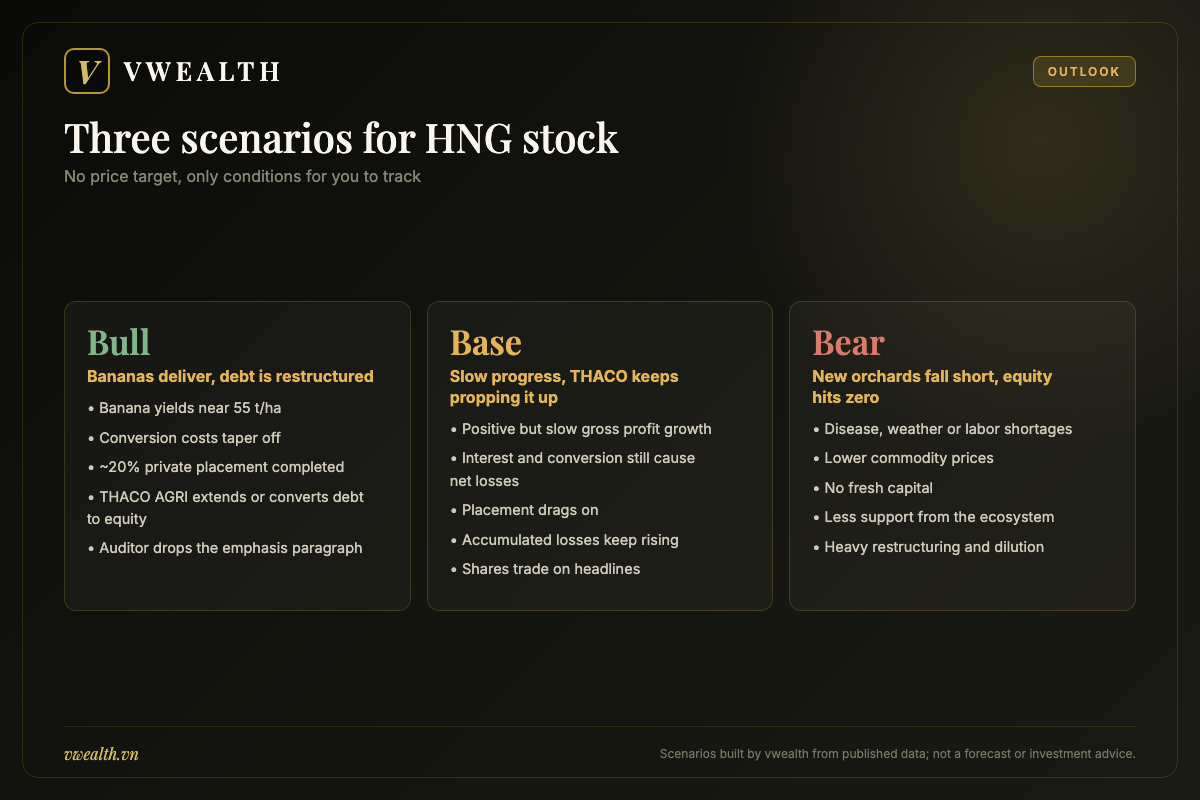
So, Should You Buy HNG Stock? Weighing the Pros and Cons
After seven sections, you have the facts to decide for yourself. This final section pulls together the positives and negatives and helps you judge whether HNG fits your situation. Once more: this is not a buy or sell recommendation; it is a way of organizing information so you can make your own call.
The Positives Worth Weighing
A large land bank with strengthened legal footing. More than 31,000 ha under cultivation in Laos under the concession signed in December 2025, plus land in northern Cambodia and more than 32,500 ha of rubber and oil palm released from old obligations to BIDV and HAG. This asset base would be very hard to recreate.
The production layer is improving. In 2025, gross profit turned positive for the first time since 2020, revenue grew 38%, and profit before working capital changes turned positive. These are small but measurable signals.
A capable, committed major shareholder. THACO has put money in through equity, bonds and loans since 2018 and has pledged continued financial support. Tran Ba Duong has said publicly that if HNG fails, THACO is the one that loses money.
The legacy debts with the HAGL group are settled. The tripartite agreement with BIDV and HAG was completed at the end of 2024, HAG fully exited in early 2026, and since April 2026 neither the board nor the supervisory board has included anyone from the HAG side. Today’s ownership and debt structure is far simpler than in 2020.
A Big Four auditor and reasonably complete disclosure. A bilingual annual report, governance reports and board resolutions on related-party transactions are published as required.
The Negatives You Cannot Ignore
Five straight years of losses and accumulated losses above charter capital. Accumulated losses of about VND 13,231 billion at 30 June 2026 (after the Circular 99 reclassification) against charter capital of VND 11,086 billion; equity of only about VND 893 billion; and a reviewed first-half 2026 loss of about VND 187 billion despite a full-year profit target.
An auditor’s emphasis on material uncertainty about going concern. Current liabilities exceeded current assets by about VND 13,423 billion at the end of 2025 and about VND 12,445 billion at 30 June 2026; the current ratio is only about 0.2 times, and cash in mid-2026 was about VND 7 billion.
Near-total dependence on one related party. Around 92% of borrowings come from THACO AGRI (vwealth estimate), which is also a major customer, supplier and source of prepayments. Minority shareholders have little independent voice in these transactions.
A record of missed plans. In 2022 the pre-tax loss was about VND 3,566 billion versus a planned VND 2,713 billion; in 2025 about VND 980 billion versus a planned VND 854 billion; and a self-reported Q2 2026 profit turned into a six-month loss of about VND 187 billion after review.
No dividends, possible dilution, and the liquidity and volatility of a UPCoM stock. Dividends are almost certainly years away; a 20% placement is on the table; the stock is not marginable and has a ±15% daily band.
| Aspect | Positives | Negatives |
|---|---|---|
| Assets | Large land bank, new concession, assets released from collateral | Leased land abroad, costly conversion, many unproductive rubber estates |
| Operations | Positive gross profit in 2025, revenue up 38% | Banana yields have fallen short repeatedly; cattle not yet profitable |
| Finances | Funding from the THACO ecosystem at disclosed rates of 6.5–8.5% a year | About VND 13,231 bn accumulated losses (30 June 2026), equity about VND 893 bn, current liabilities far above current assets |
| Governance | Committed major shareholder, audited by EY | Dependence on a related party, large internal transactions, few independent members |
| The stock | Reacts strongly to good news; catalysts include a strategic placement and a profit target | UPCoM listing, no margin, high volatility, no dividends, dilution risk |
Who HNG Stock Might Suit
HNG may suit investors with a very high tolerance for risk who understand that they are buying an “option” on a successful restructuring, and who allocate only a small part of their portfolio to it — an amount they could lose most of without derailing their long-term goals. That investor is willing to read the financial statements every quarter and to track indicators such as banana yields, conversion costs, THACO AGRI debt and the auditor’s emphasis paragraph, rather than just watching the share price.
HNG can also be a useful case study for anyone learning to read the accounts of a company in restructuring: how to split profit into layers, how to read construction in progress, how to tell genuine cash flow from related-party funding. You can learn all of that without buying the stock.
Who Should Probably Avoid It
HNG is not suitable for investors who need dividends, who use leverage, who tend to panic when a stock falls several sessions in a row, or who are investing money they may need in the short term. It also does not fit a rule of “only buy profitable companies with healthy balance sheets” — under that rule, names such as VHC, DBC or GVR are more sensible starting points within Vietnamese agriculture. If you want exposure to farming in Laos and Cambodia, compare HNG with HAG: same origins and same region, but a step further along in dealing with its debts. And if you are building a broader portfolio of Vietnam stocks, remember that a UPCoM-traded, loss-making company should sit at the speculative edge of it, not at the core.
The Bottom Line
Should you buy HNG stock? The honest answer is this: HNG is an agricultural company in the middle of a restructuring, carrying a very large legacy of accumulated losses, held up by a major shareholder who is also its largest lender, and following a conversion plan that has only recently started to show results at the production level. Its risk is far above the market average. If the banana-and-cattle model reaches its yields and the debt is restructured sensibly, shareholders could benefit substantially from a very low base; if not, most of the asset value will go to creditors before shareholders.
Whatever you decide, use the seven questions in the financial section each time HNG reports, keep an eye on the emphasis paragraph in the audit report, and open the latest vwealth analysis report for up-to-date valuation data and peer comparisons. If you do not have an account yet, you can sign up for vwealth for free to follow HNG alongside other Vietnamese agriculture stocks.
This article is for information and analysis only and is not a recommendation to buy or sell any security. Investors are responsible for their own decisions.
Research Vietnamese stocks in English with vwealth. Our AI-powered platform turns Vietnamese market data into full English analysis reports — with international payment support and a free 2-month trial for new accounts. Create your free account and read the latest reports.


