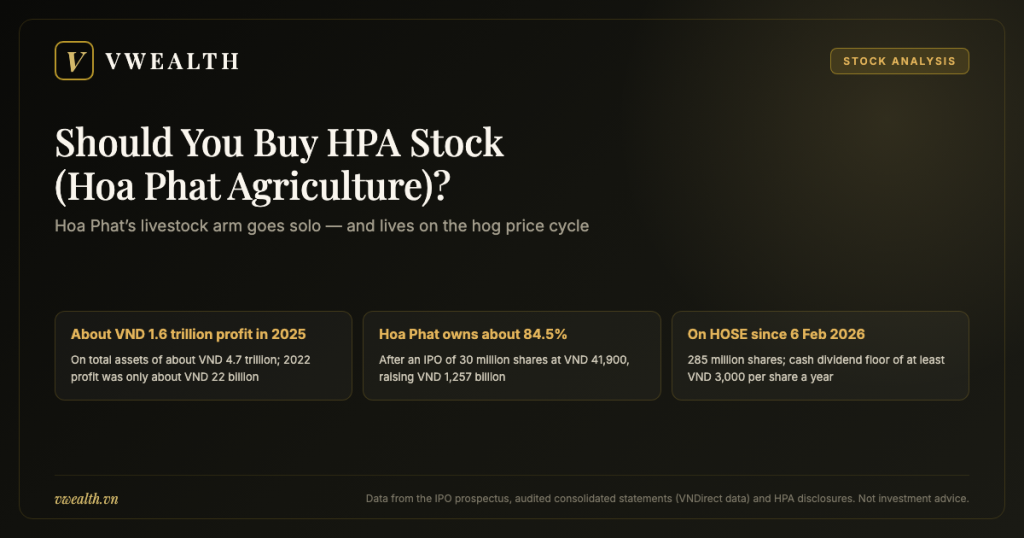
Should you buy HPA stock? HPA is the ticker of Hoa Phat Agriculture Development Joint Stock Company, which began trading on the Ho Chi Minh City Stock Exchange (HOSE) on 6 February 2026. It is an unusual listing among Vietnam stocks: the livestock arm of Hoa Phat Group, the country’s dominant steelmaker, carved out and sold to the public through an initial public offering of 30 million shares at VND 41,900 each. In 2025 this business reported net profit of about VND 1.6 trillion on total assets of only about VND 4.7 trillion — more profit than Dabaco, a rival with more than three times the assets. Yet just three years earlier, in 2022, the same company earned roughly VND 22 billion. The gap between those two numbers is the whole story of this analysis: HPA is a pig, feed, cattle and egg machine run with industrial discipline, but it lives and dies by the Vietnamese hog price cycle, and you need to understand that cycle before deciding whether to buy HPA stock.
A note on sources and conventions used throughout this series on vwealth. Dates, names and figures in this article come from published information: Hoa Phat Agriculture’s IPO prospectus (November 2025), the 2025 annual report, audited consolidated financial statements for 2022–2025 as compiled by the Vietnamese broker VNDirect, the company’s Q1 and Q2 2026 earnings disclosures, the 2026 AGM resolution, disclosures on the websites of Hoa Phat Group and of HPA itself, and reporting on shareholder meetings and investor events by CafeF, Bao Dau Tu, VietNamNet, Vietnambiz and other Vietnamese financial media. Where sources disagree, we say so. Any figure that vwealth calculated by dividing or multiplying published numbers is labeled a “vwealth estimate.” We do not quote today’s share price, current P/E or the latest quarterly profit, because those numbers change constantly; for up-to-date figures, please open the latest vwealth research report. Amounts are in Vietnamese dong (VND); for rough orientation, VND 1 trillion is a few tens of millions of US dollars at 2025–2026 exchange rates.
If you are new to the Vietnamese market, our guide on how to invest in the Vietnam stock market covers the practical mechanics — trading accounts, T+2 settlement, daily price limits and foreign ownership rules. If you have read our analysis of HPG stock (Hoa Phat Group), you already know agriculture is the “second leg” of a steel empire. This article goes the other way and stands inside the barns to ask how that livestock arm makes money now that it has to stand on its own. The closest listed peer by business model is Dabaco, and our DBC stock analysis is a useful mirror. For contrast, see our pieces on HAGL Agrico (HNG) — another industrial group’s farming venture with a very different outcome — and on Masan Group (MSN), which owns the MEATDeli branded pork business.
From a Feed Mill in Hung Yen to a HOSE Listing: The History of Hoa Phat Agriculture
Most investors know Hoa Phat for its blast furnaces at Dung Quat, its hot-rolled coil and its giant capital raisings. Few noticed that from 2015 onward the same group was quietly flying breeding pigs in from Denmark, shipping cattle from Australia and importing high-yield laying hens from the United Kingdom. Ten years later that side business had become a company earning trillions of dong, big enough to be spun off and listed. HPA’s history is short, but it contains every twist of Vietnam’s livestock industry: a collapse in hog prices, African swine fever, cattle losses caused by currency swings, eggs sold at barely break-even, and then a favorable pig price cycle that pushed profits back near the record set in 2020. Understanding each layer will help you read the numbers correctly.
2015–2016: The Steel King Walks Into the Barn
According to the company’s own prospectus, Hoa Phat Group’s first step into agriculture was the launch of Hoa Phat Hung Yen Animal Feed Co., Ltd. Hoa Phat usually cites 2015 as the year it started farming, which is why management described the late-2025 IPO as marking “ten full years of Hoa Phat in agriculture.” On 2 February 2016, Hoa Phat Agriculture Development JSC was registered in Hung Yen province with charter capital of VND 2.5 trillion, acting as the holding and management company for all of the group’s livestock and feed businesses.
The build-out in 2016 was fast. On 26 May 2016 the first batch of breeding pigs from Denmark landed at Noi Bai airport. Hoa Phat completed Australian cattle feedlots in Hung Yen (in the area formerly part of Thai Binh province) and in Dong Nai, each sized at about 10,000 head per batch; on 1 September 2016 the first Australian cattle arrived at the Viet Hung farm. On 9 December 2016 the company opened a 300,000-tonne-per-year feed mill in Hung Yen. The poultry subsidiary in Phu Tho province was also founded in June 2016, according to its director.
What stands out about this period is not speed but choices. While many Vietnamese farmers used sow lines producing around 22–25 weaned piglets per sow per year, Hoa Phat chose purebred Landrace, Yorkshire and Duroc genetics from DanBred of Denmark — breeds that, as vice chair Nguyen Thi Thanh Van later told VietNamNet, several foreign experts had considered hard to raise in Vietnam’s climate. For cattle it chose Australian stock; for eggs, Hy-Line layers. According to the 2025 annual report, each 1,200-sow Hoa Phat farm requires at least 10 hectares of land — three to four times the industry norm for the same herd size, the company says — to leave room for quarantine zones and waste treatment. Industry insiders called Hoa Phat an outsider, and the company described itself the same way. But this outsider brought two familiar things from steel into the barn: deep pockets and cost discipline.
2017–2018: A Second Feed Mill, the First Pigs to Market and 42% of Australian Cattle Imports
On 7 March 2017 charter capital was raised to VND 3.1 trillion. The prospectus notes that full payment of this capital dragged on until 9 November 2019, because a planned feed mill in Phu Tho was delayed and ultimately dropped. Also in 2017, the Dong Nai feed mill came online with 300,000 tonnes of annual capacity, lifting total feed capacity to 600,000 tonnes — a figure unchanged to this day. The first Hy-Line Brown parent stock arrived from the UK.
Around May–June 2017, as vice chair Thanh Van recalled to VietNamNet, Hoa Phat sold its first market hogs in Van Don, Quang Ninh province. Buyers complained that the pigs looked odd — a slightly big belly, not the rounded rump local traders prefer — but came back the next day asking for exactly the same meat. The anecdote matters because it happened at one of the deepest troughs in Vietnam’s hog market: in mid-2017 live hog prices sank into a prolonged slump, and many households and companies cut herds or quit. According to the company, Hoa Phat runs its farms industrially with a steady flow of output and does not change herd size in response to price swings. In 2018, the first breeding pigs and market hogs left the company’s own farm system, according to the prospectus timeline.
The cattle business moved even faster. Hoa Phat reported that in 2018 its cattle subsidiary, Hoa Phat Trading Co., Ltd., doubled revenue and took 42% of Australian cattle imported into Vietnam, becoming the number-one supplier of Australian cattle less than three years after entering the market. According to the same release, Hoa Phat Trading’s 2018 profit rose 176% from 2017, and the company targeted a 45% share of Australian cattle imports in 2019. At the time cattle was seen as the revenue engine; as the financial chapter will show, it later became the company’s biggest headache.
2019–2020: African Swine Fever and a Record Year
In 2019, African swine fever (ASF, a viral disease that kills pigs at very high rates and has no cure) spread across Vietnam and sharply reduced the national herd — the biggest supply shock the country’s pork industry had ever experienced. According to CEO Pham Thi Hong Van, speaking to VietNamNet, Hoa Phat’s closed-loop farms with three biosecurity buffer zones were not affected by that outbreak. In poultry, Hoa Phat said in early October 2020 that it was supplying about 550,000 eggs a day, the largest volume in northern Vietnam, and set a target of 1.2 million laying hens and 300 million eggs a year — a target that, according to the 2025 annual report, the poultry unit first exceeded only in 2023.
When the national herd collapsed, hog prices soared, and whoever still had pigs won big. According to the Vietnamese news site 24h, citing Hoa Phat Group’s financial statements, the agriculture segment earned roughly VND 400 billion a quarter from Q4 2019 through Q2 2021; in Q1 2020 alone its net revenue was about VND 2,779 billion. The same outlet reported that HSC Securities then forecast the segment’s 2021 net profit to fall 9.4% to about VND 1,520 billion, with a 2020 net margin of about 15.9% — implying 2020 profit of roughly VND 1,680 billion (vwealth estimate derived from HSC’s figures; this is the agriculture segment within Hoa Phat Group’s accounts, not HPA’s standalone report). Keep that level in mind: even the very strong 2025, with net profit of about VND 1.6 trillion, did not exceed the 2020 peak zone. On agriculture’s place in the group, Nguyen Viet Thang told Dan Viet before the listing that Hoa Phat “will probably keep agriculture at around 10%” of the group, because the industry keeps swinging with disease and supply.
The turn was visible early in 2021. According to 24h, the agriculture segment’s Q1 2021 net revenue was about VND 2,248 billion, down 19% year on year, profit fell almost 19% to about VND 392 billion, and egg prices were so low that the outlet described Hoa Phat selling hundreds of thousands of eggs a day at a loss. For a large livestock producer, a peak-profit year is often followed by quarters like these — treat that as part of the record, not ancient history.
2021–2023: Three Years in Reverse — Cheap Pigs, Loss-Making Cattle, Break-Even Eggs
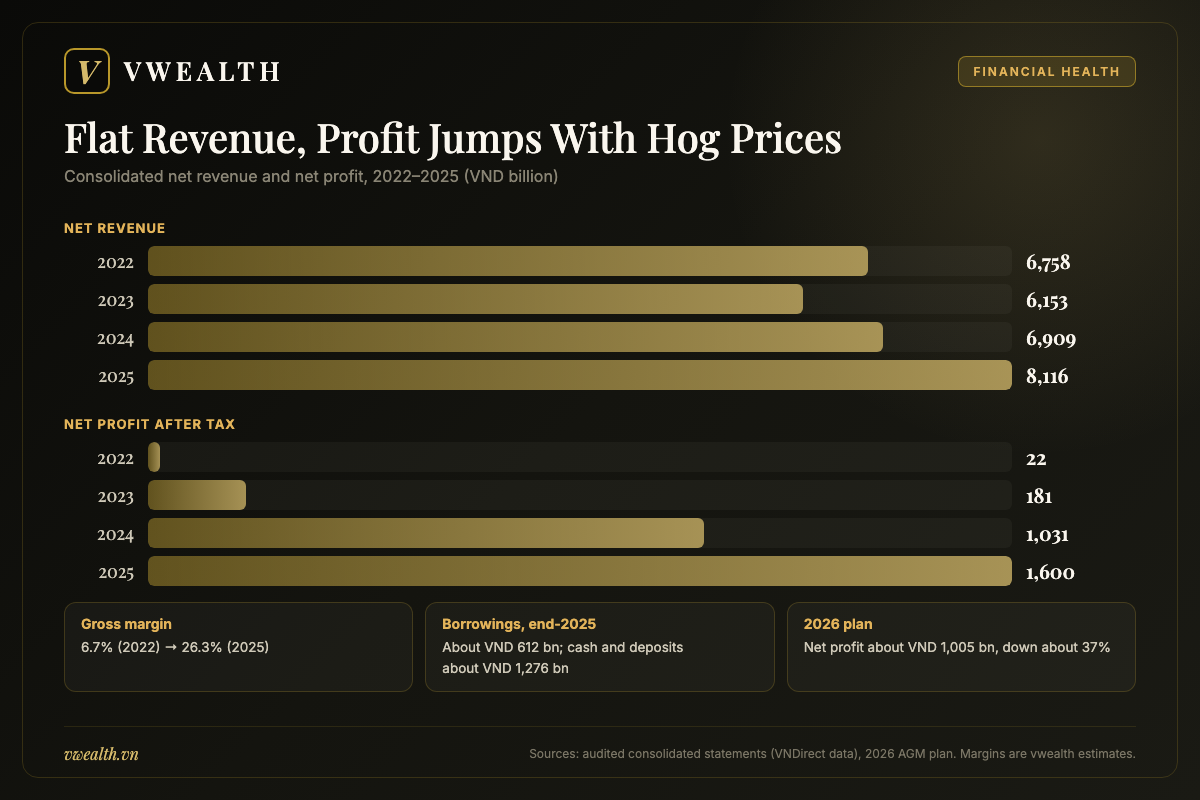
Every cycle peak passes. In the fourth quarter of 2021 alone, according to 24h citing Hoa Phat Group’s financial statements, the agriculture segment posted a pre-tax loss of about VND 104 billion and an after-tax loss of about VND 98.3 billion — its largest quarterly loss up to that point — while quarterly revenue fell 34% from a year earlier. In 2022, Hoa Phat Agriculture’s consolidated net profit shrank to about VND 22 billion on net revenue of about VND 6,758 billion, according to financial statement data compiled by VNDirect. In 2023 it recovered only to about VND 181 billion. For two years, a business with more than VND 6 trillion in revenue kept less than 3 dong of profit from every 100 dong of sales.
Three forces hit at once. First, after the ASF-driven price spike, farmers restocked aggressively and hog prices cooled. Second, the cost of feed ingredients — corn and soybean meal, largely imported — jumped in 2021–2022 as global supply chains were disrupted and the Russia–Ukraine war broke out. Third, cattle ran into trouble. Feedlot cattle imported from Australia are exposed at once to source prices, the exchange rate and freight, while domestic selling prices do not rise to match. The prospectus shows the damage in numbers: in 2023 the cattle segment posted a gross loss of about VND 113.6 billion (cost of goods sold exceeded revenue), and the cattle subsidiary, Hoa Phat Trading, lost about VND 168.7 billion after tax. The poultry and egg segment made a gross profit of only about VND 4.5 billion on more than VND 737 billion of revenue — a gross margin below 1%.
Yet during the same period, the machine kept growing quietly. According to the 2025 annual report, the pig farm system spans Lao Cai, Phu Tho, Bac Ninh, Hung Yen and Dong Nai on nearly 388 hectares, with about 25,000 sows today; at the 2026 AGM the company said that since 2016 HPA has been the only producer importing 100% DanBred genetics from Denmark. In 2023 the poultry unit surpassed 300 million eggs a year for the first time and launched its pink-shell “Hoa Phat Smile” eggs. The company’s commercial pig inventory over the year rose from about 449,000 head in 2023 to about 574,000 in 2024. In other words, capacity was being added exactly when profits hit bottom — a choice only a business with a deep-pocketed parent can make.
2024–2025: Hog Prices Return and Cash Flows Back to the Parent
2024 was the turn. Net revenue came in at about VND 6,909 billion while net profit jumped to about VND 1,031 billion, roughly 5.7 times the 2023 level (vwealth estimate from VNDirect data). According to the prospectus, gross profit from pigs rose from about VND 113 billion in 2023 to nearly VND 858 billion in 2024, and cattle swung from a gross loss to a gross profit of about VND 53 billion. 2025 was better still: HPA reported total revenue of VND 8,326 billion (up 18%, 4% above plan) and net profit of VND 1,600 billion (up 55%, 22% above plan). The company attributed the jump to higher volumes and to high average hog prices, as disease constrained market supply while its own farms kept producing.
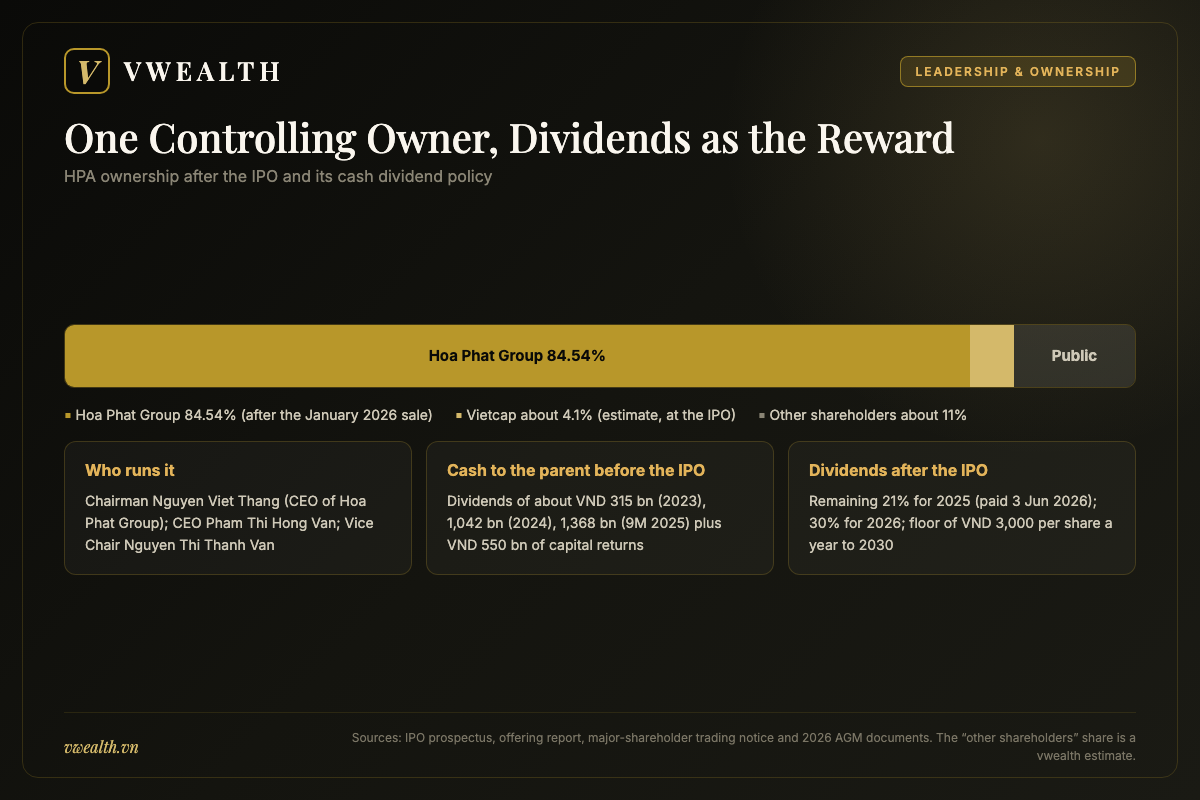
The more interesting story is where the cash went. According to the prospectus, on 2 May 2024 the company cut its charter capital from VND 3.1 trillion to VND 2.8 trillion by returning VND 300 billion of paid-in capital to shareholders; on 28 May 2025 it cut again to VND 2.55 trillion, returning a further VND 250 billion. At the time the company had just three shareholders, with Hoa Phat Group holding about 94.999%. Cash dividends flowed upstream too: the prospectus shows Hoa Phat Group received about VND 315 billion in dividends from HPA in 2023, about VND 1,042.5 billion in 2024 and about VND 1,368 billion in the first nine months of 2025 alone. Added together, over roughly three years the parent collected more than VND 2.7 trillion in dividends plus VND 550 billion from the two capital returns (vwealth estimate summing prospectus figures). Keep this in mind when we discuss why Hoa Phat took its subsidiary public.
December 2025 – February 2026: An IPO at VND 41,900 and the Listing Day
On 19 November 2025, the State Securities Commission licensed HPA’s initial public offering. The company offered 30 million shares at VND 41,900, with Vietcap Securities as exclusive adviser and distribution agent; at that price the press put the pre-money valuation at about VND 10.7 trillion (255 million shares times VND 41,900). When subscriptions closed on 15 December 2025, investors had asked for 35,739,000 shares — 19% more than offered — so shares were allocated pro rata at about 83.94%. The offering closed on 6 January 2026, raising VND 1,257 billion (about VND 1,207 billion net of costs) and lifting charter capital from VND 2.55 trillion to VND 2.85 trillion. According to Bao Dau Tu, Vietcap itself bought about 39% of the offering — roughly 11.7 million shares, or about 4.1% of post-IPO capital (vwealth estimate).
In January 2026 — before the listing — Hoa Phat Group sold about 1.32 million HPA shares: according to the 2025 annual report, HPG held 240,926,782 shares, or 84.54%, down from 242,247,944 shares (84.999%) right after the IPO. On 29 January 2026 HOSE approved the listing of 285 million HPA shares. On 6 February 2026 HPA began trading with a reference price of VND 41,900, equal to the IPO price, and a ±20% first-day band. According to Hoa Phat, the stock opened at VND 44,500 and closed at VND 43,000 (up 2.6%), with more than 1.55 million shares matched and foreign investors net buying about 121,800 shares. At the reference price, the market value on listing day was about VND 11.94 trillion (vwealth estimate: 285 million shares times VND 41,900); some media rounded differently depending on which price they used.
The table below summarizes the key milestones.
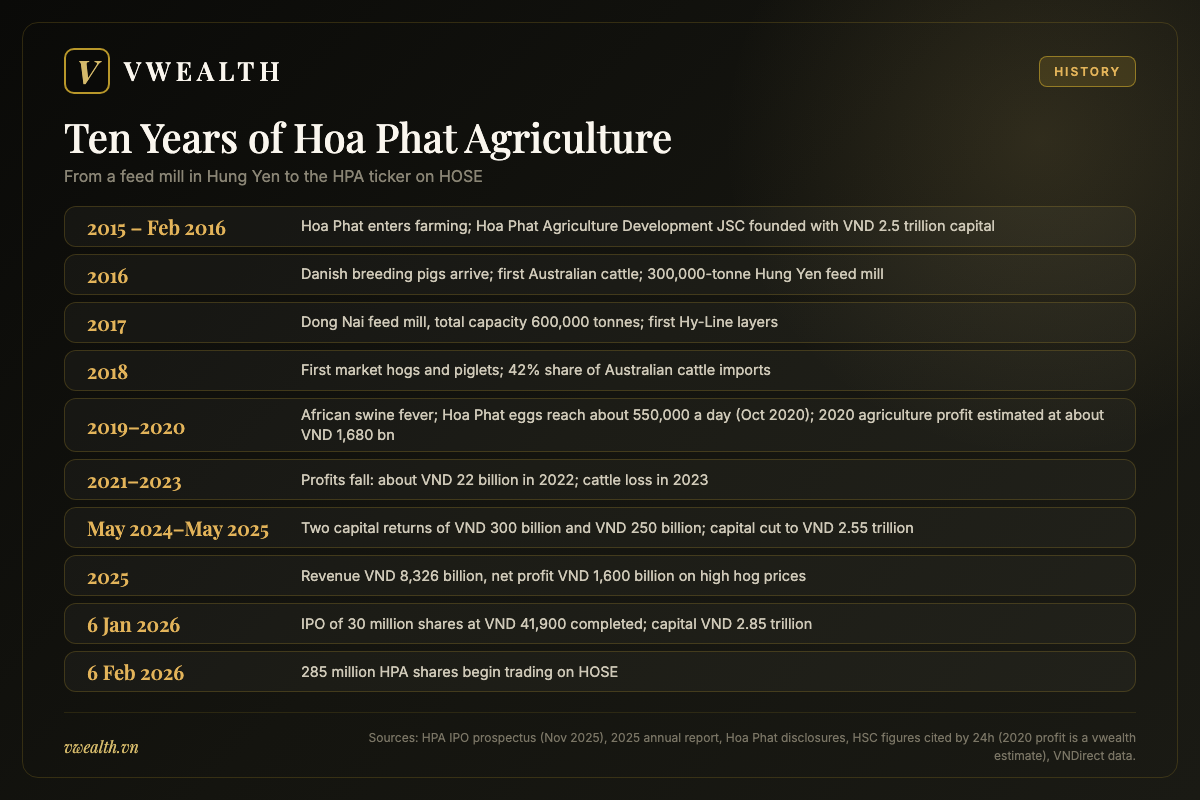
| Date | Event | What it meant for shareholders |
|---|---|---|
| 2015 | Hoa Phat launches an animal feed company in Hung Yen, its first step into agriculture | Agriculture becomes the diversification arm of a steel group |
| 2 Feb 2016 | Hoa Phat Agriculture Development JSC founded with VND 2.5 trillion capital | One holding company for all livestock and feed units |
| 2016 | Danish breeding pigs arrive (26 May); first Australian cattle (1 Sep); 300,000-tonne Hung Yen feed mill (9 Dec) | High-performance genetics and heavy upfront investment |
| 2017 | Capital raised to VND 3.1 trillion; Dong Nai feed mill, total 600,000 tonnes; first Hy-Line birds | Feed capacity in both north and south |
| 2018 | First pigs to market; 42% share of Australian cattle imports | Farms begin producing volume |
| 2019–2020 | African swine fever; Hoa Phat eggs reach about 550,000 a day (October 2020); agriculture segment profit in 2020 of roughly VND 1,680 billion (vwealth estimate from HSC figures) | Keeping the herd when others lose theirs is where the big money is |
| 2021–2023 | Profits fall; about VND 22 billion in 2022; cattle losses | The clearest evidence of cyclicality |
| May 2024 and May 2025 | Two capital returns of VND 300 billion and VND 250 billion; capital down to VND 2.55 trillion | Cash flows back to the parent before the IPO |
| 2025 | Revenue VND 8,326 billion, net profit VND 1,600 billion | A strong year right before listing |
| 6 Jan 2026 | IPO of 30 million shares at VND 41,900 completed, raising VND 1,257 billion | The public owns about 15% for the first time |
| 6 Feb 2026 | 285 million HPA shares begin trading on HOSE | Market price, liquidity and disclosure obligations |
Leadership and Ownership: Hoa Phat Holds About 84.5%, Two Women Run the Farms
When you buy a share, you buy a slice of a business together with the people steering it. For HPA, “who is steering” has two layers. The first is Hoa Phat Group — the controlling shareholder that sets big-picture strategy and receives most of the dividends. The second is the operating team that runs the barns and mills day to day and has, over ten years, turned an industry outsider into one of the most efficient producers in the country. Understanding both layers helps you anticipate how the company will behave when the cycle turns.
Chairman Nguyen Viet Thang and the Link to the Parent
According to the prospectus, HPA’s board chairman is Nguyen Viet Thang, born in 1970, with a degree in construction. He is also chief executive and a board member of Hoa Phat Group, and chairs the group’s key steel subsidiaries, including Hoa Phat Iron and Steel, Hoa Phat Dung Quat Steel and Hoa Phat Phu Yen Steel. At the time of the prospectus he represented Hoa Phat Group’s stake in HPA and held 100,000 shares personally. At the listing ceremony on 6 February 2026, it was he who received the listing decision and struck the gong to open HPA’s first trading session.
That cuts both ways. On the plus side, HPA is plugged directly into the governance of one of Vietnam’s largest private conglomerates, with a famous cost-control culture and enormous financial resources if needed. On the watch list: the man at the top of HPA is simultaneously running steel projects worth tens of trillions of dong, so agriculture is inevitably the “second job” on his calendar. In practice, day-to-day operations at HPA are handled by a separate team, and that team is where you should look to judge execution.
CEO Pham Thi Hong Van, Vice Chair Nguyen Thi Thanh Van and the Operating Team
HPA’s chief executive is Pham Thi Hong Van, born in 1974, with a degree in economics, according to the first-half 2026 corporate governance report. She fronted most investor questions at the 2026 shareholder meeting and at fund meetings during the year. The board’s vice chair is Nguyen Thi Thanh Van, born in 1976, an accountant by training and formerly deputy director of Hoa Phat Minerals JSC; at the time of the prospectus she chaired several pig-farming subsidiaries (Lac Thuy, Son Dong, Hoa Yen, Thai Thuy and Hoa Phuoc) and was director of Hoa Phat Livestock Development JSC. The newspaper VietNamNet once described the pair as Hoa Phat’s two farming “generals” who “do a lot and talk little.”
The board also includes Ta Tuan Quang as its independent member; according to the first-half 2026 governance report, all three directors attended 9 of 9 board meetings in the period. The supervisory board consists of Ngo Lan Anh (head), Vu Thanh Thuy and Nguyen Thi Thu Trang; the chief accountant is Nguyen Thi Hong Thang. The governance model is the classic general meeting, board of directors, supervisory board and CEO. The structure is lean: three directors, two of them tied directly to the group and to operations. For a newly listed company whose parent owns more than 84%, that leanness speeds up decisions, but it also means minority shareholders’ voice comes mainly through the general meeting and the quality of disclosure, not through board representation.
Management’s style shows in what it tells investors. At a meeting with funds on 13 August 2026, HPA’s leaders explained why they plan to grow the sow herd by only about 20% by 2030: suitable land is hard to find, operating capability must keep pace, and when the market enters oversupply “competition comes back to internal strength and production cost.” At HSC’s investor conference in June 2026 they said HPA does not buy or lease farms offered for sale because most fail its biosecurity standards. That is the voice of a team that prioritizes efficiency over scale — worth remembering when you compare HPA with companies expanding their herds very quickly.
Post-IPO Ownership: One Controlling Shareholder, a Thin Free Float
Before the IPO, according to the prospectus, HPA had just three shareholders; Hoa Phat Group held 242,247,944 shares, about 94.999% of capital; no individual owned more than 5%; and foreign ownership was 0%. After the IPO the share count rose to 285 million, so the same block equals 84.999%. According to the offering report dated 7 January 2026, 964 holders of under 5% together owned about 15.001% of voting shares; the shareholder list of 17 January 2026 had 965 names. After its January 2026 sale, Hoa Phat Group held 84.54%. For the June 2026 dividend, the company said the list closed on 19 May 2026 comprised 20 institutions and 2,363 individuals — about 2.5 times the pre-listing count.
A small but easy-to-miss detail: some May 2026 news reports on the dividend still described Hoa Phat as owning “nearly 95%” of HPA and estimated the parent would receive about VND 569 billion — but 95% is the pre-IPO figure and no longer correct after capital rose to VND 2.85 trillion. With about 240.9 million shares, the parent’s share of the VND 2,100 dividend is roughly VND 506 billion (vwealth estimate). When you read the news, check the latest corporate governance report and major-shareholder trading notices, because the parent’s stake could change if it sells more.
The most important consequence of this structure is a thin free float. Roughly 15% of capital, around 43–44 million shares, sits with the public, and a meaningful part of that belongs to institutions such as Vietcap (vwealth estimate from disclosed percentages). For a stock like this, daily liquidity tends to be low, bid–ask spreads can be wide and a single large order can move the price sharply. Conversely, because the parent holds near-total control, decisions on dividends, investment or restructuring will almost certainly pass according to Hoa Phat’s wishes.
Why Hoa Phat Took Its Subsidiary Public
Every investor should ask this before buying shares in a newly carved-out subsidiary: what does the parent get, and what do I get? Start with the company’s own explanation. At the IPO roadshow in Ho Chi Minh City on 1 December 2025, as reported in HPA’s own news release, management said 30 million shares was “the right landing point for HPA’s self-reliant model”; after this round it hoped to attract investors or strategic partners, and while Hoa Phat would keep control, “there will be opportunities in later rounds for potential investors, especially when the company wants to extend its value chain in agriculture.” At the listing ceremony, Tran Dinh Long said the listing would help the company “increase transparency and credibility, strengthen its autonomy and its access to secondary capital.”
Now put those words next to the numbers. According to the prospectus, the expected VND 1,257 billion was allocated as follows: VND 1,000 billion into Hoa Phat Livestock Development JSC (the pig business), mostly to recapitalize Hoa Phuoc Livestock Co., Ltd. in order to restructure its funding, repay loans and pay suppliers of feed, piglets and veterinary products; VND 50 billion into the Phu Tho poultry company to repay debt and fund working capital; and about VND 207 billion into Hoa Phat Trading to grow the cattle herd. In other words, most of the IPO money went to financial restructuring and working capital rather than new farms right away. The investment plan of more than VND 1.5 trillion for three new pig farms and a third feed mill was announced separately for the period to 2030. According to the July 2026 report on the use of proceeds, net proceeds were about VND 1,207 billion; by 5 July 2026 the company had disbursed about VND 1,139.8 billion, leaving about VND 67.2 billion (roughly 6%) still unused.
Add the detail from the previous chapter — VND 550 billion of capital returns and more than VND 2.7 trillion of dividends flowing to the parent in the three years before the IPO — and you get a financial picture that can be read in more than one way. The favorable reading: this is a strongly cash-generative business that returned surplus capital to its owner, then raised a moderate amount of public equity to gain a shareholder base and a market valuation. The more cautious reading: the parent pulled out most of the cash accumulated during a favorable cycle, then sold part of the business to the public while profits were near a high. The two readings are not mutually exclusive, and this article does not judge motives. Your job is to recognize that you are buying at a moment the parent chose — and such moments usually favor the seller.
For Hoa Phat Group, the benefits are clear. In 2025, HPG’s consolidated net profit was about VND 15,515 billion, of which HPA contributed about VND 1,600 billion — roughly 10% (vwealth estimate from VNDirect data). Listing HPA gives HPG a market reference price for its agriculture arm, an extra funding channel that does not dilute HPG shareholders, and full retained control. In years when HPG needs huge sums for Dung Quat 2 and new steel projects, a subsidiary that funds itself and pays regular dividends is a valuable asset.
Dividends: Capital Returns, Big Payouts and a VND 3,000 Floor
If one thing drew retail investors into HPA’s IPO, it was the dividend policy. According to HPA’s announcement of its IPO results, at the IPO price of VND 41,900, HPA expected to deliver a dividend yield of about 9.2% over the 12 months after the IPO, combining the remaining 2025 dividend and an advance on 2026. Further out, the company set a target of at least VND 3,000 per share in cash dividends every year from 2026 to 2030, or about 7.2% on the IPO price. Management also said it does not plan to issue new shares to raise capital during 2026–2030.
The 2025 dividend was paid in several installments. According to the 2026 AGM documents, the company paid about VND 946.9 billion of 2025 dividends (a 35.464% rate on par value) during 2025 itself — before the IPO, so almost entirely to the parent. The remaining 21% (VND 2,100 per share, about VND 598.5 billion) had a record date of 19 May 2026 and was paid from 3 June 2026 to more than 2,300 shareholders. For 2026, the AGM approved a 30% cash dividend in two installments: the first expected in Q4 2026 (described at the meeting as a 15% advance), the second after the 2027 AGM. So during calendar 2026 shareholders are expected to receive about 36% of par in total, or VND 3,600 per share, if the plan is carried out. (In Vietnam, dividend rates are quoted as a percentage of the VND 10,000 par value, so 30% means VND 3,000 per share.)
Read this policy carefully on three points. First, VND 3,000 a year is a stated direction, not a legal obligation; each year’s dividend still needs shareholder approval based on actual profit. Second, with charter capital of VND 2.85 trillion, VND 3,000 per share equals about VND 855 billion a year (vwealth estimate) — easy to pay when profit is VND 1–1.6 trillion, but most of the profit if hog prices fall to 2022–2023 levels. Third, because Hoa Phat owns more than 84%, a high payout is also the natural way for the parent to extract cash. Minority and parent interests are aligned here — a positive — but it also means little cash is retained as a cushion for bad years.
Core Businesses: The Four Fingers of Hoa Phat’s Livestock Hand
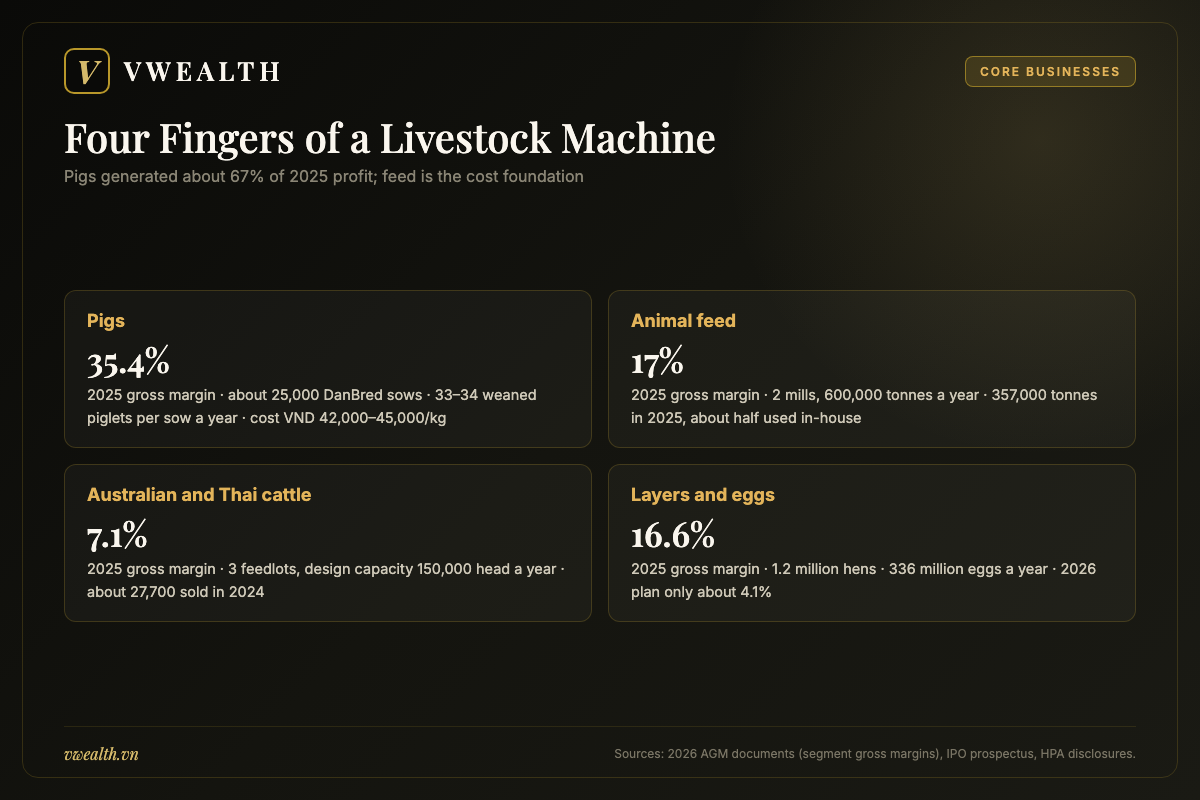
Think of HPA as a hand with four fingers: pigs, animal feed, cattle and laying hens. The fingers are very different in length. In 2025, according to the annual report and the AGM, pigs contributed 41% of revenue but 67% of net profit; feed contributed about 22% of profit; cattle revenue rose 52% and poultry profit rose about 59-fold from the year before. (Some other company releases put pigs at “about 44%” of revenue — a small gap that may reflect different treatment of intra-group sales.) The key point: nearly every big swing in HPA’s profit runs through the first finger — the pig. That is why we describe HPA as “Hoa Phat’s livestock arm gone solo, living on the hog price cycle.”
One thing to state up front: HPA operates only the Feed and Farm stages of what the industry calls the 3F model (Feed – Farm – Food). Unlike Dabaco or Masan, HPA does not yet do Food — slaughtering, processing and selling packaged meat to consumers. At the IPO roadshow, management said that when Hoa Phat does something it wants to do it “all the way, with a distribution chain to consumers,” so it needs careful study before entering the food stage, and it hopes for strategic partners when extending the value chain. At the 2026 AGM the company said all market hogs are currently sold through traders; in the south just five wholesale buyers take the entire output, Ho Chi Minh City already has a branded point of sale, and the company is planning a direct distribution network to bring pork to consumers. In other words, HPA sells near-raw commodities — live hogs, live cattle, eggs, feed — so prices are set by the market, not by a brand.
Pigs: DanBred Genetics, 33–34 Weaned Piglets and a VND 42,000–45,000 Cost per Kilogram
The pig business is run by Hoa Phat Livestock Development JSC through a set of farm companies in Lao Cai, Bac Ninh, Hung Yen, Phu Tho and Dong Nai. According to HPA’s releases in early 2026, the company has about 25,000 breeding sows (later reports mention “8 farms” on about 388 hectares once a new farm is counted), with design capacity of about 750,000 market hogs a year. All great-grandparent stock comes from DanBred in Denmark. Sows wean 33–34 piglets per year, which the company says is about 1.5 times the Vietnamese average (quoted at about 20–25 depending on the source).
Why does the weaning number matter so much? Because the cost of keeping a sow — feed, housing, vet care, labor — is roughly fixed each year. The more piglets a sow raises, the lower the piglet cost embedded in each market hog. Add in-house feed and good feed conversion, and HPA reported a production cost of about VND 42,000 per kg of live hog at its December 2025 IPO roadshow, and about VND 42,000–45,000 per kg “from 2025 until now” when answering investors at HSC’s conference in June 2026 — about VND 10,000 below the market, according to the company. At the April 2026 AGM the company was more specific: a cost of about VND 45,000 per kg is the fully loaded figure, up from the VND 42,000 cited at the IPO because of ingredient and logistics costs, and it could rise another 4–5% in the second half if ingredient prices stay under pressure. With live hog prices at VND 59,000–61,000 (the range cited at the IPO roadshow), each kilogram carries a thick margin; when hog prices slide to around VND 45,000–50,000, that margin thins very quickly.
Actual output is well below design capacity, a detail that is easy to miss. According to the prospectus, HPA sold about 357,500 market hogs in 2023 and about 364,900 in 2024; for 2025 the company reported more than 380,000 market hogs on a 100-kg-equivalent basis, up 5.9%. The gap between 380,000 hogs sold and 750,000 of capacity reflects piglets sold as breeding stock (next section), farm renovations and how the company defines capacity. In 2025–2026 the Minh Duc farm in the south — a large site that the company says produces about 150,000 market hogs a year at full capacity — underwent a major overhaul after ten years of operation, while the Long Ha 2 farm in Dong Nai was completing paperwork before stocking. These two farms are the nearest sources of volume growth; at the 2026 AGM the company set a 2026 plan of about 340,000 market hogs.
On sales, the prospectus says about 80% of 2024 pig revenue came from live hogs, sold to companies, traders at wholesale markets and smaller buyers in both the north and the south. With about 52.9 million hogs slaughtered nationwide in 2023, HPA held less than 1% of the market. HPA is therefore a price taker: not big enough to set hog prices, even if it is good enough to produce more cheaply than most of the market.
Breeding Pigs: Selling Piglets to Pull in Feed Customers
The least-noticed but fastest-growing business of the past two years is commercial piglets — young pigs of about 7–12 kg sold to finishing farms. According to the prospectus, piglet sales rose from about 86,000 head in 2023 to about 198,600 in 2024; for 2025 the company reported nearly 280,000 head on a 10-kg-equivalent basis, up about 39.5%. At HSC’s conference, management said HPA’s piglets sell at around VND 2.4 million each.
Why sell piglets? Two reasons. First, according to HPA’s leadership at the August 2026 fund meeting, small farms have almost stopped keeping sows over the past two years; households now raise short-cycle finishing pigs and buy piglets from companies, so demand for piglets has risen. Second, and more important for the business model, piglets pull feed sales along. Buyers of HPA’s healthy piglets often buy HP Feed or BigBoss feed to raise them; according to the company, pig feed now accounts for more than 75% of the feed it sells to outside customers. In the herd expansion plan to 2030, about 30% of the additional sows are earmarked for piglet sales to support the feed market, and 70% for finishing hogs. It is how a company that refuses contract farming can still embed its products in other people’s farms.
The flip side is that piglets are also cyclical — even earlier than finishing hogs. When hog prices rise, everyone restocks and piglet prices jump; when hog prices fall, farmers stop restocking and piglet demand drops first. Profit from piglets in 2024–2025 is therefore part of “cycle profit,” not steady income.
Animal Feed: Two Mills, 600,000 Tonnes, Half Consumed In-House
Animal feed is the foundation of the whole chain. HPA kept this business inside the group rather than spinning it off: the Hung Yen feed subsidiary was the first unit Hoa Phat set up when it entered agriculture in 2015. The two mills, in Hung Yen and Dong Nai, each have 300,000 tonnes of annual capacity. From Q2 2026 the Dong Nai mill runs a 1,250 kWp rooftop solar system that, according to the company, meets about 40% of the plant’s electricity needs. Products are sold under the HPFeed and BigBoss brands through more than 600 dealers.
In 2025, according to HPA, feed output reached 357,000 tonnes, up 5.5% and the highest in ten years (the previous record was about 340,000 tonnes in 2021). About 177,000 tonnes were sold externally and about 180,000 tonnes supplied to the company’s own farms. The prospectus says that in 2022–2024 about 47–51% of feed output was used internally. According to the prospectus, HPA’s 2024 output of about 339,000 tonnes was about 1.6% of Vietnam’s industrial feed output (about 21.5 million tonnes). The company ranks itself among the top 13 feed producers in Vietnam — a mid-sized player in an industry where, as HPA’s own management said at the IPO roadshow, foreign-invested companies hold about 65% of the market and total mill capacity is double actual demand.
What makes HPA’s feed arm notable is not scale but mix. According to the company, pig feed accounts for more than 75% of the feed it sells to outside customers (August 2026 fund meeting) and more than 80% of total output including supply to its own farms (2026 AGM); pig feed carries meaningfully higher margins than poultry feed. The prospectus says the gross margin on externally sold feed rose from 13.2% in 2022 to 14.6% in 2024; at the 2026 AGM the company disclosed a feed gross margin of about 17% for 2025 and guided to about 14.9% for 2026 as ingredient costs rise. The feed business plays two roles: it earns money directly from outside customers, and it supplies the farms at cost. When hog prices fall, external feed sales usually act as a cushion that stops profits from dropping straight down.
The weak spot is raw materials. According to an MBS research report cited by CafeF in August 2026, about 75% of HPA’s feed ingredients are imported. The main inputs are corn and soybean meal, bought from suppliers such as Cargill Vietnam and Asia Goldman, according to the prospectus list of major suppliers. When corn, soybean meal, ocean freight or the exchange rate rises, feed costs rise immediately, and the increase cannot always be passed on.
Australian and Thai Cattle: Big Revenue, Thin Margins
Cattle are handled by Hoa Phat Trading Co., Ltd., which runs three feedlots according to the prospectus: Viet Hung (Hung Yen) at about 10,000 head per batch, Bo Trach (Quang Tri province, formerly Quang Binh) at about 20,000 per batch, and Dong Phat (Dong Nai) at about 12,500 per batch, on about 625 hectares in total. The model is simple: import Australian cattle, fatten them to target weights and sell live cattle to slaughterhouses; the product meets ESCAS (the Australian government’s animal-welfare assurance system for exported livestock). The prospectus estimates the company’s Australian cattle herd at more than 40,000 head in 2025, about 50% of the market for fattened Australian cattle in Vietnam.
Be careful with cattle “capacity” figures. Adding up the design capacity of the three farms in the prospectus (35,000 + 70,000 + 45,000 head per year) gives about 150,000 head. Actual sales are far lower: about 22,060 head in 2023, about 27,745 in 2024 and about 30,300 in the first nine months of 2025, also per the prospectus; the annual report puts full-year 2025 at more than 41,300 head. In the first half of 2026, as the company deliberately slowed Australian imports, sales fell to 10,138 head. The company’s 2030 target is a herd of 73,000. If you see very different numbers for Hoa Phat cattle in the press, distinguish design capacity, herd size and actual sales.
Cattle revenue is substantial — about VND 1,170 billion in 2023, VND 1,260 billion in 2024 and VND 1,377 billion in the first nine months of 2025 — but margins are thin: gross margin went from minus 9.7% in 2023 to plus 4.2% in 2024 and about 7.1% in 2025 per the AGM. Fattening cattle is close to a commodity trade: source prices in Australia, the Australian dollar, ocean freight and quarantine costs set the cost base, while selling prices face competition from local cattle, Thai cattle and smuggled animals. In 2026 HPA signed an agreement with the Thai Livestock Export Association (TLEX) to import Brahman cattle — the same breed as most Australian stock — at about 1,300 head a month through December 2026 and about 36,000 head in 2027. The company also deliberately delayed Australian imports when cattle prices and freight costs rose. Both moves reduce dependence on a single source, but the “big revenue, thin margin” nature of the business is hard to change.
Clean Eggs: 1.2 Million Hens and a Lesson in Margins
If you live in Hanoi, you may well have bought a tray of Hoa Phat eggs without realizing it came from a steel company. The poultry business, Hoa Phat Phu Tho Poultry One Member Co., Ltd., runs two farms on nearly 50 hectares: a parent-stock farm of about 10.3 hectares (around 15,000 hens a year) and a commercial layer farm of nearly 40 hectares with an average of 1.2 million hens and capacity of about 336 million eggs a year — close to one million eggs a day. Housing equipment comes from Facco (Italy), hatchery machines from Pas Reform (Netherlands) and grading lines from MOBA (Netherlands); eggs are sold under the HPe, HPs and Hoa Phat Smile labels. HPA says it leads the clean-egg market in northern Vietnam.
Eggs are the best illustration of why “running at full capacity” does not mean “full profits.” According to the prospectus, capacity utilization rose from 78.6% in 2022 (about 264 million eggs) to 93% in 2023 (about 311 million) and 99.7% in 2024 (about 335 million). Yet gross margin rose only from about 0.6% in 2023 to 2.8% in 2024 — selling nearly all capacity at almost no profit. In 2025 things flipped: according to HPA, egg prices rose sharply because many small farms cut flocks early in the year and imports from Thailand and Cambodia were disrupted; poultry profit rose about 59-fold and gross margin reached about 16.6%. But the 2026 plan presented to shareholders assumes a poultry gross margin of only about 4.1%.
The lesson: egg prices have their own cycle — according to the company, they typically fall after Lunar New Year through summer and recover with the Mid-Autumn mooncake season and the year-end holidays — and margins in this segment swing widely around zero. The first half of 2026 is the latest example: according to CafeF, the poultry unit took in nearly VND 350 billion but posted an after-tax loss of about VND 6.7 billion; in Q2 2026 alone, HPA’s quarterly overview shows a loss of about VND 13.7 billion even as revenue rose 9.6%. Under the announced plan, the commercial farm will stay at 1.2 million hens and 336 million eggs, while the parent flock grows from about 15,000 to 30,000 hens a year, with the goal of expanding exports of branded eggs (eggs are already sold to Laos and Cambodia). Eggs are therefore not a growth engine but a segment with stable volume and erratic profit.
Which Segment Feeds Which — and Where HPA’s Moat Lies
Put the four businesses side by side and HPA works like a two-way chain. In one direction, the feed mills supply about half their output to the pig and poultry farms, giving the farms a stable feed cost and giving the mills a large enough base volume to run efficiently. In the other direction, the pig farms produce piglets sold to outsiders, which drags external feed sales along. HPA’s leaders also say the in-house farms serve as a test bed for formulas and additives, letting them optimize feed costs “with data rather than gut feeling.” Cattle and eggs stand relatively apart, linked to the chain mainly by buying in-house feed.
The subsidiary results show clearly who is feeding whom. According to the table of subsidiary results in the prospectus, in 2023 the Hung Yen feed company earned about VND 364 billion before tax while the pig company earned only about VND 25 billion and the cattle company lost about VND 169 billion: that year, feed fed the whole family. In 2024 the roles reversed: the pig company earned about VND 728 billion after tax, more than twice the feed company (about VND 284 billion). By 2025, according to HPA, the pig subsidiary achieved a return on equity (ROE) of about 83%, the highest in the entire Hoa Phat Group, with a net margin of about 31%.
So where is HPA’s “moat” — the advantage that lets a company keep earning above-average profit for longer than rivals? In our view it has three parts. First, cost: high-yield genetics, in-house feed and largely depreciated farms (according to the company, its 25,000-sow system was largely reinvested from depreciation cash flow) give HPA a lower hog production cost than most of the market. Second, biosecurity: large sites, three quarantine zones and no contract farming help HPA keep its herd through outbreaks — and keeping your herd when others lose theirs is precisely when the biggest profits are made. Third, a balance sheet with almost no debt (see the financial chapter), which means HPA is never forced to dump animals when prices are bad. What this moat does NOT do is set selling prices. When national hog prices fall, HPA’s prices fall too; the moat only helps HPA lose less or earn more than others in the same conditions.
| Segment | Key scale (company data) | 2024 revenue (prospectus) | 2025 gross margin (2026 AGM) | Role in the chain |
|---|---|---|---|---|
| Pigs (market hogs and piglets) | About 25,000 DanBred sows; design capacity 750,000 market hogs a year | About VND 3,054 billion (44.2%) | About 35.4% | Profit engine, most sensitive to hog prices |
| Animal feed (HPFeed, BigBoss) | 2 mills, 600,000 tonnes a year; 357,000 tonnes in 2025 | About VND 1,884 billion (27.3%, after intra-group eliminations) | About 17% | Cost foundation, cushion when hog prices fall |
| Cattle (Australian, Thai) | 3 feedlots, design capacity 150,000 head a year; about 27,700 sold in 2024 | About VND 1,260 billion (18.2%) | About 7.1% | Large revenue, thin margin, currency risk |
| Layers and eggs | 1.2 million hens; capacity 336 million eggs a year | About VND 710 billion (10.3%) | About 16.6% (2026 plan: about 4.1%) | Stable volume, erratic profit |
Financial Health: Reading HPA’s Numbers Before Deciding Whether to Buy HPA Stock
HPA’s financial statements are easier to read than most: little debt, few investments outside the core, no property business mixed in. But that cleanliness can make readers complacent. HPA’s most attractive numbers — very high margins and ROE — are exactly the ones that need the most careful reading, because they were measured at the top of a hog price cycle. This chapter walks through the four most recent audited years (2022–2025) and then shows you how to read the quarterly reports to come.
Four Years of Revenue and Profit: From About VND 22 Billion to About VND 1.6 Trillion
The table below summarizes key lines from HPA’s consolidated financial statements as compiled by VNDirect. The two margin rows were calculated by vwealth (profit divided by net revenue), so they are vwealth estimates.
| Item (VND billion) | 2022 | 2023 | 2024 | 2025 |
|---|---|---|---|---|
| Net revenue | 6,758 | 6,153 | 6,909 | 8,116 |
| Gross profit | 450 | 544 | 1,462 | 2,131 |
| Gross margin (vwealth estimate) | 6.7% | 8.8% | 21.2% | 26.3% |
| Net profit after tax | 22 | 181 | 1,031 | 1,600 |
| Net margin (vwealth estimate) | 0.3% | 2.9% | 14.9% | 19.7% |
| Total assets, year-end | 5,495 | 5,103 | 4,676 | 4,700 |
| Shareholders’ equity, year-end | 3,438 | 3,593 | 3,240 | 3,180 |
| Short- and long-term borrowings | 1,367 | 1,121 | 950 | 612 |
| Net cash from operating activities | 1,436 | 1,232 | 1,163 | 2,403 |
| Cash dividends paid | 321 | 315 | 1,043 | 1,368 |
Two notes on reading the table. First, the VND 8,326 billion revenue figure HPA often cites is “total revenue” before deductions; net revenue is about VND 8,116 billion. Both are correct under different definitions. Second, in 2022 and 2023, profit attributable to parent shareholders (about VND 65 billion and VND 221 billion) was higher than consolidated net profit, because losses were allocated to minority shareholders in a few subsidiaries. From 2024 the two figures are nearly identical.
Revenue over the four years moved within a fairly narrow band, from about VND 6,150 billion to VND 8,120 billion. Profit, by contrast, leapt from tens of billions to more than a trillion. That is the classic signature of operating leverage (when most costs are fixed, a small change in selling price produces a very large change in profit). At HPA, that leverage lives in the barns: the sow herd, farms, labor and depreciation are essentially unchanged whether hog prices are high or low. When hog prices rise by a few thousand dong per kilogram, almost all of the increase flows straight to profit.
Unusually High Margins: Where They Come From and Whether They Last
A net margin of nearly 20% is very rare in livestock. For comparison, according to VNDirect data, Dabaco’s 2025 net margin was about 10% and BAF Vietnam’s about 2.5% (vwealth estimates). According to HPA, the pig segment’s 2025 gross margin was about 35.4%. So where do the high margins come from? There are three layers, and it helps to separate them because each has a different shelf life.
The first layer is price — the least durable. In 2025 African swine fever flared badly (according to HPA’s annual report, 2,782 outbreaks across 34 provinces and cities over the year, forcing the culling of more than one million pigs), and together with natural disasters that left hog supply short and prices high. HPA’s average live hog price in the first half of 2025 was above VND 68,000 per kg, according to the company. When prices return to lower levels, this slice of profit shrinks accordingly.
The second layer is cost — more durable, but not permanent. The VND 42,000–45,000 per kg cost comes from high-yield genetics, in-house feed and an important accounting fact: fixed assets are largely depreciated. According to VNDirect data, at the end of 2025 the gross cost of tangible fixed assets was about VND 4,510 billion but accumulated depreciation was already about VND 3,329 billion, meaning about 74% of the original cost had been written off (vwealth estimate). Annual depreciation fell from about VND 569 billion in 2022 to about VND 407 billion in 2025. When HPA builds new farms and a third feed mill with more than VND 1.5 trillion, depreciation will rise again and margins will carry an extra layer of cost.
The third layer is below the operating line: low interest costs (about VND 60 billion in 2025) and corporate income tax. According to VNDirect data, 2025 tax expense was about VND 152 billion on pre-tax profit of about VND 1,752 billion, an effective tax rate of only about 8.7% (vwealth estimate), well below Vietnam’s standard 20% rate. This article does not speculate on the specific reason; if you plan to hold the stock long term, read the tax notes in the audited financial statements to see which incentives apply and when they expire, because a change in the tax rate hits net profit directly.
The company itself does not expect 2025 margins to repeat. The 2026 plan approved by shareholders targets revenue of about VND 7,200 billion and net profit of about VND 1,005 billion, down about 37% from 2025; company-wide gross margin is expected at about 20–21%, with pigs at about 29%. That is an honest signal worth crediting: management is not promising that its best year is the “new normal.”
A Balance Sheet With Almost No Debt
If margins are where caution is needed, the balance sheet is where HPA genuinely shines. At the end of 2025, according to VNDirect data, HPA’s total short- and long-term borrowings were only about VND 612 billion (long-term about VND 19 billion), while cash, cash equivalents and term deposits totaled about VND 1,276 billion. In other words, HPA had net cash of about VND 660 billion (vwealth estimate: cash and deposits minus borrowings). Total liabilities of about VND 1,520 billion were only about 32% of total assets (vwealth estimate). After the IPO, roughly VND 1,207 billion of net proceeds thickened equity further, and under the use-of-proceeds plan part of it goes to repaying loans.
At HSC’s conference in June 2026, HPA’s leaders said total investment in the entire pig farm system was a little over VND 3 trillion, of which about VND 1.2 trillion was equity, and that it was “all funded by own capital and depreciation, without long-term borrowing.” The company also owns nearly 400 hectares of land for its pig farms; management said land for the first farms in Bac Ninh (formerly Bac Giang) cost about VND 160–300 million per hectare, whereas in some localities it now costs VND 1.5–3 billion per hectare. According to management, all project land is held on 50-year terms with complete legal documentation. This land is carried at historical cost on the books — a “hidden asset” that you should treat as a cushion, not the main reason to buy.
Why does the balance sheet matter so much for a livestock company? Because the hog cycle usually ends with a loss-making phase in which weak players must sell herds and farms. Compare BAF Vietnam — with borrowings of about VND 3,977 billion against equity of about VND 4,064 billion at the end of 2025, per VNDirect data — or Dabaco with borrowings of about VND 5,876 billion: HPA can get through a bad hog-price year without debt pressure. That is exactly what lets HPA “keep the herd,” which management regards as the key to harvesting big profits when the cycle turns.
Cash Flow, Depreciation and Capex: Why Investment Spending Is So Low
HPA’s net cash from operations was positive in each of the past four years, even in 2022 when profit was only tens of billions: about VND 1,436 billion in 2022, VND 1,232 billion in 2023, VND 1,163 billion in 2024 and VND 2,403 billion in 2025, per VNDirect data. Cash flow stayed high in 2022–2023 despite low profit thanks to large depreciation (about VND 500–570 billion a year) and inventory reduction (inventories fell by about VND 891 billion in 2022 and VND 569 billion in 2023). The 2025 operating cash flow includes “other receipts from operating activities” of about VND 439 billion, unusually high compared with earlier years; read the notes to understand this item before treating VND 2,403 billion as a “normal” level of cash generation.
Spending on fixed assets has been falling: about VND 395 billion in 2022, VND 391 billion in 2023, VND 205 billion in 2024 and only about VND 90 billion in 2025. For the past two years HPA has spent far less on new investment than its depreciation charge — the company has been “milking” the system it built rather than expanding hard. All the surplus cash went into dividends, capital returns and debt reduction: in 2025 alone, dividends paid were about VND 1,368 billion, the capital return about VND 250 billion and net loan repayment about VND 338 billion (vwealth estimate from the borrowing and repayment lines).
This will change. Under the plan presented at the 2026 AGM, HPA intends to invest about VND 1,000 billion over 2026–2030 to lift the sow herd above 30,000 and output to 900,000 market hogs a year, plus about VND 500 billion for a third feed mill with 300,000 tonnes of capacity, expected to break ground in 2029. Together with a dividend floor of about VND 855 billion a year, HPA will have to split its cash between two needs — easy arithmetic when hog prices are good and tighter when they are bad.
High ROE Because the Denominator Shrank: Reading the Ratio Correctly
HPA’s 2025 ROE (net profit divided by average shareholders’ equity) was about 50% and its ROA (net profit divided by average total assets) about 34% (vwealth estimates from VNDirect data). HPA’s 2025 annual report shows the same ROE of 50% and ROA of 34%, the highest in its history; note that some press reports of the AGM swapped the two figures (ROE 34%, ROA 50%). Those are extraordinary numbers for any company, let alone a farmer.
But look at the denominator. HPA’s equity fell from about VND 3,593 billion at the end of 2023 to about VND 3,180 billion at the end of 2025, because the company returned capital and paid dividends close to or above its profit. Total assets also fell from about VND 5,495 billion to about VND 4,700 billion over four years. When the denominator shrinks while the numerator surges with hog prices, ROE rises from both directions. After the IPO, equity grew by roughly VND 1.2 trillion, so even with flat profit ROE will mechanically be lower. The company’s own long-term target is “ROE above 25%” (one report says “above 20%”) — much lower than 2025, and a more sensible benchmark for you.
Six Questions to Ask Every Time HPA Reports
Rather than memorizing the figures above, you can use six questions on every quarterly report, checking them against the updated data on vwealth. One: what was HPA’s average live hog selling price this period, compared with the production cost the company discloses? That spread decides most of the profit. Two: did market hog and piglet volumes rise or fall, and why — market conditions or farm renovations such as Minh Duc? Three: did the feed segment hold its gross margin as corn, soybean meal and freight costs moved? Four: is cattle profitable, and where are the animals coming from? Five: is operating cash flow in line with profit, or propped up by one-off items? Six: do capex and dividends together exceed the cash the business generates? If all six answers look healthy, you are looking at a good year; if the first three deteriorate together, the cycle may be turning.
How the Market Has Received HPA Stock: From an Oversubscribed IPO to a Post-Listing Slide
A newly listed stock is like a new hire: for the first few months the market is still working out how to treat it. HPA has only a few months of trading history, so this chapter does not pretend to draw a long-term “personality.” Instead it lays out what has been observed so far, what can easily lead you to misvalue the stock, and the milestones that could move it. All prices below are historical and dated; for the current price and valuation, see vwealth’s latest report.
The IPO and Listing Day: Real Interest, Modest Scale
HPA’s IPO was received reasonably well. Subscriptions of about 35.7 million shares exceeded the offer by 19%, so investors received only about 83.94% of what they asked for. According to the newspaper Thuong Hieu va Cong Luan, the offering closed on 6 January 2026 with 809 investors. But keep the numbers in proportion: 30 million shares, about VND 1,257 billion, was a small deal next to the large IPOs listed around the same period, such as Gelex Infrastructure (GEL) and the brokerages VPS (VCK) and VPBankS (VPX). Nineteen percent oversubscription shows genuine demand, not a frenzy.
Listing day on 6 February 2026 was calm: open at VND 44,500, high of VND 45,000, close at VND 43,000, up 2.6% from the reference price. Matched value was about VND 67.5 billion, around 0.2% of total HOSE turnover that day, according to Hoa Phat. Gelex Infrastructure’s GEL also debuted on 6 February 2026 — two carve-outs from two large private groups listing on the same day. From the second session HPA traded within the normal ±7% daily band for HOSE stocks; for its first six months HPA was on HOSE’s list of stocks ineligible for margin trading because it had been listed for less than six months — common for new listings — and it was removed from that list only in mid-August 2026, according to Vietnambiz.
The First Six Months on the Exchange: Why the Price Fell
According to CafeF, on 12 August 2026 HPA closed at VND 30,000, about 24% below the dividend-adjusted first-day reference price of VND 39,610; its highest price came on listing day itself. Over the same period, according to that article, GEL rose about 8%, VPX fell about 24% and VCK fell about 18% from their debut prices — so new listings as a group did not fare well, but HPA was among the weaker ones. Liquidity also thinned after the first weeks.
At least three reasons stand out. First, profit expectations were reset right after listing: less than two months after the debut, AGM documents published at the end of March 2026 set a 2026 profit plan about 37% below 2025. Second, first-half 2026 results were down year on year; the company attributed this mainly to the Minh Duc farm overhaul, which forced it to keep piglets from the Long Ha farm for finishing rather than selling them, and to a deliberate delay in cattle imports as Australian cattle prices and freight rose. HPA’s average live hog price in the first half of 2026 was about VND 66,000 per kg, below the more than VND 68,000 of the same period in 2025. Third, feed ingredient and freight costs rose during 2026 amid tensions in the Middle East, threatening margins. According to an explanatory letter sent to HOSE on 28 August 2026, reviewed consolidated first-half 2026 net profit was VND 648 billion, down VND 291 billion (31%) from VND 939 billion a year earlier, “mainly due to lower pig volumes together with lower average pig selling prices.” In Q2 2026 alone, consolidated revenue was VND 1,566 billion (down 32%) and net profit VND 303 billion (down 43% from VND 532 billion), according to the company’s Q2 overview; even so, gross margin held at about 27% and net margin at about 19%. These are historical figures for reported periods; for the most recent quarterly profit, please open vwealth’s latest report rather than relying on this article.
A familiar IPO pattern may also be at play: some investors buy IPO shares to capture listing-day gains and the dividend, so selling pressure often appears after the dividend record date. For HPA, the VND 2,100 dividend had a record date of 19 May 2026. We do not have detailed order-flow data by investor group, so we mention this only as a possible factor, not a conclusion.
Valuation: A Low P/E on a Cyclical Stock Is a Familiar Trap
In the IPO roadshow materials of 1 December 2025 republished by HPA, the VND 41,900 price implied a trailing 12-month P/E of about 6.5 times, versus an industry median of 20.9 times, with an expected 12-month dividend yield of about 9.2%. At first glance that looks cheap. But anyone who has read our Dabaco analysis will recognize the trap: for cyclical stocks, the lowest P/E usually appears exactly when earnings are at their peak. When profit returns to “normal,” the same share price corresponds to a much higher P/E.
Try a simple test (illustrative example, vwealth estimates). With 285 million shares, the 2025 profit of VND 1,600 billion equals roughly VND 5,600 per share; the 2026 plan of VND 1,005 billion equals about VND 3,500; and if profit fell back to around VND 200 billion as in 2023, EPS would be only about VND 700. The same share price could therefore be a P/E of 6, 10 or more than 50, depending on where you are in the cycle. A more sensible approach is to estimate a “through-the-cycle” profit — for example an average over good and bad years — and compare that with the price.
The P/B ratio (price divided by book value per share) also needs care. According to the prospectus, book value per share based on the audited 2024 consolidated statements was VND 11,504 (and close to VND 11,887 at 30 June 2025, per the IPO filing as cited by VietNamNet), so the IPO price implied a P/B of about 3.5–3.6 times (vwealth estimate) — well above where livestock companies typically trade. But as the financial chapter showed, HPA’s equity is small because it returned capital and paid heavy dividends, its fixed assets are largely depreciated and its land is carried at historical cost. The high P/B partly reflects a “lean” balance sheet rather than an expensive valuation; it also means the share price rests mostly on future earning power rather than tangible assets. If these ratios are new to you, the interplay of P/E, P/B, ROE and ROA is worth studying before valuing any cyclical stock.
Liquidity, Free Float and Foreign Investors
With about 85% of shares held by Hoa Phat Group, the portion of HPA that actually trades each day is small relative to its market value. The practical consequence for individual investors: use limit orders (LO) rather than market orders, split large orders, and accept that some sessions will see big price moves on just a few large trades. A stock with a small free float also struggles to enter major indices or free-float-weighted ETF portfolios, so the passive money that often supports large caps is largely absent here.
On foreign ownership, the prospectus states that the legal maximum for HPA is 100% and the company charter sets no separate cap. In other words, there is no “foreign room is full” problem of the kind seen at Vietnamese banks. At the 11 September 2025 shareholder count, foreign ownership was 0%; on listing day, foreigners were net buyers of about 121,800 shares, worth about VND 5.3 billion. HPA has also attended HSC’s Emerging Vietnam 2026 conference (11 June 2026) and a meeting with investment funds on 13 August 2026, showing it is actively courting institutional investors. But given its market value and free float today, it is hard to expect HPA to attract large foreign flows in the near term. For a broader view of how Vietnam’s consumer and food names fit together, see our overview of Vietnam consumer sector stocks.
Catalysts and Milestones to Watch
Five groups of events could change how the market sees HPA over the next one to two years. One is hog prices: as HPA’s leadership forecast at the August 2026 fund meeting, prices may recover around the year-end Tet holiday, 2027 may look similar to 2026, and on a three-year cycle 2028 could fall into a low zone. That is the company’s forecast, not a certainty. Two is volume: when Minh Duc returns to full capacity and Long Ha 2 is stocked, market hog output could rise noticeably; MBS, in a report cited by CafeF, projected 2027 revenue growth of about 10% on that basis. Three is dividends: the two 2026 dividend installments (expected in Q4 2026 and after the 2027 AGM) will test the VND 3,000 annual floor. Four is the parent’s behavior: any purchase or sale of HPA shares by Hoa Phat is a signal. Five is the food stage: if HPA announces a partnership with a meat processor, the story could shift from “raw commodity seller” to “branded producer,” but no concrete deal has been announced.
Industry Backdrop: The Hog Price Cycle, African Swine Fever and the Race to Expand Herds
If one chapter decides whether you should buy HPA stock, it is this one. As you have seen, pigs generate about two-thirds of HPA’s profit, and pig profit depends first on the national live hog price — something HPA cannot control. Our DBC analysis already lays out the six forces acting on Vietnamese livestock companies in detail; here we focus on what looks different through HPA’s lens — a low-cost, low-debt producer without a processed food business.
Vietnam’s Hog Price Cycle: Why It Turns Roughly Every Three Years
The live hog price is the price of a live pig at the farm gate, per kilogram. It follows a familiar loop: low prices cause losses and herd cuts; smaller herds mean short supply and rising prices; rising prices make everyone restock; restocked pigs reach market at the same time and prices fall. The biological lag — more than a year from deciding to keep extra sows to selling their offspring — keeps the loop repeating. HPA’s leaders describe the cycle’s length in two ways: at the August 2026 fund meeting they said hog prices move on roughly a three-year cycle and 2028 could be a low year; at the April 2026 AGM the company described the industry as peaking roughly every five years — 2025 was a peak, like 2015 and 2020, with the next expected around 2030. The two views are not necessarily contradictory (smaller swings within a larger wave), but remember these are company opinions, not laws.
The historical markers in this article show how wide the swings are. In 2017 live hog prices sank into a prolonged slump. After ASF in 2019, according to HPA’s leaders, prices at times reached VND 100,000 per kg in 2020, and Hoa Phat’s agriculture segment earned heavily. More recently, HPA’s own average selling price was about VND 69,000 per kg in Q1 2025, above VND 68,000 in the first half of 2025, and about VND 66,000 in the first half of 2026; in Q2 2026, according to the company, live hog prices eased to a VND 62,000–71,000 range. At the April 2026 AGM the company forecast a 2026 average of about VND 62,000 per kg; MBS projected about VND 62,700, down 2%. With a cost of about VND 42,000–45,000, HPA has been profitable at nearly every price level of recent years — but the margin can range from a few thousand to more than twenty thousand dong per kilogram. That is why the same company, with the same herd, can earn VND 22 billion one year and VND 1.6 trillion another.
The key lesson for investors: do not extrapolate today’s hog price into the future. High prices today cause restocking and low prices tomorrow. For HPA, the moment the company reports its best profits is usually well into the cycle.
African Swine Fever: The Baseline Risk That Is Also a Profit Source
African swine fever presents a paradox for a company like HPA. It is the biggest risk — if the virus gets into a large farm, the company may have to cull the entire herd. But when the disease spreads among small farms while company farms stay clean, the supply shortfall pushes prices up and the biosecure producer benefits most. 2019–2020 and 2025 were both examples of this for HPA. According to the prospectus, by August 2025 Vietnam had recorded 1,780 outbreaks in 34 provinces and cities, forcing the culling of more than 648,000 pigs; for all of 2025, according to HPA’s annual report, outbreaks reached 2,782 across 34 provinces and cities, forcing the culling of more than one million pigs.
HPA’s leadership said it plainly at the fund meeting: “when African swine fever is well controlled, the market will quickly move into oversupply.” In other words, part of HPA’s high profit rests on disease still restraining industry supply. If vaccines or widespread biosecurity succeed, that is good news for the industry but may be less welcome for the margins of the best disease managers. Beyond ASF, the annual report and prospectus also cite other pig diseases such as foot-and-mouth disease, porcine epidemic diarrhea (PED) — which, per the prospectus, cut piglet survival below 60% in some southern provinces — and PRRS; poultry and cattle carry their own disease risks. One point HPA often makes: after ten years, some of its farms are still PRRS-negative and do not need to vaccinate against it.
Imported Feed Ingredients, Freight Costs and the Middle East
Vietnam is an agricultural country, yet it imports most of its feed ingredients. HPA’s prospectus cites a Ministry of Agriculture and Environment forum saying that in recent years Vietnam has run a trade deficit of nearly USD 2.65 billion a year in animal feed and feed ingredients. Corn and soybean meal come mainly from South America and the United States, so feed costs depend on global grain prices, the exchange rate and ocean freight.
2026 is a live example. At the April 2026 AGM, HPA’s leaders said that in the first quarter oil prices jumped from March, pushing freight costs up about 42%, corn up about 7% and soybean meal up about 24%. The company said it was barely affected at first thanks to forward purchases, but the real impact would fall in the second and third quarters; if conditions persisted, feed costs could rise 10–11% and livestock production costs 7–8% (per HPA’s own AGM news release; another account of the meeting, in the newspaper Phap Luat, quotes chairman Nguyen Viet Thang with lower figures — feed costs up about 7% and hog costs up about 5% — and says the company would pass part of the increase on to prices). In the worst case, the company said, the situation could be harsher than 2022 when the Russia–Ukraine war disrupted agricultural supply chains. This is the “two-sided squeeze” farmers fear most: hog prices flat or falling while costs rise.
HPA has two cushions against this squeeze. One is its stated purchasing policy: splitting purchases into small lots, rolling contracts, no speculation, and switching flexibly between imports and domestic sourcing. The other is a hog cost below the market, so that a 7–8% cost increase still leaves HPA with a margin when higher-cost producers may already be losing money. But a cushion is not a shield: the 2026 plan, with company-wide gross margin expected to fall from about 26% to 20–21%, already reflects some of this pressure.
The Race to Expand Herds and the Fear of a China Replay
The biggest medium-term risk for Vietnam’s pork industry, according to HPA’s own leadership, is oversupply. At the August 2026 fund meeting they said the national sow herd is about 2.1–2.2 million; once it reaches the pre-ASF level of 2.6–2.8 million based on field data (or about 3–3.2 million based on official figures), supply will meet demand. According to the Ministry of Agriculture and Environment data they cited, the national pig herd is about 27.1 million, close to the 28 million of 2018. If the large-scale expansion plans of some companies materialize, “oversupply will certainly happen.”
They also pointed to China: after 2020, when Chinese hog prices spiked, many big groups poured capital into pig farming; once disease was brought under control, oversupply lasted more than four years, to the point that the government had to intervene. HPA’s leaders believe Vietnam could face a similar risk in about two to three years if herd expansion proceeds as planned, and stressed that this is their subjective view. That is why HPA plans to grow its sow herd by only about 20% by 2030, from about 25,000 to 30,000–32,000.
On the other hand, some factors should slow oversupply: tighter rules on the environment, distances between farms and biosecurity; smallholders leaving the industry; and, from 2026, according to HPA’s leaders, a ban on antibiotics for disease prevention and growth promotion — something HPA says it already practiced. Vietnamese pork also cannot yet be exported because there are no bilateral veterinary agreements, as two diseases, foot-and-mouth disease and classical swine fever, have not been eradicated. Any oversupply therefore has to be absorbed at home.
HPA Next to Dabaco, BAF and Masan MEATLife
To see how HPA differs from other listed livestock companies, put their 2025 numbers side by side. All figures come from 2025 consolidated financial statement data compiled by VNDirect; ratios are vwealth calculations.
| 2025 (VND billion) | HPA (Hoa Phat Agriculture) | DBC (Dabaco) | BAF (BAF Vietnam) | MML (Masan MEATLife) |
|---|---|---|---|---|
| Exchange | HOSE (since 6 Feb 2026) | HOSE | HOSE | UPCoM |
| Net revenue | 8,116 | 14,898 | 5,038 | 9,230 |
| Net profit after tax | 1,600 | 1,507 | 127 | 619 |
| Net margin (vwealth estimate) | 19.7% | 10.1% | 2.5% | 6.7% |
| Total assets | 4,700 | 15,977 | 10,780 | 11,368 |
| Short- and long-term borrowings | 612 | 5,876 | 3,977 | 4,088 |
| Model | Feed – Farm, no Food | Full 3F, plus vaccines and vegetable oil | Large-scale farming, expanding fast with borrowed money | Farm – Food, MEATDeli brand |
The table shows three things. First, HPA has the smallest asset base in the group but the largest 2025 profit — very high asset efficiency (ROA of about 34% per the annual report). Second, HPA barely relies on borrowing, whereas BAF and MML use significant leverage. Third, HPA is the most “purely cyclical” of the group: no branded processed food like Masan’s MEATDeli, no new businesses like Dabaco’s vaccines or vegetable oil. That keeps HPA simple and efficient, but ties its profit more tightly to hog prices. If you want exposure to livestock through a company with a consumer brand, our Masan analysis offers a complementary angle; to see another industrial group’s farming venture with very different results, read our Hoang Anh Gia Lai (HAG) analysis.
Outlook: Three Scenarios for HPA Stock
We do not publish a price target for HPA. For a company whose profit can vary by a factor of dozens between good and bad years, a single target price would create false precision. Instead, this chapter identifies the variables that matter and describes three scenarios with the conditions each requires. Your job is to track which scenario reality is drifting toward.
Five Variables That Will Decide HPA’s Future
The first variable is the average live hog price relative to HPA’s cost of VND 42,000–45,000 per kg. The second is volume: Minh Duc returning to full capacity (about 150,000 market hogs a year according to the company), Long Ha 2 being stocked, and progress toward 30,000–32,000 sows by 2030. The third is feed ingredient and freight costs, which set feed and livestock production costs. The fourth is disease — both the downside (an outbreak inside an HPA farm) and the upside (disease tightening industry supply). The fifth is how the parent uses HPA: keeping dividends high, selling down its stake, or bringing in a strategic partner for processed food.
Bull Case: Hog Prices Stay Firm and Volume Recovers
Conditions: African swine fever keeps restraining smallholder supply; large companies’ expansion plans run slower than expected because of land and permitting; live hog prices stay around 2026 levels, as the company forecasts for 2027. At the same time Minh Duc and Long Ha 2 add volume, ingredient prices cool as Middle East tensions ease, the Thai cattle supply stabilizes the cattle business and eggs keep a positive margin. In this scenario profit could return close to 2025 levels, the VND 3,000 dividend would be paid comfortably, and the market might start valuing HPA as a high-quality business rather than a pure cyclical. Signs to look for: rising market hog volumes quarter after quarter, pig gross margin back above 30%, and operating cash flow covering both dividends and expansion capex.
Base Case: Profit Settles Around Plan, Dividends Honored
Conditions: hog prices fluctuate around current levels; industry supply recovers gradually without overshooting; costs edge up with ingredients and depreciation on new farms. Profit stabilizes around the 2026 plan (about VND 1 trillion) — well below 2025 but far above 2022–2023. HPA keeps paying at least VND 3,000 per share, still needs no long-term debt and invests according to its VND 1.5 trillion plan. In this scenario the stock tends to move with hog-price news and dividend record dates more than along a long trend. Signs to look for: company-wide gross margin around 20%, quarterly profits without big swings, and the parent’s stake unchanged.
Bear Case: Oversupply and a Cost Squeeze Arrive Together
Conditions: ASF is brought under control nationwide, large companies bring new farms online at the same time and the national sow herd exceeds the level needed to meet demand — exactly the scenario HPA’s leaders themselves warned could arrive within two or three years; on the three-year cycle the company mentioned, 2028 is a plausible low point. At the same time ingredient prices or freight rise sharply and the exchange rate turns against the cattle business. In this scenario HPA’s profit could fall back to a few hundred billion dong as in 2023, or lower if disease hits a large farm. The VND 3,000 dividend (about VND 855 billion a year) could then exceed profit, forcing a choice between drawing on accumulated cash, cutting the dividend or slowing investment. Signs to look for: hog prices near production cost for many months, falling external feed volumes and company-wide gross margin below 15%.
Illustrative Example: What a VND 5,000 per kg Hog Price Swing Does to Profit
To get a feel for the sensitivity, here is a rough calculation (illustrative example, vwealth estimate, not a forecast). In 2025 HPA sold more than 380,000 market hogs on a 100-kg-equivalent basis, or about 38 million kilograms of live weight. If the average selling price were VND 5,000 per kg higher or lower with all costs unchanged, revenue and pre-tax profit from market hogs would change by about VND 190 billion. That excludes piglets (about 280,000 head), which are even more sensitive because piglet prices usually swing harder than hog prices, and excludes knock-on effects on external feed sales.
Set VND 190 billion against the 2026 profit plan of about VND 1,005 billion, and every VND 5,000 move in hog prices equals nearly 19% of planned profit (vwealth estimate). Put differently, a VND 10,000 per kg difference in the annual average hog price — a gap that opened within just a few months between late 2025 and early 2026 — could shift profit by nearly VND 400 billion. That is why we stress that, when analyzing HPA, getting the phase of the hog cycle right matters far more than getting each expansion project right.
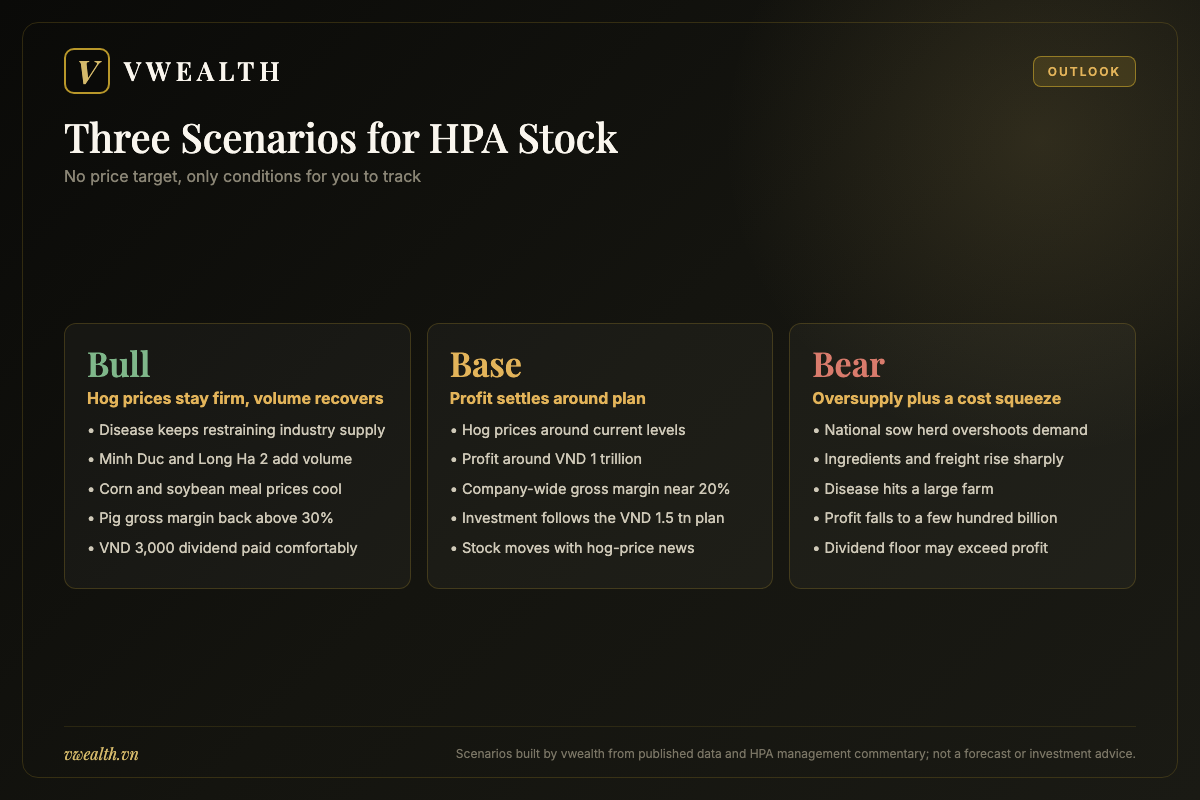
So, Should You Buy HPA Stock? Weighing the Pros and Cons Fairly
By now you have the ingredients to decide for yourself. This final chapter does not issue a buy or sell recommendation; it lines up the positives and negatives and helps you match them to your own goals and risk tolerance. The question of whether to buy HPA stock is really this: do you want to own a very efficient livestock machine that lives on the hog price cycle, controlled by a large conglomerate, where generous cash dividends are the main reward for patience?
The Positives Worth Weighing
The first positive is proven operating efficiency: a hog production cost of about VND 42,000–45,000 per kg according to the company, 33–34 weaned piglets per sow per year, and the ability to keep its herd through the major outbreaks of 2019 and 2025. The second is a very strong balance sheet: small borrowings, positive net cash, farms built with own funds and nearly 400 hectares of land carried at historical cost. The third is a clear cash dividend policy, with a floor of at least VND 3,000 per share a year through 2030 and a stated intention not to issue new shares to raise capital in that period. The fourth is the backing of Hoa Phat Group — capital if needed, governance discipline and credibility with partners. The fifth is a management team that speaks cautiously: warning about oversupply itself, setting a lower profit plan and refusing to expand herds recklessly. Finally, the long-term trend in the industry — smallholders exiting, stricter environmental and biosecurity rules — favors large, well-run producers.
The Negatives You Cannot Ignore
The biggest negative is cyclicality: profit can swing from tens of billions to more than a trillion dong between years, and 2025 — the reference year at the IPO — was an unusually good one. The second is that HPA is a price taker with less than 1% of the hog market and about 1.6% of feed volume, and no branded food business to protect margins. The third is the ownership structure: the parent holds about 84.5%, the free float is thin, liquidity is low, minority shareholders have limited voice, and the IPO timing was chosen by the parent after it had taken more than VND 3.2 trillion in cash out through dividends and capital returns over nearly three years. The fourth is disease risk across all four segments, plus the environmental risk that comes with any large-scale livestock operation. The fifth is exposure to imported ingredient prices and currency, especially in cattle. The sixth is a very short trading history since February 2026, leaving little data on how the stock behaves through a full cycle.
| Pros | Cons |
|---|---|
| Low hog production cost, high sow productivity, herd kept through outbreaks | Profit depends on live hog prices that HPA cannot control |
| Small borrowings, positive net cash, no long-term debt used to build farms | 2025 was an unusually profitable year; the 2026 plan is about 37% lower |
| Cash dividend floor of at least VND 3,000 per share a year through 2030 | The floor is a policy direction and could exceed profit in a bad cycle |
| Backing and governance discipline of Hoa Phat Group | Parent owns about 84.5%; thin liquidity; limited minority voice |
| Cautious management, controlled herd growth | Risk of industry-wide oversupply within a few years, per HPA’s own leaders |
| Industry shift toward large-scale, biosecure producers | No branded food business yet; cattle and eggs have thin, erratic margins |
Who HPA Stock May Suit
HPA may suit patient income investors: people who see cash dividends as the main return, accept that the share price will move with hog prices, and plan to hold through good and bad years. It may also suit investors who understand commodity cycles: those who follow live hog prices, the national sow herd and corn and soybean meal prices, and want a low-cost, low-debt producer to bet on when the cycle is near a trough — typically when the news is gloomy and nobody wants to talk about livestock stocks. Finally, it may be a small position for investors diversifying into food staples within a broader Vietnam portfolio. If you are just starting out and unsure how to size such a position, our guide on investing in the Vietnam stock market covers the basics.
Who It Does Not Suit
HPA does not suit investors who buy because the P/E looks low without asking where earnings sit in the cycle. It does not suit those who need high liquidity or plan to trade large volumes in the short term, given the thin free float. It does not suit those expecting tech-style growth: the company’s own 2030 plan — revenue above VND 12 trillion and net profit of about VND 1.75 trillion — implies long-term target profit only slightly above 2025. And it does not suit anyone who cannot stomach a good business reporting sharply lower profits for several quarters simply because national hog prices went down.
Final Thoughts: A Well-Built Machine in an Industry Without Straight Lines
Hoa Phat Agriculture is proof that an industrial mindset can deliver outstanding efficiency in livestock: good genetics, in-house feed, well-designed farms, little debt and tight cost control. But no mindset can abolish the hog price cycle. After ten years, “Hoa Phat’s livestock arm” has gone solo with a strong balance sheet and a generous dividend policy, yet its profits still rise and fall with a rhythm the whole industry must endure. So there is no one-size-fits-all answer to whether you should buy HPA stock: it depends on which phase of the cycle you buy in, what you need from the investment and how much volatility you can tolerate. Track the six questions from the financial chapter every quarter, check the five variables from the outlook chapter, and rely on updated data rather than the impression left by one great year. To see HPA’s current valuation, latest quarterly results and updated score, create a vwealth account and read the latest English research report.
Research Vietnamese stocks in English with vwealth. Our AI-powered platform turns Vietnamese market data into full English analysis reports — with international payment support and a free 2-month trial for new accounts. Create your free account and read the latest reports.


