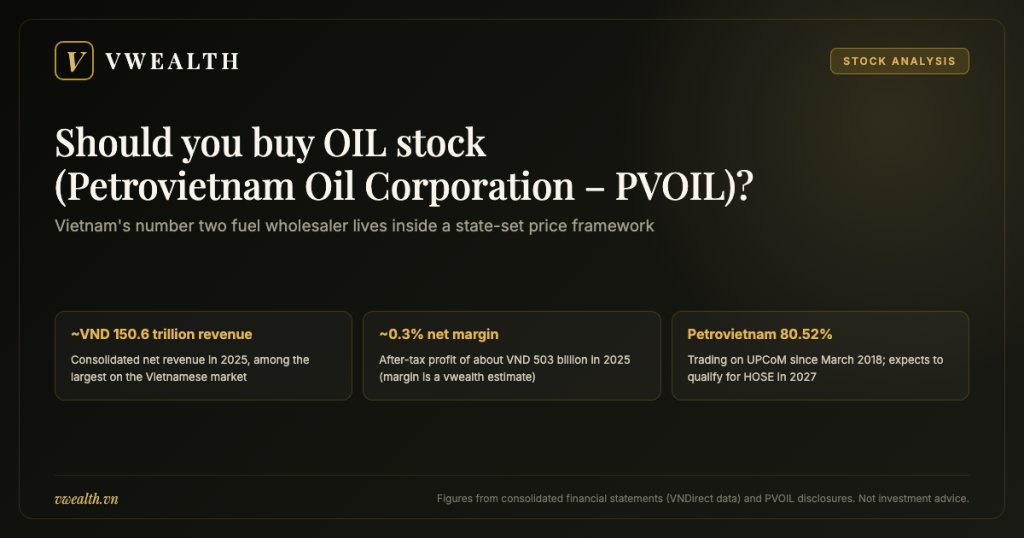
Should you buy OIL stock? The ticker belongs to Petrovietnam Oil Corporation (PVOIL), Vietnam’s second-largest fuel distributor, which has traded on the UPCoM market since March 7, 2018. On paper, PVOIL is one of the biggest companies on the Vietnamese stock market: in 2025 it booked roughly VND 150.6 trillion (about US$5.7–6 billion) of consolidated net revenue, sold around 6 million cubic meters and tonnes of fuel, and ran about 950 company-owned filling stations. Yet its after-tax profit that year was only about VND 503 billion, which means it kept roughly three dong out of every thousand dong of sales. The reason is structural. PVOIL buys fuel at prices that move every day with global markets, but sells it under a retail price ceiling set by the Vietnamese state on a weekly schedule. Add a parent company, Petrovietnam, that still owns 80.52% of the shares, and a long-promised move to the main Ho Chi Minh City Stock Exchange (HOSE), and you have a stock that is far more about policy and oil-price rhythm than about revenue growth.
A note on how this analysis works, as with every company profile in the vwealth series. Dates, names and financial figures come from published sources: PVOIL’s audited consolidated financial statements (accessed through VNDirect’s public financial data), annual general meeting (AGM) documents and coverage, disclosures on UPCoM, announcements by Vietnam’s Ministry of Industry and Trade and Ministry of Finance, and major Vietnamese financial media such as CafeF, Tin nhanh Chung khoan, Mekong ASEAN, VietNamNet, PetroTimes and VietnamFinance, plus sector research from KB Securities Vietnam (KBSV). Where sources disagree, both figures are shown. Any number that vwealth derived by dividing or multiplying published figures is labeled as a “vwealth estimate.” Dollar conversions are approximate and use a rounded exchange rate. We do not quote today’s share price, current P/E or P/B, current market capitalization or the latest quarter’s earnings, because those change daily; for live numbers, open the latest vwealth report.
If you are new to Vietnamese equities, a few basics help. Vietnam has three trading venues: HOSE (the main board, home to the VN-Index and VN30 blue chips), HNX in Hanoi, and UPCoM, an unlisted public company market with lighter listing rules and a wider daily price band. Foreign ownership in each company is capped by a “foreign room” limit. Our pillar guide on how to invest in the Vietnam stock market explains accounts, settlement and foreign ownership rules in detail. If you have already read our analysis of PLX, Petrolimex, you know the fuel-pricing system from the market leader’s point of view. This article deliberately looks at the same system from the number-two player’s seat, a company with fewer stations, more wholesale exposure, heavy reliance on domestic refineries, and one business Petrolimex does not have at all: exporting and trading crude oil for the whole Petrovietnam group.
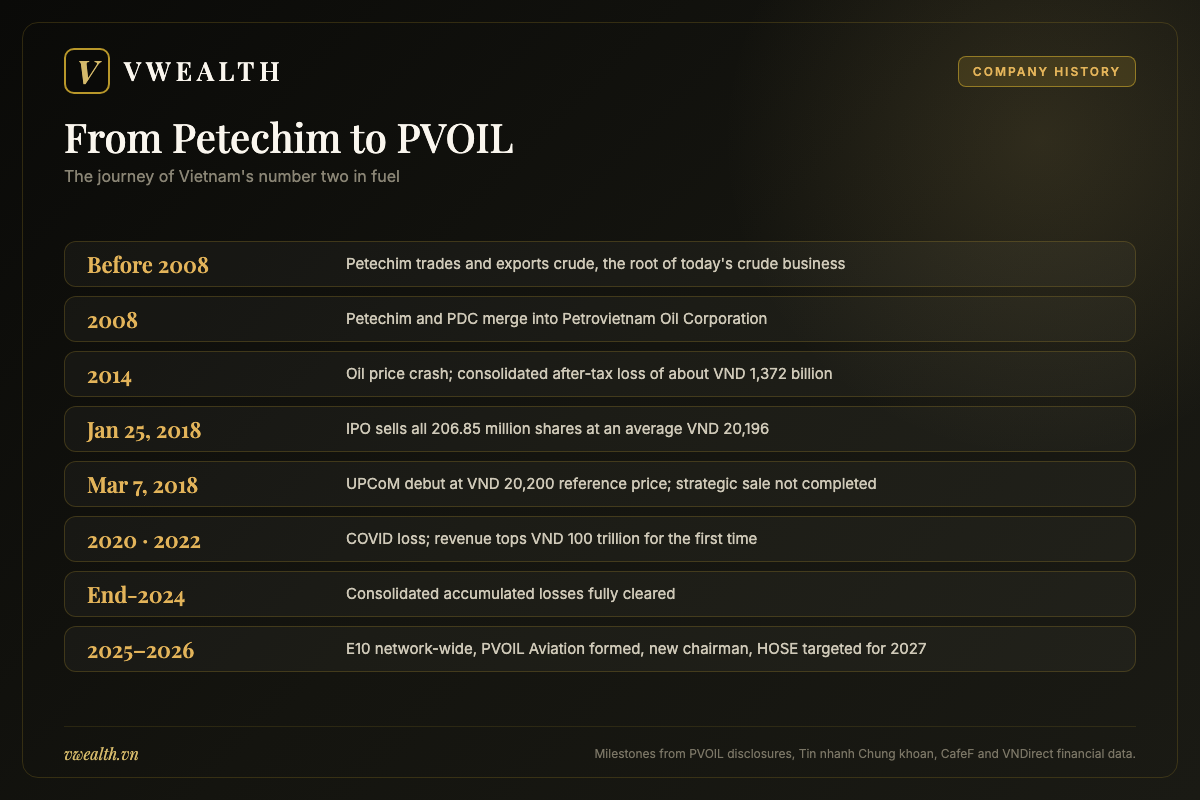
From Petechim to PVOIL: the history of Vietnam’s “number two” in fuel
Many Vietnamese drivers think of PVOIL as a newer brand than Petrolimex, because PVOIL-branded stations only became common on the roads from the late 2000s. But the company’s roots run deep into the history of the country’s oil industry. It carries the DNA of the trading house that sold Vietnam’s very first cargoes of crude oil. Understanding its two parent lineages, one in crude trading and one in refined-product distribution, explains why PVOIL today has such a hybrid revenue mix, why it is both a filling-station operator and a crude supplier to a refinery, and why its privatization was so bumpy.
Before 2008: Petechim and the crude trading business
The story begins with the Petroleum Trading Corporation (Petechim), a company whose trade was crude oil itself: finding buyers for crude produced in Vietnam, arranging export deals and handling the import-export services that came with them, in the years when Vietnam’s oil industry began commercial production. PVOIL’s company profile in VNDirect’s data names Petechim as one of the two lineages that formed Petrovietnam Oil Corporation. Petechim’s job was that of a broker and a seller: find a buyer for each cargo, arrange the ship and the payment, and carry the price risk in the short window between signing a contract and delivering the oil.
What matters is that this role was never purely commercial. Crude oil is a national resource; the right to sell it, to whom and under what terms has always been tied to decisions by the state and by Petrovietnam. That detail matters for investors today: from the very beginning, the question of who may sell fuel and who may sell crude in Vietnam was a policy question, not simply a business one. Petechim eventually became one half of PVOIL, and according to CafeF in 2024, PVOIL is still the only unit carrying out Petrovietnam’s crude export and crude trading mandate.
For you as an investor, the takeaway is that PVOIL’s crude trading arm is not a new side business. It is the original trade, decades old, tied to the company’s role as agent and trustee for selling Petrovietnam’s crude. That is why a large slice of PVOIL’s revenue always comes from crude export and trading, the part of the business that inflates the top line but carries paper-thin margins.
2008: Petechim and PDC merge into Petrovietnam Oil Corporation
The second lineage was the Petroleum Products Processing and Distribution Company (PDC), the Petrovietnam unit that handled the downstream side: storage, blending and distribution of oil products. In 2008, according to the company profile in VNDirect’s data, Petrovietnam Oil Corporation was created by merging the Petroleum Trading Corporation (Petechim) and PDC, with Petrovietnam owning 100%. The English name was Petrovietnam Oil Corporation, abbreviated as PV OIL; the company later standardized the spelling as PVOIL.
The logic was straightforward. Petrovietnam wanted a complete downstream arm that could sell domestically produced crude, supply crude to the Dung Quat refinery (which produced its first products in 2009), take refined products from that same plant and push them to market through its own depots and stations. VNDirect’s company profile describes PVOIL as working in processing, trading, distribution and import-export of fuel and biofuels, in other words almost the entire downstream end of the oil industry.
But a downstream arm needs a retail network, and this is where PVOIL started behind. Petrolimex had built a nationwide station network over decades. PVOIL had to build one almost from scratch, investing in its own stations, recruiting dealers and buying stakes in local fuel companies. According to CafeF in 2024, the company once set a goal of lifting its market share to 35% through M&A and more retail stations, a target that shows how wide the gap with the leader is.
2014–2016: the oil price crash and the biggest loss in company history
If you want one year that captures PVOIL’s core risk, pick 2014. Global crude prices collapsed from mid-year, and according to the consolidated financial statements (via VNDirect), PVOIL posted an after-tax loss of about VND 1,372 billion for 2014, with a loss attributable to parent shareholders of about VND 1,393 billion. The year-end balance sheet carried an inventory write-down provision of about VND 556 billion, the direct fingerprint of fuel bought at high prices that had to be sold or valued at lower ones. Gross profit that year was only about VND 1,260 billion, less than half the 2015 level.
The lesson from 2014 will come up again and again in this analysis: for a fuel wholesaler, inventory is effectively a bet on the oil price. When prices rise, fuel bought earlier at lower cost is sold at higher prices and profit swells. When prices fall fast and far, the opposite happens. The 2014 loss left a long scar. VNDirect data show PVOIL’s consolidated retained earnings at about negative VND 2,935 billion at the end of 2014, and it took until the end of 2024 for the company to fully erase its consolidated accumulated losses. Ten years to fill one hole, that is the price of a single year of oil-price reversal.
In 2015 and 2016 PVOIL returned to profit (after-tax profit of about VND 674 billion and VND 565 billion, respectively, per VNDirect data) as oil stabilized at a lower level. Net revenue fell from about VND 66.3 trillion in 2014 to about VND 39.3 trillion in 2016, not mainly because the company sold much less fuel, but because each liter and tonne was worth less. Keep that in mind too: PVOIL’s revenue tracks oil prices more than it tracks business health.
2017–2018: a sold-out IPO, but the strategic investor never came
In 2017, PVOIL completed its enterprise valuation for equitization (Vietnam’s term for partial privatization), with planned charter capital of VND 10,342 billion. The approved plan, as summarized by CafeF, was to sell about 0.18% to employees, 20% in a public IPO and 44.72% to strategic investors, leaving Petrovietnam with about 35.1%. In other words, the original idea was to turn PVOIL into a company where the state held just over a third and a strategic shareholder, very possibly a foreign oil major, held nearly half.
On January 25, 2018, the IPO auction took place on the Ho Chi Minh City Stock Exchange. According to Tin nhanh Chung khoan, 3,195 investors bid for nearly 483.2 million shares, about 2.3 times the 206.85 million on offer. The entire offering sold at an average winning price of VND 20,196 per share, raising about VND 4,177 billion (a vwealth estimate, volume times average price). Foreign investors won about 68.5 million shares, roughly 33% of the offering. Judged on its own, the IPO was a success: fully sold, with an average price about 50.7% above the VND 13,400 starting price (a vwealth estimate).
The “failure” came in the next step. According to a 2024 CafeF review, at the time of equitization several foreign groups, including Shell, Idemitsu, Kuwait Petroleum International, Puma and SK, as well as two domestic investors, the Sacom fund and Sovico Holdings, had signaled interest in PVOIL. But the strategic sale never happened. Then-CEO Cao Hoai Duong told the press that the plan to select strategic shareholders was no longer consistent with new government rules, and that the company would still try to cut the state stake to 35%, as in the original plan, by auctioning roughly 45% of capital in blocks. In late 2018 he said PVOIL had drawn up a plan to divest the state stake in large blocks rather than in small lots, and had reported it to Petrovietnam.
The consequence is visible on the balance sheet. VNDirect data show PVOIL’s paid-in capital falling from about VND 10,884 billion to VND 10,342 billion in 2018, equal to roughly 1.034 billion shares. Instead of keeping 35.1%, Petrovietnam kept about 80.52%. That is why it is more accurate to say the public IPO succeeded while the strategic sale, the step that would have reshaped ownership, did not. Eight years later, that ownership structure is essentially unchanged.
On March 7, 2018, OIL shares debuted on UPCoM at a reference price of VND 20,200. The first session was frenetic: according to CafeF, the price rose more than 36% intraday before closing at VND 24,200, with about 8.3 million shares traded, the highest on UPCoM that day. According to VNDirect’s company profile, PVOIL formally began operating as a joint-stock company in August 2018. By year-end it took a familiar hit: oil prices fell almost continuously in the fourth quarter of 2018, at one point for 15 days in a row, and then-CEO Cao Hoai Duong said, as reported by VietnamFinance, that PVOIL lost about VND 140 billion in December 2018 alone because of the oil price slide.
2019–2022: COVID, audit qualifications and a domestic supply crunch
The first years after listing were tough. In 2019, consolidated after-tax profit dropped to about VND 347 billion. In the first quarter of 2020, as COVID-19 crushed global oil prices, PVOIL lost about VND 538 billion after tax in a single quarter (VNDirect data), dragging full-year 2020 to a loss of about VND 166 billion. The share price, from VND 24,200 at the close of its debut session, fell to around VND 5,600 in mid-March 2020, less than a quarter of its first-day level.
PVOIL also carried a piece of pre-privatization baggage: its investment in Petrovietnam Biofuels and Petrochemicals JSC (PVB), the developer of the Phu Tho biofuel plant. Construction stopped in 2012, the project was left unfinished and uncommissioned, and a dissolution or bankruptcy route had been proposed since 2018. Because auditors could not obtain enough evidence to value this investment, they issued qualified opinions on PVOIL’s financial statements for several years in a row. In March 2023 OIL was placed on the exchange’s warning list because its annual financial statements had carried qualified audit opinions for three consecutive years. According to VNDirect’s event calendar and Hanoi Stock Exchange decisions (HNX operates UPCoM), the warning status was kept in March 2024, March 2025 and, most recently, under Decision 164/QD-SGDHN of March 16, 2026, based on the 2025 audited statements.
The years 2021–2022 revealed another side of the industry: domestic supply stress. As global prices swung violently in 2022 and several smaller fuel wholesalers ran into financial trouble, parts of Vietnam faced local fuel shortages. State-owned players such as Petrolimex and PVOIL shouldered the job of keeping supply flowing, and PVOIL’s volumes rose sharply. Consolidated net revenue passed VND 100 trillion for the first time in 2022 (about VND 104.2 trillion), with after-tax profit of about VND 723 billion. Yet the same year included a heavy losing quarter: in Q3 2022, as oil prices turned down, PVOIL lost about VND 373 billion after tax. The share price fell from a peak of about VND 22,300 in March 2022 to a low of about VND 5,400 in mid-November 2022.
At the 2024 AGM, then-CEO Doan Van Nhuom explained that the jump in volume and revenue in 2022–2023 came from several factors, including tighter and more transparent state supervision of the fuel market, which made competition healthier. He also said plainly that, over the long run, PVOIL wanted a secure market share by expanding its station network, because “selling wholesale to gain market share is not a sustainable way.” That remark is a key to reading PVOIL’s strategy in the years that followed.
2023–2026: clearing accumulated losses, E10, jet fuel and the HOSE goal
The recent period has been about cleaning house. In 2023, consolidated net revenue was about VND 102.7 trillion and after-tax profit about VND 621 billion; by year-end, accumulated consolidated losses had shrunk to about VND 6 billion. In the early hours of April 2, 2024, PVOIL’s IT systems were hit by a ransomware attack that took its e-invoicing system offline; according to VietNamNet, by the afternoon of April 3 the company was issuing e-invoices and delivery notes through a service provider’s system while it recovered. By the end of 2024, PVOIL had fully cleared its accumulated losses, with consolidated retained earnings of about VND 69.6 billion. In December 2024, Nguyen Dang Trinh, born in 1982, was appointed CEO.
In 2025, consolidated revenue hit a new record, with a big contribution from the international oil trading business of PVOIL Singapore. From August 1, 2025, PVOIL and Petrolimex piloted E10 gasoline (a 10% ethanol blend) in several major cities; from May 15, 2026, PVOIL switched its entire network to E10 in place of mineral RON95 gasoline, ahead of the national timetable. In December 2025, the company took a 51% stake in a newly formed jet fuel business, PVOIL Aviation Energy JSC. In April 2026, shareholders elected Duong Manh Son, a deputy general director of Petrovietnam, as chairman, replacing Cao Hoai Duong, and management said the company expected to qualify for a move from UPCoM to HOSE in 2027.
2026 was also the year global oil prices swung wildly because of conflict in the Middle East. That pushed PVOIL’s revenue to record levels in the first half, while profits flipped quickly between quarters: strong gains when cheaper inventory was sold into rising prices, then losses when prices reversed and interest costs rose. OIL shares touched about VND 26,100 on March 9, 2026, briefly above the 2018 debut price, before pulling back sharply. Eighteen years after its creation, PVOIL is still a company whose story comes down to two variables: the oil price and how the state regulates fuel prices.
The table below condenses the key milestones so you can see the whole journey on one page.
| Date | Event | Why it matters to investors |
|---|---|---|
| Before 2008 | Petroleum Trading Corporation (Petechim) trades and exports crude | Origin of today’s crude trading business |
| June 2008 | Petechim and PDC merged into Petrovietnam Oil Corporation, 100% owned by Petrovietnam | Petrovietnam’s downstream arm takes shape |
| 2014 | Oil price crash; consolidated after-tax loss of about VND 1,372 billion | Accumulated losses took ten years to clear |
| Jan 25, 2018 | IPO sells all 206.85 million shares at an average VND 20,196 | Cost basis for IPO shareholders |
| 2018 | 44.72% strategic sale not completed | Petrovietnam keeps about 80.52% |
| Mar 7, 2018 | OIL debuts on UPCoM at a reference price of VND 20,200 | Public trading begins |
| Mar 2023 | Shares placed on the warning list after three straight years of qualified audit opinions | Warning status still maintained as of March 2026 |
| Q1 2020 | COVID; after-tax loss of about VND 538 billion in one quarter | Proof of inventory-loss risk |
| 2022 | Revenue tops VND 100 trillion for the first time | Gains as weaker wholesalers exit |
| End-2024 | Consolidated accumulated losses fully cleared | Removes one barrier to a HOSE listing |
| 2025–2026 | E10 across the network, jet fuel unit, new chairman | New growth drivers; HOSE targeted for 2027 |
Who runs PVOIL: Petrovietnam’s 80.52% stake and the executives it appoints
At many private companies, the question “who is in charge” leads to a founder with a personal vision. At PVOIL, the answer is institutional. The real driver is the Vietnam National Industry–Energy Group (Petrovietnam, the new name of the Vietnam Oil and Gas Group), and the people in the chairman’s and CEO’s seats represent the state capital that the group places in the company. That brings real advantages, such as stability, secure supply and credibility with banks, and real limitations: the company’s goals are never only about profit for minority shareholders. If you want broader context on how Vietnam’s state-owned enterprises behave as listed stocks, our guide to Vietnam’s state-owned enterprises is a useful companion.
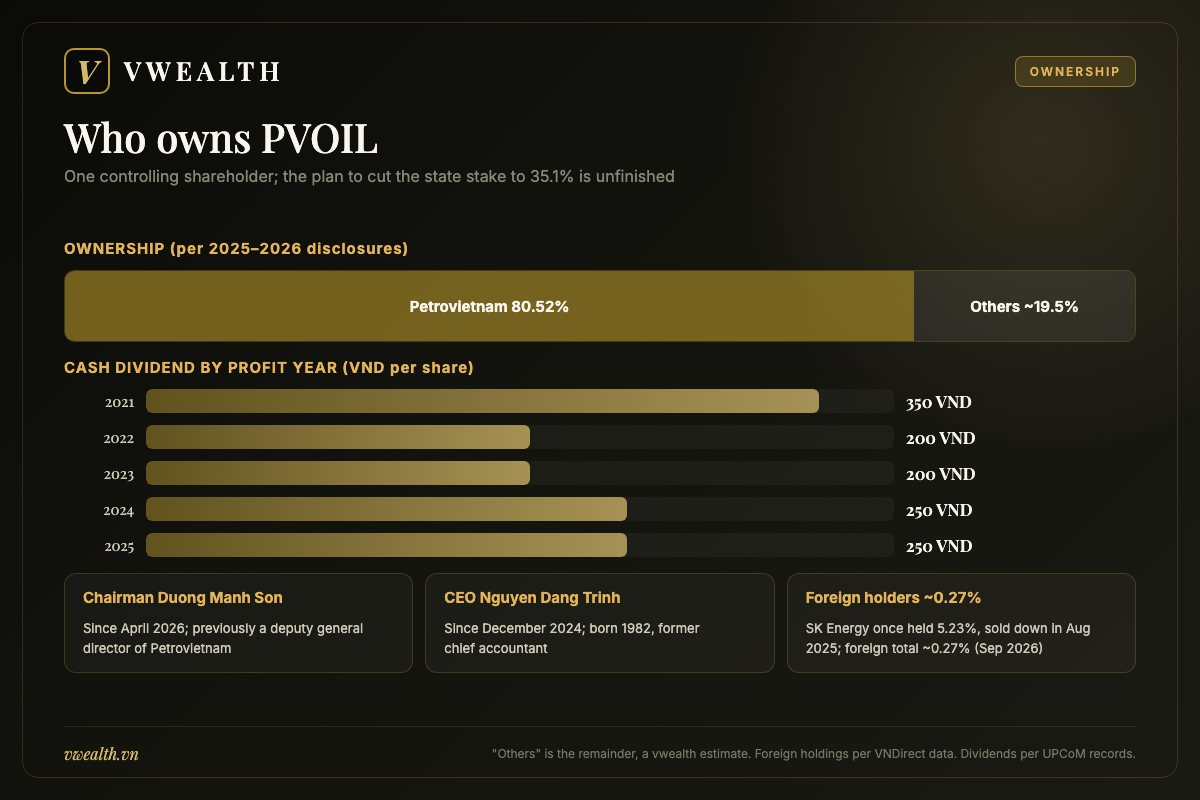
Petrovietnam owns 80.52%: one shareholder, many roles
According to published shareholder data (via VNDirect) and several CafeF reports in 2025–2026, Petrovietnam owns about 832.8 million OIL shares, or 80.52% of charter capital. With roughly 1.034 billion shares outstanding, everyone else combined owns only about 19.5%. Strip out long-term institutional holders and the genuinely tradable float is thinner still.
Petrovietnam is not just a shareholder. It is also where PVOIL buys much of its fuel (through refineries the group controls, such as Dung Quat, operated by Binh Son Refining (BSR), or has a stake in, such as Nghi Son), the principal for which PVOIL sells crude, and the body that appoints the company’s leadership. A shareholder that is simultaneously owner, supplier and service client generates a lot of related-party transactions. You can see this in OIL’s disclosure list, where board resolutions approving “contracts and transactions with related parties” appear regularly, and the 2026 AGM even passed a separate proposal on crude oil and condensate trades between PVOIL and related parties. That does not mean something is wrong; it is the nature of a state group structure. It is, however, a reason to read the related-party note carefully every time financial statements come out.
The 80.52% stake has another practical consequence: almost every major decision at a shareholders’ meeting, including profit distribution, board elections and charter amendments, is effectively decided by a single vote. Minority shareholders can ask questions, and at recent AGMs they have asked pointed ones, from audit qualifications and fuel reserves to the share price, but decision-making power sits with Petrovietnam.
Leadership: a new chairman from the parent, a CEO who rose through accounting
From 2020 to 2026, the face most associated with PVOIL was Cao Hoai Duong. He was CEO during the IPO period, had previously run Petrovietnam’s fertilizer and chemicals corporation, and became PVOIL chairman in 2020. Under his leadership, PVOIL cleared its accumulated losses, resolved most of its audit qualifications and began talking seriously about moving to HOSE. In April 2026, shareholders removed him from the board “to meet the requirement of changing Petrovietnam’s capital representative,” as Mekong ASEAN reported; in early May 2026 he was appointed a deputy general director of Petrovietnam.
His successor as chairman is Duong Manh Son, previously a deputy general director of Petrovietnam, with a master’s degree in business administration and an engineering background. The fact that a group deputy CEO came down to chair PVOIL while PVOIL’s chairman went up to become a group deputy CEO signals that PVOIL is seen as an important unit within the system. On September 18, 2026, Duong Manh Son was also appointed party secretary at PVOIL; at the ceremony, Petrovietnam chairman Le Ngoc Son called PVOIL the group’s “revenue center” and a key trading and distribution link, and asked it to focus on “turning revenue into profit and cash flow” (PetroTimes). According to the same source, the PVOIL system employs more than 7,800 people in Vietnam, Laos and Singapore.
Under the resolution of the April 24, 2026 AGM, the board members elected for the 2026–2031 term were Duong Manh Son and Nguyen Mau Dung; the supervisory board added Nguyen Ngoc Nam, and Le Vinh Van was elected head of the supervisory board, replacing Nguyen Duc Ken, who retired. These are housekeeping changes that follow the state-capital representation structure and do not alter the ownership structure.
The CEO seat has been held by Nguyen Dang Trinh since December 1, 2024. According to the appointment announcement, he was born on July 20, 1982, holds a bachelor’s degree in finance and banking, and has nearly 20 years in the oil and gas sector, rising through accounting roles: chief accountant at a liquefied petroleum gas distributor, then chief accountant of PVOIL, deputy CEO from June 2019 and board member from April 2023. At the time of his appointment he represented Petrovietnam capital equal to 10% of PVOIL’s charter capital and owned no shares personally. A CEO with a finance and accounting background is a notable fit for a business whose survival depends on managing inventory, working capital and interest costs.
Note the “capital representative” structure. Most board members represent specific blocks of Petrovietnam’s stake, and their personal holdings are typically tiny (public shareholder data show executives holding only a few thousand shares). In other words, management’s incentives are tied more to hitting group targets than to OIL’s share price. That is not necessarily bad, but it is different from a company run by a large owner-operator.
The state divestment plan and foreign shareholders: the 35.1% target is still unfinished
The 2017 equitization plan envisioned Petrovietnam keeping only 35.1% of PVOIL. After the strategic sale fell through, the company said it would continue to prepare a plan to cut the state stake to 35.1%. In December 2018, PVOIL also set its foreign ownership limit at 6.6%, a move the company’s own news page described at the time as a step toward selling the state stake in blocks. Yet as of 2026, according to the latest CafeF reports and VNDirect’s ownership data, Petrovietnam still owns 80.52%, and CafeF noted in 2024 that the divestment to 35% “remains unfinished.” In the 2026 AGM resolution and reports that vwealth reviewed, divestment is mentioned only in relation to non-core companies in which PVOIL holds stakes.
The largest foreign shareholder in OIL’s history has been SK Energy, the refining arm of South Korea’s SK Innovation. SK Energy gradually bought shares on the market and officially became a major shareholder on November 13, 2018, with about 54.1 million shares, or 5.23%. Almost seven years later, on August 22, 2025, it sold 10.8 million shares, cutting its stake to about 43.3 million shares (4.19%) and ceasing to be a major shareholder. CafeF noted that SK has also been exiting several other Vietnamese investments recently, so the sale is better read as part of SK’s own portfolio reshuffle than as a specific signal about PVOIL. Notably, VNDirect’s foreign ownership data show total foreign holdings in OIL falling from about 5.8% (June 30, 2025) to about 0.7% (September 30, 2025) and about 0.27% (September 30, 2026). That suggests SK’s remaining shares were also sold after August 2025; this is a vwealth inference from aggregate data, and vwealth has not found a separate disclosure of that transaction.
For investors, divestment cuts both ways. If Petrovietnam actually sells down, whether through an auction, a block sale to a strategic investor or a new share issue, free float would rise, the stock would become easier to include in indices, and a strategic partner could bring international fuel retail know-how. But nobody can promise the timing or price of a divestment, and a large sale could create short-term supply pressure on the stock. This article does not predict timing; it simply suggests you watch official documents from Petrovietnam and Vietnam’s state capital management authorities.
Dividends: regular but small, and why they cannot easily grow
If you want a generous dividend stock, OIL is not the obvious choice. According to published corporate action records (VNDirect, UPCoM), PVOIL began paying cash dividends in 2022 and has paid once a year since then. In Vietnam, dividends are quoted as a percentage of the VND 10,000 par value, so “2.5%” means VND 250 per share:
| Profit year | Cash rate (of par) | VND per share | Ex-dividend date |
|---|---|---|---|
| 2021 | 3.5% | 350 | Jul 19, 2022 |
| 2022 | 2% | 200 | Aug 23, 2023 |
| 2023 | 2% | 200 | Sep 5, 2024 |
| 2024 | 2.5% | 250 | Aug 21, 2025 |
| 2025 | 2.5% | 250 | Sep 4, 2026 |
With roughly 1.034 billion shares, every VND 100 of dividend per share costs about VND 103 billion. The 2025 dividend was expected to total about VND 258.6 billion, of which Petrovietnam receives more than VND 208 billion. Against 2025 profit attributable to parent shareholders of about VND 435 billion (VNDirect data), that is a payout ratio of about 59%, a vwealth estimate. So the company is not stingy; the problem is that the profit pie is small relative to more than VND 10.3 trillion of charter capital.
Two factors make big dividend increases unlikely in the short run. First, PVOIL’s return on equity (ROE) is low: with parent profit of about VND 435 billion and parent equity of about VND 10.5 trillion at end-2025, ROE is only about 4%, a vwealth estimate. Second, the company is deliberately retaining part of its profit to keep consolidated accounts free of accumulated losses, a mandatory condition for moving to HOSE. The 2026 AGM resolution puts 2025 parent-company after-tax profit at about VND 343.5 billion, the 2.5% dividend at about VND 258.6 billion and retained earnings carried forward at about VND 489.7 billion; and that part of the profit was kept to offset the provision related to PVB and to ensure there would be “no accumulated losses,” in pursuit of the HOSE listing.
The practical view: with OIL, dividends are steady pocket money rather than the main driver of returns. The actual yield depends on your purchase price; divide VND 250 by the share price at the time you look, and check the vwealth report for up-to-date yields compared with peers.
The “no accumulated losses” discipline: when a listing goal shapes payouts
At the 2024 AGM, board member Le Van Nghia listed three conditions PVOIL needed to meet to list on HOSE: ROE of at least 5% in the latest year (which the company said it had met in 2021–2023), no accumulated losses on the consolidated statements, and no remaining audit qualification related to the Phu Tho biofuel project. Two years later, the second condition has been met; the third is being addressed through provisions. According to PVOIL’s explanation to the Hanoi Stock Exchange dated March 26, 2026, PVOIL owns 39.76% of PVB, with an original cost of about VND 285.5 billion. In 2025 it booked an extra provision of about VND 151.8 billion in its separate accounts (recognized in the consolidated accounts as a share of associate losses of about VND 184.8 billion), bringing the cumulative provision to about VND 190.3 billion. The remaining roughly VND 95 billion is expected to be dealt with in 2026. The company has also asked the authorities to revalue this investment at zero when its equitization is finalized, but that request has not yet been approved. Note that the H1 2026 financial statements reviewed by Deloitte still carry a qualified conclusion on PVB, so the third condition is not yet met.
The ROE condition is the one to watch. If vwealth’s estimate of roughly 4% ROE for 2025 is close, then generating enough profit each year to clear the 5% bar becomes a real pressure, especially for a company whose profit can swing by hundreds of billions of dong on oil prices alone. Management says that without the roughly VND 150 billion Phu Tho provision, 2025 profit would have exceeded VND 800 billion. The question for you is: once the clean-up is done, where does PVOIL’s “normal” profit sit, and is it stable enough to meet the ROE threshold every year? The financial section below gives you tools to judge that yourself.
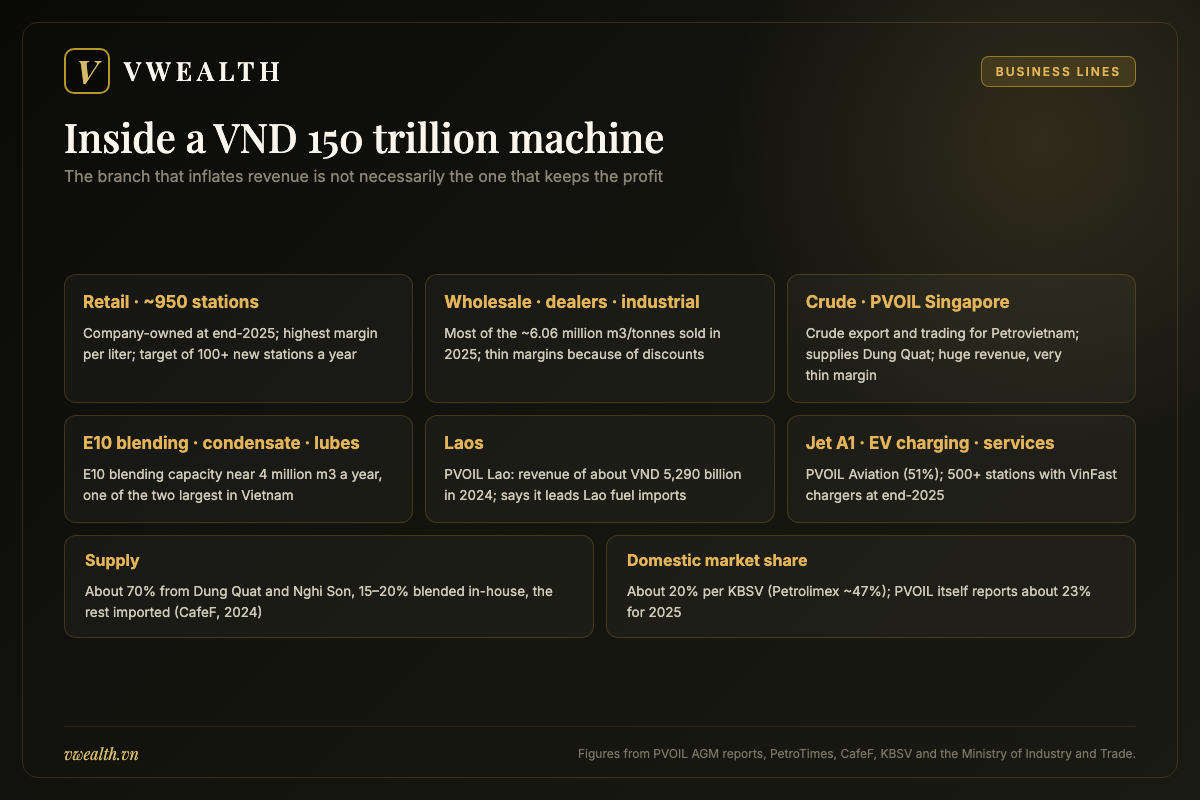
Inside a VND 150 trillion machine: PVOIL’s core businesses
Think of PVOIL’s VND 150 trillion of revenue as a river with several branches. The biggest branch by revenue is not necessarily the one that carries the most profit. Some branches are pass-through: money flows in and out almost untouched, and the company keeps a small fee. Others generate less revenue but keep more per liter. This section separates those branches so you can see where PVOIL actually makes money.
Domestic fuel sales: three channels, 950 stations and a retail ambition
This is the part consumers see: filling stations under the PVOIL brand. According to the report to the 2026 AGM, PVOIL opened 117 new stations in 2025 (170% of plan), bringing its company-owned network to 950 as of December 31, 2025. Fuel sales volume reached about 6.06 million cubic meters and tonnes, up 8% and a record. For comparison, the network had 789 stations in April 2024. Management aims to keep adding at least 100 new stations a year. Beyond its own stations, PVOIL supplies a much larger network of dealers and franchisees; CafeF estimated in 2024 that the system had about 2,200 retail outlets if about 1,500 dealers were included.
The company sells through three channels. Retail means selling directly to drivers at its own stations; prices there are capped by the state, but PVOIL keeps the full spread between the retail price and its cost, after expenses. Wholesale means selling to dealers, distributors and general agents; here PVOIL must share part of the spread as discounts. The industrial channel means selling directly to large users such as factories and transport companies. The higher the retail share, the better the average margin. According to the 2026 AGM report, retail accounted for about 27.1% of volume in 2025 (against a 27.0% plan); the 2026 plan targets about 27.7%. That is progress, but it also shows that most of PVOIL’s volume still flows through lower-margin channels.
Market share estimates differ because they measure different things. VNDirect’s company profile puts PVOIL at about 20% of the domestic fuel market; a report by KB Securities Vietnam (KBSV) in August 2026 also estimated about 20% for 2025, versus about 47% for Petrolimex. PVOIL itself told its 2026 AGM that 2025 sales represented about 23% of the domestic market, while in the discussion session management mentioned about 25% (according to FILI). Whichever figure you use, PVOIL’s position as a clear number two is unmistakable, and so is the large gap to number one.
Supply: reliant on Dung Quat and Nghi Son, topped up by blending and imports
A distributor is only as strong as its supply. According to CafeF in 2024, about 70% of PVOIL’s fuel comes from Vietnam’s two refineries, Dung Quat and Nghi Son; about 15–20% is blended or produced in-house; and the rest is imported from ASEAN, China and South Korea within quotas set by the Ministry of Industry and Trade. A more recent figure: in March 2026, then-chairman Cao Hoai Duong said that under normal conditions about 80% of PVOIL’s supply comes from Dung Quat and Nghi Son and the remaining 20% is imported, mainly from Singapore and South Korea, under long-term contracts (Nha Dau Tu, as carried by Stockbiz). The relationship runs both ways: Binh Son Refining’s (BSR) board approved planned product sales of about VND 42,291 billion to Petrolimex and about VND 12,615 billion to PVOIL (VietnamFinance), which shows PVOIL is a large customer but far smaller than Petrolimex.
Being “in the family” with BSR is both a strength and a source of risk. The strength: domestic supply is more reliable and less exposed to shipping and currency swings than full import dependence. The risk: when a refinery shuts for maintenance or has an outage, wholesalers must fill the gap with imports at higher cost, and that extra cost is not always passed through to regulated retail prices in time. At the 2026 AGM, management said PVOIL balanced supply from both Dung Quat and Nghi Son while expanding imports from multiple regions, including Africa, helped by zero import tariffs on some new sources. If you have read about BSR, you will notice an irony: when oil prices spike, a refinery’s crack spread (the gap between product prices and crude costs) widens, while the wholesaler buying from that refinery may see its margin squeezed. Same ecosystem, not always the same interests.
Crude export and trading: the business that inflates revenue
This is what really sets PVOIL apart from Petrolimex. PVOIL handles crude export and trading for Petrovietnam: selling crude and condensate produced at home and abroad, and supplying crude from domestic and imported sources to the Dung Quat refinery. CafeF estimated in 2024 that PVOIL supplied Dung Quat with roughly 7 million tonnes of crude per year on average. In 2025, crude export, sales and imports for Dung Quat reached about 10.86 million tonnes, 23% above plan; the 2026 plan calls for about 9.6 million tonnes, roughly 11% lower.
In many crude transactions, PVOIL acts as an agent or trustee for Petrovietnam, meaning it earns a service fee or a very thin margin rather than the full price spread. That is why this business can add tens of trillions of dong to revenue without a matching contribution to profit. When you read PVOIL’s results, remember that strong revenue growth does not necessarily mean strong profit growth; the increase may come from thin-margin crude trading, or simply from higher oil prices.
A newer link in the chain is PVOIL Singapore, a joint venture between PVOIL and a partner named Sebrina. According to PetroTimes, PVOIL Singapore booked more than VND 30,700 billion of revenue and about VND 61 billion of pre-tax profit in 2024; it is on the buyer list for all Vietnamese crude grades and signed a memorandum of understanding with BSR to supply crude to Dung Quat. In 2025, according to the report to PVOIL’s AGM, the international oil trading business of PVOIL Singapore contributed about VND 60,000 billion, roughly 39% of group revenue. Put the 2024 numbers side by side, VND 30,700 billion of revenue and VND 61 billion of pre-tax profit, and you can see how thin international trading margins are: about 0.2%, a vwealth estimate. In June 2026, PVOIL’s board also approved joining a consortium with a subsidiary to bid for crude supply contracts for the Nghi Son refinery, with total transactions of up to about US$600 million in the second half of 2026.
Blending and production: E5, E10, condensate and lubricants
PVOIL does not refine crude like BSR, but it has smaller production activities: blending biofuel gasoline, processing condensate and making lubricants. According to its VNDirect profile, PVOIL operates a condensate processing plant with capacity of about 130,000 tonnes a year and a lubricant plant of about 20,000 tonnes a year. The 2026 plan targets more than 1 million cubic meters and tonnes of fuel and lubricant production, about 61% higher than the year before, an increase driven mainly by E10 blending.
E10 is the most interesting part of this business. PVOIL began test sales of E10 on August 1, 2025, in Hanoi and Hai Phong and expanded gradually; by mid-May 2026, its whole network had switched to E10 in place of mineral RON95. The company says its E10 blending capacity is close to 4 million cubic meters a year. According to Ministry of Industry and Trade documents cited by CafeF in June 2026, among the three companies licensed to blend biofuel, Petrolimex had capacity of about 455,000 cubic meters a month, PVOIL about 320,000 and Saigon Petro about 120,000, against national gasoline demand of about 1 million cubic meters a month. In other words, PVOIL is one of the country’s two biggest “blending workshops.” As E10 becomes the standard, this capacity could let PVOIL sell blended gasoline to other wholesalers that lack blending licenses, though the margin on that activity has not been disclosed separately.
The bottleneck is ethanol. The ministry estimated domestic fuel ethanol output at only about 25,000 cubic meters a month, versus blending demand of about 92,000–100,000 cubic meters a month nationwide, so most must be imported. Ironically, PVOIL’s investment in PVB’s Phu Tho ethanol plant, which could have been a source of ethanol, is the very project that stalled in 2012 and caused years of audit qualifications.
Laos, jet fuel and EV charging: newer branches being tested
Outside Vietnam, PVOIL operates in Laos through PVOIL Lao and PVOIL Lao Trading. According to PetroTimes, the two units generated consolidated revenue of about VND 5,290 billion and profit of about VND 43.8 billion in 2024, and the company says they lead Laos in fuel imports and domestic fuel sales. The Lao market is small, with 14 importers and 27 fuel traders, and highly competitive; from early 2025, new Lao rules required companies to raise capital, expand storage and hold minimum inventories, which increases risk when prices fall. Compared with the group’s VND 150 trillion scale, Laos is a small but steady branch.
The newer branch most worth watching is Jet A1 aviation fuel. According to the 2026 AGM report, PVOIL received its aviation fuel key-trader license from the Ministry of Industry and Trade on January 10, 2025. In December 2025, PVOIL’s board approved the creation of PVOIL Aviation Energy JSC with planned charter capital of VND 300 billion, of which PVOIL contributes VND 153 billion, or 51%. At the 2026 AGM, management said the unit received its operating license in December 2025, was investing in refueling trucks and transit depots at airports, and expected to complete operating requirements in the third quarter and book its first revenue at the end of 2026; the AGM report puts the start of trading in Q4 2026. Vietnam’s aviation fuel market is held by only a few players and entry requires airport infrastructure, so this is a real opportunity but one that will take time to show up in profit.
Non-fuel services are where PVOIL follows global trends by turning filling stations into service hubs. Its partnership with VinFast to install EV chargers already covered 322 stations in April 2024; by the end of 2025, more than 500 of its 950 stations had chargers, and the 2026 AGM report says VinFast/V-Green had installed nearly 600 chargers and more than 1,000 battery-swap cabinets for electric scooters at PVOIL stations. Management says charging “contributes 20–30% of profit” at some member units and aims to cover about 50–60% of the network. PVOIL is also piloting Highlands Coffee kiosks, PV Mart convenience stores and car washes, and collects used cooking oil (UCO) for export as feedstock for sustainable aviation fuel; it exported 100 tonnes in 2025. The “20–30%” figure sounds impressive, but read it as applying to certain units, not the whole group; the consolidated statements do not yet break out this segment’s profit.
Which business feeds which, and where PVOIL’s moat lies
Put the pieces together and the picture looks like this. Crude and international trading generate enormous revenue on razor-thin margins; their main value is PVOIL’s role in the Petrovietnam chain and its relationships with refineries. Domestic wholesale generates volume and keeps PVOIL in the number-two spot, but margin must be shared with dealers. Retail through company stations earns the most per liter and is where the company is putting its capital. E10 blending is a capability few rivals have. The new businesses, jet fuel, charging and services, are options on the future.
| Business | Role | Margin profile | What to watch |
|---|---|---|---|
| Retail via company-owned stations | About 950 stations at end-2025 | Highest per liter, subject to price cap | Pace of new stations, retail share |
| Wholesale, dealers, industrial | Most of the volume | Thin, depends on discounts | Discount competition, new decree |
| Crude and international trading | Crude agent, Dung Quat supply, PVOIL Singapore | Very thin, large revenue | Production volumes, Nghi Son contracts |
| Blending and production | E10 near 4 million m3/year, condensate, lubricants | Not disclosed separately | Ethanol prices, sales to other wholesalers |
| Overseas (Laos) | Revenue about VND 5,290 billion in 2024 | Thin, steady | New Lao regulations |
| Jet A1, EV charging, services | New growth drivers | Not yet measurable at group level | First Jet A1 revenue, charger rollout |
PVOIL’s moat (durable competitive advantage) therefore does not lie in a consumer brand like Vinamilk’s or in being the lowest-cost operator. It lies in three things that are hard to copy: a license and position as the second-largest wholesaler in a tightly regulated industry; depots, ports and stations built over many years; and its place in the Petrovietnam chain, from crude to refinery to pump. The draft new fuel decree raises the bar for becoming a wholesaler (owning at least 15,000 cubic meters of tank capacity, 36 months of distribution experience and a minimum station count); if it is issued along those lines, the moat gets deeper. But to be blunt: this moat protects market share better than it protects margins, because margins are largely set by the pricing mechanism.
Financial health: reading PVOIL’s numbers before you decide whether to buy OIL stock
Reading a fuel distributor’s accounts is like reading a ride-hailing driver’s log: the total fares collected each day look big, but most of it goes to fuel and app commissions, and only what is left is real income. If you look only at PVOIL’s revenue, you would think it is one of Vietnam’s giants. If you look at profit, you see a mid-sized company. This section helps you read each line correctly.
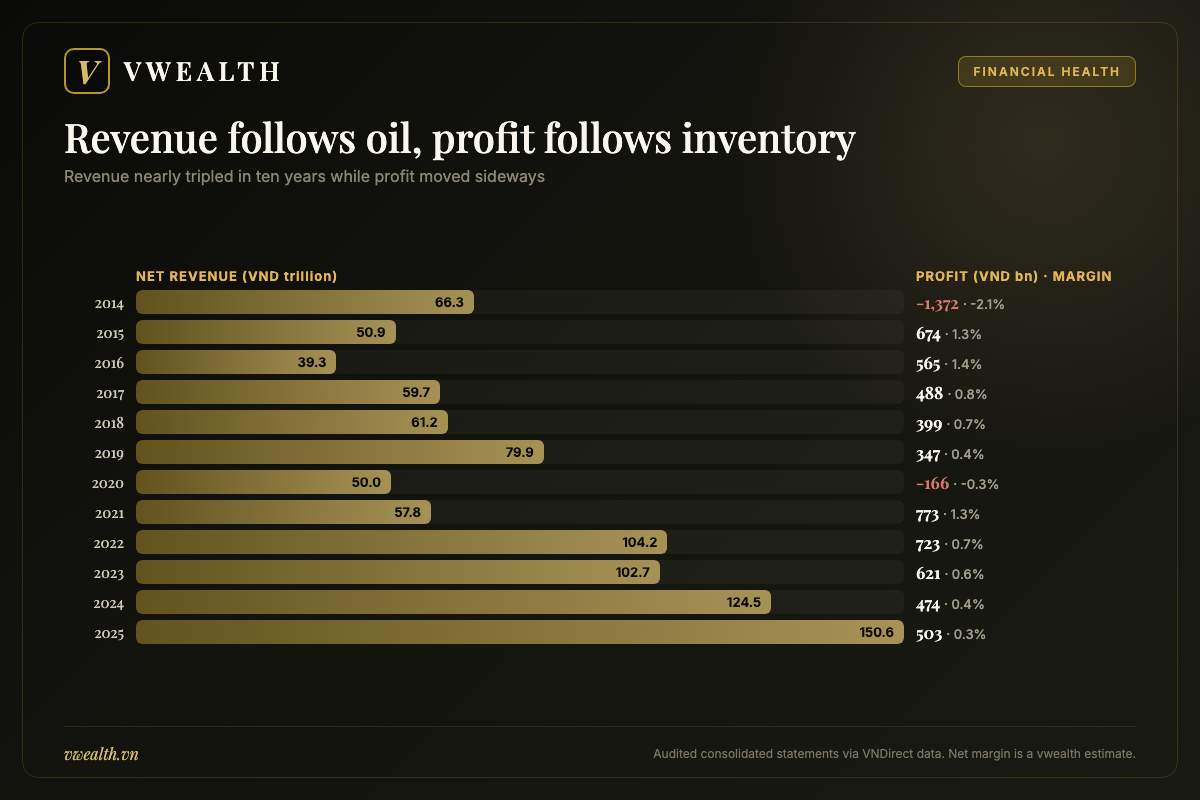
Twelve years of revenue and profit: revenue follows oil, profit follows inventory
The table below summarizes the key lines of PVOIL’s audited consolidated statements from 2014 to 2025, based on VNDirect’s public data. Gross margin and net margin are vwealth estimates, calculated by dividing profit by net revenue. For rough scale, VND 1 trillion is about US$38–40 million at recent exchange rates.
| Year | Net revenue (VND trillion) | Gross profit (VND billion) | Gross margin | Consolidated net profit (VND billion) | Net margin |
|---|---|---|---|---|---|
| 2014 | 66.3 | 1,260 | 1.9% | -1,372 | -2.1% |
| 2015 | 50.9 | 2,912 | 5.7% | 674 | 1.3% |
| 2016 | 39.3 | 2,701 | 6.9% | 565 | 1.4% |
| 2017 | 59.7 | 2,506 | 4.2% | 488 | 0.8% |
| 2018 | 61.2 | 2,707 | 4.4% | 399 | 0.7% |
| 2019 | 79.9 | 2,772 | 3.5% | 347 | 0.4% |
| 2020 | 50.0 | 1,958 | 3.9% | -166 | -0.3% |
| 2021 | 57.8 | 3,178 | 5.5% | 773 | 1.3% |
| 2022 | 104.2 | 4,067 | 3.9% | 723 | 0.7% |
| 2023 | 102.7 | 3,853 | 3.8% | 621 | 0.6% |
| 2024 | 124.5 | 4,139 | 3.3% | 474 | 0.4% |
| 2025 | 150.6 | 4,393 | 2.9% | 503 | 0.3% |
Three things stand out. First, revenue nearly tripled in ten years (from about VND 50.9 trillion in 2015 to about VND 150.6 trillion in 2025), but after-tax profit went sideways; 2025 profit was actually lower than 2015’s. Second, net margin has almost never exceeded 1.5% and has hovered around 0.3–0.7% in recent years. Third, there were two loss years out of twelve (2014 and 2020), both coinciding with sharp collapses in global oil prices. If you value OIL on revenue growth alone, you will be misled.
A note on 2025 figures, because sources use different definitions. VNDirect’s consolidated data show net revenue of about VND 150,557 billion and consolidated after-tax profit of about VND 503 billion. The 2026 AGM report cited “consolidated revenue” of about VND 151,640 billion (one news article gave VND 156,640 billion) and consolidated pre-tax profit of about VND 654 billion, while some reports cited after-tax profit of VND 344 billion; the 2026 AGM resolution confirms that this is the parent-company-only figure (about VND 343.5 billion). When comparing, always check whether you are looking at consolidated or parent-only numbers, and net revenue or gross revenue.
A 3% gross margin and selling costs: how little is really kept
In 2025, gross profit was about VND 4,393 billion. Subtract selling expenses of about VND 2,886 billion and administrative expenses of about VND 1,088 billion, and core operating profit was only about VND 419 billion, a vwealth estimate. Selling expenses are the largest item because they cover running nearly a thousand stations, depots, tanker trucks, staff and depreciation. They grow with the network: from about VND 1,445 billion in 2015 to about VND 2,886 billion in 2025, nearly double, while gross profit rose only about 50%.
The interesting line is financial income. PVOIL holds large bank deposits (see the balance sheet section), so 2025 financial income was about VND 785 billion; subtract financial expenses of about VND 450 billion (including about VND 339 billion of interest) and the net is positive at about VND 335 billion, a vwealth estimate. In 2023–2025, this net financial income ranged from about VND 317 billion to VND 462 billion a year, roughly equal to or larger than core profit from selling fuel. Put differently, in recent years nearly half of PVOIL’s pre-tax profit has come from managing cash rather than selling fuel. That is a cushion, but also a sensitivity: when deposit rates fall, or when the company must borrow more to buy fuel at high prices, this profit shrinks.
One more small line to watch: share of profit or loss from associates. In 2025 it was negative at about VND 176 billion, mainly reflecting the write-down of the PVB investment. This is essentially a one-off; if the clean-up finishes in 2026 as planned, it should stop dragging on profit in later years.
Inventory gains and losses: why PVOIL’s quarterly profit jumps around
Look at PVOIL’s quarterly earnings and you will see swings rare among consumer-facing companies: a loss of about VND 538 billion in Q1 2020, a profit of about VND 522 billion in Q2 2022 followed by a loss of about VND 373 billion in Q3 2022 (VNDirect data). 2026 replayed the pattern. CafeF reported that PVOIL earned strong profits in Q1 2026 by selling inventory accumulated cheaply from late 2025 as oil prices jumped on Middle East tensions; yet at its April 2026 AGM, the company already disclosed that preliminary four-month pre-tax profit had fallen sharply as oil prices eased in April, and in Q2 2026 it reported a loss. Some reports called this the first losing quarter since Q3 2022, but VNDirect data show PVOIL also lost about VND 37 billion after tax in Q4 2023, so small losing quarters are more frequent than people tend to think.
The Q2 2026 number also needs careful reading because two versions exist. The company’s self-prepared Q2 statements (cited by CafeF) showed net revenue of about VND 90,003 billion and an after-tax loss of about VND 95 billion, with first-half revenue of about VND 134,867 billion and after-tax profit of about VND 476 billion. The consolidated half-year statements reviewed by Deloitte, published in late August 2026, instead show first-half net revenue of about VND 136,569 billion, pre-tax profit of about VND 662.7 billion and after-tax profit of about VND 498.9 billion (about VND 383.7 billion attributable to the parent). Subtracting Q1 from the reviewed half-year figures implies a Q2 loss of about VND 73 billion, a vwealth estimate. When two figures differ, give priority to the reviewed or audited one.
The mechanism is simple. A wholesaler must hold inventory, by regulation at least about 20 days of supply. That inventory was bought at prices from a few weeks earlier. Domestic retail prices, however, are reset based on average world prices over the latest period. When world prices rise, selling prices move up before the cost of inventory catches up: an inventory gain. When world prices fall, selling prices come down while inventory still carries the old, higher cost: an inventory loss. If prices fall far enough, the company must also book provisions for inventory write-downs, like the roughly VND 556 billion on the balance sheet at end-2014.
The size of 2026’s swings shows how big this risk can be. According to PVOIL’s explanation cited by CafeF, Dated Brent averaged about US$104.5 a barrel in Q2 2026, up 54% year on year and 30% from Q1. At the AGM, management said regional diesel prices at one point reached about US$291 a barrel and then fell to around US$150 within a few weeks. Domestic retail diesel prices also spiked and then fell sharply in the same rhythm. With inventory at one point above VND 11 trillion (end of Q1 2026), a 10% move in inventory value equals about VND 1.1 trillion, double PVOIL’s entire 2025 after-tax profit (an illustrative example and vwealth estimate).
The investor lesson: never annualize a single quarter of PVOIL’s profit. Unusually strong quarters are usually quarters of rising oil prices; losing quarters are usually quarters when prices reverse. To judge “normal” profit, look at multi-year averages, or at least full years, and always set results against oil price moves in the same period.
The price stabilization fund and other unusual balance sheet lines
PVOIL’s balance sheet has a line most companies do not: the fuel price stabilization fund (known in Vietnam as the BOG fund). Wholesalers set aside money from their selling prices at rates set by the state in favorable periods, and draw on it to hold down retail prices when world prices spike. The fund sits at each wholesaler, but it is not the company’s own money; it is recorded as a liability.
VNDirect data show that the BOG fund balance on PVOIL’s consolidated balance sheet swings widely: positive at about VND 434 billion at end-2017, but negative at about VND 777 billion at end-2021 and still negative at about VND 138 billion at end-2025. A negative balance means the company has spent more from the fund than it has set aside; in effect, PVOIL has advanced cash to keep retail prices down and waits to be made whole in later periods. During the 2026 price shock, the state also allowed budget advances into the fund. According to Ministry of Finance figures for Q2 2026 (as reported by Mekong ASEAN), PVOIL set aside about VND 440.9 billion and drew about VND 328 billion, leaving a closing balance of about VND 341.1 billion; PVOIL was the largest user of the fund in the quarter, out of about VND 873 billion used market-wide, and all of the quarter’s drawdowns came from the budget-advance source.
For investors, the BOG fund matters for two reasons. First, when the fund is negative, the company is effectively lending working capital to the state, increasing bank borrowing and interest costs. Second, fund rules can change with new policy, and any change to how money is set aside or drawn affects wholesalers’ cash flow. It is another example of this article’s central theme: the number two in Vietnamese fuel lives inside a framework designed by the state, and many lines on its financial statements are footprints of that framework.
The balance sheet: lots of deposits, lots of short-term debt, and the working capital cycle
At end-2025 (VNDirect data), PVOIL had total assets of about VND 45.6 trillion, including cash and equivalents of about VND 5.5 trillion, short-term financial investments (mostly term deposits) of about VND 13.5 trillion, short-term receivables of about VND 16.7 trillion, inventory of about VND 2.8 trillion and fixed assets of about VND 3.7 trillion. On the other side, liabilities were about VND 34.1 trillion, almost all short-term, including trade payables of about VND 16.7 trillion and short-term borrowings of about VND 10.7 trillion. Equity was about VND 11.6 trillion, of which about VND 1 trillion belonged to non-controlling interests.
Holding about VND 19 trillion in cash and deposits while borrowing about VND 10.7 trillion short term may look odd. But it is typical of a large commodity trader: borrowings are often short-term foreign currency loans or letters of credit used to pay for cargoes, while cash from retail and wholesale sales is parked in term deposits until payments fall due. Subtracting all borrowings from cash and deposits, PVOIL still had positive net cash of about VND 8 trillion at end-2025, a vwealth estimate.
That picture changes quickly with oil prices, though. When prices rise, inventory and receivables balloon and the company needs to borrow more; when prices fall, the reverse happens. Total borrowings were about VND 10.9 trillion at end-2025 according to CafeF, versus about VND 2.8 trillion at end-2022 and about VND 7.5 trillion at end-2024 (VNDirect data); by June 30, 2026, with oil prices cooling and inventory lower, total borrowings had fallen back to about VND 7.8 trillion (CafeF). Interest expense rose accordingly, from about VND 180 billion in 2022 to about VND 339 billion in 2025. That is why a CEO with a finance background and a disciplined inventory policy matter as much to PVOIL as opening more stations.
One ratio worth computing yourself is the working capital cycle. Trade receivables of about VND 11.6 trillion and trade payables of about VND 16.7 trillion at end-2025 suggest that suppliers are financing part of PVOIL’s working capital: the company pays suppliers more slowly than it collects from customers. That is a benefit of scale and credibility; but if payment terms with refineries change, working capital needs could jump suddenly.
Cash flow: does profit turn into cash?
PVOIL’s operating cash flow swings even more than its profit. According to VNDirect data, net operating cash flow was positive at about VND 3,176 billion in 2022, negative at about VND 638 billion in 2023, negative at about VND 816 billion in 2024 and positive at about VND 910 billion in 2025. Negative years are usually years when receivables or inventory rose sharply; they are not necessarily bad signs, just cash temporarily tied up in working capital.
Capital expenditure (purchases and construction of stations and depots) has been rising: about VND 400 billion in 2022, VND 419 billion in 2023, VND 399 billion in 2024 and about VND 564 billion in 2025. Annual depreciation is about VND 300–340 billion. So the company is reinvesting somewhat more than depreciation, consistent with its station expansion. Cash dividends actually paid on the consolidated cash flow statement were about VND 384 billion in 2022 (including dividends to minority shareholders of subsidiaries), VND 221 billion in 2023, VND 230 billion in 2024 and VND 303 billion in 2025.
A sensible way to read this: add up operating cash flow over several years and compare it with cumulative profit. From 2022 to 2025, cumulative net operating cash flow was about VND 2,632 billion versus cumulative consolidated after-tax profit of about VND 2,322 billion, a vwealth estimate. Over time, then, PVOIL’s profit does turn into cash, just not evenly year by year.
Seven questions to ask every time PVOIL reports
Rather than memorizing the figures above, which will age after every quarter, carry a checklist. Each time PVOIL publishes financial statements, work through these questions:
- Did oil prices rise or fall during the period, and when did they turn? Set gross profit against Brent and Singapore product prices to gauge how much profit came from inventory gains or losses.
- Did fuel volume rise or fall, and how did the retail share change? Revenue growing because of prices is different from revenue growing because more fuel is sold through the company’s own stations.
- Are selling expenses growing faster or slower than gross profit? New stations raise costs first; profits arrive later.
- How large is net financial income? Financial income minus financial expenses: is the deposit cushion shrinking because of heavier borrowing?
- How did inventory, receivables and short-term borrowings change? Inventory rising sharply right at a price peak is a warning sign for the next quarter.
- Is the price stabilization fund balance positive or negative? A deeply negative fund means the company is advancing cash to hold prices down.
- Are there one-off items? Investment provisions (such as PVB), asset disposals, administrative fines, tax or fee changes: separate them to see core profit.
If you do not have time to run through these seven steps, the vwealth report on OIL compiles updated metrics and peer comparisons.
How the market treats OIL stock: waves with oil prices, liquidity of an UPCoM stock
If Petrolimex is the “low-volatility” stock long-term investors like, OIL is the one many people know through short bursts tied to oil prices. That personality is no accident; it reflects exactly what you saw in the financial statements: profit sensitive to oil, small dividends, a thin free float and a listing on UPCoM.
Eight years on UPCoM: from VND 24,200 on debut to lows and highs
The table below shows OIL’s highest and lowest prices each year, based on VNDirect’s unadjusted historical price data (in thousands of dong per share). It is meant to convey the range of swings, not the current price.
| Year | High | When | Low | When |
|---|---|---|---|---|
| 2018 | 27.5 | Mar 7, 2018 | 13.0 | Jul 2018 |
| 2019 | 15.6 | Feb 2019 | 7.4 | Dec 2019 |
| 2020 | 12.4 | Dec 2020 | 5.6 | Mar 2020 |
| 2021 | 18.4 | Nov 2021 | 8.1 | Jan 2021 |
| 2022 | 22.3 | Mar 2022 | 5.4 | Nov 2022 |
| 2023 | 11.9 | Sep 2023 | 7.8 | Jan 2023 |
| 2024 | 16.1 | Aug 2024 | 9.1 | Apr 2024 |
| 2025 | 13.7 | Feb 2025 | 8.1 | Apr 2025 |
| 2026 (through September) | 26.1 | Mar 9, 2026 | 10.8 | Jan 2026 |
A pattern repeats in the table: years in which the stock doubles or triples from trough to peak, followed by sharp falls. The 2022 and 2026 peaks both coincided with spikes in world oil prices (the Russia–Ukraine war in 2022, conflict in the Middle East in 2026); the 2020 and 2022 lows coincided with oil price collapses and weak market sentiment. Investors who bought at the 2018 IPO average of VND 20,196, as CafeF observed in 2024, waited a very long time without getting back to break-even; only during the March 2026 rally did the price briefly climb back above the IPO level.
The lesson: with OIL, entry timing matters far more than with steady growth stocks. Buyers during oil-price euphoria often wait a long time; buyers during pessimism have better odds, but nobody rings a bell at the bottom.
The stock’s personality: a retail investor’s “oil price certificate”
For many Vietnamese retail investors, OIL works like a cheap “oil price certificate.” When headlines about rising oil appear, money flows into oil and gas stocks, and OIL, trading around its VND 10,000 par value for much of its history, is often among the most actively bought. Average liquidity in VNDirect data reflects this: average matched volume was about 0.27 million shares per session in 2019, rising to about 2.3 million in 2021 and about 4.5 million in the first nine months of 2026 as oil prices swung.
But there is a paradox to understand. As chapter four showed, rising oil prices are not always good for PVOIL’s profit. Gradual, steady increases produce inventory gains; sudden spikes followed by fast reversals can produce losses, especially when domestic retail prices are held down for stabilization. Buying OIL just because “oil is going up” is a bet on market sentiment more than on the business. By contrast, upstream service providers have a more direct link to high oil prices, which you can compare in our analyses of PVD stock (PV Drilling) and PVS stock (PTSC).
Another feature of UPCoM: the daily price limit is wider than on HOSE (plus or minus 15% versus 7%), and UPCoM stocks are generally not included in major indices such as the VN30 or the benchmarks tracked by domestic and foreign ETFs. That makes prices more volatile and limits passive inflows, and it is exactly why a move to HOSE is seen as a catalyst.
Valuing a giant-revenue, thin-margin company: which yardstick?
We do not quote current P/E or P/B, but we can help you pick the right yardstick. For PVOIL, price-to-sales is nearly meaningless: revenue inflates with oil prices and crude trading has razor-thin margins, so P/S always looks “cheap” without telling you anything. P/E is more useful but must be based on multi-year average profit, because a single year can be distorted by inventory gains or losses or one-off provisions like PVB. Price-to-book is widely used for OIL because most assets are cash, deposits, receivables and fixed assets, which are relatively easy to value. For many years OIL’s share price has hovered around its VND 10,000 par value, while book value per share attributable to parent shareholders at end-2025 was about VND 10,200, a vwealth estimate based on parent equity of about VND 10.5 trillion divided by about 1.034 billion shares.
Another angle: with estimated net cash of about VND 8 trillion at end-2025, a meaningful share of OIL’s market value (depending on the price) is “backed” by cash. But that cash is not idle; it is the working capital of a trading machine and gets sucked into inventory and receivables when oil prices rise. So do not simply subtract all net cash from market value as you might for a cash-rich tech company.
Finally, compare with Petrolimex. Petrolimex has twice the market share, far more stations, a foreign strategic shareholder (Japan’s ENEOS) and a HOSE listing, and in many periods the market has valued it at a higher P/B than OIL. That gap reflects both asset quality and an “UPCoM discount” plus a “concentrated ownership discount.” If PVOIL moves to HOSE and its free float grows, part of the gap could narrow, but that is an assumption, not a promise. You can check both stocks’ current valuations in the vwealth comparison report.
Foreign investors: a low foreign room and a Korean shareholder that has exited
Unlike many oil and gas stocks with a 49% foreign ownership limit, PVOIL set its foreign ownership cap at 6.6% in December 2018, as noted in chapter two. SK Energy alone held 5.23% for years, so if that cap still applies, the room left for other foreign investors is very small. SK Energy cut its stake to 4.19% in August 2025, and as noted in chapter two, VNDirect data show total foreign holdings then fell to only about 0.27% (September 30, 2026). The same data source currently lists OIL’s foreign ownership limit at about 7%. In other words, foreign room is no longer the practical constraint it was when SK held more than 5%; the issue now is that foreign investors are almost absent. If you are a foreign investor, you should still check the current limit on your broker’s platform before placing an order.
Low foreign room is often linked to divestment plans: in 2018, CafeF placed the cut to 6.6% alongside the plan to sell the state stake in large blocks. If the state wants to sell a large block to a foreign strategic investor, letting foreign funds accumulate shares on the market first could use up the room. On the other hand, the CEO at the time told the press that the cap was only temporary. So any change to OIL’s foreign room is worth reading as a signal about future ownership. Keep an eye on company disclosures about this limit.
Catalysts ahead: HOSE, a new decree, jet fuel and divestment
Four events could change how the market views OIL over the next few years. First, a move to HOSE: management says the company expects to qualify in 2027, once accumulated losses are cleared, ROE meets the threshold and the PVB audit qualification is fully resolved. A HOSE listing could open the door to more funds, narrow daily price swings and raise transparency standards. Second, a new fuel trading decree to replace Decree 80/2023: if it follows the draft analyzed by KBSV (market-based pricing under state supervision, cost norms updated with inflation, removal of the fixed VND 300-per-liter profit norm, and stricter wholesaler requirements), large wholesalers could benefit. Third, first revenue from Jet A1, expected from late 2026. Fourth, any divestment move by Petrovietnam.
There are negative catalysts too: a sharp oil price reversal, stabilization policies that hold retail prices down for too long, a delayed listing move, or rising interest costs. None of these catalysts has a guaranteed date; treat them as a watchlist, not a schedule to bet on.
Industry context: Vietnam’s number two fuel seller lives inside a state-set price framework
Imagine running a shop where the maximum price of your main product is announced by a government agency every week, while your purchase cost changes daily with trading in Singapore. You are allowed to build a standard cost and a standard profit into the price, but those standards do not always keep up with your real costs. That is PVOIL’s world. For the leader, Petrolimex, the framework is tight; for the number two, with fewer stations and more wholesale exposure, it is tighter still.
Market structure: 26 wholesalers, two giants holding about two thirds
According to a KBSV report cited by Nha Dau Tu and CafeF in August–September 2026, Vietnam’s fuel market had 26 licensed wholesalers (known locally as “key traders”) and 252 distributors in 2025. Petrolimex held about 47% of the market, PVOIL about 20%, Thanh Le about 8% and Saigon Petro about 6%. The two largest state-owned players alone held about 67%.
The supply chain has three tiers. At the top is supply: the two domestic refineries (BSR’s Dung Quat and Nghi Son) plus imports. In the middle are the key traders, companies licensed to import, buy from refineries, produce and blend, and required to hold minimum reserves. At the bottom are distributors, general agents, dealers and retail stations. PVOIL sits in the key trader tier but also owns many retail stations, which means it both sells wholesale to independent distributors and competes directly with those same customers at the pump.
Because many small private wholesalers depend on supply from domestic refineries or from the big key traders, the supply-keeper role of Petrolimex and PVOIL comes to the fore whenever the market is stressed, as in 2022 and early 2026. Under Government Office Notice 333/TB-VPCP of June 26, 2026, following a June 24, 2026 meeting on reorganizing the fuel distribution system (attended by Petrolimex and Petrovietnam), the Standing Deputy Prime Minister called for cutting intermediary layers to a minimum, restructuring key traders and finalizing a replacement decree for submission to the government in July 2026. In vwealth’s view, because supply is already concentrated in the two largest state-owned companies, fewer intermediary layers could shift more advantage toward Petrolimex and PVOIL, though the extent depends on the final decree.
State-regulated retail prices: from Decree 83/2014 to Decree 80/2023 and the 2026 resolutions
The current legal framework for fuel trading is Decree 83/2014/ND-CP, amended by Decree 95/2021/ND-CP and Decree 80/2023/ND-CP (effective November 17, 2023). Under this system, retail prices are not set by companies. Regulators calculate a “base price” using a formula that includes the average world price over the period, costs of bringing fuel to port, taxes and fees, a standard business cost, a standard profit and the amount set aside for or drawn from the stabilization fund. A company’s retail price may not exceed the published base price.
Since Decree 80/2023, prices have been reset every Thursday, with the Ministry of Industry and Trade presiding in coordination with the Ministry of Finance. Compared with earlier periods, the adjustment cycle has been shortened step by step so that domestic prices track world prices more closely, which reduces but does not eliminate inventory risk for wholesalers.
In 2026, as the Middle East conflict sent world prices on a roller coaster, the government added emergency mechanisms. Resolution 36/NQ-CP (March 6, 2026) allowed immediate price adjustments when the base price rose 7% or more from the previous announcement. Resolution 55/NQ-CP (March 19, 2026) then revised this: prices would be adjusted immediately only after the base price rose 15% or more, while a new provision required an immediate adjustment when the base price fell 10% or more; smaller moves would still follow the weekly Thursday schedule under Decree 80/2023. The government also approved advancing state budget funds to the stabilization fund in case it ran short.
All of these adjustments serve a clear and legitimate policy goal, avoiding fuel shortages and price shocks to the economy. But as a shareholder of a wholesaler, you need to understand that the adjustment rhythm, the thresholds and whether the stabilization fund is filled or drawn are all decided by regulators, and each time the rules change, a wholesaler’s profit can change in ways the company cannot control.
Standard costs, VND 300 of profit per liter and the discount war
Two items in the current base-price formula belong to the wholesaler: the standard business cost and the standard profit. According to KBSV, the standard profit is currently a fixed VND 300 per liter (a little over one US cent). KBSV’s report also found that the margins of Petrolimex and PVOIL trended down over 2014–2025, partly because actual business costs rose while the standard costs and profit were not adjusted accordingly. The financial table in chapter four shows the same for PVOIL: gross margin fell from about 5.5–6.9% in 2015, 2016 and 2021 to about 2.9% in 2025 (vwealth estimates).
The gap between the base price and cost does not all stay with the wholesaler. To sell through the distribution network, wholesalers pay discounts to distributors and dealers. When the market is oversupplied or prices are falling, wholesalers compete on discounts and their share erodes. When reviewing 2018, Cao Hoai Duong said (as reported by VietnamFinance) that the state allowed wholesalers about VND 1,300 per liter to cover both costs and profit, while the price war of late 2018 at times pushed customer discounts up to VND 3,200 per liter, “so losses were unavoidable.” Those figures belong to a specific moment, but the mechanism remains: the number two, with a larger wholesale share, feels discount pressure more than the leader with its large own-station network.
Conversely, when the market is short of fuel, discounts narrow and wholesalers with secure supply benefit. That is why PVOIL has often done well when many small wholesalers struggle. It also explains management’s focus on raising the retail share: every liter sold at its own stations is a liter on which it does not have to share a discount with someone else.
The draft new decree: freer pricing, tougher wholesaler requirements
After nearly two years of drafting and several rounds of consultation, the Ministry of Industry and Trade published a draft fuel trading decree to replace Decree 80/2023 and submit to the government (the version reported as Draft 12.2, dated July 20, 2026). According to KBSV’s analysis, the draft contains three notable shifts. First, it moves from a state-determined base price to market pricing under state supervision: key traders and distributors would have more freedom to set wholesale and retail prices according to a formula, with regulators monitoring. Second, it removes the fixed VND 300-per-liter standard profit; standard business costs would be published and adjusted annually in line with the consumer price index (CPI) and reviewed every three years. Third, it tightens the requirements for key traders: they must own tanks at receiving depots with total capacity of at least 15,000 cubic meters, have at least 36 consecutive months of experience as a distributor, and have at least 10 owned retail stations plus 40 stations belonging to distributors in their system, while requirements for distributors would be relaxed.
KBSV cited India’s experience, where the government moved fuel to market pricing in 2014: afterward, fuel retailers’ margins tended to improve, although they became more cyclical. If Vietnam goes the same way, PVOIL could benefit twice: standard margins closer to real costs, and fewer wholesale competitors. But remember three things: the draft is not yet law and may change; “market pricing under state supervision” is still supervised, and the state keeps tools to intervene when stabilization is needed; and profit volatility could increase rather than decrease.
Long-term demand: EVs, biofuels and higher reserve requirements
On the demand side, gasoline and diesel remain the main transport fuels in Vietnam, but two trends are reshaping the long-term picture. The first is electric vehicles. At the 2024 AGM, PVOIL management cited a consultant’s report concluding that EVs would not seriously affect fuel sales in Vietnam through 2030; at the 2026 AGM, management acknowledged that fuel demand could plateau in future but argued that with its current market share there is still room to grow, and framed EV charging as an opportunity. That is the company’s view; you should form your own view on how quickly motorbikes and cars electrify after 2030. (Vietnam is a motorbike-heavy market, and VinFast’s electric scooters and cars are a visible part of that transition.)
The second trend is biofuels. 2026 is the year E10 rolled out broadly; the Ministry of Industry and Trade drafted a resolution on the E10 roadmap, which the Ministry of Justice appraised in early June 2026. According to that document, by mid-April 2026 there were 13 companies able to blend, with total capacity of about 1.18 million cubic meters a month, of which only three were licensed. For key traders with large blending capacity like Petrolimex and PVOIL, E10 is both an investment cost and an advantage, since smaller wholesalers without blending licenses must buy blended gasoline from someone.
Third, reserves. By regulation, key traders must hold minimum circulating reserves of roughly 20 days of supply, and reserve requirements tend to tighten after each supply scare. Higher reserves mean more capital tied up in inventory and greater price risk. In April 2026, the Domestic Market Management and Development Department of the Ministry of Industry and Trade said it had issued administrative violation reports to three key traders, including PVOIL, for failing to maintain, or maintaining less than, the minimum reserve level; each was fined VND 130 million. At its AGM, PVOIL’s leadership confirmed there were times when the company did not meet the 20-day reserve level, explaining that it had to increase sales to make up for market shortages when some wholesalers cut sales; it described this as situational and said reserves were restored within a short time. Also in April 2026, PVOIL disclosed a decision by the Vung Tau Port customs office fining it about VND 1.58 billion (10% of the under-declared tax) for declaring an incorrect tax rate, a case the company itself detected and corrected with a supplementary declaration. These are small administrative penalties relative to the company’s size, but they remind you that a fuel key trader operates under very close compliance oversight.
PVOIL versus Petrolimex and the rest of the oil and gas chain
To place PVOIL correctly, the table below compares the structural features of the two largest wholesalers. Figures are qualitative or sourced as noted; for current valuation metrics, see the latest vwealth report.
| Criterion | PVOIL (OIL) | Petrolimex (PLX) |
|---|---|---|
| Exchange | UPCoM, expects to qualify for HOSE in 2027 | HOSE |
| Controlling shareholder | Petrovietnam, about 80.52% | State holds control; Japan’s ENEOS is a strategic shareholder |
| Market share (KBSV, 2025) | About 20% | About 47% |
| Company-owned stations | About 950 company-owned (end-2025); about 2,200 including dealers (CafeF 2024) | About 5,500 (per CafeF in 2024) |
| Distinctive business | Crude export and trading for Petrovietnam; PVOIL Singapore | Ecosystem of shipping, petrochemicals, gas, insurance |
| Main supply | Dung Quat, Nghi Son, blending, imports | Imports and domestic refineries |
| Biofuel blending capacity (Ministry of Industry and Trade, 2026) | About 320,000 m3/month | About 455,000 m3/month |
| Recent cash dividends | 2–3.5% of par per year | Higher as a % of par in many years (see the PLX analysis) |
In the broader oil and gas chain, PVOIL is the last link, where refined crude is sold to consumers. Upstream players like PVD and PVS benefit clearly from prolonged high oil prices because exploration and production activity picks up; gas distributors like PV GAS (GAS) are affected through gas pricing formulas linked to oil; refiners like BSR earn the spread between products and crude; shippers like PVTrans (PVT) benefit from freight rates; and distributors like PVOIL and Petrolimex are affected more by the rhythm of price changes than by the price level. Understanding this helps you avoid lumping all “oil stocks” into one basket when oil prices move. For a wider view of Vietnam’s industrial and energy names, see our guide to Vietnam’s manufacturing and industrial stocks.
Outlook: three scenarios for OIL stock under a changing price framework
Forecasting oil prices is something even the world’s largest energy companies routinely get wrong. So instead of a number, this section lays out three scenarios with clear conditions. Use them as a map: whenever there is news about policy, oil prices or company plans, ask which scenario it pushes PVOIL toward.
Five variables that will shape PVOIL’s future
One, the pricing mechanism. Whether the new decree is issued along the lines of market pricing under supervision with annually updated cost norms, and whether, in practice, the state holds retail prices down for long when world prices spike.
Two, the rhythm of oil prices. Not whether prices are high or low, but whether they move smoothly or in jolts. Flat or gradually rising prices favor wholesalers; sudden spikes followed by reversals cause inventory losses and raise funding costs.
Three, retail share and network efficiency. The goal of at least 100 new stations a year and a retail share of about 27.7% of volume; every percentage point shifted from wholesale to retail improves margins.
Four, ownership and listing venue. Whether the move to HOSE happens on schedule in 2027 or later; whether Petrovietnam sells down; whether the foreign ownership limit changes.
Five, new businesses. Whether Jet A1 produces meaningful revenue and profit; whether EV charging and non-fuel services become measurable profit sources at the group level; whether international crude trading holds its volumes and margins.
Bull case: the price framework loosens and PVOIL moves to HOSE
Conditions: the new fuel decree is issued along the lines of the draft, standard business costs are updated to reflect real costs, the number of key traders falls thanks to higher entry requirements, and discounts to the distribution network narrow. World oil prices become calmer after the 2026 turbulence. PVOIL keeps opening more than 100 stations a year, raises its retail share, fully resolves the PVB issue and moves to HOSE in 2027. Jet A1 starts producing steady revenue.
In this scenario, gross margin could recover above 2025’s roughly 2.9%, profit would depend less on deposit interest, ROE could clear the 5% bar comfortably and dividends would have room to grow. A HOSE listing, plus possible changes to foreign room and a state sell-down, could lead the market to re-rate the stock closer to Petrolimex. This scenario requires many conditions to come true together; treat it as the good case, not the default.
Base case: stable life inside the framework, a few hundred billion dong of profit a year
Conditions: the pricing mechanism changes slowly or only modestly; oil prices swing within a wide range but without a prolonged collapse like 2014 or 2020. PVOIL holds a market share of about 20–25%, adds stations gradually, and E10 runs smoothly. The HOSE move happens on time or slightly late.
In this scenario, PVOIL’s annual after-tax profit keeps fluctuating in the range of a few hundred billion dong, as in 2021–2025 (roughly VND 474–773 billion), with erratic quarterly gains and losses tied to oil prices. Dividends stay around 2–3% of par. The stock remains cyclical, rising and falling with sentiment about oil, and your returns depend heavily on your entry price. This is the scenario closest to the company’s history.
Bear case: jolting oil prices, a tighter framework and a delayed listing
Conditions: world oil prices remain highly volatile with repeated reversals; the state prioritizes stabilization and holds retail prices down longer during spikes, keeping the stabilization fund negative for extended periods; interest costs rise because of heavier borrowing to carry inventory and reserves; the new decree is delayed or issued in a form less favorable to wholesalers. On top of that, a weak profit year pushes ROE below 5% and the HOSE move slips; EVs penetrate urban motorbike use faster than expected.
In this scenario, PVOIL could repeat loss years like 2014 or 2020, dividends could shrink or pause, and the stock could revisit historic lows. What cushions the bear case is a balance sheet with positive net cash and an indispensable role in national energy security, which make insolvency risk low. But “not going bankrupt” is a long way from “delivering good returns to shareholders.”
An illustrative example: what VND 100 per liter is worth to PVOIL
To see why the pricing mechanism matters so much, try a simple calculation. This is an illustrative example with rounded assumptions, not a forecast.
In 2025, PVOIL sold about 6.06 million cubic meters and tonnes of fuel. As a simplification, assume that equals about 6 billion liters. If the amount retained per liter (after discounts, before expenses) changes by VND 100 (roughly 0.4 US cents), pre-tax profit changes by about VND 600 billion a year. That is more than PVOIL’s entire 2025 consolidated after-tax profit of about VND 503 billion. In other words, cost norms updated by just a few dozen dong per liter, or dealer discounts narrowing by a few dozen dong, could change PVOIL’s profit by a large percentage. The reverse is equally true.
A second calculation: retail share. If one percentage point of volume (about 60 million liters) moves from wholesale to the company’s own stations, and we assume the margin difference between the two channels is VND 500 per liter, gross profit rises by about VND 30 billion a year, before the extra cost of running stations. That is not a big number, showing that station expansion is a slow, durable path that takes years to make a difference.
A third calculation: the 5% ROE threshold for HOSE. With parent equity of about VND 10.5 trillion, 5% ROE corresponds to parent profit of about VND 525 billion a year, a vwealth estimate. In 2025, parent profit was about VND 435 billion, below that level, although the company attributes the gap to a one-off provision. The exact ROE calculation under listing rules may differ from this simple version, so treat it as a sensitivity test, not a conclusion about listing eligibility.
These three calculations show that what drives PVOIL’s profit is not the percentage growth in revenue but a few dozen to a few hundred dong per liter, amounts largely determined by the pricing mechanism and discount competition.
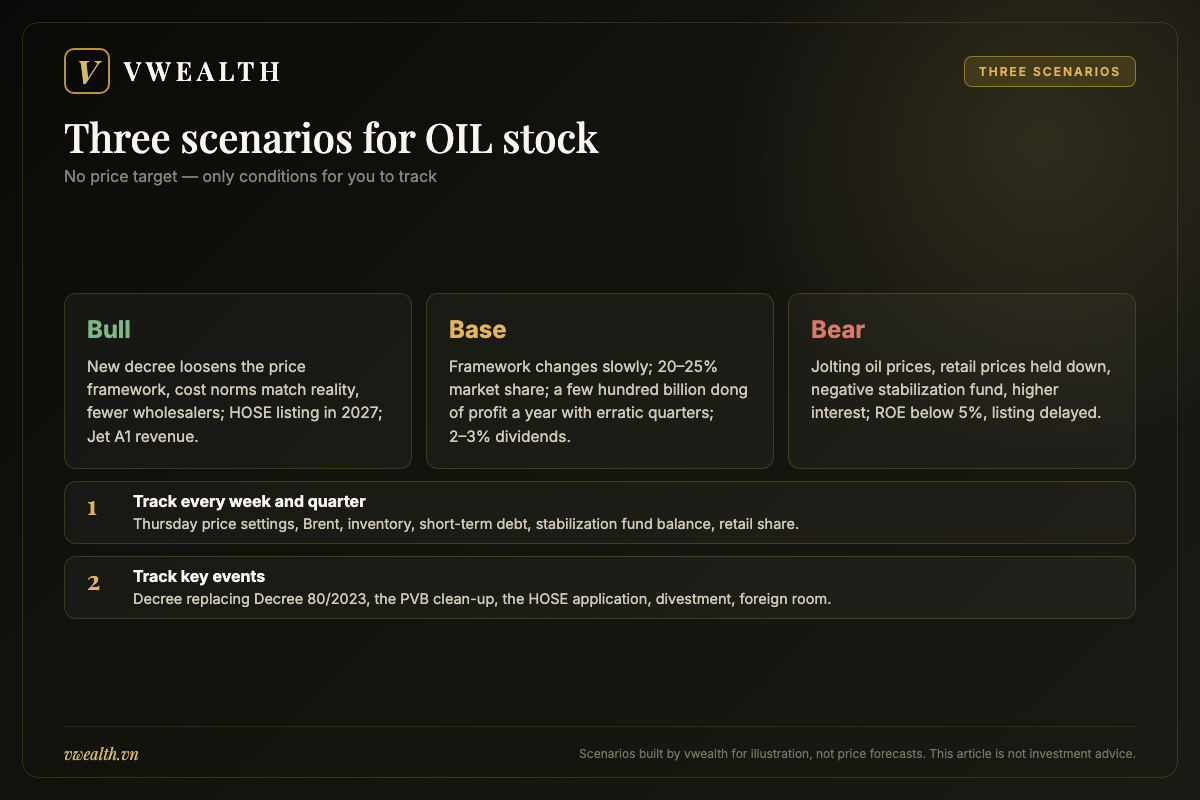
So, should you buy OIL stock? Weighing the pros and cons honestly
By now you have followed PVOIL from Petechim’s crude trading roots, through the 2014 oil crash, the 2018 IPO, the quarters of oil-driven gains and losses, to the scales of a new fuel decree. Whether you should buy OIL stock therefore has no single answer for everyone. It depends on what you need from a stock, how much volatility you can tolerate, and whether you believe the policy changes now on the horizon will materialize. This section puts the pros and cons on the scale so you can decide.
The pros worth weighing
A hard-to-shake number-two position. With about 20–25% market share depending on the source, about 950 company stations, depots and ports and a key trader license, PVOIL holds a position that newcomers would struggle to challenge, especially if wholesaler requirements tighten as drafted.
A cash-cushioned balance sheet. Cash and deposits exceeded total borrowings at end-2025 (net cash estimated by vwealth at about VND 8 trillion), helping the company weather bad oil years without liquidity risk.
Policy and listing catalysts. A new decree could widen the price framework for wholesalers; the plan to move to HOSE in 2027 could broaden the investor base. If both happen, the market’s view of OIL could change materially.
E10 capability and new businesses. As one of the two largest biofuel blenders, plus jet fuel and EV charging, PVOIL has several growth “options” that the share price may not fully reflect.
Regular cash dividends since 2022. Not large, but paid five years in a row, showing the company has moved past its accumulated-loss era.
The cons you cannot ignore
Thin margins outside management’s control. Net margins have hovered around 0.3–0.7% in recent years, and most of the margin is set by the pricing mechanism and discount competition. No matter how good management is, it cannot easily widen that framework on its own.
Profits that jump with oil. Two loss years out of twelve (2014, 2020) and several heavy losing quarters when oil reversed. If you need steady earnings to value a stock, OIL will not give you that.
Low ROE and reliance on deposit interest. ROE was about 4% in 2025 by vwealth’s estimate, and nearly half of pre-tax profit in recent years came from net financial income. When deposit rates change, that profit changes with them.
Concentrated ownership, thin free float, foreign investors absent. Petrovietnam owns 80.52%; minority shareholders have little decisive voice; foreign investors hold only about 0.27% after SK Energy’s exit. The divestment roadmap has been unfinished for eight years.
Compliance and policy risk. Rules on reserves, stabilization, taxes and fees change frequently, and a state wholesaler may be asked to prioritize supply over profit in stressed periods, as PVOIL itself acknowledged at its 2026 AGM.
The table below brings the pros and cons together:
| Aspect | Pro | Con |
|---|---|---|
| Industry position | Number-two key trader, about 20–25% share | Big gap to Petrolimex, heavy wholesale exposure |
| Profitability | Profitable in most years | Razor-thin margins, swings with oil |
| Balance sheet | Positive net cash | Working capital needs surge when oil is high |
| Policy | Draft decree could free pricing, tighten entry | State still intervenes to stabilize prices |
| Ownership | Petrovietnam backs supply and credibility | Concentrated, divestment stalled, foreign investors largely absent |
| Dividends | Regular since 2022 | Small, 2–3.5% of par |
| New growth | E10, Jet A1, EV charging, HOSE 2027 | Not yet measurable at group level; long-term EV risk |
Which investors OIL stock suits
Commodity-cycle and policy investors. If you closely follow oil prices, the Thursday price-setting calendar and the progress of the new decree, OIL is a tool for expressing a view on the fuel distribution cycle, provided you accept high volatility and have a disciplined exit plan.
Patient value investors betting on restructuring. If you believe the price framework will loosen, PVOIL will move to HOSE and its ownership structure will change, buying at prices low relative to book value and waiting several years may suit you. This is event-driven investing that requires patience and acceptance that the event may come late.
Investors who want a slice of the oil chain’s last link. If your portfolio already holds upstream names (PVD, PVS), gas (GAS) or refining (BSR), a small OIL position can diversify by segment, because distribution reacts to oil prices differently from the upstream links.
Who should probably look elsewhere
Income investors who need high, stable dividends. OIL’s dividends are small and constrained by the goal of retaining profit for the HOSE move. Utilities or consumer staples fit that goal better.
Investors seeking steady earnings growth. Revenue growth does not mean profit growth. If you want a 15–20% annual earnings growth story, OIL is not it.
Headline traders buying on “oil is rising.” As this analysis shows, oil spikes can cause losses for wholesalers when prices reverse. Buying OIL on oil headlines alone is a bet on sentiment, not on the business.
Foreign investors who need large positions. A thin free float and limited liquidity make it hard to build or exit a large position, and you should confirm the current foreign room with your broker.
The bottom line
PVOIL matters far more than its profit line suggests. It sells crude for the entire Petrovietnam group, supplies roughly a fifth of Vietnam’s fuel, is one of the two largest biofuel blenders and steps in to keep supply flowing when the market is stressed. But that very importance places it inside a framework: retail prices set by the state, standard profit measured in a few hundred dong per liter, inventory that must be held wherever oil goes, and a shareholder with more than four fifths of the capital and goals broader than profit.
So the question of whether to buy OIL stock ultimately comes down to that framework: do you believe it will loosen, that the company will reach HOSE, and do you have the patience to ride out erratic, oil-driven quarters? If yes, OIL may deserve a place in your watchlist at a reasonable price. If you are unsure, following a few more reporting cycles and the progress of the new decree is also a sensible choice. Either way, use the seven questions from the financial section each time PVOIL reports, and open the latest vwealth report for updated valuation, metrics and peer comparisons. If you do not yet have an account, you can sign up for vwealth for free to track OIL alongside other Vietnamese oil and gas stocks.
This article is for information and analysis only and is not a recommendation to buy or sell any security. Investors are responsible for their own decisions.
Research Vietnamese stocks in English with vwealth. Our AI-powered platform turns Vietnamese market data into full English analysis reports — with international payment support and a free 2-month trial for new accounts. Create your free account and read the latest reports.