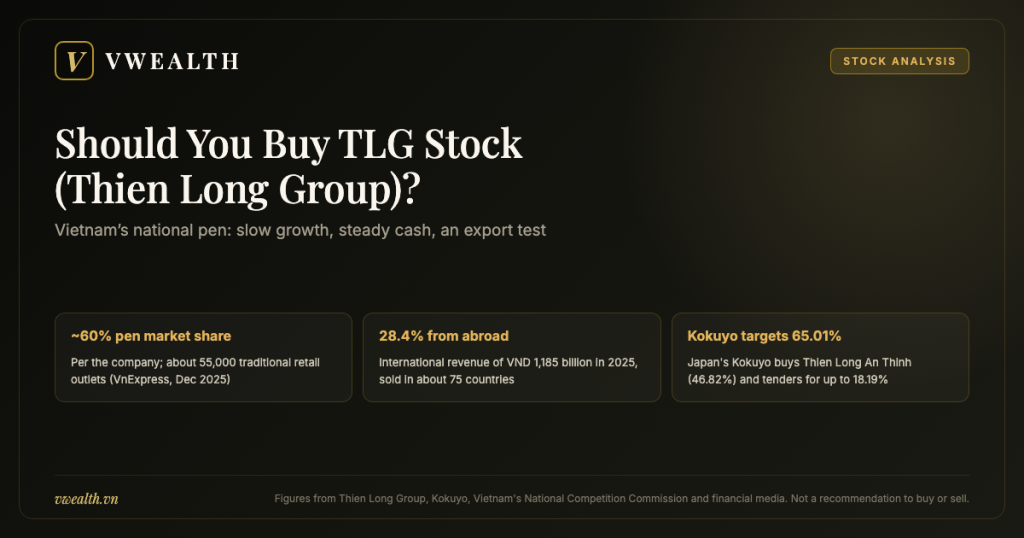
Should you buy TLG stock? The ticker belongs to Thien Long Group Corporation (Công ty Cổ phần Tập đoàn Thiên Long), listed on the Ho Chi Minh Stock Exchange (HOSE) since March 26, 2010 — and its core product is something almost every Vietnamese person has held: the Thien Long ballpoint pen. In 1981, founder Co Gia Tho started a pen workshop with savings worth about two taels of gold. More than four decades later, the company booked roughly VND 4,174 billion in net revenue in 2025, sells through tens of thousands of retail points across Vietnam and exports to about 75 countries and territories. Yet this is not a high-growth story: revenue has compounded at only around 8% a year over the past decade, and 2025 profit slipped slightly even as sales hit a record. Thien Long’s appeal lies elsewhere — a steady cash machine with little debt and a habit of paying cash dividends almost every year. And since December 2025, the story has a new chapter: Japan’s Kokuyo, one of Asia’s oldest stationery groups, has announced a plan to take up to 65.01% of the company. As of late September 2026 the deal had won conditional clearance from Vietnam’s National Competition Commission but had not closed, and Kokuyo itself had said its original timetable would slip. Vietnam’s “national pen” is on its way to a new owner, and that changes what it means to buy TLG stock.
A word on how this analysis works, as with every company deep-dive in the vwealth series. Dates, names, brands and financial figures come from published sources: Thien Long’s own corporate website, its consolidated financial statements, shareholder meeting documents and press coverage of those meetings, announcements by Kokuyo and by Vietnam’s National Competition Commission, and major Vietnamese financial media such as VnExpress, CafeF, Vietstock, Tuoi Tre and VnEconomy, plus international outlets where they covered the deal. Where sources disagree, we say so and give both numbers. Any figure we derived ourselves by dividing or multiplying published numbers is labeled a “vwealth estimate.” We deliberately avoid quoting today’s share price, current P/E or P/B, current market capitalization or the latest quarterly profit, because those change daily; for live numbers, open the latest vwealth report on TLG.
If you are new to Vietnamese equities, a few practical notes help. Vietnamese stocks trade in Vietnamese dong (VND), and all company figures below are in dong unless stated otherwise; if you think in dollars, convert at the current exchange rate rather than a remembered one. Listed companies can cap how much of their equity foreigners may own (the “foreign ownership limit” or “room”), and trades settle on a T+2 basis. Our guide to investing in the Vietnam stock market covers account opening, trading bands and foreign-ownership rules in detail. If you have read our analysis of Vinamilk (VNM) or Sabeco (SAB), you will recognize Thien Long’s personality: a consumer staple with a strong brand, deep distribution and reliable dividends. It is much smaller, however, and it has one unusual trait among Vietnam stocks in the consumer space — nearly 30% of its 2025 revenue came from abroad.
From Two Taels of Gold in 1981 to the Kokuyo Deal: 45 Years of Vietnam’s “National Pen”
Some companies’ histories are really the histories of a generation of consumers. Thien Long is one of them. Vietnamese students of the 1990s remember the ballpoint pen with the blue cap; students of the 2010s remember Colokit crayons or Diem 10 notebooks; office workers know FlexOffice folders. Behind these products, each costing a few thousand dong, lies a 45-year business journey that runs through the post-war subsidy era, the cooperative era, the industrial-park era, the stock-market era and now the era of cross-border M&A. Understanding that journey explains why Thien Long is so conservative with its balance sheet, why it went abroad earlier than most Vietnamese consumer firms, and why its founder chose to sell control precisely when revenue was at an all-time high.
1981–1995: a family pen workshop in District 6 and a battered bicycle
Co Gia Tho was born in 1958 into a large ethnic Chinese (Hoa) family in what is now Ho Chi Minh City. In a 2025 interview with VnExpress, he described himself as the eldest of ten children in a household of thirteen, including his parents and grandmother. After 1975, at 17, seeing his parents struggle to feed the household, he decided to go out and earn a living. Walking past school gates, he noticed that the men who refilled ink and repaired pens always had queues of customers. Demand for pens was enormous, he realized, but nobody was making them properly. He started by buying a few dozen pens from small workshops and pedaling an old bicycle around the city to sell them to newsstands and bookshops.
In 1981, having saved about two taels of gold (a traditional Vietnamese unit of gold savings), he switched to manufacturing. Thien Long’s corporate website dates the founding of the Thien Long ballpoint pen workshop and its first product to 1981. It began as a family operation, mostly assembling pens from parts — plastic barrels, refills and tips — supplied by the neighborhood’s Chinese-Vietnamese cottage industries. Capital was so tight, Tho recalled, that he could only afford materials for three days of production. He would make the pens, cycle around delivering them, and only on the fourth day, once everything was sold, have cash to buy the next batch. Unable to extend credit to big wholesale markets such as Binh Tay, he sold directly to newsstands and bookshops — a small detail that foreshadowed Thien Long’s greatest strength: direct distribution all the way down to the smallest retail counter.
By 1982 the business had broken into wholesale. A year later Tho married Tran Thai Nhu, whom he describes as having a natural flair for trade — she had been distributing soap in local markets. She took over deliveries and collections, freeing him to focus on production and product quality. There is also a lesser-known episode from that period: the state pushed small producers in the same trade to merge into cooperatives, and Thien Long was combined with another pen maker in District 6. Products under the shared brand flopped, Tho petitioned to leave, and the authorities agreed. The lesson — a merger that was “united in form but not in spirit” — is, in his own words, why he long remained wary of joint ventures.
In the late 1980s, when Ho Chi Minh City offered interest-free loans to businesses that committed to hiring more workers, Tho borrowed VND 200 million and hired 200 additional staff. That was the first push that turned a family workshop into a real manufacturer.
1996–2005: the Tan Tao factory, ISO certification and conversion to a joint-stock company
Thien Long Production and Trading Co., Ltd. was formally established in 1996. Around the same time, Ho Chi Minh City was encouraging manufacturers to move into the new Tan Tao Industrial Park, backed by bank loans covering 70% of factory construction costs. Tho says he bought 1.5 hectares of land at Tan Tao in 1996; the company’s website says the new Tan Tao factory in Binh Tan District began operating in 2000. The old site had been just over 2,000 square meters, crammed with machines. Inside the industrial park, Thien Long got its first proper R&D department, quality-control unit and wastewater treatment.
A steady run of certifications followed: ISO 9002 from DNV (Norway) in 2001, and in 2003 an expansion of factory space from 0.5 hectares to more than 1.6 hectares plus recertification under ISO 9001:2000. For a company selling pens worth a few thousand dong, chasing international certificates so early might look excessive. But this foundation in quality, workplace safety and environmental management is, according to Tho, what later allowed Thien Long to export to large markets, including the United States.
In 2005 the company became Thien Long Production and Trading Joint Stock Company, with charter capital of VND 100 billion — a step toward raising public equity. Notably, Tho had stepped back from day-to-day management long before: he recalls spending time in Taiwan in 1993 to study, because a management team was already running the business at home. Separating ownership from management is rare among first-generation family firms, and it helps explain how Thien Long has run smoothly under several chief executives who were not members of the Co family.
2006–2018: Long Thanh, the HOSE listing and a decade of steady growth
In 2006, charter capital rose to VND 120 billion and the company set up Thien Long Long Thanh JSC with VND 40 billion in capital, while adding a batch of certifications: ISO 14001 for environmental management, OHSAS 18001 for occupational health and safety, SA 8000 for social accountability and C-TPAT for supply-chain security — exactly the set that US importers typically require. In 2007 it created Thien Long Hoan Cau Trading and Services Co., Ltd. to distribute stationery, and in 2009 Tan Luc Trading and Services Co., Ltd. The group’s structure — factories on one side, trading and distribution companies on the other — took shape during these years.
The period also brought a stumble that Tho still mentions. Before the 2008 global financial crisis, Thien Long bought two plots of industrial land: one in the Dong Van Industrial Park (Ha Nam province) to make notebooks, pencils and chalk, with planned investment of around VND 200 billion, and one in the Sonadezi Long Thanh Industrial Park (Dong Nai province). When Vietnamese bank lending rates at times reached 20–30% a year, the company had to shelve the Ha Nam project and concentrate on Long Thanh. Tho calls it the biggest “storm” of his 40-plus years apart from the pandemic. That lesson about leverage is visible in how Thien Long has run its balance sheet ever since: low debt, mostly short-term borrowing to fund working capital.
On March 26, 2010, TLG shares listed on HOSE. We double-checked the listing record: ticker TLG, legal name Thien Long Group Corporation, exchange HOSE, par value VND 10,000. According to VnExpress, revenue crossed VND 1 trillion in 2011 and profit crossed VND 100 billion a year later. Between 2012 and 2016 the company implemented SAP-ERP, and through stock dividends and bonus shares its charter capital grew from VND 176.5 billion to VND 383.1 billion.
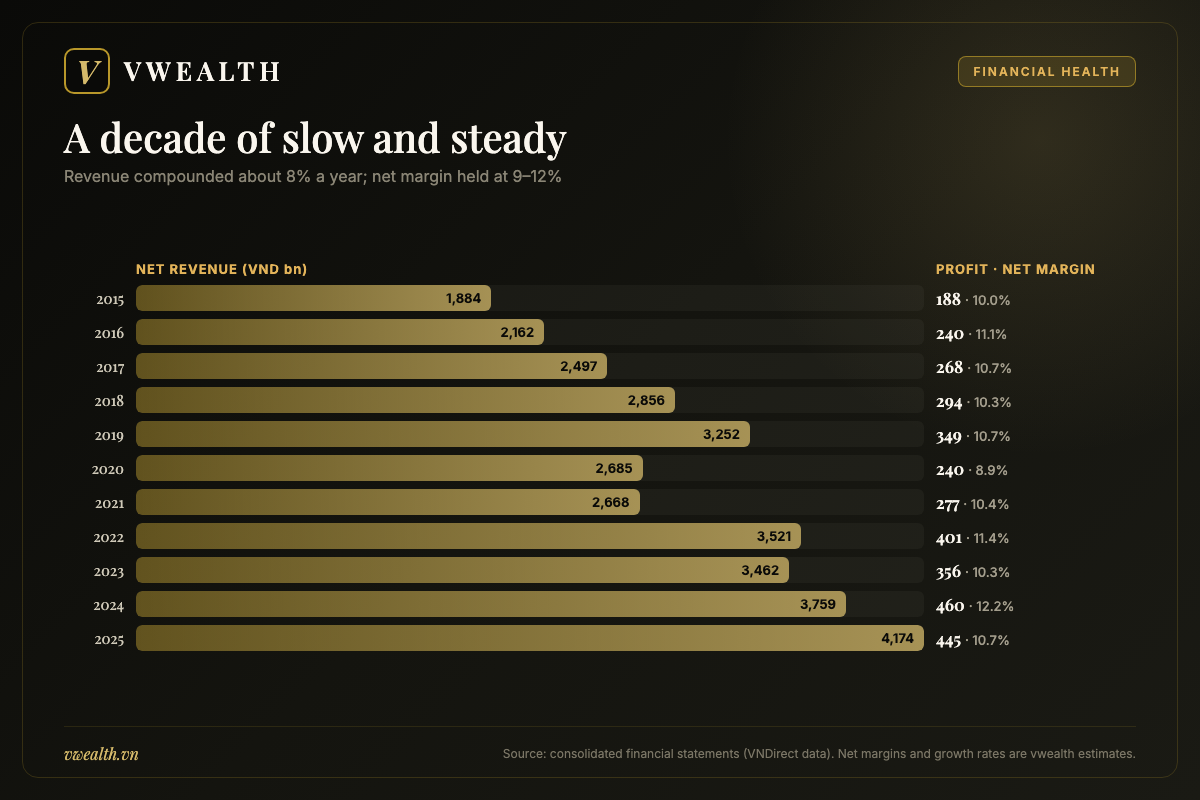
This was a textbook “slow and steady” decade. Consolidated financials compiled by VNDirect show net revenue rising from about VND 1,884 billion in 2015 to VND 2,856 billion in 2018, and after-tax profit from about VND 188 billion to VND 294 billion. In 2018, charter capital reached VND 657.2 billion, the company said it had completed its “export map” of Southeast Asia, and it launched the e-commerce site FlexOffice.com. Export revenue in 2018 was about VND 420 billion, up 28.2% and equal to nearly 15% of total revenue (about 14.7% of net revenue, a vwealth estimate), according to the Dau tu Chung khoan newspaper’s report on the 2019 shareholder meeting. At that meeting, management also said Thien Long led the domestic writing-instrument market with about 60% share, and that pens generated about 41% of group revenue.
2019–2021: an American strategic investor, the COVID blow and the first female CEO
March 2019 marked Thien Long’s first sale of shares to a foreign strategic investor. On March 5, 2019, NWL Cayman Holdings Ltd completed the purchase of 5 million newly issued TLG shares in a private placement at VND 85,000 per share — VND 425 billion in total, equal to 7.1% of voting shares. CafeF noted that TLG was trading around VND 63,000 at the time, meaning the buyer paid roughly a 35% premium to the market. At the May 2019 shareholder meeting, management discussed cooperation with NWL Cayman — an entity the press linked to the US consumer-goods group Newell — including distributing FlexOffice products in the Americas and Europe. According to VnExpress, Newell held just over 7% and the rights to distribute FlexOffice in the Americas and Europe; the two sides promised deeper cooperation, but about five years later the investor had sold out entirely. Recalling that deal in March 2025, Tho said Thien Long had “only cooperated, not formed a joint venture,” and had not lost the Vietnamese identity of its brand.
2019 was a strong year: net revenue of about VND 3,252 billion and after-tax profit of about VND 349 billion, a record at the time. Then COVID-19 arrived. Schools closed, students learned online and offices went remote — precisely the places that consume pens, notebooks and folders. Revenue fell to about VND 2,685 billion in 2020 and was roughly flat at VND 2,668 billion in 2021; 2020 profit dropped to about VND 240 billion. According to VnExpress, although 2020 revenue missed its target, profit still beat plan by about 9% — a sign of a company that knows how to cut costs when it has to. The 2020 cash-flow statement also shows roughly VND 46 billion spent buying back the company’s own shares.
In the middle of that difficult period, on June 1, 2021, Thien Long got a new chief executive: Tran Phuong Nga, succeeding Nguyen Dinh Tam after his four years in the role. Ms. Nga joined Thien Long in 2012, became deputy CEO for finance and accounting in February 2017 and also served as the chairman’s assistant; before that she held senior roles in accounting, banking and financial advisory at multinational firms in Vietnam and the UK. The press describes her as Thien Long’s first female CEO. Also in 2020–2021, the company set up FlexOffice Pte. Ltd. in Singapore, restructured the group and created Nam Thien Long Production and Trading Co., Ltd., wholly owned by the parent (its Tan Tao plant began operating in July 2021); charter capital stood at VND 777.9 billion, a level the financial statements show was already reached at the end of 2019 after the private placement.
2022–2025: “glocalization,” e-commerce and an experiment in retail
When students went back to class, Thien Long rebounded hard. In 2022 net revenue jumped to about VND 3,521 billion and after-tax profit to about VND 401 billion — above VND 400 billion for the first time. That year the company increased its capital in Nam Thien Long to VND 650 billion, opened the B2 factory at Thien Long Long Thanh, took a 25% stake in a new company, Pega Holdings (later raised to 40%), had FlexOffice Pte. Ltd. take 60% of ICCO Marketing (M) SDN. BHD. in Malaysia, and had Tan Luc Mien Nam take 70% of Clever World JSC — the operator of the Clever Box chain of toy, gift and stationery stores.
2023 was flat: revenue around VND 3,462 billion and profit around VND 356 billion. 2024 set a new record: consolidated net revenue of about VND 3,759 billion and after-tax profit of about VND 460–461 billion depending on rounding, 21% above plan. International revenue topped VND 1 trillion for the first time, up nearly 25%, and e-commerce sales grew about 2.6-fold. Charter capital reached VND 864 billion; the company said its market value had reached about USD 220 million and its brand value about USD 40 million. Management branded the strategy “Glocalization” — using its strength in the home market (local) to expand abroad (global), while bringing international standards back to serve Vietnamese consumers.
2025 was a year of experiments. In June 2025, via Tan Luc Mien Nam, Thien Long raised its stake in Phuong Nam Cultural JSC — operator of close to 50 Phuong Nam bookstores — to 49.49% and sent senior managers to run it. The goal was to expand into toys and lifestyle goods and to connect its products with end retail. In August 2025 the board also approved investing about USD 2.8 million in the Philippines to build the FlexOffice brand there; on July 7, 2026, Thien Long formally took 70% of Flexoffice Philippines Inc. and became its parent company. Net revenue for the year reached a record of about VND 4,174 billion, but after-tax profit dipped to about VND 445–446 billion as selling expenses surged (Chapter 4 explains why). Charter capital rose to VND 965 billion, or roughly 96.5 million shares outstanding. Brand Finance valued the Thien Long brand at about VND 1.7 trillion (around USD 63 million), ranking it 59th among Vietnam’s 100 most valuable brands — the only stationery company on the list.
December 2025–2026: Kokuyo knocks, and Thien Long strips back to its core
On December 4, 2025, Thien Long’s board disclosed that Thien Long An Thinh Investment JSC — its largest shareholder with 46.82% of TLG, chaired by Co Gia Tho — had said its own shareholders were negotiating to sell all of their Thien Long An Thinh shares to Kokuyo Co., Ltd. of Japan. The same day, Kokuyo announced that its board had approved two transactions: buying Thien Long An Thinh, then launching a public tender offer for up to 18.19% of TLG shares through a special-purpose vehicle, lifting its stake to 65.01% and making Thien Long a subsidiary. Kokuyo put the total purchase price at about JPY 27.6 billion, to be funded entirely from its own capital. Vietnamese media converted that to roughly VND 4,500–4,700 billion, and the press and advisers commonly cite about USD 185 million. The original timetable: close the Thien Long An Thinh purchase in August 2026, then run the tender offer between October and November 2026, all subject to Vietnamese regulatory approvals.
That timetable did not hold. In its first-half results materials published on August 6, 2026, Kokuyo said that making Thien Long a subsidiary “will take longer than initially expected” because Vietnam’s competition authorities needed more time for their review, that the original dates “will be put back,” and that it now aims for Thien Long to start contributing to its consolidated results in the next fiscal year, i.e. 2027. Kokuyo added that paperwork and pre-merger integration work remained on track. As of late September 2026, no closing date for the Thien Long An Thinh share transfer and no start date for the tender offer had been announced.
Right after the announcement, Thien Long began tidying up. In early February 2026 it disclosed plans to dissolve Clever World (an indirect subsidiary, 96.43% owned, a step the board had approved at a meeting on December 16, 2025), to sell its entire 40% stake in Pega Holdings at a target price of no less than VND 35 billion, and to restructure its Phuong Nam investment. In March 2026, the board approved Tan Luc Mien Nam putting nearly VND 145 billion (99.94% of the capital) into a new vehicle, Evertrust Investment JSC, to hold all the Phuong Nam shares, before seeking a buyer for Evertrust at a target price of no less than VND 144 billion. On June 19, 2026, the board terminated a project to set up an import and stationery-distribution entity in Indonesia — a joint venture with Snapgreen (Indonesia) and Silver Lion (Singapore), with total capital of USD 1.9 million and Thien Long due to contribute 40%. Kokuyo’s own December 2025 announcement stated that the Phuong Nam and Pega Holdings stakes were excluded from the deal and that this would be reflected in the final price, so the clean-up can reasonably be read as preparation for a change of control.
According to the subsequent-events note in the reviewed first-half 2026 financial statements, most of these steps were carried out over the summer. Evertrust was registered on April 24, 2026 and fully capitalized on July 16; on July 31, Tan Luc Mien Nam transferred its entire 49.49% of Phuong Nam to Evertrust for VND 144.3 billion; on August 5, contracts were signed to sell all of Evertrust to outside partners (VND 144.9 billion) and to sell the 40% Pega Holdings stake (VND 35.8 billion); and Clever World’s own shareholders voted on July 31 to dissolve it, with the paperwork under way.
On September 21, 2026, Vietnam’s National Competition Commission published Decision No. 294/QD-CT (signed September 9, 2026) approving, with conditions, the economic concentration — in the form of an acquisition — involving Synergy Investing Asia Pte. Ltd. (the vehicle Kokuyo is using), Thien Long An Thinh, Thien Long Group and five individuals: Co Gia Tho, Tran Thai Nhu, Co Ngan Binh, Co Cam Nguyet and Co Gia Duc. The deal may proceed, subject to conditions on reporting pen market share, selling prices and discounts, competition-law compliance and — notably — increasing R&D spending in Vietnam by VND 3 billion a year for at least five consecutive years. As the newspaper Nguoi Quan Sat pointed out, the decision clears the way for the deal but does not mean Kokuyo has completed the takeover. At the time of writing, neither step — the Thien Long An Thinh share transfer nor the tender offer — had taken place; check the latest HOSE disclosures and Kokuyo’s investor-relations page before making any decision.
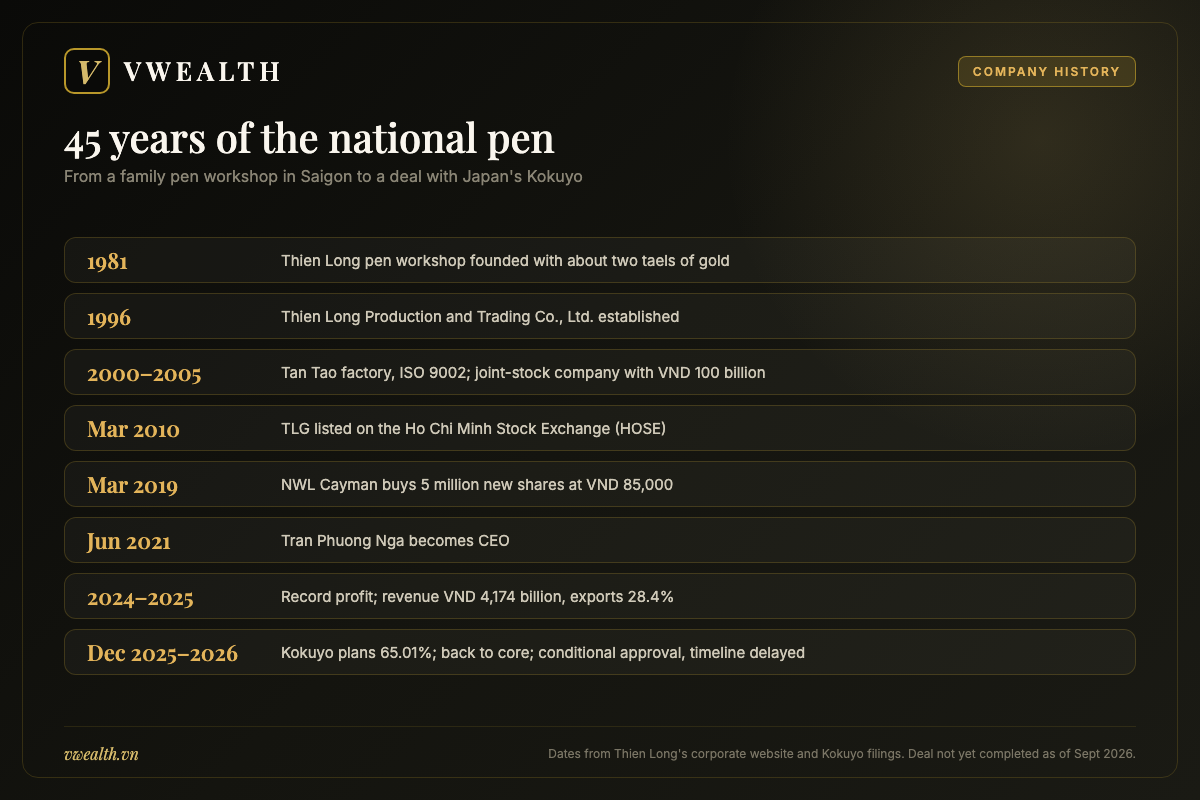
| Year | Milestone | Why it matters to shareholders today |
|---|---|---|
| 1981 | Thien Long pen workshop founded with about two taels of gold | Family roots; built on direct sales to newsstands and bookshops |
| 1996 | Thien Long Production and Trading Co., Ltd. established | From household business to company |
| 2000–2003 | Tan Tao factory operating; ISO 9002 (2001); plant expanded to 1.6+ ha | Quality base for exports and contract manufacturing |
| 2005 | Converted to a joint-stock company, VND 100 billion capital | Preparation for public equity |
| 2006 | Thien Long Long Thanh set up; ISO 14001, SA 8000, C-TPAT | Second production base; US supply-chain standards |
| Mar 26, 2010 | TLG listed on HOSE | Start of the public trading record |
| 2018 | Southeast Asia export map completed; FlexOffice.com launched | Exports nearly 15% of revenue |
| Mar 2019 | 5 million shares placed with NWL Cayman at VND 85,000 | Precedent of a foreign buyer paying above market |
| Jun 2021 | Tran Phuong Nga becomes CEO | New generation of professional management |
| 2024 | International revenue tops VND 1 trillion; record profit | Profit peak before the deal |
| Dec 2025 | Kokuyo announces plan to own 65.01% | Change of control |
| 2026 | Exits from Phuong Nam, Pega, Clever World, Indonesia entity; 70% of Flexoffice Philippines; Kokuyo delays timetable (Aug); conditional competition approval (Sep) | Back to the core pen-and-stationery business; deal not yet closed |
Who Runs Thien Long: the Founder, a Professional CEO, the Next Generation and a New Japanese Owner
For most family businesses, “who is in charge” has a simple answer: the founder, then the founder’s children. At Thien Long the answer is more layered, and it is changing in 2026. There are three groups to keep apart: the founding family, which owns; the professional management team, which operates; and, once the deal closes — Kokuyo now aims to consolidate Thien Long from fiscal 2027 — a new controlling shareholder in Kokuyo. An investor buying TLG today is buying at the exact moment control passes from the first group to the third, while the second is expected to keep the ship running.
Co Gia Tho: the eldest son who built a household brand
Across interviews, Co Gia Tho comes across consistently: low-profile, cautious, attached to his word, and determined to “sleep well at night.” He went out to earn a living at 17, and he says the secret to keeping Thien Long from growing “old” is learning: being open about what he did not know so others would teach him, learning from suppliers of materials and machinery, and bringing in people with the right expertise. He recalls telling Thien Long’s first mold engineer frankly that he did not understand the technical side, then handing authority to the specialists rather than trying to control everything.
He is known for a “4–6” philosophy: keep four parts of the gain and leave six for others. In business, that shows up in how Thien Long treats its distributors. In 2025, when competitors stepped up sales support, Thien Long chose to raise its own selling expenses sharply rather than let its dealers bear the pain, even though profit fell. It also shows up in the company’s long-running community programs, such as “Tiep suc mua thi” (support for students during national exams), which it has run for more than twenty years, and programs for teachers in poor areas.
At the April 2025 shareholder meeting, Tho was re-elected to the board for the 2025–2028 term and kept the chairmanship. The 2025 annual report lists him as also chairman and CEO of Thien Long An Thinh Investment JSC — the vehicle that owns 46.82% of Thien Long. Explaining the sale to Kokuyo at the April 22, 2026 shareholder meeting, he called Thien Long his “spiritual child” of 45 years, said he felt reassured because the buyer is a long-established Japanese company with a culture of longevity, and said that for at least the next three years he sees it as his responsibility to help the new owner run the business as well as possible.
Tran Phuong Nga: from building investor relations to running the company
If Tho is Thien Long’s soul, Tran Phuong Nga has run the machine for the past five years. Vietstock reports that about 14 years ago, when investor relations (IR) was still a novel idea among Vietnamese listed companies, Ms. Nga personally built the function at Thien Long. At the time, the company’s market value was below its book value; in her view, better communication with the market helped improve the valuation and made it possible to place shares with a foreign investor at a reasonable price. In September 2026 Thien Long won the “Mid Cap with IR most favored by investors” category at the IR Awards 2026.
Under Ms. Nga, Thien Long pushed in three directions: e-commerce (the company has invested in online channels since 2018 and targets 20% of domestic revenue from online before 2030), exports under the Glocalization strategy for 2025–2050, and tighter governance. On September 16, 2024, the company dismissed four deputy CEOs at once (supply chain, market development, business development and IT) and appointed one new deputy CEO, as part of a revamp of its job-title system that drew press attention at the time. At the 2026 meeting, asked about her future after the deal, Ms. Nga was candid: whether she stays depends on what the board requires, and “time will tell” (as reported by Vietstock); the official minutes record her saying her role “will depend on the board and shareholders,” while personally she hopes to stay. For investors, that is a real variable: continuity of professional management is one of the reasons Thien Long has run so consistently for so long.
Succession inside the Co family — and why the story turned toward Kokuyo
One point needs clarifying because it is easy to get wrong: Co Ngan Binh, who often appears in Thien Long’s shareholder lists, is Co Gia Tho’s younger sibling, not his daughter — the 2025 annual report lists her, like Co Gia Duc, as a sibling of insider Co Gia Tho. She had served on the board. At the April 2025 meeting, two long-serving directors — Tran Thai Nhu (Tho’s wife) and Co Ngan Binh — stepped down to make room for the next generation: Co Tran Co Nguyen (a University of California, San Diego graduate who worked at the fund manager VinaCapital) and Co Tran Dinh Dinh (formerly head of brand image and business development at the company), Tho’s two children. VnExpress also reported that the Clever Box chain, later dissolved, was associated with Co Tran Dinh Dinh.
The 2025–2028 board therefore comprises Co Gia Tho, Co Cam Nguyet (a board member since 2008 with more than 30 years at the group, who also sits on the board of Thien Long An Thinh), Nguyen Dinh Tam, Tran Phuong Nga, Tho’s two children, and — for the first time — three independent directors: Le Trung Thanh (30-plus years at Unilever, PepsiCo, FPT, Masan and Viettel, and a senior adviser at EY Consulting), Tieu Yen Trinh (CEO of Talentnet and an independent director at Vinamilk and PNJ) and Pham Ngoc Tuan (head of the Institute for Management and Technology Development and a specialist in Japanese-style production management). In April 2025 this looked like a classic generational handover cushioned by respected independents.
Eight months later, the Kokuyo announcement changed the plot. VietnamFinance openly asked whether the family was stepping away from the brand it created. Tho’s official answer focused on the international future: to grow “faster, stronger and more sustainably, you need greater capabilities,” and foreign markets demand a broader product range and more diverse resources. For investors, the point is not to guess personal motives but to look at consequences: after the deal, strategic decisions will rest with a listed Japanese group, not with the founding family. Every assumption about dividends, expansion or domestic pricing that used to be tied to Tho’s style should be re-examined through the new owner’s lens.
Ownership before the deal: Thien Long An Thinh and the family group
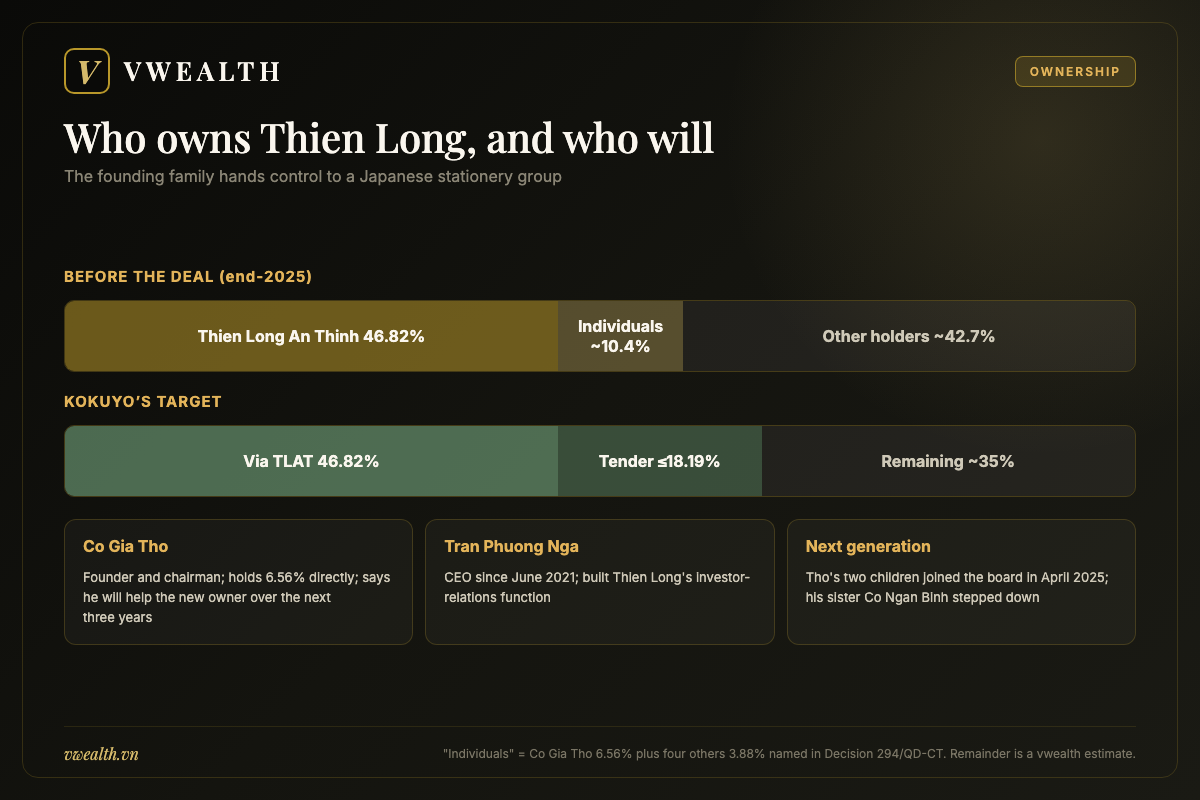
To understand the Kokuyo transaction, you need to understand the “box” the Co family uses to hold Thien Long. That box is Thien Long An Thinh Investment JSC (often abbreviated TLAT). At the end of 2025, TLAT held 46.82% of Thien Long and was its largest shareholder. According to VietnamFinance, Co Gia Tho himself is TLAT’s largest shareholder with 16 million shares (VND 160 billion of capital), while the other four shareholders — Tran Thai Nhu, Co Ngan Binh, Co Cam Nguyet and Co Gia Duc — hold 6 million shares each. Separately, Tho directly owns about 5.76 million TLG shares, or 6.56%, and other relatives (his wife, siblings and in-laws) hold anywhere from tens of thousands to more than a million shares each.
VnExpress estimated the family group’s combined stake at about 58.75% in December 2025. Markettimes (republished by CafeF) calculated that the parties to the Kokuyo agreement — TLAT plus the five individuals named in the competition decision — held just over 57%: TLAT 46.82%, Tho 6.56% and the other four individuals 3.88% combined. The two numbers differ slightly because they define “related persons” differently; both point to the same conclusion: before the deal, less than half of TLG’s shares were genuinely free-floating. One detail ties the pieces together: the five individuals named in the competition decision — Tho, Nhu, Ngan Binh, Cam Nguyet and Gia Duc — are also the five shareholders of Thien Long An Thinh according to VietnamFinance (16 million plus four times 6 million, or 40 million shares, consistent with the roughly VND 400 billion of capital that Kokuyo converted to JPY 2.4 billion; the match is a vwealth estimate). In other words, they are the sellers in step one of the deal.
| Shareholder (pre-deal) | Stake | Notes |
|---|---|---|
| Thien Long An Thinh Investment JSC (TLAT) | 46.82% | Owned by the founding family; Kokuyo buys all of TLAT |
| Co Gia Tho (direct) | 6.56% | Founder and chairman |
| Four other individuals named in Decision 294/QD-CT | about 3.88% combined | Tran Thai Nhu, Co Ngan Binh, Co Cam Nguyet, Co Gia Duc |
| Family and related persons (VnExpress definition) | about 58.75% | Broader scope, including in-laws |
| Other shareholders (funds, individuals) | roughly 41–43% | vwealth estimate from the figures above |
| Kokuyo after the deal (target) | 65.01% | 46.82% via TLAT + up to 18.19% via tender offer |
Who Kokuyo is, and how the deal is structured
Kokuyo is a Japanese group with more than 100 years of history, active in stationery, office furniture and workspace design, and best known for its Campus notebooks — a brand Vietnamese shoppers already know. Kokuyo aims to become Asia’s leading stationery company by 2030 and has identified ASEAN as its fourth core market after Japan, China and India. In India it operates through Kokuyo Camlin, which still sells under the local Camlin brand — consistent with Tho’s observation that Kokuyo “invests while keeping local brands.”
Kokuyo is no stranger to Thien Long. At the 2026 meeting, Tho called Kokuyo a “long-time partner” that had placed contract-manufacturing orders with Thien Long — the official minutes say OEM, while Vietstock quoted him as saying ODM. Kokuyo, for its part, stated in its December 2025 announcement that the two had no business relationship in fiscal 2024, and that in 2025 it signed an OEM supply agreement with Thien Long for Kokuyo-branded writing instruments, of “not significant” value. Thien Long’s Q4 2025 financial statements even show about VND 4.2 billion in short-term customer advances from Kokuyo Co., Ltd. Explaining the choice of buyer, Tho said Thien Long is strong in pens but still has room to grow in notebooks and office supplies — exactly Kokuyo’s strength — calling the pair “a perfect match.” Kokuyo, for its part, cited Thien Long’s strong brand in Vietnam, its manufacturing and product-development capabilities in writing instruments, and its wide ASEAN distribution network.
Structurally, the deal has two steps. Step one is buying 100% of TLAT — indirectly acquiring 46.82% of Thien Long without buying a single TLG share on the exchange. Step two, after step one closes, is a public tender offer for up to 18.19% of TLG — 15,962,552 shares based on the share count at announcement, a number Kokuyo said may be revised if the share count changes — through a dedicated vehicle; the competition decision names that vehicle as Synergy Investing Asia Pte. Ltd. Advisers include BDA Partners (exclusive financial adviser to the selling shareholders, i.e. the owners of Thien Long An Thinh) and VPBank Securities (co-adviser). Kokuyo said the price per share will be disclosed before the tender begins. Until then, the press has only back-calculated by dividing the JPY 27.6 billion total by about 57 million shares: Tuoi Tre estimated about JPY 484, or VND 82,000–83,000, per share, while DNSE and Nguoi Lao Dong cited about VND 79,000. The figures differ because of exchange rates and methodology; neither should be treated as the official price.
There is a technical detail many reports skip. Those per-share figures are based on the roughly 87.75 million shares outstanding when Kokuyo announced the deal on December 4, 2025. Days later, Thien Long set the record date for issuing nearly 8.78 million bonus shares as a 2024 dividend (one new share for every ten held), lifting the share count to 96.53 million. If the total deal price stays the same, each post-bonus share would correspond to a price about one-eleventh lower — roughly VND 72,000–75,000 starting from the VND 79,000–83,000 estimates above (a vwealth estimate, for illustration only). The actual tender price may differ, because the final price is subject to adjustments under the parties’ agreement and to the exclusion of Phuong Nam and Pega Holdings.
Cash dividends: the steady habit of a capital-light business
If one trait keeps small shareholders loyal to TLG, it is the dividend. VnExpress notes that Thien Long has paid regular dividends for many years at a typical rate of around 20% of par value; in recent years the cash rate has been higher. (In Vietnam, dividends are quoted as a percentage of the VND 10,000 par value, so a 35% dividend means VND 3,500 per share.) For fiscal 2025, the company paid an interim cash dividend of 10% in December 2025 and a further 25% (VND 2,500 per share) in March 2026, for a total of 35% in cash. The 2026 plan is again 35%, and in July 2026 the company paid a first interim of 10%, about VND 96.5 billion. Thien Long also pays stock dividends in some years — for example, issuing nearly 8.78 million shares (one new share for every ten held) at the end of 2025 as an additional 2024 dividend.
The cash the company actually paid out each year, taken from the cash-flow statement, gives a clearer sense of scale. Note these are calendar-year payments and may include dividends for the previous fiscal year.
| Year | Dividends paid in cash (VND billion, rounded) | After-tax profit, same year (VND billion) |
|---|---|---|
| 2018 | 101 | 294 |
| 2019 | 184 | 349 |
| 2020 | 153 | 240 |
| 2021 | 194 | 277 |
| 2022 | 156 | 401 |
| 2023 | 272 | 356 |
| 2024 | 157 | 460 |
| 2025 | 217 | 445 |
For fiscal 2025 alone, the 35% cash dividend works out to about VND 88 billion for the interim (on roughly 87.8 million shares before the bonus issue) plus about VND 241 billion for the second payment, or about VND 329 billion in total — roughly 74% of 2025 after-tax profit (vwealth estimate). That is a high payout ratio, fitting for a business that needs little capital to grow. Looking ahead, Tho said Kokuyo is itself a listed company that understands the importance of serving shareholders, so “nothing will change in terms of dividends” (as reported by Vietstock); the official minutes record a more cautious version — if the partnership makes the group more sustainable, dividends “will be more favorable in the future.” Either way, that is the seller’s expectation, not the buyer’s commitment; watch the resolutions of the first shareholder meeting after Kokuyo takes control.
Inside a Ballpoint Pen: Thien Long’s Core Businesses
How much can anyone earn on a pen that sells for a few thousand dong? The question sounds naive, but it is the key to understanding Thien Long. In 2025 the group’s gross profit was about VND 2,069 billion on net revenue of about VND 4,174 billion — roughly 50 dong of every 100 dong in sales left after cost of goods (vwealth estimate from the financial statements; Chapter 4 explains why the 2025 figure is inflated by an accounting change). Gross margins at that level are far above those of an ordinary plastics manufacturer. They show that buyers are not just paying for plastic and ink; they are paying for the brand, for the convenience of finding it at the corner shop, and for confidence that it will write smoothly. Thien Long describes itself as making and selling four main product groups: writing instruments, fine arts, office supplies and school supplies. Here is each, and how they support one another.
Writing instruments: the heart of the group and the source of its market share
Pens are the original product and still the backbone. At the 2019 shareholder meeting, management said Thien Long led the domestic writing-instrument market with about 60% share, and that pens produced about 41% of group revenue; VietnamFinance, citing Forbes, repeated the roughly 60% figure in 2025. These are company and press figures, not audited data, so treat them as an indicator of position rather than a precise measurement. Indirect evidence of that position: the National Competition Commission’s 2026 decision requires the post-deal group to track its annual share of the “nationwide writing-instrument market” along with selling prices and discount policies — regulators only impose such conditions when a company holds a significant position in the relevant market.
The range runs from the classic Thien Long ballpoint through gel pens, whiteboard markers and highlighters to premium lines. At a private-sector exhibition in May 2025, the company showcased its Hoshi premium gel pen “with Japanese technology” and its eco-friendly Eco-Style line. For 2026, Thien Long said it would devote about 70% of its R&D resources to core pen and marker lines. The beauty of pens is repeat purchase: a student can go through dozens in a school year, and buyers rarely agonize between brands when the price difference is a few hundred dong — they pick the familiar one that is on the shelf. It is exactly the kind of product where brand and distribution decide everything.
The flip side is a ceiling on growth. Vietnam will not double its pen consumption; demand tracks the number of students and office workers and the habit of handwriting, which is slowly giving way to keyboards and screens. So while the number-one position looks secure, domestic pens are unlikely to be a fast-growth engine. They are the cash machine that funds everything else.
School supplies (Diem 10) and fine arts (Colokit): riding the back-to-school season
School supplies — boards, chalk, rulers, compasses, scissors, notebooks — sit under the Diem 10 brand, student calculators under Flexio, while fine arts — colored pencils, crayons, watercolors, color markers — sit under Colokit. These are the two groups that benefit most directly from the August–September back-to-school season, when parents buy complete kits for the new school year. Flexio calculators were shown alongside Hoshi pens at the 2025 exhibition, and the annual report singles out the Flexio scientific calculator line as one of the year’s growth drivers. The company says that after seven years of investing in online channels, school supplies grew about 300% on that channel, faster than the overall figure of about 200%.
Fine arts is an interesting segment because it carries good margins and more “emotional” value than a ballpoint: a beautiful box of colored pencils is a gift, not just a tool. The 2025 annual report describes Colokit as holding the leading position in Thien Long’s fine-arts business, and says it and FlexOffice are being repositioned market by market abroad under the Glocalization strategy. Programs such as the children’s drawing contest the company has run for years are both community outreach and a way to build the Colokit brand with its users while they are very young.
Notebooks remain the weak link. As Tho acknowledged in 2026, Thien Long is strong in pens, but notebooks and office tools “still have room to grow.” That is why he describes Kokuyo — owner of the Campus notebook brand — as a complementary partner. If the deal creates domestic synergy, it will most likely come from putting Campus notebooks into Thien Long’s tens of thousands of retail points, or from bringing Kokuyo’s notebook know-how into Thien Long’s factories. That is vwealth’s inference from both parties’ statements, not an announced plan.
Office supplies (FlexOffice) and premium pens (Bizner)
FlexOffice is the office-supplies brand — folders, clips, staplers, tape, desk accessories — and also the brand Thien Long has chosen as its international spearhead. The company’s website sets a goal of making FlexOffice the leading recognized pen and stationery brand in Southeast Asia. The names of its foreign entities tell the same story: FlexOffice Pte. Ltd. in Singapore is the regional trading company, and it owns 60% of ICCO Marketing in Malaysia. At home, office supplies serve both retail buyers and corporate (B2B) customers, where Thien Long competes on breadth of range and delivery capability.
Bizner is the premium line — ballpoints, fountain pens, felt-tips and pencils — aimed at professionals and corporate gifting. As early as the 2019 shareholder meeting, management described raising the share of high-quality products such as the Bizner label as one way to solve the margin problem. It is the familiar “premiumization” playbook of consumer goods: when volumes cannot grow fast, raise the average value of each item. At the 2026 meeting, Ms. Nga said Thien Long would not join a “race to the bottom on price,” choosing instead to launch new products and add value. According to the meeting minutes, the company developed 60–80 new products in 2025, generating VND 283 billion in revenue, 9% above plan (Vietstock quoted Ms. Nga as saying “nearly 80 new products”).
Distribution: tens of thousands of retail points, supermarkets, bookstores and TikTok Shop
If products are the heart, distribution is the bloodstream — Thien Long itself uses that image. In 2019 the company had more than 110 distributors and about 65,000 retail points across 63 provinces, according to the Dau tu Chung khoan newspaper; in December 2025, VnExpress put the traditional trade (GT) channel at more than 126 major distributors and about 55,000 retail outlets, plus nearly 3,800 modern-trade points in supermarkets, bookstores and convenience stores. The counts differ by date and definition, so read them simply as “several tens of thousands of outlets.” General trade means grocery stores, small bookshops and stationery counters near schools — where most pens are actually sold. That reach extends into rural and mountain areas, and a newly arrived foreign brand would struggle to copy it within a few years, because it was built on decades of relationships with individual distributors and shop owners.
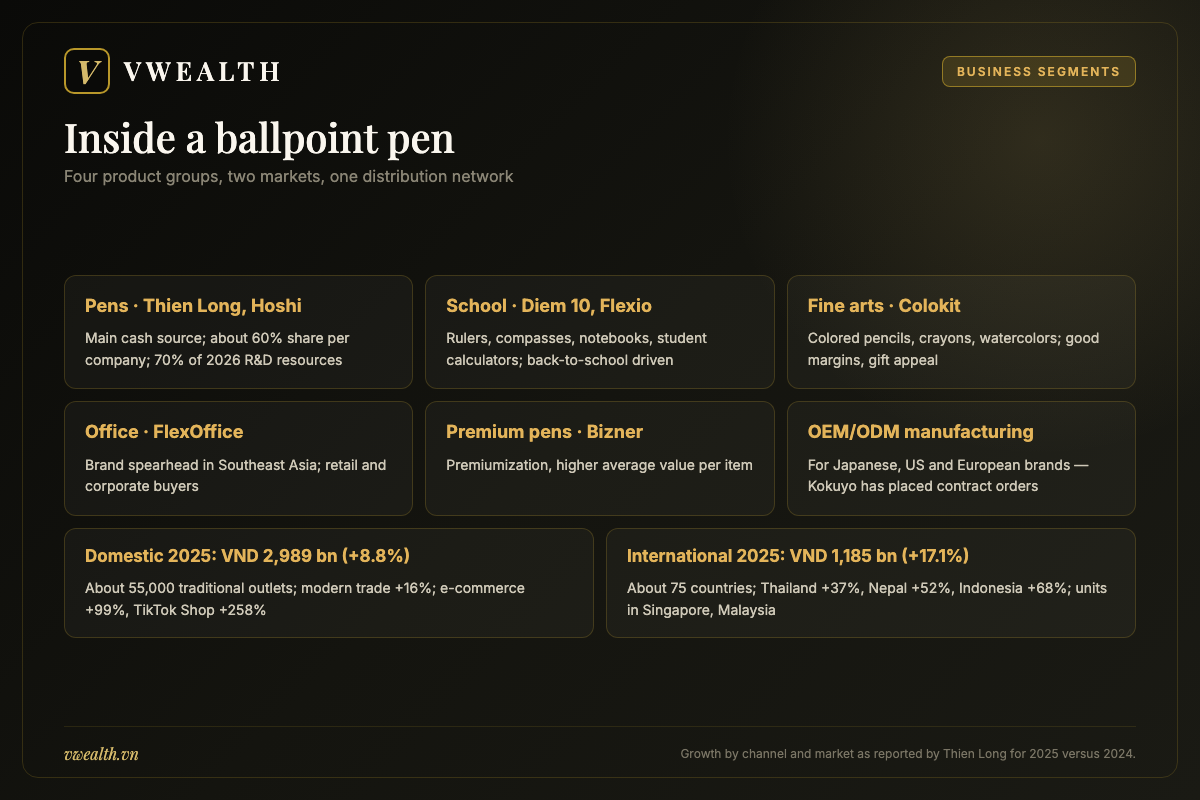
In 2025 the traditional channel had a hard time: changes in tax rules for household businesses, a nationwide crackdown on counterfeit goods and prolonged flooding in some provinces all dampened purchases, according to the company. The modern trade (MT) channel — supermarkets and bookstore chains — grew about 16% after a restructuring of pen displays in modern retail chains, and e-commerce grew about 99% versus 2024, with TikTok Shop up about 258% and Shopee — the main platform — up 87%. The annual report says Thien Long’s e-commerce sales grew more than 21-fold between 2021 and 2025. Thien Long says it works with more than 1,000 KOLs/KOCs (influencers and user-creators), who contribute more than 35% of monthly online revenue, and runs distribution centers in Nam Dinh and Ho Chi Minh City plus an express hub in Hanoi for 2–4-hour delivery. System upgrades raised order-processing capacity 2.5-fold and cut warehouse operating costs by about 30%.
E-commerce matters more than its revenue share suggests. It gives Thien Long direct data on end buyers, which general trade cannot provide, and it is the brand-building channel for younger consumers. But it has a downside: online, Thien Long competes head-to-head on price with cheap Chinese goods on the same screen, and if handled badly it can cannibalize traditional dealers. Ms. Nga says the goal is for online to reach 20% of domestic revenue before 2030, stressing that e-commerce “supports the other channels” rather than replacing them. For a pure retailer’s perspective on the same multichannel problem, see our analysis of Mobile World (MWG).
Exports and OEM/ODM: two roads to the world
Exports are what set Thien Long apart from other Vietnamese consumer companies. In 2025, overseas revenue was about VND 1,185 billion, up 17.1% and equal to 28.4% of total revenue; domestic revenue was about VND 2,989 billion, up 8.8%. The company says 2025 export revenue reached about USD 44 million, an all-time high, across roughly 75 countries and territories. Compared with 2018, when exports were about VND 420 billion and nearly 15% of revenue, the share has nearly doubled in seven years. For broader context on how exporters fit into Vietnam’s equity market, see our overview of Vietnam’s export-economy stocks.
There are two roads abroad, and you should keep them apart because their margins and risks differ. The first is exporting Thien Long’s own brands — Thien Long, FlexOffice, Colokit — mainly to Southeast Asia. For 2025 the company cited growth of about 37% in Thailand, 52% in Nepal and 68% in Indonesia. Ms. Nga explains that Southeast Asia was chosen because Thien Long already has a solid system there, populations are large and consumer habits resemble Vietnam’s. This road has higher potential margins but requires spending on brand building and distribution — which is why Thien Long has moved step by step: a trading subsidiary, FlexOffice Pte. Ltd., in Singapore; ICCO Marketing in Malaysia (which posted its first net profit in 2025, according to the annual report); a Philippine subsidiary from July 2026; while the planned joint-venture entity in Indonesia was dropped in June 2026. As VietnamFinance noted, that decision ended one specific legal-entity project; it did not mean a withdrawal from selling in Indonesia.
The second road is contract manufacturing: OEM (making products to a customer’s design) and ODM (designing and making products that carry the customer’s brand), mainly for customers in the US, Europe and Japan. Kokuyo is one such contract-manufacturing customer (see Chapter 2 on how sources describe the relationship). In 2025 the OEM business produced more than 148 new products across gel pens, crayons, art markers and coloring pens, according to the annual report. The company says it will keep expanding OEM/ODM capacity for these markets in 2026. Contract work carries lower margins than branded goods but is stable, needs little selling expense and forces the factories to meet the highest quality standards. In markets like the US, Ms. Nga says building an own brand “requires very large investment,” so Thien Long prefers partners to shorten market entry. For 2026, the company targets export growth of about 20% over 2025, according to the annual report and meeting documents.
Which business feeds which, and where Thien Long’s moat really lies
Put together, the picture looks like this. Domestic pens are the stable cash source, with a leading position and good margins; they pay the dividend and fund experiments. School supplies, fine arts and office supplies widen the basket on the same distribution network, spreading fixed costs that have already been paid. E-commerce is the fastest-growing channel and the brand tool for a new generation. Exports — both own brands and contract work — are the escape route from the ceiling of the home market. Non-core ventures such as bookstores, toys and retail were attempts to broaden the ecosystem, but they were wound back in 2026.
Thien Long’s moat — its durable competitive advantage — has three overlapping layers. The first is a brand tied to the memories of several generations of students — Thien Long is the only stationery company in Brand Finance’s 2025 ranking of Vietnam’s 100 most valuable brands, and an Ipsos survey of 1,200 parents and secondary and high-school students cited by VnExpress found 99% brand awareness and 61% regular use. The second is a network of several tens of thousands of traditional retail points that would take years and a lot of money to replicate. The third is manufacturing capability certified to international standards, good enough to produce for Japanese and American brands. The weakness is that the moat sits in an industry with low technological barriers, where cheap Chinese goods can appear in any channel, especially on e-commerce platforms. The moat is widest in general trade and narrowest online.
| Segment / brand | Main products | Role in the group | Risks to watch |
|---|---|---|---|
| Writing instruments (Thien Long, Hoshi) | Ballpoints, gel pens, markers | Main cash source; about 60% share per company | Gradual decline in handwriting; plastic and tip costs |
| School supplies (Diem 10, Flexio) | Rulers, compasses, notebooks, calculators | Bigger back-to-school basket | Notebooks still weak; price competition |
| Fine arts (Colokit) | Colored pencils, crayons, watercolors | Good margins, gift appeal | Seasonality |
| Office supplies (FlexOffice) | Folders, desk accessories | Brand spearhead in Southeast Asia; B2B | Costly to build brands abroad |
| Premium pens (Bizner) | Executive pens, gifts | Premiumization, higher average price | Small scale |
| OEM/ODM | Products for Japanese, US, European brands | Stable revenue, raises factory standards | Lower margins; reliance on a few big customers |
Financial Health: Reading Thien Long’s Numbers Before You Buy TLG Stock
Thien Long’s financial statements are among the easier ones to read on the Vietnamese market: no half-built real estate, no complex financial investments, little debt. But easy to read does not mean free of traps. 2025 is the perfect example: glance only at the falling after-tax profit and you might conclude the business is weakening; read the notes and you find that part of the story is an accounting change. This chapter walks through each part of the accounts and shows you how to read Thien Long’s own numbers. Historical data come from consolidated financial statements compiled by VNDirect, cross-checked with shareholder meeting documents; for current-year and latest-quarter figures, use the updated vwealth report.
Ten years of revenue and profit: slow but steady
| Year | Net revenue (VND bn) | Gross profit (VND bn) | Gross margin | After-tax profit (VND bn) | Net margin |
|---|---|---|---|---|---|
| 2015 | 1,884 | 726 | 38.5% | 188 | 10.0% |
| 2016 | 2,162 | 846 | 39.1% | 240 | 11.1% |
| 2017 | 2,497 | 934 | 37.4% | 268 | 10.7% |
| 2018 | 2,856 | 1,067 | 37.4% | 294 | 10.3% |
| 2019 | 3,252 | 1,197 | 36.8% | 349 | 10.7% |
| 2020 | 2,685 | 1,030 | 38.4% | 240 | 8.9% |
| 2021 | 2,668 | 1,127 | 42.2% | 277 | 10.4% |
| 2022 | 3,521 | 1,524 | 43.3% | 401 | 11.4% |
| 2023 | 3,462 | 1,513 | 43.7% | 356 | 10.3% |
| 2024 | 3,759 | 1,675 | 44.6% | 460 | 12.2% |
| 2025 | 4,174 | 2,069 | 49.6% | 445 | 10.7% |
Source: consolidated financial statements for each year (VNDirect data); gross and net margins are vwealth estimates. Small differences from company-reported figures (for example, 2024 profit reported as VND 461 billion and 2025 as VND 445.1–446 billion) come from rounding and from whether minority interests are included. Note that some early-2026 press reports put 2025 profit at VND 450 billion based on the unaudited Q4 report, and at least one cited VND 523 billion — that 523 figure is actually operating profit (before other income and tax), not after-tax profit. The same mix-up reappeared in some September 2026 reports on the competition decision; the audited figure approved by shareholders is consolidated after-tax profit of VND 445.1 billion, down 3.3%.
The table tells you three things. First, revenue grew from about VND 1,884 billion to VND 4,174 billion over ten years, a compound annual growth rate of about 8.3%, while profit compounded at about 9% a year (vwealth estimates). That is high-single-digit growth — not fast, but consistent, interrupted essentially only by COVID. Second, net margin has stayed in a narrow band of roughly 9–12% throughout; Thien Long has had no windfall years and no losses. Third, gross margin has trended up, from about 37–38% before 2020 to about 43–45% in 2021–2024 — a sign of premiumization and a richer product mix.
The company reports a 2025 return on average equity (ROAE) of about 18.3% and a return on average assets (ROAA) of about 12.9%. For a business that barely uses leverage, ROE near 18% is healthy — it shows profits come from operating efficiency rather than borrowed money. Compare that profile with a larger staple such as Masan Consumer (MCH) to see how brand-plus-distribution models differ in scale.
The 2025 gross-margin jump and 61% rise in selling expenses: reading them correctly
Two 2025 numbers look strange side by side. Gross margin jumped from about 44.6% to about 49.6%. Meanwhile selling expenses rose from about VND 770 billion to about VND 1,239 billion, an increase of roughly 61%; marketing and trade-fair costs alone exceeded VND 759 billion, more than triple the prior year, according to Markettimes — roughly VND 2 billion a day (vwealth estimate). The result: record revenue, but profit down about 3%.
At the April 2026 shareholder meeting, CEO Tran Phuong Nga explained much of the gap. Previously, distributors paid for trade-promotion activities on Thien Long’s behalf and deducted those amounts from what they owed — effectively reducing Thien Long’s reported revenue. From May 1, 2025, all such costs are recorded as Thien Long’s own selling expenses. In other words, money that used to “disappear” inside the revenue line (making revenue and gross profit smaller) now shows up in selling expenses (making revenue, gross profit and selling expenses all larger). Bottom-line profit is unaffected by this change; only the location of the numbers moves. Ms. Nga said the change helps control tax risk.
But she also acknowledged that, beyond the accounting effect, underlying selling costs did rise, because the company now has to market individual product lines rather than running umbrella campaigns, and has to spend to defend market share when competitors increase their dealer support. The lesson when reading Thien Long’s accounts from now on: do not compare 2025–2026 gross margins with earlier years as if they were like for like. A more reliable measure is operating margin (gross profit minus selling and administrative expenses, divided by revenue), or simply net margin. On that basis, 2025 net margin was about 10.7%, below 2024’s 12.2% but still within the historical range. The company also says that measured against 2025 “core” profit (excluding one-off items such as the VND 49 billion of other income), the VND 440 billion plan for 2026 implies growth of nearly 10% — a company-calculated figure you should treat as management’s explanation.
Plastic, pen tips, packaging and the exchange rate: input costs to watch
Thien Long’s 2025 cost of goods sold was about VND 2,105 billion, roughly half of revenue. Most of it is materials: the 2025 annual report says materials — pen tips (the tiny metal balls at the end of a refill), plastic resin, ink, refill tubes, springs, chemicals — make up about 70% of production cost, with plastic resin alone accounting for nearly 25% of material value. Plastic resin is a petrochemical, so its price follows oil and the chemicals cycle. Some materials and components are imported, so movements in the dong against the US dollar and other Asian currencies feed straight into costs. Export revenue in foreign currency provides a partial natural hedge: at the end of 2025 the company held more than USD 6 million and about JPY 8 million in foreign-currency cash, according to Markettimes.
2026 is the year the cost shock became visible. At the April 2026 meeting, Ms. Nga said the conflict in the Middle East had driven plastic prices sharply higher and pushed up pen tips and packaging by 20–30%, with some materials running out entirely and needing substitutes. The company had built up raw-material inventory early, added backup suppliers and renegotiated with existing ones. This is the main reason the 2026 profit plan is only about VND 440 billion, about 1.1% below 2025, even though planned revenue rises about 5.4% to VND 4,400 billion.
On pricing, sources capture two different nuances, and you should know both. CafeF, citing the meeting documents, wrote that Thien Long intended to keep selling prices stable rather than raise them by 15–20%, to protect its distribution network and market share. Vietstock, reporting the Q&A at the meeting, quoted Ms. Nga as saying “we will certainly have to pass some costs on to consumers,” that raising prices is the last resort “but still has to be done.” The sensible reading: the company will not raise prices enough to cover all cost increases, but will share part of the burden and accept thinner margins. For investors, the quarterly variables to watch are gross margin (adjusted for the accounting change above) and raw-material inventory levels.
First half of 2026: a strong first quarter, a softer second
What happened in the first six months of 2026 is the first test of the “cautious” plan management set. The numbers below are those published at the time of writing; by the time you read this, a newer quarterly report may be out, so check the latest vwealth report.
The first quarter was very strong. At the April 22 meeting, Ms. Nga announced that consolidated Q1 net revenue had topped VND 1,000 billion for the first time, up 26% year on year — domestic up 29%, exports up 20% — and consolidated after-tax profit reached VND 116 billion, up 47%, thanks to market investments made in 2025 and a better gross margin. But she immediately added that the company was “not complacent,” because higher material prices would feed into cost of goods in later quarters.
The second quarter showed that warning was justified. According to the reviewed interim consolidated financial statements, six-month net revenue was about VND 2,354 billion, up about 15%, and after-tax profit about VND 315 billion, up about 5% — roughly 54% of the full-year revenue plan and 72% of the profit plan. Isolating Q2 (six months minus Q1, a vwealth estimate from published figures), revenue still grew about 9%, but after-tax profit of about VND 199 billion was down about 10% from Q2 2025. Six-month selling expenses were about VND 594 billion, up about 21%, faster than revenue; part of that may be because the May 2025 accounting change described above applied to only two months of the comparison period (vwealth’s reading).
The mid-year balance sheet also reflects the stockpiling strategy management described: at June 30, 2026, total assets were about VND 3,793 billion, inventory about VND 1,005 billion (up from about VND 815 billion at end-2025), short-term receivables about VND 919 billion and short-term borrowings about VND 585 billion, according to financial-statement data compiled by VNDirect. Mid-year is peak stocking season ahead of back-to-school, so inventory and receivables are always higher than at year-end; the thing to watch is whether they return to normal after the third quarter.
Balance sheet: plenty of cash, little debt, seasonal inventory and receivables
At the end of 2025, Thien Long had total assets of about VND 3,569 billion, equity of about VND 2,523 billion and total liabilities of about VND 1,046 billion — liabilities of about 0.41 times equity (vwealth estimate). Short-term borrowings were about VND 439 billion, down from about VND 487 billion a year earlier; long-term debt was negligible at about VND 6 billion. Cash and cash equivalents were about VND 487 billion; including term deposits, Markettimes put total cash at about VND 665 billion. In practice, Thien Long is close to a net-cash position — its cash could repay all its borrowings.
Two items deserve closer attention: inventory and receivables. Year-end 2025 inventory was about VND 815 billion (net of provisions), and short-term receivables about VND 801 billion, up sharply from about VND 649 billion a year earlier and about VND 439 billion at the end of 2023. For a stationery maker, both are seasonal: the company builds stock before back-to-school, sells on credit to distributors and collects gradually. Receivables growing faster than revenue was raised directly by a shareholder at the 2026 meeting; Ms. Nga said the increase came mainly from export expansion, because new markets and new OEM customers typically get longer payment terms than domestic buyers, and that it was not a sign of credit risk. That is management’s explanation; you should still check the ageing of receivables and bad-debt provisions in the notes every year. Inventory write-down provisions also rose from about VND 24 billion (2023) to about VND 54 billion (2025), showing the company does provide for slow-moving stock.
Tangible fixed assets are only about VND 510 billion — small relative to more than VND 4 trillion of revenue. That is typical of the industry: injection-molding machines and pen assembly lines are not especially expensive, and each dong of fixed assets generates about eight dong of revenue (vwealth estimate). Annual capital expenditure ranged from about VND 60 billion to VND 170 billion over 2019–2025, far below profit. That is why Thien Long can pay out most of its earnings as dividends and still grow.
Cash flow: does profit turn into cash?
A good consumer business converts profit into cash. At Thien Long the answer is “yes, but unevenly year to year.” Net cash from operating activities over 2019–2025 was about VND 258, 369, 221, 289, 249, 359 and 220 billion respectively. The seven-year total is about VND 1,965 billion versus cumulative after-tax profit of about VND 2,528 billion — operating cash flow of about 78% of profit (vwealth estimate). The gap sits mainly in working capital: inventory and receivables growing with revenue.
2025 was a weak cash year: about VND 220 billion, roughly half of profit, because receivables and inventory rose. In the same year the company spent about VND 125 billion on fixed assets, about VND 217 billion on dividends and, according to Ms. Nga at the meeting, about VND 143 billion on joint-venture contributions and additional stakes (mainly the Phuong Nam investment) — together well above operating cash flow. The gap was covered from existing cash, which fell from about VND 700 billion to about VND 487 billion. One such year is not alarming on its own; but if operating cash flow keeps lagging well behind profit for several years, sustaining a 35% cash dividend will be tested. If you own TLG for income, this is the metric to watch most closely.
Seven questions to ask every time Thien Long reports
Instead of memorizing the numbers above, use these seven questions as a quarterly checklist. One: how fast did domestic and export revenue grow, and which channel drove it — traditional, modern or e-commerce? Two: how did gross margin change versus the same quarter last year (not the previous quarter, because of seasonality), after adjusting for the May 2025 accounting change? Three: did selling expenses grow faster or slower than revenue? Four: how much faster than revenue did inventory and receivables grow? Five: is cumulative operating cash flow keeping pace with profit? Six: if short-term borrowing rose, what is it funding — raw-material stockpiles or something else? Seven: are there one-off items — the Phuong Nam or Pega divestments, the Clever World dissolution, losses at associates — distorting that period’s profit?
The seventh question matters especially in 2026, when divestments can create one-time gains or losses. Other income, for instance, rose to about VND 49 billion in 2025 from a few billion to about VND 10 billion in previous years; according to Ms. Nga, it came from converting some under-used premises from owned to leased, is a one-off, and is not in the 2026 plan. In early February 2026 the company also disclosed Decision No. 685/QD-XPHC of the Ho Chi Minh City Tax Department imposing administrative penalties related to taxes and invoices for the 2016–2024 inspection period, with penalties, back taxes and late-payment interest totaling nearly VND 4.1 billion, which it said it had paid in full. The amount is small relative to profit, but it is the kind of non-recurring cost you should strip out when assessing core earnings.
How the Market Treats TLG Stock: Thin Liquidity, Patient Holders and an M&A Catalyst
Some stocks are discussed daily on Vietnamese investor forums; others only surface when there is big news. For most of its history TLG belonged to the second group. The company is a household name, yet the stock is tightly held, thinly traded and owned mainly by the founding family and long-term investors. In December 2025 the Kokuyo news turned TLG into a stock with a story almost overnight. This chapter covers the stock’s personality, how the market has valued it and what minority shareholders should know about the tender offer.
Memorable price episodes
A few historical price points help. These are prices at the time (from VNDirect price data and the press), not adjusted for later bonus shares or stock dividends, so they cannot be compared directly with today’s quote. In July 2017, TLG’s unadjusted closing price reached about VND 148,000, before several rounds of bonus shares multiplied the share count. In early 2019 the stock traded around VND 63,000 — just as NWL Cayman bought 5 million new shares at VND 85,000, roughly a 35% premium. In mid-April 2025, amid a broad market sell-off, TLG traded around VND 47,000. On December 4, 2025 — the day Kokuyo announced the deal — it closed at VND 64,200, a market value of about VND 5,600 billion, after hitting the daily limit-up in two consecutive sessions earlier that week; on December 5 it closed at VND 67,400.
Two lessons stand out. First, for years the market did not pay TLG the “brand premium” it paid larger consumer names — the share price sometimes drifted sideways or down while profits rose steadily. According to Vietstock, when the company started its IR program, Thien Long’s market value was even below book value. Second, twice now a foreign strategic investor has been willing to pay well above market — NWL Cayman in 2019 and Kokuyo in 2025, if the press conversions are right. The gap between the market price and the strategic buyer’s price is evidence either that the stock market undervalued Thien Long’s business, or that strategic buyers see synergies that minority investors do not capture.
The stock’s personality: illiquid, low-volatility, dividend-rich
TLG’s character comes down to three phrases. Illiquid: with roughly 57–59% held by the family and related persons, plus long-term funds, daily trading volume is usually small. Buying or selling a large block can move the price, and bid–ask spreads can be wide. Low sensitivity to the economic cycle: pens and notebooks are cheap necessities, so Thien Long’s earnings depend little on property or credit cycles. Dividend-rich: steady cash dividends put TLG among Vietnam’s defensive stocks.
In September 2026, FTSE Russell added TLG to the Micro Cap segment of the FTSE Global Equity Index Series for Asia Pacific, Vietstock reported. Inclusion means the stock passed screens on size, liquidity, free float and foreign-ownership limits. Micro Cap is the smallest segment, so passive flows tend to be modest; the main significance is that TLG appears on international institutional investors’ radar as Vietnam’s market moves toward an upgrade. One caveat: if Kokuyo ends up with 65% after the deal, free float may change, which could affect whether TLG keeps meeting index criteria. For a broader list of Vietnamese companies we cover in English, browse our Vietnam stock analysis hub.
The tender offer: what minority shareholders need to understand
A public tender offer is how an investor buys a large block of a public company: it announces a price, a maximum quantity and a deadline, and every shareholder may sell into it. The original timetable put Kokuyo’s tender in October–November 2026, after it closes the Thien Long An Thinh purchase; but since August 2026 Kokuyo has said those dates will be pushed back, and as of late September 2026 no tender-offer registration had been published. Three points matter. First, the official tender price will be in the registered tender documents; the VND 79,000 and VND 82,000–83,000 figures in the press are back-of-the-envelope conversions based on the pre-bonus share count, not official prices. Second, Kokuyo is bidding for at most 18.19% of the company; if shareholders tender more than that, purchases are typically allocated pro rata, and you may only sell part of what you offer.
An illustrative example: suppose holders of 30% of TLG’s shares tender into an offer capped at 18.19%. Each would then sell roughly 18.19/30 ≈ 61% of the shares they tendered; offer 1,000 shares and you might sell about 606 at the tender price, with the rest staying in your account at whatever the market price is afterwards. This is a hypothetical to show the mechanics, not a forecast of actual participation; the exact allocation rules will be in the tender documents. Third, the competition decision names five members of the founding family — who are also the five shareholders of Thien Long An Thinh — among the parties to the deal, and these individuals also hold about 10% of TLG directly. Nothing has been announced about whether those direct holdings will be tendered; if they are, the remaining “capacity” for outside shareholders would be smaller. The precise structure depends on the tender documents, so read them carefully before deciding.
After the tender comes a different question: where does the price go once the strategic buyer’s implicit floor is gone? Experience in many markets suggests the stock may revert to trading on business fundamentals, plus or minus expectations about what the new owner will do. There is no reliable rule; the one near-certainty is that liquidity could get even thinner once a controlling shareholder holds 65%.
Valuing a slow-growing defensive stock: P/E, dividend yield and the deal price
For a business with steady profits, little debt and high-single-digit growth, three valuation lenses complement each other. The first is the P/E ratio — price divided by earnings per share. Because TLG’s earnings are stable, P/E is a fairly reliable yardstick; compare the current P/E with TLG’s own historical range and with other consumer names, and ask whether any premium makes sense for a business growing about 8–9% a year. A slow grower on a high P/E is pricing in something beyond fundamentals — in 2026, usually expectations about the tender price.
The second lens is dividend yield — annual cash dividend divided by price. With a 35% of par policy, or VND 3,500 per share per year, you can work out the yield at the price you intend to pay and compare it with bank deposit rates. Illustrative example: buy at VND 60,000 and a VND 3,500 dividend is a yield of about 5.8%; at VND 80,000 it is about 4.4%. These are just divisions for illustration; check the current price in the updated vwealth report, and remember that 35% is a plan, not a fixed commitment, especially after a change of owner.
The third lens is specific to TLG in 2026: the deal price. JPY 27.6 billion for 65.01% implies a value for the whole company. The simplest calculation divides the converted total (about VND 4,500–4,700 billion in press reports) by 65.01%: an implied equity value for the whole company of roughly VND 6,900–7,200 billion; divided by 2025 profit of about VND 445 billion, that is an implied P/E of about 15.5–16 times (vwealth estimate based on press conversions). Be careful not to multiply the VND 79,000–83,000 per-share estimates by today’s 96.5 million shares: those prices were computed on the share count before the December 2025 bonus issue, so doing that double-counts and overstates the value by about a tenth. That is what a knowledgeable strategic buyer — one that has placed contract orders with Thien Long — is willing to pay for control. It is not automatically “fair value” for minority shareholders, who do not get control; but it is a useful reference point when judging whether the market price is high or low.
Foreign ownership, FTSE and the catalysts ahead
Foreign ownership in TLG has been associated with long-term holders: long-term funds, NWL Cayman from 2019 until it sold out, and now Kokuyo. With 65% in Kokuyo’s hands, TLG effectively becomes the subsidiary of a foreign group. For that to happen, TLG’s foreign ownership limit must accommodate it — the tender documents and company disclosures will make this explicit, so read those documents rather than speculating. The disclosure record shows that in November 2025, just before the deal was announced, Thien Long received a letter from the State Securities Commission regarding its filing on the company’s maximum foreign ownership ratio.
Catalysts that could change how the market views TLG over the next 12–24 months include: the tender price and outcome; the first shareholder meeting under Kokuyo — the new board, whether management stays, dividend policy; concrete cooperation agreements between Thien Long and Kokuyo — Kokuyo products in Thien Long’s network, Thien Long products in Kokuyo’s Asian network, notebook technology transfer; the outcome of the Phuong Nam and Pega divestments; plastic prices and gross margin; and export progress against the roughly 20% growth target for 2026. Each can cut either way; Chapter 7 combines them into three scenarios.
Industry Context: Vietnamese Stationery, the School Calendar and the Fight Against Cheap Imports
Stationery rarely makes the front page of the financial press. It has none of the multi-billion-dollar figures of electronics, none of the fever of real estate. But that “boring” quality is precisely what is valuable: demand for pens, notebooks and school supplies is tied to one of the most stable things in any economy — children going to school. Understanding the industry sets the right expectations: Thien Long cannot grow 30% a year at home, but it is also unlikely to lose its base demand. The real questions are how much pressure margins and market share will face from competitors, input costs and digital habits.
A small, stable, slow-growing industry
Demand for stationery in Vietnam comes from two main groups: students and office workers. The first depends on the school-age population and household spending on education — something Vietnamese families rarely cut even in hard times. The second follows the number of businesses and white-collar workers. Both grow slowly and steadily, so the domestic stationery market is not a high-growth market. In 2025 Co Gia Tho said the pen and stationery industry across Southeast Asia had been shrinking for years, with many companies switching to larger, more profitable sectors — and in his view that gap is Thien Long’s opportunity.
Against that backdrop, Thien Long’s roughly 8% annual revenue growth over a decade — domestic revenue alone compounded at about 9.6% a year over 2010–2024 excluding the pandemic years, according to Phu Hung Securities as cited by VnExpress — shows it has kept finding growth in an unexciting industry, mainly through exports, premiumization and a broader range. It also shows the limit: a company that already leads a slow-growing market has little domestic share left to gain. To grow faster it must go abroad — the path Thien Long chose, and the reason Kokuyo wants Thien Long.
Back-to-school and Tet: the industry’s seasonal rhythm
Stationery has a clear seasonal rhythm. The biggest peak is back-to-school in August–September, when parents buy complete kits for the new year; Thien Long runs “ready for school” campaigns across both traditional and online channels. Logically, distributors and retailers must stock up before the peak, so a manufacturer’s sell-in revenue tends to arrive earlier than consumers’ actual purchases, and its inventory and receivables swell with the cycle. Year-end and Tet — the Lunar New Year — form a second rhythm, linked to gifts, corporate stationery and mid-school-year top-ups. The company said traditional-channel demand stabilized “especially toward the end of the year” in 2025.
This rhythm has two implications for investors. First, do not compare a quarter with the one before it; compare it with the same quarter last year. Second, short-term factors such as floods during back-to-school, changes to school calendars or tax rules for household businesses can skew a quarter’s sales without saying much about the long-term trend. In 2025 Thien Long faced all three kinds of disruption: new tax rules for household businesses, an anti-counterfeiting campaign that unsettled small retailers, and floods in some provinces.
Competitors: cheap Chinese goods, local brands and premium imports
As early as 2019, Co Gia Tho named Chinese companies such as Deli as Thien Long’s biggest competitors, arguing that Chinese consumer culture is close to Vietnam’s, so competition from that side is stiffer than from Western brands. Seven years later, that view is even more accurate, as e-commerce erases distribution barriers: a cheap product made abroad can reach a Vietnamese student with a few taps on a phone. At the 2026 meeting, Ms. Nga said Thien Long “does not join the race to the bottom on price,” because a price war would either hurt profit or force the company to sacrifice product reliability.
At home, Thien Long competes with other domestic stationery brands and many small manufacturers; at the premium end, it faces Japanese and European brands. Counterfeits are another “competitor” for a brand as popular as the Thien Long ballpoint. The company explained its heavy 2025 selling spend as necessary to defend market share when “competitors use large selling budgets” — meaning competition is not only about shelf prices but also about discounts and support for distributors and retailers. That kind of competition rarely shows up in headlines but eats directly into profit.
Southeast Asia and the wave of Japanese capital into Vietnamese consumer brands
The Kokuyo–Thien Long deal is not an isolated event. Vietnamese media have placed it on a long list of local consumer brands now controlled by Japanese groups, with Diana (acquired by Unicharm more than a decade ago) as the familiar example. Japanese corporates tend to share a pattern: an aging, slow-growing home market pushes them to buy leading brands in younger countries. Kokuyo states plainly that it aims to be Asia’s leading stationery company by 2030 and treats ASEAN as its fourth core market. With internationally certified factories, a leading brand and a regional export network, Thien Long is a natural gateway.
For Thien Long, Southeast Asia is the testing ground for Glocalization. It has a trading company in Singapore, a subsidiary in Malaysia and fast-growing exports to Thailand and Indonesia. But the cancelled Indonesian entity in mid-2026 shows that building a direct presence abroad is not easy. Kokuyo could change the equation: according to CafeF, the Japanese group already operates in Asian markets including China, Thailand, Vietnam, Indonesia, Malaysia and Singapore; in Vietnam, Kokuyo has had a factory in Hai Phong since 2005, according to DNSE. In its August 2026 results materials, Kokuyo also wrote that the two companies “will use each other’s distribution network to expand sales in Asia.” If Thien Long can use that network rather than building from scratch, the cost of international expansion could fall. Alternatively, the new owner might redraw roles — for example, having Thien Long focus on manufacturing and Vietnam while other Kokuyo entities handle other markets. No division of roles has been announced; these are two possibilities to watch.
Domestic policy also shapes the industry. The National Competition Commission’s decision does more than guard against market dominance by tracking share, prices and discounts; it also imposes “positive impact” conditions: maintain or increase the use of recycled and green materials, keep environmental management certifications, maintain or increase R&D staff in Vietnam with priority for Vietnamese personnel, maintain or increase the number of new products commercialized, and raise R&D investment by VND 3 billion a year for at least five years. Relative to Thien Long’s profits, VND 3 billion a year is small; the real significance is that the conditions keep Thien Long’s role as a manufacturing and product-development center in Vietnam, not merely a distribution channel.
How Thien Long compares with other listed Vietnamese consumer companies
Setting Thien Long beside familiar consumer names shows where it is similar and where it differs. The table compares business characteristics, not valuations — check current valuations in the updated vwealth reports.
| Company | Main revenue source | Ownership profile | Similar to / different from Thien Long |
|---|---|---|---|
| Thien Long (TLG) | Stationery; about 28% from abroad (2025) | Founding family; expected to pass to Kokuyo (Japan) once the deal closes | Small; unusually high export share for the group |
| Vinamilk (VNM) | Dairy and nutrition | State and foreign strategic shareholders | Same defensive profile and high dividends; many times larger |
| Sabeco (SAB) | Beer, almost entirely domestic | Controlled by a foreign group | Precedent of “Vietnamese brand, foreign owner”; more domestic than TLG |
| Masan Group (MSN) | Consumer goods, retail, other businesses | Founder-led conglomerate | Broader and more leveraged; TLG is a pure-play |
| PNJ | Domestic jewelry retail | Widely held; founders and funds | Strong brand but direct retail, more cyclical |
| Mobile World (MWG), Dien May Xanh (DMX) | Phone, electronics and grocery retail | Widely held | Sales channels rather than product brands; thinner margins |
| Digiworld (DGW) | Distribution of tech and consumer products | Widely held | Strong in distribution but does not own a major brand |
The takeaway: among listed Vietnamese consumer companies, Thien Long is one of the few that owns its brand, makes its own products and earns nearly a third of revenue abroad. Purely domestic consumer plays like SAB or MWG take the full impact of Vietnamese purchasing power; Thien Long has an extra export “leg,” at the price of currency risk, logistics costs and international competition. If you are building a Vietnam consumer basket, TLG’s small size and thin liquidity argue for a modest position size rather than a core holding.
Outlook: Three Scenarios for TLG Stock Under Kokuyo
This analysis does not forecast the share price. What it can do is list the variables that will shape Thien Long’s future and combine them into three scenarios with clear conditions. Use them as a map: each quarter, when Thien Long reports or Kokuyo announces plans, mark which scenario reality is leaning toward.
Five variables that will decide Thien Long’s future
The first variable is the new owner’s strategy. What will Kokuyo use Thien Long for — a manufacturing hub for Asia, a lead brand in Southeast Asia, or mainly a Vietnamese “cash cow”? The answer will drive investment, dividend policy and export growth. The second is management continuity: Co Gia Tho says he will support the transition for three years, and Ms. Nga says “time will tell”; the professional team is one of Thien Long’s biggest intangible assets.
The third variable is input costs: plastic, pen tips and packaging — tied to oil prices and geopolitics — plus the exchange rate. The fourth is the intensity of domestic competition, especially online and in the race to offer distributors bigger discounts. The fifth is exports: the company targets roughly 20% growth in 2026, and OEM/ODM could benefit if Kokuyo moves more orders to Thien Long’s Vietnamese factories. There is also a specific short-term variable: the tender price and outcome, which will weigh heavily on the share price once announced — at a time Kokuyo has said will slip from the original October–November 2026 schedule.
Bull case: genuine synergy with Kokuyo
This scenario plays out if Kokuyo uses Thien Long as a growth platform rather than just a dividend source. Conditions: Kokuyo shifts additional ODM production to Thien Long from other factories, puts Campus notebooks and other products into Thien Long’s tens of thousands of retail points, and opens its Asian network to FlexOffice and Colokit; the current management team stays and gains Japanese management tools; plastic prices ease from 2027, allowing gross margins to recover; and cash dividends remain around 35%. In this case revenue could grow faster than the historical 8% pace thanks to exports, with margins protected by scale.
Early signs: announced cooperation agreements between the two companies, export share rising clearly above 30%, and net margin returning toward the roughly 12% seen in 2024. Even in the best case, liquidity may stay thin with a 65% controlling holder; minority shareholders would benefit mainly through dividends and gradual growth in business value rather than through sharp rallies.
Base case: the “national pen” keeps running steadily
In the base case, Thien Long carries on much as it has for a decade, with a new name in the controlling-shareholder seat. Conditions: Kokuyo keeps the brand and the team and intervenes little in daily operations; synergy exists but arrives slowly, mainly in ODM; input costs fluctuate without a prolonged shock; the company passes part of its costs into prices without losing meaningful share; and selling expenses stabilize after 2025. Revenue grows at a high single digit, profit is flat to slightly up, and cash dividends are maintained but may not rise.
For investors, the base case turns TLG into something like “a bond with modest growth”: returns come mostly from dividends, with the share price following earnings slowly. It suits those who need steady income, not those seeking fast growth. Signs: results track the annual plan (revenue up about 5% and profit around VND 440 billion, as planned for 2026), and the first shareholder meeting under Kokuyo announces no major strategic shift.
Bear case: costs squeeze margins, rivals take share, the new owner pulls cash
The bear case is a combination of misfortunes. Conditions: plastic and material prices stay high for a long time while Thien Long cannot raise prices enough because of competition, pushing net margin below its 9–12% historical range; cheap goods online and the discount race erode pen market share; key managers leave during the transition; the new owner prioritizes other regional entities, shrinking Thien Long’s own-brand export business; or dividend policy changes — either retaining much more cash or, conversely, paying out more than operating cash flow supports. On top of that, after the tender offer, liquidity dries up, making it hard for minority shareholders to exit when they need to.
Early warning signs: adjusted gross margin falling for several consecutive quarters, receivables and inventory growing faster than revenue, operating cash flow well below profit, a wave of senior management departures, or a dividend resolution far below 35%. No single sign is conclusive; but when several appear together, it is time to reassess.
Illustrative example: what one percentage point of margin is worth at Thien Long
To see why plastic prices and selling expenses matter so much, run a simple illustration using the 2026 revenue plan of VND 4,400 billion. If pre-tax margin falls by one percentage point — say because input costs rise and cannot be passed on — pre-tax profit falls by about VND 44 billion. With an effective tax rate of about 22% (2025 tax expense of about VND 127 billion on pre-tax profit of about VND 572 billion), after-tax profit falls by about VND 34 billion, roughly 8% of the VND 440 billion plan. Spread across about 96.5 million shares, each share loses about VND 355 of earnings — about a tenth of the VND 3,500 annual dividend.
Every number in that paragraph is a vwealth estimate to illustrate sensitivity, not a forecast. The lesson: for a company with net margins around 10–12%, one or two points of margin are worth as much as a full year of revenue growth. So when you read Thien Long’s quarterly results, margins matter more than the top-line growth rate.
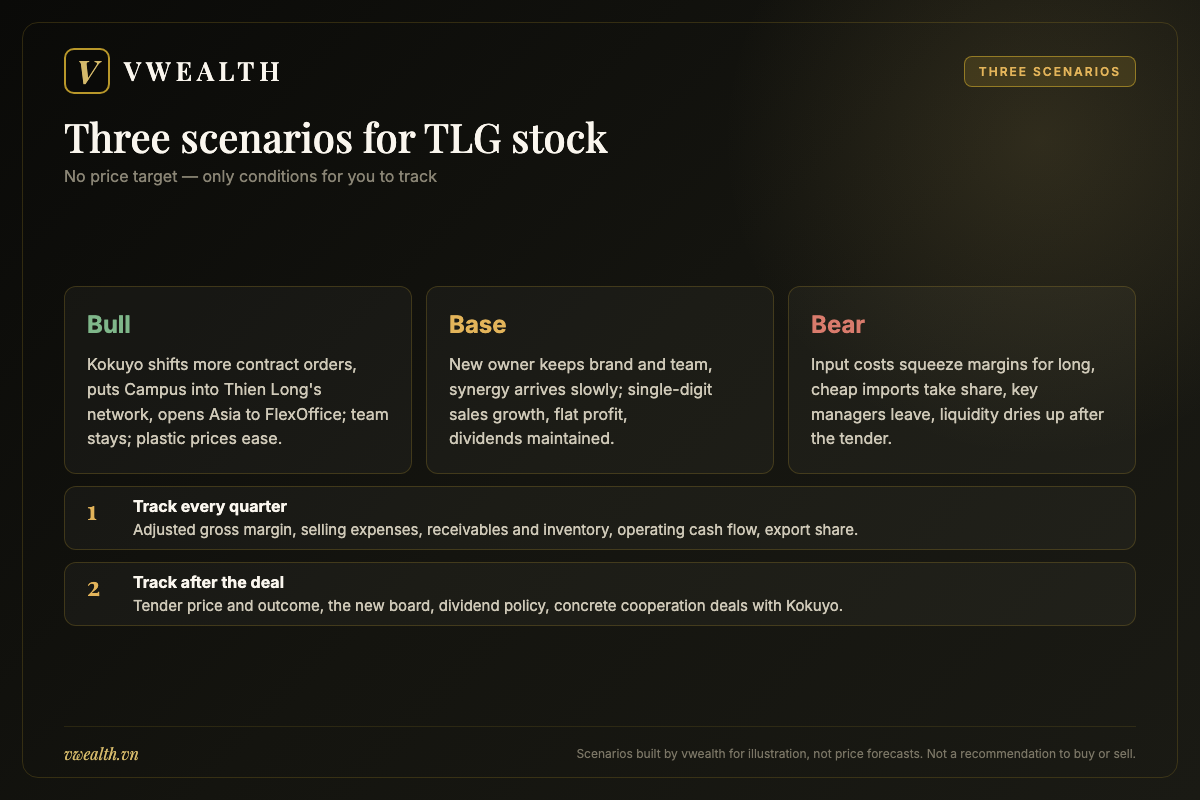
So, Should You Buy TLG Stock? Weighing the Case For and Against
After seven chapters, it is time to pull everything together. The answer to “should I buy TLG stock” is not a flat yes or no, but “yes, if you are this kind of investor” and “no, if you need that.” Below are the arguments for and against, weighed on a single standard: what has been proven by years of numbers, and what is still only an expectation.
The case for TLG
A business with proven resilience. Across 2015–2025, Thien Long never posted a loss, net margin held in a narrow band of about 9–12%, revenue compounded at about 8% and profit at about 9% a year (vwealth estimates). Even in the worst COVID year, profit still beat plan.
A brand and distribution network that are hard to copy. About 60% of the pen market by the company’s account, the only stationery company in Brand Finance’s Top 100 most valuable Vietnamese brands, tens of thousands of traditional retail points, and the number-one stationery position on online platforms according to its annual report. This moat was built over 45 years.
A clean balance sheet and regular cash dividends. Low debt, enough cash to repay all borrowings, and small fixed assets relative to revenue, so reinvestment needs are low. The cash dividend for fiscal 2025 was 35% of par, and the 2026 plan is also 35%.
An export leg that is rare among Vietnamese consumer stocks. About 28% of 2025 revenue came from abroad, up from nearly 15% in 2018. That business is both an escape from the domestic growth ceiling and a natural currency hedge.
An industry insider as the new owner. Kokuyo is not a financial investor but a century-old stationery group that has placed contract-manufacturing orders with Thien Long, strong exactly where Thien Long is weak (notebooks) and present across Asia. If synergies materialize, Thien Long could grow faster than it could on its own.
The case against TLG
Slow growth with a ceiling. The domestic pen market is close to saturated for the leader, and handwriting is gradually declining. The 2026 plan calls for flat profit — the second straight year without profit growth, as Vietstock pointed out.
Margins under a double squeeze. The CEO said in 2026 that plastic, pen tips and packaging had risen 20–30%, while competition forces higher selling spend and limits price increases. Fast-rising receivables and inventory meant 2025 operating cash flow was only about half of profit.
Uncertainty from the change of control. Strategy, management and dividend policy after Kokuyo takes 65% have not been announced. The seller’s view that dividends “will not change” is an expectation, not the buyer’s commitment. The new owner could also redraw market roles between Thien Long and other group entities.
Thin liquidity and post-tender risk. The stock was already thinly traded; with a 65% controlling shareholder, free float may shrink further. The tender is capped at 18.19%, so minority holders may only sell part of their shares at the tender price, with the rest exposed to the post-tender market.
Expansion experiments that did not stick. Phuong Nam bookstores, Clever Box, Pega Holdings and the Indonesian entity were all wound back within one to a few years. That can be read as good discipline (knowing when to stop), but it also shows that expanding beyond the core pen business is hard.
| Criterion | For | Against |
|---|---|---|
| Growth | Revenue compounded about 8% a year over 10 years; exports growing faster | Flat 2026 profit plan; saturated home market |
| Profitability | Stable 9–12% net margin, never a loss year | Input costs and selling expenses squeeze margins |
| Balance sheet | Near net cash; 2025 ROAE about 18.3% | Rising receivables and inventory; weak 2025 cash flow |
| Dividends | 35% cash for 2025, 35% planned for 2026 | Post-deal policy not yet confirmed by the new owner |
| Governance | Professional management; three independent directors | Management continuity after the deal unclear |
| The stock | Strategic buyer’s price as a reference point | Low liquidity; tender capped at 18.19% |
Who TLG stock suits
Long-term income investors. If you want a stock that pays cash regularly, operates in a business you understand, depends little on the economic cycle, and you are prepared to hold for years regardless of short-term price swings, TLG has the right characteristics — provided you track dividend policy closely once Kokuyo takes over.
Investors who want a defensive sleeve. In a portfolio heavy in Vietnamese banks, brokers or property developers, a consumer-staples stock with stable earnings reduces overall volatility. Because TLG is small and illiquid, it suits a moderate weighting rather than a large position.
Investors who understand and want to play the M&A story. If you can read tender-offer documents, understand pro-rata allocation and accept the risk of selling only part of your shares, the tender offer — once it opens, on a date Kokuyo has yet to re-announce — offers a particular kind of opportunity. But that is a short-term tactic with its own risks, different from investing in the business.
Believers in the “Vietnamese brand plus Japanese capital” thesis. If you think Kokuyo will use Thien Long as a springboard across ASEAN, TLG is one of the few ways to express that view on the Vietnamese exchange.
Who should probably pass
Growth seekers. If you want a stock whose earnings grow 20–30% a year, Thien Long is not it, even in the bull case.
Short-term traders who need liquidity. Low trading volume makes fast, large trades difficult and costly, and this could become more pronounced after the tender.
Investors who need policy certainty. If you are only comfortable when a company’s strategy and dividends have been clear for years, wait at least until the first shareholder meeting under Kokuyo to see what the new owner wants.
Final thoughts
Thien Long is the story of the eldest son of a thirteen-person household who cycled around Saigon selling pens after 1975, built Vietnam’s largest stationery brand, took it public, sold into 75 countries and then, approaching 70, chose to hand control to a century-old Japanese group so the brand could “endure.” As a business, Thien Long is a model of slow and steady: single-digit growth, stable profits, ample cash and generous dividends. As a stock, TLG now carries an added layer of uncertainty: what the new owner will do with Vietnam’s national pen. So the question of whether to buy TLG stock boils down to this: do you believe the cash machine will keep running smoothly — and perhaps faster — under Kokuyo, and are you willing to accept an illiquid stock in exchange for a steady dividend stream?
This analysis is not a recommendation to buy or sell. Before deciding, check the latest numbers — price, P/E, dividend yield, most recent quarterly profit, gross margin, inventory and receivables — in the vwealth report, read the tender-offer documents once they are published, and weigh your own risk tolerance. To compare TLG with its peers, start with our coverage of FPT Retail (FRT) and the other Vietnamese consumer names linked above, and revisit our guide to investing in the Vietnam stock market for the practical side of buying Vietnam stocks as a foreigner. You can sign up for a vwealth account to follow updated TLG reports every quarter.
Research Vietnamese stocks in English with vwealth. Our AI-powered platform turns Vietnamese market data into full English analysis reports — with international payment support and a free 2-month trial for new accounts. Create your free account and read the latest reports.


