Should you buy PVT stock? The question resurfaces every time oil tankers make international headlines. In 2022 it was the war in Ukraine and the sanctions on Russian oil; in 2024 it was ships fleeing the Red Sea; and in 2026 it is the Strait of Hormuz crisis, which at one point pushed the daily hire rate of a very large crude carrier above one million US dollars, according to reports in the international press. Each time, PVT — the ticker of PetroVietnam Transportation Corporation (PVTrans), the shipping arm of Vietnam’s national oil and gas group — gets tagged as an obvious winner. Yet PVTrans is not a single tanker trading on the spot market. It is a fleet of more than sixty vessels, most of them on time charters, controlled by Petrovietnam with a roughly 51% stake, serving “in-house” customers such as the Dung Quat refinery, and carrying a sizable pile of US dollar debt used to buy ships. This analysis walks through the full story, shows you how to read PVTrans’s own numbers, and gives a straight answer on who PVT stock suits and who it does not.
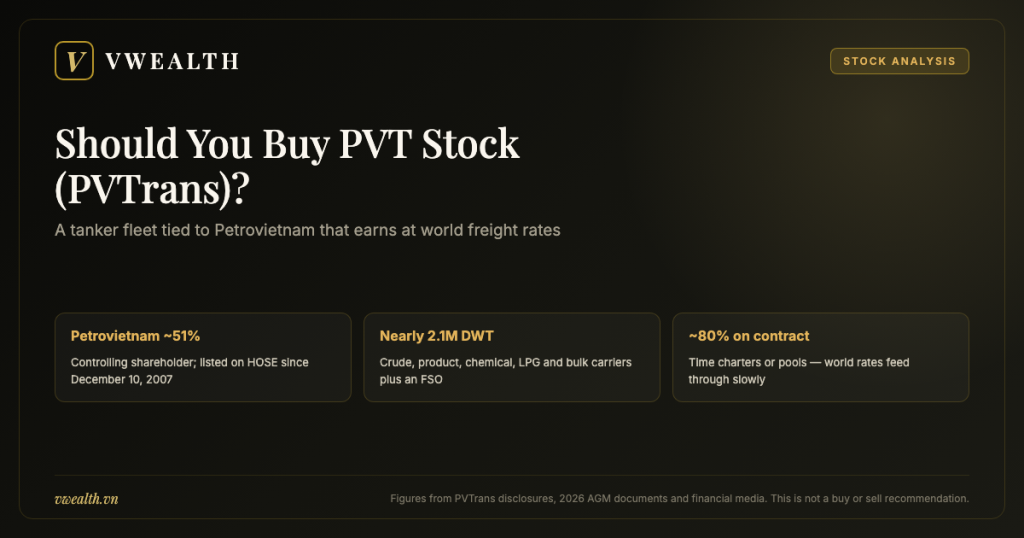
First, some names, because Vietnam’s energy sector is crowded with look-alike tickers. PVT is the ticker of PetroVietnam Transportation Corporation — Tổng Công ty Cổ phần Vận tải Dầu khí in Vietnamese, trading as PVTrans — listed on the Ho Chi Minh City Stock Exchange (HOSE) since December 10, 2007. Petrovietnam (officially renamed the Vietnam National Industry – Energy Group in April 2025, still abbreviated PVN) is the controlling shareholder. Several other listed companies carry the “PV” prefix and are easy to confuse: PVS is the oilfield services company PTSC, PVD is the driller PV Drilling, GAS is gas distributor PV GAS, PVP is Pacific Petroleum Transportation (PVTrans Pacific), a PVTrans subsidiary, and GSP is Gas Shipping JSC, another subsidiary. Buying PVT means buying the parent that sits on top of that entire cluster of shipping companies.
If you are new to the market, a few Vietnamese specifics matter here. Stocks on HOSE have a daily price limit of plus or minus 7%, trades settle on a T+2 basis, and foreign ownership in most listed companies is capped (often at 49%, sometimes lower). Our pillar guide on how to invest in the Vietnam stock market explains account opening, foreign ownership limits and settlement in detail. In this article we focus on the company.
A note on data, as in every vwealth company analysis. Dates, names, deals and figures come from published sources — PVTrans’s official website, annual general meeting documents, exchange disclosures, Vietnamese financial media and international tanker market reporting. Figures for closed financial years are used as historical reference points. We deliberately do not quote today’s share price, current P/E, current market capitalization or the latest quarterly profit — those change constantly, and for a shipping stock they change fast. Anything that is our own arithmetic is labeled “vwealth estimate” or “illustrative example”. For up-to-date numbers, open the latest vwealth reports.
And the central idea of this piece. PVTrans embodies an interesting paradox: a tanker fleet tied to Petrovietnam that earns its margin at global freight rates. Its name, its controlling shareholder, its history and part of its customer base all belong to Vietnam’s oil and gas industry; yet most of its ships trade internationally for foreign charterers, and its marginal profit depends on events thousands of nautical miles away. So the question of whether to buy PVT stock comes down to three parts: how thick the “Petrovietnam cushion” really is; how much risk comes with “earning at world freight rates”; and whether the strategy of renewing the fleet with US dollar borrowing will reward or punish shareholders when the freight cycle turns.
From Vietnam’s First Crude Carrier Company to Its Largest Tanker Fleet: More Than Two Decades of PVTrans
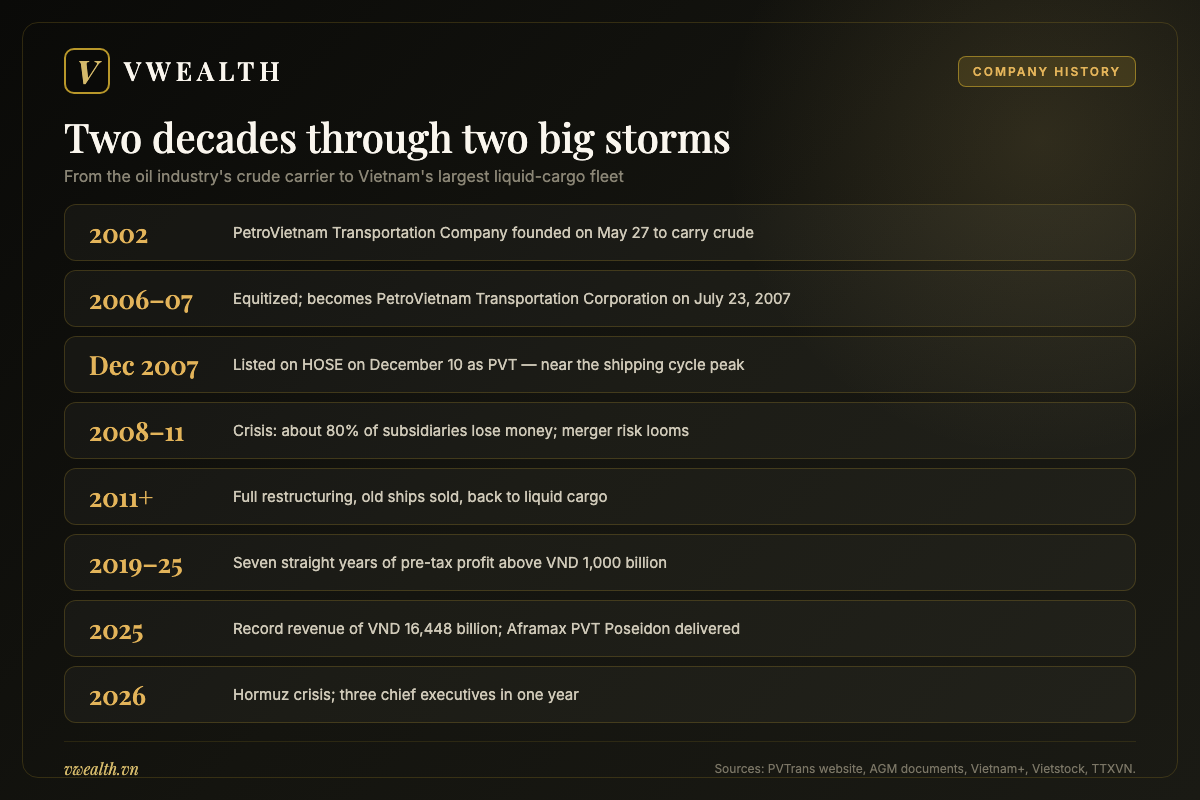
Some companies grow in a straight line. PVTrans did not. Its history reads like a ship that sailed through two major storms: it listed just before a global shipping crash, came close to being merged out of existence, and then rebuilt itself into what the company and the Vietnamese press describe as the country’s largest shipping fleet. To understand why today’s management keeps repeating the phrase “investment discipline”, you need to know what PVTrans paid when it lacked it.
2002–2007: A State Company Built to Carry Crude
PetroVietnam Transportation Company was founded on May 27, 2002, by a decision of the Government Office, with the main task of providing oil and gas transportation services, particularly crude oil shipping. The context is easy to picture. Vietnam had been producing crude from the Bach Ho (White Tiger) field for years, but most of the export cargoes moved on foreign-owned tankers. The oil industry wanted its own fleet, both to keep more of the value chain at home and to prepare for the Dung Quat refinery, then being prepared for construction, which would need a steady stream of crude oil delivered by sea.
After nearly five years as a state-owned enterprise, the company was approved for equitization — Vietnam’s term for the partial privatization of state firms — by a Ministry of Industry decision dated March 30, 2006. It formally became PetroVietnam Transportation Joint Stock Company on May 7, 2007. Just over two months later, on July 23, 2007, it was restructured into PetroVietnam Transportation Corporation, a “corporation” in the Vietnamese sense: a parent with multiple member units, fitting the expansion ambitions of that era. All of these milestones are listed in the official company history on the PVTrans website.
December 10, 2007: Listing Near the Top of the Cycle
PVT shares began trading on HOSE on December 10, 2007. At the time, Vietnam’s stock market had just come off its 2007 boom, and global shipping was near the peak of a super-cycle — freight rates and ship prices were at record highs, driven by China’s appetite for raw materials. A shipping company listing at that moment carried every optimistic expectation imaginable.
That was exactly the problem. Anyone who has invested in shipping knows the industry’s favorite warning: the worst time to buy ships is when everyone wants to buy ships. According to historical price summaries, PVT shares fell very steeply in the half-year after listing, and 2008–2011 was a long slide. The lesson is not whether the listing was cheap or expensive; it is that shipping stocks are so cyclical that your entry point matters as much as the quality of the business.
2008–2011: The Shipping Storm and the Threat of a Forced Merger
Right after its equitization, PVTrans faced one of the hardest periods in its history. By the company’s own account, the 2008–2010 shipping crisis sent freight rates tumbling and pushed many global shipowners into losses or bankruptcy; about 80% of PVTrans’s subsidiaries were losing money, its finances were out of balance, and it faced the risk of being merged into other entities. An industry analysis in the Vietnamese press recalled that around 2010–2011 freight rates had fallen by roughly 80% and ship values by about 70% from their 2005–2006 peaks, and that splitting up the parent company or folding it into better-performing Petrovietnam units was at one point on the table.
Why would a company with a state-owned parent struggle so badly? Because during those years PVTrans had spread into activities outside its core business, tied up capital in long-running projects and bought ships at high prices. When freight collapsed, the ships still had to service debt, pay interest, pay crews and undergo scheduled maintenance — fixed costs that do not shrink with revenue. This is the operating leverage of shipping: a 20% fall in revenue can erase 60–80% of profit, and the reverse is also true. You will see this mechanism again and again in this article.
2011–2018: Restructuring, Selling Old Ships, Returning to the Core
From 2011, PVTrans carried out a comprehensive restructuring across finance, investment, governance and market strategy. On the asset side, it disposed of older ships that no longer met quality standards; on the operating side, it focused on managing the technical side of its own fleet instead of outsourcing to foreign managers. These years produced few headlines, but they laid the groundwork for what came next: the balance sheet was gradually cleaned up, weak subsidiaries were dealt with, and PVTrans went back to carrying liquid cargo — crude, refined products, chemicals and liquefied gas.
This period also shaped PVTrans’s characteristic “cluster” structure: a parent company above many subsidiaries, each specializing in a segment, several with their own listed shares. PVTrans Pacific (PVP) handles the crude supply contract for the Binh Son refinery on PVTrans’s behalf; Gas Shipping (GSP), set up in 2007 with PVTrans, PTSC and PV GAS as its three original major shareholders, specializes in LPG carriers; a logistics and product-shipping unit (ticker PDV) runs chemical tankers and bulk carriers. Understanding this structure matters, because part of consolidated profit belongs to minority shareholders of these subsidiaries — Chapter 4 shows you how to separate it.
2019–2023: Consecutive Trillion-Dong Years and the Ukraine War Tailwind
According to the official company history, PVTrans posted pre-tax profit above VND 1,000 billion (roughly USD 38–40 million at recent exchange rates, a vwealth estimate) in each of the seven consecutive years from 2019 to 2025. That is a qualitative shift from the previous decade. In June 2021, Pham Viet Anh — chief executive since late 2010 — became chairman of the board, and Nguyen Duyen Hieu took over as chief executive.
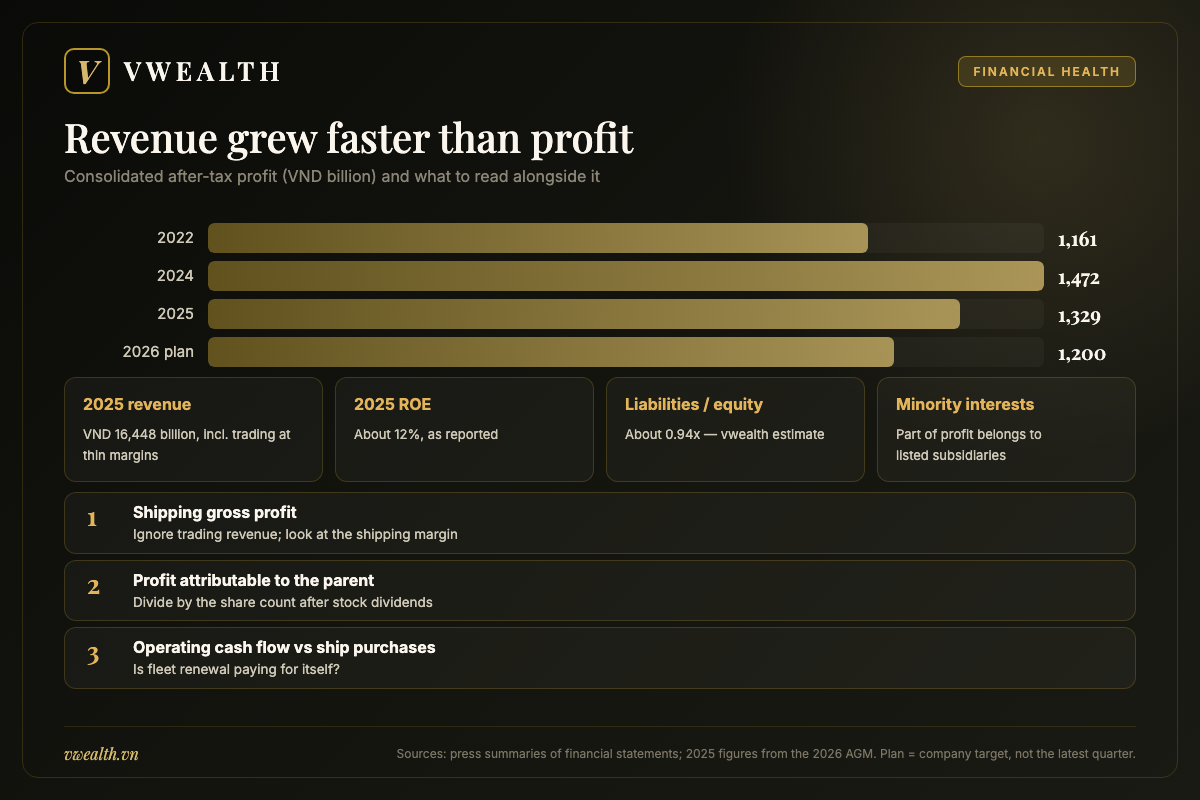
The year 2022 changed the operating environment. After the war in Ukraine began, the European Union banned seaborne imports of Russian crude from December 2022 and Russian refined products from February 2023, and the G7 imposed a price cap on Russian oil. Global oil flows were redrawn: Russian barrels traveled much farther to Asia, while Europe replaced them with oil from the United States, the Middle East and West Africa. Longer voyages mean more ships are needed for the same volume of oil, and tanker rates — especially for mid-sized tankers — jumped. In 2022, PVTrans reported net revenue of about VND 9,048 billion and after-tax profit of about VND 1,161 billion, according to press summaries of its financial statements; for 2023, the company’s published estimate put pre-tax profit at roughly VND 1,460 billion.
What stands out is not only the numbers but how PVTrans used that window to buy ships. In 2023, according to press reports quoting management, the company added 12 new vessels, bringing the fleet to about 51 ships with total capacity of about 1.4 million tonnes.
2024–2026: A 30-Ship Plan, Record Revenue and the Hormuz Crisis
In 2024, PVTrans announced its largest investment plan ever: about USD 819 million (around VND 22,420 billion) over 2024–2025 to expand the fleet from about 52 to 82 ships, with total capacity of around 2.5 million DWT (deadweight tonnage — the maximum weight a ship can carry, including cargo, fuel and water). About USD 492 million was earmarked for 21 ships in 2024 alone. Execution ran slower than planned — the fleet stood at about 65 ships by the end of 2025 — but the direction was clear: expand quickly, favor younger tonnage, trade internationally.
For 2024, PVTrans reported revenue of about VND 11,812 billion, pre-tax profit of about VND 1,871 billion and after-tax profit of about VND 1,472 billion — a record at the time, partly helped by other income from ship disposals. For 2025, according to figures presented at the 2026 shareholder meeting and on the company website, consolidated revenue hit a record VND 16,448 billion, with pre-tax profit of VND 1,654 billion and after-tax profit of VND 1,329 billion; the company added seven vessels worth about USD 137 million. In November 2025, it took delivery of the Aframax crude tanker PVT Poseidon (114,542 DWT, built in Japan) and put it straight onto a long-term time charter in Europe.
2026 opened with a new shock. From late February 2026, following attacks on Iran, the Strait of Hormuz — the exit route for most Gulf oil — fell into crisis. According to Vietnam News Agency (TTXVN), citing The Japan Times, the hire rate for a VLCC on the Persian Gulf–Asia route at one point reached about USD 1.1 million per day. PVTrans said it set up a crisis response team, reduced its fleet’s exposure and guided Vietnamese vessels through the area safely during the tense weeks of April 2026. The same year, the chief executive’s seat changed hands twice — a story we tell in Chapter 2.
| Date | Event | What it means for PVT shareholders |
|---|---|---|
| May 27, 2002 | PetroVietnam Transportation Company founded, mainly to carry crude | Origin as “the oil industry’s own fleet” |
| March 30, 2006 | Equitization approved | Opening to non-state shareholders |
| May 7, 2007 | Becomes a joint stock company | The shareholder-owned legal entity |
| July 23, 2007 | Restructured as PetroVietnam Transportation Corporation | Parent-plus-subsidiaries model |
| December 10, 2007 | Listed on HOSE as PVT | Listed near the top of a shipping super-cycle |
| 2008–2011 | Shipping crash; about 80% of subsidiaries loss-making | A lesson in leverage and timing of ship purchases |
| From 2011 | Comprehensive restructuring, old ships sold, back to core | Foundation for stable profits |
| 2019–2025 | Seven straight years of pre-tax profit above VND 1,000 billion | From “turnaround stock” to “cyclical growth stock” |
| 2022–2023 | Ukraine war, sanctions on Russian oil; 12 ships added in 2023 | Mid-sized tanker rates surge |
| 2024 | USD 819 million plan for 2024–2025; record profit | Rapid expansion funded by debt |
| 2025 | Record revenue of VND 16,448 billion; Aframax PVT Poseidon delivered | Fleet passes 2 million DWT |
| 2026 | Hormuz crisis; two changes of chief executive | High freight, but geopolitical and leadership risk also rise |
Read the timeline and a rhythm emerges: PVTrans has grown strongest after shocks that disrupted global oil flows, and struggled most after buying ships at the peak. Keep that rhythm in mind as you read on — it explains nearly every decision management makes today.
Leadership and Ownership: Petrovietnam’s 51%, a Chairman Who Has Been There Fifteen Years, and Three CEOs in 2026
In a state-controlled company, the question “who decides?” has two layers. The first is the board and the executive team — the people who choose ships, sign charters and borrow money. The second is the parent, Petrovietnam, which approves key appointments, sets strategic direction and hands down annual targets. Minority shareholders in PVT need to understand both layers, because their interaction determines whether you are paid in cash or in shares, and how aggressively the company dares to invest.
Pham Viet Anh: The Executive Who Steered the Turnaround
If one name is tied to PVTrans’s revival, it is Pham Viet Anh. According to published profiles, he served as a board member and chief executive from December 2010 to May 2021 — the entire post-crisis restructuring — and has chaired the board since June 2021. In total, he has been either the top executive or the chairman for about fifteen years, an unusually long tenure for a Vietnamese state-linked company.
His recent statements show a consistent philosophy. In a long interview published by Vietstock in August 2026, he stressed that “investment discipline is the first line of defense protecting shareholder capital”, and that large investments such as VLCCs proceed only when commercial viability, funding, approvals and return requirements are all in place. At the April 2026 shareholder meeting, according to press coverage, he said the most important condition before buying a VLCC is to “lock in a long-term contract”. That sounds simple, but set it against the 2008–2011 story in Chapter 1 and you see why it is repeated so often: buying big ships without a long-term charterer is exactly how PVTrans nearly sank.
Under his chairmanship, PVTrans also changed how it talks to investors. According to the same interview, the company held more than 20 dedicated investor meetings in 2025 and runs regular earnings calls. It was recognized in several 2025 governance rankings, including the Top 10 mid-caps for corporate governance at Vietnam’s Listed Company Awards (VLCA) and the Top 5 Boards of the Year. Awards do not replace numbers, but for a state-linked firm that was once relatively closed, the change in communication is worth noting.
2026: Three Chief Executives in One Year
While the chairman’s seat has been stable, the CEO’s seat was unusually volatile in 2026. Nguyen Duyen Hieu, chief executive since 2021, reached the end of his term at the April 2026 shareholder meeting. Tran Ngoc Nguyen — born in 1977, holder of a doctorate in chemical engineering from France’s École Nationale Supérieure du Pétrole et des Moteurs (ENSPM) and chairman of Ca Mau Fertilizer from January 2019 — was elected to the board and appointed CEO from April 21, 2026. Just over two months later, he asked to step down for personal reasons; the board approved his departure from the CEO role effective July 1, 2026, and he remains a board member.
From August 3, 2026, Nguyen Thanh Binh was appointed chief executive for the 2026–2031 term. According to the disclosure, he was born in 1977, holds a master’s degree in international business from Monash University in Australia and has more than 20 years in the oil and gas sector. From October 2003 to September 2009 he worked at PVTrans itself, in human resources, operations and market development; before returning, he had been chairman of PV GAS. In other words, the new CEO knows the shipping business from PVTrans’s early years and has experience running a large company within the Petrovietnam group.
How should you read three CEOs in a single year? We do not speculate beyond what has been disclosed. What you should watch is continuity of strategy: whether the fleet investment plan, the discipline of buying ships only with contracts in hand and the dividend policy survive the turnover. In state-controlled companies, key appointments are typically guided by the parent, and many investors treat the chairman’s continuous presence as the anchor for strategic stability.
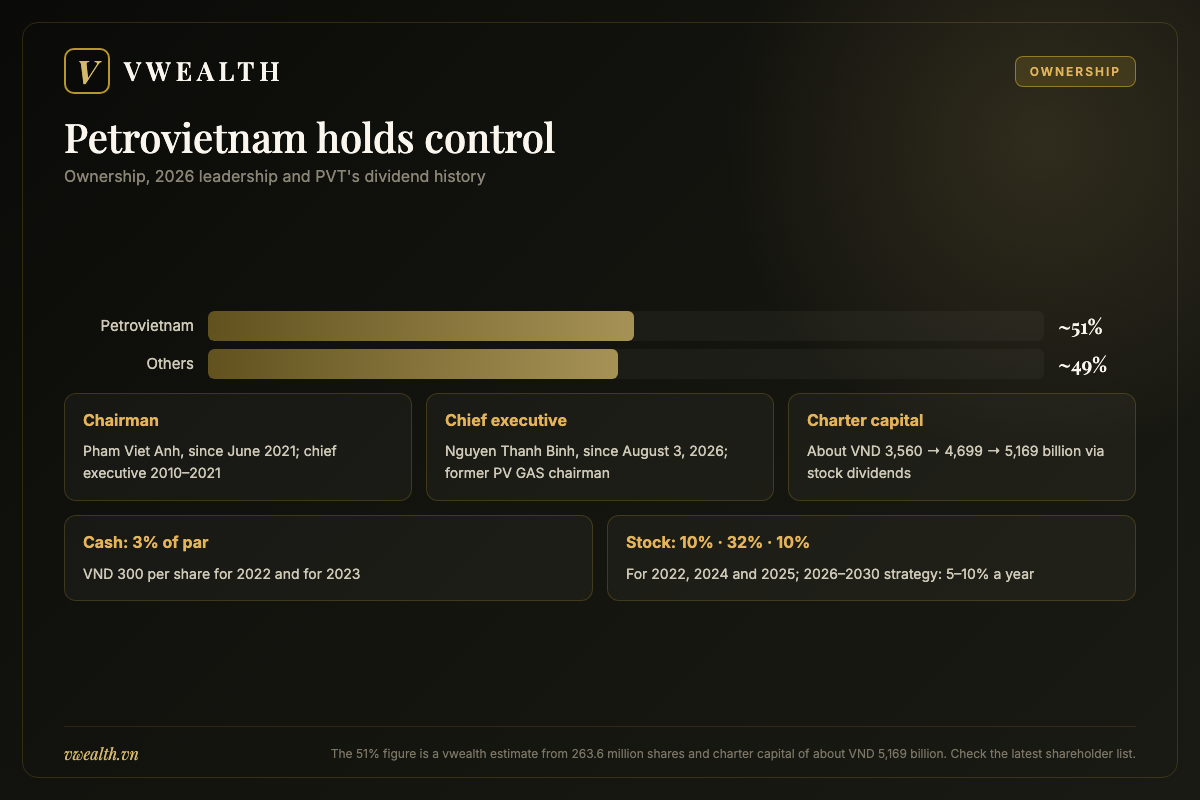
Who Owns PVT: Petrovietnam at About 51%, the Rest Widely Held
According to Vietstock’s company profile, Petrovietnam holds 263,644,200 PVT shares. With charter capital of about VND 5,169.18 billion after the mid-2026 stock dividend — about 516.9 million shares at the standard VND 10,000 par value — that works out to roughly 51.0% (vwealth estimate, consistent with the 51% figure published by many sources). Note that some foreign data aggregators show a different figure (one lists 60%); we use the number calculated from the latest disclosed share count and charter capital.
A 51% stake has a precise legal meaning. It lets Petrovietnam pass any resolution requiring a simple majority at the shareholder meeting, but it falls short of the 65% needed under Vietnam’s Law on Enterprises to pass certain major resolutions on its own, such as changing business lines or reorganizing the company. The remaining 49% is held by domestic and foreign funds and a large number of retail investors — PVT is one of the more liquid oil and gas names and familiar to Vietnamese individual investors.
| Shareholder / item | Reference figure | Notes |
|---|---|---|
| Petrovietnam (PVN) | 263,644,200 shares, about 51.0% | Percentage is a vwealth estimate based on charter capital of about VND 5,169 billion |
| Other shareholders | About 49% | Domestic and foreign funds, individuals; check current foreign ownership in the vwealth report |
| Charter capital | About VND 3,560 → 4,699 → 5,169 billion | Increased through stock dividends in 2025 and 2026 |
| Chairman | Pham Viet Anh (since June 2021) | Chief executive from December 2010 to May 2021 |
| Chief executive | Nguyen Thanh Binh (since August 3, 2026) | 2026–2031 term; former chairman of PV GAS |
Related Parties: Petrovietnam as Both Shareholder and Customer Ecosystem
What makes PVTrans distinctive is that its parent does more than provide capital. Units within the Petrovietnam ecosystem — the Binh Son refinery (BSR), PV GAS, upstream joint ventures — are also customers or partners. PVTrans Pacific, a PVTrans subsidiary, carries out the contract to supply crude oil to Binh Son on PVTrans’s behalf, handling all of the crude feedstock, domestic and imported, for the Dung Quat refinery. Gas Shipping’s LPG carriers are tied to domestic liquefied gas demand. Crude, refining and product distribution form a closed loop, with PVTrans handling the logistics link.
This relationship cuts both ways. The upside: PVTrans enjoys a stable base of cargo, familiar customers and reliable payment — things a private shipowner takes many years to build. The part to watch: related-party transactions need transparent pricing, and Petrovietnam’s interests (energy security, reasonable input costs for its refineries) do not always align perfectly with maximizing profit for PVT shareholders. The simplest check is to read the related-party disclosures in the audited financial statements and the corporate governance report each year: how much revenue comes from group companies, and whether margins differ materially from contracts with foreign customers.
It is also worth being clear that, according to press coverage of its 2026–2030 strategy, PVTrans aims to raise international shipping to about 85% of its transport revenue. The Petrovietnam ecosystem is the foundation, not the main growth engine. That is the heart of this article’s thesis: tied to Petrovietnam, but earning at world freight rates.
Dividend Policy: More Shares Than Cash
This is the part most likely to disappoint investors used to steady cash payers in Vietnam’s energy sector, such as PV GAS or Petrolimex. For years PVTrans has kept cash to buy ships and paid dividends mostly in new shares. According to company announcements and press reports:
- 2022 dividend: 3% in cash (VND 300 per share, dividends in Vietnam being quoted as a percentage of the VND 10,000 par value) plus a 10% stock dividend.
- 2023 dividend: 3% in cash, a total payout of about VND 106.8 billion.
- 2024 dividend: a 32% stock dividend (100:32), about 113.9 million new shares, raising charter capital from about VND 3,560 billion to about VND 4,699 billion; record date June 20, 2025.
- 2025 dividend: a 10% stock dividend (100:10), about 47 million new shares, record date June 8, 2026, raising charter capital to about VND 5,169 billion.
- 2026 plan: an expected dividend of 10%; the 2026–2030 strategy calls for annual dividends of 5–10%.
An illustrative example of how stock dividends work: if you held 1,000 PVT shares before the 32% distribution, you would have 1,320 afterward, and 1,452 after the 2026 10% distribution. Your share count rises by about 45%, but the price is adjusted down on each ex-rights date, so your total value is unchanged at that moment. A stock dividend only creates value if the retained profit is reinvested at a good return — in other words, if the ships bought with it earn their keep. If earnings per share (EPS) do not keep up with the growth in share count, you are being diluted. That is the single most important test of PVT’s dividend policy. If income is your priority, our overview of Vietnam dividend stocks is a better starting point.
How PVTrans Makes Money: Six Vessel Types, Two Contract Models and a Crude Trading Business With Big Revenue and Thin Margins
Think of PVTrans as a truck leasing company — except the trucks are ships more than two hundred meters long, and the renters are oil majors, refiners and energy traders around the world. Some trucks carry gasoline, some chemicals, some gas, some coal. Some customers hire by the trip, others by the year. Understanding how each type of “truck” earns money, and which contract sits behind it, is the key to reading PVT’s profits.
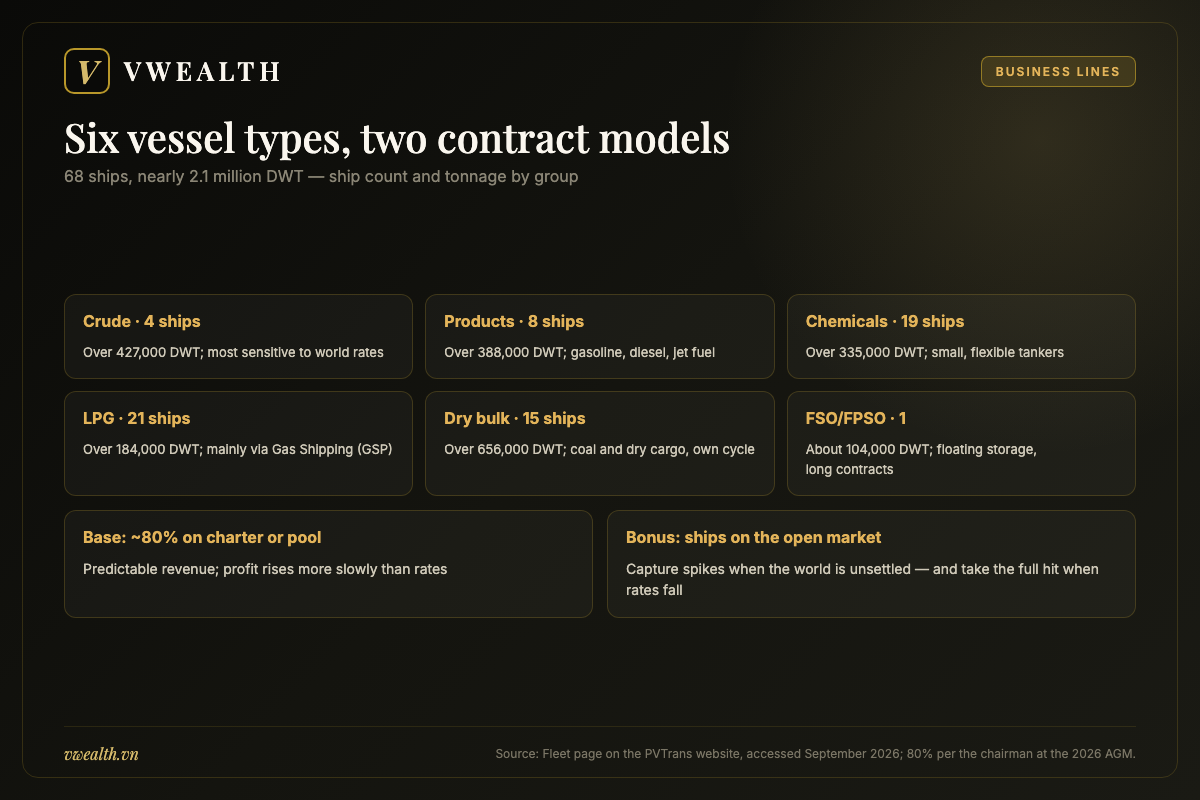
According to the fleet page on the PVTrans website (accessed September 2026), the company owns a fleet of nearly 2.1 million DWT split into six groups. Adding up the vessel counts gives 68 ships. At the April 2026 shareholder meeting, the figure reported was 65 ships and more than 2 million DWT; the “about us” page on the same website says 67. The small gap reflects continuous deliveries and disposals during the year and different update dates; for an exact count at any given date, cross-check the annual report and investor newsletter.
| Vessel group | Ships | Total capacity | Role in the business model |
|---|---|---|---|
| Crude tankers | 4 | Over 427,000 DWT | Largest ships, most sensitive to international rates; includes long-term charters in Europe |
| Product tankers | 8 | Over 388,000 DWT | Carry gasoline, diesel and jet fuel — benefit when refined product flows are redrawn |
| Chemical tankers | 19 | Over 335,000 DWT | A large group of smaller, flexible ships trading intra-Asia and internationally |
| LPG carriers | 21 | Over 184,000 DWT | Mostly via subsidiary Gas Shipping; linked to domestic and regional LPG demand |
| Bulk carriers | 15 | Over 656,000 DWT | Coal and dry cargo; largest tonnage, but follows the dry bulk cycle |
| FSO/FPSO | 1 | About 104,000 DWT | Floating storage at an oilfield; long contracts, steady cash flow |
Source: “Fleet” page on the PVTrans website, accessed September 2026. The average age of the whole fleet is not consistently published on the website; if you need it, look for it in the latest annual report or sustainability report.
Crude Tankers: Few Ships, but the Profit Engine When Rates Explode
Only four ships, yet crude tankers account for more than a fifth of total tonnage and are usually the group with the most volatile margins. This is PVTrans’s original business from 2002: carrying domestically produced crude to export buyers, bringing imported crude to the Dung Quat refinery, and chartering tankers to international oil companies. According to the press, PVTrans Pacific has chartered ships to major counterparties such as Shell, Vitol and Lukoil and is expanding its business with Middle Eastern customers.
The newest ship in the group is PVT Poseidon, an Aframax (roughly 80,000–120,000 DWT, a common size for medium-haul routes such as the North Sea, the Mediterranean and Southeast Asia) of 114,542 DWT, delivered in November 2025 at the Spanish port of Tarragona and placed immediately on a long-term time charter in Europe. That detail illustrates this article’s thesis perfectly: a vessel flying the colors of a Vietnamese oil and gas company, working for a European charterer at an internationally set rate.
The next step management is weighing is a VLCC (very large crude carrier — about 300,000 DWT, carrying roughly 2 million barrels per voyage). According to press coverage of the 2026 shareholder meeting, PVTrans is in talks with the Nghi Son refinery about crude transportation and will invest in VLCCs only if it secures a long-term contract. A refinery of Nghi Son’s size imports most of its crude from the Middle East, so if a deal materializes it would be a long-duration cash flow that is “half in-house, half international” — a meaningful development to watch.
Product and Chemical Tankers: The Largest Group and the Core of Fleet Renewal
Together, the 27 product and chemical tankers make up nearly 40% of the fleet by count. Product tankers carry gasoline, diesel and jet fuel from refineries to terminals; chemical tankers have coated tanks and can carry both refined products and liquid chemicals such as methanol or vegetable oils. Many ships in this group can switch between cargo types, giving PVTrans flexibility to chase the best-paying trade.
This group benefited most clearly from the disruptions of 2022–2024. When Europe stopped buying Russian diesel, it had to import from the Middle East, India and the United States — much longer voyages. When ships began avoiding the Red Sea and sailing around the Cape of Good Hope from late 2023, voyages lengthened by more than two weeks on some routes. Much of the tonnage PVTrans bought in 2023–2025 falls in this group; in 2025 the company took delivery of the oil/chemical tanker PVT Lyra in South Korea.
LPG Carriers: The Most “In-House” Segment, but Not Immune to the Market
With 21 ships, LPG is the largest group by count, although each vessel is small. The business sits mainly in subsidiary Gas Shipping (GSP), in which PVTrans holds about 67.98% according to published data. The ships carry liquefied petroleum gas from processing plants and import terminals to distribution depots at home and in the region, closely linked to the supply chain of PV GAS, which we cover in our PV GAS stock analysis.
But “in-house” does not mean immune. According to the press, Gas Shipping’s second-quarter 2026 profit fell by almost half year on year because of a difficult freight market and rising operating costs — at the same time as consolidated PVTrans reported record earnings. It shows that each vessel segment has its own cycle: when crude and product tankers are thriving, small LPG carriers may be under pressure, and vice versa. That diversity makes PVTrans less shock-prone than a single-segment shipowner.
Bulk Carriers and FSO: Two Segments Few Investors Notice
The bulk segment has 15 ships but more than 656,000 DWT — the largest total tonnage of the six groups. Dry bulk means unpackaged dry cargo such as coal, ore and grain. According to its business description, PVTrans carries coal, including coal for thermal power plants. Dry bulk freight follows its own cycle (usually tracked through the Baltic Dry Index), driven more by Chinese steel, coal and agricultural demand than by oil. Maintaining a sizable bulk fleet shows PVTrans has not put all its eggs in the tanker basket: when liquid and dry freight cycles diverge, the diversified portfolio smooths profits.
An FSO/FPSO (floating storage and offloading unit, or floating production, storage and offloading unit) is a “ship” that does not sail: it is moored at an oilfield, receives crude from the platforms, stores it and offloads it to shuttle tankers. FSO contracts typically run for many years, tied to the life of the field, and produce very stable cash flow. PVTrans owns one such unit of about 104,000 DWT. This segment is directly linked to upstream activity; our PTSC (PVS) stock analysis explains the FSO/FPSO market in Vietnam in more depth.
Two Contract Models: Time Charters, Spot Voyages and Pools
The same ship can earn money in three very different ways, and this is the most important thing to understand about why PVT’s profits do not jump in line with the daily rates you read about in the international press.
Time charter: the charterer pays a fixed daily rate for a long period — six months, a year, three years. The owner pays operating costs (crew, maintenance, insurance); the charterer pays fuel and port costs. Advantage: predictable revenue. Disadvantage: when rates spike, the owner still gets the old rate until the contract expires.
Voyage/spot charter: paid per voyage at the market rate at that moment. Advantage: the owner captures the full upside. Disadvantage: when rates collapse, revenue collapses with them, and ships may sit idle waiting for cargo.
Pool: several owners put similar ships into a common pool run by a single commercial manager, sharing earnings according to each ship’s contribution. Pools reduce empty sailing and give earnings that follow the market but with less volatility.
According to the PVTrans chairman at the 2026 shareholder meeting, about 80% of the fleet is on time charters or in pools. That means when world rates rise, PVT’s profit rises more slowly than rates (it must wait for older contracts to expire and be renewed), and when rates fall, profit also falls more slowly. Investors buying PVT because of a headline like “VLCC rates top USD 1 million a day” should remember: PVTrans does not yet own a VLCC, and most of its ships had already locked in their rates.
Crude Trading: Big Revenue, Small Profit
A significant share of PVTrans’s consolidated revenue does not come from freight but from trading and services — most notably PVTrans Pacific’s role in supplying crude to Binh Son. When crude passes through the company’s books, the value of the cargo inflates revenue while margins are very thin. According to press analysis of recent financial statements, shipping accounts for only about half of revenue but contributes the overwhelming majority of group gross profit.
The practical takeaway: do not judge PVT by revenue growth. A year of higher oil prices can inflate trading revenue without changing profit; a year of flat revenue can deliver strong profit growth from freight. Go straight to the gross profit and gross margin of the shipping segment in the notes to the financial statements.
Which Segment Feeds Which — and Where PVTrans’s Moat Lies
If you drew a cash-flow map, you would see this: the FSO, long-term time charters and in-house cargo from the Petrovietnam ecosystem form the base, covering interest and fixed costs; ships exposed to the international market (spot, pools, short time charters) are the “bonus” when rates rise; and crude trading maintains relationships with strategic customers and generates cargo for the fleet.
PVTrans’s moat — its durable competitive advantage — does not come from technology or a consumer brand. It rests on three things. First, scale: the largest liquid-cargo fleet in Vietnam, big enough to support better technical management, crewing and insurance than small owners. Second, its relationship with the Petrovietnam ecosystem, a cargo base private competitors cannot easily replicate. Third, access to long-term financing at reasonable cost thanks to its size and state-linked shareholder. But in fairness, in the international market PVTrans is a mid-sized owner among thousands; it is a price taker, not a price setter. The moat protects the base; the bonus is entirely up to the market.
Market Position and Financial Health: Reading a Cyclical Shipowner’s Numbers Before You Buy PVT Stock
Reading a shipping company’s financial statements is like reading a fisherman’s logbook: some years the catch is huge, some years the boat comes back empty, and what matters is not whether this year looks good or bad but whether the boat is sturdy enough to survive the worst year. This chapter does not try to give you the “right” number for today — you can find that in the vwealth report — but shows you how to read PVTrans’s own numbers so that “record profit” headlines do not lead you astray.
Position: Vietnam’s Largest Liquid-Cargo Shipowner, a Small Player Globally
At home, PVTrans is regularly described by the press as Vietnam’s largest liquid-cargo shipping company, with a fleet of more than 2 million DWT. For a sense of scale among listed peers: Vosco (VOS) is mainly a dry bulk owner, Hai An (HAH) runs container ships, and Vitaco (VTO) is a much smaller product tanker operator — each in a different niche. In liquid cargo specifically, PVTrans has no domestic rival of comparable size.
Out on the open sea, the picture is very different. The largest international tanker owners control hundreds of ships; one South Korean owner mentioned in coverage of the Hormuz crisis became the world’s largest VLCC owner after buying ships in 2025 and early 2026. With four Aframax-class crude tankers, PVTrans is a small player in that segment. The consequence: the company cannot influence freight rates; it can only choose when to sign charters and which ship types to own.
Revenue and Profit: Seven Trillion-Dong Years, but Not a Straight Line
| Year | Consolidated revenue | Pre-tax profit | After-tax profit | Notes |
|---|---|---|---|---|
| 2022 | About VND 9,048 billion | Above VND 1,000 billion | About VND 1,161 billion | Boost from the Ukraine war |
| 2023 | About VND 9,600 billion (company estimate) | About VND 1,460 billion (estimate) | About VND 1,172 billion (estimate) | 12 new ships added |
| 2024 | About VND 11,812 billion | About VND 1,871 billion | About VND 1,472 billion | Includes other income from ship sales |
| 2025 | VND 16,448 billion | VND 1,654 billion | VND 1,329 billion | Record revenue; profit below 2024 |
| 2026 plan | VND 16,500 billion | VND 1,500 billion | VND 1,200 billion | A deliberately cautious plan, per the chairman |
Sources: press summaries of financial statements; 2025 figures from the 2026 shareholder meeting documents and the PVTrans website. Note a discrepancy between sources: the preliminary estimate published in December 2025 put revenue at about VND 16,000 billion, pre-tax profit at about VND 1,550 billion, total assets at about VND 22,500 billion and equity at about VND 11,100 billion; the figures at the shareholder meeting and on the website (post-audit) are VND 16,448 billion, 1,654 billion, 22,309 billion and 11,490 billion. We use the latter.
Three takeaways from the table. First, revenue grew by about 82% from 2022 to 2025 (vwealth estimate), but after-tax profit grew by only about 14% — because, as Chapter 3 explained, much of the revenue growth came from the thin-margin trading business. Second, 2024 was flattered partly by gains on ship sales, a one-off that does not recur on a regular basis. Third, 2025 set a revenue record but pre-tax profit fell by about 12% versus 2024 (vwealth estimate): depreciation and interest on the new ships began to hit the income statement, while rates in some segments cooled before surging again in 2026.
Whose Profit Is It? Separating Minority Interests
This is the trap many newer investors miss. PVTrans’s consolidated after-tax profit includes the share belonging to minority shareholders of its subsidiaries — Gas Shipping, PVTrans Pacific, the logistics unit and others. PVTrans owns about 68% of Gas Shipping, so about 32% of GSP’s profit belongs to someone else. Added up across many subsidiaries, the portion that is “not yours” is meaningful.
The number you need is profit after tax attributable to shareholders of the parent (the line “profit after tax attributable to owners of the parent” in the consolidated income statement). To get a sense of the gap: SSI’s 2026 strategy report forecast net profit attributable to parent shareholders of about VND 1,678 billion in 2026, up 62% year on year. Working backward, the implied 2025 figure is only about VND 1,030–1,040 billion, or roughly three quarters of consolidated after-tax profit (vwealth estimate derived from SSI’s forecast). When you calculate P/E or EPS for PVT, always use the parent-attributable figure divided by the share count after all stock dividends.
Leverage and US Dollar Debt: The Price of a Younger Fleet
Ships are expensive. A second-hand Aframax a few years old can cost tens of millions of dollars; a newbuild costs more. Based on 2025 figures, PVTrans had total assets of about VND 22,309 billion and equity of about VND 11,490 billion — so total liabilities of roughly VND 10,800 billion, or about 0.94 times equity (vwealth estimate, including both borrowings and other payables). The company reported a solvency ratio of about 1.93 times and ROE of about 12% for 2025.
That leverage is not high by shipping standards, where many owners borrow 50–70% of a ship’s value. What deserves attention is the currency of the debt. Ships are bought in US dollars and international freight is paid in US dollars, so most ship financing is dollar-denominated with floating interest rates linked to international benchmarks. That creates a natural hedge: when the dollar strengthens, the debt grows in dong terms, but so does dollar revenue. The hedge is only complete, however, if dollar cash flow is large enough relative to the debt; domestic revenue in dong is not protected. When reading the accounts, check foreign exchange gains and losses in financial income and expenses — in years of big currency moves, they can pull reported profit away from core operating results.
Depreciation: A Non-Cash Cost That Drives Accounting Profit
Each ship is depreciated — its purchase price spread over its expected useful life. A ship bought at a high price leaves a large depreciation charge for many years, whether freight later rises or falls. That is why a fast-expanding owner like PVTrans can see accounting profit grow more slowly than cash flow: depreciation rises, but operating cash remains strong. According to press analysis of the second-quarter 2026 accounts, operating cash flow in the first half of the year was strong enough for PVTrans to reduce debt and increase its cash holdings compared with the start of the year.
How to read it: alongside profit, look at “net cash flow from operating activities” and compare it with “purchases of fixed assets” (mostly ships). If operating cash flow falls short of ship spending for many years in a row, the company is relying on new borrowing — acceptable when freight is strong, dangerous when it is weak. If operating cash flow covers most of the investment, the renewal strategy is paying for itself.
Fleet Renewal: Selling Old Ships, Buying Younger Ones Ahead of 2030
According to management comments reported in the press, PVTrans operates its ships until about 20–25 years of age before selling them; many ships sold for scrap or resale have already been fully depreciated, so any sale proceeds show up as a gain. The company has also said many older ships will no longer meet operating standards after 2030 as the International Maritime Organization (IMO) tightens energy-efficiency and emissions rules. Major oil companies generally avoid chartering very old tankers for safety reasons, so younger ships both command better rates and open doors to demanding customers.
The downside: younger ships cost more, and if bought when ship prices are high (which usually coincides with high freight), they carry heavy depreciation once the cycle turns. The 2026–2030 strategy reported by the press targets revenue growth of about 10% a year and cumulative after-tax profit of VND 6,500–7,000 billion over the period — an average of roughly VND 1,300–1,400 billion a year (vwealth estimate). That target is not aggressive relative to recent results, suggesting the company is quietly assuming that freight will not stay at the peak forever.
Seven Questions to Ask Every Time PVT Reports
- Did shipping-segment gross profit rise or fall? Ignore trading revenue; look directly at the shipping gross margin.
- What is profit attributable to parent shareholders? And EPS after counting all new shares from stock dividends.
- Were there any gains on ship sales? Strip them out of core profit.
- How much did foreign exchange contribute? FX gains and losses can distort a quarter.
- How does operating cash flow compare with ship purchases? Is the expansion self-funding?
- Is debt rising or falling, and when is it due? Especially dollar loans maturing within 12 months.
- How many ships come off time charter soon? Contracts expiring when rates are high are an opportunity to reprice; when rates are low, a risk.
For current figures — share price, P/E, parent-attributable profit, debt and cash — open the PVT report on vwealth.
How the Market Treats PVT Stock: The Energy Sector’s “Headline Stock” and the Problem of Valuing a Fleet
For some stocks you need the financial statements to know whether things are going well. PVT is different: many Vietnamese retail investors react to it the moment they read international news about Hormuz, the Red Sea or sanctions on Russian oil — before any number is published. That “headline stock” personality creates opportunities and traps in equal measure. This chapter helps you tell them apart.
PVT’s Personality: Sensitive to Geopolitics, Highly Liquid
PVT is one of the more liquid energy stocks on HOSE and is often mentioned alongside GAS, PLX, BSR, PVS and PVD whenever oil prices move. But PVT responds in its own way: higher oil prices are not necessarily good for PVT (fuel costs more, although under time charters the charterer usually bears it), whereas disruptions to shipping routes — even with oil prices unchanged — are usually good for PVT because they increase demand for ships.
A few historical examples give a feel for the rhythm. According to Vietnamese business daily Bao Dau Tu, between October 31, 2023 and June 4, 2024 — a period of surging tanker rates due to the Red Sea crisis — PVT shares rose about 53.6% (from VND 19,950 to VND 30,650, prices not adjusted for later stock dividends), far ahead of the market’s roughly 24.8% gain over the same period. In July 2026, after second-quarter results that the press described as the highest since listing, PVT hit its daily limit-up on July 30, 2026 and, according to CafeF, rose for six consecutive sessions through August 4. Conversely, during lulls between waves of rising freight, PVT can move sideways or correct for long stretches even while profits remain high.
The lesson: PVT’s share price tends to “run ahead” of freight expectations rather than follow reported earnings. When you read about record freight rates in the news, part of that is very likely already in the price.
Valuing PVT: Four Yardsticks, Four Stories
There is no single “right” valuation for a shipowner. Each yardstick tells a different story, and professional investors usually use all four at once.
| Yardstick | How it is calculated | Strength | Common trap with PVT |
|---|---|---|---|
| P/E | Price / EPS attributable to parent shareholders | Familiar and easy to compare | Peak-cycle EPS makes P/E look cheap; dilution from stock dividends is ignored |
| P/B | Price / book value per share | Suits asset-heavy industries | Book value of ships differs from their market value |
| EV/EBITDA | (Market cap + net debt) / earnings before interest, tax, depreciation and amortization | Captures debt and removes depreciation differences | Minority interests must be added to EV correctly |
| Fleet NAV | Market value of the fleet – net debt | The standard method among international shipping analysts | Second-hand ship values are not published; must be estimated by type and age |
With P/E, the key is to use “normalized” earnings — an average over three to five years, for example — rather than peak earnings. Illustrative example: if a freight boom pushes EPS to one and a half times its average, the P/E based on that year looks only two thirds of the “true” level. Investors who buy because “P/E is low” at the top of the freight cycle are usually the ones who get hurt when earnings revert to the mean. International shipping analysts have a saying: a shipping stock looks cheapest on P/E exactly when it is most expensive in cycle terms.
With P/B, remember that the book value of a ship bought in 2024 reflects its purchase price minus depreciation, not what it would fetch today. When second-hand ship prices rise (usually alongside freight), the true value of the fleet can exceed book; when they fall, the opposite happens. PVT’s current P/E and P/B versus its own history and its peers are in the PVT report on vwealth.
What Brokerages Say
Many Vietnamese brokerages cover PVT regularly. In its 2026 strategy report (published October 2025), SSI Securities took a positive view of PVT, citing time-charter and spot rates holding at high levels amid geopolitical tension, fleet expansion, a younger fleet and a global shortage of tankers. Earlier, in 2024, the press reported differing target prices from SSI and BSC, along with warnings that the stock may already have priced in much of the good news as technical indicators showed overbought conditions.
We do not repeat specific price targets, because they change with every update and rest on different assumptions. What is worth learning is how analysts build their case: they usually forecast time-charter rates for each vessel type, multiply by operating days, and subtract operating costs and depreciation. When you read a report, find the freight assumption — if it is far above the historical average, a “positive” conclusion rests on thin foundations.
Dividends and Fund Flows: Not a Stock for Income Seekers
As Chapter 2 showed, PVT pays little in cash (3% of par, or VND 300 per share, for 2022 and 2023) and prefers stock dividends (10% for 2022, 32% for 2024, 10% for 2025). Illustrative example: at an assumed price of VND 20,000 per share, a VND 300 cash dividend is a yield of about 1.5% — below Vietnamese bank deposit rates. If you need steady income, other energy names such as PV GAS or Petrolimex are better suited; compare them in our Petrolimex (PLX) stock analysis.
On foreign flows: FTSE Russell upgraded Vietnam to secondary emerging market status, with Vietnamese stocks entering the FTSE indices from September 21, 2026. Stocks with good liquidity, sufficient market capitalization and available foreign room are typical targets for index-tracking money. Whether PVT is included in a given index, at what weight, and whether foreign investors are net buyers or sellers — check the latest data in the PVT report on vwealth, as these change with each index review.
Catalysts the Market Typically Reacts To
Based on trading history, these are the kinds of news PVT tends to react to strongly:
- Geopolitical events on oil routes: Hormuz, the Red Sea, the Black Sea, sanctions on Russian, Iranian or Venezuelan oil. Escalation usually lifts the stock; de-escalation (a ceasefire, ships returning to the Suez Canal) usually weighs on it.
- International tanker freight indices: Baltic crude and product tanker indices, one-year time-charter rates for MR and Aframax tankers.
- Quarterly results: especially when profit far exceeds an annual plan that is usually set conservatively.
- New ship deliveries and long-term charters: especially if the Nghi Son VLCC deal materializes.
- Dividend policy: high stock-dividend ratios tend to excite the market in the short term, even though they do not create value on their own.
- Leadership changes and Petrovietnam policy: including restructuring of state capital.
The reverse-liquidity risk. The flip side of a headline stock is that crowds that rush in also rush out. When de-escalation news breaks, many short-term traders sell at once, and the price can drop sharply over a few sessions even though nothing has changed in actual profit. If you hold PVT for the long term, those sessions test whether your conviction rests on numbers or on news. If you trade short term, remember the ±7% daily limit on HOSE and the T+2 settlement cycle — shares bought today must settle before you can sell them — which can stop you getting out when bad news arrives right after you buy.
Industry Context: The Global Tanker Market, an Aging Fleet, the “Shadow Fleet” and Where PVTrans Sits Among Vietnam’s Shipping Stocks
If PVTrans is a ship, the global tanker market is the weather. However good the ship, it has to sail with the wind. This chapter sketches that weather: why tanker rates have risen so strongly since 2022, what could cool them, and how PVTrans compares with the other shipping and port companies you will find on Vietnam’s exchanges. For a broader view of how Vietnam’s economy connects to global trade, see our piece on Vietnam’s export economy and the stocks tied to it.
Tanker Rates Run on Tonne-Miles, Not Just Barrels
Demand for tankers depends not just on how much oil the world consumes but on volume multiplied by distance — what the industry calls “tonne-miles”. A million barrels moving from the Middle East to Asia need far fewer ship-days than a million barrels moving from the United States to Asia. That is why tanker rates can surge even when global oil consumption is nearly flat: all it takes is for oil to be pushed onto longer routes.
On the supply side, the number of ships cannot grow quickly: building a new tanker takes two to three years from order to delivery. When demand jumps suddenly, supply cannot keep up and rates spike; when a wave of newbuilds arrives at once, rates can collapse. This is the mechanism that created the 2003–2008 super-cycle and the 2009–2012 crash PVTrans lived through.
Three Shocks, 2022–2026: Russia, the Red Sea, Hormuz
Sanctions on Russian oil (from 2022): the EU banned seaborne Russian crude from December 2022 and Russian products from February 2023, and the G7 capped the price of Russian oil. Russian oil was redirected to India, China and Turkey; Europe replaced it with oil from the United States, the Middle East and West Africa. Average voyage distances rose sharply. At the same time a “shadow fleet” emerged — older ships with opaque ownership that carry sanctioned oil. According to Bloomberg data cited by Insurance Journal in December 2025, the fleet involved in carrying sanctioned oil from Russia, Iran and Venezuela reached about 1,423 tankers, of which 921 had been sanctioned by the US, the UK or the EU — out of a global crude and product tanker fleet of about 9,000 ships. Those vessels are largely cut off from the mainstream market, making compliant tonnage scarcer.
The Red Sea crisis (from late 2023): attacks on merchant ships near the Bab el-Mandeb Strait pushed many vessels to avoid the Suez Canal and sail around the Cape of Good Hope. According to the US Energy Information Administration (EIA), a voyage from the Persian Gulf to the Amsterdam–Rotterdam–Antwerp hub takes about 19 days via Suez but nearly 35 days around the Cape — roughly 16 extra days per voyage. Longer voyages mean each ship completes fewer trips per year, which is equivalent to removing supply from the market.
The Hormuz crisis (from late February 2026): following attacks on Iran, the Strait of Hormuz — the gateway for most Gulf oil exports — became unstable. According to TTXVN citing The Japan Times (September 2026), VLCC rates on the Persian Gulf–Asia route at one point reached about USD 1.1 million per day, whereas at the start of the year USD 100,000 per day had been considered “very attractive”; the cost of shipping a barrel rose from about USD 2 to more than USD 22. The same article noted that such extreme rates are “unlikely to become the new normal”, though they may last longer than expected.
An Aging Global Fleet and a Wave of Newbuilds: Two Opposing Forces
Supporting rates: the world tanker fleet is getting older. According to data cited by Insurance Journal in December 2025, nearly 44% of the global VLCC fleet was more than 15 years old, and about 18% of supertankers were under sanctions. IMO energy-efficiency and emissions rules make older ships increasingly hard to operate, forcing their gradual retirement. This is the backdrop for PVTrans’s fleet renewal strategy: many older ships worldwide will no longer meet standards after 2030.
Pulling rates down: according to the same source, scheduled tanker deliveries in 2026 were set to be the highest since 2009 — orders placed during the strong 2022–2024 years are now arriving. If geopolitical tension eases just as newbuilds flood in, rates could fall quickly. PVT investors need to track both forces: the pace of scrapping old ships and the pace of new deliveries.
Vietnam: Stable Domestic Demand and Two Refineries
At home, demand for oil and gas shipping is tied to the Dung Quat (Binh Son) and Nghi Son refineries, offshore production, and demand for LPG and coal for power generation. It is stable and grows with energy consumption, but it does not surge. Policies favoring Vietnamese-flagged ships for cargoes of state-owned enterprises — a topic the maritime industry has raised for years — would benefit PVTrans if adopted. But as Chapter 3 noted, PVTrans’s strategic goal is to lift international business to about 85% of transport revenue, so the domestic market is the “base” rather than the “engine”.
For the upstream side — where crude is produced before it reaches PVTrans — see our PV Drilling (PVD) stock analysis.
Comparing Listed Shipowners and Ports: Same Sea, Different Businesses
Many investors lump PVT, HAH, VOS, GMD and VSC into one “ports and shipping” basket. In reality each has a different model and a different cycle, and they react very differently to news.
| Ticker | Main business model | Driving cycle | How it differs from PVT |
|---|---|---|---|
| PVT (PVTrans) | Liquid-cargo shipowner: crude, products, chemicals, LPG; plus dry bulk and an FSO | International tanker rates, geopolitics on oil routes | — |
| HAH (Hai An) | Intra-Asia container shipping line plus port operations | Container freight, Asian trade volumes | Carries boxes, not liquids; customers are importers and exporters |
| VOS (Vosco) | Dry bulk shipowner, part of the Vietnam Maritime Corporation | Dry bulk rates (coal, ore, grain) | Tied to China and raw materials; profit swings more sharply |
| GMD (Gemadept) | Container port and logistics operator | Port throughput, port tariffs | Owns ports, not ships; less sensitive to freight rates |
| VSC (Viconship) | Hai Phong container ports, expanding into shipping via HAH | Throughput at northern ports | Holds a stake in HAH; port-plus-investment model |
According to press summaries of second-quarter 2026 results, the shipping group diverged sharply: PVTrans and Hai An grew strongly, Vosco returned to profit thanks to new ships and a dry bulk recovery, while Gas Shipping’s profit fell. A reporting season in which every company moved in a different direction is the clearest proof that “shipping stocks” are not a homogeneous group. For port models, see our Gemadept (GMD) stock analysis and Viconship (VSC) stock analysis.
Domestic macro: exchange rates, interest rates and taxes. Three macro variables affect PVT directly. USD/VND exchange rate: international freight is earned in dollars, so a weaker dong usually helps translated profit, but dollar debt also grows in dong terms — the net effect depends on the currency mix of assets and liabilities. International dollar interest rates: ship loans typically float against dollar benchmarks, so lower US rates cut interest costs. Taxes and fees: tax treatment of international shipping, classification and survey fees, and insurance — especially war-risk premiums for transiting conflict zones, which can rise very sharply, although under many contract types the charterer bears them.
For a foreign investor, these variables interact in an interesting way. If you measure returns in US dollars, PVT offers a partial hedge against dong weakness that most Vietnamese domestic stocks do not: when the dong depreciates, PVTrans’s dollar freight income is worth more in local currency, which tends to support reported profit, while a bank or a retailer earning purely in dong sees no such benefit. That does not make PVT a currency play — freight rates dominate everything else — but it is a reason some international investors use it as a diversifier within a Vietnam allocation. The flip side is that PVT’s fortunes are driven by forces you can follow in the global shipping press as easily as in Vietnamese media, so a foreign investor is not at an information disadvantage when it comes to the most important variable, the tanker market itself.
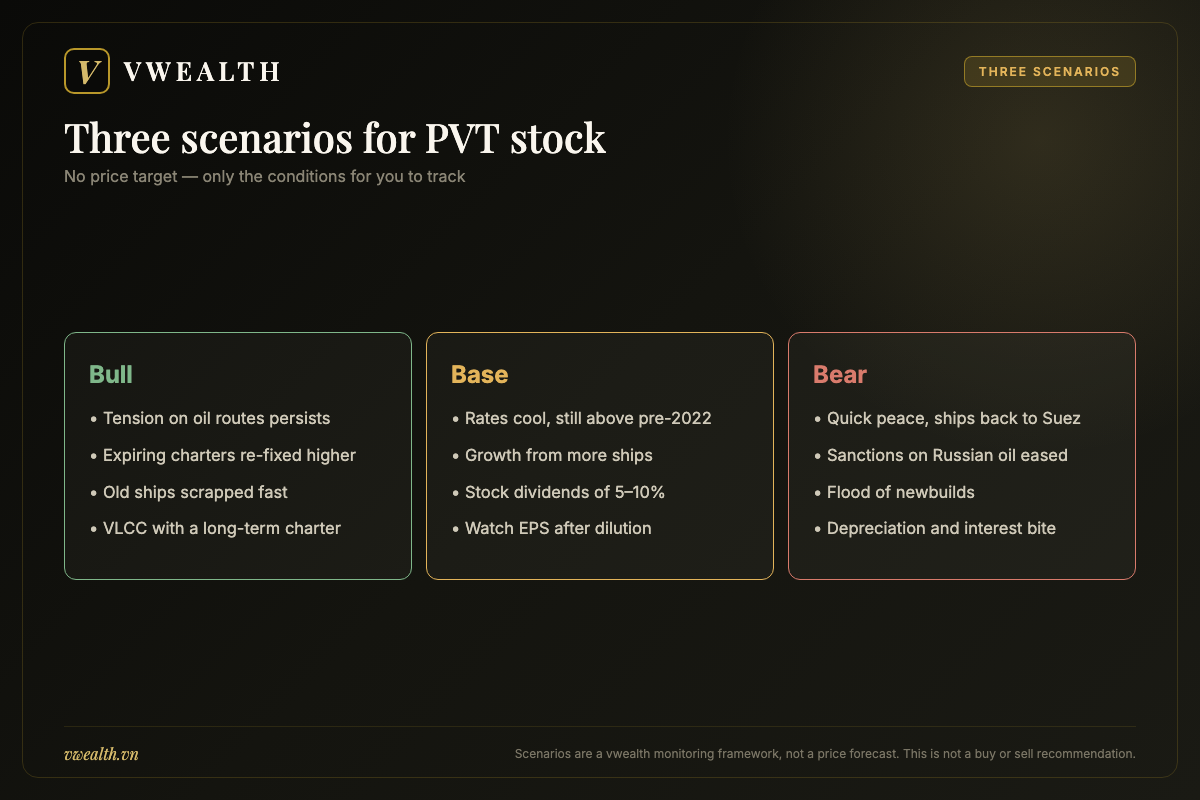
Outlook: Three Scenarios for PVT Stock and the Conditions Behind Each
Forecasting tanker rates accurately is something even the world’s oldest shipowners regularly get wrong. So this chapter offers no price target and no profit forecast. Instead, it lists the variables that will decide PVTrans’s future and sketches three scenarios with specific conditions, so you can track which way the story is heading on your own.
Six Variables That Will Shape PVT’s Future
- How long the Hormuz crisis and other flashpoints last. Prolonged tension keeps voyages long and rates high; a quick settlement could pull rates down to a lower level within months.
- The pace of global newbuild deliveries. Tanker deliveries in 2026 are expected to be the highest since 2009; if they stay high in 2027–2028, pressure on rates will build.
- The fate of the shadow fleet. If sanctions are eased, hundreds of ships could return to the mainstream market, increasing supply; if sanctions tighten and old ships are scrapped, supply stays tight.
- How many ships re-fix their charters during the high-rate period. With about 80% of the fleet on time charters or in pools, PVT’s profit rises as older contracts expire and are renewed at new rates. Ships that re-fix in 2026–2027 will shape profit in 2027–2028.
- Investment discipline. Whether the VLCC deal comes with a long-term charter as promised, and whether new ships are bought at excessive prices.
- Dividend policy and dilution. Whether EPS growth keeps pace with the growth in share count from stock dividends.
Bull Case: High Rates Persist, New Contracts Signed at the Top, the VLCC Happens
Conditions: tension in Hormuz and on other routes lasts through 2027; sanctions on Russian and Iranian oil continue or tighten; old ships are scrapped faster than new ones arrive. In that environment, PVTrans’s time charters expiring in 2026–2027 are renewed at much higher rates; ships acquired in 2025–2026 contribute for full years; and the VLCC deal with the Nghi Son refinery is signed with a long-term charter.
What you would see: shipping gross margins keep widening; parent-attributable profit far exceeds the (conservatively set) annual plan; operating cash flow is enough to repay debt and buy ships without much new borrowing; the company might consider raising cash dividends. This is the scenario in which the fleet renewal strategy is most clearly “rewarded”.
The hidden risk in the good scenario: the more optimistic things get, the easier it is for the company to be drawn into buying ships at high prices. If you see PVTrans announce large ship purchases without long-term charters right when rates are peaking, that is a signal for caution — especially remembering 2007–2008.
Base Case: Rates Cool to a Level Above Pre-2022, Profit Hovers Around the Strategic Target
Conditions: geopolitical tension gradually eases but does not disappear; some ships return to Suez and Hormuz; newbuilds arrive steadily but are offset by retirements. Tanker rates come off their highs but remain above the 2015–2021 average.
What you would see: transport revenue grows mainly because of more ships, not higher rates; profit is flat or up slightly, around the 2026–2030 strategic target (an average of roughly VND 1,300–1,400 billion after-tax profit per year, a vwealth estimate based on the published cumulative target); dividends of 5–10%, mostly in shares. This appears to be the scenario the company’s plan implicitly assumes.
What to watch: whether EPS grows after dilution. If profit is flat while the share count rises 10% a year, EPS falls — and the share price will struggle to rise sustainably even though the company still “earns a trillion dong”.
Bear Case: Quick Peace, a Flood of Newbuilds, Rates Collapse
Conditions: conflict in the Middle East ends quickly and ships return to shorter routes; sanctions on Russian oil are eased as part of a political deal and the shadow fleet re-enters the mainstream; at the same time, the wave of newbuilds ordered in 2022–2024 is delivered en masse; global oil demand grows slowly because of economic weakness and the energy transition.
What you would see: time-charter rates fall sharply; ships coming off contract re-fix at lower rates; depreciation and interest on ships bought at high prices become a burden; profit could drop steeply because of operating leverage. Second-hand ship values also fall, making profitable disposals harder. In the extreme, the 2008–2011 story could repeat in milder form — milder because financial leverage today is much lower and about 80% of the fleet is under contract.
Cushions in the bad scenario: the FSO, long-term contracts with Petrovietnam-ecosystem customers and the domestic LPG business still generate base cash flow; cash accumulated in the good years means the company would not need to sell assets in a hurry.
| Scenario | Key conditions | Early signals to watch | Impact on PVT shareholders |
|---|---|---|---|
| Bull | Prolonged tension on oil routes; fast scrapping; VLCC with long-term charter | One-year time-charter rates keep rising; a long-term contract with Nghi Son announced | Profit beats plan; possible higher cash dividends |
| Base | Rates cool but stay above pre-2022; newbuilds balance retirements | Rates ease from the peak but stabilize; quarterly profit flat | Profit around strategic target; 5–10% stock dividends |
| Bear | Quick peace; sanctions eased; newbuilds flood in | Ships return to Suez/Hormuz; rates fall persistently; global orderbook news rises | Profit drops sharply; depreciation and interest weigh |
The scenario table is a vwealth monitoring framework, not a price forecast. What matters is not guessing correctly which scenario will happen, but recognizing early which one the story is drifting toward — and adjusting your position before the market does it for you.
Long-Term Strategic Directions Worth Watching
Beyond the freight cycle, three long-term directions could change PVTrans’s character over the next five to ten years. First, the energy transition: global oil demand may peak within the next decade, but demand for gas shipping (LPG, and further out LNG and ammonia) may grow. PVTrans’s large LPG fleet is a platform for that. Second, green ships: vessels using alternative fuels or with better energy efficiency will be preferred by international charterers; management says it builds environmental factors into investment planning and sees adapting to emissions standards as a condition for keeping customers and accessing international capital. Third, domestic energy logistics: if Vietnam expands LNG imports for gas-fired power, demand for transport and floating storage could open new room — but that remains a long-term story that should not yet be priced in today.
So, Should You Buy PVT Stock? A Straight Answer for Each Type of Investor
After seven chapters, it is time to pull things together. There is no single answer to whether you should buy PVT stock, because PVT has a very distinct personality: rewarding for investors who understand cycles, dangerous for those who trade on headlines. This chapter weighs the positives and negatives, then sets out who should and should not hold PVT.
The Compelling Positives
One, a sturdier foundation than a typical shipowner. PVTrans has the national energy group as its controlling shareholder, a base of cargo from the Petrovietnam ecosystem (crude supply for Dung Quat through PVTrans Pacific, LPG, the FSO), and about 80% of its fleet on time charters or in pools. That is a cushion very few mid-sized private shipowners enjoy.
Two, a steadier profit record than you might expect. Seven consecutive years of pre-tax profit above VND 1,000 billion from 2019 to 2025, according to the company, through the pandemic and through periods of cooling freight. For a cyclical industry, that is a real achievement.
Three, direct exposure to structural trends in the tanker market. An aging world fleet, tighter environmental rules, a shadow fleet separated from the mainstream market and oil pushed onto longer routes — none of this disappears overnight. PVTrans started renewing its fleet early, positioning itself to benefit.
Four, disciplined management that has lived through a crisis. Chairman Pham Viet Anh steered the company through its post-2011 restructuring and keeps repeating the rule “no long-term contract, no big ship”. Current leverage is moderate and within industry norms.
Five, good liquidity and improving transparency. PVT is one of the more liquid energy stocks in Vietnam; the company holds regular investor meetings and earnings calls.
The Negatives You Cannot Ignore
One, profit follows world freight rates — which nobody controls. Time charters smooth the ride, but PVTrans’s long-term earnings still depend on international rates. A Middle East peace deal or a wave of newbuilds could change the picture faster than any analyst report.
Two, low cash dividends and steady dilution. Dividends are mostly paid in shares (32% for 2024, 10% for 2025), with cash at only 3% in the years it was paid. If EPS does not keep up, shareholders are diluted.
Three, consolidated profit looks better than your share of it. A meaningful portion of profit belongs to minority shareholders in subsidiaries. Investors who look only at consolidated after-tax profit will misjudge the P/E.
Four, leadership and direction risk from the state shareholder. In 2026 the CEO’s seat changed three times. Petrovietnam’s interests (energy security, costs for group companies) do not always match profit maximization for minority shareholders.
Five, “buying at the top” risk — for the company and for you. The company can buy expensive ships at the top of the cycle; you can buy the stock at the top of the news cycle. PVT’s own history in 2007–2011 is the reminder.
| Criterion | Positives | Negatives |
|---|---|---|
| Business model | Vietnam’s largest liquid-cargo fleet, six vessel types | A price taker in the international market |
| Revenue sources | Base cargo from the Petrovietnam ecosystem; about 80% of the fleet on time charters or pools | Target of 85% international transport revenue — dependent on world freight |
| Profit | Seven straight years of pre-tax profit above VND 1,000 billion | 2025 below 2024; swings with the cycle |
| Finances | Moderate leverage; dollar debt partly hedged by dollar revenue | Depreciation and interest rise with new ships |
| Dividends | Regular stock dividends | Low cash payout; dilution if EPS lags |
| Governance | Long-serving chairman, investment discipline | Three CEOs in 2026; state shareholder in control |
Who PVT Stock Suits — and Who It Does Not
It suits cyclical investors who understand shipping. If you are willing to follow tanker freight indices, read geopolitical news through a “tonne-mile” lens, and take profits when the crowd gets euphoric, PVT is a way to express a view on the global tanker market directly on a Vietnamese exchange — with a Petrovietnam cushion that lowers the risk relative to a pure-play shipowner.
It suits investors looking to diversify with a “dollarized” asset. Because most of its revenue is in US dollars and tied to international events, PVT can balance a Vietnam portfolio heavy in banks, real estate and domestic consumption. When the world is unsettled, PVT tends to move differently from domestically focused stocks.
It does not suit investors who need steady cash dividends. If you live on dividends, PV GAS, Petrolimex or other income stocks fit better.
It does not suit headline buyers. If you are about to buy PVT because you just read that “tanker rates topped USD 1 million a day”, stop and remember: PVTrans does not yet own a VLCC, most of its ships have locked in their rates, and that news may already be in the share price. Buying on hot news is the most common way to buy the top.
It does not suit investors who cannot stomach big swings. Shipping stocks can fall sharply within weeks when the news turns. If a 20–30% drawdown would keep you up at night, keep your PVT position small or stay out.
A practical approach for individual investors (illustrative, not a recommendation): build a position in several tranches during periods when the news is “cool” rather than all at once when headlines are hot; set exit conditions in advance based on the bear-case signals in Chapter 7 (ships returning to Suez or Hormuz, time-charter rates falling persistently) rather than on a price level. For foreign investors, also check available foreign room and settlement mechanics before placing orders; our guide to investing in Vietnam’s stock market covers the practical steps.
Frequently Asked Questions About PVT Stock
Which company is PVT? PVT is the ticker of PetroVietnam Transportation Corporation (PVTrans), listed on HOSE since December 10, 2007, with Petrovietnam as controlling shareholder at about 51%.
How many ships does PVTrans own? According to the company website (September 2026), the fleet comprises 68 vessels with total capacity of nearly 2.1 million DWT: 4 crude tankers, 8 product tankers, 19 chemical tankers, 21 LPG carriers, 15 bulk carriers and 1 FSO/FPSO. At the April 2026 shareholder meeting, the reported figure was 65 ships and more than 2 million DWT.
Does PVT pay cash dividends? Yes, but modest ones: 3% of par (VND 300 per share) for 2022 and 2023. For 2024 and 2025 the company paid stock dividends of 32% and 10%. The 2026 plan is 10%, and the 2026–2030 strategy calls for 5–10% a year.
Does the Hormuz crisis mean windfall profits for PVT? The effect is positive, but nowhere near proportional to the VLCC rates you see in the news. PVTrans does not yet own a VLCC, and about 80% of its fleet is on time charters or in pools, so profit rises gradually as contracts are renewed.
How is PVT different from HAH, VOS and GMD? PVT carries liquid cargo (oil, chemicals, gas), HAH carries containers, VOS carries dry bulk, and GMD operates ports. Each follows its own cycle.
Can foreigners buy PVT? Yes, within the company’s foreign ownership limit. How much room is left changes over time; check the latest figure in the vwealth report before you trade.
What is PVT’s price and P/E today? We do not quote current figures because they change daily; check the PVT report on vwealth for up-to-date numbers and peer comparisons.
Final Thoughts
PVTrans is a rare story on the Vietnamese market: a state-linked company that nearly disappeared in a forced merger now runs the country’s largest liquid-cargo fleet, trades on international routes, and profits from events thousands of nautical miles away. Its strengths are real: the Petrovietnam foundation, a diversified fleet under renewal, a high share of time-chartered ships and a management team that has been through a crisis. Its weaknesses are just as real: profit tied to world freight, low cash dividends, steady dilution and the leadership turnover of 2026.
The answer to whether you should buy PVT stock therefore rests on two things to watch over the next 12–18 months: at what level time-charter rates settle as PVTrans’s contracts come up for renewal once the Hormuz crisis passes, and whether the company sticks to its rule of buying big ships only with long-term contracts. If both go well, PVT can remain a cyclical growth stock worth holding within Vietnam’s energy sector. If not, the share price will reflect the cyclicality that is simply part of the shipping business. For related reading, our analyses of PV GAS, PTSC and PV Drilling cover the rest of the oil and gas value chain.
This article is for information and analysis only and is not a recommendation to buy or sell. Before deciding, check the latest figures — price, P/E, parent-attributable profit, debt, cash — in the vwealth report, and consider your own risk tolerance. You can sign up for a vwealth account to follow updated PVT reports every quarter.
Research Vietnamese stocks in English with vwealth. Our AI-powered platform turns Vietnamese market data into full English analysis reports — with international payment support and a free 2-month trial for new accounts. Create your free account and read the latest reports.