
Should you buy MBS stock — the ticker for MB Securities Joint Stock Company, listed on Vietnam’s Hanoi Stock Exchange — is a question with an unusual feature: most people who ask it are not really asking about the brokerage. They are asking about the bank standing behind it. That is simultaneously the strongest and the most dangerous part of the investment case. MBS is the direct descendant of Thang Long Securities, one of the first brokerages licensed in Vietnam, a firm that once led the market in brokerage share for two consecutive years and then nearly broke itself on leverage. Twenty-six years after its founding, that same company has climbed back into the leading group by an entirely different route: not with an army of brokers, but with a balance sheet and a customer base inherited from its parent bank. This article walks through that story, teaches you how to read the financial statements of a securities firm — a business type where the standard industrial toolkit will almost certainly mislead you — and ends with a direct answer: which kind of investor MBS suits, and which kind it absolutely does not.
Before we begin, one convention between you and this article, the same one used across this series. You will encounter many dates, names, transactions and scale figures, all drawn from publicly disclosed sources: filings with the stock exchange, shareholder meeting resolutions, and mainstream financial media. What you will not find is a figure for the most recent quarter — this quarter’s profit, today’s margin book, the current price-to-book multiple. Not because the article is shy about numbers, but because for a securities firm, whose earnings track market turnover almost week by week, those figures swing violently between quarters. An article still being read two years from now that contains a single quarter’s data becomes misinformation ninety days after publication. Instead, the article teaches you where to look and how to look; for current numbers, open the research reports on vwealth. It takes a few minutes, but they are the right minutes.
One more note, and it is the most important one if this is your first serious look at a securities stock. A brokerage is not a retailer. It is a small financial institution. Its main revenue lines are the interest spread on money lent to investors, commission on each matched order, gains and losses on its own trading book, and fees from underwriting and advisory work. Three of those four expand and contract with a single variable: the liquidity of the market as a whole. That means when you buy a securities stock, you are buying a double leverage on the index — once because corporate earnings swing harder than the market, and once again because the valuation multiple the market is willing to pay for those earnings swings too. Understand that mechanism and you understand why brokerage stocks are always among the fastest risers in a bull market and the deepest fallers in a bear one. It also explains why the question should you buy MBS stock cannot be separated from the question of what you think about the next two years of Vietnamese equities.
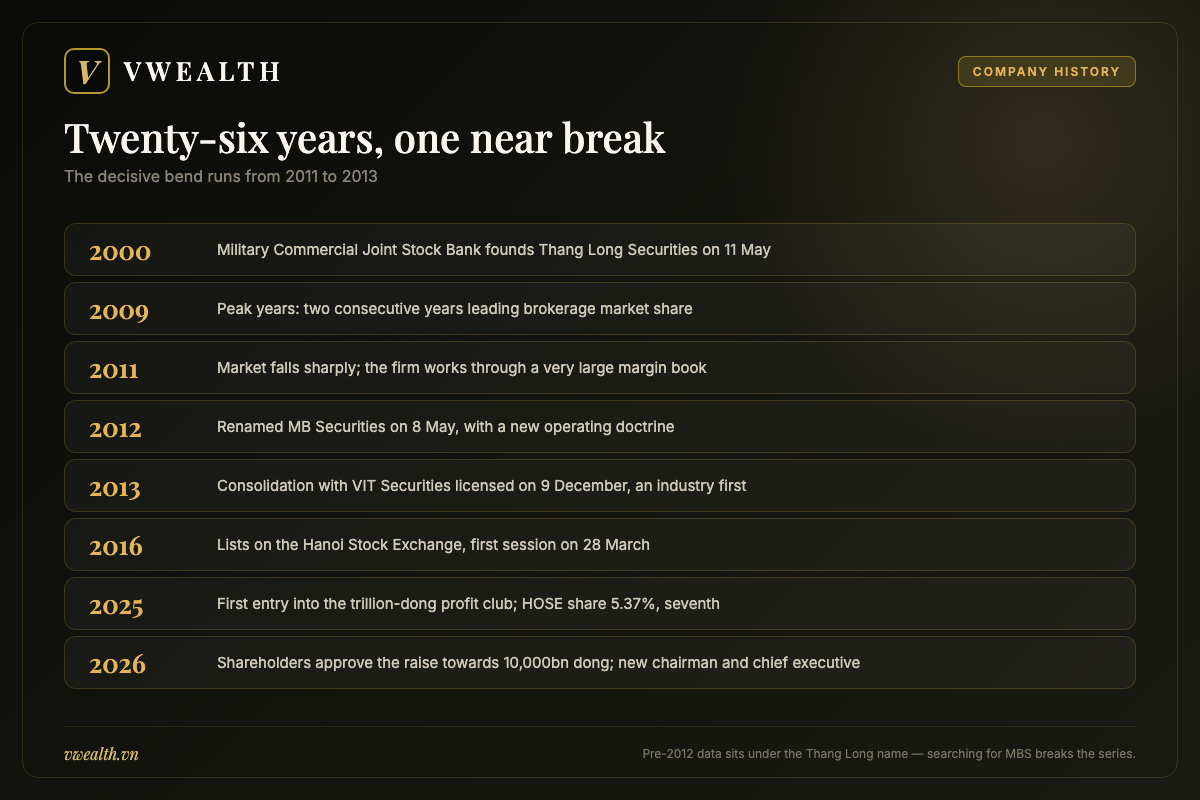
From Thang Long Securities to MBS: twenty-six years, one near-break, and a rebuild
If you had to name a Vietnamese listed company whose biography splits cleanly into a before and an after, MBS is a strong candidate. The first half is the story of a fast-growing brokerage that led the market and then paid for its own speed. The second half is the story of a firm recapitalised by its parent bank, renamed, restrategised, and made to spend the better part of a decade climbing back. To understand why MBS today operates with a caution some short-term investors find frustrating, you have to walk each bend of that road.
11 May 2000: one of Vietnam’s first securities firms
On 11 May 2000, Thang Long Securities Joint Stock Company was founded by Military Commercial Joint Stock Bank, known throughout Vietnam simply as MB. At that moment, the Vietnamese stock market barely existed. The Ho Chi Minh City Securities Trading Center would not hold its first session until July of that same year, and it opened with exactly two listed stocks. Thang Long belonged to the small first cohort of licensed brokerages, alongside names Vietnamese investors still recognise today.
Pause on that founding date, because it says something structural about the business. A brokerage founded before the exchange existed is not an ordinary commercial venture. It is an infrastructure bet by a parent bank on the proposition that Vietnam would one day have a genuine capital market. That proposition turned out to be correct, but it took seven years to become clearly profitable and another two decades to produce earnings in the trillions of dong. This is why, in Vietnam’s brokerage industry, firms established by banks at the very beginning hold something newcomers cannot easily buy: licence seniority, established relationships with the regulator, and a client base connected to a national branch network.
Through its first decade, Thang Long grew with the market. During the 2006 to 2007 period, when the VN-Index first crossed one thousand points and new brokerage accounts multiplied, Vietnamese securities firms entered an era where profit arrived almost automatically. Thang Long exploited that window better than most competitors, building a large retail sales force and a brand familiar to individual investors across the north of the country.
The peak: two consecutive years at the top of brokerage market share
By the start of the 2010s, Thang Long Securities had reached the position every brokerage covets: number one in market share, held for two years running. Brokerage market share is a publicly disclosed statistic, published quarterly by the exchanges, measuring the proportion of total traded value contributed by a firm’s clients. Within the industry it functions as both a performance measure and a marketing device — any firm that reaches the top ten puts it on the homepage.
But market share has a dark side that newer investors often miss: it can be bought. The simplest way to buy it is to cut commissions towards zero and loosen margin lending. Clients who can borrow more trade more, and more trading means more share. The problem is that every point of share purchased this way is paid for with risk sitting on the brokerage’s own balance sheet, not with a marketing budget.
This is precisely why the history chapter matters to a decision you might make today. The current management of MBS inherits a very specific institutional memory of what happens when a securities firm chases share with leverage. That memory shaped the firm’s risk appetite for the following decade, and it explains why for many years MBS was criticised by short-term investors as conservative compared with faster-growing rivals.
2011: when leverage bit back
2011 was the harshest year in the short history of Vietnamese equities up to that point. Double-digit inflation, deposit rates pushed to punishing levels, a credit squeeze, and an equity market that fell for most of the calendar year. For brokerages that had lent aggressively against securities in the preceding two years, a prolonged decline does not produce gradual losses. It produces a chain reaction.
The mechanics of that chain reaction are worth understanding properly, because they remain fully valid today. When the price of pledged shares falls to a threshold, the brokerage issues a margin call. If the client does not deposit additional funds, the brokerage force-sells. Force-selling pushes prices lower, which drags additional accounts to their thresholds, which triggers the next round of selling. In a market where liquidity has already thinned because everyone is frightened, that spiral can run for weeks. Whatever debt remains after the collateral is exhausted becomes a doubtful receivable on the brokerage’s books — which is to say, a loss.
Financial media of the period recorded that Thang Long Securities had to work through a very large volume of margin debt, and the firm’s leadership later acknowledged publicly that both its business and the reputation built over more than a decade had been affected. That is an institution’s measured way of describing a very difficult stretch. The detail that matters most to you as a prospective shareholder is this: the parent bank did not abandon its subsidiary. MB stepped in to support the restructuring, and that support is what made the entire next chapter possible.
May 2012: a new name, and a new operating doctrine
On 8 May 2012, Thang Long Securities Joint Stock Company formally became MB Securities Joint Stock Company. Legally this was a registration formality. Strategically it was a declaration: this firm would henceforth be a component of a banking ecosystem rather than an independent broker racing for share at any cost.
Accompanying the rename was a notable shift in stated ambition. Rather than promising to reclaim the top spot, the new leadership set the more modest goal of remaining within the leading group on market share, while emphasising service quality and investment banking over pure brokerage competition. In the industry, a statement like that is usually read as retreat. Looking back fourteen years later, it was among the best decisions the company ever made.
Keep the rename in mind when you read older analysis of this company. A great deal of pre-2012 data sits under the Thang Long name or the abbreviation TLS, and if you search only for MBS, your historical series will simply break. It is a small trap that produces large misunderstandings in long-run comparisons.
2013: the first successful consolidation in Vietnamese brokerage history
At the end of 2013, MB Securities consolidated with VIT Securities Joint Stock Company. On 9 December 2013, the State Securities Commission issued the establishment and operating licence for the consolidated entity, MB Securities Joint Stock Company. It is recorded as the first successful consolidation between two brokerages in the Vietnamese market.
The backdrop was an industry restructuring programme driven by the regulator. After the 2007 to 2010 boom, Vietnam had far more brokerage licences than the market could support — hundreds of firms serving an exchange whose daily matched value was still modest. Many small firms became non-viable after the crisis. The regulator encouraged mergers, consolidations and licence withdrawals to reduce the count.
For MBS, the VIT transaction delivered three things: greater capital scale, an additional client base, and most importantly the standing of a firm that moved first on a regulatory priority. For the industry, it created the technical precedent that later deals followed. For you, the practical implication is that MBS has genuine hands-on experience integrating two financial institutions — a capability not every brokerage possesses, and one that could matter if the industry enters another consolidation phase.
2016: MBS shares list on the Hanoi Stock Exchange
On 19 January 2016, MBS shares were approved for listing on the Hanoi Stock Exchange, and the first trading session took place on 28 March 2016. Choosing HNX over the larger Ho Chi Minh City exchange was consistent with the firm’s charter capital at the time, but it left a consequence that persists today: MBS is one of the few large Vietnamese brokerages still listed on HNX, while most of its size peers now trade on HOSE.
That consequence is not merely a matter of prestige. The listing venue affects whether a stock can enter the major indices, and index membership determines whether passive funds are obliged to hold it. A stock outside the main index baskets lacks a stable source of demand, and that typically shows up in its valuation relative to peers. The article returns to the exchange transfer question in chapter five, because it is one of the most frequently cited catalysts for this ticker.
2020 to 2025: back to the top by a different road
The period from 2020 onward was the great retail boom in Vietnamese equities. New account openings surged, market turnover multiplied, and the whole brokerage industry benefited. But firms exploited that window very differently, and those differences produced today’s league table.
MBS chose the ecosystem route. Rather than expanding a traditional broker force with its heavy compensation costs, the firm leaned on the existing client base of its parent bank, pushed digital channels hard, and concentrated resources on margin lending — a business that needs capital more than it needs headcount. The result: in 2025 MBS reported pre-tax profit of 1,415 billion dong, up 52 per cent on 2024 and nearly double 2023, entering for the first time the group of Vietnamese brokerages earning more than a trillion dong. Its HOSE brokerage market share for 2025 was 5.37 per cent, seventh among the top ten.
That seventh place deserves a moment of reflection. Fifteen years earlier, this company’s predecessor was first. Today it is seventh and far more profitable. It is the clearest possible evidence for a claim this article will repeat: in the brokerage industry, market share and profitability are not the same story, and an investor who conflates them will misprice the stock almost by definition.
Milestone summary table
| Date | Event | Why it matters to an investor today |
|---|---|---|
| 11 May 2000 | Thang Long Securities founded by Military Commercial Joint Stock Bank | Licence seniority and institutional relationships are intangible assets money cannot easily buy |
| 2006 to 2010 | Rapid growth with the market, including two consecutive years leading brokerage market share | Demonstrates the firm once had best-in-industry distribution capability |
| 2011 | Market falls sharply; the firm works through a very large margin book | Institutional lesson on leverage that shaped risk appetite for a decade |
| 8 May 2012 | Renamed MB Securities Joint Stock Company | Shift from independent broker to component of a banking ecosystem |
| 9 December 2013 | Consolidation with VIT Securities; licence issued to the combined entity | First successful brokerage consolidation in Vietnam; integration experience retained |
| 19 January 2016 | Listing approved on HNX; first trading session 28 March 2016 | Venue affects index eligibility and the availability of passive demand |
| 2020 to 2024 | Retail boom; MBS expands through capital and digital channels rather than headcount | The bank-backed model begins delivering measurable results |
| 2025 | Pre-tax profit of 1,415 billion dong, first entry into the trillion-dong club; HOSE share 5.37 per cent, seventh | Share ranking and profit ranking are two different league tables |
| March 2026 | Shareholders approve a capital raise towards 10,000 billion dong; new chairman and chief executive appointed | A step change in scale that arrives with dilution and an untested leadership record |
Read that table vertically and a rhythm familiar across Vietnamese finance emerges: a hot growth cycle, a stumble, a long consolidation, then a new expansion phase built on a larger capital base. The central question for anyone buying MBS stock today is where in that rhythm the company currently sits — and chapter seven addresses it directly.
Who runs MBS and who actually owns it
For a brokerage inside a banking group, the ownership question matters far more than it would for an ordinary manufacturer. The reason is simple: most of the firm’s competitive advantage flows from its relationship with the parent bank, so any change in that ownership stake, or in the parent’s strategic priorities, feeds directly into the operating foundation. You cannot analyse MBS while ignoring Military Commercial Joint Stock Bank, MB, any more than you could analyse a logistics subsidiary while ignoring its group holding company.
The controlling shareholder, and why its stake is deliberately shrinking
MB is the sole substantial shareholder of MBS and holds a controlling stake. What is interesting is that the parent bank has been actively reducing it. Between early September and early October 2025, MB registered to sell 60 million MBS shares, taking its holding from roughly 76.35 per cent down towards the mid-sixties. The stated purpose was explicit: to increase the public float of MBS shares in line with the requirements of a large-scale securities firm.
The phrase increasing the public float sounds procedural, but it carries a very practical meaning. To be included in index baskets, to attract institutional investors, and to move to an exchange with higher standards, a stock needs a sufficiently large free float. When the parent holds more than three-quarters of the equity, what remains in the market is too thin for large institutions to build meaningful positions. MB selling down is therefore not a signal of retreat. It is groundwork for the next phase.
You should hold both sides of this in mind. On the positive side: wider ownership, better liquidity, higher probability of index inclusion. On the negative side: every disposal by a major shareholder creates short-term supply pressure on the price, and as the parent’s stake falls, the degree of priority the subsidiary receives within the group could in theory fall with it. This is a variable to monitor through major-shareholder disclosure filings, not a fixed number to memorise once.
Phan Phuong Anh: from chief executive to chairman
In March 2026, following the annual general meeting, the MBS board elected Mr Phan Phuong Anh — at the time vice chairman and chief executive officer — as chairman of the board. He succeeded Mr Le Viet Hai, who moved to lead MB Ageas Life, the life insurance company within the same group.
The noteworthy detail here is not the names but the mechanism. This was an internal rotation within the MB ecosystem: the departing chairman did not leave the group but took charge of another member company, while his replacement was the executive who had been running this very business. For investors, that rotation model has an obvious virtue, which is continuity — the incoming chairman needs no time to learn the company. It has an equally obvious drawback: a leadership team promoted from within rarely produces abrupt strategic change. If your investment thesis depends on the company doing something markedly different from its past, this model does not support you.
Having one person move from chief executive to chairman also raises the familiar governance question of separation between strategy and execution. In practice MBS appointed a new chief executive at the same time, so the two roles remain held by different people. Still, when reading the corporate governance report, pay attention to the proportion of independent directors and the frequency of board meetings. These are publicly disclosed and are the most objective way to assess governance quality without guessing.
Hoang Ha: a chief executive born in 1989
In the same March 2026 round, Mr Hoang Ha — a newly elected board member — was appointed chief executive officer of MBS. According to disclosed information, he was born in 1989 in Hung Yen province, holds a master’s degree in economics from the Banking Academy, joined MB in March 2021, and before his appointment headed the digital business function at MBS.
A background in digital business is a strategic signal rather than a line on a resume. In today’s Vietnamese brokerage market, competition for retail clients has moved almost entirely online: electronic identification for account opening, order entry through mobile apps, advisory delivered as digital content. The firm with the better technology platform acquires clients at a lower cost. Elevating the head of digital to the top operating role is a statement of direction.
The other side of the coin: a young chief executive, newly appointed, without a long track record at the top of a firm. For a business whose largest risks sit in leverage management and trading book discipline, crisis-handling experience is something only a crisis can demonstrate. You should not treat this as a mark against the company, but you should not dismiss it either. The sensible approach is to watch the risk metrics over the next several reporting periods and see whether they drift from established practice.
What kind of parent is MB, and why that matters here
International readers meeting this name for the first time should understand what MB actually is, because the whole MBS case rests on it. Military Commercial Joint Stock Bank is one of Vietnam’s largest privately controlled commercial banks, listed on the Ho Chi Minh City exchange, with roots in the military-linked corporate sector and a customer franchise that has expanded far beyond it. Its 2025 results placed pre-tax profit above 34,000 billion dong with return on equity around the highest in the domestic banking sector, and the bank has been running a multi-year programme to lift charter capital past the 100,000 billion dong mark.
Three features of that parent matter directly to MBS. The first is digital reach: MB has built one of the largest retail digital banking user bases in Vietnam, which is the pipeline through which a securities subsidiary acquires accounts cheaply. The second is balance sheet strength, which supports the subsidiary’s funding costs and its ability to raise debt. The third is that MB runs a genuine multi-company group rather than a bank with a token brokerage attached, which means MBS competes for group resources against several sibling businesses.
That third point deserves emphasis because it is the risk investors most often overlook. Group management has repeatedly described the securities arm and the consumer finance arm as its main growth engines outside the bank, which is favourable for MBS today. But group priorities are reviewed continuously, and a minority shareholder in the subsidiary has no vote in that review. When you buy MBS, you are accepting that a material part of your investment case is decided in a boardroom you cannot attend.
A practical consequence: track the parent’s own disclosures as closely as the subsidiary’s. Comments made at MB’s annual general meeting about the role of the securities arm, about capital allocation between subsidiaries, and about strategic investor discussions at group level are often more informative about the MBS trajectory than anything MBS itself publishes.
Free float: does thin help or hurt
When a single shareholder holds roughly two-thirds of the equity, only about a third genuinely circulates. That figure gives MBS a distinct trading character you should understand before placing an order.
The favourable side: less supply available to sell, so when money rotates into the brokerage sector the share price tends to respond sharply. The unfavourable side is longer. First, when markets sour, thin liquidity makes exiting a large position expensive. Second, a low free float is awkward for institutional funds, which typically have internal limits on how much of a single line they may own. Third, the price becomes sensitive to medium-sized trades that reflect no change whatsoever in fundamentals.
This is also why new share issues and parent sell-downs cut both ways. They dilute existing holders in the short run, but they treat exactly the structural condition described above. When you read that MBS is issuing more shares, resist the reflexive reaction — ask instead what the proceeds will fund and what the free float will look like afterwards.
Dividend policy and a run of capital raises
For many years MBS paid dividends predominantly in shares and retained most earnings to build capital. That is a common and rational choice in this industry, for a very technical reason: the margin book a Vietnamese brokerage may extend is capped as a multiple of shareholders’ equity. To lend more, you must first hold more equity. Capital is raw material, not surplus to be handed back.
What stands out is that in 2026 the board proposed a cash dividend of 10 per cent of par value, equivalent to 1,000 dong per share. At the same time, the company launched an offering of more than 333 million shares to existing shareholders on a two-for-one basis at 10,000 dong per share, aiming to lift charter capital to the 10,000 billion dong mark. Under the disclosed plan, the majority of the proceeds is allocated to margin lending, with the remainder supplementing the proprietary trading book.
Read that structure carefully, because it is the entire MBS investment case in miniature. The company is paying a modest cash dividend while asking shareholders for several times that amount in fresh capital. Net cash flows from shareholders into the company, not the other way round. That is the signature of a business in an expansion phase, and it only makes sense if the return on the new equity is high enough to compensate for the larger share count.
Ownership and leadership at a glance
| Item | What has been disclosed | What you should track |
|---|---|---|
| Sole substantial shareholder | Military Commercial Joint Stock Bank, controlling stake in the mid-sixties per cent range after the 2025 sell-down | Major shareholder disclosure filings; the stake is being managed deliberately |
| Chairman of the board | Mr Phan Phuong Anh, elected March 2026, previously vice chairman and chief executive | Whether strategy continues the prior course or shifts |
| Chief executive officer | Mr Hoang Ha, appointed March 2026, born 1989, background in digital business | Growth in new account openings and the share of trading through digital channels |
| Board term | 2023 to 2028 term, five members | Proportion of independent directors in the governance report |
| Dividend policy | Years of share-based dividends; a 10 per cent cash dividend proposed in 2026 | Whether cash dividends survive continued capital needs for margin lending |
| Capital raise | Offering of over 333 million shares at two-for-one, priced at 10,000 dong, targeting 10,000 billion dong of charter capital | Deployment pace and the return generated on the new equity |
| Listing venue | HNX, trading since 28 March 2016 | Exchange transfer plans and index eligibility |
Once more, a reminder: ownership percentages change with every disclosure. Before making a decision, open the latest filing or the current research report on vwealth and verify the number, rather than trusting an article written earlier.

How MBS actually makes money: anatomy of a modern brokerage
Many investors still picture a securities firm as a place that collects commission on trades. That picture was accurate in 2007 and is wrong in 2026. Today, brokerage commission is rarely the main profit source for any large Vietnamese securities firm. If you want the full mechanics of this business model, the article on how to invest in the Vietnam stock market sets out the market structure investors need first. Here, we go straight into MBS.
Margin lending: the real profit engine
Margin lending is the business of lending investors money to buy shares, secured on the shares they buy. Economically it is a small bank: the firm raises funds at one rate, lends at a higher one, and keeps the spread.
What makes this attractive for a brokerage is the combination of spread and relative security. The collateral is listed equity, marked daily, highly liquid, and the firm holds the right to force-sell when the maintenance ratio is breached. No other collateral type in Vietnamese finance is as easy to value and as easy to realise. Compare that with a bank spending years working out a mortgaged plot of land and the difference is enormous.
For MBS, this is the clearly favoured business line. At the end of 2025 the firm’s margin book exceeded 15,000 billion dong, having grown by nearly 5,000 billion dong over the year. And in the 2026 capital raise, the majority of the intended proceeds is allocated directly to margin lending. In other words, management is publicly stating that this is where they believe new capital earns the best return.
But the business carries a structural weakness you must not forget: it is the exact activity that nearly broke the firm’s predecessor in 2011. Margin lending is safe when markets behave and becomes dangerous precisely when they do not, because collateral values and borrower capacity deteriorate simultaneously. The risk in this business is not evenly distributed across time — it concentrates into a handful of weeks within a multi-year cycle.
Brokerage: the front door, not the profit centre
The brokerage franchise delivered 5.37 per cent of HOSE turnover in 2025, seventh in the leading group, and the firm has held above the 5 per cent mark for several consecutive quarters. Looking at that, many conclude brokerage is the core business. Reality is more complicated.
Over the past decade, Vietnamese commission rates have been competed down to very low levels, with some firms offering close to zero for new clients. At that price, brokerage revenue rarely covers system operating costs, staff costs and technology spend. Many firms accept the brokerage line at break-even or a small loss. So why do they still fight for share?
Because brokerage is the front door. Every new account is a prospective customer for margin lending, for fund certificates, for bonds, for derivatives. The cost of acquiring an account is a customer acquisition cost, recovered through the products behind the door rather than through commission itself. This is why share and profit do not move together, and why a firm ranked seventh on share can out-earn a firm ranked third.
For MBS, that front door has an unusual advantage: the existing client base of its parent bank. When a bank has a wide branch network and a large digital banking user base, cross-selling securities services to those same customers is far cheaper than acquiring strangers. This is the genuine moat of the bank-owned brokerage model.
Proprietary trading and treasury: where earnings swing hardest
Proprietary trading is the firm investing its own capital. In Vietnam, the trading books of large brokerages are typically not the speculative equity portfolios many imagine, but lean heavily towards fixed income: corporate bonds, government bonds, certificates of deposit. The reason is that these instruments generate a steady income stream to balance the highly erratic contribution from brokerage.
In the 2026 allocation plan, MBS earmarks a portion of the proceeds for the trading book alongside the larger margin allocation. The firm’s stated direction is diversification and balance across revenue sources rather than dependence on any single line, with income drawn from brokerage, margin lending, proprietary trading, treasury and investment activity, and cross-selling.
When you read the financial statements, this is the line item to examine most carefully, because it holds the most accounting discretion. Financial assets measured at fair value through profit or loss push price movements straight into quarterly earnings; assets held to maturity do not. Two firms with identical portfolios but different classifications will report very different quarterly profits. Chapter four devotes a section to separating the two.
Investment banking: small in revenue, large in standing
Investment banking covers equity and bond issuance advisory, listing advisory, mergers and acquisitions advice, and underwriting. This is the area MBS has emphasised since the 2012 rename, when management declared a shift towards service quality and investment banking over pure brokerage competition.
Financially, the line usually contributes a modest revenue share and swings hard between years, because a single large mandate can flatter a quarter while the next year offers nothing comparable. Its strategic value lies elsewhere: relationships with issuers. A brokerage that advises a listed company gains the chance to distribute products to that company and its shareholders, gains deeper sector knowledge, and holds an advantage when competing for the next mandate.
For a bank-owned brokerage there is an additional natural advantage. A corporate that already borrows from the parent bank is a ready candidate for a bond issue arranged by the securities subsidiary. This is precisely the cross-sell that financial groups worldwide pursue. The flip side is concentration risk: when the corporate bond market runs into trouble, parent and subsidiary are affected simultaneously, and the reputation of one flows directly to the other.
Where the MBS moat sits, and where it is thin
A moat is whatever allows a business to defend its profitability against competition. For MBS the moat has three layers, and none of them is absolute.
The first layer is cost of funds. As the subsidiary of a large bank, MBS can raise funding on better terms than many independent brokerages of comparable size. In a business whose profit is literally an interest spread, a lower funding cost is a direct and durable advantage. But this layer is being eroded as more and more brokerages acquire bank or conglomerate backing, and as several raise offshore funding cheaply.
The second layer is distribution. The parent’s network and customer base allow MBS to reach new clients at low cost. This advantage is real, but it depends on the parent continuing to treat the brokerage as a priority. That is somebody else’s strategic decision, outside the control of MBS management.
The third layer is brand and seniority. Twenty-six years of operation, a successful consolidation, a research arm with a market profile — these create trust, and trust lowers selling costs. But in an industry where retail clients switch accounts with a few taps on a phone, brand is the shallowest of the three layers.
The honest conclusion: MBS has a moat, but it is the moat of a leading firm rather than that of a monopolist. Nothing prevents a well-capitalised rival from taking share by cutting fees and loosening margin terms. This is the fundamental difference between brokerage stocks and infrastructure businesses that own genuinely unique assets, such as the air cargo terminal case discussed in the article on SCS, Saigon Cargo Service.
Cross-selling and the digital channel: the quiet fifth line
There is a fifth activity that does not appear as a separate line in the income statement but increasingly shapes the economics of the whole firm: cross-selling within the group. A retail client who opens a securities account through the parent bank’s app may later buy fund certificates managed by the group’s asset manager, subscribe to a bond distributed by the brokerage, or take out an insurance policy from the group’s insurer. Each of those products carries a distribution fee, and the marginal cost of selling them to an existing relationship is very low.
The MB ecosystem is unusually broad by Vietnamese standards, spanning the bank itself, consumer finance, non-life insurance, life insurance, asset management, a debt and asset management company, and the securities arm. For MBS, that breadth means the customer acquired through the brokerage front door has more products behind it than would be the case at an independent firm. It is the practical expression of what the strategy documents call an ecosystem advantage.
Two cautions before you count this as a large positive. First, cross-selling economics are difficult for an outside investor to verify, because the revenue is spread across line items and rarely disclosed as a distinct figure. Second, cross-selling within financial groups attracts regulatory attention in every market, and Vietnam is no exception; a change in distribution rules, particularly around insurance sold through financial institutions, can remove a revenue stream quickly. Treat it as a real but unquantified advantage rather than a number you can model.
The four business lines compared
| Business line | Nature of the revenue | Volatility | What decides success |
|---|---|---|---|
| Margin lending | Interest spread on money lent to investors | Moderate, but risk concentrates in sharp market declines | Equity base, cost of funds, and discipline in setting limits |
| Brokerage | Commission on client turnover | Very high, tracking market-wide liquidity | Active account numbers and the industry fee level |
| Proprietary and treasury | Gains and losses on the investment book plus fixed income | High, and partly a function of accounting classification | Investment discipline and the equity-versus-debt mix |
| Investment banking | Advisory, underwriting and arranging fees | Very high, dependent on deal count in the period | Corporate relationships and the state of the capital market |
Look at that table and one point emerges that new investors routinely miss: no line of a securities firm is defensive. All four are cyclical, differing only in degree. That is why, in a cautious portfolio, brokerage stocks belong with cyclicals rather than with stable financials.

Financial position and health: seven checks before you decide on MBS stock
This is the most important chapter in the article, and the one to revisit whenever new financials are published. The familiar toolkit for a manufacturer — gross margin, inventory turns, debt to equity — either does not exist or means something entirely different when applied to a securities firm. The seven checks below are the replacement.
Check 1: margin book relative to shareholders’ equity
This is the single most important metric, worth more than all the others combined. Vietnamese regulation caps a brokerage’s total margin lending as a multiple of shareholders’ equity. That multiple creates a hard ceiling on business scale: a firm at the cap cannot lend more no matter how buoyant the market becomes.
How to read it: divide the margin receivable on the balance sheet by shareholders’ equity. If the ratio sits low, the firm has room to grow without raising capital — the best possible state for shareholders, because growth arrives without dilution. If the ratio is near the cap, every further increment of growth requires new equity, which means issuing new shares.
Applied to MBS: the fact that the firm is running a large offering with most proceeds earmarked for margin lending tells you something by itself. A company does not raise capital for a business line that still has headroom from existing resources. Read the offering as an admission that the old headroom is largely used, and simultaneously as an assertion that management believes client borrowing demand remains strong.
Check 2: the composition and quality of the margin book
The headline margin number says nothing about quality. Two firms with the same 15,000 billion dong of margin receivables can carry wildly different risk depending on how that lending is distributed.
Three questions to answer from the notes to the accounts. First, client concentration: if a large share of the book sits with a handful of accounts, the risk is no longer diversified. Second, whether the eligible collateral list leans towards large-capitalisation names or towards small speculative ones — in a falling market, thinly traded shares may not be sellable at any price in time. Third, the value of doubtful receivables and the level of provisioning, which is the residue of loans that have already gone wrong.
For MBS, a client base sourced from a banking ecosystem should in theory carry a better credit profile than the market average, but this is an assumption to verify against provisioning data rather than to accept on intuition.
Check 3: funding structure and cost of funds
Whose money does the brokerage lend? Part comes from equity, the larger part from borrowings. That funding structure determines the margin business’s profitability.
Three things to examine in liabilities. The short-term versus long-term borrowing mix indicates refinancing risk: if the firm borrows short to lend long, every maturity is another funding event. The source of borrowings — domestic banks, bond issues, or offshore syndicated loans — indicates diversification. And the average cost of debt, calculated as interest expense over average borrowings, tells you the price the firm pays for money.
This is precisely where the ecosystem advantage described in chapter three either becomes a number or does not. If the firm’s average funding cost sits below that of independent peers, the moat is real. If not, it is a theoretical advantage that has yet to turn into cash.
Check 4: separating trading gains from core earnings
This is the step most investors skip, and skipping it invalidates every valuation comparison you make afterwards. A brokerage’s quarterly profit can be lifted substantially by revaluing the trading book to market prices, with no cash whatsoever changing hands.
The method: in the income statement, isolate gains and losses on financial assets measured at fair value through profit or loss. That is the market-sensitive portion. What remains — brokerage commission, interest on loans and receivables, custody and advisory income — is the repeatable portion. Calculate the share of profit coming from the repeatable group and track that share across several quarters.
A firm whose profit is growing on repeatable income deserves a higher multiple than one whose profit is growing on revaluation. The market often fails to distinguish between the two in the short run, and that gap is precisely the opportunity available to an investor willing to read the notes.
Check 5: return on equity across a full cycle
Return on equity matters for every financial institution, but for a brokerage it only means anything across a full cycle. In a buoyant year, virtually every securities firm posts an attractive return. In a dull year, virtually every one looks poor. A single year’s figure cannot distinguish a skilled operator from a lucky one.
The correct approach is to average returns across at least five years, including good and bad, and compare peers over the identical window. Look separately at the worst year in the period: a brokerage’s resilience is measured by how much it loses in its worst year, not by how much it earns in its best.
For MBS there is a technical wrinkle. Shareholders’ equity is rising quickly through successive issues. When the denominator inflates mid-period, a return computed on average equity will differ materially from one computed on closing equity. Fix a single convention and apply it consistently across the entire comparison set.
Check 6: the fully diluted share count
For a business issuing shares repeatedly, historical earnings per share is close to useless for valuing the future. You have to recompute it yourself.
Build a small table: shares currently outstanding, plus shares to be issued under plans already approved by shareholders but not yet executed, plus bonus shares and stock dividends, plus any conversion from convertible instruments. That total is the real denominator against which future profit will be divided. With an offering structured as one new share for every two held, the denominator rises by roughly half if the issue completes in full.
The practical implication: if you expect profit to rise 30 per cent while the share count rises 50 per cent, your earnings per share falls rather than rises, however handsome the headline profit looks. This is the most common trap in valuing brokerage stocks during a capital expansion phase.
Check 7: capital adequacy and risk limits
Vietnamese brokerages must maintain a regulatory available-capital ratio, disclosed periodically. It plays a role similar to a bank’s capital adequacy ratio: a measure of how much cushion remains before the regulator intervenes.
Read that figure alongside two supporting disclosures. First, the list of securities eligible for margin and the maximum loan-to-value applied to each — a firm expanding that list during a hot market is increasing its risk appetite. Second, off-balance-sheet items and underwriting commitments, since a failed underwriting can force the firm to absorb a large unplanned position.
There is no golden number for these metrics. The correct use is to compare MBS against itself over time and against size peers. A sustained downward trend in capital adequacy occurring alongside rapid margin growth is a warning sign, even when both figures remain within permitted limits.
A practical checklist for running the seven checks
Reading seven metrics sounds straightforward until you sit in front of an actual set of Vietnamese financial statements, which are presented in a format most international investors will not recognise. A few practical notes will save you time.
Margin receivables appear under loans within current assets, usually described as loans to customers or margin lending receivables, and the notes break down the balance and any provisioning. The trading book appears as financial assets, split between those measured at fair value through profit or loss, those available for sale, and those held to maturity — the split itself is the information you want. Shareholders’ equity and the share count sit in the equity section, but the number you need for dilution is not there; it comes from shareholder meeting resolutions and issuance filings, which are separate documents.
Capital adequacy is disclosed in periodic filings rather than in the annual report, so you will need the disclosure section of the exchange website or a research platform that aggregates it. Brokerage market share comes from the exchanges themselves, published quarterly, and is the single easiest number to verify independently.
Set the seven checks up once as a simple spreadsheet with one column per quarter, and updating it later takes fifteen minutes rather than an afternoon. That habit is worth more than any single insight this article can offer, because it converts a one-time analysis into an ongoing monitoring process — which is what owning a cyclical stock actually requires.
What the seven checks say about the MBS position
Taken together, the portrait is this. MBS is a top-tier brokerage by scale, deliberately shifting from a brokerage-led model to a balance-sheet-led one, and funding that shift with shareholder capital. It is a strategy with clear logic and successful precedents internationally. Its risks are equally clear: it makes the firm more sensitive to the market cycle, and it moves a portion of risk from the client onto the company’s own balance sheet.
If you want to compare this framework against other models in the same industry, read the analyses of SSI Securities and HSC Securities — two firms doing the same work with markedly different ownership structures and risk appetites.

How the market treats MBS stock: portrait of a second-tier ticker with first-tier ambitions
Understanding a business is one thing; understanding how the market prices it is another. Plenty of investors analyse correctly and still lose money, simply by buying a good company at a price that already discounts the entire future. This chapter is about the trading character of the MBS ticker.
Why price to book beats price to earnings for brokerage stocks
For a manufacturer, the price-to-earnings ratio is the familiar tool. For a securities firm, it misleads more often than it helps, because earnings swing too violently between years. In a buoyant year, surging profit makes the multiple look cheap at exactly the moment the stock is most expensive. In a dull year, compressed profit makes it look expensive at exactly the moment the stock is cheapest. This is a classic feature of any cyclical industry, and it turns the metric into a contrary indicator when used mechanically.
Price to book is more useful, because the denominator is shareholders’ equity, far steadier than a single year’s profit. The correct method is to pair it with mid-cycle return on equity: a firm earning a durably high return deserves a higher book multiple. If you want the arithmetic behind how these measures relate, the broader series covers valuation frameworks in detail alongside the market structure primer.
For MBS, one technical note when comparing: when a company issues shares above book value, book value per share rises; when it issues below, book value per share falls. So during an expansion phase, the MBS price-to-book multiple shifts because of issuance activity, not only because the market has revalued the business. Recompute book value after the issue before concluding anything about cheapness.
The character of the MBS ticker
If you had to describe the MBS ticker in one sentence for a newcomer, it would be this: a leveraged play on Vietnamese market liquidity, traded on HNX, with a moderate free float.
Three consequences follow. First, MBS tends to lead the index in both directions — when money returns to the market, brokerage stocks usually move first, because investors buy them as a proxy for turnover; when markets sour, the same group falls first and furthest. Second, the daily trading range on MBS is typically wider than for large-capitalisation HOSE names, partly because of sector characteristics and partly because HNX applies a wider daily price band than HOSE. Third, the ticker responds more to news about market policy and product launches than to news about the company itself.
The practical implication: if you buy MBS, you are expressing a view on the Vietnamese stock market more than a view on this particular firm’s management. That is not a flaw, provided you know what you are betting on. An investor who buys MBS because the governance looks sound but holds no view on market turnover over the next two years has not understood the purchase.
Dividends: do not buy MBS for income
The proposed 10 per cent cash dividend on par value in 2026 is good news for shareholders, but it does not make MBS an income stock. The reason was set out in chapter two: capital is raw material for a brokerage, and a firm expanding its margin book will always want to retain earnings.
What deserves more attention is the relationship between the cash dividend and the offering that runs almost simultaneously. When a company pays cash to shareholders while calling for several times that sum in new equity, the dividend is economically the shareholders’ own money on a round trip rather than surplus cash being returned. This is not a criticism — it is how the industry works — but it should stop you from building income expectations that the business cannot support.
Foreign ownership, the room, and one point to verify
Vietnam applies different foreign ownership rules to brokerages than to banks. The law permits foreign investors to own up to the entire charter capital of a securities firm, and in practice several Vietnamese brokerages are majority-owned by foreign institutions, particularly from Korea and Taiwan. Foreign ownership limits, known locally as the room, are a recurring feature of investing in Vietnam and worth understanding before you build any position.
For MBS, practice diverges from theory in one important respect: when the parent holds around two-thirds of the equity, everything available to every other investor group combined is barely a third. A generous legal ceiling means little when the tradable supply is thin. This is why actual foreign ownership at bank-owned Vietnamese brokerages tends to sit well below that of independent firms.
Both the remaining room and current foreign ownership change daily. Check them on the exchange disclosure system or in a current research report before using either as the basis for a decision, rather than trusting a figure printed in an older article.
The exchange transfer: the most frequently cited catalyst
The prospect of MBS moving its listing from HNX to HOSE has been raised repeatedly over the years, as early as around 2019 when the board planned to put it to shareholders. The move has still not been completed, and you should treat that as a lesson in reading Vietnamese corporate news: an announced plan is not an executed plan, and the gap between the two is sometimes measured in years.
Why would a transfer matter? Three reasons. First, HOSE hosts the index families that international and domestic funds actually track, so a stock entering an index basket gains a new source of passive demand. Second, disclosure standards and the institutional investor base on HOSE are stronger, which typically supports a better relative valuation for the same underlying quality. Third, an exchange move is usually accompanied by efforts to improve the free float, addressing the structural issue described earlier.
How to use this information properly: treat the transfer as a possible bonus, not as the foundation of the thesis. A thesis that only works if a long-rumoured event finally happens is a fragile thesis.
MBS against the alternatives in the brokerage sector
| Criterion | MBS | Large independent brokerages | Other bank or conglomerate-backed brokerages |
|---|---|---|---|
| Client sourcing | Leverages the parent bank’s customer base and branch network | Built in-house through broker teams, research and digital channels | Draws on the parent group, with wide variation by ecosystem |
| Cost of funds | Favourable through the parent bank relationship | Depends on standalone credit standing; several raise offshore syndicated loans | Generally favourable, depending on parent health |
| Free float | Constrained by the parent’s controlling stake | Typically wider, with better liquidity | Varies widely between firms |
| Listing venue | HNX, with a transfer repeatedly discussed | Mostly listed on HOSE | Mixed across HOSE, HNX and UPCoM |
| Distinctive risk | Dependence on parent strategy; repeated dilution | Fee competition and retention of broker talent | Contagion risk from the parent institution itself |
| The question to ask | What return does the new capital earn, and how long does the parent keep prioritising this subsidiary | What advantage survives when commissions reach zero | How healthy and how motivated is the parent |
The table deliberately avoids ranking, because ranking requires current figures the article should not fix in place. The takeaway is that these three models have fundamentally different growth drivers and risks, so comparing them on a single valuation multiple is a reliable route to a wrong conclusion. Other names worth studying alongside MBS include SHS and VIX, both of which sit in the same sector with very different risk profiles.
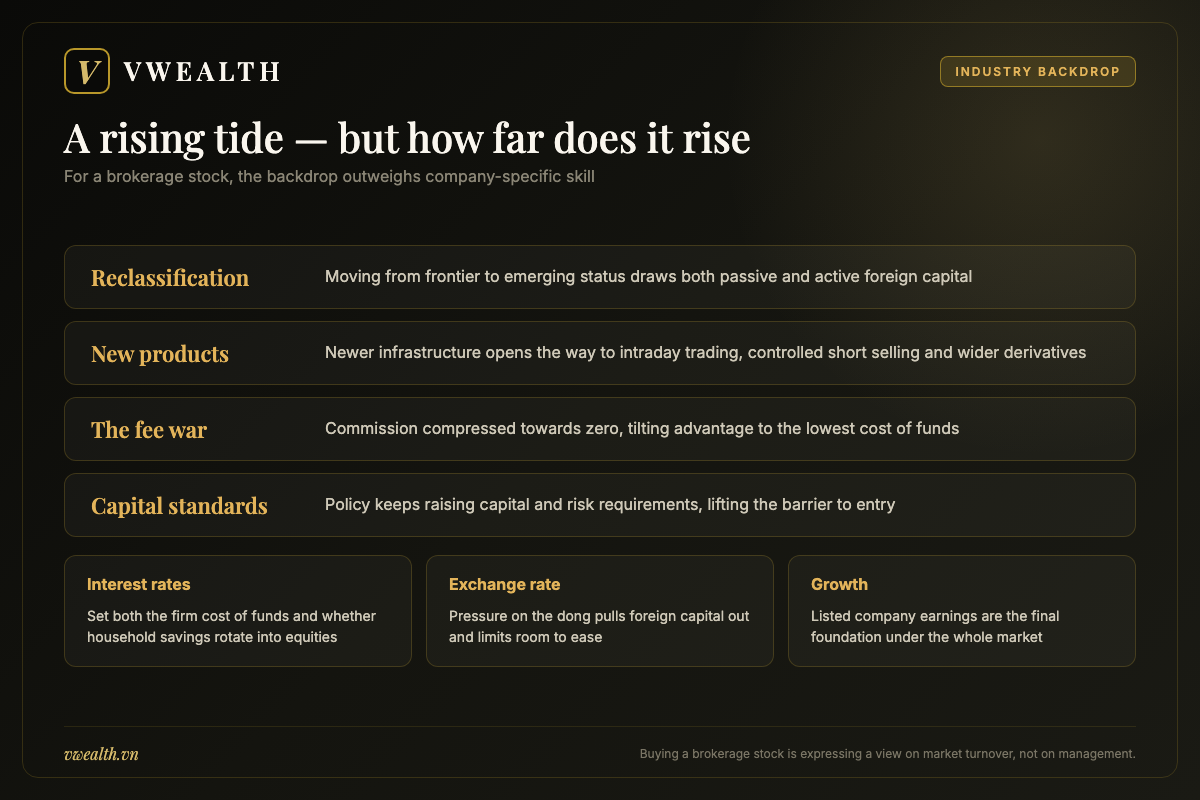
The industry backdrop: a rising tide, but how far does it rise
Brokerage stocks are the category where the industry backdrop matters more than the individual company. A superbly run firm in a market with drained liquidity still posts poor results; an average firm in a booming market still reports record profits. So this chapter is not supplementary material — it is half of the investment case.
Market reclassification: the biggest story of the decade
The prospect of Vietnam being upgraded by international index providers from frontier market status to emerging market status has been a live subject for years, and it bears more directly on brokerage stocks than on any other sector. The mechanism is concrete: when a market is reclassified, index-tracking funds benchmarked to emerging market indices are obliged to allocate capital to it, creating new foreign inflows. Those inflows raise turnover, and turnover is the raw input for every securities firm.
Beyond passive flows there is an indirect consequence that may be larger still: active foreign institutions also tend to raise allocations to a market carrying the emerging label, because many funds have internal mandates restricting frontier exposure. For an international reader unfamiliar with the practical steps of participating in this market, the pillar article on how to invest in the Vietnam stock market covers account structures, settlement conventions and foreign ownership mechanics.
The counterweight: the reclassification story has been discussed for years, and some portion of the expectation is certainly already in prices. For an investor buying a brokerage stock today, the right question is not whether reclassification happens, but how much of the expectation remains unpriced.
New trading infrastructure and products that do not yet exist
Vietnam’s newer trading infrastructure and the mechanisms accompanying it open the door to a range of products the market either lacks entirely or has only in rudimentary form: intraday trading, controlled short selling, central counterparty clearing for the cash market, and a broader derivatives suite. Notably, MBS has disclosed preparations to launch gold-linked derivatives, indicating an appetite for widening the product shelf.
For a brokerage, each new product is a new revenue line and a new reason for clients to transact. But it is worth saying plainly: new products usually demand heavy technology investment, specialised risk management teams, and a long runway before reaching meaningful scale. In the short term, they are more often a valuation story than a genuine profit source.
The fee war and what it costs
For years, competition for brokerage share in Vietnam has been waged with two instruments: cutting commission and cutting margin interest rates. The result is that margins in both businesses have been compressed, and advantage has shifted towards firms with the lowest cost of funds — meaning those with strong parents or access to cheap offshore capital.
This is simultaneously good and bad news for MBS. Good, because the bank-owned model places the firm squarely in the low-funding-cost group. Bad, because a growing number of rival brokerages also have strong parents, so the advantage is no longer scarce. When every competitor enjoys cheap funding, competition migrates to product quality, technology and customer experience — precisely the field the new chief executive comes from.
Macro conditions: three variables that govern turnover
Vietnamese market liquidity depends on three macro variables, and you should watch all three while holding a brokerage stock. The first is the level of interest rates: low deposit rates push household savings towards equities, while high rates do the opposite and simultaneously raise the brokerage’s own funding cost.
The second is the exchange rate. When the dong comes under pressure, foreign capital tends to withdraw and monetary policy loses room to ease. The third is economic growth and listed company earnings — the ultimate foundation determining whether the market has any reason to rise at all. Together these three explain most of the variation in turnover across years, and because turnover determines brokerage profit, they indirectly determine the MBS share price.
Policy direction: a capital bar that keeps rising
The policy trend for Vietnam’s securities industry has been consistent for years: raise capital standards, tighten risk management, and increase transparency requirements. This builds an ever-higher barrier to entry, favouring firms that already have scale and disadvantaging small ones.
That trend explains why the capital race within the industry has become so intense. Capital is not only the raw material for margin lending; it is also the condition for being licensed for new activities, for underwriting large issues, and for absorbing regulatory adequacy requirements. Against that backdrop, MBS aiming at a charter capital of 10,000 billion dong is not merely ambition — it is the price of staying in the leading group.
Consolidation pressure and what it could mean for MBS
One structural theme worth watching is whether Vietnam’s brokerage industry undergoes another round of consolidation. The conditions that produced the 2012 to 2015 wave are partially present again: a large number of licensed firms, rising capital requirements, and a widening gap between the top handful and everyone else. Smaller brokerages struggling to fund a competitive margin book or a modern trading platform face a strategic choice between selling, specialising, or slowly fading.
For MBS this cuts two ways. As one of the firms with a strong parent and a rising capital base, it sits on the acquiring side of that equation rather than the acquired side, and it has documented experience of integrating another brokerage from the 2013 VIT transaction. Acquiring a smaller firm could add clients and licences faster than organic growth.
Against that, acquisitions in financial services destroy value at least as often as they create it, and the Vietnamese market has seen foreign buyers pay full prices for brokerage licences during optimistic periods. If MBS were to announce a transaction, the questions to ask would be the standard ones: what exactly is being bought, at what multiple of book value, and what happens to the combined capital adequacy. Nothing has been announced, and this paragraph is a framework for reading future news rather than a prediction.
The wider point is that the brokerage sector in Vietnam is still structurally young. Ownership patterns, product ranges and even the basic economics of the business have changed substantially twice in fifteen years. An investor holding a securities stock should expect the industry to look different again in five years, and should size the position accordingly.
Foreign investors reading Vietnam for the first time
If you are approaching Vietnamese equities from outside, three market conventions shape how a brokerage stock behaves and are worth knowing before you build a position. Settlement runs on a T plus two cycle, so shares bought are not sellable on the same day, which structurally limits turnover compared with markets offering intraday trading. Daily price bands apply, and the band on HNX is wider than on HOSE, which is one reason HNX-listed brokerages display larger daily swings. And foreign ownership limits differ by sector, with brokerages treated far more liberally than banks.
None of these features is unusual for an emerging Asian market, but together they mean that liquidity, and therefore brokerage earnings, respond to structural reform as much as to the economic cycle. That is why regulatory milestones move brokerage share prices more than corporate announcements do.
Looking forward: three scenarios for MBS stock and the conditions for each
This section offers no price target, because any number would be stale before you finished reading. Instead it describes three future states and the specific conditions that let you identify which one is unfolding. The right way to use it is to reopen this table each quarter and mark off which conditions have actually occurred.
The four variables that decide the outcome
The first variable is average daily market turnover. This is the dominant input, driving both brokerage revenue and margin demand directly. You can watch it daily without waiting for financial statements, and it is the earliest indicator of sector earnings.
The second is the efficiency with which new capital is deployed. The company is raising a very large sum relative to its existing size. If that capital is deployed quickly into margin lending at unchanged spreads, absolute profit rises proportionally. If it sits idle because client borrowing demand does not keep pace, return on equity falls even as absolute profit grows.
The third is the level of interest rates, which cuts both ways at once: it sets the firm’s funding cost and determines whether household savings flow into equities.
The fourth is progress on the institutional stories — market reclassification, new products, and the firm’s own exchange transfer. This group affects near-term profit least but affects the multiple the market is willing to pay the most.
The optimistic scenario: new capital meets a strong liquidity cycle
In this case the capital raise completes just as market turnover settles at a high level. The margin book is deployed quickly, spreads hold thanks to favourable funding from the banking ecosystem, and the brokerage franchise keeps its place among the top ten. The reclassification story advances, bringing foreign inflows and lifting average daily traded value.
Identifying conditions: market-wide turnover holds at a high level across several consecutive quarters; the MBS margin book grows quickly without a corresponding rise in provisioning; return on equity does not decline after the equity base expands; brokerage share holds above the 5 per cent mark. Meet all four across two or three consecutive quarters and the balance-sheet expansion model is proving itself.
In that scenario the reward to shareholders comes from two reinforcing sources: earnings rise and the valuation multiple rises with them. This is why brokerage stocks deliver very high returns in the favourable phase of a cycle — and why the downside risk is correspondingly severe.
The base scenario: bigger without being better
This is the outcome the article regards as most likely, simply because it requires the fewest ideal conditions. The capital raise completes, the firm is larger, absolute profit grows, but profit growth does not keep pace with the increase in share count. Earnings per share flatlines or edges up slightly. Brokerage share holds around current levels because competition remains fierce. Reclassification and the exchange transfer progress more slowly than hoped.
Identifying conditions: absolute profit rises while earnings per share is essentially unchanged across four quarters; return on equity slips modestly against the pre-raise period; the margin book grows more slowly than shareholders’ equity.
For an investor, the base case is not a disaster but neither is it something to pay a premium for. It means the stock trades mostly on general market sentiment, and your return depends almost entirely on where in the cycle you bought rather than on what the company achieved.
The adverse scenario: new capital meets a turning market
The adverse case does not require a crisis. It only requires market turnover to contract for several quarters, whether because rates rise or because of an external shock, for the entire profit structure of a brokerage to come under simultaneous pressure: commission falls, margin demand falls, the trading book takes revaluation losses, and investment banking mandates are postponed.
In that state, a firm that has just raised substantial capital suffers an additional layer of disadvantage: a large equity base generating insufficient income, causing return on equity to fall faster than at peers who stayed smaller. If the market declines sharply, credit risk in the margin book can crystallise — exactly the mechanism that struck the firm’s predecessor in 2011, though risk frameworks and regulation today are considerably tighter than they were then.
Identifying conditions: market-wide average turnover falls sharply and stays down; doubtful receivables and provisioning charges rise in the notes; the capital adequacy ratio declines over consecutive periods; the firm voluntarily narrows its list of margin-eligible securities.
The three scenarios summarised
| Scenario | Required conditions | Early signals | Consequence for shareholders |
|---|---|---|---|
| Optimistic | High and sustained market turnover; rapid deployment of new capital into margin; reclassification advances | Return on equity holds after the raise; share above 5 per cent; provisioning does not rise | Earnings and valuation multiple rise together |
| Base | Flat turnover; continued fee competition; institutional stories progress slowly | Absolute profit rises while earnings per share is flat | The stock trades on sentiment; entry point determines the result |
| Adverse | Turnover contracts for several quarters; rates rise; market falls sharply | Provisioning and doubtful receivables rise; capital adequacy declines; margin list narrowed | Profit falls against an enlarged equity base; return on equity drops quickly |
To be explicit: no probabilities are attached to these scenarios, because any probability would merely be an opinion. The value of the table sits in the early signals column — things you can verify from disclosed data without guessing.
So should you buy MBS stock? A straight answer
After seven chapters it is time to answer the question in the title. The article will not tell you to buy or not to buy, because that decision is yours and depends on things the article cannot know: your time horizon, your risk appetite, your existing portfolio and your personal financial position. What the article can do is put the case for and the case against on the scales honestly.
The case for: five reasons MBS deserves consideration
First, the banking ecosystem model delivers two concrete and measurable advantages: a favourable cost of funds and a low customer acquisition cost. In an industry whose profit is literally an interest spread, this is not a decorative advantage.
Second, the firm has demonstrated an ability to transform its model. From the stumble of 2011, MBS spent a decade climbing back into the leading group by an entirely different route, and in 2025 entered the trillion-dong profit club for the first time. That is execution evidence, not a promise.
Third, the capital base after the current raise puts the firm in the group with the financial capacity to participate in every activity the industry offers. Given the policy trend towards higher capital standards, this is a survival condition rather than surplus ambition.
Fourth, the stock carries several unrealised catalysts: the exchange transfer, an improving free float, potential index inclusion, and the market reclassification story. None is certain, but together they create room for a rerating.
Fifth, the new leadership has a clear technology orientation that matches where competition in this industry is actually heading, now that commission has been compressed to the point where it no longer functions as a competitive weapon.
The case against: six risks you must look at squarely
First, this is a highly cyclical stock. Earnings and valuation swing together with market turnover, producing large ranges in both directions. Anyone who cannot tolerate a sharp drawdown over a few months should not hold this name in size.
Second, dilution is a real and current risk. With an offering structured as one new share for every two held, shareholders who do not participate will see their ownership proportion fall materially. Even those who do participate must commit additional capital to an already volatile position.
Third, credit risk in the margin book. This is a structural feature of the model, concentrated into precisely the worst market conditions, and this company’s own history shows how severe the consequences can be.
Fourth, dependence on the parent bank’s strategy. Most of the MBS competitive advantage originates in its relationship with MB. That relationship is not something minority shareholders of MBS control, and any shift in group-level priorities feeds straight through to the subsidiary.
Fifth, share liquidity and listing venue. A constrained free float and an HNX listing reduce appeal to institutional investors and make large positions more expensive to trade.
Sixth, fierce industry competition and an advantage being levelled. More and more brokerages now have strong parents, cheap funding and aggressive technology budgets. The MBS ecosystem advantage is genuine, but it is no longer as rare as it was a decade ago.
The case for and against, side by side
| For | Against |
|---|---|
| Favourable funding and customer acquisition costs through the banking ecosystem | That entire advantage rests on strategic decisions made by the parent bank |
| Demonstrated ability to transform the model, reaching trillion-dong profit in 2025 | Earnings swing violently with the market liquidity cycle |
| Post-raise capital base sufficient for every licensed activity and rising regulatory standards | Substantial dilution; earnings per share may flatline even as total profit grows |
| Several unrealised catalysts: exchange transfer, index inclusion, market reclassification | Those catalysts have been discussed for years without materialising |
| New leadership with a technology orientation matching the competitive landscape | New leadership without a long track record across a full cycle |
| A client base from the parent bank that should carry a better credit profile than average | Margin credit risk concentrates into the worst market conditions, as 2011 demonstrated |
Who MBS suits, and who it definitely does not
For the growth investor with high risk tolerance, a constructive view on Vietnamese market liquidity over the next two to three years, and a sufficiently long horizon: MBS is a defensible choice within the brokerage sector, particularly if you prefer a balance-sheet-led model to a broker-force-led one. The condition is that you must be willing to subscribe to further capital raises and to absorb large price swings.
For the value investor hunting businesses trading below asset value: MBS requires one extra step many people skip — recomputing book value per share after the offering completes, and only then comparing multiples. Skip that step and every conclusion about cheapness is unreliable. Beyond that, brokerage stocks are rarely cheap in the value sense at precisely the moments they are easiest to buy.
For the income investor seeking steady cash dividends: this is not the right name. The industry needs to retain capital to expand, and MBS specifically is paying a dividend while calling for several times as much in new equity. Look instead to sectors with stable cash generation and low reinvestment needs.
For the newcomer or the low-risk-tolerance investor: this is not a starting position. Brokerage stocks are volatile and demand a working understanding of market cycles and the ability to read the notes to financial statements. If you want exposure to the growth of Vietnam’s capital market without the volatility of a single name, a diversified approach across the sector or through funds is the more sensible route, and the market structure primer covers the available vehicles.
Four questions to answer before you place an order
Question one: what is your view on Vietnamese market turnover over the next two years? If you have no view, you should not be buying a brokerage stock, because that variable will drive your result more than anything specific to the company.
Question two: have you recomputed earnings per share on a fully diluted basis? Not on the current share count, but on the count after every approved plan has been executed.
Question three: are you prepared to commit additional capital in rights offerings? If not, accept in advance that your ownership will be diluted, and build that into your expectations from the start.
Question four: is your position small enough that you would sleep soundly through a 30 per cent quarterly decline? For a cyclical stock carrying double leverage, this is not a pessimistic question but a practical one.
Closing: a good machine standing on a sloping floor
The MBS story is the story of a business that learned its industry’s most expensive lesson twenty years ago, rebuilt itself under the shelter of a large bank, and is now placing the largest bet in its history on a single proposition: that the Vietnamese stock market will keep growing and that demand for margin credit will keep rising with it. There is a good deal supporting that proposition, from the still-low share of the population participating in the market, to market capitalisation relative to the size of the economy, to the reclassification story.
But a bet is still a bet. The success of this strategy depends on things beyond management’s reach: the level of interest rates, foreign capital flows, retail sentiment, and the timing of institutional reforms nobody controls. The company can do everything right and still endure several poor years, simply because the floor it stands on has tilted the wrong way.
So should you buy MBS stock? If you understand that you are buying a controlled leverage on Vietnamese market liquidity, accept that the expansion comes with dilution and several unattractive quarters, and hold a horizon long enough and a position small enough to sleep at night — then MBS is a defensible choice within the brokerage sector. If you are buying because the capital raise headline sounds exciting, because the stock has just run, or because you assume a big bank behind it makes losses impossible, then you are buying a narrative rather than a business.
One last thing to carry with you: the history, ownership structure and strategy of MBS change slowly, but the margin book, capital adequacy, earnings mix, share count and valuation change every quarter. Before you place an order, open the latest research report and score the seven checks from chapter four again. It takes fifteen minutes, and they are the most valuable fifteen minutes in the whole decision process. If you do not yet have the tools to do that, create a vwealth account and let the platform read the filings for you.
This article provides information and analysis for reference purposes only and is not a recommendation to buy or sell any security. All investment decisions are your own and you bear responsibility for their outcomes. Consider consulting a licensed financial adviser before acting.
Research Vietnamese stocks in English with vwealth. Our AI-powered platform turns Vietnamese market data into full English analysis reports — with international payment support and a free 2-month trial for new accounts. Create your free account and read the latest reports.