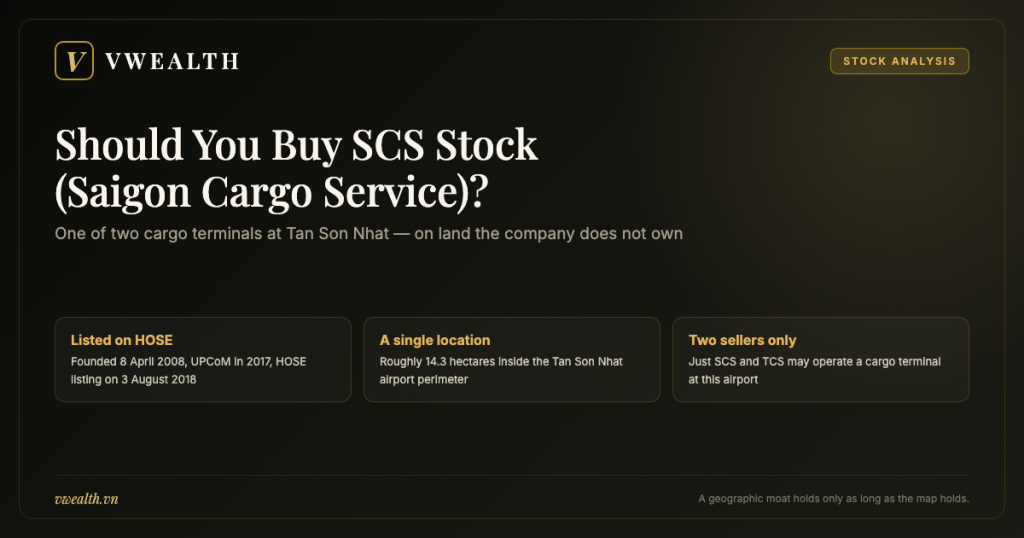
Should you buy SCS stock? The ticker belongs to Saigon Cargo Service Joint Stock Company, known locally as SCSC, and it presents foreign investors with one of the strangest risk-reward profiles on the Ho Chi Minh Stock Exchange. On one side sits a business with gross margins in the seventies, a genuine geographic moat, a cash dividend record that few listed Vietnamese companies can match, and a position as one of only two operators permitted to run a cargo terminal at Tan Son Nhat International Airport. On the other side sits a share that trades so thinly a mid-sized order can move the price against the buyer, a business built entirely on a single plot of land the company does not own, and a new airport under construction thirty-five kilometres away that will add more cargo capacity than the entire existing market. This analysis walks through all of it: how the company was built, how it earns money, the seven things you must check in its financial statements, and a straight answer on which kind of investor SCS suits and which kind it absolutely does not.
A note on method before we begin, the same one that applies to every company profile in this series. You will find dates, names, land areas, capacity figures and market share numbers throughout, all drawn from public sources: prospectus and disclosure filings to the exchange, shareholder meeting resolutions, statistics published by the Civil Aviation Authority of Vietnam, and mainstream financial press. What you will not find is a current-quarter figure. No latest earnings number, no current margin, no trailing P/E. Air cargo volumes swing hard with season and with the global trade cycle, and an article that will still be read two years from now would mislead you within ninety days if it quoted a single quarter. Instead this piece teaches you where to look and how to read it; for the current numbers, open the latest analysis reports on vwealth.
One more caution, and it matters more for SCS than for almost any other Vietnamese listed company a foreign investor might consider. This is a thinly traded stock. On many sessions, the total matched value in SCS is a small fraction of what a mid-cap bank trades. Three practical consequences follow, and you need to accept all three before the business analysis becomes relevant. You may not be able to build the position size you want at the price you want. When you need to exit, you may have to accept a meaningfully worse price than the last printed one. And intraday price swings tend to be wider than your instinct about a stable infrastructure company would suggest. If you cannot live with that, the more liquid names covered in our guide to Vietnamese aviation and logistics stocks are a better starting point.
From a plot of military land to Vietnam’s first private cargo terminal: the history of Saigon Cargo Service
Some listed companies have a corporate history so tangled you need a diagram. SCS is the opposite. Eighteen years of history fit into one sentence: the company secured a plot of land inside an airport, built a cargo terminal on it, and has operated that terminal ever since. That simplicity is what makes SCS interesting to analyse, and it is also precisely what makes the investment fragile. The entire enterprise rests on one leg.
2008: a company incorporated to do exactly one thing
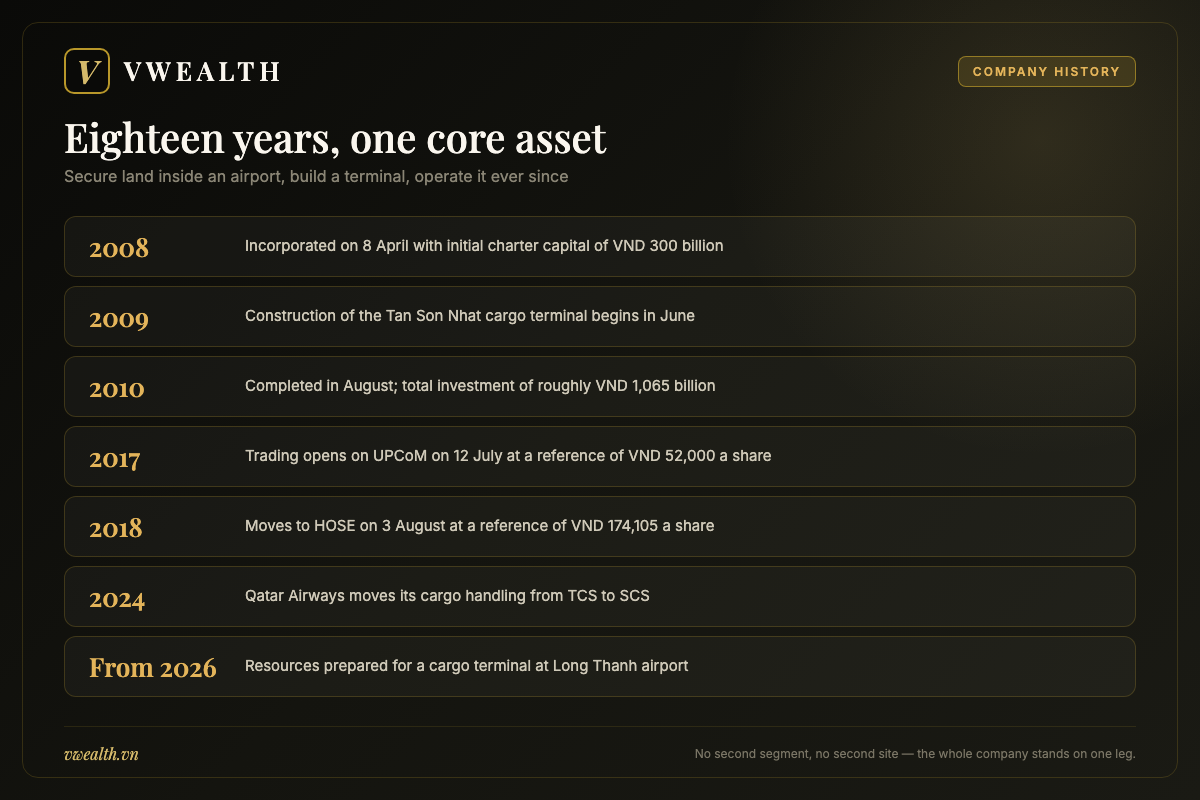
Saigon Cargo Service Joint Stock Company was established on 8 April 2008 with initial charter capital of VND 300 billion. Its stated purpose was written into the charter without ambiguity: to invest in, build and operate an international-standard air cargo terminal at Tan Son Nhat International Airport. No secondary segment, no diversification plan, no attached property play. A company created to do one thing.
The timing deserves attention. 2008 was the year the global financial crisis reached Vietnam, lending rates spiked into high double digits and international trade contracted visibly. Committing capital to an air cargo terminal in that particular year was a counter-cyclical decision. But aviation infrastructure has a property other infrastructure lacks: the gap between deciding and operating typically runs two to three years, so whoever commits at the bottom of a cycle brings the asset online as the cycle turns up. That is what happened here.
The 14.3 hectares, and a very unusual founding shareholder
This is the single most important fact in the company’s history, and it is the one most often skipped by investors who look only at the margin profile. All of the company’s operations sit on a plot of roughly 14.3 hectares inside the Tan Son Nhat airport perimeter. SCS did not buy that land, and it does not lease it from a civilian authority. The land was contributed as equity capital by Aircraft Maintenance Company 41, commonly abbreviated A41, an enterprise under the Ministry of National Defence. In other words, the physical foundation of SCS is military land injected into a joint stock company as a capital contribution.
That structure explains a great deal. It explains how a company with no state parent obtained a position no other private operator could obtain: land inside the Tan Son Nhat perimeter was effectively fully allocated years ago, and what remained sat under military management. It explains why A41 remains one of the company’s three large shareholders to this day. And it creates a risk unique to this stock, which we return to in detail later: under the disclosed terms, if the Ministry of National Defence issues an urgent requirement for military or defence purposes, activity on the plot must stop and the site must be handed back in its existing condition. This is not a hypothetical constructed to balance the article. It sits in the company’s own disclosure documents.
What a foreign investor should understand about the regulatory frame
Before going further into the company, it helps to understand the environment it operates in, because it differs from what an investor used to developed markets might assume. Airport ground services in Vietnam are a conditional business line: an operator needs specific licences from the aviation regulator, service charges sit within a state-managed tariff framework, and the airport operator itself is a state-controlled corporation that also acts as landlord, coordinator and, in the case of Long Thanh, project developer.
The practical meaning is that the competitive landscape is shaped by administrative decisions at least as much as by commercial ones. A tender mechanism, a master plan revision or a licensing decision can move value between listed companies in a way no operating improvement would match. For an investor, this argues for weighting regulatory news flow heavily and for treating management guidance about future projects as conditional on decisions taken elsewhere.
It also has a positive side that is easy to miss. The same conditional framework that limits SCS is what has kept the number of competitors at two for fifteen years. Regulatory barriers are barriers regardless of which direction they point, and in this case they have protected the incumbent far more than they have constrained it. The risk is not that the framework exists; it is that the framework is applied to a new map, at a new airport, with the incumbency reset to zero.
2009 to 2010: fifteen months to build a terminal
Construction of the Tan Son Nhat cargo terminal project began in June 2009 and was completed in August 2010, entering service the same year. Total investment came to roughly VND 1,065 billion. Note that number, because it is the denominator of every efficiency calculation that follows: a company put slightly over a trillion dong to work fifteen years ago, and that asset is still generating cash today while most of its depreciable value has already been written off.
The physical dimensions are worth picturing concretely, because they represent the entirety of the company’s productive capacity. The operating area covers roughly 143,000 square metres. Within it, the apron covers roughly 52,421 square metres, enough for three wide-body freighters of the Boeing 747F class or five narrow-body Airbus A321 aircraft to park simultaneously. The cargo terminal building itself occupies roughly 26,670 square metres. The remainder is warehousing, vehicle parking, offices and supporting infrastructure.
Why an air cargo terminal is a bigger business than it sounds
If you have never thought about this link in the chain, follow a single export shipment. A batch of electronic components leaves a factory in Binh Duong, goes onto a truck, and its next stop is not the aircraft. It must enter a cargo terminal, where the shipment is weighed, security screened, customs cleared, sorted, built onto the airline’s unit load devices, chilled if it is temperature sensitive, and stored if the flight has not arrived. Only when all of that is done does the cargo get towed to the apron and loaded. On the import side the sequence runs in reverse.
The cargo terminal is therefore a compulsory bottleneck. Airlines do not perform this function themselves, because they hold no land inside the airport and do not want the fixed cost. Shippers cannot perform it either, because this is a security-restricted zone. The result is a business model that is easy to understand: whoever owns a terminal inside the airport collects a fee on every kilogram that passes through, regardless of whose cargo it is, where it is going, or what it is worth. Investors call this a toll road model. You are not selling a product; you are selling the right to pass.
2017: the UPCoM listing and a year that is hard to believe
SCS shares began trading on UPCoM, Vietnam’s third and least regulated marketplace, on 12 July 2017 at a reference price of VND 52,000 per share. Within twelve months the stock had risen more than two hundred percent. On its final UPCoM session it closed at VND 168,500.
That move was not pure speculation. It reflected something simpler: while the company sat outside the market’s field of view, very few investors knew that a business with gross margins above seventy percent and effectively no third competitor was operating at Tan Son Nhat. As the information spread, the price adjusted toward the quality of the underlying business. It is a textbook case of the market repricing a good company it had overlooked, and it also explains why SCS is rarely cheap today. The market now knows exactly what this company is.
2018: the move to HOSE
On 3 August 2018, close to 50 million SCS shares traded their first session on the Ho Chi Minh Stock Exchange at a reference price of VND 174,105 per share. Moving from UPCoM to HOSE carries real consequences: stricter disclosure standards, a narrower daily price band, and eligibility for funds whose mandates forbid holdings on UPCoM. If the three-marketplace structure of the Vietnamese market is new to you, our explainer on the differences between HOSE, HNX and UPCoM covers the mechanics, and the guide to Vietnamese trading rules explains the price bands and settlement cycle that will shape your execution.
2024: taking the biggest customer from the only competitor
The heaviest single event in the company’s recent history came in February 2024, when Qatar Airways moved its entire Tan Son Nhat cargo handling from TCS to SCS. TCS, formally Tan Son Nhat Cargo Services, is the operator associated with Vietnam Airlines and the only competitor SCS has at this airport.
The reason for the switch was not price. According to disclosed information, TCS was by then operating close to full capacity with no remaining land to expand, while SCS was running at roughly eighty to eighty-five percent of design capacity. The two parties had been discussing cooperation since around 2022. The impact was substantial: Qatar Airways was projected to account for roughly a quarter of SCS throughput in the first year, and the company’s share at Tan Son Nhat rose from roughly thirty-five percent to nearly half.
Remember this episode when you weigh whether to buy SCS stock. In a market with two sellers, share does not drift; it moves in blocks. One large airline changing supplier is enough to redraw the picture within months. That is true in both directions, and the reverse case exists too.
Key milestones at a glance
| Date | Event | Why it matters to an investor |
|---|---|---|
| 8 April 2008 | Incorporated with VND 300 billion charter capital | A company created to do exactly one thing |
| June 2009 | Construction of the Tan Son Nhat cargo terminal begins | Counter-cyclical investment of roughly VND 1,065 billion |
| August 2010 | Terminal completed and enters service | The core asset starts generating cash |
| 12 July 2017 | Trading begins on UPCoM at VND 52,000 | The market discovers the company |
| 3 August 2018 | Moves to HOSE at a reference of VND 174,105 | Tighter disclosure, accessible to institutional mandates |
| February 2024 | Qatar Airways switches from TCS to SCS | Share at Tan Son Nhat rises toward half the market |
| From 2026 | Resources prepared for the Long Thanh cargo terminal | The variable that defines the next chapter |
Who owns Saigon Cargo Service, and who runs it?
For most listed companies the ownership chapter is one to skim. For SCS it is not. The shareholder structure here determines almost everything: who gets first look when the Long Thanh opportunity appears, why the dividend policy is so generous, and why the stock is so illiquid. Three apparently unrelated questions with one answer: because most of the shares sit with three institutions that have no intention of selling.
Three large shareholders and a three-legged stool
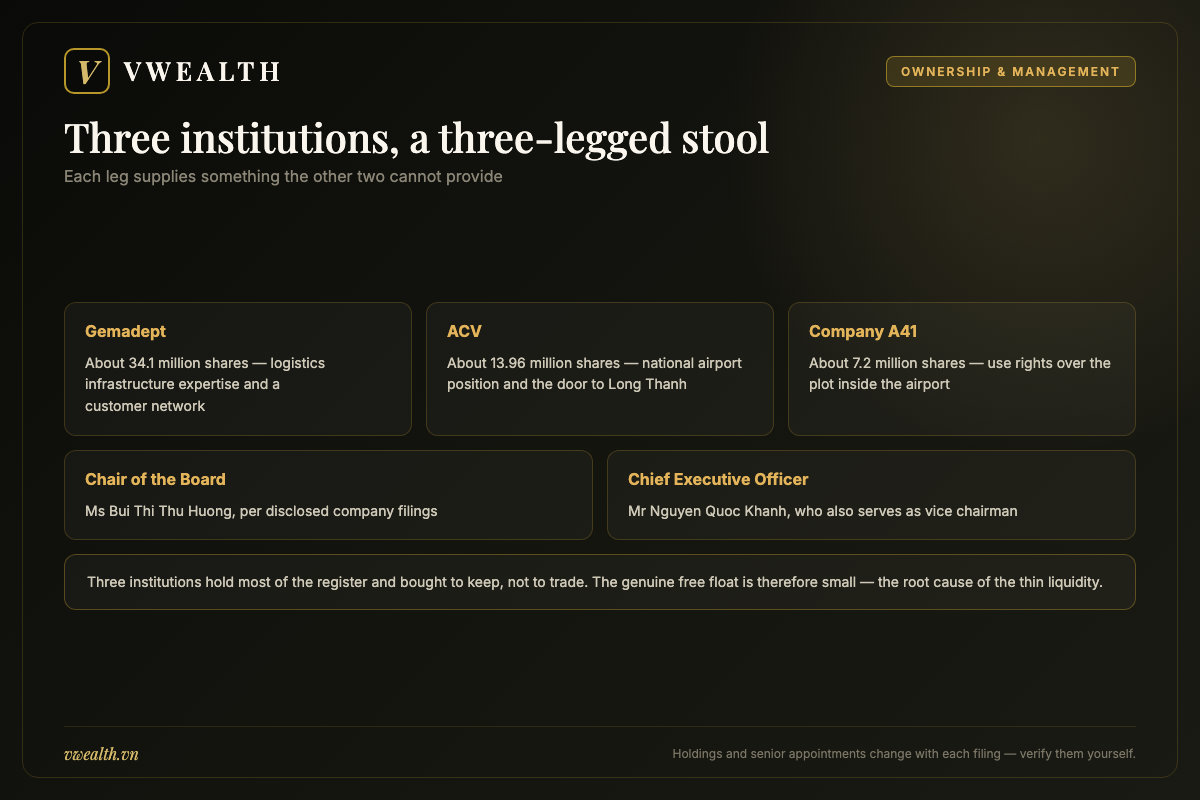
According to disclosed company filings, SCS ownership revolves around three names. The largest is Gemadept Corporation, holding roughly 34.1 million shares, equivalent to around a third of charter capital, with some recent disclosures putting the figure closer to thirty-six percent. Second is Airports Corporation of Vietnam, known as ACV, holding roughly 13.96 million shares or around fourteen percent. Third is Aircraft Maintenance Company 41, the Ministry of National Defence entity, holding roughly 7.2 million shares.
These three form an unusual stool because each leg supplies something the others cannot. Gemadept brings logistics infrastructure expertise and a customer network; if you want to understand why a seaport operator sits on the board of an aviation company, our analysis of GMD stock and the Gemadept logistics strategy sets out the wider chain they are assembling. ACV brings authority over national airport infrastructure and, critically, the developer role at Long Thanh, which makes it simultaneously partner and potential competitor. A41 brings the one thing nobody can substitute: the land.
Why this ownership structure strangles liquidity
Add the three together and you have a very high proportion of the register held by institutions that bought for strategic reasons rather than to trade. The genuinely floating portion of the share count is therefore far smaller than the headline market capitalisation implies. That, and not market indifference, is the root cause of the thin trading.
The practical consequences for you are three. First, a large buy order can push the price up several percent within the session, making you the most expensive buyer of your own position. Second, in a broad market panic SCS can fall further than the fundamentals deserve, simply because there is not enough resting bid to absorb selling. Third, and this is the one investors rarely think through: if you manage a portfolio of any real size, the maximum weight you can allocate to SCS is capped by liquidity rather than by conviction.
What the register tells you about capital allocation
There is a second reading of the ownership structure that goes beyond liquidity, and it concerns how the company decides what to do with its money. When three institutions with different objectives hold the bulk of the register, capital allocation tends toward the option all three can accept rather than the option any one of them would choose alone. In practice, the option all three can accept is usually to pay the cash out.
That is not a criticism. Returning cash rather than deploying it into weak projects is a discipline many Vietnamese listed companies conspicuously lack, and the absence of empire-building at SCS is a real point in its favour. Companies with a single dominant owner and a large cash balance frequently end up diversifying into unrelated ventures; the SCS structure has effectively prevented that for fifteen years.
But the same structure creates a specific question for the years ahead. A decision to commit significant capital to Long Thanh is exactly the kind of decision that requires all three parties to align, and one of the three is the counterparty on the other side of the transaction. If you are assessing how likely SCS is to secure a strong position at the new airport, the register is as informative as any operating metric — it tells you who is negotiating with whom, and on which side of the table each sits.
Watch, therefore, for two specific things in disclosures: whether large capital commitments are approved with clear majorities or with visible dissent, and whether related-party transactions with the shareholder group are disclosed with enough detail to be assessed. Both are readable in the annual meeting materials without any special access.
The chair: Ms Bui Thi Thu Huong
According to company filings available at the time of writing, the chair of the board of directors is Ms Bui Thi Thu Huong. Verify this yourself before acting, because senior appointments at companies with controlling institutional shareholders change with board terms and with decisions taken by those shareholders, and no written analysis can update in real time.
More instructive than the individual is how this governance model actually works. At a company where three institutions hold the bulk of the register, the board functions closer to a negotiating table between capital providers than to an independent supervisory organ. The advantage is that major decisions — expansion capex, dividend levels, bidding for new projects — get weighed carefully, and management rarely acts unilaterally. The disadvantage is speed: when three parties have interests that do not perfectly align, closing a large decision takes longer than at a company with a single controlling owner. Our guide to corporate governance in Vietnamese listed companies explains what to look for in this structure.
The chief executive: Mr Nguyen Quoc Khanh
The chief executive role at SCS is held by Mr Nguyen Quoc Khanh, who also serves on the board as vice chairman. Combining board membership with executive responsibility is common among mid-sized Vietnamese companies, and it cuts both ways.
The upside is that the person setting strategy also understands daily operations, which is not trivial at a company whose competitive edge lies in cargo processing speed and service quality for airline customers. The point to monitor is that the line between oversight and execution blurs. For a retail investor the practical test is not a theoretical governance debate but reading the annual shareholder meeting minutes: what minority shareholders ask, whether management answers directly or evasively, and whether last year’s commitments were delivered.
The wider management team, and one detail worth noticing
Beyond the chair and chief executive, disclosed filings list board members including Mai Xuan Canh, Ta Thu Ha, Chu Trung Kien, Doan Ngoc Cuong and Nguyen Ngoc Quy; deputy chief executives To Hien Phuong and Nguyen Thai Son; and chief accountant Ngo Thi Anh Thu. The registered head office is at 30 Phan Thuc Duyen in the Tan Son Nhat area of Ho Chi Minh City, which is to say inside the airport precinct rather than in a downtown office tower.
The address sounds like trivia, but it tells you what kind of company this is. SCS is an operating unit, not an investment holding company. The entire management team works a few hundred metres from the warehouse floor. For a business whose single most important metric is how quickly a shipment moves through the building, having decision-makers sitting next to the line is a small but real advantage.
Dividend policy: the reason many investors find SCS in the first place
If one thing drives search traffic toward this ticker, it is the dividend. SCS belongs to a very small group of Vietnamese listed companies that pay substantial cash dividends twice a year, at high ratios relative to par value, and that have kept doing so across many consecutive years including the years when Vietnamese aviation was at its worst.
Look at the rhythm across earlier years rather than the current one. In 2020 the company paid cash at ratios of fifty percent and thirty percent of par. In 2021 it paid VND 3,000 per share. In 2022 it paid VND 3,500 in cash plus a bonus share issue. In 2023 it paid two tranches of VND 3,000 and VND 2,000. In 2024 it paid two tranches of VND 3,000 each. The pattern is consistent: cash, twice a year, at a high ratio to the VND 10,000 par value.
Why can the company pay that much? The answer is in the asset structure. The terminal was finished in 2010, most of its depreciable value has been written off, and the business requires little annual capital expenditure to keep running. Profit therefore converts into cash almost completely, and cash with no internal use goes back to shareholders. That is also precisely why the three institutional holders are content to sit still: the holding produces a reliable cash stream for their own parent accounts.
But read that policy alongside a warning. The high payout is a consequence of the company having no large project to fund. If SCS genuinely enters an investment phase for Long Thanh or for the phase two capacity expansion, more cash will be retained and the payout ratio will very likely fall for several years. Anyone buying SCS purely for yield needs to be prepared for that. Our guide to dividend investing in Vietnamese equities works through the difference between a temporarily high yield and a durable one.
Ownership structure and what each party contributes
| Shareholder | Disclosed holding | What it brings | Latent risk |
|---|---|---|---|
| Gemadept | About 34.1 million shares, roughly a third of capital | Logistics infrastructure expertise, customer network | Parent company priorities may diverge from minorities |
| ACV | About 13.96 million shares | National airport infrastructure position, Long Thanh access | Shareholder and developer of a competing terminal at once |
| Aircraft Maintenance Company 41 | About 7.2 million shares | Use rights over the 14.3 hectare airport plot | Handback clause on urgent defence requirement |
| Remaining holders | The genuine free float | All of the stock’s liquidity | Small float means violent price moves |
How SCS makes money: anatomy of an air cargo terminal
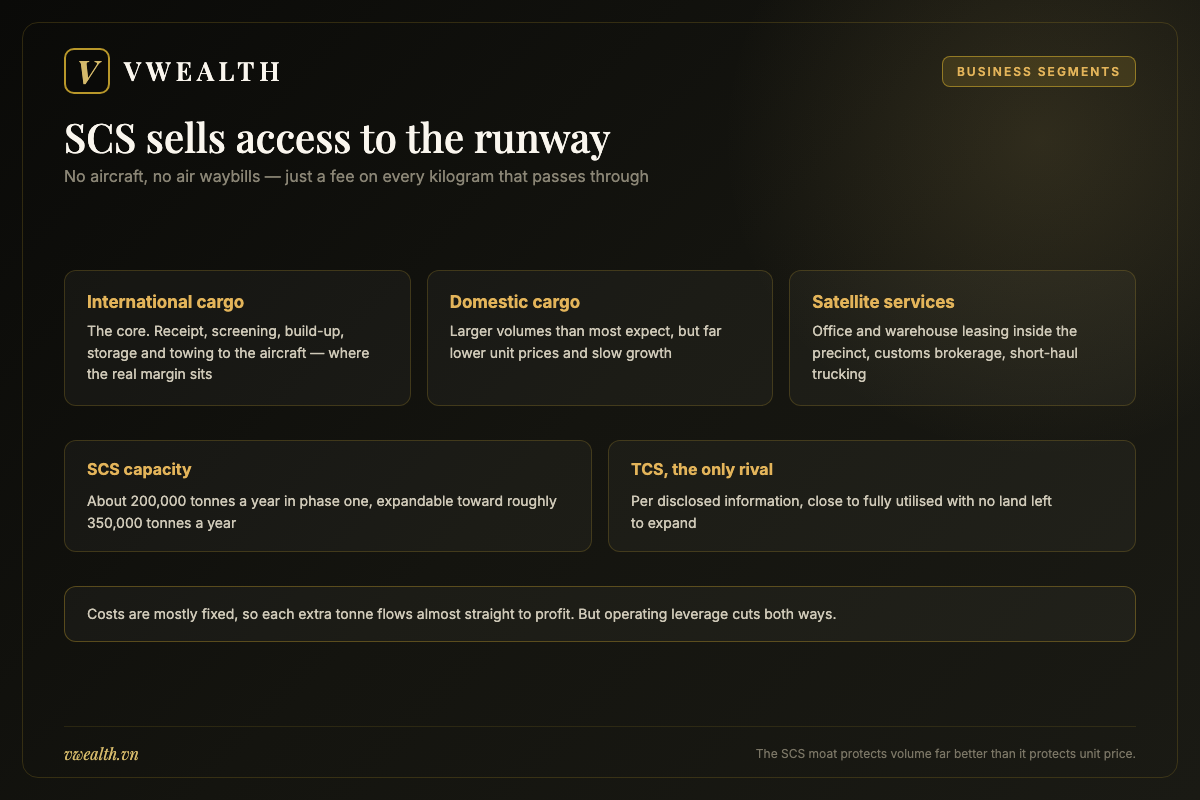
Here is a question new investors skip: what does this company actually sell? Not freight transport — SCS owns no aircraft and signs no air waybills with shippers. Not ordinary warehousing either, because anyone can build a warehouse outside the fence. What SCS sells is access to the runway. And in the whole of southern Vietnam there are exactly two sellers of that.
The core segment: international cargo handling
Most of the company’s value comes from handling international cargo, both exports leaving and imports arriving through Tan Son Nhat. Revenue is charged on volume, at tariffs agreed with each airline, and covers several layers of service stacked on top of one another: receipt and weighing, security screening, build-up onto unit load devices, storage awaiting the flight, handling of special cargo such as dangerous goods or temperature-controlled shipments, and towing to the aircraft.
The important point is that each of those layers carries a different margin, and the higher-value ones — cold chain for pharmaceuticals and seafood, express handling for e-commerce, secure processing for high-value goods — are where the real profitability sits. This is also why two terminals at the same airport can produce very different financial results: cargo mix matters more than total tonnage.
Domestic cargo and the satellite services
Alongside international cargo, SCS handles domestic freight and provides a range of satellite services: office and warehouse leasing inside the precinct, customs brokerage, short-haul trucking and ground handling. Its registered business lines also include real estate operations and fuel distribution, but these are registrations supporting activity inside the precinct rather than independent business segments.
Domestic cargo behaves in the opposite way to international. Volumes are larger than most people expect, unit prices are considerably lower, and growth is slow. Industry statistics show that domestic air cargo volumes across the Vietnamese market in 2025 were essentially flat against the prior year, while international volumes grew strongly. That tells you the growth engine for SCS sits almost entirely on the international side, and that anything slowing global trade hits the company directly. Our note on the China plus one manufacturing shift covers the demand-side driver in more depth.
The customer list: who actually uses the SCS terminal
Published research indicates that SCS serves in the region of twenty-six of the fifty-eight airlines operating at Tan Son Nhat, with the roster including major international carriers such as Cathay Pacific, Singapore Airlines, Emirates, Turkish Airlines and Lufthansa. That customer profile carries three implications a foreign investor should register.
The first is currency. When your customers are international airlines, a meaningful part of the tariff structure is linked to hard currency, which gives the revenue line a natural hedge against dong depreciation that most domestic Vietnamese businesses lack. The second is credit quality. International flag carriers are generally reliable payers, though their payment cycles lengthen when the aviation industry itself is stressed — which is precisely when you least want receivables stretching.
The third implication is the subtlest and the most important. Because the customer base is dominated by foreign carriers rather than by the national airline group, SCS volumes track international route capacity into Ho Chi Minh City rather than domestic demand. When a foreign carrier adds a frequency or upgauges to a larger aircraft, belly cargo capacity into the terminal rises without SCS doing anything at all. When a carrier suspends a route, the reverse happens equally passively. Watching international schedule announcements at Tan Son Nhat is therefore a legitimate leading indicator for this company, and a free one.
It also frames the competitive dynamic accurately. The two terminals at Tan Son Nhat do not serve identical customer sets; published commentary notes that the customer rosters differ. Competition is therefore less a daily price fight than a slow contest for the next contract renewal, decided on capacity, speed and service reliability rather than on tariff alone.
The cost structure, and why the margin is so high
This is the most revealing part of the anatomy. Between 2015 and 2018 — a window far enough in the past to serve as illustration without breaching the rule against quoting current figures — revenue rose from roughly VND 341 billion to roughly VND 675 billion, a compound annual growth rate of about eighteen percent. Gross profit rose faster, from roughly VND 238 billion to roughly VND 528 billion. Net profit rose faster still, from roughly VND 135 billion to roughly VND 416 billion. Average gross margin over that period was around seventy-three percent, touching seventy-eight percent in the best year.
A seventy-three percent gross margin is a level very few non-financial companies on the Vietnamese market reach. The reason is that the company’s largest costs are depreciation and labour, not raw materials. Published analysis puts labour at roughly thirty-nine to forty-four percent of cost of goods sold, while materials — mostly wrapping film and packing supplies — account for roughly ten percent.
This is the profile of a high operating leverage business: costs are mostly fixed, so each incremental tonne flows almost straight to the bottom line. But operating leverage cuts both ways. When volumes fall, fixed costs do not fall with them, and profit drops far faster than revenue. Anyone considering SCS needs to internalise that characteristic before reading a single financial line item.
A worked illustration of operating leverage
Because operating leverage is the single most misunderstood feature of this business, it is worth walking through an illustrative example. The numbers below are invented for teaching purposes and are not SCS figures; use them to understand the mechanism, not to estimate results.
Imagine a terminal with fixed annual costs of 100 units covering depreciation, core staffing, security and facility upkeep, plus a variable cost of 2 units per thousand tonnes handled. Suppose it handles 150 thousand tonnes at a price of 1.2 units per thousand tonnes, giving revenue of 180 units. Total cost is 100 plus 300 times 0.01, and operating profit lands comfortably positive. Now raise volume by twenty percent. Revenue rises by twenty percent, but fixed costs do not move at all, so operating profit rises far more than twenty percent. That is the good half.
Now run it backwards. Cut volume by twenty percent instead. Revenue falls by twenty percent, fixed costs again do not move, and operating profit falls by a multiple of that. In a business where fixed costs dominate, a modest volume decline produces a severe profit decline. Add the fact that depreciation on a mostly written-down asset is low today but would rise sharply after a phase two investment, and you can see how a company can invest for growth and report worse profitability for several years even while doing exactly the right thing strategically.
The practical lesson for reading SCS filings is this: never extrapolate a margin. A margin observed in a high-volume year tells you very little about what the margin will be in a low-volume year, and the direction of surprise is asymmetric. This is also why the utilisation figure from check two deserves more of your attention than the headline profit number.
It is worth adding one qualifier to the seventy-three percent figure, because comparisons across markets can mislead. A cargo terminal reports as gross cost only the direct expense of moving freight through the building; the enormous fixed investment in the building itself flows through depreciation, and much of that depreciation has already been taken. A newly built competitor would report a far lower gross margin on identical operations simply because its asset is young. The margin, in other words, is partly a measure of operating quality and partly a measure of asset age — and only the first half is durable if the company has to build again.
Why there are only two terminals, and whether that holds
At Tan Son Nhat, only two companies provide cargo terminal services: SCS and TCS. Not because a third is prohibited by law, but because there is no land. Tan Son Nhat sits surrounded by some of the densest residential districts in Ho Chi Minh City, and land inside the airport fence was fully allocated long ago. To build a third cargo terminal you would need a plot inside the restricted zone, adjacent to the apron, with taxiway connectivity. Such plots simply do not exist.
The barrier to entry here is therefore not capital, not technology, not brand. It is geography. This is the most durable class of moat there is, because money cannot buy something that does not exist. But precisely because it is a geographic moat, it holds only as long as the map holds. And the map of southern Vietnamese aviation is about to change, which is the subject of a later chapter.
Where SCS sits in the air cargo value chain
To value a company properly you need to know which link it occupies and who holds the bargaining power. The air cargo chain has five main links. First the shipper, a factory or exporter. Second the freight forwarder, who consolidates cargo from many shippers and buys capacity from airlines. Third the cargo terminal, where SCS operates. Fourth the airline, which owns the capacity. Fifth the distribution network at destination.
Link three has a rare property: it is the only link in the chain that the buyer can neither bypass nor perform in-house. A shipper can change forwarder. A forwarder can change airline. An airline can change route. But anyone who wants to put cargo on an aircraft at Tan Son Nhat must pass through one of two terminals, with no third option.
Be careful, though, to distinguish between being unavoidable and having pricing power. SCS does not set its own tariffs freely: service charges at airports fall within a regulatory framework, and the company’s customers are international airlines with strong procurement functions and an alternative next door. The SCS moat protects volume considerably better than it protects unit price.
That distinction separates SCS from a true monopoly. A monopolist can raise prices; SCS can mainly retain customers. Understanding the difference helps you avoid the most common valuation error with this stock, which is applying a multiple appropriate to a monopoly to a business that is in fact one of two regulated sellers.
Where the SCS moat actually sits
Ranking the company’s defences by durability produces the following order. Strongest is the land position: it cannot be replicated and cannot be bought. Second is customer switching cost: an airline changing terminal must redo system integration, retrain staff and renegotiate with agents, a process measured in months — the Qatar Airways discussions ran from roughly 2022 to 2024. Third is spare capacity: when your competitor is full, the operator with room is the one that receives new business.
The weakest defence, and this is worth remembering, is scale. SCS is not large enough to generate a decisive cost advantage, and it has no multi-site network across which to cross-sell. The company’s entire value is anchored to one location. That is the fundamental difference between SCS and a multi-site infrastructure operator such as ACV or Gemadept.
SCS versus TCS: two models on one runway
| Criterion | SCS | TCS |
|---|---|---|
| Origin | Joint stock company, land contributed by A41 | Operator associated with Vietnam Airlines |
| Design capacity | About 200,000 tonnes a year in phase one | Close to fully utilised per disclosed information |
| Room to expand | Land available to lift capacity to about 350,000 tonnes a year | No remaining land inside the airport |
| Customer base | Predominantly foreign airlines | A different customer set from SCS |
| Listing status | Listed on HOSE since 2018 | Not publicly traded in comparable form |
The table shows the most important thing about competition at Tan Son Nhat: the two operators do not compete head-on over price so much as over the ability to take on more work. Whoever has room wins when the market grows. For many years, SCS has been the one with room.
Position and financial health: seven checks before you buy SCS stock
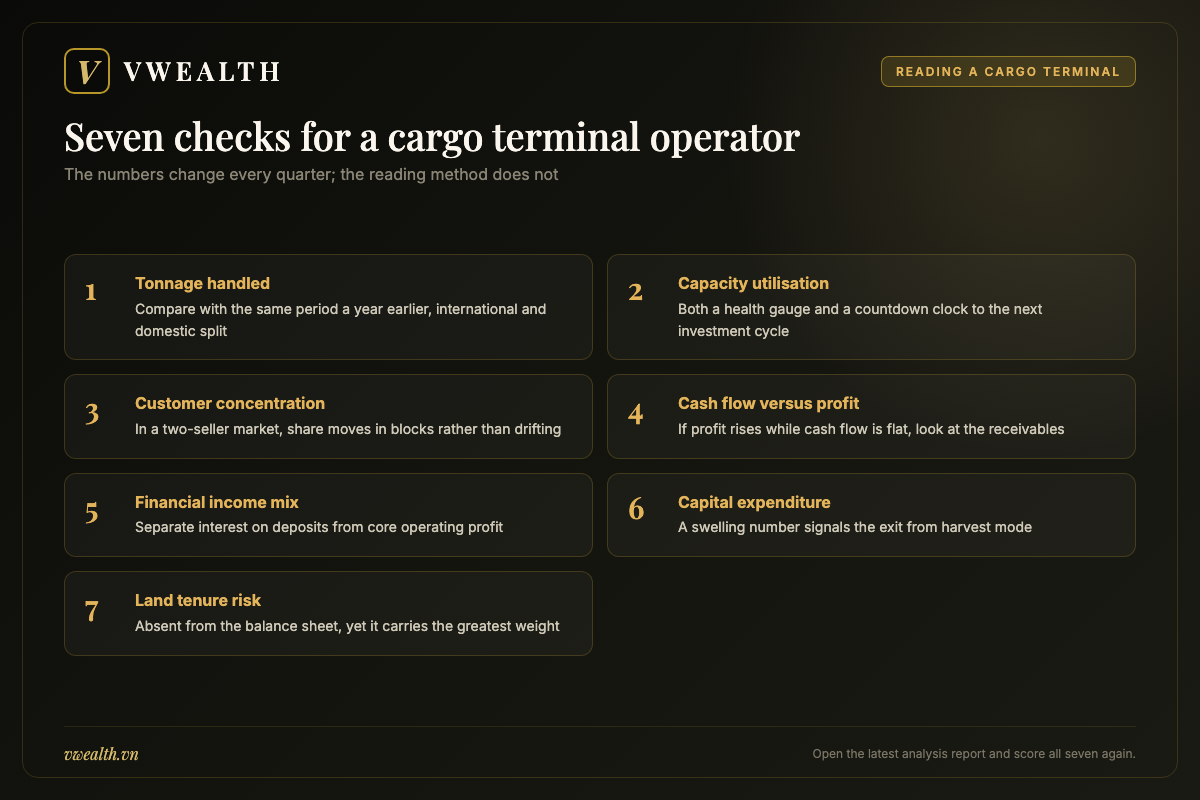
This is the chapter to remember longest, because it does not expire. The numbers change every quarter; the reading method does not. If you apply the toolkit you use for a manufacturer or a retailer to SCS, you will misread this company at a basic level. Here are seven checks, in priority order.
Check 1: tonnage, not revenue
The primitive operating metric for a cargo terminal is tonnes handled in the period, split between international and domestic. Revenue is merely tonnage times unit price, and unit price depends on cargo mix and on exchange rates. There are quarters where revenue rises while tonnage falls, purely because higher-value cargo increased its share. There are quarters where the reverse happens. If you look only at revenue, you cannot tell whether the business got healthier or merely got lucky on mix.
When you read the filings, find tonnage and compare it against the same period a year earlier rather than the immediately preceding quarter. Air cargo is strongly seasonal, with the peak in the final quarter as Western retailers stock up for the holiday season.
Check 2: utilisation against design capacity
This is the metric that decides the growth story. Phase one capacity at SCS is around 200,000 tonnes a year. While utilisation is low, each incremental tonne is nearly pure profit because the fixed cost is already in place. As utilisation approaches the ceiling, the company must fund phase two to lift capacity toward roughly 350,000 tonnes a year — and that investment phase raises depreciation sharply, compresses margins and may reduce the dividend.
Put differently, utilisation is both a health gauge and a countdown clock. You need to know where the company sits on that scale, because it determines the next two to three years of the stock more than any other single number.
Check 3: customer concentration
In a two-supplier market, winning or losing one large airline produces an immediate step change. Qatar Airways was projected to account for roughly a quarter of SCS throughput in the first year of the relationship. That figure is simultaneously good news and a warning. Any business with a single customer at a quarter of volume carries concentration risk.
In the notes to the financial statements, look for disclosure on major customers and for receivables by counterparty. If the largest customer’s share rises across successive years, concentration risk is thickening rather than thinning, even while revenue grows. Our primer on reading Vietnamese company financial statements in English shows where these disclosures sit in a VAS-format report.
Check 4: operating cash flow against accounting profit
For a company with heavy historical depreciation and a largely written-down asset base, operating cash flow typically exceeds accounting profit. That is a healthy sign. What you should test is whether the ratio between the two is stable across years. If profit rises while cash flow does not, look at receivables — with international airlines as customers, payment cycles can stretch, especially when the aviation industry is under stress.
Check 5: the cash pile and what the company does with it
SCS has a tradition of holding a large bank deposit balance relative to its asset base. This creates two effects you must read separately. First, part of reported profit comes from interest income rather than from core operations — when the rate environment shifts, that portion moves for reasons unrelated to cargo volumes. Second, a large cash balance is dry powder for a new project, and it explains why the company can contemplate bidding for a Long Thanh terminal without heavy borrowing.
When you read the accounts, separate core operating profit from financial income. This is a step many investors skip, and it leads directly to mispricing a company that carries substantial idle cash.
Check 6: capital expenditure and the phase two timeline
Track the line for purchases of fixed assets in the cash flow statement. While that number stays small, the company remains in harvest mode: strong cash generation, high dividends. When it starts to swell, the company has switched to build mode, and you must revalue it on a completely different basis — more assets, more depreciation, less cash returned, but greater capacity for the future.
Check 7: the legal risk attached to the land
The final check does not appear on the balance sheet, yet it carries the greatest weight. All SCS operations take place on land contributed by A41, an entity under the Ministry of National Defence, and under the disclosed terms, an urgent military or defence requirement obliges the company to suspend activity and hand the site back in its existing condition.
The probability of that scenario under normal conditions is very low, and this article makes no suggestion that it is imminent. But the nature of this class of risk is low probability and very large consequence — it cannot be hedged, cannot be insured, and cannot be modelled. The only tool available to a retail investor is position sizing: hold an amount small enough that, if the worst happened, you would still sleep. The broader catalogue in our guide to the risks of investing in Vietnam puts this in context alongside the market’s other structural risks.
The seven checks and where to find them
| Check | Where to find it | Good sign | Warning sign |
|---|---|---|---|
| Tonnage handled | Annual report, investor updates | Growth against the same period last year | Revenue up while tonnage falls |
| Capacity utilisation | Notes and shareholder meeting materials | Headroom to take on new airlines | Near the ceiling with no clear expansion plan |
| Customer concentration | Notes to the financial statements | Volume spread across many airlines | One customer taking a rising share |
| Operating cash flow | Cash flow statement | Above accounting profit and stable | Profit rising, cash flow flat |
| Financial income mix | Notes on financial revenue | Core profit dominates the total | Interest income masking core weakness |
| Capital expenditure | Cash flow statement | Small while in harvest mode | Sharp rise with unclear project returns |
| Land legal risk | Prospectus, annual report | No change in the disclosed terms | Any news touching the plot’s planning status |
How the market treats SCS stock: portrait of a share with too few sellers
With some equities, the personality of the share matters as much as the quality of the business. SCS is one of them. You can analyse the model correctly, identify the right opportunity, and still have a poor investing experience purely because you did not understand how this stock trades.
Why the market rarely prices SCS cheaply
Very high margins, a geographic barrier to entry, steady cash generation, a generous cash dividend and long-term institutional holders — that combination means SCS almost always trades at a valuation above the average for transport infrastructure names. The market is not being naive. It knows this company is rare.
The uncomfortable consequence for you is that you will rarely buy SCS at a level a classical value investor would call cheap. The moments when SCS genuinely is cheap tend to coincide with a specific fear: a pandemic grounding flights, global trade contracting, or bad news about Long Thanh. In other words, you only get a good entry price by accepting a real worry alongside it. That is the price of buying quality. Our overview of valuation levels across the Vietnamese market gives you the benchmark against which to judge whether the premium is reasonable.
Which yardstick to use on SCS
For an infrastructure business with heavy depreciation, a bare price-to-earnings ratio misleads, because accounting profit is shaped by depreciation policy and by interest income. A better approach layers three views. First, compare the company’s earnings multiple against its own history rather than against a sector, since there is no genuinely comparable listed peer in Vietnam. Second, treat the cash dividend yield as a valuation floor — when the yield runs well above long-tenor deposit rates, the market is paying cheaply for the cash stream. Third, compute enterprise value against earnings before interest, tax, depreciation and amortisation, which strips out the distortion of the large cash balance.
Those three views complement rather than replace one another. A stock can look expensive on earnings while looking reasonable on enterprise value, precisely because a large part of the market capitalisation is cash sitting in deposits.
The trading personality of SCS stock
Three characteristics to know before you place your first order. One, matched volume per session is thin, so the spread between the best bid and best offer is often wide. Two, the price tends to sit still for many sessions and then step sharply on news — there is no smooth accumulation pattern of the sort you see in large caps. Three, during broad market corrections SCS can fall hard for reasons unconnected to the business, simply because a fund needs cash and puts through a size the order book cannot absorb.
The practical response: use limit orders rather than market orders, split your buying across many sessions, and never use margin financing on a stock with this liquidity profile. For foreign investors there is an additional layer — settlement timing and the daily price band both constrain how quickly you can react, as set out in our guide to Vietnamese trading rules.
Foreign ownership and the room question
For a company operating in aviation services, the maximum foreign ownership ratio is governed by sector-specific rules rather than defaulting to the general ceiling. Foreign investors are naturally drawn to SCS because it is exactly the sort of business quality-focused funds like: a clear moat, steady cash, simple governance. But the small free float makes building a meaningful position genuinely difficult.
That produces a distinctive effect: when a foreign fund wants in or out, the price impact on SCS is far larger than for an equivalently capitalised stock with deep liquidity. If you use foreign flow as a signal, remember that with SCS the signal is distorted by size. Our explainer on foreign ownership limits in Vietnam covers how to check the remaining room and what happens when a name goes fully subscribed.
How a foreign investor actually buys SCS
Mechanics matter more than usual with this name, so it is worth being concrete about the practical path. A foreign investor buying Vietnamese equities needs a securities trading code and an account with a local broker, and holdings are subject to the sector-specific foreign ownership ceiling as well as to the market’s settlement conventions.
With a liquid large cap, none of that affects your outcome much. With SCS it can determine it. Three specific frictions compound. First, the daily price band on HOSE limits how far the price can move in one session, which sounds protective but in a thin book means a stock can sit locked at a limit with no counterparty for you. Second, the settlement cycle means the shares you buy are not immediately available to sell, so a fast reversal is not available as a risk control. Third, if foreign room in the name is tight, your order may not fill at all regardless of price.
The sensible construction, then, is to treat an SCS position as something you build deliberately over weeks rather than something you initiate on a single decision. Set a target weight, divide it into tranches, use limit orders inside a defined price range, and accept that you may end up with less than the target. Investors who try to build the whole position in one session almost always end up paying materially more than the price that attracted them in the first place.
The same logic applies in reverse on the way out, and it is the part people plan for least. Decide in advance what would make you sell and roughly how long an exit would take at realistic volumes. A holding you cannot exit in a reasonable window is effectively a longer-duration commitment than you intended, whatever your stated horizon.
Catalysts that move SCS stock
Four categories of news reliably produce meaningful moves. First, news of a contract with a new airline or the loss of an existing one — in a two-seller market this carries the greatest weight. Second, news on the timeline and tender mechanism for the Long Thanh cargo terminals. Third, the periodic air cargo volume statistics published by the Civil Aviation Authority of Vietnam, which lead the company’s reported results. Fourth, dividend decisions, and in particular any signal that the payout ratio is about to fall in order to fund investment.
SCS against the alternatives in Vietnamese aviation and logistics
| Ticker | Role in the chain | Strength | What to watch |
|---|---|---|---|
| SCS | Cargo terminal operator at a single airport | Very high margins, consistent cash dividends | One location only, very thin liquidity |
| ACV | Operator of the national airport network | Scale, tied to public infrastructure investment | Heavy investment cycle, policy dependent |
| GMD | Seaports and logistics, and an SCS shareholder | Multi-site, multi-segment, better liquidity | Exposed to the ocean freight cycle |
| Airlines | Capacity owners buying terminal services | Direct exposure to travel demand growth | Thin margins, fuel and currency sensitivity |
The table is not a ranking. It exists to show that SCS is a narrow and deep slice of the aviation chain: you are not buying growth in Vietnamese air travel, you are buying a bottleneck. If you want exposure to the sector rather than to one node, the wider survey in our Vietnamese aviation and logistics stocks guide lays out the alternatives.
The Vietnamese air cargo market in 2026: the map is about to be redrawn
This chapter matters more than everything before it combined, because it contains the only variable capable of changing the nature of an SCS investment. For fifteen years the company has benefited from one simple fact: southern Vietnam has had exactly one large international airport. That fact is about to stop being true.
The size of the Vietnamese air cargo market
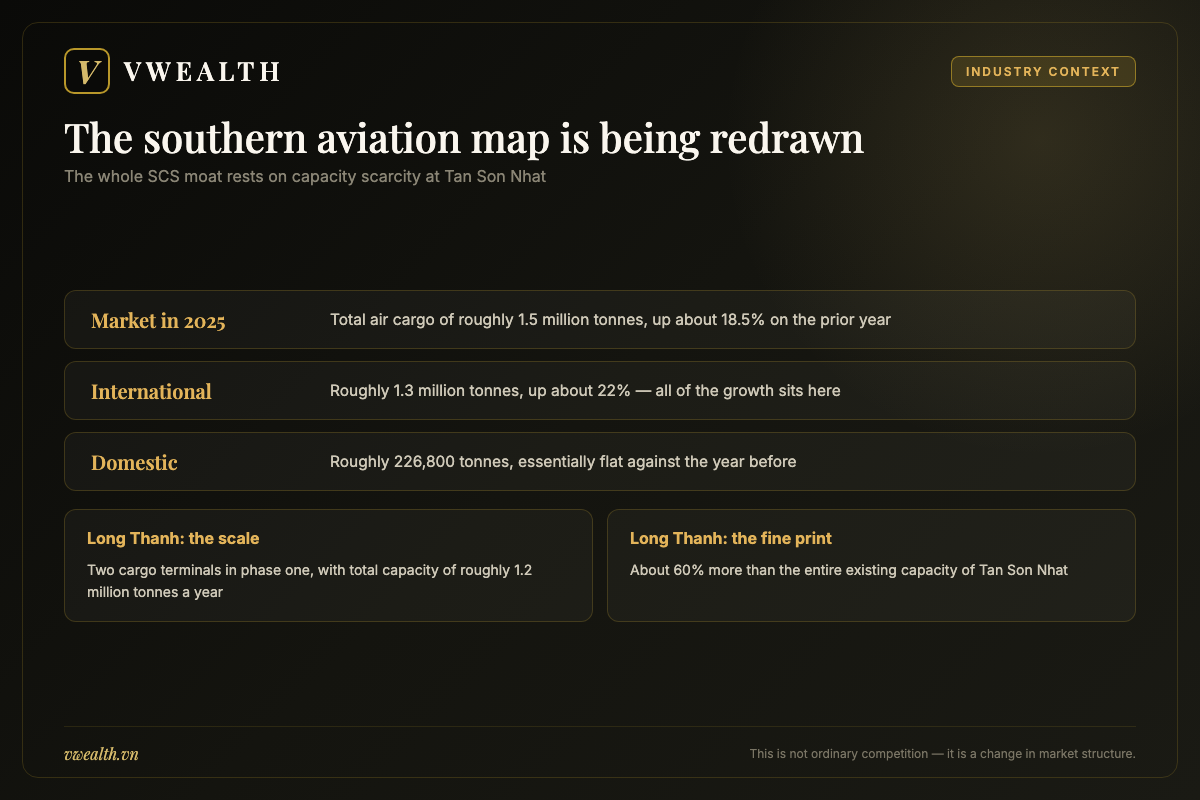
According to Civil Aviation Authority of Vietnam data for 2025, total air cargo across the market reached roughly 1.5 million tonnes, up about eighteen and a half percent on the prior year. The composition is the interesting part: domestic cargo came in at roughly 226,800 tonnes, essentially flat, while international cargo reached roughly 1.3 million tonnes, up around twenty-two percent.
Those three numbers say a great deal. First, the market is genuinely growing rather than merely recovering. Second, all of the growth sits on the international side — which means it is tied to trade, to the electronics supply chain and to cross-border e-commerce, not to domestic consumption. Third, and most relevant here: SCS is concentrated almost entirely in the fastest-growing segment.
Why air cargo grows faster than ocean cargo
Air freight represents a small share of Vietnam’s total export and import tonnage but a much larger share by value. The reason is the cargo type: semiconductors, electronic components, handsets, medical devices, pharmaceuticals, premium fashion, fresh seafood and time-critical e-commerce parcels all choose the aircraft because value per kilogram is high enough to carry the freight rate.
The shift of electronics manufacturing into Vietnam therefore affects air volumes far more powerfully than it affects ocean volumes. At the same time, the growth of cross-border e-commerce creates a new flow: small consignments, high parcel counts, demanding fast processing — exactly the kind of cargo a modern terminal can charge more to handle.
Long Thanh: new supply and a structural threat
Every SCS shareholder must read this section carefully. Long Thanh International Airport, the largest infrastructure project ever undertaken in Vietnam, includes two cargo terminals in its first phase. Total phase one cargo capacity is roughly 1.2 million tonnes a year — about sixty percent higher than the entire existing capacity at Tan Son Nhat, which sits in the range of 700,000 to 800,000 tonnes a year.
Pause on that comparison. The whole SCS moat is built on capacity scarcity at Tan Son Nhat. Long Thanh, in phase one alone, introduces more capacity than currently exists in the market. This is not ordinary competition; it is a change in market structure.
Where SCS stands in the Long Thanh question
According to disclosed information, cargo terminal number one at Long Thanh has been assigned to ACV as developer, while terminal number two is being prepared for tender. SCS has signed a memorandum of understanding with ACV — which is also its own large shareholder — regarding the project. The company has upgraded warehouse capability toward roughly 350,000 tonnes a year both to serve growing demand and to prepare resources for the tender, and has planned roughly VND 700 billion for the Long Thanh expansion.
The fine print is what counts. Published analysis suggests SCS is unlikely to be the principal investor in any Long Thanh cargo terminal during phase one; the most positive realistic case is that it operates terminal number one in place of ACV. At the shareholder meeting, management expressed the hope of becoming principal investor of a cargo terminal in phase two of the project.
That is a position of both luck and exposure. Lucky, because having the developer as a large shareholder puts SCS ahead of any other candidate for an operating role. Exposed, because even in the best case the company would shift from owning infrastructure — a very high margin role — to operating someone else’s, a materially lower margin role. And in the bad case, the lucrative international cargo currently flowing through Tan Son Nhat migrates to Long Thanh without SCS holding a share of it.
The timeline to watch
Under the published schedule, the Long Thanh phase one cargo terminal is expected to begin operating from late 2026, with clearer traffic allocation anticipated from 2027 onward. That makes the next two to three years the hinge period: volumes through Tan Son Nhat may still grow in the near term on the strength of the overall market, but the share begins to shift.
For an investor, the practical monitoring approach is to follow three streams: decisions on the tender mechanism for terminal number two, SCS disclosures about the outcome of its participation, and the monthly cargo statistics broken out by airport from the aviation authority. Those three give you the picture earlier than the quarterly accounts will.
The wider competitive map: it is not only Tan Son Nhat
When you assess the SCS position, do not look only inside the Tan Son Nhat fence. In the north, the cargo terminal market at Noi Bai Airport has its own structure, with established operators and share concentrated in a dominant player. This means SCS has essentially no route to expansion northward: that market already has an incumbent, and land inside that airport is no more plentiful.
The consequence is that the growth strategy for SCS is confined to two paths: expand capacity in place, or win a role at Long Thanh. There is no third path of the acquire-a-rival or enter-a-new-region variety. That is a sharp contrast with multi-site infrastructure operators, which can offset a weak region with a strong one.
A further competitive layer is often overlooked: modal competition. For mid-value cargo, exporters continually weigh air against ocean. When air freight rates spike, or when ocean transit times shorten, a slice of cargo shifts off aircraft. This is why air cargo volumes swing far more violently than total trade value — air freight is the most sensitive part of the trade flow.
Finally, a slow-moving long-term variable: logistics hubs are being planned in several provinces. If multimodal logistics centres develop well, some processing steps could be pushed outside the airport fence, reducing the value added a cargo terminal captures per tonne. This is a risk you will not see in a few quarters, but it is real on a ten-year horizon.
The e-commerce flow and what it changes
One structural driver deserves separate treatment because it changes the character of the cargo rather than just the quantity. Cross-border e-commerce generates a fundamentally different flow from traditional air freight: instead of a few large consolidated consignments, terminals receive very large numbers of small parcels, each with its own customs documentation, each with a delivery promise measured in days rather than weeks.
For a terminal operator this is a mixed blessing. Handling a thousand small parcels costs considerably more in labour than handling one consolidated pallet of the same total weight, and labour is already the largest component of cost of goods sold at SCS. But the tariff for express and e-commerce handling is correspondingly higher, and the customer relationships tend to be stickier because the integration between the merchant platform, the forwarder and the terminal’s systems is deeper.
The strategic question this poses is one of investment. Capturing e-commerce flow profitably requires automation: scanning, sorting and data handling built for parcel counts rather than pallet counts. That is capital expenditure, and it competes for the same cash that currently funds the dividend. A terminal that does not invest keeps its margin but slowly cedes the fastest-growing cargo category; a terminal that invests protects its future position at the cost of near-term payout.
Watch for this trade-off in the capital expenditure line and in shareholder meeting commentary. It is a quieter version of the same decision the Long Thanh question forces, and it will show up in the accounts earlier.
Policy and the factors you cannot ignore
Aviation services is a conditional business sector in Vietnam. Service charges at airports fall within a state-managed framework, licences to operate terminals are granted by the aviation regulator, and any change to airport master planning can move value between companies in the chain. This is an industry where one administrative decision outweighs one good trading quarter.
Alongside that sit the familiar macro variables: the exchange rate, since much of the revenue from international airlines is linked to foreign currency; interest rates, given the large deposit balance; and the global trade cycle, since air cargo is its most sensitive indicator. For foreign investors there is a currency layer on top, covered in our note on the Vietnamese dong and currency risk.
Looking forward: three scenarios for SCS stock and the conditions that produce each
This section does not offer a price target, because any number written today would be wrong within months. Instead it describes three scenarios and, more usefully, the specific conditions that let you recognise which one you are living in. Once you know what to watch, you do not need anyone to forecast for you.
Four variables that decide the future of SCS
Before the scenarios, fix the four variables. The first is total international air cargo volume through Vietnam — this decides how big the pie is. The second is how traffic is allocated between Tan Son Nhat and Long Thanh — this decides where the pie sits. The third is the specific role SCS secures at Long Thanh: developer, contract operator, or nothing. The fourth is the company’s own decision on phase two capacity expansion at Tan Son Nhat and the dividend level that accompanies it.
The crucial point is that the first three lie outside management’s control. This is a company that executes well but does not get to define its own playing field — in the same way an offshore drilling contractor does not set day rates and a port operator does not choose where the shipping lanes run.
The optimistic scenario: SCS keeps a role at Long Thanh
In this case international trade keeps growing, electronics manufacturing investment into Vietnam continues, and total air cargo grows fast enough that both Tan Son Nhat and Long Thanh have work. SCS is awarded the operation of a terminal at Long Thanh, or wins the developer role in phase two. Phase two capacity at Tan Son Nhat comes online while demand is still strong.
Recognition conditions: a formal disclosure confirming an SCS role at Long Thanh with a defined scope; Tan Son Nhat volumes that do not decline in the first two years of Long Thanh operation; and the company sustaining a high gross margin despite higher depreciation. If all three hold, the original investment thesis remains intact and the company is simply larger.
Note the caveat even in the best case: if the Long Thanh role is contract operation rather than ownership, consolidated margins will sit below today’s level. Bigger revenue does not automatically justify a higher multiple.
The base scenario: a good business in a market being redivided
This is the case this article considers most likely, though there is no way to prove it. In the base scenario Long Thanh enters service broadly on plan but somewhat behind schedule, traffic migrates gradually rather than abruptly, and Tan Son Nhat retains an important role for years because of its proximity to the city and its existing road links. SCS participates at Long Thanh in a limited capacity while continuing to run its existing terminal well.
Financially this produces a slower-growing business with still-healthy cash generation, a dividend that continues but at a reduced ratio during the investment phase. The stock does not surge, but neither does it collapse, and most of the shareholder return arrives as dividends rather than as capital gain.
Recognition conditions: Long Thanh announcements repeatedly pushing dates back; SCS volume growth decelerating without turning negative; capital expenditure creeping up; and a dividend ratio adjusted downward with a clear explanation attached.
The bad scenario: the moat gets relocated
The bad case does not require a catastrophe. It requires three ordinary things to happen at once. First, Long Thanh opens on schedule and international airlines migrate faster than expected, because the new airport has modern infrastructure and does not sit behind inner-city traffic. Second, SCS fails to secure any meaningful role there. Third, global trade enters a slower phase for tariff or cycle reasons.
The company then faces the worst position a high operating leverage model can find itself in: volumes falling while fixed costs stay put. Profit falls several times faster than revenue, and the premium multiple the market once paid for scarcity is repriced down toward that of an ordinary infrastructure business. This is compound damage: you lose earnings and you lose the multiple at the same time.
Early recognition conditions: news of a large airline relocating operations to Long Thanh; monthly Tan Son Nhat cargo statistics turning negative year on year while the national total still grows; and disclosures showing SCS with no share of terminal number two.
A fourth possibility few people discuss
Beyond those three sits a fourth case of an entirely different character: the land tenure risk. As set out earlier, all SCS operations sit on land contributed by a Ministry of National Defence entity, with a handback clause on urgent defence requirements. Low probability, but if it occurred there would be no intermediate outcome — the company would lose the physical foundation of its entire operation.
This is raised not to alarm but because of a simple principle in risk management: risks that cannot be quantified must be handled through position sizing rather than through modelling. Set a hard ceiling on the portfolio weight and respect it.
The three scenarios side by side
| Scenario | Main conditions | Effect on the business | Early signal |
|---|---|---|---|
| Optimistic | Market grows, SCS wins a defined Long Thanh role | Larger scale, possibly lower blended margin | Formal disclosure of the Long Thanh role |
| Base | Long Thanh slips, traffic migrates gradually | Slow growth, solid cash, slightly lower dividend | Dates pushed back, capital expenditure creeping up |
| Bad | Long Thanh on time, no SCS role, trade slows | Profit falls faster than revenue, multiple derated | Tan Son Nhat volumes fall while the national total rises |
| Tail risk | Site recalled for defence purposes | Loss of the physical basis of operations | Any news touching the plot’s planning status |
So, should you buy SCS stock? A straight answer
After all of that the question still has to be answered. But the honest answer is not yes or no; it is a description clear enough that you can decide whether you belong to the group this stock suits.
The case for: five reasons SCS deserves consideration
First, this is one of very few listed Vietnamese companies whose moat is geographic. The barrier is not capital or technology but a plot of land inside the country’s busiest airport, something money cannot manufacture. For fifteen years exactly two companies have done this at Tan Son Nhat, and the number has not moved.
Second, the profit structure is unusually clean. No complex subsidiary web, no tangle of financial investments, no property hidden in the accounts. Reading the SCS financial statements takes less time than for most companies of similar capitalisation — and for a foreign investor working across a language barrier, transparency you can actually verify is a genuine asset.
Third, cash flow and dividends. The core asset was completed in 2010 and is largely depreciated, so profit converts to cash almost fully. The record of twice-yearly cash dividends has held across many consecutive years, including the worst years Vietnamese aviation has had.
Fourth, the company sits in the fastest-growing segment of its industry: international cargo, tied to electronics trade and cross-border e-commerce. The 2025 industry data show this segment growing at a double-digit rate while domestic volumes were flat.
Fifth, the quality of the institutional register. Gemadept brings logistics expertise, ACV brings infrastructure position, A41 brings land rights, and all three have reasons to stay rather than trade.
The case against: six risks to face directly
First, single-site risk. The entire company sits on one plot. There is no second segment, no second location, and no independent income stream to cushion a problem at that site.
Second, Long Thanh. This is the highest-probability and clearest-impact risk. New capacity larger than the whole existing Tan Son Nhat market is entering, and the SCS role there remains unsettled.
Third, the legal risk attached to defence land. Low probability, very large consequence, and impossible to hedge with financial instruments.
Fourth, liquidity risk. Unlike the three above, this one you will certainly encounter rather than merely might. Thin matched volume makes buying a full position and exiting at a fair price a practical problem, not a theoretical one.
Fifth, customer concentration. In a two-seller market, losing a large airline has an immediate and potentially severe effect. The direction that favoured SCS in 2024 is the same direction that can reverse.
Sixth, valuation risk. Because the market already understands the quality here, the price is rarely cheap. Buying a good business at a high price can still be a poor investment if growth stalls.
Weighing both sides
| In favour | Against |
|---|---|
| Geographic moat inside the country’s busiest airport | The whole business depends on a single location |
| Margins among the highest on the exchange | High operating leverage means profit falls fast on lower volume |
| Strong cash generation and years of cash dividends | Dividends likely fall when a new investment cycle begins |
| Positioned in the fastest-growing cargo segment | Long Thanh adds more capacity than Tan Son Nhat has today |
| Long-term institutional shareholders | Those same holders leave almost no free float |
| Simple, verifiable financial statements | Land tenure risk that cannot be quantified |
Who SCS suits, and who it absolutely does not
The long-term income investor. This is the best fit. If your horizon runs five years or more, you buy for the dividend stream, you do not care about quarterly price swings, and you accept that building a position may take several sessions, SCS is a reasonable holding. The condition attached: you must follow the Long Thanh process as though it were a separate investment, because it determines the next decade of that dividend stream.
The quality-focused value investor. A fit, but one requiring patience. The business clears the quality bar; the price rarely clears the value bar. The right approach is to define your acceptable entry range in advance and then wait — possibly for a long time, and possibly forever.
The growth investor. A poor fit. SCS is capped by physical capacity and by having a single site. Even in the most optimistic scenario, its growth rate will struggle to match technology or consumer names. If growth is what you want, our survey of Vietnamese technology stocks is a better place to start.
The short-term trader. Absolutely not a fit. Thin liquidity makes real transaction costs far higher than the published fee schedule, exiting quickly in a falling market is close to impossible, and the price tends to sit flat then jump — meaning there is no rhythm to trade.
Four questions to answer before you place the order
One: have you checked the average matched volume over the last thirty sessions and calculated what proportion of it your intended position represents? If that figure exceeds a few percent, you need to spread the purchase across many sessions.
Two: have you read the most recent shareholder meeting materials to see what management actually said about Long Thanh? That is a more direct and more specific source than any analysis, including this one.
Three: have you opened the latest financial statements and scored the seven checks from the fourth chapter, particularly capacity utilisation and customer concentration?
Four: if tomorrow brought news that SCS has no share of the Long Thanh cargo terminals, what would you do? If you have no answer to that, you are not ready to buy.
Turning the thesis into a monitoring routine
An analysis is only useful if it converts into something you actually do. For SCS, the monitoring routine is unusually simple because the number of things that matter is small. Once a month, check the aviation authority’s cargo volume statistics and note whether the Tan Son Nhat figure is moving with or against the national total. Once a quarter, open the financial statements and update three of the seven checks: tonnage, operating cash flow against profit, and capital expenditure. Once a year, read the shareholder meeting minutes in full, paying particular attention to what management says about Long Thanh and about the dividend.
Beyond that fixed schedule, keep an alert for two event categories: any announcement involving an airline changing terminal at Tan Son Nhat, and any decision about the tender for Long Thanh terminal number two. Those two categories account for most of the meaningful news this company will ever produce.
What you can safely ignore is most of the daily price commentary. In a stock with this liquidity profile, short-term price movement carries very little information about the business, and reacting to it is how long-term holders end up trading a position they intended to hold. The discipline of separating price noise from business news is worth more here than in almost any other name.
Finally, write down your thesis in one paragraph before you buy, including the specific condition that would falsify it. For most holders of this stock that condition will read something like: SCS ends up with no meaningful role at Long Thanh while Tan Son Nhat volumes begin to decline. Having that written in advance is what allows you to act on the news rather than rationalise it.
The bottom line: an excellent operator on land it does not own
If SCS had to be summarised in one sentence, it would be this: an excellent operating company, on land it does not own, in a market it cannot shape. All three clauses are true at once, and their simultaneity defines the whole character of the investment.
The first clause explains the high margins and the steady dividend — the product of fifteen years of disciplined operation on an asset that is largely written down. The second explains why a tail risk exists that no model can quantify. The third explains why the Long Thanh story matters more than any quarterly number ever will.
So should you buy SCS stock? If you understand that you are buying an infrastructure bottleneck rather than growth in Vietnamese aviation, accept thin liquidity as a permanent condition rather than a temporary inconvenience, treat the dividend as the main return rather than a bonus, and follow the Long Thanh process seriously — then SCS is a defensible holding within the quality sleeve of a portfolio, at a moderate weight. If you are buying because the margin looks beautiful, because you heard the yield is high, or because the stock has just moved and you fear missing out, you are ignoring the most important part of this article. Investors new to this market should start with our foundation guide on how to invest in the Vietnam stock market before taking a position in any single name.
One last thing to carry away. The history, ownership structure and business model of SCS change slowly, but tonnage handled, capacity utilisation, customer mix, cash flow and valuation change every quarter. Before you place an order, open the latest analysis report and score the seven checks from the fourth chapter again. It takes fifteen minutes, and it is the most valuable fifteen minutes of the whole decision. If you do not yet have the tools to do it, create a vwealth account and let the platform read the filings for you.
There is a broader lesson here that applies well beyond this one ticker. Whenever a company’s competitive advantage rests on scarcity created by someone else — a licence, a concession, a plot of land, a regulatory limit on entrants — your analysis has to extend past the company’s own decisions to the decisions of whoever controls that scarcity. Excellent management cannot compensate for a landlord, a regulator or a planning authority changing course. That is the discipline SCS demands, and it is the reason this analysis spends more space on Long Thanh than on any operating metric.
This article provides information and analysis for reference purposes only and is not a recommendation to buy or sell any security. All investment decisions are your own and you bear responsibility for their outcome. Consider consulting a licensed financial adviser before acting.
Research Vietnamese stocks in English with vwealth. Our AI-powered platform turns Vietnamese market data into full English analysis reports — with international payment support and a free 2-month trial for new accounts. Create your free account and read the latest reports.