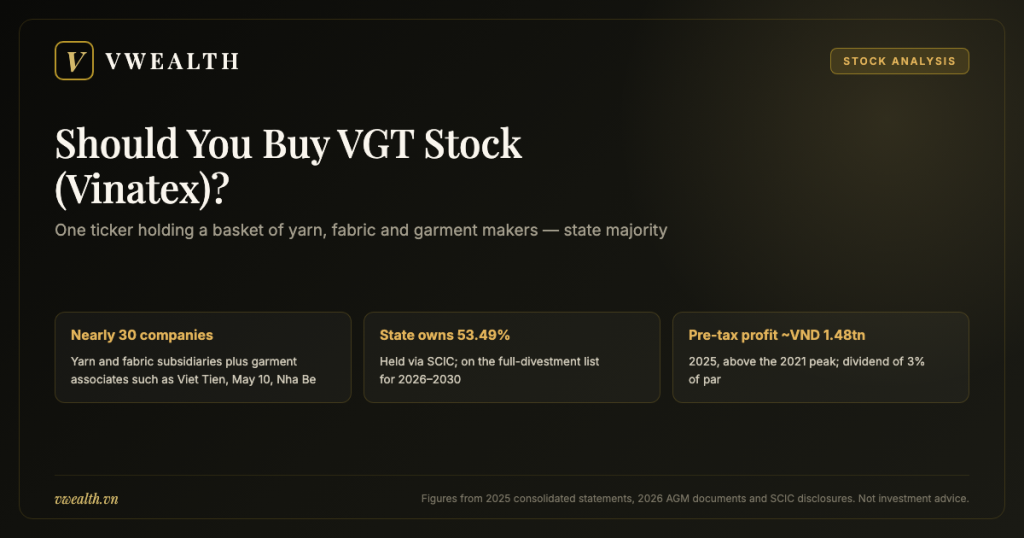
Should you buy VGT stock? The question sounds like it is about a single textile company, but it is not. VGT is the ticker of Vietnam National Textile and Garment Group — Vinatex — on the UPCoM market, and buying a share of it means buying a small slice of an entire basket of businesses: spinning mills the group controls outright, household-name garment makers such as Viet Tien, May 10, Nha Be and Duc Giang in which it holds only minority stakes, and a parent company that trades cotton and fibre while also acting as an investor. Vinatex’s own chairman describes a system of “nearly 30 enterprises with very different scale, development level, production conditions and markets.” The Vietnamese state, through the State Capital Investment Corporation (SCIC), still owns 53.49%; Japanese trading house Itochu owns roughly 13%; and of the two “strategic investors” that bought in during the 2014 IPO, VID has sold out completely while Vingroup has cut its stake below the major-shareholder threshold. In 2025 Vinatex reported consolidated pre-tax profit of nearly VND 1.48 trillion, the highest in its 30-year history and slightly above the 2021 record, yet its dividend was just 3% of par value. This analysis walks through the whole story so you can decide for yourself who VGT suits, and who it does not.
A few definitions first, because the names can be confusing. Vinatex is the English short name of Tap doan Det May Viet Nam (Vietnam National Textile and Garment Group), enterprise code 0100100008, headquartered in Hanoi. VGT is the group’s own stock, which has traded on UPCoM — Vietnam’s third, least-regulated trading venue — since 3 January 2017, with 500 million shares at a par value of VND 10,000. Vitas is the Vietnam Textile and Apparel Association, an industry body rather than a company, although the press often quotes the two side by side. When this article says “the parent company,” it means the Vinatex legal entity on a standalone basis; “consolidated” means the parent plus its subsidiaries plus its share of profits from associates, as required by Vietnamese accounting standards. Throughout, VND 1 trillion is roughly USD 38–40 million at recent exchange rates, a conversion used only to give a sense of scale.
The second ground rule is the same one used in every company analysis on vwealth. Dates, names, transactions and figures come from published sources — Vinatex’s own website and news pages, disclosures filed on the Hanoi Stock Exchange (HNX), consolidated financial statements compiled by VNDirect, the 2017 listing report by broker Bao Viet Securities (BVSC), and Vietnamese financial media including Dau Tu Chung Khoan, Vietstock, Thoi Bao Ngan Hang, Thoi Bao Tai Chinh, Tuoi Tre, Thanh Nien, Mekong ASEAN, VnEconomy, Nguoi Quan Sat and VietnamFinance. The article deliberately does not give today’s share price, current P/E or the latest quarterly profit; for those, open the latest VWEALTH analysis reports. Any figure that vwealth has calculated from source data is labelled “vwealth estimate,” and every worked example is an illustration, not a forecast. If you are new to investing in Vietnam, our guide to investing in the Vietnam stock market explains account opening, foreign ownership limits and settlement.
From a 1995 State Corporation to One Ticker Holding an Entire Industry
To see why VGT is a hard stock to read, you need to know the order in which things happened. In most groups, the parent comes first and then creates subsidiaries. At Vinatex it was the other way round: most member companies had existed for decades, had been partially privatised, and had their own shareholders and management long before the parent itself became a joint-stock company. Chairman Le Tien Truong once wrote that “the members were all founded before the Group,” and that for a long time the group’s results were “simply the sum of its members.” Seen from an investor’s seat, the thirty-year history of Vinatex is the story of trying to turn a loose collection of factories into a deliberate supply chain.
1995: merging the weavers and the sewers into one corporation
According to Vinatex’s company profile, Vietnam Textile and Garment Corporation — the forerunner of today’s group — was established under Prime Ministerial Decision 253/QD-TTg dated 29 April 1995 by merging the companies of the Vietnam Textile Corporation with the Garment Production and Import-Export Union. That sounds dry, but it explains a great deal about today’s structure. Before 1995, “textiles” and “garments” were two separate systems. On one side sat big spinning, weaving and dyeing mills from the central-planning era, such as Nam Dinh Textile, 8-3 Textile, Viet Thang and Phong Phu. On the other were garment factories doing contract manufacturing for export, such as May 10, Viet Tien, Nha Be and Duc Giang. Putting them under one roof did not automatically create a supply chain; it created a long list of companies with the same owner.
For its first decade, the corporation mostly played an administrative and industry-representation role. In October 2005 it received the Ho Chi Minh Order, one of Vietnam’s highest state honours, and it was later reorganised into a state economic group under the name it carries today. What matters for investors is not the medals but the fact that Vinatex was, from the start, a miniature of the whole industry: a university, vocational colleges, research institutes, a hospital, and dozens of factories stretching from Nam Dinh and Hanoi through Hue and Da Nang down to Ho Chi Minh City.
1999–2009: the children were privatised before the parent
This is the least-discussed turning point, and the most important one for anyone looking at VGT today. In an article published on the Vinatex website in 2022, Mr Le Tien Truong wrote that between 1999 and 2009 the group “completed the equitisation of nearly 80 member units.” (“Equitisation” is Vietnam’s term for converting a state-owned enterprise into a joint-stock company and selling shares to outside investors.) In other words, while the parent was still 100% state-owned, most of the factories below it already had private shareholders, annual general meetings and the right to set their own strategy.
The result is that in many member companies, the parent ended up with less than 50% — enough to have a loud voice, not enough to consolidate the company’s revenue into the group’s accounts. Viet Tien, May 10, Nha Be, Duc Giang, Viet Thang and Hung Yen Garment all fall into this category. That is why Vinatex’s consolidated income statement carries an unusually large line called “share of profit from associates” compared with a normal manufacturer. We will come back to that line in the financial chapter, because it is the key to the whole stock.
During the same period Vinatex lived through the 1997–1998 Asian financial crisis, Vietnam’s accession to the World Trade Organization in 2007 and the global crisis of 2008–2011. In May 2010 the group received the state’s First-Class Gold Star Order (Decision 546/QD-CTN). In the early 2010s the parent was still 100% state-owned; restructuring plans approved in the following years paved the way for the parent’s own share sale.
2014: an IPO at VND 11,000 and two strategic investors from outside the industry
In 2014 the Prime Minister approved the parent’s equitisation plan, and on 22 September 2014 Vinatex held its initial public offering by auction. According to the securities newspaper Dau Tu Chung Khoan, 87 investors bought 110,558,200 shares — about 90.6% of the almost 122 million shares offered — at an average price of VND 11,000, raising about VND 1,216 billion; 30 foreign investors took part and bought more than 55 million shares.
The IPO drew attention less for the price than for the identity of the two strategic investors: Vingroup, Vietnam’s largest private conglomerate, and Vietnam Investment Development Group (VID). Press reports at the time said the two had registered to buy 50 million and 70 million shares respectively — 10% and 14% of charter capital — at the starting price of VND 11,000. Neither was a textile company. VnExpress offered an obvious reason for their interest: Vinatex managed about 490,000 square metres of land for production and business, many plots in prime locations in Hanoi, Ho Chi Minh City and provinces such as Nam Dinh, Hai Phong and Binh Duong. BVSC’s 2017 listing report was even blunter, “guessing” that the group’s prime land in Hanoi might be the main reason Vingroup appeared on the shareholder register. Put bluntly, in 2014 the market saw Vinatex not only as a manufacturer but also as a land bank sitting inside Vietnam’s big cities.
Vingroup’s interest was also tied to retail and fashion: when it trimmed its stake in 2021, the press recalled that at the time of investing Vingroup was active in apparel through its Vinfashion unit. In hindsight, this was an early clue that this strategic shareholder had come for reasons outside the yarn-to-garment chain — and that when Vingroup’s strategy changed, its stake would no longer be needed.
2015–2017: a VND 5 trillion joint-stock company and the UPCoM debut
Vinatex formally began operating as a joint-stock company on 29 January 2015. Charter capital was VND 5,000 billion, of which 53.49% belonged to the state, with the Ministry of Industry and Trade acting as its representative. The 53.49% figure is higher than the 51% state share described by Dau Tu Chung Khoan in the planned post-IPO structure (51% state, 24% strategic investors, 0.6% employees, 24.4% other investors). A plausible explanation is that the roughly 10% of publicly offered shares that went unsold stayed with the state — but that is a vwealth inference, not something the company has stated.
For the stock market, however, 2015 and 2016 were two years in limbo. The company had been equitised, yet its shares still had nowhere to trade. Only on 3 January 2017 did the 500 million VGT shares finally list on UPCoM, at a reference price of VND 13,500. According to BVSC’s listing report, that price implied a P/E of about 15.31 times and a P/B of about 0.91 times — higher than the average listed textile company at the time, though BVSC still considered it worth a look for long-term portfolios. The stock jumped on day one, closing around VND 17,100 according to VNDirect price data, then fell in eight of the next nine sessions to VND 12,000 on 16 January 2017.
The lesson from those first weeks still applies: VGT has a small free float relative to its total share count, so news can push the price hard in either direction. BVSC also noted that in 2015–2016 the group kept investing in projects such as phase two of the Phu Hung spinning mill, a garment plant in Kien Giang and a yarn-dyed fabric plant in Long An — while observing that Vinatex’s efficiency was then “much weaker” than the industry average on almost every metric, especially return on equity. The strategic choice was clear early on: the parent wanted to own upstream stages such as yarn and fabric that its garment associates could not afford to build — and the price of that choice was an asset-heavy balance sheet.
2018–2019: Itochu steps up, VNTex walks out, and the state stake moves to SCIC
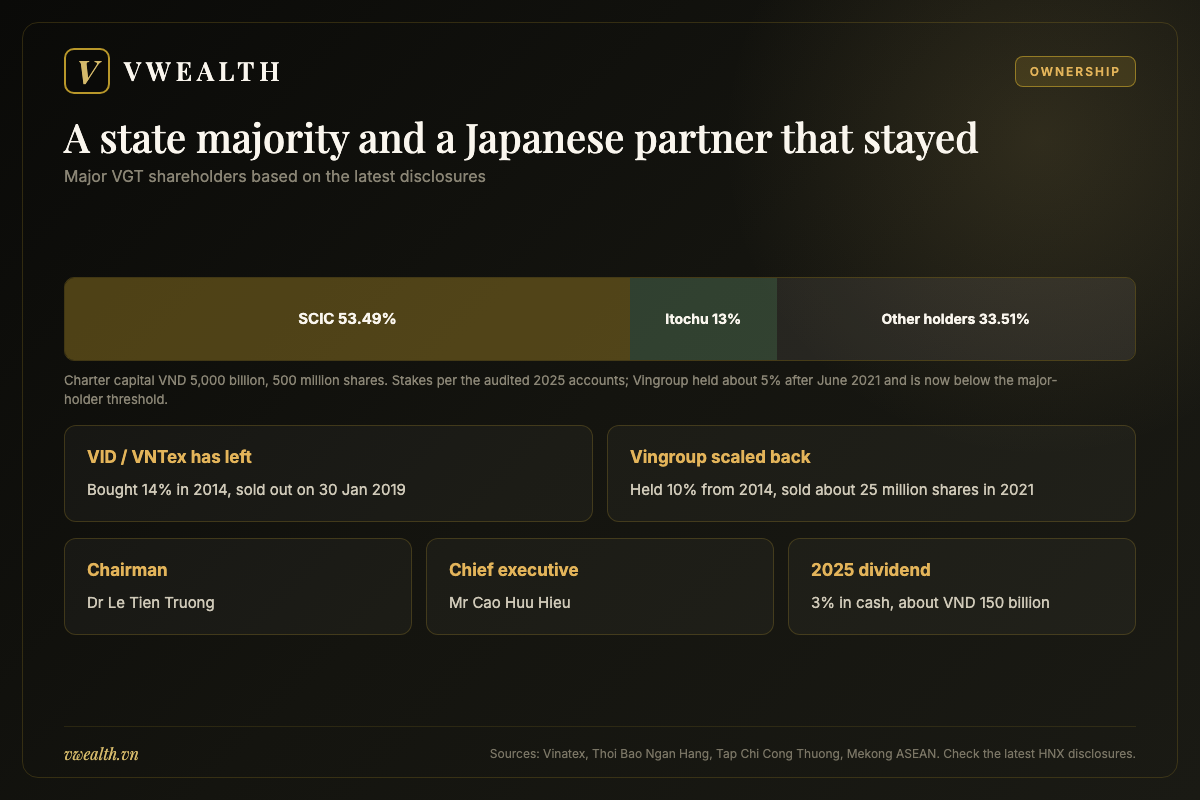
In 2018 VGT’s shareholder map shifted in two opposite directions. The first came from Japan. Citing international reports, Bao Dau Tu wrote that in late March 2018 the trading house Itochu spent about JPY 5 billion — close to USD 47 million — buying about 10% more of Vinatex from VNTex and foreign funds, becoming the No. 2 shareholder; Tuoi Tre reported at the time that Itochu bought 50 million more shares and held 13%. According to the audited 2025 financial statements, as cited by Thoi Bao Ngan Hang, Itochu still owns 13%. Itochu is not a financial investor: it is a trading house with a large textile business and a commercial partner of the Vinatex system.
The second direction was an exit. Itochu bought most of its shares from VNTex — the new name of VID Group — and from foreign funds in trades on 26 March 2018, after which VNTex held about 7%. According to Tap Chi Cong Thuong, the trade ministry’s magazine, VNTex sold its remaining 35 million VGT shares on 30 January 2019 and ceased to be a shareholder. Dien Dan Doanh Nghiep noted that strategic investors were normally required to hold their shares for five years, but VNTex had applied to divest after about three.
Also in 2018, on 23 November, the Ministry of Industry and Trade handed over the state’s ownership rights in Vinatex to SCIC, the state capital investment corporation. According to the handover minutes reported by Tuoi Tre and Thoi Bao Tai Chinh, more than VND 2,674 billion of state capital moved to SCIC — exactly 53.49% of VND 5,000 billion. From then on, the decision-maker behind the largest shareholder was no longer a sector ministry but a professional state investor, a detail that matters a great deal for the divestment story later in this analysis. For background on how Vietnam’s state-owned groups work as investments, see our overview of Vietnam state-owned enterprises.
2020–2022: Covid, the record year of 2021 and the first quarterly loss
2020 was the hardest year since listing. According to consolidated data compiled by VNDirect, net revenue fell to about VND 13,900 billion from almost VND 19,000 billion in 2019, and pre-tax profit dropped to about VND 593 billion. VGT shares touched a low of around VND 5,900 at the end of March 2020, based on VNDirect price data.
Then 2021 flipped the script. Garment demand in the US, EU and Japan recovered, yarn prices soared, and Vinatex reported consolidated pre-tax profit of VND 1,456.5 billion — the highest in its history at the time. Mr Le Tien Truong later wrote that 2021 profit was 2.2 times the 2016 level, a compound annual growth rate of about 16.3% over 2016–2021, and that the share of group profit contributed by the companies Vinatex controls had risen from 25.8% in 2016 to 60.4% in 2021. On the market, VGT climbed from about VND 10,000 at the start of 2021 to the VND 29,000–30,000 range between late 2021 and early 2022; the intraday peak, per VNDirect, was VND 30,900 on 10 January 2022.
The fall was just as fast. In the fourth quarter of 2022, Vinatex posted a net loss of about VND 5.2 billion — according to press reports at the time, its first quarterly loss since equitisation — as the quarter’s gross margin collapsed from 13.9% to 4.7%. The company blamed China’s zero-Covid policy, which hit demand in some markets and pushed down the value of yarn inventory; according to VNDirect data, inventory write-down provisions rose from about VND 80 billion at end-2021 to about VND 317 billion at end-2022. The stock sank to about VND 6,600 in mid-November 2022. In eleven months VGT had gone from its all-time high to near its all-time low, a vivid demonstration of how cyclical the spinning business is.
2023–2026: profits beat the old peak as US tariffs and a new SCIC divestment list arrive
2023 was hard enough that in November 2023 the group had to poll shareholders in writing to revise its business plan, and consolidated pre-tax profit came in at only around VND 539 billion. Vinatex’s chairman later called the period from June 2022 to July 2024 a “yarn industry crisis.” In 2024 profit recovered to about VND 835 billion — 151.8% of plan, as CEO Cao Huu Hieu told the 2025 annual general meeting.
2025 should have been the scariest year of all. On 2 April 2025, the United States announced a 46% “reciprocal” tariff on Vietnamese goods, and VGT traded as low as VND 7,200 during the 9 April 2025 session. After negotiations, the rate that took effect on 7 August 2025 was 20%. Yet the full-year result defied the fear. At a press briefing on 23 December 2025, Vinatex estimated consolidated profit at about VND 1,355 billion and called it “the second highest in its history, after 2021”; once the audited accounts came in, consolidated pre-tax profit was VND 1,479.8 billion, up 77.2%, and was presented to the 2026 AGM as a 30-year record. Gross margin improved to about 12.9% from 10.8%, according to VNDirect data. The company said customers had pulled deliveries forward during the first nine months to get ahead of tariff risk, while cost control and productivity also helped.
Two developments in 2026 frame the current story. First, after the US Supreme Court in February 2026 rejected the use of the International Emergency Economic Powers Act (IEEPA) for broad tariffs, Vietnamese goods faced a temporary additional 10% tariff; when that temporary mechanism ended on 24 July 2026, Washington moved Vietnam to a 12.5% rate under Section 301, while 17 other economies — including Bangladesh, Cambodia, Indonesia and India — pay 10%. Second, according to VietnamFinance, SCIC’s amended capital restructuring plan for 2026–2030 — Decision 129/QD-DTKDV dated 10 August 2026 — puts Vinatex on a list of 66 companies in which SCIC will sell its entire stake. Under the previous plan (Prime Ministerial Decision 690/QD-TTg of 17 July 2024), Vinatex had been in the group where SCIC would keep more than 50%. Being on the list does not mean a sale is imminent — VietnamFinance counted 58 of the 66 names, almost 88%, as “old files” that were already on the previous divestment list; Vinatex is one of eight new names — but it is the first time the idea of the state leaving Vinatex has a specific document behind it.
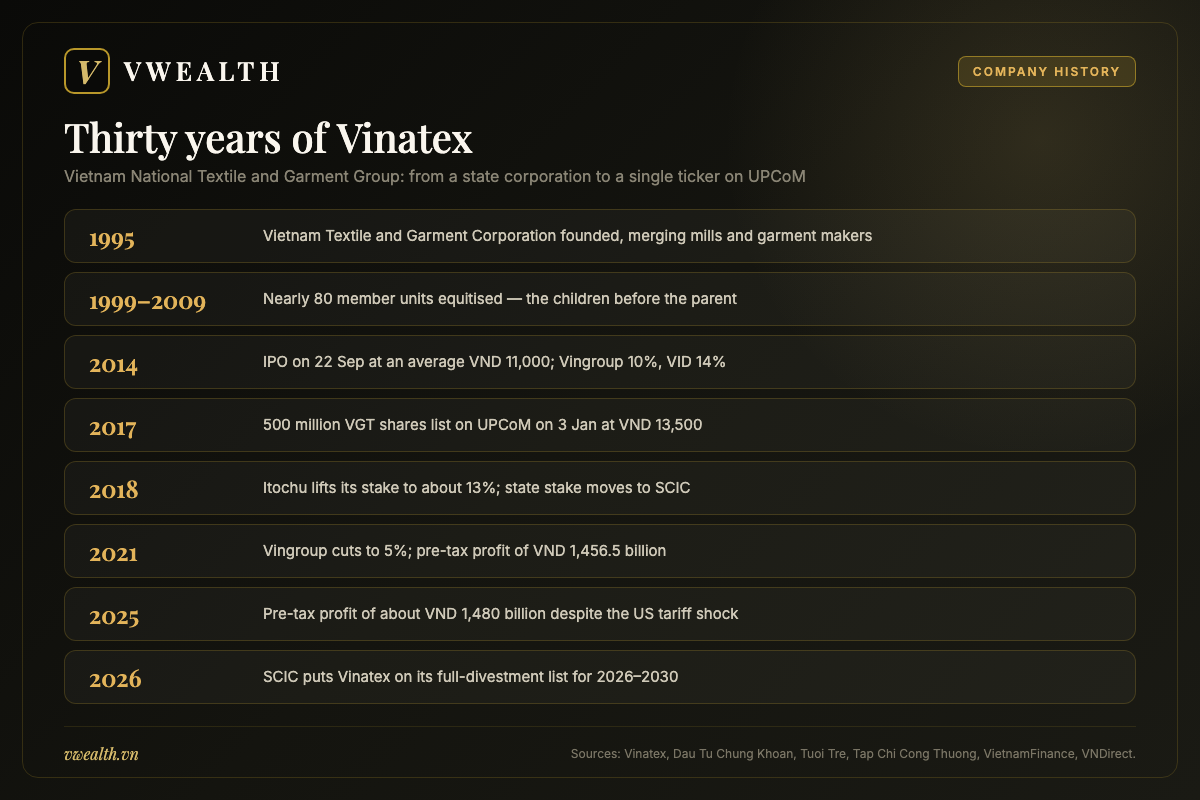
| Date | Event | What it means for VGT shareholders |
|---|---|---|
| 29 Apr 1995 | Vietnam Textile and Garment Corporation founded (Decision 253/QD-TTg) | Textile mills and garment makers placed under one owner |
| 1999–2009 | Nearly 80 member units equitised | Many garment makers became associates in which the group holds a minority |
| 22 Sep 2014 | Parent IPO sells about 90.6% of shares offered at an average VND 11,000, raising about VND 1,216 billion | Vingroup (10%) and VID (14%) join as strategic investors |
| 29 Jan 2015 | Becomes a joint-stock company with VND 5,000 billion charter capital | State holds 53.49% |
| 3 Jan 2017 | 500 million VGT shares start trading on UPCoM at VND 13,500 | First liquidity for shareholders |
| Mar 2018 | Itochu buys almost 10% more, reaching about 13% | A Japanese trading partner becomes the No. 2 shareholder |
| 23 Nov 2018 | State stake moves from the trade ministry to SCIC | Owner’s representative becomes a professional state investor |
| 30 Jan 2019 | VNTex (VID) sells its last 35 million shares | First strategic investor gone |
| Apr–Jun 2021 | Vingroup sells about 25 million shares, keeping 5% | Second strategic investor scales back |
| 2021 | Consolidated pre-tax profit of VND 1,456.5 billion | Peak of the previous cycle |
| Q4 2022 | First quarterly loss since equitisation (just over VND 5 billion) | Yarn inventory risk exposed |
| 2025 | Consolidated pre-tax profit of about VND 1,480 billion | New record despite the tariff shock |
| 20 May 2026 | AGM approves VND 1,380 billion pre-tax profit plan and cuts the board from 7 to 5 members | A cautious plan in the face of US tariffs |
| H1 2026 | Consolidated pre-tax profit of VND 930.1 billion, up 39.5% | About two-thirds of the full-year plan |
| Aug 2026 | SCIC lists Vinatex for full divestment in 2026–2030 | Possible change of controlling shareholder |
Sources: Vinatex company profile and news, Dau Tu Chung Khoan, Tuoi Tre, Tap Chi Cong Thuong, VietnamFinance, Thoi Bao Tai Chinh, VNDirect financial data.
Looking back over thirty years, you can sum up Vinatex in one sentence: a collection of factories older than the parent itself, gathered together, privatised piece by piece, and then gradually wired into a yarn-to-garment chain coordinated by the parent. If you want to compare it with a Vietnamese textile maker that built a vertically integrated chain under private, foreign-controlled ownership, read our analysis Should you buy TCM stock (Thanh Cong Textile)? — the two stories complement each other well.
Leadership and Ownership: A State Majority, a Japanese Partner and Two Investors Who Left
At most private companies, “who decides?” has a short answer: the founder or the founding family. At Vinatex the answer has three layers. The first is a professional management team that has spent decades in the industry. The second is SCIC, which owns 53.49% and appoints representatives to the board of directors. The third is everyone else, most notably Itochu. Understanding how these layers interact matters more than memorising individual names.
Le Tien Truong and Cao Huu Hieu: an industry-bred leadership duo
The board is chaired by Dr Le Tien Truong, who is also secretary of the group’s Communist Party committee — a standard dual role at Vietnamese state-controlled companies. When VGT listed in January 2017 he was chief executive, and he was the one who spoke about bringing the shares to market “to enter a path of doing business under transparent standards.” He later became chairman and presided over the 2025 and 2026 shareholder meetings. His signed articles on the group’s website show him as the architect of strategy: turning Vinatex into “a one-stop solution provider for the global textile and fashion industry,” and building a system to evaluate the group’s capital representatives at member companies using metrics such as the Altman Z-score, total factor productivity (TFP) and the cash conversion cycle, with return on capital employed (ROCE) added for 2026–2030.
Day-to-day operations are run by Mr Cao Huu Hieu, board member, chief executive and deputy party secretary, who presents results and plans to shareholders and the industry. The vice-chairman is Mr Tran Quang Nghi, re-elected for the 2025–2030 term; below the CEO sit several deputy CEOs, with Mr Pham Van Tan serving as standing deputy CEO and co-chairing the mid-2026 review. The CEO seat has also rotated internally: in 2021 it was held by Mr Dang Vu Hung, who later sat on the board until mid-2026. What these executives share is a background inside the textile system rather than in finance. For investors that cuts both ways: they know the trade and the customers, but they operate inside a state-enterprise framework in which pay, appointments and investment approvals follow common rules.
Mr Le Tien Truong himself has been candid about those limits. In an article published on the Vinatex website in November 2022 he argued that since 2018, under SCIC’s rules for managing its representatives, the Vinatex board had been “more constrained than at any time in nearly 30 years”: for investment projects above VND 100 billion — which he said in practice meant virtually every project — the representatives had to seek approval down to detailed feasibility studies, basic designs and construction drawings. He also flagged difficulties with the pay system for senior managers. This is not criticism from outsiders; it is the public view of the company’s own chairman — and a factor you should build into your expectations about how quickly VGT can make decisions.
SCIC’s 53.49% and a slimmer board
With 267.4 million shares, the state stake represented by SCIC decides any matter requiring a simple majority at the shareholders’ meeting. The board for the 2025–2030 term was elected on 16 June 2025 with seven members; shareholders holding 86.77% of voting shares attended, including the chairman of SCIC’s members’ council and a representative of Itochu.
The 2026 AGM took place on 20 May 2026 with 34 shareholders representing 89.69% of voting shares, including SCIC’s leadership, Itochu and a group of domestic corporate shareholders. It approved the dismissal of two board members, Mr Vu Hong Tuan and Mr Dang Vu Hung, effective 30 June 2026, because both had changed jobs and were no longer SCIC’s capital representatives, and cut the board from seven to five seats for the rest of the term. At the mid-year review in Hai Phong on 29 June 2026, the group formally said goodbye to the two and invited Mr Dang Vu Hung to stay on as a senior adviser. Speaking at the AGM, SCIC deputy general director Mai Quoc Vuong described textiles as a thin-margin industry and said SCIC had weighed the 2026 targets to fit broader national growth goals.
Shrinking the board in the same year that SCIC put Vinatex on its full-divestment list is worth watching, but do not read too much into it: nothing has been disclosed about the timing, method or price of any sale. What can be said with confidence is that in the coming years, the question “who replaces SCIC?” could become the biggest single catalyst for VGT — in either direction.
Itochu: when a trading partner becomes the No. 2 shareholder
Itochu is one of Japan’s biggest trading houses, with a textile business spanning raw materials to retail. Its relationship with Vinatex predates its shareholding: in early 2015 the Vietnamese press reported the two sides cooperating on a chain of dyeing projects, and as early as 2012 there were reports of Itochu taking part in a spinning mill project in Nam Dinh. In 2018 Itochu lifted its stake to roughly 13%, as described above, and it sent representatives to both the 2025 and 2026 AGMs.
Why does this matter? A shareholder that is also a commercial partner in the industry has a direct interest in Vinatex keeping stable capacity, consistent quality and on-time delivery — things that create long-term value for every shareholder. On the other hand, the relationship raises the familiar question of related-party transactions: dealings with a large shareholder should be priced on market terms. The related-party note in the annual financial statements is where you can gauge the scale. Whether Itochu would want a bigger stake if SCIC sells is not something anyone has disclosed; any view on it is speculation.
Vingroup and VID: “strategic” investors who came for land and left when strategy changed
The story of the 2014 strategic investors is a lesson in how to read the word “strategic” in Vietnamese privatisations. Neither Vingroup nor VID made textiles. VID left first, selling half its stake to Itochu in March 2018 and the rest in January 2019. Vingroup stayed longer, holding 50 million shares (10%) until early 2021.
On 31 March 2021, CafeF reported that Vingroup had registered to sell 25 million VGT shares “for the purpose of divestment” between 1 and 29 April 2021, after seven years as a shareholder. The article explained that Vingroup had invested when it was entering fashion through its VinFashion unit; later it refocused on industry and technology and began selling non-core holdings. In the first round it sold only about 12.3 million shares; in June 2021 it sold another roughly 12.7 million, leaving about 25 million shares, or 5%. In the trading reports of the time, Vingroup was listed as a related party of Vinatex board member Le Khac Hiep.
Below 5%, a shareholder no longer counts as a “major shareholder” under Vietnamese rules and does not have to disclose each trade. According to the audited 2025 accounts as cited by Thoi Bao Ngan Hang, Vinatex’s only major shareholders are SCIC (53.49%) and Itochu (13%), with the other 33.51% held by other shareholders. If you want Vingroup’s current stake, if any, check the latest corporate governance report or annual report. The more important point is the message: since 2021, VGT has had no large private shareholder acting as a counterweight to the state.
| Shareholder | Approximate stake | Key history | Source |
|---|---|---|---|
| State (represented by SCIC) | 53.49% — about 267.4 million shares | Trade ministry until 23 Nov 2018, then SCIC; on the 2026–2030 full-divestment list | Vinatex, VietnamFinance |
| Itochu (Japan) | 13% | Bought after the IPO, raised stake in March 2018 | Audited 2025 accounts via Thoi Bao Ngan Hang; Bao Dau Tu |
| Vingroup | About 5% after June 2021, now below the major-shareholder threshold | Bought 10% in 2014, sold about 25 million shares in 2021 | Vietnambiz, VnEconomy |
| VID / VNTex | 0% since 30 Jan 2019 | Bought 14% in 2014, sold out in 2018–2019 | Tap Chi Cong Thuong |
| All foreign investors | 11.01% at listing in Jan 2017; foreign limit 49% | Now mostly Itochu | BVSC |
| Other shareholders | 33.51% | Individuals and institutions, domestic and foreign | Audited 2025 accounts via Thoi Bao Ngan Hang |
Stakes may change; check the latest major-shareholder disclosures and governance reports on HNX.
Dividends: regular cash, but thin — and why
If you are drawn to VGT for income, look at the table below first. Since listing Vinatex has paid dividends entirely in cash, but each payment has ranged from 1% to 6% of par value, or VND 100–600 per share; by profit year the most generous was 2021, at 7% in two instalments (5% and 2%). Even the record profit year of 2025 produced a payout of only 3%. (In Vietnam, dividends are declared as a percentage of the VND 10,000 par value, not of the market price, so “3%” means VND 300 per share.)
| Ex-dividend date | Cash per share (VND) | Notes |
|---|---|---|
| 28 Jul 2017 | 500 | 2016 dividend, first year on UPCoM |
| 30 Aug 2018 | 400 | 2017 dividend |
| 7 May 2019 | 100 | Second 2017 instalment |
| 11 Jun 2019 | 600 | 2018 dividend |
| 18 Sep 2020 | 500 | 2019 dividend |
| 28 Feb 2022 | 500 | First 2021 instalment |
| 29 Jun 2022 | 200 | Second 2021 instalment |
| 29 Jun 2023 | 600 | 2022 dividend |
| 27 Jun 2024 | 300 | 2023 dividend |
| 3 Feb 2026 | 300 | 2024 dividend, approved by written shareholder vote in Oct 2025 |
| 18 Aug 2026 | 300 | 2025 dividend (3%, about VND 150 billion, paid from 18 Sep 2026) |
Source: VGT corporate action calendars on VNDirect and Cophieu68, Vinatex disclosures.
Why so thin when consolidated profit is large? Because dividends are paid out of the parent company’s standalone after-tax profit, not consolidated profit. According to the report to the 2026 AGM, the parent had 2025 revenue and income of VND 2,523 billion and profit of about VND 218.5 billion (Vinatex’s news release calls this pre-tax profit, while Mekong ASEAN’s summary of the profit-distribution plan calls it after-tax profit — the parent earns mostly tax-exempt dividends from members, so the two are nearly the same). The distribution plan pays out almost all of it: a 3% dividend worth VND 150 billion, over VND 18.5 billion (8.5%) for bonus and welfare funds, and VND 50 billion retained to invest in the Que Son garment factory. That means the dividend equals about 69% of the parent’s profit, but only about 18% of consolidated profit attributable to parent shareholders in 2025 — both vwealth estimates. The gap is typical of any holding group: associates’ profits are booked into the consolidated accounts in proportion to ownership, but only flow to the parent as cash when those companies pay dividends, and each of them sets its own payout. Our guide to Vietnam dividend stocks explains why a big profit does not always mean a big dividend.
Why not pay more? Answering a shareholder at the 20 May 2026 AGM, chairman Le Tien Truong said that technically the group could pay 12–13% if it pulled the maximum profit up from member companies to the parent, but the board chose a cautious path so members can strengthen equity and reduce reliance on bank loans. His reasoning: the system employs more than 55,000 workers with a wage bill of roughly VND 600–700 billion a month, so financial pressure would be severe if orders fell suddenly (as reported by Mekong ASEAN). That is management’s view, but it tells you where the board stands in the trade-off between dividends today and the safety of the system.
One small detail shows how the process works in practice. The 2024 dividend was not approved at the 2025 annual meeting itself but through a written shareholder vote in October 2025, with the ex-dividend date falling in early February 2026. Nothing about this is legally unusual, but it shows that VGT’s dividend calendar is less predictable than at some private companies that specialise in regular payouts.
A Basket of Companies in One Ticker: How Vinatex Makes Money
Imagine buying a pre-packed fruit basket at the supermarket. The label shows the total weight, but inside there are fruits you like and fruits you do not, some ripe and some not — and you cannot swap any of them. VGT is that basket. To know what it is worth, you have to open it, see what is inside, how much each item weighs, and which parts are feeding which.
What the parent does: part trader, part investor in nearly 30 companies
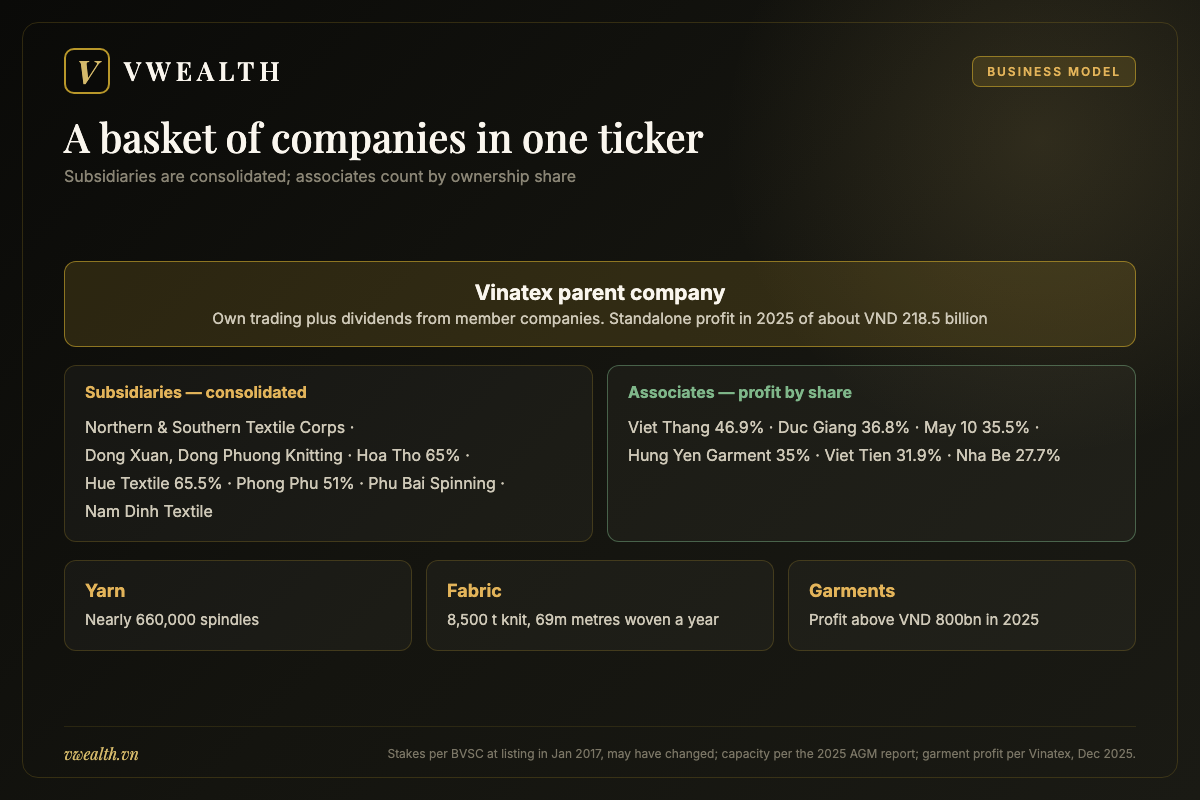
The Vinatex parent has its own direct business, with an office in Hanoi and branches, while also holding stakes in member companies. Its standalone scale is far smaller than the consolidated figures: according to the report to the 2025 shareholder meeting, the parent’s 2024 revenue was VND 2,241 billion and its pre-tax profit VND 156 billion, while group consolidated revenue was about VND 18,368 billion. In 2025 the parent reported revenue and income of VND 2,523 billion and profit of about VND 218.5 billion, with its margin rising from 7% to 8.7%. For 2026 the parent targets revenue and income of VND 2,800 billion, up 11% on 2025, and pre-tax profit of VND 260 billion, up 19%.
The key point is that the parent’s profit has two sources. One is its own trading and business activity. The other is dividends and profit distributions from subsidiaries and associates. Vietnamese financial news regularly runs items such as “Hoa Tho pays a cash dividend, Vinatex benefits,” “Viet Thang Garment pays a dividend, Vinatex expects to receive nearly VND 10 billion” or “Nam Dinh Garment sets record date for a 15% dividend, Vinatex pockets billions” — each one a stream of cash flowing up from the lower tiers. The parent therefore behaves much like a holding company: its health depends on the companies below doing well and being willing to pay out.
At the group’s mid-2026 review, the chairman described Vinatex as having “nearly 30 enterprises,” and elsewhere referred to “27 enterprises of different scale and development conditions” — the exact number depends on how you count small holdings. The mid-2026 report put the system’s workforce at 48,134 people (while at the May AGM the chairman spoke of “more than 55,000 workers” — the figures differ depending on which member companies are counted). The system’s main businesses are yarn, weaving and dyeing, garments, and towels and home textiles, with dedicated Yarn and Garment business boards coordinating markets, orders and productivity across member companies. Every month the group runs three management forums: a group-wide market seminar, a Yarn board meeting with all spinning units, and a Garment board meeting with the key units that account for more than 40% of the group’s sewing capacity.
Three rings of ownership: subsidiaries, associates and why it changes every number
This section is a little technical, but without it you will misread every VGT figure. Under Vietnamese accounting standards (which follow the same logic as IFRS on this point), a company Vinatex controls — usually above 50% of votes — is a subsidiary: all of its revenue, costs, assets and liabilities are added to the consolidated accounts, and the share of profit belonging to other shareholders is then separated out as “non-controlling interests.” A company where Vinatex has significant influence but not control — typically 20–50% — is an associate: its revenue does not enter the consolidated accounts; only Vinatex’s proportional share of its profit appears on a single line called “share of profit from associates and joint ventures.” Smaller holdings are other long-term investments, recognised only when dividends are received.
The practical consequence: the big garment brands you may know — Viet Tien, May 10, Nha Be, Duc Giang, Viet Thang, Hung Yen — are mostly associates. Their revenue is not part of Vinatex’s roughly VND 18 trillion of consolidated revenue. The spinning and weaving companies the group controls, by contrast, are fully consolidated. As a result, VGT’s consolidated accounts look far more “yarn-heavy” than the real economics of the whole system.
| Company (ticker if listed) | Main activity | Vinatex stake (approx.) | Accounting treatment |
|---|---|---|---|
| Northern and Southern Textile and Garment Corporations | Yarn, weaving | 100% | Subsidiary |
| Dong Xuan Knitting, Dong Phuong Knitting | Knitting, garments | 100% | Subsidiary |
| Hoa Tho Textile-Garment (HTG) | Yarn, garments | 65% | Subsidiary |
| Hue Textile-Garment (HDM) | Yarn, knitting, garments | 65.5% | Subsidiary |
| Phong Phu (PPH) | Yarn, fabric, home textiles | 51% | Subsidiary |
| Phu Bai Spinning (SPB) | Yarn | 53.8% | Subsidiary |
| Nam Dinh Textile-Garment (NDT) | Yarn, fabric, garments | 53.7% | Subsidiary |
| Viet Thang (TVT) | Yarn, fabric, garments | 46.9% | Associate |
| Duc Giang (MGG) | Garments | 36.8% | Associate |
| May 10 (M10) | Garments | 35.5% | Associate |
| Hung Yen Garment (HUG) | Garments | 35% | Associate |
| Viet Tien Garment (VGG) | Garments | 31.9% | Associate |
| Nha Be Garment (MNB) | Garments | 27.7% | Associate |
Source: list of subsidiaries and associates in BVSC’s VGT listing report (January 2017). Stakes are as at listing and may have changed since; check the notes to the latest consolidated financial statements for current stakes and classification.
Yarn: nearly 660,000 spindles — the most asset-heavy and volatile business
Spinning turns cotton or synthetic fibre into yarn that is then woven or knitted into fabric. It is capital-intensive: a spinning mill needs hundreds of billions of dong in machinery, runs three shifts, and earns a margin that depends heavily on the gap between the price of cotton bought and yarn sold. According to the report to the 2025 shareholder meeting, Vinatex’s spinning business operates close to 660,000 spindles, “large enough to create advantages in output and the ability to handle big orders.”
Yarn matters to Vinatex more than you might think. In his 2022 article, Mr Le Tien Truong said spinning then accounted for about 50% of group asset value and contributed more than 55% of profit. But that share swings sharply with the cycle. According to VnEconomy’s account of the 23 December 2025 press briefing, the group’s garment business contributed more than VND 800 billion of profit in 2025, while spinning swung from a VND 95 billion loss in 2024 to a VND 176 billion profit in 2025. CEO Cao Huu Hieu said what pleased him most was that, for the first time in many years, yarn, weaving and dyeing, and garments were all profitable — dyeing’s result was “still modest, but no longer a loss.” In 2021 yarn was the star thanks to soaring prices; in 2022 it was the source of the first quarterly loss, when China’s zero-Covid policy forced heavy write-downs on yarn inventory.
Yarn also sells into different markets than garments. It goes not only to weaving companies inside the group but also abroad, historically concentrated on China. According to VnEconomy, yarn’s 2025 turnaround came from diversifying away from dependence on a single market towards Japan, South Korea, the Philippines and Europe; the mid-2026 report mentioned broadening supply to customers in China, to foreign-invested (FDI) manufacturers in Vietnam and to the domestic market. In the first half of 2026 the spinning mills ran at 98% of capacity and reached 58% of the full-year output plan; by the company’s nine-month 2026 estimate reported by Bnews, yarn revenue rose 18.8% and yarn profit almost tripled year on year. Management itself warned, however, that the challenge for the second half was holding margins as yarn demand showed signs of stalling.
For investors, the simplest way to think about spinning is as a commodity variable embedded in VGT. When cotton prices are stable and yarn demand is healthy, this business can deliver big profits on an existing asset base. When cotton swings or demand falls, yarn inventory can turn profit into loss within a single quarter. There is no way to switch this variable off while you hold VGT.
Weaving and dyeing: the industry’s bottleneck, and the reason the chain exists
Between yarn and garments sit weaving and dyeing — turning yarn into fabric with the colour, shrinkage and strength a brand specifies. This is the weakest link in Vietnam’s textile industry: it requires heavy capital, strict wastewater treatment, and many provinces are reluctant to license it. As a result, a large share of the fabric used by Vietnamese garment factories is still imported, much of it from China, South Korea and Taiwan.
According to the 2025 AGM report, Vinatex’s weaving capacity is about 8,500 tonnes of knitted fabric and 69 million metres of woven fabric a year, with a stated aim to “proactively develop a closed value chain and research new products with higher added value.” Measured against the fabric needs of the garment companies in the system, that is not enough to close the loop completely; the group itself listed “investing in weak links such as dyeing” among its 2025 priorities. The newer signal is that by the nine-month 2026 estimate, weaving and dyeing “improved strongly” while towels grew revenue 19.4% and profit 37.3% year on year (Bnews).
This is also where the Itochu relationship is most visible: the 2015 framework agreement focused on dyeing, finishing and materials. If you ever read that Vinatex is investing in a big new weaving and dyeing plant, understand it as a move aimed squarely at this bottleneck — and as a long-term investment with slow payback that will take time to show up in profit.
Garments: the industry’s biggest names, mostly held as associates
Garments are where Vinatex has the most recognisable names. The sewing companies in its system — Viet Tien, May 10, Nha Be, Duc Giang, Viet Thang, Hung Yen, Hoa Tho, Hue — are among Vietnam’s leading garment exporters, and several also own domestic fashion brands. According to figures Vinatex gave at the end of 2025, the group’s garment business contributed more than VND 800 billion of profit that year, more than four times the yarn business — the comparison is a vwealth estimate. The chairman’s article after the 2026 AGM season said that in 2025 three companies in the system earned consolidated profit above VND 400 billion — Viet Tien, Phong Phu and Hoa Tho, with Viet Tien, an associate, above VND 500 billion — and four earned between just over VND 100 billion and over VND 200 billion: Nha Be, May 10, Hue Textile-Garment and Huu Nghi Garment.
But as explained above, most of the big garment makers are associates. In VGT’s consolidated accounts, their profit comes in mainly through the “share of profit from associates” line, not through revenue and cost of sales. That creates an interesting paradox: look at revenue and Vinatex seems to be a spinning company; look at profit and you see how much the garment side contributes.
Garment manufacturing has three common business levels. CM (cut and make) is pure contract sewing: the customer supplies fabric, and the factory cuts, sews, packs and earns a processing fee. FOB — in Vietnamese industry usage, the factory sources its own materials — means the factory buys fabric and trims and sells finished goods to the customer, earning a higher margin but tying up working capital and taking material risk. ODM (original design manufacturing) means the factory designs products and pitches them to brands — the highest level. Moving up from contract sewing to FOB and ODM is a direction Vinatex’s chairman has repeated for years; he now says member companies are starting to think about “new profit centres” beyond ordinary production while staying within the textile value chain. The market is tougher: according to CEO Cao Huu Hieu at the end of 2025, order prices for 2026 were generally 5–7% lower depending on customer, orders of several million pieces had all but disappeared, and 2,000–3,000 pieces per order had become normal. The nine-month 2026 estimate showed garment revenue up only 3.9%, with margins under heavy pressure from price competition, small orders and demands for faster delivery. In other words, the garment side is not counting on big volume growth; the fight is over order quality.
Keep in mind that most of these garment companies have their own shareholders, and many are separately listed or registered for trading (VGG, M10, MNB, MGG, HUG, TVT, HTG and others). If you only care about one particular garment maker, buying that stock directly may be a “purer” exposure than VGT. If you want exposure to the whole system — yarn, fabric, garments, plus land and the state-divestment story — VGT bundles it all into one ticker.
The internal chain, rules of origin and where the moat really is
Why does it matter to have yarn, fabric and garments inside one system? The answer lies in free trade agreements. The CPTPP (the Comprehensive and Progressive Agreement for Trans-Pacific Partnership) applies a “yarn forward” rule to textiles and apparel: to qualify for preferential tariffs, the yarn must be made within member countries, and the weaving and sewing must also happen within the bloc. The EU–Vietnam Free Trade Agreement (EVFTA) uses a “fabric forward” or two-stage rule: the fabric must be woven in Vietnam or the EU, with an exception allowing fabric originating in certain EU FTA partners such as South Korea. A garment factory that simply sews imported Chinese fabric will not earn preferential origin under either agreement.
A system that already has spinning, weaving and dyeing, and sewing — like Vinatex — can in theory supply goods that qualify, an advantage that pure contract sewers lack. In practice, as the weaving section showed, in-house fabric capacity still does not cover the whole system, so the advantage is partial rather than absolute. Our TCM analysis covers rules of origin in depth from the angle of a privately run integrated producer; the point to stress here is that at Vinatex the chain is not inside a single legal entity but “wired” across many independent companies, so its effectiveness depends on how well the parent coordinates them.
So where is VGT’s economic moat — its durable, hard-to-copy advantage? In vwealth’s view there are three layers. The first is scale: nearly 660,000 spindles and dozens of garment factories let the group take large orders that smaller firms cannot. The second is long-standing customer and commercial relationships, including one with a major shareholder that is also a trading partner. The third is land and infrastructure accumulated during the state-enterprise era. The weakness is that the moat does not rest on technology or consumer brands — the two things that generate high margins — but on manufacturing scale, which Bangladesh, India and Indonesia are also building quickly. For a broader look at how Vietnam’s factories fit into supply-chain diversification away from China, see China plus one and Vietnam stocks.
Financial Health: How to Read the Numbers Before Deciding Whether to Buy VGT Stock
The financial statements of a holding group are like a city map drawn at three different scales at once. Look only at consolidated revenue and you see one picture; look at profit attributable to parent shareholders and you see another; look at the parent on its own and you see a third. This chapter is not meant to give you today’s numbers — open the VWEALTH report for those — but to show you how to read Vinatex’s own figures so you know where to look every time a report comes out.
Eleven years of revenue: moving sideways in the VND 14–19 trillion range
The table below summarises key lines from the consolidated financial statements for 2015–2025, based on VNDirect data. Figures for closed financial years are used as historical reference points; some years may differ slightly from numbers quoted in the press from unaudited fourth-quarter reports.
| Year | Net revenue | Gross profit | Gross margin | Share of associates’ profit | Pre-tax profit | Net profit to parent shareholders |
|---|---|---|---|---|---|---|
| 2015 | 15,184 | 1,885 | 12.4% | 498 | 646 | 390 |
| 2016 | 15,462 | 1,704 | 11.0% | 507 | 684 | 325 |
| 2017 | 17,447 | 1,592 | 9.1% | 545 | 748 | 386 |
| 2018 | 19,101 | 1,801 | 9.4% | 673 | 761 | 438 |
| 2019 | 18,986 | 1,516 | 8.0% | 701 | 766 | 520 |
| 2020 | 13,909 | 1,280 | 9.2% | 579 | 593 | 328 |
| 2021 | 16,003 | 2,147 | 13.4% | 576 | 1,456 | 803 |
| 2022 | 18,307 | 2,004 | 10.9% | 717 | 1,189 | 594 |
| 2023 | 16,466 | 1,228 | 7.5% | 564 | 539 | 166 |
| 2024 | 17,326 | 1,875 | 10.8% | 564 | 835 | 324 |
| 2025 | 18,373 | 2,364 | 12.9% | 678 | 1,480 | 852 |
VND billion. Source: consolidated financial statements, VNDirect data. Gross margin is a vwealth estimate (gross profit divided by net revenue). The “consolidated revenue” Vinatex reports to its AGM (for example VND 19,486 billion for 2025) is higher than net revenue in this table because it includes financial and other income.
The first thing that stands out is that revenue barely grew over eleven years: from about VND 15.2 trillion in 2015 to about VND 18.4 trillion in 2025, with a peak of about VND 19.1 trillion in 2018. That works out to a compound growth rate of under 2% a year — a vwealth estimate. This is not unique to Vinatex; as explained, consolidated revenue mainly reflects the consolidated yarn and fabric companies, while the big garment makers sit outside the revenue line. But it does tell you that VGT is not a volume-growth story. If there is a story, it is about margins and efficiency.
Thin gross margins: one percentage point can decide the year
Vinatex’s gross margin has ranged from 7.5% (2023) to 13.4% (2021). That may sound like a narrow band, but do the arithmetic: on revenue of around VND 18 trillion, each percentage point of gross margin equals roughly VND 180 billion of gross profit — an illustrative vwealth calculation. Set against annual pre-tax profit of a few hundred billion to VND 1.5 trillion, that is an enormous swing factor.
Three things drive the margin. The first is the spread between cotton and yarn prices, as discussed in the yarn section. The second is processing prices and order mix at the consolidated garment companies. The third is labour cost: textiles and garments are labour-intensive, and every rise in Vietnam’s regional minimum wage pushes costs up. Vinatex’s chairman has put the system’s wage bill at roughly VND 600–700 billion a month — a very large cost variable next to a full year’s profit. In 2025 gross margin rose to about 12.9% from 10.8% in 2024 — partly thanks to high volumes as customers pulled orders forward before tariffs, partly thanks to productivity. The key question for the next few years is whether that margin can hold when US tariffs prompt customers to ask suppliers to share the cost.
Share of profit from associates: the biggest pillar under consolidated earnings
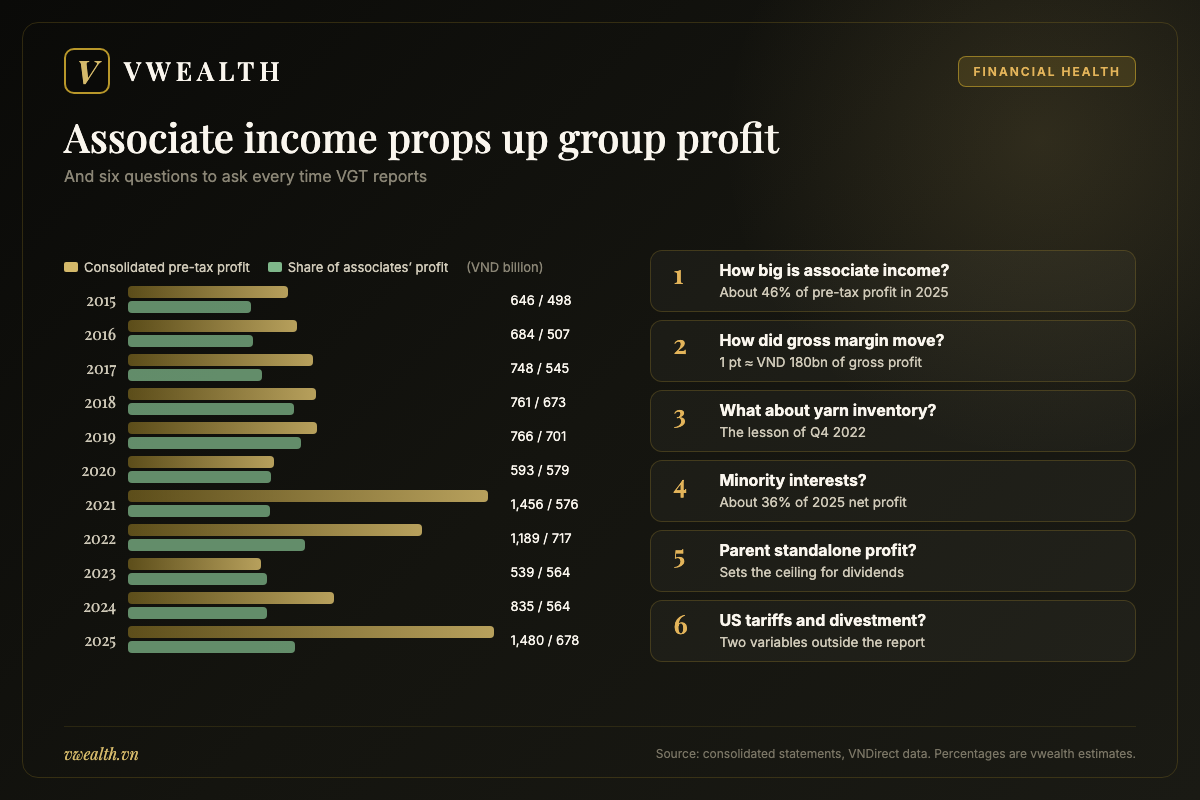
This is the most important line in VGT’s income statement, and the clearest proof that you are buying a basket of companies. Vinatex’s share of associates’ profit ranged from about VND 500 billion to VND 720 billion a year between 2015 and 2025 — far steadier than total pre-tax profit.
Put the two numbers side by side. In 2025 the associates’ share was about VND 678 billion, roughly 46% of consolidated pre-tax profit of VND 1,480 billion. In 2024 the ratio was about 68%; in 2019 about 92%; in 2020 about 98%. In 2023 the associates’ share of about VND 564 billion was actually larger than consolidated pre-tax profit of about VND 539 billion — meaning the rest of the group (the parent plus consolidated subsidiaries) made a small loss in aggregate. All of these ratios are vwealth estimates from the consolidated data.
How should you interpret this? There are two readings, and both are valid. The optimistic one: the associate garment makers — Viet Tien, May 10, Nha Be, Duc Giang and others — are a fairly durable profit cushion that stops VGT from falling too far when spinning struggles. The cautious one: that profit is “on paper” from the parent’s point of view until it is paid out as dividends; the group does not control how much is paid, nor can it direct those companies’ strategy as it can with subsidiaries. 2021 and 2025 were rare years in which the consolidated bloc (mostly yarn and fabric) generated more profit on its own than the associates did.
A practical tip: every time VGT reports a quarter, subtract the associates’ share from pre-tax profit. What is left tells you how the yarn, fabric and parent bloc is doing. If it is negative or very small, the quarter is being carried by the associate garment makers.
Non-controlling interests and the standalone parent: two layers between profit and you
After consolidated after-tax profit, there is one more step before you reach the share belonging to VGT shareholders: deducting the profit that belongs to minority shareholders in subsidiaries. Because Vinatex owns only about 50–62% of large listed subsidiaries such as Phong Phu and Hoa Tho, the portion belonging to their other shareholders is significant. In 2025, consolidated after-tax profit was about VND 1,324 billion, of which about VND 472 billion — roughly 36%, a vwealth estimate — belonged to non-controlling interests. The remainder attributable to parent shareholders was about VND 852 billion, equal to basic earnings of about VND 1,666 per share according to VNDirect.
The second layer is the standalone parent, which determines dividends. As chapter 2 showed, the parent’s 2025 after-tax profit was only about VND 218.5 billion, around a quarter of consolidated profit attributable to parent shareholders — a vwealth estimate. The rest sits in subsidiaries and associates: retained for reinvestment or debt repayment, or paid to those companies’ other shareholders.
So when someone says “VGT has a low P/E,” ask which earnings they mean. P/E on consolidated profit attributable to parent shareholders is the standard measure, but the cash that actually reaches shareholders depends on the parent’s standalone profit and its dividend policy — both much smaller. This is the root of what analysts call the “holding company discount”: markets often value a parent group below the sum of its parts because shareholders cannot directly touch the cash flows of the companies underneath.
Debt, inventory and deposits: a sturdier balance sheet than it looks
According to consolidated data compiled by VNDirect, at the end of 2025 Vinatex had total assets of about VND 20,555 billion and total borrowings of about VND 6,779 billion, of which short-term loans were about VND 4,902 billion, or roughly 72%; interest expense for 2025 was about VND 318 billion. At the same time, cash and cash equivalents of about VND 981 billion plus short-term financial investments (mostly term deposits) of about VND 3,190 billion added up to about VND 4,171 billion, more than 20% of total assets. Subtract that from borrowings and net debt is only about VND 2.6 trillion, against equity of about VND 10,006 billion — a vwealth estimate. At 30 June 2026, according to the half-year report as cited by Mekong ASEAN and Thoi Bao Ngan Hang, total assets were about VND 20,838 billion, liabilities had fallen to VND 9,968 billion, loans and finance leases were close to VND 6,250 billion and equity was VND 10,870 billion. The chairman stressed in 2022 that the group had “the most sustainable financial structure among the top five textile companies,” with a debt-to-equity ratio of about 1.2 times at the time; at the 2026 AGM the CEO reported a 2025 Altman Z-score of 3.07.
A high share of short-term borrowing is normal in this industry: mills borrow short-term to buy cotton and materials, then repay when customers pay. The risk lies in inventory — about VND 3,447 billion net at the end of 2025 according to VNDirect data, down to about VND 3,158 billion at 30 June 2026. The fourth quarter of 2022 showed that when yarn prices fall fast, inventory has to be written down and profit disappears immediately. Long-term debt, meanwhile, has fallen steadily from about VND 5,088 billion in 2017 to about VND 1,877 billion in 2025 according to VNDirect, reflecting a period without major expansion; at the end of 2025 the group also said it had no plans for new projects in 2026, only upgrades. Cash flow is strengthening as well: according to Thoi Bao Ngan Hang, operating cash flow in the first half of 2026 was a positive VND 1,123 billion or so, against VND 38 billion a year earlier, helped by releasing inventory.
The first half of 2026 and the nine-month estimate: reading a big profit correctly
According to the half-year financial statements Vinatex published on 30 July 2026, net revenue for the first six months of 2026 was VND 9,494 billion, up 9.2%; gross profit was VND 1,375 billion, with gross margin up from 13.57% to 14.48%; pre-tax profit was VND 930.1 billion, up 39.5%; and consolidated after-tax profit was VND 857.7 billion, of which VND 527.6 billion belonged to parent shareholders and VND 330 billion to non-controlling interests. Six months alone beat the whole of 2024 and reached roughly 67% of the full-year 2026 plan — the ratio is a vwealth estimate.
Using the framework above, three points stand out. First, the extra gross profit (about VND 195 billion) equalled roughly 74% of the increase in pre-tax profit, according to the company’s own explanation — so the gain came mainly from the consolidated businesses (yarn and fabric), not from one-offs. Second, the share of profit from joint ventures and associates was nearly VND 300 billion, up 15.9%, or about 32% of pre-tax profit — far lower than in 2019–2024, a classic period in which the yarn side “carries its own weight.” Third, the net financial result narrowed from minus VND 62.5 billion to about minus VND 4.3 billion, even though interest expense still rose 7.4% to VND 175.2 billion.
For the third quarter, Bnews reported on 27 September 2026 that Vinatex estimated nine-month consolidated revenue up about 7.3% and pre-tax profit up 37.8% year on year, already above the full-year profit plan, with pre-tax margin up from 7.4% to 9.5%. These are company estimates ahead of the Q3 financial statements, and the CEO himself warned of plenty of risk through year-end: volatile cotton and fibre prices, a weakening dong, shrinking demand in the US and EU, and rising logistics and material costs. For official Q3 and later figures, see the updated VWEALTH report.
Six questions to ask every time VGT reports
Pulling the analysis together, here is a short checklist to take with you each quarter. It will not tell you whether the stock will rise or fall, but it will help you see where profit comes from and whether it is durable.
One: how large is the share of associates’ profit, and what fraction of pre-tax profit does it represent? If the fraction jumps, the consolidated bloc is weakening; if it falls while total profit rises, yarn and fabric are pulling their weight.
Two: how has gross margin changed year on year? Each percentage point is worth hundreds of billions of dong of gross profit a year. Read it together with management’s explanation of cotton prices, yarn prices and processing fees.
Three: what is happening to inventory and inventory provisions? Raw-material inventory rising sharply while yarn prices are weak is the signal that deserves the most attention.
Four: how large are non-controlling interests? This tells you how much of the profit in VGT’s report “belongs to someone else.”
Five: what is the parent’s standalone profit? This figure sets the ceiling for dividends. The parent’s separate financial statements are published on HNX alongside the consolidated ones.
Six: is there news on SCIC’s divestment timeline, or on US tariffs? Neither appears in the financial statements, but either can move the share price more than any quarterly result.
If you would rather have these indicators calculated for you, the VGT report on VWEALTH compiles the latest figures, and you can create a free account to follow them.
How the Market Treats VGT Stock: From Dormant Share to Cyclical Trade
If you are used to large caps on the Ho Chi Minh City Stock Exchange (HOSE), VGT will feel different. It trades on UPCoM, where the daily price limit is ±15% — much wider than HOSE’s ±7% — and most of its shares sit untouched with a few large holders. The result is a stock that can sleep for months and then wake up violently on news. Our explainer on HOSE, HNX and UPCoM covers how the three venues differ in listing standards, price limits and liquidity.
Historical price milestones
The milestones below come from VNDirect’s historical price data and contemporary press reports, and are unadjusted prices. The reference price on listing day, 3 January 2017, was VND 13,500. On 25 January 2018 the stock briefly reached VND 19,700, then moved within roughly VND 8,000–14,000 through 2018–2019. The pandemic low was about VND 5,900 at the end of March 2020. 2021 was the breakout year: VGT rose from about VND 10,000 to almost VND 29,600 in November 2021, as Vingroup trimmed its stake and profits hit a record; the intraday high was VND 30,900 on 10 January 2022. Ten months later the stock was back at about VND 6,600 in mid-November 2022.
From 2023 to 2026 VGT traded in a narrower range: a 2024 high of about VND 18,300 (16 July 2024) and a 2025 intraday low of VND 7,200 on 9 April 2025, right after the tariff shock; by 19 November 2025 it closed at about VND 13,100. In 2026, according to VNDirect data, it reached VND 16,600 (4 March 2026) and fell to VND 10,400 (28 July 2026) before rebounding on news that SCIC had put Vinatex on its divestment list: Thoi Bao Ngan Hang noted VGT moving from around VND 10,260 in late July to above VND 12,000 at times in mid-August 2026, on sharply higher volume. For today’s price and up-to-date valuation, check the VWEALTH report — this article deliberately leaves them out.
Over the whole decade, VGT has rarely held high prices for long. Both big rallies (early 2018 and 2021–2022) coincided with changes among major shareholders and peak-cycle profits, and both were almost entirely erased afterwards. That is the personality of a cyclical stock, not a growth stock.
Stock personality: mid-sized, low free float, seasonal liquidity
Add up SCIC (53.49%) and Itochu (13%), and about two-thirds of VGT’s shares sit with two institutions that rarely trade; the remaining 33.51% also includes long-term institutional holders. The number of shares that actually change hands is therefore only about a quarter to a third of the total — a vwealth estimate. According to VNDirect data, average daily matched volume varies enormously by year: only tens of thousands of shares in 2017, a few hundred thousand in 2018–2020, more than 4 million in 2021, about 1.8 million in 2022, only about 0.6 million in 2023, and roughly 1–1.7 million shares a session in 2024–2026.
For individual investors in Vietnam stocks, that liquidity is enough for small and medium positions in VGT stock. For an institution wanting to deploy hundreds of billions of dong, VGT is hard to get into and out of — one reason it rarely appears in large fund portfolios. And because it trades on UPCoM, VGT is not in major indices such as the VN30, so it receives no passive inflows from domestic ETFs.
Foreign investors: mostly one name
Itochu alone owns 13% of VGT. In other words, “foreign ownership” in VGT is largely synonymous with Itochu; foreign funds and other overseas investors hold much less. That is a change from the 2014 IPO, when 30 foreign investors bought more than 55 million shares (about 11% of capital); at listing in January 2017 BVSC put foreign ownership at 11.01%. Some of the funds’ shares were later bought by Itochu in 2018. For the current foreign ownership ratio, check the price board or the VWEALTH report.
Textiles are not among the sectors with tight foreign ownership caps like banking; at listing, BVSC put VGT’s foreign ownership limit at 49%. For the current limit, check the company charter (amended at the 2026 AGM) and the Vietnam Securities Depository’s disclosures. In any large state divestment, however, the buyer structure and conditions are set by the competent authorities, so it is better to wait for a concrete plan than to assume in advance which foreign investor might come in. For foreigners, VGT also comes with the usual Vietnam mechanics: you need a local securities account and trading code, trades settle on a T+2 basis, and UPCoM’s ±15% daily band applies.
Valuation: P/E, P/B and the holding company discount
This article does not give today’s P/E or P/B, but it can give you a framework. At listing in 2017, according to BVSC, VGT was valued at about 15.3 times earnings and 0.9 times book value at the reference price. Since then, according to vwealth’s calculation from historical prices and parent-attributable equity, VGT has traded below book value per share most of the time — a common trait of state-controlled companies with low dividends.
Why is VGT’s P/B often below 1? Three reasons. First, return on equity (ROE) was low for many years: in 2023, profit attributable to parent shareholders was only about VND 166 billion on parent-attributable equity of about VND 6.7 trillion, an ROE of about 2.5%; in 2025 it improved to about 11–12% — both vwealth estimates. The company itself reported a 2025 ROE of 13.8%, most likely calculated on total consolidated profit and equity including non-controlling interests, unlike vwealth’s parent-only measure. Second, the holding discount: shareholders do not directly receive the cash flows of associates. Third, low dividends deter income investors.
On the other side, two things lead some investors to argue that VGT’s book value understates its worth. One is that investments in associates are carried at book value (about VND 3,067 billion at the end of 2025 according to VNDirect), while some listed associates may have market values that differ. The other is urban land: about 490,000 square metres of production land at the time of equitisation, which BVSC called in 2017 “one of Vinatex’s key highlights,” including “some large prime plots in Hanoi”; at the end-2025 press briefing the CEO also mentioned property business as one of the profitable contributors. Both are “potential” value: they only become cash for shareholders through transactions, conversions and approvals — and there is no timetable for any of those.
Catalysts the market tends to react to
Over the past decade, VGT’s price has reacted most strongly to four kinds of news. The first is major-shareholder news: Itochu buying in 2018, Vingroup selling in 2021, and most recently SCIC’s 2026–2030 divestment list. The second is US tariff and trade news: the April 2025 shock drove the stock to its low, and later negotiation steps helped it recover. The third is profit that beats expectations, especially when it surpasses old peaks, as in 2021 and 2025. The fourth is the global cotton and yarn cycle, which acts indirectly but powerfully through the spinning business.
Notice that dividends are not on the list. At 3% of par, VGT’s dividend has never been a meaningful catalyst — unless the payout policy changes sharply, of which there is no sign. With a stock like VGT, the practical approach is to be clear about which catalyst you are betting on and to follow the news that relates to it.
Industry Backdrop: US Tariffs, Rules of Origin and the Cost Race
No textile company can escape the world market, and Vinatex least of all. When the US changes tariffs, when cotton prices move, when Bangladesh gets better treatment, it all shows up in the order books of dozens of factories in the system. This chapter places Vinatex in that bigger picture. For a wider view of how exports drive Vietnam’s economy and stock market, see our guide to Vietnam’s export economy and stock exposure.
Vietnam on the global textile map
According to figures Vinatex released at its end-2025 press briefing, Vietnam’s textile and garment exports in 2025 were estimated at about USD 46 billion, up around 5% from 2024; the US remained the main market at more than USD 18 billion, and apparel accounted for more than USD 38 billion of the total. Vietnamese textile products now reach 138 markets. In 2026 growth slowed: according to industry figures cited by Vietstock, textile and garment exports for the first seven months of 2026 were USD 27.02 billion, up only 2.67%, with apparel at USD 21.13 billion, up 0.7%; Vietnam Customs put textile and garment exports at more than USD 22.8 billion, with the US still the largest market at about USD 10.5 billion, followed by Japan at USD 2.39 billion and South Korea at USD 1.5 billion. The two totals differ because they classify product groups differently.
Vinatex itself is even more dependent on the US than the industry average. The 2026 AGM documents, as summarised by Mekong ASEAN, say the US market currently accounts for about 44–45% of the company’s export turnover, and that the group is “especially mindful of the risk of US investigations and tariffs.” Any change in Washington therefore directly affects nearly half of the Vinatex system’s exports.
One little-noticed point: Vietnam is also a big buyer of American cotton. According to Vitas, in 2025 Vietnam was the largest importer of US cotton, at almost 778,000 tonnes worth about USD 1.37 billion. The Vietnam–US textile relationship is therefore two-way: Vietnamese mills buy US cotton, spin it, weave it, sew it, and sell the clothes back to American consumers.
US tariffs: from 46% to 20%, then a temporary 10% and 12.5% under Section 301
US tariff policy toward Vietnamese goods has never changed as often as it did in 2025–2026. On 2 April 2025 the US announced a 46% reciprocal tariff on Vietnamese goods. After negotiations, the rate that took effect on 7 August 2025 was 20%. In February 2026, the US Supreme Court ruled against using IEEPA to impose broad tariffs; according to the Vietnam Textile and Apparel Association (Vitas), Washington switched to other legal bases such as Sections 122, 232 and especially 301. Vietnamese goods first faced a temporary additional 10% tariff; from 24 July 2026 that was replaced by 12.5% under Section 301 of the Trade Act, tied to an investigation related to forced labour.
What worries the textile industry is not the 12.5% itself but the gap with competitors. According to Vitas, quoted by Nguoi Quan Sat, 17 countries pay only 10%, including Bangladesh, Cambodia, Indonesia, Malaysia, Mexico and India; Vietnam sits in the 12.5% group alongside China and Turkey. Vietnam is also outside the tariff-rate quota (TRQ) programme the US offers Bangladesh, Cambodia, Indonesia and Malaysia to encourage use of American cotton and inputs — even though Vietnam is the largest buyer of US cotton. Vitas has urged the government to negotiate quickly to bring the rate down to 10%.
The total duty on a garment is higher still, because the 12.5% is added on top of normal most-favoured-nation (MFN) import duties, which vary by product code. Who pays? In theory the US importer; in practice, Vinatex CEO Cao Huu Hieu told Thanh Nien at the end of 2025 that since the reciprocal tariffs, customers always ask Vietnamese suppliers to share the duty in negotiations — even partners of 20–30 years say they will leave if prices are not cut. That squeezes Vietnamese factory margins.
Views on the scale of the impact differ. ACB Securities (ACBS) places textiles and seafood among the sectors facing a direct cost impact from the 12.5% rate, but also argues the real scope may be narrower than the headline suggests, and that the effect on each company depends on its ability to share costs with customers, its margins, whether orders can shift, how traceable its inputs are and how duties apply to specific product codes. At company level, May 10 deputy CEO Bach Thanh Long said in late July 2026 that orders were confirmed to year-end, customers had not yet asked to share the cost, and the impact might become clearer from 2027 (as reported by Vietstock). Keep both views in mind — a delayed but real impact — when assessing VGT.
CPTPP, EVFTA and the challenge of diversifying markets
When the US becomes unpredictable, markets covered by free trade agreements with Vietnam become the natural escape route. CPTPP opens Japan, Canada, Australia and others under yarn-forward rules; EVFTA opens Europe under fabric-forward rules. As chapter 3 explained, those rules are exactly why a system with in-house spinning and weaving like Vinatex has a relative edge over pure contract sewers. Mr Le Tien Truong has also noted that Vinatex represented the industry during Vietnam’s negotiations for WTO accession, CPTPP and EVFTA.
But that escape route has limits. In information Vinatex released on 23 December 2025, as reported by Tuoi Tre, the group observed that the EU, Japan and South Korea had “also become more crowded as countries redirected exports away from the US because of high tariffs,” and that global textile demand in 2026 was forecast to grow only about 3%, half the 2025 pace. When China, Bangladesh and India all push more goods into Europe, Vietnam’s tariff advantage has to compete with their price advantage. Traceability, labour and environmental requirements in major markets are also getting stricter; looking to 2027, Vinatex expects G7 markets tightening standards on origin, environment and labour to tilt the advantage in 2027–2028 toward companies that control origin, raise local content and keep supply chains transparent (Bnews, 27 September 2026). A system with many in-house stages should in theory find it easier to prove origin — but that requires data and consistent management discipline across dozens of companies.
Domestic competition: where Vinatex stands next to TCM, MSH, TNG and STK
Investors who want textile exposure among Vietnam stocks have several listed alternatives to VGT stock. Each represents a different model, and setting them side by side shows where VGT is different.
| Ticker | Exchange | Main model | How it differs from VGT |
|---|---|---|---|
| VGT (Vinatex) | UPCoM | Holding group: yarn and fabric consolidated; garments mainly via associates | A basket of many companies, state-controlled |
| TCM (Thanh Cong) | HOSE | Integrated yarn–weaving–dyeing–sewing chain within one group | Korean-controlled, one main legal entity |
| MSH (Song Hong Garment) | HOSE | Garment exporter with a high FOB share | Private, focused on sewing |
| TNG | HNX | Large-scale garment exporter | Private, fast capacity growth |
| STK (Century Synthetic Fiber) | HOSE | Synthetic yarn (polyester, nylon) | Pure yarn, different product from cotton yarn |
| VGG, M10, MNB, TVT, HTG and others | UPCoM/HOSE | Garment and yarn companies inside the Vinatex system | Buy one slice of the VGT basket directly |
Sources: VNDirect listing data, vwealth’s TCM analysis, company disclosures. The table describes business models and does not compare valuations.
In 2022 Mr Le Tien Truong made a comparison: over 2016–2021 Vinatex’s profit grew 2.2 times, while the best-performing listed textile companies such as TNG, MSH, TCM and STK grew roughly 1.8–2.5 times. In other words, Vinatex kept pace with the best private companies in that period — but from a lower base of return on capital. Beyond listed companies, the largest competitors in practice are foreign-invested manufacturers from South Korea, Taiwan, China and Hong Kong operating in Vietnam, which account for the bulk of the industry’s exports. For a comparison with another Vietnamese exporter exposed to US tariffs in a different sector, see Should you buy VHC stock (Vinh Hoan)?
Labour, cotton and currency: three costs nobody fully controls
The Vinatex system employed 48,134 people according to the mid-2026 report, with average income of about VND 12.4 million a month per worker, up 8.9% year on year and close to the full-year plan of VND 12.6 million; the plan approved by shareholders targets average income growth of more than 10%. In 2025 average headcount fell 3.6% while income rose 7%, according to the CEO’s report to the AGM. That is both a retention policy in a tight labour market and a cost pressure at a time when processing prices are hard to raise. The target management keeps repeating — lifting total factor productivity by more than 5% a year — is precisely how it hopes to offset rising labour costs.
Cotton is the biggest cost in spinning, and almost all of it is imported. World cotton prices move with weather, farm policy in the US, India and Brazil, and Chinese demand. Vinatex’s mid-2026 report emphasised “optimising cotton purchasing” and “inventory management” to reduce exposure to cotton-price and currency swings. The exchange rate cuts both ways: a stronger US dollar raises export revenue in dong terms but also raises the cost of imported cotton and any foreign-currency borrowing. Logistics has been a big variable too: the 2024 results presented to the 2025 AGM cited logistics costs “falling sharply from the July 2024 peak” as one factor supporting results; by September 2026, however, group leaders were again citing rising logistics and material costs as a squeeze on margins.
Put together, the industry backdrop presents a paradox: demand for Vietnamese textiles is still large — Vietnam is the No. 1 apparel supplier to the US — yet the conditions for earning money on each order are getting tougher. Companies that raise productivity and move up to FOB and ODM will protect margins; those stuck in pure contract sewing will be squeezed.
Outlook: Three Scenarios for VGT Stock and What Would Trigger Each
Nobody knows for sure where VGT’s price will go, and this article offers no price target. What it can do is identify the variables that drive the story, then describe three scenarios with specific conditions so you can track them yourself. As each condition is met or missed, you will know which way the story is leaning.
Five variables that will shape VGT’s future
Variable one: SCIC’s divestment path. Vinatex is now on the list for full divestment in 2026–2030. Whether a sale happens, when, to whom, by what method (public auction, competitive offering or sale to a strategic investor) and at what starting price — each answer could change how the market values the shares. Experience with other SCIC files shows that being on a list does not mean selling quickly.
Variable two: US tariffs. Whether the 12.5% Section 301 rate can be negotiated down to 10%, as Vitas has urged, and whether new measures related to origin or forced labour emerge. With about 44–45% of Vinatex’s export turnover going to the US, this variable carries the most weight on profit.
Variable three: the yarn cycle. Cotton prices, yarn prices and Chinese demand determine whether the group’s most asset-heavy business makes big profits or losses.
Variable four: associates’ results and payout policies. If Viet Tien, May 10, Nha Be, Duc Giang and the others do well, VGT’s share of associates’ profit rises; if they pay generous dividends, cash to the parent rises.
Variable five: internal efficiency. The group has called 2026 a year of “growth through efficiency, not expansion,” targeting TFP growth above 5% and protecting margins through cost control, cotton purchasing and inventory discipline. If it delivers, margins could stay above the historical average even without much revenue growth.
On the official plan, the 2026 AGM approved targets of VND 21,435 billion in consolidated revenue and income, up 10%, and consolidated pre-tax profit of VND 1,380 billion, about 93% of the 2025 level. At the mid-year review, group leaders warned that it was “entirely possible” second-half profit would not stay as high as the first half because of tariffs, and set a full-year consolidated profit goal of about VND 1,400 billion, 2–3% above plan, with parent profit of about VND 270 billion. By late September 2026 the company estimated that nine-month profit had already exceeded the full-year plan, while also forecasting that 2027 would be “more challenging,” with traditional partners’ order plans still vague and market sentiment very cautious. Track actual quarterly results in the VWEALTH report.
Bull case: tariffs converge with competitors and divestment unlocks a new valuation
Conditions for this scenario: Vietnam negotiates a tariff rate in line with regional competitors, or gains access to preferential mechanisms such as tariff-rate quotas tied to US cotton; garment demand in the US and EU stays stable; cotton prices do not swing sharply; garment units keep shifting toward FOB and ODM and hold margins around 2025 levels. At the same time, SCIC announces a concrete divestment plan with a transparent process and attracts a buyer with real industry capability or a clear plan for the land bank.
In this scenario, consolidated profit could stay near its historical peak, the associates’ share would rise with the garment makers’ results, and, more importantly, the holding discount could narrow if a new shareholder pushes for higher dividends or restructures the portfolio. This is the scenario that patient long-term VGT holders hope for — but it also requires the most conditions to line up at once.
Base case: profit plateaus at a higher level than before, divestment has no date
Conditions: the 12.5% rate stays or changes only slightly; US customers ask suppliers to share some of the cost, but orders do not move away in large volumes — as garment makers in the system currently describe it, with orders secured to the end of 2026 and price pressure clearer from 2027; the yarn cycle is normal, without a repeat of 2026’s exceptional gains; SCIC keeps preparing its file but does not hold a sale in the next year or two. Consolidated profit falls back to around the VND 1,400 billion plan level or slightly below, still well above 2023–2024, and the dividend stays around 3% of par.
In this scenario VGT would likely keep trading on headlines — tariff news, divestment news, quarterly results — without a clear long-term trend. Holders collect a thin dividend and wait for a catalyst. In vwealth’s assessment this is the most likely scenario, because it only requires things to carry on much as they are.
Bear case: orders shift and the yarn cycle turns down at the same time
Conditions: the tariff gap between Vietnam and its competitors widens, or the US adds measures on origin or labour that push some orders from Vietnam to Bangladesh, India or Indonesia; consumer demand in the US and EU weakens; yarn prices fall quickly and inventory must be written down, as in the fourth quarter of 2022. The associates’ share falls with the garment makers’ results, spinning may slip back into losses, and consolidated profit returns to 2023 levels. The divestment is postponed because buyers are hard to find at an acceptable price.
In this scenario, history suggests VGT could give back most of its earlier gains within a few quarters — as it did in 2022 and early 2025. The dividend could fall below 3% if parent profit drops. A balance sheet with large deposits and low net debt would protect the group from a serious liquidity problem, but it would not stop the share price from falling.
Illustration: how VND 100 of profit at an associate reaches a VGT shareholder
To see how the holding discount works, follow one unit of profit through the layers. This is an illustrative example with assumed numbers, not data for any specific company.
Suppose a garment associate in which Vinatex owns 30% earns VND 100 of after-tax profit. In VGT’s consolidated accounts, the “share of profit from associates” line rises by VND 30 — exactly the ownership share. That is the number a consolidated P/E “sees.”
But the garment company does not pay out everything. Suppose it pays 50% of profit as dividends, or VND 50 to all its shareholders; Vinatex receives 30% of that, VND 15 in cash, which flows into the parent’s standalone profit. If the parent pays out about 69% of its standalone profit, as it did for 2025, about VND 10 of that VND 15 is paid to VGT shareholders, with the rest retained for investment or funds. Of that VND 10, 53.49% goes to the state, about 13% to Itochu, and the remainder is shared among other holders in proportion to their stakes.
In short, in this example, VND 30 of profit “on paper” becomes about VND 10 of cash paid to all VGT shareholders — roughly one-third. The rest does not vanish: it stays as retained earnings in the garment company and the parent, raising book value. But it only reaches you when the market is willing to value it, or when an unlocking event such as a stake sale, merger or restructuring takes place. That is exactly why the state-divestment story matters so much for VGT.
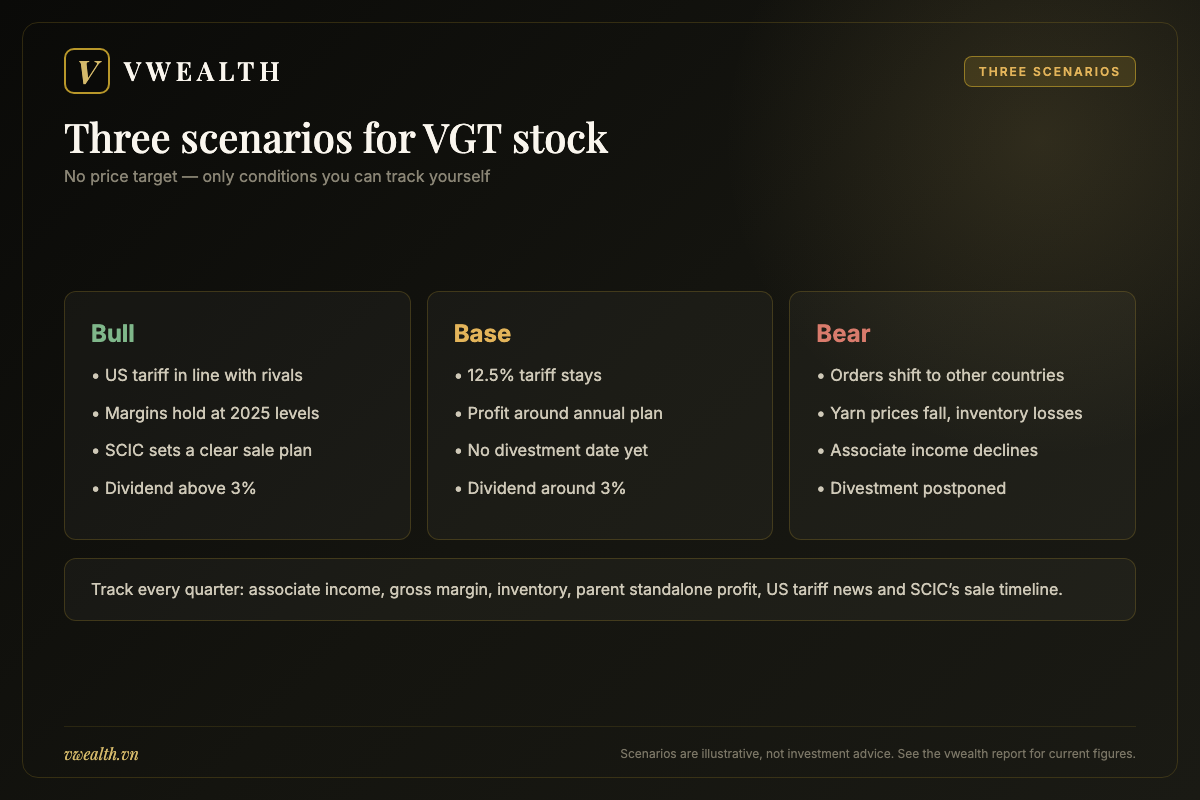
So, Should You Buy VGT Stock? Weighing the Pros and Cons
By now you have all the pieces needed to decide whether to buy VGT stock. This final chapter does not tell you to buy or sell — that depends on your goals, risk appetite and existing portfolio. Instead, it puts the pros and cons on the scale and asks which type of investor VGT fits.
The case for
One ticker, a whole industry. VGT is one of the few ways to get exposure to yarn, fabric, garments and several of Vietnam’s leading garment brands through a single stock. For investors who believe in the long-term position of Vietnam’s textile industry but do not want to pick individual companies, that is a real advantage.
Profits have proved resilient. In 2025 consolidated pre-tax profit reached about VND 1,480 billion, beating the 2021 peak in the very year of the biggest tariff shock. The share of associates’ profit has stayed in a VND 500–720 billion band for eleven years, cushioning the group when spinning struggles.
A solid balance sheet. Cash and deposits of about VND 4,171 billion and net debt of about VND 2.6 trillion against equity of about VND 10,006 billion at the end of 2025 (net debt is a vwealth estimate). Long-term debt has fallen steadily for years, and operating cash flow in the first half of 2026 was about VND 1,123 billion.
A divestment catalyst. SCIC’s decision to list Vinatex for full divestment in 2026–2030 opens the possibility of a new controlling shareholder — an event that could lead the market to re-rate assets such as associate stakes and land.
A major shareholder that is an industry partner. Itochu holds 13% and is a long-standing trading partner, aligning interests around the system’s manufacturing capability.
The case against
A thin dividend and a wide gap between consolidated and parent profit. Dividends have ranged from 1% to 6% of par, recently 3%. Parent standalone profit was only about a quarter of consolidated profit attributable to parent shareholders in 2025 — a vwealth estimate.
Revenue has barely grown in eleven years. Compound growth of under 2% a year — a vwealth estimate. VGT is not a growth story.
US dependence and a tariff disadvantage. About 44–45% of export turnover goes to the US, while Vietnamese goods pay 12.5% versus 10% for many competitors and are left out of the preferential quota programme.
A commodity-like spinning business. Profit can reverse quickly, as in the fourth quarter of 2022; large raw-material inventory is a constant risk.
State-enterprise governance. The chairman himself has spoken about limits on delegated decision-making and on pay. Investment decisions may move more slowly than at private companies.
Limited liquidity and free float. About two-thirds of shares sit with SCIC and Itochu; UPCoM’s ±15% daily band means prices can move sharply on news.
No timetable for divestment. SCIC’s list is a five-year direction, and many similar files have dragged on for years. Anyone buying VGT only on divestment hopes may have to wait a long time.
| Factor | Pros | Cons |
|---|---|---|
| Business model | One ticker holding yarn, fabric, garments and top garment brands | A holding group that is hard to read; profit depends on associates |
| Profitability | 2025 beat the 2021 peak; steady associate income | Flat revenue, thin gross margin, yarn cycle |
| Balance sheet | Large deposits, low net debt | Large raw-material inventory, mostly short-term borrowing |
| Shareholders | SCIC plans to sell its full stake; Itochu is a partner | No divestment timetable; low free float |
| Dividends | Regular cash payments | Low rate, irregular timing |
| Backdrop | Vietnam is the largest apparel supplier to the US; CPTPP and EVFTA origin advantages | US tariff of 12.5% above competitors; alternative markets more crowded |
Who VGT may suit
Patient value investors who are willing to hold for years, believe that the sum of Vinatex’s parts — stakes in garment and yarn companies plus land — is worth more than the market’s current valuation, and are prepared to wait for an event such as state divestment to unlock it. Investors in this camp should read the notes on investments in associates closely.
Industry-cycle investors who want to bet on a favourable phase for Vietnamese textiles — tariffs negotiated down, yarn prices recovering, orders rising — and who know to take profits when the cycle turns, as the history of 2018 and 2021–2022 shows.
Investors who want an “industry proxy” as a moderate-sized position within a diversified Vietnam portfolio, rather than picking individual garment makers. For more ideas on building such a portfolio, our guide to investing in the Vietnam stock market is a good starting point.
Who VGT does not suit
Income seekers. At 3% of par, VGT is not a natural fit for a dividend strategy; our Vietnam dividend stocks guide covers alternatives.
Growth investors looking for revenue and profit that rise steadily every year. Eleven years of VGT history do not show that personality.
Short-term traders using large size, because UPCoM liquidity and the low free float make quick entries and exits difficult, while the ±15% daily band can inflict heavy losses in a single session.
Anyone unwilling to read complex financial statements. If you do not plan to separate associates’ profit, non-controlling interests and parent standalone profit, it is very easy to misread VGT.
Final thoughts
Back to the original question: should you buy VGT stock? The honest answer is that VGT is not for investors who want a simple story. It is a basket of nearly thirty companies, a state shareholder with a plan to leave, a committed Japanese partner, a volatile spinning business and a well-known garment side — all in an industry adapting to US tariffs. 2025 showed the system is more resilient than many expected; but ten years of trading also show the stock rarely holds its peaks for long.
If you decide to dig deeper, start with the six questions in chapter 4, track the two big variables — US tariffs and SCIC’s divestment path — and compare VGT with other models in the industry such as Thanh Cong (TCM). And whenever you need current numbers — price, P/E, quarterly profit — open the VWEALTH analysis report rather than relying on figures that have gone stale.
Research Vietnamese stocks in English with vwealth. Our AI-powered platform turns Vietnamese market data into full English analysis reports — with international payment support and a free 2-month trial for new accounts. Create your free account and read the latest reports.


