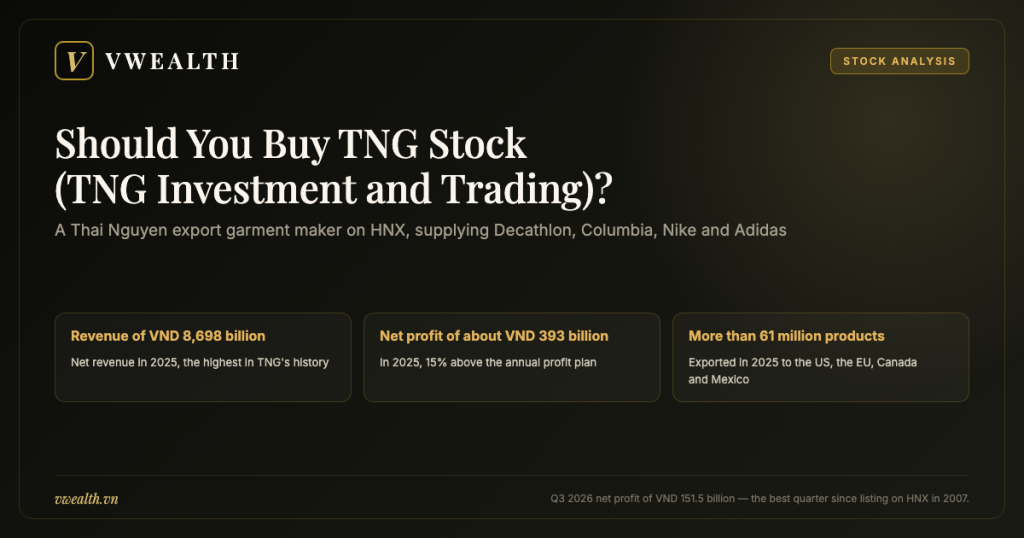
Should I buy TNG stock? It is a question that does not have a one-word answer, because TNG — the ticker of TNG Investment and Trading Joint Stock Company on the Hanoi Stock Exchange (HNX) — carries two stories that pull in opposite directions. The first is the story of a garment workshop founded in 1979 with aid from the German Democratic Republic, which at one point had auditors questioning whether it could continue as a going concern, and which now exports more than 61 million products a year for Decathlon, Columbia and The Children’s Place, having just reported third-quarter 2026 net profit of about VND 151.5 billion — its best quarter since listing. The second is the story of a company borrowing to grow: total borrowings of about VND 4,200 billion, more than 70% of it short term, operating cash flow of nearly VND 700 billion in the red for the first nine months of 2026, and a net profit margin of only around 4–4.5%. Both stories are unfolding just as the chairman’s seat has passed from father to son, and as US import tariffs rewrite the rules for Vietnam’s entire garment industry. This analysis peels back the layers — history, people, the money-making machine and financial health — so you can judge for yourself whether TNG stock fits your portfolio.
Before the story begins, a few ground rules. TNG is both the stock ticker and the shorthand that people in the industry use for TNG Investment and Trading Joint Stock Company, headquartered at 434/1 Bac Kan Street, Phan Dinh Phung Ward, Thai Nguyen Province, in northern Vietnam. The shares have a par value of VND 10,000, trade on the Hanoi Stock Exchange (HNX) and belong to the HNX30 index — the 30 largest and most liquid stocks on that exchange. Figures in this article come from the financial statements, explanatory letters and shareholder resolutions that TNG has published, annual financial data from VNDirect, and the Vietnamese financial press. Closed fiscal years serve as historical reference points; numbers that change every day, such as the share price, market capitalization or current P/E ratio, are deliberately left out. For the latest figures, open the updated analysis reports on vwealth. Wherever a number is our own calculation, the text says so as a “vwealth estimate.”
This article belongs to vwealth’s coverage of Vietnamese consumer and export-manufacturing stocks. If you are new to the market and want the bigger picture first — how foreign investors open accounts, how settlement and daily price limits work — our guide on how to invest in the Vietnam stock market is a good starting point. Here, though, we focus on a single garment maker in Thai Nguyen, and the central question running through the whole piece is this: TNG is borrowing to grow just as US tariffs change the rules of the game; can productivity gains and its strategy of taking on “difficult products” move fast enough to cover interest costs while protecting a profit margin that is already thin?
From the Bac Thai Garment Workshop to a 61-Million-Piece Exporter: TNG’s 47 Years
Many listed companies have a history as tidy as an investor-day slide deck: founded, grew, listed, expanded. TNG’s history is much bumpier. It includes years of living on foreign aid, years of hunting for customers after that aid disappeared, years of pouring every dong of profit into new factories, and a period when the auditors had to ask whether the company could keep operating at all. Understanding these twists helps you read today’s numbers correctly: why TNG borrows so much, why management loves to talk about “raising the difficulty level,” and why a record-profit quarter is not necessarily the whole story.
1979: A Garment Workshop Built on Foreign Aid
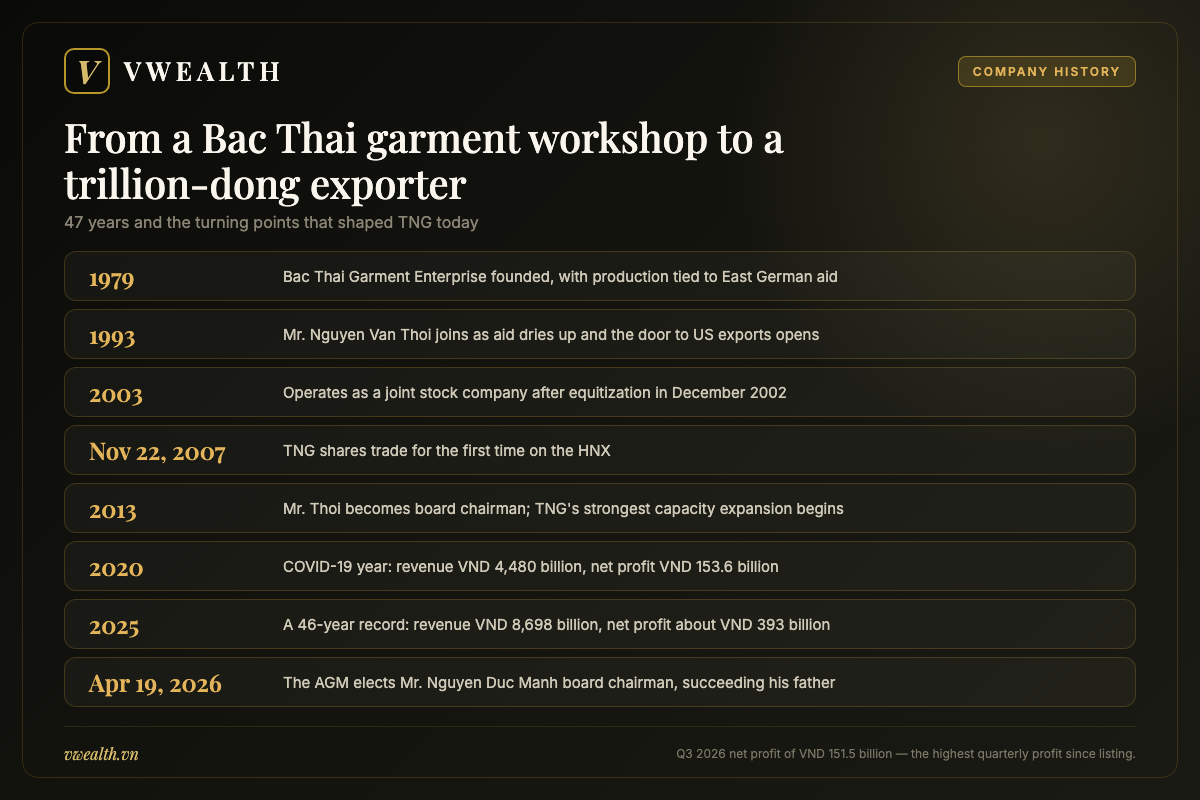
In November 1979, the Bac Thai Garment Enterprise was founded as a state-owned enterprise under the People’s Committee of Bac Thai Province — a former province that was later split into today’s Thai Nguyen and Bac Kan. Its production in those years was tightly linked to aid from the German Democratic Republic (East Germany). Put simply, the machines, the orders and even the workshop’s reason for existing came largely from a cooperation agreement between two governments, not from winning customers in a competitive market.
That model had a fatal weakness that would only become obvious more than a decade later: once the aid stopped, the enterprise had no sales skills, no international customers and no brand. Many Vietnamese garment workshops of that era never made it through the transition. The fact that TNG is still standing today — and standing among Vietnam’s large textile and garment exporters — is the first thing worth remembering about the company’s “personality”: this is a business that has grown used to surviving shocks.
Geography matters too. Unlike most of Vietnam’s big garment makers, which cluster around Ho Chi Minh City, Binh Duong, Nam Dinh or Hanoi, TNG has placed almost all of its production capacity in Thai Nguyen, a midland province in the north of the country. The advantages of that choice (a local labor pool and close ties with the provincial government) and its costs (distance from seaports and competition for workers with large electronics industrial parks) come up again and again in this analysis.
1993: The Aid Dries Up and the Door to America Opens
In 1993, Mr. Nguyen Van Thoi was transferred to the enterprise as deputy director. His arrival coincided with two events pulling in opposite directions. On one hand, the old aid had vanished — Germany had reunified and the old socialist economic bloc had collapsed. On the other hand, Vietnam was taking its first steps toward exporting textiles and garments to the United States. For a provincial garment workshop, this was both a crisis and a way out: to survive, it had to learn how to take commercial orders, meet foreign buyers’ standards and compete on both price and quality.
From 1993 to 2002, Mr. Thoi served as director of Thai Nguyen Garment Company — the name of the business during that period and the direct predecessor of today’s TNG. These were nearly ten years of transformation from a plan-driven production unit into a contract manufacturer serving the market. Mr. Thoi would later become so closely identified with TNG that the press called him the company’s “soul”; his role is covered in detail in the next chapter.
You may be wondering what the 1990s have to do with a decision to buy a stock in 2026. The answer lies in management habits. A company that once had to go out and find customers after its old lifeline disappeared tends to stick very close to its big customers, to invest aggressively to keep their orders, and to treat production capacity as something you build first — the money can be borrowed later. That is exactly the logic you will see in TNG’s balance sheet in Chapter 4.
Equitization in 2002–2003 and the HNX Listing on November 22, 2007
In December 2002, the enterprise was equitized — Vietnam’s term for converting a state-owned company into a joint stock company — and from January 2, 2003 it officially operated as a joint stock company. For a provincial garment maker at that time, equitization meant far more than a new company seal: it meant answering to shareholders for profits and losses, raising its own capital, and no longer having a government “parent agency” to shield it when business turned bad.
Almost five years later, on November 22, 2007, TNG shares began trading on the Hanoi stock exchange. 2007 was one of the most heated years in the early life of Vietnam’s stock market, and many companies listed their shares to take advantage of strong demand. For TNG, listing opened a new source of capital alongside bank loans — a channel the company would return to again and again in later expansion cycles. TNG is still listed on HNX today and is a member of the HNX30, meaning it counts among the stocks that best represent the exchange in terms of size and liquidity.
A small but useful note for newcomers: Vietnam has two main exchanges, the Ho Chi Minh City Stock Exchange (HOSE) and the Hanoi Stock Exchange (HNX), and each stock can only move within a fixed daily price band set by its exchange. TNG trades under HNX’s band and rules, which differ from those of HOSE. When you read headlines saying TNG “hit the ceiling” (rose by the maximum allowed in a day) or “hit the floor,” remember that HNX’s band is wider than HOSE’s, so a limit-up session for TNG is a bigger move in percentage terms than a limit-up session for a peer listed in Ho Chi Minh City.
Three Capital Rhythms: Pay Out, Hold Back, Pay Out Again
If you had to sum up TNG’s eighteen years as a listed company in a single rhythm, it would be the story of its dividends. From 2007 to 2012, the company paid cash dividends of around 16% a year. In Vietnam, dividends are quoted as a percentage of par value, so 16% means about VND 1,600 for every share with a par value of VND 10,000. For investors at the time, TNG was a fairly easy-to-understand income stock.
From around 2013, TNG entered the most aggressive capacity expansion in its history. 2013 was also the year Mr. Nguyen Van Thoi formally became chairman of the board of directors — a seat he held continuously until April 2026. Between 2015 and 2018, the company paid no cash dividends at all: profits were retained and combined with borrowed money to build factories. In investor language, TNG switched from “paying shareholders today” to “pouring money into production capacity to earn more tomorrow.”
At one point in the company’s history (the source does not specify the year), the auditors raised a question about TNG’s ability to continue as a going concern. In an audit report, “going concern” is the basic assumption that a business will survive and operate normally for the foreseeable future; when an auditor draws attention to it, that is a sign the company is under significant financial pressure. This detail is not here to scare anyone — it shows that TNG’s “borrow to grow” strategy once pushed the company close to the edge, and also that the company made it through. When you look at the roughly VND 4,200 billion in borrowings in Chapter 4, keep in mind that this is not the first time TNG has played the leverage game.
The third rhythm is “pay out again.” For fiscal 2025, TNG paid a 20% cash dividend — VND 2,000 per share — split into four installments of 5% each. In 2026 the company has continued paying interim dividends: a first installment of 10% and a second of 5%, for a total of 15% announced so far (the sum of the two installments, a vwealth estimate). These three rhythms are not just history: they suggest that TNG’s dividend policy moves with its investment cycle. When the company enters a big expansion phase, cash for shareholders may give way to factories, as has happened before.
From the COVID Year of 2020 to the Record Year of 2025
2020 was the most recent real test of TNG’s resilience. The COVID-19 pandemic broke global order flows; TNG’s net revenue that year fell to about VND 4,480 billion and net profit after tax came in at about VND 153.6 billion — the lowest profit of the 2019–2025 period, according to VNDirect data. What stands out, though, is that the company stayed profitable in a year when many garment makers were laying off workers en masse.
What followed was an almost unbroken run of revenue growth: about VND 5,444 billion in 2021, VND 6,772 billion in 2022, VND 7,095 billion in 2023, VND 7,656 billion in 2024 and VND 8,698.6 billion in 2025. In other words, 2025 revenue was nearly double the 2020 figure (vwealth estimate: 8,698.6 / 4,480.2 ≈ 1.94 times).
Profit did not travel in such a straight line. In 2022–2023, the US and Europe raised interest rates sharply to fight inflation, consumers tightened their belts and demand for apparel fell. TNG’s net profit slipped from about VND 293 billion in 2022 to about VND 219.4 billion in 2023 — a drop of roughly a quarter — even though revenue still edged up. This is an important lesson: at a contract manufacturer with thin margins, higher revenue does not necessarily mean higher profit.
Profit recovered to about VND 314.8 billion in 2024 and reached about VND 392–393 billion in 2025 — the highest in the company’s 46-year history, beating the revenue target set by shareholders by about 7% and the profit target by about 15%. Also in 2025, TNG had its Customs Priority Enterprise status extended for another three years and was the only Vietnamese representative in an assessment program for priority enterprises at the ASEAN level. It also became the first company in Thai Nguyen Province to reach Level 3 in the national digital transformation index. These titles sound bureaucratic, but for an exporter, priority customs status means faster clearance and fewer physical inspections of shipments — a genuine operating advantage.
2026: A New Chairman and the Best Quarter Since Listing
On April 19, 2026, TNG held its annual general meeting of shareholders (AGM) at its Song Cong garment branch in Song Cong 1 Industrial Park. The headline of the meeting was not the business plan but personnel: Mr. Nguyen Van Thoi, after 13 years as chairman, resigned “to create opportunities for promising young leaders” and moved to the role of standing vice chairman of the board. The person elected chairman was Mr. Nguyen Duc Manh, Mr. Thoi’s son. The press described it as a historic transfer of power at TNG — the first time in more than a decade that someone other than Mr. Thoi occupied the top seat.
On the business side, three quarters of 2026 had been reported at the time of writing, and all three showed strong year-on-year growth. The third quarter of 2026 was the highlight: net profit of about VND 151.5 billion, which the press described as TNG’s most profitable quarter since listing. The quarterly details are dissected in Chapter 4, together with their flip side — cash flow.
2026 was also a year of personal recognition for the man who led TNG through its modern era. Mr. Nguyen Van Thoi was honored as an “Outstanding Vietnamese Entrepreneur – Thanh Giong Cup”; and in September 2026, Thai Nguyen Province sought public opinion on a proposal asking the President of Vietnam to award him the title of Hero of Labor (Official Letter No. 397/BTDKT dated September 10, 2026). For investors, these details do not change profits, but they show the standing of TNG and its founder in the local business ecosystem — a soft but real factor when the company applies for land to build factories, develops industrial clusters or borrows from banks.
The table below brings the main milestones of TNG’s 47-year history together in one place, along with what each one means for someone weighing the stock today.
| Year | Event | What it means for investors today |
|---|---|---|
| Nov 1979 | Bac Thai Garment Enterprise founded as a state-owned enterprise under the Bac Thai Provincial People’s Committee; production tied to East German aid | Deep local roots in Thai Nguyen — the foundation of later land and labor relationships |
| 1993 | Mr. Nguyen Van Thoi joins as deputy director as aid dries up and Vietnam begins exporting garments to the US | Turning point from planned production to finding commercial customers |
| 1993–2002 | Mr. Thoi serves as director of Thai Nguyen Garment Company | Habit of sticking close to big customers and prioritizing capacity takes shape |
| Dec 2002 – Jan 2, 2003 | Equitization; begins operating as a joint stock company | Accountable to shareholders for profit and loss; raises its own capital |
| Nov 22, 2007 | TNG shares begin trading on HNX | Equity funding channel opens alongside bank loans; now in the HNX30 |
| 2007–2012 | Cash dividends of around 16% a year | The “pay out” phase of the dividend rhythm |
| 2013 | Mr. Thoi becomes board chairman; strongest capacity expansion begins | Start of the “borrow to grow” cycle |
| 2015–2018 | No cash dividends; profits and borrowings go into new factories | Precedent: in heavy investment phases, dividends can give way |
| 2020 | COVID-19 year: revenue ~VND 4,480 billion, net profit ~VND 153.6 billion | Lowest profit of 2019–2025, but still profitable |
| 2023 | Weak US/EU demand: net profit ~VND 219.4 billion (2022: ~VND 293 billion) | Higher revenue does not guarantee higher profit |
| 2025 | Revenue ~VND 8,698.6 billion, net profit ~VND 392–393 billion — a 46-year high; 20% cash dividend | Profit peak, but also a year of sharply higher debt and inventory |
| Apr 19, 2026 | Mr. Nguyen Duc Manh elected board chairman; Mr. Thoi becomes standing vice chairman | Generational handover completed at board level |
| Q3 2026 | Net profit ~VND 151.5 billion — best quarter since listing | Strong profit, but must be read alongside cash flow (Chapter 4) |
Looking at the whole table, you can see a common thread: TNG grows by staying one step ahead on production capacity, accepting leverage and then waiting for orders to fill the new lines. When the cycle is favorable, that approach produces record years like 2025; when the cycle turns, it produces years like 2023 or the period flagged by the auditors. This thread will return in every chapter that follows.
Two Generations of the Nguyen Family and the Shareholders Standing Beside TNG
At many listed Vietnamese companies, the question “who really makes the decisions?” has a fuzzy answer. At TNG it is fairly clear: one family — Mr. Nguyen Van Thoi, his wife and their two sons — together holds about one third of the company, sits in the key seats on the board of directors and has run the business across two generations. Alongside them stands a group of large institutional and individual shareholders, including investment funds that are familiar names in Vietnam’s market. This chapter redraws that map: who is who, who owns how much, and which changes in 2026 deserve your attention.
Before going into detail, a word on how to read this. Concentrated ownership in the hands of a founding family is neither good nor bad in itself. The upside is that management’s interests are tied closely to the share price — they lose money alongside you if the business does poorly. The point to watch is that minority shareholders have less of a voice once the family has settled on a direction. Both sides need to be judged on facts, not feelings.
Nguyen Van Thoi: A Mining Engineer Who “Raised the Difficulty Level” in Garments
Mr. Nguyen Van Thoi was born in 1958 and holds a degree in mining electromechanical engineering as well as a bachelor’s degree in economics. A mining engineer at the head of a garment company sounds unusual, but it explains a lot about how TNG operates: his thinking leans toward machinery, processes and productivity rather than fashion or branding. In press interviews, he often talks about “raising the difficulty level” — deliberately taking on complex, hard-to-sew products that demand high technical skill, instead of competing in simple items that any country with cheap labor can make.
His journey at TNG spans more than three decades: deputy director from 1993, director of Thai Nguyen Garment Company from 1993 to 2002, then chairman of the board from 2013 until April 2026. Outside the company, he chairs the Thai Nguyen Provincial Business Association and holds a leadership role at the Vietnam Textile and Apparel Association. In 2026 he was honored as an “Outstanding Vietnamese Entrepreneur – Thanh Giong Cup,” and Thai Nguyen Province sought public opinion on proposing him for the title of Hero of Labor.
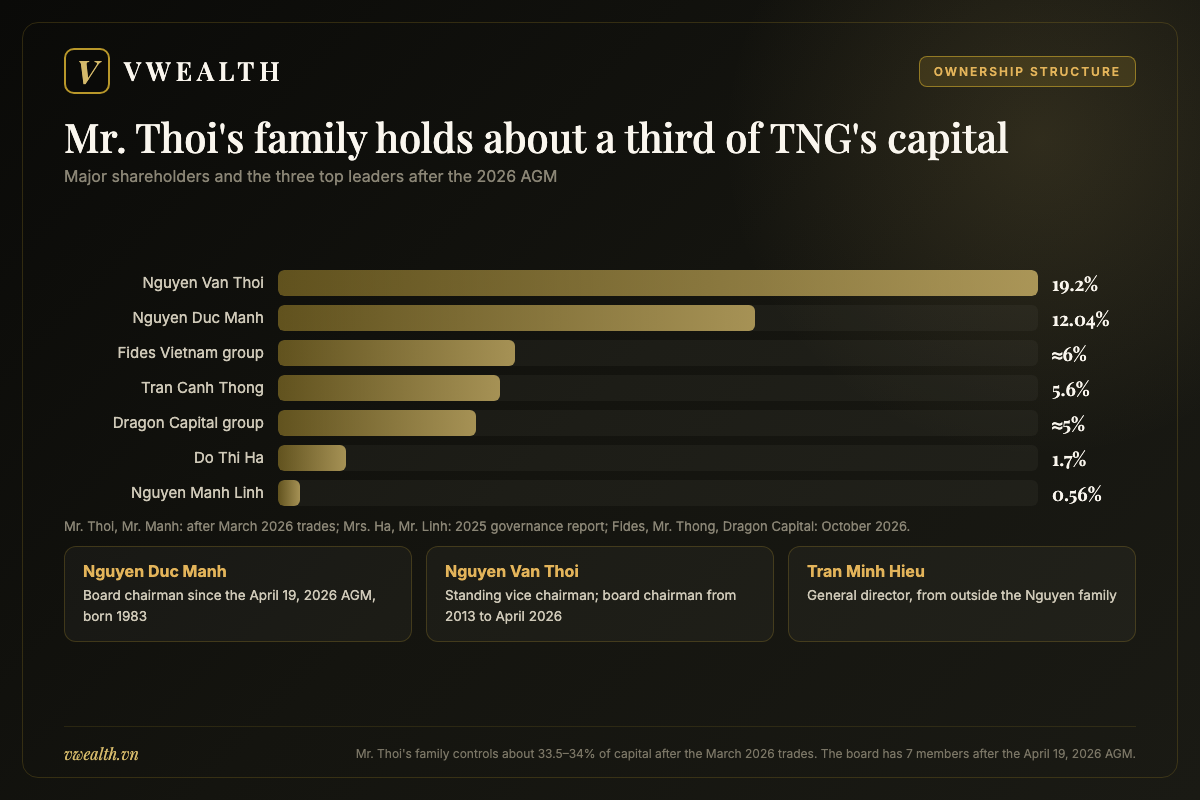
Most important for investors: Mr. Thoi remains TNG’s largest shareholder, owning more than 24.7 million shares, equivalent to about 19.19–19.20% of charter capital. Stepping down as chairman does not mean leaving the company — he still sits on the board as standing vice chairman and still casts the heaviest vote. When you see the headline “TNG chairman resigns,” read it as a change of role, not a retreat.
Nguyen Duc Manh: Many Seats Before the Chairmanship
Mr. Nguyen Duc Manh was born in 1983 and holds a bachelor’s degree in information technology from the United States, a bachelor’s degree in foreign languages from China and an MBA from the University of Hawaii at Manoa. This educational background — technology, languages and management, studied in both the US and China — matches quite closely two things TNG is emphasizing: automation and digital transformation, and working directly with international customers.
Mr. Manh’s path at TNG was not a straight climb. In 2010 he was head of the sales department; in 2011 he became deputy general director and then general director; in 2015 he returned to the deputy general director role when Mr. Thoi came back to run operations directly; in 2017 he became vice chairman of the board; and in 2020 he was general director again. He then served as standing vice chairman before being elected chairman on April 19, 2026. A path with ups and downs like this shows that the handover at TNG was carried out gradually over more than a decade, not decided overnight.
In 2026, Mr. Manh was also the most notable buyer of TNG shares. Between February 12 and March 13, 2026, he bought about 3.923 million shares out of the 5.5 million he had registered to buy, raising his stake from about 11.577 million shares (8.99%) to about 15.5 million shares (12.04%). He did not buy the full amount registered; the company’s explanation cited share price movements. In the same period, deputy director Luu Duc Huy sold 80,000 shares, leaving him with 31,418 shares (about 0.02%). Neither transaction tells you anything certain about the future, but they do show that the man about to take the chairman’s seat chose to increase his stake rather than reduce it.
A 2025 Regulatory Lesson and How TNG Separated Its Executive Roles
In early 2025, the Thai Nguyen Department of Planning and Investment fined TNG VND 25 million because the appointment of its general director did not meet the conditions of Vietnam’s Law on Enterprises: at a public company, the general director may not be a family member of the company’s managers, and the person holding the post at the time was Mr. Nguyen Duc Manh, the chairman’s son. TNG relieved Mr. Manh of the general director role from April 2025; Mr. Tran Minh Hieu — who is not a family member — then became general director, while Mr. Manh served as standing vice chairman before being elected chairman.
For shareholders, the outcome is what counts: since 2025, the top executive job at TNG has been held by someone outside the family, separate from the board where the founding family plays the leading role. The “family on the board, professional in the CEO seat” model is the structure the law aims for at public companies.
The Ownership Map and a Seven-Member Board
TNG’s contributed owners’ capital stood at about VND 1,287.31 billion on September 30, 2026, equivalent to about 128.7 million shares, unchanged from the start of the year. On that base, the Thoi family bloc consists of: Mr. Thoi with about 19.2%; Mr. Nguyen Duc Manh with about 12.04% after his March 2026 purchases; Mrs. Do Thi Ha — Mr. Thoi’s wife — with about 1.7%; and Mr. Nguyen Manh Linh (born 1987, the younger son and a board member) with about 0.56% (the last two figures come from the 2025 corporate governance report). According to press compilations, after the March 2026 transactions the Thoi family controlled about 33.5–34% of the company, up from roughly a quarter a year earlier.
The one-third mark has practical meaning. Under Vietnam’s Law on Enterprises, many important decisions at a shareholders’ meeting — amending the company charter, changing business lines, selling major assets — require a high approval ratio among the votes present. When the law demands such a high ratio, a bloc holding about a third of the capital carries enormous weight, especially since in practice not every small shareholder attends meetings or appoints a proxy. Put simply: it is very hard for any major decision at TNG to pass without the founding family’s agreement.
Beyond the family, other major shareholders (based on disclosures up to October 2026) include the Fides Vietnam group with more than 7.6 million shares (about 6%), Mr. Tran Canh Thong with nearly 7.2 million shares (about 5.6%), and the Dragon Capital group of funds with more than 6.3 million shares (about 5%).
After the April 19, 2026 AGM, TNG’s board of directors has seven members: Mr. Nguyen Duc Manh (chairman), Mr. Nguyen Van Thoi (standing vice chairman), Mr. Nguyen Hoang Giang, Mrs. Ha Thi Tuyet, Mr. Dao Duc Thanh, Mrs. Doan Thi Thu and Mrs. Nguyen Thi Phuong — a deputy general director who was newly elected. Before the meeting, the board had two independent members, Mr. Nguyen Hoang Giang and Mrs. Ha Thi Tuyet; both remain on the new board. On the executive side, the general director is Mr. Tran Minh Hieu.
| Shareholder | Shares | Stake | Date / note |
|---|---|---|---|
| Mr. Nguyen Van Thoi (standing vice chairman) | More than 24.7 million | ~19.19–19.20% | Per press reports, April 2026; largest shareholder |
| Mr. Nguyen Duc Manh (chairman) | ~15.5 million | ~12.04% | After purchases Feb 12 – Mar 13, 2026 (previously ~11.577 million, 8.99%) |
| Mrs. Do Thi Ha (Mr. Thoi’s wife) | — | ~1.7% | 2025 corporate governance report |
| Mr. Nguyen Manh Linh (board member) | — | ~0.56% | 2025 corporate governance report |
| Thoi family bloc | — | ~33.5–34% | After March 2026 transactions, per press compilations |
| Fides Vietnam group | More than 7.6 million | ~6% | Disclosures up to Oct 2026 |
| Mr. Tran Canh Thong | Nearly 7.2 million | ~5.6% | Disclosures up to Oct 2026 |
| Dragon Capital group | More than 6.3 million | ~5% | Became a major shareholder on Mar 23, 2026 (5.0584%) |
| VinaCapital group | — | 4.9501% | Became a major shareholder on Apr 3, 2026 (5.2368%); ceased on Jul 14, 2026 |
Foreign Funds In and Out During 2026
2026 saw three notable fund transactions in TNG shares, and together they tell a small story about institutional sentiment. On March 23, 2026, Norges Bank — a fund in the group of investors managed by Dragon Capital — bought 150,000 shares, lifting the group to 5.0584% and officially making it a major shareholder (in Vietnam, any holder crossing 5% must disclose it). Less than two weeks later, on April 3, 2026, a VinaCapital fund bought 400,000 shares, lifting the VinaCapital group to 5.2368% — also a major shareholder. But on July 14, 2026, the VinaCapital fund sold 150,000 shares, bringing the group down to 4.9501% and ending its major-shareholder status.
You should not read these trades as “buy signals” or “sell signals.” Funds buy and sell for many reasons — rebalancing portfolios, their own inflows and outflows, position-size limits. The more useful takeaway is a habit: whenever a fund crosses or falls below the 5% threshold, TNG and the fund must disclose it, and you can follow those disclosures to see which way institutional money is leaning. Having three institutional groups (Fides, Dragon Capital and VinaCapital) hovering around the 5% mark at the same time shows that TNG is on the radar of professional investors, not just retail traders.
Dividends: 20% for 2025 and 15% Already Paid in Advance for 2026
For fiscal 2025, TNG paid a 20% cash dividend — VND 2,000 per share — in four installments of 5% each. The final installment had an ex-dividend date of May 6, 2026 and was paid on May 22, 2026; the total payout for the year was about VND 257.4 billion. Paying in several small installments like this is quite characteristic of TNG: instead of one large payment at year-end, shareholders receive cash spread across the year, a bit like a regular “salary.”
The 2025 profit distribution is also worth reading. Distributable profit of about VND 396.66 billion was allocated as follows: dividends of about VND 254.4 billion, the bonus and welfare fund about VND 59.5 billion (15%), and retained earnings about VND 70.97 billion. In other words, most of the record year’s profit went back into shareholders’ pockets in cash. Against 2025 earnings per share (EPS) of about VND 3,045, a payout of VND 2,000 per share works out to a payout ratio of about 66% (vwealth estimate: 2,000 / 3,045). A small note: the total payout of VND 257.4 billion (from the installment announcements) and VND 254.4 billion (from the distribution plan) differ because of timing and rounding in each source; the order of magnitude is the same.
For 2026, the AGM set a dividend plan of 16–20%, in cash or in shares. At the time of writing, TNG had announced two interim payments: the first, 10% in cash, with a record date of August 10, 2026 and payment on August 31, 2026 (about VND 128.7 billion); the second, 5% (VND 500 per share), with an ex-dividend date of November 10, 2026 and expected payment on November 20, 2026 (about VND 64 billion). Together that is 15% — already close to the bottom of the plan’s range (vwealth estimate: sum of the two installments).
But put dividends next to cash flow. As Chapter 4 will show, TNG’s operating cash flow for the first nine months of 2026 was about VND 696 billion negative, and the company borrowed more to cover the gap. In other words, part of the dividend cash is being paid out during a period when the company is also increasing its borrowings. That is not unusual for a manufacturer with heavy working capital needs — the money is tied up in receivables and will come back when customers pay — but it is a reason not to treat TNG’s cash dividend as an absolute certainty in every scenario. The 2015–2018 period showed that the company is willing to stop paying cash when it needs to channel capital into factories.
To sum up this chapter in three seats: the chairman of the board is Mr. Nguyen Duc Manh, the standing vice chairman is Mr. Nguyen Van Thoi, and the general director is Mr. Tran Minh Hieu. The founding family holds about a third of the capital and keeps its hands on the strategic steering wheel; day-to-day management is run by someone outside the family; and around them sit three institutional groups each holding roughly 5–6%.
The Jacket Machine Behind Decathlon and Columbia: Where TNG Makes Its Money
If you have ever bought a windbreaker at Decathlon or a children’s outfit from The Children’s Place, there is a fair chance it passed through a sewing line in Thai Nguyen. TNG has no retail brand of its own that consumers would recognize; it makes money by sewing for the brands that consumers do recognize. This chapter opens that “black box”: what TNG makes, on what commercial terms, for whom, where and with what machinery — and how the businesses outside garments are growing.
A useful way to think about it: for an export garment maker, competitive advantage does not lie in a logo but in three things — whether customers trust you with difficult orders, whether you can sew faster and cheaper than rivals at the same quality, and whether you control your materials well enough to meet rules of origin. Each section below comes back to one of those three questions.
Jackets 60%, Kidswear 30%: The Product Mix
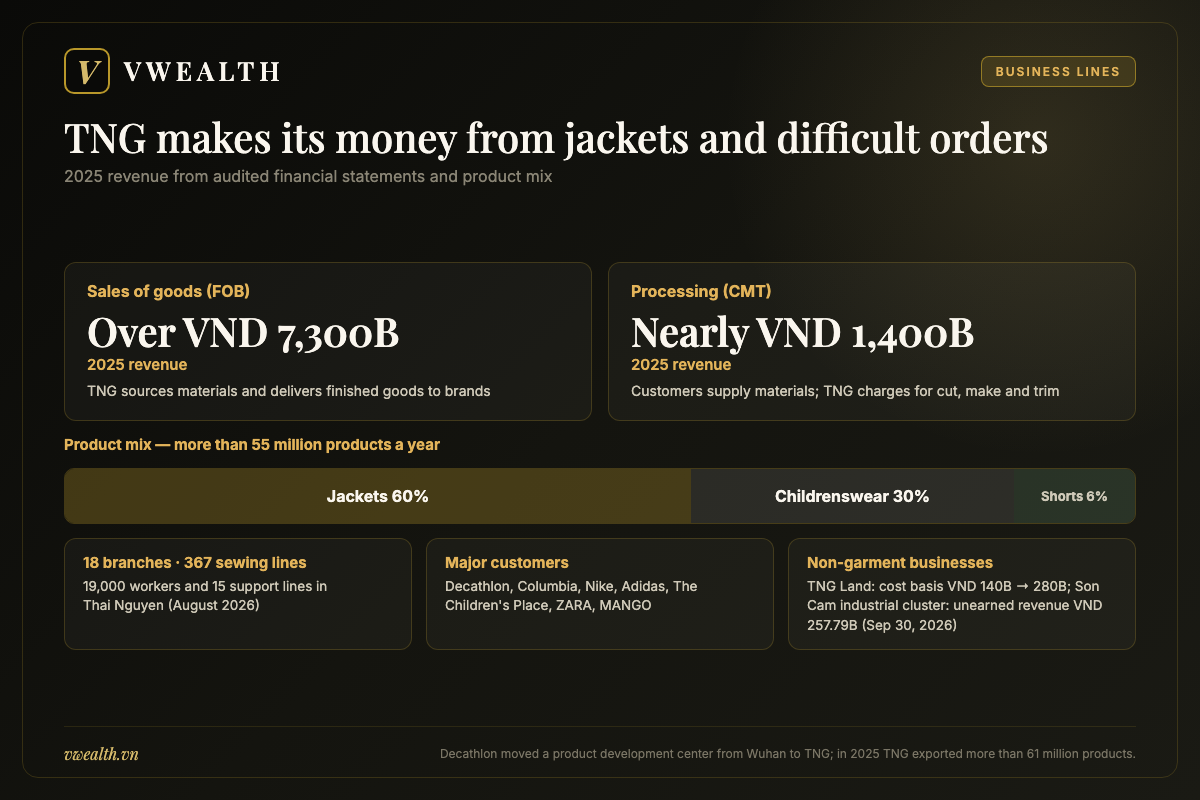
TNG has capacity of more than 55 million products a year, and in 2025 it actually exported more than 61 million. The product mix leans heavily toward one category: jackets account for about 60%, kidswear about 30% and shorts about 6%. The company profile on VNDirect describes capacity differently: about 12 million jackets and about 9 million chino trousers a year. The two descriptions do not contradict each other — one counts total pieces (including kidswear, which is small and comes in high volumes), while the other counts only the two flagship lines.
Why do jackets matter so much? Jackets — especially sports jackets, windbreakers and quilted padded jackets — are products with many components: linings, zippers, sealed waterproof seams, padding layers. Each piece needs more operations and more skill than a T-shirt. This is exactly the “difficult product” Mr. Thoi likes to mention: the more operations involved, the harder it is for a new factory to replace you, and the higher the unit price per piece. The downside is that jackets are seasonal — Americans and Europeans buy them mostly in autumn and winter — so TNG’s revenue tends to concentrate in the second half of the year, and inventory and receivables swell with the season.
Kidswear, at about 30%, is tied to customers such as The Children’s Place. It is a high-volume line with many styles and strict safety standards (no small parts that can come loose, fabrics that meet chemical standards). Combining the two lines — technical jackets and high-volume kidswear — helps TNG keep its sewing lines full all year instead of running at full capacity only during jacket season.
VND 7,300 Billion in Sales and VND 1,400 Billion in Processing: What CMT, FOB and ODM Mean
Of TNG’s roughly VND 8,698 billion in 2025 revenue, the audited financial statements split the total into two lines: sales of goods of more than VND 7,300 billion and processing revenue of nearly VND 1,400 billion. To understand the difference, you need three familiar garment-industry terms:
CMT (cut – make – trim) is pure contract processing: the customer supplies the fabric and trims, and the garment maker sells only its cutting and sewing labor. Revenue is small because it excludes the value of materials, and the material risk sits with the customer. FOB (free on board) means the garment maker buys the materials itself, produces the goods and delivers them onto the ship; revenue is much larger because it includes the materials, and absolute profit can be larger too, but the maker must advance cash to buy fabric and bears inventory risk. ODM (original design manufacturing) is a step higher still: the maker takes part in design and sample development before producing.
TNG’s “sales of goods” revenue of more than VND 7,300 billion corresponds mainly to the model of buying materials and selling finished products, while the nearly VND 1,400 billion of “processing” revenue is the CMT part. The fact that sales of goods make up the bulk shows how far TNG has already traveled on the road from CMT to FOB. The value-raising strategy management laid out for 2026 has four directions, including: gradually shifting from CMT to FOB and expanding ODM; focusing on technical product lines; and creating value through customer service capabilities.
This is also where Chapter 3 connects directly to Chapter 4. Going FOB means TNG has to pay for fabric and trims before its customers pay for the finished goods. The more FOB revenue there is, the bigger the working capital requirement — and that capital comes mostly from short-term bank loans. Raw material costs rose about 19% in 2025 to nearly VND 4,850 billion, reflecting exactly this trend. When you see TNG’s short-term borrowings rising in step with revenue, that is largely the price of climbing to the FOB rung.
Big-Name Customers, and Why Decathlon Moved a Product Development Center to TNG
TNG’s customer list reads like a shelf of international sportswear and fashion brands: Decathlon, Columbia, The Children’s Place, Nike, Adidas, SportMaster, Tom Tailor, ZARA, MANGO and more. Its main export markets are the United States, Europe, Canada and Mexico.
The most valuable detail on that list concerns Decathlon. According to press reports, Decathlon has not only expanded its orders but also moved a product development center from Wuhan, China, to TNG. A product development center is where new designs are tested, adjusted and sampled before mass production — the stage that comes before the sewing line. When a brand places that function in your factory, the relationship has moved beyond “order from whoever is cheapest”: switching suppliers becomes much more expensive because the entire sample development team would have to move. This is about the most practical kind of moat a garment maker can have — and a concrete example of the “China plus one” shift in global supply chains that we explain in our article on China plus one and Vietnam stocks.
In September 2026, TNG’s leadership traveled to the United States to meet Haddad, IFG, O5 and Columbia about orders for 2027 and beyond. This is a routine annual activity for an export garment maker — negotiating next season’s orders — but the timing in 2026 is special because US tariffs have just changed (Chapter 6 covers this in detail).
The flip side of big customers is concentration. On September 30, 2026, three customers — DESIPRO (about VND 574.42 billion), Asmara (about VND 258.33 billion) and Haddad (about VND 248.07 billion) — accounted for about 63.7% of total trade receivables. DESIPRO is not a familiar retail brand name; for export garment makers, the customer on the books is often a purchasing entity or sourcing arm of a brand, not necessarily the name on the label. Either way, having three counterparties make up nearly two thirds of receivables means that if one of them pays late, TNG’s cash flow will feel it clearly.
18 Branches and 367 Sewing Lines: Production Capacity in Thai Nguyen
TNG’s scale has been changing quickly, so the figures depend on the date. According to information published in August 2026, the company has 18 branches, about 19,000 workers, 367 sewing lines and 15 auxiliary production lines, and ranks among Vietnam’s eight largest textile and garment exporters. The company profile on VNDirect (updated earlier) describes 15 export garment factories in Thai Nguyen Province, 2 technology branches, 2 auxiliary factories and 1 LAB branch (a quality-testing laboratory). The differences between sources are mainly down to timing — and the differences themselves tell you that TNG is still expanding.
New factories keep coming: the TNG Dai Tu 2 factory is being expanded, and the 2026 plan includes expanding export garment factories and adding automated lines. The workforce is growing too: in the first quarter of 2026 alone, the company hired more than 1,000 additional workers. Average income as of April 2026 was about VND 12.5 million per worker per month.
Concentrating almost all capacity in one province cuts both ways. The benefits: centralized management, close local relationships and uniform operating costs. The risk: dependence on a single regional labor market, while Thai Nguyen and neighboring provinces host many large electronics industrial parks that compete for factory workers. When labor costs rose about 20% in 2025 to more than VND 2,760 billion, that reflected both the extra hiring and wage pressure in the region.
Automation, AGVs and an In-House ERP: The Moat Is Productivity
The garment industry has a harsh rule that Mr. Nguyen Duc Manh himself stated at the 2026 AGM: the unit price per product is under constant downward pressure year after year, so a garment maker has to raise productivity by at least 10% a year just to stand still. At a company with a net margin of about 4–4.5%, a few percentage points of productivity are the line between profit and loss.
TNG’s answer is to invest in machinery and software. In Explanatory Letter No. 574/CV-TNG dated October 20, 2026, the company listed: automated guided vehicles (AGVs) and robots that move goods between production stages; software that tracks productivity in real time; rooftop solar power; and optimized cutting layouts to save fabric. Each item targets a specific cost: AGVs reduce material-handling staff, productivity software spots slow lines early, solar power lowers electricity bills, and better cutting layouts reduce fabric waste — materials being the biggest item in the cost structure.
What stands out is the ERP system (enterprise resource planning software) that TNG developed in-house. According to management, an upgraded version of this system is ready to be transferred to other partners in the industry. Combined with being the first company in Thai Nguyen to reach Level 3 in digital transformation and holding Customs Priority Enterprise status, it is clear that TNG is trying to build a moat where few people look: not in branding, but in the ability to operate faster and more precisely than its rivals. In 2026, the company plans to invest about VND 200 billion in machinery and equipment.
Beyond Garments: TNG Land, the Son Cam Industrial Cluster and New Energy Business Lines
TNG does not only sew. The company has two associates: TNG Land Joint Stock Company (real estate) and Bac Thai Investment and Construction Joint Stock Company (electrical construction and installation). The investment in TNG Land rose significantly in 2026: its cost basis went from about VND 140 billion at the start of the year to about VND 280 billion on September 30, 2026 — doubling in nine months.
The second business is industrial infrastructure at Son Cam. On September 30, 2026, long-term unearned revenue related to the Son Cam industrial cluster rose from about VND 131.98 billion to about VND 257.79 billion, and construction in progress stood at about VND 239.42 billion. “Unearned revenue” is money that tenants have paid in advance for land leases but that the company has not yet been allowed to book as revenue — it is recognized gradually over many years. The 2026 plan includes a push to fill Son Cam 1 Industrial Park. If you want to understand how Vietnamese industrial park developers book land-lease revenue, our analysis of IDC stock (IDICO) explains the mechanism in detail.
Third, the 2026 AGM approved adding 19 groups of business lines — including technology, energy and infrastructure, even power transmission and distribution — while dropping 13 lines and amending 15. Adding business lines on paper is not the same as running a real business; it simply gives the company the legal ability to do new things. In addition, TNG has an outstanding bond with the code TNG124027, whose eighth interest period runs from August 25 to November 25, 2026.
For investors, the non-garment businesses are a double-edged sword. They can generate stable long-term cash flow (from industrial land leases) and make use of TNG’s land and local relationships. But they also absorb capital at a time when the core business already needs a lot of working capital, and they pull management’s attention away from the sewing machine. For now, these businesses are small compared with garment revenue measured in thousands of billions of dong, but the pace of growth in the TNG Land investment is worth watching every quarter.
| Business | Size / contribution (published figures) | Role | What to watch |
|---|---|---|---|
| Export garments — sales of goods (mainly FOB) | More than VND 7,300 billion in revenue in 2025 | Main source of revenue and profit | Cash advanced for materials, inventory, receivables |
| Export garments — processing (CMT) | Nearly VND 1,400 billion in revenue in 2025 | Keeps lines full with little material risk | Low unit prices, yearly price-cut pressure |
| Products | Jackets ~60%, kidswear ~30%, shorts ~6%; more than 61 million pieces exported in 2025 | “Difficult products” that set TNG apart | Seasonality of jackets |
| Infrastructure — Son Cam industrial cluster | Long-term unearned revenue ~VND 257.79 billion; construction in progress ~VND 239.42 billion (Sep 30, 2026) | Long-term land-lease cash flow | Occupancy progress, infrastructure capex |
| Associate — TNG Land | Investment cost VND 140 → 280 billion (start of year → Sep 30, 2026) | Real estate | Capital drawn away from the core business |
| Associate — Bac Thai Investment and Construction | No separate figures published | Electrical construction and installation | Linked to newly added energy business lines |
Reading TNG’s Financial Health: Record Profits, Cash Flow Going the Other Way
By now you know who TNG is, who is steering it and how it makes money. This chapter answers a harder question: how healthy is that machine? The goal is not just to list numbers but to show you how to read TNG’s own numbers — because an export garment maker that borrows heavily, sells seasonally and runs on thin margins has places that need close attention which matter far less at a bank or a property developer. Three questions run through the chapter: does profit come with cash, can the company pay its interest comfortably, and where is the money sitting?
Seven Years of Revenue and Profit in One Table
The table below uses 2019–2025 figures from the financial statement data on VNDirect. The gross margin column is a vwealth calculation (gross profit / net revenue), rounded to one decimal place.
| Year | Net revenue (VND billion) | Gross profit (VND billion) | Gross margin (vwealth estimate) | Net profit after tax (VND billion) | Interest expense (VND billion) | Owners’ equity (VND billion) |
|---|---|---|---|---|---|---|
| 2019 | 4,612.2 | 786.9 | ~17.1% | 230.1 | 101.2 | — |
| 2020 | 4,480.2 | 676.0 | ~15.1% | 153.6 | 101.2 | — |
| 2021 | 5,443.6 | 726.5 | ~13.3% | 232.3 | 125.0 | 1,462 |
| 2022 | 6,772.3 | 999.5 | ~14.8% | 293.0 | 159.5 | 1,651 |
| 2023 | 7,095.2 | 980.3 | ~13.8% | 219.4 | 192.4 | 1,855 |
| 2024 | 7,655.8 | 1,181.9 | ~15.4% | 314.8 | 184.4 | 1,892 |
| 2025 | 8,698.6 | 1,239.2 | ~14.2% | 393.1 | 212.2 | 2,002 |
Three things jump out immediately. First, revenue grew almost every year, pausing only in 2020. Second, net profit moved in a sawtooth pattern: up in 2021–2022, down in 2023, sharply up in 2024–2025. Third — and this is what many people miss — interest expense nearly doubled over seven years, from about VND 101 billion to about VND 212 billion (vwealth estimate: 212.2 / 101.2 ≈ 2.1 times), growing about as fast as revenue. TNG has grown largely on borrowed money, and every year it pays the banks a bigger amount before shareholders get their turn.
Owners’ equity grew much more slowly: from about VND 1,462 billion (2021) to about VND 2,002 billion (2025), while total assets rose from about VND 4,367 billion to VND 6,910 billion and total liabilities from about VND 2,905 billion to VND 4,907 billion. Part of the reason lies in the high cash dividend policy (Chapter 2): most profit is paid out, so equity does not accumulate quickly, and the rest of the expansion is financed with debt.
Thin Margins: 14.2% Gross, About 4.5% Net
In 2025, TNG’s gross margin narrowed to about 14.2% from about 15.4% in 2024. Net margin (net profit / revenue) was about 4.5% in 2025 and about 4.1% in 2024 (vwealth estimates). Put plainly: for every VND 100 of revenue, TNG keeps about VND 14 after the cost of goods sold, and only about VND 4–4.5 after paying interest, selling and administrative expenses and taxes.
Why did gross margin narrow in 2025 even as profit hit a record? The two biggest cost items both grew faster than revenue: raw materials rose about 19% to nearly VND 4,850 billion and labor about 20% to more than VND 2,760 billion, while revenue grew about 13.6% (vwealth estimate: 8,698.6 / 7,655.8). The sharp rise in materials reflects the shift toward FOB (described in Chapter 3) — FOB revenue is “inflated” by the value of the fabric, so gross margin in percentage terms is naturally lower than under CMT, even though absolute profit can be higher. The rise in labor reflects more hiring and a higher wage level.
A practical way to read this: with a net margin of about 4–4.5%, it only takes one variable worsening by a few percentage points — lower unit prices, higher wages, higher interest rates, US import tariffs weighing on prices — for profit to shrink significantly. That is why profit fell by about a quarter in 2023 even though revenue still grew. If you want to compare TNG with other listed garment makers, our analyses of VGT stock (Vinatex) and TCM stock (Thanh Cong Textile) give you two reference points with different business models.
Leverage: About VND 4,200 Billion in Borrowings, More Than 70% Short Term
At the end of 2025, TNG’s outstanding borrowings were more than VND 3,300 billion, up about 28% for the year, of which short-term loans were nearly VND 2,400 billion. The ratio of interest-bearing debt to equity was about 1.66 times, rising to about 2.14 times in the first quarter of 2026 (measured as total liabilities to equity, the figures were about 2.45 and 2.75 times respectively). By September 30, 2026, short-term borrowings were about VND 3,026.8 billion (VND 2,371.0 billion at the start of the year) and long-term borrowings about VND 1,167.2 billion (VND 956.3 billion at the start of the year); total borrowings were about VND 4,200 billion, up about 26%, with more than 70% short term. Total liabilities were about VND 5,712.64 billion, or about 73.7% of total capital, while owners’ equity was about VND 2,035 billion. That puts borrowings at roughly twice equity (vwealth estimate: (3,026.8 + 1,167.2) / 2,035 ≈ 2.06 times). Net debt — total borrowings minus cash and cash equivalents — was more than VND 3,540 billion, up about 40%.
The easiest number to picture: interest expense in the third quarter of 2026 was about VND 87.4 billion (versus VND 71.3 billion a year earlier), or about VND 950 million a day. For the first nine months of 2026, interest expense was about VND 220.7 billion (versus VND 174.1 billion). In 2025, interest expense was about VND 212.2 billion, equal to about 17% of gross profit (vwealth estimate: 212.2 / 1,239.2). In other words, for every VND 100 of gross profit, about VND 17 goes to the banks as interest.
Why is most of the debt short term? For an FOB garment maker, short-term loans are the natural way to finance the “buy fabric – sew – ship – collect” cycle, which takes several months. The problem is not short-term debt itself but the fact that the company must keep rolling it over — borrowing new money to repay old loans — and depends on the goodwill of its banks. In October 2026, TNG borrowed another VND 17.1 billion from VietinBank (October 13) and signed a credit line of nearly VND 758 billion with Vietcombank (October 14). Broad credit relationships with large banks are a plus; but if interest rates rise, the cost of carrying VND 4,200 billion in debt will change very quickly. Cash is also getting thinner: cash and cash equivalents were about VND 158.2 billion on September 30, 2026, down from about VND 314.6 billion at the start of the year; at the end of 2025, bank deposits had already fallen about 29% to about VND 317 billion, and financial income was below VND 117 billion (down about 9%).
Why Operating Cash Flow Is Negative While Profit Rises
This is the most important part of the chapter. In 2025, profit hit a record, yet net cash flow from operating activities (CFO — cash actually collected from sales minus cash actually paid for production, wages, taxes and interest) was about VND 259.5 billion negative, compared with a positive figure of more than VND 1,000 billion in 2024. For the first nine months of 2026, CFO was more than VND 696 billion negative (versus more than VND 344 billion negative a year earlier); investing cash flow (CFI) was more than VND 204 billion negative; and financing cash flow (CFF) was more than VND 743 billion positive — meaning the shortfall was covered with borrowed money.
Where did the money go? The answer lies in receivables. On September 30, 2026, trade receivables were about VND 1,696.42 billion, up sharply from about VND 996.17 billion at the start of the year; three customers — DESIPRO, Asmara and Haddad — accounted for about 63.7%. The goods have shipped and the revenue and profit have been booked, but the cash has not arrived. The company explained that third-quarter revenue rose about 23% partly because orders were shipped early — ship early and you book early, but cash comes in according to the customer’s payment terms.
There is a notable precedent: at the end of the third quarter of 2025, trade receivables also jumped about 76%, and then in the fourth quarter of 2025 CFO turned positive by more than VND 763 billion as customers paid. In other words, TNG’s business model is seasonal: cash gets “locked up” in receivables in the third quarter and is usually released in the fourth. If this pattern repeats, fourth-quarter 2026 CFO will be the most important number to watch in the annual report. If it does not — for example, if a major customer pays late — pressure on short-term borrowings will rise noticeably. You do not need to predict it; you just need to know this is the indicator to check when the 2026 financial statements are released.
Inventory and Write-Down Provisions
At the end of 2025, TNG’s inventory was more than VND 1,400 billion, up about 35%; finished goods alone were more than VND 506 billion, up about 76%. The provision for inventory write-downs rose from about VND 19.4 billion (2024) to about VND 53.7 billion (2025). A provision is an amount the company sets aside when it judges that part of its inventory may have to be sold below cost — a higher provision means more goods about which the company is cautious regarding their ability to sell at full price.
The good news is that by September 30, 2026, net inventory had fallen to about VND 1,333.7 billion, about 8% lower than the roughly VND 1,445.5 billion at the start of the year. That means during 2026, money has been moving from “sitting in the warehouse” to “sitting with customers” (receivables). For investors, this is only half a positive shift: the goods have been sold, but the cash is not yet in the bank.
Three Quarters of 2026 in One Table
Put the quarters reported so far in 2026 side by side and the growth picture is quite clear — along with financial costs rising in parallel.
| Period | Revenue (VND billion) | Net profit after tax (VND billion) | Notes |
|---|---|---|---|
| Q1 2026 | ~1,952 (+29%) | ~60 (+50%) | January: 715 billion, February: 506 billion, March: 731 billion |
| Q2 2026 | ~2,900 (+15.3%) | ~147 (+21.9%) | Interest expense ~88 billion (vs ~79 billion a year earlier) |
| H1 2026 | ~4,900 (+20.5%) | ~207 (+26.5%) | About 51% of the full-year revenue target |
| Q3 2026 | 3,229.0 (vs 2,632.8; +22.6%) | ~151.5 (vs ~117; +29%) | Gross margin ~14.2% (vs 13.7%); financial expenses >113 billion (+50%); other losses ~18.8 billion |
| 9M 2026 | 8,095.2 (vs 6,671.1; +21%) | >362 (+29%) | Gross profit ~1,117 billion (+16%); interest expense ~220.7 billion |
Read this table together with the sections above and you get a one-line summary of TNG’s financial health: profit is at a peak, but cash is not. Third-quarter 2026 net profit of about VND 151.5 billion is real, accompanied by a slightly higher gross margin and slightly lower administrative expenses (about VND 135 billion, down about 2%). At the same time, though, operating cash flow is deeply negative, borrowings are rising and cash is getting thinner. So the question “should I buy TNG stock?” is not only about profit; it is about whether nearly VND 1,700 billion in receivables comes back on time — and how the market has already priced all of this. That is the subject of the next part.
How the market treats TNG stock: what to know before deciding whether to buy TNG stock
The previous four chapters covered who TNG is, who runs it, how it makes money and how healthy its books are. This chapter turns to a very different question: how have the people trading on the exchange actually viewed TNG? The two questions sound similar, but in practice they can drift far apart. A company can post record profits while its share price goes nowhere; a struggling company can command a rich valuation because investors are betting on its future. With textile and garment stocks in general, and TNG in particular, the gap between “how the business is doing” and “how the stock is priced” is the thing you most need to understand before asking whether to buy TNG stock.
An important note on how this chapter is written: it does not quote the current share price, market capitalisation or P/E ratio. Those numbers change every trading session, and a long-form analysis goes stale quickly if it tries to pin them down. Instead, this chapter shows you how to read the stock yourself: where to look, which formula to use, and which historical reference points to set the result against. For current figures, you can open the vwealth analysis reports to see the latest update. If you are new to the mechanics of the Vietnamese market itself — trading hours, settlement and the rules for foreign investors — our guide to investing in the Vietnam stock market covers the basics.
The personality of a garment stock: record profits, yet the price still “searches for a bottom”
Start with a paradox that anyone who has followed TNG for years will recognise. In 2025, TNG set a profit record in its 46-year history: revenue of roughly VND 8,698 billion and net profit after tax of about VND 392–393 billion, beating its revenue plan by 7% and its profit plan by 15%. Yet according to Vietstock, TNG shares fell about 19% over the whole of 2025. Only when the record earnings were announced in early 2026 did the price recover.
There is nothing mysterious about this once you understand how the market looks at export-oriented garment makers. Investors do not buy last year’s profit; they buy expectations of profit in the years ahead. 2025 was the year the United States imposed reciprocal tariffs on Vietnamese goods, and for a company whose biggest customers are in the US, Europe, Canada and Mexico, every headline about tariffs made the market worry that next year’s order book would shrink. In many investors’ eyes, a record profit might simply be “the top of the cycle” rather than a new baseline.
That worry has precedent. After the strong demand cycle of 2022, TNG’s profit fell 24% in 2023, from about VND 293 billion to VND 219.4 billion, as the US and Europe raised interest rates and consumers cut back on clothing. The market has a memory. Every time garment makers report big profits, some investors remember 2023 and ask: will it be different this time?
In 2026 the same paradox played out to a different rhythm. According to Bao Phap luat Viet Nam (its Doanh nhan business section), in early March 2026 TNG shares hit an all-time high since listing, then pulled back. By July 2026, Nguoi Quan Sat described textile stocks as “still searching for a bottom” even though companies were reporting record second-quarter profits. In August and September, TNG traded sideways at low levels; in October 2026, according to VnBusiness, the price recovered more clearly and liquidity improved — exactly when the company reported its highest quarterly profit since listing, in the third quarter.
If you had to sum up TNG’s personality as a stock in one sentence, it might be this: the share price reacts faster and harder to macro news about tariffs and consumer demand than to the company’s own operating results. That has two practical consequences for you.
The first consequence is volatility. A stock driven heavily by outside news will have sell-offs that holders cannot control and can rarely anticipate. If you buy TNG thinking “profits go up, so the price must go up”, you may be disappointed in quarters where earnings rise but the price falls on a headline about tariff negotiations.
The second consequence is opportunity. Precisely because the price sometimes detaches from results, there will be times when the market is far more pessimistic than what the company is actually delivering. According to 24hmoney, in 2022 TNG shares traded at a record-low valuation — in the very year revenue jumped from VND 5,443.6 billion to VND 6,772.3 billion. In theory, an investor who can read financial statements and wait patiently could take advantage of those gaps. But “in theory” is the key phrase: to benefit, you have to tell the difference between a market that is overly pessimistic and a market that is seeing a real risk you have not yet spotted.
One more detail worth noting: TNG is a member of the HNX30, the index of the 30 stocks with the largest market capitalisation and best liquidity on the Hanoi Stock Exchange. In practice, that means the stock trades enough for individual investors to buy and sell without much fear of getting stuck, and it puts TNG on the radar of index funds and active funds that track the HNX. The flip side is that index membership adds another layer of buying and selling driven by fund rebalancing — flows that sometimes have nothing to do with how many jackets TNG is sewing.
P/E and P/B: how to value TNG yourself without a live quote
The two most common yardsticks for what the market is paying for a business are P/E and P/B. This article will not give you their current values, but it will show you how to calculate them and how to read them for TNG specifically.
P/E (price-to-earnings) tells you how much you are paying for each unit of the company’s annual profit. The formula is P/E = share price ÷ EPS, where EPS (earnings per share) is net profit attributable to shareholders divided by the number of shares outstanding. According to Tin nhanh Chung khoan, TNG’s 2025 EPS was about VND 3,045 per share. To get the P/E, simply divide the price on the trading board by that number.
With TNG, though, there are three things to weigh before you trust the result of that division.
First, which year’s EPS? If you use 2025 EPS — the record year — the P/E will look lower than if you used 2023, when profit fell sharply. A more conservative approach is to average EPS over several years, say 2021–2025, to see what the market is paying for TNG’s “normal” earnings rather than its best year. You have the data to do this: net profit after tax for 2021 through 2025 was roughly VND 232.3 billion, 293.0 billion, 219.4 billion, 314.8 billion and 393.1 billion, according to VNDirect data.
Second, the trailing four quarters. Because TNG is growing in 2026 — net profit for the first nine months was more than VND 362 billion, up about 29% year on year — a P/E based on the latest four quarters will differ from one based on full-year 2025. The two numbers tell two different stories, and you should look at both.
Third, a P/E only means something when compared with something else. Set it against TNG’s own historical P/E, and you learn whether the price is high or low relative to what the market usually pays for this company. Set it against peers such as Vinatex (VGT), Song Hong Garment (MSH) or Thanh Cong Textile (TCM), and you learn whether the market currently favours or shies away from TNG compared with the group. A P/E below the sector average does not automatically mean cheap; the market may be applying a discount for higher leverage or weaker operating cash flow — precisely the points analysed in Chapter 4. Our separate analyses of Vinatex (VGT) stock and Thanh Cong Textile (TCM) stock give you the peer context.
P/B (price-to-book) tells you how much you are paying relative to the shareholders’ equity recorded on the balance sheet. The formula is P/B = share price ÷ book value per share, where book value per share = shareholders’ equity ÷ shares outstanding. As of September 30, 2026, TNG’s shareholders’ equity was about VND 2,035 billion and its contributed (charter) capital was VND 1,287.31 billion, equivalent to roughly 128.7 million shares. Dividing the first figure by the share count gives a book value of about VND 15,800 per share (a vwealth estimate: VND 2,035 billion ÷ 128.7 million shares, before any adjustments).
For a garment maker, P/B is usually not the main yardstick, because the real value lies in orders, customer relationships and sewing-line productivity — things that do not show up fully on the balance sheet. P/B is still useful for checking one thing: when the market is at its most pessimistic, does the price fall close to book value? If it does, the market is valuing TNG almost as a pile of machines and factory buildings, paying nothing for its ability to generate profit.
Another ratio worth calculating when reading TNG is ROE (return on equity) — net profit divided by average shareholders’ equity. With 2025 profit of about VND 393.1 billion and equity of about VND 1,892 billion at the end of 2024 and VND 2,002 billion at the end of 2025, ROE for 2025 comes to roughly 20% (a vwealth estimate: 393.1 ÷ the average of 1,892 and 2,002). That is a fairly high ROE for the garment industry, but remember that it is partly “pumped up” by leverage: according to CafeBiz, TNG’s interest-bearing debt was 1.66 times equity at the end of 2025 and 2.14 times in the first quarter of 2026. In other words, every dong of shareholder capital is working alongside more than one and a half — at times more than two — dong of borrowed money. A leverage-driven ROE shrinks quickly when interest rates rise or profits fall.
Finally, rather than staring at a single P/E or P/B number, ask the question in reverse: at today’s price, what is the market assuming TNG will achieve? If the price implies that profit must keep growing strongly for years, the risk lies in expectations being too high. If the price implies profit will fall back to 2023 levels, the market is betting on the bad scenario. Reading valuation this way turns a dry number into a question you can answer with the analysis in Chapters 6 and 7. Session-by-session valuation metrics for TNG and its peers are available in the vwealth report list.
Cash dividends: the anchor for TNG shareholders
For a stock whose price can “search for a bottom” even while the company earns record profits, cash dividends work like an anchor: wherever the price on the board goes, holders still receive a real, regular stream of cash. TNG has a rather distinctive way of paying — it splits the dividend into several instalments through the year instead of paying it all at once.
From its 2025 profit, TNG paid a total of 20% in cash — in Vietnam, dividend percentages are quoted against the VND 10,000 par value, so this equals VND 2,000 per share — split into four instalments of 5% each. The final instalment had an ex-dividend date of May 6, 2026 and a payment date of May 22, 2026. According to Tin nhanh Chung khoan, total dividend payments for 2025 came to about VND 257.4 billion.
In 2026 the company again started paying interim dividends during the year. The first interim payment was 10% in cash, with a record date of August 10, 2026 and payment on August 31, 2026, totalling about VND 128.7 billion according to CafeF. The second interim payment is 5%, or VND 500 per share, with an ex-dividend date of November 10, 2026 and an expected payment date of November 20, 2026, totalling about VND 64 billion according to Fili. Together, the two announced interim payments for 2026 add up to 15% (vwealth’s sum of the two). The 2026 annual general meeting (AGM) set a dividend plan of 16–20%, in cash or shares, so any remaining payment will depend on full-year results and decisions by the board of directors and the AGM.
| Dividend period | Rate | Form | Key dates | Total payout (as reported) |
|---|---|---|---|---|
| Fiscal 2025 (4 instalments × 5%) | 20% | Cash | Final instalment: ex-dividend May 6, 2026, paid May 22, 2026 | About VND 257.4 billion |
| 2026 interim – instalment 1 | 10% | Cash | Record date August 10, 2026, paid August 31, 2026 | About VND 128.7 billion |
| 2026 interim – instalment 2 | 5% (VND 500/share) | Cash | Ex-dividend November 10, 2026, expected payment November 20, 2026 | About VND 64 billion |
| Full-year 2026 plan (AGM) | 16–20% | Cash or shares | Depends on full-year results and resolutions | Not yet announced |
There are three more things you should look at when assessing this dividend policy.
The first is the payout ratio relative to profit. According to the 2025 profit distribution document cited by Mekong ASEAN, distributable profit was VND 396.66 billion, the bonus and welfare fund took about VND 59.5 billion (15%), and retained earnings were about VND 70.97 billion. Put differently, most of 2025’s profit was handed back to shareholders in cash, with only a small portion kept for reinvestment. For a company expanding its factories and warehouses and buying more machinery, that means most of the capital needed for growth has to come from borrowing rather than retained earnings — exactly what we saw on the balance sheet in Chapter 4.
The second is where the cash for dividends comes from. Dividends are paid in real cash, while operating cash flow for the first nine months of 2026 was negative by more than VND 696 billion, and 2025 operating cash flow was also negative at VND 259.5 billion. So where does the dividend money come from? Partly from financing cash flow, which was positive by more than VND 743 billion over the nine months — in other words, from new loans. This is not unusual for an export garment maker, whose collection cycle is long and tends to bunch up at year-end (in the fourth quarter of 2025, operating cash flow was positive by more than VND 763 billion). But it means the sustainability of the dividend depends on whether customer payments actually arrive on schedule in the final quarter.
The third is how to calculate the dividend yield. Cash dividend yield = cash dividend per share for the year ÷ share price. For 2025, the numerator is VND 2,000; for 2026, the numerator announced as of this writing is VND 1,500 (10% + 5% of the VND 10,000 par value, vwealth’s sum of the two instalments). The denominator is the price you pay — the number this article deliberately leaves out. Plug in the price from the trading board yourself, then compare the resulting yield with the 12-month bank deposit rate to see how much you are being “paid” for accepting the stock’s volatility.
Fund flows: Dragon Capital in, VinaCapital in and out, Fides stays
Another way to read the market is to look at who is buying and who is selling. For TNG, 2026 brought three notable moves by institutional investors, all disclosed under Vietnam’s rules on major shareholders (anyone holding 5% or more of the capital).
On March 23, 2026, Norges Bank — a fund within the group managed by Dragon Capital — bought 150,000 shares, lifting the group’s combined stake to 5.0584% and formally making it a major shareholder. By October 2026, according to Fili, the Dragon Capital group held more than 6.3 million shares, about 5% of the capital.
On April 3, 2026, a VinaCapital fund bought 400,000 shares, taking the group’s stake to 5.2368% and making it a major shareholder. But just over three months later, on July 14, 2026, the fund sold 150,000 shares, leaving the group with 4.9501% and ending its major-shareholder status. The sale coincided with the mid-year period when textile stocks were “searching for a bottom”.
The Fides Vietnam group held more than 7.6 million shares, about 6% of the capital, according to October 2026 data. In addition, Mr. Tran Canh Thong, an individual investor, held nearly 7.2 million shares, about 5.6%.
How should you read these moves? A fund buying in is not a guarantee, and a fund selling out is not an absolute red flag. Funds sell because their own investors redeem, because they need to rebalance, or because they have hit their own profit targets. The real takeaway is that TNG is large and liquid enough to make it into the portfolios of the market’s leading funds, and its share price will feel the effect whenever those funds adjust their weightings. For a stock with about 128.7 million shares, where the founder’s family holds about 34% and a few institutions hold another 5–6% each, the number of shares actually floating in the market is considerably smaller than the headline total — a factor that amplifies price swings when large orders come through.
You can track these changes through the disclosure section of the HNX website and TNG’s investor relations page. Every “became / ceased to be a major shareholder” filing is a piece of the puzzle showing which way professional money is leaning.
TNG’s calendar: the dates that could change the stock’s rhythm
Catalysts are events that can make the market reassess a stock. For TNG, some have fixed dates and others are known only to be coming. Knowing the calendar in advance keeps you from being caught off guard and, more importantly, helps you tell the difference between price moves caused by known events and moves driven by genuinely new information.
November 10, 2026 — ex-dividend date for the 5% interim dividend. In that session, TNG’s reference price will be adjusted down by the VND 500 dividend. Newcomers sometimes mistake this for a “price drop”, but no value is lost — it simply moves from the share into the cash accounts of those entitled to the dividend. If you buy on or after that date, you will not receive that instalment.
The 2026 annual financial statements. This is the most important milestone of the coming months, because it answers three big questions at once: whether TNG meets its plan of VND 9,500 billion in revenue and VND 450 billion in net profit; whether operating cash flow turns positive in the fourth quarter as it did in 2025; and whether the VND 1,696.42 billion of receivables on the books at September 30, 2026 is actually collected. The fourth-quarter report comes out early next year, and the audited annual report later.
Vietnam–US tariff negotiations. This milestone has no fixed date but carries the most weight for the entire textile group. Every headline about reciprocal tariffs or Section 301 duties can move the whole group up or down together, regardless of each company’s own results. Chapter 6 analyses this in more detail.
Customer meetings and 2027 orders. In September 2026, TNG’s leadership met Haddad, IFG, O5 and Columbia in the US to discuss orders from 2027 onwards. The outcome of these negotiations will not be announced contract by contract, but it will show up gradually in the revenue figures for the early months of 2027, which TNG regularly publishes.
Investor relations activity. TNG organises factory visits for investors, such as the 2026 Investors Factory Tour at Song Cong. These events do not change the company’s results, but they help information reach the market more regularly — valuable for a stock whose swings are often driven by macro headlines.
The table below summarises the historical revenue and profit series that you should set alongside any valuation. A P/E ratio only means something when you know which years the profit behind it has been through.
| Year | Net revenue (VND billion) | Net profit after tax (VND billion) | Notes |
|---|---|---|---|
| 2019 | 4,612.2 | 230.1 | Before COVID-19 |
| 2020 | 4,480.2 | 153.6 | COVID-19 year, lowest profit of the period |
| 2021 | 5,443.6 | 232.3 | Recovery |
| 2022 | 6,772.3 | 293.0 | Strong demand, yet the stock traded at a record-low valuation |
| 2023 | 7,095.2 | 219.4 | Profit fell as the US and EU raised interest rates |
| 2024 | 7,655.8 | 314.8 | Back to growth |
| 2025 | 8,698.6 | 393.1 | 46-year record |
| 9 months of 2026 | 8,095.2 | More than 362 | Reported actuals, not a full year |
Sources: annual financial statement data on VNDirect (2019–2025); TNG’s Q3 2026 financial statements and Fili (9 months of 2026).
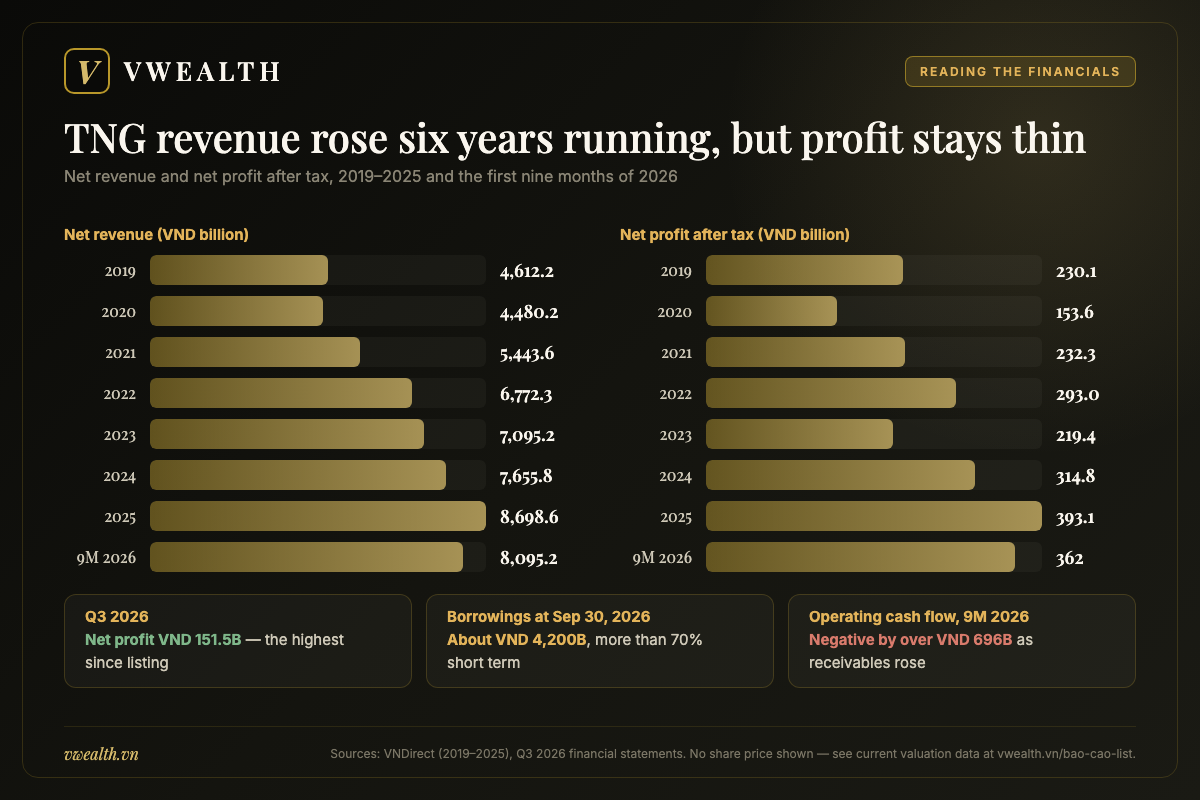
Looking at this series, you will notice something many investors skim past: TNG’s revenue has risen almost without interruption since 2020, but profit “broke” in one year, 2023. That is why the market will not pay a premium for TNG just because revenue is growing. Shareholders need to know whether profit holds up when the demand cycle turns down — and that is the question Chapter 7 poses in the form of three scenarios.
Vietnam’s textile industry between US tariffs and the race up the value chain
No export garment maker can stand apart from the story of its industry. You may be the best garment maker in Thai Nguyen, but if US import duties rise by a few percentage points, or American consumers decide to buy fewer winter jackets, your orders will still feel it. This chapter places TNG within the broader picture of Vietnam’s textile and garment industry in 2026 — a year in which the rules of the game are changing faster than at any point in the past decade.
An export industry of about USD 46 billion, and a stall in the first half of 2026
According to Bao Dau tu (Vietnam Investment Newspaper), Vietnam’s textile and garment exports reached about USD 46 billion in 2025, and Vietnam is the largest exporter of apparel to the US market. That figure shows this is no longer a small, fragmented contract-manufacturing sector but one of the pillars of the country’s export economy, with millions of workers depending on it. For a wider view of how this fits into Vietnam’s export-driven growth model, see our overview of Vietnam export economy stocks.
In 2026, growth slowed markedly. According to 24hmoney, textile and garment exports in the first six months of 2026 reached about USD 22.2 billion, up just 1.7% year on year; finished apparel alone dipped 0.32%. The industry-wide target for the whole of 2026 is USD 48 billion.
What is interesting is that while the industry as a whole was almost flat, TNG grew strongly: revenue for the first half of 2026 was about VND 4,900 billion, up 20.5%, and nine-month revenue rose about 21%. What does that gap tell you? It shows that orders are shifting within the industry — from weaker factories to those better able to deliver on scale, speed and standards. When total demand is not growing, the winners are the ones taking market share from others.
A point raised in Vietstock’s interview with TNG’s chairman in August 2026 makes this even clearer: stripping out inflation, total global textile and garment demand was roughly flat over 2015–2025. In other words, this is not an industry where “a rising tide lifts all boats”. A company that wants to grow has to win orders from competitors, whether at home or in other exporting countries.
For investors, this is the most important detail of the section. It explains why you should not buy TNG stock just because you hear “the textile industry is recovering”, and also why you do not necessarily have to sell TNG just because you hear “textile exports are stalling”. What matters is whether TNG keeps winning market share, and what it pays to do so — in margins and in debt.
US tariffs: a 20% reciprocal rate, then an extra 12.5% under Section 301
The tariff story is the biggest macro factor for TNG in 2026, and it is also where you need to be most careful when reading the news, because information changes quickly and many details have not been widely published in official primary documents.
Here is what the Vietnamese press has reported. According to Vietstock, the US imposed a 20% reciprocal tariff on Vietnamese goods from August 2025. Then, according to summaries by 24hmoney and Vietstock, from July 24, 2026 Vietnamese textiles and garments became subject to an additional 12.5% duty under Section 301 (a provision of US trade law that allows tariffs when the US Trade Representative concludes that a country’s trade practices burden US commerce), linked to an investigation into forced labour. According to 24hmoney, this rate is on a par with China and higher than the 10% faced by Bangladesh, Cambodia and India; some competing countries also have quota mechanisms tied to the use of US raw materials.
On the impact, according to Tin nhanh Chung khoan citing Vietcombank Securities (VCBS), the short-term effect of the 12.5% duty on the textile industry is not yet very large. This article does not attempt to quantify the impact on TNG’s revenue or profit, for two reasons. First, how the cost of the tariff is shared among garment makers, brands and importers varies from contract to contract and is not disclosed. Second, the tariff rate itself may still change through further rounds of Vietnam–US negotiations.
What you should grasp is the mechanism, not a number. US import duties are paid by the US importer, not by TNG. But when import costs rise, brands have three options: raise retail prices (which may dampen demand), accept thinner margins, or push garment makers to cut their CMT (cut-make-trim) and FOB prices. The third option is where TNG is directly affected. In addition, as the tariff gap between Vietnam and countries such as Bangladesh, Cambodia and India widens, brands have an incentive to move some orders there — especially simple product lines that require little technical skill. This dynamic is the mirror image of the trend we describe in our piece on China plus one and Vietnam stocks: supply chains that moved to Vietnam to diversify away from China can also move on when relative costs shift.
This is also why TNG’s strategy of “raising the difficulty level” — focusing on complex products such as technical outerwear and sportswear — has a defensive purpose. The harder the product, the harder it is for a brand to find a substitute factory in another country at short notice, and the weaker the pressure to move orders. Of course, this is an argument about direction, not a guarantee.
Raw material origin and labour standards: the brands’ new rules
Alongside tariffs, there is a quieter but deeper change: US and European brands increasingly require proof of where raw materials come from and of working conditions across the entire supply chain. The forced labour investigation that led to the Section 301 duty is one expression of that trend.
For garment makers, this means sewing well and delivering on time is no longer enough. You also have to prove where the fabric came from, where the yarn came from, where the cotton was grown, and how the workers in your factories are paid and treated. According to Bao Dau tu, TNG has invested in ancillary plants and moved deeper into the materials and accessories chain to meet the origin requirements of US and EU brands. The renewal of TNG’s status as a Customs Priority Enterprise, and its role as Vietnam’s only participant in the ASEAN Priority Enterprise assessment programme in 2025, are also advantages in an environment where traceability matters more and more.
At the national level, according to 24hmoney, Vietnam recently imported about USD 1.3 billion of US cotton, up 122%. That figure is seen as negotiating leverage: the more US raw materials Vietnam’s textile industry uses, the stronger its case for a preferential tariff rate or a quota mechanism similar to those of competing countries. Even so, nobody knows the outcome of the negotiations in advance, and you should not buy or sell a stock based purely on guesses about it.
If you want to see how other Vietnamese exporters are dealing with the same US tariff story, the comparison is instructive: catfish and jackets are very different products, but the way the market prices tariff risk into export companies has a lot in common. Our overview of Vietnamese export stocks brings those sectors together in one place.
Where TNG stands next to VGT, MSH, TCM and STK
Vietnam’s stock market lists quite a few textile and garment companies, but their business models differ considerably. Understanding those differences helps you avoid apples-to-oranges comparisons — for example, comparing the P/E of a pure garment maker with that of a group spanning yarn, weaving, dyeing and dozens of affiliates.
According to Tin nhanh Chung khoan (an October 2026 article on the industry’s peak season), VGT, TNG and MSH were seen as well placed for the year-end peak season, while TCM and STK were under pressure. The same article cited Vinatex (VGT) estimating consolidated revenue for the first nine months of 2026 at VND 15,501 billion, up 6.8%, with profit before tax of about VND 1,470 billion, up 40.7%.
| Company | Core model | Strengths cited | Pressures cited |
|---|---|---|---|
| TNG | Export garment maker, shifting from CMT to FOB/ODM; outerwear, childrenswear | 9-month 2026 revenue up about 21%; large sportswear customers; automation | High debt, negative 9-month operating cash flow |
| VGT (Vinatex) | Group combining many factories into a yarn – weaving – garment chain coordinated by the parent | Estimated 9-month consolidated revenue VND 15,501 billion (+6.8%), profit before tax ~VND 1,470 billion (+40.7%) | Consolidated results depend on many member companies |
| MSH (Song Hong Garment) | Not covered in depth in this article | Listed among those well placed for the peak season | Shares the industry’s US tariff risk |
| TCM (Thanh Cong Textile) | Vertically integrated chain: spinning, weaving, dyeing and finishing before sewing | Self-sufficient in raw materials | Listed among those under pressure |
| STK (Century Synthetic Fiber) | Not covered in depth in this article | — | Listed among those under pressure |
Sources: Tin nhanh Chung khoan (October 2026); TNG figures from its Q3 2026 financial statements; VGT and TCM business models from analyses previously published on vwealth. The table records only published views and reported figures; it is not a vwealth ranking.
The table puts TNG in a fairly clear position: a pure garment maker growing revenue faster than the industry’s leading group, but without a closed yarn-to-fabric chain that gives TCM control over its raw materials, and without VGT’s scale of many member factories. For a closer look at those two peers, read should I buy VGT (Vinatex) stock and should I buy TCM (Thanh Cong Textile) stock on vwealth.
Labour costs and the race for 10% productivity gains every year
Garment manufacturing was once seen as an industry that “competes on cheap labour”. That is less and less true of Vietnam, and TNG’s own leadership says so plainly. In his August 2026 interview with Vietstock, TNG’s chairman said that by 2030 the textile and garment industry will change qualitatively, and that labour cost is not a permanent advantage.
TNG’s own figures show why. In 2025, labour costs rose about 20% to more than VND 2,760 billion, while raw material costs rose 19% to nearly VND 4,850 billion. The average wage as of April 2026 was VND 12.5 million per person per month, and in the first quarter of 2026 alone the company hired more than 1,000 additional workers. With roughly 19,000 employees, even a small pay rise becomes a large expense on the income statement.
Unit prices, meanwhile, move the other way. At the 2026 AGM, Mr. Nguyen Duc Manh said the garment industry always faces pressure to cut the price per unit year after year, so companies must raise productivity by at least 10% a year just to maintain efficiency. Think of it simply: if a brand pays slightly less for each jacket next year than this year while wages rise, the only way to protect profit is for each sewing line to produce more jackets per hour.
That is the context for the roughly VND 200 billion investment in machinery and equipment in 2026, along with the automation projects — AGV automated guided vehicles, internal transport robots, real-time productivity tracking software — that TNG set out in Official Letter 574/CV-TNG dated October 20, 2026. These investments are not “chasing technology for show”; they are a condition for survival in an industry where selling prices go down and costs go up. Our pillar on Vietnam manufacturing and industrial stocks looks at how other listed manufacturers are handling the same squeeze.
For investors, the metric to watch here is gross margin. If productivity rises fast enough to offset falling unit prices and rising wages, gross margin holds or edges up — as in the third quarter of 2026, when gross margin reached 14.2% versus 13.7% a year earlier. If productivity cannot keep pace, gross margin erodes — as in 2025, when full-year gross margin narrowed to 14.2% from 15.4% in 2024 despite strong revenue growth. These two data points show that the productivity race is sometimes won and sometimes lost, and you should check the result every quarter.
In short, the industry picture pulls on TNG in three directions at once: US tariffs and origin requirements raise the barriers; flat overall demand forces companies to fight for market share; and rising labour costs force them to lift productivity. TNG is answering all three with the same strategy: raising product complexity, automating, and expanding its scale with borrowed money. The next chapter asks where that strategy leads under different conditions.
TNG beyond 2026: three scenarios for a garment maker borrowing to grow
Before getting into this chapter, one principle needs to be clear: this article does not give forecast figures for revenue, profit or the share price in the years ahead. Numbers like that create a sense of certainty that nobody actually has. Instead, the chapter does something more useful: it lists the growth drivers that already exist, the targets that TNG’s own shareholders’ meeting has approved, and the actual figures reported through the third quarter of 2026, and then describes three scenarios in terms of conditions — what has to happen for TNG to follow the optimistic, base or bad path. You can track those conditions yourself every quarter and update which scenario you are in.
Drivers that already exist: orders, new plants, machinery and warehouses
The first driver is orders. At the AGM in April 2026, TNG’s management said its order book was full through October 2026. In September 2026, the leadership travelled to the US to meet Haddad, IFG, O5 and Columbia about orders from 2027 onwards. The relationship with Decathlon — a customer that moved its product development centre from Wuhan to TNG — is another sign of how closely large customers are tied to the company.
The second driver is production capacity. The TNG Dai Tu 2 plant is being expanded, and the 2026 plan includes enlarging the export garment factory and adding automated lines. More lines mean the ability to take on more orders — if there are orders to take.
The third driver is machinery and warehousing. In 2026, TNG is investing about VND 200 billion in machinery and equipment. The company also says it is short of about 30,000 m² of warehouse space and plans to build three new warehouses. The warehouse shortage is interesting because it shows more goods flowing through the system than it can hold — a sign of growth, but also part of the explanation for why inventories and working capital have ballooned.
The fourth driver is the businesses outside garments. Long-term unearned revenue at the Son Cam industrial cluster rose from VND 131.98 billion to VND 257.79 billion as of September 30, 2026 — that is, money tenants have paid in advance that has not yet been booked as revenue. The investment in TNG Land rose from VND 140 billion to VND 280 billion over the nine months. In addition, the 2026 AGM added 19 new business lines related to technology, energy and infrastructure, including power transmission and distribution. These businesses are still small compared with garments, and no separate profit contribution has been disclosed, so you should treat them as expansion options rather than pillars. If you want to understand how the market values industrial park businesses, our analysis of IDC (IDICO) stock can serve as a reference.
The VND 9,500 billion and VND 450 billion targets: how far nine months have gone
The annual general meeting on April 19, 2026 approved the 2026 plan: revenue of VND 9,500 billion, up 9.2% from 2025; net profit after tax of VND 450 billion, up 14.5%; and a dividend of 16–20% in cash or shares. These are figures the company set for itself and shareholders voted to approve — not this article’s forecasts.
Through the third quarter of 2026, the reported actuals were as follows. Nine-month revenue reached VND 8,095.2 billion according to the Q3 financial statements, up about 21% from VND 6,671.1 billion a year earlier; according to Tin nhanh Chung khoan, that equals 85.2% of the full-year plan. September 2026 revenue alone was VND 856 billion, up 13.9%. Nine-month net profit after tax was more than VND 362 billion, up about 29%, or roughly 80% of the full-year plan (a vwealth estimate: 362 ÷ 450).
To appreciate the pace, look back at the mid-year mark: according to Vietstock, after six months TNG had reached only 51% of its revenue plan and 45–46% of its profit plan. The third quarter, with profit of VND 151.5 billion — the highest quarter since listing — lifted profit progress considerably. According to Official Letter 574/CV-TNG, third-quarter profit rose because revenue increased about 23% thanks to a larger workforce and early shipment of orders, together with cost optimisation.
The detail about “early shipment of orders” deserves a pause. When part of the order book ships earlier than usual, revenue and profit are recognised sooner — good for that quarter, but it can make the following quarter look weaker by comparison. According to 24hmoney, analysts also noted that early deliveries make second-half results harder to predict. So when you read the Q4 2026 results, look at the full year rather than comparing the fourth quarter in isolation with the prior-year period.
| Metric | 2026 plan (AGM, April 19, 2026) | Actual, 9 months of 2026 | Progress |
|---|---|---|---|
| Revenue | VND 9,500 billion (+9.2%) | VND 8,095.2 billion (+21%) | 85.2% (per Tin nhanh Chung khoan) |
| Net profit after tax | VND 450 billion (+14.5%) | More than VND 362 billion (+29%) | About 80% (vwealth estimate) |
| Dividend | 16–20% | 15% paid as interim (10% + 5%) | Remainder subject to later decisions |
The optimistic scenario: conditions that must all line up
The optimistic scenario for TNG does not come from a single event but from several conditions moving in its favour at the same time. There are four main conditions.
Condition one: US tariffs are lowered or eased through negotiations. If Vietnam secures a rate on a par with, or closer to, competitors such as Bangladesh, Cambodia and India, or obtains a quota mechanism tied to US raw materials like some other countries, the pressure to move orders elsewhere eases, and brands have less reason to squeeze manufacturing prices.
Condition two: customer payments arrive on time. 2025 set a precedent: at the end of Q3 2025, trade receivables had risen about 76%, and then in Q4 2025 operating cash flow was positive by more than VND 763 billion. If that cycle repeats — with the VND 1,696.42 billion of receivables at September 30, 2026 collected in the fourth quarter — full-year operating cash flow could improve markedly, pressure from short-term debt would ease, and the “profitable but cash-poor” narrative would fade.
Condition three: gross margin holds or edges up compared with 2025. Q3 2026 showed this is possible (14.2% versus 13.7% a year earlier). If investment in machinery and automation keeps raising productivity faster than wages rise and unit prices fall, each additional dong of revenue will bring in more profit.
Condition four: 2027 orders from the customers met in the US in September 2026 are confirmed at maintained or larger volumes, and new plants such as Dai Tu 2 fill their capacity.
In this scenario, TNG has a basis to meet or exceed the 2026 plan set by its AGM, maintain cash dividends as planned, and the market may start to see TNG as a sustainable growth company rather than a cyclical stock. But note: all four conditions must hold. If just one slips — say, tariff negotiations drag on — the scenario falls back to the base case.
The base scenario: the rules stay the same, and TNG keeps winning share
The base scenario is the one in which most of what is happening now simply continues. US tariffs stay at current levels, neither rising nor falling. 2027 orders from the group of US customers met in September 2026 are maintained. Gross margin fluctuates around the levels of 2025 and Q3 2026, that is, around 14%. Operating cash flow remains seasonal: negative in the first three quarters, improving in the final quarter.
In this scenario, TNG’s story is revenue growth from winning market share in an almost flat industry, with thin but stable margins. Profit grows mainly through scale, not margin. Debt stays high because working capital needs grow with revenue, and interest expense — about VND 87.4 billion in Q3 2026, or roughly VND 950 million a day according to MoneyF — remains a large cost eating into profit.
What stands out about the base scenario is that it requires nothing especially good to happen, but it also leaves no room for anything especially bad. It is the scenario most consistent with progress over the first nine months of 2026: revenue and profit are both tracking in the right direction against plan, while the tariff and cash flow risks have not yet turned into actual losses.
The bad scenario: when weak demand, high interest rates and slow-paying customers arrive together
The bad scenario is also a coincidence of several conditions, this time in the unfavourable direction. TNG has already been through a version of it, so you do not have to imagine too much.
Condition one: US consumer demand weakens. According to 24hmoney, analysts are concerned about American consumers’ purchasing power amid persistent inflation; Tin nhanh Chung khoan cited Mirae Asset as noting that high fuel prices caused by shipping disruptions through the Strait of Hormuz could squeeze consumer demand. 2026 is also a year after major sporting events have passed — for a garment maker with many sportswear customers, that is worth keeping in mind. The clearest precedent is 2023: after the strong demand cycle of 2022, TNG’s profit fell 24%.
Condition two: interest rates stay high for longer. With total borrowings of about VND 4,200 billion, more than 70% of it short-term, TNG’s interest expense is sensitive to every move in bank lending rates. In the first nine months of 2026, interest expense was already VND 220.7 billion, against VND 174.1 billion a year earlier. If rates rise while gross profit does not rise accordingly, net profit — only about 4–4.5% of revenue by vwealth’s estimate — will be eroded quickly.
Condition three: major customers pay late. As of September 30, 2026, three customers — DESIPRO, Asmara and Haddad — accounted for about 63.7% of trade receivables (VND 574.42 billion, VND 258.33 billion and VND 248.07 billion respectively). That level of concentration is normal for a garment maker serving large brands, but it means that if any one of the three stretches its payment terms, TNG’s cash flow will feel it clearly. This is a hypothetical condition used to describe the scenario, not a judgement about any specific customer.
Condition four: US tariffs rise further, or the tariff gap with competing countries widens, prompting brands to move orders — starting with simple product lines — to Bangladesh, Cambodia or India.
In the bad scenario, the main worry is not a revenue decline of a few percent but the chain reaction through leverage: revenue stalls while interest and wages still have to be paid, thin margins get squeezed, prolonged negative operating cash flow forces more borrowing, and the ability to keep paying cash dividends as planned comes into question. 2020 and 2023 were the two times TNG went through difficult periods; both times profit fell, but the company stayed profitable. However, its debt today is much larger than in those periods, so the sensitivity of its profit is greater too.
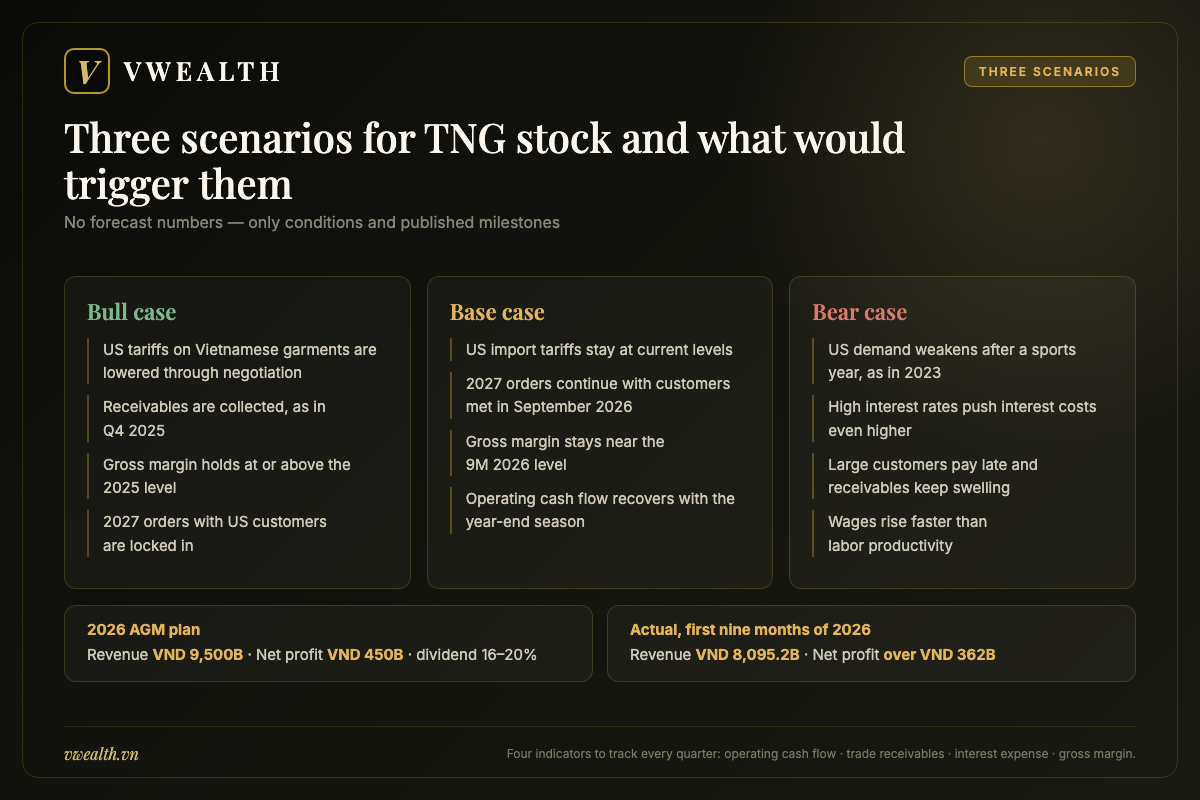
The indicators to watch each quarter to know which scenario TNG is in
The three scenarios above are only useful if you know how to recognise which one you are in. Below are five indicators, all available in TNG’s quarterly financial statements, and how to read each one.
1. Net cash flow from operating activities (CFO). This is the most important indicator for TNG right now. For the first nine months of 2026, CFO was negative by more than VND 696 billion, compared with negative more than VND 344 billion a year earlier. If the 2026 annual report shows full-year CFO improving strongly on the back of the fourth quarter — as in 2025 — that points to the base or optimistic scenario. If full-year CFO remains deeply negative, that is a signal for caution.
2. Trade receivables. These rose from VND 996.17 billion at the start of the year to VND 1,696.42 billion at September 30, 2026. Watch how much they fall by year-end, and how the share of the three largest customers changes.
3. Interest expense relative to gross profit. In Q3 2026, gross profit was about VND 457 billion while interest expense was VND 87.4 billion. The ratio between the two tells you how much of the profit from manufacturing is going to the banks. A ratio rising quarter after quarter is a bad sign.
4. Gross margin. The reference points: 15.4% in 2024, 14.2% in 2025 and 14.2% in Q3 2026. A rising gross margin shows the productivity race is being won; a falling one shows that unit prices are dropping or costs are rising faster than productivity.
5. Short-term debt. Short-term borrowings rose from VND 2,371.0 billion at the start of the year to VND 3,026.8 billion at September 30, 2026. According to VnBusiness, in October 2026 TNG received a further VND 17.1 billion loan from VietinBank and a credit line of nearly VND 758 billion from Vietcombank. Banks continuing to extend credit is a positive sign of lender confidence, but the total short-term debt at year-end is the number you need to compare.
| Indicator | Latest reported reference | Leans optimistic if | Leans bad if |
|---|---|---|---|
| CFO | 9 months of 2026: negative by more than VND 696 billion | Q4 turns clearly positive, as in 2025 | Full year stays deeply negative |
| Trade receivables | VND 1,696.42 billion (September 30, 2026) | Fall sharply by year-end | Keep rising and become more concentrated |
| Gross margin | 14.2% (2025 and Q3 2026) | Holds or edges up | Narrows quarter after quarter |
| Interest expense | VND 87.4 billion (Q3 2026) | Grows more slowly than gross profit | Grows faster than gross profit |
| US tariffs | 20% + 12.5% Section 301 (as reported by the press) | Reduced through negotiations | Raised further, or the gap with competitors widens |
You do not need to guess in advance which scenario will play out. What you need is a tracking table like the one above and the habit of opening the financial report every quarter. With each quarter that passes, the picture becomes clearer, and your decision will rest on facts rather than feelings.
Should you buy TNG stock? Weighing the pros, the cons and who it suits
After seven chapters, you have enough pieces to answer for yourself whether to buy TNG stock. This final chapter does not give a buy or sell recommendation — because the right answer depends on who you are, what you need from the investment and how much volatility you can stomach. Instead, it puts the pros and cons on two sides of the scale, then looks at which side each type of investor should focus on.
The pros: steady growth, cash dividends and big-name customers
Six straight years of revenue growth. From 2020 to 2025, TNG’s net revenue rose every year, from VND 4,480.2 billion to VND 8,698.6 billion according to VNDirect data, and revenue for the first nine months of 2026 grew another 21% or so. In an industry where global demand is roughly flat once inflation is stripped out, this growth record shows TNG is winning market share.
Profit at record levels. 2025 was a record year with profit of about VND 392–393 billion, and Q3 2026 was the most profitable quarter since listing, at VND 151.5 billion. Nine-month 2026 profit was more than VND 362 billion, up about 29%.
Regular cash dividends. TNG paid 20% in cash for 2025 and has paid 15% in interim dividends for 2026 in two instalments, against a full-year plan of 16–20%. Paying in several instalments means shareholders receive cash spread across the year.
A high-quality customer list. Decathlon, Columbia, The Children’s Place, Nike, Adidas, ZARA, MANGO and many other brands. Decathlon’s decision to move its product development centre from Wuhan to TNG signals a partnership that goes beyond simply placing orders.
Investment in productivity. Automation with AGVs, transport robots and real-time productivity tracking software, an in-house ERP system, and Level 3 on Vietnam’s national digital transformation index — these investments are a direct response to the pressure of falling unit prices and rising wages.
Interest from institutional money. Dragon Capital and Fides Vietnam are major shareholders, and the stock is a member of the HNX30.
The cons: debt, negative cash flow, thin margins and US tariffs
High leverage, tilted towards the short term. Total borrowings are about VND 4,200 billion, up about 26%, with more than 70% short-term. Total liabilities at September 30, 2026 were VND 5,712.64 billion, about 73.7% of total capital. Interest expense for the nine months was VND 220.7 billion.
Negative operating cash flow. CFO was negative VND 259.5 billion in 2025 and negative by more than VND 696 billion in the first nine months of 2026. Accounting profit is rising, but real cash has not come in to match; cash at the end of Q3 2026 was only about VND 158.2 billion, against VND 314.6 billion at the start of the year.
Thin margins. Net profit margin is only about 4–4.5% of revenue (a vwealth estimate). With margins that thin, a small change in interest rates, wages or unit prices can cause a big change in profit.
US tariff risk. The 20% reciprocal tariff and, according to press reports, an additional 12.5% under Section 301 from July 24, 2026 leave Vietnamese goods facing higher duties than some competing countries. The outcome of negotiations is unknown.
Customer concentration. Three customers accounted for about 63.7% of receivables at September 30, 2026. That is common for garment makers serving large brands, but it makes cash flow more sensitive to each individual customer.
A cyclical stock. History shows TNG’s share price can fall even while profit rises (2025), and profit can drop sharply after a peak year (2023).
| Pros | Cons | Which metric to track |
|---|---|---|
| Revenue up six years in a row (2020–2025) | Industry demand is roughly flat; growth has to be won from competitors | Monthly and quarterly revenue versus the prior year and the VND 9,500 billion plan |
| Record profit in 2025; Q3 2026 the best quarter since listing | Net margin only about 4–4.5% (vwealth estimate) | Gross and net margin each quarter |
| 20% cash dividend for 2025; 15% interim paid for 2026 | Dividends paid while CFO is negative, partly funded by borrowing | Full-year 2026 CFO, dividend payout ratio |
| Large customers with deep relationships (Decathlon, Columbia…) | Three customers account for about 63.7% of receivables | Trade receivables, days sales outstanding |
| Investment in automation, factories and warehouses | Borrowings of about VND 4,200 billion, more than 70% short-term | Debt-to-equity, interest expense versus gross profit |
| Held by large funds, member of the HNX30 | Price sensitive to US tariff news and to fund trading | Major-shareholder filings, tariff negotiation news |
Should you buy TNG stock as a dividend, growth or short-term investor?
If you are a dividend investor — someone who wants a steady stream of cash from a stock — TNG has a clear appeal: cash paid in several instalments, 20% for 2025, and 15% already paid as interim dividends for 2026. But you need to answer one more question: is the dividend sustainable while operating cash flow is negative? Watch full-year 2026 CFO. If the fourth quarter brings cash in as well as it did in 2025, the dividend policy has a firmer footing. And do not forget to calculate the dividend yield yourself at the price you pay and compare it with savings rates — because you are accepting price volatility in exchange for that cash flow.
If you are a growth investor — someone looking for a business that could multiply in size over a few years — TNG has an unbroken revenue growth record and a clear expansion plan. But its growth is being funded mainly with debt, in a thin-margin industry. The question for you is whether profit can grow fast enough to cover ever-larger interest costs, and whether that growth can survive a turn in interest rates or tariffs. Tracking gross margin and the ratio of interest expense to gross profit will give you the answer, quarter by quarter.
If you are a value investor — someone who wants to buy when the market is overly pessimistic — TNG’s personality as a stock can create such moments, as in 2022 or mid-2026, when textile stocks were “searching for a bottom” despite record profits. Your tools are comparing current P/E and P/B with TNG’s own history and with peers, while telling the difference between pessimism driven by sentiment and pessimism driven by real risks in debt and cash flow.
If you are a short-term trader — TNG has reasonably good liquidity thanks to its HNX30 membership, and its price often reacts strongly to US tariff news, quarterly results and fund trades. But precisely because the price depends so much on hard-to-predict macro news, trading TNG demands strict stop-loss discipline. With a stock this reactive to headlines, just a few consecutive bad sessions can do significant damage if you have not set your stop-loss in advance. Bear in mind, too, that shares bought in Vietnam only become sellable once the settlement cycle completes, and HNX stocks are subject to daily price limits — both of which shape how quickly you can get in and out.
If you cannot tolerate volatility or need the money in the short term, a highly leveraged cyclical stock like TNG may not suit you, even though the business is doing well. A good business and an investment that fits you are two different things.
If you want to compare TNG with other Vietnamese manufacturers before deciding, our overview of Vietnam manufacturing and industrial stocks helps you place TNG alongside companies with very different business models, and our step-by-step guide to investing in Vietnam’s stock market explains how foreign investors can open an account and buy HNX-listed shares such as TNG.
A pre-purchase checklist for TNG stock, and final thoughts
Before placing an order, check the following five things. Each takes only a few minutes but can save you from a hasty decision.
One: read the latest quarterly financial statements. Not just the profit line, but the cash flow statement (CFO), receivables, inventories and short-term debt. For TNG, the balance sheet matters as much as the income statement.
Two: check progress against the annual plan. The 2026 plan is VND 9,500 billion in revenue and VND 450 billion in net profit after tax. Compare actuals with the plan to see whether the company is moving faster or slower than its own commitments.
Three: review disclosures on major shareholders and insiders. Trades by the founder’s family and large funds tell you what the people who know the business best are doing with their shares.
Four: mark the dividend calendar. The ex-dividend date of November 10, 2026 for the 5% interim dividend is the nearest milestone. Whether you buy before or after that date determines whether you receive that instalment.
Five: follow Vietnam–US tariff negotiations through official sources. This is the factor that can change the picture for the whole industry fastest. Prioritise government documents and official statements over social media commentary.
Final thoughts. TNG is the story of a garment maker from Thai Nguyen that has travelled a long road to become one of Vietnam’s major textile and garment exporters, shipping more than 61 million products in 2025 to customers that include the world’s leading sportswear and fashion brands. In 2026 the company is at its peak in scale and profit and has just completed a generational handover of leadership — but it is also carrying its largest debt load, its deepest negative operating cash flow in recent years, and facing tariff rules that are still being rewritten.
So the question of whether to buy TNG stock really comes down to this: do you believe TNG’s productivity, complex product lines and customer relationships are strong enough to service its debt, hold its thin margins and ride out swings in US tariffs? If you do, and if the current price does not yet fully reflect that belief, TNG may be worth considering. If you still have doubts, watching for another quarter or two — especially cash flow in Q4 2026 — is a reasonable choice. Whichever way you lean, you will need the up-to-date figures this article deliberately leaves out: the current price, P/E, P/B and dividend yield. You can create a free vwealth account to track those metrics report by report, compare TNG with VGT, TCM and other Vietnamese export stocks, and make your own decision. This article is meant to help you understand the business; it is not a recommendation to buy or sell.
Research Vietnamese stocks in English with vwealth. Our AI-powered platform turns Vietnamese market data into full English analysis reports — with international payment support and a free first month when you subscribe in the VWEALTH app. Create your free account and read the latest reports.


