
Should you buy CMG stock? The ticker belongs to CMC Corporation, Vietnam’s second-largest private technology group, listed on the Ho Chi Minh City Stock Exchange (HOSE). On paper the story is attractive: Samsung SDS has been its strategic shareholder since 2019, it runs Uptime Tier III data centres that local banks rely on, it has its own AI company and its own university, and audited consolidated net profit rose 21% in fiscal year 2025 (April 2025 to March 2026). Yet over the same stretch, CMG shares went from an “NVIDIA moment” rally in 2024 to a three-year low in mid-2026. The gap between the business narrative and the share price has a fairly simple explanation: CMC is making a very large bet on digital infrastructure and AI, while its profit margins were already thin and its balance sheet is taking on more debt. This analysis walks through that story in full, so that by the end you can decide for yourself who CMG stock suits and who it does not.
First, the names. CMG is the stock ticker. The legal entity is CMC Corporation (Công ty Cổ phần Tập đoàn Công nghệ CMC in Vietnamese); the local press and the company itself usually shorten it to CMC or CMC Corp. The shares have traded on HOSE since January 2010. Do not confuse CMG with the ticker CMC on the Hanoi Stock Exchange (HNX) — that ticker belongs to CMC Investment JSC, a separate legal entity. Throughout this article, “CMC” refers to the company and “CMG” to its shares.
Second, how the numbers in this article were sourced. As with every company analysis in the vwealth series, dates, names and figures come from published material: audited consolidated financial statements, resolutions and minutes of shareholder meetings, explanatory letters CMC filed with the State Securities Commission of Vietnam (SSC) and HOSE, and the Vietnamese financial press (CafeF, Vietstock, VnExpress, VnEconomy, VietNamNet, Forbes Vietnam and others). We deliberately do not quote today’s share price, the current P/E ratio or the latest quarter’s profit as “current” figures, because they go stale quickly. Where a figure is our own calculation, it is labelled “vwealth estimate” or “illustrative example”. For up-to-date numbers, open the latest vwealth analysis reports. If you are new to the market itself, our guide on how to invest in the Vietnam stock market covers accounts, foreign ownership limits, settlement cycles and the daily price bands.
Third, and this is the thread running through the whole piece. If you have read our analysis Should You Buy FPT Stock?, you will know FPT as a high-margin software exporter with abundant cash flow. CMC differs on almost every point that matters. Most of its revenue comes from domestic systems integration and solution distribution, a thin-margin business. Most of its profit comes from digital infrastructure, a capital-hungry business. And its 2026–2030 strategy requires thousands of billions of dong more in data centres, office complexes and AI. So the real question behind “should I buy CMG stock” is not whether CMC is a good company. It is whether this infrastructure bet will earn enough, fast enough, to compensate for the thin margins and the cost of capital.
From a small computer firm in 1993 to Vietnam’s number-two private tech group: 33 years of CMC
Some technology companies are born around a product. CMC was born around a very practical need in early-1990s Vietnam: computers were scarce, and people who could install and run IT systems were even scarcer. Thirty-three years later, traces of that origin still shape the revenue mix — equipment sales and systems integration remain a large share of the business. Understanding CMC’s history is the quickest way to understand why its margins are thinner than those of the market leader, and why management is so determined to reshape the company through infrastructure and AI.
1993–2006: from a small limited company to Vietnamese-branded PCs
According to CMC’s own audited financial statements, the business was first registered with the Hanoi Department of Planning and Investment on 26 May 1993, the date CMC uses as its founding day (its 30th anniversary was celebrated on 26 May 2023). The timeline in CMC’s 2025 annual report names the predecessor as HT&NT Co., Ltd., established on 26 May 1993, and the management biographies list Mr Nguyen Trung Chinh as a founding member since May 1993. Press histories credit the late Ha The Minh (a former CMC chairman) as the partner who built the business with Mr Chinh from the early days.
The timing was not an accident. The United States lifted its trade embargo on Vietnam in 1994, global technology vendors began looking for local distribution partners, and Vietnamese agencies and banks started buying computers and building internal networks. A small firm that could import equipment, install it and maintain it could grow very quickly. According to the annual report timeline, in 1996 the company set up two centres: a System Integration Centre (the forerunner of CMC SI, later CMC Technology & Solutions, or CMC TS) and a Software Solution Centre. In 1999 CMC established CMC Computer (CMS), which the annual report describes as the first Vietnamese enterprise to manufacture computers under a Vietnamese brand.
This structure matters because it explains a great deal of what followed. Selling computers and integrating systems is a “pass-through” business: the company buys hardware and software from global vendors (Dell, IBM, HPE, Cisco, Palo Alto and so on), adds design, installation and maintenance services, and resells the package to the customer. Revenue is large, but the value added that the integrator keeps is a thin slice. Three decades later, technology and solutions is still CMC’s largest segment by revenue — and also the one with the lowest pre-tax margin, as Chapter 4 shows.
2007–2010: becoming a joint-stock group and listing on HOSE
In February 2007 the business was registered as a joint-stock company under the name CMC Corporation (enterprise code 0100244112, registered 7 February 2007, according to the “General information” page of the financial statements). From then on CMC operated as a holding company controlling specialised subsidiaries.
In January 2010, CMC listed 63.5 million shares on HOSE under the ticker CMG. According to the newspaper Dai Bieu Nhan Dan, the reference price on the first trading day was VND 35,000 per share, implying a valuation of about VND 2.2 trillion. For investors, that history matters less than the implication: CMC is one of the few Vietnamese technology companies with more than fifteen years of listed history, long enough to observe how management behaves across several cycles.
According to the audited financial statements, CMC’s share capital was about VND 1,900 billion (roughly 190.03 million shares) on 31 March 2024 and 232,954,608 shares on 31 March 2026. Most of the growth in the share count since listing did not come from cash raises but from stock dividends, bonus shares and employee share plans (ESOP) — according to VNDirect’s corporate-actions calendar, two bonus issues alone, in 2022 (ratio 100:24.62) and 2023 (100:20.2), lifted the share count sharply. We return to this in Chapters 2 and 5.
2008–2017: CMC Telecom, a cross-Vietnam cable and three data centres
If systems integration was the “original trade”, telecoms was the decision that changed CMC’s shape. According to the 2025 annual report timeline, CMC set up CMC Telecommunication Service JSC (CMC Telecom) in 2007 and CMC Telecommunication Infrastructure JSC (CMC TI) in 2008, then merged the two in 2012 into CMC Telecommunication Infrastructure Corporation — the entity still trading as CMC Telecom today. It began as an internet service provider (ISP) targeting corporate customers that needed stable, high-quality connectivity. In 2015, CMC Telecom signed a strategic investment agreement with the Malaysian telecoms group TIME dotCom.
The turning point came in 2017. CMC Telecom brought into service the CVCS (Cross Vietnam Cable System), linking Vietnam with the wider Southeast Asian region; in fiscal 2026 the company is still investing in a third circuit of this backbone (2025 annual report). The same year, CMC Telecom opened its third data centre and launched a next-generation security operations centre. It also decided to move from being a pure ISP to a “converged service provider”: selling not just connectivity but cloud computing, storage, security and managed services.
That strategy meant pouring money into fixed assets. VietNamNet described CMC Telecom as having “dared” to spend hundreds of billions of dong on cloud infrastructure and thousands of billions on data centres — very large sums for a young telecoms company. It was the first time CMC shifted part of its DNA from “reselling” to “owning infrastructure and renting it out”. Almost a decade later, that shift made digital infrastructure the group’s largest profit contributor.
2017: the “first transformation”, CMC Global and the push overseas
In his speech at the company’s 33rd anniversary in May 2026, Mr Nguyen Trung Chinh called 2017 CMC’s “first transformation”, when the group adopted digital transformation (DX) as its foundation. That year CMC announced its “Go Global” strategy: it founded CMC Global as the strategic unit for software and IT-services exports, with Japan as the priority market, and opened CMC Japan in Yokohama (2025 annual report).
In hindsight, 2017 was the year CMC formally entered the arena FPT had dominated for almost two decades. FPT began exporting software in the late 1990s; CMC arrived nearly twenty years later. But CMC Global grew quickly: according to VietNamNet, its revenue exceeded VND 1.9 trillion by the end of 2022, up 180% on 2021, and the Vietnam Software and IT Services Association (VINASA) placed it in its “trillion-dong enterprises” group in 2023. The unit describes itself as one of Vietnam’s top two software exporters.
2019: Samsung SDS arrives with about 30%
In 2019, CMC and Samsung SDS — the IT-services arm of the Samsung group — signed a strategic investment cooperation agreement, after a 2018 cooperation agreement on smart-factory solutions (2025 annual report timeline); the relationship between CMC Global and Samsung SDS dates back to 2017 (Forbes Vietnam). In August 2019, CMC issued 25 million new shares in a private placement to Samsung SDS Asia Pacific Pte. Ltd. at VND 34,000 per share, a total of VND 850 billion; CMC’s report on the use of proceeds records net proceeds of VND 844.558 billion, with the offering completed on 22 August 2019. According to VietnamBiz, one day earlier (21 August 2019) Samsung SDS had also bought 5 million CMG shares in a negotiated trade at VND 40,000, bringing its holding to roughly 30 million shares — about 30% of CMC’s charter capital at the time. The press put the total value of the deal at around VND 1,050 billion, or roughly USD 45 million.
One small but telling detail: Samsung SDS was willing to pay more on the exchange than the private-placement price in order to reach roughly 30%. An investor looking for a quick trade rarely does that; you pay up only when the stake itself has value — here, the position of largest shareholder, with a significant voice at the general meeting of a partner to which Samsung SDS was assigning hundreds of projects. Samsung SDS’s current holding is examined in Chapter 2.
2022–2024: the Tan Thuan data centre, CMC University and the AI-X strategy
On 15 August 2022, CMC opened the CMC Data Center Tan Thuan in the Tan Thuan Export Processing Zone in Ho Chi Minh City. According to VietNamNet, the facility sits within the 13,000 m² CMC Creative Space complex, cost VND 1.5 trillion, has 1,200 racks and a design capacity of up to 12,000 kW, and was a pioneer in Vietnam in holding an Uptime Tier III certificate for construction. In June 2024, VnEconomy reported that CMC Telecom’s data-centre system was the first in Vietnam to achieve level-4 information-system security certification — the level required to serve government and financial customers that cannot tolerate unplanned downtime.
Also in 2022, CMC acquired the Asia University of Industrial Fine Arts — now CMC University — positioning it as a “digital university”. The financial statements record 21 February 2022 as the acquisition date of the related subsidiaries.
In September 2024, CMC announced a comprehensive AI transformation (AI-X) strategy in Hanoi and in Japan under the banner “Enable your AI-X”; the same year it joined Keidanren and opened CMC Japan’s third office (2025 annual report). Earlier, in May 2024, a meeting between Mr Chinh and NVIDIA’s leadership triggered a strong rally in CMG shares — a story told in detail in Chapter 5.
2025–2026: the VND 10 trillion milestone, a ten-year bond and the “second transformation”
CMC’s fiscal year 2025 closed on 31 March 2026 with consolidated statements audited by Ernst & Young Vietnam: net revenue of VND 9,560.8 billion (prior year VND 8,202.6 billion), profit before tax of VND 611.9 billion (prior year VND 501.5 billion) and profit after tax of VND 516.8 billion (prior year VND 427.1 billion), of which VND 413.0 billion was attributable to shareholders of the parent. CMC’s press release, meanwhile, spoke of “revenue of more than VND 10,554 billion, crossing the VND 10 trillion mark for the first time in 33 years”, with a note that these were “figures summed horizontally across member companies”. Both numbers are correct on their own basis — but they are not the same number. Chapter 4 explains why you should use the consolidated figure when valuing the company.
During fiscal 2025, CMC issued the first bond in its history: VND 1,250 billion, ten-year tenor, fixed coupon of 5.5% a year. The notes to the accounts give a maturity date of 30 October 2035, which implies issuance around the end of October 2025. The bond carries a payment guarantee from the Credit Guarantee and Investment Facility (CGIF), a trust fund of the Asian Development Bank. In March 2026 the deal won The Asset’s “Best New Bond” award. All of the proceeds are earmarked for the CMC Creative Space Hanoi complex (formerly CMC Starlake) — according to CafeF (November 2025), a 1.13-hectare site in the Starlake Tay Ho Tay urban area with an expected total investment of VND 2,181 billion, construction started on 1 June 2025 and scheduled for completion on 31 December 2026.
In May–June 2026 CMC reshuffled its top team: Dang Tung Son, previously Senior Vice Chairman and Chief Strategy Officer, became CEO from 1 June 2026, replacing Ho Thanh Tung; several vice chairmen were relieved of their roles; and the Technology & Solutions division was restructured. At the 33rd-anniversary event, Mr Chinh declared that CMC was entering its “second transformation”, centred on AI-X, with “Accelerate your AI-X” as the slogan for fiscal 2026.
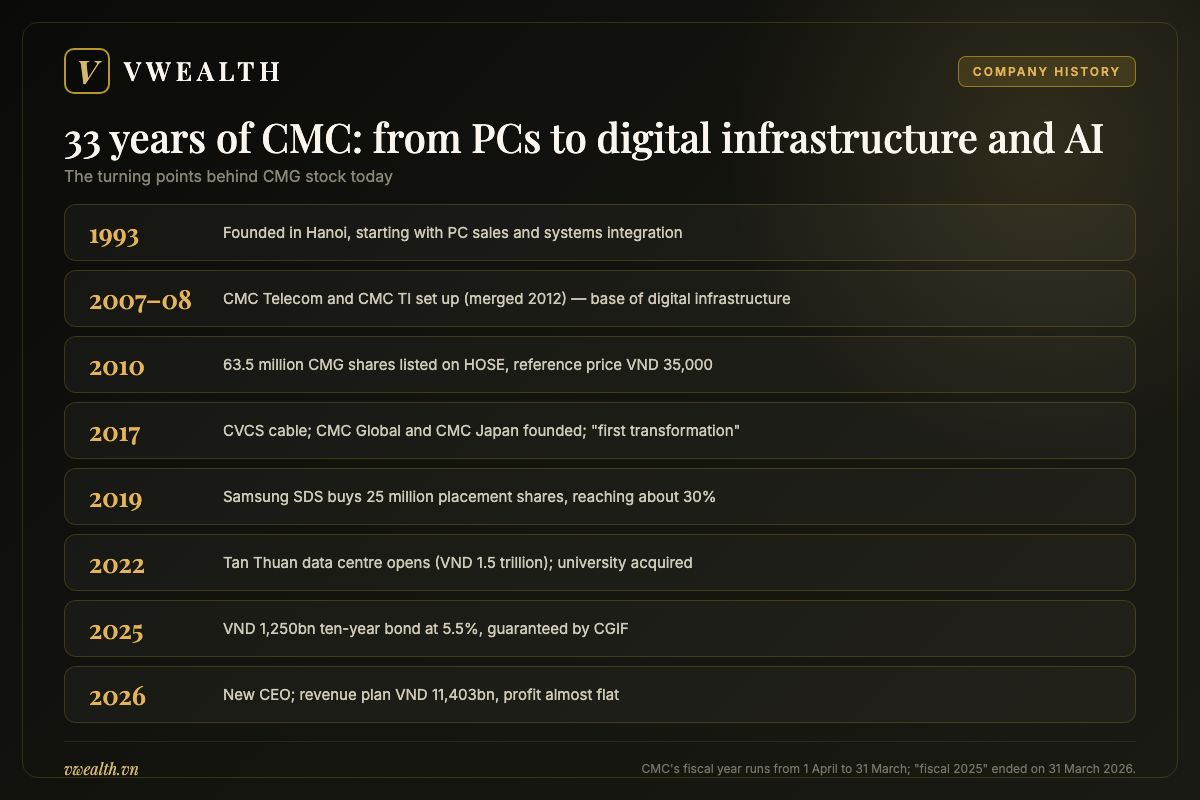
The table below gathers the key milestones in one place. The last column is how we read each milestone from the point of view of someone considering CMG stock today.
| Date | Milestone | What it means for CMG investors today |
|---|---|---|
| 26 May 1993 | Predecessor business registered in Hanoi | Roots in hardware sales and integration — the origin of thin margins |
| 1996–1999 | Systems-integration and software centres set up; CMC-branded PCs launched | Birth of the Technology & Solutions arm, still the largest revenue segment |
| Feb 2007 | Becomes CMC Corporation, a joint-stock group | Holding structure with minority shareholders at subsidiary level |
| 2007–2008 | CMC Telecom and CMC TI set up (merged in 2012 into CMC Telecommunication Infrastructure Corp.) | Start of digital infrastructure — now the biggest profit source |
| Jan 2010 | 63.5 million CMG shares listed on HOSE | More than 15 years of track record to judge management |
| 2017 | CVCS cable; CMC Global and CMC Japan founded; “first transformation” | Entered software exports almost two decades after FPT |
| Aug 2019 | Samsung SDS buys 25 million placement shares at VND 34,000 plus almost 5 million on the market | Largest shareholder at about 30%, and a major customer |
| Aug 2022 | Tan Thuan data centre opens (VND 1.5 trillion); university acquired | Infrastructure and education — both need long-term capital |
| Sep 2024 | “Enable your AI-X” strategy launched in Hanoi and Tokyo | AI becomes the stock’s central narrative |
| Oct 2025 | VND 1,250 billion ten-year bond at 5.5%, CGIF-guaranteed | Cheap long-term funding, at the cost of sharply higher debt |
| 31 Mar 2026 | Fiscal 2025 ends: consolidated revenue VND 9,560.8 billion, profit after tax VND 516.8 billion | Profit up 21%, margins still thin |
| Jun–Jul 2026 | New CEO Dang Tung Son; AGM approves revenue plan of VND 11,403 billion, profit after tax of VND 530 billion | Fast revenue growth, almost flat planned profit |
Who runs and who owns CMC: the co-founder, Samsung SDS and the major shareholders
At most Vietnamese private companies, “who owns the company” has a short answer: the founder and family. CMC is different. The co-founder still runs it but holds only a small stake; the largest shareholder is a foreign conglomerate; and the rest is spread across a fairly large number of institutions. That structure has good and less good sides — and it directly shapes how CMC pays dividends, raises capital and makes investment decisions.
Nguyen Trung Chinh: the engineer who still steers after 33 years
Mr Nguyen Trung Chinh was born in 1963, graduated as an electronics and telecommunications engineer from Hanoi University of Technology in 1987, and has been a founding member of CMC since May 1993 (2025 annual report). Today he holds two roles at once: Chairman of the Board of Directors and Executive Chairman of the group. At the annual general meeting (AGM) on 31 July 2026 he was re-elected to the board for the 2026–2031 term and, according to the board resolution published afterwards, continues as Chairman from 10 August 2026.
Mr Chinh is a familiar face in technology-policy circles. In June 2026, CafeF and Dan Tri reported his appointment as a councillor (Shingiin) of Keidanren, the Japan Business Federation, for a term running until Keidanren’s 2028 annual meeting; CMC has been a Keidanren member since 2024. His recurring message is that Vietnam must “master technology and move beyond an outsourcing mindset”, with CMC pursuing a “Make in Vietnam – Go Global” path.
One interview answer is worth remembering. Speaking to Forbes Vietnam in 2024, Mr Chinh said that out of every ten customers or partners he met, nine asked what CMC had to compete with FPT. His answer: “We have to be more specialised, more steadfast and more focused, to have the courage to go into difficult niches that bring higher value.” Those “difficult niches” — high-spec data centres for banks, cybersecurity, Vietnamese legal AI models — are exactly where CMC is putting its capital. But difficult niches also tend to be capital-intensive and slow to pay back.
The biggest difference from FPT lies in ownership. According to shareholder data on VNDirect updated on 14 January 2026, Mr Chinh holds 2,711,666 CMG shares; the 2025 annual report puts his ownership at 1.18%. In other words, CMC’s leader runs the company on the strength of reputation, experience and the confidence of major shareholders, not on controlling ownership. That cuts both ways. On the plus side, no single family can treat the company as private property. On the watch-list side, the key executive’s direct financial exposure to the share price is smaller than at founder-controlled firms, which makes ESOP schemes and remuneration important alignment tools — and, as you will see, shareholders do not always agree to them.
A new generation of executives and the 2026 leadership change
CMC’s executive bench is large: the fiscal 2025 financial statements list almost twenty positions at the level of executive vice chairman, senior vice chairman and group vice chairman. The key figures include Dang Tung Son, CEO since 1 June 2026 and previously Senior Vice Chairman and Chief Strategy Officer; Ho Thanh Tung, CEO until 1 June 2026, now Senior Executive Vice Chairman and still a board member for the new term; Nguyen Minh Tue, Senior Vice Chairman and Chief Financial Officer; and Dang Van Tu, Senior Vice Chairman and Chief Technology Officer.
The CEO change came with a string of other moves in May–June 2026: Pham Ngoc Bac stepped down as Executive Vice Chairman from 11 May 2026, Le Anh Linh from 13 June 2026, and CMC Consulting Co., Ltd. was merged into CMC Technology & Solutions (CMC TS). The press described this as a restructuring of the Technology & Solutions division. Read alongside the financial results, the logic is clear: this is the largest division by revenue but the one with the thinnest margins, and the fiscal 2026 plan assigns it the highest revenue but the lowest pre-tax profit of the three main divisions.
The 2026–2031 board has nine members: Nguyen Trung Chinh, Kwon Oh Soo, Gum Ki Ho, Ha The Vinh, Ha The Phuong, Nguyen Minh Duc, Nguyen Xuan Viet, Le Viet Ha and Ho Thanh Tung. The supervisory board comprises Jang Sung Gon, Mai Thu Ha (head) and Tran My Le; according to Mekong ASEAN, Mr Jang Sung Gon (born 1983) is finance director of the IT Biz unit at Samsung SDS Vietnam, while Mr Gum Ki Ho represents Samsung SDS’s stake in CMC. The meeting was attended in person or by proxy by 118 shareholders representing 179,447,509 shares, or 77.049% of voting shares. The AGM minutes show Mr Chinh received 338.8 million cumulative votes and the two Korean board members more than 314 million each — the highest after Mr Chinh. The minutes do not say who voted for whom, but in our reading, cumulative votes that concentrated suggest a large block of shares stood behind these two candidates.
Samsung SDS: largest shareholder and a major customer
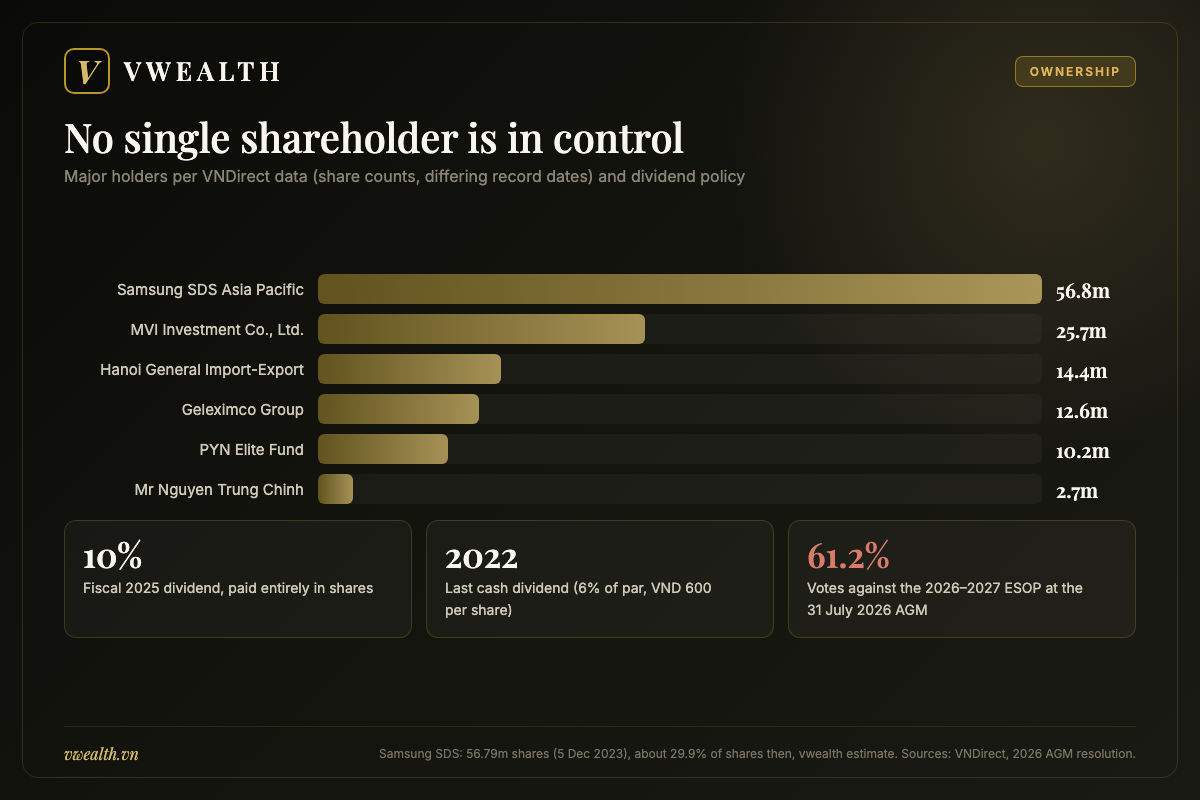
Since August 2019, Samsung SDS Asia Pacific has been CMC’s largest shareholder. VNDirect’s major-shareholder data (recorded on 5 December 2023) shows it holding 56,792,116 CMG shares. Against the 190.03 million shares CMC had outstanding on 31 March 2024 according to its financial statements, that equals about 29.9% (vwealth estimate). Mekong ASEAN (August 2026) wrote that Samsung SDS “currently holds about 30% of CMC”. Some data portals show a lower figure (about 24.4%) — that is the 2023 share count divided by today’s much larger share base after several stock dividends, not evidence that Samsung SDS has sold. The 2025 annual report adds that, based on the shareholder list of 15 January 2026, three shareholders held 5% or more, with a combined 112,528,816 shares (48.31%); foreign investors held 38.21% and institutions 64.41%.
The relationship is not only about capital. According to Vietnam Journal of Science and Technology (July 2024), after five years of cooperation CMC helped Samsung SDS choose Vietnam as a Global Delivery Center (GDC) hub; CMC’s GDC supplies nearly 1,000 engineers to more than 125 Samsung SDS projects, generating revenue of about USD 20 million. CMC also provides data-centre capacity, connectivity and cloud to Samsung’s factories in Vietnam, and deploys Samsung SDS’s RPA and MES solutions for large domestic manufacturers. Samsung SDS President and CEO Sungwoo Hwang said he was in a position to help CMC expand in South Korea and the United States.
For investors, Samsung SDS’s presence is a credibility cushion: a leading Korean IT group did its due diligence before investing and is still there seven years later. But it also raises a question worth monitoring: when your largest shareholder is also a major customer, do the prices and terms of contracts between the two affect minority shareholders? That is why you should read the related-party transactions note in the financial statements and the board resolutions approving related-party transactions that CMC publishes periodically.
The rest of the shareholder register: many institutions, no one in control
Beyond Samsung SDS, CMC has a fairly diverse group of institutional shareholders. The table below lists share counts from VNDirect’s major-shareholder data, with the date each record was captured. We deliberately do not convert everything into percentages, because the dates differ and the share count has grown through several stock dividends; cross-check against the major-shareholder list in the latest annual report.
| Shareholder | CMG shares recorded | Record date | Note |
|---|---|---|---|
| Samsung SDS Asia Pacific Pte. Ltd. | 56,792,116 | 5 Dec 2023 | Strategic shareholder since 2019, about 30% |
| MVI Investment Co., Ltd. | 25,652,208 | 5 Dec 2023 | Second-largest institutional holder |
| Hanoi General Import-Export JSC | 14,391,647 | 5 Dec 2023 | Institutional holder |
| Vietnam General Import-Export I | 13,641,546 | 5 Dec 2023 | Institutional holder |
| Geleximco Group JSC | 12,612,584 | 30 Dec 2024 | Institutional holder |
| PYN Elite Fund | 10,244,499 | 30 Dec 2024 | Finnish investment fund |
| CMC Investment JSC | 10,231,079 | 30 Dec 2024 | Separate entity, ticker CMC on HNX |
| Bao Viet Holdings | 7,151,669 | 5 Dec 2023 | Institutional holder |
| Mr Nguyen Trung Chinh | 2,711,666 | 14 Jan 2026 | Chairman and Executive Chairman |
Two takeaways. First, CMG has a fairly thick “core” of long-term holders: Samsung SDS plus domestic institutions account for a large share of the capital, so the free float that actually trades is much smaller than the 232.9 million shares outstanding. Second, no shareholder can control the company alone; big decisions need several parties to agree — as the 2026 AGM showed very clearly on the ESOP proposal.
Stock dividends, a rejected ESOP and what shareholders are telling management
If you want regular cash income from CMG, you will be disappointed. According to Mekong ASEAN (December 2025) and VNDirect’s corporate-actions calendar, CMC’s last cash dividend was the dividend for 2022, at 6% of par (VND 600 per share). In recent years, dividends have mostly been paid in shares. (In Vietnam, dividend rates are quoted as a percentage of the VND 10,000 par value, so a “10% stock dividend” means ten new shares for every hundred held.)
- Dividend for 2020: 9% in shares (ex-date 10 February 2022, per VNDirect’s calendar).
- Dividend for 2021: 13% in shares, plus bonus shares at a ratio of 100:24.62 (September 2022).
- Dividend for 2022: 6% in cash (VND 600 per share) plus 6% in shares, with bonus shares at 100:20.2 (December 2023) — the most recent cash payout.
- Dividend for 2023: 11% in shares (December 2024) — according to the financial statements, CMC issued VND 209.4 billion of par value as stock dividends during fiscal 2024.
- Dividend for fiscal 2024: 10% in shares (about 21.17 million shares; board approval on 23 December 2025), lifting charter capital to VND 2,329.5 billion.
- Dividend for fiscal 2025: 10% in shares, approved by the AGM on 31 July 2026; the dividend plan for fiscal 2026 is 9.5%.
The rationale is spelled out in the 2026 AGM resolution: shares are used “to increase charter capital for reinvestment, increase capital for member companies and finance projects: education, data centres, cybersecurity products and technical infrastructure”. In other words, every dong of profit is being retained to fund the infrastructure bet. For shareholders, a stock dividend does not make you richer on the day — you own more shares, but each represents a smaller slice of the same company. Value is created only if the retained money earns more than the cost of capital.
Shareholders have also shown their limits. At the AGM on 31 July 2026, a proposal to issue more than 2.1 million ESOP shares for 2026–2027 at VND 10,000 per share (about 60% below the 15 July 2026 closing price, according to Vietstock; all subject to a five-year transfer restriction) was rejected: according to the minutes, 109,872,352 votes (61.228%) were against and 65,534,015 (36.520%) in favour. These were the 2,148,800 shares left unissued from the 2021–2023 ESOP programme. Publicly rejected ESOP proposals are rare among Vietnamese listed companies. It is a notable governance signal in both directions: large shareholders are willing to say no to cheap dilution, but management loses a retention tool at a time when it plans to hire almost 1,000 more people in the year.
One more governance item, reported in the press (Dan Viet, VietTimes, May 2026): the State Securities Commission’s inspectorate fined CMC a total of VND 222.5 million for three breaches — VND 65 million for late disclosure related to the 2024 AGM and the 2023 annual report; VND 92.5 million for not reporting to the AGM on buy-backs of ESOP shares from departing employees (18,100 shares in September 2023, 41,800 in September 2024 and 38,800 in March 2025); and VND 65 million for not publishing an audited report on the use of private-placement proceeds. These were administrative breaches of disclosure procedure, and CMC was required to remedy them; the company subsequently included the use-of-proceeds report in its 2026 AGM proposals (passed with 97.75% approval), and the report on ESOP share buy-backs from departing employees also passed, with 97.641%.
How CMC makes money: four divisions, an infrastructure engine and a talent loop
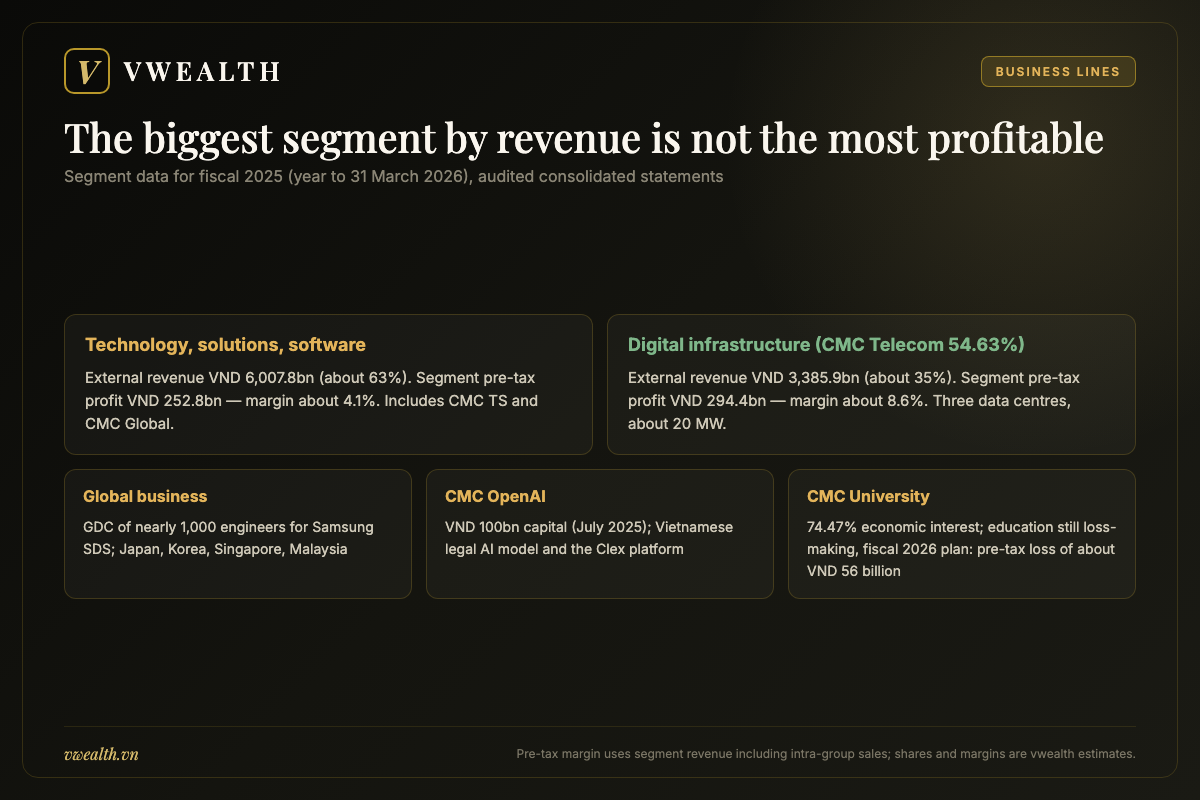
CMC describes itself through five strategic business blocks: New and Strategic Technology; Technology and Solutions; Global Business; Digital Infrastructure; and Education and Human Resources Development. The consolidated financial statements, however, report only three segments: technology, solutions and software services (covering both domestic systems integration and software exports); digital infrastructure; and other services (office leasing, education and training). To read the numbers correctly, keep both lenses in mind — the five blocks to understand the story, the three segments to understand the money.
The table below shows segment data for fiscal 2025, taken from note 35 of the audited consolidated financial statements. The ratios are vwealth estimates.
| Segment (fiscal 2025) | External revenue | Share of revenue | Segment profit before tax | Pre-tax margin on segment revenue |
|---|---|---|---|---|
| Technology, solutions and software services | VND 6,007.8 billion | about 62.8% | VND 252.8 billion | about 4.1% |
| Digital infrastructure | VND 3,385.9 billion | about 35.4% | VND 294.4 billion | about 8.6% |
| Other services (offices, education…) | VND 167.1 billion | about 1.7% | VND 48.1 billion | about 10.5% |
| Total (after intra-group eliminations) | VND 9,560.8 billion | 100% | VND 554.3 billion before unallocated items | — |
The margin column is calculated on each segment’s total revenue including intra-group sales (VND 6,180.0 billion, VND 3,421.0 billion and VND 457.0 billion respectively). The first two rows are enough to reveal CMC’s central paradox: the segment that makes up almost two-thirds of revenue delivers only about 42% of the three segments’ combined pre-tax profit (before eliminations), while the segment that makes up just over a third of revenue delivers about 49%. The smaller business earns more (vwealth estimates).
Technology and Solutions (CMC TS): the biggest revenue engine, the thinnest margin
CMC Technology & Solutions (CMC TS), a wholly owned subsidiary, is the direct descendant of the 1996 systems-integration centre. The work sounds simple: a bank needs to upgrade its data centre, a ministry needs a security system, a factory needs production-management software — CMC TS advises, designs, buys vendor hardware and software, installs, integrates and maintains. The awards the company is proud of reveal the nature of the business: Dell Technologies’ top-tier partner three years running, Allied Telesis Platinum partner, IBM partner of the year in Vietnam, and awards from Samsung, Palo Alto and HPE.
Picture a VND 100 billion systems-integration contract. Perhaps VND 70–80 billion of it is hardware and software licences paid back to the vendors; the part CMC TS actually “produces” is design, deployment and services. Revenue is booked at the full VND 100 billion, but profit comes only from the thin slice on top. (This is an illustrative example, not data from a specific contract.) That is why the technology, solutions and software segment earned a pre-tax margin of only about 4.1% in fiscal 2025 (vwealth estimate), even though it also contains the software-export business, which has better margins.
On the positive side, CMC TS is gradually shifting towards digital- and AI-transformation contracts with more service content. According to the 2025 annual report (horizontally summed, before intra-group eliminations), the Technology & Solutions block posted fiscal 2025 revenue of VND 4,453 billion (up 14%) and pre-tax profit of VND 129.6 billion (up 86% from VND 69.7 billion). CMC’s explanatory letter to the SSC on fiscal 2025 results also confirms it was the biggest contributor to profit growth. Even so, the fiscal 2026 plan presented to the AGM (on a horizontally summed basis) sets this block about VND 5,374 billion of revenue but only about VND 134 billion of pre-tax profit — a margin below 3% by our arithmetic. Restructuring the block just before the AGM suggests management sees it as the part that needs fixing.
Digital Infrastructure (CMC Telecom): smaller but more profitable — and the most capital-hungry
The Digital Infrastructure block revolves around CMC Telecom. According to the financial statements, after share buy-and-sell transactions during fiscal 2025 (under a board resolution of 8 October 2025), CMC held 54.63% of CMC Telecom directly at 31 March 2026. That means almost half the profit of the group’s most profitable business belongs to minority shareholders at the subsidiary level — a crucial point when you read “profit attributable to the parent”, covered in Chapter 4.
CMC Telecom sells four groups of services: corporate internet and leased lines; data-centre colocation (space, power, cooling and security for customers’ servers); CMC Cloud; and managed and security services. According to Forbes Vietnam (2024), CMC Telecom says it holds 65% of the market for data-centre services to Vietnamese banks, and Amazon chose CMC as its only place to keep data in-country. Also per Forbes Vietnam, CMC Telecom has two Tier III data centres with 8 MW of power in the Tan Thuan Export Processing Zone plus two data centres in Hanoi, for about 20 MW in total. According to VNDIRECT data cited by CafeF, four companies — Viettel, VNPT, FPT Telecom and CMC Telecom — hold about 97% of Vietnam’s data-centre market, and CMC is the smallest of the four.
The 2025 annual report shows the division’s weight more clearly than the segment note. On a horizontally summed basis, Digital Infrastructure posted fiscal 2025 revenue of VND 3,969.5 billion (up 17%, with CMC Telecom up 17% and NetNam up 16%) and pre-tax profit of VND 464.0 billion (up 23%) — about 63% of the group’s summed pre-tax profit of VND 737.4 billion (vwealth arithmetic). The fiscal 2026 plan gives it revenue of VND 4,676.8 billion and pre-tax profit of VND 525.0 billion, plus VND 991 billion of capital spending on an “AI Factory” project, expanding the fifth and part of the sixth floor at Data Center Tan Thuan, upgrading the Duy Tan and Hi-Tech Park data centres, and upgrading the backbone network.
Why is infrastructure more profitable? Because the revenue is recurring. A bank that has put its core systems in your data centre rarely moves out, because migration costs and risks are too high. Once a facility is full, each additional customer costs little more than the electricity. The trade-off is capital intensity: Tan Thuan cost VND 1.5 trillion, and the CMC Hyperscale project at the Saigon Hi-Tech Park was approved with total investment of more than USD 250 million, an initial capacity of 30 MW and potential expansion to 120 MW (Vietstock, July 2025). Segment assets for digital infrastructure stood at VND 3,036.8 billion at 31 March 2026, the largest of the three segments.
The explanation of first-quarter fiscal 2026 results (April–June 2026) shows the flip side of this model: Digital Infrastructure grew revenue 20%, but Tower B of the CCS Tan Thuan complex entering operation raised depreciation, contributing to a year-on-year fall in quarterly profit after tax. CMC said profit should improve towards year-end as the building’s utilisation rises. That is the rhythm of an infrastructure business: costs arrive first, revenue follows.
Global Business (CMC Global, CMC Japan, CMC Korea): behind FPT, anchored by Samsung and Japan
The Global Business block comprises CMC Global (wholly owned) and a network of overseas subsidiaries: CMC Japan, CMC Asia Pacific (Singapore), CMC Korea, CMC Global Malaysia (founded June 2025), plus a French unit that has suspended operations. The business model is close to FPT Software’s: supplying engineers, developing and maintaining software, and migrating workloads to the cloud for overseas clients, invoicing in foreign currency while paying salaries in Vietnamese dong.
Two anchors define the block: Samsung and Japan. As noted, the GDC serving Samsung SDS employs nearly 1,000 engineers. In Japan, CMC Japan opened its third office in 2024; in Korea, CMC Korea was launched in Seoul in May 2024 (2025 annual report). According to AGM documents cited by Mekong ASEAN, in 2026 CMC plans new legal entities in Thailand, the UK, Australia and Mexico, and capital increases for its units in the US, Germany, Malaysia and South Korea. According to Forbes Vietnam (2024), international business accounted for about 30% of group sales, and the company hoped to lift that to 50–60% within five years. In fiscal 2025 the block’s summed revenue reached VND 1,745.8 billion (up 24%), but pre-tax profit was VND 147.7 billion, down 1% and only 88% of plan (2025 annual report). The fiscal 2026 plan (horizontally summed) gives Global Business more than VND 2,044 billion of revenue and more than VND 158 billion of pre-tax profit — a margin of about 7.7% by our arithmetic, well above Technology & Solutions.
A detail in the first-quarter fiscal 2026 explanation deserves attention: CMC said profit after tax fell mainly because the company “no longer benefited from the appreciation of the US dollar on part of its USD-denominated revenue, as it did in the same period last year”. In other words, the global block’s profit is sensitive to the exchange rate. Compared with FPT, CMC Global is far smaller and far younger; if you want a pure software-export stock, FPT remains the purer play. CMC’s distinctive feature is the Samsung relationship — an advantage and a customer concentration at the same time.
New and Strategic Technology: CMC OpenAI, legal AI models and 1,000 NVIDIA GPUs
On 31 July 2025, CMC AI Digital Infrastructure Co., Ltd. (wholly owned by CMC) contributed capital to establish CMC OpenAI JSC (C-OpenAI) with charter capital of VND 100 billion, focused on data processing, digital-infrastructure leasing and related activities (notes to the financial statements). Do not be misled by the name: C-OpenAI is a CMC company and has no connection with OpenAI in the United States.
Its flagship products are CMC-AI-Legal-32B, a Vietnamese legal large language model, and the VLegal-Bench evaluation benchmark (VnExpress, December 2025), followed by Clex, a legal AI assistant presented at the ASEAN Law Forum in August 2026 (CafeF). According to CafeF, the government version of Clex was assessed directly by the Minister of Justice and approved as meeting the standard for the national legal portal. VLegal-Bench contains 10,450 samples across 22 tasks at five levels of reasoning difficulty. On computing infrastructure, CMC announced a plan to invest in 1,000 NVIDIA GH200 GPUs (CafeF, May 2024, citing USD 250 million for 2024–2025).
For investors, this area is currently more “story” than “profit”: it is not broken out in segment reporting, and C-OpenAI’s VND 100 billion of capital is small relative to the group. Its real value lies elsewhere — it gives CMC a reason to sell more compute, cloud and AI-deployment services to government and corporate clients who care that data never leaves Vietnam. In money terms, the New Technologies – Strategic Technologies division is still loss-making before tax (VND 2.4 billion in fiscal 2025, with a planned loss of VND 9.2 billion in fiscal 2026) and receives only VND 155.6 billion of the fiscal 2026 investment budget for C-AI Legal, C-AI Platform and AIoT Edge for smart cities (2025 annual report). Some AGM coverage said CMC would “spend more than VND 3,440 billion on technology platforms and solutions”; in fact VND 3,440.7 billion is the total group investment plan for fiscal 2026 (about 3.5 times the VND 987.6 billion of fiscal 2025), of which the largest share — VND 1,508.8 billion — goes to CCS Hanoi, the CMC Hoa Lac project and the Hyperscale data-centre project, VND 991 billion to Digital Infrastructure and VND 534 billion to Education.
Education: CMC University and the talent loop
Education runs through CMC Education Co., Ltd. (100%), CMC University Investment JSC (80.83% economic interest for the group) and CMC University itself (74.47% economic interest, 92.13% voting rights, according to the notes to the accounts). The fiscal 2026 investment plan allocates VND 534 billion to the Education & Talent Development division — including phase 1 of the Tay Mo project, renovation of training facilities at CCS Tan Thuan and upgrades to the “digital university” (2025 annual report).
The strategic logic resembles FPT Education: train your own engineers to solve the talent shortage, while the school itself can become profitable once it reaches scale. But CMC is at a very early stage of that loop. In 2024, CMC’s leadership told Forbes Vietnam they hoped education would “soon stop losing money” — in other words, the business was not yet profitable then. The 2025 annual report shows that is still true: the Education & Research division lost VND 35.0 billion before tax in fiscal 2025, less than the VND 47.1 billion loss a year earlier — the “26% growth” in CMC’s explanatory letter to the SSC is in fact a 26% narrowing of the loss, not rising profit. The fiscal 2026 plan still has this division losing VND 55.9 billion before tax, even with summed revenue planned to grow 43%. In the financial statements, education sits inside “other services” together with office leasing, with external revenue of VND 167.1 billion — still a very small part of the group. For CMG investors today, education is a long-term investment in human capital rather than a profit source.
Where CMC’s moat lies — and where it ends
A “moat” is whatever makes it hard for rivals to take your customers or your profits. We see three clear layers of moat at CMC, and three equally clear limits.
First layer: switching costs in data centres. A bank that has put its core systems in the Tan Thuan data centre — certified Uptime Tier III for design, construction and operations, and at information-security level 4 — will be very reluctant to move. Every migration risks interrupting transactions. This is why digital infrastructure produces recurring revenue and better margins.
Second layer: certifications and a demanding client list. PCI DSS, Tier III, level-4 security, and a self-reported 65% share of data-centre services to banks all take years to build. A well-funded newcomer still needs time to earn the trust of financial institutions.
Third layer: the Samsung relationship. A strategic shareholder that is also a GDC customer with nearly 1,000 engineers provides a steady flow of work that rivals find hard to break into.
And the limits? First, in the biggest business — systems integration — the moat is shallow: clients can invite several integrators to bid, and anyone can buy hardware from the same vendors. Second, in data centres CMC is the smallest of the Big 4: Viettel has 14 data centres with 87 MW of capacity (VNDIRECT data cited by CafeF), more than four times CMC Telecom’s roughly 20 MW (vwealth comparison). Bigger rivals enjoy lower funding costs and economies of scale. Third, in software exports CMC Global is smaller than FPT and later to the game, competing for the same engineers and many of the same Japanese clients.
In short, CMC has a real moat in infrastructure — but infrastructure is exactly where capital needs are highest and competitors are richest. That is why every financial number at CMC has to be read in relation to profit, debt and capital spending together.
Financial health: read the reports before deciding whether to buy CMG stock
Reading CMC’s accounts requires two preparatory steps that you can skip at most other companies. Step one: remember that CMC’s fiscal year does not match the calendar year. Step two: distinguish the “horizontally summed” figures in press releases from the “consolidated” figures in the audited statements. Once you have done both, the “thin margins, heavy capital” story shows up very clearly in the numbers.
An offset fiscal year and two kinds of “revenue”
CMC’s fiscal year starts on 1 April and ends on 31 March of the following year. “Fiscal 2025” is the period from 1 April 2025 to 31 March 2026; “the first quarter of fiscal 2026” runs from 1 April to 30 June 2026. When you compare CMC with FPT, which reports on a calendar year, the periods are three months apart. Aggregated data sites sometimes label CMC’s periods by calendar year, so you may come across “2025” numbers that do not match the audited report. The safest approach is always to open the original report and look for the line “for the fiscal year ended 31 March”.
The second mismatch matters more. CMC’s May 2026 press release said fiscal 2025 revenue “reached more than VND 10,554 billion”, “summed horizontally across member companies”. The audited consolidated figure is VND 9,560.8 billion. The gap of almost VND 1,000 billion is mostly intra-group trade — for example, CMC TS renting infrastructure from CMC Telecom, or the parent leasing offices to subsidiaries — plus the share of associates. The segment note shows inter-segment revenue alone of VND 497.2 billion. Horizontal summing counts each internal transaction twice; consolidation eliminates it. For valuation, use the consolidated figure. Likewise, the results table in the 2025 annual report shows horizontally summed pre-tax profit of VND 737.4 billion, up 27%, while the audited consolidated figure is VND 611.9 billion, up 22% (versus VND 501.5 billion) — similar in direction, but more than VND 125 billion apart in size.
This is not new. The same annual report shows horizontally summed revenue of VND 9,018.1 billion for fiscal 2024, against audited consolidated revenue of VND 8,202.6 billion for the same year — a gap of about VND 815 billion. Numbers in speeches and press releases are usually horizontally summed, so make every growth comparison on the same basis. One more detail from the same table: on a summed basis, CMC reached 98% of its fiscal 2025 revenue plan but beat its pre-tax profit plan by 15% — suggesting management sets profit targets fairly conservatively.
Margins: why CMC is so much thinner than FPT
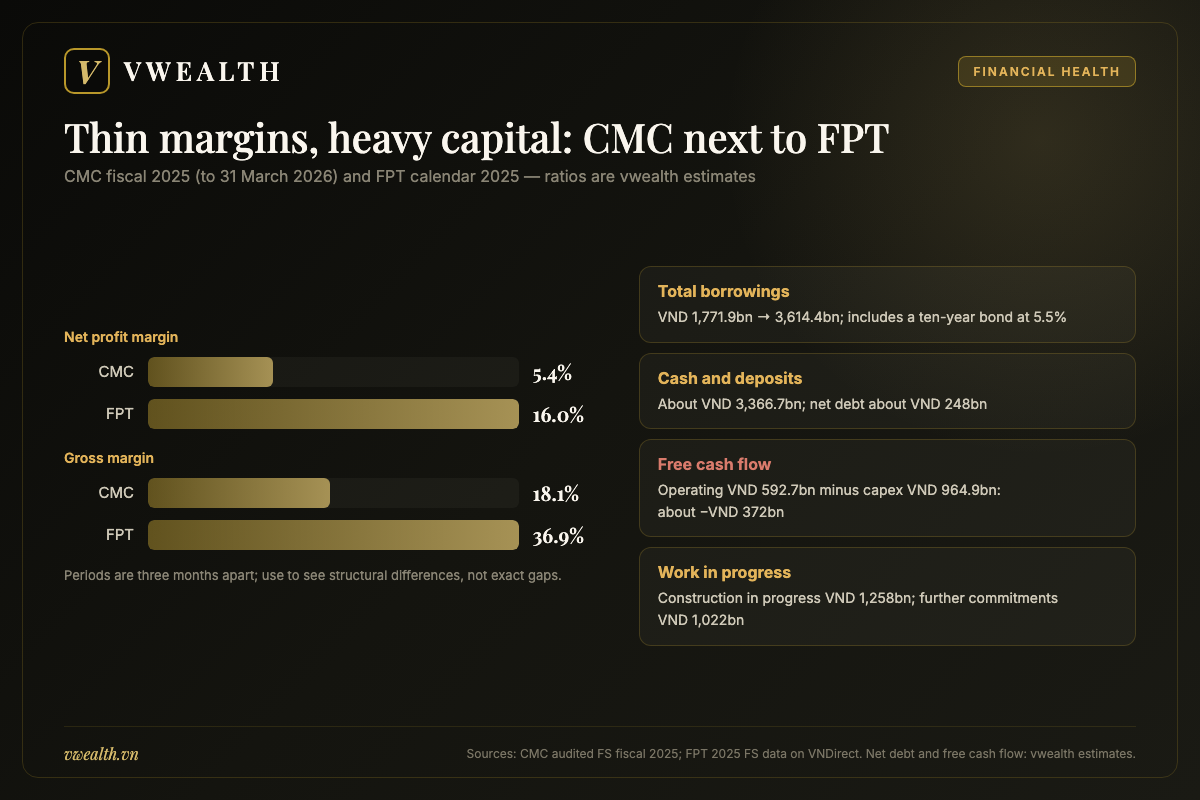
The comparison below was built from CMC’s audited consolidated statements for fiscal 2025 (year ended 31 March 2026) and FPT’s 2025 calendar-year financial data on VNDirect. The periods are three months apart; the ratios are vwealth estimates, intended only to show structural differences.
| Metric | CMC (fiscal 2025) | FPT (2025) | How to read it |
|---|---|---|---|
| Net revenue | VND 9,560.8 billion | about VND 70,113 billion | FPT is about 7.3 times larger |
| Gross margin | about 18.1% | about 36.9% | CMC resells more hardware and third-party solutions |
| Pre-tax margin | about 6.4% | about 18.6% | CMC keeps roughly one-third of what FPT keeps per VND 100 of sales |
| Net margin | about 5.4% | about 16.0% | A gap of almost three times |
| Total borrowings / equity | about 0.88x | about 0.48x | CMC is borrowing relatively more to build infrastructure |
Why is the gap so wide? Mainly because of revenue mix. Almost two-thirds of CMC’s revenue comes from technology, solutions and software, where domestic systems integration and equipment distribution make up a large share; margins there are only a few percent. FPT, by contrast, has a large software-export business, a telecoms arm that has been depreciating for years and a high-margin education business. CMC’s gross margin has barely moved over two years (about 18.2% in fiscal 2024 and 18.1% in fiscal 2025, vwealth estimates) — which suggests the “move up the value chain” management talks about has not yet shown up in consolidated gross margin.
Thin margins do not make a bad company. They make profit very sensitive to costs: if cost of sales grows slightly faster than revenue, or overheads swell as the company hires, profit can stall even while revenue grows strongly. The fourth quarter of fiscal 2025 (1 January–31 March 2026) is an example: according to the financial press (Thuong Truong, Dan Viet), net revenue for the quarter was about VND 2,367 billion, up 23.45%, but pre-tax profit was roughly flat, because cost of goods sold rose about 26% — faster than revenue — while administrative and interest expenses also increased.
Debt doubled in a year: the CGIF bond, bank loans and deposits
This is the biggest change on the fiscal 2025 balance sheet. According to note 20 of the audited statements, CMC’s total borrowings rose from VND 1,771.9 billion (31 March 2025) to VND 3,614.4 billion (31 March 2026) — more than double. The year-end structure:
- Short-term borrowings of VND 1,295.2 billion: short-term bank loans of VND 870.2 billion, overdrafts of VND 61.7 billion, loans from individuals of VND 39.2 billion and VND 324.1 billion of long-term debt falling due within a year. The short-term bank loans mostly run four to six months at rates between roughly 1.3% and 7.5% a year depending on the facility, many secured by deposit contracts.
- Long-term borrowings of VND 2,319.2 billion: long-term bank loans of VND 1,090.6 billion (Shinhan, HSBC, VietinBank, Kasikornbank and others; some secured by data-centre equipment, land-use rights and the CMC Creative Space Tan Thuan building) and bonds of VND 1,228.6 billion (the carrying value of the VND 1,250 billion issue).
The bond is a bright spot on funding cost: ten years, 5.5% a year, coupons paid semi-annually, with a CGIF payment guarantee. In return, the collateral for the guarantee includes CMC’s equity in CMC Global, receivables from the CMC Creative Space Hanoi project and a debt-service reserve account. In other words, some of the group’s best assets are now tied to this obligation.
The picture is less worrying than the gross debt figure suggests, because CMC is also holding a lot of cash. At the end of fiscal 2025, cash and cash equivalents were VND 574.4 billion, plus VND 2,792.3 billion of term deposits classified as held-to-maturity investments — about VND 3,366.7 billion in total. Net debt is therefore only about VND 248 billion (vwealth estimate). But understand why the cash pile is large: part of it is bond money not yet spent on the project, and part of the deposits are pledged as collateral for the short-term loans themselves. As the Hanoi project draws down, the cash will shrink while the debt stays.
Interest expense in fiscal 2025 was VND 99.2 billion (prior year VND 79.3 billion), not counting VND 27 billion of borrowing costs capitalised into the two CMC Creative Space projects. Profit before tax plus interest was about VND 711.1 billion, roughly 7.2 times interest expense (vwealth estimate) — a comfortable level. But note the direction: gross debt doubled in a single year, while most of the assets it funds are still under construction and not yet producing revenue.
Capex, depreciation and cash flow: a machine that does not yet fund itself
Three lines in the cash-flow statement tell the “heavy capital” story better than any commentary. In fiscal 2025, net cash from operating activities was VND 592.7 billion, down from VND 941.3 billion the year before, mainly because receivables rose by VND 701.0 billion. Spending on fixed and other long-term assets was VND 964.9 billion (prior year VND 775.7 billion). Free cash flow — operating cash minus capital spending — was therefore negative by about VND 372 billion (vwealth estimate). The shortfall was covered by borrowing: VND 5,073.6 billion drawn, VND 3,231.1 billion repaid.
Construction in progress stood at VND 1,258.0 billion at year-end, of which the CMC Creative Space Hanoi project (an office, R&D and training complex in the Tay Ho Tay urban area) accounted for VND 876.2 billion and CMC Creative Space HCM for VND 282.6 billion. CMC also has construction commitments of VND 1,022 billion for these two projects. According to CafeF (November 2025), construction of CCS Hanoi began on 1 June 2025 and is scheduled for completion on 31 December 2026; filling the building and generating steady revenue usually takes longer than finishing construction. Depreciation and amortisation in fiscal 2025 was VND 430.9 billion, up from VND 379.2 billion — and it will keep rising as the new buildings come into use.
This is the familiar “J-curve” of infrastructure businesses: in the early years, depreciation and interest weigh on profit while capacity is not yet filled; if utilisation ramps up well, profit later grows fast because marginal costs are low. CMC’s risk is that several projects overlap: Creative Space Hanoi, the newly opened Tower B at Tan Thuan, the Hyperscale project at the Saigon Hi-Tech Park, plus thousands of billions of dong for AI platforms. The fiscal 2026 plan reflects exactly that: revenue up 19.3%, EBITDA up 17.4%, but profit before tax up only 3.6% and profit after tax up 2.5% — the gap between EBITDA and profit is depreciation and interest.
Whose profit? Minority interests at CMC Telecom and earnings per share
Of the VND 516.8 billion of profit after tax in fiscal 2025, VND 103.8 billion — about 20% (vwealth estimate) — belonged to non-controlling interests, i.e. minority shareholders in subsidiaries. The parent’s share was VND 413.0 billion; basic earnings per share (EPS) for fiscal 2025 were VND 1,774, versus VND 1,234 the year before (per the audited report; the prior-year figure was restated). Equity attributable to non-controlling interests was VND 831.0 billion at year-end.
The largest source of that minority share is CMC Telecom, where CMC owns 54.63%. The practical consequence for you: for every extra VND 100 that CMC Telecom earns, CMG shareholders get about VND 55. Meanwhile, much of the digital-infrastructure investment — and the debt that goes with it — sits inside the group. If CMC buys more of CMC Telecom (as it did in fiscal 2025, spending VND 11.0 billion on changes in ownership), its share of the benefits rises; if CMC Telecom raises capital from outside investors to fund a large data centre, the share could fall. Few investors watch this variable, but it directly affects value per CMG share.
The share count is another variable. Shares outstanding rose from about 190.0 million (31 March 2024) to 211.3 million (31 March 2025) and 232.95 million (31 March 2026), and are expected to reach about 256.2 million after the fiscal 2025 stock dividend (per the 2026 AGM materials). Profit has to grow by at least about 10% a year just to keep EPS from being diluted by stock dividends. A fiscal 2026 plan with profit after tax up 2.5% therefore implies planned EPS below fiscal 2025 on the enlarged share count (vwealth inference).
Seven questions to ask every time CMC reports
Rather than memorising many numbers, carry seven questions with you every time CMC publishes quarterly or annual results:
- Is gross margin edging up? Consolidated gross margin has hovered around 18% for two years. If the value-chain strategy and AI-X are working, it should rise gradually.
- How fast is Digital Infrastructure revenue growing, and how fast is depreciation growing? Revenue must outrun depreciation for the investment to start paying off.
- How have total borrowings and deposits changed? Net debt — borrowings minus cash and deposits — matters more than gross debt.
- Has construction in progress turned into assets in use? The slower the projects, the more the cost of capital eats into profit.
- Are receivables growing faster than revenue? In fiscal 2025 receivables rose VND 701 billion, pulling operating cash flow down. Government and large-project clients often pay slowly.
- How much did profit attributable to the parent grow, and what does EPS look like after stock dividends?
- Any one-off items? Exchange-rate gains, interest income on deposits, and profit from associates (CMC holds 41.14% of Netnam JSC and booked VND 45.9 billion of associate profit in fiscal 2025).
How the market has treated CMG stock: from the 2024 NVIDIA rally to a three-year low
CMG has a distinct personality: it follows the market’s technology “story” more than it follows quarterly profit. In years with a big narrative — Samsung, NVIDIA, AI — the stock runs far ahead of results. When the narrative cools, the stock returns to reflect the company’s thin margins. This chapter retraces those swings using price points reported by the press on specific dates.
2010–2019: a quiet second-tier tech stock
CMG listed in early 2010 with a reference price of VND 35,000. For its first decade it was a mid-tier technology stock, less followed than FPT and moderately liquid. The business grew steadily but not explosively: according to VNDirect data, fiscal 2017 consolidated net revenue was about VND 4,892 billion with pre-tax profit of about VND 252 billion. The VND 10 trillion revenue mark was only reached in fiscal 2025 — and then only on a horizontally summed basis.
Note the pattern: CMC likes to set distant, ambitious targets — the goal of becoming a “USD 1 billion revenue technology group” has been repeated by management for years (Thanh Nien, May 2024), and the AI-X strategy is framed for the whole of 2026–2030. The company keeps growing, but fiscal 2025 summed revenue (VND 10,554 billion) is still far from USD 1 billion, and the Global Business division reached only 88% of its profit plan that year. That is not a fault as such, but it is a reason to value CMG on audited results rather than long-term targets.
2019 and 2024: two brushes with a giant
The first was Samsung SDS in 2019, as told in Chapter 1: a strategic partner paying above market to secure about 30%. According to CafeF (March 2022), after almost three years the investment had given Samsung SDS a large paper gain.
The second was NVIDIA in 2024. In early May 2024, Mr Chinh met NVIDIA’s leadership to discuss deeper strategic cooperation, especially in AI (CafeF). According to CafeF, CMG hit its daily upper limit on 8 May 2024 at VND 51,800, the highest since listing, with market capitalisation at a record of almost VND 10 trillion, up 60% on a year earlier. (HOSE stocks can move at most 7% up or down in a single session, so a “limit-up” day signals strong buying pressure.) Around the same time, CMC announced its plan to invest in 1,000 NVIDIA GH200 GPUs and to expand an AI data centre at the Saigon Hi-Tech Park. The rally did not stop there: according to VNDirect price data, CMG went on to a record close of VND 70,600 on 21 June 2024 (not adjusted for later stock dividends).
In hindsight, the 2024 rally was the moment the market priced CMG as an “AI stock”. The problem was that CMC’s profit still came mainly from systems integration and infrastructure — businesses growing steadily but not explosively, and requiring a great deal more capital before AI could contribute meaningfully.
2025–2026: the story cools and the stock falls to a three-year low
After the mid-2024 peak, CMG declined even as the company’s profit rose. According to Thuong Truong, the stock rebounded to around VND 37,100 in early February 2026 before correcting again, closing at VND 28,000 on 27 May 2026, for a market capitalisation of about VND 6,520 billion. According to Vietstock, CMG closed at VND 25,900 on 15 July 2026 — a “three-year low”, 55% below the 2024 peak and down 32% over one year. Note that historical prices may or may not be adjusted for stock dividends depending on the data source; use them to gauge the size of the swings, not for precise comparisons.
Why did the price fall while profit rose? We see four forces at work. One, the 2024 valuation had already “priced in” a lot of AI hope. Two, foreign capital pulled out of Vietnamese technology stocks during 2025, as discussed in our FPT analysis. Three, the fiscal 2026 profit plan is nearly flat while debt has doubled. Four, the wave of senior leadership changes in May–June 2026 means the market needs time to assess the new team. This is vwealth’s reading of published events, not an official explanation from the company.
Valuing a “thin-margin, capital-heavy” company: why P/E can mislead you
If you look only at P/E, you can easily make three mistakes with CMG. Mistake one: using EPS that has not been adjusted for the latest stock dividend; with the share count rising about 10% a year, P/E on stale EPS looks cheaper than it really is. Mistake two: forgetting that about one-fifth of consolidated profit belongs to minority shareholders. Mistake three: comparing CMG’s P/E with FPT’s as if the two companies had similar margins and similar capital needs.
For companies with a lot of infrastructure under construction, analysts usually add two lenses. The first is EV/EBITDA — enterprise value (market capitalisation plus net debt) divided by earnings before interest, tax, depreciation and amortisation — which neutralises differences in leverage and depreciation. CMC itself reports fiscal 2025 EBITDA of VND 1,179.0 billion and plans VND 1,384.2 billion for fiscal 2026. The second is sum-of-the-parts: value digital infrastructure like a data-centre business, software exports like an IT-services company and systems integration like a solutions distributor, then subtract minority interests and group-level debt. For live valuation numbers, check the CMG report on vwealth; for context on the sector, our overview of Vietnam technology stocks is a good starting point.
Foreign investors, liquidity and the catalysts ahead
For a stock whose largest shareholder is a Korean conglomerate and whose institutional holders include a Finnish fund, foreign capital plays a special role. Samsung SDS is a long-term strategic holder that rarely trades; but active foreign funds such as PYN Elite Fund can generate buying and selling that is large relative to CMG’s liquidity. And because most of the shares sit with large holders, the volume that actually trades each day is smaller than the share count suggests, so the price can swing sharply when a big fund enters or exits. Foreign investors should also check CMG’s remaining foreign-ownership “room” before buying, as Vietnamese listed companies have foreign ownership limits; our guide to investing in Vietnam explains how this works.
The catalysts we think could change CMG’s trajectory over the next 12–24 months:
- Progress on CMC Creative Space Hanoi — a project with an expected total investment of VND 2,181 billion, scheduled to finish construction at the end of 2026 (CafeF). Opening on schedule and filling quickly is the condition for the bond debt to start “paying interest” out of revenue.
- Groundbreaking and anchor tenants for CMC Hyperscale at the Saigon Hi-Tech Park — the project is among those funded under the fiscal 2026 investment plan (2025 annual report). How CMC funds it (more debt, capital raised at CMC Telecom level, or a partner) will matter a great deal to CMG shareholders.
- Results of the Technology & Solutions restructuring under the new CEO — this block’s margin is the biggest lever on consolidated profit.
- Commercialisation of AI products such as Clex for businesses and individuals, and C-AI Platform.
- Electricity pricing for data centres — a dispute currently under way in Ho Chi Minh City, covered in Chapter 6.
- Dividend policy — whether CMC keeps paying in shares or returns partly to cash will say a lot about cash-flow health.
Industry context: CMC in Vietnam’s data-centre and AI race
To understand CMC’s bet, you need to look beyond the company: how fast Vietnam’s data-centre market is growing, who is pouring money into it, and what policy supports and constrains it. This chapter places CMC in that picture — and compares it with other companies vwealth has analysed, such as FPT, VGI and CTR.
The data-centre market: small but fast-growing, and CMC is the smallest of the Big 4
Public estimates of Vietnam’s operating data-centre capacity put it at no more than a few hundred MW today, while forecasts for 2030 are several times higher — the exact numbers vary by research house, so we do not pick one. According to VNDIRECT data cited by CafeF, four domestic players — Viettel, VNPT, FPT Telecom and CMC Telecom — hold about 97% of the market; Viettel leads with 14 data centres and 87 MW of capacity. CMC Telecom has 3 data centres with about 20 MW of power in total (Forbes Vietnam).
The race is accelerating: Viettel is building a new data centre in Cu Chi, and Viettel, VNPT, FPT, VNG and CMC all appear among the operators lobbying on data-centre power prices — a sign that the number of large players is growing. According to Dang Tung Son — then CMC’s Chief Strategy Officer — the cost of building and operating data centres in Vietnam is only about USD 6–7 million per MW, 40–60% cheaper than Singapore, and industrial power costs roughly a third as much (tinnhanhchungkhoan.vn, November 2025). That is why CMC believes it can attract regional clients. But the same figure also gives you an illustrative calculation: at USD 6–7 million per MW, the 30 MW first phase of the Hyperscale project alone would cost around USD 180–210 million, and the full 120 MW would require several times CMC’s total equity of about VND 4,087 billion at the end of fiscal 2025 (illustrative example by vwealth, not the project’s official funding plan). According to VietNamNet (July 2025), phase 1 is 30 MW at about USD 250 million, while the later phase of more than 100 MW brings total capital to about USD 1 billion.
Data sovereignty, domestic cloud and why government clients matter
At the opening of the Tan Thuan data centre in 2022, then Minister of Information and Communications Nguyen Manh Hung said: “Vietnam’s data is Vietnam’s resource and asset, so it must be stored and processed in Vietnam or with Vietnam’s permission… Without Vietnamese digital infrastructure, there will be no Vietnamese digital sovereignty.” That view creates a distinct market for domestic providers: government agencies, banks and companies with sensitive data prefer infrastructure located in Vietnam and run by Vietnamese firms.
CMC has positioned itself squarely in that gap: level-4 secure data centres, and a self-trained legal AI model that “does not rely on calling APIs from international foundation models” and keeps “data from being sent outside national infrastructure”. The Law on Artificial Intelligence passed in December 2025 and AI’s inclusion on the list of strategic technologies reinforce this direction. But government clients come with their own traits: long tender processes, payment tied to budget cycles and heavy compliance requirements — all of which inflate receivables, as seen in Chapter 4.
Electricity prices for data centres: a policy dispute in progress
A data centre is essentially a power-consuming factory, so electricity prices drive much of the operating cost. In September 2026, a policy dispute between the power sector and data-centre operators in Ho Chi Minh City was widely reported, involving among others CMC’s data centres in Thuan An and Thu Duc. It is worth knowing both sides.
The operators’ side: according to VietNamNet, Viettel and CMC argued that their data centres were being billed at the commercial electricity tariff, whereas most power companies elsewhere applied the production tariff in line with Ministry of Industry and Trade guidance letter 2818 of 22 April 2026; being classed as commercial raised their power bills by more than 50% over the first three billing cycles. The Ministry of Science and Technology wrote to the Ministry of Industry and Trade for the third time asking for a resolution, citing the 2023 Telecommunications Law and the 2025 Digital Technology Industry Law to argue that data-centre operations are production in nature. On 9 September 2026, EVN Ho Chi Minh City sent a letter setting the difference between the commercial and production tariffs still owed by CMC up to 25 August 2026 at about VND 1.7 billion (about VND 7.9 billion for Viettel), and proposed cutting power to both companies’ data centres from 15 September 2026; the two companies asked the Ministry of Industry and Trade to ensure power was not cut while the dispute is resolved.
The power sector’s side: according to Tuoi Tre, Ho Chi Minh City Power Corporation (EVNHCMC) said that applying the commercial tariff to “facilities providing centralised data processing, storage and management services” complies with Clause 19, Article 11 of Circular 60/2025/TT-BCT, and that the State Audit Office had required it to apply this rule in full; EVNHCMC has asked the authorities to amend Circular 60 promptly to provide a consistent basis. A representative of the Electricity Authority said the parties need to reach agreement and that the ministry would keep reviewing the rules and consider amendments if necessary.
For CMG investors, the amount at stake so far is small relative to profit. What matters is the principle: if data centres are billed at commercial tariffs over the long term, margins across the industry — not just at CMC — will be lower than originally assumed, especially for very large projects like the 30–120 MW Hyperscale facility. Conversely, if policy settles on the production tariff, that would be a tailwind for the whole sector. We do not predict the outcome of an ongoing policy process; watch for amendments to Circular 60.
Software exports: Japan, Korea and pressure from AI itself
CMC’s Global Business operates in a market described at length in our FPT analysis: Japan’s huge demand for IT outsourcing because of its engineer shortage, the “China plus one” trend pushing multinationals towards Vietnam, and the cost competitiveness of Vietnamese engineers. CMC’s two distinctive features are its GDC relationship with Samsung SDS and its Korean footprint, with CMC Korea launched in May 2024.
But AI itself — the very thing CMC has made its strategic axis — is also a threat to the “selling hours” model. When AI coding tools let one engineer do the work of several, clients will push for lower hourly rates or switch to fixed-price, outcome-based contracts. Companies with scale, their own product portfolios and deep consulting skills usually adapt better. CMC is trying to move in that direction with its C-Product line and a “mega account” model focused on serving a few large clients in depth. Whether it works will show up in the global block’s margins over the next few years.
Policy: Resolution 57, the digital technology law and a wave of tech investment
The policy framework is favourable for domestic technology companies. Politburo Resolution 57-NQ/TW on science, technology, innovation and national digital transformation is cited by ministries themselves when calling for uninterrupted power to data centres. The 2025 Digital Technology Industry Law and the Law on Artificial Intelligence (December 2025) provide a legal framework for AI products. In June 2026, CMC announced a partnership with Hanoi on digital government and an “AI city” (CMC newsroom). A government push to review the entire body of legal documents with AI opens a market for products such as Clex.
Favourable policy, however, does not automatically become profit for any one company. Public-sector contracts are usually tendered competitively and attract many large bidders — including state-owned giants such as Viettel and VNPT. CMC has advantages in certain niches but no monopoly.
Where CMG sits relative to FPT, VGI, CTR and other tech stocks
Vietnam’s listed “technology and digital infrastructure” universe is small. The table below places CMG alongside other companies vwealth has analysed in the same broad sector, so you can see that each stock represents a different kind of bet. The descriptions are qualitative; detailed numbers are in each company’s own analysis.
| Stock | Type of bet | Main strength | What to weigh |
|---|---|---|---|
| CMG (CMC) | Digital infrastructure + systems integration + “sovereign” AI | High-spec data centres for banks; Samsung SDS as strategic shareholder | Thin margins, fast-rising debt, many projects under construction |
| FPT | Large-scale software exports + telecoms + education | Scale, high margins, strong cash flow | Reliance on overseas markets; AI pressure on outsourcing |
| VGI | Mobile telecoms in emerging markets | Viettel brand, subscriber scale | Country and currency risk in its markets |
| CTR | Building and leasing telecom infrastructure | Tower assets, large stable clients | Dependence on the telecom capex cycle |
| DGW | Distribution of tech devices and consumer goods | Distribution network, capital turnover | Thin distribution margins, vendor dependence |
Put these stocks on a line from “high margin, light capital” to “thin margin, heavy capital”, and FPT sits near the high-margin end, DGW sits on the thin-margin but capital-light side (distribution), while CMG occupies a rather unusual spot: thin margins like a distributor in integration, yet capital-heavy like an infrastructure company in data centres. That is why CMG struggles to command FPT-like valuations, but also why it has its own operating leverage: if infrastructure fills up and integration margins improve, profit can grow faster than revenue.
Outlook: three scenarios for CMG stock and the conditions behind each
This chapter does not offer a price target. Instead, we list the variables that will decide CMC’s future, then describe three scenarios — bull, base and bear — with the conditions required for each. The goal is to tell you what to watch, so that when new information arrives you can judge for yourself which way the story is heading.
Six variables that will decide CMG’s future
- How fast new infrastructure fills up: Tower B at CCS Tan Thuan, CMC Creative Space Hanoi (construction due to finish at the end of 2026) and the Hyperscale project. Fast utilisation lets revenue “carry” the depreciation and interest.
- Technology & Solutions margins: whether, after the restructuring, margins escape the low single digits.
- Growth and margins in Global Business: the Samsung relationship, Japan, exchange rates and how far AI compresses service prices.
- How the next projects are funded: more debt, new shares, or partners at subsidiary level — each affects CMG shareholders differently.
- Policy: data-centre electricity pricing, domestic data-storage rules, and public spending on digital transformation and AI.
- Governance and team: the new CEO’s effectiveness, staff retention after the ESOP rejection, and the relationship with the strategic shareholder.
Bull case: infrastructure fills quickly and integration margins improve
Conditions: Tower B at Tan Thuan and CMC Creative Space Hanoi open on schedule and fill quickly on rising demand for cloud, AI and in-country data storage; the Hyperscale project signs large clients (international hyperscalers, banks, government agencies) before most of its capacity is built, or brings in a co-investor; the Technology & Solutions restructuring lifts margins through more services, software and AI; Global Business grows steadily on Samsung and Japan; and electricity pricing for data centres is settled in the sector’s favour.
What you would see in the reports: digital-infrastructure revenue growing faster than depreciation; consolidated gross margin breaking out of the 18% range; free cash flow turning positive once the investment peak passes; net debt stable even as projects continue. In this scenario the “infrastructure bet” becomes a “recurring-revenue machine”, giving the market grounds to value CMG above a pure systems integrator.
Base case: revenue grows, profit lags during the investment phase
Conditions: infrastructure projects are completed but fill gradually; depreciation and interest rise on schedule; Technology & Solutions keeps growing revenue with only modest margin gains; Global Business grows moderately; dividends continue in shares at around 9.5–10% a year.
What you would see in the reports: something close to the fiscal 2026 plan approved by the AGM — revenue up about 19%, EBITDA up about 17%, but profit before tax up only a few percent. EPS could be flat or slightly lower because of the rising share count. In this scenario the stock tends to move with sentiment towards the tech sector and foreign flows more than with quarterly results, until the new infrastructure starts contributing clearly.
Bear case: delays, capital costs and power costs squeeze profit
Conditions: the Hanoi or Hyperscale project is delayed or runs over budget; demand for data-centre space grows more slowly than supply as several large rivals expand at once, pressuring rents; data centres are billed at commercial electricity tariffs for the long term; Technology & Solutions stays thin-margin or suffers loss-making projects; public-sector clients pay slowly and receivables balloon; and Global Business loses momentum on exchange rates or AI-driven price competition.
What you would see in the reports: falling profit while debt keeps rising; persistently negative free cash flow; the company needing to borrow more or issue shares for cash on unfavourable terms; debt-to-EBITDA rising. In this scenario “capital-heavy” becomes a genuine burden, and the stock could be valued like a low-margin integrator carrying infrastructure debt.
Illustrative example: how sensitive CMC’s profit is to thin margins and new debt
To show why small changes matter, here are three illustrative calculations based on fiscal 2025 data. They are examples, not forecasts.
- Integration margins: the technology, solutions and software segment had total revenue of VND 6,180.0 billion and pre-tax profit of VND 252.8 billion (a margin of about 4.1%). If the margin rose to just 5%, segment pre-tax profit would increase by about VND 56 billion — roughly 9% of fiscal 2025 consolidated profit before tax. If it fell to 3%, about VND 67 billion would disappear.
- Cost of new debt: every VND 1,000 billion of additional borrowing at about 6% a year adds roughly VND 60 billion of annual interest, close to 10% of fiscal 2025 profit before tax — excluding interest capitalised during construction.
- The EBITDA-to-profit gap: in the fiscal 2026 plan, EBITDA is VND 1,384.2 billion but profit before tax only VND 634.0 billion. The roughly VND 750 billion difference is mostly depreciation and interest — more than half of EBITDA is going to “pay” for existing assets and debt.
The table below summarises the three scenarios for quick comparison.
| Scenario | Key conditions | Signs in the reports | Consequence for shareholders |
|---|---|---|---|
| Bull | Fast utilisation, better integration margins, favourable power pricing | Rising gross margin, positive free cash flow, stable net debt | Profit grows faster than revenue; grounds for a higher valuation |
| Base | Projects on time but slow to fill; modest margin gains | Revenue and EBITDA up; profit up slowly; flat EPS | Stock driven by tech-sector sentiment |
| Bear | Delays, oversupply, high power costs, swelling receivables | Falling profit, rising debt, persistently negative free cash flow | Risk of dilution or a lower valuation |
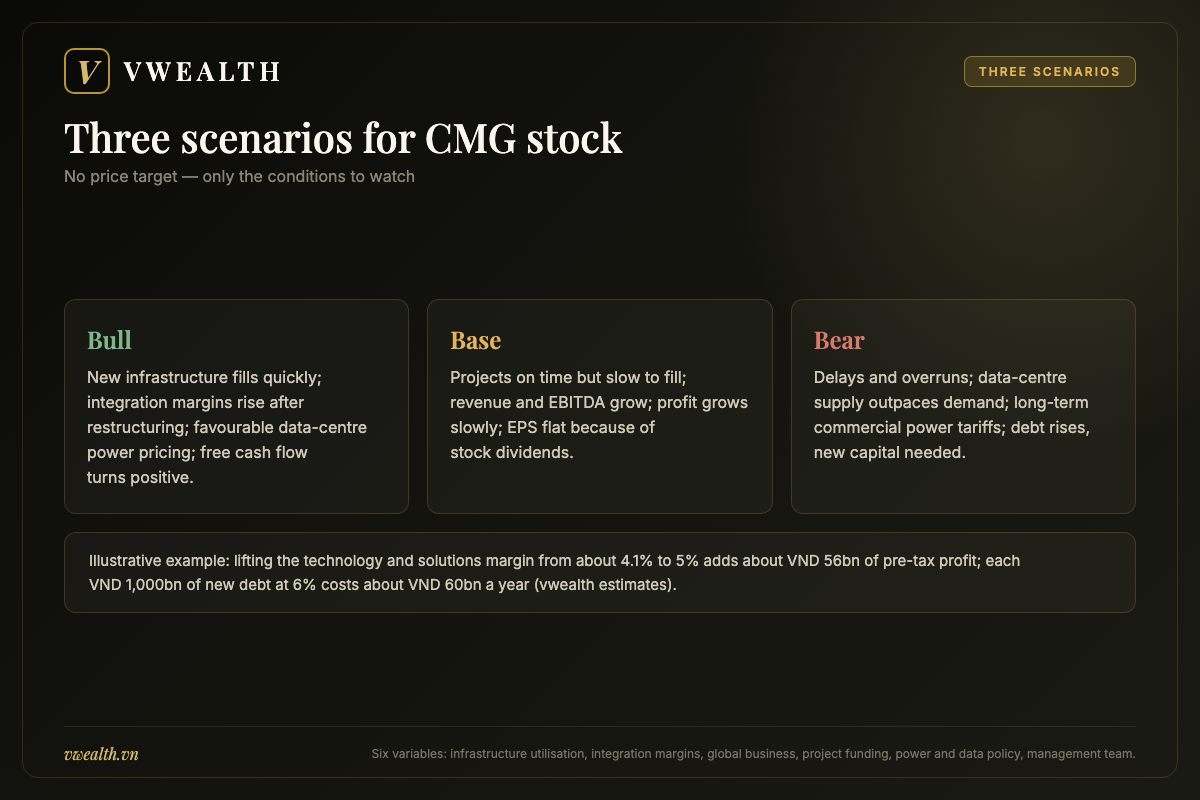
So, should you buy CMG stock? Weighing the case for and against
By now you have all the pieces. CMC is a real technology business with a long history, steadily rising profit and a heavyweight strategic shareholder. But CMG is not a “mini FPT”. It is a very different combination: a thin-margin systems integrator attached to an infrastructure business in the middle of a heavy investment cycle, topped with an AI narrative that does not yet contribute much to profit. Whether you should buy CMG stock therefore depends on how much you believe in this infrastructure bet — and how long you can wait.
The case for CMG
- Audited profit growth: consolidated profit after tax rose 21% in fiscal 2025, with net revenue up about 16.6%; Digital Infrastructure grew pre-tax profit 23% and Technology & Solutions 86% (horizontally summed, 2025 annual report).
- High-quality, hard-to-copy infrastructure: Tier III data centres, level-4 security and a self-reported 65% share of data-centre services to banks — assets that generate recurring revenue.
- A heavyweight strategic shareholder: Samsung SDS has held about 30% since 2019 and is also a GDC client with nearly 1,000 engineers.
- Reasonably priced long-term funding: a ten-year bond at 5.5% with a CGIF guarantee — terms few Vietnamese private companies can access.
- Aligned with policy trends: data sovereignty, “made in Vietnam” AI and Resolution 57 — CMC has concrete products (Clex) already evaluated and piloted by government bodies.
- Shareholders who speak up: the AGM’s rejection of a cheap ESOP shows checks and balances between major shareholders and management are working.
The case against CMG
- Thin margins: a net margin of about 5.4%, roughly a third of FPT’s (vwealth estimate); profit is highly sensitive to costs.
- Heavy capital and fast-rising debt: total borrowings rose from VND 1,771.9 billion to VND 3,614.4 billion in one year; free cash flow is negative; more than VND 1,000 billion of construction commitments and the Hyperscale project lie ahead.
- A nearly flat profit plan: fiscal 2026 targets profit after tax up only 2.5%, while the share count rises about 10% from stock dividends.
- No cash dividend since the dividend for 2022: profit is retained to fund projects.
- Education and new technologies still lose money: the fiscal 2026 plan has these two divisions losing about VND 65 billion before tax combined (vwealth sum from the 2025 annual report).
- Profit sharing in the best business: CMC owns only 54.63% of CMC Telecom; about one-fifth of consolidated profit belongs to minority shareholders.
- Much bigger competitors: Viettel, VNPT and FPT are all expanding data centres at far greater scale.
- Leadership transition and policy risk: a new CEO since June 2026, a rejected ESOP, and an unresolved electricity-pricing dispute.
Who CMG stock may suit
Long-term investors who believe in Vietnam’s digital infrastructure. If you believe demand for data centres, cloud and AI in Vietnam will rise strongly over the next five to ten years, and you can accept a “J-curve” period in which depreciation and interest hold profit down, CMG offers mid-sized exposure to that story. You need the patience to sit through at least one investment cycle — until CMC Creative Space Hanoi and the Hyperscale project start contributing revenue.
Investors who like to track a “margin inflection”. With margins this thin, an improvement of a few percentage points changes profit significantly. If you are willing to read each quarterly report and work through the seven questions in Chapter 4, you may spot early when the story shifts from “capital-heavy” to “operating leverage”.
Investors seeking a complement to FPT. CMG behaves differently from FPT: more domestic infrastructure, closer ties to Samsung and financial-sector clients. Holding both diversifies within the same sector — provided you understand what kind of bet each represents.
Who it probably does not suit
Investors who need regular cash dividends. CMC has paid dividends in shares for several years and has said clearly that cash is being retained to fund projects. Investors looking for a “pure” AI play. Most of CMC’s profit today comes from integration and infrastructure, not AI; buying CMG just for the letters “AI” repeats the mindset that drove the 2024 spike and the deep fall that followed. Investors who cannot tolerate a period of flat profit. The fiscal 2026 plan already shows profit can stand still while revenue grows. Investors wary of leverage. Debt doubled in one year and will keep rising as projects continue.
Final thoughts
CMC is the story of Vietnam’s number-two private technology group trying to escape the shadow of the “reseller” by owning its own infrastructure and core technology. Thirty-three years show a determined leadership able to draw big names to its side: Samsung SDS invested, NVIDIA sat down to talk cooperation, CGIF guaranteed its bond. But those thirty-three years also show that ambitious targets tend to slip, and consolidated margins remain thin.
The question “should I buy CMG stock” therefore comes down to three smaller questions. One: do you believe domestic demand for data centres and AI is large enough to fill the infrastructure CMC is building? Two: do you believe the new management team can lift margins in the integration business? Three: will you accept a few years of slow profit growth and stock dividends while you wait for the payoff? To answer, you need up-to-date numbers — gross margin, net debt, project progress, profit by division — which this article deliberately does not give as “today” figures. You can create a free vwealth account to track those metrics report by report, compare CMG with FPT and other Vietnam stocks, and make your own decision. This article is meant to help you understand the business; it is not a recommendation to buy or sell.
Research Vietnamese stocks in English with vwealth. Our AI-powered platform turns Vietnamese market data into full English analysis reports — with international payment support and a free 2-month trial for new accounts. Create your free account and read the latest reports.


