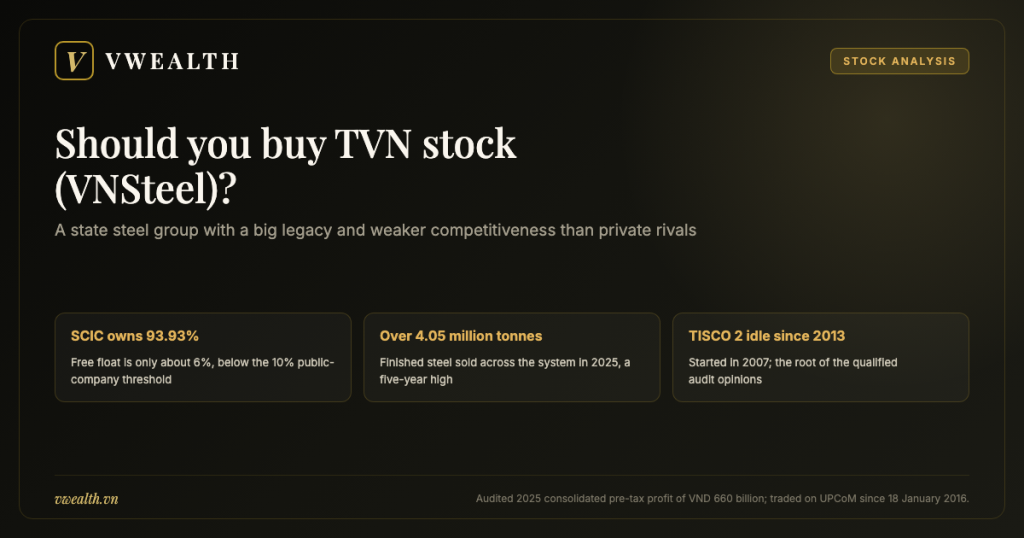
Should you buy TVN stock? The question sounds like any other Vietnam stocks question, but TVN is not a normal steel play. It is the ticker of Vietnam Steel Corporation (VNSteel), the state-owned group that was created in 1995 by merging the country’s entire state steelmaking and metals-trading apparatus into a single corporation. Today it sits on top of more than thirty subsidiaries and associates, including Thai Nguyen Iron and Steel (TISCO), the birthplace of Vietnamese metallurgy. In 2025 the group sold more than 4.05 million tonnes of finished steel, its highest volume in five years, and booked consolidated pre-tax profit of VND 660 billion; in the first half of 2026 alone, consolidated pre-tax profit reached about VND 718 billion, almost the full-year target of VND 725 billion. Yet in the same year its consolidated accounts carried five qualified audit opinions, most of them tied to an expansion project that broke ground in 2007 and has been idle since 2013. The shares remain on the exchange’s warning list, and in January 2026 the company disclosed that it no longer meets one of the conditions of a public company, because the state owns 93.93% of it. This article tells that whole story, a state steel group with a large legacy and weaker competitiveness than the private sector, and ends with a straight answer on who TVN stock suits and who it does not.
First, the names. TVN is the stock ticker. The legal name is Tong Cong ty Thep Viet Nam – CTCP, officially translated as Vietnam Steel Corporation; the company and the local press usually call it VNSteel, and internal documents sometimes shorten it to VNS. TVN has traded on UPCoM, the Hanoi-based market for unlisted public companies, since 18 January 2016. It has never moved up to the main boards of the Ho Chi Minh City Stock Exchange (HOSE) or the Hanoi Stock Exchange (HNX). Foreign readers often confuse it with other names. “Thep Viet” is a brand of the private producer Pomina. Several listed companies carry a “– VNSTEEL” suffix, such as Nha Be Steel (TNB), Thu Duc Steel (TDS) and Ho Chi Minh City Metal (KMT), but those are members of the group; TVN is the parent at the top. Most importantly, TVN is not TISCO. TISCO trades under its own ticker, TIS, and publishes its own accounts; VNSteel owns 65% of it.
Second, our ground rules, the same as for every company analysis in the vwealth series. Dates, names and figures come from published sources: annual reports, audited financial statements, shareholder-meeting documents and resolutions, the explanatory letters VNSteel files with the State Securities Commission (SSC) and HNX, court rulings as reported by mainstream Vietnamese media, and the local financial press, including CafeF, VietnamBiz, Tin nhanh Chung khoan and VietNamNet. Figures for closed fiscal years are used as historical reference points. We do not quote today’s share price, today’s P/E ratio or the latest quarter’s profit; for a thinly traded stock in a cyclical industry, such numbers go stale quickly. Any number we derive ourselves is labelled “vwealth estimate” or “illustrative example”. For current data, open the latest vwealth analysis reports.
Finally, the thread that runs through this article. TVN is not a growth stock, and it is not a pure steel play like Hoa Phat. It is a holding company: the parent does almost no manufacturing and lives on dividends, profit distributions and the consolidated earnings of its members. On top of that sit two special layers. One is the steel cycle, meaning billet prices, hot-rolled coil prices and construction demand. The other is the state-enterprise layer: the big decisions depend on the state shareholder, legacy projects need approval from higher authorities, and there is no clear timetable for state divestment. If you have read our analysis of HPG stock and Hoa Phat Group, you have seen a private company that makes its own decisions, funds its own projects and owns its own results. TVN is almost the mirror image. Understanding that difference answers half the question of whether you should buy TVN stock. If you are new to the market’s mechanics, including trading lots, settlement cycles, daily price limits and foreign ownership rules, our guide on how to invest in the Vietnam stock market covers the basics.
From a 1995 merger decree to TVN on UPCoM: thirty years of Vietnam’s state steel champion
To understand why VNSteel today is both large and heavy, you have to go back to how it was born. It did not grow out of a single mill. It was assembled by an administrative decision that gathered an entire industry under one roof. Each layer of that history left behind assets, and each also left behind problems that have not been fully solved.
Before 1995: two separate streams, steelmaking and metals trading
Under central planning, Vietnam’s steel sector was split into two fairly separate halves. One half made steel. It consisted of the smelting and rolling plants under the Ministry of Heavy Industry, and its best-known symbol was the Thai Nguyen iron and steel complex in the northern uplands. Construction began at the end of the 1950s with Chinese assistance, and the complex produced its first iron in 1963. It became the country’s first integrated metallurgical site, running all the way from ore mining through ironmaking and steelmaking to rolling. In the south, after 1975, the rolling mills around Ho Chi Minh City and Bien Hoa were reorganised into what later became Southern Steel. The other half sold steel. The Metals Corporation, under the Ministry of Materials, distributed iron, steel and non-ferrous metals to the economy through a network of metals companies in Hanoi, Da Nang and Ho Chi Minh City.
Once the economy opened up in the late 1980s and early 1990s, the split model showed its weaknesses. The mills were far from their markets, and the distributors had no link to production. At the same time, imported steel and the first joint ventures with foreign partners began to appear. That was the backdrop for the state’s plan to fold companies in the same industry into groups large enough to compete, an idea later known as the “Corporation 91” model after the government decision that launched it.
This detail still matters to investors today, for two reasons. First, it explains why VNSteel holds valuable land in major cities: the offices, warehouses and yards of the old metals companies came with it. Second, it explains why the group includes businesses that seem unrelated to steel, such as hotels, a port stake, freight forwarding, ceramic tiles and labour supply. Each one is a piece of history that ended up under the same roof.
1995–2007: Decision 255/TTg and the state-corporation model
Following Decision 91/TTg of 7 March 1994 on piloting large state business groups, the Prime Minister signed Decision 255/TTg on 29 April 1995 establishing Vietnam Steel Corporation. It merged the old Vietnam Steel Corporation, which sat under the Ministry of Heavy Industry, with the Metals Corporation under the Ministry of Materials, according to VNSteel’s own 2025 annual report. Its mandate was very broad: iron ore and coking coal mining, iron and steel production, import and export of metallurgical equipment, engineering and construction, hotels, vocational training and joint ventures with foreign partners.
For the next decade VNSteel was a pillar of the industry in the literal sense. Many of the first large steel joint ventures in Vietnam had VNSteel as the local partner alongside Japanese, Korean, Australian and Singaporean groups, among them Vina Kyoei, VSC–POSCO, Vinausteel, Nippovina, Vinapipe and NatSteelVina. That model gave VNSteel a diversified portfolio of stakes. It also built a habit of contributing capital and letting the foreign partner run the plant, and that habit shapes how TVN’s consolidated accounts should be read today. Profits from these joint ventures do not appear in revenue. They arrive through a single line, “share of profit or loss of associates”.
On 23 November 2006 the parent company of Vietnam Steel Corporation was formally established, and on 1 July 2007 it began operating as a parent–subsidiary group. The change turned a loose federation of state factories into a parent that holds capital in its member companies, which is the foundation of the holding structure TVN still has.
It is worth being blunt about what happened during that same decade. The centre of gravity of Vietnamese steel began shifting to private companies. Hoa Phat, Hoa Sen and Pomina grew quickly on the back of aggressive investment and lean management. VNSteel remained large in total assets and in the number of entities it controlled, but it stopped setting the pace. The reversal did not happen in a single year. It happened quietly, project by project, and the next section shows which projects mattered most.
2005–2013: three big bets at once — TISCO 2, Viet Trung and the Thach Khe iron mine
If you had to pick one period that defines the VNSteel of today, it would be the mid-2000s, when the group chased the dream of “making steel from ore” in three places at the same time. The logic was sound. A steel sector that only rolls imported billets is always hostage to raw material prices, while one that smelts domestic ore has more control. The problems were in the execution.
The first project was the phase-two expansion of Thai Nguyen Iron and Steel, known as TISCO 2. According to figures the press has long cited from TISCO documents, the project was approved in principle in October 2005 with an initial budget of VND 3,843 billion. The budget was raised to more than VND 8,100 billion in 2013. The EPC (engineering, procurement and construction) contractor was China Metallurgical Group Corporation (MCC). Construction started in 2007 but was suspended in 2013 and has not been completed since. The auditor’s review report on the 2026 half-year accounts puts it plainly: the project “was launched in 2007, investment has taken longer than originally planned and it is still not completed”.
The second was Viet Trung Mineral and Metallurgy Co., Ltd. (VTM), an iron and steel plant in Lao Cai province near the Chinese border, set up as a joint venture between VNSteel and a Chinese partner. VNSteel held 46.85% of VTM’s charter capital, according to a VNSteel board resolution dated 24 June 2026. VTM and TISCO 2 were both on the government’s list of 12 loss-making, underperforming projects in the industry and trade sector, which Hanoi spent more than a decade trying to resolve.
The third was Thach Khe Iron Joint Stock Company (TIC), created in 2007 to develop the Thach Khe iron ore deposit in Ha Tinh province, one of the largest iron ore bodies in Southeast Asia. According to VNSteel’s 2025 annual report, work started in 2009 but has gone no further than stripping the overburden. The company is suspended while it waits for a government decision on whether the project should continue at all. VNSteel carries its investment in TIC at a historical cost of VND 274.24 billion in its consolidated accounts. The reviewed 2026 half-year accounts add an update: the Ha Tinh Department of Finance has issued a decision terminating the Thach Khe iron ore mining and processing project, and TIC is petitioning the relevant authorities about it.
The three projects shared the same profile. Each needed large amounts of capital, long timelines and complex technology, and each got stuck on obstacles beyond the company’s own authority. Private competitors took a different route. Hoa Phat built its integrated complex in Hai Duong and later the much larger one at Dung Quat, making its own decisions from start to finish. That gap in decision-making speed is the deepest reason the old champion was gradually left behind.
2009–2011: equitisation of the parent, with the state keeping 93.93%
“Equitisation” is Vietnam’s term for turning a wholly state-owned enterprise into a joint-stock company that can sell shares to outside investors. On 31 December 2009 the Government Office announced the Prime Minister’s approval to equitise the parent company of VNSteel, on condition that the state keep more than 65% of charter capital. On 15 January 2010 the Minister of Industry and Trade issued the equitisation decision. On 18 April 2011 the Prime Minister approved the equitisation plan in Decision 552/QD-TTg. VNSteel then held an initial public offering (IPO) by auction, convened its first shareholder meeting and, from 29 September 2011, formally became a joint-stock company with charter capital of VND 6,780 billion, or 678 million shares. All of this is recorded in the 2025 annual report.
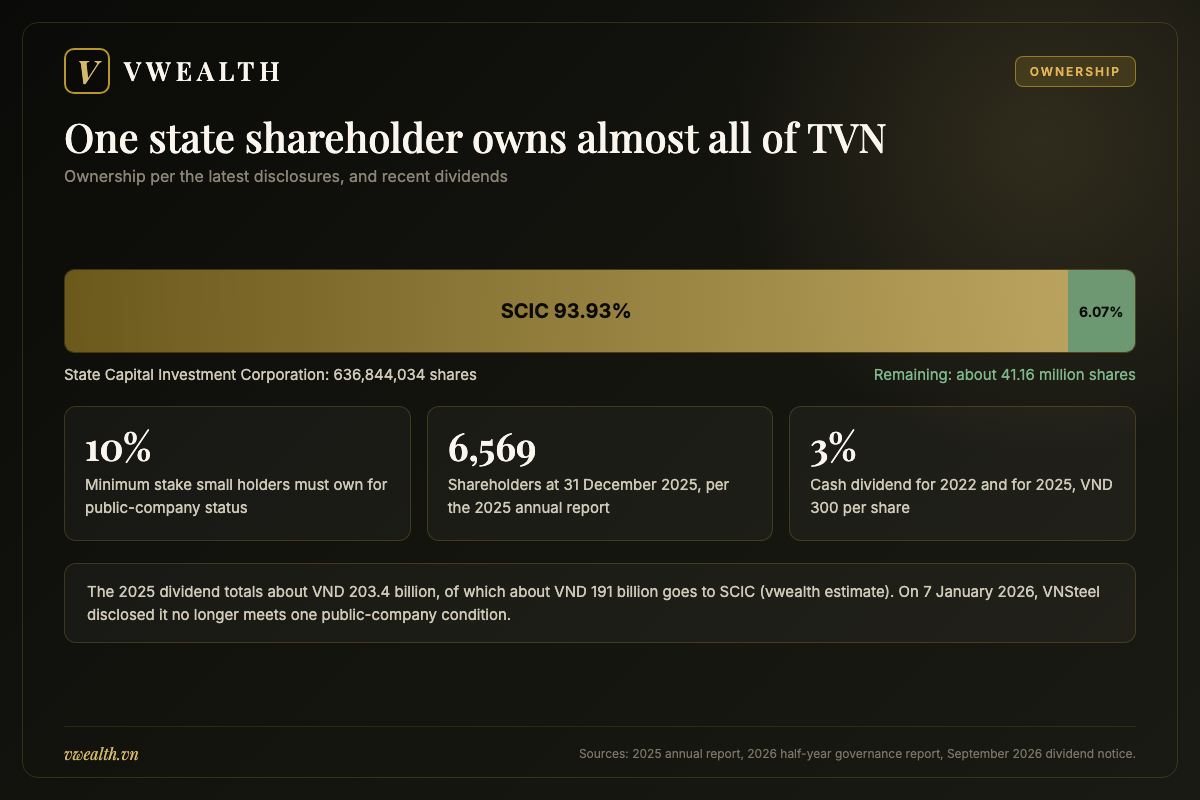
The final number is the one to note. Although the policy only required the state to keep “more than 65%”, the state shareholder in fact holds 636,844,034 shares, or 93.93%. That means only about 6% of the company was sold to outsiders. Charter capital has not changed since: TVN has never issued new shares or paid a stock dividend. The 93.93% figure will follow you through the rest of this article, because it shapes almost everything, including who sets the dividend, who decides whether to sell assets and why the stock ran into the “public company” issue in 2026.
There is a technical but important footnote. As of the 2025 financial statements, the formal settlement of the parent company’s equitisation had still not been completed. The annual report explains that the conversion took place during a transition between two government decrees on equitisation, and that changes in the status of the company’s land made it difficult to value location advantages and land-use rights when assets were handed over from the state enterprise to the new joint-stock company. VNSteel submitted a settlement dossier prepared by an independent consultant on 10 March 2023, and the Ministry of Industry and Trade and other agencies were still processing it. It is one of the five reasons the auditor qualified its opinion on the 2025 accounts.
2016: a UPCoM debut at a VND 10,000 reference price
Five years after equitisation, on 18 January 2016, TVN shares began trading on UPCoM. According to VNDirect’s historical price data, the first session had a reference price of VND 10,000, equal to par value, and closed at VND 12,700, up 27%. UPCoM allows a wide band on a stock’s first day. But only 2,000 shares changed hands that session. It was the first clue to this stock’s personality: it has a price, but very little supply.
Across 2016, TVN traded fewer than 5,000 shares per session on average (vwealth estimate from VNDirect data), and the price slid to a low of VND 4,200 on 10 October 2016, less than half of par. Average daily volume in 2017 and 2019 was still only a few thousand shares. For a company with VND 6,780 billion of charter capital and consolidated revenue in the tens of trillions of dong, that is a paradox: a big business that was almost invisible to investment flows.
The reason becomes obvious when you look at the shareholder register. Only about 6% of the shares sit outside state hands, spread across thousands of holders. The 2025 annual report shows more than 6,500 individual shareholders holding only about 4.5% of the company between them, with the rest in the hands of 19 domestic institutions, SCIC above all. There is no large foreign fund and no index that forces anyone to buy. Only in 2021, when the whole steel sector entered a super-cycle, did TVN really wake up on the price board.
2021–2025: a cyclical peak, two loss years, the TISCO 2 verdict and a recovery
In 2021, world steel prices surged after the pandemic and the whole Vietnamese steel industry had a very profitable year. VNSteel was no exception. According to consolidated financial data compiled by VNDirect, pre-tax profit in 2021 was about VND 1,052 billion and net profit attributable to shareholders of the parent about VND 728 billion. TVN shares climbed to VND 20,500 on 8 November 2021, more than twice par. Average daily volume in 2021 jumped to roughly 1.4 million shares, hundreds of times the level of earlier years (vwealth estimate from VNDirect price data).
The same year, the TISCO 2 saga moved into the courts. On 20 April 2021 the Hanoi People’s Court handed down first-instance sentences to 19 defendants in the case involving the TISCO phase-two expansion project and related entities, as reported by VietNamNet and CafeF. According to the indictment as reported by VietNamNet, the defendants were former officials of TISCO and VNSteel, and the violations caused losses of more than VND 830 billion. In November 2021 the case went to appeal at the High People’s Court in Hanoi. The judgment is final. For investors, its significance lies less in the individuals than in the fact that a court confirmed the losses at TISCO 2 were real and partly quantified.
Then the cycle turned. In 2022, steel prices fell sharply, interest rates rose and high-cost inventory had to be written down; VNSteel posted a consolidated pre-tax loss of about VND 721 billion. In 2023 it lost another VND 252 billion or so. According to quarterly data compiled by VNDirect, VNSteel lost about VND 349 billion after tax in the second quarter of 2023 alone and a further VND 172 billion or so in the third quarter. The share price, which stood at VND 17,600 in early March 2022, fell to VND 3,700 on 15 November 2022, a loss of almost 80% in eight months.
2024 broke the losing streak. Consolidated pre-tax profit turned positive again: about VND 357 billion in the 2024 accounts as compiled by VNDirect, with the comparative figure restated to about VND 389 billion in the 2025 annual report. 2025 was better still. Net revenue rose 22.9% to VND 44,458 billion; pre-tax profit rose 69.6% to VND 660 billion, 235.75% of plan; and finished-steel sales across the system exceeded 4.05 million tonnes, up 14.3%, with construction steel up 26.2%. The supervisory board noted it was the second consecutive profitable year after two years of losses.
Alongside the recovery in profits came real steps to deal with the legacy. On 17 April 2025, TISCO and MCC signed an agreement to terminate and liquidate the TISCO 2 EPC contract. From 27 April 2025, VTM’s iron and steel plant in Lao Cai restarted after almost three years of forced shutdown. VNSteel sold its stake in Vicasa Steel, converted Vinausteel into a joint-stock company, bought out its partner’s stake in Ton Phuong Nam, a coated-steel producer, and completed the bankruptcy of Tan Thanh My JSC.
2026: the warning list, the public-company question and new restructuring steps
2026 opened with a disclosure few people noticed but which carries big consequences. On 7 January 2026, VNSteel announced that it no longer meets one of the conditions for being a public company. The reason is the 93.93% figure. Vietnamese law requires that at least 10% of voting shares be held by at least 100 investors who are not major shareholders. At TVN, the portion outside the state shareholder is only about 6.07% (vwealth estimate based on the state’s shareholding).
TVN has been on the warning list since 2023 because its annual accounts have carried qualified audit opinions for several years running, and the review report on the 2026 half-year accounts still lists all five qualifications. At the annual general meeting on 28 April 2026, where the full resolution passed with 99.98% of votes, shareholders approved a 2026 plan of VND 49,240 billion in total consolidated revenue and VND 725 billion in consolidated pre-tax profit, above the VND 660 billion achieved in 2025; for the parent company alone the targets are VND 2,040 billion in revenue and VND 150 billion in pre-tax profit. The meeting also elected a five-member board for 2026–2031 (Le Song Lai, Nghiem Xuan Da, Nguyen Dinh Phuc, Tran Tien Tung and Thoi Van Tan) and a five-member supervisory board.
The first half ran ahead of plan. The reviewed consolidated half-year accounts show net revenue of about VND 26,170 billion, up 20%; gross profit of VND 1,386.7 billion, up 50%; pre-tax profit of about VND 718 billion and after-tax profit of VND 651.8 billion, up 74% year on year. In other words, six months delivered about 99% of the full-year profit target (vwealth estimate). The company’s explanatory letter says revenue rose 20% while cost of goods sold rose only 18%, while finance costs rose because of borrowing costs, settlement discounts and foreign-exchange losses. At the parent level, after-tax profit was VND 280.4 billion, up 132%, mainly because dividends and profit distributions from subsidiaries and associates increased.
Restructuring continued. On 8 May 2026, VNSteel disclosed an award by the Vietnam International Arbitration Centre upholding its request to terminate an investment cooperation agreement with An Huy Real Estate and ordering the return of a plot at 19/20 Tu Quyet Street in Ho Chi Minh City. On 25 May 2026, General Director Nghiem Xuan Da met Quang Ngai provincial leaders and said the group is restructuring in line with Politburo Resolution 79 on developing the state economic sector, concentrating on high-quality steel segments and technologies that private firms have not yet entered in force. On 24 June 2026 the board approved the sale of VNSteel’s entire 46.85% stake in VTM for VND 1,048.68 billion, on the basis of a 22 June 2026 letter from SCIC; on 31 July 2026 VNSteel announced the transfer was complete and VTM was no longer an associate, closing one of its most troubled investments. In August 2026, SCIC issued its capital restructuring plan for 2026–2030, which puts TVN on a list of 66 companies in which SCIC intends to sell its entire stake, according to An ninh Thu do. In September 2026 it set the record date for a 2025 cash dividend of 3% of par, or VND 300 per share, payable on 22 October 2026.
Also in 2026, the VTM story gained a legal chapter that is separate from the stake sale. In July 2026 the investigation police agency of the Ministry of Public Security issued its investigation conclusion in the case at VNSteel and VTM and recommended prosecuting more than 30 suspects, among them a former chairman of VNSteel’s board and a former general director of VTM, according to the newspaper Tri thuc va Cuoc song. The conclusion describes violations dating back to 2009, when the USD 160 million EPC package for the Lao Cai iron and steel plant was awarded to a Chinese partner that was also a VTM shareholder, as well as later violations in iron-ore sales and coking-coal purchases. The case is at the recommended-prosecution stage, and the suspects are presumed innocent until a final judgment. For today’s TVN shareholders, the point to note is that the alleged violations belong to an earlier period, and VNSteel has exited VTM since the end of July 2026.
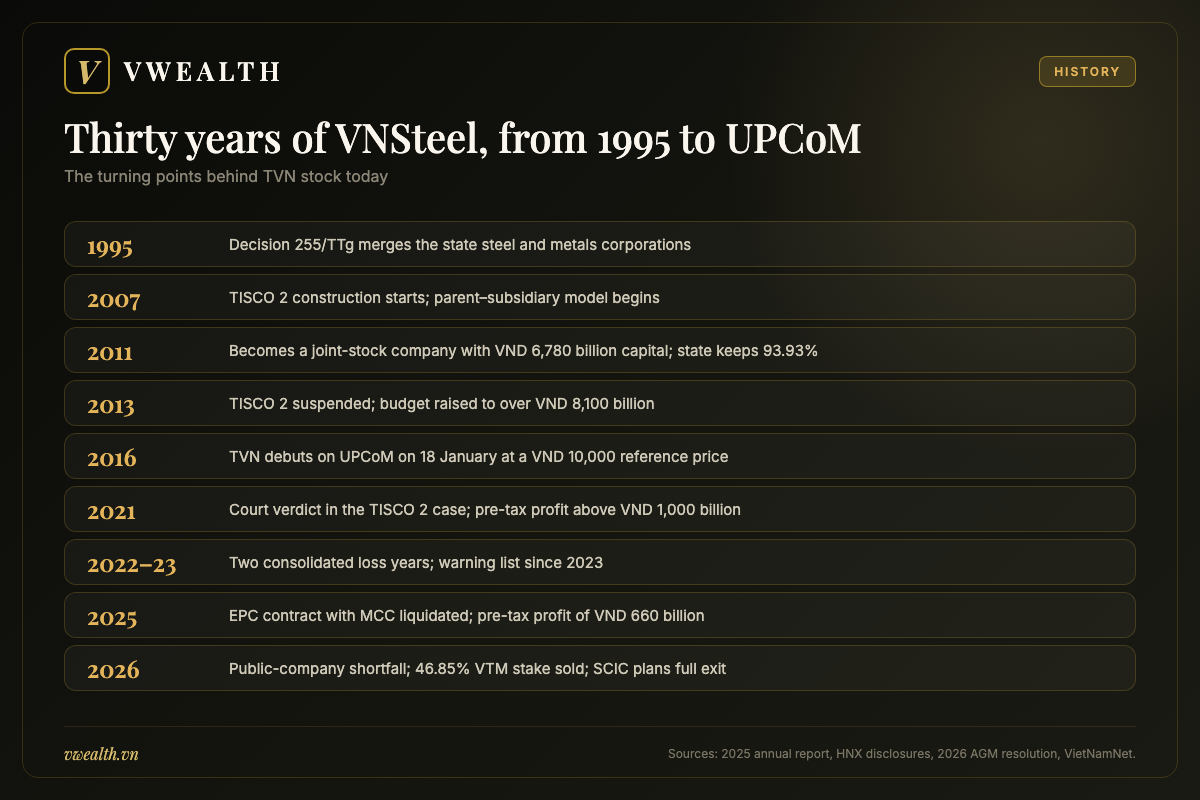
| Date | Event | Why it matters to TVN shareholders |
|---|---|---|
| 29 Apr 1995 | Decision 255/TTg creates Vietnam Steel Corporation by merging the state steel and metals corporations | Origin of the many-entity structure and large land bank |
| 2005–2007 | TISCO 2 approved in principle and construction starts (initial budget VND 3,843 billion) | The group’s largest “group A” project |
| 1 Jul 2007 | Starts operating as a parent–subsidiary group | The holding structure takes shape |
| 29 Sep 2011 | Becomes a joint-stock company with VND 6,780 billion of charter capital | The state keeps 93.93% |
| 2013 | TISCO 2 construction suspended; budget raised to over VND 8,100 billion | Start of more than a decade of idle assets |
| 18 Jan 2016 | TVN starts trading on UPCoM at a VND 10,000 reference price | Very thin liquidity for years |
| 20 Apr 2021 | First-instance verdict in the TISCO 2 case; appeal heard in Nov 2021 | Losses confirmed by a court |
| 2022–2023 | Two years of consolidated losses | Proof of cyclicality |
| 2023 | Shares placed on the warning list | Due to repeated qualified audit opinions |
| 17 Apr 2025 | TISCO and MCC sign the EPC termination agreement | Key legal step toward resolving TISCO 2 |
| 7 Jan 2026 | Discloses it no longer meets one public-company condition | Raises the question of TVN’s future on the market |
| 28 Apr 2026 | AGM sets a 2026 consolidated pre-tax profit target of VND 725 billion | A target above the 2025 result |
| 31 Jul 2026 | Completes the sale of its 46.85% stake in VTM (price VND 1,048.68 billion) | Closes one underperforming investment |
| Aug 2026 | SCIC lists TVN among 66 companies it plans to exit fully in 2026–2030 | First concrete signal of a state sell-down in TVN itself |
Who runs and who owns VNSteel: an ownership structure with SCIC at 93.93%
At a private company like Hoa Phat, the question “who decides?” has a short answer: the founder and a board elected by the major shareholders. At VNSteel the answer has more layers. There is the state shareholder, the capital representatives it appoints, the board of directors, the executive team and, above all of them, government direction on legacy projects. Understanding these layers helps you tell which news actually changes the TVN story and which is just procedure.
SCIC: a shareholder with near-total control
The ownership figures are explicit. The State Capital Investment Corporation (SCIC), Vietnam’s state investment holding company, owns 636,844,034 TVN shares, or 93.93% of charter capital. VietnamBiz, citing the 2026 half-year governance report, and Tin nhanh Chung khoan in September 2026 both name SCIC as the largest shareholder with 93.93%. The Ministry of Industry and Trade was VNSteel’s line ministry at the time of equitisation, as SCIC’s representative reminded the 2026 meeting when he said finalising the equitisation settlement falls under the ministry’s authority. SCIC is now the owner’s representative. The 2025 annual report says that a VNSteel restructuring plan approved by the board on 25 April 2024 was put on hold at SCIC’s direction in a letter dated 7 January 2025, and that the divestment from Vicasa Steel went ahead “on the basis of SCIC’s approval”.
This has practical consequences for you. TVN’s most important decisions, including the dividend rate, asset sales at subsidiaries, the TISCO 2 solution and whether the state reduces its stake in TVN itself, all have to pass through SCIC, and many also need input from the Ministry of Finance or the government. The 2025 annual report says the board “complies with SCIC’s guidance, ensuring the Corporation operates in line with the objectives and orientation of the State”. For minority shareholders that cuts both ways. It is a form of security, since the company is unlikely to vanish and governance follows state procedures. It is also a limit: your vote barely affects outcomes, and decisions move at the pace of several layers of approval.
In September 2026, VietnamBiz reported that “SCIC is about to receive nearly VND 200 billion in dividends from VNSteel”. The number matches a simple calculation. 636,844,034 shares times VND 300 comes to about VND 191 billion (vwealth estimate), out of roughly VND 203.4 billion paid on all 678 million shares. Put differently, of every 100 dong of dividends TVN pays out, almost 94 go back to the state.
On whether the state will sell down its stake in TVN itself, 2026 brought the first concrete signal. At the 28 April 2026 meeting, answering a shareholder’s question, SCIC deputy general director Mai Quoc Vuong said SCIC is the owner’s representative for the state capital in TVN and is responsible for preserving and growing it; when there is a policy to divest from TVN, SCIC will follow the rules and the direction of higher authorities; and finalising the equitisation settlement is a precondition for restructuring, according to the meeting minutes. Four months later, SCIC’s 2026–2030 capital restructuring plan put TVN on a list of 66 companies in which it intends to sell its entire stake, alongside names such as Tien Phong Plastic, Vinatex and Pha Lai Thermal Power, according to An ninh Thu do. SCIC also noted that the list may be adjusted and that actual timing and scale depend on specific plans. So read this as a direction, not a sale schedule: no timing, method or price has been announced.
The board and management: people who came up through the system
Mr Le Song Lai was appointed chairman of VNSteel’s board on 12 May 2023, and he chaired the annual general meeting on 28 April 2026 in that capacity. Also in May 2023, Mr Nghiem Xuan Da returned to VNSteel as a board member and general director. His biography in the 2025 annual report shows a career built inside the system. He started at the Institute of Mining and Metallurgy, joined the Thach Khe mine project management board in 1995, and then worked his way up through deputy head and head of finance and accounting, chief accountant, deputy general director, general director (2014–2016) and chairman of VNSteel (2017–2020). He then served as a deputy general director of SCIC from June 2021 to May 2023 before returning. The annual report lists him as the representative of 127 million SCIC-owned shares, or 18.73% of charter capital.
At the end of 2025 the executive team comprised the general director, four deputy general directors (Pham Cong Thao, Le Van Thanh, Nguyen Phu Duong and Nguyen Nguyen Ngoc) and chief accountant Nguyen Viet Liem. What they share is long experience inside member companies. Mr Thao was general director of the Vinausteel joint venture; Mr Thanh was general director of VNSteel Thang Long Coated Steel; Mr Ngoc rose from workshop manager at Southern Steel to become its general director from 2017 to 2025; Mr Duong was general director of VTM; and Mr Liem spent more than twenty years at the VSC–POSCO joint venture. The 2021–2026 board had five members; in 2025, Mr Tran Tien Tung was elected to replace Mr Tran Huu Hung. The meeting on 28 April 2026 elected the 2026–2031 board, again with five members: Le Song Lai, Nghiem Xuan Da, Nguyen Dinh Phuc, Tran Tien Tung and Thoi Van Tan.
Read through an investor’s lens, these biographies describe a team that knows every plant and every joint venture well, which is an advantage when legacy problems have to be untangled. On the other hand, the team works under the state capital-representative system, is paid under rules for state enterprises, and nobody on it owns a meaningful number of TVN shares. The annual report shows Mr Le Van Thanh holding 10,000 shares personally, a tiny number next to 678 million shares outstanding. You should not expect management to be “in the same boat” as minority shareholders in terms of personal wealth.
The remaining 6.07%: thousands of small holders and the public-company test
Subtract SCIC’s 636,844,034 shares from the 678,000,000 outstanding and you are left with about 41.16 million shares, or 6.07% of charter capital (vwealth estimate). That is the entire slice of TVN the market can actually trade. According to the 2025 annual report, TVN had 6,569 shareholders at 31 December 2025: 19 domestic institutions holding 95.551% in total (SCIC among them), 6,536 domestic individuals holding about 4.4%, 14 foreign individuals holding 0.087%, and no foreign institutions. It includes many individuals with a few hundred shares, some foreign individuals with a few thousand, a few organisations such as trade unions within the group, one fund management company and a couple of investment firms holding a few million shares each.
Vietnam’s Securities Law No. 54/2019/QH14, as amended by Law No. 56/2024/QH15, says a company must meet two tests to keep its public-company status: paid-in charter capital of at least VND 30 billion, and at least 10% of voting shares held by at least 100 investors who are not major shareholders. TVN easily passes the capital test and the “100 investors” test, but it fails the 10% test by about 3.9 percentage points. That is what the 7 January 2026 disclosure was about. As VietNamNet summarised the amended law in February 2026, a company that fails one of the conditions becomes subject to cancellation of its public-company status: it must report within 15 days with its shareholder list for the regulator to review, and if its status is cancelled it must work with the exchange to deregister its shares. In practice, Baodautu reported as early as January 2026 that TVN kept trading despite not meeting the conditions, and VNDirect data show the stock still trading on UPCoM at the end of September 2026.
To fix it, roughly 3.9% of charter capital, about 26.6 million shares (vwealth estimate), would have to move from SCIC to minority investors, or TVN would have to issue new shares to outside investors. Either route is a decision for the state shareholder and higher authorities, not for management alone. At the time of writing, apart from SCIC putting TVN on its 2026–2030 list of full exits, vwealth has not seen any disclosure setting out a specific plan or timetable, so you should follow HNX filings directly. TVN is not alone in this. Our analysis of KSV stock of Vimico, a mining company 98.06% owned by the state coal and minerals group TKV, describes the same kind of problem at another state enterprise, and in early 2026 the local press listed many heavily state-owned companies in a similar position.
The market’s reaction was typical of a thin stock: hard to predict. On 15 January 2026, Fili.vn ran a headline saying “a steel stock has risen more than 30% since announcing it no longer qualifies as a public company”. The buyers’ logic seems to be that if the state chooses to sell part of its stake to keep TVN on the market, the sale could come with a reference price and fresh attention. That is only one possibility, though, and the scenarios chapter explains why the opposite outcome also has to be considered.
Capital representatives: how a “capital-management parent” works
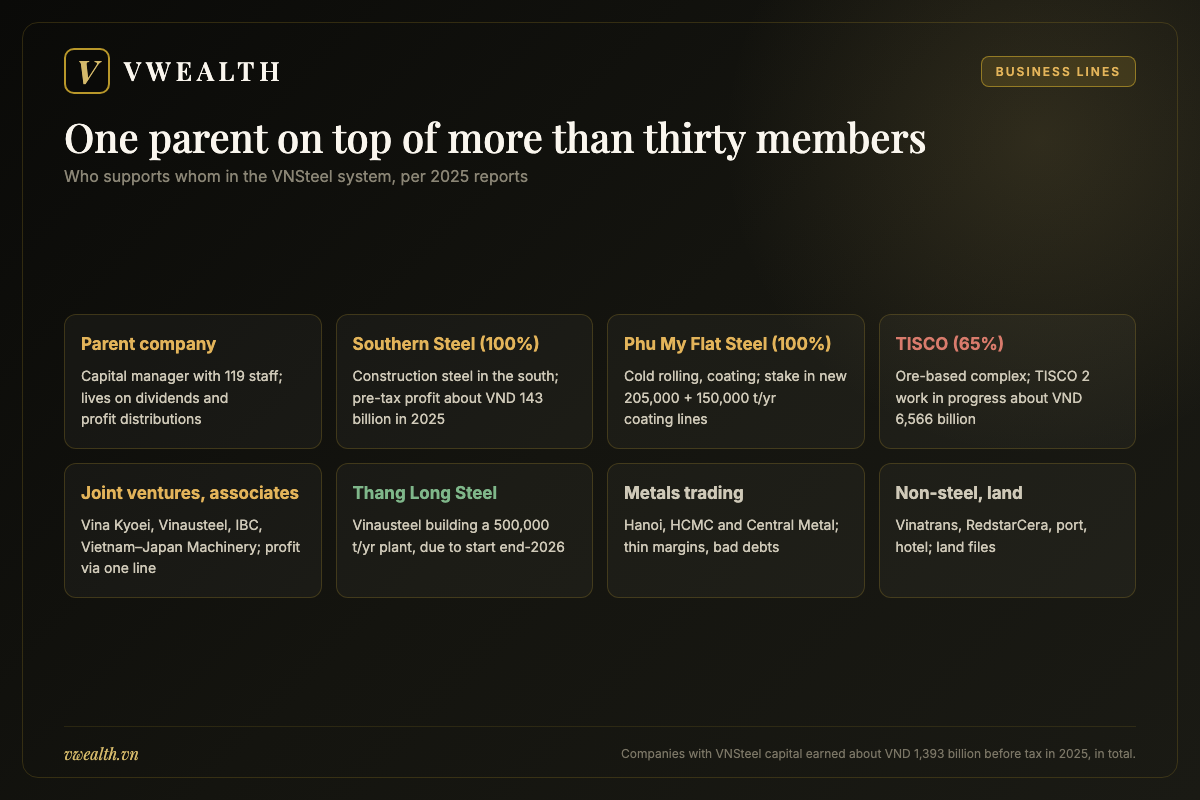
One sentence in the 2025 annual report deserves a slow read: “The parent company manages the Corporation’s capital in its dependent units, subsidiaries and associates and therefore does not directly produce or trade.” The parent had 119 employees at the end of 2025. The wider system comprises dozens of subsidiaries, joint ventures and associates, with thousands of employees.
VNSteel runs this system through capital representatives. The corporation appoints its own people to the board or members’ council of each unit, and they vote as the corporation directs. The approval of the feasibility study for Vinausteel’s 500,000-tonne-a-year steel plant, for example, is described as taking place “on the basis of the capital representatives voting at Vinausteel’s board”. For Vinatrans, the freight-forwarding associate, the report describes using “voting rights at associates to push for earlier release of financial statements”.
This model directly affects how you read results. Where VNSteel has control, as at Southern Steel, Phu My Flat Steel and TISCO, all revenue and costs are consolidated. Where it holds a minority stake in a joint venture or associate, its share of profit arrives as a single line. At the parent level, “revenue” is mostly dividends, profit distributions and interest income. The supervisory board notes that in 2025 the parent received VND 213.7 billion in dividends and profit distributions from group companies, and that parent-company profit “still depends significantly” on these flows and on provisions and reversals.
Dividends: 3%, and why more is hard
Among recent HNX filings vwealth could trace, TVN paid a 3% cash dividend (VND 300 per share) for fiscal 2022, with an ex-dividend date of 31 October 2023, and 3% for fiscal 2025, with an ex-dividend date of 21 September 2026 and payment on 22 October 2026. One interesting point is that the group posted a consolidated loss in 2022, yet the parent still paid a dividend. That is because dividends come out of the parent company’s own profit, not consolidated profit.
Why is a higher payout hard to expect? Consider an illustrative example. In 2025, pre-tax profit in the parent’s separate financial statements was about VND 135 billion, and the supervisory board’s report shows no corporate income tax expense at the parent. A 3% dividend costs about VND 203.4 billion. So this year’s payout exceeds the parent’s own 2025 profit, meaning the company is drawing on retained earnings from earlier years (vwealth estimate). For the dividend to rise to 5% or 7% on a sustainable basis, the parent would need to receive more dividends from its members, which means subsidiaries and associates would have to earn more and distribute more, year after year. With many units still carrying accumulated losses, that cannot be taken for granted.
In yield terms, VND 300 on a VND 10,000 par value is 3%; your actual yield depends on your purchase price. Open a price board or a vwealth report to do the calculation; we do not quote the current price here.
How VNSteel makes money: one parent sitting on top of more than thirty members
Imagine buying into a family of more than thirty members. A few children run good businesses, a few are still paying off old debts, and a few cousins have gone into business with foreign partners and simply send home a share of the profit each year. A TVN share is a ticket into that household. To value it, you need to know who supports whom.
The parent company barely manufactures anything
The parent’s separate 2025 accounts show revenue from sales and services of about VND 1,856 billion. The supervisory board explains that most of it came from buying and selling hot-rolled coil (HRC) with Phu My Flat Steel Co., Ltd., a wholly owned subsidiary, meaning the parent bought raw material on behalf of a member company. The rest was office rent. Because these are support transactions, gross profit was only about VND 13.7 billion. The parent’s real income was about VND 265 billion of financial revenue: dividends, profit distributions, deposit and loan interest, and the gain on selling its stake in Vicasa Steel.
The parent is also where provisions for investments in member companies are booked or reversed. In 2025 VNSteel reversed about VND 85.9 billion of provisions at units whose results had improved and set aside VND 5.6 billion at loss-making ones. For TISCO, even though it made a small profit, the parent still booked a VND 58.1 billion provision because of foreign-exchange losses on the foreign-currency loans of the phase-two project. Other expenses rose by about VND 37 billion, mostly linked to the 120 Hoang Quoc Viet land plot in Hanoi after a development partnership was terminated. The result was parent-company pre-tax profit of about VND 135 billion, 2.45 times the 2024 level. That number says more about the quality of the investment portfolio than about the parent’s own productive capacity.
The lesson: when you read a headline saying “VNSteel profit jumps”, ask whether it refers to consolidated profit or parent-only profit, and where the profit came from. The two numbers can move in opposite directions, and they answer different questions. Consolidated profit tells you how the whole system is doing. Parent profit determines how much can be paid out to you.
Southern Steel and Phu My Flat Steel: the two southern pillars
Southern Steel (Thep Mien Nam – VNSTEEL), wholly owned by VNSteel, is the group’s oldest construction-steel brand in the south, with billet-making and rolling operations at the Phu My industrial zone. According to the results table in the 2025 annual report, Southern Steel earned pre-tax profit of about VND 143.3 billion in 2025, more than four times its VND 35 billion plan, with a return on equity (ROE) of around 12%. It is the largest profit contributor among the wholly owned subsidiaries and also a training ground for current leaders. Deputy General Director Nguyen Nguyen Ngoc ran it for almost eight years.
Phu My Flat Steel (Thep tam la Phu My – VNSTEEL), also wholly owned, is the flat-steel link in the chain. It buys HRC and cold-rolls it into feedstock for coated steel. In 2025 it made pre-tax profit of about VND 58.7 billion, with ROE of about 6%. Its main investment highlight is a new 205,000-tonne-a-year aluminium-zinc coating line and a 150,000-tonne-a-year colour-coating line built by Phu My Coated Steel, a company in which Phu My Flat Steel holds a stake. The plant was inaugurated on 22 September 2025. It is one of the few “group B” projects in the system that was actually completed during 2021–2025.
These two units show the healthy side of VNSteel: largely depreciated plants, experienced staff and established brands with customers in southern Vietnam and in Cambodia. Keep the proportions in mind, though. Together, the two pillars earned about VND 202 billion before tax in 2025 (vwealth estimate). Hoa Phat alone reported consolidated pre-tax profit of about VND 18,041 billion for 2025, according to VNDirect data. That gap in scale should stay in your mind for the rest of this article.
TISCO: the cradle of Vietnamese metallurgy and the weight of phase two
Thai Nguyen Iron and Steel JSC (TISCO, ticker TIS) has charter capital of VND 1,840 billion. VNSteel owns 65%, a stake that rose from 42.11% to 65% after SCIC withdrew VND 1,000 billion of capital from TISCO in 2017, according to the notes to VNSteel’s financial statements. It is the group’s oldest integrated complex, running from iron ore and coking coal all the way to finished steel. TISCO’s consolidated net revenue in 2025 was about VND 11,992 billion, but pre-tax profit was only about VND 14 billion (VNDirect data). Its margin is close to zero.
The weight sits on the balance sheet. At the end of 2025, TISCO’s construction in progress was about VND 6,566 billion, against equity of only about VND 1,495 billion (VNDirect data). A significant part of that value is capitalised interest: interest on loans for a plant that has never run, added to the value of the works. VNSteel’s auditor states that it cannot determine the effect of the interest capitalised into the project since the project fell behind schedule. When the press reported TISCO’s termination of the MCC contract in 2025, it also noted that the company still faced doubts about its ability to continue as a going concern.
Because VNSteel consolidates TISCO, these figures sit inside TVN’s accounts. VNSteel’s consolidated construction in progress at the end of 2025 was about VND 6,583 billion, almost all of it TISCO’s (vwealth estimate from comparing the two reports). The resolution process has moved in steps. On 8 November 2024, the Party Central Committee’s Office issued a letter on the Politburo’s conclusion about how to handle the project. On 1 August 2025, the Government Office issued a letter on next steps. The termination agreement with MCC was signed on 17 April 2025. Under it, according to press reports citing TISCO documents, the Chinese contractor agreed to pay about USD 12 million in compensation. The press has also reported that TISCO is exploring cooperation with a Russian steel group to revive the project. At VNSteel’s meeting on 28 April 2026, chairman Le Song Lai said TISCO is the project owner; because of legal issues, transferring the TISCO 2 project is not possible, and the corporation currently has no plan to divest from TISCO.
TISCO has one more open file. On 20 June 2025, the regional tax authority (Tax Sub-department of Region VII) issued administrative penalty Decision 1165/QD-XPHC concerning the declaration of environmental protection fees on low-grade ore mined from 2017 to 2024 at the Tien Bo iron mine, with a total amount of VND 225.52 billion as of the date of the decision. TISCO has sued to overturn the decision at the People’s Court of Region 1 in Thai Nguyen, and the case is in the mediation stage, according to VNSteel’s explanation; the 2026 half-year review report says TISCO had provisionally paid only VND 1.009 billion and had still not fully recognised the obligation at 30 June 2026. There is no final ruling yet, so treat it as a contingent liability to monitor, not a confirmed loss.
Joint ventures and associates: profit that flows back through a single line
If TISCO is the heaviest part of VNSteel, the joint ventures and associates are the most surprising. The 2025 results table in the annual report lists the pre-tax profit of each company in which the corporation has invested, and a few lines stand out: Vina Kyoei Steel about VND 293.8 billion; IBC International Trade Centre about VND 190.7 billion; Vinausteel about VND 145.5 billion; Ton Phuong Nam about VND 90.1 billion; VNSteel Thang Long Coated Steel about VND 73 billion; Vinatrans (Vietnam National Foreign Trade Forwarding and Warehousing) about VND 72 billion; Saigon Steel Service and Processing about VND 62.3 billion; Vietnam–Japan Machinery about VND 48.5 billion; Ho Chi Minh City Metal about VND 41 billion; and Da Nang Steel about VND 32.7 billion. Total 2025 pre-tax profit across all companies with VNSteel capital was about VND 1,393 billion.
That VND 1,393 billion is the profit of the whole companies, not VNSteel’s share. In a joint venture VNSteel only receives its percentage. When you read Vina Kyoei’s profit, for instance, you have to multiply it by VNSteel’s ownership before you get the amount that flows into TVN’s “share of profit of associates” line. According to consolidated data compiled by VNDirect, that line contributed about VND 92 billion in 2025 and VND 123 billion in 2024, but it was a loss of about VND 694 billion in 2022 and VND 459 billion in 2023. In other words, during the two bad years, the associate portfolio, including problem investments such as VTM, dragged consolidated profit down the most.
The annual report ranks units by ROE. The “excellent” group above 20% includes Vinatrans, IBC, Vinausteel and Saigon Steel Service and Processing. The “high” group between 15% and 20% includes Vietnam–Japan Machinery, Da Nang Steel, Hanoi Metal, Thong Nhat Flat Steel, Vingal galvanising and RedstarCera. The “negative” group includes Vinapipe and Nippovina. The list of companies still carrying accumulated losses includes Southern Flat Steel (being dissolved), MDC Consulting, NatSteelVina, Vinapipe, VTM, Nippovina, Thong Nhat Flat Steel and Da Nang Steel. The family has rich and poor members, and the report shows fairly clearly which is which.
VTM itself turned a page in 2026. At the April 2026 meeting, chairman Le Song Lai said VNSteel had fully provisioned for the investment as required by law; two months later the board approved selling the entire 46.85% stake for VND 1,048.68 billion, and the transfer was completed on 31 July 2026. VTM’s Quy Xa iron mine resumed operations on 10 September 2026 under its new owner, according to Vietstock citing the Lao Cai newspaper. When a fully provisioned investment is sold for more than a trillion dong, VNSteel’s accounts are likely to book a sizeable gain or reversal, but the exact figure, and how it splits between the parent and consolidated accounts, will only be known when the third-quarter 2026 report comes out. It is a one-off, and you should not add it to the “normal” profit level when valuing the stock.
Vinausteel deserves a separate mention because it hosts the largest growth project in the system. In 2025 it was converted into a joint-stock company, and VNSteel stopped consolidating it from 25 August 2025. On 25 November 2025, Vinausteel broke ground on the Thang Long Steel plant, with capacity of 500,000 tonnes a year, at the Dang Le industrial cluster in Hung Yen province. It disbursed about VND 507.9 billion in 2025, and the annual report says the plant is expected to start operating at the end of 2026. In the south, Nha Be Steel has a building permit to add a 150,000-tonne-a-year billet-making stage. These two projects are rare growth bricks in a report dominated by legacy clean-up.
Trading, metals distribution, logistics and non-steel businesses
The legacy of the old Metals Corporation is still in the system: Hanoi Metal, Ho Chi Minh City Metal (KMT), Central Metal and Binh Tay Steel Wire Mesh, which distribute and process steel. They generate large revenue on thin margins and concentrate receivables risk. The annual report lists bad debts above VND 10 billion at the end of 2025 of about VND 47.1 billion at Ho Chi Minh City Metal, VND 44.8 billion at Hanoi Metal and VND 14.5 billion at Central Metal, compared with about VND 544.8 billion at TISCO alone. The supervisory board also warns that some customers outside the group owe relatively large balances spread across several units.
Outside steel, the group includes Vinatrans, a freight forwarder with ROE of about 24% in 2025, although the supervisory board notes that Vinatrans’ own profit came mostly from dividends it received. It also includes IBC, a trade centre and office landlord; RedstarCera, a ceramic tile maker studying a 4-million-square-metre-a-year granite line; a stake in Thi Vai International Port; a labour-supply company; and the Phuong Nam Hotel. None of these is large, but together they show that VNSteel still carries many non-core assets from its state-corporation past. For years its restructuring mantra has been to “focus on core business and reduce the number of units”.
Land and land-related cases
A state corporation born in the planned-economy era is usually rich in land, and land is both an asset and a source of trouble. For VNSteel, two land files have recent official disclosures. The first is the plot at 120 Hoang Quoc Viet Street in Cau Giay district, Hanoi. The Hanoi People’s Committee issued Decision 639/QD-UBND on 10 February 2025 terminating the high-rise residential, services and office project there, and VNSteel booked the related costs as other expenses, according to the supervisory board. The 2026 half-year review report adds that the plot is in the process of being reclaimed under a decision of the Nghia Do ward People’s Committee.
The second is the two-frontage plot at 19/20 Tu Quyet Street in Ho Chi Minh City. On 8 May 2026, VNSteel disclosed an award by the Vietnam International Arbitration Centre. The tribunal accepted its request to terminate an investment cooperation agreement with An Huy Real Estate JSC, ordered Vietnam Steel Quang Huy Real Estate JSC to hand the land back, and ordered the two companies to jointly reimburse more than VND 1.17 billion in arbitration fees and costs. It rejected VNSteel’s claim for damages.
For investors, land is an option that is hard to value. It can unlock value if handled transparently, but it can also generate costs and disputes, and it is always tied to the unfinished equitisation settlement. Do not add land value to your TVN valuation as if it were money in the bank. State enterprises cannot freely develop or sell land the way private companies can.
Where is the moat, and how wide is it?
In investing, a “moat” is a durable advantage that protects a company’s profits from competitors. VNSteel has three things that could be called moats, but all three are narrower than they look.
The first is long-established brands and distribution. Southern Steel, Thai Nguyen Steel, Da Nang Steel and Ton Phuong Nam are names contractors and dealers have known for decades. But construction steel is close to a commodity. When customers compare prices, a brand helps hold on to some market share but rarely allows a meaningful price premium. The 2025 annual report itself describes the goal as “maintaining the current position in construction steel”, which is defensive language.
The second is a portfolio of joint ventures with foreign partners that bring good technology and management, such as Vina Kyoei, Vinausteel and Vietnam–Japan Machinery, which deliver steady profits. This is genuine value. But because VNSteel does not control them, the profit it receives depends on its stake and on each joint venture’s dividend policy.
The third is its status as a state enterprise: access to policy-linked programmes and projects, relationships with provinces, and a new mandate under Resolution 79 to focus on high-quality and special steels where private firms are not yet strong. This is a potential advantage that has not yet turned into profit. On cost competitiveness, which decides survival in steel, VNSteel has no scale advantage comparable to the large private blast-furnace complexes. The board admits as much in its self-assessment in the 2025 annual report: “the Corporation’s development investment in recent years has been limited, while the overall production capacity of the system has continued to decline as a result of restructuring and divestment.”
| Group of units | Examples | How profit reaches TVN | What to watch |
|---|---|---|---|
| Construction and flat-steel subsidiaries | Southern Steel (100%), Phu My Flat Steel (100%), Nha Be Steel, Thu Duc Steel | Full consolidation of revenue and costs | Gross margin, volumes, Nha Be billet project |
| Ore-based integrated complex | TISCO (65%) | Consolidated; minority holders share profit or loss | TISCO 2 solution, exchange rates, environmental fee case |
| Joint ventures and associates | Vina Kyoei, Vinausteel, IBC, Vietnam–Japan Machinery, Nippovina, Vinapipe | One line: share of profit or loss of associates | Thang Long Steel plant, dividends from JVs |
| Trading and metals distribution | Hanoi Metal, HCMC Metal, Central Metal | Consolidated (subsidiaries) or equity-accounted | Bad debts, inventory |
| Non-steel | Vinatrans, RedstarCera, Thi Vai port, hotel | Consolidated or equity-accounted | Restructuring and divestment progress |
| Parent company | Capital management, HRC purchasing support, office leasing | Dividends, profit distributions, provision reversals | Ability to pay dividends, equitisation settlement |
Market position and financial health: read the reports before deciding whether to buy TVN stock
This chapter will not hand you a verdict of “good” or “bad”. Its aim is to show you how to read VNSteel’s own reports: multi-layered consolidated accounts, with qualified audit opinions, heavily influenced by the steel cycle. All figures below are for closed fiscal years.
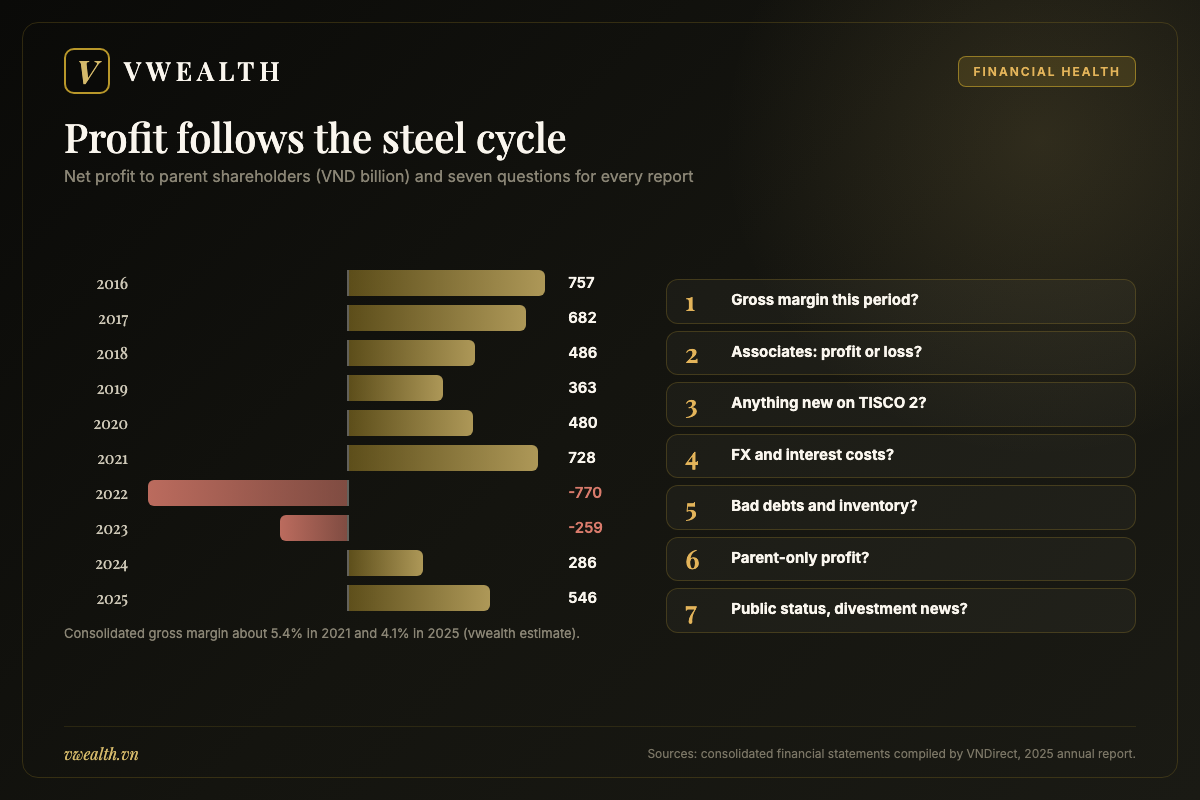
Ten years of profit: the cycle printed on every line
The table below summarises net revenue, pre-tax profit and net profit attributable to the parent’s shareholders from the consolidated accounts, as compiled by VNDirect, with 2025 cross-checked against the annual report. Figures are rounded to the nearest billion dong. For reference, VND 1,000 billion is roughly USD 38–40 million at recent exchange rates.
| Year | Net revenue (VND bn) | Pre-tax profit (VND bn) | Net profit to parent shareholders (VND bn) | Share of associates’ profit/loss (VND bn) |
|---|---|---|---|---|
| 2016 | 17,849 | 948 | 757 | 174 |
| 2017 | 19,803 | 898 | 682 | 186 |
| 2018 | 24,668 | 666 | 486 | 191 |
| 2019 | 34,021 | 503 | 363 | 178 |
| 2020 | 31,291 | 673 | 480 | -107 |
| 2021 | 40,572 | 1,052 | 728 | 169 |
| 2022 | 38,492 | -721 | -770 | -694 |
| 2023 | 30,305 | -252 | -259 | -459 |
| 2024 | 36,155 | 357 | 286 | 123 |
| 2025 | 44,458 | 660 | 546 | 92 |
Three takeaways. First, revenue grew almost 2.5 times in ten years, yet 2025 profit was still below 2016 profit: growth in size did not bring growth in earnings. Second, the associates line amplifies the cycle. In 2022 and 2023 it lost a combined VND 1,153 billion or so, more than the combined pre-tax loss of the two years (about VND 973 billion). Strip out associates, and the rest of the system still made a small pre-tax profit of roughly VND 180 billion over the two years (vwealth estimate). Third, net profit attributable to parent shareholders in 2025 was about VND 546 billion, or roughly VND 805 per share (vwealth estimate, dividing by 678 million shares). That is a useful anchor if you want to work out your own P/E at the market price.
Thin margins: how much of every 100 dong of revenue is left
In 2025, VNSteel’s consolidated gross profit was about VND 1,820 billion on net revenue of VND 44,458 billion, a gross margin of roughly 4.1% (vwealth estimate). In 2021, the top of the cycle, the gross margin was around 5.4%. The annual report puts the 2025 net margin at 1.30%, return on equity (ROE) at 5.59% and return on assets (ROA) at 2.06%. Put simply, for every 100 dong of revenue, the system keeps about 1.3 dong of profit after tax.
Thin margins have an important mathematical consequence: profit is extremely sensitive to prices. A small change in the spread between steel selling prices and the cost of billets, ore, coal and scrap can turn a profit into a loss. Here is an illustrative example. If the 2025 gross margin had been one percentage point lower (3.1% instead of 4.1%), with revenue and other costs unchanged, gross profit would have fallen by about VND 445 billion, roughly two-thirds of 2025 pre-tax profit (vwealth estimate). That is why you cannot extrapolate one good year into a trend.
Another detail: part of the revenue growth in 2025 came from changes in what was consolidated. The supervisory board notes that selling and administrative expenses rose partly because Ton Phuong Nam was consolidated from May 2025, Vinausteel was deconsolidated from 25 August 2025 and the Vicasa stake was sold. When you compare years, remember that the basket of companies in the consolidated accounts is not fixed.
How much smaller than Hoa Phat? VNSteel next to other steel stocks
The phrase “the big brother of Vietnamese steel” is historically accurate, but it no longer describes profit. The table below compares selected 2025 figures from consolidated accounts compiled by VNDirect. Hoa Sen’s fiscal year ends in September, so it is not included, but you can read about it in our analysis of HSG stock and Hoa Sen Group.
| 2025 figures (VND bn) | VNSteel (TVN) | Hoa Phat (HPG) | Nam Kim (NKG) | TISCO (TIS) |
|---|---|---|---|---|
| Net revenue | 44,458 | 156,116 | 14,808 | 11,992 |
| Pre-tax profit | 660 | 18,041 | 241 | 14 |
| Net profit to parent shareholders | 546 | 15,453 | 197 | 1 |
| Total assets | 28,076 | 257,899 | 16,494 | 10,587 |
| Equity | 10,328 | 131,220 | 7,635 | 1,495 |
| Largest owner | SCIC 93.93% | Private, more dispersed | Private | VNSteel 65% |
Hoa Phat’s revenue is about 3.5 times VNSteel’s, but its net profit attributable to shareholders is about 28 times larger and its equity about 12.7 times larger (vwealth estimate). Hoa Phat’s 2025 net margin was around 9.9%, compared with roughly 1.2–1.3% for VNSteel. The gap comes from the business model. Hoa Phat owns large blast-furnace complexes, controls the chain from ore to hot-rolled coil and manages costs at every step. VNSteel is a collection of smaller plants, many of which buy billets or HRC, and it also carries the interest and depreciation burden of an unfinished project. For a private coated-steel producer running on thin margins, see our analysis of NKG stock and Nam Kim Steel.
Don’t draw a one-sided conclusion, though. VNSteel’s revenue is still larger than that of many listed private steelmakers, and more than 4 million tonnes a year of finished-steel sales is a significant presence in the domestic market. TVN’s problem is not that it is “small”. It is “big but earns little on each unit of capital”, which analysts usually call low capital efficiency. For a sector-wide view of where steel fits among Vietnam’s industrial names, see our overview of Vietnam manufacturing and industrial stocks.
Five qualified audit opinions: how to read them properly
“Qualified opinion” sounds alarming, but read properly it is a map of the places in the accounts you should not take entirely at face value. The auditor, AASC Auditing Firm, is not saying the statements are wrong. It is saying it could not obtain sufficient evidence to confirm certain items. The 2025 consolidated statements carry five qualifications, and the same auditor’s review of the 2026 half-year accounts keeps all five:
One: the TISCO 2 project. The auditor could not determine the effect on “prepayments to suppliers”, “construction in progress”, “payables to suppliers” and “foreign exchange differences” related to the project, on interest capitalised into the project since it fell behind schedule, or on possible losses. This is the largest issue, tied to more than VND 6,500 billion of construction in progress on the consolidated balance sheet.
Two: the penalty decision at the Tien Bo iron mine. TISCO has not fully recognised the obligation under the VND 225.52 billion decision because it is suing; the auditor could not determine the impact.
Three: the investment in Thach Khe Iron. Historical cost is VND 274.24 billion but the provision is only VND 3.84 billion. The company is suspended pending a government decision, so the auditor could not determine the provision required.
Four: the financial statements of some associates held indirectly through Vinatrans were unaudited when they were equity-accounted.
Five: the equitisation settlement of the parent company is still incomplete.
A reasonable reading: items one and three are risks that could reduce book asset values if they are resolved by recognising losses. Item two is a contingent liability with an upper bound of a little over VND 225 billion. Items four and five are more procedural, although item five may affect land-use rights. Because TVN has had qualified opinions for three or more consecutive years, the stock stays on the warning list. Getting off it requires these issues, above all TISCO 2, to be resolved for good, and that depends mainly on decisions by higher authorities.
Debt, cash flow and receivables: is the balance sheet getting healthier?
At the end of 2025, VNSteel’s consolidated total assets were about VND 28,076 billion, liabilities about VND 17,748 billion and equity about VND 10,328 billion (including non-controlling interests), giving a liabilities-to-equity ratio of about 1.72 times. Short-term borrowings were about VND 8,301 billion and long-term borrowings about VND 1,824 billion, a total of about VND 10,125 billion (vwealth estimate from VNDirect data). Cash and cash equivalents were about VND 1,956 billion, or 7% of total assets, according to the annual report.
Cash flow is the bright spot. The supervisory board reports net operating cash flow of VND 701 billion in 2025, a clear improvement from negative VND 1,280 billion in 2024, helped partly by VAT refunds at Southern Steel and Nha Be Steel. Even so, total cash flow for the year was negative VND 245 billion because receivables and inventory rose and the group spent on investment and debt repayment. Short-term receivables at the end of 2025 were about VND 4,147 billion, including about VND 4,294 billion owed by customers against a doubtful-debt provision of about VND 559 billion. Inventory was about VND 6,418 billion.
Charter capital of VND 6,780 billion has not changed in more than a decade, while retained earnings at the end of 2025 were about VND 2,486 billion (VNDirect data). Compared with a peak of about VND 3,551 billion at the end of 2021, the retained-earnings cushion was significantly eroded by the two loss years. That matters, because it limits both the pool available for dividends and the buffer against potential write-downs.
At TISCO the picture is much tighter: equity of about VND 1,495 billion against liabilities of about VND 9,092 billion at the end of 2025 (VNDirect data). VNSteel has capital-contribution and guarantee commitments at TISCO, Southern Flat Steel, Thong Nhat Flat Steel and Thach Khe Iron, according to the supervisory board. In other words, TVN’s health cannot be separated from TISCO’s.
Seven questions to ask every time VNSteel reports
Instead of reacting to the first profit number in a headline, use these seven questions as a checklist each quarter.
1. What is the consolidated gross margin this period? A one-point swing changes results materially. Compare it with the same period last year and with 2025 (about 4.1%).
2. Is the share of associates’ profit positive or negative? It is the cycle amplifier; whether Vina Kyoei and Vinausteel make money matters directly.
3. Is there anything new on TISCO 2? Look for the settlement of work with MCC, further compensation received, a new partnership plan, or an impairment.
4. How did foreign-exchange differences and interest costs move? TISCO 2’s foreign-currency loans make profit sensitive to the exchange rate.
5. Are bad debts and inventories rising or falling? Especially in the metals-trading units and at TISCO.
6. What were parent-only profit and dividends received from members? This is where your dividend comes from.
7. Are there new disclosures on public-company status, state divestment or the audit opinion? Any of these three could change the stock’s story completely.
How the market treats TVN stock: a big market value, a thin free float and wide swings
There are two ways to look at TVN’s price. The first is market capitalisation: 678 million shares times the market price gives a figure in the thousands of billions of dong, enough for a January 2026 Nguoi Quan Sat headline to call it a “steel giant with a VND 5,000 billion market cap”. The second is the part that actually trades, only about 6% of it. The second view tells you how the stock behaves.
From a few thousand shares a day to a steel name traders watch
VNDirect’s historical data shows that TVN’s liquidity changes with the steel cycle. Average daily matched volume was about 4,300 shares in 2016, 3,600 in 2017 and 4,500 in 2019, practically nothing. In 2021, when the whole steel sector boomed, it rose to about 1.43 million shares per session; from 2022 to 2025 it ranged between about 360,000 and 590,000 shares per session (vwealth estimate from normal order-matching data).
The pattern is clear: TVN only comes alive when the sector has a story strong enough to attract speculative money. When the sector goes quiet, the stock goes back to standing almost still. For individual investors, that means the price on the screen is not always a price at which you can buy or sell in size. The bid-ask spread can be wide, and a large order can move the price on its own.
2021–2023: from VND 20,500 down to VND 3,700 and partly back
TVN’s price path is a vivid illustration of the word “cyclical”. According to VNDirect data, its highest close in 2021 was VND 20,500 (8 November 2021), more than twice par and about 4.9 times the 2016 low. In 2022 it fell from VND 17,600 (7 March 2022) to VND 3,700 (15 November 2022). In 2023 it bottomed around VND 5,000 (24 April 2023), just as the company was reporting quarterly losses and cutting its profit plan. In 2024 it briefly reached VND 12,100 (15 July 2024), as the market bet on a recovery in the steel cycle and steel stocks rallied on anti-dumping news, before falling back again.
This personality is not unique to TVN; every steel stock swings with the cycle. But at TVN the swings are amplified by the small free float. When a group of investors wants to buy at the same time, scarce supply pushes the price up fast; when they all want to sell, buyers are just as scarce. If you are used to how smoothly HPG trades as a member of the VN30 blue-chip index, adjust your expectations for TVN.
On the warning list since 2023: why, and what it means
Since 2023, TVN has been on the UPCoM warning list. Under the rules, registered stocks are flagged when their annual accounts carry qualified audit opinions for several consecutive years, which is VNSteel’s situation: all five qualifications remain in both the 2025 annual accounts and the 2026 half-year review. Each reporting period VNSteel has to file an explanatory letter with its accounts. Check the stock’s latest status on the HNX website before you trade.
For investors, “warning list” does not mean the company is about to go bankrupt or the stock is about to be delisted. It signals that there are problems with the quality of financial information that need fixing. In practice, some brokerages may restrict margin lending on warning-list stocks, and some funds have internal rules against buying them, which shrinks the pool of potential buyers further. In TVN’s case, because the root causes are TISCO 2 and the equitisation settlement, the warning status is likely to last until those issues are resolved.
Valuing a multi-layered holding company: P/E, P/B and the “holding discount”
Both of the familiar valuation tools need care when applied to TVN.
P/E (price to earnings per share) is easily misleading for cyclical stocks. When profits are at the bottom, as in 2022–2023 when earnings per share (EPS) were negative, P/E is meaningless. When profits peak, P/E looks cheap just as the cycle is about to turn. For TVN, 2025 EPS of about VND 805 (vwealth estimate) is a reference point, but you should also look at average earnings across many years. Average net profit attributable to parent shareholders over the ten years from 2016 to 2025 was about VND 330 billion, or roughly VND 487 per share (vwealth estimate). This is a rough “cycle-normalised” figure you can use to ask yourself how many times you are paying for a full cycle’s average earnings at today’s price.
P/B (price to book value) is the more common tool for asset-heavy companies. But TVN’s book value includes items the auditor has qualified, namely more than VND 6,500 billion of construction in progress at TISCO 2 and the Thach Khe investment, and it also includes non-controlling interests. If you apply a haircut to these items, adjusted book value will be lower than the reported number. vwealth suggests stress-testing this under several assumptions rather than relying on a single figure.
Finally there is the holding discount. Markets usually value a parent that owns stakes in many subsidiaries below the sum of those stakes, because the parent’s shareholders do not directly control the cash flows underneath and because multiple management layers cost money. At TVN the discount is compounded by thin liquidity and by decisions that rest with the state shareholder.
Catalysts ahead
If anything is going to change how the market sees TVN, it will be one of these events: a clear decision on public-company status, either a partial state sale to reach the 10% threshold or, conversely, cancellation of public status; progress on SCIC’s plan to sell its entire TVN stake during 2026–2030; the one-off gain the VTM sale may produce when the third-quarter 2026 report is published; a final decision on TISCO 2 and how it will be accounted for; Vinausteel’s Thang Long Steel plant starting up as planned at the end of 2026; the outcome of the lawsuit over the Tien Bo mine penalty; trade-defence policy on imported steel; and the pace of public investment disbursement. Positive and negative catalysts can arrive at the same time, which is exactly why TVN’s price range is so wide.
Economic and industry context: private firms lead, the state enterprise looks for its place
To put TVN in the right frame, think of Vietnamese steel as a game whose rules have changed over the past twenty years.
From champion to one player among many
When VNSteel was created in 1995, it was the backbone of state steelmaking. Three decades later, the industry is led by private groups with large blast-furnace complexes, while the state sector’s share has steadily shrunk. VNSteel’s own board acknowledges that the system’s overall production capacity “has continued to decline” because of restructuring and divestment, and that development investment “has been limited”.
The difference comes down to three things. The first is decision speed: a private project can go from idea to operation in a few years, while a VNSteel project needs several layers of approval. The second is investment scale: modern blast-furnace projects cost tens of trillions of dong, whereas the whole VNSteel system disbursed only about VND 551.33 billion on investment projects in 2025, just 42.7% of plan, according to the annual report. The third is the weight of legacy: capital frozen in TISCO 2, VTM and Thach Khe is a burden private competitors do not carry. That is the core angle of this article. VNSteel is a state steel group with a large legacy and weaker competitiveness than the private sector.
Oversupply, Chinese steel and trade defence
VNSteel’s 2025 annual report sums up the backdrop in familiar terms: weak global growth, world steel demand that “has hardly grown”, falling domestic consumption in China pushing Chinese mills to export more, falling prices as the dominant trend in world steel markets in 2025, and new US tariff policies weighing on steel trade. At home, the industry “continues to face oversupply as many new projects come on stream”, while exports are hampered by trade defences in the US and Europe.
Vietnam has also raised barriers of its own. The Ministry of Industry and Trade imposed provisional anti-dumping duties of 19.38–27.83% on certain hot-rolled coil (HRC) products from China effective 8 March 2025, then issued Decision 1959/QD-BCT on 4 July 2025 imposing official duties of 23.1–27.83% for five years from 6 July 2025; for Indian imports, the investigation was terminated because volumes were negligible, under 3% of total imports, according to Tin tuc Viet Nam and VietNamNet. That is good news for domestic HRC producers. For units that buy HRC as feedstock for cold rolling and coating, such as Phu My Flat Steel, it can mean higher input costs. VNSteel sits on both sides of this story, so the net effect is not simply positive.
Public investment and property: the two engines of construction-steel demand
Construction steel is VNSteel’s core product, and 2025 was the year the system’s construction-steel sales grew 26.2%. The annual report attributes this mainly to the recovery of the property market and to the pace of public investment disbursement. These are the two macro variables to watch when you assess TVN. If big infrastructure projects such as expressways and airports keep disbursing quickly and housing keeps recovering, construction-steel demand has a floor. If either stalls, volumes will come under pressure. The same forces drive other building-materials companies; for a materials maker with much higher margins, compare our analysis of BMP stock and Binh Minh Plastics, a leading pipe producer.
The 2026 plan approved by shareholders, with consolidated pre-tax profit of VND 725 billion, about 10% above 2025’s VND 660 billion (vwealth estimate), shows management expects the year to keep improving, but without much ambition. The annual report points to risks such as geopolitical risk, rising oil and energy prices pushing up production and logistics costs, input prices for coke, coking coal, iron ore and scrap expected to trend higher, and tougher domestic competition. First-half 2026 pre-tax profit of about VND 718 billion already came close to the full-year target, a good result but also a reminder that in steel one strong half-year does not guarantee the next, so do not expect straight-line profit growth.
Policy toward state enterprises: fixing weak projects, restructuring and divestment
The second policy layer that directly affects TVN is how the state manages its own companies. For more than a decade, TISCO 2 and VTM sat on the list of 12 loss-making, underperforming projects in the industry and trade sector. For TISCO 2, the Party Central Committee’s Office issued a letter on 8 November 2024 on the Politburo’s conclusion about how to handle it, and the Government Office issued a letter on 1 August 2025 on next steps, according to VNSteel’s annual report. By 2025–2026, both files had moved forward: the TISCO 2 EPC contract was liquidated and VNSteel’s entire VTM stake was sold.
On divestment from TVN itself, the picture is clearer but there is no timetable. The 2009 equitisation policy only required the state to keep more than 65%, yet it still holds 93.93%. The VNSteel restructuring plan approved in 2024 was put on hold at SCIC’s direction in early 2025; then in August 2026, SCIC’s 2026–2030 capital restructuring plan placed TVN among 66 companies it intends to exit fully. According to SCIC’s representative at the 2026 meeting, finalising the equitisation settlement, which falls under the Ministry of Industry and Trade, is a precondition for restructuring, so actual progress depends on that bottleneck. The new direction under Politburo Resolution 79 on the state economic sector, as the general director told Quang Ngai province in May 2026, is to concentrate on high-quality steel segments. At that meeting, HUADA, one of VNSteel’s joint ventures and associates, proposed studying a colour-coated, galvanised and cold-rolled steel project of about 1 million tonnes a year, costing about USD 100 million, at Dung Quat. That is only a study proposal, not an approved project.
Where TVN sits among Vietnam’s steel stocks
If you line up Vietnamese steel stocks by how “pure” their story is, you get a spectrum. At one end is HPG: private, by far the largest, highly liquid, with a story built on the cycle and new integrated complexes. In the middle are HSG and NKG: private, focused on coated steel, sensitive to exports and trade defence. At the other end is TVN: state-owned, multi-layered, thinly traded, with a story built on clearing legacy problems and on the state shareholder’s decisions. TIS, TNB, TDS and KMT are pieces inside the TVN ecosystem, each with its own story.
Choosing TVN is not just a bet on the steel cycle. It is also a bet that historical knots will be untied in a way that benefits shareholders. Those are two different problems, and the second is much harder to forecast.
Outlook: three scenarios for TVN stock and the conditions behind each
vwealth does not publish a price target for TVN. For a stock with so many variables outside the company’s control, a single number creates a false sense of certainty. Instead, this chapter sets out three scenarios, each with the conditions you can track to see which way the story is leaning.
Six variables that will shape TVN’s future
One: the spread between steel prices and raw-material costs. With a gross margin of about 4%, this is the fastest-acting driver of consolidated profit. Two: the results of joint ventures and associates, especially Vina Kyoei, and Vinausteel once Thang Long Steel is running. Three: the TISCO 2 solution and how it is accounted for. If part of the construction in progress has to be written down, consolidated profit and equity would take a one-off hit; if the project is restarted with a new partner, the story changes. Four: public-company status, meaning a partial state sale, cancellation of status, or the current limbo continuing. Five: domestic construction-steel demand, tied to public investment and property. Six: contingent liabilities, including the Tien Bo penalty lawsuit, Thach Khe Iron, the equitisation settlement and land files.
Bull case: a favourable cycle, legacy issues untangled, a larger free float
Conditions: construction-steel demand keeps rising on public investment and property; trade defences keep domestic prices stable; the consolidated gross margin holds at or above the 2025 level; Vinausteel’s Thang Long Steel plant starts on schedule and contributes profit from 2027; TISCO 2 gets a final approved solution, whether a restart with a partner or an asset disposal, allowing the qualified opinions to be gradually lifted; and the state shareholder chooses to reduce its stake to keep TVN on the market, pushing the free float above 10%.
If all of these happen, TVN could shift from a “legacy stock” to a steel holding company with steadier earnings, better liquidity and no warning flag. Note, though, that this scenario needs several favourable policy decisions at once, and TISCO 2’s decade-long history shows such decisions tend to arrive later than hoped.
Base case: thin, cyclical profits and step-by-step legacy clean-up
Conditions: the domestic steel market recovers unevenly and competition stays fierce; consolidated profit hovers around management’s cautious plans, a few hundred billion dong a year; TISCO 2 is handled step by step (settling work with MCC, receiving compensation in instalments, looking for partners) without a final conclusion; the qualified opinions and warning status persist; the dividend stays low, a few percent of par when the parent is profitable; and the public-company question is explained and handled slowly while the stock keeps trading.
This is the “more of the same” scenario. TVN would remain a wide-swinging cyclical stock with a thin float, reacting strongly to sector and policy news, but with no structural catalyst for a re-rating.
Bear case: the cycle turns, losses are recognised, the stock leaves the market
Conditions: steel prices fall and oversupply worsens, pushing gross margins down to 2022–2023 levels; associates swing back to losses; the TISCO 2 solution forces a significant write-down; the Tien Bo lawsuit goes against TISCO; and there is no plan to lift the free float to 10%, leading to cancellation of public-company status and delisting from UPCoM.
In this scenario, you would still legally own your shares if the stock left the market, but buying and selling them would be far harder than trading on an exchange. The two loss years of 2022–2023 and the VND 3,700 price in 2022 are reminders that the bear case is not merely theoretical.
Illustrative example: how sensitive TVN’s profit is to gross margin
Take 2025 as the base: net revenue of about VND 44,458 billion, pre-tax profit of VND 660 billion and a gross margin of about 4.1%. Assume revenue and all costs other than cost of goods sold stay the same, and only the gross margin changes:
| Assumed gross margin | Change in gross profit vs 2025 (VND bn) | Estimated pre-tax profit (VND bn) |
|---|---|---|
| 3.1% (1 point lower) | about -445 | about 215 |
| 3.6% (0.5 point lower) | about -222 | about 438 |
| 4.1% (as in 2025) | 0 | 660 |
| 4.6% (0.5 point higher) | about +222 | about 882 |
| 5.4% (as in 2021) | about +578 | about 1,238 |
This is an illustrative example and a vwealth estimate, not a forecast. It simply shows that half a percentage point of gross margin, a tiny move in the steel business, equals a third of 2025 pre-tax profit. Management’s VND 725 billion plan for 2026 needs a gross margin only about 0.15 points above 2025 if everything else is held constant (vwealth estimate). In practice, first-half gross profit of VND 1,386.7 billion on net revenue of about VND 26,170 billion implies a gross margin of about 5.3% (vwealth estimate), above 2025 and close to the 2021 peak, which explains why six months nearly reached the full-year target.
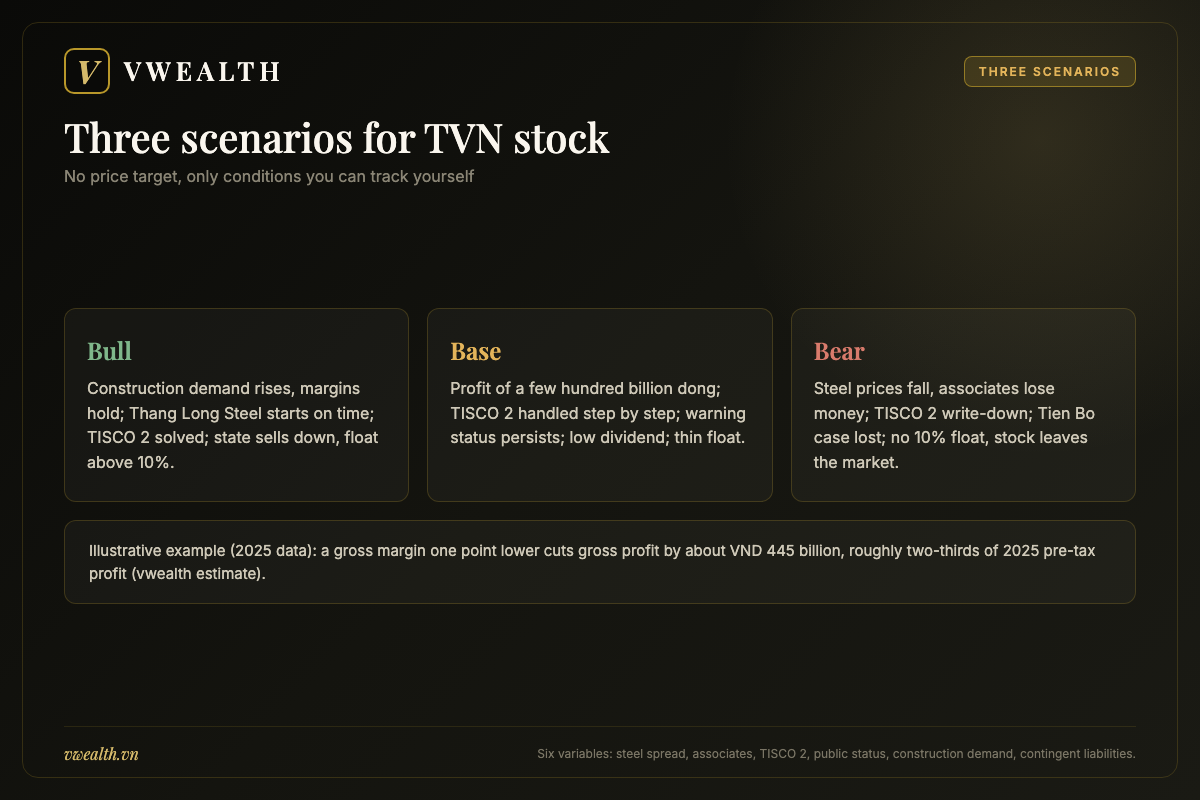
So, should you buy TVN stock? A straight answer
After seven chapters, it is time to weigh everything up. There is no universal “buy” or “sell” answer; there is only an answer that fits, or doesn’t fit, your goals, risk appetite and time horizon.
The case for
System scale and historical position. More than 4.05 million tonnes of finished steel sold in 2025, consolidated revenue of VND 44,458 billion and long-standing brands across the north, centre and south. This is not a small company that disappears after one bad cycle.
Profits have recovered for two years running after two loss years, operating cash flow was a positive VND 701 billion in 2025, a 3% cash dividend is back, and first-half 2026 consolidated pre-tax profit of about VND 718 billion came close to the full-year target.
A valuable joint-venture portfolio. Units such as Vina Kyoei, Vinausteel, IBC and Vietnam–Japan Machinery deliver steady profits, and the 500,000-tonne Thang Long Steel project is a rare growth driver in the system.
Legacy problems are being dealt with step by step: the EPC contract with MCC has been liquidated, the VTM stake transferred, Vicasa sold, Tan Thanh My’s bankruptcy completed and the Tu Quyet land arbitration won. Every step removes a risk.
A restructuring option. SCIC has put TVN on its list of full exits for 2026–2030; if that plan is carried out, or if TISCO 2 finds a solution, the market may re-rate the stock. This is an option, not a certainty.
The case against
Low capital efficiency. ROE of about 5.6% even in a good year like 2025, a net margin of about 1.3%, and 2025 profit still below 2016 despite 2.5 times the revenue.
Five qualified audit opinions and a long stay on the warning list, centred on more than VND 6,500 billion of construction in progress at TISCO 2, the Thach Khe investment, the Tien Bo environmental fee obligation and the equitisation settlement.
Public-company risk. The free float is about 6.07%, below the 10% threshold. Without a fix, the stock could have to leave the market.
Decision-making concentrated in the state shareholder. Dividends, divestments and project solutions all depend on SCIC and higher authorities, and decisions come more slowly than at private firms.
Thin liquidity and wide price swings. The price once fell almost 80% in eight months in 2022, and trading in size is not easy.
Weaker competitiveness than the private sector. No cost advantage from a large blast-furnace complex, limited development investment, and declining system capacity, in the board’s own words.
| For | Against |
|---|---|
| Large system, over 4 million tonnes of steel sold in 2025 | ROE around 5.6%, net margin around 1.3% |
| Two profitable years in a row, positive operating cash flow in 2025 | Five qualified audit opinions, on the warning list since 2023 |
| Profitable joint ventures, Thang Long Steel project | TISCO 2 unfinished for over a decade; TISCO’s thin equity |
| Legacy being cleared (EPC, VTM, Vicasa) | Free float around 6.07%, risk of leaving the market |
| 3% cash dividend is back | Low dividend that depends on parent-only profit |
| Option value from divestment and restructuring | Decisions rest with the state shareholder; slow progress |
Who TVN stock suits
Disciplined cycle investors who understand steel, are willing to buy near the bottom of the cycle and sell when it runs hot, and accept that TVN can move more violently and trade less easily than the big steel names. For them, the gross-margin sensitivity table in chapter 7 and the seven questions in chapter 4 are working tools.
Special-situation investors who are prepared to wait for one of the big catalysts: a decision on public-company status, a solution for TISCO 2 or a state divestment. They need to follow HNX filings closely and accept that the wait may be measured in years.
Investors who want exposure to Vietnam’s state steel ecosystem as a small part of an already diversified portfolio, sized so that a bear-case outcome would not damage their overall financial goals. Foreign investors should also check practical access: TVN trades on UPCoM, liquidity is thin, and the company has published a notice on its maximum foreign ownership ratio, so confirm with your broker how orders and settlement will work before you trade.
Who it does not suit
Anyone who needs high liquidity or trades in size: the free float is simply too small. Income investors looking for a high, regular dividend: 3% of par, dependent on parent-only profit. Anyone unwilling to accept legal and accounting risk: the five qualified opinions and the public-company question are real unknowns. Margin traders: a warning-list stock with wide swings may face margin restrictions. And anyone who simply wants to “bet on Vietnamese steel”: for that goal, a large, liquid private steel stock usually reflects the sector cycle more cleanly.
Final word
TVN stock is a slice of Vietnam’s industrial history. It belongs to a corporation born from a decision to merge an entire industry, once the pillar of the sector, that gradually ceded leadership to more dynamic private companies while carrying unfinished projects from more than a decade ago. 2025 showed the system can still make money when the cycle is favourable, and the biggest knots are being untied one at a time. But low capital efficiency, the TISCO 2 legacy, 93.93% state ownership and the public-company question make TVN a stock that demands you know exactly what you are buying.
Whether you should buy TVN stock therefore depends on why you want it: for the cycle, for a special situation, or out of a vague hope that the old champion will reclaim its crown. If it is one of the first two, do the cycle homework and follow the disclosures closely. If it is the third, thirty years of data argue for caution. You can open the latest vwealth reports for updated figures before deciding, or create a vwealth account to follow TVN alongside other Vietnam stocks.
Research Vietnamese stocks in English with vwealth. Our AI-powered platform turns Vietnamese market data into full English analysis reports — with international payment support and a free 2-month trial for new accounts. Create your free account and read the latest reports.


