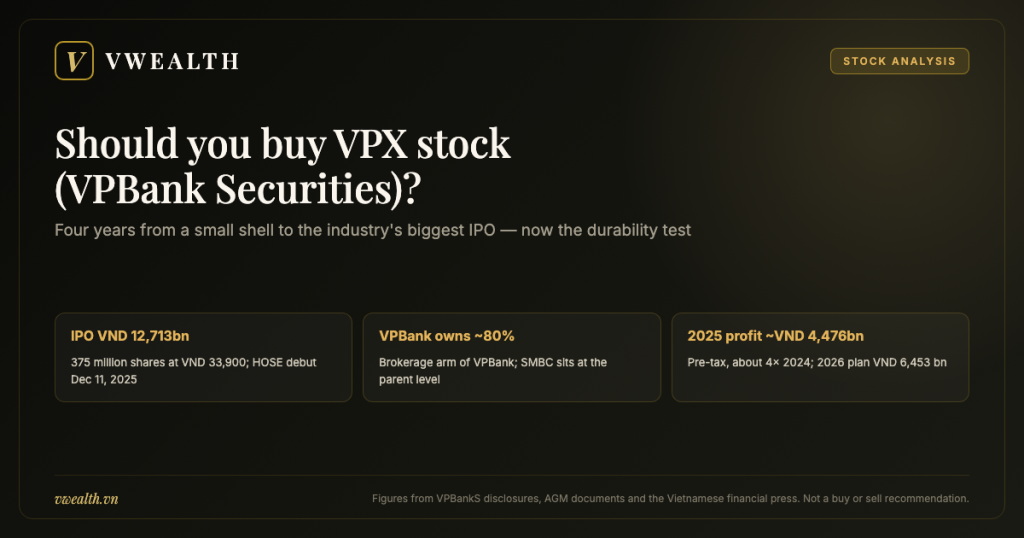
Should you buy VPX stock? The ticker belongs to VPBank Securities Joint Stock Company (VPBankS), the brokerage arm of Vietnam Prosperity Joint Stock Commercial Bank (VPBank, ticker VPB), one of Vietnam’s largest private lenders. VPBankS has the shortest real history and the fastest growth of any major securities firm in the country. At the end of 2021 its predecessor was a tiny brokerage with roughly VND 269 billion of charter capital and a full-year profit of a few billion dong. Four years later, in November 2025, the same company completed the largest IPO in the history of Vietnam’s securities industry, selling 375 million shares at VND 33,900 each and raising about VND 12,713 billion, and it went on to report 2025 pre-tax profit of close to VND 4.5 trillion. Yet on December 11, 2025, VPX closed its first day on the Ho Chi Minh City Stock Exchange down more than 9%, and at the April 2026 shareholders’ meeting investors stood up to ask management why the stock was still below its IPO price. A profit machine built with a parent bank’s money in record time, and a market that still hesitates: that gap is what you need to understand before deciding whether to buy VPX stock.
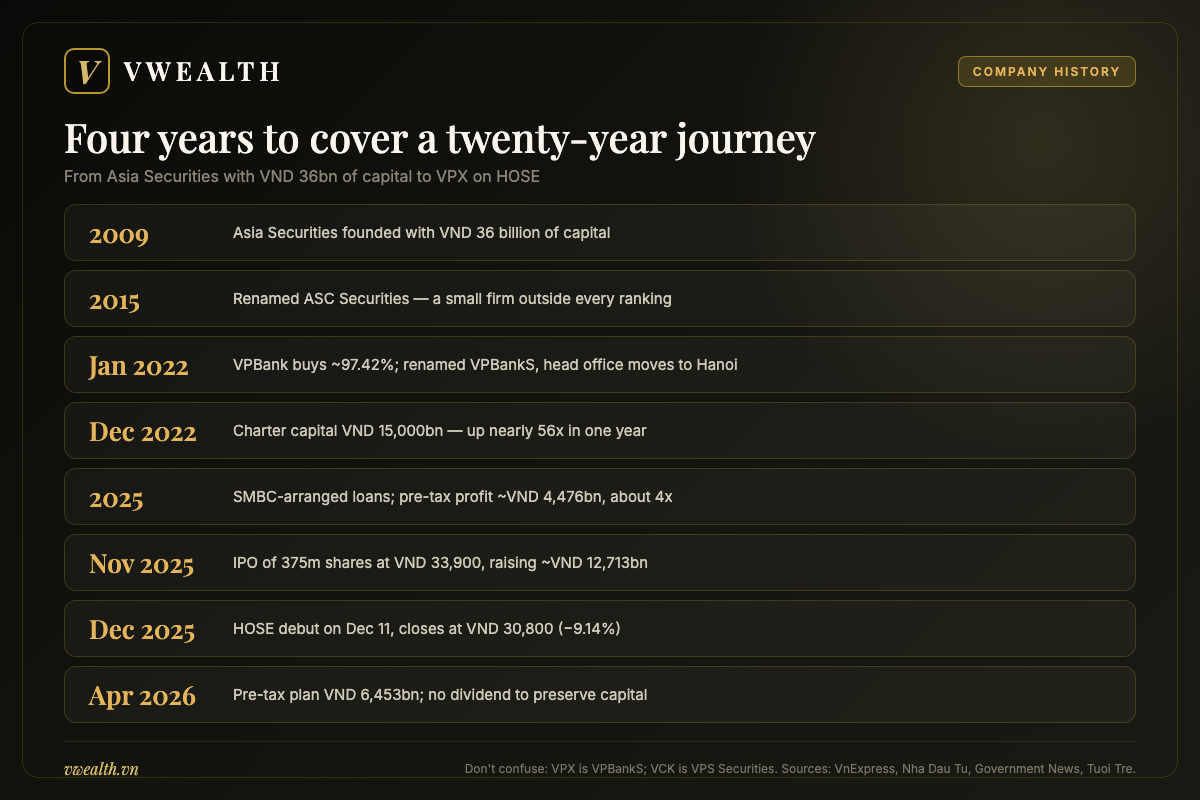
One warning first, because it trips up even experienced investors in Vietnam stocks. VPX is VPBankS, the company VPBank owns roughly 80% of today. Its predecessor was Asia Securities, founded in 2009 and later renamed ASC Securities, which VPBank bought in early 2022. VCK is a different company: VPS Securities, which was once called VPBank Securities (VPBS) and was widely known by that name, but from which VPBank divested around 2015–2016. The two tickers listed on HOSE exactly five days apart in December 2025, and both names start with “VP”, so it is easy to read news about one and think it concerns the other. This article covers VPX only. If you are researching Vietnam’s largest retail broker, read our separate VCK stock analysis of VPS Securities.
A second ground rule, shared by every article in the vwealth company-analysis series: dates, names, deals and figures come from public disclosures — shareholder-meeting documents and resolutions, HOSE filings, financial statements as summarized by Vietnam’s financial press, and management remarks as reported by the press. Numbers we derived ourselves are labeled “vwealth estimate”. We do not quote today’s share price, current P/E or P/B, current market capitalization or the latest quarter’s profit. Those numbers change daily, and for a securities firm that earns roughly half its revenue from a portfolio of financial assets, they can swing sharply from one quarter to the next. Open the latest vwealth report whenever you need current figures.
If you are new to Vietnamese equities, a few local mechanics matter throughout this piece. HOSE shares settle on a T+2 basis, daily price moves are normally capped at plus or minus 7% from the reference price (a newly listed stock gets a wider ±20% band on its first day), and “margin lending” at Vietnamese brokerages is capped by law at 200% of the broker’s equity. Amounts are in Vietnamese dong (VND); for rough orientation, VND 1 trillion was worth somewhere around USD 38–40 million over 2025–2026. Our overview of how to invest in the Vietnam stock market covers account opening, foreign ownership limits and trading rules in more detail.
And a note for readers following the series: this is the fourth Vietnamese brokerage we have analyzed in nine days. Our TCX analysis of Techcom Securities told the story of a firm that got a ten-year head start in bonds and digital distribution. The VCK piece described a mass-market brokerage machine with no parent bank. Our CTS analysis of VietinBank Securities looked at the long-lived child of a state-controlled bank that has never been given enough capital. VPX is a fourth story, different from all three: a company essentially rebuilt from the shell of a small firm, pumped by its parent to the top tier of the industry by capital within a single year, and then grown through margin loans, a bond portfolio and bond-issuance advisory for corporate clients. So the question here is not “can this firm sell brokerage accounts?” It is “how much of its profit stands on its own feet, and how much rests on the VPBank ecosystem?”
From Asia Securities to VPBankS: four years to cover a twenty-year journey
Most of Vietnam’s big brokerages have long biographies. SSI was founded in 1999, VietinBank Securities in 2000, VPS in 2006, TCBS in 2008. They grew through several market cycles and were bruised more than once before reaching today’s scale. VPBankS is different. On paper it has existed since 2009. In substance, almost everything you see at VPBankS today — its capital, people, clients, products, even its head office — was built from 2022 onward. Understanding that is the key to both the biggest strength and the biggest weakness of VPX stock: it has the speed of a startup with a virtually unlimited funding line, but it has not yet been through a full bad market cycle at its current size.
2009–2021: Asia Securities, a small firm on the sidelines
In 2009, as Vietnam’s stock market was picking itself up after the global financial crisis, Asia Securities Company was founded with initial charter capital of VND 36 billion. For perspective, that was about two-thirds of the starting capital VietinBank Securities had nine years earlier, and smaller than many brokerages of the time. In 2009–2010 securities licenses were relatively easy to obtain; Vietnam had well over a hundred brokerages, most of them small and struggling.
In 2015 the company renamed itself ASC Securities. A new name did not change its fortunes. For years afterward, ASC was a name almost no retail investor mentioned; it did not appear in any brokerage market-share ranking and had no notable investment-banking deals. By the end of 2021 — one of the hottest years in the market’s history, when millions of new accounts were opened and many brokerages posted record profits — ASC still had charter capital of about VND 269 billion, total assets of about VND 280 billion, full-year revenue of roughly VND 11 billion and after-tax profit of about VND 6 billion.
Why dwell on a period when the company did almost nothing of note? Because its very smallness explains VPBank’s choice. A bank that wants to return to the securities business has two options: apply for a license to set up a new firm, which takes time and paperwork, or buy an existing firm that already holds all the licenses. Buying a small, “clean” company with few clients and little legacy is cheap, easy to integrate and avoids inheriting old liabilities or disputes. ASC was a suitable shell. VPBankS’s real value lies not in what ASC had, but in what VPBank was about to pour in.
January 2022: VPBank returns to securities after parting ways with VPS
To see why VPBank wanted a brokerage in 2022, go back almost a decade. VPBank once owned another securities firm — today’s VPS — and divested from it around 2015–2016 (press accounts date the exit to one or the other of those years). Years later, when taking VPBankS public, VPBank CEO Nguyen Duc Vinh explained that at the time the bank had limited resources and had to choose where to focus; it chose consumer finance, building FE Credit, while securities was not a priority. The firm VPBank sold later grew on its own into the number-one retail broker in Vietnam — a story told in our VCK analysis.
By early 2022 VPBank’s picture had changed completely. The bank had just sold 49% of FE Credit to SMBC Consumer Finance, part of Japan’s Sumitomo Mitsui Banking Corporation (SMBC) group, in a deal worth nearly USD 1.4 billion; its balance sheet had thickened; and the stock market had just been through a booming 2021. In January 2022, VPBank completed the purchase of about 26.2 million ASC shares, equal to about 97.42% of charter capital. This time VPBank came back into securities as a buyer with money, not a seller with constraints.
On February 14, 2022, ASC’s 2022 annual general meeting approved a new name: VPBank Securities Joint Stock Company, VPBankS for short. Pham Phu Khoi, then a deputy CEO of VPBank, was elected chairman of the board, and Nguyen Ha Quynh was appointed CEO. The head office moved from Ho Chi Minh City to VPBank Tower in Hanoi — a small but symbolic detail: the brokerage now sat in the same building as its parent bank.
2022: a roughly 56-fold capital increase in one year
The same February 2022 meeting approved an offering of more than 865 million new shares to existing shareholders at a minimum of VND 10,000 per share, lifting charter capital from about VND 269 billion to about VND 8,920 billion — more than 33 times in a single step. Because VPBank held over 97%, nearly all of that money came from the parent. In December 2022 the company issued a further 608 million shares, taking charter capital to VND 15,000 billion. The press calculated that VPBankS had raised its capital almost 56-fold during 2022 and, at that moment, overtaken SSI as the Vietnamese securities firm with the largest charter capital.
Pause on that number, because it is the key to this whole analysis. Other brokerages spent decades accumulating retained earnings and running rights issues to reach a few thousand billion dong of capital. VietinBank Securities, after more than 25 years, has charter capital of about VND 2,722 billion. VPBankS had VND 15,000 billion within a year of changing hands. In the securities business, capital is the ceiling on almost everything: the law caps margin loans at 200% of equity, and the size of the proprietary book, underwriting capacity and the ability to absorb a market crash all depend on capital. Starting with a very large equity base meant VPBankS could skip the slow “growing into it” phase every rival had to go through.
For its first year under VPBank, management targeted revenue of VND 1,509 billion and after-tax profit of VND 632 billion, roughly 131 and 105 times the 2021 figures. Actual 2022 results fell short of the plan but were still a leap: operating revenue of about VND 773 billion, pre-tax profit of about VND 542 billion and after-tax profit of about VND 434 billion — around 72 times the prior year. What stands out is the mix. Full-year brokerage revenue was only about VND 46 billion, while gains on financial assets were about VND 460 billion and interest on loans about VND 241 billion. At the end of 2022 the portfolio of financial assets at fair value through profit or loss (FVTPL) was about VND 7,452 billion, of which about VND 7,227 billion was unlisted bonds. From year one, VPBankS made clear it did not intend to live on brokerage commissions.
2023–2024: building the machine in a difficult market
2022 was also the year Vietnam’s corporate bond market broke: a string of issuance violations was prosecuted, retail confidence collapsed and liquidity froze. The VN-Index lost roughly a third of its value over the year. For a company whose portfolio was mostly unlisted bonds, this was an early test. VPBankS came through without any major incident reported in the press, but it could not expand at the pace originally planned.
2023 brought an important change one level up: on March 27, 2023, VPBank agreed to a private placement of 15% of its shares to SMBC, a deal worth about USD 1.5 billion. SMBC does not hold VPBankS shares directly, but from then on the Japanese group became part of the ecosystem VPBankS relies on — especially when the brokerage needed to borrow internationally, as later years would show.
Over 2023–2024 VPBankS quietly built its machinery: hiring investment bankers, building trading systems, developing its app and expanding margin lending. Its margin book was still small relative to the leaders and its brokerage share modest. VPBank’s 2024 plan expected VPBankS to contribute around VND 1,902 billion of profit to the group; the actual figure was lower — the company later disclosed that its 2025 pre-tax profit was about four times the 2024 level. In other words, through the end of 2024 VPBankS was a company with huge capital whose profits had not yet caught up. Its return on equity (ROE) was low, because VND 15,000 billion of equity was not yet being put to full use.
2025: the breakout — Japanese-arranged loans, four-fold profit and a record IPO
In 2025 everything came together. The market came back to life, the VN-Index broke through old highs and industry-wide margin lending rose sharply. VPBankS moved from “capital waiting to be used” to “capital running at full capacity”. In May 2025 it received a USD 125 million loan arranged by SMBC; on October 22, 2025 it mandated SMBC as lead arranger for a syndicated loan of up to USD 200 million — its largest international financing to that date — as part of a plan to raise about USD 400 million during the year through bilateral and syndicated loans. The proceeds were earmarked for margin lending and investment banking.
Results followed fast. First-half 2025 pre-tax profit was roughly VND 900 billion. For nine months it was about VND 3,260 billion, nearly four times the prior-year period — implying third-quarter pre-tax profit alone of roughly VND 2,360 billion (vwealth estimate, nine-month figure minus the half-year figure). Margin loans at the end of the third quarter stood at about VND 27,000 billion, among the three largest in the market, and total assets exceeded VND 62,100 billion. For the full year 2025, the company reported revenue of about VND 7,910 billion and pre-tax profit of about VND 4,476 billion, roughly four times 2024 and ahead of its revised plan. (Some articles cite VND 4,450 billion; that was the 2025 plan, not the result.)
Two leadership changes also came that year. On September 15, 2025, Ho Thuy Nga was elected chair of the board, replacing Vu Huu Dien, who had held both the chair and CEO roles; the split was needed to meet governance rules for public companies. In September 2025 VPBankS also published its 2026–2030 strategy, targeting compound annual growth of around 32%. And on December 16, 2025, Nham Ha Hai was appointed CEO, with Vu Huu Dien moving to vice chair. Chapter 2 covers these people in detail.
The biggest event of the year, though, was the IPO. VPBankS offered 375 million shares to the public at VND 33,900 each, with subscriptions open from October 10 to October 31, 2025. About 13,000 successful purchase orders totaled roughly 390.5 million shares, exceeding the offering, and the allocation ratio was set at 96.036%. The company raised about VND 12,713 billion — a record for a Vietnamese securities IPO, slightly larger than the roughly VND 12,138 billion VPS raised a few weeks later. Charter capital rose from VND 15,000 billion to VND 18,750 billion and equity to nearly VND 33,000 billion (before fourth-quarter 2025 earnings), which the company said placed it second in the industry by equity at the time.
December 11, 2025: 30 days from IPO to exchange, and a disappointing debut
VPBankS became a public company on November 20, 2025, filed for listing on December 1, and on December 11, 2025 roughly 1.875 billion VPX shares began trading on HOSE at a reference price of VND 33,900 — exactly the IPO price — with a ±20% first-day band. The press highlighted the speed: under new rules, the gap between the end of the IPO and listing had shrunk to under 30 days, versus three to six months previously. At the reference price, VPBankS was valued at about VND 64,000 billion, roughly USD 2.4 billion, placing it among the three most valuable listed brokerages at the time.
The debut was not pretty. VPX fell from the open, was down about 10% by the end of the morning session, dropped more than 12.8% to VND 29,550 at one point in the afternoon, and closed at VND 30,800, down 9.14% from the reference price. Foreign investors were net sellers of nearly VND 72 billion on day one. The same day the VN-Index lost the 1,700-point mark. Five days later, VPS’s VCK debuted and fell even further. Local media dubbed the batch “blockbuster IPOs that fizzled”.
With that, VPBankS’s four-year biography had come full circle: from a tiny firm to one of the best-capitalized brokerages in the country, with listed shares and tens of thousands of new shareholders. The table below summarizes the milestones.
| When | Milestone | Why it matters to a VPX shareholder today |
|---|---|---|
| 2009 | Asia Securities founded with VND 36 billion of capital | Essentially a legal shell with little business legacy |
| 2015 | Renamed ASC Securities | Still a small firm outside every ranking |
| End-2021 | Capital about VND 269 billion, total assets about VND 280 billion, after-tax profit about VND 6 billion | The baseline for measuring later growth |
| January 2022 | VPBank buys about 97.42% | VPBank returns to securities after leaving VPS |
| February 14, 2022 | AGM approves VPBankS name and capital increase to about VND 8,920 billion | Start of the “rebuild” funded by the parent |
| December 2022 | Charter capital VND 15,000 billion | Overtakes SSI by charter capital; roughly 56-fold increase in a year |
| 2025 | SMBC-arranged loans of USD 125 million (May) and up to USD 200 million syndicated (October); pre-tax profit about VND 4,476 billion | First year capital was used near full capacity |
| October–November 2025 | IPO of 375 million shares at VND 33,900, raising about VND 12,713 billion | The key historical price benchmark; charter capital VND 18,750 billion |
| December 11, 2025 | HOSE debut, closes at VND 30,800 (−9.14%) | The market did not immediately accept the IPO valuation |
| April 20, 2026 | 2026 AGM: pre-tax profit plan VND 6,453 billion, no dividend | Retaining capital for growth takes priority over paying shareholders |
Don’t confuse VPX with VCK: two “VPBank Securities” and two different paths
This section is short but necessary, because confusion between the two companies has led investors to misread news and occasionally to place orders in the wrong ticker. Keep a simple cheat sheet. VPX is VPBankS: predecessor Asia Securities (2009), later ASC Securities; about 97.42% bought by VPBank in January 2022; VPBank now owns about 80%; IPO price VND 33,900; HOSE listing December 11, 2025. VCK is VPS: predecessor VPBank Securities (VPBS), founded inside VPBank in 2006; VPBank divested around 2015–2016; no ownership link with VPBank today; IPO price VND 60,000; HOSE listing December 16, 2025.
The two firms also follow almost opposite strategies. VPS lives on retail clients and a large sales force and has held the number-one brokerage market share for years. VPBankS ranked only eighth in HOSE brokerage share in the second quarter of 2026, but it is strong where VPS is not: advising companies on bond issuance, running a proprietary bond portfolio, and lending on margin with funding backed by a bank ecosystem. When you see a headline mentioning “VPBank Securities”, check the ticker first. On most trading screens VCK and VPX also sit close to each other alphabetically — one more reason to type carefully.
Who runs VPBankS and who really owns VPX stock
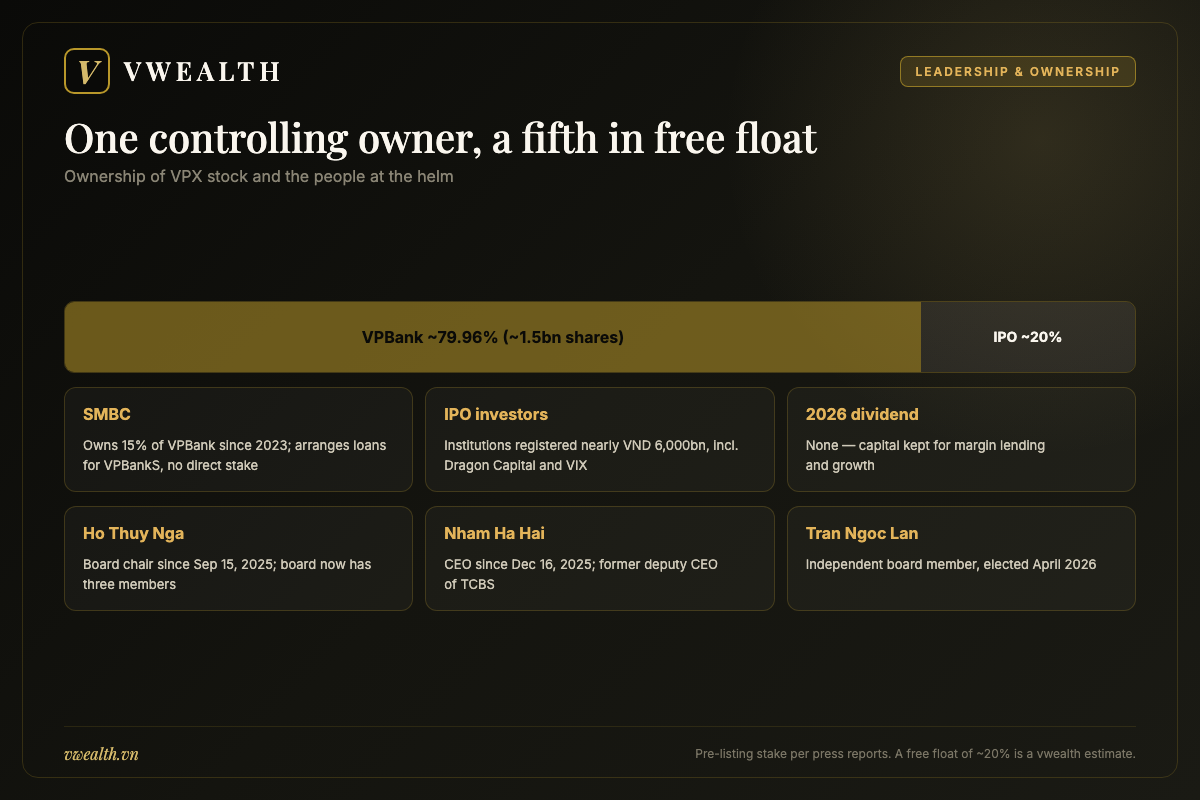
At VPS, the question “who owns the company?” was a mystery for almost a decade. At VPBankS the answer fits in one word: VPBank. But precisely because the answer is so obvious, you need to ask the follow-up questions carefully. How much does the parent own, and might it sell down? Which executives are bank people and which were hired from outside? Are the interests of a small shareholder holding a few thousand VPX shares aligned with those of a bank holding roughly 1.5 billion? This chapter walks through the managers, the ownership structure and the dividend policy — which says a lot about whose interests come first.
Chair Ho Thuy Nga and a three-member board
The chair of VPBankS’s board is Ho Thuy Nga, born in 1978 and elected chair on September 15, 2025. (Vietnamese sources spell her given name with different diacritics — “Nga” and “Ngà” — but they refer to the same person.) She replaced Vu Huu Dien, who had combined the chair and CEO roles. The two roles were separated just before VPBankS became a public company, because governance rules for Vietnamese public companies do not allow one person to hold both.
At the April 20, 2026 shareholders’ meeting, she fielded the hardest question: why VPX was trading below its IPO price. According to press reports, she said the stock had reached VND 34,500 after the IPO (in March 2026) before coming under pressure from macro factors such as interest rates, oil prices and geopolitical risk, and she argued that the company’s valuation was reasonable relative to the sector, citing a price-to-book ratio of about 1.62 times versus a sector average of about 2.01 times and a P/E of about 12.69 times versus 14.74 times. Those were the company’s figures at the time of the meeting. Treat them as management’s argument, not an independent conclusion, and check current numbers in a vwealth report before relying on them.
The same meeting shrank the board from four members to three. Vice chair Vu Huu Dien and independent member Nguyen Quang Trung left after submitting resignations, and Tran Ngoc Lan was elected as an independent member. Ms. Lan has 14 years of banking and corporate experience; she worked at VPBank in 2012–2014, has been a director at MIK Group Vietnam since November 2015 and CEO of GW Holding since June 2024. The board for the 2022–2027 term now consists of Ho Thuy Nga (chair), Nguyen Luong Tan (member) and Tran Ngoc Lan (independent member).
Three is the legal minimum. For a HOSE-listed company with more than VND 30 trillion of equity, it is a small board. A small board makes decisions quickly — fitting VPBankS’s “move fast” style — but it also means independent voices hold just one seat. When a company transacts heavily with its parent bank (more on this in chapter 4), the independent director’s role in scrutinizing those transactions is something minority shareholders should care about.
CEO Nham Ha Hai: an alumnus of TCBS at the wheel
VPBankS’s CEO since December 16, 2025 is Nham Ha Hai, born in 1977, with a master’s degree in finance (Paris Dauphine University and ESCP-EAP business school) and more than 20 years in banking and finance. His résumé is worth reading closely: he was CEO of An Binh Securities (ABS), an executive director at Standard Chartered Bank, and deputy CEO of Techcom Securities — TCBS, the company VPBankS competes with most directly.
Having a former TCBS executive running VPBankS is no accident. TCBS is the template Vietnam’s private-bank-owned brokerages are following: use a large equity base for margin lending, use the bank’s client base to distribute products, and use corporate relationships to advise on bond issues. Hiring someone who knows that machine from the inside signals that VPBankS wants to play on TCBS’s field, and to play fast.
At the 2026 AGM, Mr. Hai presented the business outlook. He pointed to supportive macro factors such as a high GDP growth target and inflation held below 4%, while flagging risks from Middle East tensions and elevated interest rates. On margin lending, he said the book had passed VND 38,000 billion and the company had roughly VND 32,000–33,000 billion of remaining headroom; he called the target of lifting margin loans to around VND 50,000 billion in 2026 “entirely feasible”, citing fresh IPO capital and an expectation that slower bank credit growth would push money toward the stock market.
VPBank’s role: CEO Nguyen Duc Vinh and “the ecosystem”
Read press coverage of VPBankS’s big moments — the IPO, the shareholders’ meeting — and one name keeps appearing even though he sits outside the brokerage’s own management: Nguyen Duc Vinh, CEO of VPBank. It was he who told the press that taking VPBankS public after three years was “a long-term strategy for VPBank and its ecosystem”; it was he who spoke about the group’s digital-asset ambitions at the VPBankS AGM in 2026. That tells you where the big strategy is drawn: the most important decisions about VPBankS — capital raising, the IPO, new business lines — are shaped at group level.
For investors this cuts both ways. On the plus side, VPBankS is backed by a bank that reported consolidated pre-tax profit of more than VND 30,600 billion in 2025, has one of the largest charter capitals in the system and counts SMBC as a strategic shareholder. You can read more about the parent in our VPB stock analysis. On the minus side, a subsidiary’s strategy serves the group’s strategy first. If the group one day decides to use its brokerage for a bigger purpose — distributing bank products, helping the bank’s corporate clients issue bonds, investing in a new ecosystem venture — the interests of VPX minority shareholders may not be top priority.
VPBank owns about 80%; who holds the other 20%?
Before listing, VPBank owned about 79.96% of VPBankS, roughly 1.5 billion of the 1.875 billion shares outstanding. Simple arithmetic shows that almost all of the remainder — about 375 million shares — is the stock sold in the IPO. In other words, VPX’s effective free float, the portion of shares that actually trades, is only around one-fifth (vwealth estimate), and much of that sits with institutions that bought in the IPO.
Who bought? According to the press, institutional investors registered to buy nearly VND 6,000 billion, about half the offering. Dragon Capital — the largest and longest-established fund manager in Vietnam’s capital market — registered USD 50 million (about VND 1,350 billion). Another institutional group registered about VND 4,000 billion, including VIX Securities with VND 2,000 billion, a power-generation company with VND 350 billion and an infrastructure company with VND 300 billion. Those were registrations, not final allocations; with a 96.036% allocation ratio, each bidder may have received slightly less. VIX — both a competitor and a shareholder of VPBankS — is covered in our VIX stock analysis.
A low free float has three consequences for you. First, when a few large holders want to sell at the same time, the price can drop sharply because few shares are in circulation. Second, VPX may struggle to enter major indices with a meaningful weight, since many index providers adjust weights by free float. Third, if VPBank ever decides to sell down — to bring in a strategic investor or to take cash back to the bank — the supply of shares could jump suddenly. No such plan has been announced, but it is a variable worth watching in VPBank’s resolutions.
| Ownership layer | Who | Disclosed stake / size | What to watch |
|---|---|---|---|
| Controlling shareholder of VPBankS | VPBank (VPB) | About 79.96% before listing, about 1.5 billion shares | Whether VPBank sells down, adds a strategic investor or injects more capital |
| Strategic shareholder of the parent | SMBC (Japan) | 15% of VPBank since 2023; not a direct VPBankS shareholder | Talks on raising its VPBank stake; role arranging loans for VPBankS |
| Institutional IPO investors | Dragon Capital, VIX and others | Registered nearly VND 6,000 billion, about half the offering | Whether they hold long term or sell into rallies |
| Retail IPO investors and others | About 13,000 successful orders | Total IPO of 375 million shares, about 20% of capital | Real trading liquidity; sentiment while the price is below the IPO level |
Where SMBC fits, and why there is no dividend for 2026
Many introductions to VPBankS describe SMBC as a pillar of support. Let’s be precise. Based on available disclosures, SMBC does not directly own VPBankS shares. It owns 15% of VPBank through the roughly USD 1.5 billion deal of 2023, and before that bought 49% of FE Credit in 2021. Its relationship with VPBankS runs through two channels: indirectly via the parent bank, and directly as a loan arranger — SMBC arranged the USD 125 million loan in May 2025 and led the syndicated loan of up to USD 200 million in October 2025. In its strategy materials VPBankS names VPBank and SMBC as partners that provide access to capital, brand credibility and a global financial network, and at the 2026 AGM management spoke about expanding investment banking by drawing on the SMBC relationship.
In late September 2026 the Vietnamese press reported that talks between SMBC and VPBank on raising SMBC’s stake in the bank to around 20% had not reached agreement, with price the sticking point. That news changes nothing directly at VPBankS, but it is a useful reminder: “SMBC support” is a commercial and shareholder relationship at the parent level, not a guarantee for the brokerage. When you assess VPBankS’s funding risk, treat SMBC-arranged loans as commercial loans with maturities, interest rates and covenants, not as family money.
What about dividends? The 2026 AGM materials proposed no dividend, citing the need to preserve capital amid domestic and global uncertainty and high interest rates, and shareholders approved it. For a company targeting around VND 50,000 billion of margin loans and roughly 32% compound profit growth to 2030, retaining earnings is logical: every dong retained raises equity, and every dong of equity allows up to two more dong of margin lending.
But look at it from a small shareholder’s seat. No dividend means your entire return depends on the share price rising. And the share price rises when the market believes retained capital will be deployed at high returns with controlled risk. If you want regular cash income, VPX is not the vehicle at this stage. Meanwhile the parent, VPBank, is paying its own shareholders a 5% cash dividend in 2026 — a small detail that reminds you cash in the ecosystem flows according to group priorities.
How VPBankS makes money: a big balance sheet, corporate clients and very little brokerage
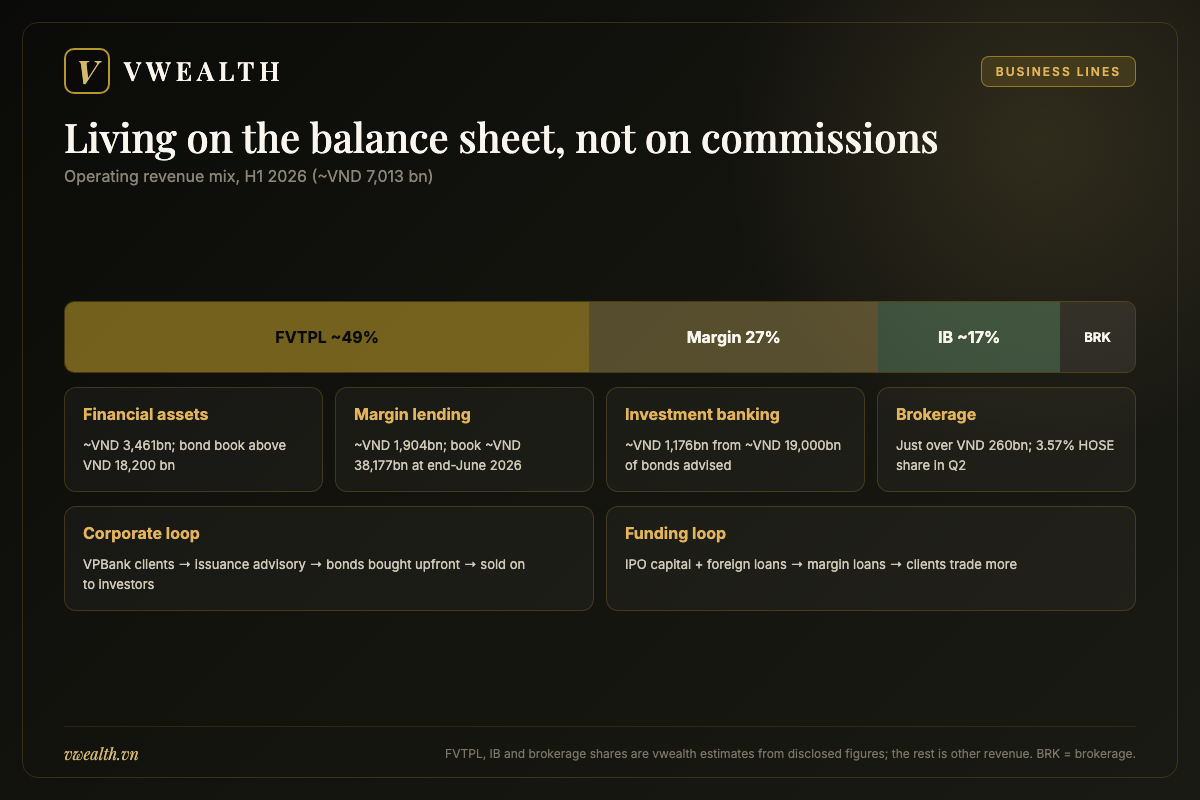
Start with a number that surprises most people. In the first half of 2026, VPBankS generated operating revenue of about VND 7,013 billion. Brokerage revenue — what most retail investors think of as a securities firm’s core business — was just over VND 260 billion, less than 4% of the total (vwealth estimate). The rest came from three big sources: gains and income on its portfolio of financial assets, interest on margin loans, and investment-banking fees. In other words, VPBankS is not “a broker that also lends”, as many traditional Vietnamese brokerages are. It looks more like a small investment bank that lives off its balance sheet and its corporate relationships. Getting this mix right is essential to reading VPX’s reports correctly.
| Business line | H1 2026 revenue (disclosed) | Share of operating revenue | Character |
|---|---|---|---|
| Financial assets at FVTPL — mainly bonds and proprietary equities | About VND 3,461 billion, nearly double a year earlier | About 49% (vwealth estimate) | Largest, but moves with interest rates and markets |
| Margin lending | About VND 1,904 billion, nearly triple a year earlier | About 27% (disclosed) | Steadier; capped by equity and driven by funding cost |
| Investment banking and advisory | About VND 1,176 billion | About 17% (vwealth estimate) | Deal-driven, tied closely to the corporate bond market |
| Securities brokerage | Just over VND 260 billion, about double a year earlier | About 4% (vwealth estimate) | Small but growing; mainly a gateway to margin clients |
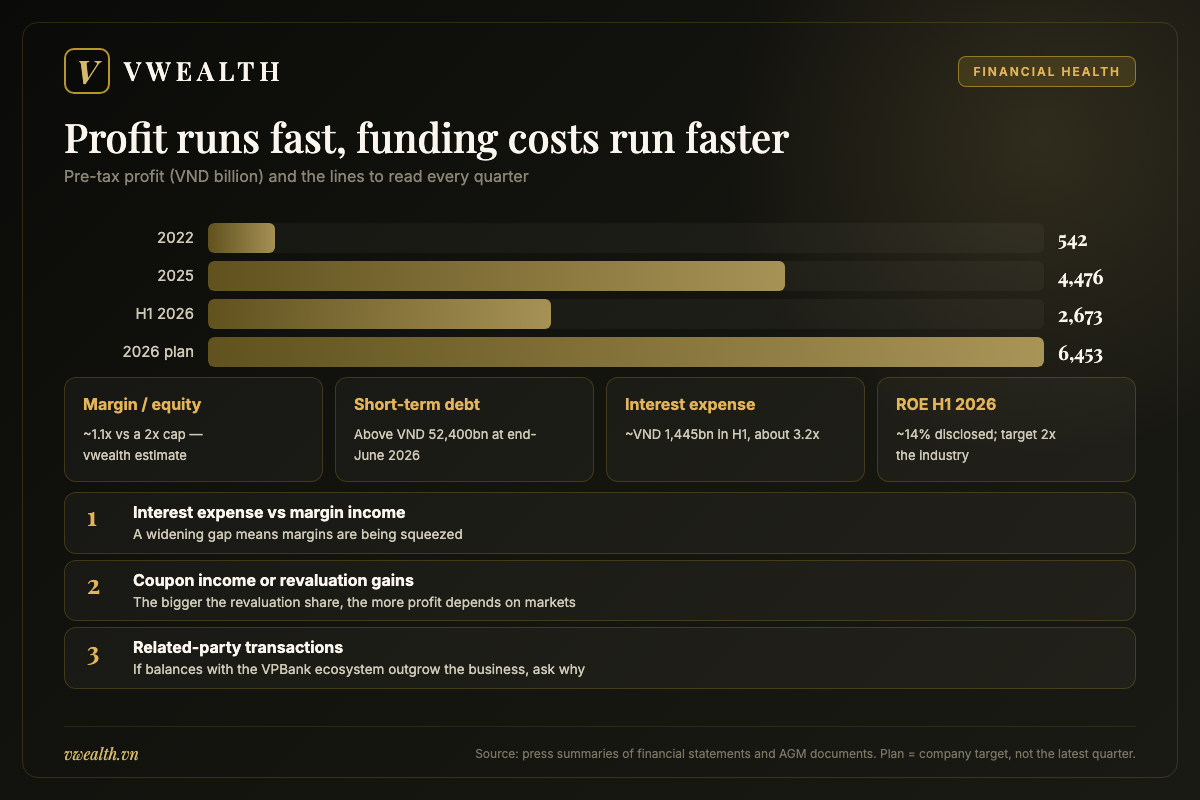
A caveat on the table: these are gross revenue lines. To get to profit, the company deducts interest expense (about VND 1,445 billion in the first half of 2026, roughly 3.2 times a year earlier), any losses on financial assets, and staff and operating costs. The table tells you where money comes from, not which line is most profitable after costs — that is the question chapter 4 digs into.
The bond portfolio and proprietary trading: the biggest engine, and the one to scrutinize hardest
At the end of June 2026, VPBankS’s FVTPL portfolio was about VND 29,500 billion. Of that, bonds accounted for more than VND 18,200 billion and equities (at cost) for nearly VND 6,500 billion; on top of that the company held about VND 4,600 billion of held-to-maturity (HTM) investments. Against total assets of nearly VND 89,000 billion, the FVTPL book is roughly a third (vwealth estimate) — the largest single “warehouse” on the balance sheet, nearly as large as the margin book.
Why would a securities firm hold so many bonds? There are two main reasons, and it is worth separating them. The first is a carry trade: borrow short-term at a lower rate, hold bonds yielding more, and pocket the spread. The second is tied to investment banking: when the firm advises on and arranges a bond issue for a company, it often buys part or all of the issue upfront and then sells it down to investors over time. While it holds the bonds, they sit in the FVTPL book; coupons and any gain on resale flow into “financial assets” revenue. This “buy wholesale, sell retail” model is exactly what TCBS used successfully for years, and it is why you see VPBankS’s FVTPL revenue and investment-banking revenue rise together.
The downside is just as clear. First, when rates rise bond prices fall, and if the portfolio is marked to market, profits take a hit. Second, unlisted corporate bonds cannot always be sold quickly; if the bond market freezes as it did in 2022, the warehouse can sit full for longer than planned. Third, the credit quality of individual issuers is hard for a minority shareholder to see; the financial statements show totals, and the notes only part of the detail. The nearly VND 6,500 billion equity book at cost is another source of volatility: in good years it flatters profits, in bad years it can drag them down.
Margin lending: the fastest-growing engine, fuelled by IPO money and foreign loans
Margin lending means the broker lends investors money to buy more shares, using those shares as collateral. Vietnamese law caps a brokerage’s total margin book at 200% of its equity. That makes this a business where capital determines scale, and it is where VPBankS has grown fastest since the IPO.
Follow the trajectory. At the end of 2022, margin loans and advances were about VND 3,280 billion. At the end of the third quarter of 2025, about VND 27,000 billion, among the three largest in the market. At the end of 2025, about VND 34,093 billion. At the end of the first quarter of 2026, more than VND 36,000 billion. At the end of June 2026, about VND 38,177 billion, up about 12% year-to-date. According to figures cited by Vietstock, VPBankS’s share of industry margin lending rose from about 2% at the end of 2022 to about 8.6% at the end of the first quarter of 2026. The company’s 2026 plan targets an average margin balance of about VND 49,485 billion, and management speaks of a VND 50,000 billion milestone.
Against post-IPO equity of nearly VND 34,000 billion, a margin book of about VND 38,000 billion is only about 1.1 times equity (vwealth estimate), well below the 2x cap — which is why CEO Nham Ha Hai talks about “VND 32,000–33,000 billion of headroom”. That is a big contrast with VietinBank Securities, whose margin book is close to its legal ceiling. VPBankS has room to grow, but filling that room takes cash: equity sets the legal ceiling, while the money to lend has to come from equity plus borrowing. That is why VPBankS planned to raise about USD 450–500 million of foreign loans in 2026, up from about USD 400 million in 2025; in the first half of 2026 it had already raised about USD 200 million from international lenders.
Margin profitability depends on the spread between the rate charged to investors and the cost of funds. A bank-owned broker has a funding edge — it can borrow from international institutions with the group’s reputation behind it, or access bank credit lines more easily. But TCBS, MBS and other bank-owned brokers are exploiting the same edge, so competition is pushing margin lending rates down. For global readers comparing Vietnamese brokers side by side, our guide to the best stock companies in Vietnam summarizes the main players.
Investment banking: home turf thanks to VPBank’s corporate client base
Investment banking (IB) covers services to companies: advising on and arranging bond and share issues, underwriting, and M&A advice. In the first half of 2026, VPBankS booked about VND 1,176 billion of advisory revenue, linked to roughly VND 19,000 billion of corporate bonds it advised on. According to an industry report by S&I Rating cited by Vietstock in 2026, just three firms — TCBS, VPBankS and HDS — account for about 80% of IB revenue across Vietnam’s securities industry.
How did VPBankS get into that top three so quickly? The answer is the ecosystem. VPBank has about 27,000 employees and more than 30 million customers, including around 200,000 small and medium-sized enterprises, according to figures cited in the press. Large corporate borrowers of the bank are often the same entities that need to issue bonds. When the parent already understands a company’s cash flows and collateral, its brokerage subsidiary can advise on an issue faster than an independent firm starting from scratch. VPBankS’s 2030 strategy targets about 18.5% of the corporate bond issuance advisory market and a top-two position in investment banking.
Look at the other side of the coin too. IB revenue is lumpy: a year with a few big deals spikes, a quiet year can fall sharply. And when IB clients are also borrowers of the parent bank, conflict-of-interest questions arise: if a company borrowing from the bank issues bonds to repay that bank, who ultimately bears the risk? Vietnamese regulations have tightened private bond placement and sales to retail investors since 2022, but this remains an area where VPX shareholders should read the related-party notes and the list of major issuers in the financial statements.
Brokerage: small but rising, and its real role
In the second quarter of 2026, VPBankS’s stock brokerage market share on HOSE reached 3.57%, the highest in its history, lifting it to eighth place in the top ten, ahead of KIS Vietnam and Mirae Asset. Sources differ on its first-quarter share: Vietnambiz reported 2.94%, Tinnhanhchungkhoan 3.21%, and AGM materials referred to “about 3.2%”. Whichever figure you use, VPBankS posted the biggest gain among the leading brokers in the second quarter. Its 2026 target is 5% of HOSE; its 2030 target is about 10% and a top-two ranking. By mid-November 2025 it had more than 1 million accounts, about 10% of all securities accounts in the market according to the company.
Still, keep brokerage in perspective. Just over VND 260 billion of half-year brokerage revenue is small next to VND 1,904 billion of margin income. For VPBankS, brokerage is the storefront: it attracts clients who open accounts, trade, and in some cases borrow on margin — which is where the real money is made. Brokerage fees are being pushed down by zero-fee offers across the market, so gaining share does not automatically raise profit much. When you read “VPBankS gains market share”, ask the next question: is the margin book growing with it, and is the margin spread holding?
New products: covered warrants, an AI assistant and a digital-asset exchange
VPBankS is adding products. In covered warrants, on December 30, 2025 it announced its fourth issuance — 23 warrants on 15 underlying stocks, its largest batch so far — spanning banks, technology, retail, real estate and materials. On technology, the company says it has more than 200 tech staff and has launched StockGuru, presented as an investment assistant built on “agentic AI”. In derivatives, its 2030 strategy targets about 20% of the derivatives brokerage market.
The line drawing the most attention is digital assets. In September 2025 VPBankS announced a board resolution to take part in a digital-asset exchange together with VPBank and technology partners. At the 2026 AGM, according to press reports, the VPBank group talked about building a digital-asset exchange named CAEX and a fund management company; the newspaper Dan Viet reported that VPBankS holds a stake worth about VND 1,100 billion in CAEX. VPBank CEO Nguyen Duc Vinh has stressed in another forum that VPBank does not trade digital assets for its own account and only provides transaction services. For VPX investors this is an option: if Vietnam’s legal framework for digital assets develops favorably, it could become a new revenue stream; if not, the capital committed is an opportunity cost. At the time of writing it contributes nothing meaningful to profit, and you should not value VPX on it.
Which lines feed which, and where the moat lies
Draw VPBankS as a diagram and you see three linked loops. Loop one: the parent bank supplies corporate clients → VPBankS advises on bond issues (IB revenue) → the firm buys bonds upfront into its book (FVTPL revenue) → and sells them on to investors. Loop two: IPO capital plus international borrowing → margin loans (interest income) → borrowers trade more (brokerage revenue). Loop three: VPBank’s retail customers → open securities accounts through the app → become brokerage and margin clients.
VPBankS’s moat, then, is not technology or a sales force — things rivals can copy — but two things that are hard to copy: an equity base among the largest in the industry, and access to the corporate client book of a big private bank. The “institutional clients, IB and bonds” strategy is where that moat works best. But the moat does not belong to VPBankS on its own; it belongs to the ecosystem. If the relationship with the parent changed — unlikely, but not impossible — most of the moat would change with it.
Financial position and health: read the numbers before you decide whether to buy VPX stock
A company that grew its total assets roughly 260-fold in four years cannot be read the usual way. Year-on-year comparisons will always show doubling, tripling, quadrupling — and those figures say very little about quality. This chapter walks you through what to look at: true scale, the profit trajectory, where profit comes from, where the funding comes from, and which parts of the story depend on the parent bank. The goal is not to label the company “good” or “bad”, but to give you a set of questions to apply yourself every quarter.
Scale: top tier by equity, top three by margin book
After the IPO, VPBankS had charter capital of VND 18,750 billion and equity of nearly VND 34,000 billion. The company and the press described it as second in the industry by equity right after the IPO; press rankings for the second quarter of 2026 placed it behind TCBS and SSI — the order shifts from quarter to quarter as firms raise capital. Total assets went from about VND 280 billion at the end of 2021 to more than VND 73,000 billion at the end of 2025 and nearly VND 89,000 billion at the end of June 2026. The margin book, about VND 38,177 billion at the end of June 2026, is among the three largest in the market.
For a yardstick, put these numbers next to familiar names. TCBS reported equity of about VND 42,478 billion as of September 30, 2025 in its IPO disclosures and still ranked first by equity in the second quarter of 2026. VietinBank Securities has charter capital of about VND 2,722 billion after its July 2026 stock dividend — less than a tenth of VPBankS. VPS, after an IPO of about VND 12,138 billion, also joined the top group by equity. By capital, VPBankS is no longer a newcomer; it stands alongside the largest firms.
But capital scale is not business scale. A 3.57% HOSE brokerage share shows VPBankS is still mid-sized by active client numbers. And a large equity base means a large denominator for ROE: to earn a high ROE, profits must be correspondingly large. That is why every VPX story eventually comes back to one question: is the company putting all that capital to efficient use?
The profit trajectory: from VND 6 billion in 2021 to a VND 6,453 billion plan for 2026
| Year | Operating revenue | Profit | Notes |
|---|---|---|---|
| 2021 (ASC) | About VND 11 billion | After-tax profit about VND 6 billion | Before VPBank’s acquisition |
| 2022 | About VND 773 billion | Pre-tax about VND 542 billion; after-tax about VND 434 billion | Original plan was VND 632 billion after tax |
| 2023–2024 | No consistent published figures to cite | 2024 pre-tax profit about a quarter of 2025 (implied by the disclosed “four times” growth) | Large capital, profits not yet matching it |
| 9M 2025 | About VND 5,457 billion | Pre-tax about VND 3,260 billion; after-tax about VND 2,614 billion | Nearly four times the prior-year period |
| 2025 | About VND 7,910 billion | Pre-tax about VND 4,476 billion | Revised plan was VND 4,450 billion |
| H1 2026 | About VND 7,013 billion | Pre-tax about VND 2,673 billion; after-tax about VND 2,169 billion | About 63% of the revenue plan and 41% of the profit plan |
| 2026 plan | VND 11,074 billion | Pre-tax VND 6,453 billion (+44%) | Approved at the April 20, 2026 AGM |
| 2030 target | VND 29,051 billion | Pre-tax VND 17,520 billion | About 32% compound annual growth; cost-to-income 23–25% |
One detail deserves attention: after the first half of 2026, VPBankS had reached about 63% of its revenue plan but only about 41% of its profit plan. Revenue running ahead of profit means costs — above all interest expense, up about 3.2 times year-on-year — are eating into margins. The second half would need to be more profitable than the first to hit the plan. Check this when the third- and fourth-quarter 2026 reports come out; open a vwealth report for the latest figures.
Another detail: second-quarter 2026 after-tax profit alone was about VND 1,733 billion, nearly four times a year earlier — which implies first-quarter after-tax profit of only about VND 436 billion (vwealth estimate, half-year minus second quarter). Large swings between quarters are typical of a firm with a big financial-asset portfolio: when equity and bond markets are favorable, revaluation gains are high; when markets correct, profits shrink. When you read VPX’s earnings, don’t multiply one quarter by four to estimate the year.
Earnings quality: how much is recurring, how much depends on markets
Split VPBankS’s revenue into two baskets. Basket one is relatively recurring income: margin interest, coupon income on bonds held, brokerage fees. Basket two is market- and deal-driven income: trading and revaluation gains on financial assets, and bond-issuance advisory fees. Think of basket one as base salary and basket two as bonus.
From the first-half 2026 numbers, a rough cut puts margin interest plus brokerage at about 31% of revenue, and FVTPL plus IB at about 66% (vwealth estimate). FVTPL revenue itself includes coupon income — the more recurring part — as well as trading and revaluation gains; the press does not split the two, so you need the notes to the financial statements. The cautious conclusion: a large share of VPBankS’s profit depends on bond-market conditions, interest rates and share prices, not just on how many clients borrow on margin.
Among the brokerages in this series, VPBankS’s mix is closest to TCBS — also strong in bonds and IB — and quite unlike VPS, where brokerage and margin are the pillars. It also differs from VietinBank Securities in that VPBankS’s book leans toward bonds rather than proprietary equities. Each mix carries its own risk: an equity book fears a crash; a bond book fears rising rates and troubled issuers.
Leverage and funding: VND 52,400 billion of short-term borrowing
At the end of June 2026, VPBankS had total liabilities of nearly VND 53,300 billion, of which short-term borrowings were more than VND 52,400 billion. With total assets of nearly VND 89,000 billion, equity was roughly VND 35,700 billion and the debt-to-equity ratio about 1.5 times (vwealth estimate, total assets minus liabilities). Compared with a bank — typically leveraged more than 10 times — that is low; compared with many brokerages, it is moderate. But note the word “short-term”: almost all borrowings mature within a year, while part of the asset side — corporate bonds, held-to-maturity investments — has longer maturities.
Why do brokerages borrow mostly short-term? Because margin loans are also short-term and can be called quickly if needed. The margin book matches short-term debt reasonably well. The bond book is harder to match: if banks and lenders ever declined to roll over short-term loans, the company would have to sell bonds to repay, and in a weak bond market the price could be poor. This is the liquidity risk every bond-heavy brokerage carries, and it is why the relationship with a parent bank — a natural backstop for liquidity — has real value.
Part of the debt is foreign-currency borrowing from abroad: USD 125 million in May 2025, a syndicated loan of up to USD 200 million arranged by SMBC in October 2025, about USD 200 million raised in the first half of 2026, and a USD 450–500 million plan for full-year 2026. Foreign-currency loans usually carry lower nominal rates but bring exchange-rate risk unless hedged. VPBankS’s financial statements are where you check whether it uses currency hedges and what they cost. This is also where the “bank’s child” advantage is most visible: a brokerage just over three years old would struggle to raise hundreds of millions of dollars in syndicated loans without the VPBank ecosystem and the SMBC relationship behind it.
Ecosystem dependence and related-party transactions: read the notes, not just the headlines
For a company roughly 80% owned by its parent bank, sharing its head office, its customer base and its route to corporate clients, related-party transactions are unavoidable. They may include VPBankS deposits at VPBank, loans or credit lines from VPBank, fees paid to the bank for client referrals or shared infrastructure, and bonds issued by ecosystem companies or bank clients that VPBankS advises on or holds. The press does not publish item-by-item detail; you need to read the “transactions and balances with related parties” note in VPBankS’s audited and reviewed financial statements to know the real scale.
Why does this matter? Three reasons. First, related-party transactions are not bad in themselves — often they are what creates the cost and client advantages. But their pricing (deposit rates, referral fees, bond purchase prices) determines whether profit flows to the subsidiary or to the parent, and VPX minority shareholders only share in what flows to the subsidiary. Second, if a meaningful share of IB revenue comes from the parent’s clients, that revenue does not fully “belong” to VPBankS. Third, dependence raises concentration risk: if the VPBank ecosystem hits trouble — say, a group of the bank’s large corporate clients weakens — both the bank’s loans and the bonds in VPBankS’s book could be hit together.
We have no basis to say current transactions are problematic. Our point is about method: when you buy a bank’s brokerage subsidiary, you are buying a slice of an ecosystem you do not control. Treat the related-party note as seriously as the income statement. If you own both VPB and VPX, remember that the two holdings are more correlated than they may look.
Seven questions to ask every time VPBankS reports
One: how much did the margin book grow, and how many times equity is it now? The benchmark is about VND 38,177 billion at end-June 2026 and the 200%-of-equity cap. Fast growth helps revenue, but fast growth during a hot market also raises the risk of mass margin calls when the market turns.
Two: is interest expense growing faster or slower than margin income? In the first half of 2026, interest expense rose about 3.2 times and margin income nearly 3 times. If the gap widens, margins are being squeezed.
Three: within FVTPL revenue, how much is coupon income and how much is trading and revaluation gains? The bigger the second part, the more profit depends on markets.
Four: which issuers make up the bond book, and is it concentrated in a few groups? The benchmark is more than VND 18,200 billion of bonds at end-June 2026.
Five: is IB revenue steady across quarters? A one-quarter spike may reflect a single large deal; look at the four-quarter average.
Six: how are transactions and balances with VPBank and ecosystem companies changing? If balances grow faster than the business, find out why.
Seven: is ROE moving toward target? Disclosed ROE for the first half of 2026 was about 14%. The 2030 strategy targets ROE and ROA of roughly twice the industry average. If ROE stalls while capital keeps rising, the growth story is being diluted by the sheer size of the equity base.
How the market has received VPX stock: a record IPO, then months below the offer price
Follow VPX for a while and you run into a paradox: the company reports profits up three- or four-fold, yet the stock spent months below its IPO price. The paradox is not unique to VPX — TCX and VCK also had difficult first months — but VPX has its own reasons. This chapter recounts how the market received the stock, and shows you how to value a brokerage whose assets are mostly bonds and loans.
The IPO: 14.3 times expected earnings and 30 days to listing
At the offer, VND 33,900 per share implied a P/E of about 14.3 times expected 2025 earnings and a P/B of about 2.4 times, according to figures reported from the offering materials — presented at the time as below the sector average. Note that the 2.4x P/B was calculated on pre-IPO equity; once VND 12,713 billion of new money was added to equity, the same VND 33,900 price implied a noticeably lower P/B — a technical point many readers missed. VPBank CEO Nguyen Duc Vinh said at the time the bank expected VPBankS to beat its 2025 profit plan by about 10–15% and aimed for at least 50% profit growth in 2026. In reality, 2025 profit only slightly beat the revised plan, and the 2026 plan was set at about 44% growth.
The offering was distributed through Vietcap, SSI and SHS plus 12 supporting firms. Institutions made up about half of registrations. Demand exceeded supply, but not by much — about 390.5 million shares bid for 375 million offered, roughly 1.04 times (vwealth estimate). By comparison, TCBS’s IPO was about 2.5 times subscribed. This was a first signal that the market accepted the price without scrambling for shares.
VPBankS then listed only about 30 days after the IPO closed — the fastest ever, thanks to new rules shortening the timeline. That speed was good for IPO buyers wanting early liquidity, but it also meant a large block of new shares hit the market at once, alongside several other big IPOs.
Debut day and the first months on the exchange
As chapter 1 described, VPX closed its first session on December 11, 2025 at VND 30,800, down 9.14%, with foreign investors net selling nearly VND 72 billion. The press cited several reasons: too much new supply in a short period as a series of IPOs listed together, rising interest rates and a volatile currency dampening risk appetite, and an IPO valuation that already priced in much of the good news. The VN-Index also lost the 1,700-point mark that day.
Over the following months, according to chair Ho Thuy Nga at the April 2026 AGM, the stock reached VND 34,500 in March 2026 — slightly above the IPO price — before falling back on macro factors. At the time of the meeting it was still below VND 33,900, and shareholders questioned management about it. We do not quote today’s price; open a vwealth report to see where VPX trades relative to the IPO benchmark.
The lesson: strong earnings are not enough to lift a newly listed stock above its IPO price when supply is heavy and sentiment is poor. IPO buyers often want to “get back to even” — selling when the price returns near their cost — which creates a natural psychological resistance around VND 33,900. It is a behavioral tendency, not a law, but it helps to know it exists.
How to value VPBankS: why P/B and ROE must be read together
For a brokerage whose assets are mostly financial assets — bonds, equities, margin loans — book value is the most important valuation anchor. P/B (price to book value per share) tells you how much the market pays for each dong of equity. But P/B alone says little: a firm with a 25% ROE deserves a much higher P/B than one earning 10%.
A common rule of thumb: a fair P/B rises with the gap between sustainable ROE and the return shareholders require. Illustrative example: if investors demand 13% a year to hold a brokerage stock, a firm with a sustainable 13% ROE should trade around 1x book; a sustainable 20% ROE would justify much more. This is a thinking framework, not a price-target calculation.
Apply it to VPBankS and the issue is obvious: first-half 2026 ROE was disclosed at about 14%, while the 2030 strategy aims for roughly twice the industry average. If you believe the company will get there, today’s P/B (see the vwealth report) may be cheap. If you think ROE will stall near current levels because the capital base is so large, today’s P/B may already be fair. At the 2026 AGM management cited P/B of about 1.62x versus an industry average of about 2.01x and P/E of about 12.69x versus 14.74x — figures as of that meeting. Because VPBankS holds so many bonds, bank-style P/B-versus-ROE logic applies well; our Vietnam banking sector guide explains that framework.
Why might VPX be valued below TCX even though both are brokerages owned by large private banks? A few hypotheses you can test: VPBankS has a much shorter track record at scale; a large share of its profit comes from the bond and proprietary book, which the market tends to see as less durable; and its free float is low. Conversely, VPX would earn a re-rating if the company proved it could grow profit steadily over many quarters without needing more capital.
Stock personality, foreign investors and the FTSE Russell upgrade
Brokerage stocks generally have high beta — they move more than the overall market: when the VN-Index rises 10%, brokerages usually rise more, and the reverse on the way down. The reason is simple: brokerage profits are sensitive to market turnover, margin balances and asset prices. VPX may inherit that personality, plus the traits of a newly listed stock with a free float of around one-fifth.
Foreign investors were net sellers on day one, yet Dragon Capital — one of the longest-standing foreign investors in Vietnam — subscribed in the IPO. The signals are not contradictory: foreign investors are not a single bloc. With Vietnam’s upgrade from frontier to emerging status under FTSE Russell’s classification, large-cap brokerage stocks are expected to benefit twice: new foreign inflows raise market turnover (lifting brokerage and margin revenue), and the stocks themselves may be bought by index funds. But VPX, with its low free float, may enter indices at a small weight. For background on the upgrade and its possible paths, see our analysis of Vietnam’s emerging-market scenarios.
Catalysts that could change how the market sees VPX
Watch five events, each of which could shift how the market values VPX. First, whether the 2026 profit plan (VND 6,453 billion pre-tax) is met — this is the first full year after the IPO, and the market will use it to judge the credibility of the 2030 targets. Second, whether brokerage share reaches 5% by the end of 2026. Third, new international loans — their size and terms reflect the company’s credit standing. Fourth, developments at the CAEX digital-asset exchange and the accompanying legal framework. Fifth, any change in ownership: VPBank selling down, a new strategic investor, or a new share issue to raise capital.
Beyond these company-specific catalysts, VPX is also driven by sector-wide variables: market liquidity, interest rates and the corporate bond market. The next chapter places VPBankS in that wider picture.
The industry context: the race among Vietnam’s bank-owned brokerages, and where VPBankS stands
Ten years ago, if you asked which Vietnamese brokerage was strongest, the answer would have been SSI, HSC or VNDirect — independent firms or ones tied to financial groups, not to commercial banks. Today the picture has changed. According to second-quarter 2026 equity rankings cited in the press, three of the top five — TCBS, VPBankS and VPS — either belong to a bank or were born inside one. VPBankS is the most extreme example of that trend. This chapter places it in the industry, and compares it directly with the two sibling cases this series just analyzed: TCX and CTS.
The rise of bank-owned brokerages
According to VIS Rating, bank-owned brokerages’ share of industry margin lending rose from about 19% in 2022 to about 30% in 2024. According to an industry report cited by Vietstock in 2026, the group earned a return on average assets of about 5.5%, above the industry average of about 3.5%. Three advantages are usually cited: lower funding costs thanks to the parent’s reputation and resources, a ready-made client base for cross-selling, and an established brand.
VPBankS is the clearest illustration. In less than four years under VPBank it reached the leading group on almost every key metric — asset size, charter capital, margin book, brokerage share and IB revenue — according to industry reports. No independent Vietnamese brokerage has grown that fast, because none received about VND 15,000 billion of capital in a single year from a single shareholder.
But the bank-owned advantage has limits. When many banks follow the same route — Techcombank with TCBS, VPBank with VPBankS, MB with MBS, TPBank with ORS (Tien Phong Securities), VietinBank with VBSE, Vietcombank with VCBS, BIDV with BSC — each one’s relative edge narrows. Bank-owned brokers now compete with each other, not just with independents.
The capital and margin race: when everyone has money
2025 was unprecedented for fundraising: TCBS, VPBankS and VPS all went public within less than three months, each raising around VND 12,000 billion. In the same period MBS ran an offering to lift capital to about VND 10,000 billion, VCBS raised its charter capital from VND 2,500 billion to VND 8,500 billion by late May 2026 with plans to reach VND 12,500 billion, and SSI also raised significant capital. The industry’s equity swelled in a short time.
With abundant capital, competition shifts to margin lending rates. Firms with cheaper funding can lend at lower rates while keeping their spread. VPBankS’s advantage is access to international loans via the SMBC relationship; its disadvantage is that interest expense is rising fast — about 3.2 times in the first half of 2026. The margin race also raises systemic risk: when industry-wide margin debt hits record highs, a sharp correction can trigger cascading forced selling. That risk is shared, not unique to VPBankS, but the firm with the fastest-growing margin book will be watched closely.
The corporate bond market: VPBankS’s main arena after the 2022 storm
After 2022, Vietnam’s corporate bond market went through two years of restructuring: many issuers had to extend maturities and renegotiate with bondholders, and rules on professional investors and private placements were tightened. From 2024 the market gradually recovered, with banks and large companies as the main issuers. That is the environment in which VPBankS built its IB business: roughly VND 19,000 billion of bonds advised in the first half of 2026 shows it has a foothold.
But the bond market remains confidence-sensitive. A large default or a sudden new regulation could freeze issuance and distribution for months — as happened to TCBS in 2022. For VPBankS the hit would come from two sides: lower IB revenue and a bond book that is harder to sell down. That is why the corporate bond market ranks among the most important variables in chapter 7.
Brokerage competition: fees heading to zero, share fragmenting
In the second quarter of 2026, the top ten HOSE brokers by market share were VPS 12.61%, SSI 11.17%, TCBS 9.36%, Vietcap 7.00%, HSC 6.80%, MBS 4.79%, VNDirect 3.96%, VPBankS 3.57%, KIS Vietnam 2.99% and Mirae Asset 2.94%. The top ten’s combined share fell to about 65.19%, the lowest since the fourth quarter of 2022; VPS still led but at its lowest share in 22 quarters. The market is fragmenting, and bank-linked brokers are gaining.
The fee war — kicked off by TCBS’s zero-fee program in 2023 — has turned brokerage into a thin-margin business. For VPBankS this matters less than for VPS, since brokerage is only about 4% of revenue. But it also means the 10% share target for 2030 will be expensive: winning clients from rivals in a low-fee market requires spending on technology, marketing and incentives.
VPX, TCX and CTS: three bank-owned brokers, three paths
This is the part readers of all four brokerage articles in the series will find most useful. TCX and VPX are brokerages of two large private banks, both IPO’d in 2025, both strong in bonds and margin. CTS is the brokerage of a state-controlled bank. Side by side, the three show how much “how the parent raises its child” shapes a securities firm.
| Metric | VPBankS (VPX) | TCBS (TCX) | VBSE (CTS) |
|---|---|---|---|
| Parent bank | VPBank (private); owns about 80% | Techcombank (private); owns about four-fifths | VietinBank (state-controlled); owns about 75.6% |
| Founded / joined the bank | 2009 (Asia Securities); bought by VPBank January 2022 | 2008, set up by Techcombank | September 1, 2000, set up by VietinBank |
| IPO / listing | VND 33,900; HOSE December 11, 2025 | VND 46,800; HOSE October 21, 2025 | HNX 2009, moved to HOSE June 20, 2017 |
| Capital | Equity nearly VND 34,000 billion post-IPO | Largest equity in the industry (VND 42,478 billion at September 30, 2025) | Charter capital about VND 2,722 billion |
| Main profit engines | Bond/FVTPL book, margin, IB | Margin, IB and bond distribution | Proprietary trading and margin |
| Brokerage | 3.57% HOSE share in Q2 2026, top 8 | 9.36% in Q2 2026, top 3 | Outside the top 10 |
| Distinctive strength | Fastest ramp-up; international loans via SMBC | Ten-year head start; digital platform; bond franchise | Long track record; state-enterprise clients |
| What to watch | Short track record at scale; ecosystem dependence; no 2026 dividend | Bond risk; low free float | Small capital; margin near cap; volatile profit |
The table shows that TCX and VPX are more alike than different. Both are “balance-sheet factories” tied to private banks, using large capital for margin and IB. The differences are age and position: TCBS came through the 2022 bond storm at scale with its reputation intact; VPBankS grew mostly after that storm, so it has not faced an equivalent test. If you read our TCX piece and liked the model, the question with VPX is whether you want to bet on “the latecomer running faster”, and how big a valuation discount you require for the shorter track record.
CTS sits at the opposite end: history without capital. The comparison reminds you that a large parent bank does not automatically create a large brokerage — what matters is whether the parent is willing to inject capital. VPBank chose to inject heavily and fast; VietinBank chose caution. Each choice has a price. Other peers are worth a look too: SSI, the oldest of the leaders, balances retail and institutional clients (see our SSI stock analysis), and MBS is another bank-owned broker that relies on the MB ecosystem and a traditional sales force (see our MBS stock analysis).
Outlook: three scenarios for VPX stock and the conditions behind each
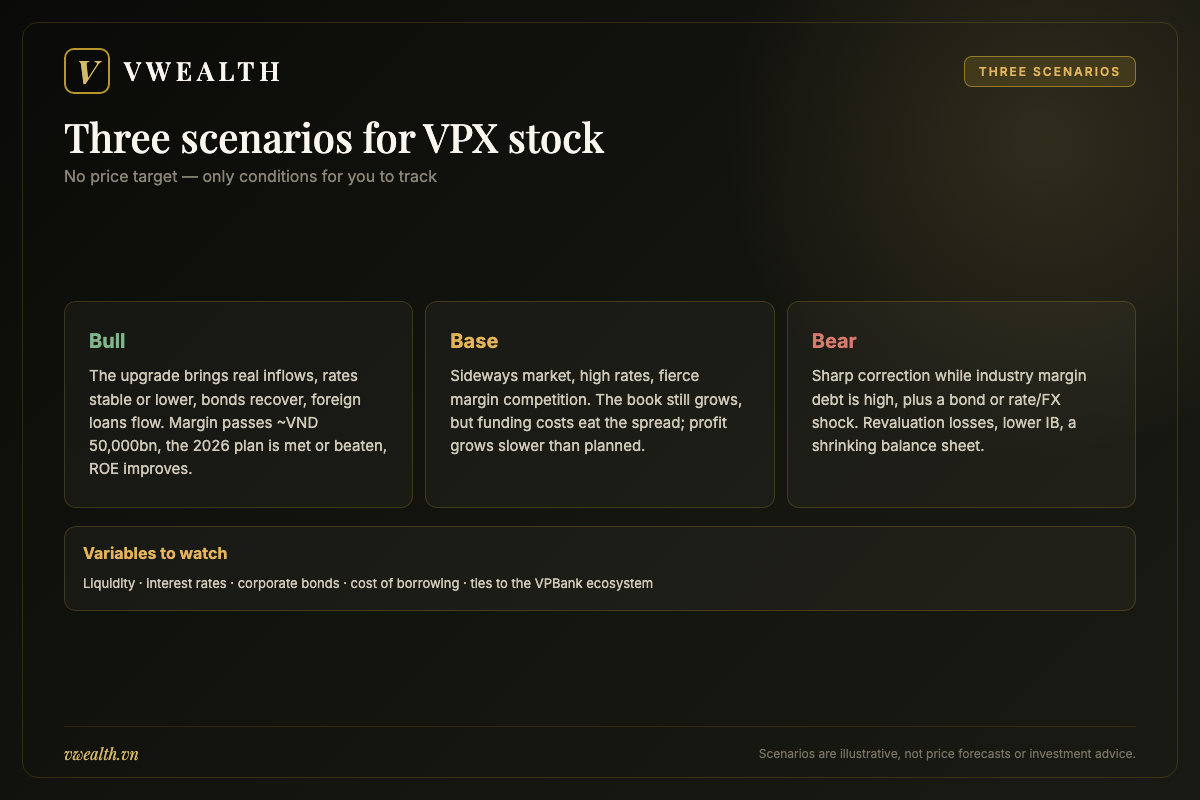
We do not forecast share prices. What we can do is identify the variables that will decide VPBankS’s future and describe three scenarios — bull, base and bear — along with the conditions each requires. You do not need to guess which one comes true; you only need to track the conditions and update your view when they change.
Five variables that will decide VPBankS’s future
One: stock-market liquidity. High turnover feeds margin balances and brokerage fees; low turnover shrinks both. The market upgrade could lift liquidity in the medium term.
Two: interest rates. Falling rates lift bond prices (good for the FVTPL book), cut funding costs (good for margin spreads) and push money toward equities. Rising rates do the opposite. This is probably the variable with the broadest impact on VPBankS, because it touches all three profit engines at once.
Three: the corporate bond market. Issuer demand, investor appetite and regulation drive IB revenue and how quickly the bond book can be turned over.
Four: the cost and availability of borrowing. With a USD 450–500 million foreign borrowing plan for 2026, international lending conditions and the exchange rate hit margins directly.
Five: the relationship with the VPBank ecosystem. The parent’s health, group strategy, and whether the group keeps prioritizing its brokerage — including decisions on further capital injections, stake sales, or using VPBankS for new lines such as digital assets.
Bull case: new liquidity, lower rates, targets hit early
Conditions: the upgrade turns into real foreign inflows and HOSE turnover stays high; interest rates are stable or falling; the corporate bond market keeps recovering without a major default; VPBankS borrows abroad smoothly at reasonable cost.
What could happen: the margin book reaches and passes about VND 50,000 billion; brokerage share tops 5%; IB revenue grows steadily; the bond book books revaluation gains as rates fall. The company meets or beats its 2026 pre-tax plan of VND 6,453 billion, and the market starts to believe in the 2030 roadmap. ROE improves clearly from the roughly 14% of the first half of 2026.
For the stock: in this scenario the market might value VPX closer to TCX, and the VND 33,900 IPO price would stop acting as a psychological ceiling. But remember: a brokerage bull case usually comes with a hot market — when every brokerage stock rises, and when risk builds up the most.
Base case: margin-led growth, gradually thinner spreads
Conditions: the market moves sideways with average turnover; rates edge up or stay high; margin competition among bank-owned brokers stays intense; the bond market recovers slowly.
What could happen: the margin book still grows thanks to unused IPO capital, but interest expense rises faster than interest income, squeezing margins — a trend already visible in the first half of 2026. Profit still grows but may miss the 44% plan; ROE stays around current levels. The market discounts the 2030 targets.
For the stock: VPX would likely trade with the brokerage group, without a strong company-specific driver to set it apart. With no dividend, holders would have to wait longer to see a return.
Bear case: a double shock from equities and bonds
Conditions: the stock market corrects sharply while industry margin debt is high, triggering forced selling; at the same time, the corporate bond market suffers a shock — a large issuer default or abrupt regulatory tightening; or interest and exchange rates rise sharply, raising the cost of foreign-currency borrowing.
What could happen: the FVTPL book records revaluation losses; part of the margin book turns risky; IB revenue drops as companies delay issues; the company has to shrink its balance sheet to protect liquidity. Profit could fall well below the prior year. In this scenario the parent’s role as a liquidity backstop becomes important — but that support would be the bank’s decision, not a legal commitment to VPX shareholders.
For the stock: brokerage stocks usually fall faster than the market in this scenario. With a low free float and IPO holders under water, selling pressure could be heavy. Decide in advance the maximum loss you can accept.
Illustrative example: how sensitive VPBankS’s profit is to the margin spread
To get a feel for the sensitivity, run a simple calculation. This is an illustrative example using round numbers and assumptions, not a forecast.
Suppose the average margin book for the year is VND 45,000 billion (illustrative, between about VND 38,000 billion at mid-2026 and the roughly VND 50,000 billion target). If the spread between the margin lending rate and the average cost of funds is 4 percentage points, net interest income from margin is about VND 1,800 billion a year. If the spread shrinks to 3 points because of competition and higher funding costs, that falls to about VND 1,350 billion — a loss of about VND 450 billion, or roughly 7% of the 2026 pre-tax plan (illustrative). If the spread widens to 5 points, income rises by about VND 450 billion.
The same logic applies to the bond book: with about VND 18,200 billion of bonds, a 2% fall in portfolio value from rising rates (illustrative) would mean about VND 364 billion of revaluation losses. Combine the two effects and a year of “rates going the wrong way” could take away more than a tenth of the profit plan (illustrative: about VND 814 billion against VND 6,453 billion). Actual figures depend on portfolio duration, asset classification and hedging — all things you need to read in the notes.
The takeaway: VPBankS’s profit is far more rate-sensitive than a pure broker’s. When you follow VPX, watch interbank rates and government bond yields alongside the VN-Index.
So, should you buy VPX stock? A straight answer
After seven chapters, you have the material to answer the question yourself. This final chapter does not issue a buy or sell recommendation. It puts the pros and cons on the scale, then says plainly who the stock suits and who it does not.
The compelling positives
Large capital with room to deploy. Nearly VND 34,000 billion of post-IPO equity puts VPBankS in the industry’s top tier, and its margin book is only about 1.1 times equity (vwealth estimate) — room to grow without new capital. That is a big difference from firms already near the cap, such as VietinBank Securities.
Real, demonstrated profit growth. From about VND 6 billion of after-tax profit in 2021 to about VND 4,476 billion of pre-tax profit in 2025 and about VND 2,673 billion in the first half of 2026. Much of that growth came from deploying new capital, but the numbers are real.
The VPBank ecosystem and the SMBC relationship. More than 30 million bank customers, around 200,000 SMEs, and the ability to borrow hundreds of millions of dollars internationally — advantages independent brokers lack.
A place among the IB leaders. Together with TCBS and HDS, about 80% of industry IB revenue according to S&I Rating — a business with high barriers to entry.
A valuation management says is below the sector average. At the 2026 AGM, P/B and P/E were cited below industry averages. That is the company’s argument; verify it against current data.
The negatives you cannot ignore
A very short track record at scale. VPBankS has operated at its current size for roughly two years and has not been through a full bad market cycle. Nobody knows for sure how its risk management would hold up under a shock.
Market-dependent earnings. About half of revenue comes from the financial-asset portfolio (vwealth estimate). Profit can swing sharply between quarters, as the first and second quarters of 2026 showed.
Fast-rising funding costs. Interest expense rose about 3.2 times in the first half of 2026, faster than margin income. Borrowings are almost entirely short-term, partly in foreign currency.
Ecosystem dependence and related-party dealings. The moat belongs more to the ecosystem than to VPBankS itself, and minority shareholders’ interests may not be the group’s top priority.
No 2026 dividend and a low free float. Your return depends entirely on the share price, while only about a fifth of shares trade freely and there is psychological resistance near the IPO price.
| On the scale | For | Against |
|---|---|---|
| Capital | Nearly VND 34,000 billion of equity; margin book far from the cap | A large capital base makes a high ROE harder unless deployed efficiently |
| Profit | Fast growth, backed by real figures | Volatile; only 41% of the 2026 plan reached in the first half |
| Business model | IB, bonds, margin — high barriers | Sensitive to rates and the corporate bond market |
| Parent bank | Clients, reputation, international funding | Dependence, related-party dealings, group priorities |
| Stock | Valuation said to be below the sector average | No 2026 dividend, low free float, short trading history |
Who VPX stock suits
Investors who believe in an upcycle for Vietnam stocks and want a leveraged way to ride it. If you think the upgrade and stable rates will bring a period of high turnover, VPX offers exposure through a large capital base with plenty of margin headroom.
Investors who accept volatility and think in years. The 2030 target is a five-year goal. If you hold VPX, think in years, not weeks, and be ready for quarters when profit goes down.
Investors who want the “private-bank brokerage” model at a valuation said to be below TCX’s. If you like the TCBS story but want a younger, faster-growing version — and accept a shorter track record — VPX is worth weighing next to TCX.
Who it does not suit
Income investors. There is no dividend for 2026, and policy for later years is unclear. Investors already heavy in VPB. Adding VPX raises concentration in one ecosystem. Investors who don’t follow rates and bonds. VPBankS’s profit is sensitive to both; watching only the VN-Index misses most of the story. Anyone buying because of the name. If you meant to buy “VPBank Securities” because you think it is the largest retail broker, you are thinking of VPS — ticker VCK. Make sure you know which company you are buying.
VPBankS is an experiment in speed: what happens when a big private bank decides to build a top-tier brokerage from a small shell, with its own money, as fast as possible. The first four years produced impressive scale and profit. But the stock market does not score speed; it scores durability. The question of whether to buy VPX stock therefore comes down to one sentence: do you believe this rapidly built machine will run reliably through a bad market cycle, and do you accept that you are buying a piece of the VPBank ecosystem, not just a brokerage?
This article is not a buy or sell recommendation. Before deciding, check current data — price, P/B, P/E, latest quarterly profit, margin book, bond portfolio, interest expense — in a vwealth report, and weigh your own risk tolerance. If you are exploring Vietnamese brokerages, the TCX, VCK, CTS, SSI, MBS and VIX analyses in this series make good comparisons, and our guide to investing in Vietnam stocks covers the practical steps. You can sign up for vwealth to follow updated VPX reports every quarter.
Research Vietnamese stocks in English with vwealth. Our AI-powered platform turns Vietnamese market data into full English analysis reports — with international payment support and a free 2-month trial for new accounts. Create your free account and read the latest reports.


