The question is Vietnam an emerging market has had a definite answer since October 2025, and a specific date attached since April 2026. FTSE Russell reclassifies Vietnam from Frontier to Secondary Emerging effective 21 September 2026.
What remains genuinely open is narrower than the volume of commentary suggests: the final constituent list, expected in August, and how prices respond. Everything else being written about September is inference layered on four settled facts.
This piece sets out those four facts, three scenarios each tied to something you can check, and the three distinct flow mechanisms that most coverage blends into one.
Is Vietnam an emerging market now?
Short answer: Under FTSE Russell’s classification, from 21 September 2026 — yes, at the Secondary Emerging tier. Under MSCI’s separate framework, no equivalent decision has been made. The two providers apply different criteria on different calendars, so the answer depends on which one you mean.
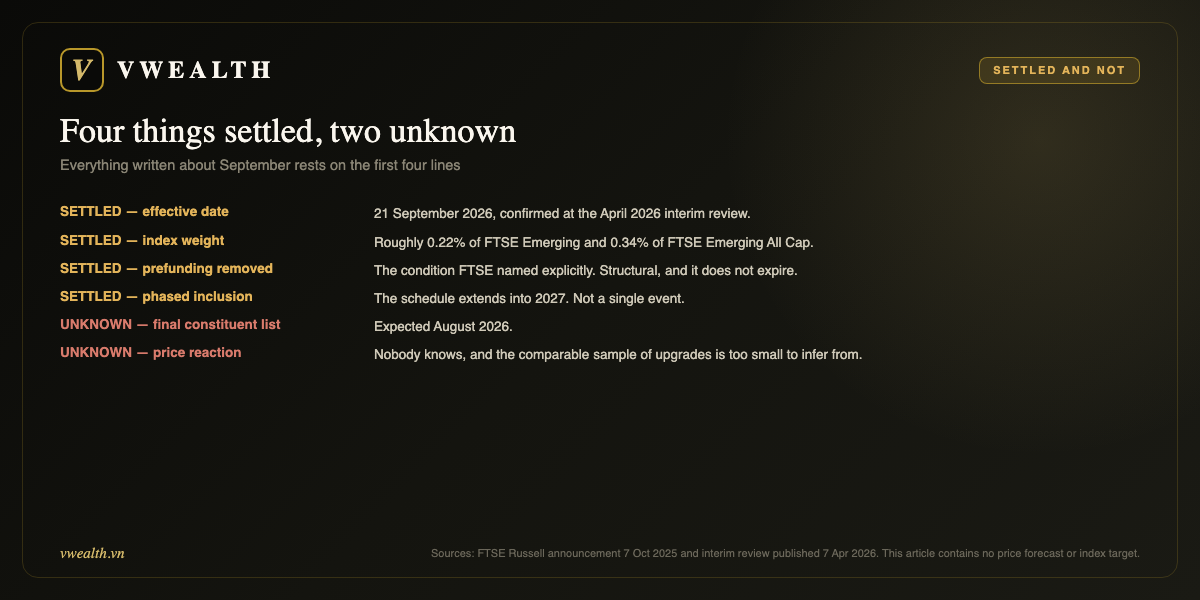
What is settled and what is not
Settled
The effective date. 21 September 2026, confirmed at the interim review published 7 April 2026. That review was the point at which the decision could have been delayed; it was not.
The index weight. Roughly 0.22% of FTSE Emerging and 0.34% of FTSE Emerging All Cap, on FTSE’s own estimates at that review. This bounds the passive flow arithmetic.
The prefunding removal. Foreign institutions no longer have to place cash before trading. This was the condition FTSE named explicitly, it has been implemented, and unlike an index event it does not expire at the next review.
Phased inclusion. The schedule extends into 2027. The effective date is not the day the money arrives.
Not settled
The final constituent list. FTSE has identified around 28 stocks as indicative, including four large caps — HPG, VCB, VIC, VHM — and three mid caps — MSN, SAB, VNM. The list is explicitly subject to change, with the official version expected in August 2026.
The price reaction. Nobody knows. The comparable sample of market upgrades is small, each market differs, and pattern-matching across a handful of cases is not evidence.
How to read commentary against this
When you encounter a view on September, separate it into the four settled facts plus whatever assumptions the author has added. The assumptions are where the disagreement lives, and they are usually unstated.
How the two index providers differ
Since the answer to the headline question depends on which provider you mean, the difference deserves setting out properly.
Different tier structures
FTSE Russell operates Developed, Emerging split into Advanced and Secondary, and Frontier. Vietnam moves into Secondary Emerging — the lower of the two emerging tiers.
MSCI uses Developed, Emerging and Frontier with no split inside Emerging. That structural difference alone means the two decisions are not equivalent events.
Different emphasis
Both assess market accessibility, and they weight the components differently. MSCI places more weight on currency convertibility and on the accumulated experience of foreign institutional investors operating in the market. FTSE weights settlement mechanics and market infrastructure relatively more heavily.
This is why a market can satisfy one provider well before the other.
Different capital pools
The money tracking each provider’s indices is different in size and belongs to different institutions. An upgrade by one mobilises only the money tracking that one.
Practically: you cannot add FTSE and MSCI flow estimates together, and you cannot use one as a proxy for the other.
What this means for the headline question
From September 2026, Vietnam is an emerging market for the purposes of FTSE-tracking capital and remains a frontier market for MSCI-tracking capital. Both statements are true simultaneously, and any commentary that does not name the provider has skipped the most important word in the sentence.
The access change, examined properly
Of the four settled facts, one deserves more attention than it receives, because it is the only structural change among them.
What prefunding meant
A foreign institution had to hold cash in the account before an order could be placed. Money was wired ahead, sat idle, and carried currency exposure for the entire waiting period.
For a fund running billions across dozens of markets, that is a measurable operational cost. More importantly, many institutional mandates prohibited prefunding into a frontier market outright — so the constraint was not a preference but a hard block.
Why removing it matters more than inclusion
Index inclusion mobilises money that has no choice. Removing prefunding admits money that previously could not participate at all, and that money makes its own decisions about whether to stay.
The first is a bounded, scheduled event. The second is an ongoing change in who can be a buyer.
The caveat
A market-level rule and an individual broker’s operational workflow are not the same thing. If you are setting up now, ask a prospective broker specifically how they operate under the new model. Covered in choosing a broker in Vietnam.
Three scenarios, each checkable
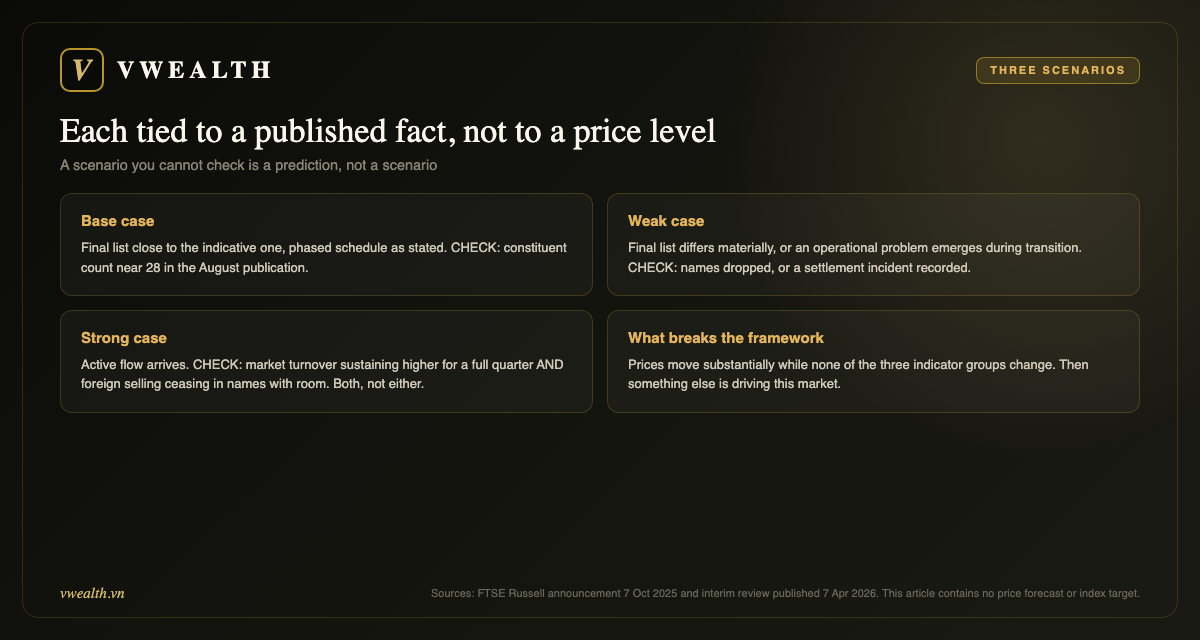
Base case
Content: the official list lands close to the indicative one, with the phased schedule as described.
Check condition: constituent count near 28 in the August publication, and the four named large caps still present.
Consequence: passive flow behaves exactly as the weight arithmetic implies — modest, spread across names and quarters, and considerably smaller than the language used to describe it.
Weak case
Content: the final list differs materially, or an operational problem emerges during the transition to the non-prefunding model.
Check condition: names dropped from the indicative list, or a settlement incident recorded during this period.
Consequence: the anticipation premium already sitting in dropped names comes out. This is a two-way risk and the main argument against concentrating before August.
Strong case
Content: active flow arrives — funds benchmarked to the index but not tracking it decide to allocate.
Check condition: market turnover sustaining higher across a full quarter, and foreign net selling ceasing in names with foreign room remaining. Both, not either.
Consequence: this is the scenario with real scale, because active money dwarfs the passive obligation. Nothing guarantees it happens.
What would break the framework
If prices move substantially while none of the three indicator groups change, something is driving this market that the framework does not capture. The correct response is to find out what, not to adjust the scenarios until they fit.
Three flow mechanisms, separated
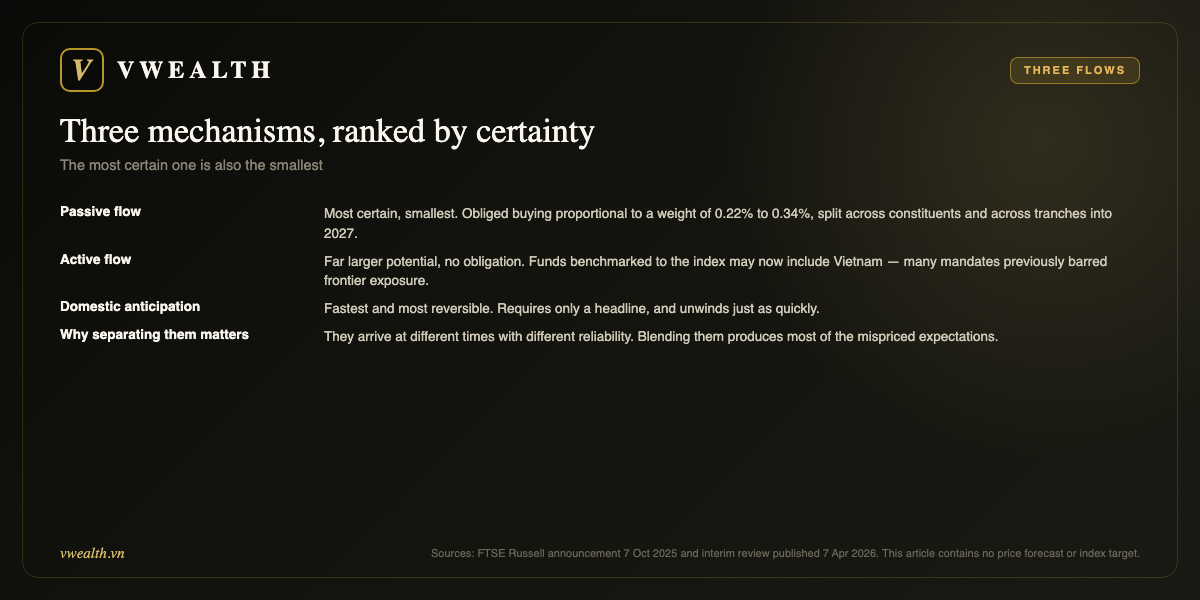
Passive flow
Index-tracking funds are obliged to buy in proportion to weight. This is the only mechanism you can size with arithmetic in advance.
It is also the smallest. Take the total tracking FTSE Emerging, multiply by 0.22%, divide across the constituents by investable market cap, then divide again by the number of inclusion tranches into 2027. After three divisions the amount reaching any single name in any single quarter is far below what the headlines imply.
That is not a bearish argument. It is long division.
Active flow
Funds that benchmark against the index without tracking it. Once Vietnam sits in the emerging category, it enters their investable universe — many mandates previously prohibited frontier exposure outright.
Potential scale is far larger. Nothing compels it: each manager decides on valuation, earnings growth and currency outlook.
Domestic anticipation
Appears earliest and moves hardest, because it requires only a headline rather than any operational change. It also reverses fastest when expectations are not met.
Why separation matters
The three arrive at different times with different reliability. Blending them into a single “money is coming” narrative produces most of the mispriced expectations around this event.
What history suggests, with the caveat attached
Several markets have been reclassified, and a pattern recurs — noting that the sample is small and each case differs.
Most of the move happens before the effective date. Markets price expectation from the announcement, and for Vietnam the announcement was October 2025. Much of that distance has already been travelled.
Post-inclusion periods are frequently flat or negative. Early buyers take profit while passive flow arrives on schedule rather than in a rush.
What persists is the plumbing. Removing prefunding, improving settlement — these outlast any index event because they change who can participate at all.
What to do in August
1. Record your own baseline
Before the list appears: what you hold, the foreign room on each name, and what you expect.
Without a baseline, October’s recollection will reorganise itself around whatever happened.
2. Check foreign room on each holding
This determines which names index flow can reach at all. A capped stock receives almost none of the obligated buying regardless of index membership.
Method in foreign room and the cap that blocks foreign money.
3. Read the official announcement at source
When the list lands, read FTSE’s publication rather than a summary of it. Three things repay attention: the final constituent count, the tranche schedule, and any conditions attached.
Conditions are where the next round of risk lives, and they are usually phrased mildly enough to skim past.
4. Avoid leverage around the date
Index review periods typically produce unusual volume. A leveraged position can breach its maintenance threshold during a single volatile session — and in a market with daily price bands, may be unable to reduce.
The interaction is covered in trading hours, price bands and settlement.
Three misconceptions to clear before September
“21 September is when the money arrives”
It is the date the classification takes effect. Inclusion runs in tranches into 2027.
“An upgrade improves the companies”
It changes nothing about revenue, earnings or competitive position. It changes the composition of buyers.
In valuation terms: it can raise the price without changing the value. That is what a re-rating is, and whether the new level is justified depends on the same questions as before.
“Being on the list means benefiting”
A capped stock sits in the basket while index funds cannot meaningfully add to it. Detail in which stocks foreign funds must buy.
A one-page record for August
Rather than reading other people’s views, a template for writing your own. One page, updated monthly.
Section 1 — baseline. Date. Current holdings. For each name: foreign room remaining, current price, and whether any part of your thesis depends on the upgrade.
Section 2 — three indicators. Market-wide turnover, monthly average. Net foreign flow. Market-wide margin balances where published.
Section 3 — your three scenarios. Rewritten in your own words, each with a check condition drawn from published data.
Section 4 — what would prove you wrong. One or two lines. Written before, not after.
Section 5 — review dates. After the constituent list appears, and after the September review.
Why this is worth the twenty minutes
Because in October, when the outcome is known, you can establish precisely where you were right and where you were wrong.
Without a record, memory reorganises itself favourably — people recall having been cautious if markets fell and confident if they rose. A single page prevents that, and it is the only thing in this article that makes your next assessment better than this one.
What happens after September
The least-asked and most useful question, because it determines the frame through which to view the whole event.
Passive flow ends. The tranches complete during 2027, and after that this event generates no further obligated buying.
The access change persists. It has no expiry, and it admits active capital that decides on fundamentals rather than on schedules.
So the real story begins after September rather than concluding there. From 2027 onward, whether foreign capital stays depends on corporate earnings growth, currency stability and valuation against peer markets — none of which have anything to do with an index decision.
That is why the monitoring framework here weights turnover and foreign behaviour rather than the effective date. The date is administrative; the behaviour afterwards is the information.
How to read the September publication
When FTSE publishes the semi-annual review, three items in that document carry more information than the headline.
The final constituent count. If it differs materially from 28, the per-name flow assumption everyone has been working from changes with it.
The stated inclusion schedule. How many tranches, at what intervals, what proportion in each. This determines whether the obligated buying spreads over two quarters or five, and therefore how much reaches any name in any period.
Any attached conditions. Reviews sometimes note areas requiring continued progress. That is where the next round of risk lives, and it is typically phrased mildly enough to be skipped.
Reading the source takes twenty minutes and puts you ahead of most commentary on it, which will be written from a press summary rather than from the review.
Two things worth being sceptical about
Both will appear frequently over the coming weeks.
Total flow figures
Published estimates of total inflow vary widely, because they rest on assumptions about how much benchmarked money is genuinely passive versus active-but-benchmarked. Those assumptions are rarely stated.
The weight is sourced and verifiable. A dollar total is inferred, and the inference is where the disagreement sits. Ask what assumption produced the number.
Lists of beneficiary stocks
The official list does not exist until August. Anything circulating before then is inferred from market capitalisation and liquidity screens, which is a reasonable exercise and not the same thing as a published constituent list.
And even the official list does not answer the useful question, because a capped name in the basket receives almost none of the flow. That analysis is in which stocks foreign funds must buy.
Frequently asked questions
Why no index target?
Because a target cannot be acted on without a timeframe and a path, and cannot be checked in a way that improves the next estimate. Scenarios tied to published facts can be checked.
What about MSCI?
MSCI applies its own criteria, weighting currency convertibility and market access differently, and has made no equivalent decision. The two processes are independent, and the historical gap between an FTSE upgrade and an MSCI upgrade has been measured in years in several markets.
Should I buy before the effective date?
No recommendation here. Worth noting that in comparable markets most of the move occurred before the effective date, measured from the announcement — which for Vietnam was October 2025.
What if the final list differs a lot?
Dropped names lose the premium already priced in; unexpected additions gain it. That is the weak case above, and it is the principal argument against concentrating before August.
Does the phased schedule mean flow every quarter?
It means flow at each tranche date rather than continuously. The number and spacing of tranches is stated in the September review, which is why that document matters more than the effective date itself.
What should I watch after September?
Three things: tranche progress, market-wide turnover, and foreign room movement in names you follow. The last two say more about active flow — the larger part of the story.
Will Vietnam be upgraded further, to Advanced Emerging?
No decision exists and none has been signalled. Movement between emerging tiers follows the same criteria-based process, and markets typically spend years at a tier before any further review. Treating Secondary Emerging as a waypoint rather than a destination is speculation.
Does this make Vietnam a safer market?
Reclassification is an assessment of market infrastructure, not of investment risk. Currency management, ownership caps, liquidity and disclosure differences are unchanged. Our piece on the risks of investing in Vietnam covers what remains.
Classification in context
A short step back, because the mechanics can obscure what classification actually is.
Index classification is a technical audit run by private companies against criteria that have almost nothing to do with economic performance. It measures plumbing: how trades settle, how much foreigners may own, whether an analyst abroad can read a company’s filings, whether currency can move.
That is why a fast-growing economy can remain in the frontier tier for years, and why the upgrade arrived roughly a year after the decision rather than tracking any change in growth.
What it does signal
That the market’s infrastructure has reached a standard where large institutional investors can operate. That is a real achievement and a real reduction in friction.
What it does not signal
That companies are better run, that valuations are attractive, or that risk has fallen. Currency management, ownership caps, liquidity and disclosure standards are all unchanged by it.
Holding both statements at once is the correct position, and most commentary manages only one of them.
One closing distinction
Two questions get asked as though they were the same one, and separating them clarifies most of the noise.
“Is Vietnam an emerging market?” is a classification question with a dated, factual answer that depends on which provider you mean.
“Is Vietnam a good investment?” is an entirely separate question, answered by earnings, valuation, currency and access constraints — none of which the classification changes.
The first was settled in October 2025 and takes effect in September 2026. The second is answered the same way it was before, and will be answered the same way afterwards.
Summary
Asking is Vietnam an emerging market now has a dated answer: under FTSE Russell, yes from 21 September 2026, at the Secondary Emerging tier; under MSCI, not yet.
Four facts are settled — the date, the weight of roughly 0.22% to 0.34%, the removal of prefunding, and the phased schedule into 2027. Two are not: the final list, and the price reaction.
The part of this story with the longest shelf life is the least discussed. Passive flow ends when the tranches complete. The access change does not — and from 2027 onward, whether foreign capital stays depends on earnings, currency and valuation rather than on any index decision.
Further reading: what actually changes in September, reading the cycle without guessing, and the complete guide to the market.
This article is for information and education. It contains no forecast, target or recommendation. Figures are as of July 2026, per FTSE Russell’s announcement of 7 October 2025 and the interim review published 7 April 2026.