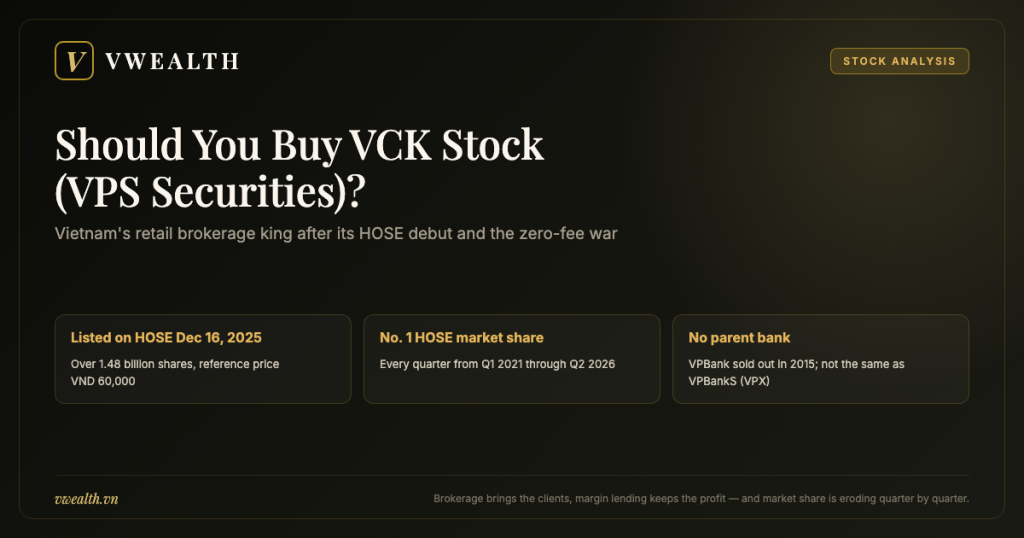
Should you buy VCK stock? The ticker belongs to VPS Securities Joint Stock Company, and if you have ever talked to a retail investor in Vietnam, there is a good chance that person opened their first brokerage account through VPS. The company has been the largest stock broker on the Ho Chi Minh City Stock Exchange (HOSE) by market share every single quarter since the first quarter of 2021, and for several years it handled more than half of all derivatives trading in the country. In November 2025 it raised roughly VND 12.1 trillion (around US$460 million) in one of the largest IPOs in the history of Vietnam’s securities industry. Yet on its first trading day, December 16, 2025, VCK closed more than 15% below its reference price, and by the second quarter of 2026 its brokerage market share had fallen to its lowest level in 22 quarters. This analysis walks through the entire story: how a small subsidiary of VPBank became the king of retail brokerage, why the bank sold it, how the business actually makes money, and what happens to a commission-driven broker when competitors start offering zero-fee trading. By the end, you will have a clear-eyed answer on who VCK stock suits and who it does not.
Before going further, there is a naming trap that every foreign investor looking at Vietnam stocks should know about. VPS was once called “Vietnam Prosperity Bank Securities” (VPBS), and for years it was casually referred to as “VPBank Securities.” But VPBank, one of Vietnam’s largest private banks, sold its stake in the company at the end of 2015. The brokerage that VPBank owns today is an entirely different firm, VPBank Securities (VPBankS), which trades under the ticker VPX. The two companies listed on HOSE just five days apart in December 2025, both carry “VP” in their names, and even some English-language databases still label VPS as “formerly VPBank Securities.” This article is about VCK, which is VPS. Whenever VPBankS comes up for comparison, it will be named explicitly with its ticker.
A second ground rule, consistent with every stock analysis in the vwealth series: every date, name, transaction and figure in this article comes from public disclosures, including VPS’s financial statements and corporate filings, shareholder meeting resolutions, exchange market-share data, and mainstream Vietnamese financial media. Figures from completed fiscal years, such as 2021 or 2025 profit, are used as historical milestones so you can see the trajectory. This article deliberately does not quote today’s share price, the current P/E or P/B ratio, or the latest quarter’s earnings. For a business that lives on market turnover, those numbers can go stale within weeks. Instead, the article shows you where to look and how to interpret what you find. For up-to-date figures in English, open the latest vwealth analysis reports. If you are new to the market itself, start with our guide on how to invest in the Vietnam stock market, which covers account opening, foreign ownership limits and settlement.
One more framing point runs through the whole article. The day before this piece, vwealth published an analysis of TCX, the stock of Techcom Securities (TCBS). TCBS and VPS sit at opposite ends of Vietnam’s brokerage industry. TCBS has no traditional sales force, offers zero-fee trading, and earns most of its money from corporate bonds and lending. VPS built its empire on people: thousands of employees and commission-based agents who find, onboard and service retail clients, and it earns its largest revenue line from trading commissions. So the question of whether to buy VCK stock is tied to a bigger one: in a market where trading fees are being pushed toward zero, how long can a people-driven, commission-based brokerage model hold its ground?
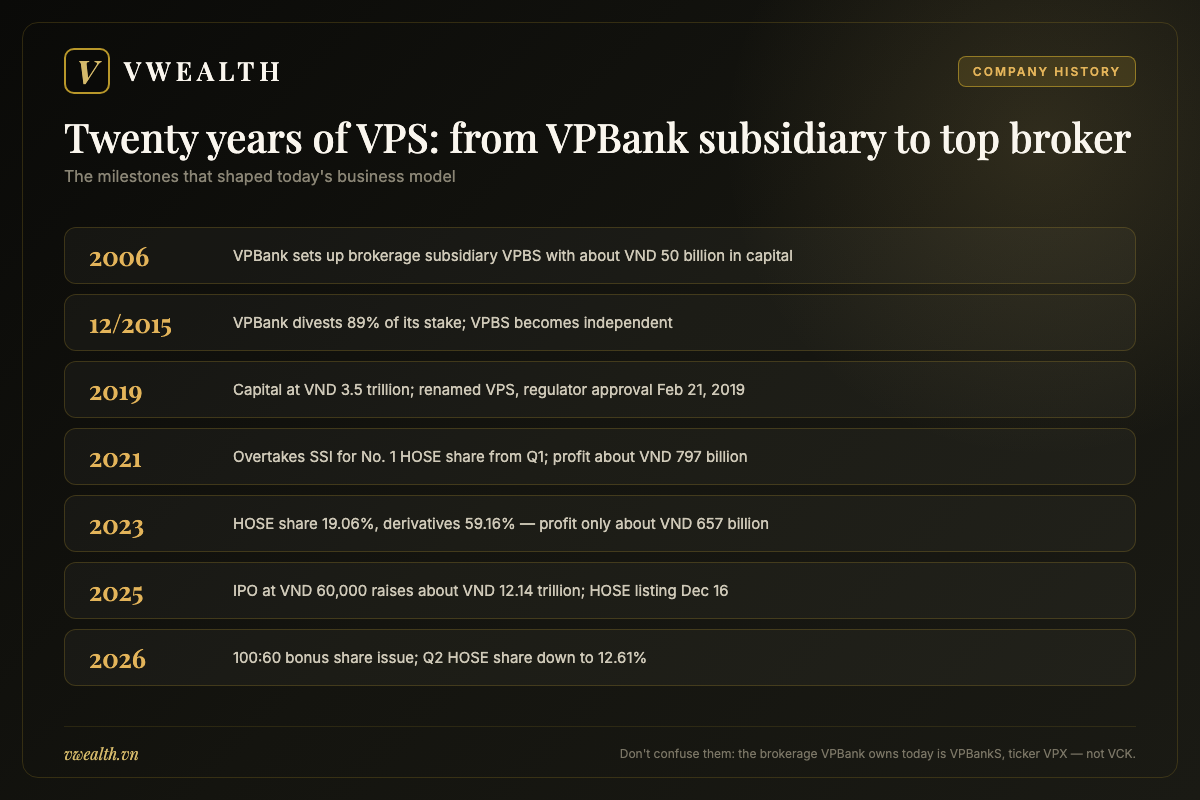
From VPBank Subsidiary to Vietnam’s Brokerage King: Twenty Years of VPS
Some brokerages grow because a parent bank feeds them capital, clients and credibility. Others grow because a founder stays the course through multiple market cycles. VPS belongs to a rarer category. It was born inside a bank, sold off while it was still small, and then built itself into the country’s largest broker by market share, larger than the brokerage its former parent later had to buy in order to re-enter the industry. Understanding that path explains why VPS has a sales-driven culture, why it spent years buying market share at the expense of margins, and why its shareholder structure today looks nothing like those of TCBS or VPBankS.
2006: A Brokerage Born Inside a Mid-Sized Bank
In December 2006, Vietnam’s State Securities Commission (SSC) licensed Vietnam Prosperity Bank Securities Company Limited, a subsidiary set up by VPBank with initial charter capital of about VND 50 billion. Consider the timing. 2006 was the year Vietnam’s stock market experienced its first real boom. The VN-Index soared, hundreds of companies rushed to list, and every bank wanted a securities arm to serve its clients. VPBank at the time was a mid-sized lender, nothing like the private-sector heavyweight it is today, and its brokerage subsidiary was one of dozens of small firms spawned by that frenzy.
The company’s legal form, a limited liability company, tells you about its original role. It was a support unit for the bank’s ecosystem rather than a standalone business. It did not need to raise capital from the public and had no market-share ambitions. When the market turned in late 2007 and plunged through 2008 into early 2009, many brokerages from the same vintage suffered heavy losses, shrank or disappeared. VPBS survived, but nothing at that point suggested it would one day be number one.
One personnel change from this period turned out to matter more than anything else. According to executive profiles compiled by Vietnamese media, Nguyen Lam Dung, formerly head of brokerage at Habubank, became general director of VPBS in 2010. It looked like a routine appointment. In hindsight, it was the defining decision: the person who would run VPS for the next fifteen years came from the brokerage trade itself. He was not a fund manager, as Nguyen Xuan Minh was at TCBS, nor an investment banker. That brokerage DNA shows up in almost every strategic choice VPS has made since.
From 2010 through 2014, Vietnam’s market was sluggish, turnover was thin, and the securities industry went through a restructuring in which many firms were forced to shrink or merge. VPBS was a mid-tier player during this period, serving the parent bank’s clients and gradually building a brokerage team. It was nowhere near the top of the market-share tables, which were dominated by SSI, HSC and later VNDirect.
December 2015: VPBank Walks Away
The biggest turning point in VPS’s history did not come from inside the company. It came from its parent. By December 2015, VPBank had divested 89% of its stake in VPBS. The price and the identity of the buyer were not widely disclosed at the time. Keep that detail in mind, because it helps explain why the question of who really owns VPS remained a subject of media curiosity for the next decade.
Why did VPBank sell? Years later, when VPBank took its new brokerage VPBankS public, VPBank CEO Nguyen Duc Vinh explained the decision. At the time, he said, the bank had limited capital and resources and had to choose. It chose to concentrate on a specialized but risky segment, consumer finance, buying a consumer lender and pouring money into what became FE Credit, the largest consumer finance company in Vietnam by 2018. Securities was not a priority. Only after the bank’s balance sheet strengthened, helped by large investments from Japanese partner SMBC in both FE Credit and VPBank itself, did the bank return to the securities business, by acquiring a small brokerage in 2022 and renaming it VPBankS.
For a VCK investor today, the 2015 divorce has three lasting consequences. First, VPS has no parent bank to lean on for funding or during a liquidity crunch; every dong of capital must be raised on its own. Second, VPS has no captive pool of bank customers to cross-sell to, unlike TCBS with Techcombank or VPBankS with VPBank. It had to find every client by itself, which is exactly why its sales force became the backbone of the business. Third, and important from a risk standpoint, there is no large, well-known shareholder that the market assumes would step in during a crisis. VPS’s credibility had to be earned through results.
After VPBank’s exit, Nguyen Lam Dung became both chairman of the board and CEO from 2016. After-tax profit in 2015 was only about VND 27 billion; by 2016 it had risen to roughly VND 107.7 billion. Small numbers by today’s standards, but they show that within a year of independence, the company was already accelerating.
2018–2019: A Capital Jump, a New Name and a Fintech Pitch
At the end of 2018, VPBS surprised the industry by raising its charter capital to VND 3.5 trillion, roughly 2.4 times the previous level, putting it among the best-capitalized brokerages in the country at the time. There is a structural detail worth knowing: according to media analysis of its 2019 financial statements, around VND 2.53 trillion, or roughly 72% of that charter capital, consisted of preferred shares carrying a fixed 6% dividend. In other words, much of the headline capital increase behaved more like long-term funding than ordinary equity. It was a way to scale up capital quickly without diluting control, an early sign that the people behind VPS intended to keep a firm grip on the company.
The rebranding came at the same time. On February 21, 2019, the SSC approved the company’s change of name from Vietnam Prosperity Bank Securities JSC to VPS Securities JSC. Some sources date the rename to late 2018, when the company made the decision; formal regulatory approval came in February 2019. The company gave two reasons: the new name was short and memorable while retaining a link to the old brand, and, more importantly, VPS wanted to reposition itself as a financial technology company. A new logo featured microchip and artificial-intelligence motifs. In practice, dropping “Vietnam Prosperity Bank” from the name also cut the remaining association with a bank the company no longer belonged to.
Is the “fintech” label just marketing? The honest answer is somewhere in between. VPS did invest in its SmartOne trading app, and by the second quarter of 2025, according to company figures cited in the press, cumulative technology spending had reached roughly VND 500 billion. But unlike TCBS, where technology replaced the sales force, at VPS technology equips the sales force. The app lets clients place orders themselves; finding clients, keeping them and prompting them to trade still depends largely on people. That distinction comes up again and again in this analysis.
2020–2021: The Retail Wave and the Overtaking of SSI
If one year defined VPS as it is known today, it was 2021. The Covid-19 pandemic pushed interest rates down and millions of Vietnamese, nicknamed “F0 investors” locally, opened stock accounts for the first time. Electronic know-your-customer (eKYC) procedures let people open an account from their phones in minutes. Any broker with a large enough sales network to capture that wave, and an app simple enough for beginners, stood to win.
VPS won big. From the first quarter of 2021, it overtook SSI to take the top spot in HOSE brokerage market share, a position SSI had held for years. For the full year 2021, VPS led market share on HOSE, the Hanoi Stock Exchange (HNX), the UPCoM market for unlisted public companies, and the derivatives market. Brokerage revenue in 2021 exceeded VND 3.1 trillion, nearly five times the prior year, while income from loans and receivables rose more than 200% to over VND 964 billion. After-tax profit came in around VND 797 billion, up roughly 58% from 2020.
One detail shows that 2021 profit understated the franchise’s strength and also exposed a weakness. That year, VPS’s proprietary trading desk lost nearly VND 600 billion. In a year when almost every Vietnamese broker made a fortune on proprietary trading, losing money there was unusual. The lesson appears to have stuck. In subsequent years, VPS did not treat proprietary equity trading as a profit engine, and by the time of the IPO, analysts noted that VPS had essentially no meaningful equity proprietary book. That cuts both ways: earnings depend less on the company’s own bets, but when markets rally hard, VPS does not capture the trading gains that SSI or VIX Securities do.
Local press coverage from this period also documented the costs of VPS’s market-share strategy: very high commission splits for brokers and agents, including social-media influencers; free derivatives trading in the early phase to attract clients, who were then cross-sold into cash equities; and what some outlets called a “burn money for market share” model. 2021 also saw cases in which individual brokers were accused of misleading novice investors. Such incidents were not unique to VPS, but they are a known risk of a model built on large numbers of commission-based agents who are harder to supervise than salaried staff.
2022–2024: Surviving a Broken Market and Reaching Record Profit
In 2022, Vietnam’s market broke down. The VN-Index fell sharply from its peak, turnover shrank, and the corporate bond market went into crisis after high-profile issuer scandals. For many brokers, profit collapsed. VPS fared somewhat differently: according to press reports, its 2022 profit still edged up. It had no large bond book or equity proprietary portfolio to write down, and market-share gains partly offset lower market turnover.
2023 was the real stress test. Operating revenue fell about 24.5% to roughly VND 6.37 trillion, pre-tax profit was about VND 828 billion, down around 18% from 2022, and after-tax profit came in near VND 657 billion. Yet that same year VPS posted its highest-ever market share: 19.06% on HOSE and 59.16% in derivatives. That paradox is the most important lesson in reading VPS’s numbers: high market share does not automatically mean high profit. If a broker must pay large commissions to hold its share, much of the fee revenue flows straight back out to its sales force.
2024 was the rebound. Operating revenue exceeded VND 6.46 trillion, brokerage revenue topped VND 3.18 trillion (up about 14%), income from loans and receivables exceeded VND 1.76 trillion (up about 44%), and after-tax profit reached around VND 2.52 trillion, roughly 3.8 times 2023 and a company record at the time. HOSE market share for the year was 18.26%, slightly lower but still first. Notably, operating costs fell sharply in the second half, especially in the fourth quarter of 2024, when they were down around 43% year on year. The company had evidently tightened its brokerage cost structure to protect margins.
2025: A VND 12 Trillion IPO and the HOSE Debut
2025 was the year Vietnam’s big brokers went public in quick succession: TCBS in the autumn, VPS and VPBankS in November. VPS offered 202.31 million new shares at VND 60,000 each. The offering closed on November 17, 2025, with about 99.65% of the shares placed, raising roughly VND 12.14 trillion. Immediately afterward, VPS published its list of major shareholders, giving the public its first clear view of who owns the company, and replaced its CEO, as covered in the next chapter.
On December 16, 2025, more than 1.48 billion VCK shares began trading on HOSE at a reference price of VND 60,000, implying a market capitalization of about VND 88.9 trillion (roughly US$3.4 billion). The debut disappointed: VCK closed at VND 50,800, down 15.33%. For full-year 2025, VPS set new records: operating revenue of about VND 8.26 trillion (up about 27.7%), pre-tax profit of about VND 4.47 trillion (up about 41.8%), after-tax profit of about VND 3.58 trillion, and total assets of around VND 48.4 trillion at year-end. It kept the top HOSE market-share spot for a fifth straight year at 15.95%, though down from 18.26% in 2024.
In 2026, the company issued bonus shares at a ratio of 100:60, more than 913 million new shares, lifting charter capital to about VND 24.35 trillion. Its first annual general meeting as a listed company, held on April 15, 2026, approved a plan for revenue of VND 11.5 trillion and pre-tax profit of VND 5.75 trillion, and authorized a private placement of up to 240 million shares. By the second quarter of 2026, VPS’s HOSE market share had slipped to 12.61%: still first, but the lowest reading in its 22-quarter run at the top.
Don’t Confuse VPS (VCK) With VPBankS (VPX)
This section is short but necessary, because mixing up the two companies has led plenty of investors to misread the news. Here is the simple distinction. VPS, ticker VCK, is the company once called Vietnam Prosperity Bank Securities (VPBS). VPBank sold it in 2015, and it has no ownership link to VPBank today; its largest shareholder is a private fund management company. VPBankS, ticker VPX, started life as Asia Securities (founded in 2009), later renamed ASC Securities. VPBank bought about 97.42% of it in January 2022 and renamed it VPBankS in May 2022. VPBankS sold 375 million shares at VND 33,900 in its IPO and listed on HOSE on December 11, 2025, five days before VCK.
The two firms follow opposite strategies. VPS is a mass-market retail broker living on individual investors and trading fees. VPBankS is a bank-owned brokerage focused on institutional clients, investment banking and cross-selling to VPBank’s customer base. When you read a headline about “VPBank Securities,” check the ticker before you react. On any Vietnamese trading screen, VCK and VPX also sit close together alphabetically, one more reason to type carefully when placing an order.
| Year | Milestone | Why it matters for VCK investors today |
|---|---|---|
| 2006 | VPBank sets up Vietnam Prosperity Bank Securities (VPBS) with about VND 50 billion in capital | Bank origins, but that relationship has ended |
| 2010 | Nguyen Lam Dung, a career broker, becomes general director | Brokerage DNA shapes the sales-driven culture |
| Dec 2015 | VPBank divests 89% of its stake | VPS becomes independent, with no parent bank behind it |
| 2018–2019 | Charter capital rises to VND 3.5 trillion (mostly preferred shares); renamed VPS, SSC approval on Feb 21, 2019 | Fintech positioning; the VPBank association is dropped |
| 2021 | Overtakes SSI for No. 1 HOSE market share from Q1; after-tax profit about VND 797 billion | Start of a market-share streak that continues today |
| 2023 | HOSE share 19.06%, derivatives 59.16%; after-tax profit about VND 657 billion | Peak market share did not bring peak profit |
| 2024 | After-tax profit about VND 2.52 trillion, a record at the time | Margins improve as costs are tightened |
| 2025 | IPO of 202.31 million shares at VND 60,000; HOSE listing Dec 16, 2025; after-tax profit about VND 3.58 trillion | Retail and foreign investors can own VPS on the exchange for the first time |
| 2026 | 100:60 bonus share issue; private placement of up to 240 million shares approved; Q2 HOSE share 12.61% | More capital for margin lending, but brokerage share is eroding |
Sources: VPS disclosures; HOSE market-share data as compiled by Vietstock, VnEconomy, Thoi bao Tai chinh Viet Nam and CafeF. The 2010 appointment is based on executive profiles compiled by Vietnam Business Insider.
Who Runs VPS and Who Really Owns VCK Stock
At TCBS or VPBankS, the question “who owns this company?” has a one-word answer: the parent bank. At VPS, it was an open question for nearly a decade, from VPBank’s exit in late 2015 until the company published its major shareholder list after the November 2025 IPO. When the answer came out, the Vietnamese press devoted a lot of ink to it. This chapter covers the people running the company, the people who own it, and what that structure means for you as a minority shareholder.
Nguyen Lam Dung: The Broker Who Built a Brokerage Machine
If TCBS is a fund manager’s company, VPS is a broker’s company. According to executive profiles in the Vietnamese press, Nguyen Lam Dung previously headed brokerage at Habubank (a bank later merged into SHB), became general director of VPBS in 2010, and from 2016, immediately after VPBank’s exit, held both the chairman and CEO roles. For almost a decade, he set strategy and ran day-to-day operations.
A broker tends to build a company differently from a fund manager or investment banker. The first priority is clients and order flow: acquire as many clients as possible, keep them as long as possible, and get them to trade as often as possible. Everything else, including margin lending, products and technology, serves that goal. It explains why VPS spent heavily on broker commissions during its market-share push, why it once offered free derivatives trading, and why it never showed much appetite for bond underwriting or proprietary trading.
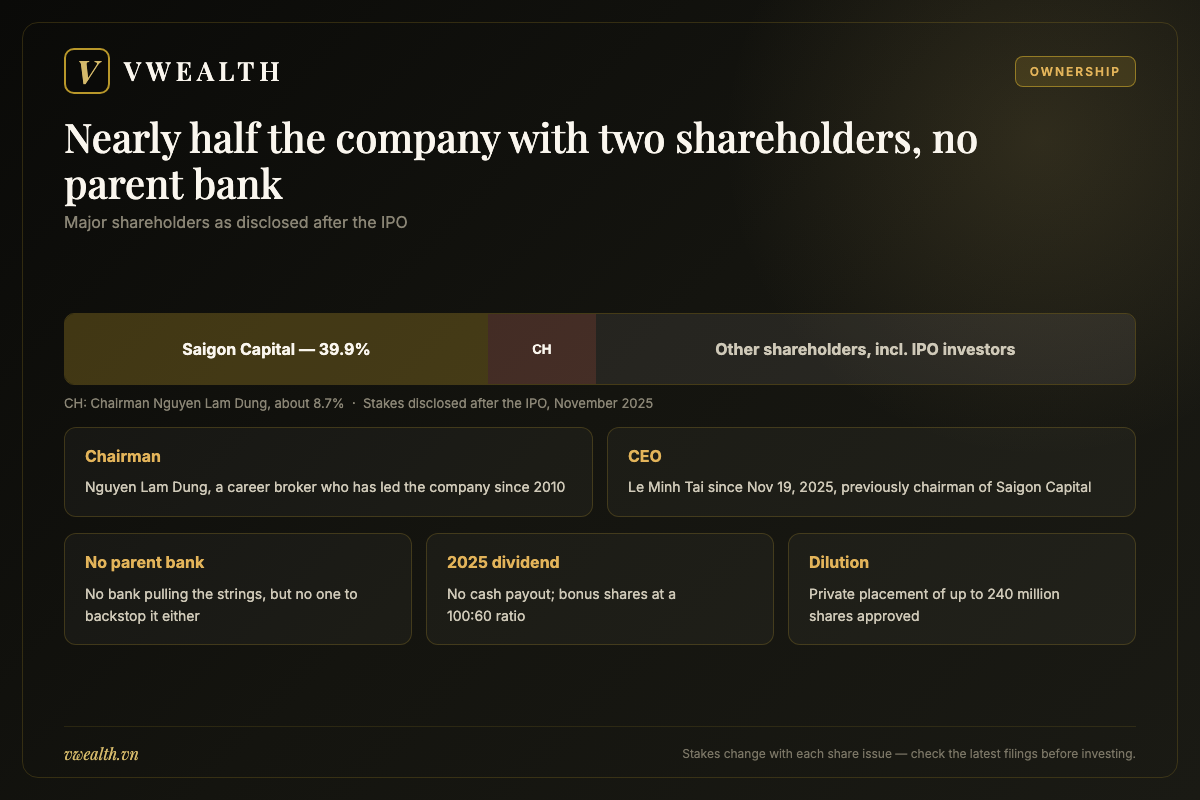
According to press reports, Dung held nearly 129 million shares after the IPO, about 8.7% of the company, making him the largest disclosed individual shareholder. At the first post-listing annual general meeting on April 15, 2026, he described the 2026 pre-tax profit target of VND 5.75 trillion as “very challenging,” a cautious remark investors should note, because it signals that management itself does not treat the plan as a given.
Le Minh Tai and the Post-IPO Separation of Roles
On November 19, 2025, two days after the IPO closed, VPS appointed Le Minh Tai as CEO for a five-year term. Dung stepped down as CEO and remained chairman. The stated reason was compliance with rules for listed public companies, which restrict one person from holding both the chairman and CEO positions.
The noteworthy detail is Tai’s most recent role. According to press reports, before joining VPS he was chairman of Saigon Capital Management JSC (Saigon Capital, or SGC), which is VPS’s largest shareholder, and he stepped down from that post at the end of October 2025. In other words, the person now running VPS came directly from the controlling shareholder’s side. That is perfectly legal, but it tells you that power at VPS remains concentrated within a small group, and that the chairman-CEO split was mainly about meeting regulatory requirements rather than a change in control.
At the April 2026 meeting, Tai also said something VCK investors should remember: the company does not make forecasts or commitments about its share price. That sounds like boilerplate, but coming shortly after a steep post-listing decline, with many IPO buyers under water, it signals that management does not intend to talk the stock up. Judge VCK on business results, not on hopes of price-support measures.
Saigon Capital: A 39.9% Shareholder With About Ten Employees
This is the part that drew the most media attention. According to the major shareholder list VPS published after its IPO, Saigon Capital Management JSC owned more than 591.4 million shares, about 39.9% of the company, making it the largest shareholder. At the IPO price of VND 60,000, that stake was worth roughly VND 35.5 trillion, or about US$1.35 billion.
What caught people’s attention was the size of SGC itself. According to figures compiled by Tuoi Tre newspaper, SGC had charter capital of about VND 43.8 billion, around ten employees as of late September 2025, total assets of about VND 75.6 billion in the third quarter of 2025, and nine-month 2025 revenue of about VND 6.7 billion. A company that small holding a billion-dollar stake in the country’s top broker suggests that SGC most likely functions as a holding vehicle representing the interests of a group of investors, rather than as an independent investor in the usual sense. SGC’s own leadership also changed around the IPO: Do Duy Tan became SGC chairman in late October 2025, and Le Thu Minh serves as its CEO.
How should you read this? Not as a conspiracy, and not as something to ignore. The sensible reading is that VPS has a controlling group, SGC plus the chairman holding close to half the company, but that group is not a large bank or a well-known conglomerate publishing detailed accounts of its own financial resources. With TCX, you know who Techcombank is and can read its reports. With VCK, you know less about the financial capacity of the people behind the company. That cuts both ways: no parent bank means no risk of value being tunneled through related-party dealings with a bank, but also no one to backstop the company in a crisis.
Post-IPO Ownership and Free Float
Put the pieces together. After the IPO, SGC held about 39.9% and Dung about 8.7%, together nearly 49%. The remaining roughly 51% belongs to other shareholders, including IPO buyers (202.31 million new shares, about 13–14% of the listed shares), pre-IPO shareholders below the disclosure threshold, and employees.
Why does this matter? For two reasons. The first is free float, the portion of shares actually available for trading rather than locked up by strategic holders. Free float affects daily liquidity and, just as importantly for foreign investors, whether and at what weight VCK is included in international indices. Index providers such as FTSE Russell weight constituents by free-float-adjusted market capitalization. The second is governance: with nearly half the votes in the hands of two related shareholders, ordinary resolutions at shareholder meetings will almost always pass as the controlling group wishes. Compared with TCX, where Techcombank held around four-fifths at listing, VCK is more widely held, but control is still highly concentrated.
Foreign investors should also be aware of Vietnam’s foreign ownership limits, often called “foreign room.” The limit is not the same for every company: it depends on the sector and on the company’s own charter and filings, and banks, for example, face much tighter caps than many other listed firms. Check the current foreign ownership level and limit on the exchange or your broker’s platform before buying; our guide to investing in Vietnamese stocks from abroad covers the practical steps.
| Shareholder | Stake disclosed after IPO (Nov 2025) | Who they are | What to watch |
|---|---|---|---|
| Saigon Capital Management JSC | About 39.9% (over 591.4 million shares) | Fund manager with about VND 43.8 billion in capital and around ten staff | Any sale, pledge or transfer of the stake; ties to management |
| Nguyen Lam Dung (Chairman) | About 8.7% (nearly 129 million shares) | Has led VPS since 2010 | Insider trading registrations |
| IPO investors | 202.31 million newly issued shares | Domestic and foreign individuals and institutions | Selling pressure while the price is below the IPO price |
| Other shareholders | Remainder | Existing holders, employees | Free float and liquidity |
Sources: VPS major shareholder disclosures after the IPO as reported by PHS, CafeF and Tuoi Tre (November 2025). Stakes change after the 2026 bonus share issue and any later offerings; check the latest filings before investing.
Dividends: Bonus Shares, No Cash, and Dilution Risk
If you are looking at VCK for a steady cash dividend, read this section carefully. At the April 2026 AGM, VPS proposed paying no cash dividend from 2025 profit, retaining all earnings for the business. Instead, the company issued bonus shares at a ratio of 100:60, meaning 60 new shares for every 100 held, totaling more than 913 million shares, with the record date in March 2026. That lifted charter capital from about VND 15.22 trillion to about VND 24.35 trillion.
Bonus shares do not make you richer on the day they arrive. The share price is adjusted down on the ex-rights date, and the total value of your holding stays the same. Their real function is to convert retained earnings into charter capital, strengthening the equity base so the company can lend more on margin, because margin lending limits are tied to equity. In effect, VPS’s dividends are being compulsorily reinvested into its lending machine.
At the same meeting, shareholders approved a private placement of up to 240 million shares (about 9.86% of shares outstanding), to be carried out during 2026, with a one-year lock-up and proceeds earmarked for margin lending. If completed, charter capital would rise to about VND 26.75 trillion. The board has authority to set the offering price and choose the investors. This is the item to watch: whether the placement is priced above or below market price and book value determines whether existing shareholders are diluted or benefit. Issuing above book value raises book value per share; issuing below it does the opposite.
One historical footnote: as mentioned, most of the 2019 charter capital consisted of preferred shares with a fixed 6% dividend. Careful investors should check the prospectus and the latest financial statements to see whether any class of shares other than common stock remains outstanding, since preferred dividends are paid ahead of common shareholders.
How VPS Makes Money: A Mass-Market Brokerage With a Lending Engine Behind It
If you want to understand VPS in one sentence, remember this: VPS is a retailer of stock-market services. It does not make its money advising companies on bond issues, as TCBS does; it does not bet its own capital on equities, as VIX Securities does; and it does not primarily serve large foreign funds, as SSI and HSC do. It makes money from millions of individual investors, charging a fee every time they trade and charging interest whenever they borrow to buy more. In 2025, those two sources, brokerage plus margin lending and cash advances, accounted for about 76% of operating revenue. This chapter takes each business line in turn, shows how they feed one another, and asks where VPS’s competitive moat really lies.
Equity Brokerage: A Huge Sales Network and the SmartOne App
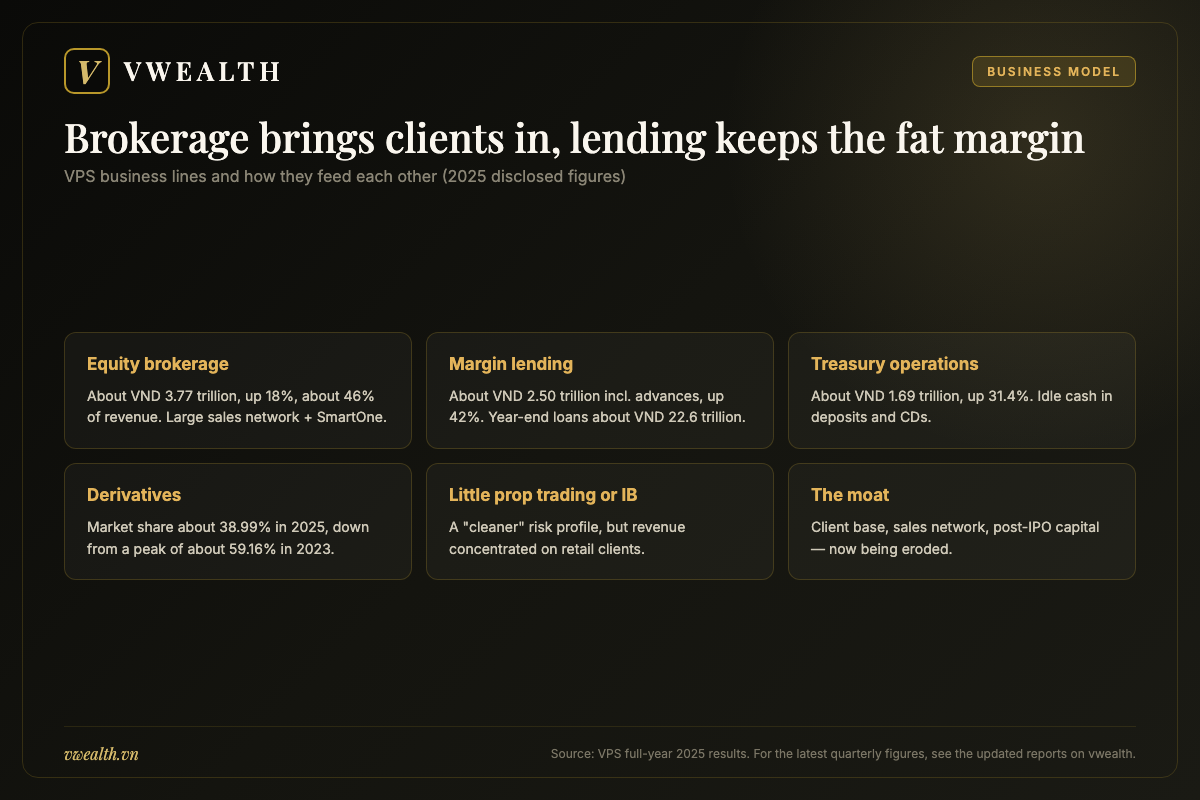
In 2025, VPS’s brokerage revenue was about VND 3.77 trillion, up roughly 18% and equal to about 46% of operating revenue. To put the scale in perspective, local media calculated that in the fourth quarter of 2023, VPS collected more than VND 12 billion in brokerage fees on average every trading session. No other Vietnamese broker generates brokerage revenue on that scale.
Where does it come from? From what you might call a mass-market brokerage model: a very large network of salaried brokers and commission-based agents, each of whom finds clients through personal networks, social media and investor chat groups, then helps them open accounts on the VPS SmartOne app. Whenever the client trades, the broker earns a share of the fee. The model looks more like life insurance distribution than investment banking: the company supplies the product, platform and brand; the sales force brings in revenue and keeps a large share of the fees.
The model has clear strengths. It scales very quickly in a hot market, because there is no need to open branches or hire expensive permanent staff; the company simply adds agents. Brokerage costs are variable: when clients trade more, the company pays out more; when they trade less, it pays out less. And it creates a personal relationship between broker and client, something inexperienced investors, who often want hand-holding, value highly.
The weaknesses are just as clear. First, margins are thin, because most of the fee flows out to the sales force. An analysis by VietnamFinance based on third-quarter 2025 data estimated that VPS’s brokerage segment earned a margin of only about 23%, roughly VND 353 billion of profit on about VND 1.52 trillion of revenue for the quarter. Second, client loyalty often attaches to the individual broker rather than the firm; when a strong broker moves to a competitor, clients may follow. Third, compliance risk: supervising the advice given by thousands of agents is harder than supervising salaried employees, and cases of brokers misleading investors, even if isolated, can damage the brand.
What about SmartOne itself? It is VPS’s main trading platform and is widely considered simple and beginner-friendly, which mattered enormously during the 2020–2021 account-opening boom. But in fairness, in the VPS model the app is the storefront and the broker is the salesperson. When VPS went public, some analysts pointed out that despite its fintech branding, VPS had fewer standout AI-driven products than some rivals. In August 2026, VPS launched a product called VPS Smart Indexing, a step toward diversifying its offering, though it is far too early to judge its contribution.
Derivatives: Where VPS Once Controlled More Than Half the Market
Derivatives in Vietnam mainly means VN30 index futures, and this is where VPS’s dominance was even more pronounced than in cash equities. A futures contract is an agreement to buy or sell the index at a set price on a future date; investors post only a fraction of the contract value as margin, so leverage is high and daily gains or losses can be large. Vietnamese derivatives traders tend to trade many times a day, so even small per-contract fees add up.
VPS’s derivatives brokerage share was about 53.84% in the first quarter of 2022 and peaked at about 59.16% for full-year 2023; in other words, nearly six of every ten futures contracts traded in Vietnam went through VPS. The strategy, as described in local media, was to offer free derivatives trading in the early phase to attract clients, then cross-sell those clients into cash equities and margin loans.
But this is also where VPS is losing ground fastest. Its derivatives share fell to about 50.64% in the first quarter of 2025, about 38.99% for full-year 2025, and about 33.84% in the second quarter of 2026. The main beneficiary has been DNSE, another technology-led broker targeting individual investors, which reached about 21.47% for 2025 and about 25.38% in the second quarter of 2026. Together the two still control nearly 60% of the market, but the gap has narrowed from dominance to leadership. That is an important signal: in the most fee-sensitive client segment, a rival with low fees and a good app can take share from VPS quite quickly.
Margin Lending and Cash Advances: The Fastest-Growing Profit Engine
If brokerage is the funnel that brings clients in, margin lending is where VPS earns its fattest margins. Margin lending means the broker lends clients money to buy more stock, using those shares as collateral; if prices fall to a set threshold, the broker issues a margin call, requiring the client to add cash or sell. Cash advances let clients receive the proceeds of a stock sale before settlement, for a fee. Because Vietnam’s market settles trades on a T+2 basis, advances are a popular service among active traders.
In 2025, revenue from margin lending and advances reached about VND 2.50 trillion, up about 42% and equal to roughly 30% of revenue. Outstanding margin loans at the end of 2025 were about VND 22.6 trillion, up roughly 80.9% from about VND 12.2 trillion a year earlier. Going back further, margin loans were only around VND 11.1 trillion at the end of 2023. In two years, the loan book doubled, with the sharpest growth coming after the IPO proceeds arrived.
Why does this line matter more than its revenue share suggests? Because its margins are far higher than brokerage. The VietnamFinance analysis found that in the third quarter of 2025, margin lending contributed about VND 706 billion, more than half of that quarter’s pre-tax profit. Lending does not require paying commissions to agents; the main cost is the interest VPS pays on its own funding. And when VPS has more equity from its IPO, funding that carries no interest cost, lending margins get even fatter.
Vietnamese regulations allow brokers to lend up to twice their equity on margin. At the April 2026 AGM, management said VPS’s lending ceiling was about VND 60 trillion (under the two-times-equity cap, that implies equity of an estimated VND 30 trillion), and it was using only about half of that. This is the growth runway management emphasizes, and it is also why VPS keeps seeking more capital through the private placement.
Look at the other side, though. A fast-growing margin book means rising credit risk. When the market falls sharply and some stocks become illiquid, hitting their daily limit-down price for several sessions in a row so that no one can sell, a broker may not be able to recover all it has lent. The quality of the loan book, meaning which stocks the loans are concentrated in and what loan-to-value ratios apply, is what you need to check in the notes to the financial statements, not just the headline loan balance. Our explainer on Vietnam’s trading hours and daily price bands explains why limit-down streaks are such a risk for margin lenders.
Treasury Operations: Where the Idle Cash Goes
The third line in VPS’s reports is capital or treasury operations, with 2025 revenue of about VND 1.69 trillion, up about 31.4%. This mainly covers the management of cash not yet deployed into loans, placed in bank deposits, certificates of deposit, bonds and other fixed-income assets measured at fair value through profit or loss (FVTPL). According to pre-IPO analysis, the share of such investments in VPS’s income mix tended to decline from 2022 through the first half of 2025.
This is not proprietary trading in the sense of betting on stock prices. It is closer to a corporate treasury: keep the money earning a safe return and ready to redeploy when margin demand rises. When VPS received more than VND 12 trillion of IPO proceeds that it could not lend out immediately, that money sat here, temporarily boosting treasury income. Over time, if VPS deploys its capital fully into margin loans, this line will shrink in relative terms.
As noted earlier, VPS lost nearly VND 600 billion on proprietary trading in 2021 and has since not treated equity trading as a profit engine. For VPS, the absence of a large proprietary book is a deliberate choice: earnings are steadier in down markets but do not explode in strong ones.
Investment Banking and the Rest: Not VPS’s Game
VPS holds licenses for the full range of securities activities: brokerage, underwriting, investment advisory, custody and proprietary trading. But investment banking, meaning advising on equity and bond issues and on mergers and acquisitions, is not a strength, and it contributes very little. That is a fundamental difference from TCBS, where bond advisory and distribution are major businesses, and from VPBankS, which has made institutional clients and investment banking its strategic focus.
Why has VPS not built a strong investment bank? Because it requires things VPS does not have naturally: relationships with large corporates (usually provided by a parent bank), a team of corporate finance specialists, and the reputation for companies to entrust it with deals. For an independent firm with brokerage roots, building that from scratch is slow and expensive. VPS chose to concentrate where it is strongest.
What does that mean for you? VPS’s risk profile is “cleaner”: no large corporate bond portfolio on the balance sheet and no direct exposure when the bond market seizes up, as it did in 2022. But its revenue is also more concentrated: almost all of its profit depends on whether individual investors keep trading and borrowing.
| Business line | How it earns | 2025 disclosed figures | Depends on | Main risk |
|---|---|---|---|---|
| Equity and derivatives brokerage | Fee on every trade | Revenue about VND 3.77 trillion, up about 18%; about 46% of revenue | Market turnover, market share, fee policy | Thin margins due to commissions; zero-fee rivals |
| Margin lending and cash advances | Interest and advance fees | Revenue about VND 2.50 trillion, up about 42%; year-end loans about VND 22.6 trillion | Equity base, funding cost, investor borrowing demand | Credit losses in a market crash |
| Treasury operations | Interest on deposits, CDs, bonds | Revenue about VND 1.69 trillion, up about 31.4% | Interest rates, idle cash | Shrinks as capital is deployed into lending |
| Investment banking, equity proprietary trading | Advisory fees, investment gains | Small contribution | Corporate relationships, market | Not a strength; limited diversification |
Sources: VPS full-year 2025 results as compiled by Vietstock, DNSE and Thoi bao Tai chinh Viet Nam. For the latest quarterly figures, see the updated reports on vwealth.
Which Business Feeds Which, and Where the Moat Lies
Put the pieces together and you get a flywheel. The sales network and the SmartOne app pull in individual investors. Clients trade and pay fees; most of those fees flow out to brokers, and the company keeps a thin slice. But once clients get used to trading, they borrow on margin to buy more, and the interest is where VPS keeps most of the value. Client cash waiting to be invested, together with undeployed equity, earns interest in the treasury line. Brokerage feeds clients to lending; lending feeds profit to the whole company.
So where is VPS’s durable competitive advantage? There are three layers. The first is the scale of its client base and sales network: five years at the top of the market-share tables have produced a client pool and a sales force that rivals cannot replicate quickly. The second is post-IPO capital: equity of an estimated VND 30 trillion or so supports large-scale margin lending and helps VPS borrow more cheaply. The third is brand recognition among retail investors: for many first-time investors in Vietnam, “VPS” is practically synonymous with “opening a stock account.”
But the moat has shallow spots. The first layer is under attack from zero-fee rivals and from bank-owned brokers with tens of millions of existing customers, such as TCBS with Techcombank and VPBankS with VPBank. When clients can trade for free inside the banking app they already use, the reason to open an account through a VPS agent weakens. The second layer is not exclusive: TCBS is regarded as having the largest equity base in the industry after its IPO, and VPBankS and SSI have also raised capital aggressively. Only the third layer, habit and brand, is hard to take away quickly, and it is also the hardest to measure. The slide in HOSE market share from 19.06% in 2023 to 12.61% in the second quarter of 2026 shows the moat is eroding, even if it has not yet been breached.
Market Position and Financial Health: What to Check Before You Buy VCK Stock
A brokerage’s financial statements look a lot like a small bank’s. On the asset side are margin loans and deposits; on the funding side are equity, bank borrowings and issued bonds. But the profit engine differs from a bank’s in one crucial way: it is tied to stock-market turnover almost week by week. This chapter does not give you the latest quarter’s numbers; you can find those in updated reports. It gives you a way of reading them: what to look at, what to compare it with, and where investors most often misread VPS.
Market Share: Reading the “Number One” Figure Correctly
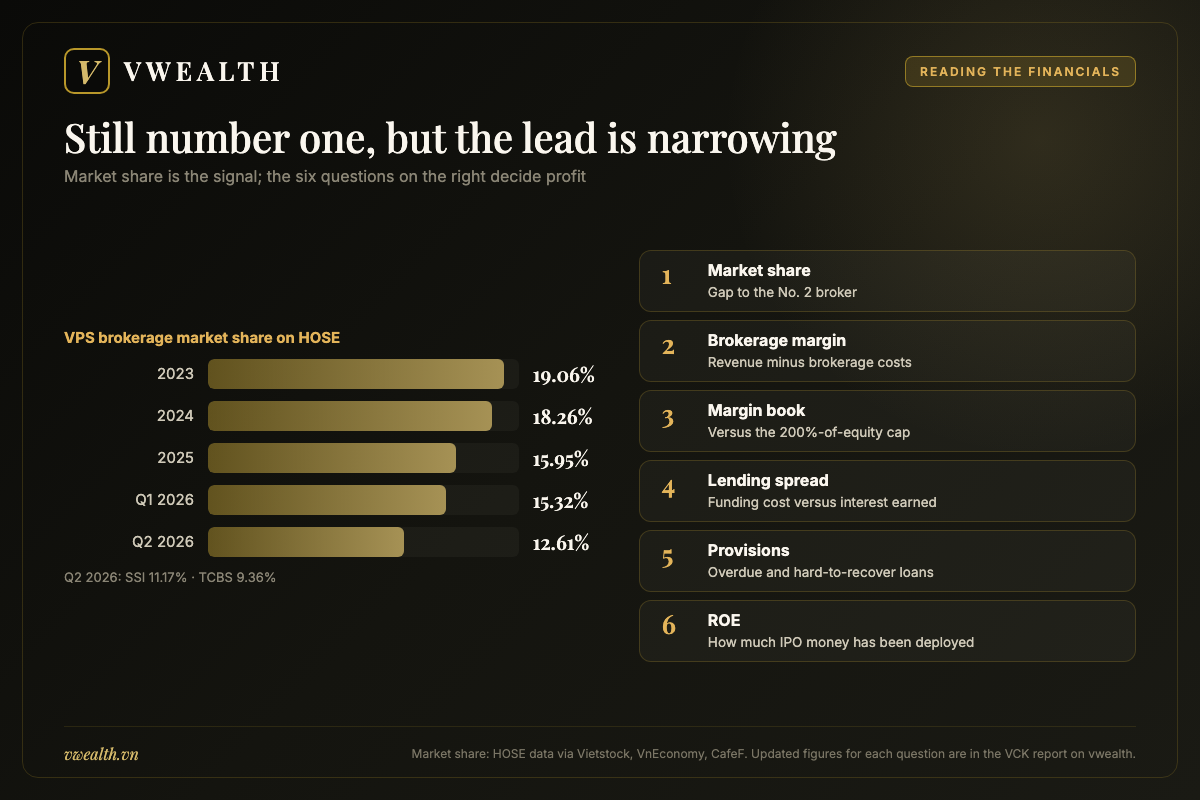
Every quarter, the Ho Chi Minh City Stock Exchange publishes the ten brokerages with the largest brokerage market share. It is the metric VPS cites most in its communications, and the one most easily misread. Look at the HOSE series: about 19.06% in 2023; about 18.26% in 2024; about 15.95% in 2025; about 15.32% in the first quarter of 2026; and about 12.61% in the second quarter of 2026, the lowest in its 22 consecutive quarters at the top. Meanwhile SSI rose from about 9.18% in 2024 to about 11.53% in 2025 and about 11.17% in the second quarter of 2026, and TCBS went from about 7.99% for 2025 to about 9.36% in the second quarter of 2026.
Three things to keep in mind. First, market share is relative: a lower share does not mean lower brokerage revenue if overall market turnover grows fast enough. In 2025, VPS’s share fell from 18.26% to 15.95%, yet brokerage revenue still rose about 18% because the market was busier. Second, market share measures trading value, not revenue. A zero-fee broker like TCBS can have a large share and almost no brokerage revenue, while VPS charges real fees on every order. Comparing the shares of VPS and TCBS means comparing two things with different economic meaning. Third, the trend matters more than the rank. VPS is still first, but its lead over second place has shrunk from nearly double in 2024 to only about 1.4 percentage points in the second quarter of 2026. If the trend continues, the day VPS loses the top spot may not be far off, and the stock could react sharply to that headline even if the real earnings impact is smaller.
One more share figure often gets overlooked. On HNX and UPCoM in 2025, VPS held about 19.49% and 17.76%, higher than on HOSE. Those venues are dominated by smaller-cap stocks popular with individual traders. That reinforces the picture: VPS’s strength lies with active retail investors.
Profit Trajectory: From VND 27 Billion in 2015 to More Than VND 3.5 Trillion in 2025
Line up the disclosed profit numbers and you see a path that is anything but straight. After-tax profit was about VND 27 billion in 2015; about VND 107.7 billion in 2016; about VND 502 billion in 2020; about VND 797 billion in 2021; slightly higher in 2022; down to about VND 657 billion in 2023; about VND 2.52 trillion in 2024; and about VND 3.58 trillion in 2025.
The year that deserves the most thought is 2023. That was VPS’s peak market-share year, yet profit was lower than in 2021. The reason was cost: in 2023, operating expenses were around VND 4.56 trillion against operating revenue of around VND 6.37 trillion. When revenue falls but the company still has to pay commissions to keep its sales force and its share, profit gets squeezed hard. In 2024, revenue was almost flat at around VND 6.47 trillion, yet profit nearly quadrupled, a sign that the company had cut costs, particularly in the fourth quarter of 2024, when operating expenses fell about 43% year on year.
The lesson: with VPS, do not look only at revenue or market share. Track the ratio of brokerage costs to brokerage revenue quarter by quarter. If that ratio rises, the company may be buying market share with higher commissions, and profit will suffer even while revenue looks healthy.
| Year | Operating revenue | After-tax profit | Year-end margin loans | HOSE market share |
|---|---|---|---|---|
| 2021 | Brokerage revenue over VND 3.1 trillion (nearly 5x) | About VND 797 billion | — | No. 1 from Q1 2021 |
| 2023 | About VND 6.37 trillion (down about 24.5%) | About VND 657 billion | About VND 11.1 trillion | About 19.06% |
| 2024 | About VND 6.47 trillion | About VND 2.52 trillion | About VND 12.2 trillion | About 18.26% |
| 2025 | About VND 8.26 trillion (up about 27.7%) | About VND 3.58 trillion | About VND 22.6 trillion | About 15.95% |
| 2026 (plan) | VND 11.5 trillion | Pre-tax profit target VND 5.75 trillion | — | Q2 2026 about 12.61% |
Sources: VPS financial statements and disclosures as compiled by CafeF, VietnamFinance, Vietstock and Nguoi Dua Tin. Figures rounded. The 2026 row shows targets approved by shareholders, not results.
Earnings Quality: Thin Brokerage Margins, Fat Lending Margins
Two brokers with the same profit do not necessarily have the same quality of earnings. Quality here means whether profit comes from recurring, predictable sources or from one-offs. The good news for VPS is that almost all its profit comes from recurring core activities, brokerage and lending, rather than asset sales or lucky trading gains. In 2025, those two lines made up about 76% of revenue.
Within the core, however, the mix is shifting. In 2025, brokerage revenue grew about 18% while margin lending revenue grew about 42%. If that continues, VPS will increasingly look like a lending company rather than a brokerage. That has an upside: higher margins and less direct exposure to the fee war. It also has a downside: the key risk shifts from “revenue falls when markets are quiet” to “bad debts appear when markets crash.” A pure broker in a bad market simply earns less; a big lender in a crashing market can lose money.
A simple quarterly test of earnings quality: compare pre-tax profit with the combined gross profit of brokerage and lending. If pre-tax profit is much higher than that sum, where did the difference come from: financial income, provision reversals, or asset revaluation? Those items tend not to repeat.
Leverage and Funding: Whose Money Is Being Lent
To lend VND 22.6 trillion on margin (end of 2025), VPS needs money from somewhere. There are three sources: equity (shareholders’ money, including IPO proceeds and retained earnings), short-term bank borrowing, and bonds. As of the end of the first quarter of 2026, according to press reports citing the financial statements, VPS had around VND 16.8 trillion in short-term borrowings and about VND 5 trillion in long-term bonds outstanding, with total liabilities of about VND 23.1 trillion against total assets of about VND 53.2 trillion. These are balance-sheet snapshots meant to show the structure; check the latest report for current figures.
What matters is the ratio, not the absolute number. Compared with many brokers that borrow two or three times their equity, VPS’s post-IPO leverage is moderate, with total liabilities below equity. That gives it plenty of room: if needed, it can borrow more to fund margin loans without raising equity right away. The trade-off is that return on equity is temporarily diluted, because equity jumped after the IPO while profit has not yet caught up.
A special funding-related item is client cash awaiting investment. At the end of 2023, client deposits at VPS were about VND 16.6 trillion. That money belongs to clients, is held separately, and cannot be lent out by the company. But its size shows the scale of the client base.
On creditworthiness, FiinRatings, a Vietnamese credit rating agency, rated VPS “A” with a stable outlook in early 2025. That is a solid rating, but below the AA- FiinRatings assigned to TCBS in 2025, a difference that partly reflects TCBS having a parent bank and VPS not. Credit ratings directly affect funding costs: a higher-rated broker borrows more cheaply and earns a wider spread on margin loans.
Efficiency: ROE, ROA and the Cost Ratio
According to figures compiled in the press before the IPO, VPS’s return on equity (ROE) in 2024 was about 22.2% and its return on assets (ROA) about 8.3%. In 2025, VPS was reported to have one of the highest ROEs in the securities industry. Those are strong numbers; the Vietnamese brokerage average in recent years has typically been meaningfully lower.
Be careful about extrapolating historical ROE, though. Part of VPS’s pre-IPO ROE came from having a small equity base relative to the size of its business. After raising more than VND 12 trillion and retaining earnings, equity has jumped. To keep ROE above 20%, profit must grow accordingly, which means deploying the new capital into margin loans quickly and at good rates. That is exactly why the 2026 plan targets roughly 29% pre-tax profit growth. If the money sits in bank deposits, ROE will fall.
One more ratio VCK investors should calculate themselves: brokerage costs as a share of brokerage revenue. At TCBS it is negligible, because there is no sales force. At VPS it is the largest expense. As an illustrative example: if a quarter’s brokerage revenue is 1,000 and brokerage costs are 770, the brokerage margin is only 23%, close to what VietnamFinance estimated for the third quarter of 2025. If the market cools, revenue drops 30%, and the company must maintain commission rates to avoid losing its brokers, that margin can shrink even further.
Six Questions to Ask Every Time VPS Reports
Instead of starting with P/E, ask these six questions whenever VPS publishes quarterly results. One: is HOSE, HNX and derivatives market share rising or falling, and how wide is the gap to second place? Two: what is left of brokerage revenue after brokerage costs; is the brokerage margin expanding or contracting? Three: how much has the margin book grown, and what percentage of the 200%-of-equity ceiling is being used?
Four: are interest expenses rising faster or slower than margin interest income; what is happening to the lending spread? Five: have any new provisions for margin loans appeared, and what does the overdue loan ratio look like? Six: how much of the IPO and placement money has been deployed, and is annualized quarterly ROE moving back toward pre-IPO levels? You can answer all six with the data in the updated VCK report on vwealth, which is available in English.
How the Market Has Received VCK Stock: From a VND 60,000 IPO to a 15% First-Day Drop
Every stock has a personality: how it reacts to news, to the broader market, to fund flows. VCK is too young to have a long price history, but its first months on the exchange already reveal quite a lot. This chapter covers the IPO, the listing day, and how to value a retail brokerage, including why VPS should not be valued the same way as TCBS.
The November 2025 IPO: VND 60,000 a Share and Near-Full Placement
VPS offered 202.31 million shares to the public at VND 60,000 each. The offering closed on November 17, 2025, with about 99.65% placed, raising roughly VND 12.14 trillion, one of the largest IPOs in the history of Vietnam’s securities industry. Around the same time, VPBankS raised more than VND 12.7 trillion at VND 33,900 per share, and TCBS had earlier sold shares at VND 46,800.
A nuance worth noting: placing nearly 100% of an offering is not the same as being oversubscribed many times. For TCBS, the press reported that its IPO was about 2.5 times oversubscribed. For VPS, the disclosed figure was the placement rate, not an oversubscription multiple. The distinction is subtle but important: it suggests that at VND 60,000, demand was roughly sufficient to absorb supply, leaving little excess demand to push the price up after listing.
At the IPO price, analysts noted that VCK was valued at the top end of the sector. As an illustrative example: dividing the reference-day market capitalization of about VND 88.9 trillion by 2024 after-tax profit of about VND 2.52 trillion gives an implied trailing P/E of roughly 35 times; using 2025 profit of about VND 3.58 trillion (reported later) gives roughly 25 times. This rough calculation simply shows that IPO buyers paid for future growth rather than past earnings. For the current valuation, check an updated report.
The December 16, 2025 Debut and the First Months of Trading
On December 16, 2025, more than 1.48 billion VCK shares began trading on HOSE at a reference price of VND 60,000. By the close, VCK stood at VND 50,800, down 15.33%. According to press reports, foreign investors sold more than 3.2 million shares during the session while buying only about 1.1 million. Even after the fall, VCK’s end-of-day market capitalization was about VND 75.4 trillion, larger than many long-established brokers such as SSI, Vietcap, SHS and VNDirect at that point.
For context, foreign readers should know how Vietnam’s price limits work on listing day. On HOSE, stocks normally move within a daily band of plus or minus 7% from the reference price, but a newly listed stock’s first session allows a much wider band of plus or minus 20%. That is why VCK could fall more than 15% in one day without hitting a limit.
VCK was not alone. Five days earlier, VPBankS’s VPX debuted at VND 33,900 and closed down about 9.1% at VND 30,800. Local media called them “blockbuster listings that fizzled.” Reasons cited included the huge supply of new shares arriving within a short period, rising interest rates and currency volatility that dampened risk appetite, and IPO prices that had already priced in most of the optimism. On February 27, 2026, VCK traded around VND 49,700, roughly 17% below its reference price, having touched about VND 42,000 intraday at one point.
The lesson from those first sessions is that a good business is not a good investment at any price. VPS posted record profit in 2025, yet IPO buyers at VND 60,000 were under water for months, because the price had already paid for the expectations. If you are considering VCK stock, the question is not “is VPS a good company?” but “which scenario is today’s price paying for?”
How to Value a Retail Brokerage: P/B, P/E and Why VPS Differs From TCBS
Analysts usually value banks and brokerages on price-to-book (P/B), because their assets are mostly financial assets carried close to fair value. A company earning a 20% ROE deserves a higher P/B than one earning 10%, because each unit of equity generates twice the return. A rough rule many use: a fair P/B scales with ROE divided by the shareholders’ cost of capital.
But for VPS, P/B has a blind spot: its most valuable assets, its client base, sales network and brand, do not appear on the balance sheet. An asset-light broker can post a very high ROE on a small equity base, making P/B look expensive even when the P/E is not extreme. So for VPS, many analysts focus more on P/E, combined with the quality and stability of earnings.
Compared with TCBS, the difference lies in where profits come from. TCBS earns from bonds and lending, capital-hungry businesses for which P/B is the natural yardstick. VPS earns mainly from brokerage fees, a business that needs little capital but is highly sensitive to market turnover, so profits swing with the cycle, and P/E at the top of the cycle can look deceptively cheap. A practical rule: when market turnover is at a record high, VPS’s profit is at a peak and its P/E looks low, which is usually not the cheapest moment. When turnover dries up, profit falls and P/E rises, which may be when the price is more attractive for patient investors. That is typical of cyclical stocks.
Stock Personality, Foreign Flows and the FTSE Russell Upgrade
Brokerage stocks in Vietnam tend to have high beta, meaning they swing more than the market. When the VN-Index rises 10%, brokerage stocks may rise 20–30%, and vice versa. The reason is that broker earnings amplify changes in turnover: in good markets, people trade and borrow more; in bad markets, both shrink. VCK, with nearly all its profit tied to individual investors, is likely to display this trait clearly.
On foreign flows, the key event is FTSE Russell’s upgrade of Vietnam. FTSE Russell announced in October 2025 that it would reclassify Vietnam from Frontier to Secondary Emerging market status, reconfirmed the decision in its interim review published on April 8, 2026, and began phasing Vietnamese stocks into its indices on September 21, 2026, with implementation continuing through September 2027. At the April 2026 AGM, VPS’s leadership cited expectations of US$5–6 billion in passive inflows following the upgrade. For more on what the upgrade may mean, see our analysis of Vietnam’s emerging-market upgrade scenarios.
For VPS, the upgrade matters in two ways. Directly, VCK could be added to index baskets and receive passive buying, with weight depending on free-float-adjusted market capitalization. Indirectly, and probably more importantly, overall market turnover could rise and domestic investors could become more active, which is the fuel for VPS’s brokerage and margin revenue. But note that foreign institutional investors usually trade through brokers with strong institutional desks, such as SSI, HSC or Vietcap, not through mass-market retail networks. Direct foreign commission revenue flowing to VPS is probably modest.
Catalysts That Could Change How the Market Sees VCK
Watch five events. One: quarterly market share. If VPS loses the top spot to SSI or TCBS, the stock may react strongly on sentiment, even if the earnings impact is slower; conversely, if share stabilizes, the erosion thesis weakens. Two: how quickly IPO money is deployed. The growth of the margin book and ROE over the coming quarters will show how productively shareholders’ money is being used.
Three: the private placement of up to 240 million shares. The price and the identity of investors will be a signal: a well-known strategic investor buying at a premium would be read positively, while a discounted placement to unnamed buyers would not. Four: actual flows after the September 21, 2026 upgrade date. If market turnover rises sustainably, brokerage revenue benefits. Five: policy changes such as further upgrades to trading systems, shorter settlement cycles or longer trading hours. Changes that increase trading velocity generally favor the largest retail broker.
Industry Context: When Mass-Market Brokerage Meets Zero Fees and Bank Capital
You cannot evaluate VPS by looking at VPS alone. Vietnam’s brokerage industry is going through three changes at once: trading fees are being pushed down, the race to fund margin lending is heating up, and bank-owned brokers are growing on the back of their parents’ customer bases. All three touch VPS’s model directly. This chapter places VPS in that picture and compares it head to head with TCBS, SSI and VPBankS.
The 2025 Wave of Brokerage IPOs
2025 was unprecedented for the industry: three large brokerages went public and listed within less than three months. TCBS debuted on October 21, 2025; VPBankS on December 11, 2025; VPS on December 16, 2025. Each raised in the region of VND 12 trillion. Together, those three deals alone added tens of trillions of dong of new equity to the sector.
Why all at once? Three reasons. First, expectations of the market upgrade made brokerage valuations attractive, a good moment to sell shares. Second, the margin-lending race requires capital, and an IPO is the fastest way to raise a lot of it. Third, listing gives existing shareholders a market price and liquidity for their holdings. For investors, it means there are more brokerage stocks on the exchange than ever, and you need to distinguish clearly between their business models. Our English-language guide to choosing a stock brokerage in Vietnam compares the major firms from a client’s perspective.
The Fee War: From TCBS’s Zero Fee to a Commission Arms Race
From January 1, 2023, TCBS introduced Zero Fee, free equity trading for clients on its platform. It was a direct hit on VPS’s model. TCBS could afford it because it earns mostly from bonds and lending and does not need brokerage fees. VPS cannot: brokerage is its largest revenue line, and most of those fees must be shared with its sales force.
Since then, “free” has become a common weapon, with many brokers offering zero or near-zero fee packages to win clients. The effect on the industry shows in the numbers. According to SHS research cited in the press, in the first quarter of 2025, industry-wide brokerage revenue fell about 30% year on year, brokerage profit fell about 67.8%, and the gross margin on brokerage dropped from about 22% in the first quarter of 2024 to about 10%. The main causes cited were aggressive fee competition and an increasingly fierce contest to pay brokers higher commissions.
VPS is caught between two forces. On one side, rivals cutting fees force VPS either to follow or to accept client losses. On the other, competitors paying high commissions to poach good brokers force VPS to keep its own payouts attractive. Squeezed between the two, brokerage margins struggle to expand. That is why VPS’s strategy is gradually shifting its center of gravity toward margin lending, where margins are not directly eroded by the fee war.
In derivatives, the story is similar with DNSE, a technology-led, low-fee broker focused on individual investors, which rose from a small base to roughly a quarter of the derivatives market in 2026.
The Race for Margin-Lending Capital
If brokerage fees are heading to zero, the real battle moves to margin lending, and margin lending is a game of capital. Because rules cap margin loans at twice equity, the broker with more capital can lend more. After the IPO and capital-raising wave, the industry now has several giants with equity in the tens of trillions of dong: TCBS, VPS, VPBankS and SSI. Bank-owned brokers also enjoy cheaper funding from their parents or from the credibility of their ecosystems.
In this race, VPS’s advantage is a large base of retail clients who want to borrow: active traders used to leverage. Its disadvantage is funding cost. Without a parent bank and with a lower credit rating than TCBS, VPS may pay more for its borrowings than bank-owned rivals. When competition pushes margin lending rates down, the broker with the higher funding cost earns a thinner spread. That is why you should compare VPS’s lending spread with those of TCBS and SSI every quarter.
One industry-wide risk bears repeating: when many brokers compete to lend on margin, total market margin debt grows quickly, and the market becomes more vulnerable to cascading forced selling. Vietnam’s market has seen this several times, most recently in 2022. The broker with the biggest loan book takes the biggest hit if such a shock occurs.
New Infrastructure: Trading Systems, the Upgrade and Digital Assets
Beyond competition, the industry’s infrastructure is changing. A new trading system (known locally as KRX) was put into operation in 2025, paving the way for new products and mechanisms. A non-prefunding mechanism for foreign institutional investors and a legal framework allowing foreign investors to access the market through global brokers, which FTSE Russell noted in connection with Circular 08/2026/TT-BTC, were among the conditions that led to the upgrade. For the largest retail broker, any reform that increases turnover and trading velocity is favorable.
Another new area is digital assets. Vietnam has launched a pilot market for crypto-asset trading under Government Resolution 05/2025/NQ-CP, which requires exchange operators to have minimum charter capital of VND 10 trillion. Some brokerages, such as TCBS and VIX Securities, have participated through separate entities. At the time of writing, the sources vwealth checked did not show VPS announcing plans to operate a digital-asset exchange; if that changes, it would be a new catalyst to reassess.
VPS Compared With TCBS, SSI and VPBankS
Put the four companies side by side and you see four different strategies. VPS is a mass-market retail broker, independent of any bank. TCBS is a digital platform without a sales force, earning from bonds and lending, and owned by Techcombank. SSI is the oldest firm in the group, founded in 1999, balancing retail and institutional clients with strong proprietary trading and investment banking; see our detailed SSI stock analysis. VPBankS is the newcomer owned by VPBank, focused on institutional clients and investment banking and on leveraging a parent-bank ecosystem of more than 30 million customers, according to VPBank’s CEO. You can read more about that parent in our VPB stock analysis.
The VPS-versus-TCBS comparison, covering the two most recent listings that vwealth has analyzed back to back, can be summarized as follows. TCBS has the edge in capital, funding cost and parent-bank support; its risks lie in corporate bonds and dependence on Techcombank. VPS has the edge in the size of its trading client base and in real brokerage revenue; its risks lie in the fee war, thin brokerage margins and having no one to back it up. If you believe the market is entering a high-turnover cycle with lots of new retail investors, VPS is the purer play on that thesis. If you believe in the bond market and bank ecosystems, TCBS fits better. Other listed brokers worth comparing include HSC (HCM), VIX Securities and MB Securities (MBS).
| Criteria | VPS (VCK) | TCBS (TCX) | SSI (SSI) | VPBankS (VPX) |
|---|---|---|---|---|
| Controlling shareholder | Saigon Capital about 39.9% + chairman about 8.7% | Techcombank about 80% at listing | Dispersed; chairman’s group and institutions | VPBank |
| HOSE listing | Dec 16, 2025, reference VND 60,000 | Oct 21, 2025, reference VND 46,800 | Long-established listing | Dec 11, 2025, reference VND 33,900 |
| HOSE share, full-year 2025 | About 15.95% (No. 1) | About 7.99% (No. 3) | About 11.53% (No. 2) | First entered top 10 in Q4 2025 (about 3.21%) |
| Core model | Mass-market brokerage via large sales network + margin lending | Digital platform, no sales force; bonds + margin | Balanced retail and institutional; proprietary trading; investment banking | Institutional clients, investment banking, VPBank ecosystem |
| Fee policy | Charges fees, shares commissions with brokers | Zero Fee since Jan 1, 2023 | Charges fees; digital and broker channels | Leverages bank customers |
| Distinctive risk | Market-share erosion, thin brokerage margins, no parent bank | Bond concentration, dependence on Techcombank | Proprietary trading volatility | New; dependent on parent ecosystem |
Sources: 2025 HOSE market-share data compiled by Vietstock; listing information from HOSE and the press. Shareholder data as of listing and may have changed.
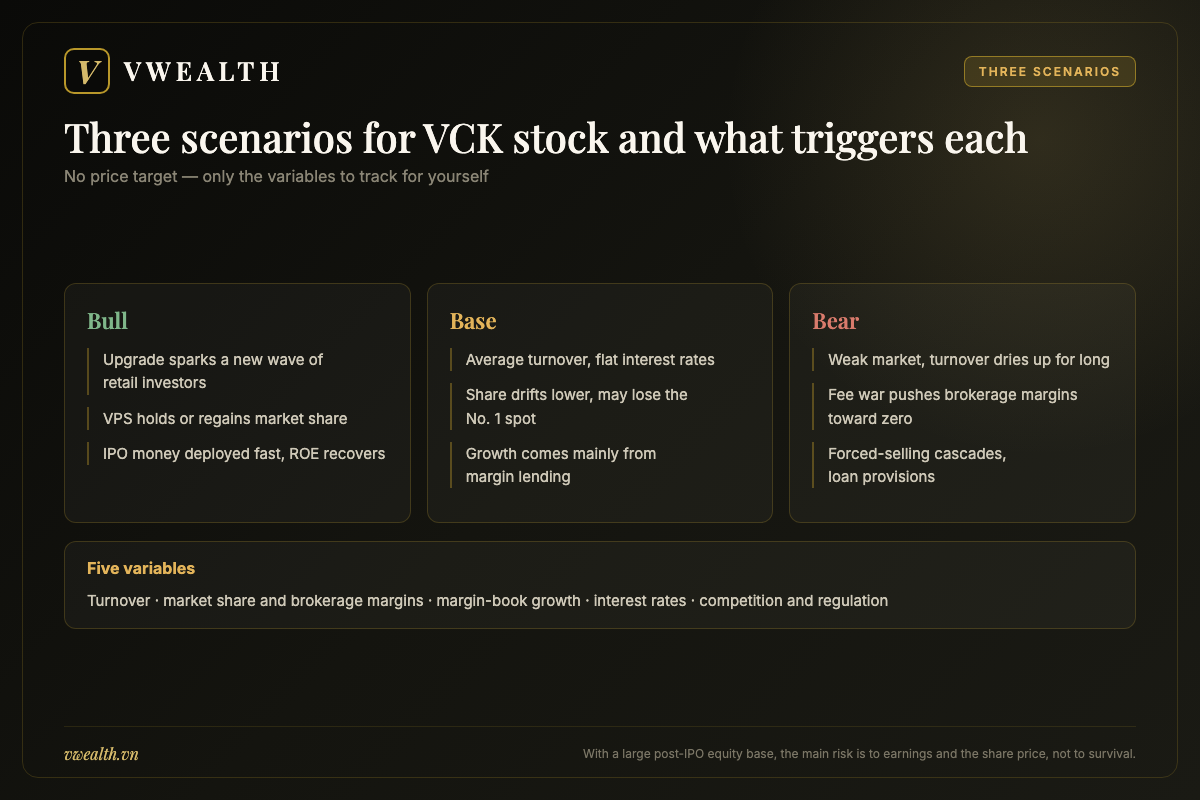
Outlook: Three Scenarios for VCK Stock and What Would Trigger Each
No one knows where VCK’s price is headed, and this article will not offer a price target. What it can do is identify the variables that will shape VPS’s future and sketch three scenarios, bull, base and bear, with the conditions required for each. As news comes in, you can mark for yourself which scenario reality is leaning toward.
Five Variables That Will Decide VPS’s Future
The first variable is equity-market turnover. It is the biggest one, because it drives both brokerage revenue and margin demand. A market trading tens of trillions of dong per session and one trading half as much produce two very different versions of VPS. The second variable is market share and brokerage margins: how much share VPS can hold, and what it has to pay, in commissions or fee cuts, to hold it.
The third variable is the pace and quality of margin-book growth: how fast IPO money is deployed, at what rates, and how safe the loan book is. The fourth is interest rates. Low rates encourage Vietnamese savers to move money from bank deposits into stocks and reduce VPS’s funding costs; high rates do the opposite. The fifth is competition and regulation: zero-fee rivals, bank-owned brokers, and any regulatory changes to margin lending or trading fees.
Bull Case: The Upgrade Sparks a New Liquidity Cycle and VPS Holds Its Crown
Conditions: post-upgrade flows materialize and trigger a new wave of retail investors, similar to 2021; interest rates stay low and stable; market turnover remains high for several consecutive quarters. VPS stabilizes its market share or regains some of it, as its large client base and sales network capture the new wave. IPO and placement proceeds are deployed quickly into margin loans at good rates, and ROE returns above 20%.
In this scenario, VPS could meet or beat its 2026 plan and keep growing. The stock, with its high beta, could outperform the market. But remember: even in the bull case, peak-cycle earnings do not last forever, and investors who buy at the peak of turnover can still lose money when the cycle turns.
Base Case: Growth From Lending, Brokerage Treads Water
Conditions: market turnover is average and interest rates are flat; the upgrade brings flows but not a big new wave of retail investors. VPS’s share keeps drifting lower and it may lose the No. 1 spot to SSI or TCBS for a quarter or two, while remaining in the leading group. Brokerage revenue is flat or slightly up, with thin margins.
Profit growth comes mainly from margin lending as new capital is deployed. Earnings grow moderately, and ROE stays below pre-IPO levels because of the larger equity base. The stock follows the broader market without a breakout story. In this scenario, VPS’s earnings mix gradually shifts from “brokerage firm” to “lending firm.”
Bear Case: A Weak Market, a Deeper Fee War and Margin Losses
Conditions: the market falls sharply or moves sideways for a long time on thin turnover; interest rates rise; one or more groups of stocks become illiquid, triggering chains of forced liquidation. At the same time, the fee war forces VPS to cut fees or raise commissions to keep clients and brokers, while bank-owned rivals keep taking share.
In this scenario, brokerage revenue drops sharply and brokerage margins could approach zero; the margin book shrinks and provisions may be needed for loans that cannot be fully recovered. Profit falls steeply. 2023 is the most recent example of how much VPS’s earnings can fall when turnover dries up, even with high market share. The stock, with its high beta, could fall more than the market. The consolation: with a large post-IPO equity base and moderate leverage, the main risks are to earnings and the share price, not to the company’s survival.
Illustrative Example: How Sensitive Is a Broker’s Profit to Turnover?
To see why brokerage stocks swing so much, run a hypothetical calculation. This is an illustrative example, not VPS data. Suppose a broker has brokerage revenue of 100, brokerage costs (mostly commissions, varying with revenue) of 75, net margin interest of 40, and fixed costs (office staff, technology, rent) of 20. Pre-tax profit: 100 − 75 + 40 − 20 = 45.
Now suppose turnover falls 30%. Brokerage revenue drops to 70 and brokerage costs to 52.5; the margin book shrinks and net margin interest falls to 30; fixed costs stay at 20. Profit: 70 − 52.5 + 30 − 20 = 27.5, a drop of nearly 40%, more than the fall in turnover. Conversely, if turnover rises 30%, profit rises by nearly 40%. That operating leverage is what makes brokerage stocks move more than the market. And if the bear case also requires provisions against margin loans, profit can fall further still.
So, Should You Buy VCK Stock? A Balanced Answer
After seven chapters, it is time to pull everything together. This article does not recommend buying or selling; that decision depends on the price when you read this, the portfolio you already hold and your own risk tolerance. But it can help you weigh the case: what supports VCK, what argues against it, and what kind of investor it suits.
The Strongest Arguments For
A genuine, measurable leadership position. VPS has led HOSE brokerage market share for 22 consecutive quarters through the second quarter of 2026, has the largest brokerage revenue in the industry, and led derivatives for years. These are not marketing claims but exchange data published every quarter.
Profits from recurring core activities. About 76% of 2025 revenue came from brokerage and margin lending, with no large corporate bond book or aggressive proprietary trading to spring surprises. When you read VPS’s accounts, you rarely find windfall gains or losses.
Ample room to grow margin lending after the IPO. According to management at the April 2026 AGM, only about half the lending ceiling was in use. In a supportive market, margin growth could lift profit without depending on the fee war.
The most direct play on Vietnam’s retail investor cycle. If you believe the market upgrade and reforms will bring millions more individual investors into Vietnam stocks, VCK expresses that thesis more purely than any other brokerage stock.
Historically strong capital efficiency. ROE of about 22.2% in 2024 and one of the highest in the industry in 2025 show a business that can earn well on its capital. The open question is how much of that survives the much larger equity base.
The Arguments Against
Steady market-share erosion. On HOSE, share has fallen from about 19.06% in 2023 to about 12.61% in the second quarter of 2026; in derivatives, from nearly 60% to about a third. There is no clear sign yet of a reversal.
Thin brokerage margins squeezed from both sides. Zero-fee rivals pull fees down while the commission race pushes costs up. VPS’s largest business is also its lowest-margin one.
No parent bank, and ownership that is less transparent than peers’. The largest shareholder is a small fund manager holding a stake worth more than a billion dollars, and the CEO came from that shareholder. You know less about the resources of VPS’s controlling group than you would about Techcombank or VPBank.
No cash dividend, and more share issuance planned. All 2025 profit was retained; the private placement of up to 240 million shares could dilute existing holders if priced low.
Highly cyclical, with a short price history that began with a fall. VCK dropped more than 15% on its first day and traded below its IPO price for months afterward. Brokerage stocks are always volatile, and VCK does not yet have enough history to show how it behaves through a prolonged downturn.
| Aspect | Pros | Cons |
|---|---|---|
| Market position | No. 1 HOSE brokerage share for 22 straight quarters | Share falling steadily; gap to No. 2 narrowing |
| Business model | Profit from recurring core activities, few surprises | Concentrated on retail clients; little diversification |
| Brokerage | Largest brokerage revenue in the industry | Thin margins due to commissions; pressure from zero-fee rivals |
| Margin lending | Large post-IPO runway, fat spreads | Credit risk in a market crash |
| Ownership | Not subject to a parent bank’s interests | Little-known controlling group; no backstop |
| Minority shareholders | Bonus shares build capital for growth | No cash dividend; dilution risk |
| Macro | Biggest beneficiary if the upgrade brings a new retail wave | Hit hardest if turnover stays low for long |
Who VCK Stock Suits
Investors who want to bet on the market cycle. If you believe Vietnam’s stock market is heading into a high-turnover phase, VCK amplifies that view. But you need an exit plan for when the cycle turns; cyclical stocks rarely suit a buy-and-forget approach.
Investors who can tolerate volatility and like reading numbers. If you are willing to track market share, brokerage margins and the margin book every quarter, using the six questions in Chapter 4, you will have an edge over investors who only watch the price.
Investors who want a brokerage that is not bank-owned. If your portfolio already holds Vietnamese bank stocks, adding TCX or VPX may double up on the same ecosystem risk; VCK carries a different risk profile, more sensitive to retail trading activity than to bank credit. For a broader view of the sector, compare it with other brokers such as SHS and with Vietnam’s banks in our Vietnam banking sector guide.
Who It Does Not Suit
Income investors seeking regular cash dividends. VPS is retaining profit to expand lending. If you need cash flow, look elsewhere.
Investors who cannot stomach deep drawdowns. A first-day drop of more than 15% is a reminder: if a fall of several tens of percent would make you panic-sell, brokerage stocks in general, and VCK in particular, are not for you.
Investors who would put their whole portfolio on one story. VCK is tied to a single variable: market turnover. If the rest of your wealth also depends on the stock market, VCK doubles that exposure.
Anyone buying because of the old name. If you want exposure to “VPBank Securities” because you believe in the VPBank ecosystem, the ticker to research is VPX, not VCK. Make sure you know which company you are buying.
The Bottom Line
VPS is the story of a company sold off by its parent bank while it was still small, which then built itself into Vietnam’s largest broker with a very old-fashioned tool: people going out to find clients. Five straight years at the top of the market-share tables, record profit in 2025 and a VND 12 trillion IPO show the model has worked. But market share is slipping, zero-fee competitors are growing, and the company is gradually shifting from selling trading services to lending money for trading, a move that brings fatter margins but a different kind of risk.
So the question of whether to buy VCK stock comes down to two smaller questions. First, what do you believe about Vietnam’s stock-market turnover over the next two to three years, now that the upgrade is taking effect? Second, which of the three scenarios is today’s price paying for? If the price reflects only the base case while you have good reasons to expect the bull case, that may be an opportunity; if the price already reflects the bull case, the risk outweighs the reward. Answering the second question requires current data, including valuation, quarterly market share, margins and the margin book, which this article deliberately leaves out. Open the reports, compare VCK with TCX, SSI and other Vietnam stocks in the sector, and decide for yourself. This article is meant to help you understand the business, not to recommend buying or selling.
Research Vietnamese stocks in English with vwealth. Our AI-powered platform turns Vietnamese market data into full English analysis reports — with international payment support and a free 2-month trial for new accounts. Create your free account and read the latest reports.