Anyone working out how to invest in Vietnam stocks from abroad eventually asks the same question: what is the minimum that makes this worthwhile?
The honest answer is that there is no regulatory minimum, and that the question is nonetheless real — because a foreign investor faces fixed costs that a domestic one does not, and those costs do not shrink with your position size.
This piece breaks down where the fixed costs sit, which route fits which allocation, and five questions worth answering before committing anything. It complements our practical guide on choosing a broker in Vietnam.
What is the minimum to invest in Vietnam stocks from abroad?
Short answer: There is no set minimum. The practical floor comes from fixed setup costs — document legalisation for the trading code, account arrangements, and currency conversion — which do not scale down with position size. Below a certain allocation, an offshore-listed fund avoids those costs entirely and is usually the better structure.
Where the costs actually sit
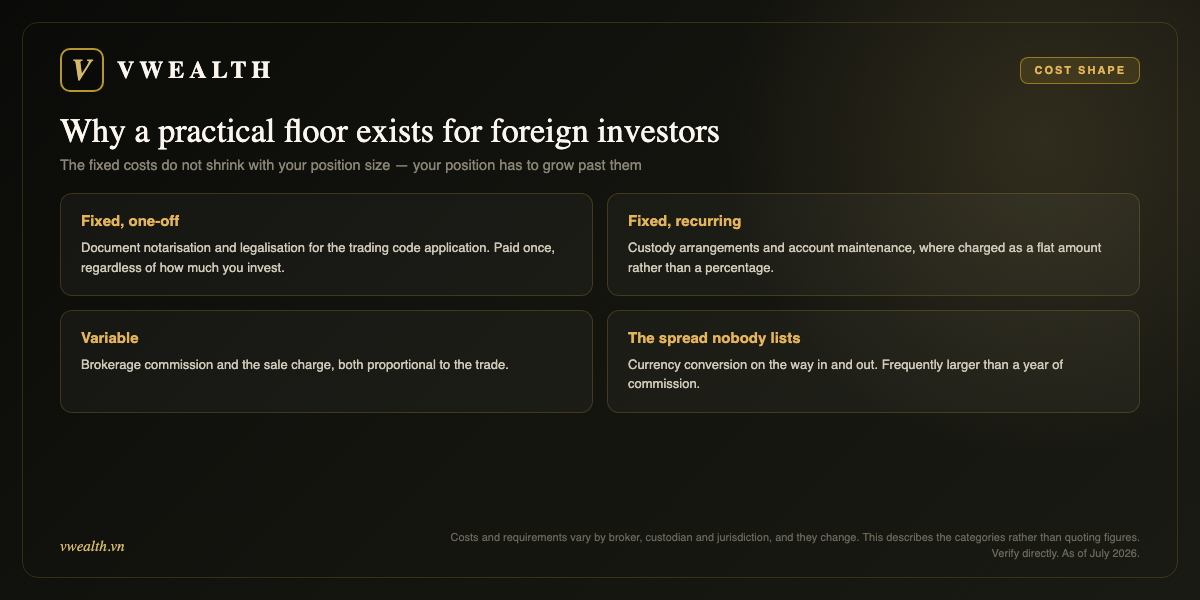
Fixed and one-off
Getting a securities trading code requires documentation that must be notarised and, depending on your jurisdiction, legalised. That is a fixed cost in both money and calendar time, and it is identical whether you intend to invest a small amount or a large one.
It is also the step that determines the timeline. Everything else is fast once this exists.
Fixed and recurring
Custody arrangements and account maintenance. Where these are charged as a flat amount rather than a percentage, they weigh disproportionately on a small position.
Where they are charged as a percentage of assets, they scale — which is friendlier to a small investor and less friendly to a large one.
Variable
Brokerage commission, proportional to each trade. And the charge on sale, which in Vietnam is applied to the value of the sale rather than to the gain — meaning a loss-making exit still incurs it.
That last point matters for sizing a first position. A test trade to verify the setup works is sensible, and it is not free.
The cost nobody lists
Currency conversion, on the way in and again on the way out.
The spread applied is frequently larger than a year of brokerage commission, and it rarely appears on a fee schedule. Ask how the rate is determined and whether it is negotiable — for a meaningful allocation, it usually is.
Which route fits which allocation
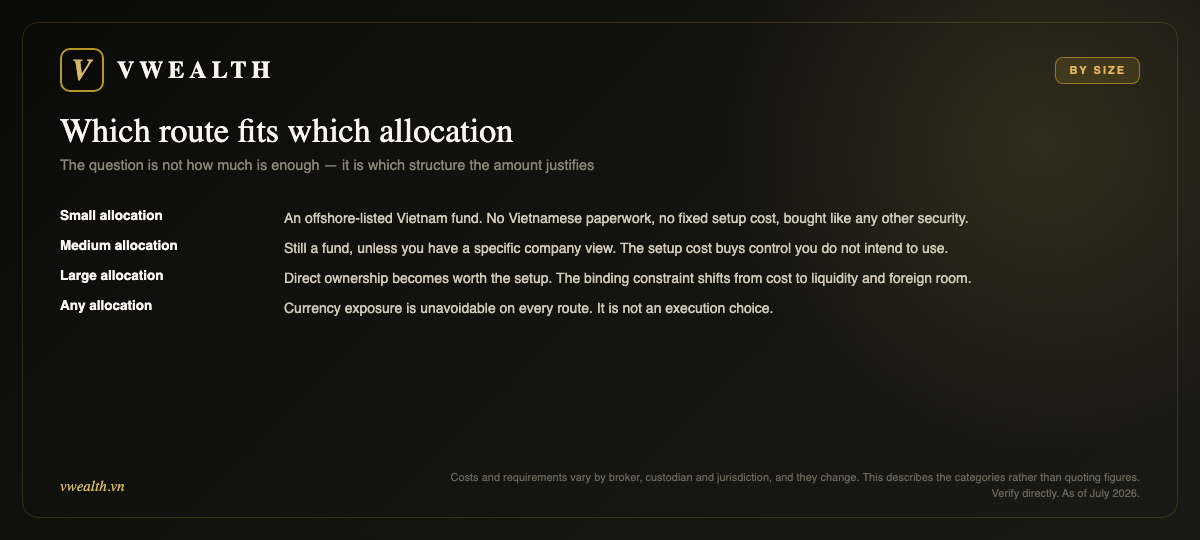
Small allocation
An offshore-listed Vietnam fund, bought through your existing brokerage account. No trading code, no capital account, no legalised documents.
You pay a higher ongoing fee and accept whatever the fund holds. For a first position or a modest allocation, that trade is straightforwardly worth it. Routes compared in which Vietnam ETF you can actually buy.
Medium allocation
Still a fund, unless you have a specific view on specific companies.
This is the case people most often get wrong. The setup cost for direct ownership buys you control over which companies you hold — and if you do not intend to exercise that control, you have paid for something you will not use.
Large allocation
Direct ownership becomes worth the setup, and the binding constraint changes.
At this size the limits are no longer cost. They are liquidity — how much you can buy and later sell without moving the price — and foreign room, which caps how much of certain companies foreigners may own in aggregate. Mechanics in foreign room and the cap that blocks foreign money.
Any allocation
Currency exposure applies on every route. Holding an offshore fund does not remove it — the fund holds dong-denominated assets and the exchange rate flows through to your return regardless of the currency the fund is quoted in.
Detail in what the dong means for USD returns.
Five questions before committing
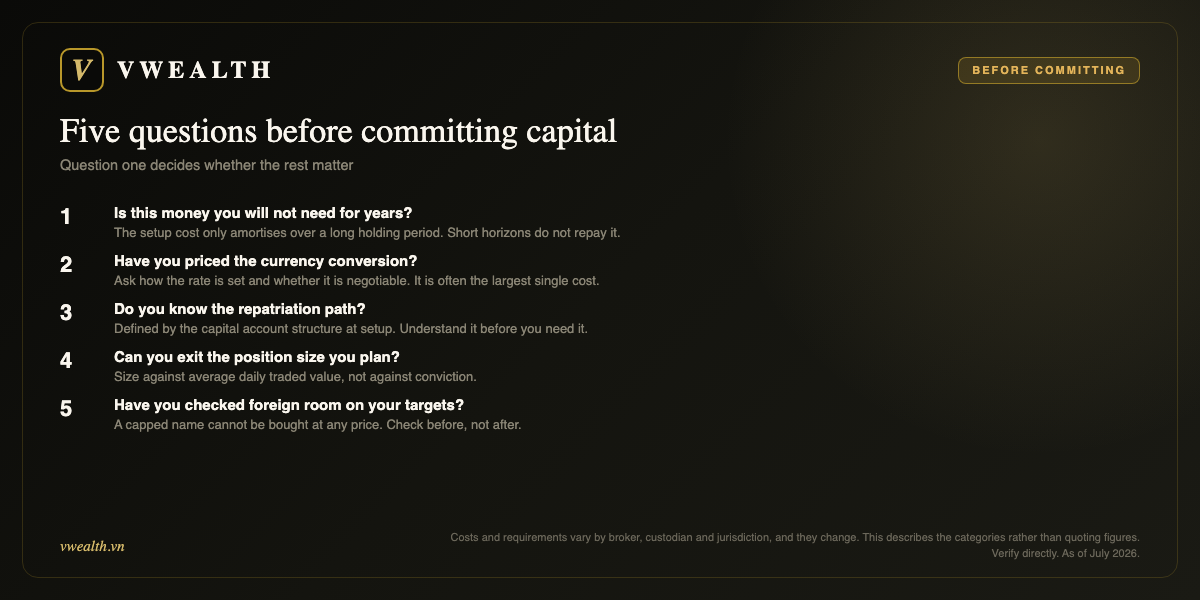
1. Is this money you will not need for years?
The fixed setup costs only amortise over a long holding period. A short horizon does not repay them, and it also collides with the sale charge applied to transaction value.
If the honest answer is that you might need the money within a couple of years, the structure question resolves itself: use a fund, or do not do it.
2. Have you priced the currency conversion?
Ask the specific question: how is the rate set, and can it be negotiated. A vague answer is itself informative.
3. Do you know the repatriation path?
Money enters and leaves through an indirect investment capital account, established at setup. That structure defines how you get money out and how long it takes.
Understand it while opening the account, not when you want the money back.
4. Can you exit the position size you plan?
Work backwards from the exit. In a market where many names trade thinly, the constraint that binds first is not how much you can buy but how much you can sell without accepting a poor price.
5. Have you checked foreign room on your targets?
A name at its foreign ownership ceiling cannot be bought by any foreign investor at any price. Checking takes two minutes and prevents building a plan around a stock you cannot access.
Working out your own floor
Rather than accepting a number from an article, here is how to compute the threshold that applies to you.
Step 1 — list the one-off costs
Notarisation and legalisation for your document set, any account opening charges, and the cost of the first currency conversion. Get actual quotes rather than estimates; they vary widely by jurisdiction.
Step 2 — list the annual costs
Custody, account maintenance, and an assumption about how many trades you will make per year with their associated commission and sale charges.
Step 3 — decide your holding period
Three years, five, ten. This is the number that determines how the one-off costs amortise.
Step 4 — express total cost as a percentage
One-off costs divided by holding period, plus annual costs, divided by the amount you intend to invest.
Now compare that percentage against the ongoing fee of an offshore fund. If direct ownership comes out higher, the fund is the better structure at that size — regardless of any general advice about minimums.
Step 5 — find the crossover
Vary the investment amount until the two costs are equal. That crossover is your personal floor, and it will differ from anyone else’s because it depends on your jurisdiction, your broker and your holding period.
This calculation takes about thirty minutes with real quotes and replaces every general rule of thumb on the subject.
What the fund route actually costs you
Since the fund is the default answer below the crossover, it is worth being precise about what you give up.
You hold what the index holds
Including the sectors you would avoid. In Vietnam, that means a substantial banking weight, in a sector constrained by the tightest foreign ownership caps.
Tracking is imperfect for a structural reason
A fund cannot hold capped names in full index weight, because the shares are not available to foreigners. The portfolio drifts from the index by an amount the fund cannot control.
That is not poor management. It is the same wall you would meet holding directly, appearing in a different place.
You pay the ongoing fee indefinitely
Unlike setup costs, which are paid once and amortise, the fund fee accrues every year you hold. Over a long enough horizon this reverses the comparison — which is precisely why the holding period is step three above rather than an afterthought.
What you gain
No paperwork, no custody arrangement, no capital account, immediate access, and the ability to exit through an ordinary brokerage account without a repatriation process.
For a first position in an unfamiliar market, that combination is worth a great deal more than the fee.
A sensible sequence for a first-time investor
Stage one. Take exposure through an offshore fund, sized small. Live with the position for two or three quarters and see whether you actually pay attention to this market or whether it becomes something you ignore.
Stage two. If the interest holds, begin the direct setup while the fund position continues. The paperwork takes weeks and there is no reason to be out of the market during it.
Stage three. Once the account exists, run a small test trade end to end. Confirm conversion, settlement, custody and reporting all work before committing size.
Stage four. Build the direct position gradually, and decide deliberately whether to keep the fund holding as a core with direct names around it, or to consolidate.
The advantage of this sequence is that no stage commits you to the next, and each one is reversible at low cost.
What changed in 2026
One development materially affects this calculation, and it is worth stating precisely.
The requirement for foreign institutions to place cash before trading has been removed — the condition FTSE Russell named explicitly ahead of Vietnam’s reclassification to Secondary Emerging status, effective 21 September 2026.
What that changes. Previously, money had to be wired ahead and sit idle, exposed to the currency, before an order could be placed. That was a real cost and, for many institutional mandates, a prohibition.
What it does not change. The trading code, the capital account, the ownership caps and the sale charge. The fixed setup burden for an individual investor is largely unchanged.
So the access improvement is genuine and it is aimed at institutions rather than at individuals. Full context in what actually changes in September.
Three mistakes at the entry point
Sizing the first position for conviction rather than for testing
The first transfer and first trade are a test of whether the whole chain works — conversion, settlement, custody, reporting. Run it small, confirm every leg, then move the real amount.
Ignoring the fixed costs when comparing routes
A direct holding with a lower ongoing fee than a fund can still be more expensive overall once setup, custody and conversion are included — particularly at smaller sizes.
Compare total cost of ownership over your intended holding period, not the headline fee.
Starting the paperwork before confirming the requirements
The most common delay is discovering that a document was legalised in the wrong form. Confirm the exact requirement for your jurisdiction before beginning notarisation, not after.
Position sizing once you are in
The minimum question is about getting started. Sizing is about not being forced out, and the two are related.
Size against the exit, not the entry
In a market where many names trade thinly, the amount you can buy comfortably exceeds the amount you can sell comfortably — because selling into weakness is harder than buying into strength.
A workable rule: size so that your entire position is a modest fraction of a normal day’s traded value in that name. Then exiting over a few sessions does not require accepting a poor price.
Account for the foreign premium
In names at or near the ownership cap, foreign buyers frequently transact above the on-screen price because supply is fixed. That premium raises your effective entry cost and it is not visible on any fee schedule.
Where you meet it, treat it as part of the cost of the position rather than as a market quirk.
Keep the currency exposure deliberate
Your equity view and your currency view are separate positions that arrive bundled. If the equity case only works with a stable exchange rate, you hold a currency position whether you intended to or not.
Naming that explicitly, in writing, prevents the common outcome where a disappointing return gets attributed to stock selection when the exchange rate did most of the damage.
What to review each year
Four things, once a year, fifteen minutes.
Total cost against the alternative. Recompute the crossover from step five. Fee structures change and so does your position size.
Foreign room on your holdings. Caps move — the amendment permitting certain restructuring banks up to 49% is evidence of that — and a cap increase in a name you hold is a genuine structural change.
Liquidity against your position size. If either has drifted, your exit assumption may no longer hold.
Whether the structure still fits. An allocation that has grown may now justify direct ownership; one that has shrunk may no longer justify the maintenance.
Common assumptions worth checking
Four beliefs that shape how people approach this, and how each holds up.
“Emerging market status will make access easier”
Partly true, and the benefit is narrower than the phrasing suggests. The prefunding removal genuinely reduces friction, and it reduces it for institutions. The trading code, capital account and ownership caps that shape an individual’s experience are unchanged.
“A larger allocation gets better terms”
Generally true, particularly on currency conversion, where the spread is frequently negotiable at size and rarely at small amounts. Worth asking regardless — the answer costs nothing.
“I can always sell if I need the money”
The weakest of the four. Selling requires liquidity in the name, and repatriation requires the capital account process. Neither is instant, and both are least convenient during market stress, which is when the need typically arises.
“Costs are similar to my home market”
The composition differs even where the total is comparable. Currency conversion and a sale charge applied to transaction value have no equivalent in most developed markets, and together they favour long holding periods far more strongly.
One structural point to carry
Every question in this article resolves to the same underlying fact: this market imposes fixed costs and structural constraints that reward patience and penalise activity.
Setup costs amortise over years. The sale charge applies to transaction value rather than to gains. Liquidity limits how quickly a position can be unwound. Foreign room caps what can be bought at all.
None of that argues against investing here. It argues for entering at a size and with a horizon that make the constraints irrelevant — which is a different question from finding a minimum, and a more useful one.
If you are investing from India, the UK or Australia
The mechanics are the same everywhere; three things differ by home jurisdiction and they are worth establishing early.
Document legalisation requirements. Whether an apostille suffices or full consular legalisation is needed depends on the arrangements between your country and Vietnam. This single point determines most of the setup timeline, and getting it wrong means starting the document process again.
Which offshore funds you can access. Fund availability is a function of where the fund is listed and what your brokerage permits. An investor in one market may have several Vietnam funds available while an investor elsewhere has one or none — which sometimes decides the route by itself.
Your own tax treatment. How Vietnamese withholding and the sale charge interact with your home tax position depends on residence and on whether a double taxation agreement applies. This is a question for your own adviser, and worth asking before rather than after the first trade.
What does not vary: the trading code, the capital account, the ownership caps and the charge on sale value. Those are features of the Vietnamese market and they apply to every foreign investor identically.
Frequently asked questions
Is there a legal minimum investment?
No. The floor is practical, created by fixed costs rather than by rule.
Can I start with a fund and move to direct later?
Yes, and for many investors that is the sensible sequence. The fund provides exposure while you decide whether you want company-level control, and the setup process can run in parallel.
How long does the setup take?
Dominated by document legalisation in your own country. Ask a prospective broker for a realistic range based on clients from your jurisdiction rather than a best case.
Do I need to be resident anywhere specific?
Requirements differ for individuals and entities and by country of residence. This is a question for the broker and, where structure matters, for a tax adviser.
Does the sale charge really apply to losses?
Vietnam applies the charge to the value of a sale rather than to a realised gain. The practical consequence is that frequent trading is more expensive here than a commission schedule suggests, and long holding periods are comparatively favoured.
Can I hold Vietnamese stocks in a retirement account?
Depends entirely on your jurisdiction and provider. Where permitted at all, it is usually only through a listed fund rather than direct holdings, since a retirement wrapper is unlikely to accommodate a foreign capital account. Check with the provider before planning around it.
Is a regional fund a reasonable compromise?
For a small allocation, yes — it removes every operational question. The trade-off is that the Vietnam weight is set by the manager and can change without reference to your view.
Summary
Working out how to invest in Vietnam stocks from abroad is less a question of minimum capital than of which structure your allocation justifies.
Fixed costs — legalised documents, account arrangements, currency conversion — do not shrink with position size. Below a certain allocation, an offshore fund avoids them entirely and is the better answer. Above it, direct ownership becomes worth the setup, and the constraints shift to liquidity and foreign room.
The one question that decides everything else is the first: is this money you can leave alone for years. If not, the structure question is already answered.
Further reading: the complete guide to the Vietnamese market, taxes for foreign investors, and an honest assessment of the risks.
This article is for information and education. It is not investment, legal or tax advice, and it is not a recommendation of any security or firm. Requirements and costs vary and change — verify directly. As of July 2026.