Anyone asking whether to buy BVH stock usually reaches for the wrong mental model. Bao Viet Holdings is not a bank, not a securities firm, and certainly not an industrial company. It is Vietnam’s largest insurance group and the country’s first insurer, created by government decision in December 1964 and operational from January 1965. The way it earns money, the way it recognises revenue, and the way you must read its accounts differ fundamentally from every other financial stock on the Vietnamese market. This analysis retells six decades of Bao Viet, teaches you from scratch how an insurance company actually makes a profit, explains why the level of interest rates — not any quarterly result — is the decisive variable for these shares, and closes with a straight answer.
Three conventions before we start.
The first concerns figures. This article uses historical milestones, ownership percentages, market share and results from completed financial years, all drawn from public sources: the incorporation decision, shareholder meeting resolutions, exchange filings and mainstream financial media. What you will not find is a share price, a current valuation multiple, a price target, or a latest-quarter number. For current data, open the research reports on vwealth.
The second concerns technical vocabulary. This is the first article in the series covering the insurance sector, so terms are explained as they appear: premiums, technical reserves, solvency margin, loss ratio, combined ratio, bancassurance. If you already know the industry, skim those passages. If you do not, read them carefully, because without these concepts every number in Bao Viet’s accounts will look meaningless.
The third concerns personnel. The group’s most senior positions have changed hands several times in recent years, and some seats have been held on an acting basis. This article records only what has been disclosed and can be verified across multiple sources, and says explicitly where you must check the company’s latest filing rather than trust the article.
Six decades of Vietnam’s first insurer
Bao Viet is not merely Vietnam’s largest insurance company. For a long stretch of its history it was Vietnam’s only insurance company. Understanding that explains most of the character the business carries today.
Orientation for readers outside Vietnam
A short note on the corporate landscape, because Bao Viet cannot be read correctly without it.
Vietnam’s insurance market is young in commercial terms. It opened to foreign participation only from the mid-1990s, meaning most of the international life insurers operating there today have roughly thirty years of local history, while Bao Viet has sixty. Insurance penetration — premium revenue as a share of gross domestic product — remains low compared with regional peers at similar income levels, which is the structural growth argument for the whole sector.
Bao Viet itself is a state-controlled holding company. The Ministry of Finance holds the dominant stake, a Japanese life insurer holds the strategic stake, and the free float available to everyone else is small. The group operates through specialist subsidiaries — life insurance, general insurance, fund management, securities and banking — rather than underwriting directly at the holding level. Keep that structure in mind: it determines how you must read the accounts.
1964: a decision of the government
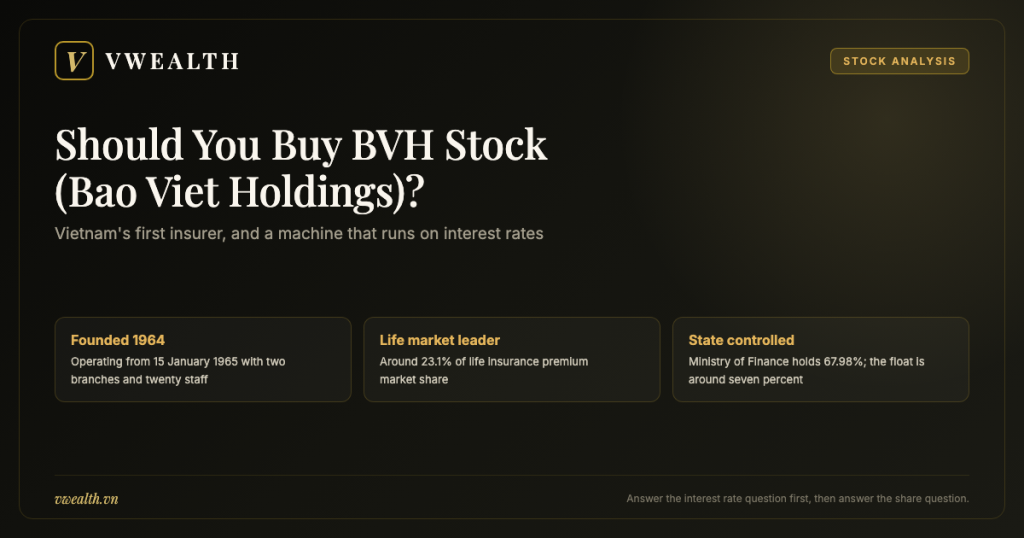
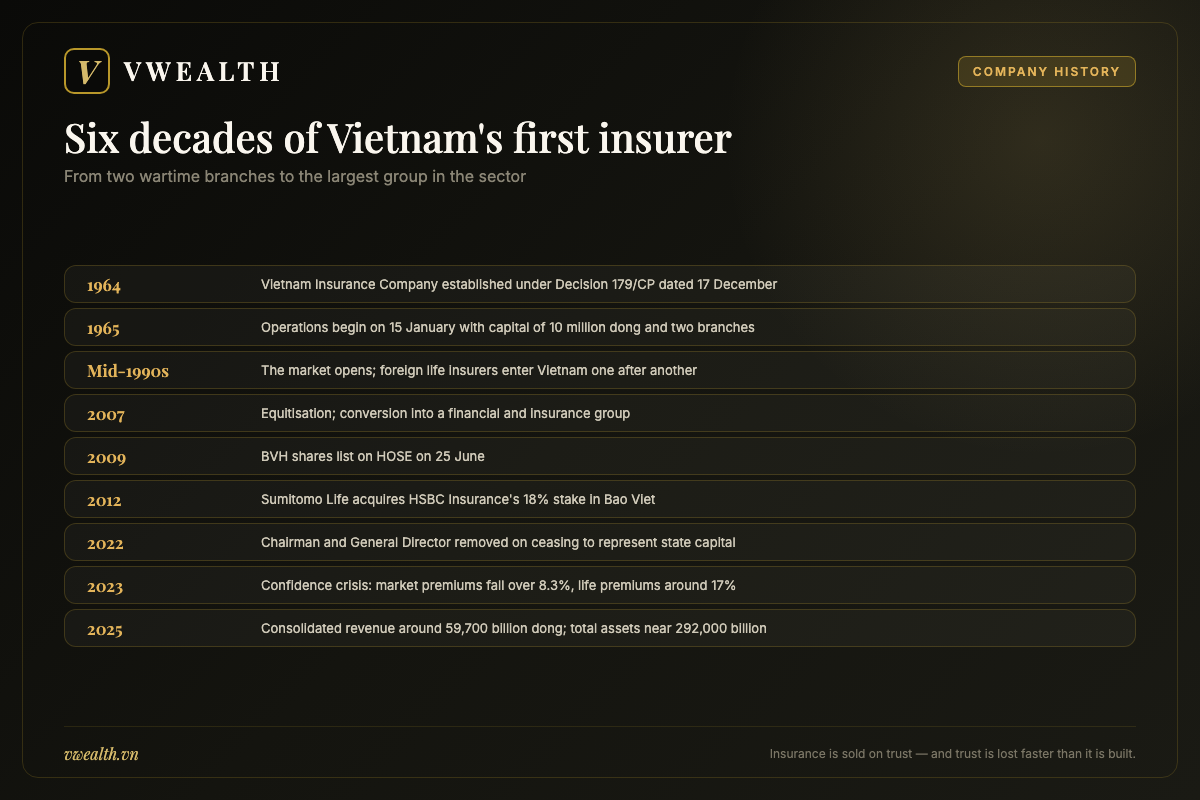
The Vietnam Insurance Company was established under Decision No. 179/CP of the government dated 17 December 1964, and began operating on 15 January 1965. Initial scale was tiny: capital of 10 million dong, around twenty staff, and two branches in Hanoi and Haiphong.
The founding context explains the original business. In the early 1960s, insurance demand in northern Vietnam centred on cargo insurance for imports and exports and on marine hull cover — risks without which foreign trade could not be conducted at all. Put differently, Bao Viet was created to serve international trade, not to sell life policies to households.
Carry this forward: Bao Viet’s roots are in general insurance for institutions, while personal life insurance is a story that begins three decades later. The two lines have economic models so different that they function almost as separate businesses, and chapter three separates them properly.
The monopoly era and the opening
For decades Bao Viet operated in a market with no competitors. That produced two opposing legacies.
The constructive legacy is the network. As the state’s sole insurer, Bao Viet built a branch system covering every province, along with a brand that essentially every Vietnamese household recognises. In insurance, distribution reach and brand recognition are real assets, because insurance is not a product customers seek out on their own — someone has to bring it to them.
The legacy to watch is operating culture. A company that grows up without competition typically carries a heavy organisational structure, long processes and slower decision-making than the private or foreign rivals that arrive later. You will see this reflected in efficiency ratios when comparing Bao Viet with the foreign insurers operating in Vietnam.
From the mid-1990s the Vietnamese insurance market opened. Foreign life insurers entered one after another, bringing professional agency models, investment-linked products and large marketing budgets. Bao Viet moved from monopolist to besieged leader — and has held the leading position in life insurance to this day, which is a more substantial achievement than most people credit, given that its competitors are global insurance groups.
2007: equitisation and a foreign strategic shareholder
2007 was the largest inflection point in the company’s history. Bao Viet was among the first large Vietnamese state enterprises to be equitised with the participation of a foreign strategic shareholder. The organisational model shifted from a state general corporation to a financial and insurance group operating on a parent–subsidiary basis.
The new structure has a practical consequence: the parent, Bao Viet Holdings, holds capital in specialist subsidiaries — life insurance, general insurance, fund management, securities, banking — rather than underwriting insurance directly. This is why, when reading the accounts, you must distinguish clearly between the parent’s separate financial statements and the group’s consolidated statements. Chapter four returns to this.
25 June 2009: BVH lists
BVH shares began trading on the Ho Chi Minh City Stock Exchange on 25 June 2009. It is one of the longest-listed financial stocks on the Vietnamese market and by far the largest insurance stock.
Early listing brings an advantage investors rarely note: BVH has a continuous published financial record spanning several economic cycles, including the global financial crisis, a period of high domestic rates, a period of record-low rates, and the sector’s own crisis of confidence. For a business whose essence is managing long-duration risk, a long data series has genuine analytical value.
2012 onward: Sumitomo Life replaces HSBC
Bao Viet’s original foreign strategic shareholder was HSBC Insurance. In 2012, Sumitomo Life Insurance of Japan acquired HSBC Insurance’s 18% stake in Bao Viet, becoming the new strategic shareholder.
The relationship later deepened. Bao Viet completed a private placement of more than 41 million shares to Sumitomo Life, lifting the Japanese partner’s holding to its current level.
Why does this detail matter? Because in life insurance a strategic shareholder brings more than money. Life insurance is an industry in which pricing capability, mortality and morbidity risk management, product design and long-duration investment management determine profitability for decades. A partner that is a leading Japanese life insurer — from a market with high life expectancy and one of the world’s oldest life insurance traditions — transfers expertise that money cannot buy quickly.
2022: senior leadership changes
On 24 August 2022, the board of Bao Viet Holdings removed Mr Dao Dinh Thi from the position of Chairman and board member, and removed Mr Do Truong Minh from the position of General Director and board member. The disclosed reason was that both had ceased to act as authorised representatives of state capital at the enterprise.
At the same time, Ms Tran Thi Dieu Hang, a board member, was assigned to oversee the board while the chairmanship remained vacant, and Mr Nguyen Dinh An was appointed Acting General Director.
Calibrate this correctly. At a company with dominant state ownership, the state capital representative mechanism means senior personnel changes track decisions of the capital management authority more than they track business results. But when such changes recur within a short span, the continuity of strategy is affected — and that is genuinely worth monitoring. The guide to corporate governance at Vietnamese listed companies explains the representative mechanism and the disclosure conventions around it.
2023: the sector’s crisis of confidence
2023 was the hardest year in the roughly thirty-year history of Vietnam’s life insurance market, and it was not a Bao Viet-specific problem.
The trigger sat in the bank distribution channel, known in the industry as bancassurance. This is the model in which a bank acts as an agent selling insurance products for an insurer and earns commission. In principle it is efficient: the bank already has the customer base, already knows customer income, and already has branches. But when sales targets became too aggressive, the model produced cases in which customers said they did not properly understand the contracts they signed, or felt conditions were attached to obtaining a loan.
The consequence in the data was stark. Total market premium revenue fell more than 8.3% in 2023 — the first decline in a decade. Life premiums fell around 17%, while general insurance still grew around 2%. The Ministry of Finance processed hundreds of complaints relating to the bancassurance channel and placed a number of insurers on its inspection programme.
For investors the lesson is about sector risk: life insurance is sold on trust, and trust is an asset that can be lost in a single year and takes many years to rebuild. That crisis reshaped how the entire industry sells, and its effects remain visible in new business premium growth in subsequent years.
Recent period: results recover, personnel keep moving
Results for financial year 2025 show a clear recovery. Consolidated total revenue reached approximately 59,700 billion dong, up 5% year on year. Consolidated profit before and after tax came to roughly 3,554 billion dong and 2,922 billion dong respectively, both growing at double-digit rates. Consolidated total assets at 31 December 2025 reached nearly 292,000 billion dong, up 16.1%.
On personnel, movement continues. Ms Tran Thi Dieu Hang, born 1973, served as Acting Chairman of the Board of Bao Viet Holdings from 27 November 2024 to 10 February 2026, and subsequently holds the position of Vice Chairman of the group’s board. From 3 April 2026 she was appointed General Director and legal representative of Bao Viet Life, with a term running to 13 March 2029. Also from 3 April 2026, Mr Nguyen Quang Phi was appointed Chairman of the Members’ Council of Bao Viet Life, with a term to 31 March 2030.
The article stops there and states one thing plainly: the group-level leadership seats at Bao Viet have changed several times in recent years and some positions have been held on an acting basis. Before making an investment decision, open the investor relations disclosures on the company’s own site to confirm the leadership roster as at the date you are reading — rather than trusting any analysis, including this one.
The timeline, read down the page
| Date | Event | Why it matters to a buyer today |
|---|---|---|
| 17 Dec 1964 | Vietnam Insurance Company established under Decision 179/CP | Vietnam’s first insurance enterprise |
| 15 Jan 1965 | Operations begin with capital of 10 million dong and two branches | Roots in marine and trade cargo insurance, not household life cover |
| Mid-1990s | Market opens to foreign insurers | From monopoly to competing with global insurance groups |
| 2007 | Equitisation; conversion to a financial and insurance group | Parent holds capital in subsidiaries; separate and consolidated accounts differ |
| 25 Jun 2009 | BVH lists on HOSE | A long published data series across several rate cycles |
| 2012 | Sumitomo Life acquires HSBC Insurance’s 18% stake | Strategic shareholder is a Japanese life insurer |
| 2019 – 2020 | Private placement of more than 41 million shares to Sumitomo Life | Lifts the strategic partner’s holding to its current level |
| 24 Aug 2022 | Chairman and General Director removed on ceasing to represent state capital | Start of a period of senior personnel turnover |
| 2023 | Sector confidence crisis; market premiums down over 8.3%, life down around 17% | Sector risk is real and its effects persist into later years |
| 2025 | Consolidated revenue around 59,700 billion dong; total assets near 292,000 billion dong | Recovery with double-digit profit growth |
| 2026 | Continued senior personnel moves between group and subsidiaries | Check the latest filing before deciding |
What to carry forward from chapter one
Three things. First, Bao Viet has depth and reach no domestic rival can match, and in an industry that sells on trust that is a real asset. Second, the company has come through a serious sector shock in 2023 and results have recovered, but the effect on new business momentum takes years to measure properly. Third, senior personnel turnover is something to monitor rather than dismiss — at an insurer, continuity of strategy matters far more than at an industrial company, because pricing and investment decisions made today shape profits decades later.
Who owns Bao Viet, and what that means for you
BVH’s ownership structure is one of the most distinctive on the Vietnamese market: the state controls it outright, a Japanese insurance group holds most of the remainder, and public shareholders hold only a sliver.
Three shareholders and the rest
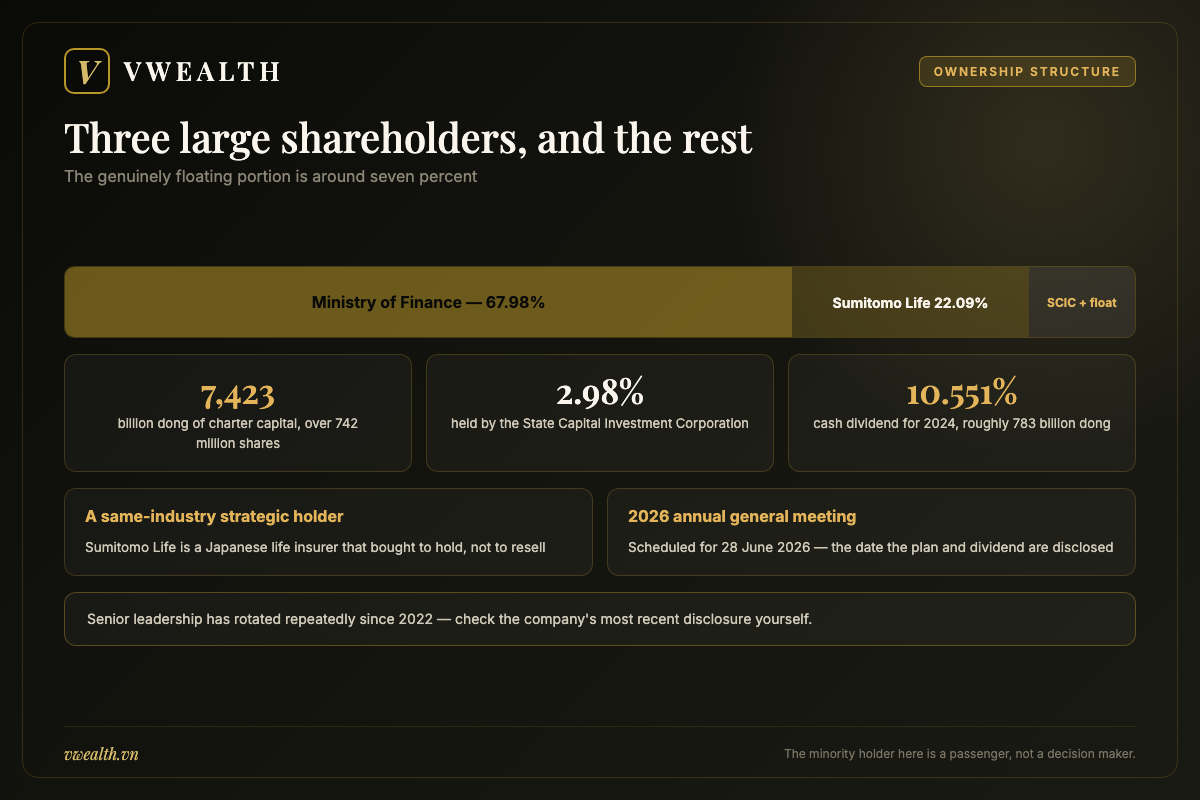
According to the disclosed shareholder structure, the Ministry of Finance holds 67.98% of Bao Viet Holdings. Sumitomo Life Insurance holds 22.09%. The State Capital Investment Corporation holds 2.98%. Charter capital stands at roughly 7,423 billion dong, corresponding to more than 742 million shares outstanding.
Do the arithmetic: three large shareholders hold about 93%. The genuinely floating portion is around seven percent of the shares.
That number produces three consequences you should weigh before buying.
The first is voting power. At 67.98%, the state capital representative can carry every item within the general meeting’s authority, including those requiring a supermajority. Minority shareholders have no capacity to influence corporate decisions — neither good nor bad in itself, but you should know what position you are buying.
The second is relative liquidity. Although BVH sits in the large-capitalisation group and appears in Vietnam’s main indices, the freely traded portion is far smaller than its notional size suggests. The result is that the stock typically moves more violently than the company’s scale would imply, particularly when capital rotates into financial names.
The third is the divestment question. Any news about reducing state ownership at Bao Viet carries weight for the share price, because it directly changes the amount of stock available. But be realistic: insurance touches the financial security of millions of people, and Bao Viet is the state’s founding insurer — any major ownership change here is a policy decision rather than a market one.
If you are unfamiliar with how foreign ownership limits interact with a structure like this, the explainer on foreign ownership room in Vietnamese stocks covers the mechanism; at BVH the practical question is how much room remains after the strategic holding, which you should check at the time you buy.
Sumitomo Life: a strategic shareholder, not a financial investor
Distinguish two kinds of large foreign shareholder. A fund buying shares for price appreciation and dividends is a financial investor; it can sell at any time. A company from the same industry buying a stake to participate in the business is a strategic shareholder; its objectives are entirely different.
Sumitomo Life belongs to the second category. It is one of Japan’s major life insurers, and its presence at Bao Viet means far more than the capital contribution. In life insurance, three capabilities decide outcomes, and all three accumulate over decades: pricing based on mortality and morbidity tables, product design aligned to customer behaviour, and management of an investment portfolio whose duration matches future payout obligations. Japan has the world’s deepest experience in all three, and particularly in running insurance portfolios through a prolonged low-rate environment — something Vietnam’s market has only begun to encounter.
For an investor, the stable presence of a same-industry strategic shareholder is a positive for governance quality and technical transfer. But do not expect it to translate into an attractive takeover situation: strategic shareholders typically buy to hold, not to resell.
Leadership: stating only what is verifiable
As noted in chapter one, Bao Viet’s senior leadership structure has changed repeatedly since 2022. What can be verified across multiple public sources:
Ms Tran Thi Dieu Hang, born 1973, holds a master’s degree in business administration and has many years of experience in insurance and audit. She previously chaired the Members’ Council of Bao Viet General Insurance, served as Acting Chairman of the group’s board from 27 November 2024 to 10 February 2026, and holds the position of Vice Chairman of the group’s board. From 3 April 2026 she was appointed General Director and legal representative of Bao Viet Life.
Mr Nguyen Quang Phi, previously General Director of Bao Viet Life, was appointed Chairman of the Members’ Council of Bao Viet Life from 3 April 2026 to 31 March 2030.
That is what this article is prepared to assert. The complete board and executive roster of the group as at the date you read this must be checked in the most recent filing. This is not evasion — it is the only honest way to write about a company whose senior personnel are in a period of active rotation.
What state control means in practice
Foreign investors sometimes read “state-controlled” as a simple negative. The reality at a Vietnamese financial institution is more specific than that, and worth spelling out.
On the constructive side, state control brings three things. It brings stability of ownership, so there is no risk of the control contests that periodically disrupt privately held Vietnamese financial companies. It brings an implicit expectation that the institution will be supported rather than allowed to fail, which matters in a business whose product is a decades-long promise. And it brings a conservative operating posture, which in insurance is closer to a virtue than a vice.
On the constraining side, it also brings three things. Capital decisions — raising equity, changing the dividend policy materially, making a large acquisition — require approval processes that run through state capital management, and those processes take time. Senior appointments follow the representative mechanism rather than a purely commercial search, which is the root of the personnel turnover described earlier. And the company’s priorities may at times reflect broader policy objectives rather than the narrowest reading of shareholder return.
The honest summary is that state control at Bao Viet reduces both tails. It makes catastrophic outcomes less likely and makes rapid value creation less likely too. Whether that trade is attractive depends entirely on what you want the position to do in your portfolio. An investor seeking a stable, cycle-linked holding in an under-penetrated industry may find the trade acceptable. An investor seeking a re-rating driven by management action will find it frustrating.
Dividends: steady but modest
Bao Viet maintains a relatively consistent cash dividend. For financial year 2024 the approved rate was 10.551% of par value, corresponding to a total payout of roughly 783 billion dong. The 2026 annual general meeting has been scheduled for 28 June 2026.
Read that number correctly. The 10.551% figure is a percentage of the 10,000 dong par value, that is roughly 1,055 dong per share — not a dividend yield on the market price. To know the actual yield you receive, divide that amount by the price you paid. This is the single most common error investors make when comparing dividends across Vietnamese stocks, because Vietnamese companies quote dividends against par by convention.
There is also a structural reason an insurance group’s dividend is hard to push higher. Most of the money the company holds is not its own — it is technical reserves, that is, future payout obligations to policyholders. That money is tightly constrained by financial safety regulation and cannot be distributed. Only profit genuinely attributable to shareholders after full reserving is available. Chapter three explains this concept in detail.
| Ownership dimension | Figure or status | Direct consequence for a retail investor |
|---|---|---|
| Ministry of Finance | 67.98% | Decides every matter within the general meeting’s authority |
| Sumitomo Life | 22.09% | Same-industry strategic shareholder; buys to hold, not to resell |
| SCIC | 2.98% | A second state capital entity within the structure |
| Free float | Around 7% | Price moves more violently than company scale would suggest |
| Charter capital | Roughly 7,423 billion dong, over 742 million shares | Small equity base relative to assets managed — an insurance sector feature |
| FY2024 dividend | 10.551% in cash, roughly 783 billion dong | Around 1,055 dong per share; compute yield on your actual purchase price |
| 2026 annual meeting | 28 June 2026 | The date the year’s plan and dividend proposal are disclosed |
| Senior personnel | Repeated rotation since 2022 | Check the latest disclosure before deciding |
One sentence for chapter two
Buying BVH means buying a very small slice of a company the state controls outright and in which a Japanese group holds a long-term strategic position. That delivers ownership stability few Vietnamese financial stocks possess, and it also means you are unambiguously a passenger. Both are true at once, and you cannot have one without the other.
How an insurance company actually makes money
This is the most important chapter if you have never held an insurance stock. Read it slowly, because the economic model differs from every other sector, and if you get the model wrong every subsequent conclusion follows it.
Three profit sources, not one
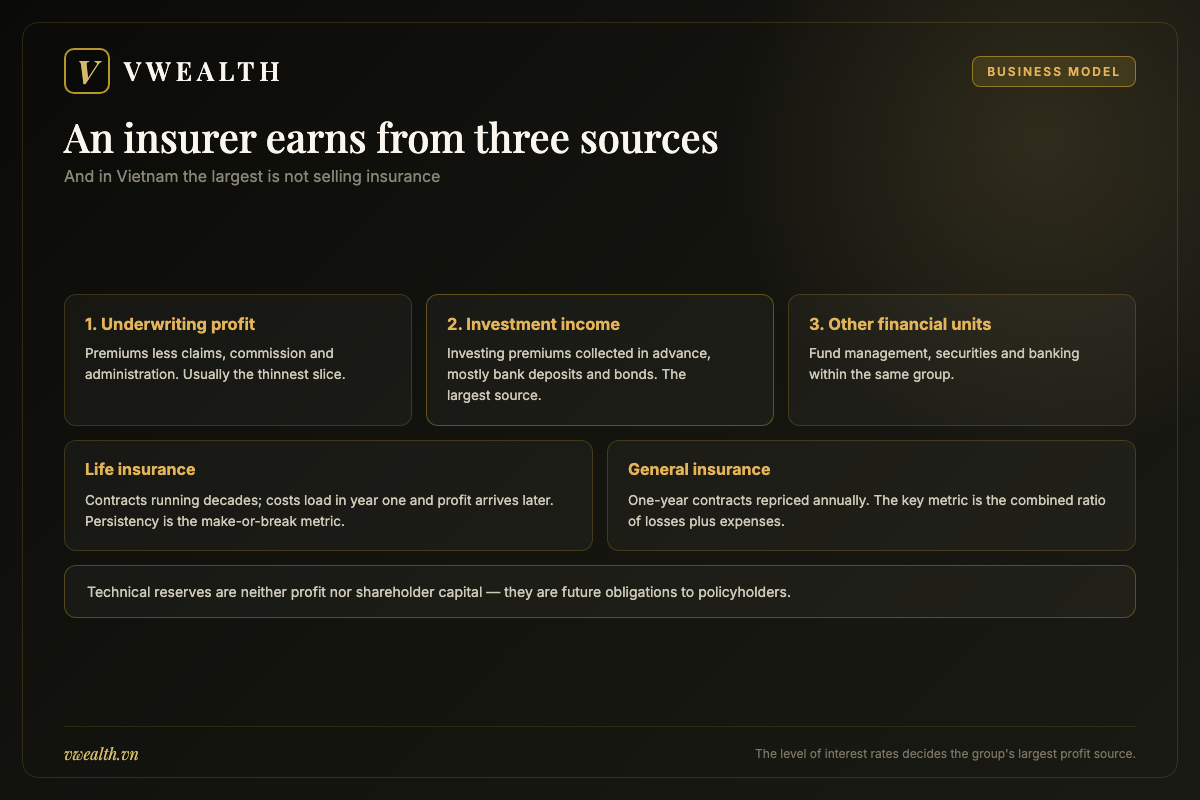
An insurance company has three distinct profit sources, and they move independently of one another.
The first is underwriting profit. The company collects premiums from customers and pays out claims plus acquisition and administration costs. If collections exceed outgoings there is an underwriting profit. Most people assume this is the whole story; in practice, in many markets it is the thinnest slice and can be negative.
The second — and in Vietnam the largest — is investment income. An insurer collects premiums first and pays claims later, sometimes decades later. The interval creates a very large pool of money sitting in the company’s hands. That pool is invested — predominantly in bank deposits and bonds — and the income it produces belongs to the company.
The third is profit from other financial businesses in the ecosystem: fund management, securities and banking. At Bao Viet this is a supplement rather than the main engine.
Once you understand these three, you understand why the opening paragraph said interest rates are the decisive variable for BVH. When the overwhelming share of group assets sits in bank deposits and bonds, the level of interest rates directly determines the company’s largest profit source.
Technical reserves: the largest line and the most misread
Open Bao Viet’s balance sheet and the largest item on the liabilities side will be technical reserves. This concept must be understood properly.
Technical reserves are the money the company must retain to ensure it can meet obligations under policies still in force. They are not profit. They are not shareholders’ capital. They are future obligations to policyholders, calculated by statistical method and tightly supervised by the regulator.
Why does this matter for an investor? Because it explains three phenomena.
The first: Bao Viet’s total assets are enormous relative to charter capital. Consolidated total assets at end-2025 were near 292,000 billion dong while charter capital is roughly 7,423 billion dong. Most of that gap is technical reserves and similar obligations. That means you cannot apply an industrial company’s debt-to-equity reading here — the number will look alarming while saying nothing meaningful.
The second: an insurer’s accounting profit is sensitive to assumptions. Reserving depends on assumptions about technical interest rates, lapse rates, mortality and morbidity. Change an assumption and you change profit, even though cash flow is unchanged. This is why you should read the note on the reserving basis rather than only the profit line. Readers used to IFRS should also note that Vietnamese companies report under Vietnamese Accounting Standards; the guide to reading Vietnamese financial statements under VAS versus IFRS sets out where the two frameworks diverge.
The third: dividends are constrained. Most of the money the company holds is not distributable. That is why a group managing nearly 292,000 billion dong of assets pays roughly 783 billion dong of dividends for a year.
Life insurance: selling a promise that runs for decades
Bao Viet Life is the group’s most important subsidiary and the leader of Vietnam’s life insurance market by premium market share.
A life product is fundamentally a long-duration contract: the customer pays premiums regularly for many years, and in exchange the company commits to pay on an insured event or at maturity. Many modern products add an investment component — investment-linked products — in which part of the premium goes into a fund the company manages.
Three economic features to remember about this line.
The first: costs load at the front, profit arrives at the back. The first year of a life policy typically loses money for the insurer, because agent commission and underwriting costs are large relative to first-year premium. Profit comes in later years, when the policy stays in force without further acquisition cost. This produces a crucial consequence: the persistency rate is the make-or-break metric. A company that sells many new policies but loses customers after a year or two loses more money the more it sells.
The second: interest rate risk is real. In selling a policy with a guaranteed technical rate, the insurer promises a minimum return over many years. If market rates fall deeply and stay low, the insurer can find its portfolio yield below the level it has already promised. This is precisely the problem Japan’s insurance industry has worked through for decades, and it is why a Japanese strategic shareholder’s experience has value.
The third: this is an industry sold on trust. The events of 2023 demonstrated that more clearly than any theoretical argument.
An illustration: one life policy over twenty years
To see those three features in motion, follow a hypothetical policy from start to finish. The figures below are an illustration constructed for clarity, not drawn from any company’s actual product.
Suppose a customer signs a twenty-year life policy paying twenty million dong per year. In year one, the insurer pays a high first-year commission to the agent — across the industry, first-year commission typically consumes a large share of first-year premium — plus medical underwriting, policy issuance and administration cost. Year one is almost certainly a loss on this policy.
From year two the picture reverses. Renewal commission is far lower than first-year commission, underwriting costs do not repeat, and premium continues to arrive in full. The surplus is set aside into technical reserves against the future obligation, and that money is invested. Each passing year, the pool accumulated from this policy grows, and the income it generates grows with it.
Now test two situations.
Situation one: the customer lapses after three years. The insurer incurred large first-year costs but has not had time to recover them through later years. On this policy the insurer loses money. Multiply that across tens of thousands of policies and you understand why persistency is the make-or-break metric, and why the 2023 confidence crisis caused genuine financial damage rather than only reputational damage.
Situation two: the customer stays the full twenty years, but market rates fall sharply during the middle decade. The accumulated pool is still there, but it earns less than originally assumed, while the maturity obligation has already been committed. This is the long-duration interest rate risk this chapter refers to, and it appears in no quarterly report — it appears only when you read the asset and liability duration table.
Those two situations explain why judging a life insurer on a single year’s profit is close to meaningless. What you need to assess is the quality of the in-force book and how the company manages the money attached to it.
General insurance: short-tail, and a price war waiting to happen
Bao Viet General Insurance handles the non-life side — motor, health, property and engineering, marine, aviation and other lines.
The economic model differs sharply from life. Contracts typically run one year, premiums and claims occur within a short window, so the pool available for investment is much smaller than in life. In compensation, the company can reprice annually in line with actual claims experience.
The most important metric here is the combined ratio. The calculation is simple: add the loss ratio to the expense ratio, both measured against premiums. Below one hundred percent means the underwriting itself is profitable before any investment income. Above one hundred percent means underwriting loses money and the company relies on investment income to cover it.
In Vietnam, non-life competition is intense and has at times been described as competition through rate-cutting. When insurers cut rates to win business, the industry-wide combined ratio deteriorates. This is what to watch when assessing the quality of this segment’s earnings.
The other financial businesses
Beyond the two insurance lines, the group holds capital in a fund management company, a securities firm and a commercial bank.
Strategically this is the diversified financial group model many countries have adopted: use the large insurance float as a base, then offer a full financial product suite to the same customer set. In practice, its effectiveness in Vietnam depends heavily on the scale and competitive position of each subsidiary within its own industry.
When reading the consolidated statements, pay attention to segment contribution. A group with many segments can easily obscure the true picture of the core business behind a consolidated total.
| Segment | Economic model | Metric to watch | Most sensitive to |
|---|---|---|---|
| Life insurance | Long-duration contracts; costs front-loaded, profit back-loaded | Persistency, new business premium, technical reserves | Long-term interest rates and customer trust |
| General insurance | One-year contracts, repriced annually | Loss ratio, expense ratio, combined ratio | Rate competition and claims frequency |
| Investment activity | Investing premiums collected in advance, mostly deposits and bonds | Portfolio yield, duration profile, asset quality | Deposit rates and bond yields |
| Fund management and securities | Fees on assets under management and market activity | Assets under management, brokerage share | Equity market conditions |
| Banking | Deposit taking and lending | Net interest margin, asset quality, capital adequacy | Credit cycle and monetary policy |
Position and how to read the financial health of an insurance group
This chapter does two things: establishes where Bao Viet stands in its industry, and shows you the five places to read carefully when you open an insurance group’s accounts.
Life insurance position: leading, but closely followed
On published life insurance premium market share for the recent period, Bao Viet Life leads with roughly 23.1%, followed by Manulife at about 16.6% and Prudential at about 13.6%. Dai-ichi Life stands at roughly 12.5% and AIA at about 10.8%. The remainder is divided among MB Ageas, Generali, FWD, Chubb, Sun Life, Hanwha, Cathay Life and others.
Reading that table correctly requires three caveats.
The first: market share on total premium differs from market share on new business premium. Total premium includes renewal premium from policies written years ago. A company with as long a history as Bao Viet has a structural advantage on total premium thanks to its accumulated in-force book. New business premium is the measure of current selling power. To judge forward momentum you need both.
The second: Bao Viet’s competitors are all subsidiaries of global insurance groups with substantial capital and technical resources. Holding the number-one position against that field is a genuine achievement, but the gap is not unassailable.
The third: Bao Viet’s largest advantage in this line is a distribution network reaching provincial towns and rural customers — segments foreign insurers find hard to cover economically. That is a real moat, built over decades.
General insurance position
In non-life, Bao Viet sits in the market’s leading group alongside names including PVI, VietinBank Insurance, BIC, MIC, Bao Minh, PTI and others. This is a more fragmented segment than life, with fiercer competition on price.
One point deserves emphasis: in non-life, revenue scale does not automatically equal earnings quality. A company can grow revenue quickly by accepting risks with high loss ratios that competitors decline. So when comparing, look at the combined ratio first and revenue second.
Five places to read in an insurance group’s accounts
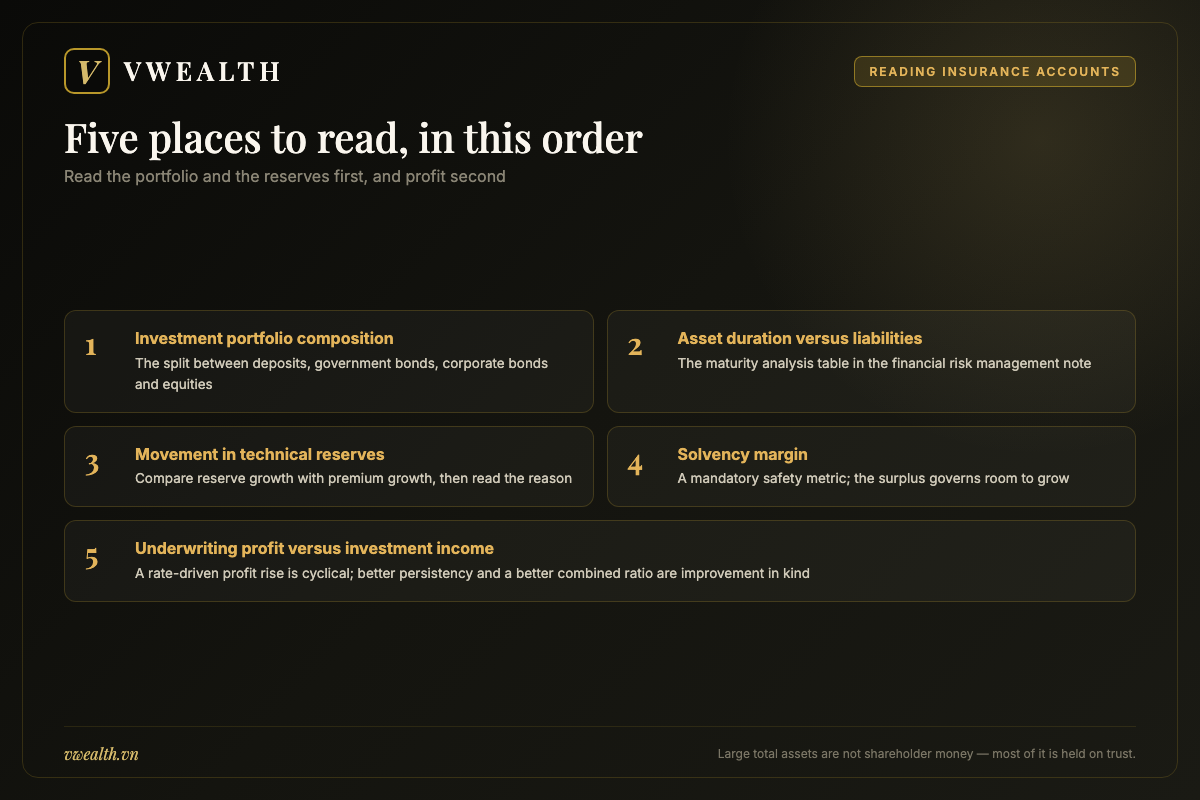
If you have only fifteen minutes with Bao Viet’s financial statements, spend them on these five places, in this order.
Place one: the composition of the investment portfolio. This determines the largest profit source. Find the note on financial investments and examine the weighting between bank deposits, government bonds, corporate bonds and equities. The overwhelming share of Bao Viet’s assets sits in deposits and bonds, and that characteristic is precisely what ties group results to the level of interest rates.
Place two: asset duration against liability duration. This is an advanced concept but worth learning. A life insurer with obligations stretching decades needs assets of matching duration. If assets are much shorter than liabilities, the company must reinvest continually and carries the risk of falling rates. If much longer, it carries risk when rates rise. The financial risk management note usually contains a maturity analysis table — that is the single most worthwhile table in the entire report.
Place three: movement in technical reserves. Compare the increase in reserves with the increase in premium revenue. If reserves rise far faster than premiums, read the note to understand why — it may reflect changed assumptions, or a shift in product mix. Either is important information.
Place four: the solvency margin. This is a regulatory metric under Vietnam’s insurance business law, measuring the company’s surplus capital above the required minimum. It is the insurance equivalent of a bank’s capital adequacy ratio. Insurers must maintain the margin above the prescribed level; the thicker the surplus, the greater the capacity to absorb shocks and the greater the room to grow.
Place five: separate underwriting profit from investment income. This is the earnings quality test. A year in which profit rises mainly because deposit rates rose is cyclical profit, not evidence the company got better at selling insurance. Conversely, improvement in the combined ratio or in persistency is improvement in kind.
| Order | Where to read | Why it matters | Common mistake |
|---|---|---|---|
| 1 | Investment portfolio composition | This is the group’s largest profit source | Looking only at premium revenue and skipping the investment side |
| 2 | Asset duration versus liability duration | Determines exposure when rates turn | Never opening the financial risk management note |
| 3 | Movement in technical reserves | Assumption changes move profit while cash flow is unchanged | Treating reserves as ordinary borrowings |
| 4 | Solvency margin | Mandatory safety metric that governs room to grow | Skipping it as a regulator’s technicality |
| 5 | Underwriting profit versus investment income | Distinguishes cyclical improvement from improvement in kind | Reading a rate-driven profit rise as operating skill |
Embedded value, in plain English
There is one more concept worth learning, because it explains why life insurers everywhere trade on metrics that look strange to investors from other sectors.
Consider what a life insurer actually owns. It owns its net assets — capital, retained earnings, the usual balance sheet items. But it also owns something the balance sheet does not show: the right to receive future premiums from millions of policies already sold, minus the future claims and expenses attached to them. That second item can be worth more than the first, and it is entirely invisible in book value under conventional accounting.
The international life industry addresses this with a family of measures usually described as embedded value. The idea is simple even if the calculation is not: take the company’s adjusted net assets, then add the present value of future profits expected from the in-force policy book, discounted at an appropriate rate and adjusted for the cost of holding required capital. The result is an estimate of what the business is worth today including the value of promises already made.
Two practical implications follow for anyone looking at BVH.
The first: a low price-to-book ratio at a life insurer does not automatically mean the stock is cheap, and a high one does not automatically mean it is expensive. Book value simply does not measure the right thing. Two life insurers with identical book values can have in-force books of wildly different quality — one full of long-duration, high-persistency policies written at favourable technical rates, the other full of recently sold policies that may lapse before they ever become profitable.
The second: embedded value is itself highly sensitive to the discount rate and to the assumed future investment return. Change the assumed long-term yield and the value of the in-force book moves substantially. So even where such figures are published, they are estimates under stated assumptions, not observed facts. Read the assumption table before reading the headline number.
For a Vietnamese investor the practical upshot is this: because embedded value disclosure is not a standard requirement under Vietnam’s current accounting framework, you often cannot obtain the figure directly. What you can do instead is track the proxies for in-force quality that are disclosed — persistency, the mix between regular-premium and single-premium business, the growth of technical reserves relative to premium — and form a qualitative judgement. That is less precise than a published embedded value, but it is far better than relying on price-to-book alone.
Where the float comes from, and why it matters
One more idea deserves a short section, because it is the reason insurance has attracted long-horizon investors for a century.
The money an insurer holds between collecting premiums and paying claims is often called float. It has an unusual property: the company gets to invest it, keeps the investment income, and — provided underwriting is at least break-even — does not pay for the privilege. In effect, it is borrowed money on which the cost of borrowing may be zero or negative.
The size and duration of that float differ enormously between insurance lines. In motor insurance, a claim is typically reported and settled within months, so the float is small and short. In life insurance, the gap between collecting premium and paying out can span decades, so the float is large and long. This is precisely why a life-weighted insurer such as Bao Viet has an investment portfolio so large relative to its annual premium income.
Two consequences for the investor. First, the value of float depends on what you can earn on it: identical float is worth far more when long-term rates are five percent than when they are two percent. That is the mechanism connecting rates to value, expressed in a different vocabulary. Second, float is only free if underwriting does not lose money. An insurer that consistently pays out more than it collects is paying for its float, and if that cost exceeds the investment return, the whole model inverts.
So when you evaluate Bao Viet, the two questions that matter most are: how large and how long is the float, and what is the company earning on it. Everything else in this chapter is a way of getting at those two questions.
Scale: the numbers reveal the sector’s nature
Consolidated total assets at 31 December 2025 reached nearly 292,000 billion dong, up 16.1% on the prior year end. Consolidated total revenue for 2025 was approximately 59,700 billion dong, up 5%. Consolidated profit before and after tax came to roughly 3,554 billion dong and 2,922 billion dong.
Put those side by side and the sector’s nature emerges. Assets of nearly 292,000 billion dong but profit after tax of roughly 2,922 billion dong — a return on total assets that would look very thin by the standards of other industries. That is entirely normal for an insurer, because most of that asset base is not shareholders’ money but money held on behalf of policyholders.
The reading lesson: for insurance stocks, return on equity is far more meaningful than return on assets. And even that should be read across a multi-year series, because insurer profits swing with the rate cycle and with claims frequency.
Why interest rates are the decisive variable
Combine two facts already established: the largest profit source is investment income, and the overwhelming share of the portfolio sits in bank deposits and bonds.
The transmission mechanism follows directly. When deposit rates rise, Bao Viet’s interest income rises with them, and newly purchased bonds carry higher yields. Conversely, when rates fall deeply and stay low, the company must reinvest maturing cash flows into lower-yielding assets, and portfolio yield grinds down over time.
This is why life insurance stocks in every market are treated as beneficiaries of rising rates. But see the other side too: rising rates reduce the market value of bonds already held, so the reported impact depends on how assets are classified and measured. Again, the note holds the answer, not the headline total.
If you want to compare this mechanism with banking — also rate-sensitive, but in a different way — the Vietnam banking sector guide describes how net interest margin responds to rates, and you will see the two industries are affected along different axes.
How the market treats BVH shares
By now you understand the business. This chapter is about the stock — its behaviour on the exchange and what its trading history reveals.
Large capitalisation, small supply
BVH sits in the large-capitalisation group on HOSE and appears in Vietnam’s principal indices. That places it in the portfolios of index-tracking funds and keeps it under regular coverage by domestic brokerages.
But as calculated in chapter two, the genuinely floating portion is only around seven percent. The combination of large capitalisation and small available supply creates a distinctive personality: when money rotates into financials, BVH can rise sharply and quickly; when money leaves, the reverse is equally true.
The practical consequence for a retail investor: do not judge this stock’s risk by the company’s size. A large company does not imply a low-volatility share. Position sizing should reflect the volatility of the security, not the balance sheet of the issuer.
Personality: more responsive to macro than to quarterly results
Anyone who has followed BVH for years notices the same thing: the share price responds more strongly to macroeconomic narratives than to any individual quarter’s earnings.
The reason lies in the business model described in chapter three. When most profit comes from a portfolio of deposits and bonds, expectations about the direction of interest rates carry more weight than a specific quarter’s profit figure. On top of that, an insurer’s accounting profit is influenced by reserving assumptions, which makes quarter-to-quarter comparison a poor predictor.
Put differently: if you buy BVH because you believe rates will rise, you hold a clear and testable thesis. If you buy because one quarter’s profit looked good, your thesis is thinner than you think.
What moves the stock in practice
It is worth naming the specific triggers that have historically moved this share, so you can distinguish signal from noise when one appears.
Triggers that genuinely matter: a shift in the domestic policy rate or a clear move in deposit rates across the banking system; industry data showing new business premium turning positive or negative; a change in the reserving basis disclosed in the annual accounts; any credible development on state divestment; and regulatory change affecting distribution or investment rules.
Triggers that look important but usually are not: a single quarter’s profit figure, because reserving assumptions and investment revaluation dominate the comparison; short-term foreign trading statistics, because they cover only a thin slice of a thin float; and general market commentary linking the stock to unrelated financial sector news.
There is also a structural behaviour worth knowing. Because BVH sits in the main indices while its float is small, index-driven flows can move the price on days when nothing at all has happened at the company. Rebalancing dates and changes to index methodology therefore produce moves that carry no information about the business. An investor who does not know this will occasionally read meaning into noise.
The discipline that follows: before reacting to a move in this stock, ask which of the two lists the trigger belongs to. If it is not on the first list, the appropriate response is usually no response.
Valuation: why this article gives no multiple
For insurance stocks the two multiples most commonly used are price to book and price to earnings. Both have specific problems at BVH.
The problem with price to earnings: an insurer’s profit swings with the rate cycle and with reserving assumptions. A multiple computed on the earnings of a high-rate year looks cheap; the same multiple on a low-rate year’s earnings looks expensive. Neither tells you about intrinsic value.
The problem with price to book: the book value of a life insurer does not fully capture the value of the in-force policy book. The international life industry uses dedicated methods to estimate the present value of future profits from policies in force, and those methods do not appear on a balance sheet prepared under Vietnam’s current accounting standards.
So the honest course is to name both problems and let you work with current data. A pragmatic approach for a retail investor: rather than trying to pin down a precise value, compare the current valuation with this stock’s own multi-year history, and always ask what the prevailing interest rate was at each point of comparison.
International insurance accounting: a long-term variable worth knowing
Globally, the insurance industry has moved to a dedicated international financial reporting standard for insurance contracts, which fundamentally changes how insurance liabilities are measured and how revenue is recognised. Vietnam is on a roadmap toward international financial reporting standards more broadly.
What an investor should remember: when the standard changes, the numbers in an insurer’s accounts can change materially while the underlying business does not. That is not a business risk, but it is a risk for anyone valuing the company by comparing multiples across years. Follow announcements about the adoption roadmap and read the transition notes carefully when they arrive.
Dividends and foreign flows
On dividends, as noted, the company pays cash consistently but at a level that is modest relative to the size of the asset base, for the structural reason explained in chapter three.
On foreign flows, distinguish two components. The strategic holding of Sumitomo Life is fixed and does not participate in daily trading. The remainder belongs to funds and foreign investors trading on the exchange, and that portion is small. So when you read foreign trading statistics for BVH, remember they reflect a very thin slice rather than total foreign ownership in the company.
Comparison with other financial-sector choices
| Criterion | BVH (Bao Viet) | Bank stocks | Securities stocks |
|---|---|---|---|
| Main profit source | Investment income on a deposit and bond portfolio, plus underwriting | Net interest income between funding and lending | Brokerage fees, margin lending, proprietary trading |
| Interest rate sensitivity | Very high, mainly through reinvestment yield | High, through net interest margin and funding cost | Indirect, through market liquidity |
| Equity market sensitivity | Low to moderate, via the equity sleeve of the portfolio | Low | Very high |
| Profit cycle length | Long, measured in years | Moderate, tracks the credit cycle | Short, tracks quarterly market turnover |
| Distinctive risk | Reserving assumptions, long-duration rate risk, customer trust | Asset quality and non-performing loans | Proprietary book and margin lending exposure |
| Typical ownership structure | State-controlled, free float around 7% | Varied, many names with high float | Varied, often with a parent group |
If you are weighing an allocation to Vietnamese financials, comparing BVH against a specific bank clarifies the differences. The analysis of whether to buy VCB stock of Vietcombank describes a state-controlled bank of comparable ownership character, while LPB of LPBank shows a bank with a very different shareholder structure. Read all three together and it becomes clear that “same sector” does not mean “same risk.”

Market mechanics a foreign investor should know
Vietnam is classified as a frontier market by the major index providers, with reclassification to emerging status under ongoing discussion. Several practical mechanics follow, worth stating for readers who have not traded Vietnamese equities.
Account opening
A foreign individual or institution must first obtain a securities trading code from the Vietnam Securities Depository, then open an indirect investment capital account at a licensed Vietnamese bank, then open a securities account with a domestic brokerage. The process requires documentation and time; it is not a same-day exercise. The overview on how to invest in the Vietnam stock market walks through the sequence.
Settlement, price bands and index membership
Vietnamese equities settle on a multi-day cycle, so you cannot buy and sell the same shares within a session as you might elsewhere. Every venue applies a daily ceiling and floor calculated from the prior session’s reference price; the main board’s band is the tightest of the three venues, and BVH trades on the main board. Index membership matters here: because BVH appears in the principal indices, a portion of the already thin float is held by passive vehicles, which further reduces the shares genuinely available for active trading.
Foreign ownership limits
Vietnam caps foreign ownership at company level, with the ceiling depending on sector and on the company’s own charter. Insurance is among the sectors where the position must be checked case by case. At BVH the practical question is how much room remains once the strategic shareholding is accounted for — verify this at the time you intend to buy rather than relying on a general figure.
Currency and country risk
Your return in your home currency has two layers: the share price in Vietnamese dong, and the dong against your own currency. Unlike an exporter, Bao Viet has essentially no natural foreign currency hedge, because its revenue and its obligations are both domestic. The broader country-level considerations are covered in the overview of the risks of investing in Vietnam.
| Mechanic | How it works in Vietnam | Specific implication at BVH |
|---|---|---|
| Trading venue | HOSE main board, HNX listed board, UPCoM registered system | BVH trades on HOSE with full disclosure obligations |
| Daily price band | Ceiling and floor from the prior reference price | Combined with a thin float, produces sharp single-session moves |
| Settlement | Multi-day cycle, no same-session round trip | Limits tactical trading around news |
| Index membership | Principal Vietnamese indices | Passive holdings absorb part of an already small float |
| Foreign ownership limit | Sector and charter dependent | Check remaining room after the strategic holding before buying |
| Currency | Dong against your home currency | No natural hedge; revenue and obligations are both domestic |
Sector context: large headroom, trust still being rebuilt
To judge BVH fairly you need to know what stage its industry is at.
Low penetration is genuine headroom
Compared with regional economies at similar income levels, Vietnam’s insurance penetration — premium revenue as a share of gross domestic product — remains low. That means most of the population holds no life policy, and most household assets are uninsured.
As an opportunity, this is a well-founded long-term growth argument. As average income rises, demand for family financial protection and for long-term savings rises with it — a pattern that has repeated in every economy that has travelled this road.
But treat the argument carefully. Large headroom is a necessary condition, not a sufficient one. Vietnam’s insurance sector has had large headroom for twenty years, and the speed at which it is converted depends on advice quality, distribution channel credibility and the regulatory framework — it does not happen automatically.
The 2023 lesson and what changed after it
The confidence crisis of 2023 was described in chapter one. What matters here is what it changed.
A new insurance business law took effect from 2023, together with implementing regulations that tightened rules on insurance agency activity, including the activity of credit institutions acting as agents. The regulator also stepped up inspection of both life and non-life insurers.
For investors these changes cut both ways. The short-term effect is negative: a tighter sales process slows new business acquisition and compliance costs rise. The long-term effect may be positive: a market in which customers genuinely understand what they buy will have higher persistency, and as chapter three explained, persistency is where a life insurer’s real profit lives.
Companies with strong proprietary agency forces and less dependence on the bank channel are less affected during this transition. That is worth checking when comparing life insurers with one another.
The demographic argument, stated carefully
Beyond penetration, there is a demographic case for Vietnamese insurance that deserves to be stated precisely rather than waved at.
Vietnam’s population is ageing faster than most observers expect, having moved through the classic sequence of falling fertility and rising life expectancy within a compressed period. The commonly used shorthand is that the country risks growing old before it grows rich. For the insurance industry, that demographic shift creates demand along two distinct lines.
The first is protection. As household income rises and family sizes shrink, the traditional model in which children support ageing parents becomes harder to rely on. That raises demand for products that provide income continuity — life cover, critical illness cover and health products that sit alongside the public health insurance scheme rather than replacing it.
The second is accumulation. An ageing population with limited pension coverage needs long-horizon savings vehicles. Life insurers are among the few domestic institutions structurally positioned to offer contractual, long-duration savings, and investment-linked products are the industry’s answer to that demand.
Now the caution, because this argument is often oversold. Demographics move slowly and predictably; they do not produce sudden revenue inflections. The same ageing that raises demand also raises claims cost over time, particularly on health and critical illness lines where medical inflation runs above general inflation. And an ageing population saving through insurance requires the insurer to invest those savings for decades — bringing us back to the interest rate problem that runs through this entire analysis.
The balanced conclusion: demographics support the long-run case for the sector and for Bao Viet’s leading position within it, but they justify patience rather than urgency. They are a reason to hold across a decade, not a catalyst for the coming year.
Health insurance: the fastest-moving line
One product line deserves separate mention because it behaves differently from both classic life and classic general insurance.
Health insurance in Vietnam sits alongside a compulsory public scheme with broad coverage but limited benefit levels. Private health cover therefore functions as a top-up: access to better facilities, shorter waits and services outside the public benefit schedule. Demand for it grows with income more directly than demand for life cover does, because the benefit is immediate and tangible rather than contingent on death.
Economically, health insurance is short-tail like general insurance — claims arrive within the policy year — but it is sold to individuals and families like life insurance, and it is frequently bundled with life products. That makes it a natural cross-sell for an insurer with both licences, which Bao Viet has.
The risk to watch is medical inflation. If the cost of treatment rises faster than premiums can be repriced, the loss ratio deteriorates. Insurers manage this through annual repricing, benefit design and provider negotiation, but in a market where private healthcare capacity is expanding rapidly, cost control is a live challenge rather than a solved problem. When reading segment disclosure, the health line’s loss ratio trend is one of the more informative numbers available.
Bancassurance after the reset
Because the bank channel caused the sector’s worst crisis, it is worth understanding where that channel stands now, since it shapes the growth outlook for every life insurer including Bao Viet.
Before the crisis, exclusive bancassurance agreements between banks and insurers were among the most lucrative deals in Vietnamese finance. An insurer would pay a large upfront fee for exclusive access to a bank’s customer base over a long term, and the bank would book that fee as other income. The arrangement suited both sides on paper: the insurer bought distribution reach it could not build organically, and the bank monetised a customer relationship it already owned.
The flaw was in incentives at the branch. When a relationship manager’s performance is measured partly on insurance sales, and the customer in front of them is applying for a loan, the potential for the customer to feel pressured is structural rather than accidental. That is what the complaints of 2023 largely described.
What has changed since is a tightening of process rather than an abandonment of the channel. Requirements around agent training, documentation of customer understanding and separation of the loan decision from the insurance sale have been reinforced. Insurers have also rebalanced toward proprietary agency forces and digital channels, which are slower to scale but produce policies that persist longer.
Two things follow for an investor. First, growth in new business premium across the industry is likely to be slower and steadier than in the pre-crisis boom, because the fastest channel has been deliberately restrained. Second, the quality of that growth should be higher, and quality is what determines an insurer’s economics over a policy’s life. A company whose distribution is weighted toward its own agents rather than toward bank branches is better positioned in this environment.
Bao Viet’s position here reflects its history. Its distribution has traditionally leaned on its own nationwide network built over decades rather than on exclusive bank arrangements. That was a disadvantage during the boom years when bank channels grew fastest, and it is a comparative advantage in the aftermath.
Competition: the rivals are global groups
Vietnam’s life market hosts most of the world’s major names. That creates fierce competition on product, on technology and on marketing spend.
Bao Viet’s advantages in that contest are three: the highest brand recognition of any insurer in the country, a network reaching localities foreign insurers struggle to serve economically, and long-standing relationships with domestic institutions on the non-life side.
Its disadvantage is speed. In an industry where digitalising the sales and service process is becoming a competitive factor, a company with a large organisation and long processes typically moves more slowly. Investors should track this through operating efficiency metrics rather than through press releases.
How Vietnamese insurance regulation shapes the business
A foreign reader will find Vietnam’s insurance regulation broadly familiar in structure but distinct in emphasis, and three features matter for how you read the company.
The first is the solvency regime. Vietnamese insurers must maintain a solvency margin above a prescribed minimum, calculated from the scale of their obligations. The regime is rules-based rather than fully risk-based in the way some developed markets have adopted, which means the headline margin does not distinguish finely between a portfolio of government bonds and a portfolio of riskier assets. Practically, that means you should look at the composition of the investment portfolio yourself rather than treating a comfortable solvency margin as a complete answer on risk.
The second is investment restriction. Regulation limits how insurers may deploy the money backing technical reserves, with caps by asset class. The intent is depositor-style protection for policyholders, and the effect is that Vietnamese insurers hold large weightings in bank deposits and government bonds by design as much as by choice. This is worth understanding before criticising the portfolio as conservative: much of that conservatism is required.
The third is distribution regulation. The insurance business law that took effect from 2023 and its implementing documents set out what a credit institution acting as an insurance agent may and may not do, and tightened requirements on agent training and on documenting customer consent. This is the direct regulatory answer to the events described earlier, and it is the reason new business acquisition in the sector slowed while the industry adapted.
Taken together, these three features tell you something important about the sector’s risk profile. Vietnamese insurers are constrained toward conservative asset allocation, which limits both downside and upside from the investment portfolio and increases sensitivity to the domestic interest rate cycle specifically, rather than to asset markets generally. If you are used to analysing insurers in markets where a large equity or alternatives allocation is normal, adjust your expectations accordingly.
Four risk categories specific to insurance
The first is interest rate risk, analysed at length in chapter four. It is both the largest risk and the largest opportunity, depending on the direction of rates.
The second is catastrophe risk. Natural disasters, epidemics and other catastrophic events can spike the loss ratio in a single period. Insurers mitigate this through reinsurance — buying cover for themselves from international reinsurers — but reinsurance pricing itself moves with the global loss cycle.
The third is assumption risk. If assumptions about mortality, morbidity or lapse rates deviate materially from experience, reserves already established may prove insufficient and additional provisioning becomes necessary.
The fourth is reputational risk. 2023 was the proof: a problem in one distribution channel spread into an industry-wide crisis of confidence and caused market premium revenue to fall for the first time in a decade.
Looking forward: three scenarios and what has to happen in each
This section gives no price target. It names the deciding variables, then describes three future states with the conditions required for each — so you can verify progress against published material.
Four decisive variables
Variable one: the level of interest rates. This has the largest influence on group profit, because the main profit source is a portfolio of deposits and bonds. The direction of rates over the next two to three years determines most of the outcome.
Variable two: the recovery rate of new business premium in life insurance. This is the direct measure of whether market trust has returned and whether the reformed distribution model is working.
Variable three: underwriting quality in general insurance, measured by the combined ratio. In a price-competitive environment, the company that maintains pricing discipline separates itself from the field.
Variable four: continuity of the leadership team. At an insurer, decisions on pricing, product mix and investment strategy have multi-year lag. A stable team keeps those decisions consistent.
The optimistic scenario
Conditions required: rates rise, or at least remain high enough that reinvestment yield does not decline; life new business premium returns to sustainable growth; the general insurance combined ratio improves; and the leadership team stabilises so strategy is executed continuously.
If that chain holds, BVH has two layers of momentum at once: investment income rising with rates, and underwriting profit improving with sales quality. As the life market share leader, the company is the largest beneficiary of a sector recovery.
One practical caveat: even in this scenario the dividend is unlikely to jump, for the structural reason already explained. Shareholder benefit arrives mainly through enterprise value rather than through dividend cash flow.
The base scenario
Conditions required: rates fluctuate around current levels; new business premium recovers slowly and unevenly; the general insurance combined ratio holds flat in a competitive market; and the company continues operating steadily with periodic personnel rotation under the state representative mechanism.
In this scenario profit grows moderately, the dividend is maintained, and the stock retains its present personality: moving with capital flows into financials more than with any quarter’s result.
This is the scenario the article treats as the default, because it requires nothing more than the status quo continuing.
The adverse scenario
Conditions required: rates fall deeply and stay low, grinding down portfolio reinvestment yield year after year; or a fresh confidence shock in the distribution channel causes new business premium to keep declining; or an unusual large-loss event in general insurance; or additional reserving driven by assumption changes.
The deep-and-prolonged-low-rate branch is the most concerning and the least discussed. It produces no dramatic bad news in any single quarter; it erodes profit gradually over years as each maturing investment is reinvested at a lower yield. This is precisely the problem life insurance industries in several developed markets have lived with for decades.
| Scenario | Conditions to look for | Verifiable evidence | Consequence for the shares |
|---|---|---|---|
| Optimistic | Rates hold high or rise; life new business recovers sustainably; combined ratio improves | Portfolio yield notes; industry new business premium data; segment reporting | Two layers of momentum: investment income and underwriting |
| Base | Rates flat; new business recovers slowly; non-life competition unchanged | Quarterly and annual filings; annual meeting resolutions | Moderate growth; the share tracks sector capital flows |
| Adverse | Deep prolonged low rates; a new confidence shock; catastrophe losses; additional reserving | Technical reserve notes; material event disclosures; claims data | Profit eroded gradually over years, invisible in any one quarter |
What to monitor over the next twelve months
Four items deserve a calendar reminder. One, deposit rates and government bond yields — the two indicators that lead Bao Viet’s investment income directly. Two, industry-wide new business premium data for life insurance, published periodically by the sector association and the regulator. Three, the notes on technical reserves and solvency margin in the annual financial statements. Four, disclosures on senior personnel and the resolutions of the annual general meeting.
All four can be verified from published material. At a company whose accounting profit depends heavily on assumptions, building a thesis on externally verifiable indicators is the safer approach.
So should you buy BVH stock?
You now have the facts. This chapter assembles them into an answer — not by saying buy or sell, but by saying clearly who this security suits and who it does not.
The case for
First, this is the largest and effectively the only insurance exposure of this scale on the Vietnamese market. If you want your portfolio represented in an industry with substantial penetration headroom, the options are few.
Second, leadership in life insurance market share at roughly 23.1% is a real moat, built on a network covering the whole country and a brand foreign competitors cannot buy with an advertising budget.
Third, the ownership structure is unusually stable: state control plus a same-industry strategic shareholder from Japan. For a business whose essence is holding millions of people’s money for decades, ownership stability is a value rather than a constraint.
Fourth, the company has a continuous published data record from 2009 across several distinct interest rate regimes, which makes historical analysis far better grounded than at recently listed names.
Fifth, 2025 results show a genuine recovery after the sector shock: consolidated revenue around 59,700 billion dong, profit after tax around 2,922 billion dong with double-digit growth, and total assets up 16.1%.
Sixth, the cash dividend is maintained consistently. It is modest as a rate, but it is real cash rather than a share dividend, and it has persisted through difficult sector years.
The case against
First, heavy dependence on the level of interest rates — a variable entirely outside management’s control. In a prolonged low-rate scenario, profit erodes steadily with no effective defence available.
Second, accounting profit is sensitive to reserving assumptions, which makes period comparison much harder than at an ordinary company and makes valuation multiples prone to mislead.
Third, the free float is only around seven percent, producing price volatility beyond what the company’s size would suggest, while minority holders have no influence over corporate decisions.
Fourth, sector reputational risk was demonstrated to be real in 2023, and a comparable event could recur at any company in the industry.
Fifth, senior personnel turnover running from 2022 to the present is something to watch, because continuity of strategy matters unusually much at an insurer.
Sixth, return on total assets is thin and profit growth is typically slower than the banking sector during the same favourable part of a cycle. That is a sector characteristic rather than a flaw, but it means you need more patience.
| For | Against |
|---|---|
| The largest insurance exposure on the Vietnamese market | Heavy dependence on interest rates, a variable outside management control |
| Life market share leadership at roughly 23.1%, a real moat | Accounting profit sensitive to reserving assumptions |
| Stable ownership: state control plus a Japanese strategic shareholder | Free float around 7%; volatile price; no minority influence |
| Continuous published data from 2009 across several rate regimes | Sector reputational risk proven real in 2023 |
| 2025 results show clear recovery with double-digit profit growth | Senior personnel turnover recurring since 2022 |
| Consistent cash dividend through difficult sector years | Modest dividend rate; benefit arrives mainly via enterprise value |
Which kind of investor this suits
| Investor type | Fit | Reasoning | If you proceed |
|---|---|---|---|
| Long-horizon investor seeking insurance sector exposure | Suitable | The sector’s largest representative, market leadership, substantial penetration headroom | Form a view on rates first; hold across a multi-year cycle rather than quarter to quarter |
| Investor positioning for a rising rate cycle | Conditionally suitable | The transmission from rates to investment income is unusually direct | Track deposit rates and bond yields; accept that the thesis breaks if rates reverse |
| Income-focused investor | Less suitable | Dividend rate is modest relative to the asset base because technical reserves are not distributable | Compute yield on your purchase price; do not compare a par-value rate with other sectors |
| Short-term trader | Partially suitable | The stock moves strongly with financial sector flows but responds weakly to quarterly results | Trade the sector flow, not company news; allow a wider stop than average |
| New investor with a small portfolio | Conditionally suitable | Transparent, long-listed company, but insurance accounts are harder to read than other sectors | Read chapters three and four of this article first; start with a small weighting |
| Foreign investor without a Vietnamese account | Practical but slow to arrange | Main-board listing and index membership make it accessible once you have an account | Complete the account process first; check remaining foreign room before buying |
A closing word
Should you buy BVH stock? The most honest answer is that you must first answer a different question: where do you think interest rates are heading over the next few years?
That is not an evasion. It follows directly from the business model described in chapter three. When a company’s largest profit source is investing money collected in advance, and that money sits predominantly in bank deposits and bonds, interest rates are not one influence among many — they are the determining factor.
Alongside that, Bao Viet holds things time cannot replicate: sixty years of operation, leadership of the life market, a network covering the entire country, a strategic shareholder that is a Japanese life insurer, and a long published data record. In an industry whose product is a promise lasting decades, none of those are minor details.
But the rest must be said plainly too: the minority shareholder here is unambiguously a passenger, accounting profit depends heavily on assumptions, the dividend is modest, and the industry has just come through a confidence shock whose consequences are still being measured. This is not a stock to hold expecting rapid growth. It is a stock to hold across a cycle, on the strength of a clear macroeconomic view.
The most sensible approach, in this article’s view: if you hold a clear view that rates will stay high or rise, and you can hold across several years, BVH is a reasonable instrument for expressing that view — at a moderate weighting in the portfolio. If you have no view on rates at all, learn more before buying, because you will not know when your thesis has been falsified.
Before deciding, open current data rather than relying on memory. This article deliberately contains no price, no multiple and no latest-quarter figure. Read the latest research reports on vwealth, check them against the five reading points in chapter four, and answer the question for yourself.
Disclaimer. This article is provided for information and educational purposes only and is not a recommendation to buy or sell any security. Information on history, personnel, ownership, market share and corporate events is drawn from public sources available at the time of writing and may change; for the senior leadership roster in particular, readers should consult the company’s most recent disclosure. Statements about future scenarios are analyses of conditions, not price forecasts. Investors are responsible for their own decisions and should consult a licensed adviser before trading. Investing in equities carries the risk of capital loss.
Research Vietnamese stocks in English with vwealth. Our AI-powered platform turns Vietnamese market data into full English analysis reports — with international payment support and a free 2-month trial for new accounts. Create your free account and read the latest reports.